EP0753235B1 - Buffer management in variable bit-rate compression systems - Google Patents
Buffer management in variable bit-rate compression systems Download PDFInfo
- Publication number
- EP0753235B1 EP0753235B1 EP95937990A EP95937990A EP0753235B1 EP 0753235 B1 EP0753235 B1 EP 0753235B1 EP 95937990 A EP95937990 A EP 95937990A EP 95937990 A EP95937990 A EP 95937990A EP 0753235 B1 EP0753235 B1 EP 0753235B1
- Authority
- EP
- European Patent Office
- Prior art keywords
- bit
- bit rate
- rate
- buffer
- encoder
- Prior art date
- Legal status (The legal status is an assumption and is not a legal conclusion. Google has not performed a legal analysis and makes no representation as to the accuracy of the status listed.)
- Expired - Lifetime
Links
- 239000000872 buffer Substances 0.000 title claims abstract description 89
- 230000006835 compression Effects 0.000 title claims abstract description 14
- 238000007906 compression Methods 0.000 title claims abstract description 14
- 238000000034 method Methods 0.000 claims abstract description 13
- 230000005540 biological transmission Effects 0.000 claims abstract description 10
- 230000003139 buffering effect Effects 0.000 abstract description 12
- 238000004891 communication Methods 0.000 abstract description 2
- 238000004458 analytical method Methods 0.000 description 4
- 238000004364 calculation method Methods 0.000 description 4
- 230000007246 mechanism Effects 0.000 description 4
- 230000003287 optical effect Effects 0.000 description 3
- 230000008859 change Effects 0.000 description 2
- 230000036962 time dependent Effects 0.000 description 2
- 230000009471 action Effects 0.000 description 1
- 239000007853 buffer solution Substances 0.000 description 1
- 238000007796 conventional method Methods 0.000 description 1
- 238000009795 derivation Methods 0.000 description 1
- 238000013461 design Methods 0.000 description 1
- 238000010586 diagram Methods 0.000 description 1
- 230000009977 dual effect Effects 0.000 description 1
- 230000000694 effects Effects 0.000 description 1
- 238000005516 engineering process Methods 0.000 description 1
- 238000003780 insertion Methods 0.000 description 1
- 230000037431 insertion Effects 0.000 description 1
- 230000009467 reduction Effects 0.000 description 1
- 239000000243 solution Substances 0.000 description 1
- 238000012360 testing method Methods 0.000 description 1
- 238000012546 transfer Methods 0.000 description 1
Images

Classifications
-
- H—ELECTRICITY
- H04—ELECTRIC COMMUNICATION TECHNIQUE
- H04Q—SELECTING
- H04Q11/00—Selecting arrangements for multiplex systems
- H04Q11/04—Selecting arrangements for multiplex systems for time-division multiplexing
-
- H—ELECTRICITY
- H04—ELECTRIC COMMUNICATION TECHNIQUE
- H04N—PICTORIAL COMMUNICATION, e.g. TELEVISION
- H04N21/00—Selective content distribution, e.g. interactive television or video on demand [VOD]
- H04N21/40—Client devices specifically adapted for the reception of or interaction with content, e.g. set-top-box [STB]; Operations thereof
- H04N21/43—Processing of content or additional data, e.g. demultiplexing additional data from a digital video stream; Elementary client operations, e.g. monitoring of home network or synchronising decoder's clock; Client middleware
- H04N21/44—Processing of video elementary streams, e.g. splicing a video clip retrieved from local storage with an incoming video stream or rendering scenes according to encoded video stream scene graphs
- H04N21/44004—Processing of video elementary streams, e.g. splicing a video clip retrieved from local storage with an incoming video stream or rendering scenes according to encoded video stream scene graphs involving video buffer management, e.g. video decoder buffer or video display buffer
-
- H—ELECTRICITY
- H04—ELECTRIC COMMUNICATION TECHNIQUE
- H04N—PICTORIAL COMMUNICATION, e.g. TELEVISION
- H04N19/00—Methods or arrangements for coding, decoding, compressing or decompressing digital video signals
- H04N19/10—Methods or arrangements for coding, decoding, compressing or decompressing digital video signals using adaptive coding
- H04N19/102—Methods or arrangements for coding, decoding, compressing or decompressing digital video signals using adaptive coding characterised by the element, parameter or selection affected or controlled by the adaptive coding
- H04N19/115—Selection of the code volume for a coding unit prior to coding
-
- H—ELECTRICITY
- H04—ELECTRIC COMMUNICATION TECHNIQUE
- H04N—PICTORIAL COMMUNICATION, e.g. TELEVISION
- H04N19/00—Methods or arrangements for coding, decoding, compressing or decompressing digital video signals
- H04N19/10—Methods or arrangements for coding, decoding, compressing or decompressing digital video signals using adaptive coding
- H04N19/102—Methods or arrangements for coding, decoding, compressing or decompressing digital video signals using adaptive coding characterised by the element, parameter or selection affected or controlled by the adaptive coding
- H04N19/124—Quantisation
-
- H—ELECTRICITY
- H04—ELECTRIC COMMUNICATION TECHNIQUE
- H04N—PICTORIAL COMMUNICATION, e.g. TELEVISION
- H04N19/00—Methods or arrangements for coding, decoding, compressing or decompressing digital video signals
- H04N19/10—Methods or arrangements for coding, decoding, compressing or decompressing digital video signals using adaptive coding
- H04N19/134—Methods or arrangements for coding, decoding, compressing or decompressing digital video signals using adaptive coding characterised by the element, parameter or criterion affecting or controlling the adaptive coding
- H04N19/136—Incoming video signal characteristics or properties
- H04N19/14—Coding unit complexity, e.g. amount of activity or edge presence estimation
-
- H—ELECTRICITY
- H04—ELECTRIC COMMUNICATION TECHNIQUE
- H04N—PICTORIAL COMMUNICATION, e.g. TELEVISION
- H04N19/00—Methods or arrangements for coding, decoding, compressing or decompressing digital video signals
- H04N19/10—Methods or arrangements for coding, decoding, compressing or decompressing digital video signals using adaptive coding
- H04N19/134—Methods or arrangements for coding, decoding, compressing or decompressing digital video signals using adaptive coding characterised by the element, parameter or criterion affecting or controlling the adaptive coding
- H04N19/146—Data rate or code amount at the encoder output
- H04N19/152—Data rate or code amount at the encoder output by measuring the fullness of the transmission buffer
-
- H—ELECTRICITY
- H04—ELECTRIC COMMUNICATION TECHNIQUE
- H04N—PICTORIAL COMMUNICATION, e.g. TELEVISION
- H04N19/00—Methods or arrangements for coding, decoding, compressing or decompressing digital video signals
- H04N19/10—Methods or arrangements for coding, decoding, compressing or decompressing digital video signals using adaptive coding
- H04N19/169—Methods or arrangements for coding, decoding, compressing or decompressing digital video signals using adaptive coding characterised by the coding unit, i.e. the structural portion or semantic portion of the video signal being the object or the subject of the adaptive coding
- H04N19/177—Methods or arrangements for coding, decoding, compressing or decompressing digital video signals using adaptive coding characterised by the coding unit, i.e. the structural portion or semantic portion of the video signal being the object or the subject of the adaptive coding the unit being a group of pictures [GOP]
-
- H—ELECTRICITY
- H04—ELECTRIC COMMUNICATION TECHNIQUE
- H04N—PICTORIAL COMMUNICATION, e.g. TELEVISION
- H04N19/00—Methods or arrangements for coding, decoding, compressing or decompressing digital video signals
- H04N19/10—Methods or arrangements for coding, decoding, compressing or decompressing digital video signals using adaptive coding
- H04N19/169—Methods or arrangements for coding, decoding, compressing or decompressing digital video signals using adaptive coding characterised by the coding unit, i.e. the structural portion or semantic portion of the video signal being the object or the subject of the adaptive coding
- H04N19/184—Methods or arrangements for coding, decoding, compressing or decompressing digital video signals using adaptive coding characterised by the coding unit, i.e. the structural portion or semantic portion of the video signal being the object or the subject of the adaptive coding the unit being bits, e.g. of the compressed video stream
-
- H—ELECTRICITY
- H04—ELECTRIC COMMUNICATION TECHNIQUE
- H04N—PICTORIAL COMMUNICATION, e.g. TELEVISION
- H04N19/00—Methods or arrangements for coding, decoding, compressing or decompressing digital video signals
- H04N19/50—Methods or arrangements for coding, decoding, compressing or decompressing digital video signals using predictive coding
-
- H—ELECTRICITY
- H04—ELECTRIC COMMUNICATION TECHNIQUE
- H04N—PICTORIAL COMMUNICATION, e.g. TELEVISION
- H04N19/00—Methods or arrangements for coding, decoding, compressing or decompressing digital video signals
- H04N19/60—Methods or arrangements for coding, decoding, compressing or decompressing digital video signals using transform coding
- H04N19/61—Methods or arrangements for coding, decoding, compressing or decompressing digital video signals using transform coding in combination with predictive coding
-
- H—ELECTRICITY
- H04—ELECTRIC COMMUNICATION TECHNIQUE
- H04N—PICTORIAL COMMUNICATION, e.g. TELEVISION
- H04N21/00—Selective content distribution, e.g. interactive television or video on demand [VOD]
- H04N21/20—Servers specifically adapted for the distribution of content, e.g. VOD servers; Operations thereof
- H04N21/23—Processing of content or additional data; Elementary server operations; Server middleware
- H04N21/234—Processing of video elementary streams, e.g. splicing of video streams or manipulating encoded video stream scene graphs
- H04N21/23406—Processing of video elementary streams, e.g. splicing of video streams or manipulating encoded video stream scene graphs involving management of server-side video buffer
-
- H—ELECTRICITY
- H04—ELECTRIC COMMUNICATION TECHNIQUE
- H04N—PICTORIAL COMMUNICATION, e.g. TELEVISION
- H04N19/00—Methods or arrangements for coding, decoding, compressing or decompressing digital video signals
- H04N19/10—Methods or arrangements for coding, decoding, compressing or decompressing digital video signals using adaptive coding
- H04N19/134—Methods or arrangements for coding, decoding, compressing or decompressing digital video signals using adaptive coding characterised by the element, parameter or criterion affecting or controlling the adaptive coding
- H04N19/146—Data rate or code amount at the encoder output
Definitions
- the present invention relates to a method and apparatus for the compression of digital video signals and in particular to the use of such method and apparatus in the encoding and decoding of signals.
- VBR Variable bit rate
- CBR constant bit-rate
- VBR compression is better than CBR, it can only be used in a limited number of applications.
- the medium should be able to convey variable bit-rate signals.
- the ISO/OSI model almost every medium conveys a fixed bit rate at the physical layer.
- the medium can be converted into a (logically) variable bit rate medium.
- VBR compression is joint bit-rate control, in which a number of sources make use of a single channel.
- bit-rate control the bit-rate of the video signals is controlled such that the individual bit rates can be varying (through optimal allocation of bit rate) but so that the sum of all bit rates is constant.
- This type of system may occur in for instance cable television or in satellite television services.
- joint bit-rate control for multi-program video signal encoding has been found to be advantageous, particularly for video signals coded according to the ISO MPEG standards.
- a system for joint bit-rate control needs technical measures for two problems, namely the bit allocation and the buffer management.
- bit allocation the bit need of the programs is measured and the bits are spread accordingly over the programs.
- Buffer management encompasses several sub-problems, some of which are described in "Constraints on variable bit-rate video for ATM-networks" by Amy Reibman and Barry Haskell; in IEEE Transactions on Circuits and Systems for Video Technology, Vol 2, No. 4 December 1992 pp. 361-372.
- the Reibman and Haskell paper examines the constraints resulting from encoder and decoder buffering in an asynchronous transfer mode (ATM) network, in particular the additional constraints needed to prevent overflowing or underflowing of the decoder buffer when a variable bit-rate data channel links encoder and decoder. They describe a method in which the number of encoded bits for each video frame and the number of bits transmitted across the variable bit-rate channel are selected jointly, a necessity imposed by the differing constraints imposed on the transmitted bit rate by the encoder and decoder buffers respectively.
- ATM asynchronous transfer mode
- An MPEG decoder contains a physical buffer, and correct MPEG bit streams must fulfil the video buffering verifier (VBV) constraints, which means that the signals may not overflow or underflow a hypothetical decoder buffer.
- VBV video buffering verifier
- an incorrect buffer management may limit the performance of a VBR compression system.
- the analyses of buffering systems rely strongly on the concept of a system delay whereby, in order to have a continuous display of video, the delay must be constant. This requirement has an effect on the buffering strategy.
- the delay must be relatively large for a low bit-rate and relatively low for a high bit-rate in order to make full use of the available buffering space in the decoder. If the bit rate is variable a compromise setting of the buffering system must be used. As a consequence of this compromise the effective buffer size in the decoder is too low for an acceptable performance at low bit rates. Essentially, two things are required, namely a constant end-to-end delay, and a low buffering delay for high bit rates and a high buffering delay for low bit rates. These requirements would appear to be incompatible.
- the tunable delay resulting from the varied output and input bit rates in the encoder buffer, the contents of the nominal decoder buffer will remain substantially constant.
- the relationship between input and output rates means that at high input signal bit rates, where the remainder of the buffering system (provided by the encoder stage and the decoder) provides a relatively low delay, the tunable delay provides a relatively high delay. At low input signal bit rates, the tunable delay is reduced to counter the relatively higher delay introduced by the remainder of the buffering system.
- the range of possible input bit rates may suitably be divided into discrete levels with a derived second bit rate being maintained constant until an input signal bit rate within a different one of the levels is detected at which point the second bit rate is recalculated.
- the second bit rate is suitably set to equal that bit rate: in other words, at minimum input bit rate, the delay is set to zero.
- Successive groupings of one or more image frames may be specified with the second bit rate being derived from the frame, or the first frame of a first grouping and maintained constant until the bit rate of the frame, or the first frame of a succeeding grouping is detected.
- the groupings may be determined on the basis of successive frames within a range of bit rates as mentioned above or may be specified on other criteria.
- a first grouping may be specified for I-pictures, with one or more other groupings for other types of image.
- a video signal encoding apparatus operable to encode a digital video signal for transmission, the apparatus comprising an encoder stage operable to encode a received video signal according to a predetermined coding scheme and to output the signal as a variable bit-rate data stream and a buffer coupled to receive the said variable bit-rate data stream from the encoder and arranged to output a data signal for transmission; characterised by means operable to detect the bit-rate of the said variable bit-rate data stream, to derive a second bit rate from the encoder stage output bit rate such that changes in the second bit rate as a percentage of the encoder stage output bit rate are inversely related to changes in the encoder stage output bit rate, and to control the buffer output data signal bit rate at the said second bit rate.
- an instantaneous bit rate of an image frame of the encoded digital video signal bit stream is inversely related to the bit density of an image frame of the signal bit stream n frame periods later where n is determined by said bit density.
- the bit rate of the uncompressed signal is determined by the bit density, and the n frame periods (where n is not necessarily an integer) corresponds to the lag introduced by the tunable delay.
- the MPEG standard describes a syntax and semantics of bit streams for compressed video and associated audio. Whilst the semantics in principle specify the functionality of the decoder, the standard provides no prescriptions for the decoder architecture. Each decoder will have an input buffer of some sort but how this is to be realized and what exact size this buffer must have is not specified.
- I- pictures provide access points for random pictures and accordingly have only limited compression.
- P-pictures are coded with reference to a past (I or P) picture and often form a reference for future P-pictures.
- B-pictures have the highest degree of compression but require both a past and future reference for prediction.
- a typical MPEG sequence of I, P and B-pictures is shown in Figure 1.
- a schematic representation of an MPEG encoder is shown in Figure 2.
- a received video signal V IN is passed to encoder stage 10 together with a control signal Q which varies the quantisation coarseness of the encoding. In many cases (although not for joint bit rate encoding) the control signal Q is kept constant to maintain coarseness at the same average level.
- the control signal Q is derived on the basis of the incoming video signal V IN by detector (DET) 12.
- the output of the encoder stage 10 is passed to an encoder buffer 14 at a first bit rate and also to a calculation unit 16.
- the calculation unit 16 derives a value for a second bit rate and passes this to a header insertion stage (HIN) 18 which reads the signal bit stream out of the buffer at the second bit rate and places the bit stream CB OUT on a communication channel for transmission to a receiver/decoder.
- HIN header insertion stage
- the MPEG standard constrains bit streams such that they may not overflow or underflow a hypothetical buffer: this hypothetical buffer can be related to the physical buffers appearing in the signal encoder and decoder stages.
- the MPEG standard is partitioned in three parts: the video part, the audio part and the systems part.
- the video part contains a mechanism called the VBV and the systems part contains a part called the transport system target decoder (T-STD).
- MPEG decoders are realisable because the signal (bitstream) has to fulfil certain conditions, and bitstreams that fulfil the VBV condition (or similar for T-STD) are said to be compliant. Since bitstreams must fulfil the VBV condition it is possible to design decoders that can decode compliant bitstreams.
- the VBV definition is based on a hypothetical decoder which reads the compressed pictures in zero time from the VBV buffer and a channel that continuously fills up the buffer.
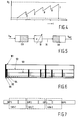
- Figure 4 shows characteristic VBV buffer contents as a function of time for a part of the MPEG frame sequence of Figure 1.
- the VBV is specifically defined for constant bit-rate operation. In case of variable bit-rate operation, the MPEG standard specifies that the definition of the VBV buffer is overruled by the definition of the T-STD.
- the bitstream is written into the buffer at the bit-rate specified in the sequence header.
- the bitstream contains information about the contents of the VBV buffer. This information is presented in a field in each picture header called the VBV delay, which specifies the time between the moment that the header enters the VBV buffer and the moment of decoding the picture.
- DTS decoding time stamp
- PTS presentation time stamp
- SCR system clock reference
- STD standard target decoder
- the systems part describes two types of systems layer: the transport stream and the program stream.
- the STD for the transport stream is referred to as T-STD and for the program stream the term P-STD is used. In the following the difference between these streams is explained.
- the program stream is defined for applications which have a very low error probability such as optical recording.
- the basic characteristic of the program stream is that it can convey only one program and that the bit-rate can be varying: as such it may be of limited general use.
- the transport stream which is intended for multi-program environments.
- the bit-rate for each program is allowed to vary but the sum of all bit-rates must be constant.
- the transport stream uses a fixed size packets of 188 bytes.
- the T-STD can be used for HD-CD (VBR optical medium) by reading a variable bit-rate from the disk and adding an artificial empty program to the bitstream in passing the information from the reader on to the decoder such that the total bit-rate is constant.
- the buffering model uses the following parameters
- the range of the buffer points is introduced as a separate variable which is time dependent, with the current buffer pointers E[n] and D[n] representing the buffer contents.
- a key variable in the buffer system is the input-output delay d which denotes the time between inputting a picture to the encoder and the time that this picture is decoded by the decoder.
- d the input-output delay
- Underflow in either of the two buffers is in fact a physical underflow and, hence, a loss of data.
- I-pictures over a series of pictures such as the sequence of Figure 1, we use two bit-rates; a relatively high one for the period of time containing the I-pictures and a lower one for the other classes of pictures. This provides us with higher peak bit-rates.
- a third bit-rate between the relatively high and relatively low levels
- the sequence of Figure 1 would comprise five GOP with the bit-rate following the pattern of high-low-medium-low-high over the series.
- Equation 5 The use of this specified bit-rate technique in the encoder may be detected from the decoder by testing Equation 5 on the bit stream. If the equation yields an "overflow" it shows the technique to have been used.
- Equation 4 The choices for our larger encoder buffer and appropriate bit-rate over time will now be described.
- the conventional choice made in Equation 4 is the source for existing problems: we have appreciated that by making an alternative choice more flexibility in the decoder is provided.
- bit rate has to change d samples after the source bit rate has changed and also that the bit rate will generally have to be changed within a picture, rather than at the header of a picture, although this may occasionally occur.
- bit rate changes are shown in terms of the MPEG syntax in Figure 6, where the reference numerals denote the following:
- the MPEG transport stream is meant for multi-program environments and the program stream is meant for environments with one program, like optical recording.
- Figure 6 shows how a video bit stream can be wrapped in a program stream.
- PACK-headers and PES-headers PES-packetized elementary stream.
- Equation 15 and Equation 16 are shown in Figure 7 which shows the skew between moment of inputting the groups of pictures to the buffer and the moment of changing the bit rate: the continuous lines represent the time interval in which the bits resulting from compressing a GOP are written into the buffer, and the dashed lines indicate the time interval for which the output bit rate calculated for that GOP is applied.
Landscapes
- Engineering & Computer Science (AREA)
- Multimedia (AREA)
- Signal Processing (AREA)
- Computer Networks & Wireless Communication (AREA)
- Compression Or Coding Systems Of Tv Signals (AREA)
- Reduction Or Emphasis Of Bandwidth Of Signals (AREA)
- Compression, Expansion, Code Conversion, And Decoders (AREA)
- Communication Control (AREA)
- Transmission Systems Not Characterized By The Medium Used For Transmission (AREA)
Applications Claiming Priority (3)
| Application Number | Priority Date | Filing Date | Title |
|---|---|---|---|
| US36633994A | 1994-12-28 | 1994-12-28 | |
| US366339 | 1994-12-28 | ||
| PCT/IB1995/001087 WO1996020575A2 (en) | 1994-12-28 | 1995-12-04 | Buffer management in variable bit-rate compression systems |
Publications (2)
| Publication Number | Publication Date |
|---|---|
| EP0753235A1 EP0753235A1 (en) | 1997-01-15 |
| EP0753235B1 true EP0753235B1 (en) | 2000-07-12 |
Family
ID=23442599
Family Applications (1)
| Application Number | Title | Priority Date | Filing Date |
|---|---|---|---|
| EP95937990A Expired - Lifetime EP0753235B1 (en) | 1994-12-28 | 1995-12-04 | Buffer management in variable bit-rate compression systems |
Country Status (10)
| Country | Link |
|---|---|
| US (2) | US6944221B1 (enExample) |
| EP (1) | EP0753235B1 (enExample) |
| JP (1) | JPH09510070A (enExample) |
| KR (1) | KR100407085B1 (enExample) |
| CN (1) | CN1115055C (enExample) |
| AT (1) | ATE194742T1 (enExample) |
| DE (1) | DE69517966T2 (enExample) |
| ES (1) | ES2150013T3 (enExample) |
| TW (1) | TW295765B (enExample) |
| WO (1) | WO1996020575A2 (enExample) |
Families Citing this family (38)
| Publication number | Priority date | Publication date | Assignee | Title |
|---|---|---|---|---|
| GB2307151A (en) * | 1995-11-10 | 1997-05-14 | British Broadcasting Corp | Digital coding of video signals |
| GB9607162D0 (en) * | 1996-04-04 | 1996-06-12 | Digi Media Vision Ltd | Improvements in or relating to the transmission of data |
| FR2748623B1 (fr) | 1996-05-09 | 1998-11-27 | Thomson Multimedia Sa | Encodeur a debit variable |
| US6011590A (en) * | 1997-01-03 | 2000-01-04 | Ncr Corporation | Method of transmitting compressed information to minimize buffer space |
| US6023233A (en) * | 1998-03-20 | 2000-02-08 | Craven; Peter G. | Data rate control for variable rate compression systems |
| EP1122955A4 (en) * | 1999-03-31 | 2008-09-24 | Matsushita Electric Industrial Co Ltd | METHOD AND APPARATUS FOR CONTINUOUS DECODING OF VIDEO STREAMS INCLUDING DATA SEQUENCES HAVING DIFFERENT FRAME FREQUENCIES |
| JP4063508B2 (ja) * | 2001-07-04 | 2008-03-19 | 日本電気株式会社 | ビットレート変換装置およびビットレート変換方法 |
| KR100420601B1 (ko) * | 2001-11-22 | 2004-03-02 | 에스케이 텔레콤주식회사 | 비디오 데이터 스트리밍 서비스 방법 |
| FR2835996A1 (fr) * | 2002-02-12 | 2003-08-15 | Koninkl Philips Electronics Nv | Procede d'encodage d'une sequence d'images numeriques |
| US7769084B1 (en) | 2002-07-15 | 2010-08-03 | Apple Inc. | Method for implementing a quantizer in a multimedia compression and encoding system |
| US7418037B1 (en) * | 2002-07-15 | 2008-08-26 | Apple Inc. | Method of performing rate control for a compression system |
| US7940843B1 (en) | 2002-12-16 | 2011-05-10 | Apple Inc. | Method of implementing improved rate control for a multimedia compression and encoding system |
| US7804897B1 (en) | 2002-12-16 | 2010-09-28 | Apple Inc. | Method for implementing an improved quantizer in a multimedia compression and encoding system |
| AU2004214313B2 (en) * | 2003-02-18 | 2010-05-20 | Nokia Technologies Oy | Picture coding method |
| JP2006518127A (ja) | 2003-02-18 | 2006-08-03 | ノキア コーポレイション | ピクチャ復号化方法 |
| US8428117B2 (en) * | 2003-04-24 | 2013-04-23 | Fujitsu Semiconductor Limited | Image encoder and image encoding method |
| US7535959B2 (en) | 2003-10-16 | 2009-05-19 | Nvidia Corporation | Apparatus, system, and method for video encoder rate control |
| US20050201471A1 (en) | 2004-02-13 | 2005-09-15 | Nokia Corporation | Picture decoding method |
| US7296205B2 (en) | 2004-02-18 | 2007-11-13 | Nokia Corporation | Data repair |
| KR100678891B1 (ko) * | 2004-07-30 | 2007-02-05 | 삼성전자주식회사 | Av데이터 수신시 버퍼량을 컨텐츠 속성에 따라탄력적으로 조절하는 방법 및 장치 |
| US9124907B2 (en) | 2004-10-04 | 2015-09-01 | Nokia Technologies Oy | Picture buffering method |
| DE102006034414B4 (de) * | 2006-07-25 | 2010-12-09 | Nokia Siemens Networks Gmbh & Co.Kg | Anordnung und Verfahren zur Dekodierung von digitalen Daten |
| US8184692B2 (en) * | 2006-09-25 | 2012-05-22 | Framecaster, Inc. | Distributed and automated video encoding and delivery system |
| WO2008044091A1 (en) * | 2006-10-10 | 2008-04-17 | Zoran (France) | Method and apparatus for spatio-temporal subband video enhancement with small time delay |
| US8578045B2 (en) * | 2007-02-14 | 2013-11-05 | Microsoft Corporation | Adaptive bandwidth utilization |
| EP2129130A1 (fr) * | 2008-05-26 | 2009-12-02 | THOMSON Licensing | Procédé de transmission simplifié d'un flux de signaux entre un émetteur et un appareil électronique |
| US9009337B2 (en) | 2008-12-22 | 2015-04-14 | Netflix, Inc. | On-device multiplexing of streaming media content |
| US9014545B2 (en) | 2009-07-24 | 2015-04-21 | Netflix, Inc. | Adaptive streaming for digital content distribution |
| US8631455B2 (en) | 2009-07-24 | 2014-01-14 | Netflix, Inc. | Adaptive streaming for digital content distribution |
| KR101389127B1 (ko) | 2010-05-06 | 2014-04-28 | 니폰덴신뎅와 가부시키가이샤 | 영상 부호화 제어 방법 및 장치 |
| ES2703005T3 (es) * | 2010-05-07 | 2019-03-06 | Nippon Telegraph & Telephone | Método de control de codificación de imágenes animadas, aparato de codificación de imágenes animadas y programa de codificación de imágenes animadas |
| RU2527740C2 (ru) | 2010-05-12 | 2014-09-10 | Ниппон Телеграф Энд Телефон Корпорейшн | Способ управления кодированием видео, устройство кодирования видео и программа кодирования видео |
| KR102244612B1 (ko) * | 2014-04-21 | 2021-04-26 | 삼성전자주식회사 | 무선 통신 시스템에서 음성 데이터를 송신 및 수신하기 위한 장치 및 방법 |
| GB2530898A (en) | 2014-08-21 | 2016-04-06 | Samsung Electronics Co Ltd | Image processor, image processing system including image processor, system-on-chip including image processing system, and method of operating image processing |
| KR102264161B1 (ko) | 2014-08-21 | 2021-06-11 | 삼성전자주식회사 | 이미지 처리 장치, 이미지 처리 시스템, 이미지 처리 시스템의 동작방법 및 이미지 처리 시스템을 포함하는 시스템 온 칩 |
| US11956158B2 (en) | 2020-06-08 | 2024-04-09 | Sky Peak Technologies, Inc. | Content shaping and routing in a network |
| CN116684609B (zh) * | 2022-11-18 | 2025-01-28 | 杭州海康威视数字技术股份有限公司 | 图像编解码方法、装置及存储介质 |
| CN116320532B (zh) * | 2023-03-17 | 2026-02-06 | 苏州元脑智能科技有限公司 | 调整串流延迟方法及装置 |
Family Cites Families (27)
| Publication number | Priority date | Publication date | Assignee | Title |
|---|---|---|---|---|
| DE69032361T2 (de) * | 1989-03-16 | 1998-10-29 | Fujitsu Ltd | Video/audiomultiplexübertragungssystem |
| FR2653953A1 (fr) * | 1989-10-27 | 1991-05-03 | Philips Electronique Lab | Dispositif de codage comportant un codeur a mots de longueur variable et dispositif de decodage associe. |
| US5134476A (en) * | 1990-03-30 | 1992-07-28 | At&T Bell Laboratories | Video signal encoding with bit rate control |
| GB9012538D0 (en) * | 1990-06-05 | 1990-07-25 | Philips Nv | Coding of video signals |
| US5038209A (en) * | 1990-09-27 | 1991-08-06 | At&T Bell Laboratories | Adaptive buffer/quantizer control for transform video coders |
| JP3187852B2 (ja) * | 1991-02-08 | 2001-07-16 | ソニー株式会社 | 高能率符号化方法 |
| US5159447A (en) * | 1991-05-23 | 1992-10-27 | At&T Bell Laboratories | Buffer control for variable bit-rate channel |
| CA2068751C (en) * | 1991-05-24 | 1998-05-19 | Tokumichi Murakami | Image coding system |
| WO1993015571A1 (en) * | 1992-01-29 | 1993-08-05 | Bell Communications Research, Inc. | Smoothing delay-sensitive traffic offered to atm networks |
| US5241383A (en) * | 1992-05-13 | 1993-08-31 | Bell Communications Research, Inc. | Pseudo-constant bit rate video coding with quantization parameter adjustment |
| JP3164647B2 (ja) * | 1992-06-03 | 2001-05-08 | 株式会社東芝 | 動画像符号化方法及び装置 |
| US5287182A (en) * | 1992-07-02 | 1994-02-15 | At&T Bell Laboratories | Timing recovery for variable bit-rate video on asynchronous transfer mode (ATM) networks |
| US5426463A (en) * | 1993-02-22 | 1995-06-20 | Rca Thomson Licensing Corporation | Apparatus for controlling quantizing in a video signal compressor |
| US5410355A (en) * | 1993-04-02 | 1995-04-25 | Rca Thomson Licensing Corporation | Video signal processor including input codeword buffer for providing stored codewords to codeword priority analysis circuit |
| EP0694245A4 (en) * | 1993-04-16 | 1996-05-08 | Data Translation Inc | VARIABLE QUANTIFICATION ADAPTIVE VIDEO COMPRESSION |
| US5561466A (en) * | 1993-06-23 | 1996-10-01 | Nec Corporation | Video and audio data multiplexing into ATM cells with no dummy cell used and ATM cell demultiplexing |
| JPH0730589A (ja) * | 1993-07-06 | 1995-01-31 | Canon Inc | データ送信装置 |
| US5461619A (en) * | 1993-07-06 | 1995-10-24 | Zenith Electronics Corp. | System for multiplexed transmission of compressed video and auxiliary data |
| JP3224465B2 (ja) * | 1993-12-22 | 2001-10-29 | シャープ株式会社 | 画像符号化装置 |
| JPH07202820A (ja) * | 1993-12-28 | 1995-08-04 | Matsushita Electric Ind Co Ltd | ビットレート制御システム |
| JPH07212710A (ja) * | 1994-01-21 | 1995-08-11 | Hitachi Ltd | 画像送信方法および画像送信装置および画像受信方法および画像受信装置および可変速度対応蓄積装置 |
| US5563961A (en) * | 1994-03-03 | 1996-10-08 | Radius Inc. | Video data compression method and system which measures compressed data storage time to optimize compression rate |
| US5566208A (en) * | 1994-03-17 | 1996-10-15 | Philips Electronics North America Corp. | Encoder buffer having an effective size which varies automatically with the channel bit-rate |
| US5541852A (en) * | 1994-04-14 | 1996-07-30 | Motorola, Inc. | Device, method and system for variable bit-rate packet video communications |
| US5506844A (en) * | 1994-05-20 | 1996-04-09 | Compression Labs, Inc. | Method for configuring a statistical multiplexer to dynamically allocate communication channel bandwidth |
| US5534944A (en) * | 1994-07-15 | 1996-07-09 | Matsushita Electric Corporation Of America | Method of splicing MPEG encoded video |
| US5606369A (en) | 1994-12-28 | 1997-02-25 | U.S. Philips Corporation | Buffering for digital video signal encoders using joint bit-rate control |
-
1995
- 1995-12-04 AT AT95937990T patent/ATE194742T1/de not_active IP Right Cessation
- 1995-12-04 KR KR1019960704805A patent/KR100407085B1/ko not_active Expired - Fee Related
- 1995-12-04 ES ES95937990T patent/ES2150013T3/es not_active Expired - Lifetime
- 1995-12-04 EP EP95937990A patent/EP0753235B1/en not_active Expired - Lifetime
- 1995-12-04 JP JP8520326A patent/JPH09510070A/ja active Pending
- 1995-12-04 DE DE69517966T patent/DE69517966T2/de not_active Expired - Fee Related
- 1995-12-04 CN CN95192467A patent/CN1115055C/zh not_active Expired - Fee Related
- 1995-12-04 WO PCT/IB1995/001087 patent/WO1996020575A2/en not_active Ceased
- 1995-12-12 TW TW084113226A patent/TW295765B/zh active
-
1997
- 1997-07-28 US US08/901,338 patent/US6944221B1/en not_active Expired - Fee Related
-
2004
- 2004-12-03 US US11/003,992 patent/US20050100094A1/en not_active Abandoned
Also Published As
| Publication number | Publication date |
|---|---|
| DE69517966T2 (de) | 2001-02-15 |
| WO1996020575A2 (en) | 1996-07-04 |
| WO1996020575A3 (en) | 1996-09-06 |
| ATE194742T1 (de) | 2000-07-15 |
| KR100407085B1 (ko) | 2004-03-20 |
| CN1115055C (zh) | 2003-07-16 |
| US6944221B1 (en) | 2005-09-13 |
| CN1145154A (zh) | 1997-03-12 |
| TW295765B (enExample) | 1997-01-11 |
| KR970701984A (ko) | 1997-04-12 |
| EP0753235A1 (en) | 1997-01-15 |
| ES2150013T3 (es) | 2000-11-16 |
| JPH09510070A (ja) | 1997-10-07 |
| DE69517966D1 (de) | 2000-08-17 |
| US20050100094A1 (en) | 2005-05-12 |
Similar Documents
| Publication | Publication Date | Title |
|---|---|---|
| US6944221B1 (en) | Buffer management in variable bit-rate compression systems | |
| US5606369A (en) | Buffering for digital video signal encoders using joint bit-rate control | |
| US5963256A (en) | Coding according to degree of coding difficulty in conformity with a target bit rate | |
| US5361097A (en) | Priority processing of encoded video signal including insertion of datastream null words during priority analysis intervals | |
| US6188700B1 (en) | Method and apparatus for encoding MPEG signals using variable rate encoding and dynamically varying transmission buffers | |
| EP1149498B1 (en) | Method for detecting and preventing bandwidth overflow in a statistical multiplexer | |
| US6327421B1 (en) | Multiple speed fast forward/rewind compressed video delivery system | |
| US6418122B1 (en) | Method and apparatus for assuring sufficient bandwidth of a statistical multiplexer | |
| US5481543A (en) | Rational input buffer arrangements for auxiliary information in video and audio signal processing systems | |
| US7433946B2 (en) | Mechanism for transmitting elementary streams in a broadcast environment | |
| US5572333A (en) | Compressed data recording method using integral logical block size and physical block size ratios | |
| US6792001B1 (en) | Method and device for transmitting data packets | |
| US5694332A (en) | MPEG audio decoding system with subframe input buffering | |
| US5751356A (en) | Video/audio signal coding system and method | |
| GB2309611A (en) | A motion video compression system with buffer empty/fill look-ahead bit allocation | |
| EP0933949B1 (en) | Transmitting system, transmitting apparatus, recording and reproducing apparatus | |
| EP0826289B1 (en) | Data multiplexing apparatus | |
| US6546013B1 (en) | Method and apparatus for delivering reference signal information within a specified time interval | |
| WO2002049364A2 (en) | Method and apparatus for adaptive bit rate control in an asynchronized encoding system | |
| US7130265B1 (en) | Data multiplexing device and data multiplexing method, and data transmitter | |
| JPH09312625A (ja) | データ多重化装置およびその方法 | |
| JPH09312656A (ja) | 伝送装置およびその方法 | |
| EP0891673A1 (en) | Buffer control in a coded data transmission system | |
| Lu et al. | Mechanisms of MPEG stream synchronization | |
| KR100269787B1 (ko) | 엠펙 포맷 간의 실시간 데이터 변환 방법 |
Legal Events
| Date | Code | Title | Description |
|---|---|---|---|
| PUAI | Public reference made under article 153(3) epc to a published international application that has entered the european phase |
Free format text: ORIGINAL CODE: 0009012 |
|
| AK | Designated contracting states |
Kind code of ref document: A1 Designated state(s): AT BE DE ES FR GB IT |
|
| 17P | Request for examination filed |
Effective date: 19970107 |
|
| 17Q | First examination report despatched |
Effective date: 19990121 |
|
| GRAG | Despatch of communication of intention to grant |
Free format text: ORIGINAL CODE: EPIDOS AGRA |
|
| GRAG | Despatch of communication of intention to grant |
Free format text: ORIGINAL CODE: EPIDOS AGRA |
|
| GRAH | Despatch of communication of intention to grant a patent |
Free format text: ORIGINAL CODE: EPIDOS IGRA |
|
| GRAH | Despatch of communication of intention to grant a patent |
Free format text: ORIGINAL CODE: EPIDOS IGRA |
|
| GRAA | (expected) grant |
Free format text: ORIGINAL CODE: 0009210 |
|
| AK | Designated contracting states |
Kind code of ref document: B1 Designated state(s): AT BE DE ES FR GB IT |
|
| PG25 | Lapsed in a contracting state [announced via postgrant information from national office to epo] |
Ref country code: BE Free format text: LAPSE BECAUSE OF FAILURE TO SUBMIT A TRANSLATION OF THE DESCRIPTION OR TO PAY THE FEE WITHIN THE PRESCRIBED TIME-LIMIT Effective date: 20000712 Ref country code: AT Free format text: LAPSE BECAUSE OF FAILURE TO SUBMIT A TRANSLATION OF THE DESCRIPTION OR TO PAY THE FEE WITHIN THE PRESCRIBED TIME-LIMIT Effective date: 20000712 |
|
| REF | Corresponds to: |
Ref document number: 194742 Country of ref document: AT Date of ref document: 20000715 Kind code of ref document: T |
|
| REF | Corresponds to: |
Ref document number: 69517966 Country of ref document: DE Date of ref document: 20000817 |
|
| ITF | It: translation for a ep patent filed | ||
| ET | Fr: translation filed | ||
| REG | Reference to a national code |
Ref country code: ES Ref legal event code: FG2A Ref document number: 2150013 Country of ref document: ES Kind code of ref document: T3 |
|
| PLBE | No opposition filed within time limit |
Free format text: ORIGINAL CODE: 0009261 |
|
| STAA | Information on the status of an ep patent application or granted ep patent |
Free format text: STATUS: NO OPPOSITION FILED WITHIN TIME LIMIT |
|
| 26N | No opposition filed | ||
| PGFP | Annual fee paid to national office [announced via postgrant information from national office to epo] |
Ref country code: ES Payment date: 20011218 Year of fee payment: 7 |
|
| REG | Reference to a national code |
Ref country code: GB Ref legal event code: IF02 |
|
| PG25 | Lapsed in a contracting state [announced via postgrant information from national office to epo] |
Ref country code: ES Free format text: LAPSE BECAUSE OF NON-PAYMENT OF DUE FEES Effective date: 20021205 |
|
| REG | Reference to a national code |
Ref country code: ES Ref legal event code: FD2A Effective date: 20021205 |
|
| PG25 | Lapsed in a contracting state [announced via postgrant information from national office to epo] |
Ref country code: IT Free format text: LAPSE BECAUSE OF NON-PAYMENT OF DUE FEES Effective date: 20051204 |
|
| REG | Reference to a national code |
Ref country code: GB Ref legal event code: 732E Free format text: REGISTERED BETWEEN 20090305 AND 20090311 |
|
| PGFP | Annual fee paid to national office [announced via postgrant information from national office to epo] |
Ref country code: FR Payment date: 20081212 Year of fee payment: 14 |
|
| PGFP | Annual fee paid to national office [announced via postgrant information from national office to epo] |
Ref country code: DE Payment date: 20081219 Year of fee payment: 14 |
|
| PGFP | Annual fee paid to national office [announced via postgrant information from national office to epo] |
Ref country code: GB Payment date: 20081216 Year of fee payment: 14 |
|
| GBPC | Gb: european patent ceased through non-payment of renewal fee |
Effective date: 20091204 |
|
| REG | Reference to a national code |
Ref country code: FR Ref legal event code: ST Effective date: 20100831 |
|
| PG25 | Lapsed in a contracting state [announced via postgrant information from national office to epo] |
Ref country code: FR Free format text: LAPSE BECAUSE OF NON-PAYMENT OF DUE FEES Effective date: 20091231 |
|
| PG25 | Lapsed in a contracting state [announced via postgrant information from national office to epo] |
Ref country code: DE Free format text: LAPSE BECAUSE OF NON-PAYMENT OF DUE FEES Effective date: 20100701 |
|
| PG25 | Lapsed in a contracting state [announced via postgrant information from national office to epo] |
Ref country code: GB Free format text: LAPSE BECAUSE OF NON-PAYMENT OF DUE FEES Effective date: 20091204 |