EP0745640A1 - Prepreg and fiber-reinforced composite material - Google Patents
Prepreg and fiber-reinforced composite material Download PDFInfo
- Publication number
- EP0745640A1 EP0745640A1 EP95938641A EP95938641A EP0745640A1 EP 0745640 A1 EP0745640 A1 EP 0745640A1 EP 95938641 A EP95938641 A EP 95938641A EP 95938641 A EP95938641 A EP 95938641A EP 0745640 A1 EP0745640 A1 EP 0745640A1
- Authority
- EP
- European Patent Office
- Prior art keywords
- prepreg
- epoxy resin
- resin
- thermoplastic resin
- epoxy
- Prior art date
- Legal status (The legal status is an assumption and is not a legal conclusion. Google has not performed a legal analysis and makes no representation as to the accuracy of the status listed.)
- Granted
Links
- 239000000463 material Substances 0.000 title claims description 29
- 239000003733 fiber-reinforced composite Substances 0.000 title claims description 12
- 239000003822 epoxy resin Substances 0.000 claims abstract description 147
- 229920000647 polyepoxide Polymers 0.000 claims abstract description 147
- 229920005989 resin Polymers 0.000 claims abstract description 94
- 239000011347 resin Substances 0.000 claims abstract description 94
- 239000000203 mixture Substances 0.000 claims abstract description 79
- 229920005992 thermoplastic resin Polymers 0.000 claims abstract description 71
- XLYOFNOQVPJJNP-UHFFFAOYSA-N water Substances O XLYOFNOQVPJJNP-UHFFFAOYSA-N 0.000 claims abstract description 65
- 238000010521 absorption reaction Methods 0.000 claims abstract description 48
- 239000011159 matrix material Substances 0.000 claims abstract description 34
- 239000012783 reinforcing fiber Substances 0.000 claims abstract description 15
- LJGHYPLBDBRCRZ-UHFFFAOYSA-N 3-(3-aminophenyl)sulfonylaniline Chemical compound NC1=CC=CC(S(=O)(=O)C=2C=C(N)C=CC=2)=C1 LJGHYPLBDBRCRZ-UHFFFAOYSA-N 0.000 claims description 67
- 239000002245 particle Substances 0.000 claims description 61
- -1 diamine compound Chemical class 0.000 claims description 42
- 239000000835 fiber Substances 0.000 claims description 27
- LNEPOXFFQSENCJ-UHFFFAOYSA-N haloperidol Chemical compound C1CC(O)(C=2C=CC(Cl)=CC=2)CCN1CCCC(=O)C1=CC=C(F)C=C1 LNEPOXFFQSENCJ-UHFFFAOYSA-N 0.000 claims description 27
- 125000003700 epoxy group Chemical group 0.000 claims description 24
- 229920000049 Carbon (fiber) Polymers 0.000 claims description 22
- 239000004917 carbon fiber Substances 0.000 claims description 22
- UUODQIKUTGWMPT-UHFFFAOYSA-N 2-fluoro-5-(trifluoromethyl)pyridine Chemical compound FC1=CC=C(C(F)(F)F)C=N1 UUODQIKUTGWMPT-UHFFFAOYSA-N 0.000 claims description 19
- IISBACLAFKSPIT-UHFFFAOYSA-N bisphenol A Chemical compound C=1C=C(O)C=CC=1C(C)(C)C1=CC=C(O)C=C1 IISBACLAFKSPIT-UHFFFAOYSA-N 0.000 claims description 18
- 239000002131 composite material Substances 0.000 claims description 18
- 125000001997 phenyl group Chemical group [H]C1=C([H])C([H])=C(*)C([H])=C1[H] 0.000 claims description 17
- 229920001601 polyetherimide Polymers 0.000 claims description 17
- PXKLMJQFEQBVLD-UHFFFAOYSA-N bisphenol F Chemical compound C1=CC(O)=CC=C1CC1=CC=C(O)C=C1 PXKLMJQFEQBVLD-UHFFFAOYSA-N 0.000 claims description 16
- 125000004435 hydrogen atom Chemical group [H]* 0.000 claims description 14
- 125000000217 alkyl group Chemical group 0.000 claims description 11
- 125000003277 amino group Chemical group 0.000 claims description 10
- 125000004432 carbon atom Chemical group C* 0.000 claims description 10
- 125000003118 aryl group Chemical group 0.000 claims description 9
- 230000009477 glass transition Effects 0.000 claims description 9
- 125000005843 halogen group Chemical group 0.000 claims description 8
- 229920002492 poly(sulfone) Polymers 0.000 claims description 8
- GYZLOYUZLJXAJU-UHFFFAOYSA-N diglycidyl ether Chemical compound C1OC1COCC1CO1 GYZLOYUZLJXAJU-UHFFFAOYSA-N 0.000 claims description 7
- 229920002647 polyamide Polymers 0.000 claims description 7
- 239000004952 Polyamide Substances 0.000 claims description 6
- 239000010408 film Substances 0.000 claims description 6
- 238000010030 laminating Methods 0.000 claims description 6
- 239000000843 powder Substances 0.000 claims description 6
- 239000004642 Polyimide Substances 0.000 claims description 5
- 229920001721 polyimide Polymers 0.000 claims description 5
- 150000001875 compounds Chemical class 0.000 claims description 3
- RTZKZFJDLAIYFH-UHFFFAOYSA-N ether Substances CCOCC RTZKZFJDLAIYFH-UHFFFAOYSA-N 0.000 claims description 3
- XQUPVDVFXZDTLT-UHFFFAOYSA-N 1-[4-[[4-(2,5-dioxopyrrol-1-yl)phenyl]methyl]phenyl]pyrrole-2,5-dione Chemical compound O=C1C=CC(=O)N1C(C=C1)=CC=C1CC1=CC=C(N2C(C=CC2=O)=O)C=C1 XQUPVDVFXZDTLT-UHFFFAOYSA-N 0.000 claims description 2
- 229920003192 poly(bis maleimide) Polymers 0.000 claims description 2
- 229920002312 polyamide-imide Polymers 0.000 claims description 2
- 239000011229 interlayer Substances 0.000 abstract description 18
- 239000003795 chemical substances by application Substances 0.000 abstract description 14
- 238000007796 conventional method Methods 0.000 abstract description 2
- 230000008094 contradictory effect Effects 0.000 abstract 1
- IGALFTFNPPBUDN-UHFFFAOYSA-N phenyl-[2,3,4,5-tetrakis(oxiran-2-ylmethyl)phenyl]methanediamine Chemical compound C=1C(CC2OC2)=C(CC2OC2)C(CC2OC2)=C(CC2OC2)C=1C(N)(N)C1=CC=CC=C1 IGALFTFNPPBUDN-UHFFFAOYSA-N 0.000 description 47
- 239000011342 resin composition Substances 0.000 description 44
- 239000004593 Epoxy Substances 0.000 description 40
- 239000000126 substance Substances 0.000 description 38
- 239000002994 raw material Substances 0.000 description 28
- 238000004519 manufacturing process Methods 0.000 description 26
- 239000004677 Nylon Substances 0.000 description 19
- 229920001778 nylon Polymers 0.000 description 19
- 239000004695 Polyether sulfone Substances 0.000 description 16
- 239000004697 Polyetherimide Substances 0.000 description 16
- 238000005259 measurement Methods 0.000 description 16
- 229920006393 polyether sulfone Polymers 0.000 description 16
- 230000007423 decrease Effects 0.000 description 14
- MEVBAGCIOOTPLF-UHFFFAOYSA-N 2-[[5-(oxiran-2-ylmethoxy)naphthalen-2-yl]oxymethyl]oxirane Chemical compound C1OC1COC(C=C1C=CC=2)=CC=C1C=2OCC1CO1 MEVBAGCIOOTPLF-UHFFFAOYSA-N 0.000 description 12
- 230000000052 comparative effect Effects 0.000 description 12
- 230000000704 physical effect Effects 0.000 description 12
- MQJKPEGWNLWLTK-UHFFFAOYSA-N Dapsone Chemical compound C1=CC(N)=CC=C1S(=O)(=O)C1=CC=C(N)C=C1 MQJKPEGWNLWLTK-UHFFFAOYSA-N 0.000 description 11
- 238000000034 method Methods 0.000 description 10
- 229920004747 ULTEM® 1000 Polymers 0.000 description 9
- 229920003023 plastic Polymers 0.000 description 9
- 239000004033 plastic Substances 0.000 description 9
- 230000002708 enhancing effect Effects 0.000 description 7
- 229920001187 thermosetting polymer Polymers 0.000 description 7
- 230000000694 effects Effects 0.000 description 6
- 229920000642 polymer Polymers 0.000 description 6
- 238000012360 testing method Methods 0.000 description 6
- IGZBSJAMZHNHKE-UHFFFAOYSA-N 2-[[4-[bis[4-(oxiran-2-ylmethoxy)phenyl]methyl]phenoxy]methyl]oxirane Chemical compound C1OC1COC(C=C1)=CC=C1C(C=1C=CC(OCC2OC2)=CC=1)C(C=C1)=CC=C1OCC1CO1 IGZBSJAMZHNHKE-UHFFFAOYSA-N 0.000 description 5
- 239000004615 ingredient Substances 0.000 description 5
- 239000002904 solvent Substances 0.000 description 5
- PULOARGYCVHSDH-UHFFFAOYSA-N 2-amino-3,4,5-tris(oxiran-2-ylmethyl)phenol Chemical group C1OC1CC1=C(CC2OC2)C(N)=C(O)C=C1CC1CO1 PULOARGYCVHSDH-UHFFFAOYSA-N 0.000 description 4
- CDAWCLOXVUBKRW-UHFFFAOYSA-N 2-aminophenol Chemical compound NC1=CC=CC=C1O CDAWCLOXVUBKRW-UHFFFAOYSA-N 0.000 description 4
- 238000006243 chemical reaction Methods 0.000 description 4
- 238000004132 cross linking Methods 0.000 description 4
- 230000003247 decreasing effect Effects 0.000 description 4
- 229920001971 elastomer Polymers 0.000 description 4
- 239000000806 elastomer Substances 0.000 description 4
- 230000008569 process Effects 0.000 description 4
- APAWRBPAPZEOEZ-UHFFFAOYSA-N C(C1CO1)C(C1=CC(=CC=C1O)N)(CC1CO1)CC1CO1 Chemical compound C(C1CO1)C(C1=CC(=CC=C1O)N)(CC1CO1)CC1CO1 APAWRBPAPZEOEZ-UHFFFAOYSA-N 0.000 description 3
- OKTJSMMVPCPJKN-UHFFFAOYSA-N Carbon Chemical compound [C] OKTJSMMVPCPJKN-UHFFFAOYSA-N 0.000 description 3
- 150000004985 diamines Chemical class 0.000 description 3
- 239000004744 fabric Substances 0.000 description 3
- 239000010439 graphite Substances 0.000 description 3
- 229910002804 graphite Inorganic materials 0.000 description 3
- 230000009257 reactivity Effects 0.000 description 3
- 239000002759 woven fabric Substances 0.000 description 3
- ZMPZWXKBGSQATE-UHFFFAOYSA-N 3-(4-aminophenyl)sulfonylaniline Chemical compound C1=CC(N)=CC=C1S(=O)(=O)C1=CC=CC(N)=C1 ZMPZWXKBGSQATE-UHFFFAOYSA-N 0.000 description 2
- WCXGOVYROJJXHA-UHFFFAOYSA-N 3-[4-[4-(3-aminophenoxy)phenyl]sulfonylphenoxy]aniline Chemical compound NC1=CC=CC(OC=2C=CC(=CC=2)S(=O)(=O)C=2C=CC(OC=3C=C(N)C=CC=3)=CC=2)=C1 WCXGOVYROJJXHA-UHFFFAOYSA-N 0.000 description 2
- RDIGYBZNNOGMHU-UHFFFAOYSA-N 3-amino-2,4,5-tris(oxiran-2-ylmethyl)phenol Chemical compound OC1=CC(CC2OC2)=C(CC2OC2)C(N)=C1CC1CO1 RDIGYBZNNOGMHU-UHFFFAOYSA-N 0.000 description 2
- AFCARXCZXQIEQB-UHFFFAOYSA-N N-[3-oxo-3-(2,4,6,7-tetrahydrotriazolo[4,5-c]pyridin-5-yl)propyl]-2-[[3-(trifluoromethoxy)phenyl]methylamino]pyrimidine-5-carboxamide Chemical compound O=C(CCNC(=O)C=1C=NC(=NC=1)NCC1=CC(=CC=C1)OC(F)(F)F)N1CC2=C(CC1)NN=N2 AFCARXCZXQIEQB-UHFFFAOYSA-N 0.000 description 2
- UFWIBTONFRDIAS-UHFFFAOYSA-N Naphthalene Chemical compound C1=CC=CC2=CC=CC=C21 UFWIBTONFRDIAS-UHFFFAOYSA-N 0.000 description 2
- MWPLVEDNUUSJAV-UHFFFAOYSA-N anthracene Chemical compound C1=CC=CC2=CC3=CC=CC=C3C=C21 MWPLVEDNUUSJAV-UHFFFAOYSA-N 0.000 description 2
- 239000011248 coating agent Substances 0.000 description 2
- 238000000576 coating method Methods 0.000 description 2
- VPUGDVKSAQVFFS-UHFFFAOYSA-N coronene Chemical compound C1=C(C2=C34)C=CC3=CC=C(C=C3)C4=C4C3=CC=C(C=C3)C4=C2C3=C1 VPUGDVKSAQVFFS-UHFFFAOYSA-N 0.000 description 2
- 229920006037 cross link polymer Polymers 0.000 description 2
- 238000005520 cutting process Methods 0.000 description 2
- 125000001495 ethyl group Chemical group [H]C([H])([H])C([H])([H])* 0.000 description 2
- NIHNNTQXNPWCJQ-UHFFFAOYSA-N fluorene Chemical compound C1=CC=C2CC3=CC=CC=C3C2=C1 NIHNNTQXNPWCJQ-UHFFFAOYSA-N 0.000 description 2
- 125000000524 functional group Chemical group 0.000 description 2
- 238000005470 impregnation Methods 0.000 description 2
- VNWKTOKETHGBQD-UHFFFAOYSA-N methane Chemical compound C VNWKTOKETHGBQD-UHFFFAOYSA-N 0.000 description 2
- 125000002496 methyl group Chemical group [H]C([H])([H])* 0.000 description 2
- 239000004745 nonwoven fabric Substances 0.000 description 2
- 238000005191 phase separation Methods 0.000 description 2
- YNPNZTXNASCQKK-UHFFFAOYSA-N phenanthrene Chemical compound C1=CC=C2C3=CC=CC=C3C=CC2=C1 YNPNZTXNASCQKK-UHFFFAOYSA-N 0.000 description 2
- 238000012545 processing Methods 0.000 description 2
- BBEAQIROQSPTKN-UHFFFAOYSA-N pyrene Chemical compound C1=CC=C2C=CC3=CC=CC4=CC=C1C2=C43 BBEAQIROQSPTKN-UHFFFAOYSA-N 0.000 description 2
- 239000012798 spherical particle Substances 0.000 description 2
- 238000003860 storage Methods 0.000 description 2
- HECLRDQVFMWTQS-RGOKHQFPSA-N 1755-01-7 Chemical compound C1[C@H]2[C@@H]3CC=C[C@@H]3[C@@H]1C=C2 HECLRDQVFMWTQS-RGOKHQFPSA-N 0.000 description 1
- HDDQXUDCEIMISH-UHFFFAOYSA-N 2-[[4-[1,2,2-tris[4-(oxiran-2-ylmethoxy)phenyl]ethyl]phenoxy]methyl]oxirane Chemical compound C1OC1COC(C=C1)=CC=C1C(C=1C=CC(OCC2OC2)=CC=1)C(C=1C=CC(OCC2OC2)=CC=1)C(C=C1)=CC=C1OCC1CO1 HDDQXUDCEIMISH-UHFFFAOYSA-N 0.000 description 1
- ZBMISJGHVWNWTE-UHFFFAOYSA-N 3-(4-aminophenoxy)aniline Chemical compound C1=CC(N)=CC=C1OC1=CC=CC(N)=C1 ZBMISJGHVWNWTE-UHFFFAOYSA-N 0.000 description 1
- CKOFBUUFHALZGK-UHFFFAOYSA-N 3-[(3-aminophenyl)methyl]aniline Chemical compound NC1=CC=CC(CC=2C=C(N)C=CC=2)=C1 CKOFBUUFHALZGK-UHFFFAOYSA-N 0.000 description 1
- FGWQCROGAHMWSU-UHFFFAOYSA-N 3-[(4-aminophenyl)methyl]aniline Chemical compound C1=CC(N)=CC=C1CC1=CC=CC(N)=C1 FGWQCROGAHMWSU-UHFFFAOYSA-N 0.000 description 1
- VPWNQTHUCYMVMZ-UHFFFAOYSA-N 4,4'-sulfonyldiphenol Chemical compound C1=CC(O)=CC=C1S(=O)(=O)C1=CC=C(O)C=C1 VPWNQTHUCYMVMZ-UHFFFAOYSA-N 0.000 description 1
- FAUAZXVRLVIARB-UHFFFAOYSA-N 4-[[4-[bis(oxiran-2-ylmethyl)amino]phenyl]methyl]-n,n-bis(oxiran-2-ylmethyl)aniline Chemical compound C1OC1CN(C=1C=CC(CC=2C=CC(=CC=2)N(CC2OC2)CC2OC2)=CC=1)CC1CO1 FAUAZXVRLVIARB-UHFFFAOYSA-N 0.000 description 1
- HTVITOHKHWFJKO-UHFFFAOYSA-N Bisphenol B Chemical compound C=1C=C(O)C=CC=1C(C)(CC)C1=CC=C(O)C=C1 HTVITOHKHWFJKO-UHFFFAOYSA-N 0.000 description 1
- ZOXJGFHDIHLPTG-UHFFFAOYSA-N Boron Chemical compound [B] ZOXJGFHDIHLPTG-UHFFFAOYSA-N 0.000 description 1
- WKBOTKDWSSQWDR-UHFFFAOYSA-N Bromine atom Chemical group [Br] WKBOTKDWSSQWDR-UHFFFAOYSA-N 0.000 description 1
- YDXAHHDARHRABV-UHFFFAOYSA-N CCC(CC(COc1ccc(C(C)(C)c(cc2)ccc2OC(C)C)cc1)O)=C Chemical compound CCC(CC(COc1ccc(C(C)(C)c(cc2)ccc2OC(C)C)cc1)O)=C YDXAHHDARHRABV-UHFFFAOYSA-N 0.000 description 1
- 0 Cc(cc1)ccc1S(c(cc1)ccc1O*=C)(=O)=O Chemical compound Cc(cc1)ccc1S(c(cc1)ccc1O*=C)(=O)=O 0.000 description 1
- PEEHTFAAVSWFBL-UHFFFAOYSA-N Maleimide Chemical compound O=C1NC(=O)C=C1 PEEHTFAAVSWFBL-UHFFFAOYSA-N 0.000 description 1
- KWYHDKDOAIKMQN-UHFFFAOYSA-N N,N,N',N'-tetramethylethylenediamine Chemical compound CN(C)CCN(C)C KWYHDKDOAIKMQN-UHFFFAOYSA-N 0.000 description 1
- 229920012266 Poly(ether sulfone) PES Polymers 0.000 description 1
- 239000011157 advanced composite material Substances 0.000 description 1
- PNEYBMLMFCGWSK-UHFFFAOYSA-N aluminium oxide Inorganic materials [O-2].[O-2].[O-2].[Al+3].[Al+3] PNEYBMLMFCGWSK-UHFFFAOYSA-N 0.000 description 1
- 150000001412 amines Chemical class 0.000 description 1
- 239000004760 aramid Substances 0.000 description 1
- 229920006231 aramid fiber Polymers 0.000 description 1
- 230000008901 benefit Effects 0.000 description 1
- 230000015572 biosynthetic process Effects 0.000 description 1
- 230000000903 blocking effect Effects 0.000 description 1
- 229910052796 boron Inorganic materials 0.000 description 1
- 125000003178 carboxy group Chemical group [H]OC(*)=O 0.000 description 1
- 230000008859 change Effects 0.000 description 1
- 229910052801 chlorine Inorganic materials 0.000 description 1
- 125000001309 chloro group Chemical group Cl* 0.000 description 1
- 238000007906 compression Methods 0.000 description 1
- 230000006835 compression Effects 0.000 description 1
- 229920001577 copolymer Polymers 0.000 description 1
- XLJMAIOERFSOGZ-UHFFFAOYSA-M cyanate Chemical compound [O-]C#N XLJMAIOERFSOGZ-UHFFFAOYSA-M 0.000 description 1
- 230000032798 delamination Effects 0.000 description 1
- 238000013461 design Methods 0.000 description 1
- 239000006185 dispersion Substances 0.000 description 1
- 238000004090 dissolution Methods 0.000 description 1
- 238000009826 distribution Methods 0.000 description 1
- 238000011156 evaluation Methods 0.000 description 1
- 230000001747 exhibiting effect Effects 0.000 description 1
- 244000144992 flock Species 0.000 description 1
- GVEPBJHOBDJJJI-UHFFFAOYSA-N fluoranthrene Natural products C1=CC(C2=CC=CC=C22)=C3C2=CC=CC3=C1 GVEPBJHOBDJJJI-UHFFFAOYSA-N 0.000 description 1
- 238000009472 formulation Methods 0.000 description 1
- 239000003365 glass fiber Substances 0.000 description 1
- 125000003055 glycidyl group Chemical group C(C1CO1)* 0.000 description 1
- 238000010438 heat treatment Methods 0.000 description 1
- 125000002887 hydroxy group Chemical group [H]O* 0.000 description 1
- 230000006872 improvement Effects 0.000 description 1
- 230000016507 interphase Effects 0.000 description 1
- 125000001449 isopropyl group Chemical group [H]C([H])([H])C([H])(*)C([H])([H])[H] 0.000 description 1
- 239000002075 main ingredient Substances 0.000 description 1
- 229920003986 novolac Polymers 0.000 description 1
- AFEQENGXSMURHA-UHFFFAOYSA-N oxiran-2-ylmethanamine Chemical compound NCC1CO1 AFEQENGXSMURHA-UHFFFAOYSA-N 0.000 description 1
- 229920006287 phenoxy resin Polymers 0.000 description 1
- 239000013034 phenoxy resin Substances 0.000 description 1
- 229920000728 polyester Polymers 0.000 description 1
- 229920001470 polyketone Polymers 0.000 description 1
- 230000009467 reduction Effects 0.000 description 1
- 238000007788 roughening Methods 0.000 description 1
- HBMJWWWQQXIZIP-UHFFFAOYSA-N silicon carbide Chemical compound [Si+]#[C-] HBMJWWWQQXIZIP-UHFFFAOYSA-N 0.000 description 1
- 229910010271 silicon carbide Inorganic materials 0.000 description 1
- 239000000243 solution Substances 0.000 description 1
- 239000004575 stone Substances 0.000 description 1
- 229920001169 thermoplastic Polymers 0.000 description 1
- 239000004416 thermosoftening plastic Substances 0.000 description 1
- UONOETXJSWQNOL-UHFFFAOYSA-N tungsten carbide Chemical compound [W+]#[C-] UONOETXJSWQNOL-UHFFFAOYSA-N 0.000 description 1
Classifications
-
- C—CHEMISTRY; METALLURGY
- C08—ORGANIC MACROMOLECULAR COMPOUNDS; THEIR PREPARATION OR CHEMICAL WORKING-UP; COMPOSITIONS BASED THEREON
- C08G—MACROMOLECULAR COMPOUNDS OBTAINED OTHERWISE THAN BY REACTIONS ONLY INVOLVING UNSATURATED CARBON-TO-CARBON BONDS
- C08G59/00—Polycondensates containing more than one epoxy group per molecule; Macromolecules obtained by polymerising compounds containing more than one epoxy group per molecule using curing agents or catalysts which react with the epoxy groups
- C08G59/18—Macromolecules obtained by polymerising compounds containing more than one epoxy group per molecule using curing agents or catalysts which react with the epoxy groups ; e.g. general methods of curing
- C08G59/20—Macromolecules obtained by polymerising compounds containing more than one epoxy group per molecule using curing agents or catalysts which react with the epoxy groups ; e.g. general methods of curing characterised by the epoxy compounds used
-
- C—CHEMISTRY; METALLURGY
- C08—ORGANIC MACROMOLECULAR COMPOUNDS; THEIR PREPARATION OR CHEMICAL WORKING-UP; COMPOSITIONS BASED THEREON
- C08G—MACROMOLECULAR COMPOUNDS OBTAINED OTHERWISE THAN BY REACTIONS ONLY INVOLVING UNSATURATED CARBON-TO-CARBON BONDS
- C08G59/00—Polycondensates containing more than one epoxy group per molecule; Macromolecules obtained by polymerising compounds containing more than one epoxy group per molecule using curing agents or catalysts which react with the epoxy groups
- C08G59/18—Macromolecules obtained by polymerising compounds containing more than one epoxy group per molecule using curing agents or catalysts which react with the epoxy groups ; e.g. general methods of curing
- C08G59/20—Macromolecules obtained by polymerising compounds containing more than one epoxy group per molecule using curing agents or catalysts which react with the epoxy groups ; e.g. general methods of curing characterised by the epoxy compounds used
- C08G59/32—Epoxy compounds containing three or more epoxy groups
- C08G59/3227—Compounds containing acyclic nitrogen atoms
-
- C—CHEMISTRY; METALLURGY
- C08—ORGANIC MACROMOLECULAR COMPOUNDS; THEIR PREPARATION OR CHEMICAL WORKING-UP; COMPOSITIONS BASED THEREON
- C08G—MACROMOLECULAR COMPOUNDS OBTAINED OTHERWISE THAN BY REACTIONS ONLY INVOLVING UNSATURATED CARBON-TO-CARBON BONDS
- C08G59/00—Polycondensates containing more than one epoxy group per molecule; Macromolecules obtained by polymerising compounds containing more than one epoxy group per molecule using curing agents or catalysts which react with the epoxy groups
- C08G59/18—Macromolecules obtained by polymerising compounds containing more than one epoxy group per molecule using curing agents or catalysts which react with the epoxy groups ; e.g. general methods of curing
- C08G59/20—Macromolecules obtained by polymerising compounds containing more than one epoxy group per molecule using curing agents or catalysts which react with the epoxy groups ; e.g. general methods of curing characterised by the epoxy compounds used
- C08G59/32—Epoxy compounds containing three or more epoxy groups
- C08G59/38—Epoxy compounds containing three or more epoxy groups together with di-epoxy compounds
-
- C—CHEMISTRY; METALLURGY
- C08—ORGANIC MACROMOLECULAR COMPOUNDS; THEIR PREPARATION OR CHEMICAL WORKING-UP; COMPOSITIONS BASED THEREON
- C08G—MACROMOLECULAR COMPOUNDS OBTAINED OTHERWISE THAN BY REACTIONS ONLY INVOLVING UNSATURATED CARBON-TO-CARBON BONDS
- C08G59/00—Polycondensates containing more than one epoxy group per molecule; Macromolecules obtained by polymerising compounds containing more than one epoxy group per molecule using curing agents or catalysts which react with the epoxy groups
- C08G59/18—Macromolecules obtained by polymerising compounds containing more than one epoxy group per molecule using curing agents or catalysts which react with the epoxy groups ; e.g. general methods of curing
- C08G59/40—Macromolecules obtained by polymerising compounds containing more than one epoxy group per molecule using curing agents or catalysts which react with the epoxy groups ; e.g. general methods of curing characterised by the curing agents used
- C08G59/50—Amines
- C08G59/5033—Amines aromatic
-
- C—CHEMISTRY; METALLURGY
- C08—ORGANIC MACROMOLECULAR COMPOUNDS; THEIR PREPARATION OR CHEMICAL WORKING-UP; COMPOSITIONS BASED THEREON
- C08J—WORKING-UP; GENERAL PROCESSES OF COMPOUNDING; AFTER-TREATMENT NOT COVERED BY SUBCLASSES C08B, C08C, C08F, C08G or C08H
- C08J5/00—Manufacture of articles or shaped materials containing macromolecular substances
- C08J5/24—Impregnating materials with prepolymers which can be polymerised in situ, e.g. manufacture of prepregs
- C08J5/241—Impregnating materials with prepolymers which can be polymerised in situ, e.g. manufacture of prepregs using inorganic fibres
- C08J5/243—Impregnating materials with prepolymers which can be polymerised in situ, e.g. manufacture of prepregs using inorganic fibres using carbon fibres
-
- C—CHEMISTRY; METALLURGY
- C08—ORGANIC MACROMOLECULAR COMPOUNDS; THEIR PREPARATION OR CHEMICAL WORKING-UP; COMPOSITIONS BASED THEREON
- C08L—COMPOSITIONS OF MACROMOLECULAR COMPOUNDS
- C08L63/00—Compositions of epoxy resins; Compositions of derivatives of epoxy resins
-
- C—CHEMISTRY; METALLURGY
- C08—ORGANIC MACROMOLECULAR COMPOUNDS; THEIR PREPARATION OR CHEMICAL WORKING-UP; COMPOSITIONS BASED THEREON
- C08J—WORKING-UP; GENERAL PROCESSES OF COMPOUNDING; AFTER-TREATMENT NOT COVERED BY SUBCLASSES C08B, C08C, C08F, C08G or C08H
- C08J2363/00—Characterised by the use of epoxy resins; Derivatives of epoxy resins
-
- Y—GENERAL TAGGING OF NEW TECHNOLOGICAL DEVELOPMENTS; GENERAL TAGGING OF CROSS-SECTIONAL TECHNOLOGIES SPANNING OVER SEVERAL SECTIONS OF THE IPC; TECHNICAL SUBJECTS COVERED BY FORMER USPC CROSS-REFERENCE ART COLLECTIONS [XRACs] AND DIGESTS
- Y10—TECHNICAL SUBJECTS COVERED BY FORMER USPC
- Y10T—TECHNICAL SUBJECTS COVERED BY FORMER US CLASSIFICATION
- Y10T428/00—Stock material or miscellaneous articles
- Y10T428/249921—Web or sheet containing structurally defined element or component
- Y10T428/249924—Noninterengaged fiber-containing paper-free web or sheet which is not of specified porosity
- Y10T428/24994—Fiber embedded in or on the surface of a polymeric matrix
-
- Y—GENERAL TAGGING OF NEW TECHNOLOGICAL DEVELOPMENTS; GENERAL TAGGING OF CROSS-SECTIONAL TECHNOLOGIES SPANNING OVER SEVERAL SECTIONS OF THE IPC; TECHNICAL SUBJECTS COVERED BY FORMER USPC CROSS-REFERENCE ART COLLECTIONS [XRACs] AND DIGESTS
- Y10—TECHNICAL SUBJECTS COVERED BY FORMER USPC
- Y10T—TECHNICAL SUBJECTS COVERED BY FORMER US CLASSIFICATION
- Y10T428/00—Stock material or miscellaneous articles
- Y10T428/25—Web or sheet containing structurally defined element or component and including a second component containing structurally defined particles
-
- Y—GENERAL TAGGING OF NEW TECHNOLOGICAL DEVELOPMENTS; GENERAL TAGGING OF CROSS-SECTIONAL TECHNOLOGIES SPANNING OVER SEVERAL SECTIONS OF THE IPC; TECHNICAL SUBJECTS COVERED BY FORMER USPC CROSS-REFERENCE ART COLLECTIONS [XRACs] AND DIGESTS
- Y10—TECHNICAL SUBJECTS COVERED BY FORMER USPC
- Y10T—TECHNICAL SUBJECTS COVERED BY FORMER US CLASSIFICATION
- Y10T428/00—Stock material or miscellaneous articles
- Y10T428/25—Web or sheet containing structurally defined element or component and including a second component containing structurally defined particles
- Y10T428/254—Polymeric or resinous material
-
- Y—GENERAL TAGGING OF NEW TECHNOLOGICAL DEVELOPMENTS; GENERAL TAGGING OF CROSS-SECTIONAL TECHNOLOGIES SPANNING OVER SEVERAL SECTIONS OF THE IPC; TECHNICAL SUBJECTS COVERED BY FORMER USPC CROSS-REFERENCE ART COLLECTIONS [XRACs] AND DIGESTS
- Y10—TECHNICAL SUBJECTS COVERED BY FORMER USPC
- Y10T—TECHNICAL SUBJECTS COVERED BY FORMER US CLASSIFICATION
- Y10T428/00—Stock material or miscellaneous articles
- Y10T428/31504—Composite [nonstructural laminate]
- Y10T428/31511—Of epoxy ether
-
- Y—GENERAL TAGGING OF NEW TECHNOLOGICAL DEVELOPMENTS; GENERAL TAGGING OF CROSS-SECTIONAL TECHNOLOGIES SPANNING OVER SEVERAL SECTIONS OF THE IPC; TECHNICAL SUBJECTS COVERED BY FORMER USPC CROSS-REFERENCE ART COLLECTIONS [XRACs] AND DIGESTS
- Y10—TECHNICAL SUBJECTS COVERED BY FORMER USPC
- Y10T—TECHNICAL SUBJECTS COVERED BY FORMER US CLASSIFICATION
- Y10T428/00—Stock material or miscellaneous articles
- Y10T428/31504—Composite [nonstructural laminate]
- Y10T428/31721—Of polyimide
-
- Y—GENERAL TAGGING OF NEW TECHNOLOGICAL DEVELOPMENTS; GENERAL TAGGING OF CROSS-SECTIONAL TECHNOLOGIES SPANNING OVER SEVERAL SECTIONS OF THE IPC; TECHNICAL SUBJECTS COVERED BY FORMER USPC CROSS-REFERENCE ART COLLECTIONS [XRACs] AND DIGESTS
- Y10—TECHNICAL SUBJECTS COVERED BY FORMER USPC
- Y10T—TECHNICAL SUBJECTS COVERED BY FORMER US CLASSIFICATION
- Y10T428/00—Stock material or miscellaneous articles
- Y10T428/31504—Composite [nonstructural laminate]
- Y10T428/31725—Of polyamide
-
- Y—GENERAL TAGGING OF NEW TECHNOLOGICAL DEVELOPMENTS; GENERAL TAGGING OF CROSS-SECTIONAL TECHNOLOGIES SPANNING OVER SEVERAL SECTIONS OF THE IPC; TECHNICAL SUBJECTS COVERED BY FORMER USPC CROSS-REFERENCE ART COLLECTIONS [XRACs] AND DIGESTS
- Y10—TECHNICAL SUBJECTS COVERED BY FORMER USPC
- Y10T—TECHNICAL SUBJECTS COVERED BY FORMER US CLASSIFICATION
- Y10T428/00—Stock material or miscellaneous articles
- Y10T428/31504—Composite [nonstructural laminate]
- Y10T428/31725—Of polyamide
- Y10T428/31728—Next to second layer of polyamide
-
- Y—GENERAL TAGGING OF NEW TECHNOLOGICAL DEVELOPMENTS; GENERAL TAGGING OF CROSS-SECTIONAL TECHNOLOGIES SPANNING OVER SEVERAL SECTIONS OF THE IPC; TECHNICAL SUBJECTS COVERED BY FORMER USPC CROSS-REFERENCE ART COLLECTIONS [XRACs] AND DIGESTS
- Y10—TECHNICAL SUBJECTS COVERED BY FORMER USPC
- Y10T—TECHNICAL SUBJECTS COVERED BY FORMER US CLASSIFICATION
- Y10T428/00—Stock material or miscellaneous articles
- Y10T428/31504—Composite [nonstructural laminate]
- Y10T428/31786—Of polyester [e.g., alkyd, etc.]
-
- Y—GENERAL TAGGING OF NEW TECHNOLOGICAL DEVELOPMENTS; GENERAL TAGGING OF CROSS-SECTIONAL TECHNOLOGIES SPANNING OVER SEVERAL SECTIONS OF THE IPC; TECHNICAL SUBJECTS COVERED BY FORMER USPC CROSS-REFERENCE ART COLLECTIONS [XRACs] AND DIGESTS
- Y10—TECHNICAL SUBJECTS COVERED BY FORMER USPC
- Y10T—TECHNICAL SUBJECTS COVERED BY FORMER US CLASSIFICATION
- Y10T428/00—Stock material or miscellaneous articles
- Y10T428/31504—Composite [nonstructural laminate]
- Y10T428/31942—Of aldehyde or ketone condensation product
Definitions
- the present invention relates to a prepreg used for forming a fiber reinforced composite material, and a fiber reinforced composite material produced by forming the prepreg.
- the present invention relates to a prepreg used for forming a fiber reinforced material excellent in compressive mechanical properties and suitable as a structural material, and a fiber reinforced composite material produced by forming the prepreg.
- Fiber reinforced composite materials consisting of reinforcing fibers and a matrix resin are widely used for sporting goods, aerospace, general industries, etc.
- Fiber reinforced composite materials are produced by various methods, and among the methods, it is widely practiced to use intermediate sheets, in which reinforcing fibers are impregnated with an unhardened matrix resin, as a prepreg. In this method, usually, sheets of a prepreg are laminated and heated, to form a composite material.
- the matrix resins used for prepregs include both thermosetting resins and thermoplastic resins, and in most cases, thermosetting resins excellent in handling convenience are used. Above all, epoxy resins are used most frequently. Furthermore, maleimide resins, cyanate resins, and their combinations are also often used.
- polymer based materials decline in strength and elastic modulus at high temperature and/or high humidity.
- fiber reinforced composite materials using a polymer as a matrix are also likely to decline in physical properties such as strength at high temperature or high humidity.
- the composite materials used as structural materials of airplanes, vehicles, ships, etc. are required to keep physical properties sufficiently even at high temperature and/or high humidity.
- compressive strength is an especially important physical property.
- the compressive strength can be measured by using a unnotched coupon, notched coupon or cylinder, etc. as a test piece, but in actual use, since the fiber reinforced composite material is often used as a plate with bolt holes, the compressive strength of a notched coupon especially at high temperature and at high humidity is important.
- Japanese Patent Laid-Open Nos. 62-297316 and 62-297312 disclose resin compositions consisting of an epoxy resin composition mainly composed of an epoxy resin with triglycidylaminophenol skeleton, and diaminodiphenylsulfone (DDS), polyether sulfone (PES) or polyether imide (PEI).
- DDS diaminodiphenylsulfone
- PES polyether sulfone
- PEI polyether imide
- the amount of the special curing agent added to the epoxy resin must be larger than the amounts of the conventional curing agents, to obtain sufficient physical properties, since the special curing agent is large in molecular weight compared with the number of reaction points (the number of amine hydrogen atoms). For this reason, the viscosity of the composition becomes high, and as a result, the degree of freedom in resin formulation is significantly limited. For example, if it is attempted to enhance impact resistance by adding a thermoplastic resin or using an interlayer toughening technology for meeting the demand for higher impact resistance, the viscosity of the resin increases. So, the application of such a technology is considered to be practically impossible, and it is difficult to enhance the impact resistance higher than the disclosed level.
- Japanese Patent Publication No. 7-78138 describes to combine 3,3'-DDS and a thermoplastic resin of 100°C or higher in Tg with epoxy resins, and also states that if heat resistance is especially important, it is preferable to let the content of tetraglycidyldiaminodiphenylmethane (TGDDM) account for 50 to 80% of all the epoxy resins.
- TGDDM tetraglycidyldiaminodiphenylmethane
- the main effect found by that invention is that if 3,3'-DDS high in the solubility in epoxy resins and high in reactivity is used instead of 4,4'-DDS, the reaction with the epoxy resins during heating for curing can be expedited to allow the minimum viscosity to be kept high.
- the cured resin can be high in heat resistance, but on the other hand, the toughness of the resin decreases, to also decrease impact resistance.
- the above invention does not solve this problem at all.
- Japanese Patent Publication No. 6-94515 discloses a particulate interlayer toughening technology of adding fine thermoplastic resin particles to a thermosetting resin used as a base resin.
- An example described in the patent gazette discloses a composition containing TGDDM by 90% in the epoxy resins as a thermosetting resin used as a base resin, 4,4'-DDS by 0.175 time the mole number of epoxy groups, and 10% of PES as a thermoplastic resin.
- the invention disclosed above is mainly intended to provide a technology for enhancing the toughness of a laminate selectively at its interlayer regiens where stresses are concentrated most under impact, by adding a thermoplastic resin.
- the invention discloses a technology concerned with impact resistance, but does not solve anything about improvement of compressive strength.
- Japanese Patent Laid-Open Nos. 5-1159 and 4-268361 also disclose interlayer toughening technology, and describes cases of using an epoxy resin consisting of TGDDM and triglycidylaminophenol as a base resin, 3,3'-DDS as a curing agent, and a polysulfone or a PES oligomer with amine terminals as a thermoplastic resin. These inventions are also mainly intended to improve impact resistance by interlayer toughening.
- a prepreg using a matrix resin containing a specific epoxy resin composition, specific curing agent and specific thermoplastic resin can provide a fiber reinforced composite material preferable as a structural material excellent in compressive mechanical properties, especially in the compressive strength as a notched coupon at high temperature and high humidity.
- the first version of the present invention is a prepreg which contains reinforcing fibers and a matrix resin, comprising at least
- the second version of the present invention is a prepreg which contains reinforcing fibers and a matrix resin, comprising at least
- the third version of the present invention is a prepreg which contains reinforcing fibers and a matrix resin, comprising at least
- the epoxy resin (A1) having two diglycidylamino groups directly bonded with a non-condensed benzene ring respectively, which can be used in the present invention, is an epoxy resin which can be cured into a product high in heat resistance and elastic modulus since the cured product is high in crosslinking density, and any of the epoxy resins represented by the following general formula (2) is preferable since it is high in heat resistance: where R6 to R13 represent, respectively independently, a hydrogen atom, halogen atom or alkyl group having 4 or less carbon atoms; and X1 represents -CO-, -S-, -SO2-, -O-, or divalent combined groups represented by any one of the following general formulae (3) to (4); where R14 and R15 represent, respectively independently, a hydrogen atom or alkyl group having 4 or less carbon atoms where R16 to R19 represent, respectively independently, a hydrogen atom, halogen atom or alkyl group having 4 or less carbon atoms; and X2 and
- R6 to R21 include hydrogen atom, chlorine atom, bromine atom, methyl group, ethyl group, and isopropyl group.
- epoxy resin (A1) include those represented by the following general formulae (6) and (7);
- R22 represents a hydrogen atom or methyl group.
- R23 represents a hydrogen atom or ethyl group.
- the epoxy resin with a condensed aromatic ring in the skeleton (A2) has at least one condensed aromatic ring such as naphthalene, phenanthrene, anthracene, pyrene, coronene or fluorene in the skeleton, and two or more glycidyl groups, and since it has a bulky structure in the skeleton, it can form a rigid cured structure, to preferably provide a cured product high in heat resistance and elastic modulus.
- the epoxy resin represented by said general formula (1) (A3) has 3 or 4 epoxy groups in the molecule and is effective in enhancing the crosslinking density and heat resistance of the cured product.
- a represents 1 or 2
- R1 to R5 represent, respectively independently, a hydrogen atom, halogen atom or alkyl group having 4 or less carbon atoms.
- epoxy resin (A3) tris(4-glycidyloxyphenyl)methane and 1,1,2,2-tetrakis(4-glycidyloxyphenyl)ethane are preferable in view of heat resistance.
- an epoxy resin with a specific chemical structure as described above is used as a main ingredient, and as far as 70 wt% or more of the epoxy resin composition (A) is at least one epoxy resin or more epoxy resins as a mixture selected from the group consisting of said (A1), (A2) and (A3), the remaining ingredient is not especially limited.
- TGDDM tetraglycidyldiaminodiphenylmethane
- N,N,N',N'-tetraglycidyl-4,4'-methylenebisbenzeneamine is used as an ingredient by more than 80 wt% in the epoxy resin composition, (a compound with a plurality of epoxy groups in any optional molecule can be used,) to provide a resin high in elastic modulus at room temperature, and less in the decline of the elastic modulus at high temperature and high humidity.
- the remaining ingredient can be selected, for example, from bisphenol A type epoxy resins, bisphenol F type epoxy resins, bisphenol S type epoxy resins, bisphenol B type epoxy resins, novolak type epoxy resins, epoxy resins produced from a copolymer of a phenol compound and dicyclopentadiene, glycidyl ether type epoxy resins such as resorcinol diglycidylether, glycidylamine type epoxy resins such as tetraglycidylxylenediamine, and their combinations.
- the remaining ingredient can be properly selected to suit respective objects.
- an epoxy resin low in viscosity can be used as the remaining ingredient, or to adjust the viscosity level for handling convenience or for resin fluidity at the curing process, an epoxy resin high in viscosity can be used.
- a composition consisting of more than 80 wt% of a tetraglycidyldiaminodiphenylmethane and a bi-functional epoxy resin especially a composition consisting of N,N,N',N'-tetraglyci dyl-4,4'-methylenebisbenzeneamine and a bisphenol F type resin, or bisphenol A type epoxy resin, or resorcinol diglycidylether is preferable in view of good handling convenience and a large degree of freedom in the control of physical properties by the addition of the thermoplastic resin.
- the matrix resin of the prepreg of the present invention contains, as a curing agent of the epoxy resin composition, a diamine compound (B) having 1 to 3 phenyl groups in the skeleton, at least one of which has bonded groups each connected to two amino groups, bonded at meta positions.
- a diamine compound with a structure represented by the following general formula (11) is preferably effective for enhancing the elastic modulus of the resin and decreasing the percentage of water absorption.
- R25 to R37 represent, respectively independently, a hydrogen atom, halogen atom or alkyl group having 4 or less carbon atoms
- X4 to X6 represent, respectively independently, -CO-, -S-, -SO2- - O- or divalent combined group represented by the following general formula (12): where R38 and R39 represent, respectively independently, a hydrogen atom, halogen atom or alkyl group having 4 or less carbon atoms.
- the diamine compound (B) is not 0 in b + c + d .
- the working life is short practically disadvantageously since the reactivity with epoxy groups is high.
- the handling life in this case refers to the time during which the prepreg can be used without being greatly decreased in handling convenience represented by the tackiness and drapability of the prepreg, compared to its initial state. Since the prepreg contains the diamine compound reactive with the epoxy resins in the epoxy resin composition, reaction progresses during storage (or during use) even though gradually, to increase the viscosity of the epoxy resin composition. Since the viscosity of the epoxy resin composition affects the tackiness and drapability of the prepreg, there is a limit to the time (days) during which the prepreg can be used. The tackiness and drapability of a prepreg is often evaluated in reference to touch feeling, and there is no quantitative standard established. However, as a simple evaluation method, the glass transition temperature of an uncured prepreg is measured by DSC. In this case, it is said that a prepreg relatively small in the change of the glass transition temperature is relatively preferable.
- the diamine compound (B) include 3,4'-diaminodiphenylsulfone, 3,3'-diaminodiphenylsulfone, 3,4'-diaminodiphenylmethane, 3,3'-diaminodiphenylmethane, 3,4'-diaminodiphenyl ether and their alkyl substituted derivatives. If any one of them is used, the epoxy resin composition can be cured by a less amount of the diamine compound (B).
- 3,4'-diaminodiphenylsulfone and 3,3'-diaminodiphenylsulfone can be more preferably used since the handling life is especially long.
- These diamine compounds with - SO2- have an advantage that the working life is long since the reactivity of amino groups with epoxy groups is weakened by the electrophilic effect of SO2.
- 3,3'-diaminodiphenylsulfone is preferable because the amount added can be small, because the working life is long, and because the effect of enhancing the compressive strength at high temperature and high humidity can be exhibited most remarkably due to the two meta substituted phenyl groups in the molecule.
- the diamine compound can be dissolved homogeneously into the epoxy resin composition using a solvent, or the diamine compound can be kneaded with and dispersed into the epoxy resin composition, without using any solvent.
- the latter method of addition is preferable, since dispersion can advantageously make the handling life longer than dissolution.
- the diamine compound is 40 ⁇ m or less in particle diameter.
- a diamine compound of 15 ⁇ m or less in the median particle diameter of the particle diameter distribution and 2.0 or less in the ⁇ g calculated from [ (Mean particle diameter + Standard deviation)/(Mean particle diameter) ] is especially preferable since the prepreg is excellent both in processability and handling life.
- a composition in which the active hydrogen atoms of amino groups of the diamino compound react with the epoxy groups of the epoxy resin composition at 1 : 1 is a composition in which the mole number of the diamine in the matrix resin is 0.25 time the mole number of the epoxy groups in the epoxy resin composition.
- composition suitable for obtaining excellent compressive strength is different from this composition, and is a composition in which the mole number of 3,3'-diaminodiphenylsulfone in the matrix resin is 0.15 to 0.2 time the mole number of the epoxy groups in the epoxy resin composition.
- the matrix resin of the prepreg of the present invention contains one or more thermoplastic resins (C) in view of impact resistance.
- the thermoplastic resin used in the present invention is 180°C or higher, preferably 200°C or higher, more preferably 215°C or higher in Tg, in view of heat resistance.
- the thermoplastic resin (C) is preferably soluble in the epoxy resin composition. That the thermoplastic resin is soluble in the epoxy resin composition means that there is a temperature range in which the epoxy resin composition containing the thermoplastic resin forms a homogeneous phase. The phase separation of the resin composition at room temperature or the phase separation in the curing process of the resin composition is allowable.
- thermoplastic resin examples include polysulfones, polyimides, polyketones, aromatic polyesters, etc., and above all, the polysulfones and polyimides represented by the following general formulae (13) and (14) are preferable since they are high in heat resistance and toughness.
- n represents a numeral of 5 to 100
- X7 represents -CO-, -S-, -SO2- or -O-
- R40 represents either of the structures represented by the following formulae: where n represents a numeral of 5 to 100
- X8 represents a direct bond, -CO-, -S-, -SO2-, -O- or divalent combined group represented by the following general formula (15)
- R41 represents a structure represented by the following general formula (16); where X9 represents a direct bond, -CO-, -S-, -SO2 or -O-.
- thermoplastic resins satisfying this condition have any of the structures represented by the following formulae (17) and (18). where n represents a numeral of 5 to 100.
- the thermoplastic resin (C) is preferably about 2000 to 25000 in number average molecular weight. If the molecular weight is smaller than it, the effect of enhancing toughness is small. If the molecular weight is larger than it, the viscosity of the resin increases remarkably, to lower the workability in the production of the prepreg, and to remarkably decrease the handling convenience represented by the tackiness and drapability of the prepreg.
- the thermoplastic resin (C) is preferably contained by 1 to 15 wt% based on the weight of the epoxy resin composition. If the content is less than 1%, the fluidity during forming and curing may be too high, and if more than 15%, the viscosity as a solution with the epoxy resin may be so high as to decrease the handling convenience represented by the tackiness and drapability of the prepreg. For the balance between the fluidity of the resin and the tackiness and drapability of the prepreg, it is preferable that the content is 1 to 10 wt%. To enhance the toughness of the cured product, the content is required to be large to some extent, and for this reason, a more preferable range is 5 to 10 wt%.
- the toughness of the resin cannot be enhanced, and as a result, it can happen that the impact resistance is not improved.
- the thermoplastic resin has functional groups such as epoxy groups, carboxyl groups, hydroxyl groups, or amino groups, etc. capable of reacting with epoxy resins or hardening agent, the inter-phase adhesiveness can be preferably improved to provide an effect of improving the breaking elongation of the cured product.
- the compatibilizer can be preferably a phenoxy resin represented by the following formula (19) disclosed in Japanese Patent Laid-Open No. 2-202913. where n represents a numeral of 50 to 150.
- thermoplastic resin used and with reactive functional groups at the ends can be preferably used, since it functions as a compatibilizer.
- thermoplastic resin (C) When the thermoplastic resin (C) is mixed with the epoxy resin composition, it can be dissolved into the epoxy resin composition beforehand, or can be dispersed as a powder in the epoxy resin composition, to be dissolved at the curing process.
- the reinforcing fibers of the prepreg of the present invention are fibers good in heat resistance and tensile strength used generally for advanced composite materials, and include, for example, carbon fibers, graphite fibers, aramid fibers, silicon carbide fibers, alumina fibers, boron fibers, tungsten carbide fibers, glass fibers, etc.
- carbon fibers and graphite fibers are more preferable in the present invention since they are good in specific strength and specific elastic modulus and capable of greatly contributing to the reduction of weight. All kinds of carbon fibers and graphite fibers can be used for respective applications, but high strength and high elongation carbon fibers of 4.4 GPa in tensile strength and 1.7% or more in tensile elongation are most suitable.
- the cross-section of carbon fibers is not especially limited to conventional circular cross-section.
- noncircular cross-section such as triangle, square, hollow type, multifoliate type, and H type as disclosed in Japanese Patent Laid-Open Nos. 4-202815, 3-185121 and 3-97917 can be preferably used since such carbon fibers are less likely to be buckled than circular cross-section carbon fibers, and since the fiber reinforced composite material obtained can be improved in compressive properties.
- noncircular cross-section carbon fibers those which can be preferably used have a three- to five-foliated sectional form as each single filament, in which each of the foliage is swollen intermediately between its root and its tip, to form a section substantially consisting of a plurality of circles.
- the degree of deformation defined by a ratio, R/r is 1.5 to 3, where R is the radius of the circumscribed circle of the cross-section of the fiber and r is the radius of inscribed circle thereof.
- the arrangement of the reinforcing fibers is not especially limited, and can be filaments paralleled in one direction, tow, woven fabric, mat, knitted fabric, braid, etc. Especially for an application requiring high strength and high elastic modulus, reinforcing fibers paralleled in one direction is most suitable, but a woven fabric easy to handle is also suitable for the present invention.
- the percentage of water absorption in the first version of the present invention, etc. refers to the percentage of water absorption measured after the cured prepreg has been immersed in 71°C water for 2 weeks. Absorbed water causes the matrix resin to be plasticized, and the decline of the elastic modulus at high temperature becomes large compared to that of the dry matrix resin. So, to keep high physical properties even at high temperature and high humidity, the percentage of water absorption preferably decrease. If the percentage of water absorption is 1% or less, the decline of physical properties at high temperature and high humidity is small. The percentage is preferably 0.9% or less, more preferably 0.85% or less.
- the production of the prepreg is not especially limited, and any ordinary prepreg production process can be applied.
- the compressive strength after impact is an important physical property. It can happen that the drop of a tool or collision with a stone gives an impact to the structural material, causing interlayer delamination, thereby decreasing the compressive strength. If this is remarkable, the structural material cannot be practically used.
- the tough material it is known to use, for example, a thermoplastic resin as disclosed in Japanese Patent Laid-Open No. 63-162732, or an elastomer as disclosed in Japanese Patent Laid-Open No. 4-268361, or a elastomer modified thermosetting resin as disclosed in US Patent No. 3,472,730.
- thermosetting resin If such an elastomer or elastomer modified thermosetting resin is used for interlayer toughening material, impact resistance is enhanced but the compressive property at high temperature is much decreased. So, the applicable range is limited. On the other hand, the specific prepreg of the present invention holds a good compressive strength even at high temperature and high humidity while exhibiting an unexpectedly high compressive strength after impact since such a thermoplastic resin is used for interlayer toughening material.
- thermoplastic resin (D) it is preferable for effectively enhancing the compressive strength after impact, that 90 wt% of more of the thermoplastic resin (D) is localized in an area from the surface of the prepreg to a depth of 15% in the thickness of the prepreg.
- the thermoplastic resin (D) which is arranged to exist on one side or both sides of the prepreg is preferably a polyamide, polyimide, polyether imide, polyamidimide, polysulfone, or polyether sulfone, etc.
- a polyamide is especially preferable since it is excellent in toughness and adhesiveness to the matrix resin.
- a polyamide modified by an epoxy resin can also be used as disclosed in Japanese Patent Laid-Open No. 1-104624.
- the shape of the thermoplastic resin (D) can be various, for example, can be a film, particles, fibers, or a combination of at least two shape of the foregoing.
- a film if the prepreg surface is perfectly covered as described in US Patent No. 4,604,319, the surface tackiness is lost, but the surface tackiness can be kept by forming through-holes in the film as described in Japanese Patent Laid-Open No. 63-97635, or by using a porous film as described in Japanese Patent Laid-Open No. 5-138785, or arranging film tapes as described in Japanese Patent Laid-Open No. 5-287091, or arranging flakes obtained by finely cutting the film as described in Japanese Patent Laid-Open No. 2-67333, etc.
- thermoplastic resin (D) used as fibers is preferable since the tackiness and drapability of the prepreg are excellent.
- the fibers are not limited in fiber length or arrangement.
- the fibers can be flocks obtained by finely cutting fibers as described in Japanese Patent Laid-Open No. 2-67333, short fibers as described in Japanese Patent Laid-Open No. 2-69566, parallel-arranged filaments as described in Japanese Patent Laid-Open No. 4-292634, a woven fabric as described in Japanese Patent Laid-Open No. 2-32843, or a nonwoven fabric or knitted fabric as described in International Laid-Open No. 94016003.
- fibers used as a nonwoven fabric or knitted fabric are preferable since tackiness and drapability are more excellent.
- the particles can be spherical particles as described in Japanese Patent Laid-Open No. 1-110537, or non-spherical particles as described in Japanese Patent Laid-Open No. 1-110536, or porous particles as described in Japanese Patent Laid-Open No. 5-1159.
- the above film, fibers or particles can be used alone, or they can be used in combination like a film containing fibers or particles, or a mixture of particles and fibers.
- thermoplastic resin (D) is thermoplastic particle consists of an epoxy resin or bismaleimide resin and thermoplastic resin which have semi-IPN structures or which are capable of forming semi-IPN structure, it is preferable for keeping the solvent resistance of the composite material as a whole, since the particles themselves are excellent in solvent resistance.
- IPN is an abbreviation of interpenetrating polymer network, which means a structure in which cross-linked polymers of different types penetrate each other to form a network.
- si-IPN means a structure in which a cross-linked polymer and a linear polymer penetrate each other to form a network.
- thermoplastic resin (D) is particles of an epoxy resin and a polyamide formed as semi-IPN, it is preferable for giving high heat resistance and high impact resistance to the prepreg.
- thermoplastic resin can be arranged to exist near the surface of a prepreg by simply sticking or scattering the thermoplastic resin onto one side or both sides of a prepreg produced according to an ordinary method, or sticking a film in which the thermoplastic resin is impregnated with the matrix resin or a film in which the thermoplastic resin is dispersed in the matrix resin, onto one side or both sides of a prepreg produced according to an ordinary method.
- thermoplastic resin (D) is particles of 30 ⁇ m or less in median particle diameter, since the the coater rolls are not blocked by the particles when the film is coated.
- Said prepreg provides a composite material excellent in impact resistance and in the compressive strength at high temperature and high humidity. If a rectangular notched specimen of 305 mm in 0° direction and 38 mm in 90° direction with a circular hole of 6.35 mm in diameter at the center prepared by quasi-isotropically laminating 16 prepreg sheets and curing at 180°C at a pressure of 0.588 MPa for 2 hours has a compressive strength of 275 MPa or more at high temperature and high humidity (measured at 82°C after immersing it in 71°C water for 2 weeks), it is very excellent in the compressive strength at high temperature and high humidity, and can preferably satisfy the high compressive strength required in larger structures.
- the fiber reinforced composite material produced with said prepreg cured is excellent in impact resistance and in the compressive strength at high temperature and high humidity, and since it has high damage tolerance and satisfies the high compressive strength required for larger structures, it expands the degree of freedom in structural design and gives a composite material light in weight and high in performance preferably.
- a composite material panel was prepared by quasi-isotropically laminating 16 prepreg sheets [(+45/0/-45/90)2s] and curing at 180°C at a pressure of 0.588 MPa in an autoclave for 2 hours.
- a rectangular coupon of 304.8 mm in 0° direction and 38.1 mm in 90° direction was cut out and had a circular hole of 6.35 mm in diameter drilled at the center, to make a circular notched coupon as a test specimen.
- the notched coupon was dried at 120°C for 24 hours, and the dry weight was measured. In succession, it was immersed in 71°C water for 2 weeks, and the weight of the board with water absorbed was measured. From the weights measured before and after water absorption, the weight increase rate by water absorption was calculated.
- the notched coupon prepared in the above A was tested by an Instron Model 1128 testing machine, to measure the compressive strengths under the following conditions:
- Tetraglycidyldiaminodiphenylmethane (A1) (ELM434, produced by Sumitomo Chemical Co., Ltd.) 90.0 parts by weight Bisphenol A type epoxy resin (epoxy equivalent weight 175) (a1) (Epikote 825, produced by Yuka Shell Epoxy K.K.) 10.0 parts by weight
- Polyether sulfone (C1) (PES5003P, produced by Mitsui Toatsu Chemicals, Inc.) 12.7 parts by weight 3,3'-diaminodiphenylsulfone (B1) (produced by Wakayama Seika Kogyo Co., Ltd.) 35.0 parts by weight
- Tetraglycidyldiaminodiphenylmethane (A1) (ELM434, produced by Sumitomo Chemical Co., Ltd.) 90.0 parts by weight Bisphenol A type epoxy resin (epoxy equivalent weight 175) (a1) (Epikote 825, produced by Yuka Shell Epoxy K.K.) 10.0 parts by weight Polyether sulfone (C1) (PES5003P, produced by Mitsui Toatsu Chemicals, Inc.) 4.3 parts by weight 3,3'-diaminodiphenylsulfone (B1) (produced by Wakayama Seika Kogyo Co., Ltd.) 35.0 parts by weight Epoxy modified nylon particles (D1) 35.2 parts by weight
- the 3,3'-diaminodiphenylsulfone was ground using an impact grinder containing an air classifier (ACM-10 produced by Hosokawa Micron Corporation) into powder of 11 ⁇ m in median particle diameter, which contained 90 wt% of powder of 22 ⁇ m or less in particle diameter, and almost 0% of powder of 1 ⁇ m or less in particle diameter, and were 1.83 in ⁇ g.
- ACM-10 air classifier
- the mole number of 3,3'-diaminodiphenylsulfone was 0.175 time the mole number of epoxy groups.
- the epoxy modified nylon resin was semi-IPN particles of 16 ⁇ m in mean particle diameter consisting of amorphous transparent nylon (Glylamide TR-55 produced by Mitsubishi Chemical Corp.), bisphenol A type epoxy resin, and polyamide based epoxy hardening agent, stated in Example 1 of Japanese Patent Laid-Open No. 1-104624.
- the first resin prepared in the above (A) was coated on releasing paper with a weight of 31.2 g/m2 using a reverse roll coater, to prepare a first resin film. Then, the second resin was coated with a weight of 20.5 g/m2, to prepare a second resin film.
- Carbon fibers (T800H produced by Toray Industries, Inc.) of 294 GPa in elastic modulus and 1.9% in elongation paralleled in one direction were kept between said first resin films, and heated and pressed, to be impregnated with the resin. Furthermore, said second resin films were stuck onto both the sides of the resin impregnated carbon fibers, to obtain a prepreg of 190 g/m2 in areal weight of carbon fibers and 64.8% in carbon fiber content.
- Sheets of the prepreg produced in (B) were laminated in (+45/0/-45/90)2s and (+45/0/-45/90)3s, and they were cured at 180°C at a pressure of 0.588 MPa in an autoclave for 2 hours.
- Tetraglycidyldiaminodiphenylmethane (A1) (ELM434, produced by Sumitomo Chemical Co., Ltd.) 60.0 parts by weight Tris(4-glycidyloxyphenyl)methane (A3) (TACTIX742, produced by Dow Chemical Japan Ltd.) 20.0 parts by weight Resorcinol diglycidyl ether (a3) (Denacol EX-201, produced by Nagase Chemicals Ltd.) 20.0 parts by weight Polyether sulfone (C1) (PES5003P, produced by Mitsui Toatsu Chemicals, Inc.) 12.6 parts by weight 3,3'-diaminodiphenylsulfone (B1) (produced by Wakayama Seika Kogyo Co., Ltd.) 34.0 parts by weight
- Tetraglycidyldiaminodiphenylmethane (A1) (ELM434, produced by Sumitomo Chemical Co., Ltd.) 60.0 parts Tris(4-glycidyloxyphenyl)methane (A3) (TACTIX742, produced by Dow Chemical Japan Ltd.) 20.0 parts by weight Resorcinol diglycidyl ether (a3) (Denacol EX-201, produced by Nagase Chemicals Ltd.) 20.0 parts by weight Polyether sulfone (C1) (PES5003P, produced by Mitsui Toatsu Chemicals, Inc.) 4.3 parts by weight 3,3'-diaminodiphenylsulfone (B1) (produced by Wakayama Seika Kogyo Co., Ltd.) 34.0 parts by weight Epoxy modified nylon particles (D1) 35.0 parts by weight
- the 3,3'-diaminodiphenylsulfone used was the same as that of Example 1. In this composition, the mole number of 3,3'-diaminodiphenylsulfone was 0.175 time the mole number of epoxy groups.
- the epoxy modified nylon particles used were the same as those of Example 1.
- Tetraglycidyldiaminodiphenylmethane (A1) (ELM434, produced by Sumitomo Chemical Co., Ltd.) 80.0 parts by weight 1,6-diglycidyloxynaphthalene (A2) (HP4032, produced by Dainippon Ink and Chemicals, Inc.) 10.0 parts by weight Resorcinol diglycidyl ether (a3) (Denacol EX-201, produced by Nagase Chemicals Ltd.) 10.0 parts by weight Polyether imide (C2) (ULTEM1000, produced by GE Plastics Japan Ltd.) 12.7 parts by weight 3.3'-diaminodiphenylsulfone (B1) (produced by Wakayama Seika Kogyo Co., Ltd.) 34.5 parts by weight
- Tetraglycidyldiaminodiphenylmethane (A1) (ELM434, produced by Sumitomo Chemical Co., Ltd.) 80.0 parts by weight 1,6-diglycidyloxynaphthalene (A2) (HP4032, produced by Dainippon Ink and Chemicals, Ind.) 10.0 parts by weight Resorcinol diglycidyl ether (a3) (Denacol EX-201, produced by Nagase Chemicals Ltd.) 10.0 parts by weight Polyether imide (C2) (ULTEM1000, produced by GE Plastics Japan Ltd.) 4.3 parts by weight 3,3'-diaminodiphenylsulfone (B1) (produced by Wakayama Seika Kogyo Co., Ltd.) 34.5 parts by weight Epoxy modified nylon particles (D1) 34.5 parts by weight
- the 3,3'-diaminodiphenylsulfone used was the same as that used in Example 1. In this composition, the mole number of 3,3'-diaminodiphenylsulfone was 0.175 time the mole number of epoxy groups.
- the epoxy modified nylon particles used were the same as those used in Example 1.
- Tetraglycidyldiaminodiphenylmethane (A1) (ELM434, produced by Sumitomo Chemical Co., Ltd.) 30.0 parts by weight 1,6-diglycidyloxynaphthalene (A2) (HP4032, produced by Dainippon Ink and Chemicals, Inc.) 60.0 parts by weight Resorcinol diglycidyl ether (a3) (Denacol EX-201, produced by Nagase Chemicals Ltd.) 10.0 parts by weight Polyether imide (C2) (ULTEM1000, produced by GE Plastics Japan Ltd.) 12.7 parts by weight 3,3'-diaminodiphenylsulfone (B1) (produced by Wakayama Seika Kogyo Co., Ltd.) 31.6 parts by weight
- Tetraglycidyldiaminodiphenylmethane (A1) (ELM434, produced by Sumitomo Chemical Co., Ltd.) 30.0 parts by weight 1,6-diglycidyloxynaphthalene (A2) (HP4032, produced by Dainippon Ink and Chemicals, Inc.) 60.0 parts by weight Resorcinol diglycidyl ether (a3) (Denacol EX-201, produced by Nagase Chemicals Ltd.) 10.0 parts by weight Polyether imide (C2) (ULTEM1000, produced by GE Plastics Japan Ltd.) 4.3 parts by weight 3,3'-diaminodiphenylsulfone (B1) (produced by Wakayama Seika Kogyo Co., Ltd.) 31.6 parts by weight Epoxy modified nylon particles (D1) 34.3 parts by weight
- the 3,3'-diaminodiphenylsulfone used was the same as that used in Example 1. In this composition, the mole number of 3,3'-diaminodiphenylsulfone was 0.175 time the mole number of epoxy groups.
- the epoxy modified nylon particles used were the same as those used in Example 1.
- the 3,3'-diaminodiphenylsulfone used was the same as that used in Example 1. In this composition, the mole number of 3,3'-diaminodiphenylsulfone was 0.175 time the mole number of epoxy groups.
- the epoxy modified nylon particles used were the same as those used in Example 1.
- Tetraglycidyldiaminodiphenylmethane (A1) (ELM434, produced by Sumitomo Chemical Co., Ltd.) 90.0 parts by weight Bisphenol A type epoxy resin (epoxy equivalent weight 175) (a1) (Epikote 825, produced by Yuka Shell Epoxy K.K.) 10.0 parts by weight
- Polyether sulfone (C1) (PES5003P, produced by Mitsui Toatsu Chemicals, Inc.) 12.7 parts by weight 3,3'-diaminodiphenylsulfone (B1) (produced by Wakayama Seika Kogyo Co., Ltd.) 35.0 parts by weight
- Tetraglycidyldiaminodiphenylmethane (A1) (ELM434, produced by Sumitomo K.K.) 90.0 parts by weight Bisphenol A type epoxy resin (epoxy equivalent weight 175) (a1) (Epikote 825, produced by Yuka Shell Epoxy K.K.) 10.0 parts by weight Polyether sulfone (C1) (PES5003P, produced by Mitsui Toatsu Chemicals, Inc.) 4.3 parts by weight 3,3'-diaminodiphenylsulfone (B1) (produced by Wakayama Seika Kogyo Co., Ltd.) 35.0 parts by weight Epoxy modified nylon particles(D1) 35.2 parts by weight
- the 3,3'-diaminodiphenylsulfone used was the same as that used in Example 1. In this composition, the mole number of 3,3'-diaminodiphenylsulfone was 0.175 time the mole number of epoxy groups.
- the epoxy modified nylon particles used were the same as those used in Example 1.
- the percentage of water absorption and compressive strengths were measured as described in Example 1, except that the resins prepared in the above (A) were used, and that carbon fibers of 294 GPa in elastic modulus, 1.9% in elongation and 2.6 in degree of deformation R/r with its production method disclosed in Japanese Patent Laid-Open No. 4-202815 were used. Both the compressive strength of the notched coupon at high temperature and high humidity, and the compressive strength after impact were high, as shown below.
- Tetraglycidyldiaminodiphenylmethane (A1) (ELM434, produced by Sumitomo Chemical Co., Ltd.) 90.0 parts by weight Bisphenyl A type epoxy resin (epoxy equivalent weight 175) (a1) (Epikote 825, produced by Yuka Shell Epoxy K.K.) 10.0 parts by weight Polysulfone (C3) (UDEL P1700, produced by Nissan Chemical Industries, Ltd.) 12.7 parts by weight 3,3'-diaminodiphenylsulfone (B1) (produced by Wakayama Seika Kogyo Co., Ltd.) 35.0 parts by weight
- Tetraglycidyldiaminodiphenylmethane (A1) (ELM434, produced by Sumitomo Chemical Co., Ltd.) 90.0 parts by weight Bisphenol A type epoxy resin (epoxy equivalent weight 175) (a1) (Epikote 825, produced by Yuka Shell Epoxy K.K.) 10.0 parts by weight Polysulfone (C3) (UDEL P1700, produced by Nissan Chemical Industries, Ltd.) 4.3 parts by weight 3,3'-diaminodiphenylsulfone (B1) (produced by Wakayama Seika Kogyo Co., Ltd.) 35.0 parts by weight Epoxy modified nylon particles (D1) 35.2 parts by weight
- the 3,3'-diaminodiphenylsulfone used was the same as that used in Example 1. In this composition, the mole number of 3,3'-diaminodiphenylsulfone was 0.175 time the mole number of epoxy groups.
- the epoxy modified nylon particles used were the same as those used in Example 1.
- the percentage of water absorption and compressive strengths were measured as described in Example 1, except that the resins prepared in the above (A) were used.
- the compressive strength of the notched coupon at high temperature and high humidity was somewhat lower since the thermoplastic resin used was rather lower in Tg than those of other examples, but it still was high, while the compressive strength after impact was also high, as shown below.
- the following raw materials were kneaded to obtain a first resin composition.
- Tetraglycidyldiaminodiphenylmethane (A1) (ELM434, produced by Sumitomo Chemical Co., Ltd.) 90.0 parts by weight Bisphenyl F type epoxy resin (epoxy equivalent weight 172) (a2) (Epichlon 830, produced by Dainippon Ink and Chemicals, Inc.) 10.0 parts by weight Polyether sulfone (C1) (PES5003P, produced by Mitsui Toatsu Chemicals, Inc.) 12.7 parts by weight 4,4'-diaminodiphenylsulfone (b1) (Sumicure S, produced by Sumitomo Chemical Co., Ltd.) 35.0 parts by weight
- Tetraglycidyldiaminodiphenylmethane (A1) (ELM434, produced by Sumitomo Chemical Co., Ltd.) 90.0 parts by weight Bisphenol F type epoxy resin (epoxy equivalent weight 172) (a2) (Epichlon 830, produced by Dainippon Ink and Chemicals, Inc.) 10.0 parts by weight Polyether sulfone (C1) (PES5003P, produced by Mitsui Toatsu Chemicals, Inc.) 4.3 parts by weight 4,4'-diaminodiphenylsulfone (b1) (Sumicure S, produced by Sumitomo Chemical Co., Ltd.) 35.0 parts by weight Epoxy modified nylon particles (D1) 35.2 parts by weight
- the mole number of 4,4'-diaminodiphenylsulfone was 0.175 time the mole number of epoxy groups.
- the epoxy modified nylon particles used was the same as that used in Example 1.
- the percentage of water absorption and compressive strengths were measured as described in Example 1, except that the resins prepared in the above (A) were used.
- the compressive strength after impact showed a high value because of the interlayer roughening, but the compressive strengths of the notched coupon were not sufficient as shown below, since the curing agent was not in conformity with the present invention.
- Tetraglycidyldiaminodiphenylmethane (A1) (ELM434, produced by Sumitomo Chemical Co., Ltd.) 60.0 parts by weight Bisphenol F type epoxy resin (epoxy equivalent weight 172) (a2) (Epichlon 830, produced by Dainippon Ink and Chemicals, Inc.) 40.0 parts by weight Polyether sulfone (C1) (PES5003P, produced by Mitsui Toatsu Chemicals, Inc.) 12.7 parts by weight 3,3'-diaminodiphenylsulfone (B1) (produced by Wakayama Seika Kogyo Co., Ltd.) 31.8 parts by weight
- Tetraglycidyldiaminodiphenylmethane (A1) (ELM434, produced by Sumitomo Chemical Co., Ltd.) 60.0 parts by weight Bisphenol F type epoxy resin (epoxy equivalent weight 172) (a2) (Epichlon 830, produced by Dainippon Ink and Chemicals, Inc.) 40.0 parts by weight Polyether sulfone (C1) (PES5003P, produced by Mitsui Toatsu Chemicals, Inc.) 4.3 parts by weight 3,3'-diaminodiphenylsulfone (B1) (produced by Wakayama Seika Kogyo Co., Ltd.) 31.8 parts by weight Epoxy modified nylon particles (D1) 35.2 parts by weight
- the mole number of 3,3'-diaminodiphenylsulfone was 0.175 time the mole number of epoxy groups.
- the epoxy modified nylon particles was the same as that used in Example 1.
- the percentage of water absorption and compressive strengths were measured as described in Example 1, except that the resins prepared in the above (A) were used.
- the compressive strength after impact showed a high value because of the interlayer toughening, but the compressive strengths of the notched coupon were not sufficient as shown below, since the resin compositions were not in conformity with the present invention.
- Tetraglycidyldiaminodiphenylmethane (A1) (ELM434, produced by Sumitomo Chemical Co., Ltd.) 50.0 parts by weight Triglycidyl-m-aminophenol (a4) (ELM120, produced by Sumitomo Chemical Co., Ltd.) 50.0 parts by weight 3,3'-diaminodiphenylsulfone (B1) (produced by Wakayama Seika Kogyo Co., Ltd.) 36.5 parts by weight Polyether sulfone (C1) (PES5003P, produced by Mitsui Toatsu Chemicals, Inc.) 34.1 parts by weight
- the mole number of 3,3'-diaminodiphenylsulfone was 0.175 time the mole number of epoxy groups, and PES accounted for 20 wt% of the total weight of the matrix.
- the resin prepared in the above (A) was coated on releasing paper with a weight of 51.7 g/m2 using a reverse roll coater, to form a resin film.
- Carbon fibers of 294 GPa in elastic modulus and 1.9% in elongation (T800H, produced by Toray Industries, Inc.) paralleled in one direction were kept between said resin films, and heated and pressed, to be impregnated with the resin, for obtaining a prepreg of 190 g/m2 in areal weight of carbon fibers and 64.8% in carbon fiber content.
- Example 1 The percentage of water absorption and compressive strengths were measured as described in Example 1. The compressive strength after impact was not sufficient since interlayer toughening was not applied, and the compressive strength of the notched coupon at high temperature and high humidity was not sufficient either as shown below, since the resin composition was not in conformity with the present invention (since a tri-functional aminophenol type epoxy resin poor in heat and water resistance was contained in a large amount).
- Tetraglycidyldiaminodiphenylmethane (A1) (ELM434, produced by Sumitomo Chemical Co., Ltd.) 30.0 parts by weight Bisphenol F type epoxy resin (epoxy equivalent weight 172) (a2) (Epichlon 830, produced by Dainippon Ink and Chemicals, Inc.) 20.0 parts by weight Triglycidyl-4-aminocresol (epoxy equivalent weight 107) (a5) (ELM100, produced by Sumitomo Chemical Co., Ltd.) 50.0 parts by weight 3,3'-diaminodiphenylsulfone (B1) (produced by Wakayama Seika Kogyo Co., Ltd.) 36.4 parts by weight Polyether imide (C2) (ULTEM1000, produced by GE Plastics Japan Ltd.) 34.1 parts by weight
- the mole number of 3,3'-diaminodiphenylsulfone was 0.175 time the mole number of epoxy groups.
- the polyether imide accounted for 20 wt% of the total weight of the matrix.
- Tetraglycidyldiaminodiphenylmethane (A1) (ELM434, produced by Sumitomo Chemical Co., Ltd.) 100.0 parts by weight Bis[4-(3-aminophenoxy)phenyl]sulfone (b2) (BAPS-M, produced by Wakayama Seika Kogyo Co., Ltd.) 63.1 parts by weight
- Polyether imide (C2) (ULTEM1000, produced by GE Plastics Japan Ltd.) 18.1 parts by weight
- the mole number of 3,3'-diaminodiphenylsulfone was 0.175 time the mole number of epoxy groups, and the polyether imide accounted for 10 wt% of the total weight of the matrix.
- Tetraglycidyldiaminodiphenylmethane (A1) (ELM434, produced by Sumitomo Chemical Co., Ltd.) 60.0 parts by weight Triglycidyl-4-aminocresol (epoxy equivalent weight 107) (a5) (ELM100, produced by Sumitomo Chemical Co., Ltd.) 40.0 parts by weight 3,3'-diaminodiphenylsulfone (B1) (produced by Wakayama Seika Kogyo Co., Ltd.) 38.1 parts by weight Polyether imide (C2) (ULTEM1000, produced by GE Plastics Japan Ltd.) 15.3 parts by weight
- the mole number of 3,3'-diaminodiphenylsulfone was 0.175 time the mole number of epoxy groups, and the polyether imide accounted for 20 wt% of the total weight of the matrix.
- Bisphenol F type epoxy resin (epoxy equivalent weight 172) (a2) (Epichlon 830, produced by Dainippon Ink and Chemicals, Inc.) 50.0 parts by weight Triglycidyl-4-aminocresol (epoxy equivalent weight 107) (a5) (ELM100, produced by Sumitomo Chemical Co., Ltd.) 50.0 parts by weight 3,3'-diaminodiphenylsulfone (B1) (produced by Wakayama Seika Kogyo Co., Ltd.) 33.1 parts by weight Polyether sulfone (C1) (PES5003P, produced by Mitsui Toatsu Chemicals, Inc.) 42.3 parts by weight
- the mole number of 3,3'-diaminodiphenylsulfone was 0.175 time the mole number of epoxy groups, and the polyether imide accounted for 24 wt% of the total weight of the matrix.
- the prepreg of the present invention can provide a composite material with an excellent compressive property under hot/wet condition
- sheets of the prepreg can be laminated and cured for processing into a fiber reinforced material to be used as a structural material, or can be wound around a mandrel for processing into poles, shafts, etc. to allow suitable use.
Landscapes
- Chemical & Material Sciences (AREA)
- Health & Medical Sciences (AREA)
- Chemical Kinetics & Catalysis (AREA)
- Medicinal Chemistry (AREA)
- Polymers & Plastics (AREA)
- Organic Chemistry (AREA)
- Engineering & Computer Science (AREA)
- Materials Engineering (AREA)
- Inorganic Chemistry (AREA)
- Manufacturing & Machinery (AREA)
- Reinforced Plastic Materials (AREA)
- Epoxy Resins (AREA)
Abstract
Description
- The present invention relates to a prepreg used for forming a fiber reinforced composite material, and a fiber reinforced composite material produced by forming the prepreg. In more detail, the present invention relates to a prepreg used for forming a fiber reinforced material excellent in compressive mechanical properties and suitable as a structural material, and a fiber reinforced composite material produced by forming the prepreg.
- Polymer based composite materials consisting of reinforcing fibers and a matrix resin are widely used for sporting goods, aerospace, general industries, etc. Fiber reinforced composite materials are produced by various methods, and among the methods, it is widely practiced to use intermediate sheets, in which reinforcing fibers are impregnated with an unhardened matrix resin, as a prepreg. In this method, usually, sheets of a prepreg are laminated and heated, to form a composite material.
- The matrix resins used for prepregs include both thermosetting resins and thermoplastic resins, and in most cases, thermosetting resins excellent in handling convenience are used. Above all, epoxy resins are used most frequently. Furthermore, maleimide resins, cyanate resins, and their combinations are also often used.
- In general, polymer based materials decline in strength and elastic modulus at high temperature and/or high humidity.
- Therefore, fiber reinforced composite materials using a polymer as a matrix are also likely to decline in physical properties such as strength at high temperature or high humidity. However, the composite materials used as structural materials of airplanes, vehicles, ships, etc. are required to keep physical properties sufficiently even at high temperature and/or high humidity.
- When a fiber reinforced composite material is used as a structural material, compressive strength is an especially important physical property. The compressive strength can be measured by using a unnotched coupon, notched coupon or cylinder, etc. as a test piece, but in actual use, since the fiber reinforced composite material is often used as a plate with bolt holes, the compressive strength of a notched coupon especially at high temperature and at high humidity is important.
- However, conventional polymer based composite materials are not always sufficient in the compressive strength at high temperature or high humidity even though they are advantageously light in weight. So, they are sometimes limited in applicability.
- To enhance the compressive strength at high temperature and high humidity, it is effective to enhance the elastic modulus of the resin, and it is considered important to prevent the decline of elastic modulus at high temperature and high humidity. For enhancing the elastic modulus of the resin, it has been proposed to use epoxy resins higher in crosslinking density, and for preventing the decline of elastic modulus at high temperature and high humidity, it has been proposed to decrease the percentage of water absorption and to introduce a heat resistant skeleton.
- As resin compositions for prepregs balanced in impact resistance, heat resistance and water resistance, Japanese Patent Laid-Open Nos. 62-297316 and 62-297312 disclose resin compositions consisting of an epoxy resin composition mainly composed of an epoxy resin with triglycidylaminophenol skeleton, and diaminodiphenylsulfone (DDS), polyether sulfone (PES) or polyether imide (PEI).
- However, their heat resistance is evaluated in reference to glass transition temperature, and water resistance, to the percentage of water absorption, respectively separately, and the problem that an epoxy resin with triglycidylaminophenol skeleton declines greatly in physical properties at high temperature and high humidity is not solved at all.
- Furthermore, to prevent the decline of hardened epoxy resins in physical properties caused by moisture absorption, less hygroscopic diamine hardening agents and their epoxy resin compositions are disclosed in Japanese Patent Laid-Open Nos. 59-215314, 59-215315 and 60-67526. It is disclosed that if any of the special diamine hardening agents is used, the hardened epoxy resin composition keeps high physical properties even at high temperature and high humidity, and has high impact resistance as a non-interlayer toughened prepreg.
- However, if an actual application as a prepreg is considered, the amount of the special curing agent added to the epoxy resin must be larger than the amounts of the conventional curing agents, to obtain sufficient physical properties, since the special curing agent is large in molecular weight compared with the number of reaction points (the number of amine hydrogen atoms). For this reason, the viscosity of the composition becomes high, and as a result, the degree of freedom in resin formulation is significantly limited. For example, if it is attempted to enhance impact resistance by adding a thermoplastic resin or using an interlayer toughening technology for meeting the demand for higher impact resistance, the viscosity of the resin increases. So, the application of such a technology is considered to be practically impossible, and it is difficult to enhance the impact resistance higher than the disclosed level.
- As a resin composition excellent in heat resistance and flow property during resin curing, Japanese Patent Publication No. 7-78138 describes to combine 3,3'-DDS and a thermoplastic resin of 100°C or higher in Tg with epoxy resins, and also states that if heat resistance is especially important, it is preferable to let the content of tetraglycidyldiaminodiphenylmethane (TGDDM) account for 50 to 80% of all the epoxy resins. The main effect found by that invention is that if 3,3'-DDS high in the solubility in epoxy resins and high in reactivity is used instead of 4,4'-DDS, the reaction with the epoxy resins during heating for curing can be expedited to allow the minimum viscosity to be kept high.
- If an epoxy resin is cured by using 3,3'-DDS like this, the cured resin can be high in heat resistance, but on the other hand, the toughness of the resin decreases, to also decrease impact resistance. The above invention does not solve this problem at all.
- As a prepreg excellent in impact resistance, Japanese Patent Publication No. 6-94515 discloses a particulate interlayer toughening technology of adding fine thermoplastic resin particles to a thermosetting resin used as a base resin. An example described in the patent gazette discloses a composition containing TGDDM by 90% in the epoxy resins as a thermosetting resin used as a base resin, 4,4'-DDS by 0.175 time the mole number of epoxy groups, and 10% of PES as a thermoplastic resin. The invention disclosed above is mainly intended to provide a technology for enhancing the toughness of a laminate selectively at its interlayer regiens where stresses are concentrated most under impact, by adding a thermoplastic resin. The invention discloses a technology concerned with impact resistance, but does not solve anything about improvement of compressive strength.
- Japanese Patent Laid-Open Nos. 5-1159 and 4-268361 also disclose interlayer toughening technology, and describes cases of using an epoxy resin consisting of TGDDM and triglycidylaminophenol as a base resin, 3,3'-DDS as a curing agent, and a polysulfone or a PES oligomer with amine terminals as a thermoplastic resin. These inventions are also mainly intended to improve impact resistance by interlayer toughening. These resin compositions are improved in impact resistance as disclosed in the examples, but since triglycidylaminophenol used accounts for 40 to 50% of all the epoxy resins, the elastic modulus of the resin at high temperature and high humidity is not so high, and hence the compression property at high temperature and high humidity is not sufficient either.
- The inventors found that a prepreg using a matrix resin containing a specific epoxy resin composition, specific curing agent and specific thermoplastic resin can provide a fiber reinforced composite material preferable as a structural material excellent in compressive mechanical properties, especially in the compressive strength as a notched coupon at high temperature and high humidity.
- The first version of the present invention is a prepreg which contains reinforcing fibers and a matrix resin, comprising at least
- (A) an epoxy resin composition,
- (B) a diamine compound having 1 to 3 phenyl groups in the skeleton, at least one of which has bonded groups each connected to two amino groups, bonded at meta positions, and
- (C) a thermoplastic resin of 180°C or higher in glass transition temperature,
to constitute said matrix resin,
wherein 70 wt% or more of said epoxy resin composition (A) is at least one epoxy resin or more epoxy resins as a mixture selected from a group consisting of the following (A1) to (A3), and even if the prepreg is cured and immersed in 71°C water for 2 weeks, the percentage of water absorption is 1% or less; - (A1) an epoxy resin having a plurality of diglycidylamino groups directly bonded with a non-condensed benzene ring respectively
- (A2) an epoxy resin having a condensed aromatic ring in the skeleton
- (A3) a glycidyl ether type epoxy resin represented by the following general formula (1)
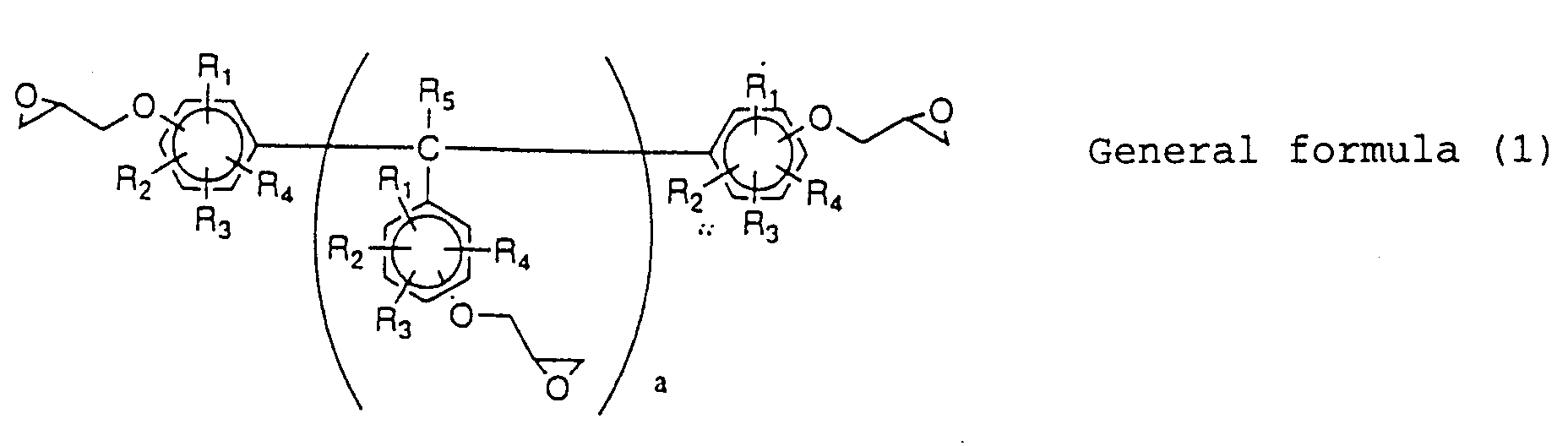
R1 to R5 represent, respectively independently, a hydrogen atom, halogen atom, or alkyl group having 4 or less carbon atoms. - The second version of the present invention is a prepreg which contains reinforcing fibers and a matrix resin, comprising at least
- (A) an epoxy resin composition,
- (B) a diamine compound having 1 to 3 phenyl groups in the skeleton, at least one of which has bonded groups each connected to two amino groups, bonded at meta positions,
- (C) a thermoplastic resin of 180°C or higher in glass transition temperature, and
- (D) a film, particles, fibers or their combination of a thermoplastic resin,
to constitute said matrix resin,
wherein 70 wt% or more of said epoxy resin composition (A) is at least one epoxy resin or more epoxy resins as a mixture selected from a group consisting of the following (A1) to (A3), and the thermoplastic resin (D) is arranged on one side or both sides of the prepreg; - (A1) an epoxy resin having a plurality of diglycidylamino groups directly bonded with a non-condensed benzene ring respectively
- (A2) an epoxy resin having a condensed aromatic ring in the skeleton
- (A3) a glycidyl ether type epoxy resin represented by the following general formula (1)

R1 to R5 represent, respectively independently, a hydrogen atom, halogen atom, or alkyl group having 4 or less carbon atoms. - The third version of the present invention is a prepreg which contains reinforcing fibers and a matrix resin, comprising at least
- (A) an epoxy resin composition,
- (B) a diamine compound having 1 to 3 phenyl groups in the skeleton, at least one of which has bonded groups each connected to two amino groups, bonded at meta positions,
- (C) a thermoplastic resin of 180°C or higher in glass transition temperature, and
- (D) a film, particles, fibers or their combination of a thermoplastic resin, to constitute said matrix resin, wherein 70 wt% or more of said epoxy resin composition (A) is at least one epoxy resin or more epoxy resins as a mixture selected from a group consisting of the following (A1) to (A3); the thermoplastic resin (D) is arranged on one side or both sides of the prepreg; and even if the prepreg is cured and immersed in 71°C water for 2 weeks, the percentage of water absorption is 1% or less;
- (A1) an epoxy resin having a plurality of diglycidylamino groups directly bonded with a non-condensed benzene ring respectively
- (A2) an epoxy resin having a condensed aromatic ring in the skeleton
- (A3) a glycidyl ether type epoxy resin represented by the following general formula (1)

- The epoxy resin (A1) having two diglycidylamino groups directly bonded with a non-condensed benzene ring respectively, which can be used in the present invention, is an epoxy resin which can be cured into a product high in heat resistance and elastic modulus since the cured product is high in crosslinking density, and any of the epoxy resins represented by the following general formula (2) is preferable since it is high in heat resistance:

X1 represents -CO-, -S-, -SO2-, -O-, or divalent combined groups represented by any one of the following general formulae (3) to (4);

X2 and X3 represent, respectively independently, -CO-, -S-, -SO2-, -O-, or divalent combined groups represented by the following general formula (5);
- Preferable examples of said R6 to R21 include hydrogen atom, chlorine atom, bromine atom, methyl group, ethyl group, and isopropyl group.
- Preferable examples of the epoxy resin (A1) include those represented by the following general formulae (6) and (7);


- The epoxy resin with a condensed aromatic ring in the skeleton (A2) has at least one condensed aromatic ring such as naphthalene, phenanthrene, anthracene, pyrene, coronene or fluorene in the skeleton, and two or more glycidyl groups, and since it has a bulky structure in the skeleton, it can form a rigid cured structure, to preferably provide a cured product high in heat resistance and elastic modulus.
- Above all, those represented by the following general formulae (8) to (10) are preferable in view of heat resistance.

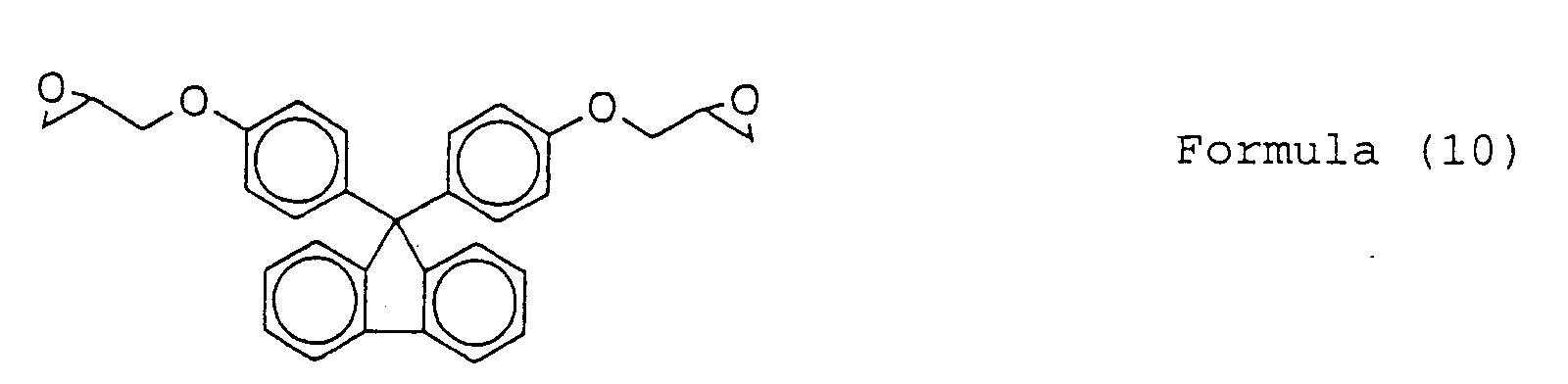
- The epoxy resin represented by said general formula (1) (A3) has 3 or 4 epoxy groups in the molecule and is effective in enhancing the crosslinking density and heat resistance of the cured product.

R1 to R5 represent, respectively independently, a hydrogen atom, halogen atom or alkyl group having 4 or less carbon atoms. - As the epoxy resin (A3), tris(4-glycidyloxyphenyl)methane and 1,1,2,2-tetrakis(4-glycidyloxyphenyl)ethane are preferable in view of heat resistance.
- For the epoxy resin composition, an epoxy resin with a specific chemical structure as described above is used as a main ingredient, and as far as 70 wt% or more of the epoxy resin composition (A) is at least one epoxy resin or more epoxy resins as a mixture selected from the group consisting of said (A1), (A2) and (A3), the remaining ingredient is not especially limited. If tetraglycidyldiaminodiphenylmethane (TGDDM) type epoxy resin (e.g., N,N,N',N'-tetraglycidyl-4,4'-methylenebisbenzeneamine) is used as an ingredient by more than 80 wt% in the epoxy resin composition, (a compound with a plurality of epoxy groups in any optional molecule can be used,) to provide a resin high in elastic modulus at room temperature, and less in the decline of the elastic modulus at high temperature and high humidity. The remaining ingredient can be selected, for example, from bisphenol A type epoxy resins, bisphenol F type epoxy resins, bisphenol S type epoxy resins, bisphenol B type epoxy resins, novolak type epoxy resins, epoxy resins produced from a copolymer of a phenol compound and dicyclopentadiene, glycidyl ether type epoxy resins such as resorcinol diglycidylether, glycidylamine type epoxy resins such as tetraglycidylxylenediamine, and their combinations.
- The remaining ingredient can be properly selected to suit respective objects. For example, to increase the amount of the thermoplastic resin to be added, an epoxy resin low in viscosity can be used as the remaining ingredient, or to adjust the viscosity level for handling convenience or for resin fluidity at the curing process, an epoxy resin high in viscosity can be used.
- Above all, a composition consisting of more than 80 wt% of a tetraglycidyldiaminodiphenylmethane and a bi-functional epoxy resin, especially a composition consisting of N,N,N',N'-tetraglyci dyl-4,4'-methylenebisbenzeneamine and a bisphenol F type resin, or bisphenol A type epoxy resin, or resorcinol diglycidylether is preferable in view of good handling convenience and a large degree of freedom in the control of physical properties by the addition of the thermoplastic resin.
- The matrix resin of the prepreg of the present invention contains, as a curing agent of the epoxy resin composition, a diamine compound (B) having 1 to 3 phenyl groups in the skeleton, at least one of which has bonded groups each connected to two amino groups, bonded at meta positions. Above all, a diamine compound with a structure represented by the following general formula (11) is preferably effective for enhancing the elastic modulus of the resin and decreasing the percentage of water absorption.
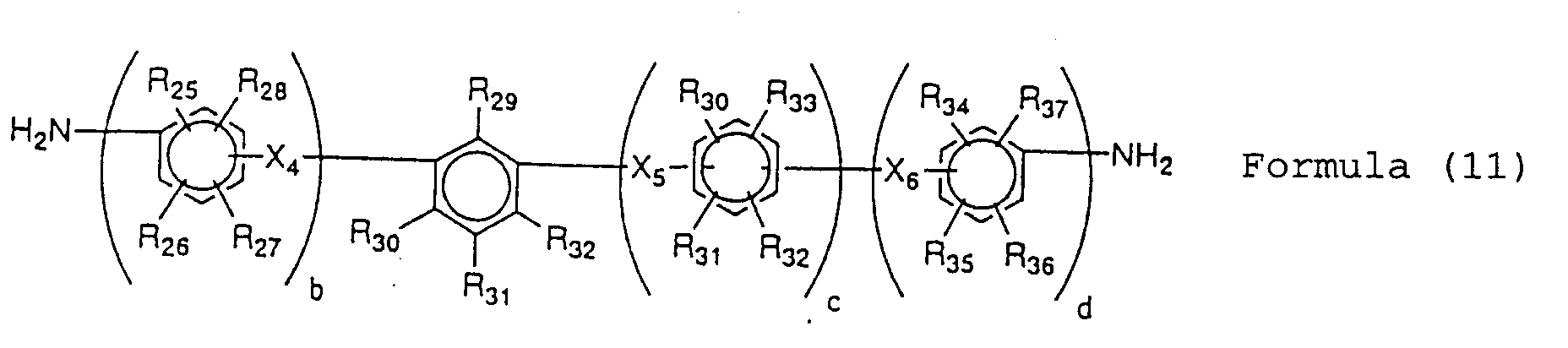

R25 to R37 represent, respectively independently, a hydrogen atom, halogen atom or alkyl group having 4 or less carbon atoms, and X4 to X6 represent, respectively independently, -CO-, -S-, -SO2- - O- or divalent combined group represented by the following general formula (12):
- In view of handling life of the prepreg, it is preferable that the diamine compound (B) is not 0 in


- The handling life in this case refers to the time during which the prepreg can be used without being greatly decreased in handling convenience represented by the tackiness and drapability of the prepreg, compared to its initial state. Since the prepreg contains the diamine compound reactive with the epoxy resins in the epoxy resin composition, reaction progresses during storage (or during use) even though gradually, to increase the viscosity of the epoxy resin composition. Since the viscosity of the epoxy resin composition affects the tackiness and drapability of the prepreg, there is a limit to the time (days) during which the prepreg can be used. The tackiness and drapability of a prepreg is often evaluated in reference to touch feeling, and there is no quantitative standard established. However, as a simple evaluation method, the glass transition temperature of an uncured prepreg is measured by DSC. In this case, it is said that a prepreg relatively small in the change of the glass transition temperature is relatively preferable.
- Preferable examples of the diamine compound (B) include 3,4'-diaminodiphenylsulfone, 3,3'-diaminodiphenylsulfone, 3,4'-diaminodiphenylmethane, 3,3'-diaminodiphenylmethane, 3,4'-diaminodiphenyl ether and their alkyl substituted derivatives. If any one of them is used, the epoxy resin composition can be cured by a less amount of the diamine compound (B).
- Above all, 3,4'-diaminodiphenylsulfone and 3,3'-diaminodiphenylsulfone can be more preferably used since the handling life is especially long. These diamine compounds with - SO2- have an advantage that the working life is long since the reactivity of amino groups with epoxy groups is weakened by the electrophilic effect of SO2. Of them, 3,3'-diaminodiphenylsulfone is preferable because the amount added can be small, because the working life is long, and because the effect of enhancing the compressive strength at high temperature and high humidity can be exhibited most remarkably due to the two meta substituted phenyl groups in the molecule.
- To add the diamine compound, the diamine compound can be dissolved homogeneously into the epoxy resin composition using a solvent, or the diamine compound can be kneaded with and dispersed into the epoxy resin composition, without using any solvent. The latter method of addition is preferable, since dispersion can advantageously make the handling life longer than dissolution.
- In the coating of the resin film or impregnation into carbon fibers in the production of a prepreg, if there are large particles, they cause blocking between the rolls of the coating machine or do not allow impregnation between carbon fibers. So, it is preferable that 90 wt% or more of the diamine compound is 40 µm or less in particle diameter.
- The reaction between the diamine compound and the epoxy resin composition in the prepreg during storage progresses near the interfaces between the diamine compound particles and the epoxy resin composition. For this reason, if the surface area of the diamine compound particles is smaller, the contact area with the epoxy resin is less to make the handling life longer. When there are particles with a certain volume, the smaller the particles, the larger the surface area. Therefore, to achieve a preferable handling life by keeping the surface area small at a certain level, it is preferable that particles of 1 µm or less in particle diameter account for 1 wt% or less of the diamine compound.
- Especially a diamine compound of 15 µm or less in the median particle diameter of the particle diameter distribution and 2.0 or less in the σg calculated from [

- A composition in which the active hydrogen atoms of amino groups of the diamino compound react with the epoxy groups of the epoxy resin composition at 1 : 1 is a composition in which the mole number of the diamine in the matrix resin is 0.25 time the mole number of the epoxy groups in the epoxy resin composition.
- However, a composition suitable for obtaining excellent compressive strength is different from this composition, and is a composition in which the mole number of 3,3'-diaminodiphenylsulfone in the matrix resin is 0.15 to 0.2 time the mole number of the epoxy groups in the epoxy resin composition.
- The matrix resin of the prepreg of the present invention contains one or more thermoplastic resins (C) in view of impact resistance.
- The thermoplastic resin used in the present invention is 180°C or higher, preferably 200°C or higher, more preferably 215°C or higher in Tg, in view of heat resistance. The thermoplastic resin (C) is preferably soluble in the epoxy resin composition. That the thermoplastic resin is soluble in the epoxy resin composition means that there is a temperature range in which the epoxy resin composition containing the thermoplastic resin forms a homogeneous phase. The phase separation of the resin composition at room temperature or the phase separation in the curing process of the resin composition is allowable. Examples of the thermoplastic resin include polysulfones, polyimides, polyketones, aromatic polyesters, etc., and above all, the polysulfones and polyimides represented by the following general formulae (13) and (14) are preferable since they are high in heat resistance and toughness.


- Furthermore, in view of the solubility in the epoxy resin composition, it is more preferable that the skeleton has an ether bond. The most preferable thermoplastic resins satisfying this condition have any of the structures represented by the following formulae (17) and (18).

The thermoplastic resin (C) is preferably about 2000 to 25000 in number average molecular weight. If the molecular weight is smaller than it, the effect of enhancing toughness is small. If the molecular weight is larger than it, the viscosity of the resin increases remarkably, to lower the workability in the production of the prepreg, and to remarkably decrease the handling convenience represented by the tackiness and drapability of the prepreg. - The thermoplastic resin (C) is preferably contained by 1 to 15 wt% based on the weight of the epoxy resin composition. If the content is less than 1%, the fluidity during forming and curing may be too high, and if more than 15%, the viscosity as a solution with the epoxy resin may be so high as to decrease the handling convenience represented by the tackiness and drapability of the prepreg. For the balance between the fluidity of the resin and the tackiness and drapability of the prepreg, it is preferable that the content is 1 to 10 wt%. To enhance the toughness of the cured product, the content is required to be large to some extent, and for this reason, a more preferable range is 5 to 10 wt%.
- If the phase rich in the thermoplastic resin is separated in the curing process due to insufficient bonding between the phases, the toughness of the resin cannot be enhanced, and as a result, it can happen that the impact resistance is not improved. In this case, if the thermoplastic resin has functional groups such as epoxy groups, carboxyl groups, hydroxyl groups, or amino groups, etc. capable of reacting with epoxy resins or hardening agent, the inter-phase adhesiveness can be preferably improved to provide an effect of improving the breaking elongation of the cured product.
- It is also preferable for improving the adhesiveness, to contain a compatibilizer with affinity to both the epoxy resin composition and the thermoplastic resin. The compatibilizer can be preferably a phenoxy resin represented by the following formula (19) disclosed in Japanese Patent Laid-Open No. 2-202913.

- Also a material identical in skeleton with, but smaller in molecular weight (preferably in an oligomer range) than, the thermoplastic resin used and with reactive functional groups at the ends can be preferably used, since it functions as a compatibilizer.
- When the thermoplastic resin (C) is mixed with the epoxy resin composition, it can be dissolved into the epoxy resin composition beforehand, or can be dispersed as a powder in the epoxy resin composition, to be dissolved at the curing process.
- The reinforcing fibers of the prepreg of the present invention are fibers good in heat resistance and tensile strength used generally for advanced composite materials, and include, for example, carbon fibers, graphite fibers, aramid fibers, silicon carbide fibers, alumina fibers, boron fibers, tungsten carbide fibers, glass fibers, etc. Among them, carbon fibers and graphite fibers are more preferable in the present invention since they are good in specific strength and specific elastic modulus and capable of greatly contributing to the reduction of weight. All kinds of carbon fibers and graphite fibers can be used for respective applications, but high strength and high elongation carbon fibers of 4.4 GPa in tensile strength and 1.7% or more in tensile elongation are most suitable.
- The cross-section of carbon fibers is not especially limited to conventional circular cross-section. However, noncircular cross-section such as triangle, square, hollow type, multifoliate type, and H type as disclosed in Japanese Patent Laid-Open Nos. 4-202815, 3-185121 and 3-97917 can be preferably used since such carbon fibers are less likely to be buckled than circular cross-section carbon fibers, and since the fiber reinforced composite material obtained can be improved in compressive properties.
- Among such noncircular cross-section carbon fibers, those which can be preferably used have a three- to five-foliated sectional form as each single filament, in which each of the foliage is swollen intermediately between its root and its tip, to form a section substantially consisting of a plurality of circles.
- Furthermore, it is preferable because of a large effect to prevent buckling, that the degree of deformation defined by a ratio, R/r is 1.5 to 3, where R is the radius of the circumscribed circle of the cross-section of the fiber and r is the radius of inscribed circle thereof.
- The arrangement of the reinforcing fibers is not especially limited, and can be filaments paralleled in one direction, tow, woven fabric, mat, knitted fabric, braid, etc. Especially for an application requiring high strength and high elastic modulus, reinforcing fibers paralleled in one direction is most suitable, but a woven fabric easy to handle is also suitable for the present invention.
- The percentage of water absorption in the first version of the present invention, etc. refers to the percentage of water absorption measured after the cured prepreg has been immersed in 71°C water for 2 weeks. Absorbed water causes the matrix resin to be plasticized, and the decline of the elastic modulus at high temperature becomes large compared to that of the dry matrix resin. So, to keep high physical properties even at high temperature and high humidity, the percentage of water absorption preferably decrease. If the percentage of water absorption is 1% or less, the decline of physical properties at high temperature and high humidity is small. The percentage is preferably 0.9% or less, more preferably 0.85% or less.
- The production of the prepreg is not especially limited, and any ordinary prepreg production process can be applied.
- When a composite material produced by laminating prepreg sheets is used as a structural material, the compressive strength after impact is an important physical property. It can happen that the drop of a tool or collision with a stone gives an impact to the structural material, causing interlayer delamination, thereby decreasing the compressive strength. If this is remarkable, the structural material cannot be practically used.
- In general, to enhance the compressive strength after impact, it is known that it is effective to let a highly tough material exist near one side or both sides of each prepreg sheet, for distributing the tough material at interlayer zone of composite material laminated and cured the prepreg. As the tough material, it is known to use, for example, a thermoplastic resin as disclosed in Japanese Patent Laid-Open No. 63-162732, or an elastomer as disclosed in Japanese Patent Laid-Open No. 4-268361, or a elastomer modified thermosetting resin as disclosed in US Patent No. 3,472,730. If such an elastomer or elastomer modified thermosetting resin is used for interlayer toughening material, impact resistance is enhanced but the compressive property at high temperature is much decreased. So, the applicable range is limited. On the other hand, the specific prepreg of the present invention holds a good compressive strength even at high temperature and high humidity while exhibiting an unexpectedly high compressive strength after impact since such a thermoplastic resin is used for interlayer toughening material.
- In this case, it is preferable for effectively enhancing the compressive strength after impact, that 90 wt% of more of the thermoplastic resin (D) is localized in an area from the surface of the prepreg to a depth of 15% in the thickness of the prepreg.
- The thermoplastic resin (D) which is arranged to exist on one side or both sides of the prepreg is preferably a polyamide, polyimide, polyether imide, polyamidimide, polysulfone, or polyether sulfone, etc. Among them, a polyamide is especially preferable since it is excellent in toughness and adhesiveness to the matrix resin. A polyamide modified by an epoxy resin can also be used as disclosed in Japanese Patent Laid-Open No. 1-104624.
- The shape of the thermoplastic resin (D) can be various, for example, can be a film, particles, fibers, or a combination of at least two shape of the foregoing. In the case of a film, if the prepreg surface is perfectly covered as described in US Patent No. 4,604,319, the surface tackiness is lost, but the surface tackiness can be kept by forming through-holes in the film as described in Japanese Patent Laid-Open No. 63-97635, or by using a porous film as described in Japanese Patent Laid-Open No. 5-138785, or arranging film tapes as described in Japanese Patent Laid-Open No. 5-287091, or arranging flakes obtained by finely cutting the film as described in Japanese Patent Laid-Open No. 2-67333, etc.
- The thermoplastic resin (D) used as fibers is preferable since the tackiness and drapability of the prepreg are excellent. In this case, the fibers are not limited in fiber length or arrangement.
- The fibers can be flocks obtained by finely cutting fibers as described in Japanese Patent Laid-Open No. 2-67333, short fibers as described in Japanese Patent Laid-Open No. 2-69566, parallel-arranged filaments as described in Japanese Patent Laid-Open No. 4-292634, a woven fabric as described in Japanese Patent Laid-Open No. 2-32843, or a nonwoven fabric or knitted fabric as described in International Laid-Open No. 94016003. Among them, fibers used as a nonwoven fabric or knitted fabric are preferable since tackiness and drapability are more excellent.
- When the thermoplastic resin (d) is partiles, the particles can be spherical particles as described in Japanese Patent Laid-Open No. 1-110537, or non-spherical particles as described in Japanese Patent Laid-Open No. 1-110536, or porous particles as described in Japanese Patent Laid-Open No. 5-1159.
- The above film, fibers or particles can be used alone, or they can be used in combination like a film containing fibers or particles, or a mixture of particles and fibers.
- If the thermoplastic resin (D) is thermoplastic particle consists of an epoxy resin or bismaleimide resin and thermoplastic resin which have semi-IPN structures or which are capable of forming semi-IPN structure, it is preferable for keeping the solvent resistance of the composite material as a whole, since the particles themselves are excellent in solvent resistance. The term "IPN" is an abbreviation of interpenetrating polymer network, which means a structure in which cross-linked polymers of different types penetrate each other to form a network. The term "semi-IPN" means a structure in which a cross-linked polymer and a linear polymer penetrate each other to form a network. The formation of semi-IPN can be achieved by using any conventional method, for example by dissolving a thermoplastic resin and a thermosetting resin into a common solvent, for homogeneous mixing, and re-precipitating. If the thermoplastic resin (D) is particles of an epoxy resin and a polyamide formed as semi-IPN, it is preferable for giving high heat resistance and high impact resistance to the prepreg.
- Such a thermoplastic resin can be arranged to exist near the surface of a prepreg by simply sticking or scattering the thermoplastic resin onto one side or both sides of a prepreg produced according to an ordinary method, or sticking a film in which the thermoplastic resin is impregnated with the matrix resin or a film in which the thermoplastic resin is dispersed in the matrix resin, onto one side or both sides of a prepreg produced according to an ordinary method.
- When a film with the thermoplastic resin dispersed is stuck, it is preferable that the thermoplastic resin (D) is particles of 30 µm or less in median particle diameter, since the the coater rolls are not blocked by the particles when the film is coated.
- Said prepreg provides a composite material excellent in impact resistance and in the compressive strength at high temperature and high humidity. If a rectangular notched specimen of 305 mm in 0° direction and 38 mm in 90° direction with a circular hole of 6.35 mm in diameter at the center prepared by quasi-isotropically laminating 16 prepreg sheets and curing at 180°C at a pressure of 0.588 MPa for 2 hours has a compressive strength of 275 MPa or more at high temperature and high humidity (measured at 82°C after immersing it in 71°C water for 2 weeks), it is very excellent in the compressive strength at high temperature and high humidity, and can preferably satisfy the high compressive strength required in larger structures.
- If a rectangular coupon of 152.4 mm in 0° direction and 101.6 mm in 90° direction cut out of a board prepared by quasi-isotropically laminating 24 prepreg sheets and curing at 180°C at a pressure of 0.588 MPa for 2 hours has a compressive strength of 275 MPa or more after having been given a drop impact of 30.5 N·m at the center it is preferable since it is very excellent in impact resistance.
- The fiber reinforced composite material produced with said prepreg cured is excellent in impact resistance and in the compressive strength at high temperature and high humidity, and since it has high damage tolerance and satisfies the high compressive strength required for larger structures, it expands the degree of freedom in structural design and gives a composite material light in weight and high in performance preferably.
- The present invention is described below in more detail in reference to examples.
- The measurement of the percentage of water absorption of a composite material, the measurement of the compressive strength of a notched coupon, and the measurement of the residual compressive strength after impact were conducted as described below.
- A composite material panel was prepared by quasi-isotropically laminating 16 prepreg sheets [(+45/0/-45/90)2s] and curing at 180°C at a pressure of 0.588 MPa in an autoclave for 2 hours.
- From the composite material panel, a rectangular coupon of 304.8 mm in 0° direction and 38.1 mm in 90° direction was cut out and had a circular hole of 6.35 mm in diameter drilled at the center, to make a circular notched coupon as a test specimen. The notched coupon was dried at 120°C for 24 hours, and the dry weight was measured. In succession, it was immersed in 71°C water for 2 weeks, and the weight of the board with water absorbed was measured. From the weights measured before and after water absorption, the weight increase rate by water absorption was calculated.
- The notched coupon prepared in the above A was tested by an Instron Model 1128 testing machine, to measure the compressive strengths under the following conditions:
- Dry sample at room temperature (25°C)
- Water absorbed sample obtained in the above A at a high temperature (82°C)
- 24 prepreg sheets were laminated quasi-isotropically [+45/0/-45/90 )3s] and cured at 180°C at a pressure of 0.588 MPa in an autoclave for 2 hours, to obtain a composite material panel.
- From the composite material board, a rectangular coupon of 152.4 mm in 0° direction and 101.6 mm in 90° direction was cut out as a test piece. A drop impact of 30.5 N·m was given at the center of the test piece, and then the compressive strength was measured using an Instron Model 1128 testing machine.
- The following raw materials were kneaded to obtain a first resin composition.
Tetraglycidyldiaminodiphenylmethane (A1) (ELM434, produced by Sumitomo Chemical Co., Ltd.) 90.0 parts by weight Bisphenol A type epoxy resin (epoxy equivalent weight 175) (a1) (Epikote 825, produced by Yuka Shell Epoxy K.K.) 10.0 parts by weight Polyether sulfone (C1) (PES5003P, produced by Mitsui Toatsu Chemicals, Inc.) 12.7 parts by weight 3,3'-diaminodiphenylsulfone (B1) (produced by Wakayama Seika Kogyo Co., Ltd.) 35.0 parts by weight - Furthermore, the following raw materials were kneaded to obtain a second resin composition.
Tetraglycidyldiaminodiphenylmethane (A1) (ELM434, produced by Sumitomo Chemical Co., Ltd.) 90.0 parts by weight Bisphenol A type epoxy resin (epoxy equivalent weight 175) (a1) (Epikote 825, produced by Yuka Shell Epoxy K.K.) 10.0 parts by weight Polyether sulfone (C1) (PES5003P, produced by Mitsui Toatsu Chemicals, Inc.) 4.3 parts by weight 3,3'-diaminodiphenylsulfone (B1) (produced by Wakayama Seika Kogyo Co., Ltd.) 35.0 parts by weight Epoxy modified nylon particles (D1) 35.2 parts by weight - The 3,3'-diaminodiphenylsulfone was ground using an impact grinder containing an air classifier (ACM-10 produced by Hosokawa Micron Corporation) into powder of 11 µm in median particle diameter, which contained 90 wt% of powder of 22 µm or less in particle diameter, and almost 0% of powder of 1 µm or less in particle diameter, and were 1.83 in σg. In this composition, the mole number of 3,3'-diaminodiphenylsulfone was 0.175 time the mole number of epoxy groups.
- Of the raw materials of the second resin, the epoxy modified nylon resin was semi-IPN particles of 16 µm in mean particle diameter consisting of amorphous transparent nylon (Glylamide TR-55 produced by Mitsubishi Chemical Corp.), bisphenol A type epoxy resin, and polyamide based epoxy hardening agent, stated in Example 1 of Japanese Patent Laid-Open No. 1-104624.
- The first resin prepared in the above (A) was coated on releasing paper with a weight of 31.2 g/m2 using a reverse roll coater, to prepare a first resin film. Then, the second resin was coated with a weight of 20.5 g/m2, to prepare a second resin film.
- Carbon fibers (T800H produced by Toray Industries, Inc.) of 294 GPa in elastic modulus and 1.9% in elongation paralleled in one direction were kept between said first resin films, and heated and pressed, to be impregnated with the resin. Furthermore, said second resin films were stuck onto both the sides of the resin impregnated carbon fibers, to obtain a prepreg of 190 g/m2 in areal weight of carbon fibers and 64.8% in carbon fiber content.
- Sheets of the prepreg produced in (B) were laminated in (+45/0/-45/90)2s and (+45/0/-45/90)3s, and they were cured at 180°C at a pressure of 0.588 MPa in an autoclave for 2 hours.
- Both the compressive strength of the notched coupon at high temperature and high humidity and the compressive strength after impact were high, as shown below.
-
Compressive strength of notched coupon At room temperature 325 MPa At high temperature and high humidity 278 MPa Compressive strength after impact 305 MPa - The following raw materials were kneaded to obtain a first resin composition.
Tetraglycidyldiaminodiphenylmethane (A1) (ELM434, produced by Sumitomo Chemical Co., Ltd.) 60.0 parts by weight Tris(4-glycidyloxyphenyl)methane (A3) (TACTIX742, produced by Dow Chemical Japan Ltd.) 20.0 parts by weight Resorcinol diglycidyl ether (a3) (Denacol EX-201, produced by Nagase Chemicals Ltd.) 20.0 parts by weight Polyether sulfone (C1) (PES5003P, produced by Mitsui Toatsu Chemicals, Inc.) 12.6 parts by weight 3,3'-diaminodiphenylsulfone (B1) (produced by Wakayama Seika Kogyo Co., Ltd.) 34.0 parts by weight - Furthermore, the following raw materials were kneaded to obtain a second resin composition.
Tetraglycidyldiaminodiphenylmethane (A1) (ELM434, produced by Sumitomo Chemical Co., Ltd.) 60.0 parts Tris(4-glycidyloxyphenyl)methane (A3) (TACTIX742, produced by Dow Chemical Japan Ltd.) 20.0 parts by weight Resorcinol diglycidyl ether (a3) (Denacol EX-201, produced by Nagase Chemicals Ltd.) 20.0 parts by weight Polyether sulfone (C1) (PES5003P, produced by Mitsui Toatsu Chemicals, Inc.) 4.3 parts by weight 3,3'-diaminodiphenylsulfone (B1) (produced by Wakayama Seika Kogyo Co., Ltd.) 34.0 parts by weight Epoxy modified nylon particles (D1) 35.0 parts by weight - The 3,3'-diaminodiphenylsulfone used was the same as that of Example 1. In this composition, the mole number of 3,3'-diaminodiphenylsulfone was 0.175 time the mole number of epoxy groups.
- Of the raw materials of the second resin, the epoxy modified nylon particles used were the same as those of Example 1.
- The percentage of water absorption and compressive strengths were measured as described in Example 1, except that the resins prepared in the above (A) were used. Both the compressive strength of the notched coupon at high temperature and high humidity and the compressive strength after impact were high, as shown below.
-
Compressive strength of notched coupon At room temperature 331 MPa At high temperature and high humidity 269 MPa Compressive strength after impact 314 MPa - The following raw materials were kneaded to obtain a first resin composition.
Tetraglycidyldiaminodiphenylmethane (A1) (ELM434, produced by Sumitomo Chemical Co., Ltd.) 80.0 parts by weight 1,6-diglycidyloxynaphthalene (A2) (HP4032, produced by Dainippon Ink and Chemicals, Inc.) 10.0 parts by weight Resorcinol diglycidyl ether (a3) (Denacol EX-201, produced by Nagase Chemicals Ltd.) 10.0 parts by weight Polyether imide (C2) (ULTEM1000, produced by GE Plastics Japan Ltd.) 12.7 parts by weight 3.3'-diaminodiphenylsulfone (B1) (produced by Wakayama Seika Kogyo Co., Ltd.) 34.5 parts by weight - Furthermore, the following raw materials were kneaded to obtain a second resin composition.
Tetraglycidyldiaminodiphenylmethane (A1) (ELM434, produced by Sumitomo Chemical Co., Ltd.) 80.0 parts by weight 1,6-diglycidyloxynaphthalene (A2) (HP4032, produced by Dainippon Ink and Chemicals, Ind.) 10.0 parts by weight Resorcinol diglycidyl ether (a3) (Denacol EX-201, produced by Nagase Chemicals Ltd.) 10.0 parts by weight Polyether imide (C2) (ULTEM1000, produced by GE Plastics Japan Ltd.) 4.3 parts by weight 3,3'-diaminodiphenylsulfone (B1) (produced by Wakayama Seika Kogyo Co., Ltd.) 34.5 parts by weight Epoxy modified nylon particles (D1) 34.5 parts by weight - The 3,3'-diaminodiphenylsulfone used was the same as that used in Example 1. In this composition, the mole number of 3,3'-diaminodiphenylsulfone was 0.175 time the mole number of epoxy groups.
- Of the raw materials of the second resin, the epoxy modified nylon particles used were the same as those used in Example 1.
- The percentage of water absorption and compressive strengths were measured as described in Example 1, except that the resins prepared in the above (A) were used. Both the compressive strength of the notched coupon at high temperature and high humidity, and the compressive strength after impact were high, as shown below.
-
Compressive strength of notched coupon At room temperature 321 MPa At high temperature and high humidity 281 MPa Compressive strength after impact 316 MPa - The following raw materials were kneaded to prepare a first resin composition.
Tetraglycidyldiaminodiphenylmethane (A1) (ELM434, produced by Sumitomo Chemical Co., Ltd.) 30.0 parts by weight 1,6-diglycidyloxynaphthalene (A2) (HP4032, produced by Dainippon Ink and Chemicals, Inc.) 60.0 parts by weight Resorcinol diglycidyl ether (a3) (Denacol EX-201, produced by Nagase Chemicals Ltd.) 10.0 parts by weight Polyether imide (C2) (ULTEM1000, produced by GE Plastics Japan Ltd.) 12.7 parts by weight 3,3'-diaminodiphenylsulfone (B1) (produced by Wakayama Seika Kogyo Co., Ltd.) 31.6 parts by weight - Furthermore, the following raw materials were kneaded to obtain a second resin composition.
Tetraglycidyldiaminodiphenylmethane (A1) (ELM434, produced by Sumitomo Chemical Co., Ltd.) 30.0 parts by weight 1,6-diglycidyloxynaphthalene (A2) (HP4032, produced by Dainippon Ink and Chemicals, Inc.) 60.0 parts by weight Resorcinol diglycidyl ether (a3) (Denacol EX-201, produced by Nagase Chemicals Ltd.) 10.0 parts by weight Polyether imide (C2) (ULTEM1000, produced by GE Plastics Japan Ltd.) 4.3 parts by weight 3,3'-diaminodiphenylsulfone (B1) (produced by Wakayama Seika Kogyo Co., Ltd.) 31.6 parts by weight Epoxy modified nylon particles (D1) 34.3 parts by weight - The 3,3'-diaminodiphenylsulfone used was the same as that used in Example 1. In this composition, the mole number of 3,3'-diaminodiphenylsulfone was 0.175 time the mole number of epoxy groups.
- Of the raw materials of the second resin, the epoxy modified nylon particles used were the same as those used in Example 1.
- The percentage of water absorption and compressive strengths were measured as described in Example 1, except that the resins prepared in the above (A) were used. Both the compressive strength of the notched coupon at high temperature and high humidity and the compressive strength after impact were high, as shown below.
-
Compressive strength of notched coupon At room temperature 307 MPa At high temperature and high humidity 270 MPa Compressive strength after impact 328 MPa - The following raw materials were kneaded to prepare a first resin composition.
1,6-diglycidyloxynaphthalene (A2) (HP4032, produced by Dainippon Ink and Chemicals, Inc.) 90.0 parts by weight Resorcinol diglycidyl ether (a3) (Denacol EX-201, produced by Nagase Chemicals Ltd.) 10.0 parts by weight Polyether imide (C2) (ULTEM1000, produced by GE Plastics Japan Ltd.) 12.2 parts by weight 3,3'-diaminodiphenylsulfone (B1) (produced by Wakayama Seika Kogyo Co., Ltd.) 29.5 parts by weight - Furthermore, the following raw materials were kneaded to obtain a second resin composition.
1,6-diglycidyloxynaphthalene (A2) (HP4032, produced by Dainippon Ink and Chemicals, Inc.) 90.0 parts by weight Resorcinol diglycidyl ether (a3) (Denacol EX-201, produced by Nagase Chemicals Ltd.) 10.0 parts by weight Polyether imide (C2) (ULTEM1000, produced by GE Plastics Japan Ltd.) 4.3 parts by weight 3,3'-diaminodiphenylsulfone (B1) (produced by Wakayama Seika Kogyo Co., Ltd.) 29.5 parts by weight Epoxy modified nylon particles (D1) 33.8 parts by weight - The 3,3'-diaminodiphenylsulfone used was the same as that used in Example 1. In this composition, the mole number of 3,3'-diaminodiphenylsulfone was 0.175 time the mole number of epoxy groups.
- Of the raw materials of the second resin, the epoxy modified nylon particles used were the same as those used in Example 1.
- The percentage of water absorption and compressive strengths were measured as described in Example 1, except that the resins prepared in the above (A) were used. Both the compressive strength of the notched coupon at high temperature and humidity, and the compressive strength after impact were high, as shown below.
-
Compressive strength of notched coupon At room temperature 305 MPa At high temperature and high humidity 272 MPa Compressive strength after impact 331 MPa - The following raw materials were kneaded to obtain a first resin composition.
Tetraglycidyldiaminodiphenylmethane (A1) (ELM434, produced by Sumitomo Chemical Co., Ltd.) 90.0 parts by weight Bisphenol A type epoxy resin (epoxy equivalent weight 175) (a1) (Epikote 825, produced by Yuka Shell Epoxy K.K.) 10.0 parts by weight Polyether sulfone (C1) (PES5003P, produced by Mitsui Toatsu Chemicals, Inc.) 12.7 parts by weight 3,3'-diaminodiphenylsulfone (B1) (produced by Wakayama Seika Kogyo Co., Ltd.) 35.0 parts by weight - Furthermore, the following raw materials were kneaded to obtain a second resin composition.
Tetraglycidyldiaminodiphenylmethane (A1) (ELM434, produced by Sumitomo K.K.) 90.0 parts by weight Bisphenol A type epoxy resin (epoxy equivalent weight 175) (a1) (Epikote 825, produced by Yuka Shell Epoxy K.K.) 10.0 parts by weight Polyether sulfone (C1) (PES5003P, produced by Mitsui Toatsu Chemicals, Inc.) 4.3 parts by weight 3,3'-diaminodiphenylsulfone (B1) (produced by Wakayama Seika Kogyo Co., Ltd.) 35.0 parts by weight Epoxy modified nylon particles(D1) 35.2 parts by weight - The 3,3'-diaminodiphenylsulfone used was the same as that used in Example 1. In this composition, the mole number of 3,3'-diaminodiphenylsulfone was 0.175 time the mole number of epoxy groups.
- Of the raw materials of the second resin, the epoxy modified nylon particles used were the same as those used in Example 1.
- The percentage of water absorption and compressive strengths were measured as described in Example 1, except that the resins prepared in the above (A) were used, and that carbon fibers of 294 GPa in elastic modulus, 1.9% in elongation and 2.6 in degree of deformation R/r with its production method disclosed in Japanese Patent Laid-Open No. 4-202815 were used. Both the compressive strength of the notched coupon at high temperature and high humidity, and the compressive strength after impact were high, as shown below.
-
Compressive strength of notched coupon At room temperature 332 MPa At high temperature and high humidity 292 MPa Compressive strength after impact 338 MPa - The following raw-materials were kneaded to obtain a first resin composition.
Tetraglycidyldiaminodiphenylmethane (A1) (ELM434, produced by Sumitomo Chemical Co., Ltd.) 90.0 parts by weight Bisphenyl A type epoxy resin (epoxy equivalent weight 175) (a1) (Epikote 825, produced by Yuka Shell Epoxy K.K.) 10.0 parts by weight Polysulfone (C3) (UDEL P1700, produced by Nissan Chemical Industries, Ltd.) 12.7 parts by weight 3,3'-diaminodiphenylsulfone (B1) (produced by Wakayama Seika Kogyo Co., Ltd.) 35.0 parts by weight - Furthermore, the following raw materials were kneaded to obtain a second resin composition.
Tetraglycidyldiaminodiphenylmethane (A1) (ELM434, produced by Sumitomo Chemical Co., Ltd.) 90.0 parts by weight Bisphenol A type epoxy resin (epoxy equivalent weight 175) (a1) (Epikote 825, produced by Yuka Shell Epoxy K.K.) 10.0 parts by weight Polysulfone (C3) (UDEL P1700, produced by Nissan Chemical Industries, Ltd.) 4.3 parts by weight 3,3'-diaminodiphenylsulfone (B1) (produced by Wakayama Seika Kogyo Co., Ltd.) 35.0 parts by weight Epoxy modified nylon particles (D1) 35.2 parts by weight - The 3,3'-diaminodiphenylsulfone used was the same as that used in Example 1. In this composition, the mole number of 3,3'-diaminodiphenylsulfone was 0.175 time the mole number of epoxy groups.
- Of the raw materials of the second resin, the epoxy modified nylon particles used were the same as those used in Example 1.
- The percentage of water absorption and compressive strengths were measured as described in Example 1, except that the resins prepared in the above (A) were used. The compressive strength of the notched coupon at high temperature and high humidity was somewhat lower since the thermoplastic resin used was rather lower in Tg than those of other examples, but it still was high, while the compressive strength after impact was also high, as shown below.
-
Compressive strength of notched coupon At room temperature 327 MPa At high temperature and high humidity 265 MPa Compressive strength after impact 320 MPa - The following raw materials were kneaded to obtain a first resin composition.
- The following raw materials were kneaded to obtain a first resin composition.
Tetraglycidyldiaminodiphenylmethane (A1) (ELM434, produced by Sumitomo Chemical Co., Ltd.) 90.0 parts by weight Bisphenyl F type epoxy resin (epoxy equivalent weight 172) (a2) (Epichlon 830, produced by Dainippon Ink and Chemicals, Inc.) 10.0 parts by weight Polyether sulfone (C1) (PES5003P, produced by Mitsui Toatsu Chemicals, Inc.) 12.7 parts by weight 4,4'-diaminodiphenylsulfone (b1) (Sumicure S, produced by Sumitomo Chemical Co., Ltd.) 35.0 parts by weight - Furthermore, the following raw materials were kneaded to obtain a second resin composition.
Tetraglycidyldiaminodiphenylmethane (A1) (ELM434, produced by Sumitomo Chemical Co., Ltd.) 90.0 parts by weight Bisphenol F type epoxy resin (epoxy equivalent weight 172) (a2) (Epichlon 830, produced by Dainippon Ink and Chemicals, Inc.) 10.0 parts by weight Polyether sulfone (C1) (PES5003P, produced by Mitsui Toatsu Chemicals, Inc.) 4.3 parts by weight 4,4'-diaminodiphenylsulfone (b1) (Sumicure S, produced by Sumitomo Chemical Co., Ltd.) 35.0 parts by weight Epoxy modified nylon particles (D1) 35.2 parts by weight - In this composition, the mole number of 4,4'-diaminodiphenylsulfone was 0.175 time the mole number of epoxy groups.
- Of the raw materials of the second resin, the epoxy modified nylon particles used was the same as that used in Example 1.
- The percentage of water absorption and compressive strengths were measured as described in Example 1, except that the resins prepared in the above (A) were used. The compressive strength after impact showed a high value because of the interlayer roughening, but the compressive strengths of the notched coupon were not sufficient as shown below, since the curing agent was not in conformity with the present invention.
-
Compressive strength of notched coupon At room temperature 294 MPa At high temperature and humidity 248 MPa Compressive strength after impact 308 MPa - The following raw materials were kneaded to obtain a first resin composition.
Tetraglycidyldiaminodiphenylmethane (A1) (ELM434, produced by Sumitomo Chemical Co., Ltd.) 60.0 parts by weight Bisphenol F type epoxy resin (epoxy equivalent weight 172) (a2) (Epichlon 830, produced by Dainippon Ink and Chemicals, Inc.) 40.0 parts by weight Polyether sulfone (C1) (PES5003P, produced by Mitsui Toatsu Chemicals, Inc.) 12.7 parts by weight 3,3'-diaminodiphenylsulfone (B1) (produced by Wakayama Seika Kogyo Co., Ltd.) 31.8 parts by weight - Furthermore, the following raw materials were kneaded to obtain a second resin composition.
Tetraglycidyldiaminodiphenylmethane (A1) (ELM434, produced by Sumitomo Chemical Co., Ltd.) 60.0 parts by weight Bisphenol F type epoxy resin (epoxy equivalent weight 172) (a2) (Epichlon 830, produced by Dainippon Ink and Chemicals, Inc.) 40.0 parts by weight Polyether sulfone (C1) (PES5003P, produced by Mitsui Toatsu Chemicals, Inc.) 4.3 parts by weight 3,3'-diaminodiphenylsulfone (B1) (produced by Wakayama Seika Kogyo Co., Ltd.) 31.8 parts by weight Epoxy modified nylon particles (D1) 35.2 parts by weight - In this composition, the mole number of 3,3'-diaminodiphenylsulfone was 0.175 time the mole number of epoxy groups.
- Of the raw materials of the second resin, the epoxy modified nylon particles was the same as that used in Example 1.
- The percentage of water absorption and compressive strengths were measured as described in Example 1, except that the resins prepared in the above (A) were used. The compressive strength after impact showed a high value because of the interlayer toughening, but the compressive strengths of the notched coupon were not sufficient as shown below, since the resin compositions were not in conformity with the present invention.
-
Compressive strength of notched coupon At room temperature 290 MPa At high temperature and humidity 236 MPa Compressive strength after impact 312 MPa -
Tetraglycidyldiaminodiphenylmethane (A1) (ELM434, produced by Sumitomo Chemical Co., Ltd.) 50.0 parts by weight Triglycidyl-m-aminophenol (a4) (ELM120, produced by Sumitomo Chemical Co., Ltd.) 50.0 parts by weight 3,3'-diaminodiphenylsulfone (B1) (produced by Wakayama Seika Kogyo Co., Ltd.) 36.5 parts by weight Polyether sulfone (C1) (PES5003P, produced by Mitsui Toatsu Chemicals, Inc.) 34.1 parts by weight - In this composition, the mole number of 3,3'-diaminodiphenylsulfone was 0.175 time the mole number of epoxy groups, and PES accounted for 20 wt% of the total weight of the matrix.
- The resin prepared in the above (A) was coated on releasing paper with a weight of 51.7 g/m2 using a reverse roll coater, to form a resin film.
- Carbon fibers of 294 GPa in elastic modulus and 1.9% in elongation (T800H, produced by Toray Industries, Inc.) paralleled in one direction were kept between said resin films, and heated and pressed, to be impregnated with the resin, for obtaining a prepreg of 190 g/m2 in areal weight of carbon fibers and 64.8% in carbon fiber content.
- The percentage of water absorption and compressive strengths were measured as described in Example 1. The compressive strength after impact was not sufficient since interlayer toughening was not applied, and the compressive strength of the notched coupon at high temperature and high humidity was not sufficient either as shown below, since the resin composition was not in conformity with the present invention (since a tri-functional aminophenol type epoxy resin poor in heat and water resistance was contained in a large amount).
-
Compressive strength of notched coupon At room temperature 325 MPa At high temperature and humidity 221 MPa Compressive strength after impact 138 MPa -
Tetraglycidyldiaminodiphenylmethane (A1) (ELM434, produced by Sumitomo Chemical Co., Ltd.) 30.0 parts by weight Bisphenol F type epoxy resin (epoxy equivalent weight 172) (a2) (Epichlon 830, produced by Dainippon Ink and Chemicals, Inc.) 20.0 parts by weight Triglycidyl-4-aminocresol (epoxy equivalent weight 107) (a5) (ELM100, produced by Sumitomo Chemical Co., Ltd.) 50.0 parts by weight 3,3'-diaminodiphenylsulfone (B1) (produced by Wakayama Seika Kogyo Co., Ltd.) 36.4 parts by weight Polyether imide (C2) (ULTEM1000, produced by GE Plastics Japan Ltd.) 34.1 parts by weight - In this composition, the mole number of 3,3'-diaminodiphenylsulfone was 0.175 time the mole number of epoxy groups. The polyether imide accounted for 20 wt% of the total weight of the matrix.
- The percentage of water absorption and compressive strengths were measured as described in Comparative Example 3, except that the resin prepared in the above (A) was used. The compressive strength after impact was not sufficient since the interlayer toughening was not applied, and the compressive strength of the notched coupon at high temperature and high humidity was not sufficient either as shown below, since the resin composition was not in conformity with the present invention (since a tri-functional aminophenol type epoxy resin poor in heat and water resistance was contained in a large amount).
-
Compressive strength of notched coupon At room temperature 310 MPa At high temperature and humidity 212 MPa Compressive strength after impact 159 MPa -
Tetraglycidyldiaminodiphenylmethane (A1) (ELM434, produced by Sumitomo Chemical Co., Ltd.) 100.0 parts by weight Bis[4-(3-aminophenoxy)phenyl]sulfone (b2) (BAPS-M, produced by Wakayama Seika Kogyo Co., Ltd.) 63.1 parts by weight Polyether imide (C2) (ULTEM1000, produced by GE Plastics Japan Ltd.) 18.1 parts by weight - In this composition, the mole number of 3,3'-diaminodiphenylsulfone was 0.175 time the mole number of epoxy groups, and the polyether imide accounted for 10 wt% of the total weight of the matrix.
- The percentage of water absorption and compressive strengths were measured as described in Comparative Example 3, except that the resin prepared in the above (A) was used. Since the prepreg was too high in the viscosity of the resin, carbon fibers were insufficiently impregnated with the resin, and many voids existed in cross section of the composite panel, not allowing sufficient physical properties to be achieved, as shown below.
-
Compressive strength of notched coupon At room temperature 208 MPa At high temperature and humidity 121 MPa Compressive strength after impact 117 MPa -
Tetraglycidyldiaminodiphenylmethane (A1) (ELM434, produced by Sumitomo Chemical Co., Ltd.) 60.0 parts by weight Triglycidyl-4-aminocresol (epoxy equivalent weight 107) (a5) (ELM100, produced by Sumitomo Chemical Co., Ltd.) 40.0 parts by weight 3,3'-diaminodiphenylsulfone (B1) (produced by Wakayama Seika Kogyo Co., Ltd.) 38.1 parts by weight Polyether imide (C2) (ULTEM1000, produced by GE Plastics Japan Ltd.) 15.3 parts by weight - In this composition, the mole number of 3,3'-diaminodiphenylsulfone was 0.175 time the mole number of epoxy groups, and the polyether imide accounted for 20 wt% of the total weight of the matrix.
- The percentage of water absorption and compressive strengths were measured as described in Comparative Example 3, except that the resin prepared in the above (A) was used. The compressive strength after impact was not sufficient since the interlayer toughening was not applied, and the compressive strength of the notched coupon at high temperature and high humidity was not sufficient either as shown below, since the resin composition was not in conformity with the present invention (since a tri-functional aminophenol type epoxy resin poor in heat and water resistance was contained in a large amount).
-
Compressive strength of notched coupon At room temperature 317 MPa At high temperature and humidity 227 MPa Compressive strength after impact 145 MPa -
Bisphenol F type epoxy resin (epoxy equivalent weight 172) (a2) (Epichlon 830, produced by Dainippon Ink and Chemicals, Inc.) 50.0 parts by weight Triglycidyl-4-aminocresol (epoxy equivalent weight 107) (a5) (ELM100, produced by Sumitomo Chemical Co., Ltd.) 50.0 parts by weight 3,3'-diaminodiphenylsulfone (B1) (produced by Wakayama Seika Kogyo Co., Ltd.) 33.1 parts by weight Polyether sulfone (C1) (PES5003P, produced by Mitsui Toatsu Chemicals, Inc.) 42.3 parts by weight - In this composition, the mole number of 3,3'-diaminodiphenylsulfone was 0.175 time the mole number of epoxy groups, and the polyether imide accounted for 24 wt% of the total weight of the matrix.
- The percentage of water absorption and compressive strengths were measured as described in Comparative Example 3, except that the resin prepared in the above (A) was used. The compressive strength after impact was not sufficient since the interlayer toughening was not applied, and the compressive strength of the notched coupon at high temperature and high humidity was not sufficient either as shown below, since the resin composition was not in conformity with the present invention (since a tri-functional aminophenol type epoxy resin poor in heat and water resistance was contained in a large amount).
-
Compressive strength of notched coupon At room temperature 264 MPa At high temperature and humidity 194 MPa Compressive strength after impact 200 MPa 


Table 3 Example 1 2 3 4 5 6 7 Percentage of water absorption 0.85 0.88 0.85 0.83 0.83 0.81 0.85 Compressive strength of perforated board (MPa) Room temperature 325 331 321 307 305 332 327 High temperature and high humidity 278 269 281 270 272 292 265 Residual compressive strength after impact (MPa) 305 314 316 328 331 338 320 Table 4 Comparative Example 1 2 3 4 5 6 7 Percentage of water absorption 1.10 1.05 1.15 1.12 1.11 1.12 1.12 Compressive strength of perforated board (MPa) Room temperature 294 290 325 310 208 317 264 High temperature and high humidity 248 236 221 212 121 227 194 Residual compressive strength after impact (MPa) 308 312 138 159 117 145 200 - Since the prepreg of the present invention can provide a composite material with an excellent compressive property under hot/wet condition, sheets of the prepreg can be laminated and cured for processing into a fiber reinforced material to be used as a structural material, or can be wound around a mandrel for processing into poles, shafts, etc. to allow suitable use.
Claims (34)
- A prepreg which contains reinforcing fibers and a matrix resin, comprising at least(A) an epoxy resin composition,(B) a diamine compound having 1 to 3 phenyl groups in the skeleton, at least one of which has bonded groups each connected to two amino groups, bonded at meta positions, and(C) a thermoplastic resin of 180°C or higher in glass transition temperature,
to constitute said matrix resin,
wherein 70 wt% or more of said epoxy resin composition (A) is at least one epoxy resin or more epoxy resins as a mixture selected from a group consisting of the following (A1) to (A3), and if the prepreg is cured and immersed in 71°C water for 2 weeks, the percentage of water absorption is 1% or less;(A1) an epoxy resin having a plurality of diglycidylamino groups directly bonded with a non-condensed benzene ring respectively(A2) an epoxy resin having a condensed aromatic ring in the skeleton(A3) a glycidyl ether type epoxy resin represented by the following general formula (1)
- A prepreg which contains reinforcing fibers and a matrix resin, comprising at least(A) an epoxy resin composition,(B) a diamine compound having 1 to 3 phenyl groups in the skeleton, at least one of which has bonded groups each connected to two amino groups, bonded at meta positions,(C) a thermoplastic resin of 180°C or higher in glass transition temperature, and(D) a film, particles, fibers or their composite of a thermoplastic resin, to constitute said matrix resin,
wherein 70 wt% or more of said epoxy resin composition (A) is at least one epoxy resin or more epoxy resins as a mixture selected from a group consisting of the following (A1) to (A3), and the thermoplastic resin (D) is arranged on one or both sides of the prepreg;(A1) an epoxy resin having a plurality of diglycidylamino groups directly bonded with a non-condensed benzene ring respectively(A2) an epoxy resin having a condensed aromatic ring in the skeleton(A3) a glycidyl ether type epoxy resin represented by the following general formula (1)
- A prepreg which contains reinforcing fibers and a matrix resin, comprising at least(A) an epoxy resin composition,(B) a diamine compound having 1 to 3 phenyl groups in the skeleton, at least one of which has bonded groups each connected to two amino groups, bonded at meta positions,(C) a thermoplastic resin of 180°C or higher in glass transition temperature, and(D) a film, particles, fibers or their composite of a thermoplastic resin,
to constitute said matrix resin,
wherein 70 wt% or more of said epoxy resin composition (A) is at least one epoxy resin or more epoxy resins as a mixture selected from a group consisting of the following (A1) to (A3); the thermoplastic resin (D) is arranged on one or both sides of the prepreg; and if the prepreg is cured and immersed in 71°C water for 2 weeks, the percentage of water absorption is 1% or less;(A1) an epoxy resin having a plurality of diglycidylamino groups directly bonded with a non-condensed benzene ring respectively(A2) an epoxy resin having a condensed aromatic ring in the skeleton(A3) a glycidyl ether type epoxy resin represented by the following general formula (1)
- A prepreg, according to any one of claims 1 through 3, wherein the diamine compound (B) is a compound represented by the following general formula (5):


R25 to R37 represent, respectively independently, a hydrogen atom, halogen atom or alkyl group having 4 or less carbon atoms, and X1 and X2 represent, respectively independently, -CO-, -S-, -SO2-, -O- or divalent combined group represented by the following general formula (6):
- A prepreg, according to claim 4, wherein the diamine compound (B) is represented by said general formula (5), with b = 1.
- A prepreg, according to claim 5, wherein the diamine compound (B) is represented by said general formula (5), with c = d = 0.
- A prepreg, according to claim 6, wherein the diamine compound (B) is represented by said general formula (5), where X4 represents -CO- or -SO2-.
- A prepreg, according to claim 7, wherein the diamine compound (B) is represented by said general formula (5), wherein X4 represents -SO2-.
- A prepreg, according to claim 8, wherein the diamine compound (B) is 3,3'-diaminodiphenylsulfone.
- A prepreg, according to any one of claims 1 through 9, wherein the content of the diamine compound (B) is such that the mole number of the diamine compound (B) is 0.15 to 0.2 time the mole number of the epoxy groups in the epoxy resin composition (A).
- A prepreg, according to any one of claims 1 through 10, wherein 90 wt% or more of the diamine compound (B) in the prepreg is powder of 40 µm or less in particle diameter, while 1 wt% or less is powder of 1 µm or less in particle diameter.
- A prepreg, according to any one of claims 1 through 11, wherein the diamine compound (B) in the prepreg is 15 µm or less in median particle diameter, and 2.0 or less in the σg calculated from [

- A prepreg, according to any one of claims 1 through 12,
wherein the thermoplastic resin (C) is at least one selected from polysulfones and polyimides. - A prepreg, according to any one of claims 1 through 13, wherein the thermoplastic resin (C) is a polysulfone with ether bonds in the main chain.
- A prepreg, according to any one of claims 1 through 13, wherein the thermoplastic resin (C) is a polyimide with ether bonds in the main chain.
- A prepreg, according to any one of claims 1 through 15, wherein the thermoplastic resin (C) is contained by 1 to 15 wt% based on the weight of the epoxy resin composition (A).
- A prepreg, according to any one of claims 1 through 16, wherein the epoxy resin composition (A) contains a bi-functional epoxy resin.
- A prepreg, according to claim 17, wherein the bi-functional epoxy resin is a bisphenol F type epoxy resin, bisphenol A type epoxy resin or resorcinol diglycidyl ether.
- A prepreg, according to any one of claims 1 through 18, wherein the epoxy resin (A1) is represented by the following general formula (7):

- A prepreg, according to claim 19, wherein the epoxy resin (A1) is tetraglycidyldiaminodiphenylsulfone.
- A prepreg, according to any one of claims 1 through 20, wherein the epoxy resin (A2) is represented the following general formula (8):

- A prepreg, according to claim 20 or 21, wherein the epoxy resin composition (A) contains more than 80 wt% of tetraglycidyldiaminodiphenylsulfone.
- A prepreg, according to any one of claims 1 through 22, wherein the reinforcing fibers are carbon fibers.
- A prepreg, according to claim 23, wherein the carbon fibers are high strength and high elongation carbon fibers of 4.4 GPa or more in tensile strength and 1.7% or more in tensile elongation.
- A prepreg, according to any one of claims 2 through 24, wherein 90 wt% or more of the thermoplastic resin (D) is localized in an area from the surface of the prepreg to a depth of 15% in the thickness of the prepreg.
- A prepreg, according to any one of claims 2 through 25, wherein the thermoplastic resin (D) is at least one selected from a group consisting of polyamides, polyamidimides and polyether imides.
- A prepreg, according to any one of claims 2 through 26, wherein the thermoplastic resin (D) in the prepreg is fibers.
- A prepreg, according to any one of claims 2 through 26, wherein the thermoplastic resin (D) in the prepreg is particles.
- A prepreg, according to claim 28, wherein the thermoplastic resin (D) in the prepreg is particles of 30 µm or less in median particle diameter.
- A prepreg, according to claim 29, wherein the thermoplastic resin (D) in the prepreg is particles formed as semi-IPN of an epoxy resin or bismaleimide resin and a thermoplastic resin.
- A prepreg, according to claim 30, wherein the thermoplastic resin (D) in the prepreg is particles formed as semi-IPN of an epoxy resin and a polyamide.
- A prepreg, according to any one of claims 1 through 31, wherein a rectangular notched coupon of 305 mm in 0° direction and 38 mm in 90° direction formed by quasi-isotropically laminating 16 sheets of the prepreg and hardening at 180°C at a pressure of 0.588 MPa for 2 hours, with a circular hole of 6.35 mm in diameter drilled at the center is 275 MPa or more in the compressive strength at high temperature and high humidity (measured at 82°C after immersing the perforated board in 71°C water for 2 weeks).
- A prepreg, according to any one claims 1 through 32, wherein a rectangular coupon of 305 mm in 0° direction and 38 mm in 90° direction cut out of a board formed by quasi-isotropically laminating 24 sheets of the prepreg and hardening at 180°C at a pressure of 588 MPa for 2 hours is 275 MPa in compressive strength after giving a drop impact of 30.5 N·m to the center of the coupon.
- A fiber reinforced composite material, comprising the prepreg stated in any one of claims 1 through 33 and cured.
Applications Claiming Priority (4)
| Application Number | Priority Date | Filing Date | Title |
|---|---|---|---|
| JP32958894 | 1994-12-02 | ||
| JP329588/94 | 1994-12-02 | ||
| JP32958894 | 1994-12-02 | ||
| PCT/JP1995/002474 WO1996017006A1 (en) | 1994-12-02 | 1995-12-04 | Prepreg and fiber-reinforced composite material |
Publications (3)
| Publication Number | Publication Date |
|---|---|
| EP0745640A1 true EP0745640A1 (en) | 1996-12-04 |
| EP0745640A4 EP0745640A4 (en) | 2000-05-31 |
| EP0745640B1 EP0745640B1 (en) | 2003-04-02 |
Family
ID=18223034
Family Applications (1)
| Application Number | Title | Priority Date | Filing Date |
|---|---|---|---|
| EP95938641A Expired - Lifetime EP0745640B1 (en) | 1994-12-02 | 1995-12-04 | Prepreg and fiber-reinforced composite material |
Country Status (6)
| Country | Link |
|---|---|
| US (1) | US5985431A (en) |
| EP (1) | EP0745640B1 (en) |
| JP (1) | JP3359037B2 (en) |
| KR (1) | KR970700720A (en) |
| DE (1) | DE69530188T2 (en) |
| WO (1) | WO1996017006A1 (en) |
Cited By (7)
| Publication number | Priority date | Publication date | Assignee | Title |
|---|---|---|---|---|
| FR2773809A1 (en) * | 1998-01-22 | 1999-07-23 | Inst Francais Du Petrole | POLYMER COMPOSITIONS, THEIR PREPARATIONS AND THEIR USES |
| EP1454936A4 (en) * | 2001-11-07 | 2005-05-04 | Toray Industries | Epoxy resin compositions for fiber-reinforced composite materials, process for production of the materials and fiber-reinforced composite materials |
| WO2008127556A1 (en) * | 2007-04-17 | 2008-10-23 | Hexcel Corporation | Pre-impregnated composite materials with improved performance |
| US7754322B2 (en) | 2006-10-02 | 2010-07-13 | Hexcel Corporation | Composite materials with blend of thermoplastic particles |
| EP2947109A4 (en) * | 2013-01-15 | 2016-09-21 | Toray Industries | Epoxy resin composition, prepreg, and carbon-fiber-reinforced composite material |
| WO2018007460A1 (en) * | 2016-07-05 | 2018-01-11 | Porcher Industries | Composite sheet made from fabric and polyetherimide with controlled porosity |
| EP3272781A4 (en) * | 2015-03-17 | 2018-10-24 | Toray Industries, Inc. | Epoxy resin composition, prepreg, and carbon fiber-reinforced composite material |
Families Citing this family (28)
| Publication number | Priority date | Publication date | Assignee | Title |
|---|---|---|---|---|
| US6117551A (en) * | 1996-12-18 | 2000-09-12 | Toray Industries, Inc. | Carbon fiber prepreg, and a production process thereof |
| DE19836892A1 (en) * | 1998-08-14 | 2000-02-17 | Krankenhauszweckverband Ingols | protective suit |
| JP3233618B2 (en) * | 1999-07-28 | 2001-11-26 | 川崎重工業株式会社 | How to absorb moisture in composites |
| JP4859081B2 (en) * | 2000-04-21 | 2012-01-18 | 三菱レイヨン株式会社 | Manufacturing method of composite material |
| US6379799B1 (en) * | 2000-06-29 | 2002-04-30 | Cytec Technology Corp. | Low moisture absorption epoxy resin systems with alkylated diamine hardeners |
| US7247876B2 (en) * | 2000-06-30 | 2007-07-24 | Intel Corporation | Three dimensional programmable device and method for fabricating the same |
| JP3894035B2 (en) * | 2001-07-04 | 2007-03-14 | 東レ株式会社 | Carbon fiber reinforced substrate, preform and composite material comprising the same |
| US6821931B2 (en) * | 2002-03-05 | 2004-11-23 | Alpine Mud Products Corporation | Water-based drilling fluid additive containing talc and carrier |
| US7056867B2 (en) * | 2002-07-17 | 2006-06-06 | Alpine Mud Products Corp | Drilling fluid additive system containing graphite and carrier |
| US7060660B2 (en) * | 2002-07-17 | 2006-06-13 | Alpine Mud Products Corp | Drilling fluid additive system containing talc and graphite |
| JP4736671B2 (en) * | 2004-09-28 | 2011-07-27 | 日立化成工業株式会社 | Prepreg, metal foil-clad laminate and printed circuit board using these |
| JP2006249171A (en) * | 2005-03-09 | 2006-09-21 | Yokohama Rubber Co Ltd:The | Curable resin composition and prepreg, and composite material obtained using the same |
| WO2006094404A1 (en) * | 2005-03-11 | 2006-09-14 | National Research Council Of Canada | Novel highly microporous thermoplastic/bismaleimide semi-interpenetrating polymer network |
| GB0622060D0 (en) * | 2006-11-06 | 2006-12-13 | Hexcel Composites Ltd | Improved composite materials |
| JP5554500B2 (en) * | 2007-01-25 | 2014-07-23 | パナソニック株式会社 | Prepreg, printed wiring board, multilayer circuit board, and method for manufacturing printed wiring board |
| GB0717507D0 (en) | 2007-09-07 | 2007-10-17 | Cytec Tech Corp | Composite materials and their use |
| US8034453B2 (en) * | 2008-10-07 | 2011-10-11 | Hexcel Corporation | Composite materials with improved burn properties |
| US8039109B2 (en) * | 2008-10-07 | 2011-10-18 | Hexcel Corporation | Epoxy resins with improved burn properties |
| JP5385011B2 (en) * | 2009-05-30 | 2014-01-08 | 東邦テナックス株式会社 | Prepreg |
| EP2551288B1 (en) | 2010-03-23 | 2016-06-01 | Toray Industries, Inc. | Epoxy resin composition for use in a carbon-fiber-reinforced composite material, prepreg, and carbon-fiber-reinforced composite material |
| US8470923B2 (en) | 2010-04-21 | 2013-06-25 | Hexcel Corporation | Composite material for structural applications |
| CN104487495B (en) | 2012-07-25 | 2016-09-07 | 东丽株式会社 | Prepreg and carbon fibre reinforced composite |
| GB201222934D0 (en) | 2012-12-19 | 2013-01-30 | Cytec Ind Inc | Particle toughening for improving fracture toughness |
| US10400076B2 (en) | 2013-07-11 | 2019-09-03 | Toray Industries, Inc. | Epoxy resin composition, prepreg, and carbon fiber-reinforced composite material |
| WO2015012348A1 (en) * | 2013-07-26 | 2015-01-29 | 東レ株式会社 | Epoxy resin composition, prepreg, and fiber-reinforced composite material |
| US10000615B1 (en) * | 2017-02-23 | 2018-06-19 | Hexcel Corporation | Retaining compressive strength of thermoplastic-toughened epoxy composites under hot and wet conditions |
| JP7183793B2 (en) | 2017-11-14 | 2022-12-06 | 東レ株式会社 | Prepregs and fiber reinforced composites |
| WO2022039104A1 (en) * | 2020-08-20 | 2022-02-24 | 日鉄ケミカル&マテリアル株式会社 | Epoxy resin composition and cured product |
Family Cites Families (38)
| Publication number | Priority date | Publication date | Assignee | Title |
|---|---|---|---|---|
| US3472730A (en) * | 1967-12-28 | 1969-10-14 | Minnesota Mining & Mfg | Heat-curable filament-reinforced resinous sheeting and laminating process using same |
| GB1299177A (en) * | 1969-01-17 | 1972-12-06 | Ciba Geigy Uk Ltd | Reinforced composites |
| EP0108476A1 (en) * | 1982-09-15 | 1984-05-16 | The British Petroleum Company p.l.c. | Epoxy resin composition |
| US4661559A (en) * | 1983-05-20 | 1987-04-28 | Union Carbide Corporation | Impact resistant matrix resins for advanced composites |
| US4517321A (en) * | 1983-05-20 | 1985-05-14 | Union Carbide Corporation | Preimpregnated reinforcements and high strength composites therefrom |
| ZA84548B (en) * | 1983-05-20 | 1984-12-24 | Union Carbide Corp | Impact resistant matrix resins for advanced composites |
| US4579885A (en) * | 1983-09-22 | 1986-04-01 | Union Carbide Corporation | Epoxy compositions containing substituted diamine hardeners |
| EP0159482A3 (en) * | 1984-03-28 | 1987-02-25 | American Cyanamid Company | Resin matrix composites with controlled flow and tack |
| US4604319B1 (en) * | 1984-06-01 | 1995-07-04 | American Cyanamid Co | Thermoplastic interleafed resin matrix composites with improved impact strength and toughness |
| JPH07105707B2 (en) * | 1985-07-31 | 1995-11-13 | 株式会社日立製作所 | 3-state circuit |
| JPH0778138B2 (en) * | 1985-12-16 | 1995-08-23 | 東レ株式会社 | Resin composition for fiber reinforced prepreg |
| JPS62297312A (en) * | 1986-06-18 | 1987-12-24 | Toray Ind Inc | Resin composition for prepreg and production thereof |
| US4863787A (en) * | 1986-07-09 | 1989-09-05 | Hercules Incorporated | Damage tolerant composites containing infusible particles |
| ES2051274T3 (en) * | 1986-12-25 | 1994-06-16 | Toray Industries | HIGHLY RESISTANT COMPOSITE MATERIALS. |
| JPH01104624A (en) * | 1987-10-16 | 1989-04-21 | Toray Ind Inc | Prepreg using resin fine particles |
| US4868050A (en) * | 1987-02-27 | 1989-09-19 | Ube Industries, Ltd. | Interleaf-containing, fiber-reinforced epoxy resin prepreg |
| US4874661A (en) * | 1987-12-15 | 1989-10-17 | Browne James M | Impact enhanced prepregs and formulations |
| US4992325A (en) * | 1987-12-15 | 1991-02-12 | The Dexter Corporation | Inorganic whisker containing impact enhanced prepregs and formulations formulations |
| US5025045A (en) * | 1987-12-24 | 1991-06-18 | Hercules Incorporated | Damage tolerant composites containing infusible particles |
| US4956411A (en) * | 1988-02-05 | 1990-09-11 | Mitsubishi Rayon Company, Ltd. | Epoxy resin composition for composite material from m- or o-substituted triglycidylaminophenols, diaminodiphenylsulfone and latent curing agents |
| US4908088A (en) * | 1988-02-29 | 1990-03-13 | Basf Aktiengesellschaft | Extreme damage tolerant graphite composites and method of making same |
| EP0351026A3 (en) * | 1988-07-15 | 1991-10-23 | Amoco Corporation | Fiber-reinforced composites toughened with elongated rigid particles |
| US5169710A (en) * | 1988-07-15 | 1992-12-08 | Amoco Corporation | Fiber-reinforced composites toughened with porous resin particles |
| EP0351025A3 (en) * | 1988-07-15 | 1991-10-23 | Amoco Corporation | Fiber reinforced composites toughened with carboxylated rubber particles |
| JPH0267331A (en) * | 1988-07-15 | 1990-03-07 | Amoco Corp | Carboxylated rubber particle as material to toughen fiber-reinforced composite material |
| JPH0267333A (en) * | 1988-07-15 | 1990-03-07 | Amoco Corp | Fiber-reinforced composite material filled with resin particle |
| JPH0639519B2 (en) * | 1988-12-02 | 1994-05-25 | 東邦レーヨン株式会社 | Epoxy resin composition and prepreg |
| US5242748A (en) * | 1989-01-04 | 1993-09-07 | Basf Aktiengesellschaft | Toughened thermosetting structural materials |
| US4954195A (en) * | 1989-02-13 | 1990-09-04 | Lockheed Corporation | Production of thermoset composites containing thermoplastic fillers |
| US5248711A (en) * | 1989-02-16 | 1993-09-28 | Hexcel Corporation | Toughened resin systems for composite applications |
| US5037689A (en) * | 1989-02-17 | 1991-08-06 | Basf Aktiengesellschaft | Toughened thermosetting structural materials |
| US5087657A (en) * | 1989-02-23 | 1992-02-11 | Amoco Corporation | Fiber-reinforced composites toughened with resin particles |
| EP0392348A3 (en) * | 1989-04-14 | 1991-12-27 | Cytec Technology Corp. | Toughened thermosetting structural materials |
| US4957801A (en) * | 1989-05-17 | 1990-09-18 | American Cyanamid Company | Advance composites with thermoplastic particles at the interface between layers |
| US5244719A (en) * | 1990-10-23 | 1993-09-14 | Amoco Corporation | Prepreg with improved room temperature storage stability |
| CA2055059A1 (en) * | 1990-11-16 | 1992-05-17 | Anita N. Chan | Damage tolerant composites containing infusible particles |
| US5258456A (en) * | 1991-03-15 | 1993-11-02 | Tomoegawa Paper Co., Ltd. | Epoxy resin with phenolic OH-aramide/ban block copolymer |
| JPH0778138A (en) * | 1993-06-30 | 1995-03-20 | Canon Inc | Comment giving method and document processing apparatus |
-
1995
- 1995-12-04 WO PCT/JP1995/002474 patent/WO1996017006A1/en not_active Ceased
- 1995-12-04 US US08/682,761 patent/US5985431A/en not_active Expired - Lifetime
- 1995-12-04 KR KR1019960704204A patent/KR970700720A/en not_active Withdrawn
- 1995-12-04 EP EP95938641A patent/EP0745640B1/en not_active Expired - Lifetime
- 1995-12-04 JP JP51592996A patent/JP3359037B2/en not_active Expired - Fee Related
- 1995-12-04 DE DE69530188T patent/DE69530188T2/en not_active Expired - Lifetime
Cited By (14)
| Publication number | Priority date | Publication date | Assignee | Title |
|---|---|---|---|---|
| FR2773809A1 (en) * | 1998-01-22 | 1999-07-23 | Inst Francais Du Petrole | POLYMER COMPOSITIONS, THEIR PREPARATIONS AND THEIR USES |
| EP0931803A1 (en) * | 1998-01-22 | 1999-07-28 | Institut Francais Du Petrole | Polymer compositions, their preparation and their use |
| US6239232B1 (en) | 1998-01-22 | 2001-05-29 | Institut Francais Du Petrole | Polyetherimide or polysulphone with polyepoxide partially reacted with aromatic polyamine |
| US6548608B2 (en) | 1998-01-22 | 2003-04-15 | Institut Francais Du Petrole | Polyetherimide and/or polysulphone, aromatic polyamine-modified epoxy resin and thermoplastic |
| EP1454936A4 (en) * | 2001-11-07 | 2005-05-04 | Toray Industries | Epoxy resin compositions for fiber-reinforced composite materials, process for production of the materials and fiber-reinforced composite materials |
| US7754322B2 (en) | 2006-10-02 | 2010-07-13 | Hexcel Corporation | Composite materials with blend of thermoplastic particles |
| US7968179B2 (en) | 2006-10-02 | 2011-06-28 | Hexcel Composites, Ltd. | Pre-impregnated composite materials with improved performance |
| US7972686B2 (en) | 2006-10-02 | 2011-07-05 | Hexcel Composites, Ltd. | Composite materials with improved performance |
| WO2008127556A1 (en) * | 2007-04-17 | 2008-10-23 | Hexcel Corporation | Pre-impregnated composite materials with improved performance |
| EP2947109A4 (en) * | 2013-01-15 | 2016-09-21 | Toray Industries | Epoxy resin composition, prepreg, and carbon-fiber-reinforced composite material |
| EP3272781A4 (en) * | 2015-03-17 | 2018-10-24 | Toray Industries, Inc. | Epoxy resin composition, prepreg, and carbon fiber-reinforced composite material |
| WO2018007460A1 (en) * | 2016-07-05 | 2018-01-11 | Porcher Industries | Composite sheet made from fabric and polyetherimide with controlled porosity |
| FR3053627A1 (en) * | 2016-07-05 | 2018-01-12 | Porcher Industries | COMPOSITE SHEET BASED ON FABRIC AND POLYETHERIMIDE WITH CONTROLLED POROSITY |
| US11072146B2 (en) | 2016-07-05 | 2021-07-27 | Porcher Industries | Composite sheet made from fabric and polyetherimide with controlled porosity |
Also Published As
| Publication number | Publication date |
|---|---|
| EP0745640B1 (en) | 2003-04-02 |
| US5985431A (en) | 1999-11-16 |
| DE69530188T2 (en) | 2004-01-29 |
| WO1996017006A1 (en) | 1996-06-06 |
| JP3359037B2 (en) | 2002-12-24 |
| EP0745640A4 (en) | 2000-05-31 |
| DE69530188D1 (en) | 2003-05-08 |
| KR970700720A (en) | 1997-02-12 |
Similar Documents
| Publication | Publication Date | Title |
|---|---|---|
| US5985431A (en) | Prepreg, and a fiber reinforced composite material | |
| US6596373B1 (en) | Epoxy resin composition for fiber-reinforced composite material prepreg, and fiber-reinforced composite material | |
| JPWO1996017006A1 (en) | Prepreg and Fiber-Reinforced Composites | |
| EP0274899B1 (en) | Highly tough composite materials | |
| US6399199B1 (en) | Prepeg and carbon fiber reinforced composite materials | |
| KR101511186B1 (en) | Composites with a blend of thermoplastic particles | |
| CA2682549C (en) | Composite material with blend of thermoplastic particles | |
| JP3241684B2 (en) | Reinforced thermosetting structural material | |
| CA2074899C (en) | Toughened, fiber-reinforced thermosetting resin matrix prepregs and composites made therefrom | |
| WO2008127556A1 (en) | Pre-impregnated composite materials with improved performance | |
| JPH08259713A (en) | Prepreg and fiber reinforced composite materials | |
| JP2003026768A (en) | Epoxy resin composition, prepreg and fiber reinforced composite material | |
| JPH0741576A (en) | Prepreg and fiber reinforced resin | |
| JP3365110B2 (en) | Prepreg and fiber reinforced composite materials | |
| US5464902A (en) | Toughening of brittle epoxy resin matrices with functionalized particulate elastomers | |
| JP2002363253A (en) | Epoxy resin composition, prepreg and fiber reinforced composite material | |
| JPH045056B2 (en) | ||
| JP4655329B2 (en) | Unidirectional prepreg and fiber reinforced composites | |
| JP2592932B2 (en) | Thermosetting epoxy resin adhesive | |
| JP3508346B2 (en) | Prepreg and fiber reinforced composite materials | |
| JPH04249544A (en) | Resin composition, prepreg and production of prepreg | |
| JPH05239317A (en) | Epoxy resin composition, prepreg and production of prepreg | |
| JPH08325394A (en) | Prepreg and fiber-reinforced composite material | |
| JPH08176325A (en) | Prepreg and fiber reinforced composite materials | |
| JPS6360056B2 (en) |
Legal Events
| Date | Code | Title | Description |
|---|---|---|---|
| PUAI | Public reference made under article 153(3) epc to a published international application that has entered the european phase |
Free format text: ORIGINAL CODE: 0009012 |
|
| 17P | Request for examination filed |
Effective date: 19960822 |
|
| AK | Designated contracting states |
Kind code of ref document: A1 Designated state(s): DE FR GB IT |
|
| A4 | Supplementary search report drawn up and despatched |
Effective date: 20000417 |
|
| AK | Designated contracting states |
Kind code of ref document: A4 Designated state(s): DE FR GB IT |
|
| RIC1 | Information provided on ipc code assigned before grant |
Free format text: 7C 08J 5/24 A, 7C 08L 63/00 B |
|
| 17Q | First examination report despatched |
Effective date: 20001012 |
|
| GRAH | Despatch of communication of intention to grant a patent |
Free format text: ORIGINAL CODE: EPIDOS IGRA |
|
| GRAH | Despatch of communication of intention to grant a patent |
Free format text: ORIGINAL CODE: EPIDOS IGRA |
|
| GRAA | (expected) grant |
Free format text: ORIGINAL CODE: 0009210 |
|
| AK | Designated contracting states |
Designated state(s): DE FR GB IT |
|
| PG25 | Lapsed in a contracting state [announced via postgrant information from national office to epo] |
Ref country code: IT Free format text: LAPSE BECAUSE OF FAILURE TO SUBMIT A TRANSLATION OF THE DESCRIPTION OR TO PAY THE FEE WITHIN THE PRE;WARNING: LAPSES OF ITALIAN PATENTS WITH EFFECTIVE DATE BEFORE 2007 MAY HAVE OCCURRED AT ANY TIME BEFORE 2007. THE CORRECT EFFECTIVE DATE MAY BE DIFFERENT FROM THE ONE RECORDED.SCRIBED TIME-LIMIT Effective date: 20030402 |
|
| REG | Reference to a national code |
Ref country code: GB Ref legal event code: FG4D |
|
| REF | Corresponds to: |
Ref document number: 69530188 Country of ref document: DE Date of ref document: 20030508 Kind code of ref document: P |
|
| ET | Fr: translation filed | ||
| PLBE | No opposition filed within time limit |
Free format text: ORIGINAL CODE: 0009261 |
|
| STAA | Information on the status of an ep patent application or granted ep patent |
Free format text: STATUS: NO OPPOSITION FILED WITHIN TIME LIMIT |
|
| 26N | No opposition filed |
Effective date: 20040105 |
|
| PGFP | Annual fee paid to national office [announced via postgrant information from national office to epo] |
Ref country code: GB Payment date: 20131204 Year of fee payment: 19 |
|
| PGFP | Annual fee paid to national office [announced via postgrant information from national office to epo] |
Ref country code: DE Payment date: 20141125 Year of fee payment: 20 |
|
| PGFP | Annual fee paid to national office [announced via postgrant information from national office to epo] |
Ref country code: FR Payment date: 20141208 Year of fee payment: 20 |
|
| GBPC | Gb: european patent ceased through non-payment of renewal fee |
Effective date: 20141204 |
|
| PG25 | Lapsed in a contracting state [announced via postgrant information from national office to epo] |
Ref country code: GB Free format text: LAPSE BECAUSE OF NON-PAYMENT OF DUE FEES Effective date: 20141204 |
|
| REG | Reference to a national code |
Ref country code: DE Ref legal event code: R071 Ref document number: 69530188 Country of ref document: DE |