EP0743847B1 - Hair cosmetic composition - Google Patents
Hair cosmetic composition Download PDFInfo
- Publication number
- EP0743847B1 EP0743847B1 EP95906518A EP95906518A EP0743847B1 EP 0743847 B1 EP0743847 B1 EP 0743847B1 EP 95906518 A EP95906518 A EP 95906518A EP 95906518 A EP95906518 A EP 95906518A EP 0743847 B1 EP0743847 B1 EP 0743847B1
- Authority
- EP
- European Patent Office
- Prior art keywords
- acid
- cosmetic composition
- hair cosmetic
- hair
- composition according
- Prior art date
- Legal status (The legal status is an assumption and is not a legal conclusion. Google has not performed a legal analysis and makes no representation as to the accuracy of the status listed.)
- Expired - Lifetime
Links
- 0 Cc(c(*)c(*)c(*)c1C(c2c(*)c(*)c(*)c(*)c2*)=O)c1[Ag] Chemical compound Cc(c(*)c(*)c(*)c1C(c2c(*)c(*)c(*)c(*)c2*)=O)c1[Ag] 0.000 description 2
Classifications
-
- A—HUMAN NECESSITIES
- A61—MEDICAL OR VETERINARY SCIENCE; HYGIENE
- A61Q—SPECIFIC USE OF COSMETICS OR SIMILAR TOILETRY PREPARATIONS
- A61Q5/00—Preparations for care of the hair
- A61Q5/12—Preparations containing hair conditioners
-
- A—HUMAN NECESSITIES
- A61—MEDICAL OR VETERINARY SCIENCE; HYGIENE
- A61K—PREPARATIONS FOR MEDICAL, DENTAL OR TOILETRY PURPOSES
- A61K8/00—Cosmetics or similar toiletry preparations
- A61K8/18—Cosmetics or similar toiletry preparations characterised by the composition
- A61K8/30—Cosmetics or similar toiletry preparations characterised by the composition containing organic compounds
- A61K8/33—Cosmetics or similar toiletry preparations characterised by the composition containing organic compounds containing oxygen
- A61K8/34—Alcohols
-
- A—HUMAN NECESSITIES
- A61—MEDICAL OR VETERINARY SCIENCE; HYGIENE
- A61K—PREPARATIONS FOR MEDICAL, DENTAL OR TOILETRY PURPOSES
- A61K8/00—Cosmetics or similar toiletry preparations
- A61K8/18—Cosmetics or similar toiletry preparations characterised by the composition
- A61K8/30—Cosmetics or similar toiletry preparations characterised by the composition containing organic compounds
- A61K8/33—Cosmetics or similar toiletry preparations characterised by the composition containing organic compounds containing oxygen
- A61K8/34—Alcohols
- A61K8/342—Alcohols having more than seven atoms in an unbroken chain
-
- A—HUMAN NECESSITIES
- A61—MEDICAL OR VETERINARY SCIENCE; HYGIENE
- A61K—PREPARATIONS FOR MEDICAL, DENTAL OR TOILETRY PURPOSES
- A61K8/00—Cosmetics or similar toiletry preparations
- A61K8/18—Cosmetics or similar toiletry preparations characterised by the composition
- A61K8/30—Cosmetics or similar toiletry preparations characterised by the composition containing organic compounds
- A61K8/33—Cosmetics or similar toiletry preparations characterised by the composition containing organic compounds containing oxygen
- A61K8/37—Esters of carboxylic acids
-
- A—HUMAN NECESSITIES
- A61—MEDICAL OR VETERINARY SCIENCE; HYGIENE
- A61K—PREPARATIONS FOR MEDICAL, DENTAL OR TOILETRY PURPOSES
- A61K8/00—Cosmetics or similar toiletry preparations
- A61K8/18—Cosmetics or similar toiletry preparations characterised by the composition
- A61K8/30—Cosmetics or similar toiletry preparations characterised by the composition containing organic compounds
- A61K8/33—Cosmetics or similar toiletry preparations characterised by the composition containing organic compounds containing oxygen
- A61K8/39—Derivatives containing from 2 to 10 oxyalkylene groups
-
- A—HUMAN NECESSITIES
- A61—MEDICAL OR VETERINARY SCIENCE; HYGIENE
- A61K—PREPARATIONS FOR MEDICAL, DENTAL OR TOILETRY PURPOSES
- A61K8/00—Cosmetics or similar toiletry preparations
- A61K8/18—Cosmetics or similar toiletry preparations characterised by the composition
- A61K8/30—Cosmetics or similar toiletry preparations characterised by the composition containing organic compounds
- A61K8/46—Cosmetics or similar toiletry preparations characterised by the composition containing organic compounds containing sulfur
- A61K8/466—Cosmetics or similar toiletry preparations characterised by the composition containing organic compounds containing sulfur containing sulfonic acid derivatives; Salts
-
- A—HUMAN NECESSITIES
- A61—MEDICAL OR VETERINARY SCIENCE; HYGIENE
- A61K—PREPARATIONS FOR MEDICAL, DENTAL OR TOILETRY PURPOSES
- A61K8/00—Cosmetics or similar toiletry preparations
- A61K8/18—Cosmetics or similar toiletry preparations characterised by the composition
- A61K8/30—Cosmetics or similar toiletry preparations characterised by the composition containing organic compounds
- A61K8/49—Cosmetics or similar toiletry preparations characterised by the composition containing organic compounds containing heterocyclic compounds
- A61K8/4906—Cosmetics or similar toiletry preparations characterised by the composition containing organic compounds containing heterocyclic compounds with one nitrogen as the only hetero atom
- A61K8/4913—Cosmetics or similar toiletry preparations characterised by the composition containing organic compounds containing heterocyclic compounds with one nitrogen as the only hetero atom having five membered rings, e.g. pyrrolidone carboxylic acid
-
- A—HUMAN NECESSITIES
- A61—MEDICAL OR VETERINARY SCIENCE; HYGIENE
- A61K—PREPARATIONS FOR MEDICAL, DENTAL OR TOILETRY PURPOSES
- A61K8/00—Cosmetics or similar toiletry preparations
- A61K8/18—Cosmetics or similar toiletry preparations characterised by the composition
- A61K8/72—Cosmetics or similar toiletry preparations characterised by the composition containing organic macromolecular compounds
- A61K8/73—Polysaccharides
- A61K8/731—Cellulose; Quaternized cellulose derivatives
-
- A—HUMAN NECESSITIES
- A61—MEDICAL OR VETERINARY SCIENCE; HYGIENE
- A61K—PREPARATIONS FOR MEDICAL, DENTAL OR TOILETRY PURPOSES
- A61K8/00—Cosmetics or similar toiletry preparations
- A61K8/18—Cosmetics or similar toiletry preparations characterised by the composition
- A61K8/72—Cosmetics or similar toiletry preparations characterised by the composition containing organic macromolecular compounds
- A61K8/81—Cosmetics or similar toiletry preparations characterised by the composition containing organic macromolecular compounds obtained by reactions involving only carbon-to-carbon unsaturated bonds
- A61K8/8141—Compositions of homopolymers or copolymers of compounds having one or more unsaturated aliphatic radicals, each having only one carbon-to-carbon double bond, and at least one being terminated by only one carboxyl radical, or of salts, anhydrides, esters, amides, imides or nitriles thereof; Compositions of derivatives of such polymers
- A61K8/8152—Homopolymers or copolymers of esters, e.g. (meth)acrylic acid esters; Compositions of derivatives of such polymers
-
- A—HUMAN NECESSITIES
- A61—MEDICAL OR VETERINARY SCIENCE; HYGIENE
- A61K—PREPARATIONS FOR MEDICAL, DENTAL OR TOILETRY PURPOSES
- A61K8/00—Cosmetics or similar toiletry preparations
- A61K8/18—Cosmetics or similar toiletry preparations characterised by the composition
- A61K8/72—Cosmetics or similar toiletry preparations characterised by the composition containing organic macromolecular compounds
- A61K8/81—Cosmetics or similar toiletry preparations characterised by the composition containing organic macromolecular compounds obtained by reactions involving only carbon-to-carbon unsaturated bonds
- A61K8/8141—Compositions of homopolymers or copolymers of compounds having one or more unsaturated aliphatic radicals, each having only one carbon-to-carbon double bond, and at least one being terminated by only one carboxyl radical, or of salts, anhydrides, esters, amides, imides or nitriles thereof; Compositions of derivatives of such polymers
- A61K8/8158—Homopolymers or copolymers of amides or imides, e.g. (meth) acrylamide; Compositions of derivatives of such polymers
-
- A—HUMAN NECESSITIES
- A61—MEDICAL OR VETERINARY SCIENCE; HYGIENE
- A61K—PREPARATIONS FOR MEDICAL, DENTAL OR TOILETRY PURPOSES
- A61K8/00—Cosmetics or similar toiletry preparations
- A61K8/18—Cosmetics or similar toiletry preparations characterised by the composition
- A61K8/72—Cosmetics or similar toiletry preparations characterised by the composition containing organic macromolecular compounds
- A61K8/81—Cosmetics or similar toiletry preparations characterised by the composition containing organic macromolecular compounds obtained by reactions involving only carbon-to-carbon unsaturated bonds
- A61K8/817—Compositions of homopolymers or copolymers of compounds having one or more unsaturated aliphatic radicals, each having only one carbon-to-carbon double bond, and at least one being terminated by a single or double bond to nitrogen or by a heterocyclic ring containing nitrogen; Compositions or derivatives of such polymers, e.g. vinylimidazol, vinylcaprolactame, allylamines (Polyquaternium 6)
-
- A—HUMAN NECESSITIES
- A61—MEDICAL OR VETERINARY SCIENCE; HYGIENE
- A61K—PREPARATIONS FOR MEDICAL, DENTAL OR TOILETRY PURPOSES
- A61K8/00—Cosmetics or similar toiletry preparations
- A61K8/18—Cosmetics or similar toiletry preparations characterised by the composition
- A61K8/72—Cosmetics or similar toiletry preparations characterised by the composition containing organic macromolecular compounds
- A61K8/81—Cosmetics or similar toiletry preparations characterised by the composition containing organic macromolecular compounds obtained by reactions involving only carbon-to-carbon unsaturated bonds
- A61K8/817—Compositions of homopolymers or copolymers of compounds having one or more unsaturated aliphatic radicals, each having only one carbon-to-carbon double bond, and at least one being terminated by a single or double bond to nitrogen or by a heterocyclic ring containing nitrogen; Compositions or derivatives of such polymers, e.g. vinylimidazol, vinylcaprolactame, allylamines (Polyquaternium 6)
- A61K8/8182—Copolymers of vinyl-pyrrolidones. Compositions of derivatives of such polymers
-
- A—HUMAN NECESSITIES
- A61—MEDICAL OR VETERINARY SCIENCE; HYGIENE
- A61Q—SPECIFIC USE OF COSMETICS OR SIMILAR TOILETRY PREPARATIONS
- A61Q5/00—Preparations for care of the hair
-
- A—HUMAN NECESSITIES
- A61—MEDICAL OR VETERINARY SCIENCE; HYGIENE
- A61K—PREPARATIONS FOR MEDICAL, DENTAL OR TOILETRY PURPOSES
- A61K2800/00—Properties of cosmetic compositions or active ingredients thereof or formulation aids used therein and process related aspects
- A61K2800/40—Chemical, physico-chemical or functional or structural properties of particular ingredients
- A61K2800/54—Polymers characterized by specific structures/properties
- A61K2800/542—Polymers characterized by specific structures/properties characterized by the charge
- A61K2800/5426—Polymers characterized by specific structures/properties characterized by the charge cationic
Definitions
- the present invention relates to a hair cosmetic composition which imparts satisfactory firmness/elasticity to hair fibers in a short time, which holds the firmness/elasticity for a long time, and which at the same time provides the hair with conditioning effects.
- Hair treatment compositions proposed by EP-A-0529437 comprise an organic solvent and an aromatic sulfonic acid.
- this composition imparts firmness/elasticity to hair fibers in a short time and the effects of the composition are long-lasting, the conditioning effects of the composition such as providing moistness, smoothness, etc. to hair fibers are still unsatisfactory.
- US-A-5,240 695 discloses a process for protecting the elasticity of hair, wherein a cosmetic composition is used comprising in a cosmetically acceptable vehicle 2-hydroxy-4-methoxy-benzophenone-5-sulphonic acid or a salt thereof and said vehicle being an aqueous alcoholic or an aqueous alcoholic medium.
- EP-A-0 330 193 discloses a cosmetic composition for hair care, characterized in that it contains in a cosmetically acceptable medium the oxazoline polymer and 2-hydroxybenzophenone-5-sulphonic acid or the cosmetically acceptable salt thereof.
- hair cosmetic compositions capable of imparting firmness/elasticity to hair fibers in a short time, holding the firmness/elasticity for a long time, and providing the hair with satisfactory conditioning effects are still desired.
- the present invention provides a hair cosmetic composition which comprises the following components (A), (B), (C) , and (D):
- satisfactory firmness/elasticity can be given to hair fibers through a short-term treatment due to the incorporation of an organic solvent, a naphthalene sulfonic acid and/or a benzophenone sulfonic acid, an anionic surfactant and/or an amphoteric surfactant, and an oily agent, and the effects obtained are long-lasting.
- conditioning effects can also be given to the hair.
- the organic solvent which is used in the present invention as component (A) is compatible with water.
- examples of the organic solvent (A) include the compounds of the following formula (1), N-alkylpyrrolidones of the following formula (2), and C1-C4 alkylene carbonates.
- R 4 represents C1-C18 linear or branched alkyl.
- aromatic alcohols of the following formula (3) are especially preferred. wherein R 5 is hydrogen or methyl, s is an integer from 0 to 5 inclusive, and R 2 and R 3 have the same meaning as described above with the exception that R 3 is not a direct bond if s is equal to 0.
- organic solvent (A) examples include ethanol, isopropanol, n-propanol, n-butanol, isobutanol, ethylene glycol, propylene glycol, 1,3-butanediol, benzyl alcohol, cinnamyl alcohol, phenethyl alcohol, p-anisyl alcohol, p-methylbenzyl alcohol, phenoxy ethanol, phenoxy isopropanol, 2-benzyloxyethanol, methyl carbitol, ethyl carbitol, propyl carbitol, butyl carbitol, triethylene glycol monoethylether, triethylene glycol monobutyl ether, glycerol, N-methylpyrrolidone, N-octylpyrrolidone, N-laurylpyrrolidone, ethylene carbonate(1,3-dioxolan-2-one), propylene carbonate(4-methyl-1,3-diox
- aromatic alcohols of formula (3) are especially preferred. Specifically, benzyl alcohol, cinnamyl alcohol, phenethyl alcohol, p-anisyl alcohol, p-methylbenzyl alcohol, phenoxy ethanol, phenoxy isopropanol, 2-benzyloxyethanol are preferred with benzyl alcohol, p-methylbenzyl alcohol, 2-benzyloxyethanol, phenoxy ethanol, and phenoxy isopropanol being particularly preferred.
- the organic solvent (A) is preferably incorporated in the hair cosmetic composition of the invention in an amount of from 0.5 to 50% by weight (hereinafter simply referred to as %) based on the total amount of the composition. If the amount of the organic solvent (A) is in the range from 2 to 30%, or particularly from 5 to 25%, prominent effects can be obtained with favorable sensation and thus preferable.
- the proportion between water and the organic solvent depends on the solubility of the solvent in water. Generally, the proportion of the amount of the organic solvent to that of water is preferably from 10:90 to 50:50.
- examples of the naphthalene sulfonic acid include the compounds represented by the following formula (4): wherein one or more of A 1 to A 8 represent a sulfonic group or a salt thereof, and the remaining group(s) represent(s) hydrogen, halogen, hydroxy, nitro, carboxy, lower alkoxycarbonyl, alkyl, alkenyl, lower alkoxy, formyl, acyl, phenylazo or substituted phenylazo, or a group wherein R' and R" represent hydrogen, lower alkyl, lower alkenyl, phenyl, benzyl, or acyl.
- examples of the alkyl include C1-C18 alkyl
- examples of the alkenyl include C2-C18 alkenyl
- examples of the lower alkyl and lower alkoxy include those of C1-C6, and examples of the lower alkenyl include C2-C6 alkenyl.
- examples of the acyl include C2-C6 alkanoyl
- examples of substituted or unsubstituted phenylazo include phenylazo, carboxyphenylazo, etc
- examples of the halogen include fluorine, chlorine, bromine, and iodine. It is preferred that one or two of the A 1 to A 8 of the formula (4) be sulfonic acid or a salt thereof.
- the salt of sulfonic acid include alkaline metal salts such as a sodium salt, potassium salt, etc., ammonium salts, and quaternary ammonium salts.
- naphthalene sulfonic acid examples include 1- or 2- naphthalene sulfonic acid, 1,3-naphthalenedisulfonic acid, 1,7-naphthalenedisulfonic acid, 2,7-naphthalenedisulfonic acid, 1,5-naphthalenedisulfonic acid, 2,6-naphthalenedisulfonic acid, 1,3,6-naphthalenetrisulfonic acid, 1-naphthol-2-sulfonic acid, 1-naphthol-4-sulfonic acid, 2-naphthol-6-sulfonic acid, 2-naphthol-7-sulfonic acid, 1-naphthol-3,6-disulfonic acid, 2-naphthol-3,6-disulfonic acid, 2-naphthol-6,8-disulfonic acid, 2,3-dihydroxynaphthalene-6-sulfonic acid, 1,7-dihydroxynaphthal
- 1-naphthalenesulfonic acid 2-naphthalenesulfonic acid, 1,5-naphthalenedisulfonic acid, 2,6-naphthalenedisulfonic acid, 2,7-naphthalenedisulfonic acid, 1,3-naphthalenedisulfonic acid, H acid (l-amino-8-naphthol-3,6-disulfonic acid), 1,3,6-naphthalenetrisulfonic acid, chromotoropic acid, and naphthalenesulfonic acid - formalin polycondensation product (weight-average degree of polycondensation: 2-100), and their salts.
- examples of the benzophenonesulfonic acid include those of the following formula (5): wherein one or more of A 9 to A 18 represent a sulfonic group or a salt thereof, and the remaining group(s) represent(s) hydrogen, halogen, hydroxy, carboxy, lower alkyl, lower alkenyl, lower alkoxy, or acyl.
- the lower alkyl and the lower alkoxy include those having 1 to 6 carbon atoms; and the lower alkenyl includes those having 2 to 6 carbon atoms.
- the acyl include a C2-C6 alkanoyl.
- the halogen include fluorine, chlorine, bromine, and iodine. It is particularly preferred that one or two of the A 9 to A18 of the formula (5) be sulfonic acid or a salt thereof.
- the salt of sulfonic acid include alkaline metal salts such as a sodium salt, potassium salt, etc., alkaline earth metal salts such as a calcium salt, ammonium salts, and quaternary ammonium salts.
- benzophenonesulfonic acid examples include oxybenzonesulfonic acid, dihydroxydimethoxybenzophenonedisulfonic acid, dihydroxy-dimethoxybenzophenonesulfonic acid, dihydroxy-dimethoxybenzophenonedisulfonic acid, o-chlorobenzo-phenonesulfonic acid, p-chlorobenzophenone-sulfonic acid, 4,4'-dichlorobenzophenonesulfonic acid, 2,4-dichlorobenzophenonesulfonic acid, 2,4-dichlorobenzophenonesulfonic acid, 2-hydroxybenzophenonesulfonic acid, 4-hydroxybenzophenonesulfonic acid, 2-aminobenzophenone-sulfonic acid, 4-aminobenzophenonesulfonic acid, 2-methylbenzophenonesulfonic acid, 4-methoxybenzophenone-sulfonic acid, 4,4'-dimethylbenzophenonesulfonic
- oxybenzonesulfonic acid dihydroxymethoxybenzophenonedisulfonic acid, dihydroxy-dimethoxybenzophenonesulfonic acid, dihydroxy-dimethoxybenzophenonedisulfonic acid, and their salts.
- naphthalenesulfonic acids and the benzosulfonic acids which are component (B), are used singly or in combinations of two or more. They are preferably incorporated in the hair cosmetic composition of the invention in an amount from 0.1 to 10% by weight based on the total amount of the composition. If the amount is in the range from 0.5 to 5%, or particularly from 1.0 to 3.0%, excellent firmness/elasticity can be imparted to the hair without impeding the feel to the touch of the hair, and thus preferable.
- examples of the anionic surfactant include the following compounds.
- amphoteric surfactant examples include the following compounds.
- the compounds (a) to (f) below are particularly preferred.
- anionic and amphoteric surfactants are used singly or in combinations of two or more. They are preferably incorporated in an amount of from 0.1 to 25% based on the total amount of the composition. If the amount falls in a range from 0.5 to 15%, and in particular from 1.0 to 10%, excellent feel to the touch can be obtained and thus preferable.
- oily agent component (D)
- examples of the oily agent, component (D) include various oils and fats and hydrocarbons which are either liquid or solid.
- oils and fats examples include C12-C30 saturated or unsaturated alcohols; ethers of these alcohols and polyhydric alcohols; esters of these alcohols and C1-C11 fatty acids; C12-C30 saturated or unsaturated fatty acids; esters of these fatty acids and monohydric or polyhydric alcohols; amides of these fatty acids and amines; sterols; squalenes; phospholipids; glycolipids; oils or fats of animal origin; and oils or fats of vegetable origin.
- Examples of the C12-C30 saturated or unsaturated alcohols include n-dodecal, myristyl alcohol, cetyl alcohol, stearyl alcohol, oleyl alcohol, octyldodecanol, behenyl alcohol, ceryl alcohol, myricyl alcohol, caranabyl alcohol, arachin alcohol, and the like.
- polyhydric alcohols which can form ethers with these alcohols include glycerol and polyalkylene glycol, and examples the formed ethers include alpha-monoisostearyl glyceryl ether, polyoxyethylene polyoxypropylene stearyl ether, polyoxyethylene cetyl ether, polyoxyethylene octyldodecyl ether, and the like.
- the esters of these alcohols and C1-C11 fatty acids include cetyl 2-ethylhexanoate, diisostearyl malate, and the like.
- Examples of the C12-C30 saturated or unsaturated fatty acids include lauric acid, myristic acid, 18-methyleicosanoic acid, palmitic acid, stearic acid, isostearic acid, behenic acid, cerotic acid, palm oil fatty acid, oleic acid, etc.
- Examples of the monohydric or polyhydric alcohols which can form esters with these fatty acids include the aforementioned C12-C30 saturated or unsaturated alcohols, glycerols, sterols, and fat-soluble vitamins, and examples of the formed esters include oleic monoglycerides, palmitic monoglycerides, behenic monoglycerides, myristic monoglycerides, isostearic monoglycerides, isostearic diglycerides, polyoxyethylene glyceryl monoisostearates, isopropyl myristates, cholesteryl ester isostearates, dipentaerythritol fatty acid esters.
- amides of these fatty acids and amines include aliphatic dialkylaminoalkylamides (long chain amideamines), and specifically, diethylaminoethylamide stearate (Amideamine S by Kao Corp.).
- phospholipids include soybean phospholipids
- glycolipids include sophorose lipids (Glycolipid PSL by Kao Corp.).
- oils and fats of animal or vegetable origin include mink oil, olive oil (the major component is glycerol oleate), beeswax (the major component is myricyl alcohol palmitate), palm oil (the major component is glycerol myristate), whale wax (the major component is ceryl alcohol palmitate), and lanolin.
- hydrocarbons examples include Vaseline, liquid paraffin, solid paraffin, etc.
- oily agents especially preferred are higher alcohols having C12-C26 linear or branched alkyl or alkenyl groups.
- oily agents are used singly or in combinations of two or more. They are preferably incorporated in an amount of from 1 to 25% based on the total amount of the composition. If the amount falls in a range of from 3 to 20%, and in particular from 5 to 15%, remarkably satisfactory results can be obtained with excellent feel to the touch of the hair and thus preferable.
- cationic polymers examples include polymers or copolymers of dimethyldiallylammonium chloride; polymers or copolymers of methacrylamide alkyl trimethyl ammonium; cationic cellulose; amino-modified silicone polymers.
- the unit structure of the polymers of dimethyldiallyl ammonium chloride is represented by the following formula (16).
- Preferable examples of monomers which form copolymers along with dimethyldiallylammonium chloride include acrylates, acrylamides, hydroxyethylcellulose, etc.
- a copolymer of dimethyldiallylammonium chloride and hydroxyethylcellulose which is registered under the name, Polyquaternium-4, in a dictionary of CTFA (The Cosmetic, Toiletry and Fragrance Association, Inc.); a polymer of dimethyldiallylammonium chloride known as Polyquaternium-6; a copolymer of dimethyldiallylammonium chloride with acrylic amide known as Polyquaternium-7; a copolymer of dimethyldiallylammonium chloride with sodium acrylate known as Polyquaternium-22; and a three component-copolymer of dimethyldiallylammonium chloride/acrylic amide/sodium acrylate known as Polyquaternium-39.
- CTFA Cosmetic, Toiletry and Fragrance Association, Inc.
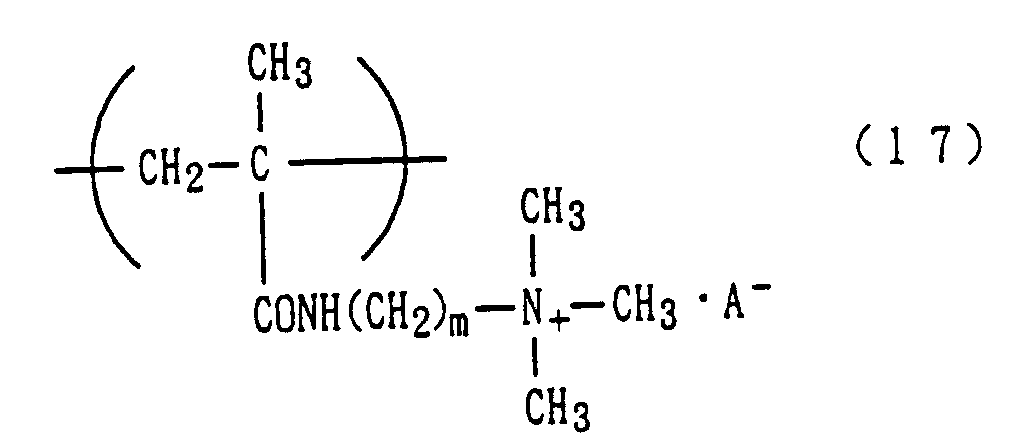
- the unit structure of the polymers of methacrylamide alkyl trimethyl ammonium is represented by the following formula (17).
- vinylpyrrolidone is particularly preferred. wherein m is an integer of from 1 to 6, and A - represents an anion).
- a copolymer of an ethyl sulfuric salt of quaternarized dimethylaminoethyl methacrylate and vinylpyrrolidone which is registered under the name, Polyquaternium-11, in the dictionary of CTFA; a copolymer of methacrylamide propyl trimethyl ammonium with vinylpyrrolidone known as Polyquaternium-28; and a methacrylamide propyl trimethyl ammonium polymer.
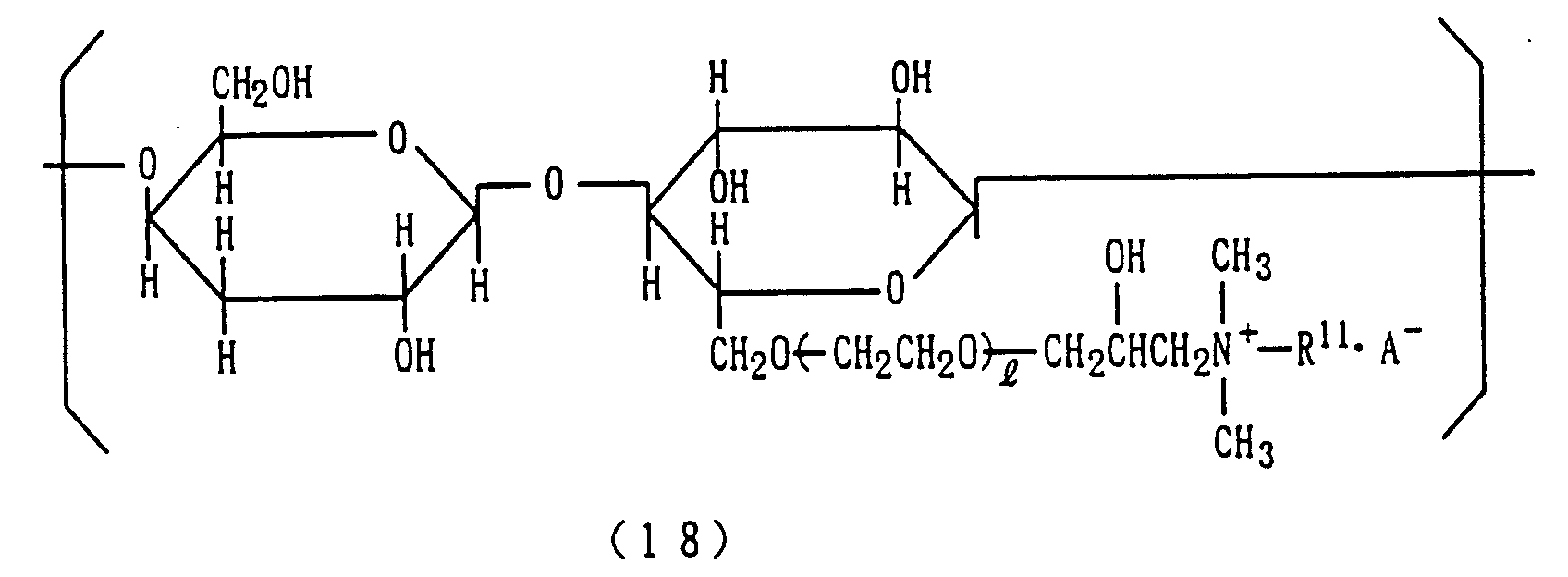
- Examples of the cationic cellulose include compounds having the unit structure represented by the following formula (18): wherein 1 is an integer of from 0 to 10 (preferably from 0 to 5), R 11 is C1-C18 alkyl, and A is an anion.
- hydroxyethylcellulose registered under the name, Polyquaternium-10, in the dictionary of CTFA; and 2-hydroxypropyl triethyl ammonium chloride ether.
- amino-modified silicone polymers include polymers of an organosiloxane having at least one aminoalkyl group in the molecule.
- the organosiloxane generally contains a methyl group as a functional group in addition to the aminoalkyl group.
- the functional group is not limited only to methyl, and other functional groups may be contained including alkyl groups such as ethyl, propyl, etc.; alkenyl groups such as vinyl, allyl, etc.; aryl groups such as phenyl, naphthyl, etc.; cycloalkyl groups such as cyclohexyl; and other groups such as hydroxy, hydroxyalkyl, hydroxyalkylene, and polyoxyalkylene, etc.
- Typical examples of the aminoalkyl groups contained in the amino-modified silicone polymers are those represented by the following formulas (19) or (20): wherein R 12 represents a divalent hydrocarbon group, R 13 represents R 14 and R 15 represent hydrogen or a monovalent hydrocarbon group, and d and e are integers of from 0 to 6. wherein R 12 represents a divalent hydrocarbon group, R 13 represents R 14 represents hydrogen or a monovalent hydrocarbon group, d and e are integers of from 0 to 6, and Z is a halogen ion or an organic anion.
- Examples of the divalent hydrocarbon group represented by R 12 in formulas (19) and (20) include C1-C6 alkylene groups such as methylene, ethylene, propylene, butylene, and -CH 2 CH(CH 3 )CH 2 -; and C7-C10 alkylenearylene groups such as -(CH 2 ) 2 -C 6 H 4 -. Of these, alkylene groups, particularly propylene, are preferred.
- hydroxyalkyl group is represented by the following formula: wherein R 12 has the same meaning as defined above.
- the oxyalkyene group and polyoxyalkylene group are represented by the following formula (21): wherein R 12 has the same meaning as defined above, f is an integer 0 or 1, g is an integer from 1 to 100 inclusive, and h is an integer from 1 to 5 inclusive.
- oxyalkylene group and polyoxyalkylene group represented by the following formula (21) preferable ones are those in which f is equal to 1, g is an integer of from 3 to 70, and h is 2 or 3. Those in which h is 2 or 3 may be linked in blocks or at random, and the same applies to other cases where h is an integer other than 2 or 3.
- the amino-modified silicone polymers are represented by the following formulas (22) or (23): wherein R 16 represents methyl or hydroxy, R 17 represents methyl or hydrogen, R 18 represents the aforementioned aminoalkyl (formula (19) or (20)), R 19 represents hydroxy, hydroxyalkyl, oxyalkylene, or polyoxyalkylene, and j and k are integers which vary depending on the molecular weight.
- R 16 , R 17 , R 18 , and R 19 have the same meaning as defined above, and i, j, and k are integers which vary depending on the molecular weight.
- Typical examples of the amino-modified silicone polymers in the present invention are those represented by the following formula (25) and having an average molecular weight of from about 3,000 to 100,000.
- This polymer is described in the aforementioned dictionary of CTFA (3rd ed.) under the name, Amodimethicone. wherein s and t are integers which vary depending on the molecular weight ranging from 3,000 to 100,000.
- the above-described cationic polymers are used singly or in combinations of two or more. They are preferably incorporated in an amount of from 0.05 to 10% based on the total amount of the composition. If the amount falls in a range of from 0.05 to 5%, particularly from 0.05 to 3%, an effect providing excellent feel to the touch of the hair is expected without impeding the firmness/elasticity-imparting effect and thus preferable.
- the pH of the hair cosmetic composition of the present invention is preferably adjusted to fall in the range from 2 to 5, more preferably from 2.5 to 4.5, by adding thereto a compound capable of forming a buffer system such as an organic carboxylic acid or a salt thereof in order to allow the hair fibers sufficiently to swell for accelerating permeation of the firmness/elasticity-imparting components, naphthalenesulfonic acids and/or benzophenonesulfonic acids into the hair fibers.
- a buffer system such as an organic carboxylic acid or a salt thereof
- the compounds which are capable of forming the buffer system include organic carboxylic acids such as citric acid, glycolic acid, succinic acid, tartaric acid, lactic acid, acetic acid, fumaric acid, malic acid, levulinic acid, butyric acid, valeric acid, oxalic acid, maleic acid, phthalic acid, mandelic acid, isethionic acid and their salts.
- organic carboxylic acids such as citric acid, glycolic acid, succinic acid, tartaric acid, lactic acid, acetic acid, fumaric acid, malic acid, levulinic acid, butyric acid, valeric acid, oxalic acid, maleic acid, phthalic acid, mandelic acid, isethionic acid and their salts.
- Preferable salts of these carboxylic acids include sodium salts, potassium salts, and ammonium salts.
- carboxylic acids are used singly or in combinations of two or more. They are incorporated in such amounts that make the pH of the composition to fall within the above-indicated pH range. Generally, they are incorporated from 0.3 to 50%, especially from 0.5 to 30%, based on the total amount of the composition.
- the hair cosmetic composition of the present invention may further contain optional components as long as the effects of the invention are not impeded.
- the optional components include thickeners such as hydroxyethylcellulose, anionic, amphoteric, and other types of setting polymers, perfumes, pearl-hue imparting agents, colorants, UV absorbers, antioxidants, preservatives, etc.
- thickeners such as hydroxyethylcellulose, anionic, amphoteric, and other types of setting polymers
- perfumes pearl-hue imparting agents, colorants, UV absorbers, antioxidants, preservatives, etc.
- silicone derivatives such as dimethylpolysiloxanes, polyether-modified silicones, alkyl-modified silicones, alkoxy-modified silicones, and aliphatic modified silicones.
- the balance of the above-described components is water.
- the hair cosmetic composition of the present invention can be prepared by a method generally known in the art into various products such as hair treatments, hair conditioners, and other products which are used outside the bath such as hair treatment foams, hair setting foams, hair sprays, and hair creams.
- the hair cosmetic composition of the present invention may, for example, be applied to hair fibers in the bath, be allowed to stand for 5 to 30 minutes, and then rinsed off. During the standing period, the hair may be heated to a suitable temperature which is preferably from 30 to 50°C.
- a suitable temperature which is preferably from 30 to 50°C.
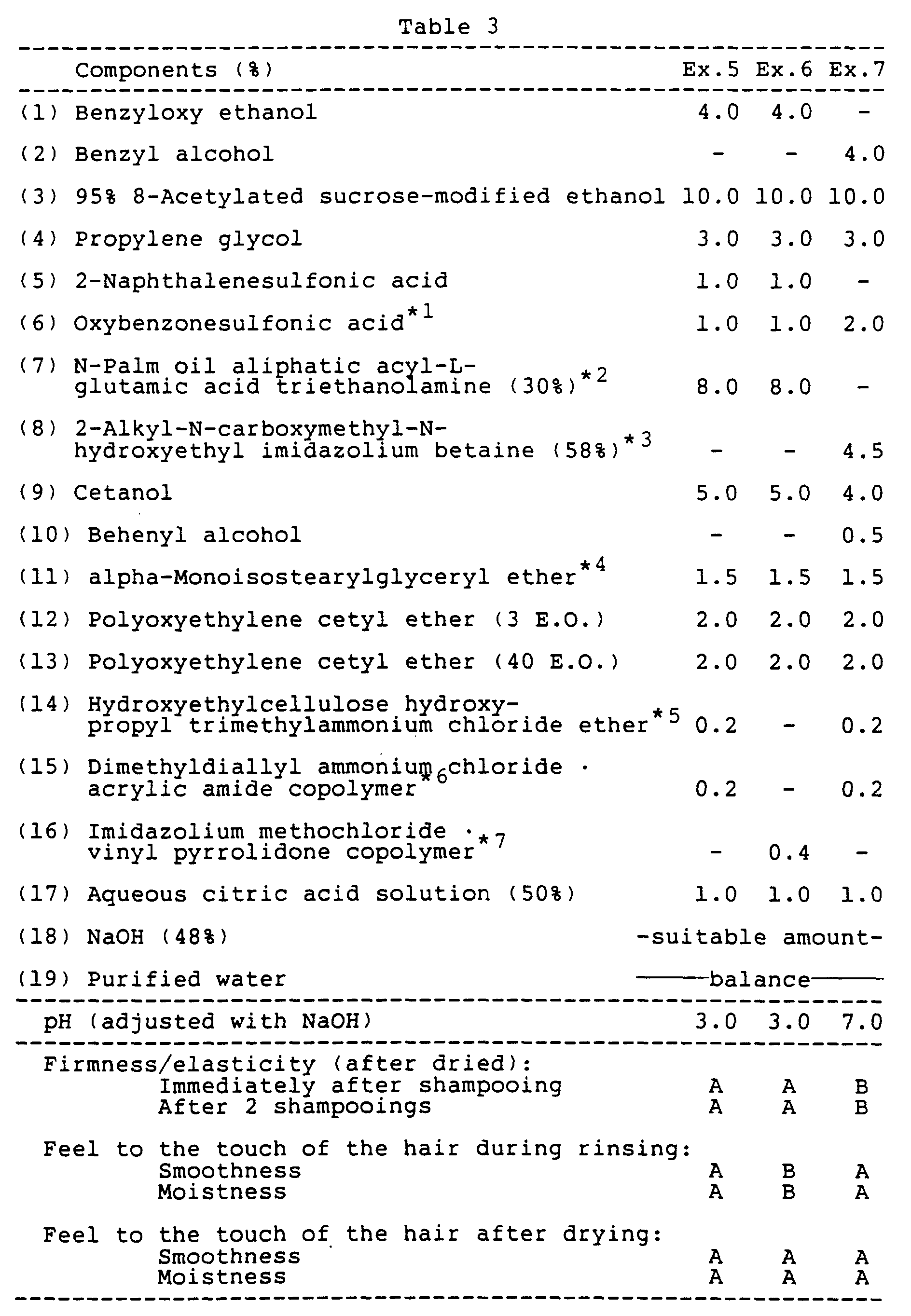
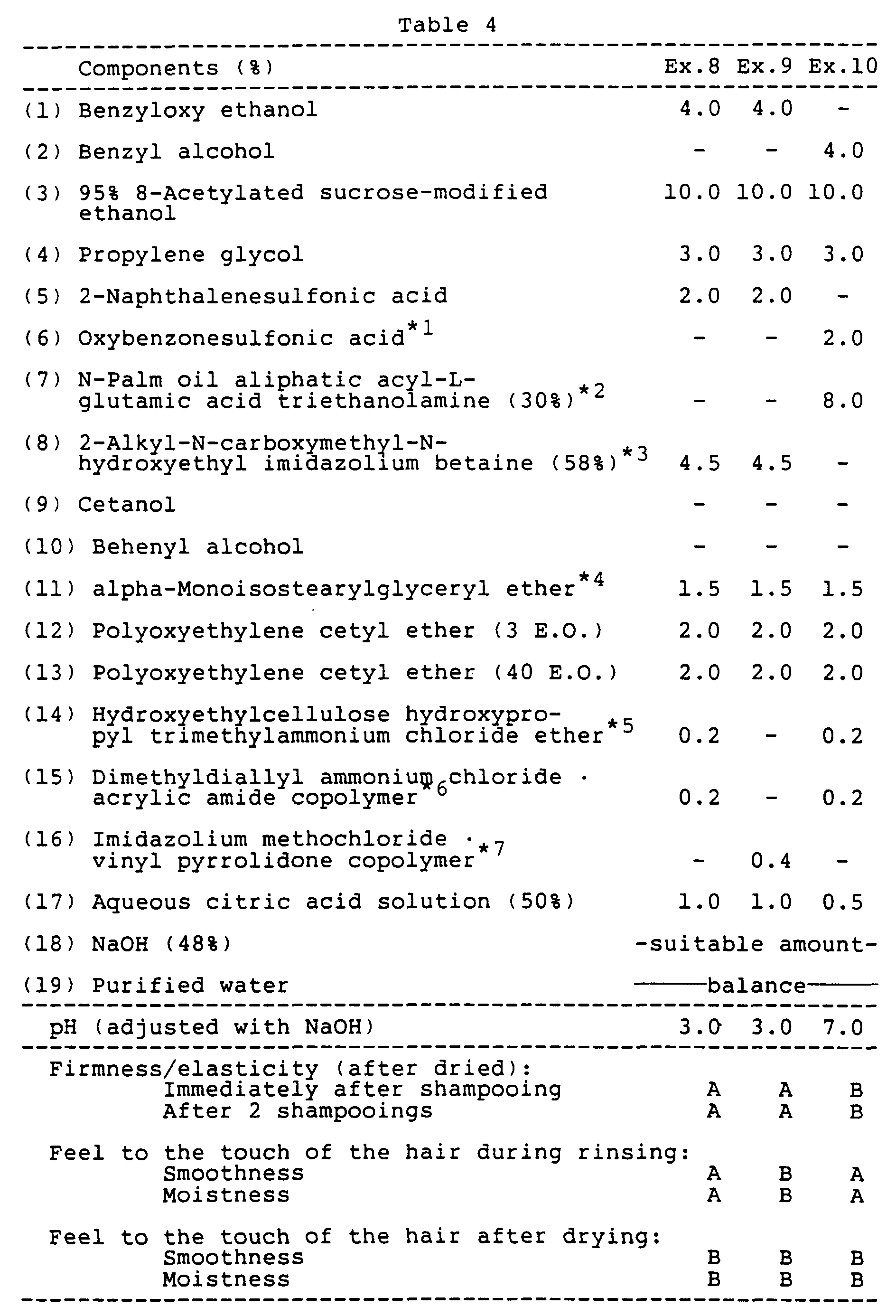
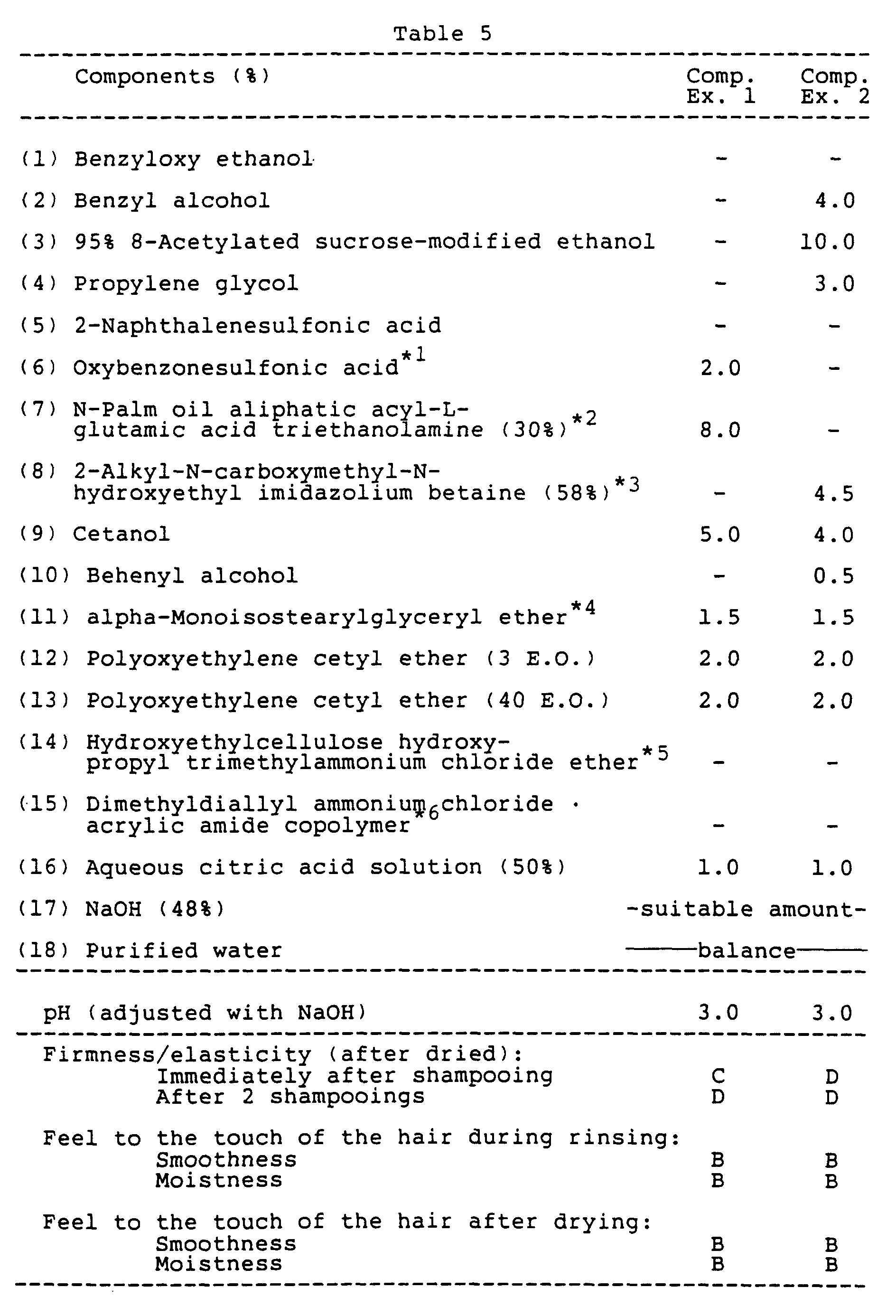
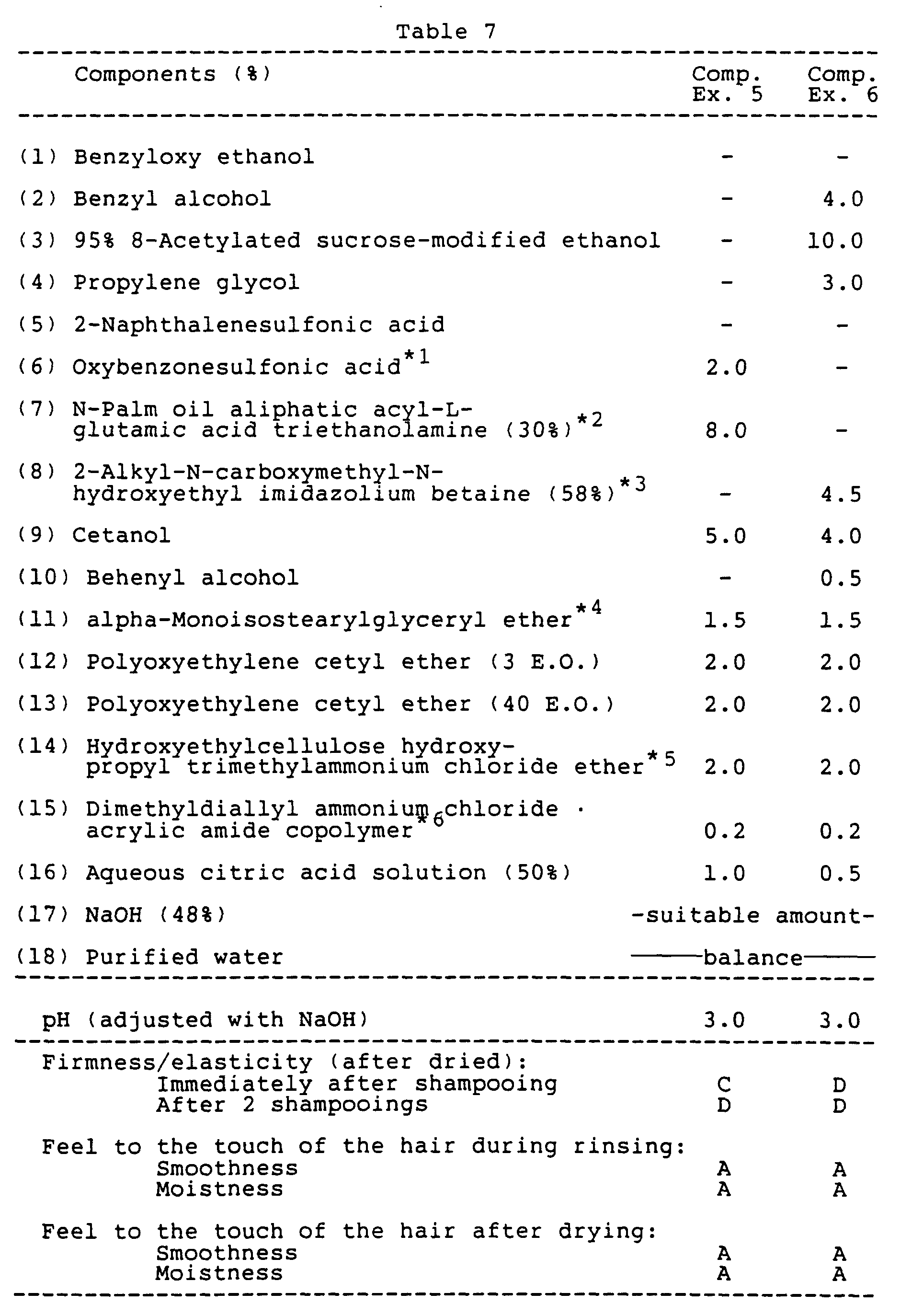
- the hair cosmetic compositions shown in Tables 1, 2, 3, 4, and 5 were prepared, and the hair treatment effects of the compositions were investigated.
- a hair treatment composition of the following formula was prepared by a routine method. It had excellent properties in both the firmness/elasticity of hair fibers and the conditioning effects (moistness, smoothness).
- Formula (%) (1) 2-Naphthalenesulfonic acid ⁇ Na 1.0 (2) Oxybenzonesulfonic acid 1.0 (3) 95% 8-Acetylated sucrose-modified ethanol 10.0 (4) Benzyloxy ethanol 3.0 (5) Dimethyldiallyl ammonium chloride .
- a hair treatment composition of the following formula was prepared by a routine method. It had excellent properties in both the firmness/elasticity of hair fibers and the conditioning effects.
- Formula (%) (1) 1-Naphthalenesulfonic acid ⁇ Na 2.0 (2) 95% 8-Acetylated sucrose-modified ethanol 5.0 (3) Diethylene glycol monoethyl ether 5.0 (4) Benzyl alcohol 4.0 (5) Hydroxyethylcellulose hydroxypropyl- trimethylammonium chloride ether 0.5 (6) Aqueous citric acid solution (50%) 1.0 (7) Lauryldimethylamine oxide (35%) 1.0 (8) Amideamino acid triethanolamine (34%) 5.0 (9) Cetanol 4.0 (10) Behenyl alcohol 1.5 (11) Polyoxyethylene cetyl ether (40 E.O.) 2.0 (12) Aqueous NaOH solution (48%) suitable amount for adjusting pH to 3.5 (13) Purified water balance Total 100
- a hair foam composition of the following formula was prepared by a routine method. It had excellent properties in both the firmness/elasticity of hair fibers and the conditioning effects (moistness, smoothness).
- a hair foam composition of the following formula was prepared by a routine method. It had excellent properties in both the firmness/elasticity of hair fibers and the conditioning effects.
- Formula (%) (1) 2-Naphthalenesulfonic acid ⁇ Na 0.5 (2) 95% 8-Acetylated sucrose-modified ethanol 10.0 (3) Benzyl alcohol 0.5 (5) Amideamino acid triethanolamine (34%) 0.5 (6) Polyoxyethylene-sec-tetradecyl ether (9 E.O.) 0.5 (7) Octyl dodecanol 0.5 (8) Propylene glycol 1.0 (9) Lauryl acrylate ⁇ vinyl acetate copolymer dispersion (20%) 4.0 (10) Vinylpyrrolidone ⁇ N,N-dimethylaminoethyl methacrylic acid copolymer, diethyl sulfate 2.5 (11) Aqueous NaOH solution (48%) suitable amount for adjusting pH to 3.5 (13) Purified water balance (14) Propellant (LPG 4.5 kg) 7.0
- the hair cosmetic composition according to the present invention imparts satisfactory firmness/elasticity to hair fibers in a short time, holds the firmness/elasticity for a long time, and provides the hair fibers with excellent conditioning effects.
Landscapes
- Health & Medical Sciences (AREA)
- Life Sciences & Earth Sciences (AREA)
- Animal Behavior & Ethology (AREA)
- General Health & Medical Sciences (AREA)
- Public Health (AREA)
- Veterinary Medicine (AREA)
- Birds (AREA)
- Epidemiology (AREA)
- Emergency Medicine (AREA)
- Dermatology (AREA)
- Cosmetics (AREA)
Abstract
Description
- The present invention relates to a hair cosmetic composition which imparts satisfactory firmness/elasticity to hair fibers in a short time, which holds the firmness/elasticity for a long time, and which at the same time provides the hair with conditioning effects.
- Not a few complaints about the hair are caused from the low elasticity of hair fibers such as lack of firmness/ elasticity and less volume. In order to meet the needs of people having such complaints, a variety of hair treatment compositions have heretofore been proposed which contain components for providing firmness/elasticity and components with conditioning effects. A majority of them exhibit their effects when they are adsorbed onto the surfaces of hair fibers, but the adsorbed compositions are rinsed off upon shampooing. Therefore, repeated treatments are needed, which is not convenient. Separately, attempts have been made to obtain an effect by permeating a hair treatment composition into hair fibers. However, the permeability of the composition is poor and requires a prolonged time for treatment while producing only an insufficient effect.
- Hair treatment compositions proposed by EP-A-0529437 comprise an organic solvent and an aromatic sulfonic acid.
- Although this composition imparts firmness/elasticity to hair fibers in a short time and the effects of the composition are long-lasting, the conditioning effects of the composition such as providing moistness, smoothness, etc. to hair fibers are still unsatisfactory.
- Similarly, US-A-5,240 695 discloses a process for protecting the elasticity of hair, wherein a cosmetic composition is used comprising in a cosmetically acceptable vehicle 2-hydroxy-4-methoxy-benzophenone-5-sulphonic acid or a salt thereof and said vehicle being an aqueous alcoholic or an aqueous alcoholic medium.
- EP-A-0 330 193 discloses a cosmetic composition for hair care, characterized in that it contains in a cosmetically acceptable medium the oxazoline polymer and 2-hydroxybenzophenone-5-sulphonic acid or the cosmetically acceptable salt thereof.
- Accordingly, hair cosmetic compositions capable of imparting firmness/elasticity to hair fibers in a short time, holding the firmness/elasticity for a long time, and providing the hair with satisfactory conditioning effects are still desired.
- Accordingly, the present invention provides a hair cosmetic composition which comprises the following components (A), (B), (C) , and (D):
- (A) an organic solvent,
- (B) a naphtalene sulfonic acid and/or a benzophenone
sulfonic
acid, - (C) an anionic surfactant and/or an amphoteric surfactant, and
- (D) an oily agent, wherein the amounts of the components (A), (B), (C), and (D) are 0.5 to 50 % by weight, 0.1 to 10 % by weight, 0.1 to 25 % by weight, and 1 to 25 % by weight based on the total weight of the composition respectively.
-
- According to the present invention, satisfactory firmness/elasticity can be given to hair fibers through a short-term treatment due to the incorporation of an organic solvent, a naphthalene sulfonic acid and/or a benzophenone sulfonic acid, an anionic surfactant and/or an amphoteric surfactant, and an oily agent, and the effects obtained are long-lasting. In addition, conditioning effects can also be given to the hair.
- The organic solvent which is used in the present invention as component (A) is compatible with water. Examples of the organic solvent (A) include the compounds of the following formula (1), N-alkylpyrrolidones of the following formula (2), and C1-C4 alkylene carbonates.wherein R1 represents hydrogen, lower alkyl, or a group
 (wherein R2 represents hydrogen, methyl, or methoxy, R3 represents a direct bond or a C1-C3 saturated or unsaturated divalent hydrocarbon group), Y and Z each represents hydrogen or hydroxy, p, q, and r are integers of from 0 to 5, with the exception of the cases where p=q=r=0 and Z=H; and p=q=r=0, R1=H, and Z=OH.
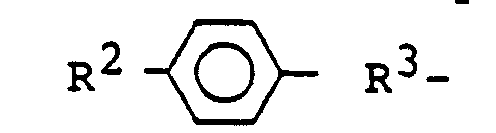 wherein R4 represents C1-C18 linear or branched alkyl.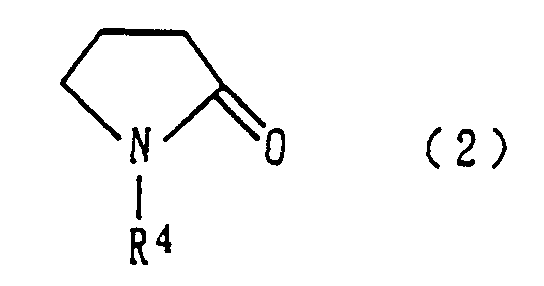
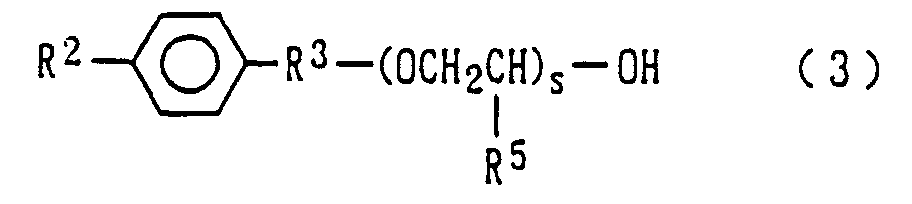
- Among the above-described species of component (A), the aromatic alcohols of the following formula (3) are especially preferred.wherein R5 is hydrogen or methyl, s is an integer from 0 to 5 inclusive, and R2 and R3 have the same meaning as described above with the exception that R3 is not a direct bond if s is equal to 0.
- Specific examples of the organic solvent (A) include ethanol, isopropanol, n-propanol, n-butanol, isobutanol, ethylene glycol, propylene glycol, 1,3-butanediol, benzyl alcohol, cinnamyl alcohol, phenethyl alcohol, p-anisyl alcohol, p-methylbenzyl alcohol, phenoxy ethanol, phenoxy isopropanol, 2-benzyloxyethanol, methyl carbitol, ethyl carbitol, propyl carbitol, butyl carbitol, triethylene glycol monoethylether, triethylene glycol monobutyl ether, glycerol, N-methylpyrrolidone, N-octylpyrrolidone, N-laurylpyrrolidone, ethylene carbonate(1,3-dioxolan-2-one), propylene carbonate(4-methyl-1,3-dioxolan-2-one), butylene carbonate(4-ethyl-1,3-dioxolan-2-one), etc. They are used singly or in combinations of two or more.
- Of these compounds, aromatic alcohols of formula (3) are especially preferred. Specifically, benzyl alcohol, cinnamyl alcohol, phenethyl alcohol, p-anisyl alcohol, p-methylbenzyl alcohol, phenoxy ethanol, phenoxy isopropanol, 2-benzyloxyethanol are preferred with benzyl alcohol, p-methylbenzyl alcohol, 2-benzyloxyethanol, phenoxy ethanol, and phenoxy isopropanol being particularly preferred.
- The organic solvent (A) is preferably incorporated in the hair cosmetic composition of the invention in an amount of from 0.5 to 50% by weight (hereinafter simply referred to as %) based on the total amount of the composition. If the amount of the organic solvent (A) is in the range from 2 to 30%, or particularly from 5 to 25%, prominent effects can be obtained with favorable sensation and thus preferable. The proportion between water and the organic solvent depends on the solubility of the solvent in water. Generally, the proportion of the amount of the organic solvent to that of water is preferably from 10:90 to 50:50.
- Of the species of component (B) which are used in the present invention, examples of the naphthalene sulfonic acid include the compounds represented by the following formula (4):wherein one or more of A1 to A8 represent a sulfonic group or a salt thereof, and the remaining group(s) represent(s) hydrogen, halogen, hydroxy, nitro, carboxy, lower alkoxycarbonyl, alkyl, alkenyl, lower alkoxy, formyl, acyl, phenylazo or substituted phenylazo, or a group
 wherein R' and R" represent hydrogen, lower alkyl, lower alkenyl, phenyl, benzyl, or acyl.
- In the above formula (4), examples of the alkyl include C1-C18 alkyl, examples of the alkenyl include C2-C18 alkenyl, examples of the lower alkyl and lower alkoxy include those of C1-C6, and examples of the lower alkenyl include C2-C6 alkenyl. Examples of the acyl include C2-C6 alkanoyl; examples of substituted or unsubstituted phenylazo include phenylazo, carboxyphenylazo, etc; examples of the halogen include fluorine, chlorine, bromine, and iodine. It is preferred that one or two of the A1 to A8 of the formula (4) be sulfonic acid or a salt thereof. Examples of the salt of sulfonic acid include alkaline metal salts such as a sodium salt, potassium salt, etc., ammonium salts, and quaternary ammonium salts.
- Specific examples of the naphthalene sulfonic acid include 1- or 2- naphthalene sulfonic acid, 1,3-naphthalenedisulfonic acid, 1,7-naphthalenedisulfonic acid, 2,7-naphthalenedisulfonic acid, 1,5-naphthalenedisulfonic acid, 2,6-naphthalenedisulfonic acid, 1,3,6-naphthalenetrisulfonic acid, 1-naphthol-2-sulfonic acid, 1-naphthol-4-sulfonic acid, 2-naphthol-6-sulfonic acid, 2-naphthol-7-sulfonic acid, 1-naphthol-3,6-disulfonic acid, 2-naphthol-3,6-disulfonic acid, 2-naphthol-6,8-disulfonic acid, 2,3-dihydroxynaphthalene-6-sulfonic acid, 1,7-dihydroxynaphthalene-3-sulfonic acid, chromotoropic acid (4,5-dihydroxynaphthalene-2,7-disulfonic acid), 3,6-dihydroxynaphthalene-2,7-disulfonic acid, S acid (1-amino-8-naphthol-4-sulfonic acid), gamma acid (2-amino-8-naphthol-6-sulfonic acid), J acid (2-amino-5-naphthol-7-sulfonic acid), H acid (l-amino-8-naphthol-3,6-disulfonic acid), 7-amino-1,3-naphthalenedisulfonic acid, l-amino-2-naphthol-4-sulfonic acid, 1-naphthylamine-4-sulfonic acid, Broenner's acid (2-naphthylamine-6-sulfonic acid), Cleve's acid (1-naphthylamine-7-sulfonic acid), 2-naphthylamine-1-sulfonic acid, 1-naphthylamine-6-sulfonic acid, 1-naphthylamine-8-sulfonic acid, 4-amino-5-hydroxy-8-phenylazo-2,7-naphthalenedisulfonic acid, 4-amino-8-(4-carboxyphenylazo)-5-hydroxy-2,7-naphthalenedisulfonic acid, 6-amino-4-hydroxy-3-phenylazo-2-naphthalenesulfonic acid, 4-amino-8-(4-carboxyphenylazo)-5-hydroxy-1-naphthalenesulfonic acid, 7-amino-4-hydroxy-1-phenylazo-2-naphthalenesulfonic acid, 8-amino-5-(4-carboxyphenylazo)-2-naphthalenesulfonic acid, 4-amino-3-(4-carboxyphenylazo)-5-hydroxy-l-naphthalenesulfonic acid, 6-amino-4-hydroxy-5-phenylazo-2-naphthalenesulfonic acid, 2,7-diamino-l-naphthol-3-sulfonic acid, 7,8-diamino-l-naphthol-3-sulfonic acid, naphthalenesulfonic acid - formalin polycondensation product (weight-average degree of polycondensation: 2-100), 6-methyl-2-naphthalenesulfonic acid, 4-ethyl-1-naphthalenesulfonic acid, 5-isopropyl-1-naphthalenesulfonic acid, 5-butyl-2-naphthalenesulfonic acid, and their salts. Of these, particularly preferred are 1-naphthalenesulfonic acid, 2-naphthalenesulfonic acid, 1,5-naphthalenedisulfonic acid, 2,6-naphthalenedisulfonic acid, 2,7-naphthalenedisulfonic acid, 1,3-naphthalenedisulfonic acid, H acid (l-amino-8-naphthol-3,6-disulfonic acid), 1,3,6-naphthalenetrisulfonic acid, chromotoropic acid, and naphthalenesulfonic acid - formalin polycondensation product (weight-average degree of polycondensation: 2-100), and their salts.
- Of the species of component (B), examples of the benzophenonesulfonic acid include those of the following formula (5):wherein one or more of A9 to A18 represent a sulfonic group or a salt thereof, and the remaining group(s) represent(s) hydrogen, halogen, hydroxy, carboxy, lower alkyl, lower alkenyl, lower alkoxy, or acyl.
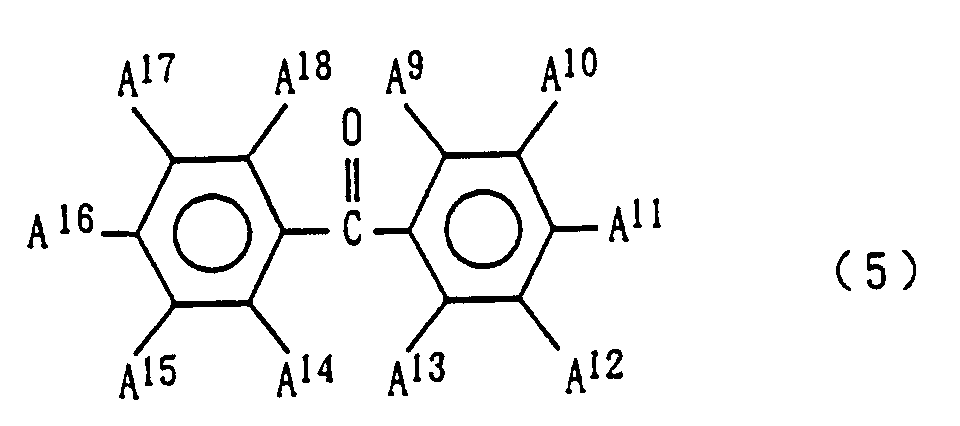
- In the above formula (5), the lower alkyl and the lower alkoxy include those having 1 to 6 carbon atoms; and the lower alkenyl includes those having 2 to 6 carbon atoms. Examples of the acyl include a C2-C6 alkanoyl. Examples of the halogen include fluorine, chlorine, bromine, and iodine. It is particularly preferred that one or two of the A9 to A18 of the formula (5) be sulfonic acid or a salt thereof. Examples of the salt of sulfonic acid include alkaline metal salts such as a sodium salt, potassium salt, etc., alkaline earth metal salts such as a calcium salt, ammonium salts, and quaternary ammonium salts.
- Specific examples of the benzophenonesulfonic acid include oxybenzonesulfonic acid, dihydroxydimethoxybenzophenonedisulfonic acid, dihydroxy-dimethoxybenzophenonesulfonic acid, dihydroxy-dimethoxybenzophenonedisulfonic acid, o-chlorobenzo-phenonesulfonic acid, p-chlorobenzophenone-sulfonic acid, 4,4'-dichlorobenzophenonesulfonic acid, 2,4-dichlorobenzophenonesulfonic acid, 2,4-dichlorobenzophenonesulfonic acid, 2-hydroxybenzophenonesulfonic acid, 4-hydroxybenzophenonesulfonic acid, 2-aminobenzophenone-sulfonic acid, 4-aminobenzophenonesulfonic acid, 2-methylbenzophenonesulfonic acid, 4-methoxybenzophenone-sulfonic acid, 4,4'-dimethylbenzophenonesulfonic acid, 4,4'-dimethoxybenzophenonesulfonic acid, 4-chloro-4'-hydroxybenzophenonesulfonic acid, and their salts. Of these, particularly preferred are oxybenzonesulfonic acid, dihydroxymethoxybenzophenonedisulfonic acid, dihydroxy-dimethoxybenzophenonesulfonic acid, dihydroxy-dimethoxybenzophenonedisulfonic acid, and their salts.
- The naphthalenesulfonic acids and the benzosulfonic acids, which are component (B), are used singly or in combinations of two or more. They are preferably incorporated in the hair cosmetic composition of the invention in an amount from 0.1 to 10% by weight based on the total amount of the composition. If the amount is in the range from 0.5 to 5%, or particularly from 1.0 to 3.0%, excellent firmness/elasticity can be imparted to the hair without impeding the feel to the touch of the hair, and thus preferable.
- Of the species of component (C) which are used in the present invention, examples of the anionic surfactant include the following compounds.
- (1) Linear or branched alkylbenzene sulfonates having an alkyl group containing 10 to 16 carbon atoms on average.
- (2) Alkyl or alkenyl ether sulfates having a linear or branched alkyl or alkenyl group containing 10 to 20 carbon atoms on average and a polyether chain to which 0.5 to 8 moles on average of ethylene oxide, propylene oxide, butylene oxide, or a combination of two or more of these is added per 1 molecule of sulfate.
- (3) Alkyl or alkenyl sulfates having an alkyl or alkenyl group containing 10 to 20 carbon atoms on average.
- (4) Olefin sulfonates having 10 to 20 carbon atoms on average per molecule.
- (5) Alkane sulfonates having 10 to 20 carbon atoms on average per molecule.
- (6) Saturated or unsaturated fatty acid salts having 10 to 24 carbon atoms on average per molecule.
- (7) Alkyl or alkenyl ether carboxylates having an alkyl or alkenyl group containing 10 to 20 carbon atoms on average and a polyether chain to which 0.5 to 8 moles on average of ethylene oxide, propylene oxide, butylene oxide, or a combination of two or more of these is added per 1 molecule of carboxylate.
- (8) Alpha-sulfofatty acid salts or esters having an alkyl or alkenyl group containing 10 to 20 carbon atoms on average per molecule.
- (9) N-acyl amino acid-type surfactants having a C8-C24 acyl group, a free carboxylic residue, or a sulfonic residue.
- (10) Phosphoric mono- or di- ester-type surfactants having C8-C24 alkyl or alkenyl, or their ethoxylates.
- (11) Sulfosuccinic esters derived from a higher aliphatic amide or a C8-C22 higher alcohol or its ethoxylates.
- (12) Sulfonic acid salts of C8-C20 higher fatty aid monoethanolamides, diethanolamides or their ethoxylates.
- (13) Sulfonic acid salts of C8-C20 monoglycerides.
- (14) Salts of C8-C20 higher fatty acids and isethionic acid.
-
- Of the species of component (C), examples of the amphoteric surfactant include the following compounds.
- (1) Imidazolines having C8-C24 alkyl, alkenyl or acyl, and of an alpha- adduct type, secondary amide type, or a tertiary amide type.
- (2) Carbobetaines, amidebetaines, sulfobetaines, hydroxysulfobetaines, and amidesulfobetaines having C6-C24 alkyl, alkenyl or acyl.
- (3) Amineoxides having C6-C24 alkyl or alkenyl.
-
- Among the above surfactants, the compounds (a) to (f) below are particularly preferred.
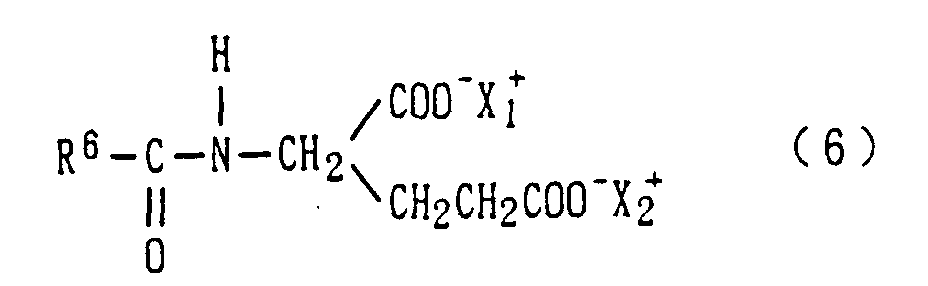
- (a) N-acyl-L-glutamic acids and their salts represented
by the following formula (6):
wherein R6 is C12-C18 linear or branched alkyl or alkenyl, X1 and X2 are hydrogen, potassium, sodium, or a triethanolamine salt, with X1 and X2 being not necessarily identical.
- (b) N-acyl-N-methyl-beta-alanines and their salts
represented by the following formula (7):
wherein R6 has the same meaning as defined above, X is hydrogen, potassium, sodium, or a triethanolamine salt.

- (c) Aminoalkyltaurinic acids and their salts
represented by the following formula (8):
wherein R6 and X have the same meaning as defined above.

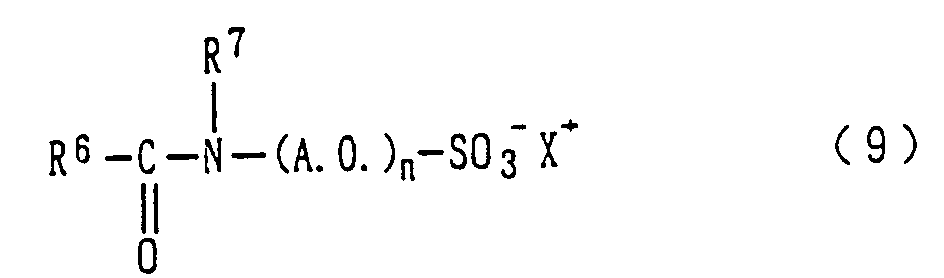
- (d) Amide ether sulfates and their salts represented by
the following formula (9):
wherein R6 is C12-C18 linear or branched alkyl or alkenyl, R7 is C1-C3 linear alkyl, (A.O.)n is 1 to 5 moles on average (=n) of ethylene oxide, propylene oxide, or butylene oxide (A.O.) which has been added, and R6 and X have the same meaning as defined above.
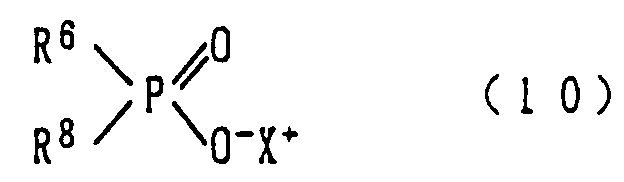
- (e) Monoalkyl or dialkyl phosphoric acids and their
salts represented by the following formula (10):
wherein R8 is C12-C18 linear or branched alkyl or alkenyl, and R6 and X have the same meaning as defined above (if R8 is hydrogen, the formula (10) represents monoalkyl phosphoric acids and their salts).
- (f) Secondary amide- or tertiary amide-type imidazoline
amphoteric surfactants and their salts represented by the
following formulas (11), (12), and (13):
wherein R9 is C7-C18 linear or branched alkyl or alkenyl, and X has the same meaning as defined above;
 wherein R9 and X have the same meaning as defined above;
 wherein R9 and X have the same meaning as defined above.
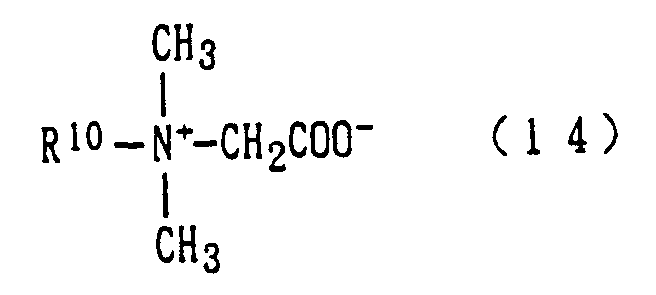
- (g) Carbobetaine-type, sulfobetaine-type, and
hydroxysulfobetaine-type amphoteric surfactants represented
by the following formulas (14) and (15):
wherein R10 is C6-C24 alkyl, alkenyl, or acyl;
 wherein Y is hydrogen or hydroxyl, and R10 has the same meaning as defined above.
-
- These anionic and amphoteric surfactants are used singly or in combinations of two or more. They are preferably incorporated in an amount of from 0.1 to 25% based on the total amount of the composition. If the amount falls in a range from 0.5 to 15%, and in particular from 1.0 to 10%, excellent feel to the touch can be obtained and thus preferable.
- Examples of the oily agent, component (D), include various oils and fats and hydrocarbons which are either liquid or solid.
- Examples of the oils and fats include C12-C30 saturated or unsaturated alcohols; ethers of these alcohols and polyhydric alcohols; esters of these alcohols and C1-C11 fatty acids; C12-C30 saturated or unsaturated fatty acids; esters of these fatty acids and monohydric or polyhydric alcohols; amides of these fatty acids and amines; sterols; squalenes; phospholipids; glycolipids; oils or fats of animal origin; and oils or fats of vegetable origin.
- Examples of the C12-C30 saturated or unsaturated alcohols include n-dodecal, myristyl alcohol, cetyl alcohol, stearyl alcohol, oleyl alcohol, octyldodecanol, behenyl alcohol, ceryl alcohol, myricyl alcohol, caranabyl alcohol, arachin alcohol, and the like. Examples of the polyhydric alcohols which can form ethers with these alcohols include glycerol and polyalkylene glycol, and examples the formed ethers include alpha-monoisostearyl glyceryl ether, polyoxyethylene polyoxypropylene stearyl ether, polyoxyethylene cetyl ether, polyoxyethylene octyldodecyl ether, and the like. Examples of the esters of these alcohols and C1-C11 fatty acids include cetyl 2-ethylhexanoate, diisostearyl malate, and the like.
- Examples of the C12-C30 saturated or unsaturated fatty acids include lauric acid, myristic acid, 18-methyleicosanoic acid, palmitic acid, stearic acid, isostearic acid, behenic acid, cerotic acid, palm oil fatty acid, oleic acid, etc. Examples of the monohydric or polyhydric alcohols which can form esters with these fatty acids include the aforementioned C12-C30 saturated or unsaturated alcohols, glycerols, sterols, and fat-soluble vitamins, and examples of the formed esters include oleic monoglycerides, palmitic monoglycerides, behenic monoglycerides, myristic monoglycerides, isostearic monoglycerides, isostearic diglycerides, polyoxyethylene glyceryl monoisostearates, isopropyl myristates, cholesteryl ester isostearates, dipentaerythritol fatty acid esters. Examples of the amides of these fatty acids and amines include aliphatic dialkylaminoalkylamides (long chain amideamines), and specifically, diethylaminoethylamide stearate (Amideamine S by Kao Corp.).
- Specific examples of the phospholipids include soybean phospholipids, and specific examples of the glycolipids include sophorose lipids (Glycolipid PSL by Kao Corp.). Specific examples of the oils and fats of animal or vegetable origin include mink oil, olive oil (the major component is glycerol oleate), beeswax (the major component is myricyl alcohol palmitate), palm oil (the major component is glycerol myristate), whale wax (the major component is ceryl alcohol palmitate), and lanolin.
- Examples of the hydrocarbons include Vaseline, liquid paraffin, solid paraffin, etc.
- Of these oily agents, especially preferred are higher alcohols having C12-C26 linear or branched alkyl or alkenyl groups.
- These oily agents are used singly or in combinations of two or more. They are preferably incorporated in an amount of from 1 to 25% based on the total amount of the composition. If the amount falls in a range of from 3 to 20%, and in particular from 5 to 15%, remarkably satisfactory results can be obtained with excellent feel to the touch of the hair and thus preferable.
- When cationic polymers are incorporated into the hair cosmetic composition of the present invention, even more excellent conditioning effects can be obtained without affecting the capability of imparting firmness/elasticity to the hair.
- Examples of the cationic polymers include polymers or copolymers of dimethyldiallylammonium chloride; polymers or copolymers of methacrylamide alkyl trimethyl ammonium; cationic cellulose; amino-modified silicone polymers.
- The unit structure of the polymers of dimethyldiallyl ammonium chloride is represented by the following formula (16). Preferable examples of monomers which form copolymers along with dimethyldiallylammonium chloride include acrylates, acrylamides, hydroxyethylcellulose, etc.

- Specifically, mention may be given to a copolymer of dimethyldiallylammonium chloride and hydroxyethylcellulose which is registered under the name, Polyquaternium-4, in a dictionary of CTFA (The Cosmetic, Toiletry and Fragrance Association, Inc.); a polymer of dimethyldiallylammonium chloride known as Polyquaternium-6; a copolymer of dimethyldiallylammonium chloride with acrylic amide known as Polyquaternium-7; a copolymer of dimethyldiallylammonium chloride with sodium acrylate known as Polyquaternium-22; and a three component-copolymer of dimethyldiallylammonium chloride/acrylic amide/sodium acrylate known as Polyquaternium-39.
- The unit structure of the polymers of methacrylamide alkyl trimethyl ammonium is represented by the following formula (17). Among the monomers which form copolymers along with methacrylamide alkyl trimethyl ammonium, vinylpyrrolidone is particularly preferred.wherein m is an integer of from 1 to 6, and A- represents an anion).
- Specifically, mention may be given to a copolymer of an ethyl sulfuric salt of quaternarized dimethylaminoethyl methacrylate and vinylpyrrolidone which is registered under the name, Polyquaternium-11, in the dictionary of CTFA; a copolymer of methacrylamide propyl trimethyl ammonium with vinylpyrrolidone known as Polyquaternium-28; and a methacrylamide propyl trimethyl ammonium polymer.
- Examples of the cationic cellulose include compounds having the unit structure represented by the following formula (18):wherein 1 is an integer of from 0 to 10 (preferably from 0 to 5), R11 is C1-C18 alkyl, and A is an anion.
- Specifically, mention may be given to hydroxyethylcellulose registered under the name, Polyquaternium-10, in the dictionary of CTFA; and 2-hydroxypropyl triethyl ammonium chloride ether.
- Examples of the amino-modified silicone polymers include polymers of an organosiloxane having at least one aminoalkyl group in the molecule.
- The organosiloxane generally contains a methyl group as a functional group in addition to the aminoalkyl group. However, the functional group is not limited only to methyl, and other functional groups may be contained including alkyl groups such as ethyl, propyl, etc.; alkenyl groups such as vinyl, allyl, etc.; aryl groups such as phenyl, naphthyl, etc.; cycloalkyl groups such as cyclohexyl; and other groups such as hydroxy, hydroxyalkyl, hydroxyalkylene, and polyoxyalkylene, etc.
- Typical examples of the aminoalkyl groups contained in the amino-modified silicone polymers are those represented by the following formulas (19) or (20):wherein R12 represents a divalent hydrocarbon group, R13 represents
 R14 and R15 represent hydrogen or a monovalent hydrocarbon group, and d and e are integers of from 0 to 6.
 wherein R12 represents a divalent hydrocarbon group, R13 represents
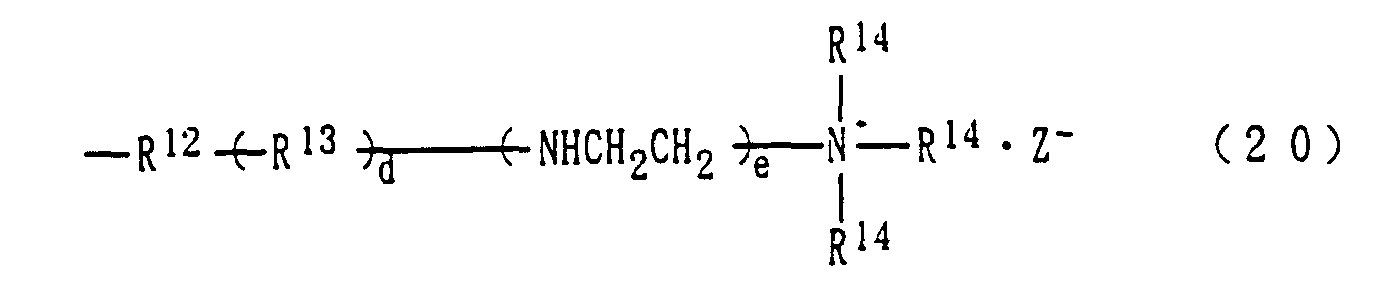 R14 represents hydrogen or a monovalent hydrocarbon group, d and e are integers of from 0 to 6, and Z is a halogen ion or an organic anion.
- Examples of the divalent hydrocarbon group represented by R12 in formulas (19) and (20) include C1-C6 alkylene groups such as methylene, ethylene, propylene, butylene, and -CH2CH(CH3)CH2-; and C7-C10 alkylenearylene groups such as -(CH2)2-C6H4-. Of these, alkylene groups, particularly propylene, are preferred. Examples of the monovalent hydrocarbon group represented by R14 and R15 include C1-C18 alkyl or aryl groups such as methyl, ethyl, propyl, hexyl, and phenyl. Both of the groups R14 and R15 may be hydrogen or a monovalent hydrocarbon group. Alternatively, they may be different in such as a manner that R14 is hydrogen and R15 is a monovalent hydrocarbon group. Preferable values of d and e are such that d=0 and e=1.
- Typically, the hydroxyalkyl group is represented by the following formula:wherein R12 has the same meaning as defined above.

- Typically, the oxyalkyene group and polyoxyalkylene group are represented by the following formula (21):wherein R12 has the same meaning as defined above, f is an integer 0 or 1, g is an integer from 1 to 100 inclusive, and h is an integer from 1 to 5 inclusive.

- Among the oxyalkylene group and polyoxyalkylene group represented by the following formula (21), preferable ones are those in which f is equal to 1, g is an integer of from 3 to 70, and h is 2 or 3. Those in which h is 2 or
3 may be linked in blocks or at random, and the same applies to other cases where h is an integer other than 2 or 3. - Typically, the amino-modified silicone polymers are represented by the following formulas (22) or (23):wherein R16 represents methyl or hydroxy, R17 represents methyl or hydrogen, R18 represents the aforementioned aminoalkyl (formula (19) or (20)), R19 represents hydroxy, hydroxyalkyl, oxyalkylene, or polyoxyalkylene, and j and k are integers which vary depending on the molecular weight.
 wherein R16, R17, R18, and R19 have the same meaning as defined above, and i, j, and k are integers which vary depending on the molecular weight.
- Of the above-mentioned amino-modified silicone polymers, particularly preferable ones are those represented by the following formula (24):wherein R20, j, and k have the same meaning as defined above.

- Typical examples of the amino-modified silicone polymers in the present invention are those represented by the following formula (25) and having an average molecular weight of from about 3,000 to 100,000. This polymer is described in the aforementioned dictionary of CTFA (3rd ed.) under the name, Amodimethicone.wherein s and t are integers which vary depending on the molecular weight ranging from 3,000 to 100,000.

- The above-described cationic polymers are used singly or in combinations of two or more. They are preferably incorporated in an amount of from 0.05 to 10% based on the total amount of the composition. If the amount falls in a range of from 0.05 to 5%, particularly from 0.05 to 3%, an effect providing excellent feel to the touch of the hair is expected without impeding the firmness/elasticity-imparting effect and thus preferable.
- The pH of the hair cosmetic composition of the present invention is preferably adjusted to fall in the range from 2 to 5, more preferably from 2.5 to 4.5, by adding thereto a compound capable of forming a buffer system such as an organic carboxylic acid or a salt thereof in order to allow the hair fibers sufficiently to swell for accelerating permeation of the firmness/elasticity-imparting components, naphthalenesulfonic acids and/or benzophenonesulfonic acids into the hair fibers.
- The compounds which are capable of forming the buffer system include organic carboxylic acids such as citric acid, glycolic acid, succinic acid, tartaric acid, lactic acid, acetic acid, fumaric acid, malic acid, levulinic acid, butyric acid, valeric acid, oxalic acid, maleic acid, phthalic acid, mandelic acid, isethionic acid and their salts. Preferable salts of these carboxylic acids include sodium salts, potassium salts, and ammonium salts.
- These carboxylic acids are used singly or in combinations of two or more. They are incorporated in such amounts that make the pH of the composition to fall within the above-indicated pH range. Generally, they are incorporated from 0.3 to 50%, especially from 0.5 to 30%, based on the total amount of the composition.
- If necessary, the hair cosmetic composition of the present invention may further contain optional components as long as the effects of the invention are not impeded. The optional components include thickeners such as hydroxyethylcellulose, anionic, amphoteric, and other types of setting polymers, perfumes, pearl-hue imparting agents, colorants, UV absorbers, antioxidants, preservatives, etc. In order to further improve feel to the touch of the hair, it is possible to incorporate silicone derivatives such as dimethylpolysiloxanes, polyether-modified silicones, alkyl-modified silicones, alkoxy-modified silicones, and aliphatic modified silicones.
- In the hair cosmetic composition of the present invention, the balance of the above-described components is water.
- The hair cosmetic composition of the present invention can be prepared by a method generally known in the art into various products such as hair treatments, hair conditioners, and other products which are used outside the bath such as hair treatment foams, hair setting foams, hair sprays, and hair creams.
- In use, the hair cosmetic composition of the present invention may, for example, be applied to hair fibers in the bath, be allowed to stand for 5 to 30 minutes, and then rinsed off. During the standing period, the hair may be heated to a suitable temperature which is preferably from 30 to 50°C. When the hair cosmetic composition of the invention is used outside the bath, it is applied to the hair (either dry hair or wet hair after shampooing) and is brought into full contact with the entire surfaces of the hair fibers.
- The present invention will next be described by way of examples, which should not be construed as limiting the invention.
- Examples 1 to 10 and Comparative Examples 1 to 8:
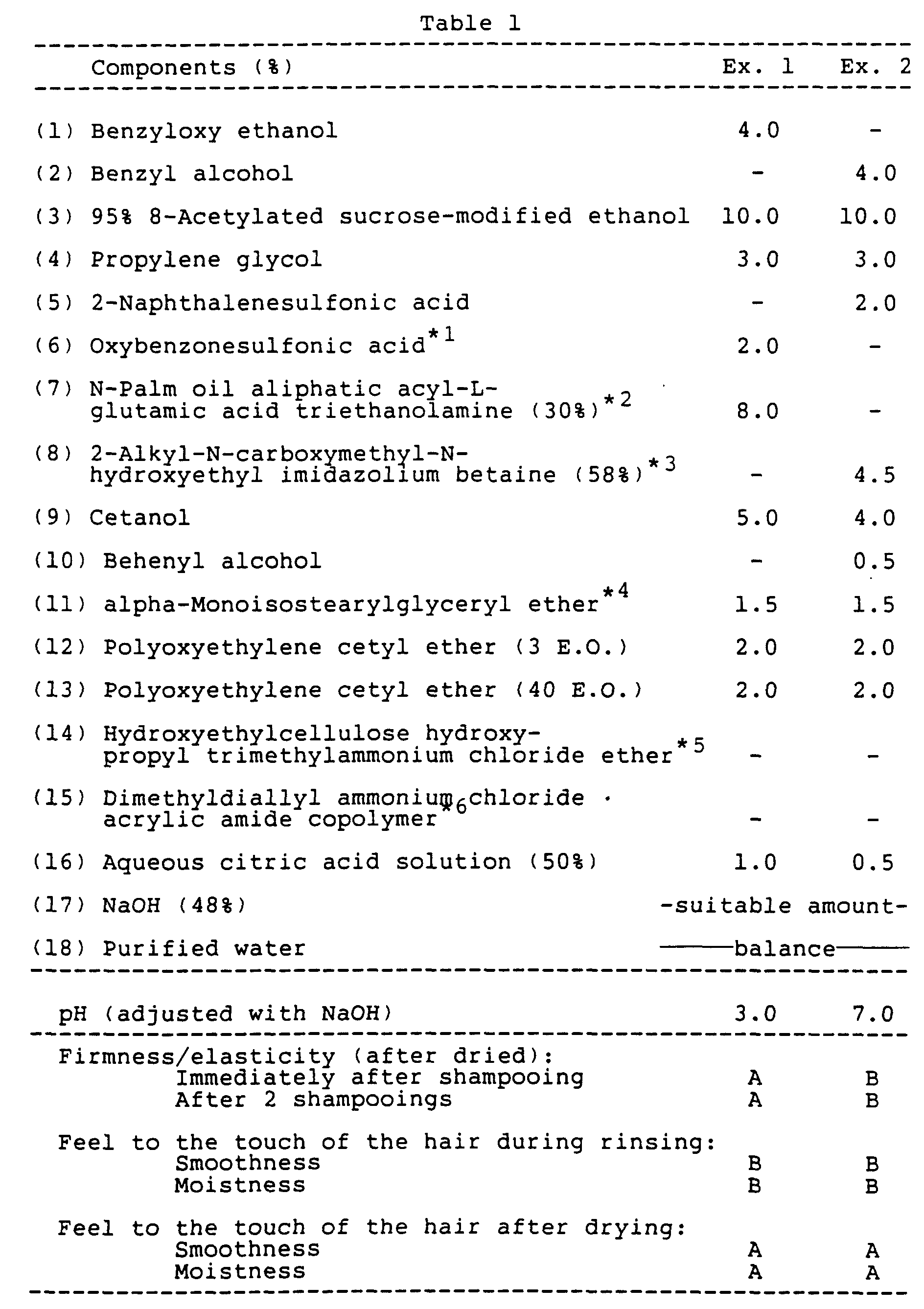
- The hair cosmetic compositions shown in Tables 1, 2, 3, 4, and 5 were prepared, and the hair treatment effects of the compositions were investigated.
- (1) The hair used in the test:
Hair fiber samples of Japanese women which had not undergone any beauty treatments such as cold perming or bleaching. - (2) Evaluation method:
Hair fiber samples each weighing 8 g were provided. Each sample was divide into two. To one half, an invention composition (or a comparative composition) in a solution of 1:1 was applied, and was allowed to stand at room temperature for 10 minutes. Subsequently, the composition was rinsed off with running water, after which the hair was dried with a hair drier or similar means. The resulting sample represented a treated sample. The other half, which was not treated with any compositions represented a non-treated sample. 10 expert panelists compared each pair in a side-by-side manner with respect to the firmness/elasticity, moistened feel to the touch of the hair, and smoothness to the touch of the hair. The evaluation of firmness/elasticity was repeated after the sample was shampooed twice. The evaluation standards were as follows:
Firmness/elasticity of the hair: - A: Remarkably excellent firmness/elasticity
- B: Good firmness/elasticity
- C: Slightly better firmness/elasticity than untreated hair
- D: The same level as that of untreated hair. Moistened feel to the touch of the hair:
- A: Very moistened feel
- B: Fairly moistened feel
- C: Slightly moistened feel
- D: The same level as that of untreated hair.
- A: Very smooth
- B: Fairly smooth
- C: Slightly smooth
- D: The same level as that of untreated hair.




-
- A hair treatment composition of the following formula was prepared by a routine method. It had excellent properties in both the firmness/elasticity of hair fibers and the conditioning effects (moistness, smoothness).
Formula (%) (1) 2-Naphthalenesulfonic acid · Na 1.0 (2) Oxybenzonesulfonic acid 1.0 (3) 95% 8-Acetylated sucrose-modified ethanol 10.0 (4) Benzyloxy ethanol 3.0 (5) Dimethyldiallyl ammonium chloride . acrylic amide copolymer 0.3 (6) Hydroxyethylcellulose hydroxypropyl-trimethylammonium chloride ether 0.3 (7) Aqueous citric acid solution (50%) 1.0 (8) N-Palm oil aliphatic acyl-L-glutamic acid triethanolamine 3.0 (9) Monolauryl phosphoric acid 2.5 (10) Cetanol 5.0 (11) Polyoxyethylene cetyl ether (40 E.O.) 2.0 (12) Aqueous NaOH solution (48%) suitable amount for adjusting pH to 3.0 (13) Purified water balance Total 100 - A hair treatment composition of the following formula was prepared by a routine method. It had excellent properties in both the firmness/elasticity of hair fibers and the conditioning effects.
Formula (%) (1) 1-Naphthalenesulfonic acid · Na 2.0 (2) 95% 8-Acetylated sucrose-modified ethanol 5.0 (3) Diethylene glycol monoethyl ether 5.0 (4) Benzyl alcohol 4.0 (5) Hydroxyethylcellulose hydroxypropyl- trimethylammonium chloride ether 0.5 (6) Aqueous citric acid solution (50%) 1.0 (7) Lauryldimethylamine oxide (35%) 1.0 (8) Amideamino acid triethanolamine (34%) 5.0 (9) Cetanol 4.0 (10) Behenyl alcohol 1.5 (11) Polyoxyethylene cetyl ether (40 E.O.) 2.0 (12) Aqueous NaOH solution (48%) suitable amount for adjusting pH to 3.5 (13) Purified water balance Total 100 - A hair foam composition of the following formula was prepared by a routine method. It had excellent properties in both the firmness/elasticity of hair fibers and the conditioning effects (moistness, smoothness).
Formula (%) (1) Oxybenzonesulfonic acid 0.5 (2) 95% 8-Acetylated sucrose-modified ethanol 10.0 (3) Amideamino acid triethanolamine (24%) (= Amphitol 20Y-N (Kao)) 0.5 (4) Polyoxyethylene-sec-tetradecyl ether (9 E.O.) 1.0 (5) N-methacryloylethyl-N,N-dimethylammonium . alpha-N-methylcarboxybetaine · butyl methacrylate copolymer 1.0 (6) Dimethylethylene chloride piperidium copolymer 0.1 (7) Octyl dodecanol 0.5 (8) Propylene glycol 1.0 (9) Aqueous NaOH solution (48%) suitable amount for adjusting pH to 3.5 (10) Purified water balance (11) Propellant (LPG 4.5 kg) 7.0 Total 100 - A hair foam composition of the following formula was prepared by a routine method. It had excellent properties in both the firmness/elasticity of hair fibers and the conditioning effects.
Formula (%) (1) 2-Naphthalenesulfonic acid · Na 0.5 (2) 95% 8-Acetylated sucrose-modified ethanol 10.0 (3) Benzyl alcohol 0.5 (5) Amideamino acid triethanolamine (34%) 0.5 (6) Polyoxyethylene-sec-tetradecyl ether (9 E.O.) 0.5 (7) Octyl dodecanol 0.5 (8) Propylene glycol 1.0 (9) Lauryl acrylate · vinyl acetate copolymer dispersion (20%) 4.0 (10) Vinylpyrrolidone · N,N-dimethylaminoethyl methacrylic acid copolymer, diethyl sulfate 2.5 (11) Aqueous NaOH solution (48%) suitable amount for adjusting pH to 3.5 (13) Purified water balance (14) Propellant (LPG 4.5 kg) 7.0 Total 100 - The hair cosmetic composition according to the present invention imparts satisfactory firmness/elasticity to hair fibers in a short time, holds the firmness/elasticity for a long time, and provides the hair fibers with excellent conditioning effects.
Claims (9)
- A hair cosmetic composition which comprises the following components (A), (B), (C), and (D):wherein the amounts of the components (A), (B), (C), and (D) are 0.5 to 50% by weight, 0.1 to 10% by weight, 0.1 to 25% by weight, and 1 to 25% by weight based on the total weight of the composition, respectively.(A) an organic solvent,(B) a naphthalene sulfonic acid and/or a benzophenone sulfonic acid,(C) an anionic surfactant and/or an amphoteric surfactant, and(D) an oily agent.
- The hair cosmetic composition according to claim 1, wherein the component (A) is selected from alkylpyrrolidones having C1 to C18 N-alkyl, C1 to C4 alkylene carbonates, and the alcohols represented by the following formula (1) :wherein R1 represents hydrogen, C1 to C4 alkyl, or a group
 (wherein R2 represents hydrogen, methyl, or methoxy, R3 represents a direct bond or a C1 to C3 saturated or unsaturated divalent hydrocarbon group), Y and Z each represents hydrogen or hydroxy, p, q, and r are integers of from 0 to 5, with the exception of the cases where p=q=r=0 and Z=H; and p=q=r=0, R1=H, and Z=OH.
- The hair cosmetic composition according to Claim 1, wherein the component (A) is represented by the following formula (3):wherein R2 is hydrogen, methyl, or methoxy, R3 is a direct bond or a C1-C3 saturated or unsaturated divalent hydrocarbon group, R5 is hydrogen or methyl, s is an integer of from 0 to 5, provided that R3 is not a direct bond if s is 0.

- The hair cosmetic composition according to claim 1, wherein the component (D) is selected from C12 to C30 saturated or unsaturated alcohols, ethers of these alcohols with polyhydric alcohols, esters of said alcohols with C1 to C11 fatty acids, C12 to C30 saturated or unsaturated fatty acids, esters of these fatty acids and monohydric or polyhydric alcohols, amides of said fatty acids and amines, sterols, squalenes, phospholipids, glycolipids, oils and fats of animal or vegetable origin, and hydrocarbons.
- The hair cosmetic composition according to Claim 1, wherein the component (D) is a higher alcohol having C12-C26 linear or branched alkyl or alkenyl.
- The hair cosmetic composition according to Claim 1, which further comprises a cationic polymer.
- The hair cosmetic composition according to Claim 6, wherein the cationic polymer is selected from the group consisting of polymers or copolymers having a unit structure of dimethyldiallylammonium chloride, polymers or copolymers having a unit structure of methacrylamide alkyl trimethyl ammonium, cationic cellulose, and amino-modified silicone polymers.
- The hair cosmetic composition according to claim 6, wherein the cationic polymer is selected from a polymer of dimethyldiallylammonium chloride, a copolymer of dimethyldiallylammonium chloride with acrylate, a copolymer of dimethyldiallylammonium chloride with acrylic amide, a three component-copolymer of dimethyldiallylammonium chloride/acrylic amide/acrylate, a copolymer of dimethyldiallylammonium chloride with hydroxyethylcellulose, a polymer of methacrylamide propyl trimethyl ammonium, a copolymer of methacrylamide propyl trimethyl ammonium with vinyl pyrrolidone, a copolymer of dimethylaminoethyl methacrylate with vinyl pyrrolidone, and hydroxythylcellulose-2-hydroxypropyl triethylammonium chloride ether.
- The hair cosmetic composition according to Claim 1, wherein the pH of the composition is adjusted to fall within a range of from 2 to 5 with a compound capable of forming a buffer system.
Applications Claiming Priority (4)
| Application Number | Priority Date | Filing Date | Title |
|---|---|---|---|
| JP745994 | 1994-01-27 | ||
| JP7459/94 | 1994-01-27 | ||
| JP745994 | 1994-01-27 | ||
| PCT/JP1995/000084 WO1995020375A1 (en) | 1994-01-27 | 1995-01-25 | Hair cosmetic composition |
Publications (2)
| Publication Number | Publication Date |
|---|---|
| EP0743847A1 EP0743847A1 (en) | 1996-11-27 |
| EP0743847B1 true EP0743847B1 (en) | 2001-05-30 |
Family
ID=11666411
Family Applications (1)
| Application Number | Title | Priority Date | Filing Date |
|---|---|---|---|
| EP95906518A Expired - Lifetime EP0743847B1 (en) | 1994-01-27 | 1995-01-25 | Hair cosmetic composition |
Country Status (4)
| Country | Link |
|---|---|
| US (1) | US5683685A (en) |
| EP (1) | EP0743847B1 (en) |
| DE (1) | DE69521116T2 (en) |
| WO (1) | WO1995020375A1 (en) |
Families Citing this family (27)
| Publication number | Priority date | Publication date | Assignee | Title |
|---|---|---|---|---|
| EP0819422B1 (en) * | 1996-07-15 | 1999-10-27 | Kao Corporation | Composition for dyeing of human hair |
| EP0884044B1 (en) * | 1996-10-08 | 2004-12-22 | Kao Corporation | Hair treatment composition |
| DE19845276C1 (en) * | 1998-10-01 | 2000-01-05 | Kao Corp | Composition for reducing cohesion and improving texture of gray hair |
| DE69939658D1 (en) | 1998-11-12 | 2008-11-13 | Croda Inc | Fatty Acid-containing Quaternary Ammone Compositions |
| US6808701B2 (en) | 2000-03-21 | 2004-10-26 | Johnson & Johnson Consumer Companies, Inc. | Conditioning compositions |
| US6562328B2 (en) | 2000-03-29 | 2003-05-13 | Croda, Inc. | Fatty quat based on ante-iso compounds |
| AU2001261690A1 (en) * | 2000-05-19 | 2001-12-03 | General Electric Company | Organosiloxane containing modified groups in agricultural compositions |
| ES2344680T3 (en) * | 2000-11-16 | 2010-09-03 | THE PROCTER & GAMBLE COMPANY | CURABLE HYDROPHILE SILICONES. |
| DE10056909A1 (en) * | 2000-11-16 | 2001-05-17 | Wella Ag | Conditioning of oxidatively-dyed hair to improve color stabilty comprises aqueous preparation adjusted to isoelectric point of human hair and containing cationic group-containing polymer |
| US6608011B2 (en) * | 2001-06-11 | 2003-08-19 | Colgate-Palmolive Company | Shampoos with behenyl-alcohol |
| JP3686044B2 (en) * | 2002-03-01 | 2005-08-24 | 花王株式会社 | Hair cleanser |
| JP3683537B2 (en) * | 2002-03-01 | 2005-08-17 | 花王株式会社 | Hair cleanser |
| WO2003084489A1 (en) * | 2002-04-10 | 2003-10-16 | Mnemoscience Gmbh | Method for creating shape memory effects on hair by combining shape memory polymers with cationic active ingredients |
| AU2003284595A1 (en) * | 2002-11-26 | 2004-06-18 | Kao Corporation | Cosmetic hair preparation |
| JP3779679B2 (en) * | 2002-12-25 | 2006-05-31 | 花王株式会社 | Hair cleanser |
| JP4185467B2 (en) * | 2004-03-25 | 2008-11-26 | 花王株式会社 | Hair cosmetics |
| JP4210614B2 (en) * | 2004-03-25 | 2009-01-21 | 花王株式会社 | Hair cosmetics |
| JP2005272377A (en) * | 2004-03-25 | 2005-10-06 | Kao Corp | Hair cosmetics |
| US20070264218A1 (en) * | 2004-07-08 | 2007-11-15 | Yuji Hirano | Reducing Composition for Permanent Wave or Straight Permanent |
| EP1676562B2 (en) † | 2004-12-16 | 2016-03-02 | Kao Germany GmbH | Composition for the hair containing uv filters |
| DE602004011797T2 (en) * | 2004-12-16 | 2009-02-05 | Kpss-Kao Professional Salon Services Gmbh | Mild cleansing composition |
| US20080124293A1 (en) * | 2006-11-24 | 2008-05-29 | Kpss-Kao Professional Salon Services Gmbh | Composition for keratin fibres |
| JP2018193366A (en) | 2017-05-17 | 2018-12-06 | 花王株式会社 | Multi-agent hair treatment |
| EP3741352B1 (en) | 2018-01-16 | 2025-08-20 | Kao Corporation | Hair cosmetic composition |
| JP7475821B2 (en) * | 2019-06-25 | 2024-04-30 | ロレアル | Compositions Comprising Biosurfactants and Carboxybetaine Polymers - Patent application |
| JP7381231B2 (en) | 2019-07-08 | 2023-11-15 | 花王株式会社 | hair cosmetics |
| EP4267094A1 (en) * | 2020-12-22 | 2023-11-01 | L V M H Recherche | Stable fatty acid soap-type cosmetic composition |
Family Cites Families (3)
| Publication number | Priority date | Publication date | Assignee | Title |
|---|---|---|---|---|
| US5240695A (en) * | 1988-02-11 | 1993-08-31 | L'oreal | Use of 2-hydroxy-4-methoxybenzophenone-5-sulphonic acid or its salts for protecting the hair against environmental attacking agents, and especially against light and process for protecting the hair using the compound |
| LU87142A1 (en) * | 1988-02-25 | 1989-09-20 | Oreal Societe Anonyme Francais | COSMETIC COMPOSITION FOR HOLDING HAIRDRESSING CONTAINING OXAZOLINE POLYMER AND 2-HYDROXY 4-METHOXY BENZOPHENONE 5-SULFONIC ACID |
| ATE140382T1 (en) * | 1991-08-14 | 1996-08-15 | Kao Corp | HAIR CARE PRODUCTS |
-
1995
- 1995-01-25 EP EP95906518A patent/EP0743847B1/en not_active Expired - Lifetime
- 1995-01-25 US US08/676,225 patent/US5683685A/en not_active Expired - Lifetime
- 1995-01-25 WO PCT/JP1995/000084 patent/WO1995020375A1/en not_active Ceased
- 1995-01-25 DE DE69521116T patent/DE69521116T2/en not_active Expired - Lifetime
Also Published As
| Publication number | Publication date |
|---|---|
| WO1995020375A1 (en) | 1995-08-03 |
| DE69521116D1 (en) | 2001-07-05 |
| US5683685A (en) | 1997-11-04 |
| EP0743847A1 (en) | 1996-11-27 |
| DE69521116T2 (en) | 2001-10-25 |
Similar Documents
| Publication | Publication Date | Title |
|---|---|---|
| US5683685A (en) | Hair cosmetic composition | |
| JPH08198732A (en) | Hair treatment composition | |
| RU2184522C2 (en) | Composition containing delustrant or pearl dye and at least one fatty alcohol | |
| EP3741352B1 (en) | Hair cosmetic composition | |
| EP2994102B1 (en) | Process for one-step colouring and straightening hair | |
| JPH06172131A (en) | Hair cosmetics | |
| US5271926A (en) | Two-pack hair treatment composition and process for treating hair | |
| RU2116065C1 (en) | Cosmetic detergent composition for hair | |
| EP0672405A1 (en) | Hair treatment composition | |
| EP3458018B2 (en) | Cosmetic composition comprising anionic surfactants, amphoteric surfactants, cationic polymers and liquid fatty substances chosen from fatty alco-hols and fatty esters, and cosmetic treatment process | |
| CN110327257B (en) | Transparent amino acid conditioning shampoo | |
| JP2019094328A (en) | Hair treatment method | |
| EP0449133A1 (en) | Hair cosmetic composition | |
| RU2204985C2 (en) | Washing cosmetic composition and method of using the same | |
| JPH0971517A (en) | Hair cosmetic | |
| JP2010285397A (en) | Hair-treating agent | |
| JPWO2018164164A1 (en) | Hair treatment agent | |
| JPH0558848A (en) | Emulsified hair cosmetic | |
| EP0547790B1 (en) | Dye composition for Keratinous fibers | |
| JP5176827B2 (en) | Cleaning composition | |
| JP2021143156A (en) | Shampoo composition | |
| KR102402933B1 (en) | Hair cleansing composition comprising sphingomonas ferment extract | |
| AU2015293674A1 (en) | Hair conditioning compositions | |
| JPH0971516A (en) | Hair cosmetic | |
| US20250000765A1 (en) | Composition for cleansing the hair |
Legal Events
| Date | Code | Title | Description |
|---|---|---|---|
| PUAI | Public reference made under article 153(3) epc to a published international application that has entered the european phase |
Free format text: ORIGINAL CODE: 0009012 |
|
| 17P | Request for examination filed |
Effective date: 19960724 |
|
| AK | Designated contracting states |
Kind code of ref document: A1 Designated state(s): DE GB |
|
| 17Q | First examination report despatched |
Effective date: 19991129 |
|
| GRAG | Despatch of communication of intention to grant |
Free format text: ORIGINAL CODE: EPIDOS AGRA |
|
| GRAG | Despatch of communication of intention to grant |
Free format text: ORIGINAL CODE: EPIDOS AGRA |
|
| GRAH | Despatch of communication of intention to grant a patent |
Free format text: ORIGINAL CODE: EPIDOS IGRA |
|
| GRAG | Despatch of communication of intention to grant |
Free format text: ORIGINAL CODE: EPIDOS AGRA |
|
| GRAH | Despatch of communication of intention to grant a patent |
Free format text: ORIGINAL CODE: EPIDOS IGRA |
|
| GRAH | Despatch of communication of intention to grant a patent |
Free format text: ORIGINAL CODE: EPIDOS IGRA |
|
| GRAA | (expected) grant |
Free format text: ORIGINAL CODE: 0009210 |
|
| AK | Designated contracting states |
Kind code of ref document: B1 Designated state(s): DE GB |
|
| REF | Corresponds to: |
Ref document number: 69521116 Country of ref document: DE Date of ref document: 20010705 |
|
| REG | Reference to a national code |
Ref country code: GB Ref legal event code: IF02 |
|
| PLBE | No opposition filed within time limit |
Free format text: ORIGINAL CODE: 0009261 |
|
| STAA | Information on the status of an ep patent application or granted ep patent |
Free format text: STATUS: NO OPPOSITION FILED WITHIN TIME LIMIT |
|
| 26N | No opposition filed | ||
| PGFP | Annual fee paid to national office [announced via postgrant information from national office to epo] |
Ref country code: GB Payment date: 20130123 Year of fee payment: 19 Ref country code: DE Payment date: 20130123 Year of fee payment: 19 |
|
| REG | Reference to a national code |
Ref country code: DE Ref legal event code: R119 Ref document number: 69521116 Country of ref document: DE |
|
| GBPC | Gb: european patent ceased through non-payment of renewal fee |
Effective date: 20140125 |
|
| PG25 | Lapsed in a contracting state [announced via postgrant information from national office to epo] |
Ref country code: DE Free format text: LAPSE BECAUSE OF NON-PAYMENT OF DUE FEES Effective date: 20140801 |
|
| PG25 | Lapsed in a contracting state [announced via postgrant information from national office to epo] |
Ref country code: GB Free format text: LAPSE BECAUSE OF NON-PAYMENT OF DUE FEES Effective date: 20140125 |
|
| REG | Reference to a national code |
Ref country code: DE Ref legal event code: R079 Ref document number: 69521116 Country of ref document: DE Free format text: PREVIOUS MAIN CLASS: A61K0007080000 Ipc: A61K0008340000 |
|
| REG | Reference to a national code |
Ref country code: DE Ref legal event code: R119 Ref document number: 69521116 Country of ref document: DE Effective date: 20140801 Ref country code: DE Ref legal event code: R079 Ref document number: 69521116 Country of ref document: DE Free format text: PREVIOUS MAIN CLASS: A61K0007080000 Ipc: A61K0008340000 Effective date: 20141128 |