EP0742534B1 - Vorrichtung und Verfahren zum Zählen von sich entlang eines Weges bewegenden Artikeln - Google Patents
Vorrichtung und Verfahren zum Zählen von sich entlang eines Weges bewegenden Artikeln Download PDFInfo
- Publication number
- EP0742534B1 EP0742534B1 EP19960104725 EP96104725A EP0742534B1 EP 0742534 B1 EP0742534 B1 EP 0742534B1 EP 19960104725 EP19960104725 EP 19960104725 EP 96104725 A EP96104725 A EP 96104725A EP 0742534 B1 EP0742534 B1 EP 0742534B1
- Authority
- EP
- European Patent Office
- Prior art keywords
- signal
- article
- duration
- articles
- microprocessor
- Prior art date
- Legal status (The legal status is an assumption and is not a legal conclusion. Google has not performed a legal analysis and makes no representation as to the accuracy of the status listed.)
- Expired - Lifetime
Links
- AOLLPOJVAPCZAL-UHFFFAOYSA-N CC(CN)C(C)C([IH]#N)[U] Chemical compound CC(CN)C(C)C([IH]#N)[U] AOLLPOJVAPCZAL-UHFFFAOYSA-N 0.000 description 1
Images




Classifications
-
- H—ELECTRICITY
- H03—ELECTRONIC CIRCUITRY
- H03K—PULSE TECHNIQUE
- H03K5/00—Manipulating of pulses not covered by one of the other main groups of this subclass
- H03K5/01—Shaping pulses
- H03K5/08—Shaping pulses by limiting; by thresholding; by slicing, i.e. combined limiting and thresholding
- H03K5/082—Shaping pulses by limiting; by thresholding; by slicing, i.e. combined limiting and thresholding with an adaptive threshold
- H03K5/084—Shaping pulses by limiting; by thresholding; by slicing, i.e. combined limiting and thresholding with an adaptive threshold modified by switching, e.g. by a periodic signal or by a signal in synchronism with the transitions of the output signal
-
- A—HUMAN NECESSITIES
- A01—AGRICULTURE; FORESTRY; ANIMAL HUSBANDRY; HUNTING; TRAPPING; FISHING
- A01C—PLANTING; SOWING; FERTILISING
- A01C7/00—Sowing
- A01C7/08—Broadcast seeders; Seeders depositing seeds in rows
- A01C7/10—Devices for adjusting the seed-box ; Regulation of machines for depositing quantities at intervals
- A01C7/102—Regulating or controlling the seed rate
- A01C7/105—Seed sensors
-
- G—PHYSICS
- G06—COMPUTING OR CALCULATING; COUNTING
- G06M—COUNTING MECHANISMS; COUNTING OF OBJECTS NOT OTHERWISE PROVIDED FOR
- G06M1/00—Design features of general application
- G06M1/08—Design features of general application for actuating the drive
- G06M1/10—Design features of general application for actuating the drive by electric or magnetic means
- G06M1/101—Design features of general application for actuating the drive by electric or magnetic means by electro-optical means
-
- G—PHYSICS
- G06—COMPUTING OR CALCULATING; COUNTING
- G06M—COUNTING MECHANISMS; COUNTING OF OBJECTS NOT OTHERWISE PROVIDED FOR
- G06M7/00—Counting of objects carried by a conveyor
-
- Y—GENERAL TAGGING OF NEW TECHNOLOGICAL DEVELOPMENTS; GENERAL TAGGING OF CROSS-SECTIONAL TECHNOLOGIES SPANNING OVER SEVERAL SECTIONS OF THE IPC; TECHNICAL SUBJECTS COVERED BY FORMER USPC CROSS-REFERENCE ART COLLECTIONS [XRACs] AND DIGESTS
- Y10—TECHNICAL SUBJECTS COVERED BY FORMER USPC
- Y10S—TECHNICAL SUBJECTS COVERED BY FORMER USPC CROSS-REFERENCE ART COLLECTIONS [XRACs] AND DIGESTS
- Y10S111/00—Planting
- Y10S111/903—Monitor
-
- Y—GENERAL TAGGING OF NEW TECHNOLOGICAL DEVELOPMENTS; GENERAL TAGGING OF CROSS-SECTIONAL TECHNOLOGIES SPANNING OVER SEVERAL SECTIONS OF THE IPC; TECHNICAL SUBJECTS COVERED BY FORMER USPC CROSS-REFERENCE ART COLLECTIONS [XRACs] AND DIGESTS
- Y10—TECHNICAL SUBJECTS COVERED BY FORMER USPC
- Y10S—TECHNICAL SUBJECTS COVERED BY FORMER USPC CROSS-REFERENCE ART COLLECTIONS [XRACs] AND DIGESTS
- Y10S706/00—Data processing: artificial intelligence
- Y10S706/90—Fuzzy logic
Definitions
- the present invention relates to a method for counting articles according to the pre-characterizing portion of claim 1 and to an apparatus for performing such a method according to the pre-characterizing portion of claim 4.
- a variety of sensors and systems have been developed which are capable of detecting that an article has passed along or through a predetermined path and displaying a total count representative of the total number of articles that are detected.
- most of the detecting sensors utilize electro-optical transducers which receive a light beam transmitted across a seed tube which light beam is interrupted or interfered with by the passage of seeds through the tube. Every time the light beam is interrupted or sufficiently diminished below some predetermined threshold, a "seed event" is said to occur and, for each seed event, the sensors typically send a signal to a central monitor which adds a count to the total count and displays the total count and other information.
- EP 0 380 186 A2 discloses a system according to the pre-characterizing portion of either claim 1 and claim 4, this system including a sensor in the form of two photo diodes, connected in parallel, at one side of an article path and an array of LEDs providing a diffused light beam at the other side.
- the plurality of LEDs and photo diodes is supposed to compensate for spacial non-uniformity of the light source and signals generated by the sensor when a portion of the light beam in the signal path gets interrupted.
- the main object of this system is that all articles passing the sensor have nearly equal effect on the amount of radiation received by the photo diodes, even when multiple articles, such as seeds, are tightly bunched together or overlapping.
- employment of a whole array of LEDs is expensive.
- provisions are made in this system to compensate automatically for changes in the steady state output of the sensor including gradual changes in average article size, this system can not react to any such changes very quickly.
- a system according to the invention may utilize a single LED and photo diode or the like.
- Amplification of the sensor signal is effected as a function of a physical characteristic, such as the size, of the foregoing article having passed through the article path. In this way the invention optimizes performance by adjusting the sensor output signal to any changes very quickly and effectively.
- a system includes a system of signal generating and processing units, each corresponding to an article path and linked to a master console and to other signal generating and processing units via a network.
- the master console may address each signal generating and processing unit individually or as an entire group and may direct the activities of each unit or request information from each unit by generating, transmitting and receiving electronic information packets on the network.
- the master console requests and receives an ongoing count from each signal generating and processing unit which represents the total number of articles which have passed through that unit's article path.
- the master console stores and accumulates each unit's total number of articles and generates a system total which is representative of the total number of articles dispensed by the entire dispensing system.
- the invention may provide for a series of signal generating and processing units, each of which accurately counts a number of articles being dispensed through a single article path.
- Each signal generating and processing unit may use a conventional detecting circuit such as an LED light emitter and a photosensor arranged in a conventional manner to detect articles passing through article paths.
- the detecting circuit may be other than a conventional light emitter and receiver combination and may incorporate other light or electro-magnetic transducing means and still be within the scope of the invention.
- the detecting circuit may incorporate non-intrusive sensors such as ultrasonic, microwave, capacitance or capaciflector sensing type devices.
- Each signal generating and processing unit generates an accurate count of the number of articles, such as seeds, passing through the associated article path by providing means for modifying and analyzing at least the signal produced by the detecting circuit.
- the signal generated by the detecting circuit is modified by an amplification factor determined by the physical characteristics of preceding articles. It may thereafter be sampled by a microprocessor which generates a digital count signal representative of the analog magnitude of the signal.
- the microprocessor compares the digital signal with a predetermined threshold and, if the digital signal is greater than the threshold signal, the microprocessor determines that a seed event is occurring. After the beginning of a seed event, the microprocessor periodically generates at least a duration signal which is representative of the length of time since the beginning of the seed event and an area signal which is representative of the integral of the digital signal over the duration of the seed event.
- the microprocessor determines that the seed event has ceased, and the microprocessor stores the cumulative duration signal and the cumulative area signal in memory. Based on at least the cumulative duration signal and the cumulative area signal, the microprocessor then determines the number of seeds which passed during the seed event by using fuzzy logic. In one embodiment, the number of articles that passed the detector during the seed event is determined in part by obtaining a number stored in a multi-dimensional data structure representative of fuzzy logic rules and indexed by signals such as the duration signal and the area signal. The signal processing unit may also calculate and store nominal values of duration and area and other relevant variables for a predetermined number of seed events. After the predetermined number of seed events has occurred, the signal processing unit recalculates the nominal values necessary for implementing the fuzzy logic.
- the present invention provides an improved article counting method and apparatus having one application e.g. in the area of counting and monitoring seeds being planted in a field.
- the present invention thus may provide a seed or planter monitoring system having enhanced accuracy particularly where the seed planting rate is high and the probability of overlapping seeds passing the detector is great.
- the enhanced accuracy is achieved with ordinary and inexpensive sensors.
- the system can readily and automatically adapt to different size articles or seeds, thus making the set-up procedure easy and fool-proof for the human operator.
- the system can automatically adapt to changing or degrading operating conditions, such as the gradual build-up of dirt or the like, without any loss of performance. Accordingly, the method and apparatus of the present invention have greatly improved fault detection capabilities, resulting in a more effective article or seed monitoring system.
- a block diagram is shown of a system which uses a plurality of individual signal generating and processing units ("signal units") 13, 20, 27, 34 and 41, linked to one another and to a master console 1 to accurately count the total number of articles being dispensed by a dispensing apparatus along a plurality of article paths.
- the dispensing system of Fig. 1 may be an agricultural planting system which dispenses agricultural seeds, such as soybean seeds, in multiple planting rows.
- Each signal unit, i.e . 13 (SU-1) counts the number of articles passing along a single article path and is linked to other signal units and to the master console via an electronic network.
- the network bus is comprised of five conductors including a power conductor, a ground conductor, two conductors comprising an information path, and a fifth conductor which links individual units to one another and to the master console in a daisy chain fashion.
- the conductors may be conventional conductors or may be fiber-optic type conductors.
- the five conductor network is one embodiment of the invention, other embodiments are contemplated for the network.
- power and ground are separately provided and not provided as network conductors. This results in a simplified three conductor network.
- Another alternative embodiment is to eliminate the information carrying conductors through the use of wireless communications devices. Thus, radio frequency transmitters and receivers or laser light transmitters and receivers may be used to convey information in the system.
- Yet another alternative embodiment uses the power conductor to both supply power and convey information. In this embodiment, only three conductors are required to implement the invention.
- the invention requires a master console 1 and an individual signal unit, i.e. 13 (SU-1), for each article path of the dispensing system wherein each individual signal unit is responsible for counting a number of articles dispensed along an associated article path and the master console 1 is responsible for computing the total number of articles dispensed along all article paths based on information received from each signal unit.
- SU-1 individual signal unit
- the invention requires an individual signal unit for each row where seeds are being dispensed.
- SU-1 signal units 13
- Fig. 1 shows five signal units 13 (SU-1), 20 (SU-2), 27 (SU-3), 34 (SU-4) and 41 (SU-N) with dashed lines illustrated between the interconnections of SU-4 and SU-N.
- the dashed lines represent any possible further signal units which may be required by the dispensing system.
- the final illustrated signal unit is designated as SU-N where N is the number of signal units in a particular system.
- the number of system article paths which may be counted is limited by the number of signal units, N, which may be incorporated in the system of Fig. 1.
- the number of signal units, N, which may be added to the system is limited by the addressing capability of the master console as well as the ability of the network to convey information to a certain number of nodes.
- the master console 1 can address a maximum of 249 signal units but, due to inherent limitations in the preferred communication system of the network, the network communication system can support only 127 signal units.
- An alternate more powerful network may be employed, such as a network with additional amplifiers and signal repeaters, and the maximum number of signal units, N, would thereafter be limited by the master console 1 addressing capability.
- the master console addressing capability is determined by the addressing protocol of the network, described in more detail below, which, for the preferred embodiment, uses a one byte data element that allows for 256 unique addresses with the system reserving 7 unique addresses for the master console 1 default address and for global addressing. However, if a more powerful network was employed, the protocol may be easily modified to include two or more bytes of addressing information which would extend the addressing capability to 65,536 signal units, or beyond.
- Fig. 1 schematically illustrates the five conductor electrical network bus of the invention.
- the first conductor of the five network conductors is a power cable which is supplied by a 9-16 volt direct current (DC) battery 42 typical of most automobile and farm vehicles.
- the power is carried from the power supply 42 along a power cable in the network and is applied to the master console and signal units SU-1 through SU-N.
- the schematic illustrates that the power from supply 42 is carried along a single line and is connected to the master console at connect point 5, signal unit 13 (SU-1) at connect point 10, signal unit 20 (SU-2) at connect point 17, signal unit 27 (SU-3) at connect point 24, signal unit 34 (SU-4) at connect point 31, and the last signal unit (SU-N) at connect point 38.
- Fig. 1 illustrates the power supply as a DC battery, it should be noted that other power supplies, such as alternating current (“AC”) power supplies, may also be utilized with appropriate signal rectification and conditioning either at or before the power is input to the master console or to a
- the second conductor in the five conductor network is a "ground" conductor.
- This network conductor insures that the master console and all signal units have a single common ground potential which reduces the possibility that information conveyed along the network will be affected by signal units "floating" at various differing electrical ground potentials.
- the ground 43 may be a "clean" ground that is not shared with other vehicular electrical or electronic equipment.
- the schematic illustrates that the ground is connected to the master console at connect point 6, signal unit 13 (SU-1) at connect point 11, signal unit 20 (SU-2) at connect point 18, signal unit 27 (SU-3) at connect point 25, signal unit 34 (SU-4) at connect point 32, and the last signal unit (SU-N) at connect point 39.
- the third and fourth conductors of the five conductor network bus are the information carrying conductors for the network.
- these conductors are cables that carry information signals conforming to the RS-485 type transceiver standard.
- the information carried over these cables, as described in more detail below, is low power digital information transmitted in a half-duplex or unidirectional manner only. Thus, only one information signal may be carried at a time on these two conductors.
- network connections for the information conductors are made at the master console at connect points 3 and 4, signal unit 13 (SU-1) at connect points 8 and 9, signal unit 20 (SU-2) at connect points 15 and 16, signal unit 27 (SU-3) at connect points 22 and 23, signal unit 34 (SU-4) at connect points 29 and 30, and the last signal unit (SU-N) at connect points 36 and 37.
- signal unit 13 SU-1 at connect points 8 and 9
- signal unit 20 SU-2) at connect points 15 and 16
- signal unit 27 (SU-3) at connect points 22 and 23,
- signal unit 34 (SU-4) at connect points 29 and 30, and the last signal unit (SU-N) at connect points 36 and 37.
- LAN local area network
- the fifth and final conductor in the electrical network bus is comprised of a plurality of single "program line" conductors which connect a single node on the network to the next node in a daisy chain fashion.
- This program line conductor is to be contrasted to the other conductors, power, ground, and information conductors, which are shared by and connected to every node on the network. As shown in Fig.
- program line conductors electrically connect the master console 1 at connect point 2 to the first signal unit 13 (SU-1) at connect point 7, the first signal unit 13 (SU-1) at connect point 12 to the second signal unit 20 (SU-2) at connect point 14, the second signal unit 20 (SU-2) at connect point 19 to the third signal unit 27 (SU-3) at connect point 21, the third signal unit (SU-3) at connect point 26 to the fourth signal unit (SU-4) at connect point 28, and the fourth signal unit (SU-4) at connect point 33 to the final signal unit (SU-N) at connect point 35.
- the final signal unit (SU-N) also has a program line conductor which, in the preferred embodiment, is left floating and pulled to a logic low level internal to the signal unit.
- each signal unit generally includes at least a beam generator 50 and photodetector 52, circuitry for amplifying and conditioning the detector output 53, system communications circuitry, and a microprocessor 60 which receives the modified photodetector signals, generates additional signals from the modified photodetector signal, and stores an accurate count of articles passing along the article path.
- a beam generator 50 and photodetector 52 circuitry for amplifying and conditioning the detector output 53
- system communications circuitry circuitry for amplifying and conditioning the detector output 53
- a microprocessor 60 which receives the modified photodetector signals, generates additional signals from the modified photodetector signal, and stores an accurate count of articles passing along the article path.
- the beam generator and detector of the typical signal unit are infrared light emitting diodes ("LEDs") 50 which transmit an infrared light beam across an article path where it is received by a photodetector 52 which generates an electrical signal proportional to the light incident on the photodetector.
- LEDs 50 may be visible red or visible green light emitting diodes.
- the beam generator and receiver is shown as a single LED 50 and a single photodetector 52. Although a preferred embodiment utilizes three LEDs to provide enhanced beam generation over the article path, it is noted that different combinations of LEDs and photodetectors may also be used to transmit and receive a plurality of light beams across the article path.
- the LEDs 50 and the photodetector 52 are well known components which are mounted in a conventional manner along the article path such that an article, e.g. seed, passing along or through the article path will cross through and interfere with the beam generated by the LED 50 and received by photodetector 52.
- This manner of mounting LEDs and photodetectors is known in the art and one example of such a mounting with a single LED and dual photodetectors is described in U.S. Patent 4,166,948.
- the LEDs 50 output a constant infrared beam which is received by the photodetector 52.
- the LEDs 50 are supplied with power from the network power cable.
- the signal unit may also include a voltage regulator 58 which further conditions the power signal.
- Constant current source 51 In order to generate the constant beam, electrical current through the LEDs 50 is regulated by constant current source 51. Constant current source 51 has an input 57 from microprocessor 60 and, depending on this input, is switchable to either generate a constant regulated current, in which case LEDs 50 produce a beam, or to generate little or no current, in which case LEDs 50 do not produce a beam. Thus, microprocessor 60, via constant current source 51, has the ability to switch the LEDs' beam on or off. This ability allows the microprocessor 60 to test the operability of the LEDs 50 and determine whether the LEDs are malfunctioning. This feature of the invention is described in more detail below.
- Photodetector 52 receives the constant beam generated by LED 50 and generates an electrical signal which is proportional to the intensity of the LED beam.
- the electrical signal generated by photodetector 52 when no articles are passing through the article path is a constant level voltage signal. However, once an article passes through the article path and crosses or interferes with the beam, the resultant voltage of the electrical signal output by the photodetector will diminish in proportion to the amount of the beam which blocked by the passing article.
- the signal that is generated by photodetector 52 is therefore modulated by the passage of articles along the article path and will have varying and negative excursions from a constant baseline signal as articles interfere with the beam.
- the photodetector signal contains essential information about the quantity of articles that passed along the article path. However, before the information may be extracted from the photodetector signal, significant further processing of the photodetector signal must be performed.
- Shown in block form in Fig. 2 is a signal conditioning and amplification circuit 53 electrically linked to the photodetector 52. Circuit 53 operates to amplify and invert the negative direction excursions of the photodetector signal that resulted when the signal was modulated by the passage of articles along the article path. Signal conditioning of the photodetector output is necessary because the negative going excursions of the signal may be small with respect to the overall signal levels of the circuit and must be amplified for later processing by microprocessor 60.
- Circuit 53 is mainly comprised of two circuits: a peak detector circuit and a difference amplifier circuit.
- the function of the peak detector circuit is to establish the peak value for the photodetector signal and the function of the difference amplifier circuit is to amplify the difference between the varying photodetector signal and the peak value of the varying photodetector signal.
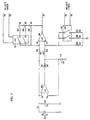
- the peak detector sub-circuit of circuit 53 is shown in Fig. 3 and comprised of resistor 75, operational amplifier 80, diode 78, and capacitor 82.
- the peak detector sub-circuit receives the varying signal of the photodetector 52 and produces a constant output signal which corresponds to the highest value, i.e. peak value, of the varying signal.
- the output of the peak detector is therefore the same as the output of photodetector 52 when no articles are interfering with the beam because, as noted above, photodetector 52 produces its highest output when it receives an uninterrupted light beam. It is noted however that any peak detector circuit which is capable of detecting and holding the highest output from photodetector 52 may be an acceptable substitute for the circuit illustrated in Fig. 3.
- the inverting difference amplifier is defined by resistors 81 and 83, operational amplifier 86, a first resistive network comprising switch 87 and resistors 88-90, a second resistive network comprising switch 91 and resistors 92-94, and the output line 56.
- the difference amplifier sub-circuit of circuit 53 is configured to subtract the varying photodetector signal from its peak and to amplify the difference.
- the peak value is supplied from the peak detector sub-circuit as described above.
- the subtraction of the varying signal from the peak signal will always produce a signal that is zero or greater than zero because the varying signal is always less than or equal to the peak output of the varying signal.
- the output of this amplifier circuit will always be zero or positive.
- the output signal of the inverting difference amplifier circuit is found at line 56 and is mathematically stated as the difference between the peak detector input, as multiplied by a first constant, and the varying photodetector input, as multiplied by a second constant.
- the value of the first constant is determined by the values of resistors 81 and 83 and the equivalent resistive values of the first and second resistive networks.
- the value of the second constant is determined solely by the value of resistor 83 and the equivalent resistance of the second resistive network.
- the equivalent resistances of the resistive networks are dependent on switches 87 and 91 because the equivalent resistances change as these switches close. This change in resistance occurs because the closing or opening of the switches places additional resistors ("switchable resistors") in parallel with the permanently connected resistors. For example, in the first resistive network, switchable resistors 88 and 89 are placed in parallel with permanent resistor 90. If switch 87 closes such that resistor 88 and/or 89 become electrically in parallel with permanent resistor 90, the equivalent resistance of the network will drop. Likewise, for the second resistive network, switch 91 controls switchable resistors 92 and 93 which effects the equivalent resistance of the second resistive network.
- switches 87 and 91 control the equivalent resistive values of the first and second resistive networks which in turn control the values of the multiplying constants which in turn control the amplification or gain of the circuit.
- the gain of the amplification circuit is completely dependent on the operation of switches 87 and 91.
- Switches 87 and 91 are electronic relays or analog multiplex devices which, upon receiving appropriate input from microprocessor 60 over select lines 54 and 55, will effectively cause current to flow in the areas represented by the schematic switches in Fig. 3. Four separate switch positions are possible for each switch 87 and 91 because of the two select lines 54 and 55.
- the select lines for the electronic relays or analog multiplex devices are supplied from microprocessor 60 which, as described in more detail below, will send signals over the select lines to select an appropriate gain for the amplifier circuit.
- circuit 53 will receive the photodetector circuit and modify it such that any signal excursions are positive and amplified.
- Fig. 4 illustrates the flow that is used by microprocessor 60 to select the amount of amplification by circuit 53.
- microprocessor 60 will select an amplification level which is dependent on the physical size of the articles passing along the article path. If the articles are very large, microprocessor 60 will only slightly amplify the output signal. However, as the articles diminish in size, microprocessor 60 increases the amplification level.
- microprocessor 60 determines whether the articles are very large, large, medium or small and then sets the appropriate level of amplification. The microprocessor makes this determination by comparing the average mean area of the articles with three predetermined thresholds. Although this process is described in more detail below, for present purposes it is sufficient to note that the amplification is set based on the sizes of articles passing along the article path.
- microprocessor 60 interconnects the various components of the signal unit. This device is responsible for partially controlling the signal unit's beam generation device, partially controlling the amplification and conditioning of the photodetector's output, and generating and maintaining an accurate count of articles passing along the article path based on the photodetector signal as modified by circuit 53.
- the microprocessor 60 also controls all data communications between the signal unit and the network over the network bus information lines. In controlling the data communications, the microprocessor 60 receives the program line signal from the master console or prior signal unit, determines whether a next signal unit is present and transmits appropriate program line signals, as directed by the master console, to the next signal unit.
- the microprocessor of a preferred embodiment may be a commonly available 80C550 microprocessor.
- the 80C550 is preferred because, in addition to its central processor, it has random access memory (RAM), read only memory (ROM), an eight channel/eight bit analog to digital convertor, three input ports, and a serial universal asynchronous receiver and transmitter (UART) built into the single integrated circuit device.
- RAM random access memory
- ROM read only memory
- UART serial universal asynchronous receiver and transmitter
- Microprocessor 60 receives and converts the modified detector signal from circuit 53 to a digital signal.
- microprocessor 60 has a built in 8-channel/eight bit analog to digital convertor which samples the analog input signal at a predetermined frequency and returns binary digital value signals.
- the predetermined sampling frequency of the analog to digital convertor may vary. In a gravity seed dispensing environment, it is desirable to sample the output of circuit 53 at least once every 200 microseconds or, equivalently, at a 5 kHz sampling rate.
- Data communication with the network is also controlled via microprocessor 60.
- the microprocessor 60 performs three communications functions: receiving the "program line” input 45 from a logically preceding device, transmitting a "program line” output 69 to a logically subsequent device if present, and interpreting serial data from the RS-485 transceiver 70.
- the program line input 45 will be connected to the master console if the signal unit is the first signal unit in the system. If not, the program line input 45 will be connected to the program line output of the logically preceding signal unit.
- the program line signal is a digital signal which is input to every signal unit's microprocessor.
- the program line input although input to every signal unit, is only used by the master console.
- the primary function of the program line signal is to individually address each particular signal unit.
- the program line signal is input to the microprocessor 60 through Schmitt trigger 48.
- Schmitt triggers, such as trigger 48, are used for most of the microprocessor inputs and outputs as these devices help reduce the signal variances associated with electrical noise.
- the program line output 69 is activated by the microprocessor 60 only if a subsequent signal unit is present in the system.
- the last signal unit of the system is terminated such that its program line output is a "low" voltage output.
- input 61 to microprocessor 60 will not be activated.
- input 61 will be activated.
- microprocessor 60 may control transistor 66 to cause it to switch the program line output at 69 to either "high" output or "low” output.
- the third communication function of microprocessor 60 in addition to receiving and transmitting program line input and output signals respectively, is to control all other data communications between the network and the signal unit over the RS-485 transceiver 70.
- the transceiver 70 is the Maxim Corporation's MAX487 transceiver.
- the transceiver 70 of the signal unit transmits or receives electrical signals to or from twisted pair conductors 71, 72, which comprise the information conductors of the network bus.
- transceiver 70 When receiving from the network, transceiver 70, on line 63, outputs a digital signal to the microprocessor based on the difference between the input voltages on the twisted pair conductors; a digital "high” signal will be output on line 63 and input to the microprocessor if the signals at 71 and 72 differ by +200mV or higher and a digital "low” signal will be output on line 63 if the difference between 71 and 72 is less than -200mV.
- the microprocessor 60 When transmitting to the network, the microprocessor 60 will output, at line 64, digital signals to transceiver 70 which will convert these signals to a differential signal which may be transmitted over the network.
- circuit 53 then receives and amplifies the difference between the peak signal and the signal excursion.
- the modified photodetector signal is subsequently received by microprocessor 60 for a determination of the number of articles passing along the article path.
- Fig. 5 is a graph of a typical output signal from circuit 53.
- Fig. 5 represents two articles passing along an article path and interfering with the beam from LEDs 50.
- time is represented on the x-axis and signal magnitude is represented on the y-axis.
- Fig. 5 also includes twenty-four vertical lines, indicated by reference numerals 160-183, which represent twenty four sampling intervals of the microprocessor 60.
- the intersection of the modified photodetector signal with a sampling line represents the magnitude of the modified photodetector signal at that point in time.
- the sampled magnitude of the signal corresponds to an eight bit digital value shown on the y-axis ranging from 0 to 255.
- Fig. 5 is a graph of two articles passing along an article path during a single "article event.”
- An “article event” is defined as the interval between the time that at least one passing article begins interfering with the beam(s) and the time that such article(s) have momentarily stopped interfering with the beam.
- the article event begins at the point in time corresponding to sample point 165 and ends at the point in time corresponding to sample point 177.
- suitable thresholds are used to determine the beginning and ending points of an article event.
- Microprocessor 60 receives the modified photodetector signal from circuit 53 at its analog to digital input port, samples the signal at a 5 kHz sampling rate, and returns an eight bit value. As microprocessor 60 receives the digitized pulse train corresponding to the sampled signal, it will compare the digitized value with one of two thresholds. The first threshold is the article event start threshold and if the digitized value of the modified photodetector signal exceeds the first threshold, the microprocessor generates and stores a signal indicating that an article event has begun.
- the first threshold is the article event start threshold and if the digitized value of the modified photodetector signal exceeds the first threshold, the microprocessor generates and stores a signal indicating that an article event has begun.
- This stored signal is the article event "flag.”
- the second threshold is the article event stop threshold and if the digitized value of the modified photodetector signal exceeds the stop threshold, the microprocessor generates a new signal indicating that the article event has stopped. Once the article event has stopped, microprocessor 60 clears the article event flag which previously indicated that an article event had begun.
- microprocessor 60 will compare the digitized signal with the article event start threshold to determine whether an article event is occurring. On the other hand, if the article event flag has been set, microprocessor 60 will compare the digitized signal with the article event stop threshold to determine if the article event is still ongoing.
- microprocessor 60 begins storing data related to the digitized signal in its memory and also begins generating additional signals.
- the microprocessor generates a duration signal and an area signal.
- the duration signal represents a running total of the time of the event and the area signal represent the integral of the magnitude of the sampled signal over the time of the article event.
- Microprocessor 60 also generates and stores an arithmetic mean area signal which is a signal representative of the sum of a number of area signals divided by the total number of corresponding article events.
- the arithmetic mean area signal is used by microprocessor 60 for a variety of functions. One important function is determining the amplification of circuit 53 as illustrated in Fig. 4. Thus, returning to Fig. 4, it is seen at 101 that if the arithmetic mean area exceeds a first predetermined threshold, the articles that are passing are "very large” and the default minimum gain should be employed in circuit 53 on both selection lines. Alternatively, as seen at 102, if the arithmetic mean area signal is beneath the first threshold but exceeds a second threshold, the articles that are passing are "large” and the first selection line are set at 103 such that the first selection line is set to minimum gain and the second selection line is set to maximum gain.
- the arithmetic mean area signal may be beneath the first and second threshold signals but exceeds a third threshold signal. If this is the case, the selection lines are set at 105 such that the first selection line is set to maximum gain and the second selection line should be set to minimum gain.
- the arithmetic mean area is beneath all thresholds. In this case, as indicated at 106, both selection lines are set to maximum gain. In the preferred embodiment, this process of gain adjustment is performed only once, after the first 128 seed events. However, this gain adjustment may be performed many times at either constant frequency or random intervals in order to optimize system performance and automatically adjust for different article sizes.
- microprocessor 60 may determine the number of articles which passed along the article path during the article event. In one embodiment of the invention, the number of articles is determined from the duration signal and from the area signal by reference to a previously determined data array. In another embodiment of the invention, the number of articles is determined based on the microprocessor generated signals through the use of fuzzy logic.
- a data structure is used to relate article event parameters such as duration and area to a particular number of articles for that article event.
- the data structure thus defines the number of articles within an article event as a function of at least two variables: article event duration and area.
- the data structure must be normalized. In the preferred embodiment, the data structure is normalized based on the arithmetic mean and harmonic mean of the duration and area signals of known samples.
- a known sequence of articles are passed through the article path in order to create varying but known numbers of articles per article event.
- data is collected and recorded which relates article event duration and area to the known number of articles in the single article event.
- two articles may be passed through the article path simultaneously to determine the duration and area for a single article event with two known articles passing in the event.
- Another sequence may involve recording duration and area data for the sequential passage of two or three partially overlapping articles within a single article event.
- the resultant data structure is then stored in microprocessor 60 memory as a two dimensional array with separate integer indices corresponding to duration and area.
- the data array is used by the microprocessor as a look-up table to obtain the number of articles which passed during the article event.
- Microprocessor 60 retrieves the stored duration and area signals and normalizes these values based on a "nominal" duration value and a "typical" area value respectively. In order to normalize the duration value for the article event, it is divided by a "nominal" duration value, multiplied by a constant and rounded to the nearest integer. Similarly, the area value for the article event is divided by a "typical" area value, multiplied by a constant and rounded to the nearest integer. As integers, the normalized duration and area values are easily used as indices to look up the number of articles per article event in the described two dimensional data structure. Hence, the number of articles per article event is easily referenced in the data structure after the duration and area signals are normalized.
- This method of normalizing the data based on the most recent article events is an important feature of the invention and allows the article sensors of the invention to adapt to the actual articles passing along the article path.
- the typical signal unit will be less likely to miscount the number of articles if the nominal duration or typical area of an article event changes dramatically from the initial default values.
- Another embodiment of the invention determines the number of articles per article event through the use of a fuzzy logic.
- the microprocessor compares the actual duration signal with four duration classification signals to determine the percent membership of the duration signal within each classification: a "nominal” signal, a “short signal” equal to one half the value of the nominal signal, a “long” signal equal to twice the value of the nominal signal, and a “very long” signal equal to three times the value of the nominal signal.
- the microprocessor also compares the actual area signal with four area classification signals to determine the percent membership of the area signal within each of its classifications: a "typical” signal, a "small” signal equal to one half the value of the typical, a “large” signal equal to twice the value of typical, and a “very large” signal equal to three times the value of typical. Depending on the percent membership of each signal in its classification, the number of articles in the article event is determined.
- microprocessor 60 determines that the article event has ceased, it begins the sequence at 210 to determine the number of articles that passed in that article event. First, at 210, microprocessor 60 assumes that the percent membership of the signal in the "short" classification is zero. Next, as illustrated by the decisional 211, microprocessor compares the duration signal with the short signal and the nominal signal. If the duration signal is between short and nominal, as indicated at 212, the percent membership in the short classification is the opposite of the quotient of the duration and the nominal signal plus 1.
- microprocessor 60 determines whether the duration is between short and nominal or whether the duration is between nominal and long. Depending on the outcome of these decisions, the percent membership in the nominal classification is as indicated in assignment boxes 215 and 217.
- microprocessor 60 first assumes that percent membership in the long classification is zero. Then, at decisional boxes 219 and 221, microprocessor 60 determines whether the duration is between nominal and long or whether the duration is between long and very long. Depending on the outcome of these decisions, the percent membership in the long classification is as indicated in assignment boxes 220 and 222.
- microprocessor 60 first assumes that percent membership in the very long classification is zero. Then, at decisional boxes 224 and 226, microprocessor 60 determines whether the duration is between long and very long or whether the duration is greater than very long. Depending on the outcome of these decisions, the percent membership in the very long classification is as indicated in assignment boxes 225 and 227.
- the logic determines the percent membership of the area signal in each of its respective categories: small, typical, large, and very large. In a manner similar to determining the percent membership of the duration signal, the logic proceeds in the remainder of Figs. 9b and 9c to determine the classification of the area signal.
- microprocessor 60 determines the overall article event's percent membership in the categories indicating zero articles, one article, two articles, or three articles based on the percent membership of the duration and area signal in each category. This determination is made by assigning the percent membership for the article event in each category as indicated in assignments 250-253.
- Figs. 9a-9d The final step of determining the number of articles in an article event through the 'fuzzy logic embodiment of Figs. 9a-9d is indicated by decision boxes 254, 256, 258, and 260, where the number of articles is greatest of the article event's membership in a particular article classification. It is noted that the logic illustrated in Figs. 9a-9d is representative of only one method of implementing the fuzzy logic and many other variations are possible and may be implemented by one skilled in the art.
- microprocessor 60 by data array, fuzzy logic or other implementation means, i.e. neural networks, may accurately determine the number of articles which pass within a single article event and, from this information, microprocessor 60 may accurately generate and maintain a count of the total number of articles which passed along the article path. Microprocessor 60 therefore constantly evaluates the incoming modified photodetector signal for the presence of an article event and, if an article event is detected, determines the number of articles in that article event. The microprocessor 60 then maintains a running sum of the total number of articles and the total number of article events.
- microprocessor 60 can perform additional important functions within the signal unit.
- microprocessor 60 provides the signal unit with the ability to self-test the operation of LEDs 50 and photodetector 52.
- LEDs 50 generate a beam depending on the current from constant current source 51 which is, in turn, dependent on the input signal at 57 to the constant current source 51.
- microprocessor 60 may control the operation of LEDs 50 by switching the constant current source 51.
- microprocessor 60 In a self-test mode, microprocessor 60 repeatedly switches constant current source on and off a known number of times and thereby cycles the LEDs 50 on and off a known number of times.
- Microprocessor 60 compares the received signal from circuit 53 with an expected received signal stored in microprocessor 60 memory. If an out of tolerance discrepancy exists between the actual received signal from circuit 53 and the expected received signal from circuit 53, microprocessor 60 will detect an error and will either store an error code or indicate to the master console that a problem exists in the optics of the signal unit.
- microprocessor 60 Another example of an additional function added by microprocessor 60 is the ability to detect when an article was "skipped," i.e. not dispensed, by the dispensing system. For many reasons, dispensing systems sometimes fail to pass articles along the article path. For example, in a seed dispensing system which uses an air-vacuum device to dispense seeds one at a time along the article path, the vacuum device may become momentarily blocked and fail to drop seeds. In the prior art, it was difficult, if not impossible, to determine when, where, and how many seeds were skipped. In the invention, the microprocessor 60 is able to determine a missing article event by comparing interval between article events.
- Fig. 8 illustrates a series of article events with one expected article event missing.
- microprocessor 60 determines the first article event 191 at time 190, the second article event 193 at time 192, the third article event 195 at time 194, and the fifth article event 198 at time 197.
- microprocessor 60 stored the article event start and duration times of each article event as well as the number of articles per article event. From this information, microprocessor 60 is able to determine an average duration between article events, i.e. the average duration between events 191, 192, 193, etc. Microprocessor 60 then compares average duration with the measured duration between events and, if the measured duration is unduly long, microprocessor 60 determines that an article was skipped. Microprocessor 60 then stores the time and the number of articles that were skipped in memory and, upon inquiry from the master console, reports this information. The ratio between missed events and counted events can therefore be calculated and presented to the user to identify possible seed spacing constancy problems.
- the master console may directly share information with every signal unit over the two information conductors in the network or may indirectly address the signal units through each signal unit's program line in. All nodes on the network, i.e. the master console as well as every signal unit, directly receive all information signals transmitted over the RS-485 network. Thus, information that is intended for a specific node will be received by all nodes but only acted upon by the node destined for the information.
- the master console 1 uses the program line, in conjunction with the direct network RS-485 connection, to address and program only individual signal units.
- the master console 1 and the rest of the signal units transmit information over the network in a specific sequence with a specific packet protocol that is common to and recognized by all of the nodes on the network.
- a specific packet protocol that is common to and recognized by all of the nodes on the network.
- only one master console 1 is present in the system.
- This master console is responsible for transmitting information to the signal units and for issuing requests for information to the signal units.
- the individual signal units are responsive only and do not independently address the master console or other signal units. Rather, the signal units transmit information onto the network in response to a specific information query from the master console.
- Figs. 6a and 6b illustrate the data elements of the two types of packets used to transmit information over the network and
- Fig. 7 illustrates the bit structure of every data element illustrated in Figs. 6a and 6b.
- the start and stop bits, 140 and 150, of Fig. 7 are used as control bits to control the asynchronous communication, the data bits 141-148 contain data to be transmitted over the network, and the address control bit 149 is set high when the transmitted data is an address.
- the master console transmits information or requests for information over the network in a three data element packet and, as shown in Fig. 6b, the signal units transmit information in seven data element packets.
- the first data element 115 of Fig. 6a corresponding to the three element packet from the master console 1, is always an address corresponding to an individual signal unit or to a category of signal units.
- the eight data bits 141-148 of the first data element 115 contain a value ranging from 0 to 255.
- the tenth bit 149, the address control bit, of the data element is also set to "1" to indicate that the data bits contain an address.
- the nodes on the network may easily distinguish the address data element from the subsequent elements by checking the state of the address control bit. Consequently, only the signal unit or units with a matching address will act on the information or request for information that follows.
- the second data element 116 of the three element packet of Fig. 6a contains the information or the request for information within the data bits 141-148.
- the address control bit 149 is set to 0.
- the request for information is a value ranging from 0 to 255 which represents a code understood by the signal unit. For example, if the second element 116 is comprised of a value corresponding to decimal 9, the addressed signal unit will decode this value into a request to transmit information relating to the number of occurrences of multiple articles passing in a single article event.
- the codes are predefined and are stored by every signal unit for later reference.
- the third data element 117 of the three element packet contains checksum information used for error detection purposes. If the least significant byte of the sum of the data in the three data element packet does not equal a predetermined sum, the message was erroneously transmitted and will be ignored.
- Fig. 6b illustrates the seven data element packet that the signal units send in response to a request for information.
- Data element one 120, element two 121, and element seven 126 of the seven element packet contain planned information.
- the first data element 120 of the seven data element packet of Fig.. 6b contains the address information of the signal unit. This enables the master console to verify that the correct signal unit has transmitted the requested information.
- the first data element 120 of the seven data element packet has the address control bit 149 set to 0.
- the second data element 121 contains command and error status information in which the data bits contain the request code transmitted by the master console. Thus, upon receipt of from the signal unit, the master console may verify that the signal unit has the correct request.
- the seventh data element 126 of the seven data element packet contains the same checksum information that is described above for the third data element 117 of the three data element packet. Thus, transmission error detection is used by both types of packets to verify communications.
- the non-planned and intervening four data elements 122-125 of the seven element data packet contain the requested information within the data bits 141-148 of each element. If the information to be transmitted does not require four data elements, the non-used elements will be set to the null string. Otherwise, the data bits 141-148 of each element contains a single byte of information. In the case where numbers greater than 255 are to be transmitted onto the network, the data elements will be transmitted in two bytes in succeeding data elements. For example, if master console 1 requests the number of articles which have passed, the number of articles to be returned may exceed 255. Hence, upon this request from the master console, the third data element 122 will contain the high byte of information and the fourth data element 123 will contain the low byte of information. Thus, depending on the request, the returned data elements contain a specific sequence of information.
- each signal unit must be assigned a unique address.
- the master console assigns a unique address to each signal unit when the system is initially powered.
- the master console uses both the RS-485 and the program line inputs. The master console sends the actual addresses over the RS-485 conductors and identifies a particular signal unit to receive the address through the program line input.
- the master console 1 first changes its program line output 2, which corresponds to the program line input 7 of the first signal unit, from high to low.
- the first signal unit its program line input 7 now being low, recognizes that the master console is attempting to assign its address.
- the console first sends a global address as the first data element, a begin address assign signal as the second data element and checksum as the third data element of the three element packet.
- the signal unit whose program line in is "low” responds by returning its signal unit type and whether another signal unit is present.
- the master console stores information and then sends a unique address over the network as a first data element, a conclude address signal as the second data element and checksum information as the third data element of the three data element packet.
- the microprocessor of the first signal unit receives the address from the first data element over the. RS-485 transceiver and stores the address in a memory location in the microprocessor.
- the signal unit After the address is stored, the signal unit responds to the conclude address signal, the second data element from the master console, and sends information back to the master console to re-confirm the signal unit's type and whether another signal unit is present. If another signal unit is not present, the master console ceases assigning addresses. If another signal unit is present, however, the first signal unit changes the state of its program line output from high to low and the next signal unit is prepared to receive the next three element begin address assign data packet and the three element conclude address assign data packets transmitted over the network from master console. In this manner, the master console sequentially assigns addresses throughout the system until no further signal units remain to be addressed.
- a signal unit may lose its stored address.
- the signal unit whose address has been lost will have its old address reassigned.
- the master console determines that the signal unit is not responding to requests for information.
- the master console will then address the preceding signal unit and direct that signal unit to switch the state of its program line output from high to low.
- the lost address signal unit's program line input will accordingly switch from high to low and this signal unit will receive the three data element begin address assign and three data element conclude address assign packets from the master console with the old address. In this manner, every signal unit may be addressed either globally at start-up or individually as necessary.
- the master console 1 may perform a vast number of system responsibilities.
- One of the most important functions of the master console is to compute and display the total article count of the entire dispensing system.
- the master console performs this primary function by requesting and receiving the article count from each signal unit over the RS-485 conductors and then computing a combined sum from all of the signal units.
- the master console may then display this information in a variety of manners depending on the display type.
- the sole limitation on the display of the master console 1 is that it display basic information relating to the number of articles which have been dispensed.
- any suitable display capable of displaying this information in any form is within the scope of the invention.
- LCD displays, CRT displays, flat panel displays, printers and the like may be used in combination with appropriate input devices such as keyboards or membranes and associated hardware circuits and switches as well as software drivers to display any of the information obtainable and/or stored by the master console.
- signal unit nodes on the network need not be limited to article detectors; other functions such as vacuum and pressure measurement may be accomplished through the use of signal unit nodes, thereby permitting the master console to monitor and display such information as well.
Landscapes
- Physics & Mathematics (AREA)
- Life Sciences & Earth Sciences (AREA)
- General Physics & Mathematics (AREA)
- Engineering & Computer Science (AREA)
- Theoretical Computer Science (AREA)
- Soil Sciences (AREA)
- Nonlinear Science (AREA)
- Environmental Sciences (AREA)
- Control Of Conveyors (AREA)
- Geophysics And Detection Of Objects (AREA)
Claims (6)
- Verfahren zum Zählen von durch eine Artikelbahn hindurchtretenden Artikeln mit den Schritten:dadurch gekennzeichnet, daß das Signal bei dem Signalkonditionierungsschritt in Abhängigkeit von der mindestens einen physikalischen Eigenschaft des Artikels konditioniert wird.Erzeugen eines Signals entsprechend mindestens einer physikalischen Eigenschaft mindestens eines durch die Artikelbahn hindurchtretenden Artikels, welches von einem Ruhepegel über einen Schwellenpegel bis zu einem Scheitelpegel und zurück über einen zweiten Schwellenpegel bis zu dem Ruhepegel fortschreitet, wenn der mindestens eine Artikel einen Punkt an der Artikelbahn passiert,Messen der Zeitdauer zwischen dem Zeitpunkt, zu dem der erste Schwellenwert erreicht wird, und dem Zeitpunkt, zu dem der zweite Schwellenwert erreicht wird,Konditionieren des Signals,annäherndes Integrieren des konditionierten Signals über die erwähnte Zeitdauer und damit Erzeugen einer Bereichsmessung sowieErzeugen eines Artikelzählwerts aus der Bereichsmessung innerhalb des bestimmten Zeitraumes,
- Verfahren nach Anspruch 1, worin der Schritt des Erzeugens eines Artikelzählwerts Abrunden der Dauer des bestimmten Zeitraumes und der Bereichsmessung und Verwenden der abgerundeten Dauer und der abgerundeten Bereichsmessung als Indizien für eine zweidimensionale Matrix einschließt, die bestimmte Artikelzählwerte entsprechend verschiedenen Kombinationen von Dauern und Bereichsmessungen enthält.
- Verfahren nach Anspruch 2, worin der Schritt des Erzeugens eines Artikelzählwerts Zuordnen eines Prozentmitgliedschaftswerts der Dauer innerhalb einer jeden einer vorbestimmten Zahl diskreter Dauerkategorien, Zuordnen eines Prozentmitgliedschaftswerts der Bereichsmessung innerhalb einer jeden einer vorbestimmten Zahl diskreter Bereichskategorien und, auf der Grundlage dieser Prozentmitgliedschaften und einer vorbestimmten Korrelation zwischen den Dauerkategorien, den Bereichskategorien und den Artikelzählwerten, Bestimmen des Artikelzählwerts hieraus einschließt.
- Gerät zur Durchführung des Verfahrens nach Anspruch 1, mitdadurch gekennzeichnet,einer Artikelbahn zur Führung der betreffenden Artikel im wesentlichen aufeinanderfolgend,einem Sensor (52) an der Artikelbahn zum Erzeugen eines Sensorsignals entsprechend zumindest einer physikalischen Eigenschaft zumindest eines durch die Artikelbahn hindurchtretenden Artikels, welches von einem Ruhepegel über einen ersten Schwellenpegel bis zu einem Scheitelpegel und zurück über eine zweiten Schwellenpegel zu dem Ruhepegel fortschreitet, wenn der zumindest eine Artikel den Sensor passiert,einem Signalkonditionierungsschaltkreis (53) in Verbindung mit dem Sensor (52) zum Aufnehmen des Sensorsignals und Erzeugen eines konditionierten Sensorsignals mit einer Größe proportional dem Sensorsignal, welcher einen Verstärker (52) zum Verstärken des Sensorsignals aufweist,Mitteln (60) zum Speichern einer physikalischen Bezugseigenschaft eines durch die Artikelbahn hindurchtretenden Artikels,Mitteln (60) zum Empfangen des konditionierten Sensorsignals und Messen der Zeitdauer zwischen dem Zeitpunkt, zu dem der erste Schwellenwert erreicht wird, und dem Zeitpunkt, zu dem der zweite Schwellenwert erreicht wird,Mitteln (60) zum Empfangen und annähernden Integrieren des konditionierten Sensorsignals über diese Zeitdauer und damit Erzeugen einer Bereichsmessung undvon der genannten Dauer und der Bereichsmessung abhängigen Ausgabemitteln zum Erzeugen eines für die Anzahl der den Sensor (52) während dieser Dauer passierenden Artikel bezeichnenden Ausgangssignals,daß das Sensorsignal in dem Signalkonditionierungsschaltkreis (53) in Abhängigkeit von einem für eine physikalische Eigenschaft des in der Artikelbahn vorausgegangenen Artikels bezeichnenden Steuersignals verstärkt wird unddaß das Gerät des weiteren Mittel (60) zum Bestimmen der zu speichernden physikalischen Eigenschaft und zum Erzeugen des Steuersignals in Abhängigkeit von einer Eigenschaft des konditionierten Sensorsignals für den Signalkonditionierungsschaltkreis (53) enthält.
- Gerät nach Anspruch 4, worin die Ausgabemittel dazu ausgelegt sind, das Ausgangssignal durch Wiedergabe eines oder mehrerer gespeicherter Datensignale zu erzeugen.
- Gerät nach Anspruch 4 oder 5, worin die Ausgabemittel Mittel zum Zuordnen eines Prozentmitgliedschaftswerts der genannten Dauer innerhalb einer vorbestimmten Anzahl diskreter Dauerkategorien enthalten, welche einen Prozentmitgliedschaftswert der Bereichsmessung innerhalb eines jeden der vorbestimmten Signale in Abhängigkeit von den Dauerkategorien, Bereichskategorien und Artikelzählwerten zuordnen.
Applications Claiming Priority (2)
| Application Number | Priority Date | Filing Date | Title |
|---|---|---|---|
| US08/438,946 US5635911A (en) | 1995-05-11 | 1995-05-11 | Apparatus and method for monitoring an article dispensing device such as a seed planter and the like |
| US438946 | 1995-05-11 |
Publications (3)
| Publication Number | Publication Date |
|---|---|
| EP0742534A2 EP0742534A2 (de) | 1996-11-13 |
| EP0742534A3 EP0742534A3 (de) | 1998-01-21 |
| EP0742534B1 true EP0742534B1 (de) | 2002-05-29 |
Family
ID=23742679
Family Applications (1)
| Application Number | Title | Priority Date | Filing Date |
|---|---|---|---|
| EP19960104725 Expired - Lifetime EP0742534B1 (de) | 1995-05-11 | 1996-03-25 | Vorrichtung und Verfahren zum Zählen von sich entlang eines Weges bewegenden Artikeln |
Country Status (6)
| Country | Link |
|---|---|
| US (1) | US5635911A (de) |
| EP (1) | EP0742534B1 (de) |
| JP (1) | JPH09138845A (de) |
| AU (1) | AU697212B2 (de) |
| CA (1) | CA2176265C (de) |
| DE (1) | DE69621371T2 (de) |
Families Citing this family (55)
| Publication number | Priority date | Publication date | Assignee | Title |
|---|---|---|---|---|
| CA2141092C (en) * | 1995-01-25 | 1999-01-05 | James F. White | Communication between components of a machine |
| US5650609A (en) * | 1995-05-15 | 1997-07-22 | Phoenix International Corporation | Seed monitoring system for counting seeds as they are dispensed through a seed planting tube |
| GB2301787B (en) * | 1995-05-16 | 1999-11-10 | Semelab Plc | Separating and sequencing apparatus |
| US6070538A (en) * | 1996-11-22 | 2000-06-06 | Case Corporation | Modular agricultural implement control system |
| US6070539A (en) * | 1997-03-21 | 2000-06-06 | Case Corporation | Variable rate agricultural product application implement with multiple inputs and feedback |
| US5915313A (en) * | 1997-03-21 | 1999-06-29 | Case Corporation | Multiple-type seed dispensing system |
| US5924371A (en) * | 1997-09-23 | 1999-07-20 | Case Corporation | Global controller and distributed local controller(s) for an agricultural implement |
| US5956255A (en) * | 1997-09-23 | 1999-09-21 | Case Corporation | Seed planter performance monitor |
| US6024035A (en) * | 1997-09-23 | 2000-02-15 | Case Corporation | Seed planting rate maintenance control with rate display |
| US6091997A (en) * | 1997-09-23 | 2000-07-18 | Case Corporation | Enhanced statistical/status display |
| US6009354A (en) * | 1997-09-23 | 1999-12-28 | Case Corporation | Enhanced implement control |
| US6078635A (en) * | 1998-02-05 | 2000-06-20 | Dubois; Jerry | Seed or particle-counting device |
| US6098095A (en) * | 1998-02-26 | 2000-08-01 | Tektronix, Inc. | Instrument communication through signal jacks |
| US6003455A (en) * | 1998-03-05 | 1999-12-21 | Case Corporation | Regulator control |
| US6073427A (en) * | 1998-06-11 | 2000-06-13 | Nichols; Stephen W. | Method and apparatus for counting crops |
| WO2000010135A1 (en) * | 1998-08-12 | 2000-02-24 | Eurodataflow S.R.L. | Device for the remote detection of the coming and going of people in premises |
| CA2248436C (en) | 1998-09-22 | 2007-01-16 | Case Corporation | Agricultural particulate material delivery system |
| US6193175B1 (en) | 1998-09-22 | 2001-02-27 | Case Corporation | Agricultural particulate material delivery system |
| US6373057B1 (en) | 1998-09-23 | 2002-04-16 | Dickey-John Corporation | Infrared reflective article counting/detecting device |
| US6158363A (en) * | 1999-05-21 | 2000-12-12 | Flexi-Coil Ltd. | Apparatus for dispensing particles |
| US6192813B1 (en) | 1999-05-21 | 2001-02-27 | Flexi-Coil Ltd. | Apparatus for controlling the flow rate of an air seeder |
| US8271336B2 (en) | 1999-11-22 | 2012-09-18 | Accenture Global Services Gmbh | Increased visibility during order management in a network-based supply chain environment |
| JP2002284106A (ja) * | 2001-03-28 | 2002-10-03 | Ishida Co Ltd | 包装装置、計量コンベヤおよびラベル貼付機 |
| US6944248B2 (en) * | 2001-05-17 | 2005-09-13 | Bluebrook Associates Llc | Data rate calibration for asynchronous serial communications |
| FR2854627B1 (fr) * | 2003-05-07 | 2006-05-26 | Saint Gobain | Composition de verre silico-sodo-calcique, notamment pour la realisation de substrats |
| US7086269B2 (en) * | 2004-07-15 | 2006-08-08 | Precision Planting, Inc. | Apparatus and method for testing seed singulation of a seed meter |
| ES2380024T3 (es) * | 2005-04-11 | 2012-05-07 | Teknovisio Oy | Sistema para la detección de sensores que funcionan incorrectamente en sistemas de conteo de visitantes |
| US20070076171A1 (en) * | 2005-09-20 | 2007-04-05 | Fasen Donald J | Wobulator position sensing system and method |
| DE102006038865A1 (de) * | 2006-08-18 | 2008-02-21 | Alois Pöttinger Maschinenfabrik Gmbh | Sämaschine sowie Verfahren zur Regelung des Austrags einer Sämaschine |
| US8868300B2 (en) * | 2009-08-28 | 2014-10-21 | Raven Industries, Inc. | Multi-variable rate agricultural product application system, device and method |
| US8176797B2 (en) * | 2009-09-04 | 2012-05-15 | Cnh Canada, Ltd. | System and method for measuring flow rate from a meter roller |
| US8175212B2 (en) * | 2010-01-25 | 2012-05-08 | Gary W. Clem, Inc. | Seed counting device |
| US8631749B2 (en) | 2011-01-04 | 2014-01-21 | Precision Planting Llc | Seed tube egress-mounted seed sensor |
| US8775689B2 (en) | 2011-05-02 | 2014-07-08 | Deere & Company | Electronic modules with automatic configuration |
| US8781693B2 (en) | 2012-03-06 | 2014-07-15 | Ag Leader Technology | Method for automatic location identification of electronic devices on agricultural implements |
| US9113591B2 (en) | 2012-06-18 | 2015-08-25 | Raven Industries, Inc. | Implement for adjustably metering an agricultural field input according to different frame sections |
| BR112015004356B1 (pt) | 2012-08-27 | 2022-03-15 | Dickey-John | Dispositivo de contagem de semente, sistema de detecção de partícula e método para detectar as sementes em um sistema de deposição de semente |
| US8839681B2 (en) | 2012-10-26 | 2014-09-23 | Cds-John Blue Company | System and method for monitoring inefficient flow rates using magnetic sensor in a liquid-flow distribution system |
| CA2845434C (en) | 2013-03-08 | 2016-06-28 | Cds-John Blue Company | Orifice selector module for liquid fertilizer distribution systems |
| US8942896B2 (en) | 2013-03-14 | 2015-01-27 | Cnh Industrial Canada, Ltd. | Seed meter control system |
| US9580256B2 (en) | 2013-03-15 | 2017-02-28 | Raven Industries, Inc. | Granular spreader section control |
| US11160204B2 (en) | 2013-03-15 | 2021-11-02 | Raven Industries, Inc. | Localized product injection system for an agricultural sprayer |
| US9781916B2 (en) | 2013-10-17 | 2017-10-10 | Raven Industries, Inc. | Nozzle control system and method |
| US9320192B2 (en) | 2013-11-12 | 2016-04-26 | Dickey-John Corporation | Synchronization of a twin row planting system |
| WO2015160837A2 (en) | 2014-04-15 | 2015-10-22 | Raven Industries, Inc. | Reaping based yield monitoring system and method for the same |
| US9661805B1 (en) | 2015-12-29 | 2017-05-30 | Ball Horticultural Company | Seed sowing system and method of use |
| CN106128050A (zh) * | 2016-08-23 | 2016-11-16 | 吴建堂 | 小型播种机种籽堵塞声光告警器 |
| CN106385884A (zh) * | 2016-08-27 | 2017-02-15 | 周芸 | 机械播种机种粒下落阻塞声光报警器 |
| WO2018129323A1 (en) | 2017-01-05 | 2018-07-12 | Raven Industries, Inc. | Localized product injection system and methods for same |
| EP3830904B1 (de) * | 2018-08-03 | 2024-09-18 | Walker, Myron | Flexible, unterbrechbare radiale sammelschiene und an sammelschiene montierte beadvorrichtung |
| US11612160B2 (en) | 2019-10-04 | 2023-03-28 | Raven Industries, Inc. | Valve control system and method |
| CN111224748A (zh) * | 2019-12-26 | 2020-06-02 | 北京启冠智能科技股份有限公司 | 有线网络传输数据 |
| WO2021163335A1 (en) | 2020-02-11 | 2021-08-19 | Tsi Incorporated | Photoelectric sensor for seed dispensing system |
| US12029151B2 (en) * | 2021-03-19 | 2024-07-09 | Deere & Company | Planter quality manager |
| CA3236692A1 (en) | 2021-11-05 | 2023-05-11 | Justin KROSSCHELL | Valve priming and depriming |
Family Cites Families (23)
| Publication number | Priority date | Publication date | Assignee | Title |
|---|---|---|---|---|
| US4021117A (en) * | 1975-08-07 | 1977-05-03 | Hildegard Gohde | Process for automatic counting and measurement of particles |
| US4164669A (en) * | 1975-09-10 | 1979-08-14 | Dickey-John Corporation | Seed sensor |
| US4149163A (en) * | 1975-11-07 | 1979-04-10 | Dickey-John Corporation | Wireless seed detecting and monitoring apparatus |
| SU587898A1 (ru) * | 1976-04-05 | 1978-01-15 | Всесоюзный Ордена Трудового Красного Знамени Научно-Исследовательский Институт Механизации Сельского Хозяйства | Устройство дл измерени нормы высева сем н се лки |
| US4166948A (en) * | 1977-12-01 | 1979-09-04 | Dickey-John Corporation | Seed sensor |
| US4246469A (en) * | 1978-11-08 | 1981-01-20 | Dickey-John Corporation | Microwave seed sensor |
| US4239010A (en) * | 1979-06-29 | 1980-12-16 | Dickey-John Corporation | Microwave seed sensor for field seed planter |
| US4333096A (en) * | 1979-07-27 | 1982-06-01 | Field Electronics Inc. | Seed planter monitor |
| US4555624A (en) * | 1983-02-22 | 1985-11-26 | Dickey-John Corporation | High rate seed sensor |
| DE3419883A1 (de) * | 1984-05-28 | 1985-11-28 | Amazonen Werke Dreyer H | Verfahren und vorrichtung zum optischen zaehlen kleiner koerperchen |
| US4635215A (en) * | 1984-09-10 | 1987-01-06 | Deere & Company | Article or seed counter |
| US4782282A (en) * | 1986-07-09 | 1988-11-01 | Dickey-John Corporation | Capacitive-type seed sensor for a planter monitor |
| DE69032318T2 (de) * | 1989-08-31 | 1998-09-24 | Canon Kk | Vorrichtung zur Bildverarbeitung |
| US5261036A (en) * | 1989-10-24 | 1993-11-09 | Mitsubishi Denki K.K. | Programmable controller with fuzzy control function, fuzzy control process and fuzzy control monitoring process |
| US5245695A (en) * | 1991-06-12 | 1993-09-14 | American Neuralogix Inc. | Fuzzy microcontroller |
| US5260875A (en) * | 1991-08-20 | 1993-11-09 | Micro-Trak System, Inc. | Networked agricultural monitoring and control system |
| US5307443A (en) * | 1991-10-11 | 1994-04-26 | Masato Tanaka | Apparatus for processing information based on fuzzy logic |
| US5222191A (en) * | 1991-11-08 | 1993-06-22 | Nec Corporation | Fuzzy hardware system |
| US5321639A (en) * | 1992-03-02 | 1994-06-14 | Regents Of The University Of California | Dual-scale topology optoelectronic matrix algebraic processing system |
| US5336882A (en) * | 1992-12-30 | 1994-08-09 | Allen-Bradley Company, Inc. | System for determining operational stability of a photoelectric control unit having a margin variable gain module |
| US5347117A (en) * | 1992-12-30 | 1994-09-13 | Allen-Bradley Company, Inc. | Operator interface for a photoelectric control unit |
| US5281810A (en) * | 1992-12-30 | 1994-01-25 | Allen-Bradley Company, Inc. | Photoelectric control unit adapted for determining its own operating margin having dual variable-gain amplifier |
| US5324931A (en) * | 1992-12-30 | 1994-06-28 | Allen-Bradley Company, Inc. | Process for reliably detecting the passage of a target object using a photoelectric control unit employing pseudo-random jitter factor pulses |
-
1995
- 1995-05-11 US US08/438,946 patent/US5635911A/en not_active Expired - Lifetime
-
1996
- 1996-03-25 EP EP19960104725 patent/EP0742534B1/de not_active Expired - Lifetime
- 1996-03-25 DE DE69621371T patent/DE69621371T2/de not_active Expired - Lifetime
- 1996-04-03 AU AU50484/96A patent/AU697212B2/en not_active Ceased
- 1996-05-10 CA CA002176265A patent/CA2176265C/en not_active Expired - Fee Related
- 1996-05-13 JP JP11796496A patent/JPH09138845A/ja active Pending
Also Published As
| Publication number | Publication date |
|---|---|
| US5635911A (en) | 1997-06-03 |
| DE69621371T2 (de) | 2002-09-26 |
| JPH09138845A (ja) | 1997-05-27 |
| AU697212B2 (en) | 1998-10-01 |
| EP0742534A3 (de) | 1998-01-21 |
| CA2176265A1 (en) | 1996-11-12 |
| AU5048496A (en) | 1996-11-21 |
| CA2176265C (en) | 2000-07-04 |
| EP0742534A2 (de) | 1996-11-13 |
| DE69621371D1 (de) | 2002-07-04 |
Similar Documents
| Publication | Publication Date | Title |
|---|---|---|
| EP0742534B1 (de) | Vorrichtung und Verfahren zum Zählen von sich entlang eines Weges bewegenden Artikeln | |
| US5650609A (en) | Seed monitoring system for counting seeds as they are dispensed through a seed planting tube | |
| US6661514B1 (en) | Tube blockage monitor | |
| CA2158894C (en) | Seed counting apparatus for a planter monitor | |
| CA2237943C (en) | Seed counting apparatus for a planter monitor | |
| US9854726B2 (en) | Fault-tolerant sensing and monitoring communications bus system for agricultural applications | |
| AU2016313367B2 (en) | Seed counting sensor and method for detecting blockage of a seed conveying pipe | |
| US4922443A (en) | Data acquisition and processing equipment for testing automotive vehicles | |
| DE60020553T2 (de) | Telemetrie - testeinheit zum testen der anfälligkeit von motorfahrzeugen auf elektromagnetische interferenz | |
| US4306313A (en) | High reliability optical fiber communication system | |
| US20160255766A1 (en) | Method and device for avoiding seed-metering errors in planters | |
| US20040234268A1 (en) | System and method of optical data communication with multiple simultaneous emitters and receivers | |
| CN1122486A (zh) | 早期火灾探测装置 | |
| EP2888614B1 (de) | Saatsensor mit lichtrohr-fotodetektoranordnung | |
| US4054779A (en) | Counting device | |
| DE19612631A1 (de) | Multiplexdatenübermittlungssystem | |
| US7350307B2 (en) | System and method for checking mechanical pieces, with wireless signal transmission | |
| DE19653648C2 (de) | Verfahren und Anordnung zum Abgleich des Ausgangssignals mindestens eines annäherungsempfindlichen Elektronik-Sensors | |
| JP3893155B2 (ja) | ノイズ許容範囲の改良された検出システム | |
| US4463345A (en) | Seed flow monitor | |
| US4714802A (en) | Apparatus and method for determining the source direction of local area network transmissions | |
| DE2510829B2 (de) | Fotoelektrischer Pulsabnehmer | |
| KR100202701B1 (ko) | 피엘씨 및 그의 제어방법 | |
| AU702941B2 (en) | Projected beam-type smoke detector and receiving unit | |
| JPH0373099A (ja) | 光電式煙感知器 |
Legal Events
| Date | Code | Title | Description |
|---|---|---|---|
| PUAI | Public reference made under article 153(3) epc to a published international application that has entered the european phase |
Free format text: ORIGINAL CODE: 0009012 |
|
| AK | Designated contracting states |
Kind code of ref document: A2 Designated state(s): DE FR GB |
|
| PUAL | Search report despatched |
Free format text: ORIGINAL CODE: 0009013 |
|
| AK | Designated contracting states |
Kind code of ref document: A3 Designated state(s): DE FR GB |
|
| 17P | Request for examination filed |
Effective date: 19980612 |
|
| 17Q | First examination report despatched |
Effective date: 20000801 |
|
| RTI1 | Title (correction) |
Free format text: APPARATUS AND METHOD FOR COUNTING ARTICLES PASSING ALONG AN ARTICLE PATH |
|
| GRAG | Despatch of communication of intention to grant |
Free format text: ORIGINAL CODE: EPIDOS AGRA |
|
| RTI1 | Title (correction) |
Free format text: APPARATUS AND METHOD FOR COUNTING ARTICLES PASSING ALONG AN ARTICLE PATH |
|
| RTI1 | Title (correction) |
Free format text: APPARATUS AND METHOD FOR COUNTING ARTICLES PASSING ALONG AN ARTICLE PATH |
|
| GRAG | Despatch of communication of intention to grant |
Free format text: ORIGINAL CODE: EPIDOS AGRA |
|
| GRAH | Despatch of communication of intention to grant a patent |
Free format text: ORIGINAL CODE: EPIDOS IGRA |
|
| GRAH | Despatch of communication of intention to grant a patent |
Free format text: ORIGINAL CODE: EPIDOS IGRA |
|
| GRAA | (expected) grant |
Free format text: ORIGINAL CODE: 0009210 |
|
| AK | Designated contracting states |
Kind code of ref document: B1 Designated state(s): DE FR GB |
|
| REG | Reference to a national code |
Ref country code: GB Ref legal event code: FG4D |
|
| REF | Corresponds to: |
Ref document number: 69621371 Country of ref document: DE Date of ref document: 20020704 |
|
| ET | Fr: translation filed | ||
| PLBE | No opposition filed within time limit |
Free format text: ORIGINAL CODE: 0009261 |
|
| STAA | Information on the status of an ep patent application or granted ep patent |
Free format text: STATUS: NO OPPOSITION FILED WITHIN TIME LIMIT |
|
| 26N | No opposition filed |
Effective date: 20030303 |
|
| PGFP | Annual fee paid to national office [announced via postgrant information from national office to epo] |
Ref country code: GB Payment date: 20140516 Year of fee payment: 19 |
|
| PGFP | Annual fee paid to national office [announced via postgrant information from national office to epo] |
Ref country code: DE Payment date: 20140514 Year of fee payment: 19 |
|
| PGFP | Annual fee paid to national office [announced via postgrant information from national office to epo] |
Ref country code: FR Payment date: 20140627 Year of fee payment: 19 |
|
| REG | Reference to a national code |
Ref country code: DE Ref legal event code: R119 Ref document number: 69621371 Country of ref document: DE |
|
| GBPC | Gb: european patent ceased through non-payment of renewal fee |
Effective date: 20150325 |
|
| REG | Reference to a national code |
Ref country code: FR Ref legal event code: ST Effective date: 20151130 |
|
| PG25 | Lapsed in a contracting state [announced via postgrant information from national office to epo] |
Ref country code: GB Free format text: LAPSE BECAUSE OF NON-PAYMENT OF DUE FEES Effective date: 20150325 Ref country code: DE Free format text: LAPSE BECAUSE OF NON-PAYMENT OF DUE FEES Effective date: 20151001 |
|
| PG25 | Lapsed in a contracting state [announced via postgrant information from national office to epo] |
Ref country code: FR Free format text: LAPSE BECAUSE OF NON-PAYMENT OF DUE FEES Effective date: 20150331 |