EP0736645A2 - Eléments de façade - Google Patents
Eléments de façade Download PDFInfo
- Publication number
- EP0736645A2 EP0736645A2 EP96105029A EP96105029A EP0736645A2 EP 0736645 A2 EP0736645 A2 EP 0736645A2 EP 96105029 A EP96105029 A EP 96105029A EP 96105029 A EP96105029 A EP 96105029A EP 0736645 A2 EP0736645 A2 EP 0736645A2
- Authority
- EP
- European Patent Office
- Prior art keywords
- weight
- polyalkyl methacrylate
- parts
- methacrylate
- facade cladding
- Prior art date
- Legal status (The legal status is an assumption and is not a legal conclusion. Google has not performed a legal analysis and makes no representation as to the accuracy of the status listed.)
- Granted
Links
- 239000000178 monomer Substances 0.000 claims abstract description 28
- 239000000725 suspension Substances 0.000 claims abstract description 26
- 238000005266 casting Methods 0.000 claims abstract description 19
- 238000005253 cladding Methods 0.000 claims abstract description 18
- VVQNEPGJFQJSBK-UHFFFAOYSA-N Methyl methacrylate Chemical compound COC(=O)C(C)=C VVQNEPGJFQJSBK-UHFFFAOYSA-N 0.000 claims abstract description 17
- VYPSYNLAJGMNEJ-UHFFFAOYSA-N Silicium dioxide Chemical compound O=[Si]=O VYPSYNLAJGMNEJ-UHFFFAOYSA-N 0.000 claims abstract description 17
- 239000011347 resin Substances 0.000 claims abstract description 17
- 229920005989 resin Polymers 0.000 claims abstract description 17
- CERQOIWHTDAKMF-UHFFFAOYSA-M Methacrylate Chemical compound CC(=C)C([O-])=O CERQOIWHTDAKMF-UHFFFAOYSA-M 0.000 claims abstract description 15
- 239000002243 precursor Substances 0.000 claims abstract description 15
- WNROFYMDJYEPJX-UHFFFAOYSA-K aluminium hydroxide Chemical compound [OH-].[OH-].[OH-].[Al+3] WNROFYMDJYEPJX-UHFFFAOYSA-K 0.000 claims abstract description 12
- 239000011256 inorganic filler Substances 0.000 claims abstract description 11
- 229910003475 inorganic filler Inorganic materials 0.000 claims abstract description 11
- 239000007788 liquid Substances 0.000 claims abstract description 9
- 235000012239 silicon dioxide Nutrition 0.000 claims abstract description 9
- 239000000377 silicon dioxide Substances 0.000 claims abstract description 7
- 238000007493 shaping process Methods 0.000 claims abstract description 6
- 150000001732 carboxylic acid derivatives Chemical class 0.000 claims abstract description 5
- 230000001698 pyrogenic effect Effects 0.000 claims abstract description 5
- WMWXXXSCZVGQAR-UHFFFAOYSA-N dialuminum;oxygen(2-);hydrate Chemical compound O.[O-2].[O-2].[O-2].[Al+3].[Al+3] WMWXXXSCZVGQAR-UHFFFAOYSA-N 0.000 claims abstract description 4
- VTHJTEIRLNZDEV-UHFFFAOYSA-L magnesium dihydroxide Chemical compound [OH-].[OH-].[Mg+2] VTHJTEIRLNZDEV-UHFFFAOYSA-L 0.000 claims abstract description 4
- 239000000347 magnesium hydroxide Substances 0.000 claims abstract description 3
- 229910001862 magnesium hydroxide Inorganic materials 0.000 claims abstract description 3
- 238000010526 radical polymerization reaction Methods 0.000 claims abstract 2
- 239000002245 particle Substances 0.000 claims description 26
- 239000000945 filler Substances 0.000 claims description 17
- 239000000203 mixture Substances 0.000 claims description 9
- 239000002984 plastic foam Substances 0.000 claims description 4
- 230000001427 coherent effect Effects 0.000 claims 1
- 239000005022 packaging material Substances 0.000 description 18
- -1 alkyl methacrylate Chemical compound 0.000 description 15
- 229920000642 polymer Polymers 0.000 description 15
- 239000000463 material Substances 0.000 description 13
- 239000000047 product Substances 0.000 description 13
- 238000006116 polymerization reaction Methods 0.000 description 12
- NIXOWILDQLNWCW-UHFFFAOYSA-M Acrylate Chemical compound [O-]C(=O)C=C NIXOWILDQLNWCW-UHFFFAOYSA-M 0.000 description 10
- 238000004519 manufacturing process Methods 0.000 description 10
- 238000000034 method Methods 0.000 description 9
- 239000006260 foam Substances 0.000 description 7
- 239000000853 adhesive Substances 0.000 description 6
- 230000001070 adhesive effect Effects 0.000 description 6
- 239000012074 organic phase Substances 0.000 description 6
- 229920003229 poly(methyl methacrylate) Polymers 0.000 description 6
- 239000004926 polymethyl methacrylate Substances 0.000 description 6
- 239000004800 polyvinyl chloride Substances 0.000 description 6
- 229920000915 polyvinyl chloride Polymers 0.000 description 6
- 238000003756 stirring Methods 0.000 description 6
- 238000005516 engineering process Methods 0.000 description 5
- 239000000049 pigment Substances 0.000 description 5
- 229920003023 plastic Polymers 0.000 description 5
- 239000004033 plastic Substances 0.000 description 5
- PPBRXRYQALVLMV-UHFFFAOYSA-N Styrene Chemical compound C=CC1=CC=CC=C1 PPBRXRYQALVLMV-UHFFFAOYSA-N 0.000 description 4
- 125000004432 carbon atom Chemical group C* 0.000 description 4
- 238000010276 construction Methods 0.000 description 4
- 238000004132 cross linking Methods 0.000 description 4
- STVZJERGLQHEKB-UHFFFAOYSA-N ethylene glycol dimethacrylate Substances CC(=C)C(=O)OCCOC(=O)C(C)=C STVZJERGLQHEKB-UHFFFAOYSA-N 0.000 description 4
- 229910052751 metal Inorganic materials 0.000 description 4
- 239000002184 metal Substances 0.000 description 4
- 239000003505 polymerization initiator Substances 0.000 description 4
- 150000003254 radicals Chemical class 0.000 description 4
- 239000004575 stone Substances 0.000 description 4
- 239000006188 syrup Substances 0.000 description 4
- 235000020357 syrup Nutrition 0.000 description 4
- 229910052782 aluminium Inorganic materials 0.000 description 3
- XAGFODPZIPBFFR-UHFFFAOYSA-N aluminium Chemical compound [Al] XAGFODPZIPBFFR-UHFFFAOYSA-N 0.000 description 3
- 239000003795 chemical substances by application Substances 0.000 description 3
- 239000002131 composite material Substances 0.000 description 3
- 239000011521 glass Substances 0.000 description 3
- 238000010438 heat treatment Methods 0.000 description 3
- 239000005368 silicate glass Substances 0.000 description 3
- 125000000391 vinyl group Chemical group [H]C([*])=C([H])[H] 0.000 description 3
- MYRTYDVEIRVNKP-UHFFFAOYSA-N 1,2-Divinylbenzene Chemical compound C=CC1=CC=CC=C1C=C MYRTYDVEIRVNKP-UHFFFAOYSA-N 0.000 description 2
- OZAIFHULBGXAKX-UHFFFAOYSA-N 2-(2-cyanopropan-2-yldiazenyl)-2-methylpropanenitrile Chemical compound N#CC(C)(C)N=NC(C)(C)C#N OZAIFHULBGXAKX-UHFFFAOYSA-N 0.000 description 2
- NLHHRLWOUZZQLW-UHFFFAOYSA-N Acrylonitrile Chemical compound C=CC#N NLHHRLWOUZZQLW-UHFFFAOYSA-N 0.000 description 2
- 229910002012 Aerosil® Inorganic materials 0.000 description 2
- MHAJPDPJQMAIIY-UHFFFAOYSA-N Hydrogen peroxide Chemical compound OO MHAJPDPJQMAIIY-UHFFFAOYSA-N 0.000 description 2
- UQSXHKLRYXJYBZ-UHFFFAOYSA-N Iron oxide Chemical compound [Fe]=O UQSXHKLRYXJYBZ-UHFFFAOYSA-N 0.000 description 2
- CERQOIWHTDAKMF-UHFFFAOYSA-N Methacrylic acid Chemical class CC(=C)C(O)=O CERQOIWHTDAKMF-UHFFFAOYSA-N 0.000 description 2
- BAPJBEWLBFYGME-UHFFFAOYSA-N Methyl acrylate Chemical compound COC(=O)C=C BAPJBEWLBFYGME-UHFFFAOYSA-N 0.000 description 2
- 235000021355 Stearic acid Nutrition 0.000 description 2
- GWEVSGVZZGPLCZ-UHFFFAOYSA-N Titan oxide Chemical compound O=[Ti]=O GWEVSGVZZGPLCZ-UHFFFAOYSA-N 0.000 description 2
- 239000012963 UV stabilizer Substances 0.000 description 2
- 239000002585 base Substances 0.000 description 2
- DOIRQSBPFJWKBE-UHFFFAOYSA-N dibutyl phthalate Chemical compound CCCCOC(=O)C1=CC=CC=C1C(=O)OCCCC DOIRQSBPFJWKBE-UHFFFAOYSA-N 0.000 description 2
- 239000002657 fibrous material Substances 0.000 description 2
- 229910021485 fumed silica Inorganic materials 0.000 description 2
- 239000003365 glass fiber Substances 0.000 description 2
- 230000007062 hydrolysis Effects 0.000 description 2
- 238000006460 hydrolysis reaction Methods 0.000 description 2
- 125000002496 methyl group Chemical group [H]C([H])([H])* 0.000 description 2
- QIQXTHQIDYTFRH-UHFFFAOYSA-N octadecanoic acid Chemical compound CCCCCCCCCCCCCCCCCC(O)=O QIQXTHQIDYTFRH-UHFFFAOYSA-N 0.000 description 2
- OQCDKBAXFALNLD-UHFFFAOYSA-N octadecanoic acid Natural products CCCCCCCC(C)CCCCCCCCC(O)=O OQCDKBAXFALNLD-UHFFFAOYSA-N 0.000 description 2
- 230000002787 reinforcement Effects 0.000 description 2
- 239000012779 reinforcing material Substances 0.000 description 2
- 150000003839 salts Chemical class 0.000 description 2
- 239000008117 stearic acid Substances 0.000 description 2
- 239000000126 substance Substances 0.000 description 2
- OPQYOFWUFGEMRZ-UHFFFAOYSA-N tert-butyl 2,2-dimethylpropaneperoxoate Chemical compound CC(C)(C)OOC(=O)C(C)(C)C OPQYOFWUFGEMRZ-UHFFFAOYSA-N 0.000 description 2
- 229920001567 vinyl ester resin Polymers 0.000 description 2
- OSSNTDFYBPYIEC-UHFFFAOYSA-N 1-ethenylimidazole Chemical compound C=CN1C=CN=C1 OSSNTDFYBPYIEC-UHFFFAOYSA-N 0.000 description 1
- BJELTSYBAHKXRW-UHFFFAOYSA-N 2,4,6-triallyloxy-1,3,5-triazine Chemical compound C=CCOC1=NC(OCC=C)=NC(OCC=C)=N1 BJELTSYBAHKXRW-UHFFFAOYSA-N 0.000 description 1
- OPLCSTZDXXUYDU-UHFFFAOYSA-N 2,4-dimethyl-6-tert-butylphenol Chemical compound CC1=CC(C)=C(O)C(C(C)(C)C)=C1 OPLCSTZDXXUYDU-UHFFFAOYSA-N 0.000 description 1
- 125000003903 2-propenyl group Chemical group [H]C([*])([H])C([H])=C([H])[H] 0.000 description 1
- KGIGUEBEKRSTEW-UHFFFAOYSA-N 2-vinylpyridine Chemical compound C=CC1=CC=CC=N1 KGIGUEBEKRSTEW-UHFFFAOYSA-N 0.000 description 1
- XOJWAAUYNWGQAU-UHFFFAOYSA-N 4-(2-methylprop-2-enoyloxy)butyl 2-methylprop-2-enoate Chemical compound CC(=C)C(=O)OCCCCOC(=O)C(C)=C XOJWAAUYNWGQAU-UHFFFAOYSA-N 0.000 description 1
- DBCAQXHNJOFNGC-UHFFFAOYSA-N 4-bromo-1,1,1-trifluorobutane Chemical compound FC(F)(F)CCCBr DBCAQXHNJOFNGC-UHFFFAOYSA-N 0.000 description 1
- 229910002016 Aerosil® 200 Inorganic materials 0.000 description 1
- OMPJBNCRMGITSC-UHFFFAOYSA-N Benzoylperoxide Chemical compound C=1C=CC=CC=1C(=O)OOC(=O)C1=CC=CC=C1 OMPJBNCRMGITSC-UHFFFAOYSA-N 0.000 description 1
- 229910001369 Brass Inorganic materials 0.000 description 1
- UFHFLCQGNIYNRP-UHFFFAOYSA-N Hydrogen Chemical compound [H][H] UFHFLCQGNIYNRP-UHFFFAOYSA-N 0.000 description 1
- LSDPWZHWYPCBBB-UHFFFAOYSA-N Methanethiol Chemical compound SC LSDPWZHWYPCBBB-UHFFFAOYSA-N 0.000 description 1
- GYCMBHHDWRMZGG-UHFFFAOYSA-N Methylacrylonitrile Chemical compound CC(=C)C#N GYCMBHHDWRMZGG-UHFFFAOYSA-N 0.000 description 1
- WHNWPMSKXPGLAX-UHFFFAOYSA-N N-Vinyl-2-pyrrolidone Chemical compound C=CN1CCCC1=O WHNWPMSKXPGLAX-UHFFFAOYSA-N 0.000 description 1
- 229910019142 PO4 Inorganic materials 0.000 description 1
- 239000004793 Polystyrene Substances 0.000 description 1
- 239000004372 Polyvinyl alcohol Substances 0.000 description 1
- 229910004298 SiO 2 Inorganic materials 0.000 description 1
- NINIDFKCEFEMDL-UHFFFAOYSA-N Sulfur Chemical compound [S] NINIDFKCEFEMDL-UHFFFAOYSA-N 0.000 description 1
- OKKRPWIIYQTPQF-UHFFFAOYSA-N Trimethylolpropane trimethacrylate Chemical compound CC(=C)C(=O)OCC(CC)(COC(=O)C(C)=C)COC(=O)C(C)=C OKKRPWIIYQTPQF-UHFFFAOYSA-N 0.000 description 1
- 238000006887 Ullmann reaction Methods 0.000 description 1
- XTXRWKRVRITETP-UHFFFAOYSA-N Vinyl acetate Chemical compound CC(=O)OC=C XTXRWKRVRITETP-UHFFFAOYSA-N 0.000 description 1
- QYKIQEUNHZKYBP-UHFFFAOYSA-N Vinyl ether Chemical class C=COC=C QYKIQEUNHZKYBP-UHFFFAOYSA-N 0.000 description 1
- XLOMVQKBTHCTTD-UHFFFAOYSA-N Zinc monoxide Chemical compound [Zn]=O XLOMVQKBTHCTTD-UHFFFAOYSA-N 0.000 description 1
- 239000000654 additive Substances 0.000 description 1
- 238000004026 adhesive bonding Methods 0.000 description 1
- 239000003513 alkali Substances 0.000 description 1
- 125000003545 alkoxy group Chemical group 0.000 description 1
- 125000000217 alkyl group Chemical group 0.000 description 1
- XYLMUPLGERFSHI-UHFFFAOYSA-N alpha-Methylstyrene Chemical compound CC(=C)C1=CC=CC=C1 XYLMUPLGERFSHI-UHFFFAOYSA-N 0.000 description 1
- IRERQBUNZFJFGC-UHFFFAOYSA-L azure blue Chemical compound [Na+].[Na+].[Na+].[Na+].[Na+].[Na+].[Na+].[Na+].[Al+3].[Al+3].[Al+3].[Al+3].[Al+3].[Al+3].[S-]S[S-].[O-][Si]([O-])([O-])[O-].[O-][Si]([O-])([O-])[O-].[O-][Si]([O-])([O-])[O-].[O-][Si]([O-])([O-])[O-].[O-][Si]([O-])([O-])[O-].[O-][Si]([O-])([O-])[O-] IRERQBUNZFJFGC-UHFFFAOYSA-L 0.000 description 1
- 230000009286 beneficial effect Effects 0.000 description 1
- 235000019400 benzoyl peroxide Nutrition 0.000 description 1
- 125000001797 benzyl group Chemical group [H]C1=C([H])C([H])=C(C([H])=C1[H])C([H])([H])* 0.000 description 1
- 239000010951 brass Substances 0.000 description 1
- 239000004566 building material Substances 0.000 description 1
- 125000000484 butyl group Chemical group [H]C([*])([H])C([H])([H])C([H])([H])C([H])([H])[H] 0.000 description 1
- 150000001735 carboxylic acids Chemical class 0.000 description 1
- 230000015556 catabolic process Effects 0.000 description 1
- 239000003054 catalyst Substances 0.000 description 1
- 239000000919 ceramic Substances 0.000 description 1
- IQYKECCCHDLEPX-UHFFFAOYSA-N chloro hypochlorite;magnesium Chemical compound [Mg].ClOCl IQYKECCCHDLEPX-UHFFFAOYSA-N 0.000 description 1
- 238000000576 coating method Methods 0.000 description 1
- 239000003086 colorant Substances 0.000 description 1
- 238000004040 coloring Methods 0.000 description 1
- 230000000295 complement effect Effects 0.000 description 1
- 150000001875 compounds Chemical class 0.000 description 1
- 239000004567 concrete Substances 0.000 description 1
- 239000000470 constituent Substances 0.000 description 1
- 238000001816 cooling Methods 0.000 description 1
- 229920001577 copolymer Polymers 0.000 description 1
- 238000005520 cutting process Methods 0.000 description 1
- 125000000113 cyclohexyl group Chemical group [H]C1([H])C([H])([H])C([H])([H])C([H])(*)C([H])([H])C1([H])[H] 0.000 description 1
- 235000014113 dietary fatty acids Nutrition 0.000 description 1
- 239000002270 dispersing agent Substances 0.000 description 1
- 239000006185 dispersion Substances 0.000 description 1
- 238000001035 drying Methods 0.000 description 1
- 239000000975 dye Substances 0.000 description 1
- UIWXSTHGICQLQT-UHFFFAOYSA-N ethenyl propanoate Chemical compound CCC(=O)OC=C UIWXSTHGICQLQT-UHFFFAOYSA-N 0.000 description 1
- 125000001495 ethyl group Chemical group [H]C([H])([H])C([H])([H])* 0.000 description 1
- 239000004744 fabric Substances 0.000 description 1
- 239000000194 fatty acid Substances 0.000 description 1
- 229930195729 fatty acid Natural products 0.000 description 1
- 150000004665 fatty acids Chemical class 0.000 description 1
- 230000002349 favourable effect Effects 0.000 description 1
- 239000000835 fiber Substances 0.000 description 1
- 238000011049 filling Methods 0.000 description 1
- 238000001914 filtration Methods 0.000 description 1
- 238000005227 gel permeation chromatography Methods 0.000 description 1
- 239000010438 granite Substances 0.000 description 1
- 238000000227 grinding Methods 0.000 description 1
- 229910052736 halogen Inorganic materials 0.000 description 1
- 150000002367 halogens Chemical class 0.000 description 1
- 229910052739 hydrogen Inorganic materials 0.000 description 1
- 239000001257 hydrogen Substances 0.000 description 1
- 230000002209 hydrophobic effect Effects 0.000 description 1
- 125000002887 hydroxy group Chemical group [H]O* 0.000 description 1
- 239000003999 initiator Substances 0.000 description 1
- 235000013980 iron oxide Nutrition 0.000 description 1
- 238000005304 joining Methods 0.000 description 1
- 239000004579 marble Substances 0.000 description 1
- 229910044991 metal oxide Inorganic materials 0.000 description 1
- 150000004706 metal oxides Chemical class 0.000 description 1
- 125000005395 methacrylic acid group Chemical group 0.000 description 1
- 239000002557 mineral fiber Substances 0.000 description 1
- 239000012764 mineral filler Substances 0.000 description 1
- 239000006082 mold release agent Substances 0.000 description 1
- 238000000465 moulding Methods 0.000 description 1
- GYVGXEWAOAAJEU-UHFFFAOYSA-N n,n,4-trimethylaniline Chemical compound CN(C)C1=CC=C(C)C=C1 GYVGXEWAOAAJEU-UHFFFAOYSA-N 0.000 description 1
- 150000004965 peroxy acids Chemical class 0.000 description 1
- 125000000864 peroxy group Chemical group O(O*)* 0.000 description 1
- 125000001997 phenyl group Chemical group [H]C1=C([H])C([H])=C(*)C([H])=C1[H] 0.000 description 1
- 235000021317 phosphate Nutrition 0.000 description 1
- 230000019612 pigmentation Effects 0.000 description 1
- 229920002959 polymer blend Polymers 0.000 description 1
- 239000002861 polymer material Substances 0.000 description 1
- 230000000379 polymerizing effect Effects 0.000 description 1
- 229920007790 polymethacrylimide foam Polymers 0.000 description 1
- 229920002223 polystyrene Polymers 0.000 description 1
- 229920001343 polytetrafluoroethylene Polymers 0.000 description 1
- 239000004810 polytetrafluoroethylene Substances 0.000 description 1
- 229920002451 polyvinyl alcohol Polymers 0.000 description 1
- 239000011148 porous material Substances 0.000 description 1
- 238000002360 preparation method Methods 0.000 description 1
- 239000011164 primary particle Substances 0.000 description 1
- FBCQUCJYYPMKRO-UHFFFAOYSA-N prop-2-enyl 2-methylprop-2-enoate Chemical compound CC(=C)C(=O)OCC=C FBCQUCJYYPMKRO-UHFFFAOYSA-N 0.000 description 1
- 125000001436 propyl group Chemical group [H]C([*])([H])C([H])([H])C([H])([H])[H] 0.000 description 1
- 239000010453 quartz Substances 0.000 description 1
- 239000012966 redox initiator Substances 0.000 description 1
- 230000003014 reinforcing effect Effects 0.000 description 1
- 239000011342 resin composition Substances 0.000 description 1
- 238000007789 sealing Methods 0.000 description 1
- 239000011265 semifinished product Substances 0.000 description 1
- 238000000926 separation method Methods 0.000 description 1
- 150000004760 silicates Chemical class 0.000 description 1
- RMAQACBXLXPBSY-UHFFFAOYSA-N silicic acid Chemical compound O[Si](O)(O)O RMAQACBXLXPBSY-UHFFFAOYSA-N 0.000 description 1
- 239000004071 soot Substances 0.000 description 1
- 239000012798 spherical particle Substances 0.000 description 1
- 230000000087 stabilizing effect Effects 0.000 description 1
- 230000003068 static effect Effects 0.000 description 1
- 239000003351 stiffener Substances 0.000 description 1
- 150000003440 styrenes Chemical class 0.000 description 1
- 125000001424 substituent group Chemical group 0.000 description 1
- 125000003107 substituted aryl group Chemical group 0.000 description 1
- 229910052717 sulfur Inorganic materials 0.000 description 1
- 239000011593 sulfur Substances 0.000 description 1
- 229920003002 synthetic resin Polymers 0.000 description 1
- 239000000057 synthetic resin Substances 0.000 description 1
- SWAXTRYEYUTSAP-UHFFFAOYSA-N tert-butyl ethaneperoxoate Chemical compound CC(=O)OOC(C)(C)C SWAXTRYEYUTSAP-UHFFFAOYSA-N 0.000 description 1
- 150000008027 tertiary esters Chemical class 0.000 description 1
- 239000012815 thermoplastic material Substances 0.000 description 1
- 239000004408 titanium dioxide Substances 0.000 description 1
- 235000010215 titanium dioxide Nutrition 0.000 description 1
- ZIBGPFATKBEMQZ-UHFFFAOYSA-N triethylene glycol Chemical compound OCCOCCOCCO ZIBGPFATKBEMQZ-UHFFFAOYSA-N 0.000 description 1
- 235000013799 ultramarine blue Nutrition 0.000 description 1
- XLYOFNOQVPJJNP-UHFFFAOYSA-N water Substances O XLYOFNOQVPJJNP-UHFFFAOYSA-N 0.000 description 1
- 238000003466 welding Methods 0.000 description 1
- 239000011787 zinc oxide Substances 0.000 description 1
- 235000014692 zinc oxide Nutrition 0.000 description 1
Images
Classifications
-
- E—FIXED CONSTRUCTIONS
- E04—BUILDING
- E04F—FINISHING WORK ON BUILDINGS, e.g. STAIRS, FLOORS
- E04F13/00—Coverings or linings, e.g. for walls or ceilings
- E04F13/07—Coverings or linings, e.g. for walls or ceilings composed of covering or lining elements; Sub-structures therefor; Fastening means therefor
- E04F13/08—Coverings or linings, e.g. for walls or ceilings composed of covering or lining elements; Sub-structures therefor; Fastening means therefor composed of a plurality of similar covering or lining elements
- E04F13/18—Coverings or linings, e.g. for walls or ceilings composed of covering or lining elements; Sub-structures therefor; Fastening means therefor composed of a plurality of similar covering or lining elements of organic plastics with or without reinforcements or filling materials or with an outer layer of organic plastics with or without reinforcements or filling materials; plastic tiles
-
- C—CHEMISTRY; METALLURGY
- C08—ORGANIC MACROMOLECULAR COMPOUNDS; THEIR PREPARATION OR CHEMICAL WORKING-UP; COMPOSITIONS BASED THEREON
- C08K—Use of inorganic or non-macromolecular organic substances as compounding ingredients
- C08K3/00—Use of inorganic substances as compounding ingredients
- C08K3/18—Oxygen-containing compounds, e.g. metal carbonyls
- C08K3/20—Oxides; Hydroxides
- C08K3/22—Oxides; Hydroxides of metals
Definitions
- the invention relates to facade cladding elements in plate form based on highly filled polyalkyl methacrylate.
- the elements must be sufficiently stiffened by shaping and shape changes as a result of Relatively large thermal expansion, especially of the thermoplastic materials, should be intercepted as much as possible within the elements visually and in terms of stress. Large, flat surfaces that are not supported by auxiliary stiffeners are not suitable for plastic elements from both points of view.
- the simplest form shaping appropriate to the material is the corrugation also used for thin-walled elements made of other building materials "(cf. HJ Saechtling loc.cit., p. 293).
- Experience with dark-colored pigmented PVC components has shown that the surface temperature can temporarily become so high when exposed to sunlight that the softening material is deformed under the thermal expansion stress (cf. HJ Saechtling lo.cit. pp. 289/290).
- a polymerizable resin composition characterized by a prepolymer content, is known from German published application DE-A 28 18 954, containing a polymer composed of at least 50% by weight of C 1 -C 8 alkyl methacrylate and 0.01 to 8% by weight of unsaturated carboxylic acid monomer unit and a monomer which is composed of at least 50% by weight of C 1 -C 8 - There is alkyl methacrylate, a mixed-in polymerization promoter system and mixed with the mixture, 40-80% by weight, based on the total weight of an inert particulate filler offs known. Hydrated silicates, metal oxides and magnesium oxychloride are mentioned as filling materials. Shaped bodies produced from the polymer material mentioned, such as plates or sheets, with a thickness of approximately 0.25 to 10 cm are also claimed. Such sheets and panels are versatile, such as as surface covering and covering material in bathrooms, kitchens and various interior and exterior uses.
- facade cladding there are certain safety-related criteria that For example, concern stability, strength and fire behavior, in the public interest and there are often relevant official regulations.
- the facade cladding must of course meet the aesthetic requirements.
- the problems to be solved include the fastening of the facade cladding elements to the walls and the design of the joints, both from the point of view of the relatively high coefficient of thermal expansion of the plastics in question.
- synthetic resin cladding elements there is the chance of a reduction in weight compared to natural stone facades, as well as relative freedom in terms of color and surface design.
- the problems associated with the stability of plastics under weathering conditions and, furthermore, the color fastness during coloring should not be neglected.
- the particulate inorganic filler according to A) is a mixture of at least two filler particle fractions of different average particle size, the size ratio of the average particle sizes of the large and the small filler particles between 10: 1 and 2: 1, preferably between 6 : 1 and 4: 1 and the weight ratio of the proportions of the large and small filler particles is between 4: 1 and 1: 4, preferably between 2: 1 and 1: 2, particularly preferably about 1: 1, usually complement each other A) and B) 100 parts by weight each.
- the invention relates to flat, flat plates, which may optionally have a structured surface.
- Filler particles with a grain size ⁇ 0.1 ⁇ m should generally not make up more than 10% of the volume of all filler particles.
- the particle size is determined by the customary methods, the largest dimensions of the particles being used in each case for determining the particle size (see, for example, B. Scarlett, Filtration & Separation, p. 215, 1965).
- the inorganic filler is preferably such that the hardened casting resin has an elastic shear modulus of 5 GNm -2 , preferably of at least 10 GNm -2 , the intended application as the plate material being decisive when setting the mechanical properties.
- the proportion of filler in the casting resins is at least 40% by weight. In general, 80% by weight is not exceeded, a relatively high content, for example from 50 to 80% by weight, being to be regarded as a guide value.
- the fillers according to A) can be produced in the appropriate grain sizes in a known manner, for example by breaking and grinding.
- Preferred fillers A) are aluminum hydroxide and aluminum oxide hydrate.
- pyrogenic or thermally produced highly disperse silicon dioxide to be used according to the invention in C is understood to mean those silicic acid products which have been produced by flame hydrolysis or by the arc process (cf. Ullmanns Encyclopedia of Technical Chemistry, 4th edition, vol. 18 , p. 652-653, Verlag Chemie; Kirk-Othmer, Encyclopedia of Chemical Technology, 3rd.Ed.Vol. 20 , 768-773, J.
- the highly dispersed, fumed silica has an SiO 2 content of ⁇ 99.7%. It is made up of amorphous, spherical particles with a diameter of 5 - 50 nm, especially up to 20 nm.
- the primary particles of silicon dioxide produced by the arc process is 5 - 500 nm.
- the density for both product types is approx. 2.2 g / cm 2 .
- the use of the pyrogenic silica produced by flame hydrolysis is preferred.
- the products which are commercially available as AEROSIL ® or CABO-SIL ® are particularly preferred.
- the surface-treated, hydrophobic AEROSIL types should be mentioned specifically.
- the proportion of the pyrogenic or thermally produced, highly disperse silicon dioxide in the suspension is expediently in the range 0.1 to 5.0% by weight; 0.5% by weight may be mentioned as a guide.
- the liquid polyalkyl methacrylate precursor PM ' corresponds to the state of the art. In this way, use can advantageously be made of the teaching of EP-B 218 866 or US-A 4,786,660. Pay attention to the absence of carboxylic acid monomer units - also in the form of salts thereof - in the entire polymer.
- acrylic acid esters which may optionally be substituted on the alkyl, styrene and its C 1 -C 4 alkyl derivatives
- vinyl esters of carboxylic acids such as styrene and its C 1 -C 4 alkyl derivatives, vinyl esters of carboxylic acids, heterocyclic vinyl compounds, (meth) acrylonitrile, vinyl ethers.
- (meth) acrylic acid esters which may optionally be substituted on the alkyl, styrene and its C 1 -C 4 alkyl derivatives
- R 1 is hydrogen or methyl
- R 2 is an optionally branched and optionally substituted alkyl radical having 1 to 18 carbon atoms, an optionally substituted cycloalkyl radical with 5 to 12 carbon atoms or an optionally substituted aryl radical with 6 to 10 carbon atoms, with the proviso that R 1 and R 2 should not simultaneously be methyl.
- the substituents known per se are, for example, halogen, hydroxy, alkoxy, dialkylamino substituents with C 1 -C 12 -alkyl radicals, preferably with C 1 -C 6 -alkyl radicals.
- R 2 represents alkyl radicals having 1 to 8 carbon atoms, such as, for example, ethyl (meth) acrylate, propyl (meth) acrylate, butyl (meth) acrylate or isomers, 2-ethylhexyl (meth ) acrylate, cyclohexyl (meth) acrylate, phenyl (meth) acrylate, benzyl (meth) acrylate.
- the polymer precursors PM ' may also contain crosslinking monomers known per se, for example those with at least two polymerizable vinyl groups in the molecule (cf. H. Rauch-Puntigam, Th.
- the content of crosslinking monomers is generally from 0.01 to 10% by weight, preferably from 0.1 to 5% by weight, based on the liquid polymer precursors PM '.
- the polymer precursors PM ' have a content of more than 50% by weight, especially 80 to 100% by weight, of methyl methacrylate.
- further monomers copolymerizable with the methacrylic esters of the formula I can be used as comonomers, for example the vinylaromatics and heterocyclic vinyl compounds already mentioned, for example styrene, ring-substituted styrenes, ⁇ -methylstyrene, divinylbenzene, vinylpyrrolidone, vinylpyridine, vinylimidazole, acrylonitrile and Methacrylonitrile, vinyl esters such as vinyl acetate or vinyl propionate.
- vinylaromatics and heterocyclic vinyl compounds already mentioned, for example styrene, ring-substituted styrenes, ⁇ -methylstyrene, divinylbenzene, vinylpyrrolidone, vinylpyridine, vinylimidazole, acrylonitrile and Methacrylonitrile, vinyl esters such as vinyl acetate or vinyl propionate.
- the Proportion of the (meth) acrylic acid esters of the formula I and of the crosslinking monomers which, together with MMA, can advantageously make up to 100% by weight of the polymer precursor.
- a mixture of the monomer methyl methacrylate and a crosslinking monomer such as, for example, glycol dimethacrylate is particularly favorable, the weight ratio advantageously being between 95: 5 and 99.9: 0.1.
- the liquid, polymerizable precursor preferably contains prepolymers PM 'which are generally composed of the same monomers M as the polymerizable precursor, but the prepolymers PM' generally do not contain any functionalized monomers. In general, the same proportions apply as indicated for the M monomers.
- the monomeric constituents of the prepolymers PM ' can be identical to the monomers M or different from them.
- the prepolymers PM ' are preferably dissolved in the monomers M, but they can also be dispersed therein.
- the prepolymers PM ' have average molecular weights M w in the range between 2 x 10 4 and 8 x 10 5 daltons (determination by gel permeation chromatography, see also: HF Mark et.al., Encyclopedia of Polymer Science and Technology, Vol. 10, pages 1 to 19, J. Wiley, 1987).
- the proportion of the prepolymers PM 'in the liquid polymer precursors is in the range 0 to 20% by weight, preferably 0 to 10% by weight.
- the liquid polymer precursors PM should preferably have a viscosity of less than 5 Pa ⁇ s, preferably less than 0.5 Pa ⁇ s at the temperature provided for the shaping.
- the production of the cast resin suspensions starts from the liquid polymer precursor B), which contains the monomers M and the prepolymers PM and which forms the organic phase.
- the inorganic filler A) and the highly disperse silicon dioxide component C) are then introduced into the organic phase with the aid of mechanical dissolvers, it being possible for the filler particle fractions to be added individually.
- the order of adding the filler particles of different sizes is not specified. The process is usually complete after 10 minutes.
- the suspension is then dispersed on the dissolver over a period of about 10 minutes, the speed of rotation of the dissolver being about 10 to 20 meters per second.
- the inorganic fillers A) are added to the organic phase B) in such a way that the viscosity does not rise above about 10 Pa ⁇ s.
- the polymerization auxiliaries such as polymerization initiators known per se, are then dissolved in amounts of 0.1 to 5% by weight, based on the monomers M.
- Free radical formers are used as polymerization initiators used, whose breakdown into radicals can be induced thermally or by redox processes. In principle, all those are suitable which deliver a high radical current even at low temperatures (cf. J. Brandrup, EH Immergut, "Polymer Handbook", 3rd. Ed., Chapter III, pages 1 to 65, J. Wiley, 1989).
- peroxy compounds such as tertiary esters of peracids such as peroxidicarbonates, perpivalates and the like are suitable.
- examples include bis (4-tert-butylcyclohexyl) peroxidicarbonate and / or tert-butyl perpivalate, tert-butyl peracetate.
- known molecular weight regulators for example sulfur regulators of the mercaptan type, can also be used in the usual amounts, generally 0.05 to 2% by weight, based on the monomers M, in the polymerization (cf. Rauch-Puntigam, loc. cit.).
- the initiators are expediently added only shortly before the casting resin suspensions are filled in and hardened.
- reinforcing materials such as, for example, fibrous materials
- Suitable fiber materials include, for example, glass fibers, mineral fibers or stone fibers.
- the proportion of these reinforcing materials is generally below the content of the finely divided, inorganic fillers, for example up to 30% by weight, based on the total of components A) -D).
- the proportion of such stabilizing additives is in the range from 0.01 to 5% by weight, based on the monomers / polymers.
- pigments and / or dyes usually 0.1 to 2% by weight, can also be added to the organic phase A).
- examples include iron oxide, titanium dioxide, zinc white, ultramarine blue and soot or ash.
- pigments that give the plates so-called "earth tint”.
- Pigments can also be introduced as pre-formed dispersions into the organic phase A) with the aid of suitable pigment dispersants.
- the cast resin suspension contains internal and / or external release agents which prevent the hardened cast resin from adhering to the mold and bring about a good surface finish on the cast resin molded parts.
- internal release agents are alkali and alkaline earth salts of fatty acids and alkyl phosphates and their neutralized derivatives.
- Suitable external mold release agents include coatings on the molds, for example made of polytetrafluoroethylene, polyorganosiloxane or polyvinyl alcohol.
- composite systems which can be obtained by polymerizing alkyl methacrylate, in particular MMA, onto a predetermined polymer base, for example onto foams of the polymethacrylimide foam type (ROHACELL®).
- the casting resin suspension according to the invention mixed with the polymerization initiator can, for example, be very easily poured into the conventional casting molds.
- the suspension is advantageously evacuated before backfilling.
- the facade cladding elements according to the invention can be produced in sheet form following the known technology for the production of cast PMMA sheets (see H. Rauch-Puntigam, Th. Völker, Acryl- und Methacrylitatien, Springer Verlag 1968; Houben-Weyl, Methods of Organic Chemistry, 4th ed., Vol. E20 , pg. 1144-1149, G. Thieme 1987).
- the chambers for the casting process can be formed in a classic manner from silicate glass or from middle plates with a high surface quality, for example from (chrome-plated) highly polished metal plates (thickness about 4 mm).
- the thickness of the glass plates depends on the size of the plates and is at least about 5 mm.
- the usual spacing sealing cords are used, for example round cords made of PVC, the distances being dimensioned such that plates of the required thickness, for example in the range 6-10 mm, are formed.
- the geometry of the Polymerization chambers are decisive, with lengths of more than 3 m at approximately half the width being readily achievable.
- the chambers can be arranged horizontally or - in the case of closed chambers - also vertically. It can also be used on polymer sheets, laminate sheets, glass fibers, fabric sheets and the like. be polymerized).
- Another alternative to the production of the facade cladding is the casting process on a double belt system (cf. EP-B 292 738; DE-A 28 01 221), it also being possible to produce multi-layer panels.
- the production of the plates by the casting process allows, among other things, the structuring of the surface, for example as a negative impression by means of a corresponding positive design of the bottom surface of a chamber.
- the options for structuring elements with a functional meaning are correspondingly diverse. where desired, by appropriate design of the polymerization chambers.
- Another advantageous embodiment of the invention is the continuous plate production on a conveyor belt.
- the cast resin suspension mixed with a suitable polymerization initiator is applied to a running conveyor belt with lateral boundaries, whereby it quickly distributes and levels due to its low viscosity and low structural viscosity.
- the surface of the suspension is then covered with a second metal tape.
- the suspension can be cured thermally either by heating the two metal strips or at Suitable redox initiators can also be used without external heating.
- the residual monomer contents of the cured casting resins are below 1% by weight, based on the total monomer content, preferably below 0.5% by weight.
- the plates according to the invention can be produced both in small format and in particular in large format (> 0.4 m 2 ). Smaller formats can be obtained from larger ones by cutting, especially sawing.
- the area dimensions are essentially determined by the dimensions of the chambers used, and by the bandwidth when manufactured in the belt system. The dimensions desired in practice, for example from approximately 3200 mm to approximately 1300 mm, can thus be obtained without great difficulty.
- the dead weight of the plates is usually in the range 0.1 to 0.2 kN / m 2 .
- composite systems which consist of an outer, highly filled polyalkyl (meth) acrylate plate produced by the casting process, which is connected flatly to a plate made of plastic foam.
- Suitable plastic foams consist, for example, of PVC, polystyrene or polymethacrylimide (ROHACELL®) (cf. Ullmann's Encyclopedia of Industrial Chemistry, 5th Ed., Vol. A11, pg. 435-464, VHC 1988).
- Foams are particularly preferred which correspond in chemical composition to the outer, highly filled polyalkyl (meth) acrylate plate.
- foams are described, for example, in German patent application DE-A 43 13 715.
- the composites can be produced, for example, using the casting process. If a suitable foam plate is used as the base plate of the polymerization chamber for the highly filled polyalkyl (meth) acrylate, the desired sandwich structure is obtained directly.
- Comparable structures are obtained by gluing the two panels flat, for example with a methyl methacrylate-based polymerization adhesive (e.g. ACRIFIX ® 190 from Röhm GmbH).
- a further, essential aspect of the present invention is the fastening on the walls or on the substructure. It has proven to be extremely advantageous that the fastening methods can connect to inventions and methods of the prior art. Care should be taken to ensure that the facade panels are not fastened under tension. Because of the nature of the plate material, a certain degree of mobility of the plates must be ensured. As a rule, the wall is attached to a substructure, advantageously consisting of wooden battens or an aluminum substructure.
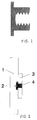
- an anchor is to be fitted on the rear, expediently made of metal such as brass (FIG. 1).
- the principle of assembly is shown in Fig. 2.
- 1.5 to 2.0 mm deep blind holes (2) with a diameter - as a guide - of 16.5 mm are drilled at the fastening points, thus fixing the fastening point.
- a hole is drilled in the middle - 10.0 mm may be mentioned as a reference.
- the reinforcement plate (3) is attached to the back of the plate (1) with the inserted anchor (4).
- the attachment can advantageously be carried out by cold welding, ie joining by means of a (non-hardened) monomer-polymer mixture, in particular of the same type as the plate material.
- the material connection surprisingly shows an even higher strength than the plate material itself, provided that the connection is made as usual on the back.
- the reinforcement plate (3) should not be too small: 70 x 70 mm should be mentioned as a reference.
- the joints that are created between the individual panels (1) can be sealed, for example, by stored joint panels, which may be color-coordinated with the panels. In this case, 10 mm should be mentioned as a guide for the joint width.
- Pre-drilled plates (1) can be drilled using a drill sleeve, undrilled plates using a step drill with a stop.
- the essentially flat panels according to the present invention are very well suited for use outdoors, ie as facade elements.
- These facade elements are characterized by a number of advantageous properties.
- Appropriate pigmentation and / or colorant addition can be used to achieve both plain and statistically distributed or color-differentiated color settings.
- a suitable imitation of pigments according to size and color can also be used to imitate stones (e.g. granite, marble, etc.).
- Corresponding measures, in particular recipes are described, for example, in WO 91/11 404, DE-A 26 27 081; DE-A 27 18 024 known.
- the fire behavior of the panel material fulfills the applicable regulations for facade cladding.
- plates with a content of 66% by weight Al (OH) 3 are classified according to the fire regulations in force in the Federal Republic of Germany under DIN 4102 according to "B1".
- the high weather stability of the facade cladding panels according to the invention which can optionally also be doped with UV stabilizers, which enables their use in the construction sector even outside of the moderate climates.
- the plates can still be subsequently reshape the casting process, which can be used both for creative processing and to improve the static properties.
- Aerosil ® 200 330.0 g aluminum hydroxide with an average particle size of 45 ⁇ m (ALCOA ® C33, product from ALCOA, USA) and then 330.0 g aluminum hydroxide with an average particle size of 8 are added to the dissolver with moderate stirring ⁇ m (ALCOA ® C333) entered in the syrup. Then the suspension with the dissolver (type HD 7.5 from Getzmann, Germany) at 20.0 m / sec. dispersed for about 10 minutes.
- MMA methyl methacrylate
- a chamber with the dimensions 3,200 mm x 1,300 mm is built from two silicate glass panes (6 mm thick) using a round PVC cord (3.2 mm diameter).
- the suspension according to I-1 is poured into the intermediate space of the silicate glass chamber and the chamber is closed.
- the filled chamber is placed horizontally in a water bath at 40 degrees Celsius.
- the polymerization time is 260 minutes.
- the mixture is then polymerized at 105 ° C. in a drying cabinet for 30 minutes.
- the chamber is then removed from the mold and the hardened casting is removed.
- the plate casting has high-gloss surfaces on both sides and is not bent.
- Example I-2 To 100 parts by weight of the suspension from Example I-2, one part by weight of dibenzoyl peroxide (50% in di-n-butyl phthalate, product INTEROX® BP-50-FT from Peroxid Chemie GmbH) and 3.5 g azo-bis-isobutyronitrile (product INTEROX ® NN IBN) added and dissolved. 10 parts by weight of CO 2 snow are then added to the suspension with stirring. After a stirring time of 5 minutes, the temperature of the suspension is measured. It is -5 degrees C. Then, while stirring the suspension, 1 part by weight of N, N-dimethyl-p-toluidine is added as a 50% solution in MMA. After stirring for one minute, the stirrer is removed.
- dibenzoyl peroxide 50% in di-n-butyl phthalate, product INTEROX® BP-50-FT from Peroxid Chemie GmbH
- azo-bis-isobutyronitrile product INTEROX ® NN IBN
- This mixture is filled in an open form with the dimensions 2300 x 1300 mm, consisting of a glass plate with an edge, which is formed by means of a round PVC cord (O, 6 mm).
- a predominantly closed-pore foam with a density of 0.66 g / cm 3 is obtained .
- ACRIFIX ® 190 is mixed with 3 - 5% by weight of catalyst ® V20 until no streaks are visible. Air bubbles rise to the surface of the adhesive in the covered container or can be removed in a vacuum desiccator (minimum 200 mbar).
- the adhesive mixture prepared in this way is poured directly onto the plate according to Example III. Then the plate from Example II is carefully placed. Excess adhesive comes out at the edges. The adhesive has hardened after approx. 2 hours.
Landscapes
- Chemical & Material Sciences (AREA)
- Architecture (AREA)
- Engineering & Computer Science (AREA)
- Chemical Kinetics & Catalysis (AREA)
- Health & Medical Sciences (AREA)
- Structural Engineering (AREA)
- Civil Engineering (AREA)
- Medicinal Chemistry (AREA)
- Polymers & Plastics (AREA)
- Organic Chemistry (AREA)
- Polymerisation Methods In General (AREA)
- Compositions Of Macromolecular Compounds (AREA)
- Addition Polymer Or Copolymer, Post-Treatments, Or Chemical Modifications (AREA)
- Led Devices (AREA)
- Finishing Walls (AREA)
Applications Claiming Priority (2)
| Application Number | Priority Date | Filing Date | Title |
|---|---|---|---|
| DE19513173A DE19513173A1 (de) | 1995-04-07 | 1995-04-07 | Fassadenverkleidungselemente |
| DE19513173 | 1995-04-07 |
Publications (3)
| Publication Number | Publication Date |
|---|---|
| EP0736645A2 true EP0736645A2 (fr) | 1996-10-09 |
| EP0736645A3 EP0736645A3 (fr) | 1999-04-28 |
| EP0736645B1 EP0736645B1 (fr) | 2003-06-04 |
Family
ID=7759125
Family Applications (1)
| Application Number | Title | Priority Date | Filing Date |
|---|---|---|---|
| EP96105029A Expired - Lifetime EP0736645B1 (fr) | 1995-04-07 | 1996-03-29 | Eléments de façade |
Country Status (3)
| Country | Link |
|---|---|
| EP (1) | EP0736645B1 (fr) |
| AT (1) | ATE242382T1 (fr) |
| DE (2) | DE19513173A1 (fr) |
Cited By (3)
| Publication number | Priority date | Publication date | Assignee | Title |
|---|---|---|---|---|
| JP2005097440A (ja) * | 2003-09-25 | 2005-04-14 | Three M Innovative Properties Co | 発泡シート形成性組成物、熱伝導性発泡シート及びその製造方法 |
| WO2005061601A1 (fr) * | 2003-12-16 | 2005-07-07 | Röhm GmbH & Co. KG | Resines de reaction a base de methacrylate sans retrait |
| US20210380776A1 (en) * | 2018-11-26 | 2021-12-09 | Mubea Carbo Tech Gmbh | Process for producing poly(meth)acrylimide materials |
Families Citing this family (1)
| Publication number | Priority date | Publication date | Assignee | Title |
|---|---|---|---|---|
| DE19829613A1 (de) * | 1998-07-02 | 2000-01-05 | Heinz Koehler | Aushärtbare Gießmasse |
Family Cites Families (4)
| Publication number | Priority date | Publication date | Assignee | Title |
|---|---|---|---|---|
| US4107135A (en) * | 1976-04-23 | 1978-08-15 | E. I. Du Pont De Nemours And Company | Decorative polymeric article containing flock fibers |
| US4183991A (en) * | 1977-05-02 | 1980-01-15 | Rohm And Haas Company | Process for preparing highly filled acrylic articles |
| DE3531914A1 (de) * | 1985-09-07 | 1987-03-19 | Roehm Gmbh | Verfahren zur herstellung haertbarer giessharze |
| US5444115A (en) * | 1994-11-21 | 1995-08-22 | E. I. Du Pont De Nemours And Company | Fire resistant poly(methyl methacrylate) composition |
-
1995
- 1995-04-07 DE DE19513173A patent/DE19513173A1/de not_active Ceased
-
1996
- 1996-03-29 AT AT96105029T patent/ATE242382T1/de not_active IP Right Cessation
- 1996-03-29 EP EP96105029A patent/EP0736645B1/fr not_active Expired - Lifetime
- 1996-03-29 DE DE59610485T patent/DE59610485D1/de not_active Expired - Lifetime
Cited By (6)
| Publication number | Priority date | Publication date | Assignee | Title |
|---|---|---|---|---|
| JP2005097440A (ja) * | 2003-09-25 | 2005-04-14 | Three M Innovative Properties Co | 発泡シート形成性組成物、熱伝導性発泡シート及びその製造方法 |
| WO2005035638A1 (fr) * | 2003-09-25 | 2005-04-21 | 3M Innovative Properties Company | Composition formant une feuille de mousse, feuille de mousse a conductivite thermique et procede |
| CN1856532B (zh) * | 2003-09-25 | 2011-05-25 | 3M创新有限公司 | 泡沫板成形组合物、导热泡沫板和方法 |
| WO2005061601A1 (fr) * | 2003-12-16 | 2005-07-07 | Röhm GmbH & Co. KG | Resines de reaction a base de methacrylate sans retrait |
| US20210380776A1 (en) * | 2018-11-26 | 2021-12-09 | Mubea Carbo Tech Gmbh | Process for producing poly(meth)acrylimide materials |
| US12043718B2 (en) * | 2018-11-26 | 2024-07-23 | Mubea Carbo Tech Gmbh | Process for producing poly(meth)acrylimide materials |
Also Published As
| Publication number | Publication date |
|---|---|
| ATE242382T1 (de) | 2003-06-15 |
| DE19513173A1 (de) | 1996-10-10 |
| EP0736645A3 (fr) | 1999-04-28 |
| DE59610485D1 (de) | 2003-07-10 |
| EP0736645B1 (fr) | 2003-06-04 |
Similar Documents
| Publication | Publication Date | Title |
|---|---|---|
| EP1573150B1 (fr) | Articles a base de matiere plastique de moulage pmma | |
| EP3529062B1 (fr) | Procédé de fabrication d'un profilé à compartiments creux thermoplastique pour fenêtre ou porte | |
| EP2935509B1 (fr) | Plastiques thermotropes | |
| DE2818954A1 (de) | Polymerisierbare harzmasse, verwendung derselben zur formkoerperherstellung und daraus gewonnene acrylpolymerformkoerper | |
| EP0640651B1 (fr) | Articles en forme d'aspect granitique en plastique hautement chargé | |
| DE19906989A1 (de) | Lärmschutzwandsegment | |
| DE3531914A1 (de) | Verfahren zur herstellung haertbarer giessharze | |
| EP1210385B1 (fr) | Demi-produit thermoplastiquement deformable s'autorenforcant, destine en particulier a la production d'articles sanitaires, son procede de production et corps moules realises a partir de ce demi-produit | |
| EP0736645B1 (fr) | Eléments de façade | |
| EP0639539A1 (fr) | Procédé pour préparation de masses à mouler de polyméthylméthacrylate, fortement chargés | |
| EP0581225B2 (fr) | Suspression pour la production des résines coulables chargées | |
| EP0659786B1 (fr) | Objets sanitaires en plastique à propriétés améliorées | |
| EP0659530A2 (fr) | Procédé pour la fabrication de plaques en matériaux plastiques contenant une grosse quantité de charges | |
| EP1485250A1 (fr) | Panneau antibruit en verre acrylique | |
| EP1214193B1 (fr) | Panneau en poly(meth)acrylate a formage thermoplastique, auto-renfor ateur, son procede de fabrication et article sanitaire fabrique a partir de ce panneau | |
| EP1587893B1 (fr) | Adhesif de polymerisation mate | |
| DE3821116A1 (de) | Verfahren zur herstellung von eingefaerbten polyacrylatplatten | |
| EP0645420B1 (fr) | Pièces en polyméthacrylate à base de résines à couler durcies, présentant une structure particulière à microdomaines | |
| EP0716197A2 (fr) | Panneau profilé rempli de mousse polymérique | |
| EP1678217A1 (fr) | PRODUCTION DE BLOCS DE PLEXIGLAS sp ( /sp INCOLORES OU DE CO ULEUR TRANSPARENTE OU OPAQUE A PARTIR D UN PREPOLYMERE EXEMP T D INITIATEURS RESIDUELS PAR POLYMERISATION THERMIQUE | |
| CH686439A5 (de) | Verfahren zur Herstellung von farbigen Acrylatkunststoffen mit metallisch glaenzenden Oberflaechen. | |
| DE3110093A1 (de) | Verfahren zur herstellung von acrylatkunststoffen mit einer farblich differenzierten oberflaeche | |
| EP1648672B1 (fr) | Utilisation d'un agent de separation pour matieres plastiques | |
| DE102009027658A1 (de) | Ultraleichte Platte aus gegossenem Acrylglas, Verfahren zu deren Herstellung sowie Verwendung | |
| EP2886619A1 (fr) | Composite à adhérence améliorée |
Legal Events
| Date | Code | Title | Description |
|---|---|---|---|
| PUAI | Public reference made under article 153(3) epc to a published international application that has entered the european phase |
Free format text: ORIGINAL CODE: 0009012 |
|
| AK | Designated contracting states |
Kind code of ref document: A2 Designated state(s): AT BE CH DE DK ES FR GB IT LI NL SE |
|
| PUAL | Search report despatched |
Free format text: ORIGINAL CODE: 0009013 |
|
| AK | Designated contracting states |
Kind code of ref document: A3 Designated state(s): AT BE CH DE DK ES FR GB IT LI NL SE |
|
| 17P | Request for examination filed |
Effective date: 19990814 |
|
| RAP1 | Party data changed (applicant data changed or rights of an application transferred) |
Owner name: ROEHM GMBH & CO. KG |
|
| 17Q | First examination report despatched |
Effective date: 20020123 |
|
| GRAH | Despatch of communication of intention to grant a patent |
Free format text: ORIGINAL CODE: EPIDOS IGRA |
|
| GRAH | Despatch of communication of intention to grant a patent |
Free format text: ORIGINAL CODE: EPIDOS IGRA |
|
| GRAA | (expected) grant |
Free format text: ORIGINAL CODE: 0009210 |
|
| AK | Designated contracting states |
Designated state(s): AT BE CH DE DK ES FR GB IT LI NL SE |
|
| PG25 | Lapsed in a contracting state [announced via postgrant information from national office to epo] |
Ref country code: NL Free format text: LAPSE BECAUSE OF FAILURE TO SUBMIT A TRANSLATION OF THE DESCRIPTION OR TO PAY THE FEE WITHIN THE PRESCRIBED TIME-LIMIT Effective date: 20030604 Ref country code: IT Free format text: LAPSE BECAUSE OF FAILURE TO SUBMIT A TRANSLATION OF THE DESCRIPTION OR TO PAY THE FEE WITHIN THE PRE;WARNING: LAPSES OF ITALIAN PATENTS WITH EFFECTIVE DATE BEFORE 2007 MAY HAVE OCCURRED AT ANY TIME BEFORE 2007. THE CORRECT EFFECTIVE DATE MAY BE DIFFERENT FROM THE ONE RECORDED.SCRIBED TIME-LIMIT Effective date: 20030604 Ref country code: GB Free format text: LAPSE BECAUSE OF FAILURE TO SUBMIT A TRANSLATION OF THE DESCRIPTION OR TO PAY THE FEE WITHIN THE PRESCRIBED TIME-LIMIT Effective date: 20030604 Ref country code: FR Free format text: LAPSE BECAUSE OF FAILURE TO SUBMIT A TRANSLATION OF THE DESCRIPTION OR TO PAY THE FEE WITHIN THE PRESCRIBED TIME-LIMIT Effective date: 20030604 |
|
| REG | Reference to a national code |
Ref country code: GB Ref legal event code: FG4D Free format text: NOT ENGLISH |
|
| REG | Reference to a national code |
Ref country code: CH Ref legal event code: EP |
|
| REF | Corresponds to: |
Ref document number: 59610485 Country of ref document: DE Date of ref document: 20030710 Kind code of ref document: P |
|
| PG25 | Lapsed in a contracting state [announced via postgrant information from national office to epo] |
Ref country code: SE Free format text: LAPSE BECAUSE OF FAILURE TO SUBMIT A TRANSLATION OF THE DESCRIPTION OR TO PAY THE FEE WITHIN THE PRESCRIBED TIME-LIMIT Effective date: 20030904 Ref country code: DK Free format text: LAPSE BECAUSE OF FAILURE TO SUBMIT A TRANSLATION OF THE DESCRIPTION OR TO PAY THE FEE WITHIN THE PRESCRIBED TIME-LIMIT Effective date: 20030904 |
|
| PG25 | Lapsed in a contracting state [announced via postgrant information from national office to epo] |
Ref country code: ES Free format text: LAPSE BECAUSE OF FAILURE TO SUBMIT A TRANSLATION OF THE DESCRIPTION OR TO PAY THE FEE WITHIN THE PRESCRIBED TIME-LIMIT Effective date: 20030915 |
|
| NLV1 | Nl: lapsed or annulled due to failure to fulfill the requirements of art. 29p and 29m of the patents act | ||
| GBV | Gb: ep patent (uk) treated as always having been void in accordance with gb section 77(7)/1977 [no translation filed] |
Effective date: 20030604 |
|
| PG25 | Lapsed in a contracting state [announced via postgrant information from national office to epo] |
Ref country code: AT Free format text: LAPSE BECAUSE OF NON-PAYMENT OF DUE FEES Effective date: 20040329 |
|
| PG25 | Lapsed in a contracting state [announced via postgrant information from national office to epo] |
Ref country code: LI Free format text: LAPSE BECAUSE OF NON-PAYMENT OF DUE FEES Effective date: 20040331 Ref country code: CH Free format text: LAPSE BECAUSE OF NON-PAYMENT OF DUE FEES Effective date: 20040331 Ref country code: BE Free format text: LAPSE BECAUSE OF NON-PAYMENT OF DUE FEES Effective date: 20040331 |
|
| PLBE | No opposition filed within time limit |
Free format text: ORIGINAL CODE: 0009261 |
|
| STAA | Information on the status of an ep patent application or granted ep patent |
Free format text: STATUS: NO OPPOSITION FILED WITHIN TIME LIMIT |
|
| 26N | No opposition filed |
Effective date: 20040305 |
|
| EN | Fr: translation not filed | ||
| BERE | Be: lapsed |
Owner name: *ROHM G.M.B.H. & CO. K.G. Effective date: 20040331 |
|
| REG | Reference to a national code |
Ref country code: CH Ref legal event code: PL |
|
| PGFP | Annual fee paid to national office [announced via postgrant information from national office to epo] |
Ref country code: DE Payment date: 20110325 Year of fee payment: 16 |
|
| REG | Reference to a national code |
Ref country code: DE Ref legal event code: R119 Ref document number: 59610485 Country of ref document: DE Effective date: 20121002 |
|
| PG25 | Lapsed in a contracting state [announced via postgrant information from national office to epo] |
Ref country code: DE Free format text: LAPSE BECAUSE OF NON-PAYMENT OF DUE FEES Effective date: 20121002 |