EP0735443B1 - Neuronales Netz zur Positionsabweichungskompensation bei Werkstückbearbeitungseinrichtungen - Google Patents
Neuronales Netz zur Positionsabweichungskompensation bei Werkstückbearbeitungseinrichtungen Download PDFInfo
- Publication number
- EP0735443B1 EP0735443B1 EP96104066A EP96104066A EP0735443B1 EP 0735443 B1 EP0735443 B1 EP 0735443B1 EP 96104066 A EP96104066 A EP 96104066A EP 96104066 A EP96104066 A EP 96104066A EP 0735443 B1 EP0735443 B1 EP 0735443B1
- Authority
- EP
- European Patent Office
- Prior art keywords
- workpiece
- tool
- neural networks
- temperature
- machining device
- Prior art date
- Legal status (The legal status is an assumption and is not a legal conclusion. Google has not performed a legal analysis and makes no representation as to the accuracy of the status listed.)
- Expired - Lifetime
Links
Images



Classifications
-
- G—PHYSICS
- G05—CONTROLLING; REGULATING
- G05B—CONTROL OR REGULATING SYSTEMS IN GENERAL; FUNCTIONAL ELEMENTS OF SUCH SYSTEMS; MONITORING OR TESTING ARRANGEMENTS FOR SUCH SYSTEMS OR ELEMENTS
- G05B19/00—Program-control systems
- G05B19/02—Program-control systems electric
- G05B19/18—Numerical control [NC], i.e. automatically operating machines, in particular machine tools, e.g. in a manufacturing environment, so as to execute positioning, movement or co-ordinated operations by means of program data in numerical form
- G05B19/404—Numerical control [NC], i.e. automatically operating machines, in particular machine tools, e.g. in a manufacturing environment, so as to execute positioning, movement or co-ordinated operations by means of program data in numerical form characterised by control arrangements for compensation, e.g. for backlash, overshoot, tool offset, tool wear, temperature, machine construction errors, load, inertia
-
- G—PHYSICS
- G05—CONTROLLING; REGULATING
- G05B—CONTROL OR REGULATING SYSTEMS IN GENERAL; FUNCTIONAL ELEMENTS OF SUCH SYSTEMS; MONITORING OR TESTING ARRANGEMENTS FOR SUCH SYSTEMS OR ELEMENTS
- G05B2219/00—Program-control systems
- G05B2219/30—Nc systems
- G05B2219/33—Director till display
- G05B2219/33027—Artificial neural network controller
-
- G—PHYSICS
- G05—CONTROLLING; REGULATING
- G05B—CONTROL OR REGULATING SYSTEMS IN GENERAL; FUNCTIONAL ELEMENTS OF SUCH SYSTEMS; MONITORING OR TESTING ARRANGEMENTS FOR SUCH SYSTEMS OR ELEMENTS
- G05B2219/00—Program-control systems
- G05B2219/30—Nc systems
- G05B2219/42—Servomotor, servo controller kind till VSS
- G05B2219/42246—Add compensation to reference value
-
- G—PHYSICS
- G05—CONTROLLING; REGULATING
- G05B—CONTROL OR REGULATING SYSTEMS IN GENERAL; FUNCTIONAL ELEMENTS OF SUCH SYSTEMS; MONITORING OR TESTING ARRANGEMENTS FOR SUCH SYSTEMS OR ELEMENTS
- G05B2219/00—Program-control systems
- G05B2219/30—Nc systems
- G05B2219/49—Nc machine tool, till multiple
- G05B2219/49206—Compensation temperature, thermal displacement, use measured temperature
Definitions
- the invention relates to a method for compensating falsifying influences when positioning workpieces or tools of a workpiece processing device by forming correction values of the falsifying Influences, using input variables that the represent falsifying factors.
- DE-A1-36 20 118 nor DD-209 765 contain one Teaching related to the type of compensation in the control.
- EP 0 641 624 A1 discloses a machine tool with a Tool that is movable relative to a workpiece. At the Machine tool several temperature sensors are provided, their measured values to compensate for thermal deformation by means of a neural network.
- EP 0 589 394 A1 discloses a robot which is used for Reduction in positioning error a neural Network.
- the object of the invention is a more precise and with less Effort feasible or a more robust method for Compensation for distorting influences in the Positioning workpieces or tools one Workpiece processing device than with the known Procedure specified.
- the object is achieved in that input variables, which represent the falsifying influencing factors, one based on trainable neural networks Information processing are supplied, the correction values forms with which a compensation of these falsifying Influencing factors can be made, the on trainable neural networks based information processing in two hierarchy levels, hierarchy level I and Hierarchy level II, is divided, the neural Networks of hierarchy level I before commissioning and the hierarchy level II also trained in the operational phase become.
- Using a trainable neural network based information processing to compensate for distorting influences during positioning is advantageous, that deal with this type of information processing the non-linear relationships between positioning distorting influences and their effects quickly and have it modeled precisely. This can be a complex process and expensive mathematical analysis of the workpiece processing device, if this is possible at all, waives become.
- this is not an analytical context, but a representative one Cross-section of the position falsifying Influences and their effects.
- Information processing quasi for compensation necessary models and the compensation laws automatically in one step. Because of the flexibility achieved are individual for individual workpiece machining equipment Solutions possible, creating a high level of precision is achieved in the compensation.
- the Correction values of the distorting influences during positioning Target positions of the workpieces or tools can correct the distorting influences during positioning the existing actuators are used for positioning become, i.e. separate actuators for compensation are not necessary.
- This is also for information processing to compensate for the distorting influences in the Positioning no separate functional interface to the Workpiece processing equipment necessary. It can at Use of the target position, as opposed to direct action including the actuator control on the actuator in modeling the trainable on neural Network-based information processing are dispensed with, the modeling is independent of the regulation.
- the distorting influences - temperature of the workpiece processing device and weight of the workpiece or tool - compensated. At this selection is advantageous that the training effort of the neural networks is reduced, with the essential falsifying influencing factors are included in the positioning.
- a further advantageous embodiment of the invention becomes the one based on trainable neural networks Information processing in neural temperature compensation networks, which is predominantly the falsifying influencing variable - Temperature of the workpiece processing device - compensated and neural weight compensation networks that predominate the falsifying influencing variable - weight of the workpiece or tools - compensated, shared.
- Information processing is advantageous in that constant precision of compensation of training effort - with a sufficiently independent effect of the two distorting influences - significantly reduced.
- a further advantageous embodiment of the invention is at least one of the sizes temperature at different Parts of the workpiece processing device, motor current, Coolant temperature of the workpiece processing device, Ambient temperature, feed speed when positioning of the tool or the workpiece or time one Input variable of the temperature compensation networks.
- all essential sizes the influence on the distortion of the positioning due to the temperature of that on trainable neural networks based information processing. It is particularly advantageous that the input variables - Motor current, coolant temperature of the workpiece processing device, Ambient temperature, feed rate at the positioning of the tool or the workpiece or the Time - temperature measuring points on the workpiece machining direction can be saved.
- temperature compensation networks do not become temperatures of fast moving, especially rotating parts of the Workpiece processing device supplied as input variables, which can save costs because of temperature measurements on fast moving, especially fast rotating Parts are expensive.
- thermo compensation networks Correction value composed of several parts, these parts generated by separate neural networks whose Input variable at least one of the variables temperatures different parts of the workpiece processing device, Motor current, coolant temperature of the workpiece processing device, Ambient temperature, feed speed when positioning the tool or workpiece or are time.
- the input variables of the weight compensation networks at least one of the sizes - weight of the workpiece or tool, Position of the workpiece or tool, engine speed or speed of the rotating parts.
- Advantage of this Design is that with these input variables high level of precision in compensation.
- the neural Computing information processing networks which masked influences that distorted the positioning Neurons that are activated by a tangent hyperbolicus.
- the Training effort for these neural networks further reduced.
- the neural networks of information processing become Compensation for the influences that distort the positioning after commissioning in the workpiece processing facility with a selection of the input variables - temperatures at different Parts of a workpiece processing device, Motor current of different drives, coolant temperature of the Workpiece processing equipment, ambient temperature, feed speed when positioning the tool or the workpiece, weight of a tool or workpiece or time since a certain event occurred as well in particular workpiece geometry and material, type of tool and material as well as workpiece actual errors - further trained.
- This measure can change the parameters of the Workpiece machining facility in the operating phase be worn. You can also by this measure Parameters are taken into account as input variables for which not sufficient in the training phase before commissioning Information provided.
- the limits of the values of the input variables that are trainable information processing based on neural networks to compensate for influences that distort the position given the training of these networks further than for operational application.
- the values of the input variables, over the limits of the values of the input quantities in operational use go beyond extrapolation be formed if any of this area outside the limits do not have a sufficient number of training values Available.
- This configuration is advantageous in that the precision of compensation at the limits of the values of the Input variables in the operational application is increased.
- the neural networks of information processing for compensation influences that distort the positioning implemented a computing device with which the actuators, the workpiece processing device, which preferably as Electric motors are designed to position the workpiece or tool can be controlled.
- the actuators the workpiece processing device, which preferably as Electric motors are designed to position the workpiece or tool can be controlled.
- information processing to compensate for the influences that distort the positioning together with the control of the Actuators can be implemented.
- a temperature compensation network with a neural network a hidden level, preferably formed with three nodes, where every node of a level with every node one connected to another level.
- This embodiment of the invention has proven particularly beneficial in terms of Precision of the compensation and the training effort proved.
- the direct link between input and output neurons allows a good modeling of linear parts of the Relationship between falsifying influencing factors during positioning and the position of the workpiece or tool.
- a weight compensation network as a neural Network with a hidden level with preferably eleven nodes exposed.
- all are neural Networks designed as feed-forward networks.
- the exemplary Design of the tool processing device shows a lathe, the workpiece 35 on a spindle 37 is attached by the drive unit 32 in Rotation is set.
- the workpiece processing device turns the workpiece into Direction of the spindle axis via a workpiece positioning device 34 moves.
- the tool 36 is operated by a tool positioning device 33 moves.
- the workpiece processing device 11 is controlled by the controller 10 the controlled variable 9 delivered.
- the workpiece processing device 11 in turn provides process status information, such as the actual position or an equivalent 7 as well as process status information 8 that are not the actual position.
- the actual position or its equivalent 7 is again the controller 10 supplied from the actual position or its equivalent 7 and a target position 3 corrected in this case Control variable 9 generated.
- a control of the workpiece processing device not shown the target position 2 of the workpiece 35 or Tool 36 generated.
- This compensation block 1 determines a corrected target position 3.
- the information - target position 2, corrected target position 3, controlled variable 9 and in particular the actual position or equivalent 7 and process status information except actual position 8 - represent information areas.
- the actual position is advantageous the neural networks as the difference between the target and actual position supplied, which leads to a normalization of this information and significantly reduced the training effort.
- All positioning information, i.e. Actual position or equivalent 8, target position 2 or corrected target position 3 has in common that they can refer to all three spatial directions. Furthermore does not contain any of the above information Information ', i.e. an information flow can be omitted become.
- the process status information 8 apart from the actual position 3 temperatures in different parts of one of the Workpiece processing device, the motor current different Drives, the coolant temperature of the workpiece processing device, the ambient temperature, the feed rate when positioning the tool or Workpiece, the weight of a tool or workpiece, the Machining quantity, workpiece geometry and material, type of tool and material or the time since a certain incision Event.
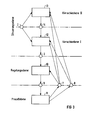
- FIG 3 shows the hierarchical structure of information processing to compensate for falsifying factors positioning.
- the functionality remains on the Process level and the control level unchanged compared to FIG 2.
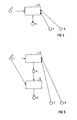
- the neural network 4.1 shows a neural network 4.1 as a compensation block 1,12 or 13.
- the neural network 4.1 the target position 2, the actual position or equivalent 7 as well as further process status information 8 apart from the actual position fed.
- the output variable of this neural network is a corrected target position 3.
- the neural network no longer receives any information about the Actual position or equivalent information 7.
- FIG. 5 also shows a neural network 4.2 as a compensation block 1,12 or 13, but this is a link block 6 is expanded.
- FIG. 4 generates the neural network 4.2 in FIG. 5 from the above Input values a compensation value with which in the logic block 6 the target position 2 to a corrected Target position 3 is linked.
- a neural network 4.1 and 4.2 for compensation of distorting influences during positioning advantageous, this by a standardization block, not shown to normalize, unless they are a priori represent standardized quantities, e.g. the difference between Target and actual position or standardization by dispensing with non-standardized sizes, e.g. the target position becomes.
- standardized quantities e.g. the difference between Target and actual position or standardization by dispensing with non-standardized sizes, e.g. the target position becomes.
- non-standardized input variables in one Standardization blocks are particularly suitable for fuzzy methods.
- the sixth shows a temperature compensation network with an input neuron level 15, a level of the hidden neurons 16 and an initial neuron level 17.
- the input neuron level contains four neurons
- the hidden neuron level 16 contains three neurons
- the output neuron level 17 also three neurons. All neurons on one level are with all Neurons of the other levels connected.
- the fourth Neuron of input level 15 becomes the time since a certain Event fed. Such an event can turn on the workpiece processing device or change from idle to load or from load to idle. It has proved to be particularly beneficial instead of time to use an exponential time.
- the first, second and third neurons of the input neuron level temperatures at various points in the workpiece processing device fed. Corresponding compensation values to determine a corrected target position 3 are from the neurons of the output neuron level 22, 23 and 24 issued.
- the one of the first neuron 22 corresponds to the Output level 17 output correction value of the position falsification on the part of the workpiece processing device, at which the temperature was recorded, which the first neuron 18 of the input neuron level 15 has been.
- Correction values are proportionality factors from which corrected by multiplying by the target position 2 Target position 3 can be formed.
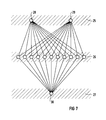
- the 7 shows a weight compensation network with an input neuron level 25 with two neurons, one hidden level Neurons 26 with eleven neurons and an output neuron level 27 with a neuron.
- the first neuron 28 of the input neuron level 25 becomes the weight of the tool and workpiece fed that the falsification of positioning caused.
- the second neuron 29 of the neuron input level 25 becomes the position of the corresponding workpiece or tool fed. In the present example, this is position the target position 2.
- the neuron 30 of the neuron output level 29 gives a compensation value to compensate for the Positioning distorting influence of the weight of the Workpiece or tool.
- This compensation value is an absolute deviation of the for the present example Position from which in link block 6 by addition with the target position 2 a corrected target position 3 is formed.
Landscapes
- Engineering & Computer Science (AREA)
- Human Computer Interaction (AREA)
- Manufacturing & Machinery (AREA)
- Physics & Mathematics (AREA)
- General Physics & Mathematics (AREA)
- Automation & Control Theory (AREA)
- Automatic Control Of Machine Tools (AREA)
- Numerical Control (AREA)
Description
- FIG 1
- eine Werkstückbearbeitungseinrichtung und eine Recheneinheit,
- FIG 2
- die Einordnung der Informationsverarbeitung zur Kompensation der die Positionierung verfälschenden Einflüsse in die Steuerungsebene einer Werkstückbearbeitungseinrichtung,
- FIG 3
- die hierarchische Gliederung der Informationsverarbeitung zur Kompensation verfälschender Einflußgrößen bei der Positionierung,
- FIG 4
- die Schnittstellen eines neuronalen Netzes zur Ermittlung einer korrigierten Sollposition,
- FIG 5
- die Schnittstellen eines neuronalen Netzes zur Ermittlung eines Kompensationswertes mit einem Verknüpfungsblock,
- FIG 6
- ein Temperaturkompensationsnetz,
- FIG 7
- ein Gewichtskompensationsnetz.
Claims (22)
- Verfahren zur Kompensation von verfälschenden Einflüssen bei der Positionierung von Werkstücken oder Werkzeugen einer Werkstückbearbeitungseinrichtung durch Bildung von Korrekturwerten der verfälschenden Einflüsse, wobei Eingangsgrößen verwendet werden, die die verfälschenden Einflußgrößen repräsentieren, und wobei die Korrekturwerte der verfälschenden Einflüsse durch eine auf trainierbaren neuronalen Netzen basierende Informationsverarbeitung gebildet werden,
dadurch gekennzeichnet,
daß die auf trainierbaren neuronalen Netzen basierende Informationsverarbeitung in zwei Hierarchieebenen, Hierarchieebene I und Hierarchieebene II, erfolgt, wobei die neuronalen Netze der Hierarchieebene I vor der Betriebsphase und die der Hierarchieebene II auch in der Betriebsphase trainiert werden. - Verfahren nach Anspruch 1,
dadurch gekennzeichnet,
daß ein Korrekturwert der verfälschenden Einflüsse bei der Positionierung eine korrigierte Sollposition (3) des Werkstücks oder Werkzeugs ist. - Verfahren nach Anspruch 1 oder 2,
dadurch gekennzeichnet,
daß ein Korrekturwert der verfälschenden Einflüsse bei der Positionierung ein Kompensationswert (5) ist, der mit der Sollposition (2) des Werkstücks oder Werkzeugs zu einer korrigierten Sollposition (3) verknüpft wird. - Verfahren nach Anspruch 1,2 oder 3,
dadurch gekennzeichnet,
daß die Kompensationswerte (5) absolute Abweichungen der Position sind, aus denen sich durch Addition mit der Sollposition (2) des Werkstückes oder Werkzeuges eine korrigierte Sollposition (3) ergibt. - Verfahren nach einem oder mehreren der Ansprüche 1 bis 4,
dadurch gekennzeichnet,
daß vorzugsweise die verfälschenden Einflüsse - Temperatur der Werkstückbearbeitungseinrichtung und Gewicht des Werkstücks oder Werkzeugs - kompensiert werden. - Verfahren nach einem oder mehreren der Ansprüche 1 bis 5,
dadurch gekennzeichnet,
daß durch als Temperaturkompensationsnetze bezeichnete neuronale Netze überwiegend die Kompensation der verfälschenden Einflußgröße - Temperatur der Werkstückbearbeitungseinrichtung - erfolgt. - Verfahren nach einem oder mehreren der Ansprüche 1 bis 6,
dadurch gekennzeichnet,
daß Kompensationswerte (5) Proportionalitätsfaktoren der Position sind, aus dem sich durch Multiplikation mit der Sollposition (2) des Werkstücks oder Werkzeugs eine korrigierte Sollposition (3) ergibt. - Verfahren nach einem oder mehreren der Ansprüche 1 bis 7,
dadurch gekennzeichnet,
daß mindestens eine der Eingangsgrößen der Temperaturkompensationsnetze Temperatur an verschiedenen Stellen der Werkstückbearbeitungseinrichtung, Motorstrom, Kühlmitteltemperatur der Werkstückbearbeitungseinrichtung, Umgebungstemperatur, Vorschubgeschwindigkeit bei der Positionierung des Werkzeugs oder des Werkstücks oder Zeit seit Eintritt eines Ereignisses ist. - Verfahren nach einem oder mehreren der Ansprüche 1 bis 8,
dadurch gekennzeichnet,
daß die Temperaturkompensationsnetze Korrekturwerte ohne Eingabe der Temperaturen von schnell beweglichen, insbesondere rotierenden Teilen der Werkstückbearbeitungseinrichtung bilden. - Verfahren nach einem oder mehreren der Ansprüche 1 bis 9,
dadurch gekennzeichnet,
daß der zur Korrektur des verfälschenden Einflusses Temperatur der Werkstückbearbeitungseinrichtung verwendete Wert sich aus mehreren Anteilen zusammensetzt, wobei diese Anteile von separaten neuronalen Netzen erzeugt werden, deren Eingangsgrößen mindestens eine der Größen Temperatur an verschiedenen und ggf. unterschiedlichen Stellen der Werkstückbearbeitungseinrichtung, Motorstrom, Kühlmitteltemperatur der Werkstückbearbeitungseinrichtung, Umgebungstemperatur, Vorschubgeschwindigkeit bei der Positionierung des Werkzeugs oder des Werkstücks oder Zeit sind. - Verfahren nach einem oder mehreren der Ansprüche 1 bis
10, dadurch gekennzeichnet,
daß für Last- und Leerlauf der Werkstückbearbeitungseinrichtung separate neuronale Netze zur Kompensation des die Positionierung verfälschenden Einflusses Temperatur verwendet werden. - Verfahren nach Anspruch 1,2,3 oder 4,
dadurch gekennzeichnet,
daß die Kompensation der verfälschenden Einflußgröße - Gewicht des Werkstückes oder Werkzeuges - im wesentlichen durch ein als Gewichtskompensationsnetz bezeichnetes neuronales Netz erfolgt. - Verfahren nach Anspruch 1 oder 12,
dadurch gekennzeichnet,
daß die Eingangsinformationen der Gewichtskompensationsnetze mindestens eine der Größen, Gewicht des Werkstückes oder Werkzeuges, Position des Werkstückes oder Werkzeuges, Motordrehzahl, Drehzahl der rotierenden Teile oder äquivalente Informationen sind. - Verfahren nach einem oder mehreren der Ansprüche 1 bis 13, dadurch gekennzeichnet,
daß die neuronalen Netze, insbesondere der Hierarchieebene I, z.B. die Temperatur- und Gewichtskompensationsnetze, verdeckte Neuronen haben, die durch einen Tangenshyperbolikus aktiviert werden. - Verfahren nach einem oder mehreren der Ansprüche 1 bis 14, dadurch gekennzeichnet,
daß die neuronalen Netze der Hierarchieebene II nach Inbetriebnahme in der Werkstückbearbeitungseinrichtung mit mindestens einer den Betrieb der Werkstückbearbeitungseinrichtung betreffenden Informationen, wie z.B. Temperatur an verschiedenen Stellen der Werkstückbearbeitungseinrichtung, Motorstrom, Kühlmitteltemperatur der Werkstückbearbeitungseinrichtung, Umgebungstemperatur, Vorschubgeschwindigkeit bei der Positionierung des Werkstücks oder Werkzeugs, Zeit seit Eintritt eines Ereignisses, Gewicht des Werkstücks oder Werkzeug, Position des Werkstücks oder Werkzeugs, Motordrehzahl, Drehzahl der rotierenden Teile oder äquivalente Informationen sowie insbesondere Zerspanungsmenge, Werkstückgeometrie und -material, Werkzeugart und -material und Werkstückistfehler trainiert werden, wobei die Ausgangsinformation dieser neuronalen Netze entweder Kompensationswerte (5) sind, mit denen die Sollposition (2) korrigiert wird, oder korrigierte Sollpositionen (3) sind. - Verfahren nach einem oder mehreren der Ansprüche 1 bis 14, dadurch gekennzeichnet,
daß die neuronalen Netze der Hierarchieebene II nach Inbetriebnahme in der Werkstückbearbeitungseinrichtung mit mindestens einer der den Betrieb der Werkstückbearbeitungseinrichtung betreffenden Informationen, wie z.B. Temperatur an verschiedenen Stellen der Werkstückbearbeitungseinrichtung, Motorstrom, Kühlmitteltemperatur der Werkstückbearbeitungseinrichtung, Umgebungstemperatur, Vorschubgeschwindigkeit bei der Positionierung des Werkstücks oder Werkzeugs, Zeit seit Eintritt eines Ereignisses, Gewicht des Werkstücks oder Werkzeug, Position des Werkstücks oder Werkzeugs, Motordrehzahl, Drehzahl der rotierenden Teile oder äquivalente Informationen sowie insbesondere Zerspanungsmenge, Werkstückgeometrie und -material, Werkzeugart und -material und Werkstückistfehler trainiert werden, wobei die Ausgangsinformationen dieser neuronalen Netze Werte sind, mit denen die zur Korrektur der verfälschenden Einflüsse verwendbaren Werte die durch neuronale Netze auf Hierarchieebene I gebildet worden sind, korrigiert werden. - Verfahren nach einem oder mehreren der Ansprüche 1 bis 15, dadurch gekennzeichnet,
daß die Grenzen der Werte der Eingangsgrößen der neuronalen Netze der Hierarchieebene I und/oder II beim Training dieser Netze weiter vorgegeben werden als bei der betrieblichen Anwendung. - Verfahren nach einem oder mehreren der Ansprüche 1 bis 17, dadurch gekennzeichnet,
daß die neuronalen Netze auf einer Recheneinrichtung implementiert sind, mit der die Aktoren, die vorzugsweise als Elektromotoren ausgebildet sind, zur Positionierung des Werkstücks oder Werkzeugs angesteuert werden. - Einrichtung zur Kompensation von verfälschenden Einflüssen bei der Positionierung von Werkstücken oder Werkzeugen einer Werkstückbearbeitungseinrichtung durch Bildung von Korrekturwerten der verfälschenden Einflüsse gemäß einem Verfahren nach einem der Ansprüche 1 bis 18, wobei die Einrichtung zur Kompensation der verfälschenden Einflüssen bei der Positionierung von Werkstücken oder Werkzeugen eine auf trainierbaren neuronalen Netzen basierende Informationsverarbeitung zur Bildung der Korrekturwerte der verfälschenden Einflüsse in Abhängigkeit von Eingangsgrößen, die die verfälschenden Einflußgrößen repräsentieren, aufweist,
dadurch gekennzeichnet,
daß die auf trainierbaren neuronalen Netzen basierende Informationsverarbeitung zwei Hierarchieebenen, Hierarchieebene I und Hierarchieebene II, aufweist, wobei die neuronalen Netze der Hierarchieebene I vor der Betriebsphase und die der Hierarchieebene II auch in der Betriebsphase trainiert werden. - Einrichtung nach Anspruch 19,
dadurch gekennzeichnet,
daß die Temperaturkompensationsnetze als neuronale Netze ausgebildet sind, bei denen jeder Knoten einer Ebene mit jedem Knoten einer anderen Ebene verbunden ist. - Einrichtung nach Anspruch 19 oder 20,
dadurch gekennzeichnet,
daß die Gewichtskompensationsnetze als neuronale Netze mit einer verdeckten Ebene (26) mit vorzugsweise elf Knoten ausgebildet sind. - Einrichtung nach Anspruch 19, 20 oder 21,
dadurch gekennzeichnet,
daß die neuronalen Netze, z.B. die Temperatur- und Gewichtskompensationsnetze, als Feed-Forward-Netze ausgebildet sind.
Applications Claiming Priority (2)
| Application Number | Priority Date | Filing Date | Title |
|---|---|---|---|
| DE19511424 | 1995-03-28 | ||
| DE19511424 | 1995-03-28 |
Publications (3)
| Publication Number | Publication Date |
|---|---|
| EP0735443A2 EP0735443A2 (de) | 1996-10-02 |
| EP0735443A3 EP0735443A3 (de) | 1997-12-29 |
| EP0735443B1 true EP0735443B1 (de) | 1999-11-24 |
Family
ID=7757995
Family Applications (1)
| Application Number | Title | Priority Date | Filing Date |
|---|---|---|---|
| EP96104066A Expired - Lifetime EP0735443B1 (de) | 1995-03-28 | 1996-03-14 | Neuronales Netz zur Positionsabweichungskompensation bei Werkstückbearbeitungseinrichtungen |
Country Status (3)
| Country | Link |
|---|---|
| EP (1) | EP0735443B1 (de) |
| AT (1) | ATE186994T1 (de) |
| DE (1) | DE59603692D1 (de) |
Families Citing this family (6)
| Publication number | Priority date | Publication date | Assignee | Title |
|---|---|---|---|---|
| CN103926874B (zh) * | 2013-12-03 | 2016-05-25 | 江苏齐航数控机床有限责任公司 | 数控机床热误差补偿建模温度测点组合的选择优化方法 |
| CN104216334B (zh) * | 2014-09-16 | 2017-02-22 | 北京工业大学 | 一种关于数控机床热效应下定位误差温度测点组合的选择优化方法 |
| DE102015115838B4 (de) | 2015-09-18 | 2021-12-16 | Grob-Werke Gmbh & Co. Kg | Bearbeitungsmaschine, Verfahren für das Einfahren einer Bearbeitungsmaschine, Verfahren zur Kompensation des temperaturbedingten Wärmeganges in einer Bearbeitungsmaschine |
| WO2020200485A1 (de) * | 2019-04-05 | 2020-10-08 | Deckel Maho Seebach Gmbh | Verfahren und vorrichtung zur kompensation einer thermisch bedingten lageveränderung an einer numerisch gesteuerten werkzeugmaschine |
| JP7275848B2 (ja) * | 2019-05-21 | 2023-05-18 | マツダ株式会社 | 加工機の制御装置及びその制御方法 |
| CN117224983A (zh) * | 2023-09-20 | 2023-12-15 | 浙江嘉诚动能科技股份有限公司 | 一种复合式甲醇蒸发器的控制系统 |
Family Cites Families (3)
| Publication number | Priority date | Publication date | Assignee | Title |
|---|---|---|---|---|
| JP2568710B2 (ja) * | 1989-12-29 | 1997-01-08 | 松下電器産業株式会社 | 描画制御方法 |
| EP0589394A1 (de) * | 1992-09-21 | 1994-03-30 | Toyoda Koki Kabushiki Kaisha | Verfahren und Gerät zur Steuerung eines Roboters mit einem neuronalen Netzwerk |
| JPH0775937A (ja) * | 1993-09-07 | 1995-03-20 | Sodick Co Ltd | 工作機械及びその制御方法 |
-
1996
- 1996-03-14 AT AT96104066T patent/ATE186994T1/de active
- 1996-03-14 EP EP96104066A patent/EP0735443B1/de not_active Expired - Lifetime
- 1996-03-14 DE DE59603692T patent/DE59603692D1/de not_active Expired - Lifetime
Also Published As
| Publication number | Publication date |
|---|---|
| DE59603692D1 (de) | 1999-12-30 |
| EP0735443A3 (de) | 1997-12-29 |
| EP0735443A2 (de) | 1996-10-02 |
| ATE186994T1 (de) | 1999-12-15 |
Similar Documents
| Publication | Publication Date | Title |
|---|---|---|
| DE69928162T2 (de) | Verfahren und Gerät zur Vorhersage eines Merkmales eines Produktattributes das von einem Bearbeitungsverfahren hergestellt wird mit Hilfe von einem Prozessmodel | |
| EP0813701B1 (de) | Leitsystem für eine anlage der grundstoff- oder der verarbeitenden industrie o.ä. | |
| DE69431822T2 (de) | Vorrichtung und Verfahren für eine modellbasierende Prozesssteuerung | |
| DE69511991T2 (de) | Verfahren und Vorrichtung zur Steuerung von Mehrgrössen-/nichtlinearen Systemen | |
| EP2169491B1 (de) | Unterstützungssystem und Verfahren zur Optimierung von Bearbeitungsparametern und/oder Regelparametern | |
| DE68920517T2 (de) | Künstliche Intelligenz für die adaptive Bearbeitungssteuerung für Oberflächen-Endbearbeitung. | |
| DE4338608B4 (de) | Verfahren und Vorrichtung zur Führung eines Prozesses in einem geregelten System | |
| EP3792712A1 (de) | Verfahren zur korrektur von werkzeugparametern einer werkzeugmaschine zur bearbeitung von werkstücken | |
| DE4035099C2 (de) | Ofentemperatur-Regelvorrichtung | |
| WO1996028771A1 (de) | Intelligentes rechner-leitsystem | |
| CH687047A5 (de) | Verfahren zur Regelung einer Arbeitsmaschine | |
| EP1914612B1 (de) | Verfahren zum Positionieren von Achsen in Werkzeugmaschinen | |
| DE4008510A1 (de) | Regeleinheit mit optimal-entscheidungsmitteln | |
| DE19963414A1 (de) | Numerisch gesteuertes System und für das System zu verwendende Totgang-Kompensationsvorrichtung | |
| EP0756219A2 (de) | Verfahren zur Überwachung von Produkteigenschaften und Verfahren zur Regelung eines Herstellungs-prozesses | |
| DE102015115838B4 (de) | Bearbeitungsmaschine, Verfahren für das Einfahren einer Bearbeitungsmaschine, Verfahren zur Kompensation des temperaturbedingten Wärmeganges in einer Bearbeitungsmaschine | |
| EP0165436A1 (de) | Verfahren zur speicherplatzsparenden Programmierung von Roboterbewegungen | |
| DE2206338A1 (de) | Werkzeugmaschinensteuerung | |
| DE102019001177A1 (de) | Steuergerät, maschinelle Lernvorrichtung und System | |
| DE3408173C2 (de) | ||
| EP0717673B1 (de) | Verfahren zum widerstandsschweissen | |
| EP0735443A2 (de) | Neuronales Netz zur Positionsabweichungskompensation bei Werkstückbearbeitungseinrichtungen | |
| EP3304227B1 (de) | Regelung eines spanenden bearbeitungsprozesses mittels p-regler und belastungsabhängigem regelfaktor | |
| EP0561813A1 (de) | Verfahren zur ermittlung von vorsteuerparametern für eine lageregelung. | |
| DE69109159T2 (de) | Prozessregelungsvorrichtung. |
Legal Events
| Date | Code | Title | Description |
|---|---|---|---|
| PUAI | Public reference made under article 153(3) epc to a published international application that has entered the european phase |
Free format text: ORIGINAL CODE: 0009012 |
|
| AK | Designated contracting states |
Kind code of ref document: A2 Designated state(s): AT CH DE ES FR GB IT LI SE |
|
| PUAL | Search report despatched |
Free format text: ORIGINAL CODE: 0009013 |
|
| AK | Designated contracting states |
Kind code of ref document: A3 Designated state(s): AT CH DE ES FR GB IT LI SE |
|
| 17P | Request for examination filed |
Effective date: 19980121 |
|
| 17Q | First examination report despatched |
Effective date: 19980417 |
|
| GRAG | Despatch of communication of intention to grant |
Free format text: ORIGINAL CODE: EPIDOS AGRA |
|
| GRAG | Despatch of communication of intention to grant |
Free format text: ORIGINAL CODE: EPIDOS AGRA |
|
| GRAH | Despatch of communication of intention to grant a patent |
Free format text: ORIGINAL CODE: EPIDOS IGRA |
|
| GRAH | Despatch of communication of intention to grant a patent |
Free format text: ORIGINAL CODE: EPIDOS IGRA |
|
| GRAA | (expected) grant |
Free format text: ORIGINAL CODE: 0009210 |
|
| AK | Designated contracting states |
Kind code of ref document: B1 Designated state(s): AT CH DE ES FR GB IT LI SE |
|
| PG25 | Lapsed in a contracting state [announced via postgrant information from national office to epo] |
Ref country code: SE Free format text: THE PATENT HAS BEEN ANNULLED BY A DECISION OF A NATIONAL AUTHORITY Effective date: 19991124 Ref country code: IT Free format text: LAPSE BECAUSE OF FAILURE TO SUBMIT A TRANSLATION OF THE DESCRIPTION OR TO PAY THE FEE WITHIN THE PRESCRIBED TIME-LIMIT;WARNING: LAPSES OF ITALIAN PATENTS WITH EFFECTIVE DATE BEFORE 2007 MAY HAVE OCCURRED AT ANY TIME BEFORE 2007. THE CORRECT EFFECTIVE DATE MAY BE DIFFERENT FROM THE ONE RECORDED. Effective date: 19991124 Ref country code: GB Free format text: LAPSE BECAUSE OF FAILURE TO SUBMIT A TRANSLATION OF THE DESCRIPTION OR TO PAY THE FEE WITHIN THE PRESCRIBED TIME-LIMIT Effective date: 19991124 Ref country code: FR Free format text: LAPSE BECAUSE OF FAILURE TO SUBMIT A TRANSLATION OF THE DESCRIPTION OR TO PAY THE FEE WITHIN THE PRESCRIBED TIME-LIMIT Effective date: 19991124 Ref country code: ES Free format text: THE PATENT HAS BEEN ANNULLED BY A DECISION OF A NATIONAL AUTHORITY Effective date: 19991124 |
|
| REF | Corresponds to: |
Ref document number: 186994 Country of ref document: AT Date of ref document: 19991215 Kind code of ref document: T |
|
| REG | Reference to a national code |
Ref country code: CH Ref legal event code: EP |
|
| REF | Corresponds to: |
Ref document number: 59603692 Country of ref document: DE Date of ref document: 19991230 |
|
| PG25 | Lapsed in a contracting state [announced via postgrant information from national office to epo] |
Ref country code: AT Free format text: LAPSE BECAUSE OF NON-PAYMENT OF DUE FEES Effective date: 20000314 |
|
| PG25 | Lapsed in a contracting state [announced via postgrant information from national office to epo] |
Ref country code: LI Free format text: LAPSE BECAUSE OF NON-PAYMENT OF DUE FEES Effective date: 20000331 Ref country code: CH Free format text: LAPSE BECAUSE OF NON-PAYMENT OF DUE FEES Effective date: 20000331 |
|
| EN | Fr: translation not filed | ||
| GBV | Gb: ep patent (uk) treated as always having been void in accordance with gb section 77(7)/1977 [no translation filed] |
Effective date: 19991124 |
|
| PLBE | No opposition filed within time limit |
Free format text: ORIGINAL CODE: 0009261 |
|
| STAA | Information on the status of an ep patent application or granted ep patent |
Free format text: STATUS: NO OPPOSITION FILED WITHIN TIME LIMIT |
|
| 26N | No opposition filed | ||
| REG | Reference to a national code |
Ref country code: CH Ref legal event code: PL |
|
| PGFP | Annual fee paid to national office [announced via postgrant information from national office to epo] |
Ref country code: DE Payment date: 20020319 Year of fee payment: 7 |
|
| PG25 | Lapsed in a contracting state [announced via postgrant information from national office to epo] |
Ref country code: DE Free format text: LAPSE BECAUSE OF THE APPLICANT RENOUNCES Effective date: 20030327 |