EP0730205A1 - Toner for developing electrostatic image - Google Patents
Toner for developing electrostatic image Download PDFInfo
- Publication number
- EP0730205A1 EP0730205A1 EP96301326A EP96301326A EP0730205A1 EP 0730205 A1 EP0730205 A1 EP 0730205A1 EP 96301326 A EP96301326 A EP 96301326A EP 96301326 A EP96301326 A EP 96301326A EP 0730205 A1 EP0730205 A1 EP 0730205A1
- Authority
- EP
- European Patent Office
- Prior art keywords
- toner
- ester wax
- toner according
- resin
- particles
- Prior art date
- Legal status (The legal status is an assumption and is not a legal conclusion. Google has not performed a legal analysis and makes no representation as to the accuracy of the status listed.)
- Granted
Links
- 239000002245 particle Substances 0.000 claims abstract description 113
- 150000002148 esters Chemical class 0.000 claims abstract description 71
- 229920005989 resin Polymers 0.000 claims abstract description 62
- 239000011347 resin Substances 0.000 claims abstract description 62
- 239000007787 solid Substances 0.000 claims abstract description 58
- PPBRXRYQALVLMV-UHFFFAOYSA-N Styrene Chemical compound C=CC1=CC=CC=C1 PPBRXRYQALVLMV-UHFFFAOYSA-N 0.000 claims abstract description 42
- 239000003086 colorant Substances 0.000 claims abstract description 24
- 229920001577 copolymer Polymers 0.000 claims abstract description 15
- 229920001519 homopolymer Polymers 0.000 claims abstract description 4
- 238000000034 method Methods 0.000 claims description 42
- 239000000178 monomer Substances 0.000 claims description 38
- 239000000203 mixture Substances 0.000 claims description 27
- -1 acrylic ester Chemical class 0.000 claims description 15
- 125000004432 carbon atom Chemical group C* 0.000 claims description 14
- 125000000962 organic group Chemical group 0.000 claims description 12
- 239000012736 aqueous medium Substances 0.000 claims description 9
- 239000000155 melt Substances 0.000 claims description 9
- 238000002844 melting Methods 0.000 claims description 8
- 230000008018 melting Effects 0.000 claims description 8
- 238000004040 coloring Methods 0.000 claims description 7
- 229920001225 polyester resin Polymers 0.000 claims description 6
- 239000004645 polyester resin Substances 0.000 claims description 6
- 238000012546 transfer Methods 0.000 claims description 4
- 125000000217 alkyl group Chemical group 0.000 claims description 3
- 125000002947 alkylene group Chemical group 0.000 claims description 3
- 239000002609 medium Substances 0.000 claims 3
- JHPBZFOKBAGZBL-UHFFFAOYSA-N (3-hydroxy-2,2,4-trimethylpentyl) 2-methylprop-2-enoate Chemical compound CC(C)C(O)C(C)(C)COC(=O)C(C)=C JHPBZFOKBAGZBL-UHFFFAOYSA-N 0.000 claims 1
- 229920003146 methacrylic ester copolymer Polymers 0.000 claims 1
- 230000000379 polymerizing effect Effects 0.000 claims 1
- 239000001993 wax Substances 0.000 description 66
- 239000003795 chemical substances by application Substances 0.000 description 27
- 238000006116 polymerization reaction Methods 0.000 description 16
- 238000009826 distribution Methods 0.000 description 12
- 239000003921 oil Substances 0.000 description 12
- NIXOWILDQLNWCW-UHFFFAOYSA-M Acrylate Chemical compound [O-]C(=O)C=C NIXOWILDQLNWCW-UHFFFAOYSA-M 0.000 description 11
- 230000007423 decrease Effects 0.000 description 11
- 239000002270 dispersing agent Substances 0.000 description 10
- 239000003999 initiator Substances 0.000 description 10
- 238000002156 mixing Methods 0.000 description 10
- 238000006243 chemical reaction Methods 0.000 description 9
- VYPSYNLAJGMNEJ-UHFFFAOYSA-N Silicium dioxide Chemical compound O=[Si]=O VYPSYNLAJGMNEJ-UHFFFAOYSA-N 0.000 description 8
- 239000000654 additive Substances 0.000 description 8
- 239000000049 pigment Substances 0.000 description 8
- 229920000642 polymer Polymers 0.000 description 8
- 230000000903 blocking effect Effects 0.000 description 7
- 239000000969 carrier Substances 0.000 description 7
- 150000001875 compounds Chemical class 0.000 description 7
- 239000000463 material Substances 0.000 description 7
- 239000000843 powder Substances 0.000 description 7
- 230000008569 process Effects 0.000 description 7
- 238000010298 pulverizing process Methods 0.000 description 7
- 238000010557 suspension polymerization reaction Methods 0.000 description 7
- WYURNTSHIVDZCO-UHFFFAOYSA-N Tetrahydrofuran Chemical compound C1CCOC1 WYURNTSHIVDZCO-UHFFFAOYSA-N 0.000 description 6
- YXFVVABEGXRONW-UHFFFAOYSA-N Toluene Chemical compound CC1=CC=CC=C1 YXFVVABEGXRONW-UHFFFAOYSA-N 0.000 description 6
- 239000002253 acid Substances 0.000 description 6
- 238000004220 aggregation Methods 0.000 description 6
- 230000002776 aggregation Effects 0.000 description 6
- 230000000052 comparative effect Effects 0.000 description 6
- 230000002209 hydrophobic effect Effects 0.000 description 6
- 230000015572 biosynthetic process Effects 0.000 description 5
- 230000003247 decreasing effect Effects 0.000 description 5
- 238000011156 evaluation Methods 0.000 description 5
- 239000011737 fluorine Substances 0.000 description 5
- 229910052731 fluorine Inorganic materials 0.000 description 5
- 239000000696 magnetic material Substances 0.000 description 5
- 229910000859 α-Fe Inorganic materials 0.000 description 5
- OZAIFHULBGXAKX-UHFFFAOYSA-N 2-(2-cyanopropan-2-yldiazenyl)-2-methylpropanenitrile Chemical compound N#CC(C)(C)N=NC(C)(C)C#N OZAIFHULBGXAKX-UHFFFAOYSA-N 0.000 description 4
- FAPWRFPIFSIZLT-UHFFFAOYSA-M Sodium chloride Chemical compound [Na+].[Cl-] FAPWRFPIFSIZLT-UHFFFAOYSA-M 0.000 description 4
- 238000013019 agitation Methods 0.000 description 4
- 125000000751 azo group Chemical group [*]N=N[*] 0.000 description 4
- 239000011248 coating agent Substances 0.000 description 4
- 238000000576 coating method Methods 0.000 description 4
- 238000005227 gel permeation chromatography Methods 0.000 description 4
- 230000005415 magnetization Effects 0.000 description 4
- 238000004519 manufacturing process Methods 0.000 description 4
- 238000005259 measurement Methods 0.000 description 4
- 230000000704 physical effect Effects 0.000 description 4
- 239000000377 silicon dioxide Substances 0.000 description 4
- 239000002904 solvent Substances 0.000 description 4
- 239000004094 surface-active agent Substances 0.000 description 4
- QORWJWZARLRLPR-UHFFFAOYSA-H tricalcium bis(phosphate) Chemical compound [Ca+2].[Ca+2].[Ca+2].[O-]P([O-])([O-])=O.[O-]P([O-])([O-])=O QORWJWZARLRLPR-UHFFFAOYSA-H 0.000 description 4
- LFQSCWFLJHTTHZ-UHFFFAOYSA-N Ethanol Chemical compound CCO LFQSCWFLJHTTHZ-UHFFFAOYSA-N 0.000 description 3
- YCKRFDGAMUMZLT-UHFFFAOYSA-N Fluorine atom Chemical compound [F] YCKRFDGAMUMZLT-UHFFFAOYSA-N 0.000 description 3
- XEEYBQQBJWHFJM-UHFFFAOYSA-N Iron Chemical compound [Fe] XEEYBQQBJWHFJM-UHFFFAOYSA-N 0.000 description 3
- 239000002033 PVDF binder Substances 0.000 description 3
- 239000004698 Polyethylene Substances 0.000 description 3
- GWEVSGVZZGPLCZ-UHFFFAOYSA-N Titan oxide Chemical compound O=[Ti]=O GWEVSGVZZGPLCZ-UHFFFAOYSA-N 0.000 description 3
- PYKYMHQGRFAEBM-UHFFFAOYSA-N anthraquinone Natural products CCC(=O)c1c(O)c2C(=O)C3C(C=CC=C3O)C(=O)c2cc1CC(=O)OC PYKYMHQGRFAEBM-UHFFFAOYSA-N 0.000 description 3
- 239000007864 aqueous solution Substances 0.000 description 3
- 239000011575 calcium Substances 0.000 description 3
- 239000001506 calcium phosphate Substances 0.000 description 3
- 229910000389 calcium phosphate Inorganic materials 0.000 description 3
- 235000011010 calcium phosphates Nutrition 0.000 description 3
- 239000006229 carbon black Substances 0.000 description 3
- 238000004140 cleaning Methods 0.000 description 3
- 239000008151 electrolyte solution Substances 0.000 description 3
- 239000010419 fine particle Substances 0.000 description 3
- RBTKNAXYKSUFRK-UHFFFAOYSA-N heliogen blue Chemical class [Cu].[N-]1C2=C(C=CC=C3)C3=C1N=C([N-]1)C3=CC=CC=C3C1=NC([N-]1)=C(C=CC=C3)C3=C1N=C([N-]1)C3=CC=CC=C3C1=N2 RBTKNAXYKSUFRK-UHFFFAOYSA-N 0.000 description 3
- 239000003960 organic solvent Substances 0.000 description 3
- 238000010422 painting Methods 0.000 description 3
- 229920000573 polyethylene Polymers 0.000 description 3
- 229920002981 polyvinylidene fluoride Polymers 0.000 description 3
- 238000007639 printing Methods 0.000 description 3
- 229920002545 silicone oil Polymers 0.000 description 3
- 238000003756 stirring Methods 0.000 description 3
- YLQBMQCUIZJEEH-UHFFFAOYSA-N tetrahydrofuran Natural products C=1C=COC=1 YLQBMQCUIZJEEH-UHFFFAOYSA-N 0.000 description 3
- OGIDPMRJRNCKJF-UHFFFAOYSA-N titanium oxide Inorganic materials [Ti]=O OGIDPMRJRNCKJF-UHFFFAOYSA-N 0.000 description 3
- 238000002834 transmittance Methods 0.000 description 3
- XLYOFNOQVPJJNP-UHFFFAOYSA-N water Substances O XLYOFNOQVPJJNP-UHFFFAOYSA-N 0.000 description 3
- GOXQRTZXKQZDDN-UHFFFAOYSA-N 2-Ethylhexyl acrylate Chemical compound CCCCC(CC)COC(=O)C=C GOXQRTZXKQZDDN-UHFFFAOYSA-N 0.000 description 2
- WYGWHHGCAGTUCH-UHFFFAOYSA-N 2-[(2-cyano-4-methylpentan-2-yl)diazenyl]-2,4-dimethylpentanenitrile Chemical compound CC(C)CC(C)(C#N)N=NC(C)(C#N)CC(C)C WYGWHHGCAGTUCH-UHFFFAOYSA-N 0.000 description 2
- IJGRMHOSHXDMSA-UHFFFAOYSA-N Atomic nitrogen Chemical compound N#N IJGRMHOSHXDMSA-UHFFFAOYSA-N 0.000 description 2
- KAKZBPTYRLMSJV-UHFFFAOYSA-N Butadiene Chemical compound C=CC=C KAKZBPTYRLMSJV-UHFFFAOYSA-N 0.000 description 2
- VTYYLEPIZMXCLO-UHFFFAOYSA-L Calcium carbonate Chemical compound [Ca+2].[O-]C([O-])=O VTYYLEPIZMXCLO-UHFFFAOYSA-L 0.000 description 2
- UXVMQQNJUSDDNG-UHFFFAOYSA-L Calcium chloride Chemical compound [Cl-].[Cl-].[Ca+2] UXVMQQNJUSDDNG-UHFFFAOYSA-L 0.000 description 2
- HEDRZPFGACZZDS-UHFFFAOYSA-N Chloroform Chemical compound ClC(Cl)Cl HEDRZPFGACZZDS-UHFFFAOYSA-N 0.000 description 2
- VEXZGXHMUGYJMC-UHFFFAOYSA-N Hydrochloric acid Chemical compound Cl VEXZGXHMUGYJMC-UHFFFAOYSA-N 0.000 description 2
- RRHGJUQNOFWUDK-UHFFFAOYSA-N Isoprene Chemical compound CC(=C)C=C RRHGJUQNOFWUDK-UHFFFAOYSA-N 0.000 description 2
- PXHVJJICTQNCMI-UHFFFAOYSA-N Nickel Chemical compound [Ni] PXHVJJICTQNCMI-UHFFFAOYSA-N 0.000 description 2
- 239000004743 Polypropylene Substances 0.000 description 2
- 239000004793 Polystyrene Substances 0.000 description 2
- 229920007962 Styrene Methyl Methacrylate Polymers 0.000 description 2
- KKEYFWRCBNTPAC-UHFFFAOYSA-N Terephthalic acid Chemical compound OC(=O)C1=CC=C(C(O)=O)C=C1 KKEYFWRCBNTPAC-UHFFFAOYSA-N 0.000 description 2
- XLOMVQKBTHCTTD-UHFFFAOYSA-N Zinc monoxide Chemical compound [Zn]=O XLOMVQKBTHCTTD-UHFFFAOYSA-N 0.000 description 2
- MCMNRKCIXSYSNV-UHFFFAOYSA-N Zirconium dioxide Chemical compound O=[Zr]=O MCMNRKCIXSYSNV-UHFFFAOYSA-N 0.000 description 2
- PNEYBMLMFCGWSK-UHFFFAOYSA-N aluminium oxide Inorganic materials [O-2].[O-2].[O-2].[Al+3].[Al+3] PNEYBMLMFCGWSK-UHFFFAOYSA-N 0.000 description 2
- TZCXTZWJZNENPQ-UHFFFAOYSA-L barium sulfate Chemical compound [Ba+2].[O-]S([O-])(=O)=O TZCXTZWJZNENPQ-UHFFFAOYSA-L 0.000 description 2
- 239000001110 calcium chloride Substances 0.000 description 2
- 229910001628 calcium chloride Inorganic materials 0.000 description 2
- OSGAYBCDTDRGGQ-UHFFFAOYSA-L calcium sulfate Chemical compound [Ca+2].[O-]S([O-])(=O)=O OSGAYBCDTDRGGQ-UHFFFAOYSA-L 0.000 description 2
- 150000001732 carboxylic acid derivatives Chemical class 0.000 description 2
- 239000003054 catalyst Substances 0.000 description 2
- 238000009833 condensation Methods 0.000 description 2
- 230000005494 condensation Effects 0.000 description 2
- HGCIXCUEYOPUTN-UHFFFAOYSA-N cyclohexene Chemical compound C1CCC=CC1 HGCIXCUEYOPUTN-UHFFFAOYSA-N 0.000 description 2
- 238000011161 development Methods 0.000 description 2
- 239000002612 dispersion medium Substances 0.000 description 2
- 238000012674 dispersion polymerization Methods 0.000 description 2
- 238000001035 drying Methods 0.000 description 2
- 230000000694 effects Effects 0.000 description 2
- 238000007720 emulsion polymerization reaction Methods 0.000 description 2
- 239000003822 epoxy resin Substances 0.000 description 2
- 238000000445 field-emission scanning electron microscopy Methods 0.000 description 2
- 238000001914 filtration Methods 0.000 description 2
- 230000008014 freezing Effects 0.000 description 2
- 238000007710 freezing Methods 0.000 description 2
- 239000011521 glass Substances 0.000 description 2
- 238000005469 granulation Methods 0.000 description 2
- 230000003179 granulation Effects 0.000 description 2
- 229910052738 indium Inorganic materials 0.000 description 2
- APFVFJFRJDLVQX-UHFFFAOYSA-N indium atom Chemical compound [In] APFVFJFRJDLVQX-UHFFFAOYSA-N 0.000 description 2
- 229910052809 inorganic oxide Inorganic materials 0.000 description 2
- 230000001788 irregular Effects 0.000 description 2
- 238000011068 loading method Methods 0.000 description 2
- ADFPJHOAARPYLP-UHFFFAOYSA-N methyl 2-methylprop-2-enoate;styrene Chemical compound COC(=O)C(C)=C.C=CC1=CC=CC=C1 ADFPJHOAARPYLP-UHFFFAOYSA-N 0.000 description 2
- 125000002496 methyl group Chemical group [H]C([H])([H])* 0.000 description 2
- TWNQGVIAIRXVLR-UHFFFAOYSA-N oxo(oxoalumanyloxy)alumane Chemical compound O=[Al]O[Al]=O TWNQGVIAIRXVLR-UHFFFAOYSA-N 0.000 description 2
- 229920000647 polyepoxide Polymers 0.000 description 2
- 229920001155 polypropylene Polymers 0.000 description 2
- 229920002223 polystyrene Polymers 0.000 description 2
- 229920001343 polytetrafluoroethylene Polymers 0.000 description 2
- 239000004810 polytetrafluoroethylene Substances 0.000 description 2
- 150000003242 quaternary ammonium salts Chemical class 0.000 description 2
- 229910001927 ruthenium tetroxide Inorganic materials 0.000 description 2
- YGSDEFSMJLZEOE-UHFFFAOYSA-N salicylic acid Chemical compound OC(=O)C1=CC=CC=C1O YGSDEFSMJLZEOE-UHFFFAOYSA-N 0.000 description 2
- 229920006395 saturated elastomer Polymers 0.000 description 2
- 229920002050 silicone resin Polymers 0.000 description 2
- 229920002379 silicone rubber Polymers 0.000 description 2
- 239000004945 silicone rubber Substances 0.000 description 2
- 239000011780 sodium chloride Substances 0.000 description 2
- 239000000243 solution Substances 0.000 description 2
- 238000005507 spraying Methods 0.000 description 2
- 238000003786 synthesis reaction Methods 0.000 description 2
- 238000012360 testing method Methods 0.000 description 2
- RYFMWSXOAZQYPI-UHFFFAOYSA-K trisodium phosphate Chemical compound [Na+].[Na+].[Na+].[O-]P([O-])([O-])=O RYFMWSXOAZQYPI-UHFFFAOYSA-K 0.000 description 2
- WRXCBRHBHGNNQA-UHFFFAOYSA-N (2,4-dichlorobenzoyl) 2,4-dichlorobenzenecarboperoxoate Chemical compound ClC1=CC(Cl)=CC=C1C(=O)OOC(=O)C1=CC=C(Cl)C=C1Cl WRXCBRHBHGNNQA-UHFFFAOYSA-N 0.000 description 1
- YTLYLLTVENPWFT-UPHRSURJSA-N (Z)-3-aminoacrylic acid Chemical compound N\C=C/C(O)=O YTLYLLTVENPWFT-UPHRSURJSA-N 0.000 description 1
- BQCIDUSAKPWEOX-UHFFFAOYSA-N 1,1-Difluoroethene Chemical group FC(F)=C BQCIDUSAKPWEOX-UHFFFAOYSA-N 0.000 description 1
- WFUGQJXVXHBTEM-UHFFFAOYSA-N 2-hydroperoxy-2-(2-hydroperoxybutan-2-ylperoxy)butane Chemical compound CCC(C)(OO)OOC(C)(CC)OO WFUGQJXVXHBTEM-UHFFFAOYSA-N 0.000 description 1
- ABPSJVSWZJJPOQ-UHFFFAOYSA-N 3,4-ditert-butyl-2-hydroxybenzoic acid Chemical compound CC(C)(C)C1=CC=C(C(O)=O)C(O)=C1C(C)(C)C ABPSJVSWZJJPOQ-UHFFFAOYSA-N 0.000 description 1
- FRIBMENBGGCKPD-UHFFFAOYSA-N 3-(2,3-dimethoxyphenyl)prop-2-enal Chemical compound COC1=CC=CC(C=CC=O)=C1OC FRIBMENBGGCKPD-UHFFFAOYSA-N 0.000 description 1
- JLBJTVDPSNHSKJ-UHFFFAOYSA-N 4-Methylstyrene Chemical compound CC1=CC=C(C=C)C=C1 JLBJTVDPSNHSKJ-UHFFFAOYSA-N 0.000 description 1
- HRPVXLWXLXDGHG-UHFFFAOYSA-N Acrylamide Chemical compound NC(=O)C=C HRPVXLWXLXDGHG-UHFFFAOYSA-N 0.000 description 1
- 229920000178 Acrylic resin Polymers 0.000 description 1
- 239000004925 Acrylic resin Substances 0.000 description 1
- NLHHRLWOUZZQLW-UHFFFAOYSA-N Acrylonitrile Chemical compound C=CC#N NLHHRLWOUZZQLW-UHFFFAOYSA-N 0.000 description 1
- 238000004438 BET method Methods 0.000 description 1
- 239000004342 Benzoyl peroxide Substances 0.000 description 1
- OMPJBNCRMGITSC-UHFFFAOYSA-N Benzoylperoxide Chemical compound C=1C=CC=CC=1C(=O)OOC(=O)C1=CC=CC=C1 OMPJBNCRMGITSC-UHFFFAOYSA-N 0.000 description 1
- LSNNMFCWUKXFEE-UHFFFAOYSA-M Bisulfite Chemical compound OS([O-])=O LSNNMFCWUKXFEE-UHFFFAOYSA-M 0.000 description 1
- SNRUBQQJIBEYMU-UHFFFAOYSA-N Dodecane Natural products CCCCCCCCCCCC SNRUBQQJIBEYMU-UHFFFAOYSA-N 0.000 description 1
- 239000001856 Ethyl cellulose Substances 0.000 description 1
- ZZSNKZQZMQGXPY-UHFFFAOYSA-N Ethyl cellulose Chemical compound CCOCC1OC(OC)C(OCC)C(OCC)C1OC1C(O)C(O)C(OC)C(CO)O1 ZZSNKZQZMQGXPY-UHFFFAOYSA-N 0.000 description 1
- 108010010803 Gelatin Proteins 0.000 description 1
- YIVJZNGAASQVEM-UHFFFAOYSA-N Lauroyl peroxide Chemical compound CCCCCCCCCCCC(=O)OOC(=O)CCCCCCCCCCC YIVJZNGAASQVEM-UHFFFAOYSA-N 0.000 description 1
- CERQOIWHTDAKMF-UHFFFAOYSA-N Methacrylic acid Chemical compound CC(=C)C(O)=O CERQOIWHTDAKMF-UHFFFAOYSA-N 0.000 description 1
- VVQNEPGJFQJSBK-UHFFFAOYSA-N Methyl methacrylate Chemical compound COC(=O)C(C)=C VVQNEPGJFQJSBK-UHFFFAOYSA-N 0.000 description 1
- 238000006845 Michael addition reaction Methods 0.000 description 1
- 239000004952 Polyamide Substances 0.000 description 1
- 239000004372 Polyvinyl alcohol Substances 0.000 description 1
- OFOBLEOULBTSOW-UHFFFAOYSA-N Propanedioic acid Natural products OC(=O)CC(O)=O OFOBLEOULBTSOW-UHFFFAOYSA-N 0.000 description 1
- NRCMAYZCPIVABH-UHFFFAOYSA-N Quinacridone Chemical class N1C2=CC=CC=C2C(=O)C2=C1C=C1C(=O)C3=CC=CC=C3NC1=C2 NRCMAYZCPIVABH-UHFFFAOYSA-N 0.000 description 1
- 239000006087 Silane Coupling Agent Substances 0.000 description 1
- DBMJMQXJHONAFJ-UHFFFAOYSA-M Sodium laurylsulphate Chemical compound [Na+].CCCCCCCCCCCCOS([O-])(=O)=O DBMJMQXJHONAFJ-UHFFFAOYSA-M 0.000 description 1
- BCKXLBQYZLBQEK-KVVVOXFISA-M Sodium oleate Chemical compound [Na+].CCCCCCCC\C=C/CCCCCCCC([O-])=O BCKXLBQYZLBQEK-KVVVOXFISA-M 0.000 description 1
- 238000000944 Soxhlet extraction Methods 0.000 description 1
- 229920002472 Starch Polymers 0.000 description 1
- 239000004809 Teflon Substances 0.000 description 1
- 229920006362 Teflon® Polymers 0.000 description 1
- 240000008042 Zea mays Species 0.000 description 1
- 235000005824 Zea mays ssp. parviglumis Nutrition 0.000 description 1
- 235000002017 Zea mays subsp mays Nutrition 0.000 description 1
- HCHKCACWOHOZIP-UHFFFAOYSA-N Zinc Chemical compound [Zn] HCHKCACWOHOZIP-UHFFFAOYSA-N 0.000 description 1
- MZVQCMJNVPIDEA-UHFFFAOYSA-N [CH2]CN(CC)CC Chemical group [CH2]CN(CC)CC MZVQCMJNVPIDEA-UHFFFAOYSA-N 0.000 description 1
- KYIKRXIYLAGAKQ-UHFFFAOYSA-N abcn Chemical compound C1CCCCC1(C#N)N=NC1(C#N)CCCCC1 KYIKRXIYLAGAKQ-UHFFFAOYSA-N 0.000 description 1
- 238000002835 absorbance Methods 0.000 description 1
- DPXJVFZANSGRMM-UHFFFAOYSA-N acetic acid;2,3,4,5,6-pentahydroxyhexanal;sodium Chemical compound [Na].CC(O)=O.OCC(O)C(O)C(O)C(O)C=O DPXJVFZANSGRMM-UHFFFAOYSA-N 0.000 description 1
- ZOIORXHNWRGPMV-UHFFFAOYSA-N acetic acid;zinc Chemical compound [Zn].CC(O)=O.CC(O)=O ZOIORXHNWRGPMV-UHFFFAOYSA-N 0.000 description 1
- 230000002378 acidificating effect Effects 0.000 description 1
- NIXOWILDQLNWCW-UHFFFAOYSA-N acrylic acid group Chemical group C(C=C)(=O)O NIXOWILDQLNWCW-UHFFFAOYSA-N 0.000 description 1
- 229910052782 aluminium Inorganic materials 0.000 description 1
- XAGFODPZIPBFFR-UHFFFAOYSA-N aluminium Chemical compound [Al] XAGFODPZIPBFFR-UHFFFAOYSA-N 0.000 description 1
- WNROFYMDJYEPJX-UHFFFAOYSA-K aluminium hydroxide Chemical compound [OH-].[OH-].[OH-].[Al+3] WNROFYMDJYEPJX-UHFFFAOYSA-K 0.000 description 1
- ILRRQNADMUWWFW-UHFFFAOYSA-K aluminium phosphate Chemical compound O1[Al]2OP1(=O)O2 ILRRQNADMUWWFW-UHFFFAOYSA-K 0.000 description 1
- 238000004458 analytical method Methods 0.000 description 1
- 125000000129 anionic group Chemical group 0.000 description 1
- 239000003945 anionic surfactant Substances 0.000 description 1
- 125000002511 behenyl group Chemical group [H]C([*])([H])C([H])([H])C([H])([H])C([H])([H])C([H])([H])C([H])([H])C([H])([H])C([H])([H])C([H])([H])C([H])([H])C([H])([H])C([H])([H])C([H])([H])C([H])([H])C([H])([H])C([H])([H])C([H])([H])C([H])([H])C([H])([H])C([H])([H])C([H])([H])C([H])([H])[H] 0.000 description 1
- 239000000440 bentonite Substances 0.000 description 1
- 229910000278 bentonite Inorganic materials 0.000 description 1
- SVPXDRXYRYOSEX-UHFFFAOYSA-N bentoquatam Chemical compound O.O=[Si]=O.O=[Al]O[Al]=O SVPXDRXYRYOSEX-UHFFFAOYSA-N 0.000 description 1
- 235000019400 benzoyl peroxide Nutrition 0.000 description 1
- 230000005540 biological transmission Effects 0.000 description 1
- 150000001639 boron compounds Chemical class 0.000 description 1
- MPMBRWOOISTHJV-UHFFFAOYSA-N but-1-enylbenzene Chemical compound CCC=CC1=CC=CC=C1 MPMBRWOOISTHJV-UHFFFAOYSA-N 0.000 description 1
- CQEYYJKEWSMYFG-UHFFFAOYSA-N butyl acrylate Chemical compound CCCCOC(=O)C=C CQEYYJKEWSMYFG-UHFFFAOYSA-N 0.000 description 1
- 125000000484 butyl group Chemical group [H]C([*])([H])C([H])([H])C([H])([H])C([H])([H])[H] 0.000 description 1
- QHIWVLPBUQWDMQ-UHFFFAOYSA-N butyl prop-2-enoate;methyl 2-methylprop-2-enoate;prop-2-enoic acid Chemical compound OC(=O)C=C.COC(=O)C(C)=C.CCCCOC(=O)C=C QHIWVLPBUQWDMQ-UHFFFAOYSA-N 0.000 description 1
- 239000006227 byproduct Substances 0.000 description 1
- 238000001354 calcination Methods 0.000 description 1
- 229910000019 calcium carbonate Inorganic materials 0.000 description 1
- AXCZMVOFGPJBDE-UHFFFAOYSA-L calcium dihydroxide Chemical compound [OH-].[OH-].[Ca+2] AXCZMVOFGPJBDE-UHFFFAOYSA-L 0.000 description 1
- 239000000920 calcium hydroxide Substances 0.000 description 1
- 229910001861 calcium hydroxide Inorganic materials 0.000 description 1
- 235000012241 calcium silicate Nutrition 0.000 description 1
- 229910052918 calcium silicate Inorganic materials 0.000 description 1
- OYACROKNLOSFPA-UHFFFAOYSA-N calcium;dioxido(oxo)silane Chemical compound [Ca+2].[O-][Si]([O-])=O OYACROKNLOSFPA-UHFFFAOYSA-N 0.000 description 1
- ZCZLQYAECBEUBH-UHFFFAOYSA-L calcium;octadec-9-enoate Chemical compound [Ca+2].CCCCCCCCC=CCCCCCCCC([O-])=O.CCCCCCCCC=CCCCCCCCC([O-])=O ZCZLQYAECBEUBH-UHFFFAOYSA-L 0.000 description 1
- 238000004364 calculation method Methods 0.000 description 1
- VTJUKNSKBAOEHE-UHFFFAOYSA-N calixarene Chemical compound COC(=O)COC1=C(CC=2C(=C(CC=3C(=C(C4)C=C(C=3)C(C)(C)C)OCC(=O)OC)C=C(C=2)C(C)(C)C)OCC(=O)OC)C=C(C(C)(C)C)C=C1CC1=C(OCC(=O)OC)C4=CC(C(C)(C)C)=C1 VTJUKNSKBAOEHE-UHFFFAOYSA-N 0.000 description 1
- 229910052799 carbon Inorganic materials 0.000 description 1
- 125000002843 carboxylic acid group Chemical group 0.000 description 1
- 239000003093 cationic surfactant Substances 0.000 description 1
- 239000001913 cellulose Substances 0.000 description 1
- 229920002678 cellulose Polymers 0.000 description 1
- 235000010980 cellulose Nutrition 0.000 description 1
- 229910000420 cerium oxide Inorganic materials 0.000 description 1
- 239000010941 cobalt Substances 0.000 description 1
- 229910017052 cobalt Inorganic materials 0.000 description 1
- GUTLYIVDDKVIGB-UHFFFAOYSA-N cobalt atom Chemical compound [Co] GUTLYIVDDKVIGB-UHFFFAOYSA-N 0.000 description 1
- 239000011231 conductive filler Substances 0.000 description 1
- 238000011109 contamination Methods 0.000 description 1
- 238000001816 cooling Methods 0.000 description 1
- 230000010485 coping Effects 0.000 description 1
- 239000007771 core particle Substances 0.000 description 1
- 235000005822 corn Nutrition 0.000 description 1
- 238000004132 cross linking Methods 0.000 description 1
- 239000003431 cross linking reagent Substances 0.000 description 1
- 230000007547 defect Effects 0.000 description 1
- 230000018044 dehydration Effects 0.000 description 1
- 238000006297 dehydration reaction Methods 0.000 description 1
- 230000006866 deterioration Effects 0.000 description 1
- 229910003460 diamond Inorganic materials 0.000 description 1
- 239000010432 diamond Substances 0.000 description 1
- 125000000664 diazo group Chemical group [N-]=[N+]=[*] 0.000 description 1
- 150000001991 dicarboxylic acids Chemical class 0.000 description 1
- 150000001993 dienes Chemical class 0.000 description 1
- IJKVHSBPTUYDLN-UHFFFAOYSA-N dihydroxy(oxo)silane Chemical compound O[Si](O)=O IJKVHSBPTUYDLN-UHFFFAOYSA-N 0.000 description 1
- VPWFPZBFBFHIIL-UHFFFAOYSA-L disodium 4-[(4-methyl-2-sulfophenyl)diazenyl]-3-oxidonaphthalene-2-carboxylate Chemical compound [Na+].[Na+].[O-]S(=O)(=O)C1=CC(C)=CC=C1N=NC1=C(O)C(C([O-])=O)=CC2=CC=CC=C12 VPWFPZBFBFHIIL-UHFFFAOYSA-L 0.000 description 1
- 239000006185 dispersion Substances 0.000 description 1
- 238000006073 displacement reaction Methods 0.000 description 1
- 238000004821 distillation Methods 0.000 description 1
- 125000003438 dodecyl group Chemical group [H]C([H])([H])C([H])([H])C([H])([H])C([H])([H])C([H])([H])C([H])([H])C([H])([H])C([H])([H])C([H])([H])C([H])([H])C([H])([H])C([H])([H])* 0.000 description 1
- 239000000975 dye Substances 0.000 description 1
- 239000003995 emulsifying agent Substances 0.000 description 1
- 239000000839 emulsion Substances 0.000 description 1
- 230000007613 environmental effect Effects 0.000 description 1
- 230000032050 esterification Effects 0.000 description 1
- 238000005886 esterification reaction Methods 0.000 description 1
- 235000019325 ethyl cellulose Nutrition 0.000 description 1
- 229920001249 ethyl cellulose Polymers 0.000 description 1
- 125000001495 ethyl group Chemical group [H]C([H])([H])C([H])([H])* 0.000 description 1
- 239000012634 fragment Substances 0.000 description 1
- 230000004927 fusion Effects 0.000 description 1
- 239000008273 gelatin Substances 0.000 description 1
- 229920000159 gelatin Polymers 0.000 description 1
- 235000019322 gelatine Nutrition 0.000 description 1
- 235000011852 gelatine desserts Nutrition 0.000 description 1
- 238000007429 general method Methods 0.000 description 1
- 230000009477 glass transition Effects 0.000 description 1
- 239000008187 granular material Substances 0.000 description 1
- 150000002357 guanidines Chemical class 0.000 description 1
- 150000004820 halides Chemical class 0.000 description 1
- LNEPOXFFQSENCJ-UHFFFAOYSA-N haloperidol Chemical compound C1CC(O)(C=2C=CC(Cl)=CC=2)CCN1CCCC(=O)C1=CC=C(F)C=C1 LNEPOXFFQSENCJ-UHFFFAOYSA-N 0.000 description 1
- 238000010438 heat treatment Methods 0.000 description 1
- 150000002460 imidazoles Chemical class 0.000 description 1
- 230000006872 improvement Effects 0.000 description 1
- 239000003112 inhibitor Substances 0.000 description 1
- 150000002484 inorganic compounds Chemical class 0.000 description 1
- 229910010272 inorganic material Inorganic materials 0.000 description 1
- 229910000765 intermetallic Inorganic materials 0.000 description 1
- 229910052742 iron Inorganic materials 0.000 description 1
- PXZQEOJJUGGUIB-UHFFFAOYSA-N isoindolin-1-one Chemical class C1=CC=C2C(=O)NCC2=C1 PXZQEOJJUGGUIB-UHFFFAOYSA-N 0.000 description 1
- ZLNQQNXFFQJAID-UHFFFAOYSA-L magnesium carbonate Chemical compound [Mg+2].[O-]C([O-])=O ZLNQQNXFFQJAID-UHFFFAOYSA-L 0.000 description 1
- 239000001095 magnesium carbonate Substances 0.000 description 1
- 229910000021 magnesium carbonate Inorganic materials 0.000 description 1
- VTHJTEIRLNZDEV-UHFFFAOYSA-L magnesium dihydroxide Chemical compound [OH-].[OH-].[Mg+2] VTHJTEIRLNZDEV-UHFFFAOYSA-L 0.000 description 1
- 239000000347 magnesium hydroxide Substances 0.000 description 1
- 229910001862 magnesium hydroxide Inorganic materials 0.000 description 1
- GVALZJMUIHGIMD-UHFFFAOYSA-H magnesium phosphate Chemical compound [Mg+2].[Mg+2].[Mg+2].[O-]P([O-])([O-])=O.[O-]P([O-])([O-])=O GVALZJMUIHGIMD-UHFFFAOYSA-H 0.000 description 1
- 239000004137 magnesium phosphate Substances 0.000 description 1
- 229910000157 magnesium phosphate Inorganic materials 0.000 description 1
- 229960002261 magnesium phosphate Drugs 0.000 description 1
- 235000010994 magnesium phosphates Nutrition 0.000 description 1
- VZCYOOQTPOCHFL-UPHRSURJSA-N maleic acid Chemical compound OC(=O)\C=C/C(O)=O VZCYOOQTPOCHFL-UPHRSURJSA-N 0.000 description 1
- 239000011976 maleic acid Substances 0.000 description 1
- 239000012803 melt mixture Substances 0.000 description 1
- 238000010309 melting process Methods 0.000 description 1
- 239000012528 membrane Substances 0.000 description 1
- 125000001434 methanylylidene group Chemical group [H]C#[*] 0.000 description 1
- 229920000609 methyl cellulose Polymers 0.000 description 1
- 239000001923 methylcellulose Substances 0.000 description 1
- 235000010981 methylcellulose Nutrition 0.000 description 1
- 239000012170 montan wax Substances 0.000 description 1
- 229910052759 nickel Inorganic materials 0.000 description 1
- 229910052757 nitrogen Inorganic materials 0.000 description 1
- 239000002736 nonionic surfactant Substances 0.000 description 1
- 239000002667 nucleating agent Substances 0.000 description 1
- 125000002347 octyl group Chemical group [H]C([*])([H])C([H])([H])C([H])([H])C([H])([H])C([H])([H])C([H])([H])C([H])([H])C([H])([H])[H] 0.000 description 1
- 238000010428 oil painting Methods 0.000 description 1
- 229910000489 osmium tetroxide Inorganic materials 0.000 description 1
- 239000012285 osmium tetroxide Substances 0.000 description 1
- 230000003647 oxidation Effects 0.000 description 1
- 238000007254 oxidation reaction Methods 0.000 description 1
- BMMGVYCKOGBVEV-UHFFFAOYSA-N oxo(oxoceriooxy)cerium Chemical compound [Ce]=O.O=[Ce]=O BMMGVYCKOGBVEV-UHFFFAOYSA-N 0.000 description 1
- FJKROLUGYXJWQN-UHFFFAOYSA-N papa-hydroxy-benzoic acid Natural products OC(=O)C1=CC=C(O)C=C1 FJKROLUGYXJWQN-UHFFFAOYSA-N 0.000 description 1
- 239000012188 paraffin wax Substances 0.000 description 1
- 150000002978 peroxides Chemical class 0.000 description 1
- 125000002080 perylenyl group Chemical group C1(=CC=C2C=CC=C3C4=CC=CC5=CC=CC(C1=C23)=C45)* 0.000 description 1
- 229940110337 pigment blue 1 Drugs 0.000 description 1
- 229920002037 poly(vinyl butyral) polymer Polymers 0.000 description 1
- 229920002647 polyamide Polymers 0.000 description 1
- 229920000728 polyester Polymers 0.000 description 1
- 229920002451 polyvinyl alcohol Polymers 0.000 description 1
- 235000019422 polyvinyl alcohol Nutrition 0.000 description 1
- 239000011148 porous material Substances 0.000 description 1
- 229940114930 potassium stearate Drugs 0.000 description 1
- ANBFRLKBEIFNQU-UHFFFAOYSA-M potassium;octadecanoate Chemical compound [K+].CCCCCCCCCCCCCCCCCC([O-])=O ANBFRLKBEIFNQU-UHFFFAOYSA-M 0.000 description 1
- 239000011164 primary particle Substances 0.000 description 1
- RGBXDEHYFWDBKD-UHFFFAOYSA-N propan-2-yl propan-2-yloxy carbonate Chemical compound CC(C)OOC(=O)OC(C)C RGBXDEHYFWDBKD-UHFFFAOYSA-N 0.000 description 1
- 125000001436 propyl group Chemical group [H]C([*])([H])C([H])([H])C([H])([H])[H] 0.000 description 1
- QQONPFPTGQHPMA-UHFFFAOYSA-N propylene Natural products CC=C QQONPFPTGQHPMA-UHFFFAOYSA-N 0.000 description 1
- 238000000746 purification Methods 0.000 description 1
- FYNROBRQIVCIQF-UHFFFAOYSA-N pyrrolo[3,2-b]pyrrole-5,6-dione Chemical class C1=CN=C2C(=O)C(=O)N=C21 FYNROBRQIVCIQF-UHFFFAOYSA-N 0.000 description 1
- 239000002994 raw material Substances 0.000 description 1
- 238000001953 recrystallisation Methods 0.000 description 1
- WPPDXAHGCGPUPK-UHFFFAOYSA-N red 2 Chemical compound C1=CC=CC=C1C(C1=CC=CC=C11)=C(C=2C=3C4=CC=C5C6=CC=C7C8=C(C=9C=CC=CC=9)C9=CC=CC=C9C(C=9C=CC=CC=9)=C8C8=CC=C(C6=C87)C(C=35)=CC=2)C4=C1C1=CC=CC=C1 WPPDXAHGCGPUPK-UHFFFAOYSA-N 0.000 description 1
- 229960004889 salicylic acid Drugs 0.000 description 1
- 231100000241 scar Toxicity 0.000 description 1
- 238000004062 sedimentation Methods 0.000 description 1
- 238000000926 separation method Methods 0.000 description 1
- 238000010008 shearing Methods 0.000 description 1
- HBMJWWWQQXIZIP-UHFFFAOYSA-N silicon carbide Chemical compound [Si+]#[C-] HBMJWWWQQXIZIP-UHFFFAOYSA-N 0.000 description 1
- 229910010271 silicon carbide Inorganic materials 0.000 description 1
- 150000003377 silicon compounds Chemical class 0.000 description 1
- 235000019812 sodium carboxymethyl cellulose Nutrition 0.000 description 1
- BTURAGWYSMTVOW-UHFFFAOYSA-M sodium dodecanoate Chemical compound [Na+].CCCCCCCCCCCC([O-])=O BTURAGWYSMTVOW-UHFFFAOYSA-M 0.000 description 1
- 229940083575 sodium dodecyl sulfate Drugs 0.000 description 1
- 229940082004 sodium laurate Drugs 0.000 description 1
- 235000019333 sodium laurylsulphate Nutrition 0.000 description 1
- 229940067741 sodium octyl sulfate Drugs 0.000 description 1
- 239000001488 sodium phosphate Substances 0.000 description 1
- 229910000162 sodium phosphate Inorganic materials 0.000 description 1
- 229960000776 sodium tetradecyl sulfate Drugs 0.000 description 1
- WFRKJMRGXGWHBM-UHFFFAOYSA-M sodium;octyl sulfate Chemical compound [Na+].CCCCCCCCOS([O-])(=O)=O WFRKJMRGXGWHBM-UHFFFAOYSA-M 0.000 description 1
- SMECTXYFLVLAJE-UHFFFAOYSA-M sodium;pentadecyl sulfate Chemical compound [Na+].CCCCCCCCCCCCCCCOS([O-])(=O)=O SMECTXYFLVLAJE-UHFFFAOYSA-M 0.000 description 1
- UPUIQOIQVMNQAP-UHFFFAOYSA-M sodium;tetradecyl sulfate Chemical compound [Na+].CCCCCCCCCCCCCCOS([O-])(=O)=O UPUIQOIQVMNQAP-UHFFFAOYSA-M 0.000 description 1
- 239000006104 solid solution Substances 0.000 description 1
- 238000010186 staining Methods 0.000 description 1
- 239000008107 starch Substances 0.000 description 1
- 235000019698 starch Nutrition 0.000 description 1
- 125000004079 stearyl group Chemical group [H]C([*])([H])C([H])([H])C([H])([H])C([H])([H])C([H])([H])C([H])([H])C([H])([H])C([H])([H])C([H])([H])C([H])([H])C([H])([H])C([H])([H])C([H])([H])C([H])([H])C([H])([H])C([H])([H])C([H])([H])C([H])([H])[H] 0.000 description 1
- 238000003860 storage Methods 0.000 description 1
- VEALVRVVWBQVSL-UHFFFAOYSA-N strontium titanate Chemical compound [Sr+2].[O-][Ti]([O-])=O VEALVRVVWBQVSL-UHFFFAOYSA-N 0.000 description 1
- 229920003048 styrene butadiene rubber Polymers 0.000 description 1
- 150000003440 styrenes Chemical class 0.000 description 1
- 239000000126 substance Substances 0.000 description 1
- 239000000725 suspension Substances 0.000 description 1
- 229920001897 terpolymer Polymers 0.000 description 1
- JOUDBUYBGJYFFP-FOCLMDBBSA-N thioindigo Chemical class S\1C2=CC=CC=C2C(=O)C/1=C1/C(=O)C2=CC=CC=C2S1 JOUDBUYBGJYFFP-FOCLMDBBSA-N 0.000 description 1
- XOLBLPGZBRYERU-UHFFFAOYSA-N tin dioxide Chemical compound O=[Sn]=O XOLBLPGZBRYERU-UHFFFAOYSA-N 0.000 description 1
- 229910001887 tin oxide Inorganic materials 0.000 description 1
- 150000003609 titanium compounds Chemical class 0.000 description 1
- VZCYOOQTPOCHFL-UHFFFAOYSA-N trans-butenedioic acid Natural products OC(=O)C=CC(O)=O VZCYOOQTPOCHFL-UHFFFAOYSA-N 0.000 description 1
- 238000004627 transmission electron microscopy Methods 0.000 description 1
- 229910000391 tricalcium phosphate Inorganic materials 0.000 description 1
- 229910000406 trisodium phosphate Inorganic materials 0.000 description 1
- 150000003672 ureas Chemical class 0.000 description 1
- 238000005406 washing Methods 0.000 description 1
- 239000010887 waste solvent Substances 0.000 description 1
- 239000003643 water by type Substances 0.000 description 1
- 229910052725 zinc Inorganic materials 0.000 description 1
- 239000011701 zinc Substances 0.000 description 1
- 239000004246 zinc acetate Substances 0.000 description 1
- 239000011787 zinc oxide Substances 0.000 description 1
- LRXTYHSAJDENHV-UHFFFAOYSA-H zinc phosphate Chemical compound [Zn+2].[Zn+2].[Zn+2].[O-]P([O-])([O-])=O.[O-]P([O-])([O-])=O LRXTYHSAJDENHV-UHFFFAOYSA-H 0.000 description 1
- 229910000165 zinc phosphate Inorganic materials 0.000 description 1
- XOOUIPVCVHRTMJ-UHFFFAOYSA-L zinc stearate Chemical compound [Zn+2].CCCCCCCCCCCCCCCCCC([O-])=O.CCCCCCCCCCCCCCCCCC([O-])=O XOOUIPVCVHRTMJ-UHFFFAOYSA-L 0.000 description 1
Images


Classifications
-
- G—PHYSICS
- G03—PHOTOGRAPHY; CINEMATOGRAPHY; ANALOGOUS TECHNIQUES USING WAVES OTHER THAN OPTICAL WAVES; ELECTROGRAPHY; HOLOGRAPHY
- G03G—ELECTROGRAPHY; ELECTROPHOTOGRAPHY; MAGNETOGRAPHY
- G03G9/00—Developers
- G03G9/08—Developers with toner particles
- G03G9/087—Binders for toner particles
- G03G9/08742—Binders for toner particles comprising macromolecular compounds obtained otherwise than by reactions only involving carbon-to-carbon unsaturated bonds
-
- G—PHYSICS
- G03—PHOTOGRAPHY; CINEMATOGRAPHY; ANALOGOUS TECHNIQUES USING WAVES OTHER THAN OPTICAL WAVES; ELECTROGRAPHY; HOLOGRAPHY
- G03G—ELECTROGRAPHY; ELECTROPHOTOGRAPHY; MAGNETOGRAPHY
- G03G9/00—Developers
- G03G9/08—Developers with toner particles
- G03G9/0802—Preparation methods
- G03G9/0804—Preparation methods whereby the components are brought together in a liquid dispersing medium
- G03G9/0806—Preparation methods whereby the components are brought together in a liquid dispersing medium whereby chemical synthesis of at least one of the toner components takes place
-
- G—PHYSICS
- G03—PHOTOGRAPHY; CINEMATOGRAPHY; ANALOGOUS TECHNIQUES USING WAVES OTHER THAN OPTICAL WAVES; ELECTROGRAPHY; HOLOGRAPHY
- G03G—ELECTROGRAPHY; ELECTROPHOTOGRAPHY; MAGNETOGRAPHY
- G03G9/00—Developers
- G03G9/08—Developers with toner particles
- G03G9/087—Binders for toner particles
- G03G9/08775—Natural macromolecular compounds or derivatives thereof
- G03G9/08782—Waxes
-
- G—PHYSICS
- G03—PHOTOGRAPHY; CINEMATOGRAPHY; ANALOGOUS TECHNIQUES USING WAVES OTHER THAN OPTICAL WAVES; ELECTROGRAPHY; HOLOGRAPHY
- G03G—ELECTROGRAPHY; ELECTROPHOTOGRAPHY; MAGNETOGRAPHY
- G03G9/00—Developers
- G03G9/08—Developers with toner particles
- G03G9/093—Encapsulated toner particles
- G03G9/09307—Encapsulated toner particles specified by the shell material
- G03G9/09314—Macromolecular compounds
- G03G9/09321—Macromolecular compounds obtained by reactions only involving carbon-to-carbon unsaturated bonds
-
- G—PHYSICS
- G03—PHOTOGRAPHY; CINEMATOGRAPHY; ANALOGOUS TECHNIQUES USING WAVES OTHER THAN OPTICAL WAVES; ELECTROGRAPHY; HOLOGRAPHY
- G03G—ELECTROGRAPHY; ELECTROPHOTOGRAPHY; MAGNETOGRAPHY
- G03G9/00—Developers
- G03G9/08—Developers with toner particles
- G03G9/093—Encapsulated toner particles
- G03G9/0935—Encapsulated toner particles specified by the core material
- G03G9/09378—Non-macromolecular organic compounds
-
- G—PHYSICS
- G03—PHOTOGRAPHY; CINEMATOGRAPHY; ANALOGOUS TECHNIQUES USING WAVES OTHER THAN OPTICAL WAVES; ELECTROGRAPHY; HOLOGRAPHY
- G03G—ELECTROGRAPHY; ELECTROPHOTOGRAPHY; MAGNETOGRAPHY
- G03G9/00—Developers
- G03G9/08—Developers with toner particles
- G03G9/093—Encapsulated toner particles
- G03G9/09392—Preparation thereof
Definitions
- the present invention relates to a toner for developing an electrostatic image suitable for thermal fixing which is used for image-forming method, such as electrophotography and electrostatic recording process.
- a general electrophotographic process uses a photoconductive material and includes the following steps to obtain a copy or print; forming electrostatic image on a photosensitive member by various means; developing the electrostatic image with toners; transferring the toner image on a transferring member such as paper by using any direct or indirect means as needed; and fixing the transferred image with heat, pressure, heat under pressure, or solvent steam. After the remaining toner on the photosensitive member is removed by any means, the above steps are repeated.
- a general method for forming full-color image will be explained.
- a photosensitive drum is charged by a first charger, an image is exposed on the photosensitive drum with laser light which is modulated by magenta image signals from an original document to form an electrostatic image on the photosensitive drum, the electrostatic image is developed with a magenta developer containing magenta toner to form a magenta toner image.
- the magenta toner image which is developed on the photosensitive drum is transferred directly or indirectly on a transferring member with a transferring charger.
- the photosensitive drum after the development of the electrostatic image is discharged by using a discharger, and cleaned by a cleaning means, again charged with the charger to form a similar cyan toner image, and the cyan toner image is transferred to the transferring member on which the magenta toner image has been transferred. Further, on yellow and black colors, developing and transferring steps are similarly applied to form a four-color toner image on the transferring member.
- the four-color toner image on the transferring member is fixed with heat and pressure by using a fixing roll to form a full-color image on the transferring member.
- Another method to form a full-color image on the transferring member includes the following steps; transferring the magenta toner image on an intermediate member from the photosensitive member; separately transferring the cyan, yellow and black toner images on the intermediate member; transferring four color toner images from the intermediated member to the transferring member; and fixing the four color toner images on the transferring member with the fixing roller by means of the effects of heat and pressure.
- required characteristics for toners are improved color reproducibility, and sufficient mixing properties of each toner in the fixing step with heat and pressure without transparency loss of an over-head projector(OHP) image.
- a low molecular weight binding resin having a sharp melt characteristic is preferred compared with black toner for general monochrome copying machines.
- troubles on the high temperature offset resistance often occur during the toner melting in the fixing step with heat and pressure due to its low self cohesive force.
- the improvement of the high temperature offset resistance and the transparency of the OHP are intended by painting oils such as silicone oil and fluorine oil on the fixing roll with heat, and by adding the releasing agent as less as possible.
- the excessive oil adheres on the resulting fixed image.
- the oil may contaminate the photosensitive member and swell the fixing roll, resulting in the decreased life of the fixing roll.
- homogeneous and quantitative oil feeding on the fixing roll is required in order to prevent linear adhesion of oil on the fixed image, so that the fixing device has a trend toward a larger size.
- a toner for developing an electrostatic image comprising: toner particles containing a binding resin composed of a styrene homopolymer or copolymer, a coloring agent, a polar resin, and a solid ester wax represented by the following general formula (A) or (B): wherein R 1 and R 3 represent organic groups each having 6 to 32 carbon atoms, R 1 and R 3 may be the same or different, and R 2 represents an organic group having 4 to 20 carbon atoms: wherein R 4 and R 6 represent organic groups each having 6 to 32 carbon atoms, R 4 and R 6 may be the same or different, and R 5 represents an organic group selected from the group consisting the following groups (1), (2), and (3): -CH 2 CH 2 OC 6 H 4 OCH 2 CH 2 - (1); wherein n represents an integer not less than 1; -(CH 2 ) m wherein m represents an integer of 4 to 20.
- R 1 and R 3 represent organic groups each having 6 to 32 carbon atoms, R 1 and R
- the toner of the present invention contains a solid ester wax represented by the following general formula (A) or (B): wherein R 1 and R 3 represent organic groups each having 6 to 32 carbon atoms, R 1 and R 3 may be the same or different, and R 2 represents an organic group having 4 to 20 carbon atoms: wherein R 4 and R 6 represent organic groups each having 6 to 32 carbon atoms, R 4 and R 6 may be the same or different, and R 5 represents an organic group selected from the group consisting the following groups (1), (2), and (3): -CH 2 CH 2 OC 6 H 4 OCH 2 CH 2 - (1); wherein n represents an integer not less than 1; -(CH 2 ) m (3) wherein m represents an integer of 4 to 20.
- R 1 and R 3 represent organic groups each having 6 to 32 carbon atoms, R 1 and R 3 may be the same or different
- R 2 represents an organic group having 4 to 20 carbon atoms: wherein R 4 and R 6 represent organic groups each having 6 to 32 carbon atoms, R
- the solid ester wax has a main peak (hereinafter "melting point") at a temperature of 40 to 90 °C, and most suitably 55 to 85 °C, in an endothermogram obtained by ASTM D3418-8 to improve the low temperature fixing properties and offset resistance of the toner.
- the measurement according to ASTM D3418-8 can be carried out, for example, by Perkin Elmer DSC-7.
- the temperature of the detector section of the instrument may be calibrated with the melting points of indium and zinc and the quantity of heat may be calibrated with the heat of fusion of indium.
- the sample is packed in an aluminum pan, and an empty pan is used as the reference. The measurement is carried out from 20 to 200 °C at the heating rate of 10 °C/min.
- the solid ester wax has a solubility parameter (SP) ranging from 7.5 to 10.5.
- SP solubility parameter
- the solubility parameter (SP) may be calculated, for example, by Fedors' method in which the additivity of atomic groups is used for the calculation [Polymer Eng. Sci., 14(2), 147(1974)].
- the melt viscosity at 130 °C of the soled ester wax is preferably in the range of 1 to 300 cPs, and more preferably 3 to 50 cPs.
- the ester wax having a melt viscosity not greater than 1 cPs easily causes the sleeve contamination due to a mechanical shearing force, when a thin toner layer is applied on the sleeve by using a coating blade in a nonmagnetic one-component developing method. Damages due to shear force between toner particles and carrier particles also easily occur when developing by using carrier in a two component type developing method, often resulting in imbedding of additives into the toner particle surface and toner breakage.
- the viscosity of polymerizable monomer composition during the toner production by means of a polymerization method becomes too high to obtain easily fine toner particles each having a homogeneous particle size, resulting in the formation of toner particles having a wide-spread particle size distribution.
- the melt viscosity of the ester wax may be measured by HAAKE VP-500 with a corn plate type rotor (PK-1) at 130 °C.
- the solid ester wax has a Vickers hardness ranging from 0.3 to 5.0, and in particular, from 0.5 to 3.0.
- the toner containing the solid ester wax having a Vickers hardness of not greater than 0.3 easily breaks at the cleaning section of the copying machine during durability test in which many copying operations are repeated, so that toner melting on the drum surface is often observed, resulting in black line formation on the image. Further, when many fixed image sheets are laid and reserved, fixed toner tends to transfer to other sheet.
- the toner containing the solid ester wax having a Vickers hardness exceeding 5.0 requires a high pressure during fixing with heat and pressure.
- the hardness of the solid ester wax is determined, for example, with Shimadzu Dynamic Micro Hardness Meter (DUH-200). After displacement of 10 ⁇ m at a loading speed of 9.67 mg/sec under the loading of 0.5 g by Vickers penetrator, the sample is allowed to stand for 15 seconds, and the Vickers hardness is determined by the analysis of the scar formed on the sample.
- the melt sample is molded with a mold having a diameter of 20 mm to a cylindrical shape having a thickness of 5 mm to prepare a molded sample for use in the measurement.
- the solid ester wax added is preferably 5 to 40 parts by weight, and more preferably 10 to 30 parts by weight, into 100 parts by weight of the binding resin, considering the case of double-sided fixing.
- Double-sided fixing means to form a fixed image on one side of the copying paper or printing paper, then to form another fixed image on the back side of the copying pater or printing paper. Since the first fixed image passes through the fixer twice, the sufficient high temperature offset resistance is required for the toner. Therefore, much amount of the solid ester wax is preferably added in the present invention. The addition of less than 5 parts by weight decreases the high temperature offset resistance and low temperature fixing properties. Further, offset is often observed in the image on the back side during double-sided fixing.
- the toner When exceeding 40 parts by weight, the toner easily melts during toner production by a pulverizing process, or toner particles tends to make aggregates each other during granulation by a polymerization process. As a result, both methods form a toner having a wide particle size distribution. Moreover, the addition exceeding 40 parts by weight decreases the toner durability.
- a preferred method to involve much amount of the solid ester wax inside each of the toner particles is the formation of the toner particles by the polymerization of emulsion particles of a monomer composition containing the solid ester wax in an aqueous medium.
- toner particles having a shell-core structure, in which the solid ester wax forms a nuclei and the binding resin forms an outer shell is effectively formed as shown in Fig. 1, which is a sections of toner particles observed with transmission electron microscopy.
- Such toner particle containing the ester wax therein is preferred to satisfy fixing properties at a low temperature, and blocking properties and durability of the toner.
- An example for observing the section of toner particles includes the following steps; toner particles are thoroughly dispersed into a cold setting epoxy resin; the resin is hardened at 40 °C for two days; the hardened sample is stained with ruthenium tetroxide and optionally osmium tetroxide; the sample is cut to thin specimens by using a microtome with a diamond blade; the thin specimens are served to observe the section of toner particles by using a transmission electron microscope. Staining with ruthenium tetroxide is preferably used to obtain a high contrast between materials, by means of the difference in crystalinities of the ester wax and the outer shell resin.
- the numbers of carbon atoms of R 1 and R 3 are ranging from 10 to 25, the number of carbon atoms of R 2 is ranging from 6 to 18, and the number of total carbon atoms is 28 or more.
- Each of R 1 and R 3 may be preferably an alkyl group, and R 2 may be preferably an alkylene group.
- solid ester wax (A) examples are as follows:
- the numbers of carbon atoms of R 4 and R 6 are ranging from 10 to 25, and the number of total carbon atoms is 28 or more.
- R 5 is -(CH 2 ) n -, n is preferred to be ranging from 6 to 18, considering low temperature fixing properties and high temperature offset.
- solid ester wax (B) examples are as follows:
- the solid polyester wax used in the present invention may be prepared by the following methods; synthesis by oxidation; synthesis from an carboxylic acid and its derivatives; ester group-introducing reaction, such as Michael addition reaction; dehydration condensation of a carboxylic acid and alcohol; reaction of an acid halide with alcohol; and ester exchanging reaction.
- preferred catalysts may include typical acidic and alkaline catalysts used for esterification, for example, zinc acetate and titanium compounds. Both equimolar reaction and non-equimolar reaction, in which either of acid or alcohol is extremely excessively added, may be available. After the reaction, any purification process, such as recrystallization and distillation, may be employed as needed.
- binding resins used in the present invention include styrene homopolymer or copolymer, such as polystyrene, styrene-(meth)acrylate copolymers, and styrene-butadiene copolymers.
- preferred monomers may be styrene monomer and other styrene derivative monomers, such as styrene, (o-, m-, and p-)methylstyrene, (m- and p-)ethylstyrene; (meth)acrylic monomers such as methyl (meth)acrylate, ethyl (meth)acrylate, propyl (meth)acrylate, butyl (meth)acrylate, octyl (meth)acrylate, dodecyl (meth)acrylate, stearyl (meth)acrylate, behenyl (meth)acrylate, 2-ethylhexyl (meth)acrylate, dimethylaminoethyl (meth)acrylate, and diethylaminoethyl (meth)acrylate; and diene monomers, such as butadiene, isoprene,
- These monomers may be used solely or as a mixture having a theoretical glass transition temperature, which is described in pages 139-192 of "Polymer Handbook" second edition III (by John Wiley & Sons), of 40 to 75 °C.
- a theoretical glass transition temperature which is described in pages 139-192 of "Polymer Handbook” second edition III (by John Wiley & Sons)
- the theoretical glass point of the binding resin is less than 40 °C, storage stability and durability of the toner often decrease, while the theoretical glass point exceeding 75 °C causes the increased fixing temperature.
- color mixing of each color, color reproducibility, and the transparency of the OHP film image decrease in the full-color toner system.
- the molecular weight of the binding resin is determined by gel permeation chromatography (GPC).
- GPC gel permeation chromatography
- Example of GPC is as follows; the toner is extracted with toluene by Soxhlet extraction method; toluene is removed with a rotary evaporator; the toner is thoroughly washed with an organic solvent, such as chloroform, which can dissolve the ester wax, but not dissolve the binding resin; the remaining solid component is dissolved into tetrahydrofuran (THF); the THF solution is filtered with a solvent-resistant membrane filter having a pore size of 0.3 ⁇ m; and the solution is fed into Waters 150C GPC with a column series consisting of Showa Denko A-801, 802, 803, 804, 805, 806, and 807.
- the molecular weight is calibrated with standard polystyrene polymers.
- the THF-soluble component has preferably a number-average molecular weight (Mn) of 5,000 to 1,000,000 and a ratio (Mw/Mn) of a weight-average molecular weight (Mw) to the number-average molecular weight (Mn) of 2 to 100.
- the solid ester wax is encapsulated inside the binding resin.
- a polar resin into the toner particles is effective.
- Preferred examples of polar resin used in the present invention may include copolymers of styrene with (meth)acrylic acid, copolymers of maleic acid, saturated polyester resins, epoxy resins.
- the polar resins not containing unsaturated groups which are reactive with the binding resin or monomer are preferred.
- the polar resins having any unsaturated groups excessive crosslinking will occur in the monomers forming the binding resin, so the color mixing unsatisfactorily decreases.
- black coloring agent in the present invention carbon black, magnetic materials, mixed black coloring agents made of yellow, magenta and cyan coloring agents may be used.
- yellow coloring agents are fused ring azo compounds, isoindolinone compounds, anthraquinone compounds, azo metallic complexes, methine compounds, and arylamide compounds; preferably including C.I. Pigment Yellow 12, 13, 14, 15, 17, 62, 74, 83, 93, 94, 95, 97, 109, 110, 111, 120, 127, 128, 129, 147, 168, 174, 176, 180, 181, and 191.
- Magenta coloring agents used are fused ring azo compounds, diketopyrrolopyrrole compounds, anthraquinone compounds, quinacridon compounds, thioindigo compounds, and perylene compounds.
- Examples of preferable magenta pigments are C.I. Pigment Red 2, 3, 5, 6, 7, 23, 48; 2, 48; 3, 48; 4, 57; 1, 81; 1, 144, 146, 166, 169, 177, 184, 185, 202, 206, 220, 221, and 254.
- Cyan coloring agents used are copper phthalocyanine compounds, anthraquinone compounds, and base dyestuff lake compounds.
- Examples of preferable cyan pigments are C.I. Pigment Blue 1, 7, 15, 15: 1, 15: 2, 15: 3, 15: 4, 60, 62 and 66.
- coloring agents may be used solely, as a mixture, or as a solid solution.
- the coloring agents of the present invention are selected in consideration of hue angle, color saturation, brilliancy, weatherability, transparency on the OHP film, and dispersibility into the toner particles. Generally 1 to 20 parts by weight of coloring agent may be added into 100 parts by weight of the binding resin.
- a magnetic material When a magnetic material is used as a black coloring agent, 40 to 150 parts by weight of the magnetic material is added into 100 parts by weight of the binding resin, differing from other coloring agents.
- Preferred charge controlling agents which are used to stabilize the triboelectric chargeability are colorless charge controlling agents having high charging speed and stably maintaining the predetermined charge quantity. Further, when direct polymerization is employed in the present invention, charge controlling agents, not having polymerization hindrance and soluble components into an aqueous medium, are preferably used.
- charge controlling agents may include negative controlling agents, such as salicylic acid, and alkylsalicylic acid, dialkylsalicylic acid, naphtoic acid, metallic compounds of dicarboxylic acids, polymeric compounds having side sulfonic acid or carboxylic acid groups, boron compounds, urea compounds, silicon compounds, and calixarene; and positive controlling agent, such as quaternary ammonium salts, polymeric compounds having these quaternary ammonium salts as side chains, guanidine compounds, and imidazole compounds.
- the preferred content of the charge controlling agent ranges from 0.5 to 10 parts by weight per 100 parts by weight of the resin.
- the addition of the charge controlling agent is not always essential.
- triboelectric charging with carriers are utilized instead of the charge controlling agent in a two component type developing method, and triboelectric charge with a blade or sleeve member are utilized in a nonmagnetic blade coating mono component type developing method.
- initiators used include azo and diazo initiators, such as 2,2'-azobis-(2,4-dimethylvaleronitrile), 2,2'-azobisisobutyronitrile, 1,1'-azobis-(cyclohexane-1-carbonitrile), 2,2'-azobis-4-methoxy-2,4-dimethylvaleronitrile), and azobisisobutyronitrile; and peroxide initiators, such as benzoyl peroxide, methyl ethyl ketone peroxide, diisopropyl peroxy carbonate, cumene hydroperoxide, 2,4-dichlorobenzoyl peroxide, and lauroyl peroxide.
- azo and diazo initiators such as 2,2'-azobis-(2,4-dimethylvaleronitrile), 2,2'-azobisisobutyronitrile, 1,1'-azobis-(cyclohexane-1-carbonitrile), 2,2'-azobis-4-methoxy
- the content of the initiators added may vary depending on the polymerization degree of the objective resin, and is generally 0.5 to 20 weight percent of the monomer.
- the suitable initiators may be selected depending on the polymerization process, referring to half-life period of ten hours, and may be used solely or as a mixture thereof.
- additives including crosslinking agents, chain transfer agents, and inhibitors may be added to control the polymerization degree.
- the toner particles of the present invention may be prepared, for example, by the following process: (1) Pulverizing method; after a binding resin, solid ester wax, coloring agent, charge controlling agent and so on are homogeneously dispersed in a pressurized kneader, extruder or media dispersion mixer, the dispersed mixture is pulverized into toner particles having a predetermined particle size mechanically or by bumping the mixture on a target in a jet stream, and the particle size distribution is adjusted by classification to obtain toner particles having a sharp particle size distribution: (2) A method for obtaining spherical toner particles by spraying a melt mixture into air with a disk or multi-fluid-nozzle as disclosed in Japanese Examined Patent No.
- the process for making toner particles by the pulverizing method it is extremely difficult to control the shape of the toner particles.
- the obtained toner In the melt spraying method, the obtained toner generally has a wide particle size distribution, and much energy is consumed in the melting process.
- the toner obtained by dispersion polymerization shows extremely sharp particle size distribution, usable raw materials are limited, and there are some problems due to the use of organic solvents, for example, the disposal of waste solvent, flammability of organic solvents, and a complicated apparatus.
- Emulsion polymerization represented by soap-free polymerization is available since a sharp particle size distribution of toner particles can be easily achieved.
- the emulsifier and initiator fragment used remain on the surface of the resulting toner particles, sometimes resulting in deterioration of environmental characteristics.
- a preferred method for the toner production may be suspension polymerization, which can readily produces fine toner particles having a diameter of 3 to 8 ⁇ m and having a sharp particle size distribution because of easy control of the toner shape.
- seed polymerization in which further monomer molecules are adsorbed in the resulting polymer particles and again polymerized with an initiator, can also be preferred.
- a polar compound can be dissolved or dispersed in the adsorbed monomer.
- the resulting monomer composition is dispersed into an aqueous medium containing a dispersant by a common agitator, homomixer or homogenizer. Agitation speed and time are preferably controlled to obtain a predetermined drop size of the monomer composition, in other words, a desirable toner particle size. Agitation is continued so that particles is stable by the effect of the dispersant added and sedimentation is prevent.
- the polymerization is carried out at a temperature of more than 40 °C, and usually 50 to 90 °C. The temperature can be raised at the second half step of the polymerization.
- the aqueous medium may be partly evaporated at the second half step of the reaction or after the reaction. After the reaction, the resulting toner particles are washed, collected by filtration, and dried.
- dispersant used include inorganic dispersants, such as calcium phosphate, magnesium phosphate, aluminum phosphate, zinc phosphate, calcium carbonate, magnesium carbonate, calcium hydroxide, magnesium hydroxide, aluminum hydroxide, calcium metasilicate, calcium sulfate, barium sulfate, bentonite, silica, alumina; organic dispersants, such as polyvinyl alcohol, gelatin, methyl cellulose, methylhydroxypropyl cellulose, ethyl cellulose, sodium salt of carboxymethyl cellulose, starch.
- the preferred amount of the dispersant ranges from 0.2 to 2.0 parts by weight per 100 parts by weight of the monomer.
- dispersant may be used as it stands, and may be used after high speed agitation in the dispersion medium so as to obtain dispersant particles each having a fine uniform particle size.
- a dispersant suitable for suspension polymerization may be prepared by mixing aqueous sodium phosphate and calcium chloride with high speed agitation.
- 0.001 to 0.1 parts by weight of a surfactant may be added if necessary.
- surfactant may include commercial nonionic, anionic, and cationic surfactants.
- sodium dodecylsulfate, sodium tetradecylsulfate, sodium pentadecylsulfate, sodium octylsulfate, sodium oleate, sodium laurate, potassium stearate, and calcium oleate are preferred.
- the toner of the present invention has a shape factor SF-1 of 100 to 160, and especially 100 to 150.
- the shape factor SF-1 is obtained by, for example, randomly selecting 100 toner particles which are enlarged to 500 times by Hitachi FE-SEM, S-800, and by analyzing information from each particle with Nileco image analyzer, LUZEX III, connected with the SEM through an interface.
- the shape factor SF-1 reflects circularity of the projected image or sphericity of the toner particle.
- Toners having a shape factor SF-1 of more than 160 show a gradual tendency toward irregular shape from circular shape and a corresponding decrease in the transferring efficiency.
- the transferring steps are repeated twice, so the decreased transferring efficiency causes the decrease in the utilization efficiency.
- B blue
- G green
- R red
- 20 to 70 ⁇ n of dot latent image is formed on the photosensitive member, and exact multi-color image of the original document including color information is reproduced by means of the subtracted color process using yellow (Y), magenta (M), cyan (C) and black (B) toners.
- each color toner used in the present invention must have significantly excellent transferring property.
- the aforementioned ester wax also be preferably used in order to maintain such excellent transferring property of the toner. More preferable toner has a shape factor of 100 to 160.
- another shape factor SF-2 which represents the irregularity of the surface of the toner particle, ranges from 100 to 130 to improve the transferring property of the toner.
- the shape factor SF-2 is obtained by, for example, randomly selecting 100 toner particles which are enlarged to 500 times by Hitachi FE-SEM, S-800, and by analyzing information from each particle with Nileco image analyzer, LUZEX III, connected with the SEM through an interface.
- the toner has a weight-average diameter of 3 ⁇ m to 8 ⁇ m and a coefficient of variation of the number of 35% or less, which are determined by Coulter Counter.
- the toner having a weight-average diameter of less than 3 ⁇ m gives a low transferring efficiency, causes much remaining toner on the photosensitive member and intermediate transferring member, resulting in nonuniform image due to fog and poor transferring.
- the toner having a weight-average diameter exceeding 8 ⁇ m brings about the decrease in resolution and dot reproducibility and adhesion to several members. Moreover, when the coefficient of variation of the number exceeds 35%, these drawbacks are further enhanced.
- the particle size distribution of the toner may be determined by various method.
- Coulter Counter was used.
- Coulter Counter TA-II made by Coulter Company, was connected with an interface, which was made by Nikkaki K.K. and output histogram of number and volume, and Canon CX-1 personal computer.
- Ca. 1% NaCl aqueous solution as an electrolytic solution was prepared from extra pure sodium chloride, for example, ISOTON II, made by Coulter Scientific Japan.
- a surfactant preferably an alkylbenzenesulfonate was added as a surfactant, and 2 to 20 mg of the sample is added.
- the particle size distribution of particles each having a particle size of 2 to 40 ⁇ was determined by using the above-mentioned Coulter Counter TA-II with an aperture of 100 ⁇ m. The weight-average diameter and the coefficient of variation of the number was finally calculated from this measurement.
- the toner of the present invention may include any lubricative powder, such as Teflon powder, zinc stearate powder, and polyvinylidene fluoride; any abradant, such as cerium oxide, silicon carbide, and strontium titanate; any flowability improving agent, such as silica, titanium oxide, and aluminum oxide; any anti-caking agent; any electron conductive filler, such as carbon black, zinc oxide, and tin oxide.
- inorganic fine powders such as fine silicate, titanium oxide, and aluminum oxide are preferably used.
- the organic fine powders are subjected to hydrophobic treatment by using hydrophobic agents, such as silane coupling agents, silicone oils, and mixtures thereof. These additives are usually added by 0.1 to 5 parts by weight per 100 parts by weight of toner particles.
- the toner of the present invention may be used as toner for mono component type developing agent or two component type developing agent.
- An example of mono component type developing method is what carries and charges magnetic toner particles in which magnetic material is contained in each toner particles by means of a developing sleeve having a magnet therein.
- the toner particles may be carried by adhering toner particles on the developing sleeve which is forcibly charged by a coating blade, coating roll, or fur brush.
- two component type developing agents use the toner of the present invention with a carrier.
- the preferred carriers include magnetic carriers comprising solely iron, nickel, or cobalt; and magnetic ferrite carriers formed from mixtures thereof.
- the shape of the carrier is also important to control a wide variety of saturation magnetization and electric resistance. For example, the shape is controlled to circular, oval, or irregular shape, and the fine structure of the carrier surface such as surface irregularity is controlled. The control is generally carried out by that carrier core particles are formed by calcination and granulation of the above-mentioned inorganic oxide and coated with a resin.
- the following methods are also available for the decrease in the load of the carrier to the toner; a method for obtaining a low density, dispersed carrier by mixing an inorganic compound and resin and pulverizing and classifying the mixture thereof; and a method for obtaining a spherical dispersed carrier by direct suspension polymerization of a mixture of the inorganic oxide and monomer in an aqueous medium.
- a covered carrier is preferably used in which the surface of the carrier particles are covered with a resin.
- the following covering methods are applicable; a method in which the resin is dissolved or dispersed in a solvent and coated on the carrier; and a method in which the resin and carrier powders are merely mixed each other.
- Suitable material include polytetrafluoroethylene, monochlorotrifuluoroethylene polymers, polyvinylidene fluoride, silicone resins, styrene resins, acrylic resin, polyamide, polyvinyl butyral, aminoacrylate resins, and mixtures thereof. These materials are generally used by 0.1 to 30 weight percent, and preferably by 0.5 to 20 weight percent, in total to the carrier.
- the average particle size of carrier is desirably 10 to 100 ⁇ m, and preferably 20 to 50 ⁇ m.
- Examples of the combination of the carrier with the resin are as follows:
- the surface of Cu-Zn-Fe ternary ferrite particle is coated with a mixture of a fluorine resin and styrene resin, such as polyvinylidene fluoride and styrene-methyl methacrylate, polytetrafluoroethylene and styrene-methyl methacrylate, and a fluorine copolymer and styrene copolymer, in which the ratio of the fluorine resin to the styrene resin ranges from 90:10 to 20:80, and preferably 70:30 to 30:70.
- the coated amount of the mixed resin ranges from 0.01 to 5 weight percent, and preferably 0.1 to 1 weight percent.
- the coated ferrite carrier has the above-mentioned average particle size, and contains 70% or more carrier particles which can pass through 250 mesh screen but not pass through 400 mesh screen.
- a typical example of the fluorine copolymer is a vinylidene fluoride/tetrafluoroethylene copolymer (10:90 to 90:10), and typical examples of the styrene copolymer are styrene/2-ethylhexyl acrylate (20:80 to 80:20) and styrene/2-ethylhexyl acrylate/methyl methacrylate terpolymer (20 to 60 : 5 to 30 : 10 to 50).
- Such coated ferrite carriers provide a preferred triboelectric property to the toner of the present invention, and improve electrophotographic characteristics.
- the concentration of the toner in the two component type developing agent comprising the toner and carrier is 2 to 15 weight percent, and preferably 4 to 13 weight percent.
- the preferred magnetic properties of the magnetic carriers are as follows:
- a higher quality of image cannot be readily obtained from the intensity of magnetization over 300 emu/cm 3 , whereas the intensity of magnetization of less than 30 emu/cm 3 readily causes the carrier adhesion due to the decreased magnetic force.
- the whiteness levels of transferring paper before and after copying of a solid white image are measured with a reflectometer made by Tokyo Denshoku K.K.
- the fog is determined by the comparison of the whiteness levels of before and after copying or printing.
- a toner coated with additives is prepared by mixing 100 parts by weight of toner and 0.1 to 3 parts by weight of additives, such as hydrophobic silica fine particles, hydrophobic titanium oxide fine particles, and hydrophobic alumina fine particles.
- An unfixed image by the prepared toner is formed on transferring paper, SK paper, made by Nippon Seishi K.K., with a commercial copying machine, so that the weight of transferred toner on the solid image is approximately 0.55 mg/cm 2 .
- An external fixer used is shown in Fig.
- the external fixer has a fixing roll 1 having a diameter of 40 mm, which comprises a cylindrical core 5 having a temperature adjustable heater 6 therein, a silicone rubber layer 4 thereon having a thickness of 2 mm and a hardness of 30, and a PFA resin layer 3 thereon having a thickness of 50 ⁇ m; and a pressurizing roll 2 having a diameter of 50 mm, which comprises a cylindrical core 9 having a temperature adjustable heater 10 therein, a silicone rubber layer 8 thereon having a thickness of 1 mm, and a PFA resin layer 7 thereon having a thickness of 50 ⁇ m.
- the image density is measured by forming a fixed image having a gloss of 9, wherein the gloss is determined by incident light having an angle of incidence of 60 degree.
- the image density is measured by forming a fixed image having a glow of 1. Each result is taken as the corresponding coloring strength.
- the gloss is measured by a handy gloss meter, Horiba Seisakusho Gloss Checker IG-310, and the image density is determined by Macbeth RD918.
- Unfixed images 12 having a transferred toner weight of 0.75 mg/cm 2 on transferring paper 11 are fixed with heat and pressure by using the external fixer as shown in Fig. 2.
- the nip between the fixing roll 1 and pressurizing roll 2 is adjusted to 7.0 mm.
- Each fixing is carried out at a fixing speed of 140 mm/sec. and at a temperature which is varied from 120 to 250 °C at an interval of 5 °C.
- unfixed images 12 having a transferred toner weight of 0.75 mg/cm 2 on one side of the transferring paper 11 are fixed with heat and pressure, then unfixed images having a transferred toner weight of 0.75 mg/cm 2 on the other side of the transferring paper 11 are fixed with heat and pressure after turning the paper over.
- the fixed images including low temperature offset images are rubbed 10 times with a lens cleaning paper "Dasper (R)" made by Ozu Paper Co. Ltd., under the pressure of 50g/cm 2 .
- the fixing temperature is taken as the temperature in which the decreased density rate of after rubbing to before rubbing become less than 10%.
- the starting point of offset at lower temperature and the end point of the offset at higher temperature are visually determined.
- a toner containing predetermined additives are added and stood to allow in a desiccator at 50 °C for 3 days.
- the toner is classified into four particle size grades by a vibration screen classifier of a powder tester made by Hosokawa Micron Co. Ltd., in which three screens of 400, 200, and 100 mesh are piled up by turns on a vibration table.
- the toner is placed on the top 100 mesh screen, and the classifier is shaken for approximately 15 seconds while the amplitude of the vibration table is adjusted within 0.5 mm by applying 15V of input voltage. Remaining toners on all the screens are weighed as aggregates, and the aggregation rate is calculated according to the following equation:
- the blocking resistance is evaluated based on the following standards from the increased aggregation rate, i.e. the difference between aggregation rate values of treated and untreated toners:
- An unfixed image on a OHP sheet (Trade name: CG3300 made by 3M) is fixed with heat and pressure under the conditions of nip of 7.0 mm, fixing speed 35 mm/sec, and fixing temperature of 180 °C, to form the fixed image on the OHP sheet.
- the transmittance and haze of the fixed image having a toner weight of 0.7 mg/cm 2 are measured, and the transparency is evaluated by using the result at the image density of 1.2.
- the transmittance is measured with Shimadzu Spectrophotometer UV2200. Wavelengths used are 650 nm for magenta toner, 500 mm for cyan toner, and 600 mm for yellow toner, respectively, and each corresponds to the maximum absorbance of respective color. The transmittance of the OHP film not copied is taken as 100%.
- Haze is determined with Haze Meter NDH-300A, made by Nihon Hasshoku Kogyo K.K.
- styrene monomer Into an atrritor, 177 parts by weight of styrene monomer, 10 parts by weight of a cyan coloring agent, i.e. Copper Phthalocyanine pigment having an average primary particle size of 0.3 ⁇ m, and a negative charge controlling agent, i.e. a metallic compound of di-tert-butylsalicylic acid having an average first particle size of 0.3 ⁇ m were fed, and mixed in the presence of spherical zirconia particles of 2 mm diameter at 30 °C for 3 hours while stirring at 200 rpm. After the resulting mixture was transferred into another container, 23 parts by weight of n-butyl acrylate monomer, 10 parts by weight of a polar resin, i.e.
- a cyan coloring agent i.e. Copper Phthalocyanine pigment having an average primary particle size of 0.3 ⁇ m
- a negative charge controlling agent i.e. a metallic compound of di-tert-butyl
- aqueous medium containing fine Ca 3 (PO 4 ) 2 particles was prepared by gradually adding 80 parts by weight of 1.3M CaCl 2 aqueous solution into the container.
- the monomer composition was fed into the aqueous medium, and stirred with TK Homomixer for 10 minutes at 60 °C and 10,000 rpm in flowing nitrogen to granulate the monomer composition. While stirring with paddle stirring wings, the suspension was heated to 70 °C and allowed to polymerize for 11 hours to form styrene/n-butyl acrylate copolymer on the particle surface.
- a negatively chargeable insulating cyan toner was prepared.
- the resulting cyan toner has a weight-average particle size of 6.4 ⁇ m, SF-1 of 111, and SF-2 of 115.
- a two component type developer for magnetic brush developing was prepared by mixing 5 parts by weight of the resulting cyan toner and 95 parts by weight of a magnetic ferrite carrier coated with a silicone resin.
- Insulating yellow, magenta, and black toners were prepared by a method similar to Example 1, but the coloring agent was changed from Copper Phthalocyanine pigment to C. I. Pigment Yellow 17 having an average first particle size of 0.3 ⁇ m, C. I. Pigment Red 202 having an average first particle size of 0.3 ⁇ m, a graft carbon black having an average first particle size of 0.05 ⁇ m, respectively. Physical properties of these color toners are shown in Table 2. Two component type developing agents for magnetic brush developing were also prepared similarly to Example 1.
- Two component type developing agents for magnetic brush developing prepared in Examples 1 through 4, were introduced a modified commercial digital full-color copying machine, Canon CLC-500, unfixed and fixed images were produced by monochrome mode of each color while supplying toners.
- a cyan toner was prepared similarly to Example 1, but the following compound was used instead of the solid ester wax (A-1):
- a cyan toner was prepared similarly to Example 1, but the following compound was used instead of the solid ester wax (A-1). Results are shown in Table 4.
- a cyan toner was prepared to evaluate similarly to Example 1, but a low molecular weight polyethylene wax (Hoechist PE130) was used instead of the solid ester wax (A-1). Results are shown in Table 4.
- a cyan toner was prepared to evaluate similarly to Example 1, but a low molecular weight polypropylene wax (Biscol 550P made by Sanyo Chemical Industries, Ltd.) was used instead of the solid ester wax (A-1). Results are shown in Table 4.
- a cyan toner was prepared to evaluate similarly to Example 1, but a paraffin wax having a weight-average molecular weight of 550 was used instead of the solid ester wax (A-1). Results are shown in Table 4.
- a cyan toner was prepared to evaluate similarly to Example 1, but a montan ester wax E, made by Hoechist, mainly containing the compound represented by the following formula, was used instead of the solid ester wax (A-1). Results are shown in Table 4. CH 3 -(CH 2 ) 19-29 -COO-CH 2 CH 2 -OOC-(CH 2 ) 19-29 -CH 3
- Insulating yellow, magenta, and black toners were prepared by a method similar to Examples 1 to 4, but the solid ester wax (A-6) was used instead of the solid ester wax (A-1). Physical properties and evaluation results of these color toners are shown in Table 3, and in Table 4, respectively.
- Insulating yellow, magenta, and black toners were prepared by a method similar to Examples 1 to 4, but the solid ester wax (B-1) was used instead of the solid ester wax (A-1). Physical properties and evaluation results of these color toners are shown in Table 3, and in Table 4, respectively.
Landscapes
- Physics & Mathematics (AREA)
- General Physics & Mathematics (AREA)
- Spectroscopy & Molecular Physics (AREA)
- Chemical & Material Sciences (AREA)
- Chemical Kinetics & Catalysis (AREA)
- Developing Agents For Electrophotography (AREA)
Abstract
Description
- The present invention relates to a toner for developing an electrostatic image suitable for thermal fixing which is used for image-forming method, such as electrophotography and electrostatic recording process.
- Various methods on electrophotography have been known as disclosed in, for example, United States Patent No. 2,297,961, and Japanese Examined Patent Nos. 42-23910 and 43-24748. A general electrophotographic process uses a photoconductive material and includes the following steps to obtain a copy or print; forming electrostatic image on a photosensitive member by various means; developing the electrostatic image with toners; transferring the toner image on a transferring member such as paper by using any direct or indirect means as needed; and fixing the transferred image with heat, pressure, heat under pressure, or solvent steam. After the remaining toner on the photosensitive member is removed by any means, the above steps are repeated.
- A general method for forming full-color image will be explained. A photosensitive drum is charged by a first charger, an image is exposed on the photosensitive drum with laser light which is modulated by magenta image signals from an original document to form an electrostatic image on the photosensitive drum, the electrostatic image is developed with a magenta developer containing magenta toner to form a magenta toner image. The magenta toner image which is developed on the photosensitive drum is transferred directly or indirectly on a transferring member with a transferring charger.
- On the other hand, the photosensitive drum after the development of the electrostatic image is discharged by using a discharger, and cleaned by a cleaning means, again charged with the charger to form a similar cyan toner image, and the cyan toner image is transferred to the transferring member on which the magenta toner image has been transferred. Further, on yellow and black colors, developing and transferring steps are similarly applied to form a four-color toner image on the transferring member. The four-color toner image on the transferring member is fixed with heat and pressure by using a fixing roll to form a full-color image on the transferring member.
- Another method to form a full-color image on the transferring member includes the following steps; transferring the magenta toner image on an intermediate member from the photosensitive member; separately transferring the cyan, yellow and black toner images on the intermediate member; transferring four color toner images from the intermediated member to the transferring member; and fixing the four color toner images on the transferring member with the fixing roller by means of the effects of heat and pressure.
- Demand for double-sided copying wherein images are formed on both sides of transferring paper is now increasing day by day in order to reduce the consumption of the transferring paper, reflecting recent boom in ecology.
- Required characteristics for toners, which are used for full-color copying machines or full-color printers, are improved color reproducibility, and sufficient mixing properties of each toner in the fixing step with heat and pressure without transparency loss of an over-head projector(OHP) image. In the toner for full-color image, a low molecular weight binding resin having a sharp melt characteristic is preferred compared with black toner for general monochrome copying machines. However, when using the binding resin having a sharp melt characteristic, troubles on the high temperature offset resistance often occur during the toner melting in the fixing step with heat and pressure due to its low self cohesive force. In general black toners for the monochrome coping machines, relatively high-crystalline waxes represented by polyethylene wax and polypropylene wax are used as a releasing agent in order to improve the high temperature offset resistance during fixing, as proposed in, for example, Japanese Examined Patent Nos. 52-3304 and 52-3305, and Japanese Laid-Open Patent No. 57-52574. However, when such waxes are used in the toner for full-color image, the transparency on the OHP projection is hampered and the color saturation and brilliancy of the projected images decrease, due to high crystallinity of the releasing agent itself and the difference of the refractive index between the releasing agent and the OHP sheet material.
- Methods for decreasing the crystallinity of waxes by means of the use of nucleation agents with waxes have been proposed in Japanese Laid-Open Patent Nos. 4-149559 and 4-10746 to solve these problems. Methods, in which waxes having a lower crystallinity are used, are disclosed in Japanese Laid-Open Patent Nos. 4-301853 and 5-61238. The use of montan waxes having relatively high transparency and a low melting point are proposed in Japanese Laid-Open Patent Nos. 1-185660, 1-185661, 1-185662, 1-185663, and 1-23867. These waxes, however, do not always satisfy sufficiently all the transparency on the OHP, low temperature fixing properties on fixing with heat and pressure, and high temperature offset resistance. Therefore, in usual color toners, the improvement of the high temperature offset resistance and the transparency of the OHP are intended by painting oils such as silicone oil and fluorine oil on the fixing roll with heat, and by adding the releasing agent as less as possible. The excessive oil, however, adheres on the resulting fixed image. The oil may contaminate the photosensitive member and swell the fixing roll, resulting in the decreased life of the fixing roll. Further, homogeneous and quantitative oil feeding on the fixing roll is required in order to prevent linear adhesion of oil on the fixed image, so that the fixing device has a trend toward a larger size.
- Thus, development of a toner having the following advantages has been waited eagerly: In the fixing means with heat and pressure using no oil or reduced amount of oil to prevent the high temperature offset, the offset is reduced and the transparency of the fixed image is excellent.
- Moreover, on the double-sided copying operations, a toner having a further improved high temperature offset resistance compared with toners used for single-sided copying has been waited eagerly, since the first copying image passes through fixing steps with heat and pressure twice.
- It is an object of the present invention to provide a toner for developing an electrostatic image of which the above-mentioned problems are solved.
- It is another object of the present invention to provide a toner for developing an electrostatic image having a large coloring strength.
- It is a further object of the present invention to provide a toner for developing an electrostatic image having an excellent offset resistance, in particular, an excellent offset resistance on fixing.
- It is still another object of the present invention to provide a toner for developing an electrostatic image which can fix satisfactorily the toner image on the transferring member by painting a small amount of oil or no oil on the fixing roll.
- It is a still further object of the present invention to provide a toner for developing an electrostatic image having an excellent blocking resistance.
- It is another object of the present invention to provide a color toner for developing an electrostatic image having a large coloring strength.
- It is a further object of the present invention to provide a color toner for developing an electrostatic image having a large coloring strength.
- It is a still further object of the present invention to provide a color toner for developing an electrostatic image having an excellent offset resistance, in particular, an excellent offset resistance on fixing.
- It is still another object of the present invention to provide a color toner for developing an electrostatic image which can fix satisfactorily the toner image on the transferring member by painting a small amount of oil or no oil on the fixing roll.
- It is a still further object of the present invention to provide a color toner for developing an electrostatic image having an excellent blocking resistance.
- It is still another object of the present invention to provide a color toner for developing an electrostatic image having an excellent transparency on the OHP and excellent high temperature offset resistance.
- It is further object of the present invention to provide a color toner for developing an electrostatic image having excellent low temperature fixing properties.
- It is another object of the present invention to provide a color toner for developing an electrostatic image which causes no image defect on double-sided fixing.
- These and other objects are attained by a toner for developing an electrostatic image, comprising: toner particles containing a binding resin composed of a styrene homopolymer or copolymer, a coloring agent, a polar resin, and a solid ester wax represented by the following general formula (A) or (B):


-CH2CH2OC6H4OCH2CH2- (1);

-(CH2)m
wherein m represents an integer of 4 to 20. -
- Fig. 1 is a schematic illustration of toner particles including solid ester wax in the core; and
- Fig. 2 is a schematic representation of an external fixer.
- In order to improve the low temperature fixing properties and the offset resistance and to obtain an excellent transparency of the fixed color image on the OHP film, the toner of the present invention contains a solid ester wax represented by the following general formula (A) or (B):


-CH2CH2OC6H4OCH2CH2- (1);

-(CH2)m (3)
wherein m represents an integer of 4 to 20. - It is preferred that the solid ester wax has a main peak (hereinafter "melting point") at a temperature of 40 to 90 °C, and most suitably 55 to 85 °C, in an endothermogram obtained by ASTM D3418-8 to improve the low temperature fixing properties and offset resistance of the toner. The measurement according to ASTM D3418-8 can be carried out, for example, by Perkin Elmer DSC-7. The temperature of the detector section of the instrument may be calibrated with the melting points of indium and zinc and the quantity of heat may be calibrated with the heat of fusion of indium. The sample is packed in an aluminum pan, and an empty pan is used as the reference. The measurement is carried out from 20 to 200 °C at the heating rate of 10 °C/min.
- It is preferred that the solid ester wax has a solubility parameter (SP) ranging from 7.5 to 10.5. The solubility parameter (SP) may be calculated, for example, by Fedors' method in which the additivity of atomic groups is used for the calculation [Polymer Eng. Sci., 14(2), 147(1974)]. When the SP of the solid ester wax is between 7.5 to 10.5, the solid ester wax in toner particles hardly adhere to the surface of carrier particles and the developing sleeve, triboelectric chargeability becomes stable, fog hardly occurs, and the fluctuation of image density on toner supplying can be suppressed. Further, the blocking of the toner is suppressed after storing during the summer season, the offset can be effectively prevented even in double-sided fixing since the ester wax forms a releasing layer on the fixing surface on fixing with heat and pressure.
- The melt viscosity at 130 °C of the soled ester wax is preferably in the range of 1 to 300 cPs, and more preferably 3 to 50 cPs. The ester wax having a melt viscosity not greater than 1 cPs easily causes the sleeve contamination due to a mechanical shearing force, when a thin toner layer is applied on the sleeve by using a coating blade in a nonmagnetic one-component developing method. Damages due to shear force between toner particles and carrier particles also easily occur when developing by using carrier in a two component type developing method, often resulting in imbedding of additives into the toner particle surface and toner breakage. When the solid ester wax has a melt viscosity over 300 cPs, the viscosity of polymerizable monomer composition during the toner production by means of a polymerization method becomes too high to obtain easily fine toner particles each having a homogeneous particle size, resulting in the formation of toner particles having a wide-spread particle size distribution. The melt viscosity of the ester wax may be measured by HAAKE VP-500 with a corn plate type rotor (PK-1) at 130 °C.
- It is preferred that the solid ester wax has a Vickers hardness ranging from 0.3 to 5.0, and in particular, from 0.5 to 3.0. The toner containing the solid ester wax having a Vickers hardness of not greater than 0.3 easily breaks at the cleaning section of the copying machine during durability test in which many copying operations are repeated, so that toner melting on the drum surface is often observed, resulting in black line formation on the image. Further, when many fixed image sheets are laid and reserved, fixed toner tends to transfer to other sheet. On the other hand, the toner containing the solid ester wax having a Vickers hardness exceeding 5.0 requires a high pressure during fixing with heat and pressure.
- The hardness of the solid ester wax is determined, for example, with Shimadzu Dynamic Micro Hardness Meter (DUH-200). After displacement of 10 µm at a loading speed of 9.67 mg/sec under the loading of 0.5 g by Vickers penetrator, the sample is allowed to stand for 15 seconds, and the Vickers hardness is determined by the analysis of the scar formed on the sample. The melt sample is molded with a mold having a diameter of 20 mm to a cylindrical shape having a thickness of 5 mm to prepare a molded sample for use in the measurement.
- The solid ester wax added is preferably 5 to 40 parts by weight, and more preferably 10 to 30 parts by weight, into 100 parts by weight of the binding resin, considering the case of double-sided fixing. "Double-sided fixing" means to form a fixed image on one side of the copying paper or printing paper, then to form another fixed image on the back side of the copying pater or printing paper. Since the first fixed image passes through the fixer twice, the sufficient high temperature offset resistance is required for the toner. Therefore, much amount of the solid ester wax is preferably added in the present invention. The addition of less than 5 parts by weight decreases the high temperature offset resistance and low temperature fixing properties. Further, offset is often observed in the image on the back side during double-sided fixing. When exceeding 40 parts by weight, the toner easily melts during toner production by a pulverizing process, or toner particles tends to make aggregates each other during granulation by a polymerization process. As a result, both methods form a toner having a wide particle size distribution. Moreover, the addition exceeding 40 parts by weight decreases the toner durability.
- A preferred method to involve much amount of the solid ester wax inside each of the toner particles is the formation of the toner particles by the polymerization of emulsion particles of a monomer composition containing the solid ester wax in an aqueous medium. According to this method, toner particles having a shell-core structure, in which the solid ester wax forms a nuclei and the binding resin forms an outer shell, is effectively formed as shown in Fig. 1, which is a sections of toner particles observed with transmission electron microscopy. Such toner particle containing the ester wax therein is preferred to satisfy fixing properties at a low temperature, and blocking properties and durability of the toner. It is difficult to prepare toner particles containing much ester wax satisfactorily by a pulverizing method unless applying a special freezing pulverization, thus particle size distribution becomes wider and melt adhesion of toners to the apparatus may occurs. Further, the freezing pulverization needs a complicated apparatus to prevent condensation in the apparatus. When the toner absorbs moisture, workability for toner production decreases and additional drying process may be added.
- An example for observing the section of toner particles includes the following steps; toner particles are thoroughly dispersed into a cold setting epoxy resin; the resin is hardened at 40 °C for two days; the hardened sample is stained with ruthenium tetroxide and optionally osmium tetroxide; the sample is cut to thin specimens by using a microtome with a diamond blade; the thin specimens are served to observe the section of toner particles by using a transmission electron microscope. Staining with ruthenium tetroxide is preferably used to obtain a high contrast between materials, by means of the difference in crystalinities of the ester wax and the outer shell resin.
- In the solid ester wax (A), it is preferred, considering low temperature fixing properties and high temperature offset resistance of toner, that the numbers of carbon atoms of R1 and R3 are ranging from 10 to 25, the number of carbon atoms of R2 is ranging from 6 to 18, and the number of total carbon atoms is 28 or more. Each of R1 and R3 may be preferably an alkyl group, and R2 may be preferably an alkylene group.
- Examples of the solid ester wax (A) are as follows:


- The physical properties of these solid ester wax are shown in Table 1.
Table 1 Wax Melting Point(°C) Solubility Parameter Vickers Hardness Melt Viscosity at 130°C(cPs) Solid ester wax (A-1) 67 8.8 2.8 5.7 Solid ester wax (A-2) 75 8.8 2.9 6.0 Solid ester wax (A-3) 65 8.8 2.8 5.7 Solid ester wax (A-4) 71 8.8 2.9 5.9 Solid ester wax (A-5) 79 8.8 3.0 6.1 Solid ester wax (A-6) 81 8.8 3.0 6.2 - In the solid ester wax (B), it is preferred, considering low temperature fixing properties and high temperature offset resistance of toner, that the numbers of carbon atoms of R4 and R6 are ranging from 10 to 25, and the number of total carbon atoms is 28 or more. When R5 is -(CH2)n-, n is preferred to be ranging from 6 to 18, considering low temperature fixing properties and high temperature offset.
- Examples of the solid ester wax (B) are as follows:


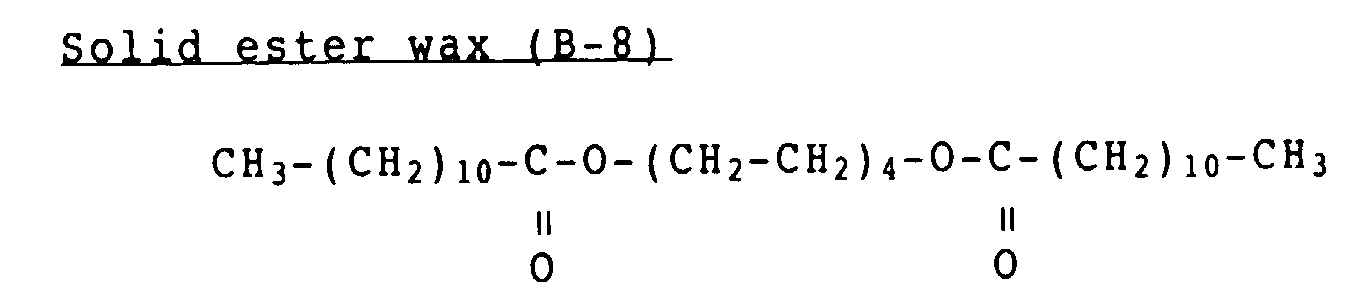


- The solid polyester wax used in the present invention may be prepared by the following methods; synthesis by oxidation; synthesis from an carboxylic acid and its derivatives; ester group-introducing reaction, such as Michael addition reaction; dehydration condensation of a carboxylic acid and alcohol; reaction of an acid halide with alcohol; and ester exchanging reaction. Examples of preferred catalysts may include typical acidic and alkaline catalysts used for esterification, for example, zinc acetate and titanium compounds. Both equimolar reaction and non-equimolar reaction, in which either of acid or alcohol is extremely excessively added, may be available. After the reaction, any purification process, such as recrystallization and distillation, may be employed as needed.
- Examples of the binding resins used in the present invention include styrene homopolymer or copolymer, such as polystyrene, styrene-(meth)acrylate copolymers, and styrene-butadiene copolymers. When obtaining toner particles by a direct polymerization, preferred monomers may be styrene monomer and other styrene derivative monomers, such as styrene, (o-, m-, and p-)methylstyrene, (m- and p-)ethylstyrene; (meth)acrylic monomers such as methyl (meth)acrylate, ethyl (meth)acrylate, propyl (meth)acrylate, butyl (meth)acrylate, octyl (meth)acrylate, dodecyl (meth)acrylate, stearyl (meth)acrylate, behenyl (meth)acrylate, 2-ethylhexyl (meth)acrylate, dimethylaminoethyl (meth)acrylate, and diethylaminoethyl (meth)acrylate; and diene monomers, such as butadiene, isoprene, cyclohexene, (meth)acrylonitrile, and acrylic amide. These monomers may be used solely or as a mixture having a theoretical glass transition temperature, which is described in pages 139-192 of "Polymer Handbook" second edition III (by John Wiley & Sons), of 40 to 75 °C. When the theoretical glass point of the binding resin is less than 40 °C, storage stability and durability of the toner often decrease, while the theoretical glass point exceeding 75 °C causes the increased fixing temperature. In particular, color mixing of each color, color reproducibility, and the transparency of the OHP film image decrease in the full-color toner system.
- The molecular weight of the binding resin is determined by gel permeation chromatography (GPC). Example of GPC is as follows; the toner is extracted with toluene by Soxhlet extraction method; toluene is removed with a rotary evaporator; the toner is thoroughly washed with an organic solvent, such as chloroform, which can dissolve the ester wax, but not dissolve the binding resin; the remaining solid component is dissolved into tetrahydrofuran (THF); the THF solution is filtered with a solvent-resistant membrane filter having a pore size of 0.3 µm; and the solution is fed into Waters 150C GPC with a column series consisting of Showa Denko A-801, 802, 803, 804, 805, 806, and 807. The molecular weight is calibrated with standard polystyrene polymers. The THF-soluble component has preferably a number-average molecular weight (Mn) of 5,000 to 1,000,000 and a ratio (Mw/Mn) of a weight-average molecular weight (Mw) to the number-average molecular weight (Mn) of 2 to 100.
- In the present invention, it is preferred that the solid ester wax is encapsulated inside the binding resin. Thus, the addition of a polar resin into the toner particles is effective. Preferred examples of polar resin used in the present invention may include copolymers of styrene with (meth)acrylic acid, copolymers of maleic acid, saturated polyester resins, epoxy resins. Particularly, the polar resins not containing unsaturated groups which are reactive with the binding resin or monomer are preferred. When the polar resins having any unsaturated groups, excessive crosslinking will occur in the monomers forming the binding resin, so the color mixing unsatisfactorily decreases.
- As a black coloring agent in the present invention, carbon black, magnetic materials, mixed black coloring agents made of yellow, magenta and cyan coloring agents may be used.
- Typical examples of the yellow coloring agents used are fused ring azo compounds, isoindolinone compounds, anthraquinone compounds, azo metallic complexes, methine compounds, and arylamide compounds; preferably including C.I. Pigment Yellow 12, 13, 14, 15, 17, 62, 74, 83, 93, 94, 95, 97, 109, 110, 111, 120, 127, 128, 129, 147, 168, 174, 176, 180, 181, and 191.
- Magenta coloring agents used are fused ring azo compounds, diketopyrrolopyrrole compounds, anthraquinone compounds, quinacridon compounds, thioindigo compounds, and perylene compounds. Examples of preferable magenta pigments are C.I.
Pigment Red - Cyan coloring agents used are copper phthalocyanine compounds, anthraquinone compounds, and base dyestuff lake compounds. Examples of preferable cyan pigments are C.I.
Pigment Blue - These coloring agents may be used solely, as a mixture, or as a solid solution. The coloring agents of the present invention are selected in consideration of hue angle, color saturation, brilliancy, weatherability, transparency on the OHP film, and dispersibility into the toner particles. Generally 1 to 20 parts by weight of coloring agent may be added into 100 parts by weight of the binding resin.
- When a magnetic material is used as a black coloring agent, 40 to 150 parts by weight of the magnetic material is added into 100 parts by weight of the binding resin, differing from other coloring agents.
- Preferred charge controlling agents which are used to stabilize the triboelectric chargeability are colorless charge controlling agents having high charging speed and stably maintaining the predetermined charge quantity. Further, when direct polymerization is employed in the present invention, charge controlling agents, not having polymerization hindrance and soluble components into an aqueous medium, are preferably used. Examples of charge controlling agents may include negative controlling agents, such as salicylic acid, and alkylsalicylic acid, dialkylsalicylic acid, naphtoic acid, metallic compounds of dicarboxylic acids, polymeric compounds having side sulfonic acid or carboxylic acid groups, boron compounds, urea compounds, silicon compounds, and calixarene; and positive controlling agent, such as quaternary ammonium salts, polymeric compounds having these quaternary ammonium salts as side chains, guanidine compounds, and imidazole compounds. The preferred content of the charge controlling agent ranges from 0.5 to 10 parts by weight per 100 parts by weight of the resin. However, the addition of the charge controlling agent is not always essential. For example, triboelectric charging with carriers are utilized instead of the charge controlling agent in a two component type developing method, and triboelectric charge with a blade or sleeve member are utilized in a nonmagnetic blade coating mono component type developing method.
- When the toner particles are prepared by a direct polymerization, initiators used include azo and diazo initiators, such as 2,2'-azobis-(2,4-dimethylvaleronitrile), 2,2'-azobisisobutyronitrile, 1,1'-azobis-(cyclohexane-1-carbonitrile), 2,2'-azobis-4-methoxy-2,4-dimethylvaleronitrile), and azobisisobutyronitrile; and peroxide initiators, such as benzoyl peroxide, methyl ethyl ketone peroxide, diisopropyl peroxy carbonate, cumene hydroperoxide, 2,4-dichlorobenzoyl peroxide, and lauroyl peroxide. The content of the initiators added may varied depending on the polymerization degree of the objective resin, and is generally 0.5 to 20 weight percent of the monomer. The suitable initiators may be selected depending on the polymerization process, referring to half-life period of ten hours, and may be used solely or as a mixture thereof.
- Other additives including crosslinking agents, chain transfer agents, and inhibitors may be added to control the polymerization degree.
- The toner particles of the present invention may be prepared, for example, by the following process: (1) Pulverizing method; after a binding resin, solid ester wax, coloring agent, charge controlling agent and so on are homogeneously dispersed in a pressurized kneader, extruder or media dispersion mixer, the dispersed mixture is pulverized into toner particles having a predetermined particle size mechanically or by bumping the mixture on a target in a jet stream, and the particle size distribution is adjusted by classification to obtain toner particles having a sharp particle size distribution: (2) A method for obtaining spherical toner particles by spraying a melt mixture into air with a disk or multi-fluid-nozzle as disclosed in Japanese Examined Patent No. 56-13945: (3) A method for making directly toner particles by a suspension polymerization described in Japanese Examined Patent No. 36-10231 and Japanese Laid-Open Patent Nos. 59-53856 and 59-61842: (4) A dispersion polymerization for forming directly toner particles by using a solvent which can dissolve the monomer, but cannot dissolve the resulting polymer: (5) An emulsion polymerization for forming toner particles, such as soap-free direct polymerization in the presence of a watersoluble polar initiator.
- In the process for making toner particles by the pulverizing method, it is extremely difficult to control the shape of the toner particles. In the melt spraying method, the obtained toner generally has a wide particle size distribution, and much energy is consumed in the melting process.
- Although the toner obtained by dispersion polymerization shows extremely sharp particle size distribution, usable raw materials are limited, and there are some problems due to the use of organic solvents, for example, the disposal of waste solvent, flammability of organic solvents, and a complicated apparatus. Emulsion polymerization represented by soap-free polymerization is available since a sharp particle size distribution of toner particles can be easily achieved. However, the emulsifier and initiator fragment used remain on the surface of the resulting toner particles, sometimes resulting in deterioration of environmental characteristics.
- A preferred method for the toner production may be suspension polymerization, which can readily produces fine toner particles having a diameter of 3 to 8 µm and having a sharp particle size distribution because of easy control of the toner shape. Further, seed polymerization, in which further monomer molecules are adsorbed in the resulting polymer particles and again polymerized with an initiator, can also be preferred. In the seed polymerization, a polar compound can be dissolved or dispersed in the adsorbed monomer. When the toner is produced by suspension polymerization in the present invention, the toner particles can be directly produced by the following process: An ester wax, coloring agent, charge controlling agent, initiator, and other additives are added into a monomer. These components are uniformly dissolved or dispersed in a monomer by a homogenizer or ultrasonic agitator. The resulting monomer composition is dispersed into an aqueous medium containing a dispersant by a common agitator, homomixer or homogenizer. Agitation speed and time are preferably controlled to obtain a predetermined drop size of the monomer composition, in other words, a desirable toner particle size. Agitation is continued so that particles is stable by the effect of the dispersant added and sedimentation is prevent. The polymerization is carried out at a temperature of more than 40 °C, and usually 50 to 90 °C. The temperature can be raised at the second half step of the polymerization. Moreover, in order to remove unreacted monomer and by-products which cause smell on the toner fixing process, the aqueous medium may be partly evaporated at the second half step of the reaction or after the reaction. After the reaction, the resulting toner particles are washed, collected by filtration, and dried.
- In the suspension polymerization, it is preferred that 300 to 3,000 parts by weight of water as the dispersion media per 100 parts by weight of the monomer composition is used. Examples of dispersant used include inorganic dispersants, such as calcium phosphate, magnesium phosphate, aluminum phosphate, zinc phosphate, calcium carbonate, magnesium carbonate, calcium hydroxide, magnesium hydroxide, aluminum hydroxide, calcium metasilicate, calcium sulfate, barium sulfate, bentonite, silica, alumina; organic dispersants, such as polyvinyl alcohol, gelatin, methyl cellulose, methylhydroxypropyl cellulose, ethyl cellulose, sodium salt of carboxymethyl cellulose, starch. The preferred amount of the dispersant ranges from 0.2 to 2.0 parts by weight per 100 parts by weight of the monomer.
- These commercially available dispersant may be used as it stands, and may be used after high speed agitation in the dispersion medium so as to obtain dispersant particles each having a fine uniform particle size. In the case of calcium phosphate, for example, a dispersant suitable for suspension polymerization may be prepared by mixing aqueous sodium phosphate and calcium chloride with high speed agitation. In order to fine the dispersant, 0.001 to 0.1 parts by weight of a surfactant may be added if necessary. Examples of surfactant may include commercial nonionic, anionic, and cationic surfactants. In detail, sodium dodecylsulfate, sodium tetradecylsulfate, sodium pentadecylsulfate, sodium octylsulfate, sodium oleate, sodium laurate, potassium stearate, and calcium oleate are preferred.
- It is preferred that the toner of the present invention has a shape factor SF-1 of 100 to 160, and especially 100 to 150. The shape factor SF-1 is defined as the following equation:

- Toners having a shape factor SF-1 of more than 160 show a gradual tendency toward irregular shape from circular shape and a corresponding decrease in the transferring efficiency. When an intermediate transferring member is used, the transferring steps are repeated twice, so the decreased transferring efficiency causes the decrease in the utilization efficiency. Further, in recent digital full-color copying machines and digital full-color printers, after the color image from original document is subjected to color separation by blue (B), green (G), and red (R) filters, 20 to 70 µn of dot latent image is formed on the photosensitive member, and exact multi-color image of the original document including color information is reproduced by means of the subtracted color process using yellow (Y), magenta (M), cyan (C) and black (B) toners. Since much amount of Y, M, C, B toners are loaded on the photosensitive member or intermediate transferring member in respect of color information of the document and CRT, each color toner used in the present invention must have significantly excellent transferring property. The aforementioned ester wax also be preferably used in order to maintain such excellent transferring property of the toner. More preferable toner has a shape factor of 100 to 160.
- It is preferred in the present invention that another shape factor SF-2, which represents the irregularity of the surface of the toner particle, ranges from 100 to 130 to improve the transferring property of the toner. The second shape factor SF-2 is defined as the following equation:

- In order to obtain a further high definition image, in other words, to develop exactly fine latent image dots, it is preferred that the toner has a weight-average diameter of 3 µm to 8 µm and a coefficient of variation of the number of 35% or less, which are determined by Coulter Counter. The toner having a weight-average diameter of less than 3 µm gives a low transferring efficiency, causes much remaining toner on the photosensitive member and intermediate transferring member, resulting in nonuniform image due to fog and poor transferring. The toner having a weight-average diameter exceeding 8 µm brings about the decrease in resolution and dot reproducibility and adhesion to several members. Moreover, when the coefficient of variation of the number exceeds 35%, these drawbacks are further enhanced.
- The particle size distribution of the toner may be determined by various method. In the present invention, Coulter Counter was used. Coulter Counter TA-II, made by Coulter Company, was connected with an interface, which was made by Nikkaki K.K. and output histogram of number and volume, and Canon CX-1 personal computer. Ca. 1% NaCl aqueous solution as an electrolytic solution was prepared from extra pure sodium chloride, for example, ISOTON II, made by Coulter Scientific Japan. Into 100 to 150 ml of the electrolytic solution, 0.1 to 5 ml of a surfactant, preferably an alkylbenzenesulfonate was added as a surfactant, and 2 to 20 mg of the sample is added. After the electrolytic solution containing suspended sample was dispersed for approximately 1 to 3 minutes by using an ultrasonic agitator, the particle size distribution of particles each having a particle size of 2 to 40 µ was determined by using the above-mentioned Coulter Counter TA-II with an aperture of 100 µm. The weight-average diameter and the coefficient of variation of the number was finally calculated from this measurement.
- The coefficient of variation A of toner size distribution can be calculated by the following equation:

- As an preferred embodiment, the toner of the present invention may include any lubricative powder, such as Teflon powder, zinc stearate powder, and polyvinylidene fluoride; any abradant, such as cerium oxide, silicon carbide, and strontium titanate; any flowability improving agent, such as silica, titanium oxide, and aluminum oxide; any anti-caking agent; any electron conductive filler, such as carbon black, zinc oxide, and tin oxide. Between these additives, inorganic fine powders, such as fine silicate, titanium oxide, and aluminum oxide are preferably used. Further, it is preferred that the organic fine powders are subjected to hydrophobic treatment by using hydrophobic agents, such as silane coupling agents, silicone oils, and mixtures thereof. These additives are usually added by 0.1 to 5 parts by weight per 100 parts by weight of toner particles.
- The toner of the present invention may be used as toner for mono component type developing agent or two component type developing agent.
- An example of mono component type developing method is what carries and charges magnetic toner particles in which magnetic material is contained in each toner particles by means of a developing sleeve having a magnet therein. When using nonmagnetic toner not containing a magnetic material, the toner particles may be carried by adhering toner particles on the developing sleeve which is forcibly charged by a coating blade, coating roll, or fur brush.
- On the other hand, two component type developing agents use the toner of the present invention with a carrier. Although any carriers may be used without limitation, the preferred carriers include magnetic carriers comprising solely iron, nickel, or cobalt; and magnetic ferrite carriers formed from mixtures thereof. The shape of the carrier is also important to control a wide variety of saturation magnetization and electric resistance. For example, the shape is controlled to circular, oval, or irregular shape, and the fine structure of the carrier surface such as surface irregularity is controlled. The control is generally carried out by that carrier core particles are formed by calcination and granulation of the above-mentioned inorganic oxide and coated with a resin. The following methods are also available for the decrease in the load of the carrier to the toner; a method for obtaining a low density, dispersed carrier by mixing an inorganic compound and resin and pulverizing and classifying the mixture thereof; and a method for obtaining a spherical dispersed carrier by direct suspension polymerization of a mixture of the inorganic oxide and monomer in an aqueous medium.
- A covered carrier is preferably used in which the surface of the carrier particles are covered with a resin. The following covering methods are applicable; a method in which the resin is dissolved or dispersed in a solvent and coated on the carrier; and a method in which the resin and carrier powders are merely mixed each other.
- Various materials may be used to cover the carrier particle surface depending on the toner material. Examples of suitable material include polytetrafluoroethylene, monochlorotrifuluoroethylene polymers, polyvinylidene fluoride, silicone resins, styrene resins, acrylic resin, polyamide, polyvinyl butyral, aminoacrylate resins, and mixtures thereof. These materials are generally used by 0.1 to 30 weight percent, and preferably by 0.5 to 20 weight percent, in total to the carrier. The average particle size of carrier is desirably 10 to 100 µm, and preferably 20 to 50 µm.
- Examples of the combination of the carrier with the resin are as follows: The surface of Cu-Zn-Fe ternary ferrite particle is coated with a mixture of a fluorine resin and styrene resin, such as polyvinylidene fluoride and styrene-methyl methacrylate, polytetrafluoroethylene and styrene-methyl methacrylate, and a fluorine copolymer and styrene copolymer, in which the ratio of the fluorine resin to the styrene resin ranges from 90:10 to 20:80, and preferably 70:30 to 30:70. The coated amount of the mixed resin ranges from 0.01 to 5 weight percent, and preferably 0.1 to 1 weight percent. The coated ferrite carrier has the above-mentioned average particle size, and contains 70% or more carrier particles which can pass through 250 mesh screen but not pass through 400 mesh screen. A typical example of the fluorine copolymer is a vinylidene fluoride/tetrafluoroethylene copolymer (10:90 to 90:10), and typical examples of the styrene copolymer are styrene/2-ethylhexyl acrylate (20:80 to 80:20) and styrene/2-ethylhexyl acrylate/methyl methacrylate terpolymer (20 to 60 : 5 to 30 : 10 to 50).
- Such coated ferrite carriers provide a preferred triboelectric property to the toner of the present invention, and improve electrophotographic characteristics.
- The concentration of the toner in the two component type developing agent comprising the toner and carrier is 2 to 15 weight percent, and preferably 4 to 13 weight percent.
- The preferred magnetic properties of the magnetic carriers are as follows: The intensity of magnetization at 1,000 oersted after magnetic saturation, (σ1000), ranges from 30 to 300 emu/cm3, and 100 to 250 emu/cm3 so as to obtain a higher quality of image. A higher quality of image cannot be readily obtained from the intensity of magnetization over 300 emu/cm3, whereas the intensity of magnetization of less than 30 emu/cm3 readily causes the carrier adhesion due to the decreased magnetic force.
- The evaluation methods on image density, fog, coloring strength, low temperature fixing property, high temperature offset resistance, transparency, and blocking resistance of the toner will now be explained below.
- By using a modified commercial digital full-color copying machine CLC-500, made by Canon, in which a silicone oil painting unit is detached, 10000 times of repeated operations are carried out for durability test. Image densities at the initial and final operations are measured with Macbeth Reflectance Densitometer made by Macbeth Co.
- Using the modified copying machine which is the same as the machine used for image density evaluation, the whiteness levels of transferring paper before and after copying of a solid white image are measured with a reflectometer made by Tokyo Denshoku K.K. The fog is determined by the comparison of the whiteness levels of before and after copying or printing.
- A toner coated with additives is prepared by mixing 100 parts by weight of toner and 0.1 to 3 parts by weight of additives, such as hydrophobic silica fine particles, hydrophobic titanium oxide fine particles, and hydrophobic alumina fine particles.
- An unfixed image by the prepared toner is formed on transferring paper, SK paper, made by Nippon Seishi K.K., with a commercial copying machine, so that the weight of transferred toner on the solid image is approximately 0.55 mg/cm2. An external fixer used is shown in Fig. 2, in which the external fixer has a fixing
roll 1 having a diameter of 40 mm, which comprises acylindrical core 5 having a temperatureadjustable heater 6 therein, asilicone rubber layer 4 thereon having a thickness of 2 mm and a hardness of 30, and aPFA resin layer 3 thereon having a thickness of 50 µm; and a pressurizingroll 2 having a diameter of 50 mm, which comprises acylindrical core 9 having a temperatureadjustable heater 10 therein, asilicone rubber layer 8 thereon having a thickness of 1 mm, and aPFA resin layer 7 thereon having a thickness of 50 µm. - When using a nonmagnetic toner, the image density is measured by forming a fixed image having a gloss of 9, wherein the gloss is determined by incident light having an angle of incidence of 60 degree. When using a magnetic toner, the image density is measured by forming a fixed image having a glow of 1. Each result is taken as the corresponding coloring strength. The gloss is measured by a handy gloss meter, Horiba Seisakusho Gloss Checker IG-310, and the image density is determined by Macbeth RD918.
-
Unfixed images 12 having a transferred toner weight of 0.75 mg/cm2 on transferringpaper 11 are fixed with heat and pressure by using the external fixer as shown in Fig. 2. The nip between the fixingroll 1 and pressurizingroll 2 is adjusted to 7.0 mm. Each fixing is carried out at a fixing speed of 140 mm/sec. and at a temperature which is varied from 120 to 250 °C at an interval of 5 °C. - In double-sided fixing,
unfixed images 12 having a transferred toner weight of 0.75 mg/cm2 on one side of the transferringpaper 11 are fixed with heat and pressure, then unfixed images having a transferred toner weight of 0.75 mg/cm2 on the other side of the transferringpaper 11 are fixed with heat and pressure after turning the paper over. - For the evaluation of the fixing property, the fixed images including low temperature offset images are rubbed 10 times with a lens cleaning paper "Dasper (R)" made by Ozu Paper Co. Ltd., under the pressure of 50g/cm2. The fixing temperature is taken as the temperature in which the decreased density rate of after rubbing to before rubbing become less than 10%.
- For evaluating the offset resistance, the starting point of offset at lower temperature and the end point of the offset at higher temperature are visually determined.
- Into a 100 cc of a polyethylene cup, 5 g of a toner containing predetermined additives are added and stood to allow in a desiccator at 50 °C for 3 days. The toner is classified into four particle size grades by a vibration screen classifier of a powder tester made by Hosokawa Micron Co. Ltd., in which three screens of 400, 200, and 100 mesh are piled up by turns on a vibration table. The toner is placed on the top 100 mesh screen, and the classifier is shaken for approximately 15 seconds while the amplitude of the vibration table is adjusted within 0.5 mm by applying 15V of input voltage. Remaining toners on all the screens are weighed as aggregates, and the aggregation rate is calculated according to the following equation:

- The blocking resistance is evaluated based on the following standards from the increased aggregation rate, i.e. the difference between aggregation rate values of treated and untreated toners:
- Good:
- 0 to 30% of increased aggregation rate;
- Fair:
- 31 to 40% of increased aggregation rate;
- No Good:
- 41% or more of increased aggregation rate
- An unfixed image on a OHP sheet (Trade name: CG3300 made by 3M) is fixed with heat and pressure under the conditions of nip of 7.0 mm, fixing speed 35 mm/sec, and fixing temperature of 180 °C, to form the fixed image on the OHP sheet.
- The transmittance and haze of the fixed image having a toner weight of 0.7 mg/cm2 are measured, and the transparency is evaluated by using the result at the image density of 1.2.
- The transmittance is measured with Shimadzu Spectrophotometer UV2200. Wavelengths used are 650 nm for magenta toner, 500 mm for cyan toner, and 600 mm for yellow toner, respectively, and each corresponds to the maximum absorbance of respective color. The transmittance of the OHP film not copied is taken as 100%.
- Haze is determined with Haze Meter NDH-300A, made by Nihon Hasshoku Kogyo K.K.
- The present invention will now be explained in detail based on the following illustrative examples.
- Into an atrritor, 177 parts by weight of styrene monomer, 10 parts by weight of a cyan coloring agent, i.e. Copper Phthalocyanine pigment having an average primary particle size of 0.3 µm, and a negative charge controlling agent, i.e. a metallic compound of di-tert-butylsalicylic acid having an average first particle size of 0.3 µm were fed, and mixed in the presence of spherical zirconia particles of 2 mm diameter at 30 °C for 3 hours while stirring at 200 rpm. After the resulting mixture was transferred into another container, 23 parts by weight of n-butyl acrylate monomer, 10 parts by weight of a polar resin, i.e. saturated polyester resin formed from terephthalic acid and propylene oxide-modified bisphenol A (weight-average molecular weight: Ca. 7,000, acid value: Ca. 14 mgKOH/g), and 40 parts of solid ester wax (A-1) were added into the mixture, and were stirred for 2 hours at 60 °C with paddle mixing wings. It was confirmed that the solid ester wax (A-1) is dissolved, and the cyan coloring agent and negative charge controlling agent are homogeneously dispersed into the monomer.
- After the agitator was exchanged to TK Homomixer made by Tokushu Kika Kogyo K.K., 12 parts by weight of 2,2'-azobis-(2,4-dimethylvaleronitrile) as an initiator was added into the container, and stirred for 1 minute at 200 rpm to prepare a monomer composition.
- Into another container, 710 parts by weight of ion-exchanged water and 540 parts by weight of 0.1M Na3PO4 aqueous solution were added, heated to 60 °C, and was stirred at 1200 rpm by using TK Homomixer made by Tokushu Kika Kogyo K.K. An aqueous medium containing fine Ca3(PO4)2 particles was prepared by gradually adding 80 parts by weight of 1.3M CaCl2 aqueous solution into the container.
- The monomer composition was fed into the aqueous medium, and stirred with TK Homomixer for 10 minutes at 60 °C and 10,000 rpm in flowing nitrogen to granulate the monomer composition. While stirring with paddle stirring wings, the suspension was heated to 70 °C and allowed to polymerize for 11 hours to form styrene/n-butyl acrylate copolymer on the particle surface.
- After suspension polymerization followed by cooling, hydrochloric acid was added to dissolve calcium phosphate. The cyan toner particles were obtained by filtration, washing with water, and drying. It was confirmed by TEM observation of the section of the cyan toner particles as shown in Fig. 1 that the ester wax (A-1) was encapsulated with the outer shell resin comprising styrene/n-butyl acrylate copolymer and the polar resin.
- By mixing 100 parts by weight of the resulting cyan toner particles and 1.5 parts by weight of a hydrophobic silica having a specific surface area of 212 m2/g by BET method, a negatively chargeable insulating cyan toner was prepared. The resulting cyan toner has a weight-average particle size of 6.4 µm, SF-1 of 111, and SF-2 of 115.
- A two component type developer for magnetic brush developing was prepared by mixing 5 parts by weight of the resulting cyan toner and 95 parts by weight of a magnetic ferrite carrier coated with a silicone resin.
- Insulating yellow, magenta, and black toners were prepared by a method similar to Example 1, but the coloring agent was changed from Copper Phthalocyanine pigment to C. I. Pigment Yellow 17 having an average first particle size of 0.3 µm, C. I. Pigment Red 202 having an average first particle size of 0.3 µm, a graft carbon black having an average first particle size of 0.05 µm, respectively. Physical properties of these color toners are shown in Table 2. Two component type developing agents for magnetic brush developing were also prepared similarly to Example 1.
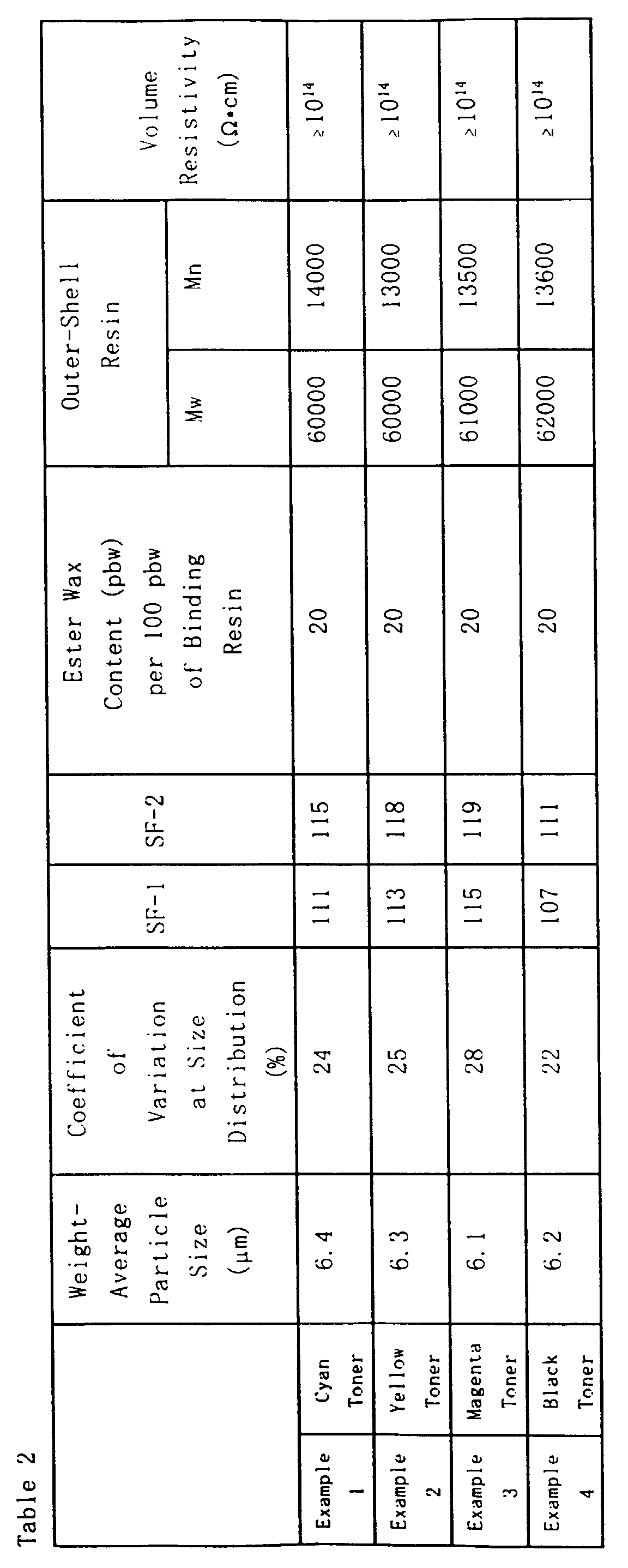
- Two component type developing agents for magnetic brush developing, prepared in Examples 1 through 4, were introduced a modified commercial digital full-color copying machine, Canon CLC-500, unfixed and fixed images were produced by monochrome mode of each color while supplying toners.
- Unfixed images, single-sided and double-sided fixed images, which were fixed with the external fixer were evaluated. The results are shown in Table 4.
- A cyan toner was prepared similarly to Example 1, but the following compound was used instead of the solid ester wax (A-1):

- Results are shown in Table 4.
- A cyan toner was prepared similarly to Example 1, but the following compound was used instead of the solid ester wax (A-1). Results are shown in Table 4.

- A cyan toner was prepared to evaluate similarly to Example 1, but a low molecular weight polyethylene wax (Hoechist PE130) was used instead of the solid ester wax (A-1). Results are shown in Table 4.
- A cyan toner was prepared to evaluate similarly to Example 1, but a low molecular weight polypropylene wax (Biscol 550P made by Sanyo Chemical Industries, Ltd.) was used instead of the solid ester wax (A-1). Results are shown in Table 4.
- A cyan toner was prepared to evaluate similarly to Example 1, but a paraffin wax having a weight-average molecular weight of 550 was used instead of the solid ester wax (A-1). Results are shown in Table 4.
- A cyan toner was prepared to evaluate similarly to Example 1, but a montan ester wax E, made by Hoechist, mainly containing the compound represented by the following formula, was used instead of the solid ester wax (A-1). Results are shown in Table 4.
CH3-(CH2)19-29-COO-CH2CH2-OOC-(CH2)19-29-CH3
- Insulating yellow, magenta, and black toners were prepared by a method similar to Examples 1 to 4, but the solid ester wax (A-6) was used instead of the solid ester wax (A-1). Physical properties and evaluation results of these color toners are shown in Table 3, and in Table 4, respectively.
- Insulating yellow, magenta, and black toners were prepared by a method similar to Examples 1 to 4, but the solid ester wax (B-1) was used instead of the solid ester wax (A-1). Physical properties and evaluation results of these color toners are shown in Table 3, and in Table 4, respectively.


- By using various toners prepared in Examples 1 through 4 and Examples 5 through 8, fixing property, offset resistance, and color mixing properties of the images, obtained from full-color mode copying, were evaluated with the external fixer. Both single-sided fixing and double-sided fixing shows satisfactory results, and the obtained full-color images are faithful to the respective original document.
Claims (30)
- A toner for developing an electrostatic image, comprising:
toner particles containing a binding resin composed of a styrene homopolymer or copolymer, a coloring agent, a polar resin, and a solid ester wax represented by the following general formula (A) or (B):

-CH2CH2OC6H4OCH2CH2- (1);

-(CH2)m- (3)
wherein m represents an integer of 4 to 20. - The toner according to claim 1, wherein said toner particles comprise coloring resin particles, containing a binding resin, formed by dispersing a monomer composition containing at least monomers containing styrene, a coloring agent, a polar resin and an ester wax into an aqueous medium so as to form particles of the monomer composition; and by polymerizing the monomer in the particles of the monomer composition.
- The toner according to claim 2, wherein said toner particles have a shape factor SF-1 of 100 to 150 and a shape factor SF-2 of 100 to 130.
- The toner according to claim 1, wherein said toner particles have a shape factor SF-1 of 100 to 150 and a shape factor SF-2 of 100 to 130, and said ester wax is encapsulated inside the toner particle by an outer shell resin layer formed from the binding resin and polar resin.
- The toner according to claim 4, wherein said binding resin is a styrene/acrylic ester copolymer, and said polar resin is a polyester resin.
- The toner according to claim 4, wherein said binding resin is a styrene/methacrylic ester copolymer, and said polar resin is a polyester resin.
- The toner according to claim 2, wherein said monomers are styrene and acrylic ester, and said polar resin is a polyester resin.
- The toner according to claim 2, wherein said monomers are styrene and methacrylic ester, and said polar resin is a polyester resin.
- The toner according to any preceding claim, wherein R1 and R3 are alkyl groups.
- The toner according to claim 9, wherein R2 is an alkylene group.
- The toner according to any preceding claim 1 to 8, wherein R4 and R6 are alkyl groups.
- The toner according to claim 11, wherein R5 is an alkylene group.
- The toner according to any preceding claim, wherein 5 to 40 parts by weight of said solid ester wax is contained per 100 parts by weight of the binding resin.
- The toner according to claim 13, wherein 10 to 30 parts by weight of said solid ester wax is contained per 100 parts by weight of the binding resin.
- The toner according to any preceding claim, wherein said toner particles are nonmagnetic cyan toner particles.
- The toner according to any preceding claim 1 to 14, wherein said toner particles are nonmagnetic yellow toner particles.
- The toner according to any preceding claim 1 to 14, wherein said toner particles are nonmagnetic magenta toner particles.
- The toner according to any preceding claim 1 to 14, wherein said toner particles are nonmagnetic black toner particles.
- The toner according to any preceding claim, wherein said solid ester wax has a melting point of 40 to 90°C.
- The toner according to claim 19, wherein said solid ester wax has a melting point of 55 to 85°C.
- The toner according to any preceding claim, wherein said solid ester wax has a solubility parameter (SP) of 7.5 to 10.5.
- The toner according to any preceding claim, wherein said solid ester wax has a melt viscosity, at 130°C., of 1 to 300 cPs.
- The toner according to claim 22, wherein said solid ester wax has a melt viscosity, at 130°C., of 3 to 50 cPs.
- The toner according to any preceding claim, wherein said solid ester wax has a Vickers hardness of 0.3 to 5.0.
- The toner according to claim 24, wherein said solid ester wax has a Vickers hardness of 0.5 to 3.0.
- A toner for developing an electrostatic image comprising toner particles containing a binding resin, a coloring agent, a polar resin and a core of solid ester wax.
- A method of producing the toner of claim 1 comprising the following steps:dispersing a monomer composition containing at least monomers container styrene, a coloring agent, a polar resin and an ester wax into an aqueous medium to form particles of the monomer composition; andpolymerising the monomer in the particles of the monomer composition.
- A method of electrophotography or electrostatic recording to produce an image, which method comprises:producing an electrostatic image;developing said electrostatic image using the toner of any preceding claim 1 to 26;transferring the developed electrostatic image to a transfer medium either directly or via an intermediate medium; andfixing the transferred image.
- A method according to claim 28 wherein the steps of producing, developing and transferring are repeated for toners including respective different coloring agents, prior to said step of fixing.
- A method according to either preceding claim 28 or 29, wherein said steps are repeated thereby to produce a fixed image on each side of said transfer medium.
Applications Claiming Priority (6)
| Application Number | Priority Date | Filing Date | Title |
|---|---|---|---|
| JP6360495 | 1995-02-28 | ||
| JP63602/95 | 1995-02-28 | ||
| JP6360495 | 1995-02-28 | ||
| JP63604/95 | 1995-02-28 | ||
| JP6360295 | 1995-02-28 | ||
| JP6360295 | 1995-02-28 |
Publications (2)
| Publication Number | Publication Date |
|---|---|
| EP0730205A1 true EP0730205A1 (en) | 1996-09-04 |
| EP0730205B1 EP0730205B1 (en) | 2000-10-18 |
Family
ID=26404733
Family Applications (1)
| Application Number | Title | Priority Date | Filing Date |
|---|---|---|---|
| EP96301326A Expired - Lifetime EP0730205B1 (en) | 1995-02-28 | 1996-02-27 | Toner for developing electrostatic image |
Country Status (3)
| Country | Link |
|---|---|
| US (1) | US5712072A (en) |
| EP (1) | EP0730205B1 (en) |
| DE (1) | DE69610653T2 (en) |
Cited By (5)
| Publication number | Priority date | Publication date | Assignee | Title |
|---|---|---|---|---|
| EP0822456A1 (en) * | 1996-07-31 | 1998-02-04 | Canon Kabushiki Kaisha | Toner for developing electrostatic image and image forming method |
| EP0899617A1 (en) * | 1997-08-29 | 1999-03-03 | Canon Kabushiki Kaisha | Electrostatic image-developing toner and image-forming method |
| EP0926564A1 (en) * | 1997-12-26 | 1999-06-30 | Canon Kabushiki Kaisha | Process for producing toner |
| EP0999476A1 (en) * | 1998-11-06 | 2000-05-10 | Canon Kabushiki Kaisha | Process for producing toner |
| EP1223474A3 (en) * | 2001-01-12 | 2003-09-24 | Nof Corporation | Ester wax and toner using the wax |
Families Citing this family (27)
| Publication number | Priority date | Publication date | Assignee | Title |
|---|---|---|---|---|
| US6002903A (en) * | 1995-05-15 | 1999-12-14 | Canon Kabushiki Kaisha | Toner for developing electrostatic image, apparatus unit and image forming method |
| US5952144A (en) * | 1996-06-20 | 1999-09-14 | Nippon Zeon Co., Ltd. | Production process of toner for development of electrostatic latent image |
| DE69705904T3 (en) * | 1996-09-02 | 2009-08-27 | Canon K.K. | Magenta toners for developing electrostatic images and manufacturing processes |
| US6132919A (en) * | 1996-11-06 | 2000-10-17 | Nippon Zeon Co., Ltd. | Polymerized toner and production process thereof |
| JPH10221880A (en) * | 1997-02-07 | 1998-08-21 | Toshiba Corp | Electrophotographic developer and developing device using the same |
| JP3454070B2 (en) * | 1997-03-04 | 2003-10-06 | ミノルタ株式会社 | Negatively charged toner |
| US5948582A (en) * | 1997-04-02 | 1999-09-07 | Canon Kabushiki Kaisha | Toner for developing electrostatic image, image forming method and developing apparatus unit |
| DE69801458T2 (en) * | 1997-04-04 | 2002-04-18 | Canon K.K., Tokio/Tokyo | Toner for image formation, image forming processes, and heat fixing processes |
| JPH1130876A (en) | 1997-05-12 | 1999-02-02 | Ricoh Co Ltd | Full-color electrophotographic toner, method for producing the same and image forming method |
| DE69818912T2 (en) * | 1997-06-18 | 2004-08-19 | Canon K.K. | Toner, two-component developer and imaging process |
| US6117605A (en) * | 1997-07-08 | 2000-09-12 | Canon Kabushiki Kaisha | Magenta toner for developing electrostatic images and process for production thereof |
| US6025108A (en) * | 1997-10-31 | 2000-02-15 | Mita Industrial Co., Ltd. | Non-magnetic contacting one component-type development system |
| US6077636A (en) * | 1998-01-28 | 2000-06-20 | Canon Kabushiki Kaisha | Toner, two-component developer, image forming method and apparatus unit |
| EP0940170B1 (en) | 1998-03-02 | 2002-09-11 | Wako Pure Chemical Industries, Ltd. | Microencapsulated osmium oxide composition |
| JP2001188387A (en) * | 1999-10-20 | 2001-07-10 | Kyocera Corp | Electrostatic latent image developer |
| JP3935315B2 (en) * | 1999-11-01 | 2007-06-20 | キヤノン株式会社 | Method for producing polymerization toner |
| JP2001312091A (en) * | 2000-02-25 | 2001-11-09 | Canon Inc | Image forming device |
| JP2002304025A (en) * | 2001-04-03 | 2002-10-18 | Konica Corp | Developing device and image forming apparatus |
| JP2003345210A (en) * | 2002-05-24 | 2003-12-03 | Konica Minolta Holdings Inc | Image forming device |
| JP2004045668A (en) * | 2002-07-10 | 2004-02-12 | Ricoh Co Ltd | Developer for developing electrostatic image, image forming apparatus, and image forming method |
| US7642032B2 (en) * | 2003-10-22 | 2010-01-05 | Ricoh Company, Limited | Toner, developer, image forming apparatus and image forming method |
| US7932011B2 (en) * | 2005-03-23 | 2011-04-26 | Konica Minolta Business Technologies, Inc. | Electrophotographic toner and manufacturing method thereof |
| KR100756676B1 (en) * | 2006-11-23 | 2007-09-07 | 제일모직주식회사 | Silicone microparticles | fine-particles, its manufacturing method, and the thermoplastic resin composition containing this microparticles | fine-particles |
| US20100330486A1 (en) * | 2009-06-24 | 2010-12-30 | Xerox Corporation | Toner Compositions |
| KR20140068892A (en) | 2011-09-28 | 2014-06-09 | 제온 코포레이션 | Toner for electrostatic charge image development |
| US20150185648A1 (en) * | 2013-12-26 | 2015-07-02 | Canon Kabushiki Kaisha | Toner |
| KR20170046381A (en) | 2015-10-21 | 2017-05-02 | 에스프린팅솔루션 주식회사 | Toner for developing electrostatic image |
Citations (7)
| Publication number | Priority date | Publication date | Assignee | Title |
|---|---|---|---|---|
| US4299899A (en) * | 1978-11-08 | 1981-11-10 | Xerox Corporation | Toner additives |
| EP0470479A1 (en) * | 1990-07-31 | 1992-02-12 | Canon Kabushiki Kaisha | Toner image heat-fixing method |
| EP0533172A1 (en) * | 1991-09-19 | 1993-03-24 | Canon Kabushiki Kaisha | Toner for developing electrostatic image and two-component type developer for developing electrostatic image |
| US5314777A (en) * | 1992-06-16 | 1994-05-24 | Ricoh Company, Ltd. | Negatively chargeable toner for developing latent electrostatic images |
| EP0621511A1 (en) * | 1993-04-20 | 1994-10-26 | Canon Kabushiki Kaisha | Toner for developing electrostatic images and process for producing toner |
| EP0627669A1 (en) * | 1993-05-20 | 1994-12-07 | Canon Kabushiki Kaisha | Toner for developing electrostatic image and process for production thereof |
| EP0658816A2 (en) * | 1993-11-29 | 1995-06-21 | Canon Kabushiki Kaisha | Image forming method |
Family Cites Families (19)
| Publication number | Priority date | Publication date | Assignee | Title |
|---|---|---|---|---|
| US2297691A (en) * | 1939-04-04 | 1942-10-06 | Chester F Carlson | Electrophotography |
| GB1442835A (en) * | 1972-10-21 | 1976-07-14 | Konishiroku Photo Ind | Toner for use in developing electrostatic images |
| JPS523305A (en) * | 1975-01-08 | 1977-01-11 | Western Electric Co | Circuit for detecting identity of bit rows |
| JPS523304A (en) * | 1975-06-27 | 1977-01-11 | Advance Transformer Co | Circuit for energizing magnetron |
| JPS5613945A (en) * | 1979-07-12 | 1981-02-10 | Terumo Corp | Agent and device for removing antigennantibody complex to which complement is combined |
| US4301355A (en) * | 1980-08-04 | 1981-11-17 | Dimetrics, Inc. | Gas metal arc welding system |
| JPS5953856A (en) * | 1982-09-21 | 1984-03-28 | Canon Inc | Toner manufacturing method |
| JPS5961842A (en) * | 1982-09-30 | 1984-04-09 | Canon Inc | Method for manufacturing magnetic toner |
| JPH01185660A (en) * | 1988-01-19 | 1989-07-25 | Konica Corp | Toner for developing electrostatic latent image |
| JPH01185661A (en) * | 1988-01-19 | 1989-07-25 | Konica Corp | Toner for developing electrostatic latent image |
| JPH01185662A (en) * | 1988-01-19 | 1989-07-25 | Konica Corp | Toner for developing electrostatic latent image |
| JPH01185663A (en) * | 1988-01-19 | 1989-07-25 | Konica Corp | Toner for developing electrostatic latent image |
| JPH01238672A (en) * | 1988-03-19 | 1989-09-22 | Konica Corp | Toner for developing electrostatic image |
| JPH04107467A (en) * | 1990-08-28 | 1992-04-08 | Ricoh Co Ltd | Electrostatic latent image developing toner |
| JPH04149559A (en) * | 1990-10-12 | 1992-05-22 | Sanyo Chem Ind Ltd | Releasing agent composition for electrophotographic toner |
| JPH04301853A (en) * | 1991-03-29 | 1992-10-26 | Canon Inc | Toner for developing electrostatic images |
| JPH0561238A (en) * | 1991-08-29 | 1993-03-12 | Canon Inc | Color toner for electrostatic image development |
| EP0531932B1 (en) * | 1991-09-09 | 1998-06-17 | Canon Kabushiki Kaisha | Process for producing toner particles |
| US5604072A (en) * | 1994-09-21 | 1997-02-18 | Canon Kabushiki Kaisha | Toner for developing electrostatic images, image forming method and process cartridge |
-
1996
- 1996-02-22 US US08/605,737 patent/US5712072A/en not_active Expired - Lifetime
- 1996-02-27 EP EP96301326A patent/EP0730205B1/en not_active Expired - Lifetime
- 1996-02-27 DE DE69610653T patent/DE69610653T2/en not_active Expired - Fee Related
Patent Citations (7)
| Publication number | Priority date | Publication date | Assignee | Title |
|---|---|---|---|---|
| US4299899A (en) * | 1978-11-08 | 1981-11-10 | Xerox Corporation | Toner additives |
| EP0470479A1 (en) * | 1990-07-31 | 1992-02-12 | Canon Kabushiki Kaisha | Toner image heat-fixing method |
| EP0533172A1 (en) * | 1991-09-19 | 1993-03-24 | Canon Kabushiki Kaisha | Toner for developing electrostatic image and two-component type developer for developing electrostatic image |
| US5314777A (en) * | 1992-06-16 | 1994-05-24 | Ricoh Company, Ltd. | Negatively chargeable toner for developing latent electrostatic images |
| EP0621511A1 (en) * | 1993-04-20 | 1994-10-26 | Canon Kabushiki Kaisha | Toner for developing electrostatic images and process for producing toner |
| EP0627669A1 (en) * | 1993-05-20 | 1994-12-07 | Canon Kabushiki Kaisha | Toner for developing electrostatic image and process for production thereof |
| EP0658816A2 (en) * | 1993-11-29 | 1995-06-21 | Canon Kabushiki Kaisha | Image forming method |
Cited By (8)
| Publication number | Priority date | Publication date | Assignee | Title |
|---|---|---|---|---|
| EP0822456A1 (en) * | 1996-07-31 | 1998-02-04 | Canon Kabushiki Kaisha | Toner for developing electrostatic image and image forming method |
| US6033817A (en) * | 1996-07-31 | 2000-03-07 | Canon Kabushiki Kaisha | Toner for developing electrostatic image and image forming method |
| EP0899617A1 (en) * | 1997-08-29 | 1999-03-03 | Canon Kabushiki Kaisha | Electrostatic image-developing toner and image-forming method |
| EP0926564A1 (en) * | 1997-12-26 | 1999-06-30 | Canon Kabushiki Kaisha | Process for producing toner |
| US6054244A (en) * | 1997-12-26 | 2000-04-25 | Canon Kabushiki Kaisha | Process for producing toner |
| EP0999476A1 (en) * | 1998-11-06 | 2000-05-10 | Canon Kabushiki Kaisha | Process for producing toner |
| US6309788B1 (en) | 1998-11-06 | 2001-10-30 | Canon Kabushiki Kaisha | Process for producing toner |
| EP1223474A3 (en) * | 2001-01-12 | 2003-09-24 | Nof Corporation | Ester wax and toner using the wax |
Also Published As
| Publication number | Publication date |
|---|---|
| DE69610653D1 (en) | 2000-11-23 |
| DE69610653T2 (en) | 2001-05-03 |
| HK1011425A1 (en) | 1999-07-09 |
| US5712072A (en) | 1998-01-27 |
| EP0730205B1 (en) | 2000-10-18 |
Similar Documents
| Publication | Publication Date | Title |
|---|---|---|
| EP0730205B1 (en) | Toner for developing electrostatic image | |
| US5863697A (en) | Toner for developing electrostatic image and process for production thereof | |
| EP0686885B1 (en) | Toner for developing electrostatic images | |
| EP0651293B1 (en) | Color toner for developing electrostatic images, process for its production, and color image forming method | |
| EP0686880B1 (en) | Toner for developing electrostatic images and image forming method | |
| CN101960392B (en) | Toner | |
| CN1614520B (en) | Color toner and two-component developer | |
| US4450221A (en) | Encapsulated lyophilic magnetic particle and resin toner | |
| EP0899617A1 (en) | Electrostatic image-developing toner and image-forming method | |
| JP3382519B2 (en) | Magenta toner for developing electrostatic images and method of manufacturing the same | |
| EP1096324A1 (en) | Dry toner, dry toner production process, and image forming method | |
| US6117605A (en) | Magenta toner for developing electrostatic images and process for production thereof | |
| US6811941B2 (en) | Electrostatic image developing toner and image forming method | |
| JP3287752B2 (en) | Toner for developing electrostatic images | |
| EP0656568B1 (en) | Encapsulated toner for heat-and-pressure fixing and production thereof | |
| JP3437436B2 (en) | Magenta toner for developing electrostatic images and method of manufacturing the same | |
| JP2003302792A (en) | Cyan toner and toner set | |
| EP0926564B1 (en) | Process for producing toner | |
| JPH0844111A (en) | Method for producing toner for developing electrostatic image | |
| JP3563925B2 (en) | Negatively chargeable magenta toner for developing electrostatic images | |
| HK1011425B (en) | Toner for developing electrostatic image | |
| JPH08234485A (en) | Method for producing toner for developing electrostatic image | |
| JPH05241376A (en) | Toner and its production | |
| JPH08328296A (en) | Toner for full color image formation | |
| HK1011748B (en) | Toner for developing electrostatic images |
Legal Events
| Date | Code | Title | Description |
|---|---|---|---|
| PUAI | Public reference made under article 153(3) epc to a published international application that has entered the european phase |
Free format text: ORIGINAL CODE: 0009012 |
|
| AK | Designated contracting states |
Kind code of ref document: A1 Designated state(s): DE FR GB IT |
|
| 17P | Request for examination filed |
Effective date: 19970115 |
|
| 17Q | First examination report despatched |
Effective date: 19990121 |
|
| GRAG | Despatch of communication of intention to grant |
Free format text: ORIGINAL CODE: EPIDOS AGRA |
|
| GRAG | Despatch of communication of intention to grant |
Free format text: ORIGINAL CODE: EPIDOS AGRA |
|
| GRAH | Despatch of communication of intention to grant a patent |
Free format text: ORIGINAL CODE: EPIDOS IGRA |
|
| GRAH | Despatch of communication of intention to grant a patent |
Free format text: ORIGINAL CODE: EPIDOS IGRA |
|
| GRAA | (expected) grant |
Free format text: ORIGINAL CODE: 0009210 |
|
| AK | Designated contracting states |
Kind code of ref document: B1 Designated state(s): DE FR GB IT |
|
| REF | Corresponds to: |
Ref document number: 69610653 Country of ref document: DE Date of ref document: 20001123 |
|
| ET | Fr: translation filed | ||
| ITF | It: translation for a ep patent filed | ||
| PLBE | No opposition filed within time limit |
Free format text: ORIGINAL CODE: 0009261 |
|
| STAA | Information on the status of an ep patent application or granted ep patent |
Free format text: STATUS: NO OPPOSITION FILED WITHIN TIME LIMIT |
|
| 26N | No opposition filed | ||
| REG | Reference to a national code |
Ref country code: GB Ref legal event code: IF02 |
|
| PGFP | Annual fee paid to national office [announced via postgrant information from national office to epo] |
Ref country code: GB Payment date: 20050214 Year of fee payment: 10 |
|
| PGFP | Annual fee paid to national office [announced via postgrant information from national office to epo] |
Ref country code: FR Payment date: 20050216 Year of fee payment: 10 |
|
| PGFP | Annual fee paid to national office [announced via postgrant information from national office to epo] |
Ref country code: DE Payment date: 20050420 Year of fee payment: 10 |
|
| PG25 | Lapsed in a contracting state [announced via postgrant information from national office to epo] |
Ref country code: GB Free format text: LAPSE BECAUSE OF NON-PAYMENT OF DUE FEES Effective date: 20060227 |
|
| PGFP | Annual fee paid to national office [announced via postgrant information from national office to epo] |
Ref country code: IT Payment date: 20060228 Year of fee payment: 11 |
|
| PG25 | Lapsed in a contracting state [announced via postgrant information from national office to epo] |
Ref country code: DE Free format text: LAPSE BECAUSE OF NON-PAYMENT OF DUE FEES Effective date: 20060901 |
|
| GBPC | Gb: european patent ceased through non-payment of renewal fee |
Effective date: 20060227 |
|
| REG | Reference to a national code |
Ref country code: FR Ref legal event code: ST Effective date: 20061031 |
|
| PG25 | Lapsed in a contracting state [announced via postgrant information from national office to epo] |
Ref country code: FR Free format text: LAPSE BECAUSE OF NON-PAYMENT OF DUE FEES Effective date: 20060228 |
|
| PG25 | Lapsed in a contracting state [announced via postgrant information from national office to epo] |
Ref country code: IT Free format text: LAPSE BECAUSE OF NON-PAYMENT OF DUE FEES Effective date: 20070227 |