EP0728815B1 - Procédé de préparation de compositions bitume-polymère - Google Patents
Procédé de préparation de compositions bitume-polymère Download PDFInfo
- Publication number
- EP0728815B1 EP0728815B1 EP96400130A EP96400130A EP0728815B1 EP 0728815 B1 EP0728815 B1 EP 0728815B1 EP 96400130 A EP96400130 A EP 96400130A EP 96400130 A EP96400130 A EP 96400130A EP 0728815 B1 EP0728815 B1 EP 0728815B1
- Authority
- EP
- European Patent Office
- Prior art keywords
- bitumen
- aromatic
- mixture
- copolymer
- content
- Prior art date
- Legal status (The legal status is an assumption and is not a legal conclusion. Google has not performed a legal analysis and makes no representation as to the accuracy of the status listed.)
- Expired - Lifetime
Links
- 229920000642 polymer Polymers 0.000 title claims abstract description 31
- 239000000203 mixture Substances 0.000 title claims description 79
- 238000004519 manufacturing process Methods 0.000 title description 5
- 239000010426 asphalt Substances 0.000 claims abstract description 50
- 125000003118 aryl group Chemical group 0.000 claims abstract description 39
- 238000003860 storage Methods 0.000 claims abstract description 16
- 229920001577 copolymer Polymers 0.000 claims description 46
- 238000000034 method Methods 0.000 claims description 33
- 150000001491 aromatic compounds Chemical class 0.000 claims description 19
- 238000004821 distillation Methods 0.000 claims description 14
- 239000003208 petroleum Substances 0.000 claims description 10
- 238000002156 mixing Methods 0.000 claims description 8
- 229920000468 styrene butadiene styrene block copolymer Polymers 0.000 claims description 6
- FACXGONDLDSNOE-UHFFFAOYSA-N buta-1,3-diene;styrene Chemical compound C=CC=C.C=CC1=CC=CC=C1.C=CC1=CC=CC=C1 FACXGONDLDSNOE-UHFFFAOYSA-N 0.000 claims description 5
- 229920003048 styrene butadiene rubber Polymers 0.000 claims description 5
- 150000002430 hydrocarbons Chemical group 0.000 claims description 4
- VSKJLJHPAFKHBX-UHFFFAOYSA-N 2-methylbuta-1,3-diene;styrene Chemical compound CC(=C)C=C.C=CC1=CC=CC=C1.C=CC1=CC=CC=C1 VSKJLJHPAFKHBX-UHFFFAOYSA-N 0.000 claims description 3
- 239000002174 Styrene-butadiene Substances 0.000 claims description 3
- MTAZNLWOLGHBHU-UHFFFAOYSA-N butadiene-styrene rubber Chemical compound C=CC=C.C=CC1=CC=CC=C1 MTAZNLWOLGHBHU-UHFFFAOYSA-N 0.000 claims description 2
- 229910052739 hydrogen Inorganic materials 0.000 claims description 2
- 239000001257 hydrogen Substances 0.000 claims description 2
- 239000011115 styrene butadiene Substances 0.000 claims description 2
- 229920003051 synthetic elastomer Polymers 0.000 claims description 2
- 239000005061 synthetic rubber Substances 0.000 claims description 2
- UFHFLCQGNIYNRP-UHFFFAOYSA-N Hydrogen Chemical compound [H][H] UFHFLCQGNIYNRP-UHFFFAOYSA-N 0.000 claims 1
- 229920002959 polymer blend Polymers 0.000 claims 1
- 230000035515 penetration Effects 0.000 description 10
- 239000012071 phase Substances 0.000 description 10
- 238000002360 preparation method Methods 0.000 description 6
- 239000011347 resin Substances 0.000 description 6
- 229920005989 resin Polymers 0.000 description 6
- KAKZBPTYRLMSJV-UHFFFAOYSA-N Butadiene Chemical compound C=CC=C KAKZBPTYRLMSJV-UHFFFAOYSA-N 0.000 description 4
- UDHXJZHVNHGCEC-UHFFFAOYSA-N Chlorophacinone Chemical compound C1=CC(Cl)=CC=C1C(C=1C=CC=CC=1)C(=O)C1C(=O)C2=CC=CC=C2C1=O UDHXJZHVNHGCEC-UHFFFAOYSA-N 0.000 description 4
- 150000001875 compounds Chemical class 0.000 description 4
- 239000010779 crude oil Substances 0.000 description 4
- HYBBIBNJHNGZAN-UHFFFAOYSA-N furfural Chemical compound O=CC1=CC=CO1 HYBBIBNJHNGZAN-UHFFFAOYSA-N 0.000 description 4
- 238000007254 oxidation reaction Methods 0.000 description 4
- 239000011550 stock solution Substances 0.000 description 4
- PPBRXRYQALVLMV-UHFFFAOYSA-N Styrene Natural products C=CC1=CC=CC=C1 PPBRXRYQALVLMV-UHFFFAOYSA-N 0.000 description 3
- 239000000654 additive Substances 0.000 description 3
- 230000000996 additive effect Effects 0.000 description 3
- 238000005899 aromatization reaction Methods 0.000 description 3
- 239000011230 binding agent Substances 0.000 description 3
- 238000000576 coating method Methods 0.000 description 3
- 229930195733 hydrocarbon Natural products 0.000 description 3
- 239000010687 lubricating oil Substances 0.000 description 3
- 239000002002 slurry Substances 0.000 description 3
- 239000000243 solution Substances 0.000 description 3
- KPAPHODVWOVUJL-UHFFFAOYSA-N 1-benzofuran;1h-indene Chemical compound C1=CC=C2CC=CC2=C1.C1=CC=C2OC=CC2=C1 KPAPHODVWOVUJL-UHFFFAOYSA-N 0.000 description 2
- 239000004215 Carbon black (E152) Substances 0.000 description 2
- 239000003054 catalyst Substances 0.000 description 2
- 238000004523 catalytic cracking Methods 0.000 description 2
- 230000003197 catalytic effect Effects 0.000 description 2
- 239000003245 coal Substances 0.000 description 2
- 239000000839 emulsion Substances 0.000 description 2
- 230000003647 oxidation Effects 0.000 description 2
- 238000000197 pyrolysis Methods 0.000 description 2
- 239000002904 solvent Substances 0.000 description 2
- 238000004227 thermal cracking Methods 0.000 description 2
- 238000005292 vacuum distillation Methods 0.000 description 2
- SFHYNDMGZXWXBU-LIMNOBDPSA-N 6-amino-2-[[(e)-(3-formylphenyl)methylideneamino]carbamoylamino]-1,3-dioxobenzo[de]isoquinoline-5,8-disulfonic acid Chemical compound O=C1C(C2=3)=CC(S(O)(=O)=O)=CC=3C(N)=C(S(O)(=O)=O)C=C2C(=O)N1NC(=O)N\N=C\C1=CC=CC(C=O)=C1 SFHYNDMGZXWXBU-LIMNOBDPSA-N 0.000 description 1
- RZVAJINKPMORJF-UHFFFAOYSA-N Acetaminophen Chemical compound CC(=O)NC1=CC=C(O)C=C1 RZVAJINKPMORJF-UHFFFAOYSA-N 0.000 description 1
- 102100026891 Cystatin-B Human genes 0.000 description 1
- 101000912191 Homo sapiens Cystatin-B Proteins 0.000 description 1
- 229920000034 Plastomer Polymers 0.000 description 1
- 244000166071 Shorea robusta Species 0.000 description 1
- 235000015076 Shorea robusta Nutrition 0.000 description 1
- 241001080024 Telles Species 0.000 description 1
- 240000008042 Zea mays Species 0.000 description 1
- 230000001133 acceleration Effects 0.000 description 1
- 230000006978 adaptation Effects 0.000 description 1
- 125000001931 aliphatic group Chemical group 0.000 description 1
- 230000003416 augmentation Effects 0.000 description 1
- 238000006243 chemical reaction Methods 0.000 description 1
- 238000004587 chromatography analysis Methods 0.000 description 1
- 238000004939 coking Methods 0.000 description 1
- 238000005336 cracking Methods 0.000 description 1
- 230000003247 decreasing effect Effects 0.000 description 1
- 230000000694 effects Effects 0.000 description 1
- 239000000945 filler Substances 0.000 description 1
- 239000000295 fuel oil Substances 0.000 description 1
- 238000004128 high performance liquid chromatography Methods 0.000 description 1
- 238000010348 incorporation Methods 0.000 description 1
- 239000007791 liquid phase Substances 0.000 description 1
- 230000001050 lubricating effect Effects 0.000 description 1
- 239000000463 material Substances 0.000 description 1
- 238000005259 measurement Methods 0.000 description 1
- 239000003921 oil Substances 0.000 description 1
- 239000010690 paraffinic oil Substances 0.000 description 1
- 230000000704 physical effect Effects 0.000 description 1
- 239000000049 pigment Substances 0.000 description 1
- 238000006116 polymerization reaction Methods 0.000 description 1
- 239000004576 sand Substances 0.000 description 1
- 229930195734 saturated hydrocarbon Natural products 0.000 description 1
- 238000007789 sealing Methods 0.000 description 1
- 230000035945 sensitivity Effects 0.000 description 1
- 238000000926 separation method Methods 0.000 description 1
- 238000010025 steaming Methods 0.000 description 1
- 239000011269 tar Substances 0.000 description 1
- 229930195735 unsaturated hydrocarbon Natural products 0.000 description 1
- 239000003190 viscoelastic substance Substances 0.000 description 1
- 238000004078 waterproofing Methods 0.000 description 1
Classifications
-
- C—CHEMISTRY; METALLURGY
- C08—ORGANIC MACROMOLECULAR COMPOUNDS; THEIR PREPARATION OR CHEMICAL WORKING-UP; COMPOSITIONS BASED THEREON
- C08L—COMPOSITIONS OF MACROMOLECULAR COMPOUNDS
- C08L95/00—Compositions of bituminous materials, e.g. asphalt, tar, pitch
- C08L95/005—Aqueous compositions, e.g. emulsions
-
- C—CHEMISTRY; METALLURGY
- C08—ORGANIC MACROMOLECULAR COMPOUNDS; THEIR PREPARATION OR CHEMICAL WORKING-UP; COMPOSITIONS BASED THEREON
- C08L—COMPOSITIONS OF MACROMOLECULAR COMPOUNDS
- C08L95/00—Compositions of bituminous materials, e.g. asphalt, tar, pitch
Definitions
- the present invention relates to a method of preparation of bitumen-polymer compositions stable to storage.
- Bitumen is a viscoelastic material: it tends to become hard and brittle at low temperatures; it turns softens and may creep at high temperatures. Her temperature sensitivity varies depending on its origin and manufacturing process.
- Bitumen is made up, according to the origin of crude oil, of varying proportions paraffinic oils (aliphatic or naphthenic) and aromatics, resins and asphaltenes (for more details, reference may be made to patent EP-B-246,956, of which the Applicant is integral).
- bituminous mixture contains a bitumen, a aromatic additive and two copolymer blocks, the second block imperatively containing a solvent for said additive aromatic.
- a preliminary mixing is carried out here from the aromatic additive and the two copolymer blocks, so as to then facilitate its incorporation into the bitumen.
- composition thus obtained certainly has a more great compatibility between the copolymers and the bitumen, but the choice of the two copolymer blocks and the preconstitution of this intermediate mixture turns out to be restrictive because, at the both limiting and complicated to implement.
- bitumen-polymer compositions stable in storage and having good resistance to temperature.
- bitumen weight selected from bitumens that have a penetration between 30 and 220 tenths of a mm to 25 ° C, a softening point between 35 and 55 ° C and a penetration index of between -1.5 and +1.5, does not provide assurance that it is certain and from any bitumen bitumen-polymer compositions stable in storage.
- the present invention aims to preparation of bitumen-polymer compositions having improved physical properties and stable in storage, in which one or more compounds are incorporated aromatic, but using a process in which, which whatever the bitumen and polymer of the composition, the aromatic content to be used can be set at advance without having to perform preliminary tests.
- the Applicant has, in fact, highlighted the fact that, to prepare a bituminous composition by mixing any bitumen, one or more copolymer (s) and a minimum quantity of certain aromatic compounds, the choice of a particular ratio of the content of cycles aromatic to the content of copolymer (s) translates systematically by very good resistance properties to cold and storage stability of the composition.
- penetration is measured in accordance with AFNOR NFT 66004, the point of softening is determined in accordance with AFNOR standard NFT 66008 (it says "ball-ring" because of the method used), the penetration index is determined in accordance with the RLB1-1964 Bridges and Roads method, and the Fraass point, an indicator of cold fragility, is determined in accordance with standard AFNOR T66-026.
- the storage stability is determined by storing at 165 ° C for 4 days a sample of the composition in a cylindrical container and determining the temperature "ball-ring" and the penetration of the upper layers and lower of the sample.
- any bitumen can be used, difference from FR-A-2,643,643.
- This bitumen can be a bitumen which will be called below “natural” bitumen, to differentiate it from bitumen “synthetic” described later.
- This natural bitumen can especially to be taken from crude oil, shales bituminous, heavy oils, bituminous sand or even coal.
- the usable bitumen can also be a bitumen synthetic having characteristics close to those a "natural" bitumen as described above, for example a clear synthetic binder which can be colored by adding pigments.
- It can be, for example, made of resins of petroleum or indene-coumarone resin mixed with aromatic and / or paraffinic hydrocarbons.
- Such petroleum resins can be prepared by polymerization unsaturated hydrocarbons present in fractions unsaturated petroleum, such as the fractions obtained by thermal cracking or steaming or pyrolysis.
- indene-coumarone resins are generally obtained from coal tars.
- This copolymer can be, for example, a plastomer or a polymer having hydrogen hydrocarbon chains mobile, in particular chosen from the group made up of synthetic rubbers, such as styrene copolymers and of butadiene statistics, S.B.R. ( “Styrene-butadiene-rubber") or sequenced, S.B.S. ( “Styrene-butadiene-styrene”), linear or starred, or S.I.S. styrene-isoprene-styrene ").
- synthetic rubbers such as styrene copolymers and of butadiene statistics, S.B.R. ( "Styrene-butadiene-rubber") or sequenced, S.B.S. ( "Styrene-butadiene-styrene”), linear or starred, or S.I.S. styrene-isoprene-styrene "
- Bitumen is chosen, from the point of view of its constitution, to have a good compatibility with the polymer by adapting the respective bitumen contents in saturated hydrocarbons, aromatics, resins and asphaltenes.
- the bitumen-polymer composition prepared by the process according to the invention may contain up to 25% by weight of copolymer, the copolymer content being chosen as a function the nature of the copolymer, the bitumen and the qualities desired for the intended use.
- composition obtained by the process according to the invention may contain a copolymer of styrene and butadiene, statistical or sequenced, in particular sequenced (SBS), linear or starred. It can be mixtures of different copolymers (and / or of the same copolymer with characteristics different, for example different molecular weights.
- SBS sequenced
- bitumens have an intrinsic aromaticity but, in most applications, it turns out generally insufficient to impart composition final of the necessary storage stability properties and withstand cold.
- the aromatic compound that is needed to add according to the invention can be derived from following cuts: cuts from conversion not hydrogenating (in particular cuts from cracking catalytic, thermal cracking, coking, visbreaking, pyrolysis), de-aromatization of lubricating bases, de-aromatization of cuts petroleum (for example furfural), or a mixture of a or more of these cuts.
- the aromatic compound is added in an amount variable according to its nature and the origin of the bitumen used, but the mixture used preferably has a content of aromatic cycles greater than 4% by weight.
- the initial point of distillation is measured according to the ASTM D-1160 standard, kinematic viscosity is measured according to ASTM D2170, the flash point is measured according to AFNOR EN 22592 and the content of aromatic rings is measured by the "SARA" method of chromatography in HPLC liquid phase published by the GSEE (Grouping European Waterproofing Engineer) in the notebooks of CSTB N ° 2555.
- the Applicant has highlighted the fact that the higher the copolymer content in the starting mixture is important, the higher the bitumen-polymer composition as well prepared must have aromaticity to be stable at storage and show good resistance to cold. Conversely, when the copolymer content is lower, a low aromaticity of the mixture is sufficient to impart good properties to the resulting bitumen-polymer composition.
- the Applicant considers this essential to be essential. proportionality between the content of aromatic rings and the content of copolymer in the bitumen-polymer composition, and this is how, in accordance with the invention, the ratio from the aromatic ring content to the copolymer is between 0.5 and 10, the optimal ratio being between 0.8 and 6. The values of this ratio vary according to the origin of the crude oil from which come bitumens and according to the type of aromatic compounds considered.
- the process according to the invention is carried out at a temperature preferably between 190 and 300 ° C., more particularly between 220 and 260 ° C, for a time preferably more than 30 minutes.
- a compound aromatic with bitumen before the introduction of the copolymer in bitumen and / or later, adding, by example with bitumen the copolymer in the form of a solution of the copolymer in the aromatic compound.
- bitumen-polymer composition obtained by the process of the invention combines good storage stability and good cold resistance.
- composition obtained by the process in accordance with the invention is therefore a multifunctional binder.
- This example relates to the preparation according to the invention of different compositions from a copolymer P and of different bitumens B, and their comparison with bitumen-polymer compositions of the state of the art.
- bitumen B 1 , B 2 , B 3 , B 4 and B 5 are available , the characteristics of which are given in Table I below.
- bitumen B 1 B 2 B 3 B 4 B 5 Ball-ring in ° C 46.2 55.2 50.9 51.0 65.5 Penetration in 1 / 10th of a mm at 25 ° C 86 42 61 63 16 FRAASS point in ° C -15 -9 -11 -12 -3 bitumen % of BA % of BB B 1 30 70 B 2 60 40 B 3 45 55 B 4 40 60 B 5 100 0
- BA base is a vacuum distillation residue direct (hard base) from a mixture of crudes containing 50% crude Maya type and 50% crude Isthmus type.
- Base BB is a vacuum distillation residue direct (soft base) from a mixture of crudes containing 50% crude Maya type and 50% crude Isthmus type.
- bituminous bases The characteristics of the bituminous bases are given in Table III below.
- a bitumen B1, B2, B3, is mixed in variable quantities B4 or B5, the copolymer P and an aromatic compound which can be A1 or A2, both from the de-aromatization of petroleum furfural, or A3, cuts from the cut "slurry", (i.e. residue from the distillation of effluents from a catalytic cracking unit, after separation of the HCO (High Cycle Oil) cup.
- the cut "slurry" i.e. residue from the distillation of effluents from a catalytic cracking unit, after separation of the HCO (High Cycle Oil) cup.
- Compound A1 has an initial point of distillation of 430 ° C, a kinematic viscosity at 100 ° C between 50 and 75 mm2 / s, a Cleveland flash point greater than or equal at 230 ° C and an aromatic content of 81.4% in weight. These measurements are carried out according to standards defined in the description.
- Compound A2 has an initial distillation point of 400 ° C, a kinematic viscosity at 100 ° C between 24 and 39 mm 2 / s, a Cleveland flash point greater than or equal to 220 ° C and an aromatic ring content of 82 , 2% by weight.
- Compound A3 has an initial point of distillation 350 ° C, a viscosity at 100 ° C of the order of 17 mm2 / s and an aromatic ring content of 68.1% by weight.
- compositions obtained, noted from 1 to 7, are presented in Table IV below.
- compositions according to the invention that is to say having a content of aromatic rings greater than 2% and whose content ratio, in aromatic cycles on copolymer content is between 0.5 and 10 have to both a good FRAASS point and good stability at storage.
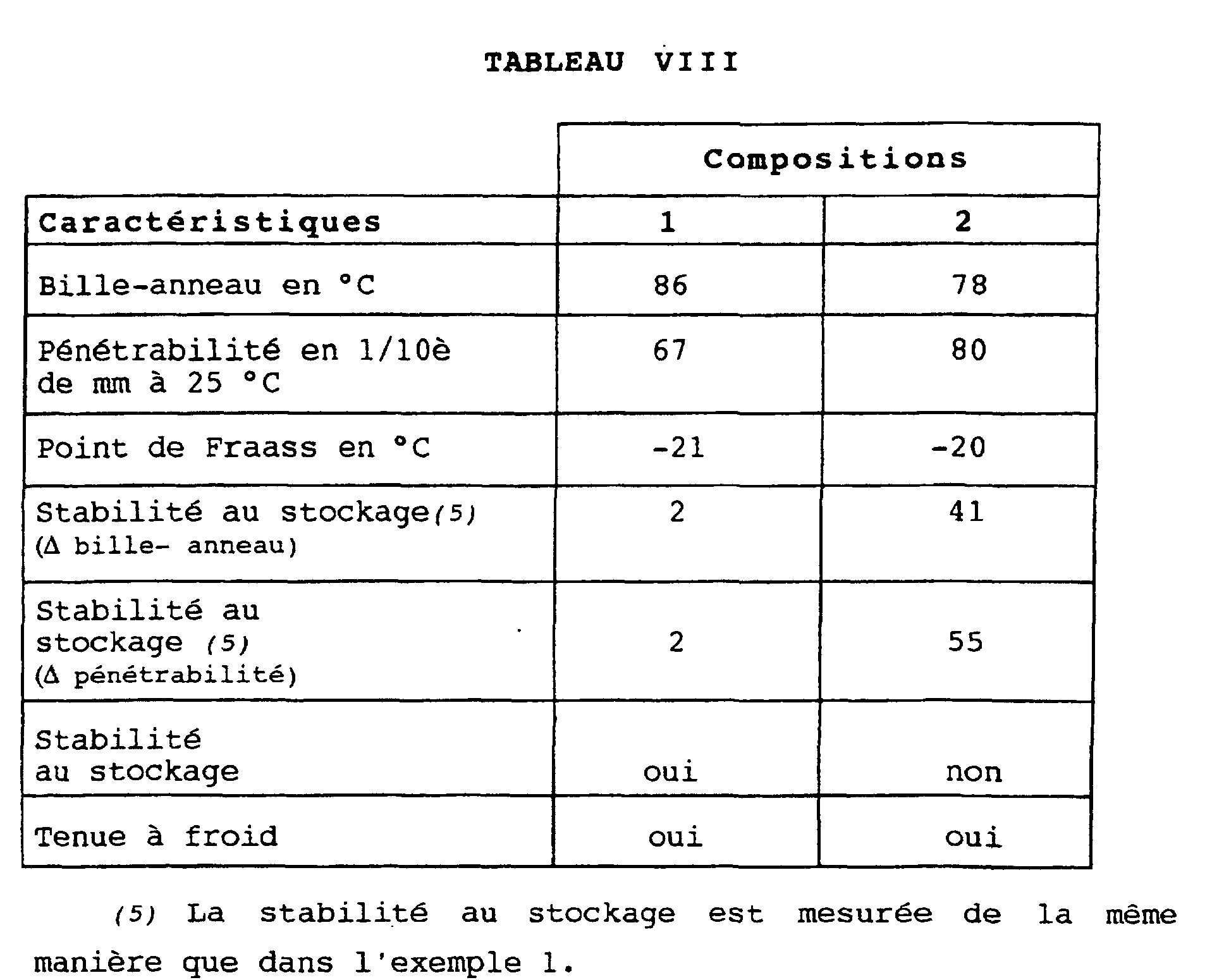
- This example concerns a variant of the preparation of bitumen-polymer compositions with character aromatic according to the invention.
- composition is obtained by preparation of a copolymer-compound stock solution aromatic which is then incorporated into the bitumen.
- the copolymer chosen is the copolymer P of Example 1 and the aromatic compound is the compound denoted A 2 in Example 1.
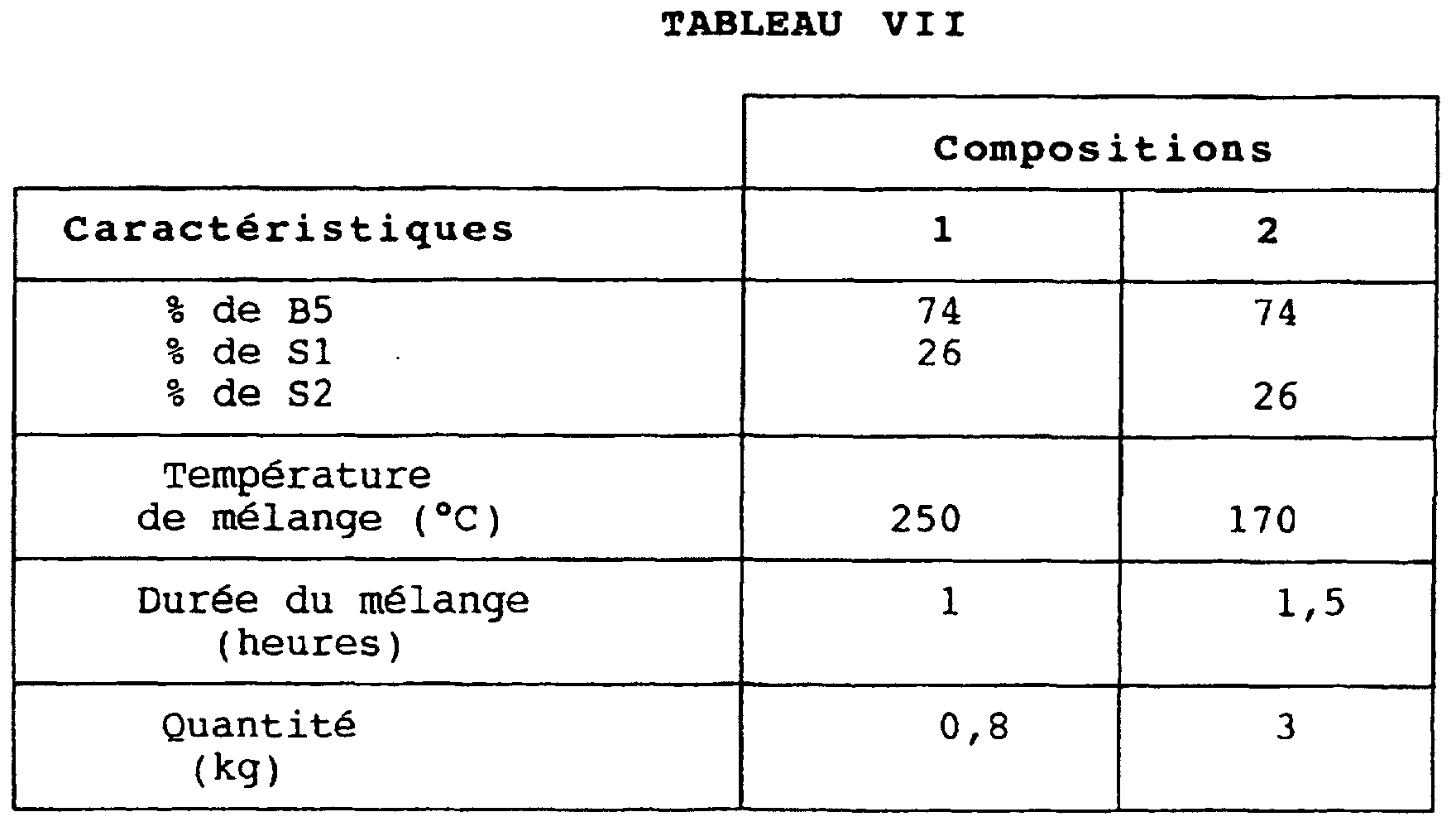
- Table VI presents the characteristics of the stock solutions S 1 and S 2 thus prepared.
Landscapes
- Chemical & Material Sciences (AREA)
- Engineering & Computer Science (AREA)
- Civil Engineering (AREA)
- Materials Engineering (AREA)
- Structural Engineering (AREA)
- Health & Medical Sciences (AREA)
- Chemical Kinetics & Catalysis (AREA)
- Medicinal Chemistry (AREA)
- Polymers & Plastics (AREA)
- Organic Chemistry (AREA)
- Compositions Of Macromolecular Compounds (AREA)
- Processes Of Treating Macromolecular Substances (AREA)
Description
- de diminuer la susceptibilité thermique des bitumes, en élargissant l'intervalle de plasticité (par augmentation de la température de ramollissement et/ou par diminution de la température de fragilité à froid),
- d'augmenter la résistance à la déformation, ainsi que le seuil de rupture.
- de 85 à 98 % en poids de bitume sélectionné parmi les bitumes qui ont une pénétrabilité comprise entre 30 et 220 dixièmes de mm à 25°C, un point de ramollissement compris entre 35 et 55 °C, et un indice de pénétrabilité compris entre -1,5 et +1,5, et
- de 15 à 2% en poids d'un copolymère "styrène-butadiène-styrène" (dit SBS) séquencé, ayant une structure étoilée ou linéaire.
- la teneur du mélange en composés aromatiques, dont le point initial de distillation est supérieur à 200°C, est supérieure à 2 % en poids,
- le rapport entre la teneur en cycles aromatiques du mélange et sa teneur en copolymère est compris entre 0,5 et 10.
- d'un distillat, ou
- d'un extrait aromatique obtenu dans la désaromatisation des huiles lubrifiantes, ou
- d'un brai de désasphaltage
- d'un distillat, ou
- d'un extrait aromatique obtenu dans la désaromatisation des huiles lubrifiantes, ou
- d'un brai de désasphaltage, ou
- d'une fraction lourde selon a) ou d'une phase lourde selon b) ;
- un distillat, ou
- un extrait aromatique obtenu dans la désaromatisation des huiles lubrifiantes, ou
- un brai de désasphaltage, ou
- une fraction lourde aromatique ("slurry catalytique") issue d'un procédé de craquage catalytique.
- en dessous de 2 % en poids de copolymère, l'addition de polymère dans le bitume est considérée comme ayant peu d'effet sur les propriétés de la composition,
- au-dessus de 7 % en poids de copolymère, le prix du polymère rend trop onéreuse l'application routière. En outre, la viscosité de la composition augmente et devient incompatible avec le matériel utilisé pour ces applications. Mais, dans le cas d'applications industrielles telles que par exemple les chapes d'étanchéité, la composition contient de préférence plus de copolymère, souvent plus de 10 % en poids, pour obtenir au contraire une viscosité élevée et une température de bille-anneau élevée, de manière à résister à la température.
- une viscosité cinématique supérieure à 5 mm2/s à 100°C, de préférence supérieure à 20 mm2/s,
- un point éclair Cleveland supérieur à 170°C, de préférence supérieur à 200°C, et
- une teneur en cycles aromatiques supérieure à 50 % en poids, de préférence supérieure à 65 % en poids.
- rapport massique styrène-butadiène : 30%,
- masse moléculaire en poids Mw : 300 000.
| Bitumes | B1 | B2 | B3 | B4 | B5 |
| Bille-anneau en °C | 46,2 | 55,2 | 50,9 | 51,0 | 65,5 |
| Pénétrabilité en 1/10e de mm à 25°C | 86 | 42 | 61 | 63 | 16 |
| Point de FRAASS en °C | -15 | -9 | -11 | -12 | -3 |
| Bitumes | % de BA | % de BB |
| B1 | 30 | 70 |
| B2 | 60 | 40 |
| B3 | 45 | 55 |
| B4 | 40 | 60 |
| B5 | 100 | 0 |
| Bases bitumineuses | BA | BB |
| Bille-anneau en °C | 65,5 | 40 |
| Pénétrabilité en 1/10è de mm à 25°C | 16 | 182 |


| Solutions-mères | S1 | S2 |
| % de P | 19 | 19 |
| % de A2 | 81 | 81 |
| Température de mélange (°C) | 200 | 180 |
| Durée de mélange (heures) | 1 | 3 |
| Quantité (Kg) | 0,8 | 3 |
Claims (13)
- Procédé de préparation d'une composition bitume-polymère aromatique possédant un point de FRAASS égal ou inférieur à -13°C et une stabilité au stockage définie par son Δ bille-anneau" et son "Δ pénétrabilité inférieurs ou égaux à 5, ce procédé comprenant le mélange de :ce procédé étant caractérisé en ce quea) 25 à 97 % en poids d'un-bitume,b) 1 à 25 % en poids d'un copolymère ou plus,c) 2 à 50 % en poids de composés aromatiques provenant de coupes pétrolières aromatiques ayant une teneur en cycles aromatiques supérieure à 50% en poidsla teneur du mélange en composés aromatiques, dont le point initial de distillation est supérieur à 200°C, est supérieure à 2 % en poids,le rapport entre la teneur en cycles aromatiques du mélange et sa teneur en copolymère est comprise entre 0,5 et 10,
- Procédé selon la revendication 1, caractérisé en ce que les composés aromatiques du mélange proviennent de coupes pétrolières aromatiques et ont une teneur en cycles aromatiques supérieure ou égale à 65 % en poids.
- Procédé selon la revendication 2, caractérisé en ce que les coupes pétrolières aromatiques présentent un point initial de distillation supérieur à 200° C, de préférence supérieur à 300°C.
- Procédé selon l'une des revendications 1 à 3, caractérisé en ce que les composés aromatiques du mélange ont une viscosité cinématique supérieure à 5 mm2/s à 100°C, de préférence supérieure à 20 mm2/s.
- Procédé selon l'une des revendications 1 à 4, caractérisé en ce que les composés aromatiques du mélange ont un point éclair Cleveland supérieur à 170° C, de préférence supérieur à 200° C.
- Procédé selon l'une des revendications 1 à 5, caractérisé en ce que la teneur en cycles aromatiques du mélange est supérieure à 4 % en poids.
- Procédé selon l'une des revendications 1 à 6, caractérisé en ce que le rapport entre la teneur en cycles aromatiques du mélange et sa teneur en copolymère est compris entre 0,8 et 6.
- Procédé selon l'une des revendications 1 à 7, caractérisé en ce que le copolymère du mélange est un copolymère présentant des chaínes hydrocarbonées à hydrogène mobile et choisi dans le groupe constitué par les caoutchoucs synthétiques, comme les copolymères styrene-butadiene statistiques S.B.R. ("styrene-butadiene-rubber") ou séquencés S.B.S. ("styrène-butadiène-styrène"), linéaires ou étoilés, ou S.I.S. ("styrène-isoprène-styrène").
- Procédé selon l'une des revendications 1 à 8, caractérisé en ce que le copolymère du mélange est un copolymère "styrène-butadiène-styrène" linéaire ou séquencé.
- Procédé selon l'une des revendications 1 à 9, caractérisé en ce que le mélange comprend un bitume "naturel".
- Procédé selon l'une des revendications 1 à 10, caractérisé en ce que le mélange comprend un bitume "synthétique".
- Procédé selon l'une des revendications 1 à 11, caractérisé en ce que l'on mélange le bitume, le copolymère et le composé aromatique à une température comprise entre 190 et 300°C, de préférence entre 220 et 260°C, pendant une durée de préférence supérieure à 30 minutes.
- Procédé selon la revendication 12, caractérisé en ce que l'on ajoute le composé aromatique préalablement au mélange bitume-polymère, ou préalablement au bitume et/ou au polymère, et/ou au cours du mélange.
Applications Claiming Priority (2)
| Application Number | Priority Date | Filing Date | Title |
|---|---|---|---|
| FR9500830 | 1995-01-25 | ||
| FR9500830A FR2729672B1 (fr) | 1995-01-25 | 1995-01-25 | Compositions bitume-polymere, leur procede de preparation et leurs applications |
Publications (2)
| Publication Number | Publication Date |
|---|---|
| EP0728815A1 EP0728815A1 (fr) | 1996-08-28 |
| EP0728815B1 true EP0728815B1 (fr) | 2004-08-04 |
Family
ID=9475476
Family Applications (1)
| Application Number | Title | Priority Date | Filing Date |
|---|---|---|---|
| EP96400130A Expired - Lifetime EP0728815B1 (fr) | 1995-01-25 | 1996-01-19 | Procédé de préparation de compositions bitume-polymère |
Country Status (7)
| Country | Link |
|---|---|
| EP (1) | EP0728815B1 (fr) |
| AT (1) | ATE272684T1 (fr) |
| DE (1) | DE69633034T2 (fr) |
| DK (1) | DK0728815T3 (fr) |
| ES (1) | ES2229257T3 (fr) |
| FR (1) | FR2729672B1 (fr) |
| PT (1) | PT728815E (fr) |
Families Citing this family (2)
| Publication number | Priority date | Publication date | Assignee | Title |
|---|---|---|---|---|
| FR2787115B1 (fr) * | 1998-12-15 | 2001-02-23 | Total Raffinage Distribution | Liants bitumineux modifies a haute cohesion et leurs utilisations |
| DE102010035071B4 (de) | 2010-08-21 | 2014-09-04 | Mitteldeutsches Bitumenwerk Gmbh | Verfahren zur Herstellung eines Bitumenkonzentrates |
Family Cites Families (6)
| Publication number | Priority date | Publication date | Assignee | Title |
|---|---|---|---|---|
| GB2164344A (en) * | 1984-09-12 | 1986-03-19 | Exxon France | Bituminous compositions and preparation thereof |
| FR2580658B1 (fr) * | 1985-04-22 | 1987-06-05 | Beugnet Sa | Composition pour revetement, a base de bitume et de poudre de caoutchouc de recuperation |
| JPS6230153A (ja) * | 1985-08-01 | 1987-02-09 | Japan Synthetic Rubber Co Ltd | アスフアルト舗装組成物 |
| EP0234615A1 (fr) * | 1986-02-28 | 1987-09-02 | Shell Internationale Researchmaatschappij B.V. | Procédé de préparation de compositions bitumineuses contenant des copolymères blocs |
| FR2643643B1 (fr) * | 1989-02-27 | 1992-10-30 | Mobil Oil France | Compositions utilisables pour la preparation de membranes d'etancheite et membranes obtenues |
| FR2709758B1 (fr) * | 1993-09-09 | 1995-11-24 | Total Raffinage Distribution | Compositions bitume/polymère, leur procédé de préparation et leurs applications. |
-
1995
- 1995-01-25 FR FR9500830A patent/FR2729672B1/fr not_active Expired - Fee Related
-
1996
- 1996-01-19 DK DK96400130T patent/DK0728815T3/da active
- 1996-01-19 PT PT96400130T patent/PT728815E/pt unknown
- 1996-01-19 ES ES96400130T patent/ES2229257T3/es not_active Expired - Lifetime
- 1996-01-19 AT AT96400130T patent/ATE272684T1/de not_active IP Right Cessation
- 1996-01-19 DE DE69633034T patent/DE69633034T2/de not_active Expired - Lifetime
- 1996-01-19 EP EP96400130A patent/EP0728815B1/fr not_active Expired - Lifetime
Also Published As
| Publication number | Publication date |
|---|---|
| ES2229257T3 (es) | 2005-04-16 |
| DK0728815T3 (da) | 2004-12-13 |
| DE69633034T2 (de) | 2005-09-22 |
| ATE272684T1 (de) | 2004-08-15 |
| DE69633034D1 (de) | 2004-09-09 |
| EP0728815A1 (fr) | 1996-08-28 |
| PT728815E (pt) | 2004-12-31 |
| FR2729672B1 (fr) | 1997-04-18 |
| FR2729672A1 (fr) | 1996-07-26 |
Similar Documents
| Publication | Publication Date | Title |
|---|---|---|
| CA2111305C (fr) | Compositions bitume-polymere, leur procede de preparation et leurs applications | |
| CA2936469A1 (fr) | Composition bitume/polymere a proprietes mecaniques a froid ameliorees | |
| EP0020203B1 (fr) | Compositions bitumes-polymères et procédé pour les préparer | |
| FR3041355A1 (fr) | Composition bitume / polymere presentant des proprietes mecaniques ameliorees | |
| EP0937750B1 (fr) | Compositions bitumineuses contenant des polyoléfines thermoplastiques et leurs utilisations | |
| FR3080856A1 (fr) | Composition bitume/polymere presentant des proprietes mecaniques ameliorees | |
| FR2533935A1 (fr) | Procede de preparation de compositions bitumes-polymeres | |
| EP0728815A1 (fr) | Compositions bitume-polymère, leur procédé de préparation et leurs applications | |
| EP0645433B1 (fr) | Procédé de préparation de compositions bitume/polymère et leurs applications | |
| CN1015111B (zh) | 沥青的制备方法 | |
| US20120016062A1 (en) | Binder composition comprising a low viscosity naphthenic oil for coloured hot-mix asphalt applications | |
| EP3283571B1 (fr) | Liant clair et ses applications | |
| US5703148A (en) | Asphalt-polymer compositions, process for making same and uses thereof | |
| CA1109192A (fr) | Compositions de bitumes contenant des polymeres | |
| FR2643643A1 (fr) | Compositions utilisables pour la preparation de membranes d'etancheite et membranes obtenues | |
| EP1010729B1 (fr) | Liants bitumineux modifiés à haute cohésion et leurs utilisations | |
| EP3891223B1 (fr) | Mastic bitumineux, son procede de preparation et ses applications | |
| JPH09279039A (ja) | ビチューメン−ポリマー組成物、その製法および用途 | |
| FR2654434A1 (fr) | Procede pour la preparation de bitumes modifies par des polymeres, comme composant de base a des fins de construction des routes, notamment pour des materiaux d'etancheite. | |
| FR3155233A1 (fr) | Composition bitumineuse comprenant un residu de conversion thermique de plastique | |
| EP3440130A1 (fr) | Procede de preparation d'une composition bitume / polymere presentant des proprietes ameliorees | |
| FR3155234A1 (fr) | Composition bitume/polymere integrant un residu de conversion thermique de plastique | |
| FR3144149A1 (fr) | Liant clair et ses applications | |
| WO2026013245A1 (fr) | Composition bitumineuse comprenant un residu de conversion thermique de plastique | |
| CA2235727C (fr) | Liants pour revetement routier basse temperature et methodes pour les preparer |
Legal Events
| Date | Code | Title | Description |
|---|---|---|---|
| PUAI | Public reference made under article 153(3) epc to a published international application that has entered the european phase |
Free format text: ORIGINAL CODE: 0009012 |
|
| AK | Designated contracting states |
Kind code of ref document: A1 Designated state(s): AT BE CH DE DK ES FR GB GR IE IT LI LU NL PT SE |
|
| 17P | Request for examination filed |
Effective date: 19970102 |
|
| 17Q | First examination report despatched |
Effective date: 20001208 |
|
| RTI1 | Title (correction) |
Free format text: PROCESS FOR PREPARING BITUMEN-POLYMER COMPOSITIONS |
|
| GRAP | Despatch of communication of intention to grant a patent |
Free format text: ORIGINAL CODE: EPIDOSNIGR1 |
|
| GRAS | Grant fee paid |
Free format text: ORIGINAL CODE: EPIDOSNIGR3 |
|
| GRAA | (expected) grant |
Free format text: ORIGINAL CODE: 0009210 |
|
| AK | Designated contracting states |
Kind code of ref document: B1 Designated state(s): AT BE CH DE DK ES FR GB GR IE IT LI LU NL PT SE |
|
| PG25 | Lapsed in a contracting state [announced via postgrant information from national office to epo] |
Ref country code: IE Free format text: LAPSE BECAUSE OF FAILURE TO SUBMIT A TRANSLATION OF THE DESCRIPTION OR TO PAY THE FEE WITHIN THE PRESCRIBED TIME-LIMIT Effective date: 20040804 |
|
| RAP1 | Party data changed (applicant data changed or rights of an application transferred) |
Owner name: TOTALFINAELF FRANCE |
|
| REG | Reference to a national code |
Ref country code: GB Ref legal event code: FG4D Free format text: NOT ENGLISH |
|
| REG | Reference to a national code |
Ref country code: CH Ref legal event code: EP |
|
| REG | Reference to a national code |
Ref country code: IE Ref legal event code: FG4D Free format text: FRENCH |
|
| REF | Corresponds to: |
Ref document number: 69633034 Country of ref document: DE Date of ref document: 20040909 Kind code of ref document: P |
|
| PG25 | Lapsed in a contracting state [announced via postgrant information from national office to epo] |
Ref country code: GR Free format text: LAPSE BECAUSE OF FAILURE TO SUBMIT A TRANSLATION OF THE DESCRIPTION OR TO PAY THE FEE WITHIN THE PRESCRIBED TIME-LIMIT Effective date: 20041104 |
|
| REG | Reference to a national code |
Ref country code: SE Ref legal event code: TRGR |
|
| REG | Reference to a national code |
Ref country code: DK Ref legal event code: T3 |
|
| GBT | Gb: translation of ep patent filed (gb section 77(6)(a)/1977) |
Effective date: 20041130 |
|
| REG | Reference to a national code |
Ref country code: PT Ref legal event code: SC4A Free format text: AVAILABILITY OF NATIONAL TRANSLATION Effective date: 20041104 Ref country code: CH Ref legal event code: NV Representative=s name: FREI PATENTANWALTSBUERO |
|
| REG | Reference to a national code |
Ref country code: ES Ref legal event code: FG2A Ref document number: 2229257 Country of ref document: ES Kind code of ref document: T3 |
|
| PLBE | No opposition filed within time limit |
Free format text: ORIGINAL CODE: 0009261 |
|
| STAA | Information on the status of an ep patent application or granted ep patent |
Free format text: STATUS: NO OPPOSITION FILED WITHIN TIME LIMIT |
|
| 26N | No opposition filed |
Effective date: 20050506 |
|
| REG | Reference to a national code |
Ref country code: FR Ref legal event code: CD |
|
| PGFP | Annual fee paid to national office [announced via postgrant information from national office to epo] |
Ref country code: SE Payment date: 20091223 Year of fee payment: 15 |
|
| PGFP | Annual fee paid to national office [announced via postgrant information from national office to epo] |
Ref country code: PT Payment date: 20100114 Year of fee payment: 15 Ref country code: LU Payment date: 20100119 Year of fee payment: 15 Ref country code: ES Payment date: 20100125 Year of fee payment: 15 Ref country code: DK Payment date: 20100113 Year of fee payment: 15 Ref country code: CH Payment date: 20100125 Year of fee payment: 15 |
|
| PGFP | Annual fee paid to national office [announced via postgrant information from national office to epo] |
Ref country code: IT Payment date: 20100127 Year of fee payment: 15 Ref country code: FR Payment date: 20100217 Year of fee payment: 15 |
|
| PGFP | Annual fee paid to national office [announced via postgrant information from national office to epo] |
Ref country code: GB Payment date: 20100121 Year of fee payment: 15 Ref country code: DE Payment date: 20100121 Year of fee payment: 15 Ref country code: AT Payment date: 20100114 Year of fee payment: 15 |
|
| PGFP | Annual fee paid to national office [announced via postgrant information from national office to epo] |
Ref country code: NL Payment date: 20100118 Year of fee payment: 15 Ref country code: BE Payment date: 20100315 Year of fee payment: 15 |
|
| REG | Reference to a national code |
Ref country code: PT Ref legal event code: MM4A Free format text: LAPSE DUE TO NON-PAYMENT OF FEES Effective date: 20110719 |
|
| BERE | Be: lapsed |
Owner name: *TOTALFINAELF FRANCE Effective date: 20110131 |
|
| REG | Reference to a national code |
Ref country code: NL Ref legal event code: V1 Effective date: 20110801 |
|
| REG | Reference to a national code |
Ref country code: DK Ref legal event code: EBP |
|
| REG | Reference to a national code |
Ref country code: CH Ref legal event code: PL |
|
| REG | Reference to a national code |
Ref country code: SE Ref legal event code: EUG |
|
| GBPC | Gb: european patent ceased through non-payment of renewal fee |
Effective date: 20110119 |
|
| REG | Reference to a national code |
Ref country code: FR Ref legal event code: ST Effective date: 20110930 |
|
| PG25 | Lapsed in a contracting state [announced via postgrant information from national office to epo] |
Ref country code: CH Free format text: LAPSE BECAUSE OF NON-PAYMENT OF DUE FEES Effective date: 20110131 Ref country code: LI Free format text: LAPSE BECAUSE OF NON-PAYMENT OF DUE FEES Effective date: 20110131 Ref country code: PT Free format text: LAPSE BECAUSE OF NON-PAYMENT OF DUE FEES Effective date: 20110719 Ref country code: FR Free format text: LAPSE BECAUSE OF NON-PAYMENT OF DUE FEES Effective date: 20110131 |
|
| PG25 | Lapsed in a contracting state [announced via postgrant information from national office to epo] |
Ref country code: BE Free format text: LAPSE BECAUSE OF NON-PAYMENT OF DUE FEES Effective date: 20110131 Ref country code: GB Free format text: LAPSE BECAUSE OF NON-PAYMENT OF DUE FEES Effective date: 20110119 Ref country code: AT Free format text: LAPSE BECAUSE OF NON-PAYMENT OF DUE FEES Effective date: 20110119 |
|
| PG25 | Lapsed in a contracting state [announced via postgrant information from national office to epo] |
Ref country code: NL Free format text: LAPSE BECAUSE OF NON-PAYMENT OF DUE FEES Effective date: 20110801 Ref country code: IT Free format text: LAPSE BECAUSE OF NON-PAYMENT OF DUE FEES Effective date: 20110119 |
|
| REG | Reference to a national code |
Ref country code: DE Ref legal event code: R119 Ref document number: 69633034 Country of ref document: DE Effective date: 20110802 |
|
| REG | Reference to a national code |
Ref country code: ES Ref legal event code: FD2A Effective date: 20120220 |
|
| PG25 | Lapsed in a contracting state [announced via postgrant information from national office to epo] |
Ref country code: ES Free format text: LAPSE BECAUSE OF NON-PAYMENT OF DUE FEES Effective date: 20110120 |
|
| PG25 | Lapsed in a contracting state [announced via postgrant information from national office to epo] |
Ref country code: SE Free format text: LAPSE BECAUSE OF NON-PAYMENT OF DUE FEES Effective date: 20110120 |
|
| PG25 | Lapsed in a contracting state [announced via postgrant information from national office to epo] |
Ref country code: LU Free format text: LAPSE BECAUSE OF NON-PAYMENT OF DUE FEES Effective date: 20110119 |
|
| PG25 | Lapsed in a contracting state [announced via postgrant information from national office to epo] |
Ref country code: DE Free format text: LAPSE BECAUSE OF NON-PAYMENT OF DUE FEES Effective date: 20110802 |