EP0721284A1 - Bildverarbeitungssystem unter Verwendung von pixel-zu-pixel Bewegungsschätzung und Bilddezimation - Google Patents
Bildverarbeitungssystem unter Verwendung von pixel-zu-pixel Bewegungsschätzung und Bilddezimation Download PDFInfo
- Publication number
- EP0721284A1 EP0721284A1 EP95100205A EP95100205A EP0721284A1 EP 0721284 A1 EP0721284 A1 EP 0721284A1 EP 95100205 A EP95100205 A EP 95100205A EP 95100205 A EP95100205 A EP 95100205A EP 0721284 A1 EP0721284 A1 EP 0721284A1
- Authority
- EP
- European Patent Office
- Prior art keywords
- frame
- current frame
- motion vectors
- pixel
- feature points
- Prior art date
- Legal status (The legal status is an assumption and is not a legal conclusion. Google has not performed a legal analysis and makes no representation as to the accuracy of the status listed.)
- Granted
Links
- 230000033001 locomotion Effects 0.000 title claims abstract description 112
- 238000012545 processing Methods 0.000 title claims abstract description 10
- 239000013598 vector Substances 0.000 claims abstract description 88
- 238000006073 displacement reaction Methods 0.000 claims abstract description 21
- 238000000034 method Methods 0.000 description 23
- 238000001514 detection method Methods 0.000 description 9
- 230000005540 biological transmission Effects 0.000 description 6
- 238000013459 approach Methods 0.000 description 4
- 238000013139 quantization Methods 0.000 description 4
- 230000006835 compression Effects 0.000 description 3
- 238000007906 compression Methods 0.000 description 3
- 238000012935 Averaging Methods 0.000 description 1
- 230000003044 adaptive effect Effects 0.000 description 1
- 230000000903 blocking effect Effects 0.000 description 1
- 238000004364 calculation method Methods 0.000 description 1
- 238000010586 diagram Methods 0.000 description 1
- 238000012986 modification Methods 0.000 description 1
- 230000004048 modification Effects 0.000 description 1
- 230000002123 temporal effect Effects 0.000 description 1
Images
Classifications
-
- H—ELECTRICITY
- H04—ELECTRIC COMMUNICATION TECHNIQUE
- H04N—PICTORIAL COMMUNICATION, e.g. TELEVISION
- H04N19/00—Methods or arrangements for coding, decoding, compressing or decompressing digital video signals
- H04N19/50—Methods or arrangements for coding, decoding, compressing or decompressing digital video signals using predictive coding
- H04N19/503—Methods or arrangements for coding, decoding, compressing or decompressing digital video signals using predictive coding involving temporal prediction
- H04N19/51—Motion estimation or motion compensation
- H04N19/577—Motion compensation with bidirectional frame interpolation, i.e. using B-pictures
-
- H—ELECTRICITY
- H04—ELECTRIC COMMUNICATION TECHNIQUE
- H04N—PICTORIAL COMMUNICATION, e.g. TELEVISION
- H04N19/00—Methods or arrangements for coding, decoding, compressing or decompressing digital video signals
- H04N19/50—Methods or arrangements for coding, decoding, compressing or decompressing digital video signals using predictive coding
- H04N19/503—Methods or arrangements for coding, decoding, compressing or decompressing digital video signals using predictive coding involving temporal prediction
- H04N19/51—Motion estimation or motion compensation
- H04N19/537—Motion estimation other than block-based
- H04N19/54—Motion estimation other than block-based using feature points or meshes
-
- H—ELECTRICITY
- H04—ELECTRIC COMMUNICATION TECHNIQUE
- H04N—PICTORIAL COMMUNICATION, e.g. TELEVISION
- H04N19/00—Methods or arrangements for coding, decoding, compressing or decompressing digital video signals
- H04N19/50—Methods or arrangements for coding, decoding, compressing or decompressing digital video signals using predictive coding
- H04N19/587—Methods or arrangements for coding, decoding, compressing or decompressing digital video signals using predictive coding involving temporal sub-sampling or interpolation, e.g. decimation or subsequent interpolation of pictures in a video sequence
Definitions
- the present invention relates to an image processing system for encoding and decoding a video signal; and, more particularly, to an image processing system for encoding and decoding a video signal by using a motion estimation and compensation technique on a pixel-by-pixel basis and a frame decimation technique.
- transmission of digitized video signals can deliver video images of much higher quality than the transmission of analog signals.
- an image signal comprising a sequence of image "frames"
- a substantial amount of data is generated for transmission, especially in the case of a high definition television system. Since, however, the available frequency bandwidth of a conventional transmission channel is limited, in order to transmit the substantial amounts of digital data through the limited channel bandwidth, it is inevitable to compress or reduce the volume of the transmission data.
- the so-called hybrid coding technique which combines temporal and spatial compression techniques together with a statistical coding technique, is known to be most effective.
- the motion compensated DPCM is a process of determining the movement of an object between a current frame and its previous frame, and predicting the current frame according to the motion flow of the object to produce a differential signal representing the difference between the current frame and its prediction.
- This method is described, for example, in Staffan Ericsson, "Fixed and Adaptive Predictors for Hybrid Predictive/Transform Coding", IEEE Transactions on Communications , COM-33 , No. 12(December 1985); and in Ninomiya and Ohtsuka, "A Motion-Compensated Interframe Coding Scheme for Television Pictures", IEEE Transactions on Communications , COM-30 , No. 1 (January 1982).
- current frame data is predicted from the corresponding previous frame data based on an estimation of the motion between the current and the previous frames.
- estimated motion may be described in terms of two dimensional motion vectors representing the displacement of pixels between the previous and the current frames.
- a block in a current frame is compared with blocks in its previous frame until a best match is determined. From this, an interframe displacement vector (how much the block of pixels has moved between frames) for the whole block can be estimated for the current frame being transmitted.
- an interframe displacement vector (how much the block of pixels has moved between frames) for the whole block can be estimated for the current frame being transmitted.
- blocking effect at the boundary of a block may occur in a motion compensation process, and poor estimates may result if all pixels in the block do not move in a same way, to thereby decrease the overall coding efficiency.
- a displacement is determined for each and every pixel.
- This technique allows a more exact estimation of the pixel value and has the ability to easily handle scale changes (e.g., zooming, movement perpendicular to the image plane).
- scale changes e.g., zooming, movement perpendicular to the image plane.
- motion vectors for a set of selected pixels i.e., feature points
- each of the feature points is defined as a pixel capable of representing its neighboring pixels so that motion vectors for non-feature points can be recovered from those of the feature points in the receiver.
- a number of feature points are first selected from all of the pixels contained in the previous frame. Then, motion vectors for the selected feature points are determined, wherein each of the motion vectors representing a spatial displacement between one feature point in the previous frame and a corresponding matching point, i.e., a most similar pixel, in the current frame. Specifically, the matching point for each of the feature points is searched in a search region within the current frame, wherein the search region is defined as a region within a predetermined area which encompasses the position of the corresponding feature point.
- Another compression technique which can be implemented readily is a frame decimation method, which reduces the amount of data by encoding and transmitting only certain selected frames of video image and skipping or decimating the remaining frames existing therebetween( see , e.g., "Video Codec for Audiovisual Services at p x 64 kb/s," CCITT Recommendation H.261, CDM XV-R 37-E, International Brass and Telephone Consultative Committee (CCITT), August 1990).
- the input to the video encoder is a video signal of 30 frames/sec.
- the frame rate resulting from the skipping of one, two or three frames between every two encoded frames is typically 15, 10 or 7.5 frames/sec, respectively.
- the skipped frames are estimated to reconstruct the video signal of 30 frames/sec; and needs have continued to exist to develop an improved system capable of reconstructing the original video signal which has been transmitted using a frame decimation technique.
- an image processing system for processing a video signal including means for encoding the video signal to provide a coded signal and means for decoding the coded signal to provide a reconstructed video signal
- said encoding means comprises: means for selecting a plurality of frames from said video signal, wherein N frames are skipped between a previous frame and a current frame, with N being a positive integer; means for estimating displacements between the previous frame and the current frame and compensating the previous frame with the estimated displacements to provide a predicted current frame on a pixel-by-pixel basis; and means for subtracting the predicted current frame from the current frame to provide a difference signal and encoding the difference signal and a first set of motion vectors representing the established displacements, to thereby provide the coded signal; and said decoding means comprises: means for decoding the coded signal to thereby recover the difference signal and the first set of motion vectors; means for estimating displacements between the previous frame and the current frame, based on the recovered first set of motion vectors,
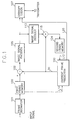
- Fig. 1 describes a video encoder employing a motion estimation and compensation technique on a pixel-by-pixel basis and frame decimation.
- An input signal is fed to a frame decimator 101.
- frames to be encoded are selected by skipping the intervening frames therebetween at a predetermined frame decimation ratio representing the degree of decimation, and fed to a first frame memory 100.
- the frame decimator 101 selects or uses every other or every third frame of the video signal if the predetermined decimation ratio is 2 or 3, respectively.
- the selected signal is stored in a first frame memory 100 which is connected to a subtractor 102 and to a current frame prediction block 150 through a line L10.
- a current frame signal on the line L10 retrieved from the first frame memory 100 and a reconstructed previous frame signal on a line L12 from a second frame memory 124 are processed to predict the current frame on a pixel-by-pixel basis to generate a predicted current frame signal onto a line L30 and a set of motion vectors for feature points onto a line L20. Details of the current frame prediction block 150 will be described with reference to Figs. 2 and 3.
- the predicted current frame signal on the line L30 is subtracted from a current frame signal at the subtractor 102, and the resultant data, i.e., an error signal denoting a differential pixel value, is dispatched to an image signal encoder 105, wherein the error signal is encoded into a set of quantized transform coefficients, e.g., by using a DCT and any of the known quantization methods. Thereafter, the quantized transform coefficients are transmitted to an entropy coder 107 and an image signal decoder 113.
- the quantized transform coefficients from the image signal encoder 105 and the motion vectors fed through the line L20 from the current frame prediction block 150 are coded together by using, e.g., a variable length coding technique for the transmission thereof.
- the image signal decoder 113 converts the quantized transform coefficients from the image signal encoder 105 back into a reconstructed error signal by employing an inverse quantization and an inverse discrete cosine transform.
- the reconstructed error signal from the image signal decoder 113 and the predicted current frame signal on the line L30 from the current frame prediction block 150 are combined at an adder 115 to thereby provide a reconstructed current frame signal to be stored as a previous frame in the second frame memory 124.
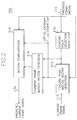
- FIG. 2 there are illustrated details of the current frame prediction block 150 shown in Fig. 1.
- a previous frame signal on the line L12 from the second frame memory 124 is inputted to a feature point selection block 210, a feature point motion vector detection block 212 and a motion compensation block 216.
- a number of feature points are selected among the pixels contained in the previous frame.
- Each of the feature points is defined as a pixel which is capable of representing the motion of an object in the frame.
- the selected feature points from the feature point selection block 210 are inputted to the feature point motion vector detection block 212 and a current frame motion vector detection block 214.
- the current frame signal on the line L10 is provided to the feature point motion vector detection block 212.
- a first set of motion vectors for the selected feature points is detected.
- Each of the first set of motion vectors is a spatial displacement between a feature point in the previous frame and a most similar pixel thereto in the current frame.
- the first set of motion vectors is provided to the current frame motion vector detection block 214 and the entropy coder 107(shown in Fig. 1) via the line L20.
- a second set of motion vectors for all the pixels contained in the current frame is determined by using of the first set of motion vectors and the feature point from the feature point selection block 210.
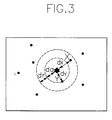
- a set of motion vectors for "quasi-feature points" each of which represents a pixel point in the current frame shifted from each of the feature points in the previous frame by each of the first set of motion vectors, is determined.
- the magnitude of a motion vector for a quasi-feature point is identical to the motion vector for its corresponding feature point but the direction of the two motion vectors is opposite.
- motion vectors for non-quasi-feature points which are the remaining pixel points in the current frame, are determined as follows.
- a motion vector for a star marked non-quasi-feature point is calculated by averaging those for the quasi-feature points which are placed within a circle boundary having a radius of d r + d a , wherein d a is the distance to the nearest quasi-feature point from the star marked pixel position, and d r is a predetermined expanded radius for including other quasi-feature points to be used in the motion vector calculation.
- the second set of motion vectors for quasi-feature points and non-quasi feature points are provided to the motion compensation block 216.
- each of the pixels to be contained in a predicted current frame is retrieved from the second frame memory 124(shown in Fig. 1) by using each of the second set of motion vectors.
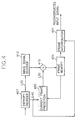
- FIG. 4 there is shown a video decoder corresponding to the video encoder shown in Fig. 1.
- a transmitted signal from the video signal encoder is inputted to an entropy decoder 407 wherein the transmitted signal is decoded into the first set of motion vectors on a line L40 and the quantized transform coefficients on a line L42.
- the motion vectors are provided to a current frame prediction block 450 and a frame interpolator 401 while the quantized transform coefficients are coupled to an image signal decoder 413.
- the image signal decoder 413 converts the quantized transform coefficients back into the reconstructed error signal by employing an inverse quantization and an inverse discrete cosine transform.
- the current frame prediction block 450 performs substantially the same operation with that of the video signal encoder shown in Fig. 1 except that it provides the predicted current frame signal based on the previous frame signal stored in a frame memory 424 and the first set of motion vectors from the entropy decoder 407.
- the current frame prediction block 450 is of a similar structure to that of Fig. 2 except that there is no motion estimator such as the feature point motion vector detection block 212 shown in Fig. 2 because the first set of motion vectors transmitted from the encoder is provided thereto on the line L40..
- feature points are reconstructed from the previous frame decoded and stored in the decoder by the similar method with the encoder.
- a second set of motion vectors for all of the pixels contained in the current frame is estimated through the use of the first set of motion vectors and the feature point.
- each of the pixels to be contained in a predicted current frame is determined by translating each of the pixels in the previous frame by each of the second set of motion vectors.
- the reconstructed error signal from the image signal decoder 413 and the predicted current frame signal on the line L30 from the current frame prediction block 450 are combined at an adder 415, thereby providing the reconstructed current frame signal to the frame memory 424.
- the reconstructed frame is also fed to the frame interpolator 401 wherein the N skipped frames between the previous frame and the current frame are reconstructed by using the first set of motion vectors from the entropy decoder 407 as explained hereinafter.
- a number of motion vectors and corresponding number of pixel points in an ith skipped frame are first determined, wherein each of the number of motion vectors and the corresponding number of pixel points corresponds to each of the first set of motion vectors; and the smaller value of i represents the temporally closer frame to the previous frame.
- a motion between two frames may be assumed to be proportional to the time gap between them.
- each of the pixel points in the ith skipped frame is determined by translating each of the feature point in the previous frame by a factor of i/(N+1) multiplied by one of the first set of the motion vectors for the feature points in the previous frame. Then, each of the number of motion vector between the previous frame and the ith skipped frame is determined by multiplying the motion vector for the corresponding feature point in the previous frame by the factor of i/(N+1) .
- Motion vectors for the remaining pixels contained in the ith skipped frame are determined based on the number of motion vectors and the pixel points in the ith frame using the method explained with reference to Figs. 2 and 3. Then, the pixel values of the ith frame can be determined easily from the previous frame and the motion vectors for the pixels in the ith frame, to thereby provide a reconstructed input signal.
- each of the pixel points in the ith skipped frame is determined by translating each of the feature point in the current frame by a factor of (N+1-i)/(N+1) multiplied by the corresponding motion vector; and the motion vector between the current frame and the ith skipped frame is determined by multiplying the corresponding motion vector of the current frame by the factor of (N+1-i)/(N+1) .
- it is preferable to reconstruct a skipped frame by using a temporally closer frame out of the previous frame and the current frame.
Landscapes
- Engineering & Computer Science (AREA)
- Multimedia (AREA)
- Signal Processing (AREA)
- Compression Or Coding Systems Of Tv Signals (AREA)
- Compression, Expansion, Code Conversion, And Decoders (AREA)
Priority Applications (5)
| Application Number | Priority Date | Filing Date | Title |
|---|---|---|---|
| EP95100205A EP0721284B1 (de) | 1995-01-09 | 1995-01-09 | Bildverarbeitungssystem unter Verwendung von pixel-zu-pixel Bewegungsschätzung und Bilddezimation |
| DE69516655T DE69516655D1 (de) | 1995-01-09 | 1995-01-09 | Bildverarbeitungssystem unter Verwendung von pixel-zu-pixel Bewegungsschätzung und Bilddezimation |
| JP7025964A JPH08205165A (ja) | 1995-01-09 | 1995-01-20 | 映像処理システム |
| CN95101986A CN1103164C (zh) | 1995-01-09 | 1995-02-13 | 利用逐个像素的运动估算和跳帧方法的图像处理系统 |
| US08/393,291 US5654761A (en) | 1995-01-09 | 1995-02-23 | Image processing system using pixel-by-pixel motion estimation and frame decimation |
Applications Claiming Priority (4)
| Application Number | Priority Date | Filing Date | Title |
|---|---|---|---|
| EP95100205A EP0721284B1 (de) | 1995-01-09 | 1995-01-09 | Bildverarbeitungssystem unter Verwendung von pixel-zu-pixel Bewegungsschätzung und Bilddezimation |
| JP7025964A JPH08205165A (ja) | 1995-01-09 | 1995-01-20 | 映像処理システム |
| CN95101986A CN1103164C (zh) | 1995-01-09 | 1995-02-13 | 利用逐个像素的运动估算和跳帧方法的图像处理系统 |
| US08/393,291 US5654761A (en) | 1995-01-09 | 1995-02-23 | Image processing system using pixel-by-pixel motion estimation and frame decimation |
Publications (2)
| Publication Number | Publication Date |
|---|---|
| EP0721284A1 true EP0721284A1 (de) | 1996-07-10 |
| EP0721284B1 EP0721284B1 (de) | 2000-05-03 |
Family
ID=27429985
Family Applications (1)
| Application Number | Title | Priority Date | Filing Date |
|---|---|---|---|
| EP95100205A Expired - Lifetime EP0721284B1 (de) | 1995-01-09 | 1995-01-09 | Bildverarbeitungssystem unter Verwendung von pixel-zu-pixel Bewegungsschätzung und Bilddezimation |
Country Status (4)
| Country | Link |
|---|---|
| US (1) | US5654761A (de) |
| EP (1) | EP0721284B1 (de) |
| JP (1) | JPH08205165A (de) |
| CN (1) | CN1103164C (de) |
Cited By (2)
| Publication number | Priority date | Publication date | Assignee | Title |
|---|---|---|---|---|
| EP0840515A3 (de) * | 1996-10-31 | 2000-03-22 | Matsushita Electric Industrial Co., Ltd. | Verfahren und Vorrichtung zur Kodierung von Videodaten |
| CN102104775B (zh) * | 2009-12-18 | 2013-04-17 | 华为技术有限公司 | 一种帧率调整方法和装置 |
Families Citing this family (15)
| Publication number | Priority date | Publication date | Assignee | Title |
|---|---|---|---|---|
| US6181747B1 (en) * | 1996-02-01 | 2001-01-30 | Hughes Electronics Corporation | Methods and systems for high compression rate encoding and decoding of quasi-stable objects in video and film |
| US5778097A (en) * | 1996-03-07 | 1998-07-07 | Intel Corporation | Table-driven bi-directional motion estimation using scratch area and offset valves |
| JP3864400B2 (ja) | 1996-10-04 | 2006-12-27 | ソニー株式会社 | 画像処理装置および画像処理方法 |
| CN101355618B (zh) * | 1997-03-25 | 2012-06-06 | 富士胶片株式会社 | 成像系统,照相机和接收装置 |
| AU1116899A (en) * | 1997-10-23 | 1999-05-10 | Sony Electronics Inc. | Apparatus and method for recovery of lost/damaged data in a bitstream of data based on compatibility |
| US6128047A (en) * | 1998-05-20 | 2000-10-03 | Sony Corporation | Motion estimation process and system using sparse search block-matching and integral projection |
| JP2002230543A (ja) * | 2000-11-28 | 2002-08-16 | Monolith Co Ltd | 画像補間方法および装置 |
| JP2004140630A (ja) * | 2002-10-18 | 2004-05-13 | Fujitsu Ltd | フレーム間引き処理を行うための画像圧縮方法及び装置 |
| US8239766B2 (en) * | 2005-09-27 | 2012-08-07 | Qualcomm Incorporated | Multimedia coding techniques for transitional effects |
| US7916791B2 (en) * | 2006-06-16 | 2011-03-29 | International Business Machines Corporation | Method and system for non-linear motion estimation |
| US20090002558A1 (en) * | 2007-06-29 | 2009-01-01 | Digital Vision Ab | Three-frame motion estimator for restoration of single frame damages |
| CN101127873B (zh) * | 2007-09-19 | 2011-03-16 | 中兴通讯股份有限公司 | 提高可视电话图像质量的方法和系统 |
| CN101394554B (zh) * | 2008-09-28 | 2010-06-09 | 湖北科创高新网络视频股份有限公司 | 一种自适应跳帧方法和装置 |
| US8508659B2 (en) * | 2009-08-26 | 2013-08-13 | Nxp B.V. | System and method for frame rate conversion using multi-resolution temporal interpolation |
| AU2012202352A1 (en) * | 2012-04-20 | 2013-11-07 | Canon Kabushiki Kaisha | Method, system and apparatus for determining a hash code representing a portion of an image |
Citations (1)
| Publication number | Priority date | Publication date | Assignee | Title |
|---|---|---|---|---|
| EP0397402A2 (de) * | 1989-05-11 | 1990-11-14 | Matsushita Electric Industrial Co., Ltd. | Bewegtbildsignalkodier- und -dekodiervorrichtung |
Family Cites Families (1)
| Publication number | Priority date | Publication date | Assignee | Title |
|---|---|---|---|---|
| KR0128860B1 (ko) * | 1993-07-16 | 1998-04-10 | 배순훈 | 저비트율의 영상전화 시스템의 부호화장치 |
-
1995
- 1995-01-09 EP EP95100205A patent/EP0721284B1/de not_active Expired - Lifetime
- 1995-01-20 JP JP7025964A patent/JPH08205165A/ja active Pending
- 1995-02-13 CN CN95101986A patent/CN1103164C/zh not_active Expired - Lifetime
- 1995-02-23 US US08/393,291 patent/US5654761A/en not_active Expired - Lifetime
Patent Citations (1)
| Publication number | Priority date | Publication date | Assignee | Title |
|---|---|---|---|---|
| EP0397402A2 (de) * | 1989-05-11 | 1990-11-14 | Matsushita Electric Industrial Co., Ltd. | Bewegtbildsignalkodier- und -dekodiervorrichtung |
Non-Patent Citations (7)
| Title |
|---|
| A.FURUKAWA ET AL.: "Motion-adaptive for Videoconference pictures", ICC'84 - IEEE INTERNATIONAL CONFERENCE ON COMMUNICATIONS, vol. 2, 14 May 1984 (1984-05-14) - 17 May 1984 (1984-05-17), pages 707 - 710, XP008078132 * |
| C.CAFFORIO ET AL.: "Motion Compensated Image Interpolation", IEEE TRANSACTIONS ON COMMUNICATIONS, vol. 38, no. 2, NEW YORK US, pages 215 - 222, XP000113142, DOI: doi:10.1109/26.47856 * |
| G.KUMMERFELDT ET AL.: "Coding Television Signals at 320 and 64 Kbit/s", SPIE - IMAGE CODING, vol. 594, pages 119 - 128 * |
| G.SULLIVAN AND R.L.BAKER: "Motion Compensation for video compression using control grid interpolation", ICASSP'91 - INTERNATIONAL CONFERENCE ON ACOUSTICS, SPEECH AND SIGNAL PROCESSING, vol. 4, 14 April 1991 (1991-04-14) - 17 April 1991 (1991-04-17), pages 2713 - 2716, XP010043566, DOI: doi:10.1109/ICASSP.1991.150962 * |
| J.K.KIM AND C.M.KYUNG: "Fast frame-to-frame interpolation technique for scenes containing moving objects", ELECTRONICS LETTERS, vol. 27, no. 20, 26 September 1991 (1991-09-26), STEVENAGE GB, pages 1788 - 1790, XP000264337, DOI: doi:10.1049/el:19911112 * |
| J.NIEWEGLOWSKI ET AL.: "A novel video coding scheme based on temporal prediction using digital image warping", IEEE TRANSACTIONS ON CONSUMER ELECTRONICS, vol. 39, no. 3, pages 141 - 150 * |
| J.NIEWEGLOWSKI ET AL.: "Motion Compensated Video Sequence Interpolation Using Digital Image Warping", ICASSP'94 - IEEE INTERNATIONAL CONFERENCE ON ACOUSTICS, SPEECH AND SIGNAL PROCESSING, vol. 5, 19 April 1994 (1994-04-19) - 22 April 1994 (1994-04-22), pages 205 - 208 * |
Cited By (2)
| Publication number | Priority date | Publication date | Assignee | Title |
|---|---|---|---|---|
| EP0840515A3 (de) * | 1996-10-31 | 2000-03-22 | Matsushita Electric Industrial Co., Ltd. | Verfahren und Vorrichtung zur Kodierung von Videodaten |
| CN102104775B (zh) * | 2009-12-18 | 2013-04-17 | 华为技术有限公司 | 一种帧率调整方法和装置 |
Also Published As
| Publication number | Publication date |
|---|---|
| US5654761A (en) | 1997-08-05 |
| JPH08205165A (ja) | 1996-08-09 |
| EP0721284B1 (de) | 2000-05-03 |
| CN1129386A (zh) | 1996-08-21 |
| CN1103164C (zh) | 2003-03-12 |
Similar Documents
| Publication | Publication Date | Title |
|---|---|---|
| US5617144A (en) | Image processing system using pixel-by-pixel motion estimation and frame decimation | |
| US5619281A (en) | Method and apparatus for detecting motion vectors in a frame decimating video encoder | |
| EP0634874B1 (de) | Bestimmung von Bewegungsvektoren in einem Videokodierer mit Bilddezimation | |
| US5546129A (en) | Method for encoding a video signal using feature point based motion estimation | |
| US5612743A (en) | Method for encoding a video signal using feature point based motion estimation | |
| US5598216A (en) | Method and apparatus for encoding/decoding a video signal | |
| US5673339A (en) | Method for encoding a video signal using feature point based motion estimation | |
| EP0771117B1 (de) | Verfahren und Vorrichtung zur Kodierung und Dekodierung eines Videosignals unter Verwendung einer Bewegungsschätzung mit charakteristischen Punkten | |
| US5654761A (en) | Image processing system using pixel-by-pixel motion estimation and frame decimation | |
| EP0721287A1 (de) | Verfahren und Vorrichtung zur Kodierung eines Videosignals | |
| US5638129A (en) | Image processing apparatus using a pixel-by-pixel motion estimation based on feature points | |
| US5627591A (en) | Image processing system using a pixel-by-pixel motion estimation based on feature points | |
| US5506622A (en) | Block matching type motion vector determination using correlation between error signals | |
| US6020925A (en) | Method and apparatus for encoding a video signal using pixel-by-pixel motion prediction | |
| EP0731612B1 (de) | Vorrichtung zur Bildsignalkodierung die Suchraster zur Bewegungsschätzung und -kompensation verwendet. | |
| US5790207A (en) | Motion compensation method for use in an image encoding system | |
| US5625417A (en) | Image processing system using a feature point-based motion estimation | |
| US6061401A (en) | Method and apparatus for selectively encoding/decoding a video signal | |
| US6023298A (en) | Video signal encoding system using a current frame prediction apparatus | |
| KR0174462B1 (ko) | 프레임 데시메이션과 화소단위 움직임 추정을 이용하는 영상처리 시스템 | |
| KR0174455B1 (ko) | 화소단위 움직임예측을 이용하는 영상신호 부호화 방법 및 장치 | |
| EP0734179A2 (de) | Verfahren und Vorrichtung zur selektiven Kodierung/Dekodierung eines Bildsignals | |
| KR0174463B1 (ko) | 프레임 데시메이팅 비데오 부호화기의 움직임벡터 검출방법 및 장치 | |
| KR100207397B1 (ko) | 영상 부호화 시스템의 움직임 예측장치 및 방법 | |
| EP0720381A1 (de) | Verfahren und Vorrichtung zur Kodierung von einem Videosignal durch Pixel-zu-Pixel-Bewegungsprädiktion |
Legal Events
| Date | Code | Title | Description |
|---|---|---|---|
| PUAI | Public reference made under article 153(3) epc to a published international application that has entered the european phase |
Free format text: ORIGINAL CODE: 0009012 |
|
| AK | Designated contracting states |
Kind code of ref document: A1 Designated state(s): DE FR GB NL |
|
| 17P | Request for examination filed |
Effective date: 19961017 |
|
| 17Q | First examination report despatched |
Effective date: 19980721 |
|
| GRAG | Despatch of communication of intention to grant |
Free format text: ORIGINAL CODE: EPIDOS AGRA |
|
| GRAG | Despatch of communication of intention to grant |
Free format text: ORIGINAL CODE: EPIDOS AGRA |
|
| GRAH | Despatch of communication of intention to grant a patent |
Free format text: ORIGINAL CODE: EPIDOS IGRA |
|
| GRAH | Despatch of communication of intention to grant a patent |
Free format text: ORIGINAL CODE: EPIDOS IGRA |
|
| GRAA | (expected) grant |
Free format text: ORIGINAL CODE: 0009210 |
|
| AK | Designated contracting states |
Kind code of ref document: B1 Designated state(s): DE FR GB NL |
|
| PG25 | Lapsed in a contracting state [announced via postgrant information from national office to epo] |
Ref country code: NL Free format text: LAPSE BECAUSE OF FAILURE TO SUBMIT A TRANSLATION OF THE DESCRIPTION OR TO PAY THE FEE WITHIN THE PRESCRIBED TIME-LIMIT Effective date: 20000503 Ref country code: FR Free format text: LAPSE BECAUSE OF FAILURE TO SUBMIT A TRANSLATION OF THE DESCRIPTION OR TO PAY THE FEE WITHIN THE PRESCRIBED TIME-LIMIT Effective date: 20000503 |
|
| REF | Corresponds to: |
Ref document number: 69516655 Country of ref document: DE Date of ref document: 20000608 |
|
| PG25 | Lapsed in a contracting state [announced via postgrant information from national office to epo] |
Ref country code: DE Free format text: LAPSE BECAUSE OF FAILURE TO SUBMIT A TRANSLATION OF THE DESCRIPTION OR TO PAY THE FEE WITHIN THE PRESCRIBED TIME-LIMIT Effective date: 20000804 |
|
| EN | Fr: translation not filed | ||
| NLV1 | Nl: lapsed or annulled due to failure to fulfill the requirements of art. 29p and 29m of the patents act | ||
| PLBE | No opposition filed within time limit |
Free format text: ORIGINAL CODE: 0009261 |
|
| STAA | Information on the status of an ep patent application or granted ep patent |
Free format text: STATUS: NO OPPOSITION FILED WITHIN TIME LIMIT |
|
| 26N | No opposition filed | ||
| REG | Reference to a national code |
Ref country code: GB Ref legal event code: IF02 |
|
| REG | Reference to a national code |
Ref country code: GB Ref legal event code: 732E |
|
| REG | Reference to a national code |
Ref country code: GB Ref legal event code: 732E Free format text: REGISTERED BETWEEN 20130404 AND 20130410 |
|
| PGFP | Annual fee paid to national office [announced via postgrant information from national office to epo] |
Ref country code: GB Payment date: 20140108 Year of fee payment: 20 |
|
| REG | Reference to a national code |
Ref country code: GB Ref legal event code: PE20 Expiry date: 20150108 |
|
| PG25 | Lapsed in a contracting state [announced via postgrant information from national office to epo] |
Ref country code: GB Free format text: LAPSE BECAUSE OF EXPIRATION OF PROTECTION Effective date: 20150108 |