EP0719265B1 - Derives de nucleosides, procedes de fabrication de ces derives de nucleosides et anticorps polyclonaux et monoclonaux specifiques de ces derives - Google Patents
Derives de nucleosides, procedes de fabrication de ces derives de nucleosides et anticorps polyclonaux et monoclonaux specifiques de ces derives Download PDFInfo
- Publication number
- EP0719265B1 EP0719265B1 EP94926977A EP94926977A EP0719265B1 EP 0719265 B1 EP0719265 B1 EP 0719265B1 EP 94926977 A EP94926977 A EP 94926977A EP 94926977 A EP94926977 A EP 94926977A EP 0719265 B1 EP0719265 B1 EP 0719265B1
- Authority
- EP
- European Patent Office
- Prior art keywords
- amino
- oxo
- stands
- chosen
- adenine
- Prior art date
- Legal status (The legal status is an assumption and is not a legal conclusion. Google has not performed a legal analysis and makes no representation as to the accuracy of the status listed.)
- Expired - Lifetime
Links
- 0 CI1(C[C@@](CO)OC(*)C1)=I Chemical compound CI1(C[C@@](CO)OC(*)C1)=I 0.000 description 1
Classifications
-
- C—CHEMISTRY; METALLURGY
- C07—ORGANIC CHEMISTRY
- C07D—HETEROCYCLIC COMPOUNDS
- C07D413/00—Heterocyclic compounds containing two or more hetero rings, at least one ring having nitrogen and oxygen atoms as the only ring hetero atoms
- C07D413/02—Heterocyclic compounds containing two or more hetero rings, at least one ring having nitrogen and oxygen atoms as the only ring hetero atoms containing two hetero rings
- C07D413/04—Heterocyclic compounds containing two or more hetero rings, at least one ring having nitrogen and oxygen atoms as the only ring hetero atoms containing two hetero rings directly linked by a ring-member-to-ring-member bond
-
- C—CHEMISTRY; METALLURGY
- C07—ORGANIC CHEMISTRY
- C07D—HETEROCYCLIC COMPOUNDS
- C07D473/00—Heterocyclic compounds containing purine ring systems
- C07D473/26—Heterocyclic compounds containing purine ring systems with an oxygen, sulphur, or nitrogen atom directly attached in position 2 or 6, but not in both
- C07D473/32—Nitrogen atom
- C07D473/34—Nitrogen atom attached in position 6, e.g. adenine
-
- C—CHEMISTRY; METALLURGY
- C07—ORGANIC CHEMISTRY
- C07K—PEPTIDES
- C07K16/00—Immunoglobulins [IG], e.g. monoclonal or polyclonal antibodies
- C07K16/44—Immunoglobulins [IG], e.g. monoclonal or polyclonal antibodies against material not provided for elsewhere, e.g. haptens, metals, DNA, RNA, amino acids
Definitions
- the invention relates to nucleoside derivatives, methods for manufacturing these nucleoside derivatives, as well as polyclonal and monoclonal antibodies specific for the aforementioned derivatives.
- the macro molecule of A.D.N. (Deoxyribonucleic acid) is the constituent of chromosomes and the different segments of this molecule make up the genes, supports of hereditary characters.
- the A.D.N. is present in the form of a spiral double helix, alternately formed from sugar (deoxyribose) and phosphate, the spirals of the two chains being joined locally by nucleic acid groupings nitrogen, purine or pyrimidine type.
- the nucleotides constituting the A.D.N. are the esters phosphorics of nucleosides.
- nucleic bases of A.D.N. an individual (or animal or plant) can be changed and damaged when this individual is exposed to a intense solar radiation, cosmic radiation (intercontinental flights), photosensitizers, on contact with asbestos or irradiation ionizing, whether it is accidental or due to a radiotherapy treatment.
- These modifications of nucleic bases of A.D.N. may cause a significant modification of the genetic heritage of the individual concerned it is particularly important detect if such changes have occurred produced and specify the nature of the modifications happened.
- immunoassays involve reacting an antibody specific for a particular modification of ADN with a sample containing the isolated or hydrolyzed ADN. These antibodies are generally produced by cloning.
- polyclonal (or monoclonal) antibodies first requires the production of antigens specific, i.e. nucleosides or nucleotides whose nucleic bases have undergone modifications that we are trying to detect, these nucleosides or nucleotides being linked to a large molecule, for example a protein. A nucleoside or a nucleotide alone too small is not perceived by the immune system. Then the polyclonal antibodies are produced by a mammal who has received an injection of the above antigen, this antigen comprising a protein foreign to the mammal considered, linked to a hapten (small molecule against which we wishes to obtain specific antibodies).
- antigens specific i.e. nucleosides or nucleotides whose nucleic bases have undergone modifications that we are trying to detect, these nucleosides or nucleotides being linked to a large molecule, for example a protein. A nucleoside or a nucleotide alone too small is not perceived
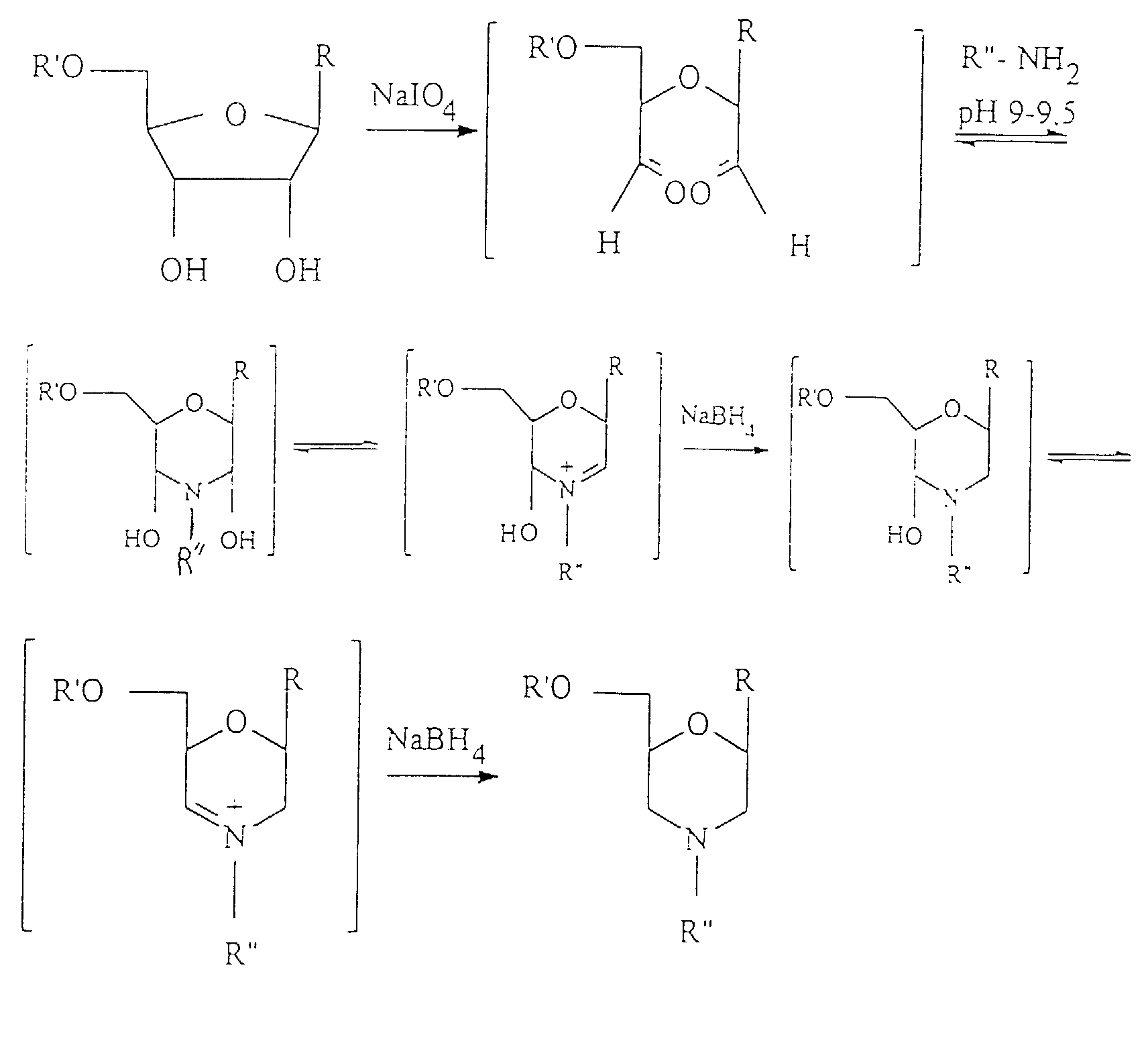
- This process consists in acting on the ose of a ribonucleoside by the action of sodium periodate.
- the ose cycle is open between the 2 'and 3' carbons and a dialdehyde is formed.
- This dialdehyde is then coupled to a protein, at a pH close to 9 to 9.5.
- NaBH 4 is used to reduce the Schiff base obtained as an intermediate product.
- the sequence of reactions described in this process is carried out without isolating the intermediate products.
- a number of products parasites are likely to appear during of the process and to be present in the conjugated protein final.
- Each parasitic product can potentially induce an immune response to it clean.
- the antibody mixture obtained may have only low selectivity. This is the case in the article by H.L. Lewis et al. previously cited, where the target molecule was the 5-hydroxymethyluracil and where the antiserum obtained also recognized thymine which is a base natural of A.D.N.
- the main defect of this process lies in the lack of stability of the ester function used for conjugate the nucleoside to the protein.
- This method differs from the previous two in that that the starting material is neither a ribo nor a deoxyribonucleoside modified but an alkylated derivative of the based. It makes it possible to form antibodies of excellent quality because the hapten used is just purified before its conjugation to the protein. However, this technique is more difficult to implement than two methods described above.
- the invention consisted in developing antigens and methods of making these antigens avoiding the drawbacks mentioned above.
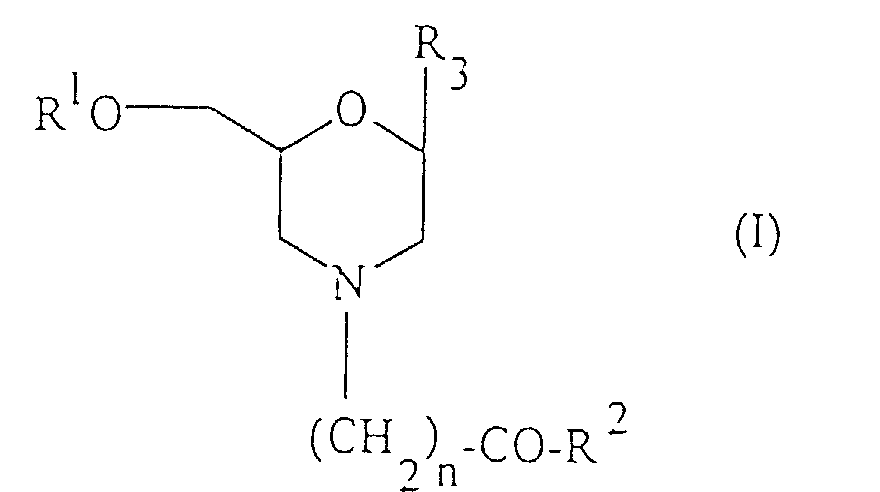
- nucleoside derivatives characterized in that they correspond to the following chemical formula: in which n represents any positive integer, R 1 represents H or a linear mono, di or tri-phosphoric acid, R 2 represents a hydroxyl group, an alkyloxy group, an aryloxy group, a protein comprising an amino site, an aminoalkyl polystyrene or a silica grafted with an alkylamine chain and R 3 represents a modified nucleic base chosen from uracil, thymine, cytosine, guanine or modified adenine.
- nucleoside derivatives since they are formed from nucleosides, however in these derivatives the dare has disappeared and is replaced by morpholine.
- R 2 represents a protein
- the antigen obtained can serve as a basis for the manufacture of antibodies.
- R 2 is an aminoalkylpolystyrene or a grafted silica
- the product obtained is a solid support to which the hapten is bonded.
- Such supports can be used in ELISA (registered trademark) type assays.
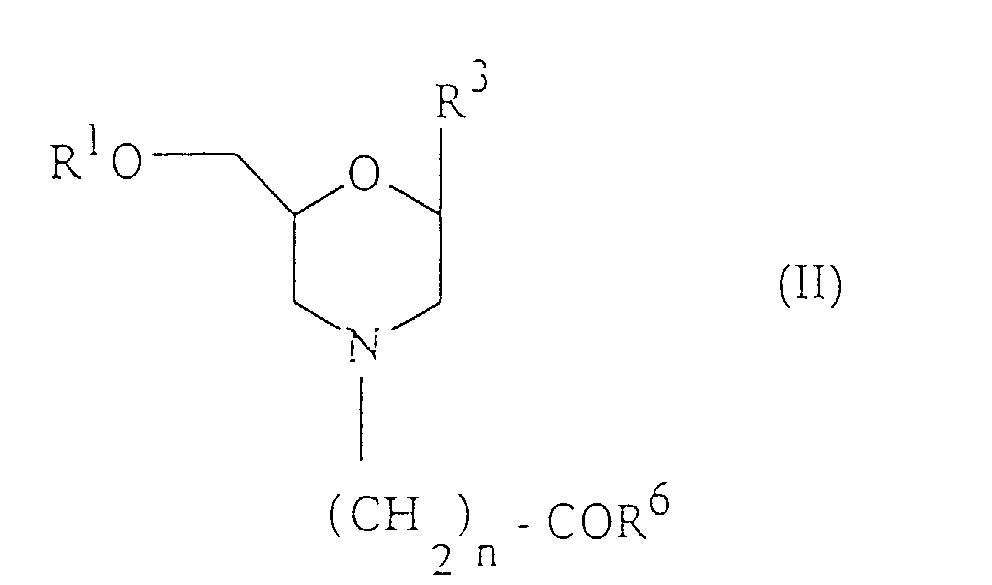
- the invention also relates to a process for the manufacture of nucleoside derivatives corresponding to the following chemical formula: in which n represents any positive integer, R 1 represents H or a linear mono, di or tri-phosphoric acid, R 6 represents a hydroxyl group, an alkyloxy group or an aryloxy group and R 3 represents a modified nucleic base chosen from uracil, thymine, cytosine, guanine or modified adenine, consisting in modifying a nucleoside derivative corresponding to the following chemical formula: in which n represents any positive integer, R 1 and R 6 have the same meaning as above and R 4 represents a nucleic base chosen from uracil, thymine, cytosine, guanine or adenine, by means of d 'a substitute agent.
- the method according to the invention does not intervene fragile ester bond between the nucleoside modified and protein.
- the conjugates obtained are therefore much more stable and can be stored in solution without being degraded, for a longer period.
- the starting material (III) has a morpholine instead of the deoxyriboside cycle. This product is stable. It is also carefully purified before to be used in the process. This avoids the presence of "parasites" or contaminants in the manufactured hapten.
- the starting product (III) has already undergone the transformation of the sugar cycle into a morpholinic cycle before the nucleic base is changed during of the method according to the invention. This allows to consider the preparation of antigens in which the bases nucleic acids are oxidized or reduced, which is a lot more difficult to obtain if the cycle summary morpholinic occurs after the modification of the nucleic base.
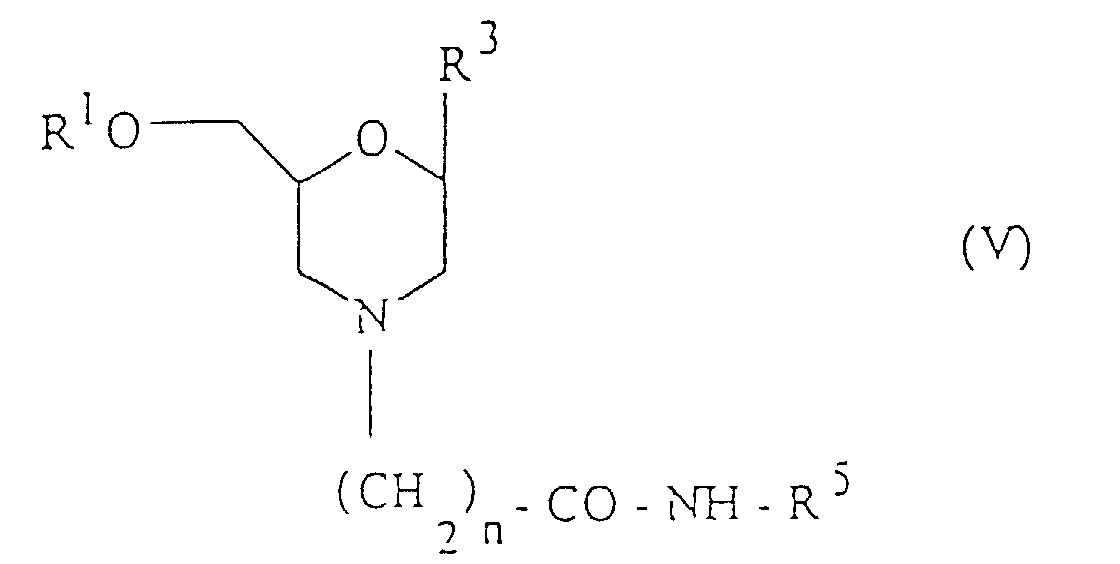
- the invention also relates to another process for the manufacture of nucleoside derivatives corresponding to the following chemical formula: in which n represents any positive integer, R 1 represents H or a linear mono, di or triphosphoric acid, R 3 represents a modified nucleic base chosen from uracil, thymine, cytosine, guanine or modified adenine and R 5 represents the remainder of a protein, an alkylpolystyrene or a silica grafted with an alkyl chain, this process consisting in reacting a compound of the NH 2 -R 5 type , in which R 5 has the same meaning as previously with a nucleoside derivative corresponding to the following chemical formula: in which n, R 1 and R 3 have the same meaning as above.
- the product (V) obtained is an antigen.
- the product (V) obtained is a solid support.
- the walls of the test tubes or the wells of the plates could be covered with this grafted silica, which could make it possible to bind the hapten to the support in a covalent manner.
- the Pharmacia Company markets an apparatus for dynamically studying the interactions between biological molecules (known as registered trademark BiaCore).
- BiaCore an apparatus for dynamically studying the interactions between biological molecules
- the principle is to fix a molecule on a solid support and to circulate a solution containing the other protagonist.
- the support solid obtained according to the invention can be used in this type of device.
- the invention also relates to polyclonal antibodies anti-nucleoside derivative, obtained by immunization of an appropriate mammal with the antigen corresponding to the following chemical formula: in which n represents any positive integer, R 1 represents H or a linear mono, di or triphosphoric acid, R 3 represents a modified nucleic base chosen from uracil, thymine, cytosine, guanine or modified adenine , and R 5 represents a protein not originating from said mammal.
- the invention relates to monoclonal antibodies anti-nucleoside derivatives obtained by fusing myeloma cells of a mammal with spleen cells of mice immunized with an antigen corresponding to the following chemical formula: in which n represents any positive integer, R 1 represents H or a linear mono, di or triphosphoric acid, R 3 represents a modified nucleic base chosen from uracil, thymine, cytosine, guanine or modified adenine , and R 5 represents a protein not originating from the mouse.
- a first process for the preparation of derivatives of nucleosides according to the invention consists in using a nucleotide or a nucleoside already modified by formation a morpholine, so that you can later bind for example with an amino group belonging to a protein.
- the starting product (III) (hereinafter referred to as "morpholinonucleoside”) has the following chemical formula: in which n represents any positive integer, R 1 represents H or linear mono, di or tri-phosphoric acid, R 6 represents a hydroxyl group, an alkyloxy group or an aryloxy group and R 4 represents a nucleic base chosen pari l ' uracil, thymine, cytosine, guanine or adenine.
- This product (III) can be obtained for example according to a process described in the article by R. Rayford et al., "Reductive alkylation with oxidized nucleotides", J. Biol. Chem., (1985), 260, 15708-15713 and illustrated below: R 4 having the same meaning as above.
- This process consists in reacting a nucleoside with sodium periodate, in order to open the bond between the 2 'carbon and the 3' carbon. A dialdehyde is thus obtained which is reacted with glycine to form a double Schiff base. This double base is reduced with NaCNBH 3 in order to lead to a "morpholinonucleoside".
- the nucleoside used in this article was adenosine. However, similarly, this treatment can be carried out with other purine or pyrimidine bases. Likewise, the nucleoside can be replaced by a nucleotide in which the phosphoric acid is in position 5.
- product III is an ester. It can be obtained by the process which has just been described by replacing the glycine glue with a glycinate, such as an ethyl or t-butyl glycinate, for example. In addition, these derivatives can be transformed into active esters to be condensed on an amine function.
- the starting product (III) of the process according to the invention can also be obtained by any another process.
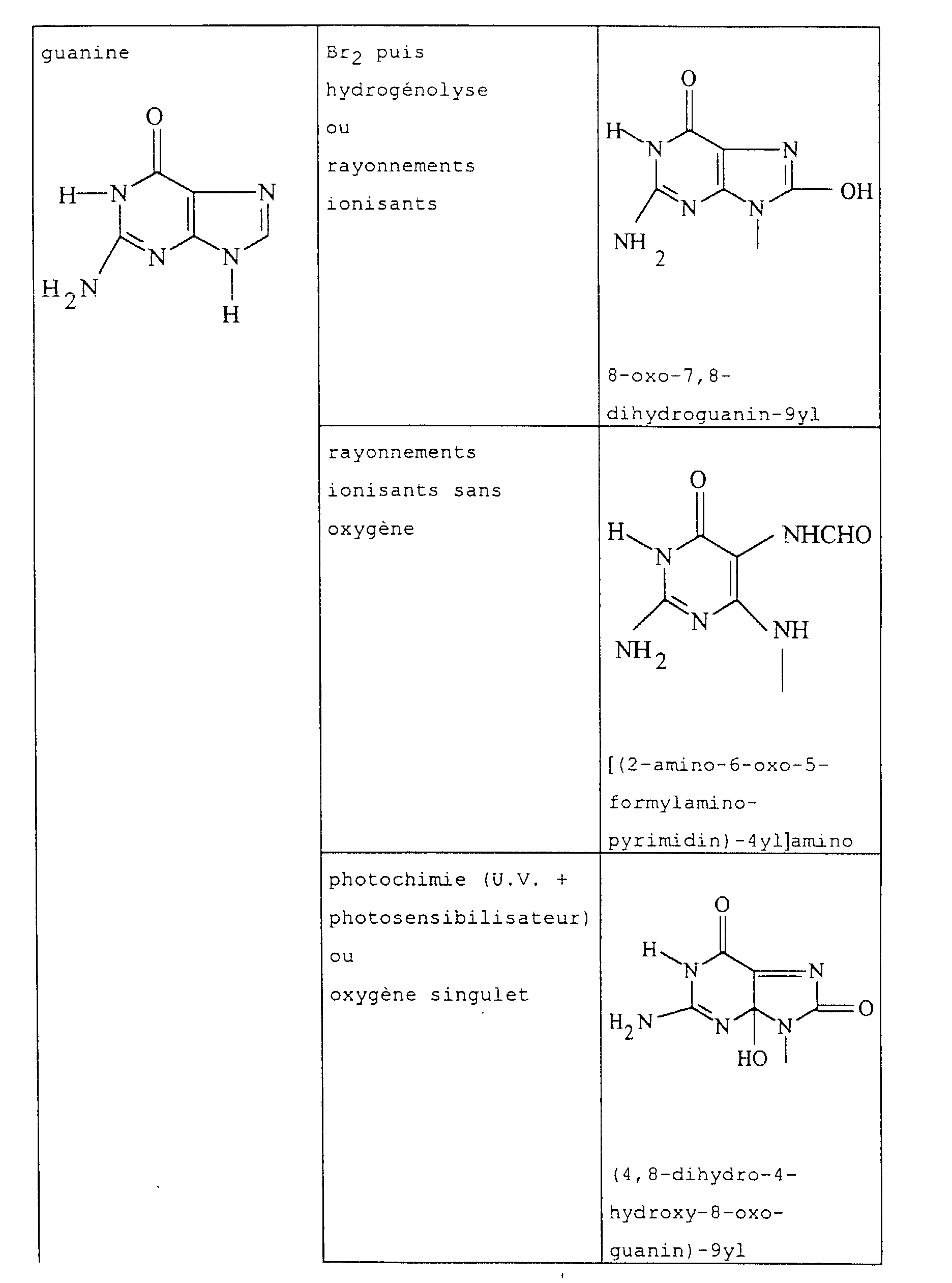
- the substituent agents making it possible to carry out the substitutions on the purine or pyrimidine bases are generally agents which cause oxidative modifications of these bases. These agents are chemical agents or physical treatment.
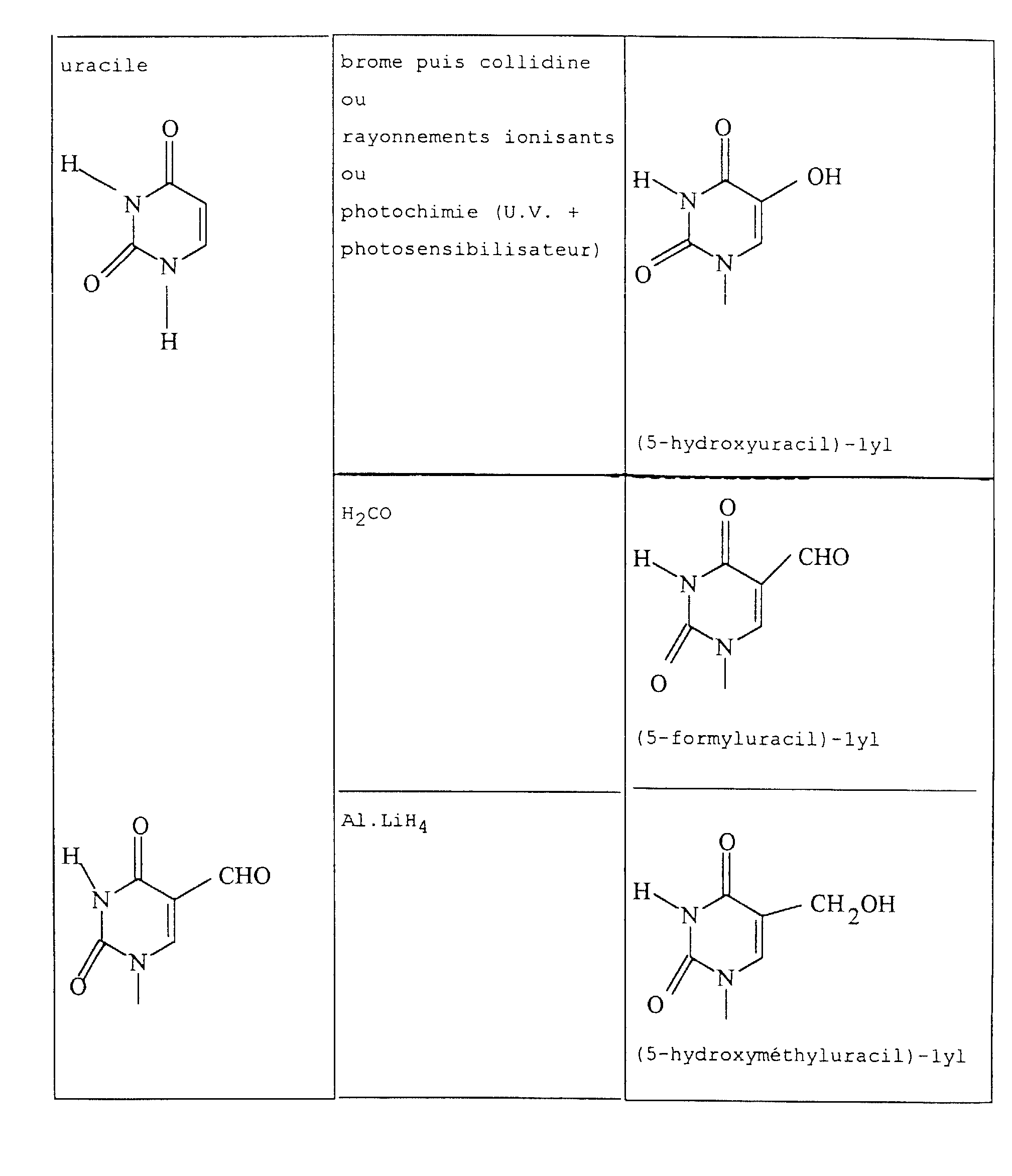
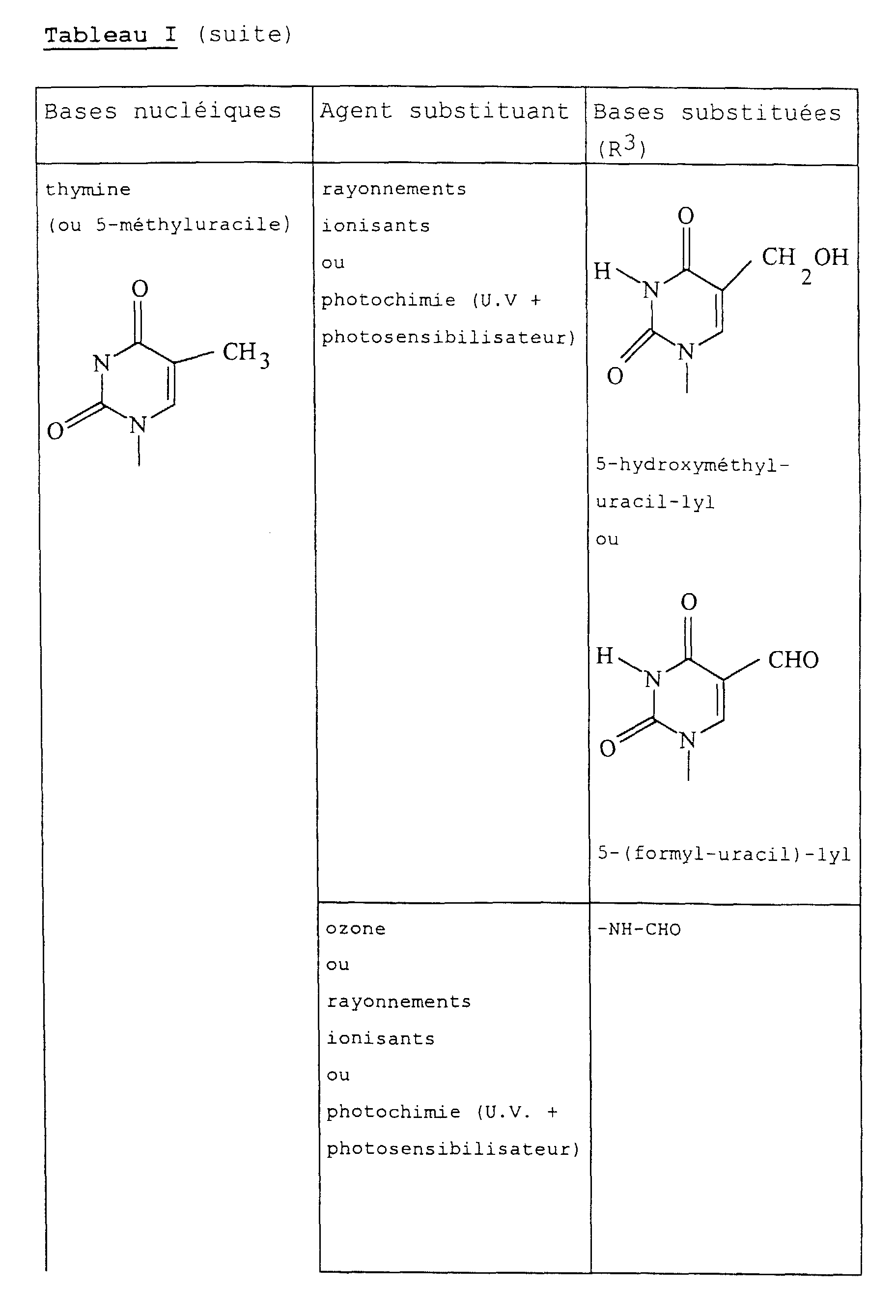
- the chemical agents are chosen, for example, from ozone, hydrogen peroxide, bromine combined with collidine, bromine and silver oxide, potassium permanganate, osmium tetraoxide, methanal or AlLiH 4 .
- the same result could be obtained by the action of ionizing radiation in the presence or absence of oxygen, by photochemistry (UV then photosensitizer), by catalytic hydrogenation or by treatment with bromine and water then hydrogenolysis.
- a summary table I will be given below of the substituent agents and of the substitutions which they entail on the different purine or pyrimidine bases.
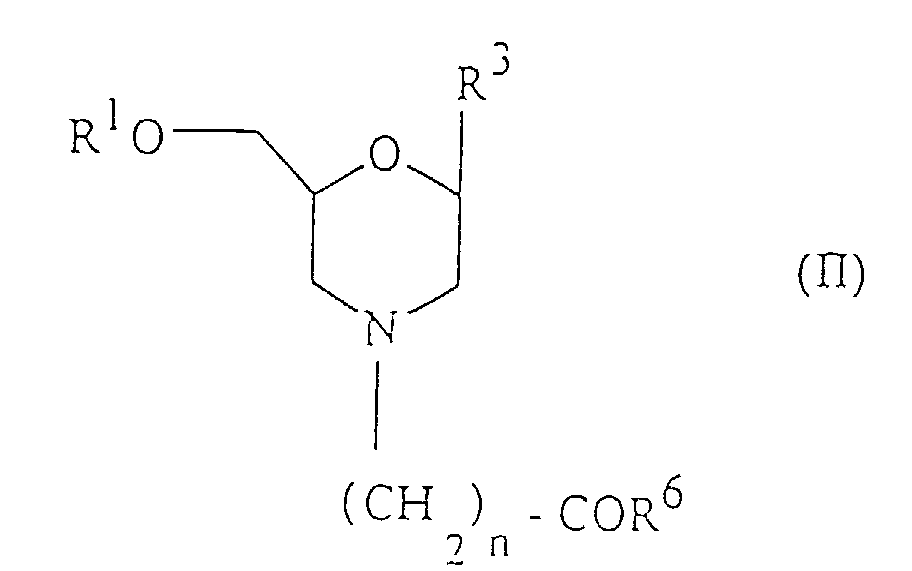
- hapten of the following chemical formula in which n represents any positive integer, R 1 represents H or a linear mono, di or triphosphoric acid, R 6 represents a hydroxyl group, an alkyloxy group or an aryloxy group and R 3 is a modified nucleic base chosen from cytosine , uracil, thymine, adenosine and modified guanine and preferably one of the modified or substituted bases of table I.
- product II represents a certain number of possible product variants (I).
- the residue obtained is analyzed by high pressure liquid chromatography (Nucleosil 10-C18 column from Macherey Nagel (registered trademark), dimensions 6 ⁇ 300 mm, mobile phase 50 mM triethylammonium acetate and methanol). Analysis shows the presence of a majority product (60%) different from the starting compound. NMR analysis of the product collected shows that it is indeed the expected compound. This product is characterized by a maximum absorption in the ultraviolet at 290.4 nm for a molecular extinction coefficient of 5700 mol.l -1 . cm -1 .
- the second method according to the invention consists in treating the hapten (VI) obtained at the end of the first method so as to form for example an antigen or a solid phase (film, gel) in which the hapten VI is attached support covalently.
- a hapten obtained at the end of the first method so as to form for example an antigen or a solid phase (film, gel) in which the hapten VI is attached support covalently.
- n, R 1 and R 3 have the same meaning as above and R 5 represents the remainder of a protein, an alkyl polystyrene or a silica grafted with an alkyl chain.
- the starting hapten (VI) is purified by high pressure liquid chromatography before being coupled to the NH 2 -R 5 radical.
- This radical R 5 can be a protein. This is chosen for example from methylated bovine serum albumin, turkey or chicken ovalbumin or hemocyanins and in particular KLH corresponding to the English term "keyhole limpet hemocianin", that is to say a protein seashell known as Bernese.
- An antigen is then obtained which can be used in the manufacture of antibodies.
- the protein will be chosen so as to be of a different nature from that of the animal used for the production of antibodies. The above proteins are well suited when it is desired to immunize a rabbit.
- the NH 2 -R 5 radical can also be an aminoalkylpolystyrene or a silica grafted with an alkylamine chain. A film or a gel is then obtained in which the hapten is covalently linked to the support.
- the product eluted first is collected, dialyzed against water and the solution obtained is then lyophilized.
- the charge of the product in hapten is then measured. This measurement is obtained by comparing the spectrum U.V. absorption of the original protein to that of the protein grafted onto the modified nucleoside. The comparison absorption at 270 and 300 nm allows determine that 7.8 moles of 2- (5-hydroxycytosin-1-yl) -4-carboxymethyl-6-hydroxymethylmorpholine are grafted per mole of protein.
- the invention relates to antibodies specific for antigens (V) obtained by the above method, in which R 5 represents the remainder of a protein.
- Polyclonal antibodies are obtained in a way completely conventional by injection into rabbits, like this will be detailed below. However, the antibody obtained is new since it is specific to the new previously prepared antigen.
- the immunization protocol was carried out from of two female rabbits of breed NZ "S.S.C.” kg which have been treated as described below.
- An emulsion was prepared by mixing 1 mg per liter of previously prepared hapten-protein conjugate in Example 2, with 1 ml of complete adjuvant Freund.
- Each female rabbit received 10 injections of 100 ⁇ l of the above emulsion, in the neck and on the back.
- the rabbits received a first reminder, practiced in identical conditions. After another interval of 4 weeks, they receive a new reminder. This is done by intramuscular injection, at hip level, 0.5 ml of an emulsion formed of 1 mg / ml hapten-protein conjugate and 1 ml of adjuvant incomplete from Freund.
- Monoclonal antibodies can be obtained in a conventional manner by fusing myeloma cells of a mammal such as a mouse with spleen cells originating, for example, from the BALB / c mouse line, these mice having been immunized with the antigen (V) consisting of the modified morpholino nucleoside linked to the carrier protein, (R 5 representing a protein). These antibodies are specific for the new antigens obtained by the process according to the invention.
- a suspension of the antigen of Example 2 above was emulsified in an identical volume Freund's complete adjuvant. This emulsion was injected intraperitoneally into mice females of the BALB / c line, aged 6 to 8 weeks, at a dose of 0.1 ml of emulsion. Three weeks later, a booster injection by the way intraperitoneal is performed with an emulsion of the antigen of Example 2 and incomplete adjuvant of Freund. Two weeks after this booster injection, the final immunization is carried out by an injection in the veins of the mouse tail, this injection including antigen that dissolved Example 2 in 0.15 M NaCl
- the spleens were removed from the mice and ground.
- the spleen cells were washed in modified Dulbecco medium containing no serum (DMEM).
- 10 8 spleen cells were mixed with 10 7 myeloma cells and then centrifuged at 500xg for 7 minutes at room temperature. The medium was removed and the centrifugation pellet was recovered to which 0.8 ml of 50% PEG 4000 (Merck) was added, over a period of 1 minute with gentle stirring at 37 ° C.
- Modified Dulbecco medium was then added, at a rate of 1 ml for 1 minute, then 20 ml for 5 minutes.
- the cells were centrifuged at 200 ⁇ g for 10 minutes and then the centrifugation pellet was resuspended in 15 ml of DMEM and 10% FBS (fetal bovine serum). 0.05 ml aliquots were dispensed into plates with culture wells coated with macrophages. Plates were incubated for 24 hours at 37 ° C before adding to the wells hypoxanthine (1.10 -4 M) amethopterin (4.10 -7 M) and thymidine (1.6.10 -5 M)) in DMEM (HAT medium). Seven days after the fusion, 0.025 ml of HAT medium was added to each well and the medium was then renewed every 3 to 4 days. The colonies were tested by the ELISA method for their activity against the antigen of Example 2. Only the cells corresponding to the positive wells were cloned.
Landscapes
- Chemical & Material Sciences (AREA)
- Organic Chemistry (AREA)
- Health & Medical Sciences (AREA)
- General Health & Medical Sciences (AREA)
- Biochemistry (AREA)
- Biophysics (AREA)
- Life Sciences & Earth Sciences (AREA)
- Genetics & Genomics (AREA)
- Medicinal Chemistry (AREA)
- Molecular Biology (AREA)
- Proteomics, Peptides & Aminoacids (AREA)
- Immunology (AREA)
- Saccharide Compounds (AREA)
- Peptides Or Proteins (AREA)
- Preparation Of Compounds By Using Micro-Organisms (AREA)
Abstract
Description




ce procédé consistant à faire réagir un composé du type NH2-R5, dans lequel R5 a la même signification que précédemment avec un dérivé de nucléoside répondant à la formule chimique suivante :






Claims (14)
- Dérivés de nucléosides caractérisés en ce qu'ils répondent à la formule chimique suivante :dans laquelle n est un nombre entier positif quelconque, R1 représente H ou un acide mono, di ou tri-phosphorique linéaire, R2 représente un groupe hydroxyle, un groupe alkyloxy, un groupe aryloxy, une protéine comprenant un site aminé libre, un aminoalkyl polystyrène ou une silice greffée avec une chaíne alkylamine et R3 représente une base nucléique modifiée choisie parmi l'uracile, la thymine, la cytosine, la guanine ou l'adénine modifiée.
- Dérivés de nucléosides selon la revendication 1, caractérisés en ce que R3 est choisi parmi la (5-hydroxycytosin)-1yl, la (5-hydroxyhydantoïne)-1yl, -NH-CO-NH-CO-NH2, le (5-hydroxyuracil)-1yl, le (5-formyluracil)-1yl, le (5-hydroxyméthyluracil)-1yl, -NH-CHO, la (5,6-dihydro-5,6-dihydroxythymin)-1yl, la (5,6-dihydrothymin)-1yl, la (5,6-dihydro-5-hydroxythymin)-1yl, l'adénine-N1-oxyde, la (8-oxo-7,8-dihydroadénine)-9yl, la [(6-amino-5-formylamino-pyrimidin)-4yl]amino, la (8-oxo-7,8-dihydroguanin)-9yl, la [(2-amino-6-oxo-5-formylamino-pyrimidin)-4yl]amino, la (4,8-dihydro-4-hydroxy-8-oxo-guanin)-9yl ou la [(2,2-diamino-oxazol-4one)-5yl]amino.
- Dérivés de nucléosides selon la revendication 1 ou 2, caractérisé en ce que R2 représente une protéine choisie parmi la sérumalbumine de bovin méthylée, l'ovalbumine de dinde ou de poulet ou les hémocyanines.
- Procédé de fabrication des dérivés de nucléosides répondant à la formule chimique suivante :dans laquelle n est un nombre entier positif quelconque, R1 représente H ou acide mono, di ou tri-phosphorique linéaire, R6 représente un groupe hydroxyle, un groupe alkyloxy ou un groupe aryloxy et R3 représente une base nucléique modifiée choisie parmi l'uracile, la thymine, la cytosine, la guanine ou l'adénine modifiée, consistant à modifier un dérivé de nucléoside répondant à la formule chimique suivante :
 dans laquelle n, R1 et R6 ont la même signification que précédemment et R4 représente une base choisie parmi l'uracile, la thymine, la cytosine, la guanine ou l'adénine, au moyen d'un agent substituant, dans lequel l'agent substituant est un agent chimique choisi parmi l'ozone, le peroxyde d'hydrogène, le brome combiné à la collidine, le brome et Ag2O, le permanganate de potassium, le tétraoxyde d'osmium, le méthanal ou AlLiH4.
- Procédé de fabrication des dérivés de nucléosides répondant à la formule chimique suivante :dans laquelle n est un nombre entier positif quelconque, R1 représente H ou un acide mono, di ou tri-phosphorique linéaire, R6 représente un groupe hydroxyle, un groupe alkyloxy ou un groupe aryloxy et R3 représente une base nucléique modifiée choisie parmi l'uracile, la thymine, la cytosine, la guanine ou l'adénine modifiée, consistant à modifier un dérivé de nucléoside répondant à la formule chimique suivante :
 dans laquelle n, R1 et R6 ont la même signification que précédemment et R4 représente une base choisie parmi l'uracile, la thymine, la cytosine, la guanine ou l'adénine, au moyen d'un agent substituant, dans lequel l'agent substituant est un traitement physique choisi parmi la photochimie, les rayonnements ionisants en présente ou en absence d'oxygène, l'hydrogénation catalytique ou le traitement par le brome et l'eau, puis l'hydrogénolyse.
- Procédé de fabrication selon la revendication 4 ou 5, caractérisé en ce que R3 est choisi parmi la (5-hydroxycytosin)-1yl, la (5-hydroxyhydantoïne)-1yl, -NH-CO-NH-CO-NH2, le (5-hydroxyuracil)-1yl, le (5-formyluracil)-1yl, le (5-hydroxyméthyluracil)-1yl, -NH-CHO, la (5,6-dihydro-5,6-dihydroxythymin)-1yl, la (5,6-dihydrothymin)-1yl, la (5,6-dihydro-5-hydroxythymin)-1yl, l'adénine-N1-oxyde, la (8--oxo-7,8-dihydroadénine)-9yl, la [(6-amino-5-formylaminopyrimidin)-4yl]amino, la (8-oxo-7,8-dihydroguanin)-9yl, la [(2-amino-6-oxo-5-formylamino-pyrimidin)-4yl]amino, la (4,8-dihydro-4-hydroxy-8-oxo-guanin)-9yl ou la [(2,2-diamino-oxazol-4one)-5yl]amino.
- Procédé de fabrication d'un dérivé de nucléoside répondant à la formule chimique suivante :dans laquelle n est un nombre entier positif quelconque, R1 représente H ou un acide mono, di ou triphosphorique linéaire, R5 représente le reste d'une protéine, un alkyl polystyrène ou une silice greffée avec une chaíne alkyle et R3 représente une base nucléique modifiée choisie parmi l'uracile, la thymine, la cytosine, la guanine ou l'adénine modifiée,
ce procédé consistant à faire réagir un composé du type NH2-R5, dans lequel R5 a la même signification que précédemment, avec un dérivé de nucléoside répondant à la formule chimique suivante :dans laquelle n, R1 et R3 ont la même signification que précédemment.
- Procédé de fabrication selon la revendication 7, caractérisé en ce que R3 est choisi parmi la (5-hydroxycytosin)-1yl, la (5-hydroxyhydantoïne)-1yl, -NH-CO-NH-CO-NH2, le (5-hydroxyuracil)-1yl, le (5-formyluracil)-1yl, le (5-hydroxyméthyluracil)-1yl, -NH-CHO, la (5,6-dihydro-5,6-dihydroxythymin)-1yl, la (5,6-dihydrothymin)-1yl, la (5,6-dihydro-5-hydroxythymin)-1yl, l'adénine-N1-oxyde, la (8--oxo-7,8-dihydroadénine)-9yl, la [(6-amino-5-formylaminopyrimidin)-4yl]amino, la (8-oxo-7,8-dihydroguanin)-9yl, la [(2-amino-6-oxo-5-formylamino-pyrimidin)-4yl]amino, la (4,8-dihydro-4-hydroxy-8-oxo-guanin)-9yl ou la [(2,2-diamino-oxazol-4one)-5yl]amino.
- Anticorps polyclonaux anti-dérivé de nucléoside, caractérisés en ce qu'ils sont obtenus par immunisation d'un mammifère approprié avec l'antigène répondant à la formule chimique suivante :dans laquelle n est un nombre entier positif quelconque, R1 représente H ou un acide mono, di ou triphosphorique linéaire, R3 représente une base nucléique modifiée choisie parmi l'uracile, la thymine, la cytosine, la guanine ou l'adénine modifiée, et R5 représente une protéine ne provenant pas dudit mammifère.

- Anticorps polyclonaux selon la revendication 9, caractérisés en ce que R5 représente une protéine choisie parmi la sérumalbumine de bovin méthylée, l'ovalbumine de dinde ou de poulet ou les hémotcyanine.
- Anticorps polyclonaux selon la revendication 9, caractérisés en ce que R3 est choisi parmi la (5-hydroxycytosin)-1yl, la (5-hydroxyhydantoïne)-1yl, -NH-CO-NH-CO-NH2, le (5-hydroxyuracil)-1yl, le (5-formyluracil)-1yl, le (5-hydroxyméthyluracil)-1yl, -NH-CHO, la (5,6-dihydro-5,6-dihydroxythymin)-1yl, la (5,6-dihydrothymin)-1yl, la (5,6-dihydro-5-hydroxythymin)-1yl, l'adénine-N1-oxyde, la (8--oxo-7,8-dihydroadénine)-9yl, la [(6-amino-5-formylaminopyrimidin)-4yl]amino, la (8-oxo-7,8-dihydroguanin)-9yl, la [(2-amino-6-oxo-5-formylamino-pyrimidin)-4yl]amino, la (4,8-dihydro-4-hydroxy-8-oxo-guanin)-9yl ou la [(2,2-diamino-oxazol-4one)-5yl]amino.
- Anticorps monoclonaux anti-dérivés de nucléosides, caractérisés en ce qu'ils sont obtenus en faisant fusionner des cellules de myélome d'un mammifère avec des cellules spléniques de souris immunisées par un antigène répondant à la formule chimique suivante :dans laquelle n représente un nombre entier positif quelconque, R1 représente H ou un acide mono, di ou triphosphorique linéaire, R3 représente une base nucléique modifiée choisie parmi l'uracile, la thymine, la cytosine, la guanine ou l'adénine modifiée, et R5 représente une protéine ne provenant pas de la souris.

- Anticorps monoclonaux selon la revendication 12, caractérisés en ce que R5 représente une protéine choisie parmi la sérumalbumine de bovin méthylée, l'ovalbumine de dinde ou de poulet ou les hémocyanines.
- Anticorps monoclonaux selon la revendication 12, caractérisés en ce que R3 est choisi parmi la (5-hydroxycytosin)-1yl, la (5-hydroxyhydantoïne)-1yl, -NH-CO-NH-CO-NH2, le (5-hydroxyuracil)-1yl, le (5-formyluracil)-1yl, le (5-hydroxyméthyluracil)-1yl, -NH-CHO, la (5,6-dihydro-5,6-dihydroxythymin)-1yl, la (5,6-dihydrothymin)-1yl, la (5,6-dihydro-5-hydroxythymin)-1yl, l'adénine-N1-oxyde, la (8-oxo-7,8-dihydroadénine)-9yl, la [(6-amino-5-formylamino-pyrimidin)-4yl]amino, la (8-oxo-7,8-dihydroguanin)-9yl, la [(2-amino-6-oxo-5-formylamino-pyrimidin)-4yl]amino, la (4,8-dihydro-4-hydroxy-8-oxo-guanin)-9yl ou la [(2,2-diamino-oxazol-4one)-5yl]amino.
Applications Claiming Priority (3)
| Application Number | Priority Date | Filing Date | Title |
|---|---|---|---|
| FR9310864 | 1993-09-13 | ||
| FR9310864A FR2710068B1 (fr) | 1993-09-13 | 1993-09-13 | Dérivés de nucléosides, procédés de fabrication de ces dérivés de nucléosides et anticorps polyclonaux et monoclonaux spécifiques de ces dérivés. |
| PCT/FR1994/001070 WO1995007907A1 (fr) | 1993-09-13 | 1994-09-12 | Derives de nucleosides, procedes de fabrication de ces derives de nucleosides et anticorps polyclonaux et monoclonaux specifiques de ces derives |
Publications (2)
| Publication Number | Publication Date |
|---|---|
| EP0719265A1 EP0719265A1 (fr) | 1996-07-03 |
| EP0719265B1 true EP0719265B1 (fr) | 1998-12-02 |
Family
ID=9450792
Family Applications (1)
| Application Number | Title | Priority Date | Filing Date |
|---|---|---|---|
| EP94926977A Expired - Lifetime EP0719265B1 (fr) | 1993-09-13 | 1994-09-12 | Derives de nucleosides, procedes de fabrication de ces derives de nucleosides et anticorps polyclonaux et monoclonaux specifiques de ces derives |
Country Status (6)
| Country | Link |
|---|---|
| US (1) | US5721341A (fr) |
| EP (1) | EP0719265B1 (fr) |
| JP (1) | JP3854632B2 (fr) |
| DE (1) | DE69415030T2 (fr) |
| FR (1) | FR2710068B1 (fr) |
| WO (1) | WO1995007907A1 (fr) |
Families Citing this family (3)
| Publication number | Priority date | Publication date | Assignee | Title |
|---|---|---|---|---|
| US6187551B1 (en) * | 1995-09-19 | 2001-02-13 | Cytochem, Inc. | Detection and quantitation of 8-OH-Adenine using monoclonal antibodies |
| FR2790005B1 (fr) | 1999-02-22 | 2004-01-30 | Commissariat Energie Atomique | Procede de fabrication de morpholino-nucleotides, et utilisation de ceux-ci pour l'analyse et le marquage de sequences d'acides nucleiques |
| FR2790004B1 (fr) * | 1999-02-22 | 2002-11-29 | Commissariat Energie Atomique | Procede de fabrication de morpholino-nucleotides, et utilisation de ceux-ci pour l'analyse et le marquage de sequences d'acides nucleiques |
Family Cites Families (4)
| Publication number | Priority date | Publication date | Assignee | Title |
|---|---|---|---|---|
| US4515781A (en) * | 1983-02-23 | 1985-05-07 | The United States Of America As Represented By The Secretary Of The Department Of Health And Human Services | 2',5'-Riboadenylate-morpholinoadenylate nucleotides |
| WO1991018898A1 (fr) * | 1990-06-01 | 1991-12-12 | Nippon Shinyaku Co., Ltd. | Homologue d'acide nucleique |
| EP0549686A4 (en) * | 1990-09-20 | 1995-01-18 | Gilead Sciences Inc | Modified internucleoside linkages |
| US5382580A (en) * | 1994-05-27 | 1995-01-17 | The Scripps Research Institute | N9 morpholino derivatives of 7,8-disubstituted guanines |
-
1993
- 1993-09-13 FR FR9310864A patent/FR2710068B1/fr not_active Expired - Fee Related
-
1994
- 1994-09-12 EP EP94926977A patent/EP0719265B1/fr not_active Expired - Lifetime
- 1994-09-12 DE DE69415030T patent/DE69415030T2/de not_active Expired - Fee Related
- 1994-09-12 WO PCT/FR1994/001070 patent/WO1995007907A1/fr not_active Ceased
- 1994-09-12 JP JP50902195A patent/JP3854632B2/ja not_active Expired - Fee Related
- 1994-09-12 US US08/605,134 patent/US5721341A/en not_active Expired - Lifetime
Also Published As
| Publication number | Publication date |
|---|---|
| FR2710068B1 (fr) | 1995-10-20 |
| FR2710068A1 (fr) | 1995-03-24 |
| DE69415030T2 (de) | 1999-06-10 |
| US5721341A (en) | 1998-02-24 |
| JPH09506858A (ja) | 1997-07-08 |
| DE69415030D1 (de) | 1999-01-14 |
| EP0719265A1 (fr) | 1996-07-03 |
| JP3854632B2 (ja) | 2006-12-06 |
| WO1995007907A1 (fr) | 1995-03-23 |
Similar Documents
| Publication | Publication Date | Title |
|---|---|---|
| RU2132853C1 (ru) | Способ идентификации продуктов из смеси, продукт, полученный при идентификации, способ получения смеси и способ совместного получения катализирующей нуклеиновой кислоты и продукта | |
| BE1018792A5 (fr) | Procede de production d'un hybridome et d'un anticorps monoclonal capable de reconnaitre des metabolites de la vitamine d. | |
| EP3581195B1 (fr) | Anticorps dirigés contre des haptènes d'olanzapine et leur utilisation | |
| CN104854110B (zh) | 奥氮平半抗原 | |
| CN115066263A (zh) | 定向缀合技术 | |
| CN104755479A (zh) | 利培酮和帕潘立酮的半抗原 | |
| EP0176396B1 (fr) | Sondes comportant des groupements adénine modifiée, leur préparation et leurs utilisations | |
| Chen et al. | Preparation of stilbene-tethered nonnatural nucleosides for use with blue-fluorescent antibodies | |
| WO1989008115A1 (fr) | NOUVEAUX DERIVES DE LA DEOXY-2'-URIDINE SUBSTITUEE EN POSITION 5, 3' ou 5' PAR DES GROUPEMENTS alpha-AMINO ACYLES, PROCEDE POUR LEUR OBTENTION ET MEDICAMENTS LES CONTENANT | |
| EP0719265A1 (fr) | Derives de nucleosides, procedes de fabrication de ces derives de nucleosides et anticorps polyclonaux et monoclonaux specifiques de ces derives | |
| EP0174879A1 (fr) | Polynucléotides liés de façon covalente à un support solide, et procédé pour leur obtention | |
| FR2466252A2 (fr) | Nouveaux produits ayant notamment des proprietes anticancereuses a base de chaine a de la ricine et d'une proteine | |
| US9549991B2 (en) | Chemical and biochemical adducts as biomarkers for organophosphate exposure | |
| EP1495325B1 (fr) | Utilisation de derives de nucleosides comportant un groupement citrate pour la production d'anticorps ayant une affinite pour des nucleosides tri-phosphoryles | |
| Standring et al. | Photoaffinity labeling of lactate dehydrogenase by the carbene derived from the 3-diazirino analog of nicotinamide adenine dinucleotide | |
| Girault et al. | Use of morpholinonucleosides to conjugate oxidized DNA bases to proteins | |
| JPH0379995B2 (fr) | ||
| EP0988288A1 (fr) | Derives chimioluminescents heterocycliques | |
| JPH0421479B2 (fr) | ||
| US5210077A (en) | Antibodies to cytokinins having a glycosylated isoprenoid side chain and immunoassay methods | |
| EP0192565A1 (fr) | Procédé de dosage immunologique des amines, anticorps monoclonaux et ensemble de réactifs pour la mise en oeuvre du procédé | |
| JPH0379994B2 (fr) | ||
| McPhillips | Class-specific monoclonal antibodies for the detection of O6-alkyl-2'-deoxyguanosines | |
| JPH0376423B2 (fr) | ||
| EP0177382A1 (fr) | Sonde mixte et ses applications, son précurseur, leur préparation et dérivés comportant une base modifiée pour cette préparation |
Legal Events
| Date | Code | Title | Description |
|---|---|---|---|
| PUAI | Public reference made under article 153(3) epc to a published international application that has entered the european phase |
Free format text: ORIGINAL CODE: 0009012 |
|
| 17P | Request for examination filed |
Effective date: 19960213 |
|
| AK | Designated contracting states |
Kind code of ref document: A1 Designated state(s): CH DE GB IT LI NL |
|
| 17Q | First examination report despatched |
Effective date: 19970808 |
|
| GRAG | Despatch of communication of intention to grant |
Free format text: ORIGINAL CODE: EPIDOS AGRA |
|
| GRAG | Despatch of communication of intention to grant |
Free format text: ORIGINAL CODE: EPIDOS AGRA |
|
| GRAH | Despatch of communication of intention to grant a patent |
Free format text: ORIGINAL CODE: EPIDOS IGRA |
|
| GRAH | Despatch of communication of intention to grant a patent |
Free format text: ORIGINAL CODE: EPIDOS IGRA |
|
| GRAA | (expected) grant |
Free format text: ORIGINAL CODE: 0009210 |
|
| AK | Designated contracting states |
Kind code of ref document: B1 Designated state(s): CH DE GB IT LI NL |
|
| REG | Reference to a national code |
Ref country code: CH Ref legal event code: EP |
|
| REF | Corresponds to: |
Ref document number: 69415030 Country of ref document: DE Date of ref document: 19990114 |
|
| ITF | It: translation for a ep patent filed | ||
| GBT | Gb: translation of ep patent filed (gb section 77(6)(a)/1977) |
Effective date: 19990205 |
|
| PLBE | No opposition filed within time limit |
Free format text: ORIGINAL CODE: 0009261 |
|
| STAA | Information on the status of an ep patent application or granted ep patent |
Free format text: STATUS: NO OPPOSITION FILED WITHIN TIME LIMIT |
|
| 26N | No opposition filed | ||
| REG | Reference to a national code |
Ref country code: GB Ref legal event code: IF02 |
|
| PGFP | Annual fee paid to national office [announced via postgrant information from national office to epo] |
Ref country code: CH Payment date: 20080925 Year of fee payment: 15 |
|
| PGFP | Annual fee paid to national office [announced via postgrant information from national office to epo] |
Ref country code: NL Payment date: 20080903 Year of fee payment: 15 Ref country code: IT Payment date: 20080926 Year of fee payment: 15 |
|
| PGFP | Annual fee paid to national office [announced via postgrant information from national office to epo] |
Ref country code: GB Payment date: 20080917 Year of fee payment: 15 |
|
| PGFP | Annual fee paid to national office [announced via postgrant information from national office to epo] |
Ref country code: DE Payment date: 20080926 Year of fee payment: 15 |
|
| REG | Reference to a national code |
Ref country code: NL Ref legal event code: V1 Effective date: 20100401 |
|
| REG | Reference to a national code |
Ref country code: CH Ref legal event code: PL |
|
| GBPC | Gb: european patent ceased through non-payment of renewal fee |
Effective date: 20090912 |
|
| PG25 | Lapsed in a contracting state [announced via postgrant information from national office to epo] |
Ref country code: NL Free format text: LAPSE BECAUSE OF NON-PAYMENT OF DUE FEES Effective date: 20100401 Ref country code: DE Free format text: LAPSE BECAUSE OF NON-PAYMENT OF DUE FEES Effective date: 20100401 |
|
| PG25 | Lapsed in a contracting state [announced via postgrant information from national office to epo] |
Ref country code: LI Free format text: LAPSE BECAUSE OF NON-PAYMENT OF DUE FEES Effective date: 20090930 Ref country code: CH Free format text: LAPSE BECAUSE OF NON-PAYMENT OF DUE FEES Effective date: 20090930 |
|
| PG25 | Lapsed in a contracting state [announced via postgrant information from national office to epo] |
Ref country code: GB Free format text: LAPSE BECAUSE OF NON-PAYMENT OF DUE FEES Effective date: 20090912 |
|
| PG25 | Lapsed in a contracting state [announced via postgrant information from national office to epo] |
Ref country code: IT Free format text: LAPSE BECAUSE OF NON-PAYMENT OF DUE FEES Effective date: 20090912 |