EP0702564B1 - Novel attenuated pseudomonas aeruginosa strains - Google Patents
Novel attenuated pseudomonas aeruginosa strains Download PDFInfo
- Publication number
- EP0702564B1 EP0702564B1 EP94917176A EP94917176A EP0702564B1 EP 0702564 B1 EP0702564 B1 EP 0702564B1 EP 94917176 A EP94917176 A EP 94917176A EP 94917176 A EP94917176 A EP 94917176A EP 0702564 B1 EP0702564 B1 EP 0702564B1
- Authority
- EP
- European Patent Office
- Prior art keywords
- pseudomonas aeruginosa
- cfcpa
- kccm
- strain
- accession number
- Prior art date
- Legal status (The legal status is an assumption and is not a legal conclusion. Google has not performed a legal analysis and makes no representation as to the accuracy of the status listed.)
- Expired - Lifetime
Links
Images


Classifications
-
- C—CHEMISTRY; METALLURGY
- C07—ORGANIC CHEMISTRY
- C07K—PEPTIDES
- C07K14/00—Peptides having more than 20 amino acids; Gastrins; Somatostatins; Melanotropins; Derivatives thereof
- C07K14/195—Peptides having more than 20 amino acids; Gastrins; Somatostatins; Melanotropins; Derivatives thereof from bacteria
- C07K14/21—Peptides having more than 20 amino acids; Gastrins; Somatostatins; Melanotropins; Derivatives thereof from bacteria from Pseudomonadaceae (F)
-
- A—HUMAN NECESSITIES
- A61—MEDICAL OR VETERINARY SCIENCE; HYGIENE
- A61K—PREPARATIONS FOR MEDICAL, DENTAL OR TOILETRY PURPOSES
- A61K39/00—Medicinal preparations containing antigens or antibodies
- A61K39/02—Bacterial antigens
- A61K39/104—Pseudomonadales, e.g. Pseudomonas
-
- A—HUMAN NECESSITIES
- A61—MEDICAL OR VETERINARY SCIENCE; HYGIENE
- A61P—SPECIFIC THERAPEUTIC ACTIVITY OF CHEMICAL COMPOUNDS OR MEDICINAL PREPARATIONS
- A61P31/00—Antiinfectives, i.e. antibiotics, antiseptics, chemotherapeutics
- A61P31/04—Antibacterial agents
-
- C—CHEMISTRY; METALLURGY
- C07—ORGANIC CHEMISTRY
- C07K—PEPTIDES
- C07K16/00—Immunoglobulins [IG], e.g. monoclonal or polyclonal antibodies
- C07K16/12—Immunoglobulins [IG], e.g. monoclonal or polyclonal antibodies against material from bacteria
- C07K16/1203—Gram-negative bacteria
- C07K16/1214—Pseudomonadaceae (F)
-
- A—HUMAN NECESSITIES
- A61—MEDICAL OR VETERINARY SCIENCE; HYGIENE
- A61K—PREPARATIONS FOR MEDICAL, DENTAL OR TOILETRY PURPOSES
- A61K39/00—Medicinal preparations containing antigens or antibodies
Definitions
- the present invention relates to novel attenuated Pseudomonas aeruginosa strains, a prophylactic vaccine and a therapeutic agent for a Pseudomonas aeruginosa infection, and a method for preparation thereof.
- the present invention relates to novel attenuated Pseudomonas aeruginosa strains which are obtained by isolating Pseudomonas aeruginosa in a pure state according to Fisher-Devlin immunotype and then repeatedly purifying the isolated strain by sequential passes through mice, a prophylactic vaccine prepared from, and therapeutic immunoglobulins induced by cell wall proteins separated from the attenuated Pseudomonas aeruginosa strain, and a method for preparation thereof.
- Pseudomonas aeruginosa is a motile gram-negative rod, approximately 0.5 um x 1.5-3.0 um, having a single flagellum and occurs widely in soil, water, sewage and human intestine (Mol. Microbiol. 4, 1069-1075, 1990). Pseudomonas aeruginosa is a pathogenic strain causative of inveterate infections such as septicemia, generalized infection, chronic respiratory tract infection, cystic fibrosis of the pancreas, etc.
- the septicemia caused by Pseudomonas aeruginosa is a disease resulting from either the invasion of the microorganism itself or the secretion of its toxic constituents into the blood of patients who have lowered resistance due to surgery, laceration, trauma and the like.
- the presence of the toxin causes shock with high fever, reduced blood pressure, and other symptoms, which ultimately may lead to death.
- Pseudomonas aeruginosa since Pseudomonas aeruginosa has been detected in urinary tract infections, interest in Pseudomonas aeruginosa has greatly increased.
- Pseudomonas aeruginosa strains can be classified in various ways.
- One such classification system classifies the strains into seven (7) types according to Fisher immunotype.
- Another system is based on the O-antigen group as proposed by Terada.
- Still another system is the International Antigenic Typing Scheme (IATS) classification system.
- IATS International Antigenic Typing Scheme
- the Pseudomonas aeruginosa strains most frequently occurring in Pseudomonas aeruginosa-infected patients are: 5/2a, 2c, 3, 7/3a, 3c, 1/4a, 4b, 6/5a, 5b, 4/6, 2/7a, 7b, 7c, /10a, /13, /12, /11 and 3,7/3d, 3e types according to Fisher immunotype/O-serotype, with 3, 7, 2 and 1 types as Fisher immunotype (corresponding to 3a, 3c, 3d, 3e, 7a, 7b, 7c, 4a and 4b as O-serotype) being mainly present.
- the antitoxin is a therapeutic agent, which is only beneficial in patients already suffering from septicemia, and has no prophylactic effect. Further, the antitoxin as presently available is very expensive and its use is limited. In addition, the most significant disadvantage accompanying the use of the antitoxin is the relatively low cure rate and the accompanying severe side effects.
- One method under study to avoid the disadvantages associated with the antitoxin uses a common antigen for the prevention and treatment of Pseudomonas aeruginosa infections.
- Methods under study for obtaining the common antigen can be generally classified into two groups.
- the first method relates to the use of a common antigen separated and purified from Pseudomonas aeruginosa strains having different immunotypes as a prophylactic vaccine antigen against Pseudomonas aeruginosa infections [Japan, J. Exp. Med. 45, 355-359, 1975].
- the second method relates to the use of common antigen mass produced by utilizing a genetic engineering technique in which a gene coding for the desired antigen is isolated and inserted into a suitable vector to obtain a recombinant vector and then the suitable host is transformed with the resulting recombinant vector and incubated to express the desired antigen.
- Another method for treating Pseudomonas aeruginosa infection is the administration of antibiotics or chemo-therapeutic agents having broad-spectrum selectivity for the Pseudomonas aeruginosa strain.
- antibiotics or chemo-therapeutic agents having broad-spectrum selectivity for the Pseudomonas aeruginosa strain.
- chemo-therapeutic agents having broad-spectrum selectivity for the Pseudomonas aeruginosa strain.
- this method has a disadvantage that since all infections are caused by different Pseudomonas aeruginosa strains with different serological and immunological types, they all cannot be treated with only one kind of monoclonal antibody. That is, monoclonal antibody therapy cannot be effectively utilized to treat all the Pseudomonas aeruginosa infected patients.
- LPS lipopolysaccharides
- the present inventors have extensively conducted research to find a means capable of effectively inducing antibodies against Pseudomonas aeruginosa and which manifests good immunogenic (i.e. antigenic) activity with extremely remote risk due to inherent toxicities of Pseudomonas aeruginosa strains themselves.
- the present inventors confirmed that when Pseudomonas aeruginosa strains isolated from Pseudomonas aeruginosa infected patients are classified into seven (7) species based on their immunotypes and then each pure strain is attenuated by passing the organism several times through a suitable animal host novel, safe and attenuated Pseudomonas aeruginosa strains can be obtained.
- These strains have cell wall proteins not only which are useful in preparing a vaccine for prophylaxis against Pseudomonas aeruginosa infections but also which can be used as an antibody inducer to produce immunoglobulins for Pseudomonas aeruginosa infection in the animal body.
- the resulting immunoglobulins exhibit superior therapeutic effect on various Pseudomonas aeruginosa infections, including severe cases, according to the present invention.
- One embodiment of the present invention relates to novel, safe and effective attenuated Pseudomonas aeruginosa strains having cell wall proteins which manifest antigenicity without the toxicity of the Pseudomonas aeruginosa strain itself.
- the present invention relates to safe attenuated Pseudomonas aeruginosa strains which are obtained by isolating Pseudomonas aeruginosa strains from patients infected with Pseudomonas aeruginosa, classifying the isolated microorganism strains into seven (7) types of species according to the Fisher-Devlin Immunotype, selecting a single representative strain for each immunotype, purifying the selected strain via repeat injection/isolation/re-injection steps into experimental animals and selecting the most attenuated strain, for each of seven (7) types of Pseudomonas aeruginosa strains.
- a further embodiment of the present invention is directed to a novel vaccine and the process for the preparation of the vaccine for prophylaxis against Pseudomonas aeruginosa infection.
- the vaccine is prepared by separating cell wall proteins in a substantially pure state from each of seven (7) types of safe attenuated Pseudomonas aeruginosa strains as described below and further purifying the separated cell wall proteins and then, preferably, combining the purified cell wall proteins derived from at least 3 types of attenuated Pseudomonas aeruginosa strains.
- Preferably equivalent amounts of cell wall proteins from each of the 3 types are used in preparing the vaccine according to the present invention.
- Another embodiment of the present invention is a therapeutic agent for Pseudomonas aeruginosa infection, which contains at least one immunoglobulin produced by cultivating at least one safe attenuated Pseudomonas aeruginosa strain, separating the cell wall protein, purifying the separated cell wall protein and then injecting the pure cell wall protein as an antibody inducer into experimental animals to induce the immunoglobulin, and a method for preparing the therapeutic agent.
- Pseudomonas aeruginosa strains having Fisher immunotypes 1 to 7 are selected as strains for attenuation, on the basis of the fact that they are detected in the blood of the major portion, i.e. 90 to 95% or more, of Pseudomonas aeruginosa infected patients.
- Pseudomonas aeruginosa type 1 and type 3 are the most frequently detected strains in Pseudomonas aeruginosa infected patients.
- the teaching of the present invention may be used against any of the strains of Pseudomonas aeruginosa to provide protection or treatment.
- Safe attenuated Pseudomonas aeruginosa strains according to the present invention can be obtained by isolating each of seven types of Pseudomonas aeruginosa strains in a pure state from the blood of patients who are determined as having Pseudomonas aeruginosa infection and then attenuating the isolated strains with repeated purifying procedures.
- the safe attenuated Pseudomonas aeruginosa strains thus obtained are all seven (7) types and designated CFCPA 10142 (Fisher type 1), CFCPA 20215 (Fisher type 2), CFCPA 30720 (Fisher type 3), CFCPA 40057 (Fisher type 4), CFCPA 50243 (Fisher type 5), CFCPA 60534 (Fisher type 6) and CFCPA 70018 (Fisher type 7), respectively.
- CFCPA is an acronym of "Cheil Food and Chemical Pseudomonas aeruginosa", which is composed of Cheil Food and Chemicals Inc., in which the inventors of the present invention are employed, and the name of the subject strain, Pseudomonas aeruginosa.
- the attenuated Pseudomonas aeruginosa strains obtained by repeated purifying procedures as described above have phenotypes and microbiological properties substantially identical to those of the corresponding parent strains but show new properties useful in the preparation of a vaccine antigen for prophylaxis against Pseudomonas aeruginosa infection rather than any pathogenicity which is present in the parent strains prior to attenuation. Accordingly, the attenuated Pseudomonas aeruginosa strains according to the present invention are regarded as novel microorganism strains.
- KCCM Korean Culture Center of Microorganisms in the Korean Federation of Culture Collections, hereafter KCCM, as an international depository authority under Budapest Treaty on May 12, 1993 under accession numbers of KCCM 10029 for CFCPA 10142, KCCM 10030 for CFCPA 20215, KCCM 10031 for CFCPA 30720, KCCM 10032 for CFCPA 40057, KCCM 10033 for CFCPA 50243, KCCM 10034 for CFCPA 60534 and KCCM 10035 for CFCPA 70018.
- the purifying procedures for producing the attenuated Pseudomonas aeruginosa strains are repeatedly carried out generally until the strains show the desired LD 50 values.
- the purification step is preferably carried out 3 to 7 times, e.g. until the LD 50 of the Pseudomonas aeruginosa is at least 2 x 10 7 cells.
- the LD 50 level of novel attenuated Pseudomonas aeruginosa strains thus obtained according to the present invention in mouse is preferably 2.0x10 7 cells or more.
- the present invention also provides a vaccine for immunization against Pseudomonas aeruginosa infection and which is prepared by separating cell wall proteins in a pure state from each of the novel attenuated Pseudomonas aeruginosa strains according to the present invention as obtained above and then further purifying the separated cell wall proteins, and combining the purified cell wall proteins thus obtained in a certain mixing ratio, preferably in equivalent amounts of the cell wall proteins from each of the desired Pseudomonas aeruginosa strain for which immunization is sought. That is, the amount used for each strain is that sufficient to induce immunization against that strain in a particular host type.
- the present invention provides a method for preparation of vaccines for immunization against Pseudomonas aeruginosa, characterized in that attenuated Pseudomonas aeruginosa strains are incubated in fermenters while maintaining optimum growth conditions to obtain a Pseudomonas aeruginosa strain mass.
- the obtained microorganism mass is treated according to a series of procedures including extraction of cell wall proteins by treatment with organic solvent, fractionation based on molecular weights, ultracentrifuging, to obtain the desired cell wall proteins.
- the obtained cell wall proteins derived from the seven (7) types of attenuated Pseudomonas aeruginosa strains are combined with each other in a suitable constitution at a desired ratio, preferably in equivalent amounts.
- the first step seven types of attenuated Pseudomonas aeruginosa strains, i.e. CFCPA 10142, CFCPA 20215, CFCPA 30720, CFCPA 40057, CFCPA 50243, CFCPA 60534 and CFCPA 70018 are respectively incubated in a suitable-sized fermenter.
- a suitable-sized fermenter As the culture medium for this purpose, tryptic soy broth or, ⁇ preferably a special medium as described below, is suitable to the incubation of Pseudomonas aeruginosa as described above.
- the special medium includes glucose (30g/l), peptone (15g/l), MgSO 4 (0.5g/l), CaCO 3 (5g/l), KH 2 PO 4 (1g/l), FeSO 4 (5mg/l), CuSO 4 (5mg/l) and ZnSO 4 (5mg/l).
- This special medium is uniquely designed by the present inventors for the cultivation of Pseudomonas aeruginosa strains and is novel. Accordingly, this special medium is encompassed within the scope of the present invention.
- the yield of the bacterial mass is at least 30% higher than the bacterial mass grown in tryptic soy broth on the basis of the weight of dry bacterial mass. Therefore, the use of such special medium is a preferred embodiment.
- the optimum culture conditions are: temperature 37°C, aeration rate 1 vvm (volume/volume. minute) and seed volume 5% v/v of the culture medium solution, and the incubation is carried out under the stirring rate of 100rpm for initial 2 hours and then 600 rpm for 10 to 20 hours, preferably for 12 to 16 hours.
- the stirring rate 100rpm for initial 2 hours and then 600 rpm for 10 to 20 hours, preferably for 12 to 16 hours.
- the precipitated bacterial cells are separated from the culture solution by means of centrifugation or the like.
- the separated bacterial cells are treated in the third step with an organic solvent to inactivate the microorganisms and at the same time to remove cell wall lipid components.
- the organic solvent is preferably selected from the group consisting of acetone, chloroform, ethanol, butanol, etc., with acetone being most preferable.
- the fourth step comprises the repeated extraction of cell wall proteins, i.e. 5 to 6 extractions, while not destroying the cells themselves such that their cell contents are lost.
- microorganism cells are retained in a solution such as phosphate buffer solution, tris buffer solution and the like, preferably in the phosphate buffer solution, and are acted on with a mixer or homogenizer, to extract the cell wall proteins.
- the extraction is preferably carried out by stirring at 100 to 2000 rpm at 4°C.
- special precautions should be taken to prevent the destruction of the cells so that the desired cell wall proteins can be kept separate from the toxic proteins present in cytoplasm.
- lactate dehydrogenase or hexokinase as a cytoplasmic marker enzyme.
- the cell wall proteins of the attenuated Pseudomonas aeruginosa strains obtained in a supernatant according to above procedures are fractionized by subjecting them to the first and second ultrafiltrations to obtain only the proteins having molecular weights between 10,000 and 100,000.
- a molecular weight of the resulting cell wall proteins be within the range of 10,000 to 100,000. The reason is that the molecular weight of cell wall proteins less than 10,000 does not provide the desired prophylactic effect as determined by animal experiments, while a molecular weight higher than 100,000 may cause toxic effects due to the presence of high molecular lipopolysaccharide (LPS).
- LPS high molecular lipopolysaccharide
- the separated cell wall proteins from each of the seven types of attenuated Pseudomonas aeruginosa having molecular weight between 10,000 and 100,000 are each further purified by ultracentrifugation to remove any possible minor lipopolysaccharide that may be present. Then a step to remove any bacterial substances is performed to finally obtain the cell wall proteins of attenuated Pseudomonas aeruginosa strains which are nonpathogenic and which have sufficient purity for use as a vaccine for prophylaxis against the Pseudomonas aeruginosa infection.
- the cell wall proteins obtained from the seven types of attenuated Pseudomonas aeruginosa strains are then combined at a certain ratio to formulate the vaccine.
- the combination of cell wall proteins should be made by mixing cell wall proteins obtained from at least three (3) types, more preferably four(4) types or more, and most preferably all of the seven (7) types of the Pseudomonas aeruginosa strains.
- the mixing ratio varies with the types of Pseudomonas aeruginosa strains from which the cell wall proteins to be combined are obtained, the cell wall proteins are preferably mixed in a ratio of equivalent amounts.
- the preferred vaccine compositions according to the present invention are those containing cell wall proteins obtained from CFCPA 10142, CFCPA 20215, CFCPA 30720 and CFCPA 60534 in a mixing ratio of 1:1:1.5:0.5; 1:1:1:1 or 0.5:1.5:1.5:0.5 or a vaccine containing all cell wall proteins obtained from CFCPA 10142, CFCPA 20215, CFCPA 30720, CFCPA 40057, CFCPA 50243, CFCPA 60534 and CFCPA 70018 in a mixing ratio of substantially equivalent amounts.
- the least amount of cell wall protein mixture from each of the strains of Pseudomonas aeruginosa present in the vaccine is that minimum amount which is sufficient to induce immunization in the intended host/patient.
- the vaccine for prophylaxis against Pseudomonas aeruginosa infection can include, in addition to the cell wall protein components obtained as above, pharmaceutically acceptable excipients, for example, calcium hydroxide, calcium phosphate, ISCOM (immunostimulating complex), SAF-1 (Syntex Adjuvant Formulation-1), SAFm (modified Syntex Adjuvant Formulation) and similar excipients known to those skilled in the art.
- pharmaceutically acceptable excipients for example, calcium hydroxide, calcium phosphate, ISCOM (immunostimulating complex), SAF-1 (Syntex Adjuvant Formulation-1), SAFm (modified Syntex Adjuvant Formulation) and similar excipients known to those skilled in the art.
- the dosage to be administered varies with sex, age, weight, health condition, etc., of the subjects who may be exposed to Pseudomonas aeruginosa, but is generally 0.5 to 2.5mg of the mixture of cell wall protein from each of the attenuated strains. This amount is generally obtained from a bacterial mass of dry weight 0.1g to 0.5g (corresponding to wet weight 0.5 to 2.5g).
- the preferred route of administration is by intramuscular injection.
- the cell wall protein obtained in a pure state from the attenuated Pseudomonas aeruginosa strain of the present invention can also be used as an antibody inducer to induce immunoglobulin in experimental animals. Therefore, the present invention provides a therapeutic agent for treating a Pseudomonas aeruginosa infection, which contains an immunoglobulin produced by injection of the cell wall protein in a pure state obtained by separation and purification as mentioned above, into an experimental animal to induce production of an immunoglobulin against Pseudomonas aeruginosa.
- the separated and purified cell wall protein obtained according to the procedures as specifically illustrated above, from attenuated Pseudomonas aeruginosa strains of the present invention is an antigen used to inoculate experimental animals, such as sheep, rabbit, etc., to induce the formation of the related antibody.
- the blood is collected from the experimental animals and then the serum is separated.
- the separated serum is treated in a known manner to obtain the desired immunoglobulin in a purified state.
- the separation and purification of immunoglobulin from the separated serum can be practiced according to the method well-known in the relevant technical field (see Practical Immunology, 3rd Ed.
- the immunoglobulin used in the therapeutic agent for treating Pseudomonas aeruginosa infection is obtained by immunizing an experimental animal with a mixture containing cell wall proteins separated from various attenuated Pseudomonas aeruginosa strains in a certain ratio.
- a combined immunoglobulin obtained by immunizing the experimental animal with a mixture consisting of each of cell wall proteins obtained from each of the seven (7) types of attenuated Pseudomonas aeruginosa strains in a certain ratio, preferably in a ratio of equivalent amounts can be used.
- the immunoglobulins obtained by immunizing an experimental animal with a mixture consisting of cell wall proteins separated from each of the 4 types of attenuated Pseudomonas aeruginosa strains as follows: CFCPA 10142, CFCPA 20215, CFCPA 30720 and CFCPA 60534 and in a ratio of 1:1:1:1 provides, considerable therapeutic effect on infections caused by all of the Pseudomonas aeruginosa strains having Fisher types 1, 2, 3, 4, 5, 6 and 7. This is the preferred combined immunoglobulin therapeutic agent for treating a desease caused by Pseudomonas aeruginosa.
- the immunoglobulin for Pseudomonas aeruginosa can be formulated into pharmaceutical compositions in a lyophilized form or in a liquid form and, if necessary, additionally contain pharmaceutically acceptable carriers, for example, stabilizers, preservatives, isotonic agents, and the like.
- pharmaceutically acceptable carriers which can be used preferably include, for example, mannitol, lactose, saccharose, human albumin, etc. in the case of lyophilized preparations and physiological saline, water for injection, phosphate buffer solution, aluminum hydroxide, etc. in the case of liquid preparations.
- the dosage of immunoglobulin varies depending on the age, body weight, sex and general state of health of the subject, the severity of Pseudomonas aeruginosa infection and the components of the combined immunoglobulin being administered.
- the immunoglobulin is generally administered in an amount of 0.1mg to 1000mg, preferably 1mg to 100mg, per day per kg body weight to an adult via the intravenous route.
- Example 1 Isolation of Pseudomonas aeruginosa strain from Pseudomonas aeruginosa infected patients and identification thereof
- Pseudomonas aeruginosa strains For the isolated Pseudomonas aeruginosa strains, their serological and immunological characterizations have already been disclosed (see, Bergey's Manual) and their identification can be determined using a commercial analysis kit according to the analytical method described in J. Gen. Microbiol, 130, 631-644, 1984. Each Pseudomonas aeruginosa strain was inoculated into a test tube containing 5ml of tryptic soy broth and then incubated at 37°C under aerobic conditions to adjust the concentration of bacterial mass so as to be maintained the absorbance of approximately 2.0 or more under visible light of 650nm.
- Example 2 Selection of attenuated Pseudomonas aeruginosa strains from each isolated Pseudomonas aeruginosa strains
- Each strain of the above selected Pseudomonas aeruginosa strains having a different immunotype was cultured in liquid tryptic soy broth under the same conditions as in Example 1 and then centrifuged with 6000xg at 4°C for 10 minutes.
- the obtained cell precipitate was suspended in 10ml of physiological saline, centrifuged again under the same conditions as above, and then diluted with fresh physiological saline to adjust the cell content to 5x10 5 , 5x10 6 , 5x10 7 and 5x10 8 cells per ml.
- Each cell dilution was administered to one group consisting of 10 ICR mice via the intravenous (or intraperitoneal) route.
- the GN 11189 strain was administered in an amount of 2.0x10 6 cells per control animal.
- Pseudomonas aeruginosa strains were aseptically isolated from ICR mice/mouse survived at the highest cell concentration.
- the isolated Pseudomonas aeruginosa strains were spread again on tryptic soy agar plate medium. Following microorganism pure isolation method as mentioned above each microorganism strain was isolated in a pure state.
- Example 3 Identification of attenuated Pseudomonas aeruginosa strain
- Sterilized cetrimide 10% (w/v) was added to a liquid nutrient medium (pH 7.2-7.4), which was prepared by steam sterilization in an autoclave at 121°C for 15 minutes, to a final concentration of 0.3% (v/v).
- a 10ml aliquot of the medium thus obtained was aseptically taken and then introduced into a test tube, to which one drop of each attenuated Pseudomonas aeruginosa strain isolated in a pure state according to Example 2, above, was inoculated and then subjected to seed culture at 30 to 37°C for 12 to 16 hours.
- the types of the selected Pseudomonas aeruginosa strains were determined according to the IATS classification system by using a Pseudomonas aeruginosa antigen kit (produced by Difco Laboratories, Detroit, Michigan, USA) and then classified by Fisher immuno-serotypes. The results thereof are described in the following Table 3. Criteria for selection of Pseudomonas aeruginosa strains and their serotype and protective range Test item Test results Growth on isolation medium Growth Growth on Pseudomonas aeruginosa medium for detection Growth Morphological features (Microscope) Both ends are round and a single polar flagellum is present.
- Attenuated Pseudomonas aeruginosa strains according to the present invention can be incubated in a conventional medium containing a carbon source, nitrogen source, inorganic compounds, amino acids, vitamins and other nutrients under aerobic conditions at selected temperature, pH, etc., to obtain a bacterial mass.
- Cell wall proteins from the resulting bacterial mass are used for preparation of Pseudomonas aeruginosa vaccines.
- the carbon source for incubation of attenuated Pseudomonas aeruginosa strains various carbohydrates such as glucose, mannitol, fructose, etc., various organic acids such as acetic acid, pyruvic acid, lactic acid, and the like, can be used.
- various organic and inorganic ammonium salts, peptone, yeast extracts, casein hydrolysates and the other nitrogen-containing substances can be used.
- magnesium sulfate, calcium carbonate, ferrous sulfate, cuprous sulfate, zinc sulfate and potassium hydrogen phosphate and potassium dihydrogen phosphate and the like can be used.
- the incubation is preferably carried out at 25 to 37oC under aerobic conditions, for example, by means of a plate culture or of a liquid culture such as shaking culture or aeration spinner culture.
- the pH value of medium is preferably maintained at pH 5 to 9 during the period of incubation.
- the bacterial mass obtained by centrifuge of the culture solution incubated for 12 to 16 hours is used as starting material for preparation of vaccines as described hereinafter.
- Example 5 Incubation of attenuated Pseudomonas aeruginosa strains
- Example 6 Partial purification of cell wall proteins from attenuated Pseudomonas aeruginosa strains
- cell wall proteins from each of the seven kinds of attenuated Pseudomonas aeruginosa strains were partially purified.
- the type 3 strain i.e. CFCPA 30720(KCCM 10031)
- the other attenuated Pseudomonas aeruginosa strains can also be subjected to the same method as the following purification method to obtain the partially purified cell wall proteins.
- 2.5L of the special medium as used in Example 4(2) above was introduced into a 5L fermenter and then incubated for 12 to 16 hours while maintaining the same incubation conditions as above. Upon the completion of incubation, 2.5L of the culture solution was centrifuged with 6000xg at 4°C for 20 minutes to remove the supernatant. The precipitated cells were resuspended in a phosphate buffer solution (Na 2 HPO 4 1.15g, KCl 0.2g, KH 2 PO 4 0.2g, NaCl 8.766g, per liter, pH 7.2) at 4°C, centrifuged again and then washed with the same phosphate buffer solution.
- a phosphate buffer solution Na 2 HPO 4 1.15g, KCl 0.2g, KH 2 PO 4 0.2g, NaCl 8.766g, per liter, pH 7.2
- the dried microorganisms were resuspended by adding 250ml of the same phosphate buffer solution as above so that the final concentration can be adjusted to 10% (v/v).
- the resulting mixture was treated with a homogenizer at the rate of 500 to 1500 rpm for 10 minutes while maintaining the temperature of 4°C to extract cell wall proteins.
- the obtained suspension was centrifuged with 8000 to 10000xg for 30 minutes to obtain the supernatant.
- the precipitated cells were separated, suspended again by adding the same volume of phosphate buffer solution and then subjected to a second extraction under the same conditions as the above first extraction to obtain the supernatant.
- the cell wall proteins were repeatedly extracted 5 to 6 times while taking care to not destroy (lyse) any of the cells.
- the destruction of the cells can be determined by measuring a specific protein as a cytoplasmic marker substance, i.e. lactate dehydrogenase or hexokinase.
- the extracted supernatants each of which is tested to ensure that the cell wall proteins are extracted without the incorporation of cytoplasmic proteins, lactate dehydrogenase and hexokinase, were collected, stirred and then finally recentrifuged with 10000xg at 4°C for 30 minutes to obtain a clear supernatant.
- the protein solution thus obtained was composed only of substantially pure cell wall proteins and was adjusted with protein quantitative assay so that the protein concentration is maintained at the level of 1mg/ml to 2mg/ml. Further, the purity of the protein solution was determined by means of 10 to 15% concentration gradient electrophoresis. As a result, it could be identified that presence of the desired cell wall proteins having the molecular weight ranging from 10,000 to 100,000 were present (see Figure 1).
- the protein solution was concentrated by 10 to 20% of the initial volume and was successively washed with 20 to 25L (ten times amount of the initial volume of protein solution) of sterilized phosphate buffer solution (Na 2 HPO 4 1.15g, KCl 0.2g, KH 2 PO 4 0.2g, NaCl 8.766g, per liter) to recover 90% or more of proteins having molecular weight below 100,000.
- the proteins having molecular weight below 100,000 separated as the filtrate were applied to a molecular weight 10,000 cut-off membrane filter in the same system to remove proteins having molecular weight less than 10,000 and other impurities and at the same time to concentrate the proteins having molecular weight of 10,000 to 100,000 to a concentration of 1mg/ml.
- the supernatant was ultracentrifuged to remove lipopolysaccharide (LPS) and cell wall-related fragments, which are possibly present in the supernatant obtained above in trace amounts. Ultracentrifuging is carried out with 180,000xg to 200,000xg for 3 hours at 4°C. After removing the precipitates, the obtained supernatant was sterilized by filtration through 0.2um filter to obtain 250 to 260mg of protein composition for use in vaccines for prophylaxis against Pseudomonas aeruginosa infection.
- LPS lipopolysaccharide
- Example 8 Purification of cell wall proteins from attenuated Pseudomonas aeruginosa strains having different immunotypes
- the cell wall proteins derived from each attenuated Pseudomonas aeruginosa strain after the separation and purification steps according to the methods described in Examples 7 and 8 were intraperitoneally administered in an amount of 0.2mg/kg to 6 weeks-old ICR male mouse weighing 23 to 25g to immunize the animal. Each group consisted of 10 to 15 test animals. One week from the immunization, blood was taken from 2 to 3 mice per group for ELISA (Enzyme-linked immunosorbent assay). For the remaining ICR mice wild-type Pseudomonas aeruginosa strain corresponding to the respective immunotype was injected in an amount of 10 to 50 times the initial LD 50 value for each microorganism strain listed on Table 2 in Example 2.
- CFCPA 10142, CFCPA 20215, CFCPA 30720 and CFCPA 60534) were treated to obtain cell wall proteins which were combined at a ratio of equivalent amounts and then were examined for cross protective capacity against each immunotype of Pseudomonas aeruginosa strains.
- the combined cell wall proteins were intraperitoneally administered to ICR male mice to immunize the test animals.
- the control group was given 0.3ml of phosphate buffer solution (Na 2 HPO 4 1.15g, KCl 0.2g, KH 2 PO 4 0.2g, NaCl 8.766g, per liter).
- each of the test group immunized with Pseudomonas aeruginosa vaccine and the control group immunized with phosphate buffer solution was intraperitoneally given Pseudomonas aeruginosa in five (5) different concentrations diluted in a series of 10 times from 1x10 8 cells to 1x10 4 cells, and after on week, the survival number of test animals was counted to calculate the efficacy index (EI).
- EI efficacy index
- a vaccine consisting of cell wall proteins obtained from 4 kinds of attenuated Pseudomonas aeruginosa strains, i.e. CFCPA 10142, CFCPA 20215, CFCPA 30720 and CFCPA 60534 has an EI value of 3.0 to 18 or more against each immunotype of Pseudomonas aeruginosa strains. Therefore, when considering that vaccines having the EI value of at least 2 are regarded as having a good immunological effect, it can be seen that the vaccine according to the present invention shows a good protective effect against infections caused by any type of the 7 kinds of Pseudomonas aeruginosa strains.
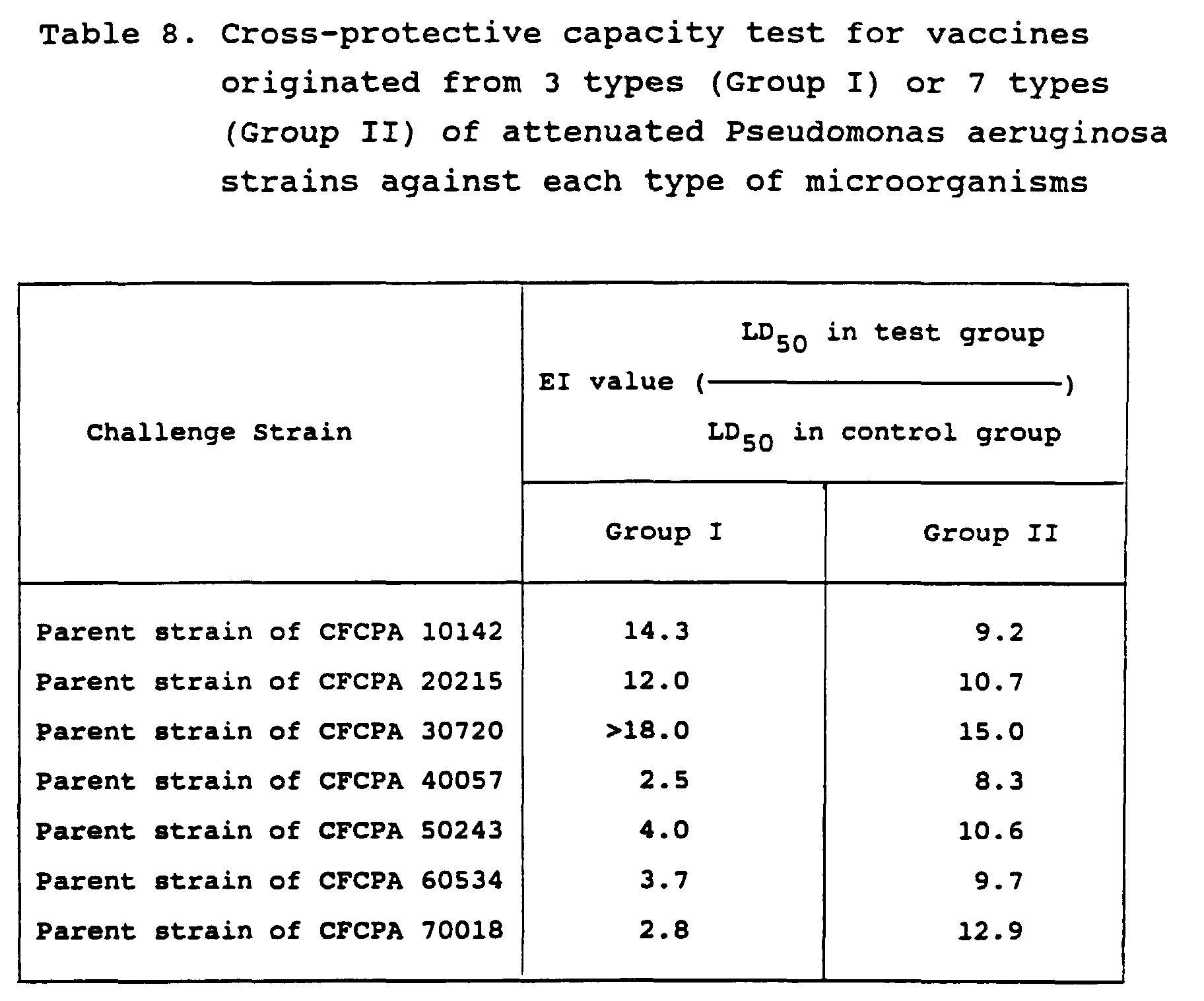
- the mixture of cell wall proteins prepared were derived from 3 types of attenuated Pseudomonas aeruginosa strains CFCPA 10142, CFCPA 30720 and CFCPA 20215 (Group I), and the mixture of cell wall proteins prepared from all 7 types of attenuated Pseudomonas aeruginosa strains (Group II), wherein all the cell wall proteins are present in a ratio of equivalent amount, are used instead of the mixture of 4 kinds of proteins, the cross-protective capacity of these 2 kinds of vaccines against infection of each Pseudomonas aeruginosa was examined. The results thereof are described in Table 8.
- the mixed protein components vaccine according to the present invention is composed of cell wall proteins prepared from at least three (3) different kinds of attenuated Pseudomonas aeruginosa strains showing different immunotypes from each other, this vaccine shows excellent protective effect against any immunotype of Pseudomonas aeruginosa in comparison with only one kind of common antigen.
- the efficacy index of the vaccine according to the present invention varies with the kind and number of selected microorganisms from attenuated Pseudomonas aeruginosa strains, mixing ratio of cell wall proteins derived therefrom, immunological schedule and method, etc., it can be confirmed that the vaccine of the present invention is effective against all Pseudomonas aeruginosa strains presently occurring in hospitals and patients.
- Example 10 Toxicological test for cell wall proteins
- cell wall proteins themselves to be used as component vaccine, as well as the safety of microorganism strains themselves as described in Example 2, should be assured.
- cell wall proteins were partially purified and then examined for their safety in an experimental animal, i.e. mouse. Specifically, each of attenuated microorganisms was incubated with tryptic soy broth as the culture medium, in a 5L fermenter and then treated according to the procedures described in Examples 5, 6 and 7.
- the supernatants of cell wall proteins extracted from attenuated Pseudomonas aeruginosa strains were collected together, centrifuged again with 10000xg at 4°C for 30 minutes to remove fine particles possibly present in solution.
- the resulting cell wall proteins were filtered through an Amicon membrane filter to obtain a mixture of cell wall proteins having molecular weight ranging from 10,000 to 100,000, which was concentrated to a protein concentration of 1mg/ml and then sterilized with a 0.2um filter to obtain a protein source for toxicological testing.
- the experimental animals used were ICR male mice weighing from 20 to 22g.
- the protein source was intravenously injected in an amount of 20mg/kg and 100mg/kg.
- the control group was given physiological saline in an amount of 25ml/kg.
- the test group exhibited a slight inhibition to weight gain on the first day after administration but on and after the second day after administration showed a normal growth and no special symptoms. In addition, even on and after the 7th day no specific change or symptoms in each organ could not be found.
- Acute toxicological test for cell wall protein source of attenuated Pseudomonas aeruginosa strains Group Dosage Test Subjects Survival/Test Subjects Remarks Test Group A 20mg/kg 20 20/20 No change of body weight Test Group B 100mg/kg 15 15/15 Change of body weight only on the first day Control Group Physiological Saline 15 15/15 No change of body weight
- Example 11 Determination of antigenicity of cell wall proteins
- Cell wall proteins obtained by partial purification of attenuated Pseudomonas aeruginosa strains in the same manner as in Example 10 were used as an antigen and were intravenously injected to ICR mice in an amount of 0.1mg/kg or 0.2mg/kg to immunize the experimental animals.
- One week from immunization a certain amount of blood was taken from each mouse of the group of mice, the serum was separated from the collected blood and the formation of the antibody was determined in accordance with ELISA method [J. Clin. Microbiol. 15, 1054-1058, 1982].
- Example 10 100 ul of antigen prepared in Example 10 which was adjusted to a concentration of 0.1mg/ml in a coating buffer (0.05M carbonate buffer solution consisting of NaHCO3 2.85g, Na 2 CO3 1.70g, H 2 O 1 , pH 9.6) was added to each well of a 96-well microplate and then reacted either at room temperature for 2 hours or at 4°C for 12 to 14 hours for the protein to adhere to the plate.
- a coating buffer 0.05M carbonate buffer solution consisting of NaHCO3 2.85g, Na 2 CO3 1.70g, H 2 O 1 , pH 9.6
- bovine serum albumin (BSA) was added to the each plate well and then reacted at room temperature for one hour to block the remaining portion in the wells not bound to protein.
- the plate was vigorously washed 7 times or more with the same phosphate buffer washing solution (pH7.0-7.2).
- phosphate buffer washing solution pH7.0-7.2
- 50 ul of ortho-phenylenediamine dihydrochloride adjusted to a concentration of 0.3 to 0.4mg/ml in citrate-phosphate buffer solution (0.1M Citrate-Phosphate buffer, pH5.0), was added to each well of the plate and reacted for 20 minutes in the absence of light.
- 50 ul of 1N-sulfuric acid was respectively added to stop the reaction in each well.
- the absorbance at 490nm was measured by means of a spectrophotometer.
- Example 12 Production of immunoglobulin for Pseudomonas aeruginosa
- Example 7 The protein solution obtained from Example 7 was administered to rabbits to produce the corresponding immunoglobulin.
- the cell wall protein obtained from attenuated Pseudomonas aeruginosa strain CFCPA 30720 was used as a typical example, the same method can be applied to the other attenuated Pseudomonas aeruginosa strains.
- 0.5 to 1ml (containing 100 to 200 ug of cell wall protein) of the cell wall protein solution obtained from CFCPA 30720 strain in Example 7 was used to inoculate albino rabbits three times at intervals of 7 days. Then blood was taken at regular intervals from each of the rabbits and the serum was separated. 100ml of the separated rabbit serum was mixed with 300ml of distilled water and the mixture was added to 500g (wet weight) of DEAE-cellulose at 4°C The resulting mixture was thoroughly shaken for one hour at 4°C, allowed to stand and then the supernatant was separated and removed.
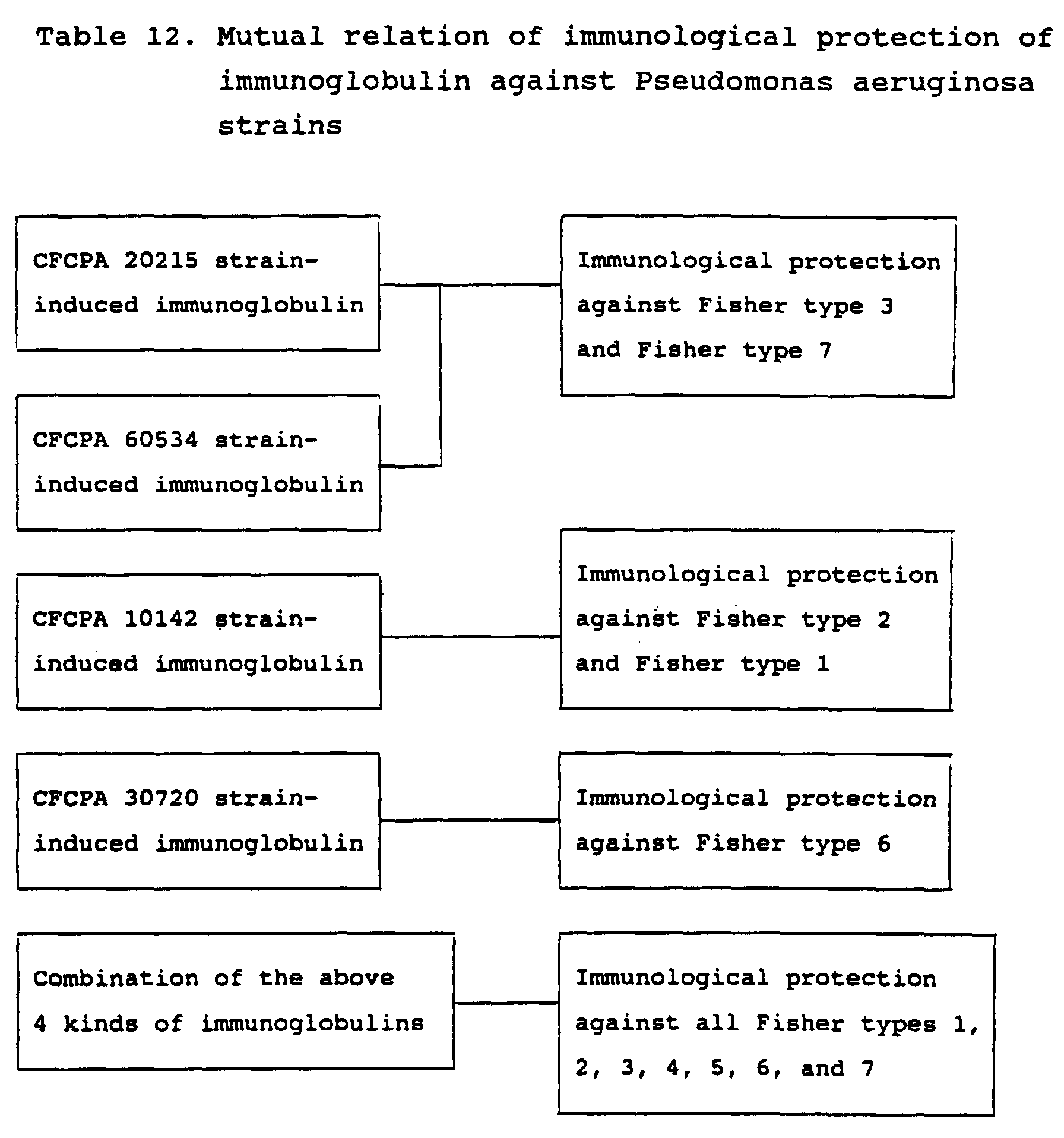
- the immunoglobulins used were CFCPA 10142, CFCPA 20215, CFCPA 30720 and CFCPA 60534, or a mixture of these 4 kinds of immunoglobulins in the ratio of equivalent amounts.
- the control group which received only physiological saline exhibited a lethality rate of 50% or more within 48 hours and 100% after 72 hours.
- the test group which received the corresponding immunoglobulin exhibited a survival rate of 80% or more after 72 hours. Accordingly, it could be demonstrated that the immunoglobulin is effective for the treatment of infection caused by pathogenic Pseudomonas aeruginosa strain having the corresponding Fisher immunotype. However, no single immunoglobulin had much of an effect on an infection caused by pathogenic Pseudomonas aeruginosa strains having Fisher immunotypes 4 and 5.
- the mouse group which received the combination of 4 kinds of immunoglobulins in the ratio of 1:1:1:1 by weight showed superior therapeutic effect even on Fisher 4 and 5 types of Pseudomonas aeruginosa strains due to their cross-reactivity.
- the combined immunoglobulin composition according to the present invention can be used as a therapeutic agent effective for infection caused by Pseudomonas aeruginosa strains having all Fisher immunotypes. The results of this experiment are summarized in Tables 11 and 12.
- Example 13 4 kinds of attenuated Pseudomonas aeruginosa strains selected in Example 13, i.e. CFCPA 10142, CFCPA 20215, CFCPA 30720 and CFCPA 60534 were incubated and extracted according to the same procedures as Examples 5, 6 and 7 to obtain the combined composition of cell wall proteins which were then inoculated three times at intervals of one week in an amount of 1.5 to 2mg into goat according to the same manner as Example 13 to obtain the combined Pseudomonas aeruginosa immunoglobulins in a large quantity which was purified according to the known method [see, Practical Immunology, 3rd Ed., (1989), pp 292-294].
- pathogenic Pseudomonas aeruginosa strains having each immunotype were inoculated into a mouse group (six groups : 20 mice per group) into which the combined immunoglobulin composition was previously injected three times, and another mouse group (six groups: 10 mice per group which received no immunoglobulin composition) in an amount of 1.0 to 3.0x10 6 cells per mouse to observe the immunological protective effect of the combined immunoglobulin.
- the combined immunoglobulin composition according to the present invention exhibits an immunological protective effect of 80%, or more, and a therapeutic effect of 75% or more (determined as the survival rate (%) after 7 days) while all the control groups have died within 3 days.
- the combined immunoglobulin composition of the present invention can be used as a useful medicinal agent showing both excellent therapeutic effect and immunological protective effect.
- Example 13 The combination of cell wall proteins which were obtained by incubation and extraction of 4 kinds of attenuated Pseudomonas aeruginosa strains selected in Example 13, i.e. CFCPA 10142, CFCPA 20215, CFCPA 30720 and CFCPA 60534 according to the same manner as Examples 5, 6 and 7, was administered to male goat in the same manner as Example 14 to obtain the combined Pseudomonas aeruginosa immunoglobulin which was separated and purified, and then formulated using various pharmaceutically acceptable carriers so that 1 to 100mg of antibody immunoglobulin can be administered per kg of body weight.
- the formulated immunoglobulin was administered to mouse infected with Pseudomonas aeruginosa to determine the efficacy of the immunoglobulin depending on the kinds of carriers used the immunoglobulin.
- the immunoglobulin preparation with physiological saline for injection or phosphate buffer solution as a carrier exhibits a high efficacy and in the case of lyophilized formulation the use of mannitol, saccharose or lactose as a carrier provides the high efficacy of the immunoglobulin preparation.
- Example 16 Efficacy of the formulated immunoglobulin composition
- a mouse received a burn according to the burn test procedure [see, J. Infect. Dis. 131, 688-691, 1975].
- the liquid preparation containing 0.5 to 1mg of combined Pseudomonas aeruginosa immunoglobulin per 1ml of phosphate buffer solution was formulated into a spray, which was then applied to the burn portion of the mouse in the test group to determine the effect thereof in comparison with that in the control group having no treatment with the immunoglobulin spray.
- the mouse group treated with the immunoglobulin-phosphate buffer solution spray shows remarkably higher survival rate than the non-treated group. Accordingly, it can be demonstrated that the Pseudomonas aeruginosa immunoglobulin-containing preparation according to the present invention exhibits a superior protective effect and a superior therapeutic effect on Pseudomonas aeruginosa infection.
- each attenuated Pseudomonas aeruginosa strain according to the present invention is considerably safe relative to the wild or pathogenic species.
- the cell wall proteins thereof exhibit an excellent safety and cross-protective property and also a superior neutralizing antibody formation capacity, the cell wall proteins can be used not only as a vaccine for prophylaxis against Pseudomonas aeruginosa infection but also as an antibody inducer in the experimental animal to produce immunoglobulin which can used as a therapeutic agent for Pseudomonas aeruginosa infection.
- Attenuated Pseudomonas aeruginosa strains according to the present invention are very useful microorganisms for preparing a prophylactic vaccine and a therapeutic agent for Pseudomonas aeruginosa infection.
Landscapes
- Health & Medical Sciences (AREA)
- Chemical & Material Sciences (AREA)
- Life Sciences & Earth Sciences (AREA)
- Organic Chemistry (AREA)
- General Health & Medical Sciences (AREA)
- Medicinal Chemistry (AREA)
- Biophysics (AREA)
- Genetics & Genomics (AREA)
- Molecular Biology (AREA)
- Pharmacology & Pharmacy (AREA)
- Proteomics, Peptides & Aminoacids (AREA)
- Animal Behavior & Ethology (AREA)
- Biochemistry (AREA)
- Public Health (AREA)
- Veterinary Medicine (AREA)
- Immunology (AREA)
- Nuclear Medicine, Radiotherapy & Molecular Imaging (AREA)
- General Chemical & Material Sciences (AREA)
- Chemical Kinetics & Catalysis (AREA)
- Oncology (AREA)
- Communicable Diseases (AREA)
- Microbiology (AREA)
- Mycology (AREA)
- Epidemiology (AREA)
- Gastroenterology & Hepatology (AREA)
- Medicines Containing Antibodies Or Antigens For Use As Internal Diagnostic Agents (AREA)
- Micro-Organisms Or Cultivation Processes Thereof (AREA)
- Peptides Or Proteins (AREA)
Description
| Procedures for separation and purification of cell wall proteins from attenuated Pseudomonas aeruginosa strains and for preparation of vaccines |
| Cultivation of seven (7) types of attenuated Pseudomonas aeruginosa strains |
| ↓ |
| Separation of microorganism cells |
| ↓ |
| Separated cells + Organic Solvent |
| ↓ |
| Extraction of cell wall proteins |
| ↓ |
| First fractionation by molecular weight (Ultrafiltration) |
| ↓ |
| Second fractionation by molecular weight (Ultrafiltration) |
| ↓ |
| Ultracentrifuge(180,000g) |
| ↓ |
| Separated cell wall proteins (M.W. 10,000<<100,000) |
| ↓ |
| Pseudomonas aeruginosa vaccine |
| Safety values of attenuated Pseudomonas aeruginosa strains selected according to the present invention | ||||
| Selected P. aeruginosa strains | Fisher-Devlin Immunotype | Initial LD50 | Final LD50 | |
| Test Strain | CFCPA 10142 | 1 | < 1.5x10⁶ | 7.6x10⁷ |
| CFCPA 20215 | 2 | < 1.4x10⁶ | 2.7x10⁷ | |
| CFCPA 30720 | 3 | < 2.0x10⁶ | 2.5x10⁸ | |
| CFCPA 40057 | 4 | < 3.7x10⁶ | 4.5x10⁷ | |
| CFCPA 50243 | 5 | < 5.0x10⁶ | 3.0x10⁷ | |
| CFCPA 60534 | 6 | < 1.5x10⁶ | 2.0x10⁷ | |
| CFCPA 70018 | 7 | < 3.8x10⁶ | 2.7x10⁷ | |
| Control Strain | GN 11189 | - | - | 2.0x10⁶ |
| Criteria for selection of Pseudomonas aeruginosa strains and their serotype and protective range | |
| Test item | Test results |
| Growth on isolation medium | Growth |
| Growth on Pseudomonas aeruginosa medium for detection | Growth |
| Morphological features (Microscope) | Both ends are round and a single polar flagellum is present. |
| Gram staining | Gram negative |
| Oxidase reaction | Positive response(+) or positive-negative response (+) |
| Antigen-Antibody reaction (first selected strains) | |
| CFCPA 20215 | Protective for |
| CFCPA 60534 | Protective for |
| CFCPA 10142 | Protective for |
| CFCPA 30720, CFCPA 30721 | Protective for |
| Microorganism growth rates depending on pH value | ||||
| Strains | pH 3.0 | pH 5.0 | pH 7.0 | pH 9.0 |
| CFCPA 10142 | - | +++ | +++ | +++ |
| CFCPA 20215 | - | +++ | +++ | +++ |
| CFCPA 30720 | - | +++ | +++ | ++ |
| CFCPA 40057 | - | +++ | +++ | ++ |
| CFCPA 50243 | - | +++ | +++ | ++ |
| CFCPA 60534 | - | +++ | +++ | ++ |
| CFCPA 70018 | - | +++ | +++ | +++ |
| Note : + Growth, - No growth |
| Microorganism growth rates depending on temperature variations | ||||
| Strains | 25° | 30°C | 37°C | 42°C |
| CFCPA 10142 | + | +++ | +++ | + |
| CFCPA 20215 | + | +++ | +++ | + |
| CFCPA 30720 | ++ | +++ | +++ | + |
| CFCPA 40057 | + | ++ | +++ | + |
| CFCPA 50243 | + | ++ | +++ | + |
| CFCPA 60534 | ++ | +++ | +++ | + |
| CFCPA 70018 | + | ++ | +++ | + |
| Note : + Growth, - No growth |

| Cross-protective capacity test for Pseudomonas aeruginosa vaccine prepared using four (4) different species of attenuated Pseudomonas aeruginosa strains against each type of microorganisms | |||
| Challenge Strain | Immunotype | Serotype | EI value |
| Parent strain of CFCPA 10142 | 1 | 06 | 9.5 |
| Parent strain of CFCPA 20215 | 2 | 011 | 13 |
| Parent strain of CFCPA 30720 | 3 | 02 | >18 |
| Parent strain of CFCPA 40057 | 4 | 01 | 3 |
| Parent strain of CFCPA 50243 | 5 | 010 | 4.5 |
| Parent strain of CFCPA 60534 | 6 | 07 | 8.4 |
| Parent strain of CFCPA 70018 | 7 | 05 | 7 |
| Acute toxicological test for cell wall protein source of attenuated Pseudomonas aeruginosa strains | ||||
| Group | Dosage | Test Subjects | Survival/Test Subjects | Remarks |
| Test Group A | 20mg/ | 20 | 20/20 | No change of body weight |
| Test Group B | 100mg/kg | 15 | 15/15 | Change of body weight only on the first day |
| Control Group | Physiological Saline | 15 | 15/15 | No change of body weight |


| Efficacy of Pseudomonas aeruginosa immunoglobulin depending on pharmaceutical carriers | ||
| Formulation type | Constituents | Efficacy |
| Lyophilized formulation | Purified combined immunoglobulin composition + mannitol (5-20%) | ++++ |
| Purified combined immunoglobulin composition + lactose (5-20%) | +++ | |
| Purified combined immunoglobulin composition + saccharose (5-20%) | +++ | |
| Purified combined immunoglobulin composition + human albumin (1-5%) | ++ | |
| Liquid formulation | Purified combined immunoglobulin composition + physiological saline | ++++ |
| Purified combined immunoglobulin composition + distilled water for injection | ++++ | |
| Purified combined immunoglobulin composition + phosphate buffer solution | ++++ | |
| Purified combined immunoglobulin composition + aluminum hydroxide + solvent | ++ |
| Result of burning test | ||||||
| Treatment | Number of mouse | Pseudomonas aeruginosa inoculation | Survival rate | |||
| 24hrs. | 48hrs. | 72hrs. | 96hrs. or more | |||
| Burn (treated with immunoglobulin) | 20 | | 20/20 | 19/20 | 16/20 | 16/20 |
| Burn (not treated with immunoglobulin) | 20 | local inoculation | 18/20 | 4/20 | 0/20 | - |
| Control group | 10 | no inoculation | 10/10 | 10/10 | 10/10 | 10/10 |
Claims (34)
- An attenuated Pseudomonas aeruginosa strain having an LD50 of at least, 2.0 x 10⁷ cells in mice and which is obtainable by isolating Pseudomonas aeruginosa in a pure state according to immunotype from patients infected with Pseudomonas aeruginosa and subjecting the isolated strain to repeat purification to attenuate the strain, said Pseudomonas aeruginosa strain being selected within the group consisting in Pseudomonas aeruginosa strains having the Korean Federation of Culture Collection accession numbers KCCM 10029 (CFCPA 10142), KCCM 10030 (CFCPA 20215), KCCM 10031 (CFCPA 30720), KCCM 10032 (CFCPA 40057), KCCM 10033 (CFCPA 50243), KCCM 10034 (CFCPA 60534) and KCCM 10035 (CFCPA 70018).
- The Pseudomonas aeruginosa strain according to claim 1 having Korean Federation of Culture Collection accession number KCCM 10029 (CFCPA 10142).
- The Pseudomonas aeruginosa strain according to claim 1 having Korean Federation of Culture Collection accession number KCCM 10030 (CFCPA 20215).
- The Pseudomonas aeruginosa strain according to claim 1 having Korean Federation of Culture Collection accession number KCCM 10031 (CFCPA 30720).
- The Pseudomonas aeruginosa strain according to claim 1 having Korean Federation of Culture Collection accession number KCCM 10032 (CFCPA 40057).
- The Pseudomonas aeruginosa strain according to claim 1 having Korean Federation of Culture Collection accession number KCCM 10033 (CFCPA 50243).
- The Pseudomonas aeruginosa strain according to claim 1 having Korean Federation of Culture Collection accession number KCCM 10034 (CFCPA 60534).
- The Pseudomonas aeruginosa strain according to claim 1 having Korean Federation of Culture Collection accession number KCCM 10035 (CFCPA 70018).
- Use of at least one Pseudomonas aeruginosa strain selected from the group consisting of:Pseudomonas aeruginosa strain having Korean Federation of Culture Collection accession number KCCM 10029 (CFCPA 10142),Pseudomonas aeruginosa strain having Korean Federation of Culture Collection accession number KCCM 10030 (CFCPA 20215),Pseudomonas aeruginosa strain having Korean Federation of Culture Collection accession number KCCM 10031 (CFCPA 30720),Pseudomonas aeruginosa strain having Korean Federation of Culture Collection accession number KCCM 10032 (CFCPA 40057),Pseudomonas aeruginosa strain having Korean Federation of Culture Collection accession number KCCM 10033 (CFCPA 50243),Pseudomonas aeruginosa strain having Korean Federation of Culture Collection accession number KCCM 10034 (CFCPA 60534),Pseudomonas aeruginosa strain having Korean Federation .of Culture Collection accession number KCCM 10035 (CFCPA 70018), in preparation of a vaccine for immunization against Pseudomonas aeruginosa infection.
- A non-pathogenic vaccine for inducing an immune response against a disease caused by Pseudomonas aeruginosa comprising a mixture of cell wall proteins having a molecular weight range of 10,000 to 100,000 derived from at least one attenuated Pseudomonas aeruginosa strain selected from the group consisting of:to induce an immune response to prevent subsequent disease caused by Pseudomonas aeruginosa.Pseudomonas aeruginosa strain having Korean Federation of Culture Collection accession number KCCM 10029 (CFCPA 10142),Pseudomonas aeruginosa strain having Korean Federation of Culture collection accession number KCCM 10030 (CFCPA 20215),Pseudomonas aeruginosa strain having Korean Federation of Culture Collection accession number KCCM 10031 (CFCPA 30720),Pseudomonas aeruginosa strain having Korean Federation of Culture Collection accession number KCCM 10032 (CFCPA 40057),Pseudomonas aeruginosa strain having Korean Federation of Culture Collection accession number KCCM 10033 (CFCPA 50243),Pseudomonas aeruginosa strain having Korean Federation of Culture Collection accession number KCCM 10034 (CFCPA 60534), andPseudomonas aeruginosa strain having Korean Federation of Culture Collection accession number KCCM 10035 (CFCPA 70018),
- The vaccine according to claim 10, wherein the cell wall proteins are derived from at least three attenuated Pseudomonas aeruginosa strains selected from the group of: CFCPA 10142, CFCPA 20215, CFCPA 30720, CFCPA 40057, CFCPA 50243, CFCPA 60534 and CFCPA 70018.
- The vaccine according to claim 11, wherein the attenuated Pseudomonas aeruginosa strains consist of: CFCPA 10142, CFCPA 20215 and CFCPA 30720.
- The vaccine according to claim 11, wherein the attenuated Pseudomonas aeruginosa strains are selected from the group consisting of: CFCPA 10142, CFCPA 20215, CFCPA 30720 and CFCPA 60534.
- The vaccine according to claim 11, wherein the attenuated Pseudomonas aeruginosa strains are CFCPA 10142, CFCPA 20215, CFCPA 30720, CFCPA 40057, CFCPA 50243, CFCPA 60534 and CFCPA 70018.
- The vaccine according to any one of claims 10 to 14, wherein the cell wall proteins from each of the attenuated Pseudomonas aeruginosa strains present are present in equivalent amounts.
- The vaccine according to claim 10, further including pharmaceutically acceptable excipients.
- A process for preparing a non-pathogenic vaccine for immunization against Pseudomonas aeruginosa infection, comprising :a) collecting Pseudomonas aeruginosa from patients infected with Pseudomonas aeruginosa;b) selecting and isolating at least one species of Pseudomonas aeruginosa in a pure state;c) incubating each pure isolated Pseudomonas aeruginosa in a first culture medium;d) attenuating each pure incubated strain by repeat injections into experimental animals and selecting the most attenuated strain for each Pseudomonas aeruginosa strain attenuated;e) incubating each attenuated Pseudomonas aeruginosa strain in a second culture medium;f) separating the attenuated Pseudomonas aeruginosa from the culture medium;g) treating the separated Pseudomonas aeruginosa with an organic solvent to inactivate and remove cell wall lipid components;h) extracting the cell wall protein from the treated Pseudomonas aeruginosa while simultaneously determining whether the cells of Pseudomonas aeruginosa are being destroyed by ascertaining the presence of lactate dehydrogenase or hexokinase as a cytoplasmic marker enzyme;i) subjecting the extracted cell wall protein to ultrafiltration to select only those cell wall proteins having the molecular weight ranging from 10,000 to 100,000;j) ultracentrafuging the cell wall protein to further remove any lipopolysaccharide and any bacterial substances;k) recovering the selected cell wall proteins in a pure state; andl) preparing a vaccine using the selected cell wall proteins as an antigenic substance to induce immunization.
- The process of claim 17, wherein the extraction is performed by placing the treated Pseudomonas aeruginosa cells in a buffer solution.
- The process of claim 18, wherein the buffer solution, is selected from the group consisting of a phosphate buffer solution and a tris buffer solution.
- The process of claim 17, wherein the extraction of the cell wall proteins is performed by standing the bacterial mass or acting on the treated Pseudomonas aeruginosa cells with a mixer or homogenizer.
- The process of claim 20, wherein the mixer is operated at 100 to 2000 rpm at 4°C.
- The process of claim 17, wherein the extraction is performed 5 to 6 times.
- The process of claim 17, wherein the organic solvent is selected from the group consisting of acetone, chloroform, ethanol, butanol and most preferably the organic solvent is acetone.
- The process of claim 17, wherein the Pseudomonas aeruginosa strains isolated include KCCM 10029 (CFCPA 10142), KCCM 10030 (CFCPA 20215), KCCM 10031 (CFCPA 30720), KCCM 10032 (CFCPA 40057), KCCM 10033 (CFCPA 50243), KCCM 10034 (CFCPA 60534) and KCCM 10035 (CFCPA 70018).
- The process of claim 17 wherein the second culture medium is selected from the group consisting of tryptic soy broth and a culture medium comprising glucose (30 g/l), peptone (15 g/l), MgS04 (0.5 g/l), CaCO3 (5 g/l), KH2PO4 (1 g/l), FeS04 (5 mg/l), CuS04 (5 mg/l) and ZnS04 (5 mg/l).
- The process of claim 17, wherein the incubation of the attenuated Pseudomonas aeruginosa conditions comprise : a temperature of 37°C, an aeration rate 1 vvm (volume/volume minute) and a seed volume of 5% v/v of the culture medium solution, with the incubation carried out under a stirring rate of 100 rpm for the first 2 hours and then at 600 rpm for the following 10 to 20 hours, preferably for 12 to 16 hours.
- A therapeutic agent for treating Pseudomonas aeruginosa infection in a patient manifesting the infection, said agent comprises at least one immunoglobulin specific against at least one Pseudomonas aeruginosa strain, wherein said immunoglobulin is induced by injection into a suitable host cell wall proteins having a molecular weight range of 10,000 to 100,000 derived from at least one attenuated Pseudomonas aeruginosa strain selected from the group consisting of :Pseudomonas aeruginosa strain having Korean Federation of Culture Collection accession number KCCM 10029 (CFCPA 10142),Pseudomonas aeruginosa strain having Korean Federation of Culture Collection accession number KCCM 10030 (CFCPA 20215),Pseudomonas aeruginosa strain having Korean Federation of Culture Collection accession number KCCM 10031 (CFCPA 30720),Pseudomonas aeruginosa strain having Korean Federation of Culture Collection accession number KCCM 10032 (CFCPA 40057),Pseudomonas aeruginosa strain having Korean Federation of Culture Collection accession number KCCM 10033 (CFCPA 50243),Pseudomonas aeruginosa strain having Korean Federation of Culture Collection accession number KCCM 10034 (CFCPA 60534), andPseudomonas aeruginosa strain having Korean Federation of Culture Collection accession number KCCM 10035 (CFCPA 70018), in an amount sufficient to induce an immune response in said host to initiate the production of said immunoglobulin to, at least lessen the untoward effects of the disease caused by Pseudomonas aeruginosa.
- The therapeutic agent of claim 27 which contains an immunoglobulin against each of the Pseudomonas aeruginosa strains corresponding to Fisher immunotypes 1, 2, 3, 4, 5, 6 and 7.
- The therapeutic agent of claim 27, containing immunoglobulins against any four of the Pseudomonas aeruginosa strains corresponding to Fisher immunotypes 1, 2, 3, 4, 5, 6 and 7.
- The therapeutic agent of claim 27, containing immunoglobulins against any three of the Pseudomonas aeruginosa strains corresponding to Fisher immunotypes 1, 2, 3, 4, 5, 6 and 7.
- The therapeutic agent of claim 27 in a lyophilized form.
- The therapeutic agent of claim 31 further including a suitable pharmaceutically acceptable carrier selected from the group consisting of mannitol, lactose, saccharose and human albumin.
- The therapeutic agent of claim 27 in a liquid form and further including suitable pharmaceutically acceptable carriers.
- The therapeutic agent of claim 27 prepared in a pharmaceutical dosage form as an injection, tablet, capsule, eye drop, spray or ointment.
Applications Claiming Priority (5)
| Application Number | Priority Date | Filing Date | Title |
|---|---|---|---|
| KR1019930010273A KR960014620B1 (en) | 1993-06-07 | 1993-06-07 | Novel attenuated Pseudomonas aeruginosa and its vaccine against Pseudomonas aeruginosa infection |
| KR1019930010281A KR970001710B1 (en) | 1993-06-07 | 1993-06-07 | Pseudomonas infection preventing agent and the method of preparation thereof |
| KR9310281 | 1993-06-07 | ||
| KR9310273 | 1993-06-07 | ||
| PCT/KR1994/000062 WO1994028928A1 (en) | 1993-06-07 | 1994-06-02 | Novel attenuated pseudomonas aeruginosa strains |
Publications (2)
| Publication Number | Publication Date |
|---|---|
| EP0702564A1 EP0702564A1 (en) | 1996-03-27 |
| EP0702564B1 true EP0702564B1 (en) | 2000-03-01 |
Family
ID=26629705
Family Applications (1)
| Application Number | Title | Priority Date | Filing Date |
|---|---|---|---|
| EP94917176A Expired - Lifetime EP0702564B1 (en) | 1993-06-07 | 1994-06-02 | Novel attenuated pseudomonas aeruginosa strains |
Country Status (16)
| Country | Link |
|---|---|
| EP (1) | EP0702564B1 (en) |
| JP (1) | JP2911603B2 (en) |
| CN (1) | CN1112356A (en) |
| AT (1) | AT408445B (en) |
| AU (1) | AU676575B2 (en) |
| CA (1) | CA2141871C (en) |
| CH (1) | CH687233A5 (en) |
| DE (3) | DE4447677C2 (en) |
| ES (1) | ES2074968B1 (en) |
| GB (1) | GB2285925B (en) |
| NL (1) | NL194910C (en) |
| NO (1) | NO317148B1 (en) |
| RU (1) | RU2155226C2 (en) |
| SE (1) | SE507114C2 (en) |
| TW (1) | TW403655B (en) |
| WO (1) | WO1994028928A1 (en) |
Families Citing this family (24)
| Publication number | Priority date | Publication date | Assignee | Title |
|---|---|---|---|---|
| CN1086588C (en) * | 1995-12-07 | 2002-06-26 | 余国华 | Pseudomonas active protein and method for producing same |
| RU2169193C2 (en) * | 1999-08-12 | 2001-06-20 | Научно-исследовательский институт пушного звероводства и кролиководства им. В.А. Афанасьева | Strain of bacterium pseudomonas aeruginosa 5142 used for preparing vaccine against fur wild animals pseudomonosis |
| RU2169194C2 (en) * | 1999-08-12 | 2001-06-20 | Научно-исследовательский институт пушного звероводства и кролиководства им. В.А. Афанасьева | Strain of bacterium pseudomonas aeruginosa 5211 used for preparing vaccine against fur wild animals pseudomonosis |
| RU2169188C2 (en) * | 1999-08-12 | 2001-06-20 | Научно-исследовательский институт пушного звероводства и кролиководства им. В.А. Афанасьева | Strain of bacterium pseudomonas aeruginosa 4492 used for making vaccine against fur wild animal pseudomonosis |
| RU2169765C2 (en) * | 1999-08-12 | 2001-06-27 | Научно-исследовательский институт пушного звероводства и кролиководства им. В.А. Афанасьева | Strain of bacterium pseudomonas aeruginosa 5002 used for preparing vaccine against fur wild animal pseudomonosis |
| RU2147318C1 (en) * | 1999-08-12 | 2000-04-10 | Научно-исследовательский институт пушного звероводства и кролиководства им.В.А.Афанасьева | Strain of bacterium pseudomonas aeruginosa 5241 used for preparing vaccine against pseudomonosis in fur wild animals |
| RU2169195C2 (en) * | 1999-08-12 | 2001-06-20 | Научно-исследовательский институт пушного звероводства и кролиководства им. В.А. Афанасьева | Strain of bacterium pseudomonas aeruginosa 5271 used for preparing vaccine against fur wild animals pseudomonosis |
| RU2169191C2 (en) * | 1999-08-12 | 2001-06-20 | Научно-исследовательский институт пушного звероводства и кролиководства им. В.А. Афанасьева | Strain of bacterium pseudomonas aeruginosa 5291 used for preparing vaccine against fur wild animals pseudomonosis |
| RU2147317C1 (en) * | 1999-08-12 | 2000-04-10 | Научно-исследовательский институт пушного звероводства и кролиководства им.В.А.Афанасьева | Strain of bacterium pseudomonas aeruginosa 4992, used for preparing vaccine against pseudomonosis in fur wild animals |
| RU2169764C2 (en) * | 1999-08-12 | 2001-06-27 | Научно-исследовательский институт пушного звероводства и кролиководства им. В.А. Афанасьева | Strain of bacterium pseudomonas aeruginosa 5132 used for preparing vaccine against fur wild animal pseudomonosis |
| RU2169192C2 (en) * | 1999-08-12 | 2001-06-20 | Научно-исследовательский институт пушного звероводства и кролиководства им. В.А. Афанасьева | Strain of bacterium pseudomonas aeruginosa ло3 used for preparing vaccine against fur wild animals pseudomonosis |
| RU2169766C2 (en) * | 1999-08-12 | 2001-06-27 | Научно-исследовательский институт пушного звероводства и кролиководства им. В.А. Афанасьева | Strain of bacterium pseudomonas aeruginosa лo1 used for preparing vaccine against fur wild animal pseudomonosis |
| RU2169190C2 (en) * | 1999-08-12 | 2001-06-20 | Научно-исследовательский институт пушного звероводства и кролиководства им. В.А. Афанасьева | Strain of bacterium pseudomonas aeruginosa 5292 used for making vaccine against pseudomonosis in fur wild animals |
| RU2169189C2 (en) * | 1999-08-12 | 2001-06-20 | Научно-исследовательский институт пушного звероводства и кролиководства им. В.А. Афанасьева | Strain of bacterium pseudomonas aeruginosa 4762 used for making vaccine against pseudomonosis in fur wild animals |
| CN1328371C (en) * | 2005-09-01 | 2007-07-25 | 北京未名凯拓农业生物技术有限公司 | A Pseudomonas aeruginosa strain and its culturing method and uses |
| CN102534027A (en) * | 2012-02-14 | 2012-07-04 | 上海中优医药高科技有限公司 | Detection primer for QacE delta1 genes in MDRPA (multidrug-resistant pseudomonas aeruginosa) and detection method thereof |
| CN102534029A (en) * | 2012-02-14 | 2012-07-04 | 上海中优医药高科技有限公司 | Detection primers for QacB gene in methicillin-resistant staphylococcus aureus (MRSA) |
| IT201600091033A1 (en) * | 2016-09-08 | 2018-03-08 | Bioimmunizer Sagl | Strains of probiotic bacteria belonging to the genus Bifidobacterium and their extracts of probiotic cells (ECP) having immunostimulant properties. |
| CN109401992B (en) * | 2017-08-18 | 2021-07-23 | 黑龙江省科学院微生物研究所 | A high-producing endotoxin protein Pseudomonas aeruginosa and its application |
| CN110724647B (en) * | 2018-07-17 | 2022-11-04 | 黑龙江省科学院微生物研究所 | A strain of Pseudomonas aeruginosa whose endotoxin protein produced has immunoprotective effect on seven serotype strains and its application |
| WO2021031270A1 (en) * | 2019-08-22 | 2021-02-25 | 四川大学 | Bacterial membrane vesicles, and separation and preparation system and method therefor |
| WO2022087122A1 (en) | 2020-10-20 | 2022-04-28 | Longhorn Vaccines And Diagnostics, Llc | Immunogenic antigens |
| CN114763544A (en) * | 2021-01-15 | 2022-07-19 | 黑龙江省科学院微生物研究所 | Biological mutagenesis method of pseudomonas aeruginosa high-yield protein strain |
| WO2024002335A1 (en) * | 2022-06-30 | 2024-01-04 | Shanghai Yuguan Biotech Co., Ltd. | A live bacteria strain of pseudomonas sp. |
Family Cites Families (8)
| Publication number | Priority date | Publication date | Assignee | Title |
|---|---|---|---|---|
| US3928565A (en) * | 1971-10-19 | 1975-12-23 | Yuzuru Homma | Pharmaceutical preparation of pseudomonas aeruginosa bacterial component possessing anti-tumor and anti-infection properties |
| US3987164A (en) * | 1970-10-20 | 1976-10-19 | Yuzuru Homma | Method for prevention of pseudomonas aeruginosa infections |
| JPS5612435B1 (en) * | 1971-03-29 | 1981-03-20 | ||
| US4285936A (en) * | 1979-12-10 | 1981-08-25 | The United States Of America As Represented By The Secretary Of The Army | Method for producing a vaccine against bacterial infections caused by pseudomonas aeruginosa |
| US4470924A (en) * | 1981-12-30 | 1984-09-11 | Iglewski Barbara M | Nontoxic, immunologically crossreactive toxin A protein from Pseudomonas aeruginosa |
| JPS60248625A (en) * | 1984-05-25 | 1985-12-09 | Mitsui Toatsu Chem Inc | Monoclonal antibody for counteracting pseudomonas aeruginosa, its preparation and use |
| JPH01197500A (en) * | 1988-01-29 | 1989-08-09 | Sumitomo Chem Co Ltd | Human monoclonal antibody |
| DE3829616C2 (en) * | 1988-09-01 | 1996-08-29 | Behringwerke Ag | Lipoprotein I (OMPI) from Pseudomonas aeruginosa |
-
1994
- 1994-06-02 NL NL9420005A patent/NL194910C/en not_active IP Right Cessation
- 1994-06-02 DE DE4447677A patent/DE4447677C2/en not_active Expired - Fee Related
- 1994-06-02 DE DE4493997T patent/DE4493997T1/en active Pending
- 1994-06-02 GB GB9502373A patent/GB2285925B/en not_active Expired - Fee Related
- 1994-06-02 CA CA002141871A patent/CA2141871C/en not_active Expired - Fee Related
- 1994-06-02 JP JP7501593A patent/JP2911603B2/en not_active Expired - Fee Related
- 1994-06-02 ES ES09550003A patent/ES2074968B1/en not_active Expired - Fee Related
- 1994-06-02 RU RU95113158/13A patent/RU2155226C2/en not_active IP Right Cessation
- 1994-06-02 AU AU68571/94A patent/AU676575B2/en not_active Ceased
- 1994-06-02 CN CN94190491A patent/CN1112356A/en active Pending
- 1994-06-02 WO PCT/KR1994/000062 patent/WO1994028928A1/en not_active Ceased
- 1994-06-02 EP EP94917176A patent/EP0702564B1/en not_active Expired - Lifetime
- 1994-06-02 AT AT0900694A patent/AT408445B/en not_active IP Right Cessation
- 1994-06-02 DE DE4493997A patent/DE4493997C2/en not_active Expired - Fee Related
- 1994-06-02 CH CH00454/95A patent/CH687233A5/en not_active IP Right Cessation
- 1994-06-04 TW TW083105105A patent/TW403655B/en not_active IP Right Cessation
-
1995
- 1995-02-06 NO NO19950421A patent/NO317148B1/en not_active IP Right Cessation
- 1995-02-06 SE SE9500418A patent/SE507114C2/en not_active IP Right Cessation
Also Published As
| Publication number | Publication date |
|---|---|
| NL194910C (en) | 2003-07-04 |
| RU2155226C2 (en) | 2000-08-27 |
| NO317148B1 (en) | 2004-08-30 |
| JPH09501826A (en) | 1997-02-25 |
| GB2285925B (en) | 1997-04-09 |
| WO1994028928A1 (en) | 1994-12-22 |
| SE9500418L (en) | 1995-04-07 |
| CN1112356A (en) | 1995-11-22 |
| CA2141871A1 (en) | 1994-12-22 |
| DE4493997C2 (en) | 1997-07-17 |
| DE4493997T1 (en) | 1995-10-05 |
| CH687233A5 (en) | 1996-10-31 |
| NL194910B (en) | 2003-03-03 |
| DE4447677C2 (en) | 1998-07-23 |
| JP2911603B2 (en) | 1999-06-23 |
| CA2141871C (en) | 1999-05-11 |
| NL9420005A (en) | 1995-06-01 |
| GB9502373D0 (en) | 1995-03-29 |
| NO950421L (en) | 1995-04-07 |
| EP0702564A1 (en) | 1996-03-27 |
| SE9500418D0 (en) | 1995-02-06 |
| ATA900694A (en) | 2001-04-15 |
| AT408445B (en) | 2001-11-26 |
| AU6857194A (en) | 1995-01-03 |
| TW403655B (en) | 2000-09-01 |
| ES2074968B1 (en) | 1996-05-01 |
| ES2074968A1 (en) | 1995-09-16 |
| GB2285925A (en) | 1995-08-02 |
| NO950421D0 (en) | 1995-02-06 |
| SE507114C2 (en) | 1998-03-30 |
| AU676575B2 (en) | 1997-03-13 |
Similar Documents
| Publication | Publication Date | Title |
|---|---|---|
| AU676575B2 (en) | Novel attenuated pseudomonas aeruginosa strains | |
| EP0648127B1 (en) | Type i surface antigens associated with staphylococcus epidermidis | |
| AU2010215275B2 (en) | Antibodies to Clostridium difficile toxins | |
| US6391315B1 (en) | Vaccine for inhibiting and preventing induced staphylococcus infection, isolated antigens used therein, and isolated antibodies induced thereby | |
| Vicari et al. | The action of the thermolabile toxin of Shigella dysenteriae on cells cultivated in vitro | |
| JPH0440330B2 (en) | ||
| Fiske et al. | Method for reducing endotoxin in Moraxella catarrhalis UspA2 protein preparations | |
| US5861163A (en) | Process for preparing a vaccine against pseudomonas aeruginosa using attenuated strains | |
| KR970001704B1 (en) | Prevention of Pseudomonas aeruginosa infection with attenuated Pseudomonas aeruginosa CFCPA 20215 | |
| KR970001707B1 (en) | A vaccine against Pseudomonas aeruginosa infection using attenuated Pseudomonas aeruginosa CFCPA 50243 | |
| KR970001703B1 (en) | Pseudomonas infection preventing vaccines using attenuated pseudomonas cfcpa 10142 | |
| KR970001705B1 (en) | Prevention of Pseudomonas aeruginosa Infection Using Attenuated Pseudomonas Aeruginosa CFCPA 30720 | |
| KR960014620B1 (en) | Novel attenuated Pseudomonas aeruginosa and its vaccine against Pseudomonas aeruginosa infection | |
| Boroff | STUDY ON TOXINS AND ANTIGENS OF SHIGELLA DYSENTERIAE I: Toxicity and Antigenicity of Whole Organisms and Various Fractions of Shigella dysenteriae | |
| KR970001706B1 (en) | Pseudomonas infection preventing vaccines using attenuated pseudomonas cfcpa 40057 | |
| KR970001708B1 (en) | Prevention of Pseudomonas aeruginosa infection vaccine using attenuated Pseudomonas aeruginosa CFCPA 60534 | |
| KR970001709B1 (en) | Pseudomonas aeruginosa infection prevention vaccine using attenuated Pseudomonas aeruginosa CFCPA 70018 | |
| KR970001710B1 (en) | Pseudomonas infection preventing agent and the method of preparation thereof | |
| Iwanaga et al. | Pili of Vibrio cholerae widely distributed in serogroup O1 strains | |
| Malina et al. | Informative value of a mouse model of Klebsiella pneumoniae infection used as a host-resistance assay | |
| JP2000509961A (en) | Opsonizing antibodies broadly react with common staphylococcal antigens | |
| KR100421453B1 (en) | Vaccine for the prophylaxis of the disease caused by Gram negative bacteria and process for the preparation thereof | |
| KR100250714B1 (en) | Therapeutic agent for treating infections of pseudomonas aeruginosa | |
| KR100509817B1 (en) | Oral vaccine for prevention of vibrio vulnificus infection | |
| Henriksen et al. | Enhancement by a serum factor of the immunoaccessibility of an enterobacterial porin protein domain |
Legal Events
| Date | Code | Title | Description |
|---|---|---|---|
| PUAI | Public reference made under article 153(3) epc to a published international application that has entered the european phase |
Free format text: ORIGINAL CODE: 0009012 |
|
| 17P | Request for examination filed |
Effective date: 19950213 |
|
| AK | Designated contracting states |
Kind code of ref document: A1 Designated state(s): BE FR IT |
|
| 17Q | First examination report despatched |
Effective date: 19981028 |
|
| GRAG | Despatch of communication of intention to grant |
Free format text: ORIGINAL CODE: EPIDOS AGRA |
|
| GRAG | Despatch of communication of intention to grant |
Free format text: ORIGINAL CODE: EPIDOS AGRA |
|
| GRAG | Despatch of communication of intention to grant |
Free format text: ORIGINAL CODE: EPIDOS AGRA |
|
| GRAH | Despatch of communication of intention to grant a patent |
Free format text: ORIGINAL CODE: EPIDOS IGRA |
|
| GRAH | Despatch of communication of intention to grant a patent |
Free format text: ORIGINAL CODE: EPIDOS IGRA |
|
| RAP1 | Party data changed (applicant data changed or rights of an application transferred) |
Owner name: CHEIL JEDANG CORPORATION |
|
| GRAA | (expected) grant |
Free format text: ORIGINAL CODE: 0009210 |
|
| ITF | It: translation for a ep patent filed | ||
| AK | Designated contracting states |
Kind code of ref document: B1 Designated state(s): BE FR IT |
|
| ET | Fr: translation filed | ||
| PLBE | No opposition filed within time limit |
Free format text: ORIGINAL CODE: 0009261 |
|
| STAA | Information on the status of an ep patent application or granted ep patent |
Free format text: STATUS: NO OPPOSITION FILED WITHIN TIME LIMIT |
|
| 26N | No opposition filed | ||
| PGFP | Annual fee paid to national office [announced via postgrant information from national office to epo] |
Ref country code: IT Payment date: 20090618 Year of fee payment: 16 |
|
| PGFP | Annual fee paid to national office [announced via postgrant information from national office to epo] |
Ref country code: BE Payment date: 20090619 Year of fee payment: 16 |
|
| BERE | Be: lapsed |
Owner name: *CHEIL JEDANG CORP. Effective date: 20100630 |
|
| REG | Reference to a national code |
Ref country code: FR Ref legal event code: ST Effective date: 20110228 |
|
| PG25 | Lapsed in a contracting state [announced via postgrant information from national office to epo] |
Ref country code: IT Free format text: LAPSE BECAUSE OF NON-PAYMENT OF DUE FEES Effective date: 20100602 |
|
| PG25 | Lapsed in a contracting state [announced via postgrant information from national office to epo] |
Ref country code: FR Free format text: LAPSE BECAUSE OF NON-PAYMENT OF DUE FEES Effective date: 20100630 |
|
| PG25 | Lapsed in a contracting state [announced via postgrant information from national office to epo] |
Ref country code: BE Free format text: LAPSE BECAUSE OF NON-PAYMENT OF DUE FEES Effective date: 20100630 |
|
| PGFP | Annual fee paid to national office [announced via postgrant information from national office to epo] |
Ref country code: FR Payment date: 20090611 Year of fee payment: 16 |