EP0700619B1 - Method and user interface for creating, specifying and adjusting motion picture transitions - Google Patents
Method and user interface for creating, specifying and adjusting motion picture transitions Download PDFInfo
- Publication number
- EP0700619B1 EP0700619B1 EP94914205A EP94914205A EP0700619B1 EP 0700619 B1 EP0700619 B1 EP 0700619B1 EP 94914205 A EP94914205 A EP 94914205A EP 94914205 A EP94914205 A EP 94914205A EP 0700619 B1 EP0700619 B1 EP 0700619B1
- Authority
- EP
- European Patent Office
- Prior art keywords
- transition
- frames
- sequences
- command
- sequence
- Prior art date
- Legal status (The legal status is an assumption and is not a legal conclusion. Google has not performed a legal analysis and makes no representation as to the accuracy of the status listed.)
- Expired - Lifetime
Links
- 230000007704 transition Effects 0.000 title claims abstract description 149
- 238000000034 method Methods 0.000 title claims abstract description 14
- 230000004044 response Effects 0.000 claims abstract description 11
- 230000008859 change Effects 0.000 abstract description 6
- 239000000463 material Substances 0.000 description 13
- 239000000203 mixture Substances 0.000 description 11
- 230000000694 effects Effects 0.000 description 7
- 238000010586 diagram Methods 0.000 description 2
- 230000006870 function Effects 0.000 description 2
- 230000019612 pigmentation Effects 0.000 description 2
- 238000013459 approach Methods 0.000 description 1
- 230000005540 biological transmission Effects 0.000 description 1
- 238000005516 engineering process Methods 0.000 description 1
- 238000005286 illumination Methods 0.000 description 1
- 238000012986 modification Methods 0.000 description 1
- 230000004048 modification Effects 0.000 description 1
- 238000012545 processing Methods 0.000 description 1
- 238000005096 rolling process Methods 0.000 description 1
- 230000001360 synchronised effect Effects 0.000 description 1
- 238000012546 transfer Methods 0.000 description 1
Images


Classifications
-
- G—PHYSICS
- G11—INFORMATION STORAGE
- G11B—INFORMATION STORAGE BASED ON RELATIVE MOVEMENT BETWEEN RECORD CARRIER AND TRANSDUCER
- G11B27/00—Editing; Indexing; Addressing; Timing or synchronising; Monitoring; Measuring tape travel
- G11B27/02—Editing, e.g. varying the order of information signals recorded on, or reproduced from, record carriers
- G11B27/031—Electronic editing of digitised analogue information signals, e.g. audio or video signals
- G11B27/034—Electronic editing of digitised analogue information signals, e.g. audio or video signals on discs
-
- G—PHYSICS
- G11—INFORMATION STORAGE
- G11B—INFORMATION STORAGE BASED ON RELATIVE MOVEMENT BETWEEN RECORD CARRIER AND TRANSDUCER
- G11B27/00—Editing; Indexing; Addressing; Timing or synchronising; Monitoring; Measuring tape travel
- G11B27/10—Indexing; Addressing; Timing or synchronising; Measuring tape travel
- G11B27/34—Indicating arrangements
-
- H—ELECTRICITY
- H04—ELECTRIC COMMUNICATION TECHNIQUE
- H04N—PICTORIAL COMMUNICATION, e.g. TELEVISION
- H04N5/00—Details of television systems
- H04N5/222—Studio circuitry; Studio devices; Studio equipment
- H04N5/262—Studio circuits, e.g. for mixing, switching-over, change of character of image, other special effects ; Cameras specially adapted for the electronic generation of special effects
- H04N5/265—Mixing
Definitions
- the invention relates generally to systems and methods for editing and composing motion picture material, and more particularly to operations on transitions between scenes in such material.
- transitions are simple cuts, but a significant number are other forms of gradual transitions. These include dissolves (or cross-fades), wipes, and various specialized transitions such as blends, rotations and peels.
- a first scene is gradually dimmed while a second scene is gradually brightened, so that the viewer sees the transition as a continuous shift from the first scene to the second scene.
- the first scene and second are both visible to some extent at the same time. For example, in a wipe, part of the second scene is displayed in a portion of the first scene, and this portion is gradually made larger until the second scene occupies the entire display area.
- 16mm transitions are prepared using a technique called A-B rolling, in which two prints of the film are prepared with alternating scenes and then combined to yield the gradual transitions. Both of these techniques usually require the film to be conveyed to a processing laboratory in order to generate the transition in final form.
- Video editing and composition systems also allow for the creation of transitions.
- centerpoint is meant the point in time within the transition half way between the beginning and end of the transition.
- the editor manipulates the transition much like a cut, but upon playback, the transition begins before the centerpoint, and ends after the centerpoint.
- the user may also manually generate the transition using an effects bar control, which is a control lever that often resembles a joystick. This allows the user to control the rate at which the transition takes place.
- each monitor shows a successive frame of the first scene
- each monitor shows a corresponding successive frame of the second scene.
- This system may allow the user to view several frames from each scene in a transition simultaneously.
- the Montage Picture Processor system available from Montage R&D Corp. of Littleton, MA uses this approach.
- US-A-4,685,003 discloses a video editing apparatus having four display screens, and having a splice mode of operation in which a dissolve between two sequences can be created.
- the invention pertains to the editing of transitions between sequences of video frames. This includes simultaneously displaying the frames in the first and second sequences at the beginning of the transition, and the frames in the first and second sequences at the end of the transition. The position of two of the four frames may then be altered in their respective sequence to redefine the transition in response to move commands. The rate of change within the transition may also correspond to a predefined film characteristic. Specific aspects of the invention are set out in Claims 1 and 5.
- the transition editing method of the invention allows for efficient, versatile and precise editing of motion picture source material. Because the first and last frames of the two scenes in the transition are both shown, it is easy for the user to see material that is not intended to be part of the transition. Such material may include booms, slates, microphones and the like. These unintended events might otherwise be hard to see, especially at the edges of the transitions where one of the scenes may be quite dim.
- the controls and displays of the invention are also meaningfully and efficiently laid out.
- the film-matching transition feature of the invention allows an editor to edit video tape using transitions that are similar to film transitions, to achieve a more film-like effect on a video copy. This enables the user to accurately preview material on the computer that is ultimately to be printed on film, without the cost and delay of laboratory work.
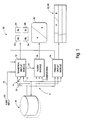
- an exemplary motion picture composition system 10 includes a transition display module 12, a player module 14, and a timeline display module 16.
- a data path 11 links a storage unit 18 with these modules. This data path may be broken down into several data lines 13, 15, 17. These data lines may be dedicated to different synchronized media channels, such as video, audio, and composition channels. These lines need not be separate physical lines.
- An input data path relays user input from a user input device 20, such as a pointing device, to the transition display module.
- the transition display module 12 relays transition display window information to transition display windows 32, 34, 36, 38 (see FIG. 2).
- the transition display module also relays transition information 21 to the player module 14, which will enable the player module to play back the entire transition on a transition playback display window 40.
- the timeline display module generates timeline information to be displayed on the display as a pair of timelines 42, 44.
- the timeline display module also provides information about user-initiated changes of transitions to the transition display module.
- a system according to the invention may be developed using a variety of types of computer systems.
- an Apple MacIntosh and the "C" computer language were used, but naturally the invention should not be read to be limited to this particular platform.
- the transition display module 12, player module 14 and timeline display module 16 may be implemented in software and/or hardware and may or may not be contained within the computer system.
- a software package entitled “Avid Media Composer”, available from Avid Technology, Inc. of Tewksbury, Massachusetts includes some of these features.
- the storage may include a high-speed, high-capacity internal magnetic hard disk drive.
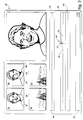
- the display interface 30 presented by the composition system to the user includes a series of four transition definition display windows 32, 34, 36, 38.
- the interface also includes a transition playback display window 40, a coarse timeline 42, a fine timeline 44, a command bar 46, and a mode bar 48.
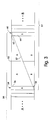
- first frame position 54 starts to include material from both of the scenes.
- this first frame position will show a frame 56 from the first scene at the same time as a frame 58 from the second scene.
- the frame from the first scene will be displayed much more brightly than the frame from the second scene.
- frames from the first scene will become dimmer as frames from the second scene become brighter.
- a last frame 62 from the first scene will be displayed much more dimly than the corresponding frame 64 from the second scene. This type of transition is symbolized by a diagonal line 57 representing this gradual shift.
- the transition definition display windows each correspond to frame positions either at the beginning 54 or the end 60 of the transition.
- the first window 32 of FIG. 2 displays the first frame 56 from the first scene in the transition.
- the second window 34 displays the last frame 62 from the first scene in the transition.
- the third window 36 displays the first frame 58 from the second scene in the transition.
- the fourth window displays the last frame 64 from the second scene in the transition.
- a user of the composing system of the invention will first manipulate the coarse timeline 42 to determine the rough area in which the transition is to be added. The user may then manipulate the fine timeline 44 to define a precise position for the edit. Using a mouse or other computer input device, the user may select two scenes to be displayed and place them in a composing area 45 of the timeline. To then create a gradual transition, the user may select one of a series of transition types and drag it to a position between the two scenes on the composition track 45 of the timeline. The system thereafter displays the transition as a transition control box 49.
- the user may then drag the transition start control line 70 to move the start of the transition earlier or later in time.
- the user may move the end transition control line 72 to end the transition earlier or later in time.
- the first transition display window 32 will display an earlier frame of the first scene.
- the third transition window 36 will also display an earlier frame of the second sequence. Moving the transition end control line 72 similarly affects the second 36 and fourth 38 transition display windows.
- the user may also move the central transition position 53 of the first scene. This may be done by manipulating the central transition command line 77 on the fine timeline.
- the first and second transition display windows 32, 34 are updated correspondingly, but the third and fourth transition display windows do not change. This allows the user to start the transition at a different time within the first scene.
- the user may move the center control for the second scene. This may be done with the central transition command line 77 modified by a mode control.
- the third transition display window 36 and the fourth transition display window 38 will be updated, leaving the first and second transition display windows 32, 34 unchanged. This allows the user to change the point in the second scene at which the transition begins.
- the user may also move both transition centers at the same time, in a similar manner. The user may play the whole transition on the playback display window at any time, under control of the command bar 46.
- an alternative embodiment of the invention also includes four transition display windows and a playback window.
- a series of four button bars 80, 82, 84, 86 are provided in a pattern surrounding the display windows.
- a button bar is an area of the screen containing "buttons" or control areas, which respond to user input from a pointing device.
- the first button bar 80 is placed above the first and second transition display windows and centered on a line roughly between them.
- the second button bar 82 is placed below the third and fourth transition display windows and centered on a line roughly between them.
- the third button bar is placed to the left of the first and third transition display windows and centered on a line roughly between them.
- the fourth button bar is placed to the right of the second and fourth transition display windows and centered on a line roughly between them.
- the button bars may each include a series of control icons or buttons.
- each button bar includes four buttons 90, 92, 94, 96.
- a first 90 of these buttons is a single frame advance button, which permits the user to step through the motion picture material to be displayed one frame at a time.
- a second button 92 is a multiple frame advance button, which allows the user to advance through the material at a rate of approximately 0.3 seconds per actuation.
- a single frame reverse button 94 and multiple frame reverse button 96 are also provided. Other controls may also be provided on the button bars, as discussed later in the present specification.
- the first button bar 80 controls the centerpoint of the transition for the first scene
- the second button bar 82 controls the centerpoint of the transition for the second scene.
- the third button bar 84 controls the start of the transition for both scenes
- the fourth button bar 86 controls the end of the transition for both scenes.
- buttons bar might be provided for each of the transition display windows, allowing the user to manipulate the position of each frame position individually.
- the composition system can compensate for non-linearities in film response.
- the density of pigmentation 101 of film resulting from a given exposure level 103 varies in a non-linear manner.
- the response curve for such a film generally includes what are known in the art as a toe portion 100 and a shoulder portion 102 in its deviation from an ideal response 104. Curves for specific film types are usually available from motion picture film manufacturers.
- the ends of the scene to be used in the transition are generally printed by exposing them to linearly increasing levels of light. Because the film responds to light in a non-linear way, the resulting transition 106 will also be non-linear, as illustrated in FIG. 6. These transitions start out with a low rate of change from the first scene to the second scene. The rate of change then increases, and finally tapers off towards the end of the transition. This effect is generally absent in electronically-generated video transitions.
- non-linear transition characteristics of film can be more pleasing to the eye. Furthermore, it is often advantageous to perform the bulk of the editing of a piece using a computerized composition system and then transfer the edits to a final film copy. It is therefore useful to provide transitions in the composition system that will simulate the ultimate effect on film.
- the storage 18 of the composition system 10 may hold a series of response curve data tables for various types of film.
- the user may select one of these tables for a desired film type to adjust the parameters of the transition to be played back on the display interface 30.
- the system retrieves values from the selected table and determines from them the relative intensities for concurrently displaying frames from the first and second scenes during the transition. For example, in the beginning of the transition of FIG. 6, frames from the first scene will be displayed more brightly relative to the first scene than they would in a linear transition.
- a system according to the invention may also permit motion in the transition display windows. This allows editors to define these points in a dynamic fashion. For example, certain moving scenes are easier to edit while the editor is perceiving the tempo of the scene.
- further buttons may be provided on the button bars, such as buttons having play, fast forward, rewind, jog and shuttle functions. It is noted that the four transition display windows need not display the first and last frames of the transition, but instead may display the frames immediately preceding and immediately following the transition.
- the system according to the invention also permits versatile editing operations on the soundtrack of motion picture material.
- this type of transition only affects audio information, it can be specified easily using the transition display windows.
- the user might want to create the effect of a door opening with a train outside of the door.
- the user may create this effect by defining a transition on one or more of the audio tracks of the material from background room sounds to train noise. This transition may be defined to start at the first frame in which the door starts to open, which is easily found using the transition display windows.
Landscapes
- Engineering & Computer Science (AREA)
- Multimedia (AREA)
- Signal Processing (AREA)
- Television Signal Processing For Recording (AREA)
- Management Or Editing Of Information On Record Carriers (AREA)
- Studio Circuits (AREA)
- User Interface Of Digital Computer (AREA)
- Television Systems (AREA)
- Processing Or Creating Images (AREA)
Applications Claiming Priority (3)
| Application Number | Priority Date | Filing Date | Title |
|---|---|---|---|
| US49028 | 1993-04-16 | ||
| US08/049,028 US5440348A (en) | 1993-04-16 | 1993-04-16 | Method and user interface for creating, specifying and adjusting motion picture transitions |
| PCT/US1994/004235 WO1994024814A1 (en) | 1993-04-16 | 1994-04-18 | Method and user interface for creating, specifying and adjusting motion picture transitions |
Publications (3)
| Publication Number | Publication Date |
|---|---|
| EP0700619A1 EP0700619A1 (en) | 1996-03-13 |
| EP0700619A4 EP0700619A4 (en) | 1996-07-17 |
| EP0700619B1 true EP0700619B1 (en) | 1999-02-10 |
Family
ID=21957686
Family Applications (1)
| Application Number | Title | Priority Date | Filing Date |
|---|---|---|---|
| EP94914205A Expired - Lifetime EP0700619B1 (en) | 1993-04-16 | 1994-04-18 | Method and user interface for creating, specifying and adjusting motion picture transitions |
Country Status (7)
| Country | Link |
|---|---|
| US (3) | US5440348A (enExample) |
| EP (1) | EP0700619B1 (enExample) |
| JP (1) | JPH09501274A (enExample) |
| AU (1) | AU681665B2 (enExample) |
| CA (1) | CA2160372C (enExample) |
| DE (1) | DE69416515T2 (enExample) |
| WO (1) | WO1994024814A1 (enExample) |
Families Citing this family (41)
| Publication number | Priority date | Publication date | Assignee | Title |
|---|---|---|---|---|
| US5812216A (en) | 1994-04-19 | 1998-09-22 | Avid Technology, Inc. | Method and apparatus for creating motion picture transitions according to non-linear light response |
| US5440348A (en) * | 1993-04-16 | 1995-08-08 | Avid Technology, Inc. | Method and user interface for creating, specifying and adjusting motion picture transitions |
| US6357047B1 (en) | 1997-06-30 | 2002-03-12 | Avid Technology, Inc. | Media pipeline with multichannel video processing and playback |
| EP0650299B1 (fr) * | 1993-10-20 | 1998-07-22 | Laboratoires D'electronique Philips S.A.S. | Procédé de traitement des niveaux de luminance dans une image composite et système de traitement d'image appliquant ce procédé |
| JPH11506575A (ja) * | 1995-03-07 | 1999-06-08 | インターバル リサーチ コーポレイション | 情報の選択記憶システム及び方法 |
| CN1312609C (zh) * | 1995-04-08 | 2007-04-25 | 索尼公司 | 编辑系统 |
| US5883670A (en) * | 1996-08-02 | 1999-03-16 | Avid Technology, Inc. | Motion video processing circuit for capture playback and manipulation of digital motion video information on a computer |
| US6154600A (en) * | 1996-08-06 | 2000-11-28 | Applied Magic, Inc. | Media editor for non-linear editing system |
| US6263507B1 (en) * | 1996-12-05 | 2001-07-17 | Interval Research Corporation | Browser for use in navigating a body of information, with particular application to browsing information represented by audiovisual data |
| US5893062A (en) | 1996-12-05 | 1999-04-06 | Interval Research Corporation | Variable rate video playback with synchronized audio |
| CA2202106C (en) * | 1997-04-08 | 2002-09-17 | Mgi Software Corp. | A non-timeline, non-linear digital multimedia composition method and system |
| US6105083A (en) * | 1997-06-20 | 2000-08-15 | Avid Technology, Inc. | Apparatus and method for controlling transfer of data between and processing of data by interconnected data processing elements |
| US5847703A (en) * | 1997-07-03 | 1998-12-08 | Vsoft Ltd. | Browsing system method and apparatus for video motion pictures |
| US6624846B1 (en) * | 1997-07-18 | 2003-09-23 | Interval Research Corporation | Visual user interface for use in controlling the interaction of a device with a spatial region |
| CN1089922C (zh) * | 1998-01-15 | 2002-08-28 | 英业达股份有限公司 | 动画界面编辑方法 |
| GB2336022A (en) * | 1998-04-03 | 1999-10-06 | Discreet Logic Inc | Edit processing audio-visual data |
| US6473132B1 (en) | 1999-09-09 | 2002-10-29 | Media 100 Inc. | Method and apparatus for effecting video transitions |
| US6243143B1 (en) | 1999-09-21 | 2001-06-05 | Media 100 Inc. | Effecting video transitions between video streams |
| US7155735B1 (en) | 1999-10-08 | 2006-12-26 | Vulcan Patents Llc | System and method for the broadcast dissemination of time-ordered data |
| US7020381B1 (en) | 1999-11-05 | 2006-03-28 | Matsushita Electric Industrial Co., Ltd. | Video editing apparatus and editing method for combining a plurality of image data to generate a series of edited motion video image data |
| US6362854B1 (en) | 1999-11-16 | 2002-03-26 | Media 100 Inc. | Effecting video transitions between video streams with a border |
| KR100349403B1 (ko) * | 1999-11-16 | 2002-08-22 | 한국방송공사 | 비디오 편집 장치 |
| US6757682B1 (en) | 2000-01-28 | 2004-06-29 | Interval Research Corporation | Alerting users to items of current interest |
| GB2374748A (en) * | 2001-04-20 | 2002-10-23 | Discreet Logic Inc | Image data editing for transitions between sequences |
| GB2378342A (en) * | 2001-07-31 | 2003-02-05 | Hewlett Packard Co | Selecting images based upon the similarity between images |
| US7398004B1 (en) | 2001-10-16 | 2008-07-08 | Sonic Solutions | Software methods for authoring multimedia content to be written to optical media |
| DE10214397A1 (de) * | 2002-03-30 | 2003-10-16 | Bts Media Solutions Gmbh | Verfahren und Vorrichtung zum Verarbeiten von Signalen |
| AU2003900809A0 (en) * | 2003-02-24 | 2003-03-13 | Aristocrat Technologies Australia Pty Ltd | Gaming machine transitions |
| US7725828B1 (en) * | 2003-10-15 | 2010-05-25 | Apple Inc. | Application of speed effects to a video presentation |
| US20050201724A1 (en) * | 2004-03-12 | 2005-09-15 | Sandy Chu | Method and system for effect addition in a single multimedia clip |
| JP4061285B2 (ja) * | 2004-03-31 | 2008-03-12 | 英特維數位科技股▲ふん▼有限公司 | 画像編集装置、プログラムおよび記録媒体 |
| US7394471B2 (en) * | 2004-04-05 | 2008-07-01 | Seiko Epson Corporation | Dynamic cross fading method and apparatus |
| US8205154B2 (en) * | 2004-04-16 | 2012-06-19 | Apple Inc. | User definable transition tool |
| US20060031879A1 (en) * | 2004-04-30 | 2006-02-09 | Vulcan Inc. | Management and non-linear presentation of news-related broadcasted or streamed multimedia content |
| US20060031885A1 (en) * | 2004-04-30 | 2006-02-09 | Vulcan Inc. | Management and non-linear presentation of music-related broadcasted or streamed multimedia content |
| US20060031916A1 (en) * | 2004-04-30 | 2006-02-09 | Vulcan Inc. | Management and non-linear presentation of broadcasted or streamed multimedia content |
| EP1883020B1 (en) * | 2006-07-28 | 2013-05-22 | Dassault Systèmes | Method and system for navigating in a database of a computer system |
| US20080148138A1 (en) * | 2006-12-18 | 2008-06-19 | General Instrument Corporation | Method, Apparatus and System for Providing Display Information to an End-User Display Device |
| US8910046B2 (en) | 2010-07-15 | 2014-12-09 | Apple Inc. | Media-editing application with anchored timeline |
| US9997196B2 (en) | 2011-02-16 | 2018-06-12 | Apple Inc. | Retiming media presentations |
| US11747972B2 (en) | 2011-02-16 | 2023-09-05 | Apple Inc. | Media-editing application with novel editing tools |
Family Cites Families (33)
| Publication number | Priority date | Publication date | Assignee | Title |
|---|---|---|---|---|
| US4205346A (en) * | 1978-06-09 | 1980-05-27 | Ross Video Limited | Video transition circuitry including transition previewing means |
| US4538188A (en) * | 1982-12-22 | 1985-08-27 | Montage Computer Corporation | Video composition method and apparatus |
| US4937685A (en) * | 1983-12-02 | 1990-06-26 | Lex Computer And Management Corporation | Method of display presentation for video editing |
| US4979050A (en) * | 1983-12-02 | 1990-12-18 | Lex Computer And Management Corporation | Video composition method for assembling video segments |
| AU601671B2 (en) * | 1982-12-22 | 1990-09-20 | Lex Computer And Management Corporation | Video composition method and apparatus |
| US4685003A (en) * | 1983-12-02 | 1987-08-04 | Lex Computing & Management Corporation | Video composition method and apparatus for providing simultaneous inputting and sorting of video source material |
| JPS59135680A (ja) * | 1983-01-24 | 1984-08-03 | Asaka:Kk | ビデオ編集用ビユワ− |
| US4625003A (en) * | 1983-08-30 | 1986-11-25 | Toa Nenryo Kogyo Kabushiki Kaisha | Catalyst component for polymerization of olefins (P-1026) |
| US4964004A (en) * | 1983-12-02 | 1990-10-16 | Lex Computer And Management Corporation | Video composition method and apparatus employing visual and tactile feedback |
| US4698664A (en) * | 1985-03-04 | 1987-10-06 | Apert-Herzog Corporation | Audio-visual monitoring system |
| US4956725A (en) * | 1986-08-29 | 1990-09-11 | Canon Kabushiki Kaisha | Image signal reproducing apparatus |
| EP0268270B1 (en) * | 1986-11-20 | 1993-11-03 | Matsushita Electric Industrial Co., Ltd. | Information editing apparatus |
| US5126851A (en) * | 1987-06-16 | 1992-06-30 | Canon Kabushiki Kaisha | Video system using two different kinds of recording media |
| US4972274A (en) * | 1988-03-04 | 1990-11-20 | Chyron Corporation | Synchronizing video edits with film edits |
| US4858011A (en) * | 1988-04-04 | 1989-08-15 | Jackson Richard A | Video switcher system with modular architecture |
| DE3900489C2 (de) * | 1989-01-10 | 1996-04-04 | Broadcast Television Syst | Einrichtung zur Erzeugung von Steuersignalen für eine Videomischeinrichtung |
| US5109482A (en) * | 1989-01-11 | 1992-04-28 | David Bohrman | Interactive video control system for displaying user-selectable clips |
| EP0390048B1 (en) * | 1989-03-28 | 1996-10-23 | Matsushita Electric Industrial Co., Ltd. | Apparatus and method for data edition |
| GB8913638D0 (en) * | 1989-06-14 | 1989-08-02 | Quantel Ltd | Electronic image composition systems |
| US5111409A (en) * | 1989-07-21 | 1992-05-05 | Elon Gasper | Authoring and use systems for sound synchronized animation |
| GB2235815A (en) * | 1989-09-01 | 1991-03-13 | Compact Video Group Inc | Digital dialog editor |
| US5218672A (en) * | 1990-01-19 | 1993-06-08 | Sony Corporation Of America | Offline editing system with user interface for controlling edit list generation |
| US5189516A (en) * | 1990-04-23 | 1993-02-23 | The Grass Valley Group, Inc. | Video preview system for allowing multiple outputs to be viewed simultaneously on the same monitor |
| EP0473322B1 (en) * | 1990-08-29 | 1995-10-25 | Sony United Kingdom Limited | Method of and apparatus for film to video signal conversion |
| US5191645A (en) * | 1991-02-28 | 1993-03-02 | Sony Corporation Of America | Digital signal processing system employing icon displays |
| US5194952A (en) * | 1991-03-28 | 1993-03-16 | Abekas Video Systems, Inc. | Video processing system having improved transition control and display |
| US5353391A (en) * | 1991-05-06 | 1994-10-04 | Apple Computer, Inc. | Method apparatus for transitioning between sequences of images |
| EP0526064B1 (en) * | 1991-08-02 | 1997-09-10 | The Grass Valley Group, Inc. | Video editing system operator interface for visualization and interactive control of video material |
| GB2266037B (en) * | 1992-03-13 | 1996-02-14 | Quantel Ltd | An electronic video processing system |
| US5999173A (en) * | 1992-04-03 | 1999-12-07 | Adobe Systems Incorporated | Method and apparatus for video editing with video clip representations displayed along a time line |
| US5305438A (en) * | 1992-05-19 | 1994-04-19 | Sony Electronics Inc. | Video storage, processing, and distribution system using recording format independent hierarchical storages and processors |
| EP0625781B1 (en) * | 1993-04-13 | 2000-06-14 | Sony Corporation | Editing apparatus |
| US5440348A (en) * | 1993-04-16 | 1995-08-08 | Avid Technology, Inc. | Method and user interface for creating, specifying and adjusting motion picture transitions |
-
1993
- 1993-04-16 US US08/049,028 patent/US5440348A/en not_active Expired - Lifetime
-
1994
- 1994-04-18 EP EP94914205A patent/EP0700619B1/en not_active Expired - Lifetime
- 1994-04-18 WO PCT/US1994/004235 patent/WO1994024814A1/en not_active Ceased
- 1994-04-18 AU AU67990/94A patent/AU681665B2/en not_active Ceased
- 1994-04-18 JP JP6523514A patent/JPH09501274A/ja not_active Ceased
- 1994-04-18 CA CA002160372A patent/CA2160372C/en not_active Expired - Fee Related
- 1994-04-18 DE DE69416515T patent/DE69416515T2/de not_active Expired - Fee Related
- 1994-04-19 US US08/230,050 patent/US5528310A/en not_active Expired - Lifetime
-
1995
- 1995-08-07 US US08/511,756 patent/US5726717A/en not_active Expired - Lifetime
Also Published As
| Publication number | Publication date |
|---|---|
| AU6799094A (en) | 1994-11-08 |
| DE69416515T2 (de) | 1999-06-17 |
| WO1994024814A1 (en) | 1994-10-27 |
| US5440348A (en) | 1995-08-08 |
| EP0700619A1 (en) | 1996-03-13 |
| CA2160372A1 (en) | 1994-10-27 |
| US5726717A (en) | 1998-03-10 |
| AU681665B2 (en) | 1997-09-04 |
| JPH09501274A (ja) | 1997-02-04 |
| US5528310A (en) | 1996-06-18 |
| DE69416515D1 (de) | 1999-03-25 |
| CA2160372C (en) | 2004-01-20 |
| EP0700619A4 (en) | 1996-07-17 |
Similar Documents
| Publication | Publication Date | Title |
|---|---|---|
| US5440348A (en) | Method and user interface for creating, specifying and adjusting motion picture transitions | |
| US5812216A (en) | Method and apparatus for creating motion picture transitions according to non-linear light response | |
| EP0625783B1 (en) | Method and apparatus for displaying available source material for editing | |
| US5442744A (en) | Methods and apparatus for displaying and editing multimedia information | |
| US5218672A (en) | Offline editing system with user interface for controlling edit list generation | |
| EP0564247B1 (en) | Method and apparatus for video editing | |
| US5781188A (en) | Indicating activeness of clips and applying effects to clips and tracks in a timeline of a multimedia work | |
| US10013154B2 (en) | Broadcast control | |
| US6452612B1 (en) | Real time video production system and method | |
| US6674955B2 (en) | Editing device and editing method | |
| JPWO1998047146A1 (ja) | 編集装置及び編集方法 | |
| GB2312081A (en) | Text-based video editing system | |
| KR20010074365A (ko) | 멀티미디어 파일 작성용 저작장치 및 방법 | |
| JPWO1998047145A1 (ja) | 編集システム及び編集方法 | |
| JP4895825B2 (ja) | テレビ制作技術 | |
| JP2001155468A (ja) | 動画像編集方法及び動画像編集を実行するプログラムを記録した機械読み取り可能な記録媒体 | |
| AU2010221788B2 (en) | Broadcast control | |
| Shaw | An On-Line True Random Access Edit System |
Legal Events
| Date | Code | Title | Description |
|---|---|---|---|
| PUAI | Public reference made under article 153(3) epc to a published international application that has entered the european phase |
Free format text: ORIGINAL CODE: 0009012 |
|
| 17P | Request for examination filed |
Effective date: 19951117 |
|
| AK | Designated contracting states |
Kind code of ref document: A1 Designated state(s): DE FR GB |
|
| A4 | Supplementary search report drawn up and despatched |
Effective date: 19960530 |
|
| AK | Designated contracting states |
Kind code of ref document: A4 Designated state(s): DE FR GB |
|
| 17Q | First examination report despatched |
Effective date: 19961220 |
|
| GRAG | Despatch of communication of intention to grant |
Free format text: ORIGINAL CODE: EPIDOS AGRA |
|
| GRAG | Despatch of communication of intention to grant |
Free format text: ORIGINAL CODE: EPIDOS AGRA |
|
| GRAH | Despatch of communication of intention to grant a patent |
Free format text: ORIGINAL CODE: EPIDOS IGRA |
|
| GRAH | Despatch of communication of intention to grant a patent |
Free format text: ORIGINAL CODE: EPIDOS IGRA |
|
| GRAA | (expected) grant |
Free format text: ORIGINAL CODE: 0009210 |
|
| AK | Designated contracting states |
Kind code of ref document: B1 Designated state(s): DE FR GB |
|
| REF | Corresponds to: |
Ref document number: 69416515 Country of ref document: DE Date of ref document: 19990325 |
|
| ET | Fr: translation filed | ||
| PLBE | No opposition filed within time limit |
Free format text: ORIGINAL CODE: 0009261 |
|
| STAA | Information on the status of an ep patent application or granted ep patent |
Free format text: STATUS: NO OPPOSITION FILED WITHIN TIME LIMIT |
|
| 26N | No opposition filed | ||
| REG | Reference to a national code |
Ref country code: GB Ref legal event code: IF02 |
|
| PGFP | Annual fee paid to national office [announced via postgrant information from national office to epo] |
Ref country code: GB Payment date: 20040414 Year of fee payment: 11 |
|
| PGFP | Annual fee paid to national office [announced via postgrant information from national office to epo] |
Ref country code: FR Payment date: 20040420 Year of fee payment: 11 |
|
| PGFP | Annual fee paid to national office [announced via postgrant information from national office to epo] |
Ref country code: DE Payment date: 20040601 Year of fee payment: 11 |
|
| PG25 | Lapsed in a contracting state [announced via postgrant information from national office to epo] |
Ref country code: GB Free format text: LAPSE BECAUSE OF NON-PAYMENT OF DUE FEES Effective date: 20050418 |
|
| PG25 | Lapsed in a contracting state [announced via postgrant information from national office to epo] |
Ref country code: DE Free format text: LAPSE BECAUSE OF NON-PAYMENT OF DUE FEES Effective date: 20051101 |
|
| GBPC | Gb: european patent ceased through non-payment of renewal fee |
Effective date: 20050418 |
|
| PG25 | Lapsed in a contracting state [announced via postgrant information from national office to epo] |
Ref country code: FR Free format text: LAPSE BECAUSE OF NON-PAYMENT OF DUE FEES Effective date: 20051230 |
|
| REG | Reference to a national code |
Ref country code: FR Ref legal event code: ST Effective date: 20051230 |