EP0700406B1 - Statistische copolymerisate des propylens - Google Patents
Statistische copolymerisate des propylens Download PDFInfo
- Publication number
- EP0700406B1 EP0700406B1 EP94917639A EP94917639A EP0700406B1 EP 0700406 B1 EP0700406 B1 EP 0700406B1 EP 94917639 A EP94917639 A EP 94917639A EP 94917639 A EP94917639 A EP 94917639A EP 0700406 B1 EP0700406 B1 EP 0700406B1
- Authority
- EP
- European Patent Office
- Prior art keywords
- weight
- random copolymer
- alkyl
- melting point
- ene
- Prior art date
- Legal status (The legal status is an assumption and is not a legal conclusion. Google has not performed a legal analysis and makes no representation as to the accuracy of the status listed.)
- Revoked
Links
- QQONPFPTGQHPMA-UHFFFAOYSA-N propylene Natural products CC=C QQONPFPTGQHPMA-UHFFFAOYSA-N 0.000 title claims abstract description 32
- 229920005604 random copolymer Polymers 0.000 title claims abstract 14
- 125000004805 propylene group Chemical group [H]C([H])([H])C([H])([*:1])C([H])([H])[*:2] 0.000 title claims description 30
- 238000002844 melting Methods 0.000 claims abstract description 27
- 230000008018 melting Effects 0.000 claims abstract description 27
- 239000003054 catalyst Substances 0.000 claims abstract description 20
- 238000004519 manufacturing process Methods 0.000 claims abstract description 9
- 239000000835 fiber Substances 0.000 claims abstract description 6
- 238000000465 moulding Methods 0.000 claims abstract description 6
- 239000000155 melt Substances 0.000 claims abstract description 5
- 229920001577 copolymer Polymers 0.000 claims abstract description 4
- VXNZUUAINFGPBY-UHFFFAOYSA-N 1-Butene Chemical compound CCC=C VXNZUUAINFGPBY-UHFFFAOYSA-N 0.000 claims description 34
- -1 aluminum compound Chemical class 0.000 claims description 22
- 150000001875 compounds Chemical class 0.000 claims description 16
- VGGSQFUCUMXWEO-UHFFFAOYSA-N Ethene Chemical compound C=C VGGSQFUCUMXWEO-UHFFFAOYSA-N 0.000 claims description 15
- 239000005977 Ethylene Substances 0.000 claims description 15
- 229920000642 polymer Polymers 0.000 claims description 14
- 239000000203 mixture Substances 0.000 claims description 13
- 125000000008 (C1-C10) alkyl group Chemical group 0.000 claims description 12
- 125000004432 carbon atom Chemical group C* 0.000 claims description 10
- 239000001257 hydrogen Substances 0.000 claims description 10
- 229910052739 hydrogen Inorganic materials 0.000 claims description 10
- 238000000034 method Methods 0.000 claims description 10
- 229910052751 metal Inorganic materials 0.000 claims description 9
- 239000002184 metal Substances 0.000 claims description 9
- 125000004122 cyclic group Chemical group 0.000 claims description 8
- QCWXUUIWCKQGHC-UHFFFAOYSA-N Zirconium Chemical group [Zr] QCWXUUIWCKQGHC-UHFFFAOYSA-N 0.000 claims description 7
- 229910052735 hafnium Inorganic materials 0.000 claims description 7
- VBJZVLUMGGDVMO-UHFFFAOYSA-N hafnium atom Chemical group [Hf] VBJZVLUMGGDVMO-UHFFFAOYSA-N 0.000 claims description 7
- 238000006116 polymerization reaction Methods 0.000 claims description 7
- 229910052782 aluminium Inorganic materials 0.000 claims description 6
- 125000003710 aryl alkyl group Chemical group 0.000 claims description 6
- 230000000737 periodic effect Effects 0.000 claims description 6
- ZAMOUSCENKQFHK-UHFFFAOYSA-N Chlorine atom Chemical group [Cl] ZAMOUSCENKQFHK-UHFFFAOYSA-N 0.000 claims description 5
- GUCVJGMIXFAOAE-UHFFFAOYSA-N niobium atom Chemical group [Nb] GUCVJGMIXFAOAE-UHFFFAOYSA-N 0.000 claims description 5
- GUVRBAGPIYLISA-UHFFFAOYSA-N tantalum atom Chemical group [Ta] GUVRBAGPIYLISA-UHFFFAOYSA-N 0.000 claims description 5
- 229910052720 vanadium Inorganic materials 0.000 claims description 5
- GPPXJZIENCGNKB-UHFFFAOYSA-N vanadium Chemical group [V]#[V] GPPXJZIENCGNKB-UHFFFAOYSA-N 0.000 claims description 5
- 229910052726 zirconium Inorganic materials 0.000 claims description 5
- RTAQQCXQSZGOHL-UHFFFAOYSA-N Titanium Chemical group [Ti] RTAQQCXQSZGOHL-UHFFFAOYSA-N 0.000 claims description 4
- 229910052801 chlorine Inorganic materials 0.000 claims description 4
- 239000000460 chlorine Chemical group 0.000 claims description 4
- 125000000753 cycloalkyl group Chemical group 0.000 claims description 4
- 229910052758 niobium Inorganic materials 0.000 claims description 4
- 239000010955 niobium Chemical group 0.000 claims description 4
- 238000002360 preparation method Methods 0.000 claims description 4
- 150000003254 radicals Chemical group 0.000 claims description 4
- 229910052715 tantalum Chemical group 0.000 claims description 4
- 229910052719 titanium Inorganic materials 0.000 claims description 4
- 239000010936 titanium Substances 0.000 claims description 4
- WKBOTKDWSSQWDR-UHFFFAOYSA-N Bromine atom Chemical group [Br] WKBOTKDWSSQWDR-UHFFFAOYSA-N 0.000 claims description 3
- OKTJSMMVPCPJKN-UHFFFAOYSA-N Carbon Chemical compound [C] OKTJSMMVPCPJKN-UHFFFAOYSA-N 0.000 claims description 3
- XUIMIQQOPSSXEZ-UHFFFAOYSA-N Silicon Chemical compound [Si] XUIMIQQOPSSXEZ-UHFFFAOYSA-N 0.000 claims description 3
- ATJFFYVFTNAWJD-UHFFFAOYSA-N Tin Chemical compound [Sn] ATJFFYVFTNAWJD-UHFFFAOYSA-N 0.000 claims description 3
- 125000002877 alkyl aryl group Chemical group 0.000 claims description 3
- PNEYBMLMFCGWSK-UHFFFAOYSA-N aluminium oxide Inorganic materials [O-2].[O-2].[O-2].[Al+3].[Al+3] PNEYBMLMFCGWSK-UHFFFAOYSA-N 0.000 claims description 3
- GDTBXPJZTBHREO-UHFFFAOYSA-N bromine Chemical group BrBr GDTBXPJZTBHREO-UHFFFAOYSA-N 0.000 claims description 3
- 229910052794 bromium Inorganic materials 0.000 claims description 3
- 229910052799 carbon Inorganic materials 0.000 claims description 3
- 229910052731 fluorine Inorganic materials 0.000 claims description 3
- 239000011737 fluorine Substances 0.000 claims description 3
- 239000007789 gas Substances 0.000 claims description 3
- 229910052732 germanium Inorganic materials 0.000 claims description 3
- GNPVGFCGXDBREM-UHFFFAOYSA-N germanium atom Chemical compound [Ge] GNPVGFCGXDBREM-UHFFFAOYSA-N 0.000 claims description 3
- 125000001424 substituent group Chemical group 0.000 claims description 3
- 229910052718 tin Inorganic materials 0.000 claims description 3
- 150000005840 aryl radicals Chemical class 0.000 claims description 2
- 125000003709 fluoroalkyl group Chemical group 0.000 claims description 2
- 125000004407 fluoroaryl group Chemical group 0.000 claims description 2
- 229910052710 silicon Inorganic materials 0.000 claims description 2
- 239000010703 silicon Substances 0.000 claims description 2
- 125000004435 hydrogen atom Chemical class [H]* 0.000 claims 2
- 125000004178 (C1-C4) alkyl group Chemical group 0.000 claims 1
- 125000001153 fluoro group Chemical group F* 0.000 claims 1
- 230000000379 polymerizing effect Effects 0.000 claims 1
- 229920006301 statistical copolymer Polymers 0.000 description 18
- YXFVVABEGXRONW-UHFFFAOYSA-N Toluene Chemical compound CC1=CC=CC=C1 YXFVVABEGXRONW-UHFFFAOYSA-N 0.000 description 15
- UFHFLCQGNIYNRP-UHFFFAOYSA-N Hydrogen Chemical compound [H][H] UFHFLCQGNIYNRP-UHFFFAOYSA-N 0.000 description 10
- IMNFDUFMRHMDMM-UHFFFAOYSA-N N-Heptane Chemical compound CCCCCCC IMNFDUFMRHMDMM-UHFFFAOYSA-N 0.000 description 8
- VYPSYNLAJGMNEJ-UHFFFAOYSA-N Silicium dioxide Chemical compound O=[Si]=O VYPSYNLAJGMNEJ-UHFFFAOYSA-N 0.000 description 8
- IJGRMHOSHXDMSA-UHFFFAOYSA-N Atomic nitrogen Chemical compound N#N IJGRMHOSHXDMSA-UHFFFAOYSA-N 0.000 description 6
- 239000002904 solvent Substances 0.000 description 6
- 239000004743 Polypropylene Substances 0.000 description 5
- 238000006243 chemical reaction Methods 0.000 description 5
- 125000002704 decyl group Chemical group [H]C([H])([H])C([H])([H])C([H])([H])C([H])([H])C([H])([H])C([H])([H])C([H])([H])C([H])([H])C([H])([H])C([H])([H])* 0.000 description 5
- 239000008246 gaseous mixture Substances 0.000 description 5
- 239000000463 material Substances 0.000 description 5
- 229920001155 polypropylene Polymers 0.000 description 5
- 239000008096 xylene Substances 0.000 description 5
- CTQNGGLPUBDAKN-UHFFFAOYSA-N O-Xylene Chemical compound CC1=CC=CC=C1C CTQNGGLPUBDAKN-UHFFFAOYSA-N 0.000 description 4
- 150000002739 metals Chemical class 0.000 description 4
- 239000000047 product Substances 0.000 description 4
- VOITXYVAKOUIBA-UHFFFAOYSA-N triethylaluminium Chemical compound CC[Al](CC)CC VOITXYVAKOUIBA-UHFFFAOYSA-N 0.000 description 4
- PXGOKWXKJXAPGV-UHFFFAOYSA-N Fluorine Chemical compound FF PXGOKWXKJXAPGV-UHFFFAOYSA-N 0.000 description 3
- XAGFODPZIPBFFR-UHFFFAOYSA-N aluminium Chemical compound [Al] XAGFODPZIPBFFR-UHFFFAOYSA-N 0.000 description 3
- 239000012876 carrier material Substances 0.000 description 3
- 125000000058 cyclopentadienyl group Chemical group C1(=CC=CC1)* 0.000 description 3
- 238000000113 differential scanning calorimetry Methods 0.000 description 3
- ZSWFCLXCOIISFI-UHFFFAOYSA-N endo-cyclopentadiene Natural products C1C=CC=C1 ZSWFCLXCOIISFI-UHFFFAOYSA-N 0.000 description 3
- 125000001495 ethyl group Chemical group [H]C([H])([H])C([H])([H])* 0.000 description 3
- 150000002431 hydrogen Chemical class 0.000 description 3
- 125000003454 indenyl group Chemical group C1(C=CC2=CC=CC=C12)* 0.000 description 3
- 125000002496 methyl group Chemical group [H]C([H])([H])* 0.000 description 3
- 229910052757 nitrogen Inorganic materials 0.000 description 3
- 239000000843 powder Substances 0.000 description 3
- 239000000377 silicon dioxide Substances 0.000 description 3
- ZGEGCLOFRBLKSE-UHFFFAOYSA-N 1-Heptene Chemical compound CCCCCC=C ZGEGCLOFRBLKSE-UHFFFAOYSA-N 0.000 description 2
- LIKMAJRDDDTEIG-UHFFFAOYSA-N 1-hexene Chemical compound CCCCC=C LIKMAJRDDDTEIG-UHFFFAOYSA-N 0.000 description 2
- KWKAKUADMBZCLK-UHFFFAOYSA-N 1-octene Chemical compound CCCCCCC=C KWKAKUADMBZCLK-UHFFFAOYSA-N 0.000 description 2
- YBYIRNPNPLQARY-UHFFFAOYSA-N 1H-indene Natural products C1=CC=C2CC=CC2=C1 YBYIRNPNPLQARY-UHFFFAOYSA-N 0.000 description 2
- AQZWEFBJYQSQEH-UHFFFAOYSA-N 2-methyloxaluminane Chemical compound C[Al]1CCCCO1 AQZWEFBJYQSQEH-UHFFFAOYSA-N 0.000 description 2
- OFBQJSOFQDEBGM-UHFFFAOYSA-N Pentane Chemical compound CCCCC OFBQJSOFQDEBGM-UHFFFAOYSA-N 0.000 description 2
- LTAUOROLGLTOIF-UHFFFAOYSA-L [Cl-].[Cl-].CC1=Cc2ccccc2[C@H]1[Hf++]([C@@H]1C(C)=Cc2ccccc12)=[Si](C)C Chemical compound [Cl-].[Cl-].CC1=Cc2ccccc2[C@H]1[Hf++]([C@@H]1C(C)=Cc2ccccc12)=[Si](C)C LTAUOROLGLTOIF-UHFFFAOYSA-L 0.000 description 2
- 125000004429 atom Chemical group 0.000 description 2
- 238000009835 boiling Methods 0.000 description 2
- 239000000470 constituent Substances 0.000 description 2
- 238000001816 cooling Methods 0.000 description 2
- 239000000706 filtrate Substances 0.000 description 2
- 238000012685 gas phase polymerization Methods 0.000 description 2
- 239000000499 gel Substances 0.000 description 2
- 239000003921 oil Substances 0.000 description 2
- 239000002245 particle Substances 0.000 description 2
- YWAKXRMUMFPDSH-UHFFFAOYSA-N pentene Chemical compound CCCC=C YWAKXRMUMFPDSH-UHFFFAOYSA-N 0.000 description 2
- 238000010992 reflux Methods 0.000 description 2
- 229920006395 saturated elastomer Polymers 0.000 description 2
- 239000000741 silica gel Substances 0.000 description 2
- 229910002027 silica gel Inorganic materials 0.000 description 2
- 238000003756 stirring Methods 0.000 description 2
- 239000000725 suspension Substances 0.000 description 2
- VPGLGRNSAYHXPY-UHFFFAOYSA-L zirconium(2+);dichloride Chemical compound Cl[Zr]Cl VPGLGRNSAYHXPY-UHFFFAOYSA-L 0.000 description 2
- ZCYVEMRRCGMTRW-UHFFFAOYSA-N 7553-56-2 Chemical compound [I] ZCYVEMRRCGMTRW-UHFFFAOYSA-N 0.000 description 1
- 229910018072 Al 2 O 3 Inorganic materials 0.000 description 1
- VCFVRHAQERGNFA-UHFFFAOYSA-L C1=CC2=CC=CC=C2C1[Zr](Cl)(Cl)(=[Si](C)C)C1C2=CC=CC=C2C=C1 Chemical compound C1=CC2=CC=CC=C2C1[Zr](Cl)(Cl)(=[Si](C)C)C1C2=CC=CC=C2C=C1 VCFVRHAQERGNFA-UHFFFAOYSA-L 0.000 description 1
- XEZLFNHQVAZJQY-UHFFFAOYSA-L C1CC2CC=CC=C2C1[Zr](Cl)(Cl)(=[Si](C)C)C1C2=CC=CCC2CC1 Chemical compound C1CC2CC=CC=C2C1[Zr](Cl)(Cl)(=[Si](C)C)C1C2=CC=CCC2CC1 XEZLFNHQVAZJQY-UHFFFAOYSA-L 0.000 description 1
- WLHDJFLYFWVYCP-UHFFFAOYSA-L C=C.Cl[Zr](Cl)(C1C=CC=C1)C1C=CC=C1 Chemical compound C=C.Cl[Zr](Cl)(C1C=CC=C1)C1C=CC=C1 WLHDJFLYFWVYCP-UHFFFAOYSA-L 0.000 description 1
- ASCHHEVZKVRIDU-UHFFFAOYSA-L CC1=C(C2=C3C=CC=CC3=CC=C2C1)[Zr](Cl)(Cl)(C1=C(C)CC2=CC=C3C=CC=CC3=C12)=[Si](C)C Chemical compound CC1=C(C2=C3C=CC=CC3=CC=C2C1)[Zr](Cl)(Cl)(C1=C(C)CC2=CC=C3C=CC=CC3=C12)=[Si](C)C ASCHHEVZKVRIDU-UHFFFAOYSA-L 0.000 description 1
- DNEHYTOIAJFQCO-UHFFFAOYSA-L CC1=CC=C(C)C1[Zr](Cl)(Cl)(C1C(C)=CC=C1C)=[Si](C)C Chemical compound CC1=CC=C(C)C1[Zr](Cl)(Cl)(C1C(C)=CC=C1C)=[Si](C)C DNEHYTOIAJFQCO-UHFFFAOYSA-L 0.000 description 1
- LMNJIRLUFGKYMP-UHFFFAOYSA-L C[Si](C)=[Zr](Cl)(Cl)(C1C=CC=C1)C1C=CC=C1 Chemical compound C[Si](C)=[Zr](Cl)(Cl)(C1C=CC=C1)C1C=CC=C1 LMNJIRLUFGKYMP-UHFFFAOYSA-L 0.000 description 1
- UGVVIPAIDGTTNN-UHFFFAOYSA-N C[Zr]C Chemical compound C[Zr]C UGVVIPAIDGTTNN-UHFFFAOYSA-N 0.000 description 1
- SBUKLPSBNFWJCU-UHFFFAOYSA-N ClIBr Chemical compound ClIBr SBUKLPSBNFWJCU-UHFFFAOYSA-N 0.000 description 1
- IOGYQQYFAFFHAT-UHFFFAOYSA-M Cl[Zr](C1C=CC=C1)C1C=CC=C1 Chemical compound Cl[Zr](C1C=CC=C1)C1C=CC=C1 IOGYQQYFAFFHAT-UHFFFAOYSA-M 0.000 description 1
- 101100490437 Mus musculus Acvrl1 gene Proteins 0.000 description 1
- 229910004298 SiO 2 Inorganic materials 0.000 description 1
- KHUMHMJAYHNUBM-UHFFFAOYSA-L [Br-].[Br-].C(C)[Si](=[Zr+2](C1C(=CC2=CC=CC=C12)C)C1C(=CC2=CC=CC=C12)C)CC Chemical compound [Br-].[Br-].C(C)[Si](=[Zr+2](C1C(=CC2=CC=CC=C12)C)C1C(=CC2=CC=CC=C12)C)CC KHUMHMJAYHNUBM-UHFFFAOYSA-L 0.000 description 1
- DLQZGRLCYQJIDQ-UHFFFAOYSA-L [Cl-].[Cl-].C=C.C12=CC=CCC2CCC1[Zr+2]C1C2=CC=CCC2CC1 Chemical compound [Cl-].[Cl-].C=C.C12=CC=CCC2CCC1[Zr+2]C1C2=CC=CCC2CC1 DLQZGRLCYQJIDQ-UHFFFAOYSA-L 0.000 description 1
- QSZGOMRHQRFORD-UHFFFAOYSA-L [Cl-].[Cl-].C=C.C1=CC2=CC=CC=C2C1[Zr+2]C1C2=CC=CC=C2C=C1 Chemical compound [Cl-].[Cl-].C=C.C1=CC2=CC=CC=C2C1[Zr+2]C1C2=CC=CC=C2C=C1 QSZGOMRHQRFORD-UHFFFAOYSA-L 0.000 description 1
- GCPXODGHANPVBD-UHFFFAOYSA-L [Cl-].[Cl-].CC(C)C1=Cc2ccccc2C1[Zr++](C1C(=Cc2ccccc12)C(C)C)=[Si](C)C Chemical compound [Cl-].[Cl-].CC(C)C1=Cc2ccccc2C1[Zr++](C1C(=Cc2ccccc12)C(C)C)=[Si](C)C GCPXODGHANPVBD-UHFFFAOYSA-L 0.000 description 1
- XONWBBJLUDBMBI-UHFFFAOYSA-L [Cl-].[Cl-].CC1=Cc2c(ccc3ccccc23)C1[Hf++]1(CC1)C1C(C)=Cc2c1ccc1ccccc21 Chemical compound [Cl-].[Cl-].CC1=Cc2c(ccc3ccccc23)C1[Hf++]1(CC1)C1C(C)=Cc2c1ccc1ccccc21 XONWBBJLUDBMBI-UHFFFAOYSA-L 0.000 description 1
- BOMWQXOILQOKHL-UHFFFAOYSA-L [Cl-].[Cl-].CC1=Cc2c(ccc3ccccc23)C1[Zr++](C1C(C)=Cc2c1ccc1ccccc21)=[Si](C)C Chemical compound [Cl-].[Cl-].CC1=Cc2c(ccc3ccccc23)C1[Zr++](C1C(C)=Cc2c1ccc1ccccc21)=[Si](C)C BOMWQXOILQOKHL-UHFFFAOYSA-L 0.000 description 1
- KOECLOYQFLBOJD-UHFFFAOYSA-L [Cl-].[Cl-].CC1=Cc2c(ccc3ccccc23)C1[Zr++]1(CC1)C1C(C)=Cc2c1ccc1ccccc21 Chemical compound [Cl-].[Cl-].CC1=Cc2c(ccc3ccccc23)C1[Zr++]1(CC1)C1C(C)=Cc2c1ccc1ccccc21 KOECLOYQFLBOJD-UHFFFAOYSA-L 0.000 description 1
- VBYGIOBOVJPTNN-UHFFFAOYSA-L [Cl-].[Cl-].CC1=Cc2ccccc2C1[Hf++]1(CC1)C1C(C)=Cc2ccccc12 Chemical compound [Cl-].[Cl-].CC1=Cc2ccccc2C1[Hf++]1(CC1)C1C(C)=Cc2ccccc12 VBYGIOBOVJPTNN-UHFFFAOYSA-L 0.000 description 1
- CGELJBSWQTYCIY-UHFFFAOYSA-L [Cl-].[Cl-].CC1=Cc2ccccc2[C@H]1[Zr++]([C@@H]1C(C)=Cc2ccccc12)=[Si](C)C Chemical compound [Cl-].[Cl-].CC1=Cc2ccccc2[C@H]1[Zr++]([C@@H]1C(C)=Cc2ccccc12)=[Si](C)C CGELJBSWQTYCIY-UHFFFAOYSA-L 0.000 description 1
- XHVLAWXDMTYYJZ-UHFFFAOYSA-L [Cl-].[Cl-].CC1=Cc2ccccc2[C@H]1[Zr++]1(CC1)[C@@H]1C(C)=Cc2ccccc12 Chemical compound [Cl-].[Cl-].CC1=Cc2ccccc2[C@H]1[Zr++]1(CC1)[C@@H]1C(C)=Cc2ccccc12 XHVLAWXDMTYYJZ-UHFFFAOYSA-L 0.000 description 1
- ZLZGFVOADUDZPU-UHFFFAOYSA-L [Cl-].[Cl-].C[Si](=[Zr+2](C1C(=CC=C1C(C)C)CC)C1C(=CC=C1C(C)C)CC)C Chemical compound [Cl-].[Cl-].C[Si](=[Zr+2](C1C(=CC=C1C(C)C)CC)C1C(=CC=C1C(C)C)CC)C ZLZGFVOADUDZPU-UHFFFAOYSA-L 0.000 description 1
- GPTVXHHNFZPTOX-UHFFFAOYSA-L [Cl-].[Cl-].C[Si](C)=[Zr++]([C@H]1C(=Cc2ccccc12)C(C)(C)C)[C@@H]1C(=Cc2ccccc12)C(C)(C)C Chemical compound [Cl-].[Cl-].C[Si](C)=[Zr++]([C@H]1C(=Cc2ccccc12)C(C)(C)C)[C@@H]1C(=Cc2ccccc12)C(C)(C)C GPTVXHHNFZPTOX-UHFFFAOYSA-L 0.000 description 1
- 125000000217 alkyl group Chemical group 0.000 description 1
- 150000004945 aromatic hydrocarbons Chemical class 0.000 description 1
- TZCXTZWJZNENPQ-UHFFFAOYSA-L barium sulfate Chemical group [Ba+2].[O-]S([O-])(=O)=O TZCXTZWJZNENPQ-UHFFFAOYSA-L 0.000 description 1
- 229920001400 block copolymer Polymers 0.000 description 1
- 125000000484 butyl group Chemical group [H]C([*])([H])C([H])([H])C([H])([H])C([H])([H])[H] 0.000 description 1
- 239000000969 carrier Substances 0.000 description 1
- 125000002091 cationic group Chemical group 0.000 description 1
- 238000012512 characterization method Methods 0.000 description 1
- 238000007334 copolymerization reaction Methods 0.000 description 1
- 230000000694 effects Effects 0.000 description 1
- 125000003983 fluorenyl group Chemical group C1(=CC=CC=2C3=CC=CC=C3CC12)* 0.000 description 1
- 150000004820 halides Chemical class 0.000 description 1
- 238000010438 heat treatment Methods 0.000 description 1
- 229930195733 hydrocarbon Natural products 0.000 description 1
- 150000002430 hydrocarbons Chemical class 0.000 description 1
- 229910052740 iodine Inorganic materials 0.000 description 1
- 239000011630 iodine Substances 0.000 description 1
- 125000001449 isopropyl group Chemical group [H]C([H])([H])C([H])(*)C([H])([H])[H] 0.000 description 1
- 239000003446 ligand Substances 0.000 description 1
- 238000005259 measurement Methods 0.000 description 1
- 239000000178 monomer Substances 0.000 description 1
- SYSQUGFVNFXIIT-UHFFFAOYSA-N n-[4-(1,3-benzoxazol-2-yl)phenyl]-4-nitrobenzenesulfonamide Chemical class C1=CC([N+](=O)[O-])=CC=C1S(=O)(=O)NC1=CC=C(C=2OC3=CC=CC=C3N=2)C=C1 SYSQUGFVNFXIIT-UHFFFAOYSA-N 0.000 description 1
- 125000002347 octyl group Chemical group [H]C([*])([H])C([H])([H])C([H])([H])C([H])([H])C([H])([H])C([H])([H])C([H])([H])C([H])([H])[H] 0.000 description 1
- 125000002524 organometallic group Chemical group 0.000 description 1
- 125000001436 propyl group Chemical group [H]C([*])([H])C([H])([H])C([H])([H])[H] 0.000 description 1
- 238000007789 sealing Methods 0.000 description 1
- 235000012239 silicon dioxide Nutrition 0.000 description 1
- SNOOUWRIMMFWNE-UHFFFAOYSA-M sodium;6-[(3,4,5-trimethoxybenzoyl)amino]hexanoate Chemical compound [Na+].COC1=CC(C(=O)NCCCCCC([O-])=O)=CC(OC)=C1OC SNOOUWRIMMFWNE-UHFFFAOYSA-M 0.000 description 1
- 125000000999 tert-butyl group Chemical group [H]C([H])([H])C(*)(C([H])([H])[H])C([H])([H])[H] 0.000 description 1
- 229910052723 transition metal Inorganic materials 0.000 description 1
- 150000003624 transition metals Chemical class 0.000 description 1
- GBXQPDCOMJJCMJ-UHFFFAOYSA-M trimethyl-[6-(trimethylazaniumyl)hexyl]azanium;bromide Chemical compound [Br-].C[N+](C)(C)CCCCCC[N+](C)(C)C GBXQPDCOMJJCMJ-UHFFFAOYSA-M 0.000 description 1
- 238000001291 vacuum drying Methods 0.000 description 1
- XLYOFNOQVPJJNP-UHFFFAOYSA-N water Substances O XLYOFNOQVPJJNP-UHFFFAOYSA-N 0.000 description 1
- 150000003738 xylenes Chemical class 0.000 description 1
Classifications
-
- D—TEXTILES; PAPER
- D01—NATURAL OR MAN-MADE THREADS OR FIBRES; SPINNING
- D01F—CHEMICAL FEATURES IN THE MANUFACTURE OF ARTIFICIAL FILAMENTS, THREADS, FIBRES, BRISTLES OR RIBBONS; APPARATUS SPECIALLY ADAPTED FOR THE MANUFACTURE OF CARBON FILAMENTS
- D01F6/00—Monocomponent artificial filaments or the like of synthetic polymers; Manufacture thereof
- D01F6/28—Monocomponent artificial filaments or the like of synthetic polymers; Manufacture thereof from copolymers obtained by reactions only involving carbon-to-carbon unsaturated bonds
- D01F6/30—Monocomponent artificial filaments or the like of synthetic polymers; Manufacture thereof from copolymers obtained by reactions only involving carbon-to-carbon unsaturated bonds comprising olefins as the major constituent
-
- C—CHEMISTRY; METALLURGY
- C08—ORGANIC MACROMOLECULAR COMPOUNDS; THEIR PREPARATION OR CHEMICAL WORKING-UP; COMPOSITIONS BASED THEREON
- C08F—MACROMOLECULAR COMPOUNDS OBTAINED BY REACTIONS ONLY INVOLVING CARBON-TO-CARBON UNSATURATED BONDS
- C08F210/00—Copolymers of unsaturated aliphatic hydrocarbons having only one carbon-to-carbon double bond
- C08F210/04—Monomers containing three or four carbon atoms
- C08F210/06—Propene
-
- C—CHEMISTRY; METALLURGY
- C08—ORGANIC MACROMOLECULAR COMPOUNDS; THEIR PREPARATION OR CHEMICAL WORKING-UP; COMPOSITIONS BASED THEREON
- C08L—COMPOSITIONS OF MACROMOLECULAR COMPOUNDS
- C08L23/00—Compositions of homopolymers or copolymers of unsaturated aliphatic hydrocarbons having only one carbon-to-carbon double bond; Compositions of derivatives of such polymers
- C08L23/02—Compositions of homopolymers or copolymers of unsaturated aliphatic hydrocarbons having only one carbon-to-carbon double bond; Compositions of derivatives of such polymers not modified by chemical after-treatment
- C08L23/10—Homopolymers or copolymers of propene
- C08L23/14—Copolymers of propene
- C08L23/142—Copolymers of propene at least partially crystalline copolymers of propene with other olefins
Definitions
- the present invention relates to statistical copolymers of propylene with 0.1 to 20% by weight of further C 2 -C 10 -alk-1-enes, a melting point below 155 ° C., xylene-soluble fractions of less than 15% by weight and one Melt flow index from 0.1 to 100 g / 10 min, at 230 ° C and under a weight of 2.16 kg.
- the invention relates to processes for the production of such statistical copolymers, their use for the production of fibers, films and moldings and the fibers, films and moldings obtainable here.
- Highly isotactic, highly crystalline polypropylenes are characterized by with a melting point of approx. 165 ° C and low xylene-soluble components combined with high rigidity.
- flexible products with reduced crystallinity are required in particular for applications in the film sector.
- EP-A 433 990 describes processes for the production of propylene block copolymers with high flowability, the polymerization being carried out in two stages. The polymers available here melt in two sections.
- the object of the present invention was therefore to develop statistical copolymers of propylene which are easy to process and at the same time show good applicability, in particular in the medical field and in the food sector.
- These have 0.1 to 20% by weight, in particular 0.5 to 10% by weight, of further C 2 -C 10 -alk-1-enes, a melting point below 155 ° C., preferably below 150 ° C., xylene-soluble fractions of less than 15% by weight, in particular less than 12% by weight and a melt flow index of 0.1 to 100 g / 10 min, preferably of 1 to 50 g / 10 min, at 230 ° C. and under one weight from 2.16 kg.
- C 2 -C 10 -alk-1-enes in particular ethylene, but-1-ene, pent-1-ene, hex-1-ene, hept-1-ene and oct-1-ene and mixtures of several these alk-1-enes can be understood.
- Preferred C 2 -C 10 alk-1-enes are ethylene and but-1-ene, and mixtures of these two alk-1-enes.
- the melting point of these statistical copolymers is to be understood as the melting point determined by means of differential scanning calorimetry (DSC).
- the xylene-soluble fraction is determined in distilled, boiling xylene.
- the melt flow index of the statistical copolymers of propylene relates to the amount of copolymer which is squeezed out within 10 minutes from the test device standardized according to DIN 53 735 at a temperature of 230 ° C. and under a weight of 2.16 kg.
- Particularly preferred statistical copolymers of propylene contain as C 2 -C 10 -alk-1-ene ethylene and have a melting point which complies with the following condition (I): Melting point ⁇ 155 ° C - x 6.5 ° C where x stands for the percentage by weight of ethylene, based on the total polymer.
- Other particularly preferred statistical copolymers of propylene contain but-1-ene as C 2 -C 10 -alk-1-ene and have a melting point which complies with the following condition (II): Melting point ⁇ 155 ° C - y2.3 ° C where y stands for the percentage by weight of but-1-ene, based on the total polymer.
- those statistical copolymers are particularly preferred which contain both ethylene and but-1-ene as C 2 -C 10 -alk-1-enes and whose melting point obeys the following condition (III): Melting point ⁇ 155 ° C - x6.5 ° C - y2.3 ° C where x stands for the percentage by weight of ethylene and y for the percentage by weight of but-1-ene, based on the total polymer.
- the statistical copolymers of propylene according to the invention can be obtained by copolymerizing propylene with C 2 -C 10 -alk-1-enes at temperatures in the range from 0 to 100 ° C. and pressures in the range from 1 to 300 bar in the presence of catalyst systems which are used as active constituents have metallocene complexes of metals of subgroup IV and V. of the periodic table and oligomeric aluminum oxide compounds.
- the copolymerization of the propylene with the C 2 -C 10 -alk-1-enes can be carried out in solution, in suspension, in bulk or in the gas phase.
- Gas phase polymerization is particularly preferred, in particular at temperatures in the range from 30 to 100 ° C., preferably 50 to 90 ° C., and pressures in the range from 5 to 40 bar, preferably 15 to 35 bar.
- the partial pressure ratios between propylene and the C 2 -C 10 -alk-1-enes are usually from 100: 1 to 1: 1, in particular from 80: 1 to 2: 1.
- the catalyst systems used to prepare the statistical copolymers of propylene according to the invention contain, as active constituents, inter alia metallocene complexes of metals from subgroups IV and V of the periodic table, in particular titanium, zirconium, hafnium, vanadium, niobium or tantalum.
- Complex compounds are preferably used in which the metal atom is connected via ⁇ bonds to unsaturated cyclic hydrocarbon radicals, for example cyclopentadienyl, fluorenyl or indenyl groups.
- the complex compounds used with preference are characterized in that the metal atom is also associated with further ligands, in particular with fluorine, chlorine, bromine and iodine or a C 1 -C 10 -alkyl, for example a methyl, ethyl, propyl or butyl group, can be linked.
- further ligands in particular with fluorine, chlorine, bromine and iodine or a C 1 -C 10 -alkyl, for example a methyl, ethyl, propyl or butyl group, can be linked.
- Such complex compounds can be synthesized by methods known per se, the reaction of the appropriately substituted cyclic hydrocarbon anions with halides of titanium, zirconium, hafnium, vanadium, niobium or tantalum being preferred. Examples of corresponding manufacturing processes include in the Journal of Organometallic Chemistry, 369 (1989), 359-370.
- the metallocene complexes can also be in cationic form, as described in EP-A 277 003 and EP-A 277 004. Furthermore, ⁇ -oxo-bis (chlorobiscyclopentadienyl) zirconium can also be used as the metallocene complex.
- the catalyst systems used to prepare the statistical copolymers of propylene according to the invention also contain oligomeric aluminum oxide compounds.
- oligomeric aluminum oxide compounds for example, open-chain or cyclic alumoxane compounds of the general formulas V or VI are suitable wherein R 15 is a C 1 to C 4 alkyl group, preferably a methyl or ethyl group and m is an integer from 5 to 30, preferably 10 to 25.
- oligomeric alumoxane compounds are usually prepared by reacting a solution of trialkylaluminum with water and include in EP-A 284 708 and US-A 4 794 096.
- the oligomeric alumoxane compounds obtained in this way are present as mixtures of both linear and cyclic chain molecules of different lengths, so that m is to be regarded as the mean.
- the alumoxane compounds can also be present in a mixture with other metal alkyls, preferably with aluminum alkyls.
- Subgroup of the periodic table is in the range from 10: 1 to 10 6 : 1, in particular in the range from 10: 1 to 10 4 : 1.
- aromatic hydrocarbons are used as solvents for these catalyst systems, preferably with 6 to 20 carbon atoms, in particular xylenes and toluene and mixtures thereof.
- Suitable carrier materials are, for example, silica gels, preferably those of the formula SiO 2 .a Al 2 O 3 , in which a stands for a number in the range from 0 to 2, preferably 0 to 0.5; essentially aluminum silicates or silicon dioxide.
- the carriers preferably have a particle diameter in the range from 1 to 200 ⁇ m, in particular from 30 to 80 ⁇ m. Products of this type are commercially available, for example as Silica Gel 332 from Grace.
- the support material for the catalyst is first prepared, then the supported catalyst complex is prepared and then the polymerization is carried out.
- the procedure is preferably such that the metallocene complex of the general formula IV is mixed with solvent, in particular toluene, and for this purpose a solution of oligomeric alumoxane compounds of the general formulas V or VI, preferably methylalumoxane, the solvent used in particular is used, which was also used in the metallocene complex, so preferably toluene.
- the support material is then added, the weight ratio of catalyst to support material being 10: 1 to 1000: 1, preferably 100: 1 to 500: 1. Then the solvent is removed, whereby a catalyst powder is obtained.
- the actual polymerization is preferably carried out in the gas phase, with polypropylene semolina usually being introduced in an autoclave and trialkylaluminum, preferably triethylaluminum, which serves as the cocatalyst, added.
- the weight ratio of polypropylene grit to trialkyl aluminum is generally 10: 1 to 10000: 1, preferably 20: 1 to 200: 1.
- 30% by weight, based on the amount of trialkylaluminum, of supported catalyst is added, the mixture is heated to temperatures up to 100 ° C., preferably 70 ° C., and the internal pressure is increased by Alk-1 enfeed up to 50 bar, preferably to 28 bar.
- the autoclave is let down.
- the statistical copolymers of propylene according to the invention have a surprisingly significantly lower melting point and a low xylene-soluble fraction. They are easy to process, can be used in many areas and are particularly suitable for the production of films, fibers and moldings.
- composition of the copolymer and the most important data for characterization can be found in the table below.
- the melting points were determined by means of DSC measurements (10 ° C./min heating rate).
- the xylene-soluble fractions were determined as follows:
Landscapes
- Chemical & Material Sciences (AREA)
- Chemical Kinetics & Catalysis (AREA)
- Health & Medical Sciences (AREA)
- Medicinal Chemistry (AREA)
- Polymers & Plastics (AREA)
- Organic Chemistry (AREA)
- General Chemical & Material Sciences (AREA)
- Engineering & Computer Science (AREA)
- Textile Engineering (AREA)
- Crystallography & Structural Chemistry (AREA)
- Transition And Organic Metals Composition Catalysts For Addition Polymerization (AREA)
- Addition Polymer Or Copolymer, Post-Treatments, Or Chemical Modifications (AREA)
- Artificial Filaments (AREA)
- Manufacture Of Macromolecular Shaped Articles (AREA)
- Polymerisation Methods In General (AREA)
Abstract
Description
- Die vorliegende Erfindung betrifft statistische Copolymerisate des Propylens mit 0,1 bis 20 Gew.-% weiterer C2-C10-Alk-1-ene, einem Schmelzpunkt unter 155°C, xylollöslichen Anteilen von weniger als 15 Gew.-% und einem Schmelzflußindex von 0,1 bis 100 g/10 min, bei 230°C und unter einem Gewicht von 2,16 kg.
- Weiterhin betrifft die Erfindung Verfahren zur Herstellung derartiger statistischer Copolymerisate, deren Verwendung zur Herstellung von Fasern, Folien und Formkörpern sowie die hierbei erhältlichen Fasern, Folien und Formkörper.
- Hochisotaktische, hochkristalline Polypropylene zeichnen sich u.a. durch einen Schmelzpunkt von ca. 165°C und niedrige xylollösliche Anteile, verbunden mit hoher Steifigkeit aus. Insbesondere für Anwendungen im Folienbereich benötigt man jedoch flexible Produkte mit abgesenkter Kristallinität.
- Bisher konnten diese Eigenschaften beim Polypropylen durch Absenken der Isotaktizität (vgl. DE-A 34 25 456) oder durch den Einbau von anderen Alk-1-enen, wie in der DE-A 40 11 160 beschrieben, erreicht werden. Dabei entstehen statistische Copolymerisate des Propylens mit einem abgesenkten Schmelzpunkt. Die Schmelzpunktabsenkung steigt mit zunehmendem Comonomergehalt.
- Die EP-A 433 990 beschreibt Verfahren zur Herstellung von Propylen-Blockcopolymeren mit hoher Fließfähigkeit, wobei die Polymerisation zweistufig durchgeführt wird. Die hierbei erhältlichen Polymere schmelzen in zwei Abschnitten.
- Aus der EP-A 355 477 sind Propylen-Isoblockpolymere mit kautschukartigen Eigenschaften bekannt, die Schmelzflußindices weit oberhalb von 100 g/10 min (230°C; 2,16 kg) aufweisen.
- Als Nachteil dieser Maßnahmen hat sich der Anstieg der xylollöslichen Anteile erwiesen; ein Effekt, der insbesondere für Anwendungen im medizinischen und Nahrungsmittelsektor unerwünscht ist. Vorteilhaft an diesen statistischen Copolymerisaten ist jedoch unter anderem, daß sie aufgrund ihres niedrigen Schmelzpunktes leicht verarbeitet werden können und eine verringerte Siegeltemperatur aufweisen.
- Aus verfahrenstechnischen und wirtschaftlichen Gründen ist man bestrebt, mit möglichst geringen Comonomermengen eine möglichst leichte Verarbeitbarkeit von Polymerisaten zu erzielen. Bei größeren Comonomermengen im Reaktor beobachtet man nämlich u.a. Brockenbildung.
- Aufgabe der vorliegenden Erfindung war es daher, statistische Copolymerisate des Propylens zu entwickeln, die sich leicht verarbeiten lassen und zugleich eine gute Anwendbarkeit zeigen, insbesondere im medizinischen Bereich und im Nahrungsmittelsektor.
- Demgemäß wurden die eingangs definierten statistischen Copolymerisate des Propylens gefunden.
- Diese weisen 0,1 bis 20 Gew.-%, insbesondere 0,5 bis 10 Gew.-% weiterer C2-C10-Alk-1-ene, einem Schmelzpunkt unter 155°C, bevorzugt unter 150°C, xylollösliche Anteile von weniger als 15 Gew.-%, insbesondere von weniger als 12 Gew.-% und einen Schmelzflußindex von 0,1 bis 100 g/10 min, vorzugsweise von 1 bis 50 g/10 min, bei 230°C und unter einem Gewicht von 2,16 kg, auf.
- Als C2-C10-Alk-1-ene sollen dabei insbesondere Ethylen, But-1-en, Pent-1-en, Hex-1-en, Hept-1-en und Oct-1-en sowie Gemische aus mehreren dieser Alk-1-ene verstanden werden. Bevorzugte C2-C10-Alk-1-ene sind Ethylen und But-1-en, sowie Gemische aus diesen beiden Alk-1-enen.
- Als Schmelzpunkt dieser statistischen Copolymerisate soll der mittels Differential Scanning Calorimetry (DSC) bestimmte Schmelzpunkt verstanden werden.
- Der xylollösliche Anteil wird dabei in destilliertem, siedendem Xylol ermittelt.
- Der Schmelzflußindex der statistischen Copolymerisate des Propylens bezieht sich auf diejenige Menge am Copolymerisat, die innerhalb von 10 Minuten aus der nach DIN 53 735 genormten Prüfvorrichtung bei einer Temperatur von 230°C und unter einem Gewicht von 2,16 kg ausgepreßt wird.
- Die hierbei angewandten Prüfungsverfahren sind dem durchschnittlichen Fachmann geläufig.
- Besonders bevorzugte statistische Copolymerisate des Propylens enthalten als C2-C10-Alk-1-ene Ethylen und weisen einen Schmelzpunkt auf, der folgender Bedingung (I) gehorcht:

- Weitere besonders bevorzugte statistische Copolymerisate des Propylens enthalten als C2-C10-Alk-1-ene But-1-en und weisen einen Schmelzpunkt auf, der folgender Bedingung (II) gehorcht:

- Darüber hinaus sind auch solche statistischen Copolymerisate besonders bevorzugt, welche als C2-C10-Alk-1-ene sowohl Ethylen als auch But-1-en enthalten und deren Schmelzpunkt der folgenden Bedingung (III) gehorcht:

- Das Zeichen "<" steht dabei sowohl bei (I) als auch bei (II) und (III) für "kleiner als".
- Die hierbei angeführten Bedingungen (I), (II) und (III) sind so zu verstehen, daß die besonders bevorzugten statistischen Copolymerisate eine, bezogen auf den jeweiligen Comonomeranteil, über das üblicherweise zu erwartende Maß hinausgehende Schmelzpunktabsenkung aufweisen. Dies hat zur Folge, daß ihre Schmelzpunkte teilweise erheblich unterhalb von 155°C liegen.
- Die erfindungsgemäßen statistischen Copolymerisate des Propylens sind erhältlich durch Copolymerisation von Propylen mit C2-C10-Alk-1-enen bei Temperaturen im Bereich von 0 bis 100°C und Drücken im Bereich von 1 bis 300 bar in Gegenwart von Katalysatorsystemen, die als aktive Bestandteile Metallocenkomplexe von Metallen der IV. und V. Nebengruppe des Periodensystems und oligomere Aluminiumoxidverbindungen aufweisen.
- Die Copolymerisation des Propylens mit den C2-C10-Alk-1-enen kann in Lösung, in Suspension, in Masse oder in der Gas-phase durchgeführt werden. Besonders bevorzugt ist die Gasphasenpolymerisation, insbesondere bei Temperaturen im Bereich von 30 bis 100°C, bevorzugt 50 bis 90°C, und Drücken im Bereich von 5 bis 40 bar, bevorzugt 15 bis 35 bar. Dabei liegen die Partialdruckverhältnisse zwischen Propylen und den C2-C10-Alk-1-enen üblicherweise bei 100:1 bis 1:1, insbesondere bei 80:1 bis 2:1.
- Die zur Herstellung der erfindungsgemäßen statistischen Copolymerisate des Propylens eingesetzten Katalysatorsysteme enthalten als aktive Bestandteile u.a. Metallocenkomplexe von Metallen der IV. und V. Nebengruppe des Periodensystems, insbesondere von Titan, Zirkonium, Hafnium, Vanadium, Niob oder Tantal. Vorzugsweise werden dabei solche Komplexverbindungen verwendet, bei denen das Metallatom über π-Bindungen mit ungesättigten cyclischen Kohlenwasserstoffresten verbunden ist, beispielsweise Cyclopentadienyl-, Fluorenyl- oder Indenylgruppen. Weiterhin sind die bevorzugt eingesetzten Komplexverbindungen dadurch gekennzeichnet, daß das Metallatom noch mit weiteren Liganden, insbesondere mit Fluor, Chlor, Brom und Iod oder einem C1- bis C10-Alkyl, beispielsweise einer Methyl-, Ethyl-, Propyl- oder Butylgruppe, verknüpft sein kann.
- Besonders geeignete Metallocenkomplexe lassen sich durch folgende allgemeine Formel IV kennzeichnen:

- M
- Titan, Zirkonium, Hafnium, Vanadium, Niob oder Tantal,
- X
- Fluor, Chlor, Brom, Iod, Wasserstoff, C1- bis C10-Alkyl, C6- bis C15-Aryl oder -OR5,
- wobei R5
- C1- bis C10-Alkyl, C6- bis C15-Aryl, Alkylaryl, Arylalkyl, Fluoralkyl oder Fluoraryl mit jeweils 1 bis 10 C-Atomen im Alkylrest und 6 bis 20 C-Atomen im Arylrest bedeutet,
- R1 bis R4 und R6 bis R9
- Wasserstoff, C1- bis C10-Alkyl, 5- bis 7-gliedriges Cycloalkyl, das seinerseits C1- bis C10-Alkyle als Substituenten tragen kann, C6- bis C15-Aryl oder Arylalkyl, wobei gegebenenfalls auch zwei benachbarte Reste gemeinsam für 4 bis 15 C-Atome aufweisende cyclische gesättigte, teilweise gesättigte oder ungesättigte Gruppen stehen können, oder Si(R10)3 mit
- R10
- C1- bis C10-Alkyl, C6- bis C15-Aryl oder C3- bis C10-Cycloalkyl,
- Y
- für R11R12Z〈 oder

- wobei Z
- Silicium, Germanium, Zinn oder Kohlenstoff bedeutet,
- R11,R12,R13,R14
- Wasserstoff, C1- bis C10-Alkyl, C3- bis C10-Cycloalkyl oder C6- bis C15-Aryl, wobei gegebenenfalls auch zwei benachbarte Reste gemeinsam für 4 bis 15 C-Atome aufweisende cyclische Gruppen stehen können.
- Von den Verbindungen der Formel IV sind diejenigen besonders geeignet, in denen
- R1 und R6
- gleich sind und für Wasserstoff oder C1- bis C10-Alkylgruppen stehen,
- R4 und R9
- gleich sind und für Wasserstoff, eine Methyl-, Ethyl-, iso-Propyl- oder tert.-Butylgruppe stehen,
- R2, R3, R7 und R8
- die Bedeutung
R3 und R8 C1- bis C4-Alkyl
R2 und R7 Wasserstoff
haben oder zwei benachbarte Reste R2 und R3 sowie R7 und R8 gemeinsam für 4 bis 12 C-Atome aufweisende cyclische Gruppen stehen, - R11,R12,R13 und R14
- für Wasserstoff oder C1- bis C8-Alkyl,
- M
- für Zirkonium oder Hafnium und
- X
- für Chlor stehen.
- Beispiele für besonders geeignete Komplexverbindungen sind u.a.
- Dimethylsilandiylbis(cyclopentadienyl)-zirkoniumdichlorid,
- Dimethylsilandiylbis(indenyl)-zirkoniumdichlorid,
- Dimethylsilandiylbis(tetrahydroindenyl)-zirkoniumdichlorid,
- Ethylenbis(cyclopentadienyl)-zirkoniumdichlorid,
- Ethylenbis(indenyl)-zirkoniumdichlorid,
- Ethylenbis(tetrahydroindenyl)-zirkoniumdichlorid,
- Ethylenbis(-2-methylindenyl)-zirkoniumdichlorid,
- Ethylenbis(-2-methylindenyl)-hafniumdichlorid,
- Ethylenbis(-2-methylbenzindenyl)-zirkoniumdichlorid,
- Ethylenbis(-2-methylbenzindenyl)-hafniumdichlorid,
- Dimethylsilandiylbis(-3-tert.butyl-5-methylcyclopentadienyl)-zirkoniumdichlorid,
- Dimethylsilandiylbis(-3-tert.butyl-5-ethylcyclopentadienyl)-zirkoniumdichlorid,
- Dimethylsilandiylbis(-3-tert.butyl-5-methylcyclopentadienyl)-dimethylzirkonium,
- Dimethylsilandiylbis(-2-methylindenyl)-zirkoniumdichlorid,
- Dimethylsilandiylbis(-2-isopropylindenyl)-zirkoniumdichlorid,
- Dimethylsilandiylbis(-2-tert.-butylindenyl)-zirkoniumdichlorid,
- Diethylsilandiylbis(-2-methylindenyl)-zirkoniumdibromid,
- Dimethylsilandiylbis(-2-methyl-5-methylcyclopentadienyl)-zirkoniumdichlorid,
- Dimethylsilandiylbis(-2-ethyl-5-isopropylcyclopentadienyl)-zirkoniumdichlorid,
- Dimethylsilandiylbis(-2-methylbenzindenyl)-zirkoniumdichlorid, und
- Dimethylsilandiylbis(-2-methylindenyl)-hafniumdichlorid.
- Die Synthese derartiger Komplexverbindungen kann nach an sich bekannten Methoden erfolgen, wobei die Umsetzung der entsprechend substituierten, cyclischen Kohlenwasserstoffanionen mit Halogeniden von Titan, Zirkonium, Hafnium, Vanadium, Niob oder Tantal, bevorzugt ist. Beispiele für entsprechende Herstellungsverfahren sind u.a. im Journal of Organometallic Chemistry, 369 (1989), 359-370 beschrieben.
- Die Metallocenkomplexe kannen auch in kationischer Form vorliegen, wie in der EP-A 277 003 und der EP-A 277 004 beschrieben wird. Weiterhin kann auch µ-Oxo-bis-(chlorobiscyclopentadienyl)-zirkonium als Metallocenkomplex verwendet werden.
- Neben den Metallocenkomplexen enthalten die zur Herstellung der erfindungsgemäßen statistischen Copolymerisate des Propylens eingesetzten Katalysatorsysteme noch oligomere Aluminiumoxidverbindungen. Geeignet sind beispielsweise offenkettige oder cyclische Alumoxanverbindungen der allgemeinen Formeln V oder VI


- Die Herstellung dieser oligomeren Alumoxanverbindungen erfolgt üblicherweise durch Umsetzung einer Lösung von Trialkylaluminium mit Wasser und ist u.a. in der EP-A 284 708 und der US-A 4 794 096 beschrieben.
- In der Regel liegen die dabei erhaltenen oligomeren Alumoxanverbindungen als Gemische unterschiedlich langer, sowohl linearer als auch cyclischer Kettenmoleküle vor, so daß m als Mittelwert anzusehen ist. Die Alumoxanverbindungen können auch im Gemisch mit anderen Metallalkylen, bevorzugt mit Aluminiumalkylen, vorliegen.
- Es hat sich als vorteilhaft erwiesen, die Komplexverbindung von Metallen der IV. und V. Nebengruppe des Periodensystems und die oligomere Alumoxanverbindung in solchen Mengen zu verwenden, daß das atomare Verhältnis zwischen Aluminium aus der oligomeren Alumoxanverbindung und dem Übergangsmetall aus der Komplexverbindung von Metallen der IV. und V. Nebengruppe des Periodensystems im Bereich von 10:1 bis 106:1, insbesondere im Bereich von 10:1 bis 104:1, liegt.
- Als Lösungsmittel für diese Katalysatorsysteme werden übliche aromatische Kohlenwasserstoffe eingesetzt, bevorzugt mit 6 bis 20 C-Atomen, insbesondere Xylole und Toluol sowie deren Mischungen.
- Bei der Herstellung der erfindungsgemäßen statistischen Copolymerisate des Propylens hat es sich als vorteilhaft erwiesen, wenn ein geträgertes Katalysatorsystem eingesetzt wird. Geeignete Trägermaterialien sind beispielsweise Kieselgele, bevorzugt solche der Formel SiO2 · a Al2O3, worin a für eine Zahl im Bereich von 0 bis 2 steht, vorzugsweise 0 bis 0,5; also im wesentlichen Alumosilikate oder Siliciumdioxid. Vorzugsweise weisen die Träger einen Teilchendurchmesser im Bereich von 1 bis 200 µm auf, insbesondere von 30 bis 80 µm. Derartige Produkte sind im Handel erhältlich, z.B. als Silica Gel 332 der Firma Grace.
- Bei einem besonders bevorzugten Verfahren zur Herstellung der erfindungsgemäßen statistischen Copolymerisate des Propylens stellt man zuerst das Trägermaterial für den Katalysator her, dann erfolgt die Herstellung des geträgerten Katalysatorkomplexes und anschließend die Polymerisation.
- Bei der Herstellung des Trägermaterials hat es sich als vorteilhaft erwiesen, die feuchten Kieselgele in Kohlenwasserstoffen, vorzugsweise in Heptan, zu suspendieren und mit Trialkylaluminium, vorzugsweise mit Triethylaluminium, zu versetzen, zu filtrieren und zu trocknen.
- Zur Herstellung des geträgerten Katalysatorkomplexes geht man vorzugsweise so vor, daß man den Metallocenkomplex der allgemeinen Formel IV mit Lösungsmittel versetzt, insbesondere mit Toluol, und hierzu eine Lösung von oligomeren Alumoxanverbindungen der allgemeinen Formeln V oder VI gibt, vorzugsweise Methylalumoxan, wobei als Lösungsmittel insbesondere dasjenige verwendet wird, welches auch beim Metallocenkomplex eingesetzt wurde, also bevorzugt Toluol. Anschließend wird das Trägermaterial zugegeben, wobei das Gewichtsverhältnis von Katalysator zu Trägermaterial 10:1 bis 1000:1 ausmacht, bevorzugt 100:1 bis 500:1. Anschließend wird das Lösungsmittel entfernt, wodurch ein Katalysatorpulver erhalten wird.
- Die eigentliche Polymerisation wird bevorzugt in der Gasphase durchgeführt, wobei man üblicherweise in einem Autoklaven Polypropylengrieß vorlegt und mit Trialkylaluminium, vorzugsweise Triethylaluminium, welches als Cokatalysator dient, versetzt. Das Gewichtsverhältnis von Polypropylengrieß zu Trialkylaluminium beträgt i.a. 10:1 bis 10000:1, bevorzugt 20:1 bis 200:1. Anschließend gibt man 30 Gew.-%, bezogen auf die Menge an Trialkylaluminium, an Trägerkatalysator zu, heizt auf Temperaturen bis 100°C, bevorzugt 70°C, auf und erhöht den Innendruck durch Alk-1-enzufuhr bis auf 50 bar, vorzugsweise auf 28 bar. Nach beendeter Polymerisation wird der Autoklav entspannt.
- Die erfindungsgemäßen statistischen Copolymerisate des Propylens weisen einen überraschend deutlich abgesenkten Schmelzpunkt und einen niedrigen xylollöslichen Anteil auf. Sie lassen sich gut verarbeiten, sind in vielen Bereichen anwendbar und eignen sich insbesondere zur Herstellung von Folien, Fasern und Formkörpern.
- Zu einer Suspension von 20,2 g Kieselgel (Fa. Grace, SG 332, Teilchendurchmesser 20 - 45 µm) in 200 ml Heptan wurden bei Raumtemperatur im Laufe von 30 min 56 ml einer Lösung von 6,4 g Triethylaluminium in 48 ml Heptan zugetropft. Dabei stieg die Temperatur auf 44°C an. Nach 18 Stunden Rühren bei Raumtemperatur wurde abfiltriert, zweimal mit je 30 ml Pentan gewaschen und anschließend am Ölpumpenvakuum bis zur Rieselfähigkeit des Trägermaterials getrocknet.
- Zu 50 µmol Dimethylsilandiylbis(-2-methylbenzo[e]-indenyl)zirkondichlorid (29 mg) in 20 ml Toluol wurden 13,1 ml (20 mmol) einer Lösung von Methylalumoxan in Toluol (1,53 molar, Fa. WITCO GmbH) gegeben und 15 min gerührt. Anschließend wurden 5 g des Trägermaterials zugegeben und weitere 30 min gerührt, Zuletzt wurde das Lösungsmittel bei Raumtemperatur im Laufe von 4 Stunden am Ölpumpenvakuum entfernt. Es entstand ein gut rieselfahiges Katalysatorpulver.
- In einem trockenen, mit Stickstoff gespülten 10-Liter-Autoklaven wurden nacheinander 50 g Polypropylengrieß und 4,8 ml Triethylaluminium (1 molare Lösung in Heptan) gegeben und 15 min geruhrt. Anschließend wurden 1,5 g des Trägerkatalysators im Stickstoff-Gegenstrom in den Autoklaven gefüllt und dieser verschlossen. Bei einer Rührerdrehzahl von 350 U/min wurde auf 70°C aufgeheizt und gleichzeitig der Innendruck stufenweise durch Propylenzufuhr bis zum Enddruck von 28 bar erhöht. Anschließend wurde bei einem Druck von 28 bar und 70°C über eine geeignete Verhältnisregelung ein gasförmiges Gemisch aus Propylen und Ethylen eingeleitet, wobei das Verhältnis zwischen dem Partialdruck des Propylens und dem des Ethylens 31:1 betrug. Die Polymerisation wurde unter ständigem Rührem bei 28 bar und 70°C im Laufe von 1,5 Stunden durchgeführt. Hierbei wurden die verbrauchten Monomere kontinuierlich ersetzt.
- Nach Beendigung der Gasphasenpolymerisation wurde während 10 min. auf Atmosphärendruck entspannt und das entstandene Produkt im Stickstoffstrom ausgetragen.
- Die Zusammensetzung des Copolymerisats und die wichtigsten Daten zur Charakterisierung sind der nachfolgenden Tabelle zu entnehmen.
- Mit dem gleichen Katalysatorsystem und unter den Reaktionsbedingungen wie in Beispiel 1 beschrieben, wurde ein gasförmiges Gemisch aus Propylen und Ethylen polymerisiert, wobei das Verhältnis zwischen dem Partialdruck des Propylens und dem des Ethylens 25:1 betrug.
- Mit dem gleichen Katalysatorsystem und unter den Reaktionsbedingungen wie in Beispiel 1 beschrieben, wurde ein gasförmiges Gemisch aus Propylen und But-1-en polymerisiert, wobei das Verhältnis zwischen dem Partialdruck des Propylens und dem des But-1-ens 25:1 betrug.
- Mit dem gleichen Katalysatorsystem und unter den Reaktionsbedingungen wie in Beispiel 1 beschrieben, wurde ein gasförmiges Gemisch aus Propylen und But-1-en polymerisiert, wobei das Verhältnis zwischen dem Partialdruck des Propylens und dem des But-1-ens 20:1 betrug.
- Mit dem gleichen Katalysatorsystem und unter den Reaktionsbedingungen wie in Beispiel 1 beschrieben, wurde ein gasförmiges Gemisch aus Propylen, Ethylen und But-1-en polymerisiert. Das Verhältnis der Partialdrücke zwischen Propylen, Ethylen und But-1-en betrug dabei 25 : 1 : 0,65.
Tabelle: Beispiel 1 2 3 4 5 Molverhältnis Al:Zr 800:1 800:1 800:1 800:1 800:1 Produktivität (g Polymer/g Trägerkatalysator) 3450 3720 3260 3610 3970 Ethylen-Gehalt (Gew.-%) im Polymerisat 2.6 3.9 - - 4.1 But-1-en-Gehalt (Gew.-%) im Polymerisat - - 4.9 6.1 1.9 Xylollöslicher Anteil (%) 5.8 7.7 3.0 3.6 11.0 DSC-Schmelzmaximum (°C) 128 119 125 121 109 Schmelflußindex* [g/10 min] 10,4 12,1 11,3 13,6 13,1 *) bei 230°C und 2,16 kg, nach DIN 53 735 - Die Schmelzpunkte wurden mittels DSC-Messungen (10°C/min Aufheizrate) bestimmt.
- Die xylollöslichen Anteile wurden folgendermaßen bestimmt:
- In einen 1-Liter-Dreihalskolben mit Rührer, Rückflußkühler und Thermometer wurden 500 ml destilliertes Xylol (Isomerengemisch) eingefüllt und auf 100°C erhitzt. Bei dieser Temperatur wurde das Polymere eingefüllt, anschließend auf den Siedepunkt des Xylols erhitzt und 60 min am Rückfluß gehalten. Anschließend wurde die Wärmezufuhr abgebrochen, innerhalb von 20 min mit einem Kältebad auf 5°C abgekühlt und dann wieder auf 20°C erwärmt. Diese Temperatur wurde für 30 min gehalten. Das ausgefallene Polymerisat wurde abfiltriert und von dem Filtrat exakt 100 ml in einen vorher tarierten 250-ml-Einhalskolben gefüllt. Daraus wurde das Lösungsmittel am Rotationsverdampfer entfernt. Anschließend wurde der verbleibende Rückstand im Vakuumtrockenschrank bei 80°C/200 Torr für 2 h getrocknet. Nach dem Erkalten wurde ausgewogen.
- Der xylollösliche Anteil ergibt sich aus

- xl = xylollöslicher Anteil in %
- g = gefundene Menge
- G = Produkteinwaage
- V = Volumen der eingesetzten Filtratmenge
Claims (13)
- Statistische Copolymerisate des Propylens mit 0,1 bis 20 Gew.-%.weiterer C2-C10-Alk-1-ene, einem Schmelzpunkt unter 155°C, xylollöslichen Anteilen von weniger als 15 Gew.-% und einem Schmelzflußindex von 0,1 bis 100 g/10 min, bei 230°C und unter einem Gewicht von 2,16 kg.
- Statistische Copolymerisate nach Anspruch 1, enthaltend 0,5 bis 10 Gew.-% weiterer C2-C10-Alk-1-ene.
- Statistische Copolymerisate nach den Ansprüchen 1 oder 2 mit einem Schmelzflußindex von 1 bis 50 g/10 min, bei 230°C und unter einem Gewicht von 2,16 kg.
- Statistische Copolymerisate nach den Ansprüchen 1 bis 3, welche als C2-C10-Alk-1-ene Ethylen enthalten und deren Schmelzpunkt der folgenden Bedingung (I) gehorcht:

- Statistische Copolymerisate nach den Ansprüchen 1 bis 3, welche als C2-C10-Alk-1-ene But-1-en enthalten und deren Schmelzpunkt der folgenden Bedingung (II) gehorcht:

- Statistische Copolymerisate nach den Ansprüchen 1 bis 3, welche als C2-C10-Alk-1-ene sowohl Ethylen als auch But-1-en enthalten und deren Schmelzpunkt der folgenden Bedingung (III) gehorcht:

- Statistische Copolymerisate nach den Ansprüchen 1 bis 6 mit xylollöslichen Anteilen von weniger als 12 Gew.-%.
- Statistische Copolymerisate nach den Ansprüchen 1 bis 7, erhältlich durch Polymerisation eines Gemisches aus Propylen und weiterer C2-C10-Alk-1-ene bei Temperaturen im Bereich von 0 bis 100°C und Drücken im Bereich von 1 bis 300 bar in Gegenwart von Katalysatorsystemen, die als aktive Bestandteile Metallocenkomplexe von Metallen der IV. und V. Nebengruppe des Periodensystems und oligomere Aluminiumoxidverbindungen enthalten.
- Statistische Copolymerisate nach Anspruch 8, erhältlich durch Polymerisation in der Gasphase bei Temperaturen im Bereich von 30 bis 100°C und Drücken im Bereich von 5 bis 40 bar.
- Statistische Copolymerisate nach den Ansprüchen 8 oder 9, wobei als Metallocenkomplexe von Metallen der IV. und V. Nebengruppe des Periodensystems
Metallocenkomplexe der allgemeinen Formel IV M Titan, Zirkonium, Hafnium, Vanadium, Niob oder Tantal,X Fluor, Chlor, Brom, Iod, Wasserstoff, C1- bis C10-Alkyl, C6- bis C15-Aryl oder -OR5,wobei R5 C1- bis C10-Alkyl, C6- bis C15-Aryl, Alkylaryl, Arylalkyl, Fluoralkyl oder Fluoraryl mit jeweils 1 bis 10 C-Atomen im Alkylrest und 6 bis 20 C-Atomen im Arylrest bedeutet,R1 bis R4 und R6 bis R9 Wasserstoff, C1 bis C10-Alkyl, 5- bis 7-gliedriges Cycloalkyl, das seinerseits C1- bis C10-Alkyle als Substituenten tragen kann, C6-bis C15-Aryl oder Arylalkyl, wobei gegebenenfalls auch zwei benachbarte Reste gemeinsam für 4 bis 15 C-Atome aufweisende cyclische Gruppen stehen können, oder Si(R10)3 mitR10 C1- bis C10-Alkyl, C6- bis C15-Aryl oder C3-bis C10-Cycloalkyl,y für R11R12Z〈 oder
 wobei Z Silicium, Germanium, Zinn oder Kohlenstoff bedeutet,R11,R12,R13,R14 Wasserstoff, C1- bis C10-Alkyl C3- bis C10-Cycloalkyl oder C6- bis C15-Aryl, wobei gegebenenfalls auch zwei benachbarte Reste gemeinsam für 4 bis 15 C-Atome aufweisende cyclische Gruppen stehen können,eingesetzt werden und als oligomere Aluminiumoxidverbindungen offenkettige oder cyclische Alumoxanverbindungen der allgemeinen Formeln V oder VI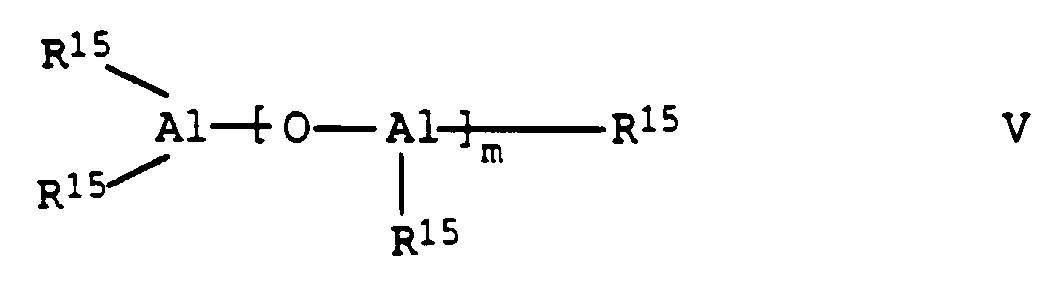

- Verfahren zur Herstellung von statistischen Copolymerisaten des Propylens gemäß den Verfahrensbedingungen von Anspruch 8.
- Verwendung der statistischen Copolymerisate gemäß den Ansprüchen 1 bis 10 zur Herstellung von Fasern, Folien und Formkörpern.
- Fasern, Folien und Formkörper, erhältlich aus den statistischen Copolymerisaten gemäß den Ansprüchen 1 bis 10 als wesentliche Bestandteile.
Applications Claiming Priority (3)
| Application Number | Priority Date | Filing Date | Title |
|---|---|---|---|
| DE4317654 | 1993-05-27 | ||
| DE4317654A DE4317654A1 (de) | 1993-05-27 | 1993-05-27 | Statistische Copolymerisate des Propylens |
| PCT/EP1994/001592 WO1994028039A1 (de) | 1993-05-27 | 1994-05-17 | Statistische copolymerisate des propylens |
Publications (2)
| Publication Number | Publication Date |
|---|---|
| EP0700406A1 EP0700406A1 (de) | 1996-03-13 |
| EP0700406B1 true EP0700406B1 (de) | 1997-04-16 |
Family
ID=6489052
Family Applications (1)
| Application Number | Title | Priority Date | Filing Date |
|---|---|---|---|
| EP94917639A Revoked EP0700406B1 (de) | 1993-05-27 | 1994-05-17 | Statistische copolymerisate des propylens |
Country Status (5)
| Country | Link |
|---|---|
| EP (1) | EP0700406B1 (de) |
| JP (1) | JPH08510492A (de) |
| DE (2) | DE4317654A1 (de) |
| ES (1) | ES2100072T3 (de) |
| WO (1) | WO1994028039A1 (de) |
Families Citing this family (8)
| Publication number | Priority date | Publication date | Assignee | Title |
|---|---|---|---|---|
| SG63595A1 (en) | 1994-02-25 | 1999-03-30 | Sumitomo Chemical Co | Propylene random copolymer and film laminate thereof |
| DE19533337A1 (de) * | 1995-09-11 | 1997-03-13 | Basf Ag | Propen/But-1-en-Copolymere |
| DE19533336A1 (de) * | 1995-09-11 | 1997-03-13 | Basf Ag | Verfahren zur Herstellung von Propen/But-1-en-Copolymeren |
| DE19545499A1 (de) * | 1995-12-06 | 1997-06-12 | Basf Ag | Verbesserte statistische Propylencopolymerisate |
| JP4595140B2 (ja) * | 1997-11-12 | 2010-12-08 | 住友化学株式会社 | 熱可塑性樹脂組成物 |
| DE19827328A1 (de) * | 1998-06-19 | 1999-12-23 | Targor Gmbh | Propen-Terpolymere mit geringem extrahierbarem Anteil |
| WO2017182211A1 (en) * | 2016-04-22 | 2017-10-26 | Basell Poliolefine Italia S.R.L. | Propylene terpolymer for filament for 3d printer |
| CN109071723B (zh) * | 2016-04-22 | 2020-12-29 | 巴塞尔聚烯烃意大利有限公司 | 用于三维打印机的基于丙烯的长丝 |
Family Cites Families (4)
| Publication number | Priority date | Publication date | Assignee | Title |
|---|---|---|---|---|
| KR920000173B1 (ko) * | 1986-10-09 | 1992-01-09 | 미쓰이세끼유 가가꾸고오교오 가부시끼가이샤 | 저결정성 프로필렌계 랜덤 공중합체 조성물, 그 제조방법 및 폴리프로필렌 복합 적층체 |
| JPH07100751B2 (ja) * | 1987-11-11 | 1995-11-01 | 出光石油化学株式会社 | プロピレン重合体組成物 |
| DE3826074A1 (de) * | 1988-07-30 | 1990-02-01 | Hoechst Ag | Propylen-isoblockpolymer und verfahren zu seiner herstellung |
| DE3942364A1 (de) * | 1989-12-21 | 1991-06-27 | Hoechst Ag | Verfahren zur herstellung einer polypropylen-formmasse |
-
1993
- 1993-05-27 DE DE4317654A patent/DE4317654A1/de not_active Withdrawn
-
1994
- 1994-05-17 ES ES94917639T patent/ES2100072T3/es not_active Expired - Lifetime
- 1994-05-17 JP JP7500174A patent/JPH08510492A/ja active Pending
- 1994-05-17 EP EP94917639A patent/EP0700406B1/de not_active Revoked
- 1994-05-17 DE DE59402454T patent/DE59402454D1/de not_active Revoked
- 1994-05-17 WO PCT/EP1994/001592 patent/WO1994028039A1/de not_active Ceased
Also Published As
| Publication number | Publication date |
|---|---|
| ES2100072T3 (es) | 1997-06-01 |
| WO1994028039A1 (de) | 1994-12-08 |
| DE4317654A1 (de) | 1994-12-01 |
| DE59402454D1 (de) | 1997-05-22 |
| JPH08510492A (ja) | 1996-11-05 |
| EP0700406A1 (de) | 1996-03-13 |
Similar Documents
| Publication | Publication Date | Title |
|---|---|---|
| EP0703932B1 (de) | Mehrphasige blockcopolymerisate des propylens | |
| EP0433986B1 (de) | Verfahren zur Herstellung einer Polypropylen-Formmasse | |
| EP0645403B1 (de) | Verfahren zur Herstellung von ultrahochmolekularem Polyethylen mit hoher Schüttdichte | |
| EP0803514B1 (de) | Verfahren zur Herstellung von Polyalk-1-enen in Gegenwart eines geträgerten Metallocenkatalysatorsystems und eines Antistatikums | |
| EP0433990B1 (de) | Verfahren zur Herstellung einer Polypropylen-Formmasse | |
| EP0519237B1 (de) | Lösliche Katalysatorsysteme zur Herstellung von Polyalk-1-enen mit hohen Molmassen | |
| EP0433989B1 (de) | Verfahren zur Herstellung einer Polypropylen-Formmasse | |
| EP0643100B1 (de) | Kälteschlagzähe Zusammensetzung aus semicrystallinen Propylen-Homopolymeren | |
| EP0571826B1 (de) | Kontinuierliches Gasphasenwirbelschichtverfahren zur Herstellung von Ethylenhomopolymerisaten und -copolymerisaten | |
| EP0674668B1 (de) | Propylen-homopolymere | |
| DE3836059A1 (de) | Verfahren zur herstellung eines ethylen-propylen-copolymers | |
| DE3443087A1 (de) | Verfahren zur herstellung von polyolefinen | |
| DE2643143A1 (de) | Katalysatoren zur polymerisation von alpha-olefinen | |
| EP0943631A1 (de) | Polymere des Propens | |
| EP0545140B1 (de) | Ethylen-Copolymerisate niederer Dichte | |
| DE4139262A1 (de) | Getraegerte katalysatorsysteme zur polymerisation von c(pfeil abwaerts)2(pfeil abwaerts)- bis c(pfeil abwaerts)1(pfeil abwaerts)(pfeil abwaerts)0(pfeil abwaerts)-alkenen | |
| EP0401776B1 (de) | Verfahren zur Herstellung eines poly-1-olefins | |
| EP0625995B1 (de) | Katalysatorsysteme zur polymerisation von c 2- bis c 10-alkenen | |
| EP0700406B1 (de) | Statistische copolymerisate des propylens | |
| EP0811642A2 (de) | Copolymere von Alk-1-enen und alpha,omega-Dienen mit erhöhtem Viskositätsindex | |
| DE69408649T2 (de) | Katalysator für die Herstellung von Elastomeren Ethylenpropylen Copolymeren | |
| EP0264733B1 (de) | Verfahren zum Herstellen von Homo- und Copolymerisaten des Ethylens mittels eines Ziegler-Katalysatorsystems | |
| DE4009169A1 (de) | Verfahren zur herstellung einer polypropylen-formmasse | |
| EP0655466B1 (de) | Katalysatorsysteme vom Typ der Ziegler-Natta-Katalysatoren | |
| EP0851889A1 (de) | Propen/but-1-en-copolymere |
Legal Events
| Date | Code | Title | Description |
|---|---|---|---|
| PUAI | Public reference made under article 153(3) epc to a published international application that has entered the european phase |
Free format text: ORIGINAL CODE: 0009012 |
|
| 17P | Request for examination filed |
Effective date: 19951019 |
|
| AK | Designated contracting states |
Kind code of ref document: A1 Designated state(s): BE DE ES FR GB NL |
|
| 17Q | First examination report despatched |
Effective date: 19960610 |
|
| GRAG | Despatch of communication of intention to grant |
Free format text: ORIGINAL CODE: EPIDOS AGRA |
|
| GRAH | Despatch of communication of intention to grant a patent |
Free format text: ORIGINAL CODE: EPIDOS IGRA |
|
| GRAH | Despatch of communication of intention to grant a patent |
Free format text: ORIGINAL CODE: EPIDOS IGRA |
|
| GRAA | (expected) grant |
Free format text: ORIGINAL CODE: 0009210 |
|
| AK | Designated contracting states |
Kind code of ref document: B1 Designated state(s): BE DE ES FR GB NL |
|
| GBT | Gb: translation of ep patent filed (gb section 77(6)(a)/1977) |
Effective date: 19970421 |
|
| REF | Corresponds to: |
Ref document number: 59402454 Country of ref document: DE Date of ref document: 19970522 |
|
| REG | Reference to a national code |
Ref country code: ES Ref legal event code: FG2A Ref document number: 2100072 Country of ref document: ES Kind code of ref document: T3 |
|
| ET | Fr: translation filed | ||
| PLBI | Opposition filed |
Free format text: ORIGINAL CODE: 0009260 |
|
| PLBQ | Unpublished change to opponent data |
Free format text: ORIGINAL CODE: EPIDOS OPPO |
|
| PLBI | Opposition filed |
Free format text: ORIGINAL CODE: 0009260 |
|
| PLBQ | Unpublished change to opponent data |
Free format text: ORIGINAL CODE: EPIDOS OPPO |
|
| PLBQ | Unpublished change to opponent data |
Free format text: ORIGINAL CODE: EPIDOS OPPO |
|
| PLBQ | Unpublished change to opponent data |
Free format text: ORIGINAL CODE: EPIDOS OPPO |
|
| PLBQ | Unpublished change to opponent data |
Free format text: ORIGINAL CODE: EPIDOS OPPO |
|
| PLBI | Opposition filed |
Free format text: ORIGINAL CODE: 0009260 |
|
| 26 | Opposition filed |
Opponent name: DSM N.V. PATENT DEPARTMENT Effective date: 19971223 |
|
| PLBF | Reply of patent proprietor to notice(s) of opposition |
Free format text: ORIGINAL CODE: EPIDOS OBSO |
|
| PLBQ | Unpublished change to opponent data |
Free format text: ORIGINAL CODE: EPIDOS OPPO |
|
| PLAB | Opposition data, opponent's data or that of the opponent's representative modified |
Free format text: ORIGINAL CODE: 0009299OPPO |
|
| 26 | Opposition filed |
Opponent name: SOLVAY POLYOLEFINS EUROPE-BELGIUM (SOCIETE ANONYME Effective date: 19980114 Opponent name: DSM N.V. PATENT DEPARTMENT Effective date: 19971223 |
|
| 26 | Opposition filed |
Opponent name: THE DOW CHEMICAL COMPANY Effective date: 19980116 Opponent name: MONTELL TECHNOLOGY COMPANY BV Effective date: 19980115 Opponent name: BOREALIS A/S Effective date: 19980116 Opponent name: UNION CARBIDE CORPORATION Effective date: 19980115 Opponent name: EXXON CHEMICAL PATENTS INC. Effective date: 19980114 Opponent name: SOLVAY POLYOLEFINS EUROPE-BELGIUM (SOCIETE ANONYME Effective date: 19980114 Opponent name: DSM N.V. PATENT DEPARTMENT Effective date: 19971223 |
|
| NLR1 | Nl: opposition has been filed with the epo |
Opponent name: DSM N.V. PATENT DEPARTMENT |
|
| R26 | Opposition filed (corrected) |
Opponent name: DSM N.V. PATENT DEPARTMENT * 980114 SOLVAY POLYOLE Effective date: 19971223 |
|
| NLR1 | Nl: opposition has been filed with the epo |
Opponent name: MONTELL TECHNOLOGY COMPANY BV Opponent name: BOREALIS A/S Opponent name: UNION CARBIDE CORPORATION Opponent name: EXXON CHEMICAL PATENTS INC. Opponent name: SOLVAY POLYOLEFINS EUROPE-BELGIUM (SOCIETE ANONYME Opponent name: DSM N.V. PATENT DEPARTMENT |
|
| NLR1 | Nl: opposition has been filed with the epo |
Opponent name: THE DOW CHEMICAL COMPANY Opponent name: MONTELL TECHNOLOGY COMPANY BV Opponent name: BOREALIS A/S Opponent name: UNION CARBIDE CORPORATION Opponent name: EXXON CHEMICAL PATENTS INC. Opponent name: SOLVAY POLYOLEFINS EUROPE-BELGIUM (SOCIETE ANONYME Opponent name: DSM N.V. PATENT DEPARTMENT |
|
| PLBF | Reply of patent proprietor to notice(s) of opposition |
Free format text: ORIGINAL CODE: EPIDOS OBSO |
|
| PLBF | Reply of patent proprietor to notice(s) of opposition |
Free format text: ORIGINAL CODE: EPIDOS OBSO |
|
| PGFP | Annual fee paid to national office [announced via postgrant information from national office to epo] |
Ref country code: DE Payment date: 19991223 Year of fee payment: 7 |
|
| PGFP | Annual fee paid to national office [announced via postgrant information from national office to epo] |
Ref country code: FR Payment date: 20000413 Year of fee payment: 7 |
|
| PGFP | Annual fee paid to national office [announced via postgrant information from national office to epo] |
Ref country code: NL Payment date: 20000428 Year of fee payment: 7 |
|
| PGFP | Annual fee paid to national office [announced via postgrant information from national office to epo] |
Ref country code: ES Payment date: 20000505 Year of fee payment: 7 |
|
| PGFP | Annual fee paid to national office [announced via postgrant information from national office to epo] |
Ref country code: GB Payment date: 20000515 Year of fee payment: 7 |
|
| PGFP | Annual fee paid to national office [announced via postgrant information from national office to epo] |
Ref country code: BE Payment date: 20000620 Year of fee payment: 7 |
|
| RDAH | Patent revoked |
Free format text: ORIGINAL CODE: EPIDOS REVO |
|
| RDAG | Patent revoked |
Free format text: ORIGINAL CODE: 0009271 |
|
| STAA | Information on the status of an ep patent application or granted ep patent |
Free format text: STATUS: PATENT REVOKED |
|
| 27W | Patent revoked |
Effective date: 20001006 |
|
| GBPR | Gb: patent revoked under art. 102 of the ep convention designating the uk as contracting state |
Free format text: 20001006 |
|
| NLR2 | Nl: decision of opposition |