EP0692538B1 - Verfahren zur Herstellung optisch aktiver L-Aminosäuren - Google Patents
Verfahren zur Herstellung optisch aktiver L-Aminosäuren Download PDFInfo
- Publication number
- EP0692538B1 EP0692538B1 EP95110765A EP95110765A EP0692538B1 EP 0692538 B1 EP0692538 B1 EP 0692538B1 EP 95110765 A EP95110765 A EP 95110765A EP 95110765 A EP95110765 A EP 95110765A EP 0692538 B1 EP0692538 B1 EP 0692538B1
- Authority
- EP
- European Patent Office
- Prior art keywords
- optically active
- amino acids
- formula
- general formula
- producing optically
- Prior art date
- Legal status (The legal status is an assumption and is not a legal conclusion. Google has not performed a legal analysis and makes no representation as to the accuracy of the status listed.)
- Expired - Lifetime
Links
- 150000008575 L-amino acids Chemical class 0.000 title claims abstract description 8
- 238000000034 method Methods 0.000 title claims description 6
- 125000004432 carbon atom Chemical group C* 0.000 claims abstract description 8
- 125000000217 alkyl group Chemical group 0.000 claims abstract description 5
- 108020005199 Dehydrogenases Proteins 0.000 claims abstract description 3
- 239000002253 acid Substances 0.000 claims abstract description 3
- 230000001419 dependent effect Effects 0.000 claims abstract description 3
- 238000006911 enzymatic reaction Methods 0.000 claims abstract 2
- 238000002360 preparation method Methods 0.000 claims description 5
- 125000001971 neopentyl group Chemical group [H]C([*])([H])C(C([H])([H])[H])(C([H])([H])[H])C([H])([H])[H] 0.000 abstract 1
- 238000006243 chemical reaction Methods 0.000 description 15
- QGZKDVFQNNGYKY-UHFFFAOYSA-N Ammonia Chemical compound N QGZKDVFQNNGYKY-UHFFFAOYSA-N 0.000 description 8
- 238000004519 manufacturing process Methods 0.000 description 7
- 150000001414 amino alcohols Chemical class 0.000 description 6
- 229940024606 amino acid Drugs 0.000 description 5
- 235000001014 amino acid Nutrition 0.000 description 5
- 150000001413 amino acids Chemical class 0.000 description 5
- 238000003786 synthesis reaction Methods 0.000 description 5
- OKTJSMMVPCPJKN-UHFFFAOYSA-N Carbon Chemical compound [C] OKTJSMMVPCPJKN-UHFFFAOYSA-N 0.000 description 4
- LFQSCWFLJHTTHZ-UHFFFAOYSA-N Ethanol Chemical compound CCO LFQSCWFLJHTTHZ-UHFFFAOYSA-N 0.000 description 4
- 108090000698 Formate Dehydrogenases Proteins 0.000 description 4
- 108010028658 Leucine Dehydrogenase Proteins 0.000 description 4
- 229910021529 ammonia Inorganic materials 0.000 description 4
- 238000011914 asymmetric synthesis Methods 0.000 description 4
- 230000015572 biosynthetic process Effects 0.000 description 4
- 150000001875 compounds Chemical class 0.000 description 4
- 239000000126 substance Substances 0.000 description 4
- 108090000790 Enzymes Proteins 0.000 description 3
- 102000004190 Enzymes Human genes 0.000 description 3
- WHUUTDBJXJRKMK-VKHMYHEASA-N L-glutamic acid Chemical compound OC(=O)[C@@H](N)CCC(O)=O WHUUTDBJXJRKMK-VKHMYHEASA-N 0.000 description 3
- 238000000655 nuclear magnetic resonance spectrum Methods 0.000 description 3
- 238000006722 reduction reaction Methods 0.000 description 3
- RPACBEVZENYWOL-XFULWGLBSA-M sodium;(2r)-2-[6-(4-chlorophenoxy)hexyl]oxirane-2-carboxylate Chemical compound [Na+].C=1C=C(Cl)C=CC=1OCCCCCC[C@]1(C(=O)[O-])CO1 RPACBEVZENYWOL-XFULWGLBSA-M 0.000 description 3
- 238000012795 verification Methods 0.000 description 3
- -1 4-Substituted 2-oxazolidinones Chemical class 0.000 description 2
- 239000008186 active pharmaceutical agent Substances 0.000 description 2
- VZTDIZULWFCMLS-UHFFFAOYSA-N ammonium formate Chemical compound [NH4+].[O-]C=O VZTDIZULWFCMLS-UHFFFAOYSA-N 0.000 description 2
- 239000003054 catalyst Substances 0.000 description 2
- 238000004817 gas chromatography Methods 0.000 description 2
- 229960002989 glutamic acid Drugs 0.000 description 2
- 238000004128 high performance liquid chromatography Methods 0.000 description 2
- 239000003446 ligand Substances 0.000 description 2
- 235000000346 sugar Nutrition 0.000 description 2
- XLYOFNOQVPJJNP-UHFFFAOYSA-N water Substances O XLYOFNOQVPJJNP-UHFFFAOYSA-N 0.000 description 2
- JBULSURVMXPBNA-RXMQYKEDSA-N (2s)-2-amino-3,3-dimethylbutan-1-ol Chemical compound CC(C)(C)[C@H](N)CO JBULSURVMXPBNA-RXMQYKEDSA-N 0.000 description 1
- AQIFZAKDNFZWND-RXMQYKEDSA-N (2s)-2-amino-3,3-dimethylpentanoic acid Chemical compound CCC(C)(C)[C@H](N)C(O)=O AQIFZAKDNFZWND-RXMQYKEDSA-N 0.000 description 1
- LPBSHGLDBQBSPI-YFKPBYRVSA-N (2s)-2-amino-4,4-dimethylpentanoic acid Chemical compound CC(C)(C)C[C@H](N)C(O)=O LPBSHGLDBQBSPI-YFKPBYRVSA-N 0.000 description 1
- HMQBHFUPSBOCOE-LURJTMIESA-N (2s)-2-amino-5,5-dimethylhexanoic acid Chemical compound CC(C)(C)CC[C@H](N)C(O)=O HMQBHFUPSBOCOE-LURJTMIESA-N 0.000 description 1
- AMLDZYCRKRBTAA-UHFFFAOYSA-N 10,29-diphenyl-12,15,18,21,24,27-hexaoxapentacyclo[26.8.0.02,11.03,8.031,36]hexatriaconta-1(28),2(11),3,5,7,9,29,31,33,35-decaene Chemical compound O1CCOCCOCCOCCOCCOC2=C(C=3C=CC=CC=3)C=C3C=CC=CC3=C2C(C2=CC=CC=C2C=2)=C1C=2C1=CC=CC=C1 AMLDZYCRKRBTAA-UHFFFAOYSA-N 0.000 description 1
- NWYYWIJOWOLJNR-UHFFFAOYSA-N 2-Amino-3-methyl-1-butanol Chemical compound CC(C)C(N)CO NWYYWIJOWOLJNR-UHFFFAOYSA-N 0.000 description 1
- MWGATWIBSKHFMR-UHFFFAOYSA-N 2-anilinoethanol Chemical compound OCCNC1=CC=CC=C1 MWGATWIBSKHFMR-UHFFFAOYSA-N 0.000 description 1
- IIVWHGMLFGNMOW-UHFFFAOYSA-N 2-methylpropane Chemical compound C[C](C)C IIVWHGMLFGNMOW-UHFFFAOYSA-N 0.000 description 1
- XNIHZNNZJHYHLC-UHFFFAOYSA-N 2-oxohexanoic acid Chemical compound CCCCC(=O)C(O)=O XNIHZNNZJHYHLC-UHFFFAOYSA-N 0.000 description 1
- VOOLHWPXPFEYAH-UHFFFAOYSA-N 3,3-dimethyl-2-oxopentanoic acid Chemical compound CCC(C)(C)C(=O)C(O)=O VOOLHWPXPFEYAH-UHFFFAOYSA-N 0.000 description 1
- QDGMKZBNMLHUFX-UHFFFAOYSA-N 4,4-dimethyl-2-oxopentanoic acid Chemical compound CC(C)(C)CC(=O)C(O)=O QDGMKZBNMLHUFX-UHFFFAOYSA-N 0.000 description 1
- XOBCNMHHIDUDSZ-UHFFFAOYSA-N 5,5-dimethyl-2-oxohexanoic acid Chemical compound CC(C)(C)CCC(=O)C(O)=O XOBCNMHHIDUDSZ-UHFFFAOYSA-N 0.000 description 1
- 101000950981 Bacillus subtilis (strain 168) Catabolic NAD-specific glutamate dehydrogenase RocG Proteins 0.000 description 1
- HNUALPPJLMYHDK-UHFFFAOYSA-N C[CH]C Chemical compound C[CH]C HNUALPPJLMYHDK-UHFFFAOYSA-N 0.000 description 1
- 101710088194 Dehydrogenase Proteins 0.000 description 1
- 238000005698 Diels-Alder reaction Methods 0.000 description 1
- PNKUSGQVOMIXLU-UHFFFAOYSA-N Formamidine Chemical compound NC=N PNKUSGQVOMIXLU-UHFFFAOYSA-N 0.000 description 1
- 102000016901 Glutamate dehydrogenase Human genes 0.000 description 1
- WHUUTDBJXJRKMK-UHFFFAOYSA-N Glutamic acid Natural products OC(=O)C(N)CCC(O)=O WHUUTDBJXJRKMK-UHFFFAOYSA-N 0.000 description 1
- STVVMTBJNDTZBF-VIFPVBQESA-N L-phenylalaninol Chemical compound OC[C@@H](N)CC1=CC=CC=C1 STVVMTBJNDTZBF-VIFPVBQESA-N 0.000 description 1
- 150000007513 acids Chemical class 0.000 description 1
- 150000001336 alkenes Chemical class 0.000 description 1
- 150000004716 alpha keto acids Chemical class 0.000 description 1
- 150000001721 carbon Chemical group 0.000 description 1
- 229910052799 carbon Inorganic materials 0.000 description 1
- 238000006555 catalytic reaction Methods 0.000 description 1
- 238000004296 chiral HPLC Methods 0.000 description 1
- 238000003776 cleavage reaction Methods 0.000 description 1
- 238000005888 cyclopropanation reaction Methods 0.000 description 1
- 230000002255 enzymatic effect Effects 0.000 description 1
- 235000013922 glutamic acid Nutrition 0.000 description 1
- 239000004220 glutamic acid Substances 0.000 description 1
- 150000002306 glutamic acid derivatives Chemical class 0.000 description 1
- 238000006459 hydrosilylation reaction Methods 0.000 description 1
- 230000006698 induction Effects 0.000 description 1
- 239000000543 intermediate Substances 0.000 description 1
- 150000002576 ketones Chemical class 0.000 description 1
- 230000002503 metabolic effect Effects 0.000 description 1
- 239000000203 mixture Substances 0.000 description 1
- 239000012038 nucleophile Substances 0.000 description 1
- 150000002918 oxazolines Chemical class 0.000 description 1
- 239000011148 porous material Substances 0.000 description 1
- 102000004196 processed proteins & peptides Human genes 0.000 description 1
- 108090000765 processed proteins & peptides Proteins 0.000 description 1
- 150000003254 radicals Chemical class 0.000 description 1
- 230000035484 reaction time Effects 0.000 description 1
- 238000006268 reductive amination reaction Methods 0.000 description 1
- 230000007017 scission Effects 0.000 description 1
- 238000006467 substitution reaction Methods 0.000 description 1
- 239000000758 substrate Substances 0.000 description 1
- 150000008163 sugars Chemical class 0.000 description 1
- 239000000725 suspension Substances 0.000 description 1
- 125000000999 tert-butyl group Chemical group [H]C([H])([H])C(*)(C([H])([H])[H])C([H])([H])[H] 0.000 description 1
Classifications
-
- C—CHEMISTRY; METALLURGY
- C07—ORGANIC CHEMISTRY
- C07C—ACYCLIC OR CARBOCYCLIC COMPOUNDS
- C07C229/00—Compounds containing amino and carboxyl groups bound to the same carbon skeleton
- C07C229/02—Compounds containing amino and carboxyl groups bound to the same carbon skeleton having amino and carboxyl groups bound to acyclic carbon atoms of the same carbon skeleton
- C07C229/04—Compounds containing amino and carboxyl groups bound to the same carbon skeleton having amino and carboxyl groups bound to acyclic carbon atoms of the same carbon skeleton the carbon skeleton being acyclic and saturated
- C07C229/06—Compounds containing amino and carboxyl groups bound to the same carbon skeleton having amino and carboxyl groups bound to acyclic carbon atoms of the same carbon skeleton the carbon skeleton being acyclic and saturated having only one amino and one carboxyl group bound to the carbon skeleton
- C07C229/08—Compounds containing amino and carboxyl groups bound to the same carbon skeleton having amino and carboxyl groups bound to acyclic carbon atoms of the same carbon skeleton the carbon skeleton being acyclic and saturated having only one amino and one carboxyl group bound to the carbon skeleton the nitrogen atom of the amino group being further bound to hydrogen atoms
-
- C—CHEMISTRY; METALLURGY
- C07—ORGANIC CHEMISTRY
- C07C—ACYCLIC OR CARBOCYCLIC COMPOUNDS
- C07C227/00—Preparation of compounds containing amino and carboxyl groups bound to the same carbon skeleton
- C07C227/30—Preparation of optical isomers
- C07C227/32—Preparation of optical isomers by stereospecific synthesis
-
- C—CHEMISTRY; METALLURGY
- C12—BIOCHEMISTRY; BEER; SPIRITS; WINE; VINEGAR; MICROBIOLOGY; ENZYMOLOGY; MUTATION OR GENETIC ENGINEERING
- C12P—FERMENTATION OR ENZYME-USING PROCESSES TO SYNTHESISE A DESIRED CHEMICAL COMPOUND OR COMPOSITION OR TO SEPARATE OPTICAL ISOMERS FROM A RACEMIC MIXTURE
- C12P13/00—Preparation of nitrogen-containing organic compounds
- C12P13/04—Alpha- or beta- amino acids
Definitions
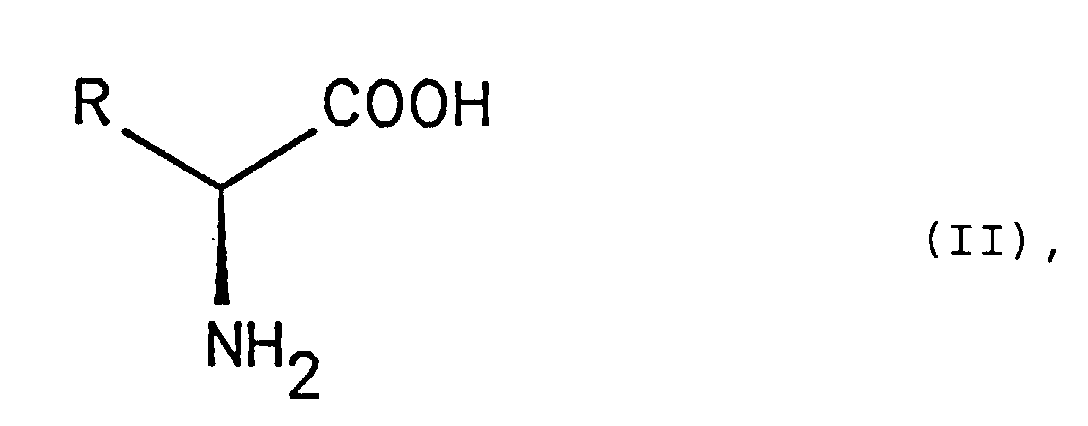
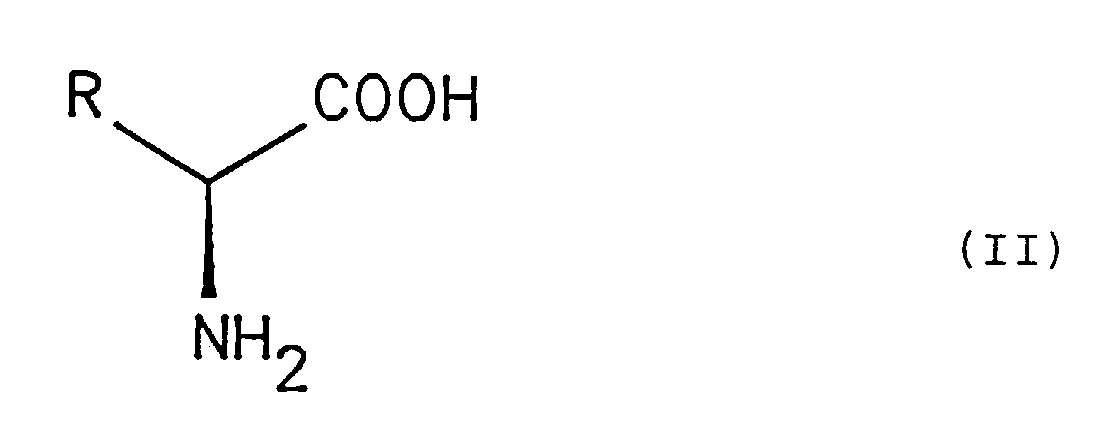
- the invention describes a method for producing optically active L-amino acids of the general formula II where R stands for a space-filling, branched, alkyl group containing 5 - 10 carbon atoms and containing a tertiary carbon atom.
- Optically active amino acids can be used to produce a A number of valuable connections can be used. So is basically the reduction to the corresponding optically active amino alcohols known. These, in turn, are extreme important intermediates in organic chemistry. she or connections derived from these find broad ones Application in asymmetric synthesis in which Manufacture of active pharmaceutical ingredients such as Example peptides, the synthesis of isecticides, the Cleavage of racemic mixtures and in other fields (Further literature on these topics among others in: J. Org. Chem. 1993, 58, 3568).
- optically active amino alcohols of the general formula in asymmetric synthesis is very often based on the fact that amino alcohols with sterically demanding side groups are incorporated into suitable derivatives with which asymmetric catalysis or asymmetrical induction is possible in the synthesis of secondary products.
- bicyclic lactams (Tetrahedron 1991, 47, 9503 and references there) are examples of secondary products of the optically active amino alcohols which can be used in a variety of ways in asymmetric synthesis Lit.) and Formamidine (Tetrahedron 1992, 48, 2589 and Lit. cited there).
- the side groups of the incorporated optically active amino alcohols of the general formula (III) have a directing influence on the reactions taking place on and with these molecules for steric or stereoelectronic reasons, which results in the sometimes extremely high enantio- or diastereoselectivities of such subsequent reactions.
- this directing influence is greater the more space-filling the side groups R mentioned are (Angew. Chem. 1991, 103, 556).
- WO 95/11296 which was published between the priority date and the filing date of the present application, describes a method for modifying Enzymes described. Hence the implementation of 2-Ketocaproat using a modified Glutamate dehydrogenase.
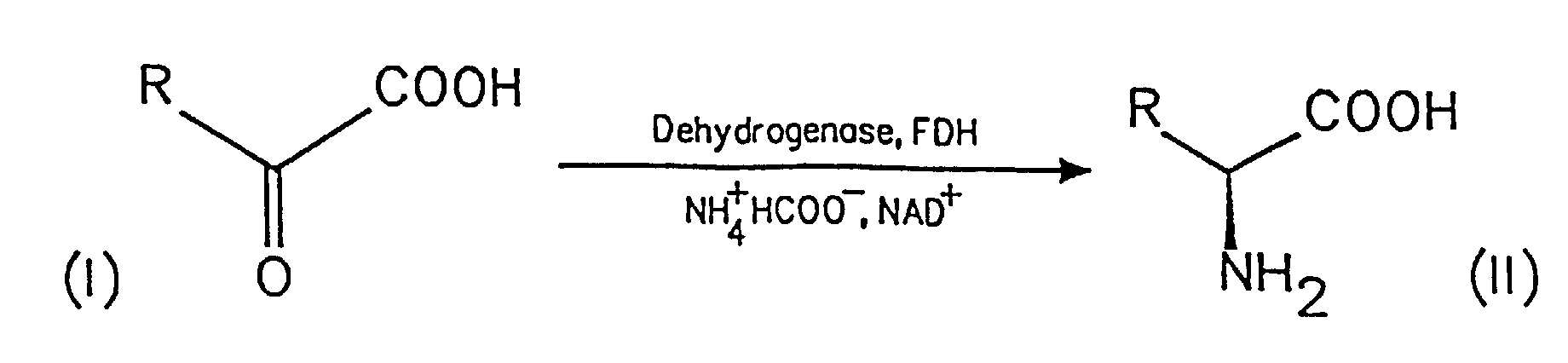
- the enzymes used also accept ⁇ -keto acids of the general formula (I) with their particularly bulky radicals R as substrates for conversion into the L-amino acids of the general formula (II) and that the products are also obtained with high chemical and enantiomeric purity and in good to very good yield.
- these compounds are light, safe, in good to very good yield and in very high chemical and in particular enantiomeric purity can be produced.
- the so Established connections are used, among others, in the synthesis of active pharmaceutical ingredients and in asymmetric synthesis for the synthesis of ligands, Catalysts and inductors.
Landscapes
- Organic Chemistry (AREA)
- Chemical & Material Sciences (AREA)
- Engineering & Computer Science (AREA)
- Zoology (AREA)
- Life Sciences & Earth Sciences (AREA)
- Wood Science & Technology (AREA)
- Chemical Kinetics & Catalysis (AREA)
- Microbiology (AREA)
- General Chemical & Material Sciences (AREA)
- Biotechnology (AREA)
- Health & Medical Sciences (AREA)
- Biochemistry (AREA)
- Bioinformatics & Cheminformatics (AREA)
- General Engineering & Computer Science (AREA)
- General Health & Medical Sciences (AREA)
- Genetics & Genomics (AREA)
- Organic Low-Molecular-Weight Compounds And Preparation Thereof (AREA)
- Preparation Of Compounds By Using Micro-Organisms (AREA)
- Heterocyclic Carbon Compounds Containing A Hetero Ring Having Nitrogen And Oxygen As The Only Ring Hetero Atoms (AREA)
Description


| Ausbeute | 15.4 g (84.9 % der Theorie) |
| Identitätsprüfung | NMR-Spektrum |
| Enantiomerenreinheit | > 99.8 % e.e., gemessen durch chirale Gaschromatographie an Chirasil-Val |
| Ausbeute | 1.17 g (80.6 % der Theorie) |
| Identitätsprüfung | NMR-Spektrum |
| Enantiomerenreinheit | > 99.9 % e.e., gemessen durch chirale Gaschromatographie an Chirasil-Val |
| Einsatz: 1.81 g (10 mmol) 2-Keto-5,5-Dimethyl-hexansäure Na-Salz | |
| Ausbeute | 1.08 g (67.9 % der Theorie) |
| Identitätsprüfung | NMR-Spektrum |
| Enantiomerenreinheit | > 99.9 % e.e., gemessen durch chirale HPLC an Crownpak-CR+Säule |
Claims (1)
- Verfahren zur Herstellung optisch aktiver L-Aminosäuren der allgemeinen Formel IIworin R für eine raumerfüllende, verzweigte, wenigstens ein tertiäres C-Atom enthaltende Alkylgruppe mit 5-10 C-Atomen steht,

dadurch gekennzeichnet,
daß eine α-Ketocarbonsäure der allgemeinen Formel Iworin R für eine raumerfüllende, verzweigte, wenigstens ein tertiäres C-Atom enthaltende Alkylgruppe mit 5 - 10 C-Atomen steht, durch eine co-faktorabhängige enzymatische Reaktion unter Verwendung von Dehydrogenasen reduktiv aminiert wird.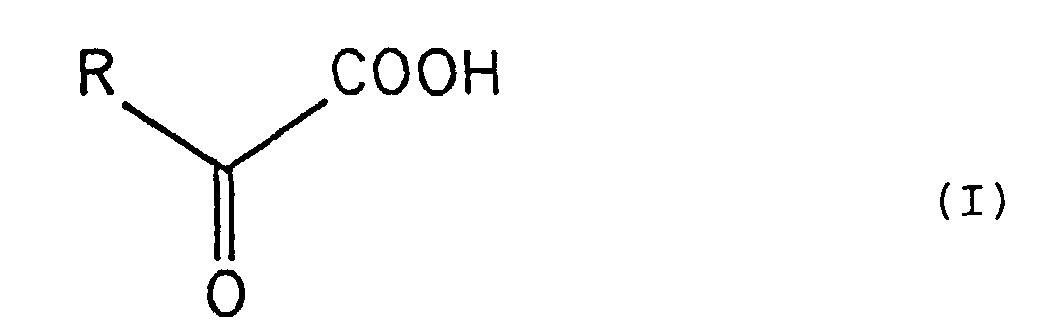
Applications Claiming Priority (2)
| Application Number | Priority Date | Filing Date | Title |
|---|---|---|---|
| DE4425068 | 1994-07-15 | ||
| DE4425068A DE4425068A1 (de) | 1994-07-15 | 1994-07-15 | Verfahren zur Herstellung optisch aktiver L-Aminosäuren, neue optisch aktive L-Aminosäuren mit raumerfüllenden Seitengruppen und deren Verwendung |
Publications (3)
| Publication Number | Publication Date |
|---|---|
| EP0692538A2 EP0692538A2 (de) | 1996-01-17 |
| EP0692538A3 EP0692538A3 (de) | 1997-03-05 |
| EP0692538B1 true EP0692538B1 (de) | 1999-09-22 |
Family
ID=6523273
Family Applications (1)
| Application Number | Title | Priority Date | Filing Date |
|---|---|---|---|
| EP95110765A Expired - Lifetime EP0692538B1 (de) | 1994-07-15 | 1995-07-11 | Verfahren zur Herstellung optisch aktiver L-Aminosäuren |
Country Status (4)
| Country | Link |
|---|---|
| EP (1) | EP0692538B1 (de) |
| JP (1) | JPH08109158A (de) |
| AT (1) | ATE184918T1 (de) |
| DE (2) | DE4425068A1 (de) |
Families Citing this family (8)
| Publication number | Priority date | Publication date | Assignee | Title |
|---|---|---|---|---|
| US6432688B1 (en) * | 1999-01-18 | 2002-08-13 | Daicel Chemical Industries, Ltd. | Amino alcohol dehydrogenase converts keto alcohol to amino alcohol and amino alcohol to keto alcohol |
| DE10048715A1 (de) * | 2000-09-30 | 2004-05-19 | Grünenthal GmbH | Verwendung von Aminosäure zur Behandlung von Schmerz |
| DE10337614A1 (de) * | 2003-08-16 | 2005-03-17 | Degussa Ag | Verfahren zur Herstellung von D-Aminosäuren |
| JP4706241B2 (ja) * | 2003-12-22 | 2011-06-22 | 住友化学株式会社 | 光学活性なビスアミドアルコール化合物の製造方法 |
| CN100436406C (zh) * | 2003-12-22 | 2008-11-26 | 住友化学株式会社 | 制备光学活性双酰氨基醇化合物的方法 |
| EP2072622A4 (de) | 2006-10-12 | 2012-01-25 | Kaneka Corp | Verfahren zur herstellung von l-aminosäure |
| CN104313071B (zh) * | 2014-10-17 | 2018-04-13 | 湖南宝利士生物技术有限公司 | 高纯L‑α‑氨基酸的生物合成方法 |
| CN111072507A (zh) * | 2019-12-20 | 2020-04-28 | 南京德尔诺医药科技有限公司 | 一种dl-新戊基甘氨酸中间体及其制备方法、基于该中间体的衍生物的制备方法 |
Family Cites Families (2)
| Publication number | Priority date | Publication date | Assignee | Title |
|---|---|---|---|---|
| DE1417030A1 (de) * | 1956-09-05 | 1969-11-20 | Kyowa Hakko Kogyo Kk | Verfahren zur biotechnischen Gewinnung von Aminosaeuren |
| EP0724629A1 (de) * | 1993-10-18 | 1996-08-07 | Degussa Aktiengesellschaft | Verfahren zur gezielten veränderung von enzymen, veränderte enzyme und deren verwendung |
-
1994
- 1994-07-15 DE DE4425068A patent/DE4425068A1/de not_active Withdrawn
-
1995
- 1995-07-11 EP EP95110765A patent/EP0692538B1/de not_active Expired - Lifetime
- 1995-07-11 AT AT95110765T patent/ATE184918T1/de not_active IP Right Cessation
- 1995-07-11 DE DE59506873T patent/DE59506873D1/de not_active Expired - Fee Related
- 1995-07-14 JP JP7179089A patent/JPH08109158A/ja active Pending
Also Published As
| Publication number | Publication date |
|---|---|
| JPH08109158A (ja) | 1996-04-30 |
| ATE184918T1 (de) | 1999-10-15 |
| EP0692538A3 (de) | 1997-03-05 |
| EP0692538A2 (de) | 1996-01-17 |
| DE59506873D1 (de) | 1999-10-28 |
| DE4425068A1 (de) | 1996-01-18 |
Similar Documents
| Publication | Publication Date | Title |
|---|---|---|
| Dondoni et al. | Stereochemistry associated with the addition of 2-(trimethylsilyl) thiazole to differentially protected. alpha.-amino aldehydes. Applications toward the synthesis of amino sugars and sphingosines | |
| EP0346658A1 (de) | Verfahren zur Herstellung phosphorhaltiger L-Aminosäuren sowie ihrer Ester und N-Derivate | |
| DE4407197A1 (de) | Verfahren zur Herstellung von /L/-Homoalanin-4-yl-(methyl)phosphinsäure und deren Salze durch Racematspaltung | |
| DE2812041A1 (de) | Optisch aktive aminosaeure-mandelsaeure- komplexe, verfahren zu deren herstellung und verfahren zur herstellung optisch aktiver aminosaeuren oder mandelsaeure | |
| DE69917318T2 (de) | Industrielles verfahren zur herstellung von l-carnitin | |
| EP1876168A1 (de) | Verfahren zur Herstellung von beta-Amino-alpha-hydroxy-carbonsäureamiden | |
| EP0288764B1 (de) | Optisch aktive alpha-Aminoaldehyde, Verfahren zu ihrer Herstellung und ihre Verwendung zur stereoselektiven Herstellung optisch aktiver beta-Aminoalkohole | |
| EP1124782B1 (de) | Verfahren zur racematspaltung von 2-hydroxypropionsäuren | |
| DE60131733T2 (de) | Verfahren zur herstellung von (2s,3r,4s)-4-hydroxyisoleucin und analoga | |
| DE3735757A1 (de) | Optisch aktive salze aus einem substituierten thiazolidin-4-carboxylat und 3-chlor-2-hydroxypropyltrimethylammonium, deren herstellung und verwendung | |
| EP0692538A2 (de) | Verfahren zur Herstellung optisch aktiver L-Aminosäuren, neue optisch aktive L-Aminosäuren mit raumerfüllenden Seitengruppen und deren Verwendung | |
| DE3781555T2 (de) | Verfahren zur herstellung einer zwei diastereoisomerische n-acylaminosaeureester enthaltenden diastereoisomerischen mischung. | |
| DE69401979T2 (de) | Verfahren zur Herstellung von L-(-)-Carnitin aus Abfallprodukten mit entgegengesetzter Konfiguration | |
| DE4425067A1 (de) | Verfahren zur Herstellung optisch aktiver, 4-substituierter (S)-2-Oxazolidinone, neue (S)-2-Oxazolidinone, neue optisch aktive (S)-Aminoalkohole sowie Verwendung dieser Verbindungen | |
| EP0529483B1 (de) | Verfahren zur Herstellung von optisch aktiven 4-Amino-3-hydroxycarbonsäuren | |
| KR100301952B1 (ko) | 반대배치를갖는폐물질로부터l-(-)-카르니틴의제조방법 | |
| US6197996B1 (en) | Process for preparing optically active carnitine ester | |
| DE69905218T2 (de) | Verfahren zur Herstellung von L-Allysin Acetal | |
| EP0664796B1 (de) | Verfahren zur herstellung von aminoalkylhydantoin und aminoalkyl-alpha-aminosäuren | |
| DE19524337C1 (de) | Verfahren zur Herstellung von beta-Amino-alpha-hydroxycarbonsäuren und deren Derivaten | |
| DE10107528B4 (de) | Verfahren zur Herstellung der Enantiomere der 2-substituierten beta-Aminosäuren | |
| DE3881572T2 (de) | Verfahren zur Herstellung von (-) N-Acetylaminocarnitin und (+) N-Acetylaminocarnitin. | |
| DE3734219C2 (de) | ||
| DE69601116T2 (de) | Verfahren zur Herstellung von (s)-Beta-hydroxy-gamma-butirolactone | |
| DE69814771T2 (de) | Gamma-oxohomophenylalanin derivate und ein verfahren zur herstellung von homophenylalanin derivaten durch reduktion derselben |
Legal Events
| Date | Code | Title | Description |
|---|---|---|---|
| PUAI | Public reference made under article 153(3) epc to a published international application that has entered the european phase |
Free format text: ORIGINAL CODE: 0009012 |
|
| AK | Designated contracting states |
Kind code of ref document: A2 Designated state(s): AT BE CH DE DK ES FR GB IE IT LI NL PT SE |
|
| PUAL | Search report despatched |
Free format text: ORIGINAL CODE: 0009013 |
|
| AK | Designated contracting states |
Kind code of ref document: A3 Designated state(s): AT BE CH DE DK ES FR GB IE IT LI NL PT SE |
|
| 17P | Request for examination filed |
Effective date: 19970815 |
|
| 17Q | First examination report despatched |
Effective date: 19971126 |
|
| GRAG | Despatch of communication of intention to grant |
Free format text: ORIGINAL CODE: EPIDOS AGRA |
|
| GRAG | Despatch of communication of intention to grant |
Free format text: ORIGINAL CODE: EPIDOS AGRA |
|
| GRAH | Despatch of communication of intention to grant a patent |
Free format text: ORIGINAL CODE: EPIDOS IGRA |
|
| RAP1 | Party data changed (applicant data changed or rights of an application transferred) |
Owner name: DEGUSSA-HUELS AKTIENGESELLSCHAFT |
|
| GRAH | Despatch of communication of intention to grant a patent |
Free format text: ORIGINAL CODE: EPIDOS IGRA |
|
| GRAA | (expected) grant |
Free format text: ORIGINAL CODE: 0009210 |
|
| RAP3 | Party data changed (applicant data changed or rights of an application transferred) |
Owner name: DEGUSSA-HUELS AKTIENGESELLSCHAFT |
|
| AK | Designated contracting states |
Kind code of ref document: B1 Designated state(s): AT BE CH DE DK ES FR GB IE IT LI NL PT SE |
|
| PG25 | Lapsed in a contracting state [announced via postgrant information from national office to epo] |
Ref country code: SE Free format text: THE PATENT HAS BEEN ANNULLED BY A DECISION OF A NATIONAL AUTHORITY Effective date: 19990922 Ref country code: ES Free format text: THE PATENT HAS BEEN ANNULLED BY A DECISION OF A NATIONAL AUTHORITY Effective date: 19990922 |
|
| REF | Corresponds to: |
Ref document number: 184918 Country of ref document: AT Date of ref document: 19991015 Kind code of ref document: T |
|
| REG | Reference to a national code |
Ref country code: CH Ref legal event code: EP |
|
| REF | Corresponds to: |
Ref document number: 59506873 Country of ref document: DE Date of ref document: 19991028 |
|
| ITF | It: translation for a ep patent filed | ||
| REG | Reference to a national code |
Ref country code: IE Ref legal event code: FG4D Free format text: GERMAN |
|
| PG25 | Lapsed in a contracting state [announced via postgrant information from national office to epo] |
Ref country code: PT Free format text: LAPSE BECAUSE OF FAILURE TO SUBMIT A TRANSLATION OF THE DESCRIPTION OR TO PAY THE FEE WITHIN THE PRESCRIBED TIME-LIMIT Effective date: 19991222 Ref country code: DK Free format text: LAPSE BECAUSE OF FAILURE TO SUBMIT A TRANSLATION OF THE DESCRIPTION OR TO PAY THE FEE WITHIN THE PRESCRIBED TIME-LIMIT Effective date: 19991222 |
|
| ET | Fr: translation filed | ||
| GBT | Gb: translation of ep patent filed (gb section 77(6)(a)/1977) |
Effective date: 19991209 |
|
| REG | Reference to a national code |
Ref country code: CH Ref legal event code: NV Representative=s name: BOVARD AG PATENTANWAELTE |
|
| PLBE | No opposition filed within time limit |
Free format text: ORIGINAL CODE: 0009261 |
|
| STAA | Information on the status of an ep patent application or granted ep patent |
Free format text: STATUS: NO OPPOSITION FILED WITHIN TIME LIMIT |
|
| 26N | No opposition filed | ||
| REG | Reference to a national code |
Ref country code: GB Ref legal event code: IF02 |
|
| PGFP | Annual fee paid to national office [announced via postgrant information from national office to epo] |
Ref country code: IE Payment date: 20020617 Year of fee payment: 8 |
|
| PGFP | Annual fee paid to national office [announced via postgrant information from national office to epo] |
Ref country code: CH Payment date: 20020619 Year of fee payment: 8 |
|
| PGFP | Annual fee paid to national office [announced via postgrant information from national office to epo] |
Ref country code: NL Payment date: 20020625 Year of fee payment: 8 |
|
| PGFP | Annual fee paid to national office [announced via postgrant information from national office to epo] |
Ref country code: AT Payment date: 20020626 Year of fee payment: 8 |
|
| PGFP | Annual fee paid to national office [announced via postgrant information from national office to epo] |
Ref country code: GB Payment date: 20020628 Year of fee payment: 8 |
|
| PGFP | Annual fee paid to national office [announced via postgrant information from national office to epo] |
Ref country code: FR Payment date: 20020711 Year of fee payment: 8 Ref country code: DE Payment date: 20020711 Year of fee payment: 8 |
|
| PGFP | Annual fee paid to national office [announced via postgrant information from national office to epo] |
Ref country code: BE Payment date: 20020724 Year of fee payment: 8 |
|
| REG | Reference to a national code |
Ref country code: GB Ref legal event code: 732E |
|
| REG | Reference to a national code |
Ref country code: CH Ref legal event code: PUE Owner name: DEGUSSA AG Free format text: DEGUSSA-HUELS AKTIENGESELLSCHAFT##60287 FRANKFURT AM MAIN (DE) -TRANSFER TO- DEGUSSA AG#BENNIGSENPLATZ 1#40474 DUESSELDORF (DE) |
|
| PG25 | Lapsed in a contracting state [announced via postgrant information from national office to epo] |
Ref country code: IE Free format text: LAPSE BECAUSE OF NON-PAYMENT OF DUE FEES Effective date: 20030711 Ref country code: GB Free format text: LAPSE BECAUSE OF NON-PAYMENT OF DUE FEES Effective date: 20030711 Ref country code: AT Free format text: LAPSE BECAUSE OF NON-PAYMENT OF DUE FEES Effective date: 20030711 |
|
| PG25 | Lapsed in a contracting state [announced via postgrant information from national office to epo] |
Ref country code: LI Free format text: LAPSE BECAUSE OF NON-PAYMENT OF DUE FEES Effective date: 20030731 Ref country code: CH Free format text: LAPSE BECAUSE OF NON-PAYMENT OF DUE FEES Effective date: 20030731 Ref country code: BE Free format text: LAPSE BECAUSE OF NON-PAYMENT OF DUE FEES Effective date: 20030731 |
|
| NLS | Nl: assignments of ep-patents |
Owner name: DEGUSSA AG |
|
| BERE | Be: lapsed |
Owner name: *DEGUSSA A.G. Effective date: 20030731 |
|
| PG25 | Lapsed in a contracting state [announced via postgrant information from national office to epo] |
Ref country code: NL Free format text: LAPSE BECAUSE OF NON-PAYMENT OF DUE FEES Effective date: 20040201 |
|
| PG25 | Lapsed in a contracting state [announced via postgrant information from national office to epo] |
Ref country code: DE Free format text: LAPSE BECAUSE OF NON-PAYMENT OF DUE FEES Effective date: 20040203 |
|
| REG | Reference to a national code |
Ref country code: FR Ref legal event code: TP |
|
| GBPC | Gb: european patent ceased through non-payment of renewal fee |
Effective date: 20030711 |
|
| REG | Reference to a national code |
Ref country code: CH Ref legal event code: PL |
|
| PG25 | Lapsed in a contracting state [announced via postgrant information from national office to epo] |
Ref country code: FR Free format text: LAPSE BECAUSE OF NON-PAYMENT OF DUE FEES Effective date: 20040331 |
|
| NLV4 | Nl: lapsed or anulled due to non-payment of the annual fee |
Effective date: 20040201 |
|
| REG | Reference to a national code |
Ref country code: FR Ref legal event code: ST |
|
| PG25 | Lapsed in a contracting state [announced via postgrant information from national office to epo] |
Ref country code: IT Free format text: LAPSE BECAUSE OF NON-PAYMENT OF DUE FEES;WARNING: LAPSES OF ITALIAN PATENTS WITH EFFECTIVE DATE BEFORE 2007 MAY HAVE OCCURRED AT ANY TIME BEFORE 2007. THE CORRECT EFFECTIVE DATE MAY BE DIFFERENT FROM THE ONE RECORDED. Effective date: 20050711 |
|
| REG | Reference to a national code |
Ref country code: IE Ref legal event code: MM4A |