EP0691122B1 - Method and apparatus for manufacturing tablets - Google Patents
Method and apparatus for manufacturing tablets Download PDFInfo
- Publication number
- EP0691122B1 EP0691122B1 EP95304529A EP95304529A EP0691122B1 EP 0691122 B1 EP0691122 B1 EP 0691122B1 EP 95304529 A EP95304529 A EP 95304529A EP 95304529 A EP95304529 A EP 95304529A EP 0691122 B1 EP0691122 B1 EP 0691122B1
- Authority
- EP
- European Patent Office
- Prior art keywords
- powder
- mold cavities
- moist powder
- moist
- tablet manufacturing
- Prior art date
- Legal status (The legal status is an assumption and is not a legal conclusion. Google has not performed a legal analysis and makes no representation as to the accuracy of the status listed.)
- Expired - Lifetime
Links
Images


Classifications
-
- A—HUMAN NECESSITIES
- A61—MEDICAL OR VETERINARY SCIENCE; HYGIENE
- A61J—CONTAINERS SPECIALLY ADAPTED FOR MEDICAL OR PHARMACEUTICAL PURPOSES; DEVICES OR METHODS SPECIALLY ADAPTED FOR BRINGING PHARMACEUTICAL PRODUCTS INTO PARTICULAR PHYSICAL OR ADMINISTERING FORMS; DEVICES FOR ADMINISTERING FOOD OR MEDICINES ORALLY; BABY COMFORTERS; DEVICES FOR RECEIVING SPITTLE
- A61J3/00—Devices or methods specially adapted for bringing pharmaceutical products into particular physical or administering forms
- A61J3/06—Devices or methods specially adapted for bringing pharmaceutical products into particular physical or administering forms into the form of pills, lozenges or dragees
-
- A—HUMAN NECESSITIES
- A61—MEDICAL OR VETERINARY SCIENCE; HYGIENE
- A61J—CONTAINERS SPECIALLY ADAPTED FOR MEDICAL OR PHARMACEUTICAL PURPOSES; DEVICES OR METHODS SPECIALLY ADAPTED FOR BRINGING PHARMACEUTICAL PRODUCTS INTO PARTICULAR PHYSICAL OR ADMINISTERING FORMS; DEVICES FOR ADMINISTERING FOOD OR MEDICINES ORALLY; BABY COMFORTERS; DEVICES FOR RECEIVING SPITTLE
- A61J3/00—Devices or methods specially adapted for bringing pharmaceutical products into particular physical or administering forms
- A61J3/10—Devices or methods specially adapted for bringing pharmaceutical products into particular physical or administering forms into the form of compressed tablets
-
- B—PERFORMING OPERATIONS; TRANSPORTING
- B30—PRESSES
- B30B—PRESSES IN GENERAL
- B30B11/00—Presses specially adapted for forming shaped articles from material in particulate or plastic state, e.g. briquetting presses, tabletting presses
- B30B11/02—Presses specially adapted for forming shaped articles from material in particulate or plastic state, e.g. briquetting presses, tabletting presses using a ram exerting pressure on the material in a moulding space
- B30B11/027—Particular press methods or systems
-
- B—PERFORMING OPERATIONS; TRANSPORTING
- B30—PRESSES
- B30B—PRESSES IN GENERAL
- B30B11/00—Presses specially adapted for forming shaped articles from material in particulate or plastic state, e.g. briquetting presses, tabletting presses
- B30B11/02—Presses specially adapted for forming shaped articles from material in particulate or plastic state, e.g. briquetting presses, tabletting presses using a ram exerting pressure on the material in a moulding space
- B30B11/08—Presses specially adapted for forming shaped articles from material in particulate or plastic state, e.g. briquetting presses, tabletting presses using a ram exerting pressure on the material in a moulding space co-operating with moulds carried by a turntable
- B30B11/10—Presses specially adapted for forming shaped articles from material in particulate or plastic state, e.g. briquetting presses, tabletting presses using a ram exerting pressure on the material in a moulding space co-operating with moulds carried by a turntable intermittently rotated
-
- B—PERFORMING OPERATIONS; TRANSPORTING
- B30—PRESSES
- B30B—PRESSES IN GENERAL
- B30B15/00—Details of, or accessories for, presses; Auxiliary measures in connection with pressing
- B30B15/30—Feeding material to presses
- B30B15/302—Feeding material in particulate or plastic state to moulding presses
Definitions
- the present invention relates to a method and an apparatus for manufacturing tablets of moist powder.
- tablets are classified into molded tablets and compressed tablets. These two kinds of tablets have been manufactured by different methods.
- the molded tablets are manufactured by kneading an additive agent such as an excipient or a binder into medical ingredients to form a mixture, adding a solvent such as water, ethanol or the like into the mixture to produce moist powder, and forming the moist powder to have a predetermined shape by molding.
- the moist powder into the tablets, one of which is a thrust-filling method in which the moist powder is forcibly pressed into a die having a certain shape, and the other of which is a die-punching method in which the moist powder is processed into a plate-like material by a rolling machine and a die of a certain shape is pressed against the material for punching. Since the molded tablets exhibit superior solubility and collapsibility when they are taken by a patient, they are manufactured as perlingual tablets and the like.
- an automatic tablet-manufacturing machine produced by Vector Colton in France has been known. This machine produces tablets by filling moist powder into mold cavities formed in a rotary disk, levelling the moist powder to smooth the surface, and pressing and releasing the moist powder out of the mold cavities onto a belt conveyer by ejector pins when they are located concentrically with the mold cavities.
- tablets produced by the conventional molded tablet manufacturing machine have the same shape as the mold cavities which have a cylindrical shape or a shape with flat upper and lower surfaces.
- the cross-sectional shape of such tablets is a rectangle whose corners have a right angle, which results in a problem that the corners chip or are abraded in a packaging step or the like of the manufacturing process.
- the moist powder tends to stick to the rolling device or the ejector pins so that there occurs dispersion in weight of tablets to be products, or the surface of the tablet becomes rough.
- the molded tablets are disadvantageous in respect of efficiency of production, accuracy and quality.
- such sticking of the moist powder results in another problem that split lines, product marks or the like can not be stamped on the tablets.
- An apparatus for manufacturing the compressed tablets molds dry granules at a relatively high pressure of 100 to several thousands kg/cm 2 .
- This machine is generally called a tablet machine.
- the tablet machine comprises an upper rod, a lower rod and a mill. By applying force from the upper and lower rods to the granules supplied in the mill, the granules are pressurized and instantaneously formed into a tablet.
- a rotary-type tablet machine ordinarily includes 10 to 100 sets of an upper rod, a lower rod and a mill which are attached to a turn table.
- the rotary-type tablet machine By using the rotary-type tablet machine, it is possible to manufacture tablets of the same number as that of the sets of the upper and lower rods and the mill during one rotation of the turn table. There is a tablet machine having a maximum tablet manufacturing capacity of 8,000 per one minute.
- the compressed tablets are appropriate for mass production, and superior to the molded tablets in respect of accuracy and quality. However, since the dry granules are compressed at the high pressure, the compressed tablets are inferior to the molded tablets as for the solubility and collapsibility.
- GB-A-1,221,861 discloses a powder compaction method and machine in accordance with the pre-characterising part of claims 1 and 12. It discloses a machine in which powder is dispersed into cavities in a rotary table, the powder then being compressed in two stages: lightly to eliminate air and voids, and then heavily to form the powder into a block.
- the compressed tablets are superior to the molded tablets in view of efficiency of production, the molded tablets having the excellent solubility and collapsibility are suitable for persons of advanced age and infants to take, who are low in organic and physiological function. Accordingly, by developing a method of effectively mass-producing tablets of high mechanical strength, accuracy and quality which are easy for the persons of advanced age and infants to take, without deteriorating the aforesaid characteristics of the molded tablets, a remarkable merit can be realised in the field of medicine.
- the present invention aims to solve the above-described problems of the prior art, and it is an object of the invention to provide a method and an apparatus for efficiently manufacturing tablets of moist powder which are high in accuracy and quality.
- the present invention provides a tablet manufacturing method, in which a moist powder is successively filled in a plurality of mold cavities, the powder filled therein is compacted into tablets and then the tablets are released out of the mold cavities, characterised in that the method comprises the steps of:
- a second aspect of the invention provides a tablet manufacturing apparatus for manufacturing tablets from a moist powder by successively filling the powder in a plurality of mold cavities, compacting the powder into tablets and then releasing out of the mold cavities, characterised in that the apparatus comprises:
- At least one of the surfaces of the moist powder in each of the molding cavities can be pressed by a molding die through a powder-intercepting film so as to form the moist powder into the shape of a tablet.
- the powder-intercepting film is interposed between the moist powder in the molding cavities and the molding dies, to thereby prevent the moist powder from sticking to the molding dies, which enables chamfering of the corners of the tablets and stamping of product marks and the like on the surfaces of the tablets.
- Fig. 1 is a schematic plan view showing a tablet manufacturing apparatus according to a first embodiment of the invention
- Fig. 2 is a schematic front elevation of the apparatus, as viewed in a direction indicated by the arrows II-II of Fig. 1.
- a small-diameter first table 2 and a large-diameter second table 3 are provided horizontally rotatably in such a manner that the first table partially contacts with and is laid on the second table at a station B.
- the first table 2 and the second table 3 are intermittently rotated by a drive unit including a motor 4 and two intermittent index-driving devices 5 which are connected to the motor 4 through chains.
- Two filling holes 6 are formed in the first table 2 at each of four positions which are equally spaced in the circumferential direction, and two mold cavities 7 are formed in the second table 3 at each of eight positions which are equally spaced in the circumferential direction.
- the filling holes 6 and the mold cavities 7 have the same diameter.
- the first table 2 and the second table 3 are positioned and driven by certain rotational angles by means of the intermittent index-driving devices 5, so that the mold cavities 7 are located right under the filling holes 6 at the station B.
- a filling and pressurizing device 8 is provided above the first table 2.
- Filling pins 9 which have a diameter slightly smaller than that of the filling holes 6 and the mold cavities 7 are attached to a lower portion of the filling and pressurizing device 8.
- a filling receiver 10 is provided under the second table 3 at a position opposite to the filling pins 9.
- a hopper 11 is installed above the first table 2.
- a hopper receiver 12 is provided under the first table 2.
- a releasing agent coating device 13 is provided on the upper and lower sides of the second table 3.
- an upper finish-forming device 14 and a lower finish-forming device 15 are provided on the upper and lower sides of the second table 3.
- Upper rods 16 are attached to the upper finish-forming device 14 while lower rods 17 are attached to the lower finish-forming device 15.
- a dryer 18 is provided above the second table 3.
- a release device 19 is provided above the second table 3, and ejector pins 20 are attached to a lower portion of the release device 19.
- One end of a conveyer 21 is located under the second table 3 at the station H whereas the other end of the conveyer 21 extends over a side edge of the bed 1, with a dryer 22 being installed on an intermediate portion of the conveyer 21.
- the first table 2 and the second table 3 are intermittently rotated by 90 degrees and by 45 degrees, respectively, by the intermittent index-driving devices 5, so that the second table 3 is rotated once while the first table 2 is rotated twice, and that the filling holes 6 and the mold cavities 7 reliably pause at each station.
- each filling hole 6 is shaped like a mortar, or the first table 2 is formed to have a larger thickness than the second table 3, or those portions of the first table 2 which surround the filling holes 6 are only increased in thickness, so that the moist powder P of an amount sufficiently larger than the volume of the mold cavities 7 of the second table 3 can be supplied.
- the filling holes 6 are moved to the station B by two strokes, and then, another set of filling holes 6 are located under the hopper 11.
- the moist powder P to be used is mixture powder consisting of about 0.0004 to 80 weight % of medical effective ingredients, about 10 to 80 weight % of at least one or more kinds of an excipient, a collapse agent, a binder, an acidity agent, a foaming agent, a perfume, a smoothing agent, a colorant, and an additive agent such as a sweetening agent, and about 1 to 25 weight % of, preferably about 6 to 20 weight % of a wetting agent.
- a solvent such as water, ethanol, propanol, isopropanol or the like which is approved from the viewpoint of medicine manufacture.
- a mixture of these solvents or an organic solvent such as hexane which is insoluble with respect to water can be used.
- the filling holes 6, in which the moist powder P has been supplied are located above the mold cavities 7 of the second table 3, with the lower opening ends of the mold cavities 7 being closed by the filling receiver 10. Then, the filling pins 9 of the filling and pressurizing device 8 are lowered to pressurize the moist powder P in the filling holes 6 under a predetermined pressure and feed the moist powder P into the mold cavities 7 of the second table 3.
- the pressure applied to the moist powder P at this time is ordinarily about 5 to 80 kg/cm 2 , preferably about 5 to 60 kg/cm 2 , and more preferably about 5 to 40 kg/cm 2 . Since the moist powder P is excessively supplied in the filling holes 6 in the previous step, the moist powder P slightly remains in the filling holes 6 even after the mold cavities 7 have been filled.
- a releasing agent an anti-adhesion material also called a smoothing agent
- a smoothing agent is applied to the moist powder P filled in the mold cavities 7 of the second table 3, from nozzles 13a, 13b of the releasing agent coating device 13 on the upper and lower sides of the moist powder P.
- Application of such a releasing agent is performed to prevent the moist powder P from sticking to the upper and lower rods which directly contact with the moist powder P when they are used for chamfering in the following step.
- the moist powder P which is adhesive owing to its particular viscosity and moisture, sticks to the rods and deforms tablets or solidifies fixedly on the rods, thereby causing troubles in the manufacture of tablets.
- a releasing agent harmless to a human body because the releasing agent is directly applied to the moist powder P to be manufactured into a tablet.
- releasing agent there are, for example, stearic acid, calcium stearate, magnesium stearate, talc, cellulose saccharides, starch or the like such as corn starch, silicic anhydride, and a substance used as a smoothening agent for medicine such as silicone oil.
- the releasing agent is not necessarily restricted to the above-described substances.
- it is desirable to use stearic acid, calcium stearate, magnesium stearate, and starch or the like such as corn starch and potato starch. Needless to say, it is possible to mix these substances before use.
- the moist powder P in the mold cavities 7, which has been applied with the releasing agent on both the surfaces, is pressed by the upper rods 16 of the upper finish-forming device 14 and the lower rods 17 of the lower finish-forming device 15, so as to chamfer the upper and lower surfaces of the moist powder P along the recessed end faces of the upper and lower rods 16, 17.
- the moist powder P is prevented from sticking to these upper and lower rods 16, 17 because the moist powder P is applied with the releasing agent.
- the chamfering is performed to round off the corners of the tablet, for making it easy for a person to swallow the tablet.
- chamfering means not only processing of the surface of the tablet into a planar surface but also processing of it into a spherical surface. If the chamfering is not performed, application of the releasing agent in the previous step is not required. At the time of chamfering, a split line or product mark may be stamped on the surface of the tablet.
- the moist powder P which has been finish-formed in the mold cavities 7 is dried by the dryer 18 and solidified to be produced as tablets.
- the tablets of moist powder P which have been solidified in the mold cavities 7 are pressed down and released out of the cavities by the ejector pins 20 of the release device 19, and are dropped onto a belt of the rotating conveyer 21.
- the dropped tablets of moist powder P are further dried by the dryer 22 and thereafter discharged into a predetermined tray.
- the step for application of a smoothing agent may also be provided before the discharge step.
- the moist powder P supplied in the filling holes 6 of the first table 2 is filled into the mold cavities 7 of the second table 3 by pressing the filling pins 9. Then, the first and second tables 2 and 3 are relatively moved with respect to each other so as to level the surface of the moist powder P in the mold cavities 7 by removing the excessive powder, thus forming it into tablets. Therefore, tablets can be easily manufactured, enabling mass-production of tablets. Further, a ratio of void defect of a tablet is lowered, and dispersion of weight and size of the tablets are minimized, and also, their mechanical strength is enhanced. Thus, it is possible to manufacture tablets which are high in precision and quality.
- the releasing agent is directly applied to the moist powder P in the step of Fig. 3D prior to chamfering.
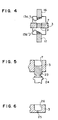
- the releasing agent coating device 13 may be installed at the station D, and as shown in Fig. 4, the releasing agent may be applied to those end faces of the upper and lower rods 16, 17 which contact with the moist powder P, before the chamfering step of Fig. 3E.
- each mold cavity 7 of the second table 3 may be closed by a slide pin 23 having an upper surface recessed for chamfering, and the slide pin 23 may be designed to move vertically by a rail 24.
- the filling receiver 10, the hopper receiver 12, the lower rods 17, the ejector pins 20 and so forth are not required.
- the releasing agent must be applied to the upper end faces of the slide pins 23 in advance.
- the tablets can be moved onto the conveyer 21 by additional means such as a gripper.
- mold cavities 26 which are closed at the bottom to form air holes 25 and which are chamfered at the corners of the bottom. Consequently, in the same manner as described above, the filling receiver 10, the hopper receiver 12, the lower rods 17, the ejector pins 20 and so forth are not required. In this case, the air is supplied to the air holes 25 to release tablets out of the cavities. However, the released products include the moist powder remaining in portions corresponding to the air holes 25, so that these residual portions must be removed.
- the first and second tables which partially contact with each other and are relatively moved to each other are used, and the moist powder supplied in the filling holes of the first table is pressurizingly filled in the mold cavities of the second table by the filling pins at the location where the filling holes of the first table are laid above the mold cavities of the second table, and then, the surface of the filled moist powder is leveled by removing the excessive powder by relatively moving the first and second tables to each other, thus forming the moist powder into tablets. Accordingly, it is easy to deal with the moist powder so that the productivity is improved, a ratio of void defect of a tablet is lowered, and dispersion of weight and size of the tablets is minimized. Thus, it is possible to manufacture tablets of high precision and quality which are high in mechanical strength and superior in solubility and collapsibility.
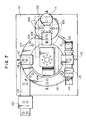
- Fig. 7 is a schematic plan view showing a tablet manufacturing apparatus according to a second embodiment of the present invention
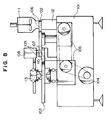
- Fig. 8 is a schematic front elevation of the apparatus.
- a small-diameter first table 102 and a large-diameter second table 103 are provided horizontally rotatably in such a manner that the first table 102 partially contacts with and is laid on the second table 103 at a station B.
- the first table 102 and the second table 103 are intermittently rotated by a drive unit including a motor 104 and two intermittent index-driving devices 105 which are connected to the motor 104 through chains.
- Two filling holes 106 are formed in the first table 102 at each of four positions which are equally spaced in the circumferential direction, and two mold cavities 107 for finish-forming are formed in the second table 103 at each of eight positions which are equally spaced in the circumferential direction.
- the filling holes 106 and the mold cavities 107 have the same diameter.
- the first table 102 and the second table 103 are positioned and driven by certain rotational angles by the intermittent index-driving devices 105, so that the mold cavities 107 are located right under the filling holes 106 at the station B.
- a filling and pressurizing device 108 is provided above the first table 102.
- Filling pins 109 which have a diameter slightly smaller than that of the filling holes 106 and the mold cavities 107 are attached to a lower portion of the filling and pressurizing device 108.
- a filling receiver 110 is provided under the second table 103 at a position opposite to the filling pins 109.
- a hopper 111 is installed above the first table 102.
- a hopper receiver 112 is provided under the first table 102.
- a finish-forming device 113 is provided on the upper and lower sides of the second table 103. Powder-intercepting film feeders 114 and releasing agent coating devices 115 are attached to the finish-forming device 113, as will be described later.
- a dryer 116 is provided above the second table 103.
- a release device 117 is provided above the second table 103, and ejector pins 118 are attached to a lower portion of the release device 117.
- One end of a conveyer 119 is located under the second table 103 at the station G whereas the other end of the conveyer 119 extends over a side edge of the bed 101, with a dryer 120 being installed on an intermediate portion of the conveyer 119.
- the first table 102 and the second table 103 are intermittently rotated by 90 degrees and by 45 degrees, respectively, by the intermittent index-driving devices 105, so that the second table 103 is rotated once while the first table 102 is rotated twice, and that the filling holes 106 and the mold cavities 107 reliably pause at each station.
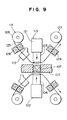
- Fig. 9 illustrates the positional relationship of the finish-forming device 113 with the powder-intercepting film feeders 114 and the releasing agent coating devices 115 which are attached to the finish-forming device 113.
- the finish-forming device 113 comprises upper finish-forming means 121 and lower finish-forming means 122 of the same structure which are provided on the upper and lower sides of the second table 103, and respectively include upper rods 123 and lower rods 124 which serve as molding dies.
- the upper rods 123 and the lower rods 124 have end faces recessed for chamfering.
- the powder-intercepting film feeders 114 are provided on the upper and lower sides of the second table 103, and the upper and lower feeders have the same structure.
- Each of the feeders 114 comprises a feeding reel 126 around which a powder-intercepting film 125 made of resin or rubber in the form of tape is wound, for supplying the film, the feeding reel 126 being located on one side of the associated finish-forming means 121, 122, a take-up reel 127 for taking up the powder-intercepting film 125 after use, which take-up reel is located on the other side of the finish-forming means, and tension means 128 and 129 for applying tensile force to the powder-intercepting film 125, which are provided on both sides of the finish-forming means 121, 122.
- the releasing agent coating devices 115 are located between the tension means 128 close to the feeding reels 126 and the finish-forming means 121, 122, whereby a releasing agent (an anti-adhesion material also called a smoothing agent) is applied to the surface of the powder-intercepting film 125 which faces the second table 103.
- the releasing agent coating devices 115 are provided for preventing moist powder from sticking to the powder-intercepting films 125, and are not required when the powder-intercepting films 125 are made of a material having excellent anti-adhesion property, such as polytetrafluoroethylene. Also, the coating devices 115 are not provided when mixing of the releasing agent with tablets must be avoided.
- the powder-intercepting film 125 is a film which is soft and hard to cut, prevents moist powder from sticking to the film during finish-forming, and does not influence stability of medicine or such factors so that the film can be used for packaging medicine.
- a film of nylon, polytetrafluoroethylene, polyester, polypropylene, polyethylene, polycarbonate or the like there is employed a film of nylon, polytetrafluoroethylene, polyester, polypropylene, polyethylene, polycarbonate or the like.
- the thickness of the film is, preferably, 10 to 30 ⁇ m.
- each filling hole 106 is shaped like a mortar, or the first table 102 is formed to have a larger thickness than the second table 103, or those portions of the first table 102 which surround the filling holes 106 are only increased in thickness, so that the moist powder P of an amount sufficiently larger than the volume of the mold cavities 107 of the second table 103 can be supplied.
- the filling holes 106 are moved to the station B by two strokes, and then, another set of filling holes 106 are located under the hopper 111.
- the moist powder P to be used is mixture powder consisting of about 0.0004 to 80 weight % of medical effective ingredients, about 10 to 80 weight % of at least one or more kinds of an excipient, a collapse agent, a binder, an acidity agent, a foaming agent, a perfume, a smoothing agent, a colorant, and an additive agent such as a sweetening agent, and about 1 to 25 weight % of, preferably about 6 to 20 weight % of a wetting agent.
- a solvent such as water, ethanol, propanol, isopropanol or the like which is approved from the viewpoint of medicine manufacture.
- a mixture of these solvents or an organic solvent such as hexane which is insoluble with respect to water can be used.
- the filling holes 106 are located above the mold cavities 107 of the second table 103, with the lower opening ends of the mold cavities 107 being closed by the filling receiver 110. Then, the filling pins 109 of the filling and pressurizing device 108 are lowered to pressurize the moist powder P in the filling holes 106 under a predetermined pressure and feed the moist powder P into the mold cavities 107 of the second table 103.
- the pressure applied to the moist powder P at this time is ordinarily about 5 to 80 kg/cm 2 , preferably about 5 to 60 kg/cm 2 , and more preferably about 5 to 40 kg/cm 2 . Since the moist powder P is excessively supplied in the filling holes 106 in the previous step, the moist powder P slightly remains in the filling holes 106 even after the mold cavities 107 have been filled.
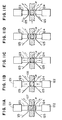
- the moist powder P in the mold cavities 107 is pressed by the upper rods 123 of the upper finish-forming means 121 and the lower rods 124 of the lower finish-forming means 122 through the powder-intercepting films 125, so as to chamfer the upper and lower surfaces of the moist powder P along the shapes of the end faces of the upper and lower rods 123, 124 while preventing the moist powder from sticking to these upper and lower rods 123, 124.
- the chamfering is performed to round off the corners of the tablet, for preventing abrasion or chipping.
- the term "chamfering" means not only processing of the surface of the tablet into a planar surface but also processing of it into a spherical surface.
- the powder-intercepting films 125 which have been applied with the releasing agent by the releasing agent coating devices 115 are applied with tensile force by the tension means 128, 129 which are located on both sides of the finish-forming means 121, 122, and the films 125 are lightly press-fitted to the end faces of the upper and lower rods 123, 124. Then, as shown in Fig. 11A, the powder-intercepting films 125 which have been applied with the releasing agent by the releasing agent coating devices 115 are applied with tensile force by the tension means 128, 129 which are located on both sides of the finish-forming means 121, 122, and the films 125 are lightly press-fitted to the end faces of the upper and lower rods 123, 124. Then, as shown in Fig.
- the powder-intercepting films 125 are constantly applied with tensile force by the tension means 128, 129. At this time, the releasing agent on the powder-intercepting films 125 is partially transferred to the moist powder P. Subsequently, as shown in Fig. 11E, the powder-intercepting films 125 are fed by a predetermined amount by the film feeders 114, so that unused surfaces of the films 125 which are coated with the releasing agent will be located on the upper and lower rods 123, 124.
- a releasing agent harmless to a human body because the releasing agent is partially attached to the moist powder P to be manufactured into a tablet.
- releasing agent there are, for example, stearic acid, calcium stearate, magnesium stearate, talc, cellulose saccharides, starch or the like such as corn starch, silicic anhydride, and a substance used as a smoothening agent for medicine such as silicone oil.
- the releasing agent is not necessarily restricted to the above-described substances.
- it is desirable to use stearic acid, calcium stearate, magnesium stearate, and starch or the like such as corn starch and potato starch. Needless to say, it is possible to mix these substances before use.
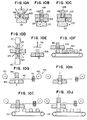
- the moist powder P which has been finish-formed in the mold cavities 107 is dried by the dryer 116 and solidified to be produced as tablets, as shown in Fig. 10E.
- the tablets of moist powder P which have been solidified in the mold cavities 107 are pressed down and released out of the cavities by the ejector pins 118 of the release device 117, and dropped onto a belt of the rotating conveyer 119.
- the dropped tablets of moist powder P are further dried by the dryer 120 and thereafter discharged into a predetermined tray.
- the moist powder P supplied in the filling holes 106 of the first table 102 is filled into the mold cavities 107 of the second table 103 by pressing the filling pins 109. Then, the first and second tables 102 and 103 are relatively moved with respect to each other so as to level the surface of the moist powder P in the mold cavities 107 by removing the excessive powder. After that, the finish-forming device 113 is operated to chamfer the surfaces of the moist powder P through the powder-intercepting films 125 by means of the upper and lower rods 123, 124. Therefore, tablets can be easily manufactured, enabling mass-production of tablets. Further, a ratio of void defect of a tablet is lowered, and dispersion of weight and size of the tablets is minimized, and also, their mechanical strength is enhanced. Thus, it is possible to manufacture tablets which are high in precision and quality.
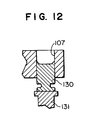
- each mold cavity 107 of the second table 103 may be closed by a slide pin 130 having an upper surface which has been recessed for chamfering and applied with the releasing agent in advance, and the slide pin 130 may be designed to move vertically by a rail 131.
- the filling receiver 110, the hopper receiver 112, the lower rods 124, the lower powder-intercepting film 125 and the associated components, the ejector pins 118 and so forth are not required.
- the tablets can be moved onto the conveyer 119 by additional means such as a gripper.
- the surface of the moist powder P in the mold cavities 107 is leveled by relatively moving the first and second tables 102, 103 with respect to each other.
- the excessive powder may be removed by other leveling means such as a scraper.
- the moist powder P is pressurized when it is moved from the filling holes 106 into the mold cavities 107.
- the moist powder P may be pressurized under a similar pressure only upon chamfering. At the time of chamfering, a split line or product mark may be stamped on the surface of the tablet.
- a powder-intercepting film may be used for the release step shown in Fig. 10F.
- Figs. 10G to 10J show such an embodiment. More specifically, in the embodiment of Figs. 10G to 10J, a powder-intercepting film feeder 144 is attached to a release device.
- the powder-intercepting film feeder 144 comprises a feeding reel 143 around which a powder-intercepting film 140 is wound, a take-up reel 142 provided on the other side for taking up the powder-intercepting film 140 after use, and feeding means 141 for intermittently feeding the powder-intercepting film 140 from the feeding reel 143 to the take-up reel 142, the feeding means 141 being located adjacent to the take-up reel 142.
- each ejector pin 118a of the release device has a recessed shape corresponding to the chamfered shape of the moist powder P.
- tablets of moist powder P in the state shown in Fig. 10G are pressed and released out of the cavities by the ejector pins 118a through the powder-intercepting film 140, as shown in Figs. 10H and 10I, and are dropped onto a belt of a rotating conveyer 119.
- the feeding means 141 are stopped.
- the powder-intercepting film 140 is withdrawn from the feeding reel 143 by an amount in accordance with an amount of the movement of the pins 118a.
- the ejector pins 118a are raised, as shown in Fig. 10J, and the feeding means 141 are synchronously operated so that the powder-intercepting film 140 after use is taken up by the take-up reel 142 by an amount corresponding to the used amount.
- the moist powder P can be reliably prevented from sticking to the ejector pins 118a.
- a material, a thickness and so forth of the powder-intercepting film 140 are the same as those of the powder-intercepting film 125.
- the moist powder is filled in the molding cavities, and at least one of the surfaces of the moist powder in each of the cavities is pressed by the molding die through the powder-intercepting film so as to form the moist powder into the shape of a tablet.
- the powder-intercepting film is interposed between the moist powder in the molding cavities and the molding dies, to thereby solve the conventional problem caused by the moist powder sticking to the molding dies.
- the first and second tables which partially contact with each other and are relatively moved to each other are used, and the moist powder supplied in the filling holes of the first table is pressurizingly filled in the mold cavities of the second table by the filling pins at the location where the first and second tables overlap with each other, and then, the surface of the filled moist powder is leveled by removing the excessive powder by relatively moving the first and second tables with respect to each other. Accordingly, it is easy to deal with the moist powder so that the productivity is improved, a ratio of void defect of a tablet is lowered, and dispersion of weight and size of the tablets is minimized. Thus, it is possible to manufacture tablets of high precision and quality which are high in mechanical strength and superior insolubility and collapsibility.
Landscapes
- Health & Medical Sciences (AREA)
- Engineering & Computer Science (AREA)
- Mechanical Engineering (AREA)
- Chemical & Material Sciences (AREA)
- Medicinal Chemistry (AREA)
- Life Sciences & Earth Sciences (AREA)
- Pharmacology & Pharmacy (AREA)
- Animal Behavior & Ethology (AREA)
- General Health & Medical Sciences (AREA)
- Public Health (AREA)
- Veterinary Medicine (AREA)
- Medical Preparation Storing Or Oral Administration Devices (AREA)
- Medicinal Preparation (AREA)
Description
Claims (21)
- A tablet manufacturing method, in which a moist powder (P) is successively filled in a plurality of mold cavities (7,107), the powder (P) filled therein is compacted into tablets and then the tablets are released out of the mold cavities (7,107), characterised in that the method comprises the steps of:providing a first table (2,102) including a plurality of filling holes (6,106), and a second table (3,103) including said plurality of mold cavities (7,107), said second table (3,103) being overlaid by a part of said first table (2,102) such that said mold cavities (7,107) are coaxially aligned below corresponding filling holes (6,106) where said part of said first table (2,102) overlays said second table (3,103);said filling holes (6,106) being of substantially the same diameter as said mold cavities (7,107) but being capable of receiving an amount of the moist powder (P) larger than an amount of the moist powder (P) capable of being received in the mold cavities (7,107) of said second table (3,103);sufficiently supplying the moist powder (P) in the filling holes (6,106) of said first table (2,102);filling and pressurizing the moist powder (P) from said filling holes (6,106) into said mold cavities (7,107) by means of filling pins (9,109); andmoving said first and second tables (2,102; 3,103) relative to each other, thereby forming a levelled surface of the moist powder (P) received in said mold cavities (7,107).
- A tablet manufacturing method according to claim 1, further comprising the step of chamfering circumferential portions of the upper and lower surfaces of the moist powder (P) within the mold cavities (7,107).
- A tablet manufacturing method according to claim 2, further comprising the step of coating a releasing agent on the surfaces of the moist powder (P) to be chamfered before they are chamfered.
- A tablet manufacturing method according to claim 2, further comprising the step of coating a releasing agent on end faces of molding dies (16,17) for chamfering before the surfaces of the moist powder (P) are chamfered.
- A tablet manufacturing method according to claim 1, further comprising the step of drying the moist powder in the mold cavities (7,107).
- A tablet manufacturing method according to claim 5, wherein the pressure upon filling and pressurizing the moist powder is substantially 5 to 80 kg/cm2.
- A tablet manufacturing method according to claim 1, wherein said step of levelling the surface of the moist powder (P) in said mold cavities (7,107) is followed by the step of pressing at least one of the surfaces of the moist powder (P) in each of the mold cavities (7,107) by means of a molding die (122,123) through a powder-intercepting film (125) so as to form the moist powder (P) into the shape of a tablet.
- A tablet manufacturing method according to claim 1, wherein said step of levelling the surface of the moist powder (P) in said mold cavities (7,107) is followed by the step of pressing the upper and lower surfaces of the moist powder (P) in each of the mold cavities (7,107) by means of molding dies (122,123) through powder-intercepting films (125) so as to form the moist powder (P) into the shape of a tablet, and the step of pressing down said moist powder (P) in the mold cavity (7,107) which has been shaped as a tablet, and releasing the moist powder (P) out of the mold cavity by an ejector pin (20,118) of a release device (19,117).
- A tablet manufacturing method according to claim 8, wherein the moist powder (P) in each of the mold cavities (7,107) is pressed down by said ejector pin (118) through a powder-intercepting film (140) so as to release the moist powder out of the mold cavity.
- A tablet manufacturing method according to claim 7 or 8, further comprising the step of coating a releasing agent on the powder-intercepting film or films (125).
- A tablet manufacturing method according to claim 7, 8, 9 or 10, further comprising the step of feeding the powder-intercepting film (125,140) so that an unused surface of the film can be used constantly.
- A tablet manufacturing apparatus for manufacturing tablets from a moist powder (P) by successively filling the powder in a plurality of mold cavities (7,107), compacting the powder (P) into tablets and then releasing tablets out of the mold cavities (7,107), characterised in that the apparatus comprises:a first table (2,102) including a plurality of filling holes (6,106) into which a moist powder (P) is successively supplied;a second table (3,103) including said plurality of mold cavities (7,107), said second table (3,103) being overlaid by a part of said first table (2,102) in such a manner that said mold cavities (7,107) are coaxially laid below said filling holes (6,106);said filling holes (6,106) being of substantially the same diameter as said mold cavities (7,107) but being capable of receiving an amount of the moist powder (P) larger than an amount of the moist powder (P) capable of being received in the mold cavities (7,107) of said second table (3,103);filling and pressurizing means which includes filling pins (9,109) for moving the moist powder (P) from said filling holes (6,106) into said mold cavities (7,107) under a pressurised condition where said part of said table (2,102) overlays the second table (3,103); andmeans (4,5: 104,105) for moving said first and second tables (2,102; 3,103) relative to each other, thereby forming a levelled surface of said moist powder (P) received in the mold cavities (7,107).
- A tablet manufacturing apparatus according to claim 12, further comprising means (16,17,123,124) for chamfering the upper and lower surfaces of the moist powder (P) within the mold cavities (7,107) by upper and lower rods (16,17,123,124) for rounding off the corners of the mass of the moist powder (P).
- A tablet manufacturing apparatus according to claim 13, further comprising means (13a,13b) for coating a releasing agent on the surfaces of the moist powder (P) to be chamfered before they are chamfered.
- A tablet manufacturing apparatus according to claim 13, further comprising means (13a,13b) for coating a releasing agent on end faces of the rods (16,17) for chamfering before the surfaces of the moist powder (P) are chamfered.
- A tablet manufacturing apparatus according to claim 12, further comprising means (18,116) for drying the moist powder in the mold cavities (7,107).
- A tablet manufacturing apparatus according to claim 13, wherein said upper and lower rods (123,124) press said moist powder (P) through powder-intercepting films (125).
- A tablet manufacturing apparatus according to claim 12, further comprising:a hopper (11,111) for containing moist powder (P) therein for supply to said holes (6,106), said filling holes (6,106) being provided and circumferentially spaced at intervals in the first table (2,102) and said mold cavities (7,107) being spaced around the circumferential direction of the second table (3,103);finish-forming and pressurizing means (123,124) which include upper and lower rods (123,124) for chamfering the upper and lower surfaces of the moist powder (P) in said mold cavities (7,107), respectively, through powder-intercepting films (125) in the form of tape, to thereby round off the comers of the mass of the moist powder (P);release means (117) for releasing the moist powder (P) out of said mold cavities (7,107) by ejector pins (118); anddrive means (104,105) for intermittently synchronously rotating said first and second tables.
- A tablet manufacturing apparatus according to claim 18, wherein said finish-forming means (123,124) include releasing agent coating means for coating a releasing agent on the surface of each of the powder-intercepting films (125) in the form of tape to be contacted with the moist powder (P).
- A tablet manufacturing apparatus according to claim 18, wherein said finish-forming means (123,124) include powder-intercepting film feeders (114) for feeding the powder-intercepting films (125) in the form of tape synchronously with the shifting pitch of the mold cavities (7,107) of the second table (3,103) while applying to the films (125) a tensile force.
- A tablet manufacturing apparatus according to claim 18, wherein said release means (118a) include a powder-intercepting film feeder (143) for feeding a powder-intercepting film (140) in the form of tape so that the film (140) is passed between the mold cavities (7,107) and the ejector pins (118a) synchronously with operations of the ejector pins (118a).
Applications Claiming Priority (6)
| Application Number | Priority Date | Filing Date | Title |
|---|---|---|---|
| JP155899/94 | 1994-07-07 | ||
| JP15589994A JP3179658B2 (en) | 1994-07-07 | 1994-07-07 | Tablet manufacturing method and device |
| JP15589994 | 1994-07-07 | ||
| JP15734494 | 1994-07-08 | ||
| JP15734494A JP3187657B2 (en) | 1994-07-08 | 1994-07-08 | Tablet manufacturing method and device |
| JP157344/94 | 1994-07-08 |
Publications (3)
| Publication Number | Publication Date |
|---|---|
| EP0691122A2 EP0691122A2 (en) | 1996-01-10 |
| EP0691122A3 EP0691122A3 (en) | 1996-03-27 |
| EP0691122B1 true EP0691122B1 (en) | 2000-12-13 |
Family
ID=26483794
Family Applications (1)
| Application Number | Title | Priority Date | Filing Date |
|---|---|---|---|
| EP95304529A Expired - Lifetime EP0691122B1 (en) | 1994-07-07 | 1995-06-27 | Method and apparatus for manufacturing tablets |
Country Status (6)
| Country | Link |
|---|---|
| US (3) | US5672364A (en) |
| EP (1) | EP0691122B1 (en) |
| KR (1) | KR100357753B1 (en) |
| BR (1) | BR9503100A (en) |
| DE (1) | DE69519604T2 (en) |
| TW (1) | TW333452B (en) |
Families Citing this family (60)
| Publication number | Priority date | Publication date | Assignee | Title |
|---|---|---|---|---|
| JPH06218028A (en) * | 1992-10-02 | 1994-08-09 | Eisai Co Ltd | Method and apparatus for molding wet-processed tablet, and the wet-processed tablet |
| US5672364A (en) * | 1994-07-07 | 1997-09-30 | Sankyo Seisakusho Co. & Eisai Co., Ltd. | Apparatus for manufacturing tablets |
| EP0974366B1 (en) | 1997-03-28 | 2006-10-18 | Eisai Co., Ltd. | Oral pharmaceutical preparations decreased in bitterness by masking |
| US6465009B1 (en) | 1998-03-18 | 2002-10-15 | Yamanouchi Pharmaceutical Co., Ltd. | Water soluble polymer-based rapidly dissolving tablets and production processes thereof |
| US6106267A (en) * | 1998-06-05 | 2000-08-22 | Aylward; John T. | Apparatus for forming a compression-molded product |
| JP3737331B2 (en) * | 1999-03-31 | 2006-01-18 | Spsシンテックス株式会社 | Automatic powder filling method and apparatus |
| PT1260215E (en) * | 2000-03-01 | 2009-09-03 | Eisai R&D Man Co Ltd | Rapidly disintegrable tablet containing polyvinyl alcohol |
| WO2002067854A2 (en) * | 2001-02-15 | 2002-09-06 | King Pharmaceuticals, Inc. | Manufacture of thyroid hormone tablets having consistent active moiety amounts |
| US20030032675A1 (en) * | 2001-02-15 | 2003-02-13 | Franz G. Andrew | Manufacture of thyroid hormone tablets having consistent active moiety amounts |
| US6706284B2 (en) | 2001-03-15 | 2004-03-16 | Yamanouchi Pharmaceutical Co., Ltd. | Bitterness-reduced oral pharmaceutical composition |
| MXPA04002973A (en) | 2001-09-28 | 2005-06-20 | Johnson & Johnson | Modified release dosage forms. |
| US7838026B2 (en) | 2001-09-28 | 2010-11-23 | Mcneil-Ppc, Inc. | Burst-release polymer composition and dosage forms comprising the same |
| US6767200B2 (en) * | 2001-09-28 | 2004-07-27 | Mcneil-Ppc, Inc. | Systems, methods and apparatuses for manufacturing dosage forms |
| US7122143B2 (en) | 2001-09-28 | 2006-10-17 | Mcneil-Ppc, Inc. | Methods for manufacturing dosage forms |
| US6982094B2 (en) | 2001-09-28 | 2006-01-03 | Mcneil-Ppc, Inc. | Systems, methods and apparatuses for manufacturing dosage forms |
| ITRM20010723A1 (en) * | 2001-12-07 | 2003-06-09 | Sipa Spa | DEVICE AND MOLDING METHOD FOR COMPRESSION OF PLASTIC ITEMS. |
| EA006053B1 (en) * | 2001-12-24 | 2005-08-25 | Тева Фармасьютикал Индастриес Лтд. | A solid dosage form, process for making therefor and tooling |
| US20040052843A1 (en) * | 2001-12-24 | 2004-03-18 | Lerner E. Itzhak | Controlled release dosage forms |
| ITBO20020094A1 (en) * | 2002-02-22 | 2003-08-22 | Tecnea Engineering S R L | PROCEDURE FOR THE CONSTRUCTION OF COMPOSITIONS AND EQUIPMENT REALIZING SUCH PROCEDURE |
| DE10212959A1 (en) * | 2002-03-22 | 2003-10-16 | Wolfram Minke | Machine, in particular, in the form of a tablet press comprises a die table which, in addition to a first circle of dies, is provided with a second circle of dies together with their respective top and bottom punches |
| ITRE20030012A1 (en) * | 2003-01-31 | 2004-08-01 | Sacmi | "DOSE SEPARATION AND TRANSPORTATION DEVICE |
| US20060216347A1 (en) * | 2003-08-25 | 2006-09-28 | Federico Stroppolo | Tablet punches and methods for tableting |
| GB0322358D0 (en) * | 2003-09-24 | 2003-10-22 | Bioprogress Technology Ltd | Improvements in powder compaction and enrobing |
| US20080095841A1 (en) * | 2004-10-06 | 2008-04-24 | Eisai R&D Management Co., Ltd. | Pharmaceutical Composition, Method for Producing the Same, and Method for Stabilizing Dihydropyridine Compound in the Pharmaceutical Composition |
| US20100016378A1 (en) * | 2005-04-28 | 2010-01-21 | Toshio Suzuki | Method of preventing dihydropyridine compound from degradation |
| CA2615063A1 (en) * | 2005-07-22 | 2007-02-01 | Myriad Genetics, Inc. | High drug load formulations and dosage forms |
| KR100650431B1 (en) * | 2005-10-21 | 2006-11-29 | 주식회사 팜텍코리아 | Powder raw material supply device of rotary tablet compression molding machine |
| JP4918999B2 (en) * | 2006-05-19 | 2012-04-18 | クオリカプス株式会社 | Powder compression molding machine and continuous production apparatus for powder compression molding using the molding machine |
| MD20060152A (en) * | 2006-06-05 | 2007-12-31 | Иван НЕКИТ | Pressing machine (variants) |
| JP2009543008A (en) * | 2006-07-07 | 2009-12-03 | カリディアンビーシーティー、インコーポレーテッド | Heat welded tube connector |
| US20090060983A1 (en) * | 2007-08-30 | 2009-03-05 | Bunick Frank J | Method And Composition For Making An Orally Disintegrating Dosage Form |
| AU2008318851B2 (en) * | 2007-10-31 | 2014-04-17 | Mcneil-Ppc, Inc. | Orally disintegrated dosage form |
| US8784781B2 (en) * | 2009-09-24 | 2014-07-22 | Mcneil-Ppc, Inc. | Manufacture of chewing gum product with radiofrequency |
| US8858210B2 (en) * | 2009-09-24 | 2014-10-14 | Mcneil-Ppc, Inc. | Manufacture of variable density dosage forms utilizing radiofrequency energy |
| JP5636719B2 (en) * | 2010-03-30 | 2014-12-10 | 住友ベークライト株式会社 | Molded body manufacturing apparatus and molded body manufacturing method |
| CN102370576B (en) * | 2010-08-05 | 2013-09-04 | 黑龙江迪尔制药机械有限责任公司 | Upper and lower shell positioning and buckling mechanism on Chinese medicinal large honeyed bolus automatic buckling machine |
| US9511028B2 (en) | 2012-05-01 | 2016-12-06 | Johnson & Johnson Consumer Inc. | Orally disintegrating tablet |
| US9445971B2 (en) | 2012-05-01 | 2016-09-20 | Johnson & Johnson Consumer Inc. | Method of manufacturing solid dosage form |
| US9233491B2 (en) | 2012-05-01 | 2016-01-12 | Johnson & Johnson Consumer Inc. | Machine for production of solid dosage forms |
| JP5889743B2 (en) * | 2012-07-20 | 2016-03-22 | 住友重機械工業株式会社 | Regenerative refrigerator |
| CN104411283B (en) * | 2013-05-16 | 2019-01-04 | 科施股份公司 | Apparatus and method for placing film in a tablet press |
| RU2526327C1 (en) * | 2013-06-21 | 2014-08-20 | Открытое акционерное общество "Федеральный научно-производственный центр "Научно-исследовательский институт прикладной химии" | Method of manufacturing layered pyrotechnic charges |
| CN103358583A (en) * | 2013-07-26 | 2013-10-23 | 四川省中药饮片有限责任公司 | Automatic pressing machine for traditional Chinese medicine |
| RU2712267C2 (en) | 2014-01-10 | 2020-01-28 | Джонсон энд Джонсон Консьюмер Инк. | Method of producing tablets using radio-frequency radiation and particles with absorbent coating |
| CN104369411B (en) * | 2014-11-05 | 2016-03-16 | 福建省尤溪县沈郎食用油有限公司 | Automatic oil mill |
| US9937680B2 (en) * | 2014-12-19 | 2018-04-10 | Kamal Manku | Pellet press machine |
| WO2017211520A1 (en) * | 2016-06-08 | 2017-12-14 | Schunk Kohlenstofftechnik Gmbh | Device and method for producing a compression moulded body |
| JP6435436B2 (en) * | 2016-09-12 | 2018-12-05 | 日揮株式会社 | Tablet processing equipment |
| US10493026B2 (en) | 2017-03-20 | 2019-12-03 | Johnson & Johnson Consumer Inc. | Process for making tablet using radiofrequency and lossy coated particles |
| EP4574428A3 (en) | 2017-05-16 | 2025-08-27 | Triastek, Inc. | 3d printing device and method |
| CN107336458A (en) * | 2017-09-04 | 2017-11-10 | 苏州海森伯格环保科技有限公司 | A kind of refuse disposal installation |
| CN107511907A (en) * | 2017-09-04 | 2017-12-26 | 深圳永呈电子科技有限公司 | A kind of chips fuel process equipment of natural environmental-protective |
| US10201503B1 (en) | 2018-01-09 | 2019-02-12 | Triastek, Inc. | Precision pharmaceutical 3D printing device |
| CN109094090A (en) * | 2018-07-11 | 2018-12-28 | 曹美兰 | A kind of numerical control rotary tablet press machine |
| CN110280187A (en) * | 2019-08-06 | 2019-09-27 | 安徽环态生物能源科技开发有限公司 | A kind of biomass granulation machine of ring moulds roller structure bilateral discharging |
| US12384112B2 (en) | 2019-08-20 | 2025-08-12 | Triastek, Inc. | High-throughput and high-precision pharmaceutical additive manufacturing system |
| RU2712900C1 (en) * | 2019-09-03 | 2020-01-31 | Акционерное общество "Федеральный научно-производственный центр "Научно-исследовательский институт прикладной химии" | Method for pressing pyrotechnic charges on automatic rotor lines |
| CN115397652B (en) * | 2020-02-17 | 2025-12-12 | 南京三迭纪医药科技有限公司 | Continuous feeding and packaging systems for pharmaceutical additive manufacturing |
| CN113840714B (en) | 2020-07-10 | 2024-06-25 | 南京三迭纪医药科技有限公司 | High-precision additive manufacturing devices and high-throughput additive manufacturing systems |
| CN116691053A (en) * | 2023-05-30 | 2023-09-05 | 河北悦康志德药业有限公司 | Pressing equipment for preparing traditional Chinese medicine decoction pieces and pressing method thereof |
Family Cites Families (16)
| Publication number | Priority date | Publication date | Assignee | Title |
|---|---|---|---|---|
| DE258335C (en) * | ||||
| US1111879A (en) * | 1914-01-30 | 1914-09-29 | Arthur Colton Company | Molding-machine. |
| US2260456A (en) * | 1939-07-20 | 1941-10-28 | Allied Products Inc | Method of and apparatus for forming rouge pads |
| US2573141A (en) * | 1947-12-11 | 1951-10-30 | Kolmar Laboratories | Process of molding a cosmetic |
| US2512275A (en) * | 1948-10-07 | 1950-06-20 | Elwin A Hawk | Apparatus for forming concave surfaced articles |
| US2886849A (en) * | 1957-07-03 | 1959-05-19 | Brierley Kenneth | Powder-compressing machines |
| GB1221861A (en) * | 1967-03-23 | 1971-02-10 | Renato Altieri | A machine for the automatic manufacture of compacted powder blocks |
| GB1401070A (en) * | 1972-12-19 | 1975-07-16 | Holt M G | Scott-maxwell d g machinery for moulding foodstuffs |
| ES485764A1 (en) * | 1978-11-15 | 1980-10-01 | Thomae Gmbh Dr K | Method and apparatus for dotting moulding devices by means of discrete droplets of a liquid or suspended lubricant during the manufacture of moulded objects in the pharmaceutical, food or catalytic field. |
| US4450127A (en) * | 1982-02-23 | 1984-05-22 | Ptx Pentronix, Inc. | Method for compacting powder material with adjustable die and punch assembly |
| US4605170A (en) * | 1985-08-23 | 1986-08-12 | Bayrisches Druckgusswerk Thurner Gmbh & Co. Kg | Apparatus for wetting mold surfaces with a liquid |
| US4970044A (en) * | 1988-03-30 | 1990-11-13 | General Electric Company | Compression molding using insulating films |
| US5407339A (en) * | 1993-09-27 | 1995-04-18 | Vector Corporation | Triturate tablet machine |
| US5672364A (en) * | 1994-07-07 | 1997-09-30 | Sankyo Seisakusho Co. & Eisai Co., Ltd. | Apparatus for manufacturing tablets |
| JP3133899B2 (en) * | 1994-07-07 | 2001-02-13 | 株式会社三共製作所 | Tablet manufacturing method and device |
| KR100590963B1 (en) * | 2004-05-07 | 2006-06-19 | 기아자동차주식회사 | Long slide rails for removable seats for vehicles |
-
1995
- 1995-06-26 US US08/494,924 patent/US5672364A/en not_active Expired - Lifetime
- 1995-06-27 EP EP95304529A patent/EP0691122B1/en not_active Expired - Lifetime
- 1995-06-27 DE DE69519604T patent/DE69519604T2/en not_active Expired - Lifetime
- 1995-07-06 BR BR9503100A patent/BR9503100A/en not_active IP Right Cessation
- 1995-07-06 TW TW084106987A patent/TW333452B/en not_active IP Right Cessation
- 1995-07-07 KR KR1019950019866A patent/KR100357753B1/en not_active Expired - Fee Related
-
1997
- 1997-04-17 US US08/833,244 patent/US6074586A/en not_active Expired - Fee Related
-
2000
- 2000-02-09 US US09/501,012 patent/US6227836B1/en not_active Expired - Fee Related
Also Published As
| Publication number | Publication date |
|---|---|
| TW333452B (en) | 1998-06-11 |
| KR960003699A (en) | 1996-02-23 |
| DE69519604T2 (en) | 2001-04-12 |
| US5672364A (en) | 1997-09-30 |
| US6227836B1 (en) | 2001-05-08 |
| BR9503100A (en) | 1996-04-23 |
| EP0691122A2 (en) | 1996-01-10 |
| KR100357753B1 (en) | 2003-05-01 |
| DE69519604D1 (en) | 2001-01-18 |
| US6074586A (en) | 2000-06-13 |
| EP0691122A3 (en) | 1996-03-27 |
Similar Documents
| Publication | Publication Date | Title |
|---|---|---|
| US5672364A (en) | Apparatus for manufacturing tablets | |
| EP0691121B1 (en) | Method and apparatus for manufacturing tablets | |
| EP0590963B1 (en) | Method and apparatus for preparation of a moulded tablet and a tablet prepared thereby | |
| EP1437116B1 (en) | Method of producing a multi-core molding article, and device for producing the same | |
| US4592916A (en) | Method and apparatus for forming cakes | |
| JP3187657B2 (en) | Tablet manufacturing method and device | |
| US20050202082A1 (en) | Press-coated molded article undergoing quick disintegration | |
| JP2980692B2 (en) | Method and apparatus for retaining a molded compressed drug unit in a die cavity | |
| EP1302304B1 (en) | Method of producing a nucleated molded article | |
| US5407339A (en) | Triturate tablet machine | |
| JP2005533563A (en) | Method and apparatus for manufacturing miniature tablets | |
| JP3179658B2 (en) | Tablet manufacturing method and device | |
| US2700938A (en) | Apparatus and method for tablet production | |
| JPH069338A (en) | Method and device for filling cosmetics | |
| JPH09508585A (en) | Method and apparatus for forming a compressed drug unit | |
| JP3082274B2 (en) | Tablet manufacturing method | |
| CN100410063C (en) | Manufacturing method of nucleated molded product | |
| JP2001252794A (en) | Tablet manufacturing apparatus and tablet manufacturing method | |
| JPH039757A (en) | Preparation of tablet | |
| JPH05318198A (en) | Manufacture of tablet | |
| JP4233230B2 (en) | Method and apparatus for producing powder-containing food | |
| HK1058024A1 (en) | Moldings with core, and method and apparatus for manufacturing the same | |
| WO2003070149A1 (en) | Process for the preparation of compositions and apparatus embodying the process | |
| MXPA96005022A (en) | Formation of chocol |
Legal Events
| Date | Code | Title | Description |
|---|---|---|---|
| PUAI | Public reference made under article 153(3) epc to a published international application that has entered the european phase |
Free format text: ORIGINAL CODE: 0009012 |
|
| AK | Designated contracting states |
Kind code of ref document: A2 Designated state(s): CH DE FR GB IT LI |
|
| PUAL | Search report despatched |
Free format text: ORIGINAL CODE: 0009013 |
|
| AK | Designated contracting states |
Kind code of ref document: A3 Designated state(s): CH DE FR GB IT LI |
|
| 17P | Request for examination filed |
Effective date: 19960801 |
|
| 17Q | First examination report despatched |
Effective date: 19990421 |
|
| GRAG | Despatch of communication of intention to grant |
Free format text: ORIGINAL CODE: EPIDOS AGRA |
|
| GRAG | Despatch of communication of intention to grant |
Free format text: ORIGINAL CODE: EPIDOS AGRA |
|
| GRAH | Despatch of communication of intention to grant a patent |
Free format text: ORIGINAL CODE: EPIDOS IGRA |
|
| GRAH | Despatch of communication of intention to grant a patent |
Free format text: ORIGINAL CODE: EPIDOS IGRA |
|
| GRAA | (expected) grant |
Free format text: ORIGINAL CODE: 0009210 |
|
| AK | Designated contracting states |
Kind code of ref document: B1 Designated state(s): CH DE FR GB IT LI |
|
| ITF | It: translation for a ep patent filed | ||
| REG | Reference to a national code |
Ref country code: CH Ref legal event code: NV Representative=s name: A. BRAUN, BRAUN, HERITIER, ESCHMANN AG PATENTANWAE Ref country code: CH Ref legal event code: EP |
|
| REF | Corresponds to: |
Ref document number: 69519604 Country of ref document: DE Date of ref document: 20010118 |
|
| ET | Fr: translation filed | ||
| PLBE | No opposition filed within time limit |
Free format text: ORIGINAL CODE: 0009261 |
|
| STAA | Information on the status of an ep patent application or granted ep patent |
Free format text: STATUS: NO OPPOSITION FILED WITHIN TIME LIMIT |
|
| 26N | No opposition filed | ||
| REG | Reference to a national code |
Ref country code: GB Ref legal event code: IF02 |
|
| REG | Reference to a national code |
Ref country code: FR Ref legal event code: TQ |
|
| REG | Reference to a national code |
Ref country code: CH Ref legal event code: PUEA Owner name: SANKYO SEISAKUSHO CO. Free format text: EISAI CO., LTD.#6-10, KOISHIKAWA 4-CHOME BUNKYO-KU#TOKYO (JP) $ SANKYO SEISAKUSHO CO.#37-3, TABATASHINMACHI-3-CHOME, KITA-KU#TOKYO (JP) -TRANSFER TO- SANKYO SEISAKUSHO CO.#37-3, TABATASHINMACHI-3-CHOME, KITA-KU#TOKYO (JP) $ EISAI R & D MANAGEMENT CO., LTD.#6-10, KOISHIKAWA 4-CHOME#BUNKYO-KU, TOKYO (JP) |
|
| REG | Reference to a national code |
Ref country code: CH Ref legal event code: PFA Owner name: SANKYO SEISAKUSHO CO. Free format text: SANKYO SEISAKUSHO CO.#37-3, TABATASHINMACHI-3-CHOME, KITA-KU#TOKYO (JP) $ EISAI R & D MANAGEMENT CO., LTD.#6-10, KOISHIKAWA 4-CHOME#BUNKYO-KU, TOKYO (JP) -TRANSFER TO- SANKYO SEISAKUSHO CO.#37-3, TABATASHINMACHI-3-CHOME, KITA-KU#TOKYO (JP) $ EISAI R & D MANAGEMENT CO., LTD.#6-10, KOISHIKAWA 4-CHOME#BUNKYO-KU, TOKYO (JP) |
|
| PGFP | Annual fee paid to national office [announced via postgrant information from national office to epo] |
Ref country code: IT Payment date: 20100621 Year of fee payment: 16 |
|
| PGFP | Annual fee paid to national office [announced via postgrant information from national office to epo] |
Ref country code: CH Payment date: 20100618 Year of fee payment: 16 |
|
| PGFP | Annual fee paid to national office [announced via postgrant information from national office to epo] |
Ref country code: GB Payment date: 20100623 Year of fee payment: 16 Ref country code: FR Payment date: 20100720 Year of fee payment: 16 Ref country code: DE Payment date: 20100607 Year of fee payment: 16 |
|
| REG | Reference to a national code |
Ref country code: CH Ref legal event code: PL |
|
| GBPC | Gb: european patent ceased through non-payment of renewal fee |
Effective date: 20110627 |
|
| PG25 | Lapsed in a contracting state [announced via postgrant information from national office to epo] |
Ref country code: IT Free format text: LAPSE BECAUSE OF NON-PAYMENT OF DUE FEES Effective date: 20110627 |
|
| REG | Reference to a national code |
Ref country code: FR Ref legal event code: ST Effective date: 20120229 |
|
| REG | Reference to a national code |
Ref country code: DE Ref legal event code: R119 Ref document number: 69519604 Country of ref document: DE Effective date: 20120103 |
|
| PG25 | Lapsed in a contracting state [announced via postgrant information from national office to epo] |
Ref country code: DE Free format text: LAPSE BECAUSE OF NON-PAYMENT OF DUE FEES Effective date: 20120103 Ref country code: FR Free format text: LAPSE BECAUSE OF NON-PAYMENT OF DUE FEES Effective date: 20110630 Ref country code: CH Free format text: LAPSE BECAUSE OF NON-PAYMENT OF DUE FEES Effective date: 20110630 Ref country code: LI Free format text: LAPSE BECAUSE OF NON-PAYMENT OF DUE FEES Effective date: 20110630 |
|
| PG25 | Lapsed in a contracting state [announced via postgrant information from national office to epo] |
Ref country code: GB Free format text: LAPSE BECAUSE OF NON-PAYMENT OF DUE FEES Effective date: 20110627 |