EP0690092B1 - Material having a damping property and masterbatch pellets therefor - Google Patents
Material having a damping property and masterbatch pellets therefor Download PDFInfo
- Publication number
- EP0690092B1 EP0690092B1 EP95304579A EP95304579A EP0690092B1 EP 0690092 B1 EP0690092 B1 EP 0690092B1 EP 95304579 A EP95304579 A EP 95304579A EP 95304579 A EP95304579 A EP 95304579A EP 0690092 B1 EP0690092 B1 EP 0690092B1
- Authority
- EP
- European Patent Office
- Prior art keywords
- weight
- resin
- styrene
- particles
- damping material
- Prior art date
- Legal status (The legal status is an assumption and is not a legal conclusion. Google has not performed a legal analysis and makes no representation as to the accuracy of the status listed.)
- Expired - Lifetime
Links
Classifications
-
- C—CHEMISTRY; METALLURGY
- C08—ORGANIC MACROMOLECULAR COMPOUNDS; THEIR PREPARATION OR CHEMICAL WORKING-UP; COMPOSITIONS BASED THEREON
- C08L—COMPOSITIONS OF MACROMOLECULAR COMPOUNDS
- C08L69/00—Compositions of polycarbonates; Compositions of derivatives of polycarbonates
-
- C—CHEMISTRY; METALLURGY
- C08—ORGANIC MACROMOLECULAR COMPOUNDS; THEIR PREPARATION OR CHEMICAL WORKING-UP; COMPOSITIONS BASED THEREON
- C08K—Use of inorganic or non-macromolecular organic substances as compounding ingredients
- C08K3/00—Use of inorganic substances as compounding ingredients
- C08K3/18—Oxygen-containing compounds, e.g. metal carbonyls
- C08K3/20—Oxides; Hydroxides
- C08K3/22—Oxides; Hydroxides of metals
-
- C—CHEMISTRY; METALLURGY
- C08—ORGANIC MACROMOLECULAR COMPOUNDS; THEIR PREPARATION OR CHEMICAL WORKING-UP; COMPOSITIONS BASED THEREON
- C08L—COMPOSITIONS OF MACROMOLECULAR COMPOUNDS
- C08L71/00—Compositions of polyethers obtained by reactions forming an ether link in the main chain; Compositions of derivatives of such polymers
- C08L71/08—Polyethers derived from hydroxy compounds or from their metallic derivatives
- C08L71/10—Polyethers derived from hydroxy compounds or from their metallic derivatives from phenols
- C08L71/12—Polyphenylene oxides
Definitions
- the present invention relates to a material having a damping property (hereinafter referred to as "damping material”) and masterbatch pellets used for production thereof.
- a damping material is widely used in many fields of industry for the purpose of damping vibration or noise generated from various sources and occasions, for example, vibration or noise which is generated incidental to operation of an engine or motor mounted in various kinds of machines and apparatus, for instance office automation equipment, household electric appliances such as washing machines, dryers, etc., a cartridge half and cassette half of data cartridge tapes, video tapes, audio tapes, etc., disk shells of optical discs, magneto-optical discs, magnetic discs, acoustic optical discs, etc., acoustic equipments, precision machine tools, works plant equipments, and various kinds of vehicles and ships; vibration or noise generated from piping such as water and gas pipes in buildings, ducts of air conditioning systems, etc.; and vibration or noise generated from running of vehicles on road or railway tracks.
- vibration or noise generated from piping such as water and gas pipes in buildings, ducts of air conditioning systems, etc.
- vibration or noise generated from running of vehicles on road or railway tracks for example, vibration or noise which is generated incidental to
- the damping material is usually offered as a sheet-like material or block-like material produced by kneading and molding a binder resin and filler material such as mica, iron oxide or the like by a suitable molding method such as extrusion molding, calender molding, compression molding, injection molding or cast molding, or it is provided directly as a structural material of electrical or electronic equipments, casings of household electric appliances, office automation equipments, a cartridge half and a cassette half, etc.
- the using mode of the damping material it may be used so that a molded sheet-like material or block-like material is stuck to or put between pertinent section(s) of an objective apparatus, etc., or it may be directly applied as a structural material of electrical or electronic equipments, casings of household electric appliances, office automation equipments, a cartridge half, a cassette half, etc.
- the damping material is demanded to have a high damping property, that is, a high internal loss.
- it is simply tried to increase the amount of inorganic filler material used in the damping material for the only purpose of improving damping property, it invites a reduction of strength and hardness of rigid resin used as binder resin, and moldability of the material is impaired. Further, since specific gravity of the produced damping material elevates, this runs counter to the requirements of the miniaturization and lightweight.
- damping material it is thus strongly required of damping material to have an excellent damping property while maintaining an intrinsic strength (e.g. bending strength) and hardness of a rigid resin.
- JP-A-4-45142 which states: "As thermoplastic resin composition having damping properties, there are known compositions obtained by blending a large amount of filler material such as calcium carbonate with polypropylene. These compositions, however, had the disadvantages in that the intrinsic priorities of resin (such as good moldability and high impact strength) are deteriorated because of blending of a large amount of filler material. Development of a damping materiel capable of retaining the intrinsic properties of resin has, therefore, been desired.”
- the movable parts such as motors, relays, transforms, gears, cums, gear boxes and the like
- the electrical, electronic or machine parts which generate vibration and/or noise are used in household electric appliances or office automation equipment.
- the vibration generated from such parts is transferred to other parts and/or casings, and as a result, the intended performances of the product can not be exhibited. According to circumstances, it may be invite to malfunction and/or generate unpleasant vibration.
- the damping material used as a structural material of the electrical, electronic or machine parts, and the casings of the household electric appliances or the office automation equipments is strongly required to have a sufficiently high strength and hardness, and excellent internal loss at around room temperature (e. g., 20 to 28°C).
- recording media such as optical disks or magnetic disks used in computers, word processors and the like, data-cartridge tapes, video and audio optical disks, cassette tapes, etc.
- tone quality and picture quality of the recording media are strongly demanded.
- These recording media are set in a recorder and driven to run by a motor or other motive force to make recording or reading-out.
- Vibration generated in the inside of the cartridge half or cassette half for example, vibration caused by "play” around a shaft such as hub for taking up the magnetic tape
- vibration from a source outside the cartridge half or cassette half for example, vibration caused by operation of motor
- the damping material used as a structural material for cartridge half or cassette half is strongly required to satisfy the above requirement, i.e., to have an excellent internal loss at around room temperature while maintaining high strength and hardness.
- thermoplastic resins such as polypropylenes, polystyrenes, acrylonitrile-butadiene-styrene copolymers, polycarbonates, polyphenylene ethers, modified polyphenylene ethers and the like. These rigid resins are preferably used because of relatively low cost and excellent molding workability.
- JP-A-2-300250 proposes a polypropylene composition improved in a damping property obtained by incorporating a styrene-isoprene-styrene block copolymer in polypropylene resin.
- JP-A-3-45646 proposes an ABS resin composition having improved damping property, obtained by incorporating a styrene-isoprene-styrene copolymer to an acrylonitrile-butadiene-styrene copolymer.
- JP-A-3-181552 proposes a polyphenylene ether resin composition having excellent damping properties, comprising a polyphenylene ether and a styrene-isoprene-styrene block copolymer.
- JP-A-5-70699 proposes a thermoplastic resin composition with improved damping property, obtained by incorporating a styrene-isoprene-styrene block copolymer in a thermoplastic resin.
- JP-A-5-59234 is proposed a damping material resin composed of polypropylene and a styrene-isoprene-styrene block copolymer.
- JP-A-2-300250 discloses a polypropylene composition
- a polypropylene composition comprising (a) 97-50 parts by weight of polypropylene and (b) 3-50 parts by weight of a block copolymer having a number-average molecular weight of 30,000-300,000 or a hydrogenation product thereof, the said block copolymer composed of blocks (A) comprising an aromatic vinyl monomer having a number-average molecular weight of 2,500-40,000 and blocks (B)comprising isoprene or an isoprene-butadiene mixture, whose number-average molecular weight is 10,000-200,000 and 3,4 bond and 1,2 bond content is 40% or more, and which shows a peak of main dispersion of tan ⁇ at 0°C or more.
- JP-A-2-300250 The problem to be solved by JP-A-2-300250 is to reduce vibration and noise at around room temperature in the range where various kinds of the equipments and appliances are practically used.
- JP-A-3-45646 discloses an ABS resin composition
- an ABS resin composition comprising (a) 97-50 parts by weight of an ABS resin and (b) 3-50 parts by weight of a block copolymer having a number-average molecular weight of 30,000-300,000 or a hydrogenation product thereof, the said block copolymer composed of blocks (A) comprising an aromatic vinyl monomer having a number-average molecular weight of 2,500-40,000 and blocks (B) comprising isoprene or an isoprene-butadiene mixture, having a number-average molecular weight of 10,000-200,000 and a 3,4 bond and 1,2 bond content of 40% or more and showing a peak of main dispersion of tan ⁇ at 0°C or more.
- JP-A-3-45646 is to improve a damping property at around room temperature in the widely used ABS resin for damping material in various kinds of the equipments and appliances.
- JP-A-3-181552 discloses a polyphenylene ether resin composition
- a polyphenylene ether resin composition comprising (a) 97-50 parts by weight of polyphenylene ether and (b) 3-50 parts by weight of a block copolymer having a number-average molecular weight of 30,000-300,000 or a hydrogenation product thereof, the said block copolymer composed of blocks (A) comprising an aromatic vinyl monomer having a number-average molecular weight of 2,500-40,000 and blocks (B)comprising isoprene or an isoprene-butadiene mixture, having a number-average molecular weight of 10,000-200,000 and a 3,4-bond and 1,2-bond content of 40% or more and showing a peak of main dispersion of tan ⁇ at 0°C or more.
- JP-A-5-70699 discloses a thermoplastic resin composition
- a thermoplastic resin composition comprising (a) 97-50 parts by weight of a thermoplastic resin and (b) 3-50 parts by weight of a block copolymer having a number-average molecular weight of 30,000-300,000 or a hydrogenation product thereof, said block copolymer composed of blocks (A) comprising an aromatic vinyl monomer having a number-average molecular weight is 2,500-40,000 and blocks (B) comprising isoprene or an isoprene-butadiene mixture, whose number-average molecular weight is 10,000-200,000 and Tg is 0 to 40°C, wherein said blocks A and B are coupled together in the form of A(BA) n or (AB) n (n: an integer of 1 or more).
- JP-A-5-70699 is to improve impact resistance in the low temperature region.
- thermoplastic resins proposed in JP-A-5-70669 include polyolefins such as polyethylene and polypropylene, polyester such as polyethylene terephthalate and polybutylene terephthalate, styrene resins such as ABS and AS resins, polyamides, polyphenylene ethers, polyacetals and polycarbonates.
- JP-A-5-59234 discloses a damping material resin comprising a polypropylene resin composition composed of a mixture of 50-95% by weight of a polypropylene and 5-50% by weight of a thermoplastic elastomer and an inorganic filler, said inorganic filler being blended in an amount of 10-150 parts by weight based on 100 parts by weight of said resin mixture, wherein said thermoplastic elastomer is composed of a block polymer of a styrene-isoprene-styrene structure having polyisoprene blocks of vinyl structure.
- JP-A-3-287652 A damping material composition obtained by adding iron oxide particles as an inorganic filler for improving a damping property is proposed in JP-A-3-287652.
- the composition of JP-A-3-287652 comprises 100 parts by weight of a block copolymer having a number-average molecular weight of 30,000 to 300,000 and composed of blocks (A) comprising an aromatic vinyl monomer having a number-average molecular weight of 2,500 to 40,000, and blocks (B) comprising isoprene or an isoprene-butadiene mixture, having a number-average molecular weight of 10,000 to 200,000 and a 3,4-bond and 1,2-bond content of 40% or more and showing a peak of main dispersion of tan ⁇ at 0°C or more, and 30 to 1000 parts by weight of iron oxide particles.
- the masterbatch pellets for the damping material which are easy to handle in producing the damping material and capable of affording a satisfactory damping effect with a moderate amount of addition thereof, are also required.
- the damping property of the damping materials disclosed in the above-mentioned JP-A-2-300250, JP-A-3-45646, JP-A-3-181552, JP-A-5-70699 and JP-A-5-59234 is unsatisfactory because iron oxide particles are not used as an inorganic filler. They are also incapable of maintaining the intrinsic strength and hardness of a rigid resin because of a high content of an inorganic filler.
- the damping material disclosed in JP-A-3-287652 mentioned above has an excellent damping property in the practical temperature range from room temperature to high temperature but is low in strength, that is, this damping material is low in bending modulus.
- the problem to be solved by the present invention is to provide a damping material having an excellent internal loss in the practical temperature range, particularly at around room temperature, while maintaining the intrinsic strength and hardness of rigid resin.
- the object of the present invention is therefore to provide a damping material having an excellent internal loss at around room temperature, and satisfactory strength and hardness.
- the present invention provides a damping material which comprises:
- the damping material according to the present invention has a loss factor of not less than 0.015, preferably not less than 0.020, at a temperature of 24°C and a relative binding modulus of not less than 70%, preferably not less than 75%, based on a bending modulus of a damping material consisting of the base resin, which show that the internal loss at around room temperature is excellent and the intrinsic strength and hardness of rigid resin is fully maintained.
- base resin used in the present invention one or more of the resins selected from polypropylenes, polystyrenes, acrylonitrile-butadiene-styrene copolymers, polycarbonates, polyphenylene ethers and modified polyphenylene ethers can be used.
- the amount of the base resin used is 85 to 99% by weight, preferably 88 to 98% by weight, based on the binder resin. When the amount of the base resin exceeds 99% by weight, there can not be obtained the desired effect of improving the damping property because of too small content of styrene-isoprene-styrene block copolymer in the binder resin.
- the amount of the base resin is less than 85% by weight, the strength and hardness of the base resin, specifically the bending modulus thereof is lowered because of too large content of styrene-isoprene-styrene block copolymer in the binder resin, and thus it is impossible to maintain the intrinsic strength of the base resin and to provide the damping material of the desired bending modulus and hardness.
- polypropylenes usable in the present invention homopolypropylenes, propylene copolymers such as propylene-ethylene random copolymer (ethylene content being not more than 20% by weight) and propylene-ethylene block copolymer (ethylene content being not more than 20% by weight), and polypropylenes modified with an unsaturated carboxylic acid or derivatives thereof may be exemplified.
- Acrylonitrile-butadiene-styrene copolymers used in the present invention are generally of a composition of 20 to 30 wt% of acrylonitrile, 10 to 30 wt% of butadiene and 40 to 70 wt% of styrene.
- polystyrenes used in the present invention available polystyrenes including homopolystyrenes and copolymers such as polystyrene-butadiene copolymers, etc. can be cited.
- polystyrene-butadiene copolymers a high-impact polystyrene (HI-PS) obtained by graft-polymerizing styrene to butadiene rubber may be exemplified.
- HI-PS high-impact polystyrene
- Polycarbonates used in the present invention are preferably one having a viscosity-average molecular weight of 1.8 x 10 4 to 3.3 x 10 4 .
- Such polycarbonates are commercially available under the trade names of Novalex (produced by Mitsubishi Chemical Co., Ltd.), Panlight (produced by Teiji Chemical Co., Ltd.), Yupiron (Produced by Mitsubishi Gas Chemical Co., Ltd.), Taflon (produced by Idemitsu Petrochemical Co., Ltd.), Rexan (produced by General Electric Corp.), Macron (Produced by Bayer Corp.), etc.
- polyphenylene ethers usable in the present invention are poly(2,6-dimethyl-1,4-phenylene) ether, poly(2,6-diethyl-1,4-phenylene) ether, poly(2-methyl-6-ethyl-1,4-phenylene) ether, poly(2-methyl-6-propyl-1,4-phenylene) ether, poly(2,6-dipropyl-1,4-phenylene) ether, and poly (2-ethyl-6-propyl-1,4-phenylene) ether.
- Modified polyphenylene ethers usable in the present invention is a polymer alloy of polyphenylene ether and styrene-based resin (Noryl resin, produced by General Electric Corp.) and a polymer alloy of polyphenylene ether and polyamide resin (Noryl GTYX resin, produced by General Electric Corp.).
- polystyrenes As a base resin, polystyrenes, acrylonitrile-butadiene-styrene copolymers, polycarbonates, polyphenylene ethers and modified polyphenylene ethers are preferably used in the present invention.
- Styrene blocks in the styrene-isoprene-styrene block copolymer used in the present invention are constituted by an aromatic vinyl monomer capable of anionic polymerization, such as styrene, 1-vinylnaphthalene, 2-vinylnaphthalene, 3-methylstyrene, 4-propylstyrene, 4-cyclohexylstyrene, 4-dodecylstyrene, 2-ethyl-4-benzylstyrene, 4-phenylbutylstyrene and the like. Among them, styrene is especially preferred.
- Isoprene blocks in the said styrene-isoprene-styrene block copolymer are preferably constituted by isoprene or isoprene-butadiene.
- the temperature at which a damping effect is produced is below 0°C even if the content of vinyl bonds is increased, and the desired damping property cannot be obtained in the practical temperature range. In this case, therefore, the damping material can be applied to a wide scope of use and has a very high practical significance.
- the desired damping property can be obtained in the temperature range not less than 0°C in case of isoprene being not less than 40%.
- the isoprene-butadiene copolymers random, block or tapered copolymers are usable.
- Number-average molecular weight of the obtained styrene-isoprene-styrene block copolymer is in the range of 30,000 to 300,000.
- the molecular weight is less than 30,000, the mechanical properties such as strength and elongation at breaking of the block copolymer itself are deteriorated, resulting in a reduced strength of the damping material.
- the molecular weight exceeds 300,000, the workability thereof worsened.
- the preferred range of the molecular weight (Mn) of the said block copolymers is from 80,000 to 250,000.
- the block formation in the said styrene-isoprene-styrene block copolymers is A(BA) n or (AB) n , wherein A represents styrene block, B represents isoprene block, and n is an integer of 1 or more.
- A(BA)n is preferred.
- the content of the styrene-isoprene-styrene block copolymers in the binder resin is in the range of 1 to 15% by weight, preferably 2 to 12 % by weight.
- the content is less than 1% by weight, the desired improvement of damping properties can not be obtained due to diffusion of the said block copolymers in the base resin.
- the content exceeds 15% by weight, the strength and hardness of the base resin is lowered, thereby making it unable to maintain the intrinsic strength and hardness of the base resin.
- iron compound particles in the present invention there can be used hematite particles, maghemite particles, magnetite particles, Berthollide compounds particles and hard ferrite particles such as strontium ferrite particles and barium ferrite particles, and hydrous iron oxide particles such as goethite ( ⁇ -FeOOH) particles, akaganéite ( ⁇ -FeOOH) particles, lepidocrocite ( ⁇ -FeOOH) particles and the like.
- magnetite particles, strontium ferrite particles and barium ferrite particles are preferred.
- the preferred BET specific surface of the magnetite particles is 3 to 40 m 2 /g and the BET specific surface the barium ferrite particles or strontium ferrite particles is 0.3 to 20 m 2 /g.
- the shape thereof is not limited, and it may be, for instance, granular, spindle, acicular, plate-like or the like. The granular shape is preferred.
- the average particle size of the iron compound particles usable in the present invention is typically in the range of 0.05 to 10 ⁇ m. It is preferably in the range of 0.1 to 5 ⁇ m, which is advantageous in terms of properties of the damping material and economy.
- the amount of iron compound particles used in the present invention is 1 to 20 parts by weight based on 100 parts by weight of the binder resin.
- the amount is less than 1 part by weight, the desired excellent internal loss can not be obtained.
- the amount exceeds 20 parts by weight, the bending modulus which is an index of strength of rigid resin, lowers to make it unable to obtain a satisfactory strength of the damping material. Also, specific gravity of the damping material increases, thereby vitiating the advantage of the resin of being lightweight.
- the preferred content of iron compound particles is 3 to 20 parts by weight based on 100 parts by weight of the binder resin.
- the damping material according to the present invention comprises the base resin, the styrene-isoprene-styrene block copolymer and the iron compound particles as essential components, but if necessary, other polymer(s), compatilizing agent, oxidation stabilizer, etc., may be blended within the range which does not impair the purpose of the present invention.
- polymers such as natural rubbers (NR), isoprene rubbers (IR), butadiene rubbers (BR), styrenebutadiene rubbers (SBR), ethylene-propylene-diene terpolymers (EPDM), ethylene-propylene rubbers (EPR), styrene-conjugated diene block copolymers and hydrogenation product thereof may be blended.
- the amount of the polymer is not more than 30 parts by weight, preferably in the name of 5 to 25 parts by weight based on 100 parts by weight of the binder resin.
- the present invention also provides masterbatch pellets suitable for use in the production of a damping material according to the invention, which pellets comprise:
- the masterbatch pellets for the damping material according to the present invention typically have a grain size of 1 to 10 mm, preferably 3 to 7 mm.
- the grain size of pellets is less than 1 mm, the workability is bad in the production of pellets, while when the grain size exceeds 10 mm, it becomes difficult to disperse the pellets in base resin.
- the grain shape is not specified, but it may be, for instance, indeterminate, columnar, spherical, flaky and the like.
- At least one resin selected from polypropylenes, polystyrenes, acrylonitrile-butadiene-styrene copolymers, polycarbonates, polyphenylene ethers and modified polyphenylene ethers is used in an amount of not more than 70% by weight, preferably in the range of not more than 65% by weight based on the binder resin.
- the amount of the base resin exceeds 70% by weight, it is difficult to obtain the desired concentration of styrene-isoprene-styrene block copolymer resin in production of damping material because of small content of styrene-isoprene-styrene block copolymer.
- composition of base resin in the masterbatch pellets may be the same combination of resins as base resin to be mixed with masterbatch pellets, or may be a different combination of the resins.
- styrene-isoprene-styrene block copolymer resin in the masterbatch pellets there can be used the resins mentioned above and the amount thereof added is 30 to 100% by weight, preferably 35 to 100% by weight based on the binder resin of the masterbatch pellets. If the amount of this resin is less than 30% by weight, it is undesirable since the amount of masterbatch pellets necessary for producing the damping material increases.
- iron compound particles of the masterbatch pellets those mentioned above can be used and the amount of the iron compound particles is 50 to 300 parts by weight, preferably 60 to 250 parts by weight, based on 100 parts by weight of the binder resin. If the amount of the iron compound particles is less than 50 parts by weight, the amount of the masterbatch pellets necessary for producing the damping material increases. If the amount of the iron compound particles exceeds 300 parts by weight, it becomes difficult to adjust the content of the iron compound particles to a desired level since their content in the damping material is varied greatly by a slight change of the amount of the masterbatch pellets added. This is also causative of extensive mechanical abrasion.
- the masterbatch pellets for the damping material according to the present invention are produced by mixing the styrene-isoprene-styrene block copolymer and iron compound particles with the base resin selected from polypropylenes, polystyrenes, acrylonitrile-butadiene-styrene copolymers, polycarbonates, polyphenylene ethers and modified polyphenylene ethers by a suitable mixing machine such as Ribbon blender, Nauta mixer, Henschel mixer, Supermixer or the like, and kneading and molding the resultant mixture by a known single-screw or twin-screw extruder, and cutting the molded product, or pulverizing and molding the resultant mixture kneaded by a Banbury mixer, press kneader or the like and cutting the molded product, thereby obtaining the desired granular material.
- the base resin selected from polypropylenes, polystyrenes, acrylonitrile
- the damping material according to the present invention is produced by kneading from 1 to 30% by weight of the said masterbatch pellets and from 70 to 99% by weight, preferably 75 to 95% by weight, of a base resin comprising at least one resin selected from polypropylenes, polystyrenes, acrylonitrile-butadiene-styrene copolymers, polycarbonates, polyphenylene ethers and modified polyphenylene ethers, and molding the kneaded mixture.
- the preferable amount of the masterbatch pellets added is 5 to 25% by weight, more preferably 5 to 20% by weight. When the amount of the masterbatch pellets added is less than 1% by weight, the effect of addition thereof is too small.
- the said masterbatch pellets and the said base resin are mixed in a suitable mixer such as a Ribbon blender, Nauta mixer, Henschel mixer or Supermixer; and the resultant mixture is molded into the desired product by a suitable machine such as an injection molding machine.
- a suitable mixer such as a Ribbon blender, Nauta mixer, Henschel mixer or Supermixer; and the resultant mixture is molded into the desired product by a suitable machine such as an injection molding machine.
- Such structural materials, casings or bodies, and cartridge halves, cassette halves and the like according to the present invention have a loss factor of not less then 0.015, preferably not less than 0.020, at 24°C and a relative bending modulus of not less than 70%, preferably not less than 75%, based on the bending modulus of structural materials, casings, bodies, cartridge halves, cassette halves, etc. made of only the base resin.
- styrene-isoprene-styrene block copolymer is dispersed, in the form of fine lumps, in the base resin comprising at least one resin selected from polypropylenes, polystyrenes, acrylonitrile-butadiene-styrene copolymers, polycarbonates, polyphenylene ethers and modified polyphenylene ethers, and a damping effect is produced by friction at the interface between the dispersed fine lumps of styrene-isoprene-styrene block copolymer and the base resin.
- the lumps of styrene-isoprene-styrene block copolymer dispersed in base resin can be made fine in size due to the iron compound particles, and consequently the dispersed state of the lumps thereof becomes finer, thereby elevating the damping effect by friction with the base resin, resulting in an increased loss factor.
- the damping property of the damping material comprising the base resin and iron compound particles dispersed in the base resin without blending styrene-isoprene-styrene block copolymer does not improve.
- damping material has a loss factor of not less than 0.015, preferably not less than 0.020, at an ordinary temperature (24°C), a relative bending modulus of not less than 70%, preferably not less than 75%, based on a bending modulus of a damping material consisting of the
- the damping material according to the present invention has a high internal loss at around room temperature, while maintaining the intrinsic strength and hardness of rigid resin, so that it is capable of significant miniaturization, lightweight and thinning, and can be effectively applied to structural materials of electrical or electronic equipment, casings or bodies of office automation equipment or household electric appliances, parts of various kinds of machines and apparatus, internal parts of vehicles and ships, building materials, etc..
- the damping material is particularly useful for cartridge halves and cassette halves of data cartridge tapes, video tapes, audio tapes etc., disk shells of optical discs, magneto-optical discs, magnetic discs, acoustic optical discs, etc.
- Loss factor ⁇ used as an index of damping property i.e., loss factor of the damping material was determined by injection molding a 200mm x 12.5mm x 3mm test piece and measuring loss factor ⁇ of this test piece by cantilever beam-type resonance method under the conditions of 24°C and 1 kHz.
- Loss factor ⁇ of casing of cassette half, household electric appliances or office automation equipments was determined in the followings.
- the casing was suspended from two points with a kite string.
- a metal ball (1.05 g in weight and 6 mm in diameter) suspended with a kite string (250 mm in length) was pulled up to an angle of 60° from the vertical plane with its fulcrum taken vertically above the casing and dropped down to the casing to give vibrations to the central part of the casing. Transmission of vibrations was detected by a vibration pickup set at the bottom of the casing and data processing was made by FFT Analyzer 3550 (manufactured by B & K Corp.) under the condition of 24°C to determine loss factor ⁇ .
- Bending modulus which is an index of strength of damping material was determined by injection molding a 80mm x 12.5mm x 3mm test piece and measuring bending modulus of this test piece according to ASTM D-790.
- Specific gravity was measured by a specific gravity hydrometer (manufactured by EW-120SG, Mirage Trading Co., Ltd.).
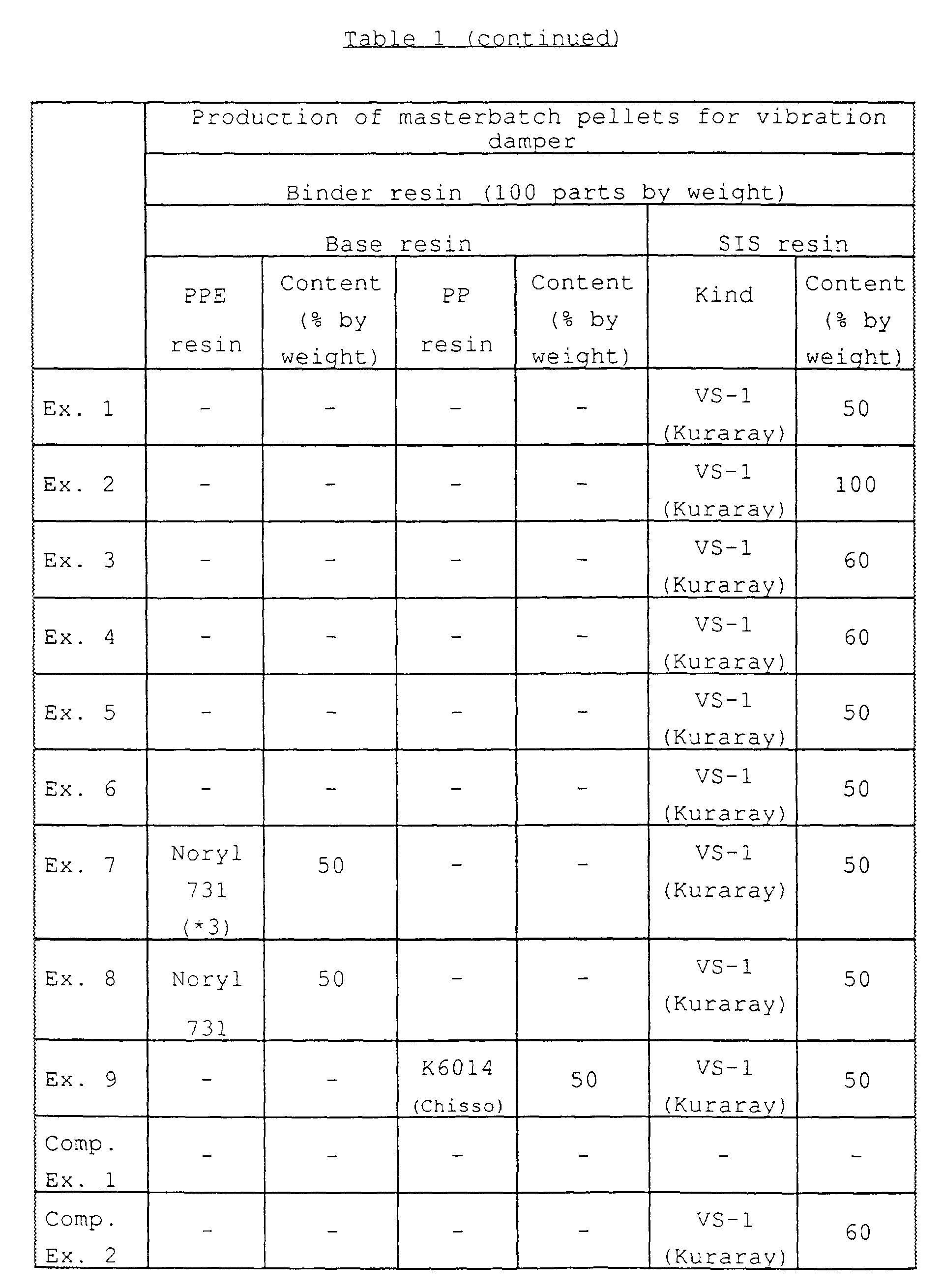
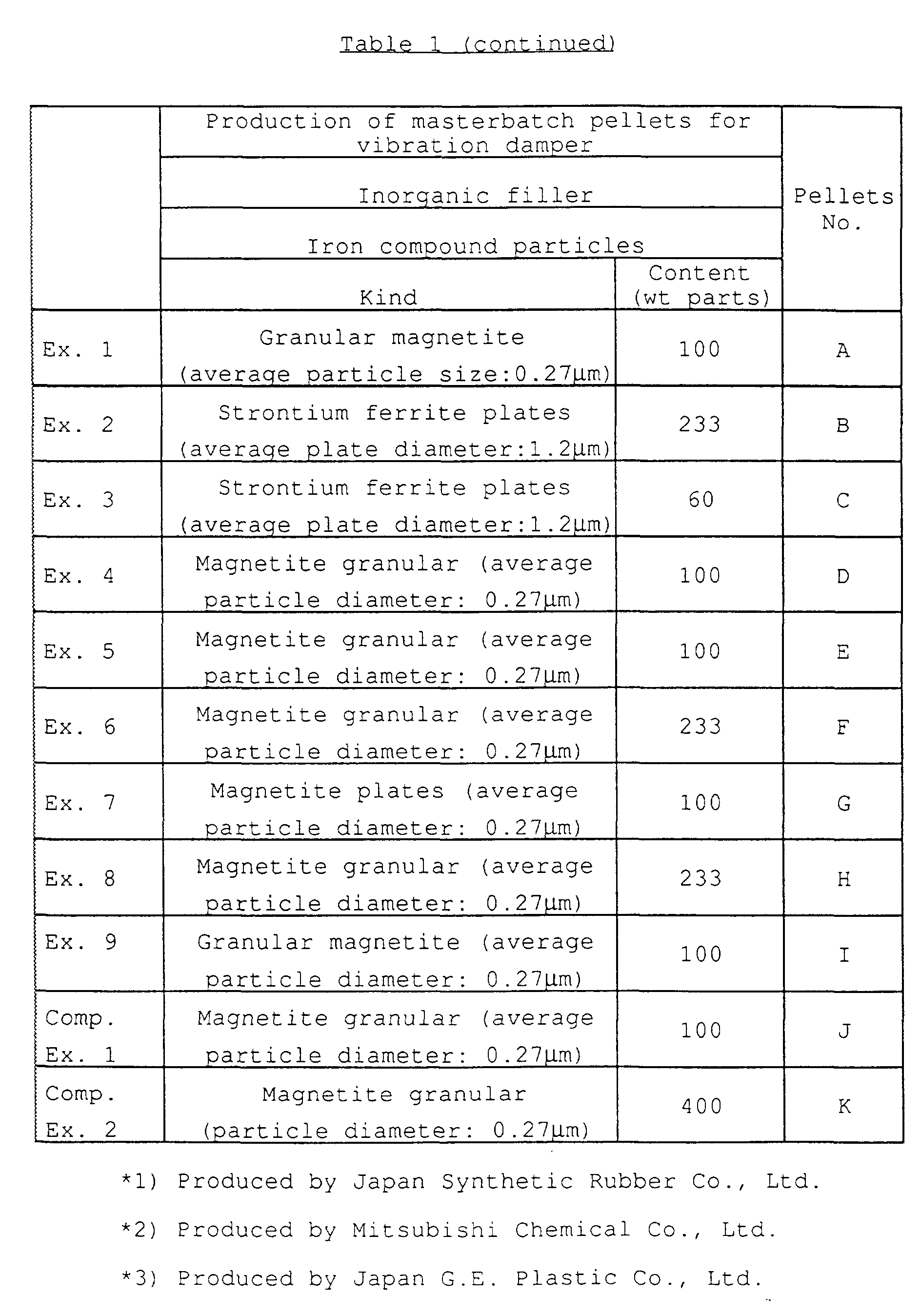
- binder resin composed of 50 parts by weight of high-impact polystyrene resin (Sumibright M-574, produced by Sumitomo Chemical Co., Ltd.) and 50 parts by weight of styrene-isoprene-styrene block copolymer (VS-1, produced by Kuraray Co., Ltd.), and 100 parts by weight of granular magnetite (VD-803C, produced by Toda Kogyo Corporation; average particle size: 0.27 ⁇ m and BET specific surface area: 4.5 m 2 /g) were kneaded at 160°C by a twin-screw kneader and extruded from a 3 mm ⁇ die, and the extrudate was cut to the approximately 3 mm units to obtain masterbatch pellets A.
- binder resin composed of 50 parts by weight of high-impact polystyrene resin (Sumibright M-574, produced by Sumitomo Chemical Co., Ltd.) and 50 parts by
- the kind and amount of base resin, styrene-isoprene-styrene block copolymer and iron oxide particles in the masterbatch pellets were selected as shown in Table 1 to prepare masterbatch pellets for damping material B-K.
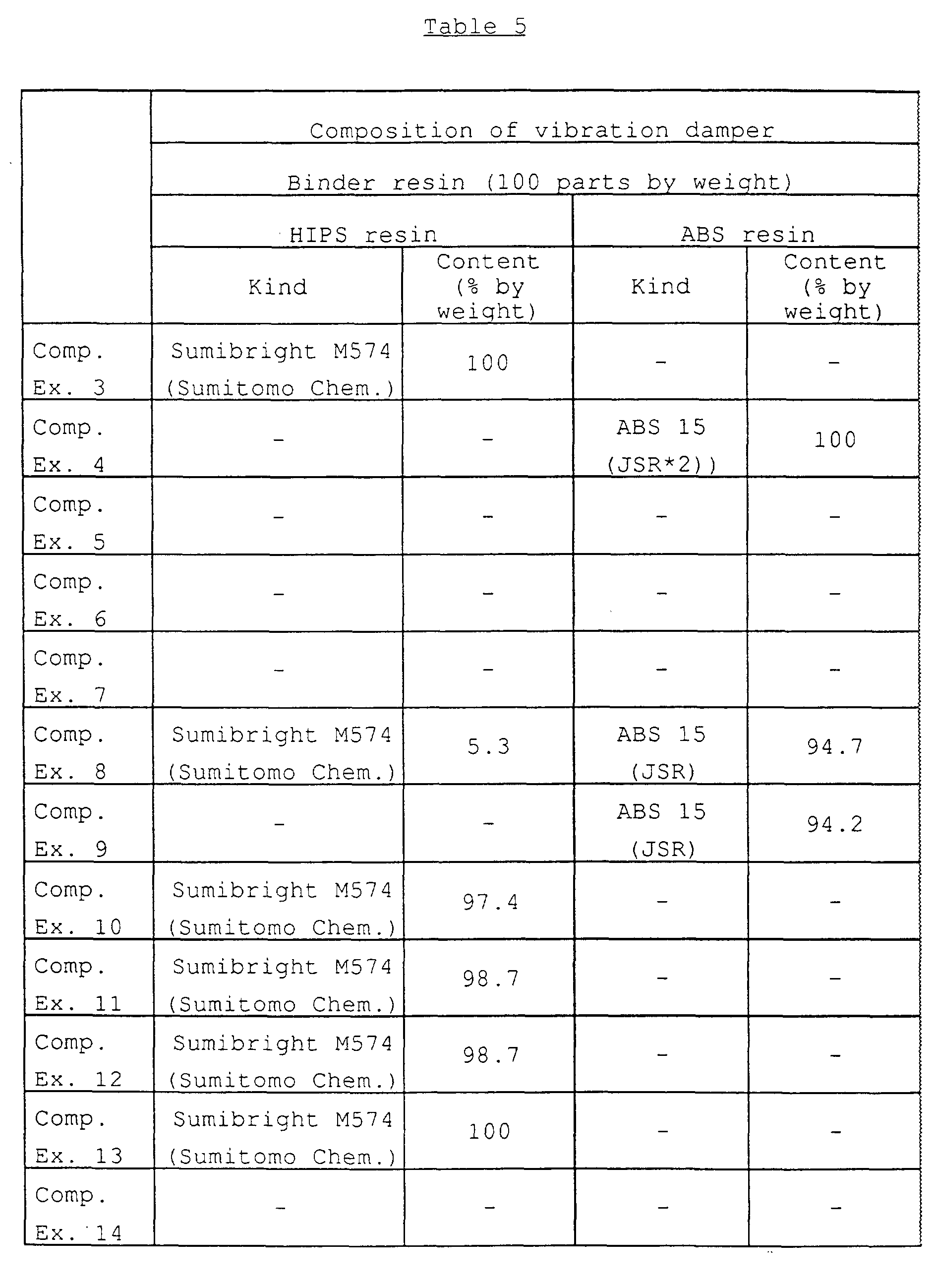
- Samples of damping material were produced by the same procedure as Example 10 except that the kind of masterbatch pellets, the kind of base resin mixed with masterbatch pellets and the mixing ratios of said base resin and masterbatch pellets were changed as shown in Table 2.
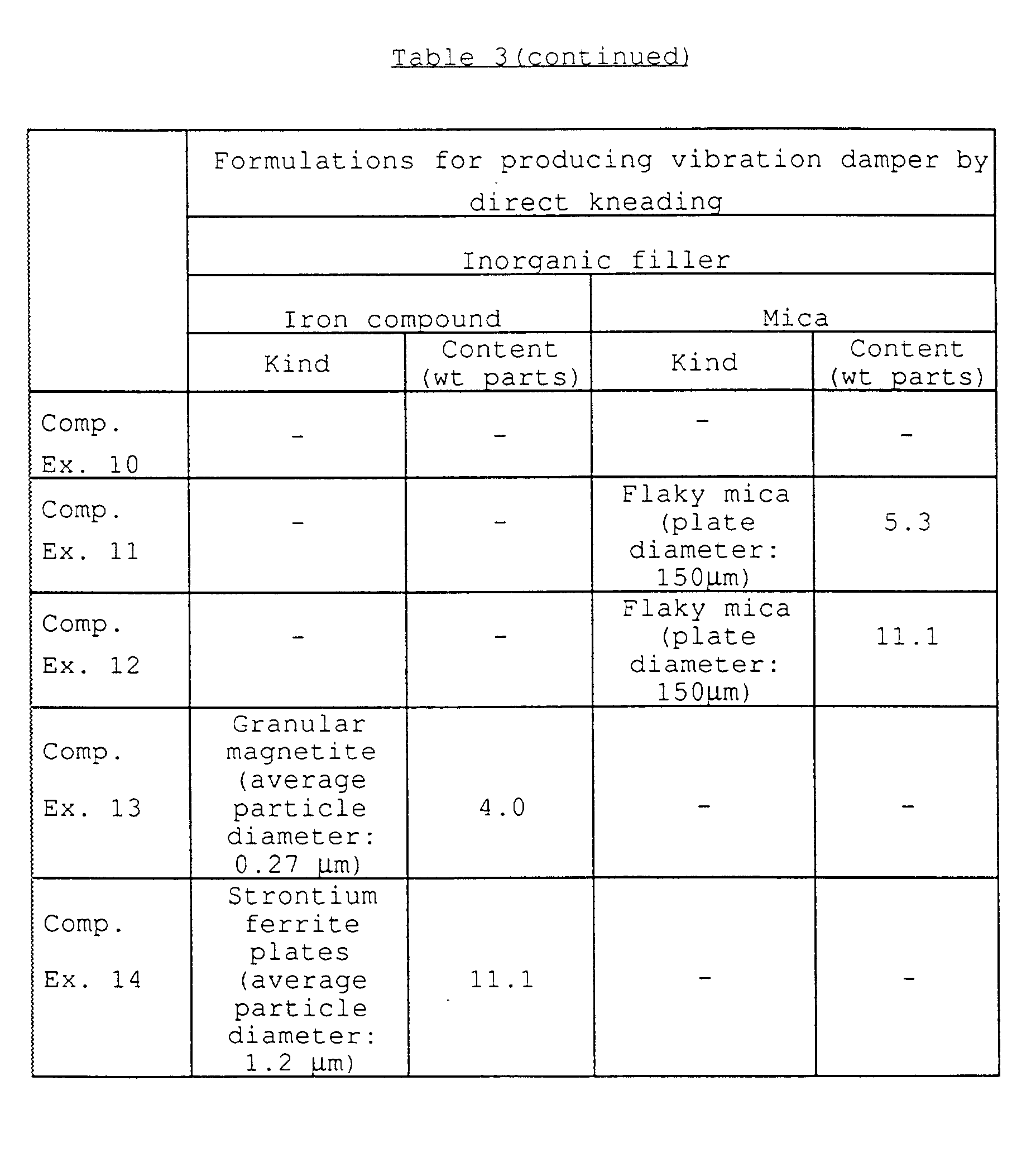
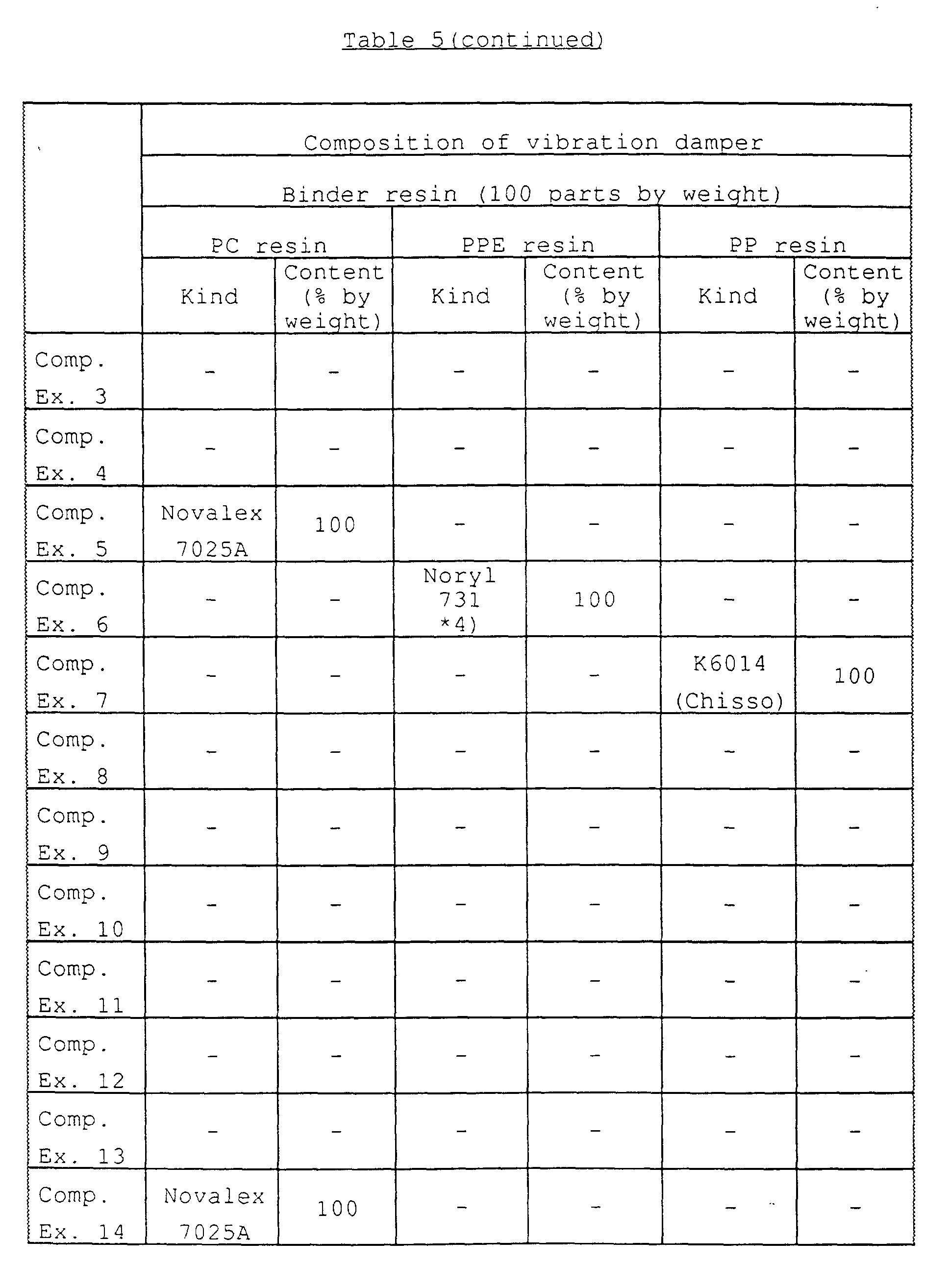
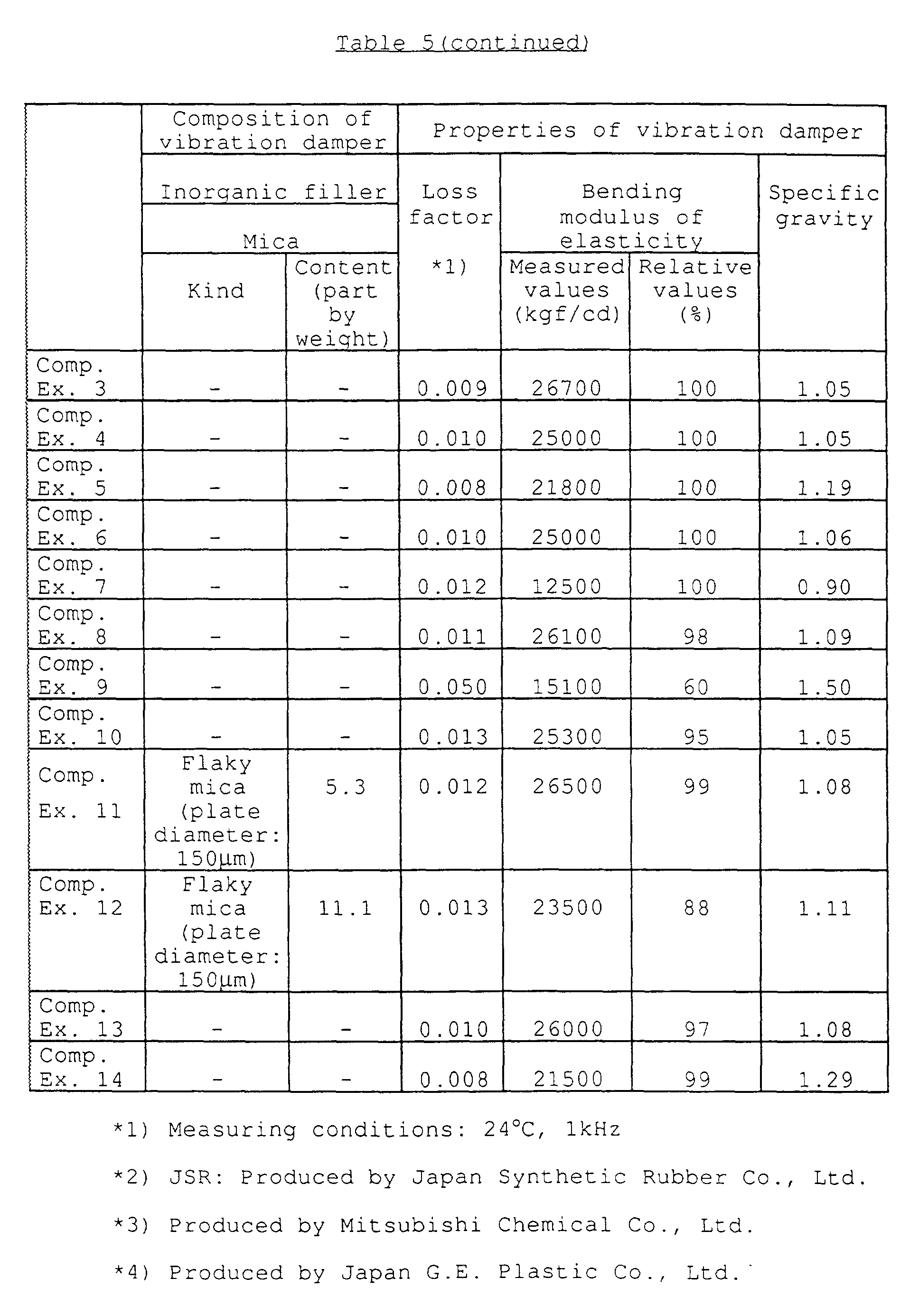
- the characteristics of the samples of Examples 11-23 are shown in Table 4, and the characteristics of the samples of Comparative Examples 3-9 are shown in Table 5.
- Samples of damping material were produced by blending and kneading base resin, styrene-isoprene-styrene block copolymer and flaky mica or iron compound without using masterbatch pellets, at the ratios shown in Table 3, and molding the mixtures. The characteristics of these samples are shown in Table 5.
- Cassette half of a commercial available cassette tape was taken as reference example and its loss factor at an ordinary temperature (24°C) was determined. It was 0.015.
- a gear was produced by the same procedure as Example 25 except for not using masterbatch pellets.
- the loss factor ⁇ of this gear at an ordinary temperature (24°C) was 0.008.
- modified polyphenylene ether resin Noryl 731, Japan G.E. Plastic Co., Ltd.
- masterbatch pellets G 10 parts by weight were uniformly blended by a Henschel mixer and injection molded into a dot printer casing (exterior part).
- the loss factor ⁇ of this casing at an ordinary temperature (24°C) was 0.035.
- a dot printer casing was produced by following the procedure of Example 26 without using masterbatch pellets.
- the loss factor ⁇ of this casing at an ordinary temperature (24°C) was 0.010.
- Formulations for producing vibration damper Masterbatch pellets Base resin Kind Content (parts by weight) Kind Content (part by weight) Ex. 10
Landscapes
- Chemical & Material Sciences (AREA)
- Health & Medical Sciences (AREA)
- Chemical Kinetics & Catalysis (AREA)
- Medicinal Chemistry (AREA)
- Polymers & Plastics (AREA)
- Organic Chemistry (AREA)
- Compositions Of Macromolecular Compounds (AREA)
Description
- The present invention relates to a material having a damping property (hereinafter referred to as "damping material") and masterbatch pellets used for production thereof.
- As is well known, a damping material is widely used in many fields of industry for the purpose of damping vibration or noise generated from various sources and occasions, for example, vibration or noise which is generated incidental to operation of an engine or motor mounted in various kinds of machines and apparatus, for instance office automation equipment, household electric appliances such as washing machines, dryers, etc., a cartridge half and cassette half of data cartridge tapes, video tapes, audio tapes, etc., disk shells of optical discs, magneto-optical discs, magnetic discs, acoustic optical discs, etc., acoustic equipments, precision machine tools, works plant equipments, and various kinds of vehicles and ships; vibration or noise generated from piping such as water and gas pipes in buildings, ducts of air conditioning systems, etc.; and vibration or noise generated from running of vehicles on road or railway tracks.
- The damping material is usually offered as a sheet-like material or block-like material produced by kneading and molding a binder resin and filler material such as mica, iron oxide or the like by a suitable molding method such as extrusion molding, calender molding, compression molding, injection molding or cast molding, or it is provided directly as a structural material of electrical or electronic equipments, casings of household electric appliances, office automation equipments, a cartridge half and a cassette half, etc. Namely, as for the using mode of the damping material, it may be used so that a molded sheet-like material or block-like material is stuck to or put between pertinent section(s) of an objective apparatus, etc., or it may be directly applied as a structural material of electrical or electronic equipments, casings of household electric appliances, office automation equipments, a cartridge half, a cassette half, etc.
- Recently, there is seen a remarkable trend toward the miniaturization and lightweight of handy apparatus such as office automation equipments and acoustic equipments, and a damping material used in such machines, equipments, appliances and tools has been strongly required to miniaturize and reduce the weight. To meet this requirements, the damping material is demanded to have a high damping property, that is, a high internal loss. However, if it is simply tried to increase the amount of inorganic filler material used in the damping material for the only purpose of improving damping property, it invites a reduction of strength and hardness of rigid resin used as binder resin, and moldability of the material is impaired. Further, since specific gravity of the produced damping material elevates, this runs counter to the requirements of the miniaturization and lightweight. It is thus strongly required of damping material to have an excellent damping property while maintaining an intrinsic strength (e.g. bending strength) and hardness of a rigid resin. This fact is referred to in, for instance, JP-A-4-45142 which states: "As thermoplastic resin composition having damping properties, there are known compositions obtained by blending a large amount of filler material such as calcium carbonate with polypropylene. These compositions, however, had the disadvantages in that the intrinsic priorities of resin (such as good moldability and high impact strength) are deteriorated because of blending of a large amount of filler material. Development of a damping materiel capable of retaining the intrinsic properties of resin has, therefore, been desired."
- Recently, large numbers of the movable parts such as motors, relays, transforms, gears, cums, gear boxes and the like, and the electrical, electronic or machine parts which generate vibration and/or noise are used in household electric appliances or office automation equipment. The vibration generated from such parts is transferred to other parts and/or casings, and as a result, the intended performances of the product can not be exhibited. According to circumstances, it may be invite to malfunction and/or generate unpleasant vibration. So, the damping material used as a structural material of the electrical, electronic or machine parts, and the casings of the household electric appliances or the office automation equipments is strongly required to have a sufficiently high strength and hardness, and excellent internal loss at around room temperature (e. g., 20 to 28°C).
- Also, in recording media such as optical disks or magnetic disks used in computers, word processors and the like, data-cartridge tapes, video and audio optical disks, cassette tapes, etc., higher reliability, tone quality and picture quality of the recording media are strongly demanded.
- These recording media are set in a recorder and driven to run by a motor or other motive force to make recording or reading-out. Vibration generated in the inside of the cartridge half or cassette half (for example, vibration caused by "play" around a shaft such as hub for taking up the magnetic tape) or vibration from a source outside the cartridge half or cassette half (for example, vibration caused by operation of motor) exerts baneful influence on recording and reading-out, so that it is difficult to have accurate recording and reading-out of information. Therefore, the damping material used as a structural material for cartridge half or cassette half is strongly required to satisfy the above requirement, i.e., to have an excellent internal loss at around room temperature while maintaining high strength and hardness.
- As binder resin for damping material, there are usually used thermoplastic resins (rigid resins) such as polypropylenes, polystyrenes, acrylonitrile-butadiene-styrene copolymers, polycarbonates, polyphenylene ethers, modified polyphenylene ethers and the like. These rigid resins are preferably used because of relatively low cost and excellent molding workability.
- These rigid resins, however, are not satisfactorily excellent in internal loss at around room temperature.
- Many attempts have been made for improving a damping property of these rigid resins. For instance, JP-A-2-300250 proposes a polypropylene composition improved in a damping property obtained by incorporating a styrene-isoprene-styrene block copolymer in polypropylene resin. JP-A-3-45646 proposes an ABS resin composition having improved damping property, obtained by incorporating a styrene-isoprene-styrene copolymer to an acrylonitrile-butadiene-styrene copolymer. JP-A-3-181552 proposes a polyphenylene ether resin composition having excellent damping properties, comprising a polyphenylene ether and a styrene-isoprene-styrene block copolymer. JP-A-5-70699 proposes a thermoplastic resin composition with improved damping property, obtained by incorporating a styrene-isoprene-styrene block copolymer in a thermoplastic resin. Also, in JP-A-5-59234 is proposed a damping material resin composed of polypropylene and a styrene-isoprene-styrene block copolymer.
- More specifically, JP-A-2-300250 discloses a polypropylene composition comprising (a) 97-50 parts by weight of polypropylene and (b) 3-50 parts by weight of a block copolymer having a number-average molecular weight of 30,000-300,000 or a hydrogenation product thereof, the said block copolymer composed of blocks (A) comprising an aromatic vinyl monomer having a number-average molecular weight of 2,500-40,000 and blocks (B)comprising isoprene or an isoprene-butadiene mixture, whose number-average molecular weight is 10,000-200,000 and 3,4 bond and 1,2 bond content is 40% or more, and which shows a peak of main dispersion of tan δ at 0°C or more.
- The problem to be solved by JP-A-2-300250 is to reduce vibration and noise at around room temperature in the range where various kinds of the equipments and appliances are practically used.
- JP-A-3-45646 discloses an ABS resin composition comprising (a) 97-50 parts by weight of an ABS resin and (b) 3-50 parts by weight of a block copolymer having a number-average molecular weight of 30,000-300,000 or a hydrogenation product thereof, the said block copolymer composed of blocks (A) comprising an aromatic vinyl monomer having a number-average molecular weight of 2,500-40,000 and blocks (B) comprising isoprene or an isoprene-butadiene mixture, having a number-average molecular weight of 10,000-200,000 and a 3,4 bond and 1,2 bond content of 40% or more and showing a peak of main dispersion of tan δ at 0°C or more.
- The object of JP-A-3-45646 is to improve a damping property at around room temperature in the widely used ABS resin for damping material in various kinds of the equipments and appliances.
- JP-A-3-181552 discloses a polyphenylene ether resin composition comprising (a) 97-50 parts by weight of polyphenylene ether and (b) 3-50 parts by weight of a block copolymer having a number-average molecular weight of 30,000-300,000 or a hydrogenation product thereof, the said block copolymer composed of blocks (A) comprising an aromatic vinyl monomer having a number-average molecular weight of 2,500-40,000 and blocks (B)comprising isoprene or an isoprene-butadiene mixture, having a number-average molecular weight of 10,000-200,000 and a 3,4-bond and 1,2-bond content of 40% or more and showing a peak of main dispersion of tan δ at 0°C or more.
- JP-A-5-70699 discloses a thermoplastic resin composition comprising (a) 97-50 parts by weight of a thermoplastic resin and (b) 3-50 parts by weight of a block copolymer having a number-average molecular weight of 30,000-300,000 or a hydrogenation product thereof, said block copolymer composed of blocks (A) comprising an aromatic vinyl monomer having a number-average molecular weight is 2,500-40,000 and blocks (B) comprising isoprene or an isoprene-butadiene mixture, whose number-average molecular weight is 10,000-200,000 and Tg is 0 to 40°C, wherein said blocks A and B are coupled together in the form of A(BA)n or (AB)n (n: an integer of 1 or more).
- The object of JP-A-5-70699 is to improve impact resistance in the low temperature region.
- The thermoplastic resins proposed in JP-A-5-70669 include polyolefins such as polyethylene and polypropylene, polyester such as polyethylene terephthalate and polybutylene terephthalate, styrene resins such as ABS and AS resins, polyamides, polyphenylene ethers, polyacetals and polycarbonates.
- JP-A-5-59234 discloses a damping material resin comprising a polypropylene resin composition composed of a mixture of 50-95% by weight of a polypropylene and 5-50% by weight of a thermoplastic elastomer and an inorganic filler, said inorganic filler being blended in an amount of 10-150 parts by weight based on 100 parts by weight of said resin mixture, wherein said thermoplastic elastomer is composed of a block polymer of a styrene-isoprene-styrene structure having polyisoprene blocks of vinyl structure.
- A damping material composition obtained by adding iron oxide particles as an inorganic filler for improving a damping property is proposed in JP-A-3-287652. The composition of JP-A-3-287652 comprises 100 parts by weight of a block copolymer having a number-average molecular weight of 30,000 to 300,000 and composed of blocks (A) comprising an aromatic vinyl monomer having a number-average molecular weight of 2,500 to 40,000, and blocks (B) comprising isoprene or an isoprene-butadiene mixture, having a number-average molecular weight of 10,000 to 200,000 and a 3,4-bond and 1,2-bond content of 40% or more and showing a peak of main dispersion of tan δ at 0°C or more, and 30 to 1000 parts by weight of iron oxide particles.
- In production of damping materials mainly composed of thermoplastic resins, it has been common practice in the art to add an inorganic filler material directly to a base resin. However, for better handling and easier preparation of the composition, there is proposed a process using masterbatch pellets in which masterbatch pellets are prepared by dispersing an inorganic filler material in a base resin at a higher concentration than the desired one and these masterbatch pellets are mixed and dispersed in the base resin to adjust the concentration of inorganic filler to the purposed level thereof.
- Accordingly, the masterbatch pellets for the damping material, which are easy to handle in producing the damping material and capable of affording a satisfactory damping effect with a moderate amount of addition thereof, are also required.
- A damping material having an excellent internal loss in the commonly used temperature range, particularly at around room temperature (for example, 20 to 28°C), while maintaining a satisfactorily high strength and hardness of a rigid resin, is most strongly required at present, but none of the damping materials of the prior art mentioned above is able to satisfy well the said requirements.
- The damping property of the damping materials disclosed in the above-mentioned JP-A-2-300250, JP-A-3-45646, JP-A-3-181552, JP-A-5-70699 and JP-A-5-59234 is unsatisfactory because iron oxide particles are not used as an inorganic filler. They are also incapable of maintaining the intrinsic strength and hardness of a rigid resin because of a high content of an inorganic filler.
- The damping material disclosed in JP-A-3-287652 mentioned above has an excellent damping property in the practical temperature range from room temperature to high temperature but is low in strength, that is, this damping material is low in bending modulus.
- The problem to be solved by the present invention is to provide a damping material having an excellent internal loss in the practical temperature range, particularly at around room temperature, while maintaining the intrinsic strength and hardness of rigid resin.
- The object of the present invention is therefore to provide a damping material having an excellent internal loss at around room temperature, and satisfactory strength and hardness.
- Accordingly, the present invention provides a damping material which comprises:
- (a) a binder resin composed of from 85 to 99% by weight of at least one base resin selected from polypropylenes, polystyrenes, acrylonitrile-butadiene-styrene copolymers, polycarbonates, polyphenylene ethers and modified polyphenylene ethers and from 1 to 15% by weight of styrene-isoprene-styrene block copolymer having a number-average molecular weight of 30,000 to 300,000, and
- (b) from 1 to 20 parts by weight, per 100 parts by weight of the binder resin, of iron compound particles, the damping material having a loss factor of not less that 0.015 at 24°C, a relative bending modulus of not less than 70% based on the bending modulus of a damping material consisting of the base resin and a specific gravity of from 0.95 to 1.30.
-
- The damping material according to the present invention has a loss factor of not less than 0.015, preferably not less than 0.020, at a temperature of 24°C and a relative binding modulus of not less than 70%, preferably not less than 75%, based on a bending modulus of a damping material consisting of the base resin, which show that the internal loss at around room temperature is excellent and the intrinsic strength and hardness of rigid resin is fully maintained.
- As base resin used in the present invention, one or more of the resins selected from polypropylenes, polystyrenes, acrylonitrile-butadiene-styrene copolymers, polycarbonates, polyphenylene ethers and modified polyphenylene ethers can be used. The amount of the base resin used is 85 to 99% by weight, preferably 88 to 98% by weight, based on the binder resin. When the amount of the base resin exceeds 99% by weight, there can not be obtained the desired effect of improving the damping property because of too small content of styrene-isoprene-styrene block copolymer in the binder resin. When the amount of the base resin is less than 85% by weight, the strength and hardness of the base resin, specifically the bending modulus thereof is lowered because of too large content of styrene-isoprene-styrene block copolymer in the binder resin, and thus it is impossible to maintain the intrinsic strength of the base resin and to provide the damping material of the desired bending modulus and hardness.
- As polypropylenes usable in the present invention, homopolypropylenes, propylene copolymers such as propylene-ethylene random copolymer (ethylene content being not more than 20% by weight) and propylene-ethylene block copolymer (ethylene content being not more than 20% by weight), and polypropylenes modified with an unsaturated carboxylic acid or derivatives thereof may be exemplified.
- Acrylonitrile-butadiene-styrene copolymers used in the present invention are generally of a composition of 20 to 30 wt% of acrylonitrile, 10 to 30 wt% of butadiene and 40 to 70 wt% of styrene.
- As polystyrenes used in the present invention, available polystyrenes including homopolystyrenes and copolymers such as polystyrene-butadiene copolymers, etc. can be cited. As the polystyrene-butadiene copolymers, a high-impact polystyrene (HI-PS) obtained by graft-polymerizing styrene to butadiene rubber may be exemplified.
- Polycarbonates used in the present invention are preferably one having a viscosity-average molecular weight of 1.8 x 10⁴ to 3.3 x 10⁴. Such polycarbonates are commercially available under the trade names of Novalex (produced by Mitsubishi Chemical Co., Ltd.), Panlight (produced by Teiji Chemical Co., Ltd.), Yupiron (Produced by Mitsubishi Gas Chemical Co., Ltd.), Taflon (produced by Idemitsu Petrochemical Co., Ltd.), Rexan (produced by General Electric Corp.), Macron (Produced by Bayer Corp.), etc.
- Examples of polyphenylene ethers usable in the present invention are poly(2,6-dimethyl-1,4-phenylene) ether, poly(2,6-diethyl-1,4-phenylene) ether, poly(2-methyl-6-ethyl-1,4-phenylene) ether, poly(2-methyl-6-propyl-1,4-phenylene) ether, poly(2,6-dipropyl-1,4-phenylene) ether, and poly (2-ethyl-6-propyl-1,4-phenylene) ether.
- Modified polyphenylene ethers usable in the present invention is a polymer alloy of polyphenylene ether and styrene-based resin (Noryl resin, produced by General Electric Corp.) and a polymer alloy of polyphenylene ether and polyamide resin (Noryl GTYX resin, produced by General Electric Corp.).
- As a base resin, polystyrenes, acrylonitrile-butadiene-styrene copolymers, polycarbonates, polyphenylene ethers and modified polyphenylene ethers are preferably used in the present invention.
- Styrene blocks in the styrene-isoprene-styrene block copolymer used in the present invention are constituted by an aromatic vinyl monomer capable of anionic polymerization, such as styrene, 1-vinylnaphthalene, 2-vinylnaphthalene, 3-methylstyrene, 4-propylstyrene, 4-cyclohexylstyrene, 4-dodecylstyrene, 2-ethyl-4-benzylstyrene, 4-phenylbutylstyrene and the like. Among them, styrene is especially preferred.
- Isoprene blocks in the said styrene-isoprene-styrene block copolymer are preferably constituted by isoprene or isoprene-butadiene. In case other monomers are used, for instance, if butadiene alone is used, the temperature at which a damping effect is produced is below 0°C even if the content of vinyl bonds is increased, and the desired damping property cannot be obtained in the practical temperature range. In this case, therefore, the damping material can be applied to a wide scope of use and has a very high practical significance. When isoprene-butadiene is used, the desired damping property can be obtained in the temperature range not less than 0°C in case of isoprene being not less than 40%. As the isoprene-butadiene copolymers, random, block or tapered copolymers are usable.
- Number-average molecular weight of the obtained styrene-isoprene-styrene block copolymer is in the range of 30,000 to 300,000. When the molecular weight is less than 30,000, the mechanical properties such as strength and elongation at breaking of the block copolymer itself are deteriorated, resulting in a reduced strength of the damping material. When the molecular weight exceeds 300,000, the workability thereof worsened. Thus, the preferred range of the molecular weight (Mn) of the said block copolymers is from 80,000 to 250,000.
- The block formation in the said styrene-isoprene-styrene block copolymers is A(BA)n or (AB)n, wherein A represents styrene block, B represents isoprene block, and n is an integer of 1 or more. The formation of A(BA)n is preferred.
- The content of the styrene-isoprene-styrene block copolymers in the binder resin is in the range of 1 to 15% by weight, preferably 2 to 12 % by weight. When the content is less than 1% by weight, the desired improvement of damping properties can not be obtained due to diffusion of the said block copolymers in the base resin. When the content exceeds 15% by weight, the strength and hardness of the base resin is lowered, thereby making it unable to maintain the intrinsic strength and hardness of the base resin.
- As iron compound particles in the present invention, there can be used hematite particles, maghemite particles, magnetite particles, Berthollide compounds particles and hard ferrite particles such as strontium ferrite particles and barium ferrite particles, and hydrous iron oxide particles such as goethite (α-FeOOH) particles, akaganéite (β-FeOOH) particles, lepidocrocite (γ-FeOOH) particles and the like. Among them, magnetite particles, strontium ferrite particles and barium ferrite particles are preferred. The preferred BET specific surface of the magnetite particles is 3 to 40 m2/g and the BET specific surface the barium ferrite particles or strontium ferrite particles is 0.3 to 20 m2/g.. The shape thereof is not limited, and it may be, for instance, granular, spindle, acicular, plate-like or the like. The granular shape is preferred. The average particle size of the iron compound particles usable in the present invention is typically in the range of 0.05 to 10 µm. It is preferably in the range of 0.1 to 5 µm, which is advantageous in terms of properties of the damping material and economy.
- The amount of iron compound particles used in the present invention is 1 to 20 parts by weight based on 100 parts by weight of the binder resin. When the amount is less than 1 part by weight, the desired excellent internal loss can not be obtained. When the amount exceeds 20 parts by weight, the bending modulus which is an index of strength of rigid resin, lowers to make it unable to obtain a satisfactory strength of the damping material. Also, specific gravity of the damping material increases, thereby vitiating the advantage of the resin of being lightweight. The preferred content of iron compound particles is 3 to 20 parts by weight based on 100 parts by weight of the binder resin.
- The damping material according to the present invention comprises the base resin, the styrene-isoprene-styrene block copolymer and the iron compound particles as essential components, but if necessary, other polymer(s), compatilizing agent, oxidation stabilizer, etc., may be blended within the range which does not impair the purpose of the present invention. For instance, polymers such as natural rubbers (NR), isoprene rubbers (IR), butadiene rubbers (BR), styrenebutadiene rubbers (SBR), ethylene-propylene-diene terpolymers (EPDM), ethylene-propylene rubbers (EPR), styrene-conjugated diene block copolymers and hydrogenation product thereof may be blended. The amount of the polymer is not more than 30 parts by weight, preferably in the name of 5 to 25 parts by weight based on 100 parts by weight of the binder resin.
- The present invention also provides masterbatch pellets suitable for use in the production of a damping material according to the invention, which pellets comprise:
- (a') a binder resin composed of not more than 70% by weight of at least one resin selected from polypropylenes, polystyrenes, acrylonitrile-butadiene-styrene copolymers, polycarbonates, polyphenylene ethers and modified polyphenylene ethers and not less than 30% by weight of styrene-isoprene-styrene block copolymer having a number-average molecular weight of 30,000 to 300,000, and
- (b') from 50 to 300 parts by weight, per 100 parts by weight of the binder resin, of iron compound particles.
-
- The masterbatch pellets for the damping material according to the present invention typically have a grain size of 1 to 10 mm, preferably 3 to 7 mm. When the grain size of pellets is less than 1 mm, the workability is bad in the production of pellets, while when the grain size exceeds 10 mm, it becomes difficult to disperse the pellets in base resin. The grain shape is not specified, but it may be, for instance, indeterminate, columnar, spherical, flaky and the like.
- As the base resin of the said masterbatch pellets, at least one resin selected from polypropylenes, polystyrenes, acrylonitrile-butadiene-styrene copolymers, polycarbonates, polyphenylene ethers and modified polyphenylene ethers is used in an amount of not more than 70% by weight, preferably in the range of not more than 65% by weight based on the binder resin. When the amount of the base resin exceeds 70% by weight, it is difficult to obtain the desired concentration of styrene-isoprene-styrene block copolymer resin in production of damping material because of small content of styrene-isoprene-styrene block copolymer.
- The composition of base resin in the masterbatch pellets may be the same combination of resins as base resin to be mixed with masterbatch pellets, or may be a different combination of the resins.
- As styrene-isoprene-styrene block copolymer resin in the masterbatch pellets, there can be used the resins mentioned above and the amount thereof added is 30 to 100% by weight, preferably 35 to 100% by weight based on the binder resin of the masterbatch pellets. If the amount of this resin is less than 30% by weight, it is undesirable since the amount of masterbatch pellets necessary for producing the damping material increases.
- As iron compound particles of the masterbatch pellets, those mentioned above can be used and the amount of the iron compound particles is 50 to 300 parts by weight, preferably 60 to 250 parts by weight, based on 100 parts by weight of the binder resin. If the amount of the iron compound particles is less than 50 parts by weight, the amount of the masterbatch pellets necessary for producing the damping material increases. If the amount of the iron compound particles exceeds 300 parts by weight, it becomes difficult to adjust the content of the iron compound particles to a desired level since their content in the damping material is varied greatly by a slight change of the amount of the masterbatch pellets added. This is also causative of extensive mechanical abrasion.
- The masterbatch pellets for the damping material according to the present invention are produced by mixing the styrene-isoprene-styrene block copolymer and iron compound particles with the base resin selected from polypropylenes, polystyrenes, acrylonitrile-butadiene-styrene copolymers, polycarbonates, polyphenylene ethers and modified polyphenylene ethers by a suitable mixing machine such as Ribbon blender, Nauta mixer, Henschel mixer, Supermixer or the like, and kneading and molding the resultant mixture by a known single-screw or twin-screw extruder, and cutting the molded product, or pulverizing and molding the resultant mixture kneaded by a Banbury mixer, press kneader or the like and cutting the molded product, thereby obtaining the desired granular material.
- The damping material according to the present invention is produced by kneading from 1 to 30% by weight of the said masterbatch pellets and from 70 to 99% by weight, preferably 75 to 95% by weight, of a base resin comprising at least one resin selected from polypropylenes, polystyrenes, acrylonitrile-butadiene-styrene copolymers, polycarbonates, polyphenylene ethers and modified polyphenylene ethers, and molding the kneaded mixture. The preferable amount of the masterbatch pellets added is 5 to 25% by weight, more preferably 5 to 20% by weight. When the amount of the masterbatch pellets added is less than 1% by weight, the effect of addition thereof is too small. When the amount of the masterbatch pellets exceeds of 30% by weight, the intrinsic strength and hardness of base resin may be adversely affected. Typically, the said masterbatch pellets and the said base resin are mixed in a suitable mixer such as a Ribbon blender, Nauta mixer, Henschel mixer or Supermixer; and the resultant mixture is molded into the desired product by a suitable machine such as an injection molding machine. The invention thus further provides:
- structural materials of electrical or electronic equipment, casings or bodies of household electric appliances and office automation equipment made of a damping material of the invention; and
- cartridge halves, cassette halves and disk shells made of a damping material of the invention.
- Such structural materials, casings or bodies, and cartridge halves, cassette halves and the like according to the present invention have a loss factor of not less then 0.015, preferably not less than 0.020, at 24°C and a relative bending modulus of not less than 70%, preferably not less than 75%, based on the bending modulus of structural materials, casings, bodies, cartridge halves, cassette halves, etc. made of only the base resin.
- The fact that a damping material having an excellent internal loss in the practical temperature range, especially at around room temperature, while maintaining the intrinsic strength and hardness of rigid resin can be obtained according to the present invention may be accounted for by the followings.
- It is considered that in the damping material according to the present invention, styrene-isoprene-styrene block copolymer is dispersed, in the form of fine lumps, in the base resin comprising at least one resin selected from polypropylenes, polystyrenes, acrylonitrile-butadiene-styrene copolymers, polycarbonates, polyphenylene ethers and modified polyphenylene ethers, and a damping effect is produced by friction at the interface between the dispersed fine lumps of styrene-isoprene-styrene block copolymer and the base resin. The fact is particularly notable that the smaller the size of the said dispersed fine lumps, the greater becomes the contact area between the dispersed fine lumps of styrene-isoprene-styrene block copolymer and the base resin, resulting in a better damping property, that is higher internal loss.
- However, when the content of styrene-isoprene-styrene copolymer is increased, although the loss factor elevates, the intrinsic strength and hardness of the rigid resin, specifically its bending modulus, is reduced.
- As a result of the present inventors' studies on the subject problem, it has been found that by using iron compound particles, it is possible to elevate the loss factor more than by using conventional inorganic fillers such as mica other than iron compound; and that by adding a small amount of styrene-isoprene-styrene block copolymer resin, the efficient enhancement of loss factor can be effected while suppressing the lowering the strength and hardness of the base resin.
- This effect may be attributed to the followings. The lumps of styrene-isoprene-styrene block copolymer dispersed in base resin can be made fine in size due to the iron compound particles, and consequently the dispersed state of the lumps thereof becomes finer, thereby elevating the damping effect by friction with the base resin, resulting in an increased loss factor.
- By the way, as seen from Comparative Examples 13 and 14 described later, the damping property of the damping material comprising the base resin and iron compound particles dispersed in the base resin without blending styrene-isoprene-styrene block copolymer does not improve.
- Further, a smaller amount of the iron compound particles than that of mica or other conventional filler is required for obtaining a same level of loss factor, and the amount of styrene-isoprene-styrene block copolymer to be added can be minimized. As a result, it is considered that a damping material showing an excellent internal loss in the practical temperature range, particularly at around room temperature, while maintaining the intrinsic strength and hardness of the rigid resin, can be obtained.
- Thus, according to the present invention, by the synergistic effect of the combination and the said specific mixing ratios of (1) base resin comprising at least one resin selected from polypropylenes, polystyrenes, acrylonitrile-butadiene-styrene copolymers, polycarbonates, polyphenylene ethers and modified polyphenylene ethers, preferably at least one resin selected from polystyrenes, acrylonitrile-butadiene-styrene copolymers, polycarbonates, polyphenylene ethers and modified polyphenylene ethers, (2) styrene-isoprene-styrene block copolymer, and (3) iron compound particles, such damping material has a loss factor of not less than 0.015, preferably not less than 0.020, at an ordinary temperature (24°C), a relative bending modulus of not less than 70%, preferably not less than 75%, based on a bending modulus of a damping material consisting of the base resin, and a specific gravity of 0.95 to 1.30.
- The damping material according to the present invention, as described particularly in the Examples given below, has a high internal loss at around room temperature, while maintaining the intrinsic strength and hardness of rigid resin, so that it is capable of significant miniaturization, lightweight and thinning, and can be effectively applied to structural materials of electrical or electronic equipment, casings or bodies of office automation equipment or household electric appliances, parts of various kinds of machines and apparatus, internal parts of vehicles and ships, building materials, etc.. The damping material is particularly useful for cartridge halves and cassette halves of data cartridge tapes, video tapes, audio tapes etc., disk shells of optical discs, magneto-optical discs, magnetic discs, acoustic optical discs, etc.
- The present invention will be explained in more detail hereinafter with reference to the following examples and comparative examples.
- Loss factor η used as an index of damping property, i.e., loss factor of the damping material was determined by injection molding a 200mm x 12.5mm x 3mm test piece and measuring loss factor η of this test piece by cantilever beam-type resonance method under the conditions of 24°C and 1 kHz.
- Loss factor η of casing of cassette half, household electric appliances or office automation equipments was determined in the followings. The casing was suspended from two points with a kite string. Then a metal ball (1.05 g in weight and 6 mm in diameter) suspended with a kite string (250 mm in length) was pulled up to an angle of 60° from the vertical plane with its fulcrum taken vertically above the casing and dropped down to the casing to give vibrations to the central part of the casing. Transmission of vibrations was detected by a vibration pickup set at the bottom of the casing and data processing was made by FFT Analyzer 3550 (manufactured by B & K Corp.) under the condition of 24°C to determine loss factor η.
- Bending modulus which is an index of strength of damping material was determined by injection molding a 80mm x 12.5mm x 3mm test piece and measuring bending modulus of this test piece according to ASTM D-790.
- Specific gravity was measured by a specific gravity hydrometer (manufactured by EW-120SG, Mirage Trading Co., Ltd.).
- 100 parts by weight of binder resin composed of 50 parts by weight of high-impact polystyrene resin (Sumibright M-574, produced by Sumitomo Chemical Co., Ltd.) and 50 parts by weight of styrene-isoprene-styrene block copolymer (VS-1, produced by Kuraray Co., Ltd.), and 100 parts by weight of granular magnetite (VD-803C, produced by Toda Kogyo Corporation; average particle size: 0.27 µm and BET specific surface area: 4.5 m2/g) were kneaded at 160°C by a twin-screw kneader and extruded from a 3 mmØ die, and the extrudate was cut to the approximately 3 mm units to obtain masterbatch pellets A.
- The kind and amount of base resin, styrene-isoprene-styrene block copolymer and iron oxide particles in the masterbatch pellets were selected as shown in Table 1 to prepare masterbatch pellets for damping material B-K.
- 90 parts of high-impact polystyrene resin (Sumibright M-574, produced by Sumitomo Chemical Co., Ltd.) used as base resin and 10 parts by weight of masterbatch pellets A were uniformly blended by a Henschel mixer and injection-molded into a strip-shaped test piece. The loss factor η of this test piece at an ordinary temperature (24°C) was 0.021, its bending modulus was 25,400 kgf/cm2 (relative bending modulus: 95 %) and its specific gravity was 1.09.
- Samples of damping material were produced by the same procedure as Example 10 except that the kind of masterbatch pellets, the kind of base resin mixed with masterbatch pellets and the mixing ratios of said base resin and masterbatch pellets were changed as shown in Table 2. The characteristics of the samples of Examples 11-23 are shown in Table 4, and the characteristics of the samples of Comparative Examples 3-9 are shown in Table 5.
- Samples of damping material were produced by blending and kneading base resin, styrene-isoprene-styrene block copolymer and flaky mica or iron compound without using masterbatch pellets, at the ratios shown in Table 3, and molding the mixtures. The characteristics of these samples are shown in Table 5.
- 90 parts by weight of high-impact polystyrene resin ( Sumibright M-574, produced by Sumitomo Chemical Co., Ltd.) used as base resin and 10 parts by weight of masterbatch pellets A were uniformly blended by a Henschel mixer and injection molded into a cassette half casing (structural materials). The loss factor η of this casing at an ordinary temperature (24°C) was 0.031.
- Cassette half of a commercial available cassette tape was taken as reference example and its loss factor at an ordinary temperature (24°C) was determined. It was 0.015.
- 93 parts by weight of polycarbonate (Novalex 7025A, produced by Mitsubishi Chemical Corporation) used as base resin and 7 parts by weight of masterbatch pellets F were uniformly blended by a Henschel mixer and injection molded into a gear. The loss factor η of this gear at ordinary temperature (24°C) was 0.021.
- A gear was produced by the same procedure as Example 25 except for not using masterbatch pellets. The loss factor η of this gear at an ordinary temperature (24°C) was 0.008.
- 90 parts by weight of modified polyphenylene ether resin (Noryl 731, Japan G.E. Plastic Co., Ltd.) used as base resin and 10 parts by weight of masterbatch pellets G were uniformly blended by a Henschel mixer and injection molded into a dot printer casing (exterior part). The loss factor η of this casing at an ordinary temperature (24°C) was 0.035.
- A dot printer casing was produced by following the procedure of Example 26 without using masterbatch pellets. The loss factor η of this casing at an ordinary temperature (24°C) was 0.010.


Formulations for producing vibration damper Masterbatch pellets Base resin Kind Content (parts by weight) Kind Content (part by weight) Ex. 10 A 10 HIPS resin (Sumibright M574) 90 Ex. 11 A 20 HIPS resin (Sumibright M574) 80 Ex. 12 A 10 ABS resin (ABS 15) 90 Ex. 13 B 10 ABS resin (ABS 15) 90 Ex. 14 C 25 ABS resin (ABS 15) 75 Ex. 15 D 7 ABS resin (ABS 15) 93 Ex. 16 D 10 ABS resin (ABS 15) 90 Ex. 17 E 12.5 PC resin (Novalex 7025A) 87.5 Ex. 18 F 7 PC resin (Novalex 7025A) 93 Ex. 19 F 12.5 PC resin (Novalex 7025A) 87.5 Ex. 20 G 10 PPE resin (Noryl 731) 90 Ex. 21 H 7 PPE resin (Noryl 731) 93 Ex. 22 H 10 PPE resin (Noryl 731) 90 Ex. 23 I 10 PP resin (K 6014) 90 Comp. Ex. 3 - - HIPS resin (Sumibright M574) 100 Comp. Ex. 4 - - ABS resin (ABS 15) 100 Comp. Ex. 5 - - PC resin (Novalex 7025A) 100 Comp. Ex. 6 - - PPE resin (Noryl 731) 100 Comp. Ex. 7 - - PP resin (K 6014) 100 Comp. Ex. 8 J 10 ABS resin (ABS 15) 90 Comp. Ex. 9 K 35 ABS resin (ABS 15) 65 




Claims (10)
- A damping material which comprises:the damping material having a loss factor of not less that 0.015 at 24°C, a relative bending modulus of not less than 70% based on the bending modulus (ASTM D-790) of a damping material consisting of the base resin and a specific gravity of from 0.95 to 1.30.(a) a binder resin composed of from 85 to 99% by weight of at least one base resin selected from polypropylenes, polystyrenes, acrylonitrile-butadiene-styrene copolymers, polycarbonates, polyphenylene ethers and modified polyphenylene ethers and from 1 to 15% by weight of styrene-isoprene-styrene block copolymer having a number-average molecular weight of 30,000 to 300,000, and(b) from 1 to 20 parts by weight, per 100 parts by weight of the binder resin, of iron compound particles,
- A material according to claim 1, having a said loss factor of not less that 0.020 at 24°C and a said bending modulus of not less than 75%.
- A material according to claim 1 or 2, wherein the iron compound particles are hematite particles, maghemite particles, magnetite particles, berthollide compound particles, barium ferrite particles, strontium ferrite particles, goethite particles, akaganeite particles or lepidocrocite particles.
- A material according to any one of the preceding claims, wherein the particle size of the iron compound particles is from 0.05 to 10 µm.
- A material according to any one of the preceding claims, wherein the base resin is at least one resin selected from polystyrenes, acrylonitrile-butadiene-styrene copolymers, polycarbonates, polypheneylene ethers and modified polyphenylene ethers.
- A material according to any one of the preceding claims, wherein the base resin is present in an amount of from 88 to 98% by weight of the binder resin, the styrene-isoprene-styrene block copolymer is present in an amount of from 2 to 12% by weight of the binder resin and the content of iron compound particles is from 3 to 20 parts by weight per 100 parts by weight of the binder resin.
- Masterbatch pellets suitable for use in the production of a damping material as defined in claim 1, which pellets comprise:(a') a binder resin composed of not more than 70% by weight of at least one resin selected from polypropylenes, polystyrenes, acrylonitrile-butadiene-styrene copolymers, polycarbonates, polyphenylene ethers and modified polyphenylene ethers and not less than 30% by weight of styrene-isoprene-styrene block copolymer having a number-average molecular weight of 30,000 to 300,000, and(b') from 50 to 300 parts by weight, per 100 parts by weight of the binder resin, of iron compound particles.
- A process for producing a damping material as defined in claim 1, which process comprises kneading from 1 to 30% by weight of masterbatch pellets as defined in claim 7 and from 70 to 99% by weight of base resin comprising at least one resin selected from polypropylenes, polystyrenes, acrylonitrile-butadiene-styrene copolymers, polycarbonates, polyphenylene ethers and modified polyphenylene ethers; and molding the kneaded mixture.
- A structural material of electrical or electronic equipment, a casing or body of household electric appliances or office automation equipment made of a damping material as defined in any one of claims 1 to 6.
- A cartridge half, cassette half or disk shell made of a damping material as defined in any one of claims 1 to 6.
Applications Claiming Priority (3)
| Application Number | Priority Date | Filing Date | Title |
|---|---|---|---|
| JP17363794 | 1994-06-30 | ||
| JP173637/94 | 1994-06-30 | ||
| JP17363794 | 1994-06-30 |
Publications (2)
| Publication Number | Publication Date |
|---|---|
| EP0690092A1 EP0690092A1 (en) | 1996-01-03 |
| EP0690092B1 true EP0690092B1 (en) | 2001-10-10 |
Family
ID=15964303
Family Applications (1)
| Application Number | Title | Priority Date | Filing Date |
|---|---|---|---|
| EP95304579A Expired - Lifetime EP0690092B1 (en) | 1994-06-30 | 1995-06-29 | Material having a damping property and masterbatch pellets therefor |
Country Status (3)
| Country | Link |
|---|---|
| US (2) | US5977235A (en) |
| EP (1) | EP0690092B1 (en) |
| DE (1) | DE69523099T2 (en) |
Cited By (2)
| Publication number | Priority date | Publication date | Assignee | Title |
|---|---|---|---|---|
| US7202297B2 (en) | 2001-01-18 | 2007-04-10 | Kraton Polymers Llc | Adhesive composition |
| US7589152B2 (en) | 2003-12-22 | 2009-09-15 | Kraton Polymers U.S. Llc | Adhesive formulations for novel radial (S-I/B)x polymers |
Families Citing this family (3)
| Publication number | Priority date | Publication date | Assignee | Title |
|---|---|---|---|---|
| US6391418B1 (en) * | 1998-12-24 | 2002-05-21 | Mitsubishi Engineering-Plastics Corp. | Substrate for information recording media |
| US6683123B1 (en) * | 2000-09-12 | 2004-01-27 | Bayer Polymers Llc | Process for making a thermoplastic molding composition |
| JP4333581B2 (en) * | 2002-07-31 | 2009-09-16 | 日本ゼオン株式会社 | Thermoplastic elastomer molded body |
Family Cites Families (11)
| Publication number | Priority date | Publication date | Assignee | Title |
|---|---|---|---|---|
| JPS57501966A (en) * | 1980-12-18 | 1982-11-04 | ||
| US4690960A (en) * | 1981-01-14 | 1987-09-01 | Nippon Electric Co., Ltd. | Vibration damping material |
| JPS6072935A (en) * | 1983-09-30 | 1985-04-25 | Sekisui Chem Co Ltd | Electroconductive plastic composition |
| JP2790313B2 (en) | 1989-05-15 | 1998-08-27 | 株式会社クラレ | Polypropylene composition |
| JP2678068B2 (en) | 1989-07-12 | 1997-11-17 | 株式会社クラレ | ABS resin composition |
| JP2948845B2 (en) | 1989-12-08 | 1999-09-13 | 株式会社クラレ | Polyphenylene ether resin composition |
| JP2823310B2 (en) | 1990-04-04 | 1998-11-11 | 株式会社クラレ | Damping composition |
| JPH0445142A (en) | 1990-06-12 | 1992-02-14 | Asahi Chem Ind Co Ltd | Resin composition having excellent vibration-damping property |
| JP3096097B2 (en) * | 1990-07-18 | 2000-10-10 | 三菱化学株式会社 | Crosslinked copolymer particles and method for producing the same |
| JPH0559234A (en) | 1991-08-30 | 1993-03-09 | Toyoda Gosei Co Ltd | Vibration-damping resin |
| JPH0570699A (en) | 1991-09-13 | 1993-03-23 | Kuraray Co Ltd | Thermoplastic resin composition |
-
1995
- 1995-06-29 DE DE69523099T patent/DE69523099T2/en not_active Expired - Fee Related
- 1995-06-29 EP EP95304579A patent/EP0690092B1/en not_active Expired - Lifetime
-
1997
- 1997-05-13 US US08/855,012 patent/US5977235A/en not_active Expired - Fee Related
-
1999
- 1999-03-08 US US09/263,084 patent/US6300401B1/en not_active Expired - Fee Related
Cited By (2)
| Publication number | Priority date | Publication date | Assignee | Title |
|---|---|---|---|---|
| US7202297B2 (en) | 2001-01-18 | 2007-04-10 | Kraton Polymers Llc | Adhesive composition |
| US7589152B2 (en) | 2003-12-22 | 2009-09-15 | Kraton Polymers U.S. Llc | Adhesive formulations for novel radial (S-I/B)x polymers |
Also Published As
| Publication number | Publication date |
|---|---|
| US5977235A (en) | 1999-11-02 |
| DE69523099T2 (en) | 2002-05-16 |
| DE69523099D1 (en) | 2001-11-15 |
| EP0690092A1 (en) | 1996-01-03 |
| US6300401B1 (en) | 2001-10-09 |
Similar Documents
| Publication | Publication Date | Title |
|---|---|---|
| EP3719069A1 (en) | Polypropylene resin composition | |
| DE69902600T2 (en) | Styrene resin composition and process for its preparation, and process for the production of moldings from styrene resin | |
| US5891943A (en) | Thermoplastic resin composition and a method of producing the same | |
| US6300401B1 (en) | Material having a damping property and masterbatch pellets thereof | |
| JP2001200166A (en) | Slidable resin composition | |
| JPH09194743A (en) | Vibration-damping thermoplastic resin composition | |
| JP3090181B2 (en) | Damping material, masterbatch pellets for damping material, method of manufacturing damping material, and damping structural material composed of damping material | |
| JP3086627B2 (en) | Pickup chassis for optical disc | |
| JP3111625B2 (en) | Resin composition with improved recyclability | |
| JPS58164634A (en) | Composition consisting of PPE, impact modifier, inorganic filler and PTFE | |
| EP1553141B1 (en) | Polyamide resin composition and process for producing the same | |
| JP2002249661A (en) | Resin mechanical parts for optical disk drives with excellent heat resistance and dimensional accuracy | |
| JPH1135817A (en) | Chassis member for disc drive apparatus | |
| KR102805381B1 (en) | Thermoplastic resin composition and molded product using the same | |
| JP3326287B2 (en) | Resin composition for disk drive chassis | |
| JP3352568B2 (en) | Optical writing unit fixed chassis | |
| JP3946614B2 (en) | Thermoplastic resin composition | |
| JP2004217832A (en) | Resin composition | |
| CN113825820B (en) | Thermoplastic elastomer composition for damping member | |
| JP2003226809A (en) | Thermoplastic resin composition | |
| JP2005281448A (en) | Resin composition | |
| JP7182333B1 (en) | Resin composition and molded article | |
| JP2007295239A (en) | Resin molding for acoustic apparatus | |
| JP2001158871A (en) | Surface modifier | |
| JP2002020629A (en) | Resin composition with excellent release properties |
Legal Events
| Date | Code | Title | Description |
|---|---|---|---|
| PUAI | Public reference made under article 153(3) epc to a published international application that has entered the european phase |
Free format text: ORIGINAL CODE: 0009012 |
|
| AK | Designated contracting states |
Kind code of ref document: A1 Designated state(s): DE FR GB NL |
|
| 17P | Request for examination filed |
Effective date: 19960614 |
|
| 17Q | First examination report despatched |
Effective date: 19971031 |
|
| GRAG | Despatch of communication of intention to grant |
Free format text: ORIGINAL CODE: EPIDOS AGRA |
|
| GRAG | Despatch of communication of intention to grant |
Free format text: ORIGINAL CODE: EPIDOS AGRA |
|
| GRAH | Despatch of communication of intention to grant a patent |
Free format text: ORIGINAL CODE: EPIDOS IGRA |
|
| RAP1 | Party data changed (applicant data changed or rights of an application transferred) |
Owner name: TODA KOGYO CORPORATION |
|
| GRAH | Despatch of communication of intention to grant a patent |
Free format text: ORIGINAL CODE: EPIDOS IGRA |
|
| GRAA | (expected) grant |
Free format text: ORIGINAL CODE: 0009210 |
|
| AK | Designated contracting states |
Kind code of ref document: B1 Designated state(s): DE FR GB NL |
|
| REF | Corresponds to: |
Ref document number: 69523099 Country of ref document: DE Date of ref document: 20011115 |
|
| REG | Reference to a national code |
Ref country code: GB Ref legal event code: IF02 |
|
| ET | Fr: translation filed | ||
| PLBE | No opposition filed within time limit |
Free format text: ORIGINAL CODE: 0009261 |
|
| STAA | Information on the status of an ep patent application or granted ep patent |
Free format text: STATUS: NO OPPOSITION FILED WITHIN TIME LIMIT |
|
| 26N | No opposition filed | ||
| PGFP | Annual fee paid to national office [announced via postgrant information from national office to epo] |
Ref country code: FR Payment date: 20030610 Year of fee payment: 9 |
|
| PGFP | Annual fee paid to national office [announced via postgrant information from national office to epo] |
Ref country code: GB Payment date: 20030625 Year of fee payment: 9 |
|
| PGFP | Annual fee paid to national office [announced via postgrant information from national office to epo] |
Ref country code: NL Payment date: 20030630 Year of fee payment: 9 |
|
| PGFP | Annual fee paid to national office [announced via postgrant information from national office to epo] |
Ref country code: DE Payment date: 20030710 Year of fee payment: 9 |
|
| PG25 | Lapsed in a contracting state [announced via postgrant information from national office to epo] |
Ref country code: GB Free format text: LAPSE BECAUSE OF NON-PAYMENT OF DUE FEES Effective date: 20040629 |
|
| PG25 | Lapsed in a contracting state [announced via postgrant information from national office to epo] |
Ref country code: NL Free format text: LAPSE BECAUSE OF NON-PAYMENT OF DUE FEES Effective date: 20050101 Ref country code: DE Free format text: LAPSE BECAUSE OF NON-PAYMENT OF DUE FEES Effective date: 20050101 |
|
| GBPC | Gb: european patent ceased through non-payment of renewal fee |
Effective date: 20040629 |
|
| PG25 | Lapsed in a contracting state [announced via postgrant information from national office to epo] |
Ref country code: FR Free format text: LAPSE BECAUSE OF NON-PAYMENT OF DUE FEES Effective date: 20050228 |
|
| NLV4 | Nl: lapsed or anulled due to non-payment of the annual fee |
Effective date: 20050101 |
|
| REG | Reference to a national code |
Ref country code: FR Ref legal event code: ST |