EP0689820B1 - Article d'hygiène féminine muni d'éléments de diffusion des fluides corporels - Google Patents
Article d'hygiène féminine muni d'éléments de diffusion des fluides corporels Download PDFInfo
- Publication number
- EP0689820B1 EP0689820B1 EP95401570A EP95401570A EP0689820B1 EP 0689820 B1 EP0689820 B1 EP 0689820B1 EP 95401570 A EP95401570 A EP 95401570A EP 95401570 A EP95401570 A EP 95401570A EP 0689820 B1 EP0689820 B1 EP 0689820B1
- Authority
- EP
- European Patent Office
- Prior art keywords
- article
- thread
- mattress
- approximately
- article according
- Prior art date
- Legal status (The legal status is an assumption and is not a legal conclusion. Google has not performed a legal analysis and makes no representation as to the accuracy of the status listed.)
- Expired - Lifetime
Links
Images


Classifications
-
- A—HUMAN NECESSITIES
- A61—MEDICAL OR VETERINARY SCIENCE; HYGIENE
- A61F—FILTERS IMPLANTABLE INTO BLOOD VESSELS; PROSTHESES; DEVICES PROVIDING PATENCY TO, OR PREVENTING COLLAPSING OF, TUBULAR STRUCTURES OF THE BODY, e.g. STENTS; ORTHOPAEDIC, NURSING OR CONTRACEPTIVE DEVICES; FOMENTATION; TREATMENT OR PROTECTION OF EYES OR EARS; BANDAGES, DRESSINGS OR ABSORBENT PADS; FIRST-AID KITS
- A61F13/00—Bandages or dressings; Absorbent pads
- A61F13/15—Absorbent pads, e.g. sanitary towels, swabs or tampons for external or internal application to the body; Supporting or fastening means therefor; Tampon applicators
- A61F13/53—Absorbent pads, e.g. sanitary towels, swabs or tampons for external or internal application to the body; Supporting or fastening means therefor; Tampon applicators characterised by the absorbing medium
- A61F13/538—Absorbent pads, e.g. sanitary towels, swabs or tampons for external or internal application to the body; Supporting or fastening means therefor; Tampon applicators characterised by the absorbing medium characterised by specific fibre orientation or weave
-
- A—HUMAN NECESSITIES
- A61—MEDICAL OR VETERINARY SCIENCE; HYGIENE
- A61F—FILTERS IMPLANTABLE INTO BLOOD VESSELS; PROSTHESES; DEVICES PROVIDING PATENCY TO, OR PREVENTING COLLAPSING OF, TUBULAR STRUCTURES OF THE BODY, e.g. STENTS; ORTHOPAEDIC, NURSING OR CONTRACEPTIVE DEVICES; FOMENTATION; TREATMENT OR PROTECTION OF EYES OR EARS; BANDAGES, DRESSINGS OR ABSORBENT PADS; FIRST-AID KITS
- A61F13/00—Bandages or dressings; Absorbent pads
- A61F13/15—Absorbent pads, e.g. sanitary towels, swabs or tampons for external or internal application to the body; Supporting or fastening means therefor; Tampon applicators
- A61F13/45—Absorbent pads, e.g. sanitary towels, swabs or tampons for external or internal application to the body; Supporting or fastening means therefor; Tampon applicators characterised by the shape
- A61F13/47—Sanitary towels, incontinence pads or napkins
- A61F13/475—Sanitary towels, incontinence pads or napkins characterised by edge leakage prevention means
- A61F13/4751—Sanitary towels, incontinence pads or napkins characterised by edge leakage prevention means the means preventing fluid flow in a transversal direction
- A61F13/4755—Sanitary towels, incontinence pads or napkins characterised by edge leakage prevention means the means preventing fluid flow in a transversal direction the means being a flat barrier on or inside the absorbent article, e.g. backsheet wrapped around the edges
-
- A—HUMAN NECESSITIES
- A61—MEDICAL OR VETERINARY SCIENCE; HYGIENE
- A61F—FILTERS IMPLANTABLE INTO BLOOD VESSELS; PROSTHESES; DEVICES PROVIDING PATENCY TO, OR PREVENTING COLLAPSING OF, TUBULAR STRUCTURES OF THE BODY, e.g. STENTS; ORTHOPAEDIC, NURSING OR CONTRACEPTIVE DEVICES; FOMENTATION; TREATMENT OR PROTECTION OF EYES OR EARS; BANDAGES, DRESSINGS OR ABSORBENT PADS; FIRST-AID KITS
- A61F13/00—Bandages or dressings; Absorbent pads
- A61F13/15—Absorbent pads, e.g. sanitary towels, swabs or tampons for external or internal application to the body; Supporting or fastening means therefor; Tampon applicators
- A61F13/53—Absorbent pads, e.g. sanitary towels, swabs or tampons for external or internal application to the body; Supporting or fastening means therefor; Tampon applicators characterised by the absorbing medium
- A61F13/534—Absorbent pads, e.g. sanitary towels, swabs or tampons for external or internal application to the body; Supporting or fastening means therefor; Tampon applicators characterised by the absorbing medium having an inhomogeneous composition through the thickness of the pad
- A61F13/537—Absorbent pads, e.g. sanitary towels, swabs or tampons for external or internal application to the body; Supporting or fastening means therefor; Tampon applicators characterised by the absorbing medium having an inhomogeneous composition through the thickness of the pad characterised by a layer facilitating or inhibiting flow in one direction or plane, e.g. a wicking layer
- A61F13/53708—Absorbent pads, e.g. sanitary towels, swabs or tampons for external or internal application to the body; Supporting or fastening means therefor; Tampon applicators characterised by the absorbing medium having an inhomogeneous composition through the thickness of the pad characterised by a layer facilitating or inhibiting flow in one direction or plane, e.g. a wicking layer the layer having a promotional function on liquid propagation in at least one direction
- A61F13/53713—Absorbent pads, e.g. sanitary towels, swabs or tampons for external or internal application to the body; Supporting or fastening means therefor; Tampon applicators characterised by the absorbing medium having an inhomogeneous composition through the thickness of the pad characterised by a layer facilitating or inhibiting flow in one direction or plane, e.g. a wicking layer the layer having a promotional function on liquid propagation in at least one direction the layer having a promotional function on liquid propagation in the vertical direction
-
- A—HUMAN NECESSITIES
- A61—MEDICAL OR VETERINARY SCIENCE; HYGIENE
- A61F—FILTERS IMPLANTABLE INTO BLOOD VESSELS; PROSTHESES; DEVICES PROVIDING PATENCY TO, OR PREVENTING COLLAPSING OF, TUBULAR STRUCTURES OF THE BODY, e.g. STENTS; ORTHOPAEDIC, NURSING OR CONTRACEPTIVE DEVICES; FOMENTATION; TREATMENT OR PROTECTION OF EYES OR EARS; BANDAGES, DRESSINGS OR ABSORBENT PADS; FIRST-AID KITS
- A61F13/00—Bandages or dressings; Absorbent pads
- A61F13/15—Absorbent pads, e.g. sanitary towels, swabs or tampons for external or internal application to the body; Supporting or fastening means therefor; Tampon applicators
- A61F13/53—Absorbent pads, e.g. sanitary towels, swabs or tampons for external or internal application to the body; Supporting or fastening means therefor; Tampon applicators characterised by the absorbing medium
- A61F13/534—Absorbent pads, e.g. sanitary towels, swabs or tampons for external or internal application to the body; Supporting or fastening means therefor; Tampon applicators characterised by the absorbing medium having an inhomogeneous composition through the thickness of the pad
- A61F13/537—Absorbent pads, e.g. sanitary towels, swabs or tampons for external or internal application to the body; Supporting or fastening means therefor; Tampon applicators characterised by the absorbing medium having an inhomogeneous composition through the thickness of the pad characterised by a layer facilitating or inhibiting flow in one direction or plane, e.g. a wicking layer
- A61F13/53743—Absorbent pads, e.g. sanitary towels, swabs or tampons for external or internal application to the body; Supporting or fastening means therefor; Tampon applicators characterised by the absorbing medium having an inhomogeneous composition through the thickness of the pad characterised by a layer facilitating or inhibiting flow in one direction or plane, e.g. a wicking layer characterised by the position of the layer relative to the other layers
- A61F13/53747—Absorbent pads, e.g. sanitary towels, swabs or tampons for external or internal application to the body; Supporting or fastening means therefor; Tampon applicators characterised by the absorbing medium having an inhomogeneous composition through the thickness of the pad characterised by a layer facilitating or inhibiting flow in one direction or plane, e.g. a wicking layer characterised by the position of the layer relative to the other layers the layer is facing the topsheet
-
- A—HUMAN NECESSITIES
- A61—MEDICAL OR VETERINARY SCIENCE; HYGIENE
- A61F—FILTERS IMPLANTABLE INTO BLOOD VESSELS; PROSTHESES; DEVICES PROVIDING PATENCY TO, OR PREVENTING COLLAPSING OF, TUBULAR STRUCTURES OF THE BODY, e.g. STENTS; ORTHOPAEDIC, NURSING OR CONTRACEPTIVE DEVICES; FOMENTATION; TREATMENT OR PROTECTION OF EYES OR EARS; BANDAGES, DRESSINGS OR ABSORBENT PADS; FIRST-AID KITS
- A61F13/00—Bandages or dressings; Absorbent pads
- A61F13/15—Absorbent pads, e.g. sanitary towels, swabs or tampons for external or internal application to the body; Supporting or fastening means therefor; Tampon applicators
- A61F13/53—Absorbent pads, e.g. sanitary towels, swabs or tampons for external or internal application to the body; Supporting or fastening means therefor; Tampon applicators characterised by the absorbing medium
- A61F13/539—Absorbent pads, e.g. sanitary towels, swabs or tampons for external or internal application to the body; Supporting or fastening means therefor; Tampon applicators characterised by the absorbing medium characterised by the connection of the absorbent layers with each other or with the outer layers
-
- A—HUMAN NECESSITIES
- A61—MEDICAL OR VETERINARY SCIENCE; HYGIENE
- A61F—FILTERS IMPLANTABLE INTO BLOOD VESSELS; PROSTHESES; DEVICES PROVIDING PATENCY TO, OR PREVENTING COLLAPSING OF, TUBULAR STRUCTURES OF THE BODY, e.g. STENTS; ORTHOPAEDIC, NURSING OR CONTRACEPTIVE DEVICES; FOMENTATION; TREATMENT OR PROTECTION OF EYES OR EARS; BANDAGES, DRESSINGS OR ABSORBENT PADS; FIRST-AID KITS
- A61F13/00—Bandages or dressings; Absorbent pads
- A61F13/15—Absorbent pads, e.g. sanitary towels, swabs or tampons for external or internal application to the body; Supporting or fastening means therefor; Tampon applicators
- A61F13/51—Absorbent pads, e.g. sanitary towels, swabs or tampons for external or internal application to the body; Supporting or fastening means therefor; Tampon applicators characterised by the outer layers of the pads
- A61F13/511—Topsheet, i.e. the permeable cover or layer facing the skin
-
- A—HUMAN NECESSITIES
- A61—MEDICAL OR VETERINARY SCIENCE; HYGIENE
- A61F—FILTERS IMPLANTABLE INTO BLOOD VESSELS; PROSTHESES; DEVICES PROVIDING PATENCY TO, OR PREVENTING COLLAPSING OF, TUBULAR STRUCTURES OF THE BODY, e.g. STENTS; ORTHOPAEDIC, NURSING OR CONTRACEPTIVE DEVICES; FOMENTATION; TREATMENT OR PROTECTION OF EYES OR EARS; BANDAGES, DRESSINGS OR ABSORBENT PADS; FIRST-AID KITS
- A61F13/00—Bandages or dressings; Absorbent pads
- A61F13/15—Absorbent pads, e.g. sanitary towels, swabs or tampons for external or internal application to the body; Supporting or fastening means therefor; Tampon applicators
- A61F13/15203—Properties of the article, e.g. stiffness or absorbency
- A61F2013/15284—Properties of the article, e.g. stiffness or absorbency characterized by quantifiable properties
- A61F2013/15447—Fibre dimension, e.g. denier or tex
-
- A—HUMAN NECESSITIES
- A61—MEDICAL OR VETERINARY SCIENCE; HYGIENE
- A61F—FILTERS IMPLANTABLE INTO BLOOD VESSELS; PROSTHESES; DEVICES PROVIDING PATENCY TO, OR PREVENTING COLLAPSING OF, TUBULAR STRUCTURES OF THE BODY, e.g. STENTS; ORTHOPAEDIC, NURSING OR CONTRACEPTIVE DEVICES; FOMENTATION; TREATMENT OR PROTECTION OF EYES OR EARS; BANDAGES, DRESSINGS OR ABSORBENT PADS; FIRST-AID KITS
- A61F13/00—Bandages or dressings; Absorbent pads
- A61F13/15—Absorbent pads, e.g. sanitary towels, swabs or tampons for external or internal application to the body; Supporting or fastening means therefor; Tampon applicators
- A61F13/51—Absorbent pads, e.g. sanitary towels, swabs or tampons for external or internal application to the body; Supporting or fastening means therefor; Tampon applicators characterised by the outer layers of the pads
- A61F2013/51002—Absorbent pads, e.g. sanitary towels, swabs or tampons for external or internal application to the body; Supporting or fastening means therefor; Tampon applicators characterised by the outer layers of the pads with special fibres
- A61F2013/51004—Absorbent pads, e.g. sanitary towels, swabs or tampons for external or internal application to the body; Supporting or fastening means therefor; Tampon applicators characterised by the outer layers of the pads with special fibres characterized by the length of the fibres
-
- A—HUMAN NECESSITIES
- A61—MEDICAL OR VETERINARY SCIENCE; HYGIENE
- A61F—FILTERS IMPLANTABLE INTO BLOOD VESSELS; PROSTHESES; DEVICES PROVIDING PATENCY TO, OR PREVENTING COLLAPSING OF, TUBULAR STRUCTURES OF THE BODY, e.g. STENTS; ORTHOPAEDIC, NURSING OR CONTRACEPTIVE DEVICES; FOMENTATION; TREATMENT OR PROTECTION OF EYES OR EARS; BANDAGES, DRESSINGS OR ABSORBENT PADS; FIRST-AID KITS
- A61F13/00—Bandages or dressings; Absorbent pads
- A61F13/15—Absorbent pads, e.g. sanitary towels, swabs or tampons for external or internal application to the body; Supporting or fastening means therefor; Tampon applicators
- A61F13/51—Absorbent pads, e.g. sanitary towels, swabs or tampons for external or internal application to the body; Supporting or fastening means therefor; Tampon applicators characterised by the outer layers of the pads
- A61F2013/51002—Absorbent pads, e.g. sanitary towels, swabs or tampons for external or internal application to the body; Supporting or fastening means therefor; Tampon applicators characterised by the outer layers of the pads with special fibres
- A61F2013/51007—Absorbent pads, e.g. sanitary towels, swabs or tampons for external or internal application to the body; Supporting or fastening means therefor; Tampon applicators characterised by the outer layers of the pads with special fibres characterized by the orientation of fibres
-
- A—HUMAN NECESSITIES
- A61—MEDICAL OR VETERINARY SCIENCE; HYGIENE
- A61F—FILTERS IMPLANTABLE INTO BLOOD VESSELS; PROSTHESES; DEVICES PROVIDING PATENCY TO, OR PREVENTING COLLAPSING OF, TUBULAR STRUCTURES OF THE BODY, e.g. STENTS; ORTHOPAEDIC, NURSING OR CONTRACEPTIVE DEVICES; FOMENTATION; TREATMENT OR PROTECTION OF EYES OR EARS; BANDAGES, DRESSINGS OR ABSORBENT PADS; FIRST-AID KITS
- A61F13/00—Bandages or dressings; Absorbent pads
- A61F13/15—Absorbent pads, e.g. sanitary towels, swabs or tampons for external or internal application to the body; Supporting or fastening means therefor; Tampon applicators
- A61F13/51—Absorbent pads, e.g. sanitary towels, swabs or tampons for external or internal application to the body; Supporting or fastening means therefor; Tampon applicators characterised by the outer layers of the pads
- A61F2013/51002—Absorbent pads, e.g. sanitary towels, swabs or tampons for external or internal application to the body; Supporting or fastening means therefor; Tampon applicators characterised by the outer layers of the pads with special fibres
- A61F2013/51023—Absorbent pads, e.g. sanitary towels, swabs or tampons for external or internal application to the body; Supporting or fastening means therefor; Tampon applicators characterised by the outer layers of the pads with special fibres being polymeric fibres
- A61F2013/51033—Absorbent pads, e.g. sanitary towels, swabs or tampons for external or internal application to the body; Supporting or fastening means therefor; Tampon applicators characterised by the outer layers of the pads with special fibres being polymeric fibres being hydrophilic
-
- A—HUMAN NECESSITIES
- A61—MEDICAL OR VETERINARY SCIENCE; HYGIENE
- A61F—FILTERS IMPLANTABLE INTO BLOOD VESSELS; PROSTHESES; DEVICES PROVIDING PATENCY TO, OR PREVENTING COLLAPSING OF, TUBULAR STRUCTURES OF THE BODY, e.g. STENTS; ORTHOPAEDIC, NURSING OR CONTRACEPTIVE DEVICES; FOMENTATION; TREATMENT OR PROTECTION OF EYES OR EARS; BANDAGES, DRESSINGS OR ABSORBENT PADS; FIRST-AID KITS
- A61F13/00—Bandages or dressings; Absorbent pads
- A61F13/15—Absorbent pads, e.g. sanitary towels, swabs or tampons for external or internal application to the body; Supporting or fastening means therefor; Tampon applicators
- A61F13/51—Absorbent pads, e.g. sanitary towels, swabs or tampons for external or internal application to the body; Supporting or fastening means therefor; Tampon applicators characterised by the outer layers of the pads
- A61F2013/51059—Absorbent pads, e.g. sanitary towels, swabs or tampons for external or internal application to the body; Supporting or fastening means therefor; Tampon applicators characterised by the outer layers of the pads being sprayed with chemicals
- A61F2013/51066—Absorbent pads, e.g. sanitary towels, swabs or tampons for external or internal application to the body; Supporting or fastening means therefor; Tampon applicators characterised by the outer layers of the pads being sprayed with chemicals for rendering the surface hydrophilic
-
- A—HUMAN NECESSITIES
- A61—MEDICAL OR VETERINARY SCIENCE; HYGIENE
- A61F—FILTERS IMPLANTABLE INTO BLOOD VESSELS; PROSTHESES; DEVICES PROVIDING PATENCY TO, OR PREVENTING COLLAPSING OF, TUBULAR STRUCTURES OF THE BODY, e.g. STENTS; ORTHOPAEDIC, NURSING OR CONTRACEPTIVE DEVICES; FOMENTATION; TREATMENT OR PROTECTION OF EYES OR EARS; BANDAGES, DRESSINGS OR ABSORBENT PADS; FIRST-AID KITS
- A61F13/00—Bandages or dressings; Absorbent pads
- A61F13/15—Absorbent pads, e.g. sanitary towels, swabs or tampons for external or internal application to the body; Supporting or fastening means therefor; Tampon applicators
- A61F13/53—Absorbent pads, e.g. sanitary towels, swabs or tampons for external or internal application to the body; Supporting or fastening means therefor; Tampon applicators characterised by the absorbing medium
- A61F2013/530131—Absorbent pads, e.g. sanitary towels, swabs or tampons for external or internal application to the body; Supporting or fastening means therefor; Tampon applicators characterised by the absorbing medium being made in fibre but being not pulp
- A61F2013/530182—Absorbent pads, e.g. sanitary towels, swabs or tampons for external or internal application to the body; Supporting or fastening means therefor; Tampon applicators characterised by the absorbing medium being made in fibre but being not pulp characterized by the connection between the fibres
-
- A—HUMAN NECESSITIES
- A61—MEDICAL OR VETERINARY SCIENCE; HYGIENE
- A61F—FILTERS IMPLANTABLE INTO BLOOD VESSELS; PROSTHESES; DEVICES PROVIDING PATENCY TO, OR PREVENTING COLLAPSING OF, TUBULAR STRUCTURES OF THE BODY, e.g. STENTS; ORTHOPAEDIC, NURSING OR CONTRACEPTIVE DEVICES; FOMENTATION; TREATMENT OR PROTECTION OF EYES OR EARS; BANDAGES, DRESSINGS OR ABSORBENT PADS; FIRST-AID KITS
- A61F13/00—Bandages or dressings; Absorbent pads
- A61F13/15—Absorbent pads, e.g. sanitary towels, swabs or tampons for external or internal application to the body; Supporting or fastening means therefor; Tampon applicators
- A61F13/53—Absorbent pads, e.g. sanitary towels, swabs or tampons for external or internal application to the body; Supporting or fastening means therefor; Tampon applicators characterised by the absorbing medium
- A61F2013/530131—Absorbent pads, e.g. sanitary towels, swabs or tampons for external or internal application to the body; Supporting or fastening means therefor; Tampon applicators characterised by the absorbing medium being made in fibre but being not pulp
- A61F2013/530335—Absorbent pads, e.g. sanitary towels, swabs or tampons for external or internal application to the body; Supporting or fastening means therefor; Tampon applicators characterised by the absorbing medium being made in fibre but being not pulp being in peat moss
-
- A—HUMAN NECESSITIES
- A61—MEDICAL OR VETERINARY SCIENCE; HYGIENE
- A61F—FILTERS IMPLANTABLE INTO BLOOD VESSELS; PROSTHESES; DEVICES PROVIDING PATENCY TO, OR PREVENTING COLLAPSING OF, TUBULAR STRUCTURES OF THE BODY, e.g. STENTS; ORTHOPAEDIC, NURSING OR CONTRACEPTIVE DEVICES; FOMENTATION; TREATMENT OR PROTECTION OF EYES OR EARS; BANDAGES, DRESSINGS OR ABSORBENT PADS; FIRST-AID KITS
- A61F13/00—Bandages or dressings; Absorbent pads
- A61F13/15—Absorbent pads, e.g. sanitary towels, swabs or tampons for external or internal application to the body; Supporting or fastening means therefor; Tampon applicators
- A61F13/53—Absorbent pads, e.g. sanitary towels, swabs or tampons for external or internal application to the body; Supporting or fastening means therefor; Tampon applicators characterised by the absorbing medium
- A61F2013/530802—Absorbent pads, e.g. sanitary towels, swabs or tampons for external or internal application to the body; Supporting or fastening means therefor; Tampon applicators characterised by the absorbing medium characterized by the foam or sponge other than superabsorbent
-
- A—HUMAN NECESSITIES
- A61—MEDICAL OR VETERINARY SCIENCE; HYGIENE
- A61F—FILTERS IMPLANTABLE INTO BLOOD VESSELS; PROSTHESES; DEVICES PROVIDING PATENCY TO, OR PREVENTING COLLAPSING OF, TUBULAR STRUCTURES OF THE BODY, e.g. STENTS; ORTHOPAEDIC, NURSING OR CONTRACEPTIVE DEVICES; FOMENTATION; TREATMENT OR PROTECTION OF EYES OR EARS; BANDAGES, DRESSINGS OR ABSORBENT PADS; FIRST-AID KITS
- A61F13/00—Bandages or dressings; Absorbent pads
- A61F13/15—Absorbent pads, e.g. sanitary towels, swabs or tampons for external or internal application to the body; Supporting or fastening means therefor; Tampon applicators
- A61F13/53—Absorbent pads, e.g. sanitary towels, swabs or tampons for external or internal application to the body; Supporting or fastening means therefor; Tampon applicators characterised by the absorbing medium
- A61F2013/530868—Absorbent pads, e.g. sanitary towels, swabs or tampons for external or internal application to the body; Supporting or fastening means therefor; Tampon applicators characterised by the absorbing medium characterized by the liquid distribution or transport means other than wicking layer
-
- A—HUMAN NECESSITIES
- A61—MEDICAL OR VETERINARY SCIENCE; HYGIENE
- A61F—FILTERS IMPLANTABLE INTO BLOOD VESSELS; PROSTHESES; DEVICES PROVIDING PATENCY TO, OR PREVENTING COLLAPSING OF, TUBULAR STRUCTURES OF THE BODY, e.g. STENTS; ORTHOPAEDIC, NURSING OR CONTRACEPTIVE DEVICES; FOMENTATION; TREATMENT OR PROTECTION OF EYES OR EARS; BANDAGES, DRESSINGS OR ABSORBENT PADS; FIRST-AID KITS
- A61F13/00—Bandages or dressings; Absorbent pads
- A61F13/15—Absorbent pads, e.g. sanitary towels, swabs or tampons for external or internal application to the body; Supporting or fastening means therefor; Tampon applicators
- A61F13/53—Absorbent pads, e.g. sanitary towels, swabs or tampons for external or internal application to the body; Supporting or fastening means therefor; Tampon applicators characterised by the absorbing medium
- A61F2013/530868—Absorbent pads, e.g. sanitary towels, swabs or tampons for external or internal application to the body; Supporting or fastening means therefor; Tampon applicators characterised by the absorbing medium characterized by the liquid distribution or transport means other than wicking layer
- A61F2013/530897—Absorbent pads, e.g. sanitary towels, swabs or tampons for external or internal application to the body; Supporting or fastening means therefor; Tampon applicators characterised by the absorbing medium characterized by the liquid distribution or transport means other than wicking layer having capillary means, e.g. pore or fibre size gradient
- A61F2013/530905—Absorbent pads, e.g. sanitary towels, swabs or tampons for external or internal application to the body; Supporting or fastening means therefor; Tampon applicators characterised by the absorbing medium characterized by the liquid distribution or transport means other than wicking layer having capillary means, e.g. pore or fibre size gradient being hydrophilic
-
- A—HUMAN NECESSITIES
- A61—MEDICAL OR VETERINARY SCIENCE; HYGIENE
- A61F—FILTERS IMPLANTABLE INTO BLOOD VESSELS; PROSTHESES; DEVICES PROVIDING PATENCY TO, OR PREVENTING COLLAPSING OF, TUBULAR STRUCTURES OF THE BODY, e.g. STENTS; ORTHOPAEDIC, NURSING OR CONTRACEPTIVE DEVICES; FOMENTATION; TREATMENT OR PROTECTION OF EYES OR EARS; BANDAGES, DRESSINGS OR ABSORBENT PADS; FIRST-AID KITS
- A61F13/00—Bandages or dressings; Absorbent pads
- A61F13/15—Absorbent pads, e.g. sanitary towels, swabs or tampons for external or internal application to the body; Supporting or fastening means therefor; Tampon applicators
- A61F13/53—Absorbent pads, e.g. sanitary towels, swabs or tampons for external or internal application to the body; Supporting or fastening means therefor; Tampon applicators characterised by the absorbing medium
- A61F13/534—Absorbent pads, e.g. sanitary towels, swabs or tampons for external or internal application to the body; Supporting or fastening means therefor; Tampon applicators characterised by the absorbing medium having an inhomogeneous composition through the thickness of the pad
- A61F2013/53445—Absorbent pads, e.g. sanitary towels, swabs or tampons for external or internal application to the body; Supporting or fastening means therefor; Tampon applicators characterised by the absorbing medium having an inhomogeneous composition through the thickness of the pad from several sheets
-
- A—HUMAN NECESSITIES
- A61—MEDICAL OR VETERINARY SCIENCE; HYGIENE
- A61F—FILTERS IMPLANTABLE INTO BLOOD VESSELS; PROSTHESES; DEVICES PROVIDING PATENCY TO, OR PREVENTING COLLAPSING OF, TUBULAR STRUCTURES OF THE BODY, e.g. STENTS; ORTHOPAEDIC, NURSING OR CONTRACEPTIVE DEVICES; FOMENTATION; TREATMENT OR PROTECTION OF EYES OR EARS; BANDAGES, DRESSINGS OR ABSORBENT PADS; FIRST-AID KITS
- A61F13/00—Bandages or dressings; Absorbent pads
- A61F13/15—Absorbent pads, e.g. sanitary towels, swabs or tampons for external or internal application to the body; Supporting or fastening means therefor; Tampon applicators
- A61F13/53—Absorbent pads, e.g. sanitary towels, swabs or tampons for external or internal application to the body; Supporting or fastening means therefor; Tampon applicators characterised by the absorbing medium
- A61F13/538—Absorbent pads, e.g. sanitary towels, swabs or tampons for external or internal application to the body; Supporting or fastening means therefor; Tampon applicators characterised by the absorbing medium characterised by specific fibre orientation or weave
- A61F2013/5383—Absorbent pads, e.g. sanitary towels, swabs or tampons for external or internal application to the body; Supporting or fastening means therefor; Tampon applicators characterised by the absorbing medium characterised by specific fibre orientation or weave by the fibre orientation in the x-y plane
-
- A—HUMAN NECESSITIES
- A61—MEDICAL OR VETERINARY SCIENCE; HYGIENE
- A61F—FILTERS IMPLANTABLE INTO BLOOD VESSELS; PROSTHESES; DEVICES PROVIDING PATENCY TO, OR PREVENTING COLLAPSING OF, TUBULAR STRUCTURES OF THE BODY, e.g. STENTS; ORTHOPAEDIC, NURSING OR CONTRACEPTIVE DEVICES; FOMENTATION; TREATMENT OR PROTECTION OF EYES OR EARS; BANDAGES, DRESSINGS OR ABSORBENT PADS; FIRST-AID KITS
- A61F13/00—Bandages or dressings; Absorbent pads
- A61F13/15—Absorbent pads, e.g. sanitary towels, swabs or tampons for external or internal application to the body; Supporting or fastening means therefor; Tampon applicators
- A61F13/53—Absorbent pads, e.g. sanitary towels, swabs or tampons for external or internal application to the body; Supporting or fastening means therefor; Tampon applicators characterised by the absorbing medium
- A61F13/538—Absorbent pads, e.g. sanitary towels, swabs or tampons for external or internal application to the body; Supporting or fastening means therefor; Tampon applicators characterised by the absorbing medium characterised by specific fibre orientation or weave
- A61F2013/5386—Absorbent pads, e.g. sanitary towels, swabs or tampons for external or internal application to the body; Supporting or fastening means therefor; Tampon applicators characterised by the absorbing medium characterised by specific fibre orientation or weave by the fibre orientation in the z plane or vertical direction
-
- A—HUMAN NECESSITIES
- A61—MEDICAL OR VETERINARY SCIENCE; HYGIENE
- A61F—FILTERS IMPLANTABLE INTO BLOOD VESSELS; PROSTHESES; DEVICES PROVIDING PATENCY TO, OR PREVENTING COLLAPSING OF, TUBULAR STRUCTURES OF THE BODY, e.g. STENTS; ORTHOPAEDIC, NURSING OR CONTRACEPTIVE DEVICES; FOMENTATION; TREATMENT OR PROTECTION OF EYES OR EARS; BANDAGES, DRESSINGS OR ABSORBENT PADS; FIRST-AID KITS
- A61F13/00—Bandages or dressings; Absorbent pads
- A61F13/15—Absorbent pads, e.g. sanitary towels, swabs or tampons for external or internal application to the body; Supporting or fastening means therefor; Tampon applicators
- A61F13/53—Absorbent pads, e.g. sanitary towels, swabs or tampons for external or internal application to the body; Supporting or fastening means therefor; Tampon applicators characterised by the absorbing medium
- A61F13/539—Absorbent pads, e.g. sanitary towels, swabs or tampons for external or internal application to the body; Supporting or fastening means therefor; Tampon applicators characterised by the absorbing medium characterised by the connection of the absorbent layers with each other or with the outer layers
- A61F2013/5395—Absorbent pads, e.g. sanitary towels, swabs or tampons for external or internal application to the body; Supporting or fastening means therefor; Tampon applicators characterised by the absorbing medium characterised by the connection of the absorbent layers with each other or with the outer layers with thermoplastic agent, i.e. softened by heat
Definitions
- the invention generally relates to a hygiene article such as a towel periodical, an article for incontinence or others.
- This article is to include elements for the dissemination of body fluids improving the penetration of these fluids into the absorbent parts of the article by moving the flow away from the center of the towel, and being able to create, according to their location, lateral and / or longitudinal barriers to fluids.
- European patent No. 0 91 412 describes a towel comprising means elastic attached to the side edges of the towel to lift them along the mattress, cause contraction of at least the central part of the edge and retain these edges in their raised positions to form side barriers against side leaks.
- European patent n ° 0 134 086 relates to a sanitary napkin provided side flaps which, when folded under the undergarment, form seals or sealing barriers at their axes of flexibility.
- European patent application No. 0 520 884 discloses an article where side beads are formed over at least a portion of the crotch area.
- the impermeable sheet constituting the underside of the absorbent mattress folded longitudinally and forms a waterproof lining of the bead, thus improving the lateral tightness.
- U.S. Patent No. 3,665,922 discloses a periodic towel which, by its structure, immediately receives the discharged fluids, transports them quickly away from their point of discharge and effectively retains them in its absorbent internal part, while leaving the upper external face of the relatively dry towel. As a result, side leaks decrease.
- this patent describes a periodic towel whose layer of outer covering forming envelope comprises a multiplicity of fibers hydrophobic individually looped and constituting a layer of nonwoven of the type "high loft". Each loop consists of a single strand fiber. The ends of each loop is fixed in the base of the nonwoven by means of an adhesive layer.
- this surface layer of fibers improves drainage and dryness of the surface of the article located on the body side, it ensures transport only so localized; the fibers do not pass through the internal structure of the towel and do not penetrate not in the mattress.
- U.S. Patent No. 3,967,623 generally describes a layer of fibers and more specifically hairs, which is located on the outside of a hygiene article such as than a sanitary napkin, above a perforated veil. This layer can be obtained by hot fibrillation of a sheet of thermoplastic polymers.
- this material forming a layer of hair is present not only on the surface of the article as a coating layer but also as an internal layer between the perforated veil and the absorbent mattress, the hairs being turned towards the mattress.
- the individual fibers of this inner layer intertwine with the individual fibers of the mattress and create channels in the mattress where fluids circulate.
- the inner layer whose fibers have been treated with a surfactant and thus becoming hydrophilic on the surface, has the function of transporting fluids to the mattress.
- the layers of fibers or bristles do not transport fluids only locally.
- the fibers do not pass through the hygiene article from its face upper body side to the underside of the mattress.
- the surface layer of fibers or hairs is so dense fluids will tend to flow over the surface of the hair without being able penetrate this coating, which can consequently cause leaks side.
- Another U.S. Patent No. 4,360,022 describes a periodic towel comprising a layer of hydrophobic fibers arranged longitudinally over the whole the surface of the absorbent mattress, which is covered by a surface layer or cover formed by the envelope of the towel.
- the international patent application WO 93/01780 describes in general a periodic towel comprising a liquid-permeable surface veil, a lower layer impermeable to liquids, an absorbent mattress positioned between the veil and the lower layer and a transport layer comprising elements oriented in a direction Z perpendicular to the plane formed by the towel.
- the part bottom of this transport layer can be inserted into the mattress and the part top of this layer may extend above the surface of the mattress.
- the elements constituting this transport layer are fibers forming capillaries. More precisely, they have a shape and a section such that channels are created on their external surface inside the same fiber. These fibers have example a U or H section, the channels being formed for example by space between the legs of the H. Capillarity inside the transport layer is ensured by each fiber. No specific arrangement of the fibers is described except the assembly in tufts which remains a random assembly without positioning of fibers relative to each other.
- the fibers forming capillaries have a denier varying in the range from 10 to 35. They are single-stranded.
- the transport layer comprising these fibers is arranged under the permeable surface veil.
- some elements of the transport layer protrude from the surface of the web.
- certain fibers pass through the perforations of the veil and their ends appear on the surface.
- a window is cut in the veil so that part fiber is found on the surface of the sanitary napkin.
- This device makes it possible to drain the fluids deposited on the surface of the web in leaving this veil dry and transporting fluids to the mattress in areas absorbent unsaturated. However, it cannot ensure rapid drainage by the same material ensuring capillarity, from a point of reception of fluids on the surface of the article to the bottom of the mattress.
- Fibers are not precisely organized together to create an element diffusion itself ensuring the transport of fluids throughout the structure internal of the towel to the bottom of the mattress.
- the transport layer is an integral part of the internal structure hygiene article.
- these are formed by taking from the transport layer located at the inside of the absorbent mattress, of the wad, through a slit made on the surface of the mattress.
- each capillary fiber is sewn in the mattress to form a loop, and the veil is then placed on the pre-assembly by any mechanical means such as by deposition of adhesive, and where appropriate is cut out.
- These hygiene articles provided with a fibrous transport layer are a net progress in improving the drainage of menstrual fluids without ability to reliably distribute fluids in different directions of the mattress, in particular in radial or longitudinal directions of the mattress, and the formation of side barriers.
- the present invention aims to promote the diffusion of fluids in all directions of the mattress, especially in radial directions from in the center of the article, thus allowing the flow to be moved away from the central region, distribute throughout the absorbent mattress and thereby avoid the phenomenon of saturation.
- the invention further aims to drain large flow rates of fluids.
- the invention further aims to create lateral barriers to fluids bodily.
- the invention also aims to provide a very hygienic structural article simple and industrially feasible.
- the invention also aims to provide a simple method of manufacturing a hygiene item from a pre-assembly consisting of at least two layers of material.
- the article comprises at minus one wire stretched over its surface parallel to the mattress, over a distance of length L defining a point, and, at its ends, crossing the hygiene article to the underside of the absorbent mattress.
- the wire is stretched preferably in a radial direction of the article, on the surface layer.
- the article comprises at at least two points, at least part of said points being arranged on the part center of the surface layer of the article in the fluid reception area.
- the article comprises at least two points, at least part of said points being aligned in the direction longitudinal near the longitudinal edges of the article so as to form side barriers against leaks.
- the wire is multi-strand.
- the invention also relates to a method for manufacturing an article. hygiene.
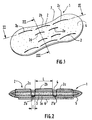
- the hygiene article according to the invention here a periodic towel 1, includes elements for diffusing or draining 2 fluids in different directions of the article.
- the periodic towel 1 comprises an absorbent mattress 3, a surface layer 4 disposed on the mattress 3 and an impermeable layer 5 located under the absorbent mattress.
- This waterproof layer can be placed between the underside of the mattress and an envelope layer which will be in contact with the undergarment, or may be intended to be in direct contact with the undergarment by any conventional means of attachment such as an adhesive, as shown Figures 2 and 3.
- this towel is provided with a means of protection 6 of the fixing means. If the fixing means is an adhesive, this means can be a silicone band.
- Diffusion elements 2 consist of a multi-strand wire which is stretched substantially flat on the surface of the article on the surface layer 4 over a distance of a length L defining a point, for example 2a, and which crosses, at the ends from point 2a, the periodic towel 1 to the underside 3a of the absorbent mattress 3.
- a point for example 2a
- the different points can be of identical or different length.
- the length L of the dots varies in the range from about 0.5 to about 6 centimeters and preferably about 1 to 3 centimeters.
- the points can be arranged in the substantially longitudinal direction of the article. According to others embodiments, they can also be arranged in other directions: transverse or radial at the surface of the article.
- Points 2a, 2b and 2c located near the longitudinal border 7 of the towel, capture and stop fluids flowing laterally to the longitudinal edge 7 of the towel and thus form a lateral barrier to fluids.
- the points can also be arranged in the central part of the towel, as illustrated in points 2d and 2c, to drain and promote the penetration of fluids from the fluid reception area on the surface of the article to areas further away from the center of the mattress.
- the stitches could also be arranged near the front ends or back of the towel, especially near the back end to prevent leakage occur backwards when the user is in a supine position.
- the wires are preferably stretched transversely at these front ends and rear, i.e. in a direction perpendicular to the longitudinal axis of the towel.
- the wire forming the diffusion elements 2 passes through, by sewing or any other equivalent means, the towel, and more precisely the absorbent mattress 3 and the diaper surface 4, so as to form not only points 2a, 2b and 2c on the surface of the article but also points 2'a and 2'b extending over a length l on the reverse, under the mattress, between two places of implantation of the wire in the mattress.
- the length l can just as well be greater than, equal to or less than the length L.
- body fluids can be collected from points 2a, 2b and 2c on the surface of the article and drained into the internal structure of the mattress 3 so fluids are diffused in areas of the mattress that are not directly located under the fluid reception area, in particular towards the edges longitudinal of the mattress or towards the front and rear ends of the mattress.
- the wire 21 has fibrils 22 which leave the yarn in a direction substantially perpendicular to the article away from the surface of the article. These fibrils promote drainage by capillarity of fluids in the fluid reception areas and, if necessary, enter in contact with the body of the user and ensure permanent contact between user and product. This permanent contact is one of the main conditions to prevent the flow from flowing to the side edges of the article or at the front and rear ends of the same article.
- distal contact between the protection and the anatomy by example when the user is standing or lying down or wearing little underwear adjusted, the flow will tend to follow the profile of the anatomy and not come into contact with the surface of the product only towards its edges or ends, or, in the most case unfavorable, directly with the undergarment.
- This flow flow along the anatomy favors lateral and / or longitudinal leaks.
- the presence of fibrils allows permanent contact between protection and anatomy. Fibrils stop the flow of the flow towards the ends or edges of the product, then the guide the threads stretched on the surface of the product which, in turn, diffuse it from channeled to the most absorbent areas of the mattress, i.e. those that are not yet saturated.
- the threads are stretched in radial directions from the center of the article, points can be arranged for example in the form of a star.
- Different patterns of implantation of the wires are illustrated in Figures 5a, 5b and 5c.
- This radial arrangement of the wires makes it possible to distance the flow from the central collection area, to distribute it in the absorbent mattress and thus avoid the saturation phenomenon.
- additional points can be added longitudinally along the longitudinal edges of the article, forming barriers lateral and points implanted laterally at the ends of the product forming longitudinal barriers.
- this radial central location must allow, on the one hand, to avoid the flow from "stagnating" at a central point on the surface of the article and, on the other hand, to avoid that the flow which would have slipped on the surface of the article, on the veil towards the side edges, without entering the mattress, does not cause leaks side.
- additional points 23 are arranged perpendicularly and in periphery of the points 24 arranged radially, to form obstacles to the flow.
- the present invention by its diffusion elements therefore provides transport and the distribution of fluids by means of a material formed of a wire passing through the structure of the article comprising the surface layer and the absorbent mattress.
- the son browsing the article perform two types of function depending on their location. On the surface of the article, they ensure the capture of fluids. And in the mattress, when cross the latter, they ensure the diffusion of fluids.
- the absorption capacity of the article according to the invention is also increased due to the use of a larger part of the absorbent mass.
- This stitch structure can be achieved by means of two wires sewn simultaneously using two needles or using a one and the same thread sewn in one direction then in the other in “back and forth” by implanting the thread from the "return” point in the places where the thread from the "outward” point is located.
- the thread forms on the surface of the article a continuous line where the points are adjacent to each other or a line interrupted where the points are spaced from each other.
- the materials conventionally used, in particular in the field of feminine hygiene are completely transposable to the product according to the invention.
- the surface layer can be formed by any material permeable to fluids: perforated plastic veil, nonwoven material, carded or not, thermolié, etc ...
- the absorbent mattress can be made of any conventional absorbent material.
- this mattress is formed of cellulosic fibers containing superabsorbent material in powder form.
- a band cellulosic fibers, papermaking, formed by dry process and bound by a latex, whose two side edges are folded over a central part on which is deposited at beforehand the superabsorbent material can form this type of mattress.
- the superabsorbent material can be in the form of a powder, leaf and also powder bound to synthetic fibers.
- the waterproof layer under the absorbent mattress is made of material waterproof plastic, such as polyethylene or any equivalent material raincoat. It can also be made of a material being both permeable to air and water vapor and impermeable to liquids. Such material is for example a "meltblown" type nonwoven composed of microfibers, for example polyethylene.
- the waterproof layer could still be made of foam polyurethane or any equivalent material.
- the surface layer and the impermeable layer are associated for example by sealing to wrap the mattress.
- This thread is a multi-strand textile yarn or continuous multi-strand filament.
- This thread is from preferably curly or textured, which improves its resilience and makes it possible to obtain softer and softer nature points.
- Each wire has between about 5 and about 100 strands. And each strand has a titer of at least about 15 dtex. The wire therefore has a titer of at least 75 dtex and preferably in the range of about 180 to about 5000 dtex.
- the choice of the unitary title of a strand and the number of strands per thread can play if a balance between resilience and softness is sought. For example, for a bit of low titer, a large number of strands will be required to compensate for the low resilience.
- the yarn is preferably hydrophilic but is not absorbent. It can be treated, for example with a surfactant, to make it hydrophilic.
- the yarn can be based on natural, artificial, synthetic fibers, or their mixtures.
- the criteria for choosing the type of wire are both resilience and sweetness.
- cotton or linen can be used, but it must be treated so as to reduce its hydrophilicity.
- a cotton thread it is twisted yarns, that is to say two or three yarns joined together by twisting.
- Angora may also be suitable.
- viscose is also suitable if treated so as to be less hydrophilic.
- synthetic fibers are preferred and are chosen from polyester, polyamide, polyethylene or polypropylene.
- polyester polyamide, polyethylene or polypropylene.
- polyamide fibrous elements for greater softness, or in certain polyesters that are both resilient and soft.
- Polypropylene will be chosen if a very large resilience is sought above all.
- a wire through this pre-assembly to form, on the one hand, on the surface thereof on the side facing the body, at least one point of length L, the wire being implanted in the preassembly at the two ends of the point, and, on the other hand, on the reverse, under the mattress, at least one point, of length l, here less than L.
- the thread can be sewn in the same longitudinal direction. The thread is stitched to the bottom of the mattress and crosses the face bottom of the mattress.
- the thread runs under the mattress and advantageously diffuses the fluids from one end to the other of this last.
- the wire 30 is stitched in a place 31 under the mattress, crosses this last towards the surface layer, then forms a point 32 on the surface of the article, crosses the pre-assembly again at 33 towards the bottom of the mattress, runs under the mattress over the distance between the stitching locations 34 and 35 to cross the pre-assembly by exiting at location 36 on the surface of the article and forming a second point 37 adjacent to point 32 and so on.
- the invention includes all the complementary and equivalent means which have not have not been described and which are within the reach of those skilled in the art.
Landscapes
- Health & Medical Sciences (AREA)
- Epidemiology (AREA)
- Engineering & Computer Science (AREA)
- Biomedical Technology (AREA)
- Heart & Thoracic Surgery (AREA)
- Vascular Medicine (AREA)
- Life Sciences & Earth Sciences (AREA)
- Animal Behavior & Ethology (AREA)
- General Health & Medical Sciences (AREA)
- Public Health (AREA)
- Veterinary Medicine (AREA)
- Physics & Mathematics (AREA)
- Fluid Mechanics (AREA)
- Absorbent Articles And Supports Therefor (AREA)
Description
- les perforations du voile, d'un certain diamètre,
- les canaux capillaires intrafibres des fibres monobrins constituant la couche de transport, de diamètre plus faible, et
- les canaux interfibres des fibres du matelas absorbant, de diamètre encore plus faible.
- disposer la couche de surface sur le matelas absorbant pour former un pré-assemblage,
- coudre au moins un fil à travers le pré-assemblage de manière à former au moins un point d'une longueur L, sur ladite couche de surface de l'article,
- disposer la couche imperméable aux fluides corporels sous le pré-assemblage après couture, et
- solidariser l'ensemble obtenu par exemple au moyen d'un scellage.
- la figure 1 représente une vue de dessus de l'article d'hygiène selon l'invention, suivant un premier mode de réalisation ;
- la figure 2 représente une coupe longitudinale de l'article représenté en figure 1, suivant l'axe II-II ;
- la figure 3 est une coupe transversale de l'article représenté en figure 1, suivant l'axe III-III ;
- la figure 4 illustre en vue de dessus un article d'hygiène selon l'invention suivant une variante du mode de réalisation représenté à la figure 1 ;
- les figures 5a, 5b et 5c illustrent des motifs d'implantation de points en surface de l'article d'hygiène suivant des directions radiales ; et
- la figure 6 représente encore un autre mode de réalisation de l'article, notamment de réalisation de points suivant une technique particulière de couture.
Claims (13)
- Article d'hygiène féminine (1) tel qu'une serviette périodique, du type comprenant une couche de surface (4) perméable aux fluides corporels, un matelas absorbant (3) et une couche (5) imperméable aux fluides, caractérisé en ce qu'il comporte au moins un fil multibrins (2) tendu sur la surface dudit article (1) parallèlement au matelas (3), sur une distance de longueur L, définissant un point (2a), et, à ses extrémités, traversant l'article d'hygiène jusqu'à la face inférieure dudit matelas absorbant (3).
- Article selon la revendication 1, caractérisé en ce que le fil est tendu de préférence dans une direction radiale de l'article, sur la couche de surface (4).
- Article selon la revendication 1, caractérisé en ce que ledit fil est tendu dans la direction longitudinale de l'article, sur la couche de surface (4).
- Article d'hygiène selon l'une des revendications 1 à 3, caractérisé en ce qu'il comporte au moins deux points, une partie au moins desdits points (2d, 2e), étant disposée sur la partie centrale de la couche de surface (4) de l'article dans la zone de réception des fluides.
- Article d'hygiène selon l'une des revendications 1, 3 et 4, caractérisé en ce qu'il comporte au moins deux points, une partie au moins desdits points (2a, 2b, 2c) étant alignée selon la direction longitudinale près des bordures longitudinales (17) dudit article de manière à former des barrières latérales contre les fuites.
- Article selon l'une quelconque des revendications précédentes, caractérisé en ce que chaque fil comprend entre environ 5 et environ 100 brins et en ce que chaque brin unitaire a un titre d'au moins environ 15 dtex.
- Article selon l'une des revendications 1 à 5, caractérisé en ce que chaque fil a un titre variant de préférence dans l'intervalle allant d'environ 180 à environ 5000 dtex.
- Article selon l'une des revendications précédentes, caractérisé en ce que le fil est d'origine naturelle telle que le coton, le lin, l'angora, artificielle telle que la viscose ou synthétique, telle que le polyester, le polyamide ou le polypropylène.
- Article selon l'une des revendications précédentes, caractérisé en ce que le fil est de préférence hydrophile ou rendu hydrophile.
- Article selon l'une quelconque des revendications précédentes, caractérisé en ce que la longueur L desdits points varie dans l'intervalle allant d'environ 0,5 à environ 6 centimètres et de préférence d'environ 1 à 3 centimètres
- Article selon l'une quelconque des revendications précédentes, caractérisé en ce que ledit fil (21) est muni de fibrilles (22) s'orientant dans une direction sensiblement perpendiculaire à la surface de l'article.
- Procédé de fabrication d'un article d'hygiène féminine selon l'une des revendications précédentes, caractérisé en ce qu'il consiste à :disposer ladite couche de surface (4) sur le matelas absorbant (3) pour former un pré-assemblage,coudre au moins un fil multibrins (2) à travers ledit pré-assemblage de manière à former au moins un point (2a) d'une longueur L sur ladite couche de surface (4) de l'article,disposer la couche (5) imperméable aux fluides corporels sous le pré-assemblage après couture, etsolidariser l'ensemble obtenu par exemple au moyen d'un scellage.
- Procédé selon la revendication 12, caractérisé en ce que le fil est cousu dans des directions radiales suivant un motif particulier.
Applications Claiming Priority (2)
| Application Number | Priority Date | Filing Date | Title |
|---|---|---|---|
| FR9408136 | 1994-07-01 | ||
| FR9408136A FR2721821B1 (fr) | 1994-07-01 | 1994-07-01 | Article d'hygiene feminine muni d'elements de diffussion des fluides corporels |
Publications (2)
| Publication Number | Publication Date |
|---|---|
| EP0689820A1 EP0689820A1 (fr) | 1996-01-03 |
| EP0689820B1 true EP0689820B1 (fr) | 2000-04-12 |
Family
ID=9464896
Family Applications (1)
| Application Number | Title | Priority Date | Filing Date |
|---|---|---|---|
| EP95401570A Expired - Lifetime EP0689820B1 (fr) | 1994-07-01 | 1995-06-29 | Article d'hygiène féminine muni d'éléments de diffusion des fluides corporels |
Country Status (2)
| Country | Link |
|---|---|
| EP (1) | EP0689820B1 (fr) |
| FR (1) | FR2721821B1 (fr) |
Families Citing this family (2)
| Publication number | Priority date | Publication date | Assignee | Title |
|---|---|---|---|---|
| WO1999018905A1 (fr) * | 1997-10-10 | 1999-04-22 | The Procter & Gamble Company | Dispositif interlabial absorbant dote d'un complexe d'acquisition/de transfert de fluide |
| GB201911052D0 (en) | 2019-08-02 | 2019-09-18 | Mas Brands Exports Private Ltd | Absorbent product |
Family Cites Families (13)
| Publication number | Priority date | Publication date | Assignee | Title |
|---|---|---|---|---|
| US3665922A (en) | 1969-11-20 | 1972-05-30 | Kimberly Clark Co | Sanitary napkin with improved wrap material |
| US3967623A (en) | 1975-06-30 | 1976-07-06 | Johnson & Johnson | Disposable absorbent pad |
| US4046147A (en) | 1976-08-05 | 1977-09-06 | Cecilia Berg | Sanitary napkin |
| JPS56106710U (fr) | 1980-01-17 | 1981-08-19 | ||
| SE8202090L (sv) | 1982-04-01 | 1983-10-02 | Moelnlycke Ab | Absorberande produkt |
| IE55472B1 (en) | 1983-07-05 | 1990-09-26 | Procter & Gamble | Shaped sanitary napkin with flaps |
| CA1247303A (fr) | 1984-05-21 | 1988-12-28 | Frederich O. Lassen | Serviette hygienique vulvaire |
| FR2592896B1 (fr) * | 1986-01-15 | 1988-04-22 | Boussac Saint Freres Bsf | Matelas absorbant perfectionne, notamment pour des articles d'hygiene. |
| NL8901653A (nl) * | 1989-06-29 | 1991-01-16 | Nijverdal Ten Cate Textiel | Werkwijze voor het vervaardigen van een vochtabsorberend produkt en daarmee verkregen produkt. |
| FR2653328B1 (fr) | 1989-10-25 | 1991-12-20 | Kaysersberg Sa | Protection periodique anatomique. |
| CH681946A5 (en) * | 1991-02-08 | 1993-06-30 | Adrian P Gisin | Incontinence pad |
| FR2678163A1 (fr) | 1991-06-25 | 1992-12-31 | Kaysersberg Sa | Serviette periodique avec bourrelets lateraux. |
| GR1002212B (en) * | 1991-07-26 | 1996-03-28 | Mcneil Ppc Inc | Clean dry facing needled composite. |
-
1994
- 1994-07-01 FR FR9408136A patent/FR2721821B1/fr not_active Expired - Fee Related
-
1995
- 1995-06-29 EP EP95401570A patent/EP0689820B1/fr not_active Expired - Lifetime
Also Published As
| Publication number | Publication date |
|---|---|
| EP0689820A1 (fr) | 1996-01-03 |
| FR2721821B1 (fr) | 1996-12-13 |
| FR2721821A1 (fr) | 1996-01-05 |
Similar Documents
| Publication | Publication Date | Title |
|---|---|---|
| EP0688200B1 (fr) | Article d'hygiene feminine muni de capteurs du flux menstruel, son procede de fabrication | |
| EP0227513B1 (fr) | Change complet avec matelas absorbant ramifié et son procédé de fabrication | |
| EP0022792B1 (fr) | Procede d'insertion de produits super-absorbants dans une structure fibreuse | |
| EP0675977B1 (fr) | Materiau non-tisse composite et son application a tout article d'hygiene absorbant | |
| RU2467735C2 (ru) | Подгузник одноразового использования | |
| FR2713981A1 (fr) | Matériau absorbant et article d'hygiène intime l'incorporant. | |
| EP0704000B1 (fr) | Materiau non-tisse composite, procede de fabrication et son application a tout article d'hygiene absorbant | |
| FR2460633A1 (fr) | Couche pour bebe a jeter apres usage | |
| FR2520609A1 (fr) | Serviette hygienique presentant un confort ameliore | |
| FR2711519A1 (fr) | Article absorbant renfermant un matériau superabsorbant disposé dans des poches séparées et réparties selon des tracés sélectionnés. | |
| KR20090121344A (ko) | 종이기저귀 | |
| SK174697A3 (en) | An absorbent article, such as a diaper, an incontinence guard, a sanitary napkin or like article | |
| JP6580171B2 (ja) | 吸収体及びその製造方法並びに吸収性物品 | |
| FR2570935A1 (fr) | Article tricote deux-couches " integre " avec une capacite d'absorption de sueur amelioree | |
| JPH05228174A (ja) | 針で処理した奇麗で乾燥した接面組成物 | |
| CN109562008A (zh) | 包括释放结构的吸收性结构 | |
| CN112839616B (zh) | 吸收性物品 | |
| JP2001123366A (ja) | 延伸不織布及びそれを用いた成形品 | |
| FR2721821A1 (fr) | Article d'hygiene feminine muni d'elements de diffussion des fluides corporels | |
| FR2672490A3 (fr) | Couche-culotte lavable. | |
| EP0670383B1 (fr) | Tissu élastique pour articles de contention | |
| FR2682591A1 (fr) | Couche-culotte a haut pouvoir absorbant. | |
| FR2496417A1 (fr) | Couche perfectionnee en tricot tubulaire | |
| JP6754860B2 (ja) | 吸収性物品 | |
| WO1997009952A1 (fr) | Materiau non-tisse composite, son procede de fabrication et son application a tout article d'hygiene absorbant |
Legal Events
| Date | Code | Title | Description |
|---|---|---|---|
| PUAI | Public reference made under article 153(3) epc to a published international application that has entered the european phase |
Free format text: ORIGINAL CODE: 0009012 |
|
| AK | Designated contracting states |
Kind code of ref document: A1 Designated state(s): BE DK GB NL SE |
|
| 17P | Request for examination filed |
Effective date: 19960703 |
|
| RAP1 | Party data changed (applicant data changed or rights of an application transferred) |
Owner name: JAMES RIVER |
|
| RAP1 | Party data changed (applicant data changed or rights of an application transferred) |
Owner name: FORT JAMES FRANCE |
|
| 17Q | First examination report despatched |
Effective date: 19980710 |
|
| GRAG | Despatch of communication of intention to grant |
Free format text: ORIGINAL CODE: EPIDOS AGRA |
|
| GRAG | Despatch of communication of intention to grant |
Free format text: ORIGINAL CODE: EPIDOS AGRA |
|
| GRAH | Despatch of communication of intention to grant a patent |
Free format text: ORIGINAL CODE: EPIDOS IGRA |
|
| GRAH | Despatch of communication of intention to grant a patent |
Free format text: ORIGINAL CODE: EPIDOS IGRA |
|
| GRAA | (expected) grant |
Free format text: ORIGINAL CODE: 0009210 |
|
| AK | Designated contracting states |
Kind code of ref document: B1 Designated state(s): BE DK GB NL SE |
|
| GBT | Gb: translation of ep patent filed (gb section 77(6)(a)/1977) |
Effective date: 20000519 |
|
| PG25 | Lapsed in a contracting state [announced via postgrant information from national office to epo] |
Ref country code: DK Free format text: LAPSE BECAUSE OF FAILURE TO SUBMIT A TRANSLATION OF THE DESCRIPTION OR TO PAY THE FEE WITHIN THE PRESCRIBED TIME-LIMIT Effective date: 20000712 |
|
| PLBE | No opposition filed within time limit |
Free format text: ORIGINAL CODE: 0009261 |
|
| STAA | Information on the status of an ep patent application or granted ep patent |
Free format text: STATUS: NO OPPOSITION FILED WITHIN TIME LIMIT |
|
| 26N | No opposition filed | ||
| REG | Reference to a national code |
Ref country code: GB Ref legal event code: IF02 |
|
| PGFP | Annual fee paid to national office [announced via postgrant information from national office to epo] |
Ref country code: NL Payment date: 20120614 Year of fee payment: 18 |
|
| PGFP | Annual fee paid to national office [announced via postgrant information from national office to epo] |
Ref country code: SE Payment date: 20120612 Year of fee payment: 18 Ref country code: GB Payment date: 20120627 Year of fee payment: 18 |
|
| PGFP | Annual fee paid to national office [announced via postgrant information from national office to epo] |
Ref country code: BE Payment date: 20120620 Year of fee payment: 18 |
|
| BERE | Be: lapsed |
Owner name: *FORT JAMES FRANCE Effective date: 20130630 |
|
| REG | Reference to a national code |
Ref country code: NL Ref legal event code: V1 Effective date: 20140101 |
|
| PG25 | Lapsed in a contracting state [announced via postgrant information from national office to epo] |
Ref country code: SE Free format text: LAPSE BECAUSE OF NON-PAYMENT OF DUE FEES Effective date: 20130630 |
|
| REG | Reference to a national code |
Ref country code: SE Ref legal event code: EUG |
|
| GBPC | Gb: european patent ceased through non-payment of renewal fee |
Effective date: 20130629 |
|
| PG25 | Lapsed in a contracting state [announced via postgrant information from national office to epo] |
Ref country code: BE Free format text: LAPSE BECAUSE OF NON-PAYMENT OF DUE FEES Effective date: 20130630 |
|
| PG25 | Lapsed in a contracting state [announced via postgrant information from national office to epo] |
Ref country code: NL Free format text: LAPSE BECAUSE OF NON-PAYMENT OF DUE FEES Effective date: 20140101 Ref country code: GB Free format text: LAPSE BECAUSE OF NON-PAYMENT OF DUE FEES Effective date: 20130629 |