EP0688785B1 - Manufacture of catechol estrogens derivatives - Google Patents
Manufacture of catechol estrogens derivatives Download PDFInfo
- Publication number
- EP0688785B1 EP0688785B1 EP95113118A EP95113118A EP0688785B1 EP 0688785 B1 EP0688785 B1 EP 0688785B1 EP 95113118 A EP95113118 A EP 95113118A EP 95113118 A EP95113118 A EP 95113118A EP 0688785 B1 EP0688785 B1 EP 0688785B1
- Authority
- EP
- European Patent Office
- Prior art keywords
- acetate
- compound
- mixture
- group
- silica gel
- Prior art date
- Legal status (The legal status is an assumption and is not a legal conclusion. Google has not performed a legal analysis and makes no representation as to the accuracy of the status listed.)
- Expired - Lifetime
Links
- 229940011871 estrogen Drugs 0.000 title description 51
- 239000000262 estrogen Substances 0.000 title description 51
- YCIMNLLNPGFGHC-UHFFFAOYSA-N catechol Chemical compound OC1=CC=CC=C1O YCIMNLLNPGFGHC-UHFFFAOYSA-N 0.000 title description 48
- 238000004519 manufacturing process Methods 0.000 title description 10
- 238000000034 method Methods 0.000 claims description 52
- 150000001875 compounds Chemical class 0.000 claims description 45
- -1 acetoxyl group Chemical group 0.000 claims description 18
- 238000006220 Baeyer-Villiger oxidation reaction Methods 0.000 claims description 10
- UIIMBOGNXHQVGW-UHFFFAOYSA-M Sodium bicarbonate Chemical compound [Na+].OC([O-])=O UIIMBOGNXHQVGW-UHFFFAOYSA-M 0.000 claims description 8
- 125000006239 protecting group Chemical group 0.000 claims description 8
- BNIILDVGGAEEIG-UHFFFAOYSA-L disodium hydrogen phosphate Chemical compound [Na+].[Na+].OP([O-])([O-])=O BNIILDVGGAEEIG-UHFFFAOYSA-L 0.000 claims description 7
- 230000007062 hydrolysis Effects 0.000 claims description 7
- 238000006460 hydrolysis reaction Methods 0.000 claims description 7
- 125000002887 hydroxy group Chemical group [H]O* 0.000 claims description 7
- 229910000028 potassium bicarbonate Inorganic materials 0.000 claims description 7
- 239000011736 potassium bicarbonate Substances 0.000 claims description 7
- TYJJADVDDVDEDZ-UHFFFAOYSA-M potassium hydrogencarbonate Chemical compound [K+].OC([O-])=O TYJJADVDDVDEDZ-UHFFFAOYSA-M 0.000 claims description 7
- 125000002777 acetyl group Chemical class [H]C([H])([H])C(*)=O 0.000 claims description 6
- 229910052783 alkali metal Inorganic materials 0.000 claims description 6
- 125000004435 hydrogen atom Chemical group [H]* 0.000 claims description 5
- DHKHKXVYLBGOIT-UHFFFAOYSA-N acetaldehyde Diethyl Acetal Natural products CCOC(C)OCC DHKHKXVYLBGOIT-UHFFFAOYSA-N 0.000 claims description 4
- 235000015497 potassium bicarbonate Nutrition 0.000 claims description 4
- 229940086066 potassium hydrogencarbonate Drugs 0.000 claims description 4
- 229960003328 benzoyl peroxide Drugs 0.000 claims description 3
- 238000005574 benzylation reaction Methods 0.000 claims description 3
- 125000002915 carbonyl group Chemical group [*:2]C([*:1])=O 0.000 claims description 3
- 230000008030 elimination Effects 0.000 claims description 3
- 238000003379 elimination reaction Methods 0.000 claims description 3
- ZPWVASYFFYYZEW-UHFFFAOYSA-L dipotassium hydrogen phosphate Chemical compound [K+].[K+].OP([O-])([O-])=O ZPWVASYFFYYZEW-UHFFFAOYSA-L 0.000 claims description 2
- 125000002534 ethynyl group Chemical group [H]C#C* 0.000 claims description 2
- 229910000030 sodium bicarbonate Inorganic materials 0.000 claims description 2
- 235000017557 sodium bicarbonate Nutrition 0.000 claims description 2
- 150000004965 peroxy acids Chemical class 0.000 claims 1
- OKKJLVBELUTLKV-UHFFFAOYSA-N Methanol Chemical compound OC OKKJLVBELUTLKV-UHFFFAOYSA-N 0.000 description 90
- VLKZOEOYAKHREP-UHFFFAOYSA-N n-Hexane Chemical compound CCCCCC VLKZOEOYAKHREP-UHFFFAOYSA-N 0.000 description 66
- HEDRZPFGACZZDS-UHFFFAOYSA-N Chloroform Chemical compound ClC(Cl)Cl HEDRZPFGACZZDS-UHFFFAOYSA-N 0.000 description 58
- XLYOFNOQVPJJNP-UHFFFAOYSA-N water Substances O XLYOFNOQVPJJNP-UHFFFAOYSA-N 0.000 description 52
- 239000000203 mixture Substances 0.000 description 39
- HEDRZPFGACZZDS-MICDWDOJSA-N Trichloro(2H)methane Chemical compound [2H]C(Cl)(Cl)Cl HEDRZPFGACZZDS-MICDWDOJSA-N 0.000 description 38
- 125000002496 methyl group Chemical group [H]C([H])([H])* 0.000 description 31
- 239000000243 solution Substances 0.000 description 28
- VYPSYNLAJGMNEJ-UHFFFAOYSA-N Silicium dioxide Chemical compound O=[Si]=O VYPSYNLAJGMNEJ-UHFFFAOYSA-N 0.000 description 27
- DILDHNKDVHLEQB-XSSYPUMDSA-N 2-hydroxy-17beta-estradiol Chemical compound OC1=C(O)C=C2[C@H]3CC[C@](C)([C@H](CC4)O)[C@@H]4[C@@H]3CCC2=C1 DILDHNKDVHLEQB-XSSYPUMDSA-N 0.000 description 26
- XEKOWRVHYACXOJ-UHFFFAOYSA-N Ethyl acetate Chemical compound CCOC(C)=O XEKOWRVHYACXOJ-UHFFFAOYSA-N 0.000 description 26
- 238000000425 proton nuclear magnetic resonance spectrum Methods 0.000 description 24
- 239000011541 reaction mixture Substances 0.000 description 23
- 239000000741 silica gel Substances 0.000 description 23
- 229910002027 silica gel Inorganic materials 0.000 description 23
- 238000004809 thin layer chromatography Methods 0.000 description 23
- WFDIJRYMOXRFFG-UHFFFAOYSA-N Acetic anhydride Chemical compound CC(=O)OC(C)=O WFDIJRYMOXRFFG-UHFFFAOYSA-N 0.000 description 21
- 239000012043 crude product Substances 0.000 description 21
- UHOVQNZJYSORNB-UHFFFAOYSA-N Benzene Chemical compound C1=CC=CC=C1 UHOVQNZJYSORNB-UHFFFAOYSA-N 0.000 description 18
- LFSXZZOTFYUINF-REBGYKTGSA-N [(8R,9S,13S,14S)-3-hydroxy-13-methyl-2-phenylmethoxy-6,7,8,9,11,12,14,15,16,17-decahydrocyclopenta[a]phenanthren-17-yl] acetate Chemical compound C(C)(=O)OC1CC[C@@H]2[C@]1(C)CC[C@@H]1C3=C(CC[C@@H]21)C=C(O)C(=C3)OCC3=CC=CC=C3 LFSXZZOTFYUINF-REBGYKTGSA-N 0.000 description 18
- 229930182470 glycoside Natural products 0.000 description 18
- 150000002338 glycosides Chemical class 0.000 description 18
- LSIKVDOGSASSRA-VXHOIHASSA-N [(8R,9S,13S,14S)-2-acetyl-3-hydroxy-13-methyl-6,7,8,9,11,12,14,15,16,17-decahydrocyclopenta[a]phenanthren-17-yl] acetate Chemical compound C(C)(=O)OC1CC[C@@H]2[C@]1(C)CC[C@@H]1C3=C(CC[C@@H]21)C=C(O)C(=C3)C(C)=O LSIKVDOGSASSRA-VXHOIHASSA-N 0.000 description 17
- 239000012156 elution solvent Substances 0.000 description 17
- 238000010898 silica gel chromatography Methods 0.000 description 17
- 238000001914 filtration Methods 0.000 description 16
- JUJWROOIHBZHMG-UHFFFAOYSA-N Pyridine Chemical compound C1=CC=NC=C1 JUJWROOIHBZHMG-UHFFFAOYSA-N 0.000 description 14
- 150000003214 pyranose derivatives Chemical class 0.000 description 14
- 239000002244 precipitate Substances 0.000 description 13
- IAZDPXIOMUYVGZ-UHFFFAOYSA-N Dimethylsulphoxide Chemical compound CS(C)=O IAZDPXIOMUYVGZ-UHFFFAOYSA-N 0.000 description 12
- HEMHJVSKTPXQMS-UHFFFAOYSA-M Sodium hydroxide Chemical compound [OH-].[Na+] HEMHJVSKTPXQMS-UHFFFAOYSA-M 0.000 description 12
- YXFVVABEGXRONW-UHFFFAOYSA-N Toluene Chemical compound CC1=CC=CC=C1 YXFVVABEGXRONW-UHFFFAOYSA-N 0.000 description 12
- 239000012267 brine Substances 0.000 description 12
- BWHMMNNQKKPAPP-UHFFFAOYSA-L potassium carbonate Chemical compound [K+].[K+].[O-]C([O-])=O BWHMMNNQKKPAPP-UHFFFAOYSA-L 0.000 description 12
- HPALAKNZSZLMCH-UHFFFAOYSA-M sodium;chloride;hydrate Chemical compound O.[Na+].[Cl-] HPALAKNZSZLMCH-UHFFFAOYSA-M 0.000 description 12
- 239000007832 Na2SO4 Substances 0.000 description 11
- PMZURENOXWZQFD-UHFFFAOYSA-L Sodium Sulfate Chemical compound [Na+].[Na+].[O-]S([O-])(=O)=O PMZURENOXWZQFD-UHFFFAOYSA-L 0.000 description 11
- 239000012044 organic layer Substances 0.000 description 11
- 229910052938 sodium sulfate Inorganic materials 0.000 description 11
- PBGQGWKTTGZBNH-QASZQUFYSA-N (8R,9S,13S,14S)-13-methyl-2-phenylmethoxy-6,7,8,9,11,12,14,15,16,17-decahydrocyclopenta[a]phenanthrene-3,17-diol Chemical compound C(C1=CC=CC=C1)OC=1C(=CC2=C([C@H]3CC[C@@]4(C(CC[C@H]4[C@@H]3CC2)O)C)C1)O PBGQGWKTTGZBNH-QASZQUFYSA-N 0.000 description 10
- CSCPPACGZOOCGX-UHFFFAOYSA-N Acetone Chemical compound CC(C)=O CSCPPACGZOOCGX-UHFFFAOYSA-N 0.000 description 10
- RTZKZFJDLAIYFH-UHFFFAOYSA-N Diethyl ether Chemical compound CCOCC RTZKZFJDLAIYFH-UHFFFAOYSA-N 0.000 description 10
- IAZDPXIOMUYVGZ-WFGJKAKNSA-N Dimethyl sulfoxide Chemical compound [2H]C([2H])([2H])S(=O)C([2H])([2H])[2H] IAZDPXIOMUYVGZ-WFGJKAKNSA-N 0.000 description 10
- LFQSCWFLJHTTHZ-UHFFFAOYSA-N Ethanol Chemical compound CCO LFQSCWFLJHTTHZ-UHFFFAOYSA-N 0.000 description 10
- KAQDVJJRJUJFIH-BKRJIHRRSA-N [(8r,9s,13s,14s,17s)-2,3-dihydroxy-13-methyl-6,7,8,9,11,12,14,15,16,17-decahydrocyclopenta[a]phenanthren-17-yl] acetate Chemical compound C1CC2=CC(O)=C(O)C=C2[C@@H]2[C@@H]1[C@@H]1CC[C@H](OC(=O)C)[C@@]1(C)CC2 KAQDVJJRJUJFIH-BKRJIHRRSA-N 0.000 description 9
- 239000000706 filtrate Substances 0.000 description 9
- OKKJLVBELUTLKV-MZCSYVLQSA-N Deuterated methanol Chemical compound [2H]OC([2H])([2H])[2H] OKKJLVBELUTLKV-MZCSYVLQSA-N 0.000 description 8
- KDLHZDBZIXYQEI-UHFFFAOYSA-N Palladium Chemical compound [Pd] KDLHZDBZIXYQEI-UHFFFAOYSA-N 0.000 description 8
- WYURNTSHIVDZCO-UHFFFAOYSA-N Tetrahydrofuran Chemical compound C1CCOC1 WYURNTSHIVDZCO-UHFFFAOYSA-N 0.000 description 8
- KCXMKQUNVWSEMD-UHFFFAOYSA-N benzyl chloride Chemical compound ClCC1=CC=CC=C1 KCXMKQUNVWSEMD-UHFFFAOYSA-N 0.000 description 8
- 229940073608 benzyl chloride Drugs 0.000 description 8
- 238000011534 incubation Methods 0.000 description 8
- 239000000543 intermediate Substances 0.000 description 8
- 238000012360 testing method Methods 0.000 description 8
- 229910000011 cadmium carbonate Inorganic materials 0.000 description 7
- KOHRTFCSIQIYAE-UHFFFAOYSA-N cadmium;carbonic acid Chemical compound [Cd].OC(O)=O KOHRTFCSIQIYAE-UHFFFAOYSA-N 0.000 description 7
- 238000006243 chemical reaction Methods 0.000 description 7
- 239000003814 drug Substances 0.000 description 7
- 239000002198 insoluble material Substances 0.000 description 7
- 238000002360 preparation method Methods 0.000 description 7
- UMJSCPRVCHMLSP-UHFFFAOYSA-N pyridine Natural products COC1=CC=CN=C1 UMJSCPRVCHMLSP-UHFFFAOYSA-N 0.000 description 7
- QTBSBXVTEAMEQO-UHFFFAOYSA-N Acetic acid Chemical compound CC(O)=O QTBSBXVTEAMEQO-UHFFFAOYSA-N 0.000 description 6
- CDBYLPFSWZWCQE-UHFFFAOYSA-L Sodium Carbonate Chemical compound [Na+].[Na+].[O-]C([O-])=O CDBYLPFSWZWCQE-UHFFFAOYSA-L 0.000 description 6
- CYAYKKUWALRRPA-RGDJUOJXSA-N [(2r,3r,4s,5r,6r)-3,4,5-triacetyloxy-6-bromooxan-2-yl]methyl acetate Chemical compound CC(=O)OC[C@H]1O[C@H](Br)[C@H](OC(C)=O)[C@@H](OC(C)=O)[C@@H]1OC(C)=O CYAYKKUWALRRPA-RGDJUOJXSA-N 0.000 description 6
- OWBPVCSBFKNPCB-IUNAXQSXSA-N [(8R,9S,13S,14S)-2-acetyloxy-3-hydroxy-13-methyl-6,7,8,9,11,12,14,15,16,17-decahydrocyclopenta[a]phenanthren-17-yl] acetate Chemical compound C(C)(=O)OC1CC[C@@H]2[C@]1(C)CC[C@@H]1C3=C(CC[C@@H]21)C=C(O)C(=C3)OC(C)=O OWBPVCSBFKNPCB-IUNAXQSXSA-N 0.000 description 6
- 238000001704 evaporation Methods 0.000 description 6
- 230000008020 evaporation Effects 0.000 description 6
- 230000003859 lipid peroxidation Effects 0.000 description 6
- 229910000027 potassium carbonate Inorganic materials 0.000 description 6
- 239000000725 suspension Substances 0.000 description 6
- VOXZDWNPVJITMN-ZBRFXRBCSA-N 17β-estradiol Chemical compound OC1=CC=C2[C@H]3CC[C@](C)([C@H](CC4)O)[C@@H]4[C@@H]3CCC2=C1 VOXZDWNPVJITMN-ZBRFXRBCSA-N 0.000 description 5
- NHQDETIJWKXCTC-UHFFFAOYSA-N 3-chloroperbenzoic acid Chemical compound OOC(=O)C1=CC=CC(Cl)=C1 NHQDETIJWKXCTC-UHFFFAOYSA-N 0.000 description 5
- 102000007330 LDL Lipoproteins Human genes 0.000 description 5
- 108010007622 LDL Lipoproteins Proteins 0.000 description 5
- WETWJCDKMRHUPV-UHFFFAOYSA-N acetyl chloride Chemical compound CC(Cl)=O WETWJCDKMRHUPV-UHFFFAOYSA-N 0.000 description 5
- 239000012346 acetyl chloride Substances 0.000 description 5
- 239000012153 distilled water Substances 0.000 description 5
- 210000003743 erythrocyte Anatomy 0.000 description 5
- 229960005309 estradiol Drugs 0.000 description 5
- 229930182833 estradiol Natural products 0.000 description 5
- 238000003786 synthesis reaction Methods 0.000 description 5
- CIWBSHSKHKDKBQ-JLAZNSOCSA-N Ascorbic acid Chemical compound OC[C@H](O)[C@H]1OC(=O)C(O)=C1O CIWBSHSKHKDKBQ-JLAZNSOCSA-N 0.000 description 4
- VQHQLBARMFAKSV-AANPDWTMSA-N [(8r,9s,13s,14s,17s)-3-acetyloxy-13-methyl-6,7,8,9,11,12,14,15,16,17-decahydrocyclopenta[a]phenanthren-17-yl] acetate Chemical compound C1CC2=CC(OC(C)=O)=CC=C2[C@@H]2[C@@H]1[C@@H]1CC[C@H](OC(=O)C)[C@@]1(C)CC2 VQHQLBARMFAKSV-AANPDWTMSA-N 0.000 description 4
- VSCWAEJMTAWNJL-UHFFFAOYSA-K aluminium trichloride Chemical compound Cl[Al](Cl)Cl VSCWAEJMTAWNJL-UHFFFAOYSA-K 0.000 description 4
- 230000003078 antioxidant effect Effects 0.000 description 4
- 230000015572 biosynthetic process Effects 0.000 description 4
- 244000309464 bull Species 0.000 description 4
- 238000001460 carbon-13 nuclear magnetic resonance spectrum Methods 0.000 description 4
- 229910000397 disodium phosphate Inorganic materials 0.000 description 4
- 229940079593 drug Drugs 0.000 description 4
- 238000000605 extraction Methods 0.000 description 4
- 238000002329 infrared spectrum Methods 0.000 description 4
- 230000002401 inhibitory effect Effects 0.000 description 4
- 239000007924 injection Substances 0.000 description 4
- 238000002347 injection Methods 0.000 description 4
- 125000004184 methoxymethyl group Chemical group [H]C([H])([H])OC([H])([H])* 0.000 description 4
- LQNUZADURLCDLV-UHFFFAOYSA-N nitrobenzene Chemical compound [O-][N+](=O)C1=CC=CC=C1 LQNUZADURLCDLV-UHFFFAOYSA-N 0.000 description 4
- 102000004169 proteins and genes Human genes 0.000 description 4
- 108090000623 proteins and genes Proteins 0.000 description 4
- 239000007858 starting material Substances 0.000 description 4
- OMPJBNCRMGITSC-UHFFFAOYSA-N Benzoylperoxide Chemical compound C=1C=CC=CC=1C(=O)OOC(=O)C1=CC=CC=C1 OMPJBNCRMGITSC-UHFFFAOYSA-N 0.000 description 3
- 241000699670 Mus sp. Species 0.000 description 3
- ZMXDDKWLCZADIW-UHFFFAOYSA-N N,N-Dimethylformamide Chemical compound CN(C)C=O ZMXDDKWLCZADIW-UHFFFAOYSA-N 0.000 description 3
- DNIAPMSPPWPWGF-UHFFFAOYSA-N Propylene glycol Chemical compound CC(O)CO DNIAPMSPPWPWGF-UHFFFAOYSA-N 0.000 description 3
- BLAKAEFIFWAFGH-UHFFFAOYSA-N acetyl acetate;pyridine Chemical compound C1=CC=NC=C1.CC(=O)OC(C)=O BLAKAEFIFWAFGH-UHFFFAOYSA-N 0.000 description 3
- LOKCTEFSRHRXRJ-UHFFFAOYSA-I dipotassium trisodium dihydrogen phosphate hydrogen phosphate dichloride Chemical compound P(=O)(O)(O)[O-].[K+].P(=O)(O)([O-])[O-].[Na+].[Na+].[Cl-].[K+].[Cl-].[Na+] LOKCTEFSRHRXRJ-UHFFFAOYSA-I 0.000 description 3
- 125000003051 glycosyloxy group Chemical group 0.000 description 3
- RAXXELZNTBOGNW-UHFFFAOYSA-N imidazole Natural products C1=CNC=N1 RAXXELZNTBOGNW-UHFFFAOYSA-N 0.000 description 3
- 238000010348 incorporation Methods 0.000 description 3
- 239000004615 ingredient Substances 0.000 description 3
- 239000010410 layer Substances 0.000 description 3
- 210000004185 liver Anatomy 0.000 description 3
- 229940038597 peroxide anti-acne preparations for topical use Drugs 0.000 description 3
- 239000002953 phosphate buffered saline Substances 0.000 description 3
- 229910000029 sodium carbonate Inorganic materials 0.000 description 3
- 150000003431 steroids Chemical class 0.000 description 3
- RVBUGGBMJDPOST-UHFFFAOYSA-N 2-thiobarbituric acid Chemical compound O=C1CC(=O)NC(=S)N1 RVBUGGBMJDPOST-UHFFFAOYSA-N 0.000 description 2
- XJUZRXYOEPSWMB-UHFFFAOYSA-N Chloromethyl methyl ether Chemical compound COCCl XJUZRXYOEPSWMB-UHFFFAOYSA-N 0.000 description 2
- FFTDLJHPIMGYHN-JFJMRBLZSA-N [(8R,9S,13S,14S)-2-acetyl-3-acetyloxy-13-methyl-6,7,8,9,11,12,14,15,16,17-decahydrocyclopenta[a]phenanthren-17-yl] acetate Chemical compound C(C)(=O)OC1CC[C@@H]2[C@]1(C)CC[C@@H]1C3=C(CC[C@@H]21)C=C(OC(C)=O)C(=C3)C(C)=O FFTDLJHPIMGYHN-JFJMRBLZSA-N 0.000 description 2
- RRECIDWPMQHGJE-LOZQATMBSA-N [(8R,9S,13S,14S)-3-acetyloxy-13-methyl-2-phenylmethoxy-6,7,8,9,11,12,14,15,16,17-decahydrocyclopenta[a]phenanthren-17-yl] acetate Chemical compound C(C)(=O)OC1CC[C@@H]2[C@]1(C)CC[C@@H]1C3=C(CC[C@@H]21)C=C(OC(C)=O)C(=C3)OCC3=CC=CC=C3 RRECIDWPMQHGJE-LOZQATMBSA-N 0.000 description 2
- 150000001241 acetals Chemical class 0.000 description 2
- 230000021736 acetylation Effects 0.000 description 2
- 238000006640 acetylation reaction Methods 0.000 description 2
- 239000003963 antioxidant agent Substances 0.000 description 2
- 235000006708 antioxidants Nutrition 0.000 description 2
- 229960005070 ascorbic acid Drugs 0.000 description 2
- 235000010323 ascorbic acid Nutrition 0.000 description 2
- 239000011668 ascorbic acid Substances 0.000 description 2
- 125000001797 benzyl group Chemical group [H]C1=C([H])C([H])=C(C([H])=C1[H])C([H])([H])* 0.000 description 2
- 230000037396 body weight Effects 0.000 description 2
- 210000004556 brain Anatomy 0.000 description 2
- 230000005587 bubbling Effects 0.000 description 2
- 239000003054 catalyst Substances 0.000 description 2
- 229940061627 chloromethyl methyl ether Drugs 0.000 description 2
- 238000010511 deprotection reaction Methods 0.000 description 2
- 201000010099 disease Diseases 0.000 description 2
- 208000037265 diseases, disorders, signs and symptoms Diseases 0.000 description 2
- 230000001076 estrogenic effect Effects 0.000 description 2
- 238000001802 infusion Methods 0.000 description 2
- HQKMJHAJHXVSDF-UHFFFAOYSA-L magnesium stearate Chemical compound [Mg+2].CCCCCCCCCCCCCCCCCC([O-])=O.CCCCCCCCCCCCCCCCCC([O-])=O HQKMJHAJHXVSDF-UHFFFAOYSA-L 0.000 description 2
- AAMWFMOHRYFSEU-UHFFFAOYSA-N methanol;propan-2-one;hydrate Chemical compound O.OC.CC(C)=O AAMWFMOHRYFSEU-UHFFFAOYSA-N 0.000 description 2
- 235000011181 potassium carbonates Nutrition 0.000 description 2
- 230000002265 prevention Effects 0.000 description 2
- 150000003254 radicals Chemical class 0.000 description 2
- 230000000717 retained effect Effects 0.000 description 2
- 239000012258 stirred mixture Substances 0.000 description 2
- 239000007929 subcutaneous injection Substances 0.000 description 2
- 238000010254 subcutaneous injection Methods 0.000 description 2
- 239000000126 substance Substances 0.000 description 2
- YLQBMQCUIZJEEH-UHFFFAOYSA-N tetrahydrofuran Natural products C=1C=COC=1 YLQBMQCUIZJEEH-UHFFFAOYSA-N 0.000 description 2
- 125000001412 tetrahydropyranyl group Chemical group 0.000 description 2
- 150000005206 1,2-dihydroxybenzenes Chemical class 0.000 description 1
- JHQREQGUZKWDML-OBRRSLBQSA-N 2-hydroxy-17beta-estradiol 3-O-(beta-D-glucuronide) Chemical compound C([C@@H]1[C@@H](C2=CC=3O)CC[C@]4([C@H]1CC[C@@H]4O)C)CC2=CC=3O[C@@H]1O[C@H](C(O)=O)[C@@H](O)[C@H](O)[C@H]1O JHQREQGUZKWDML-OBRRSLBQSA-N 0.000 description 1
- 201000001320 Atherosclerosis Diseases 0.000 description 1
- 239000004342 Benzoyl peroxide Substances 0.000 description 1
- 208000002177 Cataract Diseases 0.000 description 1
- 102000006378 Catechol O-methyltransferase Human genes 0.000 description 1
- 108020002739 Catechol O-methyltransferase Proteins 0.000 description 1
- 238000007027 Dakin phenol oxidation reaction Methods 0.000 description 1
- 206010054044 Diabetic microangiopathy Diseases 0.000 description 1
- 238000005727 Friedel-Crafts reaction Methods 0.000 description 1
- 238000005618 Fries rearrangement reaction Methods 0.000 description 1
- GUBGYTABKSRVRQ-QKKXKWKRSA-N Lactose Natural products OC[C@H]1O[C@@H](O[C@H]2[C@H](O)[C@@H](O)C(O)O[C@@H]2CO)[C@H](O)[C@@H](O)[C@H]1O GUBGYTABKSRVRQ-QKKXKWKRSA-N 0.000 description 1
- WSMYVTOQOOLQHP-UHFFFAOYSA-N Malondialdehyde Chemical compound O=CCC=O WSMYVTOQOOLQHP-UHFFFAOYSA-N 0.000 description 1
- 206010027146 Melanoderma Diseases 0.000 description 1
- 241000209295 Melanoderma Species 0.000 description 1
- 241000283973 Oryctolagus cuniculus Species 0.000 description 1
- 206010033645 Pancreatitis Diseases 0.000 description 1
- 206010063837 Reperfusion injury Diseases 0.000 description 1
- 208000017442 Retinal disease Diseases 0.000 description 1
- 206010038923 Retinopathy Diseases 0.000 description 1
- FAPWRFPIFSIZLT-UHFFFAOYSA-M Sodium chloride Chemical compound [Na+].[Cl-] FAPWRFPIFSIZLT-UHFFFAOYSA-M 0.000 description 1
- 206010064127 Solar lentigo Diseases 0.000 description 1
- 229920002472 Starch Polymers 0.000 description 1
- OUUQCZGPVNCOIJ-UHFFFAOYSA-M Superoxide Chemical compound [O-][O] OUUQCZGPVNCOIJ-UHFFFAOYSA-M 0.000 description 1
- IFNITENGSRYODF-QDSUGMFFSA-N [(8R,9S,13S,14S)-13-methyl-6,7,8,9,11,12,14,15,16,17-decahydrocyclopenta[a]phenanthren-17-yl] acetate Chemical compound C(C)(=O)OC1CC[C@@H]2[C@]1(C)CC[C@@H]1C3=C(CC[C@@H]21)C=CC=C3 IFNITENGSRYODF-QDSUGMFFSA-N 0.000 description 1
- 230000002159 abnormal effect Effects 0.000 description 1
- 125000004036 acetal group Chemical group 0.000 description 1
- HKMXNSTXMWEETD-RXKLXHAUSA-N acetic acid (8R,9S,13S,14S)-13-methyl-6,7,8,9,11,12,14,15,16,17-decahydrocyclopenta[a]phenanthrene-2,3,17-triol Chemical compound CC(O)=O.CC(O)=O.CC(O)=O.OC1=C(O)C=C2[C@H]3CC[C@](C)(C(CC4)O)[C@@H]4[C@@H]3CCC2=C1 HKMXNSTXMWEETD-RXKLXHAUSA-N 0.000 description 1
- 230000007059 acute toxicity Effects 0.000 description 1
- 231100000403 acute toxicity Toxicity 0.000 description 1
- 230000032683 aging Effects 0.000 description 1
- 230000009286 beneficial effect Effects 0.000 description 1
- 125000003236 benzoyl group Chemical group [H]C1=C([H])C([H])=C(C([H])=C1[H])C(*)=O 0.000 description 1
- 235000019400 benzoyl peroxide Nutrition 0.000 description 1
- 125000002351 beta-D-glucopyranosyloxy group Chemical group 0.000 description 1
- 210000004369 blood Anatomy 0.000 description 1
- 239000008280 blood Substances 0.000 description 1
- 210000001124 body fluid Anatomy 0.000 description 1
- 239000010839 body fluid Substances 0.000 description 1
- 239000002775 capsule Substances 0.000 description 1
- 210000004027 cell Anatomy 0.000 description 1
- 239000003795 chemical substances by application Substances 0.000 description 1
- ARUVKPQLZAKDPS-UHFFFAOYSA-L copper(II) sulfate Chemical compound [Cu+2].[O-][S+2]([O-])([O-])[O-] ARUVKPQLZAKDPS-UHFFFAOYSA-L 0.000 description 1
- 229910000366 copper(II) sulfate Inorganic materials 0.000 description 1
- 238000010908 decantation Methods 0.000 description 1
- 230000003247 decreasing effect Effects 0.000 description 1
- 230000001419 dependent effect Effects 0.000 description 1
- 238000011161 development Methods 0.000 description 1
- 230000018109 developmental process Effects 0.000 description 1
- 201000009101 diabetic angiopathy Diseases 0.000 description 1
- CRGRWBQSZSQVIE-UHFFFAOYSA-N diazomethylbenzene Chemical compound [N-]=[N+]=CC1=CC=CC=C1 CRGRWBQSZSQVIE-UHFFFAOYSA-N 0.000 description 1
- 238000004821 distillation Methods 0.000 description 1
- 230000000694 effects Effects 0.000 description 1
- 230000023611 glucuronidation Effects 0.000 description 1
- 238000010438 heat treatment Methods 0.000 description 1
- 208000006454 hepatitis Diseases 0.000 description 1
- 231100000283 hepatitis Toxicity 0.000 description 1
- 238000004128 high performance liquid chromatography Methods 0.000 description 1
- 239000012456 homogeneous solution Substances 0.000 description 1
- 229940088597 hormone Drugs 0.000 description 1
- 239000005556 hormone Substances 0.000 description 1
- 230000000260 hypercholesteremic effect Effects 0.000 description 1
- 239000007928 intraperitoneal injection Substances 0.000 description 1
- 208000012947 ischemia reperfusion injury Diseases 0.000 description 1
- 239000008101 lactose Substances 0.000 description 1
- 150000002632 lipids Chemical class 0.000 description 1
- 239000003509 long acting drug Substances 0.000 description 1
- 235000019359 magnesium stearate Nutrition 0.000 description 1
- 229940118019 malondialdehyde Drugs 0.000 description 1
- 239000002207 metabolite Substances 0.000 description 1
- CXKWCBBOMKCUKX-UHFFFAOYSA-M methylene blue Chemical compound [Cl-].C1=CC(N(C)C)=CC2=[S+]C3=CC(N(C)C)=CC=C3N=C21 CXKWCBBOMKCUKX-UHFFFAOYSA-M 0.000 description 1
- 229960000907 methylthioninium chloride Drugs 0.000 description 1
- XONPDZSGENTBNJ-UHFFFAOYSA-N molecular hydrogen;sodium Chemical compound [Na].[H][H] XONPDZSGENTBNJ-UHFFFAOYSA-N 0.000 description 1
- 208000031225 myocardial ischemia Diseases 0.000 description 1
- 239000012053 oil suspension Substances 0.000 description 1
- 239000002674 ointment Substances 0.000 description 1
- 238000005502 peroxidation Methods 0.000 description 1
- 230000003389 potentiating effect Effects 0.000 description 1
- 239000000843 powder Substances 0.000 description 1
- 201000011461 pre-eclampsia Diseases 0.000 description 1
- 230000002250 progressing effect Effects 0.000 description 1
- 230000000069 prophylactic effect Effects 0.000 description 1
- 230000035484 reaction time Effects 0.000 description 1
- 210000002966 serum Anatomy 0.000 description 1
- 208000004003 siderosis Diseases 0.000 description 1
- 239000002904 solvent Substances 0.000 description 1
- 238000001228 spectrum Methods 0.000 description 1
- 239000008107 starch Substances 0.000 description 1
- 235000019698 starch Nutrition 0.000 description 1
- 238000006467 substitution reaction Methods 0.000 description 1
- 239000006228 supernatant Substances 0.000 description 1
- 239000012134 supernatant fraction Substances 0.000 description 1
- 208000024891 symptom Diseases 0.000 description 1
- 239000003826 tablet Substances 0.000 description 1
- 239000000454 talc Substances 0.000 description 1
- 229910052623 talc Inorganic materials 0.000 description 1
- ILMRJRBKQSSXGY-UHFFFAOYSA-N tert-butyl(dimethyl)silicon Chemical group C[Si](C)C(C)(C)C ILMRJRBKQSSXGY-UHFFFAOYSA-N 0.000 description 1
- BCNZYOJHNLTNEZ-UHFFFAOYSA-N tert-butyldimethylsilyl chloride Chemical compound CC(C)(C)[Si](C)(C)Cl BCNZYOJHNLTNEZ-UHFFFAOYSA-N 0.000 description 1
- 125000000025 triisopropylsilyl group Chemical group C(C)(C)[Si](C(C)C)(C(C)C)* 0.000 description 1
- 238000005406 washing Methods 0.000 description 1
Classifications
-
- C—CHEMISTRY; METALLURGY
- C07—ORGANIC CHEMISTRY
- C07J—STEROIDS
- C07J51/00—Normal steroids with unmodified cyclopenta(a)hydrophenanthrene skeleton not provided for in groups C07J1/00 - C07J43/00
-
- C—CHEMISTRY; METALLURGY
- C07—ORGANIC CHEMISTRY
- C07J—STEROIDS
- C07J1/00—Normal steroids containing carbon, hydrogen, halogen or oxygen, not substituted in position 17 beta by a carbon atom, e.g. estrane, androstane
- C07J1/0051—Estrane derivatives
- C07J1/0066—Estrane derivatives substituted in position 17 beta not substituted in position 17 alfa
- C07J1/007—Estrane derivatives substituted in position 17 beta not substituted in position 17 alfa the substituent being an OH group free esterified or etherified
-
- C—CHEMISTRY; METALLURGY
- C07—ORGANIC CHEMISTRY
- C07J—STEROIDS
- C07J1/00—Normal steroids containing carbon, hydrogen, halogen or oxygen, not substituted in position 17 beta by a carbon atom, e.g. estrane, androstane
- C07J1/0051—Estrane derivatives
- C07J1/0066—Estrane derivatives substituted in position 17 beta not substituted in position 17 alfa
- C07J1/007—Estrane derivatives substituted in position 17 beta not substituted in position 17 alfa the substituent being an OH group free esterified or etherified
- C07J1/0074—Esters
-
- C—CHEMISTRY; METALLURGY
- C07—ORGANIC CHEMISTRY
- C07J—STEROIDS
- C07J17/00—Normal steroids containing carbon, hydrogen, halogen or oxygen, having an oxygen-containing hetero ring not condensed with the cyclopenta(a)hydrophenanthrene skeleton
- C07J17/005—Glycosides
-
- A—HUMAN NECESSITIES
- A61—MEDICAL OR VETERINARY SCIENCE; HYGIENE
- A61F—FILTERS IMPLANTABLE INTO BLOOD VESSELS; PROSTHESES; DEVICES PROVIDING PATENCY TO, OR PREVENTING COLLAPSING OF, TUBULAR STRUCTURES OF THE BODY, e.g. STENTS; ORTHOPAEDIC, NURSING OR CONTRACEPTIVE DEVICES; FOMENTATION; TREATMENT OR PROTECTION OF EYES OR EARS; BANDAGES, DRESSINGS OR ABSORBENT PADS; FIRST-AID KITS
- A61F2210/00—Particular material properties of prostheses classified in groups A61F2/00 - A61F2/26 or A61F2/82 or A61F9/00 or A61F11/00 or subgroups thereof
- A61F2210/0014—Particular material properties of prostheses classified in groups A61F2/00 - A61F2/26 or A61F2/82 or A61F9/00 or A61F11/00 or subgroups thereof using shape memory or superelastic materials, e.g. nitinol
- A61F2210/0019—Particular material properties of prostheses classified in groups A61F2/00 - A61F2/26 or A61F2/82 or A61F9/00 or A61F11/00 or subgroups thereof using shape memory or superelastic materials, e.g. nitinol operated at only one temperature whilst inside or touching the human body, e.g. constrained in a non-operative shape during surgery, another temperature only occurring before the operation
-
- Y—GENERAL TAGGING OF NEW TECHNOLOGICAL DEVELOPMENTS; GENERAL TAGGING OF CROSS-SECTIONAL TECHNOLOGIES SPANNING OVER SEVERAL SECTIONS OF THE IPC; TECHNICAL SUBJECTS COVERED BY FORMER USPC CROSS-REFERENCE ART COLLECTIONS [XRACs] AND DIGESTS
- Y02—TECHNOLOGIES OR APPLICATIONS FOR MITIGATION OR ADAPTATION AGAINST CLIMATE CHANGE
- Y02P—CLIMATE CHANGE MITIGATION TECHNOLOGIES IN THE PRODUCTION OR PROCESSING OF GOODS
- Y02P20/00—Technologies relating to chemical industry
- Y02P20/50—Improvements relating to the production of bulk chemicals
- Y02P20/55—Design of synthesis routes, e.g. reducing the use of auxiliary or protecting groups
Definitions
- the present invention relates to a process for the manufacture of intermediates for the synthesis of novel glycosides of catechol estrogens, useful for prevention and treatment of lipid peroxide- and free radical-related diseases.
- estrogens and catechol estrogens were thought to be hopeful for clinical application, however, the following disadvantages thereof make it difficult: Since these compounds are scarcely soluble in water, it is difficult to prepare an injection. Estrogens are not applicable to men because of their activity as a female hormone. Although estrogenic activity of catechol estrogens is almost nil, they are unstable against exposure to air and light so that the development of a medicament comprising catechol estrogen is not progressing. In addition, it is known that a half life of catechol estrogens in human blood is very short due to high susceptibility to be taken up into red blood cells and to be metabolized by catechol-O-methyl-transferase in the cells. Accordingly, these characteristics of catechol estrogens make it difficult to develop useful medicaments, even though they have a potent antioxidant activity.
- the method described in Reference (j) includes the Friedel-Crafts reaction of estradiol to form 2-acetylestradiol 17-acetate (yield: 57.3%) followed by the Dakin reaction at pH 8.2 - 8.5 to form 2-hydroxyestradiol 17-acetate (yield: 85.2%). In this case, the overall yield was 49%.
- estradiol was reacted with benzoyl peroxide to form 2-hydroxyestradiol 2-monobenzoate and followed by hydrolysis to give 2-hydroxyestradiol. The overall yield in this process was 60%.
- An object of the invention is to provide a method for the synthesis of intermediates for the production of novel glycosides of catechol estrogens which have an effective antioxidant activity, high solubility in water, and sufficient stability in body fluid and during the process of manufacture thereof.
- Another object of the invention is to provide suitable processes for the manufacture of catechol estrogen compounds, by taking the following points into consideration:
- the present inventors energetically studied and investigated to find a simple process in accordance with claim 1 for preparing 2-acetylestrogens with a good yield, from which they successfully prepared various glycosylated compounds of catechol estrogens.
- the glycosylated compounds thus obtained were met to their needs mentioned above.
- Bn is benzyl group; Y is carbonyl group or Z is carbonyl group or R 1 is acetoxyl group; R 2 is a hydrogen atom, or ethynyl group; R 3 is a hydrogen atom or acetoxyl group; R 4 is a protective group with an acetal type; R 8 is hydroxyl group; R 9 is a hydrogen atom or hydroxyl group; R 12' is glycosyloxy group; and R 13' is glycosyloxy group; wherein glycosyloxy group is selected from the group consisting of glucosyloxy, galactosyloxy, mannosyloxy, arabinosyloxy, ribosyloxy, xylosyloxy, fructosyloxy, rhamnosyloxy, fucosyloxy, maltosyloxy, cellobiosyloxy, lactosyloxy, sucrosyloxy, maltotriosyloxy, maltotetraosy
- 2-Acetylestrogens which are key intermediates in the present invention, can be synthesized by subjecting estrogen 3-acetate to Fries rearrangement reaction.
- the important point in this process is that the reaction is carried out in the presence of acetyl chloride. It was found that the yield of 2-acetylestrogen from the starting material was increased to over 80% in the presence of acetyl chloride.
- the preferable amount of acetyl chloride is in a range of 0.1 to 0.6 in terms of molar ratio to estrogen 3-acetate.
- 2-Acetylestrogens are subjected to Baeyer-Villiger oxidation reaction to obtain 2-acetoxyestrogens.
- the previously available Baeyer-Villiger oxidation was carried out in the absence of an alkali metal salt, requiring long time to complete the reaction.
- the present invention found that Baeyer-Villiger oxidation in the presence of the alkali metal salt required only 1 or 2 days to complete the reaction by >80% yield.
- Alkali metal salt available in the present invention is selected from the following; disodium hydrogen phosphate, dipotassium hydrogen phosphate, sodium hydrogen carbonate, and potassium hydrogen carbonate.
- any amount of the alkali metal salt is useful and its preferable amount is in a range between 0.1 and 5 in terms of molar ratio to 2-acetylestrogens.
- any radical can be used such as methyl, benzyl, t -butyldimethylsilyl, triisopropylsilyl, acetyl, benzoyl, methoxymethyl, tetrahydropyranyl, and so on.
- a process for preparing 3-glycosides of catechol estrogens involves 2-benzyloxyestrogens as an intermediate compound. It is prerequisite that the protection of hydroxyl group at C-3 must be stable during Baeyer-Villiger oxidation, hydrolysis of acetyl group, and benzylation. It was found that protective groups having an acetal type such as methoxymethyl, 2-methoxyethoxymethyl, and tetrahydropyranyl groups are satisfactory in this point of view.
- 2-Benzyloxyestrogens can be synthesized as follows: The hydroxyl group at C-3 of 2-acetylestrogens is protected by an acetal group to form 2-acetylestrogen 3-acetal compounds, subjecting to Baeyer-Villiger oxidation to form 2-acetoxyestrogen 3-acetal compounds, subjecting to hydrolysis to form 2-hydroxyestrogen 3-acetal compounds, subjecting to benzylation to form 2-benzyloxyestrogen 3-acetal compounds, and followed by elimination of 3-acetal group. According to the method of this invention, 2-benzyloxyestrogens can be synthesized from estrogens by 70% yield.
- estradiol was reacted with acetic anhydride in pyridine at room temperature for overnight, yielding estradiol diacetate stoichiometrically.
- Estradiol diacetate was heated at 80°C in nitrobenzene for 1 hour in the presence of 2mol equivalent of aluminum chloride and 0.4mol equivalent of acetyl chloride, and then 2-acetylestradiol 17-acetate was obtained by 85% yield.
- 2-Acetylestradiol 17-acetate was reacted with chloromethyl methyl ether in tetrahydrofuran containing sodium hydrogen, yielding 2-acetylestradiol 17-acetate 3-methoxymethyl ether stoichiometrically, subjecting to Baeyer-Villiger oxidation with m -chloroperbenzoic acid in chloroform containing disodium hydrogen phosphate, and thus 2-acetoxyestradiol 17-acetate 3-methoxymethyl ether was formed by 88% yield.
- 2-acetoxyestradiol 17-acetate 3-methoxymethyl ether in a process of the 2-benzyloxyestradiol 17-acetate production, a few procedures can be useful.
- 2-acetoxyestradiol 17-acetate 3-methoxymethyl ether was converted to 2-hydroxyestradiol 17-acetate 3-methoxymethyl ether by the reaction with potassium hydrogen carbonate in a mixture of acetone-water-methanol.
- 2-Hydroxyestradiol 17-acetate 3-methoxymethyl ether was reacted with benzyl chloride in ethanol in the presence of potassium carbonate, yielding a mixture of 17-acetoxy- and 17-hydroxy-2-benzyloxy compounds.
- 2-acetoxyestradiol 17-acetate 3-methoxymethyl ether was hydrolyzed in methanol in the presence of sodium hydroxide, and 2-hydroxyestradiol 3-methoxymethyl ether thus obtained was reacted with benzyl chloride in ethanol in the presence of potassium carbonate to form 2-benzyloxyestradiol 3-methoxymethyl ether.
- 17-Hydroxyl group of 2-benzyloxyestradiol 3-methoxymethyl ether was reacted with acetic anhydride-pyridine for acetylation, followed by elimination of methoxymethyl group to give 2-benzyloxyestradiol 17-acetate.
- 2-Acetylestradiol 17-acetate was transformed to 2-acetylestradiol 17-acetate 3-benzyl ether, subjecting to Baeyer-Villiger oxidation in the presence of an alkali metal salt to form 2-acetoxyestradiol 17-acetate 3-benzyl ether, subjecting selective hydrolysis at C-2 to form 2-hydroxyestradiol 17-acetate 3-benzyl ether.
- 2-Hydroxyestradiol 17-acetate 3-benzyl ether was reacted with acetobromoglucose in the presence of CdCO 3 , and after deprotection, 2-hydroxyestradiol 2-glucoside was obtained.
- glycosides of catechol estrogens produced as described above acquired an increased hydrophilicity.
- the volume of water required to dissolve 1 mg of various glycosides is as following; 2 to 3ml for 17-glucoside, 2ml for 17-maltoside, 0.7ml for 2-glucoside, and 3ml for 3-glucoside, while 1mg of 2-hydroxyestradiol cannot be dissolved in 3ml of water.
- the glycosides obtained in the present invention provide a way to prepare an injection containing the same.
- glycosides of catechol estrogens retained antioxidant activity in the same degree to that of parent catechol estrogens and that the rate of incorporation of the glycosides into red blood cells was extremely decreased, indicating that half life of the glycosides was much improved.
- glycosides of catechol estrogens obtained by the present invention have not estrogenic activity at the dosage required for antioxidant activity.
- the glycosides of catechol estrogens provide medicaments with desirable types such as injection, powder, tablets, capsules, ointment, and so on.
- estradiol (30g, 110mmol), pyridine (300ml, 3.71mol) and acetic anhydride (105ml, 1.08mol) was stirred overnight at room temperature.
- the reaction mixture was poured onto ice (1500g) and precipitate was collected by filtration, washed with water, and dried in vacuo to afford 39.3g (100%) of the titled compound.
- This compound can he converted into 2-benzyloxyestradiol 17-acetate by the process described in Example 6-c.
- LDL Low-density lipoprotein
- 2-Hydroxyestradiol 17-( ⁇ -D-glucopyranoside) (2-OHE 2 17-Glu) was dissolved in distilled water and 2-hydroxyestradiol (2-OHE 2 ) as a reference compound, in dimethylsulfoxide (DMSO), to give a final concentration of 500 ⁇ M.
- the reaction mixture contained the followings in a final volume of lml: 500 ⁇ g of LDL; 5nmol of CuSO 4 ; and 5nmol of either 2-OHE 2 17-Glu or 2-OHE 2 .
- distilled water or DMSO was added in place of 2-OHE 2 17-Glu or 2-OHE 2 .
- Values in Table 1 indicate the amount of lipid peroxides (nmol/mg protein).
- 2-Hydroxyestradiol 2-( ⁇ -D-glucopyranoside) (2-OHE 2 2-Glu) obtained according to the method of this invention (Example 10) was dissolved in water to give a concentration of lmM or 0.5mM.
- the reaction mixture contains the followings in a final volume of 2ml: 1.98ml of rat brain homogenate (10mg protein/ml) and 2-OHE 2 2-Glu at a concentration of 5 ⁇ M or 10 ⁇ M. After incubation at 37°C, lipid peroxide level was determined by the thiobarbituric acid method.
- Values in Table 2 indicate the amount of lipid peroxides (nmol/mg protein) in terms of malondialdehyde.
- a rat liver homogenate was prepared in 4 volume of 0.15M KCl.
- 2-OHE 2 2-Glu was dissolved in distilled water and 2-OHE 2 , in 1% DMSO, to give a final concentration of lmM.
- the reaction mixture contained the followings in a final volume of 2ml; 1.98ml of rat liver homogenate (10mg protein/ml) and 10 ⁇ M either 2-OHE 2 2-Glu or 2-OHE 2 .
- the same volume of distilled water or 1% DMSO was added in place of 2-OHE 2 2-Glu or 2-OHE 2 .
- lipid peroxide level was determined by the thiobarbituric acid method. It was found that 2-OHE 2 2-Glu and 2-OHE 2 inhibited the lipid peroxidation by 77% and 73%, respectively.
- the reaction mixture contained 0.2nmol of 2-OHE 2 , 2-OHE 2 17-Glu, or 2-hydroxyestradiol 17-( ⁇ -maltoside) (2-OHE 2 17-Mal), in 0.1ml of 0.2% DMSO-0.1% ascorbic acid in phosphate buffered saline (PBS) and 0.9ml of suspension of red blood cells in PBS. After incubation at 37°C for several intervals, the mixture was centrifuged and supernatant fraction was obtained, and then the amount of each glycoside of 2-hydroxyestradiol remained in the supernatant was determined by HPLC.
- PBS phosphate buffered saline
- mice of ddY strain Male mice of ddY strain were received 2-OHE 2 17-Glu or 2-OHE 2 2-Glu by an intraperitoneal injection at doses of 250mg, 500mg, 750mg, or 1000mg/kg body weight. All mice survived over an observation period of 2 weeks and no abnormal symptom was found. Therefore, LD 50 of the glycosides was found to be over 1000mg/kg body weight.
Landscapes
- Chemical & Material Sciences (AREA)
- Organic Chemistry (AREA)
- Health & Medical Sciences (AREA)
- General Health & Medical Sciences (AREA)
- Steroid Compounds (AREA)
Description
- The present invention relates to a process for the manufacture of intermediates for the synthesis of novel glycosides of catechol estrogens, useful for prevention and treatment of lipid peroxide- and free radical-related diseases.
- It is known that lipid peroxides are causative of ischemia-reperfusion injury, ischemic heart disease, atherosclerosis, retinopathy in infant, siderosis, cataract, hepatitis, pancreatitis, diabetic microangiopathy, melanoderma, liver spots, pre-eclampsia and aging itself. Therefore, the prevention of lipid peroxidation by use of suitable antioxidants is beneficial for the prophylactic and treatment of such diseases. Thus, it is in need to develop effective antioxidants as medical compound. In 1987, Yoshino et al. reported that estrogens and their metabolites catechol estrogens are effective to prevent an increase in lipid peroxide levels in mice [K. Yoshino et al., "J. Clin. Biochem. Nutr.", Vol. 3, pages 233 - 240 (1987)].
- Thus, estrogens and catechol estrogens were thought to be hopeful for clinical application, however, the following disadvantages thereof make it difficult: Since these compounds are scarcely soluble in water, it is difficult to prepare an injection. Estrogens are not applicable to men because of their activity as a female hormone. Although estrogenic activity of catechol estrogens is almost nil, they are unstable against exposure to air and light so that the development of a medicament comprising catechol estrogen is not progressing. In addition, it is known that a half life of catechol estrogens in human blood is very short due to high susceptibility to be taken up into red blood cells and to be metabolized by catechol-O-methyl-transferase in the cells. Accordingly, these characteristics of catechol estrogens make it difficult to develop useful medicaments, even though they have a potent antioxidant activity.
- As to organic synthesis of catechol estrogens, not a few papers were reported in literatures as listed below:
- (a) J. Fishman, "J. Am. Chem. Soc.", 80, 1213 (1958),
- (b) P. N. Rao, et al., "Tetrahedron", 10, 144 (1960),
- (c) J. Fishman, "J. Org. Chem.", 25, 585 (1960),
- (d) T. Nambara, et al., "Chem. Pharm. Bull.", 18, 474 (1970),
- (e) T. Nambara, et al., "Chem. Pharm. Bull.", 18, 1191 (1970),
- (f) I. Yoshizawa, et al., "Chem. Pharm. Bull.", 20, 1842 (1972),
- (g) K. Kovacs, et al., "Acta Phys. Chem.", 19, 287 (1973),
- (h) H. G. Gelbke, et al., "Steroids", 21, 205 (1973),
- (i) G. Stubenrauch, et al., "Steroids", 28, 733 (1976),
- (j) R. G. Xie, et al., "Steroids", 40, 389 (1982), and
- (k) T. Ohkubo, et al., "Chem. Pharm. Bull.", 36, 419 (1988),
-
- Among the methods previously available, only two methods gave a relatively good yield of 50 to 60% for the preparation of catechol estrogens. Namely, the method described in Reference (j) includes the Friedel-Crafts reaction of estradiol to form 2-acetylestradiol 17-acetate (yield: 57.3%) followed by the Dakin reaction at pH 8.2 - 8.5 to form 2-hydroxyestradiol 17-acetate (yield: 85.2%). In this case, the overall yield was 49%. According to the method described in Reference (f), estradiol was reacted with benzoyl peroxide to form 2-hydroxyestradiol 2-monobenzoate and followed by hydrolysis to give 2-hydroxyestradiol. The overall yield in this process was 60%.
- When derivatives of catechol estrogens are synthesized, it is important to prepare desirable intermediates thereof, wherein a suitable protective group is introduced into desired position. For example, Nambara et al. [References (d) and (e)] described the preparation of 2-acetoxyestrogens 3-alkyl ether and 3-acetoxy-2-alkoxy-1,3,5(10)-estratriene compounds from corresponding acetyl estrogens by Baeyer-Villiger oxidation in yields of 65 - 75% and 56 - 60%, respectively, in order to introduce desired substitution into desired positions.
- For the preparation of 2-hydroxyestrogen 3-glycoside, 2-benzyloxyestrogen benzyloxyestrogen is an important intermediate. The procedure described in References (d) and (e) involved 11 reaction steps for the synthesis of 2-benzyloxyestradiol 17-acetate from 3-deoxyestradiol acetate and its overall yield was only 6%, then, 2-benzyloxyestradiol 17-acetate was further subjected to glucuronidation to form 2-hydroxyestradiol 3-glucuronide in a overall yield of 0.33%.
- Thus, the procedures previously reported are not suitable for the manufacture thereof, because starting material is expensive, the process involves many reaction steps, and yield is not satisfactory.
- An object of the invention is to provide a method for the synthesis of intermediates for the production of novel glycosides of catechol estrogens which have an effective antioxidant activity, high solubility in water, and sufficient stability in body fluid and during the process of manufacture thereof.
- Another object of the invention is to provide suitable processes for the manufacture of catechol estrogen compounds, by taking the following points into consideration:
- (a) The starting material is available at reasonable cost;
- (b) The number of reaction steps is minimum;
- (c) Reaction time is as short as possible, and
- (d) Yield is satisfactory.
-
- The present inventors energetically studied and investigated to find a simple process in accordance with claim 1 for preparing 2-acetylestrogens with a good yield, from which they successfully prepared various glycosylated compounds of catechol estrogens. The glycosylated compounds thus obtained were met to their needs mentioned above.
- The process according to the invention is shown in the following Scheme.
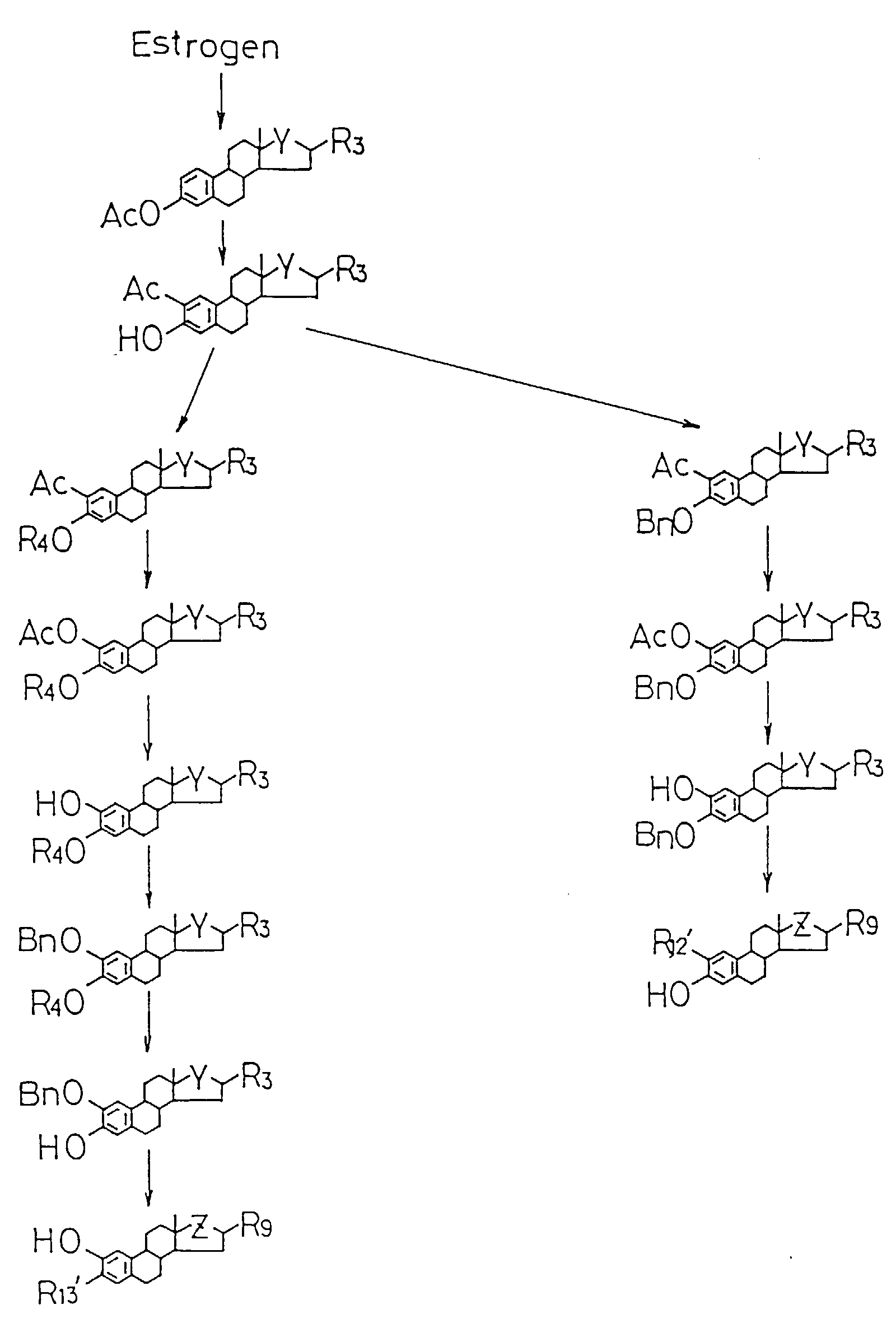
- In the Scheme, Bn is benzyl group; Y is carbonyl group orZ is carbonyl group or
 R1 is acetoxyl group; R2 is a hydrogen atom, or ethynyl group; R3 is a hydrogen atom or acetoxyl group; R4 is a protective group with an acetal type; R8 is hydroxyl group; R9 is a hydrogen atom or hydroxyl group; R12' is glycosyloxy group; and R13' is glycosyloxy group; wherein glycosyloxy group is selected from the group consisting of glucosyloxy, galactosyloxy, mannosyloxy, arabinosyloxy, ribosyloxy, xylosyloxy, fructosyloxy, rhamnosyloxy, fucosyloxy, maltosyloxy, cellobiosyloxy, lactosyloxy, sucrosyloxy, maltotriosyloxy, maltotetraosyloxy, maltopentaosyloxy, maltohexaosyloxy, maltoheptaosyloxy, and sialosyloxy.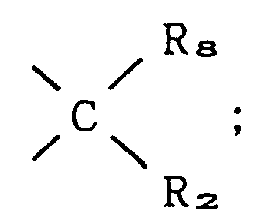
- As a result, it was found that 2-acetylestrogens of the formula:wherein Y and R3 have the meanings as defined above, are useful as intermediates for the synthesis of catechol estrogens and glycosides thereof to open the way for the present invention.

- The following section describes the method of the invention in detail. 2-Acetylestrogens, which are key intermediates in the present invention, can be synthesized by subjecting estrogen 3-acetate to Fries rearrangement reaction. The important point in this process is that the reaction is carried out in the presence of acetyl chloride. It was found that the yield of 2-acetylestrogen from the starting material was increased to over 80% in the presence of acetyl chloride. The preferable amount of acetyl chloride is in a range of 0.1 to 0.6 in terms of molar ratio to estrogen 3-acetate.
- 2-Acetylestrogens are subjected to Baeyer-Villiger oxidation reaction to obtain 2-acetoxyestrogens. The previously available Baeyer-Villiger oxidation was carried out in the absence of an alkali metal salt, requiring long time to complete the reaction. On the contrary, the present invention found that Baeyer-Villiger oxidation in the presence of the alkali metal salt required only 1 or 2 days to complete the reaction by >80% yield. Alkali metal salt available in the present invention is selected from the following; disodium hydrogen phosphate, dipotassium hydrogen phosphate, sodium hydrogen carbonate, and potassium hydrogen carbonate. Any amount of the alkali metal salt is useful and its preferable amount is in a range between 0.1 and 5 in terms of molar ratio to 2-acetylestrogens. As to protective groups for hydroxyl group at C-3 position during Baeyer-Villiger oxidation, any radical can be used such as methyl, benzyl, t-butyldimethylsilyl, triisopropylsilyl, acetyl, benzoyl, methoxymethyl, tetrahydropyranyl, and so on.
- A process for preparing 3-glycosides of catechol estrogens involves 2-benzyloxyestrogens as an intermediate compound. It is prerequisite that the protection of hydroxyl group at C-3 must be stable during Baeyer-Villiger oxidation, hydrolysis of acetyl group, and benzylation. It was found that protective groups having an acetal type such as methoxymethyl, 2-methoxyethoxymethyl, and tetrahydropyranyl groups are satisfactory in this point of view. 2-Benzyloxyestrogens can be synthesized as follows: The hydroxyl group at C-3 of 2-acetylestrogens is protected by an acetal group to form 2-acetylestrogen 3-acetal compounds, subjecting to Baeyer-Villiger oxidation to form 2-acetoxyestrogen 3-acetal compounds, subjecting to hydrolysis to form 2-hydroxyestrogen 3-acetal compounds, subjecting to benzylation to form 2-benzyloxyestrogen 3-acetal compounds, and followed by elimination of 3-acetal group. According to the method of this invention, 2-benzyloxyestrogens can be synthesized from estrogens by 70% yield.
- The following section describes the process for the manufacture of catechol estrogen glycosides from estradiol as starting material. The first step is that estradiol was reacted with acetic anhydride in pyridine at room temperature for overnight, yielding estradiol diacetate stoichiometrically. Estradiol diacetate was heated at 80°C in nitrobenzene for 1 hour in the presence of 2mol equivalent of aluminum chloride and 0.4mol equivalent of acetyl chloride, and then 2-acetylestradiol 17-acetate was obtained by 85% yield.
- 2-Acetylestradiol 17-acetate was reacted with chloromethyl methyl ether in tetrahydrofuran containing sodium hydrogen, yielding 2-acetylestradiol 17-acetate 3-methoxymethyl ether stoichiometrically, subjecting to Baeyer-Villiger oxidation with m-chloroperbenzoic acid in chloroform containing disodium hydrogen phosphate, and thus 2-acetoxyestradiol 17-acetate 3-methoxymethyl ether was formed by 88% yield.
- As to the use of 2-acetoxyestradiol 17-acetate 3-methoxymethyl ether in a process of the 2-benzyloxyestradiol 17-acetate production, a few procedures can be useful. First, 2-acetoxyestradiol 17-acetate 3-methoxymethyl ether was converted to 2-hydroxyestradiol 17-acetate 3-methoxymethyl ether by the reaction with potassium hydrogen carbonate in a mixture of acetone-water-methanol. 2-Hydroxyestradiol 17-acetate 3-methoxymethyl ether was reacted with benzyl chloride in ethanol in the presence of potassium carbonate, yielding a mixture of 17-acetoxy- and 17-hydroxy-2-benzyloxy compounds. The mixture of 2-benzyloxy compounds was further treated with acetic anhydridepyridine. When phenyldiazomethane was used as a benzylating agent, acetyl group at C-17 was retained. Methoxymethyl group of 2-benzyloxyestradiol 17-acetate 3-methoxymethyl ether was eliminated to give 2-benzyloxyestradiol 17-acetate. Second, 2-acetoxyestradiol 17-acetate 3-methoxymethyl ether was hydrolyzed in methanol in the presence of sodium hydroxide, and 2-hydroxyestradiol 3-methoxymethyl ether thus obtained was reacted with benzyl chloride in ethanol in the presence of potassium carbonate to form 2-benzyloxyestradiol 3-methoxymethyl ether. 17-Hydroxyl group of 2-benzyloxyestradiol 3-methoxymethyl ether was reacted with acetic anhydride-pyridine for acetylation, followed by elimination of methoxymethyl group to give 2-benzyloxyestradiol 17-acetate. Third, the intermediate 2-benzyloxyestradiol 3-methoxymethyl ether was subjected to hydrolysis in methanol containing HCl to form 2-benzyloxyestradiol, followed by acetylation of hydroxyl group at C-3 and C-17 in a solution containing acetic anhydride-pyridine. Then, 2-benzyloxyestradiol 17-acetate was obtained by selective hydrolysis in a mixture of acetone-water-methanol in the presence of potassium hydrogen carbonate.
- These three different processes provide 2-benzyloxyestradiol 17-acetate stoichiometrically from 2-acetoxyestradiol 17-acetate 3-methoxymethyl ether. 2-Benzyloxyestradiol 17-acetate can be reacted with acetobromoglucose in the presence of CdCO3 and after deprotection, 2-hydroxyestradiol 3-glucoside was obtained.
- 2-Acetylestradiol 17-acetate was transformed to 2-acetylestradiol 17-acetate 3-benzyl ether, subjecting to Baeyer-Villiger oxidation in the presence of an alkali metal salt to form 2-acetoxyestradiol 17-acetate 3-benzyl ether, subjecting selective hydrolysis at C-2 to form 2-hydroxyestradiol 17-acetate 3-benzyl ether. 2-Hydroxyestradiol 17-acetate 3-benzyl ether was reacted with acetobromoglucose in the presence of CdCO3, and after deprotection, 2-hydroxyestradiol 2-glucoside was obtained.
- The present inventors have found that glycosides of catechol estrogens produced as described above acquired an increased hydrophilicity. For example, the volume of water required to dissolve 1 mg of various glycosides is as following; 2 to 3ml for 17-glucoside, 2ml for 17-maltoside, 0.7ml for 2-glucoside, and 3ml for 3-glucoside, while 1mg of 2-hydroxyestradiol cannot be dissolved in 3ml of water. Accordingly, the glycosides obtained in the present invention provide a way to prepare an injection containing the same.
- It was also found that glycosides of catechol estrogens retained antioxidant activity in the same degree to that of parent catechol estrogens and that the rate of incorporation of the glycosides into red blood cells was extremely decreased, indicating that half life of the glycosides was much improved.
- The glycosides of catechol estrogens obtained by the present invention have not estrogenic activity at the dosage required for antioxidant activity. The glycosides of catechol estrogens provide medicaments with desirable types such as injection, powder, tablets, capsules, ointment, and so on.
- The invention will now be further explained in more detail with reference to Manufacturing Examples, Test Examples and Medicine Preparation Examples.
- A mixture of estradiol (30g, 110mmol), pyridine (300ml, 3.71mol) and acetic anhydride (105ml, 1.08mol) was stirred overnight at room temperature. The reaction mixture was poured onto ice (1500g) and precipitate was collected by filtration, washed with water, and dried in vacuo to afford 39.3g (100%) of the titled compound.
1H-NMR spectrum (DMSO-d6) δ ppm:
0.78 (3H, s, 18-CH3),
1.1 - 2.9 (15H, m, CH and CH2),
2.01 (3H, s, C17-OCOCH3),
2.23 (3H, s, C3-OCOCH3),
4.62 (1H, t like, C17-H),
6.83 (2H, m, C2-H and C4-H), and
7.28 (1H, d, J=10Hz, C1-H). - To a solution of estradiol diacetate (25.0g, 70.1mmol) in nitrobenzene (250ml), AlCl3 (18.6g, 139mmol) and acetyl chloride (2.0ml, 28mmol) were added, and the solution was stirred for 1 hour at 80°C. The reaction mixture was cooled and poured onto ice (1000g). To this solution concentrated HCl (100ml) was added. After extraction with CHCl3, the organic layer was washed successively with 1N-HCl, saturated NaHCO3 solution, and brine, and concentrated in vacuo to obtain a crude product (25.3g), to which methanol (MeOH) (150ml) was added to afford 17.7 g (70.6%) of the titled compound as an insoluble material. The filtrate was concentrated in vacuo and subjected to silica gel chromatography (elution solvent, CHCl3 : hexane = 2 : 1) to afford additional 3.48g of the titled compound. The total yield was 85%.
1H-NMR spectrum (CDCl3) δ ppm :
0.84 (3H, s, 18-CH3),
1.2 - 3.0 (15H, m, CH and CH2),
2.07 (3H, s, C17-OCOCH3),
2.59 (3H, s, C2-COCH3),
4.70 (1H, t like, C17-H),
6.67 (1H, s, C4-H),
7.59 (1H, s, C1-H), and
12.03 (1H, s, C3-OH). - NaH (about 60% oil suspension, 1.01g) was washed with hexane by 3 times, and tetrahydrofuran (THF, 40ml) was added. Chloromethyl methyl ether (3.83ml, 50.4mmol), and 2-acetylestradiol 17-acetate (6.00g, 16.8mmol) obtained by the process described in Example 1-b in THF (70ml) were added to the NaH suspension. After the mixture was stirred at 50°C for 20 minutes, it was poured onto ice (100g). Water (600ml) was added to the mixture. The precipitate was collected by filtration, washed with water, and then dried in vacuo to afford 6.76g (100%) of the titled compound.
1H-NMR spectrum (CDCl3) δ ppm :
0.82 (3H, s, 18-CH3),
1.2 - 3.0 (15H, m, estrogen CH and CH2),
2.05 (3H, s, C17-OCOCH3),
2.62 (3H, s, C2-COCH3),
3.50 (3H, s, O-CH3),
4.68 (1H, t like, C17-H),
5.24 (2H, s, O-CH2-O),
6.88 (1H, s, Ar C4-H), and
7.66 (1H, s, Ar C1-H).
Silica gel TLC :
Rf = 0.32 (hexane : AcOEt = 4 : 1). - A mixture of 2-acetylestradiol 17-acetate 3-methoxymethyl ether (2.50g, 6.24mmol) obtained by the process described in Example 2-a, m-chloroperbenzoic acid (2.15g, 12.5mmol), Na2HPO4 (1.77g, 12.5mmol), and CHCl3 (50ml) was stirred at room temperature for 16 hours. After removed an insoluble material by filtration, the filtrate was poured into ice-cooled ether. The organic layer was washed successively with 5% Na2CO3 solution, water, and brine, thereafter dried over anhydrous Na2SO4, and evaporated in vacuo to obtain a crude product (2.90g). A part (1.80g) of the crude product was, in turn, subjected to silica gel chromatography (elution solvent, hexane : AcOEt = 4 : 1) to afford 1.41g (87.6%) of the titled compound.
1H-NMR spectrum (CDCl3) δ ppm :
0.81 (3H, s, 18-CH3),
1.2 - 3.0 (15H, m, estrogen CH and CH2),
2.05 (3H, s, C17-OCOCH3),
2.30 (3H, s, C2-OCOCH3),
3.46 (3H, s, O-CH3),
4.69 (1H, t like, C17-H),
5.12 (2H, s, O-CH2-O),
6.90 (1H, s, Ar C4-H), and
6.93 (1H, s, Ar C1-H).
Silica gel TLC :
Rf = 0.36 (hexane : AcOEt = 4 : 1). - To a solution of 2-acetylestradiol 17-acetate (15.0g, 42.1mmol) obtained by the process described in Example 1-b in EtOH (200ml), K2CO3 (8.73g) and benzyl chloride (7.27ml) were added, and the mixture was refluxed for 3 hours. Additional amounts of K2CO3 (5.82g) and benzyl chloride (4.84ml) were added, and the mixture was refluxed for further 1.5 hours. After the reaction mixture was cooled to room temperature, it was then filtered to remove an insoluble material. The filtrate was concentrated in vacuo and a residue was dissolved in CHCl3 (500ml). The CHCl3 solution was washed with brine, dried over anhydrous Na2SO4, and then evaporated in vacuo to afford an oily residue.
- A mixture of the oily residue obtained above, pyridine (150ml), and acetic anhydride (55ml) was stirred overnight at room temperature. The reaction mixture was poured onto ice (1500g), and the precipitate was collected by filtration, washed with water, and then dried in vacuo to afford 18.7g (99.6%) of the titled compound.
1H-NMR spectrum (CDCl3) δ ppm :
0.82 (3H, s, 18-CH3),
1.1 - 3.0 (15H, m, CH and CH2),
2.05 (3H, s, C17-OCOCH3),
2.57 (3H, s, C2-COCH3),
4.69 (1H, t like, C17-H),
5.11 (2H, s, C6H5CH 2),
6.74 (1H, s, C4-H),
7.39 (5H, m, C6H5), and
7.71 (1H, s, C1-H).
Silica gel TLC :
Rf = 0.33 (hexane : AcOEt = 5 : 1). - A mixture of 2-acetylestradiol 17-acetate 3-benzyl ether (1.00g, 2.24mmol) obtained by the process described in Example 3-a, m-chloroperbenzoic acid (0.773g, 4.48mmol) , Na2HPO4 (0.318g, 2.24mmol), and CHCl3 (25ml) was stirred at room temperature for 20 hours. The reaction mixture was poured into ether (150ml). The organic layer was washed successively with 5% NaOH solution, water, and brine, thereafter it was dried over anhydrous Na2SO4 and evaporated in vacuo to obtain a crude product (1.02g), which was, in turn, subjected to silica gel chromatography (elution solvent, CHCl3) to afford 838mg (81%) of the titled compound.
1H-NMR spectrum (CDCl3) δ ppm :
0.82 (3H, s, 18-CH3),
1.1 - 3.0 (15H, m, CH and CH2),
2.05 (3H, s, C17-OCOCH3),
2.25 (3H, s, C2-OCOCH3),
4.68 (1H, t like, C17-H),
5.04 (2H, s, C6H5CH 2),
6.71 (1H, s, C4-H),
6.95 (1H, s, C1-H), and
7.36 (5H, br.s, C6H5).
Silica gel TLC :
Rf = 0.49 (CHCl3). - A mixture of 2-acetylestradiol 17-acetate (5.00g, 14.0mmol) obtained by the process described in Example 1-b, t-butyldimethylsilyl chloride (3.18g, 21.1mmol), imidazole (2.87g, 42.2mmol), and dimethylformamide (30ml) was stirred at room temperature for 20 hours. The reaction mixture was poured into water and extracted with CHCl3. The organic layer was washed with brine, dried over anhydrous Na2SO4, and then evaporated in vacuo to obtain a crude product, which was, in turn, subjected to silica gel chromatography (elution solvent, CHCl3) to afford 6.64g (101%) of the titled compound.
1H-NMR spectrum (CDCl3) δ ppm :
0.25 [6H, s, Si(CH3)2],
0.83 (3H, s, 18-CH3),
1.00 (9H, s Si-t-C4H9),
1.1 - 3.0 (15H, m, estrogen CH and CH2),
2.05 (3H, s, C17-OCOCH3),
2.58 (3H, s, C2-COCH3),
4.68 (1H, t like, C17-H),
6.57 (1H, s, Ar C4-H), and
7.55 (1H, s, Ar C1-H).
Silica gel TLC :
Rf = 0.39 (CHCl3). - A mixture of 2-acetylestradiol 17-acetate 3-t-butyldimethylsilyl ether (1.00g, 2.12mmol) obtained by the process described in Example 4-a, m-chloroperbenzoic acid (0.733g, 4.25mmol), Na2HPO4 (0.602g, 4.24mmol), and CHCl3 (25ml) was stirred at room temperature for 19 hours. The reaction mixture was poured into ether (300ml). The organic layer was washed successively with 5% Na2CO3 solution, water, and brine, thereafter it was dried over anhydrous Na2SO4 and evaporated in vacuo to obtain a crude product, which was, in turn, subjected to silica gel chromatography (elution solvent, CHCl3) to afford 898mg (87%) of the titled compound.
1H-NMR spectrum (CDCl3) δ ppm :
0.19 [6H, s, Si(CH3)2],
0.82 (3H, s, 18-CH3),
0.98 (9H, s, Si-t-C4H9),
1.2 - 2.9 (15H, m, estrogen CH and CH2),
2.05 (3H, s, C17-OCOCH3),
2.26 (3H, s, C2-OCOCH3),
4.68 (1H, t like, C17-H),
6.59 (1H, s, Ar C4-H), and
6.90 (1H, s, Ar C1-H).
Silica gel TLC :
Rf = 0.50 (CHCl3). - A mixture of 2-acetylestradiol 17-acetate (1.00g, 2.81mmol) obtained by the process described in Example 1-b, pyridine (6ml), and acetic anhydride (3ml) was stirred overnight at room temperature. The reaction mixture was poured onto ice (50g), and the precipitate was collected by filtration, washed with water, and then dried in vacuo to afford 1.11g (99.1%) of the titled compound.
1H-NMR spectrum (CDCl3) δ ppm :
0.84 (3H, s, 18-CH3),
1.1 - 3.0 (15H, m, estrogen CH and CH2),
2.07 (3H, s, C17-OCOCH3),
2.34 (3H, s, C3-OCOCH3),
2.53 (3H, s, C2-COCH3),
4.70 (1H, t like, C17-H),
6.81 (1H, s, Ar C4-H), and
7.74 (1H, s, Ar C1-H).
Silica gel TLC :
Rf = 0.21 (CHCl3). - A mixture of 2-acetylestradiol diacetate (100mg, 0.251mmol) obtained by the process described in Example 5-a, m-chloroperbenzoic acid (0.130g, 0.753mmol), Na2HPO4 (71.3mg, 0.502mmol), and CHCl3 (2ml) was stirred at room temperature for 40 hours. The reaction mixture was poured into ether (50ml). The organic layer was washed successively with 5% Na2CO3 solution, water, and brine, thereafter it was dried over anhydrous Na2SO4 and evaporated in vacuo to obtain a crude product, which was, in turn, subjected to silica gel thin-layer chromatography (developing solvent, CHCl3 : MeOH = 100 : 1) to afford 92.9mg (89%) of the titled compound.
1H-NMR spectrum (CDCl3) δ ppm :
0.82 (3H, s, 18-CH3),
1.1 - 3.0 (15H, m, estrogen CH and CH2),
2.05 (3H, s, C17-OCOCH3),
2.27 (6H, s, C2-OCOCH3 and C3-OCOCH3),
4.68 (1H, t like, C17-H),
6.87 (1H, s, Ar C4-H), and
7.05 (1H, s, Ar C1-H).
Silica gel TLC :
Rf = 0.37 (CHCl3). - To a solution of 2-hydroxyestradiol 2,17-diacetate 3-methoxymethyl ether (1.35g, 3.24mmol) obtained by the process described in Example 2-b in acetone (32.3ml), a solution of KHCO3 (647mg, 6.46mmol) in water (16.1ml) and MeOH (80.7ml) was added, and the mixture was stirred at room temperature for 22 hours and then 50°C for 3 hours. After water (20ml) was added to the reaction mixture, acetone and MeOH were removed by evaporation. The precipitate was collected by filtration, washed with water, and then dried in vacuo to afford 1.20g (99.2%) of the titled compound.
1H-NMR spectrum (CDCl3) δ ppm :
0.82 (3H, s, 18-CH3),
1.2 - 2.9 (15H, m, estrogen CH and CH2),
2.05 (3H, s, C17-OCOCH3),
3.51 (3H, s, O-CH3),
4.68 (1H, t like, C17-H),
5.16 (2H, s, O-CH2-O),
5.74 (1H, s, C2-OH),
6.79 (1H, s, Ar C4-H), and
6.89 (1H, s, Ar C1-H).
Silica gel TLC :
Rf = 0.49 (hexane : AcOEt = 2 : 1). - To a solution of 2-hydroxyestradiol 17-acetate 3-methoxymethyl ether (1.13g, 3.02mmol) obtained by the process described in Example 6-a in EtOH (25ml), K2CO3 (626mg, 4.54mmol) and benzyl chloride (0.452ml, 3.93mmol) were added and the mixture was refluxed for 4 hours. Additional amount of benzyl chloride (0.174ml, 1.51mmol) was added, and the mixture was refluxed for further 2 hours. After the reaction mixture was cooled to room temperature, it was then filtered to remove an insoluble material. The filtrate was evaporated in vacuo and a residue was mixed with water to obtain a precipitate. The precipitate was collected by filtration, washed with water, and then dried in vacuo to afford a mixture (1.44g) of 2-benzyloxyestradiol 3-methoxymethyl ether and 2-benzyloxyestradiol 17-acetate 3-methoxymethyl ether.
- A part (1.41g) of the mixture of 2-benzyloxyestradiol 3-methoxymethyl ether and 2-benzyloxyestradiol 17-acetate 3-methoxymethyl ether obtained above was treated with pyridine (4.0ml, 49.5mmol) and acetic anhydride (3.0ml, 31.7mmol) for 23 hours at room temperature. The reaction mixture was poured onto ice (150g), and 2N-HCl (40ml) was added to it. After extraction with AcOEt, the organic layer was washed successively with 1N-HCl, saturated NaHCO3 solution, water, and brine, thereafter it was dried over anhydrous Na2SO4 and evaporated in vacuo to obtain a crude product (1.51g), which was, in turn, subjected to silica gel chromatography (elution solvent, hexane : AcOEt = 6 : 1) to afford 1.35g (98.5%) of the titled compound.
1H-NMR spectrum (CDCl3) δ ppm :
0.81 (3H, s, 18-CH3),
1.1 - 2.9 (15H, m, estrogen CH and CH2),
2.05 (3H, s C17-OCOCH3),
3.51 (3H, s, O-CH3),
4.68 (1H, t like, C17-H),
5.10 (2H, s, C6H5CH 2),
5.18 (2H, s, O-CH2-O),
6.85 (2H, s, Ar C4-H and C1-H), and
7.2 - 7.5 (5H, m, C6H5).
Silica gel TLC :
Rf = 0.50 (hexane : AcOEt = 4 : 1). - A mixture of 2-benzyloxyestradiol 17-acetate 3-methoxymethyl ether (3.70g, 7.97mmol) obtained by the process described in Example 6-b, acetic acid (20ml), and 2N-HCl (2.0ml) was stirred at room temperature for 1.5 hours. The reaction mixture was poured into water (500ml), and the precipitate was collected by filtration, washed with water, and then dried in vacuo to obtain a crude product (3.41g), which was, in turn, subjected to silica gel chromatography (elution solvent, hexane : AcOEt = 6 : 1) to afford 3.02g (90.1%) of the titled compound.
1H-NMR spectrum (CDCl3) δ ppm :
0.83 (3H, s, 18-CH3),
1.1 - 2.9 (15H, m, estrogen CH and CH2),
2.05 (3H, s, C17-OCOCH3),
4.69 (1H, t like, C17-H),
5.06 (2H, s, C6H5CH 2),
6.65 (1H, s, Ar C4-H),
6.85 (1H, s, Ar C1-H), and
7.39 (5H, s, C6H5).
Silica gel TLC :
Rf = 0.37 (hexane : AcOEt = 5 : 1). - A mixture of 2-hydroxyestradiol 2,17-diacetate 3-methoxymethyl ether (5.30g, 12.7mmol) obtained by the process described in Example 2-b, MeOH (106ml), and 1N-NaOH (53ml) was stirred at room temperature for 2.5 hours. After MeOH was removed by evaporation, acetic acid (2.37ml) was added to the residue. After extraction with AcOEt, the organic layer was washed successively with saturated NaHCO3 solution, water, and brine, thereafter it was dried over anhydrous Na2SO4 and evaporated in vacuo to afford 4.23g (100%) of the titled compound.
1H-NMR spectrum (CDCl3) δ ppm :
0.77 (3H, s, 18-CH3),
1.1 - 2.9 (15H, m, estrogen CH and CH2),
3.51 (3H, s, O-CH3),
3.73 (1H, t like, C17-H),
5.16 (2H, s, O-CH2-O),
5.75 (1H, br.s, C2-OH),
6.79 (1H, s, Ar C4-H), and
6.89 (1H, s, Ar C1-H).
Silica gel TLC :
Rf = 0.20 (hexane : AcOEt = 2 : 1). - To a solution of 2-hydroxyestradiol 3-methoxymethyl ether (4.20g, 12.6mmol) obtained by the process described in Example 7-a in EtOH (100ml), K2CO3 (2.62g, 19.0mmol) and benzyl chloride (1.89ml, 16.4mmol) were added, and the mixture was refluxed for 4 hours. Additional amount of benzyl chloride (0.73ml, 6.33mmol) was added, and the mixture was refluxed for further 2 hours. After the reaction mixture was cooled to room temperature, it was then filtered to remove an insoluble material. The filtrate was concentrated in vacuo and a residue was mixed with water to obtain a precipitate. The precipitate was collected by filtration, washed with water, and then dried in vacuo to obtain a crude product (5.64g).
- A part (1.50g) of the crude product was subjected to silica gel chromatography (elution solvent, hexane: AcOEt = 3 : 1) to afford 1.40g (98.6%) of the titled compound.
1H-NMR spectrum (CDCl3) δ ppm :
0.76 (3H, s, 18-CH3),
1.0 - 2.9 (15H, m, estrogen CH and CH2),
3.51 (3H, s, O-CH3),
3.72 (1H, t like, C17-H),
5.10 (2H, s C6H5CH 2),
5.19 (2H, s, O-CH2-O),
6.85 (1H, s, Ar C4-H),
6.88 (1H, s, Ar C1-H), and
7.2 - 7.5 (5H, m, C6H5).
Silica gel TLC :
Rf = 0.38 (hexane : AcOEt = 2 : 1). - A mixture of another part (4.00g) of the crude product of 2-benzyloxyestradiol 3-methoxymethyl ether obtained by the process described in Example 7-b, pyridine (12ml, 148mmol), and acetic anhydride (9.0ml, 95.2mmol) was stirred for 23 hours at room temperature. The reaction mixture was poured onto ice (200g) and 2N-HCl (200ml) was added to it. After extraction with AcOEt, the organic layer was washed successively with 1N-HCl, saturated NaHCO3 solution, water, and brine, thereafter it was dried over anhydrous Na2SO4 and evaporated in vacuo to obtain a crude product (4.36g), which was, in turn, subjected to silica gel chromatography (elution solvent, hexane : AcOEt = 6 : 1) to afford 3.93g (94.7% from 2-hydroxyestradiol 3-methoxymethyl ether) of the titled compound.
- This compound showed the same physico-chemical data to those described in Example 6-b.
- This compound can he converted into 2-benzyloxyestradiol 17-acetate by the process described in Example 6-c.
- A mixture of the purified 2-benzyloxyestradiol 3-methoxymethyl ether (1.35g, 3.19mmol) obtained by the process described in Example 7-b, MeOH (27ml), and concentrated HCl (2.7ml) was stirred for 2 hours at room temperature. After removal of a half volume of MeOH by evaporation, the residue was poured into water (300ml). The precipitate was collected by filtration, washed with water, and then dried in vacuo to afford 1.20g (99.2%) of the titled compound.
1H-NMR spectrum (CDCl3) δ ppm :
0.78 (3H, s, 18-CH3),
1.0 - 2.9 (15H, m, estrogen CH and CH2),
3.73 (1H, t like, C17-H),
5.07 (2H, s, C6H5CH 2),
6.66 (1H, s, Ar C4-H),
6.87 (1H, s, Ar C1-H), and
7.40 (5H, s, C6H5).
Silica gel TLC :
Rf = 0.37 (hexane : AcOEt = 2 : 1). - A mixture of 2-benzloxyestradiol (1.18g, 3.12mmol) obtained by the process described in Example 8-a, pyridine (3.0ml, 37.1mmol), and acetic anhydride (2.5ml, 26.4mmol) was stirred for 21 hours at room temperature. The reaction mixture was poured onto ice and the precipitate was collected by filtration, washed with water, and then dried in vacuo to afford 1.40g (97.2%) of the titled compound.
1H-NMR spectrum (CDCl3) δ ppm :
0.82 (3H, s, 18-CH3),
1.1 - 2.9 (15H, m, estrogen CH and CH2),
2.06 (3H, s, C17-OCOCH3),
2.26 (3H, s, C3-OCOCH3),
4.68 (1H, t like, C17-H),
5.04 (2H, s C6H5CH 2),
6.75 (1H, s, Ar C4-H),
6.93 (1H, s, Ar C1-H), and
7.36 (5H, s, C6H5).
Silica gel TLC :
Rf = 0.42 (hexane : AcOEt = 4 : 1). - To a solution of 2-benzyloxyestradiol diacetate (1.35g, 2.92mmol) obtained by the process described in Example 8-b in acetone (29.2ml), a solution of KHCO3 (585mg) in water (14.6ml) and MeOH (73.0ml) was added, and the mixture was stirred at room temperature for 21 hours, followed at 50°C for 6 hours. After water was added to the reaction mixture, acetone and MeOH were removed by evaporation. The precipitate was collected by filtration, washed with water, and then dried in vacuo to obtain a crude product (1.23g), which was, in turn, subjected to silica gel chromatography (elution solvent, hexane : AcOEt = 6 : 1) to afford 1.18g (95.9%) of the titled compound.
- This compound showed the same physico-chemical data to those described in Example 6-c.
- CdCO3 (6.55g, 38.0mol) was added to a solution of 2-benzyloxyestradiol 17-acetate (4.00g, 9.49mmol) obtained by the process described in Example 6-c in toluene (250ml), and the suspension was distilled until 50ml of toluene had been removed. A solution of acetobromoglucose (11.7g, 28.5mmol) in toluene (300ml) was added dropwise to the stirred mixture over 6 hours and an equal volume of toluene was simultaneously distilled to give a constant volume of the reaction mixture. Distillation was continued for further 15 hours during which generated moisture was removed. Additional amounts of CdCO3 (6.55g) and acetobromoglucose (11.7g) were added, and the mixture was refluxed for further 18 hours during which generated moisture was removed. An insoluble material was removed off by filtration through a pad of Celite. The filtrate was evaporated in vacuo to obtain a crude product, which was, in turn, subjected to silica gel chromatography (elution solvent, hexane : AcOEt = 2 : 1) to afford 4.30g (60.3%) of the titled compound.
1H-NMR spectrum (CDCl3) δ ppm :
0.82 (3H, s, 18-CH3),
1.1 - 2.9 (30H, m, estrogen CH and CH2, and OCOCH3 x 5),
3.78 (1H, m, pyranose C5-H),
4.0 - 4.4 (2H, m, pyranose C6-H2),
4.69 (1H, t like, C17-H),
4.9 - 5.4 (6H, m, pyranose C1-H, C2-H, C3-H, C4-H, and C6H5CH 2),
6.83 (1H, s, Ar C4-H or C1-H),
6.88 (1H, s, Ar C1-H or C4-H), and
7.2 - 7.5 (5H, m, C6H5).
Silica gel TLC :
Rf = 0.26 (hexane : AcOEt = 2 : 1). - To 2,3,4,6-tetra-O-acetyl-1-O-(17β―acetoxy-2-benzyloxy-1,3,5(10)-estratriene-3-yl)-β―D-glucopyranoside (4.20g, 5.59mmol) obtained by the process described in Example 9-a, MeOH (80ml) and 1N-NaOH (40ml) were added. The mixture was stirred at room temperature for 1.5 hours and then at 45°C for 1 hour. After removal of MeOH by evaporation, an aqueous layer was separated from an oily residue by decantation. The aqueous layer was extracted with AcOEt. The AcOEt layer and the oily residue were combined and concentrated in vacuo to obtain a crude product (2.71g), which was, in turn, subjected to silica gel chromatography (elution solvent, CHCl3 : MeOH = 8 : 1) to afford 2.25g (74.5%) of the titled compound.
1H-NMR spectrum (CD3OD) δ ppm :
0.73 (3H, s, 18-CH3),
1.0 - 2.8 (15H, m, estrogen CH and CH2),
3.3 - 3.9 (7H, m, C17-H, and pyranose C2-H, C3-H, C4-H, C5-H and C6-H2),
4.84 - 4.91 (1H, m, pyranose C1-H),
5.06 (2H, s, C6H5CH 2),
6.88 (2H, s, Ar C4-H and C1-H), and
7.2 - 7.5 (5H, m, C6H5).
Silica gel TLC :
Rf = 0.55 (CHCl3 : MeOH = 5 : 1). - To a solution of 1-O-(2-benzyloxy-17β―hydroxy-1,3,5(10)-estratriene-3-yl)-β―D-glucopyranoside (2.03g, 3.75mmol) obtained by the process described in Example 9-b in MeOH (100ml), a suspension of 5% Pd/C (0.50g) in MeOH (50ml) was added, and the mixture was stirred under bubbling of H2 for 2 hours. The catalyst Pd/C was removed off by filtration through a pad of Celite. The filtrate was evaporated in vacuo to obtain a crude product (1.65g), which was, in turn, subjected to silica gel chromatography (elution solvent, CHCl3 : MeOH = 5 : 1) to afford 1.57g (92.9%) of the titled compound.
1H-NMR spectrum (CD3OD) δ ppm :
0.74 (3H, s, 18-CH3),
1.0 - 2.8 (15H, m, estrogen CH and CH2),
3.3 - 4.0 (7H, m, C17-H, and pyranose C2-H, C3-H, C4-H, C5-H and C6-H2),
4.65 - 4.73 (1H, m, pyranose C1-H),
6.77 (1H, s, Ar C4-H), and
6.85 (1H, s, Ar C1-H).
13C-NMR spectrum (DMSO-d6) δ ppm :
11.11, 22.71, 25.95, 26.98, 28.50, 29.85, 36.57, 38.41, 42.69, 43.62, 49.52, 60.79, 69.84, 73.30, 75.85, 77.10, 79.97, 103.00, 112.59, 117.62, 126.73, 134.75, 143.04, and 144.66.
IR spectrum (KBr) cm-1 :
3408, 2920, 2868, 1588, 1502, 1436, 1408, 1384, 1352, 1282, 1210, 1068, 1040, 886, 864, 830, and 810.
Silica gel TLC :
Rf = 0.24 (CHCl3 : MeOH = 5 : 1).
Solubility :
1.0mg/3ml (H2O). - To a solution of 2-hydroxyestradiol 2,17-diacetate 3-benzyl ether (9.00g, 19.4mmol) obtained by the process described in Example 3-b in acetone (450ml), a solution of KHCO3 (9.00g) in water (225ml) and MeOH (1125ml) was added, and the mixture was stirred at room temperature for 47 hours. The mixture was poured into ether (6000ml), and the organic layer was washed successively with water, and brine, thereafter it was dried over anhydrous Na2SO4 and evaporated in vacuo to obtain a crude product (8.15g), which was, in turn, subjected to silica gel chromatography (elution solvent, CHCl3) to afford 7.59g (92.8%) of the titled compound.
1H-NMR spectrum (CDCl3) δ ppm :
0.82 (3H, s, 18-CH3),
1.1 - 2.9 (15H, m, CH and CH2),
2.05 (3H, s, C17-OCOCH3),
4.68 (1H, t like, C17-H),
5.05 (2H, s, C6H5CH 2),
5.50 (1H, s, OH),
6.64 (1H, s, C4-H),
6.89 (1H, s, C1-H), and
7.39 (5H, br.s, C6H5).
Silica gel TLC :
Rf = 0.36 (CHCl3). - CdCO3 (6.55g, 38.0mmol) was added to a solution of 2-hydroxyestradiol 17-acetate 3-benzyl ether (4.00g, 9.51mmol) obtained by the process described in Example 10-a in benzene (300ml), and the suspension was distilled until 100ml of benzene had been removed. A solution of acetobromoglucose (11.7g, 28.5mmol) in benzene (300ml) was added dropwise to the stirred mixture over 3 hours and an equal volume of benzene was simultaneously distilled to give a constant volume of the reaction mixture. Heating was continued further. After 30 minutes, additional amount of CdCO3 (6.60g, 38.3mmol) was added, and after 19 hours, additional amounts of CdCO3 (5.0g, 29.0mmol) and acetobromoglucose (5.3g, 12.9mmol) in benzene (100ml) were further added. The mixture was refluxed for further 23 hours, meanwhile generated moisture was removed. An insoluble material was removed off by filtration through a pad of Celite and washed with benzene. The filtrate and washings were combined and evaporated in vacuo to obtain a crude product, which was, in turn, subjected to silica gel chromatography (elution solvent, hexane : AcOEt = 2 : 1) to afford 4.51g (63.3%) of the titled compound.
1H-NMR spectrum (CDCl3) δ ppm :
0.82 (3H, s, 18-CH3),
1.1 - 2.9 (30H, m, estrogen CH and CH2, and OCOCH3 x 5),
3.73 (1H, m, pyranose C5-H),
4.0 - 4.4 (2H, m, pyranose C6-H2),
4.68 (1H, t like, C17-H),
4.9 - 5.4 (6H, m, pyranose C1-H, C2-H, C3-H, C4-H, and C6H5CH 2),
6.67 (1H, s, Ar C4-H),
7.07 (1H, s, Ar C1-H), and
7.2 - 7.5 (5H, m, C6H5).
13C-NMR spectrum (DMSO-d6) δ ppm :
11.81, 19.99, 20.16, 20.26, 20.75, 22.70, 25.57, 26.77, 27.14, 28.61, 36.46, 37.93, 42.42, 43.34, 49.03, 61.98, 68.27, 70.11, 70.81, 72.00, 81.81, 98.77, 115.08, 115.62, 127.22, 127.49, 128.14, 131.55, 132.42, 137.24, 144.01, 146.51, 168.83, 169.20, 169.42, 169.80, and 170.18.
IR spectrum (KBr) cm-1:
2936, 2872, 1756, 1508, 1434, 1372, 1246, 1222, 1042, and 906.
MS spectrum (EI/DI) m/z :
750 (M+).
Silica gel TLC :
Rf = 0.27 (hexane : AcOEt = 2 : 1). - To 2,3,4,6-tetra-O-acetyl-1-O-(17β―acetoxy-3-benzyloxy-1,3,5(10)-estratriene-2-yl)-β―D-glucopyranoside (3.80g, 5.06mmol) obtained by the process described in Example 10-b, MeOH (266ml) was added. After the mixture was mildly heated to obtain a homogeneous solution, 1N-NaOH (76ml) was added, and the mixture was stirred at room temperature for 1.5 hours. After removal of MeOH by evaporation, the residue was extracted with AcOEt. The organic layer was washed with brine, dried over anhydrous Na2SO4, and concentrated in vacuo to obtain a crude product (2.68g), which was, in turn, subjected to silica gel chromatography (elution solvent, CHCl3 : MeOH = 7 : 1) to afford 2.36g (86.1%) of the titled compound.
1H-NMR spectrum (CD3OD) δ ppm :
0.77 (3H, s, 18-CH3),
1.0 - 2.8 (15H, m, estrogen CH and CH2),
3.2 - 4.0 (7H, m, C17-H, and pyranose C2-H, C3-H, C4-H, C5-H and C6-H2),
4.82 - 4.90 (1H, m, pyranose C1-H),
5.09 (2H, s, C6H5CH 2),
6.71 (1H, s, Ar C4-H),
7.13 (1H, s, Ar C1-H), and
7.2 - 7.6 (5H, m, C6H5).
13C-NMR spectrum (DMSO-d6) δ ppm :
11.16, 22.70, 25.68, 26.87, 28.50, 29.85, 36.68, 38.36, 42.75, 43.67, 49.52, 60.74, 69.79, 70.60, 73.36, 76.83, 76.94, 79.97, 101.37, 114.48, 115.78, 127.38, 128.08, 129.87, 133.07, 137.62, 145.26, and 146.01.
IR spectrum (KBr) cm-1 :
3400, 2920, 2868, 1504, 1454, 1412, 1382, 1324, 1286, 1260, 1210, 1072, 888, 748, and 698.
Silica gel TLC :
Rf = 0.44 (CHCl3 : MeOH = 5 : 1). - To a solution of 1-O-(3-benzyloxy-17β―hydroxy-1,3,5(10)-estratriene-2-yl)-β―D-glucopyranoside (2.30g, 4.25mmol) obtained by the process described in Example 10-c in MeOH (250ml), a suspension of 5% Pd/C (1.00g) in MeOH (100ml) was added, and the mixture was stirred under bubbling of H2 for 2 hours. The catalyst Pd/C was removed off by filtration through a pad of Celite. The filtrate was evaporated in vacuo to obtain a crude product (1.85g), which was, in turn, subjected to silica gel chromatography (elution solvent, CHCl3 : MeOH = 5 : 1) to afford 1.74g (91.1%) of the titled compound.
1H-NMR spectrum (CD3OD) δ ppm :
0.74 (3H, s, 18-CH3),
0.9 - 2.9 (15H, m, estrogen CH and CH2),
3.3 - 4.0 (7H, m, C17-H, and pyranose C2-H, C3-H, C4-H, C5-H and C6-H2),
4.6 - 4.8 (1H, m, pyranose C1-H),
6.52 (1H, s, Ar C4-H), and
7.11 (1H, s, Ar C1-H).
13C-NMR spectrum (DMSO-d6) δ ppm :
11.16, 22.76, 25.84, 26.93, 28.44, 29.91, 36.63, 38.52, 42.75, 43.67, 49.52, 60.85, 69.89, 73.36, 75.96, 77.10, 80.02, 103.38, 114.86, 115.57, 130.90, 143.31, and 144.71.
IR spectrum (KBr) cm-1 :
3368, 2920, 2864, 1502, 1434, 1380, 1354, 1322, 1292,
1264, 1204, 1068, and 884.
Silica gel TLC :
Rf = 0.21 (CHCl3 : MeOH = 5 : 1).
Solubility :
1.5mg/0.5 - 1ml (H2O). - Low-density lipoprotein (LDL) was prepared from hyper-cholesterolemic rabbit serum. 2-Hydroxyestradiol 17-(β-D-glucopyranoside) (2-OHE2 17-Glu) was dissolved in distilled water and 2-hydroxyestradiol (2-OHE2) as a reference compound, in dimethylsulfoxide (DMSO), to give a final concentration of 500µ M. The reaction mixture contained the followings in a final volume of lml: 500µ g of LDL; 5nmol of CuSO4; and 5nmol of either 2-OHE2 17-Glu or 2-OHE2. As blank tests, distilled water or DMSO was added in place of 2-OHE2 17-Glu or 2-OHE2. After incubation for a definite time at 30°C, the amount of lipid hydroperoxides generated was determined by the methylene blue method. Results are shown in following Table 1. It was found that 2-OHE2 17-Glu clearly inhibited the peroxidation of LDL and that its inhibitory potency was the same to that of 2-OHE2.
Compounds Incubation time 1 hr. 2 hr. 3 hr. 4 hr. 2-OHE2 17-Glu 8.93 19.48 24.76 32.17 Water 35.41 80.36 123.79 167.72 2-OHE2 17.45 24.55 27.29 30.74 DMSO 35.51 74.35 115.77 150.07 - Values in Table 1 indicate the amount of lipid peroxides (nmol/mg protein).
- 2-Hydroxyestradiol 2-(β-D-glucopyranoside) (2-OHE2 2-Glu) obtained according to the method of this invention (Example 10) was dissolved in water to give a concentration of lmM or 0.5mM. The reaction mixture contains the followings in a final volume of 2ml: 1.98ml of rat brain homogenate (10mg protein/ml) and 2-OHE2 2-Glu at a concentration of 5µ M or 10µ M. After incubation at 37°C, lipid peroxide level was determined by the thiobarbituric acid method.
- Following Table 2 clearly shows that 2-OHE2 2-Glu strongly inhibited the lipid peroxidation in a concentration dependent manner.
Compounds Incubation time 0 hr. 1 hr. 2 hr. 4 hr. 2-OHE2 2-Glu (10µ M) 0.271 0.905 1.326 1.534 2-OHE2 2-Glu (5µ M) 0.271 1.124 1.867 3.167 Water 0.258 1.532 2.761 4.659 - Values in Table 2 indicate the amount of lipid peroxides (nmol/mg protein) in terms of malondialdehyde.
- A rat liver homogenate was prepared in 4 volume of 0.15M KCl. 2-OHE2 2-Glu was dissolved in distilled water and 2-OHE2, in 1% DMSO, to give a final concentration of lmM. The reaction mixture contained the followings in a final volume of 2ml; 1.98ml of rat liver homogenate (10mg protein/ml) and 10µ M either 2-OHE2 2-Glu or 2-OHE2. As blank tests, the same volume of distilled water or 1% DMSO was added in place of 2-OHE2 2-Glu or 2-OHE2. After incubation for 4 hours at 37°C, lipid peroxide level was determined by the thiobarbituric acid method. It was found that 2-OHE2 2-Glu and 2-OHE2 inhibited the lipid peroxidation by 77% and 73%, respectively.
- The reaction mixture contained 0.2nmol of 2-OHE2, 2-OHE2 17-Glu, or 2-hydroxyestradiol 17-(β-maltoside) (2-OHE2 17-Mal), in 0.1ml of 0.2% DMSO-0.1% ascorbic acid in phosphate buffered saline (PBS) and 0.9ml of suspension of red blood cells in PBS. After incubation at 37°C for several intervals, the mixture was centrifuged and supernatant fraction was obtained, and then the amount of each glycoside of 2-hydroxyestradiol remained in the supernatant was determined by HPLC. Following Table 3 shows that the incorporation of 2-OHE2 17-Glu and 2-OHE2 17-Mal into red blood cells was markedly retarded as compared with that of 2-OHE2. This fact indicates that glycosylated compounds of 2-OHE2 are advantageous in a point of view as a long-acting drug.
Incubation time Compounds 2-OHE2 2-OHE2 17-Glu 2-OHE2 17-Mal 0.5 min. 4.4 74.7 102 1.0 min. 4.4 54.1 90.1 2.0 min. 3.7 39.9 80.3 3.0 min. - 20.6 86.9 4.0 min. - 16.7 77.1 5.0 min. - 13.5 81.0 Values in Table 3 indicate residual amount (%) in the incubation medium.
- : not determined. - Male mice of ddY strain were received 2-OHE2 17-Glu or 2-OHE2 2-Glu by an intraperitoneal injection at doses of 250mg, 500mg, 750mg, or 1000mg/kg body weight. All mice survived over an observation period of 2 weeks and no abnormal symptom was found. Therefore, LD50 of the glycosides was found to be over 1000mg/kg body weight.
- Ingredients listed below were blended in a conventional manner to prepare a drip infusion.
Prescription : Glycoside of catechol estrogen 50 mg Ascorbic acid 5 mg Isotonic sodium chloride solution 250 ml - Ingredients listed below were blended in a conventional manner to prepare a subcutaneous injection.
Prescription : Glycoside of catechol estrogen 10 mg Propylene glycol 0.8 ml Distilled water for injection 1.2 ml - With use of following ingredients, a tablet was prepared in a conventional manner.
Prescription : Glycoside of catechol estrogen 50 (mg) Lactose 50 Starch 145 Talc 4 Magnesium stearate 1
Claims (2)
- A method comprising steps of protecting hydroxyl group at C-3 in a compound having the formula ofwherein Y is carbonyl group or
 in which R1 is acetoxyl group, and R2 is a hydrogen atom or ethynyl group; and
and R3 is a hydrogen atom or acetoxyl group,
to form a protected compound having the formula ofwherein Y and R3 have the meanings as defined above, and R5 is a protective group,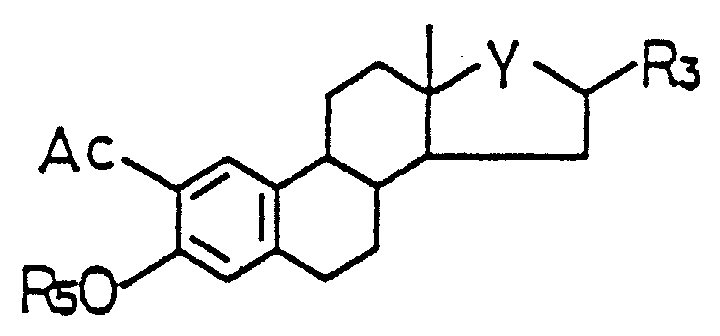
and subjecting the protected compound to Baeyer-Villiger oxidation in the presence of a peracid and an alkali metal salt selected from the group consisting of disodium hydrogen phosphate, dipotassium hydrogen phosphate, sodium hydrogen carbonate, and potassium hydrogen carbonate to form a 2-acetoxyl compound having the formula ofwherein Y, R3 and R5 have the meanings as defined above.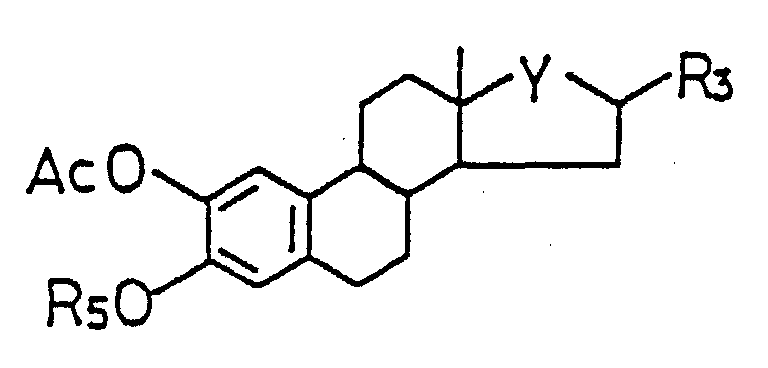
- A method as claimed in Claim 1, further comprising steps of subjecting said 2-acetoxyl compound, in which the protective group at C-3 is an acetal type one, to hydrolysis to form a 2-hydroxyl compound having the formula ofwherein Y and R3 have the meanings as defined above, and R4 is the protective group with acetal type,
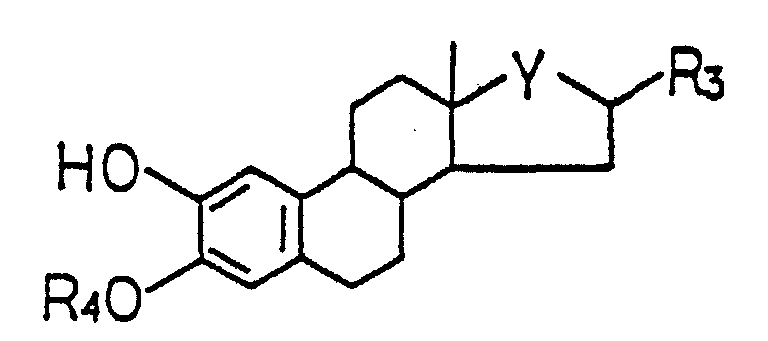
subjecting 2-hydroxyl compound to benzylation to form a 2-benzyloxy compound having the formula ofwherein Y, R3 and R4 have the meanings as defined above,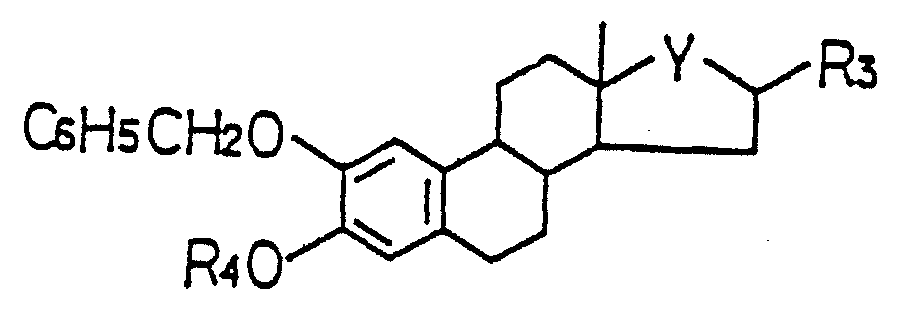
and subjecting 2-benzyloxy compound to elimination of the protective group at C-3 to form a compound having the formula ofwherein Y and R3 have the meanings as defined above.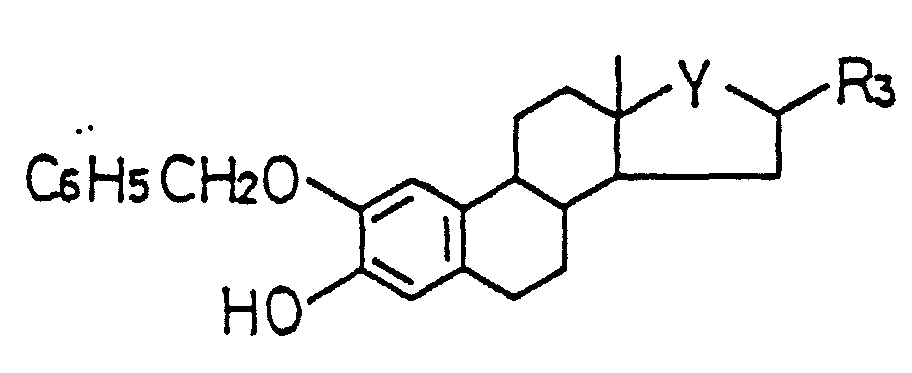
Applications Claiming Priority (19)
| Application Number | Priority Date | Filing Date | Title |
|---|---|---|---|
| JP3278973A JP3034093B2 (en) | 1991-10-01 | 1991-10-01 | Catechol estrogen glycosides and uses thereof |
| JP27897391 | 1991-10-01 | ||
| JP278973/91 | 1991-10-01 | ||
| JP293802/91 | 1991-10-15 | ||
| JP29380191A JPH05170790A (en) | 1991-10-15 | 1991-10-15 | Production of catecholestrogen |
| JP3293802A JP3034095B2 (en) | 1991-10-15 | 1991-10-15 | Catechol estrogen glycosides and uses thereof |
| JP29380291 | 1991-10-15 | ||
| JP293801/91 | 1991-10-15 | ||
| JP29380191 | 1991-10-15 | ||
| JP3303874A JP3034098B2 (en) | 1991-10-24 | 1991-10-24 | Method for producing 2-acetyloxy-3-oxy-substituted-estrogens |
| JP30387491 | 1991-10-24 | ||
| JP303874/91 | 1991-10-24 | ||
| JP12547192 | 1992-04-20 | ||
| JP12547292 | 1992-04-20 | ||
| JP04125472A JP3128580B2 (en) | 1992-04-20 | 1992-04-20 | Method for producing 2-benzyloxyestrogen compound |
| JP04125471A JP3128579B2 (en) | 1992-04-20 | 1992-04-20 | Method for producing 2-hydroxyestrogen 3-glycoside |
| JP125472/92 | 1992-04-20 | ||
| JP125471/92 | 1992-04-20 | ||
| EP92116648A EP0535595B1 (en) | 1991-10-01 | 1992-09-29 | Manufacture and use of novel glycosides of catechol estrogens |
Related Parent Applications (2)
| Application Number | Title | Priority Date | Filing Date |
|---|---|---|---|
| EP92116648.4 Division | 1992-09-29 | ||
| EP92116648A Division EP0535595B1 (en) | 1991-10-01 | 1992-09-29 | Manufacture and use of novel glycosides of catechol estrogens |
Publications (3)
| Publication Number | Publication Date |
|---|---|
| EP0688785A2 EP0688785A2 (en) | 1995-12-27 |
| EP0688785A3 EP0688785A3 (en) | 1997-01-08 |
| EP0688785B1 true EP0688785B1 (en) | 2000-01-05 |
Family
ID=27552674
Family Applications (2)
| Application Number | Title | Priority Date | Filing Date |
|---|---|---|---|
| EP95113118A Expired - Lifetime EP0688785B1 (en) | 1991-10-01 | 1992-09-29 | Manufacture of catechol estrogens derivatives |
| EP92116648A Expired - Lifetime EP0535595B1 (en) | 1991-10-01 | 1992-09-29 | Manufacture and use of novel glycosides of catechol estrogens |
Family Applications After (1)
| Application Number | Title | Priority Date | Filing Date |
|---|---|---|---|
| EP92116648A Expired - Lifetime EP0535595B1 (en) | 1991-10-01 | 1992-09-29 | Manufacture and use of novel glycosides of catechol estrogens |
Country Status (4)
| Country | Link |
|---|---|
| US (2) | US5405944A (en) |
| EP (2) | EP0688785B1 (en) |
| CA (1) | CA2078804C (en) |
| DE (2) | DE69514284T2 (en) |
Cited By (1)
| Publication number | Priority date | Publication date | Assignee | Title |
|---|---|---|---|---|
| RU2282449C2 (en) * | 2001-12-14 | 2006-08-27 | Маттиас Рат | Estrogen and other hormone composition containing ascorbate, lysine, proline and other substances |
Families Citing this family (13)
| Publication number | Priority date | Publication date | Assignee | Title |
|---|---|---|---|---|
| DE4338314C1 (en) * | 1993-11-10 | 1995-03-30 | Jenapharm Gmbh | Pharmaceutical preparations for the prophylaxis and therapy of radical-mediated cell damage |
| JP4228116B2 (en) * | 1996-05-09 | 2009-02-25 | ゼニス・オペレイションズ・プロプライエタリー・リミテッド | Treatment of asthma and airway diseases |
| AUPO427196A0 (en) | 1996-12-19 | 1997-01-23 | University Of Sydney, The | A method for preventing or controlling cataract |
| US6051726A (en) * | 1997-03-13 | 2000-04-18 | Pharm-Eco Laboratories, Inc. | Synthesis of 2-alkoxyestradiols |
| DE19723794A1 (en) * | 1997-06-06 | 1998-12-10 | Jenapharm Gmbh | Non-estrogenic derivatives of estradiol with antioxidant activity |
| AUPQ342599A0 (en) * | 1999-10-14 | 1999-11-04 | University Of Melbourne, The | Conjugates and uses thereof |
| DK1453520T3 (en) * | 2001-12-14 | 2007-01-15 | Matthias Rath | Composition of estrogen and other hormones with ascorbic acid, lysine, proline and other substances |
| US7186707B2 (en) * | 2002-04-01 | 2007-03-06 | University Of Florida | Prodrugs for use as ophthalmic agents |
| US20070213310A1 (en) * | 2002-04-01 | 2007-09-13 | Laszlo Prokai | Prodrugs for Use as Ophthalmic Agents |
| AU2005244167A1 (en) * | 2004-05-04 | 2005-11-24 | Beth Israel Deaconess Medical Center | Methods and compositions for treatment of preeclampsia |
| US7717368B2 (en) * | 2005-06-07 | 2010-05-18 | Urban Aeronautics Ltd. | Apparatus for generating horizontal forces in aerial vehicles and related method |
| EP2099933A4 (en) * | 2006-11-21 | 2010-03-24 | Beth Israel Hospital | PROTEINS AND GENES ASSOCIATED WITH HYPOXIA AND FOR THE DIAGNOSIS AND TREATMENT OF PREGNANCY COMPLICATIONS |
| CN101636157A (en) * | 2007-01-12 | 2010-01-27 | 康乃尔研究基金会有限公司 | Adenylyl cyclases as novel targets for antibacterial interventions |
Family Cites Families (2)
| Publication number | Priority date | Publication date | Assignee | Title |
|---|---|---|---|---|
| EP0216614A3 (en) * | 1985-09-19 | 1988-06-08 | The University Of Sheffield | Synthesis of steroids and intermediates therof |
| US4876382A (en) * | 1987-01-30 | 1989-10-24 | Central Glass Company, Limited | Process for making fluorobenzoic acid fluorophenylesters |
-
1992
- 1992-09-22 CA CA002078804A patent/CA2078804C/en not_active Expired - Fee Related
- 1992-09-25 US US07/950,512 patent/US5405944A/en not_active Expired - Lifetime
- 1992-09-29 EP EP95113118A patent/EP0688785B1/en not_active Expired - Lifetime
- 1992-09-29 DE DE69514284T patent/DE69514284T2/en not_active Expired - Fee Related
- 1992-09-29 DE DE69220639T patent/DE69220639T2/en not_active Expired - Fee Related
- 1992-09-29 EP EP92116648A patent/EP0535595B1/en not_active Expired - Lifetime
-
1994
- 1994-10-05 US US08/322,711 patent/US5739302A/en not_active Expired - Fee Related
Non-Patent Citations (2)
| Title |
|---|
| Grundlagen der Organischen Chemie, Ed H.R.Christen, Sauerländer-Diesterweg-Salle, Germany (1970) page 654 * |
| The Merck Index, 9th Edn. Ed.Martha Windholz, Merck & Co. Inc., USA, 1976 * |
Cited By (1)
| Publication number | Priority date | Publication date | Assignee | Title |
|---|---|---|---|---|
| RU2282449C2 (en) * | 2001-12-14 | 2006-08-27 | Маттиас Рат | Estrogen and other hormone composition containing ascorbate, lysine, proline and other substances |
Also Published As
| Publication number | Publication date |
|---|---|
| DE69514284D1 (en) | 2000-02-10 |
| CA2078804A1 (en) | 1993-04-02 |
| DE69514284T2 (en) | 2000-05-31 |
| DE69220639D1 (en) | 1997-08-07 |
| US5405944A (en) | 1995-04-11 |
| EP0535595B1 (en) | 1997-07-02 |
| US5739302A (en) | 1998-04-14 |
| CA2078804C (en) | 2003-02-25 |
| DE69220639T2 (en) | 1997-10-16 |
| EP0535595A2 (en) | 1993-04-07 |
| EP0688785A2 (en) | 1995-12-27 |
| EP0688785A3 (en) | 1997-01-08 |
| EP0535595A3 (en) | 1993-05-05 |
Similar Documents
| Publication | Publication Date | Title |
|---|---|---|
| US5405944A (en) | Glycosides of catechol estrogens | |
| KR102871606B1 (en) | Industrial process for the production of high-purity estetrol | |
| US4885280A (en) | Novel 14-amino steroids | |
| CA1076102A (en) | Estradiol derivatives | |
| JPH09507471A (en) | Novel steroid having radical-affinitive substituent, process for producing the same, and medicament containing the compound | |
| US4332797A (en) | Chlorambucil derivatives | |
| KR20010012727A (en) | Novel Glycosylated Ginkgolide Derivatives, Their Application As Medicines and Pharmaceutical Compositions | |
| NZ517281A (en) | Non-aromatic estrogenic steroids with a hydrocarbon substituent in position 11 | |
| WO1995032981A1 (en) | Novel glycoside compounds and production and use thereof | |
| US6956031B2 (en) | 11β-Substituted 19-nor-17-α-pregna-1,3,5(10)-trien-17β-ols with a 21,16α-lactone ring | |
| AU1713101A (en) | Beta-d-5-thioxylose derivatives, preparation method and therapeutic use | |
| FR2622194A1 (en) | NOVEL 19-NOR PROGESTERONE DERIVATIVES, PROCESS FOR OBTAINING SAME AND PHARMACEUTICAL COMPOSITIONS CONTAINING THE SAME | |
| CA2358012A1 (en) | Method of making 2-acetoxylestrogen derivatives | |
| JP2623285B2 (en) | Method for producing 2 (3-hydroxy-1,3,5 (10) -estrien-17-yl) propionic acid | |
| EP0875515B1 (en) | Sulfatation of estrogen mixtures | |
| CA2164314A1 (en) | Cephalostatin analogues and their use as anti-tumour agents | |
| RU2802820C2 (en) | Industrial method for production of high purity estetrol | |
| JP3034095B2 (en) | Catechol estrogen glycosides and uses thereof | |
| Anastasia et al. | Synthesis of 14. beta.-cholest-5-en-3. beta.-ol | |
| EP0300811B1 (en) | Ucy 1003 derivatives | |
| JPH05271271A (en) | 5-deazaflavin compound bonded with sialic acid | |
| JP3128579B2 (en) | Method for producing 2-hydroxyestrogen 3-glycoside | |
| EA042770B1 (en) | INDUSTRIAL METHOD FOR OBTAINING HIGH-PURE ESTETROL | |
| JPH05294987A (en) | Production of 2-benzyloxyestrogen compound | |
| MXPA98003465A (en) | Sulfatation of estrog mixes |
Legal Events
| Date | Code | Title | Description |
|---|---|---|---|
| PUAI | Public reference made under article 153(3) epc to a published international application that has entered the european phase |
Free format text: ORIGINAL CODE: 0009012 |
|
| 17P | Request for examination filed |
Effective date: 19950821 |
|
| AC | Divisional application: reference to earlier application |
Ref document number: 535595 Country of ref document: EP |
|
| AK | Designated contracting states |
Kind code of ref document: A2 Designated state(s): DE FR GB |
|
| PUAL | Search report despatched |
Free format text: ORIGINAL CODE: 0009013 |
|
| AK | Designated contracting states |
Kind code of ref document: A3 Designated state(s): DE FR GB |
|
| 17Q | First examination report despatched |
Effective date: 19970603 |
|
| GRAG | Despatch of communication of intention to grant |
Free format text: ORIGINAL CODE: EPIDOS AGRA |
|
| GRAG | Despatch of communication of intention to grant |
Free format text: ORIGINAL CODE: EPIDOS AGRA |
|
| GRAH | Despatch of communication of intention to grant a patent |
Free format text: ORIGINAL CODE: EPIDOS IGRA |
|
| GRAH | Despatch of communication of intention to grant a patent |
Free format text: ORIGINAL CODE: EPIDOS IGRA |
|
| GRAA | (expected) grant |
Free format text: ORIGINAL CODE: 0009210 |
|
| AC | Divisional application: reference to earlier application |
Ref document number: 535595 Country of ref document: EP |
|
| AK | Designated contracting states |
Kind code of ref document: B1 Designated state(s): DE FR GB |
|
| REF | Corresponds to: |
Ref document number: 69514284 Country of ref document: DE Date of ref document: 20000210 |
|
| ET | Fr: translation filed | ||
| PLBE | No opposition filed within time limit |
Free format text: ORIGINAL CODE: 0009261 |
|
| STAA | Information on the status of an ep patent application or granted ep patent |
Free format text: STATUS: NO OPPOSITION FILED WITHIN TIME LIMIT |
|
| 26N | No opposition filed | ||
| REG | Reference to a national code |
Ref country code: GB Ref legal event code: IF02 |
|
| PGFP | Annual fee paid to national office [announced via postgrant information from national office to epo] |
Ref country code: DE Payment date: 20020919 Year of fee payment: 11 |
|
| PGFP | Annual fee paid to national office [announced via postgrant information from national office to epo] |
Ref country code: GB Payment date: 20020925 Year of fee payment: 11 Ref country code: FR Payment date: 20020925 Year of fee payment: 11 |
|
| PG25 | Lapsed in a contracting state [announced via postgrant information from national office to epo] |
Ref country code: GB Free format text: LAPSE BECAUSE OF NON-PAYMENT OF DUE FEES Effective date: 20030929 |
|
| PG25 | Lapsed in a contracting state [announced via postgrant information from national office to epo] |
Ref country code: DE Free format text: LAPSE BECAUSE OF NON-PAYMENT OF DUE FEES Effective date: 20040401 |
|
| GBPC | Gb: european patent ceased through non-payment of renewal fee |
Effective date: 20030929 |
|
| PG25 | Lapsed in a contracting state [announced via postgrant information from national office to epo] |
Ref country code: FR Free format text: LAPSE BECAUSE OF NON-PAYMENT OF DUE FEES Effective date: 20040528 |
|
| REG | Reference to a national code |
Ref country code: FR Ref legal event code: ST |