EP0688200B1 - Article d'hygiene feminine muni de capteurs du flux menstruel, son procede de fabrication - Google Patents
Article d'hygiene feminine muni de capteurs du flux menstruel, son procede de fabrication Download PDFInfo
- Publication number
- EP0688200B1 EP0688200B1 EP95902809A EP95902809A EP0688200B1 EP 0688200 B1 EP0688200 B1 EP 0688200B1 EP 95902809 A EP95902809 A EP 95902809A EP 95902809 A EP95902809 A EP 95902809A EP 0688200 B1 EP0688200 B1 EP 0688200B1
- Authority
- EP
- European Patent Office
- Prior art keywords
- hygiene article
- layer
- strand
- bundle
- assembly
- Prior art date
- Legal status (The legal status is an assumption and is not a legal conclusion. Google has not performed a legal analysis and makes no representation as to the accuracy of the status listed.)
- Expired - Lifetime
Links
- 238000000034 method Methods 0.000 title claims description 22
- 230000002175 menstrual effect Effects 0.000 title description 7
- 239000010410 layer Substances 0.000 claims description 76
- 239000002250 absorbent Substances 0.000 claims description 44
- 230000002745 absorbent Effects 0.000 claims description 43
- 239000012530 fluid Substances 0.000 claims description 42
- 239000002344 surface layer Substances 0.000 claims description 42
- 239000000463 material Substances 0.000 claims description 41
- -1 polypropylene Polymers 0.000 claims description 8
- 239000004698 Polyethylene Substances 0.000 claims description 5
- 238000004519 manufacturing process Methods 0.000 claims description 5
- 229920000573 polyethylene Polymers 0.000 claims description 5
- 238000009732 tufting Methods 0.000 claims description 5
- 229920000742 Cotton Polymers 0.000 claims description 3
- 239000004952 Polyamide Substances 0.000 claims description 3
- 239000004743 Polypropylene Substances 0.000 claims description 3
- 229920002647 polyamide Polymers 0.000 claims description 3
- 229920000728 polyester Polymers 0.000 claims description 3
- 229920001155 polypropylene Polymers 0.000 claims description 3
- 239000004753 textile Substances 0.000 claims description 3
- 229920000297 Rayon Polymers 0.000 claims description 2
- 239000000835 fiber Substances 0.000 description 50
- 230000004224 protection Effects 0.000 description 24
- 230000032258 transport Effects 0.000 description 18
- 239000007788 liquid Substances 0.000 description 17
- 238000010521 absorption reaction Methods 0.000 description 8
- 210000004209 hair Anatomy 0.000 description 8
- 230000000737 periodic effect Effects 0.000 description 8
- 238000009958 sewing Methods 0.000 description 8
- 239000000853 adhesive Substances 0.000 description 6
- 230000001070 adhesive effect Effects 0.000 description 6
- 239000000523 sample Substances 0.000 description 6
- 230000008901 benefit Effects 0.000 description 5
- 238000007789 sealing Methods 0.000 description 5
- 229920002994 synthetic fiber Polymers 0.000 description 5
- 229920002678 cellulose Polymers 0.000 description 4
- 239000001913 cellulose Substances 0.000 description 4
- 230000007423 decrease Effects 0.000 description 4
- 230000008569 process Effects 0.000 description 4
- 239000012209 synthetic fiber Substances 0.000 description 4
- 241000736285 Sphagnum Species 0.000 description 3
- 230000009471 action Effects 0.000 description 3
- 230000004888 barrier function Effects 0.000 description 3
- 238000009826 distribution Methods 0.000 description 3
- 230000002209 hydrophobic effect Effects 0.000 description 3
- 238000002513 implantation Methods 0.000 description 3
- 238000005259 measurement Methods 0.000 description 3
- 239000000203 mixture Substances 0.000 description 3
- 238000000465 moulding Methods 0.000 description 3
- 239000000843 powder Substances 0.000 description 3
- XLYOFNOQVPJJNP-UHFFFAOYSA-N water Chemical compound O XLYOFNOQVPJJNP-UHFFFAOYSA-N 0.000 description 3
- 208000031968 Cadaver Diseases 0.000 description 2
- 239000011324 bead Substances 0.000 description 2
- 238000005516 engineering process Methods 0.000 description 2
- 239000006260 foam Substances 0.000 description 2
- 239000004816 latex Substances 0.000 description 2
- 229920000126 latex Polymers 0.000 description 2
- 239000004745 nonwoven fabric Substances 0.000 description 2
- 230000035515 penetration Effects 0.000 description 2
- 230000035699 permeability Effects 0.000 description 2
- 239000004033 plastic Substances 0.000 description 2
- 229920003023 plastic Polymers 0.000 description 2
- 229920001296 polysiloxane Polymers 0.000 description 2
- 238000011160 research Methods 0.000 description 2
- 239000004094 surface-active agent Substances 0.000 description 2
- 238000005303 weighing Methods 0.000 description 2
- 101100322245 Caenorhabditis elegans des-2 gene Proteins 0.000 description 1
- 229920001410 Microfiber Polymers 0.000 description 1
- 229920002302 Nylon 6,6 Polymers 0.000 description 1
- 229920005830 Polyurethane Foam Polymers 0.000 description 1
- 229910000831 Steel Inorganic materials 0.000 description 1
- 239000012790 adhesive layer Substances 0.000 description 1
- 239000002390 adhesive tape Substances 0.000 description 1
- 230000015572 biosynthetic process Effects 0.000 description 1
- 239000008280 blood Substances 0.000 description 1
- 210000004369 blood Anatomy 0.000 description 1
- 206010061592 cardiac fibrillation Diseases 0.000 description 1
- 230000008859 change Effects 0.000 description 1
- 239000011248 coating agent Substances 0.000 description 1
- 239000011247 coating layer Substances 0.000 description 1
- 238000000576 coating method Methods 0.000 description 1
- 230000008602 contraction Effects 0.000 description 1
- 239000013068 control sample Substances 0.000 description 1
- 230000007547 defect Effects 0.000 description 1
- 230000008021 deposition Effects 0.000 description 1
- 238000006073 displacement reaction Methods 0.000 description 1
- 229940082150 encore Drugs 0.000 description 1
- 230000002600 fibrillogenic effect Effects 0.000 description 1
- 239000002657 fibrous material Substances 0.000 description 1
- 239000012943 hotmelt Substances 0.000 description 1
- 238000002347 injection Methods 0.000 description 1
- 239000007924 injection Substances 0.000 description 1
- 238000012423 maintenance Methods 0.000 description 1
- 239000003658 microfiber Substances 0.000 description 1
- 230000008520 organization Effects 0.000 description 1
- 239000002985 plastic film Substances 0.000 description 1
- 229920002635 polyurethane Polymers 0.000 description 1
- 239000004814 polyurethane Substances 0.000 description 1
- 239000011496 polyurethane foam Substances 0.000 description 1
- 235000020004 porter Nutrition 0.000 description 1
- 230000002441 reversible effect Effects 0.000 description 1
- 239000002689 soil Substances 0.000 description 1
- 239000000243 solution Substances 0.000 description 1
- 239000010959 steel Substances 0.000 description 1
- 238000012360 testing method Methods 0.000 description 1
- 229920001169 thermoplastic Polymers 0.000 description 1
- 238000012546 transfer Methods 0.000 description 1
- 210000003905 vulva Anatomy 0.000 description 1
Images





Classifications
-
- A—HUMAN NECESSITIES
- A61—MEDICAL OR VETERINARY SCIENCE; HYGIENE
- A61F—FILTERS IMPLANTABLE INTO BLOOD VESSELS; PROSTHESES; DEVICES PROVIDING PATENCY TO, OR PREVENTING COLLAPSING OF, TUBULAR STRUCTURES OF THE BODY, e.g. STENTS; ORTHOPAEDIC, NURSING OR CONTRACEPTIVE DEVICES; FOMENTATION; TREATMENT OR PROTECTION OF EYES OR EARS; BANDAGES, DRESSINGS OR ABSORBENT PADS; FIRST-AID KITS
- A61F13/00—Bandages or dressings; Absorbent pads
- A61F13/15—Absorbent pads, e.g. sanitary towels, swabs or tampons for external or internal application to the body; Supporting or fastening means therefor; Tampon applicators
- A61F13/53—Absorbent pads, e.g. sanitary towels, swabs or tampons for external or internal application to the body; Supporting or fastening means therefor; Tampon applicators characterised by the absorbing medium
- A61F13/538—Absorbent pads, e.g. sanitary towels, swabs or tampons for external or internal application to the body; Supporting or fastening means therefor; Tampon applicators characterised by the absorbing medium characterised by specific fibre orientation or weave
-
- A—HUMAN NECESSITIES
- A61—MEDICAL OR VETERINARY SCIENCE; HYGIENE
- A61F—FILTERS IMPLANTABLE INTO BLOOD VESSELS; PROSTHESES; DEVICES PROVIDING PATENCY TO, OR PREVENTING COLLAPSING OF, TUBULAR STRUCTURES OF THE BODY, e.g. STENTS; ORTHOPAEDIC, NURSING OR CONTRACEPTIVE DEVICES; FOMENTATION; TREATMENT OR PROTECTION OF EYES OR EARS; BANDAGES, DRESSINGS OR ABSORBENT PADS; FIRST-AID KITS
- A61F13/00—Bandages or dressings; Absorbent pads
- A61F13/15—Absorbent pads, e.g. sanitary towels, swabs or tampons for external or internal application to the body; Supporting or fastening means therefor; Tampon applicators
- A61F13/51—Absorbent pads, e.g. sanitary towels, swabs or tampons for external or internal application to the body; Supporting or fastening means therefor; Tampon applicators characterised by the outer layers of the pads
- A61F13/511—Topsheet, i.e. the permeable cover or layer facing the skin
- A61F13/51121—Topsheet, i.e. the permeable cover or layer facing the skin characterised by the material
-
- A—HUMAN NECESSITIES
- A61—MEDICAL OR VETERINARY SCIENCE; HYGIENE
- A61F—FILTERS IMPLANTABLE INTO BLOOD VESSELS; PROSTHESES; DEVICES PROVIDING PATENCY TO, OR PREVENTING COLLAPSING OF, TUBULAR STRUCTURES OF THE BODY, e.g. STENTS; ORTHOPAEDIC, NURSING OR CONTRACEPTIVE DEVICES; FOMENTATION; TREATMENT OR PROTECTION OF EYES OR EARS; BANDAGES, DRESSINGS OR ABSORBENT PADS; FIRST-AID KITS
- A61F13/00—Bandages or dressings; Absorbent pads
- A61F13/15—Absorbent pads, e.g. sanitary towels, swabs or tampons for external or internal application to the body; Supporting or fastening means therefor; Tampon applicators
- A61F13/53—Absorbent pads, e.g. sanitary towels, swabs or tampons for external or internal application to the body; Supporting or fastening means therefor; Tampon applicators characterised by the absorbing medium
- A61F13/534—Absorbent pads, e.g. sanitary towels, swabs or tampons for external or internal application to the body; Supporting or fastening means therefor; Tampon applicators characterised by the absorbing medium having an inhomogeneous composition through the thickness of the pad
- A61F13/537—Absorbent pads, e.g. sanitary towels, swabs or tampons for external or internal application to the body; Supporting or fastening means therefor; Tampon applicators characterised by the absorbing medium having an inhomogeneous composition through the thickness of the pad characterised by a layer facilitating or inhibiting flow in one direction or plane, e.g. a wicking layer
- A61F13/53708—Absorbent pads, e.g. sanitary towels, swabs or tampons for external or internal application to the body; Supporting or fastening means therefor; Tampon applicators characterised by the absorbing medium having an inhomogeneous composition through the thickness of the pad characterised by a layer facilitating or inhibiting flow in one direction or plane, e.g. a wicking layer the layer having a promotional function on liquid propagation in at least one direction
- A61F13/53713—Absorbent pads, e.g. sanitary towels, swabs or tampons for external or internal application to the body; Supporting or fastening means therefor; Tampon applicators characterised by the absorbing medium having an inhomogeneous composition through the thickness of the pad characterised by a layer facilitating or inhibiting flow in one direction or plane, e.g. a wicking layer the layer having a promotional function on liquid propagation in at least one direction the layer having a promotional function on liquid propagation in the vertical direction
-
- A—HUMAN NECESSITIES
- A61—MEDICAL OR VETERINARY SCIENCE; HYGIENE
- A61F—FILTERS IMPLANTABLE INTO BLOOD VESSELS; PROSTHESES; DEVICES PROVIDING PATENCY TO, OR PREVENTING COLLAPSING OF, TUBULAR STRUCTURES OF THE BODY, e.g. STENTS; ORTHOPAEDIC, NURSING OR CONTRACEPTIVE DEVICES; FOMENTATION; TREATMENT OR PROTECTION OF EYES OR EARS; BANDAGES, DRESSINGS OR ABSORBENT PADS; FIRST-AID KITS
- A61F13/00—Bandages or dressings; Absorbent pads
- A61F13/15—Absorbent pads, e.g. sanitary towels, swabs or tampons for external or internal application to the body; Supporting or fastening means therefor; Tampon applicators
- A61F13/53—Absorbent pads, e.g. sanitary towels, swabs or tampons for external or internal application to the body; Supporting or fastening means therefor; Tampon applicators characterised by the absorbing medium
- A61F13/534—Absorbent pads, e.g. sanitary towels, swabs or tampons for external or internal application to the body; Supporting or fastening means therefor; Tampon applicators characterised by the absorbing medium having an inhomogeneous composition through the thickness of the pad
- A61F13/537—Absorbent pads, e.g. sanitary towels, swabs or tampons for external or internal application to the body; Supporting or fastening means therefor; Tampon applicators characterised by the absorbing medium having an inhomogeneous composition through the thickness of the pad characterised by a layer facilitating or inhibiting flow in one direction or plane, e.g. a wicking layer
- A61F13/53708—Absorbent pads, e.g. sanitary towels, swabs or tampons for external or internal application to the body; Supporting or fastening means therefor; Tampon applicators characterised by the absorbing medium having an inhomogeneous composition through the thickness of the pad characterised by a layer facilitating or inhibiting flow in one direction or plane, e.g. a wicking layer the layer having a promotional function on liquid propagation in at least one direction
- A61F13/53717—Absorbent pads, e.g. sanitary towels, swabs or tampons for external or internal application to the body; Supporting or fastening means therefor; Tampon applicators characterised by the absorbing medium having an inhomogeneous composition through the thickness of the pad characterised by a layer facilitating or inhibiting flow in one direction or plane, e.g. a wicking layer the layer having a promotional function on liquid propagation in at least one direction the layer having a promotional function on liquid propagation in the horizontal direction
-
- A—HUMAN NECESSITIES
- A61—MEDICAL OR VETERINARY SCIENCE; HYGIENE
- A61F—FILTERS IMPLANTABLE INTO BLOOD VESSELS; PROSTHESES; DEVICES PROVIDING PATENCY TO, OR PREVENTING COLLAPSING OF, TUBULAR STRUCTURES OF THE BODY, e.g. STENTS; ORTHOPAEDIC, NURSING OR CONTRACEPTIVE DEVICES; FOMENTATION; TREATMENT OR PROTECTION OF EYES OR EARS; BANDAGES, DRESSINGS OR ABSORBENT PADS; FIRST-AID KITS
- A61F13/00—Bandages or dressings; Absorbent pads
- A61F13/15—Absorbent pads, e.g. sanitary towels, swabs or tampons for external or internal application to the body; Supporting or fastening means therefor; Tampon applicators
- A61F13/53—Absorbent pads, e.g. sanitary towels, swabs or tampons for external or internal application to the body; Supporting or fastening means therefor; Tampon applicators characterised by the absorbing medium
- A61F13/534—Absorbent pads, e.g. sanitary towels, swabs or tampons for external or internal application to the body; Supporting or fastening means therefor; Tampon applicators characterised by the absorbing medium having an inhomogeneous composition through the thickness of the pad
- A61F13/537—Absorbent pads, e.g. sanitary towels, swabs or tampons for external or internal application to the body; Supporting or fastening means therefor; Tampon applicators characterised by the absorbing medium having an inhomogeneous composition through the thickness of the pad characterised by a layer facilitating or inhibiting flow in one direction or plane, e.g. a wicking layer
- A61F13/53743—Absorbent pads, e.g. sanitary towels, swabs or tampons for external or internal application to the body; Supporting or fastening means therefor; Tampon applicators characterised by the absorbing medium having an inhomogeneous composition through the thickness of the pad characterised by a layer facilitating or inhibiting flow in one direction or plane, e.g. a wicking layer characterised by the position of the layer relative to the other layers
-
- A—HUMAN NECESSITIES
- A61—MEDICAL OR VETERINARY SCIENCE; HYGIENE
- A61F—FILTERS IMPLANTABLE INTO BLOOD VESSELS; PROSTHESES; DEVICES PROVIDING PATENCY TO, OR PREVENTING COLLAPSING OF, TUBULAR STRUCTURES OF THE BODY, e.g. STENTS; ORTHOPAEDIC, NURSING OR CONTRACEPTIVE DEVICES; FOMENTATION; TREATMENT OR PROTECTION OF EYES OR EARS; BANDAGES, DRESSINGS OR ABSORBENT PADS; FIRST-AID KITS
- A61F13/00—Bandages or dressings; Absorbent pads
- A61F13/15—Absorbent pads, e.g. sanitary towels, swabs or tampons for external or internal application to the body; Supporting or fastening means therefor; Tampon applicators
- A61F13/15203—Properties of the article, e.g. stiffness or absorbency
- A61F2013/15284—Properties of the article, e.g. stiffness or absorbency characterized by quantifiable properties
- A61F2013/15447—Fibre dimension, e.g. denier or tex
-
- A—HUMAN NECESSITIES
- A61—MEDICAL OR VETERINARY SCIENCE; HYGIENE
- A61F—FILTERS IMPLANTABLE INTO BLOOD VESSELS; PROSTHESES; DEVICES PROVIDING PATENCY TO, OR PREVENTING COLLAPSING OF, TUBULAR STRUCTURES OF THE BODY, e.g. STENTS; ORTHOPAEDIC, NURSING OR CONTRACEPTIVE DEVICES; FOMENTATION; TREATMENT OR PROTECTION OF EYES OR EARS; BANDAGES, DRESSINGS OR ABSORBENT PADS; FIRST-AID KITS
- A61F13/00—Bandages or dressings; Absorbent pads
- A61F13/15—Absorbent pads, e.g. sanitary towels, swabs or tampons for external or internal application to the body; Supporting or fastening means therefor; Tampon applicators
- A61F13/53—Absorbent pads, e.g. sanitary towels, swabs or tampons for external or internal application to the body; Supporting or fastening means therefor; Tampon applicators characterised by the absorbing medium
- A61F13/534—Absorbent pads, e.g. sanitary towels, swabs or tampons for external or internal application to the body; Supporting or fastening means therefor; Tampon applicators characterised by the absorbing medium having an inhomogeneous composition through the thickness of the pad
- A61F13/537—Absorbent pads, e.g. sanitary towels, swabs or tampons for external or internal application to the body; Supporting or fastening means therefor; Tampon applicators characterised by the absorbing medium having an inhomogeneous composition through the thickness of the pad characterised by a layer facilitating or inhibiting flow in one direction or plane, e.g. a wicking layer
- A61F13/53708—Absorbent pads, e.g. sanitary towels, swabs or tampons for external or internal application to the body; Supporting or fastening means therefor; Tampon applicators characterised by the absorbing medium having an inhomogeneous composition through the thickness of the pad characterised by a layer facilitating or inhibiting flow in one direction or plane, e.g. a wicking layer the layer having a promotional function on liquid propagation in at least one direction
- A61F2013/53721—Absorbent pads, e.g. sanitary towels, swabs or tampons for external or internal application to the body; Supporting or fastening means therefor; Tampon applicators characterised by the absorbing medium having an inhomogeneous composition through the thickness of the pad characterised by a layer facilitating or inhibiting flow in one direction or plane, e.g. a wicking layer the layer having a promotional function on liquid propagation in at least one direction with capillary means
-
- A—HUMAN NECESSITIES
- A61—MEDICAL OR VETERINARY SCIENCE; HYGIENE
- A61F—FILTERS IMPLANTABLE INTO BLOOD VESSELS; PROSTHESES; DEVICES PROVIDING PATENCY TO, OR PREVENTING COLLAPSING OF, TUBULAR STRUCTURES OF THE BODY, e.g. STENTS; ORTHOPAEDIC, NURSING OR CONTRACEPTIVE DEVICES; FOMENTATION; TREATMENT OR PROTECTION OF EYES OR EARS; BANDAGES, DRESSINGS OR ABSORBENT PADS; FIRST-AID KITS
- A61F13/00—Bandages or dressings; Absorbent pads
- A61F13/15—Absorbent pads, e.g. sanitary towels, swabs or tampons for external or internal application to the body; Supporting or fastening means therefor; Tampon applicators
- A61F13/53—Absorbent pads, e.g. sanitary towels, swabs or tampons for external or internal application to the body; Supporting or fastening means therefor; Tampon applicators characterised by the absorbing medium
- A61F13/534—Absorbent pads, e.g. sanitary towels, swabs or tampons for external or internal application to the body; Supporting or fastening means therefor; Tampon applicators characterised by the absorbing medium having an inhomogeneous composition through the thickness of the pad
- A61F13/537—Absorbent pads, e.g. sanitary towels, swabs or tampons for external or internal application to the body; Supporting or fastening means therefor; Tampon applicators characterised by the absorbing medium having an inhomogeneous composition through the thickness of the pad characterised by a layer facilitating or inhibiting flow in one direction or plane, e.g. a wicking layer
- A61F13/53708—Absorbent pads, e.g. sanitary towels, swabs or tampons for external or internal application to the body; Supporting or fastening means therefor; Tampon applicators characterised by the absorbing medium having an inhomogeneous composition through the thickness of the pad characterised by a layer facilitating or inhibiting flow in one direction or plane, e.g. a wicking layer the layer having a promotional function on liquid propagation in at least one direction
- A61F2013/53721—Absorbent pads, e.g. sanitary towels, swabs or tampons for external or internal application to the body; Supporting or fastening means therefor; Tampon applicators characterised by the absorbing medium having an inhomogeneous composition through the thickness of the pad characterised by a layer facilitating or inhibiting flow in one direction or plane, e.g. a wicking layer the layer having a promotional function on liquid propagation in at least one direction with capillary means
- A61F2013/53726—Absorbent pads, e.g. sanitary towels, swabs or tampons for external or internal application to the body; Supporting or fastening means therefor; Tampon applicators characterised by the absorbing medium having an inhomogeneous composition through the thickness of the pad characterised by a layer facilitating or inhibiting flow in one direction or plane, e.g. a wicking layer the layer having a promotional function on liquid propagation in at least one direction with capillary means on the top layer
-
- A—HUMAN NECESSITIES
- A61—MEDICAL OR VETERINARY SCIENCE; HYGIENE
- A61F—FILTERS IMPLANTABLE INTO BLOOD VESSELS; PROSTHESES; DEVICES PROVIDING PATENCY TO, OR PREVENTING COLLAPSING OF, TUBULAR STRUCTURES OF THE BODY, e.g. STENTS; ORTHOPAEDIC, NURSING OR CONTRACEPTIVE DEVICES; FOMENTATION; TREATMENT OR PROTECTION OF EYES OR EARS; BANDAGES, DRESSINGS OR ABSORBENT PADS; FIRST-AID KITS
- A61F13/00—Bandages or dressings; Absorbent pads
- A61F13/15—Absorbent pads, e.g. sanitary towels, swabs or tampons for external or internal application to the body; Supporting or fastening means therefor; Tampon applicators
- A61F13/53—Absorbent pads, e.g. sanitary towels, swabs or tampons for external or internal application to the body; Supporting or fastening means therefor; Tampon applicators characterised by the absorbing medium
- A61F13/534—Absorbent pads, e.g. sanitary towels, swabs or tampons for external or internal application to the body; Supporting or fastening means therefor; Tampon applicators characterised by the absorbing medium having an inhomogeneous composition through the thickness of the pad
- A61F13/537—Absorbent pads, e.g. sanitary towels, swabs or tampons for external or internal application to the body; Supporting or fastening means therefor; Tampon applicators characterised by the absorbing medium having an inhomogeneous composition through the thickness of the pad characterised by a layer facilitating or inhibiting flow in one direction or plane, e.g. a wicking layer
- A61F2013/53765—Absorbent pads, e.g. sanitary towels, swabs or tampons for external or internal application to the body; Supporting or fastening means therefor; Tampon applicators characterised by the absorbing medium having an inhomogeneous composition through the thickness of the pad characterised by a layer facilitating or inhibiting flow in one direction or plane, e.g. a wicking layer characterized by its geometry
-
- A—HUMAN NECESSITIES
- A61—MEDICAL OR VETERINARY SCIENCE; HYGIENE
- A61F—FILTERS IMPLANTABLE INTO BLOOD VESSELS; PROSTHESES; DEVICES PROVIDING PATENCY TO, OR PREVENTING COLLAPSING OF, TUBULAR STRUCTURES OF THE BODY, e.g. STENTS; ORTHOPAEDIC, NURSING OR CONTRACEPTIVE DEVICES; FOMENTATION; TREATMENT OR PROTECTION OF EYES OR EARS; BANDAGES, DRESSINGS OR ABSORBENT PADS; FIRST-AID KITS
- A61F13/00—Bandages or dressings; Absorbent pads
- A61F13/15—Absorbent pads, e.g. sanitary towels, swabs or tampons for external or internal application to the body; Supporting or fastening means therefor; Tampon applicators
- A61F13/53—Absorbent pads, e.g. sanitary towels, swabs or tampons for external or internal application to the body; Supporting or fastening means therefor; Tampon applicators characterised by the absorbing medium
- A61F13/538—Absorbent pads, e.g. sanitary towels, swabs or tampons for external or internal application to the body; Supporting or fastening means therefor; Tampon applicators characterised by the absorbing medium characterised by specific fibre orientation or weave
- A61F2013/5386—Absorbent pads, e.g. sanitary towels, swabs or tampons for external or internal application to the body; Supporting or fastening means therefor; Tampon applicators characterised by the absorbing medium characterised by specific fibre orientation or weave by the fibre orientation in the z plane or vertical direction
-
- A—HUMAN NECESSITIES
- A61—MEDICAL OR VETERINARY SCIENCE; HYGIENE
- A61F—FILTERS IMPLANTABLE INTO BLOOD VESSELS; PROSTHESES; DEVICES PROVIDING PATENCY TO, OR PREVENTING COLLAPSING OF, TUBULAR STRUCTURES OF THE BODY, e.g. STENTS; ORTHOPAEDIC, NURSING OR CONTRACEPTIVE DEVICES; FOMENTATION; TREATMENT OR PROTECTION OF EYES OR EARS; BANDAGES, DRESSINGS OR ABSORBENT PADS; FIRST-AID KITS
- A61F13/00—Bandages or dressings; Absorbent pads
- A61F13/15—Absorbent pads, e.g. sanitary towels, swabs or tampons for external or internal application to the body; Supporting or fastening means therefor; Tampon applicators
- A61F13/53—Absorbent pads, e.g. sanitary towels, swabs or tampons for external or internal application to the body; Supporting or fastening means therefor; Tampon applicators characterised by the absorbing medium
- A61F13/539—Absorbent pads, e.g. sanitary towels, swabs or tampons for external or internal application to the body; Supporting or fastening means therefor; Tampon applicators characterised by the absorbing medium characterised by the connection of the absorbent layers with each other or with the outer layers
- A61F2013/53966—Absorbent pads, e.g. sanitary towels, swabs or tampons for external or internal application to the body; Supporting or fastening means therefor; Tampon applicators characterised by the absorbing medium characterised by the connection of the absorbent layers with each other or with the outer layers by needling, sewing, blow-needling
Definitions
- the invention generally relates to a feminine hygiene article such as a periodic towel or panty liner.
- the originality of this hygiene article is include at least one menstrual flow sensor, partially disposed on the surface of the article and intended to ensure permanent contact between the body and the absorbent part hygiene article.
- European patent No. 91412 describes a towel comprising means elastic attached to the side edges of the towel to lift them along the mattress, cause contraction of at least the central part of the edge and hold these edges in their elevated positions to form side barriers against side leaks.
- European patent No. 134086 relates to a sanitary napkin provided with side flaps which, when folded under the undergarment, form seals or sealing barriers at their flexibility axes.
- European patent application No. 520884 discloses an article where beads lateral are formed on at least part of the crotch area.
- the waterproof sheet constituting the underside of the mattress absorbent is folded longitudinally and forms a waterproof lining of the bead, thus improving the lateral tightness.
- U.S. Patent No. 3,665,922 discloses a periodic towel which, by its structure, immediately receives the discharged fluids, transports them quickly away from their point of discharge and effectively retains them in its absorbent internal part, while leaving the upper external face of the relatively dry towel. As a result, side leaks decrease.
- this patent describes a periodic towel whose layer of outer covering forming envelope comprises a multiplicity of fibers hydrophobic individually looped and constituting a layer of nonwoven of the type "high loft". Each loop consists of a single strand fiber. The ends of each loop is fixed in the base of the nonwoven by means of an adhesive layer.
- this surface layer of fibers improves transport and appearance the surface of the article located on the body side is dry, the fibers of a very weak denier: about 1.5 to 3.0, and moreover of low height do not have sufficient resilience to stay in constant contact with the body of the user. These fibers can even hampering the capture of fluids at the level of the body. In addition, this layer transport only locally, the fibers do not cross the internal structure of the towel and do not penetrate the mattress.
- U.S. Patent No. 3,967,623 generally describes a layer of fibers and more specifically hairs, which is located on the outside of the sanitary napkin above a perforated veil. This layer can be obtained by hot fibrillation a sheet of thermoplastic polymers.
- this material forming a layer of hair is present not only on the surface of the article as a coating layer but also as an internal layer between the perforated veil and the absorbent mattress, the hairs being turned towards the mattress.
- the individual fibers of this inner layer intertwine with the individual fibers of the mattress and create channels in the mattress where fluids circulate.
- the inner layer whose fibers have been treated with a surfactant and thus becoming hydrophilic on the surface, has the function of transporting fluids to the mattress.
- the layers of fibers or bristles do not transport fluids only locally.
- the fibers are not organized between them, nor do they cross the hygiene article from its upper face on the body side to its lower face on the undergarment side.
- the layer surface of fibers or hairs is so dense that fluids will tend to flow on the surface of the bristles without being able to penetrate this coating, which can consequently cause side leaks.
- the international patent application WO 93/01780 describes in general a periodic towel comprising a liquid-permeable surface veil, a lower layer impermeable to liquids, an absorbent mattress positioned between the veil and the lower layer and a transport layer comprising elements oriented in a direction Z perpendicular to the plane formed by the towel.
- the part bottom of this transport layer can be inserted into the mattress and the part top of this layer may extend above the surface of the mattress.
- the elements constituting this transport layer are fibers forming capillaries. More precisely, they have a shape and more precisely a section such, that channels are created on their external surface inside the same fiber. These fibers have for example a U or H section, the channels being formed for example by the space between the legs of the H.
- the capillarity inside the transport layer is provided by each fiber. No specific arrangement of fibers between if not the tufted assembly which remains a random assembly without positioning of the fibers relative to each other. Hair forming fibers have a denarius varying in the range from 10 to 35. They are single strand.
- the transport layer comprising these fibers is arranged under the permeable surface veil.
- some elements of the transport layer protrude from the surface of the web.
- certain fibers pass through the perforations of the veil and their ends appear on the surface. But given the small size of the fibers, the fiber overhang above the wall is very small and the contact of fiber with the body can not be ensured permanently.
- a window is cut in the veil so that part fiber is found on the surface of the sanitary napkin.
- these fibers also do not have a sufficient height in this case, nor sufficient resilience to be in permanent contact with the source of flow of fluids, at the level of the body.
- This device makes it possible to drain the fluids deposited on the surface of the web in leaving this veil dry and transporting fluids to the mattress in areas absorbent unsaturated. However, it cannot effectively capture both fluids at their pour point directly in contact with the body and rapid drainage by the same material ensuring capillarity, from this pour point to the bottom of the mattress.
- the fibers are not organized together to create a sensor ensuring itself transport of fluids throughout the internal structure of the towel to the bottom of the mattress.
- the transport layer is an integral part of the internal structure hygiene article.
- these are formed by taking from the transport layer located at the inside of the absorbent mattress, of the wad, through a slit made on the surface of the mattress.
- each capillary fiber is sewn in the mattress to form a loop, and the veil is then placed on the pre-assembly by any mechanical means such as by deposition of adhesive and where appropriate is cut out. Inside a loop, capillarity is only ensured by the fiber in herself.
- the inventors came up with the idea of providing conventional external protection one or more sensors which, like pubic hair, collect fluids at their pour point but conversely, drain them in a guided way to the bottom of the protection mattress. These sensors provide the relay between the body and the protection absorbent and optimize the speed of penetration of fluids in the protection absorbent.
- the object of the invention is to overcome all the drawbacks mentioned previously by reducing the leak rate significantly to 0%
- the invention aims to ensure permanent contact between the body and absorbent protection of conventional type, whatever the position and user movements.
- the invention aims not only to capture but also to drain large flow rates of fluids, the sensors having a "temporary" function of tank.
- Another object of the invention is to provide a hygiene article, the part of which sensors located on the surface of the hygiene article, is resilient, resistant to crushing and adapting to the different crotch morphologies.
- Another object of the invention is to provide a hygiene article provided with sensors. whose apparent diameter (that of the part of the sensor located on the surface of the article hygiene), is of the order of the diameter of a pubic hair.
- the invention further aims to considerably reduce the size of the sanitary napkins by making them very discreet, by proposing for a napkin large absorption capacity, the size of a panty liner
- the invention also aims to provide a feminine hygiene article of very simple and industrially feasible structure
- the object of the invention is also to be able to remove, if necessary, the presence of a perforated veil on the surface of the hygiene article.
- the invention further aims to provide a simple method of manufacturing a towel fitted with sensors from a pre-assembled feminine hygiene item.
- the feminine hygiene article according to the invention is of the type comprising a mattress absorbent fluids, a surface layer located on said absorbent mattress and a waterproof layer located under said mattress and intended to be in contact with the undergarment.
- the hygiene article has at least one fluid sensor with the upper free end at a distance distance d from said surface layer and is intended to be in contact with the body and whose the lower end is located below the underside of said mattress, and in this that said sensor is formed of a beam comprising at least one fibrous element multi-strand, the part of said sensor or beam located above said layer of surface having a converging flared shape.
- said sensor is provided with flexible and permanent capillary channels formed by the spaces between the strands of said beam constituting the sensor.
- said beam is an open or closed loop comprising at least one multi-strand wire.
- open loop corresponds here and in the text which follows, to a loop which has been shaved or cut at its end, which leads to a bundle or a velvet-like "tuft".
- the invention also relates to a method for manufacturing such an article. hygiene.
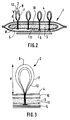
- the hygiene article according to the invention is a hygienic protection 1 external of conventional type which advantageously comprises less a sensor means 2 ensuring on the one hand, the capture of fluids at their pour point at body level, i.e. at a point in contact with the body as close as possible to the source of flow of the menstrual flow, and on the other hand, drainage of fluids from this point of contact with the body to the internal structure absorbent protection.
- the external protection 1 comprises an absorbent mattress 3, a surface layer 4 located on the absorbent mattress 3 and an impermeable layer 5 located under the absorbent mattress and intended to be in contact with the undergarment by any conventional means of fixing such as an adhesive.
- this protection is provided with a means of protection 6 of the fixing means.
- this means can be a silicone band.
- the sensor means 2 consists of a beam comprising at least a multi-stranded fibrous element, the external part of which is located above the surface layer 4 and the internal part 8 of which is located under this surface layer and crosses the absorbent mattress.
- the external part 7 is free and of flared shape and converging towards the surface layer 4.
- This external part can take a form substantially frustoconical or more pictorially "funnel”. More precisely, the multi-stranded fibrous elements are assembled inside the bundle so as to create a "receptable" of flared shape whose base is tightened at the surface of the hygiene article, that is to say of the surface layer.
- the upper free end 9 of the sensor 2 is intended to come into contact with the body and to capture the fluids.
- the external part is flexible, resilient, and has a height d of the order of 3 to 20 millimeters, preferably on the order of 5 to 10 millimeters, so that the end upper 9 of the sensor is in permanent contact with the body whatever the position of the user and the movements and displacements of the body relative to the external protection attached to the undergarment.
- the fibrous elements are closer together and are organized in spindles with zones tightening corresponding to the passage of each layer of material such that the surface layer or the layers forming the envelope of the mattress, shown on the Figure 2 by the upper 10 and lower 11 envelope of the mattress 3.
- the specificity of the sensor is to create a capillary network inside the beam. Indeed, the organization of the strands inside this bundle forms channels interbrand capillaries 12, these channels being permanent and flexible.
- the capillarity gradient is provided by the sensor itself. Indeed, the channel diameter decreases from the upper end of the sensor to the base of the external and converging part of the sensor located at the surface layer where the strands are tightened with the passage of this layer, the diameter of the channels or spaces interbrins continues to decrease at the level of each material crossed, to the bottom of the mattress, and more particularly of the lower envelope 11 of the mattress where the channel diameter is the smallest.
- the present invention therefore ensures capillarity within the same material formed of multi-stranded fibrous elements and in the same unit or bundle of elements organized fibers forming a sensor, through the entire structure of a hygiene article.
- the bundles can be in the form of open loops or closed.
- the loops are open when cut or shaved in their end. This embodiment is represented in FIG. 5, by the external part 7 ' 2 'sensors.
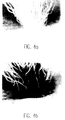
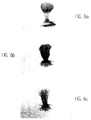
- Figures 6a to 6e are photographs of a sensor in the form of curly whose top has been shaved. These figures illustrate the capture of a drop of fluid at the top of the loop ( Figure 6a) and the drainage of fluids from this upper end of the sensor to the base of its external part ( Figure 6d and 6e).
- the bundle formed of multi-stranded fibrous elements is vacuum as the fluid descends by capillary action in the absorbent part of the towel. It should be noted that the surface layer remains dry, the fluid entering almost not in contact with the materials forming the surface layer.
- the flared shape convergent combined with the interbrand spaces forming the capillary network, promotes advantageously rapid drainage of fluids. This series of photographs illustrates also the good cohesion of the strands inside the bundle.
- Another parameter is the distribution of the sensors on the surface of the article. improving the product.
- Sensors such as loops can be located in the center of the article so as to be concentrated in an area where they will be in contact with the part of the body where the fluid flow source is located.
- sensors can be arranged longitudinally in the article, in several rows and be more or less tightened transversely. These rows can be more or less wide.
- the sensors can be arranged in an oval pattern or other on the surface of the hygiene article
- the sensors can for example be arranged in the central part of the article following concentric circles with maximum height sensors located in the center
- the surface of the hygienic article or the surface layer may be completely covered with sensors.
- the height of the sensors varies in function of the crotch morphology.
- variable height sensors are provided. This is illustrated by FIG. 7 schematically representing the surface of a towel where the sensors are loops.
- Figures 8a, 8b and 8c show the distribution of heights of loops respectively for the front part, the central part and the rear part of the periodic towel shown in Figure 7, corresponding to the profiles of the parties front, central and rear of the pubic region.
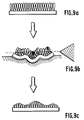
- a profile of this region can be produced by molding. So, from the counter-molding or counterform, a pattern can be reproduced for the distribution of the sensors of different height on the surface of the hygiene article. In this case, the total area of the article is covered with loops of a given maximum height, the article is applied against a molding corresponding to the crotch area and the loops are then shaved to reproduce the profile of the crotch.
- Figures 9a, 9b and 9c illustrate the different stages of this shaving process according to a form.
- An advantageous consequence of the sensors on the hygiene article according to the invention is the non-negligible increase in the absorption capacity of the towel. Therefore, it is possible to considerably reduce the size of the towel by choosing suitable absorbent materials. Indeed, the latter for a absorption capacity of a "normal" range towel can be the size of a panty liner, on the one hand, being very thin and on the other hand, of reduced length so as to only substantially cover the pubic region.
- the hygiene article according to the invention may include, where appropriate side flaps. But the role of the latter as a lateral barrier is no longer essential.
- Another advantage of the article according to the invention is the possibility of using any type of material for the surface layer, i.e. a material more or less permeable, the penetration of fluids being ensured by the sensors.
- a material for the surface layer i.e. a material more or less permeable, the penetration of fluids being ensured by the sensors.
- An article whose surface layer would be an impermeable material would be entirely conceivable. could consider any material having the property of being breathable or water vapor while being impermeable to liquids. Permeability to liquids is not therefore no longer an absolutely necessary criterion for this surface layer. So, other materials than the increasingly sophisticated perforated plastic sails and expensive, can be used Simple materials ensuring the maintenance of the mattress are sufficient.
- a hygiene article where for example the surface layer is combined with the mattress cover, is part of the invention. Textile material non-woven, woven or knitted, light weight, is also suitable.
- the layer of surface may be formed from a mixture of hydrophilic and hydropho
- this surface layer is a non-woven material, carded or not, such as a "highloft” nonwoven or a “meltblown” type material or a material formed from continuous thermally bonded filaments ("spun-laid” technology).
- the materials conventionally used for towels thin are completely transposable to the product according to the present invention, except the surface layer whose optimal permeability is no longer sought.
- the absorbent mattress can be made of any conventional absorbent material.
- this mattress is formed of cellulosic fibers containing superabsorbent material in powder form.
- a band cellulosic fibers, papermaking, formed dry and bound by a latex, that is to say an "air-laid" type material, the two lateral edges of which are folded over a central part on which the superabsorbent material is previously deposited can train this type of mattress.
- the material superabsorbent can be in the form of powder, fiber, sheet and also powder bound to synthetic fibers.
- the waterproof layer under the absorbent mattress is made of material waterproof plastic, such as polyethylene. It can also be constituted of a material being both permeable to air and water vapor and impermeable to liquids. Such a material is for example a nonwoven of the "meltblown" type composed microfibers, for example polyethylene.
- the surface layer and the impermeable layer are associated for example by sealing to wrap the mattress.
- the multi-stranded fibrous element forming the bundle is a filament or a thread multi-strand or any combination of fibers in several strands.
- the association of at least three fibers to form a fibrous element itself in the form of a bundle, is part of the invention.
- an open or closed loop sensor can be consisting of one or more filaments or multi-strand threads
- a fibrous element such as a thread is preferably crimped or textured, which improves its resilience.
- Each fibrous element comprises between about 2 and about 200 strands. And each strand has a titer of at least 6dtex
- this fibrous element has a titer of at least 50 dtex and is located preferably in the range between about 180 and about 5000 dtex.
- Fibers in this higher titer range are suitable for resilience and crush resistance characteristics sought for the external part of the sensors.
- each fibrous element comprises between about 30 and about 100 strands, the unit titer of a strand being at least 17dtex.
- the choice of the unit title of a strand and the number of strands per fibrous element is fundamental to obtaining the compromise between resilience and softness.
- a large number of strands will be necessary for compensate for the low resilience.
- the fibrous element as such is preferably hydrophilic but is not absorbent. It can be treated, for example with a surfactant to make it hydrophilic.
- the fibrous element can be based on natural, artificial, synthetic fibers, or their mixtures.
- the criteria for choosing the nature of the fibrous element are both resilience and softness.
- cotton or linen can be used, but it must be treated so as to reduce its hydrophilicity.
- these are twisted yarns, that is to say two or three yarns joined together by torsion.
- viscose is also suitable if treated so as to be less hydrophilic.
- synthetic fibers are preferred and are chosen from polyester, polyamide, polyethylene or polypropylene.
- polyester polyamide, polyethylene or polypropylene.
- polyamide fibrous elements for greater softness, or in certain polyesters that are both resilient and soft.
- Polypropylene will be chosen if a very large resilience is sought above all.
- the method according to the invention consists in forming sensors from a fibrous layer located outside of a pre-assembly, partially inserting them in this pre-assembly composed of different layers of materials forming the article hygiene.
- the sensor is thus formed by a supply of external material in a pre-assembly existing.
- a pre-assembly by preparing a product of hygiene, for example of the laminated type by laying a surface layer on a mattress absorbent. Then we have on or under this pre-assembly, an outer layer fibrous. From this fibrous layer, at least one sensor is formed under the form of a bundle comprising at least one multi-strand element. The lower end of this bundle is attached to the underside of the mattress and the outer part of this beam is free above the surface layer and of flared, convergent shape towards the surface layer. The beam therefore crosses the pre-assembly.
- An impermeable layer is then fixed under the pre-assembly provided with sensors, for example by sealing the edges of this layer with those of the surface layer protruding from the mattress, or by any other means.
- Means of fixing such that adhesive strips are placed under the waterproof layer.
- means for protecting the fixing means are provided, such as a strip silicone placed on the adhesive tape deposits.
- the multi-strand wire passes through each layer of material forming the pre-assembly in one and the same point.
- a single continuous wire can be used to form all curls.
- the loops of the same row obtained by sewing from the same continuous thread, are connected to each other at level of the underside of the mattress, and more precisely below it.
- the loops can be directly sewn in several rows.
- loops formed by sewing are achievable by means of a sew, or a Malipol type machine that forms chain stitches crossing the pre-assembly.
- the loops, once formed are either left intact, either cut or shaved.
- the shaving of the loops can be carried out according to a shape adapted to the crotch as described above.
- the fibrous layer corresponding to one or more threads is removed once the trained sensors.
- the fibrous outer layer is located under the pre-assembly and also consists of at least one continuous stranded wire or discontinuous.
- the sensors are manufactured by a known technique called tufting, which consists of stitching the thread through the pre-assembly using a needle, to form a loop by making the needle protrude a height d above the layer of surface and removing that needle.
- the loop can possibly be cut.
- the needle is provided with a fork.
- the thread remains caught by the fork after the withdrawal of the needle and exceeds by a height d of the surface layer.
- Multi-needle machines suitable for traversing different materials pre-assembly can also be used.
- this type of machine several needles are provided, but in order to obtain loops that are sufficiently spaced each other, machines having needles at least every 2.5 mm in the crosswise and every 2 mm in the machine direction are preferred.
- Non-woven textile materials such as nonwovens formed from continuous thermally bonded filaments (spun-laid technology) or meltblown type nonwovens, are suitable.
- the fibrous outer layer is also arranged under the pre-assembly and more precisely under the absorbent mattress.
- this fibrous layer is a sheet of fibers, carded. In this case, it is associated with pre-assembly and will remain in the finished hygiene item.
- the sensors can be formed by a needling technique.
- the fibrous layer which is a carded web, bound or not, or a veil, comprising fibers of different lengths, and of different titles, crimped or not curly.
- Fibrous elements of the sheet are thus introduced by means including needles through the pre-assembly and form bundles of elements multi-strand fibers corresponding to the sensors, part of which appears on the surface of the pre-assembly, above the surface layer.
- the basis of these beams is maintained, if necessary, under the fibrous sheet for example by a layer of adhesive or by thermobinding.
- the needling is of conventional, mechanical type, that is to say performed by means steel needles.
- the needles are fitted with barbs.
- the pre-assembly consists of a carded fibrous sheet of a grammage of 50 g / m 2 based on polyethylene fibers, forming the external fibrous layer, covered with a layer of cellulose paper fibers bound by a latex and obtained dry ("air-laid"), weighing 65 g / m 2 , forming the mattress, itself covered with a layer of nonwoven in the form of a conventional carded veil, forming the layer of area.
- Any other type of absorbent material can be used for the mattress, such as polyurethane foam or treated sphagnum foam.
- the process in general eliminates the step of assembling the different materials of the pre-assembly forming the hygiene article.
- a simple superposition of the surface layer, the absorbent mat and the fibrous layer external is sufficient. Indeed, the connection between the different layers of material is obtained directly by the beam forming step of the sensors of fibrous elements passing through the different layers of materials.
- the advantage of such a process is the combination of the connection of the different materials together and the formation of sensors by fibrous elements entrained in through the different materials.
- a contour seal is then preferably carried out between the layer of surface and the waterproof layer placed under the pre-assembly to consolidate the entire article and wrap the mattress more tightly.
- the efficiency of the sensors and more specifically the drainage, have been quantified by measuring the acquisition speed in liquid of a loop.
- Samples were prepared according to the following method. Initially time, we make the absorbent mattress. A sheet comprising 80% of cellulosic fibers and 20% synthetic hot-melt fibers, per channel pneumatic, then transport this tablecloth previously deposited on a sheet of cellulose wadding in a thermobonding oven After leaving the oven, a second cellulose wadding sheet is placed on the upper side of the tablecloth. All then passes through a heated grille so as to link this last sheet to the tablecloth.
- Samples of approximately 4 ⁇ 4 cm 2 , weighing approximately 1 g and having a thickness of approximately 0.60 cm are taken from the assembly obtained.
- a surface layer consisting of a "meltblown" type nonwoven sold by the company COROVIN is deposited on the surface of these samples. This nonwoven has a grammage of 20 g / m 2 , is permeable to water vapor and impermeable to liquids.
- sensors here loops, manually, by sewing.
- a polyamide 6,6 strand of 1260 dtex and comprising 68 is used.
- strands marketed by RHONE-POULENC.
- a sewing needle modified Using a sewing needle modified, a loop is formed, the two ends of the component multi-strand wire the loop, cross the pre-assembly form of the absorbent mattress and the layer surface, at a single point.
- the strands are tightened when the mattress passes absorbent, thus forming the capillarity gradient, the capillary channels being formed inside a loop by the space between the strands.
- one or more loops can be placed depending on a specific reason.
- the measurement is then carried out according to the following method.
- the loops are enclosed in a tube of internal diameter of 20 mm, which is placed on the sample.
- the quantity of liquid remaining on the surface of the sample is also measured, by placing immediately after the stopwatch, two folds of blotting paper WHATMANN n ° 4, 9 cm by 14 cm, with an average dry weight of 2.37 g, topped with a mass of 500 g, with a diameter of 38 mm.
- the quantity of liquid remaining on the surface of the sample is approximately 1.6 percent by weight of the amount injected, regardless of the number of loops on the sample.
- the acquisition time decreases with the number of loops implanted. There is of course an upper limit on the number of loops beyond which the liquid is no longer picked up by the loops which form too dense a cover on which the liquid flows.
- the hygiene articles provided with sensors according to the invention have a exceptional drainage.
Landscapes
- Health & Medical Sciences (AREA)
- Epidemiology (AREA)
- Engineering & Computer Science (AREA)
- Biomedical Technology (AREA)
- Heart & Thoracic Surgery (AREA)
- Vascular Medicine (AREA)
- Life Sciences & Earth Sciences (AREA)
- Animal Behavior & Ethology (AREA)
- General Health & Medical Sciences (AREA)
- Public Health (AREA)
- Veterinary Medicine (AREA)
- Absorbent Articles And Supports Therefor (AREA)
- Orthopedics, Nursing, And Contraception (AREA)
Description
- les perforations du voile, d'un certain diamètre,
- les canaux capillaires intrafibres des fibres monobrins constituant la couche de transport, de diamètre plus faible, et
- les canaux interfibres des fibres du matelas absorbant, de diamètre encore plus faible,
- l'absence de contact permanent entre le corps et la protection externe absorbante, ceci notamment lorsque l'utilisatrice est en position allongée,
- la diversité des morphologies d'entrejambe,
- la présence de poils pubiens qui peuvent drainer les fluides menstruels vers les bordures latérales de la protection voire à l'extérieur de la protection,
- le manque d'absorption dû à la nature et à l'abondance des écoulements, et
- la déformation de la protection externe au porter, qui a subi des contraintes et a été humidifiée.
- la figure 1 représente une vue de dessus de l'article d'hygiène selon l'invention, suivant un mode de réalisation ;
- la figure 2 représente une coupe transversale de l'article représenté en figure 1, suivant l'axe II-II ;
- la figure 3 représente le détail d'un capteur représenté en figure 2 ;
- la figure 4a est une photographie d'un capteur sous forme de bouclette et plus précisément de la partie du capteur ou bouclette située juste au-dessus de la couche de surface ;
- la figure 4b est une photographie du capteur de la figure 4a et illustre le drainage des fluides au sein de ce capteur ;
- la figure 5 représente une coupe transversale d'un autre mode de réalisation selon l'invention où les bouclettes formant les capteurs sont ouvertes ;
- les figures 6a à 6e sont des photographies d'une bouclette ouverte formant capteur, illustrant la capture et le drainage d'une goutte de fluide dans l'article d'hygiène absorbant ;
- la figure 7 représente la surface d'un article d'hygiène recouverte de bouclettes dont la hauteur est adaptée à la morphologie d'un entrejambe ;
- les figures 8a, 8b et 8c représentent la coupe de l'article représenté en figure 7 suivant respectivement les axes VIIIa-VIIIa, VIIIb-VIIIb et VIIIc-VIIIc ;
- les figures 9a, 9b et 9c illustrent les différentes étapes d'un procédé de rasage suivant une forme ;
- la figure 10 représente une coupe longitudinale de l'article représenté en figure 1, suivant l'axe IX-IX, et
- la figure 11 représente une courbe du temps d'acquisition en liquide d'un article d'hygiène selon l'invention, en fonction du nombre de capteurs prévus sur cet article.
- t1 est le temps d'acquisition d'une bouclette,
- N est le nombre de bouclettes,
- k est le coefficient dépendant de la nature de la couche de surface 0 ≤ k ≤ 1,
k tendant vers 0 pour un non tissé très perméable et
k tendant vers 1 pour un non-tissé très hydrophobe, et - to est le temps d'écoulement des 2 ml de liquide dans le tube, c'est-à-dire ici 1 seconde 2/10.
Claims (18)
- Article d'hygiène féminine externe (1) tel qu'une serviette périodique, du type comprenant un matelas absorbant les fluides, une couche de surface (4) située sur ledit matelas absorbant (3) et une couche imperméable (5) située sous ledit matelas (3) et destinée à être au contact d'un sous-vêtement, caractérisé en ce que ledit article (1) comprend au moins un capteur de fluides (2) dont l'extrémité libre supérieure (9) est à une distance d de ladite couche de surface (4) et est destinée à être en contact du corps et dont l'extrémité inférieure est située en dessous de la face intérieure (11) dudit matelas (3), en ce que ledit capteur (2) est formé d'un faisceau comprenant au moins un élément fibreux multibrins, la partie (7) dudit capteur (2) située au-dessus de ladite couche de surface (4) ayant une forme évasée convergente.
- Article d'hygiène selon la revendication 1, caractérisé en ce que ledit capteur (2) est muni de canaux capillaires (12) souples et permanents, formés par les espaces entre les brins dudit faisceau constituant le capteur.
- Article d'hygiène selon la revendication 1 ou 2, caractérisé en ce que ledit faisceau est une bouclette ouverte ou fermée comprenant au moins un fil multibrins.
- Article d'hygiène selon l'une des revendications précédentes, caractérisé en ce que d varie entre environ 3 millimètres et environ 20 millimètres et de préférence entre environ 5 et environ 10 millimètres.
- Article d'hygiène selon l'une des revendications précédentes, caractérisé en ce que chaque élément fibreux dudit faisceau formant le capteur comprend entre environ 2 et environ 200 brins et de préférence entre environ 30 et environ 100 brins.
- Article d'hygiène selon la revendication 5, caractérisé en ce que chaque brin unitaire a un titre d'au moins 6 dtex et plus préférentiellement d'au moins 17 dtex.
- Article d'hygiène selon l'une des revendications 3 à 6, caractérisé en ce que ledit élément fibreux multibrins a un titre variant dans l'intervalle d'environ 180 dtex à environ 5000 dtex.
- Article d'hygiène selon les revendications 5 et 6, caractérisé en ce que chaque brin a un titre d'au moins 17 dtex et chaque élément fibreux comprend au moins 30 brins.
- Article d'hygiène selon l'une des revendications précédentes, caractérisé en ce que l'élément fibreux précité est d'origine naturelle telle que le coton, artificielle telle que la viscose ou d'origine synthétique telle que le polyamide, le polyester, le polypropylène ou le polyéthylène.
- Article d'hygiène selon l'une des revendications précédentes, caractérisé en ce que les fibres sont de préférence hydrophiles ou rendues hydrophiles.
- Article d'hygiène selon l'une des revendications 3 à 10, caractérisé en ce que la surface totale de l'article d'hygiène est recouverte de bouclettes, la hauteur des bouclettes variant proportionnellement à la distance séparant le corps de la couche de surface précitée.
- Procédé pour fabriquer un article d'hygiène selon l'une des revendications précédentes, caractérisé en ce qu'il consiste à :a) former un pré-assemblage du type comprenant un matelas absorbant les fluides et une couche de surface disposée sur ledit matelas ;b) disposer une couche externe fibreuse sous ou sur ledit pré-assemblage ;c) former à partir de ladite couche fibreuse, au moins un faisceau comprenant au moins un élément fibreux multibrins dont l'extrémité inférieure est fixée au niveau de la face inférieure du matelas, dont la partie externe située au-dessus de la couche de surface est libre et de forme évasée convergente vers ladite couche de surface et dont l'extrémité supérieure est destinée à être au contact du corps ; etd) fixer une couche imperméable sous l'article d'hygiène obtenu en c).
- Procédé selon la revendication 12, caractérisé en ce que la couche externe fibreuse est disposée sur l'assemblage précité et est formée d'au moins un fil multibrins continu ou discontinu et en ce que ledit fil multibrins est piqué par couture à travers le pré-assemblage précité de manière à former au moins un faisceau sous forme de bouclette formée de fil multibrins.
- Procédé selon la revendication 12, caractérisé en ce que la couche externe fibreuse est disposée sous l'assemblage précité et est formée d'au moins un fil multibrins continu ou discontinu et en ce que ledit fil multibrins est piqué par une technique connue de tuftage à travers l'assemblage précité de manière à former au moins un faisceau sous forme de bouclette formée de fils multibrins.
- Procédé selon la revendication 14, caractérisé en ce que la couche de surface est de préférence un matériau textile nontissé.
- Procédé selon la revendication 13, 14 ou 15, caractérisé en ce que ledit faisceau sous forme de bouclette est coupé.
- Procédé selon la revendication 12, caractérisé en ce que ladite couche externe fibreuse est constituée d'une nappe ou voile de fibres et est disposée sous le pré-assemblage précité et en ce que l'on fait passer des éléments fibreux issus de ladite couche externe à travers le pré-assemblage par une technique connue d'aiguilletage pour former un faisceau d'élément multibrins, dont la partie à la surface de l'article d'hygiène est de forme évasée et convergente.
- Procédé selon la revendication 17, caractérisé en ce que l'aiguilletage précité est un aiguilletage de type mécanique.
Applications Claiming Priority (3)
| Application Number | Priority Date | Filing Date | Title |
|---|---|---|---|
| FR9314513 | 1993-12-03 | ||
| FR9314513A FR2713083B1 (fr) | 1993-12-03 | 1993-12-03 | Article d'hygiène féminine muni de capteurs du flux menstruel. |
| PCT/FR1994/001391 WO1995015138A1 (fr) | 1993-12-03 | 1994-11-30 | Article d'hygiene feminine muni de capteurs du flux menstruel, son procede de fabrication |
Publications (2)
| Publication Number | Publication Date |
|---|---|
| EP0688200A1 EP0688200A1 (fr) | 1995-12-27 |
| EP0688200B1 true EP0688200B1 (fr) | 1999-04-07 |
Family
ID=9453532
Family Applications (1)
| Application Number | Title | Priority Date | Filing Date |
|---|---|---|---|
| EP95902809A Expired - Lifetime EP0688200B1 (fr) | 1993-12-03 | 1994-11-30 | Article d'hygiene feminine muni de capteurs du flux menstruel, son procede de fabrication |
Country Status (4)
| Country | Link |
|---|---|
| EP (1) | EP0688200B1 (fr) |
| DE (1) | DE69417732T2 (fr) |
| FR (1) | FR2713083B1 (fr) |
| WO (1) | WO1995015138A1 (fr) |
Families Citing this family (49)
| Publication number | Priority date | Publication date | Assignee | Title |
|---|---|---|---|---|
| JP3012475B2 (ja) * | 1995-01-26 | 2000-02-21 | ユニ・チャーム株式会社 | 体液吸収性物品用の透液性複合不織布 |
| KR19990028345A (ko) * | 1995-06-23 | 1999-04-15 | 데이비드 엠 모이어 | 개선된 작용성 표면을 갖는 흡수 제품 |
| US5670110A (en) * | 1995-12-21 | 1997-09-23 | The Procter & Gamble Company | Method for making three-dimensional macroscopically-expanded webs having improved functional surfaces |
| US6152905A (en) * | 1997-10-10 | 2000-11-28 | The Procter & Gamble Company | Absorbent interlabial device comprising a fluid acquisition/transfer complex |
| WO1999018905A1 (fr) * | 1997-10-10 | 1999-04-22 | The Procter & Gamble Company | Dispositif interlabial absorbant dote d'un complexe d'acquisition/de transfert de fluide |
| SE514391C2 (sv) | 1997-12-03 | 2001-02-19 | Sca Hygiene Prod Ab | Absorberande alster |
| BR9903096A (pt) * | 1999-12-29 | 2001-09-18 | Johnson & Johnson Ind Com | Absorvente higiênico |
| JP4162368B2 (ja) * | 2000-09-01 | 2008-10-08 | ユニ・チャーム株式会社 | 連続フィラメントの表面構造体を用いた吸収性物品 |
| JP3875007B2 (ja) | 2000-09-01 | 2007-01-31 | ユニ・チャーム株式会社 | 連続フィラメントを有する表面層を用いた吸収性物品およびその製造方法 |
| RU2182476C1 (ru) * | 2001-07-12 | 2002-05-20 | Достойнов Илья Андреевич | Санитарно-гигиеническое изделие для определения состояния организма (варианты) и способ определения состояния организма |
| US8795716B2 (en) | 2001-10-01 | 2014-08-05 | The Procter & Gamble Company | Skin care compositions on a thin sanitary napkin |
| US7682686B2 (en) | 2002-12-20 | 2010-03-23 | The Procter & Gamble Company | Tufted fibrous web |
| US7732657B2 (en) * | 2002-12-20 | 2010-06-08 | The Procter & Gamble Company | Absorbent article with lotion-containing topsheet |
| US7838099B2 (en) | 2002-12-20 | 2010-11-23 | The Procter & Gamble Company | Looped nonwoven web |
| US7553532B2 (en) | 2002-12-20 | 2009-06-30 | The Procter & Gamble Company | Tufted fibrous web |
| BR0317609B1 (pt) | 2002-12-20 | 2013-10-08 | Textura laminada com tufos | |
| US7648752B2 (en) * | 2002-12-20 | 2010-01-19 | The Procter & Gamble Company | Inverse textured web |
| US7507459B2 (en) | 2002-12-20 | 2009-03-24 | The Procter & Gamble Company | Compression resistant nonwovens |
| CN100579495C (zh) * | 2002-12-20 | 2010-01-13 | 宝洁公司 | 簇状的层压纤维网 |
| US8241543B2 (en) | 2003-08-07 | 2012-08-14 | The Procter & Gamble Company | Method and apparatus for making an apertured web |
| US7910195B2 (en) * | 2003-12-16 | 2011-03-22 | The Procter & Gamble Company | Absorbent article with lotion-containing topsheet |
| JP4342337B2 (ja) * | 2004-02-17 | 2009-10-14 | ユニ・チャーム株式会社 | 使い捨ておむつ |
| JP4511250B2 (ja) | 2004-06-03 | 2010-07-28 | ユニ・チャーム株式会社 | 使い捨ておむつ |
| BRPI0512053B1 (pt) * | 2004-06-21 | 2017-12-05 | The Procter & Gamble Company | Hygienic absorbent of non-fabrics resistant to compression |
| KR100848019B1 (ko) * | 2004-06-21 | 2008-07-23 | 더 프록터 앤드 갬블 캄파니 | 루프형 부직포 웨브 |
| US7754050B2 (en) | 2004-06-21 | 2010-07-13 | The Procter + Gamble Company | Fibrous structures comprising a tuft |
| US7579062B2 (en) | 2004-06-21 | 2009-08-25 | The Procter & Gamble Company | Hydroxyl polymer web structures comprising a tuft |
| EP1902168B1 (fr) * | 2005-06-21 | 2010-07-07 | The Procter and Gamble Company | Toile fibreuse touffetée |
| US7935207B2 (en) | 2007-03-05 | 2011-05-03 | Procter And Gamble Company | Absorbent core for disposable absorbent article |
| US8502013B2 (en) | 2007-03-05 | 2013-08-06 | The Procter And Gamble Company | Disposable absorbent article |
| US7993317B2 (en) | 2008-08-08 | 2011-08-09 | The Procter & Gamble Company | Zoned topsheet |
| US8058501B2 (en) | 2008-08-08 | 2011-11-15 | The Procter & Gamble Company | Regionalized topsheet |
| US8728049B2 (en) | 2008-08-08 | 2014-05-20 | The Procter & Gamble Company | Absorbent article having a tufted topsheet |
| US9345628B2 (en) | 2008-08-08 | 2016-05-24 | The Procter & Gamble Company | Absorbent article having a tufted topsheet |
| US8691041B2 (en) | 2008-08-08 | 2014-04-08 | The Procter And Gamble Company | Method of producing a composite multi-layered printed absorbent article |
| US20100035014A1 (en) | 2008-08-08 | 2010-02-11 | John Lee Hammons | Zoned Topsheet |
| US7967801B2 (en) | 2008-08-08 | 2011-06-28 | The Procter & Gamble Company | Regionalized topsheet |
| US8158043B2 (en) | 2009-02-06 | 2012-04-17 | The Procter & Gamble Company | Method for making an apertured web |
| US8153226B2 (en) | 2009-03-31 | 2012-04-10 | The Procter & Gamble Company | Capped tufted laminate web |
| US9242406B2 (en) | 2011-04-26 | 2016-01-26 | The Procter & Gamble Company | Apparatus and process for aperturing and stretching a web |
| US8657596B2 (en) | 2011-04-26 | 2014-02-25 | The Procter & Gamble Company | Method and apparatus for deforming a web |
| US9925731B2 (en) | 2011-04-26 | 2018-03-27 | The Procter & Gamble Company | Corrugated and apertured web |
| US8708687B2 (en) | 2011-04-26 | 2014-04-29 | The Procter & Gamble Company | Apparatus for making a micro-textured web |
| US9044353B2 (en) | 2011-04-26 | 2015-06-02 | The Procter & Gamble Company | Process for making a micro-textured web |
| US9724245B2 (en) | 2011-04-26 | 2017-08-08 | The Procter & Gamble Company | Formed web comprising chads |
| US20160067118A1 (en) * | 2014-09-10 | 2016-03-10 | The Procter & Gamble Company | Nonwoven Web |
| CN104562451B (zh) * | 2014-12-31 | 2017-12-12 | 杭州诺邦无纺股份有限公司 | 易去污无纺布及制作方法 |
| CN104545722A (zh) * | 2014-12-31 | 2015-04-29 | 杭州诺邦无纺股份有限公司 | 易去污擦拭无纺布及制作方法 |
| WO2020041534A1 (fr) | 2018-08-22 | 2020-02-27 | The Procter & Gamble Company | Article absorbant jetable |
Family Cites Families (7)
| Publication number | Priority date | Publication date | Assignee | Title |
|---|---|---|---|---|
| US3420234A (en) * | 1965-10-23 | 1969-01-07 | John T Phelps | Combined sanitary pad and catamenial tampon |
| US3905372A (en) * | 1974-06-20 | 1975-09-16 | Marian C Denkinger | Feminine hygiene protective shield |
| WO1991001766A1 (fr) * | 1989-08-10 | 1991-02-21 | National Felt Company | Materiau fibreux non tisse superabsorbant |
| US5065600A (en) * | 1989-11-30 | 1991-11-19 | Guilford Mills, Inc. | Textile fabric with opposed absorbent and non-absorbent layers and method of fabricating same |
| GR1002212B (en) * | 1991-07-26 | 1996-03-28 | Mcneil Ppc Inc | Clean dry facing needled composite. |
| ATE160488T1 (de) * | 1991-08-01 | 1997-12-15 | Riccardo Candotti | Knopf mit integrierer dichtung |
| US5169394A (en) * | 1991-08-27 | 1992-12-08 | Jean Lai D | Feminine sanitary napkin |
-
1993
- 1993-12-03 FR FR9314513A patent/FR2713083B1/fr not_active Expired - Lifetime
-
1994
- 1994-11-30 DE DE69417732T patent/DE69417732T2/de not_active Expired - Lifetime
- 1994-11-30 EP EP95902809A patent/EP0688200B1/fr not_active Expired - Lifetime
- 1994-11-30 WO PCT/FR1994/001391 patent/WO1995015138A1/fr not_active Ceased
Also Published As
| Publication number | Publication date |
|---|---|
| WO1995015138A1 (fr) | 1995-06-08 |
| DE69417732T2 (de) | 1999-09-02 |
| EP0688200A1 (fr) | 1995-12-27 |
| FR2713083B1 (fr) | 1996-01-19 |
| DE69417732D1 (de) | 1999-05-12 |
| FR2713083A1 (fr) | 1995-06-09 |
Similar Documents
| Publication | Publication Date | Title |
|---|---|---|
| EP0688200A1 (fr) | Article d'hygiene feminine muni de capteurs du flux menstruel, son procede de fabrication | |
| EP0675977B1 (fr) | Materiau non-tisse composite et son application a tout article d'hygiene absorbant | |
| US20220178059A1 (en) | Airlaid composite sheet material | |
| EP0227513B1 (fr) | Change complet avec matelas absorbant ramifié et son procédé de fabrication | |
| EP0704000B1 (fr) | Materiau non-tisse composite, procede de fabrication et son application a tout article d'hygiene absorbant | |
| RU2655241C2 (ru) | Гидроспутанные волокнистые структуры | |
| WO2022054613A1 (fr) | Feuille pour absorption de fluide corporel | |
| FR2713981A1 (fr) | Matériau absorbant et article d'hygiène intime l'incorporant. | |
| MX2007007994A (es) | Nucleo sellado para un articulo absorbente. | |
| EP0704001B1 (fr) | Materiau non-tisse composite, procede de fabrication et son application a tout article d'hygiene absorbant | |
| RU2718655C1 (ru) | Включение области с отверстиями во впитывающее изделие | |
| RU2592486C2 (ru) | Впитывающее изделие, включающее в себя упругий впитывающий композиционный материал | |
| AU646751B2 (en) | Clean dry facing needled composite | |
| FR2520609A1 (fr) | Serviette hygienique presentant un confort ameliore | |
| MX2007007205A (es) | Aplicacion discontinua de locion sobre el lienzo superior de un articulo absorbente. | |
| FR2570935A1 (fr) | Article tricote deux-couches " integre " avec une capacite d'absorption de sueur amelioree | |
| JP3550882B2 (ja) | 極細繊維不織布 | |
| JP6580171B2 (ja) | 吸収体及びその製造方法並びに吸収性物品 | |
| JP4103269B2 (ja) | 延伸不織布及びそれを用いた成形品 | |
| CN112839616B (zh) | 吸收性物品 | |
| FR2703244A1 (fr) | ALPHArticle d'hygiène féminine tel qu'une serviette périodique. | |
| PL169849B1 (pl) | Wyrób jednorazowego uzytku z arkuszem absorbentu plynów PL PL | |
| EP0689820B1 (fr) | Article d'hygiène féminine muni d'éléments de diffusion des fluides corporels | |
| CH439180A (fr) | Lange pour nourrisson | |
| ES2925916T3 (es) | Sistema y método para preparar un material de lámina de material compuesto |
Legal Events
| Date | Code | Title | Description |
|---|---|---|---|
| PUAI | Public reference made under article 153(3) epc to a published international application that has entered the european phase |
Free format text: ORIGINAL CODE: 0009012 |
|
| AK | Designated contracting states |
Kind code of ref document: A1 Designated state(s): BE DE GB IT NL |
|
| 17P | Request for examination filed |
Effective date: 19951208 |
|
| RAP1 | Party data changed (applicant data changed or rights of an application transferred) |
Owner name: JAMES RIVER |
|
| 17Q | First examination report despatched |
Effective date: 19970416 |
|
| GRAG | Despatch of communication of intention to grant |
Free format text: ORIGINAL CODE: EPIDOS AGRA |
|
| RAP1 | Party data changed (applicant data changed or rights of an application transferred) |
Owner name: FORT JAMES FRANCE |
|
| GRAG | Despatch of communication of intention to grant |
Free format text: ORIGINAL CODE: EPIDOS AGRA |
|
| GRAG | Despatch of communication of intention to grant |
Free format text: ORIGINAL CODE: EPIDOS AGRA |
|
| GRAH | Despatch of communication of intention to grant a patent |
Free format text: ORIGINAL CODE: EPIDOS IGRA |
|
| GRAH | Despatch of communication of intention to grant a patent |
Free format text: ORIGINAL CODE: EPIDOS IGRA |
|
| GRAA | (expected) grant |
Free format text: ORIGINAL CODE: 0009210 |
|
| AK | Designated contracting states |
Kind code of ref document: B1 Designated state(s): BE DE GB IT NL |
|
| ITF | It: translation for a ep patent filed | ||
| REF | Corresponds to: |
Ref document number: 69417732 Country of ref document: DE Date of ref document: 19990512 |
|
| GBT | Gb: translation of ep patent filed (gb section 77(6)(a)/1977) |
Effective date: 19990615 |
|
| PLBE | No opposition filed within time limit |
Free format text: ORIGINAL CODE: 0009261 |
|
| STAA | Information on the status of an ep patent application or granted ep patent |
Free format text: STATUS: NO OPPOSITION FILED WITHIN TIME LIMIT |
|
| 26N | No opposition filed | ||
| REG | Reference to a national code |
Ref country code: GB Ref legal event code: IF02 |
|
| PGFP | Annual fee paid to national office [announced via postgrant information from national office to epo] |
Ref country code: DE Payment date: 20121128 Year of fee payment: 19 |
|
| PGFP | Annual fee paid to national office [announced via postgrant information from national office to epo] |
Ref country code: BE Payment date: 20121113 Year of fee payment: 19 Ref country code: IT Payment date: 20121117 Year of fee payment: 19 Ref country code: GB Payment date: 20121128 Year of fee payment: 19 |
|
| PGFP | Annual fee paid to national office [announced via postgrant information from national office to epo] |
Ref country code: NL Payment date: 20121110 Year of fee payment: 19 |
|
| BERE | Be: lapsed |
Owner name: *FORT JAMES FRANCE Effective date: 20131130 |
|
| REG | Reference to a national code |
Ref country code: NL Ref legal event code: V1 Effective date: 20140601 |
|
| GBPC | Gb: european patent ceased through non-payment of renewal fee |
Effective date: 20131130 |
|
| PG25 | Lapsed in a contracting state [announced via postgrant information from national office to epo] |
Ref country code: IT Free format text: LAPSE BECAUSE OF NON-PAYMENT OF DUE FEES Effective date: 20131130 Ref country code: NL Free format text: LAPSE BECAUSE OF NON-PAYMENT OF DUE FEES Effective date: 20140601 Ref country code: DE Free format text: LAPSE BECAUSE OF NON-PAYMENT OF DUE FEES Effective date: 20140603 |
|
| REG | Reference to a national code |
Ref country code: DE Ref legal event code: R119 Ref document number: 69417732 Country of ref document: DE Effective date: 20140603 |
|
| PG25 | Lapsed in a contracting state [announced via postgrant information from national office to epo] |
Ref country code: BE Free format text: LAPSE BECAUSE OF NON-PAYMENT OF DUE FEES Effective date: 20131130 |
|
| PG25 | Lapsed in a contracting state [announced via postgrant information from national office to epo] |
Ref country code: GB Free format text: LAPSE BECAUSE OF NON-PAYMENT OF DUE FEES Effective date: 20131130 |