EP0682777B1 - Aufnahmeanordnung für ein kabel-endstück - Google Patents
Aufnahmeanordnung für ein kabel-endstück Download PDFInfo
- Publication number
- EP0682777B1 EP0682777B1 EP94906840A EP94906840A EP0682777B1 EP 0682777 B1 EP0682777 B1 EP 0682777B1 EP 94906840 A EP94906840 A EP 94906840A EP 94906840 A EP94906840 A EP 94906840A EP 0682777 B1 EP0682777 B1 EP 0682777B1
- Authority
- EP
- European Patent Office
- Prior art keywords
- container
- receiving arrangement
- cable
- arrangement according
- cable sheath
- Prior art date
- Legal status (The legal status is an assumption and is not a legal conclusion. Google has not performed a legal analysis and makes no representation as to the accuracy of the status listed.)
- Expired - Lifetime
Links
- 239000004020 conductor Substances 0.000 claims abstract description 18
- 229920005989 resin Polymers 0.000 claims description 12
- 239000011347 resin Substances 0.000 claims description 12
- 150000001875 compounds Chemical class 0.000 claims description 8
- 239000000463 material Substances 0.000 claims description 8
- 238000005266 casting Methods 0.000 claims description 7
- 239000012780 transparent material Substances 0.000 claims description 7
- 230000003287 optical effect Effects 0.000 claims description 5
- 238000004382 potting Methods 0.000 description 9
- SZUVGFMDDVSKSI-WIFOCOSTSA-N (1s,2s,3s,5r)-1-(carboxymethyl)-3,5-bis[(4-phenoxyphenyl)methyl-propylcarbamoyl]cyclopentane-1,2-dicarboxylic acid Chemical compound O=C([C@@H]1[C@@H]([C@](CC(O)=O)([C@H](C(=O)N(CCC)CC=2C=CC(OC=3C=CC=CC=3)=CC=2)C1)C(O)=O)C(O)=O)N(CCC)CC(C=C1)=CC=C1OC1=CC=CC=C1 SZUVGFMDDVSKSI-WIFOCOSTSA-N 0.000 description 6
- 229940126543 compound 14 Drugs 0.000 description 6
- 239000000835 fiber Substances 0.000 description 6
- 239000013307 optical fiber Substances 0.000 description 4
- 239000004760 aramid Substances 0.000 description 3
- 229920006231 aramid fiber Polymers 0.000 description 3
- 238000010521 absorption reaction Methods 0.000 description 2
- 230000004913 activation Effects 0.000 description 2
- 230000005540 biological transmission Effects 0.000 description 2
- 238000002788 crimping Methods 0.000 description 2
- 238000009826 distribution Methods 0.000 description 2
- 239000013013 elastic material Substances 0.000 description 2
- 239000003822 epoxy resin Substances 0.000 description 2
- 238000004519 manufacturing process Methods 0.000 description 2
- 239000004033 plastic Substances 0.000 description 2
- 229920000647 polyepoxide Polymers 0.000 description 2
- 229920001169 thermoplastic Polymers 0.000 description 2
- 239000004416 thermosoftening plastic Substances 0.000 description 2
- 238000005452 bending Methods 0.000 description 1
- 238000007664 blowing Methods 0.000 description 1
- 230000000694 effects Effects 0.000 description 1
- 239000008187 granular material Substances 0.000 description 1
- LNEPOXFFQSENCJ-UHFFFAOYSA-N haloperidol Chemical compound C1CC(O)(C=2C=CC(Cl)=CC=2)CCN1CCCC(=O)C1=CC=C(F)C=C1 LNEPOXFFQSENCJ-UHFFFAOYSA-N 0.000 description 1
- 238000001746 injection moulding Methods 0.000 description 1
- 238000009434 installation Methods 0.000 description 1
- 239000007788 liquid Substances 0.000 description 1
- 239000002184 metal Substances 0.000 description 1
- 238000006116 polymerization reaction Methods 0.000 description 1
- 230000005855 radiation Effects 0.000 description 1
Images
Classifications
-
- H—ELECTRICITY
- H01—ELECTRIC ELEMENTS
- H01R—ELECTRICALLY-CONDUCTIVE CONNECTIONS; STRUCTURAL ASSOCIATIONS OF A PLURALITY OF MUTUALLY-INSULATED ELECTRICAL CONNECTING ELEMENTS; COUPLING DEVICES; CURRENT COLLECTORS
- H01R13/00—Details of coupling devices of the kinds covered by groups H01R12/70 or H01R24/00 - H01R33/00
- H01R13/56—Means for preventing chafing or fracture of flexible leads at outlet from coupling part
- H01R13/567—Traverse cable outlet or wire connection
-
- G—PHYSICS
- G02—OPTICS
- G02B—OPTICAL ELEMENTS, SYSTEMS OR APPARATUS
- G02B6/00—Light guides; Structural details of arrangements comprising light guides and other optical elements, e.g. couplings
- G02B6/24—Coupling light guides
- G02B6/36—Mechanical coupling means
- G02B6/38—Mechanical coupling means having fibre to fibre mating means
- G02B6/3807—Dismountable connectors, i.e. comprising plugs
- G02B6/3887—Anchoring optical cables to connector housings, e.g. strain relief features
- G02B6/3889—Anchoring optical cables to connector housings, e.g. strain relief features using encapsulation for protection, e.g. adhesive, molding or casting resin
-
- G—PHYSICS
- G02—OPTICS
- G02B—OPTICAL ELEMENTS, SYSTEMS OR APPARATUS
- G02B6/00—Light guides; Structural details of arrangements comprising light guides and other optical elements, e.g. couplings
- G02B6/44—Mechanical structures for providing tensile strength and external protection for fibres, e.g. optical transmission cables
- G02B6/4401—Optical cables
- G02B6/4415—Cables for special applications
- G02B6/4427—Pressure resistant cables, e.g. undersea cables
- G02B6/4428—Penetrator systems in pressure-resistant devices
-
- G—PHYSICS
- G02—OPTICS
- G02B—OPTICAL ELEMENTS, SYSTEMS OR APPARATUS
- G02B6/00—Light guides; Structural details of arrangements comprising light guides and other optical elements, e.g. couplings
- G02B6/44—Mechanical structures for providing tensile strength and external protection for fibres, e.g. optical transmission cables
- G02B6/4439—Auxiliary devices
- G02B6/4471—Terminating devices ; Cable clamps
- G02B6/44765—Terminating devices ; Cable clamps with means for strain-relieving to exterior cable layers
-
- H—ELECTRICITY
- H02—GENERATION; CONVERSION OR DISTRIBUTION OF ELECTRIC POWER
- H02G—INSTALLATION OF ELECTRIC CABLES OR LINES, OR OF COMBINED OPTICAL AND ELECTRIC CABLES OR LINES
- H02G1/00—Methods or apparatus specially adapted for installing, maintaining, repairing or dismantling electric cables or lines
- H02G1/14—Methods or apparatus specially adapted for installing, maintaining, repairing or dismantling electric cables or lines for joining or terminating cables
-
- G—PHYSICS
- G02—OPTICS
- G02B—OPTICAL ELEMENTS, SYSTEMS OR APPARATUS
- G02B6/00—Light guides; Structural details of arrangements comprising light guides and other optical elements, e.g. couplings
- G02B6/24—Coupling light guides
- G02B6/36—Mechanical coupling means
- G02B6/38—Mechanical coupling means having fibre to fibre mating means
- G02B6/3807—Dismountable connectors, i.e. comprising plugs
- G02B6/3887—Anchoring optical cables to connector housings, e.g. strain relief features
- G02B6/38875—Protection from bending or twisting
Definitions
- a receiving arrangement for a cable end piece is known, the cable jacket of which is partially removed with the release of an optical fiber end and the ends of a strand-like strain relief (aramid fibers).
- the end piece is in a connector housing introduced, in which a thermoplastic is introduced.
- a secure fixing of the cable sheath at high tensile forces and a symmetrical distribution of the fibers is not guaranteed in the known mounting arrangement; there is a risk that the fibers will collapse in an uncontrolled manner when the thermoplastic introduced in granulate form is injected or melted.
- DE-OS-38 20 950 describes a receiving arrangement of the type mentioned, which is improved with regard to the problem of the symmetrical definition of the strain relief.
- the cable end piece which is partially freed from the cable sheath at the end with the release of an optical waveguide and the ends of a strand-like strain relief (aramid fibers), is inserted through an inlet opening into a container.
- the optical fiber emerges from an outlet opening of the container.
- a sprayable, hardening or hardenable material in liquid form is injected into the container in front of the exposed ends of the fibers.
- the production of this known receiving arrangement is relatively complex since an injection molding machine is required.
- the material injected at around 200 ° C represents a strong thermal load for the temperature-sensitive optical waveguide.
- the umbrella-like blowing of the strain relief ends that is aimed at is not always guaranteed; an inhomogeneous force distribution on the strain relief ends can lead to the tearing of individual strain relief fibers.
- the object of the invention is therefore to create a receiving arrangement with the most comprehensive possible protection of the cable end piece and the signal conductor against external loads, in particular against tensile, shear and torsional loads.
- this object is achieved in a receiving arrangement of the type mentioned at the outset by the features of claim 1.
- a major advantage of the invention is that, in addition to the container, only one further, extremely inexpensive component (expansion body) is necessary in order to make the receiving arrangement according to the invention extremely resistant to the receiving arrangement known from DE-OS-38 20 950 to lend against external loads.
- the expansion body widens the cable sheath so that its cross-section is at least at one point larger than the cross-section of the inlet opening; as a result, the cable jacket end is securely fixed in the container even with high tensile forces.
- the expansion body fans out the strain relief ends uniformly at a predetermined angle from the cable axis. After the casting compound has hardened, the individual ends of the strain relief contribute uniformly to the power transmission.
- the potting compound In contrast to the potting compound in the known mounting arrangement (DE-OS-38 20 950), it can therefore be optimized solely with regard to its fixing effect.
- the expansion body is preferably designed like a sleeve (as an expansion sleeve).
- a preferred embodiment of the invention provides that the casting compound is a light-activatable or light-curable resin system.
- Known resin systems of this type allow targeted activation of the potting material.
- the light-activated resin system can be guided past a light source for activation and then introduced into the container, where the activated polymerization takes place.
- These resin systems harden extremely quickly, so that the production cycle times can be shortened considerably.
- These resin systems and also two-component epoxy resins can be used particularly advantageously in field assembly.
- the container consists of transparent material.
- the curing of the resin material close to the signal conductor if the expansion sleeve consists of transparent material.
- An embodiment of the receiving arrangement which is advantageous with regard to the fixing of a plurality of signal conductors before that the expansion body (the expansion sleeve) has an essentially oval hollow cross-section on the inside.
- an advantageous embodiment of the invention provides that the inlet opening has a profiled, preferably toothed, inner contour which is pressed into the material of the cable sheath.
- an advantageous development of the invention provides that at least one inner wall of the container running in the axial direction of the cable end piece is roughened and / or profiled.
- the inlet opening is surrounded by an anti-kink sleeve which extends away from the inlet opening of the container and which is an integral part of the container.
- the anti-kink sleeve can consist of a non-transparent and elastic material, in that the container is, for example, a two-component plastic part.
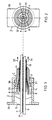
- Figure 1 shows a receiving arrangement for a cable end piece 1, which is inserted into an inlet opening 2 of a cup-shaped, cylindrical container 3.
- the cable sheath 4 of the cable end piece 1 is removed in the front area, so that signal conductors 5, 6 in the form of optical fibers and ends 8 of strand-like strain relief elements 10 (aramid fibers) are free.
- the container has an outlet opening 12 which is aligned with the inlet opening 2 and from which the signal conductors 5, 6 exit.
- a potting compound 14 is introduced into the container, which preferably consists of a cured two-component epoxy resin or a light-activatable and / or light-curable resin system.
- the potting compound 14 surrounds the signal conductors 5, 6, the ends 8 of the strain relief elements 10 and the cable sheath 4. From the free ends of the signal conductors 5, 6, a sleeve-like expansion body (expansion sleeve) 20 partially fuses into the ends 8 of the strain relief elements 10 End 21 of the cable jacket 4 introduced.
- the expansion sleeve 20 is dimensioned such that it widens the cable jacket 4 beyond the cross section of the inlet opening 2.
- the container 3 is made of transparent material when a light-curable resin system is used as the potting compound 14. In this case, the potting compound 14 can be exposed to light radiation on all sides to accelerate the curing.
- the expansion sleeve 20 then preferably also consists of a transparent material, so that the casting compound located between the expansion sleeve and the signal conductor 5, 6 also hardens completely.
- FIG. 2 shows an oval configuration of the hollow cross section 30 of the expansion sleeve 20 in a frontal view, with partial omission of the casting compound 14.
- the ends 8 of the strain relief fibers are evenly fanned out in the casting compound 14 and thus ensure a homogeneous absorption of tensile forces.
- the inlet opening 2 has a toothed inner contour 32 which is pressed into the material of the cable jacket 4. For this purpose, a slight pull can be exerted on the cable sheath 4 in the direction of the arrows 33, 34 (FIG. 1) during installation after the expansion sleeve 20 has been introduced.
- the container inner wall 38 extending in the axial direction 35 of the cable end piece 1 is roughened or profiled in order to be able to absorb shear forces acting on the cable sheath 4.
- a flange 39 is used for the torsion-proof, axially fixed fixing of the container 3.
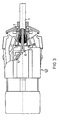
- Figure 3 shows the receiving arrangement shown in Figures 1 and 2, which is inserted into a duplex connector housing 40.
- the receiving arrangement is fixed with its flange 39 in corresponding recesses 41 of the housing 40, so that the cable end piece 1 is fixed against rotation with respect to the housing 40.
- the mounting arrangement can also be used, for example, in a simplex connector, in a device housing or in a distributor.
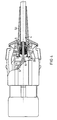
- FIG. 4 shows an alternative embodiment of a receiving arrangement according to the invention, corresponding elements already shown in FIGS. 1 and 2 being provided with the same reference numerals.
- the cable end piece 1, the cable sheath 4 of which is partially removed, is received in a container 50, the inlet opening 51 of which is surrounded by an extending anti-kink sleeve 52.
- the kink protection sleeve 52 is an integral part of the container 50.
- the container 50 can consist of a two-component plastic part, so that the front receiving area 54 can be independently optimized with regard to its strength and the area of the kink protection sleeve 52 with regard to its flexibility. If the container 50 consists of a homogeneous, elastic material, corresponding webs 55, 56 can be provided in the housing, which secure the area 54 of the container against being pulled out.
- a cable end piece with a low need for individual parts is fixed in a technically simple manner with reliable absorption of tensile forces, shear forces and torsional loads with simultaneous axial fixing of the signal conductors and kink protection of the cable sheath.
Landscapes
- Physics & Mathematics (AREA)
- General Physics & Mathematics (AREA)
- Optics & Photonics (AREA)
- Optical Couplings Of Light Guides (AREA)
- Light Guides In General And Applications Therefor (AREA)
- Cable Accessories (AREA)
- Mechanical Coupling Of Light Guides (AREA)
- Details Of Connecting Devices For Male And Female Coupling (AREA)
Abstract
Description
- Die Erfindung betrifft eine Aufnahmeanordnung für ein Kabel-Endstück, dessen Kabelmantel unter Freigabe mindestens eines Signalleiters, insbesondere eines Lichtwellenleiters, und dem Ende einer Zugentlastung endseitig teilweise entfernt ist,
- mit einem Behälter mit einer Eintrittsöffnung, in die das Kabel-Endstück eingeführt ist, und mit einer Austrittsöffnung, durch die zumindest der Signalleiter austritt,
- und mit in den Behälter eingebrachter Vergußmasse, die den Signalleiter, die Enden der Zugentlastung und den Kabelmantel umgibt.
- Zum Schutz von Kabelverbindungen gegen äußere Zugbelastungen ist es bekannt (US-PS 4,319,802; US-PS 4,447,120), Kabel-Endstücke von dem Kabelmantel zu befreien und das Ende einer in dem Kabel enthaltenen Zugentlastung durch Crimpen (beispielsweise auf einer Metallhülse) festzulegen. Der Signalleiter, insbesondere knickempfindliche Lichtwellenleiter, ist jedoch dabei weiterhin äußeren Schubbeeinflussungen ausgesetzt. Die Crimpung kann eine homogene Kraftleitung nicht gewährleisten; vielmehr übertragen insbesondere bei einer faserförmigen Zugentlastung einige Fasern einen überproportionalen Anteil der Kräfte. Der Kabelmantel ist gesondert gegen torsionsbedingte Drehungen zu sichern.
- Aus der US-PS 4,984,865 ist eine Aufnahmeanordnung für ein Kabel-Endstück bekannt, dessen Kabelmantel unter Freigabe eines Lichtwellenleiterendes und den Enden einer strangförmigen Zugentlastung (Aramid-Fasern) endseitig teilweise entfernt ist. Das Endstück ist in ein Steckverbindergehäuse eingeführt, in das ein Thermoplast eingebracht ist. Eine bei hohen Zugkräften sichere Festlegung des Kabelmantels und eine symmetrische Verteilung der Fasern ist bei der bekannten Aufnahmeanordnung nicht gewährleistet; es besteht die Gefahr, daß die Fasern beim Einspritzen oder Anschmelzen des in Granulatform eingebrachten Thermoplasten unkontrolliert zusammenfallen.
- Die DE-OS-38 20 950 beschreibt eine Aufnahmeanordnung der eingangs genannten Art, die hinsichtlich der Problematik der symmetrischen Festlegung der Zugentlastung verbessert ist. Das unter Freigabe eines Lichtwellenleiters und den Enden einer strangförmigen Zugentlastung (Aramid-Fasern) endseitig teilweise vom Kabelmantel befreite Kabel-Endstück ist durch eine Eintrittsöffnung in einen Behälter eingeführt. Der Lichtwellenleiter tritt aus einer Austrittsöffnung des Behälters aus. Nach Einführen des Kabel-Endstücks wird ein spritzbarer, erhärtender oder erhärtbarer Werkstoff in flüssiger Form vor den freiliegenden Enden der Fasern in den Behälter eingespritzt. Die Herstellung dieser bekannten Aufnahmeanordnung ist verhältnismäßig aufwendig, da eine Spritzgußmaschine erforderlich ist. Der mit etwa 200 °C eingespritzte Werkstoff stellt für den temperaturempfindlichen Lichtwellenleiter eine starke thermische Belastung dar. Das mit dem Einspritzen angestrebte schirmartige Aufwehen der Zugentlastungsenden ist in der Praxis nicht immer gewährleistet; eine inhomogene Kraftverteilung auf die Zugentlastungsenden kann zum Reißen einzelner Zugentlastungsfasern führen.
- Bei der bekannten Aufnahmeanordnung ist der Kabelmantel gegenüber dem Behälter nicht verdrehsicher gelagert. Eine besondere Gefahr bei Zugeinwirkung auf den Mantel besteht darin, daß der Mantel vergleichsweise einfach aus dem Vergußwerkstoff herausziehbar ist. In der DE-OS-38 20 950 ist ein Knickschutz (Einhaltung von Mindestbiegeradien) für das Kabel-Endstück nicht angesprochen.
- Die Aufgabe der Erfindung besteht daher in der Schaffung einer Aufnahmeanordnung mit einem möglichst umfassenden Schutz des Kabel-Endstücks und des Signalleiters vor äußeren Belastungen, insbesondere vor Zug- Schub- und Torsionsbelastungen.
- Diese Aufgabe wird erfindungsgemäß bei einer Aufnahmeanordnung der eingangs genannten Art durch die Merkmale der Anspruchs 1 gelöst.
- Ein wesentlicher Vorteil der Erfindung ist darin zu sehen, daß neben dem Behälter nur ein weiteres, äußerst preiswertes Bauteil (Spreizkörper) notwendig ist, um der erfindungsgemäßen Aufnahmeanordnung im Vergleich zu der aus der DE-OS-38 20 950 bekannten Aufnahmeanordnung eine äußerst hohe Widerstandsfähigkeit gegen äußere Belastungen zu verleihen. Der Spreizkörper weitet den Kabelmantel so, daß dessen Querschnitt zumindest an einer Stelle größer als der Eintrittsöffnungs-Querschnitt ist; dadurch ist das Kabelmantelende auch bei hohen Zugkräften in dem Behälter sicher festgelegt. Der Spreizkörper fächert die Zugentlastungsenden in einem vorgegebenen Winkel von der Kabelachse gleichförmig auf. Nach Aushärtung der Vergußmasse tragen die einzelnen Enden der Zugentlastung gleichförmig zur Kraftübertragung bei. Die Vergußmasse ist daher - im Gegensatz zu der Vergußmasse bei der bekannten Aufnahmeanordnung (DE-OS-38 20 950) - allein hinsichtlich ihrer Fixierungswirkung optimierbar. Bevorzugt ist der Spreizkörper hülsenartig (als Spreizhülse) ausgebildet.
- Eine bevorzugte Ausgestaltung der Erfindung sieht vor, daß die Vergußmasse ein lichtaktivierbares oder lichthärtbares Harzsystem ist. Derartige bekannte Harzsysteme (z. B. das unter dem Handelsnamen DELO-DFA939 der Fa. DELO bekannte lichtaktivierbare oder das unter dem Handelsnamen LCR0607 der Fa. ICI bekannte lichthärtbare Harzsystem) erlauben eine gezielte Aktivierung des Verguß-Materials. Das lichtaktivierbare Harzsystem kann zur Aktivierung an einer Lichtquelle vorbeigeführt und anschließend in den Behälter eingebracht werden, wo die aktivierte Polymerisation stattfindet. Diese Harzsysteme härten äußerst schnell aus, so daß die Fertigungstaktzeiten erheblich verkürzt werden können. Diese Harzsysteme und auch Zwei-Komponenten-Epoxi-Harze können besonders vorteilhaft bei der Feldmontage verwendet werden.
- Um bei Verwendung lichtaktivierbarer oder lichthärtbarer Harzsysteme eine besonders gute, allseitige Aushärtung zu erreichen, ist bevorzugt vorgesehen, daß der Behälter aus transparentem Material besteht. In diesem Zusammenhang ist es für die Aushärtung des signalleiternahen Harzmaterials vorteilhaft, wenn die Spreizhülse aus transparentem Material besteht.
- Eine hinsichtlich der Festlegung mehrerer Signalleiter vorteilhafte Ausgestaltung der Aufnahmeanordnung sieht vor, daß der Spreizkörper (die Spreizhülse) einen innen im wesentlichen ovalen Hohlquerschnitt aufweist.
- Um die Verdrehsicherheit des Kabelmantels relativ zum Behälter weiter zu erhöhen, sieht eine vorteilhafte Ausgestaltung der Erfindung vor, daß die Eintrittsöffnung eine profilierte, vorzugsweise gezahnte, Innen-Kontur aufweist, die sich in das Material des Kabelmantels eindrückt.
- Um eine Festlegung auch gegen auf den Mantel einwirkende äußere Schubkräfte zu ermöglichen, sieht eine vorteilhafte Weiterbildung der Erfindung vor, daß zumindest eine in Axialrichtung des Kabel-Endstücks verlaufende Behälterinnenwand aufgerauht und/oder profiliert ist.
- Eine weitere vorteilhafte Fortbildung der Erfindung besteht darin, daß die Eintrittsöffnung von einer Knickschutztülle umgeben ist, die sich von der Eintrittsöffnung des Behälters wegerstreckt und die integraler Bestandteil des Behälters ist. Dadurch ist für einen ausreichenden Knickschutz des Kabel-Endstücks kein zusätzlich zu handhabendes Bauteil erforderlich. Die Knickschutzhülle kann im Gegensatz zum übrigen Behälter aus einem nichttransparenten und elastischen Material bestehen, indem der Behälter beispielsweise ein Zwei-Komponenten-Kunststoffteil ist.
- Die Erfindung wird nachfolgend anhand einer Zeichnung beispielhaft näher erläutert. Es zeigen:
- Figur 1 einen Schnitt durch eine erfindungsgemäße Aufnahmeanordnung,
- Figur 2 eine Ansicht der Aufnahmeanordnung gemäß Figur 1,
- Figur 3 einen Duplex-Stecker mit einer Aufnahmeanordnung und
- Figur 4 einen Duplex-Stecker mit einem zweiten Ausführungsbeispiel einer erfindungsgemäßen Aufnahmeanordnung.
- Figur 1 zeigt eine Aufnahmeanordnung für ein Kabel-Endstück 1, das in eine Eintrittsöffnung 2 eines topfförmigen, zylindrischen Behälters 3 eingeführt ist. Der Kabelmantel 4 des Kabel-Endstücks 1 ist im vorderen Bereich entfernt, so daß Signalleiter 5, 6 in Form von Lichtwellenleitern und Enden 8 strangförmiger Zugentlastungselemente 10 (Aramid-Fasern) frei sind. Der Behälter hat eine mit der Eintrittsöffnung 2 fluchtende Austrittsöffnung 12, aus der die Signalleiter 5, 6 austreten. In den Behälter ist eine Vergußmasse 14 eingebracht, die vorzugsweise aus einem ausgehärteten Zwei-Komponenten-Epoxiharz oder einem lichtaktivierbaren und/oder lichtaushärtbaren Harzsystem besteht. Die Vergußmasse 14 umgibt die Signalleiter 5, 6, die Enden 8 der Zugentlastungselemente 10 und den Kabelmantel 4. Von den freien Enden der Signalleiter 5, 6 her ist ein hülsenartiger Spreizkörper (Spreizhülse) 20 unter Auffächerung der Enden 8 der Zugentlastungselemente 10 teilweise in das Ende 21 des Kabelmantels 4 eingeführt. Die Spreizhülse 20 ist so bemessen, daß sie den Kabelmantel 4 über den Querschnitt der Eintrittsöffnung 2 hinaus aufweitet. Der Behälter 3 besteht aus transparentem Material, wenn ein lichthärtbares Harzsystem als Vergußmasse 14 verwendet wird. In diesem Fall kann die Vergußmasse 14 allseitig Lichteinstrahlung zur Beschleunigung der Aushärtung ausgesetzt werden. Vorzugsweise besteht dann auch die Spreizhülse 20 aus einem transparentem Material, so daß auch die zwischen Spreizhülse und Signalleiter 5, 6 befindliche Vergußmasse schnell und vollständig aushärtet.
- Figur 2 zeigt in stirnseitiger Ansicht unter teilweiser Weglassung der Vergußmasse 14 eine ovale Ausgestaltung des Hohlquerschnitts 30 der Spreizhülse 20. Die Enden 8 der Zugentlastungsfasern sind gleichmäßig in der Vergußmasse 14 aufgefächert enthalten und gewährleisten so eine homogene Aufnahme von Zugkräften. Die Eintrittsöffnung 2 hat eine gezahnte Innenkontur 32, die sich in das Material des Kabelmantels 4 eindrückt. Dazu kann während der Montage nach Einbringen der Spreizhülse 20 ein leichter Zug auf dem Kabelmantel 4 in Richtung der Pfeile 33, 34 (Figur 1) ausgeübt werden.
- Die in Axialrichtung 35 des Kabel-Endstücks 1 verlaufende Behälterinnenwand 38 ist aufgerauht oder profiliert, um auf den Kabelmantel 4 wirkende Schubkräfte aufnehmen zu können. Ein Flansch 39 dient zur verdrehsicheren, axialfixierten Festlegung des Behälters 3.
- Figur 3 zeigt die in den Figuren 1 und 2 dargestellte Aufnahmeanordnung, die in ein Duplex-Steckergehäuse 40 eingesetzt ist. Die Aufnahmeanordnung ist mit ihrem Flansch 39 in entsprechenden Ausnehmungen 41 des Gehäuses 40 fixiert, so daß das Kabel-Endstück 1 gegenüber dem Gehäuse 40 verdrehsicher fixiert ist. Selbstverständlich kann die Aufnahmeanordnung auch z B. in einen Simplex-Stecker, in ein Gerätegehäuse oder in einen Verteiler eingesetzt werden.
- Figur 4 zeigt eine alternative Ausgestaltung einer erfindungsgemäßen Aufnahmeanordnung, wobei in den Figuren 1 und 2 bereits gezeigte, entsprechende Elemente mit denselben Bezugszeichen versehen sind. Das Kabel-Endstück 1, dessen Kabelmantel 4 teilweise entfernt ist, ist von einem Behälter 50 aufgenommen, dessen Eintrittsöffnung 51 von einer sich wegerstreckenden Knickschutztülle 52 umgeben ist. Die Knickschutztülle 52 ist integraler Bestandteil des Behälters 50. Der Behälter 50 kann aus einem Zwei-Komponenten-Kunststoffteil bestehen, so daß der vordere Aufnahmebereich 54 hinsichtlich seiner Festigkeit und der Bereich der Knickschutztülle 52 hinsichtlich seiner Nachgiebigkeit unabhängig optimierbar sind. Wenn der Behälter 50 aus einem homogenen, elastischen Material besteht, können in dem Gehäuse entsprechende Stege 55, 56 vorgesehen sein, die den Bereich 54 des Behälters gegen ein Herausziehen sichern.
- Mit der vorliegenden Erfindung wird ein Kabel-Endstück mit einem geringen Bedarf an Einzelteilen in fertigungstechnisch einfacher Weise unter zuverlässiger Aufnahme von Zug-Kräften, Schubkräften und Torsionsbelastungen bei gleichzeitiger Axialfixierung der Signalleiter und einem Knickschutz des Kabelmantels festgelegt.
Claims (8)
- Aufnahmeanordnung mit einem Kabel-Endstück (1) das aus mindestens einem Signalleiter (5,6), insbesondere einem Lichtwellenleiter, und diese(n) umgebauden strangförmigen Zugentlastungselementen 10, die von einem Kabelmantel (4) umhüllt sind, besteht wobei der Kabelmantel (4) unter Freigabe des mindestens einen Signalleiters (5, 6), insbesondere des Lichtwellenleiters, und den Enden (8) der strangförmigen Zugentlastungselemente (10) endseitig teilweise entfernt ist,- mit einem Behälter (3)-- mit einer Eintrittsöffnung (2), in die das Kabel-Endstück eingeführt ist,-- und mit einer Austrittsöffnung (12), durch die zumindest der Signalleiter (5, 6) austritt,- und mit in den Behälter (3) eingebrachter Vergußmasse (14), die den Signalleiter (5, 6), die Enden (8) der Zugentlastungselemente (10) und den Kabelmantel (4) umgibt,dadurch gekennzeichnet, daß
ein Spreizkörper (20) unter Auffächerung der Enden (8) der Zugentlastungselemente (10) zumindest teilweise in das Kabelmantelende (21) eingeführt ist und daß der Spreizkörper (20) derart bemessen ist, daß sich der Kabelmantel (4) im Querschnitt über den Querschnitt der Eintrittsöffnung (2) hinaus aufweitet. - Aufnahmeanordnung nach Anspruch 1,
dadurch gekennzeichnet, daß
die Vergußmasse (14) ein lichtaktivierbares oder lichthärtbares Harzsystem ist. - Aufnahmeanordnung nach Anspruch 2,
dadurch gekennzeichnet, daß
der Behälter (3) aus transparentem Material besteht. - Aufnahmeanordnung nach Anspruch 2 oder 3,
dadurch gekennzeichnet, daß
der Spreizkörper (20) aus transparentem Material besteht. - Aufnahmeanordnung nach einem der vorangehenden Ansprüche,
dadurch gekennzeichnet, daß
der Spreizkörper (20) einen innen im wesentlichen ovalen Hohlquerschnitt (30) aufweist. - Aufnahmeanordnung nach einem der vorangehenden Ansprüche,
dadurch gekennzeichnet, daß
die Eintrittsöffnung (2) eine profilierte, vorzugsweise gezahnte, Innen-Kontur (32) aufweist, die sich in das Material des Kabelmantels (4) eindrückt. - Aufnahmeanordnung nach einem der vorangehenden Ansprüche,
dadurch gekennzeichnet, daß
zumindest eine in Axialrichtung (35) des Kabel-Endstücks (1) verlaufende Behälterinnenwand (38) aufgerauht und/oder profiliert ist. - Aufnahmeanordnung nach einem der vorangehenden Ansprüche,
dadurch gekennzeichnet, daß
die Eintrittsöffnung (51) von einer Knickschutztülle (52) umgeben ist, die sich von der Eintrittsöffnung (51) des Behälters (50) wegerstreckt und die die integraler Bestandteil des Behälters (50) ist.
Applications Claiming Priority (3)
| Application Number | Priority Date | Filing Date | Title |
|---|---|---|---|
| DE4303737A DE4303737C2 (de) | 1993-02-03 | 1993-02-03 | Aufnahmeanordnung für ein Kabel-Endstück |
| DE4303737 | 1993-02-03 | ||
| PCT/DE1994/000118 WO1994018585A1 (de) | 1993-02-03 | 1994-02-01 | Aufnahmeanordnung für ein kabel-endstück |
Publications (2)
| Publication Number | Publication Date |
|---|---|
| EP0682777A1 EP0682777A1 (de) | 1995-11-22 |
| EP0682777B1 true EP0682777B1 (de) | 1997-07-23 |
Family
ID=6479982
Family Applications (1)
| Application Number | Title | Priority Date | Filing Date |
|---|---|---|---|
| EP94906840A Expired - Lifetime EP0682777B1 (de) | 1993-02-03 | 1994-02-01 | Aufnahmeanordnung für ein kabel-endstück |
Country Status (5)
| Country | Link |
|---|---|
| US (1) | US5574819A (de) |
| EP (1) | EP0682777B1 (de) |
| JP (1) | JPH08506190A (de) |
| DE (2) | DE4303737C2 (de) |
| WO (1) | WO1994018585A1 (de) |
Families Citing this family (20)
| Publication number | Priority date | Publication date | Assignee | Title |
|---|---|---|---|---|
| US5425121A (en) | 1994-02-02 | 1995-06-13 | Siecor Corporation | Cable assembly for use with opto-electronic equipment enclosures |
| US5416874A (en) * | 1994-07-01 | 1995-05-16 | Siecor Corporation | Optical receiver stub fitting |
| DE19541139C1 (de) * | 1995-10-27 | 1997-05-15 | Siemens Ag | Aufnahmeanordnung und Verfahren zum Herstellen einer Aufnahmeanordnung für mindestens einen umhüllten Lichtwellenleiter |
| DE19630546C1 (de) * | 1996-07-17 | 1998-02-12 | Siemens Ag | Optisches Steckerteil und Verfahren zum Herstellen eines optischen Steckerteils |
| DE19905246C1 (de) * | 1999-02-02 | 2000-11-30 | Siemens Ag | Abschlußanordnung für ein Ende eines optischen Kabels |
| DE19905244C2 (de) | 1999-02-02 | 2002-09-19 | Infineon Technologies Ag | Halter |
| AU5522700A (en) | 1999-07-23 | 2001-02-13 | Nkt Flexibles I/S | A method of securing reinforcement wires to an end termination of a pipeline or a cable, an end termination, and uses of the method and the end termination |
| DE10001680C1 (de) | 2000-01-12 | 2001-08-23 | Infineon Technologies Ag | Mehrkanalige optische Koppelanordnung |
| US20040008949A1 (en) * | 2002-06-21 | 2004-01-15 | Gang Liu | Fiber optic connection system and method of using the same |
| US7239949B2 (en) | 2003-02-26 | 2007-07-03 | Ford Global Technologies, Llc | Integrated sensing system |
| DE102005005216A1 (de) * | 2005-02-03 | 2006-08-10 | Neutrik Aktiengesellschaft | Knickschutzeinrichtung |
| US7590481B2 (en) | 2005-09-19 | 2009-09-15 | Ford Global Technologies, Llc | Integrated vehicle control system using dynamically determined vehicle conditions |
| DE102008022908B4 (de) * | 2008-05-09 | 2014-11-27 | Yamaichi Electronics Deutschland Gmbh | Anschlußdose, Verwendungen einer Anschlußdose und Verfahren |
| DE102008002616A1 (de) * | 2008-06-24 | 2009-12-31 | Robert Bosch Gmbh | Kabeltülle für Handwerkzeugmaschine |
| WO2010039830A2 (en) * | 2008-09-30 | 2010-04-08 | Corning Cable Systems Llc | Fiber optic cable assemblies and securing methods |
| US8285096B2 (en) | 2008-09-30 | 2012-10-09 | Corning Cable Systems Llc | Fiber optic cable assemblies and securing methods |
| JP5615795B2 (ja) * | 2011-12-08 | 2014-10-29 | 第一精工株式会社 | 電気コネクタ |
| US9551598B2 (en) | 2014-05-12 | 2017-01-24 | Siemens Energy, Inc. | Fiber optic sensing apparatus with an improved fiber-affixing device |
| DE102014110600A1 (de) * | 2014-07-28 | 2016-01-28 | Atlas Elektronik Gmbh | Lichtwellenleiterkabel, Wickel, Fahrzeug und Fahrzeugkombination |
| US9769551B2 (en) | 2014-12-31 | 2017-09-19 | Skullcandy, Inc. | Method of connecting cable to headphone, and headphone formed using such methods |
Family Cites Families (10)
| Publication number | Priority date | Publication date | Assignee | Title |
|---|---|---|---|---|
| FR1247410A (fr) * | 1959-10-20 | 1960-12-02 | Comp Generale Electricite | Mode de montage, dans un dispositif d'ancrage, de la tresse extérieure d'un conducteur électrique isolé |
| GB2030723B (en) * | 1978-10-03 | 1983-02-02 | Standard Telephones Cables Ltd | Fibre-optic cable joints |
| US4319802A (en) * | 1979-10-17 | 1982-03-16 | Bunker Ramo Corporation | Stain relief for fiber optic connectors |
| JPS5811906A (ja) * | 1981-07-16 | 1983-01-22 | Furukawa Electric Co Ltd:The | Frp被覆光フアイバ心線入りノンメタル光ケ−ブルの引止め部 |
| US4447120A (en) * | 1981-10-05 | 1984-05-08 | International Telephone & Telegraph Corporation | Fiber optic cable clamp |
| US4708428A (en) * | 1985-04-18 | 1987-11-24 | Siemens Aktiengesellschaft | Light waveguide connector |
| DE3820950A1 (de) * | 1988-06-16 | 1989-12-21 | Siemens Ag | Verfahren zum befestigen einer kabelverstaerkung |
| US4948222A (en) * | 1988-12-05 | 1990-08-14 | Aster Corporation | Optical fiber unit assembly package |
| US4984865A (en) * | 1989-11-17 | 1991-01-15 | Minnesota Mining And Manufacturing Company | Thermoplastic adhesive mounting apparatus and method for an optical fiber connector |
| US5418874A (en) * | 1994-01-19 | 1995-05-23 | At&T Corp. | Force transfer system for an optical fiber connector |
-
1993
- 1993-02-03 DE DE4303737A patent/DE4303737C2/de not_active Expired - Fee Related
-
1994
- 1994-02-01 WO PCT/DE1994/000118 patent/WO1994018585A1/de not_active Ceased
- 1994-02-01 US US08/495,555 patent/US5574819A/en not_active Expired - Fee Related
- 1994-02-01 DE DE59403462T patent/DE59403462D1/de not_active Expired - Fee Related
- 1994-02-01 EP EP94906840A patent/EP0682777B1/de not_active Expired - Lifetime
- 1994-02-01 JP JP6517523A patent/JPH08506190A/ja active Pending
Also Published As
| Publication number | Publication date |
|---|---|
| WO1994018585A1 (de) | 1994-08-18 |
| EP0682777A1 (de) | 1995-11-22 |
| DE59403462D1 (de) | 1997-08-28 |
| DE4303737C2 (de) | 1995-12-07 |
| JPH08506190A (ja) | 1996-07-02 |
| DE4303737A1 (de) | 1994-08-04 |
| US5574819A (en) | 1996-11-12 |
Similar Documents
| Publication | Publication Date | Title |
|---|---|---|
| EP0682777B1 (de) | Aufnahmeanordnung für ein kabel-endstück | |
| DE19737427C2 (de) | Endstück für ein Lichtwellenleiterkabel | |
| DE69326709T2 (de) | Optischer Faserverbinder | |
| DE2943180C2 (de) | Lichtleiter-Steckverbinder | |
| DE60309034T2 (de) | System zum abschluss optischer fasern in einem faseroptischen steckverbinder | |
| DE3838075C1 (de) | ||
| DE102008044938B4 (de) | Verfahren zur Terminierung von lichtleitenden Faserbündeln sowie Hülse mit einem Faserbündel | |
| DE2512330B2 (de) | Steckverbindung für ummantelte Lichtleitfasern aus Quarzglas oder Glas | |
| EP0857312B1 (de) | Aufnahmeanordnung und verfahren zum herstellen einer aufnahmeanordnung für mindestens einen umhüllten lichtwellenleiter | |
| DE69512385T2 (de) | Kabelweganordnung | |
| WO1995007479A1 (de) | Steckverbinder | |
| DE69116246T2 (de) | Zugentlasteter Stecker für optische Fasern | |
| DE2722612A1 (de) | Verbindung fuer lichtleitfasern mit schutzummantelung | |
| DE10003481B4 (de) | Lichtleiterbündel für ein Endoskop | |
| DE4221040C2 (de) | Verfahren zur Herstellung eines Lichtwellenleitersteckers | |
| CH681329A5 (de) | ||
| DE102006046181B4 (de) | Zugentlastungsvorrichtung für ein Glasfaserkabel | |
| DE4341481C2 (de) | Verzweigungseinrichtung | |
| EP0369558B1 (de) | Verfahren zur Fixierung von Lichtwellenleitern in einem Steckergehäuse | |
| DE60128360T2 (de) | Verfahren zur Kopplung einer optischen Faser an einen optischen Chip | |
| DE2541247A1 (de) | Kupplungselement zum verbinden eines optischen uebertragungselementes und eines aktiven oder passiven optoelektrischen elementes | |
| EP2018583B1 (de) | Steckverbinder mit vorrichtung zur kompensation von längenausdehnungen eines lichtwellenleiters | |
| DE3842368A1 (de) | Loesbare steckverbindung zum koppeln von zwei lichtwellen-leitern | |
| DE69103988T2 (de) | Mechanische Brecheinrichtung für Zugangskabel zu einem Unterwassergehäuse von Einrichtungen. | |
| EP0175107A1 (de) | Vorrichtung zur Halterung von zwei durch einen Spleiss miteinander verbundenen Lichtwellenleiter |
Legal Events
| Date | Code | Title | Description |
|---|---|---|---|
| PUAI | Public reference made under article 153(3) epc to a published international application that has entered the european phase |
Free format text: ORIGINAL CODE: 0009012 |
|
| 17P | Request for examination filed |
Effective date: 19950720 |
|
| AK | Designated contracting states |
Kind code of ref document: A1 Designated state(s): DE FR GB NL SE |
|
| GRAG | Despatch of communication of intention to grant |
Free format text: ORIGINAL CODE: EPIDOS AGRA |
|
| 17Q | First examination report despatched |
Effective date: 19961023 |
|
| GRAH | Despatch of communication of intention to grant a patent |
Free format text: ORIGINAL CODE: EPIDOS IGRA |
|
| GRAH | Despatch of communication of intention to grant a patent |
Free format text: ORIGINAL CODE: EPIDOS IGRA |
|
| GRAA | (expected) grant |
Free format text: ORIGINAL CODE: 0009210 |
|
| AK | Designated contracting states |
Kind code of ref document: B1 Designated state(s): DE FR GB NL SE |
|
| REF | Corresponds to: |
Ref document number: 59403462 Country of ref document: DE Date of ref document: 19970828 |
|
| ET | Fr: translation filed | ||
| GBT | Gb: translation of ep patent filed (gb section 77(6)(a)/1977) |
Effective date: 19970905 |
|
| PG25 | Lapsed in a contracting state [announced via postgrant information from national office to epo] |
Ref country code: SE Effective date: 19971023 |
|
| PLBE | No opposition filed within time limit |
Free format text: ORIGINAL CODE: 0009261 |
|
| STAA | Information on the status of an ep patent application or granted ep patent |
Free format text: STATUS: NO OPPOSITION FILED WITHIN TIME LIMIT |
|
| 26N | No opposition filed | ||
| REG | Reference to a national code |
Ref country code: GB Ref legal event code: IF02 |
|
| PGFP | Annual fee paid to national office [announced via postgrant information from national office to epo] |
Ref country code: NL Payment date: 20020218 Year of fee payment: 9 |
|
| PG25 | Lapsed in a contracting state [announced via postgrant information from national office to epo] |
Ref country code: NL Free format text: LAPSE BECAUSE OF NON-PAYMENT OF DUE FEES Effective date: 20030901 |
|
| NLV4 | Nl: lapsed or anulled due to non-payment of the annual fee |
Effective date: 20030901 |
|
| PGFP | Annual fee paid to national office [announced via postgrant information from national office to epo] |
Ref country code: FR Payment date: 20060216 Year of fee payment: 13 |
|
| PGFP | Annual fee paid to national office [announced via postgrant information from national office to epo] |
Ref country code: GB Payment date: 20060221 Year of fee payment: 13 |
|
| PGFP | Annual fee paid to national office [announced via postgrant information from national office to epo] |
Ref country code: DE Payment date: 20060407 Year of fee payment: 13 |
|
| GBPC | Gb: european patent ceased through non-payment of renewal fee |
Effective date: 20070201 |
|
| REG | Reference to a national code |
Ref country code: FR Ref legal event code: ST Effective date: 20071030 |
|
| PG25 | Lapsed in a contracting state [announced via postgrant information from national office to epo] |
Ref country code: DE Free format text: LAPSE BECAUSE OF NON-PAYMENT OF DUE FEES Effective date: 20070901 |
|
| PG25 | Lapsed in a contracting state [announced via postgrant information from national office to epo] |
Ref country code: GB Free format text: LAPSE BECAUSE OF NON-PAYMENT OF DUE FEES Effective date: 20070201 Ref country code: FR Free format text: LAPSE BECAUSE OF NON-PAYMENT OF DUE FEES Effective date: 20070228 |