EP0682547B1 - Playing structure - Google Patents
Playing structure Download PDFInfo
- Publication number
- EP0682547B1 EP0682547B1 EP94906108A EP94906108A EP0682547B1 EP 0682547 B1 EP0682547 B1 EP 0682547B1 EP 94906108 A EP94906108 A EP 94906108A EP 94906108 A EP94906108 A EP 94906108A EP 0682547 B1 EP0682547 B1 EP 0682547B1
- Authority
- EP
- European Patent Office
- Prior art keywords
- playing
- playing structure
- modules
- orientatable
- structure modules
- Prior art date
- Legal status (The legal status is an assumption and is not a legal conclusion. Google has not performed a legal analysis and makes no representation as to the accuracy of the status listed.)
- Expired - Lifetime
Links
Images






Classifications
-
- A—HUMAN NECESSITIES
- A63—SPORTS; GAMES; AMUSEMENTS
- A63F—CARD, BOARD, OR ROULETTE GAMES; INDOOR GAMES USING SMALL MOVING PLAYING BODIES; VIDEO GAMES; GAMES NOT OTHERWISE PROVIDED FOR
- A63F9/00—Games not otherwise provided for
- A63F9/001—Games or toys connected to, or combined with, other objects; Objects with a second use as a toy or game
-
- A—HUMAN NECESSITIES
- A63—SPORTS; GAMES; AMUSEMENTS
- A63F—CARD, BOARD, OR ROULETTE GAMES; INDOOR GAMES USING SMALL MOVING PLAYING BODIES; VIDEO GAMES; GAMES NOT OTHERWISE PROVIDED FOR
- A63F9/00—Games not otherwise provided for
- A63F9/06—Patience; Other games for self-amusement
- A63F9/12—Three-dimensional [3D] jig-saw puzzles
- A63F9/1204—Puzzles consisting of non-interlocking identical blocks, e.g. children's block puzzles
Definitions
- the present invention relates to children's toys and in particular to a playing structure on which toys may be placed and moved thereon, a storage system for the toys and modules for use in the playing structure.
- Lego® building blocks
- the playing surface referred to above is constituted by a free space on a hardwood floor, an unoccupied table top or desk surface and in some instances the top of a bed.
- Each of these types of playing surfaces when used for play is limited and is inconvenient in some way.
- these playing surfaces do not encourage or suggest directions for a child's fantasy. It is solely up to the child's imagination to transform the otherwise plain surface into one which has a varying topography and landscape.
- US-A-3206887 discloses a children's toy in the form of a pad having a number of pages. Printed on one side of most of the pages in the pad are roadways while on the other pages are representations of vehicles which can be punched out from the pages.
- the pages with roadways printed thereon also have different locations of interest drawn on them and a legend indicating the drawn area of interest.
- the roadways are drawn on the sheets in a manner so that the roadway is continuous when two sheets are properly oriented and placed side by side.
- this object is accomplished in a playing structure ⁇ according to claim 1 ⁇ which supports re-orientatable tops such that the topographical scene depicted is continuous and visually fluid over the upwardly presented playing surfaces of adjacent playing structure modules in its first arrangement and when at least one playing structure module is reversed (preferably along its diagonal).
- the three-dimensional topographies on the opposed playing surfaces of the reversible top are generally complementary in configuration.
- the support is preferably in the form of a frame which is open at its sides and which supports a secondary surface below the reversible top.
- the secondary surface is a shelf, to provide storage space for a child's toys after the child has finished playing with the playing structure module.
- the secondary surface constitutes a secondary playing surface and may be reversible to provide secondary playing surfaces with different topographies. In this instance, it is preferred that the reversible top has at least one passage therethrough to permit access to the secondary playing surface.
- the frame and the reversible top have complementary formations thereon to inhibit relative lateral movement between the frame and the reversible top. It is also preferred that the topographies of the playing surfaces are stepped to provide generally planar, horizontal surfaces at different elevations to provide support platforms for a child's toys.
- the reversible top is constituted by a plurality of reversible top elements, each of the top elements including a pair of opposed playing surfaces with the opposed playing surfaces having a different three-dimensional topography and depicting a different landscape, the landscapes on each playing surface being depicted such that the landscape is visually fluid over the entire top when any one or all of the top elements are reversed.
- the topographies on the top elements are configured such that when the top elements are arranged to provide a continuous, visually fluid landscape, the top elements are preferably reversed along a diagonal to create a different continuous, visually fluid landscape.
- retaining means act between the support and the top elements.
- the playing structure modules are arrangeable in arrays of varying configurations to allow different shaped playing surfaces to be created, all with continuous, visually fluid landscapes.
- the topographies on the opposed playing surfaces of the reversible tops are preferably configured such that when the playing structure modules are arranged to provide a continuous, visually fluid landscape, the tops are preferably reversed along a diagonal to create a different continuous, visually fluid landscape. It is preferred that the tops must be reversed along a North-West, South-East diagonal to create a different continuous, visually fluid landscape.
- the playing structure modules are formed in sets with each set depicting a unique setting. It is also preferred that the topographies on the opposed playing surfaces of the reversible tops of the playing structure modules in each set, are configured to permit identical sets of playing structure modules to be arranged in larger arrays while still providing a continuous, visually fluid landscape. It is also preferred that the topographies on the tops of the playing structure modules in each set are configured to permit different sets of playing structure modules to be arranged in larger arrays while still providing a continuous, visually fluid landscape.
- the playing structure modules are stackable when separated from other playing structure modules in the playing structure to facilitate cleaning and storage. It is also preferred that the playing structure modules are stackable to create three dimensional playing structures. In this instance, it is preferred that at least some of the playing structure modules have a secondary playing surface below the reversible top and that at least some of the reversible tops provide access to the secondary playing surfaces via passages formed therethrough. This permits underwater and/or underground landscapes to be created.
- the playing structure modules stacked on top of other playing structure modules are open on their sides to provide free access to the reversible tops on the playing structure modules below them.
- the present invention provides advantages in that the reversible top of each playing structure module allows different landscapes to be created while maintaining the visual fluidity of the overall landscape of the playing structure. Also, because the playing structure modules can be arranged with other playing structure modules, different size landscapes can be created making the variety and size of created landscapes virtually limitless. Because of this, the present invention forms a stage which provides direction and focus for a child's imagination. Also, because the playing surfaces of the playing structure modules are raised from the ground, the playing surfaces are at a convenient physical height for most children. More importantly, the toys placed on the playing structure are raised so that the child's point of view is as if he or she is among them.
- the present invention provides further advantages in that children's toys remain on the playing structure and may be stored on the playing surface or on the storage shelf when the child is finished playing. This avoids the problem associated with children spreading their toys around the household and speeds up the cleaning process significantly. Also, the design of the playing structure modules allows the modules to be stacked facilitating compact storage and house cleaning.
- the module 10 includes a support frame 12 having four upstanding legs 14.
- the support frame 12 is open at its four sides and at its top.
- the open interior of the support frame 12 constitutes a storage area or secondary playing space 16.
- integrally formed blocks 18 which define support surfaces 20.
- On the support surfaces are square projections 22.
- an integrally formed block 24 adapted to support a removeable shelf 26 (see Figure 2).
- a reversible top 60 having playing surfaces 62, 64 on its opposed sides.
- playing surfaces 62, 64 On each playing surface near its four corners are square recesses 66 sized to receive the projections 22 to inhibit the top 60 from sliding when properly positioned on the frame 12.
- Each playing surface 62, 64 includes a multi-coloured, three-dimensional, topographic scene thereon.
- the topographic scenes are suggestive of a predetermined landscape but are not too specific allowing children to get more variety since they can easily redefine the landscapes for their own imaginative purposes.
- the topography on each playing surface 62, 64 is also stepped to provide generally planar, horizontal surfaces at different elevations and to minimize inclined surfaces. This provides playing platforms for miniature people, animals and vehicles used during a child's play.
- the topographic scene on each playing surface 62, 64 is different although they are basically complimentary in configuration.
- the playing surface 62 has a landscape on it which resembles a mountainous terrain.
- the landscape of the topographic scene resembles a terrain which is generally complimentary to that on playing surface 62.
- Other tops 60 may, for example, have ancient ruins on one playing surface 62 and a mountainous road on the opposite playing surface 64.
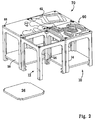
- FIG. 1 shows a playing structure 70 formed from a plurality of playing structure modules 10 arranged to form an array.
- the playing structure modules 10 are made in sets with, in this example, each set including six playing structure modules 10.
- the sets of playing structure modules 10 have different topography designs on their tops 60 and represent different worlds. Therefore, one set of playing structure modules 10 may represent for example, an "Ancient World” while other sets may represent a "Dinosaur World” and a "City World” respectively.
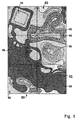
- Figure 3 shows one set of playing structure modules 10 interconnected in a 3 X 2 array to form a playing structure 80 having a visually fluid, continuous landscape.
- the landscape includes a road 82 which winds across four of the playing surfaces 62.
- a platform 84 surrounded by water on one of the playing surfaces provides an ideal location for a toy castle surrounded by a moat.
- a mountain 86 is also provided on one playing surface 62 while a continuous waterway 88 extends across five of the six playing surfaces 62 in the set.
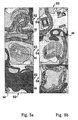
- Figure 4a shows the tops 60 of the playing structure modules 10 forming the first column of the playing structure 80 illustrated in Figure 3 while Figure 4b shows the playing surfaces 64 of the tops 60 of those same playing structure modules 10 which face the shelf 26 and remain unseen.
- Figure 5a shows the tops 60 of the playing structure modules 10 forming the second column of the playing structure illustrated in Figure 3 while Figure 5b shows the playing surfaces 64 of the tops 60 of those same playing structure modules 10 which face the shelf 26 and remain unseen.
- FIG. 6 shows a top plan view of the column of playing structure modules 10 illustrated in Figure 4a with the top 60' of the uppermost playing structure module reversed along a North-West, South-East diagonal.
- the resulting landscape of the three playing structure modules in the column 10 is still continuous and visually fluid although the castle platform 84 has been replaced by a different terrain having roads 90 which extend to islands and terminate at smaller platforms 92.
- FIGs 7a, 7b and 7c show the manner in which the top 60' of the playing structure module 10 is moved to create the landscape illustrated in Figure 6.
- the top 60' of the playing structure module simply needs to be reversed along the North-West, South-East diagonal. This movement of the top is broken down into its constituents in Figures 7b and 7c. Once the top 60' has been reversed along its diagonal, the top 60' can be placed on the frame 12 of the playing structure module and the landscape will still be visually fluid.
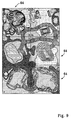
- Figure 8 is a top plan view of the playing structure 80 shown in Figure 3 with the tops 60a and 60b of the playing structure modules reversed along their North-West, South-East diagonal.
- Figure 9 shows the playing structure 80 of Figure 3 with the tops 60 of all of the playing structure modules 10 reversed along their North-West, South-East diagonal.
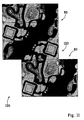
- FIG. 10 shows a top plan view of four identical sets 80 of playing structure modules 10 (the same as the set shown in Figure 3) interconnected to form a larger playing structure 100 while still depicting a continuous, visually fluid landscape.
- two sets of playing structure modules 10 have been rotated 180°.
- the tops 60 of any one of playing structure modules 10 forming the playing structure 100 may be reversed along a diagonal in the manner described previously, to create a new continuous and visually fluid landscape. This allows a significant number of different landscapes to be created and with the addition of more playing structure modules 10 or sets thereof, the variation of potential landscapes is virtually limitless.
- Figure 11 shows a top plan view of yet another larger playing structure 120 formed from a number of playing structure modules.
- playing structure 120 includes two sets 80 of playing structure modules offset with respect to one another and separated by one column 122 of another set 80 of playing structure modules, the column of which is rotated 180° with respect to the other sets of playing structure modules.
- the various playing structure modules 10 in the set simply need to be arranged within the room in which they are located to form a playing structure having the desired configuration.
- the tops 60 of the modules can then be arranged to create a continuous, visually fluid landscape by lifting the tops 60 from the frames 12 and reversing them along a diagonal as desired. Once one continuous, visually fluid landscape has been created, others are possible by reversing any one of tops 60 along a North-West, South-East diagonal.
- the design of the tops 60 facilitate the creation of different landscapes by children using the playing structure.
- toys can be placed on the playing surfaces and moved as desired.
- the varying three-dimensional topography of the individual playing surfaces 62, 64 respectively provides a stage which promotes a child's imagination and entertains them for extended periods of time.
- the toys can be removed from the playing surfaces and stored on the shelf 26 of one or more playing structure modules. If necessary, after a child is finished playing and the toys are stored on a shelf or shelves 26, the playing structure modules 10 can be stacked in a convenient location out of the way. This of course facilitates the cleaning process.
- FIG. 12 an alternative embodiment of an array 200 of playing structure modules is shown.
- the playing structure modules 10'' are stacked not for the purpose of storage, but rather to create a three dimensional playing structure.
- the lower playing structure modules 10'' in the array are basically the same as that shown in Figure 1.
- the shelf 26'' has been replaced with a playing surface 202.
- the playing surface 202 has a three dimensional topography on it which can be arranged to create a visually fluid topographic scene with the playing surfaces 202 on adjacent playing structure modules 10''.
- the playing surface 202 may also be reversible to allow the topography constituted by the playing surfaces 202 to be varied.
- the modules 204 are open on their sides and do not include a shelf. Therefore, when the playing structure modules 204 are placed on top of another module 10'' or 204, the reversible top 60'' on that module is exposed.
- the modules 204 also have projections on the bottom of their legs which are complimentary to the recesses at the corners of the reversible tops 60'' to inhibit lateral movement between stacked modules.
- the modules 204 may also come in different heights to provide a stepped playing surface as illustrated.
- Side panels 206 may be attached to the sides of one or more of the modules 10'' and 204''.
- the playing surfaces 62'', 64'' of the reversible tops 60'' on at least some of the playing structure modules 204 are provided with ladders, trap doors and the like to provide access to the playing surfaces on the playing structure modules below them.
- one of the playing structure modules 204 has a ladder 210 which extends between the different height modules 204.
- passages, trap doors and the like may be formed in the playing surfaces of any of the modules 10'' and 204 respectively. This arrangement of playing structure modules allows alternative themes to be created.
- the playing surfaces 202 and the playing surfaces on the reversible tops 60'' of modules 10'' on which a module 204 is located can be designed to have an underground or underwater theme with the playing surfaces of the uppermost playing structure modules having a ground or sea level theme thereon. If side panels 206 are used, they can be coloured to suit the theme of the playing structure 200.
- the playing structure module 10''' has a reversible top 60''' formed of smaller, reversible top elements 60a.
- Each top element 60a has a playing surface on both of its major sides.
- the reversible top elements 60a can be re-arranged in the same manner as the reversible tops 60 to create different three dimensional topographies on a single playing structure module 10''' of a smaller scale then those of the previous embodiments.
- a retention frame 300 is interposed between frame 14'' and the top elements.
- the topography of the playing structure in combination with the toys a children places thereon suggests directions and presents tensions which children quickly absorb into their play.
- the playing structure changes when different toys are placed on it and are utilized differently by different children.
- the present invention versatile in the sense that the playing surface of the playing structure can be changed but also in that the playing surface of the playing structure changes depending on the types of toys used on it.
- the frame of the playing structure module has been described as being one piece, it should be apparent to one of skill in the art that various frame designs can be used to support the top above the pound while allowing the top to be reversed to change the playing surface. It should also be realized that playing structure modules having reversible tops of different geometric shapes can be provided while ensuring that the topographic design on the playing surfaces of the tops permit playing structures to be placed side by side with the playing surfaces on adjacent playing structures creating a continuous, visually fluid landscape.
Landscapes
- Engineering & Computer Science (AREA)
- Multimedia (AREA)
- Toys (AREA)
- Electrophonic Musical Instruments (AREA)
Abstract
Description
- The present invention relates to children's toys and in particular to a playing structure on which toys may be placed and moved thereon, a storage system for the toys and modules for use in the playing structure.
- Many children's toys are available which allow a child to build structures such as houses and the like and in effect create cities. Of the toys of this nature, one of the most common are building blocks commonly referred to as Lego®. These building blocks are best assembled on a playing surface where the child can move miniature vehicles, people and animals and rearrange the built structures.
- Unfortunately children have very few supportive and convenient places to play with the above type of toys. In most households, the playing surface referred to above is constituted by a free space on a hardwood floor, an unoccupied table top or desk surface and in some instances the top of a bed. Each of these types of playing surfaces when used for play is limited and is inconvenient in some way. Moreover, these playing surfaces do not encourage or suggest directions for a child's fantasy. It is solely up to the child's imagination to transform the otherwise plain surface into one which has a varying topography and landscape.
- Another disadvantage associated with these playing surfaces is that when the child is finished playing, the child's toys remain in the way.
- To alleviate some of the above-mentioned problems, playing surfaces having printed presentations on which toys are to be moved have been considered. For example, US-A-3206887 discloses a children's toy in the form of a pad having a number of pages. Printed on one side of most of the pages in the pad are roadways while on the other pages are representations of vehicles which can be punched out from the pages. The pages with roadways printed thereon also have different locations of interest drawn on them and a legend indicating the drawn area of interest. The roadways are drawn on the sheets in a manner so that the roadway is continuous when two sheets are properly oriented and placed side by side. Although this provides a playing surface with roadways, the surface itself is relatively plain and does not resemble real terrain. In addition, the planar nature of the sheets requires an underlying support and therefore, this toy still suffers from many of the disadvantages discussed previously.
- It is therefore an object of the present invention to provide a novel playing structure having a three-dimensional playing surface which resembles real terrain more closely than prior art playing surfaces and which is changeable to allow different playing surfaces to be created.
- In accordance with the invention, this object is accomplished in a playing structure 〈according to claim 1〉 which supports re-orientatable tops such that the topographical scene depicted is continuous and visually fluid over the upwardly presented playing surfaces of adjacent playing structure modules in its first arrangement and when at least one playing structure module is reversed (preferably along its diagonal).
- The three-dimensional topographies on the opposed playing surfaces of the reversible top are generally complementary in configuration. The support is preferably in the form of a frame which is open at its sides and which supports a secondary surface below the reversible top. In one embodiment, the secondary surface is a shelf, to provide storage space for a child's toys after the child has finished playing with the playing structure module. In another embodiment, the secondary surface constitutes a secondary playing surface and may be reversible to provide secondary playing surfaces with different topographies. In this instance, it is preferred that the reversible top has at least one passage therethrough to permit access to the secondary playing surface.
- In one embodiment, it is preferred that the frame and the reversible top have complementary formations thereon to inhibit relative lateral movement between the frame and the reversible top. It is also preferred that the topographies of the playing surfaces are stepped to provide generally planar, horizontal surfaces at different elevations to provide support platforms for a child's toys.
- The reversible top is constituted by a plurality of reversible top elements, each of the top elements including a pair of opposed playing surfaces with the opposed playing surfaces having a different three-dimensional topography and depicting a different landscape, the landscapes on each playing surface being depicted such that the landscape is visually fluid over the entire top when any one or all of the top elements are reversed. The topographies on the top elements are configured such that when the top elements are arranged to provide a continuous, visually fluid landscape, the top elements are preferably reversed along a diagonal to create a different continuous, visually fluid landscape.
- It is preferred that retaining means act between the support and the top elements.
- The playing structure modules are arrangeable in arrays of varying configurations to allow different shaped playing surfaces to be created, all with continuous, visually fluid landscapes. The topographies on the opposed playing surfaces of the reversible tops are preferably configured such that when the playing structure modules are arranged to provide a continuous, visually fluid landscape, the tops are preferably reversed along a diagonal to create a different continuous, visually fluid landscape. It is preferred that the tops must be reversed along a North-West, South-East diagonal to create a different continuous, visually fluid landscape.
- Preferably, the playing structure modules are formed in sets with each set depicting a unique setting. It is also preferred that the topographies on the opposed playing surfaces of the reversible tops of the playing structure modules in each set, are configured to permit identical sets of playing structure modules to be arranged in larger arrays while still providing a continuous, visually fluid landscape. It is also preferred that the topographies on the tops of the playing structure modules in each set are configured to permit different sets of playing structure modules to be arranged in larger arrays while still providing a continuous, visually fluid landscape.
- Preferably, the playing structure modules are stackable when separated from other playing structure modules in the playing structure to facilitate cleaning and storage. It is also preferred that the playing structure modules are stackable to create three dimensional playing structures. In this instance, it is preferred that at least some of the playing structure modules have a secondary playing surface below the reversible top and that at least some of the reversible tops provide access to the secondary playing surfaces via passages formed therethrough. This permits underwater and/or underground landscapes to be created. Preferably, the playing structure modules stacked on top of other playing structure modules are open on their sides to provide free access to the reversible tops on the playing structure modules below them.
- The present invention provides advantages in that the reversible top of each playing structure module allows different landscapes to be created while maintaining the visual fluidity of the overall landscape of the playing structure. Also, because the playing structure modules can be arranged with other playing structure modules, different size landscapes can be created making the variety and size of created landscapes virtually limitless. Because of this, the present invention forms a stage which provides direction and focus for a child's imagination. Also, because the playing surfaces of the playing structure modules are raised from the ground, the playing surfaces are at a convenient physical height for most children. More importantly, the toys placed on the playing structure are raised so that the child's point of view is as if he or she is among them.
- In addition, the present invention provides further advantages in that children's toys remain on the playing structure and may be stored on the playing surface or on the storage shelf when the child is finished playing. This avoids the problem associated with children spreading their toys around the household and speeds up the cleaning process significantly. Also, the design of the playing structure modules allows the modules to be stacked facilitating compact storage and house cleaning.
- Embodiments of the present invention will now be described more fully with reference to the accompanying drawings in which:
- Figure 1 is a perspective view of a playing structure module with its reversible top lifted therefrom;
- Figure 2 is a perspective view of a playing structure formed from a plurality of playing structure modules of the type shown in Figure 1 arranged in an array;
- Figure 3 is a top plan view of a playing structure formed from an array of six playing structure modules;
- Figure 4a is a top plan view of one column of the array of playing structure modules illustrated in Figure 3;
- Figure 4b is a bottom plan view of the tops of the playing structure modules shown in Figure 4a;
- Figure 5a is a top plan view of the other column of the array of playing structure modules illustrated in Figure 3;
- Figure 5b is a bottom plan view of the tops of the playing structure modules shown in Figure 5a;
- Figure 6 is a top plan view of the column of playing structure modules illustrated in Figure 4a with the top of one of the playing structure modules reversed along a diagonal;
- Figures 7a, 7b and 7c show top plan views of one of the tops of a playing structure module forming part of the playing structure of Figure 3 in a first condition, flipped over along an east-west axis and rotated counter-clockwise by 90° respectively;
- Figure 8 is a top plan view of the playing structure of Figure 3 with the tops of two playing structure modules reversed along a diagonal in the manner shown in Figures 7b and 7c respectively;
- Figure 9 is a top plan view of the playing structure shown in Figure 3 with the tops of all of the playing structure modules reversed along a diagonal;
- Figure 10 is a top plan view of a playing structure formed from four arrays of playing structures similar to those shown in Figure 3;
- Figure 11 is a top plan view of a playing structure formed from an alternative arrangement of a number of arrays of playing structures similar to those shown in Figure 3;
- Figure 12 is a perspective view of another embodiment of a playing structure formed from a plurality of playing structure modules; and
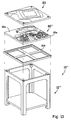
- Figure 13 is an exploded perspective view of yet another embodiment of a playing structure module.
-
- Referring now to Figure 1, a playing structure module is shown and is generally indicated by
reference numeral 10. Themodule 10 includes asupport frame 12 having fourupstanding legs 14. Thesupport frame 12 is open at its four sides and at its top. The open interior of thesupport frame 12 constitutes a storage area orsecondary playing space 16. At the four top corners of the frame are integrally formedblocks 18 which define support surfaces 20. On the support surfaces aresquare projections 22. Near the bottom of eachleg 14 is located an integrally formedblock 24 adapted to support a removeable shelf 26 (see Figure 2). - Removably supported on the top of the
frame 12 is a reversible top 60 having playing surfaces 62, 64 on its opposed sides. On each playing surface near its four corners aresquare recesses 66 sized to receive theprojections 22 to inhibit the top 60 from sliding when properly positioned on theframe 12. Each playingsurface surface - The topographic scene on each playing
surface surface 62 has a landscape on it which resembles a mountainous terrain. On theopposite playing surface 64 which is unseen in Figure 1, the landscape of the topographic scene resembles a terrain which is generally complimentary to that on playingsurface 62. Other tops 60 may, for example, have ancient ruins on oneplaying surface 62 and a mountainous road on theopposite playing surface 64. - The landscape and colouring of the playing surfaces 62, 64 of one top 60 are designed to interact with the playing surfaces 62, 64 of other tops on other
playing structure modules 10. Figure 2 shows a playingstructure 70 formed from a plurality of playingstructure modules 10 arranged to form an array. To permit many different playing structure landscapes to be created, the playingstructure modules 10 are made in sets with, in this example, each set including sixplaying structure modules 10. The sets of playingstructure modules 10 have different topography designs on theirtops 60 and represent different worlds. Therefore, one set of playingstructure modules 10 may represent for example, an "Ancient World" while other sets may represent a "Dinosaur World" and a "City World" respectively. - Figure 3 shows one set of playing
structure modules 10 interconnected in a 3 X 2 array to form a playingstructure 80 having a visually fluid, continuous landscape. The landscape includes aroad 82 which winds across four of the playing surfaces 62. Aplatform 84 surrounded by water on one of the playing surfaces provides an ideal location for a toy castle surrounded by a moat. Amountain 86 is also provided on oneplaying surface 62 while acontinuous waterway 88 extends across five of the six playingsurfaces 62 in the set. - Figure 4a shows the
tops 60 of the playingstructure modules 10 forming the first column of the playingstructure 80 illustrated in Figure 3 while Figure 4b shows the playing surfaces 64 of the tops 60 of those sameplaying structure modules 10 which face theshelf 26 and remain unseen. Similarly, Figure 5a shows thetops 60 of the playingstructure modules 10 forming the second column of the playing structure illustrated in Figure 3 while Figure 5b shows the playing surfaces 64 of the tops 60 of those sameplaying structure modules 10 which face theshelf 26 and remain unseen. - The topographic scene on each playing surface of the playing
surface modules 10 in each set are designed to exhibit a certain symmetry so that different continuous, visually fluid landscapes can be formed. In fact with a set of sixplaying structure modules 10, sixty-four different visually fluid landscapes can be created. Figure 6 shows a top plan view of the column of playingstructure modules 10 illustrated in Figure 4a with the top 60' of the uppermost playing structure module reversed along a North-West, South-East diagonal. As can be seen, the resulting landscape of the three playing structure modules in thecolumn 10 is still continuous and visually fluid although thecastle platform 84 has been replaced by a differentterrain having roads 90 which extend to islands and terminate atsmaller platforms 92. - Figures 7a, 7b and 7c show the manner in which the top 60' of the playing
structure module 10 is moved to create the landscape illustrated in Figure 6. In particular, when changing the playing structure module from that shown in Figure 4a to that shown in Figure 6, the top 60' of the playing structure module simply needs to be reversed along the North-West, South-East diagonal. This movement of the top is broken down into its constituents in Figures 7b and 7c. Once the top 60' has been reversed along its diagonal, the top 60' can be placed on theframe 12 of the playing structure module and the landscape will still be visually fluid. - Figure 8 is a top plan view of the playing
structure 80 shown in Figure 3 with the tops 60a and 60b of the playing structure modules reversed along their North-West, South-East diagonal. Figure 9 on the other hand shows the playingstructure 80 of Figure 3 with the tops 60 of all of the playingstructure modules 10 reversed along their North-West, South-East diagonal. - The landscapes depicted on the playing surfaces 62, 64 of the playing
surface modules 10 in each set are also designed so that continuous, visually fluid landscapes can be created by arranging two or more sets of playingstructure modules 10. Figure 10 shows a top plan view of fouridentical sets 80 of playing structure modules 10 (the same as the set shown in Figure 3) interconnected to form alarger playing structure 100 while still depicting a continuous, visually fluid landscape. As can be seen, to create this landscape, two sets of playingstructure modules 10 have been rotated 180°. It should be apparent that the tops 60 of any one of playingstructure modules 10 forming the playingstructure 100 may be reversed along a diagonal in the manner described previously, to create a new continuous and visually fluid landscape. This allows a significant number of different landscapes to be created and with the addition of moreplaying structure modules 10 or sets thereof, the variation of potential landscapes is virtually limitless. - Figure 11 shows a top plan view of yet another
larger playing structure 120 formed from a number of playing structure modules. In particular, playingstructure 120 includes twosets 80 of playing structure modules offset with respect to one another and separated by onecolumn 122 of another set 80 of playing structure modules, the column of which is rotated 180° with respect to the other sets of playing structure modules. - In use, the various
playing structure modules 10 in the set simply need to be arranged within the room in which they are located to form a playing structure having the desired configuration. The tops 60 of the modules can then be arranged to create a continuous, visually fluid landscape by lifting the tops 60 from theframes 12 and reversing them along a diagonal as desired. Once one continuous, visually fluid landscape has been created, others are possible by reversing any one oftops 60 along a North-West, South-East diagonal. The design of the tops 60 facilitate the creation of different landscapes by children using the playing structure. - Once created, toys can be placed on the playing surfaces and moved as desired. The varying three-dimensional topography of the individual playing surfaces 62, 64 respectively provides a stage which promotes a child's imagination and entertains them for extended periods of time. When the child is finished playing with the playing structure, the toys can be removed from the playing surfaces and stored on the
shelf 26 of one or more playing structure modules. If necessary, after a child is finished playing and the toys are stored on a shelf orshelves 26, the playingstructure modules 10 can be stacked in a convenient location out of the way. This of course facilitates the cleaning process. - Referring now to Figure 12, an alternative embodiment of an
array 200 of playing structure modules is shown. In this embodiment, like reference numerals will be used to indicate like components with a "''" added for clarity. As can been seen, the playing structure modules 10'' are stacked not for the purpose of storage, but rather to create a three dimensional playing structure. The lower playing structure modules 10'' in the array are basically the same as that shown in Figure 1. However, on some of the modules 10'' in thearray 200, the shelf 26'' has been replaced with a playingsurface 202. Similar to the playing surfaces 62 and 64, the playingsurface 202 has a three dimensional topography on it which can be arranged to create a visually fluid topographic scene with the playing surfaces 202 on adjacent playing structure modules 10''. The playingsurface 202 may also be reversible to allow the topography constituted by the playing surfaces 202 to be varied. - On top of at least some of the playing structure modules 10'' are other
playing structure modules 204 having a slightly different design. Themodules 204 are open on their sides and do not include a shelf. Therefore, when the playingstructure modules 204 are placed on top of another module 10'' or 204, the reversible top 60'' on that module is exposed. Themodules 204 also have projections on the bottom of their legs which are complimentary to the recesses at the corners of the reversible tops 60'' to inhibit lateral movement between stacked modules. Themodules 204 may also come in different heights to provide a stepped playing surface as illustrated.Side panels 206 may be attached to the sides of one or more of the modules 10'' and 204''. - When creating a three
dimensional playing structure 200, the playing surfaces 62'', 64'' of the reversible tops 60'' on at least some of the playingstructure modules 204 are provided with ladders, trap doors and the like to provide access to the playing surfaces on the playing structure modules below them. For example, in Figure 12, one of the playingstructure modules 204, has aladder 210 which extends between thedifferent height modules 204. Although not shown, passages, trap doors and the like may be formed in the playing surfaces of any of the modules 10'' and 204 respectively. This arrangement of playing structure modules allows alternative themes to be created. In particular, the playing surfaces 202 and the playing surfaces on the reversible tops 60'' of modules 10'' on which amodule 204 is located, can be designed to have an underground or underwater theme with the playing surfaces of the uppermost playing structure modules having a ground or sea level theme thereon. Ifside panels 206 are used, they can be coloured to suit the theme of the playingstructure 200. - Referring now to Figure 13, yet another embodiment of a playing structure module is shown. In this embodiment, like reference numerals will be used to indicate like components with a "'''" added for clarity. The playing structure module 10''' has a reversible top 60''' formed of smaller, reversible
top elements 60a. Eachtop element 60a has a playing surface on both of its major sides. The reversibletop elements 60a can be re-arranged in the same manner as the reversible tops 60 to create different three dimensional topographies on a single playing structure module 10''' of a smaller scale then those of the previous embodiments. When using thetop elements 60a to form a playing surface on the module, aretention frame 300 is interposed between frame 14'' and the top elements. - It has been found that the topography of the playing structure in combination with the toys a children places thereon suggests directions and presents tensions which children quickly absorb into their play. Also, the playing structure changes when different toys are placed on it and are utilized differently by different children. Not only is the present invention versatile in the sense that the playing surface of the playing structure can be changed but also in that the playing surface of the playing structure changes depending on the types of toys used on it.
- Although the frame of the playing structure module has been described as being one piece, it should be apparent to one of skill in the art that various frame designs can be used to support the top above the pound while allowing the top to be reversed to change the playing surface. It should also be realized that playing structure modules having reversible tops of different geometric shapes can be provided while ensuring that the topographic design on the playing surfaces of the tops permit playing structures to be placed side by side with the playing surfaces on adjacent playing structures creating a continuous, visually fluid landscape.
Claims (8)
- A playing structure comprising:a plurality of playing structure modules (10) arranged in an array characterised in that, each of said playing structure modules includes a re-orientatable top (60) having a pair of opposed major playing surfaces (62,64), each of said opposed major playing surfaces depicting part of a landscape, one major playing surface of said re-orientatable top differing in three-dimensional topography and landscape relative to the other major playing surface, said structure including a support (12) for supporting said re-orientatable top above a ground or other surface on which said support is located in a manner such that one of said playing surfaces is upwardly presented, in which the re-orientatable tops of said playing structure modules in said array are first arrangeable such that the scene over the upwardly presented playing surfaces of adjacent playing structure modules is continuous and visually fluid, the part of a landscape on at least one playing surface of a respective re-orientatable top being such that the scene is continuous and visually fluid over the upwardly presented playing surfaces of adjacent playing structure modules when the re-orientatable top of the at least one playing structure module is reversed to present upwardly the other of the major playing surfaces of the re-orientatable top.
- A playing structure according to claim 1, wherein said opposed major surfaces of each re-orientatable top are generally square in plan.
- A playing structure according to claim 1 or 2, wherein said playing structure modules are formed in sets with each set depicting a unique setting.
- A playing structure according to any of claims 1 to 3, wherein the support of each playing structure module is in the form of a frame having an open interior, the frame of at least one of said playing structure module supporting a secondary surface below said re-orientatable top.
- A playing structure according to claim 4, wherein said secondary surface has a three-dimensional topography to constitute a secondary playing surface.
- A playing structure according to claim 5, wherein said playing structure modules are stackable to create three-dimensional arrays and wherein the frames of ones of playing structure modules placed on top of others of said playing structure modules are configured to provide access to the re-orientatable tops of the playing structure modules below them.
- A playing structure according to claim 5 or 6, wherein at least one re-orientatable top has at least one passage therethrough to permit access to said secondary playing surface.
- A playing structure according to any of claims 1 to 7, wherein said three-dimensional topography includes at least one formation on a portion of said playing surface and spaced from the side edges thereof, said at least one formation having a stepped profile so that said three-dimensional topography provides generally planar, horizontal surfaces at at least two different elevations, said planar surfaces constituting support platforms for toys.
Applications Claiming Priority (5)
| Application Number | Priority Date | Filing Date | Title |
|---|---|---|---|
| US1332493A | 1993-02-04 | 1993-02-04 | |
| US13324 | 1993-02-04 | ||
| US61315 | 1993-05-14 | ||
| US08/061,315 US5417603A (en) | 1993-02-04 | 1993-05-14 | Playing structure and storage system and modules therefor |
| PCT/CA1994/000062 WO1994017881A1 (en) | 1993-02-04 | 1994-02-04 | Playing structure, storage system modules therefor |
Publications (2)
| Publication Number | Publication Date |
|---|---|
| EP0682547A1 EP0682547A1 (en) | 1995-11-22 |
| EP0682547B1 true EP0682547B1 (en) | 2000-11-15 |
Family
ID=26684705
Family Applications (1)
| Application Number | Title | Priority Date | Filing Date |
|---|---|---|---|
| EP94906108A Expired - Lifetime EP0682547B1 (en) | 1993-02-04 | 1994-02-04 | Playing structure |
Country Status (7)
| Country | Link |
|---|---|
| US (2) | US5417603A (en) |
| EP (1) | EP0682547B1 (en) |
| JP (1) | JPH08509137A (en) |
| AU (1) | AU693778B2 (en) |
| CA (1) | CA2155552A1 (en) |
| DE (1) | DE69426290T2 (en) |
| WO (1) | WO1994017881A1 (en) |
Families Citing this family (36)
| Publication number | Priority date | Publication date | Assignee | Title |
|---|---|---|---|---|
| US5947787A (en) * | 1997-09-24 | 1999-09-07 | Parvia Corporation | Modular lattice substructure for a toy building set |
| US5924905A (en) * | 1997-09-24 | 1999-07-20 | Parvia Corporation | Modular terrain for a toy building set |
| US5951356A (en) * | 1997-10-27 | 1999-09-14 | Parvia Corporation | Modular lattice substructure for a toy building set having columns and foundations |
| US6129605A (en) * | 1997-09-24 | 2000-10-10 | Parvia Corporation | Modular base units for a toy building set |
| US5993283A (en) * | 1997-09-30 | 1999-11-30 | Parvia Corporation | Modular buildings for a toy building set |
| US5865661A (en) * | 1997-10-03 | 1999-02-02 | Parvia Corporation | Toy vehicular drive apparatus |
| US6007401A (en) * | 1997-10-03 | 1999-12-28 | Parvia Corporation | Optoelectric remote control apparatus for guiding toy vehicles |
| US6102770A (en) * | 1997-10-03 | 2000-08-15 | Parvia Corporation | Toy vehicular electromechanical guidance apparatus |
| US6012957A (en) * | 1997-10-27 | 2000-01-11 | Parvia Corporation | Single beam optoelectric remote control apparatus for control of toys |
| US5971826A (en) * | 1997-11-28 | 1999-10-26 | Delzompo; Lisa A. | Display case |
| USD403028S (en) | 1998-01-08 | 1998-12-22 | Rokenbok Toy Company | Beam in a building structure providing paths of movement for a toy vehicle |
| DE29805208U1 (en) * | 1998-03-23 | 1998-06-04 | Epping, Astrid, 21521 Wohltorf | Driving course for toy cars |
| US6325692B1 (en) * | 2000-02-11 | 2001-12-04 | John Webb | Toy and storage play set |
| US6578667B2 (en) * | 2000-04-20 | 2003-06-17 | The Boeing Company | Thrust reverser blocker door access platform |
| US20040203314A1 (en) * | 2002-12-17 | 2004-10-14 | Timothy Effler | Toy building set |
| US20050006392A1 (en) * | 2003-06-26 | 2005-01-13 | Xing Yuan | Mechanical support system for devices operating at cryogenic temperature |
| US7229333B2 (en) * | 2004-03-25 | 2007-06-12 | Gary Bamesberger | Method and system for the distribution and maintenance of entertainment-related objects and devices |
| US7775165B2 (en) * | 2006-01-30 | 2010-08-17 | Wristen Paschich | Collapsible furniture and method to collapse and assemble using a plug joint system |
| US7926657B1 (en) * | 2010-04-15 | 2011-04-19 | David Dougan | Method and apparatus of mating boxes displaying a symbol |
| US8808050B2 (en) * | 2010-06-07 | 2014-08-19 | Steven Goldmeier | Modular display systems |
| US10258896B2 (en) * | 2013-09-10 | 2019-04-16 | Box Tiles Llc | Magnetic building tiles |
| US9138655B2 (en) | 2013-12-09 | 2015-09-22 | Mattel, Inc. | Expandable playset |
| US9364769B2 (en) * | 2014-06-18 | 2016-06-14 | Jennifer Lynn Kosmo | Surfacescape for multi-dimensional play and display |
| US20170056758A1 (en) * | 2015-08-26 | 2017-03-02 | Lucas R. Baxter | System and method for providing an adjustable game board |
| USD803952S1 (en) * | 2016-12-15 | 2017-11-28 | Anki, Inc. | Toy cube |
| USD803951S1 (en) * | 2016-12-15 | 2017-11-28 | Anki, Inc. | Toy cube |
| USD855109S1 (en) * | 2017-02-07 | 2019-07-30 | Hao T. Cao | Game box |
| USD868170S1 (en) | 2017-06-29 | 2019-11-26 | Box Tiles Llc | Toy bridge clip |
| USD867263S1 (en) | 2017-06-29 | 2019-11-19 | Box Tiles Llc | Toy building frame |
| USD868169S1 (en) | 2017-06-29 | 2019-11-26 | Box Tiles Llc | Toy building panel |
| USD832366S1 (en) | 2017-06-29 | 2018-10-30 | Box Tiles Llc | Toy connector |
| USD884802S1 (en) | 2017-06-29 | 2020-05-19 | Box Tiles Llc | Toy building panel |
| US20190127976A1 (en) * | 2017-10-26 | 2019-05-02 | William Donnelly | Interlocking Blocks |
| US11350709B2 (en) * | 2018-11-16 | 2022-06-07 | Torus Tech Llc | Frames for geometric solids |
| GB2598322B (en) * | 2020-08-25 | 2022-08-24 | Everplay Labs Ltd | System, panel and method |
| DE202020105084U1 (en) | 2020-09-03 | 2020-10-06 | Michael Stumpe | Modular holding system for a large number of uniform game pieces |
Family Cites Families (25)
| Publication number | Priority date | Publication date | Assignee | Title |
|---|---|---|---|---|
| US522014A (en) * | 1894-06-26 | George hunzinger | ||
| US2674813A (en) * | 1950-05-24 | 1954-04-13 | Lois I Hutchinson | Relief map historical game or toy |
| FR1070688A (en) * | 1953-02-09 | 1954-08-05 | Set of stained glass in tiled elements | |
| GB828518A (en) * | 1958-05-02 | 1960-02-17 | Geographical Projects Ltd | Improvements in or relating to the production of relief models of surfaces |
| US3025626A (en) * | 1958-10-07 | 1962-03-20 | Gilbert Co A C | Scenic tiles for miniature railroad |
| FR1301456A (en) * | 1961-07-08 | 1962-08-17 | Editions Lacroix & Lebeau | New three-dimensional assembly game |
| US3236003A (en) * | 1962-04-10 | 1966-02-22 | Jr John T Flood | Child's play furniture set |
| US3624956A (en) * | 1970-02-24 | 1971-12-07 | Mattel Inc | Bridge connector for toy layout |
| US3674271A (en) * | 1970-03-09 | 1972-07-04 | Mattel Inc | Reversible surface tray assembly for a toy top |
| US3755923A (en) * | 1971-12-22 | 1973-09-04 | F Krahn | Kaleidoscopic game |
| US3871655A (en) * | 1973-08-08 | 1975-03-18 | Coleco Ind Inc | Convertible game table assembly |
| US3953032A (en) * | 1973-10-04 | 1976-04-27 | Sheldon John Moore | Independently reversible segments and random selection means therefor |
| US4192083A (en) * | 1977-11-14 | 1980-03-11 | Rebbeck William G | Three-dimensional land-use planning model |
| US4556213A (en) * | 1979-09-17 | 1985-12-03 | Sharma Devendra N | Reversible playing or performance area |
| US4346889A (en) * | 1981-02-02 | 1982-08-31 | Gordon Barlow Design | Board game with path creating tiles for vehicle |
| US4534566A (en) * | 1982-09-29 | 1985-08-13 | Marvin Glass & Associates | Board game with reversible secondary pieces |
| US4484749A (en) * | 1983-04-11 | 1984-11-27 | Charney Fred D | Gameboard having separable and reversible gameboard elements |
| US4569527A (en) * | 1983-11-14 | 1986-02-11 | Marvin Glass & Associates | Treasure game with separable, changeable surfaces |
| US4552362A (en) * | 1984-02-06 | 1985-11-12 | Oake Hugh F | Game table with multiple playing surfaces |
| WO1985005282A1 (en) * | 1984-05-14 | 1985-12-05 | Quartararo Jack M | Crossword puzzle game |
| US4733867A (en) * | 1985-12-23 | 1988-03-29 | Kemp Kelvin P | Finger football/finger rugby game |
| US4685884A (en) * | 1986-01-27 | 1987-08-11 | Rohan Kieran P | Means for simulating a topographical area |
| US4696476A (en) * | 1986-05-08 | 1987-09-29 | Eplett Gene W | Multi-stepped gameboard apparatus |
| US4953786A (en) * | 1986-11-17 | 1990-09-04 | Duane R. Arsenault | Toy roadway tile |
| US4739992A (en) * | 1986-12-02 | 1988-04-26 | May Richard W | Board game including board whose playing surfaces are related |
-
1993
- 1993-05-14 US US08/061,315 patent/US5417603A/en not_active Expired - Fee Related
-
1994
- 1994-02-04 CA CA002155552A patent/CA2155552A1/en not_active Abandoned
- 1994-02-04 AU AU59972/94A patent/AU693778B2/en not_active Ceased
- 1994-02-04 JP JP6517478A patent/JPH08509137A/en not_active Ceased
- 1994-02-04 DE DE69426290T patent/DE69426290T2/en not_active Expired - Fee Related
- 1994-02-04 EP EP94906108A patent/EP0682547B1/en not_active Expired - Lifetime
- 1994-02-04 WO PCT/CA1994/000062 patent/WO1994017881A1/en not_active Ceased
-
1995
- 1995-04-04 US US08/417,070 patent/US5873762A/en not_active Expired - Fee Related
Also Published As
| Publication number | Publication date |
|---|---|
| US5873762A (en) | 1999-02-23 |
| AU693778B2 (en) | 1998-07-09 |
| DE69426290D1 (en) | 2000-12-21 |
| JPH08509137A (en) | 1996-10-01 |
| EP0682547A1 (en) | 1995-11-22 |
| US5417603A (en) | 1995-05-23 |
| WO1994017881A1 (en) | 1994-08-18 |
| CA2155552A1 (en) | 1994-08-18 |
| AU5997294A (en) | 1994-08-29 |
| DE69426290T2 (en) | 2001-06-13 |
Similar Documents
| Publication | Publication Date | Title |
|---|---|---|
| AU693778B2 (en) | Playing structure, storage system modules therefor | |
| EP3157645B1 (en) | Surfacescape for multi-dimensional play and display | |
| US4950912A (en) | Multi-segment play apparatus | |
| US3945645A (en) | Tangential spheres geometric puzzle | |
| US4783081A (en) | Playing or games board on which several games can be played | |
| JPH075687U (en) | Combination set of elements for setting surfaces with variable design textures and / or shapes | |
| JPS61284282A (en) | Assembling toy | |
| Dehaene | Broadacre City: The city in the eye of the beholder | |
| CN210804900U (en) | A mathematics teaching aid for logical reasoning | |
| JPS58500101A (en) | assembly unit | |
| US20060220314A1 (en) | Board game apparatus and method of play | |
| CN2277289Y (en) | Intelligent puzzle | |
| CN107386756B (en) | Tower structure for climbing | |
| GB2611510A (en) | Giant three dimensional chess based puzzle game | |
| JP3001126U (en) | Magic square | |
| KR200305671Y1 (en) | Teaching tools for jongie jupgi and chilgyo play | |
| Jorge et al. | Preliminary considerations on forms of spatial organization and construction techniques in late prehistoric sites (Chalcolithic/Bronze Age) of the type of Castelo Velho and Castanheiro do Vento (Vila Nova de Foz Côa)-resemblances and differences in comparison with megalithic and similar constructions | |
| JPH055177U (en) | Block toys | |
| CA3058940A1 (en) | Four-part three-dimensional game board | |
| GUIDE | KEVA® | |
| Kaul | Spatial elements and organizing principles in design | |
| HU192433B (en) | Spatial logic game | |
| JPH03228790A (en) | Mount transfer block | |
| CN2097024U (en) | magic block | |
| JPH0868148A (en) | Root |
Legal Events
| Date | Code | Title | Description |
|---|---|---|---|
| PUAI | Public reference made under article 153(3) epc to a published international application that has entered the european phase |
Free format text: ORIGINAL CODE: 0009012 |
|
| 17P | Request for examination filed |
Effective date: 19950904 |
|
| AK | Designated contracting states |
Kind code of ref document: A1 Designated state(s): DE FR GB IT |
|
| 17Q | First examination report despatched |
Effective date: 19960917 |
|
| GRAG | Despatch of communication of intention to grant |
Free format text: ORIGINAL CODE: EPIDOS AGRA |
|
| GRAG | Despatch of communication of intention to grant |
Free format text: ORIGINAL CODE: EPIDOS AGRA |
|
| GRAG | Despatch of communication of intention to grant |
Free format text: ORIGINAL CODE: EPIDOS AGRA |
|
| GRAH | Despatch of communication of intention to grant a patent |
Free format text: ORIGINAL CODE: EPIDOS IGRA |
|
| GRAH | Despatch of communication of intention to grant a patent |
Free format text: ORIGINAL CODE: EPIDOS IGRA |
|
| GRAA | (expected) grant |
Free format text: ORIGINAL CODE: 0009210 |
|
| AK | Designated contracting states |
Kind code of ref document: B1 Designated state(s): DE FR GB IT |
|
| REF | Corresponds to: |
Ref document number: 69426290 Country of ref document: DE Date of ref document: 20001221 |
|
| ITF | It: translation for a ep patent filed | ||
| ET | Fr: translation filed | ||
| PLBE | No opposition filed within time limit |
Free format text: ORIGINAL CODE: 0009261 |
|
| STAA | Information on the status of an ep patent application or granted ep patent |
Free format text: STATUS: NO OPPOSITION FILED WITHIN TIME LIMIT |
|
| 26N | No opposition filed | ||
| REG | Reference to a national code |
Ref country code: GB Ref legal event code: IF02 |
|
| PGFP | Annual fee paid to national office [announced via postgrant information from national office to epo] |
Ref country code: GB Payment date: 20020220 Year of fee payment: 9 |
|
| PGFP | Annual fee paid to national office [announced via postgrant information from national office to epo] |
Ref country code: FR Payment date: 20020225 Year of fee payment: 9 |
|
| PGFP | Annual fee paid to national office [announced via postgrant information from national office to epo] |
Ref country code: DE Payment date: 20020227 Year of fee payment: 9 |
|
| PG25 | Lapsed in a contracting state [announced via postgrant information from national office to epo] |
Ref country code: GB Free format text: LAPSE BECAUSE OF NON-PAYMENT OF DUE FEES Effective date: 20030204 |
|
| PG25 | Lapsed in a contracting state [announced via postgrant information from national office to epo] |
Ref country code: DE Free format text: LAPSE BECAUSE OF NON-PAYMENT OF DUE FEES Effective date: 20030902 |
|
| GBPC | Gb: european patent ceased through non-payment of renewal fee | ||
| PG25 | Lapsed in a contracting state [announced via postgrant information from national office to epo] |
Ref country code: FR Free format text: LAPSE BECAUSE OF NON-PAYMENT OF DUE FEES Effective date: 20031031 |
|
| REG | Reference to a national code |
Ref country code: FR Ref legal event code: ST |
|
| PG25 | Lapsed in a contracting state [announced via postgrant information from national office to epo] |
Ref country code: IT Free format text: LAPSE BECAUSE OF NON-PAYMENT OF DUE FEES Effective date: 20050204 |