EP0679006A2 - Verfahren und Anordnung zur Bearbeitung von Signalen in Telekommunikationsendgeräten - Google Patents
Verfahren und Anordnung zur Bearbeitung von Signalen in Telekommunikationsendgeräten Download PDFInfo
- Publication number
- EP0679006A2 EP0679006A2 EP95106097A EP95106097A EP0679006A2 EP 0679006 A2 EP0679006 A2 EP 0679006A2 EP 95106097 A EP95106097 A EP 95106097A EP 95106097 A EP95106097 A EP 95106097A EP 0679006 A2 EP0679006 A2 EP 0679006A2
- Authority
- EP
- European Patent Office
- Prior art keywords
- digital
- dsp
- signal processor
- analog
- data
- Prior art date
- Legal status (The legal status is an assumption and is not a legal conclusion. Google has not performed a legal analysis and makes no representation as to the accuracy of the status listed.)
- Ceased
Links
Images


Classifications
-
- H—ELECTRICITY
- H04—ELECTRIC COMMUNICATION TECHNIQUE
- H04M—TELEPHONIC COMMUNICATION
- H04M11/00—Telephonic communication systems specially adapted for combination with other electrical systems
- H04M11/06—Simultaneous speech and data transmission, e.g. telegraphic transmission over the same conductors
-
- H—ELECTRICITY
- H04—ELECTRIC COMMUNICATION TECHNIQUE
- H04Q—SELECTING
- H04Q2213/00—Indexing scheme relating to selecting arrangements in general and for multiplex systems
- H04Q2213/13034—A/D conversion, code compression/expansion
-
- H—ELECTRICITY
- H04—ELECTRIC COMMUNICATION TECHNIQUE
- H04Q—SELECTING
- H04Q2213/00—Indexing scheme relating to selecting arrangements in general and for multiplex systems
- H04Q2213/1309—Apparatus individually associated with a subscriber line, line circuits
-
- H—ELECTRICITY
- H04—ELECTRIC COMMUNICATION TECHNIQUE
- H04Q—SELECTING
- H04Q2213/00—Indexing scheme relating to selecting arrangements in general and for multiplex systems
- H04Q2213/13098—Mobile subscriber
-
- H—ELECTRICITY
- H04—ELECTRIC COMMUNICATION TECHNIQUE
- H04Q—SELECTING
- H04Q2213/00—Indexing scheme relating to selecting arrangements in general and for multiplex systems
- H04Q2213/13106—Microprocessor, CPU
-
- H—ELECTRICITY
- H04—ELECTRIC COMMUNICATION TECHNIQUE
- H04Q—SELECTING
- H04Q2213/00—Indexing scheme relating to selecting arrangements in general and for multiplex systems
- H04Q2213/13107—Control equipment for a part of the connection, distributed control, co-processing
-
- H—ELECTRICITY
- H04—ELECTRIC COMMUNICATION TECHNIQUE
- H04Q—SELECTING
- H04Q2213/00—Indexing scheme relating to selecting arrangements in general and for multiplex systems
- H04Q2213/13199—Modem, modulation
-
- H—ELECTRICITY
- H04—ELECTRIC COMMUNICATION TECHNIQUE
- H04Q—SELECTING
- H04Q2213/00—Indexing scheme relating to selecting arrangements in general and for multiplex systems
- H04Q2213/13209—ISDN
-
- H—ELECTRICITY
- H04—ELECTRIC COMMUNICATION TECHNIQUE
- H04Q—SELECTING
- H04Q2213/00—Indexing scheme relating to selecting arrangements in general and for multiplex systems
- H04Q2213/13396—Signaling in general, in-band signalling
-
- H—ELECTRICITY
- H04—ELECTRIC COMMUNICATION TECHNIQUE
- H04Q—SELECTING
- H04Q2213/00—Indexing scheme relating to selecting arrangements in general and for multiplex systems
- H04Q2213/13405—Dual frequency signaling, DTMF
Definitions
- processor systems which control the components connected to them are generally used for signal processing.
- the signal processing and signal change is usually carried out analog.
- a disadvantage of the known devices is that additional functions, such as Ringer detection, generation of signals, remote data transmission for data communication or fax connection with additional components (hardware and software) must be realized.
- the invention has for its object to carry out the internal signal processing in a communication terminal of the type mentioned in such a way that, among other things, the additional functions listed above can be carried out without additional components.
- the solution according to the invention is preferably implemented with a programmable, digital signal processor as the heart of signal processing.
- Analog and digital telecommunication terminals with convenient functions such as voice output, dial-up connection, fax transmission etc.
- Telecommunication devices with a transparent interface to host systems.
- ISDN digital
- modem modem, fax
- Protocol-transparent transmission which means that standard communication software can be used on the external device.
- the communication path is briefly converted from the remote station to data transmission, for example in order to transparently transmit information to a terminal or a chip card located in the terminal.
- ISDN digital networks
- the connection is also made via external or integrated additional cards.
- connection physics of the two networks are different, this means that there is no uniform connection technology.
- a digital data processing module is provided in the communication terminal, via which both Signaling data as well as voice and communication data run and are processed there.
- the data processing module enables the interfaces to be connected to different networks (digital and / or analog) via network-specific interface devices connected to the interfaces.
- DSP digital signal processors
- a processor module (CPU) can also be provided for processing the serial data.
- Digital signal processors enable software-controlled a variety of functions to process signals. After the signal change, the signals are again analogized and output.
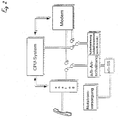
- An integrated communication path using, for example, a digital signal processor is described below, in particular with reference to FIG. 3.
- This integrated communication path enables a comparatively simple interconnection of two different end devices.
- the proposed solution is based on an integration of the voice and data path in the communication terminal. Merging is carried out, for example, by a programmable, digital signal processor DSP, via which the interfaces to the peripheral devices, such as the receiver connection HA, and to the connected networks are connected.
- DSP digital signal processor
- This signal processor DSP and a processor system CPU for the general control tasks mentioned at the outset are arranged on a main assembly HB and are connected to one another via a bus system (not shown).
- the digital signal processor DSP is connected via a converter device WE on the one hand to an analog adapter circuit AP and on the other hand to an external analog interface AA.
- the converter device WE converts the analog signals from the analog interface AA and the adapter circuit AP into digital signals for the signal processor DSP and vice versa.
- the analog interface AA is connected to an analog interface a / b-SS for connecting a subscriber line.
- a receiver connection HA is provided via the adapter circuit AP and the downstream converter device WE for both voice and data transmission.
- the semiconductor industry provides a number of interesting components here, some of which have already integrated the required analog components, such as receiver and microphone amplifiers.
- the analog speech from and to the listener is first digitized and passed on to the signal processor DSP for further processing.
- a display DP for display and a keyboard TT are also connected to the main assembly HB.
- the signal processor DSP with the D and B channels is this Network connected.
- the D channel is also connected to the CPU processor system.
- the network ISDN has an ISDN interface IA, which is connected to an SO interface SO-SS.
- the signal processor DSP then converts the linearly digitized speech into a form coded according to standardized (a-Law, ⁇ -Law) and sends it in the B channel of the SO interface SO-SS.
- An analog network is connected to the signal processor DSP via the analog interface AA and the converter device WE.
- the data is first digitized and then sent by the signal processor DSP to the a / b interface via another a / b converter.
- the signal processor DSP can also be connected to a wireless network, such as, for example, cellular network GSM, DECT, DCS 1800 or UMTS.
- the signal processor DSP can also be provided for connecting one of these networks to an optical network, or quite generally for connecting any analog and / or digital communication networks.
- the signal processor DSP now has all possibilities to intervene in the voice path in order to transmit voice and data and to meet the corresponding requirements according to e.g. B. to evaluate via digital filter functions, to free the transmission of interference such as noise or background noise or to cancel any echoes.
- the signal processor DSP can also take over the modem function in the ISDN network.
- any communication partner for example a background system
- the digital signal processor DSP can also be used to generate DTMF signals (dual-tone multi-frequency) for the DTMF dialing process.
- the DTMF signals can also be generated to control an answering machine, for example for remote access.
- the signal processor DSP can also be used as a DTMF receiver. It is then used, for example, to evaluate DTMF signals that are input by an acoustic coupler via the handset connection HA, so that the dialing of unauthorized numbers can be blocked.
- a customer inserts a telephone card into the card reader (this card reader is connected to the main assembly HB via a further interface in a manner known per se) and lifts the handset (connected to the handset connection HA).
- the processor system CPU recognizes this process and loads the signal processor DSP with the speech program and the compressed language texts.
- the signal processor DSP decompresses the speech texts and outputs them to the listener.
- the customer now receives information about the possibilities and the use of the telephone or the telecommunication terminal.
- the signal processor DSP can also be used for speech evaluation or speech recognition, for example to support speech input.
- the processor system CPU now loads the signal processor DSP with the telephone program and transfers the call number to the signal processor DSP.
- the signal processor DSP seizes the line (in the analog network), checks the loop current and dials the number using the IWV or DTMF dialing method and passes the voice data through from the handset to the line and vice versa.
- data communication with a subscriber in the digital or analog network is possible via the communication terminal to which, for example, a laptop is connected, without the need for a modem.
- the signal processor DSP is connected to a further DFÜ interface for remote data transmission.
- This can be, for example, a V-24, an infrared IR, a wireless DECT or another wired a / b interface.
- An analog or digital, preferably portable, terminal of the customer can be directly connected to this interface, which is designed as a standardized terminal interface.
- Winfax his standard fax program
- the processor system CPU recognizes this request and reloads the signal processor DSP with the fax program.
- the signal processor DSP switches the handset off and activates its interface V-24 for external data transmission DFÜ, recognizes the connected laptop by the active S1 signal (ready for operation of the end device) and communicates with it via AT commands.
- the fax machine on the other end of the line recognizes this tone and in turn sends the answer tone. Both sides now negotiate the transfer mode and transfer the data.
- the signal processor DSP now behaves like a fax modem towards the laptop.
- the signal processor DSP transmits information about the operating state to the processor system CPU, which it passes on to the customer via the display DP. After data transmission has ended, the signal processor DSP switches back to voice communication.
- the processor system CPU now loads the signal processor DSP with the DTMF tone generation program and transfers the desired number codes to it.
- the signal processor DSP generates the corresponding DTMF tones and outputs them via the a / b line connected to the a / b-SS interface.
- the customer ends the connection.
- the processor system CPU bills the connection fees via the card reader, stores the statistical data and returns the card. This example applies accordingly for data transmission in modem emulation.
- the processor system CPU now wants to connect to the server in order to transfer its stored data. It therefore loads the signal processor DSP with the modem program (e.g. V.32).
- the signal processor DSP establishes the connection and reports the successful setup to the processor system CPU.
- the CPU processor system now carries out the authentication and transfers the data. Then the processor system CPU and the signal processor DSP clear the connection again.
Landscapes
- Engineering & Computer Science (AREA)
- Computer Networks & Wireless Communication (AREA)
- Signal Processing (AREA)
- Telephonic Communication Services (AREA)
Applications Claiming Priority (4)
| Application Number | Priority Date | Filing Date | Title |
|---|---|---|---|
| DE19944414554 DE4414554A1 (de) | 1994-04-22 | 1994-04-22 | Verfahren und Anordnung zur Bearbeitung von Signalen in Telekommunikationsendgeräten |
| DE4414554 | 1994-04-22 | ||
| DE4414557 | 1994-04-22 | ||
| DE19944414557 DE4414557A1 (de) | 1994-04-22 | 1994-04-22 | Standardisierte Endgeräteschnittstelle über Signalprozessor |
Publications (2)
| Publication Number | Publication Date |
|---|---|
| EP0679006A2 true EP0679006A2 (de) | 1995-10-25 |
| EP0679006A3 EP0679006A3 (enExample) | 1995-11-29 |
Family
ID=25935960
Family Applications (1)
| Application Number | Title | Priority Date | Filing Date |
|---|---|---|---|
| EP95106097A Ceased EP0679006A2 (de) | 1994-04-22 | 1995-04-24 | Verfahren und Anordnung zur Bearbeitung von Signalen in Telekommunikationsendgeräten |
Country Status (1)
| Country | Link |
|---|---|
| EP (1) | EP0679006A2 (enExample) |
Cited By (5)
| Publication number | Priority date | Publication date | Assignee | Title |
|---|---|---|---|---|
| WO1996019065A3 (en) * | 1994-12-12 | 1996-08-22 | Nokia Mobile Phones Ltd | Data transmission method |
| WO1997021312A3 (en) * | 1995-12-01 | 1997-07-17 | Philips Electronics Nv | A digital cordless telephony system, a radio base station, and a combination of a radio base station and a cordless handset |
| DE19616239A1 (de) * | 1996-04-15 | 1997-10-16 | Deutsche Telephonwerk Kabel | Verfahren zum Anschluß funkbetriebener Mobilteile nach dem DECT-Standard an ISDN-Nebenstellenanlagen |
| EP0814628A3 (de) * | 1996-06-17 | 2000-08-02 | CLAAS KGaA | Vorrichtung und Verfahren zur mobilen Kommunikation von Arbeitsmaschinen |
| WO2001024538A3 (de) * | 1999-09-28 | 2001-10-11 | Siemens Ag | Verfahren zur detektion vorgegebener frequenzkomponenten |
Family Cites Families (2)
| Publication number | Priority date | Publication date | Assignee | Title |
|---|---|---|---|---|
| EP0309627B1 (en) * | 1987-09-30 | 1993-06-16 | International Business Machines Corporation | Apparatus for connecting data processing equipment to a telephone network |
| US5036513A (en) * | 1989-06-21 | 1991-07-30 | Academy Of Applied Science | Method of and apparatus for integrated voice (audio) communication simultaneously with "under voice" user-transparent digital data between telephone instruments |
-
1995
- 1995-04-24 EP EP95106097A patent/EP0679006A2/de not_active Ceased
Cited By (8)
| Publication number | Priority date | Publication date | Assignee | Title |
|---|---|---|---|---|
| WO1996019065A3 (en) * | 1994-12-12 | 1996-08-22 | Nokia Mobile Phones Ltd | Data transmission method |
| GB2296161B (en) * | 1994-12-12 | 1999-10-20 | Nokia Mobile Phones Ltd | Data transmission method |
| WO1997021312A3 (en) * | 1995-12-01 | 1997-07-17 | Philips Electronics Nv | A digital cordless telephony system, a radio base station, and a combination of a radio base station and a cordless handset |
| DE19616239A1 (de) * | 1996-04-15 | 1997-10-16 | Deutsche Telephonwerk Kabel | Verfahren zum Anschluß funkbetriebener Mobilteile nach dem DECT-Standard an ISDN-Nebenstellenanlagen |
| DE19616239C2 (de) * | 1996-04-15 | 2001-04-19 | Deutsche Telephonwerk Kabel | Verfahren zum Anschluß von Basisstationen eines schnurlosen Kommunikationssystems an eine ISDN-Nebenstellenanlage |
| EP0814628A3 (de) * | 1996-06-17 | 2000-08-02 | CLAAS KGaA | Vorrichtung und Verfahren zur mobilen Kommunikation von Arbeitsmaschinen |
| DE19624019B4 (de) * | 1996-06-17 | 2005-03-03 | Claas Kgaa Mbh | Vorrichtung und Verfahren zur mobilen Kommunikation von Arbeitsmaschinen |
| WO2001024538A3 (de) * | 1999-09-28 | 2001-10-11 | Siemens Ag | Verfahren zur detektion vorgegebener frequenzkomponenten |
Also Published As
| Publication number | Publication date |
|---|---|
| EP0679006A3 (enExample) | 1995-11-29 |
Similar Documents
| Publication | Publication Date | Title |
|---|---|---|
| DE69434682T2 (de) | Verfahren zur anfrage oder aufheben eines sprach-oder datendienstes mittels einer mobileinheit | |
| DE69026632T2 (de) | Faksimilebetrieb | |
| EP0687402B1 (de) | Schaltungsanordnung zur integration von edv-systemen bei der benutzung von telefonanlagen | |
| DE69927867T2 (de) | System zum Integrieren von privaten Kommunikationsendgeräten | |
| EP0532972A1 (de) | Verfahren und Fernmeldeendgerät zur Herstellung von Fernmeldeverbindungen in einem ISDN-Kommunikationssystem | |
| EP0920238A2 (de) | Verfahren zur Übermittlung einer Teilnehmernummer eines gewünschten Teilnehmers, sowie Telefonauskunftseinrichtung und Endgerät hierfür | |
| EP0670638A2 (de) | Mobilfunkanlage im PCMCIA-Standard | |
| EP0679006A2 (de) | Verfahren und Anordnung zur Bearbeitung von Signalen in Telekommunikationsendgeräten | |
| EP0032982A1 (de) | Hausanlage zur Übertragung von Informationen und Verwendung der Anlage als Haussprechanlage oder zum Auslösen eines Alarms | |
| EP0471677B1 (de) | Nachrichtenübertragungssystem | |
| DE4414554A1 (de) | Verfahren und Anordnung zur Bearbeitung von Signalen in Telekommunikationsendgeräten | |
| EP0511514B1 (de) | Schaltungsanordnung zur Datenumsetzung | |
| DE19827376B4 (de) | Telekommunikationsanlage | |
| DE19526726C2 (de) | System für den gesicherten Datenaustausch von alphanumerischen Daten zwischen zwei Telekommunkationseinrichtungen | |
| EP0939536A2 (de) | Verfahren und Anordnung zum Bereitstellen von Leistungsmerkmalen für mobile Teilnehmer über ein Kommunikationsnetz | |
| DE19926740C2 (de) | Sprachgesteuertes Telefon-Vermittlungsgerät | |
| DE19752607B4 (de) | Verfahren und Vorrichtung zum Austausch anwendungsspezifischer Daten zwischen einem Intelligenten Netz und datenfähigen Endgeräten | |
| WO1993005606A1 (de) | Fernsprecheinrichtung | |
| EP0802693A2 (de) | Verfahren zum Anschluss funkbetriebener Mobilteile nach dem DECT-Standard an ISDN-Nebenstellenanlagen | |
| DE19542948C2 (de) | Verfahren für die Kommunikation eines externen Rechners über ein Telekommunikations-Endgerät mit einem Telekommunikationsnetz und Telekommunikations-Endgerät | |
| WO1998058479A2 (de) | Konfigurierung von endgeräten in telekommunikationssystemen | |
| EP1638300A1 (de) | Drahtloses Netzwerk und IP Telefonie-Endgerät sowie Verfahren zum Betreiben eines solchen Telefonie-Endgerätes im Netzwerk | |
| DE19754862A1 (de) | Einrichtung zum Anschluß eines Modems ans öffentliche Telefonnetz | |
| EP0965218B1 (de) | Kommunikationssystem mit einstellbarer übertragungscharakteristik | |
| EP1325620B1 (de) | Datenubertragung uber eine funkschnittstelle |
Legal Events
| Date | Code | Title | Description |
|---|---|---|---|
| PUAI | Public reference made under article 153(3) epc to a published international application that has entered the european phase |
Free format text: ORIGINAL CODE: 0009012 |
|
| PUAL | Search report despatched |
Free format text: ORIGINAL CODE: 0009013 |
|
| AK | Designated contracting states |
Kind code of ref document: A2 Designated state(s): AT BE CH DE ES FR GB GR IT LI NL PT |
|
| AK | Designated contracting states |
Kind code of ref document: A3 Designated state(s): AT BE CH DE ES FR GB GR IT LI NL PT |
|
| RAP1 | Party data changed (applicant data changed or rights of an application transferred) |
Owner name: SIEMENS AKTIENGESELLSCHAFT |
|
| 17P | Request for examination filed |
Effective date: 19960104 |
|
| 17Q | First examination report despatched |
Effective date: 20000316 |
|
| STAA | Information on the status of an ep patent application or granted ep patent |
Free format text: STATUS: THE APPLICATION HAS BEEN REFUSED |
|
| 18R | Application refused |
Effective date: 20010226 |