EP0676718B1 - Dispositif de comptage de produits empilés - Google Patents
Dispositif de comptage de produits empilés Download PDFInfo
- Publication number
- EP0676718B1 EP0676718B1 EP95400815A EP95400815A EP0676718B1 EP 0676718 B1 EP0676718 B1 EP 0676718B1 EP 95400815 A EP95400815 A EP 95400815A EP 95400815 A EP95400815 A EP 95400815A EP 0676718 B1 EP0676718 B1 EP 0676718B1
- Authority
- EP
- European Patent Office
- Prior art keywords
- counting
- counting device
- linear
- pixel
- movement
- Prior art date
- Legal status (The legal status is an assumption and is not a legal conclusion. Google has not performed a legal analysis and makes no representation as to the accuracy of the status listed.)
- Expired - Lifetime
Links
Images



Classifications
-
- G—PHYSICS
- G06—COMPUTING OR CALCULATING; COUNTING
- G06M—COUNTING MECHANISMS; COUNTING OF OBJECTS NOT OTHERWISE PROVIDED FOR
- G06M1/00—Design features of general application
- G06M1/08—Design features of general application for actuating the drive
- G06M1/10—Design features of general application for actuating the drive by electric or magnetic means
- G06M1/101—Design features of general application for actuating the drive by electric or magnetic means by electro-optical means
-
- G—PHYSICS
- G06—COMPUTING OR CALCULATING; COUNTING
- G06M—COUNTING MECHANISMS; COUNTING OF OBJECTS NOT OTHERWISE PROVIDED FOR
- G06M9/00—Counting of objects in a stack thereof
Definitions
- the present invention relates to a device for counting thin products stacked side by side.
- an apparatus memory card counting system comprising a module electronics contained in opaque packaging.
- the apparatus includes means for driving packaging to scroll between a source of X-ray and a detector connected to a processing circuit.
- the packaging and the card bodies being transparent to X-ray, the detector receives a beam modified by the shadow of the electronic modules of the cards.
- Processing circuit can count pulses corresponding to the passage of each module or allow a visualization of the image obtained during scrolling complete package between detector and transmitter X-ray.
- This device can only be used for counting of product with a metallic element or more generally an opaque part at the X-ray.
- the x-ray source must be adjusted precisely from so as to emit reduced energy radiation for do not alter the opaque part.
- the object of the invention is therefore to propose a simple and inexpensive counting device and allows the reading of products arranged in batches under a translucent shrink film.
- the movement of displacement of the shuttle is a back and forth movement obtained by a electric motor whose drive shaft is connected by a mechanism for transforming the rotary movement into linear motion transmitted to the shuttle made integral with columns of linear guidance.
- the movement of the tray is obtained by a cleat belt supporting a plurality of trays entrained by a continuous movement of direction transverse to the beam linear reading.
- a push button user actuated triggers movement and during this displacement the plurality of scans.
- the means of storage consist of as many memory bytes as photosensitive elements of the reading bar from the camera.
- the number of photosensitive elements is at least greater than double the maximum number of objects the device can count.
- the number of photosensitive elements is preferably equal to ten times the maximum number of objects the device can count.
- the beam linear is reflected by a plurality of mirrors to ensure with a compact device the scanning of a large container.
- each element photosensitive allows detection of 256 levels of brightness translated into one-byte words constituting the representation of a pixel.
- the means of counting allow alternately detection of peaks and valleys starting with a detection of peak and counting peaks and valleys constitutive of the representative stored sinusoidal signal of the linear beam.
- the detection of vertices ensures the detection of the first edge and the determination of the vertices by measuring the distance between the previous vertex and the pixel being processed and by comparing the distance with a minimum value which corresponds to the thickness of a product and includes also a step of calculating percentage of variation of the summit which allows, in case of exceeding the percentage with respect to a set value, of determine the presence of an edge.
- the detection of valleys is performed relative to the previous vertex memorized by measuring the distance between the vertex and the pixel processed and compared to the previous valley memorized by measuring the distance between the valley and the processed pixel and retaining the pixel as forming a valley if the two distances are correct with respect to reference values and, if not, in processing the next pixel.
- Figures 1 to 9 represent the mechanical part constituted a support (81, Figure 2) on which can be placed trays (2) containing a stack (1) of products such as magnetic or chip cards, access badges, tickets, bundles of paper, envelopes, etc., the set of product being wrapped in translucent film retractable not shown.
- the tray (2) is lit by a tube fluorescent (7) and the light beam reflected on the slice of objects (1) to be counted and sent to a reflection device comprising a first mirror (5) and a second mirror (6) for converging the beam on a linear array (41) of elements photosensitive belonging to a camera (4).
- the beams (32, 31, 30) represent the light beam which converges towards the array of photosensitive elements (41).
- This bar (41) comprises, by way of example, 5000 elements to allow the reading of a tray containing, for example, a maximum of 500 products.
- Each photosensitive element of the bar allows to detect a light signal and express that signal as an electrical signal representative of 256 levels of brightness. This signal is translated into words, for example, of 8 bits and each word is saved in an element device memory.
- the memory of the device consists, for the example given, of a random access memory 5000 words of one byte.
- the plane light beam (30) represents a scan and the device allows the camera to perform a plurality of scans transversely to the displacement of the tray (2) represented by arrows A and B and provided by a mechanism shown, for example, in Figure 2.
- This mechanism consists of a support (81) made integral two columns (84) mounted sliding each in two bearings mounted on feet (82, 83). At least one columns (84) has a deflection piece (85) which ensures the transformation of a movement of rotation printed by an electric motor (86) in one linear movement communicated to the columns (84).
- This device aims to ensure a back and forth movement comes which allows each triggered cycle by pressing a push button not shown and placed on the hood of the machine, to have the tray (2) a back and forth movement, as shown in Figure 1.
- a switch (91) allows detect the presence of a tray (2) and validate the reading sequences performed during the plurality of scans as well as the counts of products.
- the camera (4) performs during a outward journey fifty scans, performed alternately from left to right and from right to left and during the return movement another fifty alternating scans.
- the signal bright recorded by photosensitive elements is consisting of a sinusoidal signal whose vertices represent approximately the mediums of the products, the valleys, the edges and the distance between two valleys corresponds to the thickness of a product to be counted.
- the first vertex of coordinates ys0 actually corresponds to a detection edge of the tray while the first vertex ys1 corresponds to the first product to be counted.
- a microprocessor device controlled by a program using the algorithms described below allows to process the information stored in the during the first scan before validating the memorization of a second scan, shown at figure 9.
- the program for reading stored scans and revenue recognition corresponds to the stake using the algorithms represented in FIGS. 3 to 7.
- the program performs the processing of a line represented in step (31) and after this line processing performs in step (32) a test to determine if a determined number of lines, for example, were scanned, shown.
- the result is stored in step (33) and in if so, the program jumps to step (34) which is a test to determine if it is an end of cycle. If the test is negative, the program loops before step (31).
- step (35) which is a step processing results.
- the next step (36) is constituted by the display of the report.
- a test, represented in step (37), makes it possible to know if necessary perform a next cycle. If not, program loops back between steps (36) and (37) and if so the program loops back to the cycle start.
- This "next cycle" test consists of by detecting that the push button has been pressed.
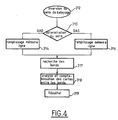
- the line processing step (31) corresponds to the succession of steps shown in Figure 4 and this sequence begins with a step of reversing the sense of scan (312) and continues with a test step (313) on determining the meaning. In the case of a sweep from left to right, filling the line memory is performed in step (314) and in the other case of swipe right to left, filling the memory line is also performed by a step (316).
- step (317) of finding the edges of the tray succeeds a step (317) of finding the edges of the tray and this step is followed by a step (318) analysis and accounting of products between edges.
- the program ends with the processing of results represented in step (319) for each of the lines.
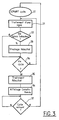
- This step is followed by a loading step 52 of the reference value which is equal to the value of the pixel whose processing is in progress.
- This information consists of an 8-bit word representative of a of the 256 brightness levels received by the element photosensitive corresponding to the word memory processed.
- This stage is followed by a research stage 53 local of vertices which continues with a step 54 of calculating the difference between the local level and the reference value stored in step 52.
- step 54 is followed by a test step 55 on the value of the difference to determine if this difference is greater than a set value. In if the program knows in step 59 that an edge has been found. If not, the program continues by step 56 of memorization as reference pixel of the pixel being processed.
- test stage 57 determining whether it's the end or the start of a line by comparison of the pixel pointer counter for determine if it has reached the set defined value to 5000 for the example, or not. If so, program displays "edge not detected" in step 58 in positioning a semaphore used in step 75 of the figure 7, and in the negative the program loops before step 53 of local summit search.
- the instruction of step 55 generally corresponds to the distance that separates on average a summit of a valley and, as can be seen in the diagram in the figure 9, the program of FIG. 5 makes it possible to detect as an edge the vertex Ys0 then, as we will see later, when treating the valley, noticing that the distance d1 between the summit and the next valley being lower than another setpoint and the percentage of variation of vertices being greater than a value determined, he considers that it is not the edge of the tray and detects the next vertex YS1 as being the effective edge of the tray.
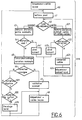
- the sequence 318 of analysis and accounting products between the edges corresponds to the stages shown in Figure 6 which begin with a step (61) of reading a pixel to continue with a step 62 of test on the type of sequence. This is is done by determining if the difference between the pixel being processed and the previous pixel is positive or negative and if it is positive triggers the local vertex processing sequence and in case it is negative starts the treatment sequence local valley.
- the local summit processing sequence begins with a step 63 for measuring the distance (dss) between vertices and continues with a test step 64 to determine if this distance (dss) is greater than a minimum value. In the negative case, the program continues with step 641 of processing the next pixel and loops back between type testing steps 61 and 62 of sequence.
- the program continues with a step 65 of calculation of the percentage of variation of the vertices which determines the information (ys2 - ys1) x100 / ys1 and ensures that the next step 66 that this variation is greater or no to an instruction. If so, the program continues with a test step 691 to determine whether the variation is negative. if it is negative, the program loops before step 61 of reading a pixel. If the variation is positive, the program continues with a test step 692 consisting in reading the content of the number of products counter and to be determined if the content of this counter is less than 3.
- step 67 validates the vertex by incrementing a counter which counts the vertices.
- This step 67 is followed by a jump to the sequencer of the local valley, therefore returning the program before step 62 to treat a local valley according to the sequence below.
- This treatment always begins with the test (62) on the type of sequence and then continues by a step of measuring the summit-valley distance (dsv) and the valley-valley distance (dvv).
- dsv summit-valley distance
- dvv valley-valley distance
- step 621 follows a test step 622 making it possible to determine if the two distances are correct by compared to reference values. If not, program continues with processing of the next pixel shown in step 625 and loops back before step 62. If so, if the distances are correct the program continues with a step 623 of validation of the valley which consists in incrementing a counter of valley. This step is followed by a step 623 of treatment of a local summit by looping the program between steps 61 and 62.
- the program executes a sequence (35) of processing results.
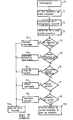
- the program has determined that this was an end-of-cycle step at step 34 of figure 3, it performs the sequence 35 of processing of the results which corresponds to the sequence of steps in FIG. 7.
- the program begins by performing a step 71 of sorting the results in ascending order then built, in step 72, a histogram of the results and research in step 73 the largest occurrence between the results.
- step 74 the success rate versus a rate value reference. In treatment a success rate quite important was chosen but this instruction can possibly be modified. If for example the value 450 returns more than 7 times on 8 counts, the program considers that the reference rate value has been reached and the program will continue with a step of test (75) to know if there has been a good detection of ends. This step 75 consists in reading the semaphore which will have been positioned during step 693 indicating that the edges have indeed been detected.
- step 751 signals a bad edge detection corresponding to step 50 and ends with the display (792) "no card found”. If so, the sequence continues with a step 76 test on sensor saturation detection photosensitive. If so, step 771 indicates that there is too much light and ends with a display "too much light”, and in the negative the sequence continues with a processing step 77 constituting a test to determine whether the information read had good sharpness. If not, the device displays a contrast defect and the sequence ends by a display "no card found", in if so, the program ends with a step 78 test on the number of products to determine if this number is greater than zero. If so, the program ends with step 791 of displaying the number of products and success rate.
- Figure 8 shows another variant of the mechanical tray displacement device under the reading beam so that you can make a plurality of transverse scans with respect to the direction for moving the trays (2).
- these trays (2) are mounted on a belt cleats (21) itself stretched between two pulleys drive (22, 23) at least one of which is driven rotating by an electric motor powered so sequential after processing the 100 lines of scan or the number of scan lines desired for achieve a sufficient success rate.
Landscapes
- Physics & Mathematics (AREA)
- General Physics & Mathematics (AREA)
- Engineering & Computer Science (AREA)
- Theoretical Computer Science (AREA)
- Length Measuring Devices By Optical Means (AREA)
- Auxiliary Devices For And Details Of Packaging Control (AREA)
- Warehouses Or Storage Devices (AREA)
- Investigating, Analyzing Materials By Fluorescence Or Luminescence (AREA)
- Vending Machines For Individual Products (AREA)
- Photographic Developing Apparatuses (AREA)
Description
- la figure 1 représente une vue en perspective du principe mécanique et optique de la machine de comptage ;
- la figure 2 représente une vue schématique de côté du principe mécanique de la machine ;
- la figure 3 représente l'organigramme représentatif du déroulement de l'opération de comptage ;
- la figure 4 représente l'organigramme représentatif du traitement d'une ligne ;
- la figure 5 représente l'organigramme représentatif du processus de localisation des bords de la boíte contenant les produits ;
- la figure 6 représente l'organigramme représentatif du processus d'analyse et de comptabilisation des produits ;
- la figure 7 représente l'organigramme représentatif du processus d'analyse et de traitement des résultats ;
- la figure 8 représente une vue schématique de côté d'une autre variante de principe mécanique de la machine ;
- la figure 9 représente la forme du signal en sortie des éléments photosensibles et mémorisé sous forme d'octets dans la mémoire de la caméra.
Claims (12)
- Dispositif de comptage de produits (1) peu épais empilés côte-à-côte et rangés sur champ en barquettes (2) le dispositif comportantcaractérisé en ce quedes moyens (7) d'éclairer la barquettedes moyens (91) de détecter la mise en place d'une barquette sur une navette (81, 21) mobile animée d'un mouvement de déplacement ;des moyens de mémorisation des informations lumineuses contenues dans le faisceau linéaire etdes moyens de comptage pour chaque balayage du nombre de produits
les barquettes (2) sont emballées sous film rétractable translucide,
et en ce que le dispositif comportedes moyens (4, 5, 6) d'effectuer une pluralité de balayages de la barquette transversalement au mouvement de déplacement de la barquette, chaque balayage correspondant à un faisceau linéaire de lecture obtenu à partir du faisceau lumineux réfléchi sur la tranche des produits et orienté sur une barette d'une caméra linéaire constituée d'éléments photosensibles. - Dispositif de comptage selon la revendication 1, caractérisé en ce que le mouvement de déplacement de la navette est un mouvement de va et vient obtenu par un moteur électrique dont l'arbre d'entraínement (80) est relié par un mécanisme (85) de transformation du mouvement rotatif en mouvement linéaire transmis à la navette (81) rendue solidaire de colonnes (84) de guidage linéaire.
- Dispositif de comptage selon la revendication 1, caractérisé en ce que le mouvement de la barquette (2) est obtenu par une courroie (21) à taquets supportant une pluralité de barquettes entraínées d'un mouvement continu de direction transversale au faisceau linéaire de lecture.
- Dispositif de comptage selon une des revendications 1 à 3, caractérisé en ce qu'un bouton poussoir actionnable par l'utilisateur déclenche un déplacement et au cours de ce déplacement la pluralité de balayages.
- Dispositif de comptage selon une des revendications 1 à 4, caractérisé en ce que les moyens de mémorisation sont constitués par autant d'octets mémoire que d'éléments photosensibles d'une barrette (41) de lecture de la caméra.
- Dispositif de comptage selon la revendication 5, caractérisé en ce que le nombre d'éléments photosensibles est au moins supérieur au double du nombre maximum d'objets que le dispositif peut compter.
- Dispositif de comptage selon la revendication 5, caractérisé en ce que le nombre d'éléments photosensibles est de préférence égal à dix fois le nombre maximum d'objets que le dispositif peut compter.
- Dispositif de comptage selon la revendication 5, caractérisé en ce que chaque élément photosensible permet la détection de 256 niveaux de luminosité traduits en mots d'un octet constituant la représentation d'un pixel.
- Dispositif de comptage selon une des revendications 1 à 8, caractérisé en ce que le faisceau linéaire réfléchi est renvoyé par une pluralité de miroirs (5, 6) pour assurer avec un dispositif compact le balayage d'une barquette de grande dimension.
- Dispositif de comptage selon une des revendications précédentes, caractérisé en ce que les moyens de comptage permettent la détection alternativement des sommets et des vallées en commençant par une détection de sommet et le comptage des sommets et des vallées constitutives du signal sinusoïdal mémorisé et représentatif du faisceau linéaire d'un balayage.
- Dispositif de comptage selon la revendication 10, caractérisé en ce que la détection des sommets assure la détection du premier bord et la détermination des sommets par mesure de la distance entre le sommet précédent et le pixel en cours de traitement, comparaison de la distance avec une valeur minimale qui correspond à l'épaisseur d'un produit et un calcul de pourcentage de variation du sommet qui permet, en cas de dépassement par rapport à une valeur consigne, de déterminer la présence d'un bord.
- Dispositif de comptage selon la revendication 10 ou 11, caractérisé en ce que la détection des vallées est effectuée par rapport à un sommet précédent mémorisé en mesurant la distance entre sommet et pixel traité et par rapport à la vallée précédente mémorisée en mesurant la distance entre la vallée et le pixel traité et en retenant le pixel comme formant une vallée si les deux distances sont correctes par rapport à des valeurs de référence et, dans le cas contraire, en traitant le pixel suivant.
Applications Claiming Priority (2)
| Application Number | Priority Date | Filing Date | Title |
|---|---|---|---|
| FR9404213 | 1994-04-11 | ||
| FR9404213A FR2718550B1 (fr) | 1994-04-11 | 1994-04-11 | Dispositif de comptage de produits. |
Publications (2)
| Publication Number | Publication Date |
|---|---|
| EP0676718A1 EP0676718A1 (fr) | 1995-10-11 |
| EP0676718B1 true EP0676718B1 (fr) | 2002-07-24 |
Family
ID=9461919
Family Applications (1)
| Application Number | Title | Priority Date | Filing Date |
|---|---|---|---|
| EP95400815A Expired - Lifetime EP0676718B1 (fr) | 1994-04-11 | 1995-04-11 | Dispositif de comptage de produits empilés |
Country Status (8)
| Country | Link |
|---|---|
| US (1) | US5686729A (fr) |
| EP (1) | EP0676718B1 (fr) |
| JP (1) | JPH0887584A (fr) |
| AT (1) | ATE221227T1 (fr) |
| CA (1) | CA2146718C (fr) |
| DE (1) | DE69527460T2 (fr) |
| ES (1) | ES2181755T3 (fr) |
| FR (1) | FR2718550B1 (fr) |
Families Citing this family (15)
| Publication number | Priority date | Publication date | Assignee | Title |
|---|---|---|---|---|
| EP0743616A3 (fr) * | 1995-05-15 | 1998-01-14 | Eastman Kodak Company | Appareil et méthode de comptage de feuilles |
| US6091792A (en) * | 1997-10-31 | 2000-07-18 | Hill; Gregory D. | Corrugated sheet counter |
| US6173607B1 (en) | 1998-01-22 | 2001-01-16 | Opsigal Control Systems Ltd. | System and method for counting the number of items within a stack |
| DE19817824A1 (de) | 1998-04-21 | 1999-10-28 | Focke & Co | Vorrichtung zum Prüfen von Einheiten aus mehreren Einzelgegenständen, Materiallagen oder dergleichen |
| SE516722C2 (sv) | 1999-04-28 | 2002-02-19 | Hana Barankova | Förfarande och apparat för plasmabehandling av gas |
| FR2854476B1 (fr) * | 2003-04-30 | 2005-07-01 | Datacard Inc | Dispositif de comptage de produits empiles |
| EP1473665A1 (fr) * | 2003-04-30 | 2004-11-03 | Kba-Giori S.A. | Procédé et dispositif pour compter des substrats plats |
| JP4877445B2 (ja) * | 2003-09-30 | 2012-02-15 | オムロン株式会社 | カウント装置 |
| EP1624402A1 (fr) * | 2004-08-03 | 2006-02-08 | Kba-Giori S.A. | Comptage de documents empilés |
| FR2895119B1 (fr) * | 2005-12-19 | 2008-02-15 | Datacard Corp | Dispositif de comptage de petites series |
| US20070242870A1 (en) * | 2006-04-18 | 2007-10-18 | Nucor Corporation | System And Method For Automatically Counting Bundled Items |
| FR2915601B1 (fr) * | 2007-04-26 | 2009-07-03 | Datacard Corp | Dispositif de comptage de cartes dans des petites series. |
| US8002692B2 (en) * | 2009-12-16 | 2011-08-23 | Coloplast A/S | Method of preparing a penis for implantation of a penile prosthetic |
| US8192352B2 (en) * | 2009-12-15 | 2012-06-05 | Coloplast A/S | Instrument configured to prepare a penis for implantation of a penile prosthetic |
| AT524451A1 (de) * | 2020-11-25 | 2022-06-15 | Westermayer Rainer | Verfahren zur bestimmung der anzahl einer menge an in einem stapel übereinander gestapelter, flacher gegenstände |
Family Cites Families (6)
| Publication number | Priority date | Publication date | Assignee | Title |
|---|---|---|---|---|
| US3573477A (en) * | 1968-09-17 | 1971-04-06 | Delta Engineering Corp | Radiation sensitive apparatus for detecting conveyed articles |
| US4373135A (en) * | 1979-12-31 | 1983-02-08 | Spartanics, Ltd. | Pitch matching detecting and counting system |
| US4771443A (en) * | 1987-06-12 | 1988-09-13 | Spartanics, Ltd. | Pitch match detecting and counting system |
| JPH02304690A (ja) * | 1989-05-19 | 1990-12-18 | Fuji Electric Co Ltd | 積重ね板状物の計数方法 |
| US4978845A (en) * | 1989-09-28 | 1990-12-18 | Dynetics Engineering Corporation | Card counter with self-adjusting card loading assembly and method |
| FR2680027A1 (fr) * | 1991-07-29 | 1993-02-05 | Schlumberger Ind Sa | Appareil de comptage de cartes a memoire. |
-
1994
- 1994-04-11 FR FR9404213A patent/FR2718550B1/fr not_active Expired - Fee Related
-
1995
- 1995-04-10 CA CA002146718A patent/CA2146718C/fr not_active Expired - Fee Related
- 1995-04-11 EP EP95400815A patent/EP0676718B1/fr not_active Expired - Lifetime
- 1995-04-11 AT AT95400815T patent/ATE221227T1/de not_active IP Right Cessation
- 1995-04-11 DE DE69527460T patent/DE69527460T2/de not_active Expired - Lifetime
- 1995-04-11 ES ES95400815T patent/ES2181755T3/es not_active Expired - Lifetime
- 1995-04-11 US US08/420,006 patent/US5686729A/en not_active Expired - Lifetime
- 1995-04-11 JP JP7085367A patent/JPH0887584A/ja active Pending
Also Published As
| Publication number | Publication date |
|---|---|
| JPH0887584A (ja) | 1996-04-02 |
| ES2181755T3 (es) | 2003-03-01 |
| FR2718550B1 (fr) | 1996-07-26 |
| CA2146718C (fr) | 2004-12-07 |
| ATE221227T1 (de) | 2002-08-15 |
| FR2718550A1 (fr) | 1995-10-13 |
| DE69527460T2 (de) | 2003-03-06 |
| EP0676718A1 (fr) | 1995-10-11 |
| US5686729A (en) | 1997-11-11 |
| CA2146718A1 (fr) | 1995-10-12 |
| DE69527460D1 (de) | 2002-08-29 |
Similar Documents
| Publication | Publication Date | Title |
|---|---|---|
| CA2146718C (fr) | Dispositif de comptage de produits | |
| FR2631476A1 (fr) | Procede et dispositif de lecture d'un code barres sur un support sensiblement immobile | |
| EP0034088B1 (fr) | Appareil d'identification d'objets tels que des bouteilles | |
| EP0449645B1 (fr) | Détermination de position pour codes à bâtonnets | |
| EP0315515B1 (fr) | Procédé de lecture optique de codes à barres | |
| EP0129450B1 (fr) | Procédé et dispositif pour la détection et la quantification d'agglutinats | |
| RU2358258C2 (ru) | Способ и система контроля упаковки | |
| JPH07508366A (ja) | 通貨の識別及び計数を行うための方法及び装置 | |
| CN1146805A (zh) | 包装薄片折缝位置检测的方法和装置 | |
| EP1115085A1 (fr) | Lecteur de codes à barres muni d'un capteur bidimensionnel à balayage ajustable | |
| FR2915601A1 (fr) | Dispositif de comptage de cartes dans des petites series. | |
| EP1473666A2 (fr) | Dispositif de comptage de produits empilés | |
| FR2520875A1 (fr) | Procede et dispositif de detection de corps etrangers dans un liquide | |
| JPH06162247A (ja) | 2次元コード読み取り用バーコードリーダ | |
| FR2690248A1 (fr) | Dispositif d'ouverture d'enveloppes en grand nombre en vue de l'extraction de leur contenu et procédé pour sa mise en Óoeuvre. | |
| EP0587484A1 (fr) | Dispositif d'analyse de supports d'informations de bulletins de jeu | |
| FR2494874A1 (fr) | Appareil universel d'authentification de documents | |
| CN1312461C (zh) | 薄片型柔性体表面三维重建的系统和方法 | |
| JP2001092916A (ja) | 反射光学素子の認識装置および記憶媒体の認識装置 | |
| EP0115236A1 (fr) | Tête de lecture de codes à bâtonnets, appareil d'analyse utilisant une telle tête et carte permettant l'étalonnage de cet appareil | |
| JPH11515108A (ja) | 両面光ディスク面検査装置 | |
| CN1791892A (zh) | 确定和/或核实硬币卷的内容物的方法 | |
| FR2780169A1 (fr) | Procede et appareil pour la mesure du repere d'un mouvement de montre mecanique | |
| BE1012843A3 (fr) | Appareil pour la determination de la forme et des dimensions d'une charge mue sur une ligne de transport. | |
| FR2501370A1 (fr) | Procede et dispositif pour la mesure d'une preparation de temperature, notamment de la zone de soudage d'un tube soude electriquement |
Legal Events
| Date | Code | Title | Description |
|---|---|---|---|
| PUAI | Public reference made under article 153(3) epc to a published international application that has entered the european phase |
Free format text: ORIGINAL CODE: 0009012 |
|
| AK | Designated contracting states |
Kind code of ref document: A1 Designated state(s): AT BE CH DE ES FR GB IT LI MC |
|
| 17P | Request for examination filed |
Effective date: 19960216 |
|
| 17Q | First examination report despatched |
Effective date: 19990415 |
|
| GRAG | Despatch of communication of intention to grant |
Free format text: ORIGINAL CODE: EPIDOS AGRA |
|
| GRAG | Despatch of communication of intention to grant |
Free format text: ORIGINAL CODE: EPIDOS AGRA |
|
| GRAH | Despatch of communication of intention to grant a patent |
Free format text: ORIGINAL CODE: EPIDOS IGRA |
|
| GRAH | Despatch of communication of intention to grant a patent |
Free format text: ORIGINAL CODE: EPIDOS IGRA |
|
| GRAA | (expected) grant |
Free format text: ORIGINAL CODE: 0009210 |
|
| AK | Designated contracting states |
Kind code of ref document: B1 Designated state(s): AT BE CH DE ES FR GB IT LI MC |
|
| REF | Corresponds to: |
Ref document number: 221227 Country of ref document: AT Date of ref document: 20020815 Kind code of ref document: T |
|
| REG | Reference to a national code |
Ref country code: GB Ref legal event code: FG4D Free format text: NOT ENGLISH |
|
| REG | Reference to a national code |
Ref country code: CH Ref legal event code: EP |
|
| REF | Corresponds to: |
Ref document number: 69527460 Country of ref document: DE Date of ref document: 20020829 |
|
| GBT | Gb: translation of ep patent filed (gb section 77(6)(a)/1977) |
Effective date: 20021101 |
|
| REG | Reference to a national code |
Ref country code: ES Ref legal event code: FG2A Ref document number: 2181755 Country of ref document: ES Kind code of ref document: T3 |
|
| PLBE | No opposition filed within time limit |
Free format text: ORIGINAL CODE: 0009261 |
|
| STAA | Information on the status of an ep patent application or granted ep patent |
Free format text: STATUS: NO OPPOSITION FILED WITHIN TIME LIMIT |
|
| 26N | No opposition filed |
Effective date: 20030425 |
|
| BECA | Be: change of holder's address |
Owner name: *DATACARD CORP.11111 BREN ROAD WEST, MINNETONKA, M Effective date: 20040426 |
|
| REG | Reference to a national code |
Ref country code: CH Ref legal event code: PUE Owner name: DATACARD CORPORATION Free format text: GILLES LEROUX S.A.#96, AVENUE EUGENE MILON, BP 1#F-45470 LOURY (FR) -TRANSFER TO- DATACARD CORPORATION#11111 BREN ROAD WEST#MINNETONKA, MN 55343-9015 (US) Ref country code: CH Ref legal event code: NV Representative=s name: R. A. EGLI & CO. PATENTANWAELTE |
|
| REG | Reference to a national code |
Ref country code: GB Ref legal event code: 732E |
|
| PGFP | Annual fee paid to national office [announced via postgrant information from national office to epo] |
Ref country code: MC Payment date: 20080219 Year of fee payment: 14 Ref country code: GB Payment date: 20080227 Year of fee payment: 14 |
|
| PGFP | Annual fee paid to national office [announced via postgrant information from national office to epo] |
Ref country code: ES Payment date: 20080416 Year of fee payment: 14 |
|
| PGFP | Annual fee paid to national office [announced via postgrant information from national office to epo] |
Ref country code: BE Payment date: 20080312 Year of fee payment: 14 Ref country code: AT Payment date: 20080326 Year of fee payment: 14 |
|
| PGFP | Annual fee paid to national office [announced via postgrant information from national office to epo] |
Ref country code: IT Payment date: 20080415 Year of fee payment: 14 |
|
| PGFP | Annual fee paid to national office [announced via postgrant information from national office to epo] |
Ref country code: CH Payment date: 20080725 Year of fee payment: 14 |
|
| PGFP | Annual fee paid to national office [announced via postgrant information from national office to epo] |
Ref country code: FR Payment date: 20090429 Year of fee payment: 15 |
|
| BERE | Be: lapsed |
Owner name: *DATACARD CORP. Effective date: 20090430 |
|
| REG | Reference to a national code |
Ref country code: CH Ref legal event code: PL |
|
| GBPC | Gb: european patent ceased through non-payment of renewal fee |
Effective date: 20090411 |
|
| PG25 | Lapsed in a contracting state [announced via postgrant information from national office to epo] |
Ref country code: LI Free format text: LAPSE BECAUSE OF NON-PAYMENT OF DUE FEES Effective date: 20090430 Ref country code: CH Free format text: LAPSE BECAUSE OF NON-PAYMENT OF DUE FEES Effective date: 20090430 Ref country code: AT Free format text: LAPSE BECAUSE OF NON-PAYMENT OF DUE FEES Effective date: 20090411 |
|
| PG25 | Lapsed in a contracting state [announced via postgrant information from national office to epo] |
Ref country code: MC Free format text: LAPSE BECAUSE OF NON-PAYMENT OF DUE FEES Effective date: 20090430 Ref country code: GB Free format text: LAPSE BECAUSE OF NON-PAYMENT OF DUE FEES Effective date: 20090411 |
|
| PG25 | Lapsed in a contracting state [announced via postgrant information from national office to epo] |
Ref country code: BE Free format text: LAPSE BECAUSE OF NON-PAYMENT OF DUE FEES Effective date: 20090430 |
|
| REG | Reference to a national code |
Ref country code: ES Ref legal event code: FD2A Effective date: 20090413 |
|
| PG25 | Lapsed in a contracting state [announced via postgrant information from national office to epo] |
Ref country code: ES Free format text: LAPSE BECAUSE OF NON-PAYMENT OF DUE FEES Effective date: 20090413 |
|
| PGFP | Annual fee paid to national office [announced via postgrant information from national office to epo] |
Ref country code: DE Payment date: 20100412 Year of fee payment: 16 |
|
| REG | Reference to a national code |
Ref country code: FR Ref legal event code: ST Effective date: 20101230 |
|
| PG25 | Lapsed in a contracting state [announced via postgrant information from national office to epo] |
Ref country code: IT Free format text: LAPSE BECAUSE OF NON-PAYMENT OF DUE FEES Effective date: 20090411 |
|
| REG | Reference to a national code |
Ref country code: DE Ref legal event code: R119 Ref document number: 69527460 Country of ref document: DE |
|
| REG | Reference to a national code |
Ref country code: DE Ref legal event code: R119 Ref document number: 69527460 Country of ref document: DE |
|
| PG25 | Lapsed in a contracting state [announced via postgrant information from national office to epo] |
Ref country code: FR Free format text: LAPSE BECAUSE OF NON-PAYMENT OF DUE FEES Effective date: 20100430 |
|
| PG25 | Lapsed in a contracting state [announced via postgrant information from national office to epo] |
Ref country code: DE Free format text: LAPSE BECAUSE OF NON-PAYMENT OF DUE FEES Effective date: 20111031 |