EP0676397B1 - Oxopyridinylquinoxaline derivatives - Google Patents
Oxopyridinylquinoxaline derivatives Download PDFInfo
- Publication number
- EP0676397B1 EP0676397B1 EP95302326A EP95302326A EP0676397B1 EP 0676397 B1 EP0676397 B1 EP 0676397B1 EP 95302326 A EP95302326 A EP 95302326A EP 95302326 A EP95302326 A EP 95302326A EP 0676397 B1 EP0676397 B1 EP 0676397B1
- Authority
- EP
- European Patent Office
- Prior art keywords
- nitro
- lower alkyl
- halogen
- hydrogen
- substituted
- Prior art date
- Legal status (The legal status is an assumption and is not a legal conclusion. Google has not performed a legal analysis and makes no representation as to the accuracy of the status listed.)
- Expired - Lifetime
Links
- 125000000217 alkyl group Chemical group 0.000 claims abstract description 67
- 125000000449 nitro group Chemical group [O-][N+](*)=O 0.000 claims abstract description 57
- 229910052736 halogen Inorganic materials 0.000 claims abstract description 47
- 150000002367 halogens Chemical class 0.000 claims abstract description 45
- 229910052739 hydrogen Inorganic materials 0.000 claims abstract description 43
- 239000001257 hydrogen Substances 0.000 claims abstract description 43
- 125000003917 carbamoyl group Chemical group [H]N([H])C(*)=O 0.000 claims abstract description 30
- 125000004397 aminosulfonyl group Chemical group NS(=O)(=O)* 0.000 claims abstract description 22
- 125000004953 trihalomethyl group Chemical group 0.000 claims abstract description 21
- 125000004093 cyano group Chemical group *C#N 0.000 claims abstract description 20
- 125000004435 hydrogen atom Chemical class [H]* 0.000 claims abstract description 19
- 230000002461 excitatory amino acid Effects 0.000 claims abstract description 18
- 239000003257 excitatory amino acid Substances 0.000 claims abstract description 18
- 125000001424 substituent group Chemical group 0.000 claims abstract description 18
- 125000000753 cycloalkyl group Chemical group 0.000 claims abstract description 17
- 230000003042 antagnostic effect Effects 0.000 claims abstract description 13
- 150000003839 salts Chemical class 0.000 claims abstract description 13
- 208000012902 Nervous system disease Diseases 0.000 claims abstract description 10
- 208000025966 Neurological disease Diseases 0.000 claims abstract description 10
- 150000001875 compounds Chemical class 0.000 claims description 40
- 210000002569 neuron Anatomy 0.000 claims description 19
- 150000002431 hydrogen Chemical group 0.000 claims description 17
- 239000008194 pharmaceutical composition Substances 0.000 claims description 13
- 102000018899 Glutamate Receptors Human genes 0.000 claims description 8
- 108010027915 Glutamate Receptors Proteins 0.000 claims description 8
- UFHFLCQGNIYNRP-UHFFFAOYSA-N Hydrogen Chemical compound [H][H] UFHFLCQGNIYNRP-UHFFFAOYSA-N 0.000 claims description 7
- 230000002401 inhibitory effect Effects 0.000 claims description 7
- 125000004432 carbon atom Chemical group C* 0.000 claims description 5
- 208000024827 Alzheimer disease Diseases 0.000 claims description 3
- 208000023105 Huntington disease Diseases 0.000 claims description 3
- 208000027089 Parkinsonian disease Diseases 0.000 claims description 3
- 206010034010 Parkinsonism Diseases 0.000 claims description 3
- 206010039966 Senile dementia Diseases 0.000 claims description 3
- 125000003277 amino group Chemical group 0.000 claims description 2
- 125000003178 carboxy group Chemical group [H]OC(*)=O 0.000 claims description 2
- 102000004868 N-Methyl-D-Aspartate Receptors Human genes 0.000 abstract description 19
- 108090001041 N-Methyl-D-Aspartate Receptors Proteins 0.000 abstract description 19
- 230000027455 binding Effects 0.000 abstract description 17
- 102000003678 AMPA Receptors Human genes 0.000 abstract description 16
- 108090000078 AMPA Receptors Proteins 0.000 abstract description 16
- 239000003814 drug Substances 0.000 abstract description 6
- 229940124597 therapeutic agent Drugs 0.000 abstract description 6
- 102000005962 receptors Human genes 0.000 abstract description 5
- 108020003175 receptors Proteins 0.000 abstract description 5
- 239000003795 chemical substances by application Substances 0.000 abstract description 2
- 239000000203 mixture Substances 0.000 description 54
- KWYUFKZDYYNOTN-UHFFFAOYSA-M Potassium hydroxide Chemical compound [OH-].[K+] KWYUFKZDYYNOTN-UHFFFAOYSA-M 0.000 description 45
- VEXZGXHMUGYJMC-UHFFFAOYSA-N Hydrochloric acid Chemical compound Cl VEXZGXHMUGYJMC-UHFFFAOYSA-N 0.000 description 44
- 239000013078 crystal Substances 0.000 description 39
- OKKJLVBELUTLKV-UHFFFAOYSA-N Methanol Chemical compound OC OKKJLVBELUTLKV-UHFFFAOYSA-N 0.000 description 33
- LFQSCWFLJHTTHZ-UHFFFAOYSA-N Ethanol Chemical compound CCO LFQSCWFLJHTTHZ-UHFFFAOYSA-N 0.000 description 31
- DHMQDGOQFOQNFH-UHFFFAOYSA-N Glycine Chemical compound NCC(O)=O DHMQDGOQFOQNFH-UHFFFAOYSA-N 0.000 description 31
- 238000005481 NMR spectroscopy Methods 0.000 description 30
- 238000002844 melting Methods 0.000 description 30
- 230000008018 melting Effects 0.000 description 30
- 238000000921 elemental analysis Methods 0.000 description 27
- IAZDPXIOMUYVGZ-UHFFFAOYSA-N Dimethylsulphoxide Chemical compound CS(C)=O IAZDPXIOMUYVGZ-UHFFFAOYSA-N 0.000 description 26
- IAZDPXIOMUYVGZ-WFGJKAKNSA-N Dimethyl sulfoxide Chemical compound [2H]C([2H])([2H])S(=O)C([2H])([2H])[2H] IAZDPXIOMUYVGZ-WFGJKAKNSA-N 0.000 description 24
- MUBZPKHOEPUJKR-UHFFFAOYSA-N Oxalic acid Chemical compound OC(=O)C(O)=O MUBZPKHOEPUJKR-UHFFFAOYSA-N 0.000 description 24
- XLYOFNOQVPJJNP-UHFFFAOYSA-N water Substances O XLYOFNOQVPJJNP-UHFFFAOYSA-N 0.000 description 24
- CSCPPACGZOOCGX-UHFFFAOYSA-N Acetone Chemical compound CC(C)=O CSCPPACGZOOCGX-UHFFFAOYSA-N 0.000 description 23
- 239000000460 chlorine Substances 0.000 description 17
- 239000004471 Glycine Substances 0.000 description 15
- 238000010438 heat treatment Methods 0.000 description 15
- 239000002244 precipitate Substances 0.000 description 15
- 239000000243 solution Substances 0.000 description 14
- 238000006243 chemical reaction Methods 0.000 description 13
- 238000000034 method Methods 0.000 description 13
- HEMHJVSKTPXQMS-UHFFFAOYSA-M Sodium hydroxide Chemical compound [OH-].[Na+] HEMHJVSKTPXQMS-UHFFFAOYSA-M 0.000 description 12
- 238000000354 decomposition reaction Methods 0.000 description 12
- 239000003921 oil Substances 0.000 description 12
- GCNTZFIIOFTKIY-UHFFFAOYSA-N 4-hydroxypyridine Chemical compound OC1=CC=NC=C1 GCNTZFIIOFTKIY-UHFFFAOYSA-N 0.000 description 9
- QTBSBXVTEAMEQO-UHFFFAOYSA-N Acetic acid Chemical compound CC(O)=O QTBSBXVTEAMEQO-UHFFFAOYSA-N 0.000 description 9
- ZMXDDKWLCZADIW-UHFFFAOYSA-N N,N-Dimethylformamide Chemical compound CN(C)C=O ZMXDDKWLCZADIW-UHFFFAOYSA-N 0.000 description 9
- 239000012299 nitrogen atmosphere Substances 0.000 description 9
- 235000002639 sodium chloride Nutrition 0.000 description 9
- MFWBPQYSXPQJNB-UHFFFAOYSA-N 6-nitro-7-(4-oxopyridin-1-yl)-1,4-dihydroquinoxaline-2,3-dione Chemical compound [O-][N+](=O)C1=CC=2NC(=O)C(=O)NC=2C=C1N1C=CC(=O)C=C1 MFWBPQYSXPQJNB-UHFFFAOYSA-N 0.000 description 8
- OKTJSMMVPCPJKN-UHFFFAOYSA-N Carbon Chemical compound [C] OKTJSMMVPCPJKN-UHFFFAOYSA-N 0.000 description 8
- 229940125890 compound Ia Drugs 0.000 description 8
- 239000012528 membrane Substances 0.000 description 8
- 235000006408 oxalic acid Nutrition 0.000 description 8
- 239000005457 ice water Substances 0.000 description 7
- 239000011541 reaction mixture Substances 0.000 description 7
- 239000000725 suspension Substances 0.000 description 7
- HEDRZPFGACZZDS-UHFFFAOYSA-N Chloroform Chemical compound ClC(Cl)Cl HEDRZPFGACZZDS-UHFFFAOYSA-N 0.000 description 6
- XEEYBQQBJWHFJM-UHFFFAOYSA-N Iron Chemical compound [Fe] XEEYBQQBJWHFJM-UHFFFAOYSA-N 0.000 description 6
- KFZMGEQAYNKOFK-UHFFFAOYSA-N Isopropanol Chemical compound CC(C)O KFZMGEQAYNKOFK-UHFFFAOYSA-N 0.000 description 6
- VYPSYNLAJGMNEJ-UHFFFAOYSA-N Silicium dioxide Chemical compound O=[Si]=O VYPSYNLAJGMNEJ-UHFFFAOYSA-N 0.000 description 6
- QAOWNCQODCNURD-UHFFFAOYSA-N Sulfuric acid Chemical compound OS(O)(=O)=O QAOWNCQODCNURD-UHFFFAOYSA-N 0.000 description 6
- 239000000872 buffer Substances 0.000 description 6
- 210000003710 cerebral cortex Anatomy 0.000 description 6
- MSVAVCLZHVHHLY-UHFFFAOYSA-N 6-fluoro-7-nitro-1,4-dihydroquinoxaline-2,3-dione Chemical compound N1C(=O)C(=O)NC2=C1C=C([N+](=O)[O-])C(F)=C2 MSVAVCLZHVHHLY-UHFFFAOYSA-N 0.000 description 5
- WHUUTDBJXJRKMK-VKHMYHEASA-N L-glutamic acid Chemical compound OC(=O)[C@@H](N)CCC(O)=O WHUUTDBJXJRKMK-VKHMYHEASA-N 0.000 description 5
- 241000700159 Rattus Species 0.000 description 5
- 239000005557 antagonist Substances 0.000 description 5
- 210000003169 central nervous system Anatomy 0.000 description 5
- QQFFGTNLOQBNOS-UHFFFAOYSA-N 1-(5-amino-2-chloro-4-nitrophenyl)pyridin-4-one Chemical compound C1=C([N+]([O-])=O)C(N)=CC(N2C=CC(=O)C=C2)=C1Cl QQFFGTNLOQBNOS-UHFFFAOYSA-N 0.000 description 4
- QGZKDVFQNNGYKY-UHFFFAOYSA-N Ammonia Chemical compound N QGZKDVFQNNGYKY-UHFFFAOYSA-N 0.000 description 4
- YCKRFDGAMUMZLT-UHFFFAOYSA-N Fluorine atom Chemical compound [F] YCKRFDGAMUMZLT-UHFFFAOYSA-N 0.000 description 4
- 230000002378 acidificating effect Effects 0.000 description 4
- 239000000556 agonist Substances 0.000 description 4
- 238000003556 assay Methods 0.000 description 4
- 229910052731 fluorine Inorganic materials 0.000 description 4
- 239000011737 fluorine Substances 0.000 description 4
- 239000007788 liquid Substances 0.000 description 4
- 229910017604 nitric acid Inorganic materials 0.000 description 4
- 230000009871 nonspecific binding Effects 0.000 description 4
- 150000003252 quinoxalines Chemical class 0.000 description 4
- 230000002285 radioactive effect Effects 0.000 description 4
- WMOUOHINJJJCLE-UHFFFAOYSA-N 1-(3,4-diaminophenyl)pyridin-4-one Chemical compound C1=C(N)C(N)=CC=C1N1C=CC(=O)C=C1 WMOUOHINJJJCLE-UHFFFAOYSA-N 0.000 description 3
- QTTWTDXNFGFBJP-UHFFFAOYSA-N 1-(3-amino-4-nitrophenyl)pyridin-4-one Chemical compound C1=C([N+]([O-])=O)C(N)=CC(N2C=CC(=O)C=C2)=C1 QTTWTDXNFGFBJP-UHFFFAOYSA-N 0.000 description 3
- VGDLTOHEPGEBEG-UHFFFAOYSA-N 1-(4,5-diamino-2-chlorophenyl)pyridin-4-one Chemical compound C1=C(N)C(N)=CC(Cl)=C1N1C=CC(=O)C=C1 VGDLTOHEPGEBEG-UHFFFAOYSA-N 0.000 description 3
- MAWSJHLAXDFKPJ-UHFFFAOYSA-N 1-(4,5-diamino-2-fluorophenyl)pyridin-4-one Chemical compound C1=C(N)C(N)=CC(F)=C1N1C=CC(=O)C=C1 MAWSJHLAXDFKPJ-UHFFFAOYSA-N 0.000 description 3
- KWGVCRUKKMHAQO-UHFFFAOYSA-N 1-(5-amino-2-fluoro-4-nitrophenyl)pyridin-4-one Chemical compound C1=C([N+]([O-])=O)C(N)=CC(N2C=CC(=O)C=C2)=C1F KWGVCRUKKMHAQO-UHFFFAOYSA-N 0.000 description 3
- CESXUQCTMRUHKU-UHFFFAOYSA-N 1-[4,5-diamino-2-(trifluoromethyl)phenyl]pyridin-4-one Chemical compound C1=C(N)C(N)=CC(N2C=CC(=O)C=C2)=C1C(F)(F)F CESXUQCTMRUHKU-UHFFFAOYSA-N 0.000 description 3
- IMSAOCNUVNHTPC-UHFFFAOYSA-N 1-[5-amino-4-nitro-2-(trifluoromethyl)phenyl]pyridin-4-one Chemical compound C1=C([N+]([O-])=O)C(N)=CC(N2C=CC(=O)C=C2)=C1C(F)(F)F IMSAOCNUVNHTPC-UHFFFAOYSA-N 0.000 description 3
- JARSLSYKEADGBT-UHFFFAOYSA-N 4,5-diamino-2-(4-oxopyridin-1-yl)benzonitrile Chemical compound C1=C(N)C(N)=CC(C#N)=C1N1C=CC(=O)C=C1 JARSLSYKEADGBT-UHFFFAOYSA-N 0.000 description 3
- KOWSJXPHKYVDKX-UHFFFAOYSA-N 4,5-diamino-n,n-dimethyl-2-(4-oxopyridin-1-yl)benzenesulfonamide Chemical compound CN(C)S(=O)(=O)C1=CC(N)=C(N)C=C1N1C=CC(=O)C=C1 KOWSJXPHKYVDKX-UHFFFAOYSA-N 0.000 description 3
- ROHIFHYSDLQFBK-UHFFFAOYSA-N 4-amino-5-nitro-2-(4-oxopyridin-1-yl)benzonitrile Chemical compound C1=C([N+]([O-])=O)C(N)=CC(N2C=CC(=O)C=C2)=C1C#N ROHIFHYSDLQFBK-UHFFFAOYSA-N 0.000 description 3
- OEOUFQKICIKUJU-UHFFFAOYSA-N 4-amino-n,n-dimethyl-5-nitro-2-(4-oxopyridin-1-yl)benzenesulfonamide Chemical compound CN(C)S(=O)(=O)C1=CC([N+]([O-])=O)=C(N)C=C1N1C=CC(=O)C=C1 OEOUFQKICIKUJU-UHFFFAOYSA-N 0.000 description 3
- REKLDMCLTRVKIC-UHFFFAOYSA-N 6-(4-oxopyridin-1-yl)-1,4-dihydroquinoxaline-2,3-dione Chemical compound C1=CC(=O)C=CN1C1=CC=C(NC(=O)C(=O)N2)C2=C1 REKLDMCLTRVKIC-UHFFFAOYSA-N 0.000 description 3
- RPXVIAFEQBNEAX-UHFFFAOYSA-N 6-Cyano-7-nitroquinoxaline-2,3-dione Chemical compound N1C(=O)C(=O)NC2=C1C=C([N+](=O)[O-])C(C#N)=C2 RPXVIAFEQBNEAX-UHFFFAOYSA-N 0.000 description 3
- RMGZAIUQHFFYAJ-UHFFFAOYSA-N 6-chloro-7-(4-oxopyridin-1-yl)-1,4-dihydroquinoxaline-2,3-dione Chemical compound ClC1=CC=2NC(=O)C(=O)NC=2C=C1N1C=CC(=O)C=C1 RMGZAIUQHFFYAJ-UHFFFAOYSA-N 0.000 description 3
- -1 AMPA Substances 0.000 description 3
- WEVYAHXRMPXWCK-UHFFFAOYSA-N Acetonitrile Chemical compound CC#N WEVYAHXRMPXWCK-UHFFFAOYSA-N 0.000 description 3
- ZAMOUSCENKQFHK-UHFFFAOYSA-N Chlorine atom Chemical compound [Cl] ZAMOUSCENKQFHK-UHFFFAOYSA-N 0.000 description 3
- YMWUJEATGCHHMB-UHFFFAOYSA-N Dichloromethane Chemical compound ClCCl YMWUJEATGCHHMB-UHFFFAOYSA-N 0.000 description 3
- XEKOWRVHYACXOJ-UHFFFAOYSA-N Ethyl acetate Chemical compound CCOC(C)=O XEKOWRVHYACXOJ-UHFFFAOYSA-N 0.000 description 3
- HOKKHZGPKSLGJE-GSVOUGTGSA-N N-Methyl-D-aspartic acid Chemical compound CN[C@@H](C(O)=O)CC(O)=O HOKKHZGPKSLGJE-GSVOUGTGSA-N 0.000 description 3
- 239000002253 acid Substances 0.000 description 3
- 229910052801 chlorine Inorganic materials 0.000 description 3
- 238000012875 competitive assay Methods 0.000 description 3
- 201000010099 disease Diseases 0.000 description 3
- 208000037265 diseases, disorders, signs and symptoms Diseases 0.000 description 3
- 239000000706 filtrate Substances 0.000 description 3
- XLYOFNOQVPJJNP-ZSJDYOACSA-N heavy water Substances [2H]O[2H] XLYOFNOQVPJJNP-ZSJDYOACSA-N 0.000 description 3
- 239000011369 resultant mixture Substances 0.000 description 3
- 239000000741 silica gel Substances 0.000 description 3
- 229910002027 silica gel Inorganic materials 0.000 description 3
- LENZDBCJOHFCAS-UHFFFAOYSA-N tris Chemical compound OCC(N)(CO)CO LENZDBCJOHFCAS-UHFFFAOYSA-N 0.000 description 3
- UUDAMDVQRQNNHZ-UHFFFAOYSA-N (S)-AMPA Chemical compound CC=1ONC(=O)C=1CC(N)C(O)=O UUDAMDVQRQNNHZ-UHFFFAOYSA-N 0.000 description 2
- UQNAFPHGVPVTAL-UHFFFAOYSA-N 2,3-Dihydroxy-6-nitro-7-sulfamoyl-benzo(f)quinoxaline Chemical compound N1C(=O)C(=O)NC2=C1C=C([N+]([O-])=O)C1=C2C=CC=C1S(=O)(=O)N UQNAFPHGVPVTAL-UHFFFAOYSA-N 0.000 description 2
- FDBNJUFYZBIJJK-UHFFFAOYSA-N 2,3-dioxo-7-(4-oxopyridin-1-yl)-1,4-dihydroquinoxaline-6-carbonitrile Chemical compound C1=CC(=O)C=CN1C(C(=C1)C#N)=CC2=C1NC(=O)C(=O)N2 FDBNJUFYZBIJJK-UHFFFAOYSA-N 0.000 description 2
- YUWOLBZMQDGRFV-UHFFFAOYSA-N 3-nitro-1h-pyridin-4-one Chemical compound [O-][N+](=O)C1=CNC=CC1=O YUWOLBZMQDGRFV-UHFFFAOYSA-N 0.000 description 2
- RWVIMCIPOAXUDG-UHFFFAOYSA-N 6,7-dinitro-1,4-dihydroquinoxaline-2,3-dione Chemical compound N1C(=O)C(=O)NC2=C1C=C([N+](=O)[O-])C([N+]([O-])=O)=C2 RWVIMCIPOAXUDG-UHFFFAOYSA-N 0.000 description 2
- VWTYVSSTLNNPFS-UHFFFAOYSA-N 6-(1h-imidazol-2-yl)-7-nitro-1,4-dihydroquinoxaline-2,3-dione Chemical compound [O-][N+](=O)C1=CC=2NC(=O)C(=O)NC=2C=C1C1=NC=CN1 VWTYVSSTLNNPFS-UHFFFAOYSA-N 0.000 description 2
- NODLAJFHJPBJSL-UHFFFAOYSA-N 6-(3,5-dichloro-4-oxopyridin-1-yl)-7-nitro-1,4-dihydroquinoxaline-2,3-dione Chemical compound [O-][N+](=O)C1=CC=2NC(=O)C(=O)NC=2C=C1N1C=C(Cl)C(=O)C(Cl)=C1 NODLAJFHJPBJSL-UHFFFAOYSA-N 0.000 description 2
- KDMABXHBRIUHQJ-UHFFFAOYSA-N 6-(3-chloro-4-oxopyridin-1-yl)-7-nitro-1,4-dihydroquinoxaline-2,3-dione Chemical compound [O-][N+](=O)C1=CC=2NC(=O)C(=O)NC=2C=C1N1C=CC(=O)C(Cl)=C1 KDMABXHBRIUHQJ-UHFFFAOYSA-N 0.000 description 2
- PKFYNEHOXBSWEM-UHFFFAOYSA-N 6-(3-fluoro-4-oxopyridin-1-yl)-7-nitro-1,4-dihydroquinoxaline-2,3-dione Chemical compound [O-][N+](=O)C1=CC=2NC(=O)C(=O)NC=2C=C1N1C=CC(=O)C(F)=C1 PKFYNEHOXBSWEM-UHFFFAOYSA-N 0.000 description 2
- MKCFKABSQKMCAR-UHFFFAOYSA-N 6-(4-oxopyridin-1-yl)-7-(trifluoromethyl)-1,4-dihydroquinoxaline-2,3-dione Chemical compound FC(F)(F)C1=CC=2NC(=O)C(=O)NC=2C=C1N1C=CC(=O)C=C1 MKCFKABSQKMCAR-UHFFFAOYSA-N 0.000 description 2
- RGYRJZRHYICFBC-UHFFFAOYSA-N 6-fluoro-7-(4-oxopyridin-1-yl)-1,4-dihydroquinoxaline-2,3-dione Chemical compound FC1=CC=2NC(=O)C(=O)NC=2C=C1N1C=CC(=O)C=C1 RGYRJZRHYICFBC-UHFFFAOYSA-N 0.000 description 2
- NZMHNPPXSMZZBX-UHFFFAOYSA-N 6-fluoro-7-nitro-4-propyl-1h-quinoxaline-2,3-dione Chemical compound FC1=C([N+]([O-])=O)C=C2NC(=O)C(=O)N(CCC)C2=C1 NZMHNPPXSMZZBX-UHFFFAOYSA-N 0.000 description 2
- AZTQVUDITUJBEE-UHFFFAOYSA-N 6-nitro-7-(3-nitro-4-oxopyridin-1-yl)-1,4-dihydroquinoxaline-2,3-dione Chemical compound [O-][N+](=O)C1=CC=2NC(=O)C(=O)NC=2C=C1N1C=CC(=O)C([N+]([O-])=O)=C1 AZTQVUDITUJBEE-UHFFFAOYSA-N 0.000 description 2
- NSVYZSUYFUVVBI-UHFFFAOYSA-N 7-nitro-6-(3-nitro-4-oxopyridin-1-yl)-4-propyl-1h-quinoxaline-2,3-dione Chemical compound [O-][N+](=O)C=1C=C2NC(=O)C(=O)N(CCC)C2=CC=1N1C=CC(=O)C([N+]([O-])=O)=C1 NSVYZSUYFUVVBI-UHFFFAOYSA-N 0.000 description 2
- VHUUQVKOLVNVRT-UHFFFAOYSA-N Ammonium hydroxide Chemical compound [NH4+].[OH-] VHUUQVKOLVNVRT-UHFFFAOYSA-N 0.000 description 2
- 206010002660 Anoxia Diseases 0.000 description 2
- 241000976983 Anoxia Species 0.000 description 2
- UXVMQQNJUSDDNG-UHFFFAOYSA-L Calcium chloride Chemical compound [Cl-].[Cl-].[Ca+2] UXVMQQNJUSDDNG-UHFFFAOYSA-L 0.000 description 2
- 0 Cc1c(C)c(C)c(*)c(C)c1C Chemical compound Cc1c(C)c(C)c(*)c(C)c1C 0.000 description 2
- 239000004381 Choline salt Substances 0.000 description 2
- VZCYOOQTPOCHFL-OWOJBTEDSA-N Fumaric acid Chemical compound OC(=O)\C=C\C(O)=O VZCYOOQTPOCHFL-OWOJBTEDSA-N 0.000 description 2
- 206010021143 Hypoxia Diseases 0.000 description 2
- 102000004310 Ion Channels Human genes 0.000 description 2
- 108090000862 Ion Channels Proteins 0.000 description 2
- NBIIXXVUZAFLBC-UHFFFAOYSA-N Phosphoric acid Chemical compound OP(O)(O)=O NBIIXXVUZAFLBC-UHFFFAOYSA-N 0.000 description 2
- ASNFTDCKZKHJSW-REOHCLBHSA-N Quisqualic acid Chemical compound OC(=O)[C@@H](N)CN1OC(=O)NC1=O ASNFTDCKZKHJSW-REOHCLBHSA-N 0.000 description 2
- 239000007983 Tris buffer Substances 0.000 description 2
- 239000008351 acetate buffer Substances 0.000 description 2
- 230000003281 allosteric effect Effects 0.000 description 2
- 230000007953 anoxia Effects 0.000 description 2
- 239000007864 aqueous solution Substances 0.000 description 2
- 239000007853 buffer solution Substances 0.000 description 2
- 239000001110 calcium chloride Substances 0.000 description 2
- 229910001628 calcium chloride Inorganic materials 0.000 description 2
- 239000003054 catalyst Substances 0.000 description 2
- 235000019417 choline salt Nutrition 0.000 description 2
- 230000009137 competitive binding Effects 0.000 description 2
- 238000010790 dilution Methods 0.000 description 2
- 239000012895 dilution Substances 0.000 description 2
- 238000001914 filtration Methods 0.000 description 2
- 229940049906 glutamate Drugs 0.000 description 2
- 229930195712 glutamate Natural products 0.000 description 2
- 229960002989 glutamic acid Drugs 0.000 description 2
- 150000004677 hydrates Chemical class 0.000 description 2
- 229910052740 iodine Inorganic materials 0.000 description 2
- 208000028867 ischemia Diseases 0.000 description 2
- 125000002496 methyl group Chemical group [H]C([H])([H])* 0.000 description 2
- 239000012452 mother liquor Substances 0.000 description 2
- 238000006396 nitration reaction Methods 0.000 description 2
- 239000003960 organic solvent Substances 0.000 description 2
- YBYRMVIVWMBXKQ-UHFFFAOYSA-N phenylmethanesulfonyl fluoride Chemical compound FS(=O)(=O)CC1=CC=CC=C1 YBYRMVIVWMBXKQ-UHFFFAOYSA-N 0.000 description 2
- BWHMMNNQKKPAPP-UHFFFAOYSA-L potassium carbonate Substances [K+].[K+].[O-]C([O-])=O BWHMMNNQKKPAPP-UHFFFAOYSA-L 0.000 description 2
- FGIUAXJPYTZDNR-UHFFFAOYSA-N potassium nitrate Chemical compound [K+].[O-][N+]([O-])=O FGIUAXJPYTZDNR-UHFFFAOYSA-N 0.000 description 2
- 230000001737 promoting effect Effects 0.000 description 2
- 150000003248 quinolines Chemical class 0.000 description 2
- 238000010898 silica gel chromatography Methods 0.000 description 2
- 239000002904 solvent Substances 0.000 description 2
- 239000000126 substance Substances 0.000 description 2
- 125000002023 trifluoromethyl group Chemical group FC(F)(F)* 0.000 description 2
- PIEPQKCYPFFYMG-UHFFFAOYSA-N tris acetate Chemical compound CC(O)=O.OCC(N)(CO)CO PIEPQKCYPFFYMG-UHFFFAOYSA-N 0.000 description 2
- IRJCBFDCFXCWGO-SCSAIBSYSA-N (2r)-2-azaniumyl-2-(3-oxo-1,2-oxazol-5-yl)acetate Chemical compound [O-]C(=O)[C@H]([NH3+])C1=CC(=O)NO1 IRJCBFDCFXCWGO-SCSAIBSYSA-N 0.000 description 1
- DQXKOHDUMJLXKH-PHEQNACWSA-N (e)-n-[2-[2-[[(e)-oct-2-enoyl]amino]ethyldisulfanyl]ethyl]oct-2-enamide Chemical compound CCCCC\C=C\C(=O)NCCSSCCNC(=O)\C=C\CCCCC DQXKOHDUMJLXKH-PHEQNACWSA-N 0.000 description 1
- KEQGZUUPPQEDPF-UHFFFAOYSA-N 1,3-dichloro-5,5-dimethylimidazolidine-2,4-dione Chemical compound CC1(C)N(Cl)C(=O)N(Cl)C1=O KEQGZUUPPQEDPF-UHFFFAOYSA-N 0.000 description 1
- HTSGKJQDMSTCGS-UHFFFAOYSA-N 1,4-bis(4-chlorophenyl)-2-(4-methylphenyl)sulfonylbutane-1,4-dione Chemical compound C1=CC(C)=CC=C1S(=O)(=O)C(C(=O)C=1C=CC(Cl)=CC=1)CC(=O)C1=CC=C(Cl)C=C1 HTSGKJQDMSTCGS-UHFFFAOYSA-N 0.000 description 1
- OECSGKJNSQDODP-UHFFFAOYSA-N 1,4-dihydroquinoline-2,3-dione Chemical class C1=CC=C2NC(=O)C(=O)CC2=C1 OECSGKJNSQDODP-UHFFFAOYSA-N 0.000 description 1
- HMBHAQMOBKLWRX-UHFFFAOYSA-N 2,3-dihydro-1,4-benzodioxine-3-carboxylic acid Chemical compound C1=CC=C2OC(C(=O)O)COC2=C1 HMBHAQMOBKLWRX-UHFFFAOYSA-N 0.000 description 1
- YKCQWIYRLMNGMO-UHFFFAOYSA-N 3,5-dichloro-1h-pyridin-4-one Chemical compound OC1=C(Cl)C=NC=C1Cl YKCQWIYRLMNGMO-UHFFFAOYSA-N 0.000 description 1
- BMYNFMYTOJXKLE-UHFFFAOYSA-N 3-azaniumyl-2-hydroxypropanoate Chemical compound NCC(O)C(O)=O BMYNFMYTOJXKLE-UHFFFAOYSA-N 0.000 description 1
- NKEYLLFRPHHBOQ-UHFFFAOYSA-N 3-chloro-1h-pyridin-4-one Chemical compound OC1=CC=NC=C1Cl NKEYLLFRPHHBOQ-UHFFFAOYSA-N 0.000 description 1
- HTXNVGYNXOGIQZ-UHFFFAOYSA-N 3-fluoro-1h-pyridin-4-one Chemical compound FC1=CNC=CC1=O HTXNVGYNXOGIQZ-UHFFFAOYSA-N 0.000 description 1
- FSGTULQLEVAYRS-UHFFFAOYSA-N 4,5-dichloro-2-nitroaniline Chemical compound NC1=CC(Cl)=C(Cl)C=C1[N+]([O-])=O FSGTULQLEVAYRS-UHFFFAOYSA-N 0.000 description 1
- QDNOBTKJPANVQD-UHFFFAOYSA-N 4-amino-2-chloro-5-nitrobenzonitrile Chemical compound NC1=CC(Cl)=C(C#N)C=C1[N+]([O-])=O QDNOBTKJPANVQD-UHFFFAOYSA-N 0.000 description 1
- JVVVVRRPJFVYJJ-UHFFFAOYSA-N 4-amino-2-chloro-n,n-dimethyl-5-nitrobenzenesulfonamide Chemical compound CN(C)S(=O)(=O)C1=CC([N+]([O-])=O)=C(N)C=C1Cl JVVVVRRPJFVYJJ-UHFFFAOYSA-N 0.000 description 1
- BGKFPRIGXAVYNX-UHFFFAOYSA-N 5,7-dichloro-4-oxo-1H-quinoline-2-carboxylic acid Chemical compound ClC1=CC(Cl)=CC2=NC(C(=O)O)=CC(O)=C21 BGKFPRIGXAVYNX-UHFFFAOYSA-N 0.000 description 1
- AAMCWLIPRMIPBN-UHFFFAOYSA-N 5-chloro-2-nitro-4-(trifluoromethyl)aniline Chemical compound NC1=CC(Cl)=C(C(F)(F)F)C=C1[N+]([O-])=O AAMCWLIPRMIPBN-UHFFFAOYSA-N 0.000 description 1
- ZCWXYZBQDNFULS-UHFFFAOYSA-N 5-chloro-2-nitroaniline Chemical compound NC1=CC(Cl)=CC=C1[N+]([O-])=O ZCWXYZBQDNFULS-UHFFFAOYSA-N 0.000 description 1
- VRJKEIWZSOHDOH-UHFFFAOYSA-N 5-chloro-4-fluoro-2-nitroaniline Chemical compound NC1=CC(Cl)=C(F)C=C1[N+]([O-])=O VRJKEIWZSOHDOH-UHFFFAOYSA-N 0.000 description 1
- ZPZQQZKACASZJU-UHFFFAOYSA-N 7-nitro-6-(4-oxopyridin-1-yl)-4-propyl-1h-quinoxaline-2,3-dione Chemical compound [O-][N+](=O)C=1C=C2NC(=O)C(=O)N(CCC)C2=CC=1N1C=CC(=O)C=C1 ZPZQQZKACASZJU-UHFFFAOYSA-N 0.000 description 1
- ZCYVEMRRCGMTRW-UHFFFAOYSA-N 7553-56-2 Chemical compound [I] ZCYVEMRRCGMTRW-UHFFFAOYSA-N 0.000 description 1
- 108010001478 Bacitracin Proteins 0.000 description 1
- LSNNMFCWUKXFEE-UHFFFAOYSA-M Bisulfite Chemical compound OS([O-])=O LSNNMFCWUKXFEE-UHFFFAOYSA-M 0.000 description 1
- 201000006474 Brain Ischemia Diseases 0.000 description 1
- WKBOTKDWSSQWDR-UHFFFAOYSA-N Bromine atom Chemical compound [Br] WKBOTKDWSSQWDR-UHFFFAOYSA-N 0.000 description 1
- BHPQYMZQTOCNFJ-UHFFFAOYSA-N Calcium cation Chemical compound [Ca+2] BHPQYMZQTOCNFJ-UHFFFAOYSA-N 0.000 description 1
- CKLJMWTZIZZHCS-UHFFFAOYSA-N D-OH-Asp Natural products OC(=O)C(N)CC(O)=O CKLJMWTZIZZHCS-UHFFFAOYSA-N 0.000 description 1
- ASNFTDCKZKHJSW-UHFFFAOYSA-N DL-Quisqualic acid Natural products OC(=O)C(N)CN1OC(=O)NC1=O ASNFTDCKZKHJSW-UHFFFAOYSA-N 0.000 description 1
- FEWJPZIEWOKRBE-JCYAYHJZSA-N Dextrotartaric acid Chemical compound OC(=O)[C@H](O)[C@@H](O)C(O)=O FEWJPZIEWOKRBE-JCYAYHJZSA-N 0.000 description 1
- 108010010803 Gelatin Proteins 0.000 description 1
- WHUUTDBJXJRKMK-UHFFFAOYSA-N Glutamic acid Natural products OC(=O)C(N)CCC(O)=O WHUUTDBJXJRKMK-UHFFFAOYSA-N 0.000 description 1
- 241000282414 Homo sapiens Species 0.000 description 1
- 208000013016 Hypoglycemia Diseases 0.000 description 1
- 206010070511 Hypoxic-ischaemic encephalopathy Diseases 0.000 description 1
- 238000004566 IR spectroscopy Methods 0.000 description 1
- IRJCBFDCFXCWGO-UHFFFAOYSA-N Ibotenic acid Natural products OC(=O)C(N)C1=CC(=O)NO1 IRJCBFDCFXCWGO-UHFFFAOYSA-N 0.000 description 1
- 102000000079 Kainic Acid Receptors Human genes 0.000 description 1
- 108010069902 Kainic Acid Receptors Proteins 0.000 description 1
- CKLJMWTZIZZHCS-UWTATZPHSA-N L-Aspartic acid Natural products OC(=O)[C@H](N)CC(O)=O CKLJMWTZIZZHCS-UWTATZPHSA-N 0.000 description 1
- CKLJMWTZIZZHCS-REOHCLBHSA-N L-aspartic acid Chemical compound OC(=O)[C@@H](N)CC(O)=O CKLJMWTZIZZHCS-REOHCLBHSA-N 0.000 description 1
- GUBGYTABKSRVRQ-QKKXKWKRSA-N Lactose Natural products OC[C@H]1O[C@@H](O[C@H]2[C@H](O)[C@@H](O)C(O)O[C@@H]2CO)[C@H](O)[C@@H](O)[C@H]1O GUBGYTABKSRVRQ-QKKXKWKRSA-N 0.000 description 1
- SYGOKCVZUFVABC-SCSAIBSYSA-N N[C@@H](C(=O)O)CCCP(=O)=O Chemical compound N[C@@H](C(=O)O)CCCP(=O)=O SYGOKCVZUFVABC-SCSAIBSYSA-N 0.000 description 1
- GRYLNZFGIOXLOG-UHFFFAOYSA-N Nitric acid Chemical compound O[N+]([O-])=O GRYLNZFGIOXLOG-UHFFFAOYSA-N 0.000 description 1
- 229910019142 PO4 Inorganic materials 0.000 description 1
- 229920002472 Starch Polymers 0.000 description 1
- QAOWNCQODCNURD-UHFFFAOYSA-L Sulfate Chemical compound [O-]S([O-])(=O)=O QAOWNCQODCNURD-UHFFFAOYSA-L 0.000 description 1
- FEWJPZIEWOKRBE-UHFFFAOYSA-N Tartaric acid Natural products [H+].[H+].[O-]C(=O)C(O)C(O)C([O-])=O FEWJPZIEWOKRBE-UHFFFAOYSA-N 0.000 description 1
- WYURNTSHIVDZCO-UHFFFAOYSA-N Tetrahydrofuran Chemical compound C1CCOC1 WYURNTSHIVDZCO-UHFFFAOYSA-N 0.000 description 1
- 229920004890 Triton X-100 Polymers 0.000 description 1
- 239000013504 Triton X-100 Substances 0.000 description 1
- 238000009825 accumulation Methods 0.000 description 1
- RUKCJUBTRDGPCC-UHFFFAOYSA-N acetic acid;acetyl acetate Chemical compound CC(O)=O.CC(=O)OC(C)=O RUKCJUBTRDGPCC-UHFFFAOYSA-N 0.000 description 1
- 150000007513 acids Chemical class 0.000 description 1
- 230000003213 activating effect Effects 0.000 description 1
- 150000001298 alcohols Chemical class 0.000 description 1
- VREFGVBLTWBCJP-UHFFFAOYSA-N alprazolam Chemical compound C12=CC(Cl)=CC=C2N2C(C)=NN=C2CN=C1C1=CC=CC=C1 VREFGVBLTWBCJP-UHFFFAOYSA-N 0.000 description 1
- 229910000147 aluminium phosphate Inorganic materials 0.000 description 1
- 229940024606 amino acid Drugs 0.000 description 1
- 235000001014 amino acid Nutrition 0.000 description 1
- 150000001413 amino acids Chemical class 0.000 description 1
- 229910021529 ammonia Inorganic materials 0.000 description 1
- 150000003863 ammonium salts Chemical class 0.000 description 1
- 150000008064 anhydrides Chemical class 0.000 description 1
- 230000003556 anti-epileptic effect Effects 0.000 description 1
- 239000001961 anticonvulsive agent Substances 0.000 description 1
- 229960005261 aspartic acid Drugs 0.000 description 1
- 229960003071 bacitracin Drugs 0.000 description 1
- 229930184125 bacitracin Natural products 0.000 description 1
- CLKOFPXJLQSYAH-ABRJDSQDSA-N bacitracin A Chemical compound C1SC([C@@H](N)[C@@H](C)CC)=N[C@@H]1C(=O)N[C@@H](CC(C)C)C(=O)N[C@H](CCC(O)=O)C(=O)N[C@@H]([C@@H](C)CC)C(=O)N[C@@H]1C(=O)N[C@H](CCCN)C(=O)N[C@@H]([C@@H](C)CC)C(=O)N[C@H](CC=2C=CC=CC=2)C(=O)N[C@@H](CC=2N=CNC=2)C(=O)N[C@H](CC(O)=O)C(=O)N[C@@H](CC(N)=O)C(=O)NCCCC1 CLKOFPXJLQSYAH-ABRJDSQDSA-N 0.000 description 1
- XSCHRSMBECNVNS-UHFFFAOYSA-N benzopyrazine Natural products N1=CC=NC2=CC=CC=C21 XSCHRSMBECNVNS-UHFFFAOYSA-N 0.000 description 1
- FFBHFFJDDLITSX-UHFFFAOYSA-N benzyl N-[2-hydroxy-4-(3-oxomorpholin-4-yl)phenyl]carbamate Chemical compound OC1=C(NC(=O)OCC2=CC=CC=C2)C=CC(=C1)N1CCOCC1=O FFBHFFJDDLITSX-UHFFFAOYSA-N 0.000 description 1
- 210000004556 brain Anatomy 0.000 description 1
- GDTBXPJZTBHREO-UHFFFAOYSA-N bromine Substances BrBr GDTBXPJZTBHREO-UHFFFAOYSA-N 0.000 description 1
- 229910052794 bromium Inorganic materials 0.000 description 1
- 125000000484 butyl group Chemical group [H]C([*])([H])C([H])([H])C([H])([H])C([H])([H])[H] 0.000 description 1
- 229910001424 calcium ion Inorganic materials 0.000 description 1
- 239000002775 capsule Substances 0.000 description 1
- 229910052799 carbon Inorganic materials 0.000 description 1
- 239000004359 castor oil Substances 0.000 description 1
- 235000019438 castor oil Nutrition 0.000 description 1
- 150000001805 chlorine compounds Chemical class 0.000 description 1
- XTHPWXDJESJLNJ-UHFFFAOYSA-N chlorosulfonic acid Substances OS(Cl)(=O)=O XTHPWXDJESJLNJ-UHFFFAOYSA-N 0.000 description 1
- OEYIOHPDSNJKLS-UHFFFAOYSA-N choline Chemical compound C[N+](C)(C)CCO OEYIOHPDSNJKLS-UHFFFAOYSA-N 0.000 description 1
- 229960001231 choline Drugs 0.000 description 1
- 229940075419 choline hydroxide Drugs 0.000 description 1
- 238000004440 column chromatography Methods 0.000 description 1
- 238000001816 cooling Methods 0.000 description 1
- 125000001995 cyclobutyl group Chemical group [H]C1([H])C([H])([H])C([H])(*)C1([H])[H] 0.000 description 1
- 125000001559 cyclopropyl group Chemical group [H]C1([H])C([H])([H])C1([H])* 0.000 description 1
- 238000004925 denaturation Methods 0.000 description 1
- 230000036425 denaturation Effects 0.000 description 1
- WGLUMOCWFMKWIL-UHFFFAOYSA-N dichloromethane;methanol Chemical compound OC.ClCCl WGLUMOCWFMKWIL-UHFFFAOYSA-N 0.000 description 1
- 150000004683 dihydrates Chemical class 0.000 description 1
- 230000000694 effects Effects 0.000 description 1
- 239000003995 emulsifying agent Substances 0.000 description 1
- 206010015037 epilepsy Diseases 0.000 description 1
- 150000002148 esters Chemical class 0.000 description 1
- 235000019441 ethanol Nutrition 0.000 description 1
- NLFBCYMMUAKCPC-KQQUZDAGSA-N ethyl (e)-3-[3-amino-2-cyano-1-[(e)-3-ethoxy-3-oxoprop-1-enyl]sulfanyl-3-oxoprop-1-enyl]sulfanylprop-2-enoate Chemical compound CCOC(=O)\C=C\SC(=C(C#N)C(N)=O)S\C=C\C(=O)OCC NLFBCYMMUAKCPC-KQQUZDAGSA-N 0.000 description 1
- 125000001495 ethyl group Chemical group [H]C([H])([H])C([H])([H])* 0.000 description 1
- DEFVIWRASFVYLL-UHFFFAOYSA-N ethylene glycol bis(2-aminoethyl)tetraacetic acid Chemical compound OC(=O)CN(CC(O)=O)CCOCCOCCN(CC(O)=O)CC(O)=O DEFVIWRASFVYLL-UHFFFAOYSA-N 0.000 description 1
- 230000001747 exhibiting effect Effects 0.000 description 1
- 238000002474 experimental method Methods 0.000 description 1
- 239000001530 fumaric acid Substances 0.000 description 1
- 230000006870 function Effects 0.000 description 1
- 239000008273 gelatin Substances 0.000 description 1
- 229920000159 gelatin Polymers 0.000 description 1
- 235000019322 gelatine Nutrition 0.000 description 1
- 235000011852 gelatine desserts Nutrition 0.000 description 1
- 235000013922 glutamic acid Nutrition 0.000 description 1
- 239000004220 glutamic acid Substances 0.000 description 1
- ZEMPKEQAKRGZGQ-XOQCFJPHSA-N glycerol triricinoleate Natural products CCCCCC[C@@H](O)CC=CCCCCCCCC(=O)OC[C@@H](COC(=O)CCCCCCCC=CC[C@@H](O)CCCCCC)OC(=O)CCCCCCCC=CC[C@H](O)CCCCCC ZEMPKEQAKRGZGQ-XOQCFJPHSA-N 0.000 description 1
- 238000004128 high performance liquid chromatography Methods 0.000 description 1
- 230000002218 hypoglycaemic effect Effects 0.000 description 1
- 238000000338 in vitro Methods 0.000 description 1
- 229940102223 injectable solution Drugs 0.000 description 1
- 208000014674 injury Diseases 0.000 description 1
- 150000007529 inorganic bases Chemical class 0.000 description 1
- 239000008011 inorganic excipient Substances 0.000 description 1
- 239000011630 iodine Substances 0.000 description 1
- 125000001449 isopropyl group Chemical group [H]C([H])([H])C([H])(*)C([H])([H])[H] 0.000 description 1
- 239000008101 lactose Substances 0.000 description 1
- 230000000670 limiting effect Effects 0.000 description 1
- 239000000314 lubricant Substances 0.000 description 1
- 238000004519 manufacturing process Methods 0.000 description 1
- 239000000463 material Substances 0.000 description 1
- 230000004060 metabolic process Effects 0.000 description 1
- DGEYTDCFMQMLTH-UHFFFAOYSA-N methanol;propan-2-ol Chemical compound OC.CC(C)O DGEYTDCFMQMLTH-UHFFFAOYSA-N 0.000 description 1
- VOZNGRHMRNVXJG-UHFFFAOYSA-N methyl 4-cyano-3-[(3,5-dinitrobenzoyl)amino]-1,5-dimethylpyrrole-2-carboxylate Chemical compound N#CC1=C(C)N(C)C(C(=O)OC)=C1NC(=O)C1=CC([N+]([O-])=O)=CC([N+]([O-])=O)=C1 VOZNGRHMRNVXJG-UHFFFAOYSA-N 0.000 description 1
- 150000007522 mineralic acids Chemical class 0.000 description 1
- 238000012986 modification Methods 0.000 description 1
- 230000004048 modification Effects 0.000 description 1
- 150000004682 monohydrates Chemical class 0.000 description 1
- AOAOGMPDWVBLQE-UHFFFAOYSA-N n,n-dimethyl-2,3-dioxo-7-(4-oxopyridin-1-yl)quinoxaline-6-sulfonamide Chemical compound CN(C)S(=O)(=O)C1=CC2=NC(=O)C(=O)N=C2C=C1N1C=CC(=O)C=C1 AOAOGMPDWVBLQE-UHFFFAOYSA-N 0.000 description 1
- 239000002858 neurotransmitter agent Substances 0.000 description 1
- 230000000802 nitrating effect Effects 0.000 description 1
- 150000007524 organic acids Chemical class 0.000 description 1
- 235000005985 organic acids Nutrition 0.000 description 1
- 150000007530 organic bases Chemical class 0.000 description 1
- 239000008012 organic excipient Substances 0.000 description 1
- 239000010452 phosphate Substances 0.000 description 1
- 229910000027 potassium carbonate Inorganic materials 0.000 description 1
- 239000004323 potassium nitrate Substances 0.000 description 1
- 235000010333 potassium nitrate Nutrition 0.000 description 1
- ZNNZYHKDIALBAK-UHFFFAOYSA-M potassium thiocyanate Chemical compound [K+].[S-]C#N ZNNZYHKDIALBAK-UHFFFAOYSA-M 0.000 description 1
- 230000003449 preventive effect Effects 0.000 description 1
- 230000009993 protective function Effects 0.000 description 1
- 125000001567 quinoxalinyl group Chemical group N1=C(C=NC2=CC=CC=C12)* 0.000 description 1
- 230000002829 reductive effect Effects 0.000 description 1
- 210000000278 spinal cord Anatomy 0.000 description 1
- 239000003381 stabilizer Substances 0.000 description 1
- 239000008107 starch Substances 0.000 description 1
- 235000019698 starch Nutrition 0.000 description 1
- 239000007858 starting material Substances 0.000 description 1
- 238000003756 stirring Methods 0.000 description 1
- HXJUTPCZVOIRIF-UHFFFAOYSA-N sulfolane Chemical compound O=S1(=O)CCCC1 HXJUTPCZVOIRIF-UHFFFAOYSA-N 0.000 description 1
- 239000000454 talc Substances 0.000 description 1
- 229910052623 talc Inorganic materials 0.000 description 1
- 239000011975 tartaric acid Substances 0.000 description 1
- 235000002906 tartaric acid Nutrition 0.000 description 1
- 230000001225 therapeutic effect Effects 0.000 description 1
- VZCYOOQTPOCHFL-UHFFFAOYSA-N trans-butenedioic acid Natural products OC(=O)C=CC(O)=O VZCYOOQTPOCHFL-UHFFFAOYSA-N 0.000 description 1
- 230000008733 trauma Effects 0.000 description 1
- 238000005406 washing Methods 0.000 description 1
Classifications
-
- C—CHEMISTRY; METALLURGY
- C07—ORGANIC CHEMISTRY
- C07D—HETEROCYCLIC COMPOUNDS
- C07D401/00—Heterocyclic compounds containing two or more hetero rings, having nitrogen atoms as the only ring hetero atoms, at least one ring being a six-membered ring with only one nitrogen atom
- C07D401/02—Heterocyclic compounds containing two or more hetero rings, having nitrogen atoms as the only ring hetero atoms, at least one ring being a six-membered ring with only one nitrogen atom containing two hetero rings
- C07D401/04—Heterocyclic compounds containing two or more hetero rings, having nitrogen atoms as the only ring hetero atoms, at least one ring being a six-membered ring with only one nitrogen atom containing two hetero rings directly linked by a ring-member-to-ring-member bond
-
- A—HUMAN NECESSITIES
- A61—MEDICAL OR VETERINARY SCIENCE; HYGIENE
- A61K—PREPARATIONS FOR MEDICAL, DENTAL OR TOILETRY PURPOSES
- A61K31/00—Medicinal preparations containing organic active ingredients
- A61K31/33—Heterocyclic compounds
- A61K31/395—Heterocyclic compounds having nitrogen as a ring hetero atom, e.g. guanethidine or rifamycins
- A61K31/495—Heterocyclic compounds having nitrogen as a ring hetero atom, e.g. guanethidine or rifamycins having six-membered rings with two or more nitrogen atoms as the only ring heteroatoms, e.g. piperazine or tetrazines
-
- A—HUMAN NECESSITIES
- A61—MEDICAL OR VETERINARY SCIENCE; HYGIENE
- A61P—SPECIFIC THERAPEUTIC ACTIVITY OF CHEMICAL COMPOUNDS OR MEDICINAL PREPARATIONS
- A61P9/00—Drugs for disorders of the cardiovascular system
- A61P9/10—Drugs for disorders of the cardiovascular system for treating ischaemic or atherosclerotic diseases, e.g. antianginal drugs, coronary vasodilators, drugs for myocardial infarction, retinopathy, cerebrovascula insufficiency, renal arteriosclerosis
Definitions
- the present invention relates to an oxopyridinylquinoxaline derivative exhibiting antagonistic effects against glutamate receptors of central neurons, in particular, NMDA receptors and AMPA receptors.
- Amino acids such as L-glutamic acid and L-aspartic acid are indispensable as neurotransmitters for activating neurons in the central nervous system (CNS).
- CNS central nervous system
- excess accumulation of these excitatory amino acids surrounding neurons is considered to induce hyper-stimulation of neurons, causing neurological disorders such as Parkinsonism, senile dementia, Huntington's disease, and epilepsy; and hyponoia and hypokinesis found after ischemia, anoxia, hypoglycemia, or head and spinal cord trauma (see, McGeer et al. Nature, 263, 517-519 (1976); Simon et al. Science, 226 , 850-852 (1984), Wieloch, Science, 230, 681-683 (1985); Faden et al. Science, 244, 798-800 (1989); Turski et al. Nature, 349, 414-418 (1991)).
- the glutamate receptor can be classified into two groups; namely an ion channel type and a metabolism type.
- the ion channel type is further classified into three groups based on its selectivity with respect to binding to an agonist. These are called N-methyl-D-aspartate (NMDA) receptors, 2-amino-3-(3-hydroxy-5-methylisoxazol-4-yl)propanoate (AMPA) receptors, and kainate receptors.
- NMDA N-methyl-D-aspartate
- AMPA 2-amino-3-(3-hydroxy-5-methylisoxazol-4-yl)propanoate
- kainate receptors kainate receptors.
- the NMDA receptors are selectively activated by agonists such as NMDA and ibotenic acid. Hyper-stimulation of the NMDA receptors allows a large amount of calcium ions to flow into neurons, which has been considered one of the causes for the death of neurons. Hithertofore, as antagonists selectively binding to the NMDA receptors, D-2-amino-5-phosphovalerate (D-AP5), and 3-[2-carboxypiperazin-4-yl]propyl-1-phosphate (CPP), etc. are known.
- the AMPA receptors are selectively activated by agonists such as AMPA, glutamic acid, and quisqualic acid.
- agonists such as AMPA, glutamic acid, and quisqualic acid.
- various derivatives of quinoxaline have been developed. Examples of the derivatives include 6,7-dinitroquinoxaline-2,3-dione (DNQX) (Ferrosan), 6-cyano-7-nitroquinoxaline-2,3-dione (CNQX), 2,3-dihydroxy-6-nitro-7-sulfamoylbenzo(f)quinoxaline (NBQX) (Ferrosan), and 6-imidazolyl-7-nitroquinoxaline-2,3-(1H, 4H)-dione (YM900) (Yamanouchi Pharmaceutical Co., Ltd.).
- DNQX 6,7-dinitroquinoxaline-2,3-dione
- CNQX 6-cyano-7-nitroquinoxaline-2,3-dione
- the NMDA receptors have an allosteric site bound by glycine as well as a site recognizing the above-mentioned agonists. It is known that the binding of the allosteric site by glycine remarkably enhances the functions of the NMDA receptors. In recent years, the development of antagonists or modulators which can bind to glycine binding sites, and affect the NMDA receptors allosterically came to public attention. Examples of the antagonist against the glycine binding sites include 5,7-dichlorokynurenic acid HA966 (Eur. J. Pharmacol., 151 , 161-163 (1988)).
- DNQX and CNQX have been confirmed to exhibit antagonistic effects on the glycine binding site of the NMDA receptors as well as on the AMPA receptors (Birch et al., Eur. J. Pharmacol., 156, 177-180 (1988); Drejer et al., Neurosci. Lett., 98, 333-338 (1989); Sheardown et al., Science, 247 , 571-574 (1990)). Dioxotetrahydroquinolines are also known to exhibit antagonistic effects against both of the glycine binding sites and the AMPA receptors.
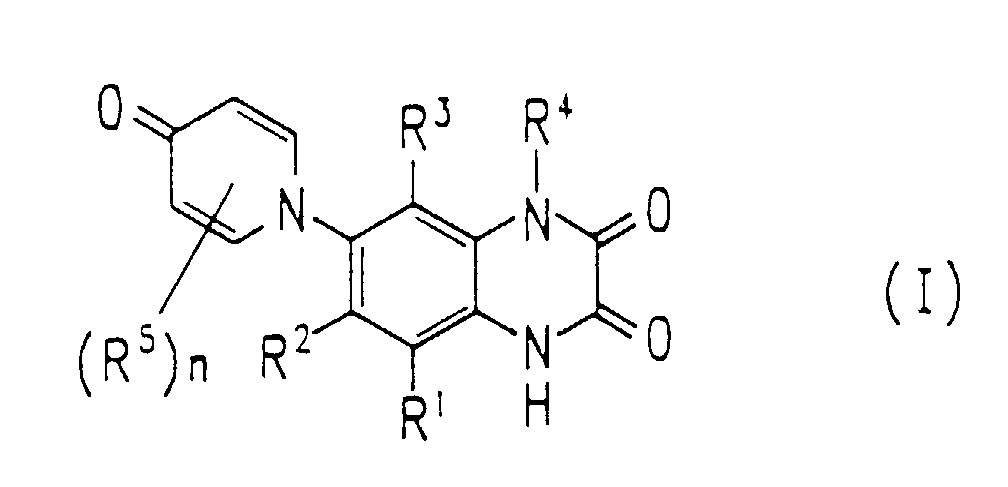
- the oxopyridinylquinoxaline derivative represented by the following Formula I or pharmaceutically acceptable salts thereof is provided: wherein R 1 is hydrogen, halogen, nitro, or trihalomethyl; R 2 is hydrogen, halogen, nitro, cyano, trihalomethyl, carbamoyl, carbamoyl substituted with lower alkyl, sulfamoyl, or sulfamoyl substituted with lower alkyl; R 3 is hydrogen, nitro, or halogen; R 4 is hydrogen, lower alkyl, substituted lower alkyl, lower cycloalkyl, or substituted lower cycloalkyl; R 5 's are substituents independently selected from the group consisting of halogen, nitro, cyano, lower alkyl, carbamoyl, and carbamoyl substituted with lower alkyl; and n is an integer of 0 to 4.
- R 1 and R 3 are independently hydrogen or nitro;
- R 2 is halogen, nitro, cyano, trihalomethyl, carbamoyl, carbamoyl substituted with lower alkyl, sulfamoyl, or sulfamoyl substituted with lower alkyl;
- R 4 is hydrogen or lower alkyl;
- R 5 's are substituents independently selected from the group consisting of halogen, nitro, and lower alkyl; and n is an integer of 0 to 4.
- each of R 1 and R 3 is hydrogen; R 2 is halogen, nitro, cyano, or trihalomethyl;, R 4 is hydrogen or lower alkyl; R 5 's are substituents independently selected from the group consisting of halogen and nitro; and n is an integer of 0 to 4.
- n 0.
- R 1 , R 3 , and R 4 in Formula I are independently hydrogen; and R 2 is nitro.
- a pharmaceutical composition of the present invention includes an oxopyridinylquinoxaline derivative represented by the following Formula I or pharmaceutically acceptable salts thereof as its active component: wherein R 1 is hydrogen, halogen, nitro, or trihalomethyl; R 2 is hydrogen, halogen, nitro, cyano, trihalomethyl, carbamoyl, carbamoyl substituted with lower alkyl, sulfamoyl, or sulfamoyl substituted with lower alkyl; R 3 is hydrogen, nitro, or halogen; R 4 is hydrogen, lower alkyl, substituted lower alkyl, lower cycloalkyl, or substituted lower cycloalkyl; R 5 's are substituents independently selected from the group consisting of halogen, nitro, cyano, lower alkyl, carbamoyl, and carbamoyl substituted with lower alkyl; and n is an integer of 0 to 4.
- R 1 is hydrogen, halogen, nitro,
- the above-mentioned pharmaceutical composition is for use in competitively inhibiting hyper-stimulation of neurons caused by excitatory amino acids.
- the above-mentioned pharmaceutical composition has antagonistic activities for glutamate receptor.
- the above-mentioned pharmaceutical composition is for treating a neurological disease caused by hyper-stimulation of neurons due to excitatory amino acids.
- the neurological disease is at least one selected from the group consisting of parkinsonism, senile dementia, Huntington's chorea, and epilepsia.
- the above-mentioned oxopyridinylquinoxaline derivative is for use in competitively inhibiting the hyper-stimulation of neurons by excitatory amino acids.
- the invention described herein makes possible the advantages of (1) providing a quinoxaline derivative having outstanding antagonistic activities to a glycine binding site of NMDA receptors and AMPA receptors which are present in the CNS; (2) providing a pharmaceutical composition for use in competitively inhibiting hyper-stimulation of neurons caused by excitatory amino acids; (3) providing a pharmaceutical composition having antagonistic activities to glutamate receptors; (4) providing a pharmaceutical composition for treating neurological disorders caused by hyper-stimulation of neurons due to excessive excitatory amino acids induced by ischemia or anoxia; and (5) providing a quinoxaline derivative for use in competitively inhibiting hyper-stimulation of neurons due to excitatory amino acids.
- oxopyridinylquinoxaline derivatives generally exhibit antagonistic effects against the glycine binding site of NMDA receptors and AMPA receptors which are present in the CNS. Therefore, oxopyridinylquinoxaline derivatives are effective for the above-mentioned diseases and conditions caused by hyper-stimulation of neurons due to excitatory amino acids.
- an oxopyridinyl group which may be substituted, is introduced into the 6-position or 7-position of quinoxaline, which is novel especially, in terms of structure, and is pharmacologically important.
- halogen examples include chlorine, fluorine, bromine, and iodine.
- trihalomethyl examples include trifluoromethyl.
- the lower alkyl refers to a straight-chain or a branched-chain alkyl group having 1 to 6 carbon atoms. Examples of the lower alkyl include methyl, ethyl, butyl, and isopropyl.
- the lower cycloalkyl refers to a cycloalkyl group having 3 to 6 carbon atoms. Examples of the lower cycloalkyl include cyclopropyl and cyclobutyl.
- Examples of the substituted lower alkyl or cycloalkyl represented by R 4 include halogen, an amino group, and a carboxyl group.
- R 1 and R 3 are independently hydrogen or nitro; more preferably, each of R 1 and R 3 is hydrogen.
- R 2 is halogen, nitro, cyano, trihalomethyl, carbamoyl, carbamoyl substituted with lower alkyl, sulfamoyl, or sulfamoyl substituted with lower alkyl; more preferably, halogen, nitro, cyano, or trihalomethyl; and most preferably, nitro.
- R 4 is hydrogen or lower alkyl; and more preferably, hydrogen.
- each of R 1 , R 3 , and R 4 is hydrogen.
- R 5 's are substituents independently selected from the group consisting of halogen, nitro, and lower alkyl; more preferably, substituents independently selected from the group consisting of halogen and nitro.
- n can be an integer of 0 to 4. In the case where n is 0, any R 5 is not present on the oxopyridinyl group. Alternatively, the above-mentioned n can be an integer of 1, 2, 3, or 4. Thus, (R 5 )n on the oxopyridinyl group of the oxopyridinylquinoxaline derivatives of the present invention can be a combination of various kinds of substituents and can be present at any position selected from the group consisting of the 2-position, 3-position, 5-position, and 6-position.
- Examples of (R 5 )n include combinations where n is 4 and each of R 5 's is halogen; n is 2, each of R 5 's is halogen and R 5 is present at the 3-position and 5-position; n is 1, R 5 is halogen and is present at the 3-position; n is 1, R 5 is lower alkyl and is present at the 2-position; and n is 1, R 5 is nitro and is present at the 3-position.
- n is 0.
- R 1 and R 3 are independently hydrogen or nitro;
- R 2 is halogen, nitro, cyano, trihalomethyl, carbamoyl, carbamoyl substituted with lower alkyl, sulfamoyl, or sulfamoyl substituted with lower alkyl;
- R 4 is hydrogen or lower alkyl;
- R 5 's are substituents independently selected from the group consisting of halogen, nitro, and lower alkyl; and n is an integer of 0 to 4.
- each of R 1 and R 3 is hydrogen; R 2 is halogen, nitro, cyano, or trihalomethyl; R 4 is hydrogen or lower alkyl; R 5 's are substituents independently selected from the group consisting of halogen and nitro; and n is an integer of 0 to 4.
- each of R 1 , R 3 , and R 4 is independently hydrogen; R 2 is nitro; and n is 0.
- Table 1 shows representative examples of the compound of the present invention.
- the present invention also includes pharmaceutically acceptable salts of Compound I.
- the salts include those of Compound I and inorganic acids such as hydrochloric acid, hydrobromic acid, sulfuric acid, and phosphoric acid; those of Compound I and organic acids such as acetic acid, tartaric acid, fumaric acid, and sulfonic acid; those of Compound I and inorganic bases such as sodium hydroxide and potassium hydroxide; or those of Compound I and organic bases such as tris(hydroxymethyl)aminomethane and choline.
- Compound I and inorganic acids such as hydrochloric acid, hydrobromic acid, sulfuric acid, and phosphoric acid
- those of Compound I and organic acids such as acetic acid, tartaric acid, fumaric acid, and sulfonic acid
- those of Compound I and inorganic bases such as sodium hydroxide and potassium hydroxide
- those of Compound I and organic bases such as tris(hydroxymethyl)aminomethane and choline.
- Compound I can be present as stereoisomers and as tautomers depending upon the identity of the substituents to be contained in Compound I. Furthermore, Compound I of the present invention or the salts thereof can be present as a hydrate such as monohydrate and dihydrate. Such hydrates are also within the range of the present invention.
- the compounds of the present invention can be produced by Synthetic Process 1 or 2 represented, for example, by the following equation. wherein X represents halogen; and R 1 , R 2 , R 3 , R 4 and (R 5 )n are defined in the same way as in Formula I.
- haloquinoxaline compound II is reacted with 4-hydroxypyridine compound III.
- This reaction is generally performed in an organic solvent such as dimethylsulfoxide, dimethylformamide, acetonitrile, acetone, and terahydrofuran, preferably at a temperature of about 80 to 180°C.
- organic solvent such as dimethylsulfoxide, dimethylformamide, acetonitrile, acetone, and terahydrofuran, preferably at a temperature of about 80 to 180°C.
- Various bases can be added for the purpose of promoting the reaction. Examples of the preferred bases include sodium hydroxide, potassium hydroxide, and potassium carbonate. wherein R 1 , R 2 , R 3 , and (R 5 )n are defined in the same way as in Formula I.
- oxopyridinyl-o-phenylenediamine derivative IV is reacted with an equimolar or excess molar amount of oxalic acid at room temperature or higher.
- a reactive derivative of oxalic aid can be used in this reaction in place of oxalic acid.
- the preferred derivatives include salts, esters, hydrates, anhydrides, and acid chlorides.
- This reaction is generally effected in an aqueous or alcohol solvent.
- Various acids can be added for the purpose of promoting the reaction.
- An example of the preferred acid is hydrochloric acid.
- Compound I' obtained by this reaction corresponds to Formula I of the present invention, where R 4 is hydrogen.
- the compounds of the present invention can also be produced by introducing a new substituent into the compounds obtained by the above-mentioned process or substituting the compounds with a suitable substituent.
- Compound I-2 of the present invention where R 2 is nitro can be obtained by nitrating Compound I-1 of the present invention where R 2 is hydrogen, as represented by the following equation. wherein R 1 , R 3 , R 4 , and (R 5 )n are defined in the same way as in Formula I.
- Nitration can be effected by treating Compound I-1 of the present invention where R 2 is hydrogen with nitric acid or one of its salts under acidic conditions of sulfuric acid or acetic anhydride-acetic acid.
- the nitration can be effected by heating Compound I-1 in an organic solvent such as sulfolane together with nitronium tetrafluoroborate.
- the compounds of the present invention can be obtained by treating Compound I-3 with chlorosulfonic acid or its salts so as to introduce a chlorosulfonyl group, and further treating the resultant compound with ammonia or an ammonium salt so as to introduce sulfamoyl as R 2 under the similar acidic conditions as the above.
- the ability of the compound of the present invention to bind to these receptors can be measured by the competitive assay using glycine or AMPA labeled with 3 H. Furthermore, experiments using rats confirmed that the compounds of the present invention exhibit a protective function for neurological disorders.
- the ability of the compounds of the present invention to bind to a glycine binding site of the NMDA receptors can be measured, for example, using competitive assay in vitro as described below.
- a rat cerebral cortex is homogenized with a buffer solution, and repeatedly centrifuged and resuspended in a buffer to prepare a membrane sample.
- the membrane sample is mixed with a solution containing [ 3 H] glycine and a compound of interest and incubated for a predetermined period of time. Then, the reaction of the mixture is terminated by dilution and filtration using filter paper. Radioactivity on the filter paper is measured by a liquid scintillation counter. Non-specific binding is measured with 1mM of non-radioactive glycine to work out IC 50 .
- the binding ability of the compounds of the present invention with respect to the AMPA receptors can be measured, for example, by the following competitive assay.
- a rat cerebral cortex is homogenized with a buffer solution, and repeatedly centrifuged and resuspended in a buffer to prepare a membrane sample.
- the membrane sample is mixed with a solution containing [ 3 H] AMPA and a compound of interest and incubated for a predetermined period of time. Then, the reaction of the mixture is terminated by dilution and filtration using filter paper. Radioactivity on the filter paper is measured by a liquid scintillation counter. Non-specific binding is measured with 1mM of non-radioactive glutamate to work out IC 50 .
- a composition containing oxopyridinylquinoxaline derivatives of the present invention can be therapeutic agents effective for neurological disorders caused by the binding of excitatory amino acids to the NMDA receptors, especially to a glycine binding site and to the AMPA receptors.
- the composition can be orally or non-orally administered to subjects.
- the pharmaceutical composition in the form of an injectable solution or a suspension, preferably in the form of an aqueous solution are suitable for non-oral administration; those in the form of a tablet and a capsule are suitable for oral administration.
- These compositions can contain a compound of the present invention in various concentrations.
- compositions such as salines, alcohols, castor oil, gelatin, lactose, starch, and talc can be contained in the composition.
- auxiliary substances such as a lubricant, a stabilizer, and an emulsifier can be contained in the composition.
- the dose of the composition of the present invention as a therapeutic agent can be varied depending upon age, weight, conditions, therapeutic effects, a method for administration, a treating time, etc. of subjects.
- the composition can be administered to human beings orally or parenterally, especially intravenously. In the case of an adult, the composition is generally administered orally at a dose of about 1 to 1000 mg, preferably 10 to 500 mg per day; or parenterally at a dose of about 1 to 500 mg per day; in one to several divided doses or continuously in terms of the oxopyridinyl quinoxaline derivative of Formula I.
- NMR nuclear magnetic resonance spectroscopy
- IR infrared spectroscopy
- Reference Examples 1 to 6 will show production examples of compounds used for starting materials in the examples of the present invention.
- a choline salt of Compound Ia is obtained as follows.
- the precipitate was recrystallized with a mixture of dimethylformaldehyde and water to give 376 mg of yellowish white 6-nitro-7-(3-chloro-4-oxo-4H-pyridin-1-yl)-1,4-dihydroquinoxaline-2,3-dione.
- the cerebral cortex of an Slc-Wistar rat (250 to 300 g in weight) was homogenized in 5 mM Tris acetic acid buffer in 20-fold volume (containing 1 mM EGTA, 0.1 mM PMSF, and 0.01% Bacitracin, pH 7.4).
- the cerebral cortex was centrifuged at 50,000 x g for 30 minutes and resuspended in a buffer. This process was repeated four times.
- the final suspension was stored at -80°C.
- the frozen suspension was thawed at room temperature and incubated with 0.08% Triton X-100 solution at 2°C for 10 minutes.
- the resultant suspension was then washed twice and suspended in 50 mM Tris-acetate buffer (pH 7.4) to give a membrane sample.
- the membrane sample was mixed with 100 nM [ 3 H]glycine and solutions in a series of concentrations of Compound Ia obtained in Example 1. The mixtures were incubated at 0°C for 10 minutes. Each of the mixtures was diluted and filtered using Whatman GF/C filter paper so as to terminate the reaction, and radioactivity of 3 H remaining on the filter paper was measured by a scintillation counter for liquid.
- the assay for non-specific binding was conducted with 1 mM of non-radioactive glycine to determine an IC 50 value.
- IC 50 value of Compound Ia was determined using YM900 (a compound of Example 15 described in WO92/07847) as a control in the same way as described above. The results are shown in Table 2.
- Compound Ia exhibited antagonistic effects approximately ten times as strong as that of YM900.
- the cerebral cortex of an Slc-Wistar rat (250 to 300 g in weight) was homogenized in 30 mM Tris acetic acid buffer in 10-fold volume (containing 2.5 mM CaCl 2 , pH 7.1).
- the cerebral cortex was centrifuged at 30,000 x g for 15 minutes and resuspended in a buffer. This process was repeated three times.
- the final suspension was stored at -80°C.
- the frozen suspension was thawed at room temperature and suspended in 30 mM Tris-acetate buffer (containing 2.5 mM CaCl 2 and 100 mM KSCN, pH 7.1) to give a membrane sample.
- the membrane sample was mixed with 30nM [ 3 H]AMPA and solutions in a series of concentrations of Compound Ia. The mixtures were incubated at 0°C for 30 minutes. Each of the mixtures was diluted and filtered using Whatman GF/C filter paper so as to terminate the reaction, and radioactivity of 3 H remaining on the filter paper was measured by a scintillation counter for liquid. The assay for non-specific binding was conducted with 1 mM non-radioactive glutamate to determine an IC 50 value. IC 50 value of Compound Ia was determined using YM900 as a control in the same way as described above. The results are shown in Table 3. Compound IC 50 ( ⁇ M) Ia 0.10 YM900 0.28
- oxopyridinylquinoxaline derivatives which are novel compounds, exhibit outstanding antagonistic effects in connection with the NMDA receptors and the AMPA receptors of central neurons.
- the compounds of the present invention are effective as therapeutic agents for neurological disorders caused by excitatory amino acids since they inhibit the excitatory amino acids from binding to the NMDA receptors or the AMPA receptors.
Landscapes
- Chemical & Material Sciences (AREA)
- Organic Chemistry (AREA)
- Health & Medical Sciences (AREA)
- Pharmacology & Pharmacy (AREA)
- Engineering & Computer Science (AREA)
- Bioinformatics & Cheminformatics (AREA)
- Veterinary Medicine (AREA)
- Public Health (AREA)
- General Health & Medical Sciences (AREA)
- Animal Behavior & Ethology (AREA)
- Life Sciences & Earth Sciences (AREA)
- Medicinal Chemistry (AREA)
- Vascular Medicine (AREA)
- Nuclear Medicine, Radiotherapy & Molecular Imaging (AREA)
- General Chemical & Material Sciences (AREA)
- Chemical Kinetics & Catalysis (AREA)
- Heart & Thoracic Surgery (AREA)
- Cardiology (AREA)
- Urology & Nephrology (AREA)
- Epidemiology (AREA)
- Pharmaceuticals Containing Other Organic And Inorganic Compounds (AREA)
- Plural Heterocyclic Compounds (AREA)
- Organic Low-Molecular-Weight Compounds And Preparation Thereof (AREA)
- Pyridine Compounds (AREA)
Abstract
Description
- The present invention relates to an oxopyridinylquinoxaline derivative exhibiting antagonistic effects against glutamate receptors of central neurons, in particular, NMDA receptors and AMPA receptors.
- Amino acids such as L-glutamic acid and L-aspartic acid are indispensable as neurotransmitters for activating neurons in the central nervous system (CNS). However, excess accumulation of these excitatory amino acids surrounding neurons is considered to induce hyper-stimulation of neurons, causing neurological disorders such as Parkinsonism, senile dementia, Huntington's disease, and epilepsy; and hyponoia and hypokinesis found after ischemia, anoxia, hypoglycemia, or head and spinal cord trauma (see, McGeer et al. Nature, 263, 517-519 (1976); Simon et al. Science, 226, 850-852 (1984), Wieloch, Science, 230, 681-683 (1985); Faden et al. Science, 244, 798-800 (1989); Turski et al. Nature, 349, 414-418 (1991)).
- It has been known that the above-mentioned excitatory amino acids act on the CNS via a glutamate receptor on the neurons. Thus, compounds for competitively inhibiting the binding of the excitatory amino acids to such a receptor have been considered to be effective as therapeutic agents for the above-mentioned diseases and conditions, such as antiepileptic, ischemic encephalopathy preventive, and antiparkinsonism agent. Important roles performed by the glutamate receptor are reported by Japanese Laid-Open Patent Publication Nos. 6-25294, 6-239747, and 6-228112 (Yamanouchi Pharmaceutical Co., Ltd.); W093/8173 (SCHERING); EP5725852A1 (BASF); etc.
- The glutamate receptor can be classified into two groups; namely an ion channel type and a metabolism type. The ion channel type is further classified into three groups based on its selectivity with respect to binding to an agonist. These are called N-methyl-D-aspartate (NMDA) receptors, 2-amino-3-(3-hydroxy-5-methylisoxazol-4-yl)propanoate (AMPA) receptors, and kainate receptors.
- The NMDA receptors are selectively activated by agonists such as NMDA and ibotenic acid. Hyper-stimulation of the NMDA receptors allows a large amount of calcium ions to flow into neurons, which has been considered one of the causes for the death of neurons. Hithertofore, as antagonists selectively binding to the NMDA receptors, D-2-amino-5-phosphovalerate (D-AP5), and 3-[2-carboxypiperazin-4-yl]propyl-1-phosphate (CPP), etc. are known.
- The AMPA receptors are selectively activated by agonists such as AMPA, glutamic acid, and quisqualic acid. As antagonists against the AMPA receptors, various derivatives of quinoxaline have been developed. Examples of the derivatives include 6,7-dinitroquinoxaline-2,3-dione (DNQX) (Ferrosan), 6-cyano-7-nitroquinoxaline-2,3-dione (CNQX), 2,3-dihydroxy-6-nitro-7-sulfamoylbenzo(f)quinoxaline (NBQX) (Ferrosan), and 6-imidazolyl-7-nitroquinoxaline-2,3-(1H, 4H)-dione (YM900) (Yamanouchi Pharmaceutical Co., Ltd.). Some of these derivatives have been reported in Honore et al., Science, 241, 701-703 (1988); Sheardown et al., Eur. J. Pharmacol., 174, 197-204 (1989), PCT Publication No. W092-07847, published on May 14, 1992; and Japanese Laid-Open Patent Publication Nos. 63-83074, 63-258466, 1-153680, 2-48578, 2-221263, and 2-221264; Sakamoto et al., J. Med. Chem. 37, 467-475 (1994).
- The NMDA receptors have an allosteric site bound by glycine as well as a site recognizing the above-mentioned agonists. It is known that the binding of the allosteric site by glycine remarkably enhances the functions of the NMDA receptors. In recent years, the development of antagonists or modulators which can bind to glycine binding sites, and affect the NMDA receptors allosterically came to public attention. Examples of the antagonist against the glycine binding sites include 5,7-dichlorokynurenic acid HA966 (Eur. J. Pharmacol., 151, 161-163 (1988)).
- The above-mentioned DNQX and CNQX have been confirmed to exhibit antagonistic effects on the glycine binding site of the NMDA receptors as well as on the AMPA receptors (Birch et al., Eur. J. Pharmacol., 156, 177-180 (1988); Drejer et al., Neurosci. Lett., 98, 333-338 (1989); Sheardown et al., Science, 247, 571-574 (1990)). Dioxotetrahydroquinolines are also known to exhibit antagonistic effects against both of the glycine binding sites and the AMPA receptors. In general, these compounds exhibit effective antagonistic effects against either one of the NMDA receptors and the AMPA receptors, whereas they do not have effective activities to both of them simultaneously (Larsen et al. ed. EXCITATORY AMINO ACID RECEPTORS, Chapter 11, published by ELLIS HORWOOD (1992)). These compounds have not been put to practical use as central nervines because they are difficult to be transmitted to the brain.
- Compounds used as therapeutic agents effective for the above-mentioned diseases and conditions, protecting neurons from death or denaturation caused by the excitatory amino acids, are required to effectively work as antagonists against both the NMDA receptors and the AMPA receptors (Mosinger et al., Exp. Neurol., 113, 10-17 (1991)). Accordingly, there is a demand for compounds having marked antagonistic activities to both the NMDA receptors and the AMPA receptors.
- According to the present invention, the oxopyridinylquinoxaline derivative represented by the following Formula I or pharmaceutically acceptable salts thereof is provided:wherein R1 is hydrogen, halogen, nitro, or trihalomethyl; R2 is hydrogen, halogen, nitro, cyano, trihalomethyl, carbamoyl, carbamoyl substituted with lower alkyl, sulfamoyl, or sulfamoyl substituted with lower alkyl; R3 is hydrogen, nitro, or halogen; R4 is hydrogen, lower alkyl, substituted lower alkyl, lower cycloalkyl, or substituted lower cycloalkyl; R5's are substituents independently selected from the group consisting of halogen, nitro, cyano, lower alkyl, carbamoyl, and carbamoyl substituted with lower alkyl; and n is an integer of 0 to 4.

- In one embodiment of the invention, in Formula I, R1 and R3 are independently hydrogen or nitro; R2 is halogen, nitro, cyano, trihalomethyl, carbamoyl, carbamoyl substituted with lower alkyl, sulfamoyl, or sulfamoyl substituted with lower alkyl; R4 is hydrogen or lower alkyl; R5's are substituents independently selected from the group consisting of halogen, nitro, and lower alkyl; and n is an integer of 0 to 4.
- In another embodiment of the invention, in Formula I, each of R1 and R3 is hydrogen; R2 is halogen, nitro, cyano, or trihalomethyl;, R4 is hydrogen or lower alkyl; R5's are substituents independently selected from the group consisting of halogen and nitro; and n is an integer of 0 to 4.
- In another embodiment of the invention, in Formula I, n is 0.
- In another embodiment of the invention, R1, R3, and R4 in Formula I are independently hydrogen; and R2 is nitro.
- A pharmaceutical composition of the present invention includes an oxopyridinylquinoxaline derivative represented by the following Formula I or pharmaceutically acceptable salts thereof as its active component:wherein R1 is hydrogen, halogen, nitro, or trihalomethyl; R2 is hydrogen, halogen, nitro, cyano, trihalomethyl, carbamoyl, carbamoyl substituted with lower alkyl, sulfamoyl, or sulfamoyl substituted with lower alkyl; R3 is hydrogen, nitro, or halogen; R4 is hydrogen, lower alkyl, substituted lower alkyl, lower cycloalkyl, or substituted lower cycloalkyl; R5's are substituents independently selected from the group consisting of halogen, nitro, cyano, lower alkyl, carbamoyl, and carbamoyl substituted with lower alkyl; and n is an integer of 0 to 4.
- In one embodiment of the invention, the above-mentioned pharmaceutical composition is for use in competitively inhibiting hyper-stimulation of neurons caused by excitatory amino acids.
- In another embodiment of the invention, the above-mentioned pharmaceutical composition has antagonistic activities for glutamate receptor.
- In another embodiment of the invention, the above-mentioned pharmaceutical composition is for treating a neurological disease caused by hyper-stimulation of neurons due to excitatory amino acids.
- In another embodiment of the invention, the neurological disease is at least one selected from the group consisting of parkinsonism, senile dementia, Huntington's chorea, and epilepsia.
- According to another aspect of the invention, the above-mentioned oxopyridinylquinoxaline derivative is for use in competitively inhibiting the hyper-stimulation of neurons by excitatory amino acids.
- Thus, the invention described herein makes possible the advantages of (1) providing a quinoxaline derivative having outstanding antagonistic activities to a glycine binding site of NMDA receptors and AMPA receptors which are present in the CNS; (2) providing a pharmaceutical composition for use in competitively inhibiting hyper-stimulation of neurons caused by excitatory amino acids; (3) providing a pharmaceutical composition having antagonistic activities to glutamate receptors; (4) providing a pharmaceutical composition for treating neurological disorders caused by hyper-stimulation of neurons due to excessive excitatory amino acids induced by ischemia or anoxia; and (5) providing a quinoxaline derivative for use in competitively inhibiting hyper-stimulation of neurons due to excitatory amino acids.
- Various further preferred features and embodiments of the invention will now be described by way of non-limiting illustration.
- The inventors of the present invention found that the following oxopyridinylquinoxaline derivatives generally exhibit antagonistic effects against the glycine binding site of NMDA receptors and AMPA receptors which are present in the CNS. Therefore, oxopyridinylquinoxaline derivatives are effective for the above-mentioned diseases and conditions caused by hyper-stimulation of neurons due to excitatory amino acids.
- The oxopyridinylquinoxaline derivatives of the present invention are represented by the following Formula I.wherein R1 is hydrogen, halogen, nitro, or trihalomethyl; R2 is hydrogen, halogen, nitro, cyano, trihalomethyl, carbamoyl, carbamoyl substituted with lower alkyl, sulfamoyl, or sulfamoyl substituted with lower alkyl; R3 is hydrogen, nitro, or halogen; R4 is hydrogen, lower alkyl, substituted lower alkyl, lower cycloalkyl, or substituted lower cycloalkyl; R5's are substituents independently selected from the group consisting of halogen, nitro, cyano, lower alkyl, carbamoyl, and carbamoyl substituted with lower alkyl; and n is an integer of 0 to 4 (i.e., n = 0, 1, 2, 3 or 4).

- In Formula I of the present invention, an oxopyridinyl group, which may be substituted, is introduced into the 6-position or 7-position of quinoxaline, which is novel especially, in terms of structure, and is pharmacologically important.
- Examples of halogen include chlorine, fluorine, bromine, and iodine. Examples of trihalomethyl include trifluoromethyl. In the present specification, the lower alkyl refers to a straight-chain or a branched-chain alkyl group having 1 to 6 carbon atoms. Examples of the lower alkyl include methyl, ethyl, butyl, and isopropyl. The lower cycloalkyl refers to a cycloalkyl group having 3 to 6 carbon atoms. Examples of the lower cycloalkyl include cyclopropyl and cyclobutyl.
- Examples of the substituted lower alkyl or cycloalkyl represented by R4 include halogen, an amino group, and a carboxyl group.
- Preferably, R1 and R3 are independently hydrogen or nitro; more preferably, each of R1 and R3 is hydrogen. Preferably, R2 is halogen, nitro, cyano, trihalomethyl, carbamoyl, carbamoyl substituted with lower alkyl, sulfamoyl, or sulfamoyl substituted with lower alkyl; more preferably, halogen, nitro, cyano, or trihalomethyl; and most preferably, nitro. Preferably, R4 is hydrogen or lower alkyl; and more preferably, hydrogen. Preferably, each of R1, R3, and R4 is hydrogen.
- Preferably, R5's are substituents independently selected from the group consisting of halogen, nitro, and lower alkyl; more preferably, substituents independently selected from the group consisting of halogen and nitro.
- The above-mentioned n can be an integer of 0 to 4. In the case where n is 0, any R5 is not present on the oxopyridinyl group. Alternatively, the above-mentioned n can be an integer of 1, 2, 3, or 4. Thus, (R5)n on the oxopyridinyl group of the oxopyridinylquinoxaline derivatives of the present invention can be a combination of various kinds of substituents and can be present at any position selected from the group consisting of the 2-position, 3-position, 5-position, and 6-position. Examples of (R5)n include combinations where n is 4 and each of R5's is halogen; n is 2, each of R5's is halogen and R5 is present at the 3-position and 5-position; n is 1, R5 is halogen and is present at the 3-position; n is 1, R5 is lower alkyl and is present at the 2-position; and n is 1, R5 is nitro and is present at the 3-position. Preferably, n is 0.
- In preferred oxopyridinylquinoxaline derivatives of the present invention, R1 and R3 are independently hydrogen or nitro; R2 is halogen, nitro, cyano, trihalomethyl, carbamoyl, carbamoyl substituted with lower alkyl, sulfamoyl, or sulfamoyl substituted with lower alkyl; R4 is hydrogen or lower alkyl; R5's are substituents independently selected from the group consisting of halogen, nitro, and lower alkyl; and n is an integer of 0 to 4.
- In more preferred oxopyridinylquinoxaline derivatives of the present invention, each of R1 and R3 is hydrogen; R2 is halogen, nitro, cyano, or trihalomethyl; R4 is hydrogen or lower alkyl; R5's are substituents independently selected from the group consisting of halogen and nitro; and n is an integer of 0 to 4. In still more preferred oxopyridinylquinoxaline derivatives of the present invention, each of R1, R3, and R4 is independently hydrogen; R2 is nitro; and n is 0.
- Table 1 shows representative examples of the compound of the present invention.
R1 R2 R3 R4 n R5 H nitro H H 0 - H halogen H H 0 - H cyano H H 0 - H carbamoyl H H 0 - H sulfamoyl H H 0 - H trihalomethyl H H 0 - H nitro H lower alkyl 0 - H halogen H lower alkyl 0 - H cyano H lower alkyl 0 - H carbamoyl H lower alkyl 0 - H sulfamoyl H lower alkyl 0 - H trihalomethyl H lower alkyl 0 - H nitro H H 1 methyl at the 2-position H nitro H H 1 chlorine at the 3-position H nitro H H 1 nitro at the 3-position H nitro H H 4 all of R5's are fluorine H nitro H H 2 chlorine at the 3- and 5-positions H nitro H lower alkyl 1 nitro at the 3-position H sulfamoyl substituted with lower alkyl H H 0 - nitro halogen H H 0 - H halogen nitro H 0 - H nitro H H 1 fluorine H trifluoromethyl H H 1 fluorine H nitro nitro H 0 - - The present invention also includes pharmaceutically acceptable salts of Compound I. Examples of the salts include those of Compound I and inorganic acids such as hydrochloric acid, hydrobromic acid, sulfuric acid, and phosphoric acid; those of Compound I and organic acids such as acetic acid, tartaric acid, fumaric acid, and sulfonic acid; those of Compound I and inorganic bases such as sodium hydroxide and potassium hydroxide; or those of Compound I and organic bases such as tris(hydroxymethyl)aminomethane and choline.
- Compound I can be present as stereoisomers and as tautomers depending upon the identity of the substituents to be contained in Compound I. Furthermore, Compound I of the present invention or the salts thereof can be present as a hydrate such as monohydrate and dihydrate. Such hydrates are also within the range of the present invention.
- The compounds of the present invention can be produced by Synthetic Process 1 or 2 represented, for example, by the following equation.wherein X represents halogen; and R1, R2, R3, R4 and (R5)n are defined in the same way as in Formula I.
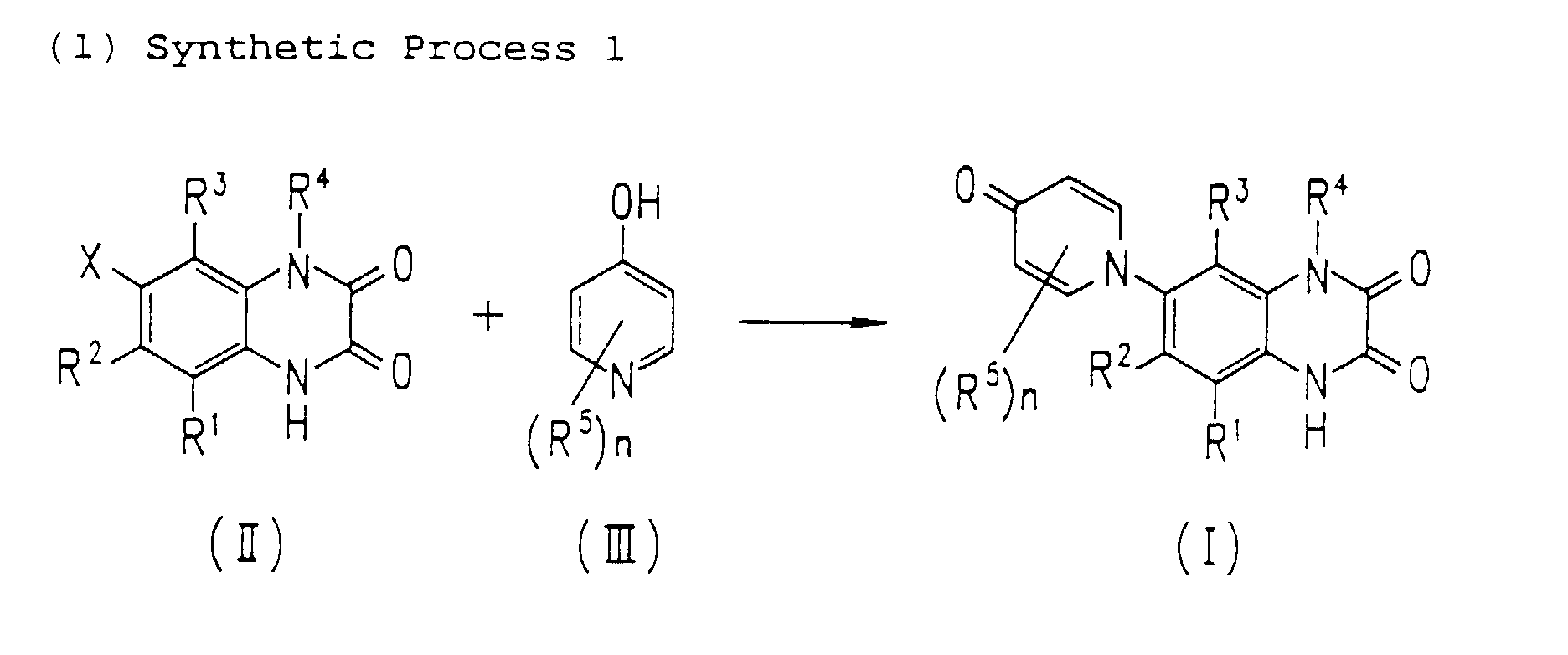
- According to this process, haloquinoxaline compound II is reacted with 4-hydroxypyridine compound III. This reaction is generally performed in an organic solvent such as dimethylsulfoxide, dimethylformamide, acetonitrile, acetone, and terahydrofuran, preferably at a temperature of about 80 to 180°C. Various bases can be added for the purpose of promoting the reaction. Examples of the preferred bases include sodium hydroxide, potassium hydroxide, and potassium carbonate.wherein R1, R2, R3, and (R5)n are defined in the same way as in Formula I.
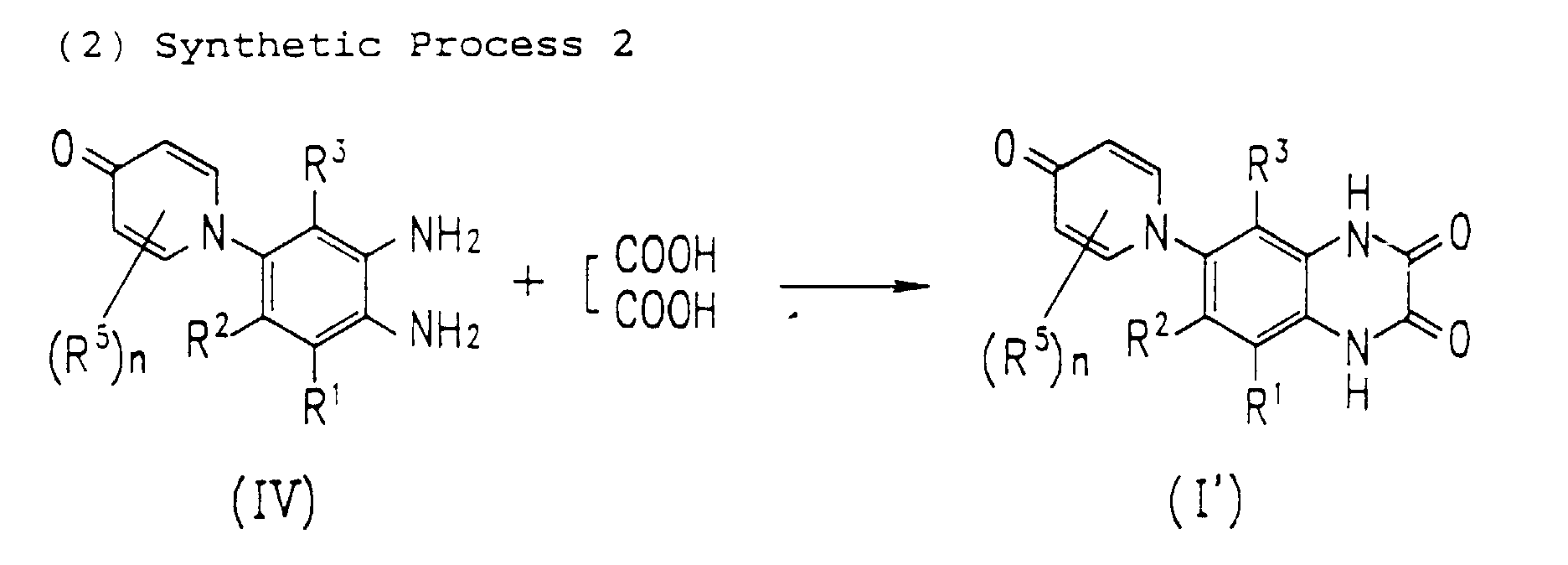
- According to this process, oxopyridinyl-o-phenylenediamine derivative IV is reacted with an equimolar or excess molar amount of oxalic acid at room temperature or higher. A reactive derivative of oxalic aid can be used in this reaction in place of oxalic acid. Examples of the preferred derivatives include salts, esters, hydrates, anhydrides, and acid chlorides. This reaction is generally effected in an aqueous or alcohol solvent. Various acids can be added for the purpose of promoting the reaction. An example of the preferred acid is hydrochloric acid. Compound I' obtained by this reaction corresponds to Formula I of the present invention, where R4 is hydrogen.
- The compounds of the present invention can also be produced by introducing a new substituent into the compounds obtained by the above-mentioned process or substituting the compounds with a suitable substituent. For example, Compound I-2 of the present invention where R2 is nitro can be obtained by nitrating Compound I-1 of the present invention where R2 is hydrogen, as represented by the following equation.wherein R1, R3, R4, and (R5)n are defined in the same way as in Formula I.
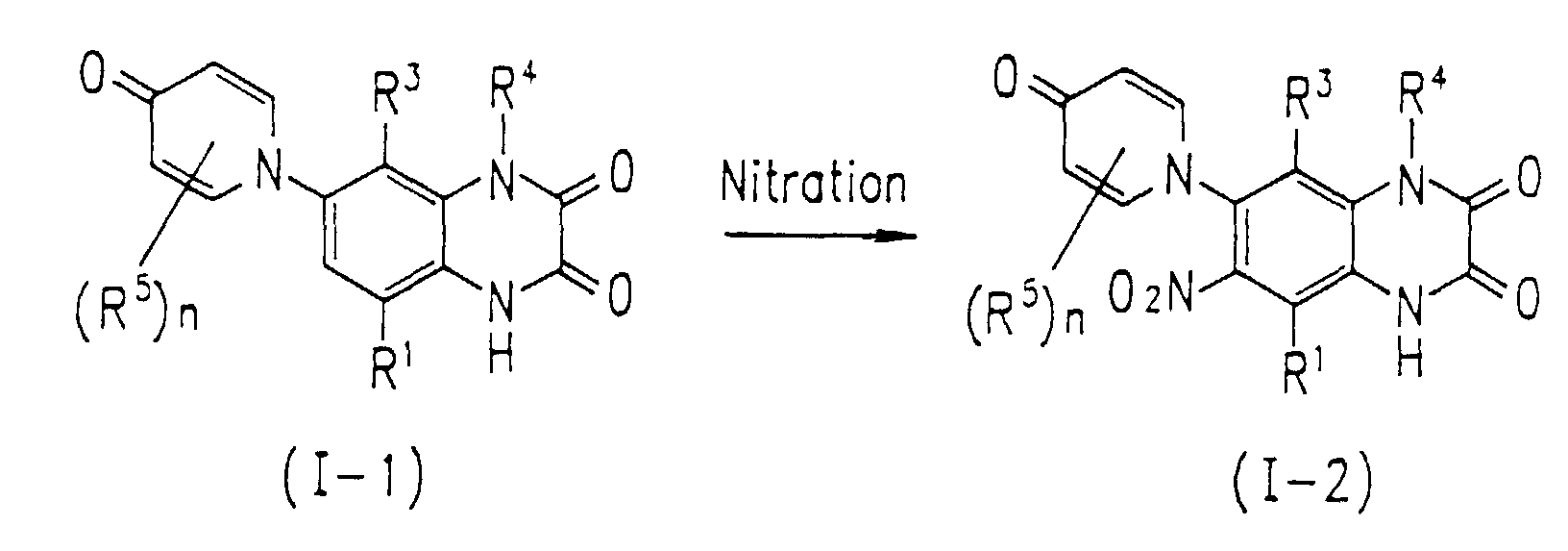
- Nitration can be effected by treating Compound I-1 of the present invention where R2 is hydrogen with nitric acid or one of its salts under acidic conditions of sulfuric acid or acetic anhydride-acetic acid. Alternatively, the nitration can be effected by heating Compound I-1 in an organic solvent such as sulfolane together with nitronium tetrafluoroborate.
- Alternatively, as represented by the following equation, the compounds of the present invention can be obtained by treating Compound I-3 with chlorosulfonic acid or its salts so as to introduce a chlorosulfonyl group, and further treating the resultant compound with ammonia or an ammonium salt so as to introduce sulfamoyl as R2 under the similar acidic conditions as the above.

- The ability of the compound of the present invention to bind to these receptors can be measured by the competitive assay using glycine or AMPA labeled with 3H. Furthermore, experiments using rats confirmed that the compounds of the present invention exhibit a protective function for neurological disorders.
- The ability of the compounds of the present invention to bind to a glycine binding site of the NMDA receptors can be measured, for example, using competitive assay in vitro as described below.
- A rat cerebral cortex is homogenized with a buffer solution, and repeatedly centrifuged and resuspended in a buffer to prepare a membrane sample. The membrane sample is mixed with a solution containing [3H] glycine and a compound of interest and incubated for a predetermined period of time. Then, the reaction of the mixture is terminated by dilution and filtration using filter paper. Radioactivity on the filter paper is measured by a liquid scintillation counter. Non-specific binding is measured with 1mM of non-radioactive glycine to work out IC50.
- The binding ability of the compounds of the present invention with respect to the AMPA receptors can be measured, for example, by the following competitive assay.
- A rat cerebral cortex is homogenized with a buffer solution, and repeatedly centrifuged and resuspended in a buffer to prepare a membrane sample. The membrane sample is mixed with a solution containing [3H] AMPA and a compound of interest and incubated for a predetermined period of time. Then, the reaction of the mixture is terminated by dilution and filtration using filter paper. Radioactivity on the filter paper is measured by a liquid scintillation counter. Non-specific binding is measured with 1mM of non-radioactive glutamate to work out IC50.
- A composition containing oxopyridinylquinoxaline derivatives of the present invention can be therapeutic agents effective for neurological disorders caused by the binding of excitatory amino acids to the NMDA receptors, especially to a glycine binding site and to the AMPA receptors. The composition can be orally or non-orally administered to subjects. The pharmaceutical composition in the form of an injectable solution or a suspension, preferably in the form of an aqueous solution are suitable for non-oral administration; those in the form of a tablet and a capsule are suitable for oral administration. These compositions can contain a compound of the present invention in various concentrations. Pharmaceutically acceptable organic or inorganic excipient such as salines, alcohols, castor oil, gelatin, lactose, starch, and talc can be contained in the composition. Furthermore, if desired, various auxiliary substances such as a lubricant, a stabilizer, and an emulsifier can be contained in the composition.
- The dose of the composition of the present invention as a therapeutic agent can be varied depending upon age, weight, conditions, therapeutic effects, a method for administration, a treating time, etc. of subjects. The composition can be administered to human beings orally or parenterally, especially intravenously. In the case of an adult, the composition is generally administered orally at a dose of about 1 to 1000 mg, preferably 10 to 500 mg per day; or parenterally at a dose of about 1 to 500 mg per day; in one to several divided doses or continuously in terms of the oxopyridinyl quinoxaline derivative of Formula I.
- Hereinafter, the present invention will be described in detail by way of illustrative examples. It should be noted that the present invention is not limited by the following examples.
- In the examples, NMR denotes nuclear magnetic resonance spectroscopy and IR denotes infrared spectroscopy.
- Reference Examples 1 to 6 will show production examples of compounds used for starting materials in the examples of the present invention.
-
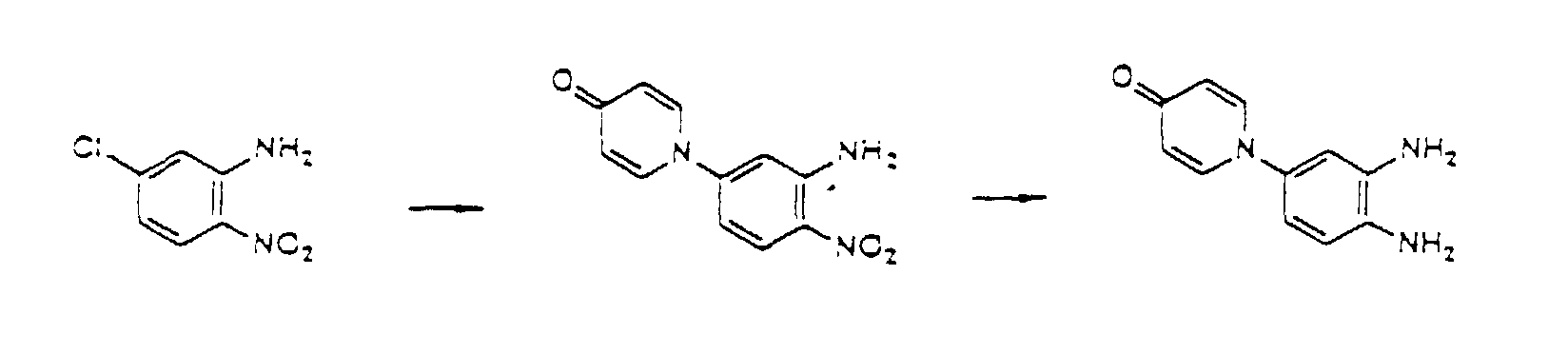
- First, 8.628 g of 5-chloro-2-nitroaniline, 7.161 g of 4-hydroxypyridine, and 4.892 g of powdered potassium hydroxide were added to 60 ml of dry dimethylsulfoxide. The mixture thus obtained was stirred at 130°C for 3 hours in a nitrogen atmosphere. Then, 200 ml of ice water was added to the reaction mixture and neutralized with 4N hydrochloric acid. The resultant solution was stirred for 30 minutes, giving a precipitate. The precipitate was filtered and washed with water. The precipitate was subjected to silica gel column chromatography, and fractions eluted with 20% methanol in methylene chloride were collected. The collected fractions were combined and evaporated. The residue was recrystallized in methanol to give 11.868 g of yellowish orange crystals of 2-nitro-5-(4-oxo-4H-pyridin-1-yl)-aniline.
Melting point: 298-303°C
Elemental analysis (analyzed as C11H9N3O3·1/5H2O)
Calculated: C,56.27; H,4.03; N,17.90 (%)
Found: C,56.21; H,4.01; N,17.79 (%)
H1-NMR (d6-DMSO)δ: 6.26 (2H, d, J=7.8 Hz), 6.81 (1H, dd, J=9.4, 2.8 Hz), 7.08 (1H, d, J=2.8 Hz), 7.61 (2H, br.s), 7.99 (2H, d, J=7.8 Hz), 8.12 (1H, d, J=9.4 Hz). - First, 5.515 g of 2-nitro-5-(4-oxo-4H-pyridin-1-yl)-aniline was added to a suspension containing 7.975 g of iron powder, 20 ml of water, and 78 ml of ethanol, followed by adding 2 ml of 2N hydrochloric acid. The resultant mixture was refluxed by heating for 6 hours. Then, 1.092 g of iron powder and 2 ml of 2N hydrochloric acid were added to the mixture. The resultant mixture was refluxed for another 1 hour. After the reaction, the reaction mixture was hot filtered using celite, and a residue on the celite was thoroughly washed with warm ethanol. The mother liquor and the washings were combined together and concentrated to dryness. The residue thus obtained was subjected to silica gel column chromatography, and fractions eluted with 5% methanol in chloroform were collected. The collected fractions were combined and evaporated. The residue was recrystallized with isopropanol-methanol (1:1) to give 4.137 g of orange crystals of 4-(4-oxo-4H-pyridin-1-yl)-1,2-phenylenediamine.
Melting point: 257-259.5°C
Elemental analysis (analyzed as C11H11N3O)
Calculated: C,65.66; H,5.51; N,20.88 (%)
Found: C,65.51; H,5.58; N,20.63 (%)
H1-NMR (d6-DMSO)δ: 4.76 (2H, br.s), 4.85 (2H, br.s), 6.15 (2H, d, J=7.6 Hz), 6.46 (1H, dd, J=8.2, 2.4 Hz), 6.57 (2H, m), 7.75 (2H, d, J=7.6 Hz). -
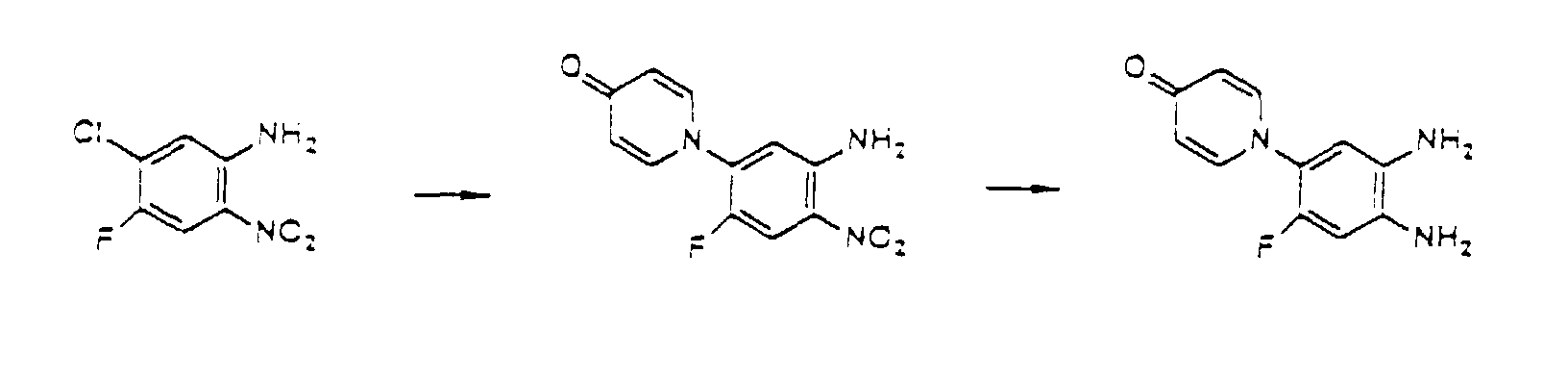
- First, 3.811 g of 2-nitro-4-fluoro-5-chloroaniline, 2.473 g of 4-hydroxypyridine, and 1.827 g of powdered potassium hydroxide were allowed to react at 130°C for 3 hours in a nitrogen atmosphere in the same way as in Reference Example 1 to give 1.125 g of 2-nitro-4-fluoro-5-(4-oxo-4H-pyridin-1-yl)-aniline.
Melting point: > 305°C (decomposition)
Elemental analysis (analyzed as C11H8N3O3F)
Calculated: C,53.02; H,3.24; N,16.86; F,7.62 (%)
Found: C, 52.63; H,3.46; N,16.64; F, 7.44 (%)
H1-NMR (d6-DMSO)δ: 6.27 (2H, d, J=7.8 Hz), 7.18 (1H, d, JFH = 7.0 Hz), 7.57 (2H, br.s), 7.87 (2H, d, J=7.8 Hz), 8.07 (1H, d, JFH=11.2 Hz). - First, 1.065 g of 2-nitro-4-fluoro-5-(4-oxo-4H-pyridin-1-yl)-aniline was dissolved in 45 ml of dimethylformaldehyde by heating and reduced over 195 mg of 10% paradium-carbon catalyst under atmospheric pressure. After the reaction, the reaction mixture was filtered through celite to remove the catalyst, and the mother liquor thus obtained was concentrated to dryness. The residue thus obtained was subjected to column chromatography using 30 g of silica gel, and fractions eluted with a methylene chloride-methanol (20:1) solution were collected. The collected fractions were combined and evaporated. The residue was recrystallized with ethanol to give 802 mg of 4-fluoro-5-(4-oxo-4H-pyridin-1-yl)-1,2-phenylenediamine.
Melting point: 227-229.5°C
Elemental analysis (analyzed as C11H10N3OF)
Calculated: C,60.27; H,4.60; N,19.17; F, 8.67 (%)
Found: C,60.38; H,4.76; N,19.01; F,8.62 (%)
H1-NMR (d6-DMSO)δ: 6.24(2H, d, J=7.8 Hz), 6.50 (1H, d, JFH =12.6 Hz), 6.58 (1H, d, JFH=7.8 Hz), 7.70 (2H, d, J=7.8 Hz). -

- First, a mixture containing 14.3 g of 3,4-dichloro-6-nitroaniline, 9.01 g of 4-hydroxypyridine, 5.87 g of 86% potassium hydroxide, and 70 ml of dimethylsulfoxide was heated in an oil bath at 130°C for 3.5 hours, and cooled. Ice water was added to the mixture and precipitated crystals were filtered. Then, 16.9 g of the resultant crude crystals were applied to a column containing 100 g of silica gel and eluted with 10% methanol in chloroform. The eluate was combined and evaporated. The residue was filtered to give 9.78 g of crude crystals of 4-chloro-3-(4-oxo-4H-pyridin-1-yl)-6-nitroaniline (melting point: 288 to 291°C (decomposition)). Then, 300 mg of the crude crystals were recrystallized with methanol to give 268 mg of crystals of 4-chloro-3-(4-oxo-4H-pyridin-1-yl)-6-nitroaniline.
Melting point: 290-293°C (decomposition)
Elemental analysis (analyzed as C11H8N3O3Cl)
Calculated: C,49.73; H,3.04; N,15.82; Cl,13.35 (%)
Found: C,49.52; H,3.20; N,15.66; Cl,13.08 (%)
H1-NMR (d6-DMSO)δ: 6.22 (2H, dd, J=6Hz, J=2Hz), 7.19 (1H,s), 7.73(2H, br.s), 7.78(2H, dd, J=6Hz, J=2Hz), 8.23(1H, s). - First, a mixture containing 3.0 g of 4-chloro-3-(4-oxo-4H-pyridin-1-yl)-6-nitroaniline, 3.78 g of iron powder, 10 ml of water, 90 ml of ethanol, and 1.15 ml of 2N hydrochloric acid was refluxed by heating in an oil bath for 3 hours. Then, 135 ml of ethanol was added to the mixture, and insoluble substances were filtered with Hyflo Super-Cel (trade name) and the solvent was removed. Crude crystals thus obtained were applied to a column containing 30 g of silica gel and eluted with 20% methanol in chloroform. The eluate was combined and evaporated. The residue was recrystallized with methanol/isopropanol to give 2.04 g of crystals of 4-chloro-5-(4-oxo-4H-pyridin-1-yl)-1,2-phenylenediamine.
Melting point: 260-261°C (decomposition)
Elemental analysis (analyzed as C11H10N3OCl)
Calculated: C,56.06; H,4.28; N,17.83; Cl,15.05 (%)
Found: C,56.05; H,4.30; N,17.75; Cl,15.17 (%)
H1-NMR (d6-DMSO)δ: 4.97 (2H, s), 5.12 (2H, s), 6.12 (2H, d, J=8Hz ), 6.58 (1H, s), 6.64 (1H, s), 7.57 (2H, d, J=8Hz). -

- First, a mixture containing 1.0 g of 3-chloro-4-cyano-6-nitroaniline, 507 mg of 4-hydroxypyridine, 330 mg of 86% potassium hydroxide, and 5 ml of dimethylsulfoxide was heated in an oil bath at 110°C for 3 hours. The subsequent processes were conducted in the same way as in Reference Example 3 to give 836 mg of crystals of 4-cyano-3-(4-oxo-4H-pyridin-1-yl)-6-nitroaniline.
Melting point: 354-357°C (decomposition)
Elemental analysis (analyzed as C12H8N4O3)
Calculated: C,56.25; H,3.15; N,21.87 (%)
Found: C,56.25; H,3.27; N,21.83 (%)
H1-NMR (d6-DMSO)δ: 6.28 (2H, d, J=8Hz), 7.13 (1H, s), 7.92 (2H, d, J=8Hz), 8.24 (2H, br.s), 8.68 (1H, s). - First, a mixture containing 490 mg of 4-cyano-3-(4-oxo-4H-pyridin-1-yl)-6-nitroaniline, 642 mg of iron powder, 4 ml of water, 16 ml of ethanol, and 0.2 ml of 2N hydrochloric acid was heated in an oil bath for 1 hour. The subsequent processes were conducted in the same way as in Reference Example 3 to give crude crystals. Then, 405 mg of the crude crystals were recrystallized with methanol/isopropanol to give 274 mg of crystals of 4-cyano-5-(4-oxo-4H-pyridin-1-yl)-1,2-phenylenediamine.
Melting point: 321-323°C (decomposition)
Elemental analysis (analyzed as C12H10N4O)
Calculated: C,63.70; H,4.46; N,24.77 (%)
Found: C,63.57; H,4.59; N,24.41 (%)
H1-NMR (d6-DMSO)δ: 5.21 (2H, s), 5.90 (2H, s), 6.17 (2H, d, J=8Hz), 6.59 (1H, s), 6.82 (1H, s), 7.73 (2H, d, J=8Hz). -
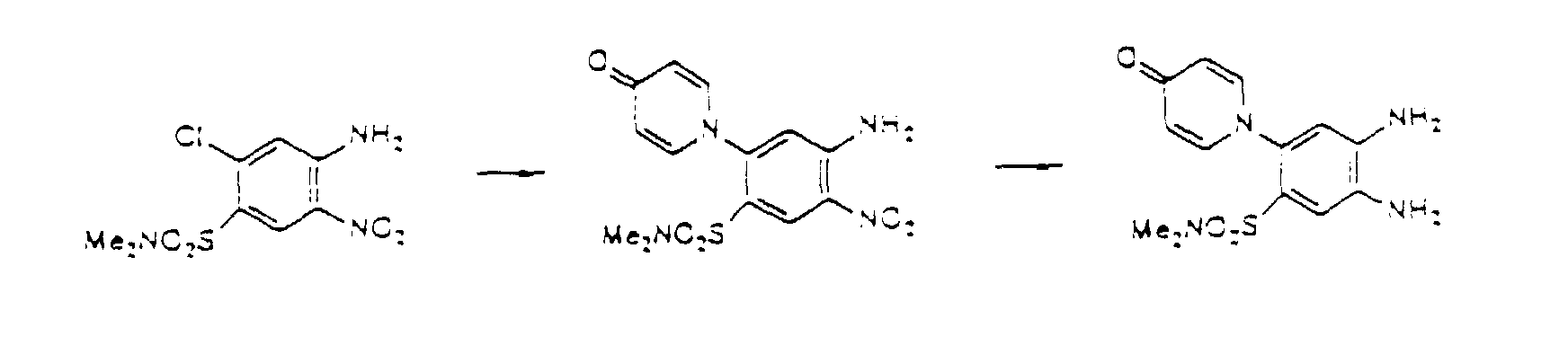
- First, a mixture containing 3.0 g of 3-chloro-4-dimethylsulfamoyl-6-nitroaniline, 1.39 g of 4-hydroxypyridine, 0.91 g of 86% potassium hydroxide, and 20 ml of dimethylsulfoxide was heated in an oil bath at 130°C for 1.5 hours. The subsequent processes were conducted in the same way as in Reference Example 3 to give 1.675 g of 4-dimethylsulfamoyl-3-(4-oxo-4H-pyridin-1-yl)-6-nitroaniline.
Melting point: 344-347°C (decomposition)
Elemental analysis (analyzed as C13H14N4O5S)
Calculated: C,46.15; H,4.17; N,16.56; S,9.48 (%)
Found: C,46.11; H,4.22; N,16.36; S,9.37 (%)
H1-NMR (d6-DMSO)δ: 2.56 (6H, s), 6.16 (2H, d, J=8Hz), 7.09 (1H, s), 7.71 (2H, d, J=8Hz), 8.25 (2H, br.s), 8.51 (1H, s). - First, a mixture containing 1.50 g of 4-dimethylsulfamoyl-3-(4-oxo-4H-pyridin-1-yl)-6-nitroaniline, 1.49 g of iron powder, 9 ml of water, 36 ml of ethanol, and 0.45 ml of 2N hydrochloric acid was refluxed by heating in an oil bath for 45 minutes. The subsequent processes were conducted in the same way as in Reference Example 3 to give crude crystals. The crude crystals were recrystallized with methanol/isopropanol to give 1.30 g of crystals of 4-dimethylsulfamoyl-5-(4-oxo-4H-pyridin-1-yl)-1,2-phenylenediamine.
Melting point: 334-336°C (decomposition)
Elemental analysis (analyzed as C13H15N4O3S)
Calculated: C,50.63; H,5.23; N,18.17; S,10.40 (%)
Found: C,50.43; H,5.28; N,18.16; S,10.58 (%)
H1-NMR (d6-DMSO)δ: 2.51 (6H, s), 5.21 (2H, s), 5.90 (2H, s), 6.17 (2H, d, J=8Hz), 6.59 (1H, s), 6.82 (1H, s), 7.73 (2H, d, J=8Hz). -

- First, a mixture containing 2.40 g of 4-amino-2-chloro-5-nitrobenzotrifluoride, 2.0 g of 4-hydroxypyridine, 684 mg of 86% potassium hydroxide, 15 ml of dimethylsulfoxide was heated in an oil bath at 70°C for 2 hours. The mixture was cooled and ice water was added to the mixture. Precipitated crude crystals were filtered and recrystallized with methanol/ethyl acetate to give 2.69 g of crystals of 4-amino-5-nitro-2-(4-oxo-4H-pyridin-1-yl)-benzotrifluoride.
Melting point: 274-275°C
Elemental analysis (analyzed as C12H8N3O3F3)
Calculated: C,48.17; H,2.70; N,14.04; F,19.05 (%)
Found: C,48.12; H,2.78; N,13.98; F,19.11 (%)
H1-NMR (d6-DMSO)δ: 6.19 (2H, d, J=8Hz), 7.17 (1H, s), 7.74 (2H, d, J=8Hz), 8.17 (2H, br.s), 8.38 (1H, s). - First, a mixture containing 2.56 g of 4-amino-5-nitro-2-(4-oxo-4H-pyridin-1-yl)-benzotrifluoride, 2.87 g of iron powder, 14.4 ml of water, 57.6 ml of ethanol, and 0.86 ml of 2N hydrochloric acid was refluxed by heating in an oil bath for 45 minutes. The subsequent processes were conducted in the same way as in Reference Example 3 to give 1.73 g of crystals of 4-(4-oxo-4H-pyridin-1-yl)-5-trifluoromethyl-1,2-phenylenediamine.
Melting point: 264-266°C (decomposition)
Elemental analysis (analyzed as C12H10N3OF3)
Calculated: C,53.53; H,3.74; N,15.61; F,21.17 (%)
Found: C,53.55; H,3.87; N,15.52; F,21.30 (%)
H1-NMR (d6-DMSO)δ: 5.23 (2H, br.s), 5.53 (2H, br.s), 7.57 (2H, d, J=8Hz), 6.09 (2H, d, J=8Hz), 6.54 (1H, s), 6.86 (1H, s). -
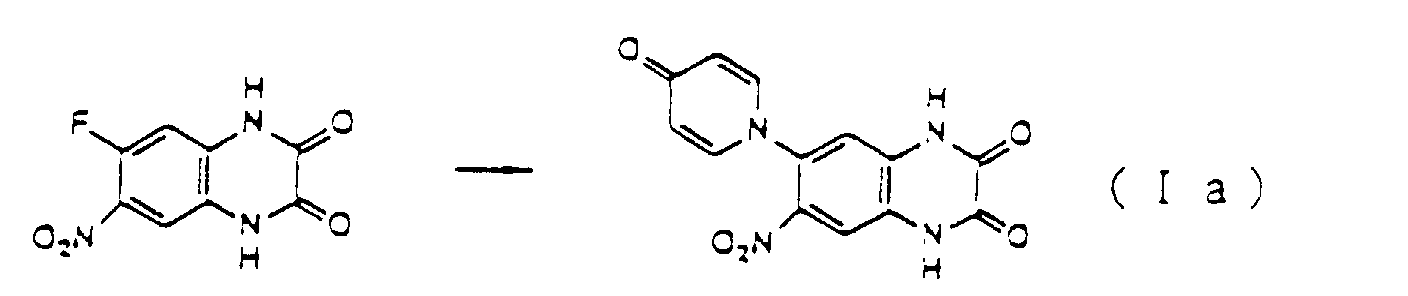
- First, 9.007 g of 7-fluoro-6-nitro-1,4-dihydroquinoxaline-2,3-dione, 7.611 g of 4-hydroxypyridine, and 5.219 g of powdered potassium hydroxide were added to 120 ml of dry dimethylsulfoxide. The mixture was stirred at 130°C for 2 hours in a nitrogen atmosphere. Then, 50 ml of ice water and 30 ml of 4N hydrochloric acid were added to the reaction mixture so as to make it weakly acidic (pH 3 to 4). The resultant yellow precipitate was filtered and washed with water. The precipitate was dissolved by heating in a mixture containing 560 ml of water and 56 ml of conc. aqueous ammonia. One gram of activated carbon was added to the resultant mixture, stirred, and filtered. The filtrate was neutralized with conc. hydrochloric acid and ice-cooled. The precipitated crystals were then filtered and washed with water, methanol, and ethanol, successively. The resultant crystals were dried to give 7.56 g of 6-nitro-7-(4-oxo-4H-pyridin-1-yl)-1,4-dihydroquinoxaline-2,3-dione (hereinafter, abbreviated as Ia).
Melting point: >300°C
Elemental analysis (analyzed as C13H8N4O5)
Calculated: C,52.01; H,2.69; N,18.66 (%)
Found: C,51.83; H,2.89; N,18.69 (%)
H1-NMR (d6-DMSO)δ: 6.22 (2H, d, J=7.4Hz), 7.21 (1H, s), 7.78 (2H, d, J=7.4Hz), 8.00 (1H, s)
IR (Nujol): 3080, 2920, 2580, 1730, 1695, 1635, 1595 cm-1.
Sulfate of Compound Ia:
Melting point: >300°C
Elemental analysis (analyzed as C13H8N4O5·1/2H2SO4·H2O)
Calculated: C,42.51; H,3.02; N,15.25; S,4.36 (%)
Found: C,42.27; H,3.10; N,15.65; S,4.36 (%)
H1-NMR (d6-DMSO)δ: 6.81 (2H, d, J=7.6Hz), 7.33 (1H, s), 8.05 (1H, s), 8.30 (2H, d, J=7.4Hz). - A choline salt of Compound Ia is obtained as follows.
- First, 2.70 g (9.0 mmol) of 6-nitro-7-(4-oxo-4H-pyridin-1-yl)-1,4-dihydroquinoxaline-2,3-dione was added to 30 ml of acetone and stirred. Then, 2.25 ml (10.0 mmol, 1.1 equivalents) of 50% aqueous solution of choline hydroxide was added to the mixture and stirred. The mixture was allowed to stand for 1.5 hours, and the precipitate thus formed was filtered and washed with acetone. The resultant reddish orange precipitate was dissolved by heating in 200 ml of ethanol. The solution was treated with activated carbon and filtered. The filtrate was concentrated to three-forths of its original volume and allowed to cool. The precipitated crystals were filtered to give 3.58 g of crystals of a choline salt in an 88.9% yield.
Melting point: 230-233°C
Elemental analysis (analyzed as C13H7N4O5·C5H14NO·2.5 H2O)
Calculated: C,48.21; H,5.84; N,15.62; H2O,10.04 (%)
Found: C,48.40; H,5.80; N,15.86; H2O,10.20 (%)
H1-NMR (d6-DMSO)δ: 3.11 (9H, s), 3.41 (2H, t, J=4.6Hz), 3.85 (2H, m), 6.14 (2H, d, J=7.4Hz), 6.87 (1H, s), 7.71 (2H, d, J=7.8Hz), 7.82 (1H, s). -
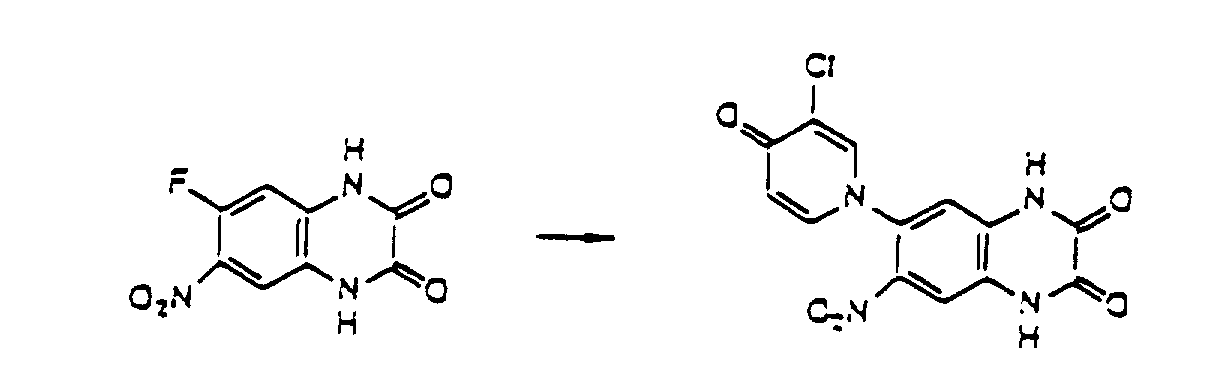
- First, 267 mg of 7-fluoro-6-nitro-1,4-dihydroquinoxaline-2,3-dione, 171 mg of 3-chloro-4-hydroxypyridine, and 92 mg of powdered potassium hydroxide were added to 3 ml of dry dimethylsulfoxide. The mixture was allowed to react at 130°C for 80 minutes in a nitrogen atmosphere. Ice water and 4N hydrochloric acid were then added to the reaction mixture so as to adjust its pH to about 2. The resultant yellow precipitate was filtered and washed with water. The precipitate was recrystallized with a mixture of dimethylformaldehyde and water to give 376 mg of yellowish white 6-nitro-7-(3-chloro-4-oxo-4H-pyridin-1-yl)-1,4-dihydroquinoxaline-2,3-dione.
Melting point: >300°C
Elemental analysis (analyzed as C13H7N4O5Cl·C3H7NO·N2O)
Calculated: C,45.13; H,3.79; N,16.45; Cl, 8.33 (%)
Found: C,45.14; H,3.46; N,16.33; Cl, 8.57 (%)
H1-NMR (d6-DMSO)δ: 6.38 (1H, d, J=7.8Hz), 7.27 (1H, s), 7.86 (1H, dd, J=7.8, 2.4Hz), 8.02 (1H, s), 8.42 (1H, d, J=2.4Hz), 12.43 (2H, br. s). -

- First, 677 mg of 7-fluoro-6-nitro-1,4-dihydroquinoxaline-2,3-dione, 840 mg of 4-hydroxy-3-nitropyridine, 403 mg of powdered potassium hydroxide were added to 6 ml of dry dimethylsulfoxide. The mixture was allowed to react at 130°C for 2 hours in a nitrogen atmosphere. The subsequent processes were conducted in the same way as in Example 2. The resultant precipitate was recrystallized with dimethylformaldehyde and water, giving 672 mg of red crystals of 6-nitro-7-(3-nitro-4-oxo-4H-pyridin-l-yl)-1,4-dihydroquinoxaline-2,3-dione.
Melting point: >300°C
Elemental analysis (analyzed as C13H7N5O7)
Calculated: C,45.23; H,2.04; N,20.29 (%)
Found: C,45.25; H,2.82; N,20.20 (%)
H1-NMR (d6-DMSO)δ: 6.62 (1H, d, J=7.8Hz), 7.40 (1H, s), 7.96 (1H, dd, J=7.8, 2.0Hz), 8.06 (1H, s), 9.11 (1H, d, J=2.0Hz). -
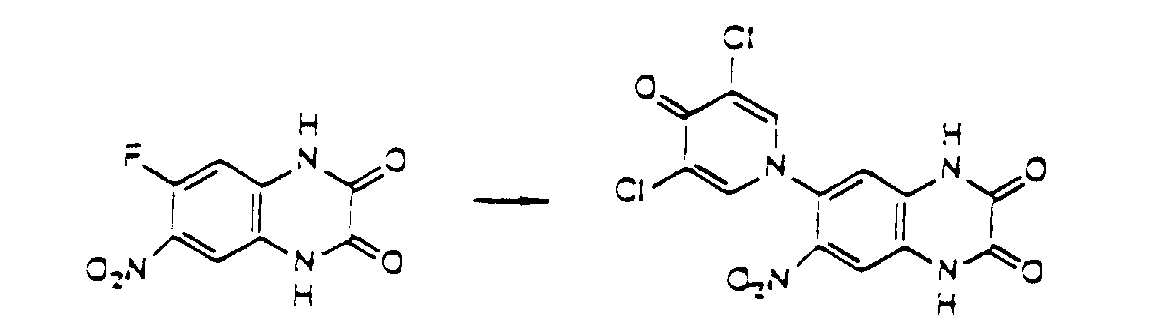
- First, 1.129 g of 7-fluoro-6-nitro-1,4-dihydroquinoxaline-2,3-dione, 1.648 g of 3,5-dichloro-4-hydroxypyridine, and 672 mg of powdered potassium hydroxide were added to 10 ml of dry dimethylsulfoxide. The mixture was allowed to react at 130°C for 3 hours in a nitrogen atmosphere. The subsequent processes were conducted in the same way as in Example 2. The resultant precipitate was dissolved by heating in dimethylformaldehyde and the solution was decolorized with activated carbon and filtered. Water in an equal amount was added thereto and the solution was allowed to stand overnight to give 1.473 g of crystals of 6-nitro-7-(3,5-dichloro-4-oxo-4H-pyridin-1-yl)-1,4-dihydroquinoxaline-2,3-dione.
Melting point: >300°C
Elemental analysis (analyzed as C13H6N4O5Cl2·1/2H2O)
Calculated: C,41.29; H,1.87; N,14.82; Cl,18.75 (%)
Found: C,41.47; H,1.84; N,15.08; Cl,19.01 (%)
H1-NMR (d6-DMSO)δ: 7.39 (1H, s), 8.06 (1H, s), 8.55 (2H, s). -
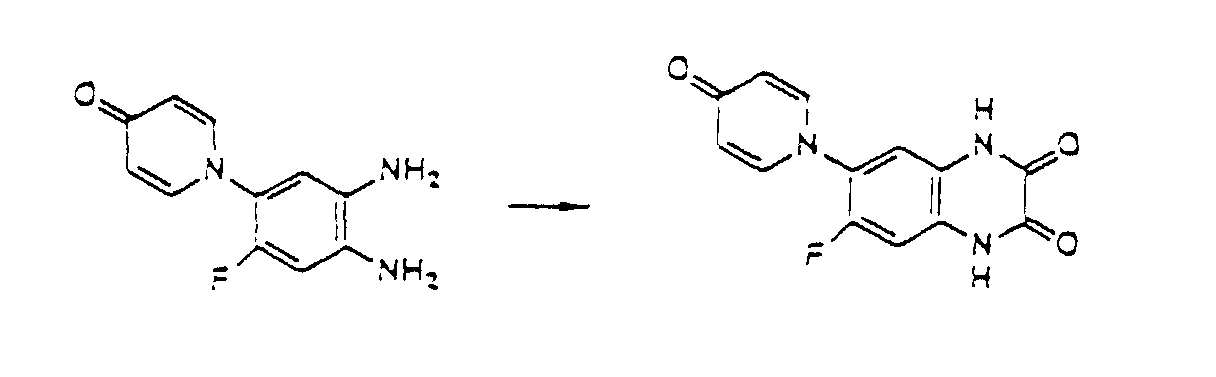
- First, 4.266 g of 4-fluoro-5-(4-oxo-4H-pyridin-1-yl)-1,2-phenylenediamine, and 1.927 g of oxalic acid were added to 48 ml of 4N hydrochloric acid. The mixture was refluxed by heating for 2.5 hours. After the reaction, precipitated crystals were filtered, washed with water, and dried to give 3.920 g of 6-fluoro-7-(4-oxo-4H-pyridin-1-yl)-1,4-dihydroquinoxaline-2,3-dione.
Melting point: >300°C
Elemental analysis (analyzed as C13H8N3O3F·O.2H2O)
Calculated: C,56.40; H,3.06; N,15.18; F,6.86 (%)
Found: C,56.21; H,3.19; N,15.24; F,6.93 (%)
H1-NMR (d6-DMSO)δ: 6.23 (2H, d, J=7.8Hz), 7.13 (1H, d, JFH=16Hz), 7.17 (1H, d, JFH=12.6Hz), 7.80 (1H, d, J=6.4Hz), 12.09 (1H, br.s), 12.15 (1H, br.s). -

- First, a mixture containing 1.93 g of 4-chloro-5-(4-oxo-4H-pyridin-1-yl)-1,2-phenylenediamine, 2.21 g of oxalic acid, and 40 ml of 2N hydrochloric acid was refluxed by heating in an oil bath for 2 hours. The mixture was cooled and precipitated crystals were filtered to give 2.1 g of crude crystals of 6-chloro-7-(4-oxo-4H-pyridin-1-yl)-1,4-dihydroquinoxaline-2,3-dione (melting point: >400°C). Then, 500 mg of the crude crystals were recrystallized with dimethylformaldehyde and water to give 299 mg of 6-chloro-7-(4-oxo-4H-pyridin-1-yl)-1,4-dihydroquinoxaline-2,3-dione.
Melting point: 420-445°C (decomposition)
Elemental analysis (analyzed as Cl3H8N3O3Cl·1/4H2O)
Calculated: C,53.07; H,2.91; N,14.28; Cl,12.05 (%)
Found: C,53.09; H,2.83; N,14.24; Cl,12.36 (%)
H1-NMR (D2O-HNO3)δ: 7.46 (2H, d, J=8Hz), 7.57 (1H, s), 7.59 (1H, s), 8.57 (2H, d, J=8Hz). -

- First, a mixture containing 246 mg of 4-cyano-5-(4-oxo-4H-pyridin-1-yl)-1,2-phenylenediamine, 294 mg of oxalic acid, and 5 ml of 2N hydrochloric acid was refluxed by heating in an oil bath for 2 hours. The mixture was cooled and precipitated crystals were filtered. Then, 284 mg of the crude crystals thus obtained were further recrystallized with 2N hydrochloric acid to give 201 mg of 6-cyano-7-(4-oxo-4H-pyridin-1-yl)-1,4-dihydroquinoxaline-2,3-dione.
Melting point: 410-415°C (decomposition)
Elemental analysis (analyzed as C14H8N4O3·3/4H2O)
Calculated: C,57.23; H,3.26; N,19.07 (%)
Found: C,57.54; H,3.33; N,19.10; (%)
H1-NMR (D2O-HNO3)δ: 7.50 (2H, d, J=8Hz), 7.68 (1H, s), 7.88 (1H, s), 8.72 (2H, d, J=8Hz). -

- First, a mixture containing 500 mg of 4-dimethylsulfamoyl-5-(4-oxo-4H-pyridin-1-yl)-1,2-phenylenediamine, 438 mg of oxalic acid, and 10 ml of 2N hydrochloric acid was refluxed by heating in an oil bath for 3 hours. The mixture was cooled and made basic with aqueous ammonia. Precipitated crystals were filtered. Then, 534 mg of the crude crystals thus obtained were further recrystallized with dimethylformaldehyde and water to give 201 mg of 6-dimethylsulfamoyl-7-(4-oxo-4H-pyridin-1-yl)-1,4-dihydroquinpxaline-2,3-dione.
Melting point: 400-405°C (decomposition)
Elemental analysis (analyzed as C15H14N4O5S·1/4H2O)
Calculated: C,49.11; H,3.98; N,15.27; S,8.74 (%)
Found: C,49.22; H,4.10; N,15.37; S,8.72 (%)
H1-NMR (D2O-HNO3)δ: 2.17 (6H, s), 6.91 (2H, d, J=7Hz), 7.13 (1H, s), 7.37 (1H, s), 8.10 (2H, d, J=7Hz). -

- First, 1.244 g of 7-fluoro-6-nitro-1-(n-propyl)-1,4-dihydroquinoxaline-2,3-dione, 952 mg of 4-hydroxypyridine, and 711 mg of powdered potassium hydroxide were added to 10 ml of dry dimethylsulfoxide. The mixture was stirred at 130°C for 3.5 hours in a nitrogen atmosphere. Then, 50 ml of water was added to the reaction mixture and the mixture was made acidic (pH 2 to 3) with 4N hydrochloric acid to give a yellow precipitate. The precipitate was filtered and recrystallized with dimethylformaldehyde to give 1.08 g of 6-nitro-7-(4-oxo-4H-pyridin-1-y1)-1-(n-propyl)-1,4-dihydroquinoxaline-2,3-dione.
Melting point: >300°C
Elemental analysis (analyzed as C16H14N4O5·O.2H2O)
Calculated: C,55.56; H,4.20; N,16.20 (%)
Found: C,55.63; H,4.29; N,16.37 (%)
H1-NMR (d6-DMSO)δ: 0.94 (3H, t, J=7.2Hz), 1.65 (2H, m), 4.10 (2H, m), 6.21 (2H, d, J=7.6Hz), 7.77 (2H, d, J=7.6Hz), 7.86 (1H, s), 8.02 (1H, s). -
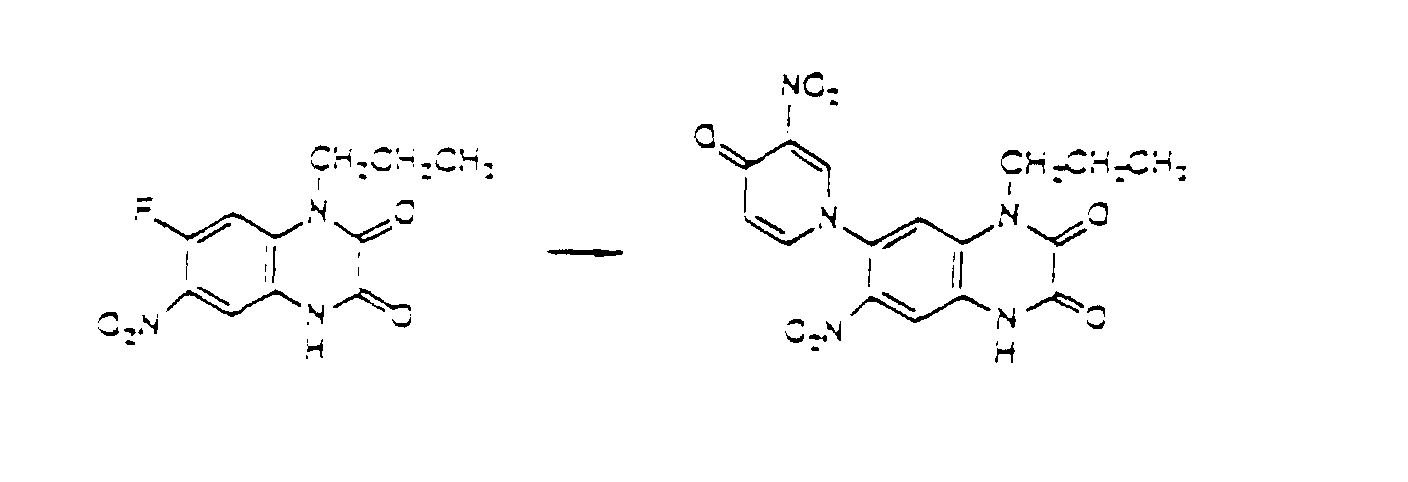
- First, 803 mg of 7-fluoro-6-nitro-1-(n-propyl)-1,4-dihydroquinoxaline-2,3-dione, 700 mg of 3-nitro-4-hydroxypyridine, and 365 mg of potassium hydroxide were allowed to react at 130°C for 4.5 hours in dry dimethylsulfoxide in the same way as in Example 9 to give 1.059 g of 6-nitro-7-(3-nitro-4-oxo-4H-pyridin-1-yl)-1-(n-propyl)-1,4-dihydroquinoxaline-2,3-dione.
Melting point: >300°C
Elemental analysis (analyzed as C16H13N5O7·O.3H2O)
Calculated: C,48.94; H,3.49; N,17.83 (%)
Found: C,49.02; H,3.68; N,17.92 (%)
H1-NMR (d6-DMSO)δ: 0.94 (3H, t, J=7.4Hz), 1.66 (2H, m), 4.06 (2H, m), 6.64 (1H, d, J=7.8Hz), 7.98 (1H, m), 8.00 (1H, s), 8.10 (1H, s), 9.12 (1H, d, J=1.8Hz), 12.46(1H, br.s). -

- First, 4.849 g of 4-(4-oxo-4H-pyridin-1-yl)-1,2-phenylenediamine and 2.402 g of oxalic acid were added to 60 ml of 4N hydrochloric acid. The mixture was refluxed by heating for 2.5 hours in a nitrogen atmosphere. After the mixture was cooled, precipitated crystals were filtered and recrystallized with dimethylformamide to give 4.786 g of 6-(4-oxo-4H-pyridin-1-yl)-1,4-dihydroquinoxaline-2,3-dione.
Melting point: >300°C
Elemental analysis (analyzed as C13H9N3O3)
Calculated: C,61.18; H,3.55; N,16.46 (%)
Found: C,60.94; H,3.62; N,16.37 (%). - First, 510 mg of 6-(4-oxo-4H-pyridin-1-yl)-1,4-dihydroquinoxaline-2,3-dione was added to 5 ml of conc. sulfuric acid with ice-cooling and dissolved therein. Then, 253 mg of potassium nitrate was added to the resultant solution. The mixture was heated at 60°C for 3 hours with stirring. Then, 20 ml of ice water was added to the mixture and the pH of the solution was adjusted to 5 with a solution of 4N sodium hydroxide. The precipitated yellow crystals were filtered. The crystals thus obtained were washed with water and dried to give 426 mg of 6-nitro-7-(4-oxo-4H-pyridin-1-yl)-1,4-dihydroquinoxaline-2,3-dione.
Melting point: >300°C
H1-NMR (d6-DMSO)δ: 6.20 (2H, d, J=7.8Hz), 7.20 (1H, s), 7.76 (2H, d, J=7.8Hz), 7.99 (1H, s). - H1-NMR and HPLC confirmed that the compound 6-nitro-7-(4-oxo-4H-pyridin-1-yl)-1,4-dihydroquinoxaline-2,3-dione was the same material as Compound Ia obtained in Example 1.
-
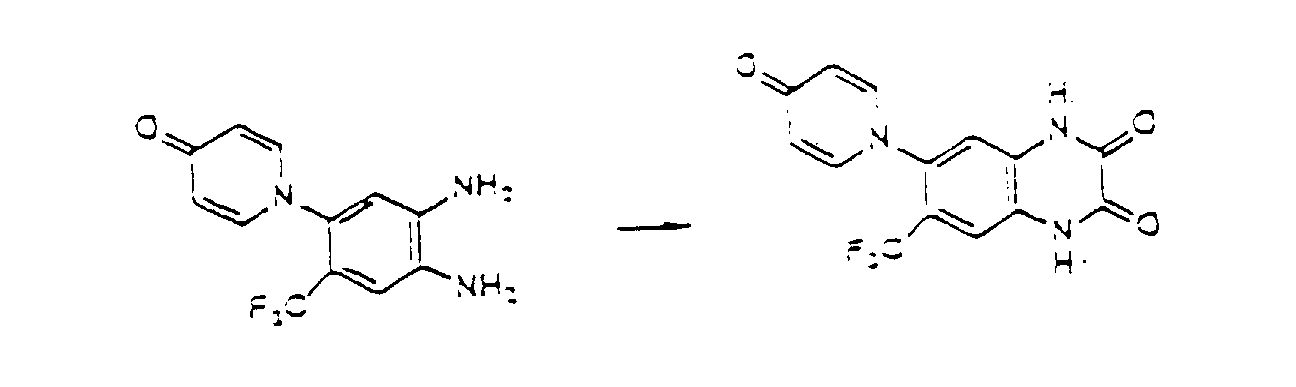
- First, a mixture containing 300 mg of 4-(4-oxo-4H-pyridin-1-yl)-5-trifluoromethyl-1,2-phenylenediamine, 301 mg of oxalic acid, and 6 ml of 2N hydrochloric acid was refluxed by heating in an oil bath for 7 hours. The mixture was cooled and precipitated crystals were filtered. Then, 333 mg of the crude crystals thus obtained were recrystallized with a mixture of dimethylformamide and water to give 216 mg of 6-(4-oxo-4H-pyridin-1-yl)-7-trifluoromethyl-1,4-dihydroquinoxaline-2,3-dione.
Melting point: 410-420°C
Elemental analysis (analyzed as C14H8N3O3F3·1/4H2O)
Calculated: C,51.31; H,2.61; N,12.82; F,17.39 (%)
Found: C,51.36; H,2.87; N,13.04; F,17.11 (%)
H1-NMR (d6-DMSO)δ: 6.18 (2H, d, J=8Hz), 7.22 (1H, s), 7.55 (1H, s), 7.70 (2H, d, J=8Hz), 12.33 (2H, br) -
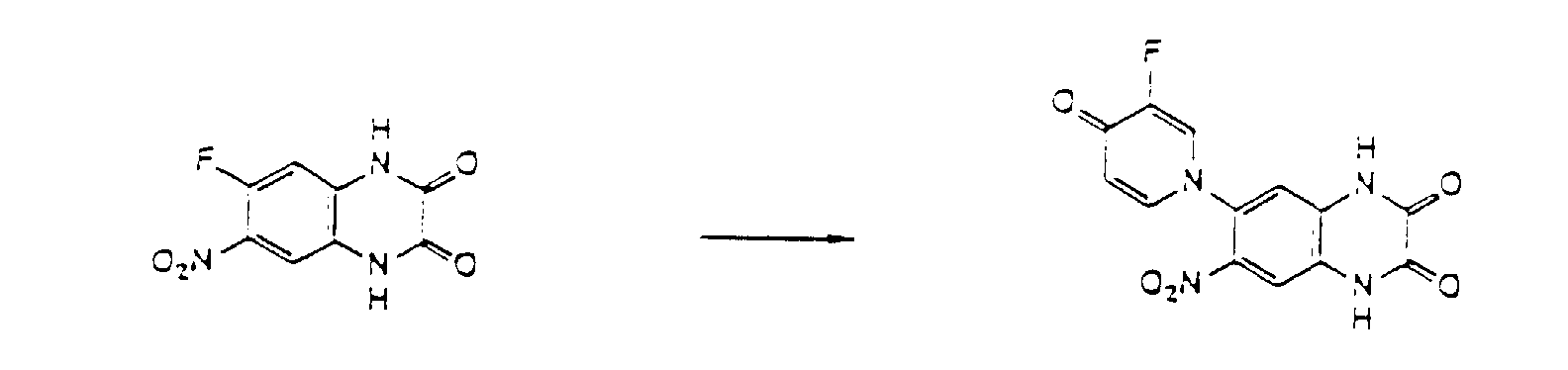
- First, 127 mg of 7-fluoro-6-nitro-1,4-dihydroquinoxaline-2,3-dione, 96 mg of 3-fluoro-4-hydroxypyridine, and 55 mg of powdered potassium hydroxide were added to 12 ml of dry dimethylsulfoxide. The mixture was stirred at 130°C for 3 hours in a nitrogen atmosphere. Then, 50 ml of ice water was added to the reaction mixture, and the mixture was neutralized with 2N hydrochloric acid. The resultant precipitate was filtered and washed with water. The precipitate was dissolved in 3 ml of 1N sodium hydroxide. The solution was treated with activated carbon and filtered. The filtrate was neutralized with conc. hydrochloric acid. The precipitated crystals were filtered and dried to give 147 mg of 6-nitro-7-(3-fluoro-4-oxo-4H-pyridin-1-yl)-1,4-dihydroquinoxaline-2,3-dione.
Melting point: >300°C
Elemental analysis (analyzed as C13H7N4O5F·0.3H2O)
Calculated: C,48.25; H,2.37; N,17.31; F,5.87 (%)
Found: C,48.09; H,2.61; N,17.49; F,6.27 (%)
H1-NMR (d6-DMSO)δ: 6.46 (1H, dd, J=9.0, 7.4Hz), 7.28 (1H, s), 7.85 (1H, dd, J=7.6, 2.0Hz), 8.08 (1H, s), 8.37 (1H, dd, J=7.8, 2.0Hz). - First, the cerebral cortex of an Slc-Wistar rat (250 to 300 g in weight) was homogenized in 5 mM Tris acetic acid buffer in 20-fold volume (containing 1 mM EGTA, 0.1 mM PMSF, and 0.01% Bacitracin, pH 7.4). The cerebral cortex was centrifuged at 50,000 x g for 30 minutes and resuspended in a buffer. This process was repeated four times. The final suspension was stored at -80°C. The frozen suspension was thawed at room temperature and incubated with 0.08% Triton X-100 solution at 2°C for 10 minutes. The resultant suspension was then washed twice and suspended in 50 mM Tris-acetate buffer (pH 7.4) to give a membrane sample. The membrane sample was mixed with 100 nM [3H]glycine and solutions in a series of concentrations of Compound Ia obtained in Example 1. The mixtures were incubated at 0°C for 10 minutes. Each of the mixtures was diluted and filtered using Whatman GF/C filter paper so as to terminate the reaction, and radioactivity of 3H remaining on the filter paper was measured by a scintillation counter for liquid. The assay for non-specific binding was conducted with 1 mM of non-radioactive glycine to determine an IC50 value. IC50 value of Compound Ia was determined using YM900 (a compound of Example 15 described in WO92/07847) as a control in the same way as described above. The results are shown in Table 2.
Compound IC50 (µM) Ia 6.6 YM900 67 - Compound Ia exhibited antagonistic effects approximately ten times as strong as that of YM900.
- First, the cerebral cortex of an Slc-Wistar rat (250 to 300 g in weight) was homogenized in 30 mM Tris acetic acid buffer in 10-fold volume (containing 2.5 mM CaCl2, pH 7.1). The cerebral cortex was centrifuged at 30,000 x g for 15 minutes and resuspended in a buffer. This process was repeated three times. The final suspension was stored at -80°C. The frozen suspension was thawed at room temperature and suspended in 30 mM Tris-acetate buffer (containing 2.5 mM CaCl2 and 100 mM KSCN, pH 7.1) to give a membrane sample. The membrane sample was mixed with 30nM [3H]AMPA and solutions in a series of concentrations of Compound Ia. The mixtures were incubated at 0°C for 30 minutes. Each of the mixtures was diluted and filtered using Whatman GF/C filter paper so as to terminate the reaction, and radioactivity of 3H remaining on the filter paper was measured by a scintillation counter for liquid. The assay for non-specific binding was conducted with 1 mM non-radioactive glutamate to determine an IC50 value. IC50 value of Compound Ia was determined using YM900 as a control in the same way as described above. The results are shown in Table 3.
Compound IC50(µM) Ia 0.10 YM900 0.28 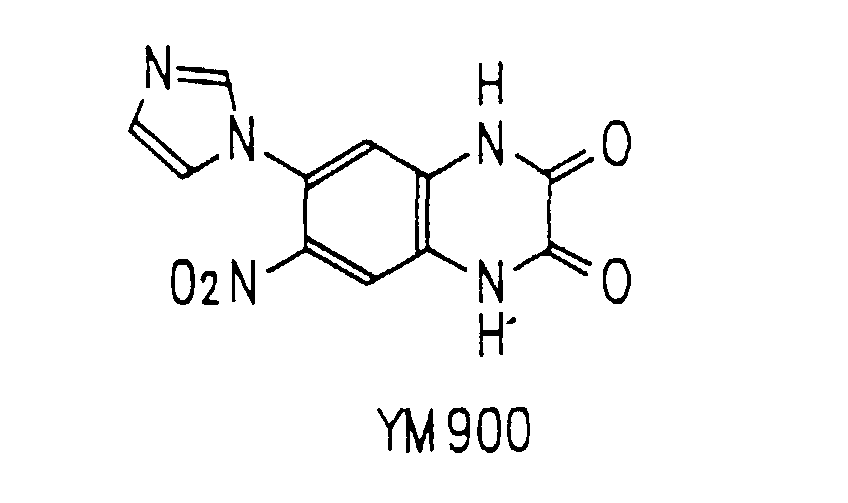
- According to the present invention, oxopyridinylquinoxaline derivatives, which are novel compounds, exhibit outstanding antagonistic effects in connection with the NMDA receptors and the AMPA receptors of central neurons. The compounds of the present invention are effective as therapeutic agents for neurological disorders caused by excitatory amino acids since they inhibit the excitatory amino acids from binding to the NMDA receptors or the AMPA receptors.
- Various other modifications will be apparent to and can be readily made by those skilled in the art without departing from the scope of this invention. Accordingly, it is not intended that the scope of the claims appended hereto be limited to the description as set forth herein, but rather that the claims be broadly construed.
Claims (11)
- An oxopyridinylquinoxaline derivative represented by the following Formula I or pharmaceutically acceptable salts thereof:wherein R1 is hydrogen, halogen, nitro, or trihalomethyl; R2 is hydrogen, halogen, nitro, cyano, trihalomethyl, carbamoyl, carbamoyl substituted with lower alkyl, sulfamoyl, or sulfamoyl substituted with lower alkyl; R3 is hydrogen, nitro, or halogen; R4 is hydrogen, lower alkyl, substituted lower alkyl, lower cycloalkyl, or substituted lower cycloalkyl; and wherein the substituents of the lower alkyl or cycloalkyl group of R4 are halogens, amino groups or carboxyl groups; R5's are substituents independently selected from the group consisting of halogen, nitro, cyano, lower alkyl, carbamoyl, and carbamoyl substituted with lower alkyl; wherein a lower alkyl is a straight chain or branched chain alkyl group having 1 to 6 carbon atoms and a lower cycloalkyl group is a cycloalkyl group having 3 to 6 carbon atoms; and n is an integer of 0 to 4.

- The oxopyridinylquinoxaline derivative or pharmaceutically acceptable salts thereof according to claim 1, wherein R1 and R3 are independently hydrogen or nitro; R2 is halogen, nitro, cyano, trihalomethyl, carbamoyl, carbamoyl substituted with lower alkyl, sulfamoyl, or sulfamoyl substituted with lower alkyl; R4 is hydrogen or lower alkyl; R5's are substituents independently selected from the group consisting of halogen, nitro, and lower alkyl; and wherein a lower alkyl group is a straight chain or branched chain alkyl group having 1 to 6 carbon atoms; and n is an integer of 0 to 4.
- The oxopyridinylquinoxaline derivative or pharmaceutically acceptable salts thereof according to claim 1, wherein each of R1 and R3 is hydrogen; R2 is halogen, nitro, cyano, or trihalomethyl; R4 is hydrogen or lower alkyl; R5's are substituents independently selected from the group consisting of halogen and nitro; and n is an integer of 0 to 4.
- The oxopyridinylquinoxaline derivative according to claim 1, wherein n is 0.
- The oxopyridinylquinoxaline derivative or pharmaceutically acceptable salts thereof according to claim 4, wherein each of R1, R3, and R4 is hydrogen; and R2 is nitro.
- A pharmaceutical composition containing an active component according to claim 1.
- The pharmaceutical composition according to claim 6, for use in competitively inhibiting hyper-stimulation of neurons caused by excitatory amino acids.
- The pharmaceutical composition according to claim 6, which has antagonistic activities for glutamate receptor.
- The pharmaceutical composition according to claim 6, for treating a neurological disease caused by hyper-stimulation of neurons due to excitatory amino acids.
- The pharmaceutical composition according to claim 9, wherein the neurological disease is at least one selected from the group consisting of parkinsonism, senile dementia, Huntington's chorea, and epilepsia.
- A compound as defined in claim 1 for use in competitively inhibiting the hyper-stimulation of neurons by excitatory amino acids.
Applications Claiming Priority (3)
| Application Number | Priority Date | Filing Date | Title |
|---|---|---|---|
| JP7090994 | 1994-04-08 | ||
| JP7090994 | 1994-04-08 | ||
| JP70909/94 | 1994-04-08 |
Publications (2)
| Publication Number | Publication Date |
|---|---|
| EP0676397A1 EP0676397A1 (en) | 1995-10-11 |
| EP0676397B1 true EP0676397B1 (en) | 1999-10-20 |
Family
ID=13445121
Family Applications (1)
| Application Number | Title | Priority Date | Filing Date |
|---|---|---|---|
| EP95302326A Expired - Lifetime EP0676397B1 (en) | 1994-04-08 | 1995-04-07 | Oxopyridinylquinoxaline derivatives |
Country Status (14)
| Country | Link |
|---|---|
| US (1) | US5677305A (en) |
| EP (1) | EP0676397B1 (en) |
| KR (1) | KR100363003B1 (en) |
| CN (1) | CN1044241C (en) |
| AT (1) | ATE185806T1 (en) |
| AU (1) | AU688459B2 (en) |
| CA (1) | CA2146478A1 (en) |
| DE (1) | DE69512816T2 (en) |
| DK (1) | DK0676397T3 (en) |
| ES (1) | ES2140620T3 (en) |
| GR (1) | GR3032406T3 (en) |
| HU (1) | HUT72064A (en) |
| TW (1) | TW300894B (en) |
| ZA (1) | ZA952841B (en) |
Families Citing this family (12)
| Publication number | Priority date | Publication date | Assignee | Title |
|---|---|---|---|---|
| AU688459B2 (en) * | 1994-04-08 | 1998-03-12 | Shionogi & Co., Ltd. | Oxopyridinylquinoxaline derivative |
| AUPN842196A0 (en) * | 1996-03-05 | 1996-03-28 | Fujisawa Pharmaceutical Co., Ltd. | New compound |
| HUP0002853A3 (en) * | 1997-09-01 | 2001-12-28 | Kyorin Seiyaku Kk | 6,7-asymmetrically disubstituted quinoxalinecarboxylic acid derivatives, and pharmaceutical compositions containing them |
| PL344406A1 (en) | 1998-06-01 | 2001-11-05 | Shionogi & Co | Cyanoiminoquinoxaline derivatives |
| CN101248060B (en) * | 2005-06-23 | 2014-09-10 | 阵列生物制药公司 | Process for preparing benzimidazole compounds |
| WO2010053757A1 (en) * | 2008-10-29 | 2010-05-14 | Gilead Palo Alto, Inc. | 2 -oxoquinoxalin blockers of the late sodium channel |
| WO2010074807A1 (en) | 2008-10-30 | 2010-07-01 | Gilead Palo Alto, Inc. | 3, 4-dihydroquinolin-2 ( 1h ) -one derivatives as sodium channel modulators |
| EP2338492A1 (en) | 2009-12-24 | 2011-06-29 | Universidad del Pais Vasco | Methods and compositions for the treatment of alzheimer |
| CN103664806B (en) * | 2013-12-16 | 2016-06-29 | 山东汇海医药化工有限公司 | A kind of N-acetoacetyl-6-methoxyl group-7-aminoquinoxaline-2, the preparation method of 3-diketone |
| US20190382346A1 (en) | 2017-02-28 | 2019-12-19 | Universitat Autonoma De Barcelona | (nitro-phenyl)-nitropyridine compounds for treating synucleinopathies |
| WO2019161917A1 (en) | 2018-02-23 | 2019-08-29 | Universitat Autonoma De Barcelona | 4-substituted 1-ethenylsulfonyl-2-nitrobenzene compounds for treating synucleinopathies |
| WO2024083850A1 (en) | 2022-10-18 | 2024-04-25 | ETH Zürich | Electrocatalyst |
Family Cites Families (13)
| Publication number | Priority date | Publication date | Assignee | Title |
|---|---|---|---|---|
| IE66149B1 (en) * | 1986-09-16 | 1995-12-13 | Novo Nordisk As | Quinoxaline compounds and their preparation and use |
| JP2635662B2 (en) * | 1987-03-23 | 1997-07-30 | ノボ・ノルデイスク・アクツイエルスカブ | Heterocyclic compounds, their preparation and their use |
| NO179551C (en) * | 1987-11-10 | 1996-10-30 | Novo Nordisk As | Analogous Process for Preparing Therapeutically Effective Quinoxaline Compounds |
| DK160941C (en) * | 1988-06-28 | 1991-10-21 | Novo Nordisk As | CONDENSED 2,3-DIHYDROXYPYRAZINES, THEIR PROCEDURES FOR THEIR PREPARATION AND PHARMACEUTICAL PREPARATIONS CONTAINING THE COMPOUNDS |
| DK716188D0 (en) * | 1988-12-22 | 1988-12-22 | Ferrosan As | QUINOXAL COMPOUNDS, THEIR PREPARATION AND USE |
| DK715888D0 (en) * | 1988-12-22 | 1988-12-22 | Ferrosan As | QUINOXAL COMPOUNDS, THEIR PREPARATION AND USE |
| US5153195A (en) * | 1988-12-22 | 1992-10-06 | Novo Nordisk A/S | Quinoxaline compounds and their preparation and use |
| ATE194985T1 (en) * | 1990-11-06 | 2000-08-15 | Yamanouchi Pharma Co Ltd | CONDENSED PYRAZINE DERIVATIVE |
| JPH04193876A (en) * | 1990-11-26 | 1992-07-13 | Sumitomo Chem Co Ltd | Quinoxaline derivative, its production and herbicide containing the same as active ingredient |
| DK73091D0 (en) * | 1991-04-22 | 1991-04-22 | Novo Nordisk As | QUINOXAL COMPOUNDS, THEIR PREPARATION AND USE |
| DE4217952A1 (en) * | 1992-05-30 | 1993-12-02 | Basf Ag | Quinoxaline-2,3 (1H, 4H) diones |
| JPH06228112A (en) * | 1993-02-05 | 1994-08-16 | Yamanouchi Pharmaceut Co Ltd | @(3754/24)1h,4h)quinoxaline derivative |
| AU688459B2 (en) * | 1994-04-08 | 1998-03-12 | Shionogi & Co., Ltd. | Oxopyridinylquinoxaline derivative |
-
1995
- 1995-04-05 AU AU16256/95A patent/AU688459B2/en not_active Ceased
- 1995-04-06 CA CA002146478A patent/CA2146478A1/en not_active Abandoned
- 1995-04-06 ZA ZA952841A patent/ZA952841B/en unknown
- 1995-04-07 DK DK95302326T patent/DK0676397T3/en active
- 1995-04-07 US US08/418,196 patent/US5677305A/en not_active Expired - Fee Related
- 1995-04-07 ES ES95302326T patent/ES2140620T3/en not_active Expired - Lifetime
- 1995-04-07 EP EP95302326A patent/EP0676397B1/en not_active Expired - Lifetime
- 1995-04-07 HU HU9501026A patent/HUT72064A/en unknown
- 1995-04-07 AT AT95302326T patent/ATE185806T1/en not_active IP Right Cessation
- 1995-04-07 DE DE69512816T patent/DE69512816T2/en not_active Expired - Fee Related
- 1995-04-08 TW TW084103375A patent/TW300894B/zh active
- 1995-04-08 KR KR1019950008201A patent/KR100363003B1/en not_active Expired - Fee Related
- 1995-04-08 CN CN95105155A patent/CN1044241C/en not_active Expired - Fee Related
-
2000
- 2000-01-19 GR GR20000400103T patent/GR3032406T3/en not_active IP Right Cessation
Also Published As
| Publication number | Publication date |
|---|---|
| DE69512816T2 (en) | 2000-04-27 |
| AU688459B2 (en) | 1998-03-12 |
| CA2146478A1 (en) | 1995-10-09 |
| CN1044241C (en) | 1999-07-21 |
| KR100363003B1 (en) | 2003-02-11 |
| GR3032406T3 (en) | 2000-05-31 |
| US5677305A (en) | 1997-10-14 |
| TW300894B (en) | 1997-03-21 |
| HUT72064A (en) | 1996-03-28 |
| DK0676397T3 (en) | 2000-04-03 |
| DE69512816D1 (en) | 1999-11-25 |
| ATE185806T1 (en) | 1999-11-15 |
| HU9501026D0 (en) | 1995-06-28 |
| ES2140620T3 (en) | 2000-03-01 |
| AU1625695A (en) | 1995-10-19 |
| KR950032171A (en) | 1995-12-20 |
| ZA952841B (en) | 1995-12-18 |
| EP0676397A1 (en) | 1995-10-11 |
| CN1123792A (en) | 1996-06-05 |
Similar Documents
| Publication | Publication Date | Title |
|---|---|---|
| Ohmori et al. | 6-(1H-imidazol-1-yl)-7-nitro-2, 3 (1H, 4H)-quinoxalinedione hydrochloride (YM90K) and related compounds: structure-activity relationships for the AMPA-type non-NMDA receptor | |
| US5639752A (en) | Indole derivatives | |
| AU634553B2 (en) | Heteroarylamino- and heteroaryloxy-pyridinamines and related compounds, a process for their preparation and their use as medicaments | |
| KR970011279B1 (en) | Quinoxaline compound, preparation method thereof, and pharmaceutical composition containing same | |
| HU223945B1 (en) | 1,2,3,4-tetrahydroquinoxalindione derivatives and pharmaceutical compositions containing them | |
| US5677305A (en) | Oxopyridinylquinoxaline derivative | |
| EP0503349B1 (en) | Hydrazone derivatives, their preparation and use | |
| WO1995026342A1 (en) | 5H-INDENO[1,2-b]PYRAZINE-2,3-DIONE DERIVATIVES, PREPARATION THEREOF AND DRUGS CONTAINING SAME | |
| US5777114A (en) | Spiro heterocycle-imidazo 1,2-a!indeno 1,2-e!pyrazine!-4'-ones, preparation thereof and drugs containing same | |
| Wright Jr et al. | Thromboxane synthetase inhibitors and antihypertensive agents. 4. N-[(1H-imidazol-1-yl) alkyl] derivatives of quinazoline-2, 4 (1H, 3H)-diones, quinazolin-4 (3H)-ones, and 1, 2, 3-benzotriazin-4 (3H)-ones | |
| CA2119579A1 (en) | Heterocyclic compounds and their preparation and use | |
| US5789406A (en) | Indeno 1,2-E!pyrazine-4-ones, their preparation and the medicaments containing them | |
| WO1993020077A1 (en) | Fused quinoxalinone derivative and pharmaceutical composition containing the same | |
| US5807859A (en) | Imidazo (1,2-A)-Indeno (1,2-E) pyrazin-4-one derivatives and pharmaceutical compositions containing same | |
| SK42397A3 (en) | 2,3-benzodiazepine derivatives | |
| Yevich et al. | Antiallergics: 3-(1H-tetrazol-5-yl)-4H-pyrimido [2, 1-b] benzothiazol-4-ones | |
| EP0627434A1 (en) | Tricyclic quinoxalinedione derivatives | |
| US5066654A (en) | 2-aryl-3-heterocyclicmethyl-3H-imidazo[4,5-b]pyridines as anxiolytics and anticonvulsants | |
| US5726175A (en) | Imidazo 1,2-A!indeno 1,2-E!pyrazine-2-carboxylic acid derivatives, preparation thereof and drugs containing same | |
| CA2281580C (en) | Quinoxalinediones | |
| Moormann et al. | Potential antisecretory antidiarrheals. 2.. alpha. 2-Adrenergic 2-[(aryloxy) alkyl] imidazolines | |
| EP0511152A2 (en) | Quinoxaline compounds, their preparation and use | |
| JPH06228112A (en) | @(3754/24)1h,4h)quinoxaline derivative | |
| WO1995021842A1 (en) | Heterocyclic compounds and their preparation and use | |
| JPH10509131A (en) | Novel quinoxaline and pharmaceuticals comprising the quinoxaline |
Legal Events
| Date | Code | Title | Description |
|---|---|---|---|
| PUAI | Public reference made under article 153(3) epc to a published international application that has entered the european phase |
Free format text: ORIGINAL CODE: 0009012 |
|
| AK | Designated contracting states |
Kind code of ref document: A1 Designated state(s): AT BE CH DE DK ES FR GB GR IE IT LI LU MC NL PT SE |
|
| RAX | Requested extension states of the european patent have changed |
Free format text: LT PAYMENT 950427;SI PAYMENT 950427 |
|
| 17P | Request for examination filed |
Effective date: 19960315 |
|
| 17Q | First examination report despatched |
Effective date: 19980723 |
|
| GRAG | Despatch of communication of intention to grant |
Free format text: ORIGINAL CODE: EPIDOS AGRA |
|
| GRAG | Despatch of communication of intention to grant |
Free format text: ORIGINAL CODE: EPIDOS AGRA |
|
| GRAH | Despatch of communication of intention to grant a patent |
Free format text: ORIGINAL CODE: EPIDOS IGRA |
|
| GRAH | Despatch of communication of intention to grant a patent |
Free format text: ORIGINAL CODE: EPIDOS IGRA |
|
| GRAA | (expected) grant |
Free format text: ORIGINAL CODE: 0009210 |
|
| AK | Designated contracting states |
Kind code of ref document: B1 Designated state(s): AT BE CH DE DK ES FR GB GR IE IT LI LU MC NL PT SE |
|
| AX | Request for extension of the european patent |
Free format text: LT PAYMENT 19950427;SI PAYMENT 19950427 |
|
| LTIE | Lt: invalidation of european patent or patent extension | ||
| REF | Corresponds to: |
Ref document number: 185806 Country of ref document: AT Date of ref document: 19991115 Kind code of ref document: T |
|
| REG | Reference to a national code |
Ref country code: CH Ref legal event code: EP |
|
| REG | Reference to a national code |
Ref country code: CH Ref legal event code: NV Representative=s name: NOVAPAT INTERNATIONAL S.A. |
|
| REF | Corresponds to: |
Ref document number: 69512816 Country of ref document: DE Date of ref document: 19991125 |
|
| ET | Fr: translation filed | ||
| ITF | It: translation for a ep patent filed | ||
| REG | Reference to a national code |
Ref country code: IE Ref legal event code: FG4D |
|
| REG | Reference to a national code |
Ref country code: ES Ref legal event code: FG2A Ref document number: 2140620 Country of ref document: ES Kind code of ref document: T3 |
|
| REG | Reference to a national code |
Ref country code: PT Ref legal event code: SC4A Free format text: AVAILABILITY OF NATIONAL TRANSLATION Effective date: 19991215 |
|
| REG | Reference to a national code |
Ref country code: DK Ref legal event code: T3 |
|
| PG25 | Lapsed in a contracting state [announced via postgrant information from national office to epo] |
Ref country code: LU Free format text: LAPSE BECAUSE OF NON-PAYMENT OF DUE FEES Effective date: 20000407 |
|
| PLBE | No opposition filed within time limit |
Free format text: ORIGINAL CODE: 0009261 |
|
| STAA | Information on the status of an ep patent application or granted ep patent |
Free format text: STATUS: NO OPPOSITION FILED WITHIN TIME LIMIT |
|
| 26N | No opposition filed | ||
| PG25 | Lapsed in a contracting state [announced via postgrant information from national office to epo] |
Ref country code: MC Free format text: LAPSE BECAUSE OF NON-PAYMENT OF DUE FEES Effective date: 20001031 |
|
| REG | Reference to a national code |
Ref country code: GB Ref legal event code: IF02 |
|
| PGFP | Annual fee paid to national office [announced via postgrant information from national office to epo] |
Ref country code: IE Payment date: 20030324 Year of fee payment: 9 |
|
| PGFP | Annual fee paid to national office [announced via postgrant information from national office to epo] |
Ref country code: SE Payment date: 20030328 Year of fee payment: 9 |
|
| PGFP | Annual fee paid to national office [announced via postgrant information from national office to epo] |
Ref country code: CH Payment date: 20030401 Year of fee payment: 9 |
|
| PGFP | Annual fee paid to national office [announced via postgrant information from national office to epo] |
Ref country code: GB Payment date: 20030404 Year of fee payment: 9 |
|
| PGFP | Annual fee paid to national office [announced via postgrant information from national office to epo] |
Ref country code: PT Payment date: 20030410 Year of fee payment: 9 |
|
| PGFP | Annual fee paid to national office [announced via postgrant information from national office to epo] |
Ref country code: GR Payment date: 20030421 Year of fee payment: 9 |
|
| PGFP | Annual fee paid to national office [announced via postgrant information from national office to epo] |
Ref country code: DK Payment date: 20030424 Year of fee payment: 9 Ref country code: AT Payment date: 20030424 Year of fee payment: 9 |
|
| PGFP | Annual fee paid to national office [announced via postgrant information from national office to epo] |
Ref country code: BE Payment date: 20030425 Year of fee payment: 9 |
|
| PGFP | Annual fee paid to national office [announced via postgrant information from national office to epo] |
Ref country code: NL Payment date: 20030429 Year of fee payment: 9 Ref country code: FR Payment date: 20030429 Year of fee payment: 9 |
|
| PGFP | Annual fee paid to national office [announced via postgrant information from national office to epo] |
Ref country code: ES Payment date: 20030530 Year of fee payment: 9 |
|
| PGFP | Annual fee paid to national office [announced via postgrant information from national office to epo] |
Ref country code: DE Payment date: 20030620 Year of fee payment: 9 |
|
| PG25 | Lapsed in a contracting state [announced via postgrant information from national office to epo] |
Ref country code: IE Free format text: LAPSE BECAUSE OF NON-PAYMENT OF DUE FEES Effective date: 20040407 Ref country code: GB Free format text: LAPSE BECAUSE OF NON-PAYMENT OF DUE FEES Effective date: 20040407 Ref country code: AT Free format text: LAPSE BECAUSE OF NON-PAYMENT OF DUE FEES Effective date: 20040407 |
|
| PG25 | Lapsed in a contracting state [announced via postgrant information from national office to epo] |
Ref country code: SE Free format text: LAPSE BECAUSE OF NON-PAYMENT OF DUE FEES Effective date: 20040408 |
|
| PG25 | Lapsed in a contracting state [announced via postgrant information from national office to epo] |
Ref country code: ES Free format text: LAPSE BECAUSE OF NON-PAYMENT OF DUE FEES Effective date: 20040410 |
|
| PG25 | Lapsed in a contracting state [announced via postgrant information from national office to epo] |
Ref country code: LI Free format text: LAPSE BECAUSE OF NON-PAYMENT OF DUE FEES Effective date: 20040430 Ref country code: DK Free format text: LAPSE BECAUSE OF NON-PAYMENT OF DUE FEES Effective date: 20040430 Ref country code: CH Free format text: LAPSE BECAUSE OF NON-PAYMENT OF DUE FEES Effective date: 20040430 Ref country code: BE Free format text: LAPSE BECAUSE OF NON-PAYMENT OF DUE FEES Effective date: 20040430 |
|
| PG25 | Lapsed in a contracting state [announced via postgrant information from national office to epo] |
Ref country code: PT Free format text: LAPSE BECAUSE OF NON-PAYMENT OF DUE FEES Effective date: 20041015 |
|
| BERE | Be: lapsed |
Owner name: *SHIONOGI & CO. LTD Effective date: 20040430 |
|
| PG25 | Lapsed in a contracting state [announced via postgrant information from national office to epo] |
Ref country code: NL Free format text: LAPSE BECAUSE OF NON-PAYMENT OF DUE FEES Effective date: 20041101 |
|
| PG25 | Lapsed in a contracting state [announced via postgrant information from national office to epo] |
Ref country code: GR Free format text: LAPSE BECAUSE OF NON-PAYMENT OF DUE FEES Effective date: 20041103 Ref country code: DE Free format text: LAPSE BECAUSE OF NON-PAYMENT OF DUE FEES Effective date: 20041103 |
|
| GBPC | Gb: european patent ceased through non-payment of renewal fee | ||
| EUG | Se: european patent has lapsed | ||
| REG | Reference to a national code |
Ref country code: CH Ref legal event code: PL |
|
| PG25 | Lapsed in a contracting state [announced via postgrant information from national office to epo] |
Ref country code: FR Free format text: LAPSE BECAUSE OF NON-PAYMENT OF DUE FEES Effective date: 20041231 |
|
| NLV4 | Nl: lapsed or anulled due to non-payment of the annual fee |
Effective date: 20041101 |
|
| REG | Reference to a national code |
Ref country code: IE Ref legal event code: MM4A |
|
| REG | Reference to a national code |
Ref country code: FR Ref legal event code: ST |
|
| PG25 | Lapsed in a contracting state [announced via postgrant information from national office to epo] |
Ref country code: IT Free format text: LAPSE BECAUSE OF NON-PAYMENT OF DUE FEES;WARNING: LAPSES OF ITALIAN PATENTS WITH EFFECTIVE DATE BEFORE 2007 MAY HAVE OCCURRED AT ANY TIME BEFORE 2007. THE CORRECT EFFECTIVE DATE MAY BE DIFFERENT FROM THE ONE RECORDED. Effective date: 20050407 |
|
| REG | Reference to a national code |
Ref country code: ES Ref legal event code: FD2A Effective date: 20040410 |