EP0669404B1 - Wear-resistant sintered aluminum alloy and method for producing the same - Google Patents
Wear-resistant sintered aluminum alloy and method for producing the same Download PDFInfo
- Publication number
- EP0669404B1 EP0669404B1 EP95101854A EP95101854A EP0669404B1 EP 0669404 B1 EP0669404 B1 EP 0669404B1 EP 95101854 A EP95101854 A EP 95101854A EP 95101854 A EP95101854 A EP 95101854A EP 0669404 B1 EP0669404 B1 EP 0669404B1
- Authority
- EP
- European Patent Office
- Prior art keywords
- alloy
- powder
- crystals
- eutectic
- pro
- Prior art date
- Legal status (The legal status is an assumption and is not a legal conclusion. Google has not performed a legal analysis and makes no representation as to the accuracy of the status listed.)
- Expired - Lifetime
Links
Images


Classifications
-
- C—CHEMISTRY; METALLURGY
- C22—METALLURGY; FERROUS OR NON-FERROUS ALLOYS; TREATMENT OF ALLOYS OR NON-FERROUS METALS
- C22C—ALLOYS
- C22C1/00—Making non-ferrous alloys
- C22C1/04—Making non-ferrous alloys by powder metallurgy
- C22C1/0408—Light metal alloys
- C22C1/0416—Aluminium-based alloys
-
- Y—GENERAL TAGGING OF NEW TECHNOLOGICAL DEVELOPMENTS; GENERAL TAGGING OF CROSS-SECTIONAL TECHNOLOGIES SPANNING OVER SEVERAL SECTIONS OF THE IPC; TECHNICAL SUBJECTS COVERED BY FORMER USPC CROSS-REFERENCE ART COLLECTIONS [XRACs] AND DIGESTS
- Y10—TECHNICAL SUBJECTS COVERED BY FORMER USPC
- Y10T—TECHNICAL SUBJECTS COVERED BY FORMER US CLASSIFICATION
- Y10T428/00—Stock material or miscellaneous articles
- Y10T428/12—All metal or with adjacent metals
- Y10T428/12007—Component of composite having metal continuous phase interengaged with nonmetal continuous phase
-
- Y—GENERAL TAGGING OF NEW TECHNOLOGICAL DEVELOPMENTS; GENERAL TAGGING OF CROSS-SECTIONAL TECHNOLOGIES SPANNING OVER SEVERAL SECTIONS OF THE IPC; TECHNICAL SUBJECTS COVERED BY FORMER USPC CROSS-REFERENCE ART COLLECTIONS [XRACs] AND DIGESTS
- Y10—TECHNICAL SUBJECTS COVERED BY FORMER USPC
- Y10T—TECHNICAL SUBJECTS COVERED BY FORMER US CLASSIFICATION
- Y10T428/00—Stock material or miscellaneous articles
- Y10T428/12—All metal or with adjacent metals
- Y10T428/12014—All metal or with adjacent metals having metal particles
-
- Y—GENERAL TAGGING OF NEW TECHNOLOGICAL DEVELOPMENTS; GENERAL TAGGING OF CROSS-SECTIONAL TECHNOLOGIES SPANNING OVER SEVERAL SECTIONS OF THE IPC; TECHNICAL SUBJECTS COVERED BY FORMER USPC CROSS-REFERENCE ART COLLECTIONS [XRACs] AND DIGESTS
- Y10—TECHNICAL SUBJECTS COVERED BY FORMER USPC
- Y10T—TECHNICAL SUBJECTS COVERED BY FORMER US CLASSIFICATION
- Y10T428/00—Stock material or miscellaneous articles
- Y10T428/12—All metal or with adjacent metals
- Y10T428/12014—All metal or with adjacent metals having metal particles
- Y10T428/12028—Composite; i.e., plural, adjacent, spatially distinct metal components [e.g., layers, etc.]
-
- Y—GENERAL TAGGING OF NEW TECHNOLOGICAL DEVELOPMENTS; GENERAL TAGGING OF CROSS-SECTIONAL TECHNOLOGIES SPANNING OVER SEVERAL SECTIONS OF THE IPC; TECHNICAL SUBJECTS COVERED BY FORMER USPC CROSS-REFERENCE ART COLLECTIONS [XRACs] AND DIGESTS
- Y10—TECHNICAL SUBJECTS COVERED BY FORMER USPC
- Y10T—TECHNICAL SUBJECTS COVERED BY FORMER US CLASSIFICATION
- Y10T428/00—Stock material or miscellaneous articles
- Y10T428/12—All metal or with adjacent metals
- Y10T428/12014—All metal or with adjacent metals having metal particles
- Y10T428/12028—Composite; i.e., plural, adjacent, spatially distinct metal components [e.g., layers, etc.]
- Y10T428/12049—Nonmetal component
-
- Y—GENERAL TAGGING OF NEW TECHNOLOGICAL DEVELOPMENTS; GENERAL TAGGING OF CROSS-SECTIONAL TECHNOLOGIES SPANNING OVER SEVERAL SECTIONS OF THE IPC; TECHNICAL SUBJECTS COVERED BY FORMER USPC CROSS-REFERENCE ART COLLECTIONS [XRACs] AND DIGESTS
- Y10—TECHNICAL SUBJECTS COVERED BY FORMER USPC
- Y10T—TECHNICAL SUBJECTS COVERED BY FORMER US CLASSIFICATION
- Y10T428/00—Stock material or miscellaneous articles
- Y10T428/12—All metal or with adjacent metals
- Y10T428/12014—All metal or with adjacent metals having metal particles
- Y10T428/12028—Composite; i.e., plural, adjacent, spatially distinct metal components [e.g., layers, etc.]
- Y10T428/12049—Nonmetal component
- Y10T428/12056—Entirely inorganic
Definitions
- This invention relates to a sintered aluminum-base alloy and method for producing the same.
- the sintered aluminum alloy of the present invention is characterized in strength, small weight and excellent wear resistance. Accordingly, it is suitable for use in producing parts of machinery such as gearwheels, pulleys, compressor vanes, connecting rods, and pistons, in which the excellence in the above properties are required.
- the sintered aluminum alloy In view of economy in energy consumption and improvement in mechanical efficiency, demands for light-weight machine parts are increased. Because it is possible for a sintered aluminum alloy that the content of fine crystals of pro-eutectic Si can be increased as compared with cast alloys, the sintered aluminum alloy is expected as a material having excellent specific strength and wear resistance.
- Japanese Laid-open Publication No. 53-128512 discloses a method of mixing some members selected from the group consisting of Al-10/35% Si powder, Cu powder, Mg powder, Al-Cu powder, Cu-Mg powder, Al-Cu-Mg powder, Cu-Mg-Si powder, and Al-Cu-Mg-Si powder, and if necessary, further adding Al powder to obtain a composition consisting of, in weight-basis, 0.2-4% Cu, 0.2-2% Mg, 10-35% Si, and the balance of Al, then compacting the powder mixture and sintering the obtained green compact to produce a desired product.
- This method is the so-called mixing method in which several powders are mixed together.
- a sintered product of rapidly solidified aluminum alloy is disclosed in Japanese Laid-open Patent Publication No. 62-10237, in which pro-eutectic Si crystals are uniformly dispersed in an Al-Si alloy matrix.
- This alloy has a composition, in terms of weight, of 10-30% Si, 1-15% in total of one or more members of Ni, Fe and Mn, and if necessary, 0.5-5% Cu and 0.2-3% Mg, and the balance of Al and unavoidable impurities, and the alloy product is prepared through compacting and hot press forging processes. According to this alloying method, highly strong products can be obtained as compared with those prepared by the mixing method.
- the alloy product is prepared by mixing a certain amount of pure Al powder with rapidly solidified Al-Si alloy powder and the powder mixture is subjected to hot press forging. Its composition in terms of weight is 12-30% Si, 1-10% of one or both of Fe and Ni, and if necessary, one or both of 1-5% Cu and 0.3-2% of Mg, and the balance of Al and unavoidable impurities.
- JP-A-2225635 further discloses an Al alloy with 18-28% Si, 0.5-3.5% Cu, 0.2-2.0% Mg, at least one of Ti, V, Zr in an amount of 0.03-0.40% respectively and less than 0.40% in total, 0.03-1.00% Cr and 0.3-2.5% Ni.
- the alloy is smelted, rapidly cooled, made into powders or flakes, compacted and heat formed at least once at below 550°C, in line with the feature of the first part of claim 5.
- the object of the present invention is to propose an Al-Si sintered alloy which is relatively high in strength and excellent in wear resistance by designing the novel grain structure of an alloy composition.
- a sintered alloy composition of the present invention was accomplished on the basis of the following consideration with employing the mixing method.
- the alloy according to the present invention has a composition, in terms of weight, of 2.4-23.5% Si, 2-5% Cu, 0.2-1.5% Mg, 0.01-1% of transition metals, and the balance of aluminum and unavoidable impurities.
- the alloy has a grain structure of Al solid solution phase and Al-Si alloy phase, the latter containing dispersed pro-eutectic Si crystals having a maximum diameter of 5-60 ⁇ m, and the area ratio of the Al solid solution phase is 20-80 percent in the cross-section of the grain structure.
- the pro-eutectic Si crystals having a maximum diameter of 5-60 ⁇ m is not always dispersed in all body of the Al-Si alloy phase.
- large crystals of pro-eutectic Si must be dispersed only in the vicinity of the surface of sintered alloy which surface will be brought into frictional contact with other material in practical uses.
- the maximum diameter of the pro-eutectic Si crystals dispersed in the Al-Si alloy phase in the vicinity of the external surface or at least the sliding contact surface is 5-60 ⁇ m, and the diameter of the pro-eutectic Si crystals in the remaining part may be less than 5 ⁇ m.
- the thickness of the portion of Al-Si alloy phase containing dispersed pro-eutectic Si crystals having a maximum diameter of 5-60 ⁇ m, is in the range of 0.05 to 1 mm in depth as measured from the surface of the sintered alloy body.
- a Cu-transition metal alloy powder containing 0.2-30 wt.% of one or more transition metals, and Mg powder or Al-Mg alloy powder containing 35 wt.% or more of Mg are mixed to the above obtained mixture of Al powder and Al-Si alloy powder, thereby obtaining a powder mixture having the composition in terms of weight of 2.4-23.5% Si, 2-5% Cu, 0.2-1.5% Mg, 0.01-1% of transition metals and the balance of aluminum and unavoidable impurities.
- the powder mixture is then subjected to compacting to form a green compact and it is then sintered. In the sintering, the maximum diameter of the pro-eutectic Si crystals are grown up to 5-60 ⁇ m.
- the above sintering is so carried out that the diameter of the pro-eutectic Si crystals is grown up to 5 pm or less in the first stage and the surface portion of sintered alloy body or only a partial surface which must be brought into sliding contact is then heated to grow up the pro-eutectic Si crystals to 5-60 ⁇ m in maximum diameter.
- the heating of the alloy of this kind is carried out by means of, for example, high-frequency heating, plasma heating or laser beam heating.
- This sintered alloy material can be used as it stands in the form of sintered body. If necessary, the sintered alloy articles may further be subjected to the working with plastic deformation such as extrusion, forging or rolling at ordinary or elevated temperatures, or to the conventional treatment for alloys such as solution heat treatment and aging treatment.
- the grain structure of the sintered alloy consists of the grains of Al solid solution phase and Al-Si alloy phase. In the latter Al-Si alloy phase, pro-eutectic Si crystals are dispersed.
- the Al-Si alloy phase containing the dispersion of pro-eutectic Si crystals is a solid solution of diffused Mg, Cu and transition metals.
- the pro-eutectic Si crystals are dispersed in the relatively hard matrix of this phase and they contribute to the improvement in strength and wear resistance of the alloy material.
- Al-solid solution phase Si, Mg, Cu and transition metals are diffused as a solid solution in Al which was added in the form of pure Al powder.
- This phase constitutes one of the alloy phases in the dapple grain structure and it is relatively soft.
- minute oil cavities are formed among the grains of this phase and Al-Si alloy phase, which contribute to the lubricating property and conformability with contact material in sliding contact.
- the alloy is susceptible to plastic deformation, when the hard pro-eutectic Si crystals in a sliding surface are exposed or released off as abraded powder, they are buried in the alloy matrix and it prevents the Si crystals from acting as wear particles.
- the area ratios of both phases in the cross-section of alloy must be in the range of 20-80:80-20, in which the two phases form a grain structure and, by the mutual action of the grains of both phases, the strength and wear resistance can be improved.
- the component of Si in the aluminum alloy is effective in reducing the thermal expansion coefficient and improving the wear resistance.
- the quantity of Si in the whole composition is selected from the range that the mixture of Al-solid solution phase and Al-Si alloy phase containing dispersed pro-eutectic Si crystals, exhibits a dapple grain structure.
- the range of 2.4-23.5% by weight is suitable.
- the wear resistance is not satisfactory because of the lack of the pro-eutectic Si crystals which contributes to the wear resistance.
- a excessively large quantity of Si means that the quantity of Si in the Al-Si alloy phase is too large or the quantity of Al-Si alloy phase itself is too large, in which the toughness is low and the quantity of Al solid solution which buries the pro-eutectic Si crystals released in sliding contact, is too small. Therefore, the wear amount is increased due to the loss of the effect of dapple grain structure.
- the component of Si is added in the form of Al-Si alloy powder. It is necessary that the content of Si is 13% by weight or more in order to precipitate the pro-eutectic Si crystals. On the other hand, if the content of Si is more than 30% by weight, the temperature of melted material in the powder making must be made high. Therefore, the content of Si in the Al-Si alloy is preferably in the range of 13 to 30% by weight.
- Mg becomes a liquid phase during the sintering and therefore, it exists in the matrix in the form of solid solution, which is effective in the acceleration of sintering, in the strengthening of matrix with Mg 2 Si that is precipitated in aging treatment, and in the improvement in wear resistance.
- the quantity of Mg is less than 0.2% by weight in the whole composition, the above effect of the addition of Mg cannot be expected. On the other hand, even if the quantity of Mg is increased to a value more than 1.5% by weight, the effect of addition is not increased more than a certain level. Therefore, the quantity of addition of Mg is desirably in the range of 0.2 to 1.5% by weight.
- Al-Mg alloy powder containing 35 wt.% or more of Mg or Mg powder itself is used.
- the reason for the use of the Al-Mg alloy powder is that the melting point of the binary Al-Mg alloy containing 33-70 wt.% of Mg is as low as about 460°C.
- the Mg concentration is reduced by the solid phase diffusion with Al matrix in the process of sintering to form a liquid phase of Mg.
- the Al-Mg alloy powder containing 33 wt.% or less of Mg is used, the Mg concentration is lowered by the diffusion into Al matrix as described above, which results in the rise of melting point and the liquid phase cannot be utilized effectively. It is, therefore, preferable that the concentration of Mg is 35 wt.% or higher.
- the component Cu is effective in strengthening the Al alloy matrix and its effect can be improved by the aging treatment. If Cu content is less than 2 wt.% in the whole composition, any desirable improvement in strength cannot be expected. If the content of Cu exceeds 5 wt.%, the toughness is lowered because much intermetallic compound mainly containing Cu is formed in the vicinity of grain boundaries.
- the quantity of the transition metal in the whole composition is less than 0.01 wt.%, none of its effect is produced.
- the quantity of the transition metal exceeds 1 wt.%, the intermetallic compound mainly containing the transition metal is produced which results in the lowering of toughness. Therefore, the quantity of transition metals must be in the range of 0.01 to 1 wt.%.
- the transition metal is preferably added in the form of powder of Cu-transition metal alloy because it is hardly diffused in the form of a single substance.
- the quantity of transition metal in the alloy powder must be more than 0.2 wt.% with considering the necessary quantities of Cu and transition metal in the whole composition. However, if the quantity of transition metal is more than 30 wt.%, the melting point of the alloy becomes too high and any liquid phase is not produced even when the melting point is lowered by solid phase diffusion in the sintering. Therefore, the quantity of transition metal added in the Cu-transition metal alloy is preferably in the range of 0.2 to 10 wt.%.
- each pro-eutectic Si crystal is roughly circular and the lengths of its longer diameter and perpendicular shorter diameter is about the same in the case of small pro-eutectic Si crystals.
- a large crystal is considered to be an agglomerate of small crystals or a grown crystal and there are various kinds of shapes such as a long one, curved one, angular one and irregular one.
- maximum diameter herein referred to means the largest length between both opposed end portions of a pro-eutectic Si crystal in an irregular shape obtained in the microscopic observation of the cross section of a largest alloy crystal of an area of about 5 mm 2 .
- the maximum diameter of pro-eutectic Si crystals must be properly determined and the value is desirably in the range of 5 to 60 ⁇ m.
- the diameter of pro-eutectic Si crystals is large, the strength and ductility are small. Meanwhile, with a smaller diameter of Si crystals, a larger strength can be attained. Therefore, the diameter of 5 ⁇ m or less is preferable in view of this points.
- the maximum diameter of pro-eutectic Si crystals is 5 to 60 ⁇ m in view of the wear resistance.
- the maximum diameter of pro-eutectic Si crystals in the surface portion or at least the surface portion which is brought into sliding contact in practical uses is made 5 to 60 ⁇ m in view of the wear resistance, and at the same time, the maximum diameter of pro-eutectic Si crystals in the inner part of sintered alloy material is made 5 ⁇ m or less in view of the strength.
- the thickness of the Al-Si alloy phase containing the dispersed pro-eutectic Si crystals of 5 to 60 ⁇ m in maximum diameter in the surface portion of the sintered alloy is preferably in the range of 0.05 mm to 1mm. This depends upon the frictional conditions in use, however, if the thickness of the surface portion containing larger Si crystals is smaller than 0.05 mm, the pro-eutectic Si crystals are liable to be released off and good wear resistance cannot be obtained. On the other hand, even if the thickness of the surface portion is increased more than 1 mm, no additional effect in wear resistance cannot be obtained but the thickness of inner portion which contributes to the strength is reduced. It is, therefore, desirable that the thickness of the layer containing the dispersed pro-eutectic Si crystals of 5-60 ⁇ m is in the range of 0.05 to 1 mm.
- the atmosphere for the sintering is vacuum or low dew point inert gases such as nitrogen and argon.
- the density of the sintered alloy in the present invention is not limited because sintered alloy products having many pores which are obtained through ordinary processes of compacting and sintering, or those produced with receiving additional process of solution heat treatment or aging treatment, can be used for the purposes requiring high sliding characteristics, by increasing the capacity of a lubricating oil.
- a sintered alloy product of 90% in density ratio is 220 MPa in tensile strength and 4 mm in wear amount
- the tensile strength can be improved to 380 MPa and the wear amount is reduced to a value as low as 0.01 mm.
- Fig. 1 schematically illustrates the cross-section of the microscopic dapple grain structure of the sintered alloy in a first embodiment of the present invention.
- the grain containing black spots is an Al-Si alloy phase 1.
- the white grain represents an Al-solid solution phase 2.
- the black spots 3 in the Al-Si alloy phase 1 are pro-eutectic Si crystals.
- the Al-Si alloy phase 1 and the Al-solid solution phase 2 are distributed in mottled side by side relationship.
- the wear resistance is highest when the area ratios of the two kinds of phases in the cross-section of the sintered alloy are in the range of 20-80 to 80-20.
- the wear resistance is markedly lowered if the ratio of the Al-Si alloy phase 1 containing dispersed pro-eutectic Si crystals is either lower than 20% or higher than 80%.
- Fig. 2 also schematically illustrates the cross-section of the dapple grain structure of the sintered alloy in a second embodiment of the present invention.
- the grain containing black spots is an Al-Si alloy phase 1.
- the white grain represents an Al-solid solution phase 2.
- the larger black spots 3a in the Al-Si alloy phase 1 are pro-eutectic Si crystals having a maximum diameter of 5 to 60 ⁇ m and they exist in the vicinity of the surface 4 of the sintered alloy.
- the smaller black spots 3b in the Al-Si alloy phase 1 are pro-eutectic Si crystals having a diameter of 5 ⁇ m or less in the inner part of the sintered alloy.
- the wear resistance of the sintered alloy can be improved by the provision of the larger Si crystals 3a, meanwhile the strength of the sintered alloy is improved by the provision of the smaller Si crystals 3b.
- the structure of the pro-eutectic Si crystals 3a and 3b can be formed by sintering the whole body of the green compact of alloy powders within a certain extent that the average diameter of Si crystals is limited to 5 ⁇ m or less in the first step.
- the surface portion of the sintered alloy body is partially heated by means of, for example, high frequency heating, plasma heating or laser beam heating so as to grow up the Si crystals only in the surface portion to 5 to 60 ⁇ m in maximum diameter.
- the surface portion to be heated partially can be limited to the area which is brought into sliding contact with other contact material in practical uses.
- Al-Si alloy powders pure Al powder, Cu-4% Ni alloy powder and Al-50% Mg alloy powder were used for preparing samples of powder mixture.
- the contents of Cu-4% Ni alloy powder was made 4.17 wt.% and Al-50% Mg alloy powder, 1 wt.% in all samples.
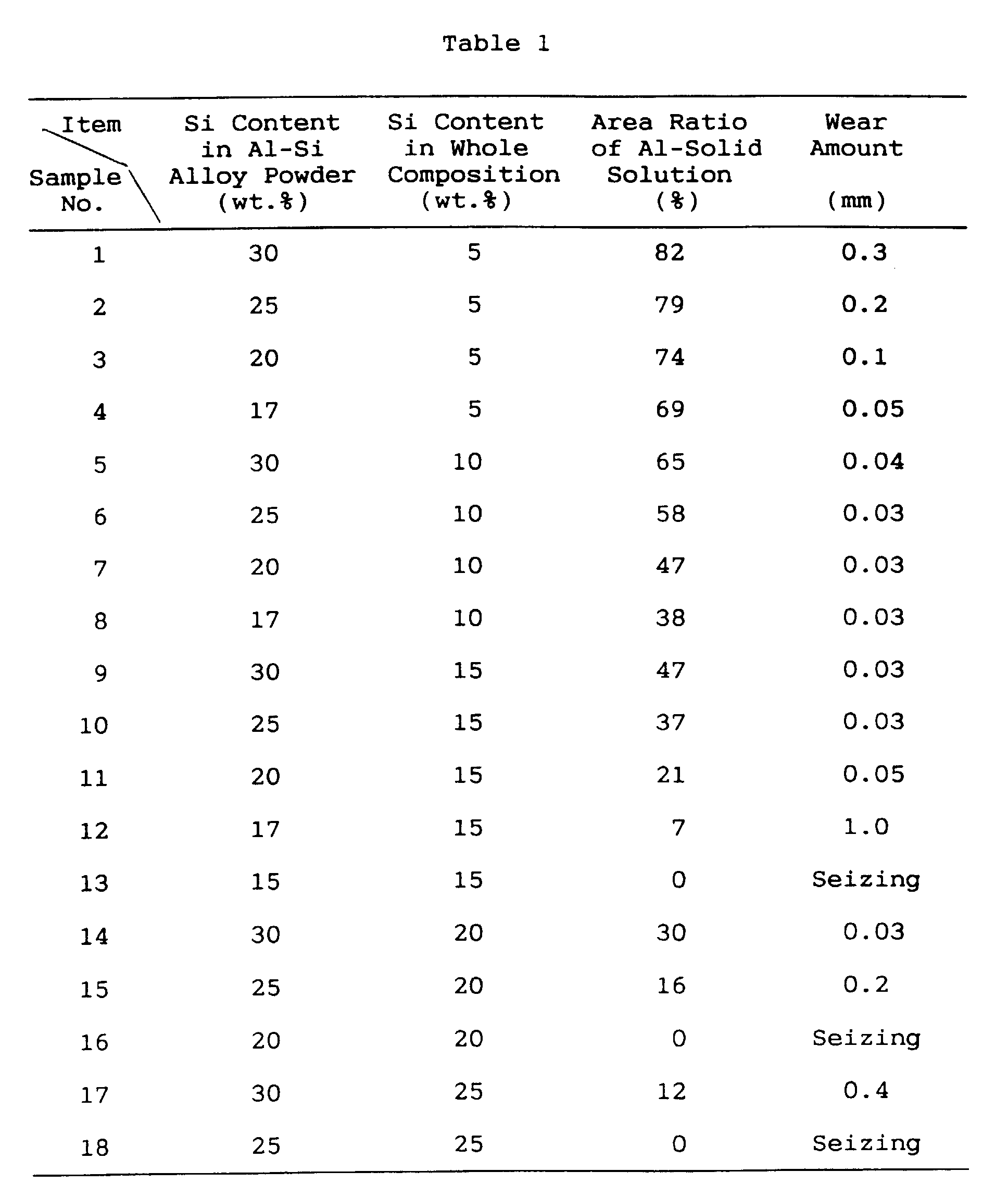
- the kinds and quantities of Al-Si alloy powders and the quantities of pure Al powder were changed to obtain powder mixtures, Sample Nos. 1-18. These powder mixtures were compacted into green compacts of a certain shape.
- the Si contents in the above Al-Si alloy powders were 5 kinds of 15%, 17%, 20%, 25% and 30%.
- the green compacts were dewaxed at 400°C and sintered at 540°C for 60 minutes. After that, the density ratios of them were made to 100% by hot press forging, and they were subjected to solution heat treatment at 490°C and aging treatment at 240°C.
- each sample to be tested was made in the form of a pin and a disk made of heat treated-S48C steel (carbon steel for machine construction) was used as a contact material.
- the sliding speed was 5 m/sec under mineral oil lubrication and the contact pressure was 49 MPa.
- Table 1 the kinds of Al-Si alloys, Si contents in whole compositions, area ratios of soft Al solid solution phases in grain structures, and wear amounts are shown.
- the weight ratios in the whole composition were 4% Cu, 0.5% Mg and 0.17% Ni.
- the wear amounts are small if the Si contents in Al-Si alloy powders are within a certain range and the area ratios of Al solid solution phases in the cross-section of alloys are in the range of 20-80%, meanwhile the wear amounts are markedly increased if the area ratio is either less than 20% or more than 80%.
- Al-20% Si alloy powder (75 parts by weight) was mixed with 25 parts by weight of pure Al powder. To this mixture were added Cu-4% Ni alloy powder and Al-50% Mg alloy powder to obtain a powder composition in terms of weight of 15% Si, 4% Cu, 0.5% Mg, 0.17% Ni and the balance of Al. This powder mixture was compacted to form several pieces of green compacts and they were dewaxed at 400°C. They were then sintered at a temperature of 540°C for 5 to 180 minutes. In the like manner as the foregoing Example 1, each sintered body was subjected to hot press forging, solution heat treatment and aging treatment so as to obtain sample Nos. 19 to 23.
- the maximum particle diameter of pro-eutectic Si crystal is small, the strength is high, however, it was understood that, when the maximum particle diameter is smaller than 5 ⁇ m or larger than 60 ⁇ m, the wear resistance is lowered.
- Powder materials shown in Table 3 were mixed together in the weight ratios also shown in table 3 and green compact samples were prepared. They were dewaxed at 400°C and sintered at 540°C for 60 minutes. The samples were subjected to hot press forging in the like manner as the foregoing examples, and some samples were further subjected to solution heat treatment at 490°C and aging treatment at 240°C. The tensile strengths and elongations were measured, the results of which are shown in the following Table 4 (Sample Nos. 24-28). In the observation of cross-sectional grain structures, when the intermetallic compound mainly containing Cu was observed, a symbol a was attached to the number of sample, while if it was not observed, the sample was represented with a symbol b.
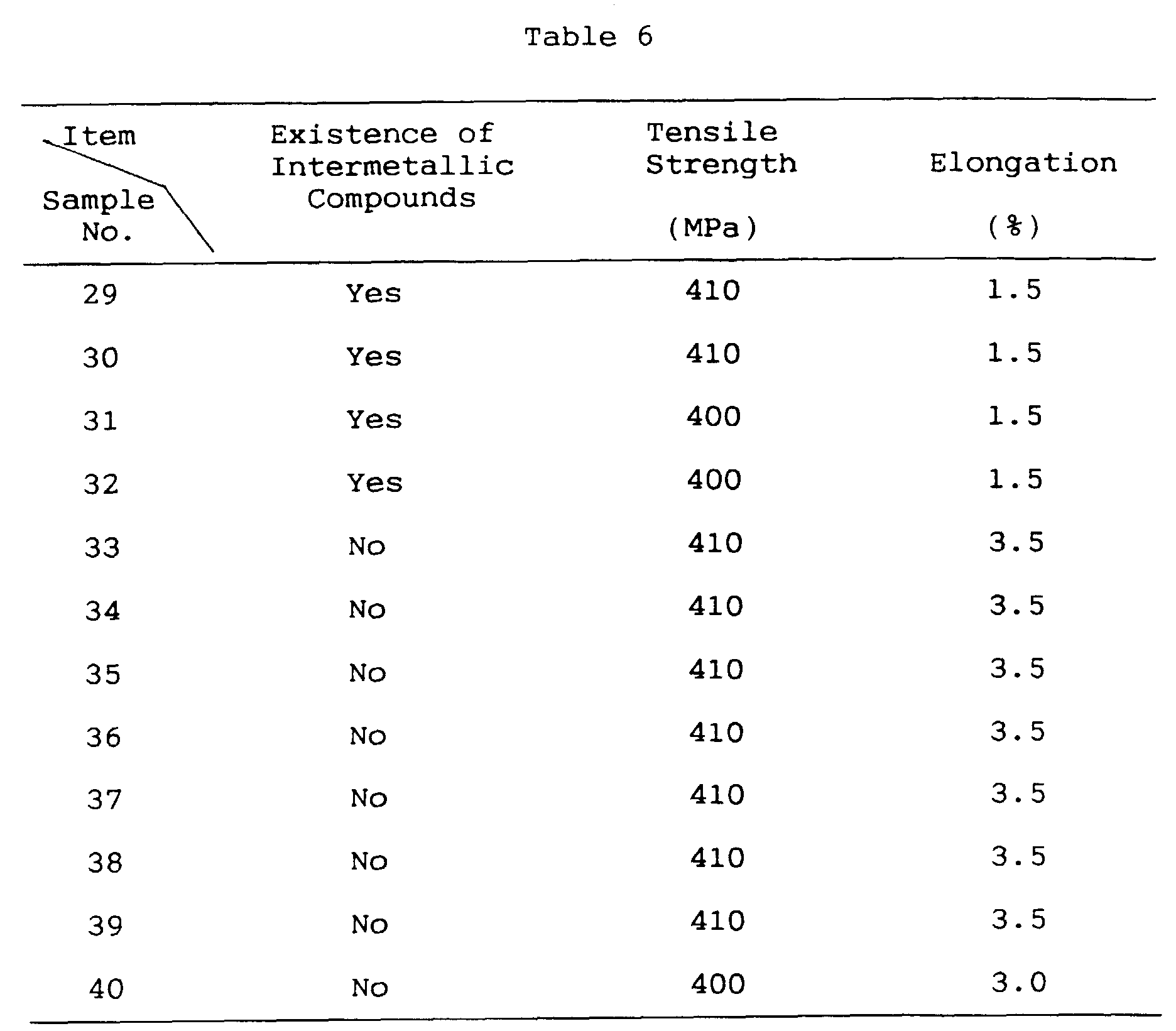
- Powder materials shown in Table 5 were mixed together in the weight ratios also shown in table 5 and green compact samples were prepared. They were dewaxed at 400°C and sintered at 540°C for 60 minutes. The samples were subjected to hot press forging and further subjected to solution heat treatment at 490°C and aging treatment at 240°C. The tensile strengths and elongations were measured and results of them are shown in the following Table 6.
- the intermetallic compound mainly containing Cu was extinguished in the cross-sectional grain structure and exhibiting elongation values similar to the foregoing examples. However, when elements other than the transition metals were added, the intermetallic compound mainly containing Cu was observed and the values of elongation were low. Unit: % by weight Sample No.
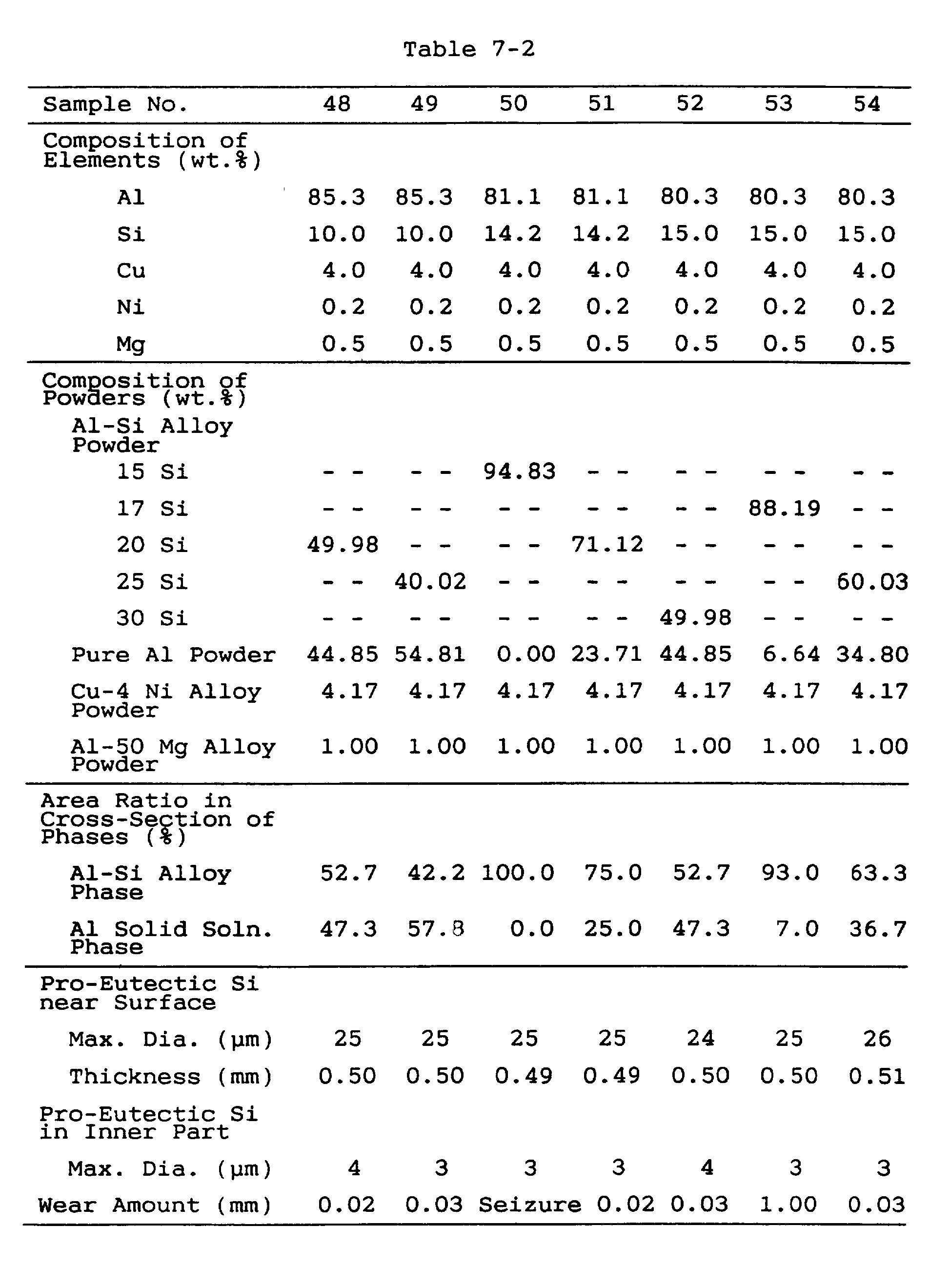
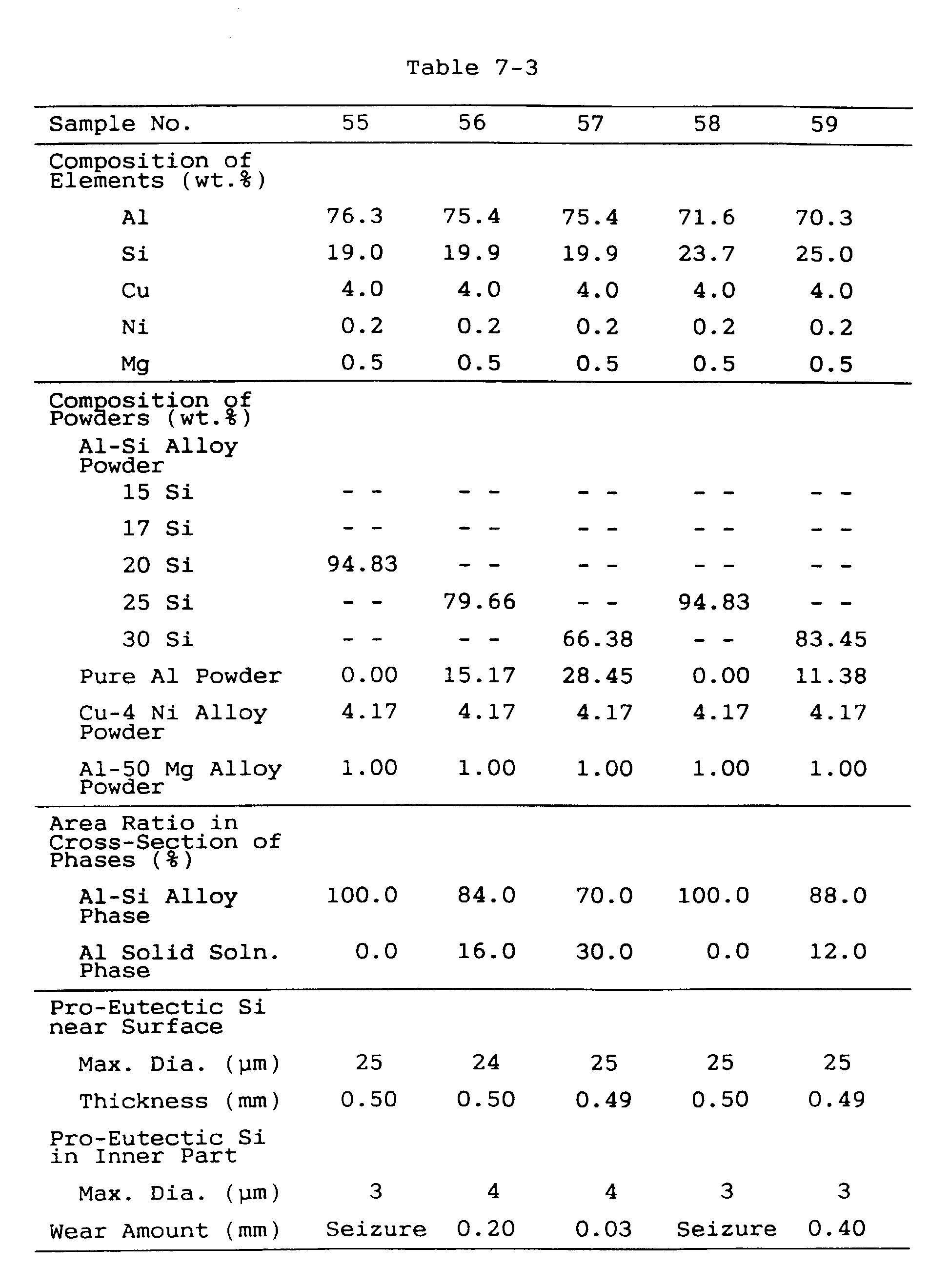
- the powder materials used were 5 kinds of Al-Si alloy powders containing 15%, 17%, 20%, 25% and 30% of Si, pure Al powder, Cu-4% Ni alloy powder, and Al-50% Mg alloy powder. These powders were mixed in the ratios shown in Tables 7-1 to 7-3 and formed into green compacts in a predetermined shape.
- the green compacts were dewaxed at 400°C and sintered at 540°C for 10 minutes. After that, the density ratios of them were made to 100% by hot press forging, and they were subjected to solution heat treatment at 490°C and aging treatment at 240°C.
- the cross-sectional area ratios of Al-Si alloy phase and Al solid solution phase of each sample were the same as the compounding ratios of Al-Si alloy powder and pure Al powder, respectively.
- the maximum diameter of the pro-eutectic Si crystals in the Al-Si alloy phase was 3-4 ⁇ m.
- the composition, area ratios in the cross-section of dapple grain structure of Al-Si alloy phase and Al solid solution phase, the maximum diameter of pro-eutectic Si crystals in the surface portion which were grown by the high frequency heating, the thickness of the layer from the surface which contained the grown particles of pro-eutectic Si, and the maximum diameter of pro-eutectic Si crystals in the inner part of sample, were measured and results are shown in the following Tables 7-1 to 7-3.
- the maximum diameters of pro-eutectic Si crystals in the surface portion were 24-26 ⁇ m.
- the wear amounts were large or seizure was caused to occur.
- the area ratios of Al-Si alloy phase and Al solid solution phase in dapple grain structures were within the predetermined range and in those cases, the wear amounts were small.
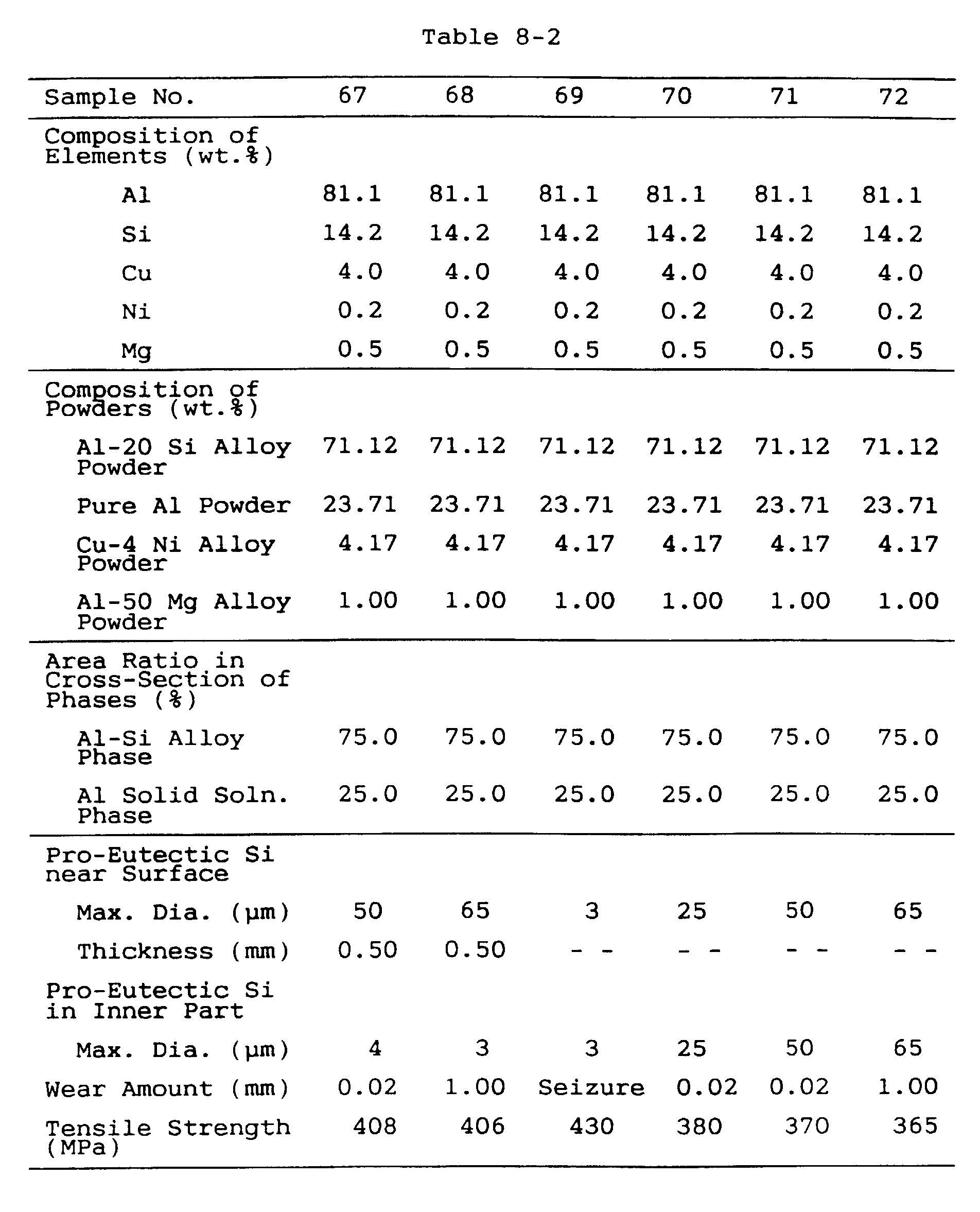
- the powder materials of Al-20 Si alloy powder, pure Al powder, Cu-4% Ni alloy powder, and Al-50% Mg powder were mixed in the ratios shown in Tables 8-1 and 8-2 and, in the like manner as in Example 5, the powder mixtures were subjected to compacting, sintering, hot press forging, solution heat treatment and aging treatment. Resultant samples were further treated by high frequency heating to obtain Sample Nos. 60-68.
- Sample Nos. 69-72 were prepared in the like manner as the above, however, they were treated by aging but were not subjected to high frequency heating.
- the maximum diameters of pro-eutectic Si crystals in sliding portion was smaller than 5 ⁇ m in Sample No. 69 and that of Sample No. 68 was larger than 60 ⁇ m. In these samples, the wear amount was quite large or seizure was caused to occur. In Sample No. 61, the maximum diameters of pro-eutectic Si crystals in sliding portion was within the range of 5 to 60 ⁇ m but its thickness was smaller than 0.05 mm, so that the seizure was caused to occur.
- the Al-Si sintered alloy according to the present invention has a dapple grain structure of an Al-solid solution phase and an Al-Si alloy phase containing dispersed pro-eutectic Si crystals having a maximum diameter of 5-60 ⁇ m.
- the cross-sectional area of the Al-solid solution phase in the grain structure is in the range of 20-80%.
- the proeutectic Si crystals having a maximum diameter of 5-60 ⁇ m is distributed only in the surface portion of the sintered alloy body and the thickness of the surface portion is 0.05 to 1 mm. Meanwhile, pro-eutectic Si crystals in other parts are less than 5 ⁇ m in diameter.
- the sintered alloy in accordance with the present invention has excellent mechanical strength and elongation and is especially good in wear resistance. Accordingly, it is expected to utilize the sintered alloy to the production of light-weight parts such as various kinds of gearwheels, pulleys, compressor vanes, connecting rods and pistons. Furthermore, the alloy of the invention can contribute to the expansion of the utility of parts made of the sintered alloy.
Landscapes
- Chemical & Material Sciences (AREA)
- Engineering & Computer Science (AREA)
- Materials Engineering (AREA)
- Mechanical Engineering (AREA)
- Metallurgy (AREA)
- Organic Chemistry (AREA)
- Powder Metallurgy (AREA)
Description

| Unit: % by weight | |||||
| Sample No. | 24 | 25 | 26 | 27 | 28 |
| Powder Materials | |||||
| Al-20% Si Powder | 35.0 | 60.0 | 75.0 | -- | -- |
| Al-25% Si Powder | -- | -- | -- | 60.0 | -- |
| Pure Al Powder | 59.8 | 34.8 | 19.8 | 34.8 | -- |
| Cu-4% Ni Powder | 4.2 | 4.2 | 4.2 | 4.2 | -- |
| A1-50% Mg Powder | 1.0 | 1.0 | 1.0 | 1.0 | -- |
| Rapidly Solidified Alloy Powder | -- | -- | -- | -- | 100 |

| Unit: % by weight | ||||
| Sample No. | 29 | 30 | 31 | 32 |
| Powder Materials | ||||
| Al-20% Si Powder | 60.0 | 60.0 | 60.0 | 60.0 |
| Pure Al Powder | 36.0 | 35.94 | 35.67 | 35.67 |
| Pure Cu Powder | 3.0 | -- | -- | -- |
| Cu-8% P Powder | -- | 3.06 | -- | -- |
| Cu-10% Sn Powder | -- | -- | 3.33 | -- |
| Cu-10% Zn Powder | -- | -- | -- | 3.33 |
| Al-50% Mg Powder | 1.0 | 1.0 | 1.0 | 1.0 |
| Sample No. | 33 | 34 | 35 | 36 |
| Al-20% Si Powder | 60.0 | 60.0 | 60.0 | 60.0 |
| Pure Al Powder | 35.87 | 35.87 | 35.99 | 35.98 |
| Cu-4% Ni Powder | 3.13 | -- | -- | -- |
| Cu-4% Ti Powder | -- | 3.13 | -- | -- |
| Cu-0.3% V Powder | -- | -- | 3.01 | -- |
| Cu-0.6% Cr Powder | -- | -- | -- | 3.02 |
| Al-50% Mg Powder | 1.0 | 1.0 | 1.0 | 1.0 |
| Sample No. | 37 | 38 | 39 | 40 |
| Al-20% Si Powder | 60.0 | 60.0 | 60.0 | 60.0 |
| Pure Al Powder | 35.87 | 35.94 | 35.91 | 35.7 |
| Cu-4% Mn Powder | 3.13 | -- | -- | -- |
| Cu-2% Fe Powder | -- | 3.06 | -- | -- |
| Cu-3% Co Powder | -- | -- | 3.09 | -- |
| Cu-9% Zr Powder | -- | -- | -- | 3.3 |
| Al-50% Mg Powder | 1.0 | 1.0 | 1.0 | 1.0 |


Claims (6)
- A wear-resistant sintered aluminium alloy which consists of, in terms of weight, 2.4 to 23.5% Si, 2 to 5% Cu, 0.2 to 1.5% Mg, 0.01 to 1% of one or more members selected from the group of transition metals consisting of Ti, V, Cr, Mn, Fe, Co, Ni, Zr and Nb, and the balance of aluminium and unavoidable impurities; which has a dapple grain structure of an Al solid solution phase and an Al-Si alloy phase, the latter containing dispersed pro-eutectic Si crystals having a maximum diameter of 5 to 60 µm, and the area of said Al solid solution phase is 20 to 80 percent in the cross-section of said dapple grain structure.
- The wear-resistant sintered aluminium alloy as claimed in claim 1, wherein said pro-eutectic Si crystals having a maximum diameter of 5 to 60 µm are uniformly dispersed in the grains of said Al-Si alloy phase in the whole body of sintered alloy.
- The wear-resistant sintered aluminium alloy as claimed in claim 1, wherein said pro-eutectic Si crystals having a maximum diameter of 5 to 60 µm are dispersed in the grains of said Al-Si alloy phase existing in the vicinity of the external surface or at least in a contact surface of said sintered alloy and other pro-eutectic Si crystals having a diameter of less than 5 pm are dispersed in the grains of said Al-Si alloy phase existing in the other part of the body of said sintered alloy.
- The wear-resistant sintered aluminium alloy as claimed in claim 3, wherein the thickness of the portion of Al-Si alloy phase containing dispersed pro-eutectic Si crystals having a maximum diameter of 5 to 60 µm, is 0.05-1 mm as measured from the surface of said sintered alloy.
- A method for producing a wear-resistant sintered aluminium alloy which comprises the steps of:characterised in that said pro-eutectic Si crystals contained in said Al-Si alloy phase in said sintered aluminium alloy are grown up to 5 to 60 µm in the maximum diameter by heating the whole body or the external surface of said sintered aluminium alloy, which is followed by cooling.preparing a mixture of 20 to 80 parts by weight of Al-Si alloy powder containing 13 to 30 wt.% of Si and 80 to 20 parts by weight of Al powder;adding a Cu-transition metal alloy powder containing 0.2 to 30 wt.% of one or more of the transition metals Ti, V, Cr, Mn, Fe, Co, Ni, Zr, and Nb; and Mg powder or an Al-Mg alloy powder containing 35 wt.% or more of Mg, to said mixture of Al powder and Al-Si alloy powder, thereby obtaining a powder mixture having the composition consisting of, in terms of weight, 2.4 to 23.5% Si, 2 to 5% Cu, 0.2 to 1.5% Mg, 0.01 to 1% of said transition metals and the balance of aluminium and unavoidable impurities;compacting the thus obtained powder mixture into a green compact; andsintering said green compact to obtain a sintered aluminium alloy,
- The method of claim 5, wherein said heating of the surface of sintered aluminium alloy is carried out by means of high-frequency heating, plasma heating or laser beam heating.
Applications Claiming Priority (4)
| Application Number | Priority Date | Filing Date | Title |
|---|---|---|---|
| JP37606/94 | 1994-02-12 | ||
| JP6037606A JP3057468B2 (en) | 1994-02-12 | 1994-02-12 | Wear-resistant aluminum-based sintered alloy and method for producing the same |
| JP335712/94 | 1994-12-21 | ||
| JP6335712A JP3060022B2 (en) | 1994-12-21 | 1994-12-21 | Wear-resistant aluminum-based sintered alloy and method for producing the same |
Publications (3)
| Publication Number | Publication Date |
|---|---|
| EP0669404A2 EP0669404A2 (en) | 1995-08-30 |
| EP0669404A3 EP0669404A3 (en) | 1995-10-25 |
| EP0669404B1 true EP0669404B1 (en) | 1998-06-24 |
Family
ID=26376743
Family Applications (1)
| Application Number | Title | Priority Date | Filing Date |
|---|---|---|---|
| EP95101854A Expired - Lifetime EP0669404B1 (en) | 1994-02-12 | 1995-02-10 | Wear-resistant sintered aluminum alloy and method for producing the same |
Country Status (3)
| Country | Link |
|---|---|
| US (1) | US5545487A (en) |
| EP (1) | EP0669404B1 (en) |
| DE (1) | DE69503077T2 (en) |
Cited By (1)
| Publication number | Priority date | Publication date | Assignee | Title |
|---|---|---|---|---|
| US6030577A (en) * | 1995-09-01 | 2000-02-29 | Erbsloh Aktiengesellschaft | Process for manufacturing thin pipes |
Families Citing this family (25)
| Publication number | Priority date | Publication date | Assignee | Title |
|---|---|---|---|---|
| DE19532252C2 (en) * | 1995-09-01 | 1999-12-02 | Erbsloeh Ag | Method of manufacturing bushings |
| DE19532253C2 (en) * | 1995-09-01 | 1998-07-02 | Peak Werkstoff Gmbh | Process for the production of thin-walled pipes (II) |
| ATE228580T1 (en) | 1997-08-30 | 2002-12-15 | Honsel Gmbh & Co Kg | ALLOY AND METHOD FOR PRODUCING OBJECTS FROM THIS ALLOY |
| US6124205A (en) * | 1998-09-03 | 2000-09-26 | Micron Technology, Inc. | Contact/via force fill process |
| US6949464B1 (en) | 1998-09-03 | 2005-09-27 | Micron Technology, Inc. | Contact/via force fill techniques |
| US6206918B1 (en) | 1999-05-12 | 2001-03-27 | Sulzer Carbomedics Inc. | Heart valve prosthesis having a pivot design for improving flow characteristics |
| DE19950595C1 (en) | 1999-10-21 | 2001-02-01 | Dorn Gmbh C | Production of sintered parts made of aluminum sintered mixture comprises mixing pure aluminum powder and aluminum alloy powder to form a sintered mixture, mixing with a pressing auxiliary agent, pressing, and sintering |
| DE10006269A1 (en) | 2000-02-12 | 2001-08-16 | Bayerische Motoren Werke Ag | Method for producing a metal component for a drive unit, in particular an internal combustion engine, which interacts with a friction partner via a sliding surface |
| DE10151716A1 (en) * | 2001-10-19 | 2003-05-08 | Bayerische Motoren Werke Ag | Alloy powder for coating in particular the valve seat area of a cylinder head of an internal combustion engine and coating method |
| JP3940022B2 (en) * | 2002-05-14 | 2007-07-04 | 日立粉末冶金株式会社 | Method for producing sintered aluminum alloy |
| JP2004176891A (en) * | 2002-11-29 | 2004-06-24 | Tsubakimoto Chain Co | Rachet-type tensioner |
| US20110240280A1 (en) * | 2010-03-31 | 2011-10-06 | Kabushiki Kaisha Kobe Seiko Sho (Kobe Steel, Ltd.) | Aluminum alloy brazing sheet and heat exchanger |
| GB2513869B (en) * | 2013-05-07 | 2015-12-30 | Charles Grant Purnell | Aluminium alloy products, and methods of making such alloy products |
| CN106457380B (en) * | 2014-04-11 | 2018-12-04 | Gkn烧结金属有限公司 | For improving the Al alloy powder preparation with silicon additive of engineering properties |
| CN106191569B (en) * | 2016-08-17 | 2018-02-09 | 江苏亚太安信达铝业有限公司 | A kind of wear-resisting silumin for piston of automobile and preparation method thereof |
| KR101856381B1 (en) * | 2016-11-16 | 2018-05-10 | 현대자동차주식회사 | Aluminum alloy for cylinder head |
| CN108080631B (en) * | 2017-12-15 | 2020-01-17 | 中国电子科技集团公司第十二研究所 | Collector electrode material, its preparation, surface treatment method and collector comprising the same |
| JP7011943B2 (en) * | 2018-01-19 | 2022-02-10 | 昭和電工株式会社 | Aluminum alloy substrate for magnetic recording medium and its manufacturing method, substrate for magnetic recording medium, magnetic recording medium and hard disk drive |
| JP7011944B2 (en) * | 2018-01-19 | 2022-02-10 | 昭和電工株式会社 | Aluminum alloy substrate for magnetic recording medium, substrate for magnetic recording medium, magnetic recording medium and hard disk drive |
| JP7011942B2 (en) * | 2018-01-19 | 2022-02-10 | 昭和電工株式会社 | Aluminum alloy substrate for magnetic recording medium, substrate for magnetic recording medium, magnetic recording medium and hard disk drive |
| CN108411172A (en) * | 2018-04-11 | 2018-08-17 | 安徽建国电力有限公司 | A kind of high intensity and high abrasion composite aluminum base material and preparation method thereof |
| US20200070240A1 (en) * | 2018-09-04 | 2020-03-05 | GM Global Technology Operations LLC | Light weight inserts for piston rings, methods of manufacturing thereof and articles comprising the same |
| US12359282B2 (en) | 2019-12-11 | 2025-07-15 | Diamet Corporation | Method for manufacturing Cu—Ni—Al-based sintered alloy |
| CN113846253B (en) * | 2021-09-18 | 2022-09-20 | 中国航发北京航空材料研究院 | Preparation method of Al-Si-Mg-Cu-Sc-Zr-Sr cast alloy |
| CN118441183B (en) * | 2024-07-08 | 2024-10-18 | 泰州市金鹰精密铸造有限公司 | Hypereutectic aluminum-silicon alloy with high wear resistance and preparation method and application thereof |
Family Cites Families (22)
| Publication number | Priority date | Publication date | Assignee | Title |
|---|---|---|---|---|
| US4055417A (en) * | 1974-03-13 | 1977-10-25 | Toyota Jidosha Kogyo Kabushiki Kaisha | Hyper-eutectic aluminum-silicon based alloys for castings |
| FR2343895A1 (en) * | 1976-03-10 | 1977-10-07 | Pechiney Aluminium | PROCESS FOR MANUFACTURING HOLLOW BODIES IN SILICON ALUMINUM ALLOYS BY SHELL SPINNING |
| US4177069A (en) * | 1977-04-09 | 1979-12-04 | Showa Denko K.K. | Process for manufacturing sintered compacts of aluminum-base alloys |
| JPS5937339B2 (en) * | 1977-04-15 | 1984-09-08 | 昭和電工株式会社 | Method for manufacturing high silicon aluminum alloy sintered body |
| DE2744994C2 (en) * | 1977-10-06 | 1985-08-29 | Stieber Division Der Borg-Warner Gmbh, 6900 Heidelberg | Process for the production of a synchronizing ring |
| CA1230761A (en) * | 1982-07-12 | 1987-12-29 | Fumio Kiyota | Heat-resistant, wear-resistant, and high-strength aluminum alloy powder and body shaped therefrom |
| FR2537655A1 (en) * | 1982-12-09 | 1984-06-15 | Cegedur | ENGINE SHAPES BASED ON ALUMINUM ALLOYS AND INTERMETALLIC COMPOUNDS AND METHODS FOR OBTAINING THEM |
| JPH0737660B2 (en) * | 1985-02-21 | 1995-04-26 | トヨタ自動車株式会社 | Improved treatment method of cylinder head for internal combustion engine made of cast aluminum alloy |
| JPS61291941A (en) * | 1985-06-19 | 1986-12-22 | Taiho Kogyo Co Ltd | Cast al alloy having high si content |
| JPS6210237A (en) * | 1985-07-09 | 1987-01-19 | Showa Denko Kk | Aluminum alloy for hot forging |
| US4847048A (en) * | 1986-07-21 | 1989-07-11 | Ryobi Limited | Aluminum die-casting alloys |
| US4865808A (en) * | 1987-03-30 | 1989-09-12 | Agency Of Industrial Science And Technology | Method for making hypereutetic Al-Si alloy composite materials |
| JPH02225635A (en) * | 1989-02-23 | 1990-09-07 | Mitsubishi Alum Co Ltd | Manufacture of al-si alloy member having low thermal expansion coefficient, excellent wear resistance and high toughness |
| JP2761085B2 (en) * | 1990-07-10 | 1998-06-04 | 昭和電工株式会社 | Raw material powder for Al-Si based alloy powder sintered parts and method for producing sintered parts |
| US5366691A (en) * | 1990-10-31 | 1994-11-22 | Sumitomo Electric Industries, Ltd. | Hyper-eutectic aluminum-silicon alloy powder and method of preparing the same |
| JPH0610086A (en) * | 1991-03-14 | 1994-01-18 | Takeshi Masumoto | Abrasion resistant aluminum alloy and processing method thereof |
| JPH05247573A (en) * | 1991-04-05 | 1993-09-24 | Railway Technical Res Inst | Aluminum alloy and auxiliary shoe for pantagraph |
| JPH0593205A (en) * | 1991-10-01 | 1993-04-16 | Hitachi Ltd | Production of aluminum sintered alloy part |
| JPH05156399A (en) * | 1991-12-04 | 1993-06-22 | Mitsubishi Materials Corp | Al-si alloy excellent in toughness |
| EP0577062B1 (en) * | 1992-06-29 | 1999-09-08 | Sumitomo Electric Industries, Limited | Oil pump made of aluminum alloys |
| JPH0647685A (en) * | 1992-07-29 | 1994-02-22 | Misawa Homes Co Ltd | Hammer with nail-puller |
| JPH06240399A (en) * | 1993-02-16 | 1994-08-30 | Honda Motor Co Ltd | Heat-resistant aluminum alloy with excellent notch fatigue strength |
-
1995
- 1995-02-09 US US08/385,988 patent/US5545487A/en not_active Expired - Lifetime
- 1995-02-10 EP EP95101854A patent/EP0669404B1/en not_active Expired - Lifetime
- 1995-02-10 DE DE69503077T patent/DE69503077T2/en not_active Expired - Lifetime
Cited By (1)
| Publication number | Priority date | Publication date | Assignee | Title |
|---|---|---|---|---|
| US6030577A (en) * | 1995-09-01 | 2000-02-29 | Erbsloh Aktiengesellschaft | Process for manufacturing thin pipes |
Also Published As
| Publication number | Publication date |
|---|---|
| EP0669404A2 (en) | 1995-08-30 |
| US5545487A (en) | 1996-08-13 |
| DE69503077T2 (en) | 1999-04-01 |
| EP0669404A3 (en) | 1995-10-25 |
| DE69503077D1 (en) | 1998-07-30 |
Similar Documents
| Publication | Publication Date | Title |
|---|---|---|
| US5545487A (en) | Wear-resistant sintered aluminum alloy and method for producing the same | |
| US4702885A (en) | Aluminum alloy and method for producing the same | |
| US5478220A (en) | Compressor scroll made of silicon containing aluminum alloy | |
| US4857267A (en) | Aluminum base bearing alloy and method of producing same | |
| JP2761085B2 (en) | Raw material powder for Al-Si based alloy powder sintered parts and method for producing sintered parts | |
| JPS6210237A (en) | Aluminum alloy for hot forging | |
| US5494540A (en) | Abrasion-resistant aluminum alloy and method of preparing the same | |
| EP1362654B1 (en) | Process for producing sintered aluminium alloy | |
| JP3095026B2 (en) | Manufacturing method of aluminum sintered alloy | |
| JP3784858B2 (en) | Method for producing aluminum wear-resistant sintered alloy | |
| RU2382099C2 (en) | Cast section from brass for manufacturing of rings of synchroniser | |
| US6706126B2 (en) | Aluminum alloy for sliding bearing and its production method | |
| JP3737371B2 (en) | Magnesium alloy for die casting | |
| JPH029099B2 (en) | ||
| JP3057468B2 (en) | Wear-resistant aluminum-based sintered alloy and method for producing the same | |
| US6899844B2 (en) | Production method of aluminum alloy for sliding bearing | |
| JP3060022B2 (en) | Wear-resistant aluminum-based sintered alloy and method for producing the same | |
| JP4704720B2 (en) | Heat-resistant Al-based alloy with excellent high-temperature fatigue properties | |
| JPH06192780A (en) | High heat resistance / high wear resistance aluminum alloy and high heat resistance / high wear resistance aluminum alloy powder | |
| JPH07278714A (en) | Aluminum powder alloy and method for producing the same | |
| JPH0421735A (en) | Aluminum series bearing alloy | |
| JP2584488B2 (en) | Processing method of wear resistant aluminum alloy | |
| JPS61295301A (en) | Heat-resistant high-power aluminum alloy powder and its molding | |
| JPH1161310A (en) | Aluminum alloy and method for producing the same | |
| JPH07331356A (en) | Al3Fe dispersion strengthened aluminum alloy, powder and method for producing the same |
Legal Events
| Date | Code | Title | Description |
|---|---|---|---|
| PUAI | Public reference made under article 153(3) epc to a published international application that has entered the european phase |
Free format text: ORIGINAL CODE: 0009012 |
|
| AK | Designated contracting states |
Kind code of ref document: A2 Designated state(s): DE FR GB IT |
|
| PUAL | Search report despatched |
Free format text: ORIGINAL CODE: 0009013 |
|
| AK | Designated contracting states |
Kind code of ref document: A3 Designated state(s): DE FR GB IT |
|
| 17P | Request for examination filed |
Effective date: 19960326 |
|
| 17Q | First examination report despatched |
Effective date: 19961018 |
|
| GRAG | Despatch of communication of intention to grant |
Free format text: ORIGINAL CODE: EPIDOS AGRA |
|
| GRAG | Despatch of communication of intention to grant |
Free format text: ORIGINAL CODE: EPIDOS AGRA |
|
| GRAH | Despatch of communication of intention to grant a patent |
Free format text: ORIGINAL CODE: EPIDOS IGRA |
|
| GRAH | Despatch of communication of intention to grant a patent |
Free format text: ORIGINAL CODE: EPIDOS IGRA |
|
| GRAA | (expected) grant |
Free format text: ORIGINAL CODE: 0009210 |
|
| AK | Designated contracting states |
Kind code of ref document: B1 Designated state(s): DE FR GB IT |
|
| ITF | It: translation for a ep patent filed | ||
| REF | Corresponds to: |
Ref document number: 69503077 Country of ref document: DE Date of ref document: 19980730 |
|
| ET | Fr: translation filed | ||
| PLBE | No opposition filed within time limit |
Free format text: ORIGINAL CODE: 0009261 |
|
| STAA | Information on the status of an ep patent application or granted ep patent |
Free format text: STATUS: NO OPPOSITION FILED WITHIN TIME LIMIT |
|
| 26N | No opposition filed | ||
| REG | Reference to a national code |
Ref country code: GB Ref legal event code: IF02 |
|
| PGFP | Annual fee paid to national office [announced via postgrant information from national office to epo] |
Ref country code: IT Payment date: 20140220 Year of fee payment: 20 Ref country code: FR Payment date: 20140211 Year of fee payment: 20 |
|
| PGFP | Annual fee paid to national office [announced via postgrant information from national office to epo] |
Ref country code: GB Payment date: 20140228 Year of fee payment: 20 |
|
| PGFP | Annual fee paid to national office [announced via postgrant information from national office to epo] |
Ref country code: DE Payment date: 20140410 Year of fee payment: 20 |
|
| REG | Reference to a national code |
Ref country code: DE Ref legal event code: R071 Ref document number: 69503077 Country of ref document: DE |
|
| REG | Reference to a national code |
Ref country code: DE Ref legal event code: R071 Ref document number: 69503077 Country of ref document: DE |
|
| REG | Reference to a national code |
Ref country code: GB Ref legal event code: PE20 Expiry date: 20150209 |
|
| PG25 | Lapsed in a contracting state [announced via postgrant information from national office to epo] |
Ref country code: GB Free format text: LAPSE BECAUSE OF EXPIRATION OF PROTECTION Effective date: 20150209 |