EP0666296B1 - Kreuzkatalysierter Phenol-Resorcinklebstoff zum Kleben von Lignocellulosehaltigem Material und Verfahren zur Herstellung - Google Patents
Kreuzkatalysierter Phenol-Resorcinklebstoff zum Kleben von Lignocellulosehaltigem Material und Verfahren zur Herstellung Download PDFInfo
- Publication number
- EP0666296B1 EP0666296B1 EP94307216A EP94307216A EP0666296B1 EP 0666296 B1 EP0666296 B1 EP 0666296B1 EP 94307216 A EP94307216 A EP 94307216A EP 94307216 A EP94307216 A EP 94307216A EP 0666296 B1 EP0666296 B1 EP 0666296B1
- Authority
- EP
- European Patent Office
- Prior art keywords
- resin
- formaldehyde
- catalyst
- resorcinolic
- parts
- Prior art date
- Legal status (The legal status is an assumption and is not a legal conclusion. Google has not performed a legal analysis and makes no representation as to the accuracy of the status listed.)
- Expired - Lifetime
Links
- 230000001070 adhesive effect Effects 0.000 title claims abstract description 50
- 239000000853 adhesive Substances 0.000 title claims abstract description 49
- 238000004519 manufacturing process Methods 0.000 title claims abstract description 19
- 238000000034 method Methods 0.000 title claims description 31
- 229920005989 resin Polymers 0.000 claims abstract description 271
- 239000011347 resin Substances 0.000 claims abstract description 271
- WSFSSNUMVMOOMR-UHFFFAOYSA-N Formaldehyde Chemical compound O=C WSFSSNUMVMOOMR-UHFFFAOYSA-N 0.000 claims abstract description 179
- 229920003987 resole Polymers 0.000 claims abstract description 111
- ISWSIDIOOBJBQZ-UHFFFAOYSA-N phenol group Chemical group C1(=CC=CC=C1)O ISWSIDIOOBJBQZ-UHFFFAOYSA-N 0.000 claims abstract description 106
- 239000003054 catalyst Substances 0.000 claims abstract description 67
- WYNCHZVNFNFDNH-UHFFFAOYSA-N Oxazolidine Chemical compound C1COCN1 WYNCHZVNFNFDNH-UHFFFAOYSA-N 0.000 claims abstract description 25
- 150000002148 esters Chemical class 0.000 claims abstract description 20
- 150000001875 compounds Chemical class 0.000 claims abstract description 13
- VGGLHLAESQEWCR-UHFFFAOYSA-N N-(hydroxymethyl)urea Chemical compound NC(=O)NCO VGGLHLAESQEWCR-UHFFFAOYSA-N 0.000 claims abstract description 8
- 125000000325 methylidene group Chemical group [H]C([H])=* 0.000 claims abstract 14
- GHMLBKRAJCXXBS-UHFFFAOYSA-N resorcinol Chemical compound OC1=CC=CC(O)=C1 GHMLBKRAJCXXBS-UHFFFAOYSA-N 0.000 claims description 65
- 239000000203 mixture Substances 0.000 claims description 64
- -1 methylol group Chemical group 0.000 claims description 34
- 125000004432 carbon atom Chemical group C* 0.000 claims description 14
- KXDHJXZQYSOELW-UHFFFAOYSA-M Carbamate Chemical compound NC([O-])=O KXDHJXZQYSOELW-UHFFFAOYSA-M 0.000 claims description 13
- VKYKSIONXSXAKP-UHFFFAOYSA-N hexamethylenetetramine Chemical compound C1N(C2)CN3CN1CN2C3 VKYKSIONXSXAKP-UHFFFAOYSA-N 0.000 claims description 13
- 238000002156 mixing Methods 0.000 claims description 13
- QGZKDVFQNNGYKY-UHFFFAOYSA-N Ammonia Chemical compound N QGZKDVFQNNGYKY-UHFFFAOYSA-N 0.000 claims description 10
- 239000004312 hexamethylene tetramine Substances 0.000 claims description 10
- 235000010299 hexamethylene tetramine Nutrition 0.000 claims description 10
- IJGRMHOSHXDMSA-UHFFFAOYSA-N Atomic nitrogen Chemical compound N#N IJGRMHOSHXDMSA-UHFFFAOYSA-N 0.000 claims description 8
- 150000001733 carboxylic acid esters Chemical class 0.000 claims description 7
- BFHKYHMIVDBCPC-UHFFFAOYSA-N 1,3,5,7-tetrahydro-[1,3]oxazolo[3,4-c][1,3]oxazol-7a-ylmethanol Chemical group C1OCN2COCC21CO BFHKYHMIVDBCPC-UHFFFAOYSA-N 0.000 claims description 6
- ZRCMGIXRGFOXNT-UHFFFAOYSA-N 7a-ethyl-1,3,5,7-tetrahydro-[1,3]oxazolo[3,4-c][1,3]oxazole Chemical group C1OCN2COCC21CC ZRCMGIXRGFOXNT-UHFFFAOYSA-N 0.000 claims description 6
- BVKZGUZCCUSVTD-UHFFFAOYSA-L Carbonate Chemical compound [O-]C([O-])=O BVKZGUZCCUSVTD-UHFFFAOYSA-L 0.000 claims description 6
- 239000007859 condensation product Substances 0.000 claims description 6
- 239000001257 hydrogen Substances 0.000 claims description 6
- 229910052739 hydrogen Inorganic materials 0.000 claims description 6
- 125000004435 hydrogen atom Chemical group [H]* 0.000 claims description 6
- 229910021529 ammonia Inorganic materials 0.000 claims description 5
- 239000007795 chemical reaction product Substances 0.000 claims description 5
- 150000002596 lactones Chemical class 0.000 claims description 5
- 125000000217 alkyl group Chemical group 0.000 claims description 4
- 239000011248 coating agent Substances 0.000 claims description 4
- 238000000576 coating method Methods 0.000 claims description 4
- 229910052757 nitrogen Inorganic materials 0.000 claims description 4
- RUOJZAUFBMNUDX-UHFFFAOYSA-N propylene carbonate Chemical compound CC1COC(=O)O1 RUOJZAUFBMNUDX-UHFFFAOYSA-N 0.000 claims description 4
- KMTRUDSVKNLOMY-UHFFFAOYSA-N Ethylene carbonate Chemical compound O=C1OCCO1 KMTRUDSVKNLOMY-UHFFFAOYSA-N 0.000 claims description 3
- CTKINSOISVBQLD-UHFFFAOYSA-N Glycidol Chemical compound OCC1CO1 CTKINSOISVBQLD-UHFFFAOYSA-N 0.000 claims description 3
- 125000002947 alkylene group Chemical group 0.000 claims description 3
- 239000003822 epoxy resin Substances 0.000 claims description 3
- 229920000647 polyepoxide Polymers 0.000 claims description 3
- BGJSXRVXTHVRSN-UHFFFAOYSA-N 1,3,5-trioxane Chemical compound C1OCOCO1 BGJSXRVXTHVRSN-UHFFFAOYSA-N 0.000 claims description 2
- PIICEJLVQHRZGT-UHFFFAOYSA-N Ethylenediamine Chemical class NCCN PIICEJLVQHRZGT-UHFFFAOYSA-N 0.000 claims description 2
- 125000001797 benzyl group Chemical group [H]C1=C([H])C([H])=C(C([H])=C1[H])C([H])([H])* 0.000 claims description 2
- 125000004122 cyclic group Chemical group 0.000 claims description 2
- 125000001495 ethyl group Chemical group [H]C([H])([H])C([H])([H])* 0.000 claims description 2
- 125000002768 hydroxyalkyl group Chemical group 0.000 claims description 2
- 125000001449 isopropyl group Chemical group [H]C([H])([H])C([H])(*)C([H])([H])[H] 0.000 claims description 2
- 125000004184 methoxymethyl group Chemical group [H]C([H])([H])OC([H])([H])* 0.000 claims description 2
- 125000002496 methyl group Chemical group [H]C([H])([H])* 0.000 claims description 2
- 125000004123 n-propyl group Chemical group [H]C([H])([H])C([H])([H])C([H])([H])* 0.000 claims description 2
- 125000000160 oxazolidinyl group Chemical group 0.000 claims 3
- 125000000623 heterocyclic group Chemical group 0.000 claims 1
- 230000000379 polymerizing effect Effects 0.000 claims 1
- HEMHJVSKTPXQMS-UHFFFAOYSA-M Sodium hydroxide Chemical compound [OH-].[Na+] HEMHJVSKTPXQMS-UHFFFAOYSA-M 0.000 description 60
- XLYOFNOQVPJJNP-UHFFFAOYSA-N water Substances O XLYOFNOQVPJJNP-UHFFFAOYSA-N 0.000 description 36
- XSQUKJJJFZCRTK-UHFFFAOYSA-N Urea Chemical compound NC(N)=O XSQUKJJJFZCRTK-UHFFFAOYSA-N 0.000 description 34
- 125000001570 methylene group Chemical group [H]C([H])([*:1])[*:2] 0.000 description 27
- 238000009835 boiling Methods 0.000 description 20
- 239000007787 solid Substances 0.000 description 19
- 239000000243 solution Substances 0.000 description 19
- 239000002023 wood Substances 0.000 description 19
- 235000013877 carbamide Nutrition 0.000 description 18
- 238000012360 testing method Methods 0.000 description 18
- 239000004202 carbamide Substances 0.000 description 16
- URAYPUMNDPQOKB-UHFFFAOYSA-N triacetin Chemical compound CC(=O)OCC(OC(C)=O)COC(C)=O URAYPUMNDPQOKB-UHFFFAOYSA-N 0.000 description 15
- 150000001299 aldehydes Chemical class 0.000 description 13
- 150000002917 oxazolidines Chemical class 0.000 description 12
- 229920001568 phenolic resin Polymers 0.000 description 10
- OKKJLVBELUTLKV-UHFFFAOYSA-N Methanol Chemical group OC OKKJLVBELUTLKV-UHFFFAOYSA-N 0.000 description 8
- 239000000047 product Substances 0.000 description 8
- 239000000126 substance Substances 0.000 description 8
- 239000001087 glyceryl triacetate Substances 0.000 description 7
- 235000013773 glyceryl triacetate Nutrition 0.000 description 7
- WSFSSNUMVMOOMR-NJFSPNSNSA-N methanone Chemical compound O=[14CH2] WSFSSNUMVMOOMR-NJFSPNSNSA-N 0.000 description 7
- 229960002622 triacetin Drugs 0.000 description 7
- IKHGUXGNUITLKF-UHFFFAOYSA-N Acetaldehyde Chemical compound CC=O IKHGUXGNUITLKF-UHFFFAOYSA-N 0.000 description 6
- KWYUFKZDYYNOTN-UHFFFAOYSA-M Potassium hydroxide Chemical compound [OH-].[K+] KWYUFKZDYYNOTN-UHFFFAOYSA-M 0.000 description 6
- 239000000463 material Substances 0.000 description 6
- 239000002245 particle Substances 0.000 description 6
- DGXAGETVRDOQFP-UHFFFAOYSA-N 2,6-dihydroxybenzaldehyde Chemical compound OC1=CC=CC(O)=C1C=O DGXAGETVRDOQFP-UHFFFAOYSA-N 0.000 description 5
- UPMLOUAZCHDJJD-UHFFFAOYSA-N 4,4'-Diphenylmethane Diisocyanate Chemical compound C1=CC(N=C=O)=CC=C1CC1=CC=C(N=C=O)C=C1 UPMLOUAZCHDJJD-UHFFFAOYSA-N 0.000 description 5
- 229920000538 Poly[(phenyl isocyanate)-co-formaldehyde] Polymers 0.000 description 5
- 239000000654 additive Substances 0.000 description 5
- 239000011230 binding agent Substances 0.000 description 5
- SLGWESQGEUXWJQ-UHFFFAOYSA-N formaldehyde;phenol Chemical compound O=C.OC1=CC=CC=C1 SLGWESQGEUXWJQ-UHFFFAOYSA-N 0.000 description 5
- ODGAOXROABLFNM-UHFFFAOYSA-N polynoxylin Chemical class O=C.NC(N)=O ODGAOXROABLFNM-UHFFFAOYSA-N 0.000 description 5
- YEJRWHAVMIAJKC-UHFFFAOYSA-N 4-Butyrolactone Chemical compound O=C1CCCO1 YEJRWHAVMIAJKC-UHFFFAOYSA-N 0.000 description 4
- 238000010276 construction Methods 0.000 description 4
- HYBBIBNJHNGZAN-UHFFFAOYSA-N furfural Chemical compound O=CC1=CC=CO1 HYBBIBNJHNGZAN-UHFFFAOYSA-N 0.000 description 4
- 239000012978 lignocellulosic material Substances 0.000 description 4
- 239000005011 phenolic resin Substances 0.000 description 4
- 239000011120 plywood Substances 0.000 description 4
- UMGDCJDMYOKAJW-UHFFFAOYSA-N thiourea Chemical compound NC(N)=S UMGDCJDMYOKAJW-UHFFFAOYSA-N 0.000 description 4
- XEKOWRVHYACXOJ-UHFFFAOYSA-N Ethyl acetate Chemical compound CCOC(C)=O XEKOWRVHYACXOJ-UHFFFAOYSA-N 0.000 description 3
- DNIAPMSPPWPWGF-UHFFFAOYSA-N Propylene glycol Chemical compound CC(O)CO DNIAPMSPPWPWGF-UHFFFAOYSA-N 0.000 description 3
- 150000001298 alcohols Chemical class 0.000 description 3
- 125000001931 aliphatic group Chemical group 0.000 description 3
- 150000004657 carbamic acid derivatives Chemical class 0.000 description 3
- 238000006555 catalytic reaction Methods 0.000 description 3
- 238000006243 chemical reaction Methods 0.000 description 3
- 230000000694 effects Effects 0.000 description 3
- 239000011094 fiberboard Substances 0.000 description 3
- 239000003517 fume Substances 0.000 description 3
- 238000012552 review Methods 0.000 description 3
- TUAMRELNJMMDMT-UHFFFAOYSA-N 3,5-xylenol Chemical compound CC1=CC(C)=CC(O)=C1 TUAMRELNJMMDMT-UHFFFAOYSA-N 0.000 description 2
- GUQMDNQYMMRJPY-UHFFFAOYSA-N 4,4-dimethyl-1,3-oxazolidine Chemical compound CC1(C)COCN1 GUQMDNQYMMRJPY-UHFFFAOYSA-N 0.000 description 2
- OKTJSMMVPCPJKN-UHFFFAOYSA-N Carbon Chemical group [C] OKTJSMMVPCPJKN-UHFFFAOYSA-N 0.000 description 2
- PEDCQBHIVMGVHV-UHFFFAOYSA-N Glycerol Natural products OCC(O)CO PEDCQBHIVMGVHV-UHFFFAOYSA-N 0.000 description 2
- 229920000877 Melamine resin Polymers 0.000 description 2
- CNCOEDDPFOAUMB-UHFFFAOYSA-N N-Methylolacrylamide Chemical compound OCNC(=O)C=C CNCOEDDPFOAUMB-UHFFFAOYSA-N 0.000 description 2
- 229930040373 Paraformaldehyde Natural products 0.000 description 2
- 239000007864 aqueous solution Substances 0.000 description 2
- 125000003118 aryl group Chemical group 0.000 description 2
- IISBACLAFKSPIT-UHFFFAOYSA-N bisphenol A Chemical compound C=1C=C(O)C=CC=1C(C)(C)C1=CC=C(O)C=C1 IISBACLAFKSPIT-UHFFFAOYSA-N 0.000 description 2
- DKPFZGUDAPQIHT-UHFFFAOYSA-N butyl acetate Chemical compound CCCCOC(C)=O DKPFZGUDAPQIHT-UHFFFAOYSA-N 0.000 description 2
- 239000003795 chemical substances by application Substances 0.000 description 2
- 239000002131 composite material Substances 0.000 description 2
- 239000003431 cross linking reagent Substances 0.000 description 2
- 230000007812 deficiency Effects 0.000 description 2
- LZCLXQDLBQLTDK-UHFFFAOYSA-N ethyl 2-hydroxypropanoate Chemical compound CCOC(=O)C(C)O LZCLXQDLBQLTDK-UHFFFAOYSA-N 0.000 description 2
- GAEKPEKOJKCEMS-UHFFFAOYSA-N gamma-valerolactone Chemical compound CC1CCC(=O)O1 GAEKPEKOJKCEMS-UHFFFAOYSA-N 0.000 description 2
- 150000002334 glycols Chemical class 0.000 description 2
- 238000007731 hot pressing Methods 0.000 description 2
- 125000002887 hydroxy group Chemical group [H]O* 0.000 description 2
- 239000012948 isocyanate Substances 0.000 description 2
- 150000002513 isocyanates Chemical class 0.000 description 2
- 239000007788 liquid Substances 0.000 description 2
- JDSHMPZPIAZGSV-UHFFFAOYSA-N melamine Chemical compound NC1=NC(N)=NC(N)=N1 JDSHMPZPIAZGSV-UHFFFAOYSA-N 0.000 description 2
- VNWKTOKETHGBQD-UHFFFAOYSA-N methane Chemical compound C VNWKTOKETHGBQD-UHFFFAOYSA-N 0.000 description 2
- TZIHFWKZFHZASV-UHFFFAOYSA-N methyl formate Chemical compound COC=O TZIHFWKZFHZASV-UHFFFAOYSA-N 0.000 description 2
- IZXGZAJMDLJLMF-UHFFFAOYSA-N methylaminomethanol Chemical compound CNCO IZXGZAJMDLJLMF-UHFFFAOYSA-N 0.000 description 2
- QUBQYFYWUJJAAK-UHFFFAOYSA-N oxymethurea Chemical compound OCNC(=O)NCO QUBQYFYWUJJAAK-UHFFFAOYSA-N 0.000 description 2
- 229950005308 oxymethurea Drugs 0.000 description 2
- 239000004014 plasticizer Substances 0.000 description 2
- 229920000642 polymer Polymers 0.000 description 2
- 238000002360 preparation method Methods 0.000 description 2
- 102000004169 proteins and genes Human genes 0.000 description 2
- 108090000623 proteins and genes Proteins 0.000 description 2
- 229920006395 saturated elastomer Polymers 0.000 description 2
- 230000035945 sensitivity Effects 0.000 description 2
- 150000003672 ureas Chemical class 0.000 description 2
- XUKSWKGOQKREON-UHFFFAOYSA-N 1,4-diacetoxybutane Chemical compound CC(=O)OCCCCOC(C)=O XUKSWKGOQKREON-UHFFFAOYSA-N 0.000 description 1
- AOMORPLAHSIXNB-UHFFFAOYSA-N 1-(5-methyl-1,3-oxazolidin-3-yl)propan-2-ol Chemical compound CC(O)CN1COC(C)C1 AOMORPLAHSIXNB-UHFFFAOYSA-N 0.000 description 1
- DSVNOPFDYLTWFF-UHFFFAOYSA-N 1-(hydroxymethyl)-1,3-dimethylurea Chemical compound CNC(=O)N(C)CO DSVNOPFDYLTWFF-UHFFFAOYSA-N 0.000 description 1
- UINXENWMDHZTCR-UHFFFAOYSA-N 1-(hydroxymethyl)-3-methylidenethiourea Chemical compound OCNC(=S)N=C UINXENWMDHZTCR-UHFFFAOYSA-N 0.000 description 1
- DZNJSBHVDXLTIK-UHFFFAOYSA-N 1-(hydroxymethyl)imidazolidine-2,4-dione Chemical compound OCN1CC(=O)NC1=O DZNJSBHVDXLTIK-UHFFFAOYSA-N 0.000 description 1
- AZVYYSCOCHRFKW-UHFFFAOYSA-N 1-(hydroxymethyl)pyrrolidine-2,5-dione Chemical compound OCN1C(=O)CCC1=O AZVYYSCOCHRFKW-UHFFFAOYSA-N 0.000 description 1
- ZXSBYAWLZRAJJY-UHFFFAOYSA-N 2,6-dihydroxybenzaldehyde phenol Chemical group C1(O)=C(C(O)=CC=C1)C=O.OC1=CC=CC=C1 ZXSBYAWLZRAJJY-UHFFFAOYSA-N 0.000 description 1
- UPIKAIAOTXEAAZ-UHFFFAOYSA-N 2-(1,3-oxazolidin-3-yl)ethanol Chemical compound OCCN1CCOC1 UPIKAIAOTXEAAZ-UHFFFAOYSA-N 0.000 description 1
- OLQJQHSAWMFDJE-UHFFFAOYSA-N 2-(hydroxymethyl)-2-nitropropane-1,3-diol Chemical compound OCC(CO)(CO)[N+]([O-])=O OLQJQHSAWMFDJE-UHFFFAOYSA-N 0.000 description 1
- JTXMVXSTHSMVQF-UHFFFAOYSA-N 2-acetyloxyethyl acetate Chemical compound CC(=O)OCCOC(C)=O JTXMVXSTHSMVQF-UHFFFAOYSA-N 0.000 description 1
- BTDQXGUEVVTAMD-UHFFFAOYSA-N 2-hydroxyethyl carbamate Chemical compound NC(=O)OCCO BTDQXGUEVVTAMD-UHFFFAOYSA-N 0.000 description 1
- KXGFMDJXCMQABM-UHFFFAOYSA-N 2-methoxy-6-methylphenol Chemical compound [CH]OC1=CC=CC([CH])=C1O KXGFMDJXCMQABM-UHFFFAOYSA-N 0.000 description 1
- YGRCLLQIAOXAHD-UHFFFAOYSA-N 3,5,7,7a-tetrahydro-1h-[1,3]oxazolo[3,4-c][1,3]oxazole Chemical compound C1OCC2COCN21 YGRCLLQIAOXAHD-UHFFFAOYSA-N 0.000 description 1
- XMIMXLQYBRPWBV-UHFFFAOYSA-N 3-cyclohexyl-5-methyl-1,3-oxazolidine Chemical compound C1OC(C)CN1C1CCCCC1 XMIMXLQYBRPWBV-UHFFFAOYSA-N 0.000 description 1
- RDRURTGSFBSIKX-UHFFFAOYSA-N 3-ethyl-1,3-oxazolidine Chemical compound CCN1CCOC1 RDRURTGSFBSIKX-UHFFFAOYSA-N 0.000 description 1
- BSBQJOWZSCCENI-UHFFFAOYSA-N 3-hydroxypropyl carbamate Chemical compound NC(=O)OCCCO BSBQJOWZSCCENI-UHFFFAOYSA-N 0.000 description 1
- NYBXFCLDEATPCM-UHFFFAOYSA-N 3-methyloxetan-2-one Chemical compound CC1COC1=O NYBXFCLDEATPCM-UHFFFAOYSA-N 0.000 description 1
- YOYQGSKKADVTRM-UHFFFAOYSA-N 4,4-dimethyl-n-phenyl-1,3-oxazolidine-3-carboxamide Chemical compound CC1(C)COCN1C(=O)NC1=CC=CC=C1 YOYQGSKKADVTRM-UHFFFAOYSA-N 0.000 description 1
- JFMGYULNQJPJCY-UHFFFAOYSA-N 4-(hydroxymethyl)-1,3-dioxolan-2-one Chemical compound OCC1COC(=O)O1 JFMGYULNQJPJCY-UHFFFAOYSA-N 0.000 description 1
- HBVZPVWFLGXUAU-UHFFFAOYSA-N 5-methyl-1,3-oxazolidine Chemical compound CC1CNCO1 HBVZPVWFLGXUAU-UHFFFAOYSA-N 0.000 description 1
- YWIJBUYJSIQULU-UHFFFAOYSA-N 7a-methyl-1,3,5,7-tetrahydro-[1,3]oxazolo[3,4-c][1,3]oxazole Chemical compound C1OCN2COCC21C YWIJBUYJSIQULU-UHFFFAOYSA-N 0.000 description 1
- FLHPYCWXCVYNOM-UHFFFAOYSA-N 7a-propan-2-yl-1,3,5,7-tetrahydro-[1,3]oxazolo[3,4-c][1,3]oxazole Chemical compound C1OCN2COCC21C(C)C FLHPYCWXCVYNOM-UHFFFAOYSA-N 0.000 description 1
- ZUHOFWLWIAWRTR-UHFFFAOYSA-N 7a-propyl-1,3,5,7-tetrahydro-[1,3]oxazolo[3,4-c][1,3]oxazole Chemical compound C1OCN2COCC21CCC ZUHOFWLWIAWRTR-UHFFFAOYSA-N 0.000 description 1
- LPEKGGXMPWTOCB-UHFFFAOYSA-N 8beta-(2,3-epoxy-2-methylbutyryloxy)-14-acetoxytithifolin Natural products COC(=O)C(C)O LPEKGGXMPWTOCB-UHFFFAOYSA-N 0.000 description 1
- 241000609240 Ambelania acida Species 0.000 description 1
- 235000005979 Citrus limon Nutrition 0.000 description 1
- 244000131522 Citrus pyriformis Species 0.000 description 1
- 239000004971 Cross linker Substances 0.000 description 1
- UDSFAEKRVUSQDD-UHFFFAOYSA-N Dimethyl adipate Chemical compound COC(=O)CCCCC(=O)OC UDSFAEKRVUSQDD-UHFFFAOYSA-N 0.000 description 1
- MUXOBHXGJLMRAB-UHFFFAOYSA-N Dimethyl succinate Chemical compound COC(=O)CCC(=O)OC MUXOBHXGJLMRAB-UHFFFAOYSA-N 0.000 description 1
- 241000196324 Embryophyta Species 0.000 description 1
- JOYRKODLDBILNP-UHFFFAOYSA-N Ethyl urethane Chemical compound CCOC(N)=O JOYRKODLDBILNP-UHFFFAOYSA-N 0.000 description 1
- MNSGOOCAMMSKGI-UHFFFAOYSA-N N-(hydroxymethyl)phthalimide Chemical compound C1=CC=C2C(=O)N(CO)C(=O)C2=C1 MNSGOOCAMMSKGI-UHFFFAOYSA-N 0.000 description 1
- 229920002302 Nylon 6,6 Polymers 0.000 description 1
- 235000005018 Pinus echinata Nutrition 0.000 description 1
- 241001236219 Pinus echinata Species 0.000 description 1
- 235000017339 Pinus palustris Nutrition 0.000 description 1
- 239000004952 Polyamide Substances 0.000 description 1
- 241000183024 Populus tremula Species 0.000 description 1
- XBDQKXXYIPTUBI-UHFFFAOYSA-M Propionate Chemical compound CCC([O-])=O XBDQKXXYIPTUBI-UHFFFAOYSA-M 0.000 description 1
- 229920002472 Starch Polymers 0.000 description 1
- 229920001807 Urea-formaldehyde Polymers 0.000 description 1
- 229920002522 Wood fibre Polymers 0.000 description 1
- KXKVLQRXCPHEJC-UHFFFAOYSA-N acetic acid trimethyl ester Natural products COC(C)=O KXKVLQRXCPHEJC-UHFFFAOYSA-N 0.000 description 1
- 239000002253 acid Substances 0.000 description 1
- 230000000996 additive effect Effects 0.000 description 1
- XAGFODPZIPBFFR-UHFFFAOYSA-N aluminium Chemical compound [Al] XAGFODPZIPBFFR-UHFFFAOYSA-N 0.000 description 1
- 229910052782 aluminium Inorganic materials 0.000 description 1
- 239000004411 aluminium Substances 0.000 description 1
- 150000001408 amides Chemical class 0.000 description 1
- 150000001412 amines Chemical class 0.000 description 1
- 150000001414 amino alcohols Chemical class 0.000 description 1
- 238000013459 approach Methods 0.000 description 1
- 239000012298 atmosphere Substances 0.000 description 1
- 238000000889 atomisation Methods 0.000 description 1
- 239000010905 bagasse Substances 0.000 description 1
- GSCLMSFRWBPUSK-UHFFFAOYSA-N beta-Butyrolactone Chemical compound CC1CC(=O)O1 GSCLMSFRWBPUSK-UHFFFAOYSA-N 0.000 description 1
- VEZXCJBBBCKRPI-UHFFFAOYSA-N beta-propiolactone Chemical compound O=C1CCO1 VEZXCJBBBCKRPI-UHFFFAOYSA-N 0.000 description 1
- 125000002618 bicyclic heterocycle group Chemical group 0.000 description 1
- 229940106691 bisphenol a Drugs 0.000 description 1
- WZRZKFUVOSDSBQ-UHFFFAOYSA-N butane-1,2-diol;carbonic acid Chemical compound OC(O)=O.CCC(O)CO WZRZKFUVOSDSBQ-UHFFFAOYSA-N 0.000 description 1
- ANQJWUKLNGHYIP-UHFFFAOYSA-N butane-1,3-diol;carbonic acid Chemical compound OC(O)=O.CC(O)CCO ANQJWUKLNGHYIP-UHFFFAOYSA-N 0.000 description 1
- CUZMQPZYCDIHQL-VCTVXEGHSA-L calcium;(2s)-1-[(2s)-3-[(2r)-2-(cyclohexanecarbonylamino)propanoyl]sulfanyl-2-methylpropanoyl]pyrrolidine-2-carboxylate Chemical compound [Ca+2].N([C@H](C)C(=O)SC[C@@H](C)C(=O)N1[C@@H](CCC1)C([O-])=O)C(=O)C1CCCCC1.N([C@H](C)C(=O)SC[C@@H](C)C(=O)N1[C@@H](CCC1)C([O-])=O)C(=O)C1CCCCC1 CUZMQPZYCDIHQL-VCTVXEGHSA-L 0.000 description 1
- CHYOCNJYMLMTNE-UHFFFAOYSA-N carbonic acid;pentane-1,2-diol Chemical compound OC(O)=O.CCCC(O)CO CHYOCNJYMLMTNE-UHFFFAOYSA-N 0.000 description 1
- MEYBCCDNSNEEGP-UHFFFAOYSA-N carbonic acid;pentane-1,3-diol Chemical compound OC(O)=O.CCC(O)CCO MEYBCCDNSNEEGP-UHFFFAOYSA-N 0.000 description 1
- 230000015556 catabolic process Effects 0.000 description 1
- 230000003197 catalytic effect Effects 0.000 description 1
- 238000009833 condensation Methods 0.000 description 1
- 230000005494 condensation Effects 0.000 description 1
- 229920001577 copolymer Polymers 0.000 description 1
- 230000008878 coupling Effects 0.000 description 1
- 238000010168 coupling process Methods 0.000 description 1
- 238000005859 coupling reaction Methods 0.000 description 1
- 150000001896 cresols Chemical class 0.000 description 1
- 238000004132 cross linking Methods 0.000 description 1
- 230000003247 decreasing effect Effects 0.000 description 1
- 238000006731 degradation reaction Methods 0.000 description 1
- 125000005265 dialkylamine group Chemical group 0.000 description 1
- QGBSISYHAICWAH-UHFFFAOYSA-N dicyandiamide Chemical compound NC(N)=NC#N QGBSISYHAICWAH-UHFFFAOYSA-N 0.000 description 1
- KIQKWYUGPPFMBV-UHFFFAOYSA-N diisocyanatomethane Chemical compound O=C=NCN=C=O KIQKWYUGPPFMBV-UHFFFAOYSA-N 0.000 description 1
- 125000000118 dimethyl group Chemical group [H]C([H])([H])* 0.000 description 1
- XQKRYBXCYCKQLL-UHFFFAOYSA-N dimethylaminomethanol Chemical compound CN(C)CO XQKRYBXCYCKQLL-UHFFFAOYSA-N 0.000 description 1
- ODQWQRRAPPTVAG-GZTJUZNOSA-N doxepin Chemical compound C1OC2=CC=CC=C2C(=C/CCN(C)C)/C2=CC=CC=C21 ODQWQRRAPPTVAG-GZTJUZNOSA-N 0.000 description 1
- 238000001035 drying Methods 0.000 description 1
- 238000005516 engineering process Methods 0.000 description 1
- UYMKPFRHYYNDTL-UHFFFAOYSA-N ethenamine Chemical compound NC=C UYMKPFRHYYNDTL-UHFFFAOYSA-N 0.000 description 1
- 229940116333 ethyl lactate Drugs 0.000 description 1
- 239000000835 fiber Substances 0.000 description 1
- 239000006260 foam Substances 0.000 description 1
- 239000008098 formaldehyde solution Substances 0.000 description 1
- 238000001879 gelation Methods 0.000 description 1
- 239000011521 glass Substances 0.000 description 1
- 239000003292 glue Substances 0.000 description 1
- 235000011187 glycerol Nutrition 0.000 description 1
- YMAWOPBAYDPSLA-UHFFFAOYSA-N glycine anhydride Natural products [NH3+]CC(=O)NCC([O-])=O YMAWOPBAYDPSLA-UHFFFAOYSA-N 0.000 description 1
- 239000011121 hardwood Substances 0.000 description 1
- 238000010438 heat treatment Methods 0.000 description 1
- 150000003949 imides Chemical class 0.000 description 1
- 238000011065 in-situ storage Methods 0.000 description 1
- 238000010030 laminating Methods 0.000 description 1
- 229940057867 methyl lactate Drugs 0.000 description 1
- KQVLODRFGIKJHZ-UHFFFAOYSA-N methylenediurea Chemical compound NC(=O)NCNC(N)=O KQVLODRFGIKJHZ-UHFFFAOYSA-N 0.000 description 1
- 239000003607 modifier Substances 0.000 description 1
- 239000000178 monomer Substances 0.000 description 1
- YMVURTUZGBUDBC-UHFFFAOYSA-N n,n-bis(hydroxymethyl)formamide Chemical compound OCN(CO)C=O YMVURTUZGBUDBC-UHFFFAOYSA-N 0.000 description 1
- HWJHZLJIIWOTGZ-UHFFFAOYSA-N n-(hydroxymethyl)acetamide Chemical compound CC(=O)NCO HWJHZLJIIWOTGZ-UHFFFAOYSA-N 0.000 description 1
- LYGJENNIWJXYER-UHFFFAOYSA-N nitromethane Chemical compound C[N+]([O-])=O LYGJENNIWJXYER-UHFFFAOYSA-N 0.000 description 1
- 150000002895 organic esters Chemical class 0.000 description 1
- 229920002866 paraformaldehyde Polymers 0.000 description 1
- 150000002989 phenols Chemical class 0.000 description 1
- 150000003014 phosphoric acid esters Chemical class 0.000 description 1
- BXRNXXXXHLBUKK-UHFFFAOYSA-N piperazine-2,5-dione Chemical compound O=C1CNC(=O)CN1 BXRNXXXXHLBUKK-UHFFFAOYSA-N 0.000 description 1
- 229920002647 polyamide Polymers 0.000 description 1
- 229920000728 polyester Polymers 0.000 description 1
- 239000004848 polyfunctional curative Substances 0.000 description 1
- 239000002243 precursor Substances 0.000 description 1
- 229960000380 propiolactone Drugs 0.000 description 1
- 239000002516 radical scavenger Substances 0.000 description 1
- 239000002994 raw material Substances 0.000 description 1
- 239000000376 reactant Substances 0.000 description 1
- 238000009738 saturating Methods 0.000 description 1
- 238000002791 soaking Methods 0.000 description 1
- 239000002904 solvent Substances 0.000 description 1
- 241000894007 species Species 0.000 description 1
- 239000007921 spray Substances 0.000 description 1
- 238000005507 spraying Methods 0.000 description 1
- 235000019698 starch Nutrition 0.000 description 1
- 239000010902 straw Substances 0.000 description 1
- 239000000725 suspension Substances 0.000 description 1
- 239000002562 thickening agent Substances 0.000 description 1
- 238000012546 transfer Methods 0.000 description 1
- 235000013311 vegetables Nutrition 0.000 description 1
- 239000002699 waste material Substances 0.000 description 1
- 239000002025 wood fiber Substances 0.000 description 1
Classifications
-
- C—CHEMISTRY; METALLURGY
- C09—DYES; PAINTS; POLISHES; NATURAL RESINS; ADHESIVES; COMPOSITIONS NOT OTHERWISE PROVIDED FOR; APPLICATIONS OF MATERIALS NOT OTHERWISE PROVIDED FOR
- C09J—ADHESIVES; NON-MECHANICAL ASPECTS OF ADHESIVE PROCESSES IN GENERAL; ADHESIVE PROCESSES NOT PROVIDED FOR ELSEWHERE; USE OF MATERIALS AS ADHESIVES
- C09J161/00—Adhesives based on condensation polymers of aldehydes or ketones; Adhesives based on derivatives of such polymers
- C09J161/04—Condensation polymers of aldehydes or ketones with phenols only
- C09J161/06—Condensation polymers of aldehydes or ketones with phenols only of aldehydes with phenols
-
- C—CHEMISTRY; METALLURGY
- C08—ORGANIC MACROMOLECULAR COMPOUNDS; THEIR PREPARATION OR CHEMICAL WORKING-UP; COMPOSITIONS BASED THEREON
- C08L—COMPOSITIONS OF MACROMOLECULAR COMPOUNDS
- C08L61/00—Compositions of condensation polymers of aldehydes or ketones; Compositions of derivatives of such polymers
- C08L61/04—Condensation polymers of aldehydes or ketones with phenols only
-
- C—CHEMISTRY; METALLURGY
- C08—ORGANIC MACROMOLECULAR COMPOUNDS; THEIR PREPARATION OR CHEMICAL WORKING-UP; COMPOSITIONS BASED THEREON
- C08L—COMPOSITIONS OF MACROMOLECULAR COMPOUNDS
- C08L2666/00—Composition of polymers characterized by a further compound in the blend, being organic macromolecular compounds, natural resins, waxes or and bituminous materials, non-macromolecular organic substances, inorganic substances or characterized by their function in the composition
- C08L2666/02—Organic macromolecular compounds, natural resins, waxes or and bituminous materials
- C08L2666/26—Natural polymers, natural resins or derivatives thereof according to C08L1/00 - C08L5/00, C08L89/00, C08L93/00, C08L97/00 or C08L99/00
-
- C—CHEMISTRY; METALLURGY
- C08—ORGANIC MACROMOLECULAR COMPOUNDS; THEIR PREPARATION OR CHEMICAL WORKING-UP; COMPOSITIONS BASED THEREON
- C08L—COMPOSITIONS OF MACROMOLECULAR COMPOUNDS
- C08L61/00—Compositions of condensation polymers of aldehydes or ketones; Compositions of derivatives of such polymers
- C08L61/04—Condensation polymers of aldehydes or ketones with phenols only
- C08L61/06—Condensation polymers of aldehydes or ketones with phenols only of aldehydes with phenols
-
- C—CHEMISTRY; METALLURGY
- C08—ORGANIC MACROMOLECULAR COMPOUNDS; THEIR PREPARATION OR CHEMICAL WORKING-UP; COMPOSITIONS BASED THEREON
- C08L—COMPOSITIONS OF MACROMOLECULAR COMPOUNDS
- C08L97/00—Compositions of lignin-containing materials
- C08L97/02—Lignocellulosic material, e.g. wood, straw or bagasse
Definitions
- This invention relates to an adhesive in two parts.
- the two parts are mixed together immediately prior to use.
- Part One is a stable aqueous alkaline phenolic resole resin solution containing a methylene donor.
- Part Two is a stable resorcinolic precondensate resin having a shortage of formaldehyde which optionally contains a catalyst for curing the resole resin.
- Each part exhibits viscosity stability of the respective resin similar to that without the methylene donor or catalyst until the two parts are mixed.
- the methylene donor of Part One reacts with the resorcinolic resin of Part Two and the catalyst in Part Two reacts with the phenolic resole resin of Part One to cause adhesive gelation and cure of the resins.
- the adhesive is particularly useful for the manufacture of lignocellulosic panels such as strandboard.
- Aqueous alkaline monohydroxylic phenolic resole resins are used in the structural board industry as durable binders to produce panel products intended for limited exterior use. Such resins have long been plagued with some drawbacks including a relatively long curing time and sensitivity to high moisture levels. Adhesive improvements in recent years have shortened curing times and reduced moisture sensitivity, but advances in these areas are still desirable.
- polymeric isocyanate polymeric methylene diisocyanate, or PMDI
- PMDI polymeric methylene diisocyanate
- PMDI is a very fast curing adhesive that is relatively unaffected by wood moisture in the normal range encountered in a panel manufacturing plant. PMDI is very expensive, though, and questions are being raised about worker health concerns in plants using the adhesive.
- phenolic resole resin curing catalysts are known, e.g., such as those described in US-A-4,831,067 of 5/16/89 to Lemon et al; and US-A-4,961,795 of 10/9/90 to Detlefsen and Phillips.
- the above mentioned Detlefsen and Phillips patent is also concerned with methods for accelerating the cure of phenolic resole resins in the manufacture of lignocellulosic panels.
- Resorcinol is very expensive in relation to phenol and mixtures of resorcinol resin in monohydroxylic phenolic resole resins are not efficient from the standpoint of the increase in performance in relation to the amount of resorcinol resin needed. Additionally, for curing of such resins prepared from both resorcinol and phenol, the prior art added formaldehyde or para-formaldehyde to the mixture.
- Resorcinolic resins will not cure without the addition of an alkylene donor such as a methylene donor, e.g., formaldehyde or hexamethylenetetramine (hexamine).
- a methylene donor e.g., formaldehyde or hexamethylenetetramine (hexamine).
- resorcinolic resins have the ability to cure at room temperature and at elevated moisture contents.
- Resorcinolic resins are made with a deficiency of formaldehyde so as to be stable until the time of use, at which time sufficient formaldehyde or other methylene donor is used to cure the resin.
- a two part adhesive containing a resorcinolic resin is described in Patent Abstracts of Japan, vol 15, no.
- JP-A-3031384 discloses a two pack resorcinol-based resin adhesive which comprises, in one pack, an acid catalysed resorcinol formaldehyde condensate and, in the other pack, a hardener component containing liquid phenolic resin preferably containing free formaldehyde.
- oxazolidines Another source of methylene donors for resorcinolic resins is a class of chemicals called oxazolidines. These can be reaction products of formaldehyde and certain amino alcohols derived from nitroparaffins. The oxazolidines react with resorcinolic resin solutions which lack formaldehyde, in the manner of formaldehyde, without actually releasing formaldehyde to the solution or to the atmosphere.
- oxazolidine to catalyze resorcinolic resins, including phenol-resorcinol resins is shown in the following US patents: US-A-3,256,137 of 6/14/66 to Danielson; US-A-3,281,310 of 10/25/66 to Danielson; US-A-3,698,983 of 10/17/72 to Bryant; US-A-3,705,832 of 12/12/72 to Stephan; and US-A-3,517,082 of 6/23/70 to Cockerham.
- TR No. 4 of the Angus Chemical company also describes oxazolidines as useful curing additives of phenol-formaldehyde and one stage phenolic resins.
- Part One of the two-part adhesive of this invention comprising the methylene donor and the alkaline monohydroxylic phenolic resole resin are stable.
- Part Two which comprises the resorcinolic resin and optionally the catalyst for the resole resin of Part One is also stable.
- the methylene donor of Part One catalyzes the resorcinolic resin of Part two and when Part Two also contains a catalyst for the resole resin such catalyst catalyzes the resole resin of Part One.
- the mixture of the Part One and Part Two components i.e. the adhesive, is applied to lignocellulosic material in the manufacture of composition board which is eventually pressed and heated to cure the adhesive.
- the problem solved by applicants involves methods and compositions for efficiently, conveniently and economically accelerating the cure of monohydroxylic phenolic resole resins without release of formaldehyde while improving properties of lignocellulosic panels prepared with the adhesive. Such properties are better than those when the resin is used alone and more efficient and convenient than the prior art mixture of resins or copolymers containing resorcinol.
- This invention allows lower resin usage levels than with a conventional monohydroxylic phenolic resole resin or a resorcinolic resin. There is a synergy in the approach of this invention which yields unexpectedly high adhesive properties at moderate expense.
- This invention provides cure times when manufacturing lignocellulosic panels which are much faster than conventional phenolic resole resins when the Part One component contains a methylene donor irrespective of whether the Part 2 component contains a catalyst for the resole resin.
- the cure times are essentially equivalent to that of polymeric isocyanate.
- the adhesive compositions of this invention are also capable of curing under high moisture and low temperature conditions.
- an adhesive prepared from two parts wherein one part, referred to as Part One, comprises a stable mixture of a monohydroxylic phenolic resole resin with a methylene donor.
- the methylene donor in Part One does not emit formaldehyde fumes from the resole resin.
- the other part referred to as Part Two, comprises a stable mixture of a resorcinolic resin with a catalyst for the resin of Part One. When the two parts are mixed together, the catalyst of each part polymerizes the resin of the other part.
- the invention comprises lignocellulosic panels prepared by mixing the above mentioned adhesive parts and applying the mixture to lignocellulosic components which are subsequently subjected to heat and pressure to cure the resins and form the bond for the panels.
- Additional aspects include methods for the preparation and use of the above mentioned compositions and articles.
- the methods and compositions of this invention provide additional advantageous properties such as: good lignocellulosic board properties; high curing speed with relatively small quantities of resorcinol; moisture tolerance; use of small quantities of total resin; good handling properties of the resin; greater binder efficiency in that lower quantities of the mixed adhesive can be used as compared to a resole resin.
- Resorcinolic resins need a cross-linker such as formaldehyde to cure but adding formaldehyde to a resorcinolic resin causes fuming and other problems.
- a cross-linker such as formaldehyde to cure but adding formaldehyde to a resorcinolic resin causes fuming and other problems.
- the monohydroxylic phenolic resole resin can be any conventional aqueous alkaline resole resin solution made with a monohydroxylic phenol suitable for use as an adhesive in the manufacture of oriented strandboard or the like composite boards.
- monohydroxylic is meant that there is only one hydroxyl group attached to an aromatic carbon ring. This is in contrast to dihydroxylic which has two hydroxyl groups attached to the aromatic carbon ring, e.g., such as with resorcinol.
- Such monohydroxylic resole resins can be high or low condensed resins. Typical resins include saturating resins, hardboard resins, particleboard resin, plywood resin, fiberboard resins, strandboard resins, glass binder, or other industrial monohydroxylic resole resins.
- the resole resins may be obtained by the reaction of phenol, cresols, 3,5-xylenol, bisphenol-A or other monohydroxylic substituted phenols or mixtures thereof with aldehydes such as formaldehyde, acetaldehyde or furaldehyde. These resins are referred to as aqueous since the solids are dissolved in water or water together with minor amounts, e.g., less than about 5% or 10% by weight of a non-reactive solvent such as alkanols of 1 to 4 carbon atoms or glycols of about 2 to 4 carbon atoms.
- a non-reactive solvent such as alkanols of 1 to 4 carbon atoms or glycols of about 2 to 4 carbon atoms.
- the reaction in the manufacture of the monohydroxylic phenolic or such phenolic derivative with aldehyde for production of the resole resin used in this invention takes place in the presence of alkaline materials such as sodium hydroxide, potassium hydroxide or ammonia.
- alkaline materials such as sodium hydroxide, potassium hydroxide or ammonia.
- the preferred resole resin is the condensation product of phenol and formaldehyde or wherein only a portion such as less than half of the phenol or formaldehyde is substituted with another monohydroxylic phenolic derivative or other aldehyde.
- the molar ratio of formaldehyde or other aldehyde to phenol or other monohydroxylic phenolic derivative in the resole resin is about 1:1 to 3:1 and preferably from about 1.8 to 2.5 moles of the aldehyde for each mole of the phenol or monohydroxy phenolic derivative.
- the resole resin has an alkalinity content, i.e., contains a base, in the range of 0.5% to about 15%, and preferably 1% to 12%, based on the weight of the resin solution, when the base is sodium hydroxide.
- alkalinity content or simply "alkalinity” is based on sodium hydroxide solids.
- the alkalinity content is proportionally equivalent on a molar weight basis.
- the alkalinity content is proportionally equivalent on a molar weight basis.
- sodium hydroxide in 100 grams of resin solution
- potassium hydroxide in 100 grams of the resin are required to attain the same alkalinity content.
- Additional base can be added to a resole resin after manufacture in order to bring it to the desired alkalinity content.
- the pH of the resole resin will be at above 8, preferably above 9, and particularly above 10.
- the resole resin used in this invention will have a resin pan solids content of about 20% to 75% by weight and preferably about 45% to 60%.
- the viscosity should be such as to permit the solution to be sprayed on the cellulosic components such as flakes or strands or to otherwise be applied to the components such as veneer.
- the viscosity of the resole resin component will generally vary from about 50 to about 1,000 centipoise (0.05 to 1 Pas) at 25°C as determined by a Brookfield RVF viscosimeter with a number 2 spindle at 20 revolutions per minute at 25°C and preferably from about 100 to 300 cP (0.1 to 0.3 Pas) at 25°C when used with particulate components such as strands.
- the free formaldehyde in the resole resin used in this invention will typically be less than about 0.3% and preferably less than about 0.1% by weight of the resin.
- a typical resole resin which can be used in this invention can be prepared as follows: To a clean reactor, charge 26 parts of phenol, 36.5 parts 50% formaldehyde in water, 17.5 parts water, and 6 parts 50% sodium hydroxide in water, all by weight. Heat the mixture to 90°C and react to 500 cP (0.5 Pas) Brookfield viscosity, when measured at 25°C. Cool to 75°C and charge 6 parts of 50% sodium hydroxide. React to 600 cP (0.6 Pas) at 25°C Brookfield. Cool to room temperature. Charge 8 parts urea, and mix until dissolved.
- Finished specifications would be: 50% resin solids; 6% alkalinity; viscosity of 100-200 cP (0.1 to 0.2 Pas) at 25°C; and a molar ratio of 2.2 moles of formaldehyde for each mole of phenol.
- the resorcinolic resins used in this invention are made with an aldehyde to resorcinol molar ratio of 0.2 to 1.0 and preferably about 0.5 to 0.8 moles of aldehyde per mole of resorcinol.
- aldehydes which can be used there can be mentioned formaldehyde and acetaldehyde.
- Sodium hydroxide or other alkaline catalysts as well as modifiers such as those listed with the monohydroxylic phenolic resole resins are generally used in the manufacture of the resorcinolic resins.
- the resorcinolic resins can also contain monomers copolymerizable therewith such as phenol.
- the quantity of phenol copolymerized in the resorcinolic resin can vary over a broad range. Thus, as much as 60 parts by weight of phenol based on 50 parts of resorcinol can be copolymerized in the resorcinolic resin.
- the quantity of aldehyde used for reacting with the phenol is about the same as that set forth above for the resorcinol.
- the quantity of phenol is the resorcinolic resin will be no more than equal to that of the resorcinol.
- the quantity of phenol is less than 25 and particularly less than 10 parts of phenol for each 50 parts of resorcinol.
- the resorcinolic resins are described as precondensates or partially reacted since they need additional formaldehyde or methylene groups to cure.
- the pH of the resorcinolic resin will vary from 6 to 9 and preferably from about 6.5 to 8.5.
- the viscosity of the resorcinolic resin can vary over a wide range such as that of from about 40 to 1000 cP (0.04 to 1 Pas) at 25°C.
- the viscosity will generally vary from about 50 to about 300 cP (0.05 to 0.3 Pas) at 25°C.
- the viscosity will generally be higher up to about 1,000 cP (1 Pas) at 25°C. Since the resorcinolic resin is made with a deficiency of aldehyde, such resin gains viscosity to a certain point and then stops. The point at which viscosity increase ceases is generally determined by the aldehyde to resorcinol molar ratio.
- the resorcinolic resins used in this invention can be those which are used for laminating wood and in the manufacture of structural wood products. Such resins are preferably made with formaldehyde but other aldehydes such as acetaldehyde or furaldehyde can be used.
- a resorcinolic resin useable in this invention to which a catalyst for the resole resin is added can be prepared as follows: To a clean reactor, charge 21 parts of water, 33 parts of resorcinol and about 0.75 parts of a 50% aqueous sodium hydroxide solution and heat the mixture to about 55°C. Ten and one-half parts of an aqueous solution containing 50% of a formaldehyde is added slowly at about 55°C to 60°C. Additional solution of sodium hydroxide (50% in water), 2.3 parts, and 14 parts of water are added and the mixture is heated to 80°C to 85°C until the viscosity stabilizes. The solution is then cooled and 17 parts of triacetin and one part of propylene glycol are added.
- This resorcinolic resin will have: a molar ratio of about 0.71 moles of formaldehyde per mole of resorcinol; a pH of about 7.2 to 7.8; a Brookfield viscosity of about 70 to 100 cP (0.07 to 0.1 Pas) at 25°C; and about 50% solids.
- the resulting mixture is stable in that the catalyst will not promote cross-linking of the resorcinolic resin. Also, the catalyst itself is relatively stable in the resin although there is some degradation of the catalyst with time.
- the mixture of resorcinolic resin and catalyst of Part Two is stable over a period of weeks or more.
- methylene donors also referred to as formaldehyde donors or cross-linking agents
- materials which have a methylol group as well as materials which do not have a methylol group.
- trioxane hexamine
- ethylene diamine/formaldehyde product such as 1,4,6,9-tetrazatricyclo-(4.4.1.1)-dodecane
- cyclic triformals such as ethyleneamine triformal, and triformaldehyde glycerine ester
- oxazolidines ethyleneamine triformal, and triformaldehyde glycerine ester
- methylolated mono- and dialkylamines such as methylol methylamine (methylaminomethanol), or dimethylaminomethanol
- methylolated amides such as mono- and dimethylol formamide, methylol acetamide, or N-methylolacrylamide
- methylolated imides such as N-methylol succinimide or N-methylol phthalimide
- methylolated polyamides such as N-methylol polyhexamethylene adipamide
- methylolated urethane methylolated protein
- urea-formaldehyde complexes such as methylolated ureas, e.g., monomethylolurea and dimethylolurea, methylolated condensed urea such as methylolated methylene diurea and methylolated substituted ureas such as methylol
- methylene donor necessary to crosslink the resorcinolic resin. This amount can vary from 0.3% to 15% by weight of the liquid resole resin, preferably in the range of 0.8% to 10% and particularly about 1% to 5%.
- the methylene donor will not catalyze the resole resin and the mixture exhibits viscosity stability typical of an unmodified monohydroxylic resole resin.
- the methylene donor itself is stable in the Part One resin. This is in contrast to methylene donors such as formaldehyde and paraformaldehyde which fume and release formaldehyde to the environment when placed in the resole resins used in this invention.
- a preferred way for preparing Part One component is to prepare the methylene donor in situ as part of the manufacture of the resole resin. This is easily accomplished by adding excess formaldehyde during the manufacture or at the end of the manufacture of the resole resin and further adding urea to the resole resin so as to react with the excess formaldehyde.
- Preferred classes of methylene donors are the oxazolidines and urea-formaldehyde complexes. Any oxazolidine can be used in this invention as long as it has minimal or no effect on the stability of the aqueous monohydroxylic phenolic resole resin of Part One and reacts with the resorcinolic resin on mixing of the Part One and Part Two components of the adhesive.
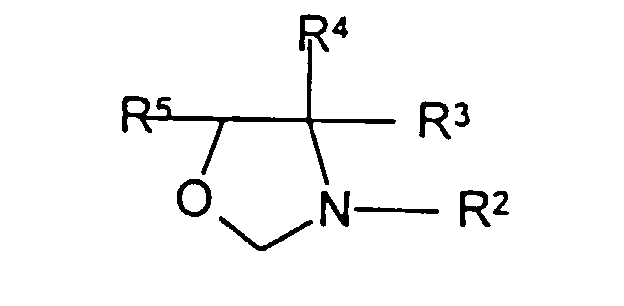
- the compounds of the 3,281,310 patent wherein the nitrogen is part of only one ring can be represented the formula: wherein R 2 is hydrogen, alkyl of 1 to 8 carbon atoms, hydroxyalkyl of 1 to 8 carbon atoms, benzyl, or phenylcarbamyl, and each of R 3 , R 4 , and R 5 is hydrogen or an alkyl of 1 to 8 carbon atoms.
- oxazolidines there can be mentioned: 4,4-dimethyl-1,3-oxazolidine; 3-(2-hydroxyethyl)-1,3-oxazolidine; 3-(2-hydroxypropyl)-5-methyl-1,3-oxazolidine; 5-methyl-1,3-oxazolidine; 3-ethyl-1,3-oxazolidine; 3-benzyl-1,3-cyclohexyl-5-methyl-1,3-oxazolidine; 3-phenylcarbamyl-4,4-dimethyl-1,3--oxazolidine; as well as the corresponding bis(1,3-oxazolidino)methanes such as bis(4,4-dimethyl-1,3-oxazolino)methane.
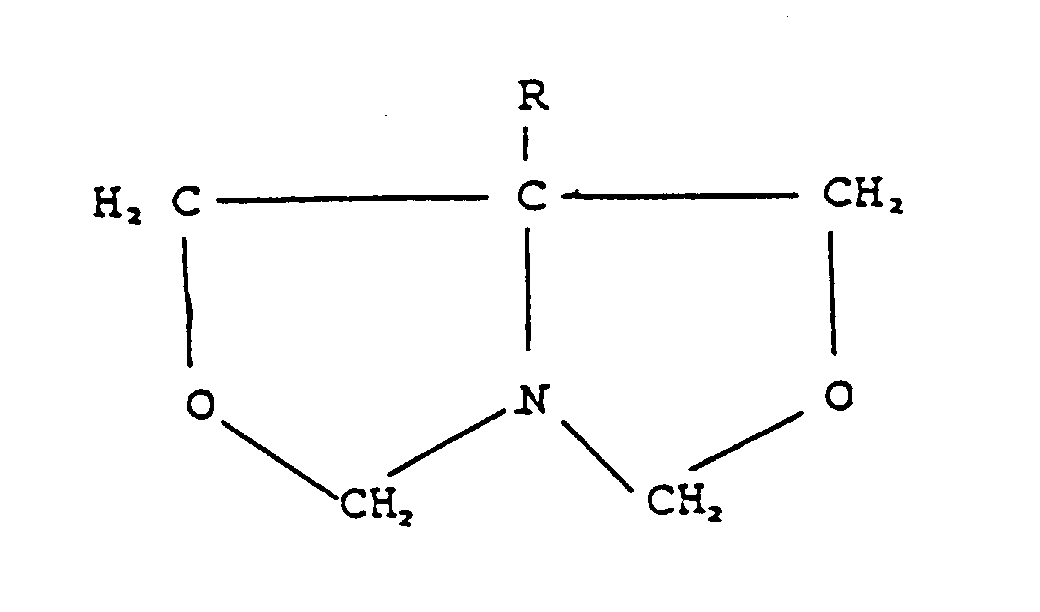
- oxazolidine compounds of the 3,256,137 patent wherein the nitrogen is directly attached to a first and a second ring of a bicyclic heterocycle can be represented by the formula: wherein R is hydrogen, methyl, ethyl, n-propyl, isopropyl, methylol, beta-hydroxyethyl, acetoxymethyl or methoxymethyl.
- oxazolidines there can be mentioned: 1-aza-3,7-dioxabicyclo[3.3.0]octane; 1-aza-5-methyl-3,7-dioxabicyclo[3.3.0]octane; 1-aza-5-ethyl-3,7-dioxabicyclo[3.3.0]octane; 1-aza-5-n-propyl-3,7-dioxabicyclo[3.3.0]octane; 1-aza-5-isopropyl-3,7-dioxabicyclo[3.3.0]octane; 1-aza-5-methylol-3,7-dioxabicyclo[3.3.0]octane; 1-aza-5-acetoxymethyl-3.7-dioxabicyclo[3.3.0]octane; and 1-aza-5-methoxymethyl-3.7-dioxabicyclo[3.3.0]octane.
- the preferred oxazolidines are: 1-aza-5-ethyl-3,7-dioxabicyclo[3.3.0]octane such as that under the trademark AMINE CS-1246; 1-aza-5-methylol-3,7-dioxabicyclo[3.3.0]octane such as that under the trademark ZOLDINE ZT-55; and 4,4-dimethyl-1,3-oxazolidine such as that under the trademark AMINE CS-1135, all of which are supplied by Angus Chemical Company.
- the oxazolidines can be with or without a methylol group attached thereto.
- aqueous alkaline phenolic resole resin solution of Part One there can be mentioned organic ester functional catalysts as well as carbamates.
- organic ester functional catalysts as well as carbamates.
- the amount of catalyst can vary from 1% to 30% by weight of the resorcinolic resin but preferably in the range of 5% to 25% and particularly from about 10% to 20%. The catalyst will not catalyze the viscosity increase of the resorcinolic resin and the mixture exhibits stability typical of an unmodified resorcinolic resin.
- Catalysts for the resole resin which can be included in the Part Two component containing the resorcinolic resin, can be ester functional catalysts such as cyclic organic carbonates, lactones or carboxylic acid esters and mixtures thereof.
- lactones include, but are not limited to: gamma-butyrolactone; gamma-valerolactone; beta-propiolactone; beta-butyrolactone; beta-isobutyrolactone, beta-isopentyl lactone; gamma isopentyl lactone, delta-pentyl lactone, and mixtures thereof. It is preferred to use gamma-butyrolactone.
- Suitable cyclic organic carbonates include: propylene carbonate; ethylene carbonate; ethylene glycol carbonate; glycerol carbonate; 1,2-butanediol carbonate, 1,3-butanediol carbonate; 1,2-pentanediol carbonate; 1,3-pentanediol carbonate; and mixtures thereof. If a cyclic organic carbonate is utilized, it is preferred to use propylene carbonate.
- the carboxylic acid ester catalysts are preferably those of aliphatic esters of alcohols having about 1 to 4 carbon atoms.
- the alcohols can be mono-, di-, or trihydric alcohols, saturated or unsaturated and which are esterified with aliphatic acids of 1 to 4 carbon atoms which can be saturated or unsaturated, mono- or dicarboxylic.
- the reactants should be chosen so that a long chain polyester is not formed.
- Aliphatic monoesters which can be used include: C 1 to C 4 alkyl propionates; C 1 to C 4 alkyl formates; C 1 to C 4 alkyl acetates; C 1 to C 4 alkyl butyrates; C 1 to C 4 alkyl pentanates.
- suitable carboxylic acid esters include: methyl formate; methyl acetate; ethyl acetate; methyl lactate; ethyl lactate; n-butyl acetate; butylene glycol diacetate; ethylene glycol diacetate; and triacetin (glycerol triacetate); dimethyl adipate; dimethyl gluterate; dimethyl succinate and mixtures thereof.
- ester functional catalyst which contains a total of 3 to 9 carbon atoms.
- ester functional curing agent is that it be dispersible in the resole resin and capable of remaining in suspension long enough to effect curing.
- the carbamate catalysts for the resole resin can be a carbamate which is disclosed in US-A-4,977,231 of T. McVay et al which issued on Dec. 11, 1990.
- the carbamate can be a reaction product of (a) a carbonate selected from the group consisting of alkylene, glycidol, and epoxy resin carbonate and (b) ammonia.
- a carbonate selected from the group consisting of alkylene, glycidol, and epoxy resin carbonate
- ammonia Of particular interest are the carbamates having 2 to 6 carbon atoms. e.g., hydroxyethyl carbamate or hydroxypropyl carbamate.
- the mixture of the two-part adhesive with each other can contain 1% to 30% by weight of the resorcinolic resin part (Part Two) mixed with 99% to 70% by weight of the resole resin part (Part One).
- Part One will be from about 95% to about 80% of the adhesive mixture with Part Two being from about 5% to 20%.
- the ratio of 18% of the resorcinolic resin part, Part Two, and 82% of the resole resin part, Part One appears to be the upper limit of economic performance under conventional hot pressing conditions. At a ratio of 15% resorcinolic resin and 85% resole resin the cure speed performance is equivalent to PMDI. At ratios lower than 15:85, performance is gradually decreased to that of a conventional resole resin at 0:100.
- the mixture of the two-part adhesive will have a pH of at least 8 and preferably at least 9 or 10.
- Suitable additives can be used in coating the raw lignocellulosic material.
- molten slack wax as well as emulsified wax can be used.
- a suitable plasticizer may be included.
- Suitable plasticizers include glycol esters, glycerine esters, or phosphate esters.
- Thickeners such as the various gums, starches, protein materials and clays may be used together with the resins.
- the resins can have additives dissolved therein.
- Illustratively urea is often dissolved in the resole resin in order to decrease the resin viscosity.
- the quantity of urea can vary over a broad range such as from about 5% to 15% based on the weight of the resole resin solution containing the urea and preferably from about 8% to 12% thereof.
- the urea also acts as a formaldehyde scavenger for the resole resin.
- the resin will also generally contain a small quantity of methanol, typically less than about 1% such as about 0.5% or less.
- the resin is applied to fibers, flakes, chips, strands and the like by various spraying techniques whereas it is generally applied to veneers by coaters.
- Resin applied to the lignocellulosic components is referred to herein as a coating even though it may be in the form of small resin particles such as atomized particles which do not form a continuous coating.
- the mix ratios listed above in the Resin Mixtures section allows easy handling in an in-line meter mix system as outlined in US-A-4,961,795 to Detlefsen and Phillips of Oct. 9, 1990.
- the adhesive part containing the mixture of resorcinolic resin and catalyst for the Part One component is mixed with the Part Two component containing the resole resin and cross-linking agent for the resorcinolic resin and the mixture of the two parts applied to wood strands, veneer or wood particles for the manufacture of composite board such as oriented strandboard, particleboard, fiberboard, or used for plywood construction.
- batch mixing of the two resin components and use of the resulting mixture before the viscosity becomes excessive is possible. This can be the case in a plywood operation where fairly viscous glue mixes are used.
- the resulting mixed adhesive has a very short boiling water gel time when compared to a conventional resole resin.
- the ratio of the two resins in the adhesive mixture can be varied to obtain the level of catalysis required.
- the resulting adhesive has hot press cure times equivalent to PMDI.
- the mixture of Part One and Part Two adhesive can be applied to the wood with any form of conventional equipment currently in use.
- Such equipment includes spray nozzles, atomizing wheels, roll coaters, curtain coaters and foam applicators. It is important for successful use, however, in obtaining a relatively short time interval between mixing of the two parts of the adhesive and application of the mixture to the wood. This is because the viscosity of the mixture begins to rapidly increase and may result in loss of solubility in water and base shortly after mixing. For these reasons, in-line mixing of the first and second parts of the adhesive just prior to application to the wood is preferred.
- the range of resin solids for the total of resorcinolic resin and the resole resin from the two components before curing which are applied to the lignocellulosic components can vary from about 1% to 15% by weight of the lignocellulose depending on the quality of the panel product desired.
- the amount of binder can vary from about 2% to about 8% of resin solids in each of the components based on the weight of the lignocellulose being bound.
- the resin solids includes the catalysts.
- Hot pressing conditions for the panels utilizing the two-part adhesive of this invention will depend on the thickness of the board, the type of board, as well as on the resin characteristics.
- the platen temperatures can vary from about 240°F to 420°F (115° to 216°C) at pressures of about 75 to 250 psi (517 to 1724 kPa) for about 2 to 10 minutes.
- the lignocellulosic materials which are the basic raw materials for panels which can be made from the adhesive of this invention may be derived from a large number of natural sources. They may be derived, for example, from sugar can bagasse, straw, cornstalks, and other waste vegetable matter. In particular however, they are derived from various species of wood in the form of wood fibers, chips, shavings, flakes, particles and veneers. These materials which are used to prepare the panels are referred to generally herein as lignocellulosic components.
- the manufactured products including hardboard, particleboard, fiberboard, waferboard, strandboard and the like as well as plywood, laminated veneer lumber or laminated wood particles. The internal bond strength of these products will be at least about 30 psi (207 kPa).
- resin solids refers to pan solids according to an industry accepted test where one gram of resin is placed in an aluminium pan and heated in a forced air oven at 125°C for one hour and 45 minutes.
- Such solids include catalysts, e.g., esters and carbamates as well as methylene donors such as oxazolidine and urea-formaldehyde complexes.
- Boiling Water Gel Tests The boiling water gel tests to determine gel time were conducted with a Gel Time Meter, Catalog No. 22 of Sunshine Scientific Instrument of 1810 Grant Avenue, Philadelphia, Pa.
- the gel-time meter essentially consists of a motor-driven, rotating spindle suspended in the test sample.
- the sample is maintained at constant temperature by a boiling bath surrounding the sample cell. In this case, the boiling bath was that of water so that the temperature was 100°C.
- the very pronounced increase in viscosity of the sample stops the rotating spindle, closing an electrical switch which actuates the timing and alarm circuits.
- the sample tube containing a 10 gram sample, unless otherwise indicated, and the spindle are placed in the briskly boiling water bath.
- the power switch is turned on, starting the counter and the slowly rotating spindle device.
- the spindle is locked into the spindle drive by magnetic coupling.
- the test switch is turned on, setting up the automatic counter stop and alarm circuits. The instrument needs no further attention for the duration of the test.
- the gel point is reached, the increased viscosity of the test sample stops the rotating spindle and the actuating switch is closed. This switch shuts off the spindle motor and the counter, and actuates the visible and audible signal.
- the gel time and the bath temperature are then recorded by the operator, and the test is complete.
- This example illustrates preparation of the two-part adhesive wherein the first part is that of a mixture of an aqueous alkaline monohydroxylic phenolic resole resin solution (PF) and an oxazolidine and the second part is phenol-resorcinol-formaldehyde co-condensed aqueous resin solution (PRF) without ester catalyst for the resole resin.
- the resole resin is referred to as WS474-101 and is made with phenol, formaldehyde, water, and sodium hydroxide, with 7.2% urea added in the finished polymer.
- the pH of this resole resin was 11.95.
- AMINE CS 1246 namely, 1-aza-5-ethyl-3,7-dioxabicyclo(3.3.0)octane, an oxazolidine supplied by Angus Chemical Company, is added to attain a 10% by weight concentration in the resin.
- the final resin has a pan solids of 51%, an alkalinity of 7% NaOH, molar ratio of 2.25:1 of formaldehyde to phenol, and 150 cP (0.15 Pas) Brookfield viscosity.
- the phenol-resorcinol resin referred to as WS453-88, is made with phenol, resorcinol, formaldehyde, water and sodium hydroxide.
- the resulting resorcinolic resin has pan solids of 50%, alkalinity of 3.5% NaOH, a molar ratio of 0.95:1 of formaldehyde to phenol-resorcinol, and 200 cP (0.2 Pas) Brookfield viscosity.
- This example shows a two-part adhesive wherein the first part is that of an aqueous alkaline monohydroxylic phenolic resole resin solution and the second part is an aqueous polymerizable resorcinolic resin (RF) wherein each part carries a catalyst for the other part.
- the resole resin (PF) referred to as WS421-110, is made with phenol, formaldehyde, water, and sodium hydroxide, with urea added to the finished polymer to provide a resin having 10.8% urea and a pH of 12.
- ZOLDINE ZT55 namely, 1-aza-5-methylol-3,7-dioxabicyclo(3.3.0)octane, an oxazolidine supplied by the Angus Chemical Company, is added within the preferred range.
- the final resin, including the oxazolidine and urea has pan solids of 50%, alkalinity of 7% NaOH, molar ratio of 2.3:1 of formaldehyde to phenol, and a viscosity of 110 cP (0.11 Pas) at 25°C Brookfield viscosity.
- Part two is a resorcinolic resin, referred to as WS421-109, which is made with resorcinol, formaldehyde, water, and sodium hydroxide.
- Triacetin an ester
- Triacetin an ester
- the resorcinolic resin had pan solids of 51%, alkalinity of 1.5% NaOH, a molar ratio of 0.58:1, formaldehyde to resorcinol, a pH of 7.6, and a viscosity of 80 cP (0.08 Pas) at 25°C Brookfield viscosity.
- Resin A is an aqueous solution of phenol-formaldehyde resole resin having: a molar ratio of about 2.2 moles of formaldehyde per mole of phenol; 47% solids; Brookfield viscosity of about 200 cP (0.2 Pas) at 25°C; a pH of about 12.5; less than 0.5% of free phenol; less than 0.2% of free formaldehyde; which was made with sodium hydroxide as the base and which contains 8% of urea which was added after the resin cooled.
- the dimensions of the boards were 14 ⁇ 14 ⁇ 0.75 inches (36.5 ⁇ 36.5 ⁇ 1.9 cm). They were pressed in an oil-heated laboratory hot press set at 390°F. (199°C).
- Target board density was 40 pcf, and the wood was southern pine strands with minor amounts of mixed southern hardwoods. The wood moisture before resin application was 9% and 14% after resin application. The boards had random strand orientation, and were homogeneous in construction. The resins were mixed by hand just prior to use and applied to the strands in a laboratory rotating blender using air atomization. The resins were applied at the rate of 5% resin solids to dry wood weight. Press cycle times, including press closing and board degas, were adjusted to determine cure speed of the resins. This was done by examining board edges and corners for weakness immediately out of the press.
- Resin B a monohydroxylic phenolic resole resin solution designated as Resin B as a control resin.
- the pH of the mixture of resins was about 10 to 11.
- Resin B has a molar ratio of about 2.2 moles of formaldehyde per mole of phenol; 47% solids; Brookfield viscosity of about 100 cP (0.1 Pas) at 25°C; a pH of about 13; less than 0.5% free phenol; less than 0.1% of free formaldehyde; and which was made with sodium hydroxide as the base.
- Resin B contains 9.4% formaldehyde which was added after the condensation of the phenol and formaldehyde.
- Example 5 Laboratory boards were made as in Example 5 with the following changes: aspen strands were used with moisture content of 9-10% before resin application; press temperature was 260°F; (127°C); Resin A, which was also used in Example 4, was again used as a control. Wood moisture was 14% after resin application.
- Table 6 The results of this example are shown in Table 6.
- Adhesive Cycle IB MOR 6-CYCLE MOR (min) (psi) (kPa) (psi) (kPa ⁇ 10 2 ) (psi) (kPa ⁇ 10 2 ) Resin A 13 37 (255) 2840 (196) 802 (55) 12 36 (255) 2459 (170) 790 (54) 11 24 (165) 1492 (103) 575 (40) 9 8 (55) 653 (45) 331 (23) RF : PF 10 60 (414) 2760 (190) 2013 (139) 18 : 82 9 51 (352) 2932 (202) 2095 (144) 8 47 (324) 2776 (191) 1864 (129) 7 29 (200) 2178 (150) 1331 (92)
- the resole resin (Component C) contained about 0.1% of free formaldehyde. It can be seen from a comparison of Sample 3 and Sample 4 in Table 7 that combining the resole resin of Component C with the resorcinolic resin of Component F gave a shorter Boiling Water Gel time. When 15 parts or resorcinolic resin, (Component F) was mixed with 85 parts of Component D which is the resole resin which included 5% of the fifty percent aqueous formaldehyde solution and 10% of urea, the boiling water gel time was down to 2.2 minutes.
- boiling water gel tests were made to show the synergism of the cross-catalysis.
- boiling water gel tests were made on each of the resole and resorcinolic resins alone carrying catalysts for the other part as well as combinations of such resins and catalysts.
- the designator PF in Table 8 is the WS421-110 base resin of Example 2 above with no methylene donor and the designator RF is the WS110-109 base resin of Example 2 above with no catalyst.
- the amount of each catalyst or methylene donor employed in Table 8 is the same as that in Components A and E of Example 7 above at a mix ratio of 15 parts of the resorcinolic resin and 85 parts of the resole resin.
Landscapes
- Chemical & Material Sciences (AREA)
- Organic Chemistry (AREA)
- Health & Medical Sciences (AREA)
- Chemical Kinetics & Catalysis (AREA)
- Medicinal Chemistry (AREA)
- Polymers & Plastics (AREA)
- Adhesives Or Adhesive Processes (AREA)
- Phenolic Resins Or Amino Resins (AREA)
- Compositions Of Macromolecular Compounds (AREA)
Claims (28)
- Verfahren zur Herstellung eines Klebemittels aus zwei Komponenten, umfassend das Bilden eines Gemisches durch Vermischen vonA. einer ersten Komponente, umfassend eine stabile wäßrige alkalische Lösung eines monohydroxyphenolischen Resolharzes, enthaltend einen Methylendonor, ausgewählt aus Verbindungen, die keine Methylolgruppe enthalten, und Verbindungen, die eine Methylolgruppe enthalten, mitB. einer zweiten Komponente, umfassend ein stabiles wäßriges Resorcinharz-Prekondensat mit einem Mangel an Formaldehyd und enthaltend einen Katalysator für das Resolharz, ausgewählt aus esterfunktionellen Härtungskatalysatoren und Carbamatkatalysatoren, undC. wobei die Menge des Methylendonors im Bereich von 0,3 bis 15 Gew.-% des Resolharzes liegt und die Menge des Katalysators für das Resolharz 1 bis 30 Gew.-% des Resorcinharzes beträgt.
- Verfahren nach Anspruch 1, wobeiA. die Menge der ersten Komponente 99 bis 70 Gewichtsteile beträgt,B. die Menge der zweiten Komponente 1 bis 30 Gewichtsteile beträgt,C. der pH-Wert des Resolharzes mindestens 9 ist, undD. der pH-Wert des Resorcinharzes 6 bis 9 ist.
- Verfahren nach Anspruch 1, wobei der Methylendonor eine Substanz ist, ausgewählt aus der Gruppe, bestehend aus Trioxan, Hexamethylentetramin, Ethylendiamin/Formaldehyd-Addukten, cyclischen Triformalen, Oxazolidin, dem eine Methylolgruppe fehlt, und methylolierten Verbindungen, die als Methylendonoren für Resorcinharz-Prekondensate dienen, die einen Mangel an Formaldehyd aufweisen.
- Verfahren nach Anspruch 2, wobei der Methylendonor ein Oxazolidin mit oder ohne einer Methylolgruppe als Teil des Oxazolidins ist.
- Verfahren nach Anspruch 2, wobei der Methylendonor ein Methylolharnstoff ist.
- Verfahren nach Anspruch 2, wobei der Katalysator in der zweiten Komponente ein Carbamat ist.
- Verfahren nach Anspruch 1, wobeiA. der esterfunktionelle Härtungskatalysator eine Substanz ist, ausgewählt aus der Gruppe bestehend aus einem cyclischen organischen Carbonat, einem Lacton und einem Carbonsäureester, undB. das Carbamat das Reaktionsprodukt von Ammoniak mit einer Substanz, ausgewählt aus der Gruppe bestehend aus einem Alkylencarbonat, Glycidolcarbonat und Epoxyharzcarbonat ist.
- Verfahren nach Anspruch 2, wobei der Katalysator für das Resolharz ein esterfunktioneller Härtungskatalysator ist.
- Verfahren nach Anspruch 2, wobei der Katalysator in der zweiten Komponente ein Carbamat ist, wobei das Carbamat ein Reaktionsprodukt von Ethylencarbonat oder Propylencarbonat mit Ammoniak ist.
- Verfahren nach Anspruch 6, wobei der Esterkatalysator 3 bis 9 Kohlenstoffatome hat.
- Verfahren nach Anspruch 2, wobeiA. der Methylendonor eine Substanz ist, ausgewählt aus einem Oxazolidin, angegeben durch die Formelwobei R2 Wasserstoff, Alkyl mit 1 bis 8 Kohlenstoffatomen, Hydroxyalkyl mit 1 bis 8 Kohlenstoffatomen, Benzyl oder Phenylcarbamyl ist und jedes von R3, R4 und R5 Wasserstoff oder ein Alkyl mit 1 bis 8 Kohlenstoffatomen ist, und
 wobei R Wasserstoff, Methyl, Ethyl, n-Propyl, Isopropyl, Methylol, β-Hydroxyethyl, Acetoxymethyl oder Methoxymethyl ist, und
 B. der Ester eine Substanz ist, ausgewählt aus der Gruppe bestehend aus einem Lacton, einem cyclischen organischen Carbonat, einem Carbonsäureester und Gemischen davon.
 - Verfahren nach Anspruch 2, wobei das Resolharz das Kondensationsprodukt von Phenol und Formaldehyd ist.
- Verfahren nach Anspruch 2, wobei das Resorcinharz eine Substanz ist, ausgewählt aus der Gruppe bestehend aus dem Kondensationsprodukt von Resorcin und Formaldehyd und dem Kondensationsprodukt von Phenol, Resorcin und Formaldehyd, enthaltend bis zu 55 Gewichtsteile Phenol pro 50 Teile Resorcin.
- Verfahren nach Anspruch 13, wobei das Resorcinharz das Kondensationsprodukt von Resorcin und Formaldehyd ist.
- Verfahren nach Anspruch 13, wobei das Resorcinharz das Kondensationsprodukt von Resorcin mit weniger als 10 Teilen Phenol ist.
- Verfahren nach Anspruch 11, wobei der Stickstoff des Oxazolidins Teil eines Einring-Heterocyclus ist.
- Verfahren nach Anspruch 11, wobei der Stickstoff des Oxazolidins direkt an einen ersten und einen zweiten Ring des Oxazolidins gebunden ist.
- Verfahren nach Anspruch 17, wobei das Oxazolidin 1-Aza-5-methylol-3,7-dioxabicyclo[3,3,0]octan ist.
- Verfahren nach Anspruch 17, wobei das Oxazolidin 1-Aza-5-ethyl-3,7-dioxabicyclo[3,3,0]octan ist.
- Verfahren zum Polymerisieren eines monohydroxyphenolischen Resolharzes zusammen mit einem Resorcinharz-Prekondensat mit einem Mangel an Formaldehyd, umfassend das Vermischen vonA. 70 bis 99 Teilen einer ersten Komponente mit einem pH-Wert von mindestens 9 und umfassend eine stabile wäßrige alkalische Lösung eines monohydroxyphenolischen Resolharzes, enthaltend 0,3 bis 15 %, bezogen auf das Gewicht der Resolharzlösung, eines Methylendonors, ausgewählt aus Verbindungen, die keine Methylolgruppe enthalten, und Verbindungen, die eine Methylolgruppe enthalten, mitB. 1 bis 30 Teilen einer zweiten Komonente, umfassend ein stabiles wäßriges Resorcinharz-Prekondensat mit einem Mangel an Formaldehyd und einem pH-Wert von 6 bis 9 und 1 bis 30 Gew.-%, bezogen auf das Gewicht des Resorcinharzes, eines Katalysators für das Resolharz, ausgewählt aus esterfunktionellen Härtungskatalysatoren und Carbamatkatalysatoren.
- Verfahren nach Anspruch 20, wobei der Methylendonor ein Oxazolidin ist.
- Verfahren nach Anspruch 20, wobei der Methylendonor ein Methylolharnstoff ist.
- Alkalisches Klebemittel mit einem pH-Wert von mindestens 9 und hergestellt durch Vermischen vonA. 70 bis 99 Gewichtsteilen einer ersten Komponente, umfassend eine stabile wäßrige alkalische Lösung eines monohydroxylphenolischen Resolharzes mit einem pH-Wert von mindestens 9 und enthaltend 0,5 bis 10 %, bezogen auf das Gewicht der Lösung, eines Methylendonors, ausgewählt aus Verbindungen, die keine Methylolgruppe enthalten und Verbindungen, die eine Methylolgruppe enthalten, mitB. 1 bis 30 Gewichtsteilen einer zweiten Komponente, umfassend eine stabile wäßrige Resorcinharzlösung mit einem pH-Wert von 6,5 bis 8,5 und enthaltend 5 bis 25 %, bezogen auf das Gewicht des Harzes, eines Katalysators für das Resolharz, wobei der Katalysator ausgewählt ist aus der Gruppe bestehend aus einem esterfunktionellen Härtungskatalysator und einem Carbamat.
- Klebemittel nach Anspruch 23, wobei der Katalysator ein esterfunktioneller Härtungskatalysator mit 3 bis 9 Kohlenstoffatomen ist, ausgewählt aus der Gruppe bestehend aus einem Carbonsäureester, einem cyclischen organischen Carbonat und einem Lacton.
- Klebemittel nach Anspruch 23, wobei der pH-Wert des Resolharzes mindestens 10 ist.
- Mittel nach Anspruch 23, wobei der Formaldehyddonor Methylolharnstoff ist.
- Mittel nach Anspruch 23, wobei der Formaldehyddonor Oxazolidin ist.
- Verfahren zur Herstellung von Lignocellulose-Paneelen durch Binden von Lignocellulose-Komponenten unter Wärme und Druck, umfassend das Überziehen der Lignocellulose-Komponenten mit einem Klebemittel, umfassend ein Gemisch ausA. 70 bis 99 Teilen einer ersten Komponente, umfassend eine stabile wäßrige alkalische Lösung eines monohydroxyphenolischen Resolharzes, enthaltend etwa 0,3 bis 15 %, bezogen auf das Gewicht des Resolharzes, eines Methylendonors, ausgewählt aus Verbindungen, die keine Methylolgruppe enthalten und Verbindungen, die eine Methylolgruppe enthalten, undB. 1 bis 30 Teilen einer zweiten Komponente, umfassend ein polymerisierbares Resorcinharz, enthaltend 1 bis 30 %, bezogen auf das Gewicht des Resorcinharzes, eines Katalysators für das Resolharz, wobei der Katalysator ausgewählt ist aus der Gruppe bestehend aus einem esterfunktionellen Katalysator und einem Carbamat, das das Reaktionsprodukt eines Carbonats, ausgewählt aus der Gruppe bestehend aus Alkylen-, Glycidol- und einem Epoxyharzcarbonat, mit Ammoniak ist.
Applications Claiming Priority (2)
| Application Number | Priority Date | Filing Date | Title |
|---|---|---|---|
| US192077 | 1980-09-29 | ||
| US08/192,077 US6150492A (en) | 1994-02-04 | 1994-02-04 | Cross-catalyzed phenol-resorcinol adhesive |
Publications (2)
| Publication Number | Publication Date |
|---|---|
| EP0666296A1 EP0666296A1 (de) | 1995-08-09 |
| EP0666296B1 true EP0666296B1 (de) | 1999-06-23 |
Family
ID=22708139
Family Applications (1)
| Application Number | Title | Priority Date | Filing Date |
|---|---|---|---|
| EP94307216A Expired - Lifetime EP0666296B1 (de) | 1994-02-04 | 1994-10-03 | Kreuzkatalysierter Phenol-Resorcinklebstoff zum Kleben von Lignocellulosehaltigem Material und Verfahren zur Herstellung |
Country Status (8)
| Country | Link |
|---|---|
| US (2) | US6150492A (de) |
| EP (1) | EP0666296B1 (de) |
| AT (1) | ATE181565T1 (de) |
| AU (1) | AU675744B2 (de) |
| CA (1) | CA2118079C (de) |
| DE (1) | DE69419242T2 (de) |
| MY (1) | MY116224A (de) |
| NZ (1) | NZ270429A (de) |
Families Citing this family (21)
| Publication number | Priority date | Publication date | Assignee | Title |
|---|---|---|---|---|
| EP0861275B1 (de) * | 1995-11-13 | 2003-02-12 | Borden Chemical, Inc. | Zusammensetzung und härtungsverfahren eines recorcinolharzes |
| US6541576B1 (en) * | 1996-11-12 | 2003-04-01 | Borden Chemical, Inc. | Composition and method for curing a resorcinol resin |
| DK9600438U3 (da) * | 1996-12-06 | 1996-12-27 | Lars Schou Fibertech Systems A | Indlæg (kerner) |
| US5858553A (en) * | 1997-04-02 | 1999-01-12 | Angus Chemical Company | Oxazolidine-based hardeners for the room temperature cure of resorcinol resins in the bonding of wood articles |
| US5912317A (en) * | 1997-04-02 | 1999-06-15 | Angus Chemical Company | Oxazolidine-based hardeners for the room temperature cure of resorcinol resins in the bonding of wood articles--II |
| US5990051A (en) * | 1998-04-06 | 1999-11-23 | Fairmount Minerals, Inc. | Injection molded degradable casing perforation ball sealers |
| US6297313B1 (en) | 1999-07-22 | 2001-10-02 | Louisiana-Pacific Corporation | Adhesive systems and products formed using same and methods for producing said adhesive systems and products |
| US20030148084A1 (en) * | 2000-02-11 | 2003-08-07 | Trocino Frank S. | Vegetable protein adhesive compositions |
| WO2004029119A1 (en) * | 2002-08-26 | 2004-04-08 | Shea Lawrence E | Non-formaldehyde reinforced thermoset plastic composites |
| US7317063B2 (en) | 2003-03-07 | 2008-01-08 | Angus Chemical Company | Phenolic resins |
| US7319131B2 (en) | 2003-03-07 | 2008-01-15 | Angus Chemical Company | Phenolic resins |
| US20040116647A1 (en) * | 2002-12-04 | 2004-06-17 | Swedo Raymond J. | Novel phenolic resins |
| US7317064B2 (en) | 2003-03-07 | 2008-01-08 | Angus Chemical Company | Phenolic resin systems for fiber reinforced composite manufacture |
| EP1742542B1 (de) * | 2004-04-06 | 2011-11-16 | Hercules Incorporated | Wasserbeständige klebemitteldispersionszusammensetzungen aus pflanzenprotein |
| US7642333B2 (en) * | 2007-05-21 | 2010-01-05 | Georgia-Pacific Chemicals Llc | Anhydride and resorcinol latent catalyst system for improving cure characteristics of phenolic resins |
| KR101211944B1 (ko) * | 2007-09-21 | 2012-12-13 | 생-고벵 아브라시프 | 페놀수지 제형 및 연마제품용 코팅재 |
| RU2011109161A (ru) * | 2008-08-13 | 2012-09-20 | Силванова, Инк. (Us) | Быстроотверждаемый состав на основе альдегидной полиизоцианатной смолы и способ получения гибридного полимера |
| CA2834830C (en) * | 2011-05-05 | 2018-06-19 | Basf Se | Resin-coated proppant and methods of use |
| US10364544B2 (en) * | 2014-01-17 | 2019-07-30 | Royal Adhesives & Sealants Canada Ltd. | Polyurethane foam in foundation footings for load-bearing structures |
| CN109851732A (zh) * | 2018-12-10 | 2019-06-07 | 沈阳化工大学 | N-羟甲基乙酰胺改性酚醛发泡材料 |
| EP4001376A1 (de) | 2020-11-13 | 2022-05-25 | Wilsonart LLC | Mehrteiliges ligninbasiertes harzsystem für dekorative laminate |
Family Cites Families (21)
| Publication number | Priority date | Publication date | Assignee | Title |
|---|---|---|---|---|
| US2952040A (en) * | 1952-11-15 | 1960-09-13 | Nat Res Dev | Moulding of synthetic resinous materials |
| US3033823A (en) * | 1957-11-12 | 1962-05-08 | Formica Corp | Resinous compositions and process of preparing same |
| US3210309A (en) * | 1960-06-21 | 1965-10-05 | Borden Co | Curing phenolic resins with alphapolyoxymethylene |
| US3256137A (en) * | 1963-07-10 | 1966-06-14 | Us Rubber Co | Adhering textile materials to rubber |
| US3281310A (en) * | 1964-10-19 | 1966-10-25 | Us Rubber Co | Adhering textile materials to rubber |
| US3698983A (en) * | 1970-04-16 | 1972-10-17 | Burlington Industries Inc | Method of improving the adhesion of glass cloth to rubber |
| US3705832A (en) * | 1970-11-12 | 1972-12-12 | Commercial Solvents Corp | Process for joining cellulose articles utilizing a two-part adhesive,wherein the first part is a partially reacted condensate of resorcinol and formaldehyde,and the second part is an oxazolidine |
| JPS5226275B2 (de) * | 1973-03-27 | 1977-07-13 | ||
| SE415367B (sv) * | 1977-05-13 | 1980-09-29 | Casco Ab | Forfarande for limning med resorcinolhartslim med anvendning av en uppslamning av paraformaldehyd som herdare samt herdarkomposition for anvendning vid settet |
| DE2738267C3 (de) * | 1977-08-25 | 1986-04-17 | Hoechst Ag, 6230 Frankfurt | Verwendung von Kunstharzbindemitteln |
| DE3034948A1 (de) * | 1980-09-17 | 1982-05-06 | Hoechst Ag, 6000 Frankfurt | Verfahren zur herstellung von kunstharzen auf der basis von resorcin-verbindungen |
| US4373062A (en) * | 1981-04-20 | 1983-02-08 | Brown Gordon E | Phenol-resorcinol-formaldehyde resin |
| GB8609909D0 (en) * | 1986-04-23 | 1986-05-29 | Borden Uk Ltd | Manufacture of frictional elements |
| US4961795A (en) * | 1986-09-03 | 1990-10-09 | Borden, Inc. | Composition and process for bonding lignocellulosic material |
| DE3738902A1 (de) * | 1987-11-17 | 1989-05-24 | Ruetgerswerke Ag | Hitzehaertendes bindemittel und seine verwendung |
| US4824896A (en) * | 1988-03-09 | 1989-04-25 | Clarke Michael R | Phenol formaldehyde adhesive for bonding wood pieces of high moisture content and composite board and veneers bonded with such adhesive |
| EP0363539A1 (de) * | 1988-10-14 | 1990-04-18 | MITSUI TOATSU CHEMICALS, Inc. | Wärmehärtbare Harzzusammensetzung zum Spritzgiessen |
| CA1338410C (en) * | 1989-02-07 | 1996-06-18 | Theodore H. Dailey, Jr. | Resorcinol-modified phenolic resin binder for reinforced plastics |
| US4977231A (en) * | 1989-04-13 | 1990-12-11 | Georgia-Pacific Corporation | Phenolic resin containing a latent hardening agent comprising the carbamate reaction product of a cyclic |
| JPH0331384A (ja) * | 1989-06-28 | 1991-02-12 | Aica Kogyo Co Ltd | 二液型レゾルシノール系樹脂接着剤 |
| US5075414A (en) * | 1989-12-18 | 1991-12-24 | Indspec Chemical Corporation | Resorcinol-modified phenolic resin binder for reinforced plastics |
-
1994
- 1994-02-04 US US08/192,077 patent/US6150492A/en not_active Expired - Lifetime
- 1994-10-03 EP EP94307216A patent/EP0666296B1/de not_active Expired - Lifetime
- 1994-10-03 AT AT94307216T patent/ATE181565T1/de not_active IP Right Cessation
- 1994-10-03 DE DE69419242T patent/DE69419242T2/de not_active Expired - Lifetime
- 1994-10-13 CA CA002118079A patent/CA2118079C/en not_active Expired - Lifetime
- 1994-12-21 AU AU81621/94A patent/AU675744B2/en not_active Expired
- 1994-12-22 MY MYPI94003488A patent/MY116224A/en unknown
-
1995
- 1995-02-01 NZ NZ270429A patent/NZ270429A/xx not_active IP Right Cessation
- 1995-06-07 US US08/487,317 patent/US5684114A/en not_active Expired - Lifetime
Also Published As
| Publication number | Publication date |
|---|---|
| NZ270429A (en) | 1996-07-26 |
| US6150492A (en) | 2000-11-21 |
| EP0666296A1 (de) | 1995-08-09 |
| DE69419242T2 (de) | 1999-11-04 |
| MY116224A (en) | 2003-12-31 |
| AU675744B2 (en) | 1997-02-13 |
| CA2118079C (en) | 2004-09-21 |
| US5684114A (en) | 1997-11-04 |
| ATE181565T1 (de) | 1999-07-15 |
| CA2118079A1 (en) | 1995-08-05 |
| AU8162194A (en) | 1995-08-17 |
| DE69419242D1 (de) | 1999-07-29 |
Similar Documents
| Publication | Publication Date | Title |
|---|---|---|
| EP0666296B1 (de) | Kreuzkatalysierter Phenol-Resorcinklebstoff zum Kleben von Lignocellulosehaltigem Material und Verfahren zur Herstellung | |
| Pizzi | Phenolic resin adhesives | |
| US11230031B2 (en) | Wood particle boards | |
| MX2008009018A (es) | Sistema aglutinante de polimero-aldehido para manufacturar productos de madera. | |
| KR20120061845A (ko) | 안정적인 산 변성된 대두/우레아 접착제 및 그의 제조 방법 | |
| CA2825527A1 (en) | Low ph soy flour-non urea diluent and methods of making same | |
| AU2012217689A1 (en) | Low pH soy flour-non urea diluent and methods of making same | |
| CA2663919A1 (en) | Novel hybrid binder with natural compounds for low emission products | |
| US11780112B2 (en) | Binders containing an aldehyde-based resin and an isocyanate-based resin and methods for making composite lignocellulose products therefrom | |
| IE81045B1 (en) | Modified phenol-aldehyde resin and binder system | |
| AU728496B2 (en) | Oxazolidine-based hardeners for curing resorcinol resins in the bonding of wood articles | |
| US20190194510A1 (en) | Glyoxalated lignin compositions | |
| Sowunmi et al. | Fortified mangrove tannin‐based plywood adhesive | |
| US5446089A (en) | Resorcinol-glutaraldehyde resin as an accelerator for curing phenol-formaldehyde resins | |
| US3342776A (en) | Method of preparing aqueous alkaline phenol-aldehyde condensates | |
| US7781521B2 (en) | Furfural-urea resins and adhesives and their methods of production | |
| US5756599A (en) | Binder resin, binder system, cellulosic composite articles, and method of making the same | |
| AU2003218011B2 (en) | Colorless phenol-formaldehyde resins that cure colorless | |
| EP0472257B1 (de) | Glutaraldehydharz-Verbindungssystem für Herstellung von Holzprodukten | |
| PL233957B1 (pl) | Sposób wytwarzania żywic melaminowo-mocznikowo-formaldehydowych | |
| CA1330604C (en) | Latently curable binder compositions which contain cure enhancing agents | |
| US2490927A (en) | Condensation products of resorcinol and formaldehyde | |
| US20250388791A1 (en) | Cyclic acetal crosslinker and solvent for formaldehyde resin | |
| RU2050372C1 (ru) | Способ получения карбомидоформальдегидной олигомерной добавки к карбамидным смолам | |
| US3081217A (en) | Adhesive and its manufacture |
Legal Events
| Date | Code | Title | Description |
|---|---|---|---|
| PUAI | Public reference made under article 153(3) epc to a published international application that has entered the european phase |
Free format text: ORIGINAL CODE: 0009012 |
|
| AK | Designated contracting states |
Kind code of ref document: A1 Designated state(s): AT BE CH DE DK ES FR GB GR IE IT LI LU MC NL PT SE |
|
| 17P | Request for examination filed |
Effective date: 19950929 |
|
| RAP1 | Party data changed (applicant data changed or rights of an application transferred) |
Owner name: BORDEN CHEMICAL, INC. |
|
| 17Q | First examination report despatched |
Effective date: 19980210 |
|
| GRAG | Despatch of communication of intention to grant |
Free format text: ORIGINAL CODE: EPIDOS AGRA |
|
| GRAG | Despatch of communication of intention to grant |
Free format text: ORIGINAL CODE: EPIDOS AGRA |
|
| GRAH | Despatch of communication of intention to grant a patent |
Free format text: ORIGINAL CODE: EPIDOS IGRA |
|
| GRAH | Despatch of communication of intention to grant a patent |
Free format text: ORIGINAL CODE: EPIDOS IGRA |
|
| GRAA | (expected) grant |
Free format text: ORIGINAL CODE: 0009210 |
|
| AK | Designated contracting states |
Kind code of ref document: B1 Designated state(s): AT BE CH DE DK ES FR GB GR IE IT LI LU MC NL PT SE |
|
| PG25 | Lapsed in a contracting state [announced via postgrant information from national office to epo] |
Ref country code: SE Free format text: THE PATENT HAS BEEN ANNULLED BY A DECISION OF A NATIONAL AUTHORITY Effective date: 19990623 Ref country code: NL Free format text: LAPSE BECAUSE OF FAILURE TO SUBMIT A TRANSLATION OF THE DESCRIPTION OR TO PAY THE FEE WITHIN THE PRESCRIBED TIME-LIMIT Effective date: 19990623 Ref country code: LI Free format text: LAPSE BECAUSE OF FAILURE TO SUBMIT A TRANSLATION OF THE DESCRIPTION OR TO PAY THE FEE WITHIN THE PRESCRIBED TIME-LIMIT Effective date: 19990623 Ref country code: IT Free format text: LAPSE BECAUSE OF FAILURE TO SUBMIT A TRANSLATION OF THE DESCRIPTION OR TO PAY THE FEE WITHIN THE PRE;WARNING: LAPSES OF ITALIAN PATENTS WITH EFFECTIVE DATE BEFORE 2007 MAY HAVE OCCURRED AT ANY TIME BEFORE 2007. THE CORRECT EFFECTIVE DATE MAY BE DIFFERENT FROM THE ONE RECORDED.SCRIBED TIME-LIMIT Effective date: 19990623 Ref country code: GR Free format text: LAPSE BECAUSE OF NON-PAYMENT OF DUE FEES Effective date: 19990623 Ref country code: ES Free format text: THE PATENT HAS BEEN ANNULLED BY A DECISION OF A NATIONAL AUTHORITY Effective date: 19990623 Ref country code: CH Free format text: LAPSE BECAUSE OF FAILURE TO SUBMIT A TRANSLATION OF THE DESCRIPTION OR TO PAY THE FEE WITHIN THE PRESCRIBED TIME-LIMIT Effective date: 19990623 Ref country code: BE Free format text: LAPSE BECAUSE OF FAILURE TO SUBMIT A TRANSLATION OF THE DESCRIPTION OR TO PAY THE FEE WITHIN THE PRESCRIBED TIME-LIMIT Effective date: 19990623 Ref country code: AT Free format text: LAPSE BECAUSE OF FAILURE TO SUBMIT A TRANSLATION OF THE DESCRIPTION OR TO PAY THE FEE WITHIN THE PRESCRIBED TIME-LIMIT Effective date: 19990623 |
|
| REF | Corresponds to: |
Ref document number: 181565 Country of ref document: AT Date of ref document: 19990715 Kind code of ref document: T |
|
| REG | Reference to a national code |
Ref country code: CH Ref legal event code: EP |
|
| REF | Corresponds to: |
Ref document number: 69419242 Country of ref document: DE Date of ref document: 19990729 |
|
| REG | Reference to a national code |
Ref country code: IE Ref legal event code: FG4D |
|
| PG25 | Lapsed in a contracting state [announced via postgrant information from national office to epo] |
Ref country code: PT Free format text: LAPSE BECAUSE OF FAILURE TO SUBMIT A TRANSLATION OF THE DESCRIPTION OR TO PAY THE FEE WITHIN THE PRESCRIBED TIME-LIMIT Effective date: 19990923 Ref country code: DK Free format text: LAPSE BECAUSE OF FAILURE TO SUBMIT A TRANSLATION OF THE DESCRIPTION OR TO PAY THE FEE WITHIN THE PRESCRIBED TIME-LIMIT Effective date: 19990923 |
|
| PG25 | Lapsed in a contracting state [announced via postgrant information from national office to epo] |
Ref country code: LU Free format text: LAPSE BECAUSE OF NON-PAYMENT OF DUE FEES Effective date: 19991003 Ref country code: IE Free format text: LAPSE BECAUSE OF NON-PAYMENT OF DUE FEES Effective date: 19991003 |
|
| ET | Fr: translation filed | ||
| NLV1 | Nl: lapsed or annulled due to failure to fulfill the requirements of art. 29p and 29m of the patents act | ||
| REG | Reference to a national code |
Ref country code: CH Ref legal event code: PL |
|
| PLBE | No opposition filed within time limit |
Free format text: ORIGINAL CODE: 0009261 |
|
| STAA | Information on the status of an ep patent application or granted ep patent |
Free format text: STATUS: NO OPPOSITION FILED WITHIN TIME LIMIT |
|
| PG25 | Lapsed in a contracting state [announced via postgrant information from national office to epo] |
Ref country code: MC Free format text: LAPSE BECAUSE OF NON-PAYMENT OF DUE FEES Effective date: 20000430 |
|
| 26N | No opposition filed | ||
| REG | Reference to a national code |
Ref country code: IE Ref legal event code: MM4A |
|
| REG | Reference to a national code |
Ref country code: GB Ref legal event code: IF02 |
|
| REG | Reference to a national code |
Ref country code: FR Ref legal event code: TP Ref country code: FR Ref legal event code: CD |
|
| PGFP | Annual fee paid to national office [announced via postgrant information from national office to epo] |
Ref country code: DE Payment date: 20131029 Year of fee payment: 20 Ref country code: FR Payment date: 20131017 Year of fee payment: 20 Ref country code: GB Payment date: 20131028 Year of fee payment: 20 |
|
| REG | Reference to a national code |
Ref country code: DE Ref legal event code: R071 Ref document number: 69419242 Country of ref document: DE |
|
| REG | Reference to a national code |
Ref country code: DE Ref legal event code: R071 Ref document number: 69419242 Country of ref document: DE |
|
| REG | Reference to a national code |
Ref country code: GB Ref legal event code: PE20 Expiry date: 20141002 |
|
| PG25 | Lapsed in a contracting state [announced via postgrant information from national office to epo] |
Ref country code: GB Free format text: LAPSE BECAUSE OF EXPIRATION OF PROTECTION Effective date: 20141002 |