EP0664652B1 - Method and apparatus for adaptive subband analysis and synthesis - Google Patents
Method and apparatus for adaptive subband analysis and synthesis Download PDFInfo
- Publication number
- EP0664652B1 EP0664652B1 EP95400069A EP95400069A EP0664652B1 EP 0664652 B1 EP0664652 B1 EP 0664652B1 EP 95400069 A EP95400069 A EP 95400069A EP 95400069 A EP95400069 A EP 95400069A EP 0664652 B1 EP0664652 B1 EP 0664652B1
- Authority
- EP
- European Patent Office
- Prior art keywords
- filters
- sub
- analysis
- process according
- band
- Prior art date
- Legal status (The legal status is an assumption and is not a legal conclusion. Google has not performed a legal analysis and makes no representation as to the accuracy of the status listed.)
- Expired - Lifetime
Links
- 238000004458 analytical method Methods 0.000 title claims description 39
- 230000015572 biosynthetic process Effects 0.000 title claims description 30
- 238000003786 synthesis reaction Methods 0.000 title claims description 30
- 238000000034 method Methods 0.000 title claims description 21
- 230000003044 adaptive effect Effects 0.000 title claims description 13
- 238000001914 filtration Methods 0.000 claims description 18
- 238000004364 calculation method Methods 0.000 claims description 10
- 238000005457 optimization Methods 0.000 claims description 8
- 230000005540 biological transmission Effects 0.000 claims description 7
- 230000001419 dependent effect Effects 0.000 claims 1
- 238000005192 partition Methods 0.000 claims 1
- 238000000638 solvent extraction Methods 0.000 claims 1
- 238000000354 decomposition reaction Methods 0.000 description 20
- 238000012546 transfer Methods 0.000 description 6
- 239000011159 matrix material Substances 0.000 description 5
- 238000012545 processing Methods 0.000 description 3
- 238000011002 quantification Methods 0.000 description 3
- 230000001052 transient effect Effects 0.000 description 3
- 238000013139 quantization Methods 0.000 description 2
- 238000001228 spectrum Methods 0.000 description 2
- 238000013459 approach Methods 0.000 description 1
- 230000001364 causal effect Effects 0.000 description 1
- 230000000295 complement effect Effects 0.000 description 1
- 230000006835 compression Effects 0.000 description 1
- 238000007906 compression Methods 0.000 description 1
- 230000007850 degeneration Effects 0.000 description 1
- 238000002513 implantation Methods 0.000 description 1
- 229940050561 matrix product Drugs 0.000 description 1
- 230000007246 mechanism Effects 0.000 description 1
- 238000012986 modification Methods 0.000 description 1
- 230000004048 modification Effects 0.000 description 1
- 230000008520 organization Effects 0.000 description 1
- 230000000135 prohibitive effect Effects 0.000 description 1
- 230000000717 retained effect Effects 0.000 description 1
- 238000005070 sampling Methods 0.000 description 1
- 230000007704 transition Effects 0.000 description 1
- 230000002087 whitening effect Effects 0.000 description 1
Images


Classifications
-
- H—ELECTRICITY
- H04—ELECTRIC COMMUNICATION TECHNIQUE
- H04N—PICTORIAL COMMUNICATION, e.g. TELEVISION
- H04N19/00—Methods or arrangements for coding, decoding, compressing or decompressing digital video signals
- H04N19/60—Methods or arrangements for coding, decoding, compressing or decompressing digital video signals using transform coding
- H04N19/63—Methods or arrangements for coding, decoding, compressing or decompressing digital video signals using transform coding using sub-band based transform, e.g. wavelets
- H04N19/635—Methods or arrangements for coding, decoding, compressing or decompressing digital video signals using transform coding using sub-band based transform, e.g. wavelets characterised by filter definition or implementation details
-
- H—ELECTRICITY
- H04—ELECTRIC COMMUNICATION TECHNIQUE
- H04N—PICTORIAL COMMUNICATION, e.g. TELEVISION
- H04N19/00—Methods or arrangements for coding, decoding, compressing or decompressing digital video signals
- H04N19/10—Methods or arrangements for coding, decoding, compressing or decompressing digital video signals using adaptive coding
- H04N19/102—Methods or arrangements for coding, decoding, compressing or decompressing digital video signals using adaptive coding characterised by the element, parameter or selection affected or controlled by the adaptive coding
- H04N19/12—Selection from among a plurality of transforms or standards, e.g. selection between discrete cosine transform [DCT] and sub-band transform or selection between H.263 and H.264
- H04N19/122—Selection of transform size, e.g. 8x8 or 2x4x8 DCT; Selection of sub-band transforms of varying structure or type
-
- H—ELECTRICITY
- H04—ELECTRIC COMMUNICATION TECHNIQUE
- H04N—PICTORIAL COMMUNICATION, e.g. TELEVISION
- H04N19/00—Methods or arrangements for coding, decoding, compressing or decompressing digital video signals
- H04N19/10—Methods or arrangements for coding, decoding, compressing or decompressing digital video signals using adaptive coding
- H04N19/169—Methods or arrangements for coding, decoding, compressing or decompressing digital video signals using adaptive coding characterised by the coding unit, i.e. the structural portion or semantic portion of the video signal being the object or the subject of the adaptive coding
- H04N19/1883—Methods or arrangements for coding, decoding, compressing or decompressing digital video signals using adaptive coding characterised by the coding unit, i.e. the structural portion or semantic portion of the video signal being the object or the subject of the adaptive coding the unit relating to sub-band structure, e.g. hierarchical level, directional tree, e.g. low-high [LH], high-low [HL], high-high [HH]
-
- H—ELECTRICITY
- H04—ELECTRIC COMMUNICATION TECHNIQUE
- H04N—PICTORIAL COMMUNICATION, e.g. TELEVISION
- H04N19/00—Methods or arrangements for coding, decoding, compressing or decompressing digital video signals
- H04N19/60—Methods or arrangements for coding, decoding, compressing or decompressing digital video signals using transform coding
- H04N19/61—Methods or arrangements for coding, decoding, compressing or decompressing digital video signals using transform coding in combination with predictive coding
-
- H—ELECTRICITY
- H04—ELECTRIC COMMUNICATION TECHNIQUE
- H04N—PICTORIAL COMMUNICATION, e.g. TELEVISION
- H04N19/00—Methods or arrangements for coding, decoding, compressing or decompressing digital video signals
- H04N19/60—Methods or arrangements for coding, decoding, compressing or decompressing digital video signals using transform coding
- H04N19/63—Methods or arrangements for coding, decoding, compressing or decompressing digital video signals using transform coding using sub-band based transform, e.g. wavelets
-
- H—ELECTRICITY
- H04—ELECTRIC COMMUNICATION TECHNIQUE
- H04N—PICTORIAL COMMUNICATION, e.g. TELEVISION
- H04N19/00—Methods or arrangements for coding, decoding, compressing or decompressing digital video signals
- H04N19/10—Methods or arrangements for coding, decoding, compressing or decompressing digital video signals using adaptive coding
- H04N19/102—Methods or arrangements for coding, decoding, compressing or decompressing digital video signals using adaptive coding characterised by the element, parameter or selection affected or controlled by the adaptive coding
Definitions
- the present invention relates to a method and a device for analysis and of synthesis in adaptive sub-bands.
- a filter bank in sub-bands as well constituted leads to average behavior towards all of the signals to be filtered, from the point of view of the decorrelation of the sub-band signals.
- the object of the invention is to overcome the aforementioned drawbacks.
- the subject of the invention is a method of analysis and synthesis in adaptive sub-bands for coder and decoder of images linked by a transmission channel of the type consisting in the level of the analysis filters to cut the signal to be transmitted on the transmission channel into sub-bands following a tree structure by filtering and decimation characterized in that it consists in carrying out an adaptive filtering in the analysis filters local in each sub-band, taking into account the neighborhood of a current point of the image.
- Subband filtering is one of the so-called transform decorrelation techniques.
- a sub-band decomposition bench consists of an analysis part which performs a signal decomposition and a synthesis part which reconstructs the signal from the sub-bands.
- the decomposition of a signal into M bands can be carried out either by a set of filters mounted in parallel, or by the cascading of decomposition cells with few bands typically comprising two bands. In the latter case, the hierarchical decomposition of the signal is structured as shown in FIG. 1.
- the corresponding tree structure is formed of two-band synthesis analysis cells also known as octave decomposition cells. Each cell is formed of a pair of filters denoted H 0 and H 1 .
- the signals applied to the inputs of the corresponding synthesis cells, not shown, are oversampled by two.
- Such a structure makes it possible, in the case of image filtering whose corresponding signals are by nature non-stationary, to obtain an appreciable gain in terms of decorrelation and therefore in terms of coding, if the synthesis analysis system has the possibility to adapt to the local characteristics of the images.
- two possibilities are to be considered, they consist either in adapting the decomposition tree, or in adapting the filters, one not being exclusive of the other.
- the idea of the invention consists of a complementary approach which consists in determining a method for adapting the filters with respect to the statistical properties of the input signal. It relates more particularly to the case of image filtering by benches of hierarchical decomposition in octave using separable filters.
- separable filters where the filtering is independent on the lines and the columns of the image, makes it possible to reduce the processing operations to the case of one-dimensional signals.
- only the decomposition banks ensuring perfect reconstruction of the signal in the absence of quantization of the subband signals are to be considered.
- the transfer function filters H 0 and H 1 are versions returned from one another. Within a dyadic decomposition, they correspond to orthogonal wavelets.
- the bi-orthogonal linear phase filters two solutions are also possible according to the parity of the order and the symmetry of the filters H 0 and H 1 .
- the lattice filters ensure perfect reconstruction of the signal regardless of the values of the coefficients.
- a generalized lattice structure such as that which is represented in FIG. 2, integrates the two cases of filters CQF and SAOO.
- each cell of the lattice of the analysis filter E i is parameterized by four coefficients a i , b i , c i and d i forming the transfer matrix of the cell.
- This transfer matrix E i can be represented in the form
- the filters are optimized according to a criterion which involves the cost of coding.
- the latter for two independent signals of zero mean value, is proportional to the product of the variances of the two signals.
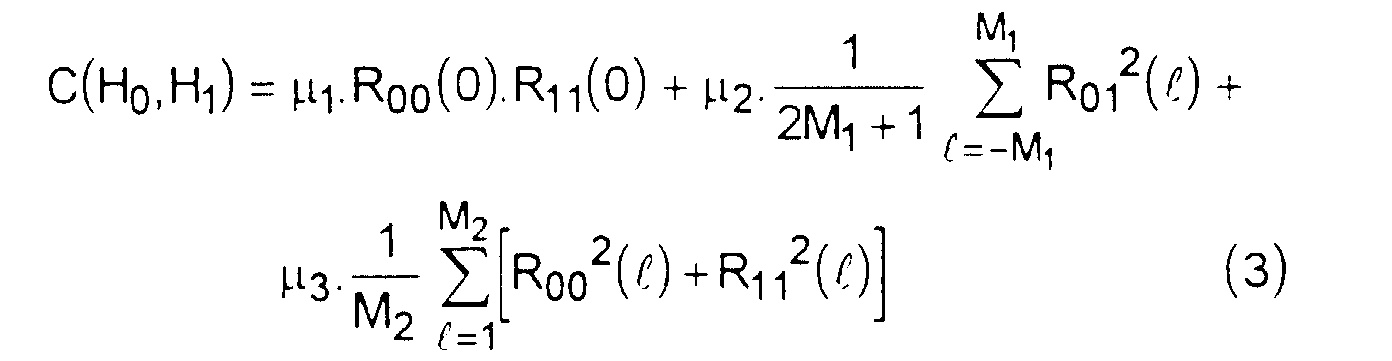
- the optimization criterion which is retained for the implementation of the invention is of the form where R ij (l) represents the delay correlation l between the signals i and j at the output of the filters H 0 and H 1 and after subsampling.
- the coefficients ⁇ 1 , ⁇ 2 and ⁇ 3 allow the contribution of each of the terms to be modulated.
- the first term tends to minimize the cost of coding under the assumption of independence and whiteness of the signals in bands.
- the second term seeks to make the two sub-band signals independent, for an inter-band decorrelation, and the third term contributes to the whitening of the signals for an intra-band decorrelation (by analogy to the spectrum of white noise).
- the method according to the invention consists in adapting the filters to the local characteristics of the image. This requires that the analysis filters be modified during the filtering as a function of the statistics measured in the vicinity of each current point. As, moreover, the filtering bench must continue to ensure perfect reconstruction of the signal in the absence of quantification, the problem of perfect reconstruction at the level of synthesis is resolved by involving an additional dimension which is time. Indeed, when the analysis filters are changed, there appears a transient phase where the samples from the old and the new filter are convoluted to the synthesis. As shown in the filter bank of FIG.
- optimization of the criterion in the case of filters of the CQF type is carried out by Newton’s known algorithm. Convergence can be improved by modifying the algorithm by the Levenberg-Marquardt method. Optimization in the case of SAOO type trellis and generalized trellis is produced under constraint and it is entrusted to the Lagrange-Newton algorithm.
- the signal correlation matrices necessary for the calculation are obtained by recurrence on the order of the trellis and can be expressed as a function signals at the input of each filter cell to be optimized.
- Newton's algorithm requires a good initialization of the filters. This is given at the start by a set of filters determined a priori used in a classic subband decomposition. During filtering, the pair of filters calculated for the previous point is used to initialize the algorithm for calculating the current point. This makes it possible to ensure faster convergence of the algorithm and to obtain filter coefficients which minimize the criterion according to relation (3) described above.
- the method according to the invention implements a technique which makes it possible to automatically recalculate the synthesis filters at the decoder.
- the statistical properties of the signal at the input of the cell to be optimized are estimated from a mask of points. In the absence of quantification, the synthesis filters can then be recalculated on the reconstructed signal as shown in FIG.
- the mask points needed to estimate statistics for optimization filters may be removed from the point to be filtered.
- the delay D calculated previously corresponds to the maximum delay between the filtered point and the mask estimate. For intermediate levels in the tree, this delay is lesser.
- the product of the transfer matrices E i and F i of each pair of analysis and synthesis cells must constantly verify the identity, any error on one of the coefficients of one of the two cells necessarily leading to a reconstruction error on the signal. Because the lattice structures are very sensitive to these errors and that, when the subband signals are quantized the synthesis filters are recalculated on the signal reconstructed from the quantized signals, the product of the matrices E i and F i cannot no longer respect identity. Under these conditions a drift in the recalculation of the synthesis filters due to the quantization error appears. To avoid this phenomenon, the analysis and synthesis filters are calculated according to the invention on the same signal since the mask of points necessary for the calculation of the analysis filters is extracted, as shown in FIG. 8, from the locally reconstructed signal to the coder.
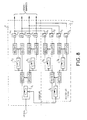
- the filters H 0 (z) H 1 (z) of the decomposition tree in sub-band of the encoder represented inside a closed line in dotted line 1 in FIG. 8, a reconstruction tree composed of the synthesis filters G 0 (z) and G 1 (z) also represented inside a closed line in dotted line 2 forming a local decoder.
- the coefficients of the filters are calculated by one or more microprocessors 3 1 ... 3 6 receiving the signal applied to each input of the filters.
- the corresponding processors are programmed to perform the calculation of the coefficients according to the optimization criterion defined by the relation (3).
- the decomposition tree of FIG. 8 is suitable for adaptive filtering of a television signal, for example with 4 sub-bands. For the purpose of transmitting the signals in sub-bands, quantizers 4 1 to 4 4 are placed at the output of the filter banks to quantify each sub-band.
- Corresponding dequantification circuits 5 1 to 5 4 are placed at the inputs of the filter banks of the reconstruction tree of the local decoder 2.
- the dot mask must be extract in the causal environment of the point to be filtered both at the coder and at the decoder.
- certain parts of the image must be filtered with filters known from coder 1 and decoder 2 for initialization processing and on the upper edge and the left edge of the image.
- this is reflected on the figure 9 by the appearance of zones 6, 7 and 8.
- CQF filters the treatment edges can be carried out in a known manner by periodization circular.
Landscapes
- Engineering & Computer Science (AREA)
- Multimedia (AREA)
- Signal Processing (AREA)
- Physics & Mathematics (AREA)
- Discrete Mathematics (AREA)
- General Physics & Mathematics (AREA)
- Compression Or Coding Systems Of Tv Signals (AREA)
- Image Processing (AREA)
- Compression, Expansion, Code Conversion, And Decoders (AREA)
Description
La présente invention concerne un procédé et un dispositif d'analyse et de synthèse en sous bandes adaptatif.The present invention relates to a method and a device for analysis and of synthesis in adaptive sub-bands.
Elle s'applique à la réalisation de systèmes de transmission et de réception de signaux vidéos numériques et notamment aux systèmes de codage et décodage compatibles d'images de télévision.It applies to the realization of transmission systems and reception of digital video signals and in particular to compatible encoding and decoding of television images.
Il est connu pour assurer la compatibilité des différents standards des signaux de télévision de procéder à un découpage hiérarchique de ceux-ci en sous bandes. Des dispositifs correspondants sont par exemple connus des demandes de brevet français FR-A-2 643 531 et FR-A-2 654 887 déposées au nom de la Demanderesse. La décomposition du spectre bi-dimensionnel de l'image est obtenue à l'aide d'une décomposition séparable arborescente obtenue à l'aide de filtres demi-bandes, passe-bas et passe-haut, couplés respectivement à des dispositifs de sous échantillonnage décimateurs par deux. Les filtres utilisés pour la décomposition sont déterminés a priori et sont identiques pour tous les niveaux de l'arbre de décomposition. L'arbre est choisi de façon à assurer une blancheur suffisante grâce à une découpe suffisamment profonde. Toutefois, la propagation des erreurs est d'autant plus importante que cette découpe est profonde. Du fait que les filtres sont calculés de manière à décomposer le signal en deux bandes de largeur identique tout en minimisant l'énergie dans la bande coupée, la fréquence de coupure étant à π/2, un banc de filtrage en sous bandes ainsi constitué conduit à un comportement moyen vis à vis de l'ensemble des signaux à filtrer, du point de vue de la décorrélation des signaux sous bandes.It is known to ensure the compatibility of different standards television signals to carry out a hierarchical division of these in sub-bands. Corresponding devices are for example known from the French patent applications FR-A-2 643 531 and FR-A-2 654 887 filed in the name of the Applicant. The decomposition of the two-dimensional spectrum of the image is obtained using a separable tree decomposition obtained using half-band, low-pass and high-pass filters, respectively coupled to decimator subsampling devices by two. The filters used for the decomposition are determined a a priori and are identical for all the levels of the decomposition tree. The tree is chosen so as to ensure sufficient whiteness thanks to a sufficiently deep cut. However, the spread of errors is all the more important that this cut is deep. Because the filters are calculated so as to decompose the signal into two bands of identical width while minimizing the energy in the cut band, the frequency cut-off being at π / 2, a filter bank in sub-bands as well constituted leads to average behavior towards all of the signals to be filtered, from the point of view of the decorrelation of the sub-band signals.
Le but de l'invention est de pallier les inconvénients précités.The object of the invention is to overcome the aforementioned drawbacks.
A cet effet, l'invention a pour objet un procédé d'analyse et de synthèse en sous bandes adaptatif pour codeur et décodeur d'images reliés par un canal de transmission du type consistant au niveau des filtres d'analyse à découper le signal à transmettre sur le canal de transmission en sous bandes suivant une structure arborescente par filtrage et décimation caractérisé en ce qu'il consiste à effectuer dans les filtres d'analyse un filtrage adaptatif local dans chaque sous bande, prenant en compte le voisinage d'un point courant de l'image. To this end, the subject of the invention is a method of analysis and synthesis in adaptive sub-bands for coder and decoder of images linked by a transmission channel of the type consisting in the level of the analysis filters to cut the signal to be transmitted on the transmission channel into sub-bands following a tree structure by filtering and decimation characterized in that it consists in carrying out an adaptive filtering in the analysis filters local in each sub-band, taking into account the neighborhood of a current point of the image.
D'autres caractéristiques et avantages de l'invention apparaítront dans la description qui suit faite en regard des figures des dessins annexés qui représentent:
- La figure 1 un banc d'analyse hiérarchique en sous bandes selon l'art antérieur.
- La figure 2 une structure de banc de filtres en treillis.
- La figure 3 une mise en oeuvre d'un dispositif pour la commutation de filtres d'analyse et de synthèse d'un signal décomposé en sous bandes.
- La figure 4 une organisation de filtres de synthèse permettant de conserver la propriété de reconstruction parfaite des filtres de synthèse lors d'une commutation de filtres.
- La figure 5 un mode de fonctionnement d'un banc de synthèse adaptatif.
- La figure 6 le principe de mise en oeuvre d'un banc d'analyse adaptatif.
- La figure 7 un mode de positionnement d'un masque d'estimation.
- La figure 8 un mode de réalisation d'un codeur à 4 bandes adaptatif selon l'invention.
- La figure 9 un mode de traitement des bords et d'initialisation des filtres.
- Figure 1 a hierarchical sub-band analysis bench according to the prior art.
- FIG. 2 a structure of a trellis filter bank.
- FIG. 3, an implementation of a device for switching analysis and synthesis filters of a signal broken down into sub-bands.
- FIG. 4 an organization of synthesis filters making it possible to preserve the property of perfect reconstruction of the synthesis filters during a switching of filters.
- Figure 5 an operating mode of an adaptive synthesis bench.
- Figure 6 the principle of implementation of an adaptive analysis bench.
- FIG. 7 a mode of positioning an estimation mask.
- FIG. 8 an embodiment of an adaptive 4-band coder according to the invention.
- FIG. 9 a mode of processing the edges and initializing the filters.
Le filtrage en sous bande fait partie des techniques de décorrélation
dite par transformée. Un banc de décomposition en sous bandes est constitué,
d'une partie analyse qui effectue une décomposition du signal et d'une
partie synthèse qui reconstruit le signal à partir des sous bandes. La
décomposition d'un signal en M bandes peut être réalisée soit par un ensemble
de filtres montés en parallèle, soit par la mise en cascade de cellules
de décomposition à peu de bandes comportant typiquement deux bandes.
Dans ce dernier cas, la décomposition hiérarchique du signal est structurée
de la manière représentée à la figure 1. La structure arborescente correspondante
est formée de cellules d'analyse synthèse à deux bandes encore
appelées cellules de décomposition en octaves. Chaque cellule est formée
d'un couple de filtres notés H0 et H1. Pour conserver un débit global constant,
les signaux en sortie des cellules d'analyse sont sous-échantillonnés
avec un taux critique R = 2. Les signaux appliqués aux entrées des cellules
de synthèse correspondantes, non représentées sont sur-échantillonnés par
deux. Une telle structure permet dans le cas de filtrage d'images dont les
signaux correspondants sont par nature non stationnaires, d'obtenir un gain
appréciable en terme de décorrélation et par suite en termes de codage, si
le système d'analyse synthèse a la possibilité de s'adapter aux caractéristiques
locales des images. Pour ce type de structure deux possibilités sont à
envisager, elles consistent, soit à adapter l'arbre de décomposition, soit à
adapter les filtres, l'une n'étant pas exclusive de l'autre. Plutôt que d'adapter
l'analyse au signal pour déterminer l'arborescence de décomposition la
mieux adaptée au signal pour une paire de filtres H0 et H1 déterminée a
priori, l'idée de l'invention consiste en une approche complémentaire qui
consiste en la détermination d'un procédé d'adaptation des filtres vis à vis
des propriétés statistiques du signal d'entrée. Elle concerne plus particulièrement
le cas du filtrage d'image par des bancs de décomposition hiérarchique
en octave utilisant des filtres séparables. L'utilisation de filtres séparables,
où le filtrage est indépendant sur les lignes et les colonnes de l'image,
permet de ramener les traitements au cas de signaux monodimensionnels.
De plus, seuls les bancs de décomposition assurant la reconstruction parfaite
du signal en l'absence de quantification des signaux sous bandes sont
à considérer. Deux catégories de filtres permettent d'obtenir ces résultats,
ces filtres étant connus sous l'abréviation anglo-saxonne CQF (Conjugated
Quadrature Filter) et sous l'appellation de filtres à phase linéaires bi-orthogonaux.
Dans les filtres CQF les filtres de fonction de transfert H0 et H1 sont
des versions retournées l'une de l'autre. Au sein d'une décomposition dyadique,
ils correspondent à des ondelettes orthogonales. Parmi les filtres à
phase linéaire bi-orthogonaux deux solutions sont également réalisables
selon la parité de l'ordre et la symétrie des filtres H0 et H1. Ces filtres sont
connus, d'une part, sous l'abréviation anglo-saxonne SSEE de "Symetric-Symetric-Even-Even"
et ont la propriété d'utiliser des filtres H0 et H1 symétriques
et d'ordre pair et d'autre part, sous l'abréviation anglo-saxonne
SAOO de "Symetric-Antisymetric-Odd-Odd" où les filtres H0 et H1 sont respectivement
symétriques et anti-symétriques d'ordre impair. Les filtres de
type SSEE imposent aux filtres H0 et H1 d'être de longueurs différentes.
Dans les modes de réalisation de l'invention décrits ci-après seuls les filtres
de type CQF et SAOO sont considérés. Les catégories de filtres retenus
existent sous une forme transverse et également sous une forme treillis. Les
filtres en treillis assurent la reconstruction parfaite du signal
indépendamment des valeurs des coefficients. Une structure en treillis
généralisée, telle que celle qui est représentée à la figure 2, intègre les deux
cas de filtres CQF et SAOO. Sur la figure 2 chaque cellule du treillis du filtre
d'analyse Ei est paramétrée par quatre coefficients ai, bi, ci et di formant la
matrice de transfert de la cellule. Cette matrice de transfert Ei est représentable
sous la forme

Afin d'éviter une dégénérescence des cellules en treillis il est nécessaire
d'imposer que le déterminant de la matrice Ei soit différent de zéro.
Pour une facilité de calcul sa valeur est imposée égale à 1. Les treillis de
type CQF sont obtenus à partir du treillis généralisé en imposant aux
coefficients des cellules Ei de satisfaire les relations ai = di et bi = -ci. De la
même manière, les treillis SAOO imposent aux coefficients des cellules Ei,
les relations ai = di et bi = ci ainsi que, l'ajout d'une cellule terminale en
sortie des filtres dont la matrice de transfert est définie par la relation :

Dans une optique de compression d'images et de codage compatible
de signaux de télévision, les filtres sont optimisés selon un critère qui fait
intervenir le coût de codage. Ce dernier, pour deux signaux indépendants de
valeur moyenne nulle, est proportionnel au produit des variances des deux
signaux. Le critère d'optimisation qui est retenu pour la mise en oeuvre de
l'invention est de la forme
Afin d'éviter une recherche d'optimisation des filtres de décomposition d'un banc de filtrage en sous bandes à partir des statistiques globales du signal, conduisant à des résultats moyens du fait du caractère non stationnaire des images, le procédé selon l'invention consiste à adapter les filtres aux caractéristiques locales de l'image. Ceci impose que les filtres d'analyse soient modifiés au cours du filtrage en fonction des statistiques mesurées dans le voisinage de chaque point courant. Comme par ailleurs le banc de filtrage doit continuer d'assurer la reconstruction parfaite du signal en l'absence de quantification, le problème de la reconstruction parfaite au niveau de la synthèse est résolu en faisant intervenir une dimension supplémentaire qui est le temps. En effet, lorsque les filtres d'analyse sont modifiés, il apparaít une phase transitoire où les échantillons issus de l'ancien et du nouveau filtre sont convolués à la synthèse. Comme le montre le banc de filtre de la figure 3 représenté, un banc de filtrage en deux bandes, dans lesquelles deux jeux de filtres d'analyse [H0(z),H1(z)] et [H0'(z),H1'(z)] ainsi que deux jeux de filtres de synthèse supplémentaires, [G0(z),G1(z)] et [G0'(z),G1(z)], peuvent être commutés. En présence de filtres de longueur 4 le problème est résolu comme le montre la figure 4 en utilisant un jeu de filtres de synthèse [G0''(z),G1''z)] durant la phase transitoire. Pour simplifier la représentation de la figure 4, les filtres ont été représentés avec une longueur de 4. Le nombre de filtres transitoires est donné par la relation (N/2-1) où N est la longueur des filtres.In order to avoid a search for optimization of the decomposition filters of a sub-band filtering bench from global signal statistics, leading to average results due to the non-stationary nature of the images, the method according to the invention consists in adapting the filters to the local characteristics of the image. This requires that the analysis filters be modified during the filtering as a function of the statistics measured in the vicinity of each current point. As, moreover, the filtering bench must continue to ensure perfect reconstruction of the signal in the absence of quantification, the problem of perfect reconstruction at the level of synthesis is resolved by involving an additional dimension which is time. Indeed, when the analysis filters are changed, there appears a transient phase where the samples from the old and the new filter are convoluted to the synthesis. As shown in the filter bank of FIG. 3 represented, a filter bank in two bands, in which two sets of analysis filters [H 0 (z), H 1 (z)] and [H 0 '(z ), H 1 '(z)] as well as two additional sets of synthesis filters, [G 0 (z), G 1 (z)] and [G 0 ' (z), G 1 (z)], can be switched. In the presence of filters of length 4 the problem is solved as shown in FIG. 4 by using a set of synthesis filters [G 0 '' (z), G 1 '' z)] during the transient phase. To simplify the representation of FIG. 4, the filters have been represented with a length of 4. The number of transient filters is given by the relation (N / 2-1) where N is the length of the filters.
Hors de la phase de transition, les filtres d'analyse et de synthèse
sont liés par la relation classique :

Lorsque les filtres sont implantés sous la forme de treillis, le problème
de la commutation des filtres se résout directement. Il suffit pour cela
d'observer le mécanisme de la propagation de l'information à travers la
structure du treillis. Dans ce cas, les coefficients des cellules peuvent être
modifiés de manière quelconque à l'analyse sous réserve que cette modification
soit répercutée à la synthèse à un instant approprié. La reconstruction
parfaite est alors toujours assurée dès lors que le produit matriciel
où Ei et Fi représentent respectivement les matrices de transfert des
filtres d'analyse et de synthèse et I la matrice identité.When the filters are installed in the form of a trellis, the problem of switching the filters is directly resolved. It suffices to observe the mechanism of the propagation of information through the lattice structure. In this case, the coefficients of the cells can be modified in any way upon analysis provided that this modification is reflected in the synthesis at an appropriate time. Perfect reconstruction is then always ensured as soon as the matrix product
where E i and F i respectively represent the transfer matrices of the analysis and synthesis filters and I the identity matrix.
Plus précisément, si les coefficients de chaque cellule Ei sont modifiés à un instant n, ce temps étant compté après sous-échantillonnage, la propriété de reconstruction parfaite est conservée à condition que les coefficients de la cellule de synthèse correspondante Fi soient mis à jour à l'instant n+L-1-i, L représentant le nombre total de cellules du treillis. Le retard est apporté par les cellules du treillis situées entre Ei et Fi.More precisely, if the coefficients of each cell E i are modified at an instant n, this time being counted after subsampling, the property of perfect reconstruction is preserved on condition that the coefficients of the corresponding synthesis cell F i are set to day at time n + L-1-i, L representing the total number of cells in the trellis. The delay is provided by the trellis cells located between E i and F i .
L'optimisation du critère dans le cas des filtres de type CQF est réalisée par l'algorithme connu de Newton. La convergence peut être améliorée en modifiant l'algorithme par la méthode de Levenberg-Marquardt. L'optimisation dans le cas des treillis de type SAOO et du treillis généralisé est réalisée sous contrainte et elle est confiée à l'algorithme de Lagrange-Newton. Les matrices de corrélation des signaux nécessaires au calcul sont obtenues par récurrence sur l'ordre du treillis et peuvent être exprimées en fonction des signaux à l'entrée de chaque cellule de filtrage à optimiser.Optimization of the criterion in the case of filters of the CQF type is carried out by Newton’s known algorithm. Convergence can be improved by modifying the algorithm by the Levenberg-Marquardt method. Optimization in the case of SAOO type trellis and generalized trellis is produced under constraint and it is entrusted to the Lagrange-Newton algorithm. The signal correlation matrices necessary for the calculation are obtained by recurrence on the order of the trellis and can be expressed as a function signals at the input of each filter cell to be optimized.
L'algorithme de Newton nécessite une bonne initialisation des filtres.
Celle-ci est donnée au départ par un jeu de filtres déterminés a priori utilisés
dans une décomposition en sous bandes classique. En cours de filtrage, le
couple de filtres calculés pour le point précédent sert d'initialisation de l'algorithme
pour le calcul du point courant. Ceci permet, d'assurer une convergence
plus rapide de l'algorithme et d'obtenir des coefficients de filtres qui
minimisent le critère selon la relation (3) décrite précédemment. Du fait que,
les filtres d'analyse peuvent être modifiés à chaque point après sous échantillonnage
de l'image à l'entrée de la cellule de filtre à optimiser, et que la
transmission vers le décodeur des coefficients des filtres d'analyse indispensables
au calcul des filtres de synthèse entraínerait un surcoût prohibitif,
le procédé selon l'invention met en oeuvre une technique qui permet de
recalculer automatiquement les filtres de synthèse au décodeur. Selon l'invention,
les propriétés statistiques du signal à l'entrée de la cellule à optimiser
sont estimées à partir d'un masque de points. En l'absence de quantification,
les filtres de synthèse peuvent alors être recalculés sur le signal
reconstruit comme le montre la figure 5 où le même masque MQ de points
que celui qui est employé pour le calcul des filtres d'analyse est utilisé, dans
la mesure où il est possible de disposer déjà des points correspondants
reconstruits. Pour cela, il est indispensable de placer le masque d'estimation
correctement au niveau de l'analyse pour prendre en compte le retard
apporté par le banc de filtres comme cela est représenté à la figure 6. Dans
ces conditions, si en désignant par L le nombre de cellules du treillis des
filtres utilisés dans le banc de décomposition et par M le nombre de niveaux
sur la branche la plus découpée, le retard global apporté par le banc est
donné par la relation :

Comme ce retard peut devenir important lorsque la découpe en sous bande est profonde ou lorsque les longueurs des filtres augmentent, le masque des points nécessaire à l'estimation des statistiques pour l'optimisation des filtres, risque de se trouver éloigner du point à filtrer. Le retard D calculé précédemment correspond au retard maximum entre le point filtré et le masque d'estimation. Pour les niveaux intermédiaires dans l'arbre, ce retard est moindre. Afin de conserver à l'optimisation un caractère local, il est préférable de choisir, comme le montre la figure 7 d'extraire le masque MQ des lignes ou des colonnes précédentes situées au dessus, à gauche du point courant N à filtrer.As this delay can become significant when the subcut band is deep or when the lengths of the filters increase, the mask points needed to estimate statistics for optimization filters, may be removed from the point to be filtered. The delay D calculated previously corresponds to the maximum delay between the filtered point and the mask estimate. For intermediate levels in the tree, this delay is lesser. In order to keep the optimization local, it is preferable to choose, as shown in figure 7 to extract the mask MQ of previous rows or columns above, to the left of the point current N to be filtered.
Il est à noter que tant que les points du masque d'estimation ne sont pas disponibles à l'analyse, c'est-à-dire à l'initialisation à cause du retard apporté par le banc de filtres, un jeu de filtres déterminé a priori et connus du codeur et du décodeur doit être utilisé.It should be noted that as long as the points of the estimation mask are not not available for analysis, i.e. initialization due to delay brought by the filter bank, a set of filters determined a priori and known encoder and decoder should be used.
En présence de quantification le produit des matrices de transfert Ei et Fi de chaque couple de cellules d'analyse et de synthèse doit vérifier constamment l'identité, toute erreur sur l'un des coefficients d'une des deux cellules entraínant nécessairement une erreur de reconstruction sur le signal. Du fait que les structures en treillis sont très sensibles à ces erreurs et que, lorsque les signaux sous bande sont quantifiés les filtres de synthèse sont recalculés sur le signal reconstruit à partir des signaux quantifiés, le produit des matrices Ei et Fi ne peut plus respecter l'identité. Dans ces conditions une dérive au niveau du recalcul des filtres de synthèse due à l'erreur de quantification apparaít. Pour éviter ce phénomène, les filtres d'analyse et de synthèse sont calculés selon l'invention sur le même signal puisque le masque de points nécessaire au calcul des filtres d'analyse est extrait, comme le montre la figure 8, du signal reconstruit localement au codeur.In the presence of quantification, the product of the transfer matrices E i and F i of each pair of analysis and synthesis cells must constantly verify the identity, any error on one of the coefficients of one of the two cells necessarily leading to a reconstruction error on the signal. Because the lattice structures are very sensitive to these errors and that, when the subband signals are quantized the synthesis filters are recalculated on the signal reconstructed from the quantized signals, the product of the matrices E i and F i cannot no longer respect identity. Under these conditions a drift in the recalculation of the synthesis filters due to the quantization error appears. To avoid this phenomenon, the analysis and synthesis filters are calculated according to the invention on the same signal since the mask of points necessary for the calculation of the analysis filters is extracted, as shown in FIG. 8, from the locally reconstructed signal to the coder.
A cette fin, il est adjoint aux filtres H0(z) H1(z) de l'arbre de décomposition
en sous bande du codeur, représenté à l'intérieur d'une ligne fermée
en pointillé 1 sur la figure 8, un arbre de reconstruction composé des
filtres de synthèse G0(z) et G1(z) représentés également à l'intérieur d'une
ligne fermée en pointillé 2 formant un décodeur local. Les coefficients des
filtres sont calculés par un ou plusieurs microprocesseurs 31 ... 36 recevant
le signal appliqué à chaque entrée des filtres. Les processeurs correspondant
sont programmés pour effectuer le calcul des coefficients selon le critère
d'optimisation défini par la relation (3). L'arbre de décomposition de la
figure 8 convient pour un filtrage adaptatif d'un signal de télévision par
exemple à 4 sous bandes. En vue de la transmission des signaux sous
bandes des quantificateurs 41 à 44 sont placés à la sortie des bancs de
filtres pour quantifier chaque sous bande.To this end, it is added to the filters H 0 (z) H 1 (z) of the decomposition tree in sub-band of the encoder, represented inside a closed line in
Des circuits de déquantification 51 à 54 correspondants sont placés
aux entrées des bancs de filtres de l'arbre de reconstruction du décodeur
local 2.Corresponding dequantification circuits 5 1 to 5 4 are placed at the inputs of the filter banks of the reconstruction tree of the
Il est à noter que le masque de points doit impérativement être
extrait dans l'environnement causal du point à filtrer tant au codeur qu'au
décodeur. D'autre part, certaines parties de l'image doivent être filtrées avec
des filtres connus du codeur 1 et du décodeur 2 pour les traitements à l'initialisation
et sur le bord supérieur et le bord gauche de l'image. Dans le cas
de l'implantation à 4 sous bandes selon la figure 8 cela se traduit sur la
figure 9 par l'apparition de zones 6, 7 et 8. En utilisant des filtres CQF le traitement
des bords pourra être effectué de façon connue par périodisation
circulaire.Note that the dot mask must be
extract in the causal environment of the point to be filtered both at the coder and at the
decoder. On the other hand, certain parts of the image must be filtered with
filters known from
Naturellement, l'invention n'est pas limitée aux exemples décrits, d'autres modes de réalisation sont également envisageables consistant par exemple à regrouper dans un seul et même processeur les calculs nécessaires à l'optimisation des filtres.Naturally, the invention is not limited to the examples described, other embodiments are also conceivable consisting of example to combine in a single processor the necessary calculations optimizing filters.
Claims (12)
- Adaptive process for sub-band analysis and synthesis for image coder (1) and decoder (2) linked by a transmission channel of the type consisting at the level of the analysis filters in partitioning the signal to be transmitted over the transmission channel into sub-bands according to a treelike structure by filtering and decimation, characterized in that it consists in performing, for each sub-band, in the analysis filters, a local adaptive filtering taking into account the neighbourhood of a current point of the image.
- Process according to Claim 1, characterized in that, in order to perform the local adaptive filtering in each sub-band, it consists in calculating the coefficients of the analysis filters (H0, H1) on the basis of sub-band signals quantized (41...44) and reconstructed locally (2) at the level of the coder.
- Process according to either one of Claims 1 and 2, characterized in that it consists in calculating for each current point (N) of the image and in each sub-band the coefficients of the analysis and synthesis filters on the basis of a specified number of previous points reconstructed in the analysis coder.
- Process according to Claim 3, characterized in that the points of the said specified number of reconstructed points are situated on the same line as the current point (N).
- Process according to Claims 1 and 2, characterized in that a calculation of the coefficients of the analysis and synthesis filters is performed with the aid of masks (M) of identical points, and in that the mask of the analysis filters is offset with respect to the current point by a delay D corresponding to the delay introduced by the filtering.
- Process according to Claim 5, characterized in that the mask (M) of points is extracted from the lines or columns which precede the line or column of the current point (N) so that the optimization of the filters preserves its local character.
- Process according to Claim 5 or 6, characterized in that it consists in using a set of predefined filters of the coder and of the decoder when the mask of points cannot be constructed.
- Process according to any one of Claims 1 to 7, characterized in that it consists in initializing a calculation of the filters on the basis of the set of filter coefficients optimized over the point which precedes the current point (N).
- Process according to any one of Claims 1 to 8, characterized in that, the filters having a trellis structure, it consists in optimizing the filters by Newton's method using the estimate of the correlation matrices of the sub-band signals obtained by recurrence on the order of the trellis on the basis of the signal applied to the input of the trellis.
- Process according to any one of Claims 1 to 9, characterized in that it consists in performing the adaptive filtering in each sub-band according to a criterion tending to minimize the coding cost by ensuring the independence and whiteness of the sub-band signals.
- Process according to any one of Claims 1 to 9, characterized in that it consists in performing the adaptive filtering in each sub-band as a function of the local spatial statistical properties of the image.
- Device for implementing the process according to any one of Claims 1 to 11, comprising a sub-band splitting bank formed of filters, the filters serving to partition the image signal to be transmitted over a transmission channel into sub-bands according to a treelike structure by filtering and decimation, the device being characterized in that the coefficients of each filter are calculated on the basis of one or more microprocessors (31...36), the microprocessor or microprocessors receiving the signals applied to the input of the filters, the calculation of the coefficients of the filters being dependent on a criterion for optimizing the filters which takes account of the neighbourhood of the current filtered point.
Applications Claiming Priority (2)
| Application Number | Priority Date | Filing Date | Title |
|---|---|---|---|
| FR9400633A FR2715527B1 (en) | 1994-01-21 | 1994-01-21 | Method and device for analysis and synthesis in adaptive sub-bands. |
| FR9400633 | 1994-01-21 |
Publications (2)
| Publication Number | Publication Date |
|---|---|
| EP0664652A1 EP0664652A1 (en) | 1995-07-26 |
| EP0664652B1 true EP0664652B1 (en) | 1999-09-15 |
Family
ID=9459253
Family Applications (1)
| Application Number | Title | Priority Date | Filing Date |
|---|---|---|---|
| EP95400069A Expired - Lifetime EP0664652B1 (en) | 1994-01-21 | 1995-01-13 | Method and apparatus for adaptive subband analysis and synthesis |
Country Status (4)
| Country | Link |
|---|---|
| US (1) | US5844610A (en) |
| EP (1) | EP0664652B1 (en) |
| DE (1) | DE69512099T2 (en) |
| FR (1) | FR2715527B1 (en) |
Families Citing this family (12)
| Publication number | Priority date | Publication date | Assignee | Title |
|---|---|---|---|---|
| US6757326B1 (en) * | 1998-12-28 | 2004-06-29 | Motorola, Inc. | Method and apparatus for implementing wavelet filters in a digital system |
| FR2790172A1 (en) * | 1999-02-24 | 2000-08-25 | Canon Kk | Digital signal transformation method, in which signal is processed by successive samples, such that calculations made on any series do not take into account samples in following series, and any series terminates in low frequency sample |
| EP1032216A1 (en) | 1999-02-24 | 2000-08-30 | Canon Kabushiki Kaisha | Device and method for transforming a digital signal. |
| FR2790173A1 (en) * | 1999-02-24 | 2000-08-25 | Canon Kk | DIGITAL SIGNAL TRANSFORMATION DEVICE AND METHOD |
| FR2790171A1 (en) * | 1999-02-24 | 2000-08-25 | Canon Kk | Digital signal transformation method, in which signal is processed by successive samples, such that calculations made on any series do not take into account samples in following series, and any series terminates in low frequency sample |
| FR2790168A1 (en) * | 1999-02-24 | 2000-08-25 | Canon Kk | Digital signal transformation method, in which signal is processed by successive samples, such that calculations made on any series do not take into account samples in following series, and any series terminates in low frequency sample |
| FR2796506B1 (en) * | 1999-07-13 | 2001-10-05 | Canon Kk | METHOD AND DEVICE FOR FILTERING A DIGITAL SIGNAL |
| CN100401778C (en) * | 2002-09-17 | 2008-07-09 | 弗拉迪米尔·切佩尔科维奇 | Fast CODEC with high compression ratio and minimal required resources |
| SE0301273D0 (en) * | 2003-04-30 | 2003-04-30 | Coding Technologies Sweden Ab | Advanced processing based on a complex exponential-modulated filter bank and adaptive time signaling methods |
| FR2887711A1 (en) * | 2005-06-23 | 2006-12-29 | Thomson Licensing Sa | METHOD OF ENCODING AND HIERARCHICAL DECODING |
| US8958510B1 (en) * | 2010-06-10 | 2015-02-17 | Fredric J. Harris | Selectable bandwidth filter |
| WO2012094750A1 (en) * | 2011-01-14 | 2012-07-19 | Ebrisk Video Inc. | Adaptive loop filtering using multiple filter shapes |
Family Cites Families (10)
| Publication number | Priority date | Publication date | Assignee | Title |
|---|---|---|---|---|
| US5122873A (en) * | 1987-10-05 | 1992-06-16 | Intel Corporation | Method and apparatus for selectively encoding and decoding a digital motion video signal at multiple resolution levels |
| FR2643531B1 (en) * | 1989-02-21 | 1996-04-26 | Thomson Csf | INFORMATION COMPRESSION METHOD AND DEVICE FOR COMPATIBLE DECODING OF A FAMILY OF INCREASING RESOLUTIONS TELEVISION SIGNALS |
| US4969040A (en) * | 1989-10-26 | 1990-11-06 | Bell Communications Research, Inc. | Apparatus and method for differential sub-band coding of video signals |
| FR2654887B1 (en) * | 1989-11-20 | 1995-06-16 | Thomson Csf | METHOD AND DEVICE FOR COMPATIBLE ENCODING AND DECODING TELEVISION IMAGES OF DIFFERENT RESOLUTIONS. |
| US5218435A (en) * | 1991-02-20 | 1993-06-08 | Massachusetts Institute Of Technology | Digital advanced television systems |
| FR2677836B1 (en) * | 1991-06-11 | 1997-08-29 | Thomson Csf | ENCODER-DECODER UNDER BANDS OF TELEVISION SIGNALS AT DIFFERENT COMPATIBILITY LEVELS. |
| FR2680924B1 (en) * | 1991-09-03 | 1997-06-06 | France Telecom | FILTERING METHOD SUITABLE FOR A SIGNAL TRANSFORMED INTO SUB-BANDS, AND CORRESPONDING FILTERING DEVICE. |
| GB2263373B (en) * | 1992-01-09 | 1995-05-24 | Sony Broadcast & Communication | Data error concealment |
| US5469517A (en) * | 1992-01-21 | 1995-11-21 | Nec Corporation | Motion compensation circuit |
| CA2088082C (en) * | 1992-02-07 | 1999-01-19 | John Hartung | Dynamic bit allocation for three-dimensional subband video coding |
-
1994
- 1994-01-21 FR FR9400633A patent/FR2715527B1/en not_active Expired - Fee Related
-
1995
- 1995-01-13 EP EP95400069A patent/EP0664652B1/en not_active Expired - Lifetime
- 1995-01-13 DE DE69512099T patent/DE69512099T2/en not_active Expired - Lifetime
- 1995-01-20 US US08/375,737 patent/US5844610A/en not_active Expired - Lifetime
Also Published As
| Publication number | Publication date |
|---|---|
| FR2715527B1 (en) | 1996-02-23 |
| DE69512099D1 (en) | 1999-10-21 |
| US5844610A (en) | 1998-12-01 |
| FR2715527A1 (en) | 1995-07-28 |
| DE69512099T2 (en) | 2000-03-02 |
| EP0664652A1 (en) | 1995-07-26 |
Similar Documents
| Publication | Publication Date | Title |
|---|---|---|
| EP0664652B1 (en) | Method and apparatus for adaptive subband analysis and synthesis | |
| EP2104936B1 (en) | Low-delay transform coding using weighting windows | |
| EP1989706B1 (en) | Device for perceptual weighting in audio encoding/decoding | |
| EP0542974B1 (en) | Variable resolution level television signal subband CODEC. | |
| EP1794748B1 (en) | Data processing method by passage between different sub-band domains | |
| EP3053163B1 (en) | Resampling an audio signal for low-delay encoding/decoding | |
| CA2841303C (en) | Adaptations of analysis or synthesis weighting windows for transform coding or decoding | |
| EP0361606A1 (en) | Apparatus for processing an echographic signal | |
| EP0511095B1 (en) | Coding and decoding method and apparatus for a digital signal | |
| FR2678103A1 (en) | VOICE SYNTHESIS PROCESS. | |
| FR3009121A1 (en) | METHOD OF SUPPRESSING LATE REVERBERATION OF A SOUND SIGNAL | |
| EP2656344B1 (en) | Improved filtering in the transformed domain | |
| EP0285495B1 (en) | Digital signal processing system using a filter bank | |
| FR2667745A1 (en) | Method of synthesising sub-band filters with quantised coefficients and filter structures obtained by this method | |
| FR2661062A2 (en) | Method and device for compatible coding and decoding of television images with different resolutions | |
| FR2731855A1 (en) | INVERSIBLE METHOD OF COMPLEX FREQUENCY DECOMPOSITION OF A DIGITAL SIGNAL AND ITS APPLICATION TO A DEVICE FOR REDUCING THE INFORMATION FLOW OF AUDIONUMERIC SIGNALS | |
| FR2911227A1 (en) | Digital audio signal coding/decoding method for telecommunication application, involves applying short and window to code current frame, when event is detected at start of current frame and not detected in current frame, respectively | |
| EP0300880A1 (en) | Adaptive predictor | |
| FR2673795A1 (en) | Method and device for matched interpolation of subband signals for compatible inter-image coding of television signals | |
| Vetterli | Analyse, synthèse et complexité de calcul de bancs de filtres numériques | |
| FR2773653A1 (en) | Input sound digital word decoding/coding device, especially for analyzing and compressing inputs for recording | |
| FR2853804A1 (en) | Audio signal decoding process, involves constructing uncorrelated signal from audio signals based on audio signal frequency transformation, and joining audio and uncorrelated signals to generate signal representing acoustic scene | |
| FR2813486A1 (en) | Data transformation device for physical variable values in image processing, uses different combinations of digital wavelet transformations with and without sub-sampling to produce movement estimation data | |
| FR2980620A1 (en) | Method for processing decoded audio frequency signal, e.g. coded voice signal including music, involves performing spectral attenuation of residue, and combining residue and attenuated signal from spectrum of tonal components |
Legal Events
| Date | Code | Title | Description |
|---|---|---|---|
| PUAI | Public reference made under article 153(3) epc to a published international application that has entered the european phase |
Free format text: ORIGINAL CODE: 0009012 |
|
| AK | Designated contracting states |
Kind code of ref document: A1 Designated state(s): DE GB IT NL |
|
| 17P | Request for examination filed |
Effective date: 19960119 |
|
| RAP1 | Party data changed (applicant data changed or rights of an application transferred) |
Owner name: THOMSON MULTIMEDIA |
|
| 17Q | First examination report despatched |
Effective date: 19980120 |
|
| RAP1 | Party data changed (applicant data changed or rights of an application transferred) |
Owner name: THOMSON MULTIMEDIA |
|
| GRAG | Despatch of communication of intention to grant |
Free format text: ORIGINAL CODE: EPIDOS AGRA |
|
| GRAG | Despatch of communication of intention to grant |
Free format text: ORIGINAL CODE: EPIDOS AGRA |
|
| GRAH | Despatch of communication of intention to grant a patent |
Free format text: ORIGINAL CODE: EPIDOS IGRA |
|
| GRAH | Despatch of communication of intention to grant a patent |
Free format text: ORIGINAL CODE: EPIDOS IGRA |
|
| GRAA | (expected) grant |
Free format text: ORIGINAL CODE: 0009210 |
|
| AK | Designated contracting states |
Kind code of ref document: B1 Designated state(s): DE GB IT NL |
|
| REF | Corresponds to: |
Ref document number: 69512099 Country of ref document: DE Date of ref document: 19991021 |
|
| ITF | It: translation for a ep patent filed | ||
| GBT | Gb: translation of ep patent filed (gb section 77(6)(a)/1977) |
Effective date: 20000111 |
|
| PLBE | No opposition filed within time limit |
Free format text: ORIGINAL CODE: 0009261 |
|
| STAA | Information on the status of an ep patent application or granted ep patent |
Free format text: STATUS: NO OPPOSITION FILED WITHIN TIME LIMIT |
|
| 26N | No opposition filed | ||
| REG | Reference to a national code |
Ref country code: GB Ref legal event code: 746 Effective date: 20011126 |
|
| REG | Reference to a national code |
Ref country code: GB Ref legal event code: IF02 |
|
| REG | Reference to a national code |
Ref country code: DE Ref legal event code: R082 Ref document number: 69512099 Country of ref document: DE Representative=s name: MANFRED ROSSMANITH, DE |
|
| REG | Reference to a national code |
Ref country code: DE Ref legal event code: R082 Ref document number: 69512099 Country of ref document: DE Representative=s name: ROSSMANITH, MANFRED, DIPL.-PHYS. DR.RER.NAT., DE Effective date: 20120111 Ref country code: DE Ref legal event code: R081 Ref document number: 69512099 Country of ref document: DE Owner name: THOMSON LICENSING, FR Free format text: FORMER OWNER: THOMSON MULTIMEDIA, BOULOGNE, FR Effective date: 20120111 |
|
| PGFP | Annual fee paid to national office [announced via postgrant information from national office to epo] |
Ref country code: IT Payment date: 20120118 Year of fee payment: 18 |
|
| PGFP | Annual fee paid to national office [announced via postgrant information from national office to epo] |
Ref country code: DE Payment date: 20130117 Year of fee payment: 19 Ref country code: GB Payment date: 20130121 Year of fee payment: 19 |
|
| PGFP | Annual fee paid to national office [announced via postgrant information from national office to epo] |
Ref country code: NL Payment date: 20130110 Year of fee payment: 19 |
|
| REG | Reference to a national code |
Ref country code: DE Ref legal event code: R119 Ref document number: 69512099 Country of ref document: DE |
|
| REG | Reference to a national code |
Ref country code: NL Ref legal event code: V1 Effective date: 20140801 |
|
| GBPC | Gb: european patent ceased through non-payment of renewal fee |
Effective date: 20140113 |
|
| REG | Reference to a national code |
Ref country code: DE Ref legal event code: R119 Ref document number: 69512099 Country of ref document: DE Effective date: 20140801 |
|
| PG25 | Lapsed in a contracting state [announced via postgrant information from national office to epo] |
Ref country code: DE Free format text: LAPSE BECAUSE OF NON-PAYMENT OF DUE FEES Effective date: 20140801 Ref country code: NL Free format text: LAPSE BECAUSE OF NON-PAYMENT OF DUE FEES Effective date: 20140801 |
|
| PG25 | Lapsed in a contracting state [announced via postgrant information from national office to epo] |
Ref country code: GB Free format text: LAPSE BECAUSE OF NON-PAYMENT OF DUE FEES Effective date: 20140113 |
|
| PG25 | Lapsed in a contracting state [announced via postgrant information from national office to epo] |
Ref country code: IT Free format text: LAPSE BECAUSE OF NON-PAYMENT OF DUE FEES Effective date: 20140113 |