EP0664652B1 - Verfahren und Vorrichtung zur adaptiven Subband-Analyse und -Synthese - Google Patents
Verfahren und Vorrichtung zur adaptiven Subband-Analyse und -Synthese Download PDFInfo
- Publication number
- EP0664652B1 EP0664652B1 EP95400069A EP95400069A EP0664652B1 EP 0664652 B1 EP0664652 B1 EP 0664652B1 EP 95400069 A EP95400069 A EP 95400069A EP 95400069 A EP95400069 A EP 95400069A EP 0664652 B1 EP0664652 B1 EP 0664652B1
- Authority
- EP
- European Patent Office
- Prior art keywords
- filters
- sub
- analysis
- process according
- band
- Prior art date
- Legal status (The legal status is an assumption and is not a legal conclusion. Google has not performed a legal analysis and makes no representation as to the accuracy of the status listed.)
- Expired - Lifetime
Links
- 238000004458 analytical method Methods 0.000 title claims description 39
- 230000015572 biosynthetic process Effects 0.000 title claims description 30
- 238000003786 synthesis reaction Methods 0.000 title claims description 30
- 238000000034 method Methods 0.000 title claims description 21
- 230000003044 adaptive effect Effects 0.000 title claims description 13
- 238000001914 filtration Methods 0.000 claims description 18
- 238000004364 calculation method Methods 0.000 claims description 10
- 238000005457 optimization Methods 0.000 claims description 8
- 230000005540 biological transmission Effects 0.000 claims description 7
- 230000001419 dependent effect Effects 0.000 claims 1
- 238000005192 partition Methods 0.000 claims 1
- 238000000638 solvent extraction Methods 0.000 claims 1
- 238000000354 decomposition reaction Methods 0.000 description 20
- 238000012546 transfer Methods 0.000 description 6
- 239000011159 matrix material Substances 0.000 description 5
- 238000012545 processing Methods 0.000 description 3
- 238000011002 quantification Methods 0.000 description 3
- 230000001052 transient effect Effects 0.000 description 3
- 238000013139 quantization Methods 0.000 description 2
- 238000001228 spectrum Methods 0.000 description 2
- 238000013459 approach Methods 0.000 description 1
- 230000001364 causal effect Effects 0.000 description 1
- 230000000295 complement effect Effects 0.000 description 1
- 230000006835 compression Effects 0.000 description 1
- 238000007906 compression Methods 0.000 description 1
- 230000007850 degeneration Effects 0.000 description 1
- 238000002513 implantation Methods 0.000 description 1
- 229940050561 matrix product Drugs 0.000 description 1
- 230000007246 mechanism Effects 0.000 description 1
- 238000012986 modification Methods 0.000 description 1
- 230000004048 modification Effects 0.000 description 1
- 230000008520 organization Effects 0.000 description 1
- 230000000135 prohibitive effect Effects 0.000 description 1
- 230000000717 retained effect Effects 0.000 description 1
- 238000005070 sampling Methods 0.000 description 1
- 230000007704 transition Effects 0.000 description 1
- 230000002087 whitening effect Effects 0.000 description 1
Images


Classifications
-
- H—ELECTRICITY
- H04—ELECTRIC COMMUNICATION TECHNIQUE
- H04N—PICTORIAL COMMUNICATION, e.g. TELEVISION
- H04N19/00—Methods or arrangements for coding, decoding, compressing or decompressing digital video signals
- H04N19/60—Methods or arrangements for coding, decoding, compressing or decompressing digital video signals using transform coding
- H04N19/63—Methods or arrangements for coding, decoding, compressing or decompressing digital video signals using transform coding using sub-band based transform, e.g. wavelets
- H04N19/635—Methods or arrangements for coding, decoding, compressing or decompressing digital video signals using transform coding using sub-band based transform, e.g. wavelets characterised by filter definition or implementation details
-
- H—ELECTRICITY
- H04—ELECTRIC COMMUNICATION TECHNIQUE
- H04N—PICTORIAL COMMUNICATION, e.g. TELEVISION
- H04N19/00—Methods or arrangements for coding, decoding, compressing or decompressing digital video signals
- H04N19/10—Methods or arrangements for coding, decoding, compressing or decompressing digital video signals using adaptive coding
- H04N19/102—Methods or arrangements for coding, decoding, compressing or decompressing digital video signals using adaptive coding characterised by the element, parameter or selection affected or controlled by the adaptive coding
- H04N19/12—Selection from among a plurality of transforms or standards, e.g. selection between discrete cosine transform [DCT] and sub-band transform or selection between H.263 and H.264
- H04N19/122—Selection of transform size, e.g. 8x8 or 2x4x8 DCT; Selection of sub-band transforms of varying structure or type
-
- H—ELECTRICITY
- H04—ELECTRIC COMMUNICATION TECHNIQUE
- H04N—PICTORIAL COMMUNICATION, e.g. TELEVISION
- H04N19/00—Methods or arrangements for coding, decoding, compressing or decompressing digital video signals
- H04N19/10—Methods or arrangements for coding, decoding, compressing or decompressing digital video signals using adaptive coding
- H04N19/169—Methods or arrangements for coding, decoding, compressing or decompressing digital video signals using adaptive coding characterised by the coding unit, i.e. the structural portion or semantic portion of the video signal being the object or the subject of the adaptive coding
- H04N19/1883—Methods or arrangements for coding, decoding, compressing or decompressing digital video signals using adaptive coding characterised by the coding unit, i.e. the structural portion or semantic portion of the video signal being the object or the subject of the adaptive coding the unit relating to sub-band structure, e.g. hierarchical level, directional tree, e.g. low-high [LH], high-low [HL], high-high [HH]
-
- H—ELECTRICITY
- H04—ELECTRIC COMMUNICATION TECHNIQUE
- H04N—PICTORIAL COMMUNICATION, e.g. TELEVISION
- H04N19/00—Methods or arrangements for coding, decoding, compressing or decompressing digital video signals
- H04N19/60—Methods or arrangements for coding, decoding, compressing or decompressing digital video signals using transform coding
- H04N19/61—Methods or arrangements for coding, decoding, compressing or decompressing digital video signals using transform coding in combination with predictive coding
-
- H—ELECTRICITY
- H04—ELECTRIC COMMUNICATION TECHNIQUE
- H04N—PICTORIAL COMMUNICATION, e.g. TELEVISION
- H04N19/00—Methods or arrangements for coding, decoding, compressing or decompressing digital video signals
- H04N19/60—Methods or arrangements for coding, decoding, compressing or decompressing digital video signals using transform coding
- H04N19/63—Methods or arrangements for coding, decoding, compressing or decompressing digital video signals using transform coding using sub-band based transform, e.g. wavelets
-
- H—ELECTRICITY
- H04—ELECTRIC COMMUNICATION TECHNIQUE
- H04N—PICTORIAL COMMUNICATION, e.g. TELEVISION
- H04N19/00—Methods or arrangements for coding, decoding, compressing or decompressing digital video signals
- H04N19/10—Methods or arrangements for coding, decoding, compressing or decompressing digital video signals using adaptive coding
- H04N19/102—Methods or arrangements for coding, decoding, compressing or decompressing digital video signals using adaptive coding characterised by the element, parameter or selection affected or controlled by the adaptive coding
Definitions
- the present invention relates to a method and a device for analysis and of synthesis in adaptive sub-bands.
- a filter bank in sub-bands as well constituted leads to average behavior towards all of the signals to be filtered, from the point of view of the decorrelation of the sub-band signals.
- the object of the invention is to overcome the aforementioned drawbacks.
- the subject of the invention is a method of analysis and synthesis in adaptive sub-bands for coder and decoder of images linked by a transmission channel of the type consisting in the level of the analysis filters to cut the signal to be transmitted on the transmission channel into sub-bands following a tree structure by filtering and decimation characterized in that it consists in carrying out an adaptive filtering in the analysis filters local in each sub-band, taking into account the neighborhood of a current point of the image.
- Subband filtering is one of the so-called transform decorrelation techniques.
- a sub-band decomposition bench consists of an analysis part which performs a signal decomposition and a synthesis part which reconstructs the signal from the sub-bands.
- the decomposition of a signal into M bands can be carried out either by a set of filters mounted in parallel, or by the cascading of decomposition cells with few bands typically comprising two bands. In the latter case, the hierarchical decomposition of the signal is structured as shown in FIG. 1.
- the corresponding tree structure is formed of two-band synthesis analysis cells also known as octave decomposition cells. Each cell is formed of a pair of filters denoted H 0 and H 1 .
- the signals applied to the inputs of the corresponding synthesis cells, not shown, are oversampled by two.
- Such a structure makes it possible, in the case of image filtering whose corresponding signals are by nature non-stationary, to obtain an appreciable gain in terms of decorrelation and therefore in terms of coding, if the synthesis analysis system has the possibility to adapt to the local characteristics of the images.
- two possibilities are to be considered, they consist either in adapting the decomposition tree, or in adapting the filters, one not being exclusive of the other.
- the idea of the invention consists of a complementary approach which consists in determining a method for adapting the filters with respect to the statistical properties of the input signal. It relates more particularly to the case of image filtering by benches of hierarchical decomposition in octave using separable filters.
- separable filters where the filtering is independent on the lines and the columns of the image, makes it possible to reduce the processing operations to the case of one-dimensional signals.
- only the decomposition banks ensuring perfect reconstruction of the signal in the absence of quantization of the subband signals are to be considered.
- the transfer function filters H 0 and H 1 are versions returned from one another. Within a dyadic decomposition, they correspond to orthogonal wavelets.
- the bi-orthogonal linear phase filters two solutions are also possible according to the parity of the order and the symmetry of the filters H 0 and H 1 .
- the lattice filters ensure perfect reconstruction of the signal regardless of the values of the coefficients.
- a generalized lattice structure such as that which is represented in FIG. 2, integrates the two cases of filters CQF and SAOO.
- each cell of the lattice of the analysis filter E i is parameterized by four coefficients a i , b i , c i and d i forming the transfer matrix of the cell.
- This transfer matrix E i can be represented in the form
- the filters are optimized according to a criterion which involves the cost of coding.
- the latter for two independent signals of zero mean value, is proportional to the product of the variances of the two signals.
- the optimization criterion which is retained for the implementation of the invention is of the form where R ij (l) represents the delay correlation l between the signals i and j at the output of the filters H 0 and H 1 and after subsampling.
- the coefficients ⁇ 1 , ⁇ 2 and ⁇ 3 allow the contribution of each of the terms to be modulated.
- the first term tends to minimize the cost of coding under the assumption of independence and whiteness of the signals in bands.
- the second term seeks to make the two sub-band signals independent, for an inter-band decorrelation, and the third term contributes to the whitening of the signals for an intra-band decorrelation (by analogy to the spectrum of white noise).
- the method according to the invention consists in adapting the filters to the local characteristics of the image. This requires that the analysis filters be modified during the filtering as a function of the statistics measured in the vicinity of each current point. As, moreover, the filtering bench must continue to ensure perfect reconstruction of the signal in the absence of quantification, the problem of perfect reconstruction at the level of synthesis is resolved by involving an additional dimension which is time. Indeed, when the analysis filters are changed, there appears a transient phase where the samples from the old and the new filter are convoluted to the synthesis. As shown in the filter bank of FIG.
- optimization of the criterion in the case of filters of the CQF type is carried out by Newton’s known algorithm. Convergence can be improved by modifying the algorithm by the Levenberg-Marquardt method. Optimization in the case of SAOO type trellis and generalized trellis is produced under constraint and it is entrusted to the Lagrange-Newton algorithm.
- the signal correlation matrices necessary for the calculation are obtained by recurrence on the order of the trellis and can be expressed as a function signals at the input of each filter cell to be optimized.
- Newton's algorithm requires a good initialization of the filters. This is given at the start by a set of filters determined a priori used in a classic subband decomposition. During filtering, the pair of filters calculated for the previous point is used to initialize the algorithm for calculating the current point. This makes it possible to ensure faster convergence of the algorithm and to obtain filter coefficients which minimize the criterion according to relation (3) described above.
- the method according to the invention implements a technique which makes it possible to automatically recalculate the synthesis filters at the decoder.
- the statistical properties of the signal at the input of the cell to be optimized are estimated from a mask of points. In the absence of quantification, the synthesis filters can then be recalculated on the reconstructed signal as shown in FIG.
- the mask points needed to estimate statistics for optimization filters may be removed from the point to be filtered.
- the delay D calculated previously corresponds to the maximum delay between the filtered point and the mask estimate. For intermediate levels in the tree, this delay is lesser.
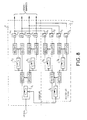
- the product of the transfer matrices E i and F i of each pair of analysis and synthesis cells must constantly verify the identity, any error on one of the coefficients of one of the two cells necessarily leading to a reconstruction error on the signal. Because the lattice structures are very sensitive to these errors and that, when the subband signals are quantized the synthesis filters are recalculated on the signal reconstructed from the quantized signals, the product of the matrices E i and F i cannot no longer respect identity. Under these conditions a drift in the recalculation of the synthesis filters due to the quantization error appears. To avoid this phenomenon, the analysis and synthesis filters are calculated according to the invention on the same signal since the mask of points necessary for the calculation of the analysis filters is extracted, as shown in FIG. 8, from the locally reconstructed signal to the coder.
- the filters H 0 (z) H 1 (z) of the decomposition tree in sub-band of the encoder represented inside a closed line in dotted line 1 in FIG. 8, a reconstruction tree composed of the synthesis filters G 0 (z) and G 1 (z) also represented inside a closed line in dotted line 2 forming a local decoder.
- the coefficients of the filters are calculated by one or more microprocessors 3 1 ... 3 6 receiving the signal applied to each input of the filters.
- the corresponding processors are programmed to perform the calculation of the coefficients according to the optimization criterion defined by the relation (3).
- the decomposition tree of FIG. 8 is suitable for adaptive filtering of a television signal, for example with 4 sub-bands. For the purpose of transmitting the signals in sub-bands, quantizers 4 1 to 4 4 are placed at the output of the filter banks to quantify each sub-band.
- Corresponding dequantification circuits 5 1 to 5 4 are placed at the inputs of the filter banks of the reconstruction tree of the local decoder 2.
- the dot mask must be extract in the causal environment of the point to be filtered both at the coder and at the decoder.
- certain parts of the image must be filtered with filters known from coder 1 and decoder 2 for initialization processing and on the upper edge and the left edge of the image.
- this is reflected on the figure 9 by the appearance of zones 6, 7 and 8.
- CQF filters the treatment edges can be carried out in a known manner by periodization circular.
Landscapes
- Engineering & Computer Science (AREA)
- Multimedia (AREA)
- Signal Processing (AREA)
- Physics & Mathematics (AREA)
- Discrete Mathematics (AREA)
- General Physics & Mathematics (AREA)
- Compression Or Coding Systems Of Tv Signals (AREA)
- Image Processing (AREA)
- Compression, Expansion, Code Conversion, And Decoders (AREA)
Claims (12)
- Verfahren zur adaptiven Subband-Analyse und -Synthese für einen Bild-Koder (1) und -Dekoder (2), die miteinander über einen Übertragungskanal von dem Typ verbunden sind, der bei den Analysefiltern das über den Übertragungskanal zu übertragende Signal durch Filterung und Dezimierung gemäß einer Baumstruktur aufteilt, dadurch gekennzeichnet, daß für jedes Subband in den Analysefiltern eine adaptive, lokale Filterung erfolgt, die die Nähe eines laufenden Pixels berücksichtigt.
- Verfahren nach Anspruch 1, dadurch gekennzeichnet, daß die adaptive, lokale Filterung in jedem Subband durch Berechnung der Koeffizienten der Analysefilter (H0, H1) aus den quantisierten Subband-Signalen (41...44) erfolgt und örtlich (2) beim Koder rekonstruiert wird.
- Verfahren nach einem der Ansprüche 1 und 2, dadurch gekennzeichnet, daß für jedes laufende Pixel (N) und in jedem Subband die Berechnung der Koeffizienten der Anaysefilter der Synthese aus einer Zahl erfolgt, die durch die vorangehenden, in dem Analysekoder rekonstruierten Pixel bestimmt ist.
- Verfahren nach Anspruch 3, dadurch gekennzeichnet, daß die Pixel der durch die rekonstruierten Pixel bestimmten Zahl in derselben Zeile wie das laufende Pixel (N) liegen.
- Verfahren nach den Ansprüchen 1 und 2, dadurch gekennzeichnet, daß eine Berechnung der Koeffizienten der Analyse- und Synthesefilter mit identischen Punktmasken (M) erfolgt, und daß die Masken der Analysefilter gegenüber dem laufenden Pixel um eine Verzögerung D versetzt werden, die der Verzögerung durch die Filterung entspricht.
- Verfahren nach Anspruch 5, dadurch gekennzeichnet, daß die Punktmaske (M) aus Zeilen oder Spalten extrahiert wird, die der Zeile oder der Spalte des laufenden Pixels (N) vorangehen, um die Optimierung der Filter in ihrer räumlichen Eigenschaft zu erhalten.
- Verfahren nach Anspruch 5 oder 6, dadurch gekennzeichnet, daß ein Satz von vorbestimmten Filtern auf den Koder und den Dekoder angewendet wird, wenn die Punktmaske nicht gebildet werden kann.
- Verfahren nach einem der Ansprüche 1 bis 7, dadurch gekennzeichnet, daß zur Auslösung einer Berechnung der Filter aus dem Satz der optimierten Filterkoeffizienten bei dem Pixel erfolgt, das dem laufenden Pixel (N) vorangeht.
- Verfahren nach einem der Ansprüche 1 bis 8, dadurch gekennzeichnet, daß dann, wenn die Filter eine Gitterstruktur haben, die Filter durch das Verfahren von Newton unter Verwendung einer Schätzung der Korrelationsfaktoren der Subband-Signale optimiert werden, die durch das Wiederauftreten auf der Gitterordnung aus dem an den Eingang des Gitters angelegten Signal erhalten werden.
- Verfahren nach einem der Ansprüche 1 bis 9, dadurch gekennzeichnet, daß die adaptive Filterung in jedem Subband gemäß einem Kriterium erfolgt, das die Kosten für die Kodierung minimiert, indem die Unabhängigkeit und die Weiße der Subband-Signale gewährleistet werden.
- Verfahren nach einem der Ansprüche 1 bis 9, dadurch gekennzeichnet, daß die adaptive Filterung in jedem Subband als Funktion der statistischen, seitlichen, örtlichen Eigenschaften des Bildes erfolgt.
- Vorrichtung zur Durchführung des Verfahrens nach einem der Ansprüche 1 bis 11 mit einer aus Filtern bestehenden Bank für die Zerlegung in Subbänder, wobei die Filter zur Aufteilung des über einen Übertragungskanal zu übertragenden Bildes in Subbänder gemäß einer Baumstruktur durch Filterung und Dezimierung dienen, dadurch gekennzeichnet, daß die Koeffizienten jedes Filters aus einem oder mehreren Mikroprozessoren (31, ... 36) berechnet werden und der oder die Mikroprozessoren die an den Eingang der Filter angelegten Signale empfangen und die Berechnung der Filterkoeffizienten als Funktion eines Kriteriums zur Optimierung der Filter die Nähe des laufenden, gefilterten Pixels berücksichtigen.
Applications Claiming Priority (2)
| Application Number | Priority Date | Filing Date | Title |
|---|---|---|---|
| FR9400633A FR2715527B1 (fr) | 1994-01-21 | 1994-01-21 | Procédé et dispositif d'analyse et de synthèse en sous bandes adaptatifs. |
| FR9400633 | 1994-01-21 |
Publications (2)
| Publication Number | Publication Date |
|---|---|
| EP0664652A1 EP0664652A1 (de) | 1995-07-26 |
| EP0664652B1 true EP0664652B1 (de) | 1999-09-15 |
Family
ID=9459253
Family Applications (1)
| Application Number | Title | Priority Date | Filing Date |
|---|---|---|---|
| EP95400069A Expired - Lifetime EP0664652B1 (de) | 1994-01-21 | 1995-01-13 | Verfahren und Vorrichtung zur adaptiven Subband-Analyse und -Synthese |
Country Status (4)
| Country | Link |
|---|---|
| US (1) | US5844610A (de) |
| EP (1) | EP0664652B1 (de) |
| DE (1) | DE69512099T2 (de) |
| FR (1) | FR2715527B1 (de) |
Families Citing this family (12)
| Publication number | Priority date | Publication date | Assignee | Title |
|---|---|---|---|---|
| US6757326B1 (en) * | 1998-12-28 | 2004-06-29 | Motorola, Inc. | Method and apparatus for implementing wavelet filters in a digital system |
| FR2790172A1 (fr) * | 1999-02-24 | 2000-08-25 | Canon Kk | Dispositif et procede de transformation de signal numerique |
| EP1032216A1 (de) | 1999-02-24 | 2000-08-30 | Canon Kabushiki Kaisha | Vorrichtung und Verfahren zur Transformation eines digitalen Signals |
| FR2790173A1 (fr) * | 1999-02-24 | 2000-08-25 | Canon Kk | Dispositif et procede de transformation de signal numerique |
| FR2790171A1 (fr) * | 1999-02-24 | 2000-08-25 | Canon Kk | Dispositif et procede de transformation de signal numerique |
| FR2790168A1 (fr) * | 1999-02-24 | 2000-08-25 | Canon Kk | Dispositif et procede de transformation de signal numerique |
| FR2796506B1 (fr) * | 1999-07-13 | 2001-10-05 | Canon Kk | Procede et dispositif de filtrage de signal numerique |
| CN100401778C (zh) * | 2002-09-17 | 2008-07-09 | 弗拉迪米尔·切佩尔科维奇 | 具有高压缩率和最小必需资源的快速codec |
| SE0301273D0 (sv) * | 2003-04-30 | 2003-04-30 | Coding Technologies Sweden Ab | Advanced processing based on a complex-exponential-modulated filterbank and adaptive time signalling methods |
| FR2887711A1 (fr) * | 2005-06-23 | 2006-12-29 | Thomson Licensing Sa | Procede de codage et decodage hierarchique |
| US8958510B1 (en) * | 2010-06-10 | 2015-02-17 | Fredric J. Harris | Selectable bandwidth filter |
| WO2012094750A1 (en) * | 2011-01-14 | 2012-07-19 | Ebrisk Video Inc. | Adaptive loop filtering using multiple filter shapes |
Family Cites Families (10)
| Publication number | Priority date | Publication date | Assignee | Title |
|---|---|---|---|---|
| US5122873A (en) * | 1987-10-05 | 1992-06-16 | Intel Corporation | Method and apparatus for selectively encoding and decoding a digital motion video signal at multiple resolution levels |
| FR2643531B1 (fr) * | 1989-02-21 | 1996-04-26 | Thomson Csf | Procede et dispositif de compression de l'information destine au decodage compatible d'une famille de signaux de television de resolutions croissantes |
| US4969040A (en) * | 1989-10-26 | 1990-11-06 | Bell Communications Research, Inc. | Apparatus and method for differential sub-band coding of video signals |
| FR2654887B1 (fr) * | 1989-11-20 | 1995-06-16 | Thomson Csf | Procede et dispositif de codage et de decodage compatibles d'images de television de resolutions differentes. |
| US5218435A (en) * | 1991-02-20 | 1993-06-08 | Massachusetts Institute Of Technology | Digital advanced television systems |
| FR2677836B1 (fr) * | 1991-06-11 | 1997-08-29 | Thomson Csf | Codeur-decodeur sous bandes de signaux de television a niveaux compatibilite differents. |
| FR2680924B1 (fr) * | 1991-09-03 | 1997-06-06 | France Telecom | Procede de filtrage adapte d'un signal transforme en sous-bandes, et dispositif de filtrage correspondant. |
| GB2263373B (en) * | 1992-01-09 | 1995-05-24 | Sony Broadcast & Communication | Data error concealment |
| US5469517A (en) * | 1992-01-21 | 1995-11-21 | Nec Corporation | Motion compensation circuit |
| CA2088082C (en) * | 1992-02-07 | 1999-01-19 | John Hartung | Dynamic bit allocation for three-dimensional subband video coding |
-
1994
- 1994-01-21 FR FR9400633A patent/FR2715527B1/fr not_active Expired - Fee Related
-
1995
- 1995-01-13 EP EP95400069A patent/EP0664652B1/de not_active Expired - Lifetime
- 1995-01-13 DE DE69512099T patent/DE69512099T2/de not_active Expired - Lifetime
- 1995-01-20 US US08/375,737 patent/US5844610A/en not_active Expired - Lifetime
Also Published As
| Publication number | Publication date |
|---|---|
| FR2715527B1 (fr) | 1996-02-23 |
| DE69512099D1 (de) | 1999-10-21 |
| US5844610A (en) | 1998-12-01 |
| FR2715527A1 (fr) | 1995-07-28 |
| DE69512099T2 (de) | 2000-03-02 |
| EP0664652A1 (de) | 1995-07-26 |
Similar Documents
| Publication | Publication Date | Title |
|---|---|---|
| EP0664652B1 (de) | Verfahren und Vorrichtung zur adaptiven Subband-Analyse und -Synthese | |
| EP2104936B1 (de) | Transformationsködierung mit geringer verzögerung unter verwendung von gewichtgsfenstern | |
| EP1989706B1 (de) | Vorrichtung für wahrnehmungsgewichtung bei der tonkodierung/-dekodierung | |
| EP0542974B1 (de) | Teilband-Koder und Dekoder für Fernsehsignale mit verschiedenen Auflösungswerten. | |
| EP1794748B1 (de) | Datenverarbeitungsverfahren durch Übergang zwischen verschiedenen Subband-domänen | |
| EP3053163B1 (de) | Wiederabtastung eines tonsignals zur codierung/decodierung mit geringer verzögerung | |
| CA2841303C (fr) | Adaptations de fenetres de ponderation d'analyse ou de synthese pour un codage ou decodage par transformee | |
| EP0361606A1 (de) | Gerät zur Verarbeitung eines echographischen Signals | |
| EP0511095B1 (de) | Verfahren und Vorrichtung zur Kodierung und Dekodierung eines numerischen Signals | |
| FR2678103A1 (fr) | Procede de synthese vocale. | |
| FR3009121A1 (fr) | Procede de suppression de la reverberation tardive d'un signal sonore | |
| EP2656344B1 (de) | Verbesserte filterung in der transformierten domäne | |
| EP0285495B1 (de) | Digitales Signalverarbeitungssystem mit einer Filterbank | |
| FR2667745A1 (fr) | Procede de synthese de filtres sous bandes a coefficients quantifies et structures de filtres obtenus par ce procede. | |
| FR2661062A2 (fr) | Procede et dispositif de codage et de decodage compatible d'images de television de resolutions differentes. | |
| FR2731855A1 (fr) | Procede inversible de decomposition complexe en frequence d'un signal numerique et son application a un dispositif de reduction du flux d'informations de signaux audionumeriques | |
| FR2911227A1 (fr) | Codage par transformee, utilisant des fenetres de ponderation et a faible retard | |
| EP0300880A1 (de) | Adaptiver Prädiktor | |
| FR2673795A1 (fr) | Procede et dispositif d'interpolation adapte de signaux sous-bandes pour le codage compatible inter-image de signaux de television. | |
| Vetterli | Analyse, synthèse et complexité de calcul de bancs de filtres numériques | |
| FR2773653A1 (fr) | Dispositifs de codage/decodage de donnees, et supports d'enregistrement memorisant un programme de codage/decodage de donnees au moyen d'un filtre de ponderation frequentielle | |
| FR2853804A1 (fr) | Procede de decodage d'un signal permettant de reconstituer une scene sonore et dispositif de decodage correspondant | |
| FR2813486A1 (fr) | Procede et dispositif de transformation de donnees | |
| FR2980620A1 (fr) | Traitement d'amelioration de la qualite des signaux audiofrequences decodes |
Legal Events
| Date | Code | Title | Description |
|---|---|---|---|
| PUAI | Public reference made under article 153(3) epc to a published international application that has entered the european phase |
Free format text: ORIGINAL CODE: 0009012 |
|
| AK | Designated contracting states |
Kind code of ref document: A1 Designated state(s): DE GB IT NL |
|
| 17P | Request for examination filed |
Effective date: 19960119 |
|
| RAP1 | Party data changed (applicant data changed or rights of an application transferred) |
Owner name: THOMSON MULTIMEDIA |
|
| 17Q | First examination report despatched |
Effective date: 19980120 |
|
| RAP1 | Party data changed (applicant data changed or rights of an application transferred) |
Owner name: THOMSON MULTIMEDIA |
|
| GRAG | Despatch of communication of intention to grant |
Free format text: ORIGINAL CODE: EPIDOS AGRA |
|
| GRAG | Despatch of communication of intention to grant |
Free format text: ORIGINAL CODE: EPIDOS AGRA |
|
| GRAH | Despatch of communication of intention to grant a patent |
Free format text: ORIGINAL CODE: EPIDOS IGRA |
|
| GRAH | Despatch of communication of intention to grant a patent |
Free format text: ORIGINAL CODE: EPIDOS IGRA |
|
| GRAA | (expected) grant |
Free format text: ORIGINAL CODE: 0009210 |
|
| AK | Designated contracting states |
Kind code of ref document: B1 Designated state(s): DE GB IT NL |
|
| REF | Corresponds to: |
Ref document number: 69512099 Country of ref document: DE Date of ref document: 19991021 |
|
| ITF | It: translation for a ep patent filed | ||
| GBT | Gb: translation of ep patent filed (gb section 77(6)(a)/1977) |
Effective date: 20000111 |
|
| PLBE | No opposition filed within time limit |
Free format text: ORIGINAL CODE: 0009261 |
|
| STAA | Information on the status of an ep patent application or granted ep patent |
Free format text: STATUS: NO OPPOSITION FILED WITHIN TIME LIMIT |
|
| 26N | No opposition filed | ||
| REG | Reference to a national code |
Ref country code: GB Ref legal event code: 746 Effective date: 20011126 |
|
| REG | Reference to a national code |
Ref country code: GB Ref legal event code: IF02 |
|
| REG | Reference to a national code |
Ref country code: DE Ref legal event code: R082 Ref document number: 69512099 Country of ref document: DE Representative=s name: MANFRED ROSSMANITH, DE |
|
| REG | Reference to a national code |
Ref country code: DE Ref legal event code: R082 Ref document number: 69512099 Country of ref document: DE Representative=s name: ROSSMANITH, MANFRED, DIPL.-PHYS. DR.RER.NAT., DE Effective date: 20120111 Ref country code: DE Ref legal event code: R081 Ref document number: 69512099 Country of ref document: DE Owner name: THOMSON LICENSING, FR Free format text: FORMER OWNER: THOMSON MULTIMEDIA, BOULOGNE, FR Effective date: 20120111 |
|
| PGFP | Annual fee paid to national office [announced via postgrant information from national office to epo] |
Ref country code: IT Payment date: 20120118 Year of fee payment: 18 |
|
| PGFP | Annual fee paid to national office [announced via postgrant information from national office to epo] |
Ref country code: DE Payment date: 20130117 Year of fee payment: 19 Ref country code: GB Payment date: 20130121 Year of fee payment: 19 |
|
| PGFP | Annual fee paid to national office [announced via postgrant information from national office to epo] |
Ref country code: NL Payment date: 20130110 Year of fee payment: 19 |
|
| REG | Reference to a national code |
Ref country code: DE Ref legal event code: R119 Ref document number: 69512099 Country of ref document: DE |
|
| REG | Reference to a national code |
Ref country code: NL Ref legal event code: V1 Effective date: 20140801 |
|
| GBPC | Gb: european patent ceased through non-payment of renewal fee |
Effective date: 20140113 |
|
| REG | Reference to a national code |
Ref country code: DE Ref legal event code: R119 Ref document number: 69512099 Country of ref document: DE Effective date: 20140801 |
|
| PG25 | Lapsed in a contracting state [announced via postgrant information from national office to epo] |
Ref country code: DE Free format text: LAPSE BECAUSE OF NON-PAYMENT OF DUE FEES Effective date: 20140801 Ref country code: NL Free format text: LAPSE BECAUSE OF NON-PAYMENT OF DUE FEES Effective date: 20140801 |
|
| PG25 | Lapsed in a contracting state [announced via postgrant information from national office to epo] |
Ref country code: GB Free format text: LAPSE BECAUSE OF NON-PAYMENT OF DUE FEES Effective date: 20140113 |
|
| PG25 | Lapsed in a contracting state [announced via postgrant information from national office to epo] |
Ref country code: IT Free format text: LAPSE BECAUSE OF NON-PAYMENT OF DUE FEES Effective date: 20140113 |