EP0659708B1 - Alumina based ceramic material and method of manufacturing the same - Google Patents
Alumina based ceramic material and method of manufacturing the same Download PDFInfo
- Publication number
- EP0659708B1 EP0659708B1 EP94309536A EP94309536A EP0659708B1 EP 0659708 B1 EP0659708 B1 EP 0659708B1 EP 94309536 A EP94309536 A EP 94309536A EP 94309536 A EP94309536 A EP 94309536A EP 0659708 B1 EP0659708 B1 EP 0659708B1
- Authority
- EP
- European Patent Office
- Prior art keywords
- sintering
- ceramic material
- sintered body
- sic whiskers
- material according
- Prior art date
- Legal status (The legal status is an assumption and is not a legal conclusion. Google has not performed a legal analysis and makes no representation as to the accuracy of the status listed.)
- Expired - Lifetime
Links
- PNEYBMLMFCGWSK-UHFFFAOYSA-N aluminium oxide Inorganic materials [O-2].[O-2].[O-2].[Al+3].[Al+3] PNEYBMLMFCGWSK-UHFFFAOYSA-N 0.000 title claims description 122
- 229910010293 ceramic material Inorganic materials 0.000 title claims description 63
- 238000004519 manufacturing process Methods 0.000 title claims description 22
- 229910052593 corundum Inorganic materials 0.000 claims description 117
- 229910001845 yogo sapphire Inorganic materials 0.000 claims description 117
- 238000005245 sintering Methods 0.000 claims description 79
- 239000012752 auxiliary agent Substances 0.000 claims description 49
- MCMNRKCIXSYSNV-UHFFFAOYSA-N Zirconium dioxide Chemical compound O=[Zr]=O MCMNRKCIXSYSNV-UHFFFAOYSA-N 0.000 claims description 42
- 238000001272 pressureless sintering Methods 0.000 claims description 38
- 238000001513 hot isostatic pressing Methods 0.000 claims description 36
- IJGRMHOSHXDMSA-UHFFFAOYSA-N Atomic nitrogen Chemical compound N#N IJGRMHOSHXDMSA-UHFFFAOYSA-N 0.000 claims description 34
- 239000011812 mixed powder Substances 0.000 claims description 34
- 238000000034 method Methods 0.000 claims description 31
- 238000002156 mixing Methods 0.000 claims description 28
- 239000011261 inert gas Substances 0.000 claims description 24
- QJGQUHMNIGDVPM-UHFFFAOYSA-N nitrogen group Chemical group [N] QJGQUHMNIGDVPM-UHFFFAOYSA-N 0.000 claims description 20
- 239000000843 powder Substances 0.000 claims description 20
- 239000000919 ceramic Substances 0.000 claims description 15
- 229910052757 nitrogen Inorganic materials 0.000 claims description 15
- 150000004767 nitrides Chemical class 0.000 claims description 14
- 239000002245 particle Substances 0.000 claims description 13
- 230000007704 transition Effects 0.000 claims description 12
- 229910052791 calcium Inorganic materials 0.000 claims description 10
- 229910052804 chromium Inorganic materials 0.000 claims description 10
- 229910052749 magnesium Inorganic materials 0.000 claims description 10
- 229910052759 nickel Inorganic materials 0.000 claims description 10
- 229910052761 rare earth metal Inorganic materials 0.000 claims description 10
- 229910052710 silicon Inorganic materials 0.000 claims description 10
- 229910052719 titanium Inorganic materials 0.000 claims description 10
- 229910052727 yttrium Inorganic materials 0.000 claims description 10
- 229910052726 zirconium Inorganic materials 0.000 claims description 10
- 238000001035 drying Methods 0.000 claims description 9
- 238000001694 spray drying Methods 0.000 claims description 7
- 230000000737 periodic effect Effects 0.000 claims description 6
- 238000005452 bending Methods 0.000 description 25
- 230000000052 comparative effect Effects 0.000 description 23
- VYPSYNLAJGMNEJ-UHFFFAOYSA-N silicon dioxide Inorganic materials O=[Si]=O VYPSYNLAJGMNEJ-UHFFFAOYSA-N 0.000 description 19
- 150000001875 compounds Chemical class 0.000 description 14
- 229910052681 coesite Inorganic materials 0.000 description 13
- 229910052906 cristobalite Inorganic materials 0.000 description 13
- 239000000463 material Substances 0.000 description 13
- 239000000377 silicon dioxide Substances 0.000 description 13
- 229910052682 stishovite Inorganic materials 0.000 description 13
- 229910052905 tridymite Inorganic materials 0.000 description 13
- 230000000694 effects Effects 0.000 description 12
- 238000007723 die pressing method Methods 0.000 description 10
- 238000005259 measurement Methods 0.000 description 9
- 238000000280 densification Methods 0.000 description 7
- 239000007789 gas Substances 0.000 description 6
- 239000007791 liquid phase Substances 0.000 description 6
- 239000000203 mixture Substances 0.000 description 6
- 238000009694 cold isostatic pressing Methods 0.000 description 5
- 239000002131 composite material Substances 0.000 description 5
- 239000011159 matrix material Substances 0.000 description 5
- 230000008569 process Effects 0.000 description 5
- 230000009467 reduction Effects 0.000 description 5
- XKRFYHLGVUSROY-UHFFFAOYSA-N Argon Chemical compound [Ar] XKRFYHLGVUSROY-UHFFFAOYSA-N 0.000 description 4
- 229910001873 dinitrogen Inorganic materials 0.000 description 4
- 239000011148 porous material Substances 0.000 description 4
- 238000007731 hot pressing Methods 0.000 description 3
- QYEXBYZXHDUPRC-UHFFFAOYSA-N B#[Ti]#B Chemical compound B#[Ti]#B QYEXBYZXHDUPRC-UHFFFAOYSA-N 0.000 description 2
- 229910052581 Si3N4 Inorganic materials 0.000 description 2
- 229910033181 TiB2 Inorganic materials 0.000 description 2
- 229910052786 argon Inorganic materials 0.000 description 2
- 238000001816 cooling Methods 0.000 description 2
- 239000013078 crystal Substances 0.000 description 2
- 238000001125 extrusion Methods 0.000 description 2
- 239000008187 granular material Substances 0.000 description 2
- 230000006872 improvement Effects 0.000 description 2
- 230000008707 rearrangement Effects 0.000 description 2
- GWEVSGVZZGPLCZ-UHFFFAOYSA-N titanium dioxide Inorganic materials O=[Ti]=O GWEVSGVZZGPLCZ-UHFFFAOYSA-N 0.000 description 2
- 241000111702 Parantica nilgiriensis Species 0.000 description 1
- ATJFFYVFTNAWJD-UHFFFAOYSA-N Tin Chemical compound [Sn] ATJFFYVFTNAWJD-UHFFFAOYSA-N 0.000 description 1
- 229910007948 ZrB2 Inorganic materials 0.000 description 1
- 238000004220 aggregation Methods 0.000 description 1
- 230000002776 aggregation Effects 0.000 description 1
- AZDRQVAHHNSJOQ-UHFFFAOYSA-N alumane Chemical class [AlH3] AZDRQVAHHNSJOQ-UHFFFAOYSA-N 0.000 description 1
- WNROFYMDJYEPJX-UHFFFAOYSA-K aluminium hydroxide Chemical compound [OH-].[OH-].[OH-].[Al+3] WNROFYMDJYEPJX-UHFFFAOYSA-K 0.000 description 1
- VWZIXVXBCBBRGP-UHFFFAOYSA-N boron;zirconium Chemical compound B#[Zr]#B VWZIXVXBCBBRGP-UHFFFAOYSA-N 0.000 description 1
- 238000005266 casting Methods 0.000 description 1
- 238000006243 chemical reaction Methods 0.000 description 1
- 230000008602 contraction Effects 0.000 description 1
- 230000010485 coping Effects 0.000 description 1
- PMHQVHHXPFUNSP-UHFFFAOYSA-M copper(1+);methylsulfanylmethane;bromide Chemical compound Br[Cu].CSC PMHQVHHXPFUNSP-UHFFFAOYSA-M 0.000 description 1
- 238000005260 corrosion Methods 0.000 description 1
- 230000007797 corrosion Effects 0.000 description 1
- 238000005336 cracking Methods 0.000 description 1
- 238000005520 cutting process Methods 0.000 description 1
- 238000001704 evaporation Methods 0.000 description 1
- 230000008020 evaporation Effects 0.000 description 1
- 239000000835 fiber Substances 0.000 description 1
- 238000010438 heat treatment Methods 0.000 description 1
- 238000007373 indentation Methods 0.000 description 1
- 238000002844 melting Methods 0.000 description 1
- 230000008018 melting Effects 0.000 description 1
- 229910052751 metal Inorganic materials 0.000 description 1
- 239000002184 metal Substances 0.000 description 1
- 239000003607 modifier Substances 0.000 description 1
- 229910000510 noble metal Inorganic materials 0.000 description 1
- 238000007254 oxidation reaction Methods 0.000 description 1
- 238000013001 point bending Methods 0.000 description 1
- 230000001376 precipitating effect Effects 0.000 description 1
- 230000002265 prevention Effects 0.000 description 1
- 239000011226 reinforced ceramic Substances 0.000 description 1
- 230000035939 shock Effects 0.000 description 1
- HQVNEWCFYHHQES-UHFFFAOYSA-N silicon nitride Chemical compound N12[Si]34N5[Si]62N3[Si]51N64 HQVNEWCFYHHQES-UHFFFAOYSA-N 0.000 description 1
- 239000002002 slurry Substances 0.000 description 1
- 229910052720 vanadium Inorganic materials 0.000 description 1
Images
Classifications
-
- C—CHEMISTRY; METALLURGY
- C04—CEMENTS; CONCRETE; ARTIFICIAL STONE; CERAMICS; REFRACTORIES
- C04B—LIME, MAGNESIA; SLAG; CEMENTS; COMPOSITIONS THEREOF, e.g. MORTARS, CONCRETE OR LIKE BUILDING MATERIALS; ARTIFICIAL STONE; CERAMICS; REFRACTORIES; TREATMENT OF NATURAL STONE
- C04B35/00—Shaped ceramic products characterised by their composition; Ceramics compositions; Processing powders of inorganic compounds preparatory to the manufacturing of ceramic products
- C04B35/01—Shaped ceramic products characterised by their composition; Ceramics compositions; Processing powders of inorganic compounds preparatory to the manufacturing of ceramic products based on oxide ceramics
- C04B35/10—Shaped ceramic products characterised by their composition; Ceramics compositions; Processing powders of inorganic compounds preparatory to the manufacturing of ceramic products based on oxide ceramics based on aluminium oxide
- C04B35/111—Fine ceramics
- C04B35/117—Composites
-
- C—CHEMISTRY; METALLURGY
- C04—CEMENTS; CONCRETE; ARTIFICIAL STONE; CERAMICS; REFRACTORIES
- C04B—LIME, MAGNESIA; SLAG; CEMENTS; COMPOSITIONS THEREOF, e.g. MORTARS, CONCRETE OR LIKE BUILDING MATERIALS; ARTIFICIAL STONE; CERAMICS; REFRACTORIES; TREATMENT OF NATURAL STONE
- C04B35/00—Shaped ceramic products characterised by their composition; Ceramics compositions; Processing powders of inorganic compounds preparatory to the manufacturing of ceramic products
- C04B35/71—Ceramic products containing macroscopic reinforcing agents
- C04B35/78—Ceramic products containing macroscopic reinforcing agents containing non-metallic materials
- C04B35/80—Fibres, filaments, whiskers, platelets, or the like
Definitions
- the present invention relates to an Al 2 O 3 (alumina) based ceramic material and a method of manufacturing the same.
- the present invention concerns an Al 2 O 3 based ceramic material suitable for tools requiring high strength, toughness and wear resistance, such as cutting tools and a die extrusion plug, and mechanical parts requiring wear resistance, toughness and shock resistance, such as a pump valve and a mechanical seal; and a method of manufacturing the same.
- An Al 2 O 3 based ceramic material having a high strength and being excellent in corrosion resistance, oxidization resistance and wear resistance, has been known to be suitable for mechanical parts and jigs/tools. However, it is inferior in strength and toughness to a Si 3 N 4 based ceramic material which has been extensively used as an engineering ceramic material.
- SiC whiskers containing Al 2 O3 based ceramic material is manufactured by hot-pressing, and is difficult to be formed into a complex shape or into a large size.
- JP1103267 discloses a ceramic composite material obtained by evenly dispersing a SiC whisker in an amount of 5-50 vol% into an alumina matrix (50-95%).
- the alumina matrix may contain at least one of TiB2 and ZrB2 in an amount of 10-50 vol%.
- the ceramic composite material may also comprise a small amount (0.5 wt%) of MgO.
- a slurry is prepared which is then subjected to a granulating process to produce alumina - SiC whisker composite granules. The granules are then pressed and sintered at 1800°C under a high pressure to obtain the composite ceramic body.
- WO91/08994 discloses a fibre-reinforced ceramic composite body based on Al 2 O 3 which is made by a combined sintering and a hot-isostatic pressuring process performed in one heating stage without intermediate cooling.
- the mechanical properties are improved by the addition of 0.05 to 2% mass of one or more noble metals.
- the present inventors disclose a method in Unexamined Japanese Patent Publication No. HEI 4-124058, wherein Al 2 O 3 is added with SiC whiskers and a sintering auxiliary agent composed of oxides of Mg, Si, Ca, Ti, Zr, Cr, Ni, Y and rare earth elements.
- a sintering auxiliary agent composed of oxides of Mg, Si, Ca, Ti, Zr, Cr, Ni, Y and rare earth elements.
- either of these pressureless-sintering methods is performed at a temperature between 1500 and 1900°C in an inert gas atmosphere such as argon for preventing the reaction between SiC whiskers and the atmospheric gas.
- WO 93/11086 discloses a pressureless sintering process for making whisker-reinforced aluminum composites using about 2 wt% to about 7.5 wt% of a nitride modifier consisting essentially of a silicon nitride, aluminum nitride or mixtures thereof to produce a sintered body having a density of greater than about 95% theoretical.
- An object of the present invention is to solve the above-described problems of the prior art, and to provide a SiC whiskers containing Al 2 O 3 based ceramic material composed of a sintered body being sufficiently densified and having a sufficient strength and toughness, basically by not using hot-pressing but by using pressureless-sintering capable of forming a product having a complex shape and a large size.
- Another object of the present invention is to provide a method of manufacturing a SiC containing Al 2 O 3 based ceramic material composed of a sintered body being sufficiently densified and having a sufficient strength and toughness, basically using pressureless-sintering.
- the present invention provides an Al 2 O 3 ceramic material comprising an Al 2 O 3 sintered body, said Al 2 O 3 sintered body comprising:
- the Al 2 O 3 sintered body may further comprise:
- the Al 2 O 3 sintered body of the present invention preferably has a porosity of 1% or less.
- a method of manufacturing an Al 2 O 3 ceramic material according to the invention comprising the steps of:
- the method may further comprise the step of hot-isostatic-pressing the sintered body at a temperature between 1200 to 1700°C in a nitrogen containing inert gas atmosphere, thereby reducing the porosity of the sintered body to 1% or less.
- the above method of manufacturing an Al 2 O 3 ceramic material preferably further comprises the step of hot-isostatic-pressing the sintered body obtained by the pressureless-sintering, at a temperature between 1200 and 1700°C in a nitrogen containing inert gas atmosphere, thereby reducing the porosity of the sintered body to be 1% or less.
- the sintering auxiliary agent preferably contains 0.2-10 wt% of MgO, 0.2-20 wt% of ZrO 2 and 1.0-20 wt% of Y 2 O 3 such that the total content of these oxides is 20 wt% or less.
- the particle size of Al 2 O 3 in the Al 2 O 3 sintered body is preferably 5 ⁇ m or less.
- the average aspect ratio of the SiC whiskers is 3 or more, and the diameters of the SiC whiskers are in the range of from 0.4 to 1.5 ⁇ m.
- the product of the average aspect ratio of the SiC whiskers and the content of the SiC whiskers in the Al 2 O 3 sintered body is preferably 400 or less.
- the mixing for obtaining the mixed powder is performed as set forth in claim 11.
- the mixing for obtaining the mixed powder is performed by a wet mixing method, and the drying for the mixed powder after the mixing and before the compacting is performed by a spray-drying method.
- the compacting pressure for the mixed powder is preferably in the range of from 294 MPa (3.0 ton/cm 2 ) or more.
- the present inventors have studied a technique obtaining a densified sintered body having a sufficient strength and toughness, basically using pressureless-sintering.
- a sintering auxiliary agent composed of one kind or more of oxides of Mg, Si, Ca, Ti, Zr, Cr, Ni, Y and rare earth elements (hereinafter, referred to as oxides of Mg and others) and an Al 2 O 3 based ceramic raw powder
- oxides of Mg and others oxides of Mg and others
- oxides of Mg and others oxides of Mg and others
- an Al 2 O 3 based ceramic raw powder a sintering atmosphere exerts an effect on the densification of an Al 2 O 3 sintered body.
- the above sintering auxiliary agent effectively acts to obtain an Al 2 O 3 sintered body being sufficiently densified and having a sufficient strength and toughness.
- the present invention has been accomplished mainly on the basis of this knowledge.
- a mixed powder containing SiC whiskers, a sintering auxiliary agent and an Al 2 O 3 based ceramic raw powder is compacted and is subjected to pressureless-sintering, to thus obtain a sintered body containing the SiC whiskers and the sintering auxiliary agent is obtained.
- SiC whiskers and sintering auxiliary agent which are related to the function of the above atmospheric gas, will be first described.
- SiC whiskers are effective to improve the toughness of an Al 2 O 3 based ceramic material by the function of pull-out/bridging/crack-deflection.
- the content is less than 5 wt%, the effect of improving the toughness is insufficient.
- it is more than 30 wt%, the densification of the ceramic material becomes difficult, and thereby the strength thereof is reduced. Accordingly, the content is required to be in the range of from 5 to 30 wt%.
- a sintering auxiliary agent acts to generate a liquid phase during sintering, which accelerates the re-arrangement of entangled SiC whiskers, thereby increasing the density of a sintered body (improving the densification).
- oxides of Mg and others are suitable. Either of these sintering auxiliary agents is converted in a liquid phase under a temperature at which SiC whiskers are deteriorated. It does not react with SiC whiskers so much, and is excellent in wettability with SiC whiskers, thus effectively improving the density of a sintered body.
- the content of the sintering auxiliary agent is less than 3 wt%, the above effect is insufficient. When it is more than 30 wt%, the amount of Al 2 O 3 is relatively reduced and the excellent characteristics inherent to Al 2 O 3 cannot be obtained. Accordingly, the content of oxides of Mg and others as the sintering auxiliary agent is required to be in the range of from 3 to 14 wt%.
- the sintering auxiliary agent (converted in liquid phase) during sintering is significantly evaporated. This harms the function of the sintering auxiliary agent (the function of accelerating the rearrangement of the entangled SiC whiskers). As a result, a sintered body cannot be densified.
- the sintering auxiliary agent is prevented from being evaporated, and acts to accelerate the densification, thereby sufficiently densifying the sintered body.
- the sintered body thus obtained contains nitrogen in an amount of 0.2 wt% or more. The reason for this is unclear, but it may be considered as follows: nitrogen is contained in the sintering auxiliary agent converted in liquid phase during sintering and thereby the evaporation temperature of the liquid phase is increased.
- the sintering temperature is required to be in the range of from 1500 to 1900°C.
- the nitrogen containing inert gas atmosphere means a nitrogen gas atmosphere or a mixed gas atmosphere of nitrogen gas and an inert gas other than nitrogen gas (for example, argon gas).
- the pressure of the nitrogen containing inert gas is normal pressure (1 atm) because the sintering is performed at normal pressure.
- a method of manufacturing an Al 2 O 3 based ceramic material according to the present invention comprises the steps of: compacting a mixed powder containing: 5-30 wt% of SiC whiskers, and 3-14 wt% of a sintering auxiliary agent composed of one kind or more of oxides of Mg, Si, Ca, Ti, Zr, Cr, Ni, Y and rare earth elements, the balance being an Al 2 O 3 based ceramic raw powder; and pressureless-sintering the green compact at a temperature between 1500 and 1900°C in a nitrogen containing inert gas atmosphere.
- the Al 2 O 3 based ceramic material according to the present invention comprises an Al 2 O 3 sintered body, the Al 2 O 3 sintered body containing: 5-30 wt% of SiC whiskers; 3-14 wt% of a sintering auxiliary agent composed of one kind or more of oxides of Mg, Si, Ca, Ti, Zr, Cr, Ni, Y and rare earth elements; and 0.2 wt% or more of nitrogen.
- the Al 2 O 3 based ceramic material is composed of an Al 2 O 3 sintered body being sufficiently densified and having a sufficient strength and toughness, which can be obtained basically using pressureless-sintering.
- the above mixed powder may be added with 0.5-10 wt% of one carbide, nitride or boride of a transition element selected from groups IVa, Va, and VIa of the periodic table.
- part of the compounds is entrapped in crystal grains of Al 2 O 3 , and dislocations are generated in the crystal grains of Al 2 O 3 due to the difference in the thermal expansion coefficient between the compounds and Al 2 O 3 upon cooling after pressureless-sintering.
- the Al 2 O 3 based ceramic material being further excellent in the strength and toughness.
- the content of the above compounds when it is less than 0.5 wt%, the effect of improving the strength and toughness cannot be achieved; while when it is more than 40 wt%, the amount of Al 2 O 3 is relatively reduced and the excellent characteristics inherent to Al 2 O 3 cannot be achieved.
- the content of nitrogen other than the nitrogen in any nitride of said transition elements is 0.2 wt% or more.
- the content of nitrogen other than N constituting the nitride is 0.2 wt% or more.
- the content of nitrogen in the Al 2 O 3 based sintered body is 0.2 wt% or more, just as in the Al 2 O 3 based ceramic material not containing the above compound.
- the Al 2 O 3 based ceramic material of the present invention is composed of the Al 2 O 3 sintered body being sufficiently densified and having a sufficient strength and toughness.
- the porosity of the sintered body is specified to be in the range of 1% or less, the strength and toughness of the sintered body can be further enhanced.
- the pores act as the starting points of cracking resulting in the reduced strength, as compared with the sintered body having a porosity of 1% or less.
- the sintered body having a porosity of 1% or less can be obtained by hot-isostatic-pressing (HIP) the sintered body obtained by pressureless-sintering.
- HIP hot-isostatic-pressing
- the sintered body having a porosity of 5% or less after pressureless-sintering can be certainly changed into that having a porosity of 1% or less by HIP.
- a nitrogen containing inert gas atmosphere is effective in removing pores (easily densifying the sintered body) and reducing the porosity more than in air or in an Ar gas atmosphere, for the same reason in the pressureless-sintering.
- the temperature of HIP when it is less than 1200°C, the effect of removing pores is insufficient; while when it is more than 1700°C, the growth of grains of Al 2 O 3 reduces the strength and toughness. Accordingly, the temperature of HIP is preferably in the range of from 1200 to 1700°C. Therefore, it is desirable to reduce the sintered body after pressureless-sintering to be 1% or less by applying HIP to the sintered body in an inert gas atmosphere at a temperature between 1200 and 1700°C. In addition, when the pressure of the nitrogen containing inert gas atmosphere is less than 500 atm, pores are difficult to be removed; while it is more than 2000 atm, unnecessary residual stress tends to remain in the ceramic material. Accordingly, the pressure of the nitrogen containing inert gas atmosphere is preferably in the range of from 500 to 2000 atm.
- the Al 2 O 3 based ceramic material of the present invention contains 3-14 wt% of the sintering auxiliary agent composed of one kind or more of oxides of Mg, Si, Ca, Ti, Zr, Cr, Ni, Y and rare earth elements.
- the sintering auxiliary agent which contains 0.2-10 wt% of MgO, 0.2-20 wt% of ZrO 2 and 1.0-20 wt% of Y 2 O 3 such that the total content of these oxides is 14 wt% or less, even an Al 2 O 3 based ceramic material containing SiC whiskers in a relatively large amount (for example, 15 wt% or more) can be densified and increased in hardness.
- the use of the MgO, ZrO 2 and Y 2 O 3 in the above amounts accelerates the sintering and suppresses the growth of grains, thus sufficiently keeping the hardness.
- the total content of the sintering auxiliary agent is less than the above value, the sintering accelerating effect is insufficient; when it is more than the above value, the ratio of the sintering auxiliary agent in the ceramic material becomes so large that the hardness inherent to Al 2 O 3 cannot be achieved.
- the total content of MgO, ZrO 2 and Y 2 O 3 is preferably in the range of from 10 to 15 wt%, and more preferably, in the range of from 8 to 12 wt%.
- the particle size of Al 2 O 3 and the share of the SiC whisker in the matrix of an Al 2 O 3 sintered body exert effects on the strength and toughness of the Al 2 O 3 based ceramic material of the present invention.
- the particle size of Al 2 O 3 is more than 5 ⁇ m, the particles act as the starting points of fracture resulting in the reduced strength. Accordingly, to suppress the reduction of the strength depending on the particle size, the particle size of Al 2 O 3 in the Al 2 O 3 sintered body is preferably in the range of 5 ⁇ m or less.
- the Al 2 O 3 based ceramic material having such particle size can be obtained by suitably controlling the manufacturing conditions using an Al 2 O 3 based ceramic raw powder having a particle size of 5 ⁇ m or less.
- the toughness and strength of an Al 2 O 3 based ceramic material can be obtained by setting the average aspect ratio to be 3 or more, and the diameters to be in the range of from 0.4 to 1.5 ⁇ m.
- SiC whiskers function as crack-bridging in an Al 2 O 3 based ceramic material and obstruct the propagation of the cracks. The function is small when the diameters of SiC whiskers are less than 0.4 ⁇ m, and it becomes larger as the diameters are made larger. However, when the diameters are more than 1.5 ⁇ m, the SiC whiskers themselves act as the starting points of fracture, and thereby the toughness is improved but the strength is reduced. Moreover, when the aspect ratio is less than 3, such function is small.
- the aspect of SiC whiskers is 4 or more, and the diameters of SiC whiskers are in the range of from 0.6 to 1.0 ⁇ m.
- the content of SiC whiskers must be in the range of from 5 to 30 wt%.
- the contraction during pressureless-sintering is obstructed by the network structure formed by the mutual entanglement of SiC whiskers, and the sintering ability tends to be reduced.
- the content of SiC whiskers may be in the range of 10 wt% or less to prevent the reduction of the sintering ability.
- the inventors have studied the means for coping with this inconvenience. As a result, it was found that by setting the product of the average aspect ratio of SiC whiskers and the content of SiC whiskers in an Al 2 O 3 sintered body to be 400 or less, the sintering ability is not reduced even in the case where the content of SiC whiskers is more than 10 wt%. In other words, by setting the above product to be 400 or less, the content of SiC whiskers can be set to be in the range of 10 to 30 wt% without any reduction of the sintering ability, thus further improving the toughness and the strength of the sintered body.
- the product is more than 400, the mutual entanglement of SiC whiskers is made larger, and the repulsion thereof lowers the effect of preventing the reduction of the sintering ability.
- the product is preferably less than 300.
- the Al 2 O 3 based ceramic material in which the average aspect ratio of SiC whiskers is 3 or more can be manufactured by suitably controlling the mixing condition of a mixed powder.
- the mixing time ⁇ t ⁇ is more than 200 hr, the average aspect ratio becomes a value less than 3 because of breakage of SiC whiskers.
- the mixing time ⁇ t ⁇ is less than (2c-20), the aspect ratio becomes excessively large, and poor sintering of the mixed powder occurs.
- the mixing time ⁇ t ⁇ is less than 2 hr, it is difficult to obtain uniform mixing, which lowers the homogeneity of an Al 2 O 3 base ceramic material, resulting in the reduced strength.
- the mixing time is preferably in the range of from 4 to 100 hr.
- the obtained mixed powder is dried before compacting.
- This drying has been made by a tray drying method where the mixed powder is put in a metal tray and stationarily dried for several hours.
- SiC whiskers are aggregated during the stationary drying and are finally made in the non-uniform state, thereby significantly reducing the strength and toughness.
- the spray drying can rapidly dry the mixed powder before the generation of the aggregation of SiC whiskers. Accordingly, in the obtained Al 2 O 3 based ceramic material, the homogeneity of SiC whiskers is excellent, and thereby the strength and toughness are enhanced.
- a ceramic material is compacted at a compacting pressure between 98 and 196 MPa (1 and 2 ton/cm 2 ).
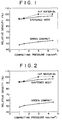
- the compacting pressure is preferably in the range of 294 MPa (3.0 ton/cm 2 ) or more. This is based on the knowledge obtained in examining the relationship between the compacting pressure and the sintered density.
- the usual compacting pressure (98 to 196 MPa) (1 to 2 ton/cm 2 ) is difficult to increase the green density by the effect of SiC whiskers, and a high compacting pressure (294 MPa or more) (3.0 ton/cm 2 or more) is successful to improve the green density.
- the relative density green density/theoretical density of sintered body is 50% or less for the usual compacting pressure; but it becomes 53% or more for the compacting pressure of 294 MPa (3.0 ton/cm 2 ) or more.
- the improvement of the green density means the increase in the contacts between powders and/or between SiC whiskers and powders, which accelerates the densification during sintering, resulting in the improved strength and toughness.
- the compacting pressure is desirable to be 392 MPa (4.0 ton/cm 2 ).
- the compacting pressure is desirable to be 980 MPa (10 ton/cm 2 ) or less.
- the compacting of a mixed powder of the present invention may be performed by die-pressing, cold-isostatic-pressing or the like.
- the pressureless sintered bodies and HIP materials thus obtained were measured for porosity, bending strength and fracture toughness, and further analyzed for the content of nitrogen.
- the porosity was obtained on the basis of the density measured by an Archimedes' method.
- the bending strength was measured by a three-point bending test.
- the fracture toughness was measured by an IF (Indentation Fracture) method in accordance with JIS.
- the content of nitrogen was analyzed by an inert gas melting method. The measured results are shown in Table 2.
- the porosity was generally larger and the bending strength and the fracture toughness were small.
- Pressureless sintered bodies and HIP materials were obtained in the same manner as in Example 1, except that the content of SiC whiskers, kind and content of a sintering auxiliary agent, pressureless-sintering conditions and HIP conditions were changed as shown in Table 3.
- the characteristics of these pressureless sintered bodies and the HIP materials were measured in the same manner as in Example 1. The measured results are shown in Table 4.
- the porosity in the inventive examples was generally small and the bending strength and fracture toughness were high.
- Comparative Example d-4 in which the kind of sintering auxiliary agent is the same as in the inventive example but the content thereof is larger, is low in hardness. Comparative Example d-5, in which the content of the sintering auxiliary agent is smaller than that of the inventive example, is poor in the densification and the mechanical properties.
- the Al 2 O 3 sintered body of Inventive Example No. D-2 in Table 7 of Example 4 has a bending strength of 940.8 MPa (96 kg/mm 2 ) and a fracture toughness is 4.9 MPam 1/2 (see Table 8).
- the particle size of the matrix (Al 2 O 3 ) of this sintered body was 1.2 ⁇ m.
- an Al 2 O 3 sintered body having the same composition as that of Inventive Example D-2 was manufactured in the same manner as in Example 4 except for using an Al 2 O 3 based ceramic raw powder having a particle size larger than that of Inventive Example No. D-2.
- the sintered body thus obtained was measured for the particle size of the matrix and the bending strength and the fracture toughness.
- An Al 2 O 3 sintered body having the same composition as that of Inventive Example No. D-2 was manufactured in the same manner as in Example 4, except that the diameter, average aspect ratio, and content ⁇ c ⁇ of SiC whiskers; raw powder mixing time ⁇ t ⁇ in a ball mill; and a porosity were changed as shown in Table 9.
- the sintered body was measured for bending strength and fracture toughness. As a result, as shown in Table 9, in the Al 2 O 3 sintered body of Inventive Example No.
- the diameter of SiC whiskers is 0.8 ⁇ m; the aspect ratio is 15; the content ⁇ c ⁇ is 15%; the mixing time ⁇ t ⁇ is 20 hr; the porosity is 0.2; the bending strength is 96 kg/mm 2 ; and the fracture toughness is 4.9 MPam 1 ⁇ 2 .
- the diameter of SiC whiskers is less than 0.4 ⁇ m, so that the bending strength is substantially similar to that of Inventive Example No. D-2 but the fracture toughness is lower.
- the diameter of SiC whiskers is larger than 1.5 ⁇ m, so that the bending strength is lower though the fracture toughness is similar to that of Inventive Example No. D-2.
- the mixing time ⁇ t ⁇ is more than 200 hr and therefore the aspect ratio is less than 3, so that the bending strength and the fracture toughness are lower.
- the mixing time ⁇ t ⁇ is less than (2c-20) and therefore the aspect ratio is large, so that the product of the aspect ratio and the content ⁇ c ⁇ of SiC whiskers is more than 400, as a result of which the densification is poor and the porosity is large.
- the mixing time ⁇ t ⁇ is less than 2 hr, so that the structure is not homogeneous, resulting the reduced strength.
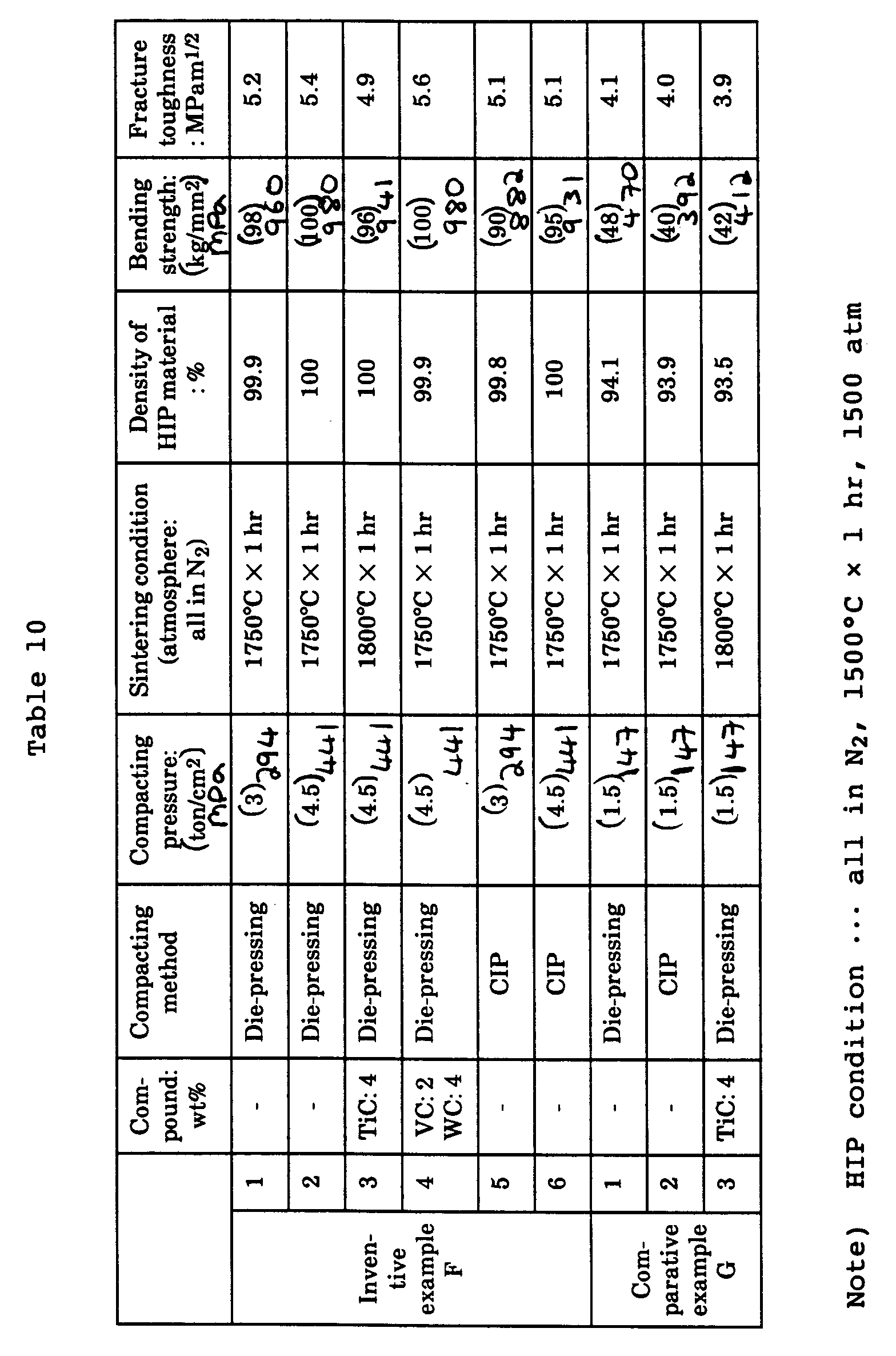
- a mixed powder containing 15 wt% of SiC whiskers, a sintering auxiliary agent composed of 0.1 wt% of MgO, 2 wt% of ZrO 2 and 4 wt% of Y 2 O 3 , and an Al 2 O 3 based ceramic raw powder as a base material, or a compound shown in Table 10 was compacted, and then subjected to pressureless-sintering and HIP under the conditions shown in Table 10.
- the Al 2 O 3 based ceramic material thus obtained was measured for the density, bending strength and fracture toughness. The results are shown in Table 10.
Landscapes
- Chemical & Material Sciences (AREA)
- Engineering & Computer Science (AREA)
- Ceramic Engineering (AREA)
- Manufacturing & Machinery (AREA)
- Materials Engineering (AREA)
- Structural Engineering (AREA)
- Organic Chemistry (AREA)
- Chemical Kinetics & Catalysis (AREA)
- Composite Materials (AREA)
- Compositions Of Oxide Ceramics (AREA)
- Ceramic Products (AREA)
- Cutting Tools, Boring Holders, And Turrets (AREA)
Description
obtainable by a method comprising the steps of:
Accordingly, the content is required to be in the range of from 5 to 30 wt%.
| SiC whisker : wt % | Compound: wt% | Sintering auxiliary agent: wt% | Compacting method | Sintering condition | HIP condition | ||
| Inventive example A | 1 | 10 | - | MgO:2 | Die-pressing | 1750°C × 1 hr, in N2 | 1500°C × 1 hr, 1500 atm, in N2 |
| Y2O3:4 | |||||||
| 2 | 12.5 | - | ZrO2:4 | " | 1800°C × 1 hr, in N2 | " | |
| MgO:8 | |||||||
| 3 | 15 | - | TiO2:4 | " | 1850°C × 1 hr, in N2 | " | |
| ZrO2:6 | |||||||
| 4 | 20 | - | MgO:2 | " | 1750°C × 1 hr, in N2 | " | |
| ZrO2:4 | |||||||
| Y2O3:8 | |||||||
| 5 | 10 | - | SiO2: 5 | " | 1700°C × 1 hr in N2 | -(:No HIP) | |
| Y2O3:3 | |||||||
| Comparative example 〈a〉 | 1 | 15 | - | SiO2:8 | " | 1800°C × 1 hr, in Ar | 1500°C × 1 hr, in N2 |
| Y2O3:4 | |||||||
| 2 | 3 | - | MgO:2 | " | 1750°C × 1 hr, in N2 | " | |
| Y2O3:4 | |||||||
| 3 | 35 | - | MgO:2 | " | 1800°C × 1 hr, in N2 | " | |
| Y2O3:4 | |||||||
| 4 | 15 | - | MgO:12 | " | " | " | |
| Y2O3:24 | |||||||
| 5 | 15 | - | SiO2:0.5 | " | " | " | |
| Y2O3:1.5 |
| Amount of N2:% | Porosity | Bending strength: (kg/mm2) MPa | Fracture toughness: MPam1/2 | ||
| Inventive example A | 1 | 0.6 | 0.2 | (80) 784 | 4.3 |
| 2 | 0.9 | 0.2 | (84) 823 | 4.9 | |
| 3 | 1.2 | 0.3 | (80) 784 | 5.1 | |
| 4 | 1.2 | 0.6 | (80) 784 | 5.5 | |
| 5 | 0.5 | 2.0 | (65) 637 | 4.4 | |
| Comparative example 〈a〉 | 1 | 0.09 | 2.9 | (42) 412 | 3.2 |
| 2 | 0.8 | 0.08 | (71) 696 | 3.1 | |
| 3 | 0.9 | 7.8 | (31) 304 | Measurement; impossible | |
| 4 | 2.1 | 1.2 | (36) 353 | 2.9 | |
| 5 | 0.2 | 10.5 | (25) 245 | Measurement; impossible |
| SiC whisker :wt% | Compound: wt% | Sintering auxiliary agent: wt% | Compacting method | Sintering condition | HIP condition | ||
| Inventive example B | 1 | 10 | - | MgO:2 | Die-pressing | 1750°C × 1 hr, in N2 | 1500°C × 1 hr, 1500 atm, in N2 |
| Y2O3:4 | |||||||
| 2 | 12.5 | - | ZrO2:4 | " | 1800°C × 1 hr, in N2 | " | |
| MgO:8 | |||||||
| 3 | 15 | - | SiO2:8 | Extrusion | " | " | |
| Y2O3:4 | |||||||
| 4 | 12.5 | TiC:4 | " | Die-pressing | " | " | |
| 5 | 15 | - | TiO2:4 | " | 1850°C × 1 hr, in N2 | " | |
| ZrO2:6 | |||||||
| 6 | 20 | - | MgO:2 | " | 1750°C × 1 hr, in N2 | " | |
| ZrO2:4 | |||||||
| Y2O3:8 | |||||||
| 7 | 10 | - | SiO2:5 | " | 1700°C × 1 hr in N2 | -(: No HIP) | |
| Y2O3:3 | |||||||
| 8 | 12.5 | - | SiO2: 8 | Casting | 1800°C × 1 hr in N2 | 1500°C × 1 hr, 1500 atm, in N2 | |
| Y2O3:4 | |||||||
| Comparative example 〈b〉 | 1 | 3 | - | MgO: 2 | Die-pressing | 1750°C × 1 hr, in Ar | 1500°C × 1 hr, in N2 |
| Y2O3:4 | |||||||
| 2 | 35 | - | " | " | 1800°C × 1 hr, in N2 | " | |
| 3 | 15 | - | MgO:12 | " | " | " | |
| Y2O3:24 | |||||||
| 4 | 15 | - | MgO:0.5 | " | " | " | |
| Y2O3:1.5 | |||||||
| 5 | 15 | - | SiO2:8 | " | 1800°C × 1 hr, in Ar | 1500°C × 1 hr, in Ar | |
| Y2O3:4 | |||||||
| 6 | 15 | - | " | " | 1400°C × 1 hr, in N2 | 1500°C × 1 hr, in N2 | |
| 7 | 15 | - | " | " | 2000°C × 1 hr, in N2 | " |
| Amount of N2:% | Porosity | Bending strength: (kg/mm2) MPa | Fracture toughness: MPam1/2 | ||
| Inventive example | 1 | 0.6 | 0.2 | (80) 784 | 4.3 |
| 2 | 0.9 | 0.2 | (84) 823 | 4.9 | |
| 3 | 1.2 | 0.1 | (95) 931 | 5.1 | |
| 4 | 1.3 | 0.1 | (89) 872 | 5.0 | |
| 5 | 1.2 | 0.3 | (80) 784 | 5.0 | |
| 6 | 1.2 | 0.6 | (80) 784 | 5.5 | |
| 7 | 0.5 | 2.0 | (65) 637 | 4.4 | |
| 8 | 0.8 | 0.1 | (83) 813 | 5.2 | |
| Comparative example 〈b〉 | 1 | 0.8 | 0.08 | (71) 696 | 3.1 |
| 2 | 0.9 | 7.8 | (31) 304 | Measurement; impossible | |
| 3 | 2.1 | 1.2 | (36) 353 | 2.9 | |
| 4 | 0.21 | 10.5 | (25) 245 | Measurement; impossible | |
| 5 | 0.09 | 2.9 | (42) 412 | 3.2 | |
| 6 | 2.0 | 15.8 | (22) 216 | Measurement; impossible | |
| 7 | 2.4 | 6.5 | (30) 294 | 3.1 |
| SiC whisker : wt% | Compound: wt% | Sintering auxiliary agent:wt% | Compacting method | Sintering condition | HIP condition | ||
| Inventive example C | 1 | 10 | TiC:4 | SiO2:5 | Die-pressing | 1750°C × 1 hr, in N2 | 1500°C × 1 hr, 1500 atm, in N2 |
| Y2O3:3 | |||||||
| 2 | 15 | TiC:8 | MgO:4 | " | " | " | |
| Y2O3:8 | |||||||
| 3 | 15 | VC:4 | MgO:4 | " | " | " | |
| ZrO2:8 | |||||||
| 4 | 20 | TiC:4 | MgO:4 | " | " | " | |
| Y2O3:8 | |||||||
| 5 | 10 | TiC:4 | SiO2:5 | " | " | -(: No HIP) | |
| Y2O3:3 | |||||||
| Comparative example 〈c〉 | 1 | 15 | TiC:8 | MgO:4 | " | 1750°C × 1 hr, in Ar | 1500°C × 1 hr, 1500 atm, in Ar |
| Y2O3:8 | |||||||
| 2 | 3 | TiC:4 | SiO2:5 | " | 1750°C × 1 hr, in N2 | 1500°C × 1 hr, 1500 atm, in N2 | |
| Y2O3:3 | |||||||
| 3 | 35 | TiC:4 | SiO2:5 | " | " | " | |
| Y2O3:3 | |||||||
| 4 | 10 | TiC:4 | SiO2:0.5 | " | " | " | |
| Y2O3:1.5 | |||||||
| 5 | 10 | TiC:4 | SiO2:12 | " | " | " | |
| Y2O3:24 |
| Amount of N2:% | Porosity | Bending strength: (kg/mm2) MPa | Fracture toughness: MPam1/2 | ||
| Inventive example C | 1 | 1.0 | 0.1 | (92) 902 | 4.1 |
| 2 | 1.2 | 0.2 | (84) 823 | 4.9 | |
| 3 | 1.4 | 0.2 | (82) 804 | 5.0 | |
| 4 | 1.0 | 0.5 | (80) 784 | 5.5 | |
| 5 | 0.5 | 3.5 | (75) 735 | 4.8 | |
| Comparative example 〈c〉 | 1 | 0.08 | 3.4 | (60) 588 | 4.0 |
| 2 | 0.9 | 0.1 | (82) 804 | 3.1 | |
| 3 | 0.9 | 11.1 | (28) 274 | Measurement; impossible | |
| 4 | 1.6 | 8.6 | (30) 294 | Measurement; impossible | |
| 5 | 1.2 | 0.5 | (42) 412 | 2.8 |
| SiC whisker : wt% | Compound: wt % | Sintering auxiliary agent: wt% | Sintering condition | HIP condition | ||
| Inventive example D | 1 | 15 | - | MgO:1, | 1750°C × 1 hr | 1450°C × 1 hr |
| ZrO2: 2, Y2O3:4 | ||||||
| 2 | 15 | TiC:4 | MgO:1, | 1800°C × 1 | " | |
| ZrO2:2, Y2O3:4 | hr | |||||
| 3 | 15 | TiC: 8 | MgO:1.4, | 1820°C × 1 | " | |
| ZrO2:3, Y2O3:6 | hr | |||||
| 4 | 20 | - | MgO:1.8, | 1750°C × 1 hr | " | |
| ZrO2:4, Y2O3:8 | ||||||
| 5 | 15 | VC: 2 | MgO:1, | 1750°C × 1 hr | " | |
| WC:4 | ZrO2:2,Y2O3:4 | |||||
| 6 | 10 | TiN:4 | MgO:1.8, | 1750°C × 1 hr | " | |
| ZrO2:4, Y2O3:8 | ||||||
| 7 | 12.5 | TiB2: 10 | MgO: 1.8, | 1770°C × 1 hr | " | |
| ZrO2:4, Y2O3:8 | ||||||
| Comparative example 〈d〉 | ||||||
| 4 | 15 | - | MgO:5, ZrO2:10, Y2O3:15 | 1750°C × 1 hr | " | |
| 5 | 15 | - | MgO:0.1, ZrO2: 0.1, Y2O3:0.5 | 1800°C X 1 hr | " |
| Amount of N2:% | Porosity: % | Bending strength: (kg/mm2) MPa | Fracture toughness: MPam1/2 | Hardness Hv | ||
| Inventive example D | 1 | 0.4 | 0.0 | (100) 980 | 5.4 | 1820 |
| 2 | 0.8 | 0.2 | (96) 941 | 4.9 | 1900 | |
| 3 | 1.0 | 0.1 | (110) 1078 | 5.4 | 2100 | |
| 4 | 0.7 | 0.3 | (86) 843 | 5.1 | 1880 | |
| 5 | 0.5 | 0.0 | (100) 980 | 5.6 | 2050 | |
| 6 | 1.7 | 0.2 | (88) 862 | 4.8 | 1900 | |
| 7 | 0.6 | 0.3 | (85) 833 | 4.9 | 1950 | |
| Comparative example 〈d〉 | ||||||
| 4 | 1.2 | 0.2 | (70) 686 | 4.6 | 1600 | |
| 5 | 0.3 | 7.2 | (46) 451 | 4.6 | 1520 |
| SiC whisker | Mixing time: Hr | Porosity : % | Bending strength: (kg/mm2) MPa | Fracture toughness: MPam1/2 | ||||
| Diameter: µm | Aspect ratio | Content :wt% | ||||||
| Inventive example D-2 | 0.8 | 15 | 15 | 20 | 0.2 | (96) 941 | 4.9 | |
| Comparative example E | 1 | 0.2 | 15 | 15 | 20 | 0.2 | (83) 813 | 3.0 |
| 2 | 2.0 | 15 | 15 | 20 | 0.2 | (62) 608 | 5.5 | |
| 3 | 0.8 | 2 | 15 | 240 | 0.2 | (68) 666 | 2.7 | |
| 4 | 0.8 | 50 | 15 | 5 | 8.8 | (35) 343 | Measurement; impossible | |
| 5 | 0.8 | 30 | 25 | 20 | 21.1 | (23) 225 | Measurement; impossible | |
| 6 | 0.8 | 60 | 5 | 1 | 0.1 | (43) 421 | 3.2 |
Claims (13)
- An Al2O3 ceramic material comprising an Al2O3 sintered body, said Al2O3 sintered body comprising:5-30 wt% of SiC whiskers,3-14 wt% of a sintering auxiliary agent selected from one or more oxides of Mg, Si, Ca, Ti, Zr, Cr, Ni, Y and rare earth elements, and0.2 wt% or more of nitrogen, obtainable by a method comprising the steps of:compacting a mixed powder comprising: 5-30 wt% of SiC whiskers, and 3-14 wt% of said sintering auxiliary agent, the balance being an Al2O3 ceramic raw powder, andpressureless-sintering the green compact at a temperature between 1500 and 1900°C in a nitrogen containing inert gas atmosphere.
- An Al2O3 ceramic material according to claim 1 which comprises:0.5-10 wt% of at least one carbide, nitride or boride of a transition element selected from groups IVa, Va, and VIa of the periodic table,said 0.2 wt% or more of nitrogen excludes any nitride of said transition element,obtainable by said method wherein said mixed powder additionally comprises 0.5-10 wt% of at least one carbide, nitride or boride of said transition element.
- An Al2O3 ceramic material according to claim 1 or claim 2 wherein said Al2O3 sintered body has a porosity of 1% or less and which isobtainable by said method which further comprises the step of hot-isostatic-pressing said sintered body obtained by the pressureless-sintering at a temperature between 1200 and 1700°C in a nitrogen containing inert gas atmosphere, thereby reducing the porosity of said sintered body to 1% or less.
- An Al2O3 based ceramic material according to any of claims 1 to 3, wherein said sintering auxiliary agent contains 0.2-10 wt% of MgO, 0.2-20 wt% of ZrO2 and 1.0-20 wt% of Y2O3 such that the total content of these oxides is 14 wt% or less.
- An Al2O3 based ceramic material according to any of claims 1 to 4 wherein the particle size of Al2O3 in said Al2O3 sintered body is 5 µm or less.
- An Al2O3 ceramic material according to any of claims 1 to 5 wherein the average aspect ratio of said SiC whiskers is 3 or more, and the diameters of said SiC whiskers are in the range of from 0.4 to 1.5 µm.
- An Al2O3 ceramic material according to any of claims 1 to 6 wherein the product of the average aspect ratio of said SiC whiskers and the content of said SiC whiskers in said Al2O3 sintered body is 400 or less.
- A method of manufacturing Al2O3 ceramic material according to claim 1 comprising the steps of:compacting a mixed powder containing: 5-30 wt% of SiC whiskers, 3-14 wt% of a sintering auxiliary agent selected from one or more oxides of Mg, Si, Ca, Ti, Zr, Cr, Ni, Y and rare earth elements, the balance being an Al2O3 ceramic raw powder, andpressureless-sintering the green compact at a temperature between 1500 and 1900°C in a nitrogen containing inert gas atmosphere.
- A method of manufacturing Al2O3 ceramic material according to claim 2 comprising the steps of:compacting a mixed powder containing: 5-30 wt% of SiC whiskers, 0.5-10 wt% of at least one carbide, nitride or boride of a transition element selected from groups IVa, Va, and VIa of the periodic table, 3-14 wt% of a sintering auxiliary agent selected from one kind or more oxides of Mg, Si, Ca, Ti, Zr, Cr, Ni, Y and rare earth elements, the balance being an Al2O3 ceramic raw powder, and being an Al2O3 ceramic raw powder, andpressureless-sintering the green compact at a temperature between 1500 and 1900°C in a nitrogen containing inert gas atmosphere.
- A method of manufacturing Al2O3 ceramic material according to claim 8 or claim 9, which further comprises the step of hot-isostatic-pressing said sintered body obtained by the pressureless-sintering at a temperature between 1200 and 1700°C in a nitrogen containing inert gas atmosphere, thereby reducing the porosity of said sintered body to 1% or less.
- A method of manufacturing an Al2O3 ceramic material according to any of claims 8 to 10 wherein the mixing to obtain said mixed powder is performed using a ball mill, and the mixing time is set to be in a range to satisfy the equation t≥2c-20 where c≥5 and c≤30 and t≥2 and t≤200, wherein 〈c〉 is the content (wt%) of SiC whiskers in said mixed powder, and 〈t〉 is the mixing time (hr).
- A method of manufacturing an Al2O3 ceramic material according to any of claims 8 to 11 wherein the mixing to obtain said mixed powder is performed by a wet mixing method, and the drying of said mixed powder after mixing and before compacting is performed by a spray-drying method.
- A method of manufacturing an Al2O3 ceramic material according to any of claims 8 to 12 wherein the compacting pressure for said mixed powder is in the range of from 294 MPa(3.0 ton/cm2) or more.
Applications Claiming Priority (4)
| Application Number | Priority Date | Filing Date | Title |
|---|---|---|---|
| JP32265493 | 1993-12-21 | ||
| JP322654/93 | 1993-12-21 | ||
| JP106630/94 | 1994-05-20 | ||
| JP6106630A JPH07232959A (en) | 1993-12-21 | 1994-05-20 | Alumina-based ceramics and its production |
Publications (2)
| Publication Number | Publication Date |
|---|---|
| EP0659708A1 EP0659708A1 (en) | 1995-06-28 |
| EP0659708B1 true EP0659708B1 (en) | 1999-05-19 |
Family
ID=26446747
Family Applications (1)
| Application Number | Title | Priority Date | Filing Date |
|---|---|---|---|
| EP94309536A Expired - Lifetime EP0659708B1 (en) | 1993-12-21 | 1994-12-20 | Alumina based ceramic material and method of manufacturing the same |
Country Status (4)
| Country | Link |
|---|---|
| US (1) | US5538926A (en) |
| EP (1) | EP0659708B1 (en) |
| JP (1) | JPH07232959A (en) |
| DE (1) | DE69418578T2 (en) |
Families Citing this family (17)
| Publication number | Priority date | Publication date | Assignee | Title |
|---|---|---|---|---|
| US5656217A (en) * | 1994-09-13 | 1997-08-12 | Advanced Composite Materials Corporation | Pressureless sintering of whisker reinforced alumina composites |
| BR9611449A (en) * | 1995-11-13 | 1999-03-30 | Kennametal Inc | Ceramic cutting tool and composition produced by consolidating a mixture of starting components |
| US6037288A (en) * | 1997-04-30 | 2000-03-14 | Robinson; Sara M. | Reinforcement of ceramic bodies with wollastonite |
| US6610113B1 (en) * | 1999-09-09 | 2003-08-26 | Kennametal Pc Inc. | Process for heat treating ceramics and articles of manufacture made thereby |
| US6204213B1 (en) | 1999-09-18 | 2001-03-20 | Kennametal Pc Inc. | Whisker reinforced ceramic cutting tool and composition thereof |
| US6417126B1 (en) | 2000-02-24 | 2002-07-09 | C-Max Technology, Inc. | Ceramics and process for producing |
| US6905992B2 (en) * | 2002-07-30 | 2005-06-14 | Kennametal Inc. | Ceramic body reinforced with coarse silicon carbide whiskers and method for making the same |
| US7262145B2 (en) * | 2004-04-23 | 2007-08-28 | Kennametal Inc. | Whisker-reinforced ceramic containing aluminum oxynitride and method of making the same |
| US20050239629A1 (en) * | 2004-04-23 | 2005-10-27 | Yeckley Russell L | Whisker-reinforced ceramic containing aluminum oxynitride and method of making the same |
| WO2006086226A2 (en) * | 2005-02-05 | 2006-08-17 | Saint-Gobain Ceramics & Plastics, Inc. | Ceramic igniters |
| WO2009085319A1 (en) * | 2007-12-29 | 2009-07-09 | Saint-Gobain Cermics & Plastics, Inc. | Coaxial ceramic igniter and methods of fabrication |
| WO2013106609A2 (en) * | 2012-01-11 | 2013-07-18 | Saint-Gobain Ceramics & Plastics, Inc. | Refractory object and process of forming a glass sheet using the refractory object |
| CN115806439A (en) | 2015-02-24 | 2023-03-17 | 圣戈本陶瓷及塑料股份有限公司 | Refractory article and method of making |
| WO2016204113A1 (en) * | 2015-06-17 | 2016-12-22 | 国立研究開発法人物質・材料研究機構 | Oxidation-induced self-healing ceramic composition containing healing activator, method for producing same, use of same, and method for enhancing functionality of oxidation-induced self-healing ceramic composition |
| CN106116532B (en) * | 2016-06-22 | 2018-06-22 | 江西鑫陶科技股份有限公司 | A kind of preparation method of antiwear alumina ceramic ball |
| RU2748537C1 (en) * | 2020-09-23 | 2021-05-26 | федеральное государственное бюджетное образовательное учреждение высшего образования «Донской государственный технический университет» (ДГТУ) | Method for producing oxide-silicon carbide cutting ceramics of new fraction |
| CN117105638A (en) * | 2023-06-16 | 2023-11-24 | 景德镇陶瓷大学 | A kind of high bending strength alumina ceramic and its preparation method |
Family Cites Families (13)
| Publication number | Priority date | Publication date | Assignee | Title |
|---|---|---|---|---|
| US4507224A (en) * | 1982-12-03 | 1985-03-26 | Agency Of Industrial Science & Technology | Ceramics containing fibers of silicon carbide |
| US4543345A (en) * | 1984-02-09 | 1985-09-24 | The United States Of America As Represented By The Department Of Energy | Silicon carbide whisker reinforced ceramic composites and method for making same |
| AU5868386A (en) * | 1985-03-14 | 1986-10-13 | Atlantic Richfield Company | High density reinforced ceramic bodies and method of making same |
| US4652413A (en) * | 1985-10-16 | 1987-03-24 | The United States Of America As Represented By The United States Department Of Energy | Method for preparing configured silicon carbide whisker-reinforced alumina ceramic articles |
| SE8701172D0 (en) * | 1987-03-20 | 1987-03-20 | Sandvik Ab | WHISKER REINFORCED CERAMIC CUTTING TOOL |
| US4956315A (en) * | 1987-09-02 | 1990-09-11 | Kennametal Inc. | Whisker reinforced ceramics and a method of clad/hot isostatic pressing same |
| JP2507479B2 (en) * | 1987-09-30 | 1996-06-12 | 晧一 新原 | SiC-Al Lower 2 O Lower 3 Composite Sintered Body and Manufacturing Method Thereof |
| JPH01103267A (en) * | 1987-10-15 | 1989-04-20 | Toshiba Ceramics Co Ltd | Grinding ceramic tool |
| US5207958A (en) * | 1989-04-09 | 1993-05-04 | Martin Marietta Energy Systems, Inc. | Pressureless sintering of whisker-toughened ceramic composites |
| US5009822A (en) * | 1989-07-17 | 1991-04-23 | University Of Florida | Alumina-or alumina/zirconia-silicon carbide whisker ceramic composites and methods of manufacture |
| CA2025425C (en) * | 1989-09-18 | 1996-01-23 | Yutaka Furuse | Sintered ceramic composite body and method of manufacturing same |
| DE59005557D1 (en) * | 1989-12-15 | 1994-06-01 | Krupp Widia Gmbh | FIBER REINFORCED CERAMIC COMPOSITE BODY, METHOD FOR PRODUCING A CERAMIC COMPOSITE BODY AND THE USE THEREOF. |
| WO1993011086A1 (en) * | 1991-12-03 | 1993-06-10 | Advanced Composite Materials Corporation | Pressureless sintering of whisker reinforced alumina composites |
-
1994
- 1994-05-20 JP JP6106630A patent/JPH07232959A/en not_active Withdrawn
- 1994-12-20 US US08/360,086 patent/US5538926A/en not_active Expired - Fee Related
- 1994-12-20 DE DE69418578T patent/DE69418578T2/en not_active Expired - Fee Related
- 1994-12-20 EP EP94309536A patent/EP0659708B1/en not_active Expired - Lifetime
Non-Patent Citations (1)
| Title |
|---|
| ROBERT C. WEAST: "CRC Handbook of Chemistry and Physics" , , CRC PRESS, INC; 69TH EDITION, 1988-1989 * |
Also Published As
| Publication number | Publication date |
|---|---|
| US5538926A (en) | 1996-07-23 |
| DE69418578T2 (en) | 1999-11-18 |
| JPH07232959A (en) | 1995-09-05 |
| EP0659708A1 (en) | 1995-06-28 |
| DE69418578D1 (en) | 1999-06-24 |
Similar Documents
| Publication | Publication Date | Title |
|---|---|---|
| US5538926A (en) | Alumina based ceramic material and method of manufacturing the same | |
| CA1272581A (en) | Nitriding silicon powder articles using high temperature and pressure dwells | |
| US5182059A (en) | Process for producing high density SiC sintered bodies | |
| EP0626359B1 (en) | Aluminum nitride sintered body and method for manufacturing the same | |
| JPH0733530A (en) | Ceramic-based composite material and manufacturing method thereof | |
| Akimune et al. | Influence of starting powder characteristics on mechanical properties of SiC-particle/Si3N4 composites | |
| EP0676380B1 (en) | Composite powders of silicon nitride and silicon carbide | |
| JP2507480B2 (en) | SiC-Al Lower 2 O Lower 3 Composite Sintered Body and Manufacturing Method Thereof | |
| JP2000256066A (en) | Silicon nitride based sintered body, method for producing the same, and wear-resistant member using the same | |
| JP3145470B2 (en) | Tungsten carbide-alumina sintered body and method for producing the same | |
| JPH0753256A (en) | Aluminous composite sintered compact and its production | |
| US5179050A (en) | Sic-based pressureless sintered product | |
| JP3694583B2 (en) | Crusher parts | |
| JPH09227236A (en) | Silicon nitride sintered body and method for producing the same | |
| JPH06321620A (en) | High toughness ceramic material | |
| JP3116242B2 (en) | Method for producing silicon nitride based sintered body | |
| JP2000143351A (en) | High toughness silicon nitride sintered body | |
| JP2597774B2 (en) | Silicon nitride based sintered body and method for producing the same | |
| JP3580660B2 (en) | Crusher components | |
| JP3045370B2 (en) | High-strength and high-toughness ceramic composite material, ceramic composite powder, and method for producing them | |
| EP0383431B1 (en) | Process for producing high density silicon carbide sintered bodies | |
| JPH07101777A (en) | Silicon nitride sintered body and method for producing the same | |
| JP3143992B2 (en) | Silicon nitride based sintered body | |
| EP0317147B1 (en) | Si3n4-al2o3 composite sintered bodies and method of producing the same | |
| JP2000034174A (en) | Manufacturing method of ceramic composite material |
Legal Events
| Date | Code | Title | Description |
|---|---|---|---|
| PUAI | Public reference made under article 153(3) epc to a published international application that has entered the european phase |
Free format text: ORIGINAL CODE: 0009012 |
|
| 17P | Request for examination filed |
Effective date: 19950113 |
|
| AK | Designated contracting states |
Kind code of ref document: A1 Designated state(s): DE FR GB |
|
| 17Q | First examination report despatched |
Effective date: 19961218 |
|
| GRAG | Despatch of communication of intention to grant |
Free format text: ORIGINAL CODE: EPIDOS AGRA |
|
| GRAG | Despatch of communication of intention to grant |
Free format text: ORIGINAL CODE: EPIDOS AGRA |
|
| GRAH | Despatch of communication of intention to grant a patent |
Free format text: ORIGINAL CODE: EPIDOS IGRA |
|
| GRAH | Despatch of communication of intention to grant a patent |
Free format text: ORIGINAL CODE: EPIDOS IGRA |
|
| GRAA | (expected) grant |
Free format text: ORIGINAL CODE: 0009210 |
|
| AK | Designated contracting states |
Kind code of ref document: B1 Designated state(s): DE FR GB |
|
| ET | Fr: translation filed | ||
| REF | Corresponds to: |
Ref document number: 69418578 Country of ref document: DE Date of ref document: 19990624 |
|
| PLBE | No opposition filed within time limit |
Free format text: ORIGINAL CODE: 0009261 |
|
| STAA | Information on the status of an ep patent application or granted ep patent |
Free format text: STATUS: NO OPPOSITION FILED WITHIN TIME LIMIT |
|
| 26N | No opposition filed | ||
| REG | Reference to a national code |
Ref country code: GB Ref legal event code: IF02 |
|
| PGFP | Annual fee paid to national office [announced via postgrant information from national office to epo] |
Ref country code: FR Payment date: 20031210 Year of fee payment: 10 |
|
| PGFP | Annual fee paid to national office [announced via postgrant information from national office to epo] |
Ref country code: GB Payment date: 20031217 Year of fee payment: 10 |
|
| PGFP | Annual fee paid to national office [announced via postgrant information from national office to epo] |
Ref country code: DE Payment date: 20040102 Year of fee payment: 10 |
|
| PG25 | Lapsed in a contracting state [announced via postgrant information from national office to epo] |
Ref country code: GB Free format text: LAPSE BECAUSE OF NON-PAYMENT OF DUE FEES Effective date: 20041220 |
|
| PG25 | Lapsed in a contracting state [announced via postgrant information from national office to epo] |
Ref country code: DE Free format text: LAPSE BECAUSE OF NON-PAYMENT OF DUE FEES Effective date: 20050701 |
|
| GBPC | Gb: european patent ceased through non-payment of renewal fee |
Effective date: 20041220 |
|
| PG25 | Lapsed in a contracting state [announced via postgrant information from national office to epo] |
Ref country code: FR Free format text: LAPSE BECAUSE OF NON-PAYMENT OF DUE FEES Effective date: 20050831 |
|
| REG | Reference to a national code |
Ref country code: FR Ref legal event code: ST |