EP0650520B1 - Verfahren zur herstellung von saccharose-synthase - Google Patents
Verfahren zur herstellung von saccharose-synthase Download PDFInfo
- Publication number
- EP0650520B1 EP0650520B1 EP93912629A EP93912629A EP0650520B1 EP 0650520 B1 EP0650520 B1 EP 0650520B1 EP 93912629 A EP93912629 A EP 93912629A EP 93912629 A EP93912629 A EP 93912629A EP 0650520 B1 EP0650520 B1 EP 0650520B1
- Authority
- EP
- European Patent Office
- Prior art keywords
- udp
- sugar
- glucose
- synthase
- saccharose
- Prior art date
- Legal status (The legal status is an assumption and is not a legal conclusion. Google has not performed a legal analysis and makes no representation as to the accuracy of the status listed.)
- Expired - Lifetime
Links
Images




Classifications
-
- C—CHEMISTRY; METALLURGY
- C07—ORGANIC CHEMISTRY
- C07H—SUGARS; DERIVATIVES THEREOF; NUCLEOSIDES; NUCLEOTIDES; NUCLEIC ACIDS
- C07H19/00—Compounds containing a hetero ring sharing one ring hetero atom with a saccharide radical; Nucleosides; Mononucleotides; Anhydro-derivatives thereof
- C07H19/02—Compounds containing a hetero ring sharing one ring hetero atom with a saccharide radical; Nucleosides; Mononucleotides; Anhydro-derivatives thereof sharing nitrogen
- C07H19/04—Heterocyclic radicals containing only nitrogen atoms as ring hetero atom
- C07H19/06—Pyrimidine radicals
- C07H19/10—Pyrimidine radicals with the saccharide radical esterified by phosphoric or polyphosphoric acids
-
- C—CHEMISTRY; METALLURGY
- C07—ORGANIC CHEMISTRY
- C07H—SUGARS; DERIVATIVES THEREOF; NUCLEOSIDES; NUCLEOTIDES; NUCLEIC ACIDS
- C07H19/00—Compounds containing a hetero ring sharing one ring hetero atom with a saccharide radical; Nucleosides; Mononucleotides; Anhydro-derivatives thereof
- C07H19/02—Compounds containing a hetero ring sharing one ring hetero atom with a saccharide radical; Nucleosides; Mononucleotides; Anhydro-derivatives thereof sharing nitrogen
- C07H19/04—Heterocyclic radicals containing only nitrogen atoms as ring hetero atom
- C07H19/16—Purine radicals
- C07H19/20—Purine radicals with the saccharide radical esterified by phosphoric or polyphosphoric acids
-
- C—CHEMISTRY; METALLURGY
- C12—BIOCHEMISTRY; BEER; SPIRITS; WINE; VINEGAR; MICROBIOLOGY; ENZYMOLOGY; MUTATION OR GENETIC ENGINEERING
- C12N—MICROORGANISMS OR ENZYMES; COMPOSITIONS THEREOF; PROPAGATING, PRESERVING, OR MAINTAINING MICROORGANISMS; MUTATION OR GENETIC ENGINEERING; CULTURE MEDIA
- C12N9/00—Enzymes; Proenzymes; Compositions thereof; Processes for preparing, activating, inhibiting, separating or purifying enzymes
- C12N9/10—Transferases (2.)
- C12N9/1048—Glycosyltransferases (2.4)
- C12N9/1051—Hexosyltransferases (2.4.1)
- C12N9/1062—Sucrose synthase (2.4.1.13)
-
- C—CHEMISTRY; METALLURGY
- C12—BIOCHEMISTRY; BEER; SPIRITS; WINE; VINEGAR; MICROBIOLOGY; ENZYMOLOGY; MUTATION OR GENETIC ENGINEERING
- C12P—FERMENTATION OR ENZYME-USING PROCESSES TO SYNTHESISE A DESIRED CHEMICAL COMPOUND OR COMPOSITION OR TO SEPARATE OPTICAL ISOMERS FROM A RACEMIC MIXTURE
- C12P19/00—Preparation of compounds containing saccharide radicals
- C12P19/26—Preparation of nitrogen-containing carbohydrates
- C12P19/28—N-glycosides
- C12P19/30—Nucleotides
-
- C—CHEMISTRY; METALLURGY
- C12—BIOCHEMISTRY; BEER; SPIRITS; WINE; VINEGAR; MICROBIOLOGY; ENZYMOLOGY; MUTATION OR GENETIC ENGINEERING
- C12P—FERMENTATION OR ENZYME-USING PROCESSES TO SYNTHESISE A DESIRED CHEMICAL COMPOUND OR COMPOSITION OR TO SEPARATE OPTICAL ISOMERS FROM A RACEMIC MIXTURE
- C12P19/00—Preparation of compounds containing saccharide radicals
- C12P19/26—Preparation of nitrogen-containing carbohydrates
- C12P19/28—N-glycosides
- C12P19/38—Nucleosides
Definitions
- Sucrose synthase (Glycosyltransferase EC 2.4.1.13 UDPG: D-fructose-2-glucosyltransferase) is a long-known enzyme, especially in plants (e.g. wheat, rice, corn, sugar beet, etc.) (see e.g. Y. Milner inter alia in "Nature” 206 (1965), p. 825), whose function as a catalyst for the formation of activated sugar within the metabolism of the plant has already been extensively investigated and summarized (Avigad, G. in: Loewus, FA et al. ( eds.) Encyclopedia of Plant Physiology New Series Vol.
- N stands for nucleosides such as uridine, thymidine, cytidine, guanine and adenine.
- sucrose synthase and purification process is manufacturing activated So far, sugar according to equation (1) above economically not been used, although the sucrose synthase in Trade is available and activated sugar as well as above Di- and oligosaccharides available in sugar chemistry are considerable To have meaning.
- Mono-, oligo- and polysaccharides have a variety of functions as antigenic determinants, in cell-cell recognition, in cell differentiation and as binding sites for toxins, Bacteria and viruses.
- sucrose synthase isolates especially the commercially available enzyme
- sucrose synthase isolates generally more or less high levels of nucleotide phosphatases contain and that their presence - even in only minor Amount - the synthesis of NDP-glucose and homologous compounds so disturbed that the convincing suitability for synthesis could not be recognized by sucrose synthase.
- sucrose synthase has now been developed which is sufficiently stable and a smooth single step Synthesis reaction according to (1) enables.
- the object of the invention is a Process for the production of Sucrose synthase, thereby marked that one Containing sucrose synthase Raw extract of a sequence of cleaning steps submits the Application of an ultrafiltered 50 mM KCL extract of pH8 on a Sepharose Q column and a gradient elution from the Column at pH8 with 50-500 mM KCL includes.
- the HPLC chromatogram of the purified sucrose synthase contains nucleotide phosphatases no longer detectable ( ⁇ 0.1%).
- sucrose synthase Rice serve as a source of sucrose synthase Rice, corn or wheat grains that are swollen and mechanical be unlocked.
- the resulting aqueous crude extract is either a PEG precipitation (A) or a distribution in subjected to aqueous 2-phase system (B).
- PEG polyethylene glycol
- B aqueous 2-phase system
- At (A) one fractional precipitation can be provided by first (A1) with relatively low molecular weight PEG (polyethylene glycol; M ⁇ 1000) and lower PEG concentrations for the accompanying precipitation Proteins is taken care of (e.g.
- A2 precipitated with increased PEG concentration and from the precipitate with 200 mM Hepes buffer (pH 7.2) is released again.
- the precipitation (A2) is not essential required and can simplify the process and increase yield can be omitted as shown below becomes.
- the molecular weight of the PEG in the case of the PEG precipitations can be determined using corresponding change in the PEG percentage can be varied.
- sucrose synthase or the Supernatant or the enzyme-containing phase of the extraction expediently after adsorption on Sephadex A50 and Step elution at pH 7.2 (adjusted with Hepes-NaOH) with 100 mM KCl and 300 mM KCl and re-buffers as well as ultrafiltration loaded onto a Sepharose Q column and linear gradient elution with 50 - 500 mM KCl at pH 8 (200 mM Hepes-NaOH) subjected and chromatographed on a gel filtration column.
- the treatment step on the is particularly important Sepharose Q column with gradient elution as indicated. On in this way one obtains purified sucrose synthase, the Nucleotide phosphatase content ⁇ 0.1%, i.e. in the phosphatase test the enzyme preparation is no longer detectable.
- the sucrose synthase purified according to the invention can be especially for the enzymatic synthesis of activated glucose and activated glucose derivatives by cleaving a di-, Tri, oligosaccharides or their derivatives with nucleoside diphosphates use.
- Resulting products e.g. UDP-glucose, TDP-glucose and CDP-glucose are important starting substrates for the enzymatic and / or chemical representation of activated deoxy sugars and their descendants.
- nucleoside diphosphates e.g. UDP or TDP.
- sucrose synthase is used for the cyclical regeneration of eg UDP-glucose.
- a disaccharide derivative such as N-acetyllactosamine (LacNAc)
- 3 enzymes there are economic advantages by reducing the number of enzymes.
- sucrose synthase purified according to the invention is also useful for the synthesis of glucosides and their derivatives.
- UDP glucose or activated glucose derivatives transferred to acceptor molecules with at least one hydroxyl group.
- sugar molecules as acceptors are in the isomers of D-fructose, e.g. D-Psicose, D-Tagatose and L-sorbose and their descendants, e.g. 5,6-dideoxy-5-keto-D-fructose and 6-deoxy-L-sorbose.
- sugar molecules as acceptors for aldoses are L-arabinose, D-lyxose, D-mannose and their descendants, e.g. 1,6-anhydroglucose.
- Di-, tri- and oligosaccharides are also acceptor molecules, e.g. Lactulose, isomaltulose and raffinose.
- Other hydroxyl groups Acceptor molecules that do not belong to the substance class the sugars are especially heterocyclic Compounds with at least one hydroxyl group on the heterocyclic Ring and / or in an attached side chain, e.g. 1-ethyl-3-hydroxy-pyrollidine or N- (2-hydroxyethyl) piperidine.
- the Step elution starts with 300 ml Hepes-NaOH pH 7.2 and 300 ml Hepes-NaOH pH 7.2 with 100 mM KCl.
- the enzyme comes with two Volumes (100 ml) of Hepes-NaOH pH 7.2 eluted with 300 mM KCl. After buffering and ultrafiltration, this fraction is on a Sepharose Q column (Hepes-NaOH pH 8.0 with 50 mM KCl) loaded and with a linear gradient (50 mM - 500 mM KCl in Hepes-NaOH 200 mM pH 8.0). The enzyme fractions collected are finally in a gel filtration column (Superdex 200 prep grade) chromatographed.
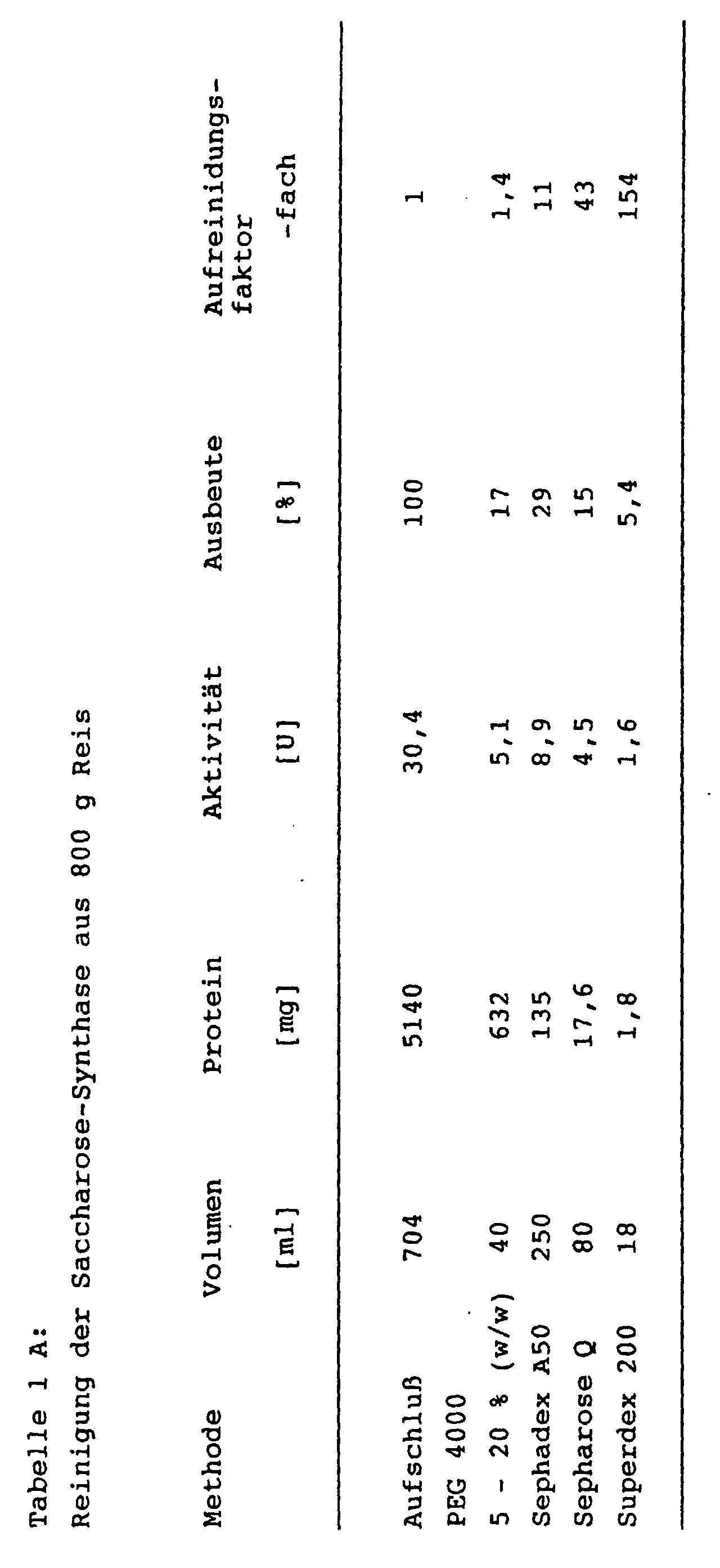
- Sucrose synthase from rice was 151 times in one yield enriched by 5.4% (Table 1 A).
- a big loss arises when precipitated with polyethylene glycol 4000 (approx. 80% loss with the 5 - 20% precipitation).
- an enzyme enrichment from the crude extract using an aqueous 2-phase system can be provided.
- PEG / salt an enzyme enrichment from the crude extract using an aqueous 2-phase system.
- the molecular weight of the native enzyme is 362000 ⁇ 7000 Da, it consists of 4 subunits of 90000 Da each and has no inter- or intramolecular disulfide bridges.
- the N-terminal Amino acid sequencing through automated Edman degradation in a pulsed liquid protein sequencer showed that the N-terminus of the subunit is blocked.
- the isoelectric The point of the native enzyme is pH 6.16.
- the cleaning of the sucrose synthase was optimized with regard to the amount of rice used and the number of cleaning steps.
- Table 1B shows that the yield was increased to 21% with only slightly lower purity.
- the cleaning process comprises only four steps instead of six, with precipitation at 20% PEG 4000 and batch adsorption on Sephadex A50 being eliminated.
- the purified enzyme is also free from nucleotide mono- and diphosphatases after this cleaning.
- sucrose synthase The following are examples of how it works and how it is used of sucrose synthase:
- Figure 2 shows that the nucleoside diphosphates in the order UDP, TDP, ADP, CDP and GDP are accepted.
- the cleaned Enzyme was free from nucleotide phosphatases (NPases, control without sucrose), the nucleoside diphosphates to the monophosphates or dismantle bases.
- NPases nucleotide phosphatases
- the occurring peaks for UMP, TMP, uridine and thymidine suitable control tests for contamination in the substrate and on the decomposition of the nucleoside diphosphates by the heat treatment to be led back.
- After heat treatment of 1.57 mM UDP originated 0.123 mM UMP; of which were 0.082 mM (5%) as Contamination already present in the UDP substrate.
- Table 2 summarizes the conversion rates for the synthesis of UDP and TDP glucose.
- the space-time yield is only slightly increased at higher substrate concentrations.
- 1.8 mU sucrose synthase a 99% conversion based on the UDP concentration used (1.57 mM) is achieved after 3 h. This corresponds to a space-time yield of 0.21 g / l * h.
- the space-time yield is 0.4 g / l * h.
- the space-time yield for the synthesis of TDP-glucose is for 0.16 mU enzyme used 0.011 g / l * h; corresponding a 49% conversion after 30 h for 0.16 mU enzyme.
- Another one Experiment shows that the conversion of 8.2 mM TDP with 0.2 mU Enzyme can be increased to 80% after 24 h.
- sucrose synthase was used from wheat (specific activity 8.15 mU / mg) tested.
- This enzyme shows similar space-time yields as the purified enzyme from rice.
- the HPLC show chromatograms the simultaneous formation of relatively large amounts of UMP and uridine by nucleotide phosphatases (Table 2). This There are no enzyme impurities in the purified enzyme from rice more available. The occurring UMP and uridine peaks in the chromatogram are solely due to the heating of the samples.
- the Hepes-NaOH buffer used so far for the synthesis of UDP and TDP glucose is the most suitable.
- the pug and TES buffers make up 60 - 80% Residual activity.
- the commercial enzyme shows in contrast to Travel enzyme in the TEA buffer has a 30 - 40% higher residual activity. Both enzymes have residual activity in the remaining buffers less than 50%.
- both enzymes have the use of Citrate or phosphate buffer a pH optimum between pH 5.5 and 5.7.
- the purified sucrose synthase from rice shows at pH 7.0 and 7.9 after 2 days a residual activity of> 60%, which exploit for the synthesis of UDP and TDP glucose.
- the temperature optimum is for the splitting of sucrose with UDP the sucrose synthase from rice at pH 6.5 between 50 ° and 60 ° C.
- the enzyme has its full activity after 5 h at 37 ° C, after 5 hours at 56 ° C there is a residual activity of 37%.
- Figure 13 shows that in the presence of 1 mM metal ions, such as Mn 2+ and Mg 2+, the activity of sucrose synthase is only slightly influenced.
- the enzyme activity is stimulated by Mn 2+ and Ca 2+ with TDP as substrate.
- the enzyme is completely inactivated.
- reaction batches were with UDP at pH 7.0 or with TDP pH 6.8 incubated at 30 ° C and stopped at different times (5 min at 95 ° C). After filtering the sample through a The resulting nucleotide sugar was filtered using a 0.22 ⁇ m filter Ion pair HPLC analyzed.
- Figures 3 and 4 show that after 24 h 92% of the UDP to UDP-glucose and 84% of the TDP were converted to TDP glucose.
- FIG. 14 shows the conversion from TDP to TDP-glucose and the concentrations of TDP, TDP-glucose and Fructose at 5mM TDP, 350mM sucrose, 40 minute residence time and 990 mU sucrose synthase.
- the turnover is 89.6% based on the TDP used.
- the theoretical space-time yield for one liter of reactor volume gives 98.1 g of TDP glucose per liter and day.
- sucrose was exchanged for other di- or trisaccharides:
- the concentration of the saccharides was 75 to 500 mM in the reaction mixture. There were 2 mM UDP or TDP and usually 10-80 mU enzyme used. After 3 h at 30 ° C and pH 7.2 (200 mM Hepes-NaOH) the reaction was at 95 ° C for 5 min. stopped. The Formation of nucleotide sugars was followed by HPLC and by compared to a control (without enzyme).
- Table 3 shows that the disaccharide isomaltulose (palatinose) and the trisaccharides raffinose and melezitose instead of the Sucrose can be implemented.
- nucleotide sugars were varied for the synthesis reaction:
- UDP-activated sugars were used: UDP-galactose, UDP-N-acetylglucosamine, UDP-glucuronic acid, UDP-N-acetylgalactosamine.
- UDP-N-acetylglucosamine and UDP-xylose can also be converted by the travel enzyme (Table 4). Verification of substrate cleavage with purified sucrose synthase from rice and UDP for the synthesis of activated sugars.
- the acceptor was varied for the synthesis reaction.
- other diastereomers of D-fructose such as D-psicose, D-tagatose, D-sorbose, were used.
- ketoses were systematically tested.
- non-sugar acceptors were also examined. Table 5 shows that the diastereomers of D-fructose examined are all accepted except for D-sorbose.
- L-sorbose, D-xylulose and the deoxyketoses listed are also acceptors of sucrose synthase. D-mannose, D-lyxose and L-arabinose are accepted from the aldoses.
- Derivatives of glucose can also act as acceptors, for example 1.6 anhydro- ⁇ -D-glucose or octyl- ⁇ -D-glucopyranoside.
- Di- and trisaccharides e.g. lactulose or raffinose
- Derivatives of pyrrolidine of the non-sugar acceptors can be used in the synthesis reaction of sucrose synthase.
- acceptor substrates were implemented with UDP-glucose.
- D-fructose 100 Sedoheptulose anhydride 1.1 mannoheptulose - D-psicose 14.1 D-tagatose 28.3 D-sorbose - L-sorbose 6.0 D-ribulose - D-xylulose 40.7 L-xylulose - D-erythrulose - 5-keto-6-deoxy-D-fructose 25.1 5,6-dideoxy-5-methyl-D-fructose 19.0 5,6-dideoxy-D-fructose 7.6 6-deoxy-L-sorbose 8.8 D-glucoheptose - ⁇ -D-Allose - ⁇ -L-allose - D-Altrose - D-glucose - L-glucose - D-mannose 3.9 L-mannose - L-gulose - D-Idose - L-Idose - D-
- UDP-galactose can also be produced enzymatically by the required enzymes are incubated simultaneously in the batch.
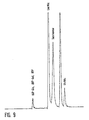
- Figure 9 shows that N-acetyllactosamine using three Enzymes ( Figure 6) is formed.
- the turnover is 80% based on the concentration of N-acetylglucosamine used.
- rice grains were made Isolated sucrose synthase is used, however, can also be made from Wheat or the like in compliance with the regulations of the invention one for the one-step formation of activated monosaccharides useful sucrose synthase can be obtained.
Landscapes
- Chemical & Material Sciences (AREA)
- Organic Chemistry (AREA)
- Life Sciences & Earth Sciences (AREA)
- Health & Medical Sciences (AREA)
- Engineering & Computer Science (AREA)
- Genetics & Genomics (AREA)
- Zoology (AREA)
- Wood Science & Technology (AREA)
- Biotechnology (AREA)
- General Health & Medical Sciences (AREA)
- Molecular Biology (AREA)
- Biochemistry (AREA)
- Bioinformatics & Cheminformatics (AREA)
- General Engineering & Computer Science (AREA)
- Microbiology (AREA)
- Chemical Kinetics & Catalysis (AREA)
- General Chemical & Material Sciences (AREA)
- Medicinal Chemistry (AREA)
- Biomedical Technology (AREA)
- Preparation Of Compounds By Using Micro-Organisms (AREA)
- Saccharide Compounds (AREA)
- Enzymes And Modification Thereof (AREA)
- Measuring Or Testing Involving Enzymes Or Micro-Organisms (AREA)
Abstract
Description

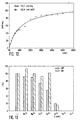
- Fig. 1:
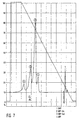
- das Chromatogramm der Sepharose-Q-Trennung;
- Fig. 2:
- die NDP-Glucose-Bildung mit unterschiedlichen Nucleotiden;
- Fig. 3 u. 4:
- Die Bildung von TDP- und UDP-Glucose mit Saccharose-Synthase;
- Fig. 5 u. 6:
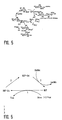
- Reaktionsschemata für die enzymatische Synthese von N-Acetyllactosamin (nach Wong; Fig. 5 bzw. erfindungsgemäß; Fig. 6);
- Fig. 7 u. 8:
- Nucleotid-Chromatogramme der Produktmischung (Schritt 1 u. 2 gemäß Fig. 6) nach Hitzeinaktivierung des Enzyms;
- Fig. 9:
- das HPLC-Chromatogramm der Produktmischung (vollständiger Zyklus gemäß Fig. 6);
- Fig. 10 - 12:
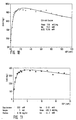
- Kurven zur Kinetik der Synthese-Reaktion (I);
- Fig. 13:
- den Einfluß von Metallionen auf die
Enzymaktivität;
und - Fig. 14:
- ein Diagramm für die Bildung von TDP-Glucose im EMR Enzymmembranreaktor (EMR).


| Mops-NaOH-NaCl | pH 6,25 - 8,15 |
| TES-NaOH-NaCl | pH 6,55 - 8,45 |
| Tris-HCl | pH 7,00 - 9,00 |
| Hepes-NaOH | pH 6,80 - 8,20 |
| KH2PO4-NaOH | pH 5,80 - 8,00 |
| Na2HPO4-NaH2PO4 | pH 5,80 - 8,00 |
| Imidazol-HCl | pH 6,20 - 7,80 |
| TEA-Hydrochlorid - NaOH | pH 6,80 - 8,80 |
| Na-Citrat-Citronensäure | pH 4,0 - 6,2 |
| KH2PO4-NaOH | pH 5,8 - 7,2 |
| Mops-NaOH-NaCl | pH 6,3 - 7,4 |
| Hepes-NaOH | pH 6,8 - 8,2 |
| TEA-Hydrochlorid - NaOH | pH 7,2 - 8,8 |


| Überprüfung der Substratspaltung mit gereinigter Saccharose-Synthase aus Reis und UDP zur Synthese von aktivierten Zuckern. | ||
| Name | Bindung | Relative Aktivität % |
| Saccharose | α Glc 1-2 β Fruc | 100 |
| Saccharose-6'-P | - | |
| 2-Desoxy-Saccharose | 55 | |
| Turanose | α Glc 1-3 β Fruc | - |
| Isomaltulose | α Glc 1-6 β Fruc | 1,0 |
| Lactulose | β Gal 1-4 Fruc | - |
| Trehalose | α Glc 1-1 α Glc | - |
| Maitose | α Glc 1-4 Glc | - |
| Isomaltose | α Glc 1-6 Glc | - |
| Laminaribose | β Glc 1-3 Glc | - |
| Cellobiose | β Glc 1-4 Glc | - |
| β-Gentiobiose | β Glc 1-6 Glc | - |
| Mannobiose | α Man 1-3 Man | - |
| N'N'Diacetylchitobiose | β GlcNAc 1-4-GlcNAc | - |
| β-Lactose | β Gal 1-4 β Glc | - |
| α-Lactose | β Gal 1-4 α Glc | - |
| α-D-Melibiose | α Gal 1-6 Glc | - |
| LacNAc | β Gal 1-4 GlcNAc | - |
| Ampicillin | 2,4 | |
| Chlorogenic acid | - | |
| Thiodigalactosid | - | |
| Thiodiglucosid | - | |
| p-Aminophenyl-β-L-Fucopyranosid | - | |
| 3-0-β-D-Galactopyranosyl-D-Arabinose | - | |
| Octyl-β-D-Glucopyranosid | - | |
| p-Aminophenyl-β-D-galactopyranosid | - | |
| Raffinose | α Gal 1-6 α Glc 1-2 β Fruc | 3,8 |
| Melizitose | α Glc 1-3 β Fruc 2-1 α Glc | 0.4 |
| Substratspektrum der gereinigten Saccharose-Synthase aus Reis. Es wurden verschiedene UDP-Zucker mit Fructose als Akzeptor eingesetzt. | |
| Name | Relative Aktivität % |
| UDP-Glucose | 100 |
| UDP-Galactose | - |
| UDP-N-Acetylglucosamin | 1,8 |
| UDP-N-Acetylgalaktosamin | - |
| UDP-Glucuronsäure | - |
| UDP-Xylose | 1,7 |
Di- und Trisaccharide (z.B. Lactulose oder Raffinose) können ebenfalls als Akzeptoren dienen. Von den Nichtzuckerakzeptoren können Derivate des Pyrrolidins in der Synthesereaktion der Saccharose-Synthase eingesetzt werden.
| Substratspektrum der gereinigten Saccharose-Synthase aus Reis. Es wurden verschiedene Akzeptorsubstrate mit UDP-Glucose umgesetzt. | |
| Name | Relative Aktivität % |
| D-Fructose | 100 |
| Sedoheptulose Anhydrid | 1,1 |
| Mannoheptulose | - |
| D-Psicose | 14,1 |
| D-Tagatose | 28,3 |
| D-Sorbose | - |
| L-Sorbose | 6,0 |
| D-Ribulose | - |
| D-Xylulose | 40,7 |
| L-Xylulose | - |
| D-Erythrulose | - |
| 5-Keto-6-desoxy-D-fructose | 25,1 |
| 5,6-Didesoxy-5-methyl-D-fructose | 19,0 |
| 5,6-Didesoxy-D-fructose | 7,6 |
| 6-Desoxy-L-sorbose | 8,8 |
| D-Glucoheptose | - |
| β-D-Allose | - |
| β-L-Allose | - |
| D-Altrose | - |
| D-Glucose | - |
| L-Glucose | - |
| D-Mannose | 3,9 |
| L-Mannose | - |
| L-Gulose | - |
| D-Idose | - |
| L-Idose | - |
| D-Galactose | - |
| L-Galaktose | - |
| α-D-Taiose | - |
| D-Ribose | - |
| L-Ribose | - |
| D-Arabinose | - |
| L-Arabinose | 3,2 |
| D-Xylose | - |
| L-Xylose | - |
| D-Lyxose | 14,7 |
| D-Sorbit | - |
| D-Arabit t | - |
| L-Arabit | - |
| L-Ascorbinsäure | - |
| 2-Desoxy-Glucose | - |
| 1,6-Anhydroglucose | 9,1 |
| n-Octyl-β-D-glucopyranosid | 0,5 |
| Hydroxypyruvat t | - |
| 3-Hydroxybenzaldehyd | - |
| 3-Hydroxy-tetrahydrofuran | - |
| Tetrahydro-3-furan-methanol | - |
| S(+)-2-(Hydroxymethyl)-pyrrolidin | - |
| 3-Hydroxypyrrolidin | 6,3 |
| 3-Hydroxy-N-methyl-pyrrolidin | 1,9 |
| 1-Ethyl-3-hydroxy-pyrrolidin | 10,4 |
| 3-Pyrrolidino-1,2-propandiol | 9,6 |
| N-(2-Hydroxymethyl)piperidin | 9,4 |
| Tropin | 10,3 |
| Turanose | 0,5 |
| Lactulose | 12,3 |
| Raffinose | 8,4 |
| Isomaltulose | 3,1 |
| β-Lactose | - |
| Melizitose | 0,6 |
Claims (7)
- Verfahren zur Herstellung von Saccharose-Synthase
dadurch gekennzeichnet, daß man einen Saccharose-Synthase enthaltenden Rohextrakt einer Folge von Reinigungsschritten unterwirft, die die Aufgabe eines ultrafiltrierten 50 mM KCl aufweisenden Extraktes von pH 8 auf eine Sepharose-Q-Säule und eine Gradienten-Elution aus der Säule bei pH 8 mit 50 -500 mM KCl umfaßt. - Verfahren nach Anspruch 1,
dadurch gekennzeichnet, daß man einen Rohextrakt aus angequollenen und mechanisch aufgeschlossenen Reiskörnern folgenden Reinigungsschritten unterwirft:Ausfällung begleitender Proteine mit PEG oder wäßrige 2-Phasentrennung;Aufgabe des auf pH 8 eingestellten Überstandes bzw. der entsprechend eingestellten, die Enzymaktivität enthaltenden Phase auf eine Sepharose-Q-Säule;Gradienten-Elution bei pH 8 mit 50 -500 mM KCl; undGelfiltrationssäulen-Chromatographie. - Verfahren nach Anspruch 1 oder 2,
dadurch gekennzeichnet, daß die so gewonnene Saccharose-Synthase zur Umsetzung von Nucleosiddiphosphaten mit Di, Tri, oder Oligosacchariden bzw. Abkömmlingen derselben unter Bildung von Nucleotidzuckern bzw. - zuckerabkömmlingen eingesetzt wird. - Verfahren nach Anspruch 3, bei dem als Nucleosiddiphosphat UDP, ADP, TDP oder CDP und als Disaccharid Saccharose vorgesehen werden.
- Verfahren nach Anspruch 3,
dadurch gekennzeichnet, daß Saccharose-Synthase zusammen mit Epimerasen (a) und/oder Transferasen (b) zur Bildung eines aktivierten Zuckers oder Zuckerabkömmlings und(a) Abwandlung ihres Zuckeranteils; oder(b) Übertragung des Zuckeranteils auf andere Akzeptormoleküle eingesetzt wird. - Verfahren nach Anspruch 5 (b),
dadurch gekennzeichnet, daß ein Zucker als Akzeptor vorgesehen wird. - Verfahren nach Anspruch 1 oder 2,
dadurch gekennzeichnet, daß die so gewonnene Saccharose-Synthase zur Umsetzung von aktivierter Glucose bzw. Abkömmlingen derselben mit einem hydroxylgruppen-haltigen Akzeptor insbesondere einem Zucker zur Bildung von Glucosiden bzw. Abkömmlingen eingesetzt wird.
Applications Claiming Priority (5)
| Application Number | Priority Date | Filing Date | Title |
|---|---|---|---|
| DE4221595 | 1992-07-01 | ||
| DE4221595A DE4221595C1 (en) | 1992-07-01 | 1992-07-01 | Purified sucrose synthase enzyme - useful for prodn. of nucleotide-activated sugars or oligosaccharide(s) |
| DE4304558A DE4304558A1 (de) | 1993-02-16 | 1993-02-16 | Gereinigte Saccharose-Synthase, Verfahren zur Herstellung derselben und deren Verwendung |
| DE4304558 | 1993-02-16 | ||
| PCT/DE1993/000562 WO1994001540A1 (de) | 1992-07-01 | 1993-06-26 | Gereinigte saccharose-synthase, verfahren zur herstellung derselben und deren verwendung |
Publications (2)
| Publication Number | Publication Date |
|---|---|
| EP0650520A1 EP0650520A1 (de) | 1995-05-03 |
| EP0650520B1 true EP0650520B1 (de) | 2002-11-06 |
Family
ID=25916195
Family Applications (1)
| Application Number | Title | Priority Date | Filing Date |
|---|---|---|---|
| EP93912629A Expired - Lifetime EP0650520B1 (de) | 1992-07-01 | 1993-06-26 | Verfahren zur herstellung von saccharose-synthase |
Country Status (6)
| Country | Link |
|---|---|
| US (1) | US5750389A (de) |
| EP (1) | EP0650520B1 (de) |
| JP (1) | JP2780062B2 (de) |
| CA (1) | CA2139419C (de) |
| DE (1) | DE59310312D1 (de) |
| WO (1) | WO1994001540A1 (de) |
Families Citing this family (6)
| Publication number | Priority date | Publication date | Assignee | Title |
|---|---|---|---|---|
| DE19516952A1 (de) * | 1995-05-12 | 1996-11-14 | Hoechst Ag | Verfahren zur enzymatischen Galactosylierung von Mono- und Oligosacchariden |
| US5952203A (en) * | 1997-04-11 | 1999-09-14 | The University Of British Columbia | Oligosaccharide synthesis using activated glycoside derivative, glycosyl transferase and catalytic amount of nucleotide phosphate |
| DE19736343B4 (de) | 1997-08-21 | 2006-02-09 | Forschungszentrum Jülich GmbH | Verfahren zur Erhöhung der Genexpression von Saccharose Synthase |
| US6574044B1 (en) * | 1999-10-25 | 2003-06-03 | 3M Innovative Properties Company | Polarizer constructions and display devices exhibiting unique color effects |
| MXPA03007469A (es) * | 2001-02-22 | 2004-07-30 | Pioneer Hi Bred Int | Manipulacion de genes sucrosa sintasa para mejorar la calidad del grano y tallo. |
| DE102023136318A1 (de) | 2023-12-21 | 2025-06-26 | Rheinisch-Westfälische Technische Hochschule Aachen, abgekürzt RWTH Aachen, Körperschaft des öffentlichen Rechts | Verfahren zum Erzeugen von Nukleotidzuckern mit Enzymkaskaden in einem kontinuierlich gefüttertem Membranreaktor |
-
1993
- 1993-06-26 JP JP6502816A patent/JP2780062B2/ja not_active Expired - Fee Related
- 1993-06-26 CA CA002139419A patent/CA2139419C/en not_active Expired - Fee Related
- 1993-06-26 WO PCT/DE1993/000562 patent/WO1994001540A1/de not_active Ceased
- 1993-06-26 EP EP93912629A patent/EP0650520B1/de not_active Expired - Lifetime
- 1993-06-26 US US08/367,178 patent/US5750389A/en not_active Expired - Fee Related
- 1993-06-26 DE DE59310312T patent/DE59310312D1/de not_active Expired - Fee Related
Also Published As
| Publication number | Publication date |
|---|---|
| CA2139419A1 (en) | 1994-01-20 |
| JPH07508413A (ja) | 1995-09-21 |
| EP0650520A1 (de) | 1995-05-03 |
| DE59310312D1 (de) | 2002-12-12 |
| CA2139419C (en) | 1998-11-24 |
| WO1994001540A1 (de) | 1994-01-20 |
| JP2780062B2 (ja) | 1998-07-23 |
| US5750389A (en) | 1998-05-12 |
Similar Documents
| Publication | Publication Date | Title |
|---|---|---|
| DE69232138T2 (de) | Methode zur isolation von glykosyltransferasen | |
| DE69328528T2 (de) | D-Ketohexose-3-Epimerase, und seine Herstellung und Verwendung | |
| EP0428947B1 (de) | Enzymatisches Verfahren zur Herstellung von N-Acetylneuraminsäure | |
| Heath et al. | The enzymatic synthesis of guanosine diphosphate colitose by a mutant strain of Escherichia coli | |
| DE69121337T2 (de) | Methode zur Herstellung von Fruktose enthaltenden Oligosacchariden | |
| Wright et al. | Phosphorylated Sugars. V. 1 Syntheses of Arabinofuranose and Arabinopyranose 1-Phosphates | |
| Nilsson | Enzymic synthesis of HexNAc-containing disaccharide glycosides | |
| EP0650520A1 (de) | Gereinigte saccharose-synthase, verfahren zur herstellung derselben und deren verwendung | |
| DE4221595C1 (en) | Purified sucrose synthase enzyme - useful for prodn. of nucleotide-activated sugars or oligosaccharide(s) | |
| EP0827549B1 (de) | Verfahren zur enzymatischen galactosylierung von mono- und oligosacchariden | |
| EP0704536B1 (de) | Verfahren zur Isolierung und Reinigung von nukleotidaktivierten Zuckern aus biologischen Quellen | |
| US6569649B2 (en) | Compositions and methods for saccharide synthesis | |
| DE4304558A1 (de) | Gereinigte Saccharose-Synthase, Verfahren zur Herstellung derselben und deren Verwendung | |
| Brundish et al. | The characterization of pneumococcal C-polysaccharide as a ribitol teichoic acid | |
| DE69328097T2 (de) | Akzeptor für fucosyltransferase | |
| EP0767239B1 (de) | Verfahren zur enzymatischen Synthese von Nukleotid-6-desoxy-D-xylo-4-hexulosen | |
| EP0259598A2 (de) | Verfahren zur enzymatischen Synthese eines N-Acetyl-neuraminsäure-haltigen Trisaccharids | |
| DE3876048T2 (de) | Hochtemperatur-verfahren zur herstellung von ribavirin. | |
| EP0298438A1 (de) | Disaccharidfluoride, Verfahren zur enzymatischen Herstellung mit alpha-glycosylfluoriden als Substraten | |
| EP1068346B1 (de) | Nucleotidaktivierte di- und oligosaccharide sowie verfahren zu deren herstellung | |
| EP0816489A1 (de) | Nukleotidzuckersynthetisierende Enzyme aus nichtparasitären Protisten | |
| Wu et al. | Multiply 13C-substituted monosaccharides: synthesis of D-(1, 5, 6-13C3) glucose and D-(2, 5, 6-13C3) glucose | |
| AKAMATSU | Isolation of uridine diphosphate N-acetyl-D-glucosamine from Streptomyces griseus | |
| DE69130804T2 (de) | Kosmetisches produkt | |
| DE102018116200A1 (de) | Verfahren zur herstellung eines nukleotidzuckers |
Legal Events
| Date | Code | Title | Description |
|---|---|---|---|
| PUAI | Public reference made under article 153(3) epc to a published international application that has entered the european phase |
Free format text: ORIGINAL CODE: 0009012 |
|
| AK | Designated contracting states |
Kind code of ref document: A1 Designated state(s): CH DE DK FR GB LI NL SE |
|
| 17P | Request for examination filed |
Effective date: 19950126 |
|
| 17Q | First examination report despatched |
Effective date: 19990621 |
|
| GRAG | Despatch of communication of intention to grant |
Free format text: ORIGINAL CODE: EPIDOS AGRA |
|
| RIC1 | Information provided on ipc code assigned before grant |
Free format text: 7C 12N 9/10 A |
|
| RTI1 | Title (correction) |
Free format text: PROCESS FOR THE PRODUCTION OF SACCHAROSE-SYNTHASE |
|
| GRAG | Despatch of communication of intention to grant |
Free format text: ORIGINAL CODE: EPIDOS AGRA |
|
| GRAH | Despatch of communication of intention to grant a patent |
Free format text: ORIGINAL CODE: EPIDOS IGRA |
|
| GRAH | Despatch of communication of intention to grant a patent |
Free format text: ORIGINAL CODE: EPIDOS IGRA |
|
| RAP1 | Party data changed (applicant data changed or rights of an application transferred) |
Owner name: FORSCHUNGSZENTRUM JUELICH GMBH |
|
| GRAA | (expected) grant |
Free format text: ORIGINAL CODE: 0009210 |
|
| AK | Designated contracting states |
Kind code of ref document: B1 Designated state(s): CH DE DK FR GB LI NL SE |
|
| REG | Reference to a national code |
Ref country code: GB Ref legal event code: FG4D Free format text: NOT ENGLISH |
|
| REG | Reference to a national code |
Ref country code: CH Ref legal event code: EP |
|
| REF | Corresponds to: |
Ref document number: 59310312 Country of ref document: DE Date of ref document: 20021212 |
|
| PG25 | Lapsed in a contracting state [announced via postgrant information from national office to epo] |
Ref country code: SE Free format text: LAPSE BECAUSE OF FAILURE TO SUBMIT A TRANSLATION OF THE DESCRIPTION OR TO PAY THE FEE WITHIN THE PRESCRIBED TIME-LIMIT Effective date: 20030206 Ref country code: DK Free format text: LAPSE BECAUSE OF FAILURE TO SUBMIT A TRANSLATION OF THE DESCRIPTION OR TO PAY THE FEE WITHIN THE PRESCRIBED TIME-LIMIT Effective date: 20030206 |
|
| GBT | Gb: translation of ep patent filed (gb section 77(6)(a)/1977) |
Effective date: 20030313 |
|
| ET | Fr: translation filed | ||
| PLBE | No opposition filed within time limit |
Free format text: ORIGINAL CODE: 0009261 |
|
| STAA | Information on the status of an ep patent application or granted ep patent |
Free format text: STATUS: NO OPPOSITION FILED WITHIN TIME LIMIT |
|
| 26N | No opposition filed |
Effective date: 20030807 |
|
| PGFP | Annual fee paid to national office [announced via postgrant information from national office to epo] |
Ref country code: GB Payment date: 20050613 Year of fee payment: 13 |
|
| PGFP | Annual fee paid to national office [announced via postgrant information from national office to epo] |
Ref country code: NL Payment date: 20050620 Year of fee payment: 13 |
|
| PGFP | Annual fee paid to national office [announced via postgrant information from national office to epo] |
Ref country code: FR Payment date: 20050621 Year of fee payment: 13 |
|
| PGFP | Annual fee paid to national office [announced via postgrant information from national office to epo] |
Ref country code: CH Payment date: 20050624 Year of fee payment: 13 |
|
| PGFP | Annual fee paid to national office [announced via postgrant information from national office to epo] |
Ref country code: DE Payment date: 20060526 Year of fee payment: 14 |
|
| PG25 | Lapsed in a contracting state [announced via postgrant information from national office to epo] |
Ref country code: GB Free format text: LAPSE BECAUSE OF NON-PAYMENT OF DUE FEES Effective date: 20060626 |
|
| PG25 | Lapsed in a contracting state [announced via postgrant information from national office to epo] |
Ref country code: LI Free format text: LAPSE BECAUSE OF NON-PAYMENT OF DUE FEES Effective date: 20060630 Ref country code: CH Free format text: LAPSE BECAUSE OF NON-PAYMENT OF DUE FEES Effective date: 20060630 |
|
| PG25 | Lapsed in a contracting state [announced via postgrant information from national office to epo] |
Ref country code: NL Free format text: LAPSE BECAUSE OF NON-PAYMENT OF DUE FEES Effective date: 20070101 |
|
| REG | Reference to a national code |
Ref country code: CH Ref legal event code: PL |
|
| GBPC | Gb: european patent ceased through non-payment of renewal fee |
Effective date: 20060626 |
|
| NLV4 | Nl: lapsed or anulled due to non-payment of the annual fee |
Effective date: 20070101 |
|
| REG | Reference to a national code |
Ref country code: FR Ref legal event code: ST Effective date: 20070228 |
|
| PG25 | Lapsed in a contracting state [announced via postgrant information from national office to epo] |
Ref country code: FR Free format text: LAPSE BECAUSE OF NON-PAYMENT OF DUE FEES Effective date: 20060630 Ref country code: DE Free format text: LAPSE BECAUSE OF NON-PAYMENT OF DUE FEES Effective date: 20080101 |