EP0650104A1 - Preconditioning of photoreceptor and cleaner brush - Google Patents
Preconditioning of photoreceptor and cleaner brush Download PDFInfo
- Publication number
- EP0650104A1 EP0650104A1 EP94307774A EP94307774A EP0650104A1 EP 0650104 A1 EP0650104 A1 EP 0650104A1 EP 94307774 A EP94307774 A EP 94307774A EP 94307774 A EP94307774 A EP 94307774A EP 0650104 A1 EP0650104 A1 EP 0650104A1
- Authority
- EP
- European Patent Office
- Prior art keywords
- brush
- particles
- toner
- photoreceptor
- imaging surface
- Prior art date
- Legal status (The legal status is an assumption and is not a legal conclusion. Google has not performed a legal analysis and makes no representation as to the accuracy of the status listed.)
- Withdrawn
Links
- 239000002245 particle Substances 0.000 claims abstract description 61
- 238000004140 cleaning Methods 0.000 claims abstract description 35
- 238000000034 method Methods 0.000 claims abstract description 34
- 230000008569 process Effects 0.000 claims abstract description 20
- 238000003384 imaging method Methods 0.000 claims description 38
- 230000003213 activating effect Effects 0.000 claims 1
- 108091008695 photoreceptors Proteins 0.000 abstract description 66
- 230000009977 dual effect Effects 0.000 abstract description 11
- XOOUIPVCVHRTMJ-UHFFFAOYSA-L zinc stearate Chemical compound [Zn+2].CCCCCCCCCCCCCCCCCC([O-])=O.CCCCCCCCCCCCCCCCCC([O-])=O XOOUIPVCVHRTMJ-UHFFFAOYSA-L 0.000 description 34
- 239000000835 fiber Substances 0.000 description 26
- 239000000654 additive Substances 0.000 description 19
- 230000000996 additive effect Effects 0.000 description 18
- 239000000463 material Substances 0.000 description 14
- 238000012360 testing method Methods 0.000 description 10
- 229910002012 Aerosil® Inorganic materials 0.000 description 6
- VYPSYNLAJGMNEJ-UHFFFAOYSA-N Silicium dioxide Chemical compound O=[Si]=O VYPSYNLAJGMNEJ-UHFFFAOYSA-N 0.000 description 6
- 230000000977 initiatory effect Effects 0.000 description 5
- 238000011161 development Methods 0.000 description 4
- 239000011248 coating agent Substances 0.000 description 3
- 238000000576 coating method Methods 0.000 description 3
- 230000007547 defect Effects 0.000 description 3
- 238000010410 dusting Methods 0.000 description 3
- 230000000694 effects Effects 0.000 description 2
- 238000012546 transfer Methods 0.000 description 2
- 238000005299 abrasion Methods 0.000 description 1
- 230000009471 action Effects 0.000 description 1
- 239000000853 adhesive Substances 0.000 description 1
- 230000001070 adhesive effect Effects 0.000 description 1
- 230000002411 adverse Effects 0.000 description 1
- 238000005054 agglomeration Methods 0.000 description 1
- 230000002776 aggregation Effects 0.000 description 1
- 230000015572 biosynthetic process Effects 0.000 description 1
- 230000008859 change Effects 0.000 description 1
- 239000003086 colorant Substances 0.000 description 1
- 238000012217 deletion Methods 0.000 description 1
- 230000037430 deletion Effects 0.000 description 1
- 238000000151 deposition Methods 0.000 description 1
- 238000013461 design Methods 0.000 description 1
- 239000000975 dye Substances 0.000 description 1
- 238000000227 grinding Methods 0.000 description 1
- 238000010438 heat treatment Methods 0.000 description 1
- 230000006872 improvement Effects 0.000 description 1
- 238000009434 installation Methods 0.000 description 1
- 238000012423 maintenance Methods 0.000 description 1
- 238000004519 manufacturing process Methods 0.000 description 1
- 238000002156 mixing Methods 0.000 description 1
- 230000003287 optical effect Effects 0.000 description 1
- 230000035699 permeability Effects 0.000 description 1
- 239000000049 pigment Substances 0.000 description 1
- 230000003449 preventive effect Effects 0.000 description 1
- 239000011347 resin Substances 0.000 description 1
- 229920005989 resin Polymers 0.000 description 1
Images
Classifications
-
- G—PHYSICS
- G03—PHOTOGRAPHY; CINEMATOGRAPHY; ANALOGOUS TECHNIQUES USING WAVES OTHER THAN OPTICAL WAVES; ELECTROGRAPHY; HOLOGRAPHY
- G03G—ELECTROGRAPHY; ELECTROPHOTOGRAPHY; MAGNETOGRAPHY
- G03G21/00—Arrangements not provided for by groups G03G13/00 - G03G19/00, e.g. cleaning, elimination of residual charge
- G03G21/0005—Arrangements not provided for by groups G03G13/00 - G03G19/00, e.g. cleaning, elimination of residual charge for removing solid developer or debris from the electrographic recording medium
- G03G21/0035—Arrangements not provided for by groups G03G13/00 - G03G19/00, e.g. cleaning, elimination of residual charge for removing solid developer or debris from the electrographic recording medium using a brush; Details of cleaning brushes, e.g. fibre density
-
- G—PHYSICS
- G03—PHOTOGRAPHY; CINEMATOGRAPHY; ANALOGOUS TECHNIQUES USING WAVES OTHER THAN OPTICAL WAVES; ELECTROGRAPHY; HOLOGRAPHY
- G03G—ELECTROGRAPHY; ELECTROPHOTOGRAPHY; MAGNETOGRAPHY
- G03G15/00—Apparatus for electrographic processes using a charge pattern
- G03G15/01—Apparatus for electrographic processes using a charge pattern for producing multicoloured copies
- G03G15/0105—Details of unit
-
- G—PHYSICS
- G03—PHOTOGRAPHY; CINEMATOGRAPHY; ANALOGOUS TECHNIQUES USING WAVES OTHER THAN OPTICAL WAVES; ELECTROGRAPHY; HOLOGRAPHY
- G03G—ELECTROGRAPHY; ELECTROPHOTOGRAPHY; MAGNETOGRAPHY
- G03G21/00—Arrangements not provided for by groups G03G13/00 - G03G19/00, e.g. cleaning, elimination of residual charge
- G03G21/0005—Arrangements not provided for by groups G03G13/00 - G03G19/00, e.g. cleaning, elimination of residual charge for removing solid developer or debris from the electrographic recording medium
- G03G21/007—Arrangement or disposition of parts of the cleaning unit
- G03G21/0076—Plural or sequential cleaning devices
-
- G—PHYSICS
- G03—PHOTOGRAPHY; CINEMATOGRAPHY; ANALOGOUS TECHNIQUES USING WAVES OTHER THAN OPTICAL WAVES; ELECTROGRAPHY; HOLOGRAPHY
- G03G—ELECTROGRAPHY; ELECTROPHOTOGRAPHY; MAGNETOGRAPHY
- G03G2221/00—Processes not provided for by group G03G2215/00, e.g. cleaning or residual charge elimination
- G03G2221/0005—Cleaning of residual toner
- G03G2221/001—Plural sequential cleaning devices
Definitions
- This invention relates generally to an electrostatographic printer and copier, and more particularly, concerns a process for preconditioning a cleaning apparatus for removal of residual particles and agglomerates from the imaging surface (e.g. photoreceptor and photoconductor).
- a cleaning apparatus for removal of residual particles and agglomerates from the imaging surface (e.g. photoreceptor and photoconductor).
- Electrostatographic printers and copiers can create often difficult cleaning problems on the imaging surface and, when toners of more then one polarity are involved these difficult cleaning problems are compounded making it difficult for conventional cleaners to handle.
- an electrostatic latent image which is to be developed by a predetermined color is formed on a photoconductor by an optical system of a copying machine or printer. Then, the electrostatic latent image is developed by a developing unit which accommodates a predetermined colored toner to be used for development. This toner image may be subsequently transferred to a support surface such as copy paper to which it may be permanently affixed by heating or by the application of pressure. After each transfer process, the toner remaining on the photoconductor is cleaned by a cleaning device.
- the ZnSt is preferentially developed in the background regions of the photoreceptor, not transferred to the print paper, and subsequently smeared on the photoreceptor by the cleaner brushes.
- Aerosil particles become embedded in the film, causing a secondary print quality defect referred to as deletions, Charge Area Development (CAD) loss, or lateral charge conductivity.
- CAD Charge Area Development
- Certain print mode and/or material mass per unit time throughput (i.e., where throughput is greater than 5% color area coverage) conditions in a single pass highlight color printer enable or promote photoreceptor filming by the Discharge Area Development (DAD) toner additive zinc stearate (ZnSt).
- DAD Discharge Area Development
- ZnSt Zinc Tin Oxide
- Such film is the origin of the tri-level Image Push defect.
- Image Push defect is the movement of the color toner during the black development cycle due to the loss of the coefficient of friction on the P/R surface by the formation of the slippery ZnSt, or the sliding of the color image on the photoreceptor as it passes by the black developer housing due to the loss of coefficient of friction on the photoreceptors by the slippery ZnSt.
- Yet another publication discloses an idea for removing a matter adhered to the photoconductor with a resin by providing a grinding device aside from a cleaning device.
- mechanical cleaners use insulative brushes and are limited in their ability to clean 100% of the residual toner on the photoreceptor at process speeds 8 ips or greater. These cleaners cannot clean untransferred images in a single pass. Also they are limited in their ability to clean dual polarity toners.
- mechanical brush cleaners have a high brush rpm (greater than 1000 rpm). This high brush rpm adversely effects photoreceptor life, brush life and increases toner emissions.
- US-A-5,153,658 to Lundy et al discloses a process for controlling the amount of DAD toner additive (i.e. Zinc Stearate) film buildup on a photoreceptor by continuously replenishing the toner in the fibers of the insulative cleaner brushes.
- the interdocument area is coated with toner to replenish the brush fibers.
- US-A-5,151,744 to Lundy et al. discloses a process for controlling the amount of DAD toner additive (i.e. Zinc Stearate) film buildup on a photoreceptor by continuously replenishing the toner in the fibers of the insulative cleaner brushes.
- the imaging area is coated with toner to replenish the brush fibers.
- US-A-4,945,388 to Tange et al. describes a method and apparatus for cleaning a color image from a photoreceptor wherein a black toner only image is transferred onto the photoreceptor periodically when the color developing units are actuated, without any transfer process, to remove residual black toner.
- a black toner only image is fixed to the photoreceptor during machine startup and after a certain number of copies.
- an apparatus for loading particles on a brush adapted to contact an imaging surface used in a printing machine of the type having successive images developed thereon comprising: means for initializing a clean brush; means for forming an image developed with particles on the imaging surface; means for removing the particles from the imaging surface with the brush such that the particles adhere to the brush; means for stopping initialization of the brush; and means for actuating the printing machine to start the printing process.
- the forming means includes means for forming a latent image recorded on the imaging surface having a line pattern
- the imaging surface has an imaging region and a non-imaging region thereon.
- the means for developing comprises means for developing the latent image with said particles in said imaging region.
- the particles may be non-black toner particles.
- the initialized brush is located downstream from a second brush, in a direction of movement of said imaging surface, said second brush having an opposite charge from said initialized brush.
- the brushes comprise: a core; and a plurality of fibers extending radially outwardly from said core.
- the said brushes are electrostatic and/or the fibers are electrically conductive.
- the cleaning means comprises means for removing the charged residual particles from the imaging surface electrostatically.
- the means for detoning further comprises: a cleaning nip contacting said brushes to loosen particles therefrom; and a flicker bar contacting said brushes.
- the apparatus preferably further comprises means for developing a latent image, during the printing process, with non-black particles
- the means for developing said non-black particles comprises means for depositing an additive film on the imaging surface to reduce adhesion of said black toner particles to said imaging surface.
- a method for loading particles on a brush adapted to contact an imaging surface used in a printing machine of the type having successive images developed thereon comprising the steps of: initializing a clean brush; forming an image developed with particles on the imaging surface; removing the particles from the imaging surface with the brush such that the particles adhere to the brush; stopping initialization of the brush; and actuating the printing machine to start the printing process.
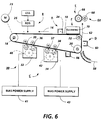
- FIG.6 depicts schematically the various components thereof.
- FIG.6 depicts schematically the various components thereof.
- the reader is referred to USSN 08/139,689, a copy of which was filed with the present application.
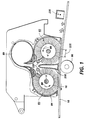
- FIG. 1 shows a dual electrostatic brush (DESB) cleaning brush system.
- This cleaner has dual electrostatic brushes 82,83 located in a cleaner housing 84.
- the brush fibers 90 rotate against the photoreceptor 10 surface supported by a cleaning roll 86.
- the dual electrostatic brushes 82 rotate in the same direction 88 at low rpm and are biased at opposite polarity to clean all types of toner including positive and negative toner (dual polarity toners), CAD toner, and single polarity DAD type toner at process speeds up to 22 inches per second (ips)(55 cm/sec) or higher. This process speed corresponds to 135 copies per minute (cpm) or greater. It is this preconditioning that allows cleaning of both DAD and CAD toners.
- the bias on the electrostatic brush, and the air and flicker bar 220 detoning system maintain the black toner in the first brush 82 at the correct level to prohibit the build up of additive films (ZnSt and Aerosil) on the photoreceptor 10.
- the electrostatics of the brushes 82,83 attract and hold one of the toners, either positive ( + ) or negative (-) depending on the bias of the brush.
- the first brush in the direction of movement 16 of the photoreceptor 10, is negatively charged to attract positive toner particles.
- the second brush 83 is positively charged to attract negative particles remaining on the photoreceptor that were not removed by the preconditioned toner laden brush 82.
- the preclean corotron 200 located prior to the first brush 82 (in the direction of movement of the photoreceptor indicated by arrow 16), provides a positive charge to the particles remaining on the imaging surface.
- the brushes 82 are contained in a single housing 84 with a continuous flow of air, provided by an air vacuum 89, into and out of the housing 84 to eliminate toner emissions and remove debris from the brush fibers 90.
- the housing design and the flow of air through the cleaner is unique.
- a contoured baffle 230 separating the two brushes 82,83 creates a pseudo two housing cleaner allowing air to flow independently in each side of the cleaner.
- the single housing also reduces the size of the cleaner and the cleaner UMC (unit manufacturing cost).
- This DESB (i.e. dual electrostatic brush) cleaner cleans 100% of the residual toner on the photoreceptor 10 at the outset if the brushes are preconditioned with black toner.
- the residual image left on the photoreceptor after the cleaner is less than 30 particles per mm2 This is a 50% improvement over the present conventional ESB (i.e. electrostatic brush) cleaners.
- the present invention has two detoning steps to reduce the detoning difficulty of electrostatic brushes.
- the initial detoning takes place just after the fibers leave the cleaning nip 225 and the final detoning takes place at the flicker bars 220.
- the interference of the brush with the imaging surface leaves a footprint. This footprint is the cleaning nip
- the predetermined amount of toner, due to preconditioning, in the first brush remains after detoning.
- the set points i.e. air flow, cfm and bias (voltage difference) of the cleaner and vacuum, control toner in the brush.
- the operating space, or cleaner latitude is defined in terms of preclean current (I pc ) and the brush bias, V B .
- the cleaner brush biases and the preclean current are set near the center of the window for these values.
- These latitudes are constructed for fixed air flow (cfm) and brush rpm. The results from machine testing have shown that the amount of black toner in the brush remains constant in the operating space or true cleaning latitude for the given air flow and brush rpm.
- the DESB cleaner of the present invention has a very large operating window for cleaning executive black toner, and tri-level images, i.e., black plus a color (e.g. red, green or blue).
- This cleaner is extremely robust.
- there are initial requirements for the brushes 82, 83, and or, the photoreceptor to clean 100% of the residual images at the outset as stated above One example where this is important is in a newly installed machine with a new photoreceptor 10 and clean BASF or SA-7 brushes.
- a "clean" brush is not only a new brush but also one that has been vacuumed clean of toner.
- the residual transferred and untransferred images of black toner (such as control patches) will not clean until the first brush 82 becomes loaded with enough black toner, and or, the photoreceptor is pretreated with ZnSt.
- the present invention is that of the requirements for a cleaner brush to remove residual particles and agglomerations from the imaging surface.
- the two brush materials experimentally tested as part of the present invention are BASF and SA-7. Preconditioning of these brush materials and the photoreceptor 10 and the methods of preconditioning are discussed below.
- One brush material is the BASF brush material. It was determined through experimentation that the first brush 82 (B1) of the dual conductive brush cleaning system must be preconditioned with approximately 12 grams of black toner, or the photoreceptor must be preconditioned with Zinc Stearate (ZnSt) to initiate cleaning of all black residual images upon initiation of the printing process. For the second brush material of SA-7, it was determined experimentally that B1 must be preconditioned with approximately six grams of black toner to clean black and green toner particles. (See Table 5 which provides a chart that shows the number of prints necessary during preconditioning to attain the predetermined amount of six grams).
- the experimental results presented here are for black and green toner, but these results could also apply to black toner with other colors such as red and/or blue toner. It is noted that with the preclean 200 and brush bias polarity shown in FIG. 1, the first brush 82 (B1) is set up to clean the black toner, (i.e. positive toner), and the second brush 83 (B2) is set to clean the color toner (i.e. negative toner).
- Tables 1 and 2 summarize the preconditioning requirements for BASF and SA-7 brush materials.
- Tables 3 and 4 summarize the tests carried out to develop the preconditioning requirements. (All tables are located at the end of the specification.)
- the black toner requirement of B1 (the first brush in the direction of movement of the photoreceptor) shown in Table 1 for BASF material, approximately 12.6 grams of black toner are required in B1 to clean executive black toner. If the first brush 82 is clean, (e.g. vacuumed clean or new) black toner can not be cleaned off a new or used photoreceptor thus, this indicates that the level of black toner in the first brush must be approximately 12 grams to obtain good cleaning of executive black toner This is an experimental result and may be associated with loading the fibers with toner to create abrasion of the image, or create a disturbing action to the image. This same amount of toner in B1 is also recommended for cleaning color toner as well as black toner.
- toner to the brush There are several methods available to add toner to the brush.
- One method is the use of diagnostic routines to add toner to a brush.
- Another method is that the brush (B1) can be doped initially by dusting toner on the brush.
- Still another method would be to let the machine run the appropriate number of black prints initially after the machine has been installed, or when the brushes are cleaned or replaced with new brushes, prior to the start-up of the initial print run.
- approximately 2000 prints of 25% area coverage executive black was needed to bring the level of black toner in B1 to 12.6 grams
- testing has shown that the level of black toner in B1 achieved by preconditioning is maintained even in a print run when the area coverage is a black document. This is due to the electrical bias on the brush that holds the toner on the fibers.
- a threshold 'steady state i.e. amount of toner that the biased brush can hold before it releases the toner
- a poor detoning system occurs when too much toner is left in the brush because this excess toner can fall out and redeposit on the imaging surface.
- air flow is sufficient to detone the excess toner out of the brush and maintain the necessary amount, i e., approximately 12 grams. This occurs in a black or color running mode That is, black toner is maintained in the brush in an executive black print run, a color only print run, and in a black and color print run.
- Tests 8, 9 and 10 in Table 3 show that it is the ZnSt on the photoreceptor that is important, not the ZnSt in the brush. This result confirms that ZnSt reduces the adhesion of the black toner to the photoreceptor. (The effects of ZnSt on toner adhesion has been known for many years.)
- the requirement for cleanability in other machines such as the Xerox 5090 and Xerox 5100 is 80 particles per mm2 left on the photoreceptor after the cleaner. In the present invention the cleanability can be reduced to less than 30 particles per mm2.
- residual toner after the cleaner will contaminate the developer housings and change the color quality in the developer.
- the cleaner must clean upon initiation, hence the need for preconditioning prior to printer start-up. It was shown experimentally that with 'clean' brushes, approximately 1000 prints of black toner must be run to load the first brush with black toner. This means that if the cleaner does not clean at initiation of the printing process a cleaning failure would occur for at least 1000 prints or even more.
- the level of ZnSt on the photoreceptor is very important. It is known from other machine studies (i.e. Xerox 4850) that if the level of ZnSt becomes too thick (approximately greater than 50 A°) image push can occur. Thus, the application of ZnSt must be used in a careful manner.
- the black toner requirement of B1 (the first brush 82 in the direction of movement of the photoreceptor 10) shown in Table 1 for SA-7 material, is about one gram of black toner to clean executive black toner
- B1 the first brush 82 in the direction of movement of the photoreceptor 10
- Table 1 for SA-7 material
- the methods discussed above to load the BASF brushes with toner can also be used to load the SA-7 brushes with toner.
- testing has shown that the level of black toner in B1 after preconditioning is maintained regardless of the variety in print jobs performed. Thus, even if a color print job is run the level of black toner in B1 does not drop to such a level that it can no longer clean. For example, to clean both black and green effectively at least six grams of black must be in B1. If an executive color job is run, experimental testing has shown that the level of black toner in B1 does not drop to a level where green toner is not cleaned.
- a chart (see Table 5) was developed through testing to determine what amount of toner would be deposited for removal from the photoreceptor 10 and adherence by the first brush 82 in the direction of movement of the photoreceptor 10. It was discovered through testing that regardless of the brush material, the first brush must be primed with black toner to start cleaning upon initiation of the printing cycle. However, testing also showed that once the first brush has enough black toner to clean, this desired level of toner does not decrease.
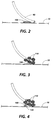
- Figure 2 shows what occurs in the typical mode of cleaning the photoreceptor.
- the brush fiber 90 as it rotates against the photoreceptor 10 contacting the surface has a tendency to smear the additive particles 100 (e.g. ZnSt).
- the smearing results from the force of the brush fibers 90 rotational momentum as they land on the additive particle.
- the present invention of loading the brush 82 fibers with positively charged toner to avoid additive smearing and to control additive film buildup can perform in one of the following ways shown in Figures 3 or 4.
- Figure 3 it is shown how the black toner (positive) 110 attaches to the brush fiber 90, to provide a buffer between the individual fibers 90 and the photoreceptor 10 surface thereby, preventing the brush fibers from smearing the additive particles 100 as the fibers 90 rotate.
- Figure 4 shows the attachment of black toner (positive) 110 and Aerosil particles 120 to the brush fibers 90.
- the Aerosil particles 120 abrade the additive particles 100 (e.g ZnSt) film from the photoreceptor 10 surface.
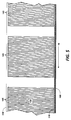
- a mass of black toner particles are placed in the image area 150 in a line pattern.
- a predetermined mass of black toner particles (See Table 5) are placed in the imaging area 150 of the photoreceptor 10 During preconditioning the first conductive brush, in the direction of motion of the photoreceptor 10, is used to remove all of the predetermined amount of black particles (see Table 5) from the imaging area 150.
- the preconditioning continues until the predetermined mass of black toner is held in the brush fibers of the first conductive brush 82 Once the first conductive brush has been preconditioned, the brush does not require further toner replenishing throughout the printing run. A full preconditioning of the first conductive brush (B1) is required for a newly built machine or when a new cleaner brush replaces the preconditioned brush installed in the field or the preconditioned brush is vacuumed cleaned. As previously stated, a predetermined amount of toner (see Table 5) determines the amount of toner to be placed on the photoreceptor imaging area 150 for preconditioning of the brush 82.
- the present invention is a preconditioning method for a dual electrostatic brush cleaning apparatus to clean the photoreceptor in a single pass color printer upon initiation of the printer.
- the first brush in the direction of movement of the photoreceptor, is initialized or preconditioned by being loaded with a predetermined amount of black toner particles removed from the imaging surface of the photoreceptor.
- the preconditioned brush is then used to clean the imaging surface. This predetermined amount of black toner is maintained within the brush fibers, without the need for replenishing, throughout the life of the printer's cleaning apparatus unless, the brush must be replaced or cleaned. At that time, the new or cleaned brush is preconditioned in the same manner.
- Another preconditioning method involves coating the surface of the photoreceptor with ZnSt to reduce adhesion of the black toner particles to the photoreceptor.
- the advantages obtained with the electrostatic brush cleaner of the present invention include better overall cleaning ability, containment of toner in the cleaner, lower brush rpm, and improved reliability. TABLE 5 ROS Print Selection Toner Density 0.9mg/cm2 1mg/cm2 20 prints 5.52 6.14 30 prints 8.3 9.21 40 prints 11.0 12.3 60 prints 16.6 18.6 200 prints 55.2 62
Landscapes
- Physics & Mathematics (AREA)
- General Physics & Mathematics (AREA)
- Cleaning In Electrography (AREA)
Applications Claiming Priority (2)
| Application Number | Priority Date | Filing Date | Title |
|---|---|---|---|
| US13968993A | 1993-10-22 | 1993-10-22 | |
| US139689 | 1993-10-22 |
Publications (1)
| Publication Number | Publication Date |
|---|---|
| EP0650104A1 true EP0650104A1 (en) | 1995-04-26 |
Family
ID=22487855
Family Applications (1)
| Application Number | Title | Priority Date | Filing Date |
|---|---|---|---|
| EP94307774A Withdrawn EP0650104A1 (en) | 1993-10-22 | 1994-10-21 | Preconditioning of photoreceptor and cleaner brush |
Country Status (3)
| Country | Link |
|---|---|
| EP (1) | EP0650104A1 (enExample) |
| JP (1) | JPH07191584A (enExample) |
| CA (1) | CA2128977C (enExample) |
Cited By (1)
| Publication number | Priority date | Publication date | Assignee | Title |
|---|---|---|---|---|
| EP0798612A1 (en) * | 1996-03-27 | 1997-10-01 | Xerox Corporation | Correct brush bias polarity for single and dual ESB cleaners with triboelectric negative toners |
Citations (3)
| Publication number | Priority date | Publication date | Assignee | Title |
|---|---|---|---|---|
| EP0472401A2 (en) * | 1990-08-20 | 1992-02-26 | Xerox Corporation | Apparatus for surface cleaning in electrophotographic imaging |
| US5151744A (en) * | 1991-08-09 | 1992-09-29 | Xerox Corporation | Cleaner brush retone film control |
| US5153658A (en) * | 1991-08-09 | 1992-10-06 | Xerox Corporation | Mac cleaner brush film control |
-
1994
- 1994-07-27 CA CA002128977A patent/CA2128977C/en not_active Expired - Fee Related
- 1994-10-19 JP JP6253579A patent/JPH07191584A/ja active Pending
- 1994-10-21 EP EP94307774A patent/EP0650104A1/en not_active Withdrawn
Patent Citations (3)
| Publication number | Priority date | Publication date | Assignee | Title |
|---|---|---|---|---|
| EP0472401A2 (en) * | 1990-08-20 | 1992-02-26 | Xerox Corporation | Apparatus for surface cleaning in electrophotographic imaging |
| US5151744A (en) * | 1991-08-09 | 1992-09-29 | Xerox Corporation | Cleaner brush retone film control |
| US5153658A (en) * | 1991-08-09 | 1992-10-06 | Xerox Corporation | Mac cleaner brush film control |
Non-Patent Citations (2)
| Title |
|---|
| NERO R. LINDBLAD ET AL.: "DUAL ELECTROSTATIC BRUSH CLEANER FOR CLEANING MULTIPLE TONER TYPES", XEROX DISCLOSURE JOURNAL., vol. 15, no. 6, STAMFORD, CONN US, pages 463 - 466, XP000161173 * |
| R. A. DANIELS: "XEROGRAPHIC PROCESS", IBM TECHNICAL DISCLOSURE BULLETIN., vol. 19, no. 1, June 1976 (1976-06-01), NEW YORK US, pages 16 * |
Cited By (1)
| Publication number | Priority date | Publication date | Assignee | Title |
|---|---|---|---|---|
| EP0798612A1 (en) * | 1996-03-27 | 1997-10-01 | Xerox Corporation | Correct brush bias polarity for single and dual ESB cleaners with triboelectric negative toners |
Also Published As
| Publication number | Publication date |
|---|---|
| CA2128977A1 (en) | 1995-04-23 |
| CA2128977C (en) | 2000-01-25 |
| JPH07191584A (ja) | 1995-07-28 |
Similar Documents
| Publication | Publication Date | Title |
|---|---|---|
| CA2046561C (en) | Method and apparatus for increasing toner loading of a cleaning brush for improved surface cleaning in electrophotographic imaging | |
| US3780391A (en) | Apparatus for cleaning a residual image from a photosensitive member | |
| EP0763786B1 (en) | Image forming apparatus | |
| US4791455A (en) | Color electrophotographic apparatus and method of cleaning a photosensitive medium | |
| US4878093A (en) | Dual roll cleaning apparatus for charge retentive surface | |
| US5771424A (en) | Preconditioning of photoreceptor and cleaner brush | |
| JP3762241B2 (ja) | 画像形成装置およびクリーニング装置 | |
| US5797078A (en) | Photoreceptor comet prevention brush | |
| US5153658A (en) | Mac cleaner brush film control | |
| EP0651299B1 (en) | Method and apparatus for cleaning a surface | |
| US5175591A (en) | Cleaning device including abrading cleaning brush for comet control | |
| US4533235A (en) | Cleaning device for use in an image forming apparatus | |
| US5652951A (en) | Detoning cycle to increase brush life and reduce emissions by removing accumulated toner | |
| EP0798612B1 (en) | Correct brush bias polarity for dual ESB cleaners with triboelectric negative toners | |
| US5151744A (en) | Cleaner brush retone film control | |
| US20050111893A1 (en) | Dual polarity electrostatic brush cleaner | |
| US5282008A (en) | Magnetic roller cleaning apparatus | |
| CA2128977C (en) | Preconditioning of photoreceptor and cleaner brush | |
| JPH0239186A (ja) | クリーナ | |
| US5381218A (en) | Conductive cleaning brush belt and detoning thereof | |
| EP0639804B1 (en) | Apparatus for removing residual developer material from a surface of a printing machine | |
| EP0620508A1 (en) | Augmented electrostatic brush | |
| US6014540A (en) | Image forming apparatus having a device for removing charged materials prior to cleaning | |
| US5241352A (en) | Air detoned cleaner brush | |
| JP2980654B2 (ja) | 潜像担持体のクリーニング兼フィルミング除去装置 |
Legal Events
| Date | Code | Title | Description |
|---|---|---|---|
| PUAI | Public reference made under article 153(3) epc to a published international application that has entered the european phase |
Free format text: ORIGINAL CODE: 0009012 |
|
| AK | Designated contracting states |
Kind code of ref document: A1 Designated state(s): DE FR GB |
|
| 17P | Request for examination filed |
Effective date: 19951026 |
|
| 17Q | First examination report despatched |
Effective date: 19960102 |
|
| STAA | Information on the status of an ep patent application or granted ep patent |
Free format text: STATUS: THE APPLICATION HAS BEEN WITHDRAWN |
|
| 18W | Application withdrawn |
Withdrawal date: 20020222 |