EP0644476B1 - Method of changing display condition of handwritten input - Google Patents
Method of changing display condition of handwritten input Download PDFInfo
- Publication number
- EP0644476B1 EP0644476B1 EP94305944A EP94305944A EP0644476B1 EP 0644476 B1 EP0644476 B1 EP 0644476B1 EP 94305944 A EP94305944 A EP 94305944A EP 94305944 A EP94305944 A EP 94305944A EP 0644476 B1 EP0644476 B1 EP 0644476B1
- Authority
- EP
- European Patent Office
- Prior art keywords
- gesture
- line segment
- process operation
- subject
- line segments
- Prior art date
- Legal status (The legal status is an assumption and is not a legal conclusion. Google has not performed a legal analysis and makes no representation as to the accuracy of the status listed.)
- Expired - Lifetime
Links
Images
















Classifications
-
- G—PHYSICS
- G06—COMPUTING OR CALCULATING; COUNTING
- G06F—ELECTRIC DIGITAL DATA PROCESSING
- G06F3/00—Input arrangements for transferring data to be processed into a form capable of being handled by the computer; Output arrangements for transferring data from processing unit to output unit, e.g. interface arrangements
- G06F3/01—Input arrangements or combined input and output arrangements for interaction between user and computer
- G06F3/048—Interaction techniques based on graphical user interfaces [GUI]
- G06F3/0487—Interaction techniques based on graphical user interfaces [GUI] using specific features provided by the input device, e.g. functions controlled by the rotation of a mouse with dual sensing arrangements, or of the nature of the input device, e.g. tap gestures based on pressure sensed by a digitiser
- G06F3/0488—Interaction techniques based on graphical user interfaces [GUI] using specific features provided by the input device, e.g. functions controlled by the rotation of a mouse with dual sensing arrangements, or of the nature of the input device, e.g. tap gestures based on pressure sensed by a digitiser using a touch-screen or digitiser, e.g. input of commands through traced gestures
- G06F3/04883—Interaction techniques based on graphical user interfaces [GUI] using specific features provided by the input device, e.g. functions controlled by the rotation of a mouse with dual sensing arrangements, or of the nature of the input device, e.g. tap gestures based on pressure sensed by a digitiser using a touch-screen or digitiser, e.g. input of commands through traced gestures for inputting data by handwriting, e.g. gesture or text
-
- G—PHYSICS
- G06—COMPUTING OR CALCULATING; COUNTING
- G06V—IMAGE OR VIDEO RECOGNITION OR UNDERSTANDING
- G06V10/00—Arrangements for image or video recognition or understanding
- G06V10/10—Image acquisition
-
- G—PHYSICS
- G06—COMPUTING OR CALCULATING; COUNTING
- G06V—IMAGE OR VIDEO RECOGNITION OR UNDERSTANDING
- G06V30/00—Character recognition; Recognising digital ink; Document-oriented image-based pattern recognition
- G06V30/10—Character recognition
- G06V30/32—Digital ink
- G06V30/333—Preprocessing; Feature extraction
- G06V30/347—Sampling; Contour coding; Stroke extraction
-
- G—PHYSICS
- G06—COMPUTING OR CALCULATING; COUNTING
- G06V—IMAGE OR VIDEO RECOGNITION OR UNDERSTANDING
- G06V30/00—Character recognition; Recognising digital ink; Document-oriented image-based pattern recognition
- G06V30/10—Character recognition
- G06V30/32—Digital ink
- G06V30/36—Matching; Classification
- G06V30/373—Matching; Classification using a special pattern or subpattern alphabet
Definitions
- the present invention relates to a handwriting input display method suitable for, e.g., an electronic notebook apparatus and a portable computer.
- a CAD system has grown, and then an arbitrary pattern, or figure may be relatively simply input.
- this CAD system when a pattern having an arbitrary shape is drawn by using, for example, a mouse or a pen, a pattern corresponding to this input pattern is displayed on a monitor. Then, for example, after a plurality of line segments have been entered, the preselected parameters are designated in order to change the display conditions of these line segments.
- the menu operation method owns the following drawbacks:
- EP-A-0 332 765 discloses a handwriting input display apparatus on which the pre-characterising portion of claim 1 is based.
- a handwriting input display apparatus comprising:
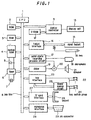
- Fig. 1 is a schematic block diagram for representing an arrangement of an apparatus to which a handwriting input display method according to an embodiment of the present invention has been applied.
- a CPU 1 controls the respective circuit units in accordance with a program previously stored in a ROM 2 to execute a character input/display operation.
- a RAM 3 predetermined data and the like are stored, if required.
- a backup RAM 4 predetermined power is continuously supplied from a battery 5, and information desired to be stored is stored even when the power supply of the apparatus is turned OFF.
- a timer 6 is so designed to be continuously operable by the battery 5 on the basis of a crystal oscillator 7.
- a display controller 11 expands data entered therein via a bus line 8 to a V-RAM 12, and causes the expanded image to be displayed on a display unit 13.
- An input tablet 15 outputs the entered coordinate position data to a tablet interface 14 by operating a pen 16.
- the tablet interface 14 outputs this data via the bus line 8 to either the CPU 1, or the display controller 11.
- a microphone 18 outputs a collected speed signal to a solid-state recording process circuit 17 so as to be recorded thereon.
- the speed signal outputted from the solid-state recording process circuit 17 is supplied via an adder 20 to a speaker 21, thereby producing speech.
- a dialler 19 is under control by the CPUl to output a predetermined dialling signal via the adder 20 to the speaker 21.
- a plurality of key switch groups 22 are operated when the operation of the apparatus is switched, and signals responding to the key operations are supplied from a key interface 23 via the bus line 8 to the CPU 1.
- a power supply circuit 25 may be turned ON to supply the power to the respective circuit units, and such various operations by the solid-state recording process circuit 17 as recording, reproducing, stop, and volume controls may be performed by operating a predetermined key switch group among the plural key switch groups 24.
- an IC card (not shown) may be inserted into a socket 26.
- An IC card interface 72 transfers and receives data with this IC card.
- a modem may be connected, and a signal is transferred/received via this modem and an extension interface 28.
- the input tablet 15 is constructed of a transparent material and formed on a display unit 13. As a result, a representation of the display unit 13 may be observed through the input tablet 15.
- process operations executed by the CPU 1 are classified into functional blocks which will be explained with reference to Fig. 2 and Fig. 3.
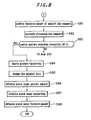
- This CPU 1 executes process operations indicated in flow charts of Fig. 4 to Fig. 8.
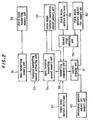
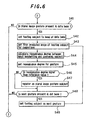
- the functional block of Fig. 2 represents such a functional block related to the process operations for judging the gestures indicated in the flow charts of Fig. 4 through Fig. 6.
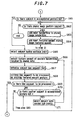
- the functional block of Fig. 3 indicates a functional block for executing the process operations corresponding to the gestures shown in Fig. 7 and Fig. 8.
- a display condition of a line segment is changed by inputting a gesture in such a manner that a predetermined relationship is established with respect to the displayed line segment.
- the respective storage units and data base are formed in the RAM 3, or the ROM 2 of Fig. 1, and other portions are formed inside the CPU 1 in these functional blocks.
- a featured handwriting amount memory unit 53 extracts a featured amount of handwriting stored in the input handwriting memory unit 51.
- This featured amount corresponds to, for instance, a direction and a length of a straight line portion of a line segment, a radius and a centre angle of an arc, a quantity of a bending angle (vertex), and the number of loops.
- This featured amount is the same as that of the gesture stored in the single image gesture data base 57 and the plural image gesture data base 58.
- the featured amount extracted by the handwriting featured amount extracting unit 53 is supplied to the input featured handwriting amount memory unit 54 so as to be stored therein.
- the featured amounts existing until all of the images are inputted in case that the gestures of the plural images are entered, are supplied to a plural image featured handwriting amount memory unit 55 so as to be stored therein.
- a handwriting comparing unit 56 compares the featured amount of the gesture stored in either the input featured handwriting amount memory unit 54 or the plural image featured handwriting amount memory unit 55 with the featured amount of the single image gesture stored in the single image gesture data base 57.
- this single image gesture data base 57 a combination among a featured amount and an identification number of a gesture command constructed by a single image (single image gesture), a retrieving method for a line segment to be processed, and a process method to be executed is employed as one data base element.
- the handwriting comparing unit 56 compares the featured amount stored in the input featured handwriting amount memory unit 54 with the featured amount stored in the single image gesture data base 57 to obtain a resemblance degree of the inputted handwriting.
- a subject changing unit 61 compares the resemblance degree of the inputted handwriting supplied from the handwriting comparing unit 56 with a preset reference value, and when this resemblance degree is greater than the reference value, the inputted handwriting is recognized as the gesture and then both the gesture number thereof and this resemblance degree are supplied to an established gesture subject list memory unit 62 so as to be stored therein.
- the plural image gesture data base 58 a combination among an identification number of a plural image gesture, the number of images for constituting a gesture, a featured amount of each image, a featured amount between the images (e.g., positional relationship), a retrieving method of a line segment under process, and a process method to be executed is employed as a data base element.
- a subject image selecting unit 59 selects predetermined plural image gestures stored in this plural image gesture data base 58, and also selects one of these plural image gestures for comparison, which will then be supplied to the handwriting comparing unit 56.
- the handwriting comparing unit 56 compares this comparison subject with the one image featured amount of the inputted handwriting supplied from the input featured handwriting amount memory unit 54, thereby obtain the resemblance degree between them.
- the subject changing unit 61 recognizes such a resemblance degree as a point of a gesture when the compared resemblance degree is greater than the preset reference value, and supplies this resemblance degree to a plural image gesture subject list memory unit 60. Then, the supplied resemblance degree is stored together with the gesture-number thereof are stored in this memory unit 60.
- a subject image selecting unit 59 reads out these images from the plural image gesture data base 58, and supplies them to the handwriting comparing unit 56 as the comparison subject.
- the handwriting comparing unit 56 compares the thus inputted comparison subject with the featured amount of the inputted handwriting supplied from the input featured handwriting amount memory unit 54 to obtain a resemblance degree therebetween.
- the subject changing unit 61 averages this resemblance degree and the resemblance degree (point of gesture) of the previously inputted handwriting, and then uses the averaged degree as a new point of the gesture to update the subject.
- this gesture is supplied tot he established gesture subject list memory unit 62 and stored therein.
- the comparison is carried out every time the inputted handwriting for the single image is entered in the handwriting unit 56, when the handwriting is inputted for the plural image gesture, a plurality of handwriting may be combined for comparison purposes. Alternatively, a plurality of images may be sequentially selected for a single image inputted handwriting, and the image having the highest resemblance degree may be selected.
- a process determining unit 75 reads such data as a method for retrieving a line segment interest, a method for extracting a featured amount of a line segment of interest, and a method for processing a line segment of interest, corresponding to the gesture stored in the established gesture subject list memory unit 73 from the gesture data base 72, and reads the featured amount of the gesture entered from the featured handwriting amount memory unit 74. Then, the process determining unit 75 determines a process operation in response to these read data to control a subject line segment retrieving unit 77, a featured amount extracting unit 79, and a line segment processing unit 81.
- a processed line segment list memory unit 76 stores data about previously entered line segments (line segments to be processed) other than the gesture.
- the subject line segment retrieving unit 77 retrieves the line segment to be processed from the line segments stored in the processed line segment list memory unit 76 in response to the control by the process determining unit 75, and then supplies the retrieved result to a subject line segment list memory unit 78 to be stored therein.
- a featured amount extracting unit 79 extracts the featured amount of the subject line segment stored in the subject line segment list memory unit 78 in response to the control by the process determining unit 75, and supplies this extracted result to a featured line segment amount memory unit 80 to be stored therein.
- a line segment process unit 81 process the featured amount of the line segment which is to be processed and is stored in the featured line segment amount memory unit 80 under control of the process determining unit 75, and produces data used to change the display condition of the line segment. Then, the produced data is supplied to a processed line segment memory unit 82 to be stored therein.
- This processed line segment memory unit 82 is read out and supplied via a display controller 11 to a V-RAM 12, in which this process data is expanded as bit map data. Then, this data is read by the display controller 11, and then outputted to a display unit 13 for the representation purpose.
- the featured amount of the input handwriting entered at the step S1 is extracted in the featured handwriting amount extracting unit 53, and then stored into the input featured handwriting amount memory unit 54.
- the process operation is advanced to a step S3 at which the list of the established gesture subject list memory unit 62 is initialized.
- the subject finally judged as the gesture namely, subject having a higher point
- the corresponding gesture number is initialized in such a manner that the point of this subject is substituted by, for instance, zero, namely the number indicative of an unprocess condition (for example, 0 or -1).
- the process operation is advanced to a step S4 at which a judgment is made as to whether or not a subject is present in the plural image gesture subject list.
- the process operation is advanced to a step S21 at which a check is done as to whether or not a single image gesture is located in the data base.
- the process operation is advanced from the step S21 to steps S22 through S28, at which such a judging process as to whether or not the inputted handwriting corresponds to the single image gesture.
- step S4 another process operation is performed at a step S4 where if a judgment is done that the subject is stored in the plural image gesture subject list, namely in case of the input handwriting subsequent to the second image, then the process operation is advanced to a step S5 at which the head subject in the plural image gesture subject list is selected as a first checking subject. Then, the process operation is advanced to a step S6 at which a predetermined single image is selected as an predicted input subject for comparison from the plural image gestures of the subjects selected at the step S5.
- the process operation is advanced to a step S7 at which a resemblance degree between the comparison subject selected at the step S6 and the presently inputted handwriting is obtained by the handwriting comparing unit 56.
- a step S8 the point of the gesture subject is corrected in accordance with the resemblance degree obtained at the step S7.
- the resemblance degrees of the respective input handwriting among the input handwriting of the plural images are averaged.
- a calculation is performed for both the resemblance degree of the previously entered handwriting and that of the presently entered handwriting, and then a newly calculated averaged value is set as the point of this gesture.
- This point may be calculated by employing the statistical value such as the above-described average value, and also by way of the fuzzy calculation.
- the process operation is advanced to a step S13, at which a judgment is made as to whether or not the subsequent gesture subject is present in the plural image gesture subject list (namely, it is judged whether or not there is such a gesture subject whose point remains initialized at the step S3).
- the process operation is advanced to a step S14 at which the checking subject is changed into the next gesture subject.
- the step S12 after the established gesture has been registered as the established gesture subject, a similar operation is carried out when it is so judged at a step S13 that there is a subsequent gesture subject. Then, the process operation is returned from the step S14 to the step S6 at which a similar process operation is repeated while the predicted input image used as the checking subject at the step S14 is employed for comparison purposes.
- the process operation is advanced to a step S10 at which this gesture subject is removed from the plural image gesture subject list.
- this gesture subject is removed from the plural image gesture subject list.
- step S13 when it is judged that there is no subsequent gesture subject in the plural image gesture subject list, the process operation is advanced to a step S21.
- a step S25 if the point (resemblance degree) of the gesture set at the step S24 is compared with a preset reference value and this point is greater than the reference value, the process operation is advanced to a step S26 at which this point is registered into the established gesture subject list.
- the process operation is advanced to a step S27 at which a judgment is'made as to whether or not the next gesture (i.e., gesture whose point is not requested) is present in the single image gesture data base 57.
- the process operation is advanced to a step S28 at which the comparison subject is changed into the subsequent gesture. Then, the process operation is returned to the step S23 at which a resemblance degree between the newly set gesture as the comparison subject and the input handwriting is calculated and a similar process operation is repeated.
- step S27 if it is judged that there is no subsequent gesture in the single image gesture data base 57, then the process operation is advanced to a step S41.
- the process operation is advanced to a step S42.
- the checking subject to be compared with the input handwriting is set to the head gesture within the plural image gesture data base 58.
- the process operation is advanced to a step S43, at which a predetermined single image of the gesture recognized as the checking subject is assumed as a predicted first image to be compared.
- the process operation is advanced to a step S44 at which a resemblance degree between the input handwriting and the comparison subject set at the step S43 is calculated. Then, the calculated resemblance degree is understood as the point of this gesture at a step S45.
- a judgment is made as to whether or not the point (resemblance degree) of the gesture obtained at the step S45 is larger than the reference value. When it is judged that the point of the gesture is greater than the reference value, this point of the gesture is stored into the plural image gesture subject list memory 60 as the plural image gesture subject.
- the process operation is advanced to a step S48.
- a check is done as to whether or not the subsequent gesture (namely, gesture whose point is not yet updated) is located in the plural image gesture data base 58.
- the process operation is advanced to a step S49 at which the checking subject is set to the next gesture. Then, the process operation is returned to the step S43 at which a first predicted image of this checking subject is compared with the input handwriting, and this comparing process is repeatedly performed in a similar manner to the above case.
- the process operation is advanced to the step S62 at which a judgment is made as to whether or not the gesture subject of the plural images is present. If the inputted subject does not correspond to the gesture, then there is no data also in the plural image gesture subject list. In this case, the process operation is accordingly ended.
- step S61 it is so judged at the step S61 that no subject is present in the established gesture subject list in a half way when the plural image gesture is entered. It should be noted that in this case, a judgment is made at the step S62 that there is a subject in the plural image gesture subject list. Then, the process operation is advanced to a step S63, at which the input handwriting is added to the plural image handwriting in the plural image gesture subject list memory unit 60. Thereafter, the process operation is advanced to a step S64 at which the input featured amount is added to the plural image featured amount in the plural image featured handwriting amount memory unit 55. Then, the process operation is again returned to the step S1 at which a similar process operation is carried out for the newly entered input handwriting, as previously explained.
- a command corresponding to an inputted gesture is executed. That is, at a step S65, a selection is made of a subject having the highest point from the subjects stored in the established gesture subject list memory unit 62. Subsequently, the process operation is advanced to a step S66 at which a detection is made of such a featured amount for the handwriting of the gesture required to change the data about the line segment which has been inputted and displayed on the display unit 13. This necessary featured amount may be obtained from the gesture data base 72.
- the process operation is advanced to a step S67 at which the list of the line segment to be processed by the gesture is initialized. Then, the process operation is advanced to a step S68, at which the featured amount (parameter) of the gesture obtained at the step S66 is utilized to retrieve the line segment to be processed.
- the retrieving method for the processing subject has been stored in the gesture data base 72.
- the process operation is advanced to a step S70.
- the process operation is advanced to a step S71 at which a subject having the second highest point is selected. Then, the process operation is returned to the step S66, at which the featured amount required to execute the command of this selected subject is extracted, and the subsequent process operation is similarly repeated.
- a step S70 when it is so judged that there is not another subject in the established gesture subject list, the process operation is returned to the step S62 at which a check is done as to whether or not a subject is present in the plural image gesture subject list. Then, the subsequent process operations are similarly executed in response to this judgment result.
- the reason why the process operation is returned from the step S70 to the step S62 and the subsequent process operation is repeated, is to confirm whether or not it is recognizable that the plural image gesture is being entered.
- step S69 when it is so judged that the line segment to be processed for the gesture is retrieved, the process operation is advanced to a step S81 represented in Fig. 8.
- a confirmation is made of a featured amount (parameter) of a line segment which should be processed.
- the necessary featured amount can be recognized from the gesture data base 72.
- the line segment data after process is calculated by utilizing the process content stored in the gesture data base 72, the featured amount of the gesture, and the featured amount of the line segment to be processed. Then, the calculated data is stored in a processed line segment memory unit 82.
- the process operation is advanced to a step S83, at which a confirmation is made as to whether or not the process operation corresponding to the gesture is executable.
- a confirmation whether or not the process operation is executable is given to a user by representing a change made when the gesture command is executed by varying its colour.
- a region corresponding to YES/NO is displayed on the display unit 13, and any of YES/NO is touched by a user with the pen 16.
- the process operation is returned to the step S70 at which a confirmation process for another gesture is performed.
- the process operation is advanced to a step S84 at which the handwriting of the gesture is erased.
- a handwriting having no relationship with the gesture is allowed to be entered during the input operation of the plural image gesture by adding such a process operation that a constructive handwriting number is added to the gesture subject, only the handwriting for constituting the confirmed gesture command may be erased.
- the line segment data is changed into the data calculated at the step S82.
- the line segment data to be processed which has been stored in the subject line segment list memory unit 78 is removed from the processed line segment list memory unit 76, and then the line segment data after being changed, which has been stored in the processed line segment memory unit 82 is added.
- the previously entered and displayed line segment is changed into such a display state corresponding to the entered gesture.
- the list of the plural image gesture subject list memory unit 60, the plural image handwriting data of the plural image handwriting memory unit 52, and the data about the plural image featured handwriting amount of the plural image featured handwriting amount memory unit 55 are initialized at steps S86 to S88.
- the operation mode may be escaped from the gesture input mode by preparing such a gesture command which can invalidate all of the plural image gestures under entry.
- the operation mode may be automatically changed from the gesture command input mode into the pattern input mode.
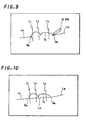
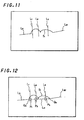
- Fig. 9 to Fig. 13 represent a display example of gestures in case that line segments which have been previously entered and displayed are aligned in a equidistant interval.
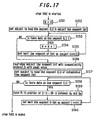
- the process operation of the step S66 is executed as shown in Fig. 14, the process operation of the step S68 carried out as indicated in Fig. 15, the process operation of the step S81 is performed as shown in Fig. 16, and the process operation of the step S82 is performed as denoted in Fig. 17.
- three straight lines L 1 , L 2 , L 3 are displayed in such a manner that these straight line are mutually extended along the substantially upper and lower directions are located parallel to each other with different intervals.
- a straight line L 11 is displayed on the left side of the straight line L 1 under substantially horizontal condition in such a manner that a predetermined angle is defined by this straight line L 1 and other straight lines L 2 and L 3 .
- another straight line L 12 is displayed on the right side of the straight line L 3 under substantially horizontal condition in such a manner that a certain angle is defined between this straight line L 12 and the straight line L 3 .
- a user changes the display condition of the three straight lines L 1 , L 2 , L 3 into an equidistant interval display condition.
- the user inputs such a gesture S 1 that two half circular patterns (figures) are continuously connected to each other by way of a pen 16.
- a starting point of the gesture S 1 is Q 1s and an end point thereof is Q 1s .
- the process operation of the step S66 corresponds to a process operation for extracting a featured handwriting amount of a gesture.
- a process operation for extracting a featured handwriting amount of a gesture As shown in Fig. 14, coordinate values of the starting point Q 1s and the end point Q 1e of the gesture (input handwriting) S 1 are acquired as the featured amounts. Then, at a step S102, a straight line L s1 containing the starting point Q 1s and the end point Q 1e is extracted as represented in Fig. 10.
- the process operation is advanced to a step S113 at which a check is done as to whether or not this line segment Li intersects with the gesture S 1 . If the line segment Li intersects with the gesture S 1 , the process operation is advanced to a step S114 at which a judgment is made whether or not an angle defined between the line segment Li and the straight line L s1 is greater than, or equal to a preset reference value. In other words, when the angle defined between the line segment Li and the gesture S 1 is smaller than the reference value, this line segment Li is excluded from the process subject. When the angle between both of the line segment Li and the gesture S 1 is greater than, or equal to the reference value, the process operation is advanced to a step S115 at which this line segment Li is registered to the list of the processed line segment list memory unit 78.
- the process operation is advanced to a step S116 at which a variable "i" is incremented by 1, and the next line segment in the processed line segment list is used to be processed.
- the process operation is advanced to a step S116 at which the subject is moved to the next line segment.
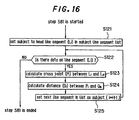
- the step S81 shown in Fig. 8 corresponds to a process operation for confirming a featured amount of a subject line segment, and this process operation is carried out as shown in Fig. 16 in this embodiment.
- the head line segment Li of the subject line segment list is first processed.
- the process operation is advanced to a step S122 at which there is data about the line segment Li. If the data about the line segment Li is present, then the process operation is advanced to a step S123, at which a cross point Pi between the line segment Li and the straight line L s1 is obtained.
- the process operation is advanced to a step S124 at which a distance "Di" between the cross point Pi and the starting point Q 1s of the gesture S 1 is calculated. Then, the process operation is advanced to a step S125 at which the variable "i" is incremented by 1, and a line segment to be processed is changed into the next line segment. Then, the process operation is returned to the step S122 at which a similar process operation is repeated.
- step S122 when it is judged that the data about the line segment Li is not present, the process operation is not present, the process operation is advanced to a step S82.
- a cross point P 1 between the straight line l 1 and the straight line L s1 , another cross point P 2 between the straight line l 2 and the straight line L s1 , and another cross point P 3 between the straight line L 3 and the straight line L s1 are obtained. Also, distances D 1 , D 2 , D 3 from the starting point Q 1s of the gesture S 1 up to the cross points P 1 , P 2 , P 3 are obtained.
- a process operation defined at the step S82 of Fig. 8 corresponds to a process operation for performing a calculation of data about a processed line segment. This process operation is performed as shown in Fig. 17 in case of this embodiment.
- a variable N indicative of the number of line segments registered in the subject line segment list is set to "0".
- the head line segment Li of he subject line segment list is to be processed.
- the process operation is advanced to a step S133 at which a judgment is made as to whether or not the data about the line segment Li is present. If this data about the line segment is present, then the process operation is advanced to a step S134 at which the variable N is incremented by 1. Then, the process operation is advanced to a step S135 at which the variable "i" is incremented by 1, and also is returned to the step S133 at which a similar process operation is repeated. That is, the quantity of existing line segments is counted by this process operation, and is set to the variable N.
- the cross point Pi between the line segment Li and the line segment L s1 is moved to such a point determined by dividing the distance between the starting point Q is and the end point Q 1e of the gesture S 1 at a ratio of (i-1) to (N-i).
- the process operation is advanced to a step S 140 at which after the variable "i" is incremented by 1, the process operation is returned to the step S138 where a similar process operation is repeated.
- the cross point P 1 between the straight line L 1 and the straight line L s1 is arranged to a position coincident with the starting point Q 1s of the gesture S 1 , and the cross; point P 3 between the straight line L 3 and the straight line L s1 is moved to a position coincident with the end point Q 1e of the gesture S 1 .
- the cross point P2 between the straight line L 2 and the straight line L s1 is moved to a midpoint between the end point Q 1e and the starting point Q 1s of the gesture S 1 .
- the straight lines L 1 to L 3 are moved and displayed in such a manner that the interval between the straight line L 1 and the straight line L 2 is made equal to the interval between the straight line l 2 and the straight line L 3 .
- the gesture S 2 constructed of a line segment bent at a substantially 90° is written in such a manner that the starting point thereof is Q 2s and the end point thereof is Q 2e in order to establish such a relationship that the straight lines L 3 and L 12 are positioned at a right angle. Both the starting point Q 2s and the end point Q 2e are detected.
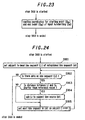
- the line segment to be processed is retrieved, so that this process operation is carried out as illustrated in Fig. 24. That is, at a first step S161, the head line segment Li of the processed line segment list is first processed. Then, at a step S162, a judgment is made as to whether or not there is the data about the line segment Li. If this data is present, then the process operation is advanced to a step S163 at which a judgment is made as to whether or not a distance between the line segment Li and the gesture S 2 is smaller than, or equal to a preset reference value. When it is so judged the distance is smaller than, or equal to the reference value, the process operation is advanced to a step S164 at which the line segment Li is registered into the subject line segment list.
- this line segment Li is not added to the subject line segment list, but removed from the process subject. That is, in this case, such a line segment whose the distance between the gesture S 2 and the line segment is smaller than the reference value, is to be processed.
- the process operation is advanced to a step S165 at which the variable "i" is incremented by 1, and the process operation is returned to the step S162 at which a similar process operation is repeated.
- step S162 when it is so judged that there is no data about the line segment Li, the process operation is advanced to the step S68.
- a process operation shown in Fig. 25 is performed. That is, in this embodiment, the head line segment Li of the subject line segment list is first processed at the step S171. Then, the process operation is advanced to a step S172 at which a check is done whether or not there is data about this line segment Li. When the data on the line segment Li is present, the process operation is advanced to a step S173 at which such a point P is whose distance between the stating point Q 2s of the gesture S 2 and itself is minimum is obtained.
- a distance between the point P is obtained at the step S173 and the starting point Q 2s of the gesture S3 is assumed as a distance D si between the line segment Li and the starting point Q 2s .
- a point P ie is obtained whose distance from the end point Q 2e of the gesture S 2 on the line segment Li.
- the distance between the point P ie and the end point Q 2e is set as a distance D ei between the line segment Li and the end point Q 2e .
- a direction "ai" of the line segment Li is calculated. Then, a step S178, after the variable "i" is incremented by 1, the process operation is returned to the step S172 at which a similar process operation is repeatedly performed. When it is so judged at the step S172 that there is no data about the line segment, the process operation is advanced to a step S82.
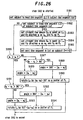
- the calculation of the line segment data after being processed at the step S82 of Fig. 8 is performed as defined from the step S181 to S194 of Fig. 26. That is, at a step S181, the head line segment Li in the subject line segment list is first processed. Then, a judgment is made at a step S182 as to whether or not the data on the line segment Li is present. If there is this data, then the process operation is advanced to a step S183.
- a straight line whose distance "D si " from the starting point Q 2s of the gesture S 2 is minimum is set as Ls
- a direction "ai” of this straight line is set as a s
- a point "P is " on this straight line, whose distance is the shortest from the starting point Q 2s .
- a distance D si-1 of a line segment L i-1 which has been processed just before, is compared with the distance D ci of the line segment Li, which is presently process, so that either the straight line having the shorter distance is set as Ls.
- the straight line which is located at the nearest position from the starting point Q 2s of the gesture S 2 is selected as a first processing line segment Ls.
- a straight line whose distance D ei from the end point Q 2e of the gesture S 2 is minimum is set as Le
- the direction ai of this straight line is set to a e
- the point P ie on this straight line, which is located at the nearest position from the end point Q 2e of the gesture S 2 is set to a point P e . That is, the distance D ei-1 of the previously processed line segment L i-1 is compared with the presently processed distance D ei , and then either the straight line having the shorter distance is set as Le.
- the straight line which is located at the nearest position from the end point Q 2e of the gesture S 2 is selected as a second processing line segment Le.
- the process operation is advanced to a step S185 at which the variable "i" is incremented by 1. Then, the process operation is returned to the step S182 at which a similar process operation is repeated.
- the process operation is advanced to a step S186 at which a comparison is made between the direction as of the line segment Ls located at the nearest position from the starting point Q 2s of the gesture S 2 and the direction ae of the line segment Le located at the nearest position from the end position Q 2e .
- the process operation is advanced to a step S187 at which a judgment is made as to whether or not a value obtained by subtracting a s from a e is larger than 90°.
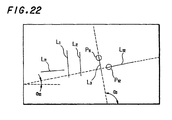
- the process operation is advanced from either the step S188 or the step S189 to a step S190 at which the line segment Ls located at the nearest position from the starting position Q 2s of the gesture S 2 is rotated by an angle ((a e -a s )-90°) around the point Ps located at the nearest position from the starting point Q 2s of the gesture S 2 as a centre.
- the line segment Ls close to the starting point Q 2s of the gesture S 2 is rotated by a preselected angle with respect to the line segment Le located at he nearest position from the end point Q 2e , whereby the angle between the line segment Ls and the line segment Le becomes 90°.
- the process operation is advanced to a step S191 at which another judgment is made whether or not (a s -a e ) is greater than 9.0°.
- the process operation is advanced to a step S92 at which a value of 180°-(a s -a e ) is set to "angle”.
- the process operation is advanced to a step S193 at which the value of (a s -a e ) is set to "angle".
- the smaller angle (acute angle) is set to "angle" among the angles defined between the two straight lines Ls and Le. Then, at a step S194, the straight Ls is rotated by the angle of 90°-(a s -a e ) around the point Ps as a centre, and is inclined by 90° with respect to the straight line Le.
- this angle has been set along the counter clockwise direction with respect to the horizontal direction in the above-described embodiment, this angle may be set along the clockwise direction. Then, in this embodiment, the angle is normalized within a range defined from the positive direction (0°) of the X axis to the negative direction (180°) of the X axis.
- Fig. 22 there is shown such a condition that the straight line L 3 has been rotated by 90° with respect to the straight line L 12 .
- the straight line located at the nearest position from the starting point of the gesture is rotated.
- either the straight line located close to the end point of the gesture, or both of these straight lines may be rotated.
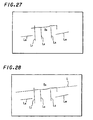
- Fig. 27 through Fig. 31 schematically represent such an embodiment that edge points of line segments are aligned on a predetermined straight line.
- the process operation defined at the step S66 of Fig. 7 is executed by a process operation defined at a step S201 of Fig. 32. That is, as represented in Fig. 27, when a gesture S 3 is inputted in which one end portion of a sufficiently long straight line is bent at a short portion thereof, a straight line L involving the longer line segment in this gesture S 3 is detected (see Fig. 28).
- this gesture S 3 has such a shape having a bending angle at a substantially 90°, and when one portion of this gesture S 3 owns a twice longer length than the reference value, as compared with the other portion, this gesture S 3 is recognized as a gesture whose end points are aligned.
- the process operation to retrieve the line segment to be processed as defined at the step S68 of Fig. 7 is carried out shown in Fig. 33. That is, the head line segment Li of the processed line segment list is selected as a first subject to be processed at a step S211. Thereafter, a judgment is made at a step S212 as to whether or not there is data about the line segment Li.
- the process operation is advanced to a step S213 at which another judgment is made as to whether or not a distance between the gesture S 3 and one end point P ia of the line segment Li is smaller than, or equal to a preset reference value.
- the process operation is advanced to a step S215 at which this line segment Li is registered into the subject line segment list.
- the dimension of the distance D ia is compared with that of the distance D ib .
- the edge point P ia , or P ib corresponding to the distance having the smaller dimension is set to a point Pi at either a step S226, or a step S227.
- a step S2208 the variable "i" is incremented by 1, and then the process operation is returned to a step S222 at which a similar process operation is repeatedly performed.
- the edge point located at the nearest position from the straight line L corresponding to the gesture S 3 is stored as Pi.
- edge points P 21 , P 22 , P 23 of the straight lines L 1 , L 2 , L 3 are stored as the edge points located at the nearest point from the straight line L corresponding to the gesture S 3 ,
- straight lines L 1 to L 3 are moved in parallel to this direction in this embodiment, these straight lines may be moved in parallel to the X-axis direction, the Y-axis direction, or the direction perpendicular to the straight line L.
- edge points P 21 to P 23 are moved on the straight line L, but may be moved in such a manner that these edge points are moved in parallel to the straight line L and on the straight line in such a way that a summation of the distances among these edge points P 21 to P 23 become minimum.
- these edge points may be moved in parallel to the straight line L and on the straight line in such a manner that a powered summation of the distances among these edge points P 21 to P 23 becomes minimum.
- the detection of the featured amount of the gesture is carried out as follows:
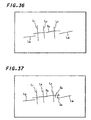
- the gesture is arranged by 3 images.
- a gesture S 4 is drawn in the form of a single straight line in such a manner that this straight line intersects with line segments L 1 to L 3 which should be processed.
- gestures S s and S 6 whose lengths are sufficiently shorter than that of the gesture S 4 are entered in such a manner that these gesture S 5 and S 6 intersect with the gesture S 4 at an angle larger than a predetermined reference value.
- a straight line L s4 corresponding to the gesture S 4 is extracted.
- another straight line L s5 corresponding to the gesture S 5 is extracted.
- a direction As of the straight line L s5 is detected.
- the head line segment Li of the processed line segment list is first selected as the subject to be processed at a step S251.
- a judgment is made as to whether or not the data about this line segment Li is present.
- the process operation is advanced to a step S253.
- another check is made as to whether or not does the line segment Li intersect with the gesture S 4 .
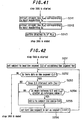
- a process operation as defined from a step S261 to a step S265 shown in Fig. 43 is carried out.
- the head line segment Li in the subject line segment list is selected as the subject to be processed, and then, a judgment is made at a step S262 as to whether or not the data about this line segment Li is present.
- the process operation is advanced to a step S263 at which a cross point Pi between the line segment Li and the gesture S 4 is obtained. Then, a direction ai of the line segment Li is obtained at a step S264.
- the process operation is advanced to a step S265 at which the variable "i" is incremented by 1, and then the process operation is returned to the step S262 at which a similar process operation is repeated.
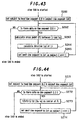
- the calculation for the processed line segment data at the step S82 of Fig. 8 is carried out as defined from a step S271 to a step S274 of Fig. 44.
- the head line segment Li of the processed line segment list is selected as the subject to be processed.
- a judgment is made as to whether or not there is data about this line segment Li.
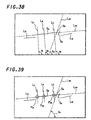
- the process operation is advanced to a step S273 at which this line segment Li is rotated by an angle (A 5 -ai) around a cross point Pi between the line segment Li and the gesture S 4 , which is obtained at the step 5263 of Fig. 43, as a centre.
- the line segment Li is rotated in such a manner that the angle becomes A 5 (namely becomes in parallel to the gesture S 5 ).
- step S274 the process operation is advanced to a step S274 at which the variable "i" is incremented by 1. Thereafter, the process operation is returned to the step S272 at which a similar process operation is repeated.
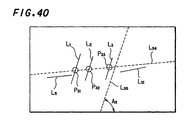
- the line segments L 1 , L 2 , L 3 to be processed are rotated around the cross points P 31 , P 32 , P 33 between these line segments and the gesture S 5 in such a manner that these line segments L 1 , L 2 , L 3 are positioned in parallel to the straight line L s5 corresponding to the gesture S 5 .
- the straight lines 1 1 to L 3 have been corrected in such a manner that they are equal to the angle A 5 corresponding to the straight line L s5 , they may be equal to either an angle corresponding to an average value between the angle A 6 defined by the gesture S 6 and the angle A 5 defined by the gesture S 5 , or an angle corresponding to an average value among the angles a 1 to a 3 of the straight lines L 1 to L 3 .
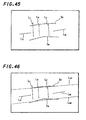
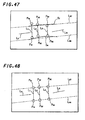
- Fig. 45 to Fig. 48 represent such an embodiment that edge points of both ends of a line segment are aligned on a preselected line.
- the process operations as defined in the steps S66, S68, S81, S82 shown in Fig. 7 or Fig. 8 are carried out as illustrated in Fig. 49 to Fig. 52.
- a gesture is arranged by a gesture S 7 which is linearly drawn adjacent to one edge points of the line segments L 1 , L 2 , L 3 to be processed, and a gesture S 8 which is linearly drawn adjacent to the other edge points thereof.
- a step S291 to a step S298 the process operations as defined from a step S291 to a step S298 are carried out, thereby to retrieve a line segment to be processed.
- a selection is made of the head line segment Li in the processed line segment list as the processing segment.
- a cheek is done as to whether or not there is data about this line segment Li.
- the process operation is advanced to a step S293 at which another judgment is made as to whether or not a distance between the straight line L s7 and one edge point P is of the straight line Li is smaller than or equal to a preset reference value.
- step S293 when it is so judged that the distance between one edge point P ia and the straight line L s7 is smaller than the reference value, otherwise when it is so judged at a step S294 that the distance between the other edge point P ib and the other straight line L s8 is below than the reference value, the process operation is advanced to a step S295.
- step S295 a judgment is made as to whether or not a distance between the edge point P ib and the straight line L s7 is smaller than the reference value.
- the process operation is further advanced to a step S296.
- a check is made as to whether or not a distance between the edge point P ia and the straight line L s8 is smaller than the reference value. If this distance is smaller than the reference value, then the process operation is advanced to a step S297 at which this straight line Li is registered into the subject line segment list.
- step S295 When it is so judged at either the step S295, or the step S296 that the distance between the edge point P ib and the straight line L s7 , or the edge point P ia and the straight line L s8 becomes largely different from the reference value, and further when the straight line Li has been registered into the subject line segment list at the step S297, the operation process is advanced to a step S298 at which the variable "i" is incremented by 1. Then, the process operation is returned to a step S292, at which a similar process operation is repeated.
- one edge points P 41 , P 42 , P 43 of the straight lines L 1 , L 2 , L 3 are arranged near the straight line L s7 respectively.
- the other edge points P 51 , P 52 , P 53 are arranged near the other straight line l s8 , respectively, so that the straight lines L 1 , L 2 , L 3 are registered as the line segments to be processed.
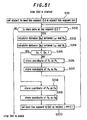
- a confirmation is made of a featured amount of a subject line segment as indicated in Fig. 51. That is, at a first step S311, the head line segment Li in the subject line segment list is selected as a subject to be processed. At a step S312, a check is done as to whether or not the data about this line segment Li is present. When it is judged that there is the data on the line segment Li, a distance D ia between the straight line L s7 and one edge point P ia of the line segment Li is calculated at a step S313. At a step S314, a distance D ib between the straight line L s7 and the other edge point P ib is calculated.
- the process operation is advanced to a step S320 at which the variable "i" is incremented by 1. Thereafter, the process operation is returned to the step S312 at which a similar process operation is repeated.
- the coordinate of the both edges of the subject line segment are stored as the point corresponding to the straight line L s7 , or the straight line L s8 located near these edge points.
- one edge points P 41 to P 43 of the straight lines L 1 to L 3 are stored as the edge point corresponding to the straight line L s7
- the other edge points P 51 to P 53 are stored as the edge point corresponding to the other straight line L s8 .
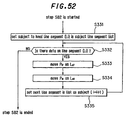
- a process operation shown in Fig. 52 is carried out as the calculation for the processed line segment data. That is, at a first step S331, the head line segment Li in the subject line segment list is first selected. At a step S332, a confirmation is made that there is the data about the line segment Li. At the next step S333, the point P i7 which has been stored as the edge point corresponding to the straight line L s7 is moved on the straight line P s7 . At a step S334, the point P i8 which has been stored as the edge point corresponding to the straight line L s8 is moved on the straight line L s8 . Subsequently, the process operation is advanced to a step S335 at which the variable "i" is incremented by 1. Then, the process operation is returned to the step S332 at which a similar process operation is repeated.
- Both of the edge points for the respective line segments Li are transported on the straight lines L s7 and L s8 in accordance with the above-described manner.
- edge points P 41 and P 51 , P 42 and P 52 , P 43 and P 53 of both the edges of the respective line segments L 1 , L 2 , L 3 are moved on either the straight line L s7 , or the straight line L s8 , respectively. As a result, the edge points of the respective straight lines are aligned.
- Fig. 53 to Fig. 56 represent such an embodiment that two straight lines intersect with each other at an arbitrary point.
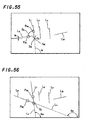
- an arc-shaped gesture S 11 is inputted so as to connect a line segment L 1 with a line segment L 11 , which are to be processed.
- two gestures S 12 and S 13 are entered which are mutually crossed, and designate a cross point between these two line segments L 1 and L 11 , or extended lines thereof.
- a starting point Q 11s and an end point Q 11e of the arc-shaped gesture S 11 which has been entered in the above manner, are confirmed as illustrated in Fig. 54.
- a cross point Qx between the gesture S 12 and the gesture S 13 is confirmed.
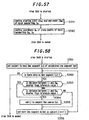
- a step S351 to a step S356 of Fig. 58 the retrieving process operation of the subject line segment as defined at the step S68 of Fig. 7 is performed.
- the head line segment Li of the established line segment list is to be processed.
- a check is done as t whether or not there is the data about the line segment Li.
- the process operation is advanced to a step S353 at which another check is made as to whether or not a distance between the line segment Li and the starting point Q 11s of the gesture S 11 is smaller than the reference value.
- the process operation is advanced to a step S355 at which this line segment Li is registered into the subject line segment list.
- the process operation is advanced to a step S354 at which a judgment is made as to whether or not a distance between this line segment Li and the end point Q 11e is smaller than the reference value.
- the process operation is advanced to a step S355 at which this line segment Li is registered into the subject line segment list.
- the line segments L 11 and L 1 which are arranged near the starting point Q 11s of the gesture S 11 and the end point Q 11e are registered into the subject line segment list.
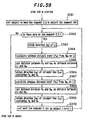
- step S361 to a step S370 shown in Fig. 59 the process operation for confirming the featured amount of the subject line segment as defined at a step S81 of Fig. 8 is carried out.
- a first step S361 the head line segment Li of the subject line segment list is to be processed.
- a judgment is made as to whether or not the data on the line segment Li is present.
- the process operation is advanced to a step S363 at which a direction (angle) "ai" of this line segment Li is obtained.
- the process operation is advanced to a step S364 at which a point P is whose distance from the starting point Q 11s of the gesture S 11 becomes minimum and which is located on the line segment Li, is calculated. Furthermore, at a step S365, a distance between this point P is and the starting point Q 11s is set as a distance D si between this line segment Li and the starting point Q 11s of the gesture S 11 .
- the process operation is advanced to a step S366 at which a direction a is of the straight line Lis containing the point P is and a cross point Qx between the gestures S 12 and S 13 is obtained.
- a point whose distance from the end point Q 11e of the gesture S 11 becomes minimum, and which is located on the line segment Li, is set as a "Pie".
- a distance between this point Pie and the end point Q 11e of the gesture S 11 is set as a distance Dei between the line segment Li and the end point Q 11e .
- a direction a ie of the straight line Lie containing the point Pie and the cross point Qx between the gesture S 12 and S 13 is obtained.
- step S370 After the variable "i" is incremented by 1 at a step S370, the process operation is returned to a step S362 at which a similar process operation is repeated.
- both the direction a 11 of the line segment L 11 , and the direction al of the line segment L 1 are obtained. It is assumed that such a point is P 63 which is located on the line segment L 11 positioned at the nearest position from the starting point Q 11s of the gesture S 11 , and a point is P 62 which is present on the line L 1 and is located at the nearest position from the end point Q 11e of the gesture S 11 . Also, as shown in Fig. 56, a direction a xs of the straight line Ls which passes through the point P 63 on the straight line L 1 and the cross point Qx, is obtained. Further, a direction a xe of the straight line Le passing through the point P 62 on the straight line L 1 and the cross point Qx is obtained.
- the process operation for calculating the processed line segment data as defined at the step S82 of Fig. 8 is executed by performing process operations defined from a step S381 to a step S387 shown in Fig. 60. That is, at a step S381, the head line segment Li in the subject line segment list is selected as a first processing subject. At a step S382, a judgment is made as to whether or not there is the data about the line segment Li.
- ai of this straight line is set as ae
- Pie is set as Pe
- aie is set as a xe .
- the line segments located at the nearest positions from both of the starting point Q 11s and the ending point Q 11e of the gesture S 11 are selected as either the line segment Ls, or the line segment Le.
- the process operation is advanced to a step S386 at which the straight line Ls located at the nearest position from the starting point Q 11s of the gesture S 11 is rotated by an angle (a xs - a,) around the point Ps as a centre which is located at the nearest position from the starting point Q 11s and is located on this straight line Ls. That is, the straight line Ls is rotated in such a manner that either this line itself, or the extended line thereof passes through the cross point Qx.
- the straight line Le located at the nearest position from the ending point Q 11e of the gesture S 11 is rotated by an angle (a xe - a e ) around the point Pe as a centre, which is located at the nearest position from the end point Q 11e . That is, the straight line Le is rotated in such a manner that either this straight line or the extended line thereof passes through the cross point Qx.
- Fig. 56 there is shown such that the straight line L 11 is rotated around the point P 63 as a centre, and is moved in such a manner that the extended line passes through the cross point Qx.
- the straight line L 1 is rotated around the point P 62 as a centre, and is moved and represented in such a way that this straight line L 1 passes through the cross point Qx.
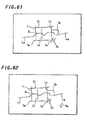
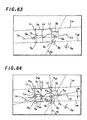
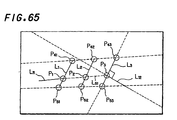
- Fig. 61 to Fig. 65 represent a further embodiment.
- a gesture S 1 for arranging the abovedescribed line segments in an equiinterval; a gesture S 2 for vertically setting two straight lines; gestures S 7 and S 8 used to align both end points of a line segment; and gestures S 8 , S 5 , S 6 used to arrange the line segments at a predetermined angle in a parallel form are combined with each other and are entered.
- the gesture S 8 is inputted together with the gesture S 7 as a gesture for aligning both of the edge points, but also is employed in combination with the gestures S 5 and S 6 as a gesture for aligning the line segments at a preselected angle (namely, gesture S 4 shown in Fig. 37).
- a single gesture may be used as the constructive elements for the plural gestures.
- the gesture S 12 shown in Fig. 62 corresponds to such a gesture that when the above-described respective gestures are inputted, this gesture is not executed but reserved, and when these entered gesture are finally and wholly executed, the gesture S 12 is entered.
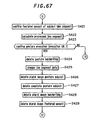
- the process operation is advanced to a step S401 of Fig. 66, at which a check is made as to whether or not the gesture S 12 used to execute the reserve handwriting as shown in Fig. 62 is inputted.
- the process operation is advanced to a step S402 at which a judgment is made as to whether or not there exists a plural image gesture subject. Then, when it is so judged that there is such a plural image gesture subject, the process operation is further advanced to a step S403.
- the featured amount of the entered gesture is added and stored into the plural image featured handwriting amount memory unit 55, and then the process operation is returned to the step S 1 of Fig. 4. Then, a process operation is carried out for another image of the plural image gesture which will then be inputted.
- the process operation is advanced to a step S404.
- a judgment is made as to whether or not the gesture subject is present in the list of the established gesture subject list memory unit 62. Then, when no gesture subject is present, the process operation is returned to the step S402 at which the subsequent process operation is similarly performed.
- the process operation is advanced to a step S405 at which a selection is made of such a gesture which owns the maximum point from these gesture subjects. Then, at a step S406, a featured amount of handwriting of the gesture is detected. As previously stated, this featured amount is required to change the display condition of the line segment under representation. Then, the process operation is advanced to a step S404 at which the subject line segment list is initialized.
- the process operation is advanced to a step S408 at which a retrieve operations carried out for the line segment to be processed by the gesture detected at the step S406 by using the featured amount of this detected gesture.
- a check is done whether or not there is a line segment to be processed.
- the process operation is advanced to a step S410 at which a check is done whether or not another gesture subject is present in the established gesture subject list.
- the process operation is advanced to a step S411 at which a selection is made of another gesture subject having the second highest point.
- the process operation is returned to the step S406 at which a similar process operation is executed by detecting a featured amount of this selected subject.
- the process operation is returned to the step S402 at which a judgment is done as to whether or not there is a plural image gesture subject. In correspondence with this judgment result, a similar process operation to that of the above-explained case is executed.
- the process operation is advanced to a step S421 at which a featured amount of this subject line segment is detected. Then, the process operation is advanced to a step S422 at which a calculation for the processed line segment data is performed. Subsequently, the process operation is advanced to a step S423 at which a confirmation is made by a user as to whether or not the gesture is executed. When the user does not allow the gesture execution, the process operation is returned to a step S410 at which such a process operation for checking whether or not another gesture subject is present in the established gesture subject list is performed.
- the process operation is advanced to a step S424 at which the gesture handwriting is erased.
- the data about the line segment is changed into the data about the processed line segment obtained at the step S422.
- the display conditions of the line segments are wholly changed.
- the process operation is advanced to a step S426 to a step S429, at which the plural image gesture subject, the established gesture subject, the plural image handwriting, and the plural image featured amount are detected. Then, the process operation is returned to the step S404 at which a similar process operation is repeated.
- the process operations defined after the step S404 are not carried out. Namely, no process operation to carry out the previously entered gesture is carried out.
- the previously entered gesture is reserved as the reserved handwriting by performing the process operations defined before the step S401. Then, after the gesture S 12 has been entered, these gestures of the reserved handwriting are wholly executed.
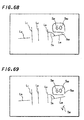
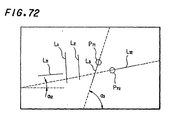
- Fig. 68 to Fig. 72 schematically represent a further embodiment.
- a featured amount may be more firmly designated by containing a character as a shape confirmation of inputted handwriting.
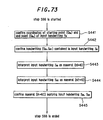
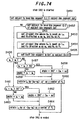
- both of the process operation for detecting the featured amount of the gesture handwriting defined at the step S66, and the process operation for calculating the processed line segment data defined at the step S82 among the above-described process operations shown in Fig. 4 to Fig. 8 are performed as represented in Fig. 73, or Fig. 74, respectively.
- a confirmation is made of coordinate values for a starting point P 11s of a gesture S 11 and an end point P 11e thereof.
- a gesture S 21 and a gesture S 22 which are contained in a gesture S 23 are confirmed.
- numeral values of the gesture S 21 and the gesture S 22 inside this gesture S 23 are interpreted.
- a numeral value signified by combining the gesture S 21 with the gesture S 22 is confirmed.
- a character of 60 is entered as the gestures S 21 and S 22 into the gesture S 23 having such a closed shape that an internal space is separated from an external space. Then, as shown in Fig. 69, after these gestures S 11 and S 21 to S 23 have been inputted, when the reserved handwriting executing gesture S 12 is entered, the character inside the gesture S 23 is confirmed, and this confirmation result is displayed adjacent to this character, as represented in Fig. 70.
- the head line segment Li in the subject line segment list is set as a first processing subject. Then, at a step S452, a judgment is made as to whether or not the data about the line segment Li is present.
- the process operation is advanced to a step S453.
- a straight line is set as Ls, whose distance D si from the starting point Q 11s of the gesture S 11 s minimum, and a direction "ai" of this straight line Ls is set as "as”.
- a point P is is set as Ps, which is located at the nearest position from the starting point Q 11s , and is positioned on this straight line Ls.
- a straight line is set as Le whose distance Dei from then end point Q 11e of the gesture S 11 becomes minimum, and whose direction "ai" is set as "ae”, and also a point Pie is set as Pe, which is located on this straight line and at the nearest position from the end point Q 11e of the gesture S 11 .
- a comparison is performed between the present is performed between the present distance Dei and the distance D ei-1 of the previously processed line segment L i-1 , and the straight line whose distance is small is set as Le.
- such a straight line located at the nearest position from the end point Q 11e of the gesture S 11 is selected as the second subject line segment Le to be processed.
- the process operation is advanced to a step S455 at which the variable "i" is incremented by 1, and then the process operation is returned to the step S452 at which a similar process operation is repeated.
- the process operation is advanced to a step S456.
- the direction "as" of the line segment Ls located at the nearest position from the starting point Q 11s of the gesture S 11 is compared with the direction "ae" of the line segment Le located at the nearest position from the end point Q 11e of this gesture Q 11 .
- the process operation is advanced to a step S457 at which a judgment is made as to whether or not a value produced by subtracting "as" from "ae” is greater than 90°.
- the process operation is advanced from either the step S458 or the step S459 to the step S460 at which the line segment Ls located at the nearest position from the starting point Q 11s of the gesture S 11 is rotated by an angle of ((a e -a s )-A°) around the point Ps located at the nearest position from the starting point Q 11s of the gesture S 11 as a centre.
- the line segment Ls located near the starting point Q 11s of the gesture S 11 is rotated by a preselected angle with respect to the line segment Le located at the nearest position from the end point Q 11e , so that both of these line segments are adjusted to define an angle of A°.
- this value of "A" is such a value recognized at the step S445.
- a plurality of windows may be utilized in order that the variation in the representation made when the command corresponding to the gesture has been executed is represented to a user.
- the execution of the input gesture is confirmed, not only such a YES/NO checking process, but also change/correct for the process subject/parameter may be employed.
- gesture command recognizing/executing method for example, interrupt of gesture entry, and allowable of using same handwriting by plural gestures
- a centre of an outer frame of a character is recognized as a centre of this character.
- a circle and a polygon other than a rectangle may be employed.
- a gravity position thereof is recognized as a centre thereof.
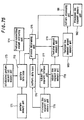
- a pattern sort number is stored in addition to the previously inputted data about the patterns (patterns to be processed) other than the gesture. This data is processed in accordance with the above-explained necessary modification process operation by the pattern data base 170, and thereafter is supplied to the process determining unit 175.
- the process determining unit 175 determines the process operation suitable for the sort of the gesture by utilizing this pattern sort number with respect to the element of the list.
- the featured amount extracting unit 179 extracts the featured amount of the subject pattern stored in the subject pattern list memory unit 178, and supplies the extracted result to the pattern featured amount memory unit 180 to be stored therein.
- the pattern processing unit 181 processes the featured amount of the pattern to be processed, which has been stored in the pattern featured amount memory unit 180, and produces data used to change the display condition of this pattern under control of the process determining unit 175. Then, this data is furnished to the processed pattern memory unit 182 so as to be stored therein.
- This processed pattern memory unit 182 is read and then supplied via the display controller 11 to the V-RAM 12 to be expanded as bit map data. Then, this expanded data is read by the display controller 11 to be outputted on the display unit 13 for a representation purpose.
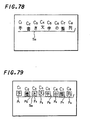
- Fig. 76 to Fig. 80 schematically indicate an embodiment such that a character is aligned on a preselected straight line.
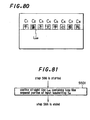
- the process operation defined at the step S66 in Fig. 7 is carried out as shown in a step S501 of Fig. 81. that is, as shown in Fig. 76, when such a gesture S 31 is inputted which is drawn by bending at a substantially right angle one edge portion of a sufficiently long straight line at a short portion thereof, as illustrated in Fig. 77, a straight line L s31 containing a longer line segment among this gesture S 31 is detected.
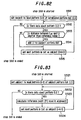
- the process operation for retrieving the subject line segment as defined at the step S68 of Fig. 7 is carried out as illustrated in Fig. 82. That is, the head pattern Li in the established pattern list is selected as a first processing subject. Since a line segment Li, a character Lci, or a pattern LFi has been stored as the pattern Li in the established pattern list, any one of them is selected.
- a judgment is made as to whether or not there is data about the pattern Li.
- the process operation is advanced to a step S513 at which it is so judged whether or not the distance between the straight L s3 , and the pattern Li is smaller than a preset reference value.
- the process operation is advanced to a step S514 at which this pattern Li is registered in the subject pattern list.
- the process operation is advanced to a step S515.
- the variable "i" is incremented by 1, and the process operation is returned to the step S512 at which a similar process operation is repeated.
- the pattern (character) of the gesture S31 to be processed is retrieved by repeating the above-described process operation.
- the process operation for confirming the featured amount of the line segment to be processed at the step S81 shown in Fig. 8 is carried out as shown at step S521 to S524 of Fig. 83. That is, at a first step S521, the head pattern Li in the subject pattern list is first set as a subject to be processed. At a step S522, a confirmation is made as to whether or not there is data about this pattern Li. When there is the data about the pattern Li, the process operation is advanced to a step S523 at which a reference point Pi of this pattern Li is obtained. This reference point Pi is defined as, for instance, a lower right point of an outer frame of the pattern.
- variable "i" is incremented by 1 at the step 5524, and then the process operation is returned to the step 5522 at which a similar process operation is repeated.
- the point located at the nearest position from the straight line L s31 corresponding to the gesture S 31 corresponding to the gesture S 31 within the outer frames of the respective patterns Li is stored as "Pi".
- the process operation for calculating the processed line segment data at the step S82 of Fig. 8 is executed as illustrated at steps S531 to 5534 of Fig. 84. Namely, at a first step S531, the head pattern Li of the subject pattern list is selected, and at a step S532, a confirmation is made as to whether or not there is data about this pattern Li. When the data about the pattern Li is present, this point Pi is moved on the straight line 1 s31 corresponding to the gesture S 31 at a step S533. Then, the process operation is advanced to a step S534 at which the variable "i" is incremented by 1. Then, the process operation is returned to the step S532 at which a similar process operation is repeated. Thus, the point of the character to be processed is moved on the straight line L s31 .
- this point Pi may be alternatively transported as follows: The point Pi may be moved on the straight line in parallel thereto in such a manner that a summation of the distances between the straight line L s31 and this point Pi becomes minimum. The point Pi may be moved on the straight line L s31 in parallel thereto in such a manner that a powered summation of the distances between this point Pi and the straight line L s31 becomes minimum.
- the display condition of the shape is changed in correspondence with the featured amount of the gesture, the display condition can be more precisely changed by investigating the input condition of the gesture.
Landscapes
- Engineering & Computer Science (AREA)
- Theoretical Computer Science (AREA)
- Physics & Mathematics (AREA)
- General Physics & Mathematics (AREA)
- Computer Vision & Pattern Recognition (AREA)
- Multimedia (AREA)
- General Engineering & Computer Science (AREA)
- Human Computer Interaction (AREA)
- User Interface Of Digital Computer (AREA)
- Character Discrimination (AREA)
- Processing Or Creating Images (AREA)
Applications Claiming Priority (3)
| Application Number | Priority Date | Filing Date | Title |
|---|---|---|---|
| JP198707/93 | 1993-08-11 | ||
| JP19870793A JP3282637B2 (ja) | 1993-08-11 | 1993-08-11 | 手書き入力表示装置および方法 |
| JP19870793 | 1993-08-11 |
Publications (3)
| Publication Number | Publication Date |
|---|---|
| EP0644476A2 EP0644476A2 (en) | 1995-03-22 |
| EP0644476A3 EP0644476A3 (en) | 1996-12-18 |
| EP0644476B1 true EP0644476B1 (en) | 2001-07-04 |
Family
ID=16395684
Family Applications (1)
| Application Number | Title | Priority Date | Filing Date |
|---|---|---|---|
| EP94305944A Expired - Lifetime EP0644476B1 (en) | 1993-08-11 | 1994-08-11 | Method of changing display condition of handwritten input |
Country Status (5)
| Country | Link |
|---|---|
| US (1) | US6240207B1 (enExample) |
| EP (1) | EP0644476B1 (enExample) |
| JP (1) | JP3282637B2 (enExample) |
| KR (1) | KR100323569B1 (enExample) |
| DE (1) | DE69427622T2 (enExample) |
Families Citing this family (41)
| Publication number | Priority date | Publication date | Assignee | Title |
|---|---|---|---|---|
| US8352400B2 (en) | 1991-12-23 | 2013-01-08 | Hoffberg Steven M | Adaptive pattern recognition based controller apparatus and method and human-factored interface therefore |
| US6317762B1 (en) * | 1995-11-22 | 2001-11-13 | Fujitsu Limited | Document creating apparatus creates free format document from handwritten data converting into normalized size |
| JPH10124505A (ja) * | 1996-10-25 | 1998-05-15 | Hitachi Ltd | 文字入力装置 |
| US7158871B1 (en) | 1998-05-07 | 2007-01-02 | Art - Advanced Recognition Technologies Ltd. | Handwritten and voice control of vehicle components |
| US7966078B2 (en) | 1999-02-01 | 2011-06-21 | Steven Hoffberg | Network media appliance system and method |
| US6903730B2 (en) * | 2000-11-10 | 2005-06-07 | Microsoft Corporation | In-air gestures for electromagnetic coordinate digitizers |
| US8442331B2 (en) | 2004-02-15 | 2013-05-14 | Google Inc. | Capturing text from rendered documents using supplemental information |
| US7707039B2 (en) | 2004-02-15 | 2010-04-27 | Exbiblio B.V. | Automatic modification of web pages |
| US7812860B2 (en) | 2004-04-01 | 2010-10-12 | Exbiblio B.V. | Handheld device for capturing text from both a document printed on paper and a document displayed on a dynamic display device |
| US10635723B2 (en) | 2004-02-15 | 2020-04-28 | Google Llc | Search engines and systems with handheld document data capture devices |
| US8081849B2 (en) | 2004-12-03 | 2011-12-20 | Google Inc. | Portable scanning and memory device |
| US9116890B2 (en) | 2004-04-01 | 2015-08-25 | Google Inc. | Triggering actions in response to optically or acoustically capturing keywords from a rendered document |
| US8146156B2 (en) | 2004-04-01 | 2012-03-27 | Google Inc. | Archive of text captures from rendered documents |
| US9008447B2 (en) | 2004-04-01 | 2015-04-14 | Google Inc. | Method and system for character recognition |
| US7894670B2 (en) | 2004-04-01 | 2011-02-22 | Exbiblio B.V. | Triggering actions in response to optically or acoustically capturing keywords from a rendered document |
| US20060098900A1 (en) | 2004-09-27 | 2006-05-11 | King Martin T | Secure data gathering from rendered documents |
| US7990556B2 (en) | 2004-12-03 | 2011-08-02 | Google Inc. | Association of a portable scanner with input/output and storage devices |
| US20060081714A1 (en) | 2004-08-23 | 2006-04-20 | King Martin T | Portable scanning device |
| US9143638B2 (en) | 2004-04-01 | 2015-09-22 | Google Inc. | Data capture from rendered documents using handheld device |
| US8713418B2 (en) | 2004-04-12 | 2014-04-29 | Google Inc. | Adding value to a rendered document |
| US8489624B2 (en) | 2004-05-17 | 2013-07-16 | Google, Inc. | Processing techniques for text capture from a rendered document |
| US8620083B2 (en) | 2004-12-03 | 2013-12-31 | Google Inc. | Method and system for character recognition |
| US8874504B2 (en) | 2004-12-03 | 2014-10-28 | Google Inc. | Processing techniques for visual capture data from a rendered document |
| US8346620B2 (en) | 2004-07-19 | 2013-01-01 | Google Inc. | Automatic modification of web pages |
| JP3919789B2 (ja) | 2005-03-07 | 2007-05-30 | 株式会社コナミデジタルエンタテインメント | 情報処理装置、画像移動指示方法及びプログラム |
| US8930834B2 (en) * | 2006-03-20 | 2015-01-06 | Microsoft Corporation | Variable orientation user interface |
| US8139059B2 (en) * | 2006-03-31 | 2012-03-20 | Microsoft Corporation | Object illumination in a virtual environment |
| KR101307062B1 (ko) | 2006-04-19 | 2013-09-11 | 엘지전자 주식회사 | 터치패드의 입력 정보 제어방법 및 장치 |
| US8001613B2 (en) * | 2006-06-23 | 2011-08-16 | Microsoft Corporation | Security using physical objects |
| US20080040692A1 (en) * | 2006-06-29 | 2008-02-14 | Microsoft Corporation | Gesture input |
| EP2067119A2 (en) | 2006-09-08 | 2009-06-10 | Exbiblio B.V. | Optical scanners, such as hand-held optical scanners |
| US20080104020A1 (en) * | 2006-10-27 | 2008-05-01 | Microsoft Corporation | Handwritten Query Builder |
| JP4632102B2 (ja) | 2008-07-17 | 2011-02-16 | ソニー株式会社 | 情報処理装置、情報処理方法及び情報処理プログラム |
| JP5197338B2 (ja) * | 2008-12-08 | 2013-05-15 | キヤノン株式会社 | 情報処理装置及び情報処理方法 |
| WO2010096193A2 (en) | 2009-02-18 | 2010-08-26 | Exbiblio B.V. | Identifying a document by performing spectral analysis on the contents of the document |
| WO2010105244A2 (en) | 2009-03-12 | 2010-09-16 | Exbiblio B.V. | Performing actions based on capturing information from rendered documents, such as documents under copyright |
| US8447066B2 (en) | 2009-03-12 | 2013-05-21 | Google Inc. | Performing actions based on capturing information from rendered documents, such as documents under copyright |
| US9081799B2 (en) | 2009-12-04 | 2015-07-14 | Google Inc. | Using gestalt information to identify locations in printed information |
| US9323784B2 (en) | 2009-12-09 | 2016-04-26 | Google Inc. | Image search using text-based elements within the contents of images |
| JP5146845B2 (ja) * | 2009-12-24 | 2013-02-20 | ブラザー工業株式会社 | ヘッドマウントディスプレイ |
| WO2013005665A1 (ja) * | 2011-07-04 | 2013-01-10 | 株式会社ニコン | 電子機器及び入力方法 |
Family Cites Families (11)
| Publication number | Priority date | Publication date | Assignee | Title |
|---|---|---|---|---|
| US4112415A (en) * | 1975-11-28 | 1978-09-05 | Hilbrink Johan O | System for optically entering, displaying and decoding handwritten symbols |
| JPS60136892A (ja) * | 1983-12-26 | 1985-07-20 | Hitachi Ltd | オンライン手書き図形認識装置 |
| US4972496A (en) * | 1986-07-25 | 1990-11-20 | Grid Systems Corporation | Handwritten keyboardless entry computer system |
| JP2589999B2 (ja) * | 1988-03-18 | 1997-03-12 | 株式会社竹中工務店 | 図形入出力装置 |
| US5010500A (en) * | 1989-01-26 | 1991-04-23 | Xerox Corporation | Gesture-modified diagram for retrieval of image resembling diagram, with parts selectable for further interactive retrieval |
| US5361310A (en) * | 1990-01-19 | 1994-11-01 | Fujitsu Limited | Handwriting entry processing system using keyboard and mouse interfaces requiring no modification of an application program |
| US5123087A (en) * | 1990-04-27 | 1992-06-16 | Ashlar, Inc. | Geometric inference engine |
| US5347295A (en) * | 1990-10-31 | 1994-09-13 | Go Corporation | Control of a computer through a position-sensed stylus |
| JP2718485B2 (ja) * | 1990-11-29 | 1998-02-25 | 株式会社リコー | 文字認識方法 |
| US5903668A (en) * | 1992-05-27 | 1999-05-11 | Apple Computer, Inc. | Method and apparatus for recognizing handwritten words |
| US5367453A (en) * | 1993-08-02 | 1994-11-22 | Apple Computer, Inc. | Method and apparatus for correcting words |
-
1993
- 1993-08-11 JP JP19870793A patent/JP3282637B2/ja not_active Expired - Fee Related
-
1994
- 1994-08-10 KR KR1019940019672A patent/KR100323569B1/ko not_active Expired - Fee Related
- 1994-08-11 US US08/289,134 patent/US6240207B1/en not_active Expired - Fee Related
- 1994-08-11 EP EP94305944A patent/EP0644476B1/en not_active Expired - Lifetime
- 1994-08-11 DE DE69427622T patent/DE69427622T2/de not_active Expired - Lifetime
Also Published As
| Publication number | Publication date |
|---|---|
| KR100323569B1 (ko) | 2002-06-20 |
| EP0644476A3 (en) | 1996-12-18 |
| DE69427622T2 (de) | 2002-05-08 |
| JP3282637B2 (ja) | 2002-05-20 |
| DE69427622D1 (de) | 2001-08-09 |
| KR950006651A (ko) | 1995-03-21 |
| US6240207B1 (en) | 2001-05-29 |
| JPH0756679A (ja) | 1995-03-03 |
| EP0644476A2 (en) | 1995-03-22 |
Similar Documents
| Publication | Publication Date | Title |
|---|---|---|
| EP0644476A2 (en) | Method of changing display condition of handwritten input | |
| US12164839B2 (en) | Systems and methods for improved parametric modeling of structures | |
| CN112085840B (zh) | 语义分割方法、装置、设备及计算机可读存储介质 | |
| JP3574202B2 (ja) | 図形入出力装置 | |
| JP3795238B2 (ja) | 文書画像処理装置及び文書画像処理方法 | |
| CN117392357A (zh) | 一种数字孪生模型编辑方法及装置 | |
| JP2020140659A (ja) | 情報処理装置、情報処理方法及びプログラム | |
| US5548695A (en) | Image figure editing system for manipulating figure elements given in terms of image data | |
| JP4046370B2 (ja) | 3次元形状の作図方法 | |
| EP0631251A2 (en) | Graphics correcting method and system employing same | |
| CN120279140B (zh) | 一种cad自动多标注生成方法及系统 | |
| CN116229004B (zh) | 虚拟道路模型的生成方法、装置、计算机设备及存储介质 | |
| CN111311730A (zh) | 一种矿井三维立体化实现方法及装置 | |
| CN118096555A (zh) | 一种图像数据处理方法、装置、设备及存储介质 | |
| CN114943946B (zh) | 车道线处理方法、装置、电子设备及存储介质 | |
| CN122336342B (zh) | 一种跨视角实例表征学习与检索定位系统和方法 | |
| CN120259605B (zh) | 一种基于cad实体类型自动生成标注的方法及系统 | |
| CN120976442B (zh) | 数字空间中坡屋顶建筑的自动化建模方法、设备和程序产品 | |
| CN115409871B (zh) | 一种基于位置智能的三维场景虚实交互方法及装置 | |
| JP2723058B2 (ja) | 線対称図形入力装置 | |
| CN121999510A (zh) | 一种错误处理方法、系统、设备、介质及产品 | |
| CN122243869A (zh) | 图像处理方法、装置及电子设备 | |
| CN122796936A (zh) | 一种用于图纸标注的数据处理系统 | |
| CN122711874A (zh) | 基于形状特征的相似实体匹配方法、装置、设备和介质 | |
| JP2002024318A (ja) | ピアス部品設計方法 |
Legal Events
| Date | Code | Title | Description |
|---|---|---|---|
| PUAI | Public reference made under article 153(3) epc to a published international application that has entered the european phase |
Free format text: ORIGINAL CODE: 0009012 |
|
| AK | Designated contracting states |
Kind code of ref document: A2 Designated state(s): DE FR GB |
|
| PUAL | Search report despatched |
Free format text: ORIGINAL CODE: 0009013 |
|
| AK | Designated contracting states |
Kind code of ref document: A3 Designated state(s): DE FR GB |
|
| 17P | Request for examination filed |
Effective date: 19970530 |
|
| 17Q | First examination report despatched |
Effective date: 20000210 |
|
| GRAG | Despatch of communication of intention to grant |
Free format text: ORIGINAL CODE: EPIDOS AGRA |
|
| GRAG | Despatch of communication of intention to grant |
Free format text: ORIGINAL CODE: EPIDOS AGRA |
|
| GRAH | Despatch of communication of intention to grant a patent |
Free format text: ORIGINAL CODE: EPIDOS IGRA |
|
| GRAH | Despatch of communication of intention to grant a patent |
Free format text: ORIGINAL CODE: EPIDOS IGRA |
|
| GRAA | (expected) grant |
Free format text: ORIGINAL CODE: 0009210 |
|
| AK | Designated contracting states |
Kind code of ref document: B1 Designated state(s): DE FR GB |
|
| REF | Corresponds to: |
Ref document number: 69427622 Country of ref document: DE Date of ref document: 20010809 |
|
| ET | Fr: translation filed | ||
| REG | Reference to a national code |
Ref country code: GB Ref legal event code: IF02 |
|
| PLBE | No opposition filed within time limit |
Free format text: ORIGINAL CODE: 0009261 |
|
| STAA | Information on the status of an ep patent application or granted ep patent |
Free format text: STATUS: NO OPPOSITION FILED WITHIN TIME LIMIT |
|
| 26N | No opposition filed | ||
| PGFP | Annual fee paid to national office [announced via postgrant information from national office to epo] |
Ref country code: DE Payment date: 20110823 Year of fee payment: 18 Ref country code: FR Payment date: 20110901 Year of fee payment: 18 Ref country code: GB Payment date: 20110819 Year of fee payment: 18 |
|
| GBPC | Gb: european patent ceased through non-payment of renewal fee |
Effective date: 20120811 |
|
| REG | Reference to a national code |
Ref country code: FR Ref legal event code: ST Effective date: 20130430 |
|
| PG25 | Lapsed in a contracting state [announced via postgrant information from national office to epo] |
Ref country code: GB Free format text: LAPSE BECAUSE OF NON-PAYMENT OF DUE FEES Effective date: 20120811 Ref country code: DE Free format text: LAPSE BECAUSE OF NON-PAYMENT OF DUE FEES Effective date: 20130301 |
|
| PG25 | Lapsed in a contracting state [announced via postgrant information from national office to epo] |
Ref country code: FR Free format text: LAPSE BECAUSE OF NON-PAYMENT OF DUE FEES Effective date: 20120831 |
|
| REG | Reference to a national code |
Ref country code: DE Ref legal event code: R119 Ref document number: 69427622 Country of ref document: DE Effective date: 20130301 |