EP0644245B1 - Wässrige Dispersionen, deren Herstellung und Verwendung in Überzugsmitteln zur kathodischen Tauchlackierung - Google Patents
Wässrige Dispersionen, deren Herstellung und Verwendung in Überzugsmitteln zur kathodischen Tauchlackierung Download PDFInfo
- Publication number
- EP0644245B1 EP0644245B1 EP94114667A EP94114667A EP0644245B1 EP 0644245 B1 EP0644245 B1 EP 0644245B1 EP 94114667 A EP94114667 A EP 94114667A EP 94114667 A EP94114667 A EP 94114667A EP 0644245 B1 EP0644245 B1 EP 0644245B1
- Authority
- EP
- European Patent Office
- Prior art keywords
- weight
- component
- dispersions
- temperatures
- water
- Prior art date
- Legal status (The legal status is an assumption and is not a legal conclusion. Google has not performed a legal analysis and makes no representation as to the accuracy of the status listed.)
- Expired - Lifetime
Links
- 239000006185 dispersion Substances 0.000 title claims abstract description 51
- 238000000576 coating method Methods 0.000 title claims abstract description 8
- 238000004519 manufacturing process Methods 0.000 title claims description 10
- 238000004070 electrodeposition Methods 0.000 title description 10
- 229920005989 resin Polymers 0.000 claims abstract description 68
- 239000011347 resin Substances 0.000 claims abstract description 68
- 229920000647 polyepoxide Polymers 0.000 claims abstract description 55
- 239000003822 epoxy resin Substances 0.000 claims abstract description 54
- 125000002887 hydroxy group Chemical group [H]O* 0.000 claims abstract description 50
- XLYOFNOQVPJJNP-UHFFFAOYSA-N water Substances O XLYOFNOQVPJJNP-UHFFFAOYSA-N 0.000 claims abstract description 48
- 239000000203 mixture Substances 0.000 claims abstract description 42
- 238000006243 chemical reaction Methods 0.000 claims abstract description 38
- 239000002904 solvent Substances 0.000 claims abstract description 30
- 150000001412 amines Chemical class 0.000 claims abstract description 29
- 239000007787 solid Substances 0.000 claims abstract description 28
- 239000003085 diluting agent Substances 0.000 claims abstract description 27
- 125000002947 alkylene group Chemical group 0.000 claims abstract description 25
- 239000003431 cross linking reagent Substances 0.000 claims abstract description 18
- 125000001302 tertiary amino group Chemical group 0.000 claims abstract description 16
- 101000623895 Bos taurus Mucin-15 Proteins 0.000 claims abstract description 13
- 239000011248 coating agent Substances 0.000 claims abstract description 13
- 239000007788 liquid Substances 0.000 claims abstract description 13
- 238000004132 cross linking Methods 0.000 claims abstract description 11
- 150000002763 monocarboxylic acids Chemical class 0.000 claims abstract description 9
- 230000000269 nucleophilic effect Effects 0.000 claims abstract description 9
- 125000002091 cationic group Chemical group 0.000 claims abstract description 7
- 238000002156 mixing Methods 0.000 claims abstract description 7
- 239000002245 particle Substances 0.000 claims abstract description 6
- -1 amino epoxy resins Chemical compound 0.000 claims description 45
- 239000005056 polyisocyanate Substances 0.000 claims description 35
- 229920001228 polyisocyanate Polymers 0.000 claims description 35
- 238000000034 method Methods 0.000 claims description 21
- GYZLOYUZLJXAJU-UHFFFAOYSA-N diglycidyl ether Chemical class C1OC1COCC1CO1 GYZLOYUZLJXAJU-UHFFFAOYSA-N 0.000 claims description 15
- 150000002170 ethers Chemical class 0.000 claims description 14
- 125000003118 aryl group Chemical group 0.000 claims description 13
- 150000002009 diols Chemical class 0.000 claims description 10
- GOOHAUXETOMSMM-UHFFFAOYSA-N Propylene oxide Chemical group CC1CO1 GOOHAUXETOMSMM-UHFFFAOYSA-N 0.000 claims description 7
- 239000001257 hydrogen Substances 0.000 claims description 4
- 229910052739 hydrogen Inorganic materials 0.000 claims description 4
- 125000004435 hydrogen atom Chemical class [H]* 0.000 claims description 4
- 239000004848 polyfunctional curative Substances 0.000 claims description 4
- 238000003618 dip coating Methods 0.000 claims description 3
- 230000003472 neutralizing effect Effects 0.000 claims description 3
- 238000005809 transesterification reaction Methods 0.000 claims description 3
- WYURNTSHIVDZCO-UHFFFAOYSA-N Tetrahydrofuran Chemical group C1CCOC1 WYURNTSHIVDZCO-UHFFFAOYSA-N 0.000 claims description 2
- 229920001568 phenolic resin Polymers 0.000 claims description 2
- 239000000758 substrate Substances 0.000 claims description 2
- 238000006845 Michael addition reaction Methods 0.000 claims 1
- IWLBIFVMPLUHLK-UHFFFAOYSA-N azane;formaldehyde Chemical compound N.O=C IWLBIFVMPLUHLK-UHFFFAOYSA-N 0.000 claims 1
- 238000006386 neutralization reaction Methods 0.000 abstract description 8
- 239000008199 coating composition Substances 0.000 abstract description 3
- 230000008021 deposition Effects 0.000 abstract description 3
- 239000000463 material Substances 0.000 abstract description 3
- 239000011230 binding agent Substances 0.000 description 22
- IISBACLAFKSPIT-UHFFFAOYSA-N bisphenol A Chemical compound C=1C=C(O)C=CC=1C(C)(C)C1=CC=C(O)C=C1 IISBACLAFKSPIT-UHFFFAOYSA-N 0.000 description 19
- 125000002924 primary amino group Chemical group [H]N([H])* 0.000 description 17
- 239000007795 chemical reaction product Substances 0.000 description 15
- 150000001875 compounds Chemical class 0.000 description 15
- 239000000049 pigment Substances 0.000 description 15
- IQPQWNKOIGAROB-UHFFFAOYSA-N isocyanate group Chemical group [N-]=C=O IQPQWNKOIGAROB-UHFFFAOYSA-N 0.000 description 14
- LNEPOXFFQSENCJ-UHFFFAOYSA-N haloperidol Chemical compound C1CC(O)(C=2C=CC(Cl)=CC=2)CCN1CCCC(=O)C1=CC=C(F)C=C1 LNEPOXFFQSENCJ-UHFFFAOYSA-N 0.000 description 13
- RTZKZFJDLAIYFH-UHFFFAOYSA-N Diethyl ether Chemical compound CCOCC RTZKZFJDLAIYFH-UHFFFAOYSA-N 0.000 description 12
- 239000003054 catalyst Substances 0.000 description 12
- 239000004971 Cross linker Substances 0.000 description 11
- 239000002253 acid Substances 0.000 description 10
- 125000004432 carbon atom Chemical group C* 0.000 description 10
- LYCAIKOWRPUZTN-UHFFFAOYSA-N ethylene glycol Natural products OCCO LYCAIKOWRPUZTN-UHFFFAOYSA-N 0.000 description 10
- 229910052757 nitrogen Inorganic materials 0.000 description 10
- 125000001931 aliphatic group Chemical group 0.000 description 9
- 125000003700 epoxy group Chemical group 0.000 description 9
- 239000003960 organic solvent Substances 0.000 description 9
- 229920001451 polypropylene glycol Polymers 0.000 description 9
- 239000004593 Epoxy Substances 0.000 description 8
- 239000003795 chemical substances by application Substances 0.000 description 8
- 125000005442 diisocyanate group Chemical group 0.000 description 8
- 230000008569 process Effects 0.000 description 8
- 229930185605 Bisphenol Natural products 0.000 description 7
- 125000003277 amino group Chemical group 0.000 description 7
- 230000015572 biosynthetic process Effects 0.000 description 7
- 239000012948 isocyanate Substances 0.000 description 7
- 150000002513 isocyanates Chemical class 0.000 description 7
- 238000002360 preparation method Methods 0.000 description 7
- 150000001298 alcohols Chemical class 0.000 description 6
- 238000004821 distillation Methods 0.000 description 6
- 150000002334 glycols Chemical class 0.000 description 6
- WGCNASOHLSPBMP-UHFFFAOYSA-N hydroxyacetaldehyde Natural products OCC=O WGCNASOHLSPBMP-UHFFFAOYSA-N 0.000 description 6
- BDAGIHXWWSANSR-UHFFFAOYSA-N methanoic acid Natural products OC=O BDAGIHXWWSANSR-UHFFFAOYSA-N 0.000 description 6
- 239000000126 substance Substances 0.000 description 6
- OFOBLEOULBTSOW-UHFFFAOYSA-N Malonic acid Chemical compound OC(=O)CC(O)=O OFOBLEOULBTSOW-UHFFFAOYSA-N 0.000 description 5
- 229940106691 bisphenol a Drugs 0.000 description 5
- 150000004985 diamines Chemical group 0.000 description 5
- 239000003973 paint Substances 0.000 description 5
- 229920000768 polyamine Polymers 0.000 description 5
- 229920000570 polyether Polymers 0.000 description 5
- 150000005846 sugar alcohols Polymers 0.000 description 5
- 229920003002 synthetic resin Polymers 0.000 description 5
- 239000000057 synthetic resin Substances 0.000 description 5
- OAOABCKPVCUNKO-UHFFFAOYSA-N 8-methyl Nonanoic acid Chemical compound CC(C)CCCCCCC(O)=O OAOABCKPVCUNKO-UHFFFAOYSA-N 0.000 description 4
- 239000005057 Hexamethylene diisocyanate Substances 0.000 description 4
- XEEYBQQBJWHFJM-UHFFFAOYSA-N Iron Chemical compound [Fe] XEEYBQQBJWHFJM-UHFFFAOYSA-N 0.000 description 4
- KYIMHWNKQXQBDG-UHFFFAOYSA-N N=C=O.N=C=O.CCCCCC Chemical compound N=C=O.N=C=O.CCCCCC KYIMHWNKQXQBDG-UHFFFAOYSA-N 0.000 description 4
- DNIAPMSPPWPWGF-UHFFFAOYSA-N Propylene glycol Chemical compound CC(O)CO DNIAPMSPPWPWGF-UHFFFAOYSA-N 0.000 description 4
- 150000007513 acids Chemical class 0.000 description 4
- 239000000654 additive Substances 0.000 description 4
- WERYXYBDKMZEQL-UHFFFAOYSA-N butane-1,4-diol Chemical compound OCCCCO WERYXYBDKMZEQL-UHFFFAOYSA-N 0.000 description 4
- JBKVHLHDHHXQEQ-UHFFFAOYSA-N epsilon-caprolactam Chemical compound O=C1CCCCCN1 JBKVHLHDHHXQEQ-UHFFFAOYSA-N 0.000 description 4
- 238000000227 grinding Methods 0.000 description 4
- RRAMGCGOFNQTLD-UHFFFAOYSA-N hexamethylene diisocyanate Chemical compound O=C=NCCCCCCN=C=O RRAMGCGOFNQTLD-UHFFFAOYSA-N 0.000 description 4
- 125000003010 ionic group Chemical group 0.000 description 4
- NIMLQBUJDJZYEJ-UHFFFAOYSA-N isophorone diisocyanate Chemical compound CC1(C)CC(N=C=O)CC(C)(CN=C=O)C1 NIMLQBUJDJZYEJ-UHFFFAOYSA-N 0.000 description 4
- 239000002184 metal Substances 0.000 description 4
- 229910052751 metal Inorganic materials 0.000 description 4
- 150000002923 oximes Chemical class 0.000 description 4
- 239000000047 product Substances 0.000 description 4
- 239000013557 residual solvent Substances 0.000 description 4
- 239000000243 solution Substances 0.000 description 4
- 238000003786 synthesis reaction Methods 0.000 description 4
- ZWEHNKRNPOVVGH-UHFFFAOYSA-N 2-Butanone Chemical compound CCC(C)=O ZWEHNKRNPOVVGH-UHFFFAOYSA-N 0.000 description 3
- POAOYUHQDCAZBD-UHFFFAOYSA-N 2-butoxyethanol Chemical compound CCCCOCCO POAOYUHQDCAZBD-UHFFFAOYSA-N 0.000 description 3
- VPWNQTHUCYMVMZ-UHFFFAOYSA-N 4,4'-sulfonyldiphenol Chemical class C1=CC(O)=CC=C1S(=O)(=O)C1=CC=C(O)C=C1 VPWNQTHUCYMVMZ-UHFFFAOYSA-N 0.000 description 3
- OSWFIVFLDKOXQC-UHFFFAOYSA-N 4-(3-methoxyphenyl)aniline Chemical compound COC1=CC=CC(C=2C=CC(N)=CC=2)=C1 OSWFIVFLDKOXQC-UHFFFAOYSA-N 0.000 description 3
- QTBSBXVTEAMEQO-UHFFFAOYSA-N Acetic acid Chemical compound CC(O)=O QTBSBXVTEAMEQO-UHFFFAOYSA-N 0.000 description 3
- CSCPPACGZOOCGX-UHFFFAOYSA-N Acetone Chemical compound CC(C)=O CSCPPACGZOOCGX-UHFFFAOYSA-N 0.000 description 3
- BRLQWZUYTZBJKN-UHFFFAOYSA-N Epichlorohydrin Chemical compound ClCC1CO1 BRLQWZUYTZBJKN-UHFFFAOYSA-N 0.000 description 3
- UFHFLCQGNIYNRP-UHFFFAOYSA-N Hydrogen Chemical compound [H][H] UFHFLCQGNIYNRP-UHFFFAOYSA-N 0.000 description 3
- 239000005058 Isophorone diisocyanate Substances 0.000 description 3
- NBIIXXVUZAFLBC-UHFFFAOYSA-N Phosphoric acid Chemical compound OP(O)(O)=O NBIIXXVUZAFLBC-UHFFFAOYSA-N 0.000 description 3
- 239000004721 Polyphenylene oxide Substances 0.000 description 3
- 125000000217 alkyl group Chemical group 0.000 description 3
- 238000009835 boiling Methods 0.000 description 3
- KRKNYBCHXYNGOX-UHFFFAOYSA-N citric acid Chemical compound OC(=O)CC(O)(C(O)=O)CC(O)=O KRKNYBCHXYNGOX-UHFFFAOYSA-N 0.000 description 3
- 238000001816 cooling Methods 0.000 description 3
- 230000000694 effects Effects 0.000 description 3
- 235000019253 formic acid Nutrition 0.000 description 3
- 238000010348 incorporation Methods 0.000 description 3
- ZFSLODLOARCGLH-UHFFFAOYSA-N isocyanuric acid Chemical compound OC1=NC(O)=NC(O)=N1 ZFSLODLOARCGLH-UHFFFAOYSA-N 0.000 description 3
- 150000002989 phenols Chemical class 0.000 description 3
- 229920001223 polyethylene glycol Polymers 0.000 description 3
- 230000009257 reactivity Effects 0.000 description 3
- 125000000467 secondary amino group Chemical group [H]N([*:1])[*:2] 0.000 description 3
- 238000003756 stirring Methods 0.000 description 3
- 238000003860 storage Methods 0.000 description 3
- YIWUKEYIRIRTPP-UHFFFAOYSA-N 2-ethylhexan-1-ol Chemical compound CCCCC(CC)CO YIWUKEYIRIRTPP-UHFFFAOYSA-N 0.000 description 2
- WJQOZHYUIDYNHM-UHFFFAOYSA-N 2-tert-Butylphenol Chemical compound CC(C)(C)C1=CC=CC=C1O WJQOZHYUIDYNHM-UHFFFAOYSA-N 0.000 description 2
- LFQSCWFLJHTTHZ-UHFFFAOYSA-N Ethanol Chemical compound CCO LFQSCWFLJHTTHZ-UHFFFAOYSA-N 0.000 description 2
- VGGSQFUCUMXWEO-UHFFFAOYSA-N Ethene Chemical compound C=C VGGSQFUCUMXWEO-UHFFFAOYSA-N 0.000 description 2
- 239000005977 Ethylene Substances 0.000 description 2
- IAYPIBMASNFSPL-UHFFFAOYSA-N Ethylene oxide Chemical compound C1CO1 IAYPIBMASNFSPL-UHFFFAOYSA-N 0.000 description 2
- QIGBRXMKCJKVMJ-UHFFFAOYSA-N Hydroquinone Chemical compound OC1=CC=C(O)C=C1 QIGBRXMKCJKVMJ-UHFFFAOYSA-N 0.000 description 2
- LRHPLDYGYMQRHN-UHFFFAOYSA-N N-Butanol Chemical compound CCCCO LRHPLDYGYMQRHN-UHFFFAOYSA-N 0.000 description 2
- UEEJHVSXFDXPFK-UHFFFAOYSA-N N-dimethylaminoethanol Chemical compound CN(C)CCO UEEJHVSXFDXPFK-UHFFFAOYSA-N 0.000 description 2
- OPKOKAMJFNKNAS-UHFFFAOYSA-N N-methylethanolamine Chemical compound CNCCO OPKOKAMJFNKNAS-UHFFFAOYSA-N 0.000 description 2
- ISWSIDIOOBJBQZ-UHFFFAOYSA-N Phenol Chemical compound OC1=CC=CC=C1 ISWSIDIOOBJBQZ-UHFFFAOYSA-N 0.000 description 2
- 239000002202 Polyethylene glycol Substances 0.000 description 2
- ATJFFYVFTNAWJD-UHFFFAOYSA-N Tin Chemical class [Sn] ATJFFYVFTNAWJD-UHFFFAOYSA-N 0.000 description 2
- UKLDJPRMSDWDSL-UHFFFAOYSA-L [dibutyl(dodecanoyloxy)stannyl] dodecanoate Chemical compound CCCCCCCCCCCC(=O)O[Sn](CCCC)(CCCC)OC(=O)CCCCCCCCCCC UKLDJPRMSDWDSL-UHFFFAOYSA-L 0.000 description 2
- 229910000147 aluminium phosphate Inorganic materials 0.000 description 2
- 230000000903 blocking effect Effects 0.000 description 2
- 230000007797 corrosion Effects 0.000 description 2
- 238000005260 corrosion Methods 0.000 description 2
- 238000000151 deposition Methods 0.000 description 2
- 125000004663 dialkyl amino group Chemical group 0.000 description 2
- 125000005265 dialkylamine group Chemical group 0.000 description 2
- 239000012975 dibutyltin dilaurate Substances 0.000 description 2
- ZBCBWPMODOFKDW-UHFFFAOYSA-N diethanolamine Chemical compound OCCNCCO ZBCBWPMODOFKDW-UHFFFAOYSA-N 0.000 description 2
- HPNMFZURTQLUMO-UHFFFAOYSA-N diethylamine Chemical compound CCNCC HPNMFZURTQLUMO-UHFFFAOYSA-N 0.000 description 2
- JXCHMDATRWUOAP-UHFFFAOYSA-N diisocyanatomethylbenzene Chemical compound O=C=NC(N=C=O)C1=CC=CC=C1 JXCHMDATRWUOAP-UHFFFAOYSA-N 0.000 description 2
- 238000010790 dilution Methods 0.000 description 2
- 239000012895 dilution Substances 0.000 description 2
- XBDQKXXYIPTUBI-UHFFFAOYSA-N dimethylselenoniopropionate Natural products CCC(O)=O XBDQKXXYIPTUBI-UHFFFAOYSA-N 0.000 description 2
- 238000001652 electrophoretic deposition Methods 0.000 description 2
- 125000001495 ethyl group Chemical group [H]C([H])([H])C([H])([H])* 0.000 description 2
- 239000000945 filler Substances 0.000 description 2
- 125000000524 functional group Chemical group 0.000 description 2
- 238000010438 heat treatment Methods 0.000 description 2
- 150000003949 imides Chemical class 0.000 description 2
- 239000011261 inert gas Substances 0.000 description 2
- 239000000543 intermediate Substances 0.000 description 2
- 229910052742 iron Inorganic materials 0.000 description 2
- 150000004658 ketimines Chemical class 0.000 description 2
- 239000004922 lacquer Substances 0.000 description 2
- 150000003951 lactams Chemical class 0.000 description 2
- JVTAAEKCZFNVCJ-UHFFFAOYSA-N lactic acid Chemical compound CC(O)C(O)=O JVTAAEKCZFNVCJ-UHFFFAOYSA-N 0.000 description 2
- 239000011133 lead Substances 0.000 description 2
- 150000002739 metals Chemical class 0.000 description 2
- CRVGTESFCCXCTH-UHFFFAOYSA-N methyl diethanolamine Chemical compound OCCN(C)CCO CRVGTESFCCXCTH-UHFFFAOYSA-N 0.000 description 2
- 125000002496 methyl group Chemical group [H]C([H])([H])* 0.000 description 2
- SWVGZFQJXVPIKM-UHFFFAOYSA-N n,n-bis(methylamino)propan-1-amine Chemical compound CCCN(NC)NC SWVGZFQJXVPIKM-UHFFFAOYSA-N 0.000 description 2
- 230000006855 networking Effects 0.000 description 2
- 125000004433 nitrogen atom Chemical group N* 0.000 description 2
- 238000010422 painting Methods 0.000 description 2
- 229920001515 polyalkylene glycol Polymers 0.000 description 2
- 229920005862 polyol Polymers 0.000 description 2
- 150000003077 polyols Chemical class 0.000 description 2
- 238000012545 processing Methods 0.000 description 2
- QQONPFPTGQHPMA-UHFFFAOYSA-N propylene Natural products CC=C QQONPFPTGQHPMA-UHFFFAOYSA-N 0.000 description 2
- 125000004805 propylene group Chemical group [H]C([H])([H])C([H])([*:1])C([H])([H])[*:2] 0.000 description 2
- 230000001681 protective effect Effects 0.000 description 2
- GHMLBKRAJCXXBS-UHFFFAOYSA-N resorcinol Chemical compound OC1=CC=CC(O)=C1 GHMLBKRAJCXXBS-UHFFFAOYSA-N 0.000 description 2
- 125000001424 substituent group Chemical group 0.000 description 2
- 150000003512 tertiary amines Chemical class 0.000 description 2
- DVKJHBMWWAPEIU-UHFFFAOYSA-N toluene 2,4-diisocyanate Chemical compound CC1=CC=C(N=C=O)C=C1N=C=O DVKJHBMWWAPEIU-UHFFFAOYSA-N 0.000 description 2
- JOYRKODLDBILNP-UHFFFAOYSA-N urethane group Chemical group NC(=O)OCC JOYRKODLDBILNP-UHFFFAOYSA-N 0.000 description 2
- 239000002966 varnish Substances 0.000 description 2
- 239000000080 wetting agent Substances 0.000 description 2
- QMTFKWDCWOTPGJ-KVVVOXFISA-N (z)-octadec-9-enoic acid;tin Chemical compound [Sn].CCCCCCCC\C=C/CCCCCCCC(O)=O QMTFKWDCWOTPGJ-KVVVOXFISA-N 0.000 description 1
- NNOZGCICXAYKLW-UHFFFAOYSA-N 1,2-bis(2-isocyanatopropan-2-yl)benzene Chemical compound O=C=NC(C)(C)C1=CC=CC=C1C(C)(C)N=C=O NNOZGCICXAYKLW-UHFFFAOYSA-N 0.000 description 1
- FKTHNVSLHLHISI-UHFFFAOYSA-N 1,2-bis(isocyanatomethyl)benzene Chemical compound O=C=NCC1=CC=CC=C1CN=C=O FKTHNVSLHLHISI-UHFFFAOYSA-N 0.000 description 1
- WVWYODXLKONLEM-UHFFFAOYSA-N 1,2-diisocyanatobutane Chemical compound O=C=NC(CC)CN=C=O WVWYODXLKONLEM-UHFFFAOYSA-N 0.000 description 1
- ZGDSDWSIFQBAJS-UHFFFAOYSA-N 1,2-diisocyanatopropane Chemical compound O=C=NC(C)CN=C=O ZGDSDWSIFQBAJS-UHFFFAOYSA-N 0.000 description 1
- QKOWXXDOHMJOMQ-UHFFFAOYSA-N 1,3,5-tris(6-isocyanatohexyl)biuret Chemical compound O=C=NCCCCCCNC(=O)N(CCCCCCN=C=O)C(=O)NCCCCCCN=C=O QKOWXXDOHMJOMQ-UHFFFAOYSA-N 0.000 description 1
- PCHXZXKMYCGVFA-UHFFFAOYSA-N 1,3-diazetidine-2,4-dione Chemical compound O=C1NC(=O)N1 PCHXZXKMYCGVFA-UHFFFAOYSA-N 0.000 description 1
- IKYNWXNXXHWHLL-UHFFFAOYSA-N 1,3-diisocyanatopropane Chemical compound O=C=NCCCN=C=O IKYNWXNXXHWHLL-UHFFFAOYSA-N 0.000 description 1
- ALQLPWJFHRMHIU-UHFFFAOYSA-N 1,4-diisocyanatobenzene Chemical compound O=C=NC1=CC=C(N=C=O)C=C1 ALQLPWJFHRMHIU-UHFFFAOYSA-N 0.000 description 1
- OVBFMUAFNIIQAL-UHFFFAOYSA-N 1,4-diisocyanatobutane Chemical compound O=C=NCCCCN=C=O OVBFMUAFNIIQAL-UHFFFAOYSA-N 0.000 description 1
- FRASJONUBLZVQX-UHFFFAOYSA-N 1,4-dioxonaphthalene Natural products C1=CC=C2C(=O)C=CC(=O)C2=C1 FRASJONUBLZVQX-UHFFFAOYSA-N 0.000 description 1
- BOKGTLAJQHTOKE-UHFFFAOYSA-N 1,5-dihydroxynaphthalene Chemical compound C1=CC=C2C(O)=CC=CC2=C1O BOKGTLAJQHTOKE-UHFFFAOYSA-N 0.000 description 1
- DFPJRUKWEPYFJT-UHFFFAOYSA-N 1,5-diisocyanatopentane Chemical compound O=C=NCCCCCN=C=O DFPJRUKWEPYFJT-UHFFFAOYSA-N 0.000 description 1
- XGIKILRODBEJIL-UHFFFAOYSA-N 1-(ethylamino)ethanol Chemical compound CCNC(C)O XGIKILRODBEJIL-UHFFFAOYSA-N 0.000 description 1
- PCXJASANFWPUMO-UHFFFAOYSA-N 1-(methylamino)propan-1-ol Chemical compound CCC(O)NC PCXJASANFWPUMO-UHFFFAOYSA-N 0.000 description 1
- ZPANWZBSGMDWON-UHFFFAOYSA-N 1-[(2-hydroxynaphthalen-1-yl)methyl]naphthalen-2-ol Chemical compound C1=CC=C2C(CC3=C4C=CC=CC4=CC=C3O)=C(O)C=CC2=C1 ZPANWZBSGMDWON-UHFFFAOYSA-N 0.000 description 1
- UARCZASBKNVJMN-UHFFFAOYSA-N 1-[2-[2-[2-(2-hexoxyethoxy)ethoxy]ethoxy]ethoxy]hexane Chemical compound CCCCCCOCCOCCOCCOCCOCCCCCC UARCZASBKNVJMN-UHFFFAOYSA-N 0.000 description 1
- PQTAUFTUHHRKSS-UHFFFAOYSA-N 1-benzyl-2-methylbenzene Chemical compound CC1=CC=CC=C1CC1=CC=CC=C1 PQTAUFTUHHRKSS-UHFFFAOYSA-N 0.000 description 1
- KSYQGOYOIKQFNA-UHFFFAOYSA-N 1-benzyl-3-methylbenzene Chemical compound CC1=CC=CC(CC=2C=CC=CC=2)=C1 KSYQGOYOIKQFNA-UHFFFAOYSA-N 0.000 description 1
- BUXKULRFRATXSI-UHFFFAOYSA-N 1-hydroxypyrrole-2,5-dione Chemical compound ON1C(=O)C=CC1=O BUXKULRFRATXSI-UHFFFAOYSA-N 0.000 description 1
- YWYHGNUFMPSTTR-UHFFFAOYSA-N 1-methyl-4-(4-methylphenoxy)benzene Chemical compound C1=CC(C)=CC=C1OC1=CC=C(C)C=C1 YWYHGNUFMPSTTR-UHFFFAOYSA-N 0.000 description 1
- FCRJKOHNMWZRPD-UHFFFAOYSA-N 1-n-[2-(dimethylamino)ethyl]propane-1,2-diamine Chemical compound CC(N)CNCCN(C)C FCRJKOHNMWZRPD-UHFFFAOYSA-N 0.000 description 1
- PTBDIHRZYDMNKB-UHFFFAOYSA-N 2,2-Bis(hydroxymethyl)propionic acid Chemical compound OCC(C)(CO)C(O)=O PTBDIHRZYDMNKB-UHFFFAOYSA-N 0.000 description 1
- FHFSRHQIVLFKEK-UHFFFAOYSA-N 2,2-dimethyl-n,n-bis(methylamino)propan-1-amine Chemical compound CNN(NC)CC(C)(C)C FHFSRHQIVLFKEK-UHFFFAOYSA-N 0.000 description 1
- LHNAURKRXGPVDW-UHFFFAOYSA-N 2,3-diisocyanatobutane Chemical compound O=C=NC(C)C(C)N=C=O LHNAURKRXGPVDW-UHFFFAOYSA-N 0.000 description 1
- SMZOUWXMTYCWNB-UHFFFAOYSA-N 2-(2-methoxy-5-methylphenyl)ethanamine Chemical compound COC1=CC=C(C)C=C1CCN SMZOUWXMTYCWNB-UHFFFAOYSA-N 0.000 description 1
- HZLYGAQNCRJBDT-UHFFFAOYSA-N 2-(ethylamino)propan-2-ol Chemical compound CCNC(C)(C)O HZLYGAQNCRJBDT-UHFFFAOYSA-N 0.000 description 1
- CMWUSCNTMPWOKZ-UHFFFAOYSA-N 2-(methylamino)propan-2-ol Chemical compound CNC(C)(C)O CMWUSCNTMPWOKZ-UHFFFAOYSA-N 0.000 description 1
- HZAXFHJVJLSVMW-UHFFFAOYSA-N 2-Aminoethan-1-ol Chemical compound NCCO HZAXFHJVJLSVMW-UHFFFAOYSA-N 0.000 description 1
- NIXOWILDQLNWCW-UHFFFAOYSA-N 2-Propenoic acid Natural products OC(=O)C=C NIXOWILDQLNWCW-UHFFFAOYSA-N 0.000 description 1
- LCZVSXRMYJUNFX-UHFFFAOYSA-N 2-[2-(2-hydroxypropoxy)propoxy]propan-1-ol Chemical compound CC(O)COC(C)COC(C)CO LCZVSXRMYJUNFX-UHFFFAOYSA-N 0.000 description 1
- AOBIOSPNXBMOAT-UHFFFAOYSA-N 2-[2-(oxiran-2-ylmethoxy)ethoxymethyl]oxirane Chemical compound C1OC1COCCOCC1CO1 AOBIOSPNXBMOAT-UHFFFAOYSA-N 0.000 description 1
- QKUWZMPCBPMXKP-UHFFFAOYSA-N 2-[2-[2-(2-phenylmethoxyethoxy)ethoxy]ethoxy]ethoxymethylbenzene Chemical compound C=1C=CC=CC=1COCCOCCOCCOCCOCC1=CC=CC=C1 QKUWZMPCBPMXKP-UHFFFAOYSA-N 0.000 description 1
- QZXIXSZVEYUCGM-UHFFFAOYSA-N 2-aminopropan-2-ol Chemical compound CC(C)(N)O QZXIXSZVEYUCGM-UHFFFAOYSA-N 0.000 description 1
- OMIGHNLMNHATMP-UHFFFAOYSA-N 2-hydroxyethyl prop-2-enoate Chemical compound OCCOC(=O)C=C OMIGHNLMNHATMP-UHFFFAOYSA-N 0.000 description 1
- OYVQDJGKYZFGDE-UHFFFAOYSA-N 2-isocyanato-4-[(4-isocyanatophenyl)methyl]-1-methylbenzene Chemical compound C1=C(N=C=O)C(C)=CC=C1CC1=CC=C(N=C=O)C=C1 OYVQDJGKYZFGDE-UHFFFAOYSA-N 0.000 description 1
- JZUHIOJYCPIVLQ-UHFFFAOYSA-N 2-methylpentane-1,5-diamine Chemical compound NCC(C)CCCN JZUHIOJYCPIVLQ-UHFFFAOYSA-N 0.000 description 1
- QCDWFXQBSFUVSP-UHFFFAOYSA-N 2-phenoxyethanol Chemical compound OCCOC1=CC=CC=C1 QCDWFXQBSFUVSP-UHFFFAOYSA-N 0.000 description 1
- CDVAIHNNWWJFJW-UHFFFAOYSA-N 3,5-diethoxycarbonyl-1,4-dihydrocollidine Chemical compound CCOC(=O)C1=C(C)NC(C)=C(C(=O)OCC)C1C CDVAIHNNWWJFJW-UHFFFAOYSA-N 0.000 description 1
- GNSFRPWPOGYVLO-UHFFFAOYSA-N 3-hydroxypropyl 2-methylprop-2-enoate Chemical compound CC(=C)C(=O)OCCCO GNSFRPWPOGYVLO-UHFFFAOYSA-N 0.000 description 1
- FAXDZWQIWUSWJH-UHFFFAOYSA-N 3-methoxypropan-1-amine Chemical compound COCCCN FAXDZWQIWUSWJH-UHFFFAOYSA-N 0.000 description 1
- NTQKCHFGSAHAPN-UHFFFAOYSA-N 3-methylpentane-1,3,5-triamine Chemical compound NCCC(N)(C)CCN NTQKCHFGSAHAPN-UHFFFAOYSA-N 0.000 description 1
- RXNYJUSEXLAVNQ-UHFFFAOYSA-N 4,4'-Dihydroxybenzophenone Chemical compound C1=CC(O)=CC=C1C(=O)C1=CC=C(O)C=C1 RXNYJUSEXLAVNQ-UHFFFAOYSA-N 0.000 description 1
- UPMLOUAZCHDJJD-UHFFFAOYSA-N 4,4'-Diphenylmethane Diisocyanate Chemical compound C1=CC(N=C=O)=CC=C1CC1=CC=C(N=C=O)C=C1 UPMLOUAZCHDJJD-UHFFFAOYSA-N 0.000 description 1
- OEOIWYCWCDBOPA-UHFFFAOYSA-N 6-methyl-heptanoic acid Chemical compound CC(C)CCCCC(O)=O OEOIWYCWCDBOPA-UHFFFAOYSA-N 0.000 description 1
- QGZKDVFQNNGYKY-UHFFFAOYSA-O Ammonium Chemical compound [NH4+] QGZKDVFQNNGYKY-UHFFFAOYSA-O 0.000 description 1
- RYGMFSIKBFXOCR-UHFFFAOYSA-N Copper Chemical compound [Cu] RYGMFSIKBFXOCR-UHFFFAOYSA-N 0.000 description 1
- XDTMQSROBMDMFD-UHFFFAOYSA-N Cyclohexane Chemical compound C1CCCCC1 XDTMQSROBMDMFD-UHFFFAOYSA-N 0.000 description 1
- 229930194542 Keto Natural products 0.000 description 1
- ZZLSFGGELYSVSY-UHFFFAOYSA-N N=C=O.N=C=O.C1CCCC1 Chemical compound N=C=O.N=C=O.C1CCCC1 ZZLSFGGELYSVSY-UHFFFAOYSA-N 0.000 description 1
- HDONYZHVZVCMLR-UHFFFAOYSA-N N=C=O.N=C=O.CC1CCCCC1 Chemical compound N=C=O.N=C=O.CC1CCCCC1 HDONYZHVZVCMLR-UHFFFAOYSA-N 0.000 description 1
- JTDWCIXOEPQECG-UHFFFAOYSA-N N=C=O.N=C=O.CCCCCC(C)(C)C Chemical compound N=C=O.N=C=O.CCCCCC(C)(C)C JTDWCIXOEPQECG-UHFFFAOYSA-N 0.000 description 1
- 229920003171 Poly (ethylene oxide) Polymers 0.000 description 1
- YGSDEFSMJLZEOE-UHFFFAOYSA-N Salicylic acid Natural products OC(=O)C1=CC=CC=C1O YGSDEFSMJLZEOE-UHFFFAOYSA-N 0.000 description 1
- GSEJCLTVZPLZKY-UHFFFAOYSA-N Triethanolamine Chemical compound OCCN(CCO)CCO GSEJCLTVZPLZKY-UHFFFAOYSA-N 0.000 description 1
- ZJCCRDAZUWHFQH-UHFFFAOYSA-N Trimethylolpropane Chemical compound CCC(CO)(CO)CO ZJCCRDAZUWHFQH-UHFFFAOYSA-N 0.000 description 1
- HCHKCACWOHOZIP-UHFFFAOYSA-N Zinc Chemical compound [Zn] HCHKCACWOHOZIP-UHFFFAOYSA-N 0.000 description 1
- KXBFLNPZHXDQLV-UHFFFAOYSA-N [cyclohexyl(diisocyanato)methyl]cyclohexane Chemical compound C1CCCCC1C(N=C=O)(N=C=O)C1CCCCC1 KXBFLNPZHXDQLV-UHFFFAOYSA-N 0.000 description 1
- 235000011054 acetic acid Nutrition 0.000 description 1
- WDJHALXBUFZDSR-UHFFFAOYSA-N acetoacetic acid Chemical class CC(=O)CC(O)=O WDJHALXBUFZDSR-UHFFFAOYSA-N 0.000 description 1
- 230000002378 acidificating effect Effects 0.000 description 1
- 150000007824 aliphatic compounds Chemical class 0.000 description 1
- 150000001338 aliphatic hydrocarbons Chemical class 0.000 description 1
- 229920000180 alkyd Polymers 0.000 description 1
- 125000005263 alkylenediamine group Chemical group 0.000 description 1
- 125000005529 alkyleneoxy group Chemical group 0.000 description 1
- 229910045601 alloy Inorganic materials 0.000 description 1
- 239000000956 alloy Substances 0.000 description 1
- 229910052782 aluminium Inorganic materials 0.000 description 1
- XAGFODPZIPBFFR-UHFFFAOYSA-N aluminium Chemical compound [Al] XAGFODPZIPBFFR-UHFFFAOYSA-N 0.000 description 1
- 150000001408 amides Chemical class 0.000 description 1
- 150000001414 amino alcohols Chemical class 0.000 description 1
- 229910052787 antimony Inorganic materials 0.000 description 1
- WATWJIUSRGPENY-UHFFFAOYSA-N antimony atom Chemical compound [Sb] WATWJIUSRGPENY-UHFFFAOYSA-N 0.000 description 1
- 150000001491 aromatic compounds Chemical class 0.000 description 1
- 150000004945 aromatic hydrocarbons Chemical class 0.000 description 1
- 125000004429 atom Chemical group 0.000 description 1
- 238000010533 azeotropic distillation Methods 0.000 description 1
- 239000004305 biphenyl Substances 0.000 description 1
- 235000010290 biphenyl Nutrition 0.000 description 1
- 125000006267 biphenyl group Chemical group 0.000 description 1
- 229910052797 bismuth Inorganic materials 0.000 description 1
- JCXGWMGPZLAOME-UHFFFAOYSA-N bismuth atom Chemical compound [Bi] JCXGWMGPZLAOME-UHFFFAOYSA-N 0.000 description 1
- 239000002981 blocking agent Substances 0.000 description 1
- YHWCPXVTRSHPNY-UHFFFAOYSA-N butan-1-olate;titanium(4+) Chemical compound [Ti+4].CCCC[O-].CCCC[O-].CCCC[O-].CCCC[O-] YHWCPXVTRSHPNY-UHFFFAOYSA-N 0.000 description 1
- BMRWNKZVCUKKSR-UHFFFAOYSA-N butane-1,2-diol Chemical compound CCC(O)CO BMRWNKZVCUKKSR-UHFFFAOYSA-N 0.000 description 1
- 229910052799 carbon Inorganic materials 0.000 description 1
- 125000003178 carboxy group Chemical group [H]OC(*)=O 0.000 description 1
- 150000001735 carboxylic acids Chemical class 0.000 description 1
- 229940072282 cardura Drugs 0.000 description 1
- 230000015556 catabolic process Effects 0.000 description 1
- 230000003197 catalytic effect Effects 0.000 description 1
- 239000000919 ceramic Substances 0.000 description 1
- 230000008859 change Effects 0.000 description 1
- 229910017052 cobalt Inorganic materials 0.000 description 1
- 239000010941 cobalt Substances 0.000 description 1
- GUTLYIVDDKVIGB-UHFFFAOYSA-N cobalt atom Chemical compound [Co] GUTLYIVDDKVIGB-UHFFFAOYSA-N 0.000 description 1
- QAEKNCDIHIGLFI-UHFFFAOYSA-L cobalt(2+);2-ethylhexanoate Chemical compound [Co+2].CCCCC(CC)C([O-])=O.CCCCC(CC)C([O-])=O QAEKNCDIHIGLFI-UHFFFAOYSA-L 0.000 description 1
- 229910052802 copper Inorganic materials 0.000 description 1
- 239000010949 copper Substances 0.000 description 1
- HPXRVTGHNJAIIH-UHFFFAOYSA-N cyclohexanol Chemical compound OC1CCCCC1 HPXRVTGHNJAIIH-UHFFFAOYSA-N 0.000 description 1
- 230000006378 damage Effects 0.000 description 1
- 229960002887 deanol Drugs 0.000 description 1
- 230000006735 deficit Effects 0.000 description 1
- 239000013530 defoamer Substances 0.000 description 1
- 239000008367 deionised water Substances 0.000 description 1
- 229910021641 deionized water Inorganic materials 0.000 description 1
- 210000003298 dental enamel Anatomy 0.000 description 1
- JGFBRKRYDCGYKD-UHFFFAOYSA-N dibutyl(oxo)tin Chemical compound CCCC[Sn](=O)CCCC JGFBRKRYDCGYKD-UHFFFAOYSA-N 0.000 description 1
- NPIPHAWEFUEGCP-IJRZPAASSA-L dibutyltin(2+);(z)-2,3-dioctylbut-2-enedioate Chemical compound CCCC[Sn+2]CCCC.CCCCCCCC\C(C([O-])=O)=C(C([O-])=O)/CCCCCCCC NPIPHAWEFUEGCP-IJRZPAASSA-L 0.000 description 1
- LVTYICIALWPMFW-UHFFFAOYSA-N diisopropanolamine Chemical compound CC(O)CNCC(C)O LVTYICIALWPMFW-UHFFFAOYSA-N 0.000 description 1
- 229940043276 diisopropanolamine Drugs 0.000 description 1
- 238000007865 diluting Methods 0.000 description 1
- IUNMPGNGSSIWFP-UHFFFAOYSA-N dimethylaminopropylamine Chemical compound CN(C)CCCN IUNMPGNGSSIWFP-UHFFFAOYSA-N 0.000 description 1
- 238000007598 dipping method Methods 0.000 description 1
- 239000012153 distilled water Substances 0.000 description 1
- 238000009826 distribution Methods 0.000 description 1
- RUZYUOTYCVRMRZ-UHFFFAOYSA-N doxazosin Chemical compound C1OC2=CC=CC=C2OC1C(=O)N(CC1)CCN1C1=NC(N)=C(C=C(C(OC)=C2)OC)C2=N1 RUZYUOTYCVRMRZ-UHFFFAOYSA-N 0.000 description 1
- 238000005485 electric heating Methods 0.000 description 1
- 238000001962 electrophoresis Methods 0.000 description 1
- 239000000839 emulsion Substances 0.000 description 1
- 238000005516 engineering process Methods 0.000 description 1
- 230000007613 environmental effect Effects 0.000 description 1
- 125000004185 ester group Chemical group 0.000 description 1
- 230000032050 esterification Effects 0.000 description 1
- 238000005886 esterification reaction Methods 0.000 description 1
- SLAFUPJSGFVWPP-UHFFFAOYSA-M ethyl(triphenyl)phosphanium;iodide Chemical compound [I-].C=1C=CC=CC=1[P+](C=1C=CC=CC=1)(CC)C1=CC=CC=C1 SLAFUPJSGFVWPP-UHFFFAOYSA-M 0.000 description 1
- 238000004880 explosion Methods 0.000 description 1
- 230000002349 favourable effect Effects 0.000 description 1
- 238000007667 floating Methods 0.000 description 1
- 239000011521 glass Substances 0.000 description 1
- 125000003055 glycidyl group Chemical group C(C1CO1)* 0.000 description 1
- 229910052736 halogen Inorganic materials 0.000 description 1
- 150000002367 halogens Chemical class 0.000 description 1
- 125000000623 heterocyclic group Chemical group 0.000 description 1
- SYECJBOWSGTPLU-UHFFFAOYSA-N hexane-1,1-diamine Chemical compound CCCCCC(N)N SYECJBOWSGTPLU-UHFFFAOYSA-N 0.000 description 1
- NAQMVNRVTILPCV-UHFFFAOYSA-N hexane-1,6-diamine Chemical compound NCCCCCCN NAQMVNRVTILPCV-UHFFFAOYSA-N 0.000 description 1
- XXMIOPMDWAUFGU-UHFFFAOYSA-N hexane-1,6-diol Chemical compound OCCCCCCO XXMIOPMDWAUFGU-UHFFFAOYSA-N 0.000 description 1
- NWOJEYNEKIVOOF-UHFFFAOYSA-N hexane-2,2-diamine Chemical compound CCCCC(C)(N)N NWOJEYNEKIVOOF-UHFFFAOYSA-N 0.000 description 1
- 230000007062 hydrolysis Effects 0.000 description 1
- 238000006460 hydrolysis reaction Methods 0.000 description 1
- 125000002768 hydroxyalkyl group Chemical group 0.000 description 1
- 238000009434 installation Methods 0.000 description 1
- 239000011810 insulating material Substances 0.000 description 1
- 150000002576 ketones Chemical class 0.000 description 1
- 239000004310 lactic acid Substances 0.000 description 1
- 235000014655 lactic acid Nutrition 0.000 description 1
- 150000002596 lactones Chemical class 0.000 description 1
- 239000004850 liquid epoxy resins (LERs) Substances 0.000 description 1
- 230000007246 mechanism Effects 0.000 description 1
- 150000002736 metal compounds Chemical class 0.000 description 1
- 230000005012 migration Effects 0.000 description 1
- 238000013508 migration Methods 0.000 description 1
- 150000007522 mineralic acids Chemical class 0.000 description 1
- 230000004048 modification Effects 0.000 description 1
- 238000012986 modification Methods 0.000 description 1
- UDGSVBYJWHOHNN-UHFFFAOYSA-N n',n'-diethylethane-1,2-diamine Chemical compound CCN(CC)CCN UDGSVBYJWHOHNN-UHFFFAOYSA-N 0.000 description 1
- YPLIFKZBNCNJJN-UHFFFAOYSA-N n,n-bis(ethylamino)ethanamine Chemical compound CCNN(CC)NCC YPLIFKZBNCNJJN-UHFFFAOYSA-N 0.000 description 1
- VBBUFMFZDHLELS-UHFFFAOYSA-N n-(oxomethylidene)carbamoyl chloride Chemical class ClC(=O)N=C=O VBBUFMFZDHLELS-UHFFFAOYSA-N 0.000 description 1
- WHIVNJATOVLWBW-UHFFFAOYSA-N n-butan-2-ylidenehydroxylamine Chemical compound CCC(C)=NO WHIVNJATOVLWBW-UHFFFAOYSA-N 0.000 description 1
- MJCJUDJQDGGKOX-UHFFFAOYSA-N n-dodecyldodecan-1-amine Chemical compound CCCCCCCCCCCCNCCCCCCCCCCCC MJCJUDJQDGGKOX-UHFFFAOYSA-N 0.000 description 1
- GSVWUPPSQAZZTF-UHFFFAOYSA-N n-ethyl-n-methylhexan-1-amine Chemical compound CCCCCCN(C)CC GSVWUPPSQAZZTF-UHFFFAOYSA-N 0.000 description 1
- 125000001624 naphthyl group Chemical group 0.000 description 1
- 229940038384 octadecane Drugs 0.000 description 1
- IOQPZZOEVPZRBK-UHFFFAOYSA-N octan-1-amine Chemical compound CCCCCCCCN IOQPZZOEVPZRBK-UHFFFAOYSA-N 0.000 description 1
- 238000006384 oligomerization reaction Methods 0.000 description 1
- 150000007524 organic acids Chemical class 0.000 description 1
- WXZMFSXDPGVJKK-UHFFFAOYSA-N pentaerythritol Chemical compound OCC(CO)(CO)CO WXZMFSXDPGVJKK-UHFFFAOYSA-N 0.000 description 1
- 150000007965 phenolic acids Chemical class 0.000 description 1
- ZUOUZKKEUPVFJK-UHFFFAOYSA-N phenylbenzene Natural products C1=CC=CC=C1C1=CC=CC=C1 ZUOUZKKEUPVFJK-UHFFFAOYSA-N 0.000 description 1
- 150000004714 phosphonium salts Chemical class 0.000 description 1
- XKJCHHZQLQNZHY-UHFFFAOYSA-N phthalimide Chemical compound C1=CC=C2C(=O)NC(=O)C2=C1 XKJCHHZQLQNZHY-UHFFFAOYSA-N 0.000 description 1
- IUGYQRQAERSCNH-UHFFFAOYSA-N pivalic acid Chemical compound CC(C)(C)C(O)=O IUGYQRQAERSCNH-UHFFFAOYSA-N 0.000 description 1
- 239000004033 plastic Substances 0.000 description 1
- 229920003023 plastic Polymers 0.000 description 1
- 229920000233 poly(alkylene oxides) Polymers 0.000 description 1
- 229920000193 polymethacrylate Polymers 0.000 description 1
- 150000008442 polyphenolic compounds Chemical class 0.000 description 1
- 235000013824 polyphenols Nutrition 0.000 description 1
- 229920005749 polyurethane resin Polymers 0.000 description 1
- 239000002244 precipitate Substances 0.000 description 1
- 239000002243 precursor Substances 0.000 description 1
- 230000002028 premature Effects 0.000 description 1
- 150000003141 primary amines Chemical class 0.000 description 1
- 235000019260 propionic acid Nutrition 0.000 description 1
- 125000006239 protecting group Chemical group 0.000 description 1
- 230000005588 protonation Effects 0.000 description 1
- HNJBEVLQSNELDL-UHFFFAOYSA-N pyrrolidin-2-one Chemical compound O=C1CCCN1 HNJBEVLQSNELDL-UHFFFAOYSA-N 0.000 description 1
- IUVKMZGDUIUOCP-BTNSXGMBSA-N quinbolone Chemical compound O([C@H]1CC[C@H]2[C@H]3[C@@H]([C@]4(C=CC(=O)C=C4CC3)C)CC[C@@]21C)C1=CCCC1 IUVKMZGDUIUOCP-BTNSXGMBSA-N 0.000 description 1
- 150000003254 radicals Chemical class 0.000 description 1
- 238000005096 rolling process Methods 0.000 description 1
- 150000003839 salts Chemical class 0.000 description 1
- 229920006395 saturated elastomer Polymers 0.000 description 1
- 238000004062 sedimentation Methods 0.000 description 1
- 238000000926 separation method Methods 0.000 description 1
- 238000007086 side reaction Methods 0.000 description 1
- 239000011877 solvent mixture Substances 0.000 description 1
- 238000005507 spraying Methods 0.000 description 1
- 125000000446 sulfanediyl group Chemical group *S* 0.000 description 1
- 230000002195 synergetic effect Effects 0.000 description 1
- 239000011135 tin Substances 0.000 description 1
- 229910052718 tin Inorganic materials 0.000 description 1
- KSBAEPSJVUENNK-UHFFFAOYSA-L tin(ii) 2-ethylhexanoate Chemical compound [Sn+2].CCCCC(CC)C([O-])=O.CCCCC(CC)C([O-])=O KSBAEPSJVUENNK-UHFFFAOYSA-L 0.000 description 1
- RUELTTOHQODFPA-UHFFFAOYSA-N toluene 2,6-diisocyanate Chemical compound CC1=C(N=C=O)C=CC=C1N=C=O RUELTTOHQODFPA-UHFFFAOYSA-N 0.000 description 1
- 238000012549 training Methods 0.000 description 1
- 238000007056 transamidation reaction Methods 0.000 description 1
- 238000012546 transfer Methods 0.000 description 1
- 238000005829 trimerization reaction Methods 0.000 description 1
- XSQUKJJJFZCRTK-UHFFFAOYSA-N urea group Chemical group NC(=O)N XSQUKJJJFZCRTK-UHFFFAOYSA-N 0.000 description 1
- 239000003039 volatile agent Substances 0.000 description 1
- 239000003021 water soluble solvent Substances 0.000 description 1
- 238000009736 wetting Methods 0.000 description 1
- 229910052725 zinc Inorganic materials 0.000 description 1
- 239000011701 zinc Substances 0.000 description 1
- NHXVNEDMKGDNPR-UHFFFAOYSA-N zinc;pentane-2,4-dione Chemical compound [Zn+2].CC(=O)[CH-]C(C)=O.CC(=O)[CH-]C(C)=O NHXVNEDMKGDNPR-UHFFFAOYSA-N 0.000 description 1
Classifications
-
- C—CHEMISTRY; METALLURGY
- C25—ELECTROLYTIC OR ELECTROPHORETIC PROCESSES; APPARATUS THEREFOR
- C25D—PROCESSES FOR THE ELECTROLYTIC OR ELECTROPHORETIC PRODUCTION OF COATINGS; ELECTROFORMING; APPARATUS THEREFOR
- C25D13/00—Electrophoretic coating characterised by the process
- C25D13/04—Electrophoretic coating characterised by the process with organic material
-
- C—CHEMISTRY; METALLURGY
- C09—DYES; PAINTS; POLISHES; NATURAL RESINS; ADHESIVES; COMPOSITIONS NOT OTHERWISE PROVIDED FOR; APPLICATIONS OF MATERIALS NOT OTHERWISE PROVIDED FOR
- C09D—COATING COMPOSITIONS, e.g. PAINTS, VARNISHES OR LACQUERS; FILLING PASTES; CHEMICAL PAINT OR INK REMOVERS; INKS; CORRECTING FLUIDS; WOODSTAINS; PASTES OR SOLIDS FOR COLOURING OR PRINTING; USE OF MATERIALS THEREFOR
- C09D5/00—Coating compositions, e.g. paints, varnishes or lacquers, characterised by their physical nature or the effects produced; Filling pastes
- C09D5/44—Coating compositions, e.g. paints, varnishes or lacquers, characterised by their physical nature or the effects produced; Filling pastes for electrophoretic applications
- C09D5/4419—Coating compositions, e.g. paints, varnishes or lacquers, characterised by their physical nature or the effects produced; Filling pastes for electrophoretic applications with polymers obtained otherwise than by polymerisation reactions only involving carbon-to-carbon unsaturated bonds
- C09D5/443—Polyepoxides
- C09D5/4434—Polyepoxides characterised by the nature of the epoxy binder
-
- C—CHEMISTRY; METALLURGY
- C25—ELECTROLYTIC OR ELECTROPHORETIC PROCESSES; APPARATUS THEREFOR
- C25D—PROCESSES FOR THE ELECTROLYTIC OR ELECTROPHORETIC PRODUCTION OF COATINGS; ELECTROFORMING; APPARATUS THEREFOR
- C25D15/00—Electrolytic or electrophoretic production of coatings containing embedded materials, e.g. particles, whiskers, wires
- C25D15/02—Combined electrolytic and electrophoretic processes with charged materials
Definitions
- the invention relates to aqueous cationic binder dispersions which are suitable for electrocoating (KTL) coating, as well as those made from it produced coating agent.
- binder consists of polyglycidyl ethers with a Epoxy equivalent weight over 1000 by reaction with longer chain Diols are modified in the presence of basic catalysts, as well through terminal introduction of tertiary and blocked primary amino groups.
- Another type of binder contains lateral short-chain dialkylamino groups, by the reaction of difunctional amines with diglycidyl ethers with an epoxy equivalent weight below 1000.
- a pigmented electro-dip bath material is an aqueous pigment paste with a pigmented aqueous KTL binder dispersion mixed, the should be as low in solvents as possible.
- binder dispersions suffers from the fact that the two common binder systems for synthesis to overcome high viscosities and reaction control for synthesis organic auxiliary solvents are necessary, which are used later in the manufacture aqueous dispersions have to be distilled off again in order to obtain suitable to obtain low-solvent dispersions. It succeeds from the synthetic resin and the crosslinking agent in separate operations the solvents to distill off and produce aqueous dispersions, the longer time are stable, when mixing the synthetic resin and hardener dispersions but after a short time to sedimentation and floating effects.
- DE-A-36 02 980 describes a process in which the mixture of amino epoxy resin solution and hardener dispersed in acid and water and the water-soluble solvent used as an aid with a Boiling point below 100 ° C under reduced pressure with slightly elevated Temperature can be removed.
- mixtures of Aminoepoxy resin solutions and crosslinking agents that are not with water or contain only partially miscible organic solvents by adding Acid and water dispersed and the organic solvents azeotropic completely distilled off. All of these distillation processes have that Disadvantage that they are uneconomical due to the distillation step are and problems with the processing or destruction of the distillate arise.
- slightly reactive blocked polyisocyanates such as polyisocyanates blocked with oximes, or Transesterification crosslinkers can cause premature crosslinking reactions.
- EP-A-0 253 404 and EP-A-0 265 655 describe epoxy resins as additives to control the layer thickness of cationic dip coating (KTL) binders used which are made from diglycidyl ether of polyols and then in the presence of organic solvents with secondary Dialkyl- or dialkanolamines, as well as ketimines of polyamines with secondary and primary amino groups are implemented.
- KTL cationic dip coating
- DE-A-34 36 345 describes hydroxyl-containing amino epoxy resins in which a part of the aromatic polyglycidyl ether is replaced by aliphatic diglycidyl ethers based on polypropylene oxide for the purpose of elasticization.
- EP-A-0 193 102 amino epoxy resins with primary hydroxyl and tertiary amino groups are produced, which contain 0.5 to 20% by weight of polyoxy (C 2 to C 5 alkylene) diglycidyl ether with a molecular weight of 300 to 850 included.
- the reaction with amines is carried out in an organic solvent which is inert to the reaction and, if appropriate, is distilled off under vacuum after the reaction.
- the object of the invention is therefore to provide cationic Coating agents that are essentially free of solvents, with the manufacture of the resins contained therein practically no solvents are needed so that distillation steps are not required.
- As electrodeposition paints it should be possible to have no additional ones use volatile solvents to control the layer thickness.
- the aqueous dispersions according to the invention have, depending on their preparation a very low solvent content; they can also be solvent free be formulated.
- the solvent content of the dispersions is for example 0 to 5% by weight, preferably 0 to 3% by weight, based on the weight of the total aqueous dispersion.
- the amino epoxy resins or mixtures used as component I with the Diluents average 0.3 to 5.0 mmol / g alkylene oxide units on.
- Such a mixture generally contains up to 15% by weight of the Polyoxyalkylene diol component A) to the desired specification To achieve alkylene oxide units. This salary is determined by whether and in what proportions the amino epoxy resins used as component B) even contain alkylene oxide units.
- amino epoxy resins modified by alkylene oxide units component B can be used, for example, by using Polyalkoxyglycols modified polyglycidyl ethers in their manufacture from polyglycidyl ethers and amines.
- components a) and b) react separately with amines.
- the two amino epoxy resin components thus obtained can be combined with one another in such proportions are mixed that the desired content of Mixture of alkylene oxide units is achieved.
- Another way of working is the gradual implementation of the modified with polyalkoxyglycol Glycidyl ether with a proportion of polyamine, the mixing of this reaction product with an aromatic diglycidyl ether of a higher molecular weight and then the installation of the remaining polyamine.
- this can, for example modified with an aromatic phenol such as bisphenol-A become.
- an aromatic phenol such as bisphenol-A
- Such a modified component b) can with amines in the corresponding amino epoxy resins are converted; this can be mixed done with component a), but it is also possible from the so modified components b) amino epoxy resin component obtained from a) to mix the amino epoxy resins obtained.
- polyalkoxydiolderivaten be omitted in component B) and vice versa. More than 1, particularly preferably more than 3, are preferred % By weight and preferably less than 15, particularly preferably less than 10 % By weight of polyalkoxyglycol derivatives b) in the aminoepoxy resin mixture used. More than 1, particularly preferably more than 3, are preferred % By weight and preferably less than 10, particularly preferably less than 6 % By weight of reactive diluents are used.
- Component A) is understood as meaning non-volatile diluents based on polyoxyalkylene diol which have at least one nucleophilic group for reacting with crosslinking agents at stoving temperatures of coating compositions prepared from the dispersions (for example temperatures up to 250 ° C.). Such diluents are also referred to as "film build-up" in the field of cathodic electrocoating. These diluents can also serve as diluents for the synthesis of the amino epoxy resin.
- Preferred examples are poly-1,2-propylene glycol and poly-1,4-butylene glycol.
- mixed ethers of, for example, ethylene oxide and propylene oxide can also be used. When mixed ethers are used, preference is given to those in which at least 80% of the alkylene oxide units present are those having at least 3 carbon atoms.
- the alkylene oxide units of component I preferably consist at least partially of propylene oxide units and / or butylene oxide units.
- Suitable diluents are preferred special, modified compounds, either directly during manufacture of polyoxyalkylene glycols arise or result from the above described polyoxyalkylene glycols by further reactions form. So arise in the reaction of optionally substituted Mono- or polyalcohols or polyphenols with alkylene oxides are suitable Polyalkylene oxide mono alcohols. Preferred examples of this product group are polypropylene glycol monobutyl ether, polyethylene glycol monophenyl ether or polypropylene glycol monocresyl ether with 4 to 12 propylene oxide units.
- diluents layer formers
- layer formers are obtained from Implementation of diglycidyl ethers or polyoxyalkylene glycols with linear or branched aliphatic or aromatic monocarboxylic acids or optionally substituted monophenols. Suitable examples of this are the reaction product of alpha-branched saturated monocarboxylic acids with the digylcidyl ether of poly-1,2-propylene glycol with 9 to 10 Propylene oxide units or from tert-butylphenol with the diglycidyl ether of poly-1,2-butylene glycol.
- binders B e.g. those in this technical field known or conventional aminoepoxide resins containing tertiary amino groups with an amine number of 30 to 120 (mg KOH per g solid resin) or corresponding to 0.5 to 2.7 milliequivalents of cationic groups per g Solid resin and a hydroxyl number of 20 to 300 or 0.9 to 8.9 milliequivalents Hydroxyl groups used per g of solid resin.
- Amino epoxy resins which contain only tertiary amino groups are preferred.
- the upper limit of the amine number is preferably 120, particularly preferably 100, the lower amine number is preferably 45, particularly preferably 60. If the amine number is too low, the solubility is too low or it is are caused by a too high degree of neutralization of acidic pH values in the electrophoresis baths. If the amine number is too high, the deposited one adheres Film bad or there is an uneven surface different layer thicknesses.
- the Molecular hydroxyl groups essential. Their number is at least 2, preferably at least 4 hydroxyl groups per molecule.
- the upper The hydroxyl number limit is 300, preferably 250.
- the lower limit of The hydroxyl number is preferably 60, particularly preferably 120
- the hydroxyl number is formed by primary and / or secondary groups. Preferably 20 to 50% of the hydroxyl groups are primary hydroxyl groups in front. These can be located at the end or on lateral chains. Is If the hydroxyl number is too low, poorly crosslinked films are formed still soluble in organic solvents such as acetone or methyl ethyl ketone are. If, on the other hand, the hydroxyl number is too high, the film after the Networking too brittle.
- polyglycidyl ethers which can be used for the preparation of the amine adducts Bisphenols are known from the literature and are commercially available.
- Aminoepoxy resins containing hydroxyl groups are expediently made from polyglycidyl ether a) obtained with at least one, preferably two 1,2-epoxy groups per molecule.
- the aromatic rings can optionally be halogens or short-chain linear or branched alkyl groups.
- Polyglycidyl ethers are particularly preferably used, the two Contain 1,2-epoxy groups per molecule, with an average molecular weight of 110 to 2000, especially over 300 and under 1500, preferably under 1000, and an epoxy equivalent weight of about 55 to 750, especially over 160 to less than 500. They are produced, for example, by the reaction of Epihalohydrins or methylepihalohydrins, preferably epichlorohydrin, with preferably dihydric phenols, the selection of Molar ratios and addition of suitable basic catalysts, such as Ammonium or phosphonium salts the molecular weight can be adjusted.
- Epihalohydrins or methylepihalohydrins preferably epichlorohydrin
- suitable basic catalysts such as Ammonium or phosphonium salts the molecular weight can be adjusted.
- Polyepoxides with a suitable molecular weight are either directly below Selection of the stoichiometry between bisphenol and epichlorohydrin or by reaction of the monomeric diglycidyl compound with further bisphenol manufactured.
- Typical dihydric phenols are hydroquinone, resorcinol, 1,5-dihydroxynaphthalene, p, p'-dihydroxydiphenylpropane, p, p'-dihydroxybenzophenone, p, p'-dihydroxydiphenylmethane, p, p'-dihydroxydiphenylethane, p, p'-Dihydroxydi-tert-butylphenylpropane or bis (2-hydroxynaphthyl) methane.
- suitable epoxy equivalents and viscosities can be used with small amounts of monofunctional compounds containing epoxy groups react, such as monoalkylphenols, monocarboxylic acids or amino alcohols, the chain can be broken.
- the technical mixtures such as the p, p'-dihydroxydiphenylpropane, particularly the 4,4'-isomers with small amounts of 2,2 'or 4,2'-isomer, are preferred.
- the epoxy resins described can also be partially hydrogenated, such as 1,4-bis (-2,3'-epoxypropoxy) cyclohexane. However, they can also be modified by reactions with polyalcohols, preferably linear or branched diols, such as 1,4-butanediol or 1,6-hexanediol, in the presence of suitable catalysts, such as, for example, BF 3 complexes.
- the epoxy resins can be used in mixtures with different structures and molecular weights.
- Reaction products of low molecular weight can also be used as polyglycidyl ether (a) liquid polyglycidyl ethers with polyols with at least three Hydroxyl groups are used, which are diglycidyl ethers acts that contain primary OH groups.
- Component b) produces a good layer thickness in the finished product ET coating agent. It can also add to the viscosity of the resin mixture reduce the reaction. Under b) connections are understood that terminally have either epoxy or hydroxyl groups. It acts e.g. reaction products from low molecular weight mono- or Polyglycidyl compounds with polyoxyalkylene glycols. Are preferred linear difunctional compounds.
- Typical examples of this are the reaction products of epichlorohydrin and the polyether diols of ethylene glycol, 1,2-propylene glycol, 1,2-and / or 1,4-butylene glycol with different molecular weights. Particularly preferred become polypropylene glycol diglycidyl ether from 2 to 20 propylene oxide units.
- Low molecular weight diglycidyl ethers with 6 to 14 propylene oxide groups can converted into higher molecular weight products by reaction with bisphenol A. be, which have a better compatibility with epoxy resins and also a more segmented structure with lower resin viscosities enable.
- the compounds are solid or liquid, preferred are liquid components.
- the epoxy resin mixture contains, for example, less than 20% by weight, preferably less than 15% by weight, particularly preferably less than 10% by weight aliphatic polyglycidyl ether present.
- the amino groups are introduced either by adding NH-reactive Connections to the epoxy group or by reacting the Hydroxyl group of the basic resin with basic monoisocyanates Reaction of aromatic and / or aliphatic and / or cycloaliphatic Di- or polyisocyanates with dialkylaminoalkanol (cf. DE-A-27 07 405) arise.
- the amino groups can either in a) or in Mixture of a) and b) or introduced into reaction products thereof.
- Amino groups are preferred by adding NH-reactive compounds introduced to the epoxy groups.
- the implementation is therefore happening approximately in equivalence ratio, possibly with a small one
- Excess epoxy groups to reduce consumption for side reactions compensate, or to ensure a complete incorporation of the amines.
- Primary amines react with two epoxy groups and thus lead to a chain extension.
- the reaction of the amines starts at room temperature and is generally exothermic. By increasing the reaction temperature on e.g. 50 to 150 ° C, ensure that after End of the reaction epoxy groups are no longer present.
- everyone can Amines in the mixture reacted simultaneously with the epoxy groups or it can be done in stages, i.e. one or more basic Intermediates containing epoxy groups can be in various orders getting produced.
- Mono- or dihydroxyalkylamines with primary, secondary or tertiary OH groups of the general formula in which -R -H or a linear or branched C 1 -C 8 alkyl radical, preferably methyl or ethyl and -R "- an optionally substituted alkylene radical having 2 to 8 carbon atoms, which can be interrupted by one or more 0 atoms, preferably ethylene or propylene.
- Amines of this type improve the reactivity of the base resin due to their preferred primary hydroxyl groups.
- Typical examples of this are aminoethanol, N-methylaminoethanol, N-ethylaminoethanol, diethanolamine, aminoisopropanol, N-methylaminoisopropanol, N-methylamino-n-propanol, N-ethylaminoisopropanol, diisopropanolamine, 2,2'-aminoethoxy -ethanol etc.
- N, N-dialkylaminoalkylamines of the general formula in which -R -H or -R "' -R '' - a linear or branched optionally substituted alkylene radical having 2 to 8 carbon atoms, preferably ethylene or propylene and -R '''being a linear or branched C 1 -C 8 alkyl radical, preferably methyl or ethyl, where the R '''radicals can be the same or different.
- Amines of this type improve the basicity and thus the solubility of the base resin through the dialkylamino groups.
- Suitable examples are N, N-dimethylaminethylamine, N, N-diethyl-N'-methylaminopropylamine, N, N-diethylaminoethylamine, N, N-dimethylaminopropylamine, N, N-dimethylaminoneopentylamine, etc.
- Long chain secondary diamines which are used for chain extension for elasticization, of the general formula in which -R is a linear or branched alkyl group or hydroxyalkyl group with 1 to 18 C atoms and -R '' - is a linear or branched alkylene group or alkyleneoxy group having 2 to 12 carbon atoms.
- the secondary diamine can also be prepared by reacting the corresponding primary alkylene diamine with glydidyl ethers or glycidyl esters.
- glydidyl ethers or glycidyl esters Typical examples are N, N'-dialkyl-diaminoalkenes such as N, N'-dimethyldiaminohexane or, preferably, the reaction product of hexanediamine or 2-methyl-pentanediamine with 2 mol of glycidyl ether of alpha-branched monocarboxylic acids, such as trimethylacetic acid, isooctanoic acid or versatic acid R.
- An extension of the elasticizing chain can be obtained to form urea groups by reacting 2 molecules of the secondary diamines described above with 1 mol of diisocyanate.
- the secondary diamine can also be constructed asymmetrically if the two substituents are not the same.
- the diamine can be a reaction product of N-hydroxethyl-ethylenediamine or N-dimethylaminoethyl-propylenediamine with Cardura E R.
- primary monoalkylamines and / or preferably secondary dialkylamines such as diethylamine, n-octylamine, N-methyl-N-ethylhexylamine, didodecylamine or methoxypropylamine can also be used in small amounts.
- Hydroxyl groups can optionally be partially by primary and / or secondary amino groups are replaced.
- Aminoepoxy resins are preferably introduced so that they are only tertiary Contain amino groups. However, it is basically possible with help of ketimines primary amino groups in the resin structure in known To incorporate the way of working. Aminoepoxy resins with tertiary amino groups are preferred because they do not contain ketones by hydrolysis of the ketimines in form the KTL dispersion, which must be distilled off.
- Component I the externally crosslinking, contains amino group-containing synthetic resin binder B) is together with Crosslinking agents used, hereinafter referred to as component II become.
- the mixing ratio of components I and II can in Coating agents fluctuate within wide limits. According to the state of the art 50 to 95% by weight of component I are 50 to 5% by weight Crosslinking agent II based on solid resin used.
- the preferred Mixing ratio of I and II is between 90 to 10 and 60 to 40 and is empirically derived from the optimally achievable application properties determined at the given baking temperature.
- the crosslinking agents For better handling, a content of 10 to 30 wt .-% water-dilutable organic solvents, e.g. Alcohols and glycol ethers, contain. If 100% crosslinkers are used, they are solvent-free Dispersions can be produced.
- crosslinking agents Partially or completely blocked polyisocyanates, hardeners capable of transesterification or transamidation, amine and phenol-formaldehyde resins, Michael addition-capable crosslinkers with activated hydrogen and / or crosslinkers with terminal, activated double bonds are used as crosslinking agents (component II).
- the crosslinking agent expediently has an average molar mass (M n ) of 250 to 5000, especially more than 500 and less than 3000.
- M n average molar mass
- I and II can be mixed cold or in the heat and also precondensed in particular at elevated temperatures. To a certain extent, components I and II react with one another without the mixture losing its heat-curability and the ability to be made water-soluble by protonation with acids.
- component II used Completely blocked polyisocyanates are preferred as component II used, which may contain conventional catalysts. It can be cheap be to mix the blocked polyisocyanates with other crosslinkers.
- the equivalent ratio of hydroxyl groups of component I to The blocked isocyanate groups of component II are in the range of 1 : 0.1 to 1.5, preferably 1: 0.7 to 1.2 and is particularly preferably 1: 1.
- I and II become self-networking Combined amino epoxy resin.
- All isocyanate groups a polyisocyanate except for an isocyanate group.
- This "Monoisocyanate” is used with hydroxyl groups or, if appropriate, NH-reactive Amino groups of the amino epoxy resin before neutralization or Disperse in water. The reactive groups become more uniform distributed and during the burn-in there are less splitting losses.
- diisocyanates with different reactivity it is also possible to mix the amino epoxy resin first with the more reactive one Implement isocyanate group and then the more inert isocyanate group implement with a blocking agent.
- the polyisocyanate component II is preferably any organic polyisocyanates with aliphatic, cycloaliphatic, araliphatic and / or aromatically bound isocyanate groups with a medium NCO functionality from 1.5 to 5, preferably over 2 and under 3, are protected against reaction with water by blocking groups.
- the polyisocyanate component B) is preferably little volatile aromatic polyisocyanates of higher molecular weight or around
- Polyisocyanates or polyisocyanate mixtures with only aliphatic and / or cycloaliphatically bound isocyanate groups are polyisocyanates or polyisocyanate mixtures with only aliphatic and / or cycloaliphatically bound isocyanate groups.
- the organic polyisocyanates have an average molecular weight of 112 to 5000, preferably more than 140 to less than 1000, and advantageously an average isocyanate functionality of 2 to 8.
- polyisocyanates are propylene diisocyanate, Ethyl ethylene diisocyanate, dimethyl ethylene diisocyanate, trimethylene diisocyanate, Tetramethylene diisocyanate, pentamethylene diisocyanate, hexamethylene diisocyanate, Trimethyl hexane diisocyanate, 1,12-dodecane diisocyanate, 1,18-octadecane diisocyanate, Cyclopentane diisocyanate, cyclohexane-1,3- and -1,4-diisocyanate, as well as any mixtures of these isomers, methyl cyclohexane diisocyanate, m- or p-tetramethylxylene diisocyanate, 3 (4) -isocyanatomethyl-1-methylcyclohexyl isocyanate, 1-isocyanato-3,3,5-trimethyl-5-isocyanatomethylcyclo
- Diisocyanates such as tolylene diisocyanate, hexane diisocyanate, diphenylmethane diisocyanate, Isophorone diisocyanate or dicyclohexylmethane diisocyanate or Tetramethylxylylene diisocyanate.
- lacquer polyisocyanates are particularly good as polyisocyanates. suitable, which are made from known diisocyanates.
- the tris (6-isocyanatohexyl) biuret is formed from hexane diisocyanate and water. Trimerization of hexane diisocyanate gives tri- (6-isocyanatohexyl) isocyanurate, optionally in a mixture with his higher homologues, as well as others from isophorone diisocyanate, diisocyanatotoluene or mixtures of diisocyanatotoluene and hexamethylene diisocyanate built-up isocyanurate polyisocyanates.
- polyisocyanates based on hexamethylene diisocyanate such as by catalytic oligomerization of hexamethylene diisocyanate under Use of trialkylphosphines arise.
- the polyisocyanate at least partially with polyethylene oxide alcohol or ionic groups can be modified.
- Very usable Polyisocyanates are also the polyisocyanates containing urethane groups, which, for example, by reacting excess amounts of 2,4-diisocyanatotoluene with polyhydric alcohols of molecular weight 63 to 300, in particular trimethylolpropane and, if appropriate, removal by distillation of the unreacted excess diisocyanate can be obtained can.
- blocked triisocyanates or blocked higher molecular weight Reaction products of triisocyanates with dialcohols such as for example di- or tripropylene glycol or dialkylamine alkyl diol, such as. N-methyldiethanolamine, particularly preferred.
- Another group of suitable aliphatic polyisocyanates can, for example, by selective reaction of silylated polyalcohols be produced with isocyanatocarboxylic acid chlorides.
- Examples of such polyisocyanates containing ester groups are such based on hexane diisocyanate and pentaerythritol. You point particularly favorable low viscosities.
- Polyisocyanates are blocked or blocked when mixed with water or water active hydrogen atoms of the base resin (hydroxyl groups or amine hydrogen groups) do not react at normal storage temperatures. Will the coated article, however, heated to a temperature sufficient is to remove the capping of the isocyanate, the Cross-linking or hardening of the coating to a protective, insoluble Film on. Any isocyanates can be used as blocked isocyanates be in which the isocyanate groups with a monovalent, volatile Compound that has been reacted with active hydrogen e.g. at elevated temperature, e.g. React 90 to 200 ° C.
- Blocked polyisocyanates are produced, for example, by using a multifunctional Isocyanate with at least a stoichiometric amount of one monofunctional, containing active hydrogen (Zerwitinoff reaction) Conveniently reacts compound at temperatures of 50 to 80 ° C, wherein optionally conventional catalysts, such as basic catalysts, for example tertiary amines or small amounts of tin salts, for example Dibutyltin dilaurate, can be added.
- the isocyanate group is in this way at room temperature against reactions with water or Alcohol protected.
- baking temperatures of less than 210 ° C, preferably less than 190 ° C, especially below 180 ° C, on the other hand above 110 ° C, preferably above 120 ° C, particularly preferred above 140 ° C, so that the released isocyanate group with the Aminoepoxy resin containing hydroxyl groups can react.
- Agents that block the isocyanates contain only a single amine, Amide, imide, lactam, thio or hydroxyl group. Generally will volatile, active hydrogen containing compounds with low Molar masses, preferably not more than 300, preferably not more than 200 used.
- aliphatic have proven their worth or cycloaliphatic alcohols, such as n-butanol, 2-ethylhexanol, cyclohexanol; Phenols such as tert-butylphenols; Dialkylamines such as diethylamine; Di-alkylamino alcohols such as dimethylaminoethanol; Oximes such as methyl ethyl ketoxime; Lactams such as epsilon-caprolactam or pyrrolidone-2; Imides such as phthalimide or N-hydroxy-maleimide, hydroxyalkyl ester; CH-acidic compounds, such as malonic or acetoacetic acid esters; nitrogen-containing heterocycles, such as.
- cycloaliphatic alcohols such as n-butanol, 2-ethylhexanol, cyclohexanol
- Phenols such as tert-butylphenols
- Alkylpyrazoles or alkyltriazoles and unsaturated alcohols such as Hydroxyethyl acrylate or hydroxypropyl methacrylate. But it will also beta-hydroxyl glycols or glycol ethers and glycol amides recommended. Oximes and lactones are of particular interest as capping agents because the capped polyisocyanates react at a relatively low temperature. More than one type of protective group, preferably those with different reactivity can be used.
- the fully blocked polyisocyanate is generally neutralized by the Aminoepoxy resin stably emulsified in the aqueous dispersion held.
- N, N-dialkylamino alcohols are used for this purpose, for example such as N, N-dimethylaminoethanol or N, N-dialkylalkylenediamines such as N, N-dimethylaminopropylamine or N, N-diethyl-N'-methyl-1,3-ethanediamine.
- the crosslinking of the amino epoxy resins with blocked polyisocyanates can optionally by adding 0.01 to 2% by weight, especially 0.5 to 1 % By weight, based on solid resin on catalysts, such as strongly basic tertiary amines and / or active metal compounds can be accelerated.
- catalysts such as strongly basic tertiary amines and / or active metal compounds can be accelerated.
- a special, sometimes synergistic effect is achieved through the Combination of basic medium of the deposited resins and the metal salts of bismuth, lead, cobalt, iron, antimony and / or tin-II and Tin IV compounds.
- Catalysts such as ferric acetylacetonate are particularly preferred.
- Zinc acetylacetonate dibutyltin dilaurate, di-n-butyltin oxide, Dibutyl-tin-dioctyl-maleate, tin octoate, tin oleate, tetrabutyl titanate and / or cobalt-2-ethylhexanoate.
- Catalysts are preferred, which are only partially soluble in the ET bath, can be found in a finely divided form deposit the varnish electrophoretically and in the film without any flow disturbances spread evenly when baked. Are unsaturated Double bonds contained in the resin, so can the usual metal siccatives optionally in emulsion form to improve the curing properties be added.
- MEQ value Moilliequivalents of acid per 100 g of solid resin
- the aqueous dispersion can be prepared by known processes respectively. For example, it is possible to use the neutralized resins to be presented and mixed with water while dispersing well. As well can optionally contain the neutralizing agent water phase submitted and incorporated the resin with stirring. Likewise is one continuous operation possible, e.g. are known in aggregates, e.g. a rotor-stator mixer, resin, water and Neutralizing agent mixed homogeneously. The transfer to the Water phase can be supported by elevated temperature.
- Solids of 30 to 45 wt .-% can be a free-flowing, thin aqueous dispersion can be obtained, which is easy to transport with mixed with a pigment paste and on to the processing solid can be diluted.
- Dispersion turns into an aqueous opalescent understood to cloudy two-phase system in which the resin disperse phase and the water forms the continuous phase.
- the average particle size is below 500 nm, preferably below 400 nm and particularly preferably below 300 nm.
- Such a binder can be used as Aid when adding the blocked polyisocyanate, for reasons of flow or quantities defined to influence the surface quantity add again to solvents.
- organic solvents should be kept as low as possible, for example below 4 % By weight, preferably below 3% by weight, particularly preferably below 2% by weight in ET bathroom.
- Alcohols, glycol ethers, keto alcohols serve as solvents, however also aliphatic and / or aromatic hydrocarbons of various types Chain length. With increasing solvent content the deteriorates Wrapping and overcoating can occur.
- Insoluble in water Solvents are more effective than water-soluble ones.
- the amino epoxy resin used according to the invention is diluted without addition of crosslinking agents after neutralization with monocarboxylic acids on one such a solid that a viscous binder paste is formed the resulting product can also be used to grind pigments.
- An electrodeposition paint is then produced by combination the pigment paste with the binder dispersion according to the invention.
- pigment pastes made from pigments and paste resins or with solvents prepared pigment pastes can be used.
- the paste resins are in an amount of 0 to 20, preferably over 0.5 to 20 parts by weight per 100 Parts of dispersion resin, preferably over 2 to 10 parts by weight, are used.
- the pigment pastes are used for film formation not enough alone. They can be soluble or dispersible in water his. They can contain ionic groups or without ionic groups available.
- the paste resins preferably have functional groups through which they can network with the film-forming resins. In doing so they are well compatible with the binders of the aqueous coating agent be and do not change the properties of the binder mixture.
- the grinding binders should be in aqueous dispersion and only contain small amounts of solvent.
- the paste resins are are, for example, binders based on epoxy resins, Alkyd resins, polyurethane resins, poly (meth) acrylate resins or based of polyethers.
- non-ionic grinding binders e.g. based on a linear or branched polyethylene glycol or Polypropylene glycol or a polypropylene glycol with grafted on end Ethylene oxide proportions are produced.
- paste resins are described in DE-A-26 34 211, DE-A-26 34 229, DE-A-34 31 532, EP-A-0 108 088, EP-A-0 183 025 or in EP-A-0 270 877.
- non-ionic paste resins or wetting agents examples are in DE-A-30 18 715, 36 41 699 and 26 06 831. They contain non-ionic resin components such as polyalkylene glycols, the should have good wetting properties for pigments and fillers. she cannot be deposited on the cathode alone, but only together deposited with the binder system.
- Ionic paste resins have basic functional groups that follow Neutralization with acid make them water dispersible or water soluble Onium groups such as quaternary nitrogen atoms. About the number these neutralized or ionic groups will increase the solubility of the Grinding agent influenced.
- Pigment pastes can be produced from the known paste resins, as described in EP-A-0 183 025. For example, you can do this that demineralized water is added to the paste resin, and transparent or opaque pigments, fillers, catalysts, Corrosion protection pigments, inorganic or organic color pigments and other additives are added.
- additives are e.g. Defoamer, To understand wetting agents, leveling additives or anti-cratering agents.
- the viscosity is adjusted and then on a conventional grinding unit, e.g. a pearl mill on which grind the necessary grain size.
- a conventional grinding unit e.g. a pearl mill on which grind the necessary grain size.
- the resulting pigment pastes are aqueous, pumpable and have good storage stability. They will with the aqueous binder dispersion according to the invention, preferably immediately at the electro-plunge pool, mixed.
- the solids content of the coating composition according to the invention is according to Dilute with water expediently 5 to 60 wt .-%.
- water expediently 5 to 60 wt .-% When setting the Lacquer to a higher solids content of 25 to 50 wt .-%, preferably of 30 to 45% by weight of water-thinnable stoving enamels are obtained by dipping, spraying, rolling, etc. onto the object to be painted can be applied.
- you dilute to a solid of 5 to 30 wt .-%, preferably 10 to 25 wt .-% is the varnish for the suitable for electrophoretic deposition.
- the pH of the paint is in the generally between 4.0 and 8.0, preferably between 6.0 and 7.5.
- the object to be coated on the cathode and the anode are in the constantly circulating aqueous bath immersed. It can all be metallic conductive workpieces are coated, such as copper, aluminum, tin, Zinc, iron or alloys of these metals, but also with thin metallic ones Layered insulating materials such as glass, ceramics or plastic.
- the bath is at temperatures kept at about 15 to 35 ° C. Solid, deposition temperature and time and voltage are chosen so that the desired layer thickness after Baking is obtained at temperatures of 120 to 200 ° C.
- the usual Separation voltage is between 50 to 500 V.
- the water-dilutable becomes Electro dip coating agent on the cathode as a thin Layer coagulates.
- the paints according to the invention are particularly suitable for electrocoating suitable of metals and result in aqueous low-solvent dispersions. Due to the method according to the invention, economic Way, low-solvent, aqueous KTL dispersions are produced, the in combination with pigmented paste resins, excellent electrocoating baths form. When the dispersions are made, none fall Solvent distillation steps and no solvent mixtures to be destroyed. Thanks to the chemical structure, the problems of To solve layer thickness training without impairments in the other technical properties occur.
- the protective properties of the crosslinked films from the films produced according to the invention Coating agents correspond to the known systems.
Landscapes
- Chemical & Material Sciences (AREA)
- Organic Chemistry (AREA)
- Engineering & Computer Science (AREA)
- Chemical Kinetics & Catalysis (AREA)
- Materials Engineering (AREA)
- Electrochemistry (AREA)
- Metallurgy (AREA)
- Life Sciences & Earth Sciences (AREA)
- Health & Medical Sciences (AREA)
- Molecular Biology (AREA)
- Wood Science & Technology (AREA)
- Paints Or Removers (AREA)
- Epoxy Resins (AREA)
Description
45 Gew.-% und Teilchengrößen der dispergierten Phase von bis zu 1000 nm, bevorzugt von 30 bis 1000 nm, und einen Lösemittelgehalt von 0 bis 5 Gew.-%. Sie sind erhältlich durch Vermischen oder zumindest teilweises Prekondensieren im lösemittelarmen Zustand bei Temperaturen von 50 bis 140°C, von
Durchschnitt 0,3 bis 5,0 mMol/g Alkylenoxideinheiten aufweisen, mit
und Dispergieren bei diesen Temperaturen in Gegenwart von Wasser.
- A)
- einem oder mehreren nicht-flüchtigen, praktisch wasserunlöslichen Verdünnungsmitteln auf der Basis Polyoxyalkylendiolen, die mindestens eine nukleophile Gruppe zur Reaktion mit der Vernetzerkomponente II enthalten, mit
- B)
- einem oder mehreren hydroxylgruppenhaltigen Aminoepoxidharzen mit tertiären Aminogruppen mit einer Aminzahl von 30 bis 120, einer Hydroxylzahl von 20 bis 300 und einem Zahlenmittel der Molmasse von 1000 bis 20000 .
- A)
- 1 bis 15 Gew.-% eines oder mehrerer der begrenzt wasserlöslichen, flüssigen, bei Einbrenntemperaturen nicht-flüchtigen Verdünnungsmittel und
- B)
- 99 bis 85 Gew.-% eines oder mehrerer der hydroxylgruppenhaltigen Aminoepoxidharze mit tertiären Aminogruppen enthält.
- a)
- 100 bis 80 Gew.-% aromatischer Polyglycidylether mit
- b)
- 0 bis 20 Gew.-% mit Polyalkoxyglykolen modifizierter Diglycidylether, die gegebenenfalls gemeinsam mit Bisphenolen kettenverlängert werden.
- a)
- 99 bis 80 Gew.-% eines oder mehrerer aromatischer Polyglycidylether und
- b)
- 1 bis 20 Gew.-% eines oder mehrerer mit Polyalkoxyglykolen modifizierter Diglycidylether

- die Auswahl der Epoxidharze und der Amine,
- die Anzahl der Amino- und Hydroxylgruppen,
- die Molmasse und das Molverhältnis von Basisharz und Vernetzer,
- das Verhältnis von harten und weichen Molekülsegmenten.
a) mit mindestens einer, bevorzugt zwei 1,2-Epoxidgruppen pro Molekül erhalten. Unter Polyglycidylether im Rahmen dieser Erfindung werden vorzugsweise solche Polyglycidylether der allgemeinen Formel verstanden
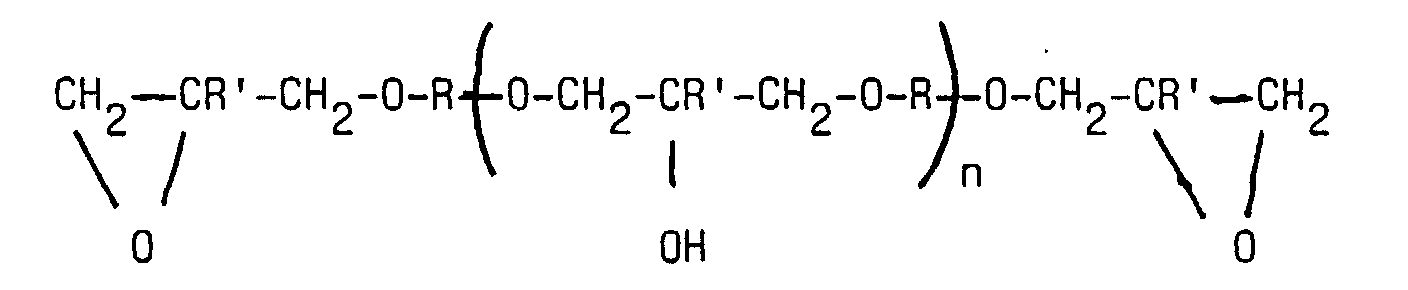

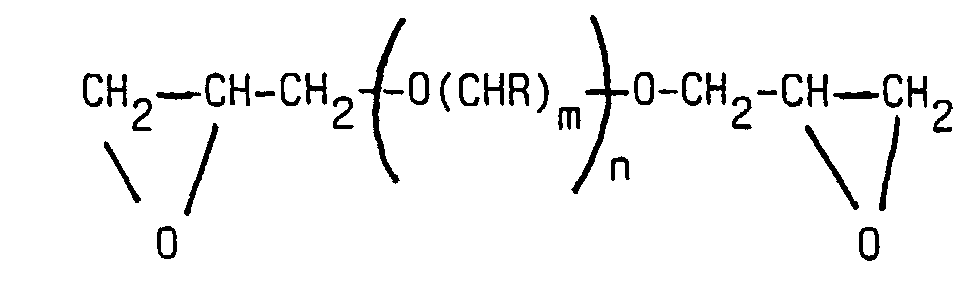

-R = -H oder ein linearer oder verzweigter C1 - C8-Alkylrest, bevorzugt Methyl oder Ethyl und
-R"- ein gegebenenfalls substituierter Alkylenrest mit 2 bis 8 C-Atomen, der durch ein oder mehrere 0-Atome unterbrochen sein kann, bevorzugt Ethylen oder Propylen ist.
Amine dieses Typs verbessern durch ihre bevorzugt primären Hydroxylgruppen die Reaktivität des Basisharzes. Typische Beispiele hierfür sind Aminoethanol, N-Methyl-aminoethanol, N-Ethyl-aminoethanol, Diethanolamin, Aminoisopropanol, N-Methylaminoisopropanol, N-Methyl-amino-n-propanol, N-Ethyl-aminoisopropanol, Diisopropanolamin,2,2'-Aminoethoxy-ethanol usw.

-R = -H oder -R"'
-R''- ein linearer oder verzweigter gegebenenfalls substituierter Alkylenrest mit 2 bis 8 C-Atomen, bevorzugt Ethylen oder Propylen und -R''' ein linearer oder verzweigter C1-C8-Alkylrest, bevorzugt Methyl oder Ethyl bedeutet, wobei die Reste R''' gleich oder verschieden sein können.
Amine dieses Typs verbessern durch die Dialkylamino-Gruppen die Basizität und damit die Löslichkeit des Basisharzes. Geeignete Beispiele hierfür sind N,N-Dimethylaminethylamin, N,N-Diethyl-N'-methyl-aminopropylamin, N,N-Diethylaminoethylamin, N,N-Dimethylaminopropylamin, N,N-Dimethylaminoneopentylamin usw.
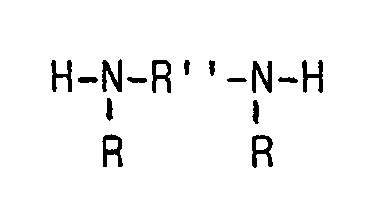
-R eine lineare oder verzweigte Alkylgruppe oder Hydroxyalkylgruppe mit 1 bis 18 C-Atomen und
-R''- eine lineare oder verzweigte Alkylengruppe oder Alkylenoxygruppe mit 2 bis 12 C-Atomen bedeuten.
- Festkörper (30 Min. Erwärmen 150°C) =
- 38,0 %
- MEQ-Wert =
- 31
- pH-Wert =
- 6,4
- Restlösemittelgehalt =
- 3,4 %
- mittlere Teilchengröße =
- 96 nm
- Festkörper (30 Min. 150°C) =
- 35,6 %
- MEQ-Wert =
- 30
- pH-Wert =
- 6,8
- Restlösemittelgehalt =
- 2,6 %
- mittlere Teilchengröße =
- 115 nm
Claims (12)
- Wäßrige Dispersionen von hydroxylgruppenhaltigen, zumindest teilweise neutralisierten Aminoepoxidharzen und Vernetzern, mit einem Festkörpergehalt von 30 bis 45 Gew.-% und Teilchengrößen der dispergierten Phase von bis zu 1000 nm und einem Lösemittelgehalt von 0 bis 5 Gew.-% erhältlich durch Vermischen oder zumindest teilweises Prekondensieren im lösemittelarmen Zustand, bei Temperaturen von 50 bis 140°C, vonI. 95 bis 50 Gew.-% eines oder mehrerer im wesentlichen lösemittelfreier hydroxylgruppenhaltiger Aminoepoxidharze mit tertiären Aminogruppen mit einer Aminzahl von 30 bis 120, einer Hydroxylzahl von 20 bis 300 und einem Zahlenmittel der Molmasse von 1000 bis 20000, die im Gemisch mit bis zu 15 Gew.-%, bezogen auf den Harzfestkörpergehalt der gesamten Komponente I, mit einem oder mehreren begrenzt wasserlöslichen, flüssigen, bei Einbrenntemperatur nicht flüchtigen Verdünnungsmitteln auf der Basis von Polyoxyalkylendiolen mit mindestens zwei Alkylenoxideinheiten im Molekül, die mindestens eine nukleophile Gruppe zur Reaktion mit der Vernetzerkomponente II enthalten, vorliegen können, wobei die Aminoepoxidharze oder das Gemisch mit den Verdünnungsmitteln im Durchschnitt 0,3 bis 5,0 mMol/g Alkylenoxideinheiten aufweisen, mitII. 5 bis 50 Gew.-% eines oder mehrerer Vernetzer, undIII. Neutralisieren des erhaltenen Gemischs bei Temperaturen von 60 bis 95°C, mit 0,1 bis 1,0 mMol/g einer oder mehrerer Monocarbonsäuren pro g Aminoepoxidharz, und Dispergieren bei diesen Temperaturen in Gegenwart von Wasser.
- Verfahren zur Herstellung der stabilen, wäßrigen Dispersionen nach Anspruch 1, dadurch gekennzeichnet, daß man in im wesentlichen lösemittelfreien Zustand bei Temperaturen von 50 bis 140°CI. 95 bis 50 Gew.-% eines oder mehrerer im wesentlichen lösemittelfreier hydroxylgruppenhaltiger Aminoepoxidharze mit tertiären Aminogruppen, mit einer Aminzahl von 30 bis 120, einer Hydroxylzahl von 20 bis 300 und einem Zahlenmittel der Molmasse von 1000 bis 20000, die im Gemisch mit bis zu 15 Gew.-%, bezogen auf den Harzfestkörpergehalt der gesamten Komponente I, mit einem oder mehreren begrenzt wasserlöslichen, flüssigen, bei Einbrenntemperaturen nicht flüchtigen Verdünnungsmitteln auf der Basis von Polyoxyalkylendiolen, die mindestens eine nukleophile Gruppe zur Reaktion mit der Vernetzerkomponente II enthalten, vorliegen können, wobei die Aminoepoxidharze oder das Gemisch mit den Verdünnungsmitteln im Durchschnitt 0,3 bis 5,0 mMol/g Alkylenoxideinheiten aufweisen, mitII. 5 bis 50 Gew.-% eines oder mehrerer Vernetzer vermischt und gegebenenfalls teilweise prekondensiert undIII. das erhaltene Gemisch bei Temperaturen von 60 bis 95°C mit 0,1 bis 1,0 mMol einer oder mehrerer Monocarbonsäuren pro g Aminoepoxidharz, neutralisiert und bei diesen Temperaturen in Gegenwart von Wasser zur Erzielung eines Festkörpergehalts von 30 bis 45 Gew.-% vermischt.
- Dispersionen und Verfahren nach Anspruch 1 oder 2, worin die begrenzt wasserlöslichen, flüssigen Verdünnungsmittel der Komponente I bei Einbrenntemperaturen bis zu 250°C nicht flüchtig sind.
- Dispersionen und Verfahren nach einem der vorhergehenden Ansprüche, worin die flüssigen Verdünnungsmittel der Komponente I in einer Menge von 0,01 bis 20 Gewichtsteilen in 100 Gewichtsteilen Wasser löslich sind.
- Dispersionen und Verfahren nach einem der vorhergehenden Ansprüche, worin die Komponente IA) 1 bis 15 Gew.-% eines oder mehrerer der begrenzt wasserlöslichen, flüssigen, bei Einbrenntemperaturen nicht-flüchtigen Verdünnungsmittel undB) 99 bis 85 Gew.-% eines oder mehrerer der hydroxylgruppenhaltigen Aminoepoxidharze mit tertiären Aminogruppen enthält.
- Dispersionen und Verfahren nach einem der vorhergehenden Ansprüche, worin die Aminoepoxidharze der Komponente I frei von Alkylenoxideinheiten sind.
- Dispersionen und Verfahren nach einem der Ansprüche 1 bis 4, worin die Aminoepoxidharze der Komponente I Alkylenoxideinheiten aufweisen und ausgehend von einem Gemisch aushergestellt wurden.a) 99 bis 80 Gew.-% eines oder mehrerer aromatischer Polyglycidylether undb) 1 bis 20 Gew.-% eines oder mehrerer mit Polyalkoxyglykolen modifizierter Diglycidylether
- Dispersionen und Verfahren nach einem der vorhergehenden Ansprüche, worin die Alkylenoxideinheiten der Komponente I zumindest teilweise aus Propylenoxideinheiten und/oder Butylenoxideinheiten bestehen.
- Dispersionen und Verfahren nach einem der vorhergehenden Ansprüche, worin die Vernetzerkomponente II teilweise oder vollständig blockierte Polyisocyanate, umesterungs- oder umamidierungsfähige Härter, Amin-Formaldehydharze, Phenol-Formaldehydharze, zur Michael-Addition fähige Vernetzer mit aktiviertem Wasserstoff und/oder Vernetzer mit endständigen, aktivierten Doppelbindungen enthält.
- Wäßrige Überzugsmittel, enthaltend die Dispersionen gemäß einem der Ansprüche 1 und 3 bis 9.
- Verwendung der wäßrigen Dispersionen nach einem der Ansprüche 1 und 4 bis 9 zur Herstellung wäßriger Überzugsmittel.
- Verwendung der Überzugsmittel nach Anspruch 10 zur kationischen Elektrotauchlackierung auf elektrisch leitfähigen Substraten.
Applications Claiming Priority (2)
| Application Number | Priority Date | Filing Date | Title |
|---|---|---|---|
| DE4331780A DE4331780A1 (de) | 1993-09-18 | 1993-09-18 | Lösemittelarme wäßrige Dispersionen, deren Herstellung und Verwendung in Überzugsmitteln zur kathodischen Tauchlackierung |
| DE4331780 | 1993-09-18 |
Publications (3)
| Publication Number | Publication Date |
|---|---|
| EP0644245A2 EP0644245A2 (de) | 1995-03-22 |
| EP0644245A3 EP0644245A3 (de) | 1996-07-03 |
| EP0644245B1 true EP0644245B1 (de) | 2001-03-21 |
Family
ID=6498040
Family Applications (1)
| Application Number | Title | Priority Date | Filing Date |
|---|---|---|---|
| EP94114667A Expired - Lifetime EP0644245B1 (de) | 1993-09-18 | 1994-09-17 | Wässrige Dispersionen, deren Herstellung und Verwendung in Überzugsmitteln zur kathodischen Tauchlackierung |
Country Status (5)
| Country | Link |
|---|---|
| EP (1) | EP0644245B1 (de) |
| AT (1) | ATE199928T1 (de) |
| DE (2) | DE4331780A1 (de) |
| ES (1) | ES2156886T3 (de) |
| PT (1) | PT644245E (de) |
Families Citing this family (2)
| Publication number | Priority date | Publication date | Assignee | Title |
|---|---|---|---|---|
| DE19703869A1 (de) * | 1997-02-03 | 1998-08-06 | Basf Coatings Ag | Wäßrige Bindemitteldispersion für kationische Elektrotauchlacke |
| CA3029554C (en) | 2016-06-30 | 2021-01-26 | Ppg Industries Ohio, Inc. | Electrodepositable coating composition having improved crater control |
Family Cites Families (5)
| Publication number | Priority date | Publication date | Assignee | Title |
|---|---|---|---|---|
| US3937679A (en) * | 1968-10-31 | 1976-02-10 | Ppg Industries, Inc. | Electrodepositable compositions |
| DE3436345A1 (de) * | 1984-10-04 | 1986-04-17 | Herberts Gmbh, 5600 Wuppertal | Kathodisch abscheidbares waessriges elektrotauchlack-ueberzugsmittel und dessen verwendung zum beschichten von gegenstaenden |
| AT381115B (de) * | 1985-02-26 | 1986-08-25 | Vianova Kunstharz Ag | Verfahren zur herstellung kathodisch abscheidbarer lackbindemittel |
| DE3712910A1 (de) * | 1987-04-15 | 1988-10-27 | Herberts Gmbh | Verfahren zur herstellung von an der kathode abscheidbaren waessrigen elektrotauchlackueberzugsmitteln |
| DE4117417A1 (de) * | 1991-05-28 | 1992-12-03 | Herberts Gmbh | Waessrige dispersion eines kathodisch abscheidbaren bindemittels, verfahren zu deren herstellung und deren verwendung |
-
1993
- 1993-09-18 DE DE4331780A patent/DE4331780A1/de not_active Withdrawn
-
1994
- 1994-09-17 AT AT94114667T patent/ATE199928T1/de not_active IP Right Cessation
- 1994-09-17 ES ES94114667T patent/ES2156886T3/es not_active Expired - Lifetime
- 1994-09-17 DE DE59409695T patent/DE59409695D1/de not_active Expired - Fee Related
- 1994-09-17 EP EP94114667A patent/EP0644245B1/de not_active Expired - Lifetime
- 1994-09-17 PT PT94114667T patent/PT644245E/pt unknown
Also Published As
| Publication number | Publication date |
|---|---|
| ES2156886T3 (es) | 2001-08-01 |
| EP0644245A3 (de) | 1996-07-03 |
| EP0644245A2 (de) | 1995-03-22 |
| ATE199928T1 (de) | 2001-04-15 |
| DE59409695D1 (de) | 2001-04-26 |
| DE4331780A1 (de) | 1995-03-23 |
| PT644245E (pt) | 2001-08-30 |
Similar Documents
| Publication | Publication Date | Title |
|---|---|---|
| EP0961797B1 (de) | Wässrige bindemitteldispersion für kationische elektrotauchlacke | |
| EP0178531B1 (de) | Wässriges Elektrotauchlack-Überzugsmittel und dessen Verwendung zum Beschichten von Gegenständen | |
| EP0137459B2 (de) | Kathodisch abscheidbares wässriges Elektrotauchlack-Überzugsmittel und dessen Verwendung | |
| EP3197961B1 (de) | Wässrige bindemitteldispersionen für kathodische elektrotauchlacke | |
| DE3103642A1 (de) | Hitzehaertbare bindemittelmischung | |
| DE3108073A1 (de) | Wasserdispergierbare bindemittel fuer kationische elektrotauchlacke und verfahren zu ihrer herstellung | |
| EP0135909B1 (de) | Kathodisch abscheidbares wässriges Elektrotauchlack-Überzugsmittel | |
| EP0287091B1 (de) | Wässriges Überzugsmittel, Verfahren zu dessen Herstellung und dessen Verwendung zum elektrophoretischen Beschichten | |
| EP0154724B1 (de) | In Wasser dispergierbare Kunstharze, Verfahren zur Herstellung der Kunstharze und Verwendung der Kunstharze als Bindemittel für Electrotauchlackbäder | |
| DE3825584A1 (de) | Traegerharz fuer pigmentpasten, seine herstellung und verwendung | |
| EP0720636B1 (de) | Elektrotauchlacke und verfahren zum lackieren elektrisch leitfähiger substrate | |
| EP0350618B1 (de) | Trägerharz für Pigmentpasten, seine Herstellung und Verwendung | |
| EP0054925B1 (de) | Kathodisch abscheidbares, wässriges Elektrotauchlack-Überzugsmittel, dessen Verwendung und Verfahren zum Lackieren von elektrischen Leitern | |
| EP0010766B2 (de) | Hitzehärtbares, wässriges Lacküberzugsmittel, dessen Verwendung zur elektrischen Ablagerung und ein Verfahren zur kathodischen Beschichtung eines elektrisch leitenden Substrats | |
| EP0337422B1 (de) | Wasserverdünnbare Bindemittel und deren Verwendung für Überzugsmittel insbesondere im Kraftfahrzeugbau | |
| EP0644245B1 (de) | Wässrige Dispersionen, deren Herstellung und Verwendung in Überzugsmitteln zur kathodischen Tauchlackierung | |
| EP0543357B1 (de) | Kunstharz | |
| EP0705308B1 (de) | Elektrotauchlacke und verfahren zum lackieren elektrisch leitfähiger substrate | |
| EP0537602B1 (de) | Hitzehärtbares Überzugsmittel für die kathodische Elektrotauchlackierung | |
| DE4018087A1 (de) | Verfahren zum beschichten elektrisch leitfaehiger substrate, waessrige lacke und blockierte nco-gruppen enthaltende vernetzungsmittel | |
| DE3712910A1 (de) | Verfahren zur herstellung von an der kathode abscheidbaren waessrigen elektrotauchlackueberzugsmitteln | |
| DE2759659C3 (de) | Verfahren zum Herstellen von Überzpgen | |
| DE4325094A1 (de) | Elektrotauchlacke und Verfahren zum Lackieren elektrisch leitfähiger Substrate | |
| DE3152220A1 (de) | Verfahren zum elektrophoretischen beschichten eines elektrisch leitenden als kathode geschalteten substrates |
Legal Events
| Date | Code | Title | Description |
|---|---|---|---|
| PUAI | Public reference made under article 153(3) epc to a published international application that has entered the european phase |
Free format text: ORIGINAL CODE: 0009012 |
|
| AK | Designated contracting states |
Kind code of ref document: A2 Designated state(s): AT BE CH DE ES FR GB IT LI NL PT SE |
|
| RIN1 | Information on inventor provided before grant (corrected) |
Inventor name: VOGT-BIRNBRICH, BETTINA, DR. Inventor name: PATZSCHKE, HANS-PETER, DR. Inventor name: EVERS, MANFRED Inventor name: COLLONG, WILFRIED, DR. |
|
| PUAL | Search report despatched |
Free format text: ORIGINAL CODE: 0009013 |
|
| AK | Designated contracting states |
Kind code of ref document: A3 Designated state(s): AT BE CH DE ES FR GB IT LI NL PT SE |
|
| 17P | Request for examination filed |
Effective date: 19960725 |
|
| 17Q | First examination report despatched |
Effective date: 19980814 |
|
| GRAG | Despatch of communication of intention to grant |
Free format text: ORIGINAL CODE: EPIDOS AGRA |
|
| RAP1 | Party data changed (applicant data changed or rights of an application transferred) |
Owner name: E.I. DU PONT DE NEMOURS AND COMPANY |
|
| GRAG | Despatch of communication of intention to grant |
Free format text: ORIGINAL CODE: EPIDOS AGRA |
|
| GRAH | Despatch of communication of intention to grant a patent |
Free format text: ORIGINAL CODE: EPIDOS IGRA |
|
| GRAH | Despatch of communication of intention to grant a patent |
Free format text: ORIGINAL CODE: EPIDOS IGRA |
|
| GRAA | (expected) grant |
Free format text: ORIGINAL CODE: 0009210 |
|
| AK | Designated contracting states |
Kind code of ref document: B1 Designated state(s): AT BE CH DE ES FR GB IT LI NL PT SE |
|
| REF | Corresponds to: |
Ref document number: 199928 Country of ref document: AT Date of ref document: 20010415 Kind code of ref document: T |
|
| REG | Reference to a national code |
Ref country code: CH Ref legal event code: NV Representative=s name: DIETLIN & CIE S.A. Ref country code: CH Ref legal event code: EP |
|
| REF | Corresponds to: |
Ref document number: 59409695 Country of ref document: DE Date of ref document: 20010426 |
|
| ET | Fr: translation filed | ||
| ITF | It: translation for a ep patent filed | ||
| GBT | Gb: translation of ep patent filed (gb section 77(6)(a)/1977) |
Effective date: 20010614 |
|
| REG | Reference to a national code |
Ref country code: ES Ref legal event code: FG2A Ref document number: 2156886 Country of ref document: ES Kind code of ref document: T3 |
|
| REG | Reference to a national code |
Ref country code: GB Ref legal event code: IF02 |
|
| PLBE | No opposition filed within time limit |
Free format text: ORIGINAL CODE: 0009261 |
|
| STAA | Information on the status of an ep patent application or granted ep patent |
Free format text: STATUS: NO OPPOSITION FILED WITHIN TIME LIMIT |
|
| 26N | No opposition filed | ||
| PGFP | Annual fee paid to national office [announced via postgrant information from national office to epo] |
Ref country code: BE Payment date: 20040709 Year of fee payment: 11 |
|
| PGFP | Annual fee paid to national office [announced via postgrant information from national office to epo] |
Ref country code: PT Payment date: 20040712 Year of fee payment: 11 |
|
| PGFP | Annual fee paid to national office [announced via postgrant information from national office to epo] |
Ref country code: GB Payment date: 20040823 Year of fee payment: 11 |
|
| PGFP | Annual fee paid to national office [announced via postgrant information from national office to epo] |
Ref country code: AT Payment date: 20040910 Year of fee payment: 11 |
|
| PGFP | Annual fee paid to national office [announced via postgrant information from national office to epo] |
Ref country code: SE Payment date: 20040913 Year of fee payment: 11 Ref country code: CH Payment date: 20040913 Year of fee payment: 11 |
|
| PGFP | Annual fee paid to national office [announced via postgrant information from national office to epo] |
Ref country code: FR Payment date: 20040915 Year of fee payment: 11 |
|
| PGFP | Annual fee paid to national office [announced via postgrant information from national office to epo] |
Ref country code: NL Payment date: 20040923 Year of fee payment: 11 |
|
| PGFP | Annual fee paid to national office [announced via postgrant information from national office to epo] |
Ref country code: ES Payment date: 20040930 Year of fee payment: 11 |
|
| PGFP | Annual fee paid to national office [announced via postgrant information from national office to epo] |
Ref country code: DE Payment date: 20041127 Year of fee payment: 11 |
|
| PG25 | Lapsed in a contracting state [announced via postgrant information from national office to epo] |
Ref country code: IT Free format text: LAPSE BECAUSE OF NON-PAYMENT OF DUE FEES;WARNING: LAPSES OF ITALIAN PATENTS WITH EFFECTIVE DATE BEFORE 2007 MAY HAVE OCCURRED AT ANY TIME BEFORE 2007. THE CORRECT EFFECTIVE DATE MAY BE DIFFERENT FROM THE ONE RECORDED. Effective date: 20050917 Ref country code: GB Free format text: LAPSE BECAUSE OF NON-PAYMENT OF DUE FEES Effective date: 20050917 Ref country code: AT Free format text: LAPSE BECAUSE OF NON-PAYMENT OF DUE FEES Effective date: 20050917 |
|
| PG25 | Lapsed in a contracting state [announced via postgrant information from national office to epo] |
Ref country code: SE Free format text: LAPSE BECAUSE OF NON-PAYMENT OF DUE FEES Effective date: 20050918 |
|
| PG25 | Lapsed in a contracting state [announced via postgrant information from national office to epo] |
Ref country code: ES Free format text: LAPSE BECAUSE OF NON-PAYMENT OF DUE FEES Effective date: 20050919 |
|
| PG25 | Lapsed in a contracting state [announced via postgrant information from national office to epo] |
Ref country code: LI Free format text: LAPSE BECAUSE OF NON-PAYMENT OF DUE FEES Effective date: 20050930 Ref country code: CH Free format text: LAPSE BECAUSE OF NON-PAYMENT OF DUE FEES Effective date: 20050930 Ref country code: BE Free format text: LAPSE BECAUSE OF NON-PAYMENT OF DUE FEES Effective date: 20050930 |
|
| PG25 | Lapsed in a contracting state [announced via postgrant information from national office to epo] |
Ref country code: PT Free format text: LAPSE BECAUSE OF NON-PAYMENT OF DUE FEES Effective date: 20060317 |
|
| PG25 | Lapsed in a contracting state [announced via postgrant information from national office to epo] |
Ref country code: NL Free format text: LAPSE BECAUSE OF NON-PAYMENT OF DUE FEES Effective date: 20060401 Ref country code: DE Free format text: LAPSE BECAUSE OF NON-PAYMENT OF DUE FEES Effective date: 20060401 |
|
| REG | Reference to a national code |
Ref country code: CH Ref legal event code: PL |
|
| EUG | Se: european patent has lapsed | ||
| GBPC | Gb: european patent ceased through non-payment of renewal fee |
Effective date: 20050917 |
|
| PG25 | Lapsed in a contracting state [announced via postgrant information from national office to epo] |
Ref country code: FR Free format text: LAPSE BECAUSE OF NON-PAYMENT OF DUE FEES Effective date: 20060531 |
|
| REG | Reference to a national code |
Ref country code: PT Ref legal event code: MM4A Effective date: 20060317 |
|
| NLV4 | Nl: lapsed or anulled due to non-payment of the annual fee |
Effective date: 20060401 |
|
| REG | Reference to a national code |
Ref country code: FR Ref legal event code: ST Effective date: 20060531 |
|
| REG | Reference to a national code |
Ref country code: ES Ref legal event code: FD2A Effective date: 20050919 |
|
| BERE | Be: lapsed |
Owner name: E.I. *DU PONT DE NEMOURS AND CY Effective date: 20050930 |