EP0638331B1 - Zeitbereichsreflektometer zur Impedanzmessung in einem implantierbaren Herzschrittmacher - Google Patents
Zeitbereichsreflektometer zur Impedanzmessung in einem implantierbaren Herzschrittmacher Download PDFInfo
- Publication number
- EP0638331B1 EP0638331B1 EP94304003A EP94304003A EP0638331B1 EP 0638331 B1 EP0638331 B1 EP 0638331B1 EP 94304003 A EP94304003 A EP 94304003A EP 94304003 A EP94304003 A EP 94304003A EP 0638331 B1 EP0638331 B1 EP 0638331B1
- Authority
- EP
- European Patent Office
- Prior art keywords
- lead
- impedance
- measuring
- patient
- signal
- Prior art date
- Legal status (The legal status is an assumption and is not a legal conclusion. Google has not performed a legal analysis and makes no representation as to the accuracy of the status listed.)
- Expired - Lifetime
Links
- 230000000747 cardiac effect Effects 0.000 title description 20
- 230000000638 stimulation Effects 0.000 claims description 32
- 230000005540 biological transmission Effects 0.000 claims description 30
- 238000005259 measurement Methods 0.000 claims description 22
- 230000029058 respiratory gaseous exchange Effects 0.000 claims description 17
- 238000000034 method Methods 0.000 claims description 16
- 239000004020 conductor Substances 0.000 claims description 13
- 210000004204 blood vessel Anatomy 0.000 claims description 10
- 210000005242 cardiac chamber Anatomy 0.000 claims description 8
- 210000000748 cardiovascular system Anatomy 0.000 claims description 7
- 230000000644 propagated effect Effects 0.000 claims description 4
- 230000003252 repetitive effect Effects 0.000 claims description 3
- 239000003990 capacitor Substances 0.000 description 53
- 230000006870 function Effects 0.000 description 25
- 239000003792 electrolyte Substances 0.000 description 18
- 238000005070 sampling Methods 0.000 description 13
- 230000000694 effects Effects 0.000 description 12
- 238000002847 impedance measurement Methods 0.000 description 12
- 230000004044 response Effects 0.000 description 12
- 239000008280 blood Substances 0.000 description 10
- 210000004369 blood Anatomy 0.000 description 10
- 230000010287 polarization Effects 0.000 description 10
- 230000008878 coupling Effects 0.000 description 8
- 238000010168 coupling process Methods 0.000 description 8
- 238000005859 coupling reaction Methods 0.000 description 8
- 238000012360 testing method Methods 0.000 description 8
- 230000008859 change Effects 0.000 description 6
- 238000006073 displacement reaction Methods 0.000 description 6
- 238000002310 reflectometry Methods 0.000 description 6
- 230000001105 regulatory effect Effects 0.000 description 6
- 102100026827 Protein associated with UVRAG as autophagy enhancer Human genes 0.000 description 5
- 101710102978 Protein associated with UVRAG as autophagy enhancer Proteins 0.000 description 5
- 239000002184 metal Substances 0.000 description 4
- 238000010586 diagram Methods 0.000 description 3
- 230000035790 physiological processes and functions Effects 0.000 description 3
- 238000011084 recovery Methods 0.000 description 3
- 230000000241 respiratory effect Effects 0.000 description 3
- 210000005241 right ventricle Anatomy 0.000 description 3
- 238000000926 separation method Methods 0.000 description 3
- 230000001225 therapeutic effect Effects 0.000 description 3
- 230000008901 benefit Effects 0.000 description 2
- 238000002592 echocardiography Methods 0.000 description 2
- 230000003028 elevating effect Effects 0.000 description 2
- 238000012986 modification Methods 0.000 description 2
- 230000004048 modification Effects 0.000 description 2
- 230000000737 periodic effect Effects 0.000 description 2
- 230000009467 reduction Effects 0.000 description 2
- 230000000630 rising effect Effects 0.000 description 2
- XLYOFNOQVPJJNP-UHFFFAOYSA-N water Substances O XLYOFNOQVPJJNP-UHFFFAOYSA-N 0.000 description 2
- 239000000654 additive Substances 0.000 description 1
- 230000000996 additive effect Effects 0.000 description 1
- 210000001124 body fluid Anatomy 0.000 description 1
- 239000010839 body fluid Substances 0.000 description 1
- 238000006243 chemical reaction Methods 0.000 description 1
- 238000004891 communication Methods 0.000 description 1
- 230000003247 decreasing effect Effects 0.000 description 1
- 230000003111 delayed effect Effects 0.000 description 1
- 230000001419 dependent effect Effects 0.000 description 1
- 238000003745 diagnosis Methods 0.000 description 1
- 238000002405 diagnostic procedure Methods 0.000 description 1
- 230000009977 dual effect Effects 0.000 description 1
- 230000005684 electric field Effects 0.000 description 1
- 238000010292 electrical insulation Methods 0.000 description 1
- 239000008151 electrolyte solution Substances 0.000 description 1
- 238000002001 electrophysiology Methods 0.000 description 1
- 230000007831 electrophysiology Effects 0.000 description 1
- 230000000763 evoking effect Effects 0.000 description 1
- 239000000835 fiber Substances 0.000 description 1
- 239000000945 filler Substances 0.000 description 1
- 239000012530 fluid Substances 0.000 description 1
- 238000002513 implantation Methods 0.000 description 1
- 230000006872 improvement Effects 0.000 description 1
- 238000002347 injection Methods 0.000 description 1
- 239000007924 injection Substances 0.000 description 1
- 238000002955 isolation Methods 0.000 description 1
- 230000002045 lasting effect Effects 0.000 description 1
- 230000002503 metabolic effect Effects 0.000 description 1
- 239000000203 mixture Substances 0.000 description 1
- 239000002052 molecular layer Substances 0.000 description 1
- 238000012544 monitoring process Methods 0.000 description 1
- 238000003012 network analysis Methods 0.000 description 1
- 230000003647 oxidation Effects 0.000 description 1
- 238000007254 oxidation reaction Methods 0.000 description 1
- 210000003281 pleural cavity Anatomy 0.000 description 1
- 238000012545 processing Methods 0.000 description 1
- 210000005245 right atrium Anatomy 0.000 description 1
- 230000002269 spontaneous effect Effects 0.000 description 1
- 238000010561 standard procedure Methods 0.000 description 1
- 230000004936 stimulating effect Effects 0.000 description 1
- 238000007920 subcutaneous administration Methods 0.000 description 1
- 238000002560 therapeutic procedure Methods 0.000 description 1
- 230000001960 triggered effect Effects 0.000 description 1
Images



Classifications
-
- A—HUMAN NECESSITIES
- A61—MEDICAL OR VETERINARY SCIENCE; HYGIENE
- A61B—DIAGNOSIS; SURGERY; IDENTIFICATION
- A61B5/00—Measuring for diagnostic purposes; Identification of persons
- A61B5/05—Detecting, measuring or recording for diagnosis by means of electric currents or magnetic fields; Measuring using microwaves or radio waves
- A61B5/053—Measuring electrical impedance or conductance of a portion of the body
- A61B5/0538—Measuring electrical impedance or conductance of a portion of the body invasively, e.g. using a catheter
-
- A—HUMAN NECESSITIES
- A61—MEDICAL OR VETERINARY SCIENCE; HYGIENE
- A61B—DIAGNOSIS; SURGERY; IDENTIFICATION
- A61B5/00—Measuring for diagnostic purposes; Identification of persons
- A61B5/05—Detecting, measuring or recording for diagnosis by means of electric currents or magnetic fields; Measuring using microwaves or radio waves
- A61B5/053—Measuring electrical impedance or conductance of a portion of the body
- A61B5/0535—Impedance plethysmography
-
- A—HUMAN NECESSITIES
- A61—MEDICAL OR VETERINARY SCIENCE; HYGIENE
- A61N—ELECTROTHERAPY; MAGNETOTHERAPY; RADIATION THERAPY; ULTRASOUND THERAPY
- A61N1/00—Electrotherapy; Circuits therefor
- A61N1/18—Applying electric currents by contact electrodes
- A61N1/32—Applying electric currents by contact electrodes alternating or intermittent currents
- A61N1/36—Applying electric currents by contact electrodes alternating or intermittent currents for stimulation
- A61N1/372—Arrangements in connection with the implantation of stimulators
-
- A—HUMAN NECESSITIES
- A61—MEDICAL OR VETERINARY SCIENCE; HYGIENE
- A61N—ELECTROTHERAPY; MAGNETOTHERAPY; RADIATION THERAPY; ULTRASOUND THERAPY
- A61N1/00—Electrotherapy; Circuits therefor
- A61N1/18—Applying electric currents by contact electrodes
- A61N1/32—Applying electric currents by contact electrodes alternating or intermittent currents
- A61N1/38—Applying electric currents by contact electrodes alternating or intermittent currents for producing shock effects
- A61N1/39—Heart defibrillators
- A61N1/3925—Monitoring; Protecting
- A61N1/3931—Protecting, e.g. back-up systems
Definitions
- This invention relates to body impedance sensors, and more particularly to body impedance sensors that sense body impedance using time domain reflectometry analysis.
- Impedance sensors have been used for various purposes in implantable medical devices.
- T.A. Nappholz et al. disclose a rate-responsive pacemaker which measures blood impedance to derive a respiratory minute volume pacing rate control parameter.
- This pacemaker (hereinafter called the " '253 pacemaker") measures impedance by providing a three-electrode lead using one electrode to sense heart signals and pace the patient's heart in the conventional manner and employing the remaining two electrodes to perform the impedance measurement.
- a three-electrode lead is not a standard lead in the art of cardiac pacing.
- the two electrodes for measuring impedance are located in a blood vessel in the vicinity of the patient's pleural cavity.
- the '253 pacemaker periodically applies current pulses between one of the electrodes and the pacemaker case, and measures the voltage resulting from the applied current between the other electrode and the pacemaker case.
- the measured voltage is a function of the blood impedance in the vessel which, in turn, is dependent upon the pleural pressure.
- the '253 pacemaker determines the minute volume by monitoring the modulation in the impedance measurement.
- a problem with the '253 pacemaker is that it requires a nonstandard lead, a lead having at least three electrodes. Unipolar (single electrode) and bipolar (dual electrode) leads are standard in the art of cardiac pacing.
- a bipolar lead has two electrodes for sensing and pacing the heart.
- a ring electrode in addition to being used for sensing and pacing, is used to apply a current which flows to the pacemaker case.
- a tip electrode in addition to being used for sensing and pacing, is used to measure the blood impedance between the tip and the case in response to the current pulse applied through the ring electrode.
- the '725 pacemaker utilizes the measured blood impedance to derive an appropriate pacing rate.
- the '725 pacemaker uses bipolar leads which are standard in cardiac pacing, it has a limitation in that this pacemaker cannot be used in the many patients who have had previously implanted unipolar leads.
- Unipolar leads which have a single tip electrode, are also standard in the art of cardiac pacing. If a bipolar lead is required when a patient has a new pacemaker implanted, then a non-rate-responsive pacemaker that is connected to a unipolar lead cannot be replaced by a '725 rate-responsive pacemaker simply by exchanging pacemakers and using the same lead.
- An opposing charge distribution develops in the electrolyte due to the charge distribution within the electrodes. This opposing charge is held from the metal surface by the forces of reduction and oxidation chemical reactions, which occur whenever a metal is placed in an electrolytic solution.
- the charge separation distance is approximately the thickness of a molecular layer of water.
- the charged layers at the electrode-electrolyte interface constitute a charged capacitance in which the charges are held together by electrostatic forces.
- the magnitude of the capacitance depends inversely on the separation of the charged layers. This separation is very small, on the order of the dimension of molecular water. Therefore, the capacitance is remarkably large, in the range of 1 to 20 ⁇ F/cm 2 .
- the presence of a large capacitance at the tip electrode causes a large DC impedance.
- the injection of current on the electrode causes a disturbance at the electrode-electrolyte interface which takes the form of a large, slowly decaying polarization potential at the tip electrode.
- the '725 pacemaker generates a measuring current between the ring electrode and the case but measures the blood impedance from a separate electrode, the tip electrode, which is located generally outside the vicinity of the electrolyte polarization arising from the applied measuring current.
- the measuring electrode and the current generating electrode are one and the same, and the measuring electrode is located precisely at the point of electrolyte polarization.
- the electrode tip has a very small surface area, over which the current is concentrated, leading to very large impedance changes where the electrode meets the electrolytes. Therefore, instead of measuring blood impedance as intended, a unipolar electrode constrains the pacemaker to predominantly detect the electrode-electrolyte polarization effects.
- This measuring current has frequency components in a range of from approximately 10 kilohertz to 1000 megahertz.
- Application of this measuring current allows the pacer to detect the voltage arising from the applied current and, from the detected voltage, to measure the patient's spatial impedance.
- the pacemaker reduces the problem of the electrode-electrolyte polarization effect by elevating the frequency content of the measuring electrical current much higher than the frequency employed in prior art impedance measuring devices. By elevating the interrogation frequency, the nature of the measuring current changes from a conduction current to predominantly a displacement current.
- a pacemaker lead can be viewed as a leaky conductor, or signal radiator. At higher measuring frequencies, more of the signal leaks from the lead throughout its length.
- the lead will measure the spatial impedance of the medium surrounding the lead. This is different from the measurement of "blood impedance", by means of interrogation using conduction current, as was performed in the '253 and '725 pacemakers.
- the '467 pacemaker performs the measurement through the length of the lead, not at the tip electrode.
- the tip electrode is separated from the input to the lead by the resistance, inductance and distributed capacitance of the lead. At higher measuring frequencies, these components of the lead impedance cause the flow of current along the lead to induce displacement currents in the tissue. Once the signal leaves the electrode tip, the current becomes a conduction current, creating the ionic conditions which make up the electrode-electrolyte polarization effect.
- the higher measuring current frequencies of the pacer greatly reduce the electrode-electrolyte polarization effect.
- the high frequency measuring current creates a displacement current within the body with little net current being injected into the body.
- the pacemaker creates this displacement current by generating an electrical current flowing within the conductor of the lead. This conductor is separated from the patient's body and its electrolytes by a layer of electrical insulation at the outside surface of the lead. The current within the lead generates an electrical field and creates the displacement current in the body.
- a displacement current arises in the body, allowing the '467 pacer to detect impedance changes in the body remote from the location in which electrode-electrolyte artifacts arise.
- the pacer reduces the impedance effects of the tip electrode.
- the high frequency measuring current radiates more energy into the body along the lead and less to the tip, to reduce local artifact effects and inject less current into the heart. The reduction of local artifact effects greatly improves the signal quality of the measurement.
- the present invention incorporates a sensor and sensing method that fundamentally differs from the method for reducing the problem of the electrode-electrolyte polarization effect taught in the '467 patent.
- the present invention employs a time domain reflectometer (TDR) for sensing a patient's body impedance.
- TDR systems have conventionally been used for testing communication cable integrity in transmission networks (see U.S. Patent No. 4,970,466 to D.C. Bolles et al.).
- TDR systems have been employed for testing for fluid leakage from underground storage tanks (see U.S. Patent No. 5,134,377 to W. J. Reddy, III, et al.).
- TDR systems have not been used previously for impedance sensing in the cardiovascular system. Additionally, TDR systems have not been used previously for sensing physiologically-varying parameters in the body.
- US-A-5 231 987 discloses a system and a method for testing the integrity of an implanted electrode by means of a TDR system.
- a conventional time domain reflectometer measures network impedance as a function of time or distance. It does this by generating a voltage step at the input to a transmission line and measuring the change in voltage at the line input due to reflections from impedance discontinuities along the line.
- the shape of the sensed voltage waveform arising in response to the leading edge of the interrogating pulse is related to the impedance as a function of distance down the lead.
- Impedance changes along the lead in the path of the pulse reflect voltages back to the line input. These impedance changes determine the amplitude and phase of the reflections. In turn, the reflections add or subtract to the pulse voltage at the input, thereby changing the morphology of the waveform.
- TDR systems are used for network analysis to diagnose faults in coaxial and fiber optic cables and to characterize interconnect nodes in hybrid circuits.
- These TDR systems generally consist of a voltage step generator and an oscilloscope.
- the TDR voltage step generator sends a voltage pulse with a very fast rise time on its leading edge down the transmission line and the oscilloscope then measures the voltage at the input to the line.
- the reflections appear at the transmission line input, superimposed on the input voltage from the step generator at a time delayed from the beginning of the rising edge of the step input. This time delay is twice the propagation time to the location of an impedance discontinuity along the transmission line.
- the principle of operation in TDR is similar to that of radar, the time of flight of the edge down and back up the lead indicates the distance to the reflection.
- signals and reflections propagate in a medium consisting of the dielectrical filler between the inner and outer conductors of the cable.
- the signal travels along an implantable lead or catheter in which the medium of propagation is the tissue surrounding the lead.
- the present invention is utilized to measure the impedance of a patient-implanted lead or catheter in order to derive information reflecting both the patient's physiological functions and the condition of the lead or catheter.
- the present invention performs this measurement using time domain reflectometry in which a voltage pulse, having the general form of a step or pulse function, is applied to the lead or catheter. The lead or catheter is then monitored to detect reflections superimposed on the applied voltage pulse. These reflections are indicative of impedance variations both along and distal to the lead or catheter.
- a sensor as defined in claim 1, a method as defined in claim 16 and a heart pacemaker as defined in claim 20.
- a sensor in a medical device for measuring a patient's internal body impedance.
- the sensor includes a transmission line implanted in the patient's body tissue.
- This transmission line may be in the form of a pacing lead, a defibrillator lead, a catheter, an antenna coil or other electrically conductive material that may be implanted within the patient's tissue.
- the sensor also includes means for applying an electrical stimulation to the implanted transmission line to propagate the electrical stimulation through the patient's tissue.
- the stimulation applying means may be in the form of a switched capacitor circuit, a function generator, a pulse generator, a signal generator, a step generator, a step recovery diode, an electrostatic discharge circuit or other device for generating an electrical step, pulse or impulse function of voltage or current.
- the sensor also includes means for measuring a reflected electrical signal from the implanted transmission line that results due to reflections of the propagated electrical stimulation as it encounters impedance variations in the patient's tissue.
- the measuring means may be in the form of a switched capacitor circuit, an oscilloscope, a digitizing oscilloscope, a sample and hold circuit or other electrical signal measuring device.
- the sensor further includes means for deriving an impedance signal as a function of the reflected electrical signal.
- the deriving means may take the form of a controller, a microprocessor, a microcomputer, a computer, a data recorder or a data sampler.
- the elements of the aforesaid first embodiment may be further combined with means for distinguishing electrical signals arising within at least one predetermined time interval of the time-varying reflected electrical signal from electrical signals arising outside such an interval.
- the distinguishing means may be a controller in combination with a timing circuit, for selecting both a predetermined delay interval following the time of delivery of the stimulation pulse and a sampling interval, and for sampling the electrical signal during the sampling interval.
- the distinguishing means may take the form of circuits, discussed hereinafter, that emphasize signals occurring during particular time intervals following the stimulation delivery.
- the sensor of this second embodiment of the invention also includes means for deriving an impedance signal as a function of the distinguished electrical signals.
- a sensor in a medical device for measuring a patient's internal body impedance.
- the sensor includes a lead implanted in the patient's blood vessels, extending from a proximal end to a distal end.
- a pulse generator is coupled to the implanted lead at its proximal end and, upon request, applies a voltage pulse to the lead.
- the sensor further includes means for measuring a reflection voltage waveform on the implanted lead that results from reflections of the applied voltage pulse due to impedance variations arising along the lead. These impedance variations arise not only along the lead but also extend beyond the distal tip of the lead into the patients blood vessels and heart chambers.
- the sensor additionally includes means for deriving an impedance signal as a function of the measured reflection voltage waveform.
- a sensor measures a patient's internal body impedance.
- a lead extending from a proximal end to a distal end, is implanted in the patient's blood vessels and heart chambers.
- the proximal end of the lead is coupled to a pulse generator, which applies a voltage pulse to the lead.
- the application of the voltage pulse starts a timer for timing a predetermined delay interval and, at the end of the delay interval, timing a predetermined sample duration interval.
- a means for measuring a reflection voltage waveform on the implanted lead is provided.
- the reflection voltage waveform results from reflections of the applied voltage pulse from impedance variations arising along the lead and extending distally beyond the lead's distal tip into the patient's blood vessels and heart chambers.
- the aforementioned delay interval and sample duration interval are predetermined to select a range of distance from the proximal end of the lead.
- the sensor further includes means for deriving a range-selected impedance signal as a function of the reflection voltage waveform.
- This fourth embodiment may further include means for repetitively triggering the pulse generator while maintaining the predetermined delay interval and the predetermined sample duration interval constant.
- the range-selected impedance signals resulting from the repetitive triggering are arranged into a time-varying range-selected impedance signal.
- the aforementioned sensor embodiments may be incorporated into a system for testing a pacing electrode in an implantable cardiac pacemaker.
- the aforementioned sensor embodiments may be incorporated into an implantable cardiac pacemaker which is adapted for measuring physiological parameters such as respiration and heart motion for diagnostic or therapeutic purposes.
- a high-level block schematic of a pacemaker is shown generally at 5 .
- an impedance sensor is described herein as part of a cardiac pacemaker, it may also be employed in defibrillators, cardioverters, antitachycardia pacemakers, electrophysiology test systems, implantable holter monitors and other similar medical diagnosis and therapeutic devices.
- the impedance sensor of the present invention may be employed in conjunction with pacing leads, defibrillator leads, catheters, antenna coils and other electrical conductors that are capable of serving as a transmission line. These transmission lines may be permanently or temporarily inserted into the cardiovascular system for diagnostic and therapeutic purposes.
- controller 28 which may include a microprocessor.
- the controller 28 operates various switches in the pacemaker 5, of which only one pair SW1A, SW1B is shown. Switch SW1B is closed whenever the pacemaker 5 is to pace or sense.
- the controller 28 sends a command to a pulse generator 18 by means of a signal on a PACE conductor 26.
- the pulse generator 18 responds to this command by applying a current pulse through the switch SW1B and a conventional unipolar, bipolar or multipolar lead 11 to the latter's tip electrode 10, which is shown positioned in the right ventricle 12 of a patient's heart 7 in FIG. 2 .
- the term "lead” is used generically herein and is intended to include catheters, wires and conductors of any type capable of freely conducting an electrical voltage or current therein.
- a sense amplifier 16 senses a cardiac signal on the electrode.
- the pacemaker 5 makes an impedance measurement when the controller 28 pulses a conductor 20 to activate a time domain reflectometer or TDR impedance sensor circuit 14.
- switch SW1A closes and switch SW1B opens and TDR impedance sensor circuit 14 applies a voltage to the lead 11.
- the voltage quickly propagates down the lead 11 toward the tip electrode 10 .
- the measuring voltage applied to the lead 11 is in the form of a step or pulse function having a preset width. As the rising edge of the voltage step or pulse propagates down the lead 11 any impedance variations along the lead 11 , both within the lead itself (due to breakage, for example) or in the surrounding tissue, result in a voltage perturbation which reflects back to the pacemaker 5 .
- the TDR impedance sensor circuit 14 measures spatial impedance by determining the potential difference between the pacemaker case 30 and the pacemaker input connection to the conductor (not shown) within lead 11 . This potential difference is the additive composition of the applied step or pulse function voltage and voltages arising from reflections from impedance variations.
- the conductor extends to the tip electrode 10.
- the pacemaker case 30 serves as a reference potential for the pacemaker circuitry.
- the TDR impedance sensor circuit 14 derives samples at a rate appropriate for the type of information sought in performing the measurement and communicates these samples to controller 28 over output bus 22 . (For example, if impedance signals are used to measure patient respiration, a sample rate of about 20 per second is appropriate. If heart motion is measured, a rate of approximately 200 Hz is required.)
- Placement of a pacing lead 11 is shown in FIG. 2 .
- the tip electrode 10 makes contact with the wall of the right ventricle 12 or the right atrium 13 of the patient's heart 7 .
- the TDR impedance sensor circuit 14 When the TDR impedance sensor circuit 14 generates a measuring voltage step, as will be described hereinafter, the impedance measurement is characteristic of physical impedance phenomena in positions along the lead 11 .
- the first voltage reflections measured by the impedance sensor 14 indicate impedance variations most proximal on the lead. Later voltage reflections arise from impedance variations that are more distal on the lead 11. Additional reflections are sensed later in time, corresponding to impedance changes all the way to the tip electrode 10 of the lead 11 and beyond.
- Voltage reflections sensed beyond the tip electrode 10 result from impedance variations distal to the lead 11 , within the patient's blood vessels and heart chambers.
- the blood vessels and heart chambers act as an extension of the lead 11 (due to their conductivity) and their impedance variations are reflected back along the lead 11.
- This phenomena graphically shown hereinafter and discussed with regard to FIGS. 9, 10, 11A, 11B, 12A and 12B, is important since it provides for sensing of additional physiological phenomena.
- impedance variations arising from patient respiration may predominate.
- impedance changes are characteristic of heart motion.
- the sensing of impedance signals may be controlled to select impedance changes arising from one or more particular physiological phenomena by selecting a time window subsequent to a delay which follows the applied voltage step or pulse, for measuring each type of signal.
- the TDR impedance sensor circuit 14 adapted for operation in a time domain reflectometry (TDR) mode is shown.
- the TDR impedance sensor circuit 14 includes a connection through a switch SW4 to the case 30, and a connection through a switch SW3 to the tip electrode 10 (via the pacing lead 11 ).
- the tip electrode 10 is a conventional pacing/sensing electrode.
- the indifferent electrode is the case 30 .
- the TDR impedance sensor circuit 14 employs the tip electrode 10 and lead 11 both for applying a voltage step or pulse to the patient's body, and for measuring voltage reflections returning from the lead 11 that result from the applied voltage step.
- a buffer amplifier 32 and filter 23 are also employed in circuit 14.
- All switches in FIG. 3 are directly or indirectly under the control of controller 28 .
- One output 33 of the controller is shown extending to switch SW2, but it is to be understood that switches SW3, SW4, SW5 and SW6 are similarly controlled.
- the controller closes switch SW6 to charge a measuring capacitor C2 to a regulated voltage source V DD .
- the controller opens switch SW6 and closes switches SW3 and SW4 while switch SW5 is held open, thereby connecting measuring capacitor C2 to lead 11 through a coupling capacitor C3.
- the switches SW3 and SW4 are closed, measuring capacitor C2 discharges through capacitor C3 into the lead 11, thereby applying the voltage that is across measuring capacitor C2 to the lead 11 .
- the interrogating voltage pulses preferably are generated in the form of 2 volt amplitude, 1 ⁇ s wide pulses occurring at 50 ms intervals, although voltage pulses in the form of a step function having an amplitude in the range of from 1 ⁇ V to 100 V, a pulse width in the range of from 1 ns to 5 ms and a pulse repetition rate in the range of from 0.1 Hz to 500 Hz may be employed.
- the controller 28 is coupled to a timer 27 .
- the controller 28 commands the timer 27 to generate periodic timing signals.
- the timer 27 generates appropriate timing signals and notifies the controller 28 when a requested time interval expires.
- the output 33 controls switches SW2, SW3 and SW4 so that a single command from the controller 28 closes, then opens, all three switches. Switches SW3 and SW4 are closed first, essentially simultaneously, and switch SW2 is closed shortly thereafter, following a predetermined sampling delay, ranging in duration from approximately 1 to 200 nanoseconds.
- switches SW3 and SW4 allow the buffer amplifier 32 to access the voltage held on the measuring capacitor C2. This voltage is advanced through the buffer amplifier 32 and through switch SW2, which switch is closed at the end of the aforesaid predetermined sampling delay which follows the opening of switches SW3 and SW4, and is sampled on capacitor C1 at the input of the filter 23.
- a single command from the controller 28 controls switches SW2, SW3 and SW4 because the response time of the controller 28 would be too slow to sense the time of flight reflections if separate commands were to be used to operate the switches.
- the switch SW2 is closed for a sampling or measuring time interval having a preset duration ⁇ T, during which the combined interrogation voltage step and superimposed reflection signal are sampled.
- the sampling interval ⁇ T may range from about 10 to 200 nanoseconds.
- the amount by which the voltage across measuring capacitor C2 changes depends on impedance variations along the lead 11 and the voltage reflections created by these impedance variations.
- Measuring capacitor C2 stores the voltage and buffer amplifier 32 transfers this measurement to the filter 23.
- switches SW2, SW3 and SW4 are opened. The opening of switches SW3 and SW4 may occur somewhat after the opening of switch SW2.
- the duration of the interrogating voltage pulses, as controlled by switches SW3 and SW4 may be 1 ⁇ s, regardless of the duration of the sampling interval determined by switch SW2.
- the controller 28 then closes switch SW6 to charge measuring capacitor C2 for the next measuring cycle measurement.
- the controller 28 measures impedance twenty times per second, at 50 ms intervals. For each measurement, the controller 28 closes the switches SW3 and SW4 for a pulse duration of 1 ⁇ s, during which the voltage across the capacitor C2 is placed on the lead 11.
- the value of the measuring capacitor C2 is selected to store the range of voltages which result from various body impedances.
- C2 has a capacitance of 4.7 nF.
- the coupling capacitor C3 provides for DC isolation for the input to the measuring circuit.
- the resistors and capacitors associated with filter 23 are selected to pass various signal frequencies, depending on the type of signal to be analyzed. It was hereinbefore stated that the sensing of impedance signals may be controlled to select impedance changes arising from one or more particular physiological phenomena by selecting a time window following the applied voltage step or pulse for each type of signal. The selection of sampling time windows, and the values of the resistors and capacitors associated with filter 23 , are preferably selected in a coordinated manner to provide for good signal fidelity with respect to a particular physiological parameter.
- the impedance signal is filtered by a two-pole filter with a center frequency of 0.2 Hz. The gain is reduced by a factor of two (6 dB) at frequencies of 0.05 Hz and 0.8 Hz.
- the cutoff frequencies for a bandpass filter that favors cardiac motion signals may range from 0.2 to 10 Hz.
- the analog signal output of the filter 23 passes to a delta modulator 25 which provides a digital signal output on output bus 22.
- the digital signal output on output bus 22 is input to the controller 28 for processing. Converting an analog signal to a digital representation by delta modulation is a standard technique. One example of such an operation is illustrated in United States Patent No. 4,692,719 to Robert H. Whigham, entitled “Combined Pacemaker Delta Modulator and Bandpass Filter", which issued on September 8, 1987.
- the output of the delta modulator 25 is a summation of a series of 0's and 1's which reflect whether the analog signal is decreasing or increasing.
- controller 28 opens switch SW1B (shown in FIG. 1 ) to briefly disable pace and sense functions. Although sensing is disabled while the impedance measurement is in operation, the duration of the measurement is on the order of fractions of microseconds, a time so short relative to that of heart signals that disabling sensing during this time is of no importance.
- the impedance sensor may be used in other implantable devices such as defibrillators and antitachycardia pacers.
- the impedance sensor of the present invention may be employed in a device that, except for the lead or catheter, is not implanted or implantable but rather is positioned external to a patient and coupled to a catheter or lead, which is inserted into the patient's body. For example, it may be used with a catheter that is temporarily inserted into the cardiovascular system for diagnostic purposes.
- the external impedance sensor may be coupled to an implanted pacing lead and impedance may be sensed to determine whether the lead may have any breaks or imperfections. Such breaks or imperfections give rise to impedance variations or discontinuities in the sensed impedance waveform.
- the impedance sensor 60 of FIG. 4A drives a transmission line 62 (e.g., a subcutaneous catheter) and includes means for applying an electrical stimulation 64 (e.g., a pulse generator or function generator) coupled to a means 66 for measuring electrical signals (e.g., a digitizing oscilloscope) via a transmission line 68 (e.g., a coaxial cable).
- an electrical stimulation 64 e.g., a pulse generator or function generator
- a means 66 for measuring electrical signals e.g., a digitizing oscilloscope
- the digitizing oscilloscope 66 is controlled by a controller 70 (e.g., a computer system), which is coupled to the oscilloscope 66 by an interface 72.
- the function generator 64 for example an Hewlett-Packard HP 3314ATM function generator (made by Hewlett-Packard Company, 3000 Hanover Street, Palo Alto, CA 94304, USA), generates pulses at a predetermined amplitude, pulse width and frequency.
- the function generator 64 may provide 2 volt, 1 ⁇ s width pulses at a frequency of 20Hz (50 ms intervals). Pulses may be generated equivalently by other electrical stimulation applying means which are known in the art, such as switched-capacitor circuits, step recovery diodes, electrostatic discharge circuits, signal generators, pulse generators and step generators.
- the computer system 70 For each pulse of the function generator 64 , the computer system 70 (e.g., Toshiba 100TM laptop computer, made by Kabushiki Kaisha Toshiba D/B/A Toshiba Corporation, 72, Horikawa-Cho, Saiwai-Ku, Kawasaki-Shi, Kanagawa-Ken, Japan), in response to a trigger by the function generator 64 , initiates data acquisition by commanding the digitizing oscilloscope 66 (e.g., Hewlett-Packard HP 54510ATM, made by Hewlett-Packard Company, 3000 Hanover Street, Palo Alto, CA 94304, USA) to acquire a preset number of waveform samples (e.g., 100) until a predetermined number of waveforms (e.g., 200), each comprising such preset number of samples, are acquired.
- the digitizing oscilloscope 66 e.g., Hewlett-Packard HP 54510ATM, made by Hewlett-Packard Company, 3000 Hanover
- Each waveform may contain 100 samples, spaced at the oscilloscope 66 sample rate of one sample per nanosecond.
- the oscilloscope 66 may store the waveform in its internal memory (not shown) until all the data is acquired. Waveforms may be measured equivalently by other devices which are known in the art, such as switched-capacitor circuits, sample and hold circuits and oscilloscopes.
- Data may be transferred to the computer 70 over the interface 72 (e.g. National Instruments AT-GPIB IEEE-488TM interface, made by National Instruments Corporation, Austin, TX, USA).
- the computer system 70 analyzes the data to derive an impedance waveform. Data may be analyzed equivalently by other devices which are known in the art, such as controllers, microprocessors, microcomputers, data recorders and data samplers.
- an impedance sensor 60 that may also be depicted by the block diagram of FIG. 4A, in this case a fully implantable impedance sensor, the sensor 60 drives a transmission line 62 in the form of an implanted pacing lead.
- the impedance sensor 60 again includes a means 64 for applying an electrical stimulation, which in this case may be a switched capacitor circuit, a step recovery diode, an electrostatic discharge circuit or other form of pulse generator.
- the electrical stimulation applying means 64 may generate electrical stimuli in the form of step voltage stimuli, step current stimuli, pulse voltage stimuli or pulse current stimuli. These stimuli must have a sufficiently fast rise time to allow discrimination of impedance variations along the transmission line 62.
- the electrical stimulation applying means is sufficiently low in current drain and small in size to provide for efficient generation of stimulating pulses for years.
- the electrical stimulation applying means 64 is coupled to an electrical signal measuring means 66, for example a data acquisition, a sample and hold or a data sampling circuit, and the electrical signal measuring means 66 is controlled by a controller 70.
- the controller 70 directs the electrical stimulation applying means 64 to generate pulses at a predetermined amplitude, pulse width and frequency.
- the electrical stimulation applying means 64 may provide 2 volt, 1 ⁇ s width pulses at a frequency of 20Hz (50 ms intervals).
- the controller 70 in response to a trigger by the electrical stimulation applying means 64, may command the electrical signal measuring means 66 to acquire a sample "TDR" waveform of the electrical signal reflected due to the application of the electrical stimulus.
- the electrical signal measuring means 66 then samples the electrical signal on the pacing lead 62.
- the round trip time of flight of reflected echoes, and variations in their signal level, are indicative of the location and types of impedance discontinuities that occur along the pacing lead 62.
- the impedance sensor 60 may be employed to test the pacing lead 62 for breaks or imperfections.
- the impedance sensor 60 may be utilized to measure physiological parameters, such as respiration and heart motion, by repeatedly triggering electrical stimulation pulses and impedance measurements.
- the controller 70 in response to a trigger by the electrical stimulation applying means 64, may command the electrical signal measuring means 66 to acquire a TDR waveform of the electrical signal reflected as a result of the application of the electrical stimulus.
- the electrical signal measuring means 66 then samples the electrical signal on the pacing lead 62.
- the round trip times of flight of reflected echoes are indicative of the positions of impedance variations both along the pacing lead 62 and beyond the tip of the lead 62.
- the controller 70 commands the acquisition of a preset number of TDR waveform samples until a predetermined number of waveforms are acquired.
- the impedance sensor 60 may be employed to measure physiological parameters for usage in pacing therapy or diagnostic procedures, as will appear in greater detail hereinafter.
- FIG. 4B A further example of an impedance sensor is depicted by the block diagram of FIG. 4B.
- the impedance sensor functions in the same manner as the impedance sensor 60 of FIG. 4A but a coil antenna replaces the lead or catheter of that figure as the transmission line 62.
- the embodiment of the invention in FIG. 4B is useful for measuring physiological function in an implantable holter monitor device.
- TDR impedance sensor One of the advantages of the time domain reflectometer (TDR) impedance sensor is its ability to measure impedance changes arising from a particular physiological function. This capability requires very fast operation of switches, such as those shown in the TDR impedance sensor circuit 14 of FIG. 3, or a high speed digital oscilloscope, similar to that illustrated in FIG. 4A. Such a high speed switching operation is difficult to achieve in an implantable pacemaker or defibrillator due to its inherent high energy requirements.
- FIGS. 5 and 7 illustrate impedance measurement circuit embodiments that are adapted to sense impedance variations at selected intervals along the lead and beyond, but do not require high speed switching. These circuit embodiments are called a constant voltage circuit ( FIG. 5 ) and a peak current circuit ( FIG. 7 ).
- FIG. 5 depicts a TDR impedance sensor circuit 14 which employs a constant voltage circuit 80 and is adapted for operation in a time domain reflectometry (TDR) mode.
- the constant voltage circuit 80 takes the form of a voltage divider that has a step voltage pulse applied to a network therein consisting of impedance elements connected in series. The DC voltage that results from the applied voltage pulse is measured at a point between the impedances.
- the constant voltage circuit 80 generates a step voltage change, followed by an essentially constant voltage at the input to the lead 11 , then measures impedance changes in relationship to time after the generation of the voltage step.
- the circuit 80 measures the combined interrogating and reflected voltage waveforms while the voltage input is applied to the lead 11.
- the constant voltage circuit 80 includes switches SW3, SW5 and SW6 for connecting, respectively, the lead 11 (through coupling capacitor C3 ), reference ground and the regulated voltage source V DD to a node A in the circuit 80.
- Switch SW4 connects reference ground to the pacemaker case 30. Node A is coupled to the positive input of the buffer amplifier 32.
- Switches SW3, SW4, SW5 and SW6, tip electrode 10, lead 11, case 30, regulated voltage source V DD , coupling capacitor C3 and buffer amplifier 32 of the constant voltage circuit 80 of FIG. 5 are functionally and structurally equivalent to like-named components of FIG. 3.
- a step generator capacitor C4 replaces the measuring capacitor C2 of FIG. 3.
- the constant voltage circuit 80 includes a series resistor R7, a rectifier diode D1 and a constant voltage measuring capacitor C7.
- a resistor R9 provides a discharge path for measuring capacitor C7.
- the constant voltage circuit 80 employs the tip electrode 10 and lead 11 both for applying a voltage step to the patient's body, and for measuring voltage reflections returning from the lead 11 that result from the applied voltage step.
- the controller closes switch SW6 to charge the step generator capacitor C4 to the regulated voltage source V DD . Subsequently, the controller opens switch SW6 and closes switches SW3 and SW4 while switch SW5 is held open, thereby connecting the step generator capacitor C4 to lead 11 through a coupling capacitor C3. While the switches SW3 and SW4 are closed, step generator capacitor C4 discharges through capacitor C3 into the lead 11, thereby applying the voltage across step generator capacitor C4 to the lead 11.
- the constant voltage circuit 80 performs as a voltage divider network consisting of two impedances, connected in series.
- a first impedance is the series resistor R7 .
- a second impedance is the patient's body, which is coupled between the lead 11 (at tip electrode 10 ) and the case 30.
- the voltage at node A is measured on the constant voltage measuring capacitor C7, after passing through the rectifier diode D1, so that the largest voltage appearing at node A is measured during the step voltage application.
- the constant voltage circuit 80 measures the voltage resulting from combination of the addition to the interrogating step voltage of reflected signals arising from impedance variations in the lead 11 and in the patient's body.
- the constant voltage measuring capacitor C7 stores this resulting voltage, and buffer amplifier 32 later transfers this voltage to the filter 23.
- the controller 28 opens switches SW3 and SW4, and closes switch SW4, allowing the buffer amplifier 32 to access the voltage held on the constant voltage measuring capacitor C2. This voltage is advanced through the buffer amplifier 32 and through switch SW2, and is sampled on capacitor C1 at the input of the filter 23.
- the controller 28 opens switch SW2 and closes switch SW6 to charge the step generator capacitor C4 for the next measurement.
- the controller 28 measures impedance twenty times per second.
- the controller closes the switches SW3 and SW4 for a pulse duration of 1 us, during which time the step voltage is applied to the lead 11, reflection signals are echoed and superimposed on the step voltage and the measuring capacitor C7 is charged to the maximum value of the superimposed signal.
- FIG. 5 constant voltage circuit 80
- the purpose of the FIG. 5 (constant voltage circuit 80) embodiment of the TDR impedance sensor 14 is to restrict the time of taking the impedance measurement to a particular portion of the measurement field, more precisely, the portion of the field which extends beyond the tip of the lead 11, thereby to eliminate the need for high speed switches.
- the maximum signal amplitude arises from impedance characteristics lying beyond the distal end of the lead 11.
- impedance signals arising beyond the distal end of the lead are a function of heart motion.
- FIGS. 6A and 6B are graphical depictions of an applied step voltage A and a voltage response B, as measured by the constant voltage circuit 80. For each waveform, the constant voltage circuit 80 determines only one value, the maximum impedance signal, which arises beyond the distal end of the lead 11.
- FIG. 7 depicts a TDR impedance sensor circuit 14 which employs a peak current circuit 82 and is adapted for operation in a time domain reflectometry (TDR) mode.
- the peak current circuit 82 applies a step voltage pulse to a lead 11 through a peak current measuring resistance R8 and measures the peak current flowing through the resistance.
- the peak current circuit 82 includes a rectifier diode D2 and a peak current measuring capacitance C8 across the resistance R8 to measure and store the voltage proportional to the current flowing through the resistance R8.
- the peak current circuit 82 generates a step voltage change, followed by an essentially constant voltage lasting a predetermined sample time (e.g. 1 ⁇ s) at the input to the lead 11 , then measures impedance changes in relationship to time after the generation of the voltage step.
- the circuit 82 measures the combined interrogating and reflected voltage waveforms while the voltage input is applied to the lead 11.
- the peak current circuit 82 includes switches SW3, SW5 and SW6 for connecting, respectively, the lead 11 (through coupling capacitor C3), reference ground and the regulated voltage source V DD to a node A in the circuit 82.
- Switch SW4 connects reference ground to the pacemaker case 30. Node A is coupled via switch SW3 to the positive input to the buffer amplifier 32.
- Switches SW3, SW4, SW5 and SW6, tip electrode 10, lead 11, case 30, V DD , coupling capacitor C3 and buffer amplifier 32 of the peak current circuit 82 of FIG. 7 are functionally and structurally equivalent to like-named components of FIGs. 3 and 5.
- a step generator capacitor C4 replaces the measuring capacitor C2 of FIG. 3.
- the peak current circuit 82 includes the aforementioned series resistor R8, rectifier diode D2 and peak current measuring capacitor C8.
- the peak current circuit 82 employs the tip electrode 10 and lead 11 both for applying a voltage step to the patient's body, and for measuring voltage reflections returning via lead 11 that result from the applied voltage step.
- the controller closes switch SW6 to charge the step generator capacitor C4 to the regulated voltage source V DD . Subsequently, the controller opens switch SW6 and closes switches SW3 and SW4 while switch SW5 is held open, thereby connecting the step generator capacitor C4 to lead 11 through a coupling capacitor C3. While the switches SW3 and SW4 are closed, step generator capacitor C4 discharges through capacitor C3 into the lead 11, thereby applying the voltage that is across step generator capacitor C4 to the lead 11.
- the current in peak current circuit 82 flows through the series resistor R8, establishing a voltage across the resistor.
- the rectifier diode D2 passes this voltage to the peak current measuring capacitor C8, so that a voltage proportional to the maximum current flowing through the resistor R8 is placed across measuring capacitor C8.
- the peak current circuit 82 establishes a voltage which represents the summation of the current flowing due to the applied interrogating voltage step impulse and the current arising from impedance variations from the lead 11 and patient's body.
- the peak current measuring capacitor C8 stores this voltage and buffer amplifier 32 later (when switch SW2 closes) transfers this voltage to the filter 23 in the manner discussed earlier in connection with the constant voltage circuit 80 of FIG. 5.
- FIG. 7 peak current circuit 82
- the purpose of the FIG. 7 (peak current circuit 82 ) embodiment of the TDR impedance sensor 14 is to restrict the time of taking the impedance measurement to a predetermined portion of the measurement field, in particular, the portion of the field proximal to the tip of the lead 11, thereby to eliminate the need for high speed switches.
- the maximum signal amplitude reflects impedance characteristics lying beyond the distal end of the lead 11.
- the peak current circuit 82 is provided to facilitate the taking of impedance measurements proximal to the tip of the lead 11.
- impedance signals arising proximal to the distal end of the lead are a function of respiration.
- FIG. 7 peak current circuit 82
- FIG. 8A is a graphical depiction of an applied step voltage A and a voltage response B, as measured by the peak current circuit 82.
- FIG. 8B illustrates the current flowing in the series resistor R8 as the voltage step is applied.
- the peak current circuit 82 determines only one value, the maximum voltage signal, which arises proximal to the end of the lead 11.
- FIG. 9 is graphical depiction of selected, simulated three-dimensional TDR waveforms. Along a horizontal distance axis, reflected voltage amplitudes change in the vertical direction in response to interrogation by an applied voltage step stimulus. Note that changes in distance along the axis correspond to changes in time since distance relates to the time-of-flight for reflections to reach the sensor following a step voltage input to the lead 11 . At distance zero, point A at the proximal end of the lead at the base of the graph of FIG. 9, a voltage step is applied to lead 11 and the sensor circuit 14 measures the voltages of a first TDR waveform 101 considered in this figure.
- the first TDR waveform extending generally horizontally on the three dimensional graph, illustrates the manner in which reflected voltages vary in distance down the lead 11 to its distal end (point B).
- the measured voltage varies as impedance variations along the lead 11 are encountered by the interrogating pulse.
- a distance and time TDR waveform resulting from a single interrogating pulse is illustrated, which extends for the lead's length.
- a second (not shown) and additional waveforms are acquired by generating voltage steps periodically after the first.
- TDR waveforms 101, 102, 103 and 104 are shown in FIG.
- time relates to the time at which an interrogation voltage pulse is applied to the lead 11 .
- These waveforms correspond to the peaks and valleys of a physiological "respiration" waveform 105 , it being understood that numerous other TDR waveforms are generated in addition to those shown at 101 - 104 to more accurately define the respiration waveform 105 (see, e.g., FIG. 10 ).
- the voltages during a segment of each TDR waveform, called a time slice may be measured and averaged over the length of the segment to provide a time slice average.
- the time slice average may be plotted in time to provide a waveform (e.g., waveform 105 ) indicative of a particular parameter, which may be a parameter having physiological importance such as respiration, as is depicted in the graph of FIG. 9.
- a waveform e.g., waveform 105
- the position of the time slice along the distance axis determines the physiological significance of the parameter. For example, in some locations the impedance may be most influenced by body motion arising from patient respiration. At other locations, heart motion may give rise to the largest signals.
- FIG. 10 is graphical depiction of simulated TDR waveforms shown in three dimensions.
- reflected voltage amplitudes change in the vertical direction in response to interrogation by an applied voltage step stimulus.
- a voltage step is applied to a lead 11 and the sensor circuit 14 measures the voltages of a first waveform 106.
- the first waveform on the right side of the three dimensional graph, illustrates the manner in which reflected voltages vary in time and, since the measuring circuit measures time-of-flight of the simulating voltage, in distance along the lead 11 (between points A and B), and beyond.
- the measured voltage varies as impedance variations along the lead 11 are encountered by the interrogating pulse.
- a discontinuity in the waveform occurs at the position (point B) of the tip electrode 10 due to the presence of a large capacitance at the tip electrode, which causes a large DC impedance change.
- the interrogating voltage step continues to proceed into the patient's heart chambers and blood vessels, where additional impedance variations are reflected back to the lead 11. From time zero (the time of stimulus delivery at point A) to the rightmost position on the graph of FIG. 10 , the TDR waveform 106 resulting from a single interrogating pulse extends for approximately 200 to 400 nanoseconds.
- multiple additional waveforms are acquired by generating a voltage step every 5 ms after the first, for example, to provide a sampling frequency of 200Hz. Sampling frequencies may be widely variable depending on the type of impedance information sought by the sensor 14. Additional TDR waveforms are shown on the waveform axis extending from the bottom center to the back left side of the three dimensional graph. The waveform axis extends from the first TDR waveform 106 to a final TDR waveform 109 and relates to the time at which the interrogating voltage step is applied to the lead 11 to produce each waveform.
- the TDR waveforms vary in amplitude as a function of physiological parameters, as was discussed previously with regard to FIG. 9. These variations are depicted as fluctuations in the three dimensional signal shown in FIG. 10.
- variations from the proximal end of the lead 11 (at time 0) to the tip electrode 10 indicate impedance fluctuations caused by patient respiration.
- Variations occurring beyond the tip electrode 10 relate to impedance changes arising from heart motion. For a particular individual and implantation, these signals may be widely variable. Placement of the lead and other factors influence the amplitude and shape of the impedance changes.
- a physiological "cardiac" waveform that may be generated from the impedance variations due to heart motion is shown at 110 in FIG. 10.
- the sensor 14 acquires multiple 100 point TDR waveforms, such as waveforms 101 - 104 and 106 - 109, triggered by the voltage pulse generator 18, until a total of 200 such TDR waveforms are acquired and stored.
- Each of such waveforms is defined by 100 data point samples, spaced at the sample rate of one sample per 1 nanosecond.
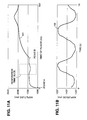
- FIG. 11A a simulated graph of a TDR voltage waveform is shown.
- This TDR waveform may be considered one of the several waveforms shown in FIGS. 9 and 10, for example waveform 101.
- the TDR waveform signal may be integrated or averaged over a time window, such as respiration time slice window 115 as shown.
- the TDR sensor circuit 14 of FIG. 3 may open and close the switches SW2, SW3, SW4 and SW5 to define the illustrated window.
- the digitizing oscilloscope 66 of the TDR impedance sensor 60 of FIG. 4A may sample multiple points within the designated window and the computer system 70 may average these samples.
- the peak current circuit 82 of FIG. 7 may measure the voltage corresponding to the peak current which flows during the designated window.
- a respiration waveform 105 may be derived from voltage measurements in the selected window depicted in FIG. 11A of many sequential TDR voltage waveforms such as 101, 106 - 108...n. These values may be plotted, stored for analysis, or processed to derive physiologically-valuable data. For example, the respiration waveform 105 may be processed to derive a pacing rate for a rate-adaptive pacemaker 5.
- FIG. 12A a simulated graph of a TDR voltage waveform is shown.
- This TDR waveform may also be considered one of the several waveforms shown in FIGs. 9 and 10, for example waveform 101, and integrated or averaged over a time window, such as cardiac time slice window 120, as shown.
- the TDR sensor circuit 14 of FIG. 3 may open and close the switches SW2, SW3, SW4 and SW5 to define the illustrated window or the digitizing oscilloscope 66 of the TDR impedance sensor 60 of FIG. 4A may sample multiple points within the designated window and the computer system 70 may average these samples.
- the constant voltage circuit 80 of FIG. 5 may measure the voltage corresponding to the voltage during the designated window.
- a cardiac motion waveform 110 may be derived from voltage measurements in the selected window depicted in FIG. 12A of many sequential TDR voltage waveforms such as 101, 106 - 108...n. These values may be plotted, stored for analysis, or processed to derive physiological data.
- the present invention provides a time domain reflectometry impedance sensor that fundamentally differs from previous methods of measuring internal body impedance.
- This impedance measurement method is valuable for reducing the problem of the electrode-electrolyte polarization effects.
- the invention accomplishes substantial improvements in distinguishing impedance signals arising from diverse physiological origins such as respiration and heart motion, and improving physiological signal fidelity by reducing signals arising from the electrode-electrolyte interface.
- the present invention is still usable in connection with a method and apparatus for testing implanted pacing leads for breakage and imperfections.
Landscapes
- Health & Medical Sciences (AREA)
- Life Sciences & Earth Sciences (AREA)
- Engineering & Computer Science (AREA)
- Biomedical Technology (AREA)
- Nuclear Medicine, Radiotherapy & Molecular Imaging (AREA)
- Radiology & Medical Imaging (AREA)
- Animal Behavior & Ethology (AREA)
- General Health & Medical Sciences (AREA)
- Public Health (AREA)
- Veterinary Medicine (AREA)
- Heart & Thoracic Surgery (AREA)
- Physics & Mathematics (AREA)
- Pathology (AREA)
- Biophysics (AREA)
- Medical Informatics (AREA)
- Molecular Biology (AREA)
- Surgery (AREA)
- Hematology (AREA)
- Cardiology (AREA)
- Electrotherapy Devices (AREA)
- Measurement And Recording Of Electrical Phenomena And Electrical Characteristics Of The Living Body (AREA)
Claims (22)
- Sensor in einer medizinischen Vorrichtung zum Messen einer inneren Körperimpedanz eines Patienten mit:einer Übertragungsleitung (11), die so beschaffen ist, daß sie in das Körpergewebe des Patienten implantiert werden kann;einer Einrichtung (14) zum Anlegen einer elektrischen Stimulation an die Übertragungsleitung (11), um die elektrische Stimulation durch das Gewebe des Patienten zu verbreiten;einer Einrichtung (14) zum Messen eines reflektierten elektrischen Signals in der Übertragungsleitung (11), das aus Reflexionen der verbreiteten elektrischen Stimulation resultiert; undeiner Einrichtung (14) zum Ableiten eines Impedanzsignals als Funktion des reflektierten elektrischen Signals; dadurch gekennzeichnet, daßdie Einrichtung (14) zum Messen und die Einrichtung zum Ableiten so beschaffen sind, daß elektrische Signale bestimmt werden können, die auf Impedanzänderungen im Gewebe des Patienten entsprechend einem physiologischen Parameter zurückzuführen sind.
- Sensor nach Anspruch 1, wobei die Übertragungsleitung eine Leitung mit einer darin befindlichen, am entfernten Ende angeordneten Elektrode (10) aufweist.
- Sensor nach Anspruch 1, wobei die Übertragungsleitung einen gewendelten Leiter (11) aufweist.
- Sensor nach einem der Ansprüche 1, 2 oder 3, wobei die Anlageeinrichtung (14) eine elektrische Stimulation in der Form eines Reizes erzeugt, der aus einer Gruppe gewählt wird, die eine Stufenspannung, einen Stufenstrom, eine Impulsspannung und einen Impulsstrom umfaßt.
- Sensor nach Anspruch 1, wobei die Meßeinrichtung (14) ferner einen Zeitgeber (27) aufweist, der auf das Anlegen des angelegten elektrischen Reizes anspricht, zum zeitlichen Steuern eines vorbestimmten Verzögerungsintervalls und eines entsprechenden vorbestimmten Abtastdauerintervalls für ein solches Anlegen, wobei das entsprechende Abtastdauerintervall zeitlich so gesteuert wird, daß es nach dem Verzögerungsintervall auftritt, wobei die Meßeinrichtung (14) auf die Beendigung des vorbestimmten Verzögerungsintervalls anspricht und während des entsprechenden Abtastdauerintervalls zum Messen des reflektierten elektrischen Signals in Betrieb ist, wobei das Verzögerungsintervall und das Abtastdauerintervall so vorbestimmt sind, daß sie einen Entfernungsbereich in bezug auf die Übertragungsleitung (11) für eine solche Messung wählen und wobei die Ableitungseinrichtung (14) einen Controller (28) aufweist, der ein durch Bereichswahl bestimmtes Impedanzsignal als Funktion des elektrischen Signals ableitet, das sich in dem mindestens einem vorbestimmten Zeitintervall unterscheidet.
- Sensor nach Anspruch 5, wobei der Controller (28) ferner aufweist:eine Einrichtung zum wiederholten Auslösen der Anlegeeinrichtung (14), während das vorbestimmte Verzögerungsintervall und das vorbestimmte Abtastdauerintervall konstant bleiben; undeine Einrichtung zum Ansammeln der durch Bereichswahl bestimmten Impedanzsignale, die aus dem wiederholten Auslösen resultieren, zu einem zeitvariablen, durch Bereichswahl bestimmten Impedanzsignal.
- Sensor nach einem der Ansprüche 1 bis 6, wobei der Controller (28) den physiologischen Parameter als Funktion jedes durch Bereichswahl bestimmten Impedanzsignals ableitet, wobei der Parameter die Form eines Signals hat, das aus einer Gruppe gewählt wird, die ein Atmungssignal und ein Herzbewegungssignal umfaßt.
- Sensor nach Anspruch 5, wobei die Ableitungseinrichtung (14) beim Ableiten von elektrischen Signalen, die innerhalb mindestens eines vorbestimmten Zeitintervalls entstehen, aus denjenigen, die außerhalb eines solchen Intervalls entstehen, eine Konstantspannungsschaltung nutzt.
- Sensor nach Anspruch 5, wobei die Ableitungseinrichtung (14) beim Ableiten von elektrischen Signalen, die innerhalb mindestens eines vorbestimmten Zeitintervalls entstehen, aus denjenigen, die außerhalb eines solchen Intervalls entstehen, eine Spitzenstromschaltung nutzt.
- Sensor nach Anspruch 1, wobei:die Übertragungsleitung (11) eine Leitung ist, die so beschaffen ist, daß sie in das kardiovaskuläre System des Patienten implantiert werden kann;die Anlegeeinrichtung (14) zum Anlegen eines Spannungsimpulses an die Leitung betriebsfähig ist;die Meßeinrichtung (14) zum Messen einer zeitvariablen Reflexionsspannungswellenform in der Leitung betriebsfähig ist, die aus Reflexionen des angelegten Spannungsimpulses aufgrund von Impedanzänderungen des Gewebes des Patienten entlang der Leitung entsprechend dem physiologischen Parameter resultiert; unddie Ableitungseinrichtung (14) zum Ableiten eines Impedanzsignals als Funktion der Reflexionsspannungswellenform betriebsfähig ist, um den Parameter zu ermitteln.
- Sensor nach Anspruch 10, wobei die Anlegeeinrichtung (14) einen Spannungsimpuls mit einer Impulsbreite im Bereich von 1 ns bis 1 ms erzeugt.
- Sensor nach Anspruch 10, wobei der Impulsgenerator einen Spannungsimpuls in Form einer Stufenfunktion mit einer Amplitude im Bereich von 1 µV bis 100 V anlegt.
- Sensor nach Anspruch 10, wobei die Meßeinrichtung (14) die Reflexionsspannungswellenform mißt, nachdem ein vorbestimmtes Verzögerungsintervall innerhalb eines Bereiches von 1 ns bis 200 ns aufgetreten ist, und ein vorbestimmtes Abtastdauerintervall verwendet, das innerhalb eines Bereichs von 1 ns bis 500 ns nach jedem entsprechenden vorbestimmten Verzögerungsintervall auftritt.
- Sensor nach Anspruch 10, ferner mit einer Auslöseeinrichtung zum Auslösen des Spannungsimpulses mit einer Rate im Bereich von 0,1 Hz bis 500 Hz.
- Sensor nach Anspruch 1, wobei:die Übertragungsleitung (11) eine Leitung ist, die so beschaffen ist, daß sie in das kardiovaskuläre System des Patienten implantiert werden kann;die Anlegeeinrichtung (14) und die Meßeinrichtung (14) in einem Zeitbereichseflektometer (TDR) enthalten sind, der mit der Leitung gekoppelt ist, wobei das TDR so konfiguriert ist, daß eine Serie von Signalimpulsen durch die Leitung übertragen und Signale, die aufgrund von Reflexionen des angelegten Spannungsimpulses aus Impedanzänderungen im Gewebe des Patienten entlang der Leitung entstehen, überwacht werden können; unddie Ableitungseinrichtung (14) einen Controller (28) aufweist, der mit dem TDR gekoppelt ist, wobei der Controller (28) so beschaffen ist, daß die überwachten Signale abgetastet werden und ein in Frage kommendes Impedanzsignal aus den durch Abtastung ermittelten Signalen definiert wird.
- Verfahren zum Messen einer inneren Körperimpedanz eines Patienten mittles einer Übertragungsleitung (11), die so beschaffen ist, daß sie in das Körpergewebe des Patienten implantiert werden kann, wobei das Verfahren die folgenden Schritte aufweist:Anlegen einer elektrischen Stimulation an die Übertragungsleitung (11), um die elektrische Stimulation durch das Gewebe des Patienten zu verbreiten;Messen eines reflektierten elektrischen Signals in der Übertragungsleitung (11), die aus Reflexionen der verbreiteten elektrischen Stimulation aufgrund von Impedanzänderungen im Gewebe des Patienten entsprechend einem physiologischen Parameter resultiert; undAbleiten eines Impedanzsignals als Funktion des reflektierten elektrischen Signals.
- Verfahren nach Anspruch 16, wobei die innere Körperimpedanz eine Impedanz entlang und bis zum entfernten Ende einer Leitung ist, die so beschaffen ist, daß sie in das kardiovaskuläre System des Patienten implantiert werden kann;
der Anlegeschritt ein Anlegen eines Spannungsimpulses an die Leitung aufweist;
der Meßschritt ein Messen einer zeitvariablen Reflexionsspannungswellenform in der Leitung aufweist, die aus Reflexionen des angelegten Spannungsimpulses aufgrund von Impedanzänderungen des Gewebes des Patienten entlang und bis zum entfernten Ende der Leitung und entsprechend dem physiologischen Parameter resultiert; und
der Ableitungsschritt ein Ableiten eines Impedanzsignals als Funktion der Reflexionswellenform aufweist, um den Parameter zu ermitteln. - Verfahren nach Anspruch 16, wobei die innere Körperimpedanz eine Impedanz entlang und bis zum entfernten Ende einer Leitung ist, die so beschaffen ist, daß sie in das kardiovaskuläre System des Patienten implantiert werden kann, wobei das Verfahren ferner die folgenden Schritte aufweist:Vorbestimmen eines in Frage kommenden, sich in Längsrichtung erstreckenden Bereichs entlang und bis zum entfernten Ende der implantierten Leitung von einer nahen Bereichsgrenze bis zu einer entfernten Bereichsgrenze;Ableiten eines Verzögerungsintervalls entsprechend der Zeit, die ein Spannungsimpuls braucht, um sich auszubreiten und von der nahen Bereichsgrenze zurückzukehren;Ableiten eines Abtastdauerintervalls entsprechend der Zeit, die ein Spannungsimpuls braucht, um sich auszubreiten und von der entfernten Bereichsgrenze zurückzukehren, abzüglich der Zeit des Verzögerungsintervalls; und wobei:der Anlegeschritt ein Anlegen eines Spannungsimpulses an die Leitung aufweist;der Meßschritt die folgenden Schritte aufweist:zeitliches Steuern des abgeleiteten Verzögerungsintervalls nach dem Anlegeschritt und zeitliches Steuern des abgeleiteten Abtastdauerintervalls nach der Zeitabschaltung des Verzögerungsintervalls; undMessen einer Reflexionsspannungswellenform in der Leitung während des Abtastdauerintervalls, wobei die Reflexionsspannungswellenform aus Reflexionen des angelegten Spannungsimpulses aufgrund von Impedanzänderungen des Gewebes des Patienten resultiert, die entlang der Leitung von ihrem nahen Ende bis zu ihrem entfernten Ende entstehen und die am entfernten Ende jenseits der Leitung in Blutgefäßen und Herzkammern des Patienten entstehen; undder Ableitungsschritt ein Ableiten eines durch Bereichswahl bestimmten Impedanzsignals als Funktion der Reflexionsspannungswellenform aufweist.
- Verfahren nach Anspruch 18, wobei der Anlegeschritt den Teilschritt des wiederholten Anlegens des Spannungsimpulses an die Leitung aufweist und wobei der Ableitungsschritt den Teilschritt des Ansammelns der Impedanzsignale, die aus dem wiederholten Anlegen von Spannungsimpulsen resultieren, zu einem zeitvariablen Impedanzsignal aufweist.
- Patientenimplantierbarer Herzschrittmacher, der zum Messen mindestens eines physiologischen Parameters geeignet ist, mit:einer Leitung (11), die so beschaffen ist, daß sie in die Blutgefäße und Herzkammern eines Patienten implantiert werden kann, wobei die Leitung sich von einem nahen Ende bis zu einem entfernten Ende erstreckt;einer Einrichtung (14) zum Anlegen einer elektrischen Stimulation an die Leitung, um die elektrische Stimulation durch das Gewebe des Patienten zu übertragen;einer Einrichtung (14) zum Messen eines zeitvariablen reflektierten elektrischen Signals aus der implantierten Leitung, das aus Reflexionen der übertragenen elektrischen Stimulation resultiert, wobei die Reflexionen aufgrund von Impedanzänderungen im Gewebe des Patienten entstehen;einer Einrichtung zum Unterscheiden mindestens eines vorbestimmten Zeitintervalls des zeitvariablen reflektierten elektrischen Signals von anderen potentiellen Zeitintervallen; undeiner Einrichtung (14) zum Ableiten eines Impedanzsignals als Funktion des unterschiedenen mindestens einen vorbestimmten Zeitintervalls des zeitvariablen reflektierten elektrischen Signals.
- Schrittmacher nach Anspruch 20, wobei die Unterscheidungseinrichtung ferner aufweist: einen Zeitgeber (27), der auf das Anlegen des angelegten elektrischen Reizes anspricht, zum zeitlichen Steuern eines vorbestimmten Verzögerungsintervalls und eines entsprechenden vorbestimmten Abtastdauerintervalls für ein solches Anlegen, wobei das entsprechende Abtastdauerintervall zeitlich so gesteuert wird, daß es nach dem Verzögerungsintervall auftritt, wobei die Meßeinrichtung (14) auf die Beendigung des vorbestimmten Verzögerungsintervalls anspricht und während des entsprechenden Abtastdauerintervalls zum Messen des zeitvariablen reflektierten elektrischen Signals in Betrieb ist, wobei das Verzögerungsintervall und das Abtastdauerintervall so vorbestimmt sind, daß sie einen Bereich der Entfernung von der Leitung für eine solche Messung wählen und wobei die Ableitungseinrichtung (14) einen Controller (28) zum Ableiten eines durch Bereichswahl bestimmten Impedanzsignals als Funktion des reflektierten elektrischen Signals aufweist, das sich in dem mindestens einen vorbestimmten Zeitintervall unterscheidet.
- Schrittmacher nach Anspruch 21, ferner mit einer Einrichtung zum Ableiten eines physiologischen Parameters als Funktion des durch Bereichswahl bestimmten Impedanzsignals, wobei der Parameter die Form eines Signals hat, das aus einer Gruppe gewählt wird, die ein Atmungssignal und ein Herzbewegungssignal umfaßt.
Applications Claiming Priority (2)
| Application Number | Priority Date | Filing Date | Title |
|---|---|---|---|
| US08/104,382 US5361776A (en) | 1993-08-06 | 1993-08-06 | Time domain reflectometer impedance sensor method of use and implantable cardiac stimulator using same |
| US104382 | 2002-03-22 |
Publications (3)
| Publication Number | Publication Date |
|---|---|
| EP0638331A2 EP0638331A2 (de) | 1995-02-15 |
| EP0638331A3 EP0638331A3 (de) | 1997-07-30 |
| EP0638331B1 true EP0638331B1 (de) | 2002-03-06 |
Family
ID=22300212
Family Applications (1)
| Application Number | Title | Priority Date | Filing Date |
|---|---|---|---|
| EP94304003A Expired - Lifetime EP0638331B1 (de) | 1993-08-06 | 1994-06-03 | Zeitbereichsreflektometer zur Impedanzmessung in einem implantierbaren Herzschrittmacher |
Country Status (3)
| Country | Link |
|---|---|
| US (1) | US5361776A (de) |
| EP (1) | EP0638331B1 (de) |
| DE (2) | DE69430028T2 (de) |
Families Citing this family (45)
| Publication number | Priority date | Publication date | Assignee | Title |
|---|---|---|---|---|
| US5479610A (en) * | 1993-11-01 | 1995-12-26 | Northrop Grumman Corporation | System interface fault isolator test set |
| HRP931478A2 (en) * | 1993-12-06 | 1995-12-31 | Ferek Petri Bo Idar | An apparatus for cardial electrotherapy containing transmission line uring cardial contractions |
| US5800467A (en) * | 1995-12-15 | 1998-09-01 | Pacesetter, Inc. | Cardio-synchronous impedance measurement system for an implantable stimulation device |
| US6044294A (en) * | 1995-12-15 | 2000-03-28 | Pacesetter, Inc. | Methods and apparatus for measuring impedance in the body |
| US6269264B1 (en) * | 1996-12-13 | 2001-07-31 | Pacesetter, Inc. | Method for measuring impedance in the body |
| US5784338A (en) * | 1997-09-15 | 1998-07-21 | The United States Of America As Represented By The Secretary Of The Army | Time domain reflectometry system for real-time bridge scour detection and monitoring |
| US6097755A (en) * | 1997-10-20 | 2000-08-01 | Tektronix, Inc. | Time domain reflectometer having optimal interrogating pulses |
| DE69704709T2 (de) * | 1997-10-23 | 2001-08-09 | Stmicroelectronics S.R.L., Agrate Brianza | Integriertes Antriebssystem für Pulsbreitenmodulation in Strombetriebsart |
| US5790471A (en) * | 1997-11-06 | 1998-08-04 | U.S. Army Corps Of Engineers As Represented By The Secretary Of The Army | Water/sediment interface monitoring system using frequency-molulated continuous wave |
| US6100700A (en) * | 1998-02-05 | 2000-08-08 | U.S. Army Corps Of Engineers, As Represented By The Secretary Of The Army | Bridge scour detection and monitoring apparatus using time domain reflectometry (TDR) |
| US6121894A (en) * | 1998-11-23 | 2000-09-19 | U.S. Army Corps Of Engineers As Represented By The Secretary Of The Army | Low cost time domain reflectometry system for bridge scour detection and monitoring |
| US6687538B1 (en) * | 2000-06-19 | 2004-02-03 | Medtronic, Inc. | Trial neuro stimulator with lead diagnostics |
| US6967652B1 (en) * | 2000-11-13 | 2005-11-22 | Ge Medical Systems Information Technologies, Inc. | Method and apparatus for displaying physiological patient data |
| US6643546B2 (en) * | 2001-02-13 | 2003-11-04 | Quetzal Biomedical, Inc. | Multi-electrode apparatus and method for treatment of congestive heart failure |
| US7736237B2 (en) | 2002-03-01 | 2010-06-15 | Aegis Industries, Inc. | Electromuscular incapacitation device and methods |
| US20030199938A1 (en) * | 2002-04-22 | 2003-10-23 | Karel Smits | Precise cardiac lead placement based on impedance measurements |
| US7041096B2 (en) * | 2002-10-24 | 2006-05-09 | Synergetics Usa, Inc. | Electrosurgical generator apparatus |
| US6985768B2 (en) * | 2003-02-28 | 2006-01-10 | Medtronic, Inc. | Physiological event detection |
| US7740591B1 (en) * | 2003-12-01 | 2010-06-22 | Ric Investments, Llc | Apparatus and method for monitoring pressure related changes in the extra-thoracic arterial circulatory system |
| US7187966B2 (en) * | 2004-04-15 | 2007-03-06 | Ge Medical Systems Information Technologies, Inc. | Method and apparatus for displaying alternans data |
| JP4789717B2 (ja) * | 2006-07-03 | 2011-10-12 | 阪和電子工業株式会社 | 静電気放電保護回路の特性インピーダンスの測定方法及び当該測定を実現する装置。 |
| EP2342950B1 (de) | 2008-09-23 | 2014-08-27 | Aegis Industries, Inc. | Prüfvorrichtungen und verfahren für schockgeräte |
| US8825158B2 (en) | 2009-08-25 | 2014-09-02 | Lamda Nu, Llc | Method and apparatus for detection of lead conductor anomalies using dynamic electrical parameters |
| US8855784B2 (en) * | 2009-12-31 | 2014-10-07 | Cardiac Pacemakers, Inc. | Implantable medical device including controllably isolated housing |
| JP5525655B2 (ja) | 2010-06-29 | 2014-06-18 | カーディアック ペースメイカーズ, インコーポレイテッド | ケーブルマイクロホン効果によるリード線の動き検知 |
| US9539428B2 (en) | 2011-01-27 | 2017-01-10 | Medtronic, Inc. | Isolating lead conductor for fault detection |
| US8463384B2 (en) | 2011-01-27 | 2013-06-11 | Medtronic, Inc. | Isolated lead conductor measurements for fault detection |
| US8798751B2 (en) | 2011-06-09 | 2014-08-05 | Medtronic, Inc. | Method and apparatus to manage lead-related conditions for fault tolerance enhancements |
| US8855765B2 (en) | 2011-06-09 | 2014-10-07 | Medtronic, Inc. | Fault tolerant methods and architectures for embedded intelligence in medical leads |
| US8812103B2 (en) | 2012-06-01 | 2014-08-19 | Lamda Nu, Llc | Method for detecting and treating insulation lead-to-housing failures |
| US9272150B2 (en) | 2012-06-01 | 2016-03-01 | Lambda Nu Technology Llc | Method for detecting and localizing insulation failures of implantable device leads |
| US9541579B2 (en) * | 2012-09-25 | 2017-01-10 | Tektronix, Inc. | Methods and systems for generating displays of waveforms |
| US9675799B2 (en) | 2012-12-05 | 2017-06-13 | Lambda Nu Technology Llc | Method and apparatus for implantable cardiac lead integrity analysis |
| US10039919B2 (en) | 2013-04-30 | 2018-08-07 | Lambda Nu Technology Llc | Methods and apparatus for detecting and localizing partial conductor failures of implantable device leads |
| US9486624B2 (en) | 2013-06-13 | 2016-11-08 | Lambda Nu Technology Llc | Detection of implantable lead failures by differential EGM analysis |
| US10118031B2 (en) | 2013-06-28 | 2018-11-06 | Lambda Nu Technology Llc | Method and apparatus for implantable cardiac lead integrity analysis |
| US9636500B2 (en) | 2014-03-25 | 2017-05-02 | Lambda Nu Technology Llc | Active surveillance of implanted medical leads for lead integrity |
| DE102014005698A1 (de) * | 2014-04-11 | 2015-10-15 | Friedrich-Alexander-Universität Erlangen-Nürnberg | Verfahren sowie Vorrichtung zur ortsaufgelösten Diagnose |
| DE102014223558A1 (de) * | 2014-11-18 | 2016-05-19 | Olympus Winter & Ibe Gmbh | Hochfrequenzgenerator zum Anschluss einer Sonde zum Einführen in Körpermedien |
| US10252069B1 (en) | 2015-11-19 | 2019-04-09 | Lambda Nu Technology Llc | Micro-charge ICD lead testing method and apparatus |
| US10555768B2 (en) | 2017-02-14 | 2020-02-11 | Medtronic, Inc. | Method of confirming safe delivery pathway to patient prior to energy delivery |
| US10543364B2 (en) | 2017-04-07 | 2020-01-28 | Lambda Nu Technology Llc | Detection of lead electrode dislodgement using cavitary electrogram |
| US11402418B2 (en) * | 2019-09-09 | 2022-08-02 | International Business Machines Corporation | Time-domain reflectometry protocol for sensors |
| WO2024121726A1 (en) * | 2022-12-04 | 2024-06-13 | Levron Cardiovascular Ltd. | Intravascular catheter for adaptive control of cardiac pacing based on respiratory and hemodynamic indices |
| WO2025210451A1 (en) * | 2024-04-02 | 2025-10-09 | Cochlear Limited | Data-derived device parameter determination |
Family Cites Families (9)
| Publication number | Priority date | Publication date | Assignee | Title |
|---|---|---|---|---|
| US4702253A (en) * | 1985-10-15 | 1987-10-27 | Telectronics N.V. | Metabolic-demand pacemaker and method of using the same to determine minute volume |
| US4692719A (en) * | 1986-08-01 | 1987-09-08 | Telectronics N.V. | Combined pacemaker delta modulator and bandpass filter |
| US4901725A (en) * | 1988-01-29 | 1990-02-20 | Telectronics N.V. | Minute volume rate-responsive pacemaker |
| US4970466A (en) * | 1989-03-22 | 1990-11-13 | Microtest, Inc. | TDR cable testing apparatus with pulse timing manipulation to automatically compensate for diverse cable characteristics |
| US5134377A (en) * | 1991-06-04 | 1992-07-28 | W. L. Gore & Associates, Inc. | TDR system and method for detecting leakage of a liquid |
| US5233986A (en) * | 1992-04-10 | 1993-08-10 | Random Technologies, Inc. | Time domain reflectometer-integrity testing system and method for medical device electrode |
| US5251622A (en) * | 1992-04-10 | 1993-10-12 | Random Technologies, Inc. | Responsive pacemaker with time domain reflectometer and method of use |
| US5231987A (en) * | 1992-04-10 | 1993-08-03 | Random Technologies, Inc. | Time domain reflectometer-integrity testing system and method for implantable electrode |
| US5197467A (en) * | 1992-06-22 | 1993-03-30 | Telectronics Pacing Systems, Inc. | Multiple parameter rate-responsive cardiac stimulation apparatus |
-
1993
- 1993-08-06 US US08/104,382 patent/US5361776A/en not_active Expired - Lifetime
-
1994
- 1994-06-03 EP EP94304003A patent/EP0638331B1/de not_active Expired - Lifetime
- 1994-06-03 DE DE69430028T patent/DE69430028T2/de not_active Expired - Fee Related
- 1994-06-03 DE DE0638331T patent/DE638331T1/de active Pending
Also Published As
| Publication number | Publication date |
|---|---|
| DE69430028D1 (de) | 2002-04-11 |
| EP0638331A2 (de) | 1995-02-15 |
| DE69430028T2 (de) | 2002-10-02 |
| DE638331T1 (de) | 1995-12-14 |
| EP0638331A3 (de) | 1997-07-30 |
| US5361776A (en) | 1994-11-08 |
Similar Documents
| Publication | Publication Date | Title |
|---|---|---|
| EP0638331B1 (de) | Zeitbereichsreflektometer zur Impedanzmessung in einem implantierbaren Herzschrittmacher | |
| US4899750A (en) | Lead impedance scanning system for pacemakers | |
| US8825158B2 (en) | Method and apparatus for detection of lead conductor anomalies using dynamic electrical parameters | |
| US5201808A (en) | Minute volume rate-responsive pacemaker employing impedance sensing on a unipolar lead | |
| US4245643A (en) | Method and apparatus for measuring the ohmic contact resistance of an electrode attached to body tissue | |
| Barold et al. | Stimulation and sensing thresholds for cardiac pacing: Electrophysiologic and technical aspects | |
| US6016445A (en) | Method and apparatus for electrode and transthoracic impedance estimation | |
| EP0596319B1 (de) | Vorrichtung zur Stimulation des Herzens | |
| US6564099B2 (en) | Implantable cardiac stimulator with electrode-tissue interface characterization | |
| US5231987A (en) | Time domain reflectometer-integrity testing system and method for implantable electrode | |
| US10039919B2 (en) | Methods and apparatus for detecting and localizing partial conductor failures of implantable device leads | |
| Chin et al. | The effect of radiofrequency catheter ablation on permanent pacemakers: an experimental study | |
| JP2001505093A (ja) | カルジオバージョン/デフィブリレーション・リードのリード・インピーダンス測定システム | |
| EP0954353A1 (de) | Schaltung und methode zur überwachung der stimulationsleitungsimpedanz | |
| US6058325A (en) | Method and apparatus for high current electrode, transthoracic and transmyocardial impedance estimation | |
| US6104954A (en) | High frequency lead testing apparatus in an implantable defibrillator | |
| CA2085627A1 (en) | Detection of electrode/patient motion and fast restore limits | |
| US6253103B1 (en) | Method and apparatus for high current electrode, transthoracic and transmyocardial impedance estimation | |
| EP2035083B1 (de) | Medizinische vorrichtung und system zur bestimmung eines hämodynamischen parameters mit intrakardialer impedanz | |
| US5649969A (en) | Method and apparatus for calculating and monitoring the impedance of an implanted pacemaker lead from a surface ECG of a pacemaker pulse | |
| EP0583246B1 (de) | Verfahren und vorrichtung zum messen und wiederherstellen des elektrischen potentials einer elektrode | |
| Ferek-Petric et al. | Ultrasonically marked pacing system | |
| Ector et al. | Measurement of pacing threshold | |
| Valentino et al. | Susceptibility of cardiac pacemakers to 60 hz magnetic fields | |
| WO1993020890A1 (en) | Pacemaker with time domain reflectometer |
Legal Events
| Date | Code | Title | Description |
|---|---|---|---|
| PUAI | Public reference made under article 153(3) epc to a published international application that has entered the european phase |
Free format text: ORIGINAL CODE: 0009012 |
|
| AK | Designated contracting states |
Kind code of ref document: A2 Designated state(s): DE FR GB |
|
| 17P | Request for examination filed |
Effective date: 19950530 |
|
| EL | Fr: translation of claims filed | ||
| DET | De: translation of patent claims | ||
| PUAL | Search report despatched |
Free format text: ORIGINAL CODE: 0009013 |
|
| AK | Designated contracting states |
Kind code of ref document: A3 Designated state(s): DE FR GB |
|
| 17Q | First examination report despatched |
Effective date: 20010207 |
|
| GRAG | Despatch of communication of intention to grant |
Free format text: ORIGINAL CODE: EPIDOS AGRA |
|
| GRAG | Despatch of communication of intention to grant |
Free format text: ORIGINAL CODE: EPIDOS AGRA |
|
| GRAH | Despatch of communication of intention to grant a patent |
Free format text: ORIGINAL CODE: EPIDOS IGRA |
|
| GRAH | Despatch of communication of intention to grant a patent |
Free format text: ORIGINAL CODE: EPIDOS IGRA |
|
| REG | Reference to a national code |
Ref country code: GB Ref legal event code: IF02 |
|
| GRAA | (expected) grant |
Free format text: ORIGINAL CODE: 0009210 |
|
| AK | Designated contracting states |
Kind code of ref document: B1 Designated state(s): DE FR GB |
|
| REF | Corresponds to: |
Ref document number: 69430028 Country of ref document: DE Date of ref document: 20020411 |
|
| PG25 | Lapsed in a contracting state [announced via postgrant information from national office to epo] |
Ref country code: GB Free format text: LAPSE BECAUSE OF NON-PAYMENT OF DUE FEES Effective date: 20020606 |
|
| ET | Fr: translation filed | ||
| RAP2 | Party data changed (patent owner data changed or rights of a patent transferred) |
Owner name: PACESETTER, INC. |
|
| PLBE | No opposition filed within time limit |
Free format text: ORIGINAL CODE: 0009261 |
|
| STAA | Information on the status of an ep patent application or granted ep patent |
Free format text: STATUS: NO OPPOSITION FILED WITHIN TIME LIMIT |
|
| GBPC | Gb: european patent ceased through non-payment of renewal fee |
Effective date: 20020606 |
|
| 26N | No opposition filed |
Effective date: 20021209 |
|
| REG | Reference to a national code |
Ref country code: FR Ref legal event code: TP |
|
| PGFP | Annual fee paid to national office [announced via postgrant information from national office to epo] |
Ref country code: FR Payment date: 20050617 Year of fee payment: 12 |
|
| PGFP | Annual fee paid to national office [announced via postgrant information from national office to epo] |
Ref country code: DE Payment date: 20060731 Year of fee payment: 13 |
|
| REG | Reference to a national code |
Ref country code: FR Ref legal event code: ST Effective date: 20070228 |
|
| PG25 | Lapsed in a contracting state [announced via postgrant information from national office to epo] |
Ref country code: FR Free format text: LAPSE BECAUSE OF NON-PAYMENT OF DUE FEES Effective date: 20060630 Ref country code: DE Free format text: LAPSE BECAUSE OF NON-PAYMENT OF DUE FEES Effective date: 20080101 |