EP0635358B1 - Laminate having improved polarization characteristics, and release film used therefor - Google Patents
Laminate having improved polarization characteristics, and release film used therefor Download PDFInfo
- Publication number
- EP0635358B1 EP0635358B1 EP94305251A EP94305251A EP0635358B1 EP 0635358 B1 EP0635358 B1 EP 0635358B1 EP 94305251 A EP94305251 A EP 94305251A EP 94305251 A EP94305251 A EP 94305251A EP 0635358 B1 EP0635358 B1 EP 0635358B1
- Authority
- EP
- European Patent Office
- Prior art keywords
- film
- aromatic polyester
- biaxially oriented
- retardation
- release
- Prior art date
- Legal status (The legal status is an assumption and is not a legal conclusion. Google has not performed a legal analysis and makes no representation as to the accuracy of the status listed.)
- Expired - Lifetime
Links
- 230000010287 polarization Effects 0.000 title claims description 8
- 229920006267 polyester film Polymers 0.000 claims description 34
- 125000003118 aryl group Chemical group 0.000 claims description 30
- 238000000576 coating method Methods 0.000 claims description 20
- 239000011248 coating agent Substances 0.000 claims description 18
- 239000012790 adhesive layer Substances 0.000 claims description 13
- 238000007689 inspection Methods 0.000 claims description 13
- -1 polyethylene terephthalate Polymers 0.000 claims description 10
- 229920001296 polysiloxane Polymers 0.000 claims description 10
- 229920000139 polyethylene terephthalate Polymers 0.000 claims description 5
- 239000005020 polyethylene terephthalate Substances 0.000 claims description 5
- 230000005540 biological transmission Effects 0.000 claims description 2
- 239000010408 film Substances 0.000 description 170
- 238000011179 visual inspection Methods 0.000 description 17
- 229920002050 silicone resin Polymers 0.000 description 15
- 230000001427 coherent effect Effects 0.000 description 12
- 229920005989 resin Polymers 0.000 description 12
- 239000011347 resin Substances 0.000 description 12
- 238000001723 curing Methods 0.000 description 11
- 238000000034 method Methods 0.000 description 9
- 239000013078 crystal Substances 0.000 description 5
- 230000007547 defect Effects 0.000 description 5
- 238000007259 addition reaction Methods 0.000 description 4
- 230000008033 biological extinction Effects 0.000 description 4
- 230000000052 comparative effect Effects 0.000 description 4
- 238000004132 cross linking Methods 0.000 description 4
- 230000007423 decrease Effects 0.000 description 4
- 238000001035 drying Methods 0.000 description 4
- 230000003287 optical effect Effects 0.000 description 4
- 230000001681 protective effect Effects 0.000 description 4
- 125000000391 vinyl group Chemical group [H]C([*])=C([H])[H] 0.000 description 4
- ZWEHNKRNPOVVGH-UHFFFAOYSA-N 2-Butanone Chemical compound CCC(C)=O ZWEHNKRNPOVVGH-UHFFFAOYSA-N 0.000 description 3
- 229920002799 BoPET Polymers 0.000 description 3
- 229910008051 Si-OH Inorganic materials 0.000 description 3
- 229910006358 Si—OH Inorganic materials 0.000 description 3
- 239000000853 adhesive Substances 0.000 description 3
- 230000001070 adhesive effect Effects 0.000 description 3
- 239000003054 catalyst Substances 0.000 description 3
- 238000006243 chemical reaction Methods 0.000 description 3
- 238000006482 condensation reaction Methods 0.000 description 3
- 239000004205 dimethyl polysiloxane Substances 0.000 description 3
- 239000003999 initiator Substances 0.000 description 3
- 238000010030 laminating Methods 0.000 description 3
- 238000003475 lamination Methods 0.000 description 3
- 239000010410 layer Substances 0.000 description 3
- 239000004973 liquid crystal related substance Substances 0.000 description 3
- 229920000435 poly(dimethylsiloxane) Polymers 0.000 description 3
- 239000004447 silicone coating Substances 0.000 description 3
- 229920001187 thermosetting polymer Polymers 0.000 description 3
- BLRPTPMANUNPDV-UHFFFAOYSA-N Silane Chemical compound [SiH4] BLRPTPMANUNPDV-UHFFFAOYSA-N 0.000 description 2
- 239000002253 acid Substances 0.000 description 2
- 238000005520 cutting process Methods 0.000 description 2
- 238000010894 electron beam technology Methods 0.000 description 2
- 238000013007 heat curing Methods 0.000 description 2
- 229910052739 hydrogen Inorganic materials 0.000 description 2
- 239000001257 hydrogen Substances 0.000 description 2
- 125000004435 hydrogen atom Chemical class [H]* 0.000 description 2
- 238000010348 incorporation Methods 0.000 description 2
- 238000004519 manufacturing process Methods 0.000 description 2
- 239000011159 matrix material Substances 0.000 description 2
- BASFCYQUMIYNBI-UHFFFAOYSA-N platinum Chemical compound [Pt] BASFCYQUMIYNBI-UHFFFAOYSA-N 0.000 description 2
- 229910000077 silane Inorganic materials 0.000 description 2
- 239000000126 substance Substances 0.000 description 2
- ODIGIKRIUKFKHP-UHFFFAOYSA-N (n-propan-2-yloxycarbonylanilino) acetate Chemical compound CC(C)OC(=O)N(OC(C)=O)C1=CC=CC=C1 ODIGIKRIUKFKHP-UHFFFAOYSA-N 0.000 description 1
- NTIZESTWPVYFNL-UHFFFAOYSA-N Methyl isobutyl ketone Chemical compound CC(C)CC(C)=O NTIZESTWPVYFNL-UHFFFAOYSA-N 0.000 description 1
- UIHCLUNTQKBZGK-UHFFFAOYSA-N Methyl isobutyl ketone Natural products CCC(C)C(C)=O UIHCLUNTQKBZGK-UHFFFAOYSA-N 0.000 description 1
- CTQNGGLPUBDAKN-UHFFFAOYSA-N O-Xylene Chemical compound CC1=CC=CC=C1C CTQNGGLPUBDAKN-UHFFFAOYSA-N 0.000 description 1
- 239000004698 Polyethylene Substances 0.000 description 1
- 230000002159 abnormal effect Effects 0.000 description 1
- NIXOWILDQLNWCW-UHFFFAOYSA-N acrylic acid group Chemical group C(C=C)(=O)O NIXOWILDQLNWCW-UHFFFAOYSA-N 0.000 description 1
- 239000002390 adhesive tape Substances 0.000 description 1
- 230000032683 aging Effects 0.000 description 1
- 125000000217 alkyl group Chemical group 0.000 description 1
- 238000007611 bar coating method Methods 0.000 description 1
- 239000003795 chemical substances by application Substances 0.000 description 1
- 238000004140 cleaning Methods 0.000 description 1
- 238000001816 cooling Methods 0.000 description 1
- 230000032798 delamination Effects 0.000 description 1
- 238000009792 diffusion process Methods 0.000 description 1
- 239000003085 diluting agent Substances 0.000 description 1
- 238000007606 doctor blade method Methods 0.000 description 1
- 238000001227 electron beam curing Methods 0.000 description 1
- 238000005265 energy consumption Methods 0.000 description 1
- 238000005516 engineering process Methods 0.000 description 1
- 125000003700 epoxy group Chemical group 0.000 description 1
- 238000007756 gravure coating Methods 0.000 description 1
- 238000012423 maintenance Methods 0.000 description 1
- 239000000463 material Substances 0.000 description 1
- 238000004806 packaging method and process Methods 0.000 description 1
- 230000037361 pathway Effects 0.000 description 1
- 229910052697 platinum Inorganic materials 0.000 description 1
- 229920000728 polyester Polymers 0.000 description 1
- 229920000573 polyethylene Polymers 0.000 description 1
- 238000006116 polymerization reaction Methods 0.000 description 1
- 230000005855 radiation Effects 0.000 description 1
- 238000007348 radical reaction Methods 0.000 description 1
- 238000007763 reverse roll coating Methods 0.000 description 1
- 150000003839 salts Chemical class 0.000 description 1
- 229920002379 silicone rubber Polymers 0.000 description 1
- 239000004945 silicone rubber Substances 0.000 description 1
- 239000000758 substrate Substances 0.000 description 1
- 239000010409 thin film Substances 0.000 description 1
- 125000003396 thiol group Chemical class [H]S* 0.000 description 1
- 230000005641 tunneling Effects 0.000 description 1
- 239000008096 xylene Substances 0.000 description 1
Images
Classifications
-
- B—PERFORMING OPERATIONS; TRANSPORTING
- B32—LAYERED PRODUCTS
- B32B—LAYERED PRODUCTS, i.e. PRODUCTS BUILT-UP OF STRATA OF FLAT OR NON-FLAT, e.g. CELLULAR OR HONEYCOMB, FORM
- B32B7/00—Layered products characterised by the relation between layers; Layered products characterised by the relative orientation of features between layers, or by the relative values of a measurable parameter between layers, i.e. products comprising layers having different physical, chemical or physicochemical properties; Layered products characterised by the interconnection of layers
-
- B—PERFORMING OPERATIONS; TRANSPORTING
- B32—LAYERED PRODUCTS
- B32B—LAYERED PRODUCTS, i.e. PRODUCTS BUILT-UP OF STRATA OF FLAT OR NON-FLAT, e.g. CELLULAR OR HONEYCOMB, FORM
- B32B27/00—Layered products comprising a layer of synthetic resin
- B32B27/06—Layered products comprising a layer of synthetic resin as the main or only constituent of a layer, which is next to another layer of the same or of a different material
-
- B—PERFORMING OPERATIONS; TRANSPORTING
- B32—LAYERED PRODUCTS
- B32B—LAYERED PRODUCTS, i.e. PRODUCTS BUILT-UP OF STRATA OF FLAT OR NON-FLAT, e.g. CELLULAR OR HONEYCOMB, FORM
- B32B27/00—Layered products comprising a layer of synthetic resin
- B32B27/06—Layered products comprising a layer of synthetic resin as the main or only constituent of a layer, which is next to another layer of the same or of a different material
- B32B27/08—Layered products comprising a layer of synthetic resin as the main or only constituent of a layer, which is next to another layer of the same or of a different material of synthetic resin
-
- B—PERFORMING OPERATIONS; TRANSPORTING
- B32—LAYERED PRODUCTS
- B32B—LAYERED PRODUCTS, i.e. PRODUCTS BUILT-UP OF STRATA OF FLAT OR NON-FLAT, e.g. CELLULAR OR HONEYCOMB, FORM
- B32B27/00—Layered products comprising a layer of synthetic resin
- B32B27/36—Layered products comprising a layer of synthetic resin comprising polyesters
-
- B—PERFORMING OPERATIONS; TRANSPORTING
- B32—LAYERED PRODUCTS
- B32B—LAYERED PRODUCTS, i.e. PRODUCTS BUILT-UP OF STRATA OF FLAT OR NON-FLAT, e.g. CELLULAR OR HONEYCOMB, FORM
- B32B7/00—Layered products characterised by the relation between layers; Layered products characterised by the relative orientation of features between layers, or by the relative values of a measurable parameter between layers, i.e. products comprising layers having different physical, chemical or physicochemical properties; Layered products characterised by the interconnection of layers
- B32B7/02—Physical, chemical or physicochemical properties
-
- B—PERFORMING OPERATIONS; TRANSPORTING
- B32—LAYERED PRODUCTS
- B32B—LAYERED PRODUCTS, i.e. PRODUCTS BUILT-UP OF STRATA OF FLAT OR NON-FLAT, e.g. CELLULAR OR HONEYCOMB, FORM
- B32B7/00—Layered products characterised by the relation between layers; Layered products characterised by the relative orientation of features between layers, or by the relative values of a measurable parameter between layers, i.e. products comprising layers having different physical, chemical or physicochemical properties; Layered products characterised by the interconnection of layers
- B32B7/02—Physical, chemical or physicochemical properties
- B32B7/023—Optical properties
-
- B—PERFORMING OPERATIONS; TRANSPORTING
- B32—LAYERED PRODUCTS
- B32B—LAYERED PRODUCTS, i.e. PRODUCTS BUILT-UP OF STRATA OF FLAT OR NON-FLAT, e.g. CELLULAR OR HONEYCOMB, FORM
- B32B7/00—Layered products characterised by the relation between layers; Layered products characterised by the relative orientation of features between layers, or by the relative values of a measurable parameter between layers, i.e. products comprising layers having different physical, chemical or physicochemical properties; Layered products characterised by the interconnection of layers
- B32B7/03—Layered products characterised by the relation between layers; Layered products characterised by the relative orientation of features between layers, or by the relative values of a measurable parameter between layers, i.e. products comprising layers having different physical, chemical or physicochemical properties; Layered products characterised by the interconnection of layers with respect to the orientation of features
- B32B7/035—Layered products characterised by the relation between layers; Layered products characterised by the relative orientation of features between layers, or by the relative values of a measurable parameter between layers, i.e. products comprising layers having different physical, chemical or physicochemical properties; Layered products characterised by the interconnection of layers with respect to the orientation of features using arrangements of stretched films, e.g. of mono-axially stretched films arranged alternately
-
- B—PERFORMING OPERATIONS; TRANSPORTING
- B32—LAYERED PRODUCTS
- B32B—LAYERED PRODUCTS, i.e. PRODUCTS BUILT-UP OF STRATA OF FLAT OR NON-FLAT, e.g. CELLULAR OR HONEYCOMB, FORM
- B32B7/00—Layered products characterised by the relation between layers; Layered products characterised by the relative orientation of features between layers, or by the relative values of a measurable parameter between layers, i.e. products comprising layers having different physical, chemical or physicochemical properties; Layered products characterised by the interconnection of layers
- B32B7/04—Interconnection of layers
- B32B7/12—Interconnection of layers using interposed adhesives or interposed materials with bonding properties
-
- G—PHYSICS
- G01—MEASURING; TESTING
- G01N—INVESTIGATING OR ANALYSING MATERIALS BY DETERMINING THEIR CHEMICAL OR PHYSICAL PROPERTIES
- G01N21/00—Investigating or analysing materials by the use of optical means, i.e. using sub-millimetre waves, infrared, visible or ultraviolet light
- G01N21/84—Systems specially adapted for particular applications
-
- G—PHYSICS
- G02—OPTICS
- G02B—OPTICAL ELEMENTS, SYSTEMS OR APPARATUS
- G02B5/00—Optical elements other than lenses
- G02B5/30—Polarising elements
- G02B5/3083—Birefringent or phase retarding elements
-
- B—PERFORMING OPERATIONS; TRANSPORTING
- B32—LAYERED PRODUCTS
- B32B—LAYERED PRODUCTS, i.e. PRODUCTS BUILT-UP OF STRATA OF FLAT OR NON-FLAT, e.g. CELLULAR OR HONEYCOMB, FORM
- B32B2307/00—Properties of the layers or laminate
- B32B2307/40—Properties of the layers or laminate having particular optical properties
- B32B2307/42—Polarizing, birefringent, filtering
-
- B—PERFORMING OPERATIONS; TRANSPORTING
- B32—LAYERED PRODUCTS
- B32B—LAYERED PRODUCTS, i.e. PRODUCTS BUILT-UP OF STRATA OF FLAT OR NON-FLAT, e.g. CELLULAR OR HONEYCOMB, FORM
- B32B2307/00—Properties of the layers or laminate
- B32B2307/50—Properties of the layers or laminate having particular mechanical properties
- B32B2307/514—Oriented
- B32B2307/518—Oriented bi-axially
Definitions
- This invention relates to a laminate having improved polarization characteristics, and a release film which can be used therefor. More specifically, the invention relates to a laminate having a structure which can be obtained when an adhesive layer is formed on one surface of a polarizing film, a retarded polarizing film or a retardation film and a release film is laminated on the surface of the adhesive layer, the laminate having excellent polarization characteristics and making it easy to visually inspect foreign matters; and to a release film which can be used therefor.
- LCD liquid crystal display
- CTR cathode ray tube
- a polarizing film, a retarded polarizing film and a retardation film are necessary and important parts for providing the density of a transmitted light and changing the color shade of the transmitted light in LDC.
- stable maintenance of qualities is also important, and criteria for inspections in the production process, quality and shipment of products have been increasingly more severe.
- the polarizing film, the retarded polarizing film and the retardation film are each provided for LCD by die- cutting to desired sizes a roll of a laminate that is prepared by forming an adhesive layer on one surface of a polarizing substrate and then laminating a release film on the adhesive layer.
- One of the important items in inspection of these films is an inspection of the incorporation and adhesion of foreign matters.
- the control of foreign matters is important in all steps including not only the step of producing a polarizing film but also the steps of adhesion-laminating with a release film, die-cutting, aging, shipment and packaging.
- inspection of foreign matters in the final inspection step is a visual inspection by an operator according to a crossed Nicol's method (which coincides with a method in which stretch axes of two polarizing films are crossed at right angles, a release film is placed therebetween and foreign matters are observed with a transmitted light).
- a crossed Nicol's method which coincides with a method in which stretch axes of two polarizing films are crossed at right angles, a release film is placed therebetween and foreign matters are observed with a transmitted light.
- exact visual inspection is hindered at times because of the optical anisotropy of the biaxially oriented aromatic polyester film which is the base film of the release film. Therefore, incorporation of foreign matters is very often overlooked.
- a biaxially oriented aromatic polyester film especially a biaxially oriented polyethylene terephthalate film
- the base film of a release film which has a good balance of mechanical and thermal characteristics in the longitudinal and transverse directions at the time of film-forming.
- the direction of the crystal orientation main axis of the film does not coincide with either the longitudinal or transverse direction of the film, and is nearly in the middle between both directions.
- the direction of the crystal orientation main axis of the film greatly changes depending on the position of the film transverse (width) direction. This change occurs by a bowing phenomenon, and becomes greater toward both ends than at the center.
- the polarizing film, the retarded polarizing film and the retardation film are formed using a monoaxially oriented polarizing film, and the direction of the orientation axis is generally the longitudinal direction.
- the directions of the orientation axes of both the films are deviated, and the crystal orientation main axis of the width direction of the release film gradually changes in a range extending from the center to the width direction. Especially the deviation is greater toward both ends. For this reason, in the visual inspection of foreign matters by a crossed Nicol's method on the obtained laminate, a color of a coherent light occurs, and the degree of this occurrence is stronger toward both ends.
- the width of the laminate is narrow, in other words when the LCD is small-sized, the visual inspection of foreign matters can accurately be conducted to some extent even if the color of the coherent light is somewhat present.
- the width of the laminate is great, in other words when the LCD is large-sized, it is quite difficult to check all foreign matters by visual inspection.
- An object of this invention is to provide a release film which, when laminated with a polarizing film, a retarded polarizing film or a retardation film, does not substantially permit occurrence of a color of the coherent light, makes easy the visual inspection of foreign matters by a crossed Nicol's method, and prevents the overlooking of foreign matters as much as possible especially in large-sized LCD, whereby accuracy of the visual inspection of foreign matters is increased to prevent occurrence of unacceptable products, as well as to provide a laminate having improved polarization characteristics which is obtained by laminating the release film with the polarizing film, the retarded polarizing film or the retardation film.
- the object of this invention is accomplished by a laminate having improved polarization characteristics, in which an adhesive layer is formed on one surface of a polarizing film, a retarded polarizing film or a retardation film and a release film having a transparent biaxially oriented aromatic polyester film as base film has its release surface in contact with the adhesive layer, wherein the positioning of the polyester film with respect to the polarizing film, the retarded polarizing film or the retardation film is such that the orientation main axis (as measured by a microwave transmission-type molecular orientation meter) of the polyester film is essentially parallel or substantially perpendicular to the orientation axis of the polarizing film, the retarded polarizing film or the retardation film, and wherein the biaxially oriented aromatic polyester film has an MOR value (the ratio of the maximum value to the minimum value of transmission, both measured with a molecular orientation meter respectively in the longitudinal and in the transverse directions of stretching) of 1.3 to 1.8
- a release film for inspection of a polarizing film, a retarded polarizing film or a retardation film wherein releasability is imparted to at least one surface of the transparent biaxially oriented aromatic polyester film by silicone coating, said biaxially oriented aromatic polyester film having an MOR value, as measured by a microwave transmission-type molecular orientation meter, of 1.3 to 1.8.
- Typical examples of the biaxially oriented aromatic polyester film used as the base film of the release film in this invention include a polyethylene terephthalate film and a poly-2,6-naphthalenedicarboxylate film. Of these, the polyethylene terephthalate film is more practical.
- the transparent biaxially oriented aromatic polyester film used as the base film of the release film in this invention has an MOR (maximum orientation ratio) value, as measured by a microwave transmission-type molecular orientation meter, of 1.3 to 1.8, preferably 1.35 to 1.75.
- MOR maximum orientation ratio
- the measuring points are three points, i.e., a central point and points 1/5 from each end between the central point and both ends of the film in the width direction of the film (the direction at right angles with the direction of the orientation main axis measured by the microwave transmission-type molecular orientation meter). That is, the MOR values are measured at three points which are distant by 10 %, 50 % and 90 % from one end in a straight line in the width direction of the film.
- the MOR values are measured at the above three points.
- the MOR values are measured at intervals of 1.0 to 5 times, preferably 2 to 3 times the width of the film, for example.
- the MOR value here referred to is the ratio of the maximum value to the minimum value (maximum value/minimum value) of a transmitted microwave intensity measured by the transmission-type molecular orientation meter.
- a film having a smaller difference between the stretch ratios in the longitudinal and transverse directions, i.e., a film having a better balance shows a lower MOR value.
- a film having a larger difference between said stretch ratios, i.e., a film having a higher stretch ratio in one direction shows a higher MOR value.
- An MOR value which is lower or higher than the above range is undesirable.
- the MOR (maximum orientation ratio) value tends to change in the width direction of the film.
- the difference of the MOR values at the above three points is preferably 0.2 or less, especially preferably 0.15 or less.
- the range of the MOR value and the range of the difference between the maximum and minimum values satisfy the above conditions, and further the retardation (R) value defined by the following formula (1) is at least 1,200 nm.
- R ⁇ n ⁇ d
- the biaxially oriented aromatic polyester film is a birefringent substance.
- the incident light spreads as two linear polarized lights whose vibrated surfaces intersect at right angles.
- the difference in optical pathway distance of the two linear polarized lights (normal light and abnormal light) is called retardation (R). This retardation affects the inspection of a polarizing film as a coherent color.
- a coherent light is within a dark sight (black) in a low retardation region.
- the coherent light changes color: yellow ⁇ red ⁇ purple ⁇ blue ⁇ green. Then, the color returns to yellow, and this color change is repeated in the same cycle.
- retardation (R) exceeds 1,200 nm, the density of the coherent color sharply decreases, and hence that when retardation (R) is high enough, the coherent color is too dim to prevent the visual inspection.
- the range of the optical retardation (R) value is preferably 1,200 nm or more, and in the case of a biaxially oriented aromatic polyester film having usually a thickness of 25 to 50 ⁇ m, the most preferred range of the R value is 1,300 nm or more.
- the ratio of the amount of transmitted light and the amount of incident light is closer to the extinction level when the angle of birefringent substance present between the crossed Nicols ( ⁇ : corresponding to the orientation angle in this invention) is smaller.
- retardation R is preferably about double 590 nm which is the average of 420 nm and 760 nm of the wavelength range of visible light.
- (R) is 1,200 nm
- the ratio is much closer to the extinction level under the transverse orientation condition with the small orientation angle ⁇ .
- retardation (R) is more than 1,200 nm, the density of the coherent light is sharply decrease in the pattern of the coherent light in the crossed Nicols. Accordingly, R ⁇ 1,200 nm is an important condition in the visual inspection of foreign matters.
- the upper limit of retardation (R) varies with the thickness of the film. With a thickness of 25 to 50 ⁇ m, it is unnecessary to set a particular upper limit.
- the biaxially oriented aromatic polyester film used as the base film preferably has the following characteristics besides the aforesaid characteristics.
- the biaxially oriented aromatic polyester film can be produced by the following method with the following stretching ratios. That is, said film is stretched at least three times in both the longitudinal and transverse directions; the stretch ratio in the longitudinal direction is preferably at least 0.5, more preferably at least 0.7, higher than that in the transverse direction, or the stretch ratio in the transverse direction is preferably at least 0.5, more preferably at least 0.7, higher than that in the longitudinal direction.
- the stretch ratios in the longitudinal and transverse directions of the film do not exceed 6.
- the treatment of imparting releasability to at least one surface of the biaxially oriented aromatic polyester film is not limited in particular.
- silicone coating treatment is preferable.
- treatment of forming a curable silicone resin coating is preferable.
- the curable silicone resin coating can be formed by coating a coating solution containing a curable silicone resin on at least one surface of the film, drying the coated film and curing it.
- the curable silicone resin includes resins prepared by any reaction such as a condensation reaction or an addition reaction and by curing with the radiation of an ultraviolet or electron beam. They may be used either singly or in combination.
- the silicone resin of the condensation reaction system includes, for example, a resin obtained by condensing polydimethylsiloxane having a terminal - OH group with polydimethylsiloxane having a terminal -H group (hydrogen silane) in the presence of an organotin catalyst (e.g., an organotin acylate catalyst) to form a three-dimensionally crosslinked structure.
- an organotin catalyst e.g., an organotin acylate catalyst
- the silicone resin of the addition reaction system includes, for example, a resin obtained by reacting polydimethylsiloxane in which a vinyl group is introduced at its terminal with hydrogen silane in the presence of a platinum catalyst to form a three-dimensionally crosslinked structure.
- the most basic examples of the silicone resin of the ultraviolet curing system include a resin obtained by the same radical reaction as in the ordinary silicone rubber crosslinking, a resin resulting from photosetting by introducing an acrylic group, a resin obtained by decomposing an onium salt with ultraviolet light to generate a strong acid and cleaving an epoxy group with said strong acid for crosslinking, and a resin resulting from crosslinking by an addition reaction of thiol to vinylsiloxane.
- the electron beam has stronger energy than the ultraviolet light, causing the crosslinking reaction with radicals without using an initiator as in the ultraviolet curing.
- a curable silicone resin has a degree of polymerization of about 50 to 200,000, preferably about 1,000 to 100,000.
- Examples of the curable silicone resin are as follows.
- Silicone resins described in Japanese Laid-open Patent Application (Kokai) No. 34,447/1972 and Japanese Patent Publication No. 40,918/1977 can also be used.
- a known coating method can be used. Examples of such coating method are the bar coating method, doctor blade coating method, a reverse-roll coating method and gravure coating method.
- Drying and curing can be conducted separately or simultaneously. When they are conducted simultaneously, the temperature is preferably at least 100°C.
- the conditions for drying and heat curing are preferably at least 100°C and about 30 seconds. When the drying temperature is lower than 100°C and the curing time is less than 30 seconds, curing of the coating is incomplete, and dropping of the coating occurs, thus making durability unstable.
- the thickness of the curable silicone resin coating is not limited in particular. However, it is preferably in the range of 0.05 to 0.5 ⁇ m. When the coating is too thin, releasability decreases and satisfactory performance cannot be expected. When the coating is too thick, curing takes much time, inviting disadvantage in production.
- the above release film is formed on the surface of the adhesive layer in the polarizing film, the retarded polarizing film or the retardation film having the adhesive layer on one surface.
- the lamination is conducted such that the adhesive layer is brought into contact with the surface of the curable silicone resin coating film of the release film.
- the laminate of this invention is situated such that the orientation main axis, as measured by a microwave transmission-type molecular orientation meter, of the biaxially oriented aromatic polyester film in the release film the orientation axis of the polarizing film, the retarded polarizing film or the retardation film are substantially the same or substantially form an angle of 90°.
- substantially the same means that both the directions exactly agree with each other or may be slightly deviated to such an extent as not to actually prevent visual inspection. Deviation of usually 5° or less, preferably 3° or less is permissible.
- the orientation main axis as measured by a microwave transmission-type molecular orientation meter (hereinafter simply referred to at times as the "orientation main axis")
- the longitudinal direction of the biaxially oriented aromatic polyester film is caused to agree with the longitudinal direction (the length direction; the direction of the orientation axis) of the polarizing film, the retarded polarizing film or the retardation film to meet the conditions of the lamination.
- the orientation main axis of the release film and the orientation axis of the polarizing film, the retarded polarizing film or the retardation film agree with each other or are deviated by 90°, with the result that the color of the coherent light does not occur in the visual inspection of foreign-matters according to the crossed Nicol's method, and the foreign matters or defects can therefore easily be detected.
- the inspection can be conducted in a bright sight.
- both axes are deviated by 90°
- the inspection is conducted in a dark sight with a reflected light alone. In either case, foreign matters can easily be inspected. For example, even a product having a length of 900 mm and a width of 600 mm can easily be inspected, and foreign matters or defects are scarcely overlooked.
- the polarizing film As the polarizing film, the retarded polarizing film and the retardation film, materials which have been so far known per se and so far used can be employed. Of these, as the polarizing film, the retarded polarizing film and the retardation film, a TFT (active matrix) system and an STN (super twist nematic) system of a large size are preferable.
- the foreign matters or the defects which are inspected through the laminate of this invention are present not only in the protective film, as shown in Figure 1, but also in the polarizing film, the retarded polarizing film, the retardation film, the adhesive layer, the silicone release layer or the biaxially oriented aromatic polyester film, or are present therebetween. At any rate, the foreign matters or the defects in the laminate can easily be found by visual inspection.
- the MOR value and the inclination of the orientation main axis of a crystal (orientation angle) were determined from the pattern of transmitted microwave intensity using a microwave molecular orientation meter manufactured by Kanzaki Paper Manufacturing Co., Ltd.
- Molten polyethylene terephthalate was extruded into a film, and the film was rapidly cooled in contact with a rotary cooling drum at 20°C to form an unstretched film.
- the unstretched film was consecutively biaxially stretched at stretch ratios shown in Table 1, and then thermoset under conditions shown in Table 1 to give a transparent biaxially oriented polyethylene terephthalate film having a thickness of 38 ⁇ m.
- a silicone resin coating solution having the following composition was coated on one surface of the biaxially oriented polyethylene terephthalate film in a coating amount (wet) of 8 g/m 2 .
- the thus coated film was dried and cured at 130°C for 30 seconds to obtain a release film having a coating thickness of 0.24 ⁇ m.
- Curable silicone resin KS847H
- Curing agent CAT PL-50T, made by Shin-etsu Silicone K.K.
- Diluent methyl ethyl ketone/xylene/methyl isobutyl ketone 898
- a polyester adhesive tape (NITTOH-31B) was adhered to the release surface of the release film, 5 kg pressure rollers were driven back and forth. After the film was left to stand for 20 hours, a 180° peeling strength of the tape was measured and found to be all within the range of 9 g ⁇ 2 g/25 mm. Thus, the film had sufficient releasability as a release film for a polarizing film (peeling liner).
- the properties are given on the laminate formed by the silicone coating.
- the film formed is divided into three parts in the width direction. That is, the film (B) in Comparative Example 1 is a film portion at the left viewed from the take-up position of the film formed.
- the films (C and F) in Example 3 are film portions at the center and at the right viewed from the take-up position of the film formed.
- the films are, though cut in the length direction from the same film formed, thus different in the MOR value and the difference between the maximum and minimum values of the MOR value, presumably because the orientation main axis varies depending on the position due to the bowing phenomenon in the film-forming.
Landscapes
- Physics & Mathematics (AREA)
- General Physics & Mathematics (AREA)
- General Health & Medical Sciences (AREA)
- Chemical & Material Sciences (AREA)
- Analytical Chemistry (AREA)
- Biochemistry (AREA)
- Life Sciences & Earth Sciences (AREA)
- Health & Medical Sciences (AREA)
- Immunology (AREA)
- Pathology (AREA)
- Optics & Photonics (AREA)
- Polarising Elements (AREA)
- Laminated Bodies (AREA)
- Shaping By String And By Release Of Stress In Plastics And The Like (AREA)
Description
- This invention relates to a laminate having improved polarization characteristics, and a release film which can be used therefor. More specifically, the invention relates to a laminate having a structure which can be obtained when an adhesive layer is formed on one surface of a polarizing film, a retarded polarizing film or a retardation film and a release film is laminated on the surface of the adhesive layer, the laminate having excellent polarization characteristics and making it easy to visually inspect foreign matters; and to a release film which can be used therefor.
- In recent years, there has been advanced a technology for a liquid crystal display (LCD) having high performance and high image quality and being colored and large-sized. Moreover, LCD can be lighter in weight and lower in energy consumption than a cathode ray tube (CRT). Accordingly, LCD has been widely employed as a display for note-type personal computers and word processors, and the use of LCD has rapidly spread and grown remarkably.
- For further growth in the use of the liquid crystal display (LCD), however, a rationalization of cost is an important factor. Especially with a thin film transistor (TFT, active matrix) system or a super twist nematic (STN) system of a large size, the occurrence of unacceptable products is great, and therefore a reduction in cost by improving the yield is urgently demanded.
- In the liquid crystal display (LCD), a polarizing film, a retarded polarizing film and a retardation film are necessary and important parts for providing the density of a transmitted light and changing the color shade of the transmitted light in LDC. For these films, stable maintenance of qualities is also important, and criteria for inspections in the production process, quality and shipment of products have been increasingly more severe.
- The polarizing film, the retarded polarizing film and the retardation film are each provided for LCD by die- cutting to desired sizes a roll of a laminate that is prepared by forming an adhesive layer on one surface of a polarizing substrate and then laminating a release film on the adhesive layer. One of the important items in inspection of these films is an inspection of the incorporation and adhesion of foreign matters. The control of foreign matters is important in all steps including not only the step of producing a polarizing film but also the steps of adhesion-laminating with a release film, die-cutting, aging, shipment and packaging.
- However, inspection of foreign matters in the final inspection step is a visual inspection by an operator according to a crossed Nicol's method (which coincides with a method in which stretch axes of two polarizing films are crossed at right angles, a release film is placed therebetween and foreign matters are observed with a transmitted light). Especially, in large-sized LCD, exact visual inspection is hindered at times because of the optical anisotropy of the biaxially oriented aromatic polyester film which is the base film of the release film. Therefore, incorporation of foreign matters is very often overlooked.
- There has been used a biaxially oriented aromatic polyester film, especially a biaxially oriented polyethylene terephthalate film, as the base film of a release film which has a good balance of mechanical and thermal characteristics in the longitudinal and transverse directions at the time of film-forming. And the direction of the crystal orientation main axis of the film does not coincide with either the longitudinal or transverse direction of the film, and is nearly in the middle between both directions. Further, the direction of the crystal orientation main axis of the film greatly changes depending on the position of the film transverse (width) direction. This change occurs by a bowing phenomenon, and becomes greater toward both ends than at the center.
- On the other hand, the polarizing film, the retarded polarizing film and the retardation film are formed using a monoaxially oriented polarizing film, and the direction of the orientation axis is generally the longitudinal direction.
- When the long polarizing film or retardation film is laminated with the rolled release film, the directions of the orientation axes of both the films are deviated, and the crystal orientation main axis of the width direction of the release film gradually changes in a range extending from the center to the width direction. Especially the deviation is greater toward both ends. For this reason, in the visual inspection of foreign matters by a crossed Nicol's method on the obtained laminate, a color of a coherent light occurs, and the degree of this occurrence is stronger toward both ends.
- When the width of the laminate is narrow, in other words when the LCD is small-sized, the visual inspection of foreign matters can accurately be conducted to some extent even if the color of the coherent light is somewhat present. However, when the width of the laminate is great, in other words when the LCD is large-sized, it is quite difficult to check all foreign matters by visual inspection.
- An object of this invention is to provide a release film which, when laminated with a polarizing film, a retarded polarizing film or a retardation film, does not substantially permit occurrence of a color of the coherent light, makes easy the visual inspection of foreign matters by a crossed Nicol's method, and prevents the overlooking of foreign matters as much as possible especially in large-sized LCD, whereby accuracy of the visual inspection of foreign matters is increased to prevent occurrence of unacceptable products, as well as to provide a laminate having improved polarization characteristics which is obtained by laminating the release film with the polarizing film, the retarded polarizing film or the retardation film.
- According to the present inventors' studies, it has been found that the object of this invention is accomplished by a laminate having improved polarization characteristics, in which an adhesive layer is formed on one surface of a polarizing film, a retarded polarizing film or a retardation film and a release film having a transparent biaxially oriented aromatic polyester film as base film has its release surface in contact with the adhesive layer, wherein the positioning of the polyester film with respect to the polarizing film, the retarded polarizing film or the retardation film is such that the orientation main axis (as measured by a microwave transmission-type molecular orientation meter) of the polyester film is essentially parallel or substantially perpendicular to the orientation axis of the polarizing film, the retarded polarizing film or the retardation film, and wherein the biaxially oriented aromatic polyester film has an MOR value (the ratio of the maximum value to the minimum value of transmission, both measured with a molecular orientation meter respectively in the longitudinal and in the transverse directions of stretching) of 1.3 to 1.8, and a retardation (R) value, as defined by the following formula (1), of at least 1,200 nm.
- wherein Δn is the difference (nx - ny) between the refractive index (nx) in the width direction and the refractive index (ny) in a direction at right angles to the width direction of the film in a visible light having a wavelength (λ) of 589 nm, and d is the thickness (nm) of the film.
-
- According to this invention, there is further provided a release film for inspection of a polarizing film, a retarded polarizing film or a retardation film, wherein releasability is imparted to at least one surface of the transparent biaxially oriented aromatic polyester film by silicone coating, said biaxially oriented aromatic polyester film having an MOR value, as measured by a microwave transmission-type molecular orientation meter, of 1.3 to 1.8.
- Hereinafter, first the release film used in the laminate in this invention and then the laminate having improved polarization characteristics will be explained in more detail.
- Typical examples of the biaxially oriented aromatic polyester film used as the base film of the release film in this invention include a polyethylene terephthalate film and a poly-2,6-naphthalenedicarboxylate film. Of these, the polyethylene terephthalate film is more practical.
- The transparent biaxially oriented aromatic polyester film used as the base film of the release film in this invention has an MOR (maximum orientation ratio) value, as measured by a microwave transmission-type molecular orientation meter, of 1.3 to 1.8, preferably 1.35 to 1.75. Regarding the MOR value, it is required that the MOR values measured at three points in the width direction of the film all satisfy the above range. The measuring points are three points, i.e., a central point and points 1/5 from each end between the central point and both ends of the film in the width direction of the film (the direction at right angles with the direction of the orientation main axis measured by the microwave transmission-type molecular orientation meter). That is, the MOR values are measured at three points which are distant by 10 %, 50 % and 90 % from one end in a straight line in the width direction of the film.
- In the width direction of the film, the MOR values are measured at the above three points. On the other hand, in the length direction (the direction at right angles to the width direction) of the film, the MOR values are measured at intervals of 1.0 to 5 times, preferably 2 to 3 times the width of the film, for example.
- The MOR value here referred to is the ratio of the maximum value to the minimum value (maximum value/minimum value) of a transmitted microwave intensity measured by the transmission-type molecular orientation meter. A film having a smaller difference between the stretch ratios in the longitudinal and transverse directions, i.e., a film having a better balance shows a lower MOR value. Whereas, a film having a larger difference between said stretch ratios, i.e., a film having a higher stretch ratio in one direction, shows a higher MOR value. An MOR value which is lower or higher than the above range is undesirable.
- The MOR (maximum orientation ratio) value tends to change in the width direction of the film. The difference of the MOR values at the above three points (difference between the maximum and minimum values) is preferably 0.2 or less, especially preferably 0.15 or less.
- As described above, in the base film of the release film in this invention, the range of the MOR value and the range of the difference between the maximum and minimum values satisfy the above conditions, and further the retardation (R) value defined by the following formula (1) is at least 1,200 nm.
- wherein Δn is the difference (nx - ny) between the refractive index (nx) in the width direction of the film and the refractive index (ny) in a direction at right angles to the width direction of the film in a visible light having a wavelength (λ) of 589 nm, and d is the thickness (nm) of the film.
-
- The biaxially oriented aromatic polyester film is a birefringent substance. When light enters, the incident light spreads as two linear polarized lights whose vibrated surfaces intersect at right angles. The difference in optical pathway distance of the two linear polarized lights (normal light and abnormal light) is called retardation (R). This retardation affects the inspection of a polarizing film as a coherent color.
- According to a pattern of a coherent color modified by Michel-Levy in crossed Nicols (prepared by a polarization microscope), a coherent light is within a dark sight (black) in a low retardation region. In proportion to the retardation, the coherent light changes color: yellow → red → purple → blue → green. Then, the color returns to yellow, and this color change is repeated in the same cycle. However, according to the studies in this invention, it has been found that when retardation (R) exceeds 1,200 nm, the density of the coherent color sharply decreases, and hence that when retardation (R) is high enough, the coherent color is too dim to prevent the visual inspection. Consequently, it has been found that the range of the optical retardation (R) value is preferably 1,200 nm or more, and in the case of a biaxially oriented aromatic polyester film having usually a thickness of 25 to 50 µm, the most preferred range of the R value is 1,300 nm or more.
- To prove this requirement, the ratio of the amount of transmitted light (I) and the amount of incident light (Io) (I/Io) under crossed Nicols of a transparent film having birefringence is generally expressed by the following formula.
- In crossed Nicols of a transparent film having birefringence, the ratio of the amount of transmitted light and the amount of incident light is closer to the extinction level when the angle of birefringent substance present between the crossed Nicols (: corresponding to the orientation angle in this invention) is smaller.
- The conditions for the above ratio to be closer to the extinction level are the following two, (a) and (b).
- (a) is small.
- (b)
natural number 1, 2, 3, ... (R is integral times as large as a light source wavelength:λ) -
- As the orientation angle is closer to 0, the ratio in the formula (2) is closer to 0, or closer to the extinction level. Thus, foreign matters float white, whereby the efficiency of visual inspection is extremely increased. At the same time, retardation R is preferably about double 590 nm which is the average of 420 nm and 760 nm of the wavelength range of visible light. When (R) is 1,200 nm, the ratio is much closer to the extinction level under the transverse orientation condition with the small orientation angle . When retardation (R) is more than 1,200 nm, the density of the coherent light is sharply decrease in the pattern of the coherent light in the crossed Nicols. Accordingly, R ≥ 1,200 nm is an important condition in the visual inspection of foreign matters.
- The upper limit of retardation (R) varies with the thickness of the film. With a thickness of 25 to 50 µm, it is unnecessary to set a particular upper limit.
- The biaxially oriented aromatic polyester film used as the base film preferably has the following characteristics besides the aforesaid characteristics.
- (1) Transparency suited for visual inspection of appearance. Flatness for making the adhesive surface uniform.
- (2) Heat resistance, high strength, high
elongation and high modulus of elasticity that permit it
to withstand coating of an adhesive and lamination with
a polarizing film which are conducted under heat with
high tension; specifically, the following elongation at
break, modulus of elasticity and heat shrinkage.
- Elongation at break of the film:
- Length direction - 150 to 250 %
- Width direction - 50 - 150 %
- Modulus of elasticity of the film:
- Length direction - 300 to 700 kg/mm2
- Width direction - 400 to 800 kg/mm2
- Heat shrinkage of the film:
- Length direction - 0.4 % or less
- Width direction - 0.3 % or less (110°C x 30 min.)
- (3) Dimensional stability that does not allow the occurrence of tunneling (delamination phenomenon) or curling which is caused by deviation with the interface of the adhesive due to heat shrinkage of the release film.
- (4) Cleaning level which is applicable to its optical usage (absence of harmful foreign matters, adhering dusts, etc.), i.e., 0 to 100 foreign matters per 64.5 cm2 (10 square inches)
- (5) Thickness of 25 to 50 µm.
-
- The biaxially oriented aromatic polyester film can be produced by the following method with the following stretching ratios. That is, said film is stretched at least three times in both the longitudinal and transverse directions; the stretch ratio in the longitudinal direction is preferably at least 0.5, more preferably at least 0.7, higher than that in the transverse direction, or the stretch ratio in the transverse direction is preferably at least 0.5, more preferably at least 0.7, higher than that in the longitudinal direction.
- It is preferable that the stretch ratios in the longitudinal and transverse directions of the film do not exceed 6.
- The biaxial stretching may be carried out by simultaneous biaxial stretching or consecutive biaxial stretching. The latter is preferable. It is advisable that in the thermosetting treatment after the biaxial stretching, treatment of imparting isotropy is conducted to decrease bowing on the whole width of the film. In the biaxially stretched, thermoset film, the heat shrinkage given when the film is maintained at 150°C for 30 minutes (under no load) is preferably 4 % or less in both the longitudinal and transverse directions.
- The treatment of imparting releasability to at least one surface of the biaxially oriented aromatic polyester film is not limited in particular. However, silicone coating treatment is preferable. Especially, treatment of forming a curable silicone resin coating is preferable.
- The curable silicone resin coating can be formed by coating a coating solution containing a curable silicone resin on at least one surface of the film, drying the coated film and curing it.
- The curable silicone resin includes resins prepared by any reaction such as a condensation reaction or an addition reaction and by curing with the radiation of an ultraviolet or electron beam. They may be used either singly or in combination.
- The various silicone curing methods are schematically shown below.
- Condensation reaction
- Addition reaction
- Ultraviolet or electron beam curing reaction
-
- The silicone resin of the condensation reaction system includes, for example, a resin obtained by condensing polydimethylsiloxane having a terminal - OH group with polydimethylsiloxane having a terminal -H group (hydrogen silane) in the presence of an organotin catalyst (e.g., an organotin acylate catalyst) to form a three-dimensionally crosslinked structure.
- The silicone resin of the addition reaction system includes, for example, a resin obtained by reacting polydimethylsiloxane in which a vinyl group is introduced at its terminal with hydrogen silane in the presence of a platinum catalyst to form a three-dimensionally crosslinked structure.
- The most basic examples of the silicone resin of the ultraviolet curing system include a resin obtained by the same radical reaction as in the ordinary silicone rubber crosslinking, a resin resulting from photosetting by introducing an acrylic group, a resin obtained by decomposing an onium salt with ultraviolet light to generate a strong acid and cleaving an epoxy group with said strong acid for crosslinking, and a resin resulting from crosslinking by an addition reaction of thiol to vinylsiloxane. The electron beam has stronger energy than the ultraviolet light, causing the crosslinking reaction with radicals without using an initiator as in the ultraviolet curing.
- A curable silicone resin has a degree of polymerization of about 50 to 200,000, preferably about 1,000 to 100,000. Examples of the curable silicone resin are as follows.
- Resins of Shin-etsu Silicone K.K.: KS-718, -774, -775, -778, -779H, -830, -835, -837, -838, -839, -841, -843, -847, -847H, X-62-2418, -2422, -2125, -2492, -2494, -470, -2366, -630, X-92-140, -128, KS-723A·B, -705F, -708A, -883, -709, -719
- Resins of Toshiba Silicone K.K.: TPR-6701, -6702, -6703. -3704, -6705, -6722, -6721, -6700, XSR-7029, YSR-3022, YR-3286
- Resins of Dow Corning K.K.: DK-Q3-202, -203, -204, -210, -240, -3003, -205, -3057, SFXF-2560 Resins of Toray Silicone K.K.: SD-7226, 7320, 7229, BY24-900, 171, 312, 374, SRX-375, SYL-OFF23, SRX-244, SEX-290
- Resin of I.C.I. Japan: SILCOLEASE 425
-
- Silicone resins described in Japanese Laid-open Patent Application (Kokai) No. 34,447/1972 and Japanese Patent Publication No. 40,918/1977 can also be used.
- When the curable silicone resin coating is formed on the surface of the film, a known coating method can be used. Examples of such coating method are the bar coating method, doctor blade coating method, a reverse-roll coating method and gravure coating method.
- Drying and curing (e.g. heat curing or ultraviolet curing) can be conducted separately or simultaneously. When they are conducted simultaneously, the temperature is preferably at least 100°C. The conditions for drying and heat curing are preferably at least 100°C and about 30 seconds. When the drying temperature is lower than 100°C and the curing time is less than 30 seconds, curing of the coating is incomplete, and dropping of the coating occurs, thus making durability unstable.
- The thickness of the curable silicone resin coating is not limited in particular. However, it is preferably in the range of 0.05 to 0.5 µm. When the coating is too thin, releasability decreases and satisfactory performance cannot be expected. When the coating is too thick, curing takes much time, inviting disadvantage in production.
- In this invention, the above release film is formed on the surface of the adhesive layer in the polarizing film, the retarded polarizing film or the retardation film having the adhesive layer on one surface. At this time, the lamination is conducted such that the adhesive layer is brought into contact with the surface of the curable silicone resin coating film of the release film.
- It is required that the laminate of this invention is situated such that the orientation main axis, as measured by a microwave transmission-type molecular orientation meter, of the biaxially oriented aromatic polyester film in the release film the orientation axis of the polarizing film, the retarded polarizing film or the retardation film are substantially the same or substantially form an angle of 90°. Here, "substantially the same" means that both the directions exactly agree with each other or may be slightly deviated to such an extent as not to actually prevent visual inspection. Deviation of usually 5° or less, preferably 3° or less is permissible.
- Generally, the orientation main axis, as measured by a microwave transmission-type molecular orientation meter (hereinafter simply referred to at times as the "orientation main axis"), of the biaxially oriented aromatic polyester film nearly agrees with the longitudinal (length) direction or a transverse (width) direction of the film. Accordingly, for example, the longitudinal direction of the biaxially oriented aromatic polyester film is caused to agree with the longitudinal direction (the length direction; the direction of the orientation axis) of the polarizing film, the retarded polarizing film or the retardation film to meet the conditions of the lamination.
- In the laminate of this invention, the orientation main axis of the release film and the orientation axis of the polarizing film, the retarded polarizing film or the retardation film agree with each other or are deviated by 90°, with the result that the color of the coherent light does not occur in the visual inspection of foreign-matters according to the crossed Nicol's method, and the foreign matters or defects can therefore easily be detected. When the orientation main axis of the release film and the orientation axis of the film accord with each other, the inspection can be conducted in a bright sight. On the other hand, when both axes are deviated by 90°, the inspection is conducted in a dark sight with a reflected light alone. In either case, foreign matters can easily be inspected. For example, even a product having a length of 900 mm and a width of 600 mm can easily be inspected, and foreign matters or defects are scarcely overlooked.
- As the polarizing film, the retarded polarizing film and the retardation film, materials which have been so far known per se and so far used can be employed. Of these, as the polarizing film, the retarded polarizing film and the retardation film, a TFT (active matrix) system and an STN (super twist nematic) system of a large size are preferable.
-
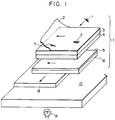
- Figure 1 is a schematic view showing the
structure of a laminate and a state of visual
inspection in this invention. In Figure 1, 1 is a
structure of a laminate, 2 is a protective film, e.g.,
a polyethylene film having a thickness of 50 to 70 µm,
3 is a polarizing film (or a retarded polarizing film
or a retardation film) usually having a thickness of
120 to 200 µm, 4 is an adhesive layer usually having a
thickness of 20 to 50 µm, 5 is a silicone release
layer, 6 is a biaxially oriented aromatic polyester
film, 7 is a foreign matter or a defect having a size
of 50 to 200 µm which is present in the
protective film 2, 8 is a polarizing film for crossed Nicol inspection, 9 is a light source, e.g., two fluorescent lights (20 W), and 10 is an opaque light diffusion film. The laminate 1 consists of the structure from the protective film 2 to the biaxially orientedaromatic polyester film 6, and the release film consists of thesilicone release layer 5 and the biaxially orientedaromatic polyester film 6. -
- The foreign matters or the defects which are inspected through the laminate of this invention are present not only in the protective film, as shown in Figure 1, but also in the polarizing film, the retarded polarizing film, the retardation film, the adhesive layer, the silicone release layer or the biaxially oriented aromatic polyester film, or are present therebetween. At any rate, the foreign matters or the defects in the laminate can easily be found by visual inspection.
- This invention will be explained in more detail by referring to the following Examples and Comparative Examples. The properties in said Examples were measured by the following methods.
- The MOR value and the inclination of the orientation main axis of a crystal (orientation angle) were determined from the pattern of transmitted microwave intensity using a microwave molecular orientation meter manufactured by Kanzaki Paper Manufacturing Co., Ltd.
- The visual inspection was conducted with the structure shown in Figure 1, and conditions of occurrence of light interference were evaluated with the following grades.
- good: Light interference does not occur.
- slightly bad: Light interference occurs, but inspection is possible.
- bad: Light interference occurs and inspection is impossible.
-
- Molten polyethylene terephthalate was extruded into a film, and the film was rapidly cooled in contact with a rotary cooling drum at 20°C to form an unstretched film. The unstretched film was consecutively biaxially stretched at stretch ratios shown in Table 1, and then thermoset under conditions shown in Table 1 to give a transparent biaxially oriented polyethylene terephthalate film having a thickness of 38 µm.
- Subsequently, a silicone resin coating solution having the following composition was coated on one surface of the biaxially oriented polyethylene terephthalate film in a coating amount (wet) of 8 g/m2. The thus coated film was dried and cured at 130°C for 30 seconds to obtain a release film having a coating thickness of 0.24 µm.
-
parts by weight Curable silicone resin (KS847H) 100 Curing agent (CAT PL-50T, made by Shin-etsu Silicone K.K.) 2 Diluent: methyl ethyl ketone/xylene/methyl isobutyl ketone 898 - A polyester adhesive tape (NITTOH-31B) was adhered to the release surface of the release film, 5 kg pressure rollers were driven back and forth. After the film was left to stand for 20 hours, a 180° peeling strength of the tape was measured and found to be all within the range of 9 g ± 2 g/25 mm. Thus, the film had sufficient releasability as a release film for a polarizing film (peeling liner).
- Using the release film, a laminate was formed with the structure indicated at 1 in Figure 1, and was measured for various properties. The results are shown in Table 1.
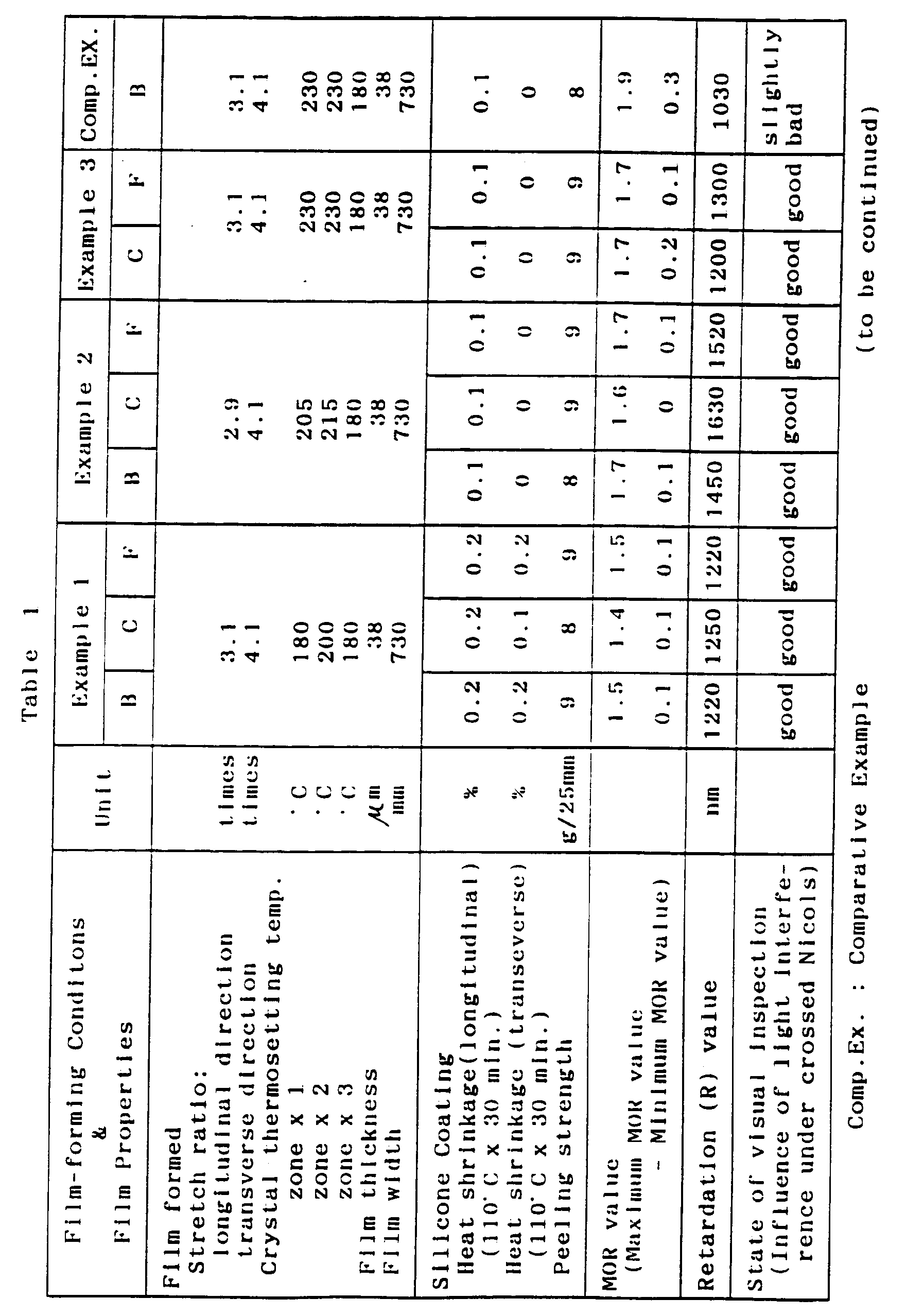

- The properties are given on the laminate formed by the silicone coating.
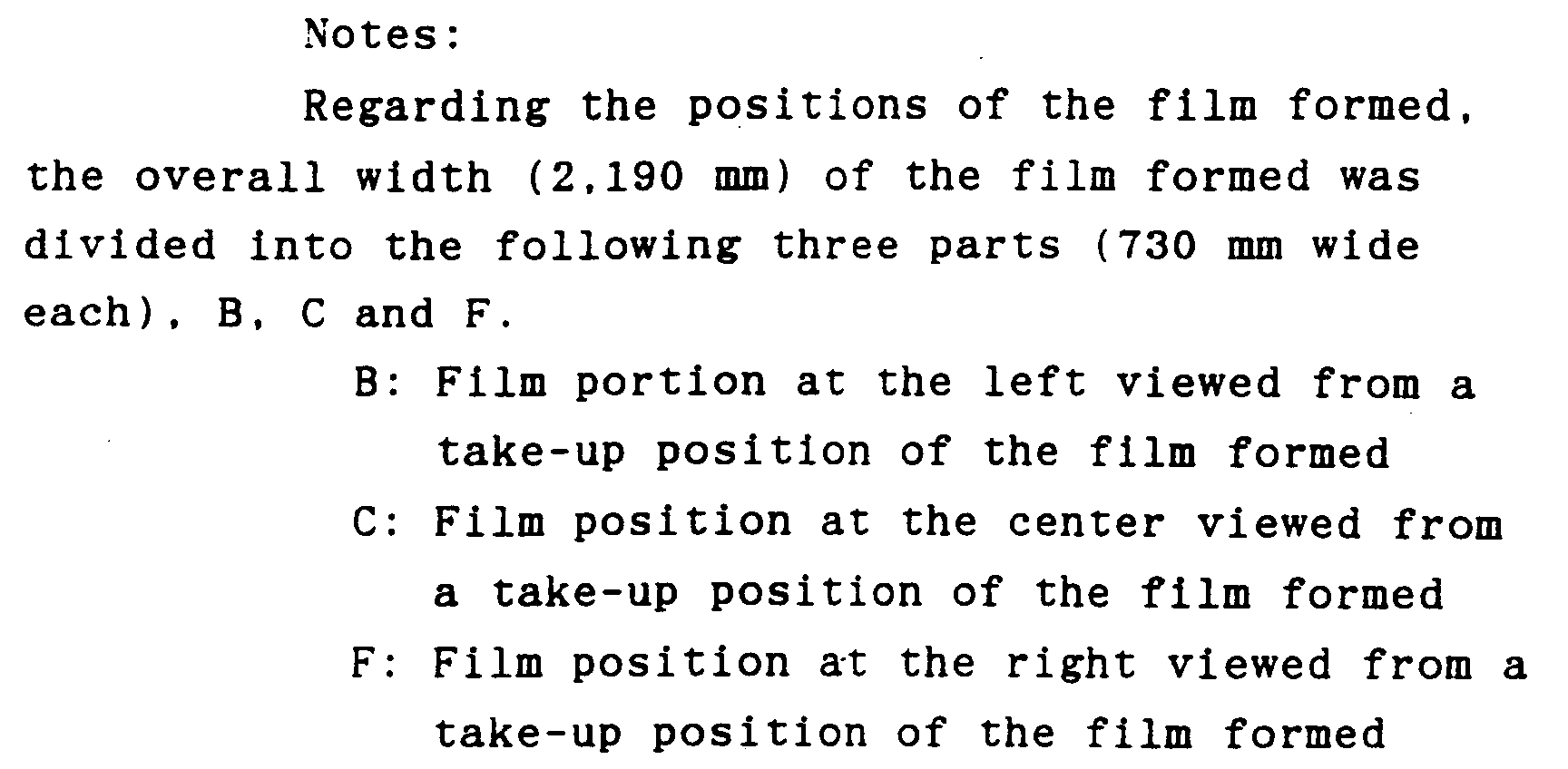
- In the film used in Comparative Example 1 and the film used in Example 3, the film formed is divided into three parts in the width direction. That is, the film (B) in Comparative Example 1 is a film portion at the left viewed from the take-up position of the film formed. The films (C and F) in Example 3 are film portions at the center and at the right viewed from the take-up position of the film formed. The films are, though cut in the length direction from the same film formed, thus different in the MOR value and the difference between the maximum and minimum values of the MOR value, presumably because the orientation main axis varies depending on the position due to the bowing phenomenon in the film-forming.
Claims (8)
- A laminate having improved polarization characteristics, in which an adhesive layer is formed on one surface of the polarizing film, a retarded polarising film or a retardation film and a release film having a transparent biaxially oriented aromatic polyester film as base film has its release surface in contact with the adhesive layer, wherein the positioning of the polyester film with respect to the polarizing film, the retarded polarizing film or the retardation film is such that the orientation main axis (as measured by a microwave transmission-type molecular orientation meter) of the polyester film is essentially parallel or substantially perpendicular to the orientation axis of the polarizing film, the retarded polarizing film or the retardation film, and wherein the biaxially oriented aromatic polyester film has an MOR value (the ratio of the maximum value to the minimum value of transmission, both measured with a molecular orientation meter respectively in the longitudinal and in the transverse directions of stretching) of 1.3 to 1.8, and a retardation (R) value, as defined by the following formula (1), of at least 1,200 nm.wherein Δn is the difference (nx - ny) between the refractive index (nx) in the width direction and the refractive index (ny) in a direction at right angles to the width direction of the film in a visible light having a wavelength (λ) of 589 nm, and d is the thickness (nm) of the film.
- The laminate of claim 1 wherein in the biaxially oriented aromatic polyester film the difference between the maximum value and the minimum value of the MOR is 0.2 or less.
- The laminate of claim 1 or 2 wherein the release film is a film obtained by imparting releasability to at least one surface of a transparent biaxially oriented aromatic polyester film by coating with a silicone.
- The laminate of any of claims 1 to 3 wherein the aromatic polyester film is a polyethylene terephthalate film.
- A release film for inspection of a polarizing film, a retarded polarizing film or a retardation film, which release film is obtainable by imparting releasability to at least one surface of a transparent biaxially oriented aromatic polyester film by coating with a silicone, said biaxially oriented aromatic polyester film having an MOR value, as defined in claim 1, of 1.3 to 1.8.
- The release film of claim 5 wherein in the biaxially oriented aromatic polyester film, the difference between the maximum value and the minimum value of the MOR is 0.2 or less.
- The release film of claim 5 or 6 wherein the biaxially oriented aromatic polyester film has a retardation (R) value, as defined by the following formula (1), of at least 1,200 nm.wherein Δn is the difference (nx - ny) between the refractive index (nx) in the width direction and the refractive index (ny) in a direction at right angles to the width direction of the film in a visible light having a wavelength (λ) of 589 nm, and d is the thickness (nm) of the film.
- The release film of any of claims 5 to 7 wherein the aromatic polyester film is a polyethylene terephthalate film.
Applications Claiming Priority (6)
| Application Number | Priority Date | Filing Date | Title |
|---|---|---|---|
| JP17809293 | 1993-07-19 | ||
| JP17809293 | 1993-07-19 | ||
| JP178092/93 | 1993-07-19 | ||
| JP20146293 | 1993-08-13 | ||
| JP20146293 | 1993-08-13 | ||
| JP201462/93 | 1993-08-13 |
Publications (2)
| Publication Number | Publication Date |
|---|---|
| EP0635358A1 EP0635358A1 (en) | 1995-01-25 |
| EP0635358B1 true EP0635358B1 (en) | 1999-12-01 |
Family
ID=26498387
Family Applications (1)
| Application Number | Title | Priority Date | Filing Date |
|---|---|---|---|
| EP94305251A Expired - Lifetime EP0635358B1 (en) | 1993-07-19 | 1994-07-18 | Laminate having improved polarization characteristics, and release film used therefor |
Country Status (4)
| Country | Link |
|---|---|
| EP (1) | EP0635358B1 (en) |
| KR (1) | KR100217160B1 (en) |
| DE (1) | DE69421854T2 (en) |
| MY (1) | MY114245A (en) |
Families Citing this family (7)
| Publication number | Priority date | Publication date | Assignee | Title |
|---|---|---|---|---|
| KR100366479B1 (en) * | 1996-11-26 | 2004-03-20 | 주식회사 코오롱 | Solar control film |
| US6482501B2 (en) | 1998-05-18 | 2002-11-19 | Toyo Boseki Kabushiki Kaisha | Optical-use adhesive film |
| JP4320763B2 (en) * | 1999-02-22 | 2009-08-26 | 東洋紡績株式会社 | Easy adhesive film for optics |
| JP2000162584A (en) * | 1998-11-26 | 2000-06-16 | Nitto Denko Corp | Optical member, cell substrate and liquid crystal display device |
| KR100689974B1 (en) | 2000-04-04 | 2007-03-09 | 미쓰비시 가가꾸 폴리에스테르 필름 가부시키가이샤 | Release film |
| KR20020081541A (en) * | 2001-04-16 | 2002-10-28 | 닛토덴코 가부시키가이샤 | Optical member and liquid-crystal display device |
| US7088511B2 (en) | 2003-02-12 | 2006-08-08 | 3M Innovative Properties Company | Light polarizing film and method of making same |
Family Cites Families (6)
| Publication number | Priority date | Publication date | Assignee | Title |
|---|---|---|---|---|
| JPS613338A (en) * | 1984-06-18 | 1986-01-09 | Toray Ind Inc | Optical recording material |
| JPS61148403A (en) * | 1984-12-24 | 1986-07-07 | Toray Ind Inc | Circular polarizing plate and its preparation |
| JPS61189506A (en) * | 1985-02-19 | 1986-08-23 | Nitto Electric Ind Co Ltd | Laminated film for formation of polarizing plate and its manufacture |
| JPH0411203A (en) * | 1990-04-27 | 1992-01-16 | Toray Ind Inc | Phase difference film |
| JP3056567B2 (en) * | 1991-10-18 | 2000-06-26 | 日東電工株式会社 | Optical inspection separator |
| JP3520347B2 (en) * | 1992-06-19 | 2004-04-19 | 東洋紡績株式会社 | Release film for polarizing plate |
-
1994
- 1994-07-08 MY MYPI94001788A patent/MY114245A/en unknown
- 1994-07-18 KR KR1019940017329A patent/KR100217160B1/en not_active Expired - Lifetime
- 1994-07-18 DE DE69421854T patent/DE69421854T2/en not_active Expired - Lifetime
- 1994-07-18 EP EP94305251A patent/EP0635358B1/en not_active Expired - Lifetime
Also Published As
| Publication number | Publication date |
|---|---|
| KR100217160B1 (en) | 1999-09-01 |
| DE69421854T2 (en) | 2000-07-27 |
| DE69421854D1 (en) | 2000-01-05 |
| MY114245A (en) | 2002-09-30 |
| EP0635358A1 (en) | 1995-01-25 |
| KR950002978A (en) | 1995-02-16 |
Similar Documents
| Publication | Publication Date | Title |
|---|---|---|
| US5677024A (en) | Laminate having improved polarization characteristics and release film used therefor | |
| US6934081B2 (en) | Polarizing plate and method of manufacturing the same, and liquid crystal display using the polarizing plate | |
| TWI401161B (en) | Protective film for polarizing plate (2) | |
| JP3403859B2 (en) | Release film | |
| US6859241B2 (en) | Method of producing polarizing plate, and liquid crystal display comprising the polarizing plate | |
| US20040239852A1 (en) | Liquid crystal display element, and use of phase difference film used the same for | |
| US20030086033A1 (en) | Laminated phase retarder, polarizing member and liquid-crystal display device | |
| EP1457792A1 (en) | Retardation film and optical device employing it | |
| US10481435B2 (en) | Horizontal alignment-type liquid crystal display device | |
| US20030151705A1 (en) | Polarizing plate with optical compensation film and liquid crystal display | |
| KR20060048078A (en) | Manufacturing method of laminated polarizing plate and manufacturing method of optical member using same | |
| JP3737564B2 (en) | Release film | |
| CN100520532C (en) | Compensator for liquid crystal display | |
| US7223451B2 (en) | Polycarbonate-based oriented film and retardation film | |
| JPWO2006137427A1 (en) | Protective film for polarizing plate | |
| JP2009012254A (en) | Release film | |
| JP3320904B2 (en) | Laminated body with improved polarization characteristics and release film therefor | |
| EP1743915A1 (en) | Oriented film, process for producing the same and laminate thereof | |
| JP2002040249A (en) | Polyester film for polarizing film lamination | |
| JP2003231214A (en) | Release film | |
| JP3629447B2 (en) | Process for producing release film | |
| EP0376696B1 (en) | Optical film | |
| US20160291229A1 (en) | Method for producing retardation film | |
| EP0635358A1 (en) | Laminate having improved polarization characteristics, and release film used therefor | |
| JP3810969B2 (en) | Optical compensation polarizing plate and manufacturing method of liquid crystal display device |
Legal Events
| Date | Code | Title | Description |
|---|---|---|---|
| PUAI | Public reference made under article 153(3) epc to a published international application that has entered the european phase |
Free format text: ORIGINAL CODE: 0009012 |
|
| AK | Designated contracting states |
Kind code of ref document: A1 Designated state(s): DE FR GB |
|
| 17P | Request for examination filed |
Effective date: 19950621 |
|
| 17Q | First examination report despatched |
Effective date: 19970718 |
|
| GRAG | Despatch of communication of intention to grant |
Free format text: ORIGINAL CODE: EPIDOS AGRA |
|
| GRAG | Despatch of communication of intention to grant |
Free format text: ORIGINAL CODE: EPIDOS AGRA |
|
| GRAH | Despatch of communication of intention to grant a patent |
Free format text: ORIGINAL CODE: EPIDOS IGRA |
|
| GRAH | Despatch of communication of intention to grant a patent |
Free format text: ORIGINAL CODE: EPIDOS IGRA |
|
| GRAA | (expected) grant |
Free format text: ORIGINAL CODE: 0009210 |
|
| AK | Designated contracting states |
Kind code of ref document: B1 Designated state(s): DE FR GB |
|
| PG25 | Lapsed in a contracting state [announced via postgrant information from national office to epo] |
Ref country code: FR Free format text: LAPSE BECAUSE OF FAILURE TO SUBMIT A TRANSLATION OF THE DESCRIPTION OR TO PAY THE FEE WITHIN THE PRESCRIBED TIME-LIMIT Effective date: 19991201 |
|
| REF | Corresponds to: |
Ref document number: 69421854 Country of ref document: DE Date of ref document: 20000105 |
|
| EN | Fr: translation not filed | ||
| PLBE | No opposition filed within time limit |
Free format text: ORIGINAL CODE: 0009261 |
|
| STAA | Information on the status of an ep patent application or granted ep patent |
Free format text: STATUS: NO OPPOSITION FILED WITHIN TIME LIMIT |
|
| 26N | No opposition filed | ||
| REG | Reference to a national code |
Ref country code: GB Ref legal event code: IF02 |
|
| PGFP | Annual fee paid to national office [announced via postgrant information from national office to epo] |
Ref country code: DE Payment date: 20100728 Year of fee payment: 17 |
|
| PGFP | Annual fee paid to national office [announced via postgrant information from national office to epo] |
Ref country code: GB Payment date: 20100630 Year of fee payment: 17 |
|
| GBPC | Gb: european patent ceased through non-payment of renewal fee |
Effective date: 20110718 |
|
| PG25 | Lapsed in a contracting state [announced via postgrant information from national office to epo] |
Ref country code: DE Free format text: LAPSE BECAUSE OF NON-PAYMENT OF DUE FEES Effective date: 20120201 |
|
| REG | Reference to a national code |
Ref country code: DE Ref legal event code: R119 Ref document number: 69421854 Country of ref document: DE Effective date: 20120201 |
|
| PG25 | Lapsed in a contracting state [announced via postgrant information from national office to epo] |
Ref country code: GB Free format text: LAPSE BECAUSE OF NON-PAYMENT OF DUE FEES Effective date: 20110718 |