EP0634837B1 - Oscillation circuit, also for use in microcomputers and IC cards - Google Patents
Oscillation circuit, also for use in microcomputers and IC cards Download PDFInfo
- Publication number
- EP0634837B1 EP0634837B1 EP94110885A EP94110885A EP0634837B1 EP 0634837 B1 EP0634837 B1 EP 0634837B1 EP 94110885 A EP94110885 A EP 94110885A EP 94110885 A EP94110885 A EP 94110885A EP 0634837 B1 EP0634837 B1 EP 0634837B1
- Authority
- EP
- European Patent Office
- Prior art keywords
- circuit
- inverter
- oscillation circuit
- stage inverter
- oscillation
- Prior art date
- Legal status (The legal status is an assumption and is not a legal conclusion. Google has not performed a legal analysis and makes no representation as to the accuracy of the status listed.)
- Expired - Lifetime
Links
Images



Classifications
-
- H—ELECTRICITY
- H03—ELECTRONIC CIRCUITRY
- H03K—PULSE TECHNIQUE
- H03K3/00—Circuits for generating electric pulses; Monostable, bistable or multistable circuits
- H03K3/02—Generators characterised by the type of circuit or by the means used for producing pulses
- H03K3/027—Generators characterised by the type of circuit or by the means used for producing pulses by the use of logic circuits, with internal or external positive feedback
- H03K3/03—Astable circuits
- H03K3/0315—Ring oscillators
Definitions
- the present invention generally relates to an oscillation circuit which is used in microcomputers, IC cards and the like. More particularly, the invention is concerned with an oscillation circuit which can operate stably over an extended range of operating voltages.
- microcomputer it is contemplated to mean a small computer system and cover small business or office computers and personal computers.
- IC card covers those typified by chip card, intelligent card, smart card and the like.
- the microcomputers and the devices mentioned above have been designed so as to operate with a single operating voltage usually standardized to 5 volts. In that case, it is sufficient for the oscillation circuit incorporated in the microcomputers to operate with a single operating voltage.
- the oscillation circuit incorporated in the microcomputers In recent years, however, there arises increasingly a demand for battery-driven microcomputers such as notebook-size personal computers, handy-type terminals and the like, which in turn requires oscillation circuits which are capable of operating at various voltages within a wide voltage range.
- broadening of the operating voltage range of the oscillation circuit is accompanied with problems to be solved, which will be explained below in conjunction with a typical one of the conventional oscillation circuits.
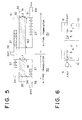
- Fig. 6 is a diagram showing an oscillation circuit known heretofore which is used in a charge pump for internally generating voltage signals to be supplied to UART (Universal Asynchronous Receiver/Transmitter), EEPROM (Electrically Erasable and Programmable Read-Only Memory) and others incorporated in microcomputers, IC cards and others.
- the oscillation circuit includes a NAND circuit 1 having first and second input terminals, a first inverter 2 having an input terminal to which the output terminal of the NAND circuit 1 is connected and an output terminal connected to one end of a first capacitor 4 via a first resistor 3. The other end of the first capacitor 4 is grounded.
- a junction (i.e., node of connection) between the first resistor 3 and the first capacitor 4 is connected to an input terminal of a second inverter 5 which has an output terminal connected to one end of a second capacitor 7 via a second resistor 6. The other end of the second capacitor 7 is grounded.
- a junction between the second resistor 6 and the second capacitor 7 is connected to an output terminal 8 of the oscillation circuit on one hand and connected to the second input terminal of the NAND circuit 1 on the other hand.
- the first input terminal of the NAND circuit 1 is connected to an input terminal 9 of the oscillation circuit.
- the first inverter 2, the first resistor 3 and the first capacitor 4 constitute one circuit unit 10a
- the another circuit unit 10b is constituted by the second inverter 5, the second resistor 6 and the second capacitor 7.
- more than two circuit units of the same configuration as the circuit units 10a and 10b may be connected in cascade, if desired.
- an enable signal EN is supplied to the first input terminal of the NAND circuit 1 from a CPU (Central Processing Unit) or the like incorporated in the microcomputer or IC card.
- the enable signal EN is fixed to a low level (L)
- the output of the NAND circuit 1 assumes a high level (H).
- This high-level output of the NAND circuit 1 is transmitted to the output terminal 8 via a series connection of the first inverter 2 and the first resistor 3 as well as the second inverter 5 and the second resistor 6 connected in series.
- an output signal OUT of high level (H) appears at the output terminal 8 of the oscillation circuit.
- This output signal OUT is fed back to the second input terminal of the NAND circuit 1.
- the enable signal EN applied to the first input terminal of the NAND circuit 1 is fixed at the low level, the output of the NAND circuit 1 remains constantly at the high level.
- the output of the NAND circuit 1 changes from the high to the low level, which results in change of the output signal OUT at the output terminal 8 to the low level from the high level.
- the feedback signal applied to the second input terminal of the NAND circuit 1 becomes low. Consequently, the output of the NAND circuit 1 becomes high with the result that the level of the output signal OUT at the output terminal 8 is also high.
- the waveform 7 shows a waveform of the oscillation signal outputted from the output terminal 8.
- the curvilinear rising edges and falling edges of the pulse-like waves are determined in dependence on the time constant mentioned above.
- the signal will have to be shaped by a suitable shaper circuit.
- each of the circuit units 10a and 10b includes a single inverter (2 or 5), the oscillation frequency characteristics of the oscillation circuit depend on the driving capability of the first inverter 2 or the second inverter 5 to a great extent.
- driving capability used herein, it is contemplated to mean a parameter indicating magnitude of a current which can be driven by the inverter. Since the inverter is constituted by an N-channel transistor and a P-channel transistor, the driving capability of the former is determined by that of the latter.
- the frequency of oscillation depends on a time constant (a delay factor) which in turn is determined by values of the resistor (3, 6) and the capacitor (4, 7) connected to the inverter (2, 5).
- the transistor itself which constitutes the inverter (2, 5) has a resistance component (internal resistance) which bears such relation to the driving capability of the inverter (2, 5) that the internal resistance assumes a smaller value as the driving capability becomes greater and vice versa.
- the influence of the internal resistance of the transistors constituting the inverter becomes significant to make dull the waveform of the output signal of the oscillation circuit (i.e., the time taken for the rising and falling of the pulse is increased), which results in that the oscillation frequency deviates from a preset value to a lower frequency.
- the driving capability of the inverters 2 and 5 are enhanced, the influence to dullness of the waveform (and hence deviation from the preset frequency) can certainly be mitigated.
- power consumption of the inverters and hence the oscillation circuit increases, giving rise to a problem.
- prior art document US-A-5 030 853 discloses logic and memory circuits optimized with respect to speed and density.
- inverters in a ring oscillator are designed such that each of a plurality of inverter stages has a symmetric voltage transfer function.
- a further conventionally known oscillation circuit is disclosed in document US-A-5 180 995, comprising inversion circuits and RC delay elements in a ring.
- This prior art document teaches the compensation of oscillation frequency variations which are due to a change, namely, a rise of the ambient temperature as an externally influencing parameter.
- the compensation is achieved by a specific temperature characteristic of a resistor provided within the circuit arrangement.
- the power consumption can effectively be prevented from increasing because magnitude of a through-current can be decreased by lowering the driving capability of the first stage inverter for which the input signal has a waveform dulled. Further, by enhancing the driving capability of the final stage inverter for which the input signal rises up and falls sharply, influence of the internal resistance to the time constant can be suppressed to a minimum, whereby the oscillation frequency can be prevented from variation or fluctuation.
- an oscillation circuit which can operate stably over a wide range of voltages.
- the second inversion circuit mentioned above may include at least one intermediate stage inverter connected between the first stage inverter and the final stage inverter, wherein driving capability of the intermediate stage inverter is made higher than that of the first stage inverter and lower than that of the final stage inverter.
- the second inversion circuit previously mentioned may include a plurality of intermediate stage inverters connected in series between the first stage inverter and the final stage inverter, wherein driving capabilities of the plurality of intermediate stage inverters are progressively and sequentially increased, starting from the one connected immediately after the first stage inverter toward the final stage inverter.
- Fig. 1 is a circuit diagram showing a configuration of an oscillation circuit according to an embodiment of the present invention which is adapted to be incorporated in microcomputers, IC cards or the like.
- a NAND circuit 11 has two input terminals, a first terminal of which is connected to an input terminal 23 of the oscillation circuit.
- a trigger signal generated by a CPU (Central Processing Unit) incorporated in a microcomputer, an IC card or the like is inputted to the input terminal 23 as an enable signal EN for triggering operation of the oscillation circuit.
- the NAND circuit 11 has an output terminal connected to an input terminal of a first delay circuit D1 via a first inverter 12 which serves as a first inversion circuit.
- the output terminal of the first delay circuit D1 is connected to an input terminal of a second inversion circuit IV of which output terminal is connected to an input terminal of a second delay circuit D2.
- the first delay circuit D1 includes a first resistor 13 having one end connected to the output terminal of the first inverter 12 and a first capacitor 14 having one end connected to the other end of the first resistor 13. The other end of the capacitor 14 is grounded. A junction (i.e., connecting node or point) between the first resistor 13 and the first capacitor 14 is connected to the input terminal of the second inversion circuit IV.
- the second inversion circuit IV includes a second inverter 15 constituting a first stage inverter, a third inverter 16 constituting an intermediate stage inverter and a fourth inverter 17 serving as a final stage inverter, wherein the input terminal of the second inverter 15 is connected to the junction between the first resistor 13 and the first capacitor 14.
- the second delay circuit D2 includes a second resistor 18 having one end connected to the output terminal of the fourth inverter 17 and a second capacitor 19 having one end connected to the other end of the second resistor 18.
- the other end of the capacitor 19 is connected to the ground.
- a junction between the second resistor 18 and the second capacitor 19 is connected to the output terminal 20 of the oscillation circuit for generating an output signal which can be utilized as a clock signal for a UART (Universal Asynchronous Receiver/Transmitter), an EEPROM (Electrically Erasable and Programmable Read-Only Memory) and others incorporated in the microcomputer, IC card or the like.
- the junction between the second resistor 18 and the second capacitor 19 is connected to a second input terminal of the NAND circuit 11 via fifth and sixth inverters 21 and 22 connected in series.
- Fig. 2 is a waveform diagram showing a waveform of a signal supplied to the first-stage inverter 15
- Fig. 3 is a waveform diagram showing a waveform of an output signal output from the final-stage inverter 17.
- Fig. 4 is a circuit diagram showing a typical structure of the inverter 15, 16 or 17 shown in Fig. 1.
- the inverter is realized in the form of a CMOS (Complementary Metal-Oxide Semiconductor) device in which a P-type transistor 51 and an N-type transistor 52 are connected in a complementary manner. More specifically, the P-type transistor 51 and the N-type transistor 52 have respective gates which are interconnected so as to form an input terminal (IN).
- the P-type transistor 51 has a source connected to a power source 55, while the N-type transistor 52 has a source connected to the ground potential.
- the drain of the P-type transistor 51 and the drain of the N-type transistor 52 are connected together to form an output terminal (OUT).
- a through-current (which may also be referred to as the rush current) flows from the power source 52 to the ground 56 (i.e., in the direction indicated by an arrow 57) via the P-type transistor 51 and the N-type transistor 52.
- the P-type transistor 51 is first turned on and then the N-type transistor 52 is turned off. Consequently, during a period in which the input signal falls from the high level to the low level, both of the P-type transistor 51 and the N-type transistor 52 are temporarily set to the conducting state to allow the through-current to flow from the power source 55 to the ground 56.
- Fig. 5 is a diagram for illustrating a physical structure or layout arrangement of the inverter shown in Fig. 4.
- the P-type transistor 51 has a field region 31, a gate region 32 and a signal input region 33.
- the N-type transistor 52 has a field region 34 and a gate region 35.
- Aluminum wires 36, 38 and 39 are connected to the output terminal, the ground and the power source, respectively.
- Contact regions 37 are provided for making electrical contacts between the aluminum wires 36, 38 and 39 and the field regions 31 and 32, respectively.
- the input signal for the second inverter 15 disposed at the input side of the second inversion circuit IV and constituting the so-called first stage inverter is caused to flow through the first delay circuit D1 constituted by the first resistor 13 and the first capacitor 14 before being inputted to the second inverter 15 and thus dulled in the waveform, as illustrated in Fig. 2. Consequently, if the driving capability of the second inverter 15 is enhanced, the period during which both the P-type transistor 51 and the N-type transistor 52 of the second inverter 15 are simultaneously in the conducting state is elongated, as a result of which the temporal period during which the through-current flows from the power source 55 to the ground 51 is extended, thus involving increase in the power consumption.
- the waveform of the signal inputted to the fourth inverter 17 corresponding to the final stage inverter provided at the output side can evade from becoming dull (i.e., this pulse signal has sharp or steep rising edge and falling edge). Accordingly, increase or enhancement of the driving capability of the fourth inverter 17 is not accompanied with any appreciable increase in the duration of the through-current and hence in the power consumption.
- the driving capability of each of the inverters 15 to 17 is determined by the driving capabilities of the P-type transistor 51 and the N-type transistor 52 which constitute the inverter.
- P represents a constant determined by various parameters (temperature, manufacturing process, material, impurity concentration, thickness of gate oxide film, dielectric constant, etc.) in the semiconductor manufacturing processes
- L represents a length of the gate of the transistor
- W represents a width of the same.
- the driving capability of the inverter constituted by the P-type transistor 51 and the N-type transistor 52 as shown in Fig. 5 increases as the lengths L1 and L2 of the gates of the P-type transistor 51 and the N-type transistor 52, respectively, is dimensioned shorter and/or as the widths W1 and W2 of the N-type transistor 52 and the P-type transistor 51, respectively, is dimensioned greater.
- magnitude of the current flowing through the transistors 51 and 52 increases as the input voltage is higher and vice versa.
- the driving capabilities of the transistors 51 and 52 are increased (with the internal resistance being decreased) and vice versa.
- the output frequency rate of the second delay circuit D2 becomes low.
- the driving capability of the second inverter 15 constituting the first stage inverter disposed at the input side of the second inversion circuit IV is reduced because it is sufficient for the second inverter 15 to drive only the third inverter 16, while the driving capability of the fourth inverter 17 constituting the final stage inverter is increased, whereby the influence of the internal resistance which affects the time constant of the oscillation circuit is suppressed to a possible minimum.
- deviation of the oscillation frequency from the preset frequency can effectively be avoided even when the overall driving capability of the second inversion circuit IV is set to be low, while the power consumption can profitably be prevented from increasing even when the overall driving capability of the second inversion circuit IV is set to be high. In this manner, there can be ensured highly stable operation of the oscillation circuit over a wide voltage range from about 2.7 volts to about 5.5 volts while decreasing effectively the power consumption.
- the fourth inverter 17 of the final stage may fail to drive the current satisfactorily, which may eventually lead to no occurrence of oscillation.
- Such unwanted situation can be evaded by providing the third inverter 16 as the intermediate stage inverter and selecting the driving capability of the third inverter 16 higher than the second inverter 15 and lower than the fourth inverter 17.
- the number of the intermediate stage inverters may be increased, as occasion requires. In that case, however, the number of the inverter elements (inclusive of the NAND circuit) in the oscillation circuit as a whole should be selected to be an odd number, because, if otherwise, no oscillation can take place.
- the second inversion circuit IV is constituted by a plurality of inverters 15 to 17. It is, however, to be noted that the first inversion circuit 12 may equally be constituted by a plurality of inverters. Further, the second inversion circuit IV and the second delay circuit D2 may be provided in pluralities, respectively.
- the oscillation circuit according to the invention is never limited to any particular utilization but may find a great variety of applications covering not only the existing microcomputers and IC cards but also those which will be developed in the future. Accordingly, the terms "microcomputer”, “IC card” or “computer system” used herein should be interpreted in their broadest sense. Thus, it should be understood that all suitable modifications may be resorted to.
Landscapes
- Pulse Circuits (AREA)
- Logic Circuits (AREA)
- Electronic Switches (AREA)
- Semiconductor Integrated Circuits (AREA)
Description
- The present invention generally relates to an oscillation circuit which is used in microcomputers, IC cards and the like. More particularly, the invention is concerned with an oscillation circuit which can operate stably over an extended range of operating voltages. With the term "microcomputer", it is contemplated to mean a small computer system and cover small business or office computers and personal computers. Further, the "IC card" covers those typified by chip card, intelligent card, smart card and the like.
- Heretofore, the microcomputers and the devices mentioned above have been designed so as to operate with a single operating voltage usually standardized to 5 volts. In that case, it is sufficient for the oscillation circuit incorporated in the microcomputers to operate with a single operating voltage. In recent years, however, there arises increasingly a demand for battery-driven microcomputers such as notebook-size personal computers, handy-type terminals and the like, which in turn requires oscillation circuits which are capable of operating at various voltages within a wide voltage range. However, broadening of the operating voltage range of the oscillation circuit is accompanied with problems to be solved, which will be explained below in conjunction with a typical one of the conventional oscillation circuits.
- Fig. 6 is a diagram showing an oscillation circuit known heretofore which is used in a charge pump for internally generating voltage signals to be supplied to UART (Universal Asynchronous Receiver/Transmitter), EEPROM (Electrically Erasable and Programmable Read-Only Memory) and others incorporated in microcomputers, IC cards and others. Referring to Fig. 6, the oscillation circuit includes a NAND circuit 1 having first and second input terminals, a
first inverter 2 having an input terminal to which the output terminal of the NAND circuit 1 is connected and an output terminal connected to one end of a first capacitor 4 via afirst resistor 3. The other end of the first capacitor 4 is grounded. A junction (i.e., node of connection) between thefirst resistor 3 and the first capacitor 4 is connected to an input terminal of asecond inverter 5 which has an output terminal connected to one end of a second capacitor 7 via asecond resistor 6. The other end of the second capacitor 7 is grounded. A junction between thesecond resistor 6 and the second capacitor 7 is connected to anoutput terminal 8 of the oscillation circuit on one hand and connected to the second input terminal of the NAND circuit 1 on the other hand. The first input terminal of the NAND circuit 1 is connected to aninput terminal 9 of the oscillation circuit. Parenthetically, thefirst inverter 2, thefirst resistor 3 and the first capacitor 4 constitute one circuit unit 10a, while the another circuit unit 10b is constituted by thesecond inverter 5, thesecond resistor 6 and the second capacitor 7. Of course, more than two circuit units of the same configuration as the circuit units 10a and 10b may be connected in cascade, if desired. - As a trigger signal for triggering operation of the oscillation circuit, an enable signal EN is supplied to the first input terminal of the NAND circuit 1 from a CPU (Central Processing Unit) or the like incorporated in the microcomputer or IC card. When the enable signal EN is fixed to a low level (L), the output of the NAND circuit 1 assumes a high level (H). This high-level output of the NAND circuit 1 is transmitted to the
output terminal 8 via a series connection of thefirst inverter 2 and thefirst resistor 3 as well as thesecond inverter 5 and thesecond resistor 6 connected in series. Thus, an output signal OUT of high level (H) appears at theoutput terminal 8 of the oscillation circuit. This output signal OUT is fed back to the second input terminal of the NAND circuit 1. However, because the enable signal EN applied to the first input terminal of the NAND circuit 1 is fixed at the low level, the output of the NAND circuit 1 remains constantly at the high level. - When the enable signal EN is changed from the low level to the high level, the output of the NAND circuit 1 changes from the high to the low level, which results in change of the output signal OUT at the
output terminal 8 to the low level from the high level. At this time, the feedback signal applied to the second input terminal of the NAND circuit 1 becomes low. Consequently, the output of the NAND circuit 1 becomes high with the result that the level of the output signal OUT at theoutput terminal 8 is also high. Through repetition of the operation described above, there occurs oscillation in the oscillation circuit, wherein the oscillation frequency is determined by a time constant which in turn is determined by the values of thefirst resistor 3, thesecond resistor 6, the first capacitor 4 and the second capacitor 7. Fig. 7 shows a waveform of the oscillation signal outputted from theoutput terminal 8. The curvilinear rising edges and falling edges of the pulse-like waves are determined in dependence on the time constant mentioned above. In order to allow the periodical signal generated by the oscillation circuit in this way to be utilized as a clock signal, the signal will have to be shaped by a suitable shaper circuit. - The prior art oscillation circuit described above suffers from a problem that because each of the circuit units 10a and 10b includes a single inverter (2 or 5), the oscillation frequency characteristics of the oscillation circuit depend on the driving capability of the
first inverter 2 or thesecond inverter 5 to a great extent. With the expression "driving capability" used herein, it is contemplated to mean a parameter indicating magnitude of a current which can be driven by the inverter. Since the inverter is constituted by an N-channel transistor and a P-channel transistor, the driving capability of the former is determined by that of the latter. - As mentioned previously, in the prior art oscillation circuit, the frequency of oscillation depends on a time constant (a delay factor) which in turn is determined by values of the resistor (3, 6) and the capacitor (4, 7) connected to the inverter (2, 5). Besides, the transistor itself which constitutes the inverter (2, 5) has a resistance component (internal resistance) which bears such relation to the driving capability of the inverter (2, 5) that the internal resistance assumes a smaller value as the driving capability becomes greater and vice versa.
- For the reasons mentioned above, if the driving capability of the
inverters inverters - Moreover, prior art document US-A-5 030 853 discloses logic and memory circuits optimized with respect to speed and density. As can be gathered from this reference, inverters in a ring oscillator are designed such that each of a plurality of inverter stages has a symmetric voltage transfer function.
- A further conventionally known oscillation circuit is disclosed in document US-A-5 180 995, comprising inversion circuits and RC delay elements in a ring. This prior art document teaches the compensation of oscillation frequency variations which are due to a change, namely, a rise of the ambient temperature as an externally influencing parameter. In particular, the compensation is achieved by a specific temperature characteristic of a resistor provided within the circuit arrangement.
- Document US-A-5 191 232 refers to a high frequency voltage multiplier for an electrically erasable and programmable memory device. However, according to the teaching of this prior art document, it is intended to reduce capacitance while maintaining a high current output.
- From the textbook "The Design And Analysis Of VLSI Circuits" by L.A. Glasser & D.W. Dobberpuhl, 1985, Addison-Wesley Publishing Company, Reading, Massachusetts, US, p. 6-11 & 253- 259 it is known to design inverter stages as staged buffers in series having increasing sizes. It is desired to "size the transistors and manipulate the layouts", which, in the light of the context of this textbook, will be interpreted by an expert in a way so as to influence an effective width (W) of the transistor and/or channel length (L).
- The Proceedings of the IEEE, Vol. 72, No. 6, June 1984 by E.T. Lewis: "Optimization Of Device Area And Overall Delay For CMOS VLSI Designs", also disclose to increase the widths of respective transistors, i.e. to increase the channel widths in inverters connected in series.
- However, even with the arrangement known from document US-A-5 180 995 there exists a problem such that in the proposed circuit arrangement the influence of the internal resistance of the transistors constituting the inverter(s) becomes significant, thus rendering the waveform of the oscillator output signal dull, which results in a deviation of the oscillation frequency from a preset value.
- It is therefore an object of the present invention to solve the above problems and to provide an oscillation circuit which is free from the above drawback, i.e. in which the influence of the internal resistance to the oscillation frequency can be suppressed to a minimum and which can enjoy an extended or enlarged range of operating voltages with power consumption being suppressed from increasing without incurring change or variation in the output frequency of the oscillation circuit.
- This object is achieved by an oscillation circuit according to claim 1.
- Advantageous further developments of the invention are as set out in the dependent claims.
- With the arrangement of the oscillation circuit as claimed, the power consumption can effectively be prevented from increasing because magnitude of a through-current can be decreased by lowering the driving capability of the first stage inverter for which the input signal has a waveform dulled. Further, by enhancing the driving capability of the final stage inverter for which the input signal rises up and falls sharply, influence of the internal resistance to the time constant can be suppressed to a minimum, whereby the oscillation frequency can be prevented from variation or fluctuation. Thus, there can be realized an oscillation circuit which can operate stably over a wide range of voltages.
- In particular, in the case of the oscillation circuits as defined in the claims, unwanted situation such as non-occurrence of oscillation may be undesirably involved, if a difference in the driving capability between the first stage inverter and the final stage inverter is excessively large. Accordingly, in a preferred mode for carrying out the invention, the second inversion circuit mentioned above may include at least one intermediate stage inverter connected between the first stage inverter and the final stage inverter, wherein driving capability of the intermediate stage inverter is made higher than that of the first stage inverter and lower than that of the final stage inverter. By virtue of provision of the intermediate stage inverter, a more stable operation of the oscillation circuit can be ensured.
- In another preferred mode for carrying out the invention, the second inversion circuit previously mentioned may include a plurality of intermediate stage inverters connected in series between the first stage inverter and the final stage inverter, wherein driving capabilities of the plurality of intermediate stage inverters are progressively and sequentially increased, starting from the one connected immediately after the first stage inverter toward the final stage inverter.
- By providing a plurality of intermediate stage inverters, even a large difference in the driving capability between the first and final stage inverters can adequately be accommodated, whereby operation of the oscillation circuit can further be stabilized over an extended range of operating voltages.
- The above and other objects, features and attendant advantages of the present invention will more easily be understood by reading the following description of the preferred embodiments thereof taken, only by way of example, in conjunction with the drawings.
- Fig. 1 is a circuit diagram showing a configuration of an oscillation circuit according to an embodiment of the present invention;
- Fig. 2 is a waveform diagram showing a waveform of an input signal for illustrating the operation of the oscillation circuit shown in Fig. 1;
- Fig. 3 is a waveform diagram showing a waveform of an output signal for illustrating the operation of the same;
- Fig. 4 is a circuit diagram showing a typical structure of an inverter employed in the oscillation circuit;
- Fig. 5 is a pattern diagram or plan view of a layout of the circuit for illustrating a physical structure of the inverter shown in Fig. 4;
- Fig. 6 is a diagram showing an oscillation circuit known heretofore; and
- Fig. 7 is a waveform diagram showing an oscillation signal outputted from an output terminal for illustrating the operation of the conventional oscillation circuit shown in Fig. 6.
-
- Now, the present invention will be described in detail in conjunction with preferred or exemplary embodiments thereof by reference to the drawings.
- Fig. 1 is a circuit diagram showing a configuration of an oscillation circuit according to an embodiment of the present invention which is adapted to be incorporated in microcomputers, IC cards or the like.
- Referring to Fig. 1, a NAND circuit 11 has two input terminals, a first terminal of which is connected to an
input terminal 23 of the oscillation circuit. A trigger signal generated by a CPU (Central Processing Unit) incorporated in a microcomputer, an IC card or the like is inputted to theinput terminal 23 as an enable signal EN for triggering operation of the oscillation circuit. The NAND circuit 11 has an output terminal connected to an input terminal of a first delay circuit D1 via afirst inverter 12 which serves as a first inversion circuit. The output terminal of the first delay circuit D1 is connected to an input terminal of a second inversion circuit IV of which output terminal is connected to an input terminal of a second delay circuit D2. - The first delay circuit D1 includes a
first resistor 13 having one end connected to the output terminal of thefirst inverter 12 and a first capacitor 14 having one end connected to the other end of thefirst resistor 13. The other end of the capacitor 14 is grounded. A junction (i.e., connecting node or point) between thefirst resistor 13 and the first capacitor 14 is connected to the input terminal of the second inversion circuit IV. - The second inversion circuit IV includes a
second inverter 15 constituting a first stage inverter, athird inverter 16 constituting an intermediate stage inverter and afourth inverter 17 serving as a final stage inverter, wherein the input terminal of thesecond inverter 15 is connected to the junction between thefirst resistor 13 and the first capacitor 14. - On the other hand, the second delay circuit D2 includes a
second resistor 18 having one end connected to the output terminal of thefourth inverter 17 and asecond capacitor 19 having one end connected to the other end of thesecond resistor 18. The other end of thecapacitor 19 is connected to the ground. A junction between thesecond resistor 18 and thesecond capacitor 19 is connected to theoutput terminal 20 of the oscillation circuit for generating an output signal which can be utilized as a clock signal for a UART (Universal Asynchronous Receiver/Transmitter), an EEPROM (Electrically Erasable and Programmable Read-Only Memory) and others incorporated in the microcomputer, IC card or the like. Additionally, the junction between thesecond resistor 18 and thesecond capacitor 19 is connected to a second input terminal of the NAND circuit 11 via fifth andsixth inverters - Fig. 2 is a waveform diagram showing a waveform of a signal supplied to the first-
stage inverter 15, and Fig. 3 is a waveform diagram showing a waveform of an output signal output from the final-stage inverter 17. - Fig. 4 is a circuit diagram showing a typical structure of the
inverter type transistor 51 and an N-type transistor 52 are connected in a complementary manner. More specifically, the P-type transistor 51 and the N-type transistor 52 have respective gates which are interconnected so as to form an input terminal (IN). The P-type transistor 51 has a source connected to apower source 55, while the N-type transistor 52 has a source connected to the ground potential. The drain of the P-type transistor 51 and the drain of the N-type transistor 52 are connected together to form an output terminal (OUT). - In operation, when the input signal applied to the gates of the P-
type transistor 51 and the N-type transistor 52 changes from a low level to a high level, the N-type transistor 52 becomes conducting, which is followed by turn-off of the P-type transistor 51 (i.e., switching of the P-type transistor 51 to the non-conducting state). In this conjunction, it should however be noted that both of thetransistors power source 52 to the ground 56 (i.e., in the direction indicated by an arrow 57) via the P-type transistor 51 and the N-type transistor 52. Similarly, upon changing of the input signal from the high level to the low level, the P-type transistor 51 is first turned on and then the N-type transistor 52 is turned off. Consequently, during a period in which the input signal falls from the high level to the low level, both of the P-type transistor 51 and the N-type transistor 52 are temporarily set to the conducting state to allow the through-current to flow from thepower source 55 to theground 56. - Fig. 5 is a diagram for illustrating a physical structure or layout arrangement of the inverter shown in Fig. 4. Referring to the figure, the P-
type transistor 51 has afield region 31, agate region 32 and asignal input region 33. Similarly, the N-type transistor 52 has afield region 34 and agate region 35.Aluminum wires regions 37 are provided for making electrical contacts between thealuminum wires field regions - Now, operation of the oscillation circuit according to the present embodiment of the invention will be described in detail. The mechanism itself for causing the oscillation to take place is essentially same as that of the conventional oscillation circuit described hereinbefore with reference to Fig. 6. In other words, as long as the enable signal EN applied to the first input terminal of the NAND circuit 11 as the trigger signal is fixed to the low level, the output signal OUT appearing at the
output terminal 20 continues to remain at the high level, involving no oscillation. However, when the enable signal EN is changed from the low level to the high level and fixed at the high level, oscillation occurs in the output signal OUT in the manner described hereinbefore in conjunction with the convention oscillation circuit. - The input signal for the
second inverter 15 disposed at the input side of the second inversion circuit IV and constituting the so-called first stage inverter is caused to flow through the first delay circuit D1 constituted by thefirst resistor 13 and the first capacitor 14 before being inputted to thesecond inverter 15 and thus dulled in the waveform, as illustrated in Fig. 2. Consequently, if the driving capability of thesecond inverter 15 is enhanced, the period during which both the P-type transistor 51 and the N-type transistor 52 of thesecond inverter 15 are simultaneously in the conducting state is elongated, as a result of which the temporal period during which the through-current flows from thepower source 55 to theground 51 is extended, thus involving increase in the power consumption. In contrast, the waveform of the signal inputted to thefourth inverter 17 corresponding to the final stage inverter provided at the output side can evade from becoming dull (i.e., this pulse signal has sharp or steep rising edge and falling edge). Accordingly, increase or enhancement of the driving capability of thefourth inverter 17 is not accompanied with any appreciable increase in the duration of the through-current and hence in the power consumption. - As mentioned previously, the driving capability of each of the
inverters 15 to 17 is determined by the driving capabilities of the P-type transistor 51 and the N-type transistor 52 which constitute the inverter. In this conjunction, the driving capability β of each of these transistors is given by the following expression:type transistor 51 and the N-type transistor 52 as shown in Fig. 5 increases as the lengths L1 and L2 of the gates of the P-type transistor 51 and the N-type transistor 52, respectively, is dimensioned shorter and/or as the widths W1 and W2 of the N-type transistor 52 and the P-type transistor 51, respectively, is dimensioned greater. - Further, magnitude of the current flowing through the
transistors transistors fourth inverter 17 disposed immediately before the second delay circuit D2, the lowering of the output frequency rate of the second delay circuit D2 can be suppressed to a negligible degree, whereby variation or fluctuation of the oscillation frequency can satisfactorily be suppressed. - For the reasons described before, in the oscillation circuit according to the present embodiment of the invention, the driving capability of the
second inverter 15 constituting the first stage inverter disposed at the input side of the second inversion circuit IV is reduced because it is sufficient for thesecond inverter 15 to drive only thethird inverter 16, while the driving capability of thefourth inverter 17 constituting the final stage inverter is increased, whereby the influence of the internal resistance which affects the time constant of the oscillation circuit is suppressed to a possible minimum. Thus, deviation of the oscillation frequency from the preset frequency can effectively be avoided even when the overall driving capability of the second inversion circuit IV is set to be low, while the power consumption can profitably be prevented from increasing even when the overall driving capability of the second inversion circuit IV is set to be high. In this manner, there can be ensured highly stable operation of the oscillation circuit over a wide voltage range from about 2.7 volts to about 5.5 volts while decreasing effectively the power consumption. - When the driving capability of the
second inverter 15 constituting the first stage is lowered with that of thefourth inverter 17 of the final stage being increased, difference arises in the driving capability between thesecond inverter 15 and thefourth inverter 17. If this difference is excessively large, thefourth inverter 17 of the final stage may fail to drive the current satisfactorily, which may eventually lead to no occurrence of oscillation. Such unwanted situation can be evaded by providing thethird inverter 16 as the intermediate stage inverter and selecting the driving capability of thethird inverter 16 higher than thesecond inverter 15 and lower than thefourth inverter 17. The number of the intermediate stage inverters may be increased, as occasion requires. In that case, however, the number of the inverter elements (inclusive of the NAND circuit) in the oscillation circuit as a whole should be selected to be an odd number, because, if otherwise, no oscillation can take place. - In the case of the oscillation circuit illustrated in Fig. 1, only one
inverter 16 is provided as the intermediate stage inverter of the second inversion circuit IV. In this conjunction, it should be noted that a plurality of intermediate stage inverters which differ from one another in respect to the driving capability may be connected in series between thefirst stage inverter 15 and thefinal stage inverter 17. In that case, the driving capabilities of these plural intermediate stage inverters should preferably be so set as to increase progressively and sequentially from the inverter disposed immediately after thefirst stage inverter 15 toward the inverter disposed immediately before thefinal stage inverter 17. Owing to such arrangement, significant difference in the driving capability between thefirst stage inverter 15 and thefinal stage inverter 17 can stepwise and smoothly be accommodated or alleviated by the plural intermediate stage inverters. - By way of example, in the oscillation circuit shown in Fig. 1, the second inversion circuit IV is constituted by a plurality of
inverters 15 to 17. It is, however, to be noted that thefirst inversion circuit 12 may equally be constituted by a plurality of inverters. Further, the second inversion circuit IV and the second delay circuit D2 may be provided in pluralities, respectively. Besides, it should be appreciated that the oscillation circuit according to the invention is never limited to any particular utilization but may find a great variety of applications covering not only the existing microcomputers and IC cards but also those which will be developed in the future. Accordingly, the terms "microcomputer", "IC card" or "computer system" used herein should be interpreted in their broadest sense. Thus, it should be understood that all suitable modifications may be resorted to.
Claims (6)
- An oscillation circuit, comprising:characterized in thata plurality of inversion circuits (12, IV), and a plurality of delay circuits (D1, D2), each delay circuit (D1, D2) comprising an RC-element,wherein at least one of said inversion circuits (IV) is constituted by a plurality of inverters (15, 16, 17) connected in series to one another,the driving capability of a first stage inverter (15) of said plural inverters which is inserted immediately after the delay circuit (D1) provided at the input side of said oscillation circuit is made lower than that of a final stage inverter (17) inserted immediately before the delay circuit (D2) provided at the output side of said oscillation circuit,with the driving capability of said inverters being determined in dependence on the ratio (W/L) between the width (W) and the length (L) of the gate of the transistors constituting a respective one of said inverters,and wherein no further delay circuit is connected in the signal path between said delay circuits (D1, D2).
- An oscillation circuit according to claim 1, further comprising
a NAND circuit (11) havingwhereina first input terminal to which an externally supplied trigger signal (EN) is applied,a second input terminal, andan output terminal,said output terminal of said NAND circuit is connected to a first inversion circuit (12) of said plurality of inversion circuits of said oscillation circuit,said output terminal of said first inversion circuit (12) is connected to a first one (D1) of said integrating delay circuits provided at the input side of said oscillation circuit, andthe output terminal of a second one (D2) of said integrating delay circuits is fed back to said second input terminal of said NAND circuit. - An oscillation circuit according to claim 2,wherein said at least one second inversion circuit (IV) includes at least one intermediate stage inverter (16) connected between said first stage inverter (15) and said final stage inverter (17),wherein driving capability of said intermediate stage inverter (16) is higher than that of said first stage inverter (15) and lower than that of said final stage inverter (17).
- An oscillation circuit according to claim 3,wherein said at least one second inversion circuit (IV) includes a plurality of intermediate stage inverters connected in series between said first stage inverter (15) and said final stage inverter (17),wherein driving capabilities of said plurality of intermediate stage inverters are progressively and sequentially increased, starting from the one connected immediately after said first stage inverter (15) toward said final stage inverter (17).
- An oscillation circuit according to claim 1 or 2 for use as a clock signal generating means in a computer system, which computer system internally generates a signal for triggering the operation of said oscillation circuit.
- An oscillation circuit according to claim 1 or 2 for use as a clock signal generating means in an IC card device.
Applications Claiming Priority (2)
| Application Number | Priority Date | Filing Date | Title |
|---|---|---|---|
| JP5175323A JPH0730378A (en) | 1993-07-15 | 1993-07-15 | Oscillator circuit |
| JP175323/93 | 1993-07-15 |
Publications (3)
| Publication Number | Publication Date |
|---|---|
| EP0634837A2 EP0634837A2 (en) | 1995-01-18 |
| EP0634837A3 EP0634837A3 (en) | 1995-08-30 |
| EP0634837B1 true EP0634837B1 (en) | 1999-02-17 |
Family
ID=15994076
Family Applications (1)
| Application Number | Title | Priority Date | Filing Date |
|---|---|---|---|
| EP94110885A Expired - Lifetime EP0634837B1 (en) | 1993-07-15 | 1994-07-13 | Oscillation circuit, also for use in microcomputers and IC cards |
Country Status (4)
| Country | Link |
|---|---|
| US (1) | US5424690A (en) |
| EP (1) | EP0634837B1 (en) |
| JP (1) | JPH0730378A (en) |
| DE (1) | DE69416549T2 (en) |
Families Citing this family (16)
| Publication number | Priority date | Publication date | Assignee | Title |
|---|---|---|---|---|
| JP3140623B2 (en) * | 1993-12-20 | 2001-03-05 | 富士通株式会社 | Oscillation circuit device |
| CN1107922C (en) * | 1995-06-16 | 2003-05-07 | 罗姆股份有限公司 | Semiconductor device, IC card utilzing the same and communication system |
| DE69531349D1 (en) * | 1995-10-31 | 2003-08-28 | St Microelectronics Srl | Voltage generator for non-volatile, electrically programmable memory cells |
| US6052013A (en) * | 1998-04-21 | 2000-04-18 | Vanguard International Semiconductor Corporation | Apparatus for generating a timing signal |
| KR100354904B1 (en) * | 1998-05-19 | 2002-12-26 | 삼성전자 주식회사 | Liquid crystal display with wide viewing angle |
| TW483251B (en) * | 2000-11-23 | 2002-04-11 | Macronix Int Co Ltd | Clock generator with stable frequency |
| KR100353544B1 (en) * | 2000-12-27 | 2002-09-27 | Hynix Semiconductor Inc | Circuit for generating internal supply voltage of semiconductor memory device |
| US6952117B2 (en) * | 2002-03-08 | 2005-10-04 | Micron Technology Inc. | Distributed clock generator for semiconductor devices and related method of operating semiconductor devices |
| US6888406B2 (en) * | 2002-08-12 | 2005-05-03 | Microtune (Texas), L.P. | Highly linear variable gain amplifier |
| US6809960B2 (en) | 2002-08-26 | 2004-10-26 | Micron Technology, Inc. | High speed low voltage driver |
| JP2004096237A (en) * | 2002-08-29 | 2004-03-25 | Nec Electronics Corp | Oscillator circuit and semiconductor integrated circuit |
| RU2237352C1 (en) * | 2003-03-03 | 2004-09-27 | Российский Федеральный Ядерный Центр - Всероссийский Научно-Исследовательский Институт Экспериментальной Физики | Multivibrator |
| US7667549B2 (en) * | 2007-04-26 | 2010-02-23 | Semiconductor Energy Laboratory Co., Ltd. | Semiconductor device and driving method thereof |
| KR100983771B1 (en) | 2008-05-19 | 2010-09-27 | 덴소풍성전자(주) | Low Voltage Ring Oscillators |
| KR101679430B1 (en) * | 2010-09-30 | 2016-11-25 | 삼성전자주식회사 | Method and apparatus for detecting of sim card inserting in a portable terminal |
| GB2583353B (en) | 2019-04-24 | 2023-04-12 | Pragmatic Printing Ltd | An oscillator with improved frequency stability |
Citations (1)
| Publication number | Priority date | Publication date | Assignee | Title |
|---|---|---|---|---|
| US5191232A (en) * | 1992-03-17 | 1993-03-02 | Silicon Storage Technology, Inc. | High frequency voltage multiplier for an electrically erasable and programmable memory device |
Family Cites Families (8)
| Publication number | Priority date | Publication date | Assignee | Title |
|---|---|---|---|---|
| US4536720A (en) * | 1983-11-14 | 1985-08-20 | International Business Machines Corporation | Programmable oscillator with power down feature and frequency adjustment |
| DE3401610A1 (en) * | 1984-01-18 | 1985-07-18 | Siemens AG, 1000 Berlin und 8000 München | INTEGRATED SEMICONDUCTOR CIRCUIT WITH A RINGOSCILLATOR |
| JPS6143814A (en) * | 1984-08-07 | 1986-03-03 | Mitsubishi Electric Corp | Oscillating circuit |
| US5030853A (en) * | 1990-03-21 | 1991-07-09 | Thunderbird Technologies, Inc. | High speed logic and memory family using ring segment buffer |
| JP2557271B2 (en) * | 1990-04-06 | 1996-11-27 | 三菱電機株式会社 | Substrate voltage generation circuit in semiconductor device having internal step-down power supply voltage |
| JPH04172711A (en) * | 1990-11-06 | 1992-06-19 | Mitsubishi Electric Corp | Semiconductor delay circuit |
| US5081428A (en) * | 1991-03-29 | 1992-01-14 | Codex Corp. | Voltage controlled oscillator having 50% duty cycle clock |
| JPH06169237A (en) * | 1991-09-13 | 1994-06-14 | Mitsubishi Electric Corp | Ring oscillator circuit |
-
1993
- 1993-07-15 JP JP5175323A patent/JPH0730378A/en active Pending
-
1994
- 1994-07-06 US US08/268,115 patent/US5424690A/en not_active Expired - Fee Related
- 1994-07-13 EP EP94110885A patent/EP0634837B1/en not_active Expired - Lifetime
- 1994-07-13 DE DE69416549T patent/DE69416549T2/en not_active Expired - Fee Related
Patent Citations (1)
| Publication number | Priority date | Publication date | Assignee | Title |
|---|---|---|---|---|
| US5191232A (en) * | 1992-03-17 | 1993-03-02 | Silicon Storage Technology, Inc. | High frequency voltage multiplier for an electrically erasable and programmable memory device |
Non-Patent Citations (1)
| Title |
|---|
| L.A.GLASSER et al., "The Design and Analysis of VLSI Circuits", Addison-Wesley Publishing Company, Reading, Massachusetts, US, pages 6-11 and 253-259 * |
Also Published As
| Publication number | Publication date |
|---|---|
| DE69416549T2 (en) | 1999-08-12 |
| US5424690A (en) | 1995-06-13 |
| EP0634837A3 (en) | 1995-08-30 |
| DE69416549D1 (en) | 1999-03-25 |
| EP0634837A2 (en) | 1995-01-18 |
| JPH0730378A (en) | 1995-01-31 |
Similar Documents
| Publication | Publication Date | Title |
|---|---|---|
| EP0634837B1 (en) | Oscillation circuit, also for use in microcomputers and IC cards | |
| US4779013A (en) | Slew-rate limited output driver having reduced switching noise | |
| US4617529A (en) | Ring oscillator with delay element and potential pulling circuit | |
| US4996443A (en) | Integrated circuit for level shift | |
| EP0410473B1 (en) | Semiconductor integrated circuit | |
| US5041741A (en) | Transient immune input buffer | |
| EP0952668A2 (en) | Stable output buffer circuit at low slew rate | |
| JPH11177398A (en) | Delay circuit | |
| EP0129580A1 (en) | Clock pulse-shaping circuit | |
| US6670841B2 (en) | Level shifting circuit | |
| EP0735688A2 (en) | Adiabatic logic | |
| US5705946A (en) | Low power low voltage level shifter | |
| EP0350879B1 (en) | Output buffer circuit of semiconductor integrated circuit | |
| EP0549378B1 (en) | Power-on-reset circuit | |
| US4216389A (en) | Bus driver/latch with second stage stack input | |
| US4352996A (en) | IGFET Clock generator circuit employing MOS boatstrap capacitive drive | |
| US6346835B1 (en) | Power-on reset signal preparing circuit | |
| EP0735683A2 (en) | Logic gate circuit and digital integrated circuit | |
| US6867629B2 (en) | Integrated circuit and method of adjusting capacitance of a node of an integrated circuit | |
| US4837463A (en) | Three-state complementary field effect integrated circuit | |
| US5982247A (en) | CR oscillating circuit | |
| KR100313512B1 (en) | Power on detect circuit | |
| EP0735453B1 (en) | A delay circuit and method | |
| KR960001858B1 (en) | Data output driver circuit of semiconductor memory device | |
| JP2574839B2 (en) | Clock drive circuit |
Legal Events
| Date | Code | Title | Description |
|---|---|---|---|
| PUAI | Public reference made under article 153(3) epc to a published international application that has entered the european phase |
Free format text: ORIGINAL CODE: 0009012 |
|
| AK | Designated contracting states |
Kind code of ref document: A2 Designated state(s): DE FR GB |
|
| PUAL | Search report despatched |
Free format text: ORIGINAL CODE: 0009013 |
|
| AK | Designated contracting states |
Kind code of ref document: A3 Designated state(s): DE FR GB |
|
| 17P | Request for examination filed |
Effective date: 19960102 |
|
| 17Q | First examination report despatched |
Effective date: 19961028 |
|
| GRAG | Despatch of communication of intention to grant |
Free format text: ORIGINAL CODE: EPIDOS AGRA |
|
| GRAG | Despatch of communication of intention to grant |
Free format text: ORIGINAL CODE: EPIDOS AGRA |
|
| GRAH | Despatch of communication of intention to grant a patent |
Free format text: ORIGINAL CODE: EPIDOS IGRA |
|
| GRAH | Despatch of communication of intention to grant a patent |
Free format text: ORIGINAL CODE: EPIDOS IGRA |
|
| GRAA | (expected) grant |
Free format text: ORIGINAL CODE: 0009210 |
|
| AK | Designated contracting states |
Kind code of ref document: B1 Designated state(s): DE FR GB |
|
| REF | Corresponds to: |
Ref document number: 69416549 Country of ref document: DE Date of ref document: 19990325 |
|
| ET | Fr: translation filed | ||
| PLBE | No opposition filed within time limit |
Free format text: ORIGINAL CODE: 0009261 |
|
| STAA | Information on the status of an ep patent application or granted ep patent |
Free format text: STATUS: NO OPPOSITION FILED WITHIN TIME LIMIT |
|
| 26N | No opposition filed | ||
| PGFP | Annual fee paid to national office [announced via postgrant information from national office to epo] |
Ref country code: DE Payment date: 20010709 Year of fee payment: 8 |
|
| PGFP | Annual fee paid to national office [announced via postgrant information from national office to epo] |
Ref country code: GB Payment date: 20010711 Year of fee payment: 8 |
|
| PGFP | Annual fee paid to national office [announced via postgrant information from national office to epo] |
Ref country code: FR Payment date: 20010712 Year of fee payment: 8 |
|
| REG | Reference to a national code |
Ref country code: GB Ref legal event code: IF02 |
|
| PG25 | Lapsed in a contracting state [announced via postgrant information from national office to epo] |
Ref country code: GB Free format text: LAPSE BECAUSE OF NON-PAYMENT OF DUE FEES Effective date: 20020713 |
|
| PG25 | Lapsed in a contracting state [announced via postgrant information from national office to epo] |
Ref country code: DE Free format text: LAPSE BECAUSE OF NON-PAYMENT OF DUE FEES Effective date: 20030201 |
|
| GBPC | Gb: european patent ceased through non-payment of renewal fee |
Effective date: 20020713 |
|
| PG25 | Lapsed in a contracting state [announced via postgrant information from national office to epo] |
Ref country code: FR Free format text: LAPSE BECAUSE OF NON-PAYMENT OF DUE FEES Effective date: 20030331 |
|
| REG | Reference to a national code |
Ref country code: FR Ref legal event code: ST |