EP0629489A2 - Induktives Schweissen von Kunststoffrohren - Google Patents
Induktives Schweissen von Kunststoffrohren Download PDFInfo
- Publication number
- EP0629489A2 EP0629489A2 EP94304110A EP94304110A EP0629489A2 EP 0629489 A2 EP0629489 A2 EP 0629489A2 EP 94304110 A EP94304110 A EP 94304110A EP 94304110 A EP94304110 A EP 94304110A EP 0629489 A2 EP0629489 A2 EP 0629489A2
- Authority
- EP
- European Patent Office
- Prior art keywords
- polymeric
- pipe components
- layer
- connection
- components
- Prior art date
- Legal status (The legal status is an assumption and is not a legal conclusion. Google has not performed a legal analysis and makes no representation as to the accuracy of the status listed.)
- Ceased
Links
- 230000001939 inductive effect Effects 0.000 title abstract description 3
- 238000003466 welding Methods 0.000 title description 2
- 229920001169 thermoplastic Polymers 0.000 title 1
- 239000004416 thermosoftening plastic Substances 0.000 title 1
- 230000006698 induction Effects 0.000 claims abstract description 43
- 239000010410 layer Substances 0.000 claims abstract description 42
- 239000013047 polymeric layer Substances 0.000 claims abstract description 27
- 229920000642 polymer Polymers 0.000 claims description 22
- 238000000034 method Methods 0.000 claims description 18
- 230000002093 peripheral effect Effects 0.000 claims description 12
- 125000006850 spacer group Chemical group 0.000 claims description 12
- 239000002923 metal particle Substances 0.000 claims description 11
- 239000002245 particle Substances 0.000 claims description 3
- 230000008878 coupling Effects 0.000 description 34
- 238000010168 coupling process Methods 0.000 description 34
- 238000005859 coupling reaction Methods 0.000 description 34
- 210000002445 nipple Anatomy 0.000 description 11
- 239000000463 material Substances 0.000 description 8
- 238000003780 insertion Methods 0.000 description 5
- 230000037431 insertion Effects 0.000 description 5
- 239000000853 adhesive Substances 0.000 description 4
- 230000001070 adhesive effect Effects 0.000 description 4
- -1 e.g. Substances 0.000 description 4
- 239000002904 solvent Substances 0.000 description 3
- 239000004801 Chlorinated PVC Substances 0.000 description 2
- 239000002033 PVDF binder Substances 0.000 description 2
- 239000004698 Polyethylene Substances 0.000 description 2
- 239000004743 Polypropylene Substances 0.000 description 2
- 230000003213 activating effect Effects 0.000 description 2
- 229920000457 chlorinated polyvinyl chloride Polymers 0.000 description 2
- 230000004927 fusion Effects 0.000 description 2
- 238000009434 installation Methods 0.000 description 2
- 239000002184 metal Substances 0.000 description 2
- 229920000573 polyethylene Polymers 0.000 description 2
- 229920001155 polypropylene Polymers 0.000 description 2
- 239000004800 polyvinyl chloride Substances 0.000 description 2
- 229920002981 polyvinylidene fluoride Polymers 0.000 description 2
- 238000007789 sealing Methods 0.000 description 2
- 229910001220 stainless steel Inorganic materials 0.000 description 2
- 239000010935 stainless steel Substances 0.000 description 2
- OKTJSMMVPCPJKN-UHFFFAOYSA-N Carbon Chemical compound [C] OKTJSMMVPCPJKN-UHFFFAOYSA-N 0.000 description 1
- 229920001780 ECTFE Polymers 0.000 description 1
- 230000001464 adherent effect Effects 0.000 description 1
- 230000000712 assembly Effects 0.000 description 1
- 238000000429 assembly Methods 0.000 description 1
- 229910052799 carbon Inorganic materials 0.000 description 1
- 239000003638 chemical reducing agent Substances 0.000 description 1
- 229920001940 conductive polymer Polymers 0.000 description 1
- 239000004020 conductor Substances 0.000 description 1
- 238000010276 construction Methods 0.000 description 1
- 238000007796 conventional method Methods 0.000 description 1
- 230000007797 corrosion Effects 0.000 description 1
- 238000005260 corrosion Methods 0.000 description 1
- 238000005516 engineering process Methods 0.000 description 1
- 239000000835 fiber Substances 0.000 description 1
- 239000012530 fluid Substances 0.000 description 1
- 239000003517 fume Substances 0.000 description 1
- 238000005304 joining Methods 0.000 description 1
- 238000004519 manufacturing process Methods 0.000 description 1
- 239000000203 mixture Substances 0.000 description 1
- 229920000915 polyvinyl chloride Polymers 0.000 description 1
- 239000007787 solid Substances 0.000 description 1
- 239000000126 substance Substances 0.000 description 1
Images

Classifications
-
- B—PERFORMING OPERATIONS; TRANSPORTING
- B29—WORKING OF PLASTICS; WORKING OF SUBSTANCES IN A PLASTIC STATE IN GENERAL
- B29C—SHAPING OR JOINING OF PLASTICS; SHAPING OF MATERIAL IN A PLASTIC STATE, NOT OTHERWISE PROVIDED FOR; AFTER-TREATMENT OF THE SHAPED PRODUCTS, e.g. REPAIRING
- B29C65/00—Joining or sealing of preformed parts, e.g. welding of plastics materials; Apparatus therefor
- B29C65/02—Joining or sealing of preformed parts, e.g. welding of plastics materials; Apparatus therefor by heating, with or without pressure
- B29C65/34—Joining or sealing of preformed parts, e.g. welding of plastics materials; Apparatus therefor by heating, with or without pressure using heated elements which remain in the joint, e.g. "verlorenes Schweisselement"
- B29C65/36—Joining or sealing of preformed parts, e.g. welding of plastics materials; Apparatus therefor by heating, with or without pressure using heated elements which remain in the joint, e.g. "verlorenes Schweisselement" heated by induction
- B29C65/3604—Joining or sealing of preformed parts, e.g. welding of plastics materials; Apparatus therefor by heating, with or without pressure using heated elements which remain in the joint, e.g. "verlorenes Schweisselement" heated by induction characterised by the type of elements heated by induction which remain in the joint
- B29C65/3608—Joining or sealing of preformed parts, e.g. welding of plastics materials; Apparatus therefor by heating, with or without pressure using heated elements which remain in the joint, e.g. "verlorenes Schweisselement" heated by induction characterised by the type of elements heated by induction which remain in the joint comprising single particles, e.g. fillers or discontinuous fibre-reinforcements
- B29C65/3612—Joining or sealing of preformed parts, e.g. welding of plastics materials; Apparatus therefor by heating, with or without pressure using heated elements which remain in the joint, e.g. "verlorenes Schweisselement" heated by induction characterised by the type of elements heated by induction which remain in the joint comprising single particles, e.g. fillers or discontinuous fibre-reinforcements comprising fillers
-
- B—PERFORMING OPERATIONS; TRANSPORTING
- B29—WORKING OF PLASTICS; WORKING OF SUBSTANCES IN A PLASTIC STATE IN GENERAL
- B29C—SHAPING OR JOINING OF PLASTICS; SHAPING OF MATERIAL IN A PLASTIC STATE, NOT OTHERWISE PROVIDED FOR; AFTER-TREATMENT OF THE SHAPED PRODUCTS, e.g. REPAIRING
- B29C66/00—General aspects of processes or apparatus for joining preformed parts
- B29C66/01—General aspects dealing with the joint area or with the area to be joined
- B29C66/05—Particular design of joint configurations
- B29C66/10—Particular design of joint configurations particular design of the joint cross-sections
- B29C66/12—Joint cross-sections combining only two joint-segments; Tongue and groove joints; Tenon and mortise joints; Stepped joint cross-sections
- B29C66/122—Joint cross-sections combining only two joint-segments, i.e. one of the parts to be joined comprising only two joint-segments in the joint cross-section
- B29C66/1222—Joint cross-sections combining only two joint-segments, i.e. one of the parts to be joined comprising only two joint-segments in the joint cross-section comprising at least a lapped joint-segment
-
- B—PERFORMING OPERATIONS; TRANSPORTING
- B29—WORKING OF PLASTICS; WORKING OF SUBSTANCES IN A PLASTIC STATE IN GENERAL
- B29C—SHAPING OR JOINING OF PLASTICS; SHAPING OF MATERIAL IN A PLASTIC STATE, NOT OTHERWISE PROVIDED FOR; AFTER-TREATMENT OF THE SHAPED PRODUCTS, e.g. REPAIRING
- B29C66/00—General aspects of processes or apparatus for joining preformed parts
- B29C66/01—General aspects dealing with the joint area or with the area to be joined
- B29C66/05—Particular design of joint configurations
- B29C66/10—Particular design of joint configurations particular design of the joint cross-sections
- B29C66/12—Joint cross-sections combining only two joint-segments; Tongue and groove joints; Tenon and mortise joints; Stepped joint cross-sections
- B29C66/122—Joint cross-sections combining only two joint-segments, i.e. one of the parts to be joined comprising only two joint-segments in the joint cross-section
- B29C66/1224—Joint cross-sections combining only two joint-segments, i.e. one of the parts to be joined comprising only two joint-segments in the joint cross-section comprising at least a butt joint-segment
-
- B—PERFORMING OPERATIONS; TRANSPORTING
- B29—WORKING OF PLASTICS; WORKING OF SUBSTANCES IN A PLASTIC STATE IN GENERAL
- B29C—SHAPING OR JOINING OF PLASTICS; SHAPING OF MATERIAL IN A PLASTIC STATE, NOT OTHERWISE PROVIDED FOR; AFTER-TREATMENT OF THE SHAPED PRODUCTS, e.g. REPAIRING
- B29C66/00—General aspects of processes or apparatus for joining preformed parts
- B29C66/50—General aspects of joining tubular articles; General aspects of joining long products, i.e. bars or profiled elements; General aspects of joining single elements to tubular articles, hollow articles or bars; General aspects of joining several hollow-preforms to form hollow or tubular articles
- B29C66/51—Joining tubular articles, profiled elements or bars; Joining single elements to tubular articles, hollow articles or bars; Joining several hollow-preforms to form hollow or tubular articles
- B29C66/52—Joining tubular articles, bars or profiled elements
- B29C66/522—Joining tubular articles
- B29C66/5221—Joining tubular articles for forming coaxial connections, i.e. the tubular articles to be joined forming a zero angle relative to each other
-
- B—PERFORMING OPERATIONS; TRANSPORTING
- B29—WORKING OF PLASTICS; WORKING OF SUBSTANCES IN A PLASTIC STATE IN GENERAL
- B29C—SHAPING OR JOINING OF PLASTICS; SHAPING OF MATERIAL IN A PLASTIC STATE, NOT OTHERWISE PROVIDED FOR; AFTER-TREATMENT OF THE SHAPED PRODUCTS, e.g. REPAIRING
- B29C66/00—General aspects of processes or apparatus for joining preformed parts
- B29C66/50—General aspects of joining tubular articles; General aspects of joining long products, i.e. bars or profiled elements; General aspects of joining single elements to tubular articles, hollow articles or bars; General aspects of joining several hollow-preforms to form hollow or tubular articles
- B29C66/51—Joining tubular articles, profiled elements or bars; Joining single elements to tubular articles, hollow articles or bars; Joining several hollow-preforms to form hollow or tubular articles
- B29C66/52—Joining tubular articles, bars or profiled elements
- B29C66/522—Joining tubular articles
- B29C66/5223—Joining tubular articles for forming corner connections or elbows, e.g. for making V-shaped pieces
- B29C66/52231—Joining tubular articles for forming corner connections or elbows, e.g. for making V-shaped pieces with a right angle, e.g. for making L-shaped pieces
-
- B—PERFORMING OPERATIONS; TRANSPORTING
- B29—WORKING OF PLASTICS; WORKING OF SUBSTANCES IN A PLASTIC STATE IN GENERAL
- B29C—SHAPING OR JOINING OF PLASTICS; SHAPING OF MATERIAL IN A PLASTIC STATE, NOT OTHERWISE PROVIDED FOR; AFTER-TREATMENT OF THE SHAPED PRODUCTS, e.g. REPAIRING
- B29C66/00—General aspects of processes or apparatus for joining preformed parts
- B29C66/50—General aspects of joining tubular articles; General aspects of joining long products, i.e. bars or profiled elements; General aspects of joining single elements to tubular articles, hollow articles or bars; General aspects of joining several hollow-preforms to form hollow or tubular articles
- B29C66/51—Joining tubular articles, profiled elements or bars; Joining single elements to tubular articles, hollow articles or bars; Joining several hollow-preforms to form hollow or tubular articles
- B29C66/52—Joining tubular articles, bars or profiled elements
- B29C66/522—Joining tubular articles
- B29C66/5229—Joining tubular articles involving the use of a socket
- B29C66/52291—Joining tubular articles involving the use of a socket said socket comprising a stop
- B29C66/52292—Joining tubular articles involving the use of a socket said socket comprising a stop said stop being internal
-
- B—PERFORMING OPERATIONS; TRANSPORTING
- B29—WORKING OF PLASTICS; WORKING OF SUBSTANCES IN A PLASTIC STATE IN GENERAL
- B29C—SHAPING OR JOINING OF PLASTICS; SHAPING OF MATERIAL IN A PLASTIC STATE, NOT OTHERWISE PROVIDED FOR; AFTER-TREATMENT OF THE SHAPED PRODUCTS, e.g. REPAIRING
- B29C65/00—Joining or sealing of preformed parts, e.g. welding of plastics materials; Apparatus therefor
- B29C65/02—Joining or sealing of preformed parts, e.g. welding of plastics materials; Apparatus therefor by heating, with or without pressure
- B29C65/34—Joining or sealing of preformed parts, e.g. welding of plastics materials; Apparatus therefor by heating, with or without pressure using heated elements which remain in the joint, e.g. "verlorenes Schweisselement"
- B29C65/3472—Joining or sealing of preformed parts, e.g. welding of plastics materials; Apparatus therefor by heating, with or without pressure using heated elements which remain in the joint, e.g. "verlorenes Schweisselement" characterised by the composition of the heated elements which remain in the joint
- B29C65/3476—Joining or sealing of preformed parts, e.g. welding of plastics materials; Apparatus therefor by heating, with or without pressure using heated elements which remain in the joint, e.g. "verlorenes Schweisselement" characterised by the composition of the heated elements which remain in the joint being metallic
-
- B—PERFORMING OPERATIONS; TRANSPORTING
- B29—WORKING OF PLASTICS; WORKING OF SUBSTANCES IN A PLASTIC STATE IN GENERAL
- B29C—SHAPING OR JOINING OF PLASTICS; SHAPING OF MATERIAL IN A PLASTIC STATE, NOT OTHERWISE PROVIDED FOR; AFTER-TREATMENT OF THE SHAPED PRODUCTS, e.g. REPAIRING
- B29C65/00—Joining or sealing of preformed parts, e.g. welding of plastics materials; Apparatus therefor
- B29C65/02—Joining or sealing of preformed parts, e.g. welding of plastics materials; Apparatus therefor by heating, with or without pressure
- B29C65/34—Joining or sealing of preformed parts, e.g. welding of plastics materials; Apparatus therefor by heating, with or without pressure using heated elements which remain in the joint, e.g. "verlorenes Schweisselement"
- B29C65/3472—Joining or sealing of preformed parts, e.g. welding of plastics materials; Apparatus therefor by heating, with or without pressure using heated elements which remain in the joint, e.g. "verlorenes Schweisselement" characterised by the composition of the heated elements which remain in the joint
- B29C65/3484—Joining or sealing of preformed parts, e.g. welding of plastics materials; Apparatus therefor by heating, with or without pressure using heated elements which remain in the joint, e.g. "verlorenes Schweisselement" characterised by the composition of the heated elements which remain in the joint being non-metallic
- B29C65/3488—Joining or sealing of preformed parts, e.g. welding of plastics materials; Apparatus therefor by heating, with or without pressure using heated elements which remain in the joint, e.g. "verlorenes Schweisselement" characterised by the composition of the heated elements which remain in the joint being non-metallic being an electrically conductive polymer
-
- B—PERFORMING OPERATIONS; TRANSPORTING
- B29—WORKING OF PLASTICS; WORKING OF SUBSTANCES IN A PLASTIC STATE IN GENERAL
- B29C—SHAPING OR JOINING OF PLASTICS; SHAPING OF MATERIAL IN A PLASTIC STATE, NOT OTHERWISE PROVIDED FOR; AFTER-TREATMENT OF THE SHAPED PRODUCTS, e.g. REPAIRING
- B29C65/00—Joining or sealing of preformed parts, e.g. welding of plastics materials; Apparatus therefor
- B29C65/02—Joining or sealing of preformed parts, e.g. welding of plastics materials; Apparatus therefor by heating, with or without pressure
- B29C65/34—Joining or sealing of preformed parts, e.g. welding of plastics materials; Apparatus therefor by heating, with or without pressure using heated elements which remain in the joint, e.g. "verlorenes Schweisselement"
- B29C65/3472—Joining or sealing of preformed parts, e.g. welding of plastics materials; Apparatus therefor by heating, with or without pressure using heated elements which remain in the joint, e.g. "verlorenes Schweisselement" characterised by the composition of the heated elements which remain in the joint
- B29C65/3484—Joining or sealing of preformed parts, e.g. welding of plastics materials; Apparatus therefor by heating, with or without pressure using heated elements which remain in the joint, e.g. "verlorenes Schweisselement" characterised by the composition of the heated elements which remain in the joint being non-metallic
- B29C65/3492—Joining or sealing of preformed parts, e.g. welding of plastics materials; Apparatus therefor by heating, with or without pressure using heated elements which remain in the joint, e.g. "verlorenes Schweisselement" characterised by the composition of the heated elements which remain in the joint being non-metallic being carbon
-
- B—PERFORMING OPERATIONS; TRANSPORTING
- B29—WORKING OF PLASTICS; WORKING OF SUBSTANCES IN A PLASTIC STATE IN GENERAL
- B29C—SHAPING OR JOINING OF PLASTICS; SHAPING OF MATERIAL IN A PLASTIC STATE, NOT OTHERWISE PROVIDED FOR; AFTER-TREATMENT OF THE SHAPED PRODUCTS, e.g. REPAIRING
- B29C65/00—Joining or sealing of preformed parts, e.g. welding of plastics materials; Apparatus therefor
- B29C65/02—Joining or sealing of preformed parts, e.g. welding of plastics materials; Apparatus therefor by heating, with or without pressure
- B29C65/34—Joining or sealing of preformed parts, e.g. welding of plastics materials; Apparatus therefor by heating, with or without pressure using heated elements which remain in the joint, e.g. "verlorenes Schweisselement"
- B29C65/36—Joining or sealing of preformed parts, e.g. welding of plastics materials; Apparatus therefor by heating, with or without pressure using heated elements which remain in the joint, e.g. "verlorenes Schweisselement" heated by induction
- B29C65/3672—Joining or sealing of preformed parts, e.g. welding of plastics materials; Apparatus therefor by heating, with or without pressure using heated elements which remain in the joint, e.g. "verlorenes Schweisselement" heated by induction characterised by the composition of the elements heated by induction which remain in the joint
- B29C65/3676—Joining or sealing of preformed parts, e.g. welding of plastics materials; Apparatus therefor by heating, with or without pressure using heated elements which remain in the joint, e.g. "verlorenes Schweisselement" heated by induction characterised by the composition of the elements heated by induction which remain in the joint being metallic
- B29C65/368—Joining or sealing of preformed parts, e.g. welding of plastics materials; Apparatus therefor by heating, with or without pressure using heated elements which remain in the joint, e.g. "verlorenes Schweisselement" heated by induction characterised by the composition of the elements heated by induction which remain in the joint being metallic with a polymer coating
-
- B—PERFORMING OPERATIONS; TRANSPORTING
- B29—WORKING OF PLASTICS; WORKING OF SUBSTANCES IN A PLASTIC STATE IN GENERAL
- B29C—SHAPING OR JOINING OF PLASTICS; SHAPING OF MATERIAL IN A PLASTIC STATE, NOT OTHERWISE PROVIDED FOR; AFTER-TREATMENT OF THE SHAPED PRODUCTS, e.g. REPAIRING
- B29C65/00—Joining or sealing of preformed parts, e.g. welding of plastics materials; Apparatus therefor
- B29C65/02—Joining or sealing of preformed parts, e.g. welding of plastics materials; Apparatus therefor by heating, with or without pressure
- B29C65/34—Joining or sealing of preformed parts, e.g. welding of plastics materials; Apparatus therefor by heating, with or without pressure using heated elements which remain in the joint, e.g. "verlorenes Schweisselement"
- B29C65/36—Joining or sealing of preformed parts, e.g. welding of plastics materials; Apparatus therefor by heating, with or without pressure using heated elements which remain in the joint, e.g. "verlorenes Schweisselement" heated by induction
- B29C65/3672—Joining or sealing of preformed parts, e.g. welding of plastics materials; Apparatus therefor by heating, with or without pressure using heated elements which remain in the joint, e.g. "verlorenes Schweisselement" heated by induction characterised by the composition of the elements heated by induction which remain in the joint
- B29C65/3684—Joining or sealing of preformed parts, e.g. welding of plastics materials; Apparatus therefor by heating, with or without pressure using heated elements which remain in the joint, e.g. "verlorenes Schweisselement" heated by induction characterised by the composition of the elements heated by induction which remain in the joint being non-metallic
- B29C65/3696—Joining or sealing of preformed parts, e.g. welding of plastics materials; Apparatus therefor by heating, with or without pressure using heated elements which remain in the joint, e.g. "verlorenes Schweisselement" heated by induction characterised by the composition of the elements heated by induction which remain in the joint being non-metallic with a coating
-
- B—PERFORMING OPERATIONS; TRANSPORTING
- B29—WORKING OF PLASTICS; WORKING OF SUBSTANCES IN A PLASTIC STATE IN GENERAL
- B29C—SHAPING OR JOINING OF PLASTICS; SHAPING OF MATERIAL IN A PLASTIC STATE, NOT OTHERWISE PROVIDED FOR; AFTER-TREATMENT OF THE SHAPED PRODUCTS, e.g. REPAIRING
- B29C66/00—General aspects of processes or apparatus for joining preformed parts
- B29C66/70—General aspects of processes or apparatus for joining preformed parts characterised by the composition, physical properties or the structure of the material of the parts to be joined; Joining with non-plastics material
- B29C66/71—General aspects of processes or apparatus for joining preformed parts characterised by the composition, physical properties or the structure of the material of the parts to be joined; Joining with non-plastics material characterised by the composition of the plastics material of the parts to be joined
-
- B—PERFORMING OPERATIONS; TRANSPORTING
- B29—WORKING OF PLASTICS; WORKING OF SUBSTANCES IN A PLASTIC STATE IN GENERAL
- B29L—INDEXING SCHEME ASSOCIATED WITH SUBCLASS B29C, RELATING TO PARTICULAR ARTICLES
- B29L2023/00—Tubular articles
- B29L2023/22—Tubes or pipes, i.e. rigid
-
- B—PERFORMING OPERATIONS; TRANSPORTING
- B29—WORKING OF PLASTICS; WORKING OF SUBSTANCES IN A PLASTIC STATE IN GENERAL
- B29L—INDEXING SCHEME ASSOCIATED WITH SUBCLASS B29C, RELATING TO PARTICULAR ARTICLES
- B29L2024/00—Articles with hollow walls
-
- B—PERFORMING OPERATIONS; TRANSPORTING
- B29—WORKING OF PLASTICS; WORKING OF SUBSTANCES IN A PLASTIC STATE IN GENERAL
- B29L—INDEXING SCHEME ASSOCIATED WITH SUBCLASS B29C, RELATING TO PARTICULAR ARTICLES
- B29L2031/00—Other particular articles
- B29L2031/60—Multitubular or multicompartmented articles, e.g. honeycomb
- B29L2031/601—Multi-tubular articles, i.e. composed of a plurality of tubes
- B29L2031/602—Multi-tubular articles, i.e. composed of a plurality of tubes composed of several elementary tubular elements
- B29L2031/603—Multi-tubular articles, i.e. composed of a plurality of tubes composed of several elementary tubular elements one placed inside the other, e.g. dual wall tubes
- B29L2031/605—Multi-tubular articles, i.e. composed of a plurality of tubes composed of several elementary tubular elements one placed inside the other, e.g. dual wall tubes concentrically
-
- Y—GENERAL TAGGING OF NEW TECHNOLOGICAL DEVELOPMENTS; GENERAL TAGGING OF CROSS-SECTIONAL TECHNOLOGIES SPANNING OVER SEVERAL SECTIONS OF THE IPC; TECHNICAL SUBJECTS COVERED BY FORMER USPC CROSS-REFERENCE ART COLLECTIONS [XRACs] AND DIGESTS
- Y10—TECHNICAL SUBJECTS COVERED BY FORMER USPC
- Y10T—TECHNICAL SUBJECTS COVERED BY FORMER US CLASSIFICATION
- Y10T428/00—Stock material or miscellaneous articles
- Y10T428/13—Hollow or container type article [e.g., tube, vase, etc.]
- Y10T428/1352—Polymer or resin containing [i.e., natural or synthetic]
- Y10T428/139—Open-ended, self-supporting conduit, cylinder, or tube-type article
- Y10T428/1393—Multilayer [continuous layer]
Definitions
- This invention relates to double containment piping, and more particularly to fabrication of double containment polymeric piping components and systems.
- Double containment piping systems are used for a variety of purposes, one of which is for safety reasons, the outer conduit serving as a container for any leakage of fluid, e.g., chemicals, from the inner conduit.
- the outer conduit is typically substantially larger than the inner conduit, so that there is a significant space between them. This space is typically maintained by annular spacers.
- double containment piping systems are highly useful, a substantial difficulty with such systems is that of assembly.
- the inner conduit components, including elbows, nipples, couplings and pipe must be assembled inside the outer conduit components, hoping that all connections on the inside are sealed so as to be leakproof. Making assembly connections and sealed joints is particularly complex and labor intensive.
- An object of this invention is to provide a method of assembling double containment piping systems in a manner enabling rapid simple assembly to produce effectively sealed joints on both the inner and outer conduits.
- This object is achieved by the present invention which provides methods and products as set out in the accompanying independent claims. Tests have shown that the methods assuredly seal all of the joints and markedly reduces tedious manual labor. In fact, no leaky joints have been found to occur in all of the tests performed. Moreover, labor can be reduced by as much as 90% over conventional methods. This eliminates most of the labor tedium and substantially lowers cost.
- the invention provides novel methods of assembling polymeric double containment piping systems easily, rapidly and reliably, even with peculiar piping configurations and use of unusual combinations of piping components.
- the invention can be used for both pressure and drainage-type conduits.
- the method employs the steps of providing an inner annular layer of induction responsive polymer between the telescopically interfitted components of the inner conduit and, in some installations, an outer layer of induction responsive polymer between the telescopically interfitted components of the outer conduit, causing the inner conduit connections to be axially offset from the outer conduit connections, positioning an induction coil peripherally around the outer conduit but aligned with the inner layer, and induction activating the inner layer at the inner conduit connections to fuse and bond the inner connections together, and then moving the induction coil axially along the outer conduit until aligned with the outer layer and induction activating the outer layer at the outer connections to fuse the outer connections together. No solvents are released into the atmosphere.
- the resulting novel polymeric double piping system has inner sealed connections axially offset from outer sealed connections.
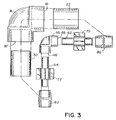
- the outer pipe components are shown to include a large outer elbow 16 having two openings on axes at an angle, e.g. 90°, to each other, the openings being essentially alike in the embodiment depicted.
- the elbow could be a reducer elbow in the concept presented, as will be readily understood from the description herein set forth.
- An opening 18 is adapted to slidably telescopically receive one end of a coupling 22 therein, the insertion of which is limited by abutment of the inner end of coupling 22 with an integral, axially facing, annular shoulder 20 spaced inwardly a predetermined distance from the outer edge of opening 18.
- the outer end of opening 18 has an annular gap 24 on its inner periphery, and which contains a ring 26 of flexible, adherent, inductively responsive material, preferably a layer of tape-like polymer containing metal particles therein.
- a ring 26 of flexible, adherent, inductively responsive material preferably a layer of tape-like polymer containing metal particles therein.
- the polymer-to-metal particle ratio is about 50/50 on a weight-to-weight basis.
- the polymer has a tacky outer surface so as to temporarily adhere to the peripheral wall surface of gap 24.
- the thickness of this tape or like strip material is chosen to cause the inner surface thereof, when applied, to align with the remainder of opening 18 inwardly of the tape, so as to have basically the same inner diameter and circumference as the adjacent inner surface 19. These inner diameter and circumference dimensions are substantially the same as the outer diameter and circumference dimensions of the corresponding end of coupling 22.
- the opposite opening 18' of elbow 16 likewise has a layer of flexible, polymeric material 26' having a tacky outer surface and containing metal particles.
- Layer 26' has a diameter and a circumference substantially the same as that of surface 19' axially inwardly of the layer 26'.
- Annular shoulder 20' limits the insertion of one end of coupling 30 which is telescopically interfittable with opening 18'.
- the received end of coupling 30 has an outer diameter and an outer circumference substantially the same as the inner diameter and circumference of layer 26'.
- Elbow 16 defines a passageway therethrough for receiving the inner pipe components 14.
- the layer of polymer 26 is preferably of the same polymer as elbow 16 and coupling 22.
- the induction responsive material usually metal particles, are preferably embedded therein, the most preferred metal particles being of stainless steel so as to not be susceptible to corrosion in the event some particles thereof are exposed on the surface of the polymer and being, for example, grit of 400 series.
- the preferred polymer is polypropylene.
- Other polymers can be employed within the concept presented, e.g., polyvinylchloride (PVC), chlorinated polyvinyl chloride (CPVC); polyethylene (PE); polyvinylidene fluoride (PVDF); melt processable fluorocarbons (ECTFE) and others.
- PVC polyvinylchloride
- CPVC chlorinated polyvinyl chloride
- PE polyethylene
- PVDF polyvinylidene fluoride
- ECTFE melt processable fluorocarbons
- the induction responsive layer is made to be electrically conductive as by having an electrically conductive material such as a metal screen embedded therein.
- it could be electrically conductive by having sufficient conductive fibers of carbon or metal as to overlap and engage each other.
- One type of electric conductive polymer tape using a PVC blend is known by the trademark INCOBLEND, by Allied Signal Co. If metal particles are the basis for making the polymeric layer induction responsive, high frequency induction should be used, as is known in the trade.
- Inner pipe elbow 46 Contained within the arcuate portion of the passageway of elbow 16 is an inner pipe elbow 46 which is significantly smaller in its outer dimensions than the inner diameter passage dimensions in elbow 16, forming an annular space therebetween.
- Inner elbow 46 is inserted into the passage of elbow 16 so that its openings 48 and 48' align axially and concentrically with openings 18 and 18'.
- Opening 48 also includes a peripheral wall 49 basically the same size as the peripheral wall of one end of a coupling 62 to be received thereby to a depth limited by an axially facing annular shoulder 50.
- annular gap 54 Within the outer end portion of surface 49 is an annular gap 54 containing an induction responsive layer of flexible polymeric material 56 of a thickness to cause the inner diameter of layer 56 to be substantially the same as that of the adjacent inner surface 49.
- the opposite end opening 48' has an annular gap 54' likewise filled with an induction responsive annular polymeric layer 56', e.g., containing metal particles.
- Layer 56' has an inner diameter substantially the same as
- polymer layer 56 is preferably of the same polymer as elbow 46, e.g., polypropylene, and preferably contains stainless steel metal particles as the inductively responsive material in the layer.
- An annular, axial shoulder 50' at the inner end of surface 49' limits the insertion of a polymeric coupling 64.
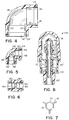
- Each of couplings 62 and 64 is shouwn to have a peripheral spider-type spacer 70 and 72, respectively, therearound, the spacer being of any of several conventional types available, e.g., that shown in US-A-5 018 260. These spacers fix the concentric location of the inner pipe components relative to the outer pipe components by having an inner split ring, e.g., 74 (Fig.
- nipples 80 and 82 which receive the ends of couplings 62 and 64 opposite the coupling ends fitted within elbow 46.
- couplings 62 and 64 could constitute the ends of elongated pipes.
- these nipples include an inner end annular pair of shoulders 84 and 86, shown for example on nipple 80 in Fig. 6, to limit the insertion of couplings 62, for example, and to limit the insertion of a pipe (not shown) in the opposite end.
- a layer of polymer 90 having metal particles therein forms an inner surface of the same diameter and periphery as coupling 62. A like layer 90' is applied on the opposite end.
- the sliding telescopically interfitting connections preferably are slightly press fit to assure solid contact between the polymer of the components and the inductively responsive polymer layers placed therein.
- Joining of the assembly components illustrated is basically as follows. Layers 26, 26', 56, 56', 90 and 90' are adhered in the appropriate annular gaps in the polymeric components.
- Small inner pipe elbow 46 is inserted generally at the curved portion of elbow 16, spaced from the walls of elbow 16.
- the inner coupling 62 and its spacer 70 are slidably inserted into outer coupling 22 and this subassembly inserted into opening 18 of elbow 16 until the inner end of coupling 62 slidably engages into small elbow 46 so that the axial end of coupling 62 abuts shoulder 50 of the inner pipe elbow, and layer 56 is in full engagement annularly with the outer periphery of coupling 62.
- coupling 62 may first be inserted into end 48 of elbow 46 and then coupling 22 slid over spacer 70 and within opening 18 to engage layer 26, so that the outer pipe coupling 22 engages shoulder 20 of the elbow.
- the same sequence is employed for coupling 64, spacer 72, coupling 30 and elbows 16 and 46.
- nipples 80 and 82 are then slid over the outer ends of couplings 62 and 64, respectively.
- the inductively reactive strips in each axial arrangement e.g., strip 26 in elbow 16, strip 56 in elbow 46, and strip 90 in nipple 80, are all axially offset from each other. The same is true of strips 26', 56' and a strip in nipple 82.
- an electrical induction coil C (shown schematically in Fig. 1) so that the coil is positioned around the outer pipe assembly in a location axially aligned with the inner pipe connection formed between coupling 62 and elbow 46, and specifically axially aligned with the polymeric layer 56.
- the induction coil is then activated to activate the metal particles in layer 56, causing the induction responsive polymer layer to heat, soften, fuse and bond to the adjacent polymer surfaces of elbow 46 and coupling 62.
- the time of coil actuation can vary depending on the size of the inner pipe components and spacing between the inner and outer pipe components, with a time between five and 30 seconds being typical.
- the particular amount of time and the amount of inductive force of the induction coil required for bonding can be determined for the dimension and softening temperature of the polymer utilized. It will also depend upon whether relatively low frequency or relatively high frequency current is employed.
- axial movement of the components relative to the induction coil is caused to occur to axially align the coil with inner layer 90.
- the coil is then activated to soften layer 90 and bond nipple 80 to inner pipe 62. Because the induction coil is typically large and heavy, normally the pipe components will be moved relative to the coil rather than vice versa, in a manner to axially align the inner polymeric layers with the coil offset from the outer layers.
- the pipe components are axially moved relative to the induction coil to align the coil with the outer pipe connections, specifically with polymeric layer 26 and then layer 26' offset from the inner pipe connections, the coil being activated to heat, soften and fuse the polymer to the adjacent surfaces of elbow 16 and couplings 22 and 30.
- the outer conduit components will be of a polymer, however. Further, because the outer conduit connections are easier to complete, they could in some instances be solvent adhesive bonded rather than induction bonded.
Landscapes
- Engineering & Computer Science (AREA)
- Mechanical Engineering (AREA)
- Rigid Pipes And Flexible Pipes (AREA)
- Quick-Acting Or Multi-Walled Pipe Joints (AREA)
- Lining Or Joining Of Plastics Or The Like (AREA)
Applications Claiming Priority (2)
| Application Number | Priority Date | Filing Date | Title |
|---|---|---|---|
| US74050 | 1993-06-08 | ||
| US08/074,050 US5503192A (en) | 1993-06-08 | 1993-06-08 | Inductive welding of thermoplastic pipe |
Publications (2)
| Publication Number | Publication Date |
|---|---|
| EP0629489A2 true EP0629489A2 (de) | 1994-12-21 |
| EP0629489A3 EP0629489A3 (de) | 1996-01-31 |
Family
ID=22117395
Family Applications (1)
| Application Number | Title | Priority Date | Filing Date |
|---|---|---|---|
| EP94304110A Ceased EP0629489A3 (de) | 1993-06-08 | 1994-06-08 | Induktives Schweissen von Kunststoffrohren. |
Country Status (3)
| Country | Link |
|---|---|
| US (3) | US5503192A (de) |
| EP (1) | EP0629489A3 (de) |
| CA (1) | CA2125222A1 (de) |
Families Citing this family (50)
| Publication number | Priority date | Publication date | Assignee | Title |
|---|---|---|---|---|
| WO1998012464A1 (en) * | 1996-09-20 | 1998-03-26 | Anthony Teague | Composite pipe structure |
| IT1291331B1 (it) * | 1997-05-09 | 1999-01-07 | Nupi S P A | Raccordo con adesione termoelettrica |
| US6234244B1 (en) * | 1999-03-01 | 2001-05-22 | The United States Of America As Represented By The United States Department Of Energy | Non-intrusive cooling system |
| US6325278B1 (en) * | 2000-01-12 | 2001-12-04 | Grant Prideco, L.P. | Concentric, insulated tubular conduits and method of assembly |
| US6398902B1 (en) * | 2000-02-14 | 2002-06-04 | Space Systems/Loral, Inc. | Method of end bonding tubular sections and bonding a flange on the end of tubular sections |
| USD627863S1 (en) * | 2000-06-13 | 2010-11-23 | Wcm Industries, Inc. | Bathtub overflow pipe |
| US8302220B2 (en) * | 2000-06-13 | 2012-11-06 | Wcm Industries, Inc. | Method and apparatus for assembling and sealing bathtub overflow and waste water ports |
| US8028357B2 (en) | 2000-06-13 | 2011-10-04 | Wcm Industries, Inc. | Method and associated apparatus for assembling and testing a plumbing system |
| US8166584B2 (en) | 2000-06-13 | 2012-05-01 | Wcm Industries, Inc. | Overflow assembly for bathtubs and the like |
| USD665062S1 (en) | 2000-06-13 | 2012-08-07 | Wcm Industries, Inc. | Bathtub overflow pipe |
| US8321970B2 (en) | 2000-06-13 | 2012-12-04 | Wcm Industries, Inc. | Method and associated apparatus for assembling and testing a plumbing system |
| US9074358B2 (en) | 2001-09-17 | 2015-07-07 | Wcm Industries, Inc. | Drain assembly for a bathtub and the like |
| US9157220B2 (en) | 2001-09-17 | 2015-10-13 | Wcm Industries, Inc. | Drain assembly for a bathtub and the like |
| US20030067162A1 (en) * | 2001-10-10 | 2003-04-10 | Welsh Thomas L. | Connector and method of manufacture |
| US20050179257A1 (en) * | 2001-10-10 | 2005-08-18 | Flex Technologies, Inc. | Connector and method of manufacture |
| US20050224123A1 (en) * | 2002-08-12 | 2005-10-13 | Baynham Richard R | Integral centraliser |
| US7178557B2 (en) * | 2003-03-26 | 2007-02-20 | Spears Manufacturing Co. | CPVC drain waste and vent fittings |
| US6875966B1 (en) | 2004-03-15 | 2005-04-05 | Nexicor Llc | Portable induction heating tool for soldering pipes |
| USD522849S1 (en) | 2005-02-08 | 2006-06-13 | Flex Technologies, Inc. | Retaining clip |
| US20070245650A1 (en) * | 2006-04-04 | 2007-10-25 | Milgard Manufactoring Incorporated | Framing corner joint and method of manufacture |
| US20090277579A1 (en) * | 2006-09-08 | 2009-11-12 | Crc For Advanced Composite Structures Limited | Joining of Concentric Section Polymer Composite Components |
| EP2212080A1 (de) * | 2007-10-25 | 2010-08-04 | Crc Advanced Composite Structures Limited | Lasttragpolymerverbundrahmen mit individuell anpassbarer grösse |
| EP2146125B1 (de) * | 2008-07-17 | 2011-11-02 | Nexans | Flexibles Leitungsrohr |
| US8424924B2 (en) * | 2008-09-19 | 2013-04-23 | Tas Acquisition Co., Llc | Electromagnetic bond welding of thermoplastic pipe distribution systems |
| FR2941512A1 (fr) * | 2009-01-26 | 2010-07-30 | Raymond A & Cie | Dispositif de raccordement de conduits plastiques. |
| US9395024B2 (en) | 2011-11-21 | 2016-07-19 | Victaulic Company | Coupling having gasket pocket of varying depth |
| USD676941S1 (en) * | 2012-01-11 | 2013-02-26 | Bill Kluss | Elbow pipe coupling |
| USD704811S1 (en) * | 2012-01-18 | 2014-05-13 | Bitspower International Co., Ltd. | Pipe connector |
| US8820795B2 (en) | 2012-02-02 | 2014-09-02 | Victaulic Company | Fitting for joining pipe elements |
| US9182058B2 (en) | 2012-02-08 | 2015-11-10 | Victaulic Company | Fitting having receptacle of varying depth |
| USD712015S1 (en) * | 2012-02-10 | 2014-08-26 | Bitspower International Co., Ltd. | Pipe connector |
| US9435469B2 (en) | 2012-09-11 | 2016-09-06 | Victaulic Company | Coupling with notched projections having gasket pocket of varying depth |
| WO2014052172A1 (en) * | 2012-09-28 | 2014-04-03 | Dow Global Technologies Llc | A composition, connector, process for improving bonding between two or more means for conveying fluids and system for conveying fluids |
| US10578234B2 (en) | 2013-05-02 | 2020-03-03 | Victaulic Company | Coupling having arcuate stiffness ribs |
| WO2015009593A1 (en) | 2013-07-17 | 2015-01-22 | Victaulic Company | Fittings having arcuate stiffness ribs |
| DE102014108499A1 (de) * | 2014-06-17 | 2015-12-17 | Norma Germany Gmbh | Beheizbare Fluidleitung |
| USD767105S1 (en) | 2015-05-04 | 2016-09-20 | Victaulic Company | Pipe fitting |
| USD764029S1 (en) | 2015-05-04 | 2016-08-16 | Victaulic Company | Pipe fitting segment |
| USD767103S1 (en) | 2015-05-12 | 2016-09-20 | Victaulic Company | Pipe coupling segment |
| MA42579B1 (fr) | 2015-12-28 | 2021-02-26 | Victaulic Co Of America | Raccord adaptateur |
| US10605394B2 (en) | 2016-05-16 | 2020-03-31 | Victaulic Company | Fitting having tabbed retainer and observation apertures |
| US10859190B2 (en) | 2016-05-16 | 2020-12-08 | Victaulic Company | Sprung coupling |
| US10533688B2 (en) | 2016-05-16 | 2020-01-14 | Victaulic Company | Coupling having tabbed retainer |
| US10563385B1 (en) | 2016-05-17 | 2020-02-18 | Wcm Industries, Inc. | Overflow cover interconnection system |
| US10443220B2 (en) | 2016-08-12 | 2019-10-15 | Wcm Industries, Inc. | Device for providing improved drainage |
| US10428966B2 (en) * | 2017-02-08 | 2019-10-01 | Mueller International, Llc | Hydrant stem coupling with ribs |
| US11781683B2 (en) | 2019-11-15 | 2023-10-10 | Victaulic Company | Shrouded coupling |
| USD1003406S1 (en) | 2020-03-13 | 2023-10-31 | Wcm Industries, Inc. | Cover for a bathtub overflow system |
| US11814832B2 (en) | 2020-03-13 | 2023-11-14 | Wcm Industries, Inc. | Overflow covers and overflow systems for bathtubs |
| USD948001S1 (en) * | 2021-10-31 | 2022-04-05 | Michael Lee Frazier | Offset grid strainer hub |
Citations (2)
| Publication number | Priority date | Publication date | Assignee | Title |
|---|---|---|---|---|
| FR2400659A1 (fr) | 1977-08-17 | 1979-03-16 | Johns Manville | Extremite evasee de tuyau en matiere plastique pour joint a emboitement et son procede de mise en forme |
| US5018260A (en) | 1989-05-26 | 1991-05-28 | Asahi/America, Inc. | Supports for double-containment thermoplastic pipe assemblies |
Family Cites Families (32)
| Publication number | Priority date | Publication date | Assignee | Title |
|---|---|---|---|---|
| DD43897A (de) * | ||||
| US3238346A (en) * | 1963-08-05 | 1966-03-01 | George P Savko | Apparatus for making joint between thermo plastic pipe and fittings thereof |
| FR1493562A (fr) * | 1966-06-08 | 1967-09-01 | Tecalemit | Procédé d'assemblage de pièces en matière plastique thermosensible et raccord pour l'application de ce procédé |
| US3574357A (en) * | 1969-02-27 | 1971-04-13 | Grupul Ind Pentru Foray Si Ext | Thermal insulating tubing |
| US3677303A (en) * | 1969-04-14 | 1972-07-18 | Anvil Ind Inc | Prefabricated conduit |
| US3685546A (en) * | 1969-06-09 | 1972-08-22 | Wavin Bv | Thermally insulated pipe |
| US3899007A (en) * | 1973-01-30 | 1975-08-12 | Randall J Miller | Insulated pipe anchor assembly |
| JPS51136756A (en) * | 1975-05-23 | 1976-11-26 | Kiyookura Kk | Method of producing partitioned container |
| EP0045764B1 (de) * | 1980-02-25 | 1984-05-09 | Brickhouse Dudley Plc | Verfahren zur verbindung von rohren |
| NL8005161A (nl) * | 1980-09-15 | 1982-04-01 | Wavin Bv | Gelijmde buisverbinding. |
| US4487660A (en) * | 1980-10-31 | 1984-12-11 | Electric Power Research Institute | Multiple wall structure for flexible cable using tubular and spiral corrugations |
| US4531552A (en) * | 1983-05-05 | 1985-07-30 | Baker Oil Tools, Inc. | Concentric insulating conduit |
| JPS59231558A (ja) * | 1983-06-14 | 1984-12-26 | Fuji Xerox Co Ltd | 電子複写機の現像装置 |
| US4573527A (en) * | 1983-07-29 | 1986-03-04 | Mcdonough M J | Heat exchanger closure connection |
| SE441074B (sv) * | 1984-01-24 | 1985-09-09 | Akerlund & Rausing Ab | Anordning for induktionssvetsning |
| JPS60159036A (ja) * | 1984-01-31 | 1985-08-20 | Suzuki Motor Co Ltd | 中空樹脂体の補強装置 |
| JPS61109996A (ja) * | 1984-11-01 | 1986-05-28 | 三菱電線工業株式会社 | 水架橋型ポリオレフインパイプの接合方法 |
| JPS61109966A (ja) * | 1984-11-05 | 1986-05-28 | Hitachi Ltd | 多溝vプ−リ |
| JPS6253336A (ja) * | 1985-09-02 | 1987-03-09 | Toyobo Co Ltd | 横型反応装置 |
| JPS63272535A (ja) * | 1987-05-01 | 1988-11-10 | Nippon Denso Co Ltd | 電磁誘導接着用加熱装置 |
| US4786088A (en) * | 1987-06-25 | 1988-11-22 | Asahi/America, Inc. | Double-containment thermoplastic pipe assembly |
| CN1030205A (zh) * | 1987-07-02 | 1989-01-11 | 周军琪 | 工程塑料的高频感应焊 |
| JPH0199071A (ja) * | 1987-10-12 | 1989-04-17 | Canon Inc | 画像形成装置 |
| US4886305A (en) * | 1988-08-12 | 1989-12-12 | Fibercast Company | Double containment pipe fittings and apparatus to adhesively install the same |
| DE3836326A1 (de) * | 1988-10-25 | 1990-04-26 | Tscherwitschke Gmbh Richard | Verbindungsstueck zum verbinden wenigstens zweier in verschiedene richtungen verlaufender, insbesondere aus thermoplastischem kunststoff bestehender rohrleitungen sowie ein verfahren zur herstellung des verbindungsstuecks |
| CH679240A5 (de) * | 1989-07-07 | 1992-01-15 | Fischer Ag Georg | |
| US5184850A (en) * | 1989-07-07 | 1993-02-09 | Georg Fischer Ag | Method of connecting pipes of plastics material of a double pipe system and a pipe connection made by the method |
| US5186502B1 (en) * | 1990-12-11 | 1994-08-30 | Fibercast Co | Double-containment pipe fittings and system |
| US5085471A (en) * | 1991-04-04 | 1992-02-04 | Double Containment Systems | Double containment pipe joint assembly |
| US5402831A (en) * | 1991-08-01 | 1995-04-04 | Asahi/America, Inc. | Restraint coupling assembly for double containment pipe system |
| US5449204A (en) * | 1993-10-22 | 1995-09-12 | Greene; Karen C. | Double containment fitting |
| US5419593A (en) * | 1993-10-22 | 1995-05-30 | Conley Corporation | Interlocking union for double containment pipe |
-
1993
- 1993-06-08 US US08/074,050 patent/US5503192A/en not_active Expired - Lifetime
-
1994
- 1994-06-06 CA CA002125222A patent/CA2125222A1/en not_active Abandoned
- 1994-06-08 EP EP94304110A patent/EP0629489A3/de not_active Ceased
-
1995
- 1995-05-31 US US08/455,387 patent/US5786054A/en not_active Expired - Lifetime
- 1995-05-31 US US08/455,913 patent/US5524674A/en not_active Expired - Lifetime
Patent Citations (2)
| Publication number | Priority date | Publication date | Assignee | Title |
|---|---|---|---|---|
| FR2400659A1 (fr) | 1977-08-17 | 1979-03-16 | Johns Manville | Extremite evasee de tuyau en matiere plastique pour joint a emboitement et son procede de mise en forme |
| US5018260A (en) | 1989-05-26 | 1991-05-28 | Asahi/America, Inc. | Supports for double-containment thermoplastic pipe assemblies |
Also Published As
| Publication number | Publication date |
|---|---|
| EP0629489A3 (de) | 1996-01-31 |
| US5524674A (en) | 1996-06-11 |
| CA2125222A1 (en) | 1994-12-09 |
| US5786054A (en) | 1998-07-28 |
| US5503192A (en) | 1996-04-02 |
Similar Documents
| Publication | Publication Date | Title |
|---|---|---|
| US5503192A (en) | Inductive welding of thermoplastic pipe | |
| US4023831A (en) | Plastic pipe fitting | |
| EP0276917B1 (de) | Tasche zum Bewahren von Flüssigkeiten | |
| CN1119546C (zh) | 电熔连接件 | |
| US6293311B1 (en) | Multilayer composite pipe fluid conduit system using multilayer composite pipe and method of making the composite | |
| JP3774222B2 (ja) | スピン溶着された流体継手 | |
| US20040021318A1 (en) | Tubing attachment | |
| US20070007763A1 (en) | Adaptor fitting | |
| US11692658B2 (en) | Couplings | |
| US5348211A (en) | Joining of metallic pipe lined with thermoplastic polymer | |
| GB2160281A (en) | Pipe connection/repair device | |
| US5690148A (en) | Closure fitting and flexibility support assembly for double-containment piping systems | |
| MXPA02009337A (es) | Montaje de junta de tubo y metodo de uso del mismo. | |
| EP1511960B1 (de) | Rohrverbindungsformteil für vorisolierte rohrleitungen | |
| EP1299671A2 (de) | Rotationsgeschweisster fluidverbinder mit einem kunststoffummantelten metallrohr | |
| US5494318A (en) | Secondary containment system | |
| EP1388703A1 (de) | Fitting für ein Verbundrohr | |
| EP0100580B1 (de) | Rohrverbindung für kunststoffbeschichtete Rohre und Verfahren zur Verbindung | |
| EP0725909B1 (de) | Flanschlose rohrkupplung, sowie verfahren zu ihrer herstellung | |
| EP0269419A1 (de) | Herstellung von Beuteln | |
| EP1379375A2 (de) | Verfahren zur verbindung von vorgefertigten, wärmeisolierten rohren | |
| WO2001092775A1 (en) | Pipe joint | |
| US4245858A (en) | Conduit structure | |
| US4326327A (en) | Method of assembling a conduit joint | |
| KR20210138417A (ko) | 파이프 피팅장치 및 파이프 피팅방법 |
Legal Events
| Date | Code | Title | Description |
|---|---|---|---|
| PUAI | Public reference made under article 153(3) epc to a published international application that has entered the european phase |
Free format text: ORIGINAL CODE: 0009012 |
|
| AK | Designated contracting states |
Kind code of ref document: A2 Designated state(s): AT CH DE FR GB LI |
|
| PUAL | Search report despatched |
Free format text: ORIGINAL CODE: 0009013 |
|
| AK | Designated contracting states |
Kind code of ref document: A3 Designated state(s): AT CH DE FR GB LI |
|
| 17P | Request for examination filed |
Effective date: 19960621 |
|
| 17Q | First examination report despatched |
Effective date: 19980323 |
|
| GRAG | Despatch of communication of intention to grant |
Free format text: ORIGINAL CODE: EPIDOS AGRA |
|
| STAA | Information on the status of an ep patent application or granted ep patent |
Free format text: STATUS: THE APPLICATION HAS BEEN REFUSED |
|
| 18R | Application refused |
Effective date: 19990228 |