EP0626459A1 - Corrosion resistant copper alloy tube and fin-tube heat exchanger - Google Patents
Corrosion resistant copper alloy tube and fin-tube heat exchanger Download PDFInfo
- Publication number
- EP0626459A1 EP0626459A1 EP94303866A EP94303866A EP0626459A1 EP 0626459 A1 EP0626459 A1 EP 0626459A1 EP 94303866 A EP94303866 A EP 94303866A EP 94303866 A EP94303866 A EP 94303866A EP 0626459 A1 EP0626459 A1 EP 0626459A1
- Authority
- EP
- European Patent Office
- Prior art keywords
- tube
- copper alloy
- corrosion resistant
- oxide
- less
- Prior art date
- Legal status (The legal status is an assumption and is not a legal conclusion. Google has not performed a legal analysis and makes no representation as to the accuracy of the status listed.)
- Granted
Links
- 230000007797 corrosion Effects 0.000 title claims abstract description 183
- 238000005260 corrosion Methods 0.000 title claims abstract description 183
- 229910000881 Cu alloy Inorganic materials 0.000 title claims abstract description 84
- 239000010949 copper Substances 0.000 claims abstract description 102
- 229910052802 copper Inorganic materials 0.000 claims abstract description 58
- RYGMFSIKBFXOCR-UHFFFAOYSA-N Copper Chemical compound [Cu] RYGMFSIKBFXOCR-UHFFFAOYSA-N 0.000 claims abstract description 56
- QVGXLLKOCUKJST-UHFFFAOYSA-N atomic oxygen Chemical compound [O] QVGXLLKOCUKJST-UHFFFAOYSA-N 0.000 claims abstract description 21
- 239000001301 oxygen Substances 0.000 claims abstract description 21
- 229910052760 oxygen Inorganic materials 0.000 claims abstract description 21
- 229910052698 phosphorus Inorganic materials 0.000 claims abstract description 19
- 229910052796 boron Inorganic materials 0.000 claims abstract description 15
- 229910052782 aluminium Inorganic materials 0.000 claims abstract description 10
- 229910052749 magnesium Inorganic materials 0.000 claims abstract description 6
- 229910052725 zinc Inorganic materials 0.000 claims abstract description 6
- 229910052787 antimony Inorganic materials 0.000 claims abstract description 5
- 229910052804 chromium Inorganic materials 0.000 claims abstract description 5
- 229910052742 iron Inorganic materials 0.000 claims abstract description 5
- 229910052785 arsenic Inorganic materials 0.000 claims abstract description 4
- 229910052738 indium Inorganic materials 0.000 claims abstract description 4
- 229910052759 nickel Inorganic materials 0.000 claims abstract description 4
- 229910052710 silicon Inorganic materials 0.000 claims abstract description 4
- 229910052709 silver Inorganic materials 0.000 claims abstract description 4
- 229910052719 titanium Inorganic materials 0.000 claims abstract description 4
- 229910052726 zirconium Inorganic materials 0.000 claims abstract description 4
- 239000000654 additive Substances 0.000 claims description 57
- 230000000996 additive effect Effects 0.000 claims description 56
- BHEPBYXIRTUNPN-UHFFFAOYSA-N hydridophosphorus(.) (triplet) Chemical compound [PH] BHEPBYXIRTUNPN-UHFFFAOYSA-N 0.000 claims description 36
- BDAGIHXWWSANSR-UHFFFAOYSA-N methanoic acid Natural products OC=O BDAGIHXWWSANSR-UHFFFAOYSA-N 0.000 claims description 30
- 239000010953 base metal Substances 0.000 claims description 25
- 239000012535 impurity Substances 0.000 claims description 20
- 230000015572 biosynthetic process Effects 0.000 claims description 16
- OSWFIVFLDKOXQC-UHFFFAOYSA-N 4-(3-methoxyphenyl)aniline Chemical compound COC1=CC=CC(C=2C=CC(N)=CC=2)=C1 OSWFIVFLDKOXQC-UHFFFAOYSA-N 0.000 claims description 15
- 235000019253 formic acid Nutrition 0.000 claims description 15
- 238000010438 heat treatment Methods 0.000 claims description 7
- 229910000838 Al alloy Inorganic materials 0.000 claims description 6
- XAGFODPZIPBFFR-UHFFFAOYSA-N aluminium Chemical compound [Al] XAGFODPZIPBFFR-UHFFFAOYSA-N 0.000 claims description 6
- 230000001590 oxidative effect Effects 0.000 claims description 6
- 239000007787 solid Substances 0.000 claims description 5
- 238000001941 electron spectroscopy Methods 0.000 claims description 3
- 238000005219 brazing Methods 0.000 abstract description 70
- 239000003507 refrigerant Substances 0.000 abstract description 14
- 230000000052 comparative effect Effects 0.000 description 42
- 230000000694 effects Effects 0.000 description 32
- 238000005452 bending Methods 0.000 description 25
- 238000012360 testing method Methods 0.000 description 24
- 230000007423 decrease Effects 0.000 description 23
- 238000000034 method Methods 0.000 description 18
- QTBSBXVTEAMEQO-UHFFFAOYSA-N Acetic acid Chemical compound CC(O)=O QTBSBXVTEAMEQO-UHFFFAOYSA-N 0.000 description 15
- 229910052751 metal Inorganic materials 0.000 description 15
- 239000002184 metal Substances 0.000 description 15
- 239000000945 filler Substances 0.000 description 13
- 239000003921 oil Substances 0.000 description 12
- 238000012546 transfer Methods 0.000 description 12
- XLYOFNOQVPJJNP-UHFFFAOYSA-N water Substances O XLYOFNOQVPJJNP-UHFFFAOYSA-N 0.000 description 12
- UFHFLCQGNIYNRP-UHFFFAOYSA-N Hydrogen Chemical compound [H][H] UFHFLCQGNIYNRP-UHFFFAOYSA-N 0.000 description 10
- 239000000956 alloy Substances 0.000 description 10
- 239000001257 hydrogen Substances 0.000 description 10
- 229910052739 hydrogen Inorganic materials 0.000 description 10
- 239000000314 lubricant Substances 0.000 description 10
- 229910045601 alloy Inorganic materials 0.000 description 9
- 230000007613 environmental effect Effects 0.000 description 9
- 230000008020 evaporation Effects 0.000 description 9
- 238000001704 evaporation Methods 0.000 description 9
- 238000004519 manufacturing process Methods 0.000 description 9
- 239000000203 mixture Substances 0.000 description 9
- 150000004653 carbonic acids Chemical class 0.000 description 8
- 239000003960 organic solvent Substances 0.000 description 8
- 239000000243 solution Substances 0.000 description 8
- 230000003245 working effect Effects 0.000 description 8
- 229910052748 manganese Inorganic materials 0.000 description 7
- 239000011368 organic material Substances 0.000 description 7
- 239000000463 material Substances 0.000 description 6
- 239000003795 chemical substances by application Substances 0.000 description 5
- 206010040954 Skin wrinkling Diseases 0.000 description 4
- 238000004458 analytical method Methods 0.000 description 4
- 239000012298 atmosphere Substances 0.000 description 4
- 238000003780 insertion Methods 0.000 description 4
- 230000037431 insertion Effects 0.000 description 4
- 238000011160 research Methods 0.000 description 4
- VOPWNXZWBYDODV-UHFFFAOYSA-N Chlorodifluoromethane Chemical compound FC(F)Cl VOPWNXZWBYDODV-UHFFFAOYSA-N 0.000 description 3
- 230000003247 decreasing effect Effects 0.000 description 3
- 230000007547 defect Effects 0.000 description 3
- 238000005259 measurement Methods 0.000 description 3
- 238000000859 sublimation Methods 0.000 description 3
- 230000008022 sublimation Effects 0.000 description 3
- IJGRMHOSHXDMSA-UHFFFAOYSA-N Atomic nitrogen Chemical compound N#N IJGRMHOSHXDMSA-UHFFFAOYSA-N 0.000 description 2
- 238000000137 annealing Methods 0.000 description 2
- 239000007864 aqueous solution Substances 0.000 description 2
- 239000002199 base oil Substances 0.000 description 2
- 238000007664 blowing Methods 0.000 description 2
- 238000005266 casting Methods 0.000 description 2
- 238000010273 cold forging Methods 0.000 description 2
- 238000009833 condensation Methods 0.000 description 2
- 230000005494 condensation Effects 0.000 description 2
- 238000010276 construction Methods 0.000 description 2
- 239000008367 deionised water Substances 0.000 description 2
- 229910021641 deionized water Inorganic materials 0.000 description 2
- 238000011161 development Methods 0.000 description 2
- 238000009792 diffusion process Methods 0.000 description 2
- 238000011156 evaluation Methods 0.000 description 2
- 230000005484 gravity Effects 0.000 description 2
- 238000001192 hot extrusion Methods 0.000 description 2
- 239000000047 product Substances 0.000 description 2
- 230000036647 reaction Effects 0.000 description 2
- 238000000682 scanning probe acoustic microscopy Methods 0.000 description 2
- 229910018274 Cu2 O Inorganic materials 0.000 description 1
- 241001274961 Rubus repens Species 0.000 description 1
- 239000007795 chemical reaction product Substances 0.000 description 1
- 239000002826 coolant Substances 0.000 description 1
- 238000001816 cooling Methods 0.000 description 1
- 150000001879 copper Chemical class 0.000 description 1
- 230000003628 erosive effect Effects 0.000 description 1
- 238000005530 etching Methods 0.000 description 1
- 239000007789 gas Substances 0.000 description 1
- 239000000155 melt Substances 0.000 description 1
- 238000010309 melting process Methods 0.000 description 1
- 229910052757 nitrogen Inorganic materials 0.000 description 1
- 239000012299 nitrogen atmosphere Substances 0.000 description 1
- 238000013021 overheating Methods 0.000 description 1
- 239000010734 process oil Substances 0.000 description 1
- 239000002994 raw material Substances 0.000 description 1
- 238000007670 refining Methods 0.000 description 1
- 239000002904 solvent Substances 0.000 description 1
- 241000894007 species Species 0.000 description 1
- 238000003860 storage Methods 0.000 description 1
Images

Classifications
-
- F—MECHANICAL ENGINEERING; LIGHTING; HEATING; WEAPONS; BLASTING
- F28—HEAT EXCHANGE IN GENERAL
- F28F—DETAILS OF HEAT-EXCHANGE AND HEAT-TRANSFER APPARATUS, OF GENERAL APPLICATION
- F28F21/00—Constructions of heat-exchange apparatus characterised by the selection of particular materials
- F28F21/08—Constructions of heat-exchange apparatus characterised by the selection of particular materials of metal
- F28F21/081—Heat exchange elements made from metals or metal alloys
- F28F21/085—Heat exchange elements made from metals or metal alloys from copper or copper alloys
-
- C—CHEMISTRY; METALLURGY
- C22—METALLURGY; FERROUS OR NON-FERROUS ALLOYS; TREATMENT OF ALLOYS OR NON-FERROUS METALS
- C22C—ALLOYS
- C22C9/00—Alloys based on copper
- C22C9/05—Alloys based on copper with manganese as the next major constituent
-
- F—MECHANICAL ENGINEERING; LIGHTING; HEATING; WEAPONS; BLASTING
- F28—HEAT EXCHANGE IN GENERAL
- F28F—DETAILS OF HEAT-EXCHANGE AND HEAT-TRANSFER APPARATUS, OF GENERAL APPLICATION
- F28F19/00—Preventing the formation of deposits or corrosion, e.g. by using filters or scrapers
- F28F19/02—Preventing the formation of deposits or corrosion, e.g. by using filters or scrapers by using coatings, e.g. vitreous or enamel coatings
- F28F19/06—Preventing the formation of deposits or corrosion, e.g. by using filters or scrapers by using coatings, e.g. vitreous or enamel coatings of metal
Definitions
- the present invention relates to an corrosion resistant copper alloy tube which is used as a refrigerant copper alloy tube or a heat exchanger copper alloy tube and a fin-tube heat exchanger which is used for an air-conditioner, particularly relates to an corrosion resistant copper tube and a fin-tube heat exchanger having improved corrosion resistant property against an ant-nest type corrosion.
- a tube which was made of copper deoxidized by phosphorous has been widely used for the conventional refrigerant tube or the conventional heat exchanger tube generally due to its better bending and brazing properties.
- organic materials such as lubricant oil or process oil and organic solvents unavoidably remaining on the surface of the fins and tubes after the tubing and fabrication processes may decompose during the repeated deposit and evaporation of water due to a coolant and during the exposure to peculiar temperature/moisture and air-exchange environment created as a nature of its construction to form carbonic acids which cause peculiar corrosion showing local ant-nest type corrosion on the surface of the tube.
- the fin-tube heat exchanger used for an air-conditioner is generally fabricated using aluminum or aluminum alloy plate fins provided with tube insertion holes and copper tubes. Inside the insertion hole, a tube-type fin collar is provided. Many of said fins are placed in parallel and the copper tube is inserted into said fin collar so as to connect each fin. Then, this tube extended and fixed on the fins. And the heating medium is allowed to flow through the inside of said tube and its heat is transmitted to and radiated from said fins.
- said plate fins are made from aluminum or aluminum alloy due to its thermal conductivity and cost, and, for said tube, the copper tube is widely used from the stand points of its thermal conductivity and corrosion resistant properties. For this copper tube, a pure copper called as phosphorous refined copper is mainly used.
- organic materials such as lubricant oil and organic solvents used in the processes of blanking and extending of the tube unavoidably remain on the surface of the tubes, and these organic materials are affected by repeated deposit and evaporation of water during storage of fins and tubes or usage as the heat exchanger. These organic materials are also exposed to the peculiar temperature/humidity and air-exchange environment during usage of the heat exchanger. Under such conditions, these organic materials decomposed to form carbonic acids which cause the peculiar local corrosion showing the ant-nest type corrosion, resulting in leakage of the tube frequently.
- the object of the present invention is to provide an corrosion resistant copper alloy tube having better corrosion resistant property against the ant-nest type corrosion even though exposed to the phenomenon specific to the refrigerant tube or the heat exchanger tube; that is, repeated deposit and evaporation of water, and used under the peculiar environmental conditions of temperature/humidity and air-exchange, and having better brazing property so that capable of increasing its integrity and life span as the refrigerant tube or the heat exchanger tube.
- the another object of the present invention is to provide a fin-tube heat exchanger having better corrosion resistant property against the ant-nest type corrosion even though affected by the phenomenon specific to the fin-tube heat exchanger; that is, repeated deposit/evaporation of water, and used under the peculiar environmental conditions of temperature/humidity and air-exchange so that carbonic acids are formed, and capable of increasing its integrity and life span.
- a corrosion resistant copper alloy tube according to the present invention consists essentially of 0.05 to 1.5 wt.% of Mn, 100 ppm or less of oxygen, and Cu and inevitable impurities.
- the corrosion resistant copper alloy tube according to the present invention shows better corrosion resistant property against the ant-nest type corrosion which specifically may occur in the conventional refrigerant tube or the heat exchanger tube made of phosphorous deoxidized copper; that is, the ant-nest type corrosion which may occur under the conditions of affecting repeated deposit and evaporation of water and peculiar environmental conditions of temperature/humidity and air-exchange, and shows better brazing property. Therefore, it is capable of increasing its integrity, applicability and life span as the refrigerant tube or the heat exchanger tube. Thus, the present invention is very useful.
- a corrosion resistant copper alloy tube for a heat exchanger comprises a main tube body including a copper alloy tube and an oxide film formed on the surface of said main tube body in the thickness of from 30 to 3000 ⁇ by oxidizing the surface of the main tube body.
- Said copper alloy consist essentially of at least one additive element at 1.7 to 3.0 wt.% in total, the volume ratio of oxide thereof to Cu base metal (ratio of molecular volume of oxide to atomic volume of Cu base metal) being within 1.7 to 3.0, and Cu and inevitable impurities.
- the additive element or elements remaining in said copper alloy is solid solubilized into Cu base metal.
- the differential natural electric potential between said oxide film and phosphorous deoxidized copper in 0.1 v.% of formic acid solution is within the range of from 0.2 V to -0.2 V.
- the corrosion resistant property was obtained by the oxide film on the surface thereof.
- the oxide film on the surface of copper alloy tube is vigorously eroded so that the corrosion protection by the oxide film is destroyed.
- the present inventors found that such oxide film can be obtained by adding certain additive elements to copper alloy and then oxidizing the surface of these copper alloy materials.
- the heat exchanger copper alloy tube according to the present invention has higher corrosion resistant property against the ant-nest type corrosion than the conventional phosphorous deoxidized copper tube being used for the heat exchanger and therefore very useful as a copper alloy tube for the heat exchanger used under the environment containing carbonic acids easily causing the ant-nest type corrosion.
- a fin-tube heat exchanger comprises: a main tube body including said copper alloy tube according to claim 1, 2 or 6, and a plurality of plate type fins of aluminum or aluminum alloy placed in parallel each other on the outer surface of the main tube body.
- said copper alloy main tube body is preferably to be an internally grooved tube having a plurality of grooves provided in parallel each other on the inner surface thereof, the outer diameter of said copper alloy main tube is 4 to 25.4 mm, the ratio h/Di of the depth h of the groove to the inner diameter Di of the tube defined by the crest part between the grooves is 0.01 ⁇ h/Di ⁇ 0.05, and the helix angle ⁇ is 0° ⁇ ⁇ ⁇ 30°.
- the fin-tube heat exchanger according to the present invention is superior in the corrosion resistant property against the ant-nest type corrosion which easily occurred when affected by repeated deposit and evaporation of water and exposed to the peculiar environmental conditions of temperature/humidity and air-exchange, therefore it is very useful as the heat exchanger used under such environmental conditions.
- the fin-tube heat exchanger according to the present invention is different from the conventional phosphorous refined copper tube; since the copper tube containing elements inferior in the electric potential to Cu is used, the potential difference between the tubes and the fins (made of aluminum or aluminum alloy) can be reduced. Therefore, since the electric corrosion of the fins can be reduced, decrease of the thermal conductivity can be minimized during its use and the initial thermal conductivity can be maintained for a longer period.
- a corrosion resistant copper alloy tube comprises; a main tube body containing at least one additive element having the standard enthalpy of -169 kJ for formation of an oxide at the amount within the range shown by the equation 1 below, and an oxide film formed on the surface of said main tube body in the thickness from 40 to 2000 ⁇ by the heat treatment of the main tube body.
- the ratio Ix/Icu of the main peak intensity Ix of said additive element to the main peak intensity of Cu obtained by X-ray Electron Spectroscopy on the surface of said oxide film is 0.10 or greater. 0.04 ⁇ ⁇ [Ax ⁇ ln( ⁇ H0f(x)/(-169))] ⁇ 4.2 where, Ax is the content (atom %) of additive element x.
- ln is natural logarithm.
- ⁇ H0f(x) is the standard enthalpy (kJ/mol) for formation of oxide of additive element x.
- ⁇ is the sum of Ax ⁇ ln( ⁇ H0f(x)/(-169)) for each additive element.
- the corrosion resistant copper alloy tube according to the present invention because the oxide film containing the pre-determined amount of certain additive elements is formed on the surface of main tube body, shows a superior corrosion resistant property against the ant-nest type corrosion which specifically occurs in the ordinary refrigerant tube or the heat exchanger tube consisting of phosphorous deoxidized copper tube; that is, the ant-nest type corrosion which may occur when affected by repeated deposit and evaporation of water and exposed to the peculiar environmental conditions of temperature/humidity and air-exchange, and capable of increasing its integrity and life span as the refrigerant tube or the heat exchanger tube, therefore the present invention is very useful.
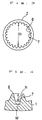
- Fig. 1 is a plain view showing the fin-tube heat exchanger according to an embodiment of the present invention.
- Fig. 2 is a sectional view in the direction of the tube axis of the same.
- Fig. 3 is a sectional view of the tube thereof.
- Fig. 4 is a enlarged sectional view of a part of the tube thereof.
- the corrosion resistant property is extremely improved compared to the conventional phosphorous deoxidized copper.
- the brazing property is significantly improved compared to the conventional phosphorous deoxidized copper.
- the corrosion resistant property against the ant-nest type corrosion is improved by adding Mn.
- Mn content is less than 0.05 wt.%, sufficient improvement effect of corrosion resistant property against the ant-nest type corrosion can not be achieved.
- the Mn content of 0.1 wt.% or more is preferable and by these contents further improvement can be observed. Meantime, if the Mn content exceeds 1.5 wt.%, resulting tube is not practically suitable because its resistance strength becomes higher so that bending property as tube decreases. Therefore, the Mn content should be within the range from 0.05 wt.% to 1.5 wt.%.
- oxygen content is restricted to 100 ppm or less.
- All of P, B, Li, Pb and Sb are allowed to add as the deoxidation agent or as elements to improve the strength, but if total amount of these elements exceed 0.20 wt.%, the corrosion resistant improvement effect of Mn against the ant-nest type corrosion may decrease and the hot working property of the tube may decrease. Therefore, the amount to be added of each element belonging to the first group should be restricted to 0.20 wt.% or less in total.
- Second group elements (Cr, Ti, Zr, Al, Si)
- the amount to be added of each element belonging to the fourth group should be restricted to 5.0 wt. % or less.
- P is usually added as a deoxidation agent during copper refining process or as the element to improve the strength of the copper alloy tube, but if P is added together with Mn, the brazing property of the copper alloy is improved further compared to the conventional phosphorous deoxidized copper.
- the P content is less than 0.002 wt.%, sufficient improvement of the brazing property can not be achieved.
- the P content is 0.005 wt.% or more so that further improvement of the brazing can be observed.
- the P content exceeds 0.15 wt.%, the corrosion resistant property against the ant-nest type corrosion may decrease. Therefore, the P content should be restricted to the range from 0.002 wt.% to 0.15 wt.%.
- the Mn/P ratio is less than 2, the amount of P added is higher than the amount of Mn added and sufficient improvement effect against the ant-nest type corrosion can not be obtained.
- the Mn/P ratio should be restricted to the range from 2 to 100.
- B is generally used as a deoxidation agent or as an additive to improve the strength, but the brazing property may be improved by adding together with Mn.
- the effect of B in improvement of the brazing property is similar to the effect of P, B concentrated on the surface reacts with Mn to form borites so that sublimation of B may be inhibited and sufficient reduction effect of B may be obtained under high temperature during the brazing process.
- the B content is preferably 0.005 wt.%. If the B content exceeds 0.15 wt.%, the corrosion resistant property against the ant-nest type corrosion may decrease. Therefore, the B content should be restricted to the range from 0.002 wt.% to 0.1 wt.%. Meantime, the Mn/B ratio is less than 2, the amount of B added is too high compared to the amount of Mn added to obtain sufficient effect of the corrosion resistant property against the ant-nest type corrosion. If the Mn/B ratio exceeds 100, the amount of B added is too low compared to the amount of Mn added to obtain sufficient improvement effect of the brazing. Therefore, the Mn/B ratio is restricted to the range from 2 to 100.
- the ratio of Mn and P plus B; that is, Mn/(P + B) is preferably restricted to the range from 2 to 100.
- Sn is an inevitable impurity.
- inclusion of Sn is unavoidable. If Sn exists in the copper alloy at the level of 0.01 wt.% or more, improvement in the corrosion resistant property of copper alloy tube by addition of Mn is deteriorated. Therefore, the inevitable impurity Sn is restricted to less than 0.01 wt.%.
- the copper alloy tube for the refrigerant tube or the heat exchanger having better corrosion resistant property against the ant-nest type corrosion than the conventional phosphorous deoxidized copper and further more practical and having better brazing, hot working and bending properties as tube can be obtained by adding Mn at the amount of said range and at the same time by controlling the oxygen content within said range and by restricting the content of each element shown in the first, second, third and fourth groups as well as the composition ratio of Mn and P and/or B within said range.
- the tube materials (0 materials; 9.5 mm in outer diameter; 0.3 mm thick) listed in Tables 1 and 2 below were prepared by melt casting, hot extrusion, cold forging, and heat treatment processes, and the corrosion resistant against the ant-nest type corrosion, brazing, hair-pin bending, hot working and hydrogen embrittlement were evaluated.
- Test pieces were exposed to the environment of formic acid and acetic acid as typical carbonic acids, and the maximum corrosion depth was determined after corrosion.
- the test conditions ware as follows: Corrosion medium: 100 ml of 1% aqueous solution of formic acid or 1% solution of acetic acid. Exposure condition: the test piece (100 mm long) was dipped into deionized water in a beaker which was placed in a one liter container containing said corrosion medium, then the container was sealed. Temperature and testing period: maintained at 40°C for 20 days.
- Pre-determined amount of the phosphorous copper brazing filler metal (BCuP-2, 1.6 mm in diameter, 10 mm long) was placed on each test piece (half cut of the tube) and these test pieces were maintained at 850°C under nitrogen stream for 10 minutes, then the length of diffused brazing filler metal was determined. The piece was a half cut of the tube with 300 mm long.
- the 180° bending test was carried out using a mandrel with 8.7 mm in diameter at the pitch of 25.4 mm, and the presence of wrinkling and broken-out in the bending part was observed.
- test sample 15 mm in diameter and 15 mm long, selected from the ingots, the drop hammer test with the deformation rate of 50% was carried out at 850°C, and the presence of cracks was determined.
- test pieces were subjected to heat treatment at 850°C under hydrogen stream for 30 minutes and then the cross section was observed for cracks by hydrogen embrittlement.
- the comparative example No.A33 since the Mn content is lower, showed insufficient corrosion resistant improvement effect against the ant-nest type corrosion.
- the comparative example No. A34 since the Mn content is too high, showed sufficient corrosion resistant property against the ant-nest type corrosion but poor brazing and hair-pin bending properties so that may not practically useful.
- the comparative example No. A35 also is not suitable for practical use because the corrosion resistant improvement effect of added Mn against the ant-nest type corrosion decreased and the hydrogen embrittlement occurred due to high oxygen level.
- the comparative examples No.A36 through No.A54 contains the pre-determined amount of single element listed in the first, second, third and fourth groups.
- the comparative examples No.A36 through No.A40 are not suitable for practical use mainly due to poor performance in the hot working.
- the comparative examples No.A41 through No.A45 are not practical mainly due to decrease of brazing property.
- the comparative examples No.A46 through No.A52, No.A53 and No.A54 are not suitable for practical use mainly because the hair-pin bending property became poor due to increase of the proof stress and decrease of the expendability.
- the examples No.A55 through No.A67 showed superior corrosion resistant property against the ant-nest type corrosion to the comparative examples No.A68 of phosphorous deoxidized copper tube. Further, the example No.A55 showed the maximum corrosion depth equivalent to about 1/3 of that of the phosphorous refined copper tube and no evidence of corrosion could be seen in the examples No.A60 and No.A61, indicating that the corrosion resistant property is improved according to increase of the Mn content.
- the examples No.A55 through No.A67 showed improvement in the length of the area wetted by the brazing filler metal compared to the comparative example No.A14 of phosphorous deoxided copper tube, indicating that these are all epoch-making materials capable of improving both corrosion resistant property against the ant-nest type corrosion and brazing property at same time. Further, these examples No.A1 through No.A31 and No.A55 through No.A67 are all good in the hair-pin bending and hydrogen embrittlement and have no problem in practical use.
- the comparative example No.A69 is not suitable for practical use because the corrosion resistant improvement effect of Mn is not sufficient due to low content of Mn, and the comparative example alloys are not suitable for practical use because the Mn content is too high so that, even though the corrosion resistant property is sufficient, but both diffusion of the brazing filler metal and the hair-pin bending properties are not satisfactory.
- the comparative examples No.A71 and No.A76 showed only limited diffusion of the brazing filler metal due to lower content of B or P
- the comparative examples No.A72 and No.A77 showed lower corrosion resistant property against the ant-nest type corrosion due to higher content of P or B.
- the comparative examples No.A73, A78 and A80 showed lower corrosion resistant property due to lower Mn/(P+B) ratio
- the comparative examples No. A74, A79 and A81 showed lower wettability of the brazing filler metal due to higher Mn/(P+B) ratio
- the comparative example No.A82 is not suitable for practical use because the hydrogen embrittlement occurred due to excess oxygen content.
- the micro-structure of oxide film varies by the volume ratio 0 ⁇ of oxide formed on the surface thereof to Cu base metal (ratio of the molecular volume of the oxide to atomic volume of Cu base metal), which affects on the corrosion resistant property.
- Said volume ratio of oxide can be expressed by the following equation (2).
- 0 ⁇ Md/nmD
- M is the molecular weight of oxide
- D is the specific gravity of oxide
- m is the molecular weight of base metal
- d is the specific gravity of base metal
- n number of metal atoms contained in one molecule of oxide.
- the volume ratio of oxide film (Cu2O) formed on the surface is about 1.7.
- the volume ratio of oxide film on the surface of copper alloy is to be 1.7 or more. If the volume ratio exceeds 3.0, difference between the molecular volume of oxide film and the atomic volume of base metal becomes too large which may create some distortion of the oxide film and consequently defects such as cracks may occur. In this case, the corrosion resistant property may decrease as the case of porous oxide film. Therefore, the volume ratio of oxide should be restricted to the range from 1.7 to 3.0.
- the elements such as Mn, Fe, Co and Cr can be used to form such oxides.
- the amount of additive element to be added to the copper alloy is less than 0.05 wt.%, the volume ratio of Cu oxide from the base metal against the oxide of additive element in the oxide film becomes significantly high, resulting in decrease of the corrosion resistant property.
- the added amount of additive element exceeds 3 wt.%, the probability of poor wettability of the brazing filler metal becomes high due to strong oxide formed from the additive element during the brazing process as one of fabrication processes of the heat exchanger, therefore there is a danger of generating leakage in the brazed part during the pressure test. Therefore, the amount of additive element to be added into the copper alloy should be restricted to the range from 0.05 to 3 wt.%.
- the thickness of oxide film formed on the surface of tube is less than 30 ⁇ , Cu erosion by carbonic acids may occur through the Cu oxide film and the corrosion medium easily contacts with the surface of base metal, resulting in decrease of the corrosion resistant property. If the thickness of said oxide film exceeds 3000 ⁇ , the brazing filler metal may poorly wet or spread out on the brazing part, therefore there is a danger of generating leakage in the brazed part. Therefore, the thickness of oxide film should be restricted to the range from 30 to 3000 ⁇ .
- the potential difference between the main body of tube and the oxide film is large and there is a defect in the oxide film, the potential difference between the oxide of additive element and Cu oxide existing in the oxide film or between these oxides and the main body of tube may create the cell reaction, and consequently the corrosion may be enhanced.
- the corrosion may also be enhanced if the additive element has already deposited in the Cu base metal.
- the natural electric potential of the oxide film is to be within the range of from 0.2 V to -0.2 V against the phosphorous deoxidized copper having oxide film of the same thickness (30 to 3000 ⁇ ).
- the natural electric potential of the oxide film is determined after a tube provided with the oxide film was dipped into formic acid solution of 0.1 v.% at room temperature (20 to 30°C) for 24 hours, for example. If the natural electric potential of the oxide film is less than -0.2 V against the phosphorous deoxidized copper, the oxide formed from the additive element may easily dissolve into carbonic acids. On the contrary, the natural electric potential of the oxide film exceeds +0.2 V against the phosphorous deoxidized copper, the corrosion resistant property of the Cu base metal in the copper alloy is deteriorated. Therefore, the differential of natural electric potential between the oxide film and the phosphorous deoxidized copper in said formic acid solution should be restricted to the range of from 0.2 V to - 0.2 V.
- the copper alloy tubes containing the additive element at the amount listed in Table 3 below and balanced with Cu and other unavoidable impurities were manufactured.
- the dimensions of each tube were as follows: 9.52 mm in outer diameter and 0.36mm thick.
- the comparative example B12 was the ordinary phosphorous deoxidized copper tube.
- the volume ratio of the oxide of additive element (PbO) in the comparative example B15 was 1.40
- that of the oxide of the additive element (SnO) in the comparative example B16 was 1.31
- that of the oxide of the additive element (MgO) in the comparative example B17 was 0.85
- that of oxide of the additive element in each of the examples B1 through B9, and the comparative examples B13 and B14 was established in the range from 1.7 to 3.0.
- each copper alloy tube was dipped into 0.1 v.% of formic acid solution at 256, 36°C for 24 hours, then the natural electric potential of the oxide film on the surface of the copper alloy tube was determined. From this value and the natural electric potential of the phosphorous deoxided copper determined under similar conditions, the differential potential was calculated.
- the finned coil was fabricated, the return-bending part was brazed, then the brazing property of each tube of the examples and the comparative examples was evaluated.
- the brazing was carried out using BCuP-2 as the brazing filler metal, at 850 °C for 30 seconds.
- the air-tightness test was carried out at the air pressure of 2.94 MPa for each tube after brazing to evaluate the brazing property based on presence or absence of leakage.
- An internally grooved tube is preferred as the copper alloy tube used for the fin-tube heat exchanger according to the present enbodiment.
- This internally grooved tube 4 to 25.4 mm in outer diameter, having a plurality of internal grooves parallel each other, is constructed so as to satisfy the following relationships: 0.01 ⁇ h/Di ⁇ 0.05 and 0° ⁇ ⁇ ⁇ 30° where, h is the depth of groove, Di is minimum internal diameter (determined at the crest part), and is helix angle toward the tube axis.
- the heat transfer capacity can be significantly improved.
- the ratio h/Di is less than 0.01, improvement of heat transfer capacity is not sufficient. On the contrary, if the ratio h/Di exceeds 0.05, the pressure loss increases so that the heat transfer capacity may decrease. Further, if the helix angle ⁇ toward the tube axis exceeds 30°, the pressure loss increases and sufficient heat transfer capacity can not be obtained. Therefore, the ratio h/Di is preferably within the range from 0.01 ⁇ h/Di ⁇ to 0.05, and the helix angle ⁇ within the range from 0° to 30°.
- the fin-tube heat exchanger having better corrosion resistant property against the ant-nest type corrosion and further having better heat transfer capacity as the heat exchanger can be obtained.
- the fin-tube heat exchanger shown in Fig. 4 were prepared using the tubes (annealed) having the composition listed in Table 4 below, the corrosion resistant property, the heat transfer capacity, the essential characteristics such as working and brazing properties required for manufacturing were evaluated.
- Fig. 2 is a view of this fin-tube heat exchanger sectioned toward the tube axis
- Fig. 3 is a sectional view of the tube
- Fig. 4 is a partially enlarged view of the tube.
- Each tube 2 is provided with a plurality of grooves 7 on the internal surface thereof, and these grooves 7 spirally extends inside the tube 2.
- the internal diameter Di of the tube 2 is defined as the distance between a crest 6 of the groove 7 and the opposed crest 6, representing the minimum internal diameter.
Landscapes
- Engineering & Computer Science (AREA)
- Mechanical Engineering (AREA)
- Chemical & Material Sciences (AREA)
- Physics & Mathematics (AREA)
- Thermal Sciences (AREA)
- General Engineering & Computer Science (AREA)
- Materials Engineering (AREA)
- Metallurgy (AREA)
- Organic Chemistry (AREA)
- Heat-Exchange Devices With Radiators And Conduit Assemblies (AREA)
- Preventing Corrosion Or Incrustation Of Metals (AREA)
Abstract
Description
- The present invention relates to an corrosion resistant copper alloy tube which is used as a refrigerant copper alloy tube or a heat exchanger copper alloy tube and a fin-tube heat exchanger which is used for an air-conditioner, particularly relates to an corrosion resistant copper tube and a fin-tube heat exchanger having improved corrosion resistant property against an ant-nest type corrosion.
- A tube which was made of copper deoxidized by phosphorous has been widely used for the conventional refrigerant tube or the conventional heat exchanger tube generally due to its better bending and brazing properties.
- In these tubs, however, organic materials such as lubricant oil or process oil and organic solvents unavoidably remaining on the surface of the fins and tubes after the tubing and fabrication processes may decompose during the repeated deposit and evaporation of water due to a coolant and during the exposure to peculiar temperature/moisture and air-exchange environment created as a nature of its construction to form carbonic acids which cause peculiar corrosion showing local ant-nest type corrosion on the surface of the tube.
- Thus, a large amount of lubricant oil has been used in the fabrication process of the heat exchanger, however considering recent environmental problems there is a trend to avoid the digressing wash by organic solvents and rather to use volatile lubricant oil instead of such organic solvents. In this case, even though the base oil itself is volatile, such lubricant oil still contains some oil additives which may remain on the surface of the copper tube.
- Therefore, there is an increasing risk for the ant-nest type corrosion in future according to more usage of volatile lubricant oil, compared to the case the degrase wash was performed using organic solvents. Reflecting such circumstance, measurements for the ant-nest type corrosion are attracting the attention of the industry as one of serious problems. Further, increase of remaining organic materials on the surface of the copper alloy tube is creating another problem of poor conjunction of tube during the brazing which is used as a major method for the tube connection. Therefore, development of a copper alloy tube having superior corrosion resistant and brazing properties than the conventional phosphorous deoxidized copper tube is desired as a tube material for the refrigerant tube or the heat exchanger tube.
- Further, the fin-tube heat exchanger used for an air-conditioner is generally fabricated using aluminum or aluminum alloy plate fins provided with tube insertion holes and copper tubes. Inside the insertion hole, a tube-type fin collar is provided. Many of said fins are placed in parallel and the copper tube is inserted into said fin collar so as to connect each fin. Then, this tube extended and fixed on the fins. And the heating medium is allowed to flow through the inside of said tube and its heat is transmitted to and radiated from said fins. In this fin-tube heat exchanger, said plate fins are made from aluminum or aluminum alloy due to its thermal conductivity and cost, and, for said tube, the copper tube is widely used from the stand points of its thermal conductivity and corrosion resistant properties. For this copper tube, a pure copper called as phosphorous refined copper is mainly used.
- However, in these conventional fin-tube heat exchanger, organic materials such as lubricant oil and organic solvents used in the processes of blanking and extending of the tube unavoidably remain on the surface of the tubes, and these organic materials are affected by repeated deposit and evaporation of water during storage of fins and tubes or usage as the heat exchanger. These organic materials are also exposed to the peculiar temperature/humidity and air-exchange environment during usage of the heat exchanger. Under such conditions, these organic materials decomposed to form carbonic acids which cause the peculiar local corrosion showing the ant-nest type corrosion, resulting in leakage of the tube frequently.
- In addition, as aforementioned, although a large amount of lubricant oil has been used during fabrication process of the fin-tube heat exchanger, considering recent environmental problems there is a trend to avoid the digressing wash by organic solvents and rather to use volatile lubricant oil instead of such organic solvents. Even though the base oil itself is volatile, such lubricant oil still contains some oil additives which may remain on the surface of the copper tube. Therefore, the amount of organic materials remaining on the surface of raw materials is in trend towards increase compared to the case of digressing wash by organic solvents and the risk for the ant-nest type corrosion is higher than the past.
- Under such circumstance, measurements for the ant-nest type corrosion of the fin-tube heat exchanger are attracting the attention of the industry as one of serious problems, and development of a fin-tube heat exchanger having superior corrosion resistant property against the ant-nest type corrosion is desired.
- The object of the present invention is to provide an corrosion resistant copper alloy tube having better corrosion resistant property against the ant-nest type corrosion even though exposed to the phenomenon specific to the refrigerant tube or the heat exchanger tube; that is, repeated deposit and evaporation of water, and used under the peculiar environmental conditions of temperature/humidity and air-exchange, and having better brazing property so that capable of increasing its integrity and life span as the refrigerant tube or the heat exchanger tube.
- The another object of the present invention is to provide a fin-tube heat exchanger having better corrosion resistant property against the ant-nest type corrosion even though affected by the phenomenon specific to the fin-tube heat exchanger; that is, repeated deposit/evaporation of water, and used under the peculiar environmental conditions of temperature/humidity and air-exchange so that carbonic acids are formed, and capable of increasing its integrity and life span.
- A corrosion resistant copper alloy tube according to the present invention consists essentially of 0.05 to 1.5 wt.% of Mn, 100 ppm or less of oxygen, and Cu and inevitable impurities.
- The corrosion resistant copper alloy tube according to the present invention shows better corrosion resistant property against the ant-nest type corrosion which specifically may occur in the conventional refrigerant tube or the heat exchanger tube made of phosphorous deoxidized copper; that is, the ant-nest type corrosion which may occur under the conditions of affecting repeated deposit and evaporation of water and peculiar environmental conditions of temperature/humidity and air-exchange, and shows better brazing property. Therefore, it is capable of increasing its integrity, applicability and life span as the refrigerant tube or the heat exchanger tube. Thus, the present invention is very useful.
- A corrosion resistant copper alloy tube for a heat exchanger according to the present invention, comprises a main tube body including a copper alloy tube and an oxide film formed on the surface of said main tube body in the thickness of from 30 to 3000 Å by oxidizing the surface of the main tube body. Said copper alloy consist essentially of at least one additive element at 1.7 to 3.0 wt.% in total, the volume ratio of oxide thereof to Cu base metal (ratio of molecular volume of oxide to atomic volume of Cu base metal) being within 1.7 to 3.0, and Cu and inevitable impurities. The additive element or elements remaining in said copper alloy is solid solubilized into Cu base metal. The differential natural electric potential between said oxide film and phosphorous deoxidized copper in 0.1 v.% of formic acid solution is within the range of from 0.2 V to -0.2 V.
- In the conventional heat exchanger copper tube made of phosphorous deoxidized copper, the corrosion resistant property was obtained by the oxide film on the surface thereof. However, under the environmental condition allowing to contact with corrosive media such as carbonic acids having a strong oxidative effect, the oxide film on the surface of copper alloy tube is vigorously eroded so that the corrosion protection by the oxide film is destroyed. In order to improve the corrosion resistant property against the ant-nest type corrosion compared to the ordinary phosphorous deoxidized copper, it is necessary to form more finer and less defect oxide film on the surface of tube. The present inventors found that such oxide film can be obtained by adding certain additive elements to copper alloy and then oxidizing the surface of these copper alloy materials.
- The heat exchanger copper alloy tube according to the present invention has higher corrosion resistant property against the ant-nest type corrosion than the conventional phosphorous deoxidized copper tube being used for the heat exchanger and therefore very useful as a copper alloy tube for the heat exchanger used under the environment containing carbonic acids easily causing the ant-nest type corrosion.
- A fin-tube heat exchanger according to the present invention comprises: a main tube body including said copper alloy tube according to
claim - Compared to the conventional heat exchanger using phosphorous deoxidized copper tube, the fin-tube heat exchanger according to the present invention is superior in the corrosion resistant property against the ant-nest type corrosion which easily occurred when affected by repeated deposit and evaporation of water and exposed to the peculiar environmental conditions of temperature/humidity and air-exchange, therefore it is very useful as the heat exchanger used under such environmental conditions.
- Further, the fin-tube heat exchanger according to the present invention is different from the conventional phosphorous refined copper tube; since the copper tube containing elements inferior in the electric potential to Cu is used, the potential difference between the tubes and the fins (made of aluminum or aluminum alloy) can be reduced. Therefore, since the electric corrosion of the fins can be reduced, decrease of the thermal conductivity can be minimized during its use and the initial thermal conductivity can be maintained for a longer period.
- A corrosion resistant copper alloy tube according to the present invention comprises; a main tube body containing at least one additive element having the standard enthalpy of -169 kJ for formation of an oxide at the amount within the range shown by the
equation 1 below, and an oxide film formed on the surface of said main tube body in the thickness from 40 to 2000 Å by the heat treatment of the main tube body. The ratio Ix/Icu of the main peak intensity Ix of said additive element to the main peak intensity of Cu obtained by X-ray Electron Spectroscopy on the surface of said oxide film is 0.10 or greater.
where, Ax is the content (atom %) of additive element x.
ln is natural logarithm.
ΔH⁰f(x) is the standard enthalpy (kJ/mol) for formation of oxide of additive element x.
Σ is the sum of Ax · ln(ΔH⁰f(x)/(-169)) for each additive element. - The corrosion resistant copper alloy tube according to the present invention, because the oxide film containing the pre-determined amount of certain additive elements is formed on the surface of main tube body, shows a superior corrosion resistant property against the ant-nest type corrosion which specifically occurs in the ordinary refrigerant tube or the heat exchanger tube consisting of phosphorous deoxidized copper tube; that is, the ant-nest type corrosion which may occur when affected by repeated deposit and evaporation of water and exposed to the peculiar environmental conditions of temperature/humidity and air-exchange, and capable of increasing its integrity and life span as the refrigerant tube or the heat exchanger tube, therefore the present invention is very useful.
- Fig. 1 is a plain view showing the fin-tube heat exchanger according to an embodiment of the present invention.
- Fig. 2 is a sectional view in the direction of the tube axis of the same.
- Fig. 3 is a sectional view of the tube thereof.
- Fig. 4 is a enlarged sectional view of a part of the tube thereof.
- As a result of having conducted a series of diligent research to develop a copper alloy tube resistant to the ant-nest type corrosion, the present inventors found the followings.
- That is, in the copper alloy containing the pre-determined amount of Mn and maintaining the oxygen content at the pre-determined level or less as described in the present invention, the corrosion resistant property is extremely improved compared to the conventional phosphorous deoxidized copper. Further, when at least one element from P or B is added to said copper alloy at the pre-determined amount, the brazing property is significantly improved compared to the conventional phosphorous deoxidized copper. The present invention was made based on these experimental results.
- Then, the reason for addition of each component and for restriction of the composition will be fully explained.
- The corrosion resistant property against the ant-nest type corrosion is improved by adding Mn. However, in case the Mn content is less than 0.05 wt.%, sufficient improvement effect of corrosion resistant property against the ant-nest type corrosion can not be achieved. The Mn content of 0.1 wt.% or more is preferable and by these contents further improvement can be observed. Meantime, if the Mn content exceeds 1.5 wt.%, resulting tube is not practically suitable because its resistance strength becomes higher so that bending property as tube decreases. Therefore, the Mn content should be within the range from 0.05 wt.% to 1.5 wt.%.
- During the melting process of the copper alloy, inclusion of oxygen at certain level is unavoidable, but if oxygen exists in the base copper metal at the level exceeding 10 ppm, the hydrogen embrittlement may occur during the brazing process widely used for connecting of the copper tubes and resulting product is not yet strong enough for practical use. Therefore, the oxygen content is restricted to 100 ppm or less.
- All of P, B, Li, Pb and Sb are allowed to add as the deoxidation agent or as elements to improve the strength, but if total amount of these elements exceed 0.20 wt.%, the corrosion resistant improvement effect of Mn against the ant-nest type corrosion may decrease and the hot working property of the tube may decrease. Therefore, the amount to be added of each element belonging to the first group should be restricted to 0.20 wt.% or less in total.
- Cr, Ti, Zr, Al and Si are allowed to add in order to improve the strength and the heat resistance of the copper tube. However, if the content of these elements exceeds 0.50 wt.% in total, the brazing property may decrease, the bending property as tube may decrease due to increase of the proof stress and decrease of the expendability, and the corrosion resistant improvement effect of Mn against the ant-nest type corrosion may also decrease. Therefore, total amount to be added of each element belonging to the second group should be restricted to 0.50 wt.% or less.
- Mg, Fe, Co, Ag, In and As can be added in order to improve the strength and the heat resistance of the copper tube, but if the content of these elements exceeds 1.0 wt.% in total, the bending property as tube may decrease due to increase of the proof stress and decrease of the expendability. Therefore, total amount to be added of each element belonging to the third group should be restricted to 1.0 wt.% or less.
- Zn and Ni are added in order to improve the strength and the corrosion resistant property of the copper tube, but if the amount to be added of these elements exceeds 5.0 wt.%, the bending property as tube may decrease due to increase of the proof stress and decrease of the expendability. Therefore, the amount to be added of each element belonging to the fourth group should be restricted to 5.0 wt. % or less.
- P is usually added as a deoxidation agent during copper refining process or as the element to improve the strength of the copper alloy tube, but if P is added together with Mn, the brazing property of the copper alloy is improved further compared to the conventional phosphorous deoxidized copper.
- At the heated state (at 700-900°C) during the brazing process, P reduces Cu and Mn oxides so that P is effective to improve the brazing property. However, in the conventional phosphorous deoxidized copper, P on the copper surface is lost by sublimation due to high temperature during the brazing process and can not give sufficient reduction effect. However, in the copper alloy containing P and Mn, P concentrated on the copper surface forms reaction products with Mn added together which inhibit sublimation of P, resulting in sufficient exhibition of the reduction effect during the brazing process.
- However, if the P content is less than 0.002 wt.%, sufficient improvement of the brazing property can not be achieved. Preferably, the P content is 0.005 wt.% or more so that further improvement of the brazing can be observed. On the other hand, if the P content exceeds 0.15 wt.%, the corrosion resistant property against the ant-nest type corrosion may decrease. Therefore, the P content should be restricted to the range from 0.002 wt.% to 0.15 wt.%. Further, if the Mn/P ratio is less than 2, the amount of P added is higher than the amount of Mn added and sufficient improvement effect against the ant-nest type corrosion can not be obtained. On the other hand, if the Mn/P ratio exceeds 100, the amount of P added is too lower than the amount of Mn added to obtain the improvement effect by Mn-phosphate compounds. Therefore, the Mn/P ratio should be restricted to the range from 2 to 100.
- Similar to P as aforementioned, also B is generally used as a deoxidation agent or as an additive to improve the strength, but the brazing property may be improved by adding together with Mn. The effect of B in improvement of the brazing property is similar to the effect of P, B concentrated on the surface reacts with Mn to form borites so that sublimation of B may be inhibited and sufficient reduction effect of B may be obtained under high temperature during the brazing process.
- However, if the B content is less than 0.002 wt.%, sufficient improvement effect of the brazing property can not be obtained. To obtain sufficient improvement effect of the brazing property the B content is preferably 0.005 wt.%. If the B content exceeds 0.15 wt.%, the corrosion resistant property against the ant-nest type corrosion may decrease. Therefore, the B content should be restricted to the range from 0.002 wt.% to 0.1 wt.%. Meantime, the Mn/B ratio is less than 2, the amount of B added is too high compared to the amount of Mn added to obtain sufficient effect of the corrosion resistant property against the ant-nest type corrosion. If the Mn/B ratio exceeds 100, the amount of B added is too low compared to the amount of Mn added to obtain sufficient improvement effect of the brazing. Therefore, the Mn/B ratio is restricted to the range from 2 to 100.
- As aforementioned in the sections for P and B, P and B have similar effect against the brazing property and, if P and B are added together, improvement effect of the brazing property can be obtained. In this case, the ratio of Mn and P plus B; that is, Mn/(P + B) is preferably restricted to the range from 2 to 100.
- In the present invention, Sn is an inevitable impurity. During the manufacturing process of the copper alloy tube, inclusion of Sn is unavoidable. If Sn exists in the copper alloy at the level of 0.01 wt.% or more, improvement in the corrosion resistant property of copper alloy tube by addition of Mn is deteriorated. Therefore, the inevitable impurity Sn is restricted to less than 0.01 wt.%.
- As mentioned above, in the present invention, the copper alloy tube for the refrigerant tube or the heat exchanger having better corrosion resistant property against the ant-nest type corrosion than the conventional phosphorous deoxidized copper and further more practical and having better brazing, hot working and bending properties as tube can be obtained by adding Mn at the amount of said range and at the same time by controlling the oxygen content within said range and by restricting the content of each element shown in the first, second, third and fourth groups as well as the composition ratio of Mn and P and/or B within said range.
- Then, the properties of the copper alloy according to the embodiment of the present invention will be fully explained comparing to the reference alloy.
- The tube materials (0 materials; 9.5 mm in outer diameter; 0.3 mm thick) listed in Tables 1 and 2 below were prepared by melt casting, hot extrusion, cold forging, and heat treatment processes, and the corrosion resistant against the ant-nest type corrosion, brazing, hair-pin bending, hot working and hydrogen embrittlement were evaluated.
- The method used for evaluation of each property is shown below.
- Test pieces were exposed to the environment of formic acid and acetic acid as typical carbonic acids, and the maximum corrosion depth was determined after corrosion. The test conditions ware as follows:
Corrosion medium:
100 ml of 1% aqueous solution of formic acid or 1% solution of acetic acid.
Exposure condition:
the test piece (100 mm long) was dipped into deionized water in a beaker which was placed in a one liter container containing said corrosion medium, then the container was sealed.
Temperature and testing period:
maintained at 40°C for 20 days. - Pre-determined amount of the phosphorous copper brazing filler metal (BCuP-2, 1.6 mm in diameter, 10 mm long) was placed on each test piece (half cut of the tube) and these test pieces were maintained at 850°C under nitrogen stream for 10 minutes, then the length of diffused brazing filler metal was determined. The piece was a half cut of the tube with 300 mm long.
- The 180° bending test was carried out using a mandrel with 8.7 mm in diameter at the pitch of 25.4 mm, and the presence of wrinkling and broken-out in the bending part was observed.
- Using test sample, 15 mm in diameter and 15 mm long, selected from the ingots, the drop hammer test with the deformation rate of 50% was carried out at 850°C, and the presence of cracks was determined.
- The test pieces were subjected to heat treatment at 850°C under hydrogen stream for 30 minutes and then the cross section was observed for cracks by hydrogen embrittlement.


- In Table 1, "―" under the heading of "maximum corrosion length" stands for "no corrosion". Under the heading of "brazing property", "○" stands for "good wettability of brazing filler metal", "Δ" for "poor wettability of brazing filler metal", "×" for "presence of hydrogen embrittlement". Under the heading of "hair-pin bending property", "○" stands for "good bending", "Δ" for "presence of wrinkling" and "×" for "presence of broken-out". Under the heading of "hot working", "○" stands for "good" and "×" for "presence of cracks".
- As obvious from Table 1, all examples No.A1 through No. A31 of the present invention have better corrosion resistant property against the ant-nest type corrosion than the phosphorous refined copper tube (comparative example No. A32); the example No.A1 (Mn:0.08 wt.%) showed the maximum corrosion depth equivalent to about 1/7 of that of the phosphorous refined copper tube, and no evidence of corrosion was observed in the example No.A4 (Mn: 1.02 wt.%); the corrosion resistant property was further improved according to increase of the Mn content.
- Furthermore, the examples No.A6 through No.A31 containing the pre-determined amount of the element(s) listed in either first, second, third or fourth group showed better corrosion resistant property equivalent to those not containing any element listed in the first, second, third and fourth groups and any practical problem could be seen since all brazing, hair-pin bending and hot working properties were good.
- On the other hand, the comparative example No.A33, since the Mn content is lower, showed insufficient corrosion resistant improvement effect against the ant-nest type corrosion. On the contrary, the comparative example No. A34, since the Mn content is too high, showed sufficient corrosion resistant property against the ant-nest type corrosion but poor brazing and hair-pin bending properties so that may not practically useful. Further, the comparative example No. A35 also is not suitable for practical use because the corrosion resistant improvement effect of added Mn against the ant-nest type corrosion decreased and the hydrogen embrittlement occurred due to high oxygen level.
- Furthermore, the comparative examples No.A36 through No.A54 contains the pre-determined amount of single element listed in the first, second, third and fourth groups. However, the comparative examples No.A36 through No.A40 are not suitable for practical use mainly due to poor performance in the hot working. The comparative examples No.A41 through No.A45 are not practical mainly due to decrease of brazing property. The comparative examples No.A46 through No.A52, No.A53 and No.A54 are not suitable for practical use mainly because the hair-pin bending property became poor due to increase of the proof stress and decrease of the expendability.
- In Table 2, "―" under the heading of "maximum corrosion length" stands for "no corrosion". Under the heading of "hair-pin bending", "○" stands for "good bending", "Δ" for presence of wrinkling" and "×" for "presence of broken-out". Under the heading of "hydrogen embrittlement", "○" stands for "good" and "×" for "presence of cracks".
- As obvious from Table 2, the examples No.A55 through No.A67 showed superior corrosion resistant property against the ant-nest type corrosion to the comparative examples No.A68 of phosphorous deoxidized copper tube. Further, the example No.A55 showed the maximum corrosion depth equivalent to about 1/3 of that of the phosphorous refined copper tube and no evidence of corrosion could be seen in the examples No.A60 and No.A61, indicating that the corrosion resistant property is improved according to increase of the Mn content. Furthermore, the examples No.A55 through No.A67 showed improvement in the length of the area wetted by the brazing filler metal compared to the comparative example No.A14 of phosphorous deoxided copper tube, indicating that these are all epoch-making materials capable of improving both corrosion resistant property against the ant-nest type corrosion and brazing property at same time. Further, these examples No.A1 through No.A31 and No.A55 through No.A67 are all good in the hair-pin bending and hydrogen embrittlement and have no problem in practical use.
- On the other hand, the comparative example No.A69 is not suitable for practical use because the corrosion resistant improvement effect of Mn is not sufficient due to low content of Mn, and the comparative example alloys are not suitable for practical use because the Mn content is too high so that, even though the corrosion resistant property is sufficient, but both diffusion of the brazing filler metal and the hair-pin bending properties are not satisfactory. Also, the comparative examples No.A71 and No.A76 showed only limited diffusion of the brazing filler metal due to lower content of B or P, and the comparative examples No.A72 and No.A77 showed lower corrosion resistant property against the ant-nest type corrosion due to higher content of P or B.
- Further, the comparative examples No.A73, A78 and A80 showed lower corrosion resistant property due to lower Mn/(P+B) ratio, and the comparative examples No. A74, A79 and A81 showed lower wettability of the brazing filler metal due to higher Mn/(P+B) ratio. Furthermore, the comparative example No.A82 is not suitable for practical use because the hydrogen embrittlement occurred due to excess oxygen content.
- Next, the corrosion resistant copper alloy tube for the heat exchanger defined in claims 9 to 11 will be fully described, particularly focusing on the rationale for restriction of the values of the volume ratio of the oxide of added element to the base metal, the amount of element to be added, the thickness of the oxide film and the electric potential of the oxide film.
- The micro-structure of oxide film varies by the volume ratio 0̸ of oxide formed on the surface thereof to Cu base metal (ratio of the molecular volume of the oxide to atomic volume of Cu base metal), which affects on the corrosion resistant property.
- Said volume ratio of oxide can be expressed by the following equation (2).

where, M is the molecular weight of oxide, D is the specific gravity of oxide, m is the molecular weight of base metal, d is the specific gravity of base metal, n is number of metal atoms contained in one molecule of oxide. - If this volume ratio is 1.0 or less, since the volume of oxide is lower than that of base metal, an oxide film formed on the surface of base metal becomes porous which allows the corrosion medium to contact with the surface of base metal so that the corrosion resistant property decreases. In case of the conventional phosphorous deoxidized copper, the volume ratio of oxide film (Cu₂O) formed on the surface is about 1.7. In order to prevent the ant-nest type corrosion, the volume ratio of oxide film on the surface of copper alloy is to be 1.7 or more. If the volume ratio exceeds 3.0, difference between the molecular volume of oxide film and the atomic volume of base metal becomes too large which may create some distortion of the oxide film and consequently defects such as cracks may occur. In this case, the corrosion resistant property may decrease as the case of porous oxide film. Therefore, the volume ratio of oxide should be restricted to the range from 1.7 to 3.0. The elements such as Mn, Fe, Co and Cr can be used to form such oxides.
- If the amount of additive element to be added to the copper alloy is less than 0.05 wt.%, the volume ratio of Cu oxide from the base metal against the oxide of additive element in the oxide film becomes significantly high, resulting in decrease of the corrosion resistant property. On the other hand, if the added amount of additive element exceeds 3 wt.%, the probability of poor wettability of the brazing filler metal becomes high due to strong oxide formed from the additive element during the brazing process as one of fabrication processes of the heat exchanger, therefore there is a danger of generating leakage in the brazed part during the pressure test. Therefore, the amount of additive element to be added into the copper alloy should be restricted to the range from 0.05 to 3 wt.%.
- If the thickness of oxide film formed on the surface of tube is less than 30 Å, Cu erosion by carbonic acids may occur through the Cu oxide film and the corrosion medium easily contacts with the surface of base metal, resulting in decrease of the corrosion resistant property. If the thickness of said oxide film exceeds 3000 Å, the brazing filler metal may poorly wet or spread out on the brazing part, therefore there is a danger of generating leakage in the brazed part. Therefore, the thickness of oxide film should be restricted to the range from 30 to 3000 Å.
- If the potential difference between the main body of tube and the oxide film is large and there is a defect in the oxide film, the potential difference between the oxide of additive element and Cu oxide existing in the oxide film or between these oxides and the main body of tube may create the cell reaction, and consequently the corrosion may be enhanced. The corrosion may also be enhanced if the additive element has already deposited in the Cu base metal. In order to reduce the corrosion by the cell reaction as aforementioned, the natural electric potential of the oxide film is to be within the range of from 0.2 V to -0.2 V against the phosphorous deoxidized copper having oxide film of the same thickness (30 to 3000 Å). In this case, the natural electric potential of the oxide film is determined after a tube provided with the oxide film was dipped into formic acid solution of 0.1 v.% at room temperature (20 to 30°C) for 24 hours, for example. If the natural electric potential of the oxide film is less than -0.2 V against the phosphorous deoxidized copper, the oxide formed from the additive element may easily dissolve into carbonic acids. On the contrary, the natural electric potential of the oxide film exceeds +0.2 V against the phosphorous deoxidized copper, the corrosion resistant property of the Cu base metal in the copper alloy is deteriorated. Therefore, the differential of natural electric potential between the oxide film and the phosphorous deoxidized copper in said formic acid solution should be restricted to the range of from 0.2 V to - 0.2 V.
- Further, addition of P as the deoxidation agent into said copper alloy does not affect on the aforementioned effects. Addition of Pb into said copper alloy also does not affect on the aforementioned effects.
- Then, various copper alloy tubes for the heat exchanger according to the examples of the present invention were actually manufactured and their corrosion resistant property was compared to the comparative examples as follows.
- The copper alloy tubes containing the additive element at the amount listed in Table 3 below and balanced with Cu and other unavoidable impurities were manufactured. The dimensions of each tube were as follows: 9.52 mm in outer diameter and 0.36mm thick. The comparative example B12 was the ordinary phosphorous deoxidized copper tube.
- These tubes were subjected to the heat treatment under N₂ atmosphere containing 100 ppm of O₂ and 5% of H₂ to form the oxide film of 30 to 3000 Å thick on the surface thereof. The volume ratio of the oxide of additive element (PbO) in the comparative example B15 was 1.40, that of the oxide of the additive element (SnO) in the comparative example B16 was 1.31, that of the oxide of the additive element (MgO) in the comparative example B17 was 0.85, and that of oxide of the additive element in each of the examples B1 through B9, and the comparative examples B13 and B14 was established in the range from 1.7 to 3.0.
- These copper alloy tubes of the examples or the comparative examples were exposed to the atmosphere affected by 1 v.% of formic acid solution or acetic acid solution for 20 days, then the maximum corrosion depth was determined to evaluate the corrosion resistant property. Exposure to formic acid or acetic acid was used because the ant-nest type corrosion can be readily reproduced by formic acid and acetic acid.
- Further, each copper alloy tube was dipped into 0.1 v.% of formic acid solution at 256, 36°C for 24 hours, then the natural electric potential of the oxide film on the surface of the copper alloy tube was determined. From this value and the natural electric potential of the phosphorous deoxided copper determined under similar conditions, the differential potential was calculated.
- Furthermore, using each tube of the examples and the comparative examples, the finned coil was fabricated, the return-bending part was brazed, then the brazing property of each tube of the examples and the comparative examples was evaluated. The brazing was carried out using BCuP-2 as the brazing filler metal, at 850 °C for 30 seconds. The air-tightness test was carried out at the air pressure of 2.94 MPa for each tube after brazing to evaluate the brazing property based on presence or absence of leakage. These results are shown all together in Table 3. Under the heading of "brazing property", "○" stands for "no leakage" and "×" for "presence of leakage".

- As obvious from Table 3, in
case 1 v.% formic acid solution was used as the corrosion medium, only corrosion with about 0.01 mm depth was observed in the examples B1 through B11, indicating better corrosion resistant property. In these examples B1 through B11, the brazing property was also good. On the other hand, the conventional phosphorous deoxidized copper of the comparative example B12, the comparative example B13 which contains only small amount of the additive element, and comparative examples B15, B16 and B17 which have small volume ratio of the oxide were all inferior to the examples in the corrosion resistant property. The comparative example B14 which has large amount of the additive element showed poor brazing property. - Next, the fin-tube heat exchanger described in claims 12 to 17 will be explained. In the fin-tube heat exchanger according to the present embodiment, a plurality of plate type fins of aluminum or aluminum alloy are placed in parallel each other on the outer surface of the main tube body including the copper alloy tube of
claim - An internally grooved tube is preferred as the copper alloy tube used for the fin-tube heat exchanger according to the present enbodiment. This internally grooved tube, 4 to 25.4 mm in outer diameter, having a plurality of internal grooves parallel each other, is constructed so as to satisfy the following relationships:

where, h is the depth of groove, Di is minimum internal diameter (determined at the crest part), and is helix angle toward the tube axis. Thereby, the heat transfer capacity can be significantly improved. - If the outer diameter of the internally grooved tube is less than 4 mm, the pressure loss of the thermal medium may increase and sufficient heat transfer capacity can not be obtained. On the other hand, if the outer diameter exceeds 25.4 mm, the heat exchanger becomes large size and uneconomical as the fin-tube heat exchanger. Therefore, the outer diameter of tube should be restricted to the range from 4 to 25.4 mm.
- If the ratio h/Di is less than 0.01, improvement of heat transfer capacity is not sufficient. On the contrary, if the ratio h/Di exceeds 0.05, the pressure loss increases so that the heat transfer capacity may decrease. Further, if the helix angle γ toward the tube axis exceeds 30°, the pressure loss increases and sufficient heat transfer capacity can not be obtained. Therefore, the ratio h/Di is preferably within the range from 0.01 ≦ h/Di ≦ to 0.05, and the helix angle γ within the range from 0° to 30°.
- When the internally grooved tube having internally formed grooves with such construction is used as the tube, the fin-tube heat exchanger having better corrosion resistant property against the ant-nest type corrosion and further having better heat transfer capacity as the heat exchanger can be obtained.
- Further, the copper alloy tube constituting the tube according to the present invention may contain unavoidable impurities such as P and B which are usually used as deoxidation agents in addition to Zn, Mn and Mg, but existence of such impurities does not cause any problem for improvement of the corrosion resistant property.
- Then, the examples of the present invention will be explained comparing to the comparative examples. The fin-tube heat exchanger shown in Fig. 4 were prepared using the tubes (annealed) having the composition listed in Table 4 below, the corrosion resistant property, the heat transfer capacity, the essential characteristics such as working and brazing properties required for manufacturing were evaluated. Fig. 2 is a view of this fin-tube heat exchanger sectioned toward the tube axis, Fig. 3 is a sectional view of the tube, and Fig. 4 is a partially enlarged view of the tube. Each
fin 1 is substantially a plate having a plurality of tube insertion holes formed in between the top and the bottom thereof, and to the surrounding edge of each insertion hole is provided with a tubetype fin collar 5 in the way that the axis direction thereof is orthogonal to thefin 1. Allplate type fins 1 are placed in parallel each other, and atube 2 is inserted into thefin collar 5 of eachfin 1. Thistube 2 is formed in U-shape with a hair-pin bending part 3 to connect each tube into one line of tube; that is, eachtube 2 is inserted into thefin collar 5 and fixed to thefin 1 by expanding thetube 2, then both ends of thetube 2 are connected to the end of neighboringtubes 2 through asemi-circular tube 4 by brazing. - Each
tube 2 is provided with a plurality ofgrooves 7 on the internal surface thereof, and thesegrooves 7 spirally extends inside thetube 2. The internal diameter Di of thetube 2 is defined as the distance between acrest 6 of thegroove 7 and theopposed crest 6, representing the minimum internal diameter. - The internally grooved tube used in the fin-tube heat exchanger of the present example has the following dimensions: the outer diameter = 7 mm, the inner diameter (Di) = 6.14 mm , 50 grooves at the sectioned surface orthogonally to the tube axis, the groove depth (h) = 0.18 mm, the bottom thickness (t) = 0.25 mm, the bottom width of groove (W) = 0.23 mm, and the helix angle γ of groove against the tube axis = 18°. The composition of copper alloy for each
tube 2 is shown in Table 4 below. - Volatile lubricant oil was used in each step of blanking of the fin, hair-pin bending and expansion of the tube during manufacturing of the fin-tube heat exchanger, but subsequent digressing step by solvent was eliminated. The brazing of the tube was carried out using the phosphorous copper brazing filler metal (BCuP-2; the species defined by JIS-Z3264 and containing 6.8 - 7.5 % of P, 0.2 % of other elements and the remaining is mainly Cu) by the burner brazing. Results of evaluation of each characteristic are shown in Table 5 below. The heat transfer calorie shown in Table 5 was obtained under air blowing at 1.0 m/sec.


- Each characteristic listed in Table 5 was evaluated according to the following method.
- The fin-tube heat exchanger used each tube having composition listed in Table 4 was operated inside room under the following conditions and then the maximum corrosion depth by the ant-nest type corrosion was determined.
Operation environment:
temperature 30 °C, relative humidity 80%
Operation conditions:
5-minute cooling and 10-minute air blowing, repeated for 6 months. - Using a wind tunnel test apparatus, the heat transfer calorie (evaporation and condensation) as the heat exchanger was determined.
- R-22 (Fleon HCFC-22: molecular formula CHClF₂) was used as a refrigerant, and measurement conditions were as follows.
Evaporation test
Air: Dry-bulb/wet-bulb temperature 27.0°C/19.0°C
Refrigerant: Out-put pressure from heat exchanger 5.4 kgf/cm²
Overheating: 5.0 deg
Condensation test
Air: Dry-bulb/wet-bulb temperature 20.0°C/15.0°C
Refrigerant: Out-put pressure from heat exchanger 18.8 kgf/cm²
Undercooling: 5.0 deg - Working (hair-pin bending: 10.5 mm in diameter):
observed for incidence of wrinkling inside the bending part.
Brazing property:
the breaking test was carried out under adding internal pressure to the tube of heat exchanger and then broken-out part was observed. - As obvious from Table 5, the examples C1 to C7 of the present invention all showed better corrosion resistant property against the ant-nest type corrosion than the comparative example C8 using the conventional phosphorous deoxidized copper and other characteristics such as the heat transfer capacity required as the heat exchanger and the working and brazing properties required for manufacturing were good and almost equal to the comparative example C8 using the conventional phosphorous deoxidized copper.
- On the other hand, the comparative examples C9 to C11 were not suitable for practical use because heat transfer capacity as well as the working and brazing properties decreased due to use of the tubes containing large amount of Zn, Mn and Mg. The comparative example C11 showed inferior corrosion resistant property, probably due to deposit of Mg since the Mg content was too high and exceeded its solid soluble volume against Cu.
- Next, the corrosion resistant copper alloy tubes according to claims 18 and 19 will be described.
- As a result of having conducted a series of diligent research to improve the corrosion resistant property of copper alloy tube, the present inventors found that the corrosion resistant property against the ant-nest type corrosion can be significantly improved by providing on the surface of the main body of tube a oxide film containing oxide of an element having smaller standard enthalpy for formation of the oxide than that (-169 kj/mol at 298.15 K Kelvin temperature) for Cu oxide (Cu₂ O). Such oxide film can be formed by annealing the main body of tube consisted of one or two additive elements having standard enthalpy -169 kJ/mol or less for formation of the oxide, Cu and unavoidable impurities in the inactive atmosphere or in the atmosphere containing small amount of oxygen, for example.
- In this case, if the thickness of oxide film is less than 40Å, sufficient improvement effect of the corrosion resistant property can not be obtained. On the other hand, if the thickness of said oxide film exceeds 2000Å, further increase of effect can not be expected due to saturation of improvement effect of the corrosion resistant property and also the brazing property may decrease. Therefore, the thickness of oxide film should be restricted to the range from 40 to 2000Å.
- Among said additive elements, elements having smaller standard enthalpy for formation of oxide have larger improvement effect of the corrosion resistant property. For said additive elements, the corrosion resistant property increases by increasing the content. However, if the content of said additive element exceeds certain level, the working property of copper alloy tube may significantly decrease. Therefore, the lower limit of content for the additive element should be restricted based on the corrosion resistant property and the upper limit should be restricted based on the working property. As a result of a series of diligent research, the present inventors found that the oxide film having better corrosion resistant property against the ant-nest type corrosion can be obtained by restricting the amount of additive element to the range expressed by the following equation (3).

where, Ax is the content of additive element x in atomic %.
ln is natural logarithm.
ΔH⁰f(x) is standard enthalpy for formation of oxide of additive element in kJ/mol.
Σ is sum of Ax · ln (ΔH⁰f(x)/(-169)) for each additive element. - That is, the corrosion resistant property created by the oxide film relates to both standard enthalpy for formation of oxide and the content of additive element, and the value obtained from the
following equation 4 can be used as the index for the corrosion resistant property.
- So, if the copper alloy tube contains the element having larger oxygen affinity than that of Cu (that is, the element having smaller standard enthalpy for formation of oxide), the oxide film on the surface of copper alloy tube mainly contains the oxide of that additive element. In general, there exists absorbed water on the surface of oxide as hydroxide radical, and there is a trend toward that the oxide having smaller standard enthalpy for formation contains larger amount of absorbed water. Therefore, if the standard enthalpy for formation of oxide of additive element is expressed by ΔH⁰f(x), it can be said that the alloy containing the element having larger ratio [ΔH⁰f(x)/(-169)] for the standard enthalpy for formation of oxide against the standard enthalpy (-169 kJ/mol) for formation of Cu oxide (Cu₂O) is covered on its surface by larger amount of hydroxide radical than pure copper. In the alloy covered on its surface by larger amount of hydroxide radical, even if dew drops formed on its surface, they diffuses to form water film so that its surface is maintained in uniform sate and the ant-nest type corrosion is hardly formed. That is, the value of the aforementioned equation (4) can be used as the index for the corrosion resistant property against the ant-nest type corrosion. Furthermore, if the content of these additive elements is increased, its effect becomes more remarkable, but the present inventors found that there is a relationship between the content Ax and [ΔH⁰f(x)/(-169)] and that improvement effect of the corrosion resistant property can be evaluated by the product of the natural logarithm of [ΔH⁰ f(x)/-169] by Ax; that is, Ax · ln (ΔH⁰f(x)/(-169)) and further that the value of Ax · ln (ΔH⁰f(x)/(-169)) is additive property in case of the alloy containing two or more additive elements.
- Therefore, in case of the alloy containing a plurality of elements, the value obtained for each element from the equation (4) should be summed. That is, the following equation (5) can be applied.

- If the value obtained from this equation (5) is less than 0.04, sufficient improvement effect can not be created by the oxide film. And, if the value obtained from the equation (5) exceeds 4.2, further improvement of the corrosion resistant property can not be expected due to saturation of improvement effect of the corrosion resistant property and the working property of the copper alloy tube is decreased by the additive element. Therefore, the content of additive element should be restricted to the range shown by the aforementioned equation (3).
- Further, the characteristics of the oxide film formed on the surface of tube can be readily judged based on intensity of the main peak from the X-ray electron spectroscopy (XPS) analysis. That is, when the ratio Ix/ICu of said main peak intensity Ix of said additive element to the main peak intensity ICu of Cu is 0.10 or grater, significant improvement effect of the corrosion resistant property against the ant-nest type corrosion can be obtained. Then, the ratio of the main peak intensity Ix for the additive element to the main peak intensity ICu of Cu will be explained in more detail.
- It is well known that the corrosion resistant property of the copper alloy largely depends not only on its alloy composition also on the film formed on the surface. In the present invention, better corrosion resistant property can be obtained by restricting not only the thickness of the oxide film formed on the surface also restricting the element constructing the oxide film. In order to increase the effect further of the alloy containing the element having small standard enthalpy for formation of oxide, the oxide film formed on the surface thereof should contain the additive element concentrated at higher level than the alloy composition ratio of the main body of tube, and in order to obtain that index the XPS analysis is most practical from technical and economical point of view. As a result of a series of diligent research on the relationship between said ratio Ix/ICu and the corrosion resistant property, the present inventors found that if the ratio Ix/ICu is 0.10 or more, improvement effect of the corrosion resistant property significantly increases. The main peak ratio Ix/ICu can be established at 0.10 or more, for example, by controlling the composition rate of reduction gas such as oxygen, CO and the like in the atmosphere in the annealing process for treating the copper alloy tube mild, but not restricted thereto.
- Then, comparing to the comparative examples, the examples of the present invention will be explained.
- First, the tube materials (O materials: 9.5 mm in outer diameter: 0.3 mm thick) having composition shown in Table 6 below were prepared by the melt casting, the hot extrusion, the cold forging and the heat treatment. The figures shown under the heading of "the symbol of an element" indicates the standard enthalpy in kJ/mol for formation of oxide of that element at the temperature of 298.15 K. The value calculated from the equation 5 (under the heading of Σ[ ]) for each copper alloy tube or copper tube of these examples and the comparative examples, the thickness of the oxide film and the main peak intensity ratio Ix/ICu are also shown in Table 6. The thickness of the oxide film was obtained from the etching time by Auger Electron Spectroscopy (AES) analysis. The main peak intensity by the XPS analysis was determined using X-ray (Kα) derived from Mg under the following conditions: output power 300 W (voltage 15 kV, current 20 mA), analyzed area 1000 µm².
- The corrosion resistant property against the ant-nest type corrosion, brazing and hot working properties of these examples and the comparative examples were evaluated by the following methods.
- Test pieces were exposed to the environment of formic acid as one of typical carbonic, and the maximum corrosion depth was determined after corrosion. The test conditions were as follows:
Corrosion medium:
100 ml of 1% aqueous solution of formic acid.
Exposure condition:
the test piece (100 mm long) was dipped into deionized water in a beaker which was placed in a one liter container containing said corrosion medium, then the container was sealed.
Temperature and testing period:
maintained at 40°C for 20 days. - The finned coil was fabricated and the return bending part was brazed. The brazing property was evaluated by presence or absence of leakage. The conditions of brazing were as follows; brazing filler metal: BCuP-2, temperature: 850°C, brazing time:30 seconds. The air-tight test was carried out under air pressure of 2.94 MPa.
- Using test sample, 15 mm in diameter and 15 mm long, selected from the ingots, the drop hammer test with the deformation rate of 50% was carried out at 850°C, and the presence of cracks was determined.
- Results of these tests are shown in Table 7 below. Under the heading of "brazing property", "×" stands for presence of leakage and "○" for no leakage. Under heading of "hot-working property", "×" stands for presence of cracks and "○" for no crack.


- As obvious from Table 7, in the examples D1 through D12, the corrosion depth was very thin and 0.03 mm or less, the brazing and hot working properties were also good. On the other hand, the comparative examples D13, D14, D15, D20 and D24 showed small value for the equation (5) (0.02 or less) as shown under the heading of [ ] but rated with high value of 0.19 mm or more for the corrosion depth. The comparative examples D18, D21 and D23 showed high value of 4.42 or more for the equation (5) and also poor hot working property. The comparative examples D16, D20 and D23 having thick oxide film of 2500Å or more showed poor brazing property. The comparative examples D13, D17, D19, D22 and D24 having lower value of the peak intensity ratio Ix/ICu (0.07 or less) showed unsatisfactory corrosion resistant property.
Claims (14)
- A corrosion resistant copper alloy tube characterized by consisting essentially of 0.05 to 1.5 wt. % of Mn, 100 ppm or less of oxygen, and Cu and incidental elements and impurities.
- A corrosion resistant copper alloy tube characterized by consisting essentially of 0.05 to 1.5 wt. % of Mn, 100 ppm or less or oxygen, at least one element selected from the first group of elements consisting of P, B, Li, Pb and Sb at a concentration of 0.20 wt.% or less in total, and Cu and incidental elements and impurities.
- A corrosion resistant copper alloy tube characterized by consisting essentially of 0.05 to 1.5 wt.% of Mn, 100 ppm or less of oxygen, and at least one element selected from the second group of elements consisting of Cr, Ti, Zr, Al and Si at a concentration of 0.50 wt.% or less in total, and Cu and incidental elements and impurities.
- A corrosion resistant copper alloy tube characterized by consisting essentially of 0.05 to 1.5 wt.% of Mn, 100 ppm or less of oxygen, and at least one element selected from the third group of elements consisting of Mg, Fe, Co, Ag, In and As at a concentration of 1.0 wt.% or less in total, and Cu and incidental elements and impurities.
- A corrosion resistant copper alloy tube characterized by consisting essentially of 0.05 to 1.5 wt.% of Mn, 100 ppm or less of oxygen, and at least one element selected from the fourth group of elements consisting of Zn and Ni at a concentration of 5.0 wt.% or less in total, and Cu and incidental elements and impurities.
- A corrosion resistant copper alloy tube characterized by consisting essentially of 0.05 to 1.5 wt.% of Mn, 0.002 to 0.15 wt.% of P, 100 ppm or less of oxygen, and Cu and incidental elements and impurities, wherein the ratio (Mn/P) of said Mn to said P is in the range from 2 to 100.
- A corrosion resistant copper alloy tube characterized by consisting essentially of 0.05 to 1.5 wt.% of Mn, 0.002 to 0.15 wt.% of B, 100 ppm or less of oxygen, and Cu and incidental elements and impurities, wherein the ratio (Mn/B) of said Mn to said B is in the range from 2 to 100.
- A corrosion resistant copper alloy tube characterized by consisting essentially of 0.05 to 1.5 wt.% oxygen, and Cu and incidental elements and impurities, wherein the ratio {Mn/(P + B)} of said Mn to said P and B is in the range from 2 to 100.
- A corrosion resistant copper alloy tube for a heat exchanger characterized by comprising:
a main tube body made of a copper alloy consisting essentially of at least one additive element at 0.05 to 3.0 wt.% in total, the volume ratio of oxide thereof to Cu base metal (ratio of molecular volume of oxide to atomic volume of Cu base metal) being within 1.7 to 3.0, and Cu and incidental elements and impurities, and
an oxide layer formed on the surface of said main tube body in the thickness from 30 to 3000 Å by oxidizing the surface of said main tube body,
wherein the additive element or elements remaining in said copper alloy is solid solubilized into Cu base metal, and the differential natural electric potential between said oxide film and phosphorous deoxidized copper in 0.1 v. % of formic acid solution is within the range of from 0.2 V to -0.2 V. - A corrosion resistant copper alloy tube for a heat exchanger characterized by comprising:
a main tube body made of a copper alloy consisting essentially of at least one element selected from the first group of elements consisting of P, B, Li, Pb and Sb at a concentration of 0.20 wt.% or less in total, at least one additive element at a concentration of 0.05 to 3.0 wt.% in total, the volume ratio of oxide thereof to Cu base metal (ratio of molecular volume of oxide to atomic volume of Cu base metal) being within the range of 1.7 to 3.0, and Cu and incidental elements and impurities, and
an oxide film formed on the surface of said main tube body in a thickness from 30 to 3000 Å by oxidizing the surface of the main tube body,
wherein the additive element or elements remaining in said copper alloy is solid solubilized into Cu base metal, and the differential natural electric potential between said oxide film and phosphorous deoxidized copper in 0.1 v.% of formic acid solution is within the range of from 0.2 V to -0.2 V. - A corrosion resistant copper alloy tube for a heat exchanger characterized by comprising:
a main tube body made of a copper alloy consisting essentially of 0.05 to 1.5 wt.% of Mn and 0.002 to 0.15 wt.% of P, the ratio Mn/P being within the range from 2 to 100, at least one additive element at 0.05 to 3.0 wt.% in total, the volume ratio of oxide thereof to Cu base metal (ratio of molecular volume of oxide to atomic volume of Cu base metal) being within the range of 1.7 to 3.0, and Cu and incidental elements and impurities, and
an oxide film formed into the thickness from 30 to 3000 Å by oxidizing the surface of the main tube body,
wherein the additive element or elements remaining in said copper alloy is solid solubilized into Cu base metal, and the differential natural electric potential between said oxide film and phosphorous deoxidized copper in 0.1 v.% of formic acid solution is within the range of from 0.2 V to -0.2 V. - A fin-tube heat exchanger characterized by comprising:
a main tube body including said copper alloy tube according to claim 1, 2 or 6,
a plurality of plate type fins of aluminum or aluminum alloy placed in parallel relationship with each other on the outer surface of the main tube body. - A fin-tube heat exchanger according to claim 12, characterized in that said copper alloy main tube body is an internally grooved tube having a plurality of grooves provided parallel to each other on the inner surface thereof, the outer diameter of said copper alloy main tube is 4 to 25.4 mm, the ratio h/Di of the depth h of the groove to the inner diameter Di of the tube defined by the crest part between the grooves is 0.01 ≦ h/Di ≦ 0.05, and the helix angle τ is 0° ≦ τ ≦ 30°.
- A corrosion resistant copper alloy tube characterized by comprising:
a main tube body including said copper alloy tube according to claim 1 or 2, the main tube body containing at least one additive element having the standard enthalpy of -169 kJ for formation of an oxide at the amount within the range shown by the equation 1 below, and
an oxide film formed on the surface of said main tube body in the thickness from 40 to 2000 Å by the heat treatment of the main tube body,
wherein the ratio Ix/Icu of the main peak intensity Ix of said additive element to the main peak intensity of cu obtained by X-ray Electron Spectroscopy on the surface of said oxide film is 0.10 or more.
ln is natural logarithm.
Hof(x) is the standard enthalpy (kJ/mol) for formation of oxide of additive element x.
Σ is the sum of Ax . ln( Hof(x)/(-169)) for each additive element.
Applications Claiming Priority (9)
| Application Number | Priority Date | Filing Date | Title |
|---|---|---|---|
| JP126329/93 | 1993-05-27 | ||
| JP12632993A JP2942096B2 (en) | 1993-05-27 | 1993-05-27 | Corrosion-resistant copper alloy tube for heat exchanger |
| JP12632993 | 1993-05-27 | ||
| JP16487893 | 1993-07-02 | ||
| JP5164878A JP3046471B2 (en) | 1993-07-02 | 1993-07-02 | Fin tube type heat exchanger with excellent ant-nest corrosion resistance |
| JP164878/93 | 1993-07-02 | ||
| JP168230/93 | 1993-07-07 | ||
| JP16823093 | 1993-07-07 | ||
| JP5168230A JPH0719786A (en) | 1993-07-07 | 1993-07-07 | Corrosion-resistant copper alloy pipe |
Publications (2)
| Publication Number | Publication Date |
|---|---|
| EP0626459A1 true EP0626459A1 (en) | 1994-11-30 |
| EP0626459B1 EP0626459B1 (en) | 2001-12-05 |
Family
ID=27315303
Family Applications (1)
| Application Number | Title | Priority Date | Filing Date |
|---|---|---|---|
| EP94303866A Expired - Lifetime EP0626459B1 (en) | 1993-05-27 | 1994-05-27 | Corrosion resistant copper alloy tube and fin-tube heat exchanger |
Country Status (5)
| Country | Link |
|---|---|
| US (1) | US6202703B1 (en) |
| EP (1) | EP0626459B1 (en) |
| DE (1) | DE69429303T2 (en) |
| MY (1) | MY115423A (en) |
| SG (1) | SG48880A1 (en) |
Cited By (4)
| Publication number | Priority date | Publication date | Assignee | Title |
|---|---|---|---|---|
| GB2303681B (en) * | 1995-03-16 | 1998-12-23 | Kobe Steel Ltd | Cold- and hot-water supply copper-alloy pipe with inner-surface protective film, method for manufacturing the same, and hot-water supply heat exchanger |
| WO2007110165A1 (en) * | 2006-03-23 | 2007-10-04 | Wieland-Werke Ag | Use of a heat exchanger tube |
| EP2716403A1 (en) | 2012-09-12 | 2014-04-09 | KME France SAS | Copper alloys for heat exchangers |
| CN110653568A (en) * | 2019-09-30 | 2020-01-07 | 台州金龙大丰水暖股份有限公司 | Processing technology of quick connector |
Families Citing this family (20)
| Publication number | Priority date | Publication date | Assignee | Title |
|---|---|---|---|---|
| JP2000350414A (en) * | 1999-06-03 | 2000-12-15 | Hitachi Ltd | Operating method of turbine generator |
| JP2001241877A (en) * | 2000-02-25 | 2001-09-07 | Furukawa Electric Co Ltd:The | Inner grooved pipe and method of manufacturing the same |
| WO2003036213A1 (en) * | 2001-10-22 | 2003-05-01 | Showa Denko K.K. | Finned tube for heat exchangers, heat exchanger, process for producing heat exchanger finned tube, and process for fabricating heat exchanger |
| JP3554305B2 (en) * | 2001-11-06 | 2004-08-18 | 株式会社Neomax | Method of manufacturing brazing sheet and flow path structure of heat exchanger |
| DE10237052A1 (en) * | 2002-08-09 | 2004-02-19 | Km Europa Metal Ag | Use of a low-alloy copper alloy and hollow profile component made from it |
| SI1769211T1 (en) * | 2004-05-05 | 2011-06-30 | Luvata Oy | Heat transfer tube constructed of tin brass alloy |
| US20060218791A1 (en) * | 2005-03-29 | 2006-10-05 | John Lamkin | Fin-tube heat exchanger collar, and method of making same |
| CA2645462A1 (en) * | 2007-11-30 | 2009-05-30 | Gordon Hogan | Heat exchanger |
| RU2557812C2 (en) * | 2011-03-01 | 2015-07-27 | Мицубиси Электрик Корпорейшн | Heat exchanger, refrigerator provided with heat exchanger, and air conditioning device provided with heat exchanger |
| CN102346001A (en) * | 2011-06-27 | 2012-02-08 | 苏州方暨圆节能科技有限公司 | Antibacterial corrosion resistant radiator cooling fin |
| US8783544B2 (en) * | 2012-03-20 | 2014-07-22 | Joseph W. Harris | Brazing alloys and methods of brazing |
| WO2013160959A1 (en) * | 2012-04-27 | 2013-10-31 | 三菱電機株式会社 | Heat exchanger, method for producing same, and refrigeration cycle device |
| KR102085716B1 (en) | 2012-12-10 | 2020-03-06 | 엘지전자 주식회사 | Heat exchanger and method for manufacturing the same |
| CN105143478B (en) | 2013-03-19 | 2017-07-07 | 株式会社Uacj | High corrosion resistance copper tube |
| CN104232985A (en) * | 2014-09-25 | 2014-12-24 | 江苏鑫成铜业有限公司 | High-corrosion-resistance copper alloy |
| JP6041014B1 (en) * | 2015-05-26 | 2016-12-07 | ダイキン工業株式会社 | Method for manufacturing evaporator of refrigeration equipment |
| JP6946765B2 (en) * | 2016-06-23 | 2021-10-06 | 三菱マテリアル株式会社 | Copper alloys, copper alloy ingots and copper alloy solution materials |
| USD837356S1 (en) * | 2016-09-15 | 2019-01-01 | Ngk Insulators, Ltd. | Catalyst carrier for exhaust gas purification |
| USD835768S1 (en) * | 2016-09-15 | 2018-12-11 | Ngk Insulators, Ltd. | Catalyst carrier for exhaust gas purification |
| CN107339827B (en) * | 2017-07-25 | 2024-03-19 | 广东美的制冷设备有限公司 | Heat exchanger, air conditioner and refrigeration equipment |
Citations (8)
| Publication number | Priority date | Publication date | Assignee | Title |
|---|---|---|---|---|
| US2075509A (en) * | 1935-04-02 | 1937-03-30 | American Brass Co | Copper base alloys |
| GB483407A (en) * | 1937-02-08 | 1938-04-20 | American Brass Co | Improvements in or relating to the manufacture of articles subject to corrosion or intergranular attack in steam from copper base alloys and to the heat treatment of said alloys |
| US2131437A (en) * | 1936-04-13 | 1938-09-27 | American Brass Co | Admiralty condenser tube |
| DE732565C (en) * | 1939-07-11 | 1943-03-06 | Ver Deutsche Metallwerke Ag | Copper alloy for the manufacture of fire boxes and studs |
| US2712992A (en) * | 1953-11-16 | 1955-07-12 | Olin Mathiason Chemical Corp | Copper-base alloy |
| DE1608189A1 (en) * | 1967-12-13 | 1970-12-03 | Knapsack Ag | Copper components, especially for pipes carrying water |
| US4059437A (en) * | 1975-07-02 | 1977-11-22 | Phelps Dodge Industries, Inc. | Oxygen-free copper product and process |
| GB2073250A (en) * | 1980-04-09 | 1981-10-14 | Amax Inc | Copper alloys with small amounts of manganese and selenium |
Family Cites Families (9)
| Publication number | Priority date | Publication date | Assignee | Title |
|---|---|---|---|---|
| US1214539A (en) * | 1914-12-05 | 1917-02-06 | Goldschmidt Thermit Company | Method of improving the alloying qualities of manganese with brass and bronze. |
| US2123628A (en) * | 1936-06-12 | 1938-07-12 | Mallory & Co Inc P R | Copper base alloys |
| US2315507A (en) * | 1941-10-01 | 1943-04-06 | Chicago Dev Co | Copper-base alloy |
| DE1278109B (en) * | 1960-09-02 | 1968-09-19 | Dr Eugen Vaders | Use of a copper-manganese alloy for the production of pressed and rolled semi-finished products for further processing into bearings, bearing bushes and the like. like |
| JPS5832220B2 (en) * | 1976-08-09 | 1983-07-12 | 古河電気工業株式会社 | Softening resistant copper alloy |
| JPS593531B2 (en) * | 1979-09-27 | 1984-01-24 | 株式会社デンソー | Corrosion-resistant copper alloy and heat exchanger using it |
| JPS60142195A (en) * | 1983-12-28 | 1985-07-27 | Hitachi Cable Ltd | Internally grooved heat transfer tube |
| JPH0759729B2 (en) * | 1985-09-26 | 1995-06-28 | 古河電気工業株式会社 | Fin material for heat exchanger |
| JPH01316431A (en) | 1988-06-15 | 1989-12-21 | Furukawa Electric Co Ltd:The | Corrosion-resistant copper alloy pipe for piping of refrigerant |
-
1994
- 1994-05-26 MY MYPI94001335A patent/MY115423A/en unknown
- 1994-05-27 EP EP94303866A patent/EP0626459B1/en not_active Expired - Lifetime
- 1994-05-27 DE DE69429303T patent/DE69429303T2/en not_active Expired - Lifetime
- 1994-05-27 US US08/250,607 patent/US6202703B1/en not_active Expired - Lifetime
- 1994-05-27 SG SG1996003329A patent/SG48880A1/en unknown
Patent Citations (8)
| Publication number | Priority date | Publication date | Assignee | Title |
|---|---|---|---|---|
| US2075509A (en) * | 1935-04-02 | 1937-03-30 | American Brass Co | Copper base alloys |
| US2131437A (en) * | 1936-04-13 | 1938-09-27 | American Brass Co | Admiralty condenser tube |
| GB483407A (en) * | 1937-02-08 | 1938-04-20 | American Brass Co | Improvements in or relating to the manufacture of articles subject to corrosion or intergranular attack in steam from copper base alloys and to the heat treatment of said alloys |
| DE732565C (en) * | 1939-07-11 | 1943-03-06 | Ver Deutsche Metallwerke Ag | Copper alloy for the manufacture of fire boxes and studs |
| US2712992A (en) * | 1953-11-16 | 1955-07-12 | Olin Mathiason Chemical Corp | Copper-base alloy |
| DE1608189A1 (en) * | 1967-12-13 | 1970-12-03 | Knapsack Ag | Copper components, especially for pipes carrying water |
| US4059437A (en) * | 1975-07-02 | 1977-11-22 | Phelps Dodge Industries, Inc. | Oxygen-free copper product and process |
| GB2073250A (en) * | 1980-04-09 | 1981-10-14 | Amax Inc | Copper alloys with small amounts of manganese and selenium |
Cited By (4)
| Publication number | Priority date | Publication date | Assignee | Title |
|---|---|---|---|---|
| GB2303681B (en) * | 1995-03-16 | 1998-12-23 | Kobe Steel Ltd | Cold- and hot-water supply copper-alloy pipe with inner-surface protective film, method for manufacturing the same, and hot-water supply heat exchanger |
| WO2007110165A1 (en) * | 2006-03-23 | 2007-10-04 | Wieland-Werke Ag | Use of a heat exchanger tube |
| EP2716403A1 (en) | 2012-09-12 | 2014-04-09 | KME France SAS | Copper alloys for heat exchangers |
| CN110653568A (en) * | 2019-09-30 | 2020-01-07 | 台州金龙大丰水暖股份有限公司 | Processing technology of quick connector |
Also Published As
| Publication number | Publication date |
|---|---|
| DE69429303D1 (en) | 2002-01-17 |
| MY115423A (en) | 2003-06-30 |
| SG48880A1 (en) | 1998-05-18 |
| DE69429303T2 (en) | 2002-08-14 |
| US6202703B1 (en) | 2001-03-20 |
| EP0626459B1 (en) | 2001-12-05 |
Similar Documents
| Publication | Publication Date | Title |
|---|---|---|
| EP0626459A1 (en) | Corrosion resistant copper alloy tube and fin-tube heat exchanger | |
| HK1251625A1 (en) | Copper alloy for heat exchanger tube | |
| US4357397A (en) | Brazing fin stock for use in aluminum base alloy heat exchanger | |
| JP3794971B2 (en) | Copper alloy tube for heat exchanger | |
| EP3059329A1 (en) | Aluminum alloy heat exchanger | |
| DE3206298A1 (en) | Method of producing an aluminium heat exchanger | |
| US8470100B2 (en) | Copper alloys and heat exchanger tubes | |
| US4828936A (en) | Aluminum alloy sheet excellent in high-temperature sagging resistance and sacrificial anode property and having high room-temperature strength | |
| CN1272888A (en) | 0.2% Seamless copper alloy tubes for heat exchangers with excellent endurance and fatigue strength | |
| US4150980A (en) | Aluminum alloy excellent in high-temperature sagging resistance and sacrificial anode property | |
| US11655530B2 (en) | Copper alloy tube for heat exchanger with excellent thermal conductivity and breaking strength and method of manufacturing the same | |
| EP0582235B1 (en) | Aluminum alloy fin material for heat-exchanger | |
| JPS6248743B2 (en) | ||
| JPH0797651A (en) | Aluminum alloy brazing sheet for heat exchanger and method for manufacturing aluminum alloy heat exchanger | |
| JPH08291353A (en) | Aluminum alloy brazing sheet strip with excellent electric resistance workability | |
| JP3863595B2 (en) | Aluminum alloy brazing sheet | |
| JPS6342546B2 (en) | ||
| JPH06337197A (en) | Corrosion resistant copper alloy tube for heat exchanger | |
| JPH0790454A (en) | Aluminum alloy brazing sheet for heat exchanger and method for manufacturing aluminum alloy heat exchanger | |
| JPH0788682A (en) | Method of manufacturing aluminum alloy brazing material and aluminum alloy heat exchanger | |
| JPH07116888A (en) | Method of manufacturing aluminum alloy brazing material and aluminum alloy heat exchanger | |
| JP2013189664A (en) | Copper alloy tube | |
| JPH1017968A (en) | Aluminum alloy clad fin material | |
| JPH0797652A (en) | Aluminum alloy brazing sheet fin material and method for manufacturing aluminum alloy heat exchanger | |
| JP3256909B2 (en) | Aluminum alloy fin material |
Legal Events
| Date | Code | Title | Description |
|---|---|---|---|
| PUAI | Public reference made under article 153(3) epc to a published international application that has entered the european phase |
Free format text: ORIGINAL CODE: 0009012 |
|
| 17P | Request for examination filed |
Effective date: 19940613 |
|
| AK | Designated contracting states |
Kind code of ref document: A1 Designated state(s): DE FR GB IT |
|
| 17Q | First examination report despatched |
Effective date: 19970904 |
|
| RIN1 | Information on inventor provided before grant (corrected) |
Inventor name: TSUCHIYA, AKINORI, C/O CHOFU PLANT IN Inventor name: OZAKI, RYOICHI, C/O CHOFU PLANT IN Inventor name: OOKUBO, MITSUHIRO, C/O CHOFU PLANT IN Inventor name: MINAMOTO, KENJYU, C/O CHOFU PLANT IN Inventor name: MIYAFUYI, MOTOHISA, C/O CHOFU PLANT IN Inventor name: KURODA, TARO, C/O CHOFU PLANT IN |
|
| RIN1 | Information on inventor provided before grant (corrected) |
Inventor name: TSUCHIYA, AKINORI, C/O CHOFU PLANT IN Inventor name: OZAKI, RYOICHI, C/O CHOFU PLANT IN Inventor name: OOKUBO, MITSUHIRO, C/O CHOFU PLANT IN Inventor name: MINAMOTO, KENJYU, C/O CHOFU PLANT IN Inventor name: MIYAFUJI, MOTOHISA, C/O CHOFU PLANT IN Inventor name: KURODA, TARO, C/O CHOFU PLANT IN |
|
| GRAG | Despatch of communication of intention to grant |
Free format text: ORIGINAL CODE: EPIDOS AGRA |
|
| GRAG | Despatch of communication of intention to grant |
Free format text: ORIGINAL CODE: EPIDOS AGRA |
|
| GRAH | Despatch of communication of intention to grant a patent |
Free format text: ORIGINAL CODE: EPIDOS IGRA |
|
| GRAH | Despatch of communication of intention to grant a patent |
Free format text: ORIGINAL CODE: EPIDOS IGRA |
|
| GRAA | (expected) grant |
Free format text: ORIGINAL CODE: 0009210 |
|
| AK | Designated contracting states |
Kind code of ref document: B1 Designated state(s): DE FR GB IT |
|
| REG | Reference to a national code |
Ref country code: GB Ref legal event code: IF02 |
|
| REF | Corresponds to: |
Ref document number: 69429303 Country of ref document: DE Date of ref document: 20020117 |
|
| ET | Fr: translation filed | ||
| PLBE | No opposition filed within time limit |
Free format text: ORIGINAL CODE: 0009261 |
|
| STAA | Information on the status of an ep patent application or granted ep patent |
Free format text: STATUS: NO OPPOSITION FILED WITHIN TIME LIMIT |
|
| 26N | No opposition filed | ||
| PGFP | Annual fee paid to national office [announced via postgrant information from national office to epo] |
Ref country code: GB Payment date: 20130522 Year of fee payment: 20 Ref country code: DE Payment date: 20130522 Year of fee payment: 20 |
|
| PGFP | Annual fee paid to national office [announced via postgrant information from national office to epo] |
Ref country code: FR Payment date: 20130531 Year of fee payment: 20 Ref country code: IT Payment date: 20130518 Year of fee payment: 20 |
|
| REG | Reference to a national code |
Ref country code: DE Ref legal event code: R071 Ref document number: 69429303 Country of ref document: DE |
|
| REG | Reference to a national code |
Ref country code: GB Ref legal event code: PE20 Expiry date: 20140526 |
|
| PG25 | Lapsed in a contracting state [announced via postgrant information from national office to epo] |
Ref country code: GB Free format text: LAPSE BECAUSE OF EXPIRATION OF PROTECTION Effective date: 20140526 |
|
| PG25 | Lapsed in a contracting state [announced via postgrant information from national office to epo] |
Ref country code: DE Free format text: LAPSE BECAUSE OF EXPIRATION OF PROTECTION Effective date: 20140528 |