EP0622487A2 - Enzymzusammensetzung für die Behandlung von klebrigem Baumwollfaden sowie ein Verfahren zur Behandlung von klebrigem Baumwollfaden mit solcher Enzymzusammensetzung - Google Patents
Enzymzusammensetzung für die Behandlung von klebrigem Baumwollfaden sowie ein Verfahren zur Behandlung von klebrigem Baumwollfaden mit solcher Enzymzusammensetzung Download PDFInfo
- Publication number
- EP0622487A2 EP0622487A2 EP94201168A EP94201168A EP0622487A2 EP 0622487 A2 EP0622487 A2 EP 0622487A2 EP 94201168 A EP94201168 A EP 94201168A EP 94201168 A EP94201168 A EP 94201168A EP 0622487 A2 EP0622487 A2 EP 0622487A2
- Authority
- EP
- European Patent Office
- Prior art keywords
- cotton
- enzyme
- honeydew
- transglucosidase
- cotton fiber
- Prior art date
- Legal status (The legal status is an assumption and is not a legal conclusion. Google has not performed a legal analysis and makes no representation as to the accuracy of the status listed.)
- Granted
Links
Images




Classifications
-
- D—TEXTILES; PAPER
- D06—TREATMENT OF TEXTILES OR THE LIKE; LAUNDERING; FLEXIBLE MATERIALS NOT OTHERWISE PROVIDED FOR
- D06L—DRY-CLEANING, WASHING OR BLEACHING FIBRES, FILAMENTS, THREADS, YARNS, FABRICS, FEATHERS OR MADE-UP FIBROUS GOODS; BLEACHING LEATHER OR FURS
- D06L1/00—Dry-cleaning or washing fibres, filaments, threads, yarns, fabrics, feathers or made-up fibrous goods
-
- D—TEXTILES; PAPER
- D01—NATURAL OR MAN-MADE THREADS OR FIBRES; SPINNING
- D01C—CHEMICAL OR BIOLOGICAL TREATMENT OF NATURAL FILAMENTARY OR FIBROUS MATERIAL TO OBTAIN FILAMENTS OR FIBRES FOR SPINNING; CARBONISING RAGS TO RECOVER ANIMAL FIBRES
- D01C1/00—Treatment of vegetable material
-
- D—TEXTILES; PAPER
- D06—TREATMENT OF TEXTILES OR THE LIKE; LAUNDERING; FLEXIBLE MATERIALS NOT OTHERWISE PROVIDED FOR
- D06L—DRY-CLEANING, WASHING OR BLEACHING FIBRES, FILAMENTS, THREADS, YARNS, FABRICS, FEATHERS OR MADE-UP FIBROUS GOODS; BLEACHING LEATHER OR FURS
- D06L1/00—Dry-cleaning or washing fibres, filaments, threads, yarns, fabrics, feathers or made-up fibrous goods
- D06L1/12—Dry-cleaning or washing fibres, filaments, threads, yarns, fabrics, feathers or made-up fibrous goods using aqueous solvents
-
- D—TEXTILES; PAPER
- D06—TREATMENT OF TEXTILES OR THE LIKE; LAUNDERING; FLEXIBLE MATERIALS NOT OTHERWISE PROVIDED FOR
- D06M—TREATMENT, NOT PROVIDED FOR ELSEWHERE IN CLASS D06, OF FIBRES, THREADS, YARNS, FABRICS, FEATHERS OR FIBROUS GOODS MADE FROM SUCH MATERIALS
- D06M16/00—Biochemical treatment of fibres, threads, yarns, fabrics, or fibrous goods made from such materials, e.g. enzymatic
- D06M16/003—Biochemical treatment of fibres, threads, yarns, fabrics, or fibrous goods made from such materials, e.g. enzymatic with enzymes or microorganisms
-
- D—TEXTILES; PAPER
- D06—TREATMENT OF TEXTILES OR THE LIKE; LAUNDERING; FLEXIBLE MATERIALS NOT OTHERWISE PROVIDED FOR
- D06M—TREATMENT, NOT PROVIDED FOR ELSEWHERE IN CLASS D06, OF FIBRES, THREADS, YARNS, FABRICS, FEATHERS OR FIBROUS GOODS MADE FROM SUCH MATERIALS
- D06M2101/00—Chemical constitution of the fibres, threads, yarns, fabrics or fibrous goods made from such materials, to be treated
- D06M2101/02—Natural fibres, other than mineral fibres
- D06M2101/04—Vegetal fibres
- D06M2101/06—Vegetal fibres cellulosic
Definitions
- the present invention relates to the treatment of "Sticky Cotton” for the reduction of the stickiness on the cotton fibers and, in particular, to enzyme compositions and methods using such enzyme compositions for the treatment of "Sticky Cotton” fiber in order to obtain a reduction of the stickiness thereof.
- Sticky cotton is a term used to refer to cotton fiber that has thereon sticky sugar deposits which have been excreted by certain insects (mainly the sweet potato whitefly Bemisia tabaci and the cotton aphid, Aphis gossyppi) which feed on cotton leaves above open bolls. Sticky cotton causes severe problems during the milling of cotton. It is a problem faced by cotton growers all over the world.
- honeydew is a complex mixture of mono-, di-, trisaccharides and small amounts of protein and organic acids (1,2).
- a typical composition of the honeydew produced by white flies is 29.5 % oligosaccharides (including melezitose), 10.1 % sucrose, 5.3 % glucose, 11.7 % fructose, and 43.1 % trehalulose (3).
- honeydew on cotton makes it difficult to process the cotton in gins and textile mills. Furthermore, the presence of such honeydew enhances the microbial fermentation of fiber staining fungi which greatly deleteriously effects the fiber quality of the cotton. In gins, sticky cotton interferes with trash removal and requires gin blades to be cleaned more frequently, slowing the ginning operation. This can significantly reduce productivity. In textile mills, honeydew interferes with the major processing steps including carding, drawing, roving and spinning operations. Because of the adaptation of high speed technology, sticky cotton is a major threat to cotton production in many countries and plays an important quality consideration in the textile industry.
- glucose oxidase only converts glucose to gluconic acid, and is not active on those sugars which are known to contribute to the stickiness of the cotton.
- These sugars contain simple sugars, glucose and fructose, which are linked by alpha and beta glucosidic linkages as given below :
- an enzyme composition that is capable of hydrolyzing and/or otherwise reducing the presence of honeydew on cotton fiber, thereby reducing the stickiness thereon.
- This enzyme composition includes at least one hydrolyzing enzyme derived from a fungal source.
- the hydrolyzing enzymes of the enzyme composition are derived from fungal strains of the genus Aspergillus . More preferrably, such hydrolyzing enzymes are derived from strains of the species Aspergillus niger . Most preferred are hydrolyzing enzymes derived from the fungal strain Aspergillus niger ( foetidus ) which has been deposited in the American Type Culture Collection (ATCC) under accession number 14916.
- ATCC American Type Culture Collection
- the preferred hydrolyzing enzymes derived from fungal sources to be included in the enzyme compositions of the present invention include transglucosidase ( ⁇ -1,4 and ⁇ -1,6) and pectinase.
- a method for treating (enzymatically treating) sticky cotton fiber for effecting a reduction of the stickiness thereon includes contacting said cotton fiber with an enzymatic composition including at least one hydrolyzing enzyme derived from a fungal source.
- the method employs these enzymatic compositions having hydrolyzing enzymes which are derived from fungal strains of the genus Aspergillus . More preferrably, such hydrolyzing enzymes are derived from strains of the species Aspergillus niger . Most preferred are hydrolyzing enzymes derived from the fungal strain Aspergillus niger ( foetidus ) which has been deposited in the American Type Culture Collection (ATCC) under accession number 14916.
- ATCC American Type Culture Collection
- the preferred hydrolyzing enzymes derived from fungal sources to be included in the enzyme compositions of the present invention include transglucosidase ( ⁇ -1,4 and ⁇ -1,6) and pectinase.
- At least one hydrolyzing enzyme derived from a fungal source for the preparation of enzymatic composition capable of at least partially hydrolyzing the honeydew on cotton fiber, whereby the stickiness of the cotton fiber is reduced.
- those enzyme compositions which are used have hydrolyzing enzymes which are derived from fungal strains of the genus Aspergillus . More preferrably, such hydrolyzing enzymes are derived from strains of the species Aspergillus niger . Most preferred are hydrolyzing enzymes derived from the fungal strain Aspergillus niger ( foetidus ) which has been deposited in the American Type Culture Collection (ATCC) under accession number 14916.
- ATCC American Type Culture Collection
- the preferred hydrolyzing enzymes derived from fungal sources to be included in the enzyme compositions of the present invention include transglucosidase ( ⁇ -1,4 and ⁇ -1,6) and pectinase.
- Figures 1A and 1B are HPLC chromatograms of the honeydew digest at, respectively, zero time and seventeen (17) hours, resulting from the enzyme hydrolysis test of honeydew extracted from sticky (contaminated) cotton fiber conducted, as described in Example 1.
- Figures 2A, 2B, 2C and 2D are HPLC chromatograms of transglucosidase hydrolysis of sucrose at, respectively, zero time, one (1) hour, four (4) hours and twenty (20) hours, as described in Example 2.
- Figures 3A, 3B, 3C and 3D are HPLC chromatograms of transglucosidase hydrolysis of melezitose at, respectively, zero time, one (1) hour, four (4) hours and twenty (20) hours, as described in Example 2.
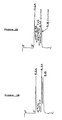
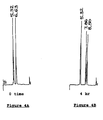
- Figures 4A and 4B are HPLC chromatograms of transglucosidase hydolysis of trehalulose at, respectively, zero time and four (4) hours, as described in Example 2.
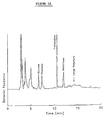
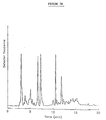
- Figure 5A and 5B are HPLC chromatograms of the sugars extracted from fiber treated with a pectinase preparation derived from A. Niger .
- Untreated refers to the check sample in Table 2.
- Boom + Duct refers to the same replicates in both illustrations.
- Figure 6 is a chart demonstrating the efficacy of an enzymatic composition of the present invention, wherein the X-axis is the Thermodetector Rating, the Y-axis is the percent water in seedcotton, the solid (or black) dots and the line joining them together represents the results obtained from the use of an enzymatic composition containing 1 % (v/v) of the transglucosidase L-1000 preparation, the empty (or white) dots and the line joining them together represents the results obtained from the use of an enzymatic composition containing 2 % (v/v) of the transglucosidase L-1000 preparation and the triangles and the line joining them together represents the results obtained from the use of a standard.
- the X-axis is the Thermodetector Rating
- the Y-axis is the percent water in seedcotton
- the solid (or black) dots and the line joining them together represents the results obtained from the use of an enzymatic composition containing 1 % (v/v) of the
- Figure 7 is a chart demonstrating the efficacy of an enzymatic composition of the present invention, wherein the X-axis is the Minicard Rating, the Y-axis is the percent water in seed-cotton, the solid (or black) dots and the line joining them together represents the results obtained from the use of an enzymatic composition containing 1 % (v/v) of the transglucosidase L-1000 preparation, the empty (or white) dots and the line joining them together represents the results obtained from the use of an enzymatic composition containing 2 % (v/v) of the transglucosidase L-1000 preparation and the triangles and the line joining them together represents the results obtained from the use of a standard.
- the X-axis is the Minicard Rating
- the Y-axis is the percent water in seed-cotton
- the solid (or black) dots and the line joining them together represents the results obtained from the use of an enzymatic composition containing 1 % (v/v) of the transglucosidas
- Figure 8 is a chart demonstrating the efficacy of an enzymatic composition of the present invention, wherein the X-axis is the Thermodetector Reading and the Y-axis is the Minicard Reading.
- Figure 9 is a bar graph further demonstrating the efficacy of an enzyme composition of the present invention containing the transglucosidase L-1000 preparation which has been sprayed to various moisture levels and incubated for two weeks, wherein the X-axis is the Thermodetector Reading, and further wherein the lefthandmost bar represents a dry check (that is to say, a check of a sample having neither moisture nor enzyme), wherein the bar immediately to the right thereof represents a wet check having 10 % (v/v) H2O and no enzyme, wherein the bar immediately to the right thereof represents a wet check having 10 % (v/v) H2O and 0.26 % (v/v) of the transglucosidase L-1000 preparation, wherein the bar immediately to the right thereof represents a wet check having 12 % (v/v) H2O and 0.25 % (v/v) of the transglucosidase L-1000 preparation, wherein the bar immediately to the right thereof represents a wet check having
- the novel enzyme preparations (compositions) of the present invention include enzyme(s) capable of reducing the stickiness on cotton fiber by hydrolyzing sugars in honeydew, preferably, melezitose and trehalulose. Further, the method of enzymatic hydrolysis of these sugars, as disclosed herein, results in the reduction of the stickiness of the contaminated cotton. Thereby offering a simple, economical and safe solution to the major problem of the cotton growers all over the world.
- the enzymes which we have identified as being capable of such hydrolysis are those hydrolyzing enzymes which have been derived from a fungal source and, more particularly, fungi of the genus Aspergillus . Most preferred are those hydrolyzing enzymes which have been derived from strains of Aspergillus niger , such as that strain of Aspergillus niger ( foetidus ) which has been deposited in the American Type Culture Collection (ATCC) under accession number 14916.
- ATCC American Type Culture Collection
- hydrolyzing enzymes of the present invention which, when incorporated into the enzyme compositions of the present invention are capable of hydrolyzing sugars (melezitose and trehalulose) include, but are not limited to transglucosidases, pectinases, ⁇ -galactosidases and glucoamylases which have been derived from a fungal source.
- transglucosidases examples include transglucosidase ⁇ -1,4 derived from A. niger ATCC 14916, transglucosidase ⁇ -1,6 derived from A. niger ATCC 14916 and that transglucosidase composition marketed under the tradename Transglucosidase L-1000 (SOLVAY ENZYMES, INC., Elkhart, Ind.).
- pectinases examples include those pectinase compositions marketed under the tradenames PEAREX 5X and CLAREX-ML (SOLVAY ENZYMES, INC., Elkhart, Ind., U.S.A.).
- ⁇ -galactosidase is that ⁇ -galactosidase derived from A. niger (marketed under the tradename BEANO, by AK PARMA INC., USA).
- glucoamylase is that glucoamylase derived from A. niger ATCC 14916.
- the hydrolyzing enzymes are used to prepare an enzyme composition for the hydrolysis of honeydew on cotton fiber, whereby the stickiness of the cotton fiber is reduced.
- the enzyme or enzymatic preparation
- the enzyme is mixed or otherwise formulated with an acceptable carrier which permits the application of the resulting enzyme composition on the cotton fibers in such a manner that the honeydew thereon may be hydrolyzed thereby and removed therefrom.
- Example of carriers which may be utilized in the enzyme compositions of the present invention include water.
- Other types of carriers would include, wetting agents, such as TRITON X-100 (UNION CARBIDE).
- wetting agents such as TRITON X-100 (UNION CARBIDE).
- the precise carrier to utilize may be varied depending upon the circumstances of the application (such as the desired contact time, environmental conditions during contact, etc.) of the enzymatic composition during use.
- the enzyme (or enzymatic preparation) is mixed with the carrier using methods, such as agitation, which are well-known in the art to dissolve and/or otherwise throroughly and substantially homogenously blend the components into a substantially homogenous composition.
- the enzyme compositions of the present invention may be used for the treatment of cotton fiber having honeydew thereon.
- This method of treatment includes contacting the cotton fiber with the enzymatic compositions of the present invention for a time sufficient to permit at least partial hydrolysis of the honeydew.
- This method of treatment further includes the subsequent removal of the cotton fiber from the enzymatic composition, whereby the hydrolyzed honeydew remains in the enzymatic composition. In this manner, a reduction of the honeydew on the cotton fiber is provided.
- the enzymatic composition and the method for the use thereof of the present invention may be used to either treat cotton fiber which is still in the field or which has already been harvested.
- the enzymatic composition may be applied with booms or any other suitable apparatus, such as sprayers, which are capable of distributing (preferrably, substantially evenly distributing) the liquid enzyme compositions onto the cotton fiber.
- the cotton fiber may then be removed from the enzymatic composition by both gravity causing the enzymatic composition to drip off the cotton fiber, by evaporation and by natural precipitation.
- subsequent wetting or soaking of the cotton fiber may be also be resorted to for further removal of the enzymatic composition of the present invention from the cotton fiber being treated therewith.
- the enzymatic composition may be applied by soaking the harvested cotton fiber in an appropriate reservoir which contains the enzymatic composition of the present invention.
- the enzymatic composition may be applied by being sprayed onto the cotton fiber with the use of a suitable (and ordinary) apparatus, such as a air-pressure spray gun.
- a suitable (and ordinary) apparatus such as a air-pressure spray gun.
- merely pouring the enzymatic composition over the cotton fiber would suffice.
- the cotton fiber may then be removed from the enzymatic composition by gravity causing the enzymatic composition to drip off the cotton fiber, evaporation, natural precipitation and/or subsequent wetting or soaking of the cotton fiber for further removal of the enzymatic composition of the present invention from the cotton fiber being treated therewith.
- the length of time with which the enzymatic composition should stay in contact with the cotton fiber having honeydew thereon will vary, as can be readily determined by those skilled in the art, depending upon, inter alia , the quantity and throughness of hydrolyzation desired. It is contemplated herein that such contact may occur for as little as ten minutes or for as long as one desires, with contact times for up to several days or weeks being possible. However, it is contemplated herein that a minimun contact time of eighteen hours is preferred.
- a 15 gm sample of Cotton contaminated with honeydew was extracted with 600 ml water at 50 °C. The extraction was repeated for another three times. Each extraction involved wetting the cotton and mixing for 15 minutes and squeezing the water from the cotton by hand. The extracts were combined and concentrated in vacuum in a rotary film evaporator to about 10 ml. This extract was then used to screen for enzymes that would hydrolyze the honeydew.
- transglucosidase L-1000 preparation produced by a selected strain of Aspergillus niger which has been deposited in the American Type Culture Collection, Rockville, Maryland, U.S.A., under accession number ATCC 14916, (this strain is sometimes classified as being a member of the species Aspergillus foetidus ) and which has been cultured in an appropriate nutrient broth.
- the reaction was terminated by removing 0.2 ml sample of the reaction and placing it in a boiling water bath for 10 minutes. After cooling, 0.3 ml of 0.01 N H2SO4 was added.
- Transglucosidase isolated from the same selected strain of Aspergillus niger var. was tested as described above by adding 20 transglucosidase units to the honeydew extract (0.5 ml volume).
- a unit of transglucosidase is defined as the amount of enzyme required to produce one micromole of panose per minute under the conditions of the assay in which maltose is used as the substrate.
- a copy of the HPLC chromatograms from this assay is shown in Figure 1 of the honeydew digest at zero time and after 17 hours.
- Figure 1 clearly shows the increase of the monosaccharides (glucose and fructose) as the oligosaccharides of honeydew are hydrolyzed.
- Honeydew is reported to contain sucrose, trehalulose, and melezitose (7). Since the HPLC conditions with the BioRad HPX-87H column hydrolyze sucrose, another HPLC column was found whose operating conditions did not cause hydrolysis of sucrose. BioRad Amino Bio Sil 5S column was found to give very good separation of the oligosaccharides and monosaccharides without hydrolyzing sucrose using mobile phase composed of 68 % (v/v) acetonitrile and 32 % (v/v) water. The column was operated at 25 °C with a mobile phase and a flow rate of 0.8 ml/min was used. A 20 ⁇ l sample of 4 % DS (dry substance) was found adequate for good separation.
- Honeydew extract obtained from contaminated (“Sticky”) cotton as described in Example 1, was used to test various commercial enzyme preparations that contain various fungal enzyme activity. The same procedure as was described above in Example 1 was used to test these enzymes for hydrolytic activity on honeydew.
- a qualitative scale was developed to rate the effectiveness of the enzymatic hydrolysis of the honeydew by the various enzymatic compositions of the present invention.
- the scale developed ranged from 0 to 3 with 0 (-) indicating approximately 0-10 % hydrolysis, 1 (+) indicating approximately 10-40 % hydrolysis, 2 (++) indicating approximately 40-70 % hydrolysis and 3 (+++) indicating approximately 70-100 % hydrolysis.
- 0 (-) indicating approximately 0-10 % hydrolysis
- 1 (+) indicating approximately 10-40 % hydrolysis
- 2 (++) indicating approximately 40-70 % hydrolysis
- 3 (+++) indicating approximately 70-100 % hydrolysis.
- Sumizyme-AP-II in it's liquid form was diluted to 2 % (v/v) of its original concentration, just prior to use, with tap water containing 0.25 % (w/v) TRITON X-100 (UNION CARBIDE) whose pH was lowered to 4.5 by adding a sufficient amount of acetic acid.
- This mixture was applied to Bemisia tabaci honeydew-contaminated cotton at the time of harvest by spraying it with nozzles, such that the harvested seedcotton was wetted with this solution. Knowing the speed of the cotton picker, the pressure in the spray lines was adjusted to apply approximately 30 gallons (US) of this mixture per acre of cotton. The yield of the fields where these tests were conducted was approximately 3,000 lb seedcotton per acre.
- the picker used in these experiments an International Harvester model 422, had a small (14 US gallons) plastic tank, a pressure regulator, ball-type flow valves and filter mounted near the driver to hold the enzyme solution. From this tank, the mixture was pumped to the nozzles at various pressures (approximately 40 psi) to produce the desired application rate. Spray nozzles were placed on boom mounts (metal support structures) in front of the picker heads so that the cotton was sprayed with a fine mist just prior to entering the picker (Boom Treatment).
- Another method of application which was used to test the pectinase preparation was spraying the harvested cotton via flush-mounted nozzles directed into the ducts which convey the harvested seedcotton from the picker heads to the storage bin (called a basket) behind the driver on the picker.
- samples were rapidly removed from the picker basket and placed into air-tight containers to determine applied moisture (and, thereby, the effective enzyme addition, since it is presumed that the enzyme must be in a wet state to be effective). These samples were then weighed, dried in a forced-air oven at 105 °C overnight, and reweighed to determine their moisture content. Untreated samples were likewise sampled and by comparison the effective addition of spray was determined.
- PERKINS, Jr. in Clemson, S.C. for analysis of reducing sugars and stickiness by the Minicard test.
- the later test as employed in the United States, has a scale of 0 to 3 with 0 representing nonsticky cotton and 3 being the most sticky.
- Application of the pectinase enzyme composition resulted in a stickiness rating of 2.75 ⁇ 0.29 (means ⁇ SEM) being reduced in Boom applications to a rating of 0.5 ⁇ 0.29.
- the stickiness was lowered to a Minicard rating of 0.25 ⁇ 0.00 and when sprayed from both locations, the stickiness rating was 0.00 ⁇ 0.00.
- Table 2 The experiment illustrated in Table 2 and figures used unsprayed cotton as a control, which is reflected in the relative water content of the replicates (Table 2).
- Table 2 Treatment Minicard Rating Percent Sugars Percent Moisture Check 2.75 ⁇ 0.29 0.76 ⁇ 0.06 0.15 ⁇ 0.07 From Boom 0.50 ⁇ 0.29 1.1 ⁇ 0.11 5.60 ⁇ 0.08 From Duct 0.25 ⁇ 0.00 0.87 ⁇ 0.02 12.65 ⁇ 0.03 Boom + Duct 0.00 ⁇ 0.00 0.57 ⁇ 0.01 12.43 ⁇ 0.33
- Data represent means ⁇ S.E. of four replicate samples.
- the treatment labeled check was picked without enzyme addition, the other treatments were sprayed at harvest with a solution which contained 2 % (v/v) of the enzyme preparation 0.25 % (v/v) surfactant in a weak solution of acetic acid (pH ca. 4.5).
- Transglucosidase L-1000 was obtained from SOLVAY ENZYMES, INC. (Elkhart, IN) as a liquid which was diluted to various concentrations which ranged from 0.25 to 1 % (v/v), just prior to use, with tap water containing 0.25 % (w/v) TRITON X-100 (UNION CARBIDE) whose pH was lowered to 4.5 by adding a sufficient amount of acetic acid.
- This mixture was applied to Bemisia tabaci honeydew-contaminated cotton at the time of harvest by spraying it with nozzles, such that the harvested seedcotton was wetted with this solution.
- the IH model 422 had a small (14 US gallons) plastic tank, a pressure regulator, ball-type flow valves and filter mounted near the driver to hold the enzyme solution. From this tank, the mixture was pumped to the nozzles at various pressures (approximately 40 psi) to produce the desired application rate.
- the IH model 782 used the picker's water supply tank (ca. 50 US gal) as a source of water for the spray. On both pickers, Spray nozzles were placed on boom mounts (metal support structures) in front of the picker heads so that the cotton was sprayed with a fine mist just prior to entering the picker (Boom Treatment).
- Another method of application which was used to test the transglucosidase L-1000 preparation was by spraying the harvested cotton via flush-mounted nozzles directed into the ducts which convey the harvested seedcotton from the picker heads to the storage bin (called a basket) behind the driver on the picker.
- the remaining lint was sent to a laboratory (Dr. Henry H. PERKINS, Jr., USDA-ARS, Clemson, S.C.) for analysis of reducing sugars and stickiness by both the Minicard test and the Thermodetector tests.
- Minicard test as employed in the United States, has a scale of 0 to 3 with 0 representing nonsticky cotton and 3 being the most sticky and the Thermodetector test has a scale which is approximately 10-fold higher (i.e., a 3.0 Minicard rating is very close to a 30 thermodetector rating). While the these tests give equivalent results, the later is somewhat faster to administer with very sticky samples, and so was predominantly used to access stickiness during the 1993 compaign.
- Additional seedcotton lots were processed into cotton "modules" in the field after spraying with either the transglucosidase L-1000 solution or an equivalent amount of water containing acetic acid and TRITON X-100 at the same rates used in the enzyme additions.
- These modules were stored under ambient conditions (ca. 70 to 105 °F) for approximately one week prior to being taken to a commercial gin for seed removal. Samples were removed from these commercial modules at time of their preparation, just prior to ginning and from the lint slide in the gin just after the seeds were removed.
- the stickiness in these samples at the time of ginning was : 21.67 ⁇ 1.20 (mean ⁇ SEM) for water-alone-treated samples removed from the module and ginned on a laboratory-scale gin; 0.00 ⁇ 0.00 for transglucosidase L-1000 treated seedcotton; 4.10 ⁇ 0.79 for water-treated seedcotton from the gin lint slide (i.e., immediately after seed removal); and 0.25 ⁇ 0.16 for transglucosidase L-1000 treated seedcotton taken from the lint slide.
Landscapes
- Engineering & Computer Science (AREA)
- Textile Engineering (AREA)
- Life Sciences & Earth Sciences (AREA)
- Chemical & Material Sciences (AREA)
- Microbiology (AREA)
- Chemical Kinetics & Catalysis (AREA)
- General Chemical & Material Sciences (AREA)
- Biochemistry (AREA)
- Wood Science & Technology (AREA)
- Zoology (AREA)
- Molecular Biology (AREA)
- Health & Medical Sciences (AREA)
- Preparation Of Compounds By Using Micro-Organisms (AREA)
- Jellies, Jams, And Syrups (AREA)
- Chemical Or Physical Treatment Of Fibers (AREA)
- Enzymes And Modification Thereof (AREA)
- Medicines Containing Material From Animals Or Micro-Organisms (AREA)
Applications Claiming Priority (2)
| Application Number | Priority Date | Filing Date | Title |
|---|---|---|---|
| US08/054,226 US5516689A (en) | 1993-04-30 | 1993-04-30 | Method for the treatment of sticky cotton fiber with transglucosidase from Aspergillus niger |
| US54226 | 2001-11-13 |
Publications (3)
| Publication Number | Publication Date |
|---|---|
| EP0622487A2 true EP0622487A2 (de) | 1994-11-02 |
| EP0622487A3 EP0622487A3 (de) | 1995-09-13 |
| EP0622487B1 EP0622487B1 (de) | 1999-02-10 |
Family
ID=21989602
Family Applications (1)
| Application Number | Title | Priority Date | Filing Date |
|---|---|---|---|
| EP94201168A Expired - Lifetime EP0622487B1 (de) | 1993-04-30 | 1994-04-26 | Verfahren zur Behandlung von klebrigem Baumwollfaden mit Enzymen |
Country Status (15)
| Country | Link |
|---|---|
| US (2) | US5516689A (de) |
| EP (1) | EP0622487B1 (de) |
| JP (1) | JPH06319538A (de) |
| CN (1) | CN1100142A (de) |
| AU (1) | AU676017B2 (de) |
| BR (1) | BR9401662A (de) |
| DE (1) | DE69416445T2 (de) |
| DK (1) | DK0622487T3 (de) |
| ES (1) | ES2127344T3 (de) |
| FI (1) | FI942007A7 (de) |
| IL (1) | IL109419A (de) |
| MA (1) | MA23184A1 (de) |
| RU (1) | RU94015284A (de) |
| TW (1) | TW297837B (de) |
| ZA (1) | ZA942913B (de) |
Cited By (7)
| Publication number | Priority date | Publication date | Assignee | Title |
|---|---|---|---|---|
| WO1998024965A1 (en) * | 1996-12-04 | 1998-06-11 | Novo Nordisk Biochem North America, Inc. | Alkaline enzyme scouring of cotton textiles |
| FR2847815A1 (fr) * | 2002-12-03 | 2004-06-04 | Vincience | Utilisation d'au moins un extrait de miellat de coton comme ingredient actif dans ou pour la preparation d'une composition cosmetique et/ou pharmaceutique. |
| FR2873720A1 (fr) * | 2004-07-28 | 2006-02-03 | Inst Francais Textile Habillem | Procede de traitement du coton collant |
| RU2295592C1 (ru) * | 2005-11-21 | 2007-03-20 | Инновационно-технологический центр "Биологически активные соединения и их применение" Российской академии наук (РАН) | Раствор для обработки льняных волокон |
| RU2366771C1 (ru) * | 2008-05-19 | 2009-09-10 | Учреждение Российской академии наук "Институт химии растворов РАН" | Способ ферментативно-пероксидной подготовки к прядению высоколигнифицированной льняной ровницы |
| RU2366770C1 (ru) * | 2008-05-19 | 2009-09-10 | Учреждение Российской академии наук "Институт химии растворов РАН" | Способ ферментативно-пероксидной подготовки льняной ровницы к прядению |
| RU2366769C1 (ru) * | 2008-05-19 | 2009-09-10 | Учреждение Российской академии наук "Институт химии растворов РАН" | Совмещенный способ подготовки к прядению и крашения льняного волокна |
Families Citing this family (7)
| Publication number | Priority date | Publication date | Assignee | Title |
|---|---|---|---|---|
| US6936289B2 (en) | 1995-06-07 | 2005-08-30 | Danisco A/S | Method of improving the properties of a flour dough, a flour dough improving composition and improved food products |
| RU2157434C1 (ru) * | 1999-03-10 | 2000-10-10 | Ивановский государственный химико-технологический университет | Способ получения ваты |
| RU2148111C1 (ru) * | 1999-06-30 | 2000-04-27 | Государственное унитарное предприятие Центральный научно-исследовательский институт комплексной автоматизации легкой промышленности | Способ подготовки льняного волокна к мокрому прядению |
| KR100733136B1 (ko) | 2006-08-30 | 2007-06-28 | 한국섬유기술연구소 | 정색 반응 및 화상 분석을 이용한 원면 점착성 평가 방법 |
| US8399230B2 (en) * | 2006-10-12 | 2013-03-19 | Kemin Industries, Inc. | Heat-stable enzyme compositions |
| CN102296032B (zh) * | 2011-08-31 | 2013-11-06 | 保龄宝生物股份有限公司 | 转葡糖苷酶及其制备和固定化方法 |
| US9982284B2 (en) | 2014-02-27 | 2018-05-29 | E I Du Pont De Nemours And Company | Enzymatic hydrolysis of disaccharides and oligosaccharides using alpha-glucosidase enzymes |
Family Cites Families (15)
| Publication number | Priority date | Publication date | Assignee | Title |
|---|---|---|---|---|
| DE946881C (de) * | 1952-10-16 | 1956-08-09 | Boehme Fettchemie G M B H | Verfahren zum Vorreinigen von Rohbaumwolle |
| FR1084773A (fr) * | 1952-10-16 | 1955-01-24 | Bohme Fettchemie Gmbh | Procédé de nettoyage préalable et de blanchiment de fibres de coton |
| US4343070A (en) * | 1980-08-25 | 1982-08-10 | The United States Of America As Represented By The Secretary Of Agriculture | Removal of lint from cottonseed |
| US4572898A (en) * | 1982-12-14 | 1986-02-25 | Genentech, Inc. | Thermophile isolate having thermostable hydrolytic activity |
| US4721676A (en) * | 1982-12-14 | 1988-01-26 | Genencor, Inc. | Novel thermophile isolate having thermostable hydrolytic activity |
| US4575487A (en) * | 1983-05-25 | 1986-03-11 | Miles Laboratories, Inc. | Method for determination of transglucosidase |
| US4481355A (en) * | 1983-11-22 | 1984-11-06 | Helmic, Inc. | Method for degumming decorticated plant bast fiber |
| FR2588886B1 (fr) * | 1985-10-18 | 1988-06-24 | Comite Eco Agric Prod Chanvre | Procede de traitement biochimique de plantes fibreuses liberiennes ou cellulosiques et assimilees |
| JPH0639596B2 (ja) * | 1985-10-18 | 1994-05-25 | ライオン株式会社 | 洗浄剤組成物 |
| JPS62223309A (ja) * | 1986-03-18 | 1987-10-01 | Tanaka Tekkosho:Kk | 原綿のホネデユ−除去方法 |
| JPS62299504A (ja) * | 1986-06-17 | 1987-12-26 | Minoru Tanaka | 原綿の除糖処理装置 |
| US4712290A (en) * | 1986-07-28 | 1987-12-15 | Avondale Mills | Textile and method of manufacture |
| JPH0644927B2 (ja) * | 1987-03-14 | 1994-06-15 | 日本油脂株式会社 | 徐放性活性成分放出剤 |
| US5246853A (en) * | 1990-10-05 | 1993-09-21 | Genencor International, Inc. | Method for treating cotton-containing fabric with a cellulase composition containing endoglucanase components and which composition is free of exo-cellobiohydrolase I |
| US5232851A (en) * | 1990-10-16 | 1993-08-03 | Springs Industries, Inc. | Methods for treating non-dyed and non-finished cotton woven fabric with cellulase to improve appearance and feel characteristics |
-
1993
- 1993-04-30 US US08/054,226 patent/US5516689A/en not_active Expired - Lifetime
-
1994
- 1994-04-25 IL IL10941994A patent/IL109419A/en not_active IP Right Cessation
- 1994-04-26 DK DK94201168T patent/DK0622487T3/da active
- 1994-04-26 ES ES94201168T patent/ES2127344T3/es not_active Expired - Lifetime
- 1994-04-26 DE DE69416445T patent/DE69416445T2/de not_active Expired - Lifetime
- 1994-04-26 EP EP94201168A patent/EP0622487B1/de not_active Expired - Lifetime
- 1994-04-26 ZA ZA942913A patent/ZA942913B/xx unknown
- 1994-04-26 TW TW083103758A patent/TW297837B/zh active
- 1994-04-28 MA MA23490A patent/MA23184A1/fr unknown
- 1994-04-28 AU AU60750/94A patent/AU676017B2/en not_active Ceased
- 1994-04-29 RU RU94015284/13A patent/RU94015284A/ru unknown
- 1994-04-29 FI FI942007A patent/FI942007A7/fi unknown
- 1994-04-29 BR BR9401662A patent/BR9401662A/pt not_active Application Discontinuation
- 1994-04-29 CN CN94106627A patent/CN1100142A/zh active Pending
- 1994-05-02 JP JP6093490A patent/JPH06319538A/ja active Pending
-
1995
- 1995-06-07 US US08/487,391 patent/US5770437A/en not_active Expired - Lifetime
Cited By (13)
| Publication number | Priority date | Publication date | Assignee | Title |
|---|---|---|---|---|
| WO1998024965A1 (en) * | 1996-12-04 | 1998-06-11 | Novo Nordisk Biochem North America, Inc. | Alkaline enzyme scouring of cotton textiles |
| US5912407A (en) * | 1996-12-04 | 1999-06-15 | Novo Nordisk Biochem North America, Inc. | Alkaline enzyme scouring of cotton textiles |
| US6551358B2 (en) | 1996-12-04 | 2003-04-22 | Novozymes A/S | Alkaline enzyme scouring of cotton textiles |
| FR2847815A1 (fr) * | 2002-12-03 | 2004-06-04 | Vincience | Utilisation d'au moins un extrait de miellat de coton comme ingredient actif dans ou pour la preparation d'une composition cosmetique et/ou pharmaceutique. |
| WO2004052331A3 (fr) * | 2002-12-03 | 2004-08-12 | Soc Extraction Principes Actif | Utilisation d'un extrait de miellat de coton comme ingredient acitif |
| US7413755B2 (en) | 2002-12-03 | 2008-08-19 | Societe D'extraction Des Principes Actifs S.A. | Use of a cotton honeydew extract as active ingredient in or for preparing a cosmetic and/or pharmaceutical composition |
| WO2006018533A3 (fr) * | 2004-07-28 | 2006-04-13 | Inst Francais Textile Habillem | Procede de traitement du coton collant |
| FR2873720A1 (fr) * | 2004-07-28 | 2006-02-03 | Inst Francais Textile Habillem | Procede de traitement du coton collant |
| EA011893B1 (ru) * | 2004-07-28 | 2009-06-30 | Институт Франсез Текстиль Абийман | Способ обработки липкого хлопкового волокна |
| RU2295592C1 (ru) * | 2005-11-21 | 2007-03-20 | Инновационно-технологический центр "Биологически активные соединения и их применение" Российской академии наук (РАН) | Раствор для обработки льняных волокон |
| RU2366771C1 (ru) * | 2008-05-19 | 2009-09-10 | Учреждение Российской академии наук "Институт химии растворов РАН" | Способ ферментативно-пероксидной подготовки к прядению высоколигнифицированной льняной ровницы |
| RU2366770C1 (ru) * | 2008-05-19 | 2009-09-10 | Учреждение Российской академии наук "Институт химии растворов РАН" | Способ ферментативно-пероксидной подготовки льняной ровницы к прядению |
| RU2366769C1 (ru) * | 2008-05-19 | 2009-09-10 | Учреждение Российской академии наук "Институт химии растворов РАН" | Совмещенный способ подготовки к прядению и крашения льняного волокна |
Also Published As
| Publication number | Publication date |
|---|---|
| EP0622487B1 (de) | 1999-02-10 |
| ZA942913B (en) | 1995-03-03 |
| DK0622487T3 (da) | 1999-09-20 |
| TW297837B (de) | 1997-02-11 |
| DE69416445T2 (de) | 1999-10-28 |
| DE69416445D1 (de) | 1999-03-25 |
| JPH06319538A (ja) | 1994-11-22 |
| FI942007L (fi) | 1994-10-31 |
| EP0622487A3 (de) | 1995-09-13 |
| RU94015284A (ru) | 1996-06-27 |
| FI942007A0 (fi) | 1994-04-29 |
| US5516689A (en) | 1996-05-14 |
| ES2127344T3 (es) | 1999-04-16 |
| CN1100142A (zh) | 1995-03-15 |
| IL109419A0 (en) | 1994-07-31 |
| AU676017B2 (en) | 1997-02-27 |
| BR9401662A (pt) | 1994-12-27 |
| FI942007A7 (fi) | 1994-10-31 |
| AU6075094A (en) | 1994-11-03 |
| MA23184A1 (fr) | 1994-12-31 |
| IL109419A (en) | 1998-09-24 |
| US5770437A (en) | 1998-06-23 |
Similar Documents
| Publication | Publication Date | Title |
|---|---|---|
| EP0622487B1 (de) | Verfahren zur Behandlung von klebrigem Baumwollfaden mit Enzymen | |
| Jones et al. | Host-pathogen interactions IV. Studies on the polysaccharide-degrading enzymes secreted by Fusarium oxysporum f. sp. lycopersici | |
| Chesson | The maceration of linen flax under anaerobic conditions | |
| Fåhraeus et al. | The possible significance of pectic enzymes in root hair infection by nodule bacteria. | |
| BROWN et al. | Production of polysaccharide‐degrading enzymes by saprophytic fungi from glyphosate‐treated flax and their involvement in retting | |
| Wicklow et al. | Decomposition of lignocellulose by Cyathus stercoreus (Schw.) de Toni NRRL 6473, a “white rot” fungus from cattle dung | |
| US5948454A (en) | Method for treatment of fibrous crops with a modified cellulase to improve feed values storage and other properties | |
| CN101492882B (zh) | 细菌纤维素在古代丝织品文物保护上的应用方法 | |
| Brown | Epicoccum nigrum, a primary saprophyte involved in the retting of flax | |
| BROWN et al. | Relationship between pectin content of stems of flax cultivars, fungal cell wall‐degrading enzymes and pre‐harvest retting | |
| Hussain et al. | The function of extracellular enzymes of Dutch elm disease pathogen | |
| Singh et al. | Studies in the Physiology of Parasitism: XXI. The Production and Properties of Pectic Enzymes secreted by Fusarium moniliforme Sheldon | |
| Dhawan et al. | Enzymic hydrolysis of common cellulosic wastes by cellulase | |
| Lam et al. | Effect of radiation and fungal treatment on lignocelluloses and their biological activity | |
| Yinghua et al. | Production of efficient enzymes for flax retting by solid state fermentation with Aspergillus niger | |
| CN112458068A (zh) | 复合酶制剂及其用途和使用方法 | |
| Sharma et al. | A review of recent research on the retting of flax in Northern Ireland | |
| Baracat-Pereira et al. | Partial characterization of Aspergillus fumigatus polygalacturonases for the degumming of natural fibers | |
| Milstein et al. | Heat and microbial treatments for nutritional upgrading of wheat straw | |
| Goodenough et al. | The activity of cell-wall degrading enzymes in tomato roots infected with Pyrenochaeta lycopersici and the effect of sugar concentrations in these roots on disease development | |
| Guckert et al. | Root exudation in Beta vulgaris: a comparison with Zea mays | |
| CN112471171A (zh) | 一种纤维用大麻茎杆田间站立脱胶剂及其脱胶工艺方法 | |
| US5436220A (en) | Cotton canopy conditioner to prevent cotton regrowth comprising glyphosate or sulfosate and a krebs cycle acid | |
| Verhoeff et al. | Cellulolytic activity of Botrytis cinerea in vitro and in vivo | |
| Singh et al. | A review on enzymes and substrate colonization by microflora |
Legal Events
| Date | Code | Title | Description |
|---|---|---|---|
| PUAI | Public reference made under article 153(3) epc to a published international application that has entered the european phase |
Free format text: ORIGINAL CODE: 0009012 |
|
| AK | Designated contracting states |
Kind code of ref document: A2 Designated state(s): BE CH DE DK ES FR GB GR IT LI NL |
|
| PUAL | Search report despatched |
Free format text: ORIGINAL CODE: 0009013 |
|
| AK | Designated contracting states |
Kind code of ref document: A3 Designated state(s): BE CH DE DK ES FR GB GR IT LI NL |
|
| 17P | Request for examination filed |
Effective date: 19960313 |
|
| 17Q | First examination report despatched |
Effective date: 19960604 |
|
| GRAG | Despatch of communication of intention to grant |
Free format text: ORIGINAL CODE: EPIDOS AGRA |
|
| RAP1 | Party data changed (applicant data changed or rights of an application transferred) |
Owner name: GENENCOR INTERNATIONAL INDIANA, INC. |
|
| GRAG | Despatch of communication of intention to grant |
Free format text: ORIGINAL CODE: EPIDOS AGRA |
|
| GRAH | Despatch of communication of intention to grant a patent |
Free format text: ORIGINAL CODE: EPIDOS IGRA |
|
| RAP1 | Party data changed (applicant data changed or rights of an application transferred) |
Owner name: GENENCOR INTERNATIONAL, INC. |
|
| GRAH | Despatch of communication of intention to grant a patent |
Free format text: ORIGINAL CODE: EPIDOS IGRA |
|
| GRAA | (expected) grant |
Free format text: ORIGINAL CODE: 0009210 |
|
| ITF | It: translation for a ep patent filed | ||
| AK | Designated contracting states |
Kind code of ref document: B1 Designated state(s): BE CH DE DK ES FR GB GR IT LI NL |
|
| PG25 | Lapsed in a contracting state [announced via postgrant information from national office to epo] |
Ref country code: GR Free format text: LAPSE BECAUSE OF NON-PAYMENT OF DUE FEES Effective date: 19990210 |
|
| REG | Reference to a national code |
Ref country code: CH Ref legal event code: EP |
|
| ET | Fr: translation filed | ||
| REG | Reference to a national code |
Ref country code: CH Ref legal event code: NV Representative=s name: E. BLUM & CO. PATENTANWAELTE |
|
| REF | Corresponds to: |
Ref document number: 69416445 Country of ref document: DE Date of ref document: 19990325 |
|
| REG | Reference to a national code |
Ref country code: ES Ref legal event code: FG2A Ref document number: 2127344 Country of ref document: ES Kind code of ref document: T3 |
|
| PG25 | Lapsed in a contracting state [announced via postgrant information from national office to epo] |
Ref country code: GB Free format text: LAPSE BECAUSE OF NON-PAYMENT OF DUE FEES Effective date: 19990510 |
|
| REG | Reference to a national code |
Ref country code: DK Ref legal event code: T3 |
|
| PLBE | No opposition filed within time limit |
Free format text: ORIGINAL CODE: 0009261 |
|
| STAA | Information on the status of an ep patent application or granted ep patent |
Free format text: STATUS: NO OPPOSITION FILED WITHIN TIME LIMIT |
|
| GBPC | Gb: european patent ceased through non-payment of renewal fee |
Effective date: 19990510 |
|
| 26N | No opposition filed | ||
| REG | Reference to a national code |
Ref country code: CH Ref legal event code: PFA Owner name: GENENCOR INTERNATIONAL, INC. Free format text: GENENCOR INTERNATIONAL, INC.#4 CAMBRIDGE PLACE, 1870 SOUTH WINTON ROAD#ROCHESTER, NEW YORK 14618 (US) -TRANSFER TO- GENENCOR INTERNATIONAL, INC.#4 CAMBRIDGE PLACE, 1870 SOUTH WINTON ROAD#ROCHESTER, NEW YORK 14618 (US) |
|
| PGFP | Annual fee paid to national office [announced via postgrant information from national office to epo] |
Ref country code: ES Payment date: 20120426 Year of fee payment: 19 |
|
| PGFP | Annual fee paid to national office [announced via postgrant information from national office to epo] |
Ref country code: CH Payment date: 20130429 Year of fee payment: 20 Ref country code: DE Payment date: 20130429 Year of fee payment: 20 Ref country code: BE Payment date: 20130429 Year of fee payment: 20 Ref country code: DK Payment date: 20130429 Year of fee payment: 20 |
|
| PGFP | Annual fee paid to national office [announced via postgrant information from national office to epo] |
Ref country code: FR Payment date: 20130506 Year of fee payment: 20 Ref country code: IT Payment date: 20130422 Year of fee payment: 20 Ref country code: NL Payment date: 20130426 Year of fee payment: 20 |
|
| REG | Reference to a national code |
Ref country code: DE Ref legal event code: R071 Ref document number: 69416445 Country of ref document: DE |
|
| REG | Reference to a national code |
Ref country code: DK Ref legal event code: EUP Effective date: 20140426 |
|
| REG | Reference to a national code |
Ref country code: DE Ref legal event code: R071 Ref document number: 69416445 Country of ref document: DE |
|
| BE20 | Be: patent expired |
Owner name: *GENENCOR INTERNATIONAL INC. Effective date: 20140426 |
|
| REG | Reference to a national code |
Ref country code: CH Ref legal event code: PL |
|
| REG | Reference to a national code |
Ref country code: NL Ref legal event code: V4 Effective date: 20140426 |
|
| REG | Reference to a national code |
Ref country code: ES Ref legal event code: FD2A Effective date: 20140707 |
|
| PG25 | Lapsed in a contracting state [announced via postgrant information from national office to epo] |
Ref country code: DE Free format text: LAPSE BECAUSE OF EXPIRATION OF PROTECTION Effective date: 20140429 |
|
| PG25 | Lapsed in a contracting state [announced via postgrant information from national office to epo] |
Ref country code: ES Free format text: LAPSE BECAUSE OF EXPIRATION OF PROTECTION Effective date: 20140427 |