EP0621232B1 - Device and method for breaking an ampoule - Google Patents
Device and method for breaking an ampoule Download PDFInfo
- Publication number
- EP0621232B1 EP0621232B1 EP93120103A EP93120103A EP0621232B1 EP 0621232 B1 EP0621232 B1 EP 0621232B1 EP 93120103 A EP93120103 A EP 93120103A EP 93120103 A EP93120103 A EP 93120103A EP 0621232 B1 EP0621232 B1 EP 0621232B1
- Authority
- EP
- European Patent Office
- Prior art keywords
- ampoule
- members
- specimen
- swab
- housing
- Prior art date
- Legal status (The legal status is an assumption and is not a legal conclusion. Google has not performed a legal analysis and makes no representation as to the accuracy of the status listed.)
- Expired - Lifetime
Links
Images



Classifications
-
- B—PERFORMING OPERATIONS; TRANSPORTING
- B67—OPENING, CLOSING OR CLEANING BOTTLES, JARS OR SIMILAR CONTAINERS; LIQUID HANDLING
- B67B—APPLYING CLOSURE MEMBERS TO BOTTLES JARS, OR SIMILAR CONTAINERS; OPENING CLOSED CONTAINERS
- B67B7/00—Hand- or power-operated devices for opening closed containers
- B67B7/92—Hand- or power-operated devices for opening closed containers by breaking, e.g. for ampoules
-
- A—HUMAN NECESSITIES
- A61—MEDICAL OR VETERINARY SCIENCE; HYGIENE
- A61B—DIAGNOSIS; SURGERY; IDENTIFICATION
- A61B10/00—Instruments for taking body samples for diagnostic purposes; Other methods or instruments for diagnosis, e.g. for vaccination diagnosis, sex determination or ovulation-period determination; Throat striking implements
- A61B10/0096—Casings for storing test samples
-
- C—CHEMISTRY; METALLURGY
- C12—BIOCHEMISTRY; BEER; SPIRITS; WINE; VINEGAR; MICROBIOLOGY; ENZYMOLOGY; MUTATION OR GENETIC ENGINEERING
- C12M—APPARATUS FOR ENZYMOLOGY OR MICROBIOLOGY; APPARATUS FOR CULTURING MICROORGANISMS FOR PRODUCING BIOMASS, FOR GROWING CELLS OR FOR OBTAINING FERMENTATION OR METABOLIC PRODUCTS, i.e. BIOREACTORS OR FERMENTERS
- C12M45/00—Means for pre-treatment of biological substances
- C12M45/22—Means for packing or storing viable microorganisms
-
- G—PHYSICS
- G01—MEASURING; TESTING
- G01N—INVESTIGATING OR ANALYSING MATERIALS BY DETERMINING THEIR CHEMICAL OR PHYSICAL PROPERTIES
- G01N1/00—Sampling; Preparing specimens for investigation
- G01N1/02—Devices for withdrawing samples
-
- A—HUMAN NECESSITIES
- A61—MEDICAL OR VETERINARY SCIENCE; HYGIENE
- A61F—FILTERS IMPLANTABLE INTO BLOOD VESSELS; PROSTHESES; DEVICES PROVIDING PATENCY TO, OR PREVENTING COLLAPSING OF, TUBULAR STRUCTURES OF THE BODY, e.g. STENTS; ORTHOPAEDIC, NURSING OR CONTRACEPTIVE DEVICES; FOMENTATION; TREATMENT OR PROTECTION OF EYES OR EARS; BANDAGES, DRESSINGS OR ABSORBENT PADS; FIRST-AID KITS
- A61F13/00—Bandages or dressings; Absorbent pads
- A61F13/15—Absorbent pads, e.g. sanitary towels, swabs or tampons for external or internal application to the body; Supporting or fastening means therefor; Tampon applicators
- A61F13/38—Swabs having a stick-type handle, e.g. cotton tips
-
- G—PHYSICS
- G01—MEASURING; TESTING
- G01N—INVESTIGATING OR ANALYSING MATERIALS BY DETERMINING THEIR CHEMICAL OR PHYSICAL PROPERTIES
- G01N1/00—Sampling; Preparing specimens for investigation
- G01N1/28—Preparing specimens for investigation including physical details of (bio-)chemical methods covered elsewhere, e.g. G01N33/50, C12Q
- G01N1/30—Staining; Impregnating ; Fixation; Dehydration; Multistep processes for preparing samples of tissue, cell or nucleic acid material and the like for analysis
- G01N1/31—Apparatus therefor
-
- G—PHYSICS
- G01—MEASURING; TESTING
- G01N—INVESTIGATING OR ANALYSING MATERIALS BY DETERMINING THEIR CHEMICAL OR PHYSICAL PROPERTIES
- G01N1/00—Sampling; Preparing specimens for investigation
- G01N1/02—Devices for withdrawing samples
- G01N2001/028—Sampling from a surface, swabbing, vaporising
Definitions
- This invention relates to a device and method for breaking ampoules.
- the device may be used for breaking ampoules in an apparatus for collecting and transporting biological specimens.
- An element common to most devices for collecting and transporting biological specimens is an ampoule in a container that can be broken to release medium into the container to keep the swab and sample moist.
- a typical collecting and transporting device has been described in several publications and most specifically in U.S. Patent No. 4,014,748.
- a commercially available device for collecting and transporting biological specimens is the CULTURETTE® Collection and Transport System (trademark of Becton, Dickinson and Company) sold by Becton Dickinson Microbiology Systems, Cockeysville, Maryland.
- the CULTURETTE device is for collecting and transporting a biological sample with a protective sleeve or skirt surrounding the container where the ampoule, which is to be broken for use, is contained.
- a problem that has confronted users of collection and transport devices is maintaining the viability and preventing the contamination of any biological sample which is collected.
- viability of the microorganisms is not always assured by the use of the prior art collection devices.
- Such a device would be comparatively simple and inexpensive to manufacture as compared to available devices.
- the device of the invention is defined by claim 1.
- the device may be used in an apparatus for collecting and transporting biological specimens to substantially prevent the specimen collected in the apparatus from being exposed to the outside environment.
- the device is a guard arrangement having two rigid, movable and opposing members spaced sufficiently from one another surrounding an ampoule.
- the movable members extend from a forward end to a rearward end.
- the movable members are folded together at the rearward end.
- Preferably the movable members are connected by a living hinge at the rearward end.
- Each member comprises a wall with an outer surface, an inner surface and an edge.
- the inner surfaces face each other to form a cavity that surrounds an ampoule and the edges face each other to form a gap.
- the ampoule may be placed or attached in the cavity between the inner surfaces of the members while maintaining a gap between the edges.
- the diameter of the cavity is greater than the diameter of the ampoule.
- the edges of the members are brought together so there is no gap, the diameter of the cavity of the guard arrangement is reduced and the ampoule is ruptured.
- the compressed or reduced cavity in turn effects a force on the ampoule so that the ampoule will deform and rupture.
- each member is greater than the gap that is formed between the edges of the members when the guard arrangement surrounds an ampoule.
- the wall thickness substantially reduces or limits fragments of a ruptured ampoule from penetrating the walls of each member.
- each member has a curved wall in the shape of an arch, oval or the like.
- the wall of each member has three sides. The sides are desirably in the shape of an arch, oval or the like. Most preferably the walls of the members are the same or symmetrical in shape.
- the guard arrangement and ampoule may be preferably included in an apparatus for collecting and transporting biological specimens.
- the apparatus comprises a tubular housing, a specimen collector, a guard arrangement and a frangible ampoule located within the tubular housing.
- the frangible ampoule holds medium that may be released into the tubular housing.
- the specimen collector is removed from the tubular housing.
- a site such as the area of the throat, nose, ears, mouth, wound or operative sites, is sampled by contacting the site with the swab of the specimen collector.
- the specimen is removed from the site with the swab.
- the specimen collector is preferably returned to the tubular housing with the swab being preferably positioned in contact with a swatch or pledget.
- the user then effects a force, such as finger pressure, on the tubular housing where the guard arrangement and ampoule are located.
- the guard arrangement of the present invention improves the standard collection type device in that microorganisms that are obtained by the collection device may remain substantially viable and uncontaminated through the entire specimen collection, transport, storage and identification phases.
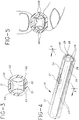
- FIG. 1 is a perspective view of the preferred guard arrangement embodiment of the present invention, illustrated in its folded condition.
- FIG. 2 is a top view of the guard arrangement of FIG. 1 in its unfolded condition.
- FIG. 3 is a cross sectional view of FIG. 1 taken along line 3-3 thereof.
- FIG. 4 is a perspective view of the preferred guard arrangement of the present invention, including an ampoule.
- FIG. 5 is a cross sectional view of FIG. 4 taken along lines 5-5 illustrating the breaking of an ampoule.
- FIG. 6 is a perspective view illustrating a device for collecting and transporting specimens with the guard arrangement of FIG. 1.
- FIG. 7 is a cross-sectional view of FIG. 6 taken along lines 7-7.
- FIG. 8 is the cross sectional view of FIG. 7 illustrating the breaking of the ampoule.
- FIG. 9 is a perspective view illustrating a system for collecting and transporting specimens comprising at least two ampoules with respective guard arrangements.
- the preferred guard arrangement 10 of the present invention in its folded condition as illustrated in FIG. 1, comprises two rigid, movable and opposing members 12 and 14 that extend from a forward end 16 to a rearward end 18 and are connected by a living hinge 20 at the rearward end.
- Each member comprises a sidewall 19 with an outer surface 24 and inner surface 25 and preferably the outer surface of each member is marked with indicia 27 .
- each sidewall In its unfolded arrangement, as shown in FIG. 2, each sidewall preferably has three sides 21 , 22 and 23 , with sides 22 and 23 extending from side 21 . As shown in FIG. 3, sides 22 and 23 extend from side 21 at an angle preferably less than .45 degrees to an edge 26 .
- the inner surfaces of the opposing members face the other to form a cavity 29 and the edges of the opposing members also face each other.
- the distance from side 23 to side 22 of each member is greater than the height of cavity 29 or the distance between sides 21 of the members.
- the guard arrangement substantially surrounds a sealed frangible ampoule 40 with a space 28 between the edges of the members.
- the ampoule may if desired, be secured to the inner surfaces of the guard arrangement with an adhesive.
- the frangible ampoule is ruptured when the user applies finger pressure at the marked indicia on the guard arrangement so that the edges of the members are brought together and the cavity is compressed or reduced so there is not sufficient area for the frangible ampoule.
- the compressed cavity in turn effects a force on the ampoule to cause it to rupture.
- Device 30 preferably comprises a tubular housing 32 and a specimen collector 34.
- Tubular housing 32 has a closed end extremity 35 and an opposite open end extremity 36.
- the tubular housing is sealed at closed end extremity 35, leaving surface 39 to which may be affixed by heat stamp, imprinting or other means a lot number or identification to enable traceability throughout the life of device 30.
- Device 30 also includes a cap 44, a shaft 45, and a swab 46.
- Cap 44 is preferably removably attachable to the open end extremity of the tubular housing.
- the cap is preferably adapted to telescope snugly, but slidably, over the open end extremity of the tubular housing before and after swab 46 is used.
- Shaft 45 comprises a first end 50 and a second end 52.
- First end 50 is preferably connected to the cap and second end 52 is preferably connected to swab 46.
- the swab is contained within the tubular housing.
- Swab 46 is preferably made from soft and absorbent materials including but not limited to suitable fibrous material such as cotton, polyester fibers or the like.
- frangible ampoule 40 Disposed within the tubular housing and adjacent the closed end extremity is frangible ampoule 40.
- the frangible ampoule preferably holds liquid medium which may be released inside the tubular housing.
- the liquid in the ampoule may be a transport medium which provides an environment in which the specimen can remain substantially viable.
- Frangible ampoule 40 is preferably made of, but not limited to, glass or some other frangible or rupturable material which is substantially non-reactive with the liquid therein.
- guard arrangement 10 Substantially surrounding the frangible ampoule is guard arrangement 10.
- the guard arrangement is preferably oriented so that the rearward end is at the closed end extremity of the tubular housing.
- an absorbent plug 54 is located within the tubular housing.
- the absorbent plug may be tightly telescoped within the tubular housing and preferably abuts the frangible ampoule and the surrounding guard arrangement to prevent the latter from sliding.
- Absorbent plug 54 may be made of cotton-like material or any other suitable material having absorbing properties, for properly restraining flow and/or fragments or particulate matter.
- the swab is also preferably in contact with the absorbent plug and thus, as liquid is released from the frangible ampoule, the absorbent plug is moistened and in turn conducts the moisture to the swab.
- the liquid provides a moist environment for the specimen on the swab, to keep the specimen substantially viable during transport and to prevent dehydration of the specimen.
- the absorbent plug may substantially prevent fragments of the frangible ampoule from collecting on the swab after the frangible ampoule has been broken.
- the absorbent plug may not be employed in the tubular housing, however, it is a preferred element, especially when the liquid in the ampoule has a low viscosity.
- the metering effect of the absorbent plug prevents the liquid and portions of the specimen from spreading onto the shaft or onto the interior face of the cap and thus prevents contamination of these parts.
- the frangible ampoule is located within cavity 29 of the guard arrangement.
- the guard arrangement substantially surrounds the ampoule while having a space between the edges of the members.
- the frangible ampoule is ruptured.
- the user applies finger pressure to the outer surface of the tubular housing section at the locations marked on the guard arrangement.
- the force on the tubular housing in turn effects a force on the guard arrangement so that the edges of the members are brought together and the cavity is compressed or reduced and there is not sufficient area for the ampoule.
- the compressed or reduced cavity in turn effects a force on the ampoule so that the ampoule breaks and liquid is released therein.
- a frangible ampoule made of glass is most preferred because it can be easily and effectively sterilized by autoclaving and it does not react either with the medium and/or the specimen collected.
- the liquid in the ampoule may be various well known liquid media.
- the particular medium used is chosen on the basis of the particular type of culture to be preserved in the specimen collected.
- a liquid medium such as Stuart's Modified Media or a liquid culture of bile, blood or egg may be used.
- Gel-type media may also be used.
- the tubular housing is most preferably an optically clear plastic and the guard arrangement an opaque plastic.
- the opaque plastic highlights where the frangible ampoule is located or the type of medium enclosed in the ampoule.
- the tubular housing is made of easily compressible material so that guard arrangement, if employed in the device, may rupture the ampoule simply by applying pressure to the tubular housing.
- cap 44 is removed from tubular housing 32 and swab 46 is pulled out of the tubular housing.
- a particular body passage of the patient then is swabbed with swab 46 to obtain a specimen.
- the swab with the specimen is returned to the tubular member with the swab being positioned in contact with absorbent plug 54.
- the user then effects a force on the tubular housing at the locations marked with indicia on the guard arrangement to bring the edges of the members together.
- the cavity is compressed or reduced so there is not sufficient area for the ampoule.
- the compressed or reduced cavity in turn effects a force on the ampoule so that the ampoule breaks and liquid is released.
- the liquid moistens the absorbent plug which, in turn, moistens the swab to keep the specimen in suitable condition until it reaches, for example, a laboratory or related facility for testing.
- FIG. 9 An alternate embodiment of a collection device is shown in, FIG. 9, that includes many components of FIGS. 6-8. Accordingly, similar components performing similar functions will be numbered identically to those components of FIGS. 6-8, except that a suffix "a" is used to identify those similar components in FIG. 9.
- FIG. 9 illustrates a collection device 70 that has disposed within tubular housing 32a , adjacent absorbent plug 54a, a second frangible ampoule 75 within a second guard arrangement 77.
- Second frangible ampoule 75 is preferably made, but not limited to the same materials as frangible ampoule 40a.
- Second frangible ampoule 75 preferably holds a test reagent which may be released inside the tubular housing. The test reagent may be used to detect and identify microorganisms and for receiving detectable antigen in the device.
- a second absorbent plug 78 is located within the tubular housing. The absorbent plug is tightly telescoped within the tubular housing and abuts the second frangible ampoule and guard arrangement to prevent the latter from sliding.
- the test reagent that is preferably held in the second frangible ampoule may be one or more of various well known test reagents.
- the particular test reagent used may be chosen on the basis of the particular type of species being identified.
- a test reagent such as N,N,N,N-tetramethyl-p-phenylenediamine dihydrochloride may be used as disclosed in U.S. Patent 3,876,503, which is hereby incorporated by reference, for detecting gonorrhea.
- test reagents such as di-methyl-aminocinnaminaldehyde, beta-d-galactosidase substrates, gamma-glutamylamino peptidase and prolylamine peptidase may also be used as disclosed in U.S. Patent No. 4,767,702 which is hereby incorporated by reference for detecting specific species of the genus Neisseria .
- test reagents may include, but are not limited to, hippuric acid for detecting Group B Streptococcus , L-pyrrolidonyl-beta-naphthylamide and esculin for detecting Group A Streptococcus , acid or mineral acid and sodium nitrite for extracting Group A Streptococcus antigen and tris-buffer, sodium chloride, EDTA, sodium azide and N-acetyl-cysteine for extracting Respiratory Syncytial Virus (RSV) antigen.
- hippuric acid for detecting Group B Streptococcus
- L-pyrrolidonyl-beta-naphthylamide and esculin for detecting Group A Streptococcus , acid or mineral acid and sodium nitrite for extracting Group A Streptococcus antigen and tris-buffer
- sodium chloride sodium EDTA
- ampoules with guard arrangements may be disposed within the tubular housing of the collection device wherein each ampoule is separated by an absorbent plug.
- the number of frangible ampoules used is dependent on the need associated with the specimen collected and/or the particular test or immunoassay to be performed.
- the collection devices described herein may be used for providing viable specimens for in vitro diagnostic testing methods, immunoassays for detecting and identifying microorganisms and for extracting detectable antigen.
- the collection devices may also be used in clinical situations to extract bacteria or other microorganisms from a clinical specimen for inoculation onto or into primary isolation media.
- the bacteria or microorganisms extracted by the collection devices may also be used for immunological or DNA/RNA probe testing or other tests to determine the identity and/or antimicrobial susceptibility pattern of the etiological agent.
- a sampling site is contacted with a swab and a specimen, containing Group A Streptococcus is removed.
- the swab is inserted into a collection device having an ampoule associated with a guard arrangement.
- the ampoule contains L-pyrrolidonyl-beta-naphthylamide.
- the ampoule is broken by way of the guard arrangement to release the L-pyrrolidonyl-betanaphthylamide. If the specimen develops no color, then the test is negative, however, if the specimen turns red, the specimen is positive for Group A Streptococcus .
- a sampling site is contacted with a swab and a specimen, containing Group A Streptococcus or Enterococci strains, is removed.
- the swab is inserted into a collection device having two ampoules and each ampoule associated with a guard arrangement.
- the first ampoule contains L-pyrrolidonyl-beta-naphthylamide and the second ampoule contains esculin.
- the first ampoule is broken by way of the guard arrangement to release the L-pyrrolidonyl-betanaphthaylamide. If the specimen develops no color, then the test is negative, however, if the specimen turns red, the specimen is positive for Group A Streptococcus .
- the second ampoule is then broken by way of its guard arrangement to release the esculin. If no color develops then the specimen is positive for Group A Streptococcus , however, if a blue color develops then the specimen is positive for Enterococci .
- a throat site is contacted with a swab and a specimen, possibly containing Group A Streptococcus , is removed.
- the swab is inserted into a collection device with a tubular housing and two ampoules disposed within. Each ampoule is associated with a guard arrangement.
- the first ampoule contains an acid or mineral acid such as acetic acid, citric acid or hydrochloric acid and the second ampoule contains sodium nitrite.
- the first and second ampoules are broken in succession to permit the formation of nitrous acid to cause the extraction of Group A Streptococcus antigen if present for further testing by an immunological based assay such as DIRECTIGEN® Rapid Group A Strep Test (trademark of Becton, Dickinson and Company, Franklin Lakes, NJ) sold by Becton Dickinson Microbiology Systems, Cockeysville, MD.
- an immunological based assay such as DIRECTIGEN® Rapid Group A Strep Test (trademark of Becton, Dickinson and Company, Franklin Lakes, NJ) sold by Becton Dickinson Microbiology Systems, Cockeysville, MD.
- a swab is inserted into a collection device with a tubular housing having two ampoules disposed within. Each ampoule is disposed within a guard arrangement.
- the first ampoule contains a saline wetting agent and the second ampoule contains the reagent N,N,N,N-tetra-methyl-p-phenylenediamine dihydrochloride.
- the first ampoule is broken to release the wetting agent onto the swab.
- the swab is then removed from the device to collect a male urethral discharge specimen.
- the swab is reinserted into the collection device with the collected specimen.
- the second ampoule is then broken to release the reagent. If N. gonorrhoeae is present in the specimen, the reagent will turn purple or blue/purple.
Landscapes
- Health & Medical Sciences (AREA)
- Life Sciences & Earth Sciences (AREA)
- Engineering & Computer Science (AREA)
- General Health & Medical Sciences (AREA)
- Chemical & Material Sciences (AREA)
- Wood Science & Technology (AREA)
- Pathology (AREA)
- Organic Chemistry (AREA)
- Molecular Biology (AREA)
- Zoology (AREA)
- Bioinformatics & Cheminformatics (AREA)
- Biomedical Technology (AREA)
- Biochemistry (AREA)
- Veterinary Medicine (AREA)
- Mechanical Engineering (AREA)
- Heart & Thoracic Surgery (AREA)
- Analytical Chemistry (AREA)
- Public Health (AREA)
- General Physics & Mathematics (AREA)
- Immunology (AREA)
- Animal Behavior & Ethology (AREA)
- Biotechnology (AREA)
- Microbiology (AREA)
- Sustainable Development (AREA)
- Physics & Mathematics (AREA)
- Surgery (AREA)
- General Engineering & Computer Science (AREA)
- Genetics & Genomics (AREA)
- Medical Informatics (AREA)
- Apparatus Associated With Microorganisms And Enzymes (AREA)
- Measuring Or Testing Involving Enzymes Or Micro-Organisms (AREA)
- Investigating Or Analysing Biological Materials (AREA)
- Sampling And Sample Adjustment (AREA)
- Devices For Opening Bottles Or Cans (AREA)
- Medical Preparation Storing Or Oral Administration Devices (AREA)
Applications Claiming Priority (2)
| Application Number | Priority Date | Filing Date | Title |
|---|---|---|---|
| US50521 | 1993-04-21 | ||
| US08/050,521 US5313959A (en) | 1993-04-21 | 1993-04-21 | Device and method for breaking an ampoule |
Publications (2)
| Publication Number | Publication Date |
|---|---|
| EP0621232A1 EP0621232A1 (en) | 1994-10-26 |
| EP0621232B1 true EP0621232B1 (en) | 1997-04-02 |
Family
ID=21965723
Family Applications (1)
| Application Number | Title | Priority Date | Filing Date |
|---|---|---|---|
| EP93120103A Expired - Lifetime EP0621232B1 (en) | 1993-04-21 | 1993-12-14 | Device and method for breaking an ampoule |
Country Status (8)
| Country | Link |
|---|---|
| US (1) | US5313959A (OSRAM) |
| EP (1) | EP0621232B1 (OSRAM) |
| JP (1) | JP2516734B2 (OSRAM) |
| AU (1) | AU662086B2 (OSRAM) |
| CA (1) | CA2110834C (OSRAM) |
| DE (1) | DE69309430T2 (OSRAM) |
| SG (1) | SG45463A1 (OSRAM) |
| TW (1) | TW256770B (OSRAM) |
Families Citing this family (17)
| Publication number | Priority date | Publication date | Assignee | Title |
|---|---|---|---|---|
| USD355970S (en) | 1993-06-28 | 1995-02-28 | Becton, Dickinson And Company | Culturette sleeve for breaking an ampoule |
| CA2131489C (en) * | 1993-09-23 | 1997-01-21 | James F. Monthony | Collecting and transport system |
| WO1996014570A1 (en) * | 1994-11-07 | 1996-05-17 | Idexx Laboratories, Inc. | Self-contained signal generating sampling device and methods of use of same |
| US6458322B1 (en) * | 2000-09-08 | 2002-10-01 | Bioavailability Systems, Llc | Method for simplified shipping of clinical specimens and optional direct analysis |
| JP4642277B2 (ja) | 2001-06-21 | 2011-03-02 | 株式会社ジーシー | 唾液の前処理用具及び唾液の前処理方法 |
| US6712252B2 (en) | 2001-08-31 | 2004-03-30 | Starr Systems, Llc | Method of opening an ampoule |
| US7285246B1 (en) * | 2003-08-19 | 2007-10-23 | Akers Acquisition Sub, Inc. | Hand-held fluid analyzer |
| US20050131314A1 (en) * | 2003-11-17 | 2005-06-16 | Hird Robert F. | Methods and apparatus for the rapid detection of microorganisms collected from infected sites |
| EP1701853A1 (en) * | 2003-12-05 | 2006-09-20 | Garry Tsaur | Enclosed opening means |
| US20050288606A1 (en) * | 2004-06-25 | 2005-12-29 | Continental Plastic Corp | Culture swab with protective cap and safety pin |
| US8357538B2 (en) * | 2007-04-06 | 2013-01-22 | Qiagen Gaithersburg, Inc. | Automated assay and system |
| US20120082977A1 (en) * | 2009-05-06 | 2012-04-05 | Raj Rajagopal | Articles with matrix comprising a cell extractant and biodetection methods thereof |
| US20120100531A1 (en) * | 2009-05-06 | 2012-04-26 | 3M Innovative Properties Company | Coated substrates comprising a cell extractant and biodetection methods thereof |
| WO2010129728A2 (en) * | 2009-05-06 | 2010-11-11 | 3M Innovative Properties Company | Articles with shell structures including a cell extractant and biodetection methods thereof |
| CN102782472B (zh) * | 2009-10-02 | 2016-04-06 | 生命科技公司 | 样品制备装置和方法 |
| US9849457B2 (en) * | 2013-01-22 | 2017-12-26 | Becton, Dickinson And Company | Dual barcode labeling facilitating automated decapping |
| DE102022212454A1 (de) * | 2022-11-22 | 2024-05-23 | PharmaMedia Dr. Müller GmbH | Vorrichtung zur Bereitstellung und Handhabung eines sterilen flüssigen Mediums, Verfahren zur Bereitstellung eines flüssigen Kulturmediums und Anwendung einer entsprechenden Vorrichtung zur Probennahme in Reinräumen oder Isolatoren |
Family Cites Families (15)
| Publication number | Priority date | Publication date | Assignee | Title |
|---|---|---|---|---|
| US3450129A (en) * | 1966-07-06 | 1969-06-17 | Medical Supply Co | Swabbing unit |
| US3891331A (en) * | 1974-06-14 | 1975-06-24 | Marion Health & Safety Inc | Unit for dispensing liquid from a frangible ampoule |
| US3924623A (en) * | 1974-11-04 | 1975-12-09 | Marion Health And Safety Inc | Tip for applicator swab |
| US4014748A (en) * | 1975-12-22 | 1977-03-29 | Marion Laboratories, Inc. | Anaerobic culture collecting and transporting apparatus |
| US4023934A (en) * | 1975-12-22 | 1977-05-17 | Marion Laboratories, Inc. | Color indicator apparatus for presence of oxygen |
| US4211323A (en) * | 1978-12-01 | 1980-07-08 | California Medical Developments, Inc. | Disposable diagnostic swab having a stored culture medium |
| US4196167A (en) * | 1978-12-26 | 1980-04-01 | California Medical Developments, Inc. | Drug detection device |
| US4311792A (en) * | 1980-04-14 | 1982-01-19 | Marion Health And Safety, Inc. | Culture collecting and transporting unit |
| US4353868A (en) * | 1981-05-29 | 1982-10-12 | Sherwood Medical Industries Inc. | Specimen collecting device |
| US4604360A (en) * | 1983-01-19 | 1986-08-05 | Hounsell Melvin W | Culture transport apparatus |
| US4586604A (en) * | 1984-06-28 | 1986-05-06 | Continental Plastic Corporation | Culture collection instrument and sealed swab holder therefor |
| US4637139A (en) * | 1984-12-07 | 1987-01-20 | Fu Chen | Ampoule cutter |
| US5238649A (en) * | 1988-02-09 | 1993-08-24 | Nason Frederic L | Specimen test unit |
| NO168369C (no) * | 1989-09-18 | 1992-02-12 | Bionor As | Oppsamlings- og transportsystem for kulturer av mikroorganismer |
| CA2044422C (en) * | 1990-07-10 | 1995-02-07 | Hans-Joachim Burkardt | Transport system for conveying biological samples |
-
1993
- 1993-04-21 US US08/050,521 patent/US5313959A/en not_active Expired - Lifetime
- 1993-12-07 CA CA002110834A patent/CA2110834C/en not_active Expired - Fee Related
- 1993-12-14 EP EP93120103A patent/EP0621232B1/en not_active Expired - Lifetime
- 1993-12-14 DE DE69309430T patent/DE69309430T2/de not_active Expired - Fee Related
- 1993-12-14 SG SG1996009623A patent/SG45463A1/en unknown
- 1993-12-28 JP JP5338130A patent/JP2516734B2/ja not_active Expired - Lifetime
-
1994
- 1994-01-24 AU AU53959/94A patent/AU662086B2/en not_active Ceased
- 1994-01-28 TW TW083100736A patent/TW256770B/zh not_active IP Right Cessation
Also Published As
| Publication number | Publication date |
|---|---|
| CA2110834C (en) | 2000-09-19 |
| DE69309430T2 (de) | 1997-10-23 |
| JPH06312787A (ja) | 1994-11-08 |
| EP0621232A1 (en) | 1994-10-26 |
| US5313959A (en) | 1994-05-24 |
| TW256770B (OSRAM) | 1995-09-11 |
| AU662086B2 (en) | 1995-08-17 |
| CA2110834A1 (en) | 1994-10-22 |
| SG45463A1 (en) | 1998-01-16 |
| JP2516734B2 (ja) | 1996-07-24 |
| DE69309430D1 (de) | 1997-05-07 |
| AU5395994A (en) | 1994-10-27 |
Similar Documents
| Publication | Publication Date | Title |
|---|---|---|
| US5425915A (en) | Culturette safety sleeve | |
| EP0621232B1 (en) | Device and method for breaking an ampoule | |
| US4175008A (en) | Culture specimen collection and transport package | |
| US3954563A (en) | Apparatus especially useful for detection of neisseria gonorrhoeae and the like in females | |
| CN100457050C (zh) | 诊断检验装置和使用这种装置的方法 | |
| US5780305A (en) | Method for using forensic sampler | |
| AU2011293832B2 (en) | Biological fluid sampling and storage apparatus for remote use | |
| CA2075193C (en) | Specimen test unit | |
| US3954564A (en) | Instrument for the detection of neisseria gonorrhoeae and the like | |
| KR100617443B1 (ko) | 시료 방출구를 갖춘 일회용 시험약병 | |
| US10119968B2 (en) | Self-contained diagnostic test with advanceable test strip | |
| EP3846939A2 (en) | Testing for particulates | |
| CA2443077A1 (en) | A "one-device" system for testing constituents in fluids | |
| CA3185490A1 (en) | Breakable sample collection swab | |
| CN101869491B (zh) | 结肠直肠细胞采样设备 | |
| AU614380B2 (en) | Swab for collection of biological samples | |
| WO2008030817A2 (en) | A safe self-contained bio-molecular sampling and transportation system utilizing a docking mechanism | |
| EP0645447A2 (en) | Specimen collecting and transport system | |
| JP2001514740A (ja) | 貫入分析テスト装置 | |
| CN210056076U (zh) | 一种妇科阴道分泌物送检装置 | |
| Manual | QuickStripe™ Strep B |
Legal Events
| Date | Code | Title | Description |
|---|---|---|---|
| PUAI | Public reference made under article 153(3) epc to a published international application that has entered the european phase |
Free format text: ORIGINAL CODE: 0009012 |
|
| AK | Designated contracting states |
Kind code of ref document: A1 Designated state(s): DE FR GB IT SE |
|
| 17P | Request for examination filed |
Effective date: 19940924 |
|
| 17Q | First examination report despatched |
Effective date: 19951121 |
|
| GRAG | Despatch of communication of intention to grant |
Free format text: ORIGINAL CODE: EPIDOS AGRA |
|
| GRAH | Despatch of communication of intention to grant a patent |
Free format text: ORIGINAL CODE: EPIDOS IGRA |
|
| GRAH | Despatch of communication of intention to grant a patent |
Free format text: ORIGINAL CODE: EPIDOS IGRA |
|
| GRAA | (expected) grant |
Free format text: ORIGINAL CODE: 0009210 |
|
| AK | Designated contracting states |
Kind code of ref document: B1 Designated state(s): DE FR GB IT SE |
|
| REF | Corresponds to: |
Ref document number: 69309430 Country of ref document: DE Date of ref document: 19970507 |
|
| ITF | It: translation for a ep patent filed | ||
| PG25 | Lapsed in a contracting state [announced via postgrant information from national office to epo] |
Ref country code: SE Effective date: 19970702 |
|
| ET | Fr: translation filed | ||
| PLBE | No opposition filed within time limit |
Free format text: ORIGINAL CODE: 0009261 |
|
| STAA | Information on the status of an ep patent application or granted ep patent |
Free format text: STATUS: NO OPPOSITION FILED WITHIN TIME LIMIT |
|
| 26N | No opposition filed | ||
| REG | Reference to a national code |
Ref country code: GB Ref legal event code: IF02 |
|
| PGFP | Annual fee paid to national office [announced via postgrant information from national office to epo] |
Ref country code: FR Payment date: 20021119 Year of fee payment: 10 |
|
| PGFP | Annual fee paid to national office [announced via postgrant information from national office to epo] |
Ref country code: GB Payment date: 20021211 Year of fee payment: 10 |
|
| PGFP | Annual fee paid to national office [announced via postgrant information from national office to epo] |
Ref country code: DE Payment date: 20021230 Year of fee payment: 10 |
|
| PG25 | Lapsed in a contracting state [announced via postgrant information from national office to epo] |
Ref country code: GB Free format text: LAPSE BECAUSE OF NON-PAYMENT OF DUE FEES Effective date: 20031214 |
|
| PG25 | Lapsed in a contracting state [announced via postgrant information from national office to epo] |
Ref country code: DE Free format text: LAPSE BECAUSE OF NON-PAYMENT OF DUE FEES Effective date: 20040701 |
|
| GBPC | Gb: european patent ceased through non-payment of renewal fee |
Effective date: 20031214 |
|
| PG25 | Lapsed in a contracting state [announced via postgrant information from national office to epo] |
Ref country code: FR Free format text: LAPSE BECAUSE OF NON-PAYMENT OF DUE FEES Effective date: 20040831 |
|
| REG | Reference to a national code |
Ref country code: FR Ref legal event code: ST |
|
| PG25 | Lapsed in a contracting state [announced via postgrant information from national office to epo] |
Ref country code: IT Free format text: LAPSE BECAUSE OF NON-PAYMENT OF DUE FEES Effective date: 20051214 |