EP0621014B1 - Ensemble prothétique en matériau textile - Google Patents
Ensemble prothétique en matériau textile Download PDFInfo
- Publication number
- EP0621014B1 EP0621014B1 EP94420114A EP94420114A EP0621014B1 EP 0621014 B1 EP0621014 B1 EP 0621014B1 EP 94420114 A EP94420114 A EP 94420114A EP 94420114 A EP94420114 A EP 94420114A EP 0621014 B1 EP0621014 B1 EP 0621014B1
- Authority
- EP
- European Patent Office
- Prior art keywords
- prosthetic element
- dimensional
- knitting
- layers
- central zone
- Prior art date
- Legal status (The legal status is an assumption and is not a legal conclusion. Google has not performed a legal analysis and makes no representation as to the accuracy of the status listed.)
- Expired - Lifetime
Links
- 239000000463 material Substances 0.000 title claims description 4
- 239000004744 fabric Substances 0.000 title description 6
- 102000008186 Collagen Human genes 0.000 claims description 8
- 108010035532 Collagen Proteins 0.000 claims description 8
- 229920001436 collagen Polymers 0.000 claims description 8
- 238000009940 knitting Methods 0.000 claims description 7
- 210000003205 muscle Anatomy 0.000 claims description 6
- 229920000728 polyester Polymers 0.000 claims description 3
- 239000004753 textile Substances 0.000 claims description 3
- 230000010354 integration Effects 0.000 description 5
- 210000001519 tissue Anatomy 0.000 description 4
- 206010019909 Hernia Diseases 0.000 description 3
- 239000000835 fiber Substances 0.000 description 3
- 206010016228 Fasciitis Diseases 0.000 description 2
- 230000035515 penetration Effects 0.000 description 2
- 230000002787 reinforcement Effects 0.000 description 2
- 235000001674 Agaricus brunnescens Nutrition 0.000 description 1
- 206010053567 Coagulopathies Diseases 0.000 description 1
- 208000029836 Inguinal Hernia Diseases 0.000 description 1
- 208000012287 Prolapse Diseases 0.000 description 1
- 210000003815 abdominal wall Anatomy 0.000 description 1
- 239000008280 blood Substances 0.000 description 1
- 210000004369 blood Anatomy 0.000 description 1
- 230000035602 clotting Effects 0.000 description 1
- 239000011248 coating agent Substances 0.000 description 1
- 238000000576 coating method Methods 0.000 description 1
- 239000000470 constituent Substances 0.000 description 1
- 230000035876 healing Effects 0.000 description 1
- 238000005470 impregnation Methods 0.000 description 1
- 238000002357 laparoscopic surgery Methods 0.000 description 1
- 230000003387 muscular Effects 0.000 description 1
- 229920000151 polyglycol Polymers 0.000 description 1
- 239000010695 polyglycol Substances 0.000 description 1
- 230000005855 radiation Effects 0.000 description 1
- 239000000126 substance Substances 0.000 description 1
- 229920002994 synthetic fiber Polymers 0.000 description 1
- 230000002792 vascular Effects 0.000 description 1
- 238000009941 weaving Methods 0.000 description 1
Images

Classifications
-
- D—TEXTILES; PAPER
- D04—BRAIDING; LACE-MAKING; KNITTING; TRIMMINGS; NON-WOVEN FABRICS
- D04B—KNITTING
- D04B1/00—Weft knitting processes for the production of fabrics or articles not dependent on the use of particular machines; Fabrics or articles defined by such processes
- D04B1/22—Weft knitting processes for the production of fabrics or articles not dependent on the use of particular machines; Fabrics or articles defined by such processes specially adapted for knitting goods of particular configuration
-
- A—HUMAN NECESSITIES
- A61—MEDICAL OR VETERINARY SCIENCE; HYGIENE
- A61F—FILTERS IMPLANTABLE INTO BLOOD VESSELS; PROSTHESES; DEVICES PROVIDING PATENCY TO, OR PREVENTING COLLAPSING OF, TUBULAR STRUCTURES OF THE BODY, e.g. STENTS; ORTHOPAEDIC, NURSING OR CONTRACEPTIVE DEVICES; FOMENTATION; TREATMENT OR PROTECTION OF EYES OR EARS; BANDAGES, DRESSINGS OR ABSORBENT PADS; FIRST-AID KITS
- A61F2/00—Filters implantable into blood vessels; Prostheses, i.e. artificial substitutes or replacements for parts of the body; Appliances for connecting them with the body; Devices providing patency to, or preventing collapsing of, tubular structures of the body, e.g. stents
- A61F2/0063—Implantable repair or support meshes, e.g. hernia meshes
-
- A—HUMAN NECESSITIES
- A61—MEDICAL OR VETERINARY SCIENCE; HYGIENE
- A61F—FILTERS IMPLANTABLE INTO BLOOD VESSELS; PROSTHESES; DEVICES PROVIDING PATENCY TO, OR PREVENTING COLLAPSING OF, TUBULAR STRUCTURES OF THE BODY, e.g. STENTS; ORTHOPAEDIC, NURSING OR CONTRACEPTIVE DEVICES; FOMENTATION; TREATMENT OR PROTECTION OF EYES OR EARS; BANDAGES, DRESSINGS OR ABSORBENT PADS; FIRST-AID KITS
- A61F2/00—Filters implantable into blood vessels; Prostheses, i.e. artificial substitutes or replacements for parts of the body; Appliances for connecting them with the body; Devices providing patency to, or preventing collapsing of, tubular structures of the body, e.g. stents
- A61F2/0063—Implantable repair or support meshes, e.g. hernia meshes
- A61F2002/0068—Implantable repair or support meshes, e.g. hernia meshes having a special mesh pattern
-
- D—TEXTILES; PAPER
- D10—INDEXING SCHEME ASSOCIATED WITH SUBLASSES OF SECTION D, RELATING TO TEXTILES
- D10B—INDEXING SCHEME ASSOCIATED WITH SUBLASSES OF SECTION D, RELATING TO TEXTILES
- D10B2403/00—Details of fabric structure established in the fabric forming process
- D10B2403/01—Surface features
- D10B2403/012—Alike front and back faces
- D10B2403/0123—Both surfaces including hollow piping or integrated straps, e.g. for inserts or mountings
-
- D—TEXTILES; PAPER
- D10—INDEXING SCHEME ASSOCIATED WITH SUBLASSES OF SECTION D, RELATING TO TEXTILES
- D10B—INDEXING SCHEME ASSOCIATED WITH SUBLASSES OF SECTION D, RELATING TO TEXTILES
- D10B2403/00—Details of fabric structure established in the fabric forming process
- D10B2403/02—Cross-sectional features
- D10B2403/021—Lofty fabric with equidistantly spaced front and back plies, e.g. spacer fabrics
-
- D—TEXTILES; PAPER
- D10—INDEXING SCHEME ASSOCIATED WITH SUBLASSES OF SECTION D, RELATING TO TEXTILES
- D10B—INDEXING SCHEME ASSOCIATED WITH SUBLASSES OF SECTION D, RELATING TO TEXTILES
- D10B2509/00—Medical; Hygiene
- D10B2509/08—Hernia repair mesh
Definitions
- the invention relates to the technical sector of vascular prostheses implantable in humans as well as reinforcement prostheses or replacement of the abdominal wall and more generally losses of muscle and fascial substances.
- the invention relates to a prosthesis of the type of that described in patent FR 2541888 whose applicant for this is also holder.
- this patent discloses a partially absorbable prosthesis comprising an internal support in flexible non-absorbable synthetic material, a resorbable polyglycol or collagen coating cooperating with the support internal and finally, a non-absorbable woven or knitted external reinforcement element, wider meshes.
- the three elements can be arranged in layers concentric, superimposed or nested.
- the absorbable parts allow the passage of tissue cells neighbors intended to line the prosthesis. In contact with cells, the elements of blood for clotting is not activated, which allows a decrease obliteration risks.
- the non-absorbable parts of the prosthesis guarantee the solidity and flexibility.
- the prosthetic element is in the form of a mushroom having a central part of cylindrical shape coupled to two plates planes for example by a system of the type of those known under the brand VELCRO.
- This prosthetic element constitutes a plug which prevents healing.
- Such an element is difficult to apply for treatment inguinal hernias and eventrations.
- the problems which the invention proposes to solve are to strengthen the tissues in which the prosthesis is implanted, to improve its integration in fabrics and finally to increase its solidity and its non-deformability, while having very great flexibility, with the essential objective of treating, in particular, the different types of hernias and eventrations.
- the present invention generally relates to a prosthetic element made of textile material intended for the treatment of eventrations comprising two parallel layers and coupled together in their central part by defining thus a three-dimensional central zone and two free end parts overflowing on either side of said central zone, and capable of enclosing partially a muscle, characterized in that said central area three-dimensional is made by knitting using a double needle loom.
- a prosthetic element of textile material which includes two parallel layers of fabrics coupled in a non-contiguous manner by knitting suitable for creating at least one thicker area of structure three-dimensional, at least one of the layers extending beyond said zone.
- the two layers protrude on either side of the three-dimensional zone, the protruding parts being free.
- the two layers extend laterally from the central area three-dimensional to create two free parts capable of partially enclosing a muscular.
- the free parts of the layers of fabric cooperate with staples.
- the staples are attached to the perimeter of the central area three-dimensional by a wire forming a ring, said staples being able to cooperate directly with the muscles or aponeuroses and are covered by the parts simple overflowing.
- each layer is composed of fibers knitted polyester, said layers being connected by yarns of the same kind, the whole being impregnated with purified collagen.
- Collagen is selected to promote cell penetration conjunctives for better integration.
- the prosthetic element designated as a whole by (E) comprises two parallel layers of fabric (1) and (2) coupled in a non-contiguous manner, by a suitable knitting (3), so as to create at least one thicker area of three-dimensional structure.
- This three-dimensional structure is produced by a double needle weaving.
- the two layers (1) and (2) protrude on either side of the central three-dimensional zone (3). More in particular, said layers (1) and (2) project laterally from zone (3), to form two free end parts (1) (2a) and (1) (2b).
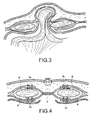
- the prosthetic element finds a particularly advantageous application in the event of eventration (figure 3).
- the central area (3) is arranged between the muscles (M), while the free end parts (1a) (2a) and (1b) (2b) partially cover the muscles by being attached to them by staples or the like, in combination with the aponeuroses (A) ( Figure 4).
- each layer (1) and (2) is composed of knitted polyester fibers connected by threads of the same kind to constitute the central three-dimensional zone (3).
- the whole is impregnated with purified collagen.
- Collagen is selected to facilitate the penetration of connective cells for better integration of the prosthetic element.
- the collagen is purified type I.
- the entire prosthetic element, as defined, is sterilized in particular by gamma radiation.
- the prosthetic element can be produced in different dimensions.
Landscapes
- Health & Medical Sciences (AREA)
- Engineering & Computer Science (AREA)
- Life Sciences & Earth Sciences (AREA)
- Animal Behavior & Ethology (AREA)
- Oral & Maxillofacial Surgery (AREA)
- Biomedical Technology (AREA)
- Heart & Thoracic Surgery (AREA)
- Vascular Medicine (AREA)
- Cardiology (AREA)
- Transplantation (AREA)
- General Health & Medical Sciences (AREA)
- Public Health (AREA)
- Veterinary Medicine (AREA)
- Textile Engineering (AREA)
- Prostheses (AREA)
- Laminated Bodies (AREA)
- Manufacturing Of Multi-Layer Textile Fabrics (AREA)
Description
- La figure 1 est une vue en perspective de l'élément prothétique selon un mode de réalisation.
- La figure 2 est une vue en coupe longitudinale considérée selon la ligne 2.2 de la figure 1.
- La figure 3 est une vue en coupe montrant une éventration médiane.
- La figure 4 est une vue montrant un exemple d'application de l'élément prothétique conforme au mode de réalisation illustré aux figures 1 et 2 dans le cas d'une éventration médiane, montrée figure 3.
- les hernies inguinales et crurales par voie trans-pariétale habituelle ou par coelioscopie,
- les éventrations,
- les prolapsus recto et génito-urinaires.
- le tricotage tridimensionnel confère à l'élément prothétique, une solidité accrue en le rendant indéformable, tout en gardant une grande souplesse,
- l'imprégnation des fibres par le collagène favorise leur colonisation par les cellules et permet une meilleure intégration de la prothèse dans les tissus.
Claims (3)
- Elément prothétique en matériau textile destiné au traitement des éventrations comprenant deux couches (1, 2) parallèles et accouplées entre elles dans leur partie centrale en définissant ainsi une zone centrale tridimensionnelle (3) et deux parties d'extrémité libres (1a, 2a; 1b, 2b) débordant de part et d'autre de ladite zone centrale (3), et aptes à enserrer partiellement un muscle, caractérisé en ce que ladite zone centrale tridimensionnelle (3) est réalisée par tricotage au moyen d'un métier double fonture.
- Elément prothétique selon la revendication 1, caractérisé en ce que le tricotage est réalisé en fibres de polyester.
- Elément prothétique selon la revendication 1 ou 2, caractérisé en ce que, après le tricotage, l'ensemble obtenu est imprégné de collagène purifié.
Applications Claiming Priority (2)
| Application Number | Priority Date | Filing Date | Title |
|---|---|---|---|
| FR9305185 | 1993-04-23 | ||
| FR9305185A FR2704139B1 (fr) | 1993-04-23 | 1993-04-23 | Ensemble prothetique en materiau textile. |
Publications (2)
| Publication Number | Publication Date |
|---|---|
| EP0621014A1 EP0621014A1 (fr) | 1994-10-26 |
| EP0621014B1 true EP0621014B1 (fr) | 2000-08-16 |
Family
ID=9446647
Family Applications (1)
| Application Number | Title | Priority Date | Filing Date |
|---|---|---|---|
| EP94420114A Expired - Lifetime EP0621014B1 (fr) | 1993-04-23 | 1994-04-08 | Ensemble prothétique en matériau textile |
Country Status (5)
| Country | Link |
|---|---|
| EP (1) | EP0621014B1 (fr) |
| CA (1) | CA2121394C (fr) |
| DE (1) | DE69425523T2 (fr) |
| ES (1) | ES2151537T3 (fr) |
| FR (1) | FR2704139B1 (fr) |
Cited By (3)
| Publication number | Priority date | Publication date | Assignee | Title |
|---|---|---|---|---|
| US8147478B2 (en) | 2000-09-07 | 2012-04-03 | Ams Research Corporation | Coated sling material |
| US9242026B2 (en) | 2008-06-27 | 2016-01-26 | Sofradim Production | Biosynthetic implant for soft tissue repair |
| WO2022187243A1 (fr) | 2021-03-01 | 2022-09-09 | Surgical Innovation Associates, Inc. | Maille et ses utilisations |
Families Citing this family (37)
| Publication number | Priority date | Publication date | Assignee | Title |
|---|---|---|---|---|
| FR2728776B1 (fr) * | 1994-12-30 | 1997-07-18 | Cogent Sarl | Element prothetique pour le traitement des hernies de l'aine, notamment par voie coelioscopique |
| FR2759899B1 (fr) * | 1997-02-27 | 1999-05-14 | Philippe Breil | Dispositif pour la correction des hernies |
| FR2766698B1 (fr) * | 1997-08-01 | 1999-11-05 | Cogent Sarl | Tissu prothetique tridimensionnel ajoure |
| DE10041347A1 (de) * | 2000-08-23 | 2002-03-07 | Ethicon Gmbh | Flächiges Implantat |
| US6592515B2 (en) | 2000-09-07 | 2003-07-15 | Ams Research Corporation | Implantable article and method |
| ES2192436B1 (es) * | 2000-11-24 | 2005-02-16 | Juan Manuel Bellon Caneiro | Protesis de pared de integracion al tejido con alta capacidad de estimulacion conjuntiva y mayor resistencia tensional. |
| US9308068B2 (en) | 2007-12-03 | 2016-04-12 | Sofradim Production | Implant for parastomal hernia |
| FR2924330B1 (fr) * | 2007-12-03 | 2009-11-20 | Sofradim Production | Implant pour hernie parastomiale |
| FR2929834B1 (fr) * | 2008-04-11 | 2011-01-28 | Sofradim Production | Clip chirurgical pour la fixation et le maintien d'une prothese herniaire |
| FR2929836B1 (fr) * | 2008-04-11 | 2011-01-28 | Sofradim Production | Dispositif pour le positionnement, le maintien et la fixation peripherique d'une prothese |
| FR2949688B1 (fr) | 2009-09-04 | 2012-08-24 | Sofradim Production | Tissu avec picots revetu d'une couche microporeuse bioresorbable |
| FR2972626B1 (fr) | 2011-03-16 | 2014-04-11 | Sofradim Production | Prothese comprenant un tricot tridimensionnel et ajoure |
| FR2977789B1 (fr) | 2011-07-13 | 2013-07-19 | Sofradim Production | Prothese pour hernie ombilicale |
| FR2977790B1 (fr) | 2011-07-13 | 2013-07-19 | Sofradim Production | Prothese pour hernie ombilicale |
| CN103781499B (zh) | 2011-09-30 | 2016-09-28 | 索弗拉狄姆产品公司 | 轻质网的可逆硬化 |
| FR2985271B1 (fr) | 2011-12-29 | 2014-01-24 | Sofradim Production | Tricot a picots |
| FR2985170B1 (fr) | 2011-12-29 | 2014-01-24 | Sofradim Production | Prothese pour hernie inguinale |
| FR2994185B1 (fr) | 2012-08-02 | 2015-07-31 | Sofradim Production | Procede de preparation d’une couche poreuse a base de chitosane |
| FR2995788B1 (fr) | 2012-09-25 | 2014-09-26 | Sofradim Production | Patch hemostatique et procede de preparation |
| FR2995779B1 (fr) | 2012-09-25 | 2015-09-25 | Sofradim Production | Prothese comprenant un treillis et un moyen de consolidation |
| FR2995778B1 (fr) | 2012-09-25 | 2015-06-26 | Sofradim Production | Prothese de renfort de la paroi abdominale et procede de fabrication |
| WO2014049446A2 (fr) | 2012-09-28 | 2014-04-03 | Sofradim Production | Emballage pour dispositif de réparation des hernies |
| FR3006581B1 (fr) | 2013-06-07 | 2016-07-22 | Sofradim Production | Prothese a base d’un textile pour voie laparoscopique |
| FR3006578B1 (fr) | 2013-06-07 | 2015-05-29 | Sofradim Production | Prothese a base d’un textile pour voie laparoscopique |
| EP3000489B1 (fr) | 2014-09-24 | 2017-04-05 | Sofradim Production | Procédé de préparation d'un film barrière anti-adhésion |
| EP3000433B1 (fr) | 2014-09-29 | 2022-09-21 | Sofradim Production | Dispositif pour introduire une prothèse pour le traitement de la hernie dans une incision et prothèse textile flexible |
| EP3000432B1 (fr) | 2014-09-29 | 2022-05-04 | Sofradim Production | Prothèse à base textile pour le traitement d'une hernie inguinale |
| EP3029189B1 (fr) | 2014-12-05 | 2021-08-11 | Sofradim Production | Tricot poreux prothétique, procédé pour son obtention et prothèse à hernie |
| EP3059255B1 (fr) | 2015-02-17 | 2020-05-13 | Sofradim Production | Méthode pour préparer une matrice de chitosane comprenant un élément de renfort fibreux |
| EP3085337B1 (fr) | 2015-04-24 | 2022-09-14 | Sofradim Production | Prothèse pour supporter une structure mammaire |
| EP3106185B1 (fr) | 2015-06-19 | 2018-04-25 | Sofradim Production | Prothèse synthétique comprenant un tricot et un film non poreux et méthode pour la former |
| EP3195830B1 (fr) | 2016-01-25 | 2020-11-18 | Sofradim Production | Prothèse de réparation de hernie |
| EP3312325B1 (fr) | 2016-10-21 | 2021-09-22 | Sofradim Production | Méthode pour la fabrication un treillis avec suture crantée attachée et treillis ainsi obtenu |
| EP3398554B1 (fr) | 2017-05-02 | 2025-06-25 | Sofradim Production | Prothèse pour réparation de hernie inguinale |
| EP3399084B1 (fr) * | 2017-05-02 | 2022-06-29 | Sofradim Production | Méthode pour former un tricot de base pour la manufacture de prothèses pour hernie |
| EP3653171B1 (fr) | 2018-11-16 | 2024-08-21 | Sofradim Production | Implants conçus pour la réparation de tissus mous |
| US12064330B2 (en) | 2020-04-28 | 2024-08-20 | Covidien Lp | Implantable prothesis for minimally invasive hernia repair |
Family Cites Families (8)
| Publication number | Priority date | Publication date | Assignee | Title |
|---|---|---|---|---|
| US3124136A (en) * | 1964-03-10 | Method of repairing body tissue | ||
| DE907115C (de) * | 1953-01-09 | 1954-03-22 | Emil Huber | Vorrichtung zum Beheben von Bruchleiden ohne Bruchband und ohne groesseren operativen Eingriff |
| US3276448A (en) * | 1962-12-14 | 1966-10-04 | Ethicon Inc | Collagen coated fabric prosthesis |
| US4769038A (en) * | 1986-03-18 | 1988-09-06 | C. R. Bard, Inc. | Prostheses and techniques and repair of inguinal and femoral hernias |
| US4854316A (en) * | 1986-10-03 | 1989-08-08 | Davis Emsley A | Apparatus and method for repairing and preventing para-stomal hernias |
| FR2628634B1 (fr) * | 1988-03-15 | 1990-07-13 | Imedex | Patch de chirurgie viscerale |
| US5254133A (en) * | 1991-04-24 | 1993-10-19 | Seid Arnold S | Surgical implantation device and related method of use |
| US5147374A (en) * | 1991-12-05 | 1992-09-15 | Alfredo Fernandez | Prosthetic mesh patch for hernia repair |
-
1993
- 1993-04-23 FR FR9305185A patent/FR2704139B1/fr not_active Expired - Lifetime
-
1994
- 1994-04-08 DE DE69425523T patent/DE69425523T2/de not_active Expired - Lifetime
- 1994-04-08 ES ES94420114T patent/ES2151537T3/es not_active Expired - Lifetime
- 1994-04-08 EP EP94420114A patent/EP0621014B1/fr not_active Expired - Lifetime
- 1994-04-15 CA CA002121394A patent/CA2121394C/fr not_active Expired - Fee Related
Cited By (4)
| Publication number | Priority date | Publication date | Assignee | Title |
|---|---|---|---|---|
| US8147478B2 (en) | 2000-09-07 | 2012-04-03 | Ams Research Corporation | Coated sling material |
| US9242026B2 (en) | 2008-06-27 | 2016-01-26 | Sofradim Production | Biosynthetic implant for soft tissue repair |
| WO2022187243A1 (fr) | 2021-03-01 | 2022-09-09 | Surgical Innovation Associates, Inc. | Maille et ses utilisations |
| EP4301275A4 (fr) * | 2021-03-01 | 2024-12-18 | Surgical Innovation Associates, Inc. | Maille et ses utilisations |
Also Published As
| Publication number | Publication date |
|---|---|
| DE69425523T2 (de) | 2001-06-13 |
| FR2704139B1 (fr) | 1995-08-04 |
| CA2121394A1 (fr) | 1994-10-24 |
| ES2151537T3 (es) | 2001-01-01 |
| CA2121394C (fr) | 2005-01-11 |
| EP0621014A1 (fr) | 1994-10-26 |
| DE69425523D1 (de) | 2000-09-21 |
| FR2704139A1 (fr) | 1994-10-28 |
Similar Documents
| Publication | Publication Date | Title |
|---|---|---|
| CA2121394C (fr) | Ensemble prothetique en materiau textile | |
| EP2391299B1 (fr) | Plaque implantable pour la réfection de parois | |
| EP0999805B1 (fr) | Tissu prothetique tridimensionnel ajoure | |
| EP1274892B1 (fr) | Tricot prothetique agrippant et implant de renfort pour le traitement des deficits parietaux | |
| EP3691567B1 (fr) | Insert textile a finalité médicale et son procédé de fabrication | |
| EP1024764B1 (fr) | Implant prothetique obturateur de canal anatomique, et ensemble d'obturation le comportant | |
| EP1229866B1 (fr) | Dispositif de protection des nerfs apres intervention chirurgicale | |
| FR2924330A1 (fr) | Implant pour hernie parastomiale | |
| FR2720266A1 (fr) | Tissu prothétique. | |
| FR2977789A1 (fr) | Prothese pour hernie ombilicale | |
| WO1996041588A1 (fr) | Prothese interne sous forme d'un support textile ou autre et son appareil d'insertion par voie coelioscopique | |
| CH654995A5 (en) | Prosthesis for replacing a cardiac valve | |
| EP1432859A1 (fr) | Renfort de paroi en tricot tridimensionnel et ajoure | |
| FR2935605A1 (fr) | Prothese comprenant un assemblage de tricots, sonotrode et procede de fabrication par soudure sonique | |
| EP1538248A1 (fr) | Tricot chaíne à usage chirurgical | |
| HUE031569T2 (en) | Orthotopic artificial bladder endoprosthesis | |
| FR2666219A1 (fr) | Ligament prothetique pour le renforcement du tendon rotulien verticalise par retournement des fibres externes dudit tendon. | |
| WO2012160308A1 (fr) | Structure textile tricotee pour la realisation d'implants | |
| CN101573083B (zh) | 单件造瘘口支撑植入物及其制造方法 | |
| FR3006580A1 (fr) | Prothese pour hernie | |
| JP7393228B2 (ja) | 医療用筒状埋込材 | |
| RU98106382A (ru) | Имплантируемый опорный элемент для крепления искусственных зубов | |
| EP1343432B1 (fr) | Implant prothetique pour orifice anatomique ou chirurgical | |
| BE839830A (fr) | Greffon vasculaire synthetique et procede de fabrication de celui-ci | |
| FR2929836A1 (fr) | Dispositif pour le positionnement, le maintien et la fixation peripherique d'une prothese |
Legal Events
| Date | Code | Title | Description |
|---|---|---|---|
| PUAI | Public reference made under article 153(3) epc to a published international application that has entered the european phase |
Free format text: ORIGINAL CODE: 0009012 |
|
| AK | Designated contracting states |
Kind code of ref document: A1 Designated state(s): BE CH DE ES IT LI LU |
|
| 17P | Request for examination filed |
Effective date: 19950413 |
|
| 17Q | First examination report despatched |
Effective date: 19961204 |
|
| REG | Reference to a national code |
Ref country code: CH Ref legal event code: PLI Owner name: SGRO, JEAN-CLAUDE TRANSFER- COGENT S.A.R.L. |
|
| 111L | Licence recorded |
Free format text: 970711 0100 COGENT S.A.R.L. |
|
| GRAG | Despatch of communication of intention to grant |
Free format text: ORIGINAL CODE: EPIDOS AGRA |
|
| GRAG | Despatch of communication of intention to grant |
Free format text: ORIGINAL CODE: EPIDOS AGRA |
|
| GRAH | Despatch of communication of intention to grant a patent |
Free format text: ORIGINAL CODE: EPIDOS IGRA |
|
| GRAH | Despatch of communication of intention to grant a patent |
Free format text: ORIGINAL CODE: EPIDOS IGRA |
|
| GRAA | (expected) grant |
Free format text: ORIGINAL CODE: 0009210 |
|
| AK | Designated contracting states |
Kind code of ref document: B1 Designated state(s): BE CH DE ES IT LI LU |
|
| REG | Reference to a national code |
Ref country code: CH Ref legal event code: EP |
|
| REF | Corresponds to: |
Ref document number: 69425523 Country of ref document: DE Date of ref document: 20000921 |
|
| ITF | It: translation for a ep patent filed | ||
| REG | Reference to a national code |
Ref country code: ES Ref legal event code: FG2A Ref document number: 2151537 Country of ref document: ES Kind code of ref document: T3 |
|
| PG25 | Lapsed in a contracting state [announced via postgrant information from national office to epo] |
Ref country code: LU Free format text: LAPSE BECAUSE OF NON-PAYMENT OF DUE FEES Effective date: 20010408 |
|
| PG25 | Lapsed in a contracting state [announced via postgrant information from national office to epo] |
Ref country code: BE Free format text: LAPSE BECAUSE OF NON-PAYMENT OF DUE FEES Effective date: 20010430 |
|
| PG25 | Lapsed in a contracting state [announced via postgrant information from national office to epo] |
Ref country code: LI Free format text: LAPSE BECAUSE OF NON-PAYMENT OF DUE FEES Effective date: 20010507 Ref country code: CH Free format text: LAPSE BECAUSE OF NON-PAYMENT OF DUE FEES Effective date: 20010507 |
|
| PLBE | No opposition filed within time limit |
Free format text: ORIGINAL CODE: 0009261 |
|
| STAA | Information on the status of an ep patent application or granted ep patent |
Free format text: STATUS: NO OPPOSITION FILED WITHIN TIME LIMIT |
|
| 26N | No opposition filed | ||
| BERE | Be: lapsed |
Owner name: SGRO JEAN-CLAUDE Effective date: 20010430 |
|
| REG | Reference to a national code |
Ref country code: CH Ref legal event code: PL |
|
| PGFP | Annual fee paid to national office [announced via postgrant information from national office to epo] |
Ref country code: ES Payment date: 20120426 Year of fee payment: 19 |
|
| PGFP | Annual fee paid to national office [announced via postgrant information from national office to epo] |
Ref country code: DE Payment date: 20130429 Year of fee payment: 20 |
|
| PGFP | Annual fee paid to national office [announced via postgrant information from national office to epo] |
Ref country code: IT Payment date: 20130422 Year of fee payment: 20 |
|
| REG | Reference to a national code |
Ref country code: DE Ref legal event code: R071 Ref document number: 69425523 Country of ref document: DE |
|
| REG | Reference to a national code |
Ref country code: DE Ref legal event code: R071 Ref document number: 69425523 Country of ref document: DE |
|
| PG25 | Lapsed in a contracting state [announced via postgrant information from national office to epo] |
Ref country code: DE Free format text: LAPSE BECAUSE OF EXPIRATION OF PROTECTION Effective date: 20140409 |
|
| REG | Reference to a national code |
Ref country code: ES Ref legal event code: FD2A Effective date: 20140926 |
|
| PG25 | Lapsed in a contracting state [announced via postgrant information from national office to epo] |
Ref country code: ES Free format text: LAPSE BECAUSE OF EXPIRATION OF PROTECTION Effective date: 20140409 |