EP0619815B1 - Process for the preparation of 4-methyl-5-(2-chloroethyl)-thiazole and analogues thereof - Google Patents
Process for the preparation of 4-methyl-5-(2-chloroethyl)-thiazole and analogues thereof Download PDFInfo
- Publication number
- EP0619815B1 EP0619815B1 EP92923097A EP92923097A EP0619815B1 EP 0619815 B1 EP0619815 B1 EP 0619815B1 EP 92923097 A EP92923097 A EP 92923097A EP 92923097 A EP92923097 A EP 92923097A EP 0619815 B1 EP0619815 B1 EP 0619815B1
- Authority
- EP
- European Patent Office
- Prior art keywords
- general formula
- chloro
- thiazole
- methyl
- compound
- Prior art date
- Legal status (The legal status is an assumption and is not a legal conclusion. Google has not performed a legal analysis and makes no representation as to the accuracy of the status listed.)
- Expired - Lifetime
Links
- 238000000034 method Methods 0.000 title claims abstract description 43
- 238000002360 preparation method Methods 0.000 title claims abstract description 16
- PCLITLDOTJTVDJ-UHFFFAOYSA-N Chlormethiazole Chemical compound CC=1N=CSC=1CCCl PCLITLDOTJTVDJ-UHFFFAOYSA-N 0.000 title description 8
- 150000001875 compounds Chemical class 0.000 claims abstract description 59
- VEXZGXHMUGYJMC-UHFFFAOYSA-N Hydrochloric acid Chemical compound Cl VEXZGXHMUGYJMC-UHFFFAOYSA-N 0.000 claims abstract description 27
- 239000003960 organic solvent Substances 0.000 claims abstract description 14
- 239000002253 acid Substances 0.000 claims abstract description 12
- 230000002140 halogenating effect Effects 0.000 claims abstract description 8
- 239000003795 chemical substances by application Substances 0.000 claims abstract description 5
- 229910052500 inorganic mineral Inorganic materials 0.000 claims abstract description 5
- 239000011707 mineral Substances 0.000 claims abstract description 5
- IXCSERBJSXMMFS-UHFFFAOYSA-N hydrogen chloride Substances Cl.Cl IXCSERBJSXMMFS-UHFFFAOYSA-N 0.000 claims abstract description 3
- 229910000041 hydrogen chloride Inorganic materials 0.000 claims abstract description 3
- XLYOFNOQVPJJNP-UHFFFAOYSA-N water Substances O XLYOFNOQVPJJNP-UHFFFAOYSA-N 0.000 claims description 24
- -1 2-chlorobutyl Chemical group 0.000 claims description 17
- KDLHZDBZIXYQEI-UHFFFAOYSA-N Palladium Chemical compound [Pd] KDLHZDBZIXYQEI-UHFFFAOYSA-N 0.000 claims description 17
- 239000003054 catalyst Substances 0.000 claims description 14
- DKPFZGUDAPQIHT-UHFFFAOYSA-N Butyl acetate Natural products CCCCOC(C)=O DKPFZGUDAPQIHT-UHFFFAOYSA-N 0.000 claims description 13
- FUZZWVXGSFPDMH-UHFFFAOYSA-N hexanoic acid Chemical compound CCCCCC(O)=O FUZZWVXGSFPDMH-UHFFFAOYSA-N 0.000 claims description 13
- NBIIXXVUZAFLBC-UHFFFAOYSA-N Phosphoric acid Chemical compound OP(O)(O)=O NBIIXXVUZAFLBC-UHFFFAOYSA-N 0.000 claims description 12
- XHXFXVLFKHQFAL-UHFFFAOYSA-N phosphoryl trichloride Chemical compound ClP(Cl)(Cl)=O XHXFXVLFKHQFAL-UHFFFAOYSA-N 0.000 claims description 12
- 125000001340 2-chloroethyl group Chemical group [H]C([H])(Cl)C([H])([H])* 0.000 claims description 8
- 238000005984 hydrogenation reaction Methods 0.000 claims description 7
- 239000002904 solvent Substances 0.000 claims description 7
- KKZUMAMOMRDVKA-UHFFFAOYSA-N 2-chloropropane Chemical group [CH2]C(C)Cl KKZUMAMOMRDVKA-UHFFFAOYSA-N 0.000 claims description 6
- ZMANZCXQSJIPKH-UHFFFAOYSA-N Triethylamine Chemical compound CCN(CC)CC ZMANZCXQSJIPKH-UHFFFAOYSA-N 0.000 claims description 6
- 229910000147 aluminium phosphate Inorganic materials 0.000 claims description 6
- 229910052763 palladium Inorganic materials 0.000 claims description 6
- ZNNZYHKDIALBAK-UHFFFAOYSA-M potassium thiocyanate Chemical compound [K+].[S-]C#N ZNNZYHKDIALBAK-UHFFFAOYSA-M 0.000 claims description 5
- 150000003839 salts Chemical class 0.000 claims description 5
- VGTPCRGMBIAPIM-UHFFFAOYSA-M sodium thiocyanate Chemical group [Na+].[S-]C#N VGTPCRGMBIAPIM-UHFFFAOYSA-M 0.000 claims description 5
- 150000004945 aromatic hydrocarbons Chemical class 0.000 claims description 4
- 150000002148 esters Chemical class 0.000 claims description 4
- BUGBHKTXTAQXES-UHFFFAOYSA-N Selenium Chemical compound [Se] BUGBHKTXTAQXES-UHFFFAOYSA-N 0.000 claims description 3
- ZMZDMBWJUHKJPS-UHFFFAOYSA-M Thiocyanate anion Chemical compound [S-]C#N ZMZDMBWJUHKJPS-UHFFFAOYSA-M 0.000 claims description 3
- SOIFLUNRINLCBN-UHFFFAOYSA-N ammonium thiocyanate Chemical compound [NH4+].[S-]C#N SOIFLUNRINLCBN-UHFFFAOYSA-N 0.000 claims description 3
- 235000014113 dietary fatty acids Nutrition 0.000 claims description 3
- 150000002170 ethers Chemical class 0.000 claims description 3
- 239000000194 fatty acid Substances 0.000 claims description 3
- 229930195729 fatty acid Natural products 0.000 claims description 3
- 150000004665 fatty acids Chemical class 0.000 claims description 3
- 239000007789 gas Substances 0.000 claims description 3
- 229910052711 selenium Inorganic materials 0.000 claims description 3
- 239000011669 selenium Substances 0.000 claims description 3
- KJTLSVCANCCWHF-UHFFFAOYSA-N Ruthenium Chemical compound [Ru] KJTLSVCANCCWHF-UHFFFAOYSA-N 0.000 claims description 2
- 125000003118 aryl group Chemical group 0.000 claims description 2
- 239000011230 binding agent Substances 0.000 claims description 2
- UHZYTMXLRWXGPK-UHFFFAOYSA-N phosphorus pentachloride Chemical compound ClP(Cl)(Cl)(Cl)Cl UHZYTMXLRWXGPK-UHFFFAOYSA-N 0.000 claims description 2
- FAIAAWCVCHQXDN-UHFFFAOYSA-N phosphorus trichloride Chemical compound ClP(Cl)Cl FAIAAWCVCHQXDN-UHFFFAOYSA-N 0.000 claims description 2
- 229910052703 rhodium Inorganic materials 0.000 claims description 2
- 239000010948 rhodium Substances 0.000 claims description 2
- MHOVAHRLVXNVSD-UHFFFAOYSA-N rhodium atom Chemical compound [Rh] MHOVAHRLVXNVSD-UHFFFAOYSA-N 0.000 claims description 2
- 229910052707 ruthenium Inorganic materials 0.000 claims description 2
- ZMZDMBWJUHKJPS-UHFFFAOYSA-N hydrogen thiocyanate Natural products SC#N ZMZDMBWJUHKJPS-UHFFFAOYSA-N 0.000 claims 2
- QCQCHGYLTSGIGX-GHXANHINSA-N 4-[[(3ar,5ar,5br,7ar,9s,11ar,11br,13as)-5a,5b,8,8,11a-pentamethyl-3a-[(5-methylpyridine-3-carbonyl)amino]-2-oxo-1-propan-2-yl-4,5,6,7,7a,9,10,11,11b,12,13,13a-dodecahydro-3h-cyclopenta[a]chrysen-9-yl]oxy]-2,2-dimethyl-4-oxobutanoic acid Chemical compound N([C@@]12CC[C@@]3(C)[C@]4(C)CC[C@H]5C(C)(C)[C@@H](OC(=O)CC(C)(C)C(O)=O)CC[C@]5(C)[C@H]4CC[C@@H]3C1=C(C(C2)=O)C(C)C)C(=O)C1=CN=CC(C)=C1 QCQCHGYLTSGIGX-GHXANHINSA-N 0.000 claims 1
- 239000003849 aromatic solvent Substances 0.000 claims 1
- 229940116357 potassium thiocyanate Drugs 0.000 claims 1
- 238000007363 ring formation reaction Methods 0.000 claims 1
- 239000000543 intermediate Substances 0.000 abstract description 3
- 125000006531 (C2-C5) alkyl group Chemical group 0.000 abstract 1
- 239000008194 pharmaceutical composition Substances 0.000 abstract 1
- 239000000460 chlorine Substances 0.000 description 37
- UHOVQNZJYSORNB-UHFFFAOYSA-N Benzene Chemical compound C1=CC=CC=C1 UHOVQNZJYSORNB-UHFFFAOYSA-N 0.000 description 33
- LFQSCWFLJHTTHZ-UHFFFAOYSA-N Ethanol Chemical compound CCO LFQSCWFLJHTTHZ-UHFFFAOYSA-N 0.000 description 29
- 239000000047 product Substances 0.000 description 19
- CSCPPACGZOOCGX-UHFFFAOYSA-N Acetone Chemical compound CC(C)=O CSCPPACGZOOCGX-UHFFFAOYSA-N 0.000 description 18
- XEKOWRVHYACXOJ-UHFFFAOYSA-N Ethyl acetate Chemical compound CCOC(C)=O XEKOWRVHYACXOJ-UHFFFAOYSA-N 0.000 description 18
- 238000009835 boiling Methods 0.000 description 17
- 239000011541 reaction mixture Substances 0.000 description 16
- 238000004458 analytical method Methods 0.000 description 15
- QTBSBXVTEAMEQO-UHFFFAOYSA-N Acetic acid Chemical compound CC(O)=O QTBSBXVTEAMEQO-UHFFFAOYSA-N 0.000 description 14
- 229910052774 Proactinium Inorganic materials 0.000 description 12
- UIIMBOGNXHQVGW-UHFFFAOYSA-M Sodium bicarbonate Chemical compound [Na+].OC([O-])=O UIIMBOGNXHQVGW-UHFFFAOYSA-M 0.000 description 12
- 238000006243 chemical reaction Methods 0.000 description 12
- MVPPADPHJFYWMZ-UHFFFAOYSA-N chlorobenzene Chemical compound ClC1=CC=CC=C1 MVPPADPHJFYWMZ-UHFFFAOYSA-N 0.000 description 12
- 238000001816 cooling Methods 0.000 description 11
- HEMHJVSKTPXQMS-UHFFFAOYSA-M sodium hydroxide Inorganic materials [OH-].[Na+] HEMHJVSKTPXQMS-UHFFFAOYSA-M 0.000 description 11
- QOCBYUYXAYWNIW-UHFFFAOYSA-N 2-chloro-5-(2-chloroethyl)-4-methyl-1,3-thiazole Chemical compound CC=1N=C(Cl)SC=1CCCl QOCBYUYXAYWNIW-UHFFFAOYSA-N 0.000 description 10
- HEDRZPFGACZZDS-UHFFFAOYSA-N Chloroform Chemical compound ClC(Cl)Cl HEDRZPFGACZZDS-UHFFFAOYSA-N 0.000 description 10
- 230000015572 biosynthetic process Effects 0.000 description 10
- 238000003756 stirring Methods 0.000 description 10
- ZWEHNKRNPOVVGH-UHFFFAOYSA-N 2-Butanone Chemical compound CCC(C)=O ZWEHNKRNPOVVGH-UHFFFAOYSA-N 0.000 description 9
- OKKJLVBELUTLKV-UHFFFAOYSA-N Methanol Chemical compound OC OKKJLVBELUTLKV-UHFFFAOYSA-N 0.000 description 9
- MUNVMJWLFQIMTQ-UHFFFAOYSA-N (1-chloro-4-oxopentan-3-yl) thiocyanate Chemical compound ClCCC(C(=O)C)SC#N MUNVMJWLFQIMTQ-UHFFFAOYSA-N 0.000 description 8
- PMZURENOXWZQFD-UHFFFAOYSA-L Sodium Sulfate Chemical compound [Na+].[Na+].[O-]S([O-])(=O)=O PMZURENOXWZQFD-UHFFFAOYSA-L 0.000 description 8
- 238000004821 distillation Methods 0.000 description 8
- NOSBOKVYSXXKFL-UHFFFAOYSA-N 3,5-dichloropentan-2-one Chemical compound CC(=O)C(Cl)CCCl NOSBOKVYSXXKFL-UHFFFAOYSA-N 0.000 description 7
- YXFVVABEGXRONW-UHFFFAOYSA-N Toluene Chemical compound CC1=CC=CC=C1 YXFVVABEGXRONW-UHFFFAOYSA-N 0.000 description 6
- 229940093499 ethyl acetate Drugs 0.000 description 6
- 235000019439 ethyl acetate Nutrition 0.000 description 6
- 239000007788 liquid Substances 0.000 description 6
- 235000017557 sodium bicarbonate Nutrition 0.000 description 6
- 229910000030 sodium bicarbonate Inorganic materials 0.000 description 6
- 229910052938 sodium sulfate Inorganic materials 0.000 description 6
- 235000011152 sodium sulphate Nutrition 0.000 description 6
- 238000003786 synthesis reaction Methods 0.000 description 6
- 229960000583 acetic acid Drugs 0.000 description 5
- 238000001704 evaporation Methods 0.000 description 5
- 239000000203 mixture Substances 0.000 description 5
- 239000012071 phase Substances 0.000 description 5
- HJLZTYJNTROXOS-UHFFFAOYSA-N 5-(2-chloroethyl)-4-methyl-3h-1,3-thiazol-2-one Chemical compound CC=1NC(=O)SC=1CCCl HJLZTYJNTROXOS-UHFFFAOYSA-N 0.000 description 4
- KFZMGEQAYNKOFK-UHFFFAOYSA-N Isopropanol Chemical compound CC(C)O KFZMGEQAYNKOFK-UHFFFAOYSA-N 0.000 description 4
- PXHVJJICTQNCMI-UHFFFAOYSA-N Nickel Chemical compound [Ni] PXHVJJICTQNCMI-UHFFFAOYSA-N 0.000 description 4
- FAPWRFPIFSIZLT-UHFFFAOYSA-M Sodium chloride Chemical compound [Na+].[Cl-] FAPWRFPIFSIZLT-UHFFFAOYSA-M 0.000 description 4
- FZWLAAWBMGSTSO-UHFFFAOYSA-N Thiazole Chemical group C1=CSC=N1 FZWLAAWBMGSTSO-UHFFFAOYSA-N 0.000 description 4
- 239000008346 aqueous phase Substances 0.000 description 4
- 125000001309 chloro group Chemical group Cl* 0.000 description 4
- FKRCODPIKNYEAC-UHFFFAOYSA-N ethyl propionate Chemical compound CCOC(=O)CC FKRCODPIKNYEAC-UHFFFAOYSA-N 0.000 description 4
- 230000008020 evaporation Effects 0.000 description 4
- 239000000706 filtrate Substances 0.000 description 4
- 238000001914 filtration Methods 0.000 description 4
- 238000004817 gas chromatography Methods 0.000 description 4
- 238000002329 infrared spectrum Methods 0.000 description 4
- 150000002540 isothiocyanates Chemical class 0.000 description 4
- CYEBJEDOHLIWNP-UHFFFAOYSA-N methanethioamide Chemical compound NC=S CYEBJEDOHLIWNP-UHFFFAOYSA-N 0.000 description 4
- BDERNNFJNOPAEC-UHFFFAOYSA-N propan-1-ol Chemical compound CCCO BDERNNFJNOPAEC-UHFFFAOYSA-N 0.000 description 4
- 239000000725 suspension Substances 0.000 description 4
- ZHGFGCVGAWZQNQ-UHFFFAOYSA-N (5-chloro-2-oxoheptan-3-yl) thiocyanate Chemical compound CCC(Cl)CC(C(C)=O)SC#N ZHGFGCVGAWZQNQ-UHFFFAOYSA-N 0.000 description 3
- OELCKVRGGUWIKQ-UHFFFAOYSA-N (5-chloro-2-oxohexan-3-yl) thiocyanate Chemical compound CC(Cl)CC(C(C)=O)SC#N OELCKVRGGUWIKQ-UHFFFAOYSA-N 0.000 description 3
- UBOXGVDOUJQMTN-UHFFFAOYSA-N 1,1,2-trichloroethane Chemical compound ClCC(Cl)Cl UBOXGVDOUJQMTN-UHFFFAOYSA-N 0.000 description 3
- PBKONEOXTCPAFI-UHFFFAOYSA-N 1,2,4-trichlorobenzene Chemical compound ClC1=CC=C(Cl)C(Cl)=C1 PBKONEOXTCPAFI-UHFFFAOYSA-N 0.000 description 3
- RFFLAFLAYFXFSW-UHFFFAOYSA-N 1,2-dichlorobenzene Chemical compound ClC1=CC=CC=C1Cl RFFLAFLAYFXFSW-UHFFFAOYSA-N 0.000 description 3
- OCFJOPKQBDPPGU-UHFFFAOYSA-N 2-chloro-5-(2-chlorobutyl)-4-methyl-1,3-thiazole Chemical compound CCC(Cl)CC=1SC(Cl)=NC=1C OCFJOPKQBDPPGU-UHFFFAOYSA-N 0.000 description 3
- ZQGSRCVHQGHGOT-UHFFFAOYSA-N 2-chloro-5-(2-chloropropyl)-4-methyl-1,3-thiazole Chemical compound CC(Cl)CC=1SC(Cl)=NC=1C ZQGSRCVHQGHGOT-UHFFFAOYSA-N 0.000 description 3
- RDLSLDUOUDBZEE-UHFFFAOYSA-N 3,5-dichlorohexan-2-one Chemical compound CC(Cl)CC(Cl)C(C)=O RDLSLDUOUDBZEE-UHFFFAOYSA-N 0.000 description 3
- KWYUFKZDYYNOTN-UHFFFAOYSA-M Potassium hydroxide Chemical compound [OH-].[K+] KWYUFKZDYYNOTN-UHFFFAOYSA-M 0.000 description 3
- 229960004414 clomethiazole Drugs 0.000 description 3
- 239000000155 melt Substances 0.000 description 3
- 238000002844 melting Methods 0.000 description 3
- 230000008018 melting Effects 0.000 description 3
- 229910052751 metal Inorganic materials 0.000 description 3
- 239000002184 metal Substances 0.000 description 3
- 229940032007 methylethyl ketone Drugs 0.000 description 3
- 230000007935 neutral effect Effects 0.000 description 3
- 229920006395 saturated elastomer Polymers 0.000 description 3
- 150000007979 thiazole derivatives Chemical class 0.000 description 3
- 0 *c1c(*)[s]cn1 Chemical compound *c1c(*)[s]cn1 0.000 description 2
- QPFMBZIOSGYJDE-UHFFFAOYSA-N 1,1,2,2-tetrachloroethane Chemical compound ClC(Cl)C(Cl)Cl QPFMBZIOSGYJDE-UHFFFAOYSA-N 0.000 description 2
- WSLDOOZREJYCGB-UHFFFAOYSA-N 1,2-Dichloroethane Chemical compound ClCCCl WSLDOOZREJYCGB-UHFFFAOYSA-N 0.000 description 2
- RAIPHJJURHTUIC-UHFFFAOYSA-N 1,3-thiazol-2-amine Chemical class NC1=NC=CS1 RAIPHJJURHTUIC-UHFFFAOYSA-N 0.000 description 2
- DCYIWPGXDRVDSG-UHFFFAOYSA-N 3,5-dichloroheptan-2-one Chemical compound CCC(Cl)CC(Cl)C(C)=O DCYIWPGXDRVDSG-UHFFFAOYSA-N 0.000 description 2
- OZEKTIKQEZYCJF-UHFFFAOYSA-N 3-acetyl-3-chloro-5-ethyloxolan-2-one Chemical compound CCC1CC(Cl)(C(C)=O)C(=O)O1 OZEKTIKQEZYCJF-UHFFFAOYSA-N 0.000 description 2
- CZWWCTHQXBMHDA-UHFFFAOYSA-N 3h-1,3-thiazol-2-one Chemical class OC1=NC=CS1 CZWWCTHQXBMHDA-UHFFFAOYSA-N 0.000 description 2
- OCVLSHAVSIYKLI-UHFFFAOYSA-N 3h-1,3-thiazole-2-thione Chemical class SC1=NC=CS1 OCVLSHAVSIYKLI-UHFFFAOYSA-N 0.000 description 2
- SYTQSMOVMUXZOG-UHFFFAOYSA-N 5-(2-chlorobutyl)-4-methyl-3h-1,3-thiazol-2-one Chemical compound CCC(Cl)CC=1SC(O)=NC=1C SYTQSMOVMUXZOG-UHFFFAOYSA-N 0.000 description 2
- OFXYKSLKNMTBHK-UHFFFAOYSA-N 5-(2-chloroethyl)-4-methyl-1,3-thiazole;hydrochloride Chemical compound Cl.CC=1N=CSC=1CCCl OFXYKSLKNMTBHK-UHFFFAOYSA-N 0.000 description 2
- VTOZAWFXXADUTJ-UHFFFAOYSA-N 5-(2-chloropropyl)-4-methyl-3h-1,3-thiazol-2-one Chemical compound CC(Cl)CC=1SC(O)=NC=1C VTOZAWFXXADUTJ-UHFFFAOYSA-N 0.000 description 2
- XTHFKEDIFFGKHM-UHFFFAOYSA-N Dimethoxyethane Chemical compound COCCOC XTHFKEDIFFGKHM-UHFFFAOYSA-N 0.000 description 2
- ZHNUHDYFZUAESO-UHFFFAOYSA-N Formamide Chemical compound NC=O ZHNUHDYFZUAESO-UHFFFAOYSA-N 0.000 description 2
- MHAJPDPJQMAIIY-UHFFFAOYSA-N Hydrogen peroxide Chemical compound OO MHAJPDPJQMAIIY-UHFFFAOYSA-N 0.000 description 2
- DGAQECJNVWCQMB-PUAWFVPOSA-M Ilexoside XXIX Chemical compound C[C@@H]1CC[C@@]2(CC[C@@]3(C(=CC[C@H]4[C@]3(CC[C@@H]5[C@@]4(CC[C@@H](C5(C)C)OS(=O)(=O)[O-])C)C)[C@@H]2[C@]1(C)O)C)C(=O)O[C@H]6[C@@H]([C@H]([C@@H]([C@H](O6)CO)O)O)O.[Na+] DGAQECJNVWCQMB-PUAWFVPOSA-M 0.000 description 2
- LRHPLDYGYMQRHN-UHFFFAOYSA-N N-Butanol Chemical compound CCCCO LRHPLDYGYMQRHN-UHFFFAOYSA-N 0.000 description 2
- WCUXLLCKKVVCTQ-UHFFFAOYSA-M Potassium chloride Chemical compound [Cl-].[K+] WCUXLLCKKVVCTQ-UHFFFAOYSA-M 0.000 description 2
- 239000007868 Raney catalyst Substances 0.000 description 2
- 229910000564 Raney nickel Inorganic materials 0.000 description 2
- 239000013543 active substance Substances 0.000 description 2
- 150000001299 aldehydes Chemical class 0.000 description 2
- 239000006227 byproduct Substances 0.000 description 2
- 239000003153 chemical reaction reagent Substances 0.000 description 2
- 238000005695 dehalogenation reaction Methods 0.000 description 2
- 238000006193 diazotization reaction Methods 0.000 description 2
- RCJVRSBWZCNNQT-UHFFFAOYSA-N dichlorine monoxide Inorganic materials ClOCl RCJVRSBWZCNNQT-UHFFFAOYSA-N 0.000 description 2
- 125000003963 dichloro group Chemical group Cl* 0.000 description 2
- XBDQKXXYIPTUBI-UHFFFAOYSA-N dimethylselenoniopropionate Natural products CCC(O)=O XBDQKXXYIPTUBI-UHFFFAOYSA-N 0.000 description 2
- 238000001035 drying Methods 0.000 description 2
- 229910052736 halogen Inorganic materials 0.000 description 2
- 125000005843 halogen group Chemical group 0.000 description 2
- 150000002391 heterocyclic compounds Chemical class 0.000 description 2
- BHEPBYXIRTUNPN-UHFFFAOYSA-N hydridophosphorus(.) (triplet) Chemical compound [PH] BHEPBYXIRTUNPN-UHFFFAOYSA-N 0.000 description 2
- JMMWKPVZQRWMSS-UHFFFAOYSA-N isopropanol acetate Natural products CC(C)OC(C)=O JMMWKPVZQRWMSS-UHFFFAOYSA-N 0.000 description 2
- 229940011051 isopropyl acetate Drugs 0.000 description 2
- GWYFCOCPABKNJV-UHFFFAOYSA-N isovaleric acid Chemical compound CC(C)CC(O)=O GWYFCOCPABKNJV-UHFFFAOYSA-N 0.000 description 2
- 230000001376 precipitating effect Effects 0.000 description 2
- 238000001953 recrystallisation Methods 0.000 description 2
- 239000011780 sodium chloride Substances 0.000 description 2
- 239000007787 solid Substances 0.000 description 2
- 239000007858 starting material Substances 0.000 description 2
- 239000000126 substance Substances 0.000 description 2
- 125000001424 substituent group Chemical group 0.000 description 2
- VZGDMQKNWNREIO-UHFFFAOYSA-N tetrachloromethane Chemical compound ClC(Cl)(Cl)Cl VZGDMQKNWNREIO-UHFFFAOYSA-N 0.000 description 2
- FYSNRJHAOHDILO-UHFFFAOYSA-N thionyl chloride Chemical compound ClS(Cl)=O FYSNRJHAOHDILO-UHFFFAOYSA-N 0.000 description 2
- UMGDCJDMYOKAJW-UHFFFAOYSA-N thiourea Chemical compound NC(N)=S UMGDCJDMYOKAJW-UHFFFAOYSA-N 0.000 description 2
- XNWFRZJHXBZDAG-UHFFFAOYSA-N 2-METHOXYETHANOL Chemical compound COCCO XNWFRZJHXBZDAG-UHFFFAOYSA-N 0.000 description 1
- BEGREHRAUWCAHV-UHFFFAOYSA-N 2-bromo-1,3-thiazole-4-carboxylic acid Chemical compound OC(=O)C1=CSC(Br)=N1 BEGREHRAUWCAHV-UHFFFAOYSA-N 0.000 description 1
- POAOYUHQDCAZBD-UHFFFAOYSA-N 2-butoxyethanol Chemical compound CCCCOCCO POAOYUHQDCAZBD-UHFFFAOYSA-N 0.000 description 1
- ZNQVEEAIQZEUHB-UHFFFAOYSA-N 2-ethoxyethanol Chemical compound CCOCCO ZNQVEEAIQZEUHB-UHFFFAOYSA-N 0.000 description 1
- ZHXISMXDCUJVCY-UHFFFAOYSA-N 2-phenylsulfanylethanamine;hydrochloride Chemical compound [Cl-].[NH3+]CCSC1=CC=CC=C1 ZHXISMXDCUJVCY-UHFFFAOYSA-N 0.000 description 1
- KRCFMTREVNAMCY-UHFFFAOYSA-N 3-acetyl-5-ethyloxolan-2-one Chemical compound CCC1CC(C(C)=O)C(=O)O1 KRCFMTREVNAMCY-UHFFFAOYSA-N 0.000 description 1
- XXWRIJZGJRUCAE-UHFFFAOYSA-N 5-(2-chlorobutyl)-4-methyl-1,3-thiazole Chemical compound CCC(Cl)CC=1SC=NC=1C XXWRIJZGJRUCAE-UHFFFAOYSA-N 0.000 description 1
- CZIRNNUXUNXCFN-UHFFFAOYSA-N 5-(2-chloropropyl)-4-methyl-1,3-thiazole Chemical compound CC(Cl)CC=1SC=NC=1C CZIRNNUXUNXCFN-UHFFFAOYSA-N 0.000 description 1
- VVGANIOJGMWQNK-UHFFFAOYSA-N C(=S)=S.C(N)([S-])=S.[NH4+] Chemical compound C(=S)=S.C(N)([S-])=S.[NH4+] VVGANIOJGMWQNK-UHFFFAOYSA-N 0.000 description 1
- ZAFNJMIOTHYJRJ-UHFFFAOYSA-N Diisopropyl ether Chemical compound CC(C)OC(C)C ZAFNJMIOTHYJRJ-UHFFFAOYSA-N 0.000 description 1
- UFHFLCQGNIYNRP-UHFFFAOYSA-N Hydrogen Chemical compound [H][H] UFHFLCQGNIYNRP-UHFFFAOYSA-N 0.000 description 1
- 235000002779 Morchella esculenta Nutrition 0.000 description 1
- 240000002769 Morchella esculenta Species 0.000 description 1
- CTQNGGLPUBDAKN-UHFFFAOYSA-N O-Xylene Chemical compound CC1=CC=CC=C1C CTQNGGLPUBDAKN-UHFFFAOYSA-N 0.000 description 1
- ZLMJMSJWJFRBEC-UHFFFAOYSA-N Potassium Chemical compound [K] ZLMJMSJWJFRBEC-UHFFFAOYSA-N 0.000 description 1
- XBDQKXXYIPTUBI-UHFFFAOYSA-M Propionate Chemical compound CCC([O-])=O XBDQKXXYIPTUBI-UHFFFAOYSA-M 0.000 description 1
- 238000000297 Sandmeyer reaction Methods 0.000 description 1
- XSTXAVWGXDQKEL-UHFFFAOYSA-N Trichloroethylene Chemical group ClC=C(Cl)Cl XSTXAVWGXDQKEL-UHFFFAOYSA-N 0.000 description 1
- XSQUKJJJFZCRTK-UHFFFAOYSA-N Urea Natural products NC(N)=O XSQUKJJJFZCRTK-UHFFFAOYSA-N 0.000 description 1
- HCHKCACWOHOZIP-UHFFFAOYSA-N Zinc Chemical compound [Zn] HCHKCACWOHOZIP-UHFFFAOYSA-N 0.000 description 1
- KXKVLQRXCPHEJC-UHFFFAOYSA-N acetic acid trimethyl ester Natural products COC(C)=O KXKVLQRXCPHEJC-UHFFFAOYSA-N 0.000 description 1
- 229940022682 acetone Drugs 0.000 description 1
- 239000004480 active ingredient Substances 0.000 description 1
- 150000007933 aliphatic carboxylic acids Chemical class 0.000 description 1
- 150000001338 aliphatic hydrocarbons Chemical class 0.000 description 1
- 229910001854 alkali hydroxide Inorganic materials 0.000 description 1
- 150000008044 alkali metal hydroxides Chemical class 0.000 description 1
- 125000000217 alkyl group Chemical group 0.000 description 1
- 125000002947 alkylene group Chemical group 0.000 description 1
- 125000003277 amino group Chemical group 0.000 description 1
- YNNGZCVDIREDDK-UHFFFAOYSA-N aminocarbamodithioic acid Chemical compound NNC(S)=S YNNGZCVDIREDDK-UHFFFAOYSA-N 0.000 description 1
- 230000002082 anti-convulsion Effects 0.000 description 1
- 150000007514 bases Chemical class 0.000 description 1
- 229940043232 butyl acetate Drugs 0.000 description 1
- 229950005499 carbon tetrachloride Drugs 0.000 description 1
- FULSCKQLKRBVJV-UHFFFAOYSA-N carbonyl diisothiocyanate Chemical compound S=C=NC(=O)N=C=S FULSCKQLKRBVJV-UHFFFAOYSA-N 0.000 description 1
- 125000002915 carbonyl group Chemical group [*:2]C([*:1])=O 0.000 description 1
- 230000003197 catalytic effect Effects 0.000 description 1
- 239000003610 charcoal Substances 0.000 description 1
- 238000005260 corrosion Methods 0.000 description 1
- 230000007797 corrosion Effects 0.000 description 1
- 239000013078 crystal Substances 0.000 description 1
- 239000002274 desiccant Substances 0.000 description 1
- IJGRMHOSHXDMSA-UHFFFAOYSA-O diazynium Chemical group [NH+]#N IJGRMHOSHXDMSA-UHFFFAOYSA-O 0.000 description 1
- SBZXBUIDTXKZTM-UHFFFAOYSA-N diglyme Chemical compound COCCOCCOC SBZXBUIDTXKZTM-UHFFFAOYSA-N 0.000 description 1
- 230000007613 environmental effect Effects 0.000 description 1
- AFAXGSQYZLGZPG-UHFFFAOYSA-N ethanedisulfonic acid Chemical class OS(=O)(=O)CCS(O)(=O)=O AFAXGSQYZLGZPG-UHFFFAOYSA-N 0.000 description 1
- ZYBWTEQKHIADDQ-UHFFFAOYSA-N ethanol;methanol Chemical compound OC.CCO ZYBWTEQKHIADDQ-UHFFFAOYSA-N 0.000 description 1
- WDCDAAMJNUHOIY-UHFFFAOYSA-N ethyl acetate;2-propan-2-yloxypropane Chemical compound CCOC(C)=O.CC(C)OC(C)C WDCDAAMJNUHOIY-UHFFFAOYSA-N 0.000 description 1
- QTDBPWPSHBVVMQ-UHFFFAOYSA-N ethyl acetate;tetrachloromethane Chemical compound ClC(Cl)(Cl)Cl.CCOC(C)=O QTDBPWPSHBVVMQ-UHFFFAOYSA-N 0.000 description 1
- 239000012362 glacial acetic acid Substances 0.000 description 1
- 150000008282 halocarbons Chemical class 0.000 description 1
- 230000026030 halogenation Effects 0.000 description 1
- 238000005658 halogenation reaction Methods 0.000 description 1
- 235000015220 hamburgers Nutrition 0.000 description 1
- 150000003840 hydrochlorides Chemical class 0.000 description 1
- 229910052739 hydrogen Inorganic materials 0.000 description 1
- 239000001257 hydrogen Substances 0.000 description 1
- 150000002440 hydroxy compounds Chemical class 0.000 description 1
- 150000002576 ketones Chemical class 0.000 description 1
- 235000010755 mineral Nutrition 0.000 description 1
- 229910052759 nickel Inorganic materials 0.000 description 1
- 238000000655 nuclear magnetic resonance spectrum Methods 0.000 description 1
- 150000007530 organic bases Chemical class 0.000 description 1
- 230000001590 oxidative effect Effects 0.000 description 1
- 150000003013 phosphoric acid derivatives Chemical class 0.000 description 1
- 229910052698 phosphorus Inorganic materials 0.000 description 1
- 239000011574 phosphorus Substances 0.000 description 1
- 239000011591 potassium Substances 0.000 description 1
- 229910052700 potassium Inorganic materials 0.000 description 1
- 239000001103 potassium chloride Substances 0.000 description 1
- 235000011164 potassium chloride Nutrition 0.000 description 1
- 235000019260 propionic acid Nutrition 0.000 description 1
- IUVKMZGDUIUOCP-BTNSXGMBSA-N quinbolone Chemical compound O([C@H]1CC[C@H]2[C@H]3[C@@H]([C@]4(C=CC(=O)C=C4CC3)C)CC[C@@]21C)C1=CCCC1 IUVKMZGDUIUOCP-BTNSXGMBSA-N 0.000 description 1
- 230000009257 reactivity Effects 0.000 description 1
- 238000006798 ring closing metathesis reaction Methods 0.000 description 1
- 229940125723 sedative agent Drugs 0.000 description 1
- 239000000932 sedative agent Substances 0.000 description 1
- 239000011734 sodium Substances 0.000 description 1
- 229910052708 sodium Inorganic materials 0.000 description 1
- QAOWNCQODCNURD-UHFFFAOYSA-N sulfuric acid Substances OS(O)(=O)=O QAOWNCQODCNURD-UHFFFAOYSA-N 0.000 description 1
- YBBRCQOCSYXUOC-UHFFFAOYSA-N sulfuryl dichloride Chemical compound ClS(Cl)(=O)=O YBBRCQOCSYXUOC-UHFFFAOYSA-N 0.000 description 1
- 150000003557 thiazoles Chemical class 0.000 description 1
- 125000004149 thio group Chemical group *S* 0.000 description 1
- 150000003567 thiocyanates Chemical class 0.000 description 1
- 239000008096 xylene Substances 0.000 description 1
- 229910052725 zinc Inorganic materials 0.000 description 1
- 239000011701 zinc Substances 0.000 description 1
Classifications
-
- C—CHEMISTRY; METALLURGY
- C07—ORGANIC CHEMISTRY
- C07D—HETEROCYCLIC COMPOUNDS
- C07D277/00—Heterocyclic compounds containing 1,3-thiazole or hydrogenated 1,3-thiazole rings
- C07D277/02—Heterocyclic compounds containing 1,3-thiazole or hydrogenated 1,3-thiazole rings not condensed with other rings
- C07D277/20—Heterocyclic compounds containing 1,3-thiazole or hydrogenated 1,3-thiazole rings not condensed with other rings having two or three double bonds between ring members or between ring members and non-ring members
- C07D277/22—Heterocyclic compounds containing 1,3-thiazole or hydrogenated 1,3-thiazole rings not condensed with other rings having two or three double bonds between ring members or between ring members and non-ring members with only hydrogen atoms, hydrocarbon or substituted hydrocarbon radicals, directly attached to ring carbon atoms
-
- C—CHEMISTRY; METALLURGY
- C07—ORGANIC CHEMISTRY
- C07C—ACYCLIC OR CARBOCYCLIC COMPOUNDS
- C07C331/00—Derivatives of thiocyanic acid or of isothiocyanic acid
- C07C331/02—Thiocyanates
- C07C331/04—Thiocyanates having sulfur atoms of thiocyanate groups bound to acyclic carbon atoms
-
- C—CHEMISTRY; METALLURGY
- C07—ORGANIC CHEMISTRY
- C07D—HETEROCYCLIC COMPOUNDS
- C07D277/00—Heterocyclic compounds containing 1,3-thiazole or hydrogenated 1,3-thiazole rings
- C07D277/02—Heterocyclic compounds containing 1,3-thiazole or hydrogenated 1,3-thiazole rings not condensed with other rings
- C07D277/20—Heterocyclic compounds containing 1,3-thiazole or hydrogenated 1,3-thiazole rings not condensed with other rings having two or three double bonds between ring members or between ring members and non-ring members
- C07D277/32—Heterocyclic compounds containing 1,3-thiazole or hydrogenated 1,3-thiazole rings not condensed with other rings having two or three double bonds between ring members or between ring members and non-ring members with hetero atoms or with carbon atoms having three bonds to hetero atoms with at the most one bond to halogen, e.g. ester or nitrile radicals, directly attached to ring carbon atoms
-
- C—CHEMISTRY; METALLURGY
- C07—ORGANIC CHEMISTRY
- C07D—HETEROCYCLIC COMPOUNDS
- C07D277/00—Heterocyclic compounds containing 1,3-thiazole or hydrogenated 1,3-thiazole rings
- C07D277/02—Heterocyclic compounds containing 1,3-thiazole or hydrogenated 1,3-thiazole rings not condensed with other rings
- C07D277/20—Heterocyclic compounds containing 1,3-thiazole or hydrogenated 1,3-thiazole rings not condensed with other rings having two or three double bonds between ring members or between ring members and non-ring members
- C07D277/32—Heterocyclic compounds containing 1,3-thiazole or hydrogenated 1,3-thiazole rings not condensed with other rings having two or three double bonds between ring members or between ring members and non-ring members with hetero atoms or with carbon atoms having three bonds to hetero atoms with at the most one bond to halogen, e.g. ester or nitrile radicals, directly attached to ring carbon atoms
- C07D277/34—Oxygen atoms
Definitions
- the invention relates to a novel process for the preparation of 4-methyl-5-(2-chloroalkyl)-thiazoles of the general formula wherein R stands for 2-chloroethyl, 2-chloropropyl or 2-chlorobutyl, by the aid of partially known intermediates.
- R stands for 2-chloroethyl, 2-chloropropyl or 2-chlorobutyl
- the compound of the formula and acid addition salts thereof (Clomethiazole) is the therapeutically widely applied active ingredient of anticonvulsives and sedatives.
- the compound of the formula (Ia) was first described in 1935 [J. Am. Chem. Soc. 57 , 1876 (1935)). Its hydrochloride and ethane disulphonate salt are disclosed in GB-PS 792,158. Its phosphate salt is known from US-PS 3,639,415.
- the known methods for the preparation of the thiazole derivatives unsubstituted in position 2 can be divided into two main types.
- the 2-unsubstituted thiazole is obtained in one step.
- the second type thiazole derivatives containing an easily removable substituent in position 2 are prepared and this substituent is removed in a second step.
- the thiazole ring is formed by reacting a halogenated ketone or aldehyde, which are halogenated in the ⁇ -position or aldehyde with thioformamide [Elderfield, R.C.: Heterocyclic Compounds, Vol. 5, page 516 (1957)] (Reaction scheme A).
- the 2-halo-thiazole compounds i.e. the starting material of the process, are prepared from 2-amino-thiazole derivatives by diazotization and Sandmeyer reaction (e.g. Sava and Maeda: J. Pharm. Soc. Japan 76 , 301 (1956); C.A.
- the compounds of the general formula (I) can be converted into acid addition salts by methods known per se. One may also proceed by reacting compounds of the general formula (IV) with an aqueous mineral acid and converting the 2-hydroxy-4-methyl-5-(2-chloroalkyl)-thiazoles of the general formula thus obtained into compounds of the general formula (II) by the aid of a halogenating agent, then by hydrogenating the latter into compounds of the general formula (I) as described above.
- Our invention is based on the following recognition: in the compounds of the general formula (V) the reactivity of the chlorine substituent in position ⁇ related to the carbonyl group surpasses that of the other chlorine substituent at the end of the chain to such an extent, that exclusively compounds of the general formula (IV) are obtained, the formation of neither dithiocyanato-ketone nor isothiocyanato-ketone can be detected even in traces.
- the method described in the examples of the present invention is novel and represents an alternative synthesis route which cannot be derived from the known preparation methods of the Clomethiazole of the formula (Ia).
- a compound of the formula is prepared from a known compound of the formula [Acta Chem. Hung. 3 , 157 (1953)] in water, in an organic solvent or in a mixture of water and an organic solvent, by the aid of inorganic thiocyanates, preferably sodium, potassium or ammonium thiocyanate.
- an organic solvent e.g. acetone, methyl-ethyl-ketone, ethyl acetate, butyl acetate, methanol, ethanol, isopropyl acetate or ethyl propionate, is used.
- the reaction may be carried out at a temperature ranging from 20 to 100°C, preferably at the boiling point of the solvent, with an equivalent amount or with a slight (1 to 5 mol%) excess of the inorganic rhodanide .
- the dichloro derivative of the general formula (IIa) is obtained by reacting a compound of the formula (IVa), dissolved in an organic solvent, with anhydrous gaseous hydrochloric acid.
- a solvent most preferably water-immiscible ethers and esters, which do not dissolve water, e.g. ethylacetate, butyl acetate or diisopropylether are used.
- Lower aliphatic alcohols may preferably be used, e.g. methanol, ethanol, n-propanol, isopropanol or butanol, lower fatty acids, e.g. acetic acid or propionic acid, or halogenated hydrocarbons, e.g. carbontetrachloride, chloroform or 1,2-dichloroethane may also be preferred.
- the reaction is carried out at a temperature ranging from 0 to 100°C, preferably from 0 to 40°C.
- the selective hydrogenation of the compound of the formula (IIa) is carried out in the presence of a metal catalyst in an organic solvent.
- the metal catalyst is preferably palladium on active charcoal or palladium containing selenium (Examples 1, 3 and 5 of published PCT-application No. 89/2429) and a catalyst containing rhodium or ruthenium may also be applied.
- organic solvent lower aliphatic alcohols, e.g. methanol, ethanol, n-propanol or isopropanol, lower esters of aliphatic carboxylic acids, e.g. ethyl acetate, butyl acetate, methyl acetate, isopropyl acetate or ethyl-propionate, aromatic hydrocarbons, e.g. benzene or toluene, or open-chained ethers, e.g. cellosolve, methylcellosolve, butylcellosolve, dimethylcellosolve or diglyme) can be used.
- lower esters of aliphatic carboxylic acids e.g. ethyl acetate, butyl acetate, methyl acetate, isopropyl acetate or ethyl-propionate
- aromatic hydrocarbons e.g. benzene or toluene
- Hydrogenation may be carried out at atmospheric pressure or at a slight overpressure (0.05-0.7 MPa).
- splitting hydrochloric acid is bound by the forming thiazole derivative of the formula (Ia), then it can also be recovered in the form of a hydrochloride of the formula (Ia).
- alkali hydroxides e.g. sodium or potassium hydroxide
- organic bases e.g. triethylamine
- ⁇ -thiocyanato-ketone of the formula (IVa) is treated by aqueous phosphoric acid, in this case no organic solvent is needed and no corrosion problem arises as opposed to the known acetic acid - concentrated sulfuric acid or acetic acid - concentrated hydrochloric acid reagents. Further, no environmentally damaging by-products are formed during the processing of the reaction mixture.
- the reaction is carried out at a temperature ranging from 50 to 120°C, preferably from 90 to 100°C.
- phosphorus halides e.g. phosphoryl chloride, phosphorus pentachloride or phosphorus trichloride are used as halogenating agent.
- organic solvent preferably halogenated aliphatic hydrocarbons, e.g. 1,2-dichloroethane, 1,1,2-trichloroethane, trichloroethylene or 1,1,2,2-tetrachloroethane, aromatic hydrocarbons, e.g. benzene, toluene or xylene, specially preferably halogenated aromatic hydrocarbons, e.g. chlorobenzene, 1,2-dichlorobenzene or 1,2,4-trichlorobenzene may be used.
- halogenated aliphatic hydrocarbons e.g. 1,2-dichloroethane, 1,1,2-trichloroethane, trichloroethylene or 1,1,2,2-tetrachloroethane
- aromatic hydrocarbons e.g. benzene, toluene or xylene
- specially preferably halogenated aromatic hydrocarbons e.g. chlorobenzene, 1,2-dichlorobenzen
- the reaction is carried out at a temperature ranging from 80 to 150°C, preferably from 100 to 140°C.
- a solution of 17.7 g (0.1 mole) of 3-thiocyanato-5-chloro-pentanone-2 in 170 cm 3 of anhydrous ethylacetate is saturated with gaseous hydrochloric acid.
- the temperature of the reaction mixture is kept below 10°C by ice-cooling.
- the solution obtained is let to stand overnight at room temperature.
- the next day the solution is poured onto ice and its pH-value is adjusted to a value between 6 and 7 with a 20% sodium hydroxide solution.
- the phases are separated and the aqueous phase is shaken with 150 ml of ethyl acetate.
- the combined ethyl acetate solutions are washed neutral with water and a 5% sodium hydrogen carbonate solution and dried over sodium sulphate.
- the IR and NMR data support the structure.
- the content of the product is more than 95% determined by gas chromatography.
- Example 7 One proceeds as described in Example 7 with the difference that instead of butyl acetate abs. ethanol is used. After the termination of the reaction the reaction mixture is evaporated in vacuo and to the residue water and 20% sodium hydroxide solution are added to a pH-value of 7. Furtheron one proceeds as described in Example 7. 17 g (62%) of 2-chloro-4-methyl-5-(2-chloroethyl)-thiazole are obtained which is identical in every respect with the product obtained in Example 6.
- Example 6 One proceeds as described in Example 6 with the difference that instead of ethyl acetate diisopropylether is used. 14 g (74%) of 2-chloro-4-methyl-5-(2-chloroethyl)-thiazole are obtained which is identical in every respect with the product obtained in Example 6.
- Example 8 One proceeds as described in Example 8 with the difference that instead of abs. ethanol glacial acetic acid is used. 20.2 g (73.5%) of 2-chloro-4-methyl-5-(2-chloroethyl)-thiazole are obtained, which is identical in every respect with the product obtained in Example 6.
- Example 6 One proceeds as described in Example 6 with the difference that instead of ethyl acetate carbon tetrachloride is used. 12 g (61%) of 2-chloro-4-methyl-5-(2-chloroethyl)-thiazole are obtained, which is identical in every respect with the product obtained in Example 6.
- the infrared and NMR spectra of the product is identical with that of the authentic sample.
- Example 15 One proceeds as described in Example 15 with the difference that the hydrogenation is carried out at a pressure of 0.3 MPa.
- Example 15 One proceeds as described in Example 15 with the difference that instead of ethanol methanol is used.
- Example 15 One proceeds as described in Example 15 with the difference that after evaporation the residual solid substance is separated.
- Example 15 One proceeds as described in Example 15 with the difference that acetone is added to the solution obtained after filtering off the catalyst and the precipitating solid substance is filtered
- Example 15 One proceeds as described in Example 15 with the difference that as catalyst 9 g of palladium on charcoal containing selenium are added. This catalyst has been prepared according to Example 5 of the PCT-application published under No. WO-89/02429 (page 12).
- Example 1 One proceeds as described in Example 1 by using 8.45 g (0.05 moles) of 3,5-dichloro-2-hexanone, 5 g of potassium rhodanide and 50 cm 3 of acetone.
- Example 1 One proceeds as described in Example 1 by using 18.3 g (0.1 mole) of 3,5-dichloro-2-heptanone, 10 g (0.102 moles) of potassium rhodanide and 100 cm 3 of acetone.
- Example 7 One proceeds as described in Example 7 by using 10.25 g (0.05 moles) of 3-thiocyanato-5-chloro-2-heptanone and 55 cm 3 of butyl acetate.
- Example 15 One proceeds as described in Example 15 by using 7 g (0.033 moles) of 2-chloro-4-methyl-5-(2-chloro-propyl)-thiazole, 60 cm 3 of 96% ethanol and 1 g of wet palladium on charcoal catalyst (palladium content: 8%).
- Example 15 One proceeds as described in Example 15 by using 5.3 g (0.024 moles) of 2-chloro-4-methyl-5-(2-chlorobutyl)-thiazole, 50 cm 3 of 96% ethanol and 0.9 g of wet palladium on charcoal catalyst (palladium content: 8%).
- Example 12 One proceeds as described in Example 12 by using 15.3 g (0.05 moles) of 3-thiocyanato-5-chloro-2-hexanone and 16 cm 3 of 83% phosphoric acid.
- Example 12 One proceeds as described in Example 12 by using 13.3 g (0.064 moles) of 3-thiocyanato-5-chloro-2-heptanone and 14 cm 3 of 85% phosphoric acid.
- Example 14 One proceeds as described in Example 14 by using 9.7 g (0.05 moles) of 2-hydroxy-4-methyl-5-(2-chloro-propyl)-thiazole, 15,3 g (0.1 mole) of phosphoryl chloride and 26 cm 3 of anhydrous chlorobenzene.
- Example 14 One proceeds as described in Example 14 by using 7.4 g (0.036 moles) of 2-hydroxy-4-methyl-5-(2-chlorobutyl)-thiazole, 11 g (0,072 moles) of phosphoryl chloride and 19 cm 3 of anhydrous chlorobenzene.
- the benzene containing solution is washed with 100 cm 3 of 5% sodium hydrogencarbonate solution. After evaporation the residual oil is distilled in vacuo.
Landscapes
- Chemical & Material Sciences (AREA)
- Organic Chemistry (AREA)
- Thiazole And Isothizaole Compounds (AREA)
- Pharmaceuticals Containing Other Organic And Inorganic Compounds (AREA)
- Organic Low-Molecular-Weight Compounds And Preparation Thereof (AREA)
- Low-Molecular Organic Synthesis Reactions Using Catalysts (AREA)
Abstract
Description
- The invention relates to a novel process for the preparation of 4-methyl-5-(2-chloroalkyl)-thiazoles of the general formula

R stands for 2-chloroethyl, 2-chloropropyl or 2-chlorobutyl, by the aid of partially known intermediates. The compound of the formula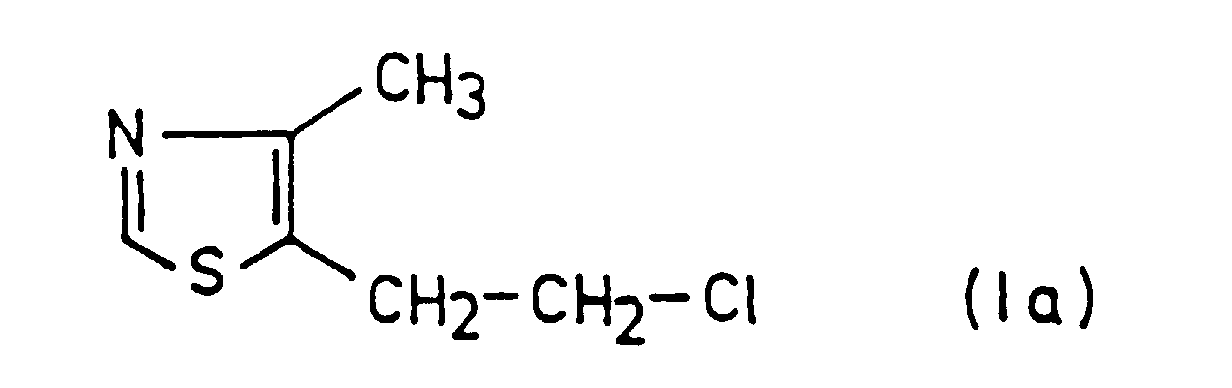
- The known methods for the preparation of the thiazole derivatives unsubstituted in position 2 can be divided into two main types. When proceeding according to methods of the first type the 2-unsubstituted thiazole is obtained in one step. According to methods of the second type thiazole derivatives containing an easily removable substituent in position 2 are prepared and this substituent is removed in a second step.
- According to methods of the first type the thiazole ring is formed by reacting a halogenated ketone or aldehyde, which are halogenated in the α-position or aldehyde with thioformamide [Elderfield, R.C.: Heterocyclic Compounds, Vol. 5, page 516 (1957)] (Reaction scheme A).

- R1 and R2 = alkyl, aryl or nydrogen
- X = halogen
- This type of methods gives a good yield only in some cases [Buchman and Richardson: J. Am. Chem. Soc. 67, 395 (1945); Erne, Ramirez and Burger: Helv. Chim. Acta 34, 143 (1951)]. A further disadvantage of this method is the difficulty of preparing pure thioformamide and the instable character of thioformamide. To eliminate this difficulty the preparation of thioformamide was carried out in the reaction mixture itself from formamide and phosphorous pentasulphide, but this method succeeded only in some cases [Ganapathi and Venkataraman: Proc. Indian Acad. Sci. 22, 362 (1945)]. This method is strongly contaminating the environment because of the use of phosphorous pentasulphide.
- As the direct synthesis described above can hardly be realized on industrial scale, attention was paid to the indirect synthesis variants. One of these variants eliminates the amino group in position 2 via diazotization and the subsequent reduction of the diazonium group [Ganapathi and Venkataraman: Proc. Indian Acad. Sci 22, 366 (1945)]. The 2-amino-thiazole derivative necessary for this method is to be prepared in a separate step from α-halogen-ketone with thiourea [e.g. Tanida, Tamura and Sava: J. Pharm. Soc. Japan 74, 652 (1954); C.A. 48, 10737 (1945)] (reaction scheme B).

- A further possibility is the oxidative removal of the thio group in position 2 of the thiazole [GB-PS 492,637; Buchman, Reims and Sargnet: J. Org. Chem. 6, 764 (1941)], or the desulphuration of the 2-mercapto-thiazole derivative by boiling with Raney nickel at a great excess [Cook et al: J. Chem. Soc. 1954 (1947); Hurd and Rudner: J. Am. Chem. Soc. 73, 5157 (1951)). The required 2-mercapto-thiazole has also to be prepared in a separate step from α-halogen-ketone and ammonium-dithiocarbamate (e.g. GB-PS 492,637) (Reaction Scheme C).

- A disadvantage of this method is that for the preparation of ammonium dithiocarbamate carbon disulphide is needed, requiring a special workshop when prepared on industrial scale because of the great danger of fire. Further, the reagent and the by-products of the synthesis are contaminating the environment to a great extent. For the desulphuration with Raney nickel a great excess of nickel is required, which significantly increases the costs of the synthesis.
- A third possibility is the dehalogenation of the 2-halo-thiazole derivatives. For this purpose mostly zinc is used in an acetic acid medium [GB-PS 456,751; Gibbs and Robinson: J. Chem. Soc. 925 (1945); Andersag and Westphal: Ber. 70, 2035 (1937)].
- Catalytic dehalogenation was described only in case of 2-bromo-thiazole-4-carboxylic acid [Erlenmeyer and Morel: Helv. Chim. Acta 25, 1073 (1942)]. The 2-halo-thiazole compounds, i.e. the starting material of the process, are prepared from 2-amino-thiazole derivatives by diazotization and Sandmeyer reaction (e.g. Sava and Maeda: J. Pharm. Soc. Japan 76, 301 (1956); C.A. 50, 13875 (1956)) or from 2-hydroxy-thiazole derivatives with phosphoryl chloride (GB-PS 456,751) or by ring closure of α-thiocyanato-ketones with gaseous hydrochloric acid [Elderfield: Heterocyclic Compounds, Vol. 5, p. 540 (1957)] (Reaction Schemes D

- R3 = NH2, OH
- X = halogen
- None of the above methods was used for the preparation of the compounds of the general formula (I) of the present invention, nor for the preparation of the compound of the formula (Ia). The compound of the formula (Ia) was prepared by chlorinating a suitable hydroxy compound with thionyl chloride (FR-PS 3,815 M, GB-PS 792,158 and NL-PA 6,510,389 - Reaction Scheme F).

- In case of Clomethiazole of the formula (Ia) a process was disclosed, according to which a suitable 2-mercapto derivative was oxidized with hydrogen peroxide (CH-PS 200,248).
- The 2-chloro-4-methyl-5-(2-chloroethyl)-thiazole of the formula


- In all of the general formulae R is as defined above.
- Surprisingly we have found that by reacting a known 3,5-dichloro-2-alkanone of the general formula


- The compounds of the general formula (I) can be converted into acid addition salts by methods known per se. One may also proceed by reacting compounds of the general formula (IV) with an aqueous mineral acid and converting the 2-hydroxy-4-methyl-5-(2-chloroalkyl)-thiazoles of the general formula

- Our invention is based on the following recognition: in the compounds of the general formula (V) the reactivity of the chlorine substituent in position α related to the carbonyl group surpasses that of the other chlorine substituent at the end of the chain to such an extent, that exclusively compounds of the general formula (IV) are obtained, the formation of neither dithiocyanato-ketone nor isothiocyanato-ketone can be detected even in traces.
- The preparation of the compounds of the general formula (II) containing a thiazole ring from the compounds of the general formula (IV) is not obvious in the knowledge of the literature.
- The removal of the chlorine substituent on the thiazole ring from the dichloro compounds of the general formula (II) by selective hydrogenation is surprising and not obvious, since the inactivity of the chlorine substituent at the end of the chain could not be expected by a person skilled in the art.
- The conversion of the compounds of the general formula (IV) into 2-hydroxy-thiazole derivatives of the general formula (III) preferably in the presence of phosphoric acid, further the halogenation of the compounds of the general formula (III) with a slight excess of the halogenating agent and in the most suitable solvent is accompanied with significant technological and environmental advantages.
- The method described in the examples of the present invention is novel and represents an alternative synthesis route which cannot be derived from the known preparation methods of the Clomethiazole of the formula (Ia).
- In the following an advantageous embodiment of the process of our invention is presented on the synthesis of the compound of the formula (Ia).
- A compound of the formula


- The reaction may be carried out at a temperature ranging from 20 to 100°C, preferably at the boiling point of the solvent, with an equivalent amount or with a slight (1 to 5 mol%) excess of the inorganic rhodanide .
- The dichloro derivative of the general formula (IIa) is obtained by reacting a compound of the formula (IVa), dissolved in an organic solvent, with anhydrous gaseous hydrochloric acid. As a solvent most preferably water-immiscible ethers and esters, which do not dissolve water, e.g. ethylacetate, butyl acetate or diisopropylether are used. Lower aliphatic alcohols may preferably be used, e.g. methanol, ethanol, n-propanol, isopropanol or butanol, lower fatty acids, e.g. acetic acid or propionic acid, or halogenated hydrocarbons, e.g. carbontetrachloride, chloroform or 1,2-dichloroethane may also be preferred.
- The reaction is carried out at a temperature ranging from 0 to 100°C, preferably from 0 to 40°C.
- The selective hydrogenation of the compound of the formula (IIa) is carried out in the presence of a metal catalyst in an organic solvent.
- The metal catalyst is preferably palladium on active charcoal or palladium containing selenium (Examples 1, 3 and 5 of published PCT-application No. 89/2429) and a catalyst containing rhodium or ruthenium may also be applied.
- As an organic solvent lower aliphatic alcohols, e.g. methanol, ethanol, n-propanol or isopropanol, lower esters of aliphatic carboxylic acids, e.g. ethyl acetate, butyl acetate, methyl acetate, isopropyl acetate or ethyl-propionate, aromatic hydrocarbons, e.g. benzene or toluene, or open-chained ethers, e.g. cellosolve, methylcellosolve, butylcellosolve, dimethylcellosolve or diglyme) can be used.
- Hydrogenation may be carried out at atmospheric pressure or at a slight overpressure (0.05-0.7 MPa).
- The splitting hydrochloric acid is bound by the forming thiazole derivative of the formula (Ia), then it can also be recovered in the form of a hydrochloride of the formula (Ia).
- During hydrogenation as an acid binding agent alkali hydroxides, e.g. sodium or potassium hydroxide, or organic bases, e.g. triethylamine, may be applied, then the basic compound of the formula (Ia) itself is obtained.
- In the preparation of the compound of the formula (IIIa) α-thiocyanato-ketone of the formula (IVa) is treated by aqueous phosphoric acid, in this case no organic solvent is needed and no corrosion problem arises as opposed to the known acetic acid - concentrated sulfuric acid or acetic acid - concentrated hydrochloric acid reagents. Further, no environmentally damaging by-products are formed during the processing of the reaction mixture.
- The reaction is carried out at a temperature ranging from 50 to 120°C, preferably from 90 to 100°C.
- When halogenating the compounds of the formula (IIIa) preferably phosphorus halides, e.g. phosphoryl chloride, phosphorus pentachloride or phosphorus trichloride are used as halogenating agent.
- As an organic solvent preferably halogenated aliphatic hydrocarbons, e.g. 1,2-dichloroethane, 1,1,2-trichloroethane, trichloroethylene or 1,1,2,2-tetrachloroethane, aromatic hydrocarbons, e.g. benzene, toluene or xylene, specially preferably halogenated aromatic hydrocarbons, e.g. chlorobenzene, 1,2-dichlorobenzene or 1,2,4-trichlorobenzene may be used.
- The reaction is carried out at a temperature ranging from 80 to 150°C, preferably from 100 to 140°C.
- The other compounds of the general formulae (I), (II), (III) and (IV) can preferably be prepared by the methods described above.
- The preparation of the compounds of the general formula (V) is disclosed in the examples where no literature reference is available.
- The present invention is elucidated in more detail in the following examples.
- 77.8 g (0.5 moles) of 3,5-dichloro-2-pentanone [prepared according to Acta Chim. Hung. 3, 157 (1953)] are added to the solution of 49.9 g (0.513 moles) of potassium rhodanide in 500 ml of acetone. The solution is boiled under stirring for 4 hours. The reaction mixture is cooled to room temperature and the precipitated potassium chloride is filtered off and washed with acetone. The filtrate is evaporated, the residue is dissolved in benzene and the benzene solution is washed 3 times with water. After drying with sodium sulphate, the benzene is distilled off. 62.2 g (93%) of 3-thiocyanato-5-chloro-2-pentanone are obtained in the form of a red oil. After distilling at a lower pressure a faint yellow oil is obtained, its boiling point is 112°C at a pressure of 26.6 Pa, nD 20=1.5110. According to infrared spectrum it does not contain any isothiocyanate.
Analysis for the formula C6H8ClNOS: calculated: C%=40.56, H%=4.53, N%=7.88, Cl%=19.95, S%=18.04; found: C%=41.25, H%=4.59, N%=8.13, Cl%=20.32, S%=17.90; - The NMR data support the structure.
- A solution of 155.5 g (1 mole) of 3,5-dichloro-2-pentanone with 83 g (1.024 moles) of sodium rhodanide in 1 litre of methyl-ethyl-ketone is boiled for 1 hour under stirring. Then the procedure described in Example 1 is followed. 171 g (96.2%) of 3-thiocyanato-5-chloro-2-pentanone are obtained, which after distillation identical in all respect with the product of Example 1.
- A suspension of 7.8 g (0.05 moles) of 3,5-dichloro-2-pentanone with 3.9 g (0.051 moles) of ammonium rhodanide in 50 cm3 of methyl-ethyl-ketone is boiled for 1 hour under stirring. Then the procedure described in Example 1 is followed. 8.5 g (95.5%) of 3-thiocyanato-5-chloro-2-pentanone are obtained, which after distillation is identical in all respect with the product of Example 1.
- A solution of 7.8 g (0.05 moles) of 3,5-dichloro-2-pentanone with 4.15 g (0.051 moles) of sodium rhodanide in 50 cm3 of ethanol is boiled for 2 hours under stirring. Then the procedure described in Example 1 is followed. 7.7 g (87%) of 3-thiocyanato-5-chloro-2-pentanone are obtained, which is identical in all respect with the product of Example 1 after distillation.
- To a solution of 4.86 g (0.05 moles) of potassium rhodanide in 10 cm3 of water 7.8 g (0.05 moles) of 3,5-dichloro-2-pentanone are added and the reaction mixture is stirred for 3 hours at a temperature of 80°C. After cooling the precipitating oil is separated and the aqueous phase is shaken twice with 20 cm3 of benzene each. The separated oil is combined with the benzene solution, washed with water and dried over sodium sulfate. After filtering and evaporating 7.4 g (83.5%) of 3-thiocyanato-5-chloro-2-pentanone are obtained, which after distillation is identical in all respect with the product of Example 1.
- A solution of 17.7 g (0.1 mole) of 3-thiocyanato-5-chloro-pentanone-2 in 170 cm3 of anhydrous ethylacetate is saturated with gaseous hydrochloric acid. The temperature of the reaction mixture is kept below 10°C by ice-cooling. The solution obtained is let to stand overnight at room temperature. The next day the solution is poured onto ice and its pH-value is adjusted to a value between 6 and 7 with a 20% sodium hydroxide solution. The phases are separated and the aqueous phase is shaken with 150 ml of ethyl acetate. The combined ethyl acetate solutions are washed neutral with water and a 5% sodium hydrogen carbonate solution and dried over sodium sulphate. After distilling off the solvent, the residue is distilled under reduced pressure to obtain 14.8 g (75.5%) of 2-chloro-4-methyl-5-(2-chloroethyl)-thiazole in the form of a faint yellow oil. The boiling point is 104°C at a pressure of 40 Pa, nD 20=1.5505.


- The IR and NMR data support the structure. The content of the product is more than 95% determined by gas chromatography.
- 25 g (0,14 moles) of 3-thiocyanato-5-chloro-pentanone-2 are dissolved in 170 cm3 of butyl acetate saturated with gaseous hydrochloric acid at 0°C. Into the reaction mixture gaseous hydrochloric acid is introduced until saturation under cooling with ice, keeping the temperature below 10°C. After saturation the reaction mixture is stirred for further 20 minutes under cooling, then the temperature is slowly increased to 40°C. The reaction mixture is stirred at this temperature for 20 minutes and after cooling to room temperature it is poured onto ice. The pH-value of the mixture is adjusted between 7 and 8 by adding a 40% sodium hydroxide solution. The mixture is processed further as described in Example 6.
- 20.8 g (76%) of 2-chloro-4-methyl-5-(2-chloroethyl)-thiazole are obtained, which is identical in every respect with the product obtained in Example 6.
- One proceeds as described in Example 7 with the difference that instead of butyl acetate abs. ethanol is used. After the termination of the reaction the reaction mixture is evaporated in vacuo and to the residue water and 20% sodium hydroxide solution are added to a pH-value of 7. Furtheron one proceeds as described in Example 7. 17 g (62%) of 2-chloro-4-methyl-5-(2-chloroethyl)-thiazole are obtained which is identical in every respect with the product obtained in Example 6.
- One proceeds as described in Example 6 with the difference that instead of ethyl acetate diisopropylether is used. 14 g (74%) of 2-chloro-4-methyl-5-(2-chloroethyl)-thiazole are obtained which is identical in every respect with the product obtained in Example 6.
- One proceeds as described in Example 8 with the difference that instead of abs. ethanol glacial acetic acid is used. 20.2 g (73.5%) of 2-chloro-4-methyl-5-(2-chloroethyl)-thiazole are obtained, which is identical in every respect with the product obtained in Example 6.
- One proceeds as described in Example 6 with the difference that instead of ethyl acetate carbon tetrachloride is used. 12 g (61%) of 2-chloro-4-methyl-5-(2-chloroethyl)-thiazole are obtained, which is identical in every respect with the product obtained in Example 6.
- 355,3 g (2 moles) of distilled 3-thiocyanato-5-chloro-2-pentanone are added into 360 cm3 of 85% phosphoric acid under stirring. The temperature of the reaction mixture is increased to 95°C in water bath within about 1 hour and then it is stirred for half and hour between 95 to 100°C. The brown solution is cooled to 20°C and poured into 660 cm3 of water. The precipitated beige crystals are removed by suction after a stirring for half an hour, washed neutral with water and dried in vacuo at a temperature of 60°C. 337 g (95%) of pale beige 2-hydroxy-4-methyl-5-(2-chloroethyl)-thiazole are obtained, m.p.: 151-152°C. After recrystallization from benzene the melting point is 157-158°C.
Analysis as calculated for C6H8ClNOS: calculated: C%=40.56, H%=4.53, N%=7.88, S%=18.04, Cl%=19.95; found: C%=40.74, H%=4.52, N%=7.57, S%=17.94, Cl%=19.68. - The structure of the compound is confirmed also by the IR and NMR data.
- One proceeds as described in Example 12 using non-distilled 3-thiocyanato-5-chloro-2-pentanone content: 80%, determined by gas chromatography). 234 g (66%) of 2-hydroxy-4-methyl-5-(2-chloroethyl)-thiazole are obtained, which melts at 141 to 146°C.
- A suspension of 177.6 g (1 mole) of 2-hydroxy-4-methyl-5-(2-chloroethyl)-thiazole in 530 cm3 of anhydrous chlorobenzene is heated to 100 °C under stirring. 306.6 g (2 moles) of phosphoryl chloride are flown into the solution in 30 minutes, then it is stirred at a temperature of 125-130°C until the formation of hydrogen chloride ceases (about 2 hours). The reaction mixture is cooled to 20°C, then it is poured onto 1.5 kg of ice. The phases are separated, the aqueous phase is extracted twice with 200 cm3 of chlorobenzene each. The combined phases containing the chlorobenzene are washed acid-free with water and then with a 5% sodium hydrogen carbonate solution and then evaporated under reduced pressure. The brown residue is fractionated in vacuo. 145 g (74%) of 2-chloro-4-methyl-5-(2-chloroethyl)-thiazole are obtained. The boiling point is 102°C at a pressure of 53.2 Pa, n20 D=1.5512, n30 D=1,5468.
- Purity: 99.4% (by gas chromatography).
Analysis as calculated for C6H7Cl2NS: calculated: C%=36.70, H%=3.59, N%=7.14, Cl%=36.15, S%=16.35; found: C%=36.98, H%=3.68, N%=7.28, Cl%=35.70, S%=16.05. - The structure of the compound is confirmed also by the IR and NMR data.
- To a solution of 63 g (0.32 moles) of 2-chloro-4-methyl-5-(2-chloroethyl)-thiazole in 630 cm3 of a 96% ethanol 9 g of a wet palladium on charcoal catalyst (palladium content: 8%) are added. The mixture is hydrogenated at atmospheric pressure. The termination of the reaction is indicated by the cease of the hydrogen consumption. After filtering off the catalyst the solution is evaporated, the residue is dissolved in water and the solution is neutralized with sodium hydrogen carbonate (pH 7). The separated oil is shaken out with chloroform. The residue after the evaporation of the chloroform solution is distilled under reduced pressure. 47 g (91%) of 4-methyl-5-(2-chloroethyl)-thiazole are obtained. Its boiling point is 105°C at a pressure of 0.93 KPa, nD 20=1.5430. Its active agent content is 98.8%, determined by gas chromatography.
- The infrared and NMR spectra of the product is identical with that of the authentic sample.
- One proceeds as described in Example 15 with the difference that the hydrogenation is carried out at a pressure of 0.3 MPa.
- 46.5 g (90%) of 4-methyl-5-(2-chloroethyl)-thiazole are obtained which is identical in every respect with the product obtained in Example 15.
- One proceeds as described in Example 15 with the difference that instead of ethanol methanol is used.
- 42.9 g (83%) of 4-methyl-5-(2-chloroethyl)-thiazole are obtained which is identical in every respect with the product obtained in Example 15.
- One proceeds as described in Example 15 with the difference that after evaporation the residual solid substance is separated.
- 61.5 g (97%) of 4-methyl-5-(2-chloroethyl)-thiazole hydrochloride are obtained. Its melting point after recrystallization from anhydrous ethanol is 136-137°C.
Analysis as calculated for C6H9Cl2NS: calculated: C%=36.37, H%=4.58, N%=7.07, Cl%=35.79; found: C%=36.18, H%=4.52, N%=7.10, Cl%=35.89. - One proceeds as described in Example 15 with the difference that acetone is added to the solution obtained after filtering off the catalyst and the precipitating solid substance is filtered
- 59.4 g (93.7%) of 4-methyl-5-(2-chloroethyl)-thiazole hydrochloride are obtained. Its melting point is 137-137.5°C after recrystallized in anhydrous ethanol.
Analysis as calculated for C6H9Cl2Ns: calculated: C%=36.37, H%=3.59, N%=4.58, Cl%=35.79; found: C%=36.17, H%=4.51, N%=7.12, Cl%=35.89. - One proceeds as described in Example 15 with the difference that as catalyst 9 g of palladium on charcoal containing selenium are added. This catalyst has been prepared according to Example 5 of the PCT-application published under No. WO-89/02429 (page 12).
- 46.2 g (89.4%) of 4-methyl-5-(2-chloroethyl)-thiazole are obtained which is identical with the product obtained in Example 15 in respect of its physical constants and active agent content.
- 83 g (1.024 moles) of sodium rhodanide are added to a solution of 155.5 g (1 mole) of 3,5-dichloro-2-pentanone in 1 litre of butyl acetate. The suspension is stirred for 4 hours in hot water bath. After cooling the sodium chloride formed is filtered off and the filtrate is washed 3 times with water. After drying over sodium sulfate the butyl acetate is distilled off.
- 168 g (94%) of 3-thiocyanato-5-chloro-2-pentanone are obtained in the form of red oil. After distillation this product is identical with the product obtained in Example 1.
- 83 g (1.024 moles) of sodium rhodanide are added to a solution of 155.5 g (1 mole) of 3,5-dichloro-2-pentanone in 1 litre of butyl acetate. The suspension is stirred for 4 hours in hot water bath. After cooling the sodium chloride formed is filtered off and the filtrate is washed 3 times with water and dried over sodium sulfate. After filtering off the drying agent the light red-brown filtrate is cooled under 10°C by icy water and saturated with gaseous hydrochloric acid under stirring, keeping the temperature under 10°C. After saturation the reaction mixture is stirred for further 20 minutes under cooling, then the temperature is increased slowly to 40°C. The reaction mixture is stirred at this temperature for 20 minutes and poured onto ice after cooling down to room temperature. The phases are separated, the aqueous phase is shaken with 150 cm3 of butyl acetate. The combined butyl acetate solutions are washed neutral with water and 5% sodium hydrogen carbonate solution, then dried over sodium sulfate. After distilling off the solvent the residue is distilled off under reduced pressure to obtain 121 g (66%) of 2-chloro-4-methyl-5-(2-chloroethyl)-thiazole in the form of pale yellow oil, which is identical in every respect with the product obtained in Example 1.
- One proceeds as described in Example 1 by using 8.45 g (0.05 moles) of 3,5-dichloro-2-hexanone, 5 g of potassium rhodanide and 50 cm3 of acetone.
- 8.9 g (93%) of 3-thiocyanato-5-chloro-2-hexanone are obtained. After distillation under reduced pressure it is a pale yellow oil, its boiling point is 107-108°C at a pressure of 53.3 Pa, nD 20=1.5050.
- According to the IR spectrum data the product contains no isothiocyanate.
Analysis as calculated for C7H10ClNOS: calculated: C%=43.82, H%=5.25, N%=7.30, Cl%=18.50, S%=16.72; found: C%=43.57, H%=5.96, N%=7.61, Cl%=18.36. S%=16.58. - One proceeds as described in Example 1 by using 18.3 g (0.1 mole) of 3,5-dichloro-2-heptanone, 10 g (0.102 moles) of potassium rhodanide and 100 cm3 of acetone.
- 19.1 g (93%) of 3-thiocyanato-5-chloro-2-heptanone are obtained. After distillation under reduced pressure it is a pale yellow oil, its boiling point is 124°C at a pressure of 53.3 Pa, nD 20=1.4983.
- According the IR spectrum data the product contains no isothiocyanate.


- One proceeds as described in Example 7 by using 9.6 g (0.05 moles) of 3-thiocyanato-5-chloro-2-hexanone and 55 cm3 of butyl acetate.
- 7.7 g (80%) of 2-chloro-4-methyl-5-(2-chloropropyl)-thiazole are obtained in the form of a colourless liquid. Its boiling point is 96°C at a pressure of 66.6 Pa, nD 20=1.5400.
Analysis as calculated for C7H9Cl2NS: calculated: C%=40.00, H%=4.31, N%=6.66, Cl%=33.74, S%=15.26; found: C%=39.75, H%=4.24, N%=6.70, Cl%=33.68. S%=14.82. - The structure of the compound is confirmed by the IR and NMR data.
- One proceeds as described in Example 7 by using 10.25 g (0.05 moles) of 3-thiocyanato-5-chloro-2-heptanone and 55 cm3 of butyl acetate.
- 8.9 g (79.5%) of 2-chloro-4-methyl-5-(2-chlorobutyl)-thiazole are obtained in the form of a colourless liquid. Its boiling point is 108°C at a pressure of 53.2 Pa, nD 20=1.5263.
Analysis as calculated for C8H11Cl2NS: calculated: C%=42.86, H%=4.94, N%=6.28, Cl%=31.63, S%=14.30; found: C%=43.07, H%=4.79, N%=6.13, Cl%=31.33. S%=14.20. - The structure of the compound is confirmed by the IR and NMR data.
- One proceeds as described in Example 15 by using 7 g (0.033 moles) of 2-chloro-4-methyl-5-(2-chloro-propyl)-thiazole, 60 cm3 of 96% ethanol and 1 g of wet palladium on charcoal catalyst (palladium content: 8%).
- 5 g (86%) of 4-methyl-5-(2-chloropropyl)-thiazole are obtained in the form of a colourless liquid. Its boiling point is 78°C at a pressure of 40 Pa, nD 20=1.5330.
Analysis as calculated for C7H10ClNS: calculated: C%=47.30, H%=5.73, N%=7.97, Cl%=20.17, S%=18.24; found: C%=47.53, H%=5.25, N%=7.63, Cl%=20.46. S%=18.18. - The structure of the compound is confirmed by the IR and NMR data.
- One proceeds as described in Example 15 by using 5.3 g (0.024 moles) of 2-chloro-4-methyl-5-(2-chlorobutyl)-thiazole, 50 cm3 of 96% ethanol and 0.9 g of wet palladium on charcoal catalyst (palladium content: 8%).
- 3.7 g (81%) of 4-methyl-5-(2-chlorobutyl)-thiazole are obtained in the form of a colourless liquid. Its boiling point is 94°C at a pressure of 66.5 Pa, nD 20=1.5263.
Analysis as calculated for C8H12ClNS: calculated: C%=50.64, H%=6.37, N%=7.38, Cl%=18.69, S%=16.90; found: C%=49.98, H%=6.21, N%=7.12, Cl%=18.20. S%=17.08. - The structure of the compound is confirmed by the IR and NMR data.
- One proceeds as described in Example 12 by using 15.3 g (0.05 moles) of 3-thiocyanato-5-chloro-2-hexanone and 16 cm3 of 83% phosphoric acid.
- 11.2 g (73%) of 2-hydroxy-4-methyl-5-(2-chloro-propyl)-thiazole are obtained, which melts at 91-93°C.
Analysis as calculated for C7H10ClNOS: calculated: C%=43.85, H%=5.25, N%=7.30, Cl%=18.49, S%=16.72; found: C%=43.52, H%=5.12, N%=7.05, Cl%=18.50. S%=16.82. - The structure of the compound is confirmed by the IR and NMR data.
- One proceeds as described in Example 12 by using 13.3 g (0.064 moles) of 3-thiocyanato-5-chloro-2-heptanone and 14 cm3 of 85% phosphoric acid.
- 9.5 g (71.5%) of 2-hydroxy-4-methyl-5-(2-chloro-butyl)-thiazole are obtained, which melts at 84-85°C.


- The structure of the compound is confirmed by the IR and NMR data.
- One proceeds as described in Example 14 by using 9.7 g (0.05 moles) of 2-hydroxy-4-methyl-5-(2-chloro-propyl)-thiazole, 15,3 g (0.1 mole) of phosphoryl chloride and 26 cm3 of anhydrous chlorobenzene.
- 8.4 g (83.3%) of 2-chloro-4-methyl-5-(2-chloro-propyl)-thiazole are obtained in the form of a colourless oil. Its boiling point is 102°C at a pressure of 80 Pa, nD 20=1.5400.
Analysis as calculated for C7H9Cl2NS: calculated: C%=40.00, H%=4.31, N%=6.66, Cl%=33.74, S%=15.26; found: C%=39.85, H%=4.35, N%=6.76, Cl%=33.65. S%=14.95. - The structure of the compound is confirmed by the IR and NMR data.
- One proceeds as described in Example 14 by using 7.4 g (0.036 moles) of 2-hydroxy-4-methyl-5-(2-chlorobutyl)-thiazole, 11 g (0,072 moles) of phosphoryl chloride and 19 cm3 of anhydrous chlorobenzene.
- 6.7 g (83.3%) of 2-chloro-4-methyl-5-(2-chlorobutyl)-thiazole are obtained in the form of a colourless oil. Its boiling point is 108°C at a pressure of 53.2 Pa, nD 20=1.5352.
Analysis as calculated for C8H11Cl2NS: calculated: C%=42.86, H%=4.94, N%=6.28, Cl%=31.63, S%=14.30; found: C%=42.98, H%=4.81, N%=6.21, Cl%=31.44, S%=14.20. - The structure of the compound is confirmed by the IR and NMR data.
- A mixture of 17.7 g (0.1 mole) of α-chloro-α-aceto-γ-valerolactone [prepared according to J. Am. Chem. Soc. 67, 398 (1945)] and 35 cm3 of abs. hydrochloric acid is heated slowly to 90°C under stirring and is stirred at this temperature until the gas formation stops. After cooling the dark solution is poured into 100 cm3 of water, the separating oil is extracted with chloroform. The chloroform containing solution is washed by 50 cm3 of 5% sodium hydrogen carbonate solution. After evaporation the residual oil is distilled in vacuo. 5 g (30%) of 3,5-dichloro-2-hexanone are obtained in the form a colourless liquid. The boiling point is 38°C at a pressure of 26.6 Pa.
Analysis as calculated for C6H10Cl2O: calculated: C%=42.62, H%=5.96, Cl%=41.94; found: C%=42.77, H%=5.76, Cl%=41.50. - The structure of the compound is confirmed by the IR and NMR data.
- Into a solution of 58.2 g (0.37 moles) of α-acetyl-γ-ethyl-γ-butyrolactone [prepared according to J. Pharm. Sci. 52, 733 (1963)] in 60 cm3 benzene 50 g of (0.37 moles) of sulphuryl chloride are added dropwise under stirring and cooling in 2 hours, keeping the temperature of the reaction mixture between 5 and 10°C. After completing the addition the reaction mixture is let to warm to room temperature and stirred at this temperature until the gas formation ceases. Then it is poured into 400 cm3 of water, the phases are separated and the water is extracted with 200 cm3 of benzene. The benzene containing solution is washed with 100 cm3 of 5% sodium hydrogencarbonate solution. After evaporation the residual oil is distilled in vacuo. The title compound is obtained in the form of a colourless liquid in an amount of 58.9 g (82.5%), its boiling point is 91°C at a pressure of 80 Pa, nD 20=1,4623.


- The title compound is prepared according to the method described in Example 1 starting from 49 g (0.26 moles) of α-chloro-α-acetyl-γ-ethyl-γ-butyrolactone and 98 cm3 of abs. hydrochloric acid. After distillation 22 g (47%) of the title compound is obtained. Its boiling point is 68-70°C at a pressure of 133.3 Pa, nD 20=1,4600.
Analysis as calculated for C7H12Cl20: calculated: C%=45.91, H%=6.60, Cl%=38.73; found: C%=45.66, H%=6.55, Cl%=38.90.

Claims (16)
- A process for the preparation of a compound of the general formula

 a) in an organic solvent with hydrogen chloride gas to give a 2-chloro-4-methyl-5-(2-chloroalkyl)-thiazole of the general formula
 b) with an aqueous mineral acid to give a 2-hydroxy-4-methyl-5(2-chloroalkyl)-thiazole of the general formula
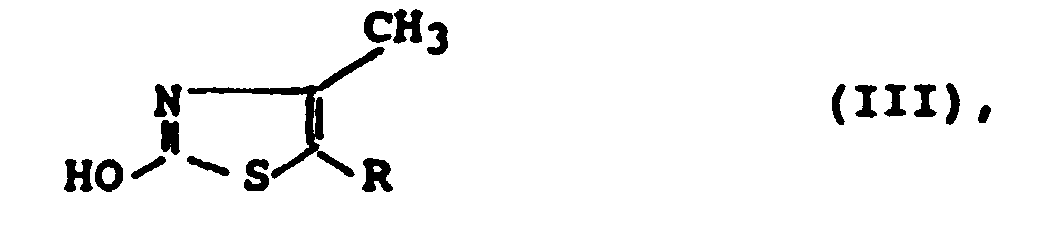 which is treated with a halogenating agent to give a 2-chloro-4-methyl-5-(2-chloroalkyl)-thiazole of the general formula (II),and then hydrogenating the compound of the general formula (II) in the presence of a palladium on charcoal catalyst, a palladium containing selenium catalyst or a catalyst containing rhodium or ruthenium in an organic solvent to obtain 4-methyl-5-(2-chloroalkyl)-thiazole of the general formula (I), wherein R is as defined above, and optionally converting the compound of the general formula (I), wherein R is as defined above, or a hydrochloride salt thereof, in a manner known per se, into another acid addition salt or setting free a compound of the general formula (I), wherein R is defined above, from its acid addition salt.
 - A process according to claim 1 wherein R stands for 2-chloroethyl.
- A process according to any one of claims 1-2, characterized by carrying out the hydrogenation in the presence of an acid binding agent, preferably in the presence of triethylamine.
- A process according to any one of claims 1-3, characterized by using as organic solvent aliphatic alcohols, esters of fatty acids formed with aliphatic alcohols, aromatic hydrocarbons or open chain ethers.
- A process according to any one of claims 1-4, characterized by carrying out the hydrogenation at or above atmospheric pressure, but at the most at a pressure of 0.7 Mpa.
- A process according to any one of the claims 1-5, characterized by carrying out the ring closure reaction from compounds of the general formula (IV) to compounds ofthe general formula (II) in anhydrous water-immiscible solvents, which do not dissolve water, preferably in butyl acetate.
- A process according to any one of the claims 1-6, characterized in that the aqueous mineral acid is aqueous phosphoric acid.
- A process according to any one of the claims 1-7, characterized by reacting the compounds of the general formula (IV) with an aqeous mineral acid at a temperature ranging from 50° to 120°C.
- A process according to any one of the claims 1-8, characterized by halogenating the compounds of the general formula (III) with phosphoryl chloride, phosphorus pentachloride, or phosphorus trichloride.
- A process according to any one of the claims 1-9, characterized by halogenating the compounds of the general formula (III) in a halogenated aromatic solvent.
- A compound of the general formula

- A compound according to claim 11 wherein R stands for 2-chloroethyl.
- A process for the preparation of a compound of the general formula (IV) according to claims 11 or 12, characterized by reacting a compound of the general formula

- A process according to claim 13, characterized in that the inorganic thiocyanate is selected from sodium thiocyanate, potassium thiocyanate and ammonium thiocyanate.
- A process according to claims 13 or 14, characterized in that the process is carried out in the presence of a solvent such as aliphatic alcohols, aliphatic ketones, esters of fatty acids formed with aliphatic alcohols, or water.
- A process according to any one of the claims 1-10, characterized in that said process is preceeded by the process as claimed in claim 13, without isolating the compounds ofthe general formula (IV).
Applications Claiming Priority (11)
| Application Number | Priority Date | Filing Date | Title |
|---|---|---|---|
| HU3402/91A HU215840B (en) | 1991-10-30 | 1991-10-30 | Process for producing 2-chlorothiazole derivatives |
| HU340391 | 1991-10-30 | ||
| HU3403/91A HU215850B (en) | 1991-10-30 | 1991-10-30 | Process for producing thiocyanatoketone derivatives |
| HU340291 | 1991-10-30 | ||
| HU913404A HU207724B (en) | 1991-10-30 | 1991-10-30 | New process for producing thiazols |
| HU340491 | 1991-10-30 | ||
| HU9201125 | 1992-04-03 | ||
| HU9201125A HUT66222A (en) | 1992-04-03 | 1992-04-03 | 2-hydroxy-4-methyl-5-halogenoalkyl-1,3-thiazole derivatives and process for producing them |
| HU9201124 | 1992-04-03 | ||
| HUP9201124A HU215849B (en) | 1992-04-03 | 1992-04-03 | Process for producing 2-chloro-4-methyl-5-halogenoalkyl-1,3-thiazole derivatives |
| PCT/HU1992/000042 WO1993009107A1 (en) | 1991-10-30 | 1992-10-30 | Novel process for the preparation of 4-methyl-5-(2-chloroethyl)-thiazole and analogues thereof |
Publications (2)
| Publication Number | Publication Date |
|---|---|
| EP0619815A1 EP0619815A1 (en) | 1994-10-19 |
| EP0619815B1 true EP0619815B1 (en) | 1997-04-16 |
Family
ID=27517525
Family Applications (2)
| Application Number | Title | Priority Date | Filing Date |
|---|---|---|---|
| EP92118606A Expired - Lifetime EP0546306B1 (en) | 1991-10-30 | 1992-10-30 | 5-(2-Chloroalkyl)-4-methylthiazoles, their preparation and their use, and intermediates for their preparation |
| EP92923097A Expired - Lifetime EP0619815B1 (en) | 1991-10-30 | 1992-10-30 | Process for the preparation of 4-methyl-5-(2-chloroethyl)-thiazole and analogues thereof |
Family Applications Before (1)
| Application Number | Title | Priority Date | Filing Date |
|---|---|---|---|
| EP92118606A Expired - Lifetime EP0546306B1 (en) | 1991-10-30 | 1992-10-30 | 5-(2-Chloroalkyl)-4-methylthiazoles, their preparation and their use, and intermediates for their preparation |
Country Status (24)
| Country | Link |
|---|---|
| US (2) | US5648498A (en) |
| EP (2) | EP0546306B1 (en) |
| JP (1) | JP3190959B2 (en) |
| KR (1) | KR100218131B1 (en) |
| AT (1) | ATE151761T1 (en) |
| AU (1) | AU664868B2 (en) |
| CA (1) | CA2121488A1 (en) |
| CZ (1) | CZ283402B6 (en) |
| DE (1) | DE69219154T2 (en) |
| DK (1) | DK0619815T3 (en) |
| ES (1) | ES2100365T3 (en) |
| FI (1) | FI105476B (en) |
| GR (1) | GR3023842T3 (en) |
| HK (1) | HK93397A (en) |
| HR (1) | HRP921128B1 (en) |
| HU (1) | HU217079B (en) |
| IL (1) | IL103586A (en) |
| IS (1) | IS1688B (en) |
| LV (1) | LV12130B (en) |
| NO (1) | NO304650B1 (en) |
| PL (1) | PL172013B1 (en) |
| SI (1) | SI9200292B (en) |
| SK (1) | SK279665B6 (en) |
| WO (1) | WO1993009107A1 (en) |
Families Citing this family (3)
| Publication number | Priority date | Publication date | Assignee | Title |
|---|---|---|---|---|
| DE19548417A1 (en) * | 1995-12-22 | 1997-06-26 | Bayer Ag | Process for the preparation of 2-chloro-5-chloromethylthiazole |
| HUP0900267A2 (en) | 2009-04-30 | 2011-03-28 | Sanofi Aventis | Process for preparing of thiazole amines and intermediates thereof |
| KR102799767B1 (en) * | 2022-11-30 | 2025-04-23 | 주식회사 그립인 | Perfume dispensing device forming model |
Family Cites Families (23)
| Publication number | Priority date | Publication date | Assignee | Title |
|---|---|---|---|---|
| US1808893A (en) * | 1931-06-09 | Leon c | ||
| GB456751A (en) * | 1935-05-13 | 1936-11-13 | Ig Farbenindustrie Ag | Process for the manufacture of 4-alkyl-5-hydroxy-alkylthiazoles |
| CH200248A (en) * | 1937-03-12 | 1938-09-30 | Hoffmann La Roche | Process for the preparation of 4-methyl-5-B-chloroethylthiazole. |
| US2395453A (en) * | 1944-02-26 | 1946-02-26 | Rohm & Haas | Beta-thiocyano ketones and method for their preparation |
| FR1274353A (en) * | 1955-09-28 | 1961-10-27 | Process for the preparation of 4-methyl-beta-haloethyl-5 thiazoles and their salts | |
| DE1082903B (en) * | 1957-10-11 | 1960-06-09 | Basf Ag | Process for the production of rhodane compounds |
| DE1515197C3 (en) * | 1964-05-06 | 1974-08-15 | Steigerwald Strahltechnik Gmbh, 8000 Muenchen | Energy beam welding process |
| GB1053696A (en) * | 1964-08-12 | |||
| US3670004A (en) * | 1969-01-07 | 1972-06-13 | Buckman Labor Inc | Thiocyano substituted acrylates and propionates and their use as pesticides |
| FR2152345A1 (en) * | 1971-09-06 | 1973-04-27 | Roussel Uclaf | Alpha-(2-thiazolyl)oxyalkanoic acids and derivatives - - with analgesic,antiinflammatory and antipyretic activity |
| DE2236796A1 (en) * | 1972-07-27 | 1974-02-07 | Georg Dipl Chem Dr Herbertz | 2-Hydroxy-chlormethiazole - with sedative, hypnotic and anticonvulsant activity |
| DE2423981A1 (en) * | 1974-05-17 | 1975-11-27 | Bayer Ag | Alpha halo-ketones as biocides - are prepd. by reaction of substituted ketones with chlorine and an acid acceptor |
| DE2339109A1 (en) * | 1973-08-02 | 1975-02-20 | Bayer Ag | Alpha halo-ketones as biocides - are prepd. by reaction of substituted ketones with chlorine and an acid acceptor |
| DE2823658A1 (en) * | 1978-05-30 | 1979-12-06 | Bayer Ag | AGENTS FOR CONTROLLING PLANT BACTERIOS |
| US4377693A (en) * | 1979-10-01 | 1983-03-22 | Monsanto Company | 2-Chloro-4,5-disubstituted-thiazoles useful as herbicidal safeners |
| US4284426A (en) * | 1979-10-01 | 1981-08-18 | Monsanto Company | 2-Chloro-4,5-disubstituted-thiazoles useful as herbicidal safeners |
| US4284784A (en) * | 1980-05-22 | 1981-08-18 | Merck & Co., Inc. | Process for the preparation of 4-methyl thiazole |
| SU943233A1 (en) * | 1980-07-18 | 1982-07-15 | Ереванский государственный университет | Alpha-thiocyanovinylmethyl ketone as monomer for synthesis of ionites and polyelectrolytes and method for making the same |
| GB8705447D0 (en) * | 1987-03-09 | 1987-04-15 | Autopia Terakat Accessories Lt | Glass frail |
| US4822813A (en) * | 1987-03-11 | 1989-04-18 | Uniroyal Chemical Ltd./Uniroyal Chemical Ltee | 3-(2-Haloalkyl)-1,4-oxathiins and 2-(2-haloalkyl)-1,4-dithiins, and treatment of leukemia and tumors therewith |
| SE8900564D0 (en) * | 1989-02-17 | 1989-02-17 | Astra Ab | NOVEL MEDICINAL USE |
| US5180833A (en) * | 1990-03-16 | 1993-01-19 | Takeda Chemical Industries, Ltd. | Process for the preparation of chlorothiazole derivatives |
| HU206198B (en) * | 1990-09-21 | 1992-09-28 | Egyt Gyogyszervegyeszeti Gyar | Process for producing rhodanidoisobutyric acid |
-
1992
- 1992-10-29 HR HR1125/92A patent/HRP921128B1/en not_active IP Right Cessation
- 1992-10-29 IL IL103586A patent/IL103586A/en not_active IP Right Cessation
- 1992-10-29 IS IS3937A patent/IS1688B/en unknown
- 1992-10-30 KR KR1019940701422A patent/KR100218131B1/en not_active Expired - Fee Related
- 1992-10-30 SI SI9200292A patent/SI9200292B/en unknown
- 1992-10-30 CA CA002121488A patent/CA2121488A1/en not_active Withdrawn
- 1992-10-30 AT AT92923097T patent/ATE151761T1/en not_active IP Right Cessation
- 1992-10-30 PL PL92303342A patent/PL172013B1/en unknown
- 1992-10-30 EP EP92118606A patent/EP0546306B1/en not_active Expired - Lifetime
- 1992-10-30 DE DE69219154T patent/DE69219154T2/en not_active Expired - Lifetime
- 1992-10-30 JP JP50829893A patent/JP3190959B2/en not_active Expired - Lifetime
- 1992-10-30 HU HU9401262A patent/HU217079B/en not_active IP Right Cessation
- 1992-10-30 SK SK501-94A patent/SK279665B6/en unknown
- 1992-10-30 WO PCT/HU1992/000042 patent/WO1993009107A1/en not_active Ceased
- 1992-10-30 ES ES92923097T patent/ES2100365T3/en not_active Expired - Lifetime
- 1992-10-30 CZ CZ941034A patent/CZ283402B6/en not_active IP Right Cessation
- 1992-10-30 DK DK92923097.7T patent/DK0619815T3/en active
- 1992-10-30 EP EP92923097A patent/EP0619815B1/en not_active Expired - Lifetime
- 1992-10-30 US US08/232,207 patent/US5648498A/en not_active Expired - Lifetime
- 1992-10-30 AU AU29123/92A patent/AU664868B2/en not_active Ceased
-
1994
- 1994-04-28 NO NO940004A patent/NO304650B1/en not_active IP Right Cessation
- 1994-04-29 FI FI941996A patent/FI105476B/en active
-
1995
- 1995-06-05 US US08/464,308 patent/US5534644A/en not_active Expired - Lifetime
-
1997
- 1997-06-19 GR GR970401480T patent/GR3023842T3/en unknown
- 1997-06-26 HK HK93397A patent/HK93397A/en not_active IP Right Cessation
-
1998
- 1998-04-16 LV LVP-98-68A patent/LV12130B/en unknown
Non-Patent Citations (1)
| Title |
|---|
| Chemical Abstracts, Volume 74, no.25 issued 21 June 1971 (21.06.71) (Columbus, Ohio, USA) LINDBERG U.H. et al.; "Compounds related to clomethiazole. IV. 4-Methylthiazoles and oxazoles with polar side-chains and some other analogs of clomethiazole", page 576, column 2, the Abstract No. 141617w, Acta Pharm. Suecica 1971, 8(1), 39-48 (Eng) * |
Also Published As
Similar Documents
| Publication | Publication Date | Title |
|---|---|---|
| US7285669B2 (en) | Process for preparing 2,6-diamino-4,5,6,7-tetrahydro-benzothiazole | |
| GB2163747A (en) | Benzimidazole derivatives | |
| FR2463774A1 (en) | DERIVATIVES OF 2-PHENYLIMIDAZO (2,1-B) BENZOTHIAZOLE | |
| US4061647A (en) | Thiazolidine derivatives | |
| EP0546306B1 (en) | 5-(2-Chloroalkyl)-4-methylthiazoles, their preparation and their use, and intermediates for their preparation | |
| NO770161L (en) | THIAZOLIDINE DERIVATIVES AND PROCEDURES FOR THEIR PREPARATION. | |
| US3847934A (en) | 7-(imidazolinyl-(2)-amino)-indazoles | |
| JP3440196B2 (en) | Method for producing thiobenzamide derivative | |
| US6861522B2 (en) | Process for the manufacture of thiazole derivatives with pesticidal activity | |
| RU2103264C1 (en) | Method for producing derivatives of thiazole or their acid additive salts, 5-chloro-3-thiocyanate-2-alkanone and method for its production | |
| JPS6233164A (en) | Manufacture of 2-substituted benzothiazole | |
| EP0408437B1 (en) | 2 Alkylimino-benzothiazolines, process for their preparation and pharmaceuticals containing them | |
| US4264500A (en) | Process of making 6-chloro-α-methyl-carbazole-2-acetic acid | |
| US3966752A (en) | Resolution of D,L-protected-penicillamine | |
| CA1323032C (en) | Process for preparing 2-guanidinothiazole derivatives | |
| CN1032007A (en) | Prepare the method for halogen alkyl thiazole and the halogen alkyl thiazole of preparation thereof | |
| JPS585194B2 (en) | Method for producing DL-cysteine or cystine | |
| JPH0667932B2 (en) | 4,5,6,7-Tetrahydro-2H-indazole derivative | |
| HU200182B (en) | Process for producing new spiroquinazoline imidazolidine derivatives and pharmaceutical compositions comprising same |
Legal Events
| Date | Code | Title | Description |
|---|---|---|---|
| PUAI | Public reference made under article 153(3) epc to a published international application that has entered the european phase |
Free format text: ORIGINAL CODE: 0009012 |
|
| 17P | Request for examination filed |
Effective date: 19940415 |
|
| AK | Designated contracting states |
Kind code of ref document: A1 Designated state(s): AT BE CH DE DK ES FR GB GR IE IT LI LU MC NL SE |
|
| 17Q | First examination report despatched |
Effective date: 19951024 |
|
| GRAG | Despatch of communication of intention to grant |
Free format text: ORIGINAL CODE: EPIDOS AGRA |
|
| GRAH | Despatch of communication of intention to grant a patent |
Free format text: ORIGINAL CODE: EPIDOS IGRA |
|
| GRAH | Despatch of communication of intention to grant a patent |
Free format text: ORIGINAL CODE: EPIDOS IGRA |
|
| GRAA | (expected) grant |
Free format text: ORIGINAL CODE: 0009210 |
|
| AK | Designated contracting states |
Kind code of ref document: B1 Designated state(s): AT BE CH DE DK ES FR GB GR IE IT LI LU MC NL SE |
|
| REF | Corresponds to: |
Ref document number: 151761 Country of ref document: AT Date of ref document: 19970515 Kind code of ref document: T |
|
| REG | Reference to a national code |
Ref country code: CH Ref legal event code: NV Representative=s name: R. A. EGLI & CO. PATENTANWAELTE Ref country code: CH Ref legal event code: EP |
|
| REF | Corresponds to: |
Ref document number: 69219154 Country of ref document: DE Date of ref document: 19970522 |
|
| ET | Fr: translation filed | ||
| REG | Reference to a national code |
Ref country code: ES Ref legal event code: FG2A Ref document number: 2100365 Country of ref document: ES Kind code of ref document: T3 |
|
| REG | Reference to a national code |
Ref country code: IE Ref legal event code: FG4D Free format text: 73346 |
|
| REG | Reference to a national code |
Ref country code: GR Ref legal event code: FG4A Free format text: 3023842 |
|
| REG | Reference to a national code |
Ref country code: DK Ref legal event code: T3 |
|
| PLBE | No opposition filed within time limit |
Free format text: ORIGINAL CODE: 0009261 |
|
| STAA | Information on the status of an ep patent application or granted ep patent |
Free format text: STATUS: NO OPPOSITION FILED WITHIN TIME LIMIT |
|
| 26N | No opposition filed | ||
| PGFP | Annual fee paid to national office [announced via postgrant information from national office to epo] |
Ref country code: AT Payment date: 20000918 Year of fee payment: 9 |
|
| PGFP | Annual fee paid to national office [announced via postgrant information from national office to epo] |
Ref country code: DK Payment date: 20000919 Year of fee payment: 9 |
|
| PGFP | Annual fee paid to national office [announced via postgrant information from national office to epo] |
Ref country code: NL Payment date: 20000929 Year of fee payment: 9 |
|
| PGFP | Annual fee paid to national office [announced via postgrant information from national office to epo] |
Ref country code: ES Payment date: 20001016 Year of fee payment: 9 |
|
| PGFP | Annual fee paid to national office [announced via postgrant information from national office to epo] |
Ref country code: GR Payment date: 20001023 Year of fee payment: 9 |
|
| PGFP | Annual fee paid to national office [announced via postgrant information from national office to epo] |
Ref country code: IE Payment date: 20001024 Year of fee payment: 9 |
|
| PGFP | Annual fee paid to national office [announced via postgrant information from national office to epo] |
Ref country code: MC Payment date: 20001026 Year of fee payment: 9 |
|
| PGFP | Annual fee paid to national office [announced via postgrant information from national office to epo] |
Ref country code: BE Payment date: 20001120 Year of fee payment: 9 |
|
| PGFP | Annual fee paid to national office [announced via postgrant information from national office to epo] |
Ref country code: LU Payment date: 20001201 Year of fee payment: 9 |
|
| PG25 | Lapsed in a contracting state [announced via postgrant information from national office to epo] |
Ref country code: MC Free format text: LAPSE BECAUSE OF NON-PAYMENT OF DUE FEES Effective date: 20011030 Ref country code: LU Free format text: LAPSE BECAUSE OF NON-PAYMENT OF DUE FEES Effective date: 20011030 Ref country code: IE Free format text: LAPSE BECAUSE OF FAILURE TO SUBMIT A TRANSLATION OF THE DESCRIPTION OR TO PAY THE FEE WITHIN THE PRESCRIBED TIME-LIMIT Effective date: 20011030 Ref country code: DK Free format text: LAPSE BECAUSE OF NON-PAYMENT OF DUE FEES Effective date: 20011030 Ref country code: AT Free format text: LAPSE BECAUSE OF NON-PAYMENT OF DUE FEES Effective date: 20011030 |
|
| PG25 | Lapsed in a contracting state [announced via postgrant information from national office to epo] |
Ref country code: GR Free format text: LAPSE BECAUSE OF NON-PAYMENT OF DUE FEES Effective date: 20011031 Ref country code: ES Free format text: LAPSE BECAUSE OF NON-PAYMENT OF DUE FEES Effective date: 20011031 Ref country code: BE Free format text: LAPSE BECAUSE OF NON-PAYMENT OF DUE FEES Effective date: 20011031 |
|
| REG | Reference to a national code |
Ref country code: GB Ref legal event code: IF02 |
|
| BERE | Be: lapsed |
Owner name: ASTRA A.B. Effective date: 20011031 |
|
| PG25 | Lapsed in a contracting state [announced via postgrant information from national office to epo] |
Ref country code: NL Free format text: LAPSE BECAUSE OF NON-PAYMENT OF DUE FEES Effective date: 20020501 |
|
| REG | Reference to a national code |
Ref country code: DK Ref legal event code: EBP |
|
| NLV4 | Nl: lapsed or anulled due to non-payment of the annual fee |
Effective date: 20020501 |
|
| REG | Reference to a national code |
Ref country code: IE Ref legal event code: MM4A |
|
| REG | Reference to a national code |
Ref country code: ES Ref legal event code: FD2A Effective date: 20021113 |
|
| PGFP | Annual fee paid to national office [announced via postgrant information from national office to epo] |
Ref country code: DE Payment date: 20101029 Year of fee payment: 19 |
|
| PGFP | Annual fee paid to national office [announced via postgrant information from national office to epo] |
Ref country code: IT Payment date: 20101016 Year of fee payment: 19 |
|
| PGFP | Annual fee paid to national office [announced via postgrant information from national office to epo] |
Ref country code: FR Payment date: 20111005 Year of fee payment: 20 Ref country code: GB Payment date: 20110930 Year of fee payment: 20 |
|
| PGFP | Annual fee paid to national office [announced via postgrant information from national office to epo] |
Ref country code: SE Payment date: 20111006 Year of fee payment: 20 Ref country code: CH Payment date: 20111026 Year of fee payment: 20 |
|
| REG | Reference to a national code |
Ref country code: DE Ref legal event code: R071 Ref document number: 69219154 Country of ref document: DE |
|
| REG | Reference to a national code |
Ref country code: DE Ref legal event code: R071 Ref document number: 69219154 Country of ref document: DE |
|
| REG | Reference to a national code |
Ref country code: CH Ref legal event code: PL |
|
| REG | Reference to a national code |
Ref country code: GB Ref legal event code: PE20 Expiry date: 20121029 |
|
| REG | Reference to a national code |
Ref country code: SE Ref legal event code: EUG |
|
| PG25 | Lapsed in a contracting state [announced via postgrant information from national office to epo] |
Ref country code: GB Free format text: LAPSE BECAUSE OF EXPIRATION OF PROTECTION Effective date: 20121029 |