EP0618216A1 - 1-N-Alkylaminoisomalt, ihre Herstellung aus Isomaltulose sowie ihre Verwendung als oberflächenaktive Mittel - Google Patents
1-N-Alkylaminoisomalt, ihre Herstellung aus Isomaltulose sowie ihre Verwendung als oberflächenaktive Mittel Download PDFInfo
- Publication number
- EP0618216A1 EP0618216A1 EP94104472A EP94104472A EP0618216A1 EP 0618216 A1 EP0618216 A1 EP 0618216A1 EP 94104472 A EP94104472 A EP 94104472A EP 94104472 A EP94104472 A EP 94104472A EP 0618216 A1 EP0618216 A1 EP 0618216A1
- Authority
- EP
- European Patent Office
- Prior art keywords
- alkylamino
- products
- formula
- deoxy
- isomaltulose
- Prior art date
- Legal status (The legal status is an assumption and is not a legal conclusion. Google has not performed a legal analysis and makes no representation as to the accuracy of the status listed.)
- Granted
Links
- 238000002360 preparation method Methods 0.000 title claims abstract description 5
- PVXPPJIGRGXGCY-TZLCEDOOSA-N 6-O-alpha-D-glucopyranosyl-D-fructofuranose Chemical compound O[C@@H]1[C@@H](O)[C@H](O)[C@@H](CO)O[C@@H]1OC[C@@H]1[C@@H](O)[C@H](O)C(O)(CO)O1 PVXPPJIGRGXGCY-TZLCEDOOSA-N 0.000 title claims description 15
- 239000004094 surface-active agent Substances 0.000 title description 5
- 239000000203 mixture Substances 0.000 claims abstract description 27
- 238000000034 method Methods 0.000 claims abstract description 13
- 230000008569 process Effects 0.000 claims abstract description 11
- 125000000217 alkyl group Chemical group 0.000 claims abstract description 10
- 239000003995 emulsifying agent Substances 0.000 claims abstract description 8
- 239000000080 wetting agent Substances 0.000 claims abstract description 5
- 239000002537 cosmetic Substances 0.000 claims abstract description 4
- 229920006395 saturated elastomer Polymers 0.000 claims abstract 2
- 239000000047 product Substances 0.000 claims description 41
- 238000006268 reductive amination reaction Methods 0.000 claims description 17
- 239000000905 isomalt Substances 0.000 claims description 8
- 235000010439 isomalt Nutrition 0.000 claims description 8
- HPIGCVXMBGOWTF-UHFFFAOYSA-N isomaltol Natural products CC(=O)C=1OC=CC=1O HPIGCVXMBGOWTF-UHFFFAOYSA-N 0.000 claims description 8
- UFHFLCQGNIYNRP-UHFFFAOYSA-N Hydrogen Chemical compound [H][H] UFHFLCQGNIYNRP-UHFFFAOYSA-N 0.000 claims description 7
- PEDCQBHIVMGVHV-UHFFFAOYSA-N glycerol Substances OCC(O)CO PEDCQBHIVMGVHV-UHFFFAOYSA-N 0.000 claims description 7
- 239000003945 anionic surfactant Substances 0.000 claims description 6
- 239000003054 catalyst Substances 0.000 claims description 6
- 229910052739 hydrogen Inorganic materials 0.000 claims description 6
- 239000001257 hydrogen Substances 0.000 claims description 6
- 238000000909 electrodialysis Methods 0.000 claims description 5
- 229960002920 sorbitol Drugs 0.000 claims description 5
- 239000013543 active substance Substances 0.000 claims description 4
- 150000003973 alkyl amines Chemical class 0.000 claims description 4
- 239000003795 chemical substances by application Substances 0.000 claims description 4
- 239000011541 reaction mixture Substances 0.000 claims description 4
- 238000004587 chromatography analysis Methods 0.000 claims description 3
- 239000002184 metal Substances 0.000 claims description 3
- 229910052751 metal Inorganic materials 0.000 claims description 3
- 239000000600 sorbitol Substances 0.000 claims description 3
- 239000012459 cleaning agent Substances 0.000 claims description 2
- 239000012043 crude product Substances 0.000 claims description 2
- FBPFZTCFMRRESA-KVTDHHQDSA-N D-Mannitol Chemical compound OC[C@@H](O)[C@@H](O)[C@H](O)[C@H](O)CO FBPFZTCFMRRESA-KVTDHHQDSA-N 0.000 claims 2
- 235000010355 mannitol Nutrition 0.000 claims 1
- 239000003599 detergent Substances 0.000 abstract description 7
- 239000000126 substance Substances 0.000 abstract description 4
- 239000000594 mannitol Substances 0.000 abstract 1
- ZMXDDKWLCZADIW-UHFFFAOYSA-N N,N-Dimethylformamide Chemical compound CN(C)C=O ZMXDDKWLCZADIW-UHFFFAOYSA-N 0.000 description 25
- KFZMGEQAYNKOFK-UHFFFAOYSA-N Isopropanol Chemical compound CC(C)O KFZMGEQAYNKOFK-UHFFFAOYSA-N 0.000 description 16
- 239000000243 solution Substances 0.000 description 15
- 238000006243 chemical reaction Methods 0.000 description 8
- 150000001875 compounds Chemical class 0.000 description 8
- -1 ammonia (US 2 Chemical compound 0.000 description 7
- 150000005846 sugar alcohols Chemical class 0.000 description 7
- QGZKDVFQNNGYKY-UHFFFAOYSA-N Ammonia Chemical compound N QGZKDVFQNNGYKY-UHFFFAOYSA-N 0.000 description 6
- XLYOFNOQVPJJNP-UHFFFAOYSA-N water Chemical compound O XLYOFNOQVPJJNP-UHFFFAOYSA-N 0.000 description 6
- SERLAGPUMNYUCK-DCUALPFSSA-N 1-O-alpha-D-glucopyranosyl-D-mannitol Chemical compound OC[C@@H](O)[C@@H](O)[C@H](O)[C@H](O)CO[C@H]1O[C@H](CO)[C@@H](O)[C@H](O)[C@H]1O SERLAGPUMNYUCK-DCUALPFSSA-N 0.000 description 5
- JRBPAEWTRLWTQC-UHFFFAOYSA-N dodecylamine Chemical compound CCCCCCCCCCCCN JRBPAEWTRLWTQC-UHFFFAOYSA-N 0.000 description 5
- 239000000693 micelle Substances 0.000 description 5
- 229920005862 polyol Polymers 0.000 description 5
- OAKJQQAXSVQMHS-UHFFFAOYSA-N Hydrazine Chemical compound NN OAKJQQAXSVQMHS-UHFFFAOYSA-N 0.000 description 4
- 239000007868 Raney catalyst Substances 0.000 description 4
- NPXOKRUENSOPAO-UHFFFAOYSA-N Raney nickel Chemical compound [Al].[Ni] NPXOKRUENSOPAO-UHFFFAOYSA-N 0.000 description 4
- 229910000564 Raney nickel Inorganic materials 0.000 description 4
- 230000015572 biosynthetic process Effects 0.000 description 4
- 239000012141 concentrate Substances 0.000 description 4
- 238000005984 hydrogenation reaction Methods 0.000 description 4
- 238000004519 manufacturing process Methods 0.000 description 4
- 238000012360 testing method Methods 0.000 description 4
- FBPFZTCFMRRESA-JGWLITMVSA-N D-glucitol Chemical class OC[C@H](O)[C@@H](O)[C@H](O)[C@H](O)CO FBPFZTCFMRRESA-JGWLITMVSA-N 0.000 description 3
- 150000001720 carbohydrates Chemical class 0.000 description 3
- RTZKZFJDLAIYFH-UHFFFAOYSA-N ether Substances CCOCC RTZKZFJDLAIYFH-UHFFFAOYSA-N 0.000 description 3
- 239000002904 solvent Substances 0.000 description 3
- 238000003756 stirring Methods 0.000 description 3
- 239000000725 suspension Substances 0.000 description 3
- YXCQQSJTEBUHOD-OSEFXCQPSA-N (2s,3s,4r,5r)-1-[(2r,3r,4s,5s,6r)-3,4,5-trihydroxy-6-(hydroxymethyl)oxan-2-yl]hexane-1,2,3,4,5,6-hexol Chemical compound OC[C@@H](O)[C@@H](O)[C@H](O)[C@H](O)C(O)[C@H]1O[C@H](CO)[C@@H](O)[C@H](O)[C@H]1O YXCQQSJTEBUHOD-OSEFXCQPSA-N 0.000 description 2
- FBPFZTCFMRRESA-FSIIMWSLSA-N D-Glucitol Natural products OC[C@H](O)[C@H](O)[C@@H](O)[C@H](O)CO FBPFZTCFMRRESA-FSIIMWSLSA-N 0.000 description 2
- IAYPIBMASNFSPL-UHFFFAOYSA-N Ethylene oxide Chemical compound C1CO1 IAYPIBMASNFSPL-UHFFFAOYSA-N 0.000 description 2
- WQZGKKKJIJFFOK-GASJEMHNSA-N Glucose Natural products OC[C@H]1OC(O)[C@H](O)[C@@H](O)[C@@H]1O WQZGKKKJIJFFOK-GASJEMHNSA-N 0.000 description 2
- 230000001476 alcoholic effect Effects 0.000 description 2
- 150000001412 amines Chemical class 0.000 description 2
- 229910021529 ammonia Inorganic materials 0.000 description 2
- 239000007864 aqueous solution Substances 0.000 description 2
- 230000008901 benefit Effects 0.000 description 2
- HQABUPZFAYXKJW-UHFFFAOYSA-N butan-1-amine Chemical compound CCCCN HQABUPZFAYXKJW-UHFFFAOYSA-N 0.000 description 2
- 238000005341 cation exchange Methods 0.000 description 2
- 125000002091 cationic group Chemical group 0.000 description 2
- 238000003776 cleavage reaction Methods 0.000 description 2
- 238000010924 continuous production Methods 0.000 description 2
- 239000003792 electrolyte Substances 0.000 description 2
- 239000002979 fabric softener Substances 0.000 description 2
- 238000005189 flocculation Methods 0.000 description 2
- 230000016615 flocculation Effects 0.000 description 2
- 238000005187 foaming Methods 0.000 description 2
- 239000008103 glucose Substances 0.000 description 2
- 235000011187 glycerol Nutrition 0.000 description 2
- 238000004128 high performance liquid chromatography Methods 0.000 description 2
- 239000003960 organic solvent Substances 0.000 description 2
- 238000000926 separation method Methods 0.000 description 2
- 238000005406 washing Methods 0.000 description 2
- 0 *C(CN*)[C@]([C@]([C@@](CO[C@](C(C1O)O)OC(CO)[C@]1O)O)O)O Chemical compound *C(CN*)[C@]([C@]([C@@](CO[C@](C(C1O)O)OC(CO)[C@]1O)O)O)O 0.000 description 1
- NWUYHJFMYQTDRP-UHFFFAOYSA-N 1,2-bis(ethenyl)benzene;1-ethenyl-2-ethylbenzene;styrene Chemical compound C=CC1=CC=CC=C1.CCC1=CC=CC=C1C=C.C=CC1=CC=CC=C1C=C NWUYHJFMYQTDRP-UHFFFAOYSA-N 0.000 description 1
- CMCBDXRRFKYBDG-UHFFFAOYSA-N 1-dodecoxydodecane Chemical compound CCCCCCCCCCCCOCCCCCCCCCCCC CMCBDXRRFKYBDG-UHFFFAOYSA-N 0.000 description 1
- BMVXCPBXGZKUPN-UHFFFAOYSA-N 1-hexanamine Chemical compound CCCCCCN BMVXCPBXGZKUPN-UHFFFAOYSA-N 0.000 description 1
- OWEGMIWEEQEYGQ-UHFFFAOYSA-N 100676-05-9 Natural products OC1C(O)C(O)C(CO)OC1OCC1C(O)C(O)C(O)C(OC2C(OC(O)C(O)C2O)CO)O1 OWEGMIWEEQEYGQ-UHFFFAOYSA-N 0.000 description 1
- NLXLAEXVIDQMFP-UHFFFAOYSA-N Ammonium chloride Substances [NH4+].[Cl-] NLXLAEXVIDQMFP-UHFFFAOYSA-N 0.000 description 1
- VHUUQVKOLVNVRT-UHFFFAOYSA-N Ammonium hydroxide Chemical compound [NH4+].[OH-] VHUUQVKOLVNVRT-UHFFFAOYSA-N 0.000 description 1
- 240000001492 Carallia brachiata Species 0.000 description 1
- LFQSCWFLJHTTHZ-UHFFFAOYSA-N Ethanol Chemical compound CCO LFQSCWFLJHTTHZ-UHFFFAOYSA-N 0.000 description 1
- DGAQECJNVWCQMB-PUAWFVPOSA-M Ilexoside XXIX Chemical compound C[C@@H]1CC[C@@]2(CC[C@@]3(C(=CC[C@H]4[C@]3(CC[C@@H]5[C@@]4(CC[C@@H](C5(C)C)OS(=O)(=O)[O-])C)C)[C@@H]2[C@]1(C)O)C)C(=O)O[C@H]6[C@@H]([C@H]([C@@H]([C@H](O6)CO)O)O)O.[Na+] DGAQECJNVWCQMB-PUAWFVPOSA-M 0.000 description 1
- AYRXSINWFIIFAE-SCLMCMATSA-N Isomaltose Natural products OC[C@H]1O[C@H](OC[C@@H](O)[C@@H](O)[C@H](O)[C@@H](O)C=O)[C@@H](O)[C@@H](O)[C@@H]1O AYRXSINWFIIFAE-SCLMCMATSA-N 0.000 description 1
- GUBGYTABKSRVRQ-PICCSMPSSA-N Maltose Natural products O[C@@H]1[C@@H](O)[C@H](O)[C@@H](CO)O[C@@H]1O[C@@H]1[C@@H](CO)OC(O)[C@H](O)[C@H]1O GUBGYTABKSRVRQ-PICCSMPSSA-N 0.000 description 1
- 238000005481 NMR spectroscopy Methods 0.000 description 1
- QAOWNCQODCNURD-UHFFFAOYSA-L Sulfate Chemical compound [O-]S([O-])(=O)=O QAOWNCQODCNURD-UHFFFAOYSA-L 0.000 description 1
- 239000002253 acid Substances 0.000 description 1
- 150000001299 aldehydes Chemical group 0.000 description 1
- 125000004103 aminoalkyl group Chemical group 0.000 description 1
- QGZKDVFQNNGYKY-UHFFFAOYSA-O ammonium group Chemical group [NH4+] QGZKDVFQNNGYKY-UHFFFAOYSA-O 0.000 description 1
- 235000011114 ammonium hydroxide Nutrition 0.000 description 1
- 125000000129 anionic group Chemical group 0.000 description 1
- 235000014633 carbohydrates Nutrition 0.000 description 1
- 125000004432 carbon atom Chemical group C* 0.000 description 1
- 230000015556 catabolic process Effects 0.000 description 1
- 238000010531 catalytic reduction reaction Methods 0.000 description 1
- 239000003729 cation exchange resin Substances 0.000 description 1
- 150000001768 cations Chemical class 0.000 description 1
- 230000008859 change Effects 0.000 description 1
- 229920001429 chelating resin Polymers 0.000 description 1
- 230000000052 comparative effect Effects 0.000 description 1
- 238000001816 cooling Methods 0.000 description 1
- 239000006071 cream Substances 0.000 description 1
- 238000006731 degradation reaction Methods 0.000 description 1
- 239000008367 deionised water Substances 0.000 description 1
- 229910021641 deionized water Inorganic materials 0.000 description 1
- 230000001419 dependent effect Effects 0.000 description 1
- 238000011161 development Methods 0.000 description 1
- 230000000694 effects Effects 0.000 description 1
- 230000005684 electric field Effects 0.000 description 1
- 239000008151 electrolyte solution Substances 0.000 description 1
- 229940021013 electrolyte solution Drugs 0.000 description 1
- 238000010828 elution Methods 0.000 description 1
- 238000005516 engineering process Methods 0.000 description 1
- 238000001704 evaporation Methods 0.000 description 1
- 230000008020 evaporation Effects 0.000 description 1
- 238000002474 experimental method Methods 0.000 description 1
- 150000002191 fatty alcohols Chemical class 0.000 description 1
- 239000000835 fiber Substances 0.000 description 1
- 239000000945 filler Substances 0.000 description 1
- 239000006260 foam Substances 0.000 description 1
- 238000009472 formulation Methods 0.000 description 1
- 238000004108 freeze drying Methods 0.000 description 1
- 239000000499 gel Substances 0.000 description 1
- 238000011835 investigation Methods 0.000 description 1
- DLRVVLDZNNYCBX-RTPHMHGBSA-N isomaltose Chemical compound O[C@@H]1[C@@H](O)[C@H](O)[C@@H](CO)O[C@@H]1OC[C@@H]1[C@@H](O)[C@H](O)[C@@H](O)C(O)O1 DLRVVLDZNNYCBX-RTPHMHGBSA-N 0.000 description 1
- 125000000468 ketone group Chemical group 0.000 description 1
- 238000005259 measurement Methods 0.000 description 1
- 239000012528 membrane Substances 0.000 description 1
- 238000010327 methods by industry Methods 0.000 description 1
- 230000007935 neutral effect Effects 0.000 description 1
- 230000003472 neutralizing effect Effects 0.000 description 1
- 229910000069 nitrogen hydride Inorganic materials 0.000 description 1
- 239000002736 nonionic surfactant Substances 0.000 description 1
- 230000008520 organization Effects 0.000 description 1
- 239000004033 plastic Substances 0.000 description 1
- 229920003023 plastic Polymers 0.000 description 1
- 150000003077 polyols Chemical class 0.000 description 1
- 239000010970 precious metal Substances 0.000 description 1
- 238000001556 precipitation Methods 0.000 description 1
- BDERNNFJNOPAEC-UHFFFAOYSA-N propan-1-ol Chemical compound CCCO BDERNNFJNOPAEC-UHFFFAOYSA-N 0.000 description 1
- 150000003856 quaternary ammonium compounds Chemical class 0.000 description 1
- 239000002994 raw material Substances 0.000 description 1
- 230000002829 reductive effect Effects 0.000 description 1
- 238000011160 research Methods 0.000 description 1
- 239000012266 salt solution Substances 0.000 description 1
- 150000003839 salts Chemical class 0.000 description 1
- 230000007017 scission Effects 0.000 description 1
- 238000012216 screening Methods 0.000 description 1
- 239000002453 shampoo Substances 0.000 description 1
- 239000002002 slurry Substances 0.000 description 1
- 229910052708 sodium Inorganic materials 0.000 description 1
- 239000011734 sodium Substances 0.000 description 1
- 239000007787 solid Substances 0.000 description 1
- 239000007858 starting material Substances 0.000 description 1
- 150000003871 sulfonates Chemical class 0.000 description 1
Images

Classifications
-
- A—HUMAN NECESSITIES
- A61—MEDICAL OR VETERINARY SCIENCE; HYGIENE
- A61Q—SPECIFIC USE OF COSMETICS OR SIMILAR TOILETRY PREPARATIONS
- A61Q19/00—Preparations for care of the skin
-
- A—HUMAN NECESSITIES
- A61—MEDICAL OR VETERINARY SCIENCE; HYGIENE
- A61K—PREPARATIONS FOR MEDICAL, DENTAL OR TOILETRY PURPOSES
- A61K8/00—Cosmetics or similar toiletry preparations
- A61K8/18—Cosmetics or similar toiletry preparations characterised by the composition
- A61K8/30—Cosmetics or similar toiletry preparations characterised by the composition containing organic compounds
- A61K8/60—Sugars; Derivatives thereof
- A61K8/602—Glycosides, e.g. rutin
-
- C—CHEMISTRY; METALLURGY
- C07—ORGANIC CHEMISTRY
- C07H—SUGARS; DERIVATIVES THEREOF; NUCLEOSIDES; NUCLEOTIDES; NUCLEIC ACIDS
- C07H15/00—Compounds containing hydrocarbon or substituted hydrocarbon radicals directly attached to hetero atoms of saccharide radicals
- C07H15/02—Acyclic radicals, not substituted by cyclic structures
- C07H15/04—Acyclic radicals, not substituted by cyclic structures attached to an oxygen atom of the saccharide radical
-
- C—CHEMISTRY; METALLURGY
- C11—ANIMAL OR VEGETABLE OILS, FATS, FATTY SUBSTANCES OR WAXES; FATTY ACIDS THEREFROM; DETERGENTS; CANDLES
- C11D—DETERGENT COMPOSITIONS; USE OF SINGLE SUBSTANCES AS DETERGENTS; SOAP OR SOAP-MAKING; RESIN SOAPS; RECOVERY OF GLYCEROL
- C11D1/00—Detergent compositions based essentially on surface-active compounds; Use of these compounds as a detergent
- C11D1/38—Cationic compounds
- C11D1/42—Amino alcohols or amino ethers
- C11D1/44—Ethers of polyoxyalkylenes with amino alcohols; Condensation products of epoxyalkanes with amines
-
- C—CHEMISTRY; METALLURGY
- C11—ANIMAL OR VEGETABLE OILS, FATS, FATTY SUBSTANCES OR WAXES; FATTY ACIDS THEREFROM; DETERGENTS; CANDLES
- C11D—DETERGENT COMPOSITIONS; USE OF SINGLE SUBSTANCES AS DETERGENTS; SOAP OR SOAP-MAKING; RESIN SOAPS; RECOVERY OF GLYCEROL
- C11D1/00—Detergent compositions based essentially on surface-active compounds; Use of these compounds as a detergent
- C11D1/38—Cationic compounds
- C11D1/65—Mixtures of anionic with cationic compounds
-
- A—HUMAN NECESSITIES
- A61—MEDICAL OR VETERINARY SCIENCE; HYGIENE
- A61Q—SPECIFIC USE OF COSMETICS OR SIMILAR TOILETRY PREPARATIONS
- A61Q19/00—Preparations for care of the skin
- A61Q19/10—Washing or bathing preparations
-
- A—HUMAN NECESSITIES
- A61—MEDICAL OR VETERINARY SCIENCE; HYGIENE
- A61Q—SPECIFIC USE OF COSMETICS OR SIMILAR TOILETRY PREPARATIONS
- A61Q5/00—Preparations for care of the hair
- A61Q5/02—Preparations for cleaning the hair
-
- C—CHEMISTRY; METALLURGY
- C11—ANIMAL OR VEGETABLE OILS, FATS, FATTY SUBSTANCES OR WAXES; FATTY ACIDS THEREFROM; DETERGENTS; CANDLES
- C11D—DETERGENT COMPOSITIONS; USE OF SINGLE SUBSTANCES AS DETERGENTS; SOAP OR SOAP-MAKING; RESIN SOAPS; RECOVERY OF GLYCEROL
- C11D1/00—Detergent compositions based essentially on surface-active compounds; Use of these compounds as a detergent
- C11D1/02—Anionic compounds
- C11D1/12—Sulfonic acids or sulfuric acid esters; Salts thereof
- C11D1/29—Sulfates of polyoxyalkylene ethers
Definitions
- the invention relates to novel products which are produced on the basis of the raw material isomaltulose by reductive amination with longer-chain alkylamines or alkylamine mixtures.
- the compounds show excellent surface-active properties and are suitable according to their HLB value (hydrophilic, lipophilic balance) as hydrophilic wetting agents, emulsifiers, washing-active substances and as surface-active neutralizing agents of anionic surfactants.
- the reductive amination of reducing saccharides with alkylamines was also carried out using the example of glucose (DD 13746) and maltose (US 2,181,929). Isomaltulose describes the reaction with N-hexylamine (DE 3904246). According to these investigations, the aminoalkyl function corresponding to the position of the aldehyde or keto function in the saccharide is introduced in the reductive amination.
- the reductive amination of isomaltulose with e.g. B. N-dodecylamine provides 1-N-dodecylaminoisomalt corresponding to formula I in high yields.
- the term 1-N-dodecylaminoisomalt was chosen for the sake of simplicity and describes a mixture of 1-N-dodecylamino-1-deoxy-6-O- ( ⁇ -D-glucopyranosyl) -D-sorbitol and 1-N-dodecylamino-1-deoxy-6-O- ( ⁇ -D-glucopyranosyl) -D-mannitol.
- the preparation of the sorbitol derivative is described (C. Wood, EA Kabat, J. Exp. Med., 154 (2), 432-49 (1981)), but here the compound is produced from isomaltose.
- the resulting products can be isolated on the one hand with the sugar alcohol still in the mixture (isomalt, mixture of 6-O- ( ⁇ -D-glucopyranosyl-D-mannitol or sorbitol) by evaporation of the solvent.
- the sugar alcohol is here called ecologically justifiable, biodegradable filler.
- sugar alcohols can also be separated off and used, for example, as auxiliaries in the plastics industry.
- aminated N-alkylaminopolyols can also be isolated by chromatography either as a mixture or individually.
- the Such products are separated on a cation exchange column which is in the corresponding ammonium form.
- the products are eluted with ammonia solution.
- Another technically interesting process for obtaining the aminated products from the sugar alcohol / N-alkylaminopolyol mixture could be realized by electrodialysis.
- the potentially cationic N-alkyl polyols are transferred from the diluate to the concentrate. This process leads to even higher electrodialysis speeds if the diluate is fumigated with CO2 or acidified with an acid.
- the N-alkylaminopolyols are converted into the concentrate as salts and can then be obtained by removing the solvent.
- the products or the product mixtures can be used as hydrophilic wetting agents, emulsifiers or washing-active substances.
- Table 2 shows the surface tensions ⁇ of a number of compounds and their mixtures.
- the surface tensions of aqueous solutions of the substances are clearly below 30 mN / m, so that the products can be used in the detergent sector.
- the products are particularly suitable as surfactants due to their ecological behavior. Due to the sugar building block, which makes up approx. 60% of the total molecule, the products show in OECD screening tests (Organization for Economic Co-Operation and Development; see also regulation on the degradability of anionic and nonionic surfactants in detergents and cleaning agents from January 30, 1977 (BGBl. I, p. 244)) good degradability and can be classified as readily biodegradable.
- Another advantage of the compounds is the very low critical micelle formation concentration, or CMC for short. Products with a low CMC are classified as particularly gentle on the skin and can be used as emulsifiers in the cosmetic sector.
- Another advantage of the products according to the invention is that they are water-soluble in the entire pH range as a corresponding N-alkylaminopolyol mixture (up to an average alkyl chain length up to C14), as a result of which they differ from known aklylaminomonosaccharides.
- reaction mixture is filled into an autoclave, 24 g of Raney nickel suspension (wet weight) are added and the mixture is hydrogenated at 150 bar hydrogen partial pressure, 50 ° C. and a stirring speed of 1,000 rpm for 24 hours. After the catalyst has been separated off, a rotary evaporator is used concentrated and the remaining reaction mixture worked up by chromatography.
- the 1-N-dodecyl polyols obtained are separated from the sugar alcohol on a cation exchange column (Serva, Amberlite IR-120, NH4-form). The solution is applied to the column (bed volume 1.7 l) and washed with 5 times the bed volume of water / 2-propanol (90/10; v / v). This removes the sugar alcohol.
- the elution of the 1-N-alkyl polyols from the cation exchange resin is carried out with 5 times the bed volume of 10% NH 3 solution / 2-propanol (50/50; v / v). The eluate is evaporated, NH3 and propanol removed and the products are then isolated by freeze-drying. Yield (based on the N-dodecylamine used): 98%.
- the product range is listed in Table 1.
- the isomaltulose and dodecylamine solution (composition as described in Example 1) and hydrogen are pumped continuously through a mixer through a tubular reactor filled with Raney nickel (500 ml).
- the hydrogenation takes place at a pressure of 150 bar, a temperature of 70 ° C and a pump speed of 0.1 l / h.
- N-dodeclyaminopolyols and isomalt mixture of 6-O- ( ⁇ -D-glucopyranosyl-D-mannitol or sorbitol) (ratio 2: 1) is in an electrodialysis system (company Bergholt, type Bel II ) dialyzed against demineralized water / isopropanol (80/20; v / v) After 3 h at a voltage of 16 V and a membrane area of 360 cm2, a concentrate with a solids content of 8.5% is obtained. HPLC analyzes (high performance liquid chromatography) confirm that the concentrate consists of 95% N-alkylaminopolyols.
- alkyl polyglycosides which are also made up of a carbohydrate building block and an alkyl radical and ethylene oxide surfactants (for example, non-ethylene oxide dodecyl ether was used)
- APG alkyl polyglycosides
- ethylene oxide surfactants for example, non-ethylene oxide dodecyl ether was used
- the CMC is partially lowered even further by adding electrolyte.
- electrolyte With other surfactants such.
- APG's causes the electrolyte influence, with particularly divalent cations, an increase in the critical micelle formation concentration.
- the foaming capacity or the foam stability of the N-cocoamino isomalt was measured as a 0.1% aqueous solution according to DIN 53 902.
- the values achieved (reading after 30 s / 300 s) for this product are 585 ml / 580 ml and are therefore of the order of magnitude found for the commercially used anionic surfactant LAS (590 ml / 570 ml).
- the suitability as a detergent substance is thus given.
Landscapes
- Chemical & Material Sciences (AREA)
- Life Sciences & Earth Sciences (AREA)
- Health & Medical Sciences (AREA)
- Organic Chemistry (AREA)
- General Health & Medical Sciences (AREA)
- Engineering & Computer Science (AREA)
- Oil, Petroleum & Natural Gas (AREA)
- Animal Behavior & Ethology (AREA)
- Wood Science & Technology (AREA)
- Veterinary Medicine (AREA)
- Public Health (AREA)
- Chemical Kinetics & Catalysis (AREA)
- Crystallography & Structural Chemistry (AREA)
- Molecular Biology (AREA)
- Dermatology (AREA)
- Birds (AREA)
- Biochemistry (AREA)
- Biotechnology (AREA)
- Genetics & Genomics (AREA)
- Epidemiology (AREA)
- Detergent Compositions (AREA)
- Saccharide Compounds (AREA)
- Emulsifying, Dispersing, Foam-Producing Or Wetting Agents (AREA)
- Cosmetics (AREA)
- Organic Low-Molecular-Weight Compounds And Preparation Thereof (AREA)
- Cephalosporin Compounds (AREA)
Abstract
Description
- Gegenstand der Erfindung sind neuartige Produkte, die auf Basis des Rohstoffes Isomaltulose durch reduktive Aminierung mit längerkettigen Alkylaminen bzw. Alkylaminmischungen hergestellt werden. Die Verbindungen zeigen hervorragende oberflächenaktive Eigenschaften und eignen sich entsprechend ihrem HLB-Wert (hydrophilic, lipophilic-balance) als hydrophile Netzmittel, Emulgatoren, waschaktive Substanzen sowie als oberflächenaktive Neutralisationsmittel von anionischen Tensiden.
- Die reduktive Aminierung als Schlüsselreaktion zur Herstellung von Monoaminopolyolen ist bereits beschrieben, jedoch werden als Aminierungsmittel z. B. bei Glucose vorwiegend Ammoniak (US 2.016.962) und Hydrazin (US. 2.830.983) eingesetzt.
- Auch die reduktive Aminierung von Isomaltulose mit Ammoniak und Hydrazin sowie in organischen Lösungsmitteln mit Natriumborhydriden ist bekannt. Isomaltulose, bei der es sich um ein 2-Keto-Disaccharid handelt, liefert bei der Reaktion die erwarteten korrespondierenden 2-Aminopolyole (DE 39 04 246).
- Die reduktive Aminierung von reduzierenden Sacchariden mit Alkylaminen wurde ebenfalls am Beispiel Glucose (DD 13746) und Maltose (US 2.181.929) durchgeführt. Von Isomaltulose wird die Umsetzung mit N-Hexylamin beschrieben (DE 3904246). Gemäß diesen Untersuchungen wird bei der reduktiven Aminierung die Aminoalkylfunktion entsprechend der Position der Aldehyd- bzw. Ketofunktion im Saccharid eingeführt.
- Führt man die reduktive Aminierung bei Isomaltulose jedoch mit längerkettigen N-Alkylaminen (C₈ bis C₂₁) durch, so erhält man nicht die 2-Aminoalkyl- sondern überraschenderweise die 1-Amino-alkylpolyole in hohen Ausbeuten. Versuche mit unterschiedlichen Aminen bestätigen, daß nur bei Aminen mit kürzeren Alkylkettenlängen Derivate gebildet werden, die auch in 2-Position entsprechend substituiert sind. Bei Alkylkettenlängen ab C₈ werden nur 1-subsittuierte Produkte beobachtet.
- Die reduktive Aminierung von Isomaltulose mit z. B. N-Dodecylamin liefert in hohen Ausbeuten 1-N-Dodecylaminoisomalt entsprechend Formel I. Die Bezeichung 1-N-Dodecylaminoisomalt wurde der Einfachheit halber gewählt und beschreibt ein Gemisch aus 1-N-Dodecylamino-1-desoxy-6-O-(α-D-glucopyranosyl)-D-sorbit und 1-N-Dodecylamino-1-desoxy-6-O-(α-D-glucopyranosyl)-D-mannit. Die Herstellung des Sorbit-Derivates ist beschrieben ( C. Wood, E.A. Kabat, J. Exp. Med., 154 (2), 432-49 (1981)), jedoch wird hier die Verbindung aus Isomaltose hergestellt.
- Die korrespondierende 1-N-Dodecylamino-1-desoxy-6-O-(α-D-glucopyranosyl)-D-mannit-Verbindung konnte NMR-spektroskopisch im Gemisch nachgewiesen werden und ist in der Literatur noch nicht beschrieben.
- Neben diesen Verbindungen entsteht durch Spaltung auch das um 3 Kohlenstoffatome kettenverkürzte 1-N-Dodecylamino-1-desoxy-3-O-(α-D-glucopyranosyl)-glycerin. Besonders vorteilhaft hat sich der Einsatz einer höheren stöchiometrischen Menge (1,5 bis 6 Mol) Isomaltulose erwiesen. Auf diese Weise wird das N-Alkylamin fast vollständig umgesetzt, so daß aufgrund von Spaltungsreaktionen nur ein Gemisch aus den folgenden N-Alkylaminopolyolen entsteht, daß praktisch frei an N-Alkylamin (< 0,5 %) ist.
- 1-N-Dodecylaminoisomalt
- 1-N-Dodecylamino-1-desoxy-sorbit
- 1-N-Dodecylamino-1-desoxy-3-O-(α-D-glucopyranosyl)-glycerin
- 1-N-Dodecylamino-1-desoxy-glycerin
- a) In Gegenwart von Katalysatoren unter Verwendung von Wasserstoff in wäßrig/alkoholischer Lösung.
Als Katalysatoren eignen sich für die Herstellung der erfindungsgemäßen Produkte und Mischungen Edelmetallträger-, Ganzmetallträger- sowie Mischmetallkatalysatoren, die entsprechend dem Stand der Tecknik bei Hydrierungen eingesetzt werden. Vorteilhaft hat sich hierbei die absatzweise Herstellung der Produkte bei Temperaturen von 40 bis 110 °C, einem Wasserstoffpartialdruck von 50 bis 300 bar und Verwendung von Raney-Nickel-Suspensionen im Slurryverfahren erwiesen. - b) Die Umsetzung kann jedoch auch in wäßriger/ alkoholischer Lösung mit einem Festbettkatalysator in einem kontinuierlichen Verfahren realisiert werden. Nach einer Vorrührphase (0,1 bis 16 h) wird die reduktive Aminierung bei Temperaturen von 40 bis 110 °C, einer Isomaltulosekonzentration von 5 bis 40 Gew.-% und einem Wasserstoffpartialdruck von 50 bis 300 bar an einem Raney-Nickel-Festbettkontakt durchgeführt.
- c) Als weitere Möglichkeit kann die Umsetzung auch in organischen Lösungsmitteln, z.B. in Dimethylformamid, im folgendem DMF genannt, realisiert werden. Diese Möglichkeit ist jedoch in technologischer Hinischt von untergeordneter Bedeutung, da der reduktive Abbau zum 1-N-Alkylamino-1-desoxy-glycerin der Formel II dabei zunimmt.
- Außerordentlich gut hat sich die Zugabe von 0,5 bis 10 Gew.-% 1-N-Alkylamino-isomalt bzw. der Alkylpolyolmischung bewährt. Durch diese vorherige Produktzugabe kann eine bessere Homogenität der Reaktionslösung erreicht werden, so daß bei der katalytischen Reduktion eine höhere Reaktionsgeschwindigkeit beobachtet wird.
- Bei der Zugabe einer höheren stöchiometrischen Menge an Isomaltulsoe und Produktzugabe führt die reduktive Aminierung zu einem Produktgemisch, das fast kein N-Alkylamin mehr enthält (unter 0,5 %). Die Abtrennung des N-Alkylamin aus dem Rohprodukt wird daher durch die erheblich einfachere Abtrennung der neutralen Polyole ersetzt.
- Die resultierenden Produkte können zum einen mit dem noch im Gemisch befindlichen Zuckeralkohol (Isomalt, Mischung aus 6-O-(α-D-Glucopyranosyl-D-mannit bzw. -sorbit) durch Verdampfung des Lösungsmittels direkt isoliert werden. Der Zuckeralkohol wird hier als ökologisch vertretbarer, biologisch leicht abbaubarer Füllstoff angesehen.
- Die Zuckeralkohole können jedoch auch abgetrennt und beispielsweise als Hilfsstoffe in der Kunststoffindustrie eingesetzt werden.
- Die aminierten N-Alkylaminopolyole können jedoch auch durch chromatographische Verfahren entweder als Gemisch bzw. einzeln isoliert werden. Die Trennung solcher Produkte erfolgt an einer Kationenaustauschersäule, die in der entsprechenden Ammoniumform vorliegt.
- Nach Abtrennung der nicht aminierten Bestandteile (Zuckeralkohol) erfolgt die Elution der Produkte mit Ammoniaklösung.
- Ein weiteres technisch interessantes Verfahren zur Gewinnung der aminierten Produkte aus dem Zuckeralkohol/N-Alkylaminopolyol-Gemisch konnte durch Elektrodialyse realisiert werden.
- Durch Anlegen des elektrischen Feldes werden die potentiell kationischen N-Alkylpolyole aus dem Diluat ins Konzentrat überführt. Dieses Verfahren führt zu noch höheren Elektrodialysegeschwindigkeiten, wenn eine Begasung des Diluates mit CO₂ erfolgt oder Ansäuern mit einer Säure erfolgt. Hierbei werden die N-Alkylaminopolyole als Salze in das Konzentrat überführt und können anschließend durch Entfernung des Lösungsmittels gewonnen werden.
- Entsprechend ihres Eigenschaftsprofiles können die Produkte bzw. die Produktmischungen als hydrophile Netzmittel, Emulgatoren oder waschaktive Substanzen eingesetzt werden.
- In Tabelle 2 sind die Oberflächenspannungen σ einer Reihe von Verbindungen sowie deren Mischungen angegeben. Die Oberflächenspannungen wäßriger Lösungen der Substanzen liegen deutlich unter 30 mN/m, so daß die Produkte im Detergentienbereich eingesetzt werden können.
- Besonders als Tenside geeignet sind die Produkte aufgrund ihres ökologischen Verhaltens. Durch den Zuckerbaustein, der ca. 60 % des Gesamtmoleküls ausmacht, zeigen die Produkte in OECD-Screening-Tests (Organisation for Economic Co-Operation and Development; s. auch Verordnung über die Abbaubarkeit anionischer und nichtionischer grenzflächenaktiver Stoffe in Wasch- und Reinigungsmitteln vom 30.Januar 1977 (BGBl. I, S. 244)) eine gute Abbaubarkeit und können als gut biologisch abbaubar eingestuft werden.
- Ein weiterer Vorteil der Verbindungen ist die sehr niedrige kritische Micellbildungskonzentration, kurz CMC genannt. Produkte mit niedriger CMC werden als besonders hautschonend eingestuft und können im kosmetischen Sektor als Emulgatoren Anwendung finden.
- Ein weiterer Vorteil der erfindungsgemäßen Produkte ist, daß sie im gesamten pH-Bereich auch als entsprechende N-Alkylaminopolyolmischung (bis zu einer mittleren Alkylkettenlänge bis C₁₄ ) wasserlöslich sind, wodurch sie sich von bekannten Aklylaminomonosacchariden unterscheiden.
- Auch bei Gegenwart eines anionischen Tensides, z. B. Fettalkoholethersulfaten bzw. Sulfonaten bleiben die Produkte in Lösung. Durch diese Eigenschaft verhindern sie ein Absetzen von flockenden Anteilen auf Wäsche bzw. Fasern und fungieren ähnlich wie kommerzielle Weichspüler (z. B. quartäre Ammoniumverbindungen). In der neueren Literatur werden diese bereits beim Waschvorgang als Weichspüler wirkenden Stoffe als "Softergents" bezeichnet. Die erfindungsgemäßen Produkte bzw. Produktgemische können in diese Verbindungsklasse ebenfalls eingestuft werden.
- Der potentielle Einsatzbereich dieser neuen Produkte liegt aufgrund des Eigenschaftsprofils im Bereich Waschmittel, kosmetische Produkte wie z. B. Haarshampoo, Duschgele, Cremes. Als Emulgatoren können sie in technischen Bereichen wie z. B. Spülmittel sowie als Emulgatoren für organische Medien dienen. Ein Einsatz dieser Verbindungen ist sicherlich auch im Bereich der tertiären Erdölförderung, z. B. als Flutungshilfsmittel zu finden.
- Im folgenden wir die Erfindung an Hand von Beispielen näher erläutert.
- 50 g Isomaltulose (0,139 mol) werden in 180 ml VE-Wasser und 57 ml 2-Propanol gelöst und diese Lösung wird in einem temperierbaren Reaktor auf 10 °C abgekühlt. Anschließend tropft man eine Lösung aus 7,37 g N-Dodecylamin (0,0397 mol) in 120 ml VE-Wasser und 69 ml 2-Propanol dazu und rührt 30 Minuten weiter.
- Das Reaktionsgemisch wird in einen Autoklaven gefüllt, 24 g Raney-Nickel-Suspension (Feuchtmasse) zugesetzt und bei 150 bar Wasserstoffpartialdruck, 50 °C und einer Rührgeschwindigkeit von 1 000 U/min 24 Stunden lang hydriert. Nach Abtrennung des Katalysates wird am Rotationsverdampfer ein geengt und das verbleibende Reaktionsgemisch chromatographisch aufgearbeitet.
- Die Trennung der erhaltenen 1-N-Dodecylpolyole vom Zuckeralkohol erfolgt an einer Kationenaustauschersäule (Firma Serva, Amberlite IR-120, NH₄-Form). Die Lösung wird auf die Säule (Bettvolumen 1,7 l) aufgegeben und man wäscht mit dem 5fachen Bettvolumen Wasser/2-Propanol (90/10; v/v) nach. Hierbei wird der Zuckeralkohol entfernt.
Die Elution der 1-N-Alkylpolyole vom Kationenaustauscherharz erfolgt mit dem 5fachen Bettvolumen 10 % NH₃-Lösung/2-Propanol (50/50; v/v).
Das Eluat wird einrotiert, NH₃ und Propanol entfernt und die Produkte werden anschließend durch Gefriertrocknung isoliert. Ausbeute (bezogen auf eingesetztes N-Dodecylamin): 98 %. Das Produktspektrum ist in Tabelle 1 aufgeführt. - Die Isomaltulose und Dodecylaminlösung (Zusammensetzung wie unter Beispiel 1 beschrieben) sowie Wasserstoff werden über einen Mischer durch einen mit Festbett-Raney-Nickel gefüllten Rohreaktor (500 ml) kontinuierlich gepumpt. Die Hydrierung erfolt bei einem Druck von 150 bar, einer Temperatur von 70 °C und einer Pumpgeschwindigkeit von 0,1 l/h.
- Nach Einstellung des Gleichgewichtes wird ein Produkt entnommen, das nach der Aufarbeitung (siehe Beispiel 1) eine ähnliche Zusammensetzung hat wie bei der absatzweisen Hydrierung im Suspensionsverfahren.
- Die reduktive Aminierung von Isomaltulose und Dodecylamin (molares Verhältnis 3:1) wird in DMF entsprechend der im Beispiel 1 beschriebenen Bedingungen hydriert. Gegenüber der Umsetzung in wäßrigem Alkohol variiert die Produktzusammensetzung.
- In Tabelle I sind die Produktzusammensetzungen der Hydrierungen in DMF und in Wasser/Isopropanol sowie das Vergleichsbeispiel 1 mit einer kürzeren Alkylkettenlänge (mit Butylamin) angegeben. Es geht hieraus hervor, daß auch in DMF bei längeren Alkylketten nur die 1-N-Alkylaminoverbindung gebildet wird.

- Ein Teil des Produktes aus Beispiel 1 (5 % Produktlösung) wurde wieder mit frischer Eduktlösung zurück in den Reaktor eingefüllt. Unter gleicher Parametereinstellung konnte die reduktive Aminierung bereits nach 16 Stunden abgebrochen werden. Asubeute (bezogen auf 1-N-Dodecylamin): > 98 %
- Eine 30 %ige Lösung aus N-Dodeclyaminopolyolen und Isomalt (Mischung aus 6-O-(α-D-Glucopyranosyl-D-mannit bzw. -sorbit) (Verhältnis 2:1) wird in einer Elektrodialyseanlage (Firma Bergholt, Typ Bel II) gegen vollentsalztes Wasser/Isopropanol (80/20; v/v) dialysiert. Bei einer Spannung von 16 V, einer Membranfläche von 360 cm² wird nach 3 h ein Konzentrat mit einem Feststoffgehalt von 8,5 % erhalten. HPLC-Analysen (high performance liquid chromatography) bestätigen, daß das Konzentrat aus 95 % N-Alkylaminopolyolen besteht.
- Beispiele zu Eigenschaften hinsichtlich der Verwendung als hydrophiles Netzmittel, waschaktive Subsanzen, Emulgatoren bzw. Detergentien.
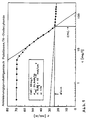
- Es wurden für verschiedene Aminierungsmittel (Isomaltulose mit N-Alkylamin) die Abhängigkeiten der Oberflächenspannungen von den eingesetzten Produktkonzentrationen mit der Plattenmethode nach Wilhelmy (H. Nassenstein, "Grenzflächenforschung und Verfahrenstechnik", Chem.-Ing.-Tech., 53, S. 631-37 (1981) in Wasser bei 25 °C ermittelt (Abb. 1). Aus den konzentrationsabhängigen Oberflächenspannungsmessungen wird neben der Oberflächenspannung σ ebenfalls die kritische Micellbildungskonzentration, kurz CMC genannt, erhalten.

- Gegenüber den sogenannten Alkylpolyglycosiden, kurz als APG bezeichnet, die ebenfalls aus einem Kohlenhydratbaustein und einem Alkylrest aufgebaut sind und Ethylenoxidtensiden (beispielhaft wurde Nonaethylenoxid-dodecylether verwendet) weisen die hier beschriebenen neuen Produkte äquivalente Oberflächenspannungen auf, zeigen hinsichtlich CMC noch niedrigere Werte (Abb. 2), so daß davon ausgegangen werden kann, daß in entsprechenden Formulierungen durch einen geringen Einsatz das gleiche Resultat erzielt werden kann.
- Obwohl die erfindungsgemäßen Verbindungen einen potentiell kationischen Charakter aufweisen, verändern sich Oberflächenspannung und CMC in Salzlösungen nur geringfügig.

- Durch Elektrolytzugabe wird die CMC teilweise noch weiter abgesenkt. Bei anderen Tensiden wie z. B. APG's bewirkt der Elektrolyteinfluß, bei besonders zweiwertigen Kationen, eine Erhöhung der kritischen Micellbildungskonzentration.
- Vorversuche bestätigen, daß die neuen Produkte mit anionischen Tensiden nicht zu Ausflockungen führen. Es wurden je 1 % Lösung von N-Cocoaminoisomalt und Fettalkoholethersulfat zusammengegeben und bis 90 °C erhitzt. Eine Ausfällung war auch beim Abkühlen nicht zu beobachten. In einem standardisierten Waschversuch konnte geprüft werden, daß bereits eine 1 % Zugabe eine weichmachende Wirkung auf die Wäsche ausübt.
- Das Schaumvermögen bzw. die Schaumstabilität wurde beim N-Cocoaminoisomalt als 0,1 %ige wäßrige Lösung nach DIN 53 902 vermessen. Die erzielten Werte (Ablesung nach 30 s/300 s) liegen bei diesem Produkt bei 585 ml/580 ml und liegen somit in der Größenordnung, wie sie für das kommerziell in hohem Umfang eingesetzte Anionentensid LAS (590 ml/570 ml) gefunden werden. Die Eignung als waschaktive Substanz ist somit gegeben.
Claims (10)
- Stereoisomeres Gemisch aus 1-N-Alkylamino-1-desoxy-6-0-[α-D-glucopyranosyl]-D-sorbit und 1-N-Alkylamino-1-desoxy-6-0-[α-D-glucopyranosyl]-D-mannit, das auch als 1-N-Alkylaminoisomalt bezeichnet die folgende allgemeine Formel I hat:

- Mischungen von 1-N-Alkylaminoisomalt der Formel I gemäß Anspruch 1 mit 1-N-Alkyl-amino-1-desoxy-3-O-α-glucopyranosylglycerin, der Formel II

- Verfahren zur Herstellung der Produkte gemäß Anspruch 1 oder 2, dadurch gekennzeichnet, daß Isomaltulose mit N-Alkylaminen bzw. Mischungen von N-Alkylaminen in denen die Alkylgruppe die gleiche Bedeutung wie in Formel I hat, reduktiv aminiert wird.
- Verfahren nach Anspruch 3, dadurch gekennzeichnet, daß die reduktive Aminierung mit Metallkatalysatoren und Wasserstoff in wäßriger oder wäßrigalkoholischer Lösung durchgeführt wird.
- Verfahren nach Anspruch 3 oder 4, dadurch gekennzeichnet, daß das Rohprodukt mittels chromatographischer Methoden getrennt wird.
- Verfahren gemäß einem der Ansprüche 3 bis 5, dadurch gekennzeichnet, daß ein Überschuß von 0,5 bis 5 Mol, vorzugsweise 2 bis 4 Mol, Isomaltulose gegenüber dem Alkylamin eingesetz wird.
- Verfahren gemäß einem der Ansprüche 3 bis 6, dadurch gekennzeichnet, daß der Reaktionsmischung 0,5 bis 10 Gew.-% von Produkten der Formel I zugemischt werden.
- Verfahren gemäß einem der Ansprüche 3 bis 7, bei denen die aminierten Produkte mittels Elektrodialyse von nicht aminierten Produkten abgetrennt werden.
- Verwendung der Produkte gemäß Anspruch 1 bzw. deren Mischung gemäß Anspruch 2 als hydrophile Netzmittel, Emulgatoren oder waschaktive Substanzen, insbesondere in kosmetischen bzw. technischen Reinigungsmitteln.
- Verwendung gemäß Anspruch 9, zusammen mit einem anionischen Tensid als Softergent.
Applications Claiming Priority (2)
| Application Number | Priority Date | Filing Date | Title |
|---|---|---|---|
| DE4310032A DE4310032C2 (de) | 1993-03-27 | 1993-03-27 | Stereoisomeres Gemisch aus 1-N-Alkylamino-1-desoxy-6-0-[alpha-D-glucopyranosyl]-D-sorbit und 1-N-Alkylamino-1-desoxy-6-0-[alpha-D-glucopyranosyl]-D-mannit, Verfahren zu seiner Herstellung und seine Verwendung |
| DE4310032 | 1993-03-27 |
Publications (2)
| Publication Number | Publication Date |
|---|---|
| EP0618216A1 true EP0618216A1 (de) | 1994-10-05 |
| EP0618216B1 EP0618216B1 (de) | 1997-09-10 |
Family
ID=6484045
Family Applications (1)
| Application Number | Title | Priority Date | Filing Date |
|---|---|---|---|
| EP94104472A Expired - Lifetime EP0618216B1 (de) | 1993-03-27 | 1994-03-22 | 1-N-Alkylaminoisomalt, ihre Herstellung aus Isomaltulose sowie ihre Verwendung als oberflächenaktive Mittel |
Country Status (5)
| Country | Link |
|---|---|
| EP (1) | EP0618216B1 (de) |
| JP (1) | JP3220323B2 (de) |
| AT (1) | ATE157983T1 (de) |
| DE (2) | DE4310032C2 (de) |
| DK (1) | DK0618216T3 (de) |
Families Citing this family (2)
| Publication number | Priority date | Publication date | Assignee | Title |
|---|---|---|---|---|
| DE19748195A1 (de) | 1997-10-31 | 1999-05-06 | Suedzucker Ag | Disaccharidderivate zur Behandlung von Hyperglykämien |
| DE102012110121A1 (de) | 2012-10-24 | 2014-04-24 | Continental Reifen Deutschland Gmbh | Kautschukmischung und Fahrzeugluftreifen |
Citations (8)
| Publication number | Priority date | Publication date | Assignee | Title |
|---|---|---|---|---|
| US2181929A (en) * | 1937-09-21 | 1939-12-05 | Du Pont | Maltosamine and process for preparing it |
| US2838487A (en) * | 1953-08-03 | 1958-06-10 | Gen Mills Inc | Salts of sulfated fatty amine glycosides |
| EP0220676A1 (de) * | 1985-10-29 | 1987-05-06 | Süddeutsche Zucker-Aktiengesellschaft | Fettsäureamide von Aminopolyolen als nichtionogene Tenside |
| EP0255033A2 (de) * | 1986-07-31 | 1988-02-03 | Südzucker Aktiengesellschaft Mannheim/Ochsenfurt | Isomaltamine sowie deren N-Acylderivate, Verfahren zu deren Herstellung und ihre Verwendung |
| EP0383024A2 (de) * | 1989-02-13 | 1990-08-22 | Südzucker Aktiengesellschaft Mannheim/Ochsenfurt | N-Polyhydroxy-N'-alkylharnstoffderivate, Verfahren zu ihrer Herstellung und Verwendung derselben |
| EP0383023A2 (de) * | 1989-02-13 | 1990-08-22 | Südzucker Aktiengesellschaft Mannheim/Ochsenfurt | Polymerisierbare N'-Polyhydroxy-N'-alkylharnstoffderivate, Verfahren zu ihrer Herstellung, deren Verwendung und daraus erhältliche Homo- oder Copolymeren |
| WO1992006984A1 (en) * | 1990-10-12 | 1992-04-30 | The Procter & Gamble Company | Process for preparing n-alkyl polyhydroxy amines and fatty acid amides therefrom in hydroxy solvents |
| JPH05117216A (ja) * | 1991-10-25 | 1993-05-14 | Kao Corp | 新規アミノ糖化合物 |
-
1993
- 1993-03-27 DE DE4310032A patent/DE4310032C2/de not_active Expired - Fee Related
-
1994
- 1994-03-22 AT AT94104472T patent/ATE157983T1/de not_active IP Right Cessation
- 1994-03-22 DE DE59403998T patent/DE59403998D1/de not_active Expired - Fee Related
- 1994-03-22 EP EP94104472A patent/EP0618216B1/de not_active Expired - Lifetime
- 1994-03-22 DK DK94104472.9T patent/DK0618216T3/da active
- 1994-03-24 JP JP07632994A patent/JP3220323B2/ja not_active Expired - Fee Related
Patent Citations (8)
| Publication number | Priority date | Publication date | Assignee | Title |
|---|---|---|---|---|
| US2181929A (en) * | 1937-09-21 | 1939-12-05 | Du Pont | Maltosamine and process for preparing it |
| US2838487A (en) * | 1953-08-03 | 1958-06-10 | Gen Mills Inc | Salts of sulfated fatty amine glycosides |
| EP0220676A1 (de) * | 1985-10-29 | 1987-05-06 | Süddeutsche Zucker-Aktiengesellschaft | Fettsäureamide von Aminopolyolen als nichtionogene Tenside |
| EP0255033A2 (de) * | 1986-07-31 | 1988-02-03 | Südzucker Aktiengesellschaft Mannheim/Ochsenfurt | Isomaltamine sowie deren N-Acylderivate, Verfahren zu deren Herstellung und ihre Verwendung |
| EP0383024A2 (de) * | 1989-02-13 | 1990-08-22 | Südzucker Aktiengesellschaft Mannheim/Ochsenfurt | N-Polyhydroxy-N'-alkylharnstoffderivate, Verfahren zu ihrer Herstellung und Verwendung derselben |
| EP0383023A2 (de) * | 1989-02-13 | 1990-08-22 | Südzucker Aktiengesellschaft Mannheim/Ochsenfurt | Polymerisierbare N'-Polyhydroxy-N'-alkylharnstoffderivate, Verfahren zu ihrer Herstellung, deren Verwendung und daraus erhältliche Homo- oder Copolymeren |
| WO1992006984A1 (en) * | 1990-10-12 | 1992-04-30 | The Procter & Gamble Company | Process for preparing n-alkyl polyhydroxy amines and fatty acid amides therefrom in hydroxy solvents |
| JPH05117216A (ja) * | 1991-10-25 | 1993-05-14 | Kao Corp | 新規アミノ糖化合物 |
Non-Patent Citations (4)
| Title |
|---|
| C. WOOD, E. KABAT: "Immunochemical Studies of Conjugates of Isomaltosyl Oligosaccharides to Lipid", J. EXP. MED., vol. 154, 1981, pages 432 - 449 * |
| DATABASE WPI DERWENT PUBLICATIONS LTD., LONDON, GB; "Novel amino sugar cpds." * |
| J. KLEIN: "New surfactant polymers based on carbohydrates", MACROMOL. CHEM., vol. 191, 1990, pages 517 - 528, XP000611640, DOI: doi:10.1002/macp.1990.021910307 * |
| R.S. SHALLENBERGER: "ADVANCED SUGAR CHEMISTRY", 1982, ELLIS HORWOOD LTD PUBLISHERS * |
Also Published As
| Publication number | Publication date |
|---|---|
| EP0618216B1 (de) | 1997-09-10 |
| DE59403998D1 (de) | 1997-10-16 |
| DE4310032C2 (de) | 2000-01-05 |
| DE4310032A1 (de) | 1994-09-29 |
| DK0618216T3 (da) | 1998-04-14 |
| JPH0753585A (ja) | 1995-02-28 |
| JP3220323B2 (ja) | 2001-10-22 |
| ATE157983T1 (de) | 1997-09-15 |
Similar Documents
| Publication | Publication Date | Title |
|---|---|---|
| DE2728841C2 (de) | ||
| EP2902010B1 (de) | Wäßrige tensid-Zusammensetzungen | |
| EP0659207A1 (de) | Detergensgemische | |
| EP0255033A2 (de) | Isomaltamine sowie deren N-Acylderivate, Verfahren zu deren Herstellung und ihre Verwendung | |
| EP0569869B1 (de) | Lactobionsäureamidzusammensetzungen und deren Verwendung | |
| DE3603581A1 (de) | Verfahren zur reinigung von alkylglycosiden, durch dieses verfahren erhaeltliche produkte und deren verwendung | |
| EP0703962B1 (de) | Ultramilde tensidmischungen | |
| DE3638918A1 (de) | Quartaere ammoniumverbindungen, deren herstellung und verwendung als textilnachbehandlungsmittel | |
| DE69309102T2 (de) | Verfahren zur herstellung von sulfierter polyhydroxyfettsäuretensiden | |
| EP0784609B2 (de) | Verfahren zur herstellung von pumpfähigen wässrigen tensidkonzentraten | |
| EP0613482B1 (de) | Verfahren zur herstellung von alkyl- und/oder alkenyloligoglykosiden | |
| EP0618216B1 (de) | 1-N-Alkylaminoisomalt, ihre Herstellung aus Isomaltulose sowie ihre Verwendung als oberflächenaktive Mittel | |
| DE60016735T2 (de) | Verwendung von alkoxilierten zuckerestern in flüssigen wässrigen weichmacherzusammensetzungen | |
| DE4414696A1 (de) | Schäumende Detergensgemische | |
| EP1465582B1 (de) | Alkyl-und/oder alkylenoligoglycosid-betainesterquats | |
| EP0396871B1 (de) | Neue N-Alkylglykaminoverbindungen sowie ein Verfahren zur Herstellung und ihre Verwendung | |
| DE4433070C1 (de) | Milde Detergensgemische | |
| DE2643794A1 (de) | Neue amphotere oberflaechenaktive verbindungen | |
| DE69511387T2 (de) | Neue glycinderivate, zwischenprodukte dazu, sowie diese enthaltenden reinigungszusammensetzungen | |
| WO2017198527A1 (de) | Wässrige tensid-zusammensetzungen | |
| DE4433959A1 (de) | Schäumende Detergensgemische | |
| DE19527630A1 (de) | Polyhydroxyalkylamidobetaine | |
| DE102024209772A1 (de) | Tensidzusammensetzung, die eine Mischung von Fettalkoholsulfaten enthält | |
| DE102024209769A1 (de) | Tensidzusammensetzung, die eine Mischung aus Fettalkoholethersulfaten enthält | |
| DE102024209766A1 (de) | Tensidzusammensetzung, die eine Mischung aus Alkylpolyglykosiden enthält |
Legal Events
| Date | Code | Title | Description |
|---|---|---|---|
| PUAI | Public reference made under article 153(3) epc to a published international application that has entered the european phase |
Free format text: ORIGINAL CODE: 0009012 |
|
| AK | Designated contracting states |
Kind code of ref document: A1 Designated state(s): AT BE CH DE DK FR GB IT LI LU NL |
|
| 17P | Request for examination filed |
Effective date: 19940910 |
|
| 17Q | First examination report despatched |
Effective date: 19941222 |
|
| GRAG | Despatch of communication of intention to grant |
Free format text: ORIGINAL CODE: EPIDOS AGRA |
|
| GRAH | Despatch of communication of intention to grant a patent |
Free format text: ORIGINAL CODE: EPIDOS IGRA |
|
| GRAH | Despatch of communication of intention to grant a patent |
Free format text: ORIGINAL CODE: EPIDOS IGRA |
|
| GRAA | (expected) grant |
Free format text: ORIGINAL CODE: 0009210 |
|
| AK | Designated contracting states |
Kind code of ref document: B1 Designated state(s): AT BE CH DE DK FR GB IT LI LU NL |
|
| REF | Corresponds to: |
Ref document number: 157983 Country of ref document: AT Date of ref document: 19970915 Kind code of ref document: T |
|
| REG | Reference to a national code |
Ref country code: CH Ref legal event code: EP |
|
| REF | Corresponds to: |
Ref document number: 59403998 Country of ref document: DE Date of ref document: 19971016 |
|
| ET | Fr: translation filed | ||
| ITF | It: translation for a ep patent filed | ||
| GBT | Gb: translation of ep patent filed (gb section 77(6)(a)/1977) |
Effective date: 19971119 |
|
| PG25 | Lapsed in a contracting state [announced via postgrant information from national office to epo] |
Ref country code: LU Free format text: LAPSE BECAUSE OF NON-PAYMENT OF DUE FEES Effective date: 19980322 |
|
| PG25 | Lapsed in a contracting state [announced via postgrant information from national office to epo] |
Ref country code: LI Free format text: LAPSE BECAUSE OF NON-PAYMENT OF DUE FEES Effective date: 19980331 Ref country code: CH Free format text: LAPSE BECAUSE OF NON-PAYMENT OF DUE FEES Effective date: 19980331 |
|
| REG | Reference to a national code |
Ref country code: DK Ref legal event code: T3 |
|
| PLBE | No opposition filed within time limit |
Free format text: ORIGINAL CODE: 0009261 |
|
| STAA | Information on the status of an ep patent application or granted ep patent |
Free format text: STATUS: NO OPPOSITION FILED WITHIN TIME LIMIT |
|
| 26N | No opposition filed | ||
| REG | Reference to a national code |
Ref country code: CH Ref legal event code: PL |
|
| REG | Reference to a national code |
Ref country code: GB Ref legal event code: IF02 |
|
| PGFP | Annual fee paid to national office [announced via postgrant information from national office to epo] |
Ref country code: AT Payment date: 20050208 Year of fee payment: 12 |
|
| PGFP | Annual fee paid to national office [announced via postgrant information from national office to epo] |
Ref country code: DK Payment date: 20050211 Year of fee payment: 12 |
|
| PGFP | Annual fee paid to national office [announced via postgrant information from national office to epo] |
Ref country code: FR Payment date: 20060313 Year of fee payment: 13 |
|
| PGFP | Annual fee paid to national office [announced via postgrant information from national office to epo] |
Ref country code: NL Payment date: 20060315 Year of fee payment: 13 |
|
| PGFP | Annual fee paid to national office [announced via postgrant information from national office to epo] |
Ref country code: GB Payment date: 20060316 Year of fee payment: 13 |
|
| PG25 | Lapsed in a contracting state [announced via postgrant information from national office to epo] |
Ref country code: AT Free format text: LAPSE BECAUSE OF NON-PAYMENT OF DUE FEES Effective date: 20060322 |
|
| PGFP | Annual fee paid to national office [announced via postgrant information from national office to epo] |
Ref country code: DE Payment date: 20060330 Year of fee payment: 13 |
|
| PG25 | Lapsed in a contracting state [announced via postgrant information from national office to epo] |
Ref country code: DK Free format text: LAPSE BECAUSE OF NON-PAYMENT OF DUE FEES Effective date: 20060331 |
|
| PGFP | Annual fee paid to national office [announced via postgrant information from national office to epo] |
Ref country code: IT Payment date: 20060331 Year of fee payment: 13 Ref country code: BE Payment date: 20060331 Year of fee payment: 13 |
|
| REG | Reference to a national code |
Ref country code: DK Ref legal event code: EBP |
|
| GBPC | Gb: european patent ceased through non-payment of renewal fee |
Effective date: 20070322 |
|
| NLV4 | Nl: lapsed or anulled due to non-payment of the annual fee |
Effective date: 20071001 |
|
| BERE | Be: lapsed |
Owner name: *SUDZUCKER A.G. MANNHEIM/OCHSENFURT Effective date: 20070331 |
|
| PG25 | Lapsed in a contracting state [announced via postgrant information from national office to epo] |
Ref country code: BE Free format text: LAPSE BECAUSE OF NON-PAYMENT OF DUE FEES Effective date: 20070331 |
|
| REG | Reference to a national code |
Ref country code: FR Ref legal event code: ST Effective date: 20071130 |
|
| PG25 | Lapsed in a contracting state [announced via postgrant information from national office to epo] |
Ref country code: NL Free format text: LAPSE BECAUSE OF NON-PAYMENT OF DUE FEES Effective date: 20071001 Ref country code: DE Free format text: LAPSE BECAUSE OF NON-PAYMENT OF DUE FEES Effective date: 20071002 |
|
| PG25 | Lapsed in a contracting state [announced via postgrant information from national office to epo] |
Ref country code: GB Free format text: LAPSE BECAUSE OF NON-PAYMENT OF DUE FEES Effective date: 20070322 |
|
| PG25 | Lapsed in a contracting state [announced via postgrant information from national office to epo] |
Ref country code: FR Free format text: LAPSE BECAUSE OF NON-PAYMENT OF DUE FEES Effective date: 20070402 |
|
| PG25 | Lapsed in a contracting state [announced via postgrant information from national office to epo] |
Ref country code: IT Free format text: LAPSE BECAUSE OF NON-PAYMENT OF DUE FEES Effective date: 20070322 |