EP0617100B1 - Alpha- cyanoacrylate adhesive compositions and method of production thereof - Google Patents
Alpha- cyanoacrylate adhesive compositions and method of production thereof Download PDFInfo
- Publication number
- EP0617100B1 EP0617100B1 EP19940301952 EP94301952A EP0617100B1 EP 0617100 B1 EP0617100 B1 EP 0617100B1 EP 19940301952 EP19940301952 EP 19940301952 EP 94301952 A EP94301952 A EP 94301952A EP 0617100 B1 EP0617100 B1 EP 0617100B1
- Authority
- EP
- European Patent Office
- Prior art keywords
- adhesive
- cyanoacrylate adhesive
- elastomer particles
- cyanoacrylate
- butadiene copolymer
- Prior art date
- Legal status (The legal status is an assumption and is not a legal conclusion. Google has not performed a legal analysis and makes no representation as to the accuracy of the status listed.)
- Expired - Lifetime
Links
- IJVRPNIWWODHHA-UHFFFAOYSA-N 2-cyanoprop-2-enoic acid Chemical compound OC(=O)C(=C)C#N IJVRPNIWWODHHA-UHFFFAOYSA-N 0.000 title claims description 44
- 239000004830 Super Glue Substances 0.000 title claims description 40
- 239000000203 mixture Substances 0.000 title claims description 35
- 238000000034 method Methods 0.000 title claims description 14
- 238000004519 manufacturing process Methods 0.000 title claims description 3
- 239000002245 particle Substances 0.000 claims description 44
- 229920001971 elastomer Polymers 0.000 claims description 43
- 239000000806 elastomer Substances 0.000 claims description 37
- 229920001577 copolymer Polymers 0.000 claims description 15
- 239000012454 non-polar solvent Substances 0.000 claims description 8
- 239000005060 rubber Substances 0.000 claims description 6
- 229920003048 styrene butadiene rubber Polymers 0.000 claims description 5
- 238000001816 cooling Methods 0.000 claims description 2
- 238000010438 heat treatment Methods 0.000 claims description 2
- 230000001070 adhesive effect Effects 0.000 description 39
- 239000000853 adhesive Substances 0.000 description 37
- 230000035939 shock Effects 0.000 description 8
- 229910000831 Steel Inorganic materials 0.000 description 5
- 239000010959 steel Substances 0.000 description 5
- 229920001651 Cyanoacrylate Polymers 0.000 description 4
- QIGBRXMKCJKVMJ-UHFFFAOYSA-N Hydroquinone Chemical compound OC1=CC=C(O)C=C1 QIGBRXMKCJKVMJ-UHFFFAOYSA-N 0.000 description 4
- 230000000052 comparative effect Effects 0.000 description 3
- 150000001875 compounds Chemical class 0.000 description 3
- 239000000470 constituent Substances 0.000 description 3
- 239000000945 filler Substances 0.000 description 3
- 239000003112 inhibitor Substances 0.000 description 3
- 238000005259 measurement Methods 0.000 description 3
- 238000003860 storage Methods 0.000 description 3
- 230000009974 thixotropic effect Effects 0.000 description 3
- XLYOFNOQVPJJNP-UHFFFAOYSA-N water Substances O XLYOFNOQVPJJNP-UHFFFAOYSA-N 0.000 description 3
- AFVFQIVMOAPDHO-UHFFFAOYSA-N Methanesulfonic acid Chemical compound CS(O)(=O)=O AFVFQIVMOAPDHO-UHFFFAOYSA-N 0.000 description 2
- MWCLLHOVUTZFKS-UHFFFAOYSA-N Methyl cyanoacrylate Chemical compound COC(=O)C(=C)C#N MWCLLHOVUTZFKS-UHFFFAOYSA-N 0.000 description 2
- NBIIXXVUZAFLBC-UHFFFAOYSA-N Phosphoric acid Chemical compound OP(O)(O)=O NBIIXXVUZAFLBC-UHFFFAOYSA-N 0.000 description 2
- AFVLVVWMAFSXCK-VMPITWQZSA-N alpha-cyano-4-hydroxycinnamic acid Chemical group OC(=O)C(\C#N)=C\C1=CC=C(O)C=C1 AFVLVVWMAFSXCK-VMPITWQZSA-N 0.000 description 2
- YCIMNLLNPGFGHC-UHFFFAOYSA-N catechol Chemical compound OC1=CC=CC=C1O YCIMNLLNPGFGHC-UHFFFAOYSA-N 0.000 description 2
- -1 cyanoacrylate ester Chemical class 0.000 description 2
- FGBJXOREULPLGL-UHFFFAOYSA-N ethyl cyanoacrylate Chemical compound CCOC(=O)C(=C)C#N FGBJXOREULPLGL-UHFFFAOYSA-N 0.000 description 2
- 238000006116 polymerization reaction Methods 0.000 description 2
- WQGWDDDVZFFDIG-UHFFFAOYSA-N pyrogallol Chemical compound OC1=CC=CC(O)=C1O WQGWDDDVZFFDIG-UHFFFAOYSA-N 0.000 description 2
- 229920006395 saturated elastomer Polymers 0.000 description 2
- 238000003756 stirring Methods 0.000 description 2
- 230000008719 thickening Effects 0.000 description 2
- JOXIMZWYDAKGHI-UHFFFAOYSA-N toluene-4-sulfonic acid Chemical compound CC1=CC=C(S(O)(=O)=O)C=C1 JOXIMZWYDAKGHI-UHFFFAOYSA-N 0.000 description 2
- ZQXCQTAELHSNAT-UHFFFAOYSA-N 1-chloro-3-nitro-5-(trifluoromethyl)benzene Chemical compound [O-][N+](=O)C1=CC(Cl)=CC(C(F)(F)F)=C1 ZQXCQTAELHSNAT-UHFFFAOYSA-N 0.000 description 1
- 125000003903 2-propenyl group Chemical group [H]C([*])([H])C([H])=C([H])[H] 0.000 description 1
- NLHHRLWOUZZQLW-UHFFFAOYSA-N Acrylonitrile Chemical compound C=CC#N NLHHRLWOUZZQLW-UHFFFAOYSA-N 0.000 description 1
- OKTJSMMVPCPJKN-UHFFFAOYSA-N Carbon Chemical compound [C] OKTJSMMVPCPJKN-UHFFFAOYSA-N 0.000 description 1
- 239000004698 Polyethylene Substances 0.000 description 1
- NIXOWILDQLNWCW-UHFFFAOYSA-N acrylic acid group Chemical group C(C=C)(=O)O NIXOWILDQLNWCW-UHFFFAOYSA-N 0.000 description 1
- 238000004220 aggregation Methods 0.000 description 1
- 230000002776 aggregation Effects 0.000 description 1
- 125000003342 alkenyl group Chemical group 0.000 description 1
- 125000004183 alkoxy alkyl group Chemical group 0.000 description 1
- 125000000217 alkyl group Chemical group 0.000 description 1
- 229910000147 aluminium phosphate Inorganic materials 0.000 description 1
- 238000010539 anionic addition polymerization reaction Methods 0.000 description 1
- 125000003710 aryl alkyl group Chemical group 0.000 description 1
- 229920001400 block copolymer Polymers 0.000 description 1
- 229910052799 carbon Inorganic materials 0.000 description 1
- 125000000113 cyclohexyl group Chemical group [H]C1([H])C([H])([H])C([H])([H])C([H])(*)C([H])([H])C1([H])[H] 0.000 description 1
- 230000007547 defect Effects 0.000 description 1
- 238000004090 dissolution Methods 0.000 description 1
- 239000011521 glass Substances 0.000 description 1
- 125000001188 haloalkyl group Chemical group 0.000 description 1
- 239000007788 liquid Substances 0.000 description 1
- 239000002184 metal Substances 0.000 description 1
- 229940098779 methanesulfonic acid Drugs 0.000 description 1
- 239000012766 organic filler Substances 0.000 description 1
- 125000001997 phenyl group Chemical group [H]C1=C([H])C([H])=C(*)C([H])=C1[H] 0.000 description 1
- 239000004033 plastic Substances 0.000 description 1
- 229920003023 plastic Polymers 0.000 description 1
- 239000004417 polycarbonate Substances 0.000 description 1
- 229920000515 polycarbonate Polymers 0.000 description 1
- 229920000573 polyethylene Polymers 0.000 description 1
- 229920002981 polyvinylidene fluoride Polymers 0.000 description 1
- 229940079877 pyrogallol Drugs 0.000 description 1
- 238000010526 radical polymerization reaction Methods 0.000 description 1
- 239000012258 stirred mixture Substances 0.000 description 1
- 239000002023 wood Substances 0.000 description 1
Classifications
-
- C—CHEMISTRY; METALLURGY
- C09—DYES; PAINTS; POLISHES; NATURAL RESINS; ADHESIVES; COMPOSITIONS NOT OTHERWISE PROVIDED FOR; APPLICATIONS OF MATERIALS NOT OTHERWISE PROVIDED FOR
- C09J—ADHESIVES; NON-MECHANICAL ASPECTS OF ADHESIVE PROCESSES IN GENERAL; ADHESIVE PROCESSES NOT PROVIDED FOR ELSEWHERE; USE OF MATERIALS AS ADHESIVES
- C09J4/00—Adhesives based on organic non-macromolecular compounds having at least one polymerisable carbon-to-carbon unsaturated bond ; adhesives, based on monomers of macromolecular compounds of groups C09J183/00 - C09J183/16
- C09J4/06—Organic non-macromolecular compounds having at least one polymerisable carbon-to-carbon unsaturated bond in combination with a macromolecular compound other than an unsaturated polymer of groups C09J159/00 - C09J187/00
-
- C—CHEMISTRY; METALLURGY
- C09—DYES; PAINTS; POLISHES; NATURAL RESINS; ADHESIVES; COMPOSITIONS NOT OTHERWISE PROVIDED FOR; APPLICATIONS OF MATERIALS NOT OTHERWISE PROVIDED FOR
- C09J—ADHESIVES; NON-MECHANICAL ASPECTS OF ADHESIVE PROCESSES IN GENERAL; ADHESIVE PROCESSES NOT PROVIDED FOR ELSEWHERE; USE OF MATERIALS AS ADHESIVES
- C09J4/00—Adhesives based on organic non-macromolecular compounds having at least one polymerisable carbon-to-carbon unsaturated bond ; adhesives, based on monomers of macromolecular compounds of groups C09J183/00 - C09J183/16
Definitions
- This invention relates to ⁇ -cyanoacrylate adhesive compositions having excellent properties such as high peel strength, impact resistance, heat resistance, moisture resistance, and thermal shock resistance, and a method for production of the ⁇ -cyanoacrylate adhesive compositions by dispersing refractory elastomer particles such as acrylonitrile-butadiene copolymer in ⁇ -cyanoacrylate adhesive.
- Cyanoacrylate is a compound expressed by the following general formula.
- R represents components having carbon number of 16 or less such as alkyl, alkenyl, aralkyl, alkoxy alkyl, haloalkyl, cyclohexyl, allyl, and phenyl.
- the compound of this type When this compound is applied to a surface of metal, rubber, plastic, glass and wood, it quickly hardens by taking place polymerization reaction with a little moisture on the surface.
- the compound of this type has an excellent adhesive property and has been widely used as rapid-setting adhesive.
- the ⁇ -cyanoacrylate adhesive shows high adhesive strength under shear; nevertheless, it suffers from the defect that it becomes brittle when hardened.
- the hardened ⁇ -cyanoacrylate adhesive is insufficient in resistance against peeling stress and impact and durability (heat resistance, water resistance, moisture resistance, and thermal shock resistance).
- Japanese Patent Application Public Disclosure No. SHO 57-78469(A) discloses a method for improving the properties of ⁇ -cyanoacrylate adhesive such as resistance against peeling stress and impact by adding pyrogallol to ⁇ -cyanoacrylate in the range of 1 to 5000 ppm.
- the prior art method makes it possible to improve the adhesive strength and impact resistance of the adhesive resultantly obtained, the hardened adhesive entails a problem such as insufficiency of heat resistance, water resistance and moisture resistance, and therefore, it is restricted in use.
- United States Patent 4,105,715 discloses a cyanoacrylate adhesive composition in thixotropic paste form made by mixing a liquid cyanoacrylate ester with powdered organic fillers selected from (i) polycarbonates, (ii) polyvinylidene fluorides, (iii) polyethylenes, and (iv) acrylic block copolymers containing saturated elastomer segments.
- the filler is added in proportions of 2.5 to 50% by weight for the purpose of thickening the basic cyanoacrylate to improve its handling characteristics.
- a thixotropic gel composition comprising an ⁇ -cyano acrylate in admixture with, among other things, a filler in the form of fibres, spheres or mixtures thereof.
- the filler is substantially insoluble in the ⁇ -cyanoacrylate monomer and is responsible for the thixotropic character of the composition.
- Japanese Patent Publication No. SHO 43-29477(B) proposes the method for improvement of the properties of ⁇ -cyanoacrylate adhesive by mixing ⁇ -cyanoacrylate with elastomer such as acrylonitrile-butadiene copolymer.
- elastomer such as acrylonitrile-butadiene copolymer.
- the adhesive produced by this prior art method is disadvantageously insufficient in adhesive strength and compatibility so as not to improve brittleness.
- the inventor of this invention has studied to solve the aforenoted problem on the conventional ⁇ -cyanoacrylate adhesive of this type and, as a result of his study, could find a method capable of producing ⁇ -cyanoacrylate adhesive compositions being remarkably excellent in' adhesive strength, impact resistance, peel strength, heat resistance, moisture resistance, and thermal shock resistance, and further free from the problem as to brittleness after hardened.
- the highly functional ⁇ -cyanoacrylate adhesive by dispersing refractory elastomer particles in ⁇ -cyanoacrylate adhesive.
- the inventor has accomplished this invention.
- the ⁇ -cyanoacrylate adhesive used in this invention is obtained by adding a radical polymerization inhibitor for ensuring storage stability, and an anionic polymerization inhibitor such as hydroquinone, catechol, phosphoric acid, methanesulfonic acid, p-toluenesulfonic acid and sultoneboron trifluoride etherate to ⁇ -cyanoacrylate adhesive, as a primary component which is expressed by the general formula as specified above.
- the invention is an ⁇ -cyanoacrylate adhesive composition
- an ⁇ -cyanoacrylate adhesive composition comprising an ⁇ -cyanoacrylate adhesive having dispersed therethrough elastomer particles of size in the range 0.1 to 100 ⁇ m, characterised in that said elastomer particles are selected from one or more of acrylonitrile-butadiene copolymer, styrene-butadiene copolymer or crude rubber.
- Acrylonitrile-butadiene copolymer is the preferred elastomer in this invention.
- the elastomer particles are dispersed.
- the reason why a dispersal system is used in this invention is that excessive elastomer particles can be added in the dispersal system thereby to obtain an elastomeric composition of ⁇ -cyanoacrylate adhesive without increasing its viscosity.
- ⁇ -cyanoacrylate adhesive and elastomer are soluble in each other and thereby produce an elastic composition of ⁇ -cyano acrylate adhesive with high viscosity.
- the invention is a method of preparing an adhesive composition in accordance with the first aspect by the steps of:
- the method may be executed by dissolving the elastomer particles in a non-polar solvent prior to mixing with the ⁇ -cyanoacrylate adhesive. Particles are educed in the desired particle size range by removing the non-polar solvent by vacuum deaeration.
- ⁇ -cyanoacrylate adhesive compositions having sufficient adhesive strength cannot be obtained.
- the ⁇ -cyanoacrylate adhesive composition obtained by using elastomer particles with particle sizes of above 100 ⁇ m is inferior in storage stability and, particularly, entails conspicuous thickening of the composition due to aggregation occurring between the particles of elastomer.
- the method of dispersing the refractory elastomer particles in ⁇ -cyanoacrylate adhesive is carried out by, for example, mixing the elastomer previously dissolved in an adequate non-polar solvent with ⁇ -cyanoacrylate adhesive, stirring three components until being mixed uniformly, and then, subjecting the mixture thus obtained to vacuum-deaeration for removing the non-polar solvent so as to supersaturate and educe the elastomer particles with a particle size of 0.1 to 100 ⁇ m in the mixture.
- the refractory elastomer particles are dispersed in the ⁇ -cyanoacrylate adhesive.
- the mixture is cooled in such a manner that a temperature is reduced by 10°C per hour, thereby to educe NBR-1 in the form of particles. Then, the educed NBR-1 particles were efficiently stirred at a high speed with an agitator. The stirring was continued for several hours after the temperature is lowered to about 15°C so as to disperse the NBR-1 particles in the adhesive, consequently to obtain an experimental sample.
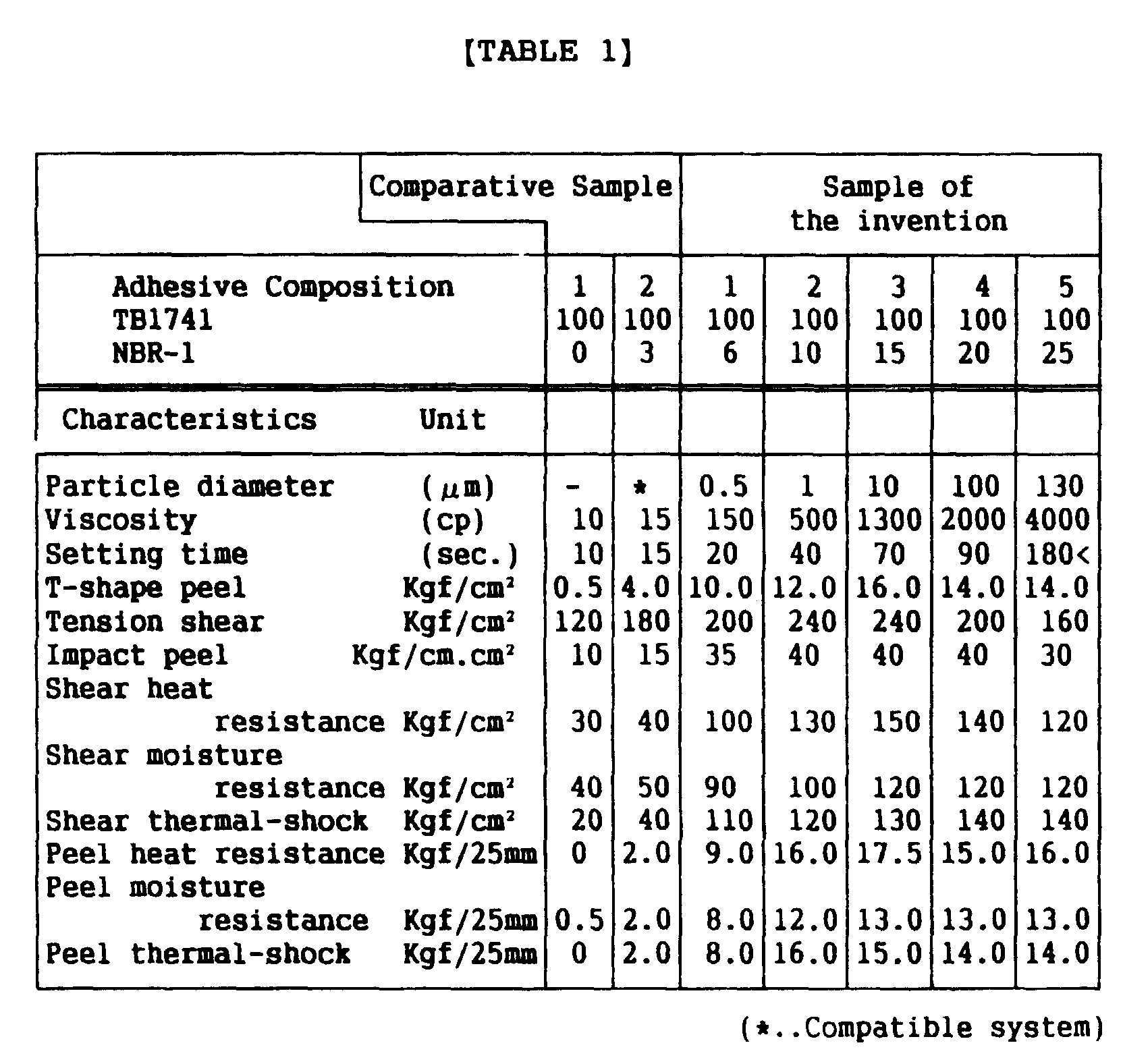
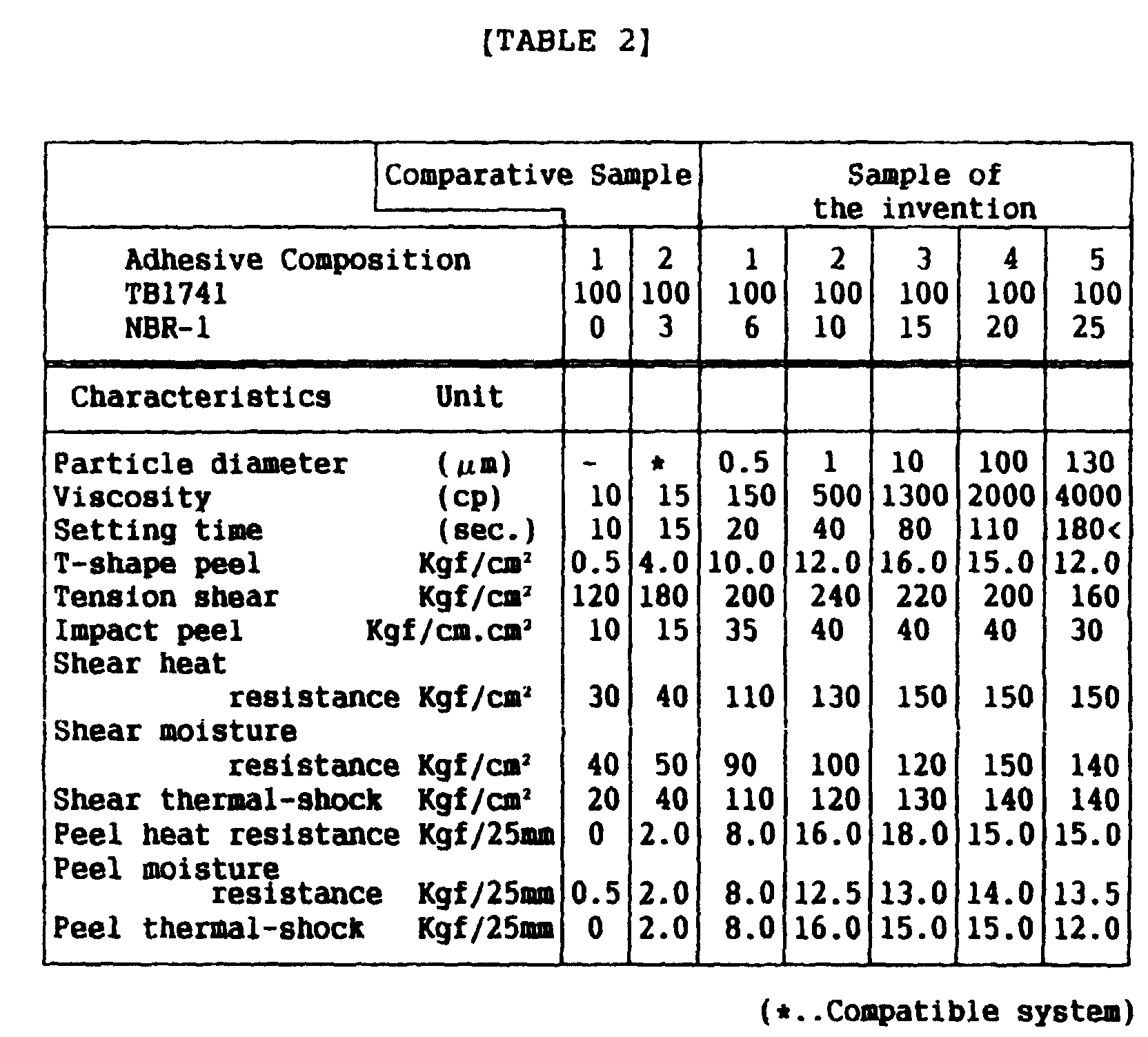
- the sample thus obtained was tested by the following manner. The result of the test are shown in Table 1 below.
- the aforesaid TB1741 alone, and a mixture of 100 parts by weight of TB1741 and 1 to 5 parts by weight of NBR-1 which were dissolved at room temperature were used.
- the state of the particles dispersed in the adhesive was confirmed by use of a phase contrast microscope, and the measure of the resultant adhesive was evaluated from the particle diameter thereof.
- Moisture Resistance ... A humidity test was made in such a manner that the hardened adhesive was permitted to stand-for 7 days at 60°C at 95% relative humidity, and then, cooled down to room temperature for measurement.
- Thermal Shock Resistance A thermal shock test was conducted in such a manner that a thermal shock caused by changing the condition from 120°C for one hour to -40°C for one hour was administered to the hardened adhesive twenty times, and then, the hardened adhesive was cooled down to room temperature for measurement.
- the experimental samples were obtained by using acrylonitrile-butadiene copolymers different from that used in Embodiment 1 noted above.
- acrylonitrile-butadiene copolymer elastomer particles of 1 ⁇ m in particle size, being low in Mooney viscosity and high in solubility at a normal temperature, were dispersed in adhesive composition.
- the tests for evaluating the properties of the adhesive composition were carried out by the same method as above. The results of the tests are shown in Table 3 below.
- Sample of the invention Composition 7 11 12 TB1741 100 100 100 Saturated solubility at room temperature (%) 5 10 15 NBR-1 10 NBR-2 25 NBR-3 35 Characteristics Unit Mooney viscosity ML (100°C) Particle diameter ( ⁇ m) 1 1 1 Viscosity (cp) 500 500 500 Setting time (sec.) 40 180 300 ⁇ T-shape peel Kgf/cm 2 12.0 8.0 8.0 Tension shear Kgf/cm 2 240 180 120 Impact peel Kgf/cm.cm 2 40 30 25
- Embodiments 1 to 10 were made by the different methods. However, the respective properties of the samples can be regarded to be substantially the same, taking account of differences in constituents of the adhesive samples.
- the adhesive of this invention in which particles of acrylonitrile-butadiene copolymer are dispersed (dispersal system) is remarkably improved in its durable adhesive properties.
- the adhesive When using acrylonitrile-butadiene copolymer being low in Mooney viscosity and solubility as the dispersal system, the adhesive entails disadvantages such that the setting time thereof becomes longer thus losing its rapid-setting ability and storage stability is degraded.
- the present invention can provide highly functional adhesive compositions being improved in brittleness after hardened, having higher adhesive strength, impact resistance and peel strength in comparison with compatible type adhesive compositions, and showing remarkably excellent durability (heat resistance, water resistance, moisture resistance, and thermal shock resistance) by dispersing refractory elastomer particles in ⁇ -cyanoacrylate adhesive.
Landscapes
- Chemical & Material Sciences (AREA)
- Organic Chemistry (AREA)
- Adhesives Or Adhesive Processes (AREA)
Description

| Sample of the invention | |||
| Composition | 7 | 11 | 12 |
| TB1741 | 100 | 100 | 100 |
| Saturated solubility at room temperature (%) | 5 | 10 | 15 |
| NBR-1 | 10 | ||
| NBR-2 | 25 | ||
| NBR-3 | 35 | ||
| Characteristics Unit | |||
| Mooney viscosity ML (100°C) | |||
| Particle diameter (µm) | 1 | 1 | 1 |
| Viscosity (cp) | 500 | 500 | 500 |
| Setting time (sec.) | 40 | 180 | 300< |
| T-shape peel Kgf/cm2 | 12.0 | 8.0 | 8.0 |
| Tension shear Kgf/cm2 | 240 | 180 | 120 |
| Impact peel Kgf/cm.cm2 | 40 | 30 | 25 |
Claims (3)
- An α-cyanoacrylate adhesive composition comprising an α-cyanoacrylate adhesive having dispersed therethrough elastomer particles of size in the range 0.1 to 100 µm, characterised in that said elastomer particles are selected from one or more of acrylonitrile-butadiene copolymer, styrene-butadiene copolymer or crude rubber.
- A method for producing an α-cyanoacrylate adhesive composition characterised by the steps of:(a) adding to an α-cyanoacrylate adhesive an excess of elastomer particles selected from one or more of acrylonitrile-butadiene copolymer, styrene-butadiene copolymer or crude rubber, said elastomer particles having a solubility of 10% or less in α-cyanoacrylate at 30°C or below;(b) heating the mixture obtained in step (a) at 100°C or below to dissolve the elastomer particles;(c) rapidly cooling the solution to 20°C to 30°C to educe elastomer particles in the size range 0.1 to 100 µm, and(d) dispersing said educed elastomer particles through said α-cyanoacrylate adhesive.
- A method as for producing an α-cyanoacrylate adhesive composition characterised by the steps of:(a) dissolving elastomer particles selected from one or more of acrylonitrile-butadiene copolymer, styrene-butadiene copolymer or crude rubber in a non-polar solvent to obtain an elastomer solution;(b) mixing said elastomer solution with α-cyanoacrylate adhesive to obtain a mixture;(c) subjecting said mixture to vacuum deaeration for removing said non-polar solvent, thereby educing elastomer particles in the size range 0.1 to 100 µm, and(d) dispersing said educed elastomer particles through said α-cyanoacrylate adhesive.
Applications Claiming Priority (2)
| Application Number | Priority Date | Filing Date | Title |
|---|---|---|---|
| JP8697693A JPH06271817A (en) | 1993-03-23 | 1993-03-23 | Alpha-cyanoacrylate-based adhesive composition and its production |
| JP86976/93 | 1993-03-23 |
Publications (2)
| Publication Number | Publication Date |
|---|---|
| EP0617100A1 EP0617100A1 (en) | 1994-09-28 |
| EP0617100B1 true EP0617100B1 (en) | 1998-08-05 |
Family
ID=13901908
Family Applications (1)
| Application Number | Title | Priority Date | Filing Date |
|---|---|---|---|
| EP19940301952 Expired - Lifetime EP0617100B1 (en) | 1993-03-23 | 1994-03-18 | Alpha- cyanoacrylate adhesive compositions and method of production thereof |
Country Status (3)
| Country | Link |
|---|---|
| EP (1) | EP0617100B1 (en) |
| JP (1) | JPH06271817A (en) |
| DE (1) | DE69412158T2 (en) |
Cited By (1)
| Publication number | Priority date | Publication date | Assignee | Title |
|---|---|---|---|---|
| CN102952483A (en) * | 2012-10-27 | 2013-03-06 | 蚌埠凤凰滤清器有限责任公司 | Filter adhesive film |
Families Citing this family (11)
| Publication number | Priority date | Publication date | Assignee | Title |
|---|---|---|---|---|
| JP2000018806A (en) * | 1998-07-07 | 2000-01-18 | Showa Alum Corp | Refrigerator door |
| US8541495B2 (en) | 2008-12-25 | 2013-09-24 | Toagosei Co., Ltd. | Adhesive composition |
| CN102952488B (en) * | 2012-10-27 | 2013-11-13 | 蚌埠凤凰滤清器有限责任公司 | Epoxy soybean oil modified adhesive film for filter |
| CN102952476B (en) * | 2012-10-27 | 2013-11-13 | 蚌埠凤凰滤清器有限责任公司 | Filter adhesive film containing nanometer attapulgite |
| CN103013361B (en) * | 2012-12-12 | 2013-12-04 | 滁州市鑫彩印务有限公司 | Medium-resistant binding agent for packaging material |
| CN103013356B (en) * | 2012-12-12 | 2013-12-04 | 滁州市鑫彩印务有限公司 | Low-temperature-resistant binding agent for packaging material |
| CN103013360B (en) * | 2012-12-12 | 2013-12-04 | 滁州市鑫彩印务有限公司 | Packing material binder containing nano kieselguhr |
| CN103045106B (en) * | 2012-12-12 | 2013-12-04 | 滁州市鑫彩印务有限公司 | Adhesive containing modified PVC (polyvinyl chloride) resin for packaging materials |
| KR102140940B1 (en) | 2012-12-14 | 2020-08-04 | 도아고세이가부시키가이샤 | Adhesive composition |
| CN103045107B (en) * | 2012-12-14 | 2014-04-02 | 安徽扬帆充气游乐设备制造有限公司 | A water-resistant adhesive for boats |
| JP6863456B2 (en) * | 2017-04-26 | 2021-04-21 | 東亞合成株式会社 | 2-Cyanoacrylate-based adhesive composition |
Family Cites Families (3)
| Publication number | Priority date | Publication date | Assignee | Title |
|---|---|---|---|---|
| IE45626B1 (en) * | 1976-07-14 | 1982-10-20 | Loctite Ltd | Filled cyanoacrylate adhesive compositions |
| IE45111B1 (en) * | 1976-07-14 | 1982-06-30 | Loctite Ltd | Cyanoacrylate adhesive paste compositions |
| US4574097A (en) * | 1984-08-10 | 1986-03-04 | Isopedix Corporation | Reinforced thixotropic gel composition |
-
1993
- 1993-03-23 JP JP8697693A patent/JPH06271817A/en active Pending
-
1994
- 1994-03-18 EP EP19940301952 patent/EP0617100B1/en not_active Expired - Lifetime
- 1994-03-18 DE DE1994612158 patent/DE69412158T2/en not_active Expired - Fee Related
Cited By (2)
| Publication number | Priority date | Publication date | Assignee | Title |
|---|---|---|---|---|
| CN102952483A (en) * | 2012-10-27 | 2013-03-06 | 蚌埠凤凰滤清器有限责任公司 | Filter adhesive film |
| CN102952483B (en) * | 2012-10-27 | 2013-11-27 | 蚌埠凤凰滤清器有限责任公司 | Filter adhesive film |
Also Published As
| Publication number | Publication date |
|---|---|
| EP0617100A1 (en) | 1994-09-28 |
| JPH06271817A (en) | 1994-09-27 |
| DE69412158T2 (en) | 1999-05-06 |
| DE69412158D1 (en) | 1998-09-10 |
Similar Documents
| Publication | Publication Date | Title |
|---|---|---|
| US5206288A (en) | Adhesive for low temperature applications | |
| EP0563055B1 (en) | Interpenetrating pressure-sensitive adhesive polymer networks | |
| US5112691A (en) | Adhesive for low temperature applications | |
| US4297160A (en) | Locking and sealing compositions and methods for their application | |
| CA2553251A1 (en) | Epoxy adhesive composition | |
| EP1877507B1 (en) | Adhesive for metal bonding applications | |
| EP0617100A1 (en) | Alpha- cyanoacrylate adhesive compositions and method of production thereof | |
| KR20030008139A (en) | BLENDS OF HIGH Tg POLYMER EMULSIONS AND PRESSURE SENSITIVE ADHESIVE POLYMER EMULSIONS USEFUL AS PRESSURE SENSITIVE ADHESIVES | |
| JP2002184793A (en) | Die attach paste and semiconductor device | |
| WO2010029134A1 (en) | Toughened cyanoacrylate compositions | |
| US6833196B1 (en) | Acrylic-toughened cyanoacrylate compositions | |
| EP1274808B1 (en) | Die-attaching paste and semiconductor device | |
| US20040131827A1 (en) | Toughened cyanoacrylate compositions | |
| JPH09176603A (en) | Adhesive for polarizing plates and retarders | |
| CN1497033A (en) | Method for preparing pressure-sensitive hybridization compound latex adhesive | |
| CN117384572A (en) | A kind of low-temperature resistant acrylic pressure-sensitive adhesive, pressure-sensitive tape and preparation method thereof | |
| AU636770B2 (en) | Adhesive for low temperature applications | |
| JP3018859B2 (en) | α-cyanoacrylate adhesive composition | |
| JP2784892B2 (en) | Acrylic adhesive | |
| KR20230150341A (en) | Adhesive compositions, joints and methods for producing adhesive compositions | |
| KR100675817B1 (en) | Aqueous emulsion adhesive for polyolefin | |
| JPS6345430B2 (en) | ||
| JP2582767B2 (en) | Water-dispersed pressure-sensitive adhesive composition | |
| JP2777788B2 (en) | Two-component acrylic adhesive. | |
| JPH03109477A (en) | Moisture curing type tacky agent composition |
Legal Events
| Date | Code | Title | Description |
|---|---|---|---|
| PUAI | Public reference made under article 153(3) epc to a published international application that has entered the european phase |
Free format text: ORIGINAL CODE: 0009012 |
|
| AK | Designated contracting states |
Kind code of ref document: A1 Designated state(s): DE FR GB |
|
| 17P | Request for examination filed |
Effective date: 19950317 |
|
| 17Q | First examination report despatched |
Effective date: 19960321 |
|
| GRAG | Despatch of communication of intention to grant |
Free format text: ORIGINAL CODE: EPIDOS AGRA |
|
| GRAG | Despatch of communication of intention to grant |
Free format text: ORIGINAL CODE: EPIDOS AGRA |
|
| GRAH | Despatch of communication of intention to grant a patent |
Free format text: ORIGINAL CODE: EPIDOS IGRA |
|
| GRAH | Despatch of communication of intention to grant a patent |
Free format text: ORIGINAL CODE: EPIDOS IGRA |
|
| GRAA | (expected) grant |
Free format text: ORIGINAL CODE: 0009210 |
|
| AK | Designated contracting states |
Kind code of ref document: B1 Designated state(s): DE FR GB |
|
| REF | Corresponds to: |
Ref document number: 69412158 Country of ref document: DE Date of ref document: 19980910 |
|
| ET | Fr: translation filed | ||
| PGFP | Annual fee paid to national office [announced via postgrant information from national office to epo] |
Ref country code: GB Payment date: 19990305 Year of fee payment: 6 |
|
| PGFP | Annual fee paid to national office [announced via postgrant information from national office to epo] |
Ref country code: FR Payment date: 19990315 Year of fee payment: 6 |
|
| PGFP | Annual fee paid to national office [announced via postgrant information from national office to epo] |
Ref country code: DE Payment date: 19990326 Year of fee payment: 6 |
|
| PLBE | No opposition filed within time limit |
Free format text: ORIGINAL CODE: 0009261 |
|
| STAA | Information on the status of an ep patent application or granted ep patent |
Free format text: STATUS: NO OPPOSITION FILED WITHIN TIME LIMIT |
|
| 26N | No opposition filed | ||
| PG25 | Lapsed in a contracting state [announced via postgrant information from national office to epo] |
Ref country code: GB Free format text: LAPSE BECAUSE OF NON-PAYMENT OF DUE FEES Effective date: 20000318 |
|
| GBPC | Gb: european patent ceased through non-payment of renewal fee |
Effective date: 20000318 |
|
| PG25 | Lapsed in a contracting state [announced via postgrant information from national office to epo] |
Ref country code: FR Free format text: LAPSE BECAUSE OF NON-PAYMENT OF DUE FEES Effective date: 20001130 |
|
| REG | Reference to a national code |
Ref country code: FR Ref legal event code: ST |
|
| PG25 | Lapsed in a contracting state [announced via postgrant information from national office to epo] |
Ref country code: DE Free format text: LAPSE BECAUSE OF NON-PAYMENT OF DUE FEES Effective date: 20010103 |