EP0614239A2 - Non-aqueous safe secondary cell - Google Patents
Non-aqueous safe secondary cell Download PDFInfo
- Publication number
- EP0614239A2 EP0614239A2 EP94102970A EP94102970A EP0614239A2 EP 0614239 A2 EP0614239 A2 EP 0614239A2 EP 94102970 A EP94102970 A EP 94102970A EP 94102970 A EP94102970 A EP 94102970A EP 0614239 A2 EP0614239 A2 EP 0614239A2
- Authority
- EP
- European Patent Office
- Prior art keywords
- secondary cell
- cell
- electrochemical secondary
- electrolyte
- cathode
- Prior art date
- Legal status (The legal status is an assumption and is not a legal conclusion. Google has not performed a legal analysis and makes no representation as to the accuracy of the status listed.)
- Withdrawn
Links
Images



Classifications
-
- H—ELECTRICITY
- H01—ELECTRIC ELEMENTS
- H01M—PROCESSES OR MEANS, e.g. BATTERIES, FOR THE DIRECT CONVERSION OF CHEMICAL ENERGY INTO ELECTRICAL ENERGY
- H01M10/00—Secondary cells; Manufacture thereof
- H01M10/05—Accumulators with non-aqueous electrolyte
- H01M10/056—Accumulators with non-aqueous electrolyte characterised by the materials used as electrolytes, e.g. mixed inorganic/organic electrolytes
- H01M10/0564—Accumulators with non-aqueous electrolyte characterised by the materials used as electrolytes, e.g. mixed inorganic/organic electrolytes the electrolyte being constituted of organic materials only
- H01M10/0566—Liquid materials
- H01M10/0567—Liquid materials characterised by the additives
-
- H—ELECTRICITY
- H01—ELECTRIC ELEMENTS
- H01M—PROCESSES OR MEANS, e.g. BATTERIES, FOR THE DIRECT CONVERSION OF CHEMICAL ENERGY INTO ELECTRICAL ENERGY
- H01M10/00—Secondary cells; Manufacture thereof
- H01M10/05—Accumulators with non-aqueous electrolyte
- H01M10/052—Li-accumulators
-
- H—ELECTRICITY
- H01—ELECTRIC ELEMENTS
- H01M—PROCESSES OR MEANS, e.g. BATTERIES, FOR THE DIRECT CONVERSION OF CHEMICAL ENERGY INTO ELECTRICAL ENERGY
- H01M10/00—Secondary cells; Manufacture thereof
- H01M10/42—Methods or arrangements for servicing or maintenance of secondary cells or secondary half-cells
- H01M10/4235—Safety or regulating additives or arrangements in electrodes, separators or electrolyte
-
- H—ELECTRICITY
- H01—ELECTRIC ELEMENTS
- H01M—PROCESSES OR MEANS, e.g. BATTERIES, FOR THE DIRECT CONVERSION OF CHEMICAL ENERGY INTO ELECTRICAL ENERGY
- H01M10/00—Secondary cells; Manufacture thereof
- H01M10/42—Methods or arrangements for servicing or maintenance of secondary cells or secondary half-cells
- H01M10/44—Methods for charging or discharging
-
- H—ELECTRICITY
- H01—ELECTRIC ELEMENTS
- H01M—PROCESSES OR MEANS, e.g. BATTERIES, FOR THE DIRECT CONVERSION OF CHEMICAL ENERGY INTO ELECTRICAL ENERGY
- H01M4/00—Electrodes
- H01M4/02—Electrodes composed of, or comprising, active material
-
- H—ELECTRICITY
- H01—ELECTRIC ELEMENTS
- H01M—PROCESSES OR MEANS, e.g. BATTERIES, FOR THE DIRECT CONVERSION OF CHEMICAL ENERGY INTO ELECTRICAL ENERGY
- H01M2200/00—Safety devices for primary or secondary batteries
-
- H—ELECTRICITY
- H01—ELECTRIC ELEMENTS
- H01M—PROCESSES OR MEANS, e.g. BATTERIES, FOR THE DIRECT CONVERSION OF CHEMICAL ENERGY INTO ELECTRICAL ENERGY
- H01M4/00—Electrodes
- H01M4/02—Electrodes composed of, or comprising, active material
- H01M4/36—Selection of substances as active materials, active masses, active liquids
- H01M4/38—Selection of substances as active materials, active masses, active liquids of elements or alloys
-
- H—ELECTRICITY
- H01—ELECTRIC ELEMENTS
- H01M—PROCESSES OR MEANS, e.g. BATTERIES, FOR THE DIRECT CONVERSION OF CHEMICAL ENERGY INTO ELECTRICAL ENERGY
- H01M6/00—Primary cells; Manufacture thereof
- H01M6/04—Cells with aqueous electrolyte
- H01M6/06—Dry cells, i.e. cells wherein the electrolyte is rendered non-fluid
- H01M6/10—Dry cells, i.e. cells wherein the electrolyte is rendered non-fluid with wound or folded electrodes
-
- H—ELECTRICITY
- H01—ELECTRIC ELEMENTS
- H01M—PROCESSES OR MEANS, e.g. BATTERIES, FOR THE DIRECT CONVERSION OF CHEMICAL ENERGY INTO ELECTRICAL ENERGY
- H01M6/00—Primary cells; Manufacture thereof
- H01M6/14—Cells with non-aqueous electrolyte
- H01M6/16—Cells with non-aqueous electrolyte with organic electrolyte
- H01M6/162—Cells with non-aqueous electrolyte with organic electrolyte characterised by the electrolyte
- H01M6/168—Cells with non-aqueous electrolyte with organic electrolyte characterised by the electrolyte by additives
-
- Y—GENERAL TAGGING OF NEW TECHNOLOGICAL DEVELOPMENTS; GENERAL TAGGING OF CROSS-SECTIONAL TECHNOLOGIES SPANNING OVER SEVERAL SECTIONS OF THE IPC; TECHNICAL SUBJECTS COVERED BY FORMER USPC CROSS-REFERENCE ART COLLECTIONS [XRACs] AND DIGESTS
- Y02—TECHNOLOGIES OR APPLICATIONS FOR MITIGATION OR ADAPTATION AGAINST CLIMATE CHANGE
- Y02E—REDUCTION OF GREENHOUSE GAS [GHG] EMISSIONS, RELATED TO ENERGY GENERATION, TRANSMISSION OR DISTRIBUTION
- Y02E60/00—Enabling technologies; Technologies with a potential or indirect contribution to GHG emissions mitigation
- Y02E60/10—Energy storage using batteries
-
- Y—GENERAL TAGGING OF NEW TECHNOLOGICAL DEVELOPMENTS; GENERAL TAGGING OF CROSS-SECTIONAL TECHNOLOGIES SPANNING OVER SEVERAL SECTIONS OF THE IPC; TECHNICAL SUBJECTS COVERED BY FORMER USPC CROSS-REFERENCE ART COLLECTIONS [XRACs] AND DIGESTS
- Y02—TECHNOLOGIES OR APPLICATIONS FOR MITIGATION OR ADAPTATION AGAINST CLIMATE CHANGE
- Y02P—CLIMATE CHANGE MITIGATION TECHNOLOGIES IN THE PRODUCTION OR PROCESSING OF GOODS
- Y02P70/00—Climate change mitigation technologies in the production process for final industrial or consumer products
- Y02P70/50—Manufacturing or production processes characterised by the final manufactured product
Definitions
- This invention relates to rechargeable electrochemical cells and, more particularly, to an advantageous combination of anode, cathode and electrolyte within such a cell.
- Rechargeable electrochemical cells typically include an anode, a cathode and an electrolyte.
- the anode includes an alkali metal
- the electrolyte is a solution containing an electrolytic salt which is usually an alkali metal as an anode
- the cathode includes an electrochemically active material, such as compound of a transition metal.
- the cell In the design of secondary cells two issues are of importance. On the one hand the cell must be safe; on the other hand the cell must have good performance, meaning that it must be able to produce energy and be capable of being cycled (charged and discharged) numerous times.
- lithium As an anode material, the use of lithium as an anode material has been suggested. This is because it yields a cell having a very high energy density. That is, the cell that can store a substantial amount of electrical energy for a given size.
- manganese dioxide (MnO2) and Li derivatives of manganese dioxide have been shown to be good cathode materials for such lithium-based cells as these materials provide a high electrochemical potential against lithium.
- MnO2 is inexpensive, environmentally friendly and readily available. As a result, considerable effort has been devoted to development of secondary Li/MnO2 cells.
- lithium-based cells Although some lithium-based cells have also met the requirement of being capable of being cycled numerous limes, they unfortunately have a number of problems in practical implementation. This is because these cells are not safe under abusive conditions such as overcharging, short circuiting or exposure to high temperature.
- the basic problem with this type of secondary cell is the high reactivity of the lithium deposits, which are formed on the anode during cycling, with the electrolyte. Abusive operating conditions can increase the temperature within the cell to the point where the lithium increases the temperature and, consequently the pressure, within the cell.
- venting This is a very hazardous condition and can lead to the splitting open of the cell, an event known as venting.
- This venting can range from venting accompanied by a mild flame; through venting which is accompanied by vigorous flames; and to venting in which there is a violent explosion. All these venting conditions pose a considerable safety risk.
- this invention provides for a secondary electrochemical cell comprising a Lithium based negative electrode; a positive electrode including the compound MnO2; and an electrolyte including an ionic salt and a solvent which is stable at temperatures below 100°C, but which polymerizes at temperatures greater than 100°C and at voltages higher than 4 Volts. This polymerization increases the internal resistivity of the cell and thereby decrease the flow of current and, simultaneously, the temperature within the cell.
- the ionic salt is a Lithium salt and has concentration in the dioxolane solvent from 0.5 mole per liter of solvent up to the saturation point.
- the salt is LiAsF6 at concentrations between 0.8M to 1.5M per liter.
- the electrolyte is preferably a member of the dioxolane family and should include a stabilizer which acts as a polymerization inhibitor.
- the electrolyte includes 1,3 dioxolane and the stabilizer is a member of the tertiary amine group and typically is one of the group consisting of: triethylamine, tributhylamine, tripropylamine, tribenzylamine, trioctylamine, triphenylamine, methylpiperidine.
- Stabilizers such as triethylamine, tributylamine and triphenylamine, are preferably added at concentrations of between 50ppm (v/v) to 5 percent (v/v) while concentrations of 100 ppm (v/v) to 5000ppm (v/v) of triethylamine and tributylamine were found to be the most effective.
- a cell of this type has been found to be particularly advantageous as it is a high density lithium based secondary cell which can be safely cycled many times and which is also appropriately safe under the abusive operating conditions of high temperature, overcharging and short circuiting.
- the cap 14 is of standard industrial manufacture and includes an upstanding protrusion 30 which serves as the positive terminal of the cell.
- the protrusion 30 is the top of a downwardly extending molybdenum pin 32 which is supported by a glass insulator 34.
- the pin 32 is connected to the cathode 20 by way of a tab 36 and the anode 18 connected to the casing 12 by a tab 38.
- a typical AA size cell of this type of construction would be 50mm long and have an outer diameter of 14 to 15mm.
- the anode 18 and cathode 20 consist of 40mm wide strips respectively about 300mm and 250mm long. Typically the strip making up the anode 18 is 160 ⁇ m thick and that making up the cathode 20 is 250 ⁇ m thick.
- the separator 24 is made of a porous strip about 700mm long, 48mm wide and about 25 ⁇ m thick.
- the separator 24 is folded lengthwise over the cathode 20 and this combination together with the anode 18 is wound tightly to produce a roll 26.
- the roll 26 is then covered in insulation and inserted into the casing 12.
- the separator 24 is wider than the cathode, it protrudes beyond both the cathode and the anode and, in use, serves to prevent short circuiting between them.
- the tabs 36, 38 are respectively connected to the pin 34 and casing 12, the remaining portion of the tab 36 insulated to prevent short circuit with the anode 18 and the cap 14 secured to the top of the casing.
- Electrolyte 22 is then vacuum injected into the casing 12 through an aperture (not shown) in its base 16 which is thereafter sealed off.
- the electrolyte which will be described in greater detail below, has a very low viscosity, it fills all the voids, including the pores in the separator and the cathode.
- the anode 18 is typically a thin laminate foil consisting of a copper layer sandwiched between two lithium layers.
- the copper layer is typically 20 ⁇ m thick and the lithium layers each 70 ⁇ m thick.
- This type of lithium based anode is known in the art and can be obtained commercially. Furthermore, it is also possible to use a pure Lithium anode.
- the cathode 20 preferably contains an active material which is manganese dioxide (MnO2) which may include lithium in one form or the other. Many different ways of producing this cathode active material are known.
- MnO2 manganese dioxide
- MnO2 active material For example, one way of producing an MnO2 active material is disclosed in United States Patent 4,133,856 (Ikeda, et al.). This patent teaches that gamma-phase manganese dioxide is heated for a period of at least 2 hours at a temperature of between 350° and 430°C so that the MnO2 is effectively dried and its structure changed from the gamma-phase to the beta-phase. This method is also referred to in U.S. Patent 5,279,972 (Moses).
- the cathode active material can also include lithium, In which case it is preferable for the material to be lithiated manganese dioxide of the formula Li x MnO2.
- This material is typically in granular/powder form which must be mixed with a conductive agent such carbon black or graphite in amounts of between 5% to 10% by weight, and with a commercial binder.
- a conductive agent such carbon black or graphite in amounts of between 5% to 10% by weight
- binders are known.
- One type is an emulsion of Teflon® powder and water. This mixture can then be heated to make a putty which can be molded under heat and/or pressure.
- the solvent is added in quantities of about 70% solvent to binder plus cathode material.
- the solvent can, for example, be propanol, ethanol, isopropanol or one of the family of saturated olefins such as C10H22 (decane), C9H20 and C11H24.
- the mixture is rolled onto an aluminum grid and baked at about 270°C for 1 to 4 hours.
- the temperature and timing of this step is, to a large degree, a matter of choice but it is important that sufficient heat be applied so that the binder melts and binds with the active material, and that the solvent evaporates.
- the aluminum grid acts both as a support for the cathode material and as a collector for electrons.
- the electrolyte 22 is important to the safe operation of the cell. It should include a solvent which is stable and which, together with a suitable ionic salt forms a conductive solution at typical cell operating temperatures.
- the solvent should, however, be such that it polymerizes in the cell so as described at unsafe temperatures, above about 100°C and at high voltages of above about 4V. These conditions would typically be reached when the cell is overcharged at high currents or short circuited. This polymerization is very effective in that it substantially increases the resistivity of the cell and thereby terminates its operation and precludes the possibility of further hazardous reactions between the Lithium and the electrolyte itself.
- the electrolyte is constituted by a solution of a member of the dioxolane family and most preferably by 1,3-dioxolane, a lithium salt and a tertiary amine polymerization inhibitor (stabilizer).
- concentration of the lithium salt in the dioxolane can vary from 0.5 mole per liter of dioxolane up to the saturation point.
- the lithium salt of choice is lithium hexafluoroarsenate (LiAsF6) at concentrations between 0.8 to 1.5 moles per liter.
- 1,3-dioxolane in conjunction with an MnO2 based cathode active material produces very good results.
- 1,3-dioxolane with the LiAsF6 polymerizes at high voltages (above about 4.0V) and/or under high temperatures (above about 100°C).
- the electrolyte in combination with the other components will be stable at normal operating temperatures and when the Voltage across the cell is within the operating voltage window of the cell.
- the electrolyte, in combination with the other elements must polymerize when the conditions are beyond the normal operating parameters.
- the performance of the electrolyte can be enhanced by the use of a stabilizer which inhibits the polymerization of the electrolyte at operating temperatures.
- This stabilizer is typically one of the group of tertiary amines and preferably is one of the group consisting of: triethylamine, tributhylamine, tripropylamine, tribenzylamine, trioctylamine, triphenylamine, methylpiperidine. A concentration of 1000ppm of stabilizer has been found to yield satisfactory results.
- the separator 24 functions to keep the cathode and anode apart to prevent short circuiting but is porous to allow the flow of ions across it.
- Many different separator materials are available commercially, for example the polypropylene separator which is sold under the designation 3402 by Hoechst Celanese.
- a number of AA size cells of the invention containing a Li metal anode; a Li x MnO2 cathode; an electrolyte of 1,3-dioxolane, 1 mole per liter LiAsF6 and 1000ppm v/v tributhylamine; and a polypropylene separator were used in this experiment.
- Fig. 5 describes the behavior of the same type of cell as in Experiment 1 but this time exposed to overcharge conditions at a curtent of 1A. The cell had previously been cycled 50 times.
- the charging voltage increased rapidly to more than 10V when the cell voltage reached 4.1V. This situation was reached after the cell was overcharged for 3 hours. Importantly, the temperature and the current (not shown) decreased at the same time the voltage increased. The cell was tested for a further 20 minutes and remained intact after this test.
- Electrolyte A was a dioxolane/LiAsF6/1000 ppm tributhylamine solution and electrolyte B a prior art EC/PC/LiAsF6 solution.
- Cells of both types were initially cycled at a charge rate of 60mA per hour and discharged at a rate of 250mA per hour. This type of cycling is typical of normal operating conditions. Thereafter the cell containing electrolyte A was charged at 250mA per hour (for about 2.5 hours per charging cycle) and discharged at the same rate. The cell containing electrolyte B was charged at the more advantageous rate of 120mA per hour (for about 5 hours per charging cycle) and also discharged at 250mA per hour. Both cells were cycled between 2.0 and 3.4V at these respective rates until they reached about 65% of their capacity.
- cell A reached the end of its life, with 65% of the capacity it had after the second cycle, after 120 cycles.
- cell B was cycled only 50 times before developing short circuits and failing as a result of formation of dendrite bridges in the electrolyte.
- the cell of this invention can be treated to increase its life expectancy when it is to be exposed to conditions of rapid charging (such as the tested charging rate of 250mA per hour). This can be achieved by first cycling the cell at the usually recommended normal rate, of 60mA per hour charge and 250mA per hour discharge, for about two to ten times. The optimum number of these cycles has yet to be determined, but it is believed that they should be sufficient to allow lithium to redeposit on the anode.
- the cell After this cycling, the cell can be rapidly charged as shown. Although this reduces its potential life from over 250 cycles to about 120 cycles, it is a substantial improvement over rapid charging without the initial slower charging steps (which would yield a life of less than 50 cycles even in the cell of this invention). It is furthermore anticipated that this method may also be applied to other secondary cells as well.
- a cell identical to the one used in Experiment 1 was tested at high temperature.
- the cell was placed inside an oven, in which a thermocouple was attached to the outer casing of the cell.
- the oven was heated at rate of 3°C per minute. When the cell's can reached 128°C, it vented without noise, fire or any explosion.
- the cell had previously been cycled 120 cycles at 250mA per hour discharge and 60mA per hour charge.
- the secondary cell of the invention performs well under the adverse conditions of high and low temperature, short circuit and overcharging.
- the cell is shown to be capable of being cycled many times.
- the addition of the stabilizers gives the cell an added shelf life, even at temperatures of as high as 80°C.
Landscapes
- Chemical & Material Sciences (AREA)
- Chemical Kinetics & Catalysis (AREA)
- Electrochemistry (AREA)
- General Chemical & Material Sciences (AREA)
- Engineering & Computer Science (AREA)
- Manufacturing & Machinery (AREA)
- Physics & Mathematics (AREA)
- Condensed Matter Physics & Semiconductors (AREA)
- General Physics & Mathematics (AREA)
- Inorganic Chemistry (AREA)
- Secondary Cells (AREA)
- Battery Electrode And Active Subsutance (AREA)
Abstract
Description
- This invention relates to rechargeable electrochemical cells and, more particularly, to an advantageous combination of anode, cathode and electrolyte within such a cell.
- Rechargeable electrochemical cells, also known as secondary cells, typically include an anode, a cathode and an electrolyte. In many commercially available secondary cells the anode includes an alkali metal; the electrolyte is a solution containing an electrolytic salt which is usually an alkali metal as an anode; and the cathode includes an electrochemically active material, such as compound of a transition metal. During use, electrons pass from anode through exterior connecting circuitry to the cathode and alkali metal ions from the anode pass through the elctrolyte to the cathode where the ions are taken up, with the release of electrical energy. During charging, the flow of electrons and ions are reversed.
- In the design of secondary cells two issues are of importance. On the one hand the cell must be safe; on the other hand the cell must have good performance, meaning that it must be able to produce energy and be capable of being cycled (charged and discharged) numerous times.
- To meet the energy requirement of the secondary cells, the use of lithium as an anode material has been suggested. This is because it yields a cell having a very high energy density. That is, the cell that can store a substantial amount of electrical energy for a given size. Furthermore, manganese dioxide (MnO₂) and Li derivatives of manganese dioxide have been shown to be good cathode materials for such lithium-based cells as these materials provide a high electrochemical potential against lithium. Moreover, MnO₂ is inexpensive, environmentally friendly and readily available. As a result, considerable effort has been devoted to development of secondary Li/MnO₂ cells.
- Although some lithium-based cells have also met the requirement of being capable of being cycled numerous limes, they unfortunately have a number of problems in practical implementation. This is because these cells are not safe under abusive conditions such as overcharging, short circuiting or exposure to high temperature.
- The basic problem with this type of secondary cell is the high reactivity of the lithium deposits, which are formed on the anode during cycling, with the electrolyte. Abusive operating conditions can increase the temperature within the cell to the point where the lithium increases the temperature and, consequently the pressure, within the cell.
- This is a very hazardous condition and can lead to the splitting open of the cell, an event known as venting. This venting can range from venting accompanied by a mild flame; through venting which is accompanied by vigorous flames; and to venting in which there is a violent explosion. All these venting conditions pose a considerable safety risk.
- As one attempt to solve the problem of the reaction between the anode and the electrolyte, an electrolyte containing propylene carbonate (PC) and ethylene carbonate (EC), with ethers, has been proposed. This PC/EC based electrolyte has, however, not provided a safe cell under abusive operating conditions.
- A different attempt at solving the problem has been to provide a porous separator having a low melting point. The intention of this is that as the temperature inside the cell rises above the melting point of the material making up the separator, it will melt and block the pores. This would prevent the flow of ions between the cathode and anode and effectively terminate the current and consequently the raise in temperature. Unfortunately though, the melting points of these separators are too high and they are not effective in preventing the reaction of the lithium with the electrolyte.
- From the above then, it is apparent that none of the proposals cited above is satisfactory and the need still exists for a high density lithium based secondary cell which can be safely cycled many times and which is also appropriately safe under the abusive operating conditions of high temperature, overcharging and short circuiting.
- Accordingly this invention provides for a secondary electrochemical cell comprising a Lithium based negative electrode; a positive electrode including the compound MnO₂; and an electrolyte including an ionic salt and a solvent which is stable at temperatures below 100°C, but which polymerizes at temperatures greater than 100°C and at voltages higher than 4 Volts. This polymerization increases the internal resistivity of the cell and thereby decrease the flow of current and, simultaneously, the temperature within the cell.
- Typically, the ionic salt is a Lithium salt and has concentration in the dioxolane solvent from 0.5 mole per liter of solvent up to the saturation point. Preferably the salt is LiAsF₆ at concentrations between 0.8M to 1.5M per liter.
- The positive electrode or cathode can be MnO₂ or lithiated MnO₂ and is preferably of the general formula LixMnO₂, with x = 0.30 to 0.40.
- The electrolyte is preferably a member of the dioxolane family and should include a stabilizer which acts as a polymerization inhibitor. Typically the electrolyte includes 1,3 dioxolane and the stabilizer is a member of the tertiary amine group and typically is one of the group consisting of: triethylamine, tributhylamine, tripropylamine, tribenzylamine, trioctylamine, triphenylamine, methylpiperidine.
- Stabilizers such as triethylamine, tributylamine and triphenylamine, are preferably added at concentrations of between 50ppm (v/v) to 5 percent (v/v) while concentrations of 100 ppm (v/v) to 5000ppm (v/v) of triethylamine and tributylamine were found to be the most effective.
- A cell of this type has been found to be particularly advantageous as it is a high density lithium based secondary cell which can be safely cycled many times and which is also appropriately safe under the abusive operating conditions of high temperature, overcharging and short circuiting.
- The present invention is described below and its details will no doubt become apparent to those skilled in the art after having read the following description of the invention which is illustrated in the several figures of the drawing.
- In the accompanying drawings:
- Fig. 1 is a schematic representation of an electrochemical secondary cell constructed according to the invention;
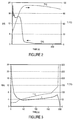
- Fig. 2 graphs the behavior of the cell of the invention under short circuit conditions;
- Fig. 3 illustrates a short circuit test of a prior art AA size, rechargeable Li/LixMnO₂ cell;
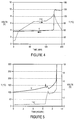
- Fig. 4 graphs the maximum temperature of a cell, as a function of cycling life, for cells exposed to short circuit conditions.
- Fig. 5 plots the behavior of the above cell under conditions of overcharge at a current of 1A;
- Fig. 6 illustrates an overcharge test of a prior art rechargeable Lithium AA size cell;
- Fig. 7 is a graph plotting the results of an experiment conducted with a secondary cell of the invention which was repeatedly cycled;
- Fig. 8 compares the performance of cells with or without the electrolyte of the invention;
- Fig. 9 graphically illustrates discharge tests done on the secondary cells of the invention; and
- Fig. 10 graphically illustrates the capacity of secondary cells tested by discharging at low temperature;
- The
cap 14 is of standard industrial manufacture and includes anupstanding protrusion 30 which serves as the positive terminal of the cell. Theprotrusion 30 is the top of a downwardly extendingmolybdenum pin 32 which is supported by aglass insulator 34. As is indicated thepin 32 is connected to thecathode 20 by way of atab 36 and theanode 18 connected to thecasing 12 by atab 38. - A typical AA size cell of this type of construction would be 50mm long and have an outer diameter of 14 to 15mm. The
anode 18 andcathode 20 consist of 40mm wide strips respectively about 300mm and 250mm long. Typically the strip making up theanode 18 is 160µm thick and that making up thecathode 20 is 250µm thick. Theseparator 24 is made of a porous strip about 700mm long, 48mm wide and about 25µm thick. - During manufacture of the cell, the
separator 24 is folded lengthwise over thecathode 20 and this combination together with theanode 18 is wound tightly to produce aroll 26. Theroll 26 is then covered in insulation and inserted into thecasing 12. As theseparator 24 is wider than the cathode, it protrudes beyond both the cathode and the anode and, in use, serves to prevent short circuiting between them. Once theroll 26 is located in the casing, thetabs pin 34 andcasing 12, the remaining portion of thetab 36 insulated to prevent short circuit with theanode 18 and thecap 14 secured to the top of the casing.Electrolyte 22 is then vacuum injected into thecasing 12 through an aperture (not shown) in itsbase 16 which is thereafter sealed off. As the electrolyte, which will be described in greater detail below, has a very low viscosity, it fills all the voids, including the pores in the separator and the cathode. - Turning now to the relevant components of the cell, these are described in greater detail below:
- The
anode 18 is typically a thin laminate foil consisting of a copper layer sandwiched between two lithium layers. In the example of the AA cell given above, the copper layer is typically 20µm thick and the lithium layers each 70µm thick. This type of lithium based anode is known in the art and can be obtained commercially. Furthermore, it is also possible to use a pure Lithium anode. - The
cathode 20 preferably contains an active material which is manganese dioxide (MnO₂) which may include lithium in one form or the other. Many different ways of producing this cathode active material are known. - For example, one way of producing an MnO₂ active material is disclosed in United States Patent 4,133,856 (Ikeda, et al.). This patent teaches that gamma-phase manganese dioxide is heated for a period of at least 2 hours at a temperature of between 350° and 430°C so that the MnO₂ is effectively dried and its structure changed from the gamma-phase to the beta-phase. This method is also referred to in U.S. Patent 5,279,972 (Moses).
- As indicated, the cathode active material can also include lithium, In which case it is preferable for the material to be lithiated manganese dioxide of the formula LixMnO₂.
- One way of preparing this compound is disclosed in Matsushita's Japanese Kokai 62-20250 (1987) which suggests the synthesis of a lithium potassium permanganate of the general formula (1-x) Kx LiMnO₄ followed by the thermal decomposition of the permanganate. This publication teaches that the decomposition products resulting from this process have stoichometric formulas of between Li0.3 MnO₂ and Li0.8 Mn0₂.
- Yet another method of producing a lithiated manganese dioxide cathode active material is described in Sanyo's U.S. Patent 4,758,484 which was issued to Furukawa et. al. on July 19, 1988. This method is described as selecting particulate MnO₂ having a particle size not greater than 30um, mixing it with a suitable lithium salt and heating the mixture in air at 375°C. Typical lithium salts mentioned are: LiOH; LiNO₃; LiPO₃; Li₂CO₃ and Li₂O. This patent discloses a number of different ratios to define the mixture of MnO₂ and lithium salt.
- Although this patent indicates that this method results in an active material of the formula, Li₂MnO3, tests have shown that it in fact produces a material of the formula of Lix MnO₂, where x is 0.3 to 0.4, a material which is also appropriate for use in the cells of this invention.
- There are thus many ways of producing an appropriate cathode active material. This material, whatever the form, is typically in granular/powder form which must be mixed with a conductive agent such carbon black or graphite in amounts of between 5% to 10% by weight, and with a commercial binder. Many different types of binders are known. One type is an emulsion of Teflon® powder and water. This mixture can then be heated to make a putty which can be molded under heat and/or pressure.
- It has also become common to mix a solvent in with the mixture of binder and cathode active material. As a result of the heat applied during the molding step, this solvent evaporates. Even so, it has the advantage of producing a better combination between the binder and active material and thus improves the performance of the cell in use. Generally, the solvent is added in quantities of about 70% solvent to binder plus cathode material. The solvent can, for example, be propanol, ethanol, isopropanol or one of the family of saturated olefins such as C₁₀H₂₂ (decane), C₉H₂₀ and C₁₁H₂₄.
- Finally, during the manufacture of the cathode, the mixture is rolled onto an aluminum grid and baked at about 270°C for 1 to 4 hours. The temperature and timing of this step is, to a large degree, a matter of choice but it is important that sufficient heat be applied so that the binder melts and binds with the active material, and that the solvent evaporates. In use the aluminum grid acts both as a support for the cathode material and as a collector for electrons.
- The
electrolyte 22 is important to the safe operation of the cell. It should include a solvent which is stable and which, together with a suitable ionic salt forms a conductive solution at typical cell operating temperatures. The solvent should, however, be such that it polymerizes in the cell so as described at unsafe temperatures, above about 100°C and at high voltages of above about 4V. These conditions would typically be reached when the cell is overcharged at high currents or short circuited. This polymerization is very effective in that it substantially increases the resistivity of the cell and thereby terminates its operation and precludes the possibility of further hazardous reactions between the Lithium and the electrolyte itself. - In a preferred embodiment of the invention, the electrolyte is constituted by a solution of a member of the dioxolane family and most preferably by 1,3-dioxolane, a lithium salt and a tertiary amine polymerization inhibitor (stabilizer). The concentration of the lithium salt in the dioxolane, can vary from 0.5 mole per liter of dioxolane up to the saturation point. However, the lithium salt of choice is lithium hexafluoroarsenate (LiAsF₆) at concentrations between 0.8 to 1.5 moles per liter.
- It has been found that 1,3-dioxolane in conjunction with an MnO₂ based cathode active material produces very good results. As will be shown in the experiments below, 1,3-dioxolane with the LiAsF₆ polymerizes at high voltages (above about 4.0V) and/or under high temperatures (above about 100°C).
- It should be noted that although this advantageous result has only been observed in 1,3 dioxolane in the presence of a MnO₂ based cathode material, and more particularly when the lithium based ionic salt is LiAsF₆, it is conceivable that other combinations of electrode, solvent and salt may produce the same result. For example a cathode containing Ni used with a LiClO₄ salt in dioxolane could be used. Alternatively a different metal oxide such as a Cobalt oxide could be used in the cathode. Similarly ethers such as 2-methyl tetrahydrafuran could be used. An alternative anode could be lithium ion type of material. Whatever the combination of components used it is important that the electrolyte in combination with the other components will be stable at normal operating temperatures and when the Voltage across the cell is within the operating voltage window of the cell. In addition to this, the electrolyte, in combination with the other elements, must polymerize when the conditions are beyond the normal operating parameters.
- The performance of the electrolyte can be enhanced by the use of a stabilizer which inhibits the polymerization of the electrolyte at operating temperatures. This stabilizer is typically one of the group of tertiary amines and preferably is one of the group consisting of: triethylamine, tributhylamine, tripropylamine, tribenzylamine, trioctylamine, triphenylamine, methylpiperidine. A concentration of 1000ppm of stabilizer has been found to yield satisfactory results.
- The
separator 24 functions to keep the cathode and anode apart to prevent short circuiting but is porous to allow the flow of ions across it. Many different separator materials are available commercially, for example the polypropylene separator which is sold under the designation 3402 by Hoechst Celanese. - The operation of the
secondary cell 10 of this invention can be illustrated in the following examples which report the results of the experiments conducted: - A number of AA size cells of the invention containing a Li metal anode; a LixMnO₂ cathode; an electrolyte of 1,3-dioxolane, 1 mole per liter LiAsF₆ and 1000ppm v/v tributhylamine; and a polypropylene separator were used in this experiment.
- These cells were exposed to the short circuit condition of a 0.01 ohm resistance and the results plotted on Fig. 2. It can be seen from this figure that the temperature rise in the cells was limited to a maximum temperature of about 115°C thereby preventing any hazardous venting.
In contrast to this Fig. 3 illustrates the results of similar tests concluded on prior art cells. This figure shows very clearly how the temperature within the cell increased dramatically after reaching the 140°C mark, thereby destroying the cell. - Charged cells similar to those used in Experiment 1 were exposed to short circuit conditions of 0.01 ohm resistance. Prior to the experiment, the cells were cycled (under extreme conditions) by discharging them at 40 to 250mA and charging them at 60 to 250mA. The internal temperature of each cell was monitored during the short circuit conditions. The readings are plotted in Fig. 4, against the number of cycles that the cell had previously been exposed to.
- As can be seen the maximum temperature reached decreased with the number of cycles. This indicates that the cell is safer the more it has been cycled.
- Fig. 5 describes the behavior of the same type of cell as in Experiment 1 but this time exposed to overcharge conditions at a curtent of 1A. The cell had previously been cycled 50 times.
- As can be seen, the charging voltage increased rapidly to more than 10V when the cell voltage reached 4.1V. This situation was reached after the cell was overcharged for 3 hours. Importantly, the temperature and the current (not shown) decreased at the same time the voltage increased. The cell was tested for a further 20 minutes and remained intact after this test.
- In contrast to this Figure 6 shows the results of a similar experiment conducted on prior art cells. From this figure the failure of the cell and hazardous increase in temperature are clearly apparent.
-
- Cells similar to those used in Experiment 1 were tested by repeated cycling. The results of this experiment are plotted on the graph in Fig. 7 which shows that the cells exhibited a long cycling life of more than 250 cycles. Moreover, even at
cycle number 250 the cells were still able to deliver more than 75% of their nominal capacity. - Li/LixMnO₂ Cells similar to those used above, but with two different electrolytes A and B, were tested for comparison purposes. Electrolyte A was a dioxolane/LiAsF₆/1000 ppm tributhylamine solution and electrolyte B a prior art EC/PC/LiAsF₆ solution.
- Cells of both types were initially cycled at a charge rate of 60mA per hour and discharged at a rate of 250mA per hour. This type of cycling is typical of normal operating conditions. Thereafter the cell containing electrolyte A was charged at 250mA per hour (for about 2.5 hours per charging cycle) and discharged at the same rate. The cell containing electrolyte B was charged at the more advantageous rate of 120mA per hour (for about 5 hours per charging cycle) and also discharged at 250mA per hour. Both cells were cycled between 2.0 and 3.4V at these respective rates until they reached about 65% of their capacity.
- As can be seen from the results plotted in Fig. 8, cell A reached the end of its life, with 65% of the capacity it had after the second cycle, after 120 cycles. However, cell B was cycled only 50 times before developing short circuits and failing as a result of formation of dendrite bridges in the electrolyte.
- It should be noted that this experiment also shows that the cell of this invention can be treated to increase its life expectancy when it is to be exposed to conditions of rapid charging (such as the tested charging rate of 250mA per hour). This can be achieved by first cycling the cell at the usually recommended normal rate, of 60mA per hour charge and 250mA per hour discharge, for about two to ten times. The optimum number of these cycles has yet to be determined, but it is believed that they should be sufficient to allow lithium to redeposit on the anode.
- After this cycling, the cell can be rapidly charged as shown. Although this reduces its potential life from over 250 cycles to about 120 cycles, it is a substantial improvement over rapid charging without the initial slower charging steps (which would yield a life of less than 50 cycles even in the cell of this invention). It is furthermore anticipated that this method may also be applied to other secondary cells as well.
- The same cells as used in Experiment 1 were tested by discharging at the relatively high rates of 0.25A, 0.5A, 1A and 2A, respectively. As can be seen from the results of these tests, which are plotted on the graph of Fig. 9, the cells of the invention perform very well and retain a large percentage of their capacity.
- In this experiment the same cells as used in Experiment 1 were discharged at the three different "low" temperatures of 0°C, -20°C and -30°C. As can be seen from the results plotted in Fig. 10 the cells performed well at low temperature. The cells used delivered more than 60% at their room temperature (RT) capacity at -30°C at a 60mA rate of discharge.
- A cell identical to the one used in Experiment 1 was tested at high temperature. The cell was placed inside an oven, in which a thermocouple was attached to the outer casing of the cell. The oven was heated at rate of 3°C per minute. When the cell's can reached 128°C, it vented without noise, fire or any explosion. The cell had previously been cycled 120 cycles at 250mA per hour discharge and 60mA per hour charge.
- In a manner similar to that of Experiment 1, a variety of cells were tested, using other members of the tertiary amine family defined above. Similar results were obtained. The amines were tested at various concentrations, and proved to be effective over a wide range of concentrations, from about 0.005 percent to about 5 percent. The best results were obtained at concentrations in the 0.01% to 0.3% range.
- Furthermore, various concentrations of the lithium hexafluoroarsenate were tested. Good results were obtained using a concentration in the 0.5 mole/liter to 2.5 mole/liter range, with the best results at about 1 mole/liter.
- From these experiments it can be concluded that the secondary cell of the invention performs well under the adverse conditions of high and low temperature, short circuit and overcharging. In addition, the cell is shown to be capable of being cycled many times. Also, the addition of the stabilizers gives the cell an added shelf life, even at temperatures of as high as 80°C.
- Although the present invention has been described above in terms of a specific embodiment, it is anticipated that alterations and modifications thereof will no doubt become apparent to those skilled in the art. It is therefore intended that the following claims be interpreted as covering all such alterations and modifications as fall within the true spirit and scope of the invention.
Claims (23)
- An electrochemical secondary cell (10) comprising a cathode (20), an anode (18) and an electrolyte (22), characterized in that:(i) the cathode (20) includes a metal oxide; and(ii) the electrolyte (22) rapidly polymerizes at temperatures exceeding 100°C or voltages greater than the operating voltage window of the cell, whereby such polymerization increases the internal resistivity of the cell.
- The electrochemical secondary cell of claim 1, characterized in that the metal oxide is manganese dioxide (MnO₂).
- The electrochemical secondary cell of either claim 1 or 2, characterized in that the anode (18) includes lithium.
- The electrochemical secondary cell of any one of claims 1 to 3, characterized in that the cathode (20) includes lithiated manganese dioxide of the general formula LixMnO₂ where x is from 0.30 to 0.40.
- The electrochemical secondary cell of any one of claims 1 to 4, characterized in that the electrolyte (22) includes a member of the dioxolane family and an ionic salt of the material of the anode (18).
- The electrochemical secondary cell of any one of claims 1 to 5, characterized in that the electrolyte (22) is 1,3 dioxolane.
- The electrochemical secondary cell of any one of either claim 5 or 6, characterized in that the ionic salt includes alkali metal salt.
- The electrochemical secondary cell of claim 7, characterized in that the ionic salt is lithium hexafluoroarsenate (LiAsF₆).
- The electrochemical secondary cell of claim 8, characterized in that the LiAsF₆ is in the concentration of form 0.8 to 1.5 moles per liter.
- The electrochemical secondary cell of any one of claims 1 to 9, characterized in that the electrolyte (22) includes a polymerization inhibitor.
- The electrochemical secondary cell of claim 10, characterized in that the inhibitor is one of the family of tertiary amines.
- The electrochemical secondary cell of claim 11, characterized in that the tertiary amine is one of the group consisting of: triethylamine, tributhylamine, tripropylamine, tribenzylamine, trioctylamine, triphenylamine, methylpiperidine.
- The electrochemical secondary cell of claim 12, characterized in that the tertiary amine is at a concentration of from 50ppm to 50 000ppm.
- The electrochemical secondary cell of claim 13, characterized in that the concentration of the tertiary amine is from 100ppm to 5000ppm.
- The electrochemical secondary cell of any one of claims 2 to 14, characterized in that the cathode (20) is manufactured by a method including the steps of:(i) mixing a particulate metal oxide with a binder and carbon;(ii) adding a saturated olefin solvent to the mixture of oxide and binder; and(iii) heating the mixture to evaporate the olefin solvent.
- The electrochemical secondary cell of claim 15, characterized in that the solvent is decane.
- An electrolyte (22) for use in an electrochemical secondary cell (10) comprising:(i) a solvent being a member of the dioxolane family;(ii) an alkali or alkali earth metal salt; and(iii) a tertiary amine polymerization inhibitor at a concentration of greater than 500ppm.
- An electrolyte (22) according to claim 17, characterized in that the solvent is 1,3 dioxolane and the metal salt is lithium hexafluoroarsenate (LiAsF₆).
- A method of producing a cathode (20) for an electrochemical cell comprising the steps of:(i) mixing a particulate cathode active material with a binder, carbon and a saturated olefin solvent; and(ii) heating the mixture to evaporate the solvent.
- The method of claim 19, characterized in that the solvent is decane.
- The method of claim 20, further comprising the step of applying the mixture to an electron conductive support material.
- A method of enhancing the operational life of an electrochemical secondary cell which is to be exposed to charging conditions of greater than 150 mA, comprising the step of initially exposing the cell to a plurality of charge and discharge cycles, each such cycle having a charge rate of no greater than 108 mA and a discharge rate of no smaller than 200 mA.
- The method of claim 22, characterized in that the cell is of the type including a cathode (20) formed of a manganese dioxide compound, an anode (18), and a 1,3 dioxolane based electrolyte (22).
Applications Claiming Priority (3)
| Application Number | Priority Date | Filing Date | Title |
|---|---|---|---|
| IL104903A IL104903A0 (en) | 1993-03-01 | 1993-03-01 | Safe high energy density electrochemical rechargeable cell |
| IL10490393 | 1993-03-01 | ||
| US08/205,037 US5506068A (en) | 1993-03-01 | 1994-03-01 | Non-aqueous safe secondary cell |
Publications (2)
| Publication Number | Publication Date |
|---|---|
| EP0614239A2 true EP0614239A2 (en) | 1994-09-07 |
| EP0614239A3 EP0614239A3 (en) | 1996-10-16 |
Family
ID=26322590
Family Applications (1)
| Application Number | Title | Priority Date | Filing Date |
|---|---|---|---|
| EP94102970A Withdrawn EP0614239A3 (en) | 1993-03-01 | 1994-02-28 | Non-aqueous safe secondary cell. |
Country Status (6)
| Country | Link |
|---|---|
| US (1) | US5506068A (en) |
| EP (1) | EP0614239A3 (en) |
| JP (1) | JPH0778635A (en) |
| DE (1) | DE4406617A1 (en) |
| FR (1) | FR2702312B1 (en) |
| GB (1) | GB2275818B (en) |
Cited By (8)
| Publication number | Priority date | Publication date | Assignee | Title |
|---|---|---|---|---|
| EP0759641A1 (en) * | 1995-08-23 | 1997-02-26 | Moli Energy (1990) Limited | Polymerizable aromatic additives for overcharge protection in non-aqueous rechargeable lithium batteries |
| WO1998026467A1 (en) * | 1996-12-09 | 1998-06-18 | Valence Technology, Inc. | Additive to stabilize electrochemical cell |
| US5776627A (en) * | 1995-11-17 | 1998-07-07 | Moli Energy (1990) Limited | Aromatic monomer gassing agents for protecting non-aqueous lithium batteries against overcharge |
| EP0878861A1 (en) * | 1997-05-16 | 1998-11-18 | Moli Energy (1990) Limited | Polymerizable additives for making non-aqueous rechargeable lithium batteries safe after overcharge |
| EP0944126A1 (en) * | 1998-03-18 | 1999-09-22 | Hitachi, Ltd. | Lithium secondary battery, its electrolyte, and electric apparatus using the same |
| NL1013484C2 (en) * | 1999-11-04 | 2001-05-09 | Tno | Method of manufacturing a rechargeable 3V Li-ion battery. |
| EP1245053A4 (en) * | 1999-10-18 | 2005-08-10 | Univ Bar Ilan | NON-AQUEOUS, HIGHERERGETIC ELECTROLYTE FOR RECHARGEABLE ELECTROCHEMICAL CELLS |
| CN100433443C (en) * | 2004-03-29 | 2008-11-12 | 三星Sdi株式会社 | Electrolyte solution for lithium battery, preparation method thereof, and lithium battery containing it |
Families Citing this family (54)
| Publication number | Priority date | Publication date | Assignee | Title |
|---|---|---|---|---|
| US5616429A (en) * | 1995-05-24 | 1997-04-01 | Wilson Greatbatch Ltd. | alkali metal electrochemical cell exhibiting reduced voltage delay and method of manufacture |
| KR100499114B1 (en) * | 1997-08-21 | 2005-09-26 | 삼성전자주식회사 | Electrolyte for lithium secondary battery and lithium secondary battery using same |
| JPH11260349A (en) | 1998-03-05 | 1999-09-24 | Fujitsu Ltd | Lithium secondary battery and positive electrode mixture used therefor |
| FR2777386B1 (en) | 1998-04-14 | 2000-05-12 | Commissariat Energie Atomique | PROCESS FOR THE PREPARATION OF LITHIA OR SURLITHIA TRANSITION METAL OXIDE, POSITIVE ELECTRODE ACTIVE MATERIAL INCLUDING THIS OXIDE, AND ACCUMULATOR |
| EP1095420A1 (en) | 1998-06-08 | 2001-05-02 | Moltech Corporation | Multifunctional reactive monomers for safety protection of nonaqueous electrochemical cells |
| US6126704A (en) * | 1998-08-27 | 2000-10-03 | Duracell Inc. | Method of forming a terminal pip protrusion on the casing of an alkaline cell |
| KR100330148B1 (en) | 1999-05-03 | 2002-03-28 | 김순택 | Electrolyte for lithium secondary battery |
| US6455200B1 (en) | 1999-09-02 | 2002-09-24 | Illinois Institute Of Technology | Flame-retardant additive for li-ion batteries |
| KR100838060B1 (en) * | 2001-09-19 | 2008-06-13 | 삼성에스디아이 주식회사 | Overcharge prevention electrolyte for lithium secondary battery and lithium secondary battery using same |
| US6911280B1 (en) * | 2001-12-21 | 2005-06-28 | Polyplus Battery Company | Chemical protection of a lithium surface |
| KR100858800B1 (en) * | 2002-07-19 | 2008-09-17 | 삼성에스디아이 주식회사 | Composition for forming gel polymer electrolyte with excellent storage |
| US20080057386A1 (en) * | 2002-10-15 | 2008-03-06 | Polyplus Battery Company | Ionically conductive membranes for protection of active metal anodes and battery cells |
| EP1552572A2 (en) | 2002-10-15 | 2005-07-13 | Polyplus Battery Company | Ionically conductive composites for protection of active metal anodes |
| US7390591B2 (en) | 2002-10-15 | 2008-06-24 | Polyplus Battery Company | Ionically conductive membranes for protection of active metal anodes and battery cells |
| US7645543B2 (en) * | 2002-10-15 | 2010-01-12 | Polyplus Battery Company | Active metal/aqueous electrochemical cells and systems |
| US7282302B2 (en) * | 2002-10-15 | 2007-10-16 | Polyplus Battery Company | Ionically conductive composites for protection of active metal anodes |
| US7608178B2 (en) * | 2003-11-10 | 2009-10-27 | Polyplus Battery Company | Active metal electrolyzer |
| US7491458B2 (en) | 2003-11-10 | 2009-02-17 | Polyplus Battery Company | Active metal fuel cells |
| CN100568613C (en) * | 2004-02-06 | 2009-12-09 | 波利普拉斯电池有限公司 | Protected active metal electrode and battery cell structure with non-aqueous interlayer architecture |
| US9368775B2 (en) | 2004-02-06 | 2016-06-14 | Polyplus Battery Company | Protected lithium electrodes having porous ceramic separators, including an integrated structure of porous and dense Li ion conducting garnet solid electrolyte layers |
| US7282295B2 (en) | 2004-02-06 | 2007-10-16 | Polyplus Battery Company | Protected active metal electrode and battery cell structures with non-aqueous interlayer architecture |
| FR2866478A1 (en) * | 2004-02-12 | 2005-08-19 | Commissariat Energie Atomique | Lithium battery with protection against inappropriate utilization, notably to provide an energy source for portable equipment |
| BRPI0614743A2 (en) * | 2005-08-09 | 2011-04-12 | Polyplus Battery Co Inc | flexible sealing frames for protected active metal anodes |
| US8404388B2 (en) | 2005-08-09 | 2013-03-26 | Polyplus Battery Company | Compliant seal structures for protected active metal anodes |
| US8048570B2 (en) * | 2005-08-09 | 2011-11-01 | Polyplus Battery Company | Compliant seal structures for protected active metal anodes |
| US8129052B2 (en) | 2005-09-02 | 2012-03-06 | Polyplus Battery Company | Polymer adhesive seals for protected anode architectures |
| US8652692B2 (en) * | 2005-11-23 | 2014-02-18 | Polyplus Battery Company | Li/Air non-aqueous batteries |
| CN101331642B (en) * | 2005-12-14 | 2013-03-06 | 株式会社Lg化学 | Non-aqueous electrolytic solution and secondary battery containing same |
| WO2007075867A2 (en) | 2005-12-19 | 2007-07-05 | Polyplus Battery Company | Composite solid electrolyte for protection of active metal anodes |
| US7585590B2 (en) * | 2006-02-17 | 2009-09-08 | 3M Innovative Properties Company | Rechargeable lithium-ion cell with triphenylamine redox shuttle |
| US8000084B2 (en) * | 2007-07-25 | 2011-08-16 | Honeywell International, Inc. | High voltage electrolytes |
| US8101302B2 (en) * | 2008-02-12 | 2012-01-24 | 3M Innovative Properties Company | Redox shuttles for high voltage cathodes |
| EP2301105A4 (en) | 2008-06-16 | 2013-06-19 | Polyplus Battery Co Inc | AQUEOUS LITHIUM / AIR BATTERIES |
| WO2013028574A2 (en) | 2011-08-19 | 2013-02-28 | Polyplus Battery Company | Aqueous lithium air batteries |
| US8828574B2 (en) | 2011-11-15 | 2014-09-09 | Polyplus Battery Company | Electrolyte compositions for aqueous electrolyte lithium sulfur batteries |
| US8828573B2 (en) | 2011-11-15 | 2014-09-09 | Polyplus Battery Company | Electrode structures for aqueous electrolyte lithium sulfur batteries |
| US8828575B2 (en) | 2011-11-15 | 2014-09-09 | PolyPlus Batter Company | Aqueous electrolyte lithium sulfur batteries |
| US9660265B2 (en) | 2011-11-15 | 2017-05-23 | Polyplus Battery Company | Lithium sulfur batteries and electrolytes and sulfur cathodes thereof |
| JP5652386B2 (en) * | 2011-12-12 | 2015-01-14 | 株式会社豊田自動織機 | Nonaqueous electrolyte secondary battery, vehicle, and power storage device |
| US8932771B2 (en) | 2012-05-03 | 2015-01-13 | Polyplus Battery Company | Cathode architectures for alkali metal / oxygen batteries |
| CN103427125B (en) * | 2012-05-15 | 2016-04-13 | 清华大学 | The round-robin method of sulfenyl polymer Li-ion battery |
| DE102012022969A1 (en) | 2012-11-23 | 2014-05-28 | Li-Tec Battery Gmbh | Electrochemical cell |
| JP5949605B2 (en) * | 2013-03-15 | 2016-07-06 | 日立化成株式会社 | Nonaqueous electrolyte secondary battery and power storage device |
| US9905860B2 (en) | 2013-06-28 | 2018-02-27 | Polyplus Battery Company | Water activated battery system having enhanced start-up behavior |
| CN112514196A (en) | 2018-07-31 | 2021-03-16 | 赛昂能源有限公司 | Multi-path charging and discharging battery management system |
| DE102018120029B4 (en) | 2018-08-17 | 2024-12-05 | Volkswagen Aktiengesellschaft | Method for increasing safety when operating a battery cell and battery cell |
| DE102019107175A1 (en) * | 2019-03-20 | 2020-09-24 | Volkswagen Aktiengesellschaft | Method for increasing safety when operating a battery cell and battery cell |
| US11056728B2 (en) | 2019-10-31 | 2021-07-06 | Sion Power Corporation | System and method for operating a rechargeable electrochemical cell or battery |
| US11424492B2 (en) * | 2019-10-31 | 2022-08-23 | Sion Power Corporation | System and method for operating a rechargeable electrochemical cell or battery |
| EP4208931A1 (en) | 2020-09-01 | 2023-07-12 | Sion Power Corporation | Multiplexed battery management system |
| WO2022137129A1 (en) | 2020-12-22 | 2022-06-30 | Alcon Inc. | Hybrid power delivery for surgical implants |
| CN112713306B (en) * | 2020-12-24 | 2022-02-25 | 清华大学深圳国际研究生院 | Electrolyte capable of being cured when meeting air or moisture, preparation method and application thereof |
| WO2022169980A1 (en) | 2021-02-05 | 2022-08-11 | Sion Power Corporation | Charge/discharge management in electrochemical cells, including partial cycle control |
| CN114267880A (en) * | 2021-12-10 | 2022-04-01 | 珠海冠宇电池股份有限公司 | Electrolyte and battery comprising same |
Family Cites Families (38)
| Publication number | Priority date | Publication date | Assignee | Title |
|---|---|---|---|---|
| DE1228685B (en) * | 1963-06-28 | 1966-11-17 | Varta Pertrix Union Ges Mit Be | Depolarizer mixture and process for its preparation |
| US4071665A (en) * | 1972-09-18 | 1978-01-31 | E. I. Du Pont De Nemours And Company | High energy density battery with dioxolane based electrolyte |
| US3947289A (en) * | 1973-11-23 | 1976-03-30 | P. R. Mallory & Co., Inc. | Mixed solvents for high and low temperature organic electrolyte batteries |
| US3907597A (en) * | 1974-09-27 | 1975-09-23 | Union Carbide Corp | Nonaqueous cell having an electrolyte containing sulfolane or an alkyl-substituted derivative thereof |
| CA1066766A (en) * | 1975-05-09 | 1979-11-20 | Lewis H. Gaines | Reversible lithium battery using a dioxolane based solvent system |
| US4205432A (en) * | 1975-11-26 | 1980-06-03 | Prazska Akumulatorka, Narodni Podnik | Method of manufacturing plastic bonded battery plates having controlled porosity |
| JPS5342325A (en) * | 1976-09-29 | 1978-04-17 | Sanyo Electric Co | Method of making cathode of nonnaqueous battery |
| US4086403A (en) * | 1976-11-26 | 1978-04-25 | Exxon Research & Engineering Co. | Alkali metal/niobium triselenide cell having a dioxolane-based electrolyte |
| US4093783A (en) * | 1977-04-22 | 1978-06-06 | Exxon Research And Engineering Company | Novel formulations M2 UO2 F2 and their use in electrochemical cells |
| IN154337B (en) * | 1979-06-25 | 1984-10-20 | Union Carbide Corp | |
| US4279972A (en) * | 1979-08-27 | 1981-07-21 | Duracell International Inc. | Non-aqueous electrolyte cell |
| US4401735A (en) * | 1979-12-28 | 1983-08-30 | Duracell International Inc. | Non-aqueous Li/MnO2 cell |
| US4284692A (en) * | 1980-04-28 | 1981-08-18 | Exxon Research & Engineering Co. | Compositions for stabilizing electrolytes in Li/TiS2 systems |
| JPS56167274A (en) * | 1980-05-27 | 1981-12-22 | Hitachi Maxell Ltd | Manufacture of organic electrolyte battery |
| US4321314A (en) * | 1980-09-02 | 1982-03-23 | Duracell International Inc. | Non-aqueous cell safety |
| US4345010A (en) * | 1980-12-22 | 1982-08-17 | General Electric Company | Electrolyte for secondary electrochemical cell |
| US4526846A (en) * | 1982-06-14 | 1985-07-02 | Duracell Inc. | Corrosion prevention additive |
| US4490449A (en) * | 1983-09-19 | 1984-12-25 | Duracell Inc. | Cell solvent |
| US4680241A (en) * | 1983-11-29 | 1987-07-14 | American Telephone And Telegraph Company, At&T Bell Laboratories | Method for restoring the lost capacity of nickel batteries and batteries formed thereby |
| JPS6220250A (en) * | 1985-07-19 | 1987-01-28 | Matsushita Electric Ind Co Ltd | Organic electrolyte secondary battery |
| US4853305A (en) * | 1986-03-24 | 1989-08-01 | W. R. Grace & Co.-Conn. | Cathodic electrode |
| DE3611123A1 (en) * | 1986-04-03 | 1987-10-08 | Varta Batterie | WATER-FREE ORGANIC ELECTROLYTE |
| US4736150A (en) * | 1986-07-09 | 1988-04-05 | The United States Of America As Represented By The Secretary Of The Army | Method of increasing the useful life of rechargeable lithium batteries |
| JPH0746608B2 (en) * | 1986-10-30 | 1995-05-17 | 三洋電機株式会社 | Non-aqueous secondary battery |
| US4803137A (en) * | 1987-05-19 | 1989-02-07 | Bridgestone Corporation | Non-aqueous electrolyte secondary cell |
| JPH01200557A (en) * | 1987-10-13 | 1989-08-11 | Bridgestone Corp | Nonaqueous electrolytic battery |
| US4959282A (en) * | 1988-07-11 | 1990-09-25 | Moli Energy Limited | Cathode active materials, methods of making same and electrochemical cells incorporating the same |
| CA1331506C (en) * | 1988-07-12 | 1994-08-23 | Michael Makepeace Thackeray | Method of synthesizing a lithium manganese oxide |
| DE3829419C1 (en) * | 1988-08-31 | 1989-12-28 | Accumulatorenwerke Hoppecke Carl Zoellner & Sohn Gmbh & Co Kg, 5790 Brilon, De | |
| US5100745A (en) * | 1989-01-18 | 1992-03-31 | Communications Satellite Corporation | Method for rejuvenating Ni-H2 batteries |
| US4952330A (en) * | 1989-05-25 | 1990-08-28 | Eveready Battery Company, Inc. | Nonaqueous electrolyte |
| GB2234233B (en) * | 1989-07-28 | 1993-02-17 | Csir | Lithium manganese oxide |
| US5219684A (en) * | 1990-05-16 | 1993-06-15 | Her Majesty The Queen In Right Of Canada, As Represented By The Province Of British Columbia | Electrochemical cells containing a safety electrolyte solvent |
| US5166012A (en) * | 1990-05-17 | 1992-11-24 | Technology Finance Corporation (Proprietary) Limited | Manganese oxide compounds |
| GB2251119B (en) * | 1990-12-20 | 1995-06-07 | Technology Finance Corp | Electrochemical cell |
| US5154784A (en) * | 1991-02-01 | 1992-10-13 | Westinghouse Electric Corp. | Process for manufacturing a lithium alloy electrochemical cell |
| JP3086297B2 (en) * | 1991-05-21 | 2000-09-11 | 東芝電池株式会社 | Non-aqueous solvent secondary battery |
| JPH1161671A (en) * | 1997-08-11 | 1999-03-05 | Tokyo Seiko Co Ltd | Wrapping method of steel cord |
-
1994
- 1994-02-28 EP EP94102970A patent/EP0614239A3/en not_active Withdrawn
- 1994-03-01 JP JP6031161A patent/JPH0778635A/en active Pending
- 1994-03-01 GB GB9403881A patent/GB2275818B/en not_active Expired - Fee Related
- 1994-03-01 FR FR9402338A patent/FR2702312B1/en not_active Expired - Fee Related
- 1994-03-01 DE DE4406617A patent/DE4406617A1/en not_active Withdrawn
- 1994-03-01 US US08/205,037 patent/US5506068A/en not_active Expired - Lifetime
Cited By (13)
| Publication number | Priority date | Publication date | Assignee | Title |
|---|---|---|---|---|
| EP0759641A1 (en) * | 1995-08-23 | 1997-02-26 | Moli Energy (1990) Limited | Polymerizable aromatic additives for overcharge protection in non-aqueous rechargeable lithium batteries |
| US5879834A (en) * | 1995-08-23 | 1999-03-09 | Nec Moli Energy (Canada) Ltd. | Polymerizable aromatic additives for overcharge protection in non-aqueous rechargeable lithium batteries |
| EP0776058A3 (en) * | 1995-11-17 | 1998-07-22 | Moli Energy (1990) Limited | Aromatic monomer gassing agents for protecting non-aqueous lithium batteries against overcharge |
| US5776627A (en) * | 1995-11-17 | 1998-07-07 | Moli Energy (1990) Limited | Aromatic monomer gassing agents for protecting non-aqueous lithium batteries against overcharge |
| US5846673A (en) * | 1996-12-09 | 1998-12-08 | Valence Technology, Inc. | Additive to stabilize electrochemical cell |
| WO1998026467A1 (en) * | 1996-12-09 | 1998-06-18 | Valence Technology, Inc. | Additive to stabilize electrochemical cell |
| EP0878861A1 (en) * | 1997-05-16 | 1998-11-18 | Moli Energy (1990) Limited | Polymerizable additives for making non-aqueous rechargeable lithium batteries safe after overcharge |
| EP0944126A1 (en) * | 1998-03-18 | 1999-09-22 | Hitachi, Ltd. | Lithium secondary battery, its electrolyte, and electric apparatus using the same |
| US6475680B1 (en) | 1998-03-18 | 2002-11-05 | Hitachi, Ltd. | Lithium secondary battery, its electrolyte, and electric apparatus using the same |
| EP1245053A4 (en) * | 1999-10-18 | 2005-08-10 | Univ Bar Ilan | NON-AQUEOUS, HIGHERERGETIC ELECTROLYTE FOR RECHARGEABLE ELECTROCHEMICAL CELLS |
| NL1013484C2 (en) * | 1999-11-04 | 2001-05-09 | Tno | Method of manufacturing a rechargeable 3V Li-ion battery. |
| WO2001033657A1 (en) * | 1999-11-04 | 2001-05-10 | Nederlandse Organisatie Voor Toegepast-Natuurwetenschappelijk Onderzoek Tno | Method for manufacturing a rechargeable 3v li-ion battery |
| CN100433443C (en) * | 2004-03-29 | 2008-11-12 | 三星Sdi株式会社 | Electrolyte solution for lithium battery, preparation method thereof, and lithium battery containing it |
Also Published As
| Publication number | Publication date |
|---|---|
| GB9403881D0 (en) | 1994-04-20 |
| EP0614239A3 (en) | 1996-10-16 |
| JPH0778635A (en) | 1995-03-20 |
| DE4406617A1 (en) | 1994-09-08 |
| GB2275818A (en) | 1994-09-07 |
| GB2275818B (en) | 1997-12-10 |
| FR2702312B1 (en) | 2004-10-01 |
| US5506068A (en) | 1996-04-09 |
| FR2702312A1 (en) | 1994-09-09 |
Similar Documents
| Publication | Publication Date | Title |
|---|---|---|
| US5506068A (en) | Non-aqueous safe secondary cell | |
| EP1256995B1 (en) | Nonaqueous electrolytic secondary battery | |
| JP3269396B2 (en) | Non-aqueous electrolyte lithium secondary battery | |
| EP2270901B1 (en) | Method for regulating terminal voltage of cathode during overdischarge and cathode active matrial for lithium secondary battery | |
| EP2219247B1 (en) | Cylindrical secondary battery | |
| EP1490916B1 (en) | Lithium secondary battery comprising overdischarge-preventing agent | |
| US5427872A (en) | Dendrite preventing separator for secondary lithium batteries | |
| JP2002203553A (en) | Cathode active material and non-aqueous electrolyte secondary battery | |
| JP2005228565A (en) | Electrolyte and battery | |
| KR20040088292A (en) | The cathode active material comprising the overdischarge retardant and the lithium secondary battery using the same | |
| US20020136951A1 (en) | Electrochemical cell having an electrode with a carbonate additive in the electrode active mixture | |
| JPH10255839A (en) | Non-aqueous electrolyte secondary battery | |
| KR100358224B1 (en) | Lithium secondary battery | |
| JPH11176470A (en) | Organic electrolyte secondary battery | |
| US6562515B2 (en) | Electrochemical cell having an electrode with a nitrate additive in the electrode active mixture | |
| US6586135B2 (en) | Electrochemical cell having an electrode with a dicarbonate additive in the electrode active mixture | |
| JP4595205B2 (en) | Nonaqueous electrolyte secondary battery | |
| JP2734822B2 (en) | Non-aqueous electrolyte secondary battery | |
| JP2002289159A (en) | Non-aqueous electrolyte secondary battery pack | |
| JP3185273B2 (en) | Non-aqueous electrolyte secondary battery | |
| JPH10189051A (en) | Non-aqueous electrolyte battery | |
| GB2311410A (en) | Non-aqueous safe secondary cells | |
| GB2306762A (en) | Non-aqueous safe secondary cells | |
| JP4240422B2 (en) | Organic electrolyte secondary battery | |
| JP2001297762A (en) | Non-aqueous electrolyte secondary battery |
Legal Events
| Date | Code | Title | Description |
|---|---|---|---|
| PUAI | Public reference made under article 153(3) epc to a published international application that has entered the european phase |
Free format text: ORIGINAL CODE: 0009012 |
|
| AK | Designated contracting states |
Kind code of ref document: A2 Designated state(s): AT BE CH DE DK ES FR GB GR IE IT LI LU MC NL PT SE |
|
| RIN1 | Information on inventor provided before grant (corrected) |
Inventor name: AURBACH, DORON Inventor name: MEGENITSKY, EMIL Inventor name: LUSKI, SHALOM Inventor name: GERONOV, JORDAN Inventor name: DAN, PNINA |
|
| PUAL | Search report despatched |
Free format text: ORIGINAL CODE: 0009013 |
|
| AK | Designated contracting states |
Kind code of ref document: A3 Designated state(s): AT BE CH DE DK ES FR GB GR IE IT LI LU MC NL PT SE |
|
| 17P | Request for examination filed |
Effective date: 19970405 |
|
| 17Q | First examination report despatched |
Effective date: 19981217 |
|
| RAP1 | Party data changed (applicant data changed or rights of an application transferred) |
Owner name: TADIRAN BATTERIES LTD. |
|
| STAA | Information on the status of an ep patent application or granted ep patent |
Free format text: STATUS: THE APPLICATION HAS BEEN WITHDRAWN |
|
| 18W | Application withdrawn |
Withdrawal date: 20020115 |