EP0613621B1 - Verfahren zum Entfernen zumindest eines unerwünschten organischen Produktes aus einem natürlichen Extrakt - Google Patents
Verfahren zum Entfernen zumindest eines unerwünschten organischen Produktes aus einem natürlichen Extrakt Download PDFInfo
- Publication number
- EP0613621B1 EP0613621B1 EP94400410A EP94400410A EP0613621B1 EP 0613621 B1 EP0613621 B1 EP 0613621B1 EP 94400410 A EP94400410 A EP 94400410A EP 94400410 A EP94400410 A EP 94400410A EP 0613621 B1 EP0613621 B1 EP 0613621B1
- Authority
- EP
- European Patent Office
- Prior art keywords
- extract
- irradiation
- process according
- compound
- unwanted
- Prior art date
- Legal status (The legal status is an assumption and is not a legal conclusion. Google has not performed a legal analysis and makes no representation as to the accuracy of the status listed.)
- Expired - Lifetime
Links
- 239000000284 extract Substances 0.000 title claims description 47
- 238000000034 method Methods 0.000 title claims description 42
- 150000002894 organic compounds Chemical class 0.000 title claims description 8
- 150000001875 compounds Chemical class 0.000 claims description 49
- 238000010521 absorption reaction Methods 0.000 claims description 30
- BGEBZHIAGXMEMV-UHFFFAOYSA-N 5-methoxypsoralen Chemical compound O1C(=O)C=CC2=C1C=C1OC=CC1=C2OC BGEBZHIAGXMEMV-UHFFFAOYSA-N 0.000 claims description 22
- 230000008030 elimination Effects 0.000 claims description 14
- 238000003379 elimination reaction Methods 0.000 claims description 14
- 229960002045 bergapten Drugs 0.000 claims description 11
- 244000179970 Monarda didyma Species 0.000 claims description 10
- 235000010672 Monarda didyma Nutrition 0.000 claims description 10
- 235000020752 sage extract Nutrition 0.000 claims description 10
- 229940112950 sage extract Drugs 0.000 claims description 9
- 239000002904 solvent Substances 0.000 claims description 8
- 230000006378 damage Effects 0.000 claims description 7
- USMNOWBWPHYOEA-UHFFFAOYSA-N 3‐isothujone Chemical compound CC1C(=O)CC2(C(C)C)C1C2 USMNOWBWPHYOEA-UHFFFAOYSA-N 0.000 claims description 6
- 238000001704 evaporation Methods 0.000 claims description 5
- 230000008020 evaporation Effects 0.000 claims description 5
- 229930007110 thujone Natural products 0.000 claims description 5
- 238000000926 separation method Methods 0.000 claims description 4
- 230000001678 irradiating effect Effects 0.000 claims description 3
- 108060006184 phycobiliprotein Proteins 0.000 claims description 3
- 238000007711 solidification Methods 0.000 claims description 3
- 230000008023 solidification Effects 0.000 claims description 3
- 150000002576 ketones Chemical class 0.000 claims description 2
- 235000019568 aromas Nutrition 0.000 claims 1
- 150000003597 thujone derivatives Chemical class 0.000 description 20
- 108010053210 Phycocyanin Proteins 0.000 description 16
- 108010004729 Phycoerythrin Proteins 0.000 description 16
- 239000000243 solution Substances 0.000 description 16
- 239000000047 product Substances 0.000 description 15
- DSSYKIVIOFKYAU-XCBNKYQSSA-N (R)-camphor Chemical compound C1C[C@@]2(C)C(=O)C[C@@H]1C2(C)C DSSYKIVIOFKYAU-XCBNKYQSSA-N 0.000 description 12
- 241000723346 Cinnamomum camphora Species 0.000 description 12
- 229930008380 camphor Natural products 0.000 description 12
- 229960000846 camphor Drugs 0.000 description 12
- LFQSCWFLJHTTHZ-UHFFFAOYSA-N Ethanol Chemical compound CCO LFQSCWFLJHTTHZ-UHFFFAOYSA-N 0.000 description 11
- 108010010522 Phycobilisomes Proteins 0.000 description 9
- 239000000203 mixture Substances 0.000 description 9
- 210000002306 phycobilisome Anatomy 0.000 description 9
- 238000001228 spectrum Methods 0.000 description 9
- 229930195733 hydrocarbon Natural products 0.000 description 7
- 150000002430 hydrocarbons Chemical class 0.000 description 7
- 238000000862 absorption spectrum Methods 0.000 description 6
- 238000006243 chemical reaction Methods 0.000 description 6
- 238000004587 chromatography analysis Methods 0.000 description 6
- 239000000470 constituent Substances 0.000 description 5
- 239000007789 gas Substances 0.000 description 5
- 239000012071 phase Substances 0.000 description 5
- 238000006303 photolysis reaction Methods 0.000 description 5
- 239000000341 volatile oil Substances 0.000 description 5
- 235000005911 diet Nutrition 0.000 description 4
- 238000009434 installation Methods 0.000 description 4
- 239000003921 oil Substances 0.000 description 4
- 230000015843 photosynthesis, light reaction Effects 0.000 description 4
- 235000002020 sage Nutrition 0.000 description 4
- 238000004458 analytical method Methods 0.000 description 3
- 230000008878 coupling Effects 0.000 description 3
- 238000010168 coupling process Methods 0.000 description 3
- 238000005859 coupling reaction Methods 0.000 description 3
- 238000010790 dilution Methods 0.000 description 3
- 239000012895 dilution Substances 0.000 description 3
- 230000008034 disappearance Effects 0.000 description 3
- 230000002427 irreversible effect Effects 0.000 description 3
- MUSLHCJRTRQOSP-UHFFFAOYSA-N rhodamine 101 Chemical compound [O-]C(=O)C1=CC=CC=C1C(C1=CC=2CCCN3CCCC(C=23)=C1O1)=C2C1=C(CCC1)C3=[N+]1CCCC3=C2 MUSLHCJRTRQOSP-UHFFFAOYSA-N 0.000 description 3
- 230000003595 spectral effect Effects 0.000 description 3
- 230000009466 transformation Effects 0.000 description 3
- 239000002253 acid Substances 0.000 description 2
- 150000007513 acids Chemical class 0.000 description 2
- 230000001476 alcoholic effect Effects 0.000 description 2
- 108010004469 allophycocyanin Proteins 0.000 description 2
- 150000001728 carbonyl compounds Chemical class 0.000 description 2
- 239000003153 chemical reaction reagent Substances 0.000 description 2
- 239000013256 coordination polymer Substances 0.000 description 2
- 239000002537 cosmetic Substances 0.000 description 2
- ZYGHJZDHTFUPRJ-UHFFFAOYSA-N coumarin Chemical compound C1=CC=C2OC(=O)C=CC2=C1 ZYGHJZDHTFUPRJ-UHFFFAOYSA-N 0.000 description 2
- 230000037213 diet Effects 0.000 description 2
- 230000000378 dietary effect Effects 0.000 description 2
- 238000004821 distillation Methods 0.000 description 2
- 238000004949 mass spectrometry Methods 0.000 description 2
- 230000005855 radiation Effects 0.000 description 2
- 238000012360 testing method Methods 0.000 description 2
- 238000000844 transformation Methods 0.000 description 2
- XLYOFNOQVPJJNP-UHFFFAOYSA-N water Substances O XLYOFNOQVPJJNP-UHFFFAOYSA-N 0.000 description 2
- 150000000012 (+)-beta-thujone derivatives Chemical class 0.000 description 1
- 239000004215 Carbon black (E152) Substances 0.000 description 1
- 241000195493 Cryptophyta Species 0.000 description 1
- YZCKVEUIGOORGS-OUBTZVSYSA-N Deuterium Chemical compound [2H] YZCKVEUIGOORGS-OUBTZVSYSA-N 0.000 description 1
- 241000196324 Embryophyta Species 0.000 description 1
- 235000008694 Humulus lupulus Nutrition 0.000 description 1
- 102000002397 Kinins Human genes 0.000 description 1
- 108010093008 Kinins Proteins 0.000 description 1
- NBIIXXVUZAFLBC-UHFFFAOYSA-L Phosphate ion(2-) Chemical compound OP([O-])([O-])=O NBIIXXVUZAFLBC-UHFFFAOYSA-L 0.000 description 1
- 240000007164 Salvia officinalis Species 0.000 description 1
- 235000002912 Salvia officinalis Nutrition 0.000 description 1
- 235000012308 Tagetes Nutrition 0.000 description 1
- 241000736851 Tagetes Species 0.000 description 1
- 239000012675 alcoholic extract Substances 0.000 description 1
- 150000001298 alcohols Chemical class 0.000 description 1
- 150000001390 alpha-thujone derivatives Chemical class 0.000 description 1
- 230000000890 antigenic effect Effects 0.000 description 1
- 230000003078 antioxidant effect Effects 0.000 description 1
- 238000009835 boiling Methods 0.000 description 1
- 125000002915 carbonyl group Chemical group [*:2]C([*:1])=O 0.000 description 1
- 239000012159 carrier gas Substances 0.000 description 1
- 230000015556 catabolic process Effects 0.000 description 1
- 210000004027 cell Anatomy 0.000 description 1
- 238000007796 conventional method Methods 0.000 description 1
- XHXMPURWMSJENN-UHFFFAOYSA-N coumarin 480 Chemical compound C12=C3CCCN2CCCC1=CC1=C3OC(=O)C=C1C XHXMPURWMSJENN-UHFFFAOYSA-N 0.000 description 1
- 238000000354 decomposition reaction Methods 0.000 description 1
- 239000007857 degradation product Substances 0.000 description 1
- 238000006731 degradation reaction Methods 0.000 description 1
- 229910052805 deuterium Inorganic materials 0.000 description 1
- 238000004090 dissolution Methods 0.000 description 1
- 230000000694 effects Effects 0.000 description 1
- 239000000796 flavoring agent Substances 0.000 description 1
- 235000019634 flavors Nutrition 0.000 description 1
- GNBHRKFJIUUOQI-UHFFFAOYSA-N fluorescein Chemical compound O1C(=O)C2=CC=CC=C2C21C1=CC=C(O)C=C1OC1=CC(O)=CC=C21 GNBHRKFJIUUOQI-UHFFFAOYSA-N 0.000 description 1
- 235000013305 food Nutrition 0.000 description 1
- 238000004817 gas chromatography Methods 0.000 description 1
- 238000002290 gas chromatography-mass spectrometry Methods 0.000 description 1
- 229910052739 hydrogen Inorganic materials 0.000 description 1
- 150000002431 hydrogen Chemical class 0.000 description 1
- 239000001257 hydrogen Substances 0.000 description 1
- 238000011065 in-situ storage Methods 0.000 description 1
- 238000006317 isomerization reaction Methods 0.000 description 1
- -1 ketones Chemical class 0.000 description 1
- 230000002045 lasting effect Effects 0.000 description 1
- 239000007791 liquid phase Substances 0.000 description 1
- 238000004519 manufacturing process Methods 0.000 description 1
- 239000003550 marker Substances 0.000 description 1
- 238000001819 mass spectrum Methods 0.000 description 1
- 238000005259 measurement Methods 0.000 description 1
- 231100000189 neurotoxic Toxicity 0.000 description 1
- 230000002887 neurotoxic effect Effects 0.000 description 1
- 239000012454 non-polar solvent Substances 0.000 description 1
- 230000003287 optical effect Effects 0.000 description 1
- 239000003960 organic solvent Substances 0.000 description 1
- 230000002165 photosensitisation Effects 0.000 description 1
- 239000003504 photosensitizing agent Substances 0.000 description 1
- 231100000760 phototoxic Toxicity 0.000 description 1
- 239000000049 pigment Substances 0.000 description 1
- 239000002798 polar solvent Substances 0.000 description 1
- 229920000555 poly(dimethylsilanediyl) polymer Polymers 0.000 description 1
- 238000002360 preparation method Methods 0.000 description 1
- 102000004196 processed proteins & peptides Human genes 0.000 description 1
- 108090000765 processed proteins & peptides Proteins 0.000 description 1
- 238000012545 processing Methods 0.000 description 1
- 238000000746 purification Methods 0.000 description 1
- 239000003507 refrigerant Substances 0.000 description 1
- 239000010672 sassafras oil Substances 0.000 description 1
- 238000004611 spectroscopical analysis Methods 0.000 description 1
- 239000000126 substance Substances 0.000 description 1
- 125000004434 sulfur atom Chemical group 0.000 description 1
- 230000002123 temporal effect Effects 0.000 description 1
- 231100000331 toxic Toxicity 0.000 description 1
- 230000002588 toxic effect Effects 0.000 description 1
- 231100000419 toxicity Toxicity 0.000 description 1
- 230000001988 toxicity Effects 0.000 description 1
- 238000002211 ultraviolet spectrum Methods 0.000 description 1
- 229930195735 unsaturated hydrocarbon Natural products 0.000 description 1
- 229910052724 xenon Inorganic materials 0.000 description 1
- FHNFHKCVQCLJFQ-UHFFFAOYSA-N xenon atom Chemical compound [Xe] FHNFHKCVQCLJFQ-UHFFFAOYSA-N 0.000 description 1
Images





Classifications
-
- C—CHEMISTRY; METALLURGY
- C11—ANIMAL OR VEGETABLE OILS, FATS, FATTY SUBSTANCES OR WAXES; FATTY ACIDS THEREFROM; DETERGENTS; CANDLES
- C11B—PRODUCING, e.g. BY PRESSING RAW MATERIALS OR BY EXTRACTION FROM WASTE MATERIALS, REFINING OR PRESERVING FATS, FATTY SUBSTANCES, e.g. LANOLIN, FATTY OILS OR WAXES; ESSENTIAL OILS; PERFUMES
- C11B9/00—Essential oils; Perfumes
- C11B9/02—Recovery or refining of essential oils from raw materials
- C11B9/022—Refining
-
- A—HUMAN NECESSITIES
- A23—FOODS OR FOODSTUFFS; TREATMENT THEREOF, NOT COVERED BY OTHER CLASSES
- A23L—FOODS, FOODSTUFFS OR NON-ALCOHOLIC BEVERAGES, NOT OTHERWISE PROVIDED FOR; PREPARATION OR TREATMENT THEREOF
- A23L5/00—Preparation or treatment of foods or foodstuffs, in general; Food or foodstuffs obtained thereby; Materials therefor
- A23L5/20—Removal of unwanted matter, e.g. deodorisation or detoxification
-
- A—HUMAN NECESSITIES
- A23—FOODS OR FOODSTUFFS; TREATMENT THEREOF, NOT COVERED BY OTHER CLASSES
- A23L—FOODS, FOODSTUFFS OR NON-ALCOHOLIC BEVERAGES, NOT OTHERWISE PROVIDED FOR; PREPARATION OR TREATMENT THEREOF
- A23L5/00—Preparation or treatment of foods or foodstuffs, in general; Food or foodstuffs obtained thereby; Materials therefor
- A23L5/30—Physical treatment, e.g. electrical or magnetic means, wave energy or irradiation
Definitions
- the subject of the present invention is a process for removing at least one natural extract an annoying organic compound.
- Certain natural extracts obtained from plants have interesting properties for various applications, for example in pharmacy, in perfumery, cosmetics, dietetics or diet, but these extracts sometimes contain unwanted or toxic products that it's necessary to eliminate.
- sources photonics to destroy them "in situ" in a mixture, in case these products have a clean absorption band.
- Light sources usable in the ultraviolet and visible, as deuterium or xenon lamps have strong divergence and bandwidth (in length too wide to obtain selectivity desired in the case of a complex mixture. Use filter to get more bandwidth narrow is not suitable because it leads to loss too much energy to destroy the products to eliminate.
- Document FR-A-2,590,589 describes the use light sources such as lasers, the sun and conventional photon sources, to transform alpha acids to iso-alpha acids in extracts hops, in order to improve the bittering power of hop.
- the processed product is a kinin compound whose activity is reduced physiological by laser irradiation.
- the treated product is food or fodder, and we use the thermal power of a laser to improve quality of this product
- the present invention has precisely for subject a process for removing at least one extract an annoying organic compound by means of a source photonics constituted by a laser.
- the method for eliminating of a natural extract at least one organic compound annoying consists in subjecting the extract to a irradiation by means of a laser beam, the wavelength corresponds to an absorption band annoying compound (s) to transform this (s) compound (s) into non-annoying compound (s) and / or easily separable from the extract.
- a pulsed laser is used.
- the laser makes it possible to ensure a low divergence and an emission characterized by a narrow spectral band, tunable from ultraviolet to infrared, passing through the visible, with high powers reaching several MW / cm 2 .
- An example of an annoying carbonyl compound is that of the thujone because it is a compound neurotoxic that is found in particular at rates important in cis and trans forms in hexanic extracts of sage (Salvia officinalis L) which also have antioxidant properties interesting.
- This photolysis reaction is interesting because the unsaturated hydrocarbons produced are not not bothersome compounds; moreover, they can be easily separated from the extract by evaporation.
- the sage extract also contains camphor which is of no special interest and which is not bothersome; this compound has the same absorption spectrum as thujone. Also, the camphor will also be transformed by photolysis into hydrocarbon in accordance with the following reaction scheme:
- organic compounds likely to be treated by the process of the invention is that of phycobilisomes.
- Phycobilisomes are aggregates of phycobiliproteins which can break down into three classes: phycoerythrin (84%), phycocyanins (11%) and allophycocyanins (5%). They can be used as fluorescent markers in immunology where they allow the highlighting of an antigenic marker in a preparation cell or histological section by association a specific antibody.
- the phycobilisomes have many advantages (notably by compared to fluorescein usually used): high absorption coefficients in a broad spectral band, high quantum efficiency, constant fluorescence in a wide pH band, higher fluorescence yield, high solubility in water, fluorescence in the orange-red region (minimum interference region with others biological compounds).
- the process of the invention is very interesting in the case of these compounds because it allows to purify them effectively by choosing a appropriate wavelength to selectively destroy certain constituents of these phycobilisomes.
- the dissolution or dilution of the extract in a solvent makes it possible to adjust the concentration of the extract at a concentration optimal for the irradiation operation. It is also possible to work directly (without dilution) on the extract.
- the solvents used can be different types and they are chosen so that form a homogeneous liquid phase with the extract under the conditions of irradiation. These solvents can be polar or nonpolar solvents.
- organic solvents usable there may be mentioned alcohols and in particular ethanol.
- irradiation can be carried out at a temperature below room temperature to better separate the absorption peaks of the constituents of the mixed.
- the process of the invention is therefore very interesting because it does not require the addition chemical reagents to remove compounds annoying organic and it ensures elimination full of these compounds.
- a simpler way to track this elimination is to perform continuous measurement of the energy of the laser beam, after irradiation extract.
- we can realize irradiating the extract by putting it in circulation in a crossed irradiation tank by the laser beam and control the elimination of the annoying compound (s) by measuring the energy of the laser beam having passed through the tank irradiation.
- the laser beam is very absorbed by the extract which contains the annoying compound.
- the beam is less absorbed and its energy, measured after the irradiation tank, increases.
- the energy of the laser beam having passed through the irradiation tank is practically identical to beam energy before it enters the irradiation tank.
- the lasers used to implement the process of the invention are chosen according to the nature of the compound to be removed so as to present a wavelength corresponding to a peak absorption of this compound.
- lasers can be used with excimer or dye lasers pumped by excimer or other lasers (in both cases, these are pulsed lasers).
- the method of the invention can be used in particular to eliminate annoying elements by their toxicity, their instability or their odor, in natural extracts, in very various such as pharmacy, cosmetics, dietetics and diet. This process is particularly interesting in case the physicochemical separation of the troublesome compound is difficult and / or the constituents of the extract are too fragile.
- perfumery we can for example use this process for removing flavor extracts from products with an annoying odor and so modify the olfactory note of the extract.
- Examples of natural extracts likely to be treated by the process of the invention are sage extracts, sassafras oil, tagetes extract, bergamot essence, and extracts of algae or pigments, for example of phycobilisomes.
- Example 1 Elimination of thujones in solution alcoholic.
- the ultraviolet spectrum of alpha thujones and beta has shown that the characteristic absorption band of carbonyls was around 300nm, which allows direct use of the excimer laser XeCl emitting at 308nm.
- This installation includes an irradiation tank (1) circulation in which we introduce a solution of thujones in ethanol, a source laser (3) emitting a passing laser beam (4) the tank (1) and a wattmeter (5) to measure the energy of the laser beam having passed through the tank.
- the optical path beam in the tank is 1cm, and we use 2ml of ethanolic solution containing 10% by volume. of thujones.
- the solution is then analyzed by chromatography in the gas phase on a DB1 column (polydimethylsilane) 30m long and 0.25mm in diameter, using as carrier gas hydrogen, with a temperature program of 50 ° C (isothermal for 2 min), then an increase from 4 ° C / min up to 280 ° C.
- the mixture is injected in the column at a temperature of 240 ° C and the chromatogram is obtained with a detector at flame ionization at 250 ° C.
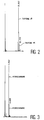
- FIG. 2 shows the chromatogram obtained before irradiation where we notice the two peaks corresponding respectively to the thujone beta (10.837) and thujone alpha (11.220).
- FIG. 3 shows the chromatogram obtained after irradiation of the solution. On this chromatogram, the peaks corresponding to thujones are gone. However, we observe new peaks that correspond to the appearance of hydrocarbons from the degradation of thujones whose molecular weights are 124.
- Example 2 Elimination of thujones and camphor in sage extract.
- the sage extract is diluted in ethanol to obtain a 10% solution of sage and we submit 2ml of this solution to a irradiation using the same laser and the same conditions as in example 1.
- the method of the invention which simply understands the successive stages of laser beam photolysis and evaporation under reduced pressure, allowed to remove thujones and the sage extract camphor without any addition of reagent by performing only a simple dilution in alcohol.
- Figure 7 illustrates the formulas of phycoerythrin and phycocyanin which are usually linked to peptides via sulfur atoms of Cys residues, as it is shown in this figure.
- Figure 8 shows the spectra of absorption of these different compounds belonging to the class of phycobilisomes.
- the line spectrum full refers to phycoerythrin (PE) and it has two absorption maxima around 545 and 565nm.
- the dotted spectrum relates to phycocyanin (PC) and it presents two absorption maxima towards 555 and 620nm.
- the mixed line spectrum relates to allophycocyanin (APC) and it has a maximum absorption around 650nm.
- Example 3 Selective destruction of phycoerythrin (PE) in the presence of phycocyanin (PC) .
- wavelength is complex because the irradiation at 545nm (maximum absorption of the PE) is not selective since the PC absorbs as strongly.
- the choice of wavelength (470nm) is therefore explained by the fact that the PE presents a large shoulder at this wavelength while the PC absorbs little.
- the different tests irradiation (between 470 and 500nm) have shown that was not possible to destroy the PE without touching also at the PC, on the other hand it is possible to destroy 2 times more PE than PC while working on this particular wavelength.
- Example 4 Total destruction of phycocyanin PC in the presence of phycoerythrin PE.
- Figure 8 illustrates the spectra absorption before irradiation (curve 1) and after irradiation (curve 2).
- Example 5 Elimination of an annoying compound, bergaptene, in bergamot essential oil, by laser irradiation.
- This essential oil is widely used in perfumery, especially for water from Cologne.
- its use raises difficulties due to the presence in this oil, bergaptene, photosensitizing molecule. Indeed, he is responsible for reactions phototoxic (lasting browning) following exposure of the skin, in contact with oil of Bergamot, in the sun or in UV radiation. the amount of bergaptene present in the oils essential containing it severely controlled.
- the maximum absorption wavelength bergaptene, dissolved in 96% ethanol, is of 311nm.
- This wavelength corresponds practically at the emission wavelength of the XeCl excimer laser which is 308nm. Use direct from this laser is therefore possible.
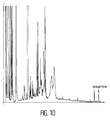
- Figures 10 and 11 show the gas chromatograms before irradiation (fig. 10) and after irradiation (fig. 11).
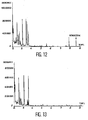
- Figures 12 and 13 illustrate the chromatograms obtained by CPG / spectrometry coupling mass before irradiation (fig. 12) and after irradiation (fig. 13).
- the method of the invention has allowed to eliminate, in the essential oil of bergamot, the annoying compound, bergaptene.
Landscapes
- Chemical & Material Sciences (AREA)
- Engineering & Computer Science (AREA)
- Life Sciences & Earth Sciences (AREA)
- Health & Medical Sciences (AREA)
- Polymers & Plastics (AREA)
- Food Science & Technology (AREA)
- Nutrition Science (AREA)
- Chemical Kinetics & Catalysis (AREA)
- Organic Chemistry (AREA)
- Wood Science & Technology (AREA)
- Oil, Petroleum & Natural Gas (AREA)
- Organic Low-Molecular-Weight Compounds And Preparation Thereof (AREA)
- Medicines Containing Plant Substances (AREA)
- Physical Or Chemical Processes And Apparatus (AREA)
Claims (15)
- Verfahren zur Entfernung wenigstens einer störenden organischen Verbindung aus einem natürlichen Extrakt, dadurch gekennzeichnet, daß es darin besteht, den Extrakt einer Bestrahlung mit einem Laserbündel, dessen Wellenlänge einer Absorptionsbande der störenden Verbindung(en) entspricht, auszusetzen, um diese Verbindung(en) in eine (bzw. mehrere) nicht störende und/oder leicht von dem Extrakt abzutrennende Verbindung(en) umzuwandeln.
- Verfahren nach Anspruch 1, dadurch gekennzeichnet, daß die störende Verbindung ein Keton ist.
- Verfahren nach Anspruch 2, dadurch gekennzeichnet, daß die störende Verbindung Thujon ist.
- Verfahren nach Anspruch 3, dadurch gekennzeichnet, daß der Extrakt ein Salbei-Extrakt ist.
- Verfahren nach Anspruch 1, dadurch gekennzeichnet, daß die störende Verbindung ein Phycobiliprotein ist.
- Verfahren nach Anspruch 5, dadurch gekennzeichnet, daß die störende Verbindung Phycocyanin oder Phycoerythrin ist.
- Verfahren nach Anspruch 1, dadurch gekennzeichnet, daß der Extrakt ein Bergamotte-Extrakt ist.
- Verfahren nach Anspruch 7, dadurch gekennzeichnet, daß die störende Verbindung Bergapten ist.
- Verfahren nach einem der Ansprüche 1 bis 8, dadurch gekennzeichnet, daß der Extrakt in einem Lösungsmittel aufgelöst oder verdünnt wird, bevor er der Bestrahlung mit dem Laserbündel ausgesetzt wird.
- Verfahren nach einem der Ansprüche 1 bis 9, dadurch gekennzeichnet, daß man die Bestrahlung bei einer Temperatur ausführt, die unter der Umgebungstemperatur, aber über der Erstarrungstemperatur des der Bestrahlung ausgesetzten Extrakts liegt.
- Verfahren nach einem der Ansprüche 2 bis 4, dadurch gekennzeichnet, daß es einen ergänzenden Schritt der Abtrennung der durch die Bestrahlung der störenden Verbindung(en) erhaltenen Verbindung(en) umfaßt.
- Verfahren nach Anspruch 11, dadurch gekennzeichnet, daß man diese Abtrennung durch Abdampfen ausführt.
- Verfahren nach Anspruch 1, dadurch gekennzeichnet, daß man die Bestrahlung des Extrakts ausführt, indem man ihn in einer Bestrahlungszelle, die von dem Laserbündel durchquert wird, umwälzt, und daß man die Entfernung der störenden Verbindung(en) kontrolliert, indem man die Energie des Laserbündels, das die Bestrahlungszelle durchquert hat, mißt.
- Verfahren nach einem der Ansprüche 1, 5 und 6, dadurch gekennzeichnet, daß die Bestrahlung bei einer Wellenlänge ausgeführt wird, die der Flanke des Absorptionspeaks der störenden Komponente entspricht, um die beste Selektivität der Zerstörung zu erhalten.
- Verfahren nach einem der Ansprüche 1 bis 14, dadurch gekennzeichnet, daß der Extrakt ein Aromenextrakt ist und daß die Bestrahlungsbehandlung es erlaubt, die olfaktorische Note des Extrakts zu verändern.
Applications Claiming Priority (2)
| Application Number | Priority Date | Filing Date | Title |
|---|---|---|---|
| FR9302313A FR2702161B1 (fr) | 1993-03-01 | 1993-03-01 | Procédé pour éliminer d'un mélange au moins un composé organique gênant, utilisable en particulier pour le traitement d'extraits naturels. |
| FR9302313 | 1993-03-01 |
Publications (3)
| Publication Number | Publication Date |
|---|---|
| EP0613621A2 EP0613621A2 (de) | 1994-09-07 |
| EP0613621A3 EP0613621A3 (de) | 1994-10-19 |
| EP0613621B1 true EP0613621B1 (de) | 1998-10-28 |
Family
ID=9444520
Family Applications (1)
| Application Number | Title | Priority Date | Filing Date |
|---|---|---|---|
| EP94400410A Expired - Lifetime EP0613621B1 (de) | 1993-03-01 | 1994-02-25 | Verfahren zum Entfernen zumindest eines unerwünschten organischen Produktes aus einem natürlichen Extrakt |
Country Status (4)
| Country | Link |
|---|---|
| EP (1) | EP0613621B1 (de) |
| DE (1) | DE69414154T2 (de) |
| ES (1) | ES2125418T3 (de) |
| FR (1) | FR2702161B1 (de) |
Families Citing this family (2)
| Publication number | Priority date | Publication date | Assignee | Title |
|---|---|---|---|---|
| GB0306399D0 (en) * | 2003-03-20 | 2003-04-23 | Ineos Fluor Holdings Ltd | Process for reducing the concentration of undesired compounds in a composition |
| FR2960000B1 (fr) * | 2010-05-12 | 2012-07-20 | Univ D Avignon Et Des Pays De Vaucluse | Procede destine a reduire la teneur en furocoumarines |
Family Cites Families (4)
| Publication number | Priority date | Publication date | Assignee | Title |
|---|---|---|---|---|
| FR2590589B1 (fr) * | 1985-11-26 | 1988-02-19 | Centre Nat Rech Scient | Nouveau procede de transformation photochimique d'extraits de houblon et dispositif pour la mise en oeuvre de ce procede. |
| JPS62258325A (ja) * | 1986-04-30 | 1987-11-10 | Ishikawajima Harima Heavy Ind Co Ltd | キニン化合物の不活性化方法 |
| NL8802848A (nl) * | 1988-11-18 | 1990-06-18 | Naarden International Nv | Werkwijze voor het bereiden van aroma- en reukstoffen. |
| SU1738206A1 (ru) * | 1989-07-26 | 1992-06-07 | Гродненский Государственный Университет | Способ обработки пищевых продуктов и кормов ИК - излучением |
-
1993
- 1993-03-01 FR FR9302313A patent/FR2702161B1/fr not_active Expired - Fee Related
-
1994
- 1994-02-25 EP EP94400410A patent/EP0613621B1/de not_active Expired - Lifetime
- 1994-02-25 DE DE69414154T patent/DE69414154T2/de not_active Expired - Fee Related
- 1994-02-25 ES ES94400410T patent/ES2125418T3/es not_active Expired - Lifetime
Also Published As
| Publication number | Publication date |
|---|---|
| DE69414154T2 (de) | 1999-05-20 |
| FR2702161A1 (fr) | 1994-09-09 |
| DE69414154D1 (de) | 1998-12-03 |
| ES2125418T3 (es) | 1999-03-01 |
| FR2702161B1 (fr) | 1995-04-07 |
| EP0613621A3 (de) | 1994-10-19 |
| EP0613621A2 (de) | 1994-09-07 |
Similar Documents
| Publication | Publication Date | Title |
|---|---|---|
| US5458897A (en) | Microwave-assisted extraction from materials containing organic matter | |
| Kongbonga et al. | Characterization of vegetable oils by fluorescence spectroscopy | |
| Whitehead et al. | Photodegradation and photosensitization of mycosporine-like amino acids | |
| JP2790212B2 (ja) | ケン化したマリゴールドの含油樹脂からのルテインの単離、精製および再結晶法、およびその使用 | |
| Abid et al. | Photo-stability and photo-sensitizing characterization of selected sunscreens’ ingredients | |
| CA2767350C (fr) | Composition de solvant a base d'oxyde de sulfure organique a odeur masquee | |
| FR2607700A1 (fr) | Composition cosmetique photostable contenant un filtre uv-a et un filtre uv-b, son utilisation pour la protection de la peau contre les rayons uv et procede de stabilisation du filtre uv-a par le filtre uv-b | |
| US5338557A (en) | Microwave extraction of volatile oils | |
| Dawe et al. | Radical ions derived from photosynthetic polyenes | |
| WO2007057549A2 (fr) | Extrait vegetal obtenu par un procede d'extraction a l'aide de solvants d'origine vegetale | |
| Bitterling et al. | Photo-protective effects of selected furocoumarins on β-pinene, R-(+)-limonene and γ-terpinene upon UV-A irradiation | |
| FR2655054A1 (fr) | Agents de protection des cellules contenant des curcuminoides. | |
| Failloux et al. | Quantitative analysis of vitamin A degradation by Raman spectroscopy | |
| EP0613621A2 (de) | Verfahren zur Entfernen von zumindest eines unerwünschten organischen Produktes aus einem natürlichen Extrakt | |
| He et al. | Carotenoids in liposomes: photodegradation, excited state lifetimes, and energy transfer | |
| JP2000073057A (ja) | 水溶性抗酸化剤およびその製造方法 | |
| Konovalova et al. | Photoinduced electron transfer between carotenoids and solvent molecules | |
| De Sio et al. | A chromatographic procedure for the determination of carotenoids and chlorophylls in vegetable products | |
| Dattola et al. | Effect of two reflective materials on the physiological and production behaviour of bergamot (Citrus bergamia Risso et Poiteau) plants | |
| JP7674734B2 (ja) | シス型カロテノイド含有組成物の製造方法 | |
| FR3006896A1 (fr) | Composition photoprotectrice | |
| Guedes de Pinho et al. | Monitoring carotenoids and derived compounds in grapes and port wines: Impact on Quality | |
| Dawidar et al. | Chemical composition and effect of photo-oxygenation on biological activities of Egyptian commercial anise and fennel essential oils | |
| Takeda et al. | Heats of formation of intermediate radicals in solution | |
| Moulin et al. | Selective laser photolysis of organic molecules in complex matrices |
Legal Events
| Date | Code | Title | Description |
|---|---|---|---|
| PUAI | Public reference made under article 153(3) epc to a published international application that has entered the european phase |
Free format text: ORIGINAL CODE: 0009012 |
|
| PUAL | Search report despatched |
Free format text: ORIGINAL CODE: 0009013 |
|
| AK | Designated contracting states |
Kind code of ref document: A2 Designated state(s): CH DE ES FR GR IT LI |
|
| AK | Designated contracting states |
Kind code of ref document: A3 Designated state(s): CH DE ES FR GR IT LI |
|
| 17P | Request for examination filed |
Effective date: 19950327 |
|
| 17Q | First examination report despatched |
Effective date: 19970416 |
|
| GRAG | Despatch of communication of intention to grant |
Free format text: ORIGINAL CODE: EPIDOS AGRA |
|
| GRAG | Despatch of communication of intention to grant |
Free format text: ORIGINAL CODE: EPIDOS AGRA |
|
| GRAH | Despatch of communication of intention to grant a patent |
Free format text: ORIGINAL CODE: EPIDOS IGRA |
|
| GRAH | Despatch of communication of intention to grant a patent |
Free format text: ORIGINAL CODE: EPIDOS IGRA |
|
| GRAA | (expected) grant |
Free format text: ORIGINAL CODE: 0009210 |
|
| AK | Designated contracting states |
Kind code of ref document: B1 Designated state(s): CH DE ES FR GR IT LI |
|
| REG | Reference to a national code |
Ref country code: CH Ref legal event code: EP |
|
| REF | Corresponds to: |
Ref document number: 69414154 Country of ref document: DE Date of ref document: 19981203 |
|
| REG | Reference to a national code |
Ref country code: ES Ref legal event code: FG2A Ref document number: 2125418 Country of ref document: ES Kind code of ref document: T3 |
|
| PLBE | No opposition filed within time limit |
Free format text: ORIGINAL CODE: 0009261 |
|
| STAA | Information on the status of an ep patent application or granted ep patent |
Free format text: STATUS: NO OPPOSITION FILED WITHIN TIME LIMIT |
|
| 26N | No opposition filed | ||
| PGFP | Annual fee paid to national office [announced via postgrant information from national office to epo] |
Ref country code: GR Payment date: 20000216 Year of fee payment: 7 |
|
| PG25 | Lapsed in a contracting state [announced via postgrant information from national office to epo] |
Ref country code: GR Free format text: LAPSE BECAUSE OF NON-PAYMENT OF DUE FEES Effective date: 20010228 |
|
| PGFP | Annual fee paid to national office [announced via postgrant information from national office to epo] |
Ref country code: ES Payment date: 20030124 Year of fee payment: 10 |
|
| PGFP | Annual fee paid to national office [announced via postgrant information from national office to epo] |
Ref country code: DE Payment date: 20030223 Year of fee payment: 10 |
|
| PGFP | Annual fee paid to national office [announced via postgrant information from national office to epo] |
Ref country code: FR Payment date: 20030225 Year of fee payment: 10 Ref country code: CH Payment date: 20030225 Year of fee payment: 10 |
|
| PG25 | Lapsed in a contracting state [announced via postgrant information from national office to epo] |
Ref country code: ES Free format text: LAPSE BECAUSE OF NON-PAYMENT OF DUE FEES Effective date: 20040226 |
|
| PG25 | Lapsed in a contracting state [announced via postgrant information from national office to epo] |
Ref country code: LI Free format text: LAPSE BECAUSE OF NON-PAYMENT OF DUE FEES Effective date: 20040229 Ref country code: CH Free format text: LAPSE BECAUSE OF NON-PAYMENT OF DUE FEES Effective date: 20040229 |
|
| PG25 | Lapsed in a contracting state [announced via postgrant information from national office to epo] |
Ref country code: DE Free format text: LAPSE BECAUSE OF NON-PAYMENT OF DUE FEES Effective date: 20040901 |
|
| REG | Reference to a national code |
Ref country code: CH Ref legal event code: PL |
|
| PG25 | Lapsed in a contracting state [announced via postgrant information from national office to epo] |
Ref country code: FR Free format text: LAPSE BECAUSE OF NON-PAYMENT OF DUE FEES Effective date: 20041029 |
|
| REG | Reference to a national code |
Ref country code: FR Ref legal event code: ST |
|
| PG25 | Lapsed in a contracting state [announced via postgrant information from national office to epo] |
Ref country code: IT Free format text: LAPSE BECAUSE OF NON-PAYMENT OF DUE FEES;WARNING: LAPSES OF ITALIAN PATENTS WITH EFFECTIVE DATE BEFORE 2007 MAY HAVE OCCURRED AT ANY TIME BEFORE 2007. THE CORRECT EFFECTIVE DATE MAY BE DIFFERENT FROM THE ONE RECORDED. Effective date: 20050225 |
|
| REG | Reference to a national code |
Ref country code: ES Ref legal event code: FD2A Effective date: 20040226 |