EP0613621A2 - Verfahren zur Entfernen von zumindest eines unerwünschten organischen Produktes aus einem natürlichen Extrakt - Google Patents
Verfahren zur Entfernen von zumindest eines unerwünschten organischen Produktes aus einem natürlichen Extrakt Download PDFInfo
- Publication number
- EP0613621A2 EP0613621A2 EP94400410A EP94400410A EP0613621A2 EP 0613621 A2 EP0613621 A2 EP 0613621A2 EP 94400410 A EP94400410 A EP 94400410A EP 94400410 A EP94400410 A EP 94400410A EP 0613621 A2 EP0613621 A2 EP 0613621A2
- Authority
- EP
- European Patent Office
- Prior art keywords
- extract
- irradiation
- compound
- annoying
- laser beam
- Prior art date
- Legal status (The legal status is an assumption and is not a legal conclusion. Google has not performed a legal analysis and makes no representation as to the accuracy of the status listed.)
- Granted
Links
- 0 CC(CC1)(*C1C1)C1=O Chemical compound CC(CC1)(*C1C1)C1=O 0.000 description 2
Images





Classifications
-
- C—CHEMISTRY; METALLURGY
- C11—ANIMAL OR VEGETABLE OILS, FATS, FATTY SUBSTANCES OR WAXES; FATTY ACIDS THEREFROM; DETERGENTS; CANDLES
- C11B—PRODUCING, e.g. BY PRESSING RAW MATERIALS OR BY EXTRACTION FROM WASTE MATERIALS, REFINING OR PRESERVING FATS, FATTY SUBSTANCES, e.g. LANOLIN, FATTY OILS OR WAXES; ESSENTIAL OILS; PERFUMES
- C11B9/00—Essential oils; Perfumes
- C11B9/02—Recovery or refining of essential oils from raw materials
- C11B9/022—Refining
-
- A—HUMAN NECESSITIES
- A23—FOODS OR FOODSTUFFS; TREATMENT THEREOF, NOT COVERED BY OTHER CLASSES
- A23L—FOODS, FOODSTUFFS OR NON-ALCOHOLIC BEVERAGES, NOT OTHERWISE PROVIDED FOR; PREPARATION OR TREATMENT THEREOF
- A23L5/00—Preparation or treatment of foods or foodstuffs, in general; Food or foodstuffs obtained thereby; Materials therefor
- A23L5/20—Removal of unwanted matter, e.g. deodorisation or detoxification
-
- A—HUMAN NECESSITIES
- A23—FOODS OR FOODSTUFFS; TREATMENT THEREOF, NOT COVERED BY OTHER CLASSES
- A23L—FOODS, FOODSTUFFS OR NON-ALCOHOLIC BEVERAGES, NOT OTHERWISE PROVIDED FOR; PREPARATION OR TREATMENT THEREOF
- A23L5/00—Preparation or treatment of foods or foodstuffs, in general; Food or foodstuffs obtained thereby; Materials therefor
- A23L5/30—Physical treatment, e.g. electrical or magnetic means, wave energy or irradiation
Definitions
- the present invention relates to a process for removing from a natural extract at least one annoying organic compound.
- Certain natural extracts obtained from plants have interesting properties for various applications, for example in pharmacy, perfumery, cosmetics, dietetics or food, but these extracts sometimes contain undesirable or toxic products which it is necessary to eliminate.
- photonic sources to destroy them "in situ" in a mixture, in the case where these products have a clean absorption band.
- Light sources usable in ultraviolet and visible light, such as deuterium or xenon lamps have a large divergence and a bandwidth (in wavelength) too wide to obtain the desired selectivity in the case of a complex mixture.
- the use of a filter to obtain a narrower bandwidth is not suitable since it leads to too great a loss of energy to destroy the products to be eliminated.
- the present invention specifically relates to a method for removing from an extract at least one annoying organic compound by means of a photonic source constituted by a laser.
- the method for removing from a natural extract at least one annoying organic compound consists in subjecting the extract to irradiation by means of a laser beam whose wavelength corresponds to an absorption band annoying compound (s) to transform this compound (s) into non-annoying compound (s) and / or easily separable from the extract.
- a pulsed laser is used.
- the laser makes it possible to ensure a low divergence and an emission characterized by a narrow spectral band, tunable from ultraviolet to infrared, via the visible, with high powers reaching several MW / cm2.
- the troublesome compounds which can be eliminated by this process are therefore organic compounds capable of undergoing irreversible chemical transformations by absorption of appropriate radiation. These transformations can consist of an isomerization or a decomposition into several molecules.
- An example of an annoying carbonyl compound is that of thujone because it is a neurotoxic compound which is found in particular at high levels in the cis and trans forms in hexane extracts of sage (Salvia officinalis L) which also have interesting antioxidant properties.
- This photolysis reaction is interesting because the unsaturated hydrocarbons produced are not troublesome compounds; moreover, they can be easily separated from the extract by evaporation.
- the sage extract also contains camphor which is of no special interest and which is not bothersome; this compound has the same absorption spectrum as thujone. Also, the camphor will also be transformed by photolysis into hydrocarbon in accordance with the following reaction scheme:
- organic compounds capable of being treated by the process of the invention is that of phycobilisomes.
- Phycobilisomes are aggregates of phycobiliproteins which can be broken down into three classes: phycoerythrins (84%), phycocyanins (11%) and allophycocyanins (5%). They can be used as fluorescent markers in immunology where they allow the detection of an antigenic marker in a cell preparation or a histological section by the association of a specific antibody. Phycobilisomes have many advantages (especially compared to the fluorescein usually used): high absorption coefficients in a wide spectral band, high quantum yield, constant fluorescence in a wide pH band, higher fluorescence yield, high solubility in water, fluorescence in the orange-red region (region of minimal interference with other biological compounds).
- the process of the invention is very interesting in the case of these compounds because it makes it possible to purify them efficiently by choosing an appropriate wavelength to selectively destroy certain constituents of these phycobilisomes.
- the extract is generally dissolved or diluted in an appropriate solvent before subjecting it to irradiation by the laser beam.
- the dissolution or dilution of the extract in a solvent makes it possible to adjust the concentration of the extract to a concentration optimal for the irradiation operation. It is also possible to work directly (without dilution) on the extract.
- the solvents used can be of different types and they are chosen so as to form a homogeneous liquid phase with the extract under the irradiation conditions. These solvents can be polar or apolar solvents.
- a laser of most appropriate wavelength is used corresponding to a side of the absorption peak of the annoying element to obtain the best selectivity.
- irradiation can be carried out at a temperature below ambient temperature in order to better separate the absorption peaks from the constituents of the mixture.
- the process of the invention is therefore very advantageous since it does not require the addition of chemical reagents to remove the troublesome organic compounds and it makes it possible to ensure the complete elimination of these compounds.
- a simpler way of monitoring this elimination is to carry out a continuous measurement of the energy of the laser beam, after irradiation of the extract.
- the laser beam is very absorbed by the extract which contains the annoying compound. As this compound is destroyed, the beam is less absorbed and its energy, measured after the irradiation tank, increases.
- the energy of the laser beam having passed through the irradiation tank is practically identical to the energy of the beam before it enters the treatment tank. irradiation.
- the lasers used to implement the process of the invention are chosen according to the nature of the compound to be removed so as to have a wavelength corresponding to an absorption peak of this compound.
- the process of the invention can be used in particular for removing annoying elements by their toxicity, their instability or their odor, in natural extracts, in very diverse fields such as pharmacy, cosmetics, dietetics and food. .
- This process is particularly advantageous in the case where the physicochemical separation of the annoying compound is difficult and / or the constituents of the extract are too fragile.
- perfumery one can for example use this process to remove from an aroma extract products having an annoying odor and thus modify the olfactory note of the extract.
- Examples of natural extracts which can be treated by the process of the invention are sage extracts, sassafras oil, tagetes extract, bergamot essence, and extracts of algae or of pigments, for example from phycobilisomes.
- Example 1 Elimination of thujones in alcoholic solution.
- the ultraviolet spectrum of alpha and beta thujones has shown that the characteristic absorption band of carbonyls is around 300nm, which allows the direct use of the XeCl excimer laser emitting at 308nm.
- This installation comprises a circulation irradiation tank (1) into which a solution of thujones in ethanol is introduced, a laser source (3) emitting a laser beam (4) passing through the tank (1) and a wattmeter (5 ) to measure the energy of the laser beam having passed through the tank.
- the optical path of the beam in the tank is 1 cm, and 2 ml of ethanolic solution containing 10% in vol is used. of thujones.
- This solution is irradiated for 20 min under ambient conditions, without a refrigerating system, ie at a temperature of 30 to 40 ° C.
- the solution is then analyzed by gas chromatography on a DB1 (polydimethylsilane) column 30m long and 0.25mm in diameter, using hydrogen as the carrier gas, with a temperature program of 50 ° C (isothermal for 2min), then an increase of 4 ° C / min to 280 ° C.
- the mixture is injected into the column at a temperature of 240 ° C and the chromatogram is obtained with a flame ionization detector at 250 ° C.
- FIG. 2 the chromatogram obtained before irradiation is shown, where the two peaks corresponding to the thujone beta (10.837) and to the thujone alpha (11.220) are respectively observed.
- FIG. 3 shows the chromatogram obtained after irradiation of the solution. On this chromatogram, the peaks corresponding to the thujones have disappeared. On the other hand, we observe new peaks which correspond to the appearance of hydrocarbons resulting from the degradation of thujones whose molecular masses are 124.
- Example 2 Elimination of thujones and camphor in a sage extract.
- the sage extract is diluted in ethanol to obtain a 10% solution of sage extract and 2 ml of this solution are subjected to irradiation using the same laser and the same conditions as those of Example 1 This transforms all the thujones present in the extract into hydrocarbons and also destroys the camphor present in the sample.
- FIG. 4 the chromatogram of the alcoholic extract of sage before irradiation has been shown, and we notice on this chromatogram the peaks corresponding to the thujones alpha, beta and camphor.
- FIG. 6 shows the absorption spectra of sage extract, before and after irradiation. These spectra were obtained on a Cary 1 spectrophotometer using the same cell as that used during the laser irradiation.
- the method of the invention which simply comprises the successive steps of photolysis by laser beam and evaporation under reduced pressure, has made it possible to remove the thujones and the camphor from the sage extract without any addition of reagent. performing only a simple dilution in alcohol.
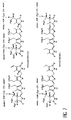
- Figure 7 illustrates the formulas of phycoerythrin and phycocyanin which are generally linked to peptides via the sulfur atoms of Cys residues, as shown in this figure.
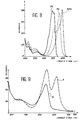
- FIG. 8 represents the absorption spectra of these different compounds belonging to the class of phycobilisomes.
- the solid line spectrum relates to phycoerythrin (PE) and it has two absorption maxima around 545 and 565nm.
- the dotted spectrum relates to phycocyanin (PC) and it has two absorption maxima around 555 and 620nm.
- the spectrum in phantom lines relates to allophycocyanin (APC) and it has a maximum absorption around 650nm.
- Example 3 Selective destruction of phycoerythrin (PE) in the presence of phycocyanin (PC) .
- the Coumarin 102 laser is used at 470nm, and the procedure is as in Example 1 using a solution of hydrogen phosphate containing 20% by volume of a PE-PC mixture.
- wavelength is complex because the irradiation at 545nm (maximum absorption of PE) is not selective since the PC also absorbs strongly.
- the choice of wavelength (470nm) is therefore explained by the fact that the PE has a large shoulder at this wavelength while the PC absorbs little.
- the various irradiation tests (between 470 and 500nm) have shown that it was not possible to destroy PE without also touching the PC, on the other hand it is possible to destroy 2 times more PE than PC while working at this particular wavelength.
- Example 4 Total destruction of PC phycocyanin in the presence of PE phycoerythrin.
- the laser irradiation is carried out at 620 nm with the Rhodamine 101 laser and the procedure is as in Example 3.
- Figure 8 illustrates the absorption spectra before irradiation (curve 1) and after irradiation (curve 2).
- Example 5 Elimination of an annoying compound, bergaptene, in bergamot essential oil, by laser irradiation.
- This essential oil is widely used in perfumery, especially for cologne.
- its use raises difficulties due to the presence, in this oil, of bergaptene, a photosensitizing molecule. Indeed, it is responsible for phototoxic reactions (lasting browning) following exposure of the skin, in contact with Bergamot oil, in the sun or to UV radiation
- the amount of bergaptene present in essential oils in container is strictly controlled.
- the maximum absorption wavelength of bergaptene, in solution in ethanol 96%, is 311nm.
- This wavelength corresponds practically to the emission wavelength of the XeCl excimer laser which is 308nm. Direct use of this laser is therefore possible.
- Example 1 The same procedure is therefore followed as in Example 1 for irradiating the bergamot extract using this XeCl excimer laser.
- Figures 10 and 11 show the chromatograms obtained in the gas phase before irradiation (fig. 10) and after irradiation (fig. 11).
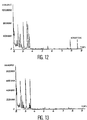
- FIGS. 12 and 13 illustrate the chromatograms obtained by coupling CPG / mass spectrometry before irradiation (fig. 12) and after irradiation (fig. 13).
- the process of the invention has made it possible to eliminate, in the essential oil of bergamot, the annoying compound, bergaptene.
Landscapes
- Chemical & Material Sciences (AREA)
- Engineering & Computer Science (AREA)
- Life Sciences & Earth Sciences (AREA)
- Health & Medical Sciences (AREA)
- Polymers & Plastics (AREA)
- Food Science & Technology (AREA)
- Nutrition Science (AREA)
- Chemical Kinetics & Catalysis (AREA)
- Organic Chemistry (AREA)
- Wood Science & Technology (AREA)
- Oil, Petroleum & Natural Gas (AREA)
- Organic Low-Molecular-Weight Compounds And Preparation Thereof (AREA)
- Medicines Containing Plant Substances (AREA)
- Physical Or Chemical Processes And Apparatus (AREA)
Applications Claiming Priority (2)
| Application Number | Priority Date | Filing Date | Title |
|---|---|---|---|
| FR9302313A FR2702161B1 (fr) | 1993-03-01 | 1993-03-01 | Procédé pour éliminer d'un mélange au moins un composé organique gênant, utilisable en particulier pour le traitement d'extraits naturels. |
| FR9302313 | 1993-03-01 |
Publications (3)
| Publication Number | Publication Date |
|---|---|
| EP0613621A2 true EP0613621A2 (de) | 1994-09-07 |
| EP0613621A3 EP0613621A3 (de) | 1994-10-19 |
| EP0613621B1 EP0613621B1 (de) | 1998-10-28 |
Family
ID=9444520
Family Applications (1)
| Application Number | Title | Priority Date | Filing Date |
|---|---|---|---|
| EP94400410A Expired - Lifetime EP0613621B1 (de) | 1993-03-01 | 1994-02-25 | Verfahren zum Entfernen zumindest eines unerwünschten organischen Produktes aus einem natürlichen Extrakt |
Country Status (4)
| Country | Link |
|---|---|
| EP (1) | EP0613621B1 (de) |
| DE (1) | DE69414154T2 (de) |
| ES (1) | ES2125418T3 (de) |
| FR (1) | FR2702161B1 (de) |
Cited By (2)
| Publication number | Priority date | Publication date | Assignee | Title |
|---|---|---|---|---|
| WO2004082800A1 (en) * | 2003-03-20 | 2004-09-30 | Ineos Fluor Holdings Limited | Process for reducing the concentration of undesired compounds in a composition |
| FR2960000A1 (fr) * | 2010-05-12 | 2011-11-18 | Univ D Avignon Et Des Pays De Vaucluse | Procede destine a reduire la teneur en furocoumarines lors de la preparation d'une huile essentielle |
Family Cites Families (4)
| Publication number | Priority date | Publication date | Assignee | Title |
|---|---|---|---|---|
| FR2590589B1 (fr) * | 1985-11-26 | 1988-02-19 | Centre Nat Rech Scient | Nouveau procede de transformation photochimique d'extraits de houblon et dispositif pour la mise en oeuvre de ce procede. |
| JPS62258325A (ja) * | 1986-04-30 | 1987-11-10 | Ishikawajima Harima Heavy Ind Co Ltd | キニン化合物の不活性化方法 |
| NL8802848A (nl) * | 1988-11-18 | 1990-06-18 | Naarden International Nv | Werkwijze voor het bereiden van aroma- en reukstoffen. |
| SU1738206A1 (ru) * | 1989-07-26 | 1992-06-07 | Гродненский Государственный Университет | Способ обработки пищевых продуктов и кормов ИК - излучением |
-
1993
- 1993-03-01 FR FR9302313A patent/FR2702161B1/fr not_active Expired - Fee Related
-
1994
- 1994-02-25 EP EP94400410A patent/EP0613621B1/de not_active Expired - Lifetime
- 1994-02-25 DE DE69414154T patent/DE69414154T2/de not_active Expired - Fee Related
- 1994-02-25 ES ES94400410T patent/ES2125418T3/es not_active Expired - Lifetime
Cited By (2)
| Publication number | Priority date | Publication date | Assignee | Title |
|---|---|---|---|---|
| WO2004082800A1 (en) * | 2003-03-20 | 2004-09-30 | Ineos Fluor Holdings Limited | Process for reducing the concentration of undesired compounds in a composition |
| FR2960000A1 (fr) * | 2010-05-12 | 2011-11-18 | Univ D Avignon Et Des Pays De Vaucluse | Procede destine a reduire la teneur en furocoumarines lors de la preparation d'une huile essentielle |
Also Published As
| Publication number | Publication date |
|---|---|
| DE69414154T2 (de) | 1999-05-20 |
| FR2702161A1 (fr) | 1994-09-09 |
| EP0613621B1 (de) | 1998-10-28 |
| DE69414154D1 (de) | 1998-12-03 |
| ES2125418T3 (es) | 1999-03-01 |
| FR2702161B1 (fr) | 1995-04-07 |
| EP0613621A3 (de) | 1994-10-19 |
Similar Documents
| Publication | Publication Date | Title |
|---|---|---|
| US5458897A (en) | Microwave-assisted extraction from materials containing organic matter | |
| Kongbonga et al. | Characterization of vegetable oils by fluorescence spectroscopy | |
| CA2767350C (fr) | Composition de solvant a base d'oxyde de sulfure organique a odeur masquee | |
| JP2790212B2 (ja) | ケン化したマリゴールドの含油樹脂からのルテインの単離、精製および再結晶法、およびその使用 | |
| Semitsoglou-Tsiapou et al. | Photochemical (UV–vis/H2O2) degradation of carotenoids: Kinetics and molecular end products | |
| FR2607700A1 (fr) | Composition cosmetique photostable contenant un filtre uv-a et un filtre uv-b, son utilisation pour la protection de la peau contre les rayons uv et procede de stabilisation du filtre uv-a par le filtre uv-b | |
| US5338557A (en) | Microwave extraction of volatile oils | |
| Jirovetz et al. | Purity, antimicrobial activities and olfactoric evaluations of geraniol/nerol and various of their derivatives | |
| Dawe et al. | Radical ions derived from photosynthetic polyenes | |
| WO2007057549A2 (fr) | Extrait vegetal obtenu par un procede d'extraction a l'aide de solvants d'origine vegetale | |
| EP3362078B1 (de) | Neuartiges organisches auflösungs- und/oder extraktionslösungsmittel, extraktionsverfahren mit verwendung des besagten lösungsmittels und durch besagtes verfahren hergestellte extrakte | |
| Bitterling et al. | Photo-protective effects of selected furocoumarins on β-pinene, R-(+)-limonene and γ-terpinene upon UV-A irradiation | |
| EP0613621B1 (de) | Verfahren zum Entfernen zumindest eines unerwünschten organischen Produktes aus einem natürlichen Extrakt | |
| FR2655054A1 (fr) | Agents de protection des cellules contenant des curcuminoides. | |
| Failloux et al. | Quantitative analysis of vitamin A degradation by Raman spectroscopy | |
| JP2000073057A (ja) | 水溶性抗酸化剤およびその製造方法 | |
| FR2642526A1 (fr) | Utilisation de generateur de radicaux libres dans le domaine des dosages biologiques | |
| He et al. | Carotenoids in liposomes: photodegradation, excited state lifetimes, and energy transfer | |
| De Sio et al. | A chromatographic procedure for the determination of carotenoids and chlorophylls in vegetable products | |
| WO2021219963A1 (fr) | Procede d'extraction d'odeur a partir d'une matiere vegetale, notamment de fleurs muettes, sous forme solide | |
| JP7674734B2 (ja) | シス型カロテノイド含有組成物の製造方法 | |
| Moulin et al. | Selective laser photolysis of organic molecules in complex matrices | |
| Takeda et al. | Heats of formation of intermediate radicals in solution | |
| Dawidar et al. | Chemical composition and effect of photo-oxygenation on biological activities of Egyptian commercial anise and fennel essential oils | |
| WO2026070220A1 (ja) | シス異性化方法 |
Legal Events
| Date | Code | Title | Description |
|---|---|---|---|
| PUAI | Public reference made under article 153(3) epc to a published international application that has entered the european phase |
Free format text: ORIGINAL CODE: 0009012 |
|
| PUAL | Search report despatched |
Free format text: ORIGINAL CODE: 0009013 |
|
| AK | Designated contracting states |
Kind code of ref document: A2 Designated state(s): CH DE ES FR GR IT LI |
|
| AK | Designated contracting states |
Kind code of ref document: A3 Designated state(s): CH DE ES FR GR IT LI |
|
| 17P | Request for examination filed |
Effective date: 19950327 |
|
| 17Q | First examination report despatched |
Effective date: 19970416 |
|
| GRAG | Despatch of communication of intention to grant |
Free format text: ORIGINAL CODE: EPIDOS AGRA |
|
| GRAG | Despatch of communication of intention to grant |
Free format text: ORIGINAL CODE: EPIDOS AGRA |
|
| GRAH | Despatch of communication of intention to grant a patent |
Free format text: ORIGINAL CODE: EPIDOS IGRA |
|
| GRAH | Despatch of communication of intention to grant a patent |
Free format text: ORIGINAL CODE: EPIDOS IGRA |
|
| GRAA | (expected) grant |
Free format text: ORIGINAL CODE: 0009210 |
|
| AK | Designated contracting states |
Kind code of ref document: B1 Designated state(s): CH DE ES FR GR IT LI |
|
| REG | Reference to a national code |
Ref country code: CH Ref legal event code: EP |
|
| REF | Corresponds to: |
Ref document number: 69414154 Country of ref document: DE Date of ref document: 19981203 |
|
| REG | Reference to a national code |
Ref country code: ES Ref legal event code: FG2A Ref document number: 2125418 Country of ref document: ES Kind code of ref document: T3 |
|
| PLBE | No opposition filed within time limit |
Free format text: ORIGINAL CODE: 0009261 |
|
| STAA | Information on the status of an ep patent application or granted ep patent |
Free format text: STATUS: NO OPPOSITION FILED WITHIN TIME LIMIT |
|
| 26N | No opposition filed | ||
| PGFP | Annual fee paid to national office [announced via postgrant information from national office to epo] |
Ref country code: GR Payment date: 20000216 Year of fee payment: 7 |
|
| PG25 | Lapsed in a contracting state [announced via postgrant information from national office to epo] |
Ref country code: GR Free format text: LAPSE BECAUSE OF NON-PAYMENT OF DUE FEES Effective date: 20010228 |
|
| PGFP | Annual fee paid to national office [announced via postgrant information from national office to epo] |
Ref country code: ES Payment date: 20030124 Year of fee payment: 10 |
|
| PGFP | Annual fee paid to national office [announced via postgrant information from national office to epo] |
Ref country code: DE Payment date: 20030223 Year of fee payment: 10 |
|
| PGFP | Annual fee paid to national office [announced via postgrant information from national office to epo] |
Ref country code: FR Payment date: 20030225 Year of fee payment: 10 Ref country code: CH Payment date: 20030225 Year of fee payment: 10 |
|
| PG25 | Lapsed in a contracting state [announced via postgrant information from national office to epo] |
Ref country code: ES Free format text: LAPSE BECAUSE OF NON-PAYMENT OF DUE FEES Effective date: 20040226 |
|
| PG25 | Lapsed in a contracting state [announced via postgrant information from national office to epo] |
Ref country code: LI Free format text: LAPSE BECAUSE OF NON-PAYMENT OF DUE FEES Effective date: 20040229 Ref country code: CH Free format text: LAPSE BECAUSE OF NON-PAYMENT OF DUE FEES Effective date: 20040229 |
|
| PG25 | Lapsed in a contracting state [announced via postgrant information from national office to epo] |
Ref country code: DE Free format text: LAPSE BECAUSE OF NON-PAYMENT OF DUE FEES Effective date: 20040901 |
|
| REG | Reference to a national code |
Ref country code: CH Ref legal event code: PL |
|
| PG25 | Lapsed in a contracting state [announced via postgrant information from national office to epo] |
Ref country code: FR Free format text: LAPSE BECAUSE OF NON-PAYMENT OF DUE FEES Effective date: 20041029 |
|
| REG | Reference to a national code |
Ref country code: FR Ref legal event code: ST |
|
| PG25 | Lapsed in a contracting state [announced via postgrant information from national office to epo] |
Ref country code: IT Free format text: LAPSE BECAUSE OF NON-PAYMENT OF DUE FEES;WARNING: LAPSES OF ITALIAN PATENTS WITH EFFECTIVE DATE BEFORE 2007 MAY HAVE OCCURRED AT ANY TIME BEFORE 2007. THE CORRECT EFFECTIVE DATE MAY BE DIFFERENT FROM THE ONE RECORDED. Effective date: 20050225 |
|
| REG | Reference to a national code |
Ref country code: ES Ref legal event code: FD2A Effective date: 20040226 |