EP0612209B1 - Plant for farming fish and the like - Google Patents
Plant for farming fish and the like Download PDFInfo
- Publication number
- EP0612209B1 EP0612209B1 EP92920214A EP92920214A EP0612209B1 EP 0612209 B1 EP0612209 B1 EP 0612209B1 EP 92920214 A EP92920214 A EP 92920214A EP 92920214 A EP92920214 A EP 92920214A EP 0612209 B1 EP0612209 B1 EP 0612209B1
- Authority
- EP
- European Patent Office
- Prior art keywords
- net cage
- sea
- plant
- section
- plant according
- Prior art date
- Legal status (The legal status is an assumption and is not a legal conclusion. Google has not performed a legal analysis and makes no representation as to the accuracy of the status listed.)
- Expired - Lifetime
Links
- 241000251468 Actinopterygii Species 0.000 title claims abstract description 27
- 238000009313 farming Methods 0.000 title claims abstract description 11
- 238000004873 anchoring Methods 0.000 claims abstract description 17
- 238000003860 storage Methods 0.000 claims abstract description 3
- 235000019688 fish Nutrition 0.000 claims description 24
- XLYOFNOQVPJJNP-UHFFFAOYSA-N water Substances O XLYOFNOQVPJJNP-UHFFFAOYSA-N 0.000 claims description 7
- 230000008878 coupling Effects 0.000 claims description 6
- 238000010168 coupling process Methods 0.000 claims description 6
- 238000005859 coupling reaction Methods 0.000 claims description 6
- 241000269908 Platichthys flesus Species 0.000 claims description 4
- 230000000295 complement effect Effects 0.000 claims 1
- 239000000758 substrate Substances 0.000 claims 1
- 238000009372 pisciculture Methods 0.000 description 15
- 230000007613 environmental effect Effects 0.000 description 6
- 230000008901 benefit Effects 0.000 description 5
- 238000009395 breeding Methods 0.000 description 5
- 230000001488 breeding effect Effects 0.000 description 5
- 238000009434 installation Methods 0.000 description 5
- 238000010276 construction Methods 0.000 description 4
- 239000003643 water by type Substances 0.000 description 4
- 238000012423 maintenance Methods 0.000 description 3
- 241000972773 Aulopiformes Species 0.000 description 2
- 241000269978 Pleuronectiformes Species 0.000 description 2
- 230000012010 growth Effects 0.000 description 2
- 230000007246 mechanism Effects 0.000 description 2
- 241000894007 species Species 0.000 description 2
- 241001474374 Blennius Species 0.000 description 1
- 238000011109 contamination Methods 0.000 description 1
- 230000036461 convulsion Effects 0.000 description 1
- 230000001419 dependent effect Effects 0.000 description 1
- 230000000694 effects Effects 0.000 description 1
- 230000036541 health Effects 0.000 description 1
- 238000005286 illumination Methods 0.000 description 1
- 230000009467 reduction Effects 0.000 description 1
- 230000000284 resting effect Effects 0.000 description 1
- 235000019515 salmon Nutrition 0.000 description 1
- 235000015170 shellfish Nutrition 0.000 description 1
- 230000000087 stabilizing effect Effects 0.000 description 1
- 230000009182 swimming Effects 0.000 description 1
- 238000009423 ventilation Methods 0.000 description 1
Images



Classifications
-
- A—HUMAN NECESSITIES
- A01—AGRICULTURE; FORESTRY; ANIMAL HUSBANDRY; HUNTING; TRAPPING; FISHING
- A01K—ANIMAL HUSBANDRY; AVICULTURE; APICULTURE; PISCICULTURE; FISHING; REARING OR BREEDING ANIMALS, NOT OTHERWISE PROVIDED FOR; NEW BREEDS OF ANIMALS
- A01K61/00—Culture of aquatic animals
- A01K61/60—Floating cultivation devices, e.g. rafts or floating fish-farms
-
- Y—GENERAL TAGGING OF NEW TECHNOLOGICAL DEVELOPMENTS; GENERAL TAGGING OF CROSS-SECTIONAL TECHNOLOGIES SPANNING OVER SEVERAL SECTIONS OF THE IPC; TECHNICAL SUBJECTS COVERED BY FORMER USPC CROSS-REFERENCE ART COLLECTIONS [XRACs] AND DIGESTS
- Y02—TECHNOLOGIES OR APPLICATIONS FOR MITIGATION OR ADAPTATION AGAINST CLIMATE CHANGE
- Y02A—TECHNOLOGIES FOR ADAPTATION TO CLIMATE CHANGE
- Y02A40/00—Adaptation technologies in agriculture, forestry, livestock or agroalimentary production
- Y02A40/80—Adaptation technologies in agriculture, forestry, livestock or agroalimentary production in fisheries management
- Y02A40/81—Aquaculture, e.g. of fish
Definitions
- Swedish patent no. 450866 shows a fish farming plant where the net cage consists of a lattice framework assembled from rods which are linked together in the nodes.
- the framework circumscribes and supports a net cage with a closed ceiling.
- the plant is designed for use in open waters, i.e. an "offshore" fish farming plant.
- the plant seems to imply two substantial drawbacks. Firstly, a such relatively tight or compact construction of the plant will be severely affected by lateral forces, i.e. environmental forces from waves, wind, stream etc. Furthermore, maintenance of the plant will be complicated, since the cage is permanently attached to the framework at a plurality of circumferentially distributed points. Growth or fouling might also represent a problem.
- a special object in this connection is to provide a farming plant which is little influenced or vulnerable versus lateral environmental forces, such as wind, waves and stream.
- a fish farming plant in accordance with the invention will be particularly applicable on relatively large sea depths, since at large sea depths, a given deviation angle, given as a function of buoyancy and horisontal forces, results in a larger downward movement of the net cage, a fact making it possible for the net cage to be relatively easily pulled down to a submerged position. Also this fact will imply an advantage, since fish will instinctively seek towards deeper waters during bad weather conditions, and will be more comfortable in a submerged net cage subjected to such conditions.
Landscapes
- Life Sciences & Earth Sciences (AREA)
- Environmental Sciences (AREA)
- Marine Sciences & Fisheries (AREA)
- Zoology (AREA)
- Animal Husbandry (AREA)
- Biodiversity & Conservation Biology (AREA)
- Farming Of Fish And Shellfish (AREA)
- Artificial Fish Reefs (AREA)
Abstract
Description
- The present invention relates to a plant for breeding, farming and storage of fish and other marine species of the kind comprising a net cage which is installed in a submerged position in the sea. The invention is particularly adapted for installation in open or offshore environments as distinct from sheltered and shallow environments.
- Fish farming plants of this kind consist basically of a plurality of anchored floating bodies which are supporting a net cage downwardly suspended in the sea. In order to stabilize the net cage in a substantially vertically expanded configuration in the sea, weights and/or bottom anchorings are arranged along the bottom edge of the net cage. In connection with fish farming plants to be installed in sheltered waters, there are further arranged suitable plattforms with gangways, suspended feeding means etc.
- Known plants for farming and storing or caging fish in the sea have, on account of their shape and equipment, a limited field of utilization due to the prevailing environmental forces, water depths etc. The installation site of the plants creates problems such as a risk for local contamination and traffic impediments. On this background, both fish farmers and authorities want to develop plants which can be positioned in more open, deep water areas. A more freely exposed location of the plants will also render possibilities for installation of larger plants.
- In recent years, several types of fish farming plants have been developed, designed for use in offshore environments. As illustrative for the prior art in this field is referred to US Patent No. 4957064, Swedish Patent No. 450866 and Norwegian Patent No. 153991.
- The US patent shows a fish cage structure consisting of a cagelike enclosure which at the top is provided with circumferentially arranged float means, designed to float in the sea surface. The net cage is upwardly open and must accordingly not be pulled down below the sea surface, otherwise the fish would escape. Along the bottom edge of the fish cage, weights are provided in order to tension the cage downwards. Instead of weights, the bottom edge of the cage may be provided with anchor lines to the sea bottom. On account of the interconnected, complicated floating system shown, the plant will be severely exposed to lateral forces from wind and waves.
- Swedish patent no. 450866 shows a fish farming plant where the net cage consists of a lattice framework assembled from rods which are linked together in the nodes. The framework circumscribes and supports a net cage with a closed ceiling. The plant is designed for use in open waters, i.e. an "offshore" fish farming plant. The plant seems to imply two substantial drawbacks. Firstly, a such relatively tight or compact construction of the plant will be severely affected by lateral forces, i.e. environmental forces from waves, wind, stream etc. Furthermore, maintenance of the plant will be complicated, since the cage is permanently attached to the framework at a plurality of circumferentially distributed points. Growth or fouling might also represent a problem.
- Norwegian patent 153991 shows a plant where a submerged cage is used, i.e. a cage which normally is positioned below the sea surface. At the installation site, the cage is pulled down to the selected level. At the top, the cage is provided with ventilation and illumination equipment. A plant with a permanently submerged fish cage will require special air supply means if the plant is to be used for breeding or farming fish belonging to the salmon family.
- The main object of the present invention is to create a new design for a fish farming plant with a special view to a construction which is suitable for installation and use in deeper and more exposed or offshore environments.
- A special object in this connection is to provide a farming plant which is little influenced or vulnerable versus lateral environmental forces, such as wind, waves and stream.
- A further object for the invention is to provide a farming plant which is reasonable in production, maintenance and operation.
- A further object for the invention is to provide a farming plant which is such designed that it with advantage can be used on large depths, f.inst. depths exceeding several hundred meters.
- A still further object of the invention is to provide a plant for fish farming which is applicable for breeding various kinds of fish, such as round fish and also flatfish (flounder) and other marine species, such as shellfish.
- The plant for farming and caging or storing fish and the like in accordance with the invention, is of the kind comprising a net or net cage which is anchored to the sea bottom and provided with necessary floats, buoyant members and the like, so that the net cage can be maintained in a sufficiently expanded, vertical position in the sea, and the plant in accordance with the invention is generally characterized in that it consists of two main parts, namely an anchoring section with a submerged supporting section or the like with positive buoyancy and which is anchored to the sea bottom with a plurality of preferably parallel lines which lead down to a sea bottom anchor, and a second section which consists of one on the supporting section releasably attached net cage which at an upper edge is provided with circumferentially distributed floating members, and a preferably centrally positioned buoyant body, and in that the anchoring section and the net cage with the buoyant body are such vertically dimensioned that the central buoyant body on the net cage normally will be positioned substantially at the sea surface, but subjected to environmental forces, such as waves, wind and stream, it will be pulled or pushed laterally having into effect that the net cage attains from time to time a completely submerged position.
- The net cage is preferably made in two parts, namely a lower, substantially cylindrically shaped part which along the top edge or fence is provided with float or buoyant members, and an upper, suitably substantially conically configurated section, the lower edge of which is attached to the top edge of the lower part. The upper conical section is in the uppermost central part provided with a ring-shaped buoyant member, which forms a so-called "water mirror". Such a configuration of the net cage gives rise to several advantages, of which shall be mentioned that the solution makes it very easy to hoist up and remove growths and fouling from the net cage, and such fouling will usually occur mostly on the uppermost conical part of the net cage. Furthermore, such a geometrical configuration of the net cage, having an upper conical part, will render the cage a desired accordion-like vertical flexibility during wave actions, simultaneously as the net cage only to a little degree will be exposed to weather, wind and stream.
- A fish farming plant in accordance with the invention will in itself have a rather simple construction, and will be reasonable in production.
- The anchoring of the plant with the use of a special anchoring module implies that the plant may be anchored at depths of several hundred meters, a fact which to a large degree increases the field of application.
- In periods of bad weather with waves and wind, the plant will be forced laterally and attain an entirely submerged position, in which it is not exposed to those extreme dynamic loads which occur at the sea surface.
- The net cage has in itself a very simple construction without large surfaces being exposed to environmental forces.
- In view of the fact that the net cage is releasably attached to the anchoring module and may be hoisted up to the sea surface, maintenance and replacements are simple.
- Embodiments for the invention shall be further described with reference to the enclosed drawings, wherein
- Fig. 1 is a schematic, lateral view of a fully installed plant in accordance with the invention,
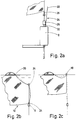
- Figs. 2a, b and c are detail views illustrating a means for releasing and hoisting of the net cage,
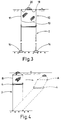
- Fig. 3 is a schematic, fragmentary view illustrating the net cage in a partly elevated position,
- Fig. 4 is a schematic, lateral view illustrating the plant in an extreme laterally displaced position as a result of prevailing environmental forces,
- Fig. 5 is a schematic, lateral view of a group of independent fish farming plants in accordance with the invention,
- Fig. 6 is a plan view illustrating a further groupwise solution for fish farming plants in accordance with the invention, and
- Fig. 7a and b illustrate a further embodiment of a fish farming plant in accordance with the invention, wherein the net cage is provided with a plurality of elevationally spaced floors with throughgoing apertures, which embodiment is especially adapted for housing bottom seeking fish species, such as flounder.
- As illustrated in Fig. 1, a fish farm in accordance with the invention consists of an anchoring section, generally designated with the reference no. 2, comprising a
support section 4 which in the shown embodiment consists of aringshaped element 6 with positive buoyancy or provided with separatebuoyant elements 8. Thesupport section 4 is given horisontal dimensions and shape, substantially corresponding to the bottom area orfloor 13 of thenet cage 10. Thesupport section 4 is anchored to the sea bottom by means of a plurality of preferably substantially parallel stays orlines 12, each of which is connected down tobottom anchors 14. The support section is provided with sufficient buoyancy to support the anchor stays 12 under tension, thereby stabilizing the system in horisontal direction, so that the support section is supported in a preselected, substantially horisontal position in the sea. The rigidity of the system in horisontal direction may be varied by varying the buoyancy of thesupport section 4 and thebuoyant elements 8. - To the
support section 4 is releasably attached thenet cage 10, which in plan view may be circular or for instance squarely shaped, havingsidewalls 11, abottom floor 13, and furthermore with an upwardly taperedtop section 16. Thenet cage 10 is at theuppermost edge 15 provided with circumferentially distributed floatingmembers 18. Thetop section 16 is uppermost provided with a ringshapedbuoyant body 20 adapted to rest and float in the sea surface. On top of the ringshapedbuoyant body 20 is suitably mounted a screenshapeddome 21. Thebuoyant body 20 will normally rest in the sea surface and thereby form a centrally located "water mirror", and using a screenshaped dome prevents birds, seals and the like from entering into the net cage and also prevents the fish from escaping. - A plant in accordance with the invention is suitably given such vertical dimensions, among other things by adjusting the length or height of the anchoring stays relative to the sea depth, that the upper central
buoyant body 20 attached to the top part of thetop section 16 is floating in the sea surface and forming a water mirror, simultaneously as theupper part 16 of the net cage is suspended with a slack (as shown) down to the buoyant members of the net cage. Thereby is obtained a vertical flexibility of the buoyant system able to absorb minor or normal wave actions and tidal changes. In situations with larger wave actions some of the floatingmembers 18 will be pushed towards the center of the plant and thereby render geometrical flexibility when thebuoyant body 20 moves upwards subjected to waves. Thereby undesirable jerks against the cage net and the buoyant members are avoided. - Fig. 2a, b and c are detail views illustrating a means facilitating release and hoisting up of the net cage to desired elevational level. On the support member for the anchoring module or on the
buoyant elements 8 are mounted a suitable number of circumferentially distributed quick couplings, each comprising asnap lock 24, having abushing 26 and alocking pin 28, to which is attached ahoisting line 30 passing down through the bushing to a sheave or block 32, and from there up to aslide ring 34 or the like at the top edge of the net cage, and from there extending to anattachment point 36 on the floatingmembers 18 or thebuoyant body 20. The snap lock may suitably be such devised that at one single downward pushing of the pin, the sane is locked, and by a renewed second down pushing, the locking pin will be released. By operating a quick coupling like this, the net cage can be released from a sea surface position by means of the hoisting line without requiring assistance from a diver. When the net cage is released, the same can be hoisted up, for instance by utilizing a winch mounted on a vessel (not shown). In practical operation, it nay frequently be desirable to hoist the net cage up to a position such that the floatingmembers 18 are resting in the sea surface, such as illustrated in Fig. 2c, for instance in order to remove or clean the uppermost part, the socalled top section of the net cage, for floating debris, seaweed, fouling and the like. A hoisting up or raising of the net cage may otherwise take place without use of a winch, since when the hoisting line is released at its uppermost position, thetop edge 15 of the net cage will elevate to the sea surface by means of the floatingmembers 18. If the net cage shall be replaced, the sane is hoisted up, the bottom of the net cage is released from the hoisting line by means of the locking mechanisms which are arranged at suitable spacings around the bottom of the net cage, whereafter a new net cage is installed. When a new net cage is attached on the pins in the locking mechanisms, the net cage is pulled down by attaching the hoisting line to a winch mounted on a nearby vessel. - Fig. 3 is a schematic lateral view, illustrating the net cage in a partly elevated position, so that the floating
members 18 are positioned in the sea surface, for instance in order the cleanse the upper conical part of the net cage, as mentioned previously. - Fig. 4 is a similar schematic lateral view of the entire fish farming plant in two different modes of operation. In the position or mode "A" shown to the right, the plant has attained a laterally displaced position due to lateral forces created by strong wind and stream. Due to the structural design of the plant, the
support section 4 including the bottom of the net cage is being kept in a substantially horisontal position, also in the shown laterally displaced position. The net cage will, however, be physically laterally displaced relative to the anchoring, and the same situation will to a large degree count also for the top section of the net cage. This is an advantage, because hereby the dynamic loads on the net cage is reduced. The conically shaped top section of the net cage will further result in a reduction of prevailing dynamic lateral forces on the entire plant, both during normal and during extreme weather conditions, a fact which reduces the loads on the anchoring and also the combined loads on the net cage as well as on the anchoring module. The mode B shown to the left in Fig. 4 illustrates the fish farming plant during fair weather conditions with little or no stream. - It will be understood that a fish farming plant in accordance with the invention will be particularly applicable on relatively large sea depths, since at large sea depths, a given deviation angle, given as a function of buoyancy and horisontal forces, results in a larger downward movement of the net cage, a fact making it possible for the net cage to be relatively easily pulled down to a submerged position. Also this fact will imply an advantage, since fish will instinctively seek towards deeper waters during bad weather conditions, and will be more comfortable in a submerged net cage subjected to such conditions.
- The uppermost section of the net cage, the socalled top section, which preferably is conically shaped as shown, and the domeshaped buoyant body at the top, constitute an important functional part in the plant, since this particular configuration implies, as previously mentioned, that the upper part of the net cage subjected to normal wave actions will fluctuate up and down in the sea simultaneously as the ringshaped floating member will rest in the sea surface and provide a water mirror in the net cage, a fact which is necessary in connection with farming of fish such as salmon fish which is dependent upon the possibility to swim up to the surface in order to snatch air for its swimming bladder. A submersion of limited time due to bad weather has, however, little or no influence on the health condition of the fish, and as mentioned, fish will normally seek down to deeper waters in bad weather.
- Regarding the top section or conical part of the net cage, this part may with advantage be releasably attached to the top edge of the cylindrical part of the net cage, so that the same may be replaced for cleansing. During such an operation, the floating
members 18 will prevent the fish from escaping. - Fig. 5 is a schematic perspective view, illustrating a group of
fish farming plants - Fig. 6 illustrates a further positional arrangement, where a number of
plants 44, 46 etc. are positioned around acentral working platform 48 or the like. A such working platform may, during quiet weather conditions, be moved sideways close to each separate net cage by winching the platform towards the net cages by means of the anchoring lines 50. In connection with conventionally interconnected net cages (distributed anchoring), such an operation will be impossible due to crossing lines. - Fig. 7a and b illustrate a further embodiment of a net cage configuration used in a fish farm in accordance with the invention. In this embodiment, the net cage is provided with one or several vertically spaced floors or
shelves central openings 52, as shown, providing a vertical throughgoing opening or shaft through the floors down to thebottom floor 13. A net cage provided with the shown supplementary floors will be especially adapted for breeding flatfish such as flounder, i.e. socalled bottom living or seeking fish. By installing a number of supplementary mutually spaced floors as shown, the total bottom or floor area of the net cage will be multiplied, implying that the net cage will have a correspondingly multiplied capacity for breeding such fishes. By providing thefloor 50 with openings, the fish is free to circulate to various elevations in the cage.
Claims (12)
- Plant for farming and storage of fish and the like in the sea comprising a net cage which is anchored to the sea bottom and provided with floats, buoyant bodies etc., so that the net cage can be maintained in a sufficiently expanded position in the sea, said plant consisting of two main parts, namely an anchoring section (2) with a submerged supporting section (4) with positive buoyancy and which is anchored to the sea bottom with an anchor line means (12) which leads down to a sea bottom anchor (14), and a second section (10) which consists of a net cage attached on the supporting section which cage is provided at an upper edge with circumferentially distributed floating members (18), said net cage including an tipper part or top part (16) arranged on the top side of the floating members (18) which preferably is upwardly conically tapered, characterised in that said anchor line means is comprised of a plurality of substantially parallel anchor lines, further characterised in that said net cage is releasably attached to the supporting section and still further characterised in that the top centre of the upper part is provided with a buoyant body (20) adapted to float on the sea surface when the plant is in normal operative condition in the sea.
- Plant according to claim 1, characterised in that the anchoring section (2) and the net cage (10) are given such dimensions that the upper part (16) of the net cage above the floating members (18) normally is suspended as a skirt with a slack up to the sea surface and is supported by the buoyant body (20), in order thereby to absorb tide water variations and smaller waves without imposing a substantial load on the buoyant body (20) and creating a risk of pulling the buoyant body (20) below the sea surface.
- Plant according to claim 1, characterised in that the buoyant body (20) is configurated as a ring-shaped element covered with a screen formed cage-like dome (21).
- Plant according to any preceding claim characterised in that said net cage (10) includes a lower, substantially cylindrically shaped part.
- Plant according to claim 4, characterised in that the upper part (16) of the net cage is releasably attached to the cylindrical part of the net cage (10).
- Plant according to any of the preceding claims, characterised in that the net cage (10) is releasably and hoistably mounted on the supporting section (4).
- Plant according to claim 6, characterised in that the net cage (10) is releasably attached to the support section (4) by means of lines running through circumferentially distributed blocks mounted on the support section (4), which lines thereafter extend up to the sea surface and suitably are attached to the buoyant body (20).
- Plant according to claim 7, characterised in that the net cage (10) is releasably attached to the support section (4) by means of interconnected quick couplings (24) operable from the sea surface.
- Plant according to claim 7 or 8, characterised in that the net cage (10) is releasably attached by means of a quick coupling (24) which is operable from the sea surface and is further attached by means of a plurality of lines (30) passing through sheaves or blocks (32) mounted on the support section, such that the net cage, possibly a new net cage in case of replacement, may be pulled down to the support section and be attached thereto utilising the quick couplings (24).
- Plant according to any of the claims 7 to 9, characterised in that each of the quick couplings (24) consists of a locking pin (28) adapted to be put into a complementary locking bushing (26) provided with locking means, and in that a hoisting line (30) is attached to the end of the locking pin (28) and is passing through said locking bushing to the bottom of same and from there via a block (32) up to the sea surface.
- Plant in accordance with any of the preceding claims, characterised in that the net cage is provided with one or more supplementary substantially horizontal extending floors (50) with one or more openings (52), which floor or floors function as substrate for bottom seeking fishes, such as flounder.
- Plant in accordance with claim 10, characterised in that the net cage is provided with a plurality of elevationally spaced floors (50), each of which is provided with a central opening (52), thereby presenting a vertically open shaft through the supplementary floors.
Applications Claiming Priority (3)
| Application Number | Priority Date | Filing Date | Title |
|---|---|---|---|
| NO913581A NO173481C (en) | 1991-09-11 | 1991-09-11 | Fish farming and storage facilities and the like in the show |
| NO913581 | 1991-09-11 | ||
| PCT/NO1992/000150 WO1993004576A1 (en) | 1991-09-11 | 1992-09-11 | Plant for farming fish and the like |
Publications (2)
| Publication Number | Publication Date |
|---|---|
| EP0612209A1 EP0612209A1 (en) | 1994-08-31 |
| EP0612209B1 true EP0612209B1 (en) | 1997-01-22 |
Family
ID=19894453
Family Applications (1)
| Application Number | Title | Priority Date | Filing Date |
|---|---|---|---|
| EP92920214A Expired - Lifetime EP0612209B1 (en) | 1991-09-11 | 1992-09-11 | Plant for farming fish and the like |
Country Status (9)
| Country | Link |
|---|---|
| US (1) | US5477813A (en) |
| EP (1) | EP0612209B1 (en) |
| JP (1) | JPH06510430A (en) |
| AU (1) | AU2596292A (en) |
| CA (1) | CA2118580A1 (en) |
| ES (1) | ES2099281T3 (en) |
| GR (1) | GR3023263T3 (en) |
| NO (1) | NO173481C (en) |
| WO (1) | WO1993004576A1 (en) |
Cited By (1)
| Publication number | Priority date | Publication date | Assignee | Title |
|---|---|---|---|---|
| CN102499144A (en) * | 2011-10-26 | 2012-06-20 | 浙江海洋学院 | One-way streaming cage |
Families Citing this family (31)
| Publication number | Priority date | Publication date | Assignee | Title |
|---|---|---|---|---|
| NO300002B1 (en) * | 1995-02-10 | 1997-03-17 | Charles Kaarstad | Device for lowering and raising aquaculture cages |
| NO970233A (en) * | 1997-01-20 | 1998-06-29 | Refa As | Device for cage construction |
| US6062170A (en) * | 1998-06-01 | 2000-05-16 | Nutreco Canada Inc. | Method and apparatus for plankton reduction in fish farming |
| US6379952B1 (en) | 1999-02-01 | 2002-04-30 | 3M Innovative Properties Company | Method for cell selection utilizing azlactone-functional supports |
| US6223689B1 (en) * | 1999-02-10 | 2001-05-01 | Gregory John Nelson | Nelson trawlers aquaculture unit |
| NO311062B1 (en) * | 1999-02-12 | 2001-10-08 | Refa As | Device for flat bottom cages |
| GB0202324D0 (en) * | 2002-02-01 | 2002-03-20 | Subsea Shellfish Ltd | Cultivation and harvesting of shellfish |
| JP2007507235A (en) * | 2003-09-30 | 2007-03-29 | ラッキー リター エルエルシー | Self-cleaning toilet for animals |
| US20070181072A1 (en) * | 2006-02-03 | 2007-08-09 | Davis Russell P | Integrated system of shellfish production and utilization #2 |
| GB0608114D0 (en) * | 2006-04-25 | 2006-06-07 | Maris Fish Ranch Ltd | Fish enclosure |
| CN100407909C (en) * | 2007-02-06 | 2008-08-06 | 天津市水产研究所 | Controllable environmental protection fish tank |
| KR100888927B1 (en) * | 2008-07-24 | 2009-03-17 | 김동주 | Underwater cage farming device |
| CN101658152B (en) * | 2009-09-15 | 2011-06-15 | 大连獐子岛渔业集团股份有限公司 | Patinopecten yesoensis natural seedling intermediate rearing method |
| NO334524B1 (en) * | 2011-11-03 | 2014-03-31 | Egersund Net As | Device for a farmed cage, method of using the cage and use of the cage to reduce the exposure of farmed fish to pathogenic plankton |
| NO20120133A1 (en) * | 2012-02-09 | 2013-06-24 | Calanus As | Fluid permeable protective net for farmed cages |
| JP5616555B1 (en) * | 2014-05-02 | 2014-10-29 | 雅雄 鈴木 | Fish farming support tool and fish farming method |
| CN104067960B (en) * | 2014-05-14 | 2016-01-13 | 三沙蓝海海洋工程有限公司 | Anti-stormy wave cultivation net cage system in the open ocean that can assemble on the spot on the water and reef dish |
| CN104304130B (en) * | 2014-11-03 | 2016-09-14 | 中国水产科学研究院渔业机械仪器研究所 | High-density environmental protection breeding cage |
| PT109514A (en) * | 2016-07-08 | 2018-01-08 | Simões Alves António | UNDERSTANDING CAGE FOR FLAT FISH |
| NO20161802A1 (en) * | 2016-11-15 | 2018-05-22 | Marine Constructions As | Cage with double net wall |
| RU2707942C2 (en) * | 2017-02-20 | 2019-12-02 | Леонид Юрьевич Бугров | Submersible cage separating apparatus for growing aquatic organisms |
| US11096380B2 (en) * | 2017-12-28 | 2021-08-24 | Ketcham Supply Co., Inc. | Method for aquaculture |
| NO344440B1 (en) * | 2018-06-11 | 2019-12-09 | Rs X As | Stretch-anchored cage with concrete collar and notch section with hollow beams |
| WO2020181344A1 (en) * | 2019-03-14 | 2020-09-17 | Trotta Paulo Ferreira | Configuration applied to an element for fastening oysters |
| GB2583130A (en) | 2019-04-18 | 2020-10-21 | Impact9 Energy And Marine Ltd | A submersible pen system |
| US20230301292A1 (en) * | 2019-11-14 | 2023-09-28 | Field Engine Wildlife Research And Management Llc | Animal trap |
| US11185065B2 (en) * | 2019-11-14 | 2021-11-30 | White Buffalo, Inc | Animal trap |
| NO346205B1 (en) * | 2020-03-19 | 2022-04-19 | Aker Solutions As | A fish farming plant and methods of operation |
| CN111418533B (en) * | 2020-04-03 | 2021-11-12 | 山东省科学院海洋仪器仪表研究所 | Remote monitoring's sinking and floating net cage of righting certainly |
| CN114097680A (en) * | 2021-12-03 | 2022-03-01 | 武汉中科水生环境工程股份有限公司 | Water ecological restoration ecological breeding device and method |
| WO2024196310A1 (en) * | 2023-03-22 | 2024-09-26 | Oceans For All Private Limited | A net cage, marine farming system and method of use thereof |
Family Cites Families (11)
| Publication number | Priority date | Publication date | Assignee | Title |
|---|---|---|---|---|
| JPS5298799U (en) * | 1976-01-24 | 1977-07-26 | ||
| CH612325A5 (en) * | 1976-01-26 | 1979-07-31 | Ernst August Fruechtnicht | |
| FR2345075A1 (en) * | 1976-03-25 | 1977-10-21 | Goguel Olivier | FISH BREEDING CAGE |
| SU587915A1 (en) * | 1976-09-21 | 1978-01-15 | Азовский научно-исследовательский институт рыбного хозяйства | Fish-rearing container |
| US4297973A (en) * | 1980-04-21 | 1981-11-03 | K.R. Associates, Inc. | Process and apparatus for increasing the utilization of fish feed in fish farming ponds and the like |
| SE435671B (en) * | 1983-12-19 | 1984-10-15 | Viking Fish Ab | FISH CULTURE EQUIPMENT INCLUDING ATMINSTONE A BOX OF ADJUSTABLE DEPARTURE AND AIR CLOCK |
| CA1253406A (en) * | 1985-06-14 | 1989-05-02 | David E. Whiffin | Method and apparatus for rearing fish in natural waters |
| SU1489673A1 (en) * | 1986-12-26 | 1989-06-30 | Gpki Rybopromy Flota | SUBMERSIBLE DEVICE FOR CULTIVATION OF FISH |
| JPS63222632A (en) * | 1987-03-13 | 1988-09-16 | 日本鋼管株式会社 | Open ocean fish cage |
| WO1989000010A1 (en) * | 1987-07-06 | 1989-01-12 | Sasakat Pty. Ltd. | Shellfisch processing |
| NO880384L (en) * | 1988-01-28 | 1989-07-31 | Brunsvikens Reperbane A S | FISKEMAER. |
-
1991
- 1991-09-11 NO NO913581A patent/NO173481C/en not_active IP Right Cessation
-
1992
- 1992-09-11 EP EP92920214A patent/EP0612209B1/en not_active Expired - Lifetime
- 1992-09-11 AU AU25962/92A patent/AU2596292A/en not_active Abandoned
- 1992-09-11 US US08/204,356 patent/US5477813A/en not_active Expired - Fee Related
- 1992-09-11 WO PCT/NO1992/000150 patent/WO1993004576A1/en not_active Ceased
- 1992-09-11 CA CA002118580A patent/CA2118580A1/en not_active Abandoned
- 1992-09-11 JP JP5505124A patent/JPH06510430A/en active Pending
- 1992-09-11 ES ES92920214T patent/ES2099281T3/en not_active Expired - Lifetime
-
1997
- 1997-04-22 GR GR970400928T patent/GR3023263T3/en unknown
Cited By (1)
| Publication number | Priority date | Publication date | Assignee | Title |
|---|---|---|---|---|
| CN102499144A (en) * | 2011-10-26 | 2012-06-20 | 浙江海洋学院 | One-way streaming cage |
Also Published As
| Publication number | Publication date |
|---|---|
| EP0612209A1 (en) | 1994-08-31 |
| ES2099281T3 (en) | 1997-05-16 |
| WO1993004576A1 (en) | 1993-03-18 |
| NO913581D0 (en) | 1991-09-11 |
| CA2118580A1 (en) | 1993-03-18 |
| GR3023263T3 (en) | 1997-07-30 |
| AU2596292A (en) | 1993-04-05 |
| US5477813A (en) | 1995-12-26 |
| NO173481C (en) | 1993-12-22 |
| JPH06510430A (en) | 1994-11-24 |
| NO173481B (en) | 1993-09-13 |
| NO913581L (en) | 1993-03-12 |
Similar Documents
| Publication | Publication Date | Title |
|---|---|---|
| US5477813A (en) | Plant for farming fish and shellfish | |
| US5412903A (en) | Sea cage fish farming system | |
| ES2517867T3 (en) | Mooring system | |
| JP2019512223A (en) | Semi-submersible aquaculture system | |
| US20090288612A1 (en) | Submersible mooring grid | |
| EP3811776A1 (en) | Fish farm for raising fish in the open sea | |
| KR101845500B1 (en) | Submersible cage device | |
| JP2021528993A (en) | Open ocean cage | |
| NO20220268A1 (en) | Fish farming system | |
| WO2004016079A1 (en) | Fish enclosure | |
| WO2007125363A1 (en) | Fish enclosure | |
| KR19990055863A (en) | Aquaculture Equipment | |
| AU2020360572A1 (en) | Deep-sea aquaculture installation | |
| RU2669304C1 (en) | Construction for growing marine hydrobionts on the shelf and the continental margin | |
| CA2362859A1 (en) | Equipment for flat-bottom floating cage | |
| KR200195068Y1 (en) | A shellfish farming device | |
| KR101429017B1 (en) | Multi Functional Water Float | |
| KR100441614B1 (en) | artificial floated fish-breeding ground | |
| KR100643778B1 (en) | Cages for benthic fish | |
| KR102399823B1 (en) | Support structure on seabed for coexisting the marine production industry within the offshore wind farm complex | |
| KR100317163B1 (en) | Structure | |
| KR20240113118A (en) | Multi-purpose submersible cage device for aquaculture and fishery management. | |
| NO20250348A1 (en) | Fish cage | |
| WO2025029155A1 (en) | Fish cage | |
| KR19990085156A (en) | Aquaculture Equipment |
Legal Events
| Date | Code | Title | Description |
|---|---|---|---|
| PUAI | Public reference made under article 153(3) epc to a published international application that has entered the european phase |
Free format text: ORIGINAL CODE: 0009012 |
|
| 17P | Request for examination filed |
Effective date: 19940321 |
|
| AK | Designated contracting states |
Kind code of ref document: A1 Designated state(s): ES GB GR IT |
|
| 17Q | First examination report despatched |
Effective date: 19951006 |
|
| GRAG | Despatch of communication of intention to grant |
Free format text: ORIGINAL CODE: EPIDOS AGRA |
|
| GRAH | Despatch of communication of intention to grant a patent |
Free format text: ORIGINAL CODE: EPIDOS IGRA |
|
| GRAH | Despatch of communication of intention to grant a patent |
Free format text: ORIGINAL CODE: EPIDOS IGRA |
|
| GRAA | (expected) grant |
Free format text: ORIGINAL CODE: 0009210 |
|
| AK | Designated contracting states |
Kind code of ref document: B1 Designated state(s): ES GB GR IT |
|
| PG25 | Lapsed in a contracting state [announced via postgrant information from national office to epo] |
Ref country code: GR Free format text: LAPSE BECAUSE OF FAILURE TO SUBMIT A TRANSLATION OF THE DESCRIPTION OR TO PAY THE FEE WITHIN THE PRESCRIBED TIME-LIMIT Effective date: 19970122 |
|
| ITF | It: translation for a ep patent filed | ||
| REG | Reference to a national code |
Ref country code: ES Ref legal event code: FG2A Ref document number: 2099281 Country of ref document: ES Kind code of ref document: T3 |
|
| REG | Reference to a national code |
Ref country code: GR Ref legal event code: FG4A Free format text: 3023263 |
|
| PG25 | Lapsed in a contracting state [announced via postgrant information from national office to epo] |
Ref country code: ES Free format text: LAPSE BECAUSE OF THE APPLICANT RENOUNCES Effective date: 19970912 |
|
| PLBE | No opposition filed within time limit |
Free format text: ORIGINAL CODE: 0009261 |
|
| STAA | Information on the status of an ep patent application or granted ep patent |
Free format text: STATUS: NO OPPOSITION FILED WITHIN TIME LIMIT |
|
| 26N | No opposition filed | ||
| REG | Reference to a national code |
Ref country code: ES Ref legal event code: FD2A Effective date: 20001102 |
|
| REG | Reference to a national code |
Ref country code: GB Ref legal event code: IF02 |
|
| PGFP | Annual fee paid to national office [announced via postgrant information from national office to epo] |
Ref country code: GB Payment date: 20060922 Year of fee payment: 15 |
|
| GBPC | Gb: european patent ceased through non-payment of renewal fee |
Effective date: 20070911 |
|
| PG25 | Lapsed in a contracting state [announced via postgrant information from national office to epo] |
Ref country code: GB Free format text: LAPSE BECAUSE OF NON-PAYMENT OF DUE FEES Effective date: 20070911 |
|
| PGFP | Annual fee paid to national office [announced via postgrant information from national office to epo] |
Ref country code: IT Payment date: 20080911 Year of fee payment: 17 |
|
| PG25 | Lapsed in a contracting state [announced via postgrant information from national office to epo] |
Ref country code: IT Free format text: LAPSE BECAUSE OF NON-PAYMENT OF DUE FEES Effective date: 20090911 |