EP0609684A1 - Positive-working light-sensitive composition - Google Patents
Positive-working light-sensitive composition Download PDFInfo
- Publication number
- EP0609684A1 EP0609684A1 EP94100530A EP94100530A EP0609684A1 EP 0609684 A1 EP0609684 A1 EP 0609684A1 EP 94100530 A EP94100530 A EP 94100530A EP 94100530 A EP94100530 A EP 94100530A EP 0609684 A1 EP0609684 A1 EP 0609684A1
- Authority
- EP
- European Patent Office
- Prior art keywords
- group
- positive
- sensitive composition
- light
- substituted
- Prior art date
- Legal status (The legal status is an assumption and is not a legal conclusion. Google has not performed a legal analysis and makes no representation as to the accuracy of the status listed.)
- Granted
Links
- 239000000203 mixture Substances 0.000 title claims abstract description 72
- 150000001875 compounds Chemical class 0.000 claims abstract description 68
- 229920000642 polymer Polymers 0.000 claims abstract description 42
- 125000003118 aryl group Chemical group 0.000 claims abstract description 26
- 239000002253 acid Substances 0.000 claims abstract description 20
- 230000002378 acidificating effect Effects 0.000 claims abstract description 20
- 125000000217 alkyl group Chemical group 0.000 claims abstract description 19
- 125000003500 enol ether group Chemical group 0.000 claims abstract description 18
- 125000004435 hydrogen atom Chemical group [H]* 0.000 claims abstract description 8
- 229920006395 saturated elastomer Polymers 0.000 claims abstract description 5
- -1 carboalkoxy Chemical group 0.000 claims description 45
- 125000001424 substituent group Chemical group 0.000 claims description 20
- QYKIQEUNHZKYBP-UHFFFAOYSA-N Vinyl ether Chemical group C=COC=C QYKIQEUNHZKYBP-UHFFFAOYSA-N 0.000 claims description 17
- 125000004432 carbon atom Chemical group C* 0.000 claims description 13
- 239000007787 solid Substances 0.000 claims description 10
- 125000005843 halogen group Chemical group 0.000 claims description 8
- 125000003545 alkoxy group Chemical group 0.000 claims description 7
- 125000002887 hydroxy group Chemical group [H]O* 0.000 claims description 6
- 150000007978 oxazole derivatives Chemical class 0.000 claims description 5
- 125000003342 alkenyl group Chemical group 0.000 claims description 4
- 125000002947 alkylene group Chemical group 0.000 claims description 4
- 150000001450 anions Chemical class 0.000 claims description 4
- 125000004104 aryloxy group Chemical group 0.000 claims description 4
- 125000004093 cyano group Chemical group *C#N 0.000 claims description 4
- 125000001273 sulfonato group Chemical group [O-]S(*)(=O)=O 0.000 claims description 4
- JIHQDMXYYFUGFV-UHFFFAOYSA-N 1,3,5-triazine Chemical class C1=NC=NC=N1 JIHQDMXYYFUGFV-UHFFFAOYSA-N 0.000 claims description 3
- RWSOTUBLDIXVET-UHFFFAOYSA-N Dihydrogen sulfide Chemical class S RWSOTUBLDIXVET-UHFFFAOYSA-N 0.000 claims description 3
- 125000000753 cycloalkyl group Chemical group 0.000 claims description 3
- XMBWDFGMSWQBCA-UHFFFAOYSA-N hydrogen iodide Chemical class I XMBWDFGMSWQBCA-UHFFFAOYSA-N 0.000 claims description 3
- 229910017048 AsF6 Inorganic materials 0.000 claims description 2
- WKBOTKDWSSQWDR-UHFFFAOYSA-N Bromine atom Chemical group [Br] WKBOTKDWSSQWDR-UHFFFAOYSA-N 0.000 claims description 2
- KZBUYRJDOAKODT-UHFFFAOYSA-N Chlorine Chemical compound ClCl KZBUYRJDOAKODT-UHFFFAOYSA-N 0.000 claims description 2
- 125000002252 acyl group Chemical group 0.000 claims description 2
- 125000004423 acyloxy group Chemical group 0.000 claims description 2
- 125000002723 alicyclic group Chemical group 0.000 claims description 2
- 125000004450 alkenylene group Chemical group 0.000 claims description 2
- 125000004414 alkyl thio group Chemical group 0.000 claims description 2
- 125000000266 alpha-aminoacyl group Chemical group 0.000 claims description 2
- 125000000732 arylene group Chemical group 0.000 claims description 2
- 239000000460 chlorine Substances 0.000 claims description 2
- 229910052801 chlorine Inorganic materials 0.000 claims description 2
- 125000000392 cycloalkenyl group Chemical group 0.000 claims description 2
- 150000002148 esters Chemical class 0.000 claims description 2
- 125000001495 ethyl group Chemical group [H]C([H])([H])C([H])([H])* 0.000 claims description 2
- 125000002496 methyl group Chemical group [H]C([H])([H])* 0.000 claims description 2
- 125000001820 oxy group Chemical group [*:1]O[*:2] 0.000 claims description 2
- 125000001997 phenyl group Chemical group [H]C1=C([H])C([H])=C(*)C([H])=C1[H] 0.000 claims description 2
- 125000004953 trihalomethyl group Chemical group 0.000 claims description 2
- 206010034960 Photophobia Diseases 0.000 abstract description 2
- 208000013469 light sensitivity Diseases 0.000 abstract description 2
- 229960000834 vinyl ether Drugs 0.000 description 24
- 238000000034 method Methods 0.000 description 18
- 239000000178 monomer Substances 0.000 description 13
- 238000011282 treatment Methods 0.000 description 13
- 229910052782 aluminium Inorganic materials 0.000 description 12
- XAGFODPZIPBFFR-UHFFFAOYSA-N aluminium Chemical compound [Al] XAGFODPZIPBFFR-UHFFFAOYSA-N 0.000 description 12
- 229920005989 resin Polymers 0.000 description 12
- 239000011347 resin Substances 0.000 description 12
- 239000004793 Polystyrene Substances 0.000 description 11
- 239000002904 solvent Substances 0.000 description 11
- 239000000975 dye Substances 0.000 description 10
- 229920002120 photoresistant polymer Polymers 0.000 description 10
- 230000035945 sensitivity Effects 0.000 description 10
- 239000000758 substrate Substances 0.000 description 10
- 125000000391 vinyl group Chemical group [H]C([*])=C([H])[H] 0.000 description 10
- 239000007864 aqueous solution Substances 0.000 description 9
- 239000000243 solution Substances 0.000 description 9
- 239000011248 coating agent Substances 0.000 description 8
- 238000000576 coating method Methods 0.000 description 8
- 239000000463 material Substances 0.000 description 8
- 229920002554 vinyl polymer Polymers 0.000 description 8
- RTZKZFJDLAIYFH-UHFFFAOYSA-N Diethyl ether Chemical compound CCOCC RTZKZFJDLAIYFH-UHFFFAOYSA-N 0.000 description 7
- ISWSIDIOOBJBQZ-UHFFFAOYSA-N Phenol Chemical compound OC1=CC=CC=C1 ISWSIDIOOBJBQZ-UHFFFAOYSA-N 0.000 description 7
- 125000003178 carboxy group Chemical group [H]OC(*)=O 0.000 description 7
- XLYOFNOQVPJJNP-UHFFFAOYSA-N water Substances O XLYOFNOQVPJJNP-UHFFFAOYSA-N 0.000 description 7
- UHOVQNZJYSORNB-UHFFFAOYSA-N Benzene Chemical compound C1=CC=CC=C1 UHOVQNZJYSORNB-UHFFFAOYSA-N 0.000 description 6
- OKKJLVBELUTLKV-UHFFFAOYSA-N Methanol Chemical compound OC OKKJLVBELUTLKV-UHFFFAOYSA-N 0.000 description 6
- 150000007513 acids Chemical class 0.000 description 6
- 239000003795 chemical substances by application Substances 0.000 description 6
- 238000001035 drying Methods 0.000 description 6
- 229920002521 macromolecule Polymers 0.000 description 6
- 125000002467 phosphate group Chemical group [H]OP(=O)(O[H])O[*] 0.000 description 6
- DGAQECJNVWCQMB-PUAWFVPOSA-M Ilexoside XXIX Chemical compound C[C@@H]1CC[C@@]2(CC[C@@]3(C(=CC[C@H]4[C@]3(CC[C@@H]5[C@@]4(CC[C@@H](C5(C)C)OS(=O)(=O)[O-])C)C)[C@@H]2[C@]1(C)O)C)C(=O)O[C@H]6[C@@H]([C@H]([C@@H]([C@H](O6)CO)O)O)O.[Na+] DGAQECJNVWCQMB-PUAWFVPOSA-M 0.000 description 5
- 229910019142 PO4 Inorganic materials 0.000 description 5
- IISBACLAFKSPIT-UHFFFAOYSA-N bisphenol A Chemical compound C=1C=C(O)C=CC=1C(C)(C)C1=CC=C(O)C=C1 IISBACLAFKSPIT-UHFFFAOYSA-N 0.000 description 5
- 229940118056 cresol / formaldehyde Drugs 0.000 description 5
- 239000003921 oil Substances 0.000 description 5
- 239000010452 phosphate Substances 0.000 description 5
- 150000003839 salts Chemical class 0.000 description 5
- 239000000126 substance Substances 0.000 description 5
- DVKJHBMWWAPEIU-UHFFFAOYSA-N toluene 2,4-diisocyanate Chemical compound CC1=CC=C(N=C=O)C=C1N=C=O DVKJHBMWWAPEIU-UHFFFAOYSA-N 0.000 description 5
- LFQSCWFLJHTTHZ-UHFFFAOYSA-N Ethanol Chemical compound CCO LFQSCWFLJHTTHZ-UHFFFAOYSA-N 0.000 description 4
- QAOWNCQODCNURD-UHFFFAOYSA-N Sulfuric acid Chemical compound OS(O)(=O)=O QAOWNCQODCNURD-UHFFFAOYSA-N 0.000 description 4
- 230000015572 biosynthetic process Effects 0.000 description 4
- 125000000325 methylidene group Chemical group [H]C([H])=* 0.000 description 4
- 239000004065 semiconductor Substances 0.000 description 4
- 239000011734 sodium Substances 0.000 description 4
- 229910052708 sodium Inorganic materials 0.000 description 4
- VZCYOOQTPOCHFL-UHFFFAOYSA-N trans-butenedioic acid Natural products OC(=O)C=CC(O)=O VZCYOOQTPOCHFL-UHFFFAOYSA-N 0.000 description 4
- ZWEHNKRNPOVVGH-UHFFFAOYSA-N 2-Butanone Chemical compound CCC(C)=O ZWEHNKRNPOVVGH-UHFFFAOYSA-N 0.000 description 3
- WVDDGKGOMKODPV-UHFFFAOYSA-N Benzyl alcohol Chemical compound OCC1=CC=CC=C1 WVDDGKGOMKODPV-UHFFFAOYSA-N 0.000 description 3
- XEKOWRVHYACXOJ-UHFFFAOYSA-N Ethyl acetate Chemical compound CCOC(C)=O XEKOWRVHYACXOJ-UHFFFAOYSA-N 0.000 description 3
- LYCAIKOWRPUZTN-UHFFFAOYSA-N Ethylene glycol Chemical compound OCCO LYCAIKOWRPUZTN-UHFFFAOYSA-N 0.000 description 3
- WSFSSNUMVMOOMR-UHFFFAOYSA-N Formaldehyde Chemical compound O=C WSFSSNUMVMOOMR-UHFFFAOYSA-N 0.000 description 3
- 239000005057 Hexamethylene diisocyanate Substances 0.000 description 3
- VEXZGXHMUGYJMC-UHFFFAOYSA-N Hydrochloric acid Chemical compound Cl VEXZGXHMUGYJMC-UHFFFAOYSA-N 0.000 description 3
- WMFOQBRAJBCJND-UHFFFAOYSA-M Lithium hydroxide Chemical compound [Li+].[OH-] WMFOQBRAJBCJND-UHFFFAOYSA-M 0.000 description 3
- ZMXDDKWLCZADIW-UHFFFAOYSA-N N,N-Dimethylformamide Chemical compound CN(C)C=O ZMXDDKWLCZADIW-UHFFFAOYSA-N 0.000 description 3
- KWYUFKZDYYNOTN-UHFFFAOYSA-M Potassium hydroxide Chemical compound [OH-].[K+] KWYUFKZDYYNOTN-UHFFFAOYSA-M 0.000 description 3
- OFOBLEOULBTSOW-UHFFFAOYSA-N Propanedioic acid Natural products OC(=O)CC(O)=O OFOBLEOULBTSOW-UHFFFAOYSA-N 0.000 description 3
- 239000004115 Sodium Silicate Substances 0.000 description 3
- HEMHJVSKTPXQMS-UHFFFAOYSA-M Sodium hydroxide Chemical compound [OH-].[Na+] HEMHJVSKTPXQMS-UHFFFAOYSA-M 0.000 description 3
- YXFVVABEGXRONW-UHFFFAOYSA-N Toluene Chemical compound CC1=CC=CC=C1 YXFVVABEGXRONW-UHFFFAOYSA-N 0.000 description 3
- 150000001241 acetals Chemical class 0.000 description 3
- 238000006243 chemical reaction Methods 0.000 description 3
- 238000004132 cross linking Methods 0.000 description 3
- MTHSVFCYNBDYFN-UHFFFAOYSA-N diethylene glycol Chemical compound OCCOCCO MTHSVFCYNBDYFN-UHFFFAOYSA-N 0.000 description 3
- 150000002009 diols Chemical class 0.000 description 3
- 238000001312 dry etching Methods 0.000 description 3
- RRAMGCGOFNQTLD-UHFFFAOYSA-N hexamethylene diisocyanate Chemical compound O=C=NCCCCCCN=C=O RRAMGCGOFNQTLD-UHFFFAOYSA-N 0.000 description 3
- 230000007062 hydrolysis Effects 0.000 description 3
- 238000006460 hydrolysis reaction Methods 0.000 description 3
- IQPQWNKOIGAROB-UHFFFAOYSA-N isocyanate group Chemical group [N-]=C=O IQPQWNKOIGAROB-UHFFFAOYSA-N 0.000 description 3
- VZCYOOQTPOCHFL-UPHRSURJSA-N maleic acid Chemical compound OC(=O)\C=C/C(O)=O VZCYOOQTPOCHFL-UPHRSURJSA-N 0.000 description 3
- 239000011976 maleic acid Substances 0.000 description 3
- QSHDDOUJBYECFT-UHFFFAOYSA-N mercury Chemical compound [Hg] QSHDDOUJBYECFT-UHFFFAOYSA-N 0.000 description 3
- 229910052753 mercury Inorganic materials 0.000 description 3
- 229910052751 metal Inorganic materials 0.000 description 3
- 239000002184 metal Substances 0.000 description 3
- 239000002985 plastic film Substances 0.000 description 3
- 229920006255 plastic film Polymers 0.000 description 3
- 229910052911 sodium silicate Inorganic materials 0.000 description 3
- 230000004304 visual acuity Effects 0.000 description 3
- PUPZLCDOIYMWBV-UHFFFAOYSA-N (+/-)-1,3-Butanediol Chemical compound CC(O)CCO PUPZLCDOIYMWBV-UHFFFAOYSA-N 0.000 description 2
- RYHBNJHYFVUHQT-UHFFFAOYSA-N 1,4-Dioxane Chemical compound C1COCCO1 RYHBNJHYFVUHQT-UHFFFAOYSA-N 0.000 description 2
- SBJCUZQNHOLYMD-UHFFFAOYSA-N 1,5-Naphthalene diisocyanate Chemical compound C1=CC=C2C(N=C=O)=CC=CC2=C1N=C=O SBJCUZQNHOLYMD-UHFFFAOYSA-N 0.000 description 2
- ARXJGSRGQADJSQ-UHFFFAOYSA-N 1-methoxypropan-2-ol Chemical compound COCC(C)O ARXJGSRGQADJSQ-UHFFFAOYSA-N 0.000 description 2
- JAHNSTQSQJOJLO-UHFFFAOYSA-N 2-(3-fluorophenyl)-1h-imidazole Chemical compound FC1=CC=CC(C=2NC=CN=2)=C1 JAHNSTQSQJOJLO-UHFFFAOYSA-N 0.000 description 2
- XLLIQLLCWZCATF-UHFFFAOYSA-N 2-methoxyethyl acetate Chemical compound COCCOC(C)=O XLLIQLLCWZCATF-UHFFFAOYSA-N 0.000 description 2
- UYEMGAFJOZZIFP-UHFFFAOYSA-N 3,5-dihydroxybenzoic acid Chemical compound OC(=O)C1=CC(O)=CC(O)=C1 UYEMGAFJOZZIFP-UHFFFAOYSA-N 0.000 description 2
- UPMLOUAZCHDJJD-UHFFFAOYSA-N 4,4'-Diphenylmethane Diisocyanate Chemical compound C1=CC(N=C=O)=CC=C1CC1=CC=C(N=C=O)C=C1 UPMLOUAZCHDJJD-UHFFFAOYSA-N 0.000 description 2
- YEJRWHAVMIAJKC-UHFFFAOYSA-N 4-Butyrolactone Chemical compound O=C1CCCO1 YEJRWHAVMIAJKC-UHFFFAOYSA-N 0.000 description 2
- 229920000178 Acrylic resin Polymers 0.000 description 2
- 239000004925 Acrylic resin Substances 0.000 description 2
- QGZKDVFQNNGYKY-UHFFFAOYSA-O Ammonium Chemical group [NH4+] QGZKDVFQNNGYKY-UHFFFAOYSA-O 0.000 description 2
- XKRFYHLGVUSROY-UHFFFAOYSA-N Argon Chemical compound [Ar] XKRFYHLGVUSROY-UHFFFAOYSA-N 0.000 description 2
- KAKZBPTYRLMSJV-UHFFFAOYSA-N Butadiene Chemical compound C=CC=C KAKZBPTYRLMSJV-UHFFFAOYSA-N 0.000 description 2
- SOGAXMICEFXMKE-UHFFFAOYSA-N Butylmethacrylate Chemical compound CCCCOC(=O)C(C)=C SOGAXMICEFXMKE-UHFFFAOYSA-N 0.000 description 2
- RYGMFSIKBFXOCR-UHFFFAOYSA-N Copper Chemical compound [Cu] RYGMFSIKBFXOCR-UHFFFAOYSA-N 0.000 description 2
- FBPFZTCFMRRESA-FSIIMWSLSA-N D-Glucitol Natural products OC[C@H](O)[C@H](O)[C@@H](O)[C@H](O)CO FBPFZTCFMRRESA-FSIIMWSLSA-N 0.000 description 2
- FBPFZTCFMRRESA-JGWLITMVSA-N D-glucitol Chemical compound OC[C@H](O)[C@@H](O)[C@H](O)[C@H](O)CO FBPFZTCFMRRESA-JGWLITMVSA-N 0.000 description 2
- IAZDPXIOMUYVGZ-UHFFFAOYSA-N Dimethylsulphoxide Chemical compound CS(C)=O IAZDPXIOMUYVGZ-UHFFFAOYSA-N 0.000 description 2
- VZCYOOQTPOCHFL-OWOJBTEDSA-N Fumaric acid Chemical compound OC(=O)\C=C\C(O)=O VZCYOOQTPOCHFL-OWOJBTEDSA-N 0.000 description 2
- RRHGJUQNOFWUDK-UHFFFAOYSA-N Isoprene Chemical compound CC(=C)C=C RRHGJUQNOFWUDK-UHFFFAOYSA-N 0.000 description 2
- BAPJBEWLBFYGME-UHFFFAOYSA-N Methyl acrylate Chemical compound COC(=O)C=C BAPJBEWLBFYGME-UHFFFAOYSA-N 0.000 description 2
- 239000004677 Nylon Substances 0.000 description 2
- BPQQTUXANYXVAA-UHFFFAOYSA-N Orthosilicate Chemical compound [O-][Si]([O-])([O-])[O-] BPQQTUXANYXVAA-UHFFFAOYSA-N 0.000 description 2
- NBIIXXVUZAFLBC-UHFFFAOYSA-N Phosphoric acid Chemical compound OP(O)(O)=O NBIIXXVUZAFLBC-UHFFFAOYSA-N 0.000 description 2
- 239000004698 Polyethylene Substances 0.000 description 2
- 239000004743 Polypropylene Substances 0.000 description 2
- 239000004111 Potassium silicate Substances 0.000 description 2
- XUIMIQQOPSSXEZ-UHFFFAOYSA-N Silicon Chemical compound [Si] XUIMIQQOPSSXEZ-UHFFFAOYSA-N 0.000 description 2
- UIIMBOGNXHQVGW-UHFFFAOYSA-M Sodium bicarbonate Chemical group [Na+].OC([O-])=O UIIMBOGNXHQVGW-UHFFFAOYSA-M 0.000 description 2
- PPBRXRYQALVLMV-UHFFFAOYSA-N Styrene Chemical compound C=CC1=CC=CC=C1 PPBRXRYQALVLMV-UHFFFAOYSA-N 0.000 description 2
- KKEYFWRCBNTPAC-UHFFFAOYSA-N Terephthalic acid Chemical compound OC(=O)C1=CC=C(C(O)=O)C=C1 KKEYFWRCBNTPAC-UHFFFAOYSA-N 0.000 description 2
- ZJCCRDAZUWHFQH-UHFFFAOYSA-N Trimethylolpropane Chemical compound CCC(CO)(CO)CO ZJCCRDAZUWHFQH-UHFFFAOYSA-N 0.000 description 2
- DHKHKXVYLBGOIT-UHFFFAOYSA-N acetaldehyde Diethyl Acetal Natural products CCOC(C)OCC DHKHKXVYLBGOIT-UHFFFAOYSA-N 0.000 description 2
- 150000008065 acid anhydrides Chemical class 0.000 description 2
- WNLRTRBMVRJNCN-UHFFFAOYSA-N adipic acid Chemical compound OC(=O)CCCCC(O)=O WNLRTRBMVRJNCN-UHFFFAOYSA-N 0.000 description 2
- 239000003513 alkali Substances 0.000 description 2
- 125000004453 alkoxycarbonyl group Chemical group 0.000 description 2
- VSCWAEJMTAWNJL-UHFFFAOYSA-K aluminium trichloride Chemical compound Cl[Al](Cl)Cl VSCWAEJMTAWNJL-UHFFFAOYSA-K 0.000 description 2
- 244000309464 bull Species 0.000 description 2
- 150000001735 carboxylic acids Chemical class 0.000 description 2
- 230000000052 comparative effect Effects 0.000 description 2
- 239000002131 composite material Substances 0.000 description 2
- 229910052802 copper Inorganic materials 0.000 description 2
- 239000010949 copper Substances 0.000 description 2
- ZXJXZNDDNMQXFV-UHFFFAOYSA-M crystal violet Chemical compound [Cl-].C1=CC(N(C)C)=CC=C1[C+](C=1C=CC(=CC=1)N(C)C)C1=CC=C(N(C)C)C=C1 ZXJXZNDDNMQXFV-UHFFFAOYSA-M 0.000 description 2
- JHIVVAPYMSGYDF-UHFFFAOYSA-N cyclohexanone Chemical compound O=C1CCCCC1 JHIVVAPYMSGYDF-UHFFFAOYSA-N 0.000 description 2
- 239000000539 dimer Substances 0.000 description 2
- 239000003792 electrolyte Substances 0.000 description 2
- 238000010894 electron beam technology Methods 0.000 description 2
- LZCLXQDLBQLTDK-UHFFFAOYSA-N ethyl 2-hydroxypropanoate Chemical compound CCOC(=O)C(C)O LZCLXQDLBQLTDK-UHFFFAOYSA-N 0.000 description 2
- 238000003384 imaging method Methods 0.000 description 2
- 230000010354 integration Effects 0.000 description 2
- QQVIHTHCMHWDBS-UHFFFAOYSA-N isophthalic acid Chemical compound OC(=O)C1=CC=CC(C(O)=O)=C1 QQVIHTHCMHWDBS-UHFFFAOYSA-N 0.000 description 2
- RLSSMJSEOOYNOY-UHFFFAOYSA-N m-cresol Chemical compound CC1=CC=CC(O)=C1 RLSSMJSEOOYNOY-UHFFFAOYSA-N 0.000 description 2
- FDZZZRQASAIRJF-UHFFFAOYSA-M malachite green Chemical compound [Cl-].C1=CC(N(C)C)=CC=C1C(C=1C=CC=CC=1)=C1C=CC(=[N+](C)C)C=C1 FDZZZRQASAIRJF-UHFFFAOYSA-M 0.000 description 2
- 238000004519 manufacturing process Methods 0.000 description 2
- 150000002739 metals Chemical class 0.000 description 2
- FQPSGWSUVKBHSU-UHFFFAOYSA-N methacrylamide Chemical compound CC(=C)C(N)=O FQPSGWSUVKBHSU-UHFFFAOYSA-N 0.000 description 2
- CXKWCBBOMKCUKX-UHFFFAOYSA-M methylene blue Chemical compound [Cl-].C1=CC(N(C)C)=CC2=[S+]C3=CC(N(C)C)=CC=C3N=C21 CXKWCBBOMKCUKX-UHFFFAOYSA-M 0.000 description 2
- LVHBHZANLOWSRM-UHFFFAOYSA-N methylenebutanedioic acid Natural products OC(=O)CC(=C)C(O)=O LVHBHZANLOWSRM-UHFFFAOYSA-N 0.000 description 2
- 229920003986 novolac Polymers 0.000 description 2
- 229920001778 nylon Polymers 0.000 description 2
- QWVGKYWNOKOFNN-UHFFFAOYSA-N o-cresol Chemical compound CC1=CC=CC=C1O QWVGKYWNOKOFNN-UHFFFAOYSA-N 0.000 description 2
- 230000003287 optical effect Effects 0.000 description 2
- IWDCLRJOBJJRNH-UHFFFAOYSA-N p-cresol Chemical compound CC1=CC=C(O)C=C1 IWDCLRJOBJJRNH-UHFFFAOYSA-N 0.000 description 2
- 238000004806 packaging method and process Methods 0.000 description 2
- 238000002161 passivation Methods 0.000 description 2
- XNGIFLGASWRNHJ-UHFFFAOYSA-N phthalic acid Chemical compound OC(=O)C1=CC=CC=C1C(O)=O XNGIFLGASWRNHJ-UHFFFAOYSA-N 0.000 description 2
- 125000000612 phthaloyl group Chemical group C(C=1C(C(=O)*)=CC=CC1)(=O)* 0.000 description 2
- 229920000573 polyethylene Polymers 0.000 description 2
- 229920000139 polyethylene terephthalate Polymers 0.000 description 2
- 239000005020 polyethylene terephthalate Substances 0.000 description 2
- 239000005056 polyisocyanate Substances 0.000 description 2
- 229920001228 polyisocyanate Polymers 0.000 description 2
- 229920001155 polypropylene Polymers 0.000 description 2
- 229920001296 polysiloxane Polymers 0.000 description 2
- 229920002223 polystyrene Polymers 0.000 description 2
- NNHHDJVEYQHLHG-UHFFFAOYSA-N potassium silicate Chemical compound [K+].[K+].[O-][Si]([O-])=O NNHHDJVEYQHLHG-UHFFFAOYSA-N 0.000 description 2
- 229910052913 potassium silicate Inorganic materials 0.000 description 2
- 235000019353 potassium silicate Nutrition 0.000 description 2
- 238000002360 preparation method Methods 0.000 description 2
- BBEAQIROQSPTKN-UHFFFAOYSA-N pyrene Chemical compound C1=CC=C2C=CC3=CC=CC4=CC=C1C2=C43 BBEAQIROQSPTKN-UHFFFAOYSA-N 0.000 description 2
- 238000007789 sealing Methods 0.000 description 2
- 229910052710 silicon Inorganic materials 0.000 description 2
- 239000010703 silicon Substances 0.000 description 2
- 229920005573 silicon-containing polymer Polymers 0.000 description 2
- NTHWMYGWWRZVTN-UHFFFAOYSA-N sodium silicate Chemical compound [Na+].[Na+].[O-][Si]([O-])=O NTHWMYGWWRZVTN-UHFFFAOYSA-N 0.000 description 2
- 239000000600 sorbitol Substances 0.000 description 2
- 239000011550 stock solution Substances 0.000 description 2
- 150000005846 sugar alcohols Polymers 0.000 description 2
- WGTYBPLFGIVFAS-UHFFFAOYSA-M tetramethylammonium hydroxide Chemical compound [OH-].C[N+](C)(C)C WGTYBPLFGIVFAS-UHFFFAOYSA-M 0.000 description 2
- LDHQCZJRKDOVOX-UHFFFAOYSA-N trans-crotonic acid Natural products CC=CC(O)=O LDHQCZJRKDOVOX-UHFFFAOYSA-N 0.000 description 2
- 239000008096 xylene Substances 0.000 description 2
- MUTGBJKUEZFXGO-OLQVQODUSA-N (3as,7ar)-3a,4,5,6,7,7a-hexahydro-2-benzofuran-1,3-dione Chemical compound C1CCC[C@@H]2C(=O)OC(=O)[C@@H]21 MUTGBJKUEZFXGO-OLQVQODUSA-N 0.000 description 1
- KMOUUZVZFBCRAM-OLQVQODUSA-N (3as,7ar)-3a,4,7,7a-tetrahydro-2-benzofuran-1,3-dione Chemical compound C1C=CC[C@@H]2C(=O)OC(=O)[C@@H]21 KMOUUZVZFBCRAM-OLQVQODUSA-N 0.000 description 1
- QGKMIGUHVLGJBR-UHFFFAOYSA-M (4z)-1-(3-methylbutyl)-4-[[1-(3-methylbutyl)quinolin-1-ium-4-yl]methylidene]quinoline;iodide Chemical compound [I-].C12=CC=CC=C2N(CCC(C)C)C=CC1=CC1=CC=[N+](CCC(C)C)C2=CC=CC=C12 QGKMIGUHVLGJBR-UHFFFAOYSA-M 0.000 description 1
- AVQQQNCBBIEMEU-UHFFFAOYSA-N 1,1,3,3-tetramethylurea Chemical compound CN(C)C(=O)N(C)C AVQQQNCBBIEMEU-UHFFFAOYSA-N 0.000 description 1
- GPHWXFINOWXMDN-UHFFFAOYSA-N 1,1-bis(ethenoxy)hexane Chemical compound CCCCCC(OC=C)OC=C GPHWXFINOWXMDN-UHFFFAOYSA-N 0.000 description 1
- WSLDOOZREJYCGB-UHFFFAOYSA-N 1,2-Dichloroethane Chemical compound ClCCCl WSLDOOZREJYCGB-UHFFFAOYSA-N 0.000 description 1
- CYIGRWUIQAVBFG-UHFFFAOYSA-N 1,2-bis(2-ethenoxyethoxy)ethane Chemical compound C=COCCOCCOCCOC=C CYIGRWUIQAVBFG-UHFFFAOYSA-N 0.000 description 1
- ZXHDVRATSGZISC-UHFFFAOYSA-N 1,2-bis(ethenoxy)ethane Chemical compound C=COCCOC=C ZXHDVRATSGZISC-UHFFFAOYSA-N 0.000 description 1
- XDWRKTULOHXYGN-UHFFFAOYSA-N 1,3-bis(ethenoxy)-2,2-bis(ethenoxymethyl)propane Chemical compound C=COCC(COC=C)(COC=C)COC=C XDWRKTULOHXYGN-UHFFFAOYSA-N 0.000 description 1
- AITKNDQVEUUYHE-UHFFFAOYSA-N 1,3-bis(ethenoxy)-2,2-dimethylpropane Chemical compound C=COCC(C)(C)COC=C AITKNDQVEUUYHE-UHFFFAOYSA-N 0.000 description 1
- QVOHHWQAOFEPOQ-UHFFFAOYSA-N 1,3-bis(ethenoxy)butane Chemical compound C=COC(C)CCOC=C QVOHHWQAOFEPOQ-UHFFFAOYSA-N 0.000 description 1
- 229940058015 1,3-butylene glycol Drugs 0.000 description 1
- MWZJGRDWJVHRDV-UHFFFAOYSA-N 1,4-bis(ethenoxy)butane Chemical compound C=COCCCCOC=C MWZJGRDWJVHRDV-UHFFFAOYSA-N 0.000 description 1
- CGHMMUAOPPRRMX-UHFFFAOYSA-N 1,4-bis(ethenoxy)cyclohexane Chemical compound C=COC1CCC(OC=C)CC1 CGHMMUAOPPRRMX-UHFFFAOYSA-N 0.000 description 1
- VZXPHDGHQXLXJC-UHFFFAOYSA-N 1,6-diisocyanato-5,6-dimethylheptane Chemical compound O=C=NC(C)(C)C(C)CCCCN=C=O VZXPHDGHQXLXJC-UHFFFAOYSA-N 0.000 description 1
- UEIPWOFSKAZYJO-UHFFFAOYSA-N 1-(2-ethenoxyethoxy)-2-[2-(2-ethenoxyethoxy)ethoxy]ethane Chemical compound C=COCCOCCOCCOCCOC=C UEIPWOFSKAZYJO-UHFFFAOYSA-N 0.000 description 1
- CZAVRNDQSIORTH-UHFFFAOYSA-N 1-ethenoxy-2,2-bis(ethenoxymethyl)butane Chemical compound C=COCC(CC)(COC=C)COC=C CZAVRNDQSIORTH-UHFFFAOYSA-N 0.000 description 1
- PTBDIHRZYDMNKB-UHFFFAOYSA-N 2,2-Bis(hydroxymethyl)propionic acid Chemical compound OCC(C)(CO)C(O)=O PTBDIHRZYDMNKB-UHFFFAOYSA-N 0.000 description 1
- SCBGJZIOPNAEMH-UHFFFAOYSA-N 2,2-bis(4-hydroxyphenyl)acetic acid Chemical compound C=1C=C(O)C=CC=1C(C(=O)O)C1=CC=C(O)C=C1 SCBGJZIOPNAEMH-UHFFFAOYSA-N 0.000 description 1
- SUFSXWBMZQUYOC-UHFFFAOYSA-N 2,2-bis(ethenoxymethyl)propane-1,3-diol Chemical compound C=COCC(CO)(CO)COC=C SUFSXWBMZQUYOC-UHFFFAOYSA-N 0.000 description 1
- SMZOUWXMTYCWNB-UHFFFAOYSA-N 2-(2-methoxy-5-methylphenyl)ethanamine Chemical compound COC1=CC=C(C)C=C1CCN SMZOUWXMTYCWNB-UHFFFAOYSA-N 0.000 description 1
- OEPOKWHJYJXUGD-UHFFFAOYSA-N 2-(3-phenylmethoxyphenyl)-1,3-thiazole-4-carbaldehyde Chemical compound O=CC1=CSC(C=2C=C(OCC=3C=CC=CC=3)C=CC=2)=N1 OEPOKWHJYJXUGD-UHFFFAOYSA-N 0.000 description 1
- TVUARPCSZQNJJZ-UHFFFAOYSA-N 2-(4-ethenylphenyl)ethanol Chemical compound OCCC1=CC=C(C=C)C=C1 TVUARPCSZQNJJZ-UHFFFAOYSA-N 0.000 description 1
- FALRKNHUBBKYCC-UHFFFAOYSA-N 2-(chloromethyl)pyridine-3-carbonitrile Chemical compound ClCC1=NC=CC=C1C#N FALRKNHUBBKYCC-UHFFFAOYSA-N 0.000 description 1
- XNWFRZJHXBZDAG-UHFFFAOYSA-N 2-METHOXYETHANOL Chemical compound COCCO XNWFRZJHXBZDAG-UHFFFAOYSA-N 0.000 description 1
- NIXOWILDQLNWCW-UHFFFAOYSA-N 2-Propenoic acid Natural products OC(=O)C=C NIXOWILDQLNWCW-UHFFFAOYSA-N 0.000 description 1
- ZNQVEEAIQZEUHB-UHFFFAOYSA-N 2-ethoxyethanol Chemical compound CCOCCO ZNQVEEAIQZEUHB-UHFFFAOYSA-N 0.000 description 1
- OMIGHNLMNHATMP-UHFFFAOYSA-N 2-hydroxyethyl prop-2-enoate Chemical compound OCCOC(=O)C=C OMIGHNLMNHATMP-UHFFFAOYSA-N 0.000 description 1
- NQRAOOGLFRBSHM-UHFFFAOYSA-N 2-methyl-n-(4-sulfamoylphenyl)prop-2-enamide Chemical compound CC(=C)C(=O)NC1=CC=C(S(N)(=O)=O)C=C1 NQRAOOGLFRBSHM-UHFFFAOYSA-N 0.000 description 1
- XLLXMBCBJGATSP-UHFFFAOYSA-N 2-phenylethenol Polymers OC=CC1=CC=CC=C1 XLLXMBCBJGATSP-UHFFFAOYSA-N 0.000 description 1
- JDCKRJKSXAFBHB-UHFFFAOYSA-N 3-(4-ethenylphenyl)prop-2-enoic acid Chemical compound OC(=O)C=CC1=CC=C(C=C)C=C1 JDCKRJKSXAFBHB-UHFFFAOYSA-N 0.000 description 1
- CXJAFLQWMOMYOW-UHFFFAOYSA-N 3-chlorofuran-2,5-dione Chemical compound ClC1=CC(=O)OC1=O CXJAFLQWMOMYOW-UHFFFAOYSA-N 0.000 description 1
- ILRVMZXWYVQUMN-UHFFFAOYSA-N 3-ethenoxy-2,2-bis(ethenoxymethyl)propan-1-ol Chemical compound C=COCC(CO)(COC=C)COC=C ILRVMZXWYVQUMN-UHFFFAOYSA-N 0.000 description 1
- ULMZOZMSDIOZAF-UHFFFAOYSA-N 3-hydroxy-2-(hydroxymethyl)propanoic acid Chemical compound OCC(CO)C(O)=O ULMZOZMSDIOZAF-UHFFFAOYSA-N 0.000 description 1
- QZYCWJVSPFQUQC-UHFFFAOYSA-N 3-phenylfuran-2,5-dione Chemical compound O=C1OC(=O)C(C=2C=CC=CC=2)=C1 QZYCWJVSPFQUQC-UHFFFAOYSA-N 0.000 description 1
- MAGFQRLKWCCTQJ-UHFFFAOYSA-N 4-ethenylbenzenesulfonic acid Chemical compound OS(=O)(=O)C1=CC=C(C=C)C=C1 MAGFQRLKWCCTQJ-UHFFFAOYSA-N 0.000 description 1
- IRQWEODKXLDORP-UHFFFAOYSA-N 4-ethenylbenzoic acid Chemical compound OC(=O)C1=CC=C(C=C)C=C1 IRQWEODKXLDORP-UHFFFAOYSA-N 0.000 description 1
- DNFUJUFGVPNZMP-UHFFFAOYSA-N 4-hydroxy-2-(2-hydroxyethyl)-2-methylbutanoic acid Chemical compound OCCC(C)(CCO)C(O)=O DNFUJUFGVPNZMP-UHFFFAOYSA-N 0.000 description 1
- FUGYGGDSWSUORM-UHFFFAOYSA-N 4-hydroxystyrene Chemical compound OC1=CC=C(C=C)C=C1 FUGYGGDSWSUORM-UHFFFAOYSA-N 0.000 description 1
- IAHCIRBKFCOPEE-UHFFFAOYSA-N 4-phenylbut-3-en-1-ol Chemical compound OCCC=CC1=CC=CC=C1 IAHCIRBKFCOPEE-UHFFFAOYSA-N 0.000 description 1
- SERCPQYXEUPQHB-UHFFFAOYSA-N 5,6-diisocyanato-5-methylcyclohexa-1,3-diene Chemical compound O=C=NC1(C)C=CC=CC1N=C=O SERCPQYXEUPQHB-UHFFFAOYSA-N 0.000 description 1
- IDIMQYQWJLCKLC-UHFFFAOYSA-N 5-hydroxy-2-(3-hydroxypropyl)-2-methylpentanoic acid Chemical compound OCCCC(C)(CCCO)C(O)=O IDIMQYQWJLCKLC-UHFFFAOYSA-N 0.000 description 1
- LPEKGGXMPWTOCB-UHFFFAOYSA-N 8beta-(2,3-epoxy-2-methylbutyryloxy)-14-acetoxytithifolin Natural products COC(=O)C(C)O LPEKGGXMPWTOCB-UHFFFAOYSA-N 0.000 description 1
- HRPVXLWXLXDGHG-UHFFFAOYSA-N Acrylamide Chemical compound NC(=O)C=C HRPVXLWXLXDGHG-UHFFFAOYSA-N 0.000 description 1
- NLHHRLWOUZZQLW-UHFFFAOYSA-N Acrylonitrile Chemical compound C=CC#N NLHHRLWOUZZQLW-UHFFFAOYSA-N 0.000 description 1
- 229910000838 Al alloy Inorganic materials 0.000 description 1
- VHUUQVKOLVNVRT-UHFFFAOYSA-N Ammonium hydroxide Chemical group [NH4+].[OH-] VHUUQVKOLVNVRT-UHFFFAOYSA-N 0.000 description 1
- 101100132433 Arabidopsis thaliana VIII-1 gene Proteins 0.000 description 1
- OKTJSMMVPCPJKN-UHFFFAOYSA-N Carbon Chemical compound [C] OKTJSMMVPCPJKN-UHFFFAOYSA-N 0.000 description 1
- 229920001747 Cellulose diacetate Polymers 0.000 description 1
- DQEFEBPAPFSJLV-UHFFFAOYSA-N Cellulose propionate Chemical compound CCC(=O)OCC1OC(OC(=O)CC)C(OC(=O)CC)C(OC(=O)CC)C1OC1C(OC(=O)CC)C(OC(=O)CC)C(OC(=O)CC)C(COC(=O)CC)O1 DQEFEBPAPFSJLV-UHFFFAOYSA-N 0.000 description 1
- 229920002284 Cellulose triacetate Polymers 0.000 description 1
- 240000000244 Crotalaria pallida Species 0.000 description 1
- FEWJPZIEWOKRBE-JCYAYHJZSA-N Dextrotartaric acid Chemical compound OC(=O)[C@H](O)[C@@H](O)C(O)=O FEWJPZIEWOKRBE-JCYAYHJZSA-N 0.000 description 1
- XTHFKEDIFFGKHM-UHFFFAOYSA-N Dimethoxyethane Chemical compound COCCOC XTHFKEDIFFGKHM-UHFFFAOYSA-N 0.000 description 1
- LCGLNKUTAGEVQW-UHFFFAOYSA-N Dimethyl ether Chemical compound COC LCGLNKUTAGEVQW-UHFFFAOYSA-N 0.000 description 1
- VKOUCJUTMGHNOR-UHFFFAOYSA-N Diphenolic acid Chemical compound C=1C=C(O)C=CC=1C(CCC(O)=O)(C)C1=CC=C(O)C=C1 VKOUCJUTMGHNOR-UHFFFAOYSA-N 0.000 description 1
- JIGUQPWFLRLWPJ-UHFFFAOYSA-N Ethyl acrylate Chemical compound CCOC(=O)C=C JIGUQPWFLRLWPJ-UHFFFAOYSA-N 0.000 description 1
- IAYPIBMASNFSPL-UHFFFAOYSA-N Ethylene oxide Chemical class C1CO1 IAYPIBMASNFSPL-UHFFFAOYSA-N 0.000 description 1
- WOBHKFSMXKNTIM-UHFFFAOYSA-N Hydroxyethyl methacrylate Chemical compound CC(=C)C(=O)OCCO WOBHKFSMXKNTIM-UHFFFAOYSA-N 0.000 description 1
- IMQLKJBTEOYOSI-GPIVLXJGSA-N Inositol-hexakisphosphate Chemical compound OP(O)(=O)O[C@H]1[C@H](OP(O)(O)=O)[C@@H](OP(O)(O)=O)[C@H](OP(O)(O)=O)[C@H](OP(O)(O)=O)[C@@H]1OP(O)(O)=O IMQLKJBTEOYOSI-GPIVLXJGSA-N 0.000 description 1
- CERQOIWHTDAKMF-UHFFFAOYSA-N Methacrylic acid Chemical compound CC(=C)C(O)=O CERQOIWHTDAKMF-UHFFFAOYSA-N 0.000 description 1
- VVQNEPGJFQJSBK-UHFFFAOYSA-N Methyl methacrylate Chemical compound COC(=O)C(C)=C VVQNEPGJFQJSBK-UHFFFAOYSA-N 0.000 description 1
- FXHOOIRPVKKKFG-UHFFFAOYSA-N N,N-Dimethylacetamide Chemical compound CN(C)C(C)=O FXHOOIRPVKKKFG-UHFFFAOYSA-N 0.000 description 1
- SECXISVLQFMRJM-UHFFFAOYSA-N N-Methylpyrrolidone Chemical compound CN1CCCC1=O SECXISVLQFMRJM-UHFFFAOYSA-N 0.000 description 1
- QORUGOXNWQUALA-UHFFFAOYSA-N N=C=O.N=C=O.N=C=O.C1=CC=C(C(C2=CC=CC=C2)C2=CC=CC=C2)C=C1 Chemical compound N=C=O.N=C=O.N=C=O.C1=CC=C(C(C2=CC=CC=C2)C2=CC=CC=C2)C=C1 QORUGOXNWQUALA-UHFFFAOYSA-N 0.000 description 1
- GRYLNZFGIOXLOG-UHFFFAOYSA-N Nitric acid Chemical compound O[N+]([O-])=O GRYLNZFGIOXLOG-UHFFFAOYSA-N 0.000 description 1
- 239000000020 Nitrocellulose Substances 0.000 description 1
- CTQNGGLPUBDAKN-UHFFFAOYSA-N O-Xylene Chemical compound CC1=CC=CC=C1C CTQNGGLPUBDAKN-UHFFFAOYSA-N 0.000 description 1
- ABLZXFCXXLZCGV-UHFFFAOYSA-N Phosphorous acid Chemical compound OP(O)=O ABLZXFCXXLZCGV-UHFFFAOYSA-N 0.000 description 1
- LGRFSURHDFAFJT-UHFFFAOYSA-N Phthalic anhydride Natural products C1=CC=C2C(=O)OC(=O)C2=C1 LGRFSURHDFAFJT-UHFFFAOYSA-N 0.000 description 1
- IMQLKJBTEOYOSI-UHFFFAOYSA-N Phytic acid Natural products OP(O)(=O)OC1C(OP(O)(O)=O)C(OP(O)(O)=O)C(OP(O)(O)=O)C(OP(O)(O)=O)C1OP(O)(O)=O IMQLKJBTEOYOSI-UHFFFAOYSA-N 0.000 description 1
- 229920000538 Poly[(phenyl isocyanate)-co-formaldehyde] Polymers 0.000 description 1
- 229920002125 Sokalan® Polymers 0.000 description 1
- FEWJPZIEWOKRBE-UHFFFAOYSA-N Tartaric acid Natural products [H+].[H+].[O-]C(=O)C(O)C(O)C([O-])=O FEWJPZIEWOKRBE-UHFFFAOYSA-N 0.000 description 1
- GSEJCLTVZPLZKY-UHFFFAOYSA-N Triethanolamine Chemical compound OCCN(CCO)CCO GSEJCLTVZPLZKY-UHFFFAOYSA-N 0.000 description 1
- XTXRWKRVRITETP-UHFFFAOYSA-N Vinyl acetate Chemical compound CC(=O)OC=C XTXRWKRVRITETP-UHFFFAOYSA-N 0.000 description 1
- BZHJMEDXRYGGRV-UHFFFAOYSA-N Vinyl chloride Chemical compound ClC=C BZHJMEDXRYGGRV-UHFFFAOYSA-N 0.000 description 1
- 235000010724 Wisteria floribunda Nutrition 0.000 description 1
- HCHKCACWOHOZIP-UHFFFAOYSA-N Zinc Chemical compound [Zn] HCHKCACWOHOZIP-UHFFFAOYSA-N 0.000 description 1
- NNLVGZFZQQXQNW-ADJNRHBOSA-N [(2r,3r,4s,5r,6s)-4,5-diacetyloxy-3-[(2s,3r,4s,5r,6r)-3,4,5-triacetyloxy-6-(acetyloxymethyl)oxan-2-yl]oxy-6-[(2r,3r,4s,5r,6s)-4,5,6-triacetyloxy-2-(acetyloxymethyl)oxan-3-yl]oxyoxan-2-yl]methyl acetate Chemical compound O([C@@H]1O[C@@H]([C@H]([C@H](OC(C)=O)[C@H]1OC(C)=O)O[C@H]1[C@@H]([C@@H](OC(C)=O)[C@H](OC(C)=O)[C@@H](COC(C)=O)O1)OC(C)=O)COC(=O)C)[C@@H]1[C@@H](COC(C)=O)O[C@@H](OC(C)=O)[C@H](OC(C)=O)[C@H]1OC(C)=O NNLVGZFZQQXQNW-ADJNRHBOSA-N 0.000 description 1
- FJWGYAHXMCUOOM-QHOUIDNNSA-N [(2s,3r,4s,5r,6r)-2-[(2r,3r,4s,5r,6s)-4,5-dinitrooxy-2-(nitrooxymethyl)-6-[(2r,3r,4s,5r,6s)-4,5,6-trinitrooxy-2-(nitrooxymethyl)oxan-3-yl]oxyoxan-3-yl]oxy-3,5-dinitrooxy-6-(nitrooxymethyl)oxan-4-yl] nitrate Chemical compound O([C@@H]1O[C@@H]([C@H]([C@H](O[N+]([O-])=O)[C@H]1O[N+]([O-])=O)O[C@H]1[C@@H]([C@@H](O[N+]([O-])=O)[C@H](O[N+]([O-])=O)[C@@H](CO[N+]([O-])=O)O1)O[N+]([O-])=O)CO[N+](=O)[O-])[C@@H]1[C@@H](CO[N+]([O-])=O)O[C@@H](O[N+]([O-])=O)[C@H](O[N+]([O-])=O)[C@H]1O[N+]([O-])=O FJWGYAHXMCUOOM-QHOUIDNNSA-N 0.000 description 1
- 238000002835 absorbance Methods 0.000 description 1
- 239000000654 additive Substances 0.000 description 1
- 239000001361 adipic acid Substances 0.000 description 1
- 235000011037 adipic acid Nutrition 0.000 description 1
- 238000007754 air knife coating Methods 0.000 description 1
- 239000012670 alkaline solution Substances 0.000 description 1
- HSFWRNGVRCDJHI-UHFFFAOYSA-N alpha-acetylene Natural products C#C HSFWRNGVRCDJHI-UHFFFAOYSA-N 0.000 description 1
- 229910000147 aluminium phosphate Inorganic materials 0.000 description 1
- ANBBXQWFNXMHLD-UHFFFAOYSA-N aluminum;sodium;oxygen(2-) Chemical compound [O-2].[O-2].[Na+].[Al+3] ANBBXQWFNXMHLD-UHFFFAOYSA-N 0.000 description 1
- 150000001412 amines Chemical class 0.000 description 1
- QGZKDVFQNNGYKY-UHFFFAOYSA-N ammonia Chemical group N QGZKDVFQNNGYKY-UHFFFAOYSA-N 0.000 description 1
- 235000011114 ammonium hydroxide Nutrition 0.000 description 1
- 150000003863 ammonium salts Chemical class 0.000 description 1
- 238000002048 anodisation reaction Methods 0.000 description 1
- 239000003125 aqueous solvent Substances 0.000 description 1
- 229910052786 argon Inorganic materials 0.000 description 1
- 150000001491 aromatic compounds Chemical class 0.000 description 1
- VUEDNLCYHKSELL-UHFFFAOYSA-N arsonium Chemical class [AsH4+] VUEDNLCYHKSELL-UHFFFAOYSA-N 0.000 description 1
- 239000000981 basic dye Substances 0.000 description 1
- AOJOEFVRHOZDFN-UHFFFAOYSA-N benzyl 2-methylprop-2-enoate Chemical compound CC(=C)C(=O)OCC1=CC=CC=C1 AOJOEFVRHOZDFN-UHFFFAOYSA-N 0.000 description 1
- 235000019445 benzyl alcohol Nutrition 0.000 description 1
- GCTPMLUUWLLESL-UHFFFAOYSA-N benzyl prop-2-enoate Chemical compound C=CC(=O)OCC1=CC=CC=C1 GCTPMLUUWLLESL-UHFFFAOYSA-N 0.000 description 1
- 230000001588 bifunctional effect Effects 0.000 description 1
- 239000011230 binding agent Substances 0.000 description 1
- PXKLMJQFEQBVLD-UHFFFAOYSA-N bisphenol F Chemical class C1=CC(O)=CC=C1CC1=CC=C(O)C=C1 PXKLMJQFEQBVLD-UHFFFAOYSA-N 0.000 description 1
- 229920001400 block copolymer Polymers 0.000 description 1
- 238000009835 boiling Methods 0.000 description 1
- 235000019437 butane-1,3-diol Nutrition 0.000 description 1
- JHIWVOJDXOSYLW-UHFFFAOYSA-N butyl 2,2-difluorocyclopropane-1-carboxylate Chemical compound CCCCOC(=O)C1CC1(F)F JHIWVOJDXOSYLW-UHFFFAOYSA-N 0.000 description 1
- CQEYYJKEWSMYFG-UHFFFAOYSA-N butyl acrylate Chemical compound CCCCOC(=O)C=C CQEYYJKEWSMYFG-UHFFFAOYSA-N 0.000 description 1
- 229960005286 carbaryl Drugs 0.000 description 1
- CVXBEEMKQHEXEN-UHFFFAOYSA-N carbaryl Chemical compound C1=CC=C2C(OC(=O)NC)=CC=CC2=C1 CVXBEEMKQHEXEN-UHFFFAOYSA-N 0.000 description 1
- 229910052799 carbon Inorganic materials 0.000 description 1
- 238000012663 cationic photopolymerization Methods 0.000 description 1
- 229920006217 cellulose acetate butyrate Polymers 0.000 description 1
- 229920001727 cellulose butyrate Polymers 0.000 description 1
- 229920006218 cellulose propionate Polymers 0.000 description 1
- YACLQRRMGMJLJV-UHFFFAOYSA-N chloroprene Chemical compound ClC(=C)C=C YACLQRRMGMJLJV-UHFFFAOYSA-N 0.000 description 1
- KRVSOGSZCMJSLX-UHFFFAOYSA-L chromic acid Substances O[Cr](O)(=O)=O KRVSOGSZCMJSLX-UHFFFAOYSA-L 0.000 description 1
- 239000003086 colorant Substances 0.000 description 1
- 229920001577 copolymer Polymers 0.000 description 1
- 238000007334 copolymerization reaction Methods 0.000 description 1
- 239000003431 cross linking reagent Substances 0.000 description 1
- LDHQCZJRKDOVOX-NSCUHMNNSA-N crotonic acid Chemical compound C\C=C\C(O)=O LDHQCZJRKDOVOX-NSCUHMNNSA-N 0.000 description 1
- 239000013078 crystal Substances 0.000 description 1
- 238000007766 curtain coating Methods 0.000 description 1
- 125000004122 cyclic group Chemical group 0.000 description 1
- 230000007423 decrease Effects 0.000 description 1
- 238000005238 degreasing Methods 0.000 description 1
- 239000012954 diazonium Substances 0.000 description 1
- 150000001989 diazonium salts Chemical class 0.000 description 1
- KORSJDCBLAPZEQ-UHFFFAOYSA-N dicyclohexylmethane-4,4'-diisocyanate Chemical compound C1CC(N=C=O)CCC1CC1CCC(N=C=O)CC1 KORSJDCBLAPZEQ-UHFFFAOYSA-N 0.000 description 1
- 238000003618 dip coating Methods 0.000 description 1
- BJZIJOLEWHWTJO-UHFFFAOYSA-H dipotassium;hexafluorozirconium(2-) Chemical compound [F-].[F-].[F-].[F-].[F-].[F-].[K+].[K+].[Zr+4] BJZIJOLEWHWTJO-UHFFFAOYSA-H 0.000 description 1
- 238000002845 discoloration Methods 0.000 description 1
- ODQWQRRAPPTVAG-GZTJUZNOSA-N doxepin Chemical compound C1OC2=CC=CC=C2C(=C/CCN(C)C)/C2=CC=CC=C21 ODQWQRRAPPTVAG-GZTJUZNOSA-N 0.000 description 1
- 230000000694 effects Effects 0.000 description 1
- 238000004070 electrodeposition Methods 0.000 description 1
- 230000008030 elimination Effects 0.000 description 1
- 238000003379 elimination reaction Methods 0.000 description 1
- 238000005530 etching Methods 0.000 description 1
- 125000005677 ethinylene group Chemical group [*:2]C#C[*:1] 0.000 description 1
- SUPCQIBBMFXVTL-UHFFFAOYSA-N ethyl 2-methylprop-2-enoate Chemical compound CCOC(=O)C(C)=C SUPCQIBBMFXVTL-UHFFFAOYSA-N 0.000 description 1
- 229940116333 ethyl lactate Drugs 0.000 description 1
- 230000001747 exhibiting effect Effects 0.000 description 1
- 238000007687 exposure technique Methods 0.000 description 1
- 239000000945 filler Substances 0.000 description 1
- GVEPBJHOBDJJJI-UHFFFAOYSA-N fluoranthrene Natural products C1=CC(C2=CC=CC=C22)=C3C2=CC=CC3=C1 GVEPBJHOBDJJJI-UHFFFAOYSA-N 0.000 description 1
- 238000009472 formulation Methods 0.000 description 1
- 239000001530 fumaric acid Substances 0.000 description 1
- 125000004031 fumaroyl group Chemical group C(\C=C\C(=O)*)(=O)* 0.000 description 1
- AWJWCTOOIBYHON-UHFFFAOYSA-N furo[3,4-b]pyrazine-5,7-dione Chemical compound C1=CN=C2C(=O)OC(=O)C2=N1 AWJWCTOOIBYHON-UHFFFAOYSA-N 0.000 description 1
- ANSXAPJVJOKRDJ-UHFFFAOYSA-N furo[3,4-f][2]benzofuran-1,3,5,7-tetrone Chemical compound C1=C2C(=O)OC(=O)C2=CC2=C1C(=O)OC2=O ANSXAPJVJOKRDJ-UHFFFAOYSA-N 0.000 description 1
- 239000011521 glass Substances 0.000 description 1
- 125000001188 haloalkyl group Chemical group 0.000 description 1
- 125000000623 heterocyclic group Chemical group 0.000 description 1
- 230000001771 impaired effect Effects 0.000 description 1
- 238000010884 ion-beam technique Methods 0.000 description 1
- 150000002500 ions Chemical class 0.000 description 1
- LDHQCZJRKDOVOX-IHWYPQMZSA-N isocrotonic acid Chemical compound C\C=C/C(O)=O LDHQCZJRKDOVOX-IHWYPQMZSA-N 0.000 description 1
- 239000012948 isocyanate Substances 0.000 description 1
- 229910052743 krypton Inorganic materials 0.000 description 1
- 239000007788 liquid Substances 0.000 description 1
- 229940107698 malachite green Drugs 0.000 description 1
- FPYJFEHAWHCUMM-UHFFFAOYSA-N maleic anhydride Chemical compound O=C1OC(=O)C=C1 FPYJFEHAWHCUMM-UHFFFAOYSA-N 0.000 description 1
- 125000003099 maleoyl group Chemical group C(\C=C/C(=O)*)(=O)* 0.000 description 1
- 230000015654 memory Effects 0.000 description 1
- DZVCFNFOPIZQKX-LTHRDKTGSA-M merocyanine Chemical compound [Na+].O=C1N(CCCC)C(=O)N(CCCC)C(=O)C1=C\C=C\C=C/1N(CCCS([O-])(=O)=O)C2=CC=CC=C2O\1 DZVCFNFOPIZQKX-LTHRDKTGSA-M 0.000 description 1
- 229910001507 metal halide Inorganic materials 0.000 description 1
- 150000005309 metal halides Chemical class 0.000 description 1
- 229910021645 metal ion Inorganic materials 0.000 description 1
- 229940057867 methyl lactate Drugs 0.000 description 1
- 229960000907 methylthioninium chloride Drugs 0.000 description 1
- 238000004377 microelectronic Methods 0.000 description 1
- LNOPIUAQISRISI-UHFFFAOYSA-N n'-hydroxy-2-propan-2-ylsulfonylethanimidamide Chemical compound CC(C)S(=O)(=O)CC(N)=NO LNOPIUAQISRISI-UHFFFAOYSA-N 0.000 description 1
- SLCVBVWXLSEKPL-UHFFFAOYSA-N neopentyl glycol Chemical compound OCC(C)(C)CO SLCVBVWXLSEKPL-UHFFFAOYSA-N 0.000 description 1
- 229910017604 nitric acid Inorganic materials 0.000 description 1
- 125000000449 nitro group Chemical group [O-][N+](*)=O 0.000 description 1
- 229920001220 nitrocellulos Polymers 0.000 description 1
- 229920000620 organic polymer Polymers 0.000 description 1
- 239000003960 organic solvent Substances 0.000 description 1
- 150000002905 orthoesters Chemical class 0.000 description 1
- 239000003973 paint Substances 0.000 description 1
- 239000002245 particle Substances 0.000 description 1
- PNJWIWWMYCMZRO-UHFFFAOYSA-N pent‐4‐en‐2‐one Natural products CC(=O)CC=C PNJWIWWMYCMZRO-UHFFFAOYSA-N 0.000 description 1
- 125000002080 perylenyl group Chemical group C1(=CC=C2C=CC=C3C4=CC=CC5=CC=CC(C1=C23)=C45)* 0.000 description 1
- CSHWQDPOILHKBI-UHFFFAOYSA-N peryrene Natural products C1=CC(C2=CC=CC=3C2=C2C=CC=3)=C3C2=CC=CC3=C1 CSHWQDPOILHKBI-UHFFFAOYSA-N 0.000 description 1
- 239000005011 phenolic resin Substances 0.000 description 1
- 235000021317 phosphate Nutrition 0.000 description 1
- 150000004714 phosphonium salts Chemical class 0.000 description 1
- 238000006303 photolysis reaction Methods 0.000 description 1
- 230000015843 photosynthesis, light reaction Effects 0.000 description 1
- 235000002949 phytic acid Nutrition 0.000 description 1
- 229940068041 phytic acid Drugs 0.000 description 1
- 239000000467 phytic acid Substances 0.000 description 1
- 239000000049 pigment Substances 0.000 description 1
- 239000004014 plasticizer Substances 0.000 description 1
- 239000004584 polyacrylic acid Substances 0.000 description 1
- 229920000515 polycarbonate Polymers 0.000 description 1
- 239000004417 polycarbonate Substances 0.000 description 1
- 229920005749 polyurethane resin Polymers 0.000 description 1
- BDERNNFJNOPAEC-UHFFFAOYSA-N propan-1-ol Chemical compound CCCO BDERNNFJNOPAEC-UHFFFAOYSA-N 0.000 description 1
- NHARPDSAXCBDDR-UHFFFAOYSA-N propyl 2-methylprop-2-enoate Chemical compound CCCOC(=O)C(C)=C NHARPDSAXCBDDR-UHFFFAOYSA-N 0.000 description 1
- PNXMTCDJUBJHQJ-UHFFFAOYSA-N propyl prop-2-enoate Chemical compound CCCOC(=O)C=C PNXMTCDJUBJHQJ-UHFFFAOYSA-N 0.000 description 1
- LLHKCFNBLRBOGN-UHFFFAOYSA-N propylene glycol methyl ether acetate Chemical compound COCC(C)OC(C)=O LLHKCFNBLRBOGN-UHFFFAOYSA-N 0.000 description 1
- 125000006239 protecting group Chemical group 0.000 description 1
- 238000006862 quantum yield reaction Methods 0.000 description 1
- 150000003254 radicals Chemical class 0.000 description 1
- 229920003987 resole Polymers 0.000 description 1
- PYWVYCXTNDRMGF-UHFFFAOYSA-N rhodamine B Chemical compound [Cl-].C=12C=CC(=[N+](CC)CC)C=C2OC2=CC(N(CC)CC)=CC=C2C=1C1=CC=CC=C1C(O)=O PYWVYCXTNDRMGF-UHFFFAOYSA-N 0.000 description 1
- 229940043267 rhodamine b Drugs 0.000 description 1
- 238000007761 roller coating Methods 0.000 description 1
- 238000007788 roughening Methods 0.000 description 1
- SPVXKVOXSXTJOY-UHFFFAOYSA-O selenonium Chemical class [SeH3+] SPVXKVOXSXTJOY-UHFFFAOYSA-O 0.000 description 1
- 239000002002 slurry Substances 0.000 description 1
- 229910001388 sodium aluminate Inorganic materials 0.000 description 1
- 229910000030 sodium bicarbonate Inorganic materials 0.000 description 1
- 235000017557 sodium bicarbonate Nutrition 0.000 description 1
- WBHQBSYUUJJSRZ-UHFFFAOYSA-M sodium bisulfate Chemical compound [Na+].OS([O-])(=O)=O WBHQBSYUUJJSRZ-UHFFFAOYSA-M 0.000 description 1
- 229910000342 sodium bisulfate Inorganic materials 0.000 description 1
- 235000019795 sodium metasilicate Nutrition 0.000 description 1
- 238000005507 spraying Methods 0.000 description 1
- 239000010935 stainless steel Substances 0.000 description 1
- 229910001220 stainless steel Inorganic materials 0.000 description 1
- 229940014800 succinic anhydride Drugs 0.000 description 1
- HXJUTPCZVOIRIF-UHFFFAOYSA-N sulfolane Chemical compound O=S1(=O)CCCC1 HXJUTPCZVOIRIF-UHFFFAOYSA-N 0.000 description 1
- 125000005420 sulfonamido group Chemical group S(=O)(=O)(N*)* 0.000 description 1
- BDHFUVZGWQCTTF-UHFFFAOYSA-M sulfonate Chemical compound [O-]S(=O)=O BDHFUVZGWQCTTF-UHFFFAOYSA-M 0.000 description 1
- 239000004094 surface-active agent Substances 0.000 description 1
- 238000003786 synthesis reaction Methods 0.000 description 1
- 235000002906 tartaric acid Nutrition 0.000 description 1
- 239000011975 tartaric acid Substances 0.000 description 1
- RSEHMVDVWGHIAQ-UHFFFAOYSA-N tert-butyl naphthalene-1-sulfonate Chemical compound C1=CC=C2C(S(=O)(=O)OC(C)(C)C)=CC=CC2=C1 RSEHMVDVWGHIAQ-UHFFFAOYSA-N 0.000 description 1
- 125000005207 tetraalkylammonium group Chemical group 0.000 description 1
- AUHHYELHRWCWEZ-UHFFFAOYSA-N tetrachlorophthalic anhydride Chemical compound ClC1=C(Cl)C(Cl)=C2C(=O)OC(=O)C2=C1Cl AUHHYELHRWCWEZ-UHFFFAOYSA-N 0.000 description 1
- 125000003396 thiol group Chemical group [H]S* 0.000 description 1
- ZIBGPFATKBEMQZ-UHFFFAOYSA-N triethylene glycol Chemical compound OCCOCCOCCO ZIBGPFATKBEMQZ-UHFFFAOYSA-N 0.000 description 1
- QXJQHYBHAIHNGG-UHFFFAOYSA-N trimethylolethane Chemical compound OCC(C)(CO)CO QXJQHYBHAIHNGG-UHFFFAOYSA-N 0.000 description 1
- KOZCZZVUFDCZGG-UHFFFAOYSA-N vinyl benzoate Chemical compound C=COC(=O)C1=CC=CC=C1 KOZCZZVUFDCZGG-UHFFFAOYSA-N 0.000 description 1
- 229920003169 water-soluble polymer Polymers 0.000 description 1
- 229910052724 xenon Inorganic materials 0.000 description 1
- FHNFHKCVQCLJFQ-UHFFFAOYSA-N xenon atom Chemical compound [Xe] FHNFHKCVQCLJFQ-UHFFFAOYSA-N 0.000 description 1
- 229910052725 zinc Inorganic materials 0.000 description 1
- 239000011701 zinc Substances 0.000 description 1
Classifications
-
- G—PHYSICS
- G03—PHOTOGRAPHY; CINEMATOGRAPHY; ANALOGOUS TECHNIQUES USING WAVES OTHER THAN OPTICAL WAVES; ELECTROGRAPHY; HOLOGRAPHY
- G03F—PHOTOMECHANICAL PRODUCTION OF TEXTURED OR PATTERNED SURFACES, e.g. FOR PRINTING, FOR PROCESSING OF SEMICONDUCTOR DEVICES; MATERIALS THEREFOR; ORIGINALS THEREFOR; APPARATUS SPECIALLY ADAPTED THEREFOR
- G03F7/00—Photomechanical, e.g. photolithographic, production of textured or patterned surfaces, e.g. printing surfaces; Materials therefor, e.g. comprising photoresists; Apparatus specially adapted therefor
- G03F7/004—Photosensitive materials
- G03F7/0045—Photosensitive materials with organic non-macromolecular light-sensitive compounds not otherwise provided for, e.g. dissolution inhibitors
-
- G—PHYSICS
- G03—PHOTOGRAPHY; CINEMATOGRAPHY; ANALOGOUS TECHNIQUES USING WAVES OTHER THAN OPTICAL WAVES; ELECTROGRAPHY; HOLOGRAPHY
- G03F—PHOTOMECHANICAL PRODUCTION OF TEXTURED OR PATTERNED SURFACES, e.g. FOR PRINTING, FOR PROCESSING OF SEMICONDUCTOR DEVICES; MATERIALS THEREFOR; ORIGINALS THEREFOR; APPARATUS SPECIALLY ADAPTED THEREFOR
- G03F7/00—Photomechanical, e.g. photolithographic, production of textured or patterned surfaces, e.g. printing surfaces; Materials therefor, e.g. comprising photoresists; Apparatus specially adapted therefor
- G03F7/004—Photosensitive materials
- G03F7/039—Macromolecular compounds which are photodegradable, e.g. positive electron resists
Definitions
- the present invention relates to a positive-working light-sensitive composition which permits the formation of a lithographic printing plate, a multicolor proof sheet and a figure for use in an overhead projector as well as fine resist patterns when producing integrated circuits of semiconductors.
- Ortho-quinonediadide compounds have conventionally been known as so-called positive-working light-sensitive substances for use in making, for instance, lithographic printing plates and are solubilized through irradiation with actinic light rays and in fact, they have widely been used for the preparation of lithographic printing plates.
- Such o-quinonediazide compounds are disclosed in various publications such as U.S. Patent Nos.
- o-quinonediazide compounds can be decomposed through irradiation with actinic light rays to give 5-membered cyclic carboxylic acids and thus are made alkali-soluble.
- the positive-working light-sensitive composition makes use of the foregoing properties of these compounds, but the sensitivity thereof is still insufficient. This is because it is difficult to photochemically sensitize these o-quinonediazide compounds and correspondingly, the quantum yield thereof does not essentially exceed 1.
- lithographic printing plates or the like are in general prepared by imagewise exposing, to light, presensitized plates comprising light-sensitive layers containing these compounds using a printer to form desired patterns and then removing the exposed areas thereof with an alkali developer or a solvent.
- the presensitized plate suffers from various problems. For instance, the sensitivity of the presensitized plate is changed (narrow development latitude) since the development thereof is greatly affected by various factors such as temperatures and concentrations of developers and solvents used and developing time.
- the light-sensitive materials comprising o-quinonediazide compounds are sensitive only to light rays of specific wavelengths, light sources usable for the development thereof are accordingly limited to specific ones and this makes it difficult to impart stability to white light to the light-sensitive materials.
- the compounds have high absorbances in the Deep UV region and therefore, they cannot favorably be applied to, for instance, photoresists which require the improvement in the resolving power through the use of light rays of short wavelengths.
- J.P. KOKOKU Japanese Patent Publication for Opposition Purpose
- J.P. KOKAI Japanese Un-examined Patent Publication
- Sho 52-40125 Japanese Un-examined Patent Publication
- U.S. Patent No. 4,307,173 U.S. Patent No. 4,307,173
- alkali-developable positive-working photoresists mainly comprising alkali-soluble novolak resins such as those disclosed in, for instance, J.C. Striata, Kodak Microelectronics Seminar Proceedings, p. 116 (1976) because of their high sensitivity, high resolving power and excellent resistance to dry etching.
- light-sensitive materials comprising the combinations of the conventional o-quinonediazide light-sensitive substances with silicone polymers such as polysiloxanes or polysil methylenes which are made alkali-soluble such as light-sensitive compositions disclosed in, for instance, J.P. KOKAI Nos.
- An example of the positive-working light-sensitive material which has recently been proposed and which is usable instead of the conventional quinonediazide compound includes a composition comprising a compound capable of photolytically generating an acid, a compound whose solubility in an alkaline water can be changed through, for instance, hydrolysis with an acid and an optional binder resin.
- a method for forming a positive image by decomposing a specific low molecular weight or high molecular weight acetal and O,N-acetal comprising an aromatic compound as a hydroxyl or amine component U.S. Patent No. 3,779,778), and an ortho ester and an amidoacetal (DEOS No. 2,610,842) with an acid generated through exposure to light.
- J.P. KOKAI No. Sho 62-45971 discloses that a positive image can be formed in the same manner described above through the use of an enol ether group-containing compound as a compound capable of being decomposed with an acid.
- J.P. KOKAI No. Hei 4-215661 discloses that a positive image can be formed in the same manner discussed above by reacting a monofunctional vinyl ether compound with caboxyl groups present on a resin to form a polymer having an acetal structure.
- these methods provide clear positive images only under limited image-forming conditions because of low sensitivity and a low solubility difference between exposed and non-exposed areas.
- an object of the present invention is to provide a novel positive-working light-sensitive composition which permits the solution of the foregoing problems associated with the conventional light-sensitive compositions and more specifically to provide a novel positive-working light-sensitive composition which has high sensitivity and is sensitive to light rays extending over a wide range of wavelengths.
- Another object of the present invention is to provide a novel positive-working light-sensitive composition which has a high solubility difference between exposed and non-exposed areas thereof and a high development latitude.
- the inventors of this invention have searched for a novel positive-working light-sensitive composition usable in place of those comprising o-quinonediazide compounds in order to achieve the foregoing objects, have found out that when a combination of a compound having at least two enol ether groups such as vinyl ether groups and, for instance, an acrylic resin carrying carboxyl groups is diluted with a solvent to give a solution, then applied onto a substrate and dried, the foregoing components are made insoluble in, for instance, an alkaline aqueous solution and solvents through effective thermal crosslinking by the action of the heat applied thereto during the drying process and that the portion thermally crosslinked is made soluble through efficient hydrolysis in the presence of an acid and thus have completed the present invention.
- a compound having at least two enol ether groups such as vinyl ether groups and, for instance, an acrylic resin carrying carboxyl groups
- the foregoing components are made insoluble in, for instance, an alkaline aqueous solution and solvents through effective thermal crosslinking
- a positive-working light-sensitive composition which comprises (a) a compound having at least two enol ether groups, represented by the following general formula (I); (b) a linear polymer having acidic groups; and (c
- the positive-working light-sensitive composition of the present invention comprises the foregoing three components (a), (b) and (c) and is first characterized by the fact that the enol ether group-containing compound (a) and the linear polymer (b) form a crosslinked structure through a thermal crosslinking reaction.
- the aryl group may be one generally having 4 to 20 carbon atoms and may be substituted with an alkyl, alkoxy, aryloxy, acyl, acyloxy, alkylmercapto, aminoacyl, carboalkoxy, nitro, sulfonyl or cyano group or a halogen atom.
- substituents R1, R2 and R3 each represents an alkyl group, it may be a saturated or unsaturated, linear, branched or alicyclic alkyl group preferably having 1 to 20 carbon atoms and may be substituted with a halogen atom, a cyano, ester, oxy, alkoxy, aryloxy or aryl group.
- the group may be generally a 3 to 8-membered, preferably 5 or 6-membered cyclic group.
- preferred enol ether groups represented by Formula (I) include those in which one of the substituents R1, R2 and R3 represents a methyl or ethyl group and the other groups are hydrogen atoms; and more preferably the enol ether group of Formula (I) in which all of the substituents R1, R2 and R3 are hydrogen atoms, i.e., a vinyl ether group.
- Various compounds having at least two enol ether groups may be used in the present invention, but preferred are those having boiling points, as determined at atmospheric pressure, of not less than 60 °C.
- the compounds represented by Formula (II) can be synthesized by, for instance, the method disclosed in Stephen. C. Lapin, Polymers Paint Colour Journal, 179(4237), 321 (1988), i.e., through a reaction of a polyhydric alcohol or a polyhydric phenol with acetylene, or a reaction of a polyhydric alcohol or a polyhydric phenol with a halogenated alkyl vinyl ether.
- ethylene glycol divinyl ether triethylene glycol divinyl ether, 1,3-butanediol divinyl ether, tetramethylene glycol divinyl ether, neopentyl glycol divinyl ether, trimethylolpropane trivinyl ether, trimethylolethane trivinyl ether, hexanediol divinyl ether, 1,4-cyclohexanediol divinyl ether, tetraethylene glycol divinyl ether, pentaerythritol divinyl ether, pentaerythritol trivinyl ether, pentaerythritol tetravinyl ether, sorbitol tetravinyl ether, sorbitol pentavinyl ether, ethylene glycol diethylene vinyl ether, triethylene glycol diethylene vinyl ether, ethylene glycol dipropylene vinyl ether, tri
- Specific examples of the compounds represented by Formula (III) include terephthaloyl diethylene vinyl ether, phthaloyl diethylene vinyl ether, isophthaloyl diethylene vinyl ether, phthaloyl dipropylene vinyl ether, terephthaloyl dipropylene vinyl ether, isophthaloyl dipropylene vinyl ether, maleoyl diethylene vinyl ether, fumaroyl diethylene vinyl ether and itaconoyl diethylene vinyl ether, but the compounds of Formula (III) usable in the present invention are not restricted to these specific examples.
- the isocyanate group-containing compounds usable herein may be those disclosed in, for instance, Handbook of Crosslinking Agents (published by Taisei Publishing Company Jap., in 1981).
- polyisocyanate type ones such as triphenylmethane triisocyanate, diphenylmethane diisocyanate, tolylene diisocyanate, dimer of 2,4-tolylene diisocyanate, naphthalene-1,5-diisocyanate, o-tolylene diisocyanate, polymethylene polyphenyl isocyanate and hexamethylene diisocyanate; and polyisocyanate adduct type ones such as adduct of tolylene diisocyanate with trimethylolpropane, hexamethylene diisocyanate with water and xylene diisocyanate with trimethylolpropane.
- the enol ether group (in particular, vinyl ether group)-containing compound may be added to the light-sensitive composition of the present invention in an amount generally ranging from 1 to 80% by weight and preferably 5 to 50% by weight on the basis of the total solid content of the composition.
- the linear polymers (b) having acidic groups used in the present invention may be any polymeric compounds so far as they can be thermally crosslinked with the compounds (a) having at least two enol ether groups discussed above and the resulting crosslinked product is capable of being efficiently decomposed by the action of an acid in the crosslinked portions of the product.
- linear polymers having acidic groups in the molecule may in general be synthesized by any known method for preparing such linear polymers.
- the polymer can be prepared by copolymerizing a vinyl monomer having an acidic group which is preferably a carboxyl group, a sulfonate group, a phosphate group and/or a sulfonamido group with another vinyl monomer copolymerizable therewith.
- acidic group-containing vinyl monomers examples include acrylic acid, methacrylic acid, maleic acid, itaconic acid, crotonic acid, isocrotonic acid, p-vinylbenzoic acid, p-vinylbenzenesulfonic acid, p-vinylcinnamic acid, maleic acid monomethyl ether and maleic acid monoethyl ether, but the present invention is not limited to these specific examples.
- the other vinyl monomers copolymerizable with the foregoing vinyl monomers having acidic groups include, for instance, acrylonitrile, acrylamide, methacrylamide, methyl acrylate, ethyl acrylate, propyl acrylate, butyl acrylate, methyl methacrylate, ethyl methacrylate, propyl methacrylate, butyl methacrylate, benzyl acrylate, benzyl methacrylate, vinyl benzoate, vinyl chloride, vinylidene chloride, styrene, vinyl acetate, N-(4-sulfamoylphenyl)methacrylamide, N-phenylphosphonyl methacrylamide, butadiene, chloroprene, isoprene, 2-hydroxyethylstyrene, 2-hydroxyethyl acrylate, 2-hydroxyethyl methacrylate, p-2-hydroxyethylstyrene and p-hydroxy
- the foregoing copolymers may be prepared by copolymerizing any combination and any number of the foregoing acidic group-containing vinyl monomers and other copolymerizable monomers, but the weight ratio of the acidic group-containing vinyl monomer to the copolymerizable monomer suitably ranges from 2:98 to 80:20 and preferably 5:95 to 70:30.
- the acidic group-containing linear polymer (b) may be prepared by, for instance, reacting a dihydroxy compound having an acidic group with a diisocyanate compound, or co-condensing a dihydroxy compound having an acidic group with a dicarboxylic acid compound.
- a carboxyl group-containing linear polyurethane resin can be prepared by reacting an acidic group-containing dihydroxy compound such as 3,5-dihydroxybenzoic acid, 2,2-bis(hydroxymethyl)propionic acid, 2,2-bis(2-hydroxyethyl) propionic acid, 2,2-bis(3-hydroxypropyl)propionic acid, bis(hydroxymethyl)acetic acid, bis(4-hydroxyphenyl)acetic acid, 4,4-bis(4-hydroxyphenyl)pentanoic acid or tartaric acid and an equal equivalent of a diisocyanate compound such as 2,4-tolylene diisocyanate, dimer of 2,4-tolylene diisocyanate, 4,4'-diphenylmethane diisocyanate, 1,5-naphthylene diisocyanate, hexamethylene diisocyanate, trimethylhexamethylene diisocyanate or 4,4'-methylenebis(cyclohexyl isocyanate).
- diol compounds in the foregoing copolymerization, which do not carry any carboxyl group and may have other substituents non-reactive with the isocyanate compounds.
- diol compounds include ethylene glycol, diethylene glycol, triethylene glycol, neopentyl glycol, 1,3-butylene glycol, bisphenol A, hydrogenated bisphenol A, hydrogenated bisphenol F and ethylene oxide adducts of bisphenol A, but the present invention is not restricted to these specific examples.
- the linear polymers (b) may likewise be prepared by co-condensing the foregoing acidic group-containing diols, optional other diols listed above and bifunctional carboxylic acids such as phthalic acid, isophthalic acid, terephthalic acid, fumaric acid, itaconic acid and adipic acid.
- the linear polymer has a weight ratio of the acidic group-containing diol monomer units to other monomer units ranging from 2:98 to 80:20 and preferably 5:95 to 70:30.
- Examples of the acidic group-containing linear polymers (b) usable in the invention further include phenolic hydroxyl group-containing resins.
- phenolic hydroxyl group-containing resins include, but are not limited to, novolak resins such as phenol/formaldehyde resins, m-cresol/formaldehyde resins, p-cresol/formaldehyde resins, o-cresol/formaldehyde resins, m-/p-mixed cresol/formaldehyde resins and phenol/cresol/formaldehyde resins; resol type phenol resins; xylene resins modified with phenol; polyhydroxystyrene, polyhalogenated hydroxystyrenes, and phenolic hydroxyl group-containing acrylic resins.
- the molecular weight of these linear polymers in general ranges from 1,000 to 1,000,000 and preferably 1,500 to 200,000.
- the amount of the linear polymer added to the light-sensitive composition in general ranges from 1 to 95% by weight and preferably 20 to 90% by weight on the basis of the total solid content of the composition.
- the compound capable of being decomposed and hence capable of generating an acid through irradiation with actinic light rays or radiant rays which can be used in the invention may be arbitrarily selected from the group consisting of, for instance, photoinitiators for cationic photopolymerization, photoinitiators for radical photopolymerization, agents for photolytic color-extinction of dyes, photolytic discoloration agents, known compounds which are capable of photolytically generating acids and used in microresists and mixture thereof.
- onium salts such as diazonium salts as disclosed in S.I. Schlesinger, Photogr. Sci. Eng., 1974, 18 , p. 18 and T.S. Bal et al., Polymer, 1980, 21, p. 423; ammonium salts as disclosed in U.S. Patent Nos. 4,069,055, 4,069,056 and Re 27,992 and J.P. KOKAI No Hei 4-365049; phosphonium salts as disclosed in D.C. Necker et al., Macromolecules, 1984, 17, p. 2468, C.S. Wen et al., Teh. Proc. Conf. Rad. Curing ASIA, p. 478 Tokyo, Oct.
- polymers wherein the foregoing photolytically acid-generating groups or compounds are introduced into the main chains or side chains of the polymers, for instance, compounds as disclosed in M.E. Woodhouse et al., J. Am. Chem. Soc., 104, 5586 (1982), S.P. Pappas et al., J. Imaging Sci., 30(5), 218 (1986), S. Kondo et al., Makromol. Chem., Rapid Commun., 9, 625 (1988), Y. Yamada et al., Makromol. Chem., 152, 153, 163 (1972), J.V. Crivello et al., J. Polymer Sci., Polymer Chem.
- compounds usable in the composition of the invention include photolytically acid-generating compounds disclosed in V.N.R. Pillai, Synthesis, (1), 1 (1980), A. Abad et al., Tetrahedron Lett., (47) 4555 (1971), D.H.R. Barton et al., J. Chem. Soc., (C), 329 (1970), U.S. Patent No. 3,779,778 and European Patent No. 126,712.
- the substituents R8, R9 and R10 each independently represents a substituted or unsubstituted alkyl or aryl group, with aryl groups having 6 to 14 carbon atoms, alkyl groups having 1 to 8 carbon atoms or substituted derivatives thereof being preferred.
- Examples of preferred substituents are alkoxy groups having 1 to 8 carbon atoms, alkyl groups having 1 to 8 carbon atoms, nitro group, carboxyl group, hydroxyl group and/or halogen atoms for the aryl group, and alkoxy groups having 1 to 8 carbon atoms, carboxyl group and/or alkoxycarbonyl groups for the alkyl group.
- any two of the substituents R8, R9 and R10, and the substituents Ar1 and Ar2 may be linked through a single bond or a divalent substituent.
- onium salts represented by Formulas (X) and (XI) are known in the art and can be prepared by, for instance, methods as disclosed in J.W. Knapczyk et al., J. Am. Chem Soc., 91, 145 (1969); A.L. Maycok et al., J. Org. Chem., 35, 2532 (1970); E. Goethas et al., Bull. Soc. Chem. Belg., 73, 546 (1964); H.M. Leicester, J. Am. Chem. Soc., 51, 3587 (1929); J.B. Crivello et al., J. Polymer Chem. Ed., 18, 2677 (1980); U.S. Patent Nos. 2,807,648 and 4,247,473; and J.P. KOKAI No. Sho 53-101331.
- onium salts represented by Formulas (X) and (XI) are compounds X-1 to X-22 and compounds XI-1 to XI-34 listed below, but the present invention is by no means limited to these specific compounds.
- Examples of the compounds represented by Formulas (XII) and (XIII) include, but are not limited to, compounds XII-1 to XII-12 and compounds XIII-1 to XIII-12 listed below. These compounds capable of being decomposed and generating acids through irradiation with actinic light rays or radiant rays may be used alone or in combination and may be added to the light-sensitive composition in an amount generally ranging from 0.001 to 40% by weight and preferably 0.1 to 20% by weight on the basis of the total solid content of the composition.
- the positive-working light-sensitive composition of the present invention may optionally comprise a compound capable of improving the photolytically acid-generating efficiency of the acid-generating compound (sensitizer), a dye, a pigment, a plasticizer and various kinds of compounds for adjusting the solubility of the positive-working light-sensitive composition in an alkaline aqueous solution.
- semsitizers include, but are not limited to, electron donative compounds such as pyrene and perylene or dyes such as merocyanine dyes and cyanine dyes.
- sensitizers may be used alone or in combination and the ratio thereof to the component (b) preferably ranges from 0.01/1 to 20/1 expressed in terms of the molar ratio and 0.1/1 to 5/1 expressed in terms of the weight ratio.
- a dye may be used in the positive-working light-sensitive composition of the invention as a coloring agent and preferred dyes include, for instance, oil-soluble dyes or basic dyes. Specific examples thereof are Oil Yellow #101 and #130, Oil Pink #312, Oil Green BG, Oil Blue BOS, Oil Black BY, BS and T-505 (they are all available from Oriental Chemical Industry Co., Ltd.); Crystal Violet (CI 42555), Methyl Violet (CI 42535), Rhodamine B (CI 45170B), Malachite Green (CI 42000) and Methylene Blue (CI 52015).
- These dyes may be used alone or in combination and can be added to the light-sensitive composition in an amount ranging from 0.01 to 10% by weight and preferably 0.1 to 3% by weight on the basis of the total solid content of the composition.
- the compounds for adjusting the solubility of the positive-working light-sensitive composition of the present invention in an alkaline aqueous solution may be cyclic acid anhydrides and other fillers.
- cyclic acid anhydrides examples include phthalic anhydride, tetrahydrophthalic anhydride, hexahydrophthalic anhydride, 3,6-endoxy-tetrahydrophthalic anhydride, tetrachlorophthalic anhydride, maleic anhydride, chloromaleic anhydride, ⁇ -phenylmaleic anhydride, succinic anhydride and pyromellitic anhydride as disclosed in U.S. Patent No. 4,115,128.
- These acid anhydrides may be used alone or in combination and may be added to the light-sensitive composition in an amount ranging from 1 to 15% by weight on the basis of the total solid content of the composition.
- the sensitivity of the composition can be increased up to at most about three times through the addition of these acid anhydrides.
- the positive-working light-sensitive composition of the present invention is used as a material for making a lithographic printing plate, the foregoing components are dissolved in a solvent capable of dissolving these components and then applied onto the surface of a substrate.
- the composition is used as a resist material for semiconductors, it is used in the form of a solution dissolved in a solvent.
- solvent usable in the invention examples include ethylene dichloride, cyclohexanone, methyl ethyl ketone, methanol, ethanol, propanol, ethylene glycol monomethyl ether, 1-methoxy-2-propanol, ethylene glycol monoethyl ether, 2-methoxyethyl acetate, 1-methoxy-2-propyl acetate, dimethoxyethane, methyl lactate, ethyl lactate, N,N-dimethylacetamide, N,N-dimethylformamide, tetramethylurea, N-methylpyrrolidone, dimethylsulfoxide, sulfolane, ⁇ - butyrolactone, toluene, ethyl acetate and dioxane. These solvent may be used alone or in combination.
- the concentration of the foregoing components (total solid content inclusive of the foregoing additives) in the solvent preferably ranges from 2 to 50% by weight.
- the amount thereof to be applied varies depending on applications, but in general preferred amount thereof ranges from 0.5 to 3.0 g/m2 for presensitized plate for use in making a lithographic printing plate (hereinafter referred to as "PS plate")and 0.1 to 3.0 g/m2 when it is used as a photoresist.
- PS plate lithographic printing plate
- substrates for the printing plate may be, for instance, paper; paper laminated with a plastic film (such as a polyethylene, polypropylene or polystyrene film); metal plates such as aluminum (including aluminum alloys), zinc and copper plates; plastic films such as cellulose diacetate, cellulose triacetate, cellulose propionate, cellulose butyrate, cellulose acetate butyrate, cellulose nitrate, polyethylene terephthalate, polyethylene, polystyrene, polypropylene, polycarbonate and polyvinyl acetal films; and paper or plastic films laminated with films of the foregoing metals or on which the foregoing metals are vapor-deposited.
- a plastic film such as a polyethylene, polypropylene or polystyrene film
- metal plates such as aluminum (including aluminum alloys), zinc and copper plates
- plastic films such as cellulose diacetate, cellulose triacetate, cellulose propionate, cellulose butyrate, cellulose acetate butyrate, cellulose
- substrates particularly preferred are aluminum plates because of their high dimensional stability and cheapness.
- substrates further include composite sheets comprising polyethylene terephthalate films and aluminum sheets bonded thereto as disclosed in J.P. KOKOKU No. Sho 48-18327.
- the aluminum plate is surface-grained by a mechnical method such as wire brush graining, brush graining which comprises surface-graining with a nylon brush while pouring a slurry containing abrasive particles, ball graining, graining by liquid honing or buff graining; a chemical graining method which makes use of HF, AlCl3 or HCl as an etchant; an electrolytic graining method in which nitric acid or hydrochloric acid is used as an electrolyte or a composite graining method comprising a combination of at least two of these surface-roughening methods, oprionally etched with an acid or an alkali and then anodized by passing a direct or alternating current therethrough in an electrolyte selected from sulfuric acid, phosphoric acid, chromic acid, sulfamic acid or mixture thereof to form a firm passivation film on the surface of the aluminum plate.
- a mechnical method such as wire brush graining, brush graining which comprises surface-gra
- the aluminum plate is preferably subjected to sealing treatment after the surface-graining and anodization treatments.
- a sealing treatment is performed by immersing the aluminum plate in hot water, a hot aqueous solution containing an inorganic or organic salt or by treating the plate in a steam bath.
- the surface of the aluminum plate is converted into a hydrophilic one through the application of such a passivation film onto the surface, but a particularly preferred aluminum plate is further subjected to a hydrophilization treatment such as a treatment with a silicate (e.g., sodium or potassium silicate) as disclosed in U.S. Patent Nos. 2,714,066 and 3,181,461; a treatment with potassium fluorozirconate as disclosed in U.S. Patent No. 2,946,638; a treatment with phosphomolybdate as disclosed in U.S. Patent No. 3,201,247; a treatment with an alkyl titanate as disclosed in U.K. Patent No. 1,108,559; a treatment with polyacrylic acid as disclosed in German Patent No.
- a silicate e.g., sodium or potassium silicate
- a treatment with potassium fluorozirconate as disclosed in U.S. Patent No. 2,946,638
- a treatment with phosphomolybdate as disclosed in U.S.
- the positive-working light-sensitive composition of the invention is applied onto the surface of a substrate by a known coating technique.
- coating techniques include coating with a whirler, coating with a wire bar, dip coating, air knife coating, roller coating, blade coating, curtain coating and spray coating.
- the layer of the positive-working light-sensitive composition applied onto the substrate in the foregoing manner is dried at a temperature ranging from 40 to 150 °C for 30 seconds to 10 minutes using, for instance, a hot-air dryer or an infrared dryer.
- the crosslinking of the components (a) and (b) can be performed by, for instance, applying heat during application of the light-sensitive composition and/or during drying the applied layer of the composition or by applying heat after the application and drying of the composition.
- the layer of the composition is heated at a temperature preferably ranging from 60 to 150 °C more preferably 80 to 130 °C for 5 seconds to 20 minutes and preferably 20 seconds to 5 minutes.
- the positive-working light-sensitive composition of the invention is used as a photoresist
- various substrates may be used, for instance, a copper plate, a copper-plated plate, a silicon plate, a stainless steel plate and a glass plate.
- the PS plate, photoresist or the like comprising the positive-working light-sensitive composition of the invention are in general subjected to imagewise exposure to light and a subsequent development process.
- the imagewise exposure to light may be performed using various sources for actinic light rays such as a mercury lamp, a metal halide lamp, a xenon lamp, a chemical lamp and a carbon arc lamp.
- Radiant rays may likewise be used for the imagewise exposure process and examples of the radiant rays include electron beam, X-rays, ion beam and far ultraviolet rays.
- light sources for photoresists preferably include, for instance, g-rays, i-rays and Deep-UV rays.
- scanning exposure techniques which make use of high density energy beams (such as laser beams or electron beams) may likewise be used in the present invention. Examples of such laser beams include those emitted from He - Ne lasers, argon lasers, krypton ion lasers, He - Cd lasers and KrF excimer lasers.
- Developers suitably used in the development of the positive-working light-sensitive composition of the present invention include, for instance, aqueous solutions of inorganic alkaline agents such as sodium silicate, potassium silicate, sodium hydroxide, potassium hydroxide, lithium hydroxide, sodium tertiary phosphate, sodium secondary phosphate, ammonium tertiary phosphate, ammonium secondary phosphate, sodium metasilicate, sodium bicarbonate and aqueous ammonia; and organic alkaline agents such as tetraalkyl ammonium hydrides and the concentration of these aqueous alkaline solutions in general ranges from 0.1 to 10% by weight and preferably 0.5 to 5% by weight.
- inorganic alkaline agents such as sodium silicate, potassium silicate, sodium hydroxide, potassium hydroxide, lithium hydroxide, sodium tertiary phosphate, sodium secondary phosphate, ammonium tertiary phosphate, ammonium secondary phosphate, sodium metasilicate, sodium bicarbon
- the alkaline aqueous solution may optionally comprise a surfactant and/or an organic solvent such as an alcohol.
- the positive-working light-sensitive composition has high light-sensitivity and permits the use of light rays extending over a wide range of wavelengths. Therefore, the positive-working light-sensitive composition of the present invention can provide clear positive images and has a wide development latitude.
- a 2S aluminum plate having a thickness of 0.24 mm was immersed in a 10% sodium tertiary phosphate aqueous solution maintained at 80 °C for 3 minutes for degreasing, then surface-grained by rubbing it with a nylon brush, etched with sodium aluminate for about 10 minutes and desmutted with a 3% aqueous solution of sodium hydrogen sulfate.
- the aluminum plate was anodized at a current density of 2A/dm2 for 2 minutes in a 20% aqueous sulfuric acid solution.
- each resulting PS plate was immersed in a solvent listed in the following Table 2 for 5 minutes, then washed with water and inspected for the condition of the dissolved coated film.
- Table 2 the coated film was completely insoluble in the solvent (A), partially dissolved in the solvent (B) or completely dissolved therein (C).
- the light-sensitive solutions [A]-1, [A]-4, [A]-6 and [A]-14 each was applied onto the surface of a silicon wafer having a thickness of 2 mm with a spinner and dried at 120°C for 2 minutes while the film thickness determined after drying was adjusted to 1 g/m2.
- the resulting resist film was exposed to light using a reduction-projection exposure machine (a stepper) provided with a light source capable of emitting monochromatic light rays of 436 nm and then heated to 120 °C for 3 minutes.
- the exposed resist film was developed in a 2.4% aqueous solution of tetramethylammonium hydroxide for 60 seconds to give a resist pattern.
- a reduction-projection exposure machine a stepper
- the exposed resist film was developed in a 2.4% aqueous solution of tetramethylammonium hydroxide for 60 seconds to give a resist pattern.
- a gray scale having an optical density difference of 0.15 was brought into close contact with the light-sensitive layer of the PS plate prepared in Example 1 and the assembly was exposed to light from a 2 KW high pressure mercury lamp for 20 seconds at a distance of 50 cm.
- the exposed PS plate was heated at 120°C for 5 minutes and then developed in Y-3C (trade name of a developer available from Fuji Photo Film Co., Ltd.) diluted two times with water at 25 °C over various development times, i.e., 20 seconds, 30 seconds, one minute, 2 minutes, 5 minutes and 10 minutes.
- Y-3C trade name of a developer available from Fuji Photo Film Co., Ltd.
- the positive-working light-sensitive composition of the present invention is highly sensitive, can provide clear positive images and has a wide development latitude.
Landscapes
- Physics & Mathematics (AREA)
- Spectroscopy & Molecular Physics (AREA)
- General Physics & Mathematics (AREA)
- Materials For Photolithography (AREA)
- Photosensitive Polymer And Photoresist Processing (AREA)
Abstract
(R²)(R¹)C = C(R³)-O- (I)
wherein R¹, R² and R³ may be the same or different and each represents a hydrogen atom, an alkyl group or an aryl group, provided that each two of R¹, R² and R³ may be linked together to form a saturated or olefinically unsaturated ring. The positive-working light-sensitive composition has high light-sensitivity and permits the use of light rays extending over a wide range of wavelengths. Therefore, the positive-working light-sensitive composition of the present invention can provide clear positive images and has a wide development latitude.
Description
- The present invention relates to a positive-working light-sensitive composition which permits the formation of a lithographic printing plate, a multicolor proof sheet and a figure for use in an overhead projector as well as fine resist patterns when producing integrated circuits of semiconductors.
- Ortho-quinonediadide compounds have conventionally been known as so-called positive-working light-sensitive substances for use in making, for instance, lithographic printing plates and are solubilized through irradiation with actinic light rays and in fact, they have widely been used for the preparation of lithographic printing plates. Such o-quinonediazide compounds are disclosed in various publications such as U.S. Patent Nos. 2,766,118; 2,767,092; 2,772,972; 2,859,112; 2,907,665; 3,046,110; 3,046,111; 3,046,115; 3,046,118; 3,046,119; 3,046,120; 3,046,121; 3,046,122; 3,046,123; 3,061,430; 3,102,809; 3,106,465; 3,635,709; and 3,647,443.
- These o-quinonediazide compounds can be decomposed through irradiation with actinic light rays to give 5-membered cyclic carboxylic acids and thus are made alkali-soluble. The positive-working light-sensitive composition makes use of the foregoing properties of these compounds, but the sensitivity thereof is still insufficient. This is because it is difficult to photochemically sensitize these o-quinonediazide compounds and correspondingly, the quantum yield thereof does not essentially exceed 1.
- Moreover, lithographic printing plates or the like are in general prepared by imagewise exposing, to light, presensitized plates comprising light-sensitive layers containing these compounds using a printer to form desired patterns and then removing the exposed areas thereof with an alkali developer or a solvent. However, the presensitized plate suffers from various problems. For instance, the sensitivity of the presensitized plate is changed (narrow development latitude) since the development thereof is greatly affected by various factors such as temperatures and concentrations of developers and solvents used and developing time.
- Moreover, the light-sensitive materials comprising o-quinonediazide compounds are sensitive only to light rays of specific wavelengths, light sources usable for the development thereof are accordingly limited to specific ones and this makes it difficult to impart stability to white light to the light-sensitive materials. In addition, the compounds have high absorbances in the Deep UV region and therefore, they cannot favorably be applied to, for instance, photoresists which require the improvement in the resolving power through the use of light rays of short wavelengths.
- Many attempts have been done for the elimination of these disadvantages, for instance, methods disclosed in various publications such as Japanese Patent Publication for Opposition Purpose (hereunder referred to as "J.P. KOKOKU") No. Sho 48-12242, Japanese Un-examined Patent Publication (hereunder referred to as "J.P. KOKAI") No. Sho 52-40125 and U.S. Patent No. 4,307,173, but there has still remained a room for improvement.
- Recently, some attempts have been proposed for the development of novel positive-working light-sensitive materials which can be used in place of the o-quinonediazide compounds. For instance, J.P. KOKOKU No. Sho 56-2696 discloses polymeric compounds having o-carbinol ester groups. However, these novel positive-working light-sensitive materials were still insufficient in sensitivity.
- On the other hand, methods for forming patterns while making use of photoresists have generally been adopted in the production of electronic parts such as semiconductor elements, magnetic bubble memories and integrated circuits. In addition, a high packaging density and a high level of integration have increasingly been required for the production of electronic parts such as semiconductor elements and correspondingly, there has been required for the formation of patterns of very fine line widths and line spaces and the dry etching method has been adopted for etching substrates. For this reason, there has been desired for the development of photoresists exhibiting high resolving power and high resistance to dry etching and accordingly, negative-working photoresists currently used exclusively have been superseded by positive-working photoresists recently. In particular, there have widely been used currently alkali-developable positive-working photoresists mainly comprising alkali-soluble novolak resins such as those disclosed in, for instance, J.C. Striata, Kodak Microelectronics Seminar Proceedings, p. 116 (1976) because of their high sensitivity, high resolving power and excellent resistance to dry etching.
- However, there has intensively been required for the formation of finer patterns in order to further increase the packaging density and the level of integration of electronic machinery and equipments in proportion to the recent increase in the diversity and required sensitivity thereof. To meet these demands, there have been proposed light-sensitive materials comprising the combinations of the conventional o-quinonediazide light-sensitive substances with silicone polymers such as polysiloxanes or polysil methylenes which are made alkali-soluble such as light-sensitive compositions disclosed in, for instance, J.P. KOKAI Nos. Sho 61-256347, Sho 61-144639, Sho 62-159141, sho 62-191849, Sho 62-220949, Sho 62-229136, Sho 63-90534 and Sho 63-91654; and light-sensitive compositions comprising combinations of polysiloxane/carbomate block copolymers with effective amounts of onium salts such as those disclosed in, for instance, J.P. KOKAI No. Sho 62-136638. However, these silicone polymers should be converted into alkali-soluble ones and this makes the preparation thereof very difficult. Moreover, they are insufficient in stability with time.
- An example of the positive-working light-sensitive material which has recently been proposed and which is usable instead of the conventional quinonediazide compound includes a composition comprising a compound capable of photolytically generating an acid, a compound whose solubility in an alkaline water can be changed through, for instance, hydrolysis with an acid and an optional binder resin. There may be mentioned, for instance, a method for forming a positive image by decomposing a specific low molecular weight or high molecular weight acetal and O,N-acetal comprising an aromatic compound as a hydroxyl or amine component (U.S. Patent No. 3,779,778), and an ortho ester and an amidoacetal (DEOS No. 2,610,842) with an acid generated through exposure to light. Moreover, methods for forming positive images in the same manner are disclosed in, for instance, J.P. KOKAI Nos. Sho 64-33546, Sho 48-89003, Sho 51-120714, Sho 53-133429, Sho 55-126236, Sho 53-133428, Sho 55-12995, Sho 57-31674, Sho 57-31675, Sho 57-37347, Sho 62-215947, Hei 1-106040 and Hei 1-106041.
- However, all of these conventional compositions have low sensitivity or a low solubility difference between exposed and non-exposed areas or provide only insufficient shapes of patterns of the resulting positive images and therefore, they have not yet been practically used.
- Further J.P. KOKAI No. Sho 62-45971 discloses that a positive image can be formed in the same manner described above through the use of an enol ether group-containing compound as a compound capable of being decomposed with an acid. In addition, J.P. KOKAI No. Hei 4-215661 discloses that a positive image can be formed in the same manner discussed above by reacting a monofunctional vinyl ether compound with caboxyl groups present on a resin to form a polymer having an acetal structure. However, these methods provide clear positive images only under limited image-forming conditions because of low sensitivity and a low solubility difference between exposed and non-exposed areas.
- Accordingly, an object of the present invention is to provide a novel positive-working light-sensitive composition which permits the solution of the foregoing problems associated with the conventional light-sensitive compositions and more specifically to provide a novel positive-working light-sensitive composition which has high sensitivity and is sensitive to light rays extending over a wide range of wavelengths.
- Another object of the present invention is to provide a novel positive-working light-sensitive composition which has a high solubility difference between exposed and non-exposed areas thereof and a high development latitude.
- The inventors of this invention have searched for a novel positive-working light-sensitive composition usable in place of those comprising o-quinonediazide compounds in order to achieve the foregoing objects, have found out that when a combination of a compound having at least two enol ether groups such as vinyl ether groups and, for instance, an acrylic resin carrying carboxyl groups is diluted with a solvent to give a solution, then applied onto a substrate and dried, the foregoing components are made insoluble in, for instance, an alkaline aqueous solution and solvents through effective thermal crosslinking by the action of the heat applied thereto during the drying process and that the portion thermally crosslinked is made soluble through efficient hydrolysis in the presence of an acid and thus have completed the present invention.
- The present invention thus relates to a positive-working light-sensitive composition which comprises (a) a compound having at least two enol ether groups, represented by the following general formula (I); (b) a linear polymer having acidic groups; and (c) a compound capable of generating an acid through irradiation with actinic light rays or radiant rays and wherein the component (a) and the component (b) are thermally crosslinked:
(R²)(R¹)C = C(R³)-O- (I)
where in R¹, R² and R³ may be the same or different and each represents a hydrogen atom, an alkyl group or an aryl group, provided that each two of R¹, R² and R³ may be linked together to form a saturated or olefinically unsaturated ring. - The present invention will hereunder be explained in more detail.
- The positive-working light-sensitive composition of the present invention comprises the foregoing three components (a), (b) and (c) and is first characterized by the fact that the enol ether group-containing compound (a) and the linear polymer (b) form a crosslinked structure through a thermal crosslinking reaction.
- First of all, the enol ether group-containing compound (a) as an essential component of the composition of the present invention will be detailed below.
- If the substituents R¹, R² and R³ in the enol ether group of Formula (I) each represents an aryl group, the aryl group may be one generally having 4 to 20 carbon atoms and may be substituted with an alkyl, alkoxy, aryloxy, acyl, acyloxy, alkylmercapto, aminoacyl, carboalkoxy, nitro, sulfonyl or cyano group or a halogen atom.
- If the substituents R¹, R² and R³ each represents an alkyl group, it may be a saturated or unsaturated, linear, branched or alicyclic alkyl group preferably having 1 to 20 carbon atoms and may be substituted with a halogen atom, a cyano, ester, oxy, alkoxy, aryloxy or aryl group.
- Moreover, if any two of these substituents R¹, R² and R³ are bonded together to form a cycloalkyl or cycloalkenyl group, the group may be generally a 3 to 8-membered, preferably 5 or 6-membered cyclic group.
- In the present invention, preferred enol ether groups represented by Formula (I) include those in which one of the substituents R¹, R² and R³ represents a methyl or ethyl group and the other groups are hydrogen atoms; and more preferably the enol ether group of Formula (I) in which all of the substituents R¹, R² and R³ are hydrogen atoms, i.e., a vinyl ether group.
- Various compounds having at least two enol ether groups may be used in the present invention, but preferred are those having boiling points, as determined at atmospheric pressure, of not less than 60 °C. Examples of compounds preferably used as the component (a) are vinyl ether compounds represented by the following general formula (II) or (III):
A-[O-(R⁴-O) n -CH=CH₂]m (II)
A-[B-R⁴-O-CH=CH₂] m (III)
wherein A represents an alkyl, aryl or heterocyclic group having a valency of m; B represents a group -CO-O-, -NHCOO- or - NHCONH-; R⁴ represents a linear or branched alkylene group having 1 to 10 carbon atoms; n is 0 or an integer ranging from 1 to 10; and m is an integer ranging from 2 to 6. - The compounds represented by Formula (II) can be synthesized by, for instance, the method disclosed in Stephen. C. Lapin, Polymers Paint Colour Journal, 179(4237), 321 (1988), i.e., through a reaction of a polyhydric alcohol or a polyhydric phenol with acetylene, or a reaction of a polyhydric alcohol or a polyhydric phenol with a halogenated alkyl vinyl ether.
- Specific examples thereof are ethylene glycol divinyl ether, triethylene glycol divinyl ether, 1,3-butanediol divinyl ether, tetramethylene glycol divinyl ether, neopentyl glycol divinyl ether, trimethylolpropane trivinyl ether, trimethylolethane trivinyl ether, hexanediol divinyl ether, 1,4-cyclohexanediol divinyl ether, tetraethylene glycol divinyl ether, pentaerythritol divinyl ether, pentaerythritol trivinyl ether, pentaerythritol tetravinyl ether, sorbitol tetravinyl ether, sorbitol pentavinyl ether, ethylene glycol diethylene vinyl ether, triethylene glycol diethylene vinyl ether, ethylene glycol dipropylene vinyl ether, triethylene glycol diethylene vinyl ether, trimethylolpropane triethylene vinyl ether, trimethylolpropane diethylene vinyl ether, pentaerythritol diethylene vinyl ether, pentaerythritol triethylene vinyl ether, pentaerythritol tetraethylene vinyl ether, 1,2-di-(vinyl ether methoxy)benzene, 1,2-di-(vinyl ether ethoxy)benzene and compounds represented by the following formulas (II-1) to (II-41), but the compounds of Formula (II) usable in the present invention are not restricted to these specific examples:


On the other hand, the compounds represented by Formula (III) (wherein B is a group -CO-O-) can be prepared by reacting polyvalent carboxylic acids with halogenated alkyl vinyl ethers. - Specific examples of the compounds represented by Formula (III) include terephthaloyl diethylene vinyl ether, phthaloyl diethylene vinyl ether, isophthaloyl diethylene vinyl ether, phthaloyl dipropylene vinyl ether, terephthaloyl dipropylene vinyl ether, isophthaloyl dipropylene vinyl ether, maleoyl diethylene vinyl ether, fumaroyl diethylene vinyl ether and itaconoyl diethylene vinyl ether, but the compounds of Formula (III) usable in the present invention are not restricted to these specific examples.
- Moreover, the enol ether group (in particular, vinyl ether group)-containing compounds suitably used in the composition of the present invention further include those represented by, for instance, the following general formula (IV), (V) or (VI) which are synthesized by reacting active hydrogen atom-containing vinyl ether compounds with isocyanate group-containing compounds:
CH₂=CH-O-R⁵-OH (IV)
CH₂=CH-O-R⁵-COOH (V)
CH₂=CH-O-R⁵-NH₂ (VI)
wherein R⁵ represents a linear or branched alkylene group having 1 to 10 carbon atoms. The isocyanate group-containing compounds usable herein may be those disclosed in, for instance, Handbook of Crosslinking Agents (published by Taisei Publishing Company Jap., in 1981). - Specific examples thereof include polyisocyanate type ones such as triphenylmethane triisocyanate, diphenylmethane diisocyanate, tolylene diisocyanate, dimer of 2,4-tolylene diisocyanate, naphthalene-1,5-diisocyanate, o-tolylene diisocyanate, polymethylene polyphenyl isocyanate and hexamethylene diisocyanate; and polyisocyanate adduct type ones such as adduct of tolylene diisocyanate with trimethylolpropane, hexamethylene diisocyanate with water and xylene diisocyanate with trimethylolpropane.
- Various compounds carrying terminal vinyl groups can be prepared by reacting the isocyanate group-containing compounds with the active hydrogen atom-containing vinyl ether compounds discussed above. Examples of such compounds will be listed below, but the scope of the present invention is by no means limited to these specific ones:


The compounds having at least two enol ether groups (in particular, vinyl ether groups) discussed above may be used alone or in combination. - The enol ether group (in particular, vinyl ether group)-containing compound may be added to the light-sensitive composition of the present invention in an amount generally ranging from 1 to 80% by weight and preferably 5 to 50% by weight on the basis of the total solid content of the composition.
- The linear polymers (b) having acidic groups used in the present invention may be any polymeric compounds so far as they can be thermally crosslinked with the compounds (a) having at least two enol ether groups discussed above and the resulting crosslinked product is capable of being efficiently decomposed by the action of an acid in the crosslinked portions of the product.
- The foregoing linear polymers having acidic groups in the molecule may in general be synthesized by any known method for preparing such linear polymers. For instance, the polymer can be prepared by copolymerizing a vinyl monomer having an acidic group which is preferably a carboxyl group, a sulfonate group, a phosphate group and/or a sulfonamido group with another vinyl monomer copolymerizable therewith.
- Examples of the acidic group-containing vinyl monomers are acrylic acid, methacrylic acid, maleic acid, itaconic acid, crotonic acid, isocrotonic acid, p-vinylbenzoic acid, p-vinylbenzenesulfonic acid, p-vinylcinnamic acid, maleic acid monomethyl ether and maleic acid monoethyl ether, but the present invention is not limited to these specific examples.
- The other vinyl monomers copolymerizable with the foregoing vinyl monomers having acidic groups include, for instance, acrylonitrile, acrylamide, methacrylamide, methyl acrylate, ethyl acrylate, propyl acrylate, butyl acrylate, methyl methacrylate, ethyl methacrylate, propyl methacrylate, butyl methacrylate, benzyl acrylate, benzyl methacrylate, vinyl benzoate, vinyl chloride, vinylidene chloride, styrene, vinyl acetate, N-(4-sulfamoylphenyl)methacrylamide, N-phenylphosphonyl methacrylamide, butadiene, chloroprene, isoprene, 2-hydroxyethylstyrene, 2-hydroxyethyl acrylate, 2-hydroxyethyl methacrylate, p-2-hydroxyethylstyrene and p-hydroxystyrene, but the monomers usable in the present invention are not limited to these specific monomers.
- The foregoing copolymers may be prepared by copolymerizing any combination and any number of the foregoing acidic group-containing vinyl monomers and other copolymerizable monomers, but the weight ratio of the acidic group-containing vinyl monomer to the copolymerizable monomer suitably ranges from 2:98 to 80:20 and preferably 5:95 to 70:30. Moreover, the acidic group-containing linear polymer (b) may be prepared by, for instance, reacting a dihydroxy compound having an acidic group with a diisocyanate compound, or co-condensing a dihydroxy compound having an acidic group with a dicarboxylic acid compound.
- For instance, a carboxyl group-containing linear polyurethane resin can be prepared by reacting an acidic group-containing dihydroxy compound such as 3,5-dihydroxybenzoic acid, 2,2-bis(hydroxymethyl)propionic acid, 2,2-bis(2-hydroxyethyl) propionic acid, 2,2-bis(3-hydroxypropyl)propionic acid, bis(hydroxymethyl)acetic acid, bis(4-hydroxyphenyl)acetic acid, 4,4-bis(4-hydroxyphenyl)pentanoic acid or tartaric acid and an equal equivalent of a diisocyanate compound such as 2,4-tolylene diisocyanate, dimer of 2,4-tolylene diisocyanate, 4,4'-diphenylmethane diisocyanate, 1,5-naphthylene diisocyanate, hexamethylene diisocyanate, trimethylhexamethylene diisocyanate or 4,4'-methylenebis(cyclohexyl isocyanate). Moreover, it is also possible to simultaneously use diol compounds, in the foregoing copolymerization, which do not carry any carboxyl group and may have other substituents non-reactive with the isocyanate compounds. Examples of such diol compounds include ethylene glycol, diethylene glycol, triethylene glycol, neopentyl glycol, 1,3-butylene glycol, bisphenol A, hydrogenated bisphenol A, hydrogenated bisphenol F and ethylene oxide adducts of bisphenol A, but the present invention is not restricted to these specific examples.
- Alternatively, the linear polymers (b) may likewise be prepared by co-condensing the foregoing acidic group-containing diols, optional other diols listed above and bifunctional carboxylic acids such as phthalic acid, isophthalic acid, terephthalic acid, fumaric acid, itaconic acid and adipic acid.
- The linear polymer has a weight ratio of the acidic group-containing diol monomer units to other monomer units ranging from 2:98 to 80:20 and preferably 5:95 to 70:30.
- Examples of the acidic group-containing linear polymers (b) usable in the invention further include phenolic hydroxyl group-containing resins. Specific examples thereof include, but are not limited to, novolak resins such as phenol/formaldehyde resins, m-cresol/formaldehyde resins, p-cresol/formaldehyde resins, o-cresol/formaldehyde resins, m-/p-mixed cresol/formaldehyde resins and phenol/cresol/formaldehyde resins; resol type phenol resins; xylene resins modified with phenol; polyhydroxystyrene, polyhalogenated hydroxystyrenes, and phenolic hydroxyl group-containing acrylic resins.
- The molecular weight of these linear polymers in general ranges from 1,000 to 1,000,000 and preferably 1,500 to 200,000.
- These acidic group-containing linear polymers may be used alone or in any combination. The amount of the linear polymer added to the light-sensitive composition in general ranges from 1 to 95% by weight and preferably 20 to 90% by weight on the basis of the total solid content of the composition.
- The compound capable of being decomposed and hence capable of generating an acid through irradiation with actinic light rays or radiant rays which can be used in the invention may be arbitrarily selected from the group consisting of, for instance, photoinitiators for cationic photopolymerization, photoinitiators for radical photopolymerization, agents for photolytic color-extinction of dyes, photolytic discoloration agents, known compounds which are capable of photolytically generating acids and used in microresists and mixture thereof.
- Specific examples thereof include onium salts such as diazonium salts as disclosed in S.I. Schlesinger, Photogr. Sci. Eng., 1974, 18, p. 18 and T.S. Bal et al., Polymer, 1980, 21, p. 423; ammonium salts as disclosed in U.S. Patent Nos. 4,069,055, 4,069,056 and Re 27,992 and J.P. KOKAI No Hei 4-365049; phosphonium salts as disclosed in D.C. Necker et al., Macromolecules, 1984, 17, p. 2468, C.S. Wen et al., Teh. Proc. Conf. Rad. Curing ASIA, p. 478 Tokyo, Oct. (1988), U.S. Patent Nos. 4,069,055 and 4,069,056; iodonium salts as disclosed in J.V. Crivello et al., Macromolecules, 1977, 10(6), p. 1307, Chem. & Eng. News, Nov. 28, p. 31 (1988), European Patent No. 104,143, J.P. KOKAI Nos. Hei 2-150848 and Hei 2-296514; sulfonium salts as disclosed in J.V. Crivello et al., Polymer J., 1985, 17, p. 73, J.V. Crivello et al., J. Org. Chem., 1978, 43, p. 3055, W.R. Watt et al., J. Polymer Sci., Polymer Chem. Ed., 1984, 22, p. 1789, J.V. Crivello et al., Polymer Bull., 1985, 14, p. 279, J.V. Crivello et al., Macromolecules, 1981, 14(5), p. 1141, J.V. Crivello et al., J. Polymer Sci., Polymer Chem. Ed., 1979, 17, p. 2877, European Patent Nos. 370,693, 3,902,114, 233,567, 297,443 and 297,442, U.S. Patent Nos. 4,933,377, 4,760,013, 4,734,444 and 2,833,827, and German Patent Nos. 2,904,626, 3,604,580 and 3,604,581; selenonium salts as disclosed in J.V. Crivello et al., Macromolecules, 1977, 10(6), p. 1307 and J.V. Crivello et al., J. Polymer Sci., Polymer Chem. Ed., 1979, 17, p. 1047; and arsonium salts as disclosed in C.S. Wen et al., Teh. Proc. Conf. Rad. Curing ASIA, p. 478 Tokyo, Oct (1988); compounds capable of generating acids through photolysis such as organic halogen atom-containing compounds as disclosed in U.S. Patent No. 3,905,815, J.P. KOKOKU No. Sho 46-4605 and J.P. KOKAI Nos. Sho 48-36281, Sho 55-32070, Sho 60-239736, Sho 61-169835, Sho 61-169837, Sho 62-58241, Sho 62-212401, Sho 63-70243 and Sho 63-298339; organometal/organic halogen atom-containing compounds as disclosed in K. Meier et al., J. Rad. Curing, 1986. 13(4), p. 26, T.P. Gill et al., Inorg. Chem., 1980. 19, p. 3007, D. Astruc. Acc. Chem. Res., 1896, 19(12), p. 377 and J.P. KOKAI No. Hei 2-161445; photolytically acid-generating agents having o-nitrobenzyl type protective groups as disclosed in S. Hayase et al., J. Polymer Sci., 1987, 25, p. 753, E. Reichmanis et al., J. Polymer Sci., Polymer Chem. Ed., 1985, 23, p. 1, Q.Q. Zhu et al., J. Photochem., 36, 85, 39, 317 (1987), B. Amit. et al., Tetrahedron Lett., (24) 2205 (1973), D.H.R. Barton et al., J. Chem. Soc., 3571 (1965), P.M. Collins et al., J. Chem. Soc., Perkin I, 1695 (1975), M. Rudinstein et al., Tetrahedron Lett., (17), 1445 (1975), J.W. Walker et al., J. Am. Chem. Soc., 110, 7170 (1988), S.C. Busman et al., J. Imaging Technol., 11(4), 191 (1985), H.M. Houlihan et al., Macromolecules, 21, 2001 (1988), P.M. Collins et al., J. Chem. Soc., Chem. Commun., 532 (1972), S. Hayase et al., Macromolecules, 18, 1799 (1985), E. Reichmanis et al., J. Electrochem. Soc., Solid State Sci. Technol., 130(6), European Patent Nos. 0290,750, 046,083, 156,535, 271,851 and 0,388,343, U.S. Patent Nos. 3,901,710 and 4,181,531 and J.P. KOKAI Nos. Sho 60-198538 and Sho 53-133022; compounds capable of photolytically generating acids represented by iminosulfonates as disclosed in M. TUNOOKA et al., Polymer Preprints Japan, 38(8), G. Berner et al., J. Rad. Curing, 13(4), W.J. Mijs et al., Coating Technol., 55(697), 45 (1983), Akzo, H. Adachi et al., Polymer Preprints, Japan, 37(3), European Patent Nos. 0199,672, 84515, 199,672, 044,115 and 0101,122, U.S. Patent Nos. 4,618,564, 4,371,605 and 4,431,774, J.P. KOKAI Nos. Sho 64-18143, Hei 2-245756 and Hei 4-365048; and disulfone compounds as disclosed in J.P. KOKAI No. Sho 61-166544.
- It is also possible to use polymers wherein the foregoing photolytically acid-generating groups or compounds are introduced into the main chains or side chains of the polymers, for instance, compounds as disclosed in M.E. Woodhouse et al., J. Am. Chem. Soc., 104, 5586 (1982), S.P. Pappas et al., J. Imaging Sci., 30(5), 218 (1986), S. Kondo et al., Makromol. Chem., Rapid Commun., 9, 625 (1988), Y. Yamada et al., Makromol. Chem., 152, 153, 163 (1972), J.V. Crivello et al., J. Polymer Sci., Polymer Chem. Ed., 17, 3845 (1979), U.S. Patent No. 3,849,137, German Patent No. 3,914,407, J.P. KOKAI Nos. Sho 63-26653, Sho 55-164824, Sho 62-69263, Sho 63-163452, Sho 62-153853 and Sho 63-146029.
- Moreover, compounds usable in the composition of the invention include photolytically acid-generating compounds disclosed in V.N.R. Pillai, Synthesis, (1), 1 (1980), A. Abad et al., Tetrahedron Lett., (47) 4555 (1971), D.H.R. Barton et al., J. Chem. Soc., (C), 329 (1970), U.S. Patent No. 3,779,778 and European Patent No. 126,712.
- Among the foregoing compounds capable of generating acids through irradiation with actinic light rays or radiant rays, those particularly effective in the invention will be detailed below.
- (1) Oxazole derivatives represented by the following general formula (VIII) or s-triazine derivatives represented by the following general formula (IX), substituted with trihalomethyl groups:

- As specific examples of the foregoing oxazole derivatives (VIII) or s-triazine derivatives (IX), there may be mentioned, for instance, compounds VIII-1 to VIII-8 and compounds IX-1 to IX-10 listed below, but the present invention is by no means limited to these specific examples.


- (2) Iodonium salts represented by the following general formula (X) or sulfonium salts represented by the following general formula (XI):
Ar¹Ar²I ⁺ Z ⁻ (X)
R⁸R⁹R¹⁰S⁺ Z ⁻ (XI)
where in Ar¹ and Ar² each independently represents a substituted or unsubstituted aryl group. Preferred substituents for the aryl group include, for instance, alkyl, haloalkyl, cycloalkyl, aryl, alkoxy, nitro, carboxyl, alkoxycarbonyl, hydroxyl, mercapto groups and/or halogen atoms. - The substituents R⁸, R⁹ and R¹⁰ each independently represents a substituted or unsubstituted alkyl or aryl group, with aryl groups having 6 to 14 carbon atoms, alkyl groups having 1 to 8 carbon atoms or substituted derivatives thereof being preferred. Examples of preferred substituents are alkoxy groups having 1 to 8 carbon atoms, alkyl groups having 1 to 8 carbon atoms, nitro group, carboxyl group, hydroxyl group and/or halogen atoms for the aryl group, and alkoxy groups having 1 to 8 carbon atoms, carboxyl group and/or alkoxycarbonyl groups for the alkyl group.
- Z ⁻ represents a counter anion, for instance, BF₄ ⁻ , AsF₆ -, PF₆ ⁻ , SbF₆ ⁻ , SiF₆⁻ , ClO₄⁻ , CF₃SO ⁻ , BPh₄⁻ (Ph = phenyl group); a condensed polynuclear aromatic sulfonate an ion such as a naphthalene-1-sulfonate anion or an anthraquinonesulfonate anion; or an anion of a sulfonate group-containing dye, but the present invention is not restricted to these specific examples.
- Moreover, any two of the substituents R⁸, R⁹ and R¹⁰, and the substituents Ar¹ and Ar² may be linked through a single bond or a divalent substituent.
- The foregoing onium salts represented by Formulas (X) and (XI) are known in the art and can be prepared by, for instance, methods as disclosed in J.W. Knapczyk et al., J. Am. Chem Soc., 91, 145 (1969); A.L. Maycok et al., J. Org. Chem., 35, 2532 (1970); E. Goethas et al., Bull. Soc. Chem. Belg., 73, 546 (1964); H.M. Leicester, J. Am. Chem. Soc., 51, 3587 (1929); J.B. Crivello et al., J. Polymer Chem. Ed., 18, 2677 (1980); U.S. Patent Nos. 2,807,648 and 4,247,473; and J.P. KOKAI No. Sho 53-101331.
- Specific examples of the onium salts represented by Formulas (X) and (XI) are compounds X-1 to X-22 and compounds XI-1 to XI-34 listed below, but the present invention is by no means limited to these specific compounds.


- (3) Disulfone derivatives represented by the following general formula (XII) or iminosulfonate derivatives represented by the following general formula (XIII):
Ar³-SO₂-SO₂-Ar⁴ (XII)
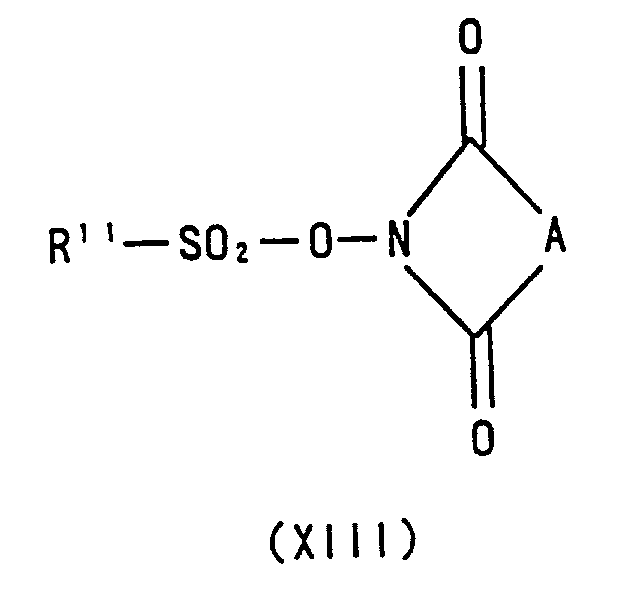
- Specific examples of the compounds represented by Formulas (XII) and (XIII) include, but are not limited to, compounds XII-1 to XII-12 and compounds XIII-1 to XIII-12 listed below.
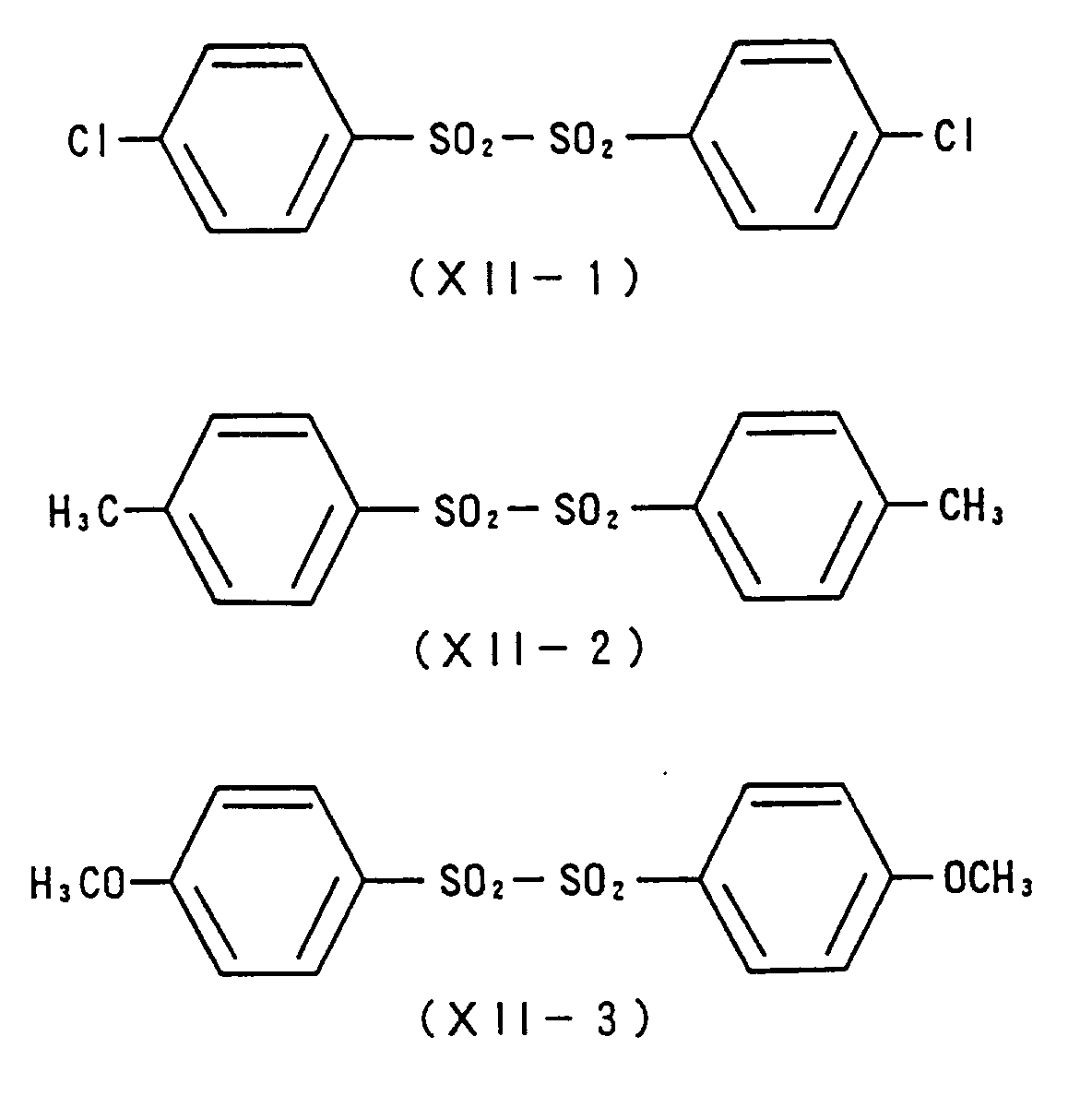


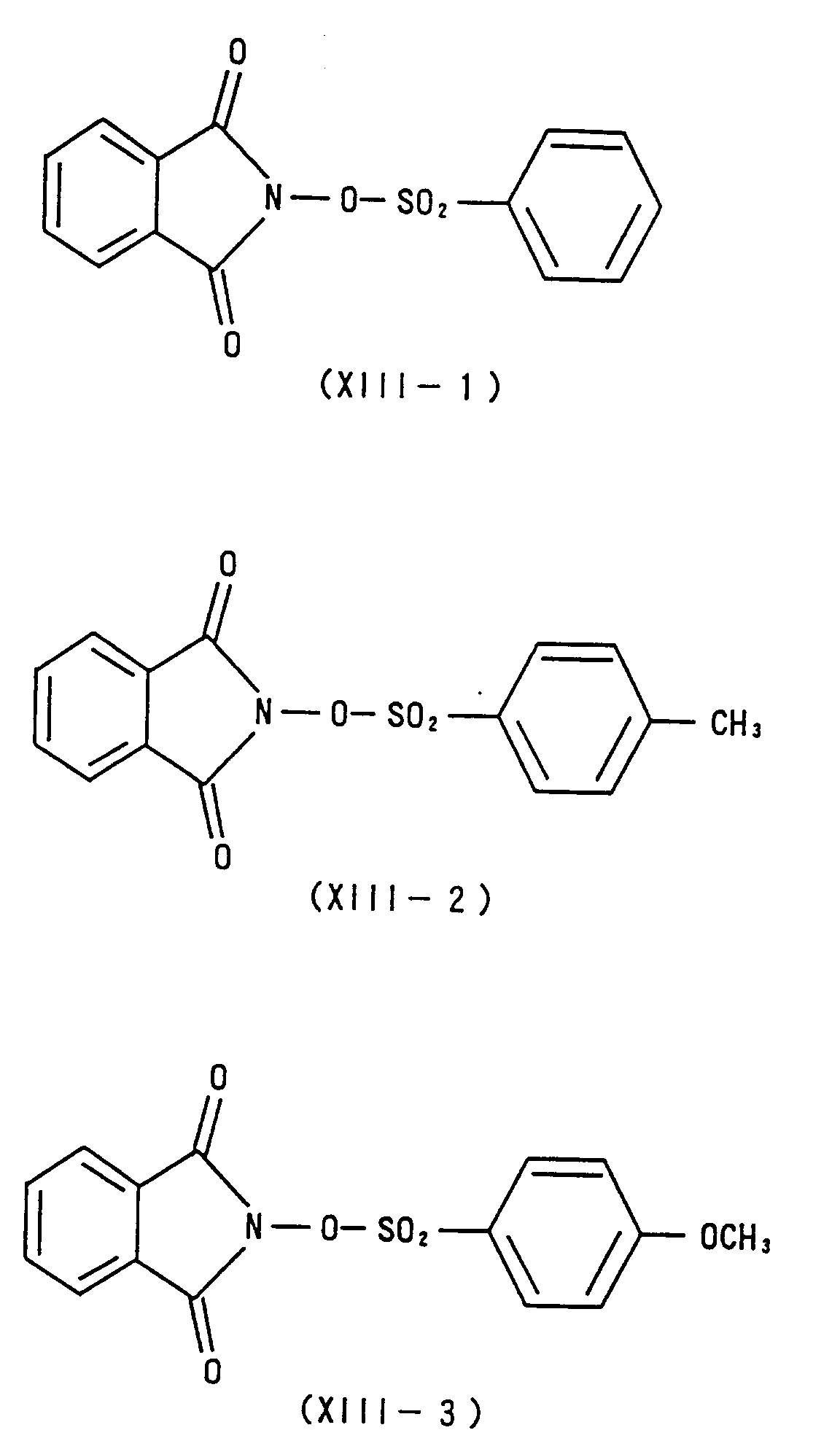


These compounds capable of being decomposed and generating acids through irradiation with actinic light rays or radiant rays may be used alone or in combination and may be added to the light-sensitive composition in an amount generally ranging from 0.001 to 40% by weight and preferably 0.1 to 20% by weight on the basis of the total solid content of the composition. - Moreover, the positive-working light-sensitive composition of the present invention may optionally comprise a compound capable of improving the photolytically acid-generating efficiency of the acid-generating compound (sensitizer), a dye, a pigment, a plasticizer and various kinds of compounds for adjusting the solubility of the positive-working light-sensitive composition in an alkaline aqueous solution.
- Examples of such semsitizers include, but are not limited to, electron donative compounds such as pyrene and perylene or dyes such as merocyanine dyes and cyanine dyes.
- These sensitizers may be used alone or in combination and the ratio thereof to the component (b) preferably ranges from 0.01/1 to 20/1 expressed in terms of the molar ratio and 0.1/1 to 5/1 expressed in terms of the weight ratio.
- In addition, a dye may be used in the positive-working light-sensitive composition of the invention as a coloring agent and preferred dyes include, for instance, oil-soluble dyes or basic dyes. Specific examples thereof are Oil Yellow #101 and #130, Oil Pink #312, Oil Green BG, Oil Blue BOS, Oil Black BY, BS and T-505 (they are all available from Oriental Chemical Industry Co., Ltd.); Crystal Violet (CI 42555), Methyl Violet (CI 42535), Rhodamine B (CI 45170B), Malachite Green (CI 42000) and Methylene Blue (CI 52015).
- These dyes may be used alone or in combination and can be added to the light-sensitive composition in an amount ranging from 0.01 to 10% by weight and preferably 0.1 to 3% by weight on the basis of the total solid content of the composition.
- The compounds for adjusting the solubility of the positive-working light-sensitive composition of the present invention in an alkaline aqueous solution may be cyclic acid anhydrides and other fillers.
- Examples of such cyclic acid anhydrides are phthalic anhydride, tetrahydrophthalic anhydride, hexahydrophthalic anhydride, 3,6-endoxy-tetrahydrophthalic anhydride, tetrachlorophthalic anhydride, maleic anhydride, chloromaleic anhydride, α-phenylmaleic anhydride, succinic anhydride and pyromellitic anhydride as disclosed in U.S. Patent No. 4,115,128. These acid anhydrides may be used alone or in combination and may be added to the light-sensitive composition in an amount ranging from 1 to 15% by weight on the basis of the total solid content of the composition. The sensitivity of the composition can be increased up to at most about three times through the addition of these acid anhydrides.
- It is also possible to use compounds, which can be made alkali-soluble through hydrolysis with acids, such as those disclosed in, for instance, J.P. KOKAI Nos. Sho 62-27829, Sho 63-250642, Sho 63-139343, Hei 4-63846, Hei 4-70021, Hei 4-67677, Sho 60-191372, Sho 48-39003, Sho 51-120714, Sho 53-133429, Sho 55-126236, Hei 1-106038 and Sho 64-57258 in order to increase the difference in solubility between exposed and unexposed portions of the composition.
- If the positive-working light-sensitive composition of the present invention is used as a material for making a lithographic printing plate, the foregoing components are dissolved in a solvent capable of dissolving these components and then applied onto the surface of a substrate. Alternatively, if the composition is used as a resist material for semiconductors, it is used in the form of a solution dissolved in a solvent. Examples of solvent usable in the invention include ethylene dichloride, cyclohexanone, methyl ethyl ketone, methanol, ethanol, propanol, ethylene glycol monomethyl ether, 1-methoxy-2-propanol, ethylene glycol monoethyl ether, 2-methoxyethyl acetate, 1-methoxy-2-propyl acetate, dimethoxyethane, methyl lactate, ethyl lactate, N,N-dimethylacetamide, N,N-dimethylformamide, tetramethylurea, N-methylpyrrolidone, dimethylsulfoxide, sulfolane, γ - butyrolactone, toluene, ethyl acetate and dioxane. These solvent may be used alone or in combination.
- The concentration of the foregoing components (total solid content inclusive of the foregoing additives) in the solvent preferably ranges from 2 to 50% by weight. Moreover, if the composition is applied onto a substrate, the amount thereof to be applied varies depending on applications, but in general preferred amount thereof ranges from 0.5 to 3.0 g/m² for presensitized plate for use in making a lithographic printing plate (hereinafter referred to as "PS plate")and 0.1 to 3.0 g/m² when it is used as a photoresist. As the coated amount thereof decreases, the sensitivity of the resulting film increases, but the properties of the resulting film are impaired.
- When preparing a lithographic printing plate using the positive-working light-sensitive composition of the invention, substrates for the printing plate may be, for instance, paper; paper laminated with a plastic film (such as a polyethylene, polypropylene or polystyrene film); metal plates such as aluminum (including aluminum alloys), zinc and copper plates; plastic films such as cellulose diacetate, cellulose triacetate, cellulose propionate, cellulose butyrate, cellulose acetate butyrate, cellulose nitrate, polyethylene terephthalate, polyethylene, polystyrene, polypropylene, polycarbonate and polyvinyl acetal films; and paper or plastic films laminated with films of the foregoing metals or on which the foregoing metals are vapor-deposited. Among these substrates, particularly preferred are aluminum plates because of their high dimensional stability and cheapness. Examples of preferred substrates further include composite sheets comprising polyethylene terephthalate films and aluminum sheets bonded thereto as disclosed in J.P. KOKOKU No. Sho 48-18327. Preferably, the aluminum plate is surface-grained by a mechnical method such as wire brush graining, brush graining which comprises surface-graining with a nylon brush while pouring a slurry containing abrasive particles, ball graining, graining by liquid honing or buff graining; a chemical graining method which makes use of HF, AlCl₃ or HCl as an etchant; an electrolytic graining method in which nitric acid or hydrochloric acid is used as an electrolyte or a composite graining method comprising a combination of at least two of these surface-roughening methods, oprionally etched with an acid or an alkali and then anodized by passing a direct or alternating current therethrough in an electrolyte selected from sulfuric acid, phosphoric acid, chromic acid, sulfamic acid or mixture thereof to form a firm passivation film on the surface of the aluminum plate.
- Moreover, the aluminum plate is preferably subjected to sealing treatment after the surface-graining and anodization treatments. Such a sealing treatment is performed by immersing the aluminum plate in hot water, a hot aqueous solution containing an inorganic or organic salt or by treating the plate in a steam bath.
- The surface of the aluminum plate is converted into a hydrophilic one through the application of such a passivation film onto the surface, but a particularly preferred aluminum plate is further subjected to a hydrophilization treatment such as a treatment with a silicate (e.g., sodium or potassium silicate) as disclosed in U.S. Patent Nos. 2,714,066 and 3,181,461; a treatment with potassium fluorozirconate as disclosed in U.S. Patent No. 2,946,638; a treatment with phosphomolybdate as disclosed in U.S. Patent No. 3,201,247; a treatment with an alkyl titanate as disclosed in U.K. Patent No. 1,108,559; a treatment with polyacrylic acid as disclosed in German Patent No. 1,091,443; a treatment with polyvinylsufonic acid as disclosed in German Patent No. 1,134,093 and U.K. Patent No. 1,230,447; a treatment with a phosphonic acid as disclosed in J.P. KOKOKU No. Sho 44-6409; a treatment with a phytic acid as disclosed in U.S. Patent No. 3,307,951; application of an underlying coating of a complex comprising a hydrophilic organic polymer and divalent metal ions as disclosed in J.P. KOKAI Nos. Sho 58-16893 and Sho 58-16291; and application of an underlying coating of a water-soluble polymer having sulfonate groups as disclosed in J.P. KOKAI No. Sho 59-101651. Examples of other hydrophilization treatments usable in the invention include silicate electrodeposition as disclosed in U.S. Patent No. 3,658,662.
- The positive-working light-sensitive composition of the invention is applied onto the surface of a substrate by a known coating technique. Examples of the coating techniques include coating with a whirler, coating with a wire bar, dip coating, air knife coating, roller coating, blade coating, curtain coating and spray coating.
- The layer of the positive-working light-sensitive composition applied onto the substrate in the foregoing manner is dried at a temperature ranging from 40 to 150 °C for 30 seconds to 10 minutes using, for instance, a hot-air dryer or an infrared dryer. The crosslinking of the components (a) and (b) can be performed by, for instance, applying heat during application of the light-sensitive composition and/or during drying the applied layer of the composition or by applying heat after the application and drying of the composition. The layer of the composition is heated at a temperature preferably ranging from 60 to 150 °C more preferably 80 to 130 °C for 5 seconds to 20 minutes and preferably 20 seconds to 5 minutes.
- If the positive-working light-sensitive composition of the invention is used as a photoresist, various substrates may be used, for instance, a copper plate, a copper-plated plate, a silicon plate, a stainless steel plate and a glass plate.
- The PS plate, photoresist or the like comprising the positive-working light-sensitive composition of the invention are in general subjected to imagewise exposure to light and a subsequent development process.
- The imagewise exposure to light may be performed using various sources for actinic light rays such as a mercury lamp, a metal halide lamp, a xenon lamp, a chemical lamp and a carbon arc lamp. Radiant rays may likewise be used for the imagewise exposure process and examples of the radiant rays include electron beam, X-rays, ion beam and far ultraviolet rays. In addition, light sources for photoresists preferably include, for instance, g-rays, i-rays and Deep-UV rays. Moreover, scanning exposure techniques which make use of high density energy beams (such as laser beams or electron beams) may likewise be used in the present invention. Examples of such laser beams include those emitted from He - Ne lasers, argon lasers, krypton ion lasers, He - Cd lasers and KrF excimer lasers.
- Developers suitably used in the development of the positive-working light-sensitive composition of the present invention include, for instance, aqueous solutions of inorganic alkaline agents such as sodium silicate, potassium silicate, sodium hydroxide, potassium hydroxide, lithium hydroxide, sodium tertiary phosphate, sodium secondary phosphate, ammonium tertiary phosphate, ammonium secondary phosphate, sodium metasilicate, sodium bicarbonate and aqueous ammonia; and organic alkaline agents such as tetraalkyl ammonium hydrides and the concentration of these aqueous alkaline solutions in general ranges from 0.1 to 10% by weight and preferably 0.5 to 5% by weight.
- The alkaline aqueous solution may optionally comprise a surfactant and/or an organic solvent such as an alcohol.
- The positive-working light-sensitive composition has high light-sensitivity and permits the use of light rays extending over a wide range of wavelengths. Therefore, the positive-working light-sensitive composition of the present invention can provide clear positive images and has a wide development latitude.
- The present invention will hereunder be explained in more detail with reference to the following non-limitative working Examples and the effects practically attained by the present invention will also be discussed in detail in comparison with Comparative Examples.
- A 2S aluminum plate having a thickness of 0.24 mm was immersed in a 10% sodium tertiary phosphate aqueous solution maintained at 80 °C for 3 minutes for degreasing, then surface-grained by rubbing it with a nylon brush, etched with sodium aluminate for about 10 minutes and desmutted with a 3% aqueous solution of sodium hydrogen sulfate. The aluminum plate was anodized at a current density of 2A/dm² for 2 minutes in a 20% aqueous sulfuric acid solution.
- Twenty six kinds of light-sensitive solutions [A]-1 to [A]-23 and [A']-1 to [A']-3, each having a formulation given below, were prepared using compounds listed in the following Table 1. Each light-sensitive solution was applied onto the surface of the anodized aluminum plate and dried at 100°C for 10 minutes to give each corresponding PS plate. In all of the PS plates thus prepared, the coated amount of each light-sensitive solution was adjusted to 1.7 g/m² (determined after drying).
Light-Sensitive Solution [A] linear polymer listed in Table 1 2.0 g vinyl ether compound listed in Table 1 0.4 g photolytically acid-generating agent listed in Table 1 0.1 g dioxane 50.0 g methanol 15.0 g - To confirm whether, or not, the light-sensitive layer had been crosslinked by the heat applied during the drying step, each resulting PS plate was immersed in a solvent listed in the following Table 2 for 5 minutes, then washed with water and inspected for the condition of the dissolved coated film. The results thus obtained are summarized in Table 2. In Table 2, the coated film was completely insoluble in the solvent (A), partially dissolved in the solvent (B) or completely dissolved therein (C).
- Then a gray scale having an optical density difference of 0.15 was brought into close contact with the light-sensitive layer of each resulting PS plate and the resulting assembly was exposed to light from a 2KW high pressure mercury lamp for 20 seconds at a distance of 50 cm. The exposed PS plates each was heated to 120 °C for 5 minutes and then developed by immersing in a stock solution (Y) for developer having the following composition, which was diluted two times with water prior to use, at 25 °C for 60 seconds. As a result, all of the light-sensitive compositions of the present invention provided clear positive images. The results thus obtained are listed in the following Table 3.
Stock Solution of Developer (Y) water 80 g triethanolamine 3 g sodium t-butylnaphthalenesulfonate 8 g benzyl alcohol 9 g 


- The light-sensitive solutions [A]-1, [A]-4, [A]-6 and [A]-14 each was applied onto the surface of a silicon wafer having a thickness of 2 mm with a spinner and dried at 120°C for 2 minutes while the film thickness determined after drying was adjusted to 1 g/m². The resulting resist film was exposed to light using a reduction-projection exposure machine (a stepper) provided with a light source capable of emitting monochromatic light rays of 436 nm and then heated to 120 °C for 3 minutes. The exposed resist film was developed in a 2.4% aqueous solution of tetramethylammonium hydroxide for 60 seconds to give a resist pattern. As a result, it was found out that all of the samples thus formed provided good patterns comprising lines and spaces having widths of 0.7 µm.
-
- A gray scale having an optical density difference of 0.15 was brought into close contact with the light-sensitive layer of the PS plate prepared in Example 1 and the assembly was exposed to light from a 2 KW high pressure mercury lamp for 20 seconds at a distance of 50 cm. The exposed PS plate was heated at 120°C for 5 minutes and then developed in Y-3C (trade name of a developer available from Fuji Photo Film Co., Ltd.) diluted two times with water at 25 °C over various development times, i.e., 20 seconds, 30 seconds, one minute, 2 minutes, 5 minutes and 10 minutes. As a result, it was found that good positive images were formed in all of the cases examined and that the number of steps of the gray scale was 13 for all of the cases.
- The foregoing results clearly indicate that the positive-working light-sensitive composition of the present invention is highly sensitive, can provide clear positive images and has a wide development latitude.
Claims (10)
- A positive-working light-sensitive composition comprising:(a) a compound having at least two enol ether groups, represented by the following general formula (I);(b) a linear polymer having acidic groups; and(c) a compound capable of generating an acid through irradiation with actinic light rays or radiant rays, the component (a) and the component (b) being thermally crosslinked:
(R²)(R¹)C = C(R³)-O- (I)
wherein R¹, R² and R³ may be the same or different and each represents a hydrogen atom, an alkyl group or an aryl group, provided that each two of R¹, R² and R³ may be linked together to form a saturated or olefinically unsaturated ring. - The positive-working light-sensitive composition of claim 1 wherein the substituents R¹, R² and R³ in the enol ether group of Formula (I) each represents an aryl group having 4 to 20 carbon atoms which may be substituted with an alkyl, alkoxy, aryloxy, acyl, acyloxy, alkylmercapto, aminoacyl, carboalkoxy, nitro, sulfonyl or cyano group or a halogen atom; or a saturated or unsaturated, linear, branched or alicyclic alkyl group having 1 to 20 carbon atoms which may be substituted with a halogen atom, a cyano, ester, oxy, alkoxy, aryloxy or aryl group; provided that any two of these substituents R¹, R² and R³ may be bonded together to form a 5 or 6-membered cycloalkyl or cycloalkenyl.
- The positive-working light-sensitive composition of claim 1 wherein the enol ether group is a group in which one of the substituents R¹, R² and R³ represents a methyl or ethyl group and the other groups represent hydrogen atoms.
- The positive-working light-sensitive composition of claim 1 wherein the enol ether group is a vinyl ether group.
- The positive-working light-sensitive composition of claim 1 wherein the amount of the vinyl ether group-containing compound added to the light-sensitive composition ranges from 5 to 50% by weight on the basis of the total solid content of the composition.
- The positive-working light-sensitive composition of claim 1 wherein the linear polymer as the component (b) further has hydroxyl groups.
- The positive-working light-sensitive composition of claim 1 wherein the acidic group-containing linear polymer (b) has a molecular weight ranging from 1,500 to 200,000.
- The positive-working light-sensitive composition of claim 1 wherein the amount of the acidic group-containing linear polymer (b) ranges from 20 to 90% by weight on the basis of the total solid content of the composition.
- The positive-working light-sensitive composition of claim 1 wherein the compound capable of generating an acid through irradiation with actinic light rays or radiant rays is at least one member selected from the group consisting of:(1) oxazole derivatives represented by the following general formula (VIII) or s-triazine derivatives represented by the following general formula (IX), substituted with trihalomethyl groups:
 (2) iodonium salts represented by the following general formula (X) or sulfonium salts represented by the following general formula (XI):
Ar¹Ar²I ⁺ Z ⁻ (X)
R⁸R⁹R¹⁰S⁺ Z ⁻ (XI)
wherein Ar¹ and Ar² each independently represents a substituted or unsubstituted aryl group; R⁸, R⁹ and R¹⁰ each independently represents a substituted or unsubstituted aryl group having 6 to 14 carbon atoms, a substituted or unsubstituted alkyl group having 1 to 8 carbon atoms or a substituted derivative thereof; Z ⁻ represents a counter anion selected from the group consisting of BF₄ ⁻ , AsF₆ ⁻ , PF₆ ⁻ , SbF₆⁻ , SiF₆⁻ , ClO₄⁻ , CF₃SO ⁻ , BPh₄⁻ (Ph: phenyl group), a condensed polynuclear aromatic sulfonate anion or an anion of a sulfonate group-containing dye; provided that any two of the substituents R⁸, R⁹ and R¹⁰, and the substituents Ar¹ and Ar² may be linked through a single bond or a divalent substituent; and(3) disulfone derivatives represented by the following general formula (XII) or iminosulfonate derivatives represented by the following general formula (XIII):
Ar³-SO₂-SO₂-Ar⁴ (XII)

- The positive-working light-sensitive composition of claim 1 wherein the compound capable of generating an acid through irradiation with actinic light rays or radiant rays is added to the light-sensitive composition in an amount ranging from 0.1 to 20% by weight on the basis of the total solid content of the composition.
Applications Claiming Priority (3)
| Application Number | Priority Date | Filing Date | Title |
|---|---|---|---|
| JP18793/93 | 1993-02-05 | ||
| JP1879393 | 1993-02-05 | ||
| JP5018793A JPH06230574A (en) | 1993-02-05 | 1993-02-05 | Positive type photosensitive composition |
Publications (2)
| Publication Number | Publication Date |
|---|---|
| EP0609684A1 true EP0609684A1 (en) | 1994-08-10 |
| EP0609684B1 EP0609684B1 (en) | 2000-04-05 |
Family
ID=11981482
Family Applications (1)
| Application Number | Title | Priority Date | Filing Date |
|---|---|---|---|
| EP94100530A Expired - Lifetime EP0609684B1 (en) | 1993-02-05 | 1994-01-14 | Positive-working light-sensitive composition |
Country Status (4)
| Country | Link |
|---|---|
| US (1) | US5939235A (en) |
| EP (1) | EP0609684B1 (en) |
| JP (1) | JPH06230574A (en) |
| DE (1) | DE69423800T2 (en) |
Cited By (9)
| Publication number | Priority date | Publication date | Assignee | Title |
|---|---|---|---|---|
| EP0702271A1 (en) * | 1994-09-06 | 1996-03-20 | Fuji Photo Film Co., Ltd. | Positive working printing plate |
| US5658708A (en) * | 1995-02-17 | 1997-08-19 | Fuji Photo Film Co., Ltd. | Image recording material |
| US6187509B1 (en) * | 1997-10-07 | 2001-02-13 | Kansai Paint Co., Ltd. | Positive type electrodeposition photoresist compositions and pattern formation process |
| WO2005052688A2 (en) | 2003-11-25 | 2005-06-09 | Tokyo Ohka Kogyo Co., Ltd. | Chemically amplified positive photosensitive thermosetting resin composition method of forming cured article and method of producing functional device |
| EP2813889A2 (en) | 2013-06-11 | 2014-12-17 | Shin-Etsu Chemical Co., Ltd. | Photoresist underlayer film-forming composition and pattern forming process |
| EP2813892A2 (en) | 2013-06-11 | 2014-12-17 | Shin-Etsu Chemical Co., Ltd. | Photoresist underlayer film-forming composition and pattern forming process |
| EP2813891A2 (en) | 2013-06-11 | 2014-12-17 | Shin-Etsu Chemical Co., Ltd. | Photoresist underlayer film-forming composition and pattern forming process |
| EP2813890A2 (en) | 2013-06-11 | 2014-12-17 | Shin-Etsu Chemical Co., Ltd. | Photoresist underlayer film-forming composition and pattern forming process |
| US11385543B2 (en) | 2016-08-09 | 2022-07-12 | Merck Patent Gmbh | Enviromentally stable, thick film, chemically amplified resist |
Families Citing this family (31)
| Publication number | Priority date | Publication date | Assignee | Title |
|---|---|---|---|---|
| JP3198915B2 (en) * | 1996-04-02 | 2001-08-13 | 信越化学工業株式会社 | Chemically amplified positive resist material |
| JP3518158B2 (en) * | 1996-04-02 | 2004-04-12 | 信越化学工業株式会社 | Chemically amplified positive resist material |
| JP3125678B2 (en) * | 1996-04-08 | 2001-01-22 | 信越化学工業株式会社 | Chemically amplified positive resist material |
| JP3903638B2 (en) * | 1999-04-12 | 2007-04-11 | 株式会社日立製作所 | Pattern formation method |
| US6555286B1 (en) * | 1999-08-25 | 2003-04-29 | Kansai Paint Co., Ltd. | Positive type actinic-ray-curable dry film and pattern-forming method by use of the same |
| WO2001032720A1 (en) * | 1999-11-02 | 2001-05-10 | Canadian Space Agency | Photosolubilizable layers |
| EP1136885B1 (en) * | 2000-03-22 | 2007-05-09 | Shin-Etsu Chemical Co., Ltd. | Chemically amplified positive resist composition and patterning method |
| DE60143334D1 (en) | 2000-08-21 | 2010-12-09 | Tokyo Ohka Kogyo Co Ltd | Crosslinked, positive-working photoresist composition |
| JP3948646B2 (en) | 2000-08-31 | 2007-07-25 | 東京応化工業株式会社 | Positive resist composition and resist pattern forming method using the same |
| JP3890052B2 (en) * | 2001-09-11 | 2007-03-07 | 関西ペイント株式会社 | Active energy linear composition and pattern forming method |
| CN1698016A (en) | 2003-05-20 | 2005-11-16 | 东京应化工业株式会社 | Chemically amplified positive photo resist composition and method for forming resist pattern |
| TWI331255B (en) | 2003-05-22 | 2010-10-01 | Tokyo Ohka Kogyo Co Ltd | Chemical amplification type positive photoresist composition and resist pattern forming method using the same |
| JP2005173369A (en) | 2003-12-12 | 2005-06-30 | Tokyo Ohka Kogyo Co Ltd | Resist pattern peeling method |
| US20050214674A1 (en) * | 2004-03-25 | 2005-09-29 | Yu Sui | Positive-working photoimageable bottom antireflective coating |
| US20050255410A1 (en) * | 2004-04-29 | 2005-11-17 | Guerrero Douglas J | Anti-reflective coatings using vinyl ether crosslinkers |
| JP4555698B2 (en) | 2005-01-27 | 2010-10-06 | 日本電信電話株式会社 | Resist pattern forming method |
| JP4630077B2 (en) | 2005-01-27 | 2011-02-09 | 日本電信電話株式会社 | Resist pattern forming method |
| JP4937594B2 (en) | 2006-02-02 | 2012-05-23 | 東京応化工業株式会社 | Positive resist composition for forming thick resist film, thick resist laminate, and resist pattern forming method |
| WO2007132892A1 (en) * | 2006-05-16 | 2007-11-22 | Nissan Chemical Industries, Ltd. | Positive photosensitive resin composition containing siloxane compound |
| US7914974B2 (en) | 2006-08-18 | 2011-03-29 | Brewer Science Inc. | Anti-reflective imaging layer for multiple patterning process |
| US20100291483A1 (en) * | 2007-09-20 | 2010-11-18 | Nissan Chemical Industries, Ltd. | Resist underlayer film forming composition containing branched polyhydroxystyrene |
| US8715918B2 (en) | 2007-09-25 | 2014-05-06 | Az Electronic Materials Usa Corp. | Thick film resists |
| US8088548B2 (en) * | 2007-10-23 | 2012-01-03 | Az Electronic Materials Usa Corp. | Bottom antireflective coating compositions |
| US8393158B2 (en) * | 2007-10-24 | 2013-03-12 | Gulfstream Aerospace Corporation | Low shock strength inlet |
| JP5357186B2 (en) * | 2008-01-29 | 2013-12-04 | ブルーワー サイエンス アイ エヌ シー. | On-track process for hard mask pattern formation by multiple dark field exposure |
| KR101697789B1 (en) * | 2008-02-22 | 2017-01-18 | 브레우어 사이언스 인코포레이션 | Methods of fabricating microelectronic structures using dual-layer light-sensitive developer-soluble bottom anti-reflective coatings for 193-nm lithography |
| JP5553488B2 (en) * | 2008-06-06 | 2014-07-16 | 株式会社ダイセル | Lithographic polymer and process for producing the same |
| US8455176B2 (en) * | 2008-11-12 | 2013-06-04 | Az Electronic Materials Usa Corp. | Coating composition |
| US9640396B2 (en) * | 2009-01-07 | 2017-05-02 | Brewer Science Inc. | Spin-on spacer materials for double- and triple-patterning lithography |
| US8632948B2 (en) * | 2009-09-30 | 2014-01-21 | Az Electronic Materials Usa Corp. | Positive-working photoimageable bottom antireflective coating |
| KR101977886B1 (en) * | 2018-06-18 | 2019-05-13 | 영창케미칼 주식회사 | Chemical amplified type positive photoresist composition for pattern profile improvement |
Citations (2)
| Publication number | Priority date | Publication date | Assignee | Title |
|---|---|---|---|---|
| EP0006627A2 (en) * | 1978-07-05 | 1980-01-09 | Hoechst Aktiengesellschaft | Radiation-sensitive mixture and process for producing relief images |
| EP0536690A1 (en) * | 1991-10-07 | 1993-04-14 | Fuji Photo Film Co., Ltd. | Light-sensitive composition |
Family Cites Families (3)
| Publication number | Priority date | Publication date | Assignee | Title |
|---|---|---|---|---|
| DE2718254C3 (en) * | 1977-04-25 | 1980-04-10 | Hoechst Ag, 6000 Frankfurt | Radiation-sensitive copying paste |
| DE3725741A1 (en) * | 1987-08-04 | 1989-02-16 | Hoechst Ag | POSITIVELY WORKING RADIATION-SENSITIVE MIXTURE |
| JPH0480758A (en) * | 1990-07-23 | 1992-03-13 | Fuji Photo Film Co Ltd | Photosensitive composition |
-
1993
- 1993-02-05 JP JP5018793A patent/JPH06230574A/en active Pending
-
1994
- 1994-01-14 EP EP94100530A patent/EP0609684B1/en not_active Expired - Lifetime
- 1994-01-14 DE DE69423800T patent/DE69423800T2/en not_active Expired - Fee Related
-
1997
- 1997-11-12 US US08/968,210 patent/US5939235A/en not_active Expired - Fee Related
Patent Citations (2)
| Publication number | Priority date | Publication date | Assignee | Title |
|---|---|---|---|---|
| EP0006627A2 (en) * | 1978-07-05 | 1980-01-09 | Hoechst Aktiengesellschaft | Radiation-sensitive mixture and process for producing relief images |
| EP0536690A1 (en) * | 1991-10-07 | 1993-04-14 | Fuji Photo Film Co., Ltd. | Light-sensitive composition |
Cited By (12)
| Publication number | Priority date | Publication date | Assignee | Title |
|---|---|---|---|---|
| EP0702271A1 (en) * | 1994-09-06 | 1996-03-20 | Fuji Photo Film Co., Ltd. | Positive working printing plate |
| US5658708A (en) * | 1995-02-17 | 1997-08-19 | Fuji Photo Film Co., Ltd. | Image recording material |
| US6187509B1 (en) * | 1997-10-07 | 2001-02-13 | Kansai Paint Co., Ltd. | Positive type electrodeposition photoresist compositions and pattern formation process |
| WO2005052688A2 (en) | 2003-11-25 | 2005-06-09 | Tokyo Ohka Kogyo Co., Ltd. | Chemically amplified positive photosensitive thermosetting resin composition method of forming cured article and method of producing functional device |
| WO2005052688A3 (en) * | 2003-11-25 | 2005-09-29 | Tokyo Ohka Kogyo Co Ltd | Chemically amplified positive photosensitive thermosetting resin composition method of forming cured article and method of producing functional device |
| CN1875322B (en) * | 2003-11-25 | 2010-12-15 | 东京应化工业株式会社 | Chemically amplified positive-type photosensitive thermosetting resin composition, method for forming cured product, and method for preparing functional device |
| US7871756B2 (en) | 2003-11-25 | 2011-01-18 | Tokyo Ohka Kogyo Co., Ltd. | Chemically amplified positive photosensitive thermosetting resin composition, method of forming cured article, and method of producing functional device |
| EP2813889A2 (en) | 2013-06-11 | 2014-12-17 | Shin-Etsu Chemical Co., Ltd. | Photoresist underlayer film-forming composition and pattern forming process |
| EP2813892A2 (en) | 2013-06-11 | 2014-12-17 | Shin-Etsu Chemical Co., Ltd. | Photoresist underlayer film-forming composition and pattern forming process |
| EP2813891A2 (en) | 2013-06-11 | 2014-12-17 | Shin-Etsu Chemical Co., Ltd. | Photoresist underlayer film-forming composition and pattern forming process |
| EP2813890A2 (en) | 2013-06-11 | 2014-12-17 | Shin-Etsu Chemical Co., Ltd. | Photoresist underlayer film-forming composition and pattern forming process |
| US11385543B2 (en) | 2016-08-09 | 2022-07-12 | Merck Patent Gmbh | Enviromentally stable, thick film, chemically amplified resist |
Also Published As
| Publication number | Publication date |
|---|---|
| DE69423800D1 (en) | 2000-05-11 |
| JPH06230574A (en) | 1994-08-19 |
| DE69423800T2 (en) | 2000-08-03 |
| US5939235A (en) | 1999-08-17 |
| EP0609684B1 (en) | 2000-04-05 |
Similar Documents
| Publication | Publication Date | Title |
|---|---|---|
| EP0609684B1 (en) | Positive-working light-sensitive composition | |
| US5364738A (en) | Light-sensitive composition | |
| US5320931A (en) | Light-sensitive composition | |
| US5658708A (en) | Image recording material | |
| JP3589365B2 (en) | Positive image forming composition | |
| JP3206989B2 (en) | Positive photosensitive material | |
| JPH04365048A (en) | Photosensitive composition material | |
| JPH0962005A (en) | Negative type photosensitive composition | |
| JP3856270B2 (en) | Positive resist composition | |
| US6228559B1 (en) | Negative working waterless lithographic printing plate precursor | |
| JP3954233B2 (en) | Positive photoresist composition | |
| JP3802179B2 (en) | Positive photoresist composition | |
| JPH1195421A (en) | Laser direct lithography type planographic printing plate material | |
| JP3778391B2 (en) | Positive photosensitive composition | |
| US5370965A (en) | Positive-working light-sensitive composition containing diazonium salt and novolak resin | |
| JPH08220752A (en) | Image recording material | |
| KR19990013892A (en) | Positive photoresist composition and method of forming a pattern using the same | |
| JP2668609B2 (en) | Photosensitive composition | |
| EP0702271A1 (en) | Positive working printing plate | |
| JP2668608B2 (en) | Photosensitive composition | |
| JP3802202B2 (en) | Laser direct drawing lithographic printing plate material | |
| JPH0862844A (en) | Positive photosensitive composition | |
| JP4272805B2 (en) | Positive radiation sensitive composition | |
| JP2934102B2 (en) | Positive photosensitive composition | |
| JP2704331B2 (en) | Photosensitive composition |
Legal Events
| Date | Code | Title | Description |
|---|---|---|---|
| PUAI | Public reference made under article 153(3) epc to a published international application that has entered the european phase |
Free format text: ORIGINAL CODE: 0009012 |
|
| AK | Designated contracting states |
Kind code of ref document: A1 Designated state(s): DE GB |
|
| 17P | Request for examination filed |
Effective date: 19950202 |
|
| 17Q | First examination report despatched |
Effective date: 19980105 |
|
| GRAG | Despatch of communication of intention to grant |
Free format text: ORIGINAL CODE: EPIDOS AGRA |
|
| GRAG | Despatch of communication of intention to grant |
Free format text: ORIGINAL CODE: EPIDOS AGRA |
|
| GRAH | Despatch of communication of intention to grant a patent |
Free format text: ORIGINAL CODE: EPIDOS IGRA |
|
| GRAH | Despatch of communication of intention to grant a patent |
Free format text: ORIGINAL CODE: EPIDOS IGRA |
|
| GRAA | (expected) grant |
Free format text: ORIGINAL CODE: 0009210 |
|
| AK | Designated contracting states |
Kind code of ref document: B1 Designated state(s): DE GB |
|
| REF | Corresponds to: |
Ref document number: 69423800 Country of ref document: DE Date of ref document: 20000511 |
|
| EN | Fr: translation not filed | ||
| PLBE | No opposition filed within time limit |
Free format text: ORIGINAL CODE: 0009261 |
|
| STAA | Information on the status of an ep patent application or granted ep patent |
Free format text: STATUS: NO OPPOSITION FILED WITHIN TIME LIMIT |
|
| 26N | No opposition filed | ||
| REG | Reference to a national code |
Ref country code: GB Ref legal event code: IF02 |
|
| REG | Reference to a national code |
Ref country code: GB Ref legal event code: 732E |
|
| PGFP | Annual fee paid to national office [announced via postgrant information from national office to epo] |
Ref country code: GB Payment date: 20080129 Year of fee payment: 15 Ref country code: DE Payment date: 20080228 Year of fee payment: 15 |
|
| GBPC | Gb: european patent ceased through non-payment of renewal fee |
Effective date: 20090114 |
|
| PG25 | Lapsed in a contracting state [announced via postgrant information from national office to epo] |
Ref country code: DE Free format text: LAPSE BECAUSE OF NON-PAYMENT OF DUE FEES Effective date: 20090801 |
|
| PG25 | Lapsed in a contracting state [announced via postgrant information from national office to epo] |
Ref country code: GB Free format text: LAPSE BECAUSE OF NON-PAYMENT OF DUE FEES Effective date: 20090114 |