EP0601722A1 - Catalysts for hydrotreating hydrocarbon oils and methods of preparing the same - Google Patents
Catalysts for hydrotreating hydrocarbon oils and methods of preparing the same Download PDFInfo
- Publication number
- EP0601722A1 EP0601722A1 EP93309206A EP93309206A EP0601722A1 EP 0601722 A1 EP0601722 A1 EP 0601722A1 EP 93309206 A EP93309206 A EP 93309206A EP 93309206 A EP93309206 A EP 93309206A EP 0601722 A1 EP0601722 A1 EP 0601722A1
- Authority
- EP
- European Patent Office
- Prior art keywords
- catalysts
- catalyst
- active metal
- sugar
- alumina carrier
- Prior art date
- Legal status (The legal status is an assumption and is not a legal conclusion. Google has not performed a legal analysis and makes no representation as to the accuracy of the status listed.)
- Granted
Links
Classifications
-
- B—PERFORMING OPERATIONS; TRANSPORTING
- B01—PHYSICAL OR CHEMICAL PROCESSES OR APPARATUS IN GENERAL
- B01J—CHEMICAL OR PHYSICAL PROCESSES, e.g. CATALYSIS OR COLLOID CHEMISTRY; THEIR RELEVANT APPARATUS
- B01J31/00—Catalysts comprising hydrides, coordination complexes or organic compounds
- B01J31/02—Catalysts comprising hydrides, coordination complexes or organic compounds containing organic compounds or metal hydrides
- B01J31/06—Catalysts comprising hydrides, coordination complexes or organic compounds containing organic compounds or metal hydrides containing polymers
- B01J31/068—Polyalkylene glycols
-
- B—PERFORMING OPERATIONS; TRANSPORTING
- B01—PHYSICAL OR CHEMICAL PROCESSES OR APPARATUS IN GENERAL
- B01J—CHEMICAL OR PHYSICAL PROCESSES, e.g. CATALYSIS OR COLLOID CHEMISTRY; THEIR RELEVANT APPARATUS
- B01J23/00—Catalysts comprising metals or metal oxides or hydroxides, not provided for in group B01J21/00
- B01J23/70—Catalysts comprising metals or metal oxides or hydroxides, not provided for in group B01J21/00 of the iron group metals or copper
- B01J23/76—Catalysts comprising metals or metal oxides or hydroxides, not provided for in group B01J21/00 of the iron group metals or copper combined with metals, oxides or hydroxides provided for in groups B01J23/02 - B01J23/36
- B01J23/84—Catalysts comprising metals or metal oxides or hydroxides, not provided for in group B01J21/00 of the iron group metals or copper combined with metals, oxides or hydroxides provided for in groups B01J23/02 - B01J23/36 with arsenic, antimony, bismuth, vanadium, niobium, tantalum, polonium, chromium, molybdenum, tungsten, manganese, technetium or rhenium
- B01J23/85—Chromium, molybdenum or tungsten
-
- B—PERFORMING OPERATIONS; TRANSPORTING
- B01—PHYSICAL OR CHEMICAL PROCESSES OR APPARATUS IN GENERAL
- B01J—CHEMICAL OR PHYSICAL PROCESSES, e.g. CATALYSIS OR COLLOID CHEMISTRY; THEIR RELEVANT APPARATUS
- B01J27/00—Catalysts comprising the elements or compounds of halogens, sulfur, selenium, tellurium, phosphorus or nitrogen; Catalysts comprising carbon compounds
- B01J27/14—Phosphorus; Compounds thereof
- B01J27/186—Phosphorus; Compounds thereof with arsenic, antimony, bismuth, vanadium, niobium, tantalum, polonium, chromium, molybdenum, tungsten, manganese, technetium or rhenium
- B01J27/188—Phosphorus; Compounds thereof with arsenic, antimony, bismuth, vanadium, niobium, tantalum, polonium, chromium, molybdenum, tungsten, manganese, technetium or rhenium with chromium, molybdenum, tungsten or polonium
-
- B—PERFORMING OPERATIONS; TRANSPORTING
- B01—PHYSICAL OR CHEMICAL PROCESSES OR APPARATUS IN GENERAL
- B01J—CHEMICAL OR PHYSICAL PROCESSES, e.g. CATALYSIS OR COLLOID CHEMISTRY; THEIR RELEVANT APPARATUS
- B01J31/00—Catalysts comprising hydrides, coordination complexes or organic compounds
- B01J31/02—Catalysts comprising hydrides, coordination complexes or organic compounds containing organic compounds or metal hydrides
- B01J31/0201—Oxygen-containing compounds
- B01J31/0202—Alcohols or phenols
-
- B—PERFORMING OPERATIONS; TRANSPORTING
- B01—PHYSICAL OR CHEMICAL PROCESSES OR APPARATUS IN GENERAL
- B01J—CHEMICAL OR PHYSICAL PROCESSES, e.g. CATALYSIS OR COLLOID CHEMISTRY; THEIR RELEVANT APPARATUS
- B01J31/00—Catalysts comprising hydrides, coordination complexes or organic compounds
- B01J31/26—Catalysts comprising hydrides, coordination complexes or organic compounds containing in addition, inorganic metal compounds not provided for in groups B01J31/02 - B01J31/24
- B01J31/28—Catalysts comprising hydrides, coordination complexes or organic compounds containing in addition, inorganic metal compounds not provided for in groups B01J31/02 - B01J31/24 of the platinum group metals, iron group metals or copper
-
- B—PERFORMING OPERATIONS; TRANSPORTING
- B01—PHYSICAL OR CHEMICAL PROCESSES OR APPARATUS IN GENERAL
- B01J—CHEMICAL OR PHYSICAL PROCESSES, e.g. CATALYSIS OR COLLOID CHEMISTRY; THEIR RELEVANT APPARATUS
- B01J31/00—Catalysts comprising hydrides, coordination complexes or organic compounds
- B01J31/26—Catalysts comprising hydrides, coordination complexes or organic compounds containing in addition, inorganic metal compounds not provided for in groups B01J31/02 - B01J31/24
- B01J31/34—Catalysts comprising hydrides, coordination complexes or organic compounds containing in addition, inorganic metal compounds not provided for in groups B01J31/02 - B01J31/24 of chromium, molybdenum or tungsten
-
- B—PERFORMING OPERATIONS; TRANSPORTING
- B01—PHYSICAL OR CHEMICAL PROCESSES OR APPARATUS IN GENERAL
- B01J—CHEMICAL OR PHYSICAL PROCESSES, e.g. CATALYSIS OR COLLOID CHEMISTRY; THEIR RELEVANT APPARATUS
- B01J37/00—Processes, in general, for preparing catalysts; Processes, in general, for activation of catalysts
- B01J37/02—Impregnation, coating or precipitation
- B01J37/0201—Impregnation
- B01J37/0203—Impregnation the impregnation liquid containing organic compounds
-
- C—CHEMISTRY; METALLURGY
- C10—PETROLEUM, GAS OR COKE INDUSTRIES; TECHNICAL GASES CONTAINING CARBON MONOXIDE; FUELS; LUBRICANTS; PEAT
- C10G—CRACKING HYDROCARBON OILS; PRODUCTION OF LIQUID HYDROCARBON MIXTURES, e.g. BY DESTRUCTIVE HYDROGENATION, OLIGOMERISATION, POLYMERISATION; RECOVERY OF HYDROCARBON OILS FROM OIL-SHALE, OIL-SAND, OR GASES; REFINING MIXTURES MAINLY CONSISTING OF HYDROCARBONS; REFORMING OF NAPHTHA; MINERAL WAXES
- C10G45/00—Refining of hydrocarbon oils using hydrogen or hydrogen-generating compounds
- C10G45/02—Refining of hydrocarbon oils using hydrogen or hydrogen-generating compounds to eliminate hetero atoms without changing the skeleton of the hydrocarbon involved and without cracking into lower boiling hydrocarbons; Hydrofinishing
- C10G45/04—Refining of hydrocarbon oils using hydrogen or hydrogen-generating compounds to eliminate hetero atoms without changing the skeleton of the hydrocarbon involved and without cracking into lower boiling hydrocarbons; Hydrofinishing characterised by the catalyst used
- C10G45/06—Refining of hydrocarbon oils using hydrogen or hydrogen-generating compounds to eliminate hetero atoms without changing the skeleton of the hydrocarbon involved and without cracking into lower boiling hydrocarbons; Hydrofinishing characterised by the catalyst used containing nickel or cobalt metal, or compounds thereof
- C10G45/08—Refining of hydrocarbon oils using hydrogen or hydrogen-generating compounds to eliminate hetero atoms without changing the skeleton of the hydrocarbon involved and without cracking into lower boiling hydrocarbons; Hydrofinishing characterised by the catalyst used containing nickel or cobalt metal, or compounds thereof in combination with chromium, molybdenum, or tungsten metals, or compounds thereof
-
- B—PERFORMING OPERATIONS; TRANSPORTING
- B01—PHYSICAL OR CHEMICAL PROCESSES OR APPARATUS IN GENERAL
- B01J—CHEMICAL OR PHYSICAL PROCESSES, e.g. CATALYSIS OR COLLOID CHEMISTRY; THEIR RELEVANT APPARATUS
- B01J21/00—Catalysts comprising the elements, oxides, or hydroxides of magnesium, boron, aluminium, carbon, silicon, titanium, zirconium, or hafnium
- B01J21/02—Boron or aluminium; Oxides or hydroxides thereof
- B01J21/04—Alumina
-
- B—PERFORMING OPERATIONS; TRANSPORTING
- B01—PHYSICAL OR CHEMICAL PROCESSES OR APPARATUS IN GENERAL
- B01J—CHEMICAL OR PHYSICAL PROCESSES, e.g. CATALYSIS OR COLLOID CHEMISTRY; THEIR RELEVANT APPARATUS
- B01J35/00—Catalysts, in general, characterised by their form or physical properties
- B01J35/60—Catalysts, in general, characterised by their form or physical properties characterised by their surface properties or porosity
- B01J35/64—Pore diameter
- B01J35/647—2-50 nm
-
- B—PERFORMING OPERATIONS; TRANSPORTING
- B01—PHYSICAL OR CHEMICAL PROCESSES OR APPARATUS IN GENERAL
- B01J—CHEMICAL OR PHYSICAL PROCESSES, e.g. CATALYSIS OR COLLOID CHEMISTRY; THEIR RELEVANT APPARATUS
- B01J35/00—Catalysts, in general, characterised by their form or physical properties
- B01J35/60—Catalysts, in general, characterised by their form or physical properties characterised by their surface properties or porosity
- B01J35/66—Pore distribution
-
- B—PERFORMING OPERATIONS; TRANSPORTING
- B01—PHYSICAL OR CHEMICAL PROCESSES OR APPARATUS IN GENERAL
- B01J—CHEMICAL OR PHYSICAL PROCESSES, e.g. CATALYSIS OR COLLOID CHEMISTRY; THEIR RELEVANT APPARATUS
- B01J35/00—Catalysts, in general, characterised by their form or physical properties
- B01J35/60—Catalysts, in general, characterised by their form or physical properties characterised by their surface properties or porosity
- B01J35/66—Pore distribution
- B01J35/67—Pore distribution monomodal
Definitions
- the present invention relates to catalysts which are utilized for the desulfurization and denitrogenation of hydrocarbon oils and to methods of preparing the same.
- catalysts are used.
- the catalysts are composed of inorganic oxides, for example, alumina carrier substances carrying active metal elements including cobalt, nickel, molybdenum, tungsten, or the like.
- alumina carrier substances carrying active metal elements including cobalt, nickel, molybdenum, tungsten, or the like.
- These types of catalysts are normally prepared by means of the following consecutive processes; namely, forming alumina hydrates, sintering of ⁇ alumina carrier substances, impregnating them with aqueous solutions of active metal salts of cobalt, nickel, molybdenum, tungsten or the like, drying at about 100°C, and calcining the impregnated carrier substances at temperatures ranging from 400 to 600°C.
- the carried active metal elements are formed as oxides in the above prepared catalysts for the hydrotreatments, they can not be utilized as prepared conditions due to relatively low catalyst activity.
- the catalysts are filled in a reactor column, through which light oils containing sulfurizing agents are purged under flowing hydrogen to conduct a presulfurization treatment in order to convert the oxides of active metal elements impregnated in catalysts to sulfides, and this is followed by replacing the light oils to operating for the purpose of conducting normal operations.
- an improved treatment has been disclosed in the Japanese Patent Application Laid-Open Tokkai-Hei No. 1-148347, in which the activity of hydrogenating catalysts, but not catalysts for either desulfurization or denitrogenation, was enhanced.
- said improved pretreatment by using 0 ⁇ 50°C aqueous or organic solutions of reducing agents properly selected from aldehydes having 2 ⁇ 14 carbon atoms per molecule, alcohols or polyhydric alcohols that contain 1 ⁇ 14 carbon atoms per molecule, or organic acid or polyacids having 1 ⁇ 14 carbon atoms per molecule, the catalysts which are carried with at least one type of element from Group VIII metals in the periodic table are impregnated with said reducing agents in such a way that the reducing agent is to be impregnated with 10ppm ⁇ 100 weight %.
- the catalysts are calcined at 500 ⁇ 550°C which is a similar condition to the conventional method, active metal elements carried on said catalysts are in the form of oxides and this enables them to bond strongly with the carrier substances.
- the sulfurization agent is added to catalyst surfaces with the aid of an organic solvent, an improvement of the dispersibility of active metal elements in the catalysts can not be expected in spite of the fact that the activation initiation temperature can be lower than in the conventional method.
- the hydrotreating activity is evaluated to be of no difference from that method when the calcined catalysts are used without said organic sulfur compounds, so that in consequence hydrodesulfurization and hydrotreated denitrogenation reactions can not be promoted. No description to overcome these problems can be found in the above cited patent document.
- the Japanese Patent Application Laid-Open Tokkai-Hei No. 4-210240 discloses a presulfurization method by which a ⁇ alumina carrier substance is impregnated with an aqueous solution of active metal salts including cobalt, nickel, molybdenum, tungsten or the like.
- the catalysts which were subjected to only drying are filled into a reactor column to which hydrogen gas containing hydrogen sulfide is introduced to presulfurize the catalyst at 400°C for a certain period of time, so that the activity for the hydrocracking can be enhanced.
- the aforementioned application includes a description of only hydrogenation and hydrocracking of the model compounds. It does not describe the method by which the ability of hydrodesulfurization or hydrodenitrogenation of hydrocarbon oils would be altered, or what type of additives can promote the reaction by which hydrodesulfurization or hydrodenitrogenation can be achieved.
- the Japanese Patent Application Laid-Open Tokkai-Hei No. 4-166233 discloses a method of preparing catalysts in which, after impregnating a ⁇ alumina carrier substance with an active metal element, alkoxycarboxylic acid was added to the catalyst which was dried or calcined after drying, followed by drying employing a temperature below 2000C.
- the catalysts prepared by said method exhibited a higher reaction velocity constant than that manufactured by the conventional method, only when the methoxy acetic acid is utilized as one type of alkoxycarboxylic acid did the prepared catalyst exhibit about 2 times higher relative activity constant than catalysts prepared by the conventional method.
- the methoxyacetic acid is employed to improve relative activity, the relative activity itself does not even reach the satisfactory level expected.
- both drying the ⁇ alumina carrier substance after being impregnated with active metal elements at 110°C for 5 hours and drying the substance impregnated with the alkoxycarboxylic acid at 110°C for 10 hours are absolutely necessitated, so that a reduction in the production process of the catalysts can by no means be avoided. It is prone for carboxylic acid as one type of strong corrosive acetic acid to be produced during the presulfurization process when using hydrodesulfurization catalysts prepared by the aforementioned method, causing undesired damage of equipment and consequently shortening of the system life.
- Catalysts basically consist of an alumina carrier substance, at least one kind of active metal element selected from the Group VI metals in the periodic table, at least one kind of active metal element selected from the Group VIII metals in the periodic table, phosphoric acid, and additives.
- Said catalysts for hydrotreating hydrocarbon oils are characterized by the fact that the additive is composed of one or more than two types of substances selected from dihydric or trihydric alcohol groups having 2 ⁇ 10 carbon atoms per molecule, their ether groups, monosaccharide, disaccharide or polysaccharide groups.
- Said catalysts according to the present invention have furthermore the characteristic that the alumina carrier substance is impregnated with a solution which is a mixture of active metal element, phosphoric acid, and a certain type of said additive, and is dried by virtue of a temperature below 200°C.
- a ⁇ alumina carrier substance which possess 70 ⁇ 120 Angstrom as an average pore diameter measured by the mercury porosimetry technique, and pores within a range of average pore diameter ⁇ 10 Angstrom which occupy 60% of the total volume of pores.
- Active metal elements used for the impregnation process into said alumina carrier substance are molybdenum and tungsten which are preferably chosen from the Group VI metals in the periodic table; furthermore it should be emphasized that molybdenum is more preferable.
- metal elements chosen preferably from the Group VIII metals in the periodic table are nickel and cobalt.
- the amount of selected active metal element to the alumina carrier substance will be preferably 10 ⁇ 30 weight % with respect to the weight of catalyst, when the catalyst weight is converted to oxide weight for the Group VI metals; and it will be preferably 1 ⁇ 8 equivalent weight % with respect to catalysts weight for the Group VIII metals.
- the carrier amount of the phosphoric acid used as an impregnating solution will be preferably 1 ⁇ 10 % of the catalysts weight when it is converted to an oxide, namely P2O5.
- dihydric or trihydric alcohol groups having 2 ⁇ 10 carbon atoms per molecule will be preferably chosen, or the following compounds will also be preferably selected as ether groups of said alcohols; namely, ethylene glycol, propylene glycol, diethylene glycol, trimethylene glycol, triethylene glycol, ethylene glycol, monobutyl ether, diethylene glycol, monomethyl ether, diethylene glycol monoethyl ether, diethylene glycol monopropyl ether, diethylene glycol monobutyl ether, glycerine, trimethylol ethane, trimethylol propane, or the like.
- sugar groups to be utilized as an additive for the impregnation solution will be preferably grape sugar (glucose: C6H12O6), fruit sugar (fructose: C6H12O6), malt sugar (maltose: C12H22O11), milk sugar (lactose: C12H22O11), cane sugar (sucrose: C12H22O11), or the like.
- the catalyst according to the present invention is basically composed of the following: an alumina carrier substance, at least one active metal element selected from Group VI metals in the periodic table, at least one active metal element selected from Group VIII metals in the periodic table, phosphoric acid and a certain type of additive.
- the catalysts of this invention for hydrotreating hydrocarbon oils is further characterized in that said additive is either a dihydric or trihydric alcohol group having 2 ⁇ 10 carbon atoms per molecule or one or more than two types of substances preferably selected from ether, monosaccharide, disaccharide or polysaccharide groups.
- Said alumina carrier substance is furthermore impregnated with a solution containing a certain type of active metal element, phosphoric acid, and a certain type of additive, followed by drying at a temperature which is less than 200°C.
- alumina carrier substance is utilized as a catalysts carrier substance
- at least one metal element selected from Group VI metals in the periodic table as an active metal and at least one metal element chosen from the Group VIII metals in the periodic table as an active metal are employed
- the amount of each selected active metal element will be 10 ⁇ 30% and 1 ⁇ 8 % of the catalyst's weight converted to oxide weight, respectively
- the amount of the phosphoric acid is 1 ⁇ 10% of the catalysts weight converted to P2O5 weight.
- the hydrotreating catalyst of the present invention is characterized in that the additive is added to a solution employed for the impregnation process of the alumina carrier substance by a certain amount of preferably selected active metal element, and phosphoric acid; said additive is preferably selected from either dihydric or trihydric alcohol groups having 2 ⁇ 10 carbon atoms per molecule or one type of substances chosen from ether, monosaccharide, disaccharide, or polysaccharide groups to enhance the catalytic activities for hydrodesulfurization and hydrodenitrogenation.
- the hydrotreating catalysts with high catalytic activity can be easily manufactured by only drying the impregnated catalysts at a temperature of less than 200°C, so that preparation process is easy, it is guaranteed by this invention that the equipment will perform for a longer life and the present process is advantageous from the standpoint of pollution countermeasures.
- both the active metal elements and said additives are dispersed and adsorbed on the surface of fine pores in the alumina carrier substances and active metal elements and additives are fixed at their relevant sites during the subsequent drying process, so that an aggregation of active metal elements in the presulfurization process can be suppressed.
- the alumina being used as a catalyst carrier substance can be any type which is conventionally utilized for manufacturing catalysts, it is preferable to employ a ⁇ alumina carrier substance which has 70 ⁇ 120 Angstrom of average pore diameter measured by the mercury porosimetry technique and pores having a pore size within an average pore diameter of ⁇ 10 Angstrom occupying more than 60% of the total pore volume of the carrier substance.
- the aforementioned ⁇ alumina carrier substance can be obtained by forming a certain shape of mixed alumina hydrates which can be produced by virtue of a hydrolysis reaction of sodium aluminate and aluminum sulphate, and by firing it above 500°C.
- the shape of the carrier substance is not necessarily defined to a specific type, but it can be arbitrarily chosen to be any of a spherical, cylindrical, a triulobe, or a quadrulobe shape.
- the alumina carrier substance As characteristics required for the alumina carrier substance to be used for the catalysts, it is necessary that the alumina carrier substance possesses large specific surface area to highly disperse the active metal elements to be supported thereon and the carrier substance is an aggregated body of uniform alumina particle, and for more specifity, it is desired that fine pore of the aggregate is uniformly distributed on the entire body and in addition to achieving a uniform pore size.
- the ⁇ alumina carrier substance which is utilized as a catalyst carrier substance of the present invention not only satisfies a specification for fine pore as mentioned above, but also leads to high catalytic performance.
- Preferable dihydric or trihydric alcohol groups having 2 ⁇ 10 carbon atoms per molecule or their ether groups to be utilized as an additive for an impregnation solution are ethylene glycol, propylene glycol, diethylene glycol, trimethylene glycol, triethylene glycol, ethylene glycol, monobutyl ether, diethylene glycol, monomethyl ether, diethylene glycol monoethyl ether, diethylene glycol monopropyl ether, diethylene glycol monobutyl ether, glycerine, trimethylol ethane, trimethylol propane, or the like.
- preferable sugar groups to be utilized as an additive for an impregnation solution are grape sugar (glucose: C6H12O6), fruit sugar (Fructose: C6H12O6), malt sugar (maltose: C12H22O11), milk sugar (lactose: C12H22O11), cane sugar (sucrose: C12H22O11), or the like.
- grape sugar glucose: C6H12O6
- Fruit sugar Frazier sugar
- malt sugar malt sugar
- milk sugar lactose: C12H22O11
- cane sugar sucrose: C12H22O11
- the added amount of these additives has been experimented and found to be in the order of 0.05 ⁇ 3 fold of the total mole of the supported active metal elements in the case of alcohol or its ether groups and 0.05 ⁇ 1 fold for the sugar groups, respectively, to exhibit the effectiveness of catalysts. If the added amount is less than the lower limit, no sufficient effectiveness is consequently expected, on the other hand, if it exceeds the upper limit, the viscosity of the impregnation solution becomes high enough to cause difficulty for the impregnation solution to penetrate into the alumina carrier substance. The viscosity of impregnating solution principally depends upon the type of additives. Hence the optimum upper limit for addition will differ among various types of additives.
- the above list provides a guideline for the added amount when each additive is added individually, it is recommended to determine the added amount taking account of the above list when a plurality of types of additives will be added.
- the alumina carrier substance is impregnated with a solution containing a certain amount of active metal elements, phosphoric acid and additives and dried at a temperature which is less than 200°C.
- the reason for drying at less than 200°C is because decomposition or evaporation of adsorbed additives on the pore surface of the alumina carrier substance should be prevented. Since the boiling point, melting point, and decomposition temperature of one type of additive is different from an other type, it is recommended to determine the optimum drying temperature according to the selected additive.
- the drying temperature for the catalysts is chosen in such a way that it should be high enough to remove the moisture content if drying is conducted in air and at the same time it should be a temperature at which the supported active metal salts are not decomposed to form oxides, hence it is preferable to be less than 200°C. Moreover, if in vacuum or inert gas atmosphere, an optimum temperature should be high enough to remove moisture content, and low enough so that the supported active metal component and additives will neither evaporate nor decompose.
- the thus prepared hydrotreating catalysts are filled in a reactor column and subjected to a conventional presulfurization treatment prior to practical operation.
- a conventional presulfurization treatment after the catalysts prepared through the present invention are filled in the reactor column, hydrocarbon oil containing organic sulfur compounds are passed therethrough under rising temperature and pressure while introducing hydrogen in said reactor column to achieve the presulfurization treatment.
- organic sulfur compounds sulfide groups such as dimethyl disulfide, thiol groups such as butane thiol, or the like can be employed.
- the slurry was aged for 30 minutes, filtered and washed to obtain alumina hydrate cakes.
- 5.0 kg (water content was 80%) of the alumina hydrate cake was mixed with a kneader, extruded into a cylinder of 1.5 mm diameter by using an extruder.
- the extrudate was then fired at 650°, 450°, and 850°C to obtain ⁇ alumina carriers; each of which was designated as P, Q, and R.
- the ⁇ alumina carrier designated as S was prepared under a similar process for preparing alumina carrier R except that the feeding time for aluminum sulphate and sodium aluminate aqueous solution was shortened.
- the ⁇ alumina carrier designated as T, was made with a similar method for preparing ⁇ alumina carrier P except that the gluconic acid was not added.
- pore diameters of ⁇ alumina carrier substances P, Q, R, S, and T were measured through the mercury porosimetry technique. Results obtained through mercury porosimetry technique on pore size are listed in Table 1 along with other pore characteristics.
- PD -4 ⁇ cos ⁇ , where P is detected pressure in psi, D is pore diameter in Angstrom, ⁇ is surface tension force of mercury which is 480 dyne/cm, and ⁇ is a contact angle between mercury and the object which is 140°.
- the pore volume distribution (in %) indicates what portion of the pore range will be contained in the total average pore diameter; in other words, it was obtained by dividing pore volume of each range by the total pore volume.
- Table 1 carrier P Q R S T specific surface area (cm2/g) 222 280 234 300 271 average pore diameter ( ⁇ : Angstrom) 112 74 130 60 108 pore volume distribution (%) -100 ⁇ -10 ⁇ 9 17 6 21 44 -10 ⁇ +10 ⁇ 63 75 61 76 31 +10 ⁇ +100 ⁇ 15 4 27 3 19 +100 ⁇ +1000 ⁇ 11 4 6 3 6 From Table 1, it is found that carrier substances P and Q meet satisfactorily all required characteristics of pore for preferable carrier substances.
- catalysts AAA ⁇ AAI were prepared according to conditions listed in Table 2.
- An impregnation solution was prepared by mixing a certain amount of molybdenum trioxide, cobalt carbonate, phosphoric acid, water, and diethylene glycol. The thus prepared solution is further impregnated into 1 kg of ⁇ alumina carrier substances as listed in Table 1, followed by drying at a temperature of 100°C for 16 hours.
- catalysts AAG and AAI were calcined at 500°C for 2 hours.
- Catalysts AAA ⁇ AAC in Table 2 are examples of the catalysts according to the present invention, while catalysts AAD through AAH are comparisons and the catalyst AAI is a conventional type of catalyst.
- (3) Presulfurization treatment In the next step, catalysts prepared through the aforementioned conditions were filled in a flow-type reactor system and then subjected to a presulfurization treatment by using the Kuwait straight-rum light gas oil (LGO) containing 1.15 weight% of sulfur and 68 ppm of nitrogen after adding 3% butane thiol as a sulfurizing agent. The presulfurization treatment was carried out according to following conditions.
- LGO Kuwait straight-rum light gas oil
- reaction temperature (°C): 316 hydrogen pressure (kg/cm2G): 20 liquid space velocity of feed oil (hr ⁇ 1): 1 hydrogen/oil flow ratio (Nl/l): 200 flowing time of oil (hr): 18 (4) Hydrodesulfurization tests
- the catalysts were thus presulfurized according to the above (3) conditions, the hydrodesulfurization tests were conducted under the following conditions, using the same equipment employed for the presulfurization treatment, for the purpose of examining the activity of hydrodesulfurigation.
- Nitrogen content in the treated oil was analyzed by the Nitrogen analyzer (Mitsubishi Kasei Co. Ltd., TN-05 Type).
- the rate constant is expressed as a pseudo first order reaction rate constant and is calculated by equation 2 below.
- the catalysts according to the present invention possess higher activities for hydrodesulfurization and hydrodenitrogenation than those prepared by the conventional methods.
- the method for preparing said catalysts is also simple and easy.
Landscapes
- Chemical & Material Sciences (AREA)
- Organic Chemistry (AREA)
- Engineering & Computer Science (AREA)
- Chemical Kinetics & Catalysis (AREA)
- Materials Engineering (AREA)
- Oil, Petroleum & Natural Gas (AREA)
- Inorganic Chemistry (AREA)
- General Chemical & Material Sciences (AREA)
- Catalysts (AREA)
- Production Of Liquid Hydrocarbon Mixture For Refining Petroleum (AREA)
Abstract
Description
- The present invention relates to catalysts which are utilized for the desulfurization and denitrogenation of hydrocarbon oils and to methods of preparing the same.
- In the conventionally well known employed hydrotreating processes for hydrocarbon oils produced from crude oils or coals, catalysts are used. The catalysts are composed of inorganic oxides, for example, alumina carrier substances carrying active metal elements including cobalt, nickel, molybdenum, tungsten, or the like. These types of catalysts are normally prepared by means of the following consecutive processes; namely, forming alumina hydrates, sintering of γ alumina carrier substances, impregnating them with aqueous solutions of active metal salts of cobalt, nickel, molybdenum, tungsten or the like, drying at about 100°C, and calcining the impregnated carrier substances at temperatures ranging from 400 to 600°C.
- Since the carried active metal elements are formed as oxides in the above prepared catalysts for the hydrotreatments, they can not be utilized as prepared conditions due to relatively low catalyst activity. Hence, in order to add the activity of hydrotreating to said catalysts prior to usage, the catalysts are filled in a reactor column, through which light oils containing sulfurizing agents are purged under flowing hydrogen to conduct a presulfurization treatment in order to convert the oxides of active metal elements impregnated in catalysts to sulfides, and this is followed by replacing the light oils to operating for the purpose of conducting normal operations.
- However, it has been noticed that the conventionally prepared catalysts can not satisfactorily meet an ever-growing demand on reducing the levels of sulfur or nitrogen compounds in the heavy oils or the like from the viewpoint of environmental protection. Although, several catalysts exhibiting high activity have been previously investigated, none of these catalysts have been evaluated to be practically suitable.
- For example, an improved treatment has been disclosed in the Japanese Patent Application Laid-Open Tokkai-Hei No. 1-148347, in which the activity of hydrogenating catalysts, but not catalysts for either desulfurization or denitrogenation, was enhanced. According to said improved pretreatment, by using 0 ~ 50°C aqueous or organic solutions of reducing agents properly selected from aldehydes having 2 ~ 14 carbon atoms per molecule, alcohols or polyhydric alcohols that contain 1 ~ 14 carbon atoms per molecule, or organic acid or polyacids having 1 ~ 14 carbon atoms per molecule, the catalysts which are carried with at least one type of element from Group VIII metals in the periodic table are impregnated with said reducing agents in such a way that the reducing agent is to be impregnated with 10ppm ~ 100 weight %. The thus impregnated catalysts are further pressurized under 1 ~ 10 bar and heat treated at 100 ~ 150°C to promote the reduction reaction and drying. However, according to example 1 disclosed in the Laid-Open document, it was found that the selectivity and activity of the activated catalysts of the aforementioned application were evaluated to be similar to the selectivity and activity of activated catalysts prepared by the conventional methods, and the end result is that there is no significant improvement to be noticed.
- Moreover, a method for preparing highly activated catalysts for desulfurization was disclosed in U.S.Patent No. 4530917. According to said patent, catalysts prepared by the conventional methods were impregnated with organic solution which was produced by dissolving organic sulfur compounds into light oil, aldehyde, ketone, polyketone, alcohol, organic acid, polyacid or the like. The thus impregnated catalysts were further heated under flowing hydrogen gas to complete the activation reaction of the catalysts at a relatively lower temperature region.
- However, since the catalysts are calcined at 500 ~ 550°C which is a similar condition to the conventional method, active metal elements carried on said catalysts are in the form of oxides and this enables them to bond strongly with the carrier substances. Hence, even when the sulfurization agent is added to catalyst surfaces with the aid of an organic solvent, an improvement of the dispersibility of active metal elements in the catalysts can not be expected in spite of the fact that the activation initiation temperature can be lower than in the conventional method. Accordingly, the hydrotreating activity is evaluated to be of no difference from that method when the calcined catalysts are used without said organic sulfur compounds, so that in consequence hydrodesulfurization and hydrotreated denitrogenation reactions can not be promoted. No description to overcome these problems can be found in the above cited patent document.
- Furthermore, the Japanese Patent Application Laid-Open Tokkai-Hei No. 4-210240 discloses a presulfurization method by which a γ alumina carrier substance is impregnated with an aqueous solution of active metal salts including cobalt, nickel, molybdenum, tungsten or the like. The catalysts which were subjected to only drying are filled into a reactor column to which hydrogen gas containing hydrogen sulfide is introduced to presulfurize the catalyst at 400°C for a certain period of time, so that the activity for the hydrocracking can be enhanced. However, the aforementioned application includes a description of only hydrogenation and hydrocracking of the model compounds. It does not describe the method by which the ability of hydrodesulfurization or hydrodenitrogenation of hydrocarbon oils would be altered, or what type of additives can promote the reaction by which hydrodesulfurization or hydrodenitrogenation can be achieved.
- Moreover, the Japanese Patent Application Laid-Open Tokkai-Hei No. 4-166233 discloses a method of preparing catalysts in which, after impregnating a γ alumina carrier substance with an active metal element, alkoxycarboxylic acid was added to the catalyst which was dried or calcined after drying, followed by drying employing a temperature below 200⁰C. According to an example described in the aforementioned application, although the catalysts prepared by said method exhibited a higher reaction velocity constant than that manufactured by the conventional method, only when the methoxy acetic acid is utilized as one type of alkoxycarboxylic acid did the prepared catalyst exhibit about 2 times higher relative activity constant than catalysts prepared by the conventional method. However, even if the methoxyacetic acid is employed to improve relative activity, the relative activity itself does not even reach the satisfactory level expected.
- Furthermore, in the method in which the aforementioned methoxy acetic acid is utilized, both drying the γ alumina carrier substance after being impregnated with active metal elements at 110°C for 5 hours and drying the substance impregnated with the alkoxycarboxylic acid at 110°C for 10 hours are absolutely necessitated, so that a reduction in the production process of the catalysts can by no means be avoided. It is prone for carboxylic acid as one type of strong corrosive acetic acid to be produced during the presulfurization process when using hydrodesulfurization catalysts prepared by the aforementioned method, causing undesired damage of equipment and consequently shortening of the system life.
- Furthermore, in said Japanese Patent Application No. 4-166233, it is described that an improvement of the activity can be achieved as a result of a controlled agglomeration on the catalysts carrier substance by forming complex ions composed of said alkoxycarboxylic acid and active metal elements. Hence, it is suggested that the method described in the above cited patent specification is due to the formation of complex ions. Namely, alkoxycarboxylic acid plays an extremely important role in said disclosure and is an indispensable additive. Moreover, any concrete description on hydrodenitrogenation is not described in said application.
- It is an object of the present invention to provide catalysts to be used for hydrodesulfurization and hydrodenitrogenation which exhibit higher activity in conjunction with excellent productivity and to provide a method of preparing such catalysts.
- As a result of continuous and diligent efforts to solve the known problems associated with conventional methods, the present inventors have found that a γ alumina carrier substance impregnated with a solution containing active metal elements mixed with a certain type of additive and dried at less than 200°C thus producing catalysts for the hydrodesulfurization and hydrodenitrogenation processes to take place with these catalysts possess higher activity than those prepared through conventional methods.
- Catalysts, according to the present invention, basically consist of an alumina carrier substance, at least one kind of active metal element selected from the Group VI metals in the periodic table, at least one kind of active metal element selected from the Group VIII metals in the periodic table, phosphoric acid, and additives. Said catalysts for hydrotreating hydrocarbon oils are characterized by the fact that the additive is composed of one or more than two types of substances selected from dihydric or trihydric alcohol groups having 2 ~ 10 carbon atoms per molecule, their ether groups, monosaccharide, disaccharide or polysaccharide groups. Said catalysts according to the present invention have furthermore the characteristic that the alumina carrier substance is impregnated with a solution which is a mixture of active metal element, phosphoric acid, and a certain type of said additive, and is dried by virtue of a temperature below 200°C.
- As a structure of catalysts according to the present invention, it is preferable to utilize a γ alumina carrier substance which possess 70 ~ 120 Angstrom as an average pore diameter measured by the mercury porosimetry technique, and pores within a range of average pore diameter±10 Angstrom which occupy 60% of the total volume of pores.
- Active metal elements used for the impregnation process into said alumina carrier substance are molybdenum and tungsten which are preferably chosen from the Group VI metals in the periodic table; furthermore it should be emphasized that molybdenum is more preferable. Moreover metal elements chosen preferably from the Group VIII metals in the periodic table are nickel and cobalt. Furthermore, the amount of selected active metal element to the alumina carrier substance will be preferably 10 ~ 30 weight % with respect to the weight of catalyst, when the catalyst weight is converted to oxide weight for the Group VI metals; and it will be preferably 1 ~ 8 equivalent weight % with respect to catalysts weight for the Group VIII metals.
- Similarly, the carrier amount of the phosphoric acid used as an impregnating solution will be preferably 1 ~ 10 % of the catalysts weight when it is converted to an oxide, namely P₂O₅.
- As an additive to be included in the impregnation solution, dihydric or trihydric alcohol groups having 2 ~ 10 carbon atoms per molecule will be preferably chosen, or the following compounds will also be preferably selected as ether groups of said alcohols; namely, ethylene glycol, propylene glycol, diethylene glycol, trimethylene glycol, triethylene glycol, ethylene glycol, monobutyl ether, diethylene glycol, monomethyl ether, diethylene glycol monoethyl ether, diethylene glycol monopropyl ether, diethylene glycol monobutyl ether, glycerine, trimethylol ethane, trimethylol propane, or the like.
- Similarly, sugar groups to be utilized as an additive for the impregnation solution will be preferably grape sugar (glucose: C₆H₁₂O₆), fruit sugar (fructose: C₆H₁₂O₆), malt sugar (maltose: C1₂H₂₂O₁₁), milk sugar (lactose: C₁₂H₂₂O₁₁), cane sugar (sucrose: C₁₂H₂₂O₁₁), or the like.
- Additive amount of the aforementioned agents to the solution employed for the impregnation process will be preferably 0.05 ~ 3 fold of the total mole of the carried active metal elements for a case when said additive is either dihydric or trihydric alcohol group having 2 ~ 10 carbon atoms per molecule or ether groups of said alcohols. For a case when the additive is selected from sugar groups, it will be preferably 0.05 ~ 1 fold of the total mole of the carried active metals.
- As described above, the catalyst according to the present invention is basically composed of the following: an alumina carrier substance, at least one active metal element selected from Group VI metals in the periodic table, at least one active metal element selected from Group VIII metals in the periodic table, phosphoric acid and a certain type of additive. The catalysts of this invention for hydrotreating hydrocarbon oils is further characterized in that said additive is either a dihydric or trihydric alcohol group having 2 ~ 10 carbon atoms per molecule or one or more than two types of substances preferably selected from ether, monosaccharide, disaccharide or polysaccharide groups. Said alumina carrier substance is furthermore impregnated with a solution containing a certain type of active metal element, phosphoric acid, and a certain type of additive, followed by drying at a temperature which is less than 200°C.
- It is already known that, in the structure of catalysts of the present invention, the following is being used: (i) alumina carrier substance is utilized as a catalysts carrier substance, (ii) at least one metal element selected from Group VI metals in the periodic table as an active metal and at least one metal element chosen from the Group VIII metals in the periodic table as an active metal are employed, (iii) it is preferable that the amount of each selected active metal element will be 10 ~ 30% and 1 ~8 % of the catalyst's weight converted to oxide weight, respectively, and (iv) it is preferable that the amount of the phosphoric acid is 1 ~ 10% of the catalysts weight converted to P₂O₅ weight.
- Moreover, it is also prior art that (i) it is preferable to utilize molybdenum, tungsten, or the like as the Group VI metal element; it is also preferable to employ molybdenum, (ii) nickel , cobalt or the like is preferably chosen as the Group VIII metal element, (iii) the catalysts using cobalt and molybdenum exhibit high activity for hydrodesulfurization, and (iv) the catalysts using nickel and molybdenum or tungsten show high activity for hydrodenitrogenation.
- The hydrotreating catalyst of the present invention is characterized in that the additive is added to a solution employed for the impregnation process of the alumina carrier substance by a certain amount of preferably selected active metal element, and phosphoric acid; said additive is preferably selected from either dihydric or trihydric alcohol groups having 2 ~ 10 carbon atoms per molecule or one type of substances chosen from ether, monosaccharide, disaccharide, or polysaccharide groups to enhance the catalytic activities for hydrodesulfurization and hydrodenitrogenation. It is also characterized that the hydrotreating catalysts with high catalytic activity can be easily manufactured by only drying the impregnated catalysts at a temperature of less than 200°C, so that preparation process is easy, it is guaranteed by this invention that the equipment will perform for a longer life and the present process is advantageous from the standpoint of pollution countermeasures.
- It is not yet fully understood the reason why the catalytic activity is improved when the additives mentioned above are utilized in the impregnating solution during the preparation process of the catalysts. Although it might be due to the formation of complex ions, it is hardly believed that the formation of complex ions between the additives and active metal ions leads to an enhancement of the catalytic activity since the additives employed in the present invention exhibit lower coordinate ability when compared with the aforementioned alkoxycarboxylic acid. Rather it can be speculated that, in impregnating the alumina carrier substance with a solution containing said additives, both the active metal elements and said additives are dispersed and adsorbed on the surface of fine pores in the alumina carrier substances and active metal elements and additives are fixed at their relevant sites during the subsequent drying process, so that an aggregation of active metal elements in the presulfurization process can be suppressed.
- Moreover, in spite of the fact that the alumina being used as a catalyst carrier substance can be any type which is conventionally utilized for manufacturing catalysts, it is preferable to employ a γ alumina carrier substance which has 70 ~ 120 Angstrom of average pore diameter measured by the mercury porosimetry technique and pores having a pore size within an average pore diameter of±10 Angstrom occupying more than 60% of the total pore volume of the carrier substance. The aforementioned γ alumina carrier substance can be obtained by forming a certain shape of mixed alumina hydrates which can be produced by virtue of a hydrolysis reaction of sodium aluminate and aluminum sulphate, and by firing it above 500°C. If the physical characteristics mentioned above for fine pores are satisfied, the shape of the carrier substance is not necessarily defined to a specific type, but it can be arbitrarily chosen to be any of a spherical, cylindrical, a triulobe, or a quadrulobe shape.
- As characteristics required for the alumina carrier substance to be used for the catalysts, it is necessary that the alumina carrier substance possesses large specific surface area to highly disperse the active metal elements to be supported thereon and the carrier substance is an aggregated body of uniform alumina particle, and for more specifity, it is desired that fine pore of the aggregate is uniformly distributed on the entire body and in addition to achieving a uniform pore size. The γ alumina carrier substance which is utilized as a catalyst carrier substance of the present invention not only satisfies a specification for fine pore as mentioned above, but also leads to high catalytic performance.
- Preferable dihydric or trihydric alcohol groups having 2 ~ 10 carbon atoms per molecule or their ether groups to be utilized as an additive for an impregnation solution are ethylene glycol, propylene glycol, diethylene glycol, trimethylene glycol, triethylene glycol, ethylene glycol, monobutyl ether, diethylene glycol, monomethyl ether, diethylene glycol monoethyl ether, diethylene glycol monopropyl ether, diethylene glycol monobutyl ether, glycerine, trimethylol ethane, trimethylol propane, or the like.
- Similarly, preferable sugar groups to be utilized as an additive for an impregnation solution, are grape sugar (glucose: C₆H₁₂O₆), fruit sugar (Fructose: C₆H₁₂O₆), malt sugar (maltose: C₁₂H₂₂O₁₁), milk sugar (lactose: C₁₂H₂₂O₁₁), cane sugar (sucrose: C₁₂H₂₂O₁₁), or the like. These alcohol, their ether or sugar groups may be used as a single substance, or can be employed as a mixture thereof.
- The added amount of these additives has been experimented and found to be in the order of 0.05 ~ 3 fold of the total mole of the supported active metal elements in the case of alcohol or its ether groups and 0.05 ~ 1 fold for the sugar groups, respectively, to exhibit the effectiveness of catalysts. If the added amount is less than the lower limit, no sufficient effectiveness is consequently expected, on the other hand, if it exceeds the upper limit, the viscosity of the impregnation solution becomes high enough to cause difficulty for the impregnation solution to penetrate into the alumina carrier substance. The viscosity of impregnating solution principally depends upon the type of additives. Hence the optimum upper limit for addition will differ among various types of additives.
- Namely, the following indicates a guideline for preferable added amount of additives when each additive is added individually.
type of additives portion with respect to total mole of active metal element A. Alcohol or its ether ethylene glycol 0.05 ~ 1.5 fold propylene glycol 0.05 ~ 1.0 fold diethylene glycol 0.05 ~ 1.0 fold trimethylene glycol 0.05 ~ 1.0 fold triethylene glycol 0.05 ~ 0.5 fold ethylene glycol monobutyl ether 0.05 ~ 1.0 fold diethylene glycol monomethyl ether 0.05 ~ 1.0 fold diethylene glycol monoethyl ether 0.05 ~ 1.0 fold diethylene glycol monoproplyl ether 0.05 ~ 1.0 fold diethylene glycol monobutyl ether 0.05 ~ 1.0 fold glycerine 0.05 ~ 1.0 fold trimethylol ethane 0.05 ~ 1.0 fold trimethylol propane 0.05 ~ 1.0 fold B. Sugar groups grape sugar 0.05 ~ 1.0 fold fruit sugar 0.05 ~ 1.0 fold malt sugar 0.05 ~ 0.5 fold milk sugar 0.05 ~ 0.5 fold cane sugar 0.05 ~ 0.5 fold - Since the above list provides a guideline for the added amount when each additive is added individually, it is recommended to determine the added amount taking account of the above list when a plurality of types of additives will be added.
- According to the method of preparing catalysts of the present invention, the alumina carrier substance is impregnated with a solution containing a certain amount of active metal elements, phosphoric acid and additives and dried at a temperature which is less than 200°C. The reason for drying at less than 200°C is because decomposition or evaporation of adsorbed additives on the pore surface of the alumina carrier substance should be prevented. Since the boiling point, melting point, and decomposition temperature of one type of additive is different from an other type, it is recommended to determine the optimum drying temperature according to the selected additive.
- The following list provides information on the boiling point, melting point, and decomposition temperature of aforementioned additives.


- The drying temperature for the catalysts is chosen in such a way that it should be high enough to remove the moisture content if drying is conducted in air and at the same time it should be a temperature at which the supported active metal salts are not decomposed to form oxides, hence it is preferable to be less than 200°C. Moreover, if in vacuum or inert gas atmosphere, an optimum temperature should be high enough to remove moisture content, and low enough so that the supported active metal component and additives will neither evaporate nor decompose.
- The thus prepared hydrotreating catalysts are filled in a reactor column and subjected to a conventional presulfurization treatment prior to practical operation. As an example of the presulfurization treatment, after the catalysts prepared through the present invention are filled in the reactor column, hydrocarbon oil containing organic sulfur compounds are passed therethrough under rising temperature and pressure while introducing hydrogen in said reactor column to achieve the presulfurization treatment. As organic sulfur compounds, sulfide groups such as dimethyl disulfide, thiol groups such as butane thiol, or the like can be employed.
- In the followings, various examples will be described in greater detail.
-
(1) Preparation of γ alumina carrier substance
Into a 100 liter capacity stainless steel reactor with a stirrer, a mixture of 49.5 liter of water and 204 g of 50% concentration of gluconic acid (Wako Pure Chemicals, Co, Ltd.) is filled. The reactor is heated up to 70°C. While stirring, 9,540 g of aluminum sulphate aqueous solution (8% sulfuric acid band, Shimada Shoten, Co. Ltd.) and 6,230 g of sodium aluminate aqueous solution (Sumitomo Chemical Co. Ltd.) were fed into said reactor to obtain alumina hydrate slurry which has pH of 8.8. The slurry was aged for 30 minutes, filtered and washed to obtain alumina hydrate cakes. 5.0 kg (water content was 80%) of the alumina hydrate cake was mixed with a kneader, extruded into a cylinder of 1.5 mm diameter by using an extruder. The extrudate was then fired at 650°, 450°, and 850°C to obtain γ alumina carriers; each of which was designated as P, Q, and R.
In the next step, the γ alumina carrier designated as S, was prepared under a similar process for preparing alumina carrier R except that the feeding time for aluminum sulphate and sodium aluminate aqueous solution was shortened.
The γ alumina carrier, designated as T, was made with a similar method for preparing γ alumina carrier P except that the gluconic acid was not added.
In the next step, pore diameters of γ alumina carrier substances P, Q, R, S, and T were measured through the mercury porosimetry technique. Results obtained through mercury porosimetry technique on pore size are listed in Table 1 along with other pore characteristics. For calculating fine pore diameter, the next Washburn's equation was employed;
In Table 1, the pore volume distribution (in %) indicates what portion of the pore range will be contained in the total average pore diameter; in other words, it was obtained by dividing pore volume of each range by the total pore volume.Table 1 carrier P Q R S T specific surface area (cm²/g) 222 280 234 300 271 average pore diameter (Å: Angstrom) 112 74 130 60 108 pore volume distribution (%) -100 ~ -10 Å 9 17 6 21 44 -10 ~ +10 Å 63 75 61 76 31 +10 ~ +100 Å 15 4 27 3 19 +100 ~ +1000 Å 11 4 6 3 6
From Table 1, it is found that carrier substances P and Q meet satisfactorily all required characteristics of pore for preferable carrier substances. Although carrier substances R and S exhibit good pore volume distribution, they do not satisfy requirements of average pore diameter. Although the carrier substance T shows large specific surface area, it possesses some problems with the pore volume distribution.
(2) Preparation of hydrodesulfurization catalysts
Using carriers listed in Table 1, catalysts AAA ~ AAI were prepared according to conditions listed in Table 2. An impregnation solution was prepared by mixing a certain amount of molybdenum trioxide, cobalt carbonate, phosphoric acid, water, and diethylene glycol.
The thus prepared solution is further impregnated into 1 kg of γ alumina carrier substances as listed in Table 1, followed by drying at a temperature of 100°C for 16 hours. In the next step, according to conditions listed in Table 2, catalysts AAG and AAI were calcined at 500°C for 2 hours.
Catalysts AAA ~ AAC in Table 2 are examples of the catalysts according to the present invention, while catalysts AAD through AAH are comparisons and the catalyst AAI is a conventional type of catalyst.
(3) Presulfurization treatment
In the next step, catalysts prepared through the aforementioned conditions were filled in a flow-type reactor system and then subjected to a presulfurization treatment by using the Kuwait straight-rum light gas oil (LGO) containing 1.15 weight% of sulfur and 68 ppm of nitrogen after adding 3% butane thiol as a sulfurizing agent. The presulfurization treatment was carried out according to following conditions. No cobalt carbonyl was detected in the decomposition product which was produced during the presulfurization treatment.(Conditions for presulfurization reactions) reaction temperature (°C): 316 hydrogen pressure (kg/cm²G): 20 liquid space velocity of feed oil (hr⁻¹): 1 hydrogen/oil flow ratio (Nℓ/ℓ): 200 flowing time of oil (hr): 18
(4) Hydrodesulfurization tests
The catalysts were thus presulfurized according to the above (3) conditions, the hydrodesulfurization tests were conducted under the following conditions, using the same equipment employed for the presulfurization treatment, for the purpose of examining the activity of hydrodesulfurigation.(Conditions for hydrodesulfurization) amount of catalysts (mℓ : 15 reaction temperature (°C) : 330 hydrogen pressure (kg/cm²G) : 30 liquid space velocity of feed oil (hr⁻¹) : 2 hydrogen/oil flow ratio (Nℓ/ℓ) : 300 flow time of oil (hr) : 88
The activity obtained for the hydrodesulfurization is shown as a relative value of the rate constant, and the rate constant, Kn, is calculated through equation 1, provided that the hydrodesulfurization rate is proportional to power of 1.75 of sulfur concentration of LGO of feed oil.
- n
- : 1.75.
- S
- : sulfur concentration (%) in treated oil,
- So
- : sulfur concentration (%) in feed oil,
- LHSV
- : liquid space velocity (hr⁻¹).
-
- (1) Preparation of γ alumina carrier substance
Preparations were conducted in a similar way to example 1 and similar γ alumina substances as listed in Table 1 for example 1 were obtained. - (2) Preparation of hydrodesulfurization catalysts
Using the same γ alumina carrier substance obtained through the above (1) procedure according to Table 1, catalysts AAA' ~ AAI' were prepared using diethylene glycol as the selected additive agent under the conditions listed in Table 4. Catalysts AAA' ~ AAC' are catalysts of the present invention, while catalysts AAD' through AAH' are comparisons and catalyst AAI' is the conventional type of the catalyst.
- (3) Presulfurization treatment
Each of the catalysts obtained through the above (2) processes was presulfurized under the same procedures as previously employed for example 1. No cobalt carbonyl was detected from the decomposition product which was produced during the presulfurization reaction. - (4) Hydrodesulfurization tests
Using the presulfurized catalysts according to the above (3) procedures, each of the catalysts was subjected to the hydrodesulfurization tests in a similar manner as for the example in order to examine the activity of hydrodesulfurization. Obtained results along with chemical compositions are listed in Table 5. It is found, from Table 5, that catalysts according to the present invention exhibit significant improvement in catalytic activities.
-
- (1) Preparation of γ alumina carrier substance
The same preparation procedure has been employed to yield the γ alumina carrier substances similar to those listed in Table 1 for example 1. - (2) Preparation of hydrodesulfurization catalysts
Using the similar γ alumina carrier substances as those listed in Table 1 according to the above (1) procedures, catalysts ABA ~ ABI were prepared using triethylene glycol as an additive agent, as shown in Table 6.
In Table 6, catalysts ABA through ABC are catalysts according to the present invention, while catalysts ABD ~ ABH are comparisons, on the other hand the catalysts designated as ABI is the conventional type of catalyst. - (3) Presulfurization treatment
Each catalyst obtained through the above (2) process was presulfurized in a similar manner as for example 1. It was found that no cobalt carbonyl was detected from the decomposition product which was produced during the presulfurization treatment. - (4) Hydrodesulfurization
Using presulfurized catalysts in above, each of the catalysts was subjected to hydrodesulfurization tests in a similar way done for example 1 to examine the catalytic activities.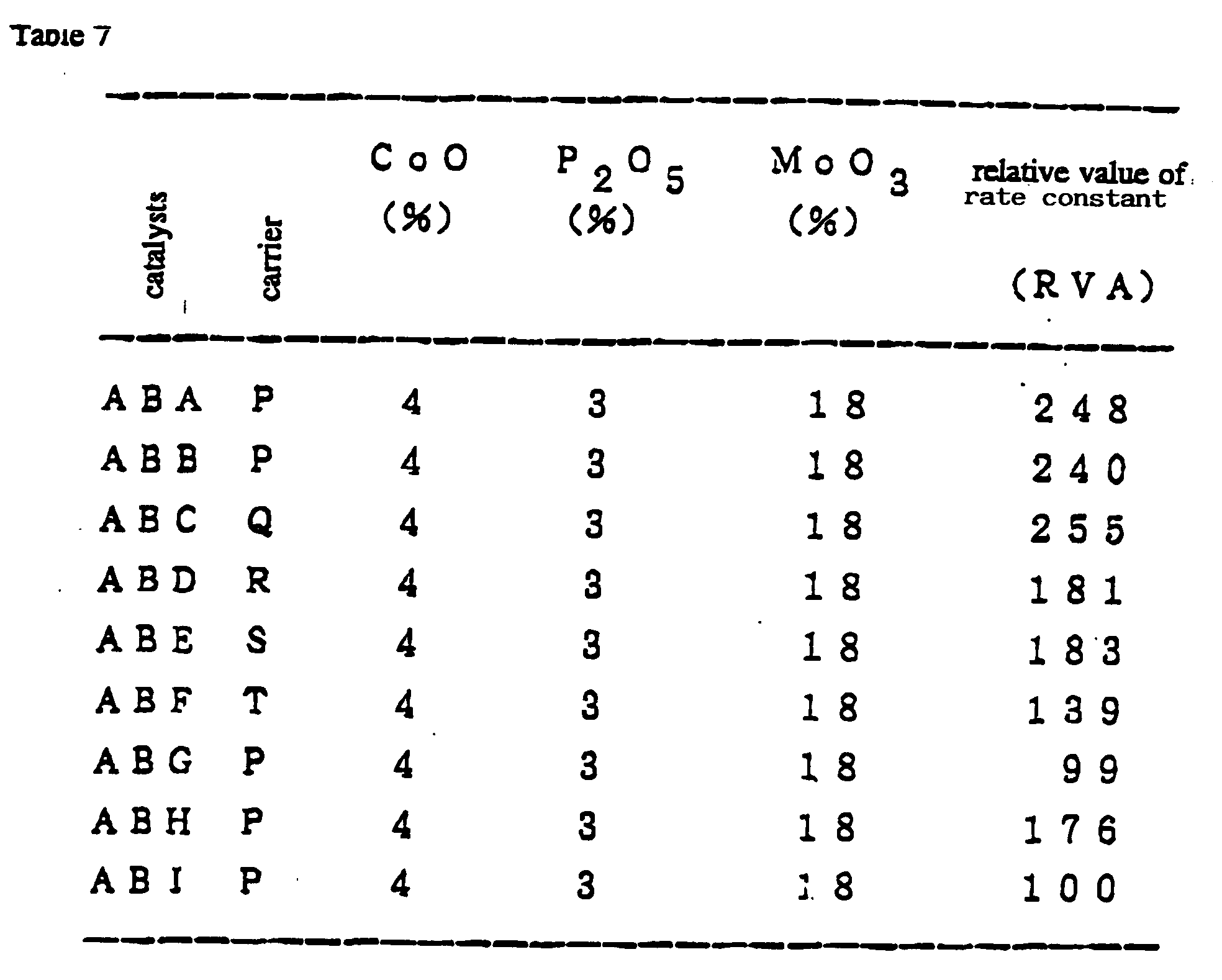
Table 7 represents a list of the obtained results along with the chemical compositions. From Table 7, it was found that catalysts according to the present invention exhibit excellent improvement in catalytic activities. -
- (1) Preparation of γ alumina carrier substance
Using the same preparation procedures as for the example 1, γ alumina carrier substances were produced which are similar to those listed in Table 1 for example 1. - (2) Preparation of the hydrodesulfurization catalysts
Using γ alumina carrier substances obtained through the above (1) processes, catalysts ACA ~ ACI were prepared under the same conditions listed in Table 6 except that ethylene glycol was utilized as the selected additive agent. Catalysts from ACA to ACC are catalysts according to the present invention, while the catalysts ACD ~ ACH are comparisons and the catalyst designated as ACI is the conventional type of catalyst. - (3) Presulfurization treatment
Each of the catalysts prepared through the above (2) was subjected to presulfurization treatment in a similar manner to that done for example 1. No cobalt carbonyl was detected from the decomposition product which was produced during the presulfurization treatments. - (4) Hydrodesulfurization tests
Using presulfurized catalysts according to the above (3) process, each catalyst was subjected to the hydrodesulfurization tests in a similar manner as done for example 1 to examine the activity of hydrodesulfurization. Results obtained and chemical compositions are listed in Table 8. From Table 8, it is found that the catalytic activity has shown a remarkable improvement with catalysts of the present invention when compared with catalysts of the conventional types.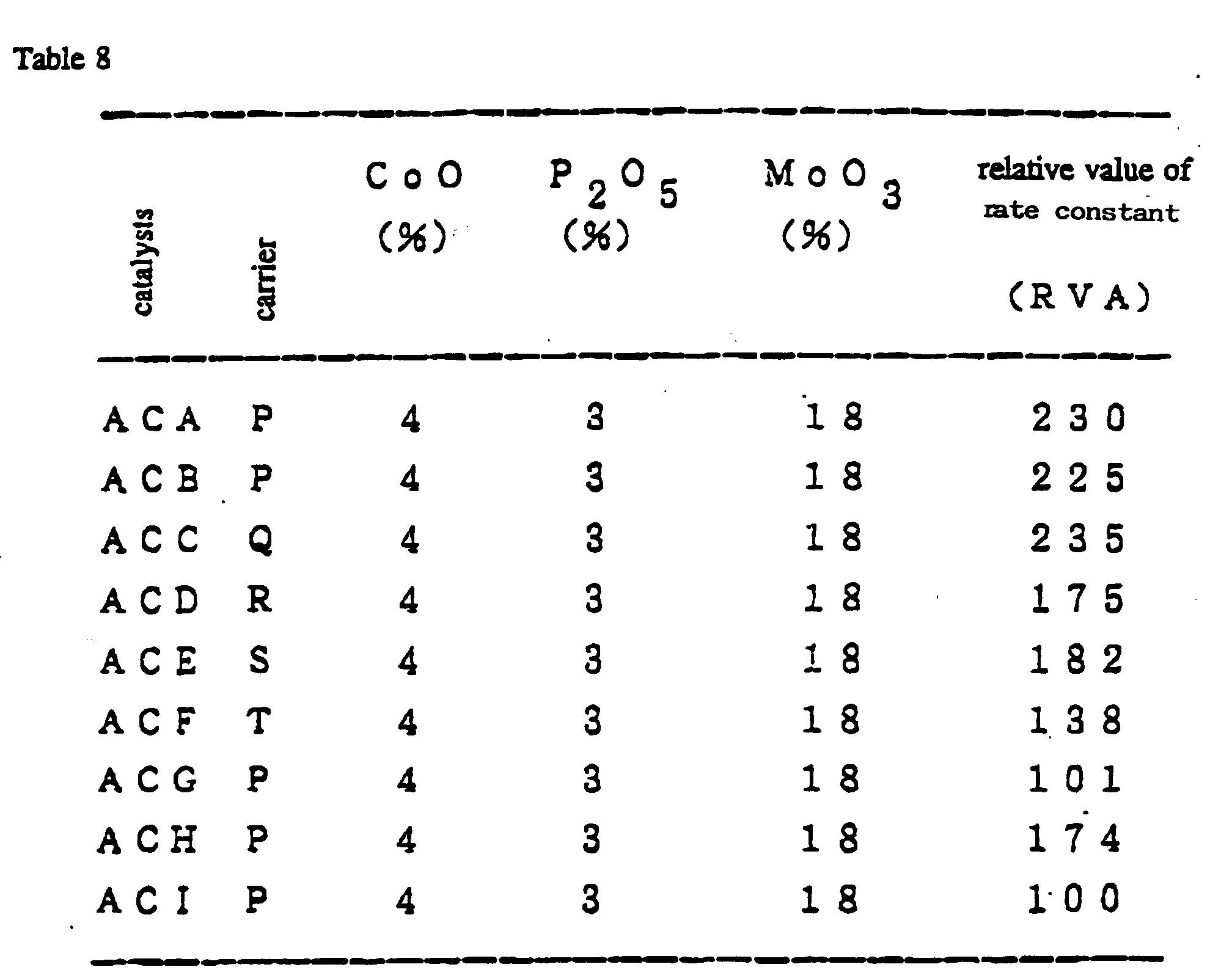
-
- (1) Preparation of γ alumina carrier substances
Under similar procedures as employed previously for example 1, γ alumina carrier substances were prepared which have similar characteristics listed in Table 1 for example 1. - (2) Preparation of the hydrodesulfurization catalysts
Using γ alumina carrier substances prepared in the above (1) procedures similar to Table 1, catalysts ADA ~ ADI were prepared using glycerine as an additive, as listed in Table 9. Catalysts ADA ~ ADC are of the present invention, while catalysts ADD ~ ADH are comparisons and the catalyst designated as ADI is the conventional type of catalyst.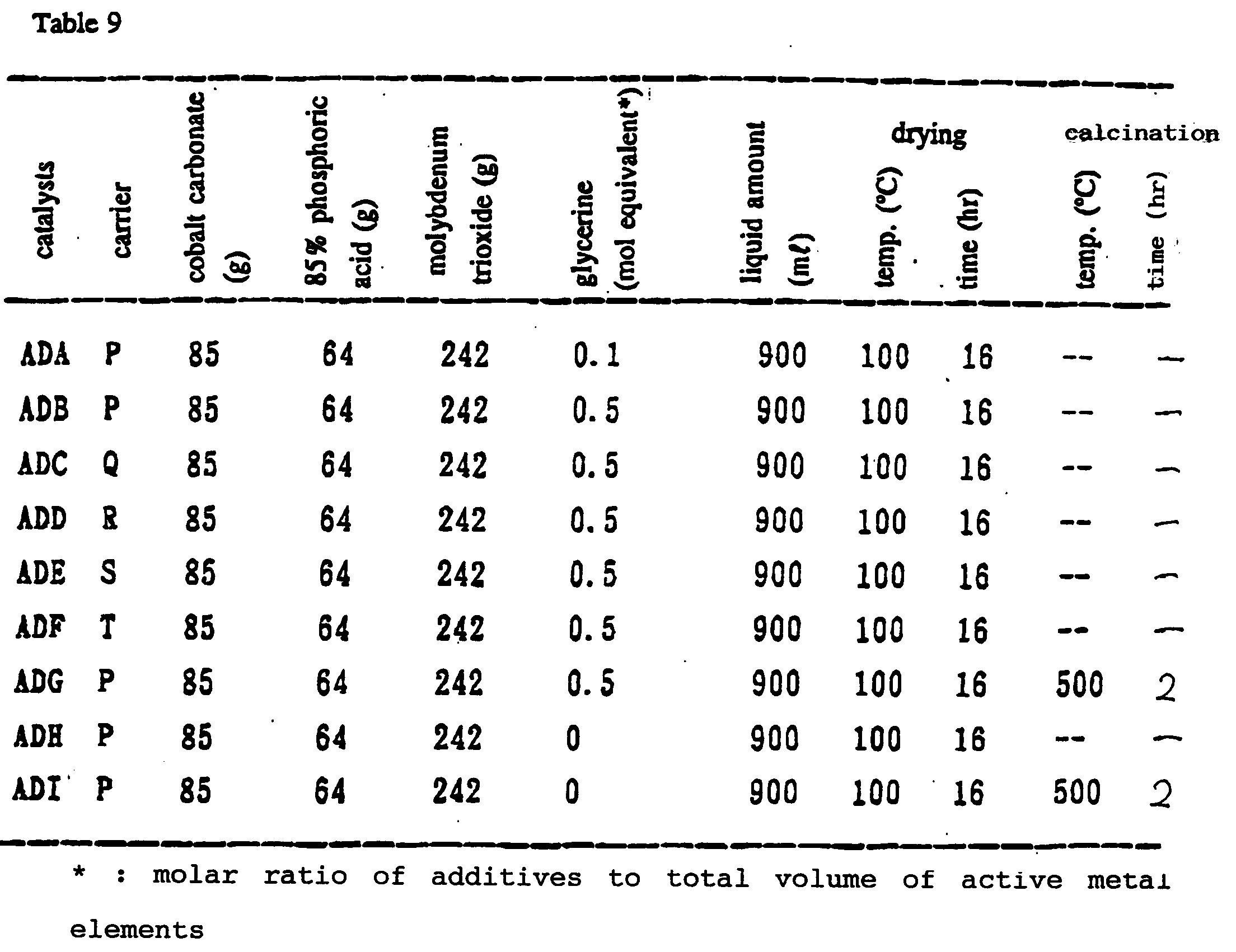
- (3) Presulfurization treatment
Presulfurization treatments were performed in a similar manner to that for example 1. It was found that no cobalt carbonyl was detected from the decomposition product which was produced during the presulfurization treatment. - (4) Hydrodesulfurization tests
Using catalysts presulfurized according to the above (3) procedures, each catalyst was subjected to hydrodesulfurization tests in a similar manner to that for example 1 in order to examine activity of hydrodesulfurization. Results obtained along with chemical compositions are listed in Table 10. It was found that catalysts according to the present invention exhibit significant enhancement of catalytic activities.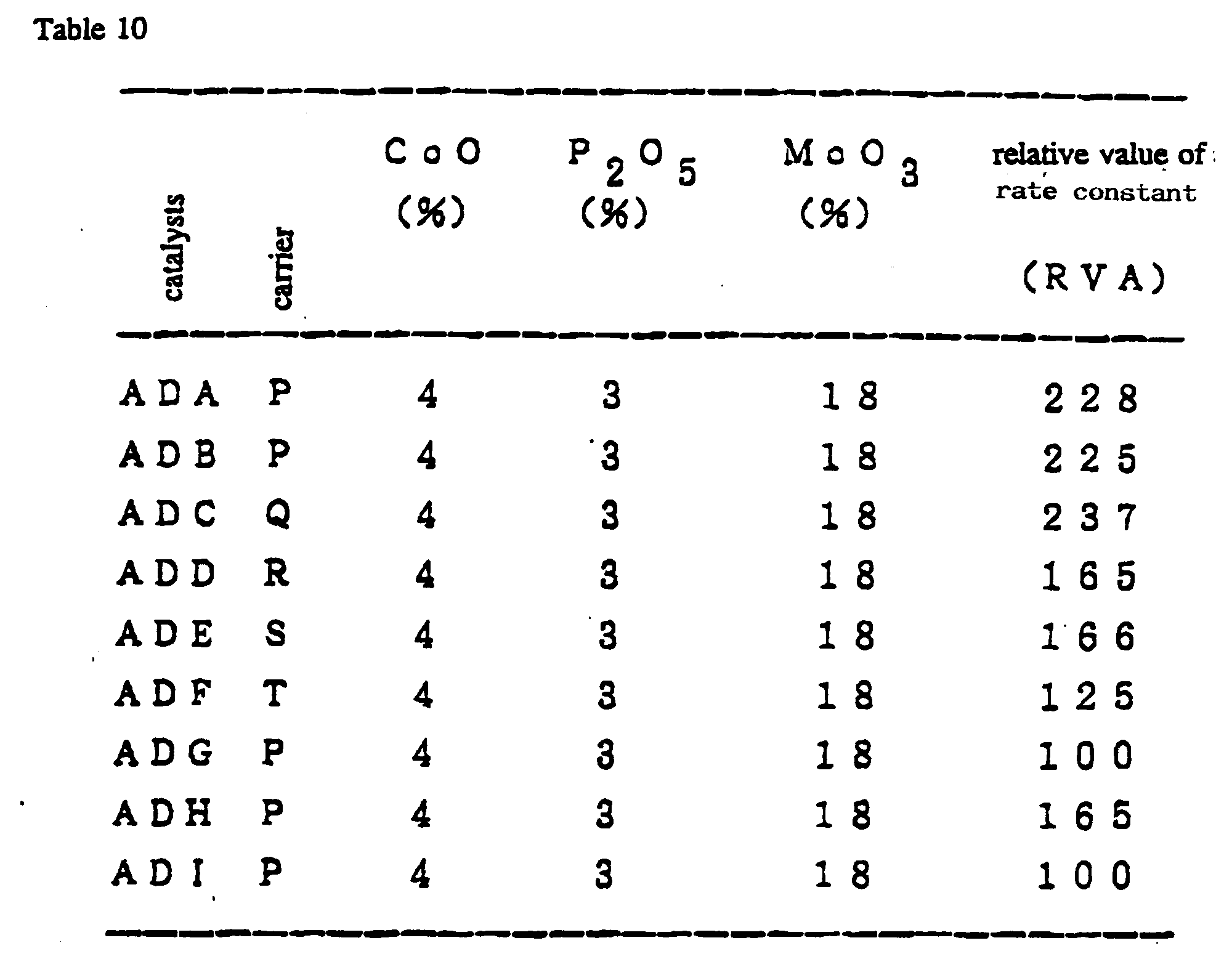
-
- (1) Preparation of γ alumina carrier substances
Similarly to example 1, γ alumina carrier substances which have similar characteristics as those listed in Table 1 for example 1 were prepared. - (2) Preparation of the hydrodesulfurization catalysts
Using γ carrier substances prepared through the above (1) procedures, catalysts AEA ~ AEI were prepared under similar conditions as for Table 9 except that diethylene glycol monoethyl ether was used as an additive agent. Catalysts AEA ~ AEC represent the invention, AED ~ AEH are comparisons and the catalyst designated as AEI is the conventional type of catalyst. - (3) Presulfurization treatment
Presulfurization treatments were performed in a similar manner to that for example 1. No cobalt carbonyl was detected from the decomposition product.
- (4) Hydrodesulfurization tests
Using the catalysts presulfurized by the above (3) process, a similar hydrodesulfurization test to example 1 was conducted to examine the activity for the hydrodesulfurization. Results obtained and chemical compositions are listed in Table 11. It was found that the catalysts according to the present invention exhibit remarkable improvement in catalytic activities. -
- (1) Preparation of γ alumina carrier substances
Similarly to example 1, γ alumina carrier substances with the same characteristics as listed in Table 1 for example 1 were prepared. - (2) Preparation of the hydrodesulfurization catalysts
Using γ alumina carrier substances prepared through the above (1) similar to Table 1, catalysts AFA ~ AFI were prepared according to conditions listed in Table 9 except that diethylene glycol mono butyl ether was used as an additive agent. Catalysts AFA ~ AFC are of the present invention, AFD ~ AFH are comparisons, and AFI is the conventional type of catalyst. - (3) Presulfurization treatments
Presulfurization treatments were performed on each catalyst conditioned through the above (2) procedures. No cobalt carbonyl was detected from the decomposition product which was produced during the presulfurization treatment. - (4) Hydrodesulfurization tests
Using the catalysts presulfurized through the above (3) processes, hydrodesulfurization tests were performed in a similar manner as for example 1 to examine the catalytic activity of the hydrodesulfurization. Results along with the chemical compositions are listed in Table 12. It was found that catalysts according to the present invention exhibit significant improvement in catalytic activities when compared to the catalysts prepared by the conventional methods. -
(1) Preparation of γ alumina carrier substances
Similar γ alumina carrier substances were prepared according to Table 1 for example 1.
(2) Preparation of the hydrodenitrogenation catalysts
Using 1 kg of γ alumina carrier substances prepared through the above (1) procedures, catalysts BAA ~ BAI were prepared according to conditions listed in Table 13 using diethylene glycol as an additive agent. Catalysts BAA ~ BAC are catalysts according to the present invention, BAD ~ BAH are comparisons and BAI is the conventional type of catalyst.
(3) Presulfurization treatment
Catalysts obtained from the above (2) process were each presulfurized similarly to example 1. No nickel carbonyl was detected from the decomposition product which was produced during the presulfurization treatment.
(4) Hydrodenitrogenation tests
Catalysts prepared by the above (3) procedures are subjected to hydrodenitrogenation tests using the same equipment utilized for the presulfurization treatment in order to examine the catalytic activity of hydrodenitrogenation. Testing conditions are as follows;(conditions for hydrodenitrogenation) catalysts amount (mℓ) : 15 reaction temperature (°C) : 330 hydrogen pressure (kg/cm²G) : 30 liquid space velocity of feed oil (hr⁻¹) : 2 hydrogen/oil flow ratio (Nℓ/ℓ) : 300 flow time of oil (hr) : 88
The rate constant was obtained from the nitrogen content in the treated oil. The activity for the hydrodenitrogenation was indicated by the relative value of the rate constant. Nitrogen content in the treated oil was analyzed by the Nitrogen analyzer (Mitsubishi Kasei Co. Ltd., TN-05 Type). The rate constant is expressed as a pseudo first order reaction rate constant and is calculated by equation 2 below. The rate constant for the conventional catalyst BAI was set to be 100 as a reference point for the other types of catalysts.
- No
- : nitrogen content in feed oil (ppm),
- N
- : nitrogen content in treated oil (ppm), and
- LHSV
- : liquid space velocity (hr⁻¹).
-
- (1) Preparation of γ alumina carrier substances
The γ alumina carrier substances are prepared under similar procedures as for example 1, listed in Table 1. - (2) Preparation of the hydrodenitrogenation catalysts
Similar γ alumina carrier substances as those obtained before and having characteristics listed in Table 1 according to the above (1) procedures, catalysts BAA' ~ BAI' were prepared under conditions listed in Table 15 using diethylene glycol as an additive agent. Catalysts BAA' ~ BAC' are catalysts according to the present invention , BAD' ~ BAH' are comparisons while the catalyst designated as BAI' is the conventional catalyst.
- (3) Presulfurization treatment
Similarly to example 1, catalysts obtained by the above (2) procedures were each subjected to presulfurization treatment. No nickel carbonyl was detected from the decomposition product which was produced during the presulfurization treatments. - (4) Hydrodenitrogenation tests
Using the catalysts presulfurized by the above (3) process, the hydrodenitrogenation tests similar to example 8 were conducted to examine the catalytic activity of the hydrodenitrogenation. Results and chemical compositions are listed in Table 16. It was found that the present catalysts exhibit a remarkable enhancement in terms of catalytic activity.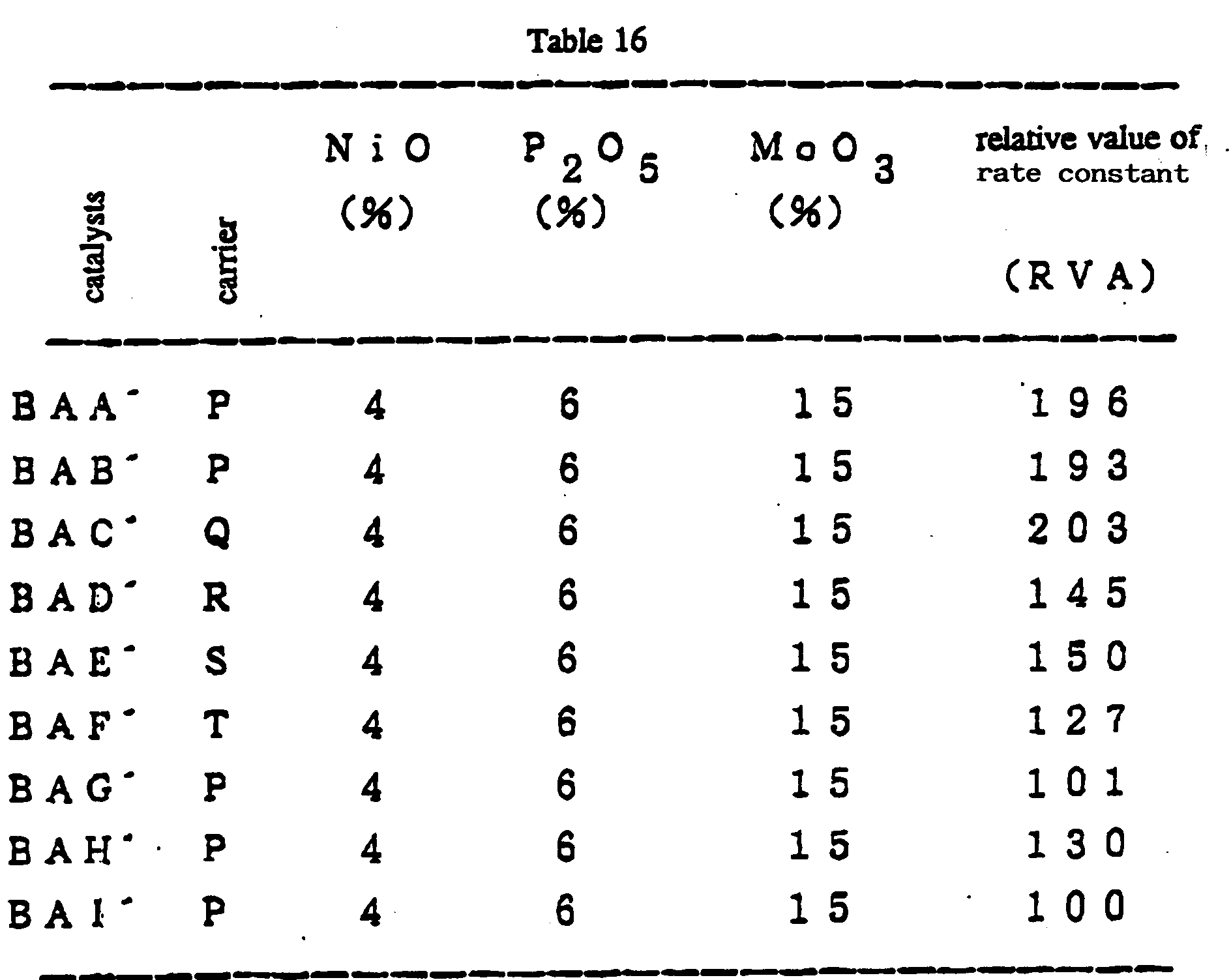
-
- (1) Preparation of γ alumina carrier substances
The γ alumina carrier substances were prepared under similar procedures as employed in example 1 with similar characteristics listed in Table 1. - (2) Preparation of the Hydrodenitrogenation catalysts
Using the γ alumina carrier substances obtained from the above (1) process, catalysts BBA ~ BBI were prepared under conditions listed in Table 17, using triethylene glycol as an additive agent.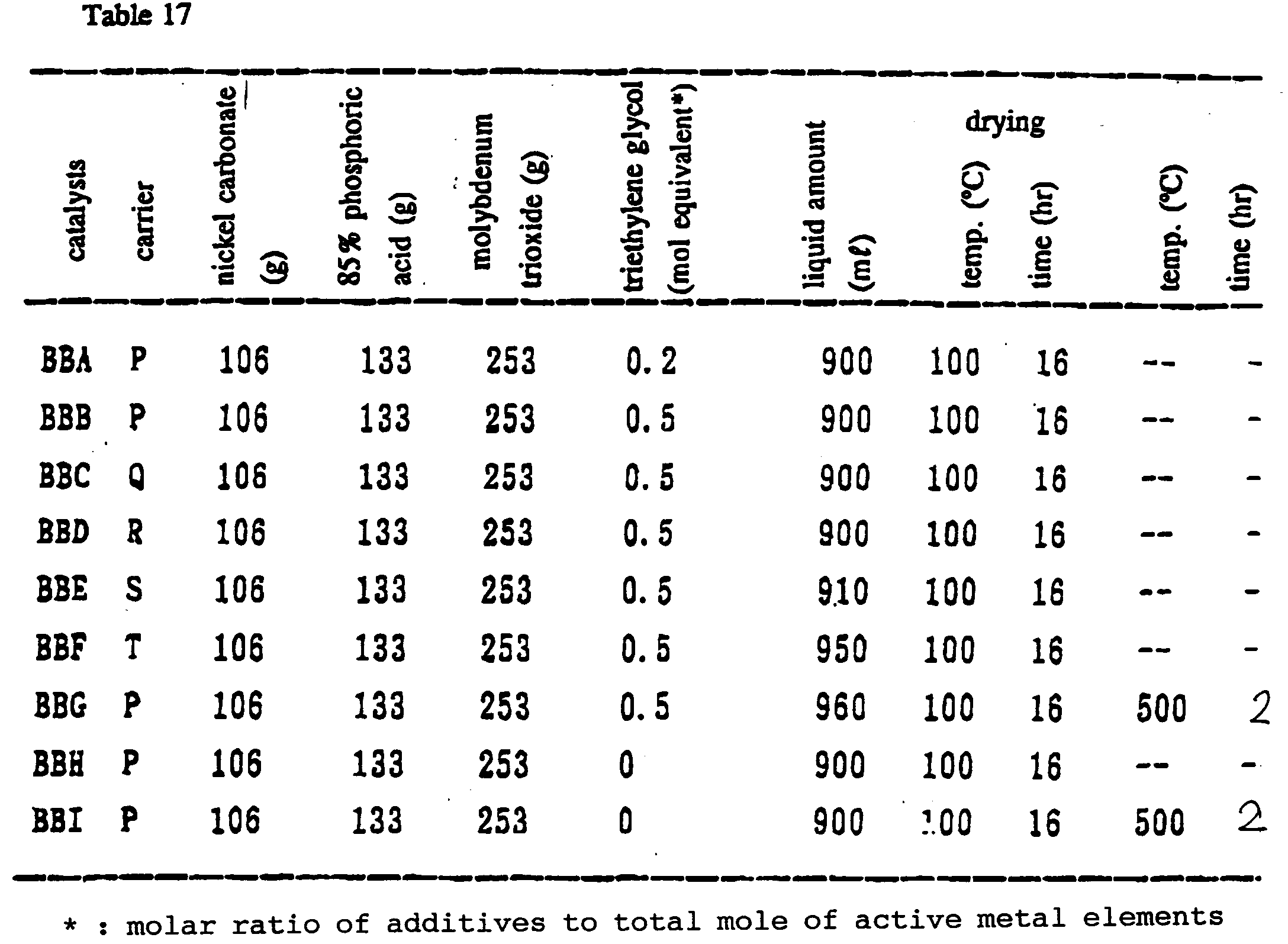
In Table 17, catalysts BBA ~ BBC are catalysts according to the present invention, BBD ~ BBH are comparisons, and the catalyst designated as BBI is a conventional catalyst. - (3) Presulfurization treatment
Similarly to example 1, each of the catalysts prepared by the above (2) procedures is subjected to hydrodenitrogenation tests under same procedures as for example 8 to examine the catalytic activities of the hydrodenitrogenation. Results with chemical compositions are listed in Table 18. From Table 18, it is found that the present catalysts improve remarkably the catalytic activities.
-
- (1) Preparation of γ alumina carrier substances
The γ alumina carrier substances are prepared under similar procedures to those for example 1 having same characteristics as listed in Table 1. - (2) Preparation of the hydrodenitrogenation catalysts
Using γ alumina carrier substances prepared by the above (1) process, catalysts BCA ~ BCI were prepared in a similar manner as listed in Table 14, except that ethylene glycol was employed as an additive agent.
In Table 19, catalysts BCA ~ BCC represent catalysts according to the present invention, BCD ~ BCH are comparisons, and the catalyst designated as BCI is a conventional catalyst. - (3) Presulfurization treatment
Each of the catalysts listed in Table 19 was subjected to the presulfurization treatment according to a similar procedure as example 1. No nickel carbonyl was detected from the decomposition which was produced during the presulfurization treatment. - (4) Hydrodenitrogenation tests
The presulfurized catalysts obtained by the above (3) procedures were subjected to the hydrodenitrogenation tests in a similar manner as for example 8 to examine the catalytic activity. Results along with the chemical compositions are listed in Table 19. It was found that the catalysts according to the present invention enhanced the catalytic activities. -
- (1) Preparation of γ alumina carrier substances
The γ alumina carrier substances were prepared according to the same procedures for example 1 having the similar characteristics. - (2) Hydrodenitrogenation catalysts
Using the γ alumina carrier substances prepared by the above (1) procedures which are similar to Table 1, catalysts BDA ~ BDI were prepared under the conditions listed in Table 20 using glycerine as an additive agent. Catalysts BDA ~ BDC are catalysts according to the present invention, BDD ~ BDH are comparisons, and the catalyst designated as BDI is the conventional type of catalyst. - (3) Presulfurization treatment
Similar presulfurization treatments were applied to each catalyst prepared through the above (2) step. No nickel carbonyl was detected from the decomposition product which was produced during the presulfurization treatment.
- (4) Hydrodenitrogenation tests
Using the catalysts presulfurized by the process (3), each catalyst was subjected to the hydrodenitrogenation tests in a similar manner to example 8 to examine the catalytic activities. Results and chemical compositions are listed in Table 21. It was found, from Table 21, that the catalysts according to the present invention improve the catalytic activity significantly.
-
- (1) Preparation of γ alumina carrier substances
The γ alumina carrier substances were prepared in a similar manner to example 1 having the same characteristics as listed in Table 1. - (2) Preparation of the hydrodenitrogenation catalysts
Using the γ alumina prepared by the above (1) procedures, catalysts BEA ~ BEI were prepared under similar conditions as listed in Table 20 except that diethylene glycol monoethyl ether was used as an additive agent. Catalysts BEA ~ BEC are catalysts according to the present invention, BED ~ BEH are comparisons, and the catalyst designated as BEI is the conventional type of catalyst, as listed in Table 22.
- (3) Presulfurization treatment
Each catalyst obtained by the above (2) process was subjected to presulfurization treatments. No nickel carbonyl was detected form the decomposition product during the presulfurization treatment. - (4) Hydrodenitrogenation tests
Using presulfurized catalysts, each catalyst was subjected to the hydrodenitrogenation tests under similar procedures as in example 8 to examine the catalytic activities. As seen in Table 22, it was found that the catalysts according to the present invention enhance the catalytic activities significantly. -
- (1) Preparation of γ alumina carrier substances
The γ alumina carrier substances were prepared according to similar procedures as in example 1. - (2) Preparation of the hydrodenitrogenation catalysts
Using the γ carrier substances having similar characteristics as listed in Table 1, catalysts BFA ~ BFI were prepared under the similar conditions as listed in Table 20 except that diethylene glycol monobutyl ether was employed as an additive agent. In Table 23, catalysts BFA ~ BFC are catalysts according to the present invention, BFD ~ BFH are comparisons, and the catalyst designated as BFI is the conventional catalyst. - (3) Presulfurization treatment
Each catalyst was presulfurized according to the same procedures as example 1. No nickel carbonyl was detected from the decomposition product during the presulfurization treatment. - (4) Hydrodenitrogenation tests
Using the catalysts presulfurized by the above (3) procedures, each of the catalysts was subjected to the catalytic hydrodenitrogenation tests in a similar manner to example 8 to examine the catalytic activities. Results along with the chemical compositions are listed in Table 23. It was found that the catalysts according to the present invention exhibit significant improvements in catalytic activities.
-
- (1) Preparation of the hydrodesulfurization catalysts
Using 1 kg of the aforementioned γ alumina carrier substance P, catalysts CAA ~ CAR were prepared using diethylene glycol or triethylene glycol as an additive agent, under similar procedures as example 1, see Table 24.
In Table 24, catalysts CAB ~ CAG, and CAJ ~ CAQ are the catalysts according to the present invention, CAA, CAH, CAI, CAP, and CAQ are comparisons, and the one designated as CAR is the conventional type of catalyst.
- (2) Presulfurization treatments
Each catalyst prepared in the above (1) procedure was presulfurized as in example 1. No cobalt carbonyl was detected in the decomposition product during the presulfurization treatments. - (3) Hydrodesulfurization tests
Using catalysts presulfurized according to the above (2) process, catalysts were subjected to the hydrodesulfurization tests under a similar procedure as in example 1 to examine the catalyst activities. Results along with chemical compositions are listed in Table 25. From Table 25, it was found that the present catalysts show significant enhancement in catalytic activities.
-
- (1) Preparation of the hydrodesulfurization catalysts.
Using ethylene glycol as an additive agent, catalysts CBA ~ CBG were prepared under similar procedures as in example 15 except with the conditions listed in Table 26. In Table 26, catalysts CBB ~ CBE are the catalysts according to the present invention, CBA and CBF are comparisons, and the one designated as CBG is the conventional type of catalyst.
- (2) Presulfurization treatments
Each of the catalysts prepared according to the above (1) was presulfurized as in example 1. No cobalt carbonyl was detected from the decomposition product during the presulfurization treatment. - (3) Hydrodesulfurization tests
Using catalysts presulfurized by the above (2) process, each catalyst was subjected to the hydrotreating desulfurization tests under a similar procedure as for example 1 to investigate the catalyst activity. Results and chemical compositions are listed in Table 27. From Table 27, it is found that catalysts within the defined range in the present invention exhibit remarkable improvement in the catalytic activities.
-
- (1) Preparation of the hydrodesulfurization catalysts
Using diethylene glycol monobutyl ether as an additive agent, catalysts CCA ~ CCG were prepared in accordance with a similar procedure to example 16 except that 1.5 mole weight is changed to 1.0 mole weight. Catalysts CCB ~ CCE are the present catalysts, CCA and CCF are comparisons, and the one designated as CCG is the conventional type of catalyst. - (2) Presulfurization treatments
Catalysts obtained by the above (1) process are presulfurized in a similar manner to example 1. No cobalt carbonyl was detected from the decomposition product during the presulfurization treatment. - (3) Hydrodesulfurization tests
Using the presulfurized catalysts of the above (2) procedure, each catalyst was subjected to the hydrodesulfurization tests in a similar manner to example 1 to examine the catalytic activities. Obtained results along with the chemical compositions are listed in Table 28. It was found, from Table 28, that the catalysts within the present invention exhibit significant enhancement in catalytic activities.
-
- (1) Preparation of the hydrodesulfurization catalysts
Catalysts CDA ~ CDG were prepared in a similar manner to example 17 except that diethylene glycol monoethyl ether was employed as an additive agent. Catalysts CDB ~ CDE are catalysts according to the present invention, CDA and CDF are comparisons, and the one designated as DCG is the conventional catalyst. - (2) Presulfurization treatment
Each catalyst was presulfurized in a similar manner to example 1. No cobalt carbonyl was detected in the decomposition product during the presulfurization treatment. - (3) Hydrodesulfurization tests
Using presulfurized catalysts, each catalyst was subjected to the hydrodesulfurization tests in a similar manner to example 1 to examine the catalytic activities. Results are listed in Table 29 along with chemical compositions. From Table 29, it was found that the catalysts according to the present invention show remarkable improvements in catalytic activities.
-
- (1) Preparation of the hydrodesulfurization catalysts
Catalysts CEA ~ CEG were prepared in a similar method as to example 17 except that glycerine was utilized as an additive agent. Catalysts CEB ~ CEE are catalysts according to the present invention, CEA and CEF are comparisons, and the one designated as CEG is the conventional type of catalyst. - (2) Presulfurization treatment
Catalysts were presulfurized in a similar manner to example 1. No cobalt carbonyl was detected from the decomposition product. - (3) Hydrodesulfurization tests
Using presulfurized catalysts, each catalyst was subjected to the hydrodesulfurization tests in a similar way to example 1 to examine the catalytic activities. Results and chemical compositions are listed in Table 30. It was found that the catalysts according to the present invention show significant improvements in the catalytic activities.
-
- (1) Preparation of the hydrodenitrogenation catalysts
Using the aforementioned carrier substance P, catalysts DAA ~ DAP were prepared in a similar manner to example 1 with conditions listed in Table 31 by using diethylene glycol or triethylene glycol as an additive agent.
In Table 31, catalysts DAB ~ DAF, and DAI ~ DAM are catalysts according to the present invention, DAA, DAG, DAH, DAN, and DAO are comparisons, and the one designated as DAP is the conventional type of catalyst. - (2) Presulfurization treatment
Each catalyst was presulfurized according to a similar manner as in example 1. No nickel carbonyl was detected from the decomposition product which is produced during the presulfurization treatment. - (3) Hydrodenitrogenation tests
Using the catalysts presulfurized in the above (2) procedure, each catalyst was subjected to hydrodenitrogenation tests in a similar manner to example 8 to investigate the catalytic activities. The obtained results and chemical compositions are listed in Table 32. From Table 32, it is found that the catalysts according to the present invention enhance the catalytic activities remarkably.
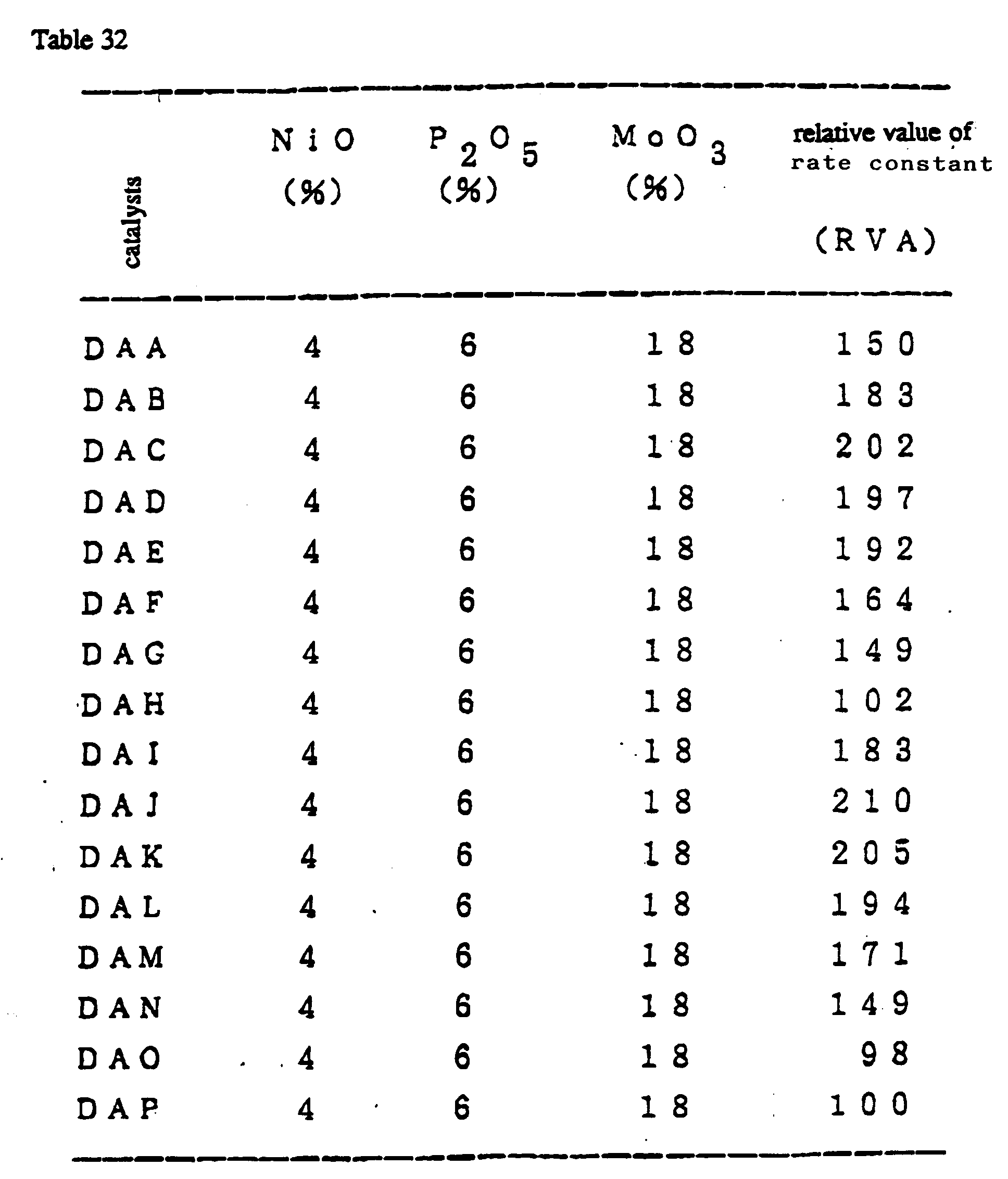
-
- (1) Preparation of the hydrodenitrogenation catalysts
Using the ethylene glycol as an additive agent, catalysts DBA ~ DBG were prepared in a similar manner to example 20 and conditions are listed in Table 33. Catalysts DBB ~ DBE are catalysts according to the present invention, DBA and DBF are comparisons while the one designated as DBG is the conventional type of catalyst.
- (2) Presulfurization treatment
Each catalyst was presulfurized according to the similar manner as example 1. No nickel carbonyl was detected from the decomposition product during the persulfurization treatment. - (3) Hydrodenitrogenation tests
Using catalysts presulfurized by the above (2) procedures, each catalyst was subjected to the hydrodenitrogenation tests under a similar procedure as in example 8 to evaluate the catalytic activities. The obtained data and chemical compositions are listed in Table 34. It was found that the catalyst according to the present invention exhibit great improvements in catalytic activities compared with conventional types of catalysts.
-
- (1) Preparation of the hydrodenitrogenation catalysts
Using diethylene glycol monobutyl ether as an additive agent, catalysts DCA ~ DCG were prepared under a similar procedure as in example 20 except that 1.5 mol equivalent was changed to be only 1.0 mole equivalent. Catalysts DCA ~ DCE are catalysts according to the present invention, DCA and DCF are comparisons and the one designated as DCG is the conventional type of catalyst. - (2) Presulfurization treatment
Using catalysts prepared with the above (1) procedure, each catalyst was presulfurized as in example 1. No nickel carbonyl was detected in the decomposition product during the presulfurization treatment. - (3) Hydrodenitrogenation tests
Using presulfurized catalysts, each catalyst was subjected to the hydrodenitrogenation tests in a similar manner to example 8 to examine the catalytic activities. Obtained data along with chemical compositions are listed in Table 35. From Table 35, it is found that the catalysts according to the present invention show remarkable enhancement in catalytic activities.
-
- (1) Preparation of the hydrodenitrogenation catalysts
Using diethylene glycol mono ethyl ether as an additive agent, catalysts DDA ~ DDG were prepared in a similar manner to example 22. Catalysts DDB ~ DDE are catalysts according to the present invention, DDA and DDF are comparisons, and the one designated as DDG is the conventional type of catalyst.
- (2) Presulfurization treatment
Each catalyst was presulfurized according to a method similar to example 1. No nickel carbonyl was detected from the decomposition product during the persulfurization treatment. - (3) Hydrodenitrogenation tests
Using the presulfurized catalysts, each catalyst was subjected to hydrodenitrogenation tests similar to as in example 8 to evaluate the catalytic activities. The obtained results and chemical compositions are listed in Table 36. It is found that the catalysts according to the present invention demonstrate great improvement in catalytic activities. -
- (1) Preparation of the hydrodenitrogenation catalysts
Using the glycerine as an additive agent, catalysts DEA ~ DEC were prepared in a similar manner to in example 22. Catalysts DEB ~ DEE are catalysts according to the present invention, DEA and DEF are comparisons, and the one designated as DEG is the conventional type of catalyst.
- (2) Presulfurization treatment
Using the catalysts prepared by the above (1) procedure, each catalyst was presulfurized under a similar method as for example 1. No nickel carbonyl was detected from the decomposition product during the presulfurization treatment. - (3) Hydrodenitrogenation tests
Using presulfurized catalysts, each catalyst was subjected to the hydrodenitrogenation tests in a similar manner as done for the example 8 to examine the catalytic activity. The obtained data and chemical compositions are listed in Table 37. It is found that the catalysts according to the present invention show remarkable improvement in the catalytic activities. -
- (1) Preparation of γ alumina carrier substances
Similarly as in example 1, the γ alumina carrier substances were prepared. - (2) Preparation of the hydrodesulfurization catalysts
Using the γ alumina carrier substances prepared in the above (1) process, catalysts EAA ~ EAI were prepared under conditions listed in Table 38 using grape sugar as an additive agent. Catalysts EAA ~ EAC are catalysts according to the present invention, EAD ~ EAH are comparisons, and the one designated as EAI is the conventional type of the catalyst. - (3) Presulfurization treatment
Each catalyst prepared in the above (2) procedure was presulfurized in a similar manner as in example 1. No cobalt carbonyl was detected from the decomposition product during the presulfurization treatment.
- (4) Hydrodesulfurization tests
Using presulfurized catalysts, each catalyst was subjected to the hydrodesulfurization tests in a similar manner as example 1 to evaluate the catalytic activity. The obtained data along with the chemical compositions are listed in Table 39. From Table 39, it is found that the catalysts prepared through the present invention exhibit a significant improvement in catalytic activities.
-
- (1) Preparation of the γ alumina carrier substances
Similarly as in example 1, the γ alumina carrier substances were prepared. - (2) Preparation of the hydrodesulfurization catalysts
Using γ alumina carrier substances prepared by the above (1) procedure, catalysts EBA ~ EBI were prepared under conditions listed in Table 40 using malt sugar as an additive agent. Catalysts EBA ~ EBC are catalysts according to the present invention, EBD ~ EBH are comparisons, and the one designated as EBI is the conventional type of catalyst.
- (3) Presulfurization treatments
Using catalysts prepared by the step (2) above, each catalyst was presulfurized in a similar manner as in example 1. No cobalt carbonyl was detected from the decomposition product during the presulfurization treatment. - (4) Hydrodesulfurization tests
Using presulfurized catalysts, each catalyst was subjected to the hydrodesfulfurization tests to evaluate the catalytic activities. The results obtained from the tests are listed in Table 41 along with chemical compositions. It is found that the catalysts according to the present invention show great enhancement in catalytic activities.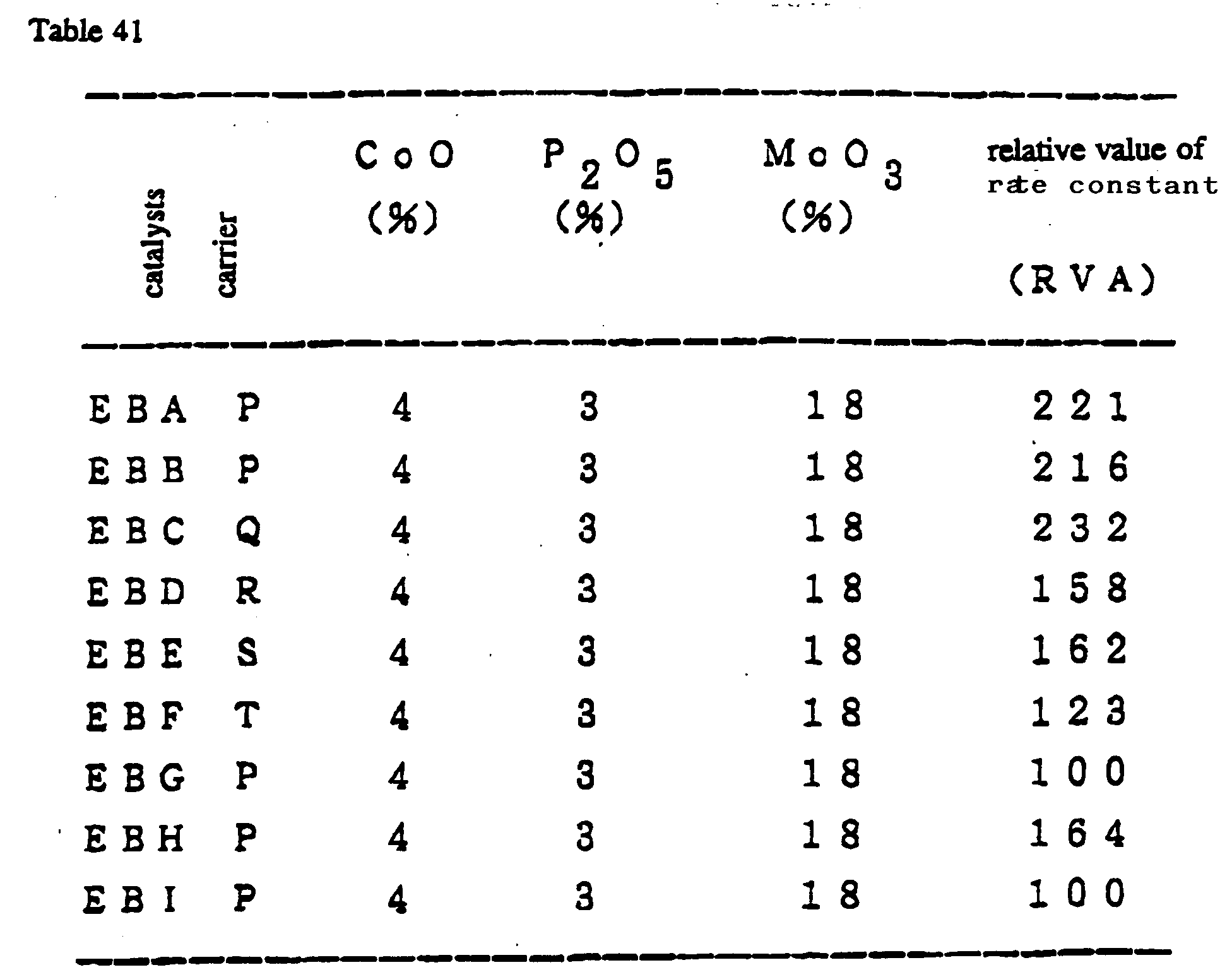
-
- (1) Preparation of the γ alumina carrier substances
The γ alumina carrier substances were prepared following a similar method to the one employed for example 1, showing the same characteristics as listed in Table 1. - (2) Preparation of the hydrodesulfurization catalysts
Using the γ alumina carrier substances, catalysts ECA ~ ECI were prepared under conditions listed in Table 42 using the milk sugar as an additive agent. Catalysts ECA ~ ECC are the catalysts according to the present invention, ECD ~ ECH are comparisons and the one designated as ECI is the conventional type of catalyst.

- (3) Presulfurization treatment
Following the similar procedures as in example 1, each catalyst was presulfurized. No cobalt carbonyl was detected from the decomposition product during the presulfurization treatment. - (4) Hydrodesulfurization tests
Using catalysts presulfurized by the step (3) above, each catalyst was subjected to the hydrodesulfurization tests to evaluate the catalytic activity. The obtained results and chemical compositions are listed in Table 43. From Table 43, it is found that the catalysts according to the present invention exhibit significant improvement in catalytic activities.
-
- (1) Preparation of the γ alumina carrier substances
According to the similar procedure done previously for example 1, the γ alumina carrier substances were prepared. - (2) Preparation of the hydrodenitrogenation catalysts
Using the γ alumina carrier substances, catalysts FAA ~ FAI were prepared under conditions listed in Table 44. Catalysts FAA ~ FAC are catalysts according to the present invention while FAD ~ FAH are comparisons and the one designated as FAI is the conventional catalyst.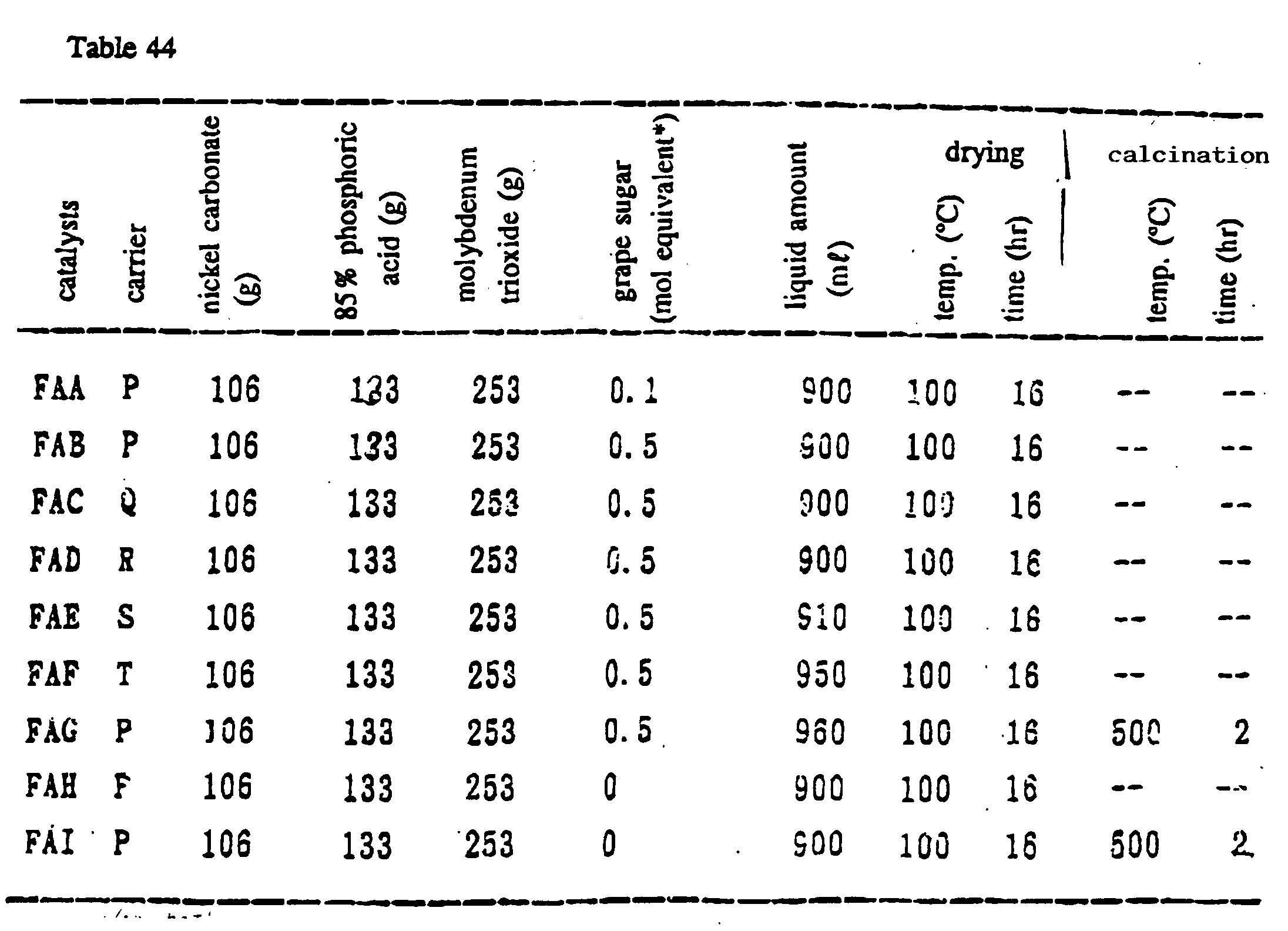

- (3) Presulfurization treatments
Each catalyst prepared by the above (2) process was presulfurized in a similar manner as in example 1. No nickel carbonyl was detected in the decomposition product. - (4) Hydrodenitrogenation tests
Using the persulfurized catalysts, each catalyst was subjected to the hydrodenitrogenation tests to evaluate the catalytic activity. The results obtained are listed in Table 45 along with the chemical compositions. It is found that the catalyst according to the present invention improves its catalytic activity remarkably.
-
- (1) Preparation of the γ alumina carrier substances
The γ alumina carrier substances were prepared using similar procedures as in example 1. - (2) Preparation of the hydrodenitrogenation catalysts
Using the γ alumina carrier substances, catalysts FBA ~ FBI were prepared under conditions listed in Table 46 using the malt sugar as an additive agent. In Table 46, catalysts FBA ~ FBC are catalysts according to the present invention while FBD ~ FBH are comparisons and the one designated as FBI is a conventional catalyst.
- (3) Presulfurization treatment
Using the catalyst prepared by the above (2) procedure, each catalyst was presulfurized in a similar manner to example 1. No nickel carbonyl was detected from the decomposition product during the presulfurization treatment. - (4) Hydrodenitrogenation tests
Using the presulfurized catalysts, each catalyst was subjected to the hydrodenitrogenation tests to evaluate the catalytic activities. The obtained data along with the chemical compositions are listed in Table 47. It is found that the catalysts according to the present invention enhance the catalytic activities remarkably.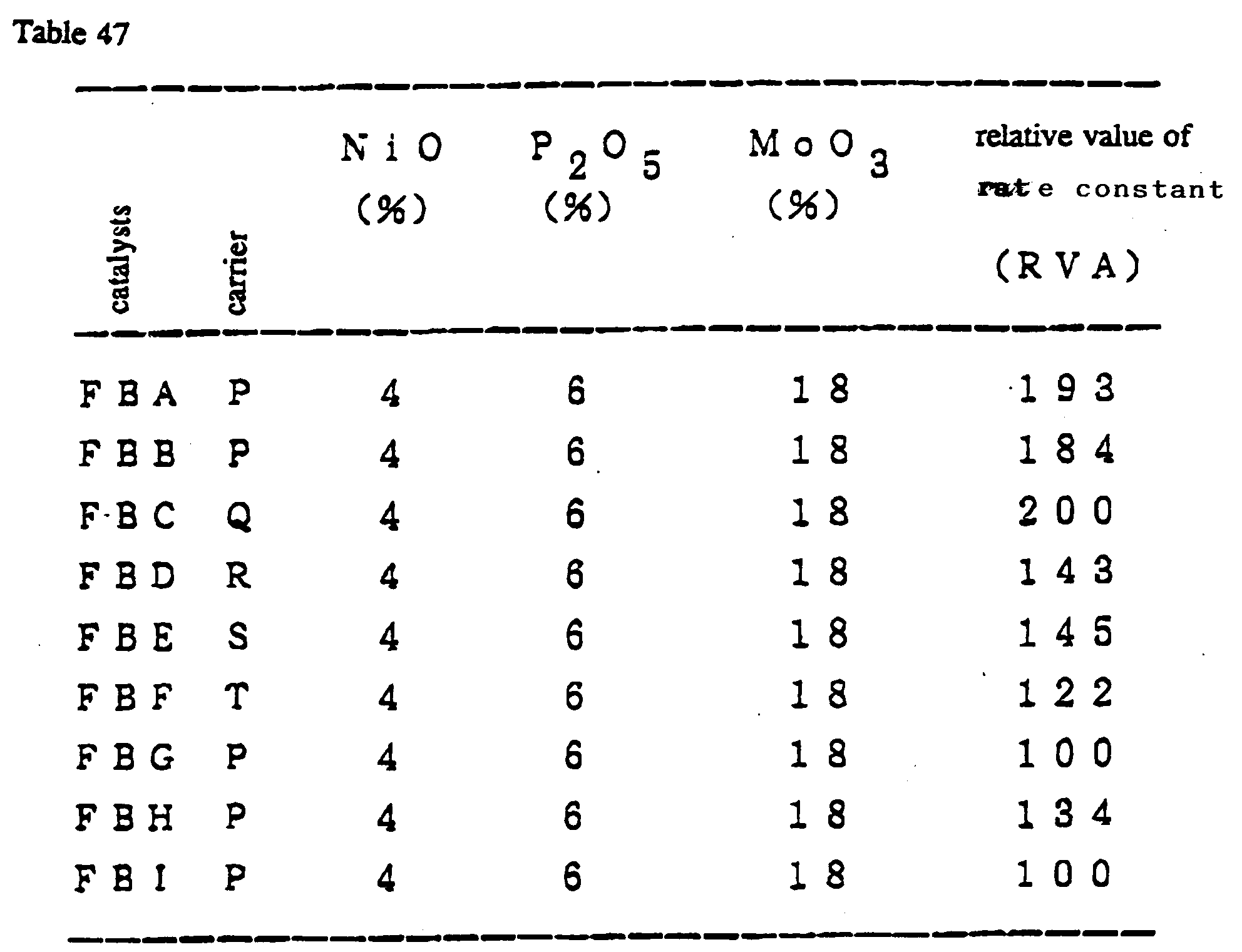
-
- (1) Preparation of the γ alumina carrier substances
Similarly as in example 1, the γ alumina carrier substances were prepared. - (2) Preparation of the hydrodenitrogenation catalysts
Using the γ alumina carrier substances prepared by the above (1) procedure, catalysts FCA ~ FCI were prepared under the conditions listed in Table 48 using the milk sugar as an additive agent. Catalysts FCA ~ FCC are catalysts according to the present invention, FCD ~ FCH are comparisons, and the one designated as FCI is the conventional type of catalysts.
- (3) Presulfurization treatment
Similarly as in example 1, catalysts prepared by the above (2) procedure were presulfurized. No nickel carbonyl was detected in the decomposition product during the presulfurization treatment. - (4) Hydrodenitrogenation tests
Using the presulfurized catalysts, each catalyst was subjected to the hydrodenitrogenation tests to evaluate the catalytic activities. The obtained data along with the chemical compositions are listed in Table 49. It was found that the catalyst according to the present invention exhibits significant improvement in catalytic activities.
-
- (1) Preparation of the hydrodesulfurization catalysts
Using the aforementioned γ alumina carrier substance P, catalysts GAA ~ GAG were prepared under the conditions listed in Table 50 using the grape sugar as an additive agent.
Catalysts GAB ~ GAE are catalysts according to the present invention, while GAA and GAF are comparisons, and the one given the designation of GAG is the conventional type of catalyst. - (2) Presulfurization treatment
Each catalyst prepared by the above (1) procedure was presulfurized in a similar way to example 1. No cobalt carbonyl was detected in the decomposition product which was produced during the presulfurization treatment. - (3) Hydrodesulfurization tests
Using the presulfurized catalysts, each catalyst was subjected to the hydrodesulfurization tests to evaluate the catalytic activities. The results are listed in Table 51 along with the chemical compositions.
It was found that the present catalysts according to the present invention show great enhancement in catalytic activities.
-
- (1) Preparation of the hydrodesulfurization catalysts
Using malt sugar as an additive agent, catalysts GBA ~ GBG were prepared under the conditions listed in Table 52 in a similar manner to example 31. Catalysts GBB ~ GBE are catalysts according to the present invention, while GBA and GBF are comparisons and the one designated as GBG is the conventional type of catalyst.
- (2) Presulfurization treatment
Each catalyst prepared in the above (1) step was presulfurized in a similar manner as in example 1. No cobalt carbonyl was detected in the decomposition product. - (3) Hydrodesulfurization tests
Using the presulfurized catalysts, each catalyst was subjected to the hydrodesulfurization tests to examine the catalyst activities. The obtained results are listed in Table 53 along with the chemical compositions. It is found that the catalyst according to the present invention shows a remarkable improvement regarding the activities of the catalyst.
-
- (1) Preparation of the hydrodesulfurization catalysts
Using the milk sugar as an additive agent, catalysts GCA ~ GCG were prepared under the conditions listed in Table 54. Catalysts GCB ~ GCE are catalysts according to the present invention while GCA and GCF are comparisons, and the designation GCG is the conventional type of catalyst. - (2) Presulfurization treatment
Each catalyst was presulfurized in a similar manner to example 1. No cobalt carbonyl was detected in the decomposition product during the presulfurization treatment.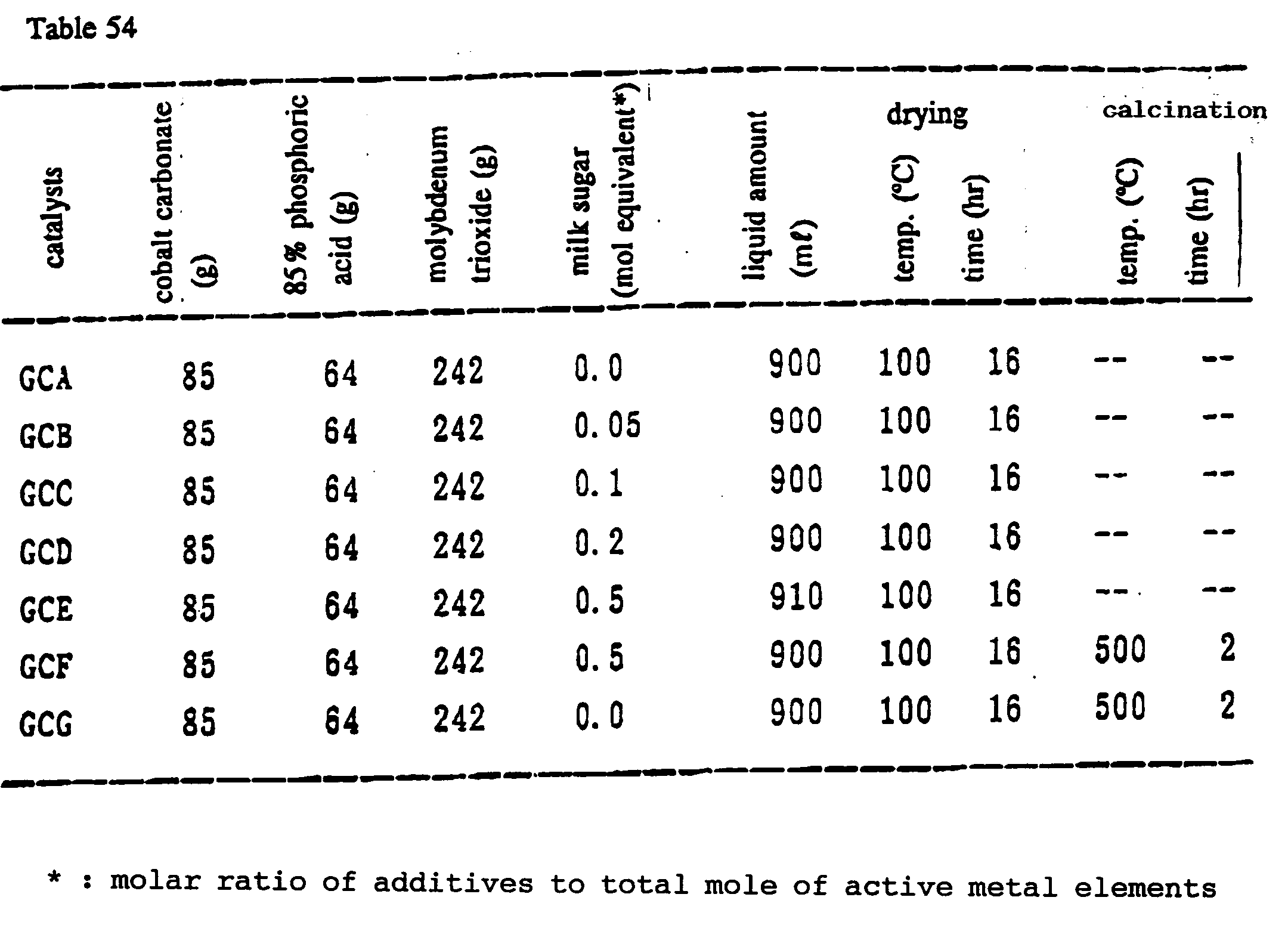
- (3) Hydrodesulfurization tests
Using the presulfurized catalysts, each catalyst was subjected to the hydrodesulfurization tests to evaluate the catalytic activity. The obtained results along with the chemical compositions are listed in Table 55. It was found that the catalysts according to the present invention show significant enhancement in catalytic activities, when compared with other types of catalysts.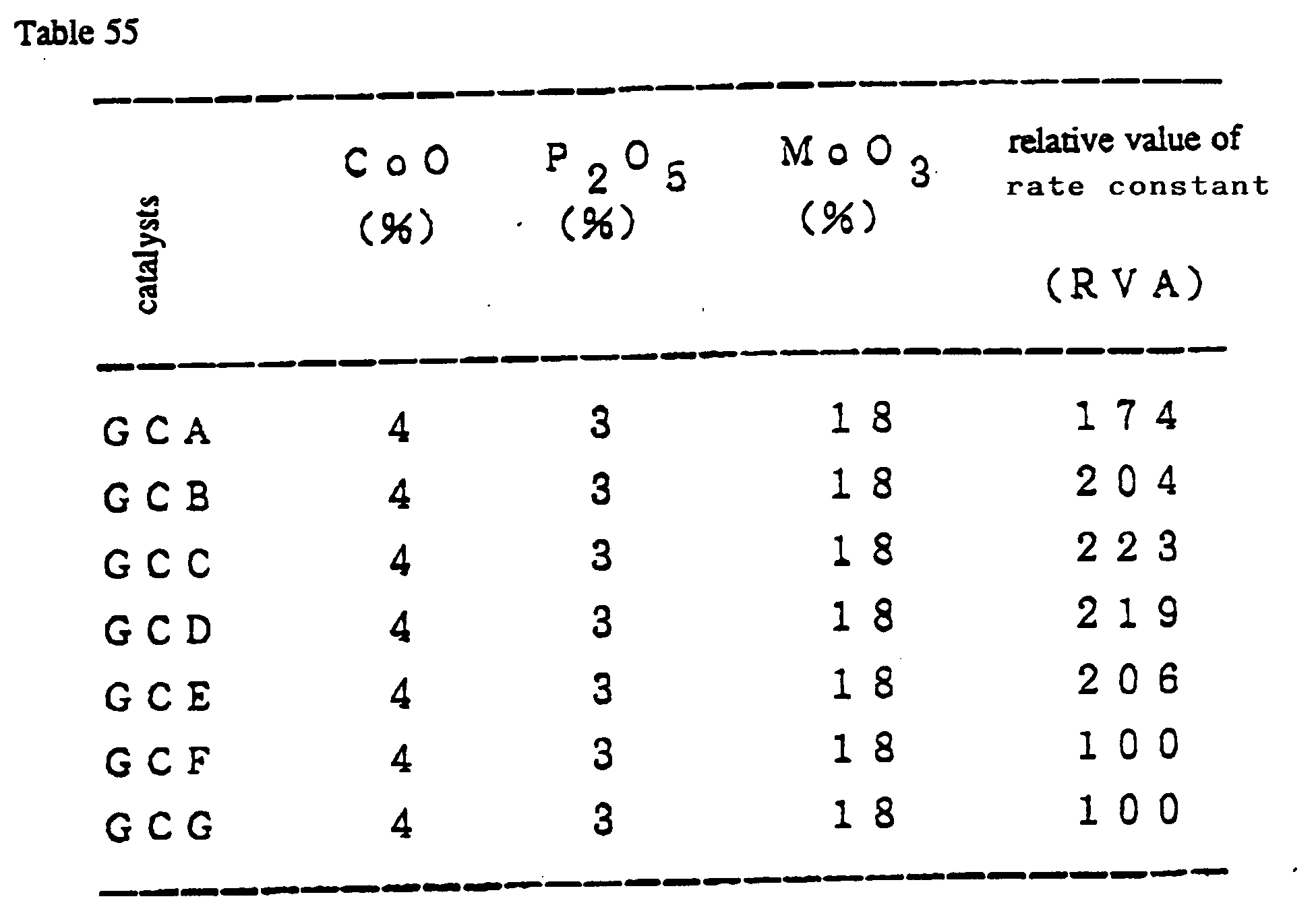
-
- (1) Preparation of the hydrodenitrogenation catalysts
Using the aforementioned γ alumina carrier substances P, catalysts HAA ~ HAG were prepared under the conditions listed in Table 56 using the grape sugar as an additive agent. In Table 56, catalysts HAB ~ HAE are catalysts according to the present invention while HAA and HAF are comparisons, and catalyst HAG represents the conventional type of catalyst.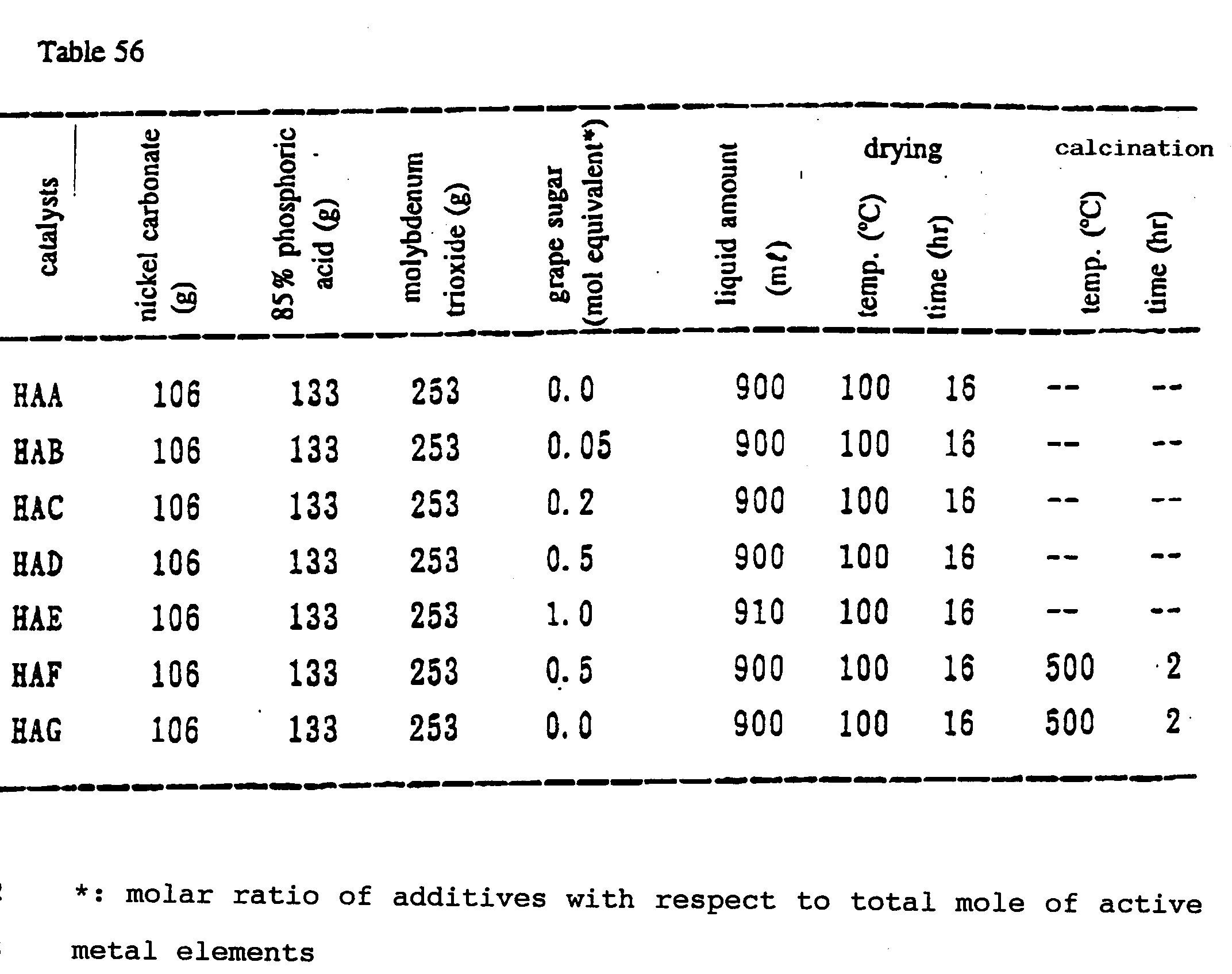
- (2) Presulfurization treatment
Each catalyst was presulfurized according to a similar procedure as in example 1. No nickel carbonyl was detected from the decomposition product during the presulfurization process. - (3) Hydrodenitrogenation tests
Using presulfurized catalysts, each catalyst was subjected to the hydrodenitrogenation tests to evaluate the catalytic activities. The data obtained and chemical compositions are listed in Table 57. It was found that the catalysts according to the present invention exhibit remarkable improvement in catalytic activities.
-
- (1) Preparation of the hydrodenitrogenation catalysts
Using the malt sugar as an additive agent, catalysts HBA ~ HBG were prepared under conditions listed in Table 58 in a similar manner to example 34. Catalysts HBB ~ HBE are catalysts according to the present invention while HBA and HBF are comparisons and HBG is the conventional catalyst. - (2) Presulfurization treatment
Each of the catalysts was presulfurized in a similar manner to example 1. No nickel carbonyl was detected from the decomposition product. - (3) Hydrodenitrogenation tests
The presulfurized catalyst was subjected to the hydrodenitrogenation tests to evaluate the catalytic activities. The results obtained are listed in Table 59. It was found that the catalyst according to the present invention exhibit remarkable improvement in the catalytic activities.

-
- (1) Preparation of the hydrodenitrogenation catalysts
Using the milk sugar as an additive agent, catalysts HCA ~ HCG were prepared under the conditions listed in Table 60 in a similar manner to example 34. Catalysts HCB ~ HCE are catalysts according to the present invention, while HCA and HCF are comparisons and HCG is the conventional catalyst. - (2) Presulfurization treatment
Each catalyst prepared by the above (1) procedure was presulfurized. It was found that no nickel carbonyl was detected from the decomposition product which was produced during the presulfurization treatment.
- (3) Hydrodenitrogenation tests
Using the same catalyst employed for the presulfurization treatments, each catalyst was subjected to the hydrodenitrogenation tests in a similar manner to example 8. The data obtained and chemical compositions are listed in Table 61. It was found that the catalyst according to the present invention exhibits remarkable improvement in catalytic activities.
-
- (1) Preparation of the γ alumina carrier substances
The γ alumina carrier substances P, Q, R, S, and T are prepared by the similar method employed for example 1. - (2) Preparation of the hydrodesulfurization catalysts
Catalysts AAA' ~ AAI' were prepared according to Table 2 for example 1. - (3) Presulfurization treatments
Each catalyst was presulfurized in a similar manner as for example 1. - (4) Hydrodesulfurization tests
The hydrodesulfurization tests were conducted on presulfurized catalysts under similar conditions as for example 1 except for the following: (i) feed oil was Kuwait vacuum gas oil (VGO) with 2.87% of sulfur and 827 ppm of nitrogen, (ii) the reaction temperature was 365°C, (iii) the hydrogen pressure was 40 kg/cm²G, and (iv) the hydrogen/liquid ratio was 600 Nℓ/ℓ.
The hydrodesulfurization performance for each catalyst, when it is indicated as a relative value of the reaction rate constant, was found to be approximately the same as those which are listed in Table 3. -
- (1) Preparation of the γ alumina carrier substances
Similarly as in example 1, carrier substances P, Q, R, S, and T having the same characteristics shown in Table 1 were prepared. - (2) Preparation of the hydrodenitrogenation catalysts
According to Table 13 for example 8, catalysts BAA'' ~ BAI'' were prepared for hydrodenitrogenation tests. - (3) Presulfurization treatments
Each catalyst was presulfurized in a similar manner to example 8. - (4) Hydrodenitrogenation tests
The hydrodenitrogenation tests were conducted on presulfurized catalysts under conditions similar to those mentioned in the case of example 8 except for the following (i) feed oil was Kuwait reduced pressure light oil (VGO) with 2.87% of sulfur and 827 ppm of nitrogen, (ii) the reaction temperature was 365°C, (iii) the reaction hydrogen pressure was 40 kg/cm²G, and (iv) the hydrogen/liquid ratio was 600 Nℓ/ℓ. - The denitrogenation performance for each catalyst, when it is indicated as a relative value of the reaction rate constant, was found to be approximately the same as those listed in Table 14.
- As described in detail, the catalysts according to the present invention possess higher activities for hydrodesulfurization and hydrodenitrogenation than those prepared by the conventional methods. The method for preparing said catalysts is also simple and easy.
- While this invention has been described in detail with reference to preferred examples and method disclosed herein, it should be understood that this invention is not limited to previously mentioned precise examples; rather many modifications and variations would present themselves to those of skill in the art without departing from the scope of this invention, as defined in the appended claims.
For evaluation, the rate constant of the conventional catalysts AAI is set as 100 for a reference point to other types of catalysts. The rate constants along with the chemical compositions of each catalyst are listed in Table 3. Sulfur content was measured by the Sulfur analyzer (Horiba Co. Ltd., SLFA-920 Type). It has been found that catalysts prepared according to the present invention enhanced remarkably their activities when compared with the catalysts prepared by conventional methods.


Results of the obtained activity for hydrodenitrogenation are listed in Table 14. From Table 14, it is found that catalysts according to the present invention improve significantly the catalytic activities when compared to the activities of conventional types of catalysts.

Claims (11)
- A catalyst for hydrotreating hydrocarbon oils comprising an alumina carrier substance, at least one active metal element selected from Group VI metals in the periodic table, at least one active metal element chosen from Group VIII metals in the periodic table, phosphoric acid, and an additive agent, characterised in that said additive agent is at least one substance selected from dihydric or trihydric alcohols having 2 - 10 carbon atoms per one molecule, ethers of said alcohols, monosaccharides, disaccharides and polysaccharides.
- A catalyst according to claim 1 wherein said alumina carrier substance is a γ alumina which has an average pore diameter of 70 - 120 Angstrom measured by the mercury porosimetry technique and the pores are within a range of average pore diameter of ± 10 Angstrom and occupy 60% of total pore volume.
- A catalyst according to claim 1 or claim 2 wherein said dihydric or trihydric alcohols having 2 - 10 carbon atoms per one molecule or ethers of the alcohols being used as the additive agent are selected from ethylene glycol, propylene glycol, diethylene glycol, trimethylene glycol, triethylene glycol, ethylene glycol monobutyl ether, diethylene glycol monomethyl ether, diethylene glycol monoethyl ether, diethylene glycol monopropyl ether, diethylene glycol monobutyl ether, glycerine, trimethylol ethane and trimethylol propane.
- A catalyst according to any one of the preceding claims, wherein said additive agent is at least one substance selected from dihydric or trihydric alcohols having 2 - 10 carbon atoms per one molecule or ethers of said alcohols and wherein the amount of said additive agent is in order of 0.05 - 0.3 fold of total mole of the supported active metal elements.
- A catalyst according to claim 1 or claim 2 wherein said additive agent is at least one substance selected from monosaccharides, disaccharides and polysaccharides, and the added amount is in the order of 0.05 - 1 fold of total mole of the supported active metal elements.
- A catalyst according to claim 5 wherein the additive agent is a sugar selected from grape sugar (glucose: C₆H₁₂O₆), fruit sugar (fructose: C₆H₁₂O₆), malt sugar (maltose: C₁₂H₂₂O₁₁), milk sugar (lactose:C₁₂H₂₂O₁₁), and cane sugar (sucrose: C₁₂H₂₂O₁₁).
- A catalyst according to any one of the preceding claims wherein a supported amount of at least one active metal element selected from the Group VI metals in the periodic table is 10 - 30% equivalent weight of oxide converted weight of said catalysts, a supported amount of at least one active metal element chosen from the Group VIII metals in the periodic table is 1 - 8% equivalent weight of oxide converted weight of said catalysts, and a supported amount of phosphoric acid is 1 - 10% equivalent weight of P₂O₅ converted weight of the catalyst.
- A method for preparing a hydrotreating catalyst for hydrocarbon oils comprising;
impregnating an alumina carrier substance with a solution mixed with at least one active metal element selected from Group VI metals in the periodic table, at least one active metal element selected from Group VIII metals in the periodic table, phosphoric acid, at least one additive selected from dihydric or trihydric alcohols having 2 - 10 carbon atoms per one molecule, ethers of said alcohols, monosaccharides, disaccharides and polysaccharides; and
drying said impregnated carrier substance at a temperature of less than 200°C. - A method according to claim 8 wherein said alumina carrier substance is a γ alumina which has an average pore diameter of 70 - 120 Angstrom measured by the mercury porosimetry technique and the pores are within a range of average pore diameter of ± 10 Angstrom and occupy 60% of total pore volume.
- A method according to claim 8 or claim 9 wherein said additive agent is at least one substance selected from ethylene glycol, propylene glycol, diethylene glycol, trimethylene glycol, triethylene glycol, ethylene glycol monobutyl ether, diethylene glycol monomethyl ether, diethylene glycol monoethyl ether, diethylene glycol monopropyl ether, diethylene glycol monobutyl ether, glycerine, trimethylol ethane, and trimethylol propane.
- A method according to claim 8 or claim 9 wherein the additive agent is a sugar selected from grape sugar (glucose:C₆H₁₂O₆), fruit sugar (fructose: C₆H₁₂O₆), malt sugar (maltose: C₁₂H₂₂O₁₁), milk sugar (lactose: C₁₂H₂₂O₁₁, and cane sugar (sucrose: C₁₂H₂₂O₁₁).
Applications Claiming Priority (6)
| Application Number | Priority Date | Filing Date | Title |
|---|---|---|---|
| JP33129492 | 1992-11-18 | ||
| JP331294/92 | 1992-11-18 | ||
| JP35154992 | 1992-12-09 | ||
| JP351549/92 | 1992-12-09 | ||
| JP308760/93 | 1993-11-15 | ||
| JP5308760A JP2900771B2 (en) | 1992-11-18 | 1993-11-15 | Method for producing catalyst for hydrotreating hydrocarbon oil |
Publications (2)
| Publication Number | Publication Date |
|---|---|
| EP0601722A1 true EP0601722A1 (en) | 1994-06-15 |
| EP0601722B1 EP0601722B1 (en) | 1998-09-23 |
Family
ID=27338995
Family Applications (1)
| Application Number | Title | Priority Date | Filing Date |
|---|---|---|---|
| EP93309206A Expired - Lifetime EP0601722B1 (en) | 1992-11-18 | 1993-11-18 | Catalysts for hydrotreating hydrocarbon oils and methods of preparing the same |
Country Status (8)
| Country | Link |
|---|---|
| US (1) | US5468709A (en) |
| EP (1) | EP0601722B1 (en) |
| JP (1) | JP2900771B2 (en) |
| KR (1) | KR960016685B1 (en) |
| CA (1) | CA2103337C (en) |
| DE (1) | DE69321203T2 (en) |
| DK (1) | DK0601722T3 (en) |
| TW (1) | TW249820B (en) |
Cited By (53)
| Publication number | Priority date | Publication date | Assignee | Title |
|---|---|---|---|---|
| WO1996041848A1 (en) * | 1995-06-08 | 1996-12-27 | Sumitomo Metal Mining Company Limited | Hydrotreating catalyst: composition, preparation, and use thereof |
| WO1998047617A1 (en) * | 1997-04-22 | 1998-10-29 | Exxon Research And Engineering Company | Preparation of high activity catalysts; the catalysts and their use |
| WO1998047620A1 (en) * | 1997-04-22 | 1998-10-29 | Exxon Research And Engineering Company | Preparation of high activity catalysts; the catalysts and their use |
| EP1041133A1 (en) * | 1999-04-02 | 2000-10-04 | Akzo Nobel N.V. | Process for effecting ultra-deep HDS of hydrocarbon feedstocks |
| KR20010020701A (en) * | 1999-04-02 | 2001-03-15 | 샬크비즈크 피이터 코르넬리스; 페트귄터 | Process for effecting ultra-deep hds of hydrocarbon feedstocks |
| WO2001076741A1 (en) * | 2000-04-11 | 2001-10-18 | Akzo Nobel N.V. | Process for sulphiding an additive-containing catalyst |
| WO2002004117A1 (en) * | 2000-07-12 | 2002-01-17 | Akzo Nobel N.V. | Process for preparing an additive-based mixed metal catalyst |
| US6540908B1 (en) | 1999-04-08 | 2003-04-01 | Akzo Nobel N.V. | Process for sulfiding a hydrotreating catalyst comprising an organic compound comprising n and carbonyl |
| US6566296B2 (en) | 2000-07-12 | 2003-05-20 | Akzo Nobel N.V. | Process for preparing an additive-based mixed metal catalyst, its composition and use |
| US6635596B1 (en) | 1999-07-05 | 2003-10-21 | Akzo Nobel N.V. | Process for regenerating additive-based catalysts |
| EP1380343A1 (en) | 2002-07-03 | 2004-01-14 | Institut Francais Du Petrole | Hydrotreating catalyst comprising an nitrogen-containing organic compound and its use |
| WO2005035691A1 (en) * | 2003-10-03 | 2005-04-21 | Albemarle Netherlands B.V. | Process for activating a hydrotreating catalyst |
| US6923904B1 (en) | 1999-04-02 | 2005-08-02 | Akso Nobel N.V. | Process for effecting ultra-deep HDS of hydrocarbon feedstocks |
| US6989348B2 (en) * | 2000-07-12 | 2006-01-24 | Albemarle Corporation | Mixed metal catalyst comprising a combustible binder, its process of preparation and use |
| WO2006034073A1 (en) * | 2004-09-17 | 2006-03-30 | Shell Internationale Research Maatschappij B.V. | A high activity hydrodesulfurization catalyst, a method of making said catalyst, and a process for manufacturing an ultra-low sulfur middle distillate fuel |
| WO2006077326A1 (en) | 2005-01-20 | 2006-07-27 | Total France | Hydroprocessing catalyst, preparation method thereof and use of same |
| WO2011023668A2 (en) | 2009-08-24 | 2011-03-03 | Albemarle Europe Sprl | Solutions and catalysts comprising group vi metal, group viii metal, and phosphorus |
| WO2011036862A1 (en) * | 2009-09-25 | 2011-03-31 | Nippon Ketjen Co., Ltd. | Process for producing a hydroprocessing catalyst, and method for hydroprocessing a hydrocarbon oil using said catalyst |
| WO2011029716A3 (en) * | 2009-09-10 | 2011-06-30 | Albemarle Europe Sprl | Concentrated solutions comprising group vi metal, group viii metal, and phosphorus |
| WO2011080407A1 (en) | 2009-12-16 | 2011-07-07 | IFP Energies Nouvelles | Catalyst that can be used in hydrotreatment, comprising metals of groups viii and vib, and preparation with acetic acid and dialkyl succinate c1-c4 |
| WO2011153215A1 (en) | 2010-06-01 | 2011-12-08 | Exxonmobil Research And Engineering Company | Hydroprocessing catalysts and their production |
| WO2012022850A2 (en) | 2010-07-29 | 2012-02-23 | IFP Energies Nouvelles | Method for the hydrotreating a hydrocarbon fraction having a boiling point of higher than 250°c in the presence of a sulfide catalyst prepared using at least one cyclic oligosaccharide |
| WO2012022848A1 (en) | 2010-07-29 | 2012-02-23 | IFP Energies Nouvelles | Method for the hydrodesulfurization of a gasoline fraction in the presence of a supported sulfide catalyst prepared using at least one cyclic oligosaccharide |
| US8128811B2 (en) * | 2008-04-11 | 2012-03-06 | Exxonmobil Research And Engineering Company | Hydroprocessing using rejuvenated supported hydroprocessing catalysts |
| CN102465005A (en) * | 2010-11-04 | 2012-05-23 | 中国石油化工股份有限公司 | Method for starting second type active center hydrogenation catalyst |
| WO2012127128A1 (en) | 2011-03-18 | 2012-09-27 | IFP Energies Nouvelles | Catalyst which can be used in hydrotreatment and which includes group viii metals and group vib metals, and preparation thereof using citric acid and c1-c4 dialkyl succinate |
| FR3004967A1 (en) * | 2013-04-30 | 2014-10-31 | IFP Energies Nouvelles | PROCESS FOR THE PREPARATION OF A MOLYBDENE CATALYST FOR USE IN HYDROTREATMENT OR HYDROCRACKING |
| FR3004968A1 (en) * | 2013-04-30 | 2014-10-31 | IFP Energies Nouvelles | PROCESS FOR THE PREPARATION OF A TUNGSTEN CATALYST FOR USE IN HYDROTREATMENT OR HYDROCRACKING |
| FR3013721A1 (en) * | 2013-11-28 | 2015-05-29 | IFP Energies Nouvelles | GASOLINE HYDROTREATMENT PROCESS USING A CATALYST SURFACE |
| EP2878651A1 (en) | 2013-11-28 | 2015-06-03 | IFP Energies nouvelles | Method for hydrotreating vacuum distillate using a sequence of catalysts |
| WO2015086541A1 (en) | 2013-12-13 | 2015-06-18 | IFP Energies Nouvelles | Method for preparing a catalyst, catalyst and use thereof in a hydroconversion and/or hydrotreatment method |
| WO2015171277A1 (en) | 2014-05-05 | 2015-11-12 | Exxonmobil Research And Engineering Company | Hydroprocessing catalysts and their production |
| KR20160002933A (en) * | 2013-04-23 | 2016-01-08 | 쉘 인터내셔날 리써취 마트샤피지 비.브이. | Process for preparing a sulphided catalyst |
| WO2016173759A1 (en) | 2015-04-30 | 2016-11-03 | IFP Energies Nouvelles | Catalyst containing γ-valerolactone and/or the hydrolysis products thereof, and use thereof in a hydroprocessing and/or hydrocracking method |
| WO2016173760A1 (en) | 2015-04-30 | 2016-11-03 | IFP Energies Nouvelles | Γ-ketovaleric acid-based catalyst and use thereof in a hydroprocessing and/or hydrocracking method |
| WO2017167522A1 (en) | 2016-03-30 | 2017-10-05 | IFP Energies Nouvelles | Catecholamine-based catalyst and use thereof in a hydroprocessing and/or hydrocracking method |
| WO2018019492A1 (en) | 2016-07-28 | 2018-02-01 | IFP Energies Nouvelles | Catalyst made from an organic compound and use thereof in a hydroprocessing and/or hydrocracking method |
| WO2018019491A1 (en) | 2016-07-28 | 2018-02-01 | IFP Energies Nouvelles | Catalyst containing 2-acetylbutyrolactone and/or the hydrolysis products thereof, and use thereof in a hydrotreatment and/or hydrocracking process |
| WO2018059871A1 (en) | 2016-09-28 | 2018-04-05 | IFP Energies Nouvelles | Hydrotreatment method using a catalyst based on a group viiib metal and a group vib metal prepared in a supercritical fluid medium |
| US10022712B2 (en) | 2010-06-01 | 2018-07-17 | Exxonmobil Research And Engineering Company | Hydroprocessing catalysts and their production |
| WO2018202468A1 (en) | 2017-05-04 | 2018-11-08 | IFP Energies Nouvelles | Method for the indirect addition of an organic compound to a porous solid |
| WO2018202467A1 (en) | 2017-05-04 | 2018-11-08 | IFP Energies Nouvelles | Method for adding an organic compound to a porous solid in the gaseous phase |
| US10279340B2 (en) | 2011-12-23 | 2019-05-07 | Shell Oil Company | Process for preparing hydrocracking catalyst |
| WO2019101564A1 (en) | 2017-11-22 | 2019-05-31 | IFP Energies Nouvelles | Catalyst containing a furan compound and use thereof in a hydroprocessing and/or hydrocracking method |
| WO2019110346A1 (en) | 2017-12-05 | 2019-06-13 | IFP Energies Nouvelles | Hydroprocessing of hydrocarbon feeds with a catalyst comprising an aluminium material comprising carbon |
| RU2706335C1 (en) * | 2018-12-20 | 2019-11-18 | Федеральное государственное автономное образовательное учреждение высшего образования "Новосибирский национальный исследовательский государственный университет" (Новосибирский государственный университет, НГУ) | Method of preparing catalyst for straight-run diesel fraction hydrofining |
| WO2020002140A1 (en) | 2018-06-27 | 2020-01-02 | IFP Energies Nouvelles | Catalyst based on amine derivatives and use thereof in a hydrotreatment and/or hydrocracking process |
| WO2020002135A1 (en) | 2018-06-27 | 2020-01-02 | IFP Energies Nouvelles | Ascorbic acid derivative-based catalyst and use thereof in a hydroprocessing and/or hydrocracking process |
| WO2020002137A1 (en) | 2018-06-27 | 2020-01-02 | IFP Energies Nouvelles | Catalyst based on a beta-oxygen ester and use thereof in a hydrotreating and/or hydrocracking process |
| WO2020002136A1 (en) | 2018-06-27 | 2020-01-02 | IFP Energies Nouvelles | Catalyst based on a beta-substituted ester and use thereof in a hydrotreatment and/or hydrocracking process |
| WO2020002139A1 (en) | 2018-06-27 | 2020-01-02 | IFP Energies Nouvelles | Catalyst additivated with alkyl lactate, preparation thereof and use thereof in a hydrotreating and/or hydrocracking process |
| FR3105931A1 (en) | 2020-01-06 | 2021-07-09 | IFP Energies Nouvelles | CATALYST BASED ON 2-HYDROXY-BUTANEDIOIC ACID OR 2-HYDROXY-BUTANEDIOIC ACID ESTERS AND ITS USE IN A HYDROTREATMENT AND / OR HYDROCRACKING PROCESS |
| EP3967397A1 (en) * | 2020-09-09 | 2022-03-16 | Indian Oil Corporation Limited | Process for preparing a hydro-treating catalyst composition for producing ultra-low sulfur diesel |
Families Citing this family (26)
| Publication number | Priority date | Publication date | Assignee | Title |
|---|---|---|---|---|
| JP3363304B2 (en) * | 1995-10-09 | 2003-01-08 | 出光興産株式会社 | Method for producing catalyst composition for heavy oil hydrotreating |
| CN1054393C (en) * | 1997-07-22 | 2000-07-12 | 中国石油化工总公司 | Residuum hydrogenating and metal-eliminating catalyst |
| US5897769A (en) * | 1997-08-29 | 1999-04-27 | Exxon Research And Engineering Co. | Process for selectively removing lower molecular weight naphthenic acids from acidic crudes |
| US6218333B1 (en) * | 1999-02-15 | 2001-04-17 | Shell Oil Company | Preparation of a hydrotreating catalyst |
| KR20000074574A (en) * | 1999-05-21 | 2000-12-15 | 오근호 | Mono- and Di-saccharides for Environmental Friendly Plastic Alumina Slurries with High Alumina Concentration |
| JP4748497B2 (en) * | 1999-07-05 | 2011-08-17 | アルベマーレ ネザーランズ ビー.ブイ. | Method for regenerating additive-containing catalyst |
| EP1322730A1 (en) * | 2000-09-04 | 2003-07-02 | Akzo Nobel N.V. | Process for effecting ultra-deep hds of hydrocarbon feedstocks |
| JP4156859B2 (en) * | 2001-06-20 | 2008-09-24 | コスモ石油株式会社 | Gas oil hydrotreating catalyst, method for producing the same, and gas oil hydrotreating method |
| GB0214383D0 (en) * | 2002-06-21 | 2002-07-31 | Isis Innovation | Catalyst |
| WO2004054712A1 (en) * | 2002-12-18 | 2004-07-01 | Cosmo Oil Co., Ltd. | Hydrotreating catalyst for gas oil, process for producing the same, and method of hydrotreating gas oil |
| CN100435954C (en) * | 2002-12-18 | 2008-11-26 | 克斯莫石油株式会社 | Light oil hydrotreating catalyst, its preparation method and light oil hydrotreating method |
| CN101171081A (en) | 2005-03-01 | 2008-04-30 | 独立行政法人产业技术综合研究所 | Porous inorganic oxide carrier and hydrotreating catalyst for catalytic cracking gasoline prepared by using the carrier |
| JP4571885B2 (en) * | 2005-05-12 | 2010-10-27 | 日本ケッチェン株式会社 | Hydrotreating catalyst, method for producing the same, and hydrotreating method |
| DK1960101T3 (en) * | 2005-12-14 | 2014-12-08 | Advanced Refining Technologies Llc | PROCESS FOR THE PREPARATION OF A hydrotreating catalyst |
| JP5654720B2 (en) * | 2006-02-22 | 2015-01-14 | 出光興産株式会社 | Hydrodesulfurization catalyst and hydrodesulfurization method for kerosene fraction |
| US11318453B2 (en) | 2009-04-21 | 2022-05-03 | Albemarle Catalysts Company B.V. | Hydrotreating catalyst containing phosphorus and boron |
| JP5599212B2 (en) | 2010-03-30 | 2014-10-01 | 千代田化工建設株式会社 | Hydrocarbon oil hydrotreating catalyst, method for producing the same, and hydrotreating method for hydrocarbon oil using the same |
| CN102463140B (en) * | 2010-11-04 | 2013-10-09 | 中国石油化工股份有限公司 | Preparation method for high activity hydrogenation treatment catalyst |
| CN102463150B (en) * | 2010-11-04 | 2013-10-09 | 中国石油化工股份有限公司 | Preparation method of hydroprocessing catalyst |
| JP5690634B2 (en) * | 2011-03-31 | 2015-03-25 | 独立行政法人石油天然ガス・金属鉱物資源機構 | Hydrorefining catalyst and method for producing hydrocarbon oil |
| EP2726578B1 (en) * | 2011-06-28 | 2020-04-29 | Shell International Research Maatschappij B.V. | An ether amine additive impregnated composition useful in the catalytic hydroprocessing of hydrocarbons, a method of making such composition |
| JP5826936B2 (en) | 2012-07-19 | 2015-12-02 | 千代田化工建設株式会社 | Method for reactivation of used titania catalyst for hydrotreating |
| JP6378902B2 (en) * | 2014-03-10 | 2018-08-22 | 日本ケッチェン株式会社 | Hydrotreating catalyst, method for producing the catalyst, and hydrotreating method for hydrocarbon oil using the catalyst |
| CN107921413B (en) * | 2015-05-29 | 2021-07-20 | 先进炼制技术有限公司 | Hydrotreating catalysts with high hydrodenitrogenation selectivity |
| US11161105B2 (en) | 2016-09-12 | 2021-11-02 | China Petroleum & Chemical Corporation | Hydrogenation catalyst, its production and application thereof |
| CN116371476B (en) * | 2023-04-27 | 2024-05-10 | 青岛中瑞泰丰新材料有限公司 | Pre-vulcanization method of hydrogenation catalyst |
Citations (5)
| Publication number | Priority date | Publication date | Assignee | Title |
|---|---|---|---|---|
| US4012340A (en) * | 1971-02-01 | 1977-03-15 | Chiyoda Kako Kensetsu Kabushiki Kaisha | Process for preparing catalysts for hydrodesulfurization |
| FR2543566A1 (en) * | 1983-04-01 | 1984-10-05 | Intevep Sa | Hydrocracking catalyst and process for its preparation |
| EP0382588A1 (en) * | 1989-02-07 | 1990-08-16 | Eurecat Europeenne De Retraitement De Catalyseurs | Method for the reduction of a refining catalyst before its use |
| EP0482817A1 (en) * | 1990-10-17 | 1992-04-29 | Sumitomo Metal Mining Company Limited | Method for preparing a catalyst for hydrogenation of hydrocarbon oil |
| EP0496592A1 (en) * | 1991-01-22 | 1992-07-29 | Sumitomo Metal Mining Company Limited | Method of preparing hydrotreating catalyst for hydrocarbon oil |
Family Cites Families (14)
| Publication number | Priority date | Publication date | Assignee | Title |
|---|---|---|---|---|
| US4879265A (en) * | 1982-08-19 | 1989-11-07 | Union Oil Company Of California | Hydroprocessing catalyst and phosphorous and citric acid containing impregnating solution |
| FR2548205B1 (en) * | 1983-06-30 | 1985-11-29 | Eurecat Europ Retrait Catalys | PROCESS FOR PRESULFURIZING A HYDROCARBON PROCESSING CATALYST |
| US4814315A (en) * | 1987-05-20 | 1989-03-21 | Phillips Petroleum Company | Pretreated alumina containing material and process for its preparation |
| FR2619391B1 (en) * | 1987-08-14 | 1990-01-12 | Eurecat Europ Retrait Catalys | METHOD FOR REDUCING A REFINING CATALYST BEFORE IMPLEMENTING |
| JPH0278442A (en) * | 1988-09-13 | 1990-03-19 | Sumitomo Metal Mining Co Ltd | Catalyst for hydrotreating hydrocarbons and method for producing the same |
| EP0357295B1 (en) * | 1988-08-19 | 1996-07-03 | Sumitomo Metal Mining Company Limited | Catalysts for hydrotreating of hydrocarbons and methods of preparing the same |
| JP2893539B2 (en) * | 1988-10-05 | 1999-05-24 | 三菱化学株式会社 | Method for producing vanadium-phosphorus crystalline oxide and catalyst containing the same |
| JPH02107333A (en) * | 1988-10-17 | 1990-04-19 | Sumitomo Metal Mining Co Ltd | Catalyst for hydrotreating coal liquefaction circulating solvent |
| JP3244695B2 (en) * | 1990-10-29 | 2002-01-07 | 住友金属鉱山株式会社 | Method for producing hydrotreating catalyst |
| JP3244694B2 (en) * | 1990-10-29 | 2002-01-07 | 住友金属鉱山株式会社 | Method for producing hydrotreating catalyst |
| JPH04210240A (en) * | 1990-11-30 | 1992-07-31 | Agency Of Ind Science & Technol | Hydrogenation catalyst and its production |
| US5338717A (en) * | 1990-12-24 | 1994-08-16 | Exxon Research And Engineering Company | Method for the preparation of supported hydrogenation and hydrotreating catalysts |
| JP2936753B2 (en) * | 1991-02-12 | 1999-08-23 | 住友金属鉱山株式会社 | Method for producing hydrotreating catalyst |
| US5332709A (en) * | 1993-03-22 | 1994-07-26 | Om Group, Inc. (Mooney Chemicals, Inc.) | Stabilized aqueous solutions for preparing catalysts and process for preparing catalysts |
-
1993
- 1993-11-15 JP JP5308760A patent/JP2900771B2/en not_active Expired - Lifetime
- 1993-11-17 CA CA002103337A patent/CA2103337C/en not_active Expired - Lifetime
- 1993-11-18 US US08/154,005 patent/US5468709A/en not_active Expired - Lifetime
- 1993-11-18 DE DE69321203T patent/DE69321203T2/en not_active Expired - Lifetime
- 1993-11-18 TW TW082109665A patent/TW249820B/zh not_active IP Right Cessation
- 1993-11-18 KR KR93024834A patent/KR960016685B1/en not_active Expired - Lifetime
- 1993-11-18 EP EP93309206A patent/EP0601722B1/en not_active Expired - Lifetime
- 1993-11-18 DK DK93309206T patent/DK0601722T3/en active
Patent Citations (5)
| Publication number | Priority date | Publication date | Assignee | Title |
|---|---|---|---|---|
| US4012340A (en) * | 1971-02-01 | 1977-03-15 | Chiyoda Kako Kensetsu Kabushiki Kaisha | Process for preparing catalysts for hydrodesulfurization |
| FR2543566A1 (en) * | 1983-04-01 | 1984-10-05 | Intevep Sa | Hydrocracking catalyst and process for its preparation |
| EP0382588A1 (en) * | 1989-02-07 | 1990-08-16 | Eurecat Europeenne De Retraitement De Catalyseurs | Method for the reduction of a refining catalyst before its use |
| EP0482817A1 (en) * | 1990-10-17 | 1992-04-29 | Sumitomo Metal Mining Company Limited | Method for preparing a catalyst for hydrogenation of hydrocarbon oil |
| EP0496592A1 (en) * | 1991-01-22 | 1992-07-29 | Sumitomo Metal Mining Company Limited | Method of preparing hydrotreating catalyst for hydrocarbon oil |
Cited By (86)
| Publication number | Priority date | Publication date | Assignee | Title |
|---|---|---|---|---|
| AU707614B2 (en) * | 1995-06-08 | 1999-07-15 | Nippon Ketjen Co., Ltd. | Hydrotreating catalyst: composition, preparation, and use thereof |
| EP1418002A3 (en) * | 1995-06-08 | 2012-02-01 | Nippon Ketjen Co., Ltd | Activated hydrotreating catalyst: composition, preparation, and use thereof |
| WO1996041848A1 (en) * | 1995-06-08 | 1996-12-27 | Sumitomo Metal Mining Company Limited | Hydrotreating catalyst: composition, preparation, and use thereof |
| US6280610B1 (en) | 1995-06-08 | 2001-08-28 | Akzo Nobel Nv | Hydrotreating catalyst: composition, preparation, and use thereof |
| AU730786B2 (en) * | 1997-04-22 | 2001-03-15 | Exxon Research And Engineering Company | Preparation of high activity catalysts; the catalysts and their use |
| US5856261A (en) * | 1997-04-22 | 1999-01-05 | Exxon Research And Engineering Company | Preparation of high activity catalysts; the catalysts and their use |
| US6136868A (en) * | 1997-04-22 | 2000-10-24 | Exxon Research And Engineering Company | Preparation of high activity catalysts; the catalysts and their use |
| US5856260A (en) * | 1997-04-22 | 1999-01-05 | Exxon Research And Engineering Company | Preparation of high activity catalysts; the catalysts and their use |
| WO1998047620A1 (en) * | 1997-04-22 | 1998-10-29 | Exxon Research And Engineering Company | Preparation of high activity catalysts; the catalysts and their use |
| US6331575B1 (en) * | 1997-04-22 | 2001-12-18 | Exxon Research And Engineering Company | Preparation of high activity catalysts; the catalysts and their use |
| WO1998047617A1 (en) * | 1997-04-22 | 1998-10-29 | Exxon Research And Engineering Company | Preparation of high activity catalysts; the catalysts and their use |
| AU744172B2 (en) * | 1997-04-22 | 2002-02-14 | Exxonmobil Research And Engineering Company | Preparation of high activity catalysts; the catalysts and their use |
| EP1041133A1 (en) * | 1999-04-02 | 2000-10-04 | Akzo Nobel N.V. | Process for effecting ultra-deep HDS of hydrocarbon feedstocks |
| US6923904B1 (en) | 1999-04-02 | 2005-08-02 | Akso Nobel N.V. | Process for effecting ultra-deep HDS of hydrocarbon feedstocks |
| KR20010020701A (en) * | 1999-04-02 | 2001-03-15 | 샬크비즈크 피이터 코르넬리스; 페트귄터 | Process for effecting ultra-deep hds of hydrocarbon feedstocks |
| SG87095A1 (en) * | 1999-04-02 | 2002-03-19 | Akzo Nobel Nv | Process for effecting ultra-deep hds of hydrocarbon feedstocks |
| US6540908B1 (en) | 1999-04-08 | 2003-04-01 | Akzo Nobel N.V. | Process for sulfiding a hydrotreating catalyst comprising an organic compound comprising n and carbonyl |
| US6635596B1 (en) | 1999-07-05 | 2003-10-21 | Akzo Nobel N.V. | Process for regenerating additive-based catalysts |
| US7087546B2 (en) | 1999-07-05 | 2006-08-08 | Albemarle Corporation | Process for regenerating and rejuvenating additive-based catalysts |
| US6753291B2 (en) | 2000-04-11 | 2004-06-22 | Akzo Nobel N.V. | Process for sulfiding an additive-containing catalyst |
| WO2001076741A1 (en) * | 2000-04-11 | 2001-10-18 | Akzo Nobel N.V. | Process for sulphiding an additive-containing catalyst |
| US6860987B2 (en) | 2000-07-12 | 2005-03-01 | Akzo Nobel N.V. | Process for the hydroprocessing of hydrocarbon feedstocks |
| US6566296B2 (en) | 2000-07-12 | 2003-05-20 | Akzo Nobel N.V. | Process for preparing an additive-based mixed metal catalyst, its composition and use |
| US6989348B2 (en) * | 2000-07-12 | 2006-01-24 | Albemarle Corporation | Mixed metal catalyst comprising a combustible binder, its process of preparation and use |
| WO2002004117A1 (en) * | 2000-07-12 | 2002-01-17 | Akzo Nobel N.V. | Process for preparing an additive-based mixed metal catalyst |
| EP1380343A1 (en) | 2002-07-03 | 2004-01-14 | Institut Francais Du Petrole | Hydrotreating catalyst comprising an nitrogen-containing organic compound and its use |
| AU2004280373B2 (en) * | 2003-10-03 | 2010-04-22 | Albemarle Netherlands B.V. | Process for activating a hydrotreating catalyst |
| EP1680486B1 (en) | 2003-10-03 | 2022-06-22 | Albemarle Netherlands B.V. | Process for activating a hydrotreating catalyst |
| WO2005035691A1 (en) * | 2003-10-03 | 2005-04-21 | Albemarle Netherlands B.V. | Process for activating a hydrotreating catalyst |
| US9540573B2 (en) | 2004-09-17 | 2017-01-10 | Shell Oil Company | High activity hydrodesulfurization catalyst, a method of making a high activity hydrodesulfurization catalyst, and a process for manufacturing an ultra-low sulfur distillate product |
| WO2006034073A1 (en) * | 2004-09-17 | 2006-03-30 | Shell Internationale Research Maatschappij B.V. | A high activity hydrodesulfurization catalyst, a method of making said catalyst, and a process for manufacturing an ultra-low sulfur middle distillate fuel |
| US8618015B2 (en) | 2004-09-17 | 2013-12-31 | Shell Oil Company | High activity hydrodesulfurization catalyst, a method of making a high activity hydrodesulfurization catalyst, and a process for manufacturing an ultra-low sulfur distillate product |
| WO2006077326A1 (en) | 2005-01-20 | 2006-07-27 | Total France | Hydroprocessing catalyst, preparation method thereof and use of same |
| US8128811B2 (en) * | 2008-04-11 | 2012-03-06 | Exxonmobil Research And Engineering Company | Hydroprocessing using rejuvenated supported hydroprocessing catalysts |
| WO2011023668A2 (en) | 2009-08-24 | 2011-03-03 | Albemarle Europe Sprl | Solutions and catalysts comprising group vi metal, group viii metal, and phosphorus |
| WO2011023668A3 (en) * | 2009-08-24 | 2011-05-19 | Albemarle Europe Sprl | Solutions and catalysts comprising group vi metal, group viii metal, phosphorous and an additive |
| US10173201B2 (en) | 2009-08-24 | 2019-01-08 | Albemarle Europe Sprl | Solutions and catalysts comprising group VI metal, group VIII metal, phosphorus and an additive |
| US9254478B2 (en) | 2009-08-24 | 2016-02-09 | Albemarle Corporation | Solutions and catalysts comprising group VI metal, group VIII metal, phosphorus and an additive |
| AU2010288616B2 (en) * | 2009-08-24 | 2014-10-30 | Albemarle Europe Sprl | Solutions and catalysts comprising Group VI metal, Group VIII metal, phosphorous and an additive |
| AU2010294405B2 (en) * | 2009-09-10 | 2014-10-09 | Albemarle Europe Sprl | Concentrated solutions comprising group VI metal, group VIII metal, and phosphorus |
| WO2011029716A3 (en) * | 2009-09-10 | 2011-06-30 | Albemarle Europe Sprl | Concentrated solutions comprising group vi metal, group viii metal, and phosphorus |
| US9364816B2 (en) | 2009-09-10 | 2016-06-14 | Albemarle Europe Sprl | Concentrated solutions comprising group VI metal, group VII metal, and phosphorus |
| EP3821978A1 (en) * | 2009-09-10 | 2021-05-19 | Albemarle Europe Sprl. | Process for forming a catalyst with concentrated solutions comprising group vi metal, group viii metal, and phosphorus |
| WO2011036862A1 (en) * | 2009-09-25 | 2011-03-31 | Nippon Ketjen Co., Ltd. | Process for producing a hydroprocessing catalyst, and method for hydroprocessing a hydrocarbon oil using said catalyst |
| WO2011080407A1 (en) | 2009-12-16 | 2011-07-07 | IFP Energies Nouvelles | Catalyst that can be used in hydrotreatment, comprising metals of groups viii and vib, and preparation with acetic acid and dialkyl succinate c1-c4 |
| EP3275539A1 (en) | 2010-06-01 | 2018-01-31 | ExxonMobil Research and Engineering Company | Hydroprocessing catalysts and their production |
| WO2011153215A1 (en) | 2010-06-01 | 2011-12-08 | Exxonmobil Research And Engineering Company | Hydroprocessing catalysts and their production |
| WO2011153218A1 (en) | 2010-06-01 | 2011-12-08 | Exxonmobil Research And Engineering Company | Hydroprocessing catalysts and their production |
| US10022712B2 (en) | 2010-06-01 | 2018-07-17 | Exxonmobil Research And Engineering Company | Hydroprocessing catalysts and their production |
| WO2012022848A1 (en) | 2010-07-29 | 2012-02-23 | IFP Energies Nouvelles | Method for the hydrodesulfurization of a gasoline fraction in the presence of a supported sulfide catalyst prepared using at least one cyclic oligosaccharide |
| WO2012022850A2 (en) | 2010-07-29 | 2012-02-23 | IFP Energies Nouvelles | Method for the hydrotreating a hydrocarbon fraction having a boiling point of higher than 250°c in the presence of a sulfide catalyst prepared using at least one cyclic oligosaccharide |
| CN102465005A (en) * | 2010-11-04 | 2012-05-23 | 中国石油化工股份有限公司 | Method for starting second type active center hydrogenation catalyst |
| WO2012127128A1 (en) | 2011-03-18 | 2012-09-27 | IFP Energies Nouvelles | Catalyst which can be used in hydrotreatment and which includes group viii metals and group vib metals, and preparation thereof using citric acid and c1-c4 dialkyl succinate |
| US10279340B2 (en) | 2011-12-23 | 2019-05-07 | Shell Oil Company | Process for preparing hydrocracking catalyst |
| KR102216537B1 (en) | 2013-04-23 | 2021-02-17 | 쉘 인터내셔날 리써취 마트샤피지 비.브이. | Process for preparing a sulphided catalyst |
| US9724678B2 (en) * | 2013-04-23 | 2017-08-08 | Shell Oil Company | Process for preparing a sulphided catalyst |
| KR20160002933A (en) * | 2013-04-23 | 2016-01-08 | 쉘 인터내셔날 리써취 마트샤피지 비.브이. | Process for preparing a sulphided catalyst |
| EP2799132A1 (en) | 2013-04-30 | 2014-11-05 | IFP Energies nouvelles | Method for preparing a tungsten catalyst that can be used in hydrocracking or hydrotreatment |
| CN104128190A (en) * | 2013-04-30 | 2014-11-05 | Ifp新能源公司 | Process for the preparation of a catalyst based on tungsten for use in hydrotreatment or in hydrocracking |
| EP2799131A1 (en) | 2013-04-30 | 2014-11-05 | IFP Energies nouvelles | Method for preparing a molybdenum catalyst that can be used in hydrocracking or hydrotreatment |
| FR3004968A1 (en) * | 2013-04-30 | 2014-10-31 | IFP Energies Nouvelles | PROCESS FOR THE PREPARATION OF A TUNGSTEN CATALYST FOR USE IN HYDROTREATMENT OR HYDROCRACKING |
| CN104128190B (en) * | 2013-04-30 | 2019-10-01 | Ifp 新能源公司 | For hydrotreating or the preparation method for the catalyst based on tungsten being hydrocracked |
| FR3004967A1 (en) * | 2013-04-30 | 2014-10-31 | IFP Energies Nouvelles | PROCESS FOR THE PREPARATION OF A MOLYBDENE CATALYST FOR USE IN HYDROTREATMENT OR HYDROCRACKING |
| EP2878370A1 (en) | 2013-11-28 | 2015-06-03 | IFP Energies nouvelles | Method for hydrotreating diesel by means of a sequence of catalysts |
| EP2878651A1 (en) | 2013-11-28 | 2015-06-03 | IFP Energies nouvelles | Method for hydrotreating vacuum distillate using a sequence of catalysts |
| FR3013721A1 (en) * | 2013-11-28 | 2015-05-29 | IFP Energies Nouvelles | GASOLINE HYDROTREATMENT PROCESS USING A CATALYST SURFACE |
| WO2015086541A1 (en) | 2013-12-13 | 2015-06-18 | IFP Energies Nouvelles | Method for preparing a catalyst, catalyst and use thereof in a hydroconversion and/or hydrotreatment method |
| WO2015171277A1 (en) | 2014-05-05 | 2015-11-12 | Exxonmobil Research And Engineering Company | Hydroprocessing catalysts and their production |
| WO2016173759A1 (en) | 2015-04-30 | 2016-11-03 | IFP Energies Nouvelles | Catalyst containing γ-valerolactone and/or the hydrolysis products thereof, and use thereof in a hydroprocessing and/or hydrocracking method |
| WO2016173760A1 (en) | 2015-04-30 | 2016-11-03 | IFP Energies Nouvelles | Γ-ketovaleric acid-based catalyst and use thereof in a hydroprocessing and/or hydrocracking method |
| WO2017167522A1 (en) | 2016-03-30 | 2017-10-05 | IFP Energies Nouvelles | Catecholamine-based catalyst and use thereof in a hydroprocessing and/or hydrocracking method |
| WO2018019492A1 (en) | 2016-07-28 | 2018-02-01 | IFP Energies Nouvelles | Catalyst made from an organic compound and use thereof in a hydroprocessing and/or hydrocracking method |
| WO2018019491A1 (en) | 2016-07-28 | 2018-02-01 | IFP Energies Nouvelles | Catalyst containing 2-acetylbutyrolactone and/or the hydrolysis products thereof, and use thereof in a hydrotreatment and/or hydrocracking process |
| WO2018059871A1 (en) | 2016-09-28 | 2018-04-05 | IFP Energies Nouvelles | Hydrotreatment method using a catalyst based on a group viiib metal and a group vib metal prepared in a supercritical fluid medium |
| WO2018202468A1 (en) | 2017-05-04 | 2018-11-08 | IFP Energies Nouvelles | Method for the indirect addition of an organic compound to a porous solid |
| WO2018202467A1 (en) | 2017-05-04 | 2018-11-08 | IFP Energies Nouvelles | Method for adding an organic compound to a porous solid in the gaseous phase |
| WO2019101564A1 (en) | 2017-11-22 | 2019-05-31 | IFP Energies Nouvelles | Catalyst containing a furan compound and use thereof in a hydroprocessing and/or hydrocracking method |
| WO2019110346A1 (en) | 2017-12-05 | 2019-06-13 | IFP Energies Nouvelles | Hydroprocessing of hydrocarbon feeds with a catalyst comprising an aluminium material comprising carbon |
| WO2020002135A1 (en) | 2018-06-27 | 2020-01-02 | IFP Energies Nouvelles | Ascorbic acid derivative-based catalyst and use thereof in a hydroprocessing and/or hydrocracking process |
| WO2020002136A1 (en) | 2018-06-27 | 2020-01-02 | IFP Energies Nouvelles | Catalyst based on a beta-substituted ester and use thereof in a hydrotreatment and/or hydrocracking process |
| WO2020002139A1 (en) | 2018-06-27 | 2020-01-02 | IFP Energies Nouvelles | Catalyst additivated with alkyl lactate, preparation thereof and use thereof in a hydrotreating and/or hydrocracking process |
| WO2020002137A1 (en) | 2018-06-27 | 2020-01-02 | IFP Energies Nouvelles | Catalyst based on a beta-oxygen ester and use thereof in a hydrotreating and/or hydrocracking process |
| WO2020002140A1 (en) | 2018-06-27 | 2020-01-02 | IFP Energies Nouvelles | Catalyst based on amine derivatives and use thereof in a hydrotreatment and/or hydrocracking process |
| RU2706335C1 (en) * | 2018-12-20 | 2019-11-18 | Федеральное государственное автономное образовательное учреждение высшего образования "Новосибирский национальный исследовательский государственный университет" (Новосибирский государственный университет, НГУ) | Method of preparing catalyst for straight-run diesel fraction hydrofining |
| FR3105931A1 (en) | 2020-01-06 | 2021-07-09 | IFP Energies Nouvelles | CATALYST BASED ON 2-HYDROXY-BUTANEDIOIC ACID OR 2-HYDROXY-BUTANEDIOIC ACID ESTERS AND ITS USE IN A HYDROTREATMENT AND / OR HYDROCRACKING PROCESS |
| EP3967397A1 (en) * | 2020-09-09 | 2022-03-16 | Indian Oil Corporation Limited | Process for preparing a hydro-treating catalyst composition for producing ultra-low sulfur diesel |
Also Published As
| Publication number | Publication date |
|---|---|
| DE69321203T2 (en) | 1999-06-02 |
| EP0601722B1 (en) | 1998-09-23 |
| JPH06226108A (en) | 1994-08-16 |
| JP2900771B2 (en) | 1999-06-02 |
| CA2103337C (en) | 1996-07-02 |
| TW249820B (en) | 1995-06-21 |
| US5468709A (en) | 1995-11-21 |
| KR960016685B1 (en) | 1996-12-20 |
| CA2103337A1 (en) | 1994-05-19 |
| DK0601722T3 (en) | 1999-06-14 |
| DE69321203D1 (en) | 1998-10-29 |
| KR940011055A (en) | 1994-06-20 |
Similar Documents
| Publication | Publication Date | Title |
|---|---|---|
| EP0601722B1 (en) | Catalysts for hydrotreating hydrocarbon oils and methods of preparing the same | |
| EP0870003B2 (en) | Hydrotreating catalyst: composition, preparation, and use thereof | |
| EP0469675B1 (en) | Hydrodesulphurization process | |
| US7087546B2 (en) | Process for regenerating and rejuvenating additive-based catalysts | |
| EP2918661B1 (en) | Selective catalysts for naphtha hydrodesulfurization | |
| US6174432B1 (en) | Hydrotreating catalyst for heavy hydrocarbon oil, process for producing the catalyst, and hydrotreating method using the same | |
| US20040198593A1 (en) | Arsenic removal catalyst and method for making same | |
| EP1402948B1 (en) | Catalyst for hydrogenation treatment of gas oil and method for preparation thereof; and process for hydrogenation treatment of gas oil | |
| EP0341893A2 (en) | Hydroprocessing catalyst and method of preparation | |
| US4613425A (en) | Process for hydrotreating heavy hydrocarbon oils | |
| US10118160B2 (en) | Process for preparing a hydrotreating catalyst | |
| US4568450A (en) | Hydrocarbon conversion process | |
| JPH06339635A (en) | Method for producing hydrotreating catalyst | |
| EP0517300A1 (en) | Boron-containing catalyst | |
| EP1052015A1 (en) | Hydrotreating catalyst for heavy oil, carrier for the catalyst, and process for the preparation of the catalyst | |
| JP3244694B2 (en) | Method for producing hydrotreating catalyst | |
| JP2936753B2 (en) | Method for producing hydrotreating catalyst | |
| JP3244695B2 (en) | Method for producing hydrotreating catalyst | |
| US4743359A (en) | Reforming and related processes | |
| JPH08243407A (en) | Method for producing hydrotreating catalyst | |
| JP4316192B2 (en) | Titanium-containing support, method for producing the same, and hydrotreating catalyst for hydrocarbon oil | |
| JP2817622B2 (en) | Catalyst for hydrodesulfurization and denitrification and production method thereof | |
| CN120459988A (en) | Catalyst for hydrogenation to capture silicon and phosphorus, and its preparation and application | |
| JPH04247239A (en) | Production of catalyst for hydrogenation treatment of hydrocarbon oil | |
| JPH04225840A (en) | Production of catalyst for hydrogenation treatment |
Legal Events
| Date | Code | Title | Description |
|---|---|---|---|
| PUAI | Public reference made under article 153(3) epc to a published international application that has entered the european phase |
Free format text: ORIGINAL CODE: 0009012 |
|
| AK | Designated contracting states |
Kind code of ref document: A1 Designated state(s): BE DE DK FR GB NL |
|
| 17P | Request for examination filed |
Effective date: 19941206 |
|
| 17Q | First examination report despatched |
Effective date: 19961211 |
|
| GRAG | Despatch of communication of intention to grant |
Free format text: ORIGINAL CODE: EPIDOS AGRA |
|
| GRAG | Despatch of communication of intention to grant |
Free format text: ORIGINAL CODE: EPIDOS AGRA |
|
| GRAH | Despatch of communication of intention to grant a patent |
Free format text: ORIGINAL CODE: EPIDOS IGRA |
|
| GRAH | Despatch of communication of intention to grant a patent |
Free format text: ORIGINAL CODE: EPIDOS IGRA |
|
| GRAA | (expected) grant |
Free format text: ORIGINAL CODE: 0009210 |
|
| AK | Designated contracting states |
Kind code of ref document: B1 Designated state(s): BE DE DK FR GB NL |
|
| REF | Corresponds to: |
Ref document number: 69321203 Country of ref document: DE Date of ref document: 19981029 |
|
| ET | Fr: translation filed | ||
| REG | Reference to a national code |
Ref country code: DK Ref legal event code: T3 |
|
| PLBE | No opposition filed within time limit |
Free format text: ORIGINAL CODE: 0009261 |
|
| 26N | No opposition filed | ||
| REG | Reference to a national code |
Ref country code: GB Ref legal event code: IF02 |
|
| REG | Reference to a national code |
Ref country code: GB Ref legal event code: 732E |
|
| NLS | Nl: assignments of ep-patents |
Owner name: NIPPON KETJEN CO., LTD. |
|
| REG | Reference to a national code |
Ref country code: FR Ref legal event code: TP |
|
| PGFP | Annual fee paid to national office [announced via postgrant information from national office to epo] |
Ref country code: DK Payment date: 20121112 Year of fee payment: 20 |
|
| PGFP | Annual fee paid to national office [announced via postgrant information from national office to epo] |
Ref country code: FR Payment date: 20121130 Year of fee payment: 20 Ref country code: DE Payment date: 20121114 Year of fee payment: 20 |
|
| PGFP | Annual fee paid to national office [announced via postgrant information from national office to epo] |
Ref country code: BE Payment date: 20121113 Year of fee payment: 20 Ref country code: GB Payment date: 20121114 Year of fee payment: 20 |
|
| PGFP | Annual fee paid to national office [announced via postgrant information from national office to epo] |
Ref country code: NL Payment date: 20121116 Year of fee payment: 20 |
|
| REG | Reference to a national code |
Ref country code: DE Ref legal event code: R071 Ref document number: 69321203 Country of ref document: DE |
|
| REG | Reference to a national code |
Ref country code: DE Ref legal event code: R071 Ref document number: 69321203 Country of ref document: DE |
|
| REG | Reference to a national code |
Ref country code: DK Ref legal event code: EUP Effective date: 20131118 |
|
| REG | Reference to a national code |
Ref country code: NL Ref legal event code: V4 Effective date: 20131118 |
|
| BE20 | Be: patent expired |
Owner name: *NIPPON KETJEN CO. LTD Effective date: 20131118 |
|
| REG | Reference to a national code |
Ref country code: GB Ref legal event code: PE20 Expiry date: 20131117 |
|
| PG25 | Lapsed in a contracting state [announced via postgrant information from national office to epo] |
Ref country code: DE Free format text: LAPSE BECAUSE OF EXPIRATION OF PROTECTION Effective date: 20131119 Ref country code: GB Free format text: LAPSE BECAUSE OF EXPIRATION OF PROTECTION Effective date: 20131117 |